
If Your Farm Is Organic, Must It Be GMO-Free?
|
|
|
- Baldwin Paul
- 10 years ago
- Views:
Transcription
1 If Your Farm Is Organic, Must It Be GMO-Free? Organic Farmers, Genetically Modified Organisms, and the Law September 2007 By Jill E. Krueger Farmers Legal Action Group, Inc. 360 North Robert Street, Suite 500 St. Paul, Minnesota Phone: Fax: Web site:
2 PUBLISHED BY Farmers Legal Action Group, Inc. 360 North Robert Street, Suite 500 St. Paul, Minnesota Text Copyright 2007, Farmers Legal Action Group, Inc. This booklet may be reprinted for educational purposes only so long as Farmers Legal Action Group, Inc., is credited when reprinting. Photos courtesy of USDA NRCS Karen Krub of FLAG edited this article with her usual skill and judgment. Joseph Mendelson, Legal Director at the Center for Food Safety, and Jim Riddle, Organic Outreach Coordinator at the University of Minnesota, each contributed insightful and invaluable comments on an earlier draft of this article. Rita Gorman Capes carefully copyedited and formatted the article. Debby Juarez creatively designed the cover and provided publishing support. Financial support for the article was provided by the Family Advisory Board of the Compton Foundation, Inc. and the Agua Fund. While we greatly appreciate all assistance received, FLAG is solely responsible for the content of this article. These materials are intended to provide general legal information. Farmers with specific questions should consult an attorney for advice regarding their particular situation.
3 If Your Farm Is Organic, Must It Be GMO-Free? Organic Farmers, Genetically Modified Organisms, and the Law September 2007 By Jill E. Krueger, Farmers Legal Action Group, Inc. Most organic farmers are aware that they may not plant genetically modified organisms (GMOs), or seeds developed through genetic engineering, if they wish to market their crops as organic. Yet many organic farmers have questions about their legal rights and responsibilities with respect to the unintended presence of GMOs. These questions relate to two basic interests of organic farmers: maintaining their organic certification and meeting the requirements of their buyers. This article examines requirements to avoid the use of genetic engineering that affect crop and livestock farmers who are certified organic, or who wish to become certified organic. The article also briefly addresses handling requirements as they apply to organic farmers. The article is concerned primarily with issues related to organic certification, but it concludes with a brief discussion of the ways in which sales contracts may impose responsibilities upon farmers that differ from the requirements for organic certification. The regulations governing organic certification are found in 7 C.F.R. part 205, and the underlying statute is the Organic Foods Production Act (OFPA or the Act ), which begins at 7 U.S.C When the final rule for the National Organic Program (NOP) was published in the Federal Register in December 2000, it included a lengthy preamble containing remarks by the United States Department of Agriculture (USDA) about the rulemaking process, including a discussion of public comments received and how the final rule differed from the proposed rule. 1 Unlike OFPA and the NOP regulations themselves, the preamble is not the law. However, the preamble can be a useful resource for farmers and certifiers to help them understand and interpret the law, or at least to understand how USDA believes the law should be interpreted. This article is based on information from a variety of sources and includes footnotes with full citations, so that farmers, farm advocates and advisors, certifying agents, and attorneys can find the original sources for the information provided. This article is intended to provide 1 65 Fed. Reg. 80,548 (2000) (prefatory comments). Farmers should take note that changes have been made to the regulations for the National Organic Program since the final rule was published, so the regulatory text set forth in the Federal Register must not be relied upon as an accurate statement of all of the current regulations. This article uses the term final rule to refer to the program as originally established in 2000 and uses the term regulations to refer to the regulations in effect in mid USDA has posted Questions and Answers about the NOP regulations on the NOP Web site. These Questions and Answers set forth USDA s interpretation of the regulations with respect to specific questions. These interpretations are not binding if they are found to be in conflict with the regulations.
4 general legal information based upon the laws in effect in the summer of For advice about a specific situation, farmers should consult an attorney. I. The Structure of the National Organic Program The NOP is a process-based program. 2 It is administered by USDA, and implemented by accredited certifying agents, which may be private businesses, nonprofit organizations, or state governments. Certifying agents make certification decisions based upon the farmer s organic system plan. Certifying agents look for evidence that farmers have developed and followed an organic plan that meets the requirements of OFPA and the organic regulations. Certifying agents make the decisions to grant, deny, suspend, or revoke organic certification. A. Required Elements in an Organic Plan The organic system plan is the key document in organic certification. It is a plan of management for an organic farm that is agreed to by the farmer and the certifying agent. 3 It includes written plans concerning all aspects of agricultural production, including: 4 (1) A description of practices and procedures to be performed and maintained, including how often they will be performed; (2) A list of each substance to be used as a production input, indicating its composition, source, location(s) where it will be used, and documentation of commercial availability, as applicable; (3) A description of the monitoring practices and procedures to be performed and maintained, including how often they will be performed in order to verify that the organic system plan is being effectively implemented; (4) A description of the recordkeeping system implemented; (5) A description of the management practices and physical barriers established to prevent commingling of organic and nonorganic products on a split operation and to prevent contact of organic production operations and products with prohibited substances; and (6) Additional information deemed necessary by the certifying agent to evaluate compliance with the regulations. The organic plan must demonstrate the farmer s knowledge of and ability to comply with all applicable practice standards. A practice standard is defined as The guidelines and requirements through which a production or handling operation implements a required component of its production or handling organic system plan. A practice standard includes a series of allowed and prohibited actions, materials, and conditions to establish a minimum level performance for planning, conducting, and maintaining a function, such as Fed. Reg. 80,548, 80,556 (2000) (prefatory comments). 7 C.F.R , Organic system plan (2007). 7 C.F.R (a) (2007). Page Farmers Legal Action Group, Inc.
5 livestock health care or facility pest management, essential to an organic operation. 5 As is discussed further below, many practice standards require farmers to take steps to avoid the use or presence of GMOs. These steps must be set forth in the organic plan. B. General Approach to GMOs in the NOP Regulations In order to be sold or labeled as organic, food and other agricultural products must have been produced and handled without the use of excluded methods. 6 Excluded methods are defined as: A variety of methods used to genetically modify organisms or influence their growth and development by means that are not possible under natural conditions or processes and are not considered compatible with organic agriculture. 7 Examples of excluded methods include cell fusion, microencapsulation and macroencapsulation, and recombinant DNA technology (including gene deletion, gene doubling, introducing a foreign gene, and changing the positions of genes when achieved by recombinant DNA technology). On the other hand, traditional breeding, conjugation, fermentation, hybridization, in vitro fertilization, or tissue culture are not excluded methods under the NOP regulations. USDA declined to adopt public comments during the rulemaking process which asked USDA to limit the regulatory prohibition to intentional use of excluded methods. 8 The preamble states that, Although we recognize that a distinction between intentional and unintentional use of excluded methods may be meaningful, particularly as it pertains to issues of drift, this is an issue that is best handled in the sections of the regulation governing use of excluded methods, not in the definition. The statement that organic foods must be produced and handled without the use of excluded methods may seem like a straightforward ban on the presence of GMOs in organic products. But the NOP regulations use the term excluded methods in just four places, and how the concept of excluded methods fits into the NOP as a whole can be confusing. As a result, the legal rights and responsibilities of organic farmers with respect to GMOs and especially with respect to the unintended presence of GMOs can also be confusing. Organic farmers may begin to piece together their rights and responsibilities with respect to GMOs through careful study of the NOP regulations C.F.R , Practice standard (2007). 7 C.F.R (e), (c), and (f)(1) (2007). 7 C.F.R , Excluded methods (2007). 65 Fed. Reg. 80,548, 80,549 (2000) (prefatory comments) Farmers Legal Action Group, Inc. Page 3
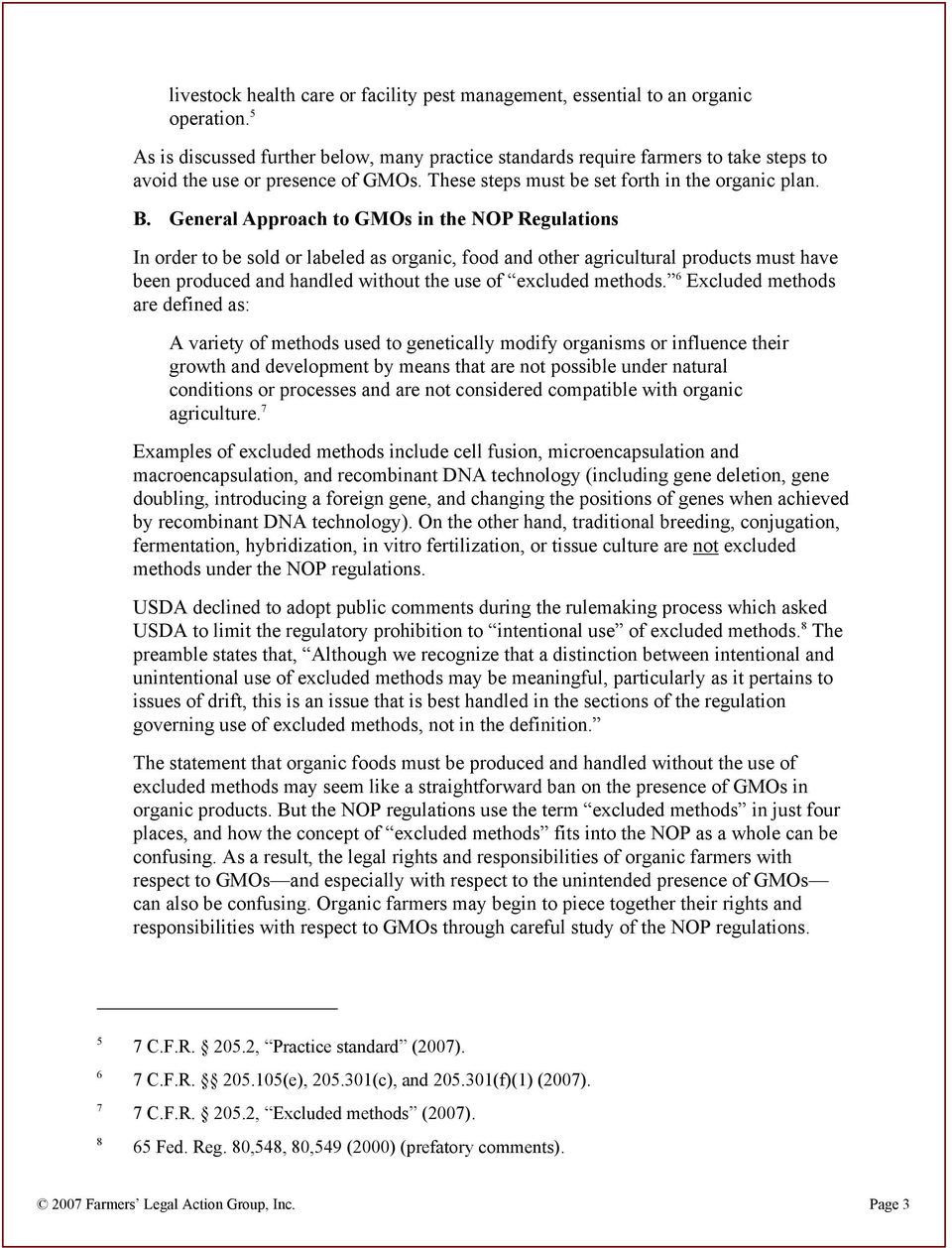
6 Provisions Related to GMOs in the NOP Regulations Regulation refers to excluded methods 1. Definition Prohibition on Use (e) (f) Regulation refers to or (e) Regulation is otherwise relevant (c) 3. Three-Year Transition for Land (b) 4. Steps to Prevent Unintended Application to Land (Buffers) (c) 5. Notify Certifier of Drift (f) 6. Avoid Contamination in Handling (c) Residue Testing (b) 8. No Variances Allowed for Use C. NOP Regulations and GMOs Sections of the NOP regulations where issues related to GMOs are addressed are discussed below. 1. Definition of Excluded Methods The NOP definition of the term excluded methods is found in 7 C.F.R As stated above, that definition is A variety of methods used to genetically modify organisms or influence their growth and development by means that are not possible under natural conditions or processes and are not considered compatible with organic agriculture. 2. Prohibition on Use of Excluded Methods The second use of the term excluded methods in the NOP regulations is the most important one. Section (e) of the regulations states that to be sold or labeled as 100 percent organic, organic, or made with organic (specified ingredients or food group(s)), a product must be produced and handled without the use of Page Farmers Legal Action Group, Inc.
7 excluded methods. 9 The preamble to the final rule states that (e) is intended to establish a comprehensive prohibition on the use of excluded methods in all areas of the production and handling of organic products. 10 USDA further stated that adding this section to the final rule allowed USDA to eliminate most of the individual references to the prohibition on the use of excluded methods. 11 The third use of the term excluded methods in the NOP regulations occurs in 7 C.F.R (f)(1). This states that all products labeled as 100 percent organic or organic, and all ingredients identified as organic in the ingredient statement of any product must not be produced using excluded methods, in accordance with (e). Even non-organic ingredients in products, sold, labeled, or represented as made with organic (specified ingredients or food group(s)) may not be produced using prohibited practices, including excluded methods. 12 An important principle in the NOP is the idea that natural substances are generally allowed for use, while synthetic substances are generally prohibited for use. 13 A prohibited substance is defined as, A substance the use of which in any aspect of organic production or handling is prohibited or not provided for in the Act or the regulations. 14 The term excluded methods addresses practices that are not allowed for use in organic farming, while the term prohibited substances addresses substances not allowed for use in organic farming. However, (b) seems to refer to all items listed in , including excluded methods, as prohibited substances. It can be difficult to understand the relationship between excluded methods and prohibited substances in the NOP regulations. Yet organic farmers, certifiers, and USDA all seem to agree that the restrictions on prohibited substances (such as the three-year transition period) also apply to GMOs. 9 7 C.F.R (e) (2007). The regulations create a limited exception to allow the consideration of GMO vaccines for placement on the National List of Allowed and Prohibited Substances Fed. Reg. 80,548, 80,554, 80,613 (2000) (prefatory comments). 65 Fed. Reg. 80,548, 80,554 (2000) (prefatory comments) C.F.R (c) (2007). The term prohibited practices is not defined, but use of excluded methods, ionizing radiation, and sewage sludge are all referenced. 13 The National List is a list of exceptions to the general rule that is, it includes lists of natural substances that are not allowed, and synthetic substances that are allowed for use in organic crop and livestock production, at least under specified conditions. 7 C.F.R et seq. (2007). To be used in organic handling, every nonorganic substance must appear on the National List, whether the substance is considered to be natural or synthetic C.F.R , Prohibited substance (2007) Farmers Legal Action Group, Inc. Page 5
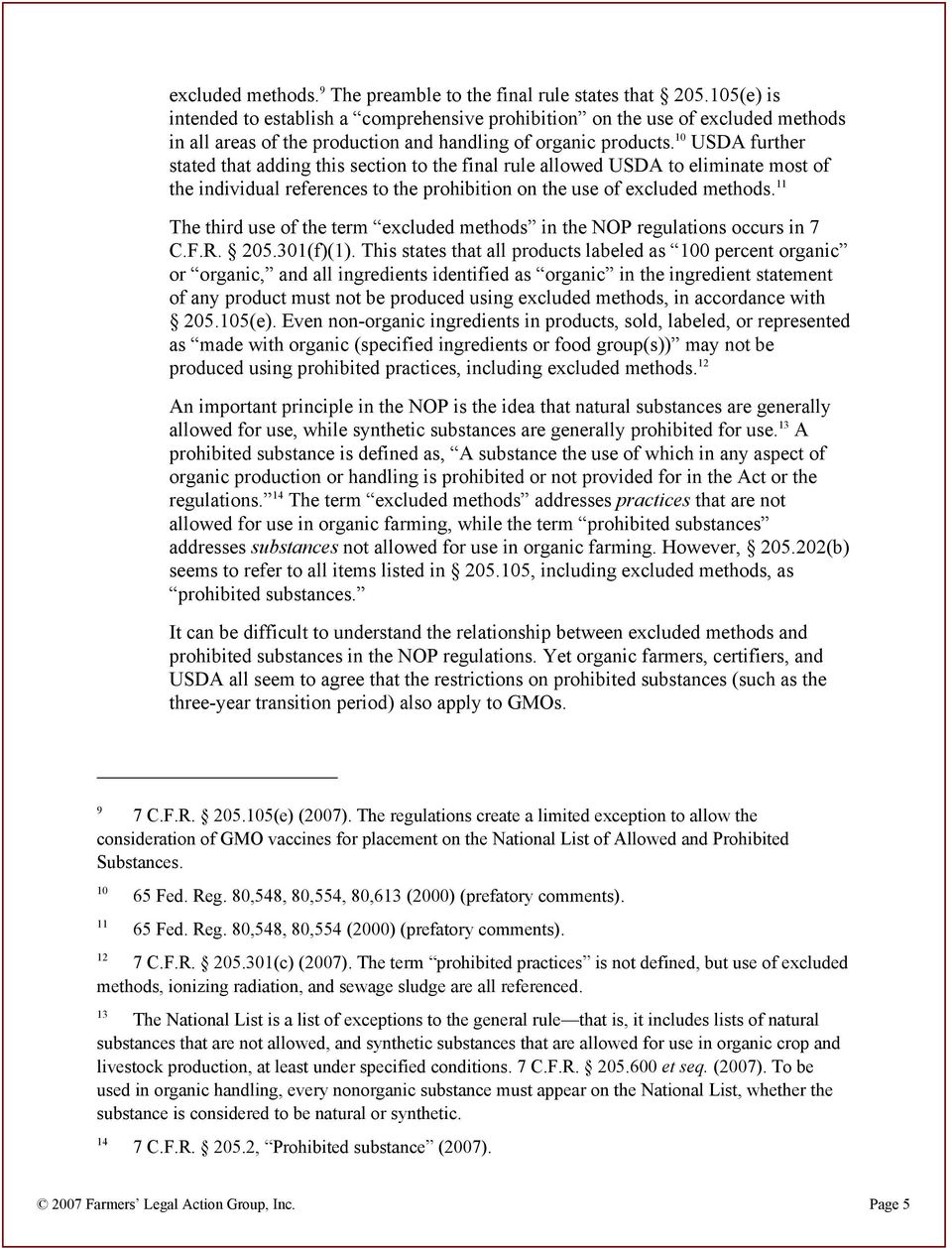
8 Excluded method Any of a variety of methods used to genetically modify organisms or influence their growth and development by means that are not possible under natural conditions or processes and are not considered compatible with organic agriculture. Prohibited substance A substance the use of which in any aspect of organic production or handling is prohibited or not provided for in the Act or the regulations. As discussed earlier, USDA declined to adopt public comments during the rulemaking process which asked USDA to add the products of excluded methods (that is, GMOs) to the definition of excluded methods. The preamble states that, We have not accepted comments that requested adding the products of excluded methods to the definition. The emphasis and basis of these standards is on process, not product. We have specifically structured the provisions relating to excluded methods to refer to the use of methods. Including the products of excluded methods in the definition would not be consistent with this approach to organic standards as a process-based system. For the same reason, we have retained the term, excluded methods, to reinforce that process-based approach. 15 USDA s position in the preamble presents a difficulty, however, when individual sections of the organic regulations address application of prohibited substances, but do not specifically address products of excluded methods. If GMOs are the products of excluded methods, but USDA s emphasis on process means that GMOs themselves are not directly covered by the prohibition on use of excluded methods in (e), organic farmers and certifiers might reasonably ask how the organic regulations make provisions such as the three-year transition period applicable to use of GMOs. The distinction between process and product is not nearly as sharp as the preamble to the final rule suggests. This article suggests that one way to read the regulations is to conclude that GMOs themselves are prohibited substances within the meaning of the organic regulations. The support for this reading is to note that the definition of excluded methods essentially states that genetic engineering is not considered compatible with organic agriculture. Comparing this to the definition of prohibited substance, one sees that a prohibited substance is one that is prohibited or not provided for in OFPA or the organic regulations. GMOs are certainly not provided for in the organic regulations; indeed, the use of excluded methods is considered incompatible with organic agriculture. Arguably, therefore, use of GMOs is inherently the use of an excluded method Fed. Reg. 80,548, 80,549 (2000) (prefatory comments). Page Farmers Legal Action Group, Inc.
9 The argument put forth in these materials is not an official government interpretation. 16 But this argument certainly seems like a reasonable interpretation. If it is accepted, this argument makes it easier for organic farmers and certifiers to understand how the provisions which apply to use of prohibited substances also apply to use of GMOs. 3. Transition Period for Land Any field or farm parcel from which harvested crops are intended to be sold, labeled, or represented as organic must Have had no prohibited substances, as listed in , applied to it for a period of 3 years immediately preceding harvest of the crop. 17 Similar language is used to describe the requirements for the designated area from which an organic wild crop may be harvested. 18 An important principle in the NOP is the idea that natural substances generally are allowed for use, while synthetic substances are generally prohibited for use. 19 Because this section of the regulations does not simply refer to prohibited substances, but refers to prohibited substances as listed in , it is helpful to review the list from , which is made up of the following: (a) Synthetic substances and ingredients, except as included on the National List; (b) Nonsynthetic substances included on the National List ; (c) Nonagricultural substances used in or on processed products, except as included on the National List; (d) Nonorganic agricultural substances used in or on processed products, except as included on the National List; (e) Excluded methods, except for vaccines included on the National List, if any; (f) Ionizing radiation, as described in Food and Drug Administration regulation, 21 C.F.R ; and (g) Sewage sludge. 16 However, in response to the question, Are all products of genetic modification considered prohibited substances as defined in the federal regulations?, USDA replied that, All genetically modified practices or products are indeed considered prohibited, as cited in , the paragraph that describes excluded methods. See C.F.R (b) (2007). 7 C.F.R (a) (2007). 19 The National List is a list of exceptions to the general rule that is, it includes lists of natural substances that are not allowed and synthetic substances that are allowed for use in organic farming and handling, at least under certain conditions. 7 C.F.R et seq. (2007) Farmers Legal Action Group, Inc. Page 7

10 It seems likely that the reference to is intended to refer to excluded methods (or, arguably, the products of excluded methods), since they are included in the list in that section. This may appear somewhat inconsistent with the distinction USDA has made between process and product. The relationship between excluded methods and prohibited substances is discussed above. 4. Take Steps to Prevent Unintended Application Under (c), organic land also must: Have distinct, defined boundaries and buffer zones such as runoff diversions to prevent the unintended application of a prohibited substance to the crop or contact with a prohibited substance applied to adjoining land that is not under organic management. 20 This section does not include a specific reference to either excluded methods or to Once again, however, in light of the prohibition on the use of excluded methods and the argument that GMOs are prohibited substances, it seems clear that this provision also establishes a duty to take steps to prevent unintended application of GMOs. 21 The NOP regulations do not include definitions for apply or application. 5. Notify Certifier of Any Drift or Other Application of a Prohibited Substance A person seeking to receive or maintain organic certification must immediately notify the certifier concerning any application, including drift, of a prohibited substance to any field, production unit, site, facility, livestock, or product that is part of an operation. 22 Drift is defined as the physical movement of prohibited substances from the intended target site onto an organic operation or portion thereof. 23 In light of the prohibition on use of excluded methods and the argument that GMOs are prohibited substances, it seems clear that this provision also establishes a duty to report drift of GMOs. 6. Avoid Contamination in Handling A handler may not use excluded methods in or on agricultural products that are to be sold as organic. 24 In addition, the handler of an organic handling operation must implement measures necessary to (a) prevent the commingling of organic and 20 7 C.F.R (c) (2007). 21 The preamble to the final rule include a discussion of genetic drift that implicitly applies the requirements of (c). 65 Fed. Reg. 80,548, 80,5556 (2000) (prefatory comments) C.F.R (f)(1) (2007). 7 C.F.R , Drift (2007). 7 C.F.R (c)(1) (2007). Page Farmers Legal Action Group, Inc.
11 nonorganic products, and (b) protect organic products from contact with prohibited substances. 25 The question of whether the handling restrictions apply to farmers is somewhat confusing. The regulations define handle as to sell, process, or package agricultural products, except such term shall not include the sale, transportation, or delivery of crops or livestock by the producer thereof to a handler. 26 Yet the regulations define handler as any person engaged in the business of handling agricultural products, including producers who handle crops or livestock of their own production, except such term shall not include final retailers of agricultural products that do not process agricultural products. 27 It is hard to reconcile a provision that does not include the activities of farmers in the definition of handle, but does include the activities of farmers in the definition of handler. But considered together with the prohibition on the use of excluded methods in organic production and handling, it becomes clear that whether a farmer s activities after harvest are considered to be production practices or handling practices, the farmer must continue to avoid the use of excluded methods, and to prevent the commingling of organic and nonorganic products. 7. Certifier or Others May Test When there is reason to believe that an agricultural input used on an organic farm or an agricultural product to be sold as organic has been produced using excluded methods or has come into contact with a prohibited substance, then the certifier, USDA, or state organic program (if applicable) may require testing of the input or a sample of the agricultural product. 28 Testing may be required before or after harvest. However, the farmer may not be required to pay for the testing. Rather, the test must be at the expense of the certifying agent or state organic program who orders the test. 29 When they apply for accreditation from USDA, certifying agents must submit the procedures for sampling and residue testing that they will follow C.F.R (2007). 7 C.F.R , Handle (2007). 7 C.F.R , Handler (2007) C.F.R (b) (2007). Compare 7 U.S.C. 6506(a)(6), which states that a program established under OFPA must require periodic residue testing by certifying agents of agricultural products produced on organic farms to determine whether they contain any pesticide or other nonorganic residue C.F.R (b) (2007). USDA has taken the position that residue testing expenses are a cost of doing business for the certifier. 65 Fed. Reg. 80,548, 80,628 (2000) (prefatory comments). The section does not address who must pay for testing if it is ordered by USDA C.F.R (b)(6) (2007) Farmers Legal Action Group, Inc. Page 9

12 The certifier must maintain sample integrity, and the testing must be performed in an accredited laboratory. 31 The certifier must provide the certification applicant with a copy of the test results for any sample taken by an inspector. 32 In many instances, testing is part of an ongoing compliance investigation. But in cases where the testing is not part of an ongoing investigation, results of all analyses and tests performed by the certifying agent are to be made available to the public No Variances Allowed The fourth and final provision of the NOP regulations that refers directly to is This section sets forth circumstances under which USDA may establish temporary variances from NOP crop practice standards, livestock practice standards, and handling practice standards. Section (e) states that temporary variances will not be granted for any practice, material, or procedure prohibited under Thus, a temporary variance may not be granted to allow the use of excluded methods or prohibited substances. D. NOP Regulations Do Not Bar Sale of Goods Simply Because GMOs Are Present Another important NOP regulatory section related to GMOs is one that does not directly address excluded methods or GMOs at all. Section states that: When residue testing detects prohibited substances at levels that are greater than 5 percent of the Environmental Protection Agency s tolerance for the specific residue detected or unavoidable residual environmental contamination, the agricultural product must not be sold, labeled, or represented as organically produced. The [Agricultural Marketing Service] Administrator, the applicable State organic program s governing State official, or the certifying agent may conduct an investigation of the certified operation to determine the cause of the prohibited substance. This section is striking because it sets forth absolute limits upon the presence of prohibited substances, without an inquiry into how they got there, contrary to USDA s suggestion that the NOP is entirely process-based. It sets forth two measures for when an agricultural product may not be sold as organic because of the presence of prohibited substances. First, an agricultural product may not be sold as organic if it contains detectable residues at greater than a small percentage of the EPA tolerance for a specific prohibited substance. Second, an agricultural product may not be sold as organic if it contains detectable residues at a level greater than that determined to be simply unavoidable in the environment. It appears that this section does not apply to GMOs, as is discussed further below C.F.R (b) (2007). 7 C.F.R (b)(3) (2007). 7 C.F.R (d)(2) (2007). Page Farmers Legal Action Group, Inc.

13 1. Tolerances for GMOs Have Not Been Established Section relates to tolerances for chemical residues; it does not directly mention excluded methods or GMOs. This article considers the possibility that the section could apply to GMOs because they are prohibited substances. A tolerance is defined under the NOP regulations as the maximum legal level of a pesticide chemical residue in or on a raw or processed agricultural commodity or processed food. 34 The Environmental Protection Agency (EPA) has authority to regulate pesticides under the Federal Insecticide, Fungicide, and Rodenticide Act (FIFRA). 35 For pesticides and plant-incorporated protectants regulated by the EPA, the first step is generally for the manufacturer to register the substance with the EPA. 36 A plant-incorporated protectant is a pesticidal substance that is intended to be produced and used in a living plant and the genetic material necessary for production of such a pesticidal substance. 37 In general, after a pesticide or plantincorporated protectant is registered with the EPA, either a tolerance or an exemption from the need for a tolerance will be established. 38 While a number of substances produced through the use of genetic engineering have been registered with the EPA, it does not appear that the EPA has set a tolerance for any GMO substances as of this writing. 39 Thus, there are no EPA tolerance to which the NOP may refer for its own limit for GMO residues in organic agricultural products. In effect, the NOP limit is five percent of the EPA tolerance, if any. Although section refers specifically to tolerances established by EPA, in the absence of an EPA tolerance for GMOs, there was some discussion during the NOP rulemaking whether USDA would itself set a maximum legal level for GMOs in organic production and handling. Some commenters had suggested that a tolerance for GMOs should be established, but this proposal was controversial because of the strong consumer expectation that organic food should be GMO-free. USDA did not establish a maximum legal level for GMOs in the final rule, yet the preamble to the final rule notes that the NOP regulations do not set a zero tolerance standard C.F.R , Tolerance (2007). 7 U.S.C. 136 et seq. 40 C.F.R. pt. 152 (2007). 40 C.F.R , Plant-incorporated protectant (2007). 40 C.F.R. pt. 180 (2007) C.F.R. pt. 180 (2007). The glossary to 40 C.F.R. pt. 180 is an alphabetical listing of pesticide chemicals for which a tolerance has been set by EPA, or for which an exemption has been granted. One group of substances used in genetic engineering which are registered with EPA but exempt from establishing a tolerance is bacillus thuringiensis, or bt, proteins. Many of these exemptions, including those for bt proteins, have been relocated from 40 C.F.R. pt. 180, and will be codified in 40 C.F.R. pt. 174 in Fed. Reg. 20,431 (2007) Farmers Legal Action Group, Inc. Page 11

14 for the products of excluded methods. 40 This requires a conclusion that current NOP regulations do not require that food be GMO-free in order to be certified organic. The preamble to the final rule states that the presence of the products of excluded methods acts as a warning indicator to the certifying agent, but does not necessarily indicate a violation of the NOP regulations. 41 That is, As long as an organic operation has not used excluded methods and takes reasonable steps to avoid contact with the products of excluded methods as detailed in their approved organic system plan, the unintentional presence of the products of excluded methods should not affect the status of an organic product or operation. 42 Therefore does not, in practice, exclude crops or products from sale as organic based solely upon presence of GMOs. However, organic farmers who market their crops internationally should be aware that other countries may have established specific GMO tolerances, and these tolerances may be subject to change. 2. Unavoidable Residual Environmental Contamination and GMOs The meaning of the term unavoidable residual environmental contamination may be somewhat unclear to organic farmers and potential organic farmers, and with good reason. The NOP regulations define unavoidable residual environmental contamination as background levels of naturally occurring or synthetic chemicals that are present in the soil or present in organically produced agricultural products. 43 The definition further notes that unavoidable residual environmental contamination is below established tolerances. If there is no established tolerance for a given substance, it would seem there could be no point at which a certifier or USDA could determine that unavoidable residual environmental contamination had been exceeded. However, USDA asserted in the preamble to the final rule that it intended to establish levels of unavoidable residual environmental contamination for prohibited substances. 44 USDA went on to state that these levels would represent limits at which USDA could take compliance action to suspend the use of a contaminated area for organic agricultural production. 45 USDA further stated that, in the interim, unavoidable residual environmental contamination would be defined as the Food and Drug Administration s action levels for poisonous or deleterious substances in Fed. Reg. 80,548, 80,632 (2000) (prefatory comments). 65 Fed. Reg. 80,548, 80,628 (2000) (prefatory comments). 65 Fed. Reg. 80,548, 80,556 (2000) (prefatory comments). 7 C.F.R , Unavoidable residual environmental contamination (2007). 65 Fed. Reg. 80,548, 80,629 (2000) (prefatory comments). 65 Fed. Reg. 80,548, 80,629 (2000) (prefatory comments). Page Farmers Legal Action Group, Inc.
15 human or animal feed. 46 Research for this article did not discover any action taken by USDA since issuance of the final rule in 2000 to establish unavoidable residual environmental contamination levels. It is unclear what effect incorporating action levels already enforced by the FDA into the NOP standards would have on organic farmers. Moreover, it is doubtful whether a standard referenced only in the preamble to the final rule and not in the regulation itself could be enforced against an organic farmer as a part of organic certification standards, since the preamble does not have the force and effect of law. Therefore, until tolerance levels are established in the NOP regulations for unavoidable residual environmental contamination, it seems that an organic farmer could argue that exceeding background levels of unavoidable residual environmental contamination is not a lawful basis for excluding organic products from sale or suspending or revoking certification, because no background levels have been established through the rulemaking process. II. The Organic Plan and GMOs A farmer applying for organic certification must include an organic system plan. 47 Organic farmers should address in their organic system plans the requirements that relate to the use of GMOs discussed above. 48 Most certifying agents use application forms designed to serve as the organic system plan when completed by organic farmers and handlers. 49 Even farmers whose certifying agents do not provide a detailed application, or farmers who have not yet chosen a certifying agent, need not design their organic system plan entirely on their own. One valuable resource for organic farmers and farmers transitioning to organic production is ATTRA, the National Sustainable Agriculture Information Service, which has prepared numerous publications for organic farmers, including sample worksheets that organic farmers may incorporate into their organic plans. 50 Farmers should be sure to address any unique or unusual aspects of their farming operation in their organic plan Fed. Reg. 80,548, 80,629 (2000) (prefatory comments). The FDA s action levels for poisonous or deleterious substances in human or animal feed are set forth at 21 C.F.R. pt. 109 (2007) C.F.R (a) (2007). 48 Failure to create a GMO drift management plan has been identified as one of the most common mistakes made by farmers who apply for organic certification. Common Mistakes Made by Organic Certification Applicants, Midwest Organic and Sustainable Education Service (September 2006), available at 49 George Kuepper, Holly Born, and Lance Gegner, Organic System Plan (OSP) Templates for Certifiers (2007), available at Other helpful documents from ATTRA include Ann Baier, Preparing for an Organic Inspection: Steps and Checklists (2005), and National Organic Program: Compliance Checklist for Producers (2003). 50 ATTRA publications about organic production may be found at ATTRA s general Web site is Farmers may 2007 Farmers Legal Action Group, Inc. Page 13

16 Communicate with Your Certifier Certifying agents can be good resources for organic farmers. Certifiers may provide information to farmers that will help enable them to comply with NOP regulations, though certifiers may not give advice or consult with farmers about how to overcome identified barriers to certification. 51 Because some NOP regulations require certifiers to exercise judgment, it is often a good practice for farmers to check with their certifiers when in doubt about preparing, implementing, or changing the organic plans. Farmers should be sure to ask for written answers from their certifiers. Getting it in writing helps both farmers and certifiers by creating a record that both parties can refer back to later. It can also help farmers and certifiers discover if there has been a misunderstanding or miscommunication. Farmers should be aware, however, that if the certifier provides mistaken information about the organic standards and the farmer should have known the information was incorrect, the farmer may be held responsible for any failure to comply with organic requirements. With respect to GMOs, an organic system plan should document the steps taken by the farmer to minimize the risk of contamination, which may arise from seed impurities, wind- or insect-borne cross-pollination, volunteer plants, and harvest and handling practices that fail to keep organic products separate from nonorganic products. 53 Organic farmers who develop, follow, and document that they have followed an approved organic plan should be in a good position to defend their organic certification if challenged. The discussion below shows how each of the six elements of the organic system plan can be used to demonstrate and achieve compliance with NOP regulations related to GMOs. A. Practices and Procedures The first element of an organic system plan is a description of practices and procedures to be performed and maintained, including how often they will be performed. The preamble to the final NOP rule states that practices are tangible production and handling techniques, including methods used and measures taken. 54 The preamble describes also call ATTRA with questions or to request publications by mail. ATTRA s telephone number is ; Spanish speakers may call C.F.R (a)(8), (a)(11)(iv) (2007). 53 Jim Riddle, A Plan for Co-Existence: Best Management Practices for Producers of GMO and non-gmo Crops (January 2004), available at Fed. Reg. 80,548, 80,558 (2000) (prefatory comments). Page Farmers Legal Action Group, Inc.
17 procedures as the decision-making process established for selecting appropriate practices and materials for use in the organic farming operation. As discussed above, there is a three-year period before farmland may be considered organic, during which no excluded methods may have been used. As a consequence, land use history or field history sheets are an essential part of an organic plan. 55 Farmers should discuss with their certifiers the documentation needed in the organic plan to demonstrate that the three-year transition period has been completed. An organic plan that takes GMO risk management into account will include a description of practices intended to avoid or reduce the risk of GMO contamination. Again, the entire farming process from planting to harvesting, storing, transporting, and marketing the crop should be considered. 56 For example, organic farmers might choose a crop rotation that avoids planting a susceptible crop in a field adjoining a neighbor s GMO crop, or they might plan to plant earlier or later than the neighbor in an effort to avoid cross-pollination. 57 Hiring custom combining at harvest time is a potential risk for accidental contamination. 58 Farmers should address what practices and procedures they will follow to ensure use of equipment free of GMOs in their organic plan. 59 B. Production and Handling Inputs The second element in an organic system plan is a list of each substance to be used as a production input, indicating its composition, source, where it will be used, and documentation of commercial availability, if a nonorganic input is used. In general, organic farmers must use organic production inputs. They should list production inputs to be used on the farm, and steps they will take to avoid use of GMO production inputs in their organic plans George Kuepper, Holly Born, and Lance Gegner, Organic System Plan (OSP) Templates for Certifiers (2007), available at 56 For a list of suggested steps, see David Moeller and Michael Sligh, FARMERS GUIDE TO GMOS at (2004), available at FGtoGMOs2004.pdf. 57 Jim Riddle, A Plan for Co-Existence: Best Management Practices for Producers of GMO and non-gmo Crops (January 2004), available at 58 Dale Monson, GMOs in Agricultural Inputs Pose Risks to Organic, Non-GMO Farms, The Organic & Non-GMO Report (May 2006), available at 59 George Kuepper, Holly Born, and Lance Gegner, Organic System Plan (OSP) Templates for Certifiers at (2007), available at George Kuepper and Lisa Cone, Organic Field Crops Documentation Forms at 1P and 1Q (2003). 60 For examples of ways to do this, see George Kuepper et al., Forms, Documents, and Sample Letters for Organic Producers (2005), available at Crop farmers may want to review George Kuepper and Lisa Cone, Organic Field Crops Documentation Forms (2003). Livestock producers might want to review George Kuepper, et al., Organic Livestock Documentation Forms (2003) Farmers Legal Action Group, Inc. Page 15
18 1. Seed Selection In general, organic farmers must use organically grown seeds, annual seedlings, and planting stock. 61 This requirement applies to crops grown for human consumption and to crops grown for livestock feed. A short list of exceptions applies to this requirement. a. Finding Organic Seed Many certifying agents provide a list of organic seed companies upon request, or post such a list on their Web site. 62 A searchable list is available on the Internet from ATTRA, the national sustainable agriculture information service. 63 The Organic Material Review Institute (OMRI) also maintains a database of organic seeds on its Web site. 64 Farmers should ask for documentation of their seed supplier s organic certification. Organic inspectors or certifiers may ask farmers to show them seed labels, seed packaging, or seed invoices. 65 The NOP regulations regarding organic seed selection are somewhat controversial. On one hand, use of organic seed is necessary to have completely organic production. And organic seed varieties may address the particular needs of organic farmers such as low input requirements, tolerance of drought and other weather extremes, season extension, crop quality, and nutritional capacity. 66 On the other hand, organic seed production is still in its early stages and obtaining sufficient quantities, adequate quality, desired varieties, and purity is still a challenge for organic farmers. 67 Many advocates of organic 61 7 C.F.R (a) (2007). 62 See, for example, on the Web site of MOSA, the Midwest Organic Services Association The general ATTRA Web site is Jim Riddle, To Plant or Not to Plant (February 2, 2005), available at 66 Matthew Dillon, NOP Rule Seed Allowances Help Farmers, But Make Bigger Seed Business Investment More Risky (March 15, 2007), available at Dillon is the Executive Director of the Organic Seed Alliance, 67 Margaret Mellon and Jane Rissler, Gone to Seed: Transgenic Contaminants in the Traditional Seed Supply (Union of Concerned Scientists: 2004), available at Page Farmers Legal Action Group, Inc.
19 farming have argued for greater public investment in organic research, including organic seed development. 68 b. Exceptions to the Organic Seed Requirement An organic farmer is relieved from the requirement to use organic seed only if an equivalent organically produced seed variety is not commercially available. 69 Commercial availability is defined as the ability to obtain a production input in an appropriate form, quality, or quantity to fulfill an essential function in a system of organic production or handling, as determined by the certifying agent in the course of reviewing the organic plan. 70 i. Nonorganic, Untreated Seed and Planting Stock If an equivalent organically produced seed variety is not commercially available, nonorganically produced untreated seeds and planting stock may be used to produce an organic crop. 71 The NOP regulations do not include a definition of untreated seed. However, the preamble to the final rule indicates that untreated seed is seed that has not been treated with substances that appear on the National List. 72 Thus, untreated seed has not been treated with any of the following: allowed synthetic substances, prohibited synthetic substances, or prohibited natural substances. If nonorganic seed will be used, the farmer should discuss with the certifier the documentation needed in the organic plan to demonstrate the unavailability of appropriate organic seed. 73 Many certifiers require documentation that the farmer contacted at least three sources of organic 68 Testimony of Mark Lipson, Review of Economic Impacts of Production, Processing, and Marketing of Organic Agricultural Products, U.S. House of Representatives Committee on Agriculture, Subcommittee on Horticulture and Organic Agriculture (Washington, DC, April 18, 2007); available at Lipson is the Public Policy Director of the Organic Farming Research Foundation, See also Michael Sligh and Laura Lauffer, editors, Summit Proceedings: Summit on Seeds and Breeds for 21st Agriculture (September 6-8, 2003), available from the Rural Advancement Foundation International USA, at C.F.R (a) (2007). 7 C.F.R , Commercially available (2007) C.F.R (a)(1) (2007). However, organically produced seed must be used for the production of edible sprouts Fed. Reg. 80,548, 80,559 (2000) (prefatory comments). 73 A sample may be found in George Kuepper and Lisa Cone, Organic Field Crops Documentation Forms at 1D (2003), available at Farmers Legal Action Group, Inc. Page 17

20 seed in an attempt to obtain organic seed. 74 Farmers may wish to record in the organic plan the reason a particular variety of seed is preferred, even if not available as organic seed. Certifiers may also require a statement that nonorganic seed to be used is non-gmo. Some seed suppliers include a non-gmo pledge, or Safe Seed Pledge, in their catalogs. The Non-GMO Sourcebook is a directory which includes information about non-gmo seed suppliers. 75 ii. Nonorganic Seed and Planting Stock Treated with Allowed Synthetic Substances If neither an equivalent organically produced variety nor an untreated nonorganic variety is commercially available, nonorganically produced treated seeds and planting stock may be used to produce an organic crop. 76 A treated seed is one that has been treated with an allowed synthetic substance. 77 Seed that has been treated with a synthetic substance not included on the National List, or treated with a prohibited natural substance, must not be used on an organic farming operation. iii. Nonorganically Produced Annual Seedlings Nonorganically produced annual seedlings may be used to produce an organic crop when a temporary variance has been granted because of natural disaster. 78 A temporary variance may be granted by the Administrator of USDA s Agricultural Marketing Service due to damage caused by drought, wind, flood, excessive moisture, hail, tornado, earthquake, fire, or other business interruption. 79 Temporary variances will not be granted to allow use of GMOs. 80 iv. Nonorganically Produced Planting Stock Used to Produce a Perennial Crop Nonorganically produced planting stock used to produce a perennial crop may be sold, labeled, or represented as organically produced only after the 74 Jim Riddle, To Plant or Not to Plant (February 2, 2005), available at For more information on the Non-GMO Sourcebook, see 7 C.F.R (a)(2) (2007). 65 Fed. Reg. 80,548, 80,559 (2000) (prefatory comments). 7 C.F.R (a)(3) (2007). 7 C.F.R (a)(2) (2007). 7 C.F.R (e), (e) (2007). Page Farmers Legal Action Group, Inc.
21 planting stock has been maintained under a system of organic management for a period of no less than one year. 81 v. When Use of Prohibited Substances Is Required by Plant Health Regulations Seeds, annual seedlings, and planting stock treated with prohibited substances may be used to produce an organic crop when the application of the materials is a requirement of federal or state plant health regulations. 82 c. Documenting Seed Use in the Organic Plan The organic plan should indicate whether seeds and planting stock are certified organic, untreated nonorganic, or treated nonorganic. 83 If seeds are treated, the organic plan should identify the substance used to treat the seed. d. Unresolved Questions Related to the Organic Seed Requirement The prohibition on the use of excluded methods in plainly applies to bar the use of GMO seeds, yet a few difficult questions may arise in this context. For example, an organic farmer may be a producer of organic seeds. If an organic seed producer suffers drift, so that GMOs are present in the seed crop produced, but the producer s certifier concludes that the producer is in compliance with NOP requirements and may retain organic certification, may the producer sell the seed as organic? Must the seed producer disclose the presence of GMOs? May an organic farmer purchase the certified organic seeds and use them in his or her organic farming operation (and does whether this counts as use of excluded methods depend upon whether the organic farmer knows of the presence of GMOs?) An organic farmer who does not sell seed commercially, but who customarily saves his or her own seed for use in the following year, may face similar questions following a GMO contamination event. 2. Crop Input Selection In addition to seed, all other inputs used on the farming operation must also be free from GMOs. 84 The organic system plan should list other inputs to be used, and identify their sources. 85 Farmers should ask their suppliers for documentation of the 81 7 C.F.R (a)(4) (2007) C.F.R (a)(5) (2007). 83 A sample may be found in George Kuepper and Lisa Cone, Organic Field Crops Documentation Forms (2003) at 1C, available at C.F.R (e) (2007). 85 A sample may be found in George Kuepper and Lisa Cone, Organic Field Crops Documentation Forms at 1B (2003), available at Farmers Legal Action Group, Inc. Page 19
22 non-gmo status of inputs such as fertilizers, inoculants, microbial inputs, biocontrol products (such as Bt products), and supplements. 86 Farmers should not rely solely on the supplier s statement, but ask for their certifier s written agreement to use the inputs Livestock Operation Input Selection In general, organic livestock farmers must provide livestock with a total feed ration composed of organically produced agricultural products, including pasture and forage. 88 Thus, livestock feed must be produced without the use of excluded methods. If feed is purchased, farmers should obtain satisfactory documentation that the feed is organically produced, and include the documents in the organic plan. 89 Organic farmers should also include a record of inputs used in the course of providing health care to their livestock. 90 In particular, organic livestock producers should note the use of any vaccines. The NOP regulations include one possible exception to the prohibition on the use of excluded methods. The exception would be for vaccines, if a vaccine were approved for inclusion on the National List. 91 However, as of the writing of this article, no vaccines created through the use of excluded methods have been added to the National List. As a result, all vaccines identified for use in the organic plan must have been produced without the use of excluded methods. C. Monitoring Practices The third element of an organic system plan is a description of the monitoring practices and procedures to be performed and maintained, including how often they will be performed to verify that the plan is being effectively implemented. The organic plan should include a description of how the risk of GMO contamination will be monitored. 86 Dale Monson, GMOs in Agricultural Inputs Pose Risks to Organic, Non-GMO Farms, The Organic & Non-GMO Report (May 2006), available at 87 Common Mistakes Made by Organic Certification Applicants, Midwest Organic and Sustainable Education Service (September 2006), available at C.F.R (a) (2007). For current regulations governing feed during the transition of a herd of dairy animals to organic production, see 71 Fed. Reg. 32,803, (2007) (to be codified at 7 C.F.R (a)(2)(1)). 89 Samples may be found in George Kuepper et al., Organic Livestock Documentation Forms (2003), available at 90 Samples may be found in George Kuepper, et al., Organic Livestock Documentation Forms at 2L and 2S (2003), available at C.F.R (e) (2007). For a discussion of the reasoning behind the exception, see 65 Fed. Reg. 80,548, 80,554 (2000) (prefatory comments). Page Farmers Legal Action Group, Inc.
23 Farmers may use a variety of means to monitor for crop contamination. For example, they may use visual observation (of their own fields, buffers, and adjoining land), residue analysis, photographs, data about wind direction and speed, and GMO testing. 92 Organic farmers are not specifically required to test seeds or crops for GMOs. However, many organic farmers do perform tests in anticipation of review by their certifier, or because of buyer requirements. Farmers may test seeds before they plant them, or they may test crops either before or after they harvest them. Some experts recommend that farmers use an ISO-accredited laboratory for the tests. 93 If testing is a part of the organic plan, it will also be important to address how representative samples will be obtained. 94 D. Recordkeeping The fourth element of an organic system plan is a description of the recordkeeping system implemented. An organic farm must maintain records concerning production, harvesting, and handling of agricultural products sold, labeled, or represented as 100 percent organic, organic, or made with organic (specified ingredients or food group(s)). 95 The records must meet all of the following requirements: 96 Be adapted to the certified operation s particular business; Fully disclose all activities and transactions of the certified operation in sufficient detail as to be readily understood and audited; Be maintained for at least five years; and Be sufficient to demonstrate compliance with OFPA and the NOP regulations. Detailed and well-organized records regarding an organic farmer s efforts to avoid GMO contamination, as well as records of any GMO contamination events that do occur, may be crucial to establishing the farmer s legal rights and responsibilities. 97 The preamble to the final rule included a lengthy list of examples of records that might be used to demonstrate compliance with organic requirements. 98 As noted above, the 92 George Kuepper, Holly Born, and Lance Gegner, Organic System Plan (OSP) Templates for Certifiers at 13 (2007), available at 93 The 2006 Non-GMO Sourcebook at 73 (2006). The Grain Inspection Packers and Stockyards Administration offers a voluntary Proficiency Program to improve the reliability of testing for GMOs in grains and oilseeds. For more information, see GIPSA Directive (Feb. 7, 2002), available at archive.gipsa.usda.gov/reference-library/directives/ pdf. 94 Jason Koenfal and Lawrence Busch, Survey Finds Standards, Testing, IP, and Certification Critical for Non-GMO Production, The Organic & Non-GMO Report (October 2006) C.F.R (a) (2007). 7 C.F.R (b) (2007). 97 For helpful suggestions on recordkeeping with respect to GMOs, see Jim Riddle, A Plan for Co- Existence: Best Management Practices for Producers of GMO and non-gmo Crops (January 2004), available at Farmers Legal Action Group, Inc. Page 21
24 application provided by most certifying agents will assist with recordkeeping. Also, numerous publications from ATTRA may also be helpful in complying with recordkeeping obligations. 99 In the end, farmers must use their own judgment about which recordkeeping system to use to demonstrate organic compliance on their farming operation, with the approval of their certifying agent. 100 The certified operation must make records of its organic practices available for inspection and copying during normal business hours by the certifier, USDA, and the state organic program, if applicable The examples of records identified in the preamble to the final rule include: application and supporting documents for certification; organic system plan and supporting documents; purchased inputs, including seeds, transplants, livestock, and substances (fertilizers, pesticides, and veterinary biologics consistent with the livestock provisions), cash purchase receipts, receiving manifests (bills of lading), receiving tickets, and purchase invoices; field records (planting, inputs, cultivation, and harvest); storage records (bin register, cooler log); livestock records, including feed (cash purchase receipts, receiving manifests (bills of lading), receiving tickets, purchase invoices, copies of grower certificates), breeding records (calendar, chart, notebook, veterinary documents), purchased animals documentation (cash purchase receipts, receiving manifests (bills of lading), receiving tickets, purchase invoices, copies of grower certificates), herd health records (calendar, notebook, card file, veterinary records), and input records (cash purchase receipts, written records, labels); producer invoice; producer contract; receiving manifests (bills of lading); transaction certificate; producer certificate; handler certificate; weigh tickets, receipts, and tags; receiving tickets; cash purchase receipts; raw product inventory reports and records; finished product inventory reports and records; daily inventories by lot; records as to reconditioning, shrinkage, and dumping; production reports and records; shipping reports; shipping manifests (bills of lading); paid freight and other bills; car manifests; broker s contracts; broker s statements; warehouse receipts; inspection certificates; residue testing reports; soil and water testing reports; cash receipt journals; general ledgers and supporting documents; sales journals; accounts payable journals; accounts receivable journals; cash disbursement journals; purchase invoices; purchase journals; receiving tickets; producer and handler contracts; cash sales receipts; cash purchase journals; sales invoices, statements, journals, tickets, and receipts; account sales invoices; ledgers; financial statements; bank statements; records of deposit; canceled checks; check stubs; cash receipts; tax returns; accountant s or other work papers; agreements; contracts; purchase orders; confirmations and memorandums of sales; computer data; computer printouts; and compilations of data from the foregoing. 65 Fed. Reg. 80,548, 80,553 (2000) (prefatory comments). 99 ATTRA publications relating specifically to organic production may be found at See, for example, George Kuepper, Holly Born, and Lance Gegner, Organic System Plan (OSP) Templates for Certifiers at 18 (2007), available at Fed. Reg. 80,548, 80,556 (2000) (prefatory comments). 7 C.F.R (c) (2007). Page Farmers Legal Action Group, Inc.
25 E. Management and Physical Barriers to Prevent Contamination The fifth element of an organic system plan is a description of the management practices and physical barriers established to prevent commingling of organic and nonorganic products on a split operation and to prevent contact of organic production operations and products with prohibited substances. Commingling means physical contact between unpackaged organically produced and nonorganically produced agricultural products during production, processing, transportation, storage, or handling. 102 The preamble to the final rule indicates that this provision was intended primarily to address split operations, but the provision in OFPA that it is based upon refers to certification of entire farms as well as specific fields. 103 In any case, the requirement to prevent contact and commingling between organic farming operations and GMOs certainly applies to both split operations and exclusively organic farms, whether under this element of the organic system plan or the first element of the plan. 1. Split Operations Must Meet Certain Conditions Special challenges are posed for farmers with split operations, that is, farming operations that produce or handle both organic and nonorganic agricultural products. 104 Another term used is parallel production. Parallel production refers to growing the same crops conventionally or in transition to organic, as well as certified organic. 105 Specific fields of a split operation farm may be certified organic if all three of the following conditions are met: (a) the area to be certified has distinct, defined boundaries and buffer zones separating the land being operated organically from land that is not being operated organically; 106 (b) the farm operators maintain records of all organic operations separate from records relating to other operations and make such records (organic and nonorganic) available for inspection; 107 and (c) physical facilities, machinery, and management practices are established to prevent the possibility of mixing organic and nonorganic products or a C.F.R , Commingling (2007). There is an exception for the manufacture of a multiingredient product containing both types of ingredients Fed. Reg. 80,548, 80,559, 80,562 (2000) (prefatory comments). 7 U.S.C. 6506(b)(1) C.F.R , Split operation (2007). 105 See George Kuepper, Holly Born, and Lance Gegner, Organic System Plan (OSP) Templates for Certifiers at 13 (2007), available at See 7 C.F.R (a)(5) (2007). See 7 C.F.R (b)(1) and (2) (2007) Farmers Legal Action Group, Inc. Page 23
26 penetration of prohibited chemicals or other substances on the certified area. 108 Farmers should discuss with their certifiers the documentation needed in the organic plan, as well as records to be maintained throughout the year, to demonstrate that all required conditions are met for their split operation Use of Buffer Zones Required As discussed above, organic farm land must have distinct, defined boundaries and buffer zones, such as runoff diversions, to prevent the unintended application of a prohibited substance to the crop or contact with a prohibited substance applied to adjoining land that is not under organic management. 110 This rule applies both to entire farms and to fields farmed organically as part of a split operation. The NOP regulations do not specify precisely what is required to prevent unintended application of GMOs. For example, the regulatory definition of buffer zone states that a buffer zone is An area located between a certified production operation or portion of a production operation and an adjacent land area that is not maintained under organic management. A buffer zone must be sufficient in size or other features ([for example], windbreaks or a diversion ditch) to prevent the possibility of unintended contact by prohibited substances applied to adjacent land areas with an area that is part of a certified operation. 111 In general, when developing buffer zones and other measures to prevent contamination of organic crops, organic farmers should strive to develop an organic system plan that takes into account site-specific conditions (such as presence of GMO crops nearby, prevailing winds, and length of growing season), and should then seek the written approval of their certifying agents. Farmers should discuss with their certifiers the documentation needed in the organic plan to demonstrate that adequate buffer zones are present in the farming operation, and that the harvest from the buffer zone is kept separate from the organic crop See 7 C.F.R (a)(5) (2007). 109 See samples in George Kuepper and Lisa Cone, Organic Field Crops Documentation Forms at 1B (2003), available at For a sample recordkeeping format for greenhouses, see George Kuepper, Holly Born, and Lance Gegner, Organic System Plan (OSP) Templates for Certifiers at 4 (2007) C.F.R (c) (2007). 7 C.F.R , Buffer zone (2007). 112 See a sample Adjoining Land Use record in George Kuepper, Holly Born, and Lance Gegner, Organic System Plan (OSP) Templates for Certifiers at 13 (2007), available at Page Farmers Legal Action Group, Inc.
27 To the extent that buffer zones provide conservation benefits, such as wildlife habitat and prevention of soil erosion, organic farmers and farmers transitioning to organic farming methods may be eligible to receive assistance from federal conservation programs such as the Conservation Security Program, 113 the Environmental Quality Incentives Program, 114 and the Wildlife Habitat Incentives Program 115 to establish and maintain the buffer zones. 3. Current Status of Alfalfa and GMOs Alfalfa is an important crop for organic crop and livestock producers, whether in pasture or mechanically harvested. Organic farmers who have heard recent legal news regarding GMO alfalfa may have questions about how it affects their responsibilities under the NOP regulations. The Animal and Plant Health Inspection Service (APHIS) within USDA has authority to regulate the introduction and dissemination of plant pests, including organisms and products altered or produced through genetic engineering that are plant pests or are believed to be plant pests. 116 Monsanto submitted a petition to APHIS seeking a determination that Roundup Ready alfalfa does not present a plant pest risk, and therefore could be deregulated. In June, 2005, APHIS approved Monsanto s petition for deregulation of Roundup Ready alfalfa. A group of alfalfa farmers, family farm organizations, and consumer organizations challenged APHIS s decision to deregulate Roundup Ready without first conducting an environmental impact study (EIS). 117 In the lawsuit, APHIS asserted that the NOP regulations placed the burden to avoid contamination of organic crops upon organic farmers, and the presence of contamination would not necessarily constitute a violation of the NOP regulations. 118 See a sample Adjoining Land Use Verification form for neighbors who do not plant GMOs in George Kuepper, et al., Forms, Documents, and Sample Letters for Organic Producers at 5 (2005). See a sample Buffer Zone Harvest Record for Organic Operations in George Kuepper and Lisa Cone, Organic Field Crops Documentation Forms at 1H (2003) C.F.R. pt (2007) C.F.R. pt (2007). See also, FLAG s Is Your Farm EQIPed for Conservation?: A Farmers Guide to the Environmental Quality Incentives Program, available at C.F.R. pt. 636 (2007). 116 Plant Protection Act, 7 U.S.C et seq.; 7 C.F.R. pt. 340 (2007). A plant pest is any organisms which can directly or indirectly injure or cause disease or damage in or to any plants or plant parts, or any processed, manufactured, or other products of plants.7 C.F.R , Plant pest (2007). APHIS also has authority to regulate noxious weeds Geertson Seed Farms v. Johanns, 2007 U.S. Dist. LEXIS (N.D. Cal. 2007). Geertson Seed Farms v. Johanns, 2007 U.S. Dist. LEXIS at * 16 (N.D. Cal. 2007) Farmers Legal Action Group, Inc. Page 25
28 The judge ruled that the deregulation decision was improper, stating, First, the statement itself is equivocal; even APHIS is uncertain whether farmers can still label their products organic under the federal government s organic standards. 119 The judge ruled that the threat to the organic farmers choice not to grow or feed to their livestock genetically engineered alfalfa was an important concern which warranted an EIS. 120 An appeal of the judge s decision has been filed, but until the court of appeals rules, no more Roundup Ready alfalfa may be planted. 121 The court directed APHIS to take additional steps to reduce the risk of contamination for organic farmers and other alfalfa producers who choose not to use GMOs. 122 APHIS has created a page on its Web site that organic farmers may visit for general information about Roundup Ready alfalfa. 123 Or organic farmers may contact APHIS using a toll-free number, In order to receive information about Roundup Ready alfalfa planted near their farms or fields, callers must currently plant non-gmo alfalfa or plan to do so. Callers must also provide either the latitude and longitude coordinates or the mailing address of their farm or field where their alfalfa is or will be grown. APHIS will provide callers with the distance from the property they identify to the nearest five fields in the same or adjacent counties that have been planted with Roundup Ready seed, as that information has been provided to APHIS by dealers, distributors, and producers of Roundup Ready alfalfa. Callers will apparently not be given precise identifying information about the location of the Roundup Ready alfalfa plantings. It is unclear what organic farmers are expected to do with the information if they learn of nearby plantings of GMO alfalfa. 124 Certainly, organic alfalfa seed and hay producers must continue to comply with the NOP regulations and their organic system plans. As with all difficult questions in organic certification, organic alfalfa seed and hay producers are encouraged to communicate with their certifiers regarding any questions they may have Geertson Seed Farms v. Johanns, 2007 U.S. Dist. LEXIS at * 20 (N.D. Cal. 2007). Geertson Seed Farms v. Johanns, 2007 U.S. Dist. LEXIS at * (N.D. Cal. 2007). 121 Geertson Farms, Inc. v. Johanns, 2007 U.S. Dist. LEXIS at * 11 (N.D. Cal. 2007) (enjoining further planting of Roundup Ready alfalfa as of March 30, 2007) Geertson Farms, Inc. v. Johanns, 2007 U.S. Dist. LEXIS (N.D. Cal. 2007). See also 72 Fed. Reg. 43,222 (2007). 124 The case illustrates the paradox for organic farmers. The NOP regulations may not go beyond the scope of OFPA, and thus lack authority to regulate use of GMOs by farmers not seeking organic certification. But other federal agencies, such as APHIS and EPA, have viewed the NOP regulations as placing the burden to avoid contamination on organic farmers and excusing them from the need to act to prevent contamination of organic crops. Page Farmers Legal Action Group, Inc.
29 4. Harvest and Post-Harvest Practices In an organic system plan, farmers must identify the steps that will be taken to prevent contamination when they harvest, store, and transport their organic agricultural products. 125 a. Equipment Some experts have argued that seed contamination through accidental mixing in machinery is a bigger risk than pollen drift. 126 Organic farmers should document their procedures to ensure that organic and nonorganic crops do not commingle in equipment, particularly if the equipment used to harvest the crop is not owned by the farmer. 127 Most farmers establish and describe procedures for cleaning the equipment before each use. b. Storage Organic farmers must also ensure the organic integrity of packaging materials, storage containers, bins, bags, and containers. 128 Practices and procedures to prevent contact between organic products and nonorganic products should be documented in the organic system plan. 129 Storage units previously used for nonorganic crops, including GMO crops, must be thoroughly emptied and cleaned prior to use for organic crop storage. A storage unit register should be established to document use of the facility. Records should be maintained of storage unit cleaning, either on the storage unit register or on a separate cleaning report. c. Transportation Organic farmers who are responsible for transporting their agricultural products must take steps to prevent commingling during transport, and should document C.F.R (c)(1) (2007). 126 See Dale Monson, GMOs in Agricultural Inputs Pose Risks to Organic, Non-GMO Farms, The Organic & Non-GMO Report (May 2006), available at Dale Monson quotes Mary-Howell Martens, an organic farmer and feed mill operator in New York. 127 George Kuepper, Holly Born, and Lance Gegner, Organic System Plan (OSP) Templates for Certifiers at (2007), available at George Kuepper and Lisa Cone, Organic Field Crops Documentation Forms at 1P and 1Q (2003) C.F.R (2007). 129 George Kuepper, Holly Born, and Lance Gegner, Organic System Plan (OSP) Templates for Certifiers (2007) at 15-16, available at George Kuepper and Lisa Cone, Organic Field Crops Documentation Forms (2003) at 1H-1O Farmers Legal Action Group, Inc. Page 27
30 these steps in the organic plan. 130 Transport units, such as trucks, trailers, and shipping containers, previously used for shipping nonorganic crops, including GMO crops, must be thoroughly emptied and cleaned prior to use to transport organic crops and products. Records should be maintained of transport unit cleaning, either on the bill of lading or on a separate cleaning report, such as a clean truck affidavit. 5. Alerting Others to Organic Status May Reduce Risk As a practical matter, one step that farmers can take to substantially reduce the risk of contamination is communicating with nearby farming operations about their organic production practices. This communication can take a variety of forms, from letters sent to the neighboring farms to signs posted at farm boundary lines. What is a neighboring farm for these purposes may depend upon the crop that the organic farm is trying to protect from contamination, how likely that crop is to crosspollinate, how far the crop s pollen is likely to travel, and the amount and direction of wind in the area. These efforts should be documented in the organic system plan. 131 Copies of letters sent to neighbors should be retained. Sending a letter return receipt requested can provide evidence of the notice provided. F. Other Information Required by the Certifying Agent The sixth element of an organic system plan is any additional information deemed necessary by the certifying agent to evaluate the farmer s compliance with the regulations. This may include information related to unique or unusual aspects of a particular farming operation. III. Process When Certifying Agents Find a Violation of Organic Requirements, Including Violations Related to Use of Excluded Methods or Presence of GMOs As noted above, certifying agents have the authority to make organic certification decisions. Certifying agents may grant or deny organic certification to those who apply. Certifying agents or USDA may propose to suspend or revoke organic certification. Certifying agents and USDA must follow certain procedures when they believe a farmer is not in compliance with organic requirements. 130 George Kuepper, Holly Born, and Lance Gegner, Organic System Plan (OSP) Templates for Certifiers (2007) at 17, available at George Kuepper et al., Forms, Documents, and Sample Letters for Organic Producers (2005) at See a sample Adjoining Land Use record in George Kuepper, Holly Born, and Lance Gegner, Organic System Plan (OSP) Templates for Certifiers (2007) at 13, available at See a sample Adjoining Land Use Verification form for neighbors who do not plant GMOs in George Kuepper et al., Forms, Documents, and Sample Letters for Organic Producers at 5 (2005). See a sample Buffer Zone Harvest Record for Organic Operations in George Kuepper and Lisa Cone, Organic Field Crops Documentation Forms at 1H (2003). Page Farmers Legal Action Group, Inc.
31 A. Process for New Certification Applicants When a farmer applies for organic certification, the certifying agent reviews the application, including the organic system plan, and conducts an on-site inspection. 132 If the certifying agent concludes that the farmer is not able to comply or is not in compliance with organic requirements, the certifying agent will issue a notice of noncompliance. 133 For example, a notice of noncompliance might be issued if the organic system plan does not include all required elements, or fails to address the risk of contamination by GMOs. The farmer has the opportunity to rebut or correct the notice of noncompliance. 134 That is, the farmer may offer written information to show that the certifying agent has made a mistake about the farming operation. Or the farmer may submit a written description of the corrective action taken, along with any needed supporting documentation, to the same certifying agent. In the alternative, the farmer may apply to a different certifying agent, but the farmer must reveal all identified noncompliances, along with evidence of corrective actions taken. If the certifying agent concludes that the farmer s corrective action or rebuttal demonstrates that the farmer now meets organic requirements, the certifying agent will grant organic certification. 135 If the certifying agent concludes that the farmer still does not meet organic standards, the certifying agent will issue a written notice of denial of certification. A certifier s written denial of certification must state the reason(s) for denial and must inform the farmer of the rights to apply again for organic certification, request mediation, and appeal. 136 Appeal rights under the NOP are discussed in the next section of these materials. B. Process for Certified Organic Farm Once a farm has been certified organic, the farmer has a duty to submit updates to the certifying agent once a year. The updates must describe any changes made to the organic system plan during the previous year. 137 The update must also describe any changes to the organic system plan intended for the coming year. After receiving the update, the certifying agent must complete another on-site inspection. 138 In addition to the required C.F.R , (2007). 7 C.F.R (a) (2007). 7 C.F.R (b) (2007). 7 C.F.R (c) (2007). 7 C.F.R (d) (2007). 7 C.F.R (a)(1) (2007). 7 C.F.R (b) (2007) Farmers Legal Action Group, Inc. Page 29
32 annual on-site inspection which is arranged with the farmer, the certifying agent has the discretion to conduct additional inspections, which may be announced or unannounced. 139 The certifying agent will send a copy of the on-site inspection report and any test results to the inspected farm Notice of Noncompliance If the certifying agent concludes, based on the on-site inspection and other information, that a certified organic farm is not complying with organic requirements, the certifying agent shall provide a written notice of noncompliance. 141 For example, the certifying agent might issue a notice of noncompliance if the organic plan was insufficient to ensure compliance with NOP requirements, or if the farmer failed to follow the organic plan, or the farmer failed to document how the organic plan was followed. 142 The notice of noncompliance must provide a description of each point of noncompliance, the facts that form the basis for each point of noncompliance, and the date by which the farmer must rebut or correct each noncompliance and submit supporting documentation of corrective action taken. 143 If the certifying agent concludes that the farmer has demonstrated that each point of noncompliance is resolved, the certifying agent shall send the farmer a notice of noncompliance resolution Notice of Proposed Suspension or Revocation When rebuttal is not accepted by the certifying agent or correction of the noncompliance is not completed by the date provided by the certifying agent, the certifying agent shall send the certified operation a written notice of proposed suspension or revocation of certification. This may apply to the entire farming operation or to a portion of the operation. 145 For example, a certifying agent might limit a notice of proposed suspension or revocation to a particular field, if the farmer failed to maintain a buffer on that field, but could document that buffers had been maintained on other fields. An organic plan that was written and implemented with C.F.R (a)(2)(iii) (2007) C.F.R (e)(2) (2007) C.F.R (c), (2007). 142 USDA has stated that if an approved buffer zone fails to prevent GMO contamination, the certifier and farmer should re-evaluate the buffer zone and other preventive measures in the plan to ensure improved integrity and performance in the future. However, USDA has also stated that buffer zones need not be designed to attempt to achieve a zero tolerance for prohibited substances C.F.R (a) (2007). 7 C.F.R (b) (2007). 7 C.F.R (c) (2007). Page Farmers Legal Action Group, Inc.
33 care may help the farmer and certifier to pinpoint the location of the violation, and thus to limit any de-certification to the affected fields. The notification of proposed suspension or revocation will state all of the following: 146 The reasons for the proposed suspension or revocation; The proposed effective date of the suspension or revocation; The impact of a suspension or revocation on the farmer s future eligibility for certification; The farmer s right to request mediation; and The farmer s right to file an appeal. USDA will suspend or revoke the license if (1) the farmer does not appeal the proposed suspension or revocation by the appeal deadline, or (2) the farmer is unsuccessful in the appeal. 147 Appeal rights under the NOP are discussed in the next section of these materials. Farmers may not sell their agricultural products as organic after their certification has been suspended or revoked. 3. Civil Penalties In addition to suspension or revocation, any certified operation that knowingly sells or labels a product as organic, except in accordance with organic requirements, is subject to a civil penalty of not more than $10,000 per violation. 148 For example, selling products as organic after one s organic certification was revoked would put a farmer at risk of having to pay a civil penalty. 4. Unresolved Question: Effect on Certification Status of the Affected Crop When Used an Input It is clear that if a farmer has been found to have used excluded methods, in violation of NOP requirements, after exhausting all appeal rights, it is unlawful for the farmer to sell agricultural products as organic. 149 When the presence of GMOs is detected, but the farmer has been found not to have violated the NOP requirements, it would seem that it is lawful for the farmer to sell the agricultural products as organic. The analysis can become more difficult as layers are added. For example, a farmer who experiences GMO drift onto forage crops, but who took adequate measures to prevent the unintended presence of GMOs, could sell the forage crops as organic. But if an organic livestock producer purchased the certified organic forage crops C.F.R (c) (2007). 7 C.F.R (c) (2007). 7 C.F.R (g)(1) (2007). 7 C.F.R (a) (2007) Farmers Legal Action Group, Inc. Page 31
34 knowing that GMOs had been detected, would the livestock producer have used excluded methods if the producer then fed them to livestock? Certifying agents, farmers, and USDA continue to grapple with these unresolved questions. If the livestock producer s certifier concluded that the livestock producer s use of the feed was not in compliance with NOP regulations, the livestock producer would be entitled to the procedural rights described above. Farmers should contact their certifiers for further guidance. 5. Unresolved Questions: Effect on Certification Status of the Affected Land It is similarly difficult to know for certain whether the unintended presence of GMOs requires a new three-year transition period for organic farmland. As discussed above, organic farmland must (1) have had no prohibited substances applied to it for a period of 3 years immediately preceding harvest of the crop; and (2) have distinct, defined boundaries and buffer zones to prevent the unintended application of a prohibited substance to the crop. 150 Unfortunately, the NOP regulations do not define application of prohibited substances, nor do they define use of excluded methods. For example, if a farmer begins to transition to organic production on land where GMO crops were previously grown, have GMOs been applied within the meaning of the NOP regulations, if a volunteer GMO plant is found on the land in transition? Must the three-year transition period be started over? May a certifier require a farmer to repeat the three-year transition process apart from the suspension or revocation process? Again, certifying agents, farmers, and USDA continue to grapple with these questions. 151 If an organic farmer s certifier were to conclude that the farmer was not in compliance with NOP regulations and the land must repeat the three-year transition period, the farmer would be entitled to the procedural rights described above. Farmers should contact their certifiers for further guidance. IV. Appeal Rights Related to Organic Certification Farmers may seek to enter into mediation with their certifiers for any disputes. 152 Mediation is especially useful to clear up any misunderstandings. A certifying agent may not reach any C.F.R (2007). 151 Campbell v. Ag Finder Iowa Nebraska, 2004 Iowa App. LEXIS 531 (Iowa Ct. App. 2004) (unpublished). The case indicates that the presence of GMOs in a 1997 soybean crop precluded a farmer from obtaining organic certification from a private certifier in 1998, presumably because of a perceived need to begin the three-year transition period over again. However, because the case was decided before the NOP regulations took effect, it provides little insight into what would happen in such a case today C.F.R (2007). Page Farmers Legal Action Group, Inc.
35 agreement in mediation which would allow a certified operation to violate the NOP requirements. If mediation is unsuccessful, or if the certifier does not agree to mediate, the farmer may file an administrative appeal with USDA. OFPA states that any person may appeal a decision (whether made by a certifier, USDA, or a state organic program) that adversely affects that person or that is inconsistent with the requirements of OFPA and the NOP regulations. 153 The NOP regulations state that farmers may appeal to the Administrator of USDA s Agricultural Marketing Service when their application for certification is denied, or when they receive a notice of proposed suspension or revocation of organic certification. 154 In the regulations, sections and describe the appeals process available to farmers. An appeal request must include a copy of the adverse decision and a statement of the farmer s reasons for believing that the adverse decision was improper or inconsistent with NOP regulations, policies, or procedures. An appeal of a noncompliance decision or notice of proposed suspension or revocation of suspension must be filed within the time period provided in the letter of notification or within 30 days from receipt of the notification by the farmer, whichever occurs later. The appeal will be considered filed on the date received by the Administrator. 155 In California and Utah, the only two states with approved state organic programs, the appeal must be filed with the state, rather than USDA. 156 A farmer who wishes to appeal a decision of the Administrator may seek further review by an Administrative Law Judge within USDA and the USDA Judicial Officer. 157 Finally, the farmer may seek review in federal court. Details of Appeals Under the NOP Regulations An appeal of a noncompliance decision must be filed within the time period provided in the notice from the certifier, or within 30 days form receipt of the notice, whichever is later. The appeal will be considered filed on the date received by the AMS Administrator. Appeals to the Administrator must be filed in writing and addressed to Administrator, USDA, AMS, c/o NOP Appeals Staff, Stop 0203, Room 302-Annex, 1400 Independence Avenue, SW, Washington DC U.S.C C.F.R , (2007). 7 C.F.R (d). 156 A state organic program is approved by USDA to implement the requirements of the NOP as well as additional guidelines chosen by the state. 7 C.F.R , State organic program (SOP) (2007); 7 U.S.C. 6506(c). A state that acts as an accredited certifying agent within the NOP has not established a state organic program C.F.R (a)(2) (2007); 7 C.F.R et seq. (2007) Farmers Legal Action Group, Inc. Page 33
36 V. Contracts for the Sale of Organic Goods For an organic farmer whose crop tests positive for the presence of GMOs, potential loss of organic certification is not the only concern to be addressed. A. Organic Goods versus GMO-Free Goods Organic farmers may be asked by potential buyers to provide goods that are certified organic, or buyers may ask organic farmers to supply goods that meet additional criteria. For example, a buyer may wish to advertise that its goods are GMO Free. Organic farmers and handlers may use terms such as GMO Free, in addition to the organic label, as long as the terms are truthful and are not used as a replacement for the term organic. 158 Organic farmers should give careful thought to their farming operation, and their ability to meet the additional criteria sought by the buyer, before entering into any such agreements. B. Negotiating the Contract Before deciding whether to agree to supply GMO free goods or risk losing a sale, organic farmers may want to ask for more information from the potential buyer. There may be more room to negotiate than is apparent at first. Once a farmer and buyer sign a contract, both parties are bound by it. Of course, both parties may agree to change the contract at any time. If the parties reach agreement on any important points, they should be sure to get them in writing and include them in the contract. The first question to ask might be what is meant by GMO free. Would there be any threshold or tolerance for the presence of some GMOs? Is the tolerance defined in a way that can be measured? Discuss the procedure for taking samples and measuring for the presence of GMOs. Will seeds be tested before planting? Will contamination be measured before or after harvest? Will samples be taken at the farm, or after delivery to the buyer? The contract should make it clear who is responsible for preventing contamination during shipping. Farmers may also want to negotiate for a contract provision that would excuse contamination caused by natural disasters or unusual weather occurrences. The contract should set out the timeframe within which the buyer must make a decision on whether to accept the goods once delivered. 159 In general, a buyer must accept and pay for the goods if they meet the requirements set forth in the contract, but the buyer may reject the goods if they do not meet contract requirements. Perhaps the buyer would Fed. Reg. 80,548, 80, (2000) (prefatory comments). 159 One judge has ruled that if a buyer does not find an organic crop acceptable due to the presence of GMOs, then the buyer must reject the crop within a reasonable time. If the buyer does not reject the crop within a reasonable time, then the buyer must fulfill its promises under the contract and purchase the goods at the contract price. Campbell v. Ag Finder Iowa Nebraska, 2004 Iowa App. LEXIS 531 (Iowa Ct. App. 2004) (unpublished). Page Farmers Legal Action Group, Inc.
37 agree to purchase all of the farmer s goods that are certified organic, and to pay a higher price for goods that have no GMO residue. Finally, the contract should specify how any dispute that may arise will be resolved. Will the parties go to mediation? Arbitration? State court? Federal court? If the farmer and buyer are in different states, in which state s courts and under which state s laws will the contract be interpreted? C. Loss of Organic Certification May Result in Breach of Contract If a farmer were to lose his or her organic certification, for any reason, the farmer could be in breach of a sales contract to provide certified organic goods. Farmers may want to negotiate a contract provision that would excuse them from performing their duty under the contract to provide certified organic goods if their certification is suspended or revoked. Otherwise, farmers could find themselves in the position of needing to purchase organic goods in the marketplace for resale to their buyers in order to meet their obligations under the contract. D. Presence of GMOs and Breach of Contract The effect of the presence of GMOs on contract performance by the farmer and the buyer depends upon the terms of the contract. 1. If the Contract Calls for Delivery of Organic Goods If the contract requires the farmer to deliver certified organic goods, and the farmer retains organic certification and delivers certified organic goods, the presence of GMOs alone would not be evidence of a breach of contract. 160 Indeed, if the buyer rejects the shipment due to the buyer s perception that the presence of GMOs renders the crop nonorganic, the buyer would arguably be in breach of contract, if the contract contained no additional criteria for the crops. 2. If the Contract Calls for Delivery of GMO-Free Goods or Imposes a GMO Tolerance If the contract specified a tolerance level for GMOs or specified that the crop must be GMO-free, then the presence of GMOs above the tolerance level places the farmer at risk of breaching the contract, even if the farmer retains organic 160 Some buyers may require organic farmers to acquire a transaction certificate for each sale. Transaction certificates are not addressed in the NOP regulations, but some certifying agents use them to create a record of each sale of certified organic products in the year. See Jim Riddle and Lisa Gulbranson, The Minnesota Guide to Organic Certification, (University of Minnesota, 2007) at 21, available at Farmers whose potential buyers require transaction certificates should make certain their certifier will issue transaction certificates, and then make sure they understand the certifier s procedures for issuing transaction certificates, including any fees charged. Farmers should take any fees for issuing transaction certificates into account when negotiating prices for their crops Farmers Legal Action Group, Inc. Page 35
38 certification. A farmer who breaches a contract for the sale of goods may be forced to pay damages to the buyer or to purchase goods that meet the contract standards for re-sale to the buyer. VI. Potential Remedies for GMO Contamination Organic farmers who suffer losses as a result of GMO contamination will likely seek to recover some of those losses. But the options for seeking a remedy for losses in the marketplace as a result of GMO contamination are limited. 161 A. Private Lawsuit Few farmers want to bring legal action against people in their community, such as neighbors, custom harvesters, shippers, and seed suppliers. But if GMO contamination causes serious economic harm to an organic farmer, the farmer might consider legal action to recover for the harm. 162 The farmer may consider a variety of tort claims, such as trespass, nuisance, negligence, and strict liability. These legal claims would likely need to be brought in state court, and farmers would need to hire an attorney to represent them. Some challenges organic farmers might need to overcome in bringing a private lawsuit for GMO contamination include proving the source of the contamination and paying the fees for the extensive residue testing likely needed. When a neighboring farmer is the source of the GMO contamination, organic farmers might also need to overcome laws in some states intended to shield farmers from lawsuits claiming the farmer had created a nuisance, so-called right to farm laws. B. Crop Insurance or Other Insurance Crop insurance is increasingly available for organic crops. 163 Federal crop insurance policies, however, explicitly exclude coverage for losses due to application or drift of prohibited substances. 164 As discussed above, GMOs arguably are prohibited substances under the NOP regulations. But whether GMO contamination is excluded from crop insurance coverage because GMOs are considered a prohibited substance, 161 Some family farm organizations have advocated passage of laws that would assign liability for GMO contamination to the manufacturer or patent-holder of the seed. Such a bill passed in both legislative houses in Vermont in 2006, but was vetoed by the governor. Vermont Bill S.18 (2006). The text of the bill can be found at The legal claims an organic farmer may have are discussed in David Moeller and Michael Sligh, FARMERS GUIDE TO GMOS (2004), available at FGtoGMOs2004.pdf C.F.R , Common Crop Insurance Policy, 37. Organic Farming Practices (2007); Crop Revenue Coverage (CRC) Insurance Policy, 37. Organic Farming Practices (Policy No. 05- CRC-Basic) C.F.R , Common Crop Insurance Policy, 37. Organic Farming Practices (2007); Crop Revenue Coverage (CRC) Insurance Policy, 37. Organic Farming Practices (Policy No. 05- CRC-Basic). Page Farmers Legal Action Group, Inc.
39 or because GMO contamination is not listed as an insured cause of loss, the farmer will generally not receive coverage for GMO contamination. In order for organic farmers generally to receive federal crop insurance coverage for genetic drift, there would need to be a change in the crop insurance regulations. Research for this article did not reveal any other types of insurance covering the risk of GMO drift for organic farmers, but it is possible that if there were demand for such a product, it would be created. C. Sale on the Organic or Conventional Market If contamination by GMOs makes a farmer s crop fail to conform with contract requirements, the farmer may be able to find another buyer. Another organic buyer may only require a crop that is certified organic. If no organic buyers can be found, the farmer may sell the organic product on the conventional market. The farmer will likely receive a lower price than on the organic market, but the crop would not be a total loss. VII. Risk of Liability for Patent Infringement for Organic Farmers Many organic farmers and potential organic farmers have likely heard of the case of Percy Schmeiser, the Canadian organic farmer who neither purchased nor planted GMO seed, but who discovered GMO canola on his farm, and who was sued by the manufacturer and patentholder of the GMO seed for patent violation. 165 Research for this article has not revealed any similar cases reported in the court system in the United States. A full discussion of legal issues for organic farmers related to patents and GMOs is outside the scope of this article. However, organic farmers should understand that infringement of a utility patent may occur when a person makes, uses, offers to sell, or sells any patented invention, including plants. 166 Thus, it is possible that a patent-holder could argue that a farmer infringed upon its patent, based upon the presence of GMOs in the farmer s fields or crops, even if the farmer never intended to use GMOs. Farmers who take the steps required for organic certification will reduce, but not eliminate, their risk of involuntary possession of GMOs. Any organic farmer who is contacted by a patent-holder or manufacturer of GMOs about possible patent infringement should contact an attorney immediately For a discussion of the Schmeiser case, see Andrew Kimbrell and Joseph Mendelson, MONSANTO VS. U.S. FARMERS at 38 (Center for Food Safety: 2005), available at U.S.C. 271(a) and For a list of some attorneys who have represented farmers in GMO cases, see Andrew Kimbrell and Joseph Mendelson, MONSANTO VS. U.S. FARMERS at 56 (Center for Food Safety: 2005), available at Farmers may also want to consult David Moeller and Michael Sligh, FARMERS GUIDE TO GMOS (2004), available at FGtoGMOs2004.pdf Farmers Legal Action Group, Inc. Page 37
40 VIII. Conclusion This article demonstrates that the prohibition on use of excluded methods in organic production and handling can be challenging to interpret and apply. Distilling the NOP regulations to their essentials, organic farmers will see that they: May not intentionally use excluded methods; Must take reasonable steps to prevent unintended application of excluded methods, by developing and implementing an organic system plan; May be subject to inspection and investigation if unintended application of excluded methods occurs, or if the products of excluded methods are detected; May be found in compliance with organic requirements, even if GMOs are found, because the presence of GMOs is not, in itself, a violation of organic requirements; and Have the right to rebut or correct noncompliances, and to appeal denials and proposed suspension or revocation of certification. Farmers who address GMO issues throughout their organic system plan are more prepared to prevent contamination and to document their efforts to avoid contamination, and thus retain organic certification. Page Farmers Legal Action Group, Inc.
GMO CONTAMINATION PREVENTION
 UNIVERSITY OF MINNESOTA Southwest Research and Outreach Center GMO CONTAMINATION PREVENTION What Does it Take? By Jim Riddle, Organic Outreach Coordinator Best Management Practices for Producers of GMO
Information on Certificates of Organic Operation. Recommendation
 Date: _March 18, 2005 FORMAL RECOMMENDATION BY THE NATIONAL ORGANIC STANDARDS BOARD (NOSB) TO THE NATIONAL ORGANIC PROGRAM (NOP) Subject: Chair: Information on Certificates of Organic Operation Jim Riddle
Chapter 3 - Additional rules for the certification program: Organic Production Methods (USDA NOP)
 Chapter 3 - Additional rules for the certification program: Organic Production Methods (USDA NOP) TABLE OF CONTENTS Article 3.1 Samples for USDA NOP... 2 Article 3.2 Classification of non-conformities
United States Department of Agriculture Office of Inspector General
 United States Department of Agriculture Office of Inspector General United States Department of Agriculture Office of Inspector General Washington, D.C. 20250 DATE: February 27, 2012 AUDIT NUMBER: 01601-0001-Te
11 III. Create additional market opportunities for New Hampshire producers who are not
 Rep. Moynihan, Coos 2 October, 13 13-23h 08/ Amendment to HB 660-FN 1 Amend the bill by replacing all after the enacting clause with the following: 3 1 New Subdivision; Genetically Engineered. Foods. Amend.
 1400 Independence Avenue, SW. Room 2646-S, STOP 0268 Washington, DC 20250-0201 Applicant Name: BioAgriCert s.r.l. (BAC) Est. Number: N/A Physical Address: Via dei Macabraccia 8 40033 Casalechhio di Reno
Overview of the PCA/CCA Role in Providing Nutrient and Pest Control Advice to Organic Growers
 Overview of the PCA/CCA Role in Providing Nutrient and Pest Control Advice to Organic Growers Steve Beckley Organic Fertilizer Association of California/Ca Certified Crop Advisers Organic Fertilizer Association
NATIONAL ORGANIC PROGRAM APPLICATION & ORGANIC SYSTEM PLAN - PROCESSING/HANDLING
 NATIONAL ORGANIC PROGRAM APPLICATION & ORGANIC SYSTEM PLAN - PROCESSING/HANDLING 1 of 17 SECTION 1. GENERAL INFORMATION: Name of Operation: Address: City: State: Zip Code: Mailing Address (if different):
Guidance for Industry
 Guidance for Industry Questions and Answers Regarding Registration of Food Facilities (Edition 2) Final Guidance Comments and suggestions regarding this document may be submitted at any time. Submit comments
TESTIMONY OF DR. STEVEN BRADBURY DIRECTOR, OFFICE OF PESTICIDE PROGRAMS U.S. ENVIRONMENTAL PROTECTION AGENCY
 TESTIMONY OF DR. STEVEN BRADBURY DIRECTOR, OFFICE OF PESTICIDE PROGRAMS U.S. ENVIRONMENTAL PROTECTION AGENCY BEFORE THE SUBCOMMITTEE ON NUTRITION AND HORTICULTURE OF THE AGRICULTURE COMMITTEE AND SUBCOMMITTEE
NSF International Non-GMO Project Verification Guidance Document
 NSF International Non-GMO Project Verification Guidance Document Table of Contents > NSF Document Overview > Inputs > Input Compliance Documentation > Segregation > Testing Requirement > Acceptable IP
JAN 2 7 2016. outdoor commercial agricultural operations in Hawaii has. been increasing. Unlike the majority of Hawaii's farmers, these
 THE SENATE TWENTY-EIGHTH LEGISLATURE, 0 STATE OF HAWAII JAN 0 A BILL FOR AN ACT S.B. NO. mb RELATING TO ENVIRONMENTAL PROTECTION. BE IT ENACTED BY THE LEGISLATURE OF THE STATE OF HAWAII: SECTION. The legislature
2016 -- H 7082 S T A T E O F R H O D E I S L A N D
 LC00 01 -- H 0 S T A T E O F R H O D E I S L A N D IN GENERAL ASSEMBLY JANUARY SESSION, A.D. 01 A N A C T RELATING TO FOOD AND DRUGS -- GENETICALLY-ENGINEERED FOODS Introduced By: Representatives Hull,
U.S. SOYBEAN SUSTAINABILITY ASSURANCE PROTOCOL
 US SOYBEAN SUSTAINABILITY ASSURANCE PROTOCOL A Sustainability System That Delivers MARCH 2013 Since 1980, US farmers increased soy production by 96% while using 8% less energy US SOYBEAN SUSTAINABILITY
The Regulatory Framework Gene Technology Act 2000 (Cth) and the Gene Technology Bill 2001 (WA)
 For Who s Benefit? - Evaluating Genetically Modified Organisms in Western Australia from a Different Perspective Conference held by Conservation Council WA 10 October 2002 The Regulatory Framework Gene
FOOD FACILITIES REGISTRATION OF. Protecting the U.S. Food Supply. What You Need to Know About
 U.S. Food and Drug Administration Protecting the U.S. Food Supply U.S. Department of Health and Human Services What You Need to Know About REGISTRATION OF FOOD FACILITIES FDA Food Security Information
Integrated Pest Management
 Chapter 2 Integrated Pest Management In This Chapter Keywords After learning the information in this chapter, you will be able to: 1. Define Integrated Pest Management (IPM). 2. List and describe the 5
agreement ( Agreement ) made and entered into by and between Bayer CropScience, LP
 Memorandum of Agreement Between the Environmental Protection Agency and Bayer CropScience, Regarding the Registration of a Pesticide Product Containing Aldicarb This Memorandum, effective as of the 16
Costa Rica's Ag Biotechnology Situation and Outlook
 THIS REPORT CONTAINS ASSESSMENTS OF COMMODITY AND TRADE ISSUES MADE BY USDA STAFF AND NOT NECESSARILY STATEMENTS OF OFFICIAL U.S. GOVERNMENT POLICY Required Report - public distribution Date: GAIN Report
U.S. Department of Health and Human Services Food and Drug Administration Center for Drug Evaluation and Research (CDER) March 2006 Compliance
 Guidance for Industry Prescription Drug Marketing Act Donation of Prescription Drug Samples to Free Clinics U.S. Department of Health and Human Services Food and Drug Administration Center for Drug Evaluation
FARM LEGAL SERIES June 2015 Security Interests in Personal Property
 Agricultural Business Management FARM LEGAL SERIES June 2015 Security Interests in Personal Property Phillip L. Kunkel, Jeffrey A. Peterson, Jason Thibodeaux Attorneys, Gray Plant Mooty INTRODUCTION The
The Georgia Brokerage Relationships in Real Estate Transactions Act
 Chapter 9 The Georgia Brokerage Relationships in Real Estate Transactions Act A. OVERVIEW PURPOSE OF THE ACT The Brokerage Relationships in Real Estate Transactions Act (BRRETA) http://www.crowngeorgia.com/brreta.htm
PRIOR NOTICE OF IMPORTED FOOD SHIPMENTS A
 U.S. Food and Drug Administration Protecting the U.S. Food Supply U.S. Department of Health and Human Services What You Need to Know About PRIOR NOTICE OF IMPORTED FOOD SHIPMENTS A Small Entity Compliance
Proposed amendment to Part XV of the Health of Animals Regulations. July 2012. Presentation during comment period
 Proposed amendment to Part XV of the Health of Animals Regulations July 2012 Presentation during comment period 2011 Her Majesty the Queen in Right of Canada (Canadian Food Inspection Agency), all rights
Actuarial Services Life/Health/Annuity Forms; Standards for Individual Life Insurance Policy Forms; Individual Annuity Contract Form Standards
 INSURANCE DEPARTMENT OF BANKING AND INSURANCE OFFICE OF LIFE AND HEALTH Actuarial Services Life/Health/Annuity Forms; Standards for Individual Life Insurance Policy Forms; Individual Annuity Contract Form
Resources for Wisconsin Farmers
 Resources for Wisconsin Farmers The following web-based resource links can get you started in identifying sources of information for your farm. This is a short list focused on Wisconsin sustainable agriculture.
Comparison Chart of FDA and EPA Good Laboratory Practice (GLP) Regulations and the OECD Principles of GLP
 Comparison Chart of FDA and EPA Good Laboratory Practice (GLP) Regulations and the OECD Principles of GLP Document issued on: June 2004 U.S. Department of Health and Human Services Food and Drug Administration
FACT SHEET. Production Risk
 ALABAMA AGRICULTURAL & MECHANICAL UNIVERSITY SMALL FARMERS RESEARCH CENTER FACT SHEET Production Risk Any production related activity or event that is uncertain is a production risk. Agricultural production
Food Safety Challenges Facing the Pistachio Industry. Bob Klein, Manager Advisory Committee of Pistachios California Pistachio Research Board
 Food Safety Challenges Facing the Pistachio Industry Bob Klein, Manager Advisory Committee of Pistachios California Pistachio Research Board QUALITY PRODUCT = SAFE PRODUCT Safety part science, part consumer
4 th IAIS/A2ii Consultation Call Agricultural Insurance
 4 th IAIS/A2ii Consultation Call Agricultural Insurance The following questions have been received during the 4 th IAIS-A2ii Consultation Call on Agricultural Insurance on June 26 th at 10am and 4pm and
Organic Certification of Vegetable Operations
 Organic Certification of Vegetable Operations By Jim Riddle Organic Outreach Coordinator University of Minnesota http://swroc.cfans.umn.edu www.organicecology.umn.edu http://www.cfans.umn.edu www.eorganic.info
STATE OF VERMONT DECISION ON MOTIONS. WhistlePig, LLC Act 250 JO (#9-070)
 SUPERIOR COURT Vermont Unit STATE OF VERMONT ENVIRONMENTAL DIVISION Docket No. 21-2-13 Vtec WhistlePig, LLC Act 250 JO (#9-070) DECISION ON MOTIONS Decision on WhistlePig s Motion to Reconsider and the
O r g a n i c f o o d i s a g r o w t h i n d u s t r y. F i n d o u t a b o u t s o m e o f t h e j o b s t h a t b r i n g o r g a n i c s f r o m
 O r g a n i c f o o d i s a g r o w t h i n d u s t r y. F i n d o u t a b o u t s o m e o f t h e j o b s t h a t b r i n g o r g a n i c s f r o m t h e f a r m a n d t h e f a c t o r y t o y o u r
Agricultural Production and Research in Heilongjiang Province, China. Jiang Enchen. Professor, Department of Agricultural Engineering, Northeast
 1 Agricultural Production and Research in Heilongjiang Province, China Jiang Enchen Professor, Department of Agricultural Engineering, Northeast Agricultural University, Harbin, China. Post code: 150030
Emergency Conservation Program
 Materials Prepared for Federation of Southern Cooperatives Epes, Alabama September 11, 2009 Emergency Conservation Program by Karen R. Krub Farmers Legal Action Group, Inc. 360 North Robert Street, Suite
Model Policy Statement for Integrated Pest Management in Schools and Child Care Facilities
 Model Policy Statement for Integrated Pest Management in Schools and Child Care Facilities School Pest Management Policy Statement Structural and landscape pests can pose significant problems in the urban
7 CFR Parts 3400, 3401, 3402, 3403, 3405, 3406, 3407, 3415, 3430, and 3431
 This document is scheduled to be published in the Federal Register on 02/16/2016 and available online at http://federalregister.gov/a/2016-02473, and on FDsys.gov Billing Code: 3410-KS-P DEPARTMENT OF
CITY OF SURREY BY-LAW NO. 17410
 CITY OF SURREY BY-LAW NO. 17410 A by-law to license and regulate the cultivation and production of Medical Marijuana... (d) WHEREAS Health Canada issues licenses under the Medical Marijuana Access Regulation
PRINCIPLES FOR THE RISK ANALYSIS OF FOODS DERIVED FROM MODERN BIOTECHNOLOGY
 THAI AGRICULTURAL STANDARD TAS 9010-2006 PRINCIPLES FOR THE RISK ANALYSIS OF FOODS DERIVED FROM MODERN BIOTECHNOLOGY National Bureau of Agricultural Commodity and Food Standards Ministry of Agriculture
The Pest Control Act
 1 PEST CONTROL P-7 The Pest Control Act being Chapter P-7 of The Revised Statutes of Saskatchewan 1978, as amended by 1979, c.51; 1979-80, c.m-32.01; 1980-81, c.83; 1983, c.77 and c.78; 1989-90, c.54;
GOOD LABORATORY PRACTICE UK GLPMA POLICY ON THE USE OF NON-GLP FACILITIES FOR THE CONDUCT OF STUDY PHASES.
 GOOD LABORATORY PRACTICE UK GLPMA POLICY ON THE USE OF NON-GLP FACILITIES FOR THE CONDUCT OF STUDY PHASES. Introduction The information provided in this document is designed to supplement the guidance
How To Write A Pesticide Control
 State of Arizona House of Representatives Forty-third Legislature Second Regular Session REFERENCE TITLE: structural pest control commission; fees Introduced by Representative Lynch AN ACT Amending sections
ADOPTED REGULATION OF THE DIVISION OF PUBLIC AND BEHAVIORAL HEALTH OF THE DEPARTMENT OF HEALTH AND HUMAN SERVICES. LCB File No.
 ADOPTED REGULATION OF THE DIVISION OF PUBLIC AND BEHAVIORAL HEALTH OF THE DEPARTMENT OF HEALTH AND HUMAN SERVICES LCB File No. R004-14 Effective April 1, 2014 EXPLANATION Matter in italics is new; matter
CORN IS GROWN ON MORE ACRES OF IOWA LAND THAN ANY OTHER CROP.
 CORN IS GROWN ON MORE ACRES OF IOWA LAND THAN ANY OTHER CROP. Planted acreage reached a high in 1981 with 14.4 million acres planted for all purposes and has hovered near 12.5 million acres since the early
NATIONAL ORGANIC PROGRAM: CORRECTIVE ACTION REPORT
 1400 Independence Avenue, SW. Room 2646-S, STOP 0268 Washington, DC 20250-0201 NATIONAL ORGANIC PROGRAM: CORRECTIVE ACTION REPORT AUDIT AND REVIEW PROCESS The National Organic Program (NOP) conducted a
Industrial Testing and Certification Requirements For Import Shipping Process
 68328 Federal Register / Vol. 73, No. 223 / Tuesday, November 18, 2008 / Rules and Regulations 29. Section 772.1 is amended by revising the definition of transfer to read as follows: 772.1 Definitions
A. MARIJUANA LAND USE IN MULTNOMAH COUNTY: CURRENT STATUS
 A. MARIJUANA LAND USE IN MULTNOMAH COUNTY: CURRENT STATUS 1. The County Land Use Planning Division routinely receives inquiries regarding marijuana regulations, associated land use regulations, and permitting
Ohio Pesticide Law Summary of Changes/Requirements for the Landscape, Lawn and Nursery
 Ohio Pesticide Law Summary of Changes/Requirements for the Landscape, Lawn and Nursery Joanne Kick-Raack State Pesticide Coordinator Pesticide Education Program The Ohio State University Extension On July
Speaker Summary Note
 2020 CONFERENCE MAY 2014 Session: Speaker: Speaker Summary Note Building Resilience by Innovating and Investing in Agricultural Systems Mark Rosegrant Director, Environment and Production Technology Division
Issue #2 January 25, 2016. RECENTLY ASKED QUESTIONS ABOUT THE REAL PROPERTY TAX LAW on the topic of SOLAR ENERGY SYSTEMS
 OFFICE OF COUNSEL Issue #2 January 25, 2016 RECENTLY ASKED QUESTIONS ABOUT THE REAL PROPERTY TAX LAW on the topic of SOLAR ENERGY SYSTEMS This is the second in a series of Recently Asked Questions (RAQs)
Credit Services Organization Act 24 O.S. 131 148
 Credit Services Organization Act 24 O.S. 131 148 Chapter 8 Credit Services Organization Act Section 131 Short Title This act shall be known and may be cited as the "Credit Services Organization Act". Added
Disclosure Requirements Concerning Lead-Based Paint in Housing: Questions and Answers
 Disclosure Requirements Concerning Lead-Based Paint in Housing: Questions and Answers By Legislative Affairs Updated June, 2003 Institute of Real Estate Management 430 N. Michigan Avenue Chicago, IL 60611
Terms and Conditions for Tax Services
 Terms and Conditions for Tax Services In the course of delivering services relating to tax return preparation, tax advisory, and assistance in tax controversy matters, Brady, Martz & Associates, P.C. (we
May 31, 2002 CERTIFIED MAIL. Ronald Landis, Ph.D. Landis International 3185 Madison Highway PO Box 5126 Valdosta, GA 31603-5126. Dear Mr.
 UNITED STATES ENVIRONMENTAL PROTECTION AGENCY WASHINGTON, D.C. 20460 OFFICE OF PREVENTION, PESTICIDES AND TOXIC SUBSTANCES May 31, 2002 CERTIFIED MAIL Ronald Landis, Ph.D. Landis International 3185 Madison
Conclusion CERTIFICATION: PRIVILEGES AND RESPONSIBILITIES
 CHAPTER FOUR Conclusion CERTIFICATION: PRIVILEGES AND RESPONSIBILITIES Certification has rewards. The obvious reward is the validation of an organic product that offers entry to niche markets and potential
Methods of Supporting Farm Prices and Income
 Methods of Supporting Farm Prices and Income By Arthur Mauch When the level of support has been decided, the cost of the program has pretty well been determined. The second major decision involves how
Interest Rate Restrictions on Insured Depository Institutions. AGENCY: Federal Deposit Insurance Corporation (FDIC).
 [XXXX-XX-X] FEDERAL DEPOSIT INSURANCE CORPORATION 12 CFR Part 337 Interest Rate Restrictions on Insured Depository Institutions That Are Not Well Capitalized AGENCY: Federal Deposit Insurance Corporation
Pasture, Rangeland, and Forage Insurance: A Risk Management Tool for Hay and Livestock Producers
 October 2012 Pasture, Rangeland, and Forage Insurance: A Risk Management Tool for Hay and Livestock Producers Monte Vandeveer, Otoe County Extension Educator University of Nebraska-Lincoln Institute of
Guidance on the Lead-Based Paint Disclosure Rule: Part II
 December 5, 1996 U.S. Department of Housing and Urban Development Guidance on the Lead-Based Paint Disclosure Rule: Part II Prepared by the Office of Lead Hazard Control U.S. Department of Housing and
Inspections, Compliance, Enforcement, and Criminal Investigations
 Page 1 of 5 Home Inspections, Compliance, Enforcement, and Criminal Investigations Enforcement Actions Warning Letters Inspections, Compliance, Enforcement, and Criminal Investigations Jabones Pardo S.A.
COMMONWEALTH OF PENNSYLVANIA AGRICULTURAL SECURITY AREA HANDBOOK
 COMMONWEALTH OF PENNSYLVANIA AGRICULTURAL SECURITY AREA HANDBOOK Bureau of Farmland Preservation 2301 North Cameron Street Harrisburg, PA 17110 Phone: 717-783-3167 Fax: 717-772-8798 www.agriculture.state.pa.us
Endorsement Guide. A brief overview of ALTA Title Insurance Endorsements
 Endorsement Guide A brief overview of ALTA Title Insurance Endorsements 2013 First American Financial Corporation and/or its affiliates. All rights reserved. q NYSE: FAF ACKNOWLEDGMENTS All publications
Florida Senate - 2015 SB 528
 By Senator Brandes 1 2 3 4 5 6 7 8 9 10 11 12 13 14 15 16 17 18 19 20 21 22 23 24 25 26 27 28 29 A bill to be entitled An act relating to the medical use of marijuana; creating s. 381.99, F.S.; providing
Guidance for Industry Time and Extent Applications for Nonprescription Drug Products
 Guidance for Industry Time and Extent Applications for Nonprescription Drug Products U.S. Department of Health and Human Services Food and Drug Administration Center for Drug Evaluation and Research (CDER)
M E M O R A N D U M. The Policy provides for blackout periods during which you are prohibited from buying or selling Company securities.
 M E M O R A N D U M TO: FROM: All Directors, Officers and Covered Persons of Power Solutions International, Inc. and its Subsidiaries Catherine Andrews General Counsel and Insider Trading Compliance Officer
POLICY REGARDING PEST MANAGEMENT ON CITY PROPERTY
 POLICY REGARDING PEST MANAGEMENT ON CITY PROPERTY 1. The purpose of this policy is to eliminate or reduce pesticide use to the greatest possible extent. The City of Madison agrees with the US EPA that
Adjustments Following Sales of Partnership Interests. SUMMARY: This document finalizes regulations relating to the
 [4830-01-u] DEPARTMENT OF THE TREASURY Internal Revenue Service 26 CFR Parts 1 and 602 [TD 8847] RIN 1545-AS39 Adjustments Following Sales of Partnership Interests AGENCY: Internal Revenue Service (IRS),
Farm and stock valuation
 Helpsheet 232 Tax year 6 April 2013 to 5 April 2014 Farm and stock valuation A Contacts Please phone: the number printed on page TR 1 of your tax return the SA Helpline on 0300 200 3310 the SA Orderline
Environmental Protection Programs Applicable to Modern Agriculture
 Environmental Protection Programs Applicable to Modern Agriculture Prepared by: Anthony D. Kanagy Legal Research Assistant The Agricultural Law Research and Education Center September 1, 1999 The purpose
Auditing Derivative Instruments, Hedging Activities, and Investments in Securities 1
 Auditing Derivative Instruments 1915 AU Section 332 Auditing Derivative Instruments, Hedging Activities, and Investments in Securities 1 (Supersedes SAS No. 81.) Source: SAS No. 92. See section 9332 for
FAO/WHO Regional Conference on Food Safety for the Americas and the Caribbean San José, Costa Rica, 6-9 December 2005
 Agenda Item 5 Conference Room Document 13 FAO/WHO Regional Conference on Food Safety for the Americas and the Caribbean San José, Costa Rica, 6-9 December 2005 THE FOOD SAFETY REGULATORY SYSTEM IN CANADA
RE: Handling Subcommittee Petition to revise the annotation for Natural Flavors on 205.605(a)
 October 7, 2015 Ms. Michelle Arsenault National Organic Standards Board USDA-AMS-NOP 1400 Independence Avenue, SW Room 2648-So., Ag Stop 0268 Washington, DC 20250-0268 Docket: AMS-NOP-15-0037 RE: Handling
Case 2:10-md-02179-CJB-SS Document 14206 Filed 02/19/15 Page 1 of 7 UNITED STATES DISTRICT COURT EASTERN DISTRICT OF LOUISIANA * * * * * * * *
 Case 2:10-md-02179-CJB-SS Document 14206 Filed 02/19/15 Page 1 of 7 UNITED STATES DISTRICT COURT EASTERN DISTRICT OF LOUISIANA In re: Oil Spill by the Oil Rig Deepwater Horizon in the Gulf of Mexico, on