
Hamilton Board of Education Lalor Elementary School Hamilton, NJ 08610
|
|
|
- Augustus Randall
- 9 years ago
- Views:
Transcription
1 Steven Winter Associates, Inc. 50 Washington Street Telephone (203) Architects and Engineers Norwalk, CT Facsimile (203) July 17, 2009 Local Government Energy Program Energy audit report For Hamilton Board of Education Lalor Elementary School Hamilton, NJ Project Number: LGEA01 Hamilton Board of Education SWA, Inc. Local Government Energy Audit Report Page 1/27

2 TABLE OF CONTENTS INTRODUCTION... 3 EXECUTIVE SUMMARY... 4 SCOPE OF WORK SUMMARY TABLE HISTORIC ENERGY CONSUMPTION ENERGY USAGE AND COST ANALYSIS UTILITY RATE ENERGY BENCHMARKING FACILITY AND SYSTEMS DESCRIPTION BUILDING CHARACTERISTICS BUILDING OCCUPANCY PROFILES BUILDING ENVELOPE EXTERIOR WALLS ROOF BASE WINDOWS EXTERIOR DOORS BUILDING AIR TIGHTNESS HVAC SYSTEMS HEATING COOLING VENTILATION DOMESTIC HOT WATER ELECTRICAL SYSTEMS LIGHTING APPLIANCES AND PROCESS ELEVATORS OTHER ELECTRICAL SYSTEMS EQUIPMENT LIST RENEWABLE AND DISTRIBUTED ENERGY MEASURES EXISTING SYSTEMS SOLAR PHOTOVOLTAIC SOLAR THERMAL COLLECTORS COMBINED HEAT AND POWER GEOTHERMAL WIND ENERGY PURCHASING AND PROCUREMENT STRATEGIES TARIFF ANALYSIS ENERGY PROCUREMENT STRATEGIES METHOD OF ANALYSIS ASSUMPTIONS AND METHODS DISCLAIMER APPENDIX A: LIGHTING STUDY APPENDIX B: THIRD PARTY ENERGY SUPPLIERS (ESCOS) Hamilton Board of Education SWA, Inc. Local Government Energy Audit Report Page 2/27
3 INTRODUCTION On April 13th, 14 th, 15 th and 16 th, 2009, Steven Winter Associates, Inc. (SWA) performed energy audits and assessments of 12 elementary schools within the Hamilton School District located in Hamilton, NJ. Current conditions and energy-related information were collected in order to analyze and facilitate the implementation of energy conservation measures for the building. The following twelve elementary schools were evaluated under this energy audit: Greenwood, Klockner, Kuser, Lalor, Langtree, Mercerville, Morgan, Robinson, Sayen, Sunnybrae, Yardville, and Yardville Heights. The original construction date, type, and building area of each school vary, since the buildings were constructed to accommodate school district expansion over the years. Construction of the original 12 buildings was undertaken between 1908 and 1966, with additions or modular classroom units added between 1922 and Floor area ranges from 27,750 square feet up to 51,813 square feet. Typical occupancy includes 300 Kindergarten through fifth grade students and 30 teachers and staff. Energy data and building information collected in the field were analyzed to determine the baseline energy performance of each building. Using spreadsheet-based calculation methods, SWA estimated the energy and cost savings associated with the installation of each of the recommended energy conservation measures. The findings for each building are summarized in the respective report. The present report is for Lalor Elementary School only. Lalor Elementary School was built in 1927 and consists of 36,408 square feet of conditioned space. There are approximately 300 students in grades Kindergarten through fifth grade and about 30 teachers. The building is operated on weekday schedule from 6:30 am to 5:30 pm, about 55 hours a week. The goal of this energy audit is to provide sufficient information to make decisions regarding the implementation of the most appropriate and most cost effective energy conservation measures for the building. Hamilton Board of Education SWA, Inc. Local Government Energy Audit Report Page 3/27
4 EXECUTIVE SUMMARY This document contains the energy audit report for Lalor Elementary School located at 25 Barnt Deklyn Avenue, Hamilton, NJ Lalor Elementary is a two story building. Based on the field visit performed by Steven Winter Associates (SWA) staff on April 14th, 2009 and the results of a comprehensive energy analysis, this report describes the site s current conditions and recommendations for improvements. Suggestions for measures related to energy conservation and improved comfort are provided in the scope of work. Energy and resource savings are estimated for each measure that results in a reduction of heating, cooling, and electric usage. In the most recent year full year of data collected (2008), Lalor Elementary School building consumed approximately 145,480 kwh or $22,969 worth of electricity and 19,571 therms or $7,074 worth of natural gas. For purposes of this report, an average gas cost of $1.55/therm was assumed. This unit price represents typical local costs for both consumption and transportation of natural gas. With electricity and natural gas combined, the building consumed 2,454 MMBtu of energy at a total cost of $53,304. SWA benchmarked Lalor Elementary School using the U.S. Environmental Protection Agency s (EPA) Energy Star Portfolio Manager Energy benchmarking system. The Portfolio Manager generated a benchmark score of 66 for the building, when compared to a national average. The benchmark rating is based on the facility s source energy use, level of business activity, and geographical location. The Portfolio Manager is also capable of generating a site energy use intensity number using 2008 as a baseline year. In order to compare commercial buildings equitably, the Portfolio Manager ratings convey the consumption of each type of energy in a single common unit. The EPA uses source energy to represent the total amount of raw fuel required to operate the building. The site energy use intensity for Lalor Elementary School building is 98.8 kbtu/sq.ft/year. After energy efficiency improvements are made, future utility bills can be added to the Portfolio Manager and the site energy use intensity for a different time period can be compared to the year 2008 baseline to track the changes in energy consumption associated with the energy improvements. SWA recommends a total of 2 Energy Conservation Measures (ECMs) for Lalor Elementary School. The total investment cost for these ECMs is $79,405. SWA estimates a first year savings of $4,010 with a simple payback of 12.4 years. SWA also estimates that Lalor Elementary School will be able to reduce their carbon footprint by 37,028 lbs of CO2 annually. There are various incentives that Lalor Elementary School could apply for that could also help lower the cost of installing the ECMs. SWA recommends that Lalor Elementary School applies for the NJ SmartStart program through the New Jersey Office of Clean Energy. This incentive can help provide technical assistance for the building in the implementation phase of any energy conservation project. When pursuing incentives through the SmartStart program, SWA encourages building managers to contact the program provider to obtain more detailed information on the program guidelines and request pre-approval for all planned upgrades. At the time of this report, high-efficiency, gas-fired boilers with a capacity between MBH may be eligible for an incentive of $1.00 per MBH. Larger equipment may qualify for a custom incentive package. When replacing gas-fired water heaters, consider upgrading to high-efficiency equipment. Water heaters that are 50 gallons and larger may be eligible for an incentive of $1.00-$2.00 per MBH. Incentives are also available for the installation of occupancy sensors and dimming controls. Incentives for lighting controls vary and are based on the quantity and type of controls installed. Hamilton Board of Education SWA, Inc. Local Government Energy Audit Report Page 4/27

5 For further information on both custom and prescriptive incentives, please visit: The New Jersey Clean Energy website also provides information on incentives for renewable energy. Visit the website to download a copy of the Renewable Energy Incentive Program (REIP) Guidebook. Incentives include up to $1.00 per watt for eligible photovoltaic projects. Hamilton Board of Education should become familiar with New Jersey Clean Energy programs aimed specifically at schools if they are considering building new facilities or doing major renovations. For further information about specific program information, please visit: The following table summarizes the proposed Energy Conservation Measures (ECM) and their economical relevance. Hamilton Board of Education SWA, Inc. Local Government Energy Audit Report Page 5/27

6 SCOPE OF WORK SUMMARY TABLE Hamilton Board of Education SWA, Inc. Local Government Energy Audit Report Page 6/27
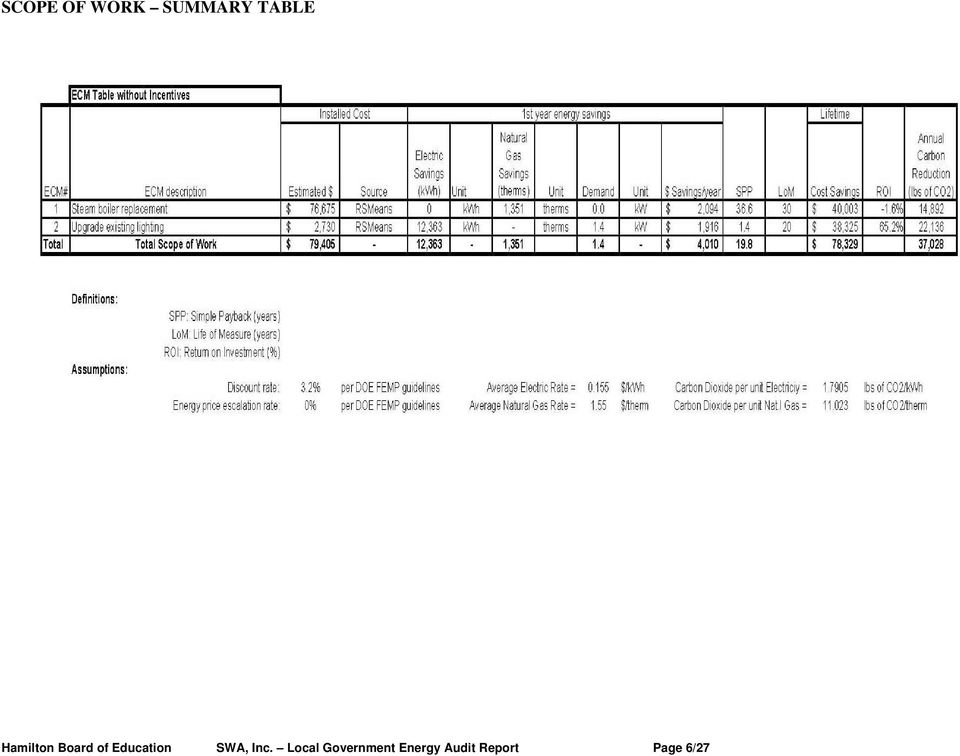
7 1. HISTORIC ENERGY CONSUMPTION 1.1. Energy usage and cost analysis SWA received and analyzed utility bills from September 2006 through September 2008 that were received from the Hamilton Board of Education. Electricity Lalor Elementary School has one electric meter for incoming electricity supply. The building purchases electricity from PSE&G at an average aggregated rate of $.16/kWh based on September 2008 through September 2007 electric bills. The building purchased approximately 145,480 kwh or $22,969 worth of electricity between September 2007 and September Based on the same time period, the building also had an average monthly demand of 52.2 kw and monthly peak demand of 66.6 kw. Natural Gas Lalor Elementary School has one gas meter for incoming natural gas from PSE&G. Between September 2007 and September 2008, the building purchased approximately 19,571 therms or $30,335 worth of natural gas. To account for the additional costs associated with transportation and delivery fees, an average total gas rate of $1.55 per therm was assumed in this report. The following chart shows electricity usage for the school based on utility bills for the billing period. Electricity Usage (kwh) kwh Aug-07 Sep-07 Oct-07 Nov-07 Dec-07 Jan-08 Feb-08 Mar-08 Apr-08 May-08 Jun-08 Jul-08 Aug-08 Mid-Period The following chart shows the natural gas usage for the school based on utility bills for the year September 2007 to September Hamilton Board of Education SWA, Inc. Local Government Energy Audit Report Page 7/27
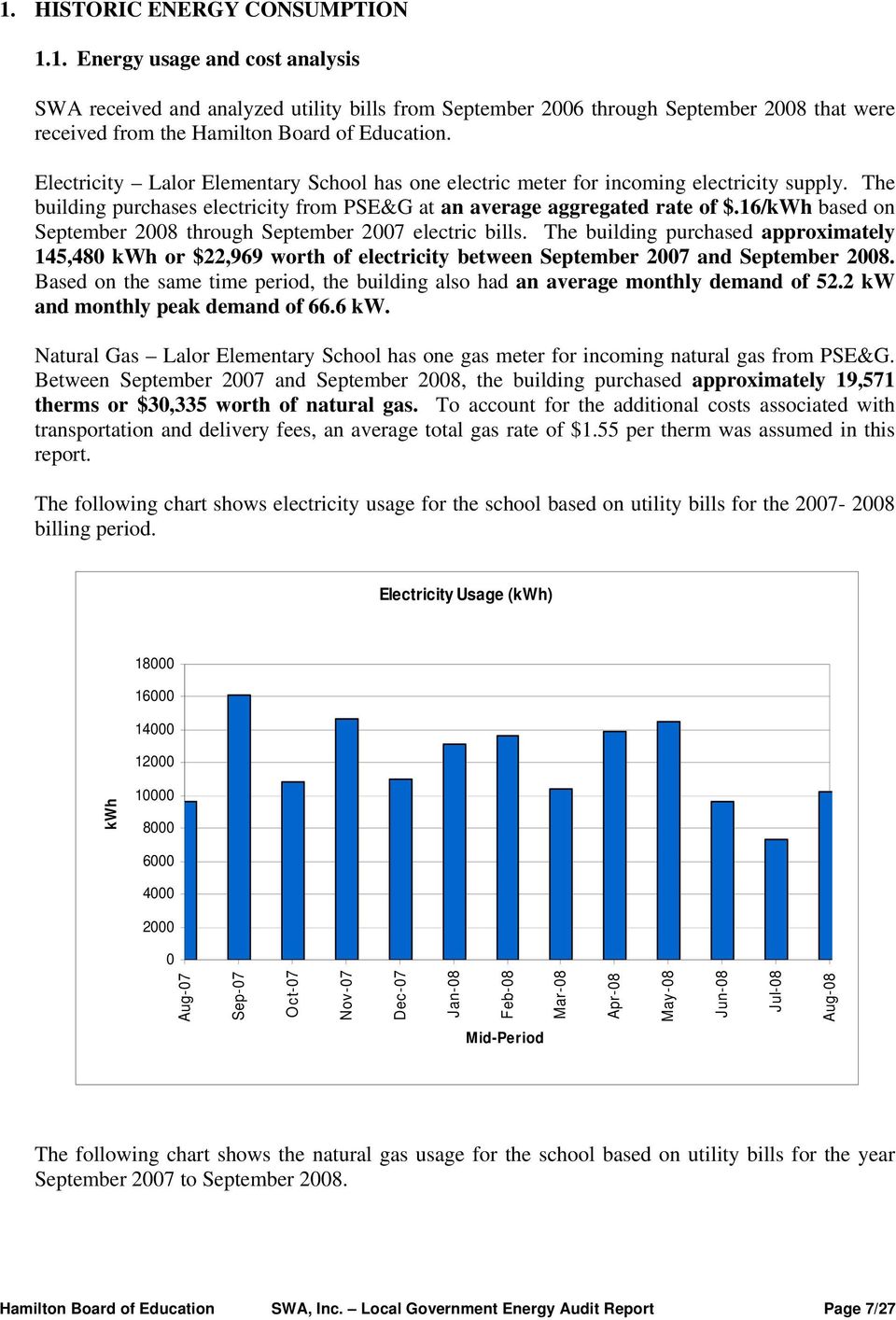
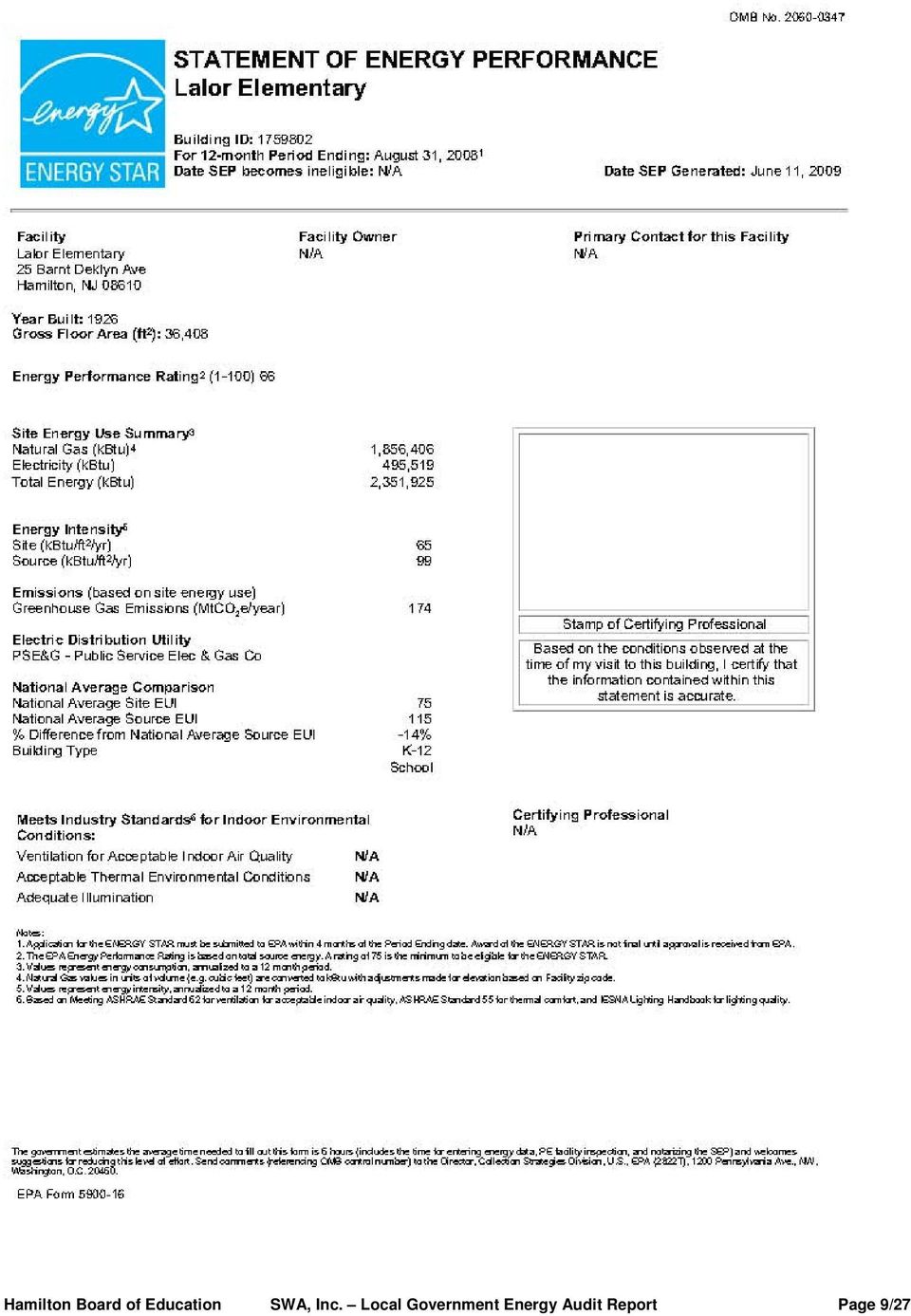
8 Natural Gas Usage (therms) therm s 5,000 4,500 4,000 3,500 3,000 2,500 2,000 1,500 1, Aug-07 Sep-07 Oct-07 Nov-07 Dec-07 Jan-08 Feb-08 Mar-08 Apr-08 May-08 Jun-08 Jul-08 Aug-08 Mid-Period In the above chart, the natural gas usage follows a heating trend as expected. During the summer it is clear that the natural gas usage is very minimal which reflects that heat is not being used and the DHW load is minimal Utility rate Lalor Elementary School currently buys electricity and gas from PSE&G at the FTLV service rate. The FTLV service is s typical rate where customers pay for natural gas based on usage and electricity based on usage with the addition of an electrical charge demand. Lalor Elementary School uses account # , at the service address of 25 Barnt Deklyn Ave, Hamilton, NJ for the building electric and gas. Electricity for the building was billed at an average rate of $0.16/kWh. As previously noted, a typical regional average gas unit price of $1.55/therm was assumed in this report to address both the consumption and transportation costs of the fuel Energy benchmarking Lalor Elementary School information and utility data were entered into the U.S. Environmental Protection Agency s (EPA) Energy Star Portfolio Manager energy benchmarking system. The performance score generated for the building is 66. SWA recommends that the Lalor Elementary School Board of Education maintain the Portfolio Manager account at the link below. As the account is maintained, SWA can share the Lalor Elementary School facility and allow future data to be added and tracked using the benchmarking tool. Hamilton Board of Education SWA, Inc. Local Government Energy Audit Report Page 8/27

9 Hamilton Board of Education SWA, Inc. Local Government Energy Audit Report Page 9/27
10 2. FACILITY AND SYSTEMS DESCRIPTION 2.1. Building Characteristics Lalor Elementary School was built approximately 83 years ago. The building is three stories (including the basement) and has a total floor area of 36,408 square feet. The basement holds the boiler room, storage rooms as well as classrooms Building occupancy profiles During the site visit (spring break week), there were approximately 5 employees observed in the building at once. The building is operated from 7:30am until 3pm, Monday through Friday, unless conditions such as winter weather required the school to be closed. During summer months when school is not in session, there is an average of 5 people in the building including maintenance and administrative staff Building envelope Exterior walls The exterior walls consist of a red brick façade with 2 x6 metal framing on the interior, 16 inches on center with no insulation. While insulation could be added to the exterior walls of the main building, it would have a significant impact on building operations and SWA has determined that it is not cost effective to do so at this time. If any portion of the building is renovated or improved as part of a capital improvement plan, SWA recommends increased insulation is added to any walls during construction Roof The roof of the building is pitched and was recently replaced with EPDM rubber roofing on a metal deck. The roof is accessed from the outside via a ladder. On the day of the site visit, the maintenance staff did not the have the capabilities of accessing the roof. From portions of roof that could be observed from the ground, the roof surface appeared to be in good condition and it would not be cost effective to upgrade at this point in time Base The building has a basement with a 6 concrete base. There were no reported problems with water penetration or moisture Windows All of the windows in the building are single-pane, metal framed windows with plexi-glass inserts for child safety. These windows have a poor insulating quality and allow heat to transfer out of the building during the heating season and allow heat to transfer in during the cooling season. In addition to the windows being poorly insulated, many of the windows were noticed to be poorly sealed to the envelope of the building and daylight could be seen around the frame of the window. Below is a picture showing a typical window for Lalor Elementary School. Hamilton Board of Education SWA, Inc. Local Government Energy Audit Report Page 10/27

11 Typical classroom window Exterior doors The entranceways for Lalor Elementary School consist of a mix of insulated and un-insulated metal doors. A majority of these doors are poor insulators and allow conditioned air to leak out of the building. These doors consist of metal frames as well as metal doors. The doors were observed to be missing weather-stripping so that they did not seal well to the frames. In many cases, the frame assembly was not sealed well to the building and gaps were left between the masonry and the door frame. Areas where there were large gaps between the masonry and door frame were observed to be stuffed with compressed insulation that has a compromised insulation value. SWA recommends air sealing around all of the doors and windows in the office portion of the building in order to prevent conditioned air from leaking outside of the building. Exterior door needing replacement Building air tightness Lalor Elementary School has a leaky shell with poor air sealing to separate conditioned air from the outside air. The ceiling provides a poor air and thermal seal from the plenum above and therefore, the volume of the building that requires heat is expanded. Conditioned air is allowed Hamilton Board of Education SWA, Inc. Local Government Energy Audit Report Page 11/27

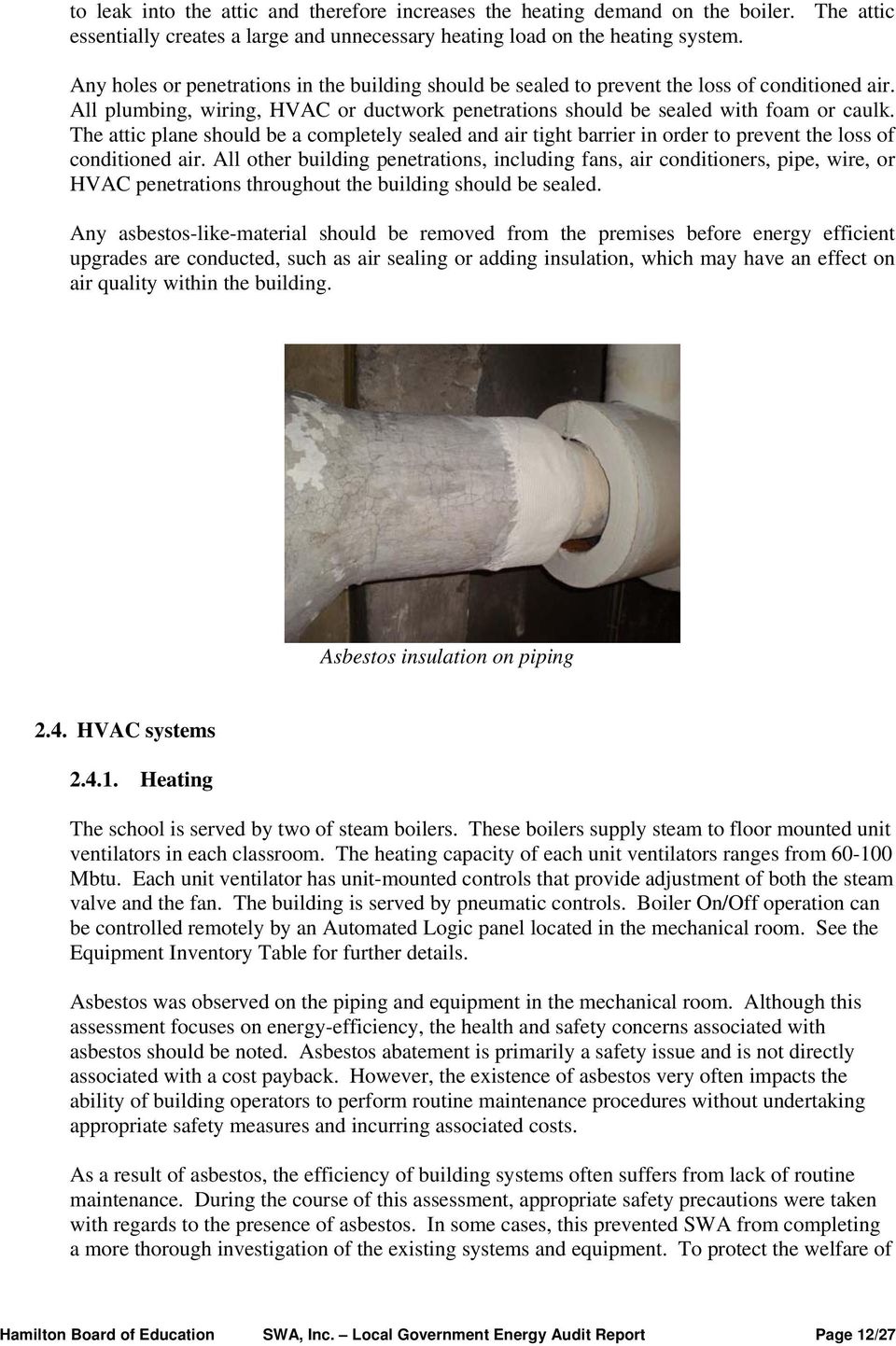
12 to leak into the attic and therefore increases the heating demand on the boiler. The attic essentially creates a large and unnecessary heating load on the heating system. Any holes or penetrations in the building should be sealed to prevent the loss of conditioned air. All plumbing, wiring, HVAC or ductwork penetrations should be sealed with foam or caulk. The attic plane should be a completely sealed and air tight barrier in order to prevent the loss of conditioned air. All other building penetrations, including fans, air conditioners, pipe, wire, or HVAC penetrations throughout the building should be sealed. Any asbestos-like-material should be removed from the premises before energy efficient upgrades are conducted, such as air sealing or adding insulation, which may have an effect on air quality within the building. Asbestos insulation on piping 2.4. HVAC systems Heating The school is served by two of steam boilers. These boilers supply steam to floor mounted unit ventilators in each classroom. The heating capacity of each unit ventilators ranges from Mbtu. Each unit ventilator has unit-mounted controls that provide adjustment of both the steam valve and the fan. The building is served by pneumatic controls. Boiler On/Off operation can be controlled remotely by an Automated Logic panel located in the mechanical room. See the Equipment Inventory Table for further details. Asbestos was observed on the piping and equipment in the mechanical room. Although this assessment focuses on energy-efficiency, the health and safety concerns associated with asbestos should be noted. Asbestos abatement is primarily a safety issue and is not directly associated with a cost payback. However, the existence of asbestos very often impacts the ability of building operators to perform routine maintenance procedures without undertaking appropriate safety measures and incurring associated costs. As a result of asbestos, the efficiency of building systems often suffers from lack of routine maintenance. During the course of this assessment, appropriate safety precautions were taken with regards to the presence of asbestos. In some cases, this prevented SWA from completing a more thorough investigation of the existing systems and equipment. To protect the welfare of Hamilton Board of Education SWA, Inc. Local Government Energy Audit Report Page 12/27
13 students and staff, SWA recommends that asbestos abatement be addressed prior to undertaking any other significant investments in capital improvements Cooling There were approximately five window air conditioner units observed throughout the building. SWA recommends replacing older model units with Energy Star window air conditioners, sized proportionally for the room, with an EER of 12 or better Ventilation The floor-mounted unit ventilators in each classroom have an outdoor air duct through the exterior wall that delivers air to the rear of the unit. Exterior louvers allow air to be drawn into the unit ventilator and heated within the space. When the unit ventilator fan is operating, the fresh air is distributed to the room. In addition, the classrooms have operable windows to provide ventilation during the summer months. Exhaust fans in bathrooms throughout the school provide the only air exchange throughout the school. The bathroom and kitchen cafeteria exhaust fans are used to minimize odor Domestic Hot Water Domestic Hot Water for the building is provided by an A.O. Smith natural gas-fired hot water storage tank. The storage tank has a capacity of 60 gallons of storage and an input of 80 MBtuh. This standard efficiency equipment has an efficiency rating of approximately 78%. It is not cost-effective to replace the existing water heating equipment with higher efficiency equipment. However, higher efficiency water heating equipment will save energy and should be strongly considered upon replacement of the equipment. Energy saving appliances bearing the ENERGY STAR label should be selected to ensure efficiency performance. Incentives may be available to offset any added costs for the installed equipment. More efficient water-consuming fixtures and appliances save both energy and money through reduced energy consumption for water heating, as well decreased water and sewer bills. SWA recommends adding controlled on/off timers on all lavatory faucets to reduce domestic hot water demand and save water. Building staff can also easily install faucet aerators and/or lowflow fixtures to reduce hot water consumption. In addition, routine maintenance practices that identify and quickly address water leaks are a low-cost way to save water and energy Electrical systems Lighting Interior Lighting Lalor Elementary School showed a great need for updated lighting throughout many classroom closets, stairwells, and storage areas. Many fixtures appeared to be original to the building and contained inefficient ballasts, as well as inefficient incandescent bulbs. SWA recommends replacing all magnetic ballasts with electronic ballasts and all T12 fluorescent bulbs with T8 fluorescent bulbs. Replacing the magnetic ballasts alone will result in a 15-20% savings per light fixture and replacing T12 bulbs with T8 bulbs will result in an Hamilton Board of Education SWA, Inc. Local Government Energy Audit Report Page 13/27
14 additional 10-15% savings per light fixture. Incandescent bulbs were found in most classroom closets and storage areas and should be upgraded to compact fluorescent bulbs. The building has approximately 15 exit signs installed, 11 of which are older fluorescent type fixtures. Fluorescent exit signs waste an unnecessary amount of energy since they run 24 hours per day and should be upgraded to newer LED exit signs. SWA recommends replacing all fluorescent exit signs with newer 5W LED models. See the lighting schedule attached in the Appendix A for complete lighting retrofit details. SWA recommends implementing a school-wide educational program to teach both teachers and students to take advantage of turning off lights to save energy, use blinds to block out unwanted warmth from solar heat gain and other ways to save energy without spending money. Although natural day lighting has been shown to improve occupant health, solar heat gain and glare from older glazing often negatively impact activities and comfort within the space. During the time of our visit (spring break week) shades were half drawn throughout the school. To understand the comfort concerns and identify those classrooms with the most significant problems, building staff can conduct an occupant survey. For problem areas, it may be beneficial to install tinted glazing or a window film to reduce the glare and solar heat gains. This recommendation will not provide energy savings but may improve occupant comfort Appliances and process Appliances, such as refrigerators, that are over 10 years of age should be replaced with newer efficient models with the Energy Star label. For example, Energy Star refrigerators use as little as 315kwh/hr. When compared to the average electrical consumption of older equipment, Energy Star equipment results in a large savings. Look for the Energy Star label when replacing appliances and equipment, including: window air conditioners, refrigerators, printers, computers, copy machines, etc. More information can be found in the Products section of the Energy Star website at: Computers left on in classrooms consume a lot of energy. A typical desk top computer uses 65 to 250 watts and uses the same amount of energy when the screen saver is left on. Televisions in classrooms use approximately 3-5 watts of electricity when turned off. SWA recommends all computers and all classrooms appliances (i.e. fridges, coffee makers, televisions, etc.) be plugged in to power strips and turned off each evening just as the lights are turned off. There were at least 5 computers left fully on when the building was audited during spring break week. Computer left on during spring break week Hamilton Board of Education SWA, Inc. Local Government Energy Audit Report Page 14/27

15 Elevators There are no elevators at Lalor Elementary School Other electrical systems There are currently no other electrical systems in the building. Hamilton Board of Education SWA, Inc. Local Government Energy Audit Report Page 15/27

16 3. EQUIPMENT LIST Building System Heating Distribution System Cooling Ventilation Domestic Hot Water Description (2) Steam Boilers, 101 HP each Floor mounted Unit ventilators/radiators with unitmounted adjustable valve and fan controls No Central Cooling Outdoor Intake in Unit Ventilators, Exhaust for kitchens and baths. Tank-type Water Heater, 60 gallon, 80 Mbtuh Make/ Model HB Smith Nesbitt A.O. Smith Fuel Natural Gas Steam Natural Gas Space served Estimated Remaining useful life % Building 5% Each Classroom Varies Building 10% Lighting See details appendix A Note: The remaining useful life of a system (in %) is an estimate based on the system date of built and existing conditions derived from visual inspection. Hamilton Board of Education SWA, Inc. Local Government Energy Audit Report Page 16/27

17 ENERGY CONSERVATION MEASURES Based on the assessment of this building, SWA has separated the investment opportunities into three categories of recommendations: 1. Capital Improvements Upgrades not directly associated with energy savings 2. Operations and Maintenance Low Cost/No Cost Measures 3. Energy Conservation Measures Higher cost upgrades with associated energy savings Category I Recommendations: Capital Improvements Asbestos Abatement As noted previously, asbestos was observed in the buildings and is considered a health and safety hazard. In addition, the existence of asbestos impacts the ability of the building operations staff to conduct routine maintenance without incurring additional costs associated with proper safety measures. Regardless of the recommendations adopted to upgrade the energy-efficiency of the facility, SWA recommends abatement as the first priority. Window Replacement Some of the buildings in the school district have already undergone upgrades to the windows. In the past, the existing window frames have been maintained and only new glazing was installed. Since the existing window units typically contain only single pane glazing and have metal frames, this upgrade typically offers little energy savings during the heating season. Since the buildings do not have central air conditioning, there are no cost savings associated with windows during the summer months. While window replacement may provide comfort and safety benefits, SWA does not recommend this as a high priority investment with respect to energy efficiency. Category II Recommendations: Operations and Maintenance Pipe Insulation The energy efficiency of the heating plant and distribution system can be improved by repairing and/or replacing damaged pipe insulation. This recommendation can easily be undertaken by maintenance personal for minimal cost. However, the existence of asbestos impacts the cost associated with this recommendation. For this reason, asbestos abatement has been identified as a high priority investment. Steam Traps Similarly, the energy efficiency of the heating plant and distribution system can be improved by repairing and/or replacing damaged steam traps. SWA recommends that building personnel conduct a steam trap inventory to determine the scope of the project. Project costs will vary, depending on the number of traps and the type of upgrade required. Again, the existence of asbestos impacts the cost associated with this recommendation. For this reason, asbestos abatement has been identified as a high priority investment. Controls Optimization Is is SWA s understanding that the existing Automated Logic Control panel is used to remotely control on/off boiler operation for all buildings by the District Facility Manager. This panel can be optimized and/or expanded to either shut down or reset the boilers based on outdoor temperature. This may require additional sensors and programming by a Controls professional. However, utilization of the existing equipment makes this a relatively simple and cost-effective recommendation. Weather Stripping/Air Sealing - SWA observed that exterior door weather-stripping was beginning to deteriorate. Doors and vestibules should be observed annually for deficient weather-stripping and replaced as needed. The perimeter of all window frames should also be regularly inspected and any missing or deteriorated caulking should be re-caulked to provide an unbroken seal around the window frame. Any other accessible gaps or penetrations in the thermal envelope penetrations should also be sealed with caulk or spray foam. Hamilton Board of Education SWA, Inc. Local Government Energy Audit Report Page 17/27
18 Water Efficient Fixtures & Controls - Adding controlled on/off timers on all lavatory faucets is a cost-effect way to reduce domestic hot water demand and save water. Building staff can also easily install faucet aerators and/or low-flow fixtures to reduce water consumption. There are many retrofit options, which can be installed now or incorporated as equipment is replaced. Routine maintenance practices that identify and quickly address water leaks are a low-cost way to save water and energy. Retrofitting with more efficient water-consuming fixtures and appliances will save both energy and money through reduced energy consumption for water heating, while also decreasing water and sewer bills. Create an educational program that teaches both students and their teachers how to minimize their energy use in the classroom by using window blinds to allow natural light in or keep unwanted heat out. The US Department of Energy offers free information for hosting energy efficiency educational programs and K-12 lesson plans, for more information please visit: Category III Recommendations: Energy Conservation Measures Summary table ECM# Description 1 Replace Existing Steam Boilers: Upgrade the existing steam boilers with new, higher efficiency steam boilers. This recommendation includes optimization of existing remote boiler controls, new local boiler controls, repair/replacement of failed steam traps, and increased pipe insulation. Implementation of this recommendation will require professional design assistance and asbestos abatement. 2 Lighting Upgrade; See appendix A for entire lighting retrofit schedule. Hamilton Board of Education SWA, Inc. Local Government Energy Audit Report Page 18/27

19 Description: ECM#1: Replace Existing Steam Boilers The existing steam boilers have been reasonably well-maintained but they are inefficient relative to newer technology and they have reached the end of their useful life. The recommendation provided here cannot be cost justified by energy savings alone. However, the age and condition of the equipment warrant attention and this recommendation is intended to provide guidance to help the building management staff prioritize upgrades within the facility. The existing equipment is approximately 75% efficient. To improve heating plant energy performance, SWA recommends replacement of the existing boilers with new boilers that have an efficiency of 82% or better. Boiler capacity should be properly sized. Insulation and steam traps on all boiler piping within the mechanical room and any accessible distribution piping should be replaced during this retrofit. As part of this upgrade, a local boiler control should be installed to provide on/off control based on outdoor temperature and boiler sequencing. The existing Automated Logic Control panel should be optimized to provide improved control during remote operation. This may require the installation of local temperature sensors and updated programming by a controls contractor. Before proceeding with implementation of this recommendation, it will be necessary to abate the asbestos in the mechanical room. Asbestos abatement is outside the scope of this assessment and the cost estimates provided do not include pricing associated with abatement. This recommendation will also require professional design assistance to determine the appropriate equipment and configuration. Costs associated with design have not been included in the estimate provided in this report. Pneumatic controls are used to regulate the heating system throughout the building, which primarily includes floor-mounted unit ventilators that are quite old. Although there is an opportunity to improve comfort and energy performance by upgrading the building controls and the distribution system, the impact on the building operations negates the cost-effectiveness of this recommendation. Installation cost: Estimated installed cost: $76,675 Source of cost estimate: RS Means Economics: 1st year energy savings SPP LoM lifetime Annual Carbon Reduction (lbs usage unit demand unit $ savings/yr cost savings ROI of CO2) 1,351 therm 0.0 kw $ 2, $ 40, % 14,892 Assumptions: SWA calculated the savings for this measure using information collected during the field visit and analysis of historical utility consumption information. SWA estimated the natural gas usage associated with heating only and assumed that this measure will save 7% of the heating usage. Pricing is based on removal of all existing boilers and replacement with an equal number of boilers. Rebates/financial incentives: This measure may qualify for an incentive of $1.00 per MBH of boiler capacity. Required boiler capacity will be determined by the design professional. Hamilton Board of Education SWA, Inc. Local Government Energy Audit Report Page 19/27
20 Options for funding ECM: Additional information may be found on the NJ Clean Energy website. Hamilton Board of Education SWA, Inc. Local Government Energy Audit Report Page 20/27

21 ECM#2: Lighting Upgrade Description: Lalor Elementary School uses a mix of both efficient and inefficient lighting. For the most part, the school used 4 linear T8 fixtures with electronic ballasts that are not in need of upgraded. A few light fixtures still contain magnetic ballasts with T12 bulbs and these should be replaced. One are of concern with regards to lighting is closets and bathrooms. Most classrooms contain a closet, a bathroom or both. The majority of these smaller spaces had incandescent lighting. There were some light bulbs that SWA witnessed burn out on the day of the audit. Some closets were equipped with incandescent bulbs that were much too large, such as a 200W bulb. In most cases, a 20W CFL replacement is recommended and will provide sufficient light. In order to save energy usage, energy costs and also maintenance costs, SWA recommends that all incandescent lighting fixtures be retro-fitted with CFL light bulbs. Lalor Elementary School also contains many fluorescent exit signs that consume 20W of power compared to newer LED models that consume only 5W of power. Switching from fluorescent exit signs to LED exit signs is always cost-effective since they are left on 24/7. SWA recommends that all fluorescent exit signs should also be replaced with LED models. For a complete existing and retrofit lighting schedule, please see Appendix A. Installation cost: Estimated installed cost: $2,730 Source of cost estimate: RS Means Economics: 1st year energy savings SPP LoM lifetime Annual Carbon Reduction (lbs usage unit demand unit $ savings/yr cost savings ROI of CO2) 12,363 kwh 1.4 kw $ 1, $ 38, % 22,136 Assumptions: SWA calculated the savings for this measure using measurements taken the day of the field visit, and billing analysis. Rebates/financial incentives: NJ Clean Energy Prescriptive Lighting Incentive, Incentive based on installing T5 or T8 lamps with electronic ballasts in existing facilities ($10-$30 per fixture, depending on quantity of lamps). NJ Clean Energy Prescriptive Lighting Incentive, Incentive based on installing LED Exit signs ($10/$20 per fixture). Options for funding ECM: This project may benefit from enrolling in NJ SmartStart program with Technical Assistance to offset a portion of the cost of implementation. Hamilton Board of Education SWA, Inc. Local Government Energy Audit Report Page 21/27
22 4. RENEWABLE AND DISTRIBUTED ENERGY MEASURES 4.1. Existing systems There are currently no existing renewable energy systems Solar Photovoltaic Photovoltaic (PV) technology would not be cost beneficial to this project since there is such little electric demand. Also, the school is not in session during the summer when photovoltaic panels would be most beneficial Solar Thermal Collectors Solar thermal collectors are not cost effective for this project and are not be recommended due to the low amount of domestic hot water use throughout the building Combined Heat and Power CHP is not applicable to this project because of the HVAC system type and limited domestic hot water usage Geothermal Geothermal is not applicable to this project because it would require modifications to the existing heat distribution system, which would not be cost effective Wind Wind power production is not appropriate for this location because required land is not available for the wind turbine. Also, the available wind energy resource is very low. 5. ENERGY PURCHASING AND PROCUREMENT STRATEGIES Load profiles The average electrical peak demand for the previous year was 52.2 kw and the maximum peak demand was 66.6 kw. The electric and gas load profiles for this project are presented in the following charts. The first chart shows electric demand (in kw) for the previous 12 months and the other two charts show electric and gas usage (in kwh), respectively. Hamilton Board of Education SWA, Inc. Local Government Energy Audit Report Page 22/27
23 Electricity Demand (kw) kw Aug-07 Sep-07 Oct-07 Nov-07 Dec-07 Jan-08 Feb-08 Mar-08 Apr-08 May-08 Jun-08 Jul-08 Aug-08 Mid-Period Electricity Usage (kwh) kwh Aug-07 Sep-07 Oct-07 Nov-07 Dec-07 Jan-08 Feb-08 Mar-08 Apr-08 May-08 Jun-08 Jul-08 Aug-08 Mid-Period Hamilton Board of Education SWA, Inc. Local Government Energy Audit Report Page 23/27
24 Natural Gas Usage (therms) therm s 5,000 4,500 4,000 3,500 3,000 2,500 2,000 1,500 1, Aug-07 Sep-07 Oct-07 Nov-07 Dec-07 Jan-08 Feb-08 Mar-08 Apr-08 May-08 Jun-08 Jul-08 Aug-08 Mid-Period 5.1. Tariff analysis The school currently buys electricity and gas from PSE&G at the FTLV rate. FTLV is a typical rate structure where customers pay for natural gas based on usage and electricity based on usage with the addition of an electrical demand charge. The FTLV rate is appropriate for this building. No information on gas transportation charges was provided for this analysis Energy Procurement strategies Billing analysis shows price fluctuations of over 20% over the course of the year for the building electrical and natural gas accounts. Customers that have a large variation in monthly billing rates can often reduce the costs associated with energy procurement by selecting a third party energy supplier. Contact the NJ Energy Choice Program for further information on Energy Services Companies (ESCOs) that can act as third party energy suppliers. Purchasing electricity from an ESCO can reduce electric rate fluctuation and ultimately reduce the annual cost of energy for the school. Appendix C contains a complete list of third party energy suppliers. The building would not be eligible for enrollment in a Demand Response Program because the minimum electric demand each month does not greatly exceed 50 kw, which is the typical threshold for considering this option. Hamilton Board of Education SWA, Inc. Local Government Energy Audit Report Page 24/27
25 6. METHOD OF ANALYSIS 6.1. Assumptions and methods Energy modeling method: Cost estimates: Spreadsheet-based calculation methods RS Means 2009 (Facilities Maintenance & Repair Cost Data) RS Means 2009 (Building Construction Cost Data) RS Means 2009 (Mechanical Cost Data) Note: Cost estimates also based on utility bill analysis and prior experience with similar projects Disclaimer This engineering audit was prepared using the most current and accurate fuel consumption data available for the site. The estimates that it projects are intended to help guide the owner toward best energy choices. The costs and savings are subject to fluctuations in weather, variations in quality of maintenance, changes in prices of fuel, materials, and labor, and other factors. Although we cannot guarantee savings or costs, we suggest that you use this report for economic analysis of the building and as a means to estimate future cash flow. THE RECOMMENDATIONS PRESENTED IN THIS REPORT ARE BASED ON THE RESULTS OF ANALYSIS, INSPECTION, AND PERFORMANCE TESTING OF A SAMPLE OF COMPONENTS OF THE BUILDING SITE. ALTHOUGH CODE-RELATED ISSUES MAY BE NOTED, SWA STAFF HAVE NOT COMPLETED A COMPREHENSIVE EVALUATION FOR CODE-COMPLIANCE OR HEALTH AND SAFETY ISSUES. THE OWNER(S) AND MANAGER(S) OF THE BUILDING(S) CONTAINED IN THIS REPORT ARE REMINDED THAT ANY IMPROVEMENTS SUGGESTED IN THIS SCOPE OF WORK MUST BE PERFORMED IN ACCORDANCE WITH ALL LOCAL, STATE, AND FEDERAL LAWS AND REGULATIONS THAT APPLY TO SAID WORK. PARTICULAR ATTENTION MUST BE PAID TO ANY WORK WHICH INVOLVES HEATING AND AIR MOVEMENT SYSTEMS, AND ANY WORK WHICH WILL INVOLVE THE DISTURBANCE OF PRODUCTS CONTAINING MOLD, ASBESTOS, OR LEAD. Hamilton Board of Education SWA, Inc. Local Government Energy Audit Report Page 25/27
26 Appendix A: Lighting study Hamilton Board of Education SWA, Inc. Local Government Energy Audit Report Page 26/27
27 Appendix B: Third Party Energy Suppliers (ESCOs) Hamilton Board of Education SWA, Inc. Local Government Energy Audit Report Page 27/27
SAVE ENERGY AT HOME INSULATE AND AIR SEAL
 SAVE ENERGY AT HOME INSULATE AND AIR SEAL Check the roof insulation level and add insulation to maintain minimum R-38 (6 of blown cellulose or equal). Use R-19 between frame or R-10 rigid insulation for
This report presents the findings and recommendations of the assessment of energy use and
 This report presents the findings and recommendations of the assessment of energy use and environmental stewardship of Arlington Street Church, Boston, MA. As stewards of the earth it is important that
Energy Benchmarking Report for Lafayette Elementary School Bound Brook, NJ
 Energy Benchmarking Report for Lafayette Elementary School Bound Brook, NJ (for the period: March 2007 through February 2009) Prepared by: Background & Findings The New Jersey Clean Energy Program (NJCEP)
EarthCents (DSM) Program Summary
 EarthCents (DSM) Program Summary Renewable Energy EarthCents Programs Solar Water Heating This program is available to residential customers for the installation of a qualifying solar thermal water heater.
energy-saving checklist a guide for rental property owners
 energy-saving checklist a guide for rental property owners taking responsibility As an individual, your efficient use of energy brings benefits such as lower bills, improved comfort levels in your home
Sample Customer 123 Conservation Way TAMPA FL 33626 Tracking Number: 000675309
 Thank you for completing the Online Home Energy Audit. Based on the answers that you provided in the questionnaire, the following is a complete analysis of your household's energy consumption. We have
Case Studies in Existing Building Audits
 Case Studies in Existing Building Audits Erica Brabon Steven Winter Associates, Inc. 307 7 th Ave., NY, NY [email protected] Who we are Steven Winter Associates, Inc. (SWA) is a 37 yearold architecture
Energy Benchmarking Report for Lakeside Middle School. Millville, NJ
 Energy Benchmarking Report for Lakeside Middle School Millville, NJ (for the period: June 1, 2008 through May 31, 2009) Prepared by: Background & Findings: The New Jersey Clean Energy Program (NJCEP) developed
Key energy-efficient features of your new home
 Key energy-efficient features of your new home Your thermal envelope The thermal envelope, or shell, of your home (walls, roof and floor) is designed to keep you dry and comfortable. It protects you from
Green Guide for Businesses Strategy: Energy
 Green Guide for Businesses Strategy: Energy Reduce Energy Use in New and Existing Businesses - In the United States buildings account for: o 72% of electricity consumption, o 39% of energy use, o 38% of
Current Programs available to Limited Income Customers. Residential and Multifamily
 Current Programs available to Limited Income Customers Residential and Multifamily CAP Program- Residential and Multifamily The City of Austin offers programs to help customers facing temporary and long-term
Air Conditioning. The opportunity for energy efficiency. Low cost actions to reduce energy usage now
 Fact Sheet #6 Air Conditioning In this fact sheet you will discover: The opportunity for energy efficiency How air conditioning works Low cost actions to reduce energy usage now Investments to reduce costs
First Time Home Buyers Energy Efficiency Workshop Guide
 First Time Home Buyers Energy Efficiency Workshop Guide Why is efficiency important when buying a home? Affordability: lower utility bills Environmental responsibility: reduces your carbon footprint and
Energy Conservation Audits for Six Performing Arts Facilities A Toronto s Green Theatres Project
 Energy Conservation Audits for Six Performing Arts Facilities A Toronto s Green Theatres Project Anthony Marshall, P.Eng., CEM January 2012 For Creative Trust for Arts & Culture Table of Contents Introduction
101 Low-Cost /No-Cost. Home Energy-Saving Measures
 101 Low-Cost /No-Cost Home Energy-Saving Measures Your Touchstone Energy Cooperative has compiled this list of low-cost / no-cost energy-saving measures to help you better manage your home s energy costs.
Energy Efficiency Tips for Businesses
 Energy Efficiency Tips for Businesses Top 10 Tips Lighting Tips Heating and Cooling Temperature Control Office Equipment Laundry Service Refrigeration Equipment Food Service Equipment Employee Involvement
Energy-Saving Tips. Energy Saving Tips
 Energy-Saving Tips Energy Saving Tips TABLE OF CONTENTS How Do You Spend Your Energy Dollars?.. 1 Easy Ways to Save... 2 Investing in Energy Savings... 6 EarthCents... 7 How Do You Spend Your Energy Dollars?
HOW AN ENERGY EFFICIENT HOME CAN HELP THE ENVIRONMENT
 HOW AN ENERGY EFFICIENT HOME CAN HELP THE ENVIRONMENT During the last century, concern about the environment increased, as issues such as global warming and the Greenhouse Effect convinced us that the
City of Cornwall Social Housing Division Top 10 Energy & Water Saving Tips. in Multi-Unit Residential Buildings
 City of Cornwall Social Housing Division Top 10 Energy & Water Saving Tips in Multi-Unit Residential Buildings Duncan Hill Canada Mortgage and Housing Corporation Andrew Pride Minto Developments Inc. Energy
Commercial Energy Efficiency Program. Save money, reduce energy use and earn incentives. Save money, reduce energy use and qualify for incentives
 Save money, reduce energy use and earn incentives by improving the energy efficiency of your business. Georgia Power s Commercial Energy Efficiency Program makes incorporating energy-efficient improvements
Sea Water Heat Pump Project
 Sea Water Heat Pump Project Alaska SeaLife Center, Seward, AK Presenter: Andy Baker, PE, YourCleanEnergy LLC Also Present is ASLC Operations Manager: Darryl Schaefermeyer ACEP Rural Energy Conference Forum
Rules of Thumb Energy Efficiency in Buildings
 Energy Efficiency in Buildings Energy Savings Cost Savings Increased Productivity Economic Development Other Standard lighting retrofits: $0.90-$1.20 per square foot. High-efficiency packaged and split
ENERGY AUDITS (OR SURVEYS) & ENERGY MANAGEMENT PROGRAMS SECTION B
 ENERGY AUDITS (OR SURVEYS) & ENERGY MANAGEMENT PROGRAMS SECTION B GOALS OF THE ENERGY AUDIT Clearly identify types and costs of energy use Understand how energy is being used--and possibly wasted Identify
Energy Efficiency for Businesses: An Overview of Best Practices to Help Reduce Energy Costs
 Energy Efficiency for Businesses: An Overview of Best Practices to Help Reduce Energy Costs Presented by: Paul Spiegel, Practical Energy Solutions Courtney Lane, PennFuture Commercial Building Energy Use
Small Guide to BIG Savings: Energy Efficiency for your Small Business. Julia Sander Leidos Engineering, LLC
 Small Guide to BIG Savings: Energy Efficiency for your Small Business Julia Sander Leidos Engineering, LLC TWO KEY MESSAGES 1. Every dollar saved is a profit of one dollar to your business» If you save
BUNKER HILL ELEMENTARY SCHOOL
 INITIAL YEAR BUILT 1970 BUILDING AREA 98,200 SF CURRENT PROGRAM CAPACITY 332 ENROLLMENT 2008 387 WARD 5 PROPOSED PROGRAM CAPACITY 750 Site Plan BUNKER HILL - 1 PROPOSED PROGRAM PROFILE GRADE CONFIGURATION
Tips on Saving Energy in Your Business
 Fact Sheet #3 Tips on Saving Energy in Your Business In this fact sheet you will discover: Quick and easy changes to save energy. Cost effective ways to reduce your heating, cooling, lighting and office
Switching Energy Providers and PECO Smart Ideas. March 23, 2011
 Switching Energy Providers and PECO Smart Ideas March 23, 2011 Agenda Market Changes Taking Advantage of Competition PECO Smart Ideas for your home Questions Market Changes Utility Functions Before deregulation,
It Pays. To Save Energy FPO. Guide to Xcel Energy rebates, incentives and programs for residential customers in Minnesota
 It Pays To Save Energy Guide to Xcel Energy rebates, incentives and programs for residential customers in Minnesota FPO 10% Cert no. SW-COC-1865 xcelenergy.com 2012 Xcel Energy Inc. Xcel Energy is a registered
Greenhouse Gas Implications of HVAC Upgrades in Multi-Unit Residential Buildings
 Greenhouse Gas Implications of HVAC Upgrades in Multi-Unit Residential Buildings J A NUARY 2015 INTRODUCTION This Research Report explores best practices and approaches for reducing greenhouse gas (GHG)
WATER. Water Management Protect your building from water damage. Intent. Information & Tips
 Water Management Protect your building from water damage If not managed properly, rain can drain into unwanted areas damaging your roof, windows, walls and facade. Eliminate water damage to your property
WAYS TO SAVE ENERGY AND MONEY
 WAYS TO SAVE ENERGY AND MONEY RESIDENTIAL PROGRAMS SRP offers a variety of programs and rebates to help customers save energy, save money and increase the comfort of their homes. Program eligibility requirements
Mechanical, Plumbing, and Fire Protection Conditions
 Mechanical, Plumbing, and Fire Protection Conditions Mechanical Conditions The mechanical systems within the building consist of a combination of the original 1926 systems and renovations that occurred
CHAPTER 10: APPLIANCES AND LIGHTING
 Chapter 10: Appliances and Lighting 151 CHAPTER 10: APPLIANCES AND LIGHTING According to the U.S. Environmental Protection Agency, appliances and home electronics account for 20% of energy bills in the
Training for Building Technicians: Energy Efficiency & Sustainability (BEST) Program. Seminar Outline & Sample BEST Exam Questions
 Training for Building Technicians: Energy Efficiency & Sustainability (BEST) Program Seminar Outline & Sample BEST Exam Questions Buildings in the United State consume a significant amount of energy. According
Before You Start an Energy Efficiency Retrofit The Building Envelope
 ABOUT YOUR HOUSE Before You Start an Energy Efficiency Retrofit The Building Envelope The building envelope is the outer layer of the building that separates the indoor living space from the outdoor environment,
FLORIDA SOLAR ENERGY CENTER
 FLORIDA SOLAR ENERGY CENTER Creating Energy Independence High Performance Existing Homes Partnerships and Research Janet McIlvaine Research Analyst, Florida Solar Energy Center A Research Institute of
How to Reduce Energy Costs in Your Commercial Building
 How to Reduce Energy Costs in Your Commercial Building Mark Steinmetz, Energy Advisor, GDS Associates, Inc., an ActOnEnergy Partner Mary Bentsen, Education and Training Coordinator SAIC, an Ameren Illinois
Report Date: 04/03/2014. Assessor: John Doyle Address: BLOCK K APT 108 SANDYFORD VIEW DUBLIN 18 BER: 106178106 MPRN: 10301589669
 Report Date: 04/03/2014 Assessor: John Doyle Address: BLOCK K APT 108 SANDYFORD VIEW DUBLIN 18 BER: 106178106 MPRN: 10301589669 About this Advisory Report Energy use in our homes is responsible for almost
ENERGY EFFICIENCY ENERGY EFFICIENCY: Saving Dollars While Clearing the Air
 : Saving Dollars While Clearing the Air After labor and food, energy is the largest controllable cost in a restaurant s operation. And energy is a great place to start in becoming a green restaurant because
Industrial Green Building Retrofit 101 Opportunities and Challenges. Light Industrial Green Building Retrofits. Why Green Retrofit?
 Industrial Green Building 101 Opportunities and Challenges Joanne Sawatzky Senior Project Manager, Light House Sustainability at Work Re-visioning a Sustainable False Creek Flats Light Industrial Green
5-Minute Primer for Commercial Building Energy Audits
 5-Minute Primer for Commercial Building Energy Audits Why Energy Audits? Because an energy audit is the first step to saving energy at your facility. Putting together an energy project can be like finding
Deep Energy Savings in Existing Buildings
 Case Study Deep Energy Savings in Existing Buildings Overview Site Details Owner: Alliance for Sustainable Colorado Location: Denver, CO Building Type: Office Project Description: Major Renovation Size
ENERGY STAR Certified Homes, Version 3 Cost & Savings Estimates
 November 1, 2013 Contents ENERGY STAR Certified Homes, Version 3 Section 1: Executive Summary... 3 Section 2: Detailed Incremental Cost Estimates... 6 Section 3: Incremental Cost & Savings of the Thermal
Certified Residential Energy Auditor (REA) Study Guide
 Certified Residential Energy Auditor (REA) Study Guide This guide provides an overview of the Certified Residential Energy Auditor (REA) Program, including how to register for the REA Training Seminar
The Potential for Energy Retrofits within the City of Sacramento s Rental Housing Inspection Program
 PNNL-20343 Prepared for the U.S. Department of Energy under Contract DE-AC05-76RL01830 The Potential for Energy Retrofits within the City of Sacramento s Rental Housing Inspection Program MM Iverson S
Energy Saving Ideas for Your Box Plant
 General Session Energy Saving Ideas for Your Box Plant Moderator: Jeff Pallini Fosber America, Inc. Program Overview: Immediate Ideas: Jim Simko of Simtek Systems, Inc. Mid-Term Ideas: John Donahue of
Case Studies: Infrared Heating in Industrial Applications
 Case Studies: Infrared Heating in Industrial Applications Chao Chen, Puget Sound Energy ABSTRACT Puget Sound Energy (PSE) is a utility which serves more than one million electric customers and over 700,000
Identify ways to save energy in the home, either through energy efficiency or energy conservation.
 Home Energy Audit TEACHER GUIDE Students will learn about energy conservation and energy efficiency. By conducting an audit of their own homes, they will learn to identify energy-efficient features and
Small Business Energy Efficiency and Specialty Equipment
 Small Business Energy Efficiency and Specialty Equipment Scott Schultz, LEED AP, CEM Energy Program Engineer, SAIC, an Ameren Illinois ActOnEnergy Partner August 28, 2013 Practical Items If you can't hear
HAMILTON SCHOOL. 1401 Brentwood Parkway, N.E., Washington, DC INITIAL YEAR BUILT 1968 BUILDING AREA
 INITIAL YEAR BUILT 1968 BUILDING AREA 187,700 SF CURRENT PROGRAM CAPACITY N/A ENROLLMENT 2008 129 WARD 5 PROPOSED PROGRAM CAPACITY N/A Site Plan HAMILTON - 1 PROPOSED PROGRAM PROFILE GRADE CONFIGURATION
Energy Efficiency HOSPITALITY. www.energia.ie
 Energy Efficiency HOSPITALITY www.energia.ie Your chance to reduce your business energy usage by as much as 20%! 20% is a significant figure and reducing your energy bill by this amount could make a real
BPC Green Builders. Green building for new and existing homes. Health Comfort Energy
 BPC Green Builders Green building for new and existing homes Health Comfort Energy Mechanical Systems Installed HVAC Systems Primary energy source large, roof mounted, solar thermal array (AET flat plate)
Codes and High Performance Hot Water Systems. Gary Klein Affiliated International Management, LLC 916 549 7080 gary@aim4sustainability.
 Codes and High Performance Hot Water Systems Gary Klein Affiliated International Management, LLC 916 549 7080 [email protected] Annual Energy Use for Heating Water Natural Gas Gallons Per Day
Home Energy Evaluation Report for Fritz Kreiss and Catherine McQueen
 Home Energy Evaluation Report for Fritz Kreiss and Catherine McQueen May 2008 Wisconsin Area PO BOX 115 Lake Geneva, WI 53147 CELL (414) 550-4765 Home Performance with ENERGY STAR Evaluation Report Customer
Xcel Business Customers: Program and Rebate Summary
 Xcel Business Customers: Program and Rebate Summary Rebates for New Energy-Efficient Equipment Xcel offers prescriptive rebates to its business customers. What s a prescriptive rebate? It simply means
Energy Conservation. City of Fort Worth Business Smart Program
 City of Fort Worth Business Smart Program Energy Conservation Conserving energy in your organization s daily operations is an important step towards saving money, but also reducing the need for the generation
Inspecting to a higher standard.
 Inspecting to a higher standard. Rob Hopkin Silver Spring, MD 20902 Monday, June 2, 2014 ProTec Inspection Services Inc. 19736 Selby Ave Poolesville, MD 20837 301-972-8531 www.protec-inspections.com [email protected]
HVAC Costs. Reducing Building. Building owners are caught between two powerful forces the need to lower energy costs. By Stephen J.
 Reducing Building HVAC Costs of site rec By Stephen J. Pargeter Building owners are caught between two powerful forces the need to lower energy costs and the need to meet or exceed outdoor air ventilation
The Only GUY To Call. Why are my utility bills so high? What can I do to lower my energy expenses?
 The Only GUY To Call May 2014 412.885.2356 Why are my utility bills so high? What can I do to lower my energy expenses? Did you know... that between 2007 and 2012, the average U.S. household spent more
AIR CONDITIONING EFFICIENCY F8 Energy eco-efficiency opportunities in Queensland Foundries
 AIR CONDITIONING EFFICIENCY F8 Energy eco-efficiency opportunities in Queensland Foundries Hot tips and cool ideas to save energy and money! Air conditioning units or systems are often used by foundries
PENNSYLVANIA GREEN ENERGY LOAN FUND
 PENNSYLVANIA GREEN ENERGY LOAN FUND Procedures Manual for Quantifying Energy Savings A. Introduction A building project applying for a GELF energy loan must demonstrate that it will result in a 25% reduction
HIGH MOUNTAIN EAST DORM 300 Pompton Road, Wayne NJ 07470
 WILLIAM PATTERSON UNIVERSITY HIGH MOUNTAIN EAST DORM 300 Pompton Road, Wayne NJ 07470 LOCAL GOVERNMENT ENERGY AUDIT PROGRAM FOR NEW JERSEY BOARD OF PUBLIC UTILITIES July 2014 Prepared by: 6 Campus Drive
ENERGY AUDITS AND RETRO- COMMISSIONING Local Law 87
 ENERGY AUDITS AND RETRO- COMMISSIONING Local Law 87 Overview Although energy-efficiency retrofits generally result in major cost and energy savings, many buildings are not participating in the audits that
Direct Energy Home Energy Audit Audit Report
 Direct Energy Home Energy Audit Audit Report Joe Smith 123 Anywere St Houston Tx. 77046 1 Audit Introduction The Direct Energy Home Energy Audit Team used the Home Energy Rating System (HERS ) to evaluate
Sustainable Design and Energy-Efficient Building Techniques for Existing Housing
 Sustainable Design and Energy-Efficient Building Techniques for Existing Housing PATH Energy Retrofit Project Henderson, Nevada NREL Research Site, Lebanon NJ Energy Retrofit Goals PROJECT GOALS Identify,
Energy Saving Opportunities for Businesses. Presented by Anna Selgert, Outreach Representative
 Energy Saving Opportunities for Businesses Presented by Anna Selgert, Outreach Representative Where Energy Efficiency Started... Part of Illinois energy legislation passed in 2007 Utility companies required
VETERANS COURTHOUSE 50 West Market Street, Newark, NJ, 07102
 COUNTY OF ESSEX VETERANS COURTHOUSE 50 West Market Street, Newark, NJ, 07102 LOCAL GOVERNMENT ENERGY AUDIT PROGRAM FOR NEW JERSEY BOARD OF PUBLIC UTILITIES January 2015 Prepared by: 6 Campus Drive Parsippany,
Xcel Energy s Commercial Industrial Energy Efficiency Programs. Overview of Colorado Business Rebate Programs
 Xcel Energy s Commercial Industrial Energy Efficiency Programs Overview of Colorado Business Rebate Programs Trade Relation Managers Derek Shockley 303-294-2082 [email protected] Commercial
research highlight Highly Energy Efficient Building Envelope Retrofits for Houses
 research highlight June 2012 Technical Series 12-103 Highly Energy Efficient Building Envelope Retrofits for Houses introduction In Canada approximately 30% of all energy is consumed in buildings, with
6 Schedule quarterly communications to keep employees involved in environmental improvements. WASTE REDUCTION REQUIRED MEASURES
 GREEN BUSINESS CERTIFICATION (GBC) Business Name: Business Address: Plano, TX ZIP: Commercial Recycling 4200 W. Plano Parkway Plano, TX 75093 972-769-4393 OFFICE/RETAIL CHECKLIST General Education Waste
Home Energy Efficiency and Conservation: Call to Action. July 23, 2015 Dave Blake and David Wood REEP Green Solutions
 Home Energy Efficiency and Conservation: Call to Action July 23, 2015 Dave Blake and David Wood REEP Green Solutions Today s Agenda Background Understanding where you are: Energy Usage EnerGuide Home Energy
Everyday Energy-Saving Tips. Helping you save ENERGY, MONEY, and the ENVIRONMENT
 Everyday Energy-Saving Tips Helping you save ENERGY, MONEY, and the ENVIRONMENT At Home With Energy Efficiency Whether it s a house, an apartment, a co-op, or a condo, it s where you live, and you want
BGE Smart Energy Savers Program Energy Efficiency and Demand Response Programs December 4, 2012 USEA Global Workshop On Clean Energy Development
 BGE Smart Energy Savers Program Energy Efficiency and Demand Response Programs December 4, 2012 USEA Global Workshop On Clean Energy Development Ruth C. Kiselewich, Director Demand Side Management Programs
Energy Audit Data Collection Form
 SAVING ENERGY IN COMMERCIAL BUILDINGS Energy Audit Data Collection Form Site Data Building Name Address Building Square Footage (ft 2 ) Age of Building (years) Date of Last Major Renovation Purpose of
Smart Ideas for Your Business. Energy Saving Opportunities for Hospitals
 Smart Ideas for Your Business Energy Saving Opportunities for Hospitals Where Are Your Energy Dollars Going? 21% of hospitals do not measure/monitor energy performance Only 23% have a designated energy
2012 Ontario Building Code Requirements for New Construction. Bradford West Gwillimbury Building Division March 5, 2012
 2012 Ontario Building Code Requirements for New Construction Bradford West Gwillimbury Building Division March 5, 2012 1 Ontario Building Code changes Applicable to permits applied for after December 31,
1. What percent of a commercial business s energy usage comes from their HVAC system? A. 13% B. 23% C. 33% D. 43% E. 53%
 1 1. What percent of a commercial business s energy usage comes from their HVAC system? A. 13% B. 23% C. 33% D. 43% E. 53% 2. How much money do commercial facilities spend per square foot on energy costs
ENERGY CONSERVATION GUIDELINES
 MIDWAY INDEPENDENT SCHOOL DISTRICT ENERGY CONSERVATION GUIDELINES The following energy conservation guidelines are applicable to all district personnel and facilities. The directors of departments and
Your DIY home energy checklist.
 Your DIY home energy checklist. Assessing your building envelope (the structure and everything outside your home). Your building envelope covers the structural elements and everything on the outside of
Energy Efficiency Evaluation Reportii House file number: 9900D00001ii
 Energy Efficiency Evaluation Reportii House file number: 9900D00001ii Household, John, 123 Main St., Ottawa, Ontario, K1K 1K1 64 EnerGuide ratingii 74! Your house currently rates 64.! If you implement
CHAPTER 9: WATER HEATING
 Chapter 9: Water Heating 145 CHAPTER 9: WATER HEATING Energy costs for water heating can be as great as the costs for heating, for an energy efficient house, in a mild climate. Estimating hot water usage
Energy Efficiency for the Homeowner
 Efficiency for the Homeowner How to Reduce Your Home s Bills October 2009 National Mall Washington, DC A Quick Test Using Efficient Products and Practices Can: A. Make your home more affordable B. Make
Energy Audits. Good energy management begins with an energy audit
 Energy Audits Good energy management begins with an energy audit Effective management of energy-consuming systems can lead to significant cost and energy savings as well as increased comfort, lower maintenance
10 Strategic Steps to Reducing Your Energy Costs AEE Regional Chapter Meeting February 2, 2005
 10 Strategic Steps to Reducing Your Energy Costs AEE Regional Chapter Meeting February 2, 2005 Presented by: Gary A. Swanson, PE President Energy Management Solutions (612) 819-7975 10 Step Summary 1.
Existing Housing Stock
 1 How Old and New Houses Use Energy Total Consumption per Household, 2001 120 100 2: RENOVATION - CONCORD, MA million per household 80 60 40 20 Space Heating Electric Air Conditioning Water Heating Refrigerators
The main steam enters the building in the basement mechanical room; this is where the condensate line also leaves the building.
 MSV: Square Footage: 24,844 No. of Floors: 1 Year Built: 1963 Type of Use: Lounge and dining area open all night for snacks Steam Water-cooled condenser, 50-Ton York unit with a 6 cylinder-reciprocating
How U.S. Hotels Reduce Energy Use. Dan Ruben Boston Green Tourism
 How U.S. Hotels Reduce Energy Use Dan Ruben Boston Green Tourism Step One: Benchmark, Identify Opportunities Start with your own assessment Review this presentation and energy efficiency checklists Calculate
Empower. Savings Growth Community. small business. Energy Management Solutions Guide. Come in, we re
 Empower Savings Growth Community Come in, we re small business Energy Management Solutions Guide Energize your business, now and in the future. Funds are available to help you reduce costs, while putting