
Baseline Forecast of GRF Revenues & Medicaid Expenditures
|
|
|
- David Wilkinson
- 10 years ago
- Views:
Transcription
1 Baseline Forecast of GRF Revenues & Medicaid Expenditures FY 2016-FY 2017 Biennial Budget Ohio Legislative Service Commission February 3, 2015

2 TABLE OF CONTENTS ECONOMIC CONDITIONS AND OUTLOOK... 1 STATE OF THE ECONOMY... 1 National... 1 Ohio... 4 ECONOMIC FORECASTS... 9 U.S. Gross Domestic Product... 9 Ohio Gross Domestic Product... 9 U.S. Inflation U.S. Personal Income Ohio Personal Income U.S. Unemployment Rate Ohio Unemployment Rate REVENUE FORECASTS SALES AND USE TAX Auto Sales and Use Tax Nonauto Sales and Use Tax PERSONAL INCOME TAX COMMERCIAL ACTIVITY TAX PETROLEUM ACTIVITY TAX FINANCIAL INSTITUTIONS TAX PUBLIC UTILITY EXCISE TAX KILOWATT-HOUR TAX NATURAL GAS CONSUMPTION (MCF) TAX FOREIGN INSURANCE TAX DOMESTIC INSURANCE TAX CIGARETTE AND OTHER TOBACCO PRODUCTS TAX ALCOHOLIC BEVERAGE TAX LIQUOR GALLONAGE TAX EARNINGS ON INVESTMENTS LICENSES AND FEES MEDICAID EXPENDITURE FORECAST OVERVIEW Background Federal Poverty Guidelines Changes to the Medicaid Program over Time CURRENT MEDICAID ELIGIBILITY IN OHIO Medicaid Caseloads Medicaid Expenditures Reasons for Forecasting Medicaid Expenditures Baseline Forecasting ASSUMPTIONS AND DATA METHODOLOGY MEDICAID FORECAST SUMMARY Caseload Forecast Caseload Projections by Eligibility Category Caseload by Service Delivery System EXPENDITURE FORECAST Medicaid Expenditures for Selected Service Categories Managed Care Plans DDD Services Nursing Facilities Hospital Services ADD-ONS TO THE BASELINE Hospital Supplemental Upper Payment Limit Program Hospital Care Assurance Program Managed Care Health Insurer Fee ACA Physician Rate Increase Medicare Part D Targeted Case Management (Federal) Pay for Performance... 63
3 ECONOMIC CONDITIONS AND OUTLOOK State of the Economy U.S. economic growth turned higher in recent quarters. Expansion in U.S. and Ohio economic activity has been underway since the end of the recession in Growth in Ohio outpaced that in the U.S. early in the recovery but trailed in 2013 and appears to have continued to do so since then. Further growth is predicted for both the nation and the state, as summarized in the economic forecast tables below. 1 Energy prices fell sharply last year, particularly crude oil and gasoline prices, cutting costs for many industries and consumers but hurting oil producers. On balance, the drop in energy prices is expected to be a net plus for the U.S. economy, still a net petroleum importer. Consumer spending growth strengthened in 2014 along with employment. Light motor vehicle sales in 2014 rose to the highest rate since Housing starts last year were the highest since 2007, mainly on strength in apartment construction, but remained well below rates in most earlier years. Business capital spending growth strengthened last year, supported by tightening levels of capacity utilization and low long-term interest rates, but the plunge in crude oil prices is causing sharp cutbacks in oil-related industries. Unemployment has come down. Price inflation is low, held down in part by the drop in energy prices. Wage gains also are generally slow but turned higher last year, particularly for workers with needed technical skills, as hiring increased. National Growth of the national economy picked up in Inflation-adjusted gross domestic product (real GDP), the total output of the economy, grew at a 5% annual rate in the third quarter, the strongest quarterly rise in over a decade, after increasing at a 4.6% annual rate in the second quarter. The expansion slowed in the fourth quarter, but growth for the full year, at 2.4%, was the strongest since Industrial production last year rose 4.2%, also the largest increase since Chart 1 shows changes in real GDP and industrial production from the recession through last year. Though U.S. economic growth strengthened last year, the current recovery and expansion remained the slowest in any business cycle in the post-world War II era. Growth of real GDP averaged a 2.3% annual rate from the 2009 second quarter through the 2014 fourth quarter, only half of the average growth rate in upturns earlier in the period since Economic forecasts shown in this document are Global Insight's December 2014 baseline predictions. 2 Business cycle trough and peak dates used in calculating the numbers on which these statements are based are from the National Bureau of Economic Research. Legislative Service Commission Page 1

4 10 Chart 1: United States Output Measures % Change from Previous Quarter, Seasonally Adjusted Annual Rate Real Gross Domestic Product Total Industrial Production Consumer spending growth strengthened in last year's second half. Growing consumer spending was supported by employment gains. The national economy added nearly 3.0 million jobs in 2014, the best year for job growth since Disposable income growth picked up last year after weakness in Household debt service levels have been reduced to more manageable levels relative to incomes. Replacement needs have contributed to increased spending on consumer durables. U.S. sales of cars and light trucks rose in 2014 to more than 16.4 million units, the highest rate since 2006 and in line with healthy levels prior to the last recession. Residential fixed investment growth slowed last year after double-digit growth in 2012 and 2013 from very low levels. The collapse in home values and housing construction was one of the drivers of the recession. Housing starts rose 9% in 2014 to 1.0 million units, the highest rate of construction starts since 2007 but less than half the rate in peak year The strength in residential building was mainly in starts on apartments. Sales of new homes rose only 1% last year after rising 40% in the previous two years. Before that, new home sales plummeted 76% from 2005 to Sales of older homes fell 3% last year after increasing 9% in Home prices on average nationwide are up from post-recession lows in 2011 but still short of the 2007 peak. 4 Business fixed investment strengthened last year, following slow growth in With capacity utilization in manufacturing at the highest levels since 2007, financing conditions exceptionally attractive as indicated by long-term interest rates, and corporate cash still ample, further increases in investment spending in many industries 3 Data on existing home sales are from the National Association of Realtors. 4 Home prices cited in this document are as reported by the Federal Housing Finance Agency. Legislative Service Commission Page 2

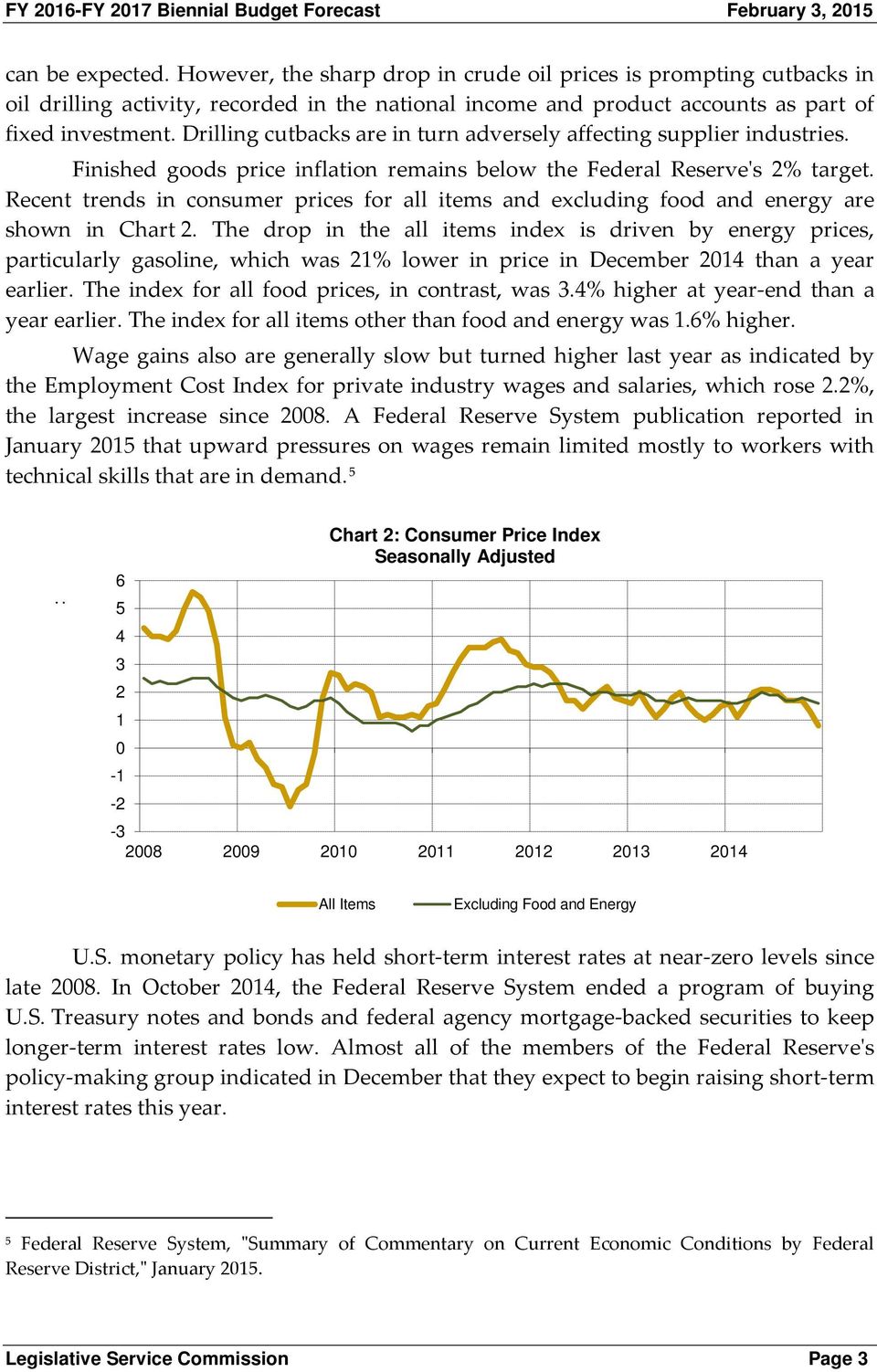
5 can be expected. However, the sharp drop in crude oil prices is prompting cutbacks in oil drilling activity, recorded in the national income and product accounts as part of fixed investment. Drilling cutbacks are in turn adversely affecting supplier industries. Finished goods price inflation remains below the Federal Reserve's 2% target. Recent trends in consumer prices for all items and excluding food and energy are shown in Chart 2. The drop in the all items index is driven by energy prices, particularly gasoline, which was 21% lower in price in December 2014 than a year earlier. The index for all food prices, in contrast, was 3.4% higher at year-end than a year earlier. The index for all items other than food and energy was 1.6% higher. Wage gains also are generally slow but turned higher last year as indicated by the Employment Cost Index for private industry wages and salaries, which rose 2.2%, the largest increase since A Federal Reserve System publication reported in January 2015 that upward pressures on wages remain limited mostly to workers with technical skills that are in demand. 5 : Chart 2: Consumer Price Index Seasonally Adjusted All Items Excluding Food and Energy U.S. monetary policy has held short-term interest rates at near-zero levels since late In October 2014, the Federal Reserve System ended a program of buying U.S. Treasury notes and bonds and federal agency mortgage-backed securities to keep longer-term interest rates low. Almost all of the members of the Federal Reserve's policy-making group indicated in December that they expect to begin raising short-term interest rates this year. 5 Federal Reserve System, "Summary of Commentary on Current Economic Conditions by Federal Reserve District," January Legislative Service Commission Page 3
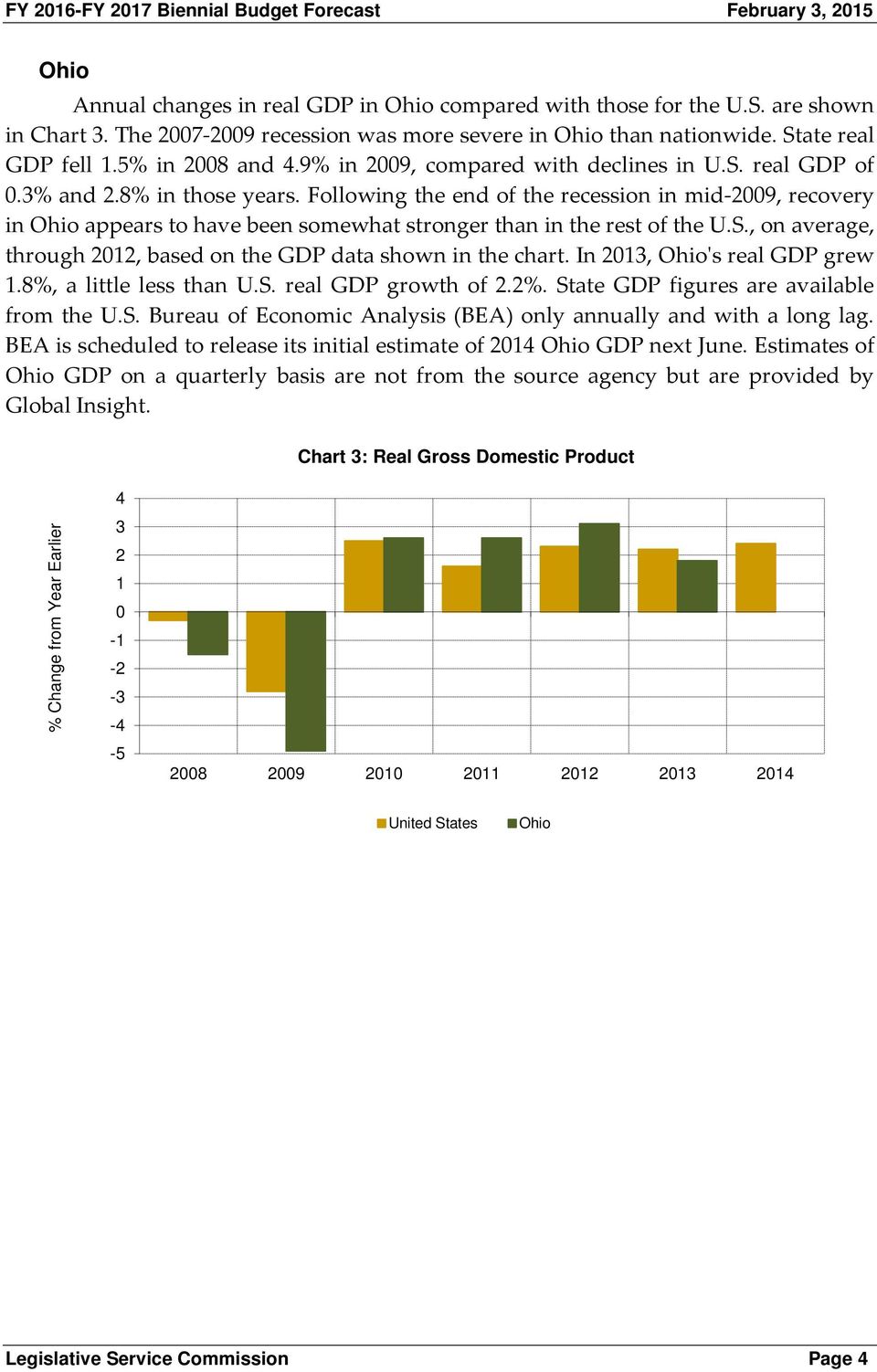
6 Ohio Annual changes in real GDP in Ohio compared with those for the U.S. are shown in Chart 3. The recession was more severe in Ohio than nationwide. State real GDP fell 1.5% in 2008 and 4.9% in 2009, compared with declines in U.S. real GDP of 0.3% and 2.8% in those years. Following the end of the recession in mid-2009, recovery in Ohio appears to have been somewhat stronger than in the rest of the U.S., on average, through 2012, based on the GDP data shown in the chart. In 2013, Ohio's real GDP grew 1.8%, a little less than U.S. real GDP growth of 2.2%. State GDP figures are available from the U.S. Bureau of Economic Analysis (BEA) only annually and with a long lag. BEA is scheduled to release its initial estimate of 2014 Ohio GDP next June. Estimates of Ohio GDP on a quarterly basis are not from the source agency but are provided by Global Insight. Chart 3: Real Gross Domestic Product % Change from Year Earlier United States Ohio Legislative Service Commission Page 4
7 Nonfarm payroll employment in Ohio, compared with that in the U.S., is shown in Chart 4. Ohio nonfarm payroll employment reached a low point in early 2010, and had recovered by 6.6%, 330,000 additional jobs, by the end of last year. U.S. nonfarm payroll employment also reached its low point in February 2010, and through December 2014 had risen 8.2%, 10.7 million more jobs. Employment growth in Ohio outpaced that in the U.S. in the first two years of recovery but has since lagged, as shown in the chart. Chart 4: Total Nonfarm Payroll Employment Millions, Seasonally Adjusted United States Ohio (right scale) Legislative Service Commission Page 5

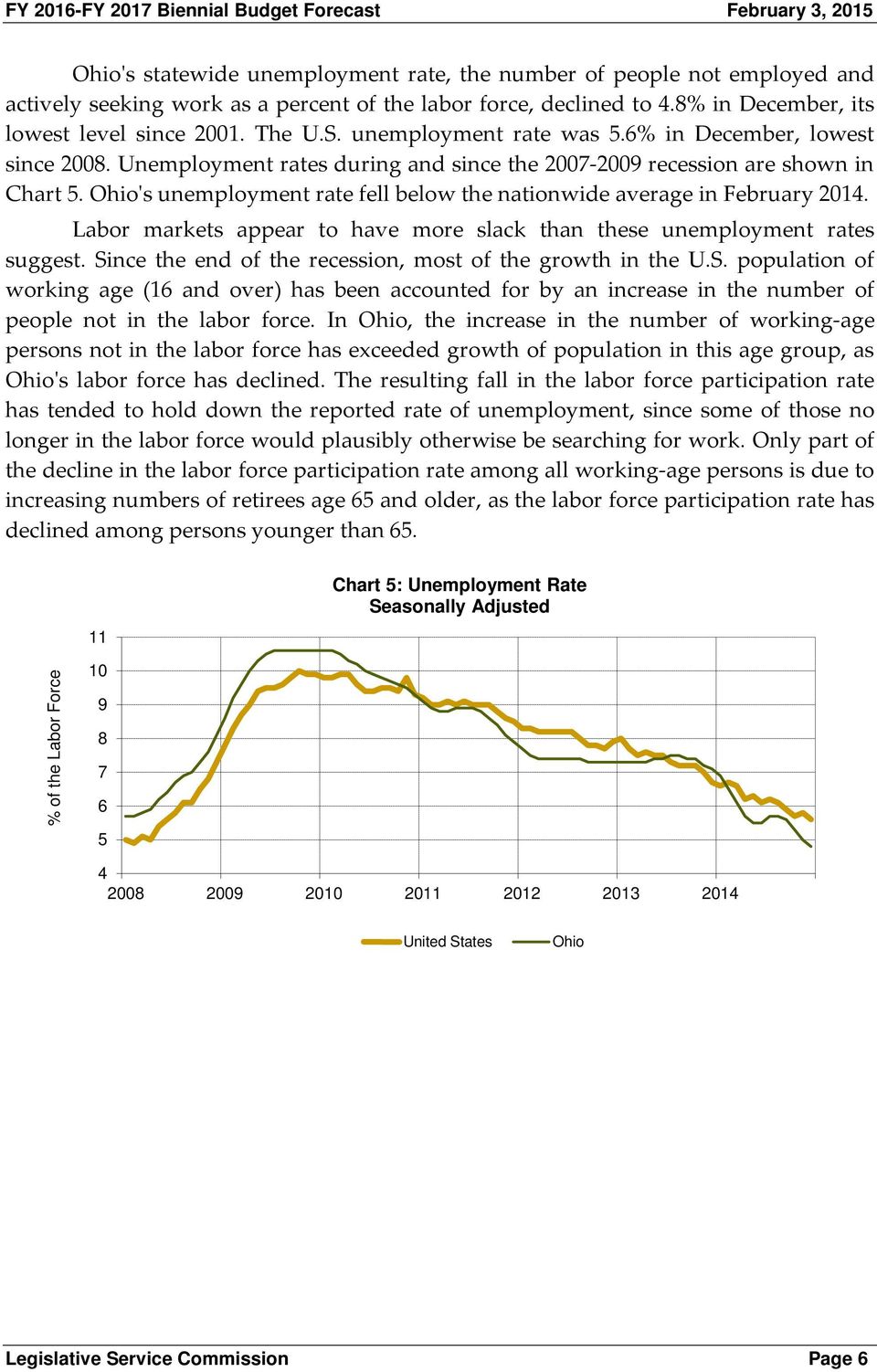
8 Ohio's statewide unemployment rate, the number of people not employed and actively seeking work as a percent of the labor force, declined to 4.8% in December, its lowest level since The U.S. unemployment rate was 5.6% in December, lowest since Unemployment rates during and since the recession are shown in Chart 5. Ohio's unemployment rate fell below the nationwide average in February Labor markets appear to have more slack than these unemployment rates suggest. Since the end of the recession, most of the growth in the U.S. population of working age (16 and over) has been accounted for by an increase in the number of people not in the labor force. In Ohio, the increase in the number of working-age persons not in the labor force has exceeded growth of population in this age group, as Ohio's labor force has declined. The resulting fall in the labor force participation rate has tended to hold down the reported rate of unemployment, since some of those no longer in the labor force would plausibly otherwise be searching for work. Only part of the decline in the labor force participation rate among all working-age persons is due to increasing numbers of retirees age 65 and older, as the labor force participation rate has declined among persons younger than Chart 5: Unemployment Rate Seasonally Adjusted % of the Labor Force United States Ohio Legislative Service Commission Page 6
9 Personal income has been growing in the nation and Ohio since 2009, as shown in Chart 6. Both series in the chart are shown in dollars of current purchasing power. Ohio personal income as well as U.S. personal income rose 3.8% in the latest year. U.S. personal income rose further in the fourth quarter. 15,000 Chart 6: Personal Income Billions of Dollars, Seasonally Adjusted Annual Rates , , , , United States Ohio (right scale) Legislative Service Commission Page 7

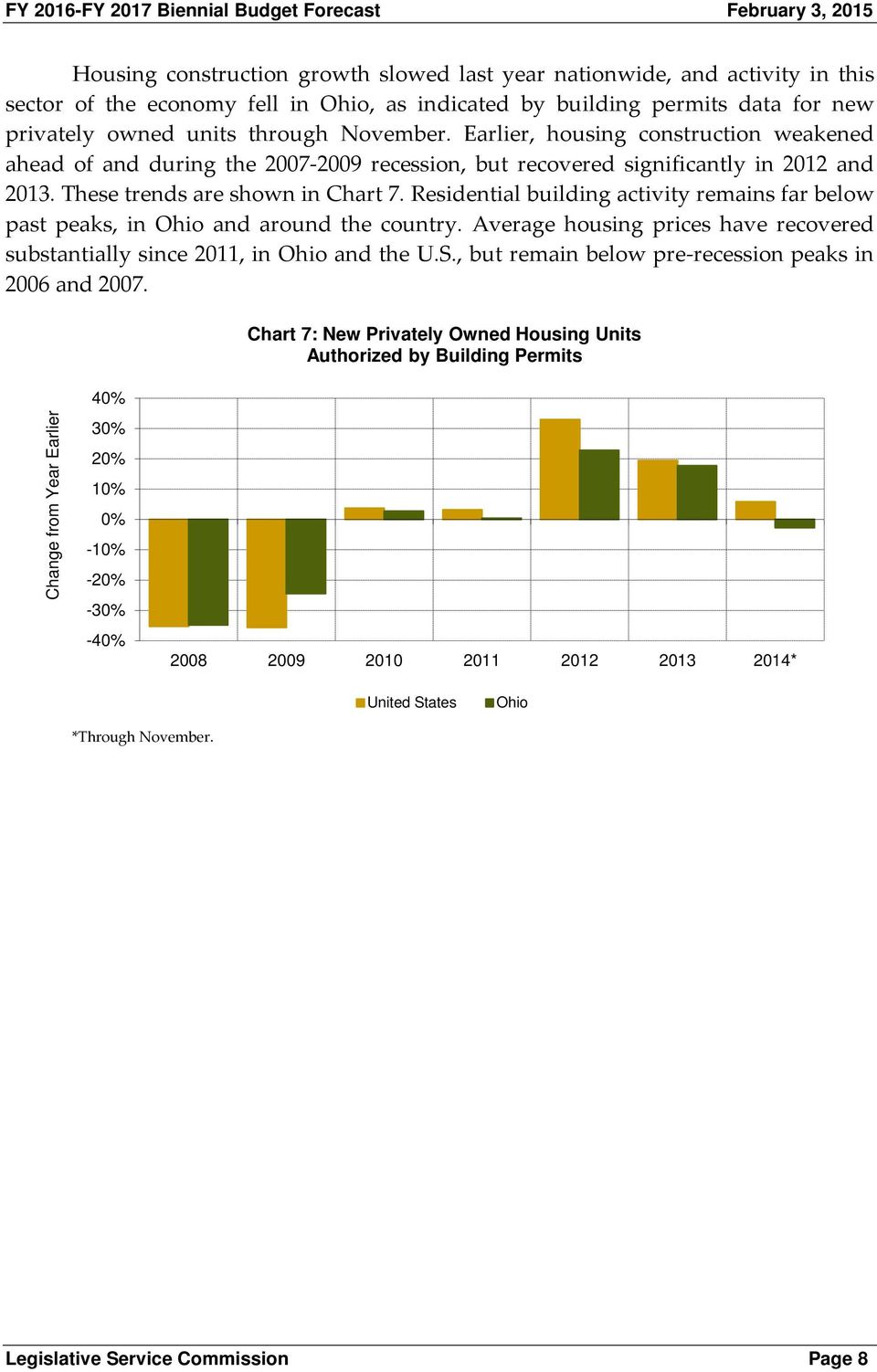
10 Housing construction growth slowed last year nationwide, and activity in this sector of the economy fell in Ohio, as indicated by building permits data for new privately owned units through November. Earlier, housing construction weakened ahead of and during the recession, but recovered significantly in 2012 and These trends are shown in Chart 7. Residential building activity remains far below past peaks, in Ohio and around the country. Average housing prices have recovered substantially since 2011, in Ohio and the U.S., but remain below pre-recession peaks in 2006 and Chart 7: New Privately Owned Housing Units Authorized by Building Permits Change from Year Earlier 40% 30% 20% 10% 0% -10% -20% -30% -40% * United States Ohio *Through November. Legislative Service Commission Page 8
11 Economic Forecasts The predictions for the economic outlook in the tables that follow are from Global Insight's baseline forecasts released in December Economic forecasting is inherently uncertain, and projections may turn out to be too optimistic or too pessimistic. LSC's forecasts for state tax revenues, based in part on some of the variables provided by Global Insight, could in consequence also be either too high or too low. Quarterly changes shown, the first line in each table, are from the preceding quarter. Changes shown in the second line compare average values for the four quarters ending in the second calendar quarter, coinciding with Ohio's fiscal year, with average values for the four quarters one year earlier. The unemployment rate tables show average unemployment rates for the quarters indicated (first line) and for the four quarters ending in the second quarter (second line). U.S. Gross Domestic Product U.S. real GDP is projected to increase at about a 2.5% annual rate on average over the forecast horizon through 2017, as shown below. U.S. Real GDP Growth Forecast Q1 Q2 Q3 Q4 Q1 Q2 Q3 Q4 Q1 Q2 Q3 Q percent change at annual rate Quarterly Fiscal Year Ohio Gross Domestic Product Economic growth in Ohio is expected to continue through 2017 but at a somewhat slower pace than the U.S. Predicted growth of real GDP in Ohio averages 2.0% per year in 2015 through Ohio Real GDP Growth Forecast Q1 Q2 Q3 Q4 Q1 Q2 Q3 Q4 Q1 Q2 Q3 Q percent change at annual rate Quarterly Fiscal Year Legislative Service Commission Page 9

12 U.S. Inflation In Global Insight's December baseline forecast, the consumer price index turns up in this year's second quarter, after falling as a result of lower energy prices. Inflation averages about a 2.2% annual rate in the next two years. U.S. Consumer Price Index Inflation Forecast Q1 Q2 Q3 Q4 Q1 Q2 Q3 Q4 Q1 Q2 Q3 Q percent change at annual rate Quarterly Fiscal Year U.S. Personal Income Nationwide personal income growth is projected to average 4.9% at an annual rate in 2015 through These growth rates are based on the dollar amounts of income, not adjusted for inflation. U.S. Personal Income Growth Forecast Q1 Q2 Q3 Q4 Q1 Q2 Q3 Q4 Q1 Q2 Q3 Q percent change at annual rate Quarterly Fiscal Year Ohio Personal Income Income to persons who reside in Ohio also is forecast to grow through Growth of Ohio personal income averages 4.2% at an annual rate in 2015 through 2017, lagging behind growth of personal income nationwide. Ohio Personal Income Growth Forecast Q1 Q2 Q3 Q4 Q1 Q2 Q3 Q4 Q1 Q2 Q3 Q percent change at annual rate Quarterly Fiscal Year Legislative Service Commission Page 10

13 U.S. Unemployment Rate Unemployment nationwide is expected to decline slowly through the forecast period shown in the table. U.S. Unemployment Rate Forecast Q1 Q2 Q3 Q4 Q1 Q2 Q3 Q4 Q1 Q2 Q3 Q percent of the labor force Quarterly Fiscal Year Ohio Unemployment Rate The unemployment rate in Ohio is projected to be 5.4% in almost every quarter through the end of As the rate was down to 4.8% in December 2014, it would have to rise for this forecast to be realized. Ohio Unemployment Rate Forecast Q1 Q2 Q3 Q4 Q1 Q2 Q3 Q4 Q1 Q2 Q3 Q percent of the labor force Quarterly Fiscal Year Legislative Service Commission Page 11

14 REVENUE FORECASTS The LSC baseline forecasts for FY 2016 and FY 2017 assume the current statutory tax structure, including tax changes enacted by the 130th General Assembly. Among the bills enacted by that General Assembly, there were two that included enough significant changes to GRF taxes to describe them as tax reform acts: the budget act for the current biennium, H.B. 59, and the mid-biennium review act, H.B Also, S.B. 243 enacted a three-day sales tax holiday in August 2015, affecting FY 2016 receipts. The Medicaid expansion related to the federal Affordable Care Act (ACA) is assumed to continue through the biennium, boosting revenue from the nonauto sales and use tax and the domestic insurance tax. The tax reform provisions enacted in H.B. 59 began to take effect in FY That act made significant changes to the income tax, including a reduction in tax rates by 8.5% across all brackets, a new small business income deduction, and a new earned income tax credit (EITC), all effective in tax year (TY) H.B. 483 added an acceleration of a tax rate cut for TY 2014 (to a total 10% reduction as compared to TY 2012 rates), an enhancement of the EITC (to 10% of the federal EITC), and a temporary enhancement of the small business income deduction. 6 A number of smaller changes were also included in both acts, including the beginning of means testing before taxpayers are allowed to claim certain credits. For several of the changes that were made to this tax by H.B. 59, data with which to analyze the revenue effects are still very limited, so estimates of the revenue effects of that act are still rough. Similarly, for certain changes made by H.B. 483 that take effect for TY 2014, solid data on revenue effects will not be available for at least a year. Two years ago, the forecast involved an added degree of uncertainty related to a portion of GRF tax receipts that is transferred to the Local Government Fund (LGF) and the Public Library Fund (PLF). That uncertainty, at least, has been eliminated. The forecast assumes that 1.66% of total GRF tax revenue received each month will be transferred to each of the LGF and PLF. That ratio was determined by the Tax Commissioner under the authority of Section of the Revised Code. Also, readers may note the elimination of pages contained in past editions of this forecast book: those for the corporate franchise tax (CFT), the dealers in intangibles tax (DIT), and the estate tax. All three taxes have been eliminated. Although some revenue effects from these taxes have resulted during FY 2015, none were expected at the beginning of the fiscal year, and none are expected in future years. 7 On the other hand, a new GRF tax source, the petroleum activity tax commenced in FY For baseline purposes for this tax, LSC economists assume that the temporary enhancement to the small business income deduction expires as currently scheduled after TY The financial institutions tax (FIT), which first received revenue in FY 2014, replaced the CFT and the DIT. Legislative Service Commission Page 12

15 GRF tax revenue under current law is forecast to increase by $1.32 billion (6.2%) in FY Growth is expected for most tax revenue sources, as the economic recovery is expected to continue. The cigarette and other tobacco products tax is a notable exception, as it is expected to continue its steady decline. A projected decline in kilowatt-hour tax revenue is due to the growing share of PLF receipts, half of which are debited against this tax, rather than to any changes in its tax base or rates. No revenues are expected from either the CFT or the DIT as those taxes are eliminated, but late tax reconciliations may result in nonzero revenue. The estate tax, which ended for deaths after December 31, 2012, is projected to yield no GRF tax receipts after FY The baseline forecast also includes additional sales tax and insurance tax receipts from growth in receipts attributable to Medicaid health insurance companies, which is projected to grow strongly in the LSC Medicaid expenditure forecast. LSC also forecasts revenue from earnings on investments and from license fees, which are projected to total $92.3 million in FY GRF tax revenue under current law is forecast to increase by $863.3 million (3.8%) in FY Growth in revenue from the personal income tax and the nonauto sales and use tax, the two largest GRF tax sources, is projected to moderate somewhat, but remain fairly robust. The financial institutions tax (FIT) and the domestic insurance tax are anticipated to have sizable revenue growth. Receipts from the auto sales and use tax are projected to decline slightly, primarily reflecting the effects of increasing interest rates on willingness of consumers to take out loans to finance purchases. Except for declining receipts for the tax on cigarettes and other tobacco products and the kilowatt-hour tax, the remaining taxes are expected to exhibit smaller rates of revenue growth. Earnings on investments and license revenue are forecast to total $118.3 million in FY GRF tax revenue for the FY 2016-FY 2017 biennium is forecast to be $45.98 billion, 11.1% higher than the revenue received during the current biennium. The following chart and table provide overviews of GRF receipts from taxes and from state sources including earnings on investments and receipts from charges for licenses and fees. Legislative Service Commission Page 13

16 $25,000 GRF Tax Revenues (in millions) $20,000 $ in millions $15,000 $10,000 $5,000 $0 FY 2011 Actual FY 2012 Actual FY 2013 Actual FY 2014 Actual FY 2015 Estimate FY 2016 Forecast FY 2017 Forecast FY 2011 FY 2012 FY 2013 FY 2014 FY 2015 FY 2016 FY 2017 Actual Actual Actual Actual Estimate Forecast Forecast Revenue $17,706.2 $19,005.2 $21,015.5 $20,134.4 $21,242.7 $22,558.5 $23,421.8 Growth 9.1% 7.3% 10.6% -4.2% 5.5% 6.2% 3.8% Legislative Service Commission Page 14

17 LSC Baseline Revenue Forecasts, FY 2016-FY 2017 ($ in millions) GRF TAX REVENUE FY 2014 FY 2015 Growth FY 2016 Growth FY 2017 Growth Actuals Estimates Rate Forecast Rate Forecast Rate Auto Sales & Use $1,209.9 $1, % $1, % $1, % Nonauto Sales & Use $7,955.9 $8, % $9, % $9, % Total Sales & Use Taxes $9,165.8 $10, % $10, % $10, % Personal Income $8,064.9 $8, % $9, % $9, % Commercial Activity $794.2 $ % $ % $ % Petroleum Activity $0.0 $ $ % $ % Corporate Franchise -$11.4 -$ % $ % $ Financial Institutions $197.8 $ % $ % $ % Public Utility $106.0 $ % $ % $ % Kilowatt-Hour Excise $306.3 $ % $ % $ % Natural Gas Consumption $76.1 $ % $ % $ % Foreign Insurance $286.5 $ % $ % $ % Domestic Insurance $196.9 $ % $ % $ % Business & Property $0.5 $ % $ $ Cigarette $814.0 $ % $ % $ % Alcoholic Beverage $55.5 $ % $ % $ % Liquor Gallonage $41.8 $ % $ % $ % Estate $39.4 $ % $ % $ Total Tax Revenue $20,134.4 $21, % $22, % $23, % NONTAX STATE-SOURCE REVENUE Earnings on Investments $17.3 $ % $ % $ % Licenses and Fees $57.3 $ % $ % $ % Legislative Service Commission Page 15

18 Sales and Use Tax $12,000 GRF Revenues from the Sales and Use Tax (in millions) $10,000 $8,000 $ in millions $6,000 $4,000 $2,000 $0 FY 2011 Actual FY 2012 Actual FY 2013 Actual FY 2014 Actual FY 2015 Estimate FY 2016 Forecast FY 2017 Forecast FY 2011 FY 2012 FY 2013 FY 2014 FY 2015 FY 2016 FY 2017 Actual Actual Actual Actual Estimate Forecast Forecast Revenue $7,578.2 $8,087.0 $8,444.9 $9,165.8 $10,022.8 $10,496.3 $10,922.1 Growth 7.1% 6.7% 4.4% 8.5% 9.3% 4.7% 4.1% Under current law, the state sales and use tax is levied at a rate of 5.75% on retail sales of tangible personal property, rental of some tangible personal property, and selected services. Major exemptions to the sales and use tax include: food for human consumption off the premises where sold, motor fuel (taxed separately), packaging and packaging equipment, prescription drugs and medical supplies, and property used primarily in manufacturing or used directly in mining or agriculture. There is also a credit for trade-ins on purchases of new motor vehicles. For forecasting purposes, the tax is separated into two parts: auto and nonauto. Auto sales and use tax collections generally arise from the sale of motor vehicles while nonauto sales and use tax collections arise from other sales. One major exception is auto taxes arising from leases, which are paid at the lease signing and are mostly recorded under the nonauto tax, instead of the auto tax. The level of auto sales is dependent on the level of incentives provided by manufacturers and dealers and changes in gasoline prices. The incentives have also changed the way consumers decide whether to purchase or lease their vehicles. As the share of vehicles leased and manufacturers' incentives have varied over the years, the auto sales tax has become more volatile. Also, those changes have affected the nonauto sales tax because taxes arising from leases are recorded under the nonauto sales tax. Legislative Service Commission Page 16

19 The performance of the tax has been strong after the economic recession of In more recent years, revenue growth resulted from an increase in the tax rate from 5.5% to 5.75% starting September 2013, a base expansion from H.B. 59 of the 130th General Assembly, and additional tax receipts from the ACA expansion. Growth is expected to continue in the FY 2016-FY 2017 biennium, supported by steady improvements in the labor market and wages. Legislative Service Commission Page 17
20 Auto Sales and Use Tax $1,400 GRF Revenues from the Auto Sales and Use Tax (in millions) $1,200 $1,000 $ in millions $800 $600 $400 $200 $0 FY 2011 Actual FY 2012 Actual FY 2013 Actual FY 2014 Actual FY 2015 Estimate FY 2016 Forecast FY 2017 Forecast FY 2011 FY 2012 FY 2013 FY 2014 FY 2015 FY 2016 FY 2017 Actual Actual Actual Actual Estimate Forecast Forecast Revenue $976.9 $1,053.5 $1,096.7 $1,209.9 $1,310.2 $1,327.7 $1,311.3 Growth 10.7% 7.8% 4.1% 10.3% 8.3% 1.3% -1.2% The forecast for the auto sales and use tax is based on statistical regressions of quarterly auto sales and use tax base against Ohio auto registrations, average new vehicle prices, and interest rates. FY 2015 estimates were adjusted to reflect actual performance of the tax through December The auto sales and use tax taxable base has strongly rebounded from a multi-year slump exacerbated by the recession. The following economic recovery and the need to replace aging vehicles led to outsized revenue growth in FY 2011 and FY This expansion of the auto sales and use tax taxable base continued in FY 2013 as economic growth accelerated, and the rate increase boosted the revenue growth in FY For the next biennium, revenue growth will be somewhat dependent on changes in gasoline prices and the continued ability of consumers to obtain loans at favorable interest rates. Higher interest rates would make auto loans more expensive and affect unit sales. On the other hand, higher gasoline prices would decrease the sale of light trucks and the average prices of auto sales. Both forecasts of gasoline prices and interest rates are higher in the coming biennium, which in turn, would restrain growth of the auto sales and use tax. Legislative Service Commission Page 18

21 Nonauto Sales and Use Tax $12,000 GRF Revenues from the Nonauto Sales and Use Tax (in millions) $10,000 $8,000 $ in millions $6,000 $4,000 $2,000 $0 FY 2011 Actual FY 2012 Actual FY 2013 Actual FY 2014 Actual FY 2015 Estimate FY 2016 Forecast FY 2017 Forecast FY 2011 FY 2012 FY 2013 FY 2014 FY 2015 FY 2016 FY 2017 Actual Actual Actual Actual Estimate Forecast Forecast Revenue $6,601.3 $7,033.5 $7,348.2 $7,955.9 $8,712.6 $9,168.6 $9,610.8 Growth 6.6% 6.5% 4.5% 8.3% 9.5% 5.2% 4.8% The forecast for the nonauto sales and use tax is based on statistical regressions of quarterly nonauto sales and use tax revenues against retail sales and Ohio employment, wages and salaries, and housing starts. FY 2015 estimates were adjusted to reflect actual performance of the tax through December Growth in nonauto sales and use tax receipts has been fairly robust in recent years, supported by wage growth, and growth in tax payments by Medicaid health insuring corporations (MHICs, which were added to the nonauto sales and use tax by H.B. 1 of the 128th General Assembly), and other legislated changes. H.B. 59 of the 130th General Assembly extended the tax to the sale of certain digital products and repealed the exemption for subscription magazines. Also, the Medicaid expansion in 2014 effectively served as another base expansion which boosted revenue in FY 2014 and FY Forecasts for FY 2016 and FY 2017 assume the continuation of the existing tax base. Legislative Service Commission Page 19
22 Personal Income Tax $10,000 $9,000 $8,000 $7,000 GRF Revenues from the Personal Income Tax (in millions) $ in millions $6,000 $5,000 $4,000 $3,000 $2,000 $1,000 $0 FY 2011 Actual FY 2012 Actual FY 2013 Actual FY 2014 Actual FY 2015 Estimate FY 2016 Forecast FY 2017 Forecast FY 2011 FY 2012 FY 2013 FY 2014 FY 2015 FY 2016 FY 2017 Actual Actual Actual Actual Estimate Forecast Forecast Revenue $8,120.3 $8,432.9 $9,507.8 $8,064.9 $8,315.2 $9,077.3 $9,464.7 Growth 12.0% 3.8% 12.7% -15.2% 3.1% 9.2% 4.3% The personal income tax is levied on Ohio taxable income, which equals federal adjusted gross income as reported to the U.S. Internal Revenue Service (IRS), plus or minus various adjustments and minus personal and dependent exemptions. A taxpayer's tax liability before credits is determined by applying Ohio's graduated tax rates to the taxpayer's Ohio taxable income. Certain credits may be subtracted from this amount to derive the taxpayer's final tax liability. The estimate of personal income tax revenues in FY 2015 and the forecasts for FY 2016 and FY 2017 are based on the results of models of revenue collections. The models work with four components of state income tax collections: employer withholding, payments from individual taxpayers (estimated taxes and annual returns), other revenues (trust income and miscellaneous collections), and refunds. The data are largely organized on a fiscal year basis. Withholding is estimated as a function of Ohio wage and salary income, nonfarm payroll employment, withholding rates, the amount of wages per employee, and the number of employees per household. The individual taxpayer component is a function of proprietors' income and other taxable nonwage income, the Standard and Poor's (S&P) 500 index (used to represent capital gains), household holdings of equities and nonfinancial assets, and tax rate variables. All other income tax collections are a function of revenue trends in miscellaneous collections and the S&P 500 index (used as a predictor of receipts derived from taxable trusts). Refunds Legislative Service Commission Page 20
23 are a function of gross tax collections (withholding plus individual plus other), the change in gross tax collections from the previous year, the value of the personal exemption, and tax rate variables. Forecasts of the explanatory variables are from Global Insight, except for withholding and tax rates and personal exemption amounts. Further modifications to revenue estimates reflect adjustments for estimated revenue losses from the small business deduction authorized by H.B. 59 of the 130th General Assembly; projected revenue losses following the acceleration of income realization ahead of the "fiscal cliff" at the end of calendar year 2012; revenue losses from refundable tax credits for rehabilitating historical buildings; revenue losses from the small business investment credit enacted in H.B. 153 of the 129th General Assembly; revenue effects of the most recent mid-biennium review act, H.B. 483, as well as other bills enacted during the 130th General Assembly. The fiscal cliff was a widely expected increase in federal income tax rates in 2013, in anticipation of which bonus and dividend payments and capital gains realizations were accelerated into 2012, boosting state income tax receipts in FY Through December, FY 2015 GRF revenues from the personal income tax were 3.1% above estimate but down 3.1% compared with the first six months of FY Gross collections were 1.7% above estimate but 1.6% lower than FY 2014 year-to-date levels. Refunds were 17.2% below estimate but 30.1% above FY 2014 levels. Most refunds are sent out during February through April. The FY 2015 estimate for GRF revenues from the personal income tax is $8,315.2 billion, a 3.1% increase from FY 2014 revenues. Revenues are held down in FY 2015 by a further reduction in the tax rate and by an increase, for tax year (TY) 2014 only, in the deduction for income from a trade or business from 50% to 75% of that income. GRF revenues are projected to rise by 9.2% in FY 2016, and by 4.3% in FY Income tax rates were reduced 21% between TY 2004 and TY 2011 by H.B. 66 of the 126th General Assembly, as modified by H.B. 318 of the 128th General Assembly. Income tax rates were lowered by an additional 10% between TY 2012 and TY 2014 by H.B. 59 and H.B. 483, both of the 130th General Assembly. Legislative Service Commission Page 21
24 Commercial Activity Tax $2,000 $1,800 $1,600 $1,400 All-Funds Revenues from the Commercial Activity Tax (in millions) $ in millions $1,200 $1,000 $800 $600 $400 $200 $0 FY 2011 Actual FY 2012 Actual FY 2013 Actual FY 2014 Actual FY 2015 Estimate FY 2016 Forecast FY 2017 Forecast FY 2011 FY 2012 FY 2013 FY 2014 FY 2015 FY 2016 FY 2017 Actual Actual Actual Actual Estimate Forecast Forecast All Funds Revenue $1,450.1 $1,653.3 $1,594.4 $1,604.0 $1,650.3 $1,716.8 $1,778.5 Growth 8.1% 14.0% -3.6% 0.6% 2.9% 4.0% 3.6% GRF Share $0 $417.1 $790.0 $794.2 $825.2 $858.4 $889.3 The commercial activity tax (CAT) forecast is primarily based on changes to Ohio's Industrial Production and Gross State Product, with some adjustments for estimates of tax credits applied against the tax. Annual revenue growth in FY 2011 and in FY 2012 was primarily due to the economic recovery after the recession. The poor performance of the tax in FY 2013 was due to larger than expected refunds from tax credits, but also a one-time large decrease in revenue from a change in the application of the $1 million exclusion from taxable gross receipts enacted by H.B. 508 (129th General Assembly). CAT receipts available for the state general operating budget were reduced by a decision of the Ohio Supreme Court, 8 and the exclusion of revenue from motor fuel sales restrained growth in CAT revenue in FY Note that all-funds CAT revenues for FY 2014 through FY 2017 have been adjusted to exclude gross receipts from motor fuel sales. 8 On December 7, 2012, the Supreme Court of Ohio ruled that imposing the CAT on gross receipts from the sale of motor vehicle fuel and allocating the revenues to the GRF is unconstitutional. The court precluded allocations of those revenues after the date of the decision. To address the use of motor fuel-related CAT taxes, the General Assembly enacted H.B. 51 (130th General Assembly) requiring the Department of Taxation to determine the amount of such taxes, and to transfer those amounts to the Commercial Activity Motor Fuel Receipts Fund. Legislative Service Commission Page 22
25 Current law earmarks revenues from the CAT for the GRF and for reimbursing school districts and other local governments for the reductions and phase-out of local taxes on most tangible personal property. In FY 2011, revenues from the CAT were distributed only to the School District Tangible Property Tax Replacement Fund (70%) and the Local Government Tangible Property Tax Replacement Fund (30%) for reimbursement purposes. H.B. 153 of the 129th General Assembly prescribed a distribution of 25% of total CAT receipts to the GRF in FY 2012 and 50% in FY Distributions to school districts decreased to 52.5% in FY 2012 and 35% in FY 2013, and distributions to local governments other than schools decreased to 22.5% in FY 2012 and 15% in FY The CAT is a privilege tax on business entities operating in Ohio. Generally, business entities with annual taxable gross receipts below $150,000 are exempt from the CAT and those with annual taxable gross receipts above $150,000 and less than $1 million pay the minimum tax of $150. Taxpayers with taxable gross receipts between $1 million and $2 million pay $800 plus 0.26% of the taxable gross receipts in excess of $1 million, those with taxable gross receipts between $2 million and $4 million pay $2,100 plus 0.26% of the taxable gross receipts in excess of $1 million, and those with taxable gross receipts in excess of $4 million pay $2,600 plus 0.26% of the taxable gross receipts in excess of $1 million. Taxpayers who pay the minimum tax pay the CAT once a year. The other CAT taxpayers generally pay the CAT each quarter, based on gross taxable receipts in the previous calendar quarter. Major tax credits against the tax included the job retention, the job creation, the research and development (R&D), the R&D loan repayment, and the credit for net operating losses and other deferred tax assets. Beginning July 1, 2014, the CAT as applied to receipts from the sale or exchange of motor fuel was replaced with a separate tax, the motor fuel receipts tax (MFRT), based solely on receipts from such sales and exchanges. The tax was subsequently renamed the petroleum activity tax by H.B. 492 of the 130th General Assembly. Legislative Service Commission Page 23
26 Petroleum Activity Tax $12 GRF Revenues from the Petroleum Activity Tax (in millions) $10 $8 $ in millions $6 $4 $2 The PAT is first levied in FY $0 FY 2011 Actual FY 2012 Actual FY 2013 Actual FY 2014 Actual FY 2015 Estimate FY 2016 Forecast FY 2017 Forecast FY 2011 FY 2012 FY 2013 FY 2014 FY 2015 FY 2016 FY 2017 Actual Actual Actual Actual Estimate Forecast Forecast Revenue $0 $0 $0 $0 $6.0 $10.0 $10.0 Growth NA NA NA NA NA 66.7% 0.0% On December 7, 2012, the Supreme Court of Ohio ruled that imposing the CAT on gross receipts from the sale of motor vehicle fuel and allocating the revenues to the GRF was unconstitutional, and that revenue arising from the sale of motor fuel used on public highways must be used for public highway purposes. To address the use of motor fuel-related CAT taxes, the General Assembly enacted H.B. 51 (130th General Assembly) requiring the Department of Taxation to determine the amount of such taxes. Subsequently, the General Assembly established the petroleum activity tax (PAT) as a replacement for the CAT on motor fuel in H.B. 59 of the 130th General Assembly. The PAT, which started on July 1, 2014, is computed on the basis of the gross receipts received by a "supplier" from the first sale of motor fuel delivered to a location in the state. The PAT tax rate is 0.65% on a supplier's gross receipts, to be paid quarterly by suppliers. As used in the new law, a "supplier" is a person that acquires motor fuel from a terminal or refinery "rack" and distributes that fuel within the state or imports motor fuel for sale or distribution by the person within the state. A "rack" is defined as a mechanism that delivers motor fuel from a terminal or refinery into a means of transport other than a pipeline or vessel. The new law prescribes several procedures and requirements for the PAT that are similar to the CAT, including provisions related to assessments, refunds, penalties, joint liability, and the electronic filing of returns. Legislative Service Commission Page 24
27 Generally, revenue from the tax is credited to the Petroleum Activity Tax Fund. Money in the fund is to be used first to pay any refunds owed, with 1% of the remaining amount in the fund to be transferred to the Petroleum Activity Tax Administration Fund used by the Department of Taxation, and the bulk of the receipts to the Petroleum Activity Tax Public Highways Fund to be used for public highway purposes. Any revenue from sales of motor fuel not used to propel vehicles on public highways would be transferred to the GRF. The first payment of PAT receipts in November 2014 for the July to September 2014 taxable period totaled $32.0 million, of which $1.9 million was transferred to the GRF, resulting in a shortfall of $4.9 million for the fiscal year to date. The FY 2015 estimate is adjusted to reflect the performance of the tax through December Related to the requirement that revenue arising from the sale of motor fuel used on public highways be used for public highway purposes, existing law requires the Director of the Ohio Public Works Commission to certify on or before June 15 of each year to the Director of Budget and Management the amount of debt service paid from the GRF in that fiscal year on bonds issued to finance or assist in the financing of local public subdivisions' infrastructure capital improvement projects, that are attributable to costs for construction, reconstruction, maintenance, or repair of public highways and bridges and other statutory highway purposes. Then, the Director of Budget and Management is required to allocate the total amount of debt service paid in each fiscal year according to the applicable section of the Ohio Constitution under which the bonds were originally issued. Legislative Service Commission Page 25
28 Financial Institutions Tax $250 GRF Revenues from the Financial Institutions Tax (in millions) $200 $ in millions $150 $100 $50 The FIT was first levied in TY $0 FY 2011 Actual FY 2012 Actual FY 2013 Actual FY 2014 Actual FY 2015 Estimate FY 2016 Forecast FY 2017 Forecast FY 2011 FY 2012 FY 2013 FY 2014 FY 2015 FY 2016 FY 2017 Actual Actual Actual Actual Estimate Forecast Forecast Revenue $0 $0 $0 $197.8 $182.2 $191.5 $200.0 Growth NA NA NA NA -7.9% 5.1% 4.4% The financial institutions tax (FIT), created by H.B. 510 of the 129th General Assembly, was designed as a replacement for the corporate franchise tax (CFT) and the dealers in intangibles tax (DIT) (which were both eliminated at the end of 2013). The FIT was first levied in tax year (TY) 2014, with receipts credited to the GRF starting in FY Through December 2014, the FIT was $22.8 million below estimated revenue, due to adjustments made by taxpayers in the current fiscal year to their TY 2014 report. The FY 2015 estimate was adjusted to reflect the actual performance of the tax. Projected revenues from the FIT in the next biennium are based on the average growth rate in the total equity capital of Ohio banks and savings and loans in the last few years in data from the Federal Deposit Insurance Corporation. For the purposes of this tax, financial institutions are defined as either bank organizations (or holding companies of bank organizations) or nonbank financial organizations. Nonbank financial organizations are persons engaged in business primarily as "small loan lenders." Bank organizations subject to the FIT are the same classes of institutions that were subject to the CFT. A number of financial companies are not subject to the FIT, including credit unions, insurance companies, institutions organized under the Federal Farm Loan Act (or a successor), diversified savings and loan holding companies, and grandfathered unitary savings and loan companies. Legislative Service Commission Page 26
29 Unlike the CFT, the FIT extends the taxation of financial institutions to noncorporate forms of business organizations. The FIT is levied on the "total Ohio equity capital" of financial institutions, which includes a firm's common stock, perpetual preferred stock, surplus, retained earnings, treasury stock, and unearned employee stock ownership plan shares. Taxpayers operating in multiple states are required to apportion total equity capital in proportion to gross receipts sitused to Ohio. The FIT specifies three tax rates: a rate of 0.8% (8 mills) which applies to the first $200 million of a taxpayer's total Ohio equity capital; a rate of 0.4% (4 mills) of a taxpayer's total Ohio equity capital between $200 million and $1.3 billion; and a rate of 0.25% (2.5 mills) which applies to the amount of total Ohio equity capital in excess of $1.3 billion. The minimum FIT tax is $1,000. Each taxpayer must file an annual report and file all tax payments by October 15 of each year. Estimated payments are due on the preceding January 31, March 31, and May 31. H.B. 510 specified a revenue target of $200 million in FY 2014 and prescribed a tax rate adjustment mechanism if revenue was more than 110% or less than 90% of that amount. If revenue exceeded $220 million for TY 2014, the Tax Commissioner would decrease the tax rates for TY 2015 and subsequent years so that the tax would have provided $200 million in receipts, and if the tax rates generated less than 90% of the target amount or $180 million, only the 0.25% third-tier tax rate for equity capital in excess of $1.3 billion would be adjusted upward for TY 2015 and thereafter. Actual revenue for FY 2014 for the initial reports for TY 2014 was within the required range for tax rates to be the same for the TY 2015 report. H.B. 510 also provides another test period in TY 2016, and a second target amount of $212 million. An adjustment mechanism similar to the one for TY 2014 is to occur during TY 2016, with the same consequences for TY 2017 and thereafter if the revenue deviated from the 2016 target amount. Legislative Service Commission Page 27
30 Public Utility Excise Tax $140 GRF Revenues from the Public Utility Excise Tax (in millions) $120 $100 $ in millions $80 $60 $40 $20 $0 FY 2011 Actual FY 2012 Actual FY 2013 Actual FY 2014 Actual FY 2015 Estimate FY 2016 Forecast FY 2017 Forecast FY 2011 FY 2012 FY 2013 FY 2014 FY 2015 FY 2016 FY 2017 Actual Actual Actual Actual Estimate Forecast Forecast Revenue $124.8 $113.9 $96.7 $106.0 $102.4 $100.7 $100.1 Growth -8.7% -8.8% -15.1% 9.7% -3.4% -1.6% -0.6% The public utility excise tax is imposed on the gross intrastate receipts of specified utilities. The tax is levied on natural gas utilities, pipeline companies, heating companies, waterworks, and water transportation companies. Other types of public utilities currently operating are exempt from the tax, as are public utilities owned by municipal corporations. Companies subject to the tax pay 4.75% of gross receipts, except for pipeline companies which pay 6.75% of gross receipts. All companies receive an annual deduction of $25,000. Gross receipts from sales of merchandise, interstate transactions, sales to other utilities for resale, sales to federal government entities, and billings on behalf of other entities are exempt from the tax. Most of the revenue from the public utility excise tax is from natural gas companies. They accounted for about 95% of total public utility excise tax revenue in FY So changes in natural gas prices and consumption are the main determinants of public utility excise tax revenues. All revenue from the public utility excise tax is distributed to the GRF. Tax revenue from the public utility excise tax fell in FY 2012 by 8.8% and in FY 2013 by 15.1%, then recovered in FY 2014 by 9.7%. On balance, tax revenues in FY 2014 were approximately 43% lower than five years earlier, reflecting lower tax payments by natural gas companies. Commodity market prices for natural gas fell following the recession, recovered somewhat in 2010, then dropped further in Legislative Service Commission Page 28
31 2011 and early Prices recovered somewhat to a peak in early 2014 but have since fallen. The drop in crude oil prices in 2014 and 2015, and increased supplies of natural gas from expansion of "fracking" (fracturing of rock formations to free trapped natural gas and crude oil), likely account for much of the recent downward pressure on natural gas prices. Year-to-date public utility excise tax revenues through December were 23.5% lower than in the year-earlier period. The fiscal fourth quarter, April through June, accounts for a disproportionate share of annual revenues, 29% to 35% in recent years. Commodity price fluctuations are reflected in public utility excise tax receipts with a lag. Tax revenues are projected to remain soft in FY 2016 and FY The estimate of public utility excise tax revenue for FY 2015 is based on year-todate tax receipts through December and on a model of public utility excise tax receipts from natural gas companies that relates these receipts to Ohio residential, commercial, and industrial natural gas consumption, to variables representing the quarterly pattern of receipts, and to a time trend. Forecasts for tax receipts from natural gas companies in FY 2016 and FY 2017 are from this model. The price forecast is provided by Global Insight. The forecast of natural gas consumption volumes is from the U.S. Energy Information Administration (EIA) and is based on that agency's projection for the East North Central states. The time trend represents the effects of the Choice Program, under which gas utility customers may choose to purchase their natural gas from companies other than the utility that delivers the gas. Public utility excise tax receipts from companies other than natural gas utilities are assumed unchanged at FY 2014 levels in FY 2015 through FY Legislative Service Commission Page 29
32 Kilowatt-Hour Tax $350 GRF Revenues from the Kilowatt-Hour Tax (in millions) $300 $250 $ in millions $200 $150 $100 $50 $0 FY 2011 Actual FY 2012 Actual FY 2013 Actual FY 2014 Actual FY 2015 Estimate FY 2016 Forecast FY 2017 Forecast FY 2011 FY 2012 FY 2013 FY 2014 FY 2015 FY 2016 FY 2017 Actual Actual Actual Actual Estimate Forecast Forecast Revenue $153.9 $294.8 $307.2 $306.3 $293.9 $289.0 $287.6 Growth -1.5% 91.6% 4.2% -0.3% -4.1% -1.7% -0.5% The kilowatt-hour (kwh) tax is levied on electric distribution companies with end-users in Ohio. The tax rate depends on the volume of electricity used by the customer. There are three distinct marginal tax rates, $ per kwh for the first 2,000 kilowatt hours consumed in a month, $ per kwh for the next 13,000 kilowatt hours consumed, and $ per kwh for all kilowatt hours consumed over 15,000. Very large users, those that use over 45 million kwh per year, have the option of self-assessing the tax, which enables them to pay a lower rate. Beginning January 1, 2011, self-assessors have paid a flat tax rate of $ per kwh for the first 500 million kilowatt hours used in a year and $ per kwh over 500 million. GRF revenue from this tax has varied considerably over the years, due primarily to changes in the share of tax revenue that goes to the GRF; total (all funds) revenue from the tax has been fairly stable. Revenues from the kwh tax are distributed as follows: the GRF (88%), the School District Property Tax Replacement Fund (9%), and the Local Government Property Tax Replacement Fund (3%). 9 Also, half of the share of GRF total tax revenue that is transferred to the Public Library Fund (PLF) is debited against this tax source for accounting purposes. 9 Prior to FY 2012, the GRF received 63%; the School District Property Tax Replacement Fund, 25.4%; and the Local Government Property Tax Replacement Fund, 11.6%. Legislative Service Commission Page 30
33 Revenue to all funds from the tax increased by 0.4% in FY 2012 and 1.8% in FY 2013, but decreased by 0.5% in FY Through December 2014, FY 2015 revenue to all funds has decreased by about 0.7% as compared with the corresponding period in FY The reason for the decrease so far this year is the decrease in electricity consumption by each type of end-user (i.e., residential, commercial, and industrial). Revenue to all funds from the tax is estimated to increase by 1.3% and 1.2% in FY 2016 and FY 2017, respectively. GRF revenue from the kwh tax is expected to decline in the next biennium. Forecasted decreases in GRF revenue in FY 2016 and FY 2017 are due to increases in amounts debited against this tax for the PLF. The forecast of GRF kwh tax revenues was generated in two steps. First, the volume of electricity used by each type of end-user in Ohio was estimated based on trend of retail sales of electricity in the East North Central region as forecasted by the EIA in the May 2014 edition of its publication Annual Energy Outlook. Then, the estimated tax revenue was calculated by multiplying the marginal tax rates by the estimated volume of electricity used for each type of end-user In performing the second step, it was assumed that the highest marginal tax rate ($ per kwh) applied to residential users, the second-highest rate applied to commercial users, and the lowest rate applied to industrial users. Although the correspondence between the electricity usage by these end-user categories and the usage categories represented in the structure of the tax is thought to be close, this is an approximation as the categories are not likely to align perfectly. Legislative Service Commission Page 31
34 Natural Gas Consumption (Mcf) Tax $90 $80 $70 $60 GRF Revenues from the Mcf Tax (in millions) $ in millions $50 $40 $30 $20 $10 $0 FY 2012 Actual FY 2013 Actual FY 2014 Actual FY 2015 Estimate FY 2016 Forecast FY 2017 Forecast FY 2011 FY 2012 FY 2013 FY 2014 FY 2015 FY 2016 FY 2017 Actual Actual Actual Actual Estimate Forecast Forecast Revenue $0.0 $60.2 $57.8 $76.1 $71.2 $75.7 $78.3 Growth NA NA -4.0% 31.7% -6.5% 6.3% 3.5% The GRF started to receive revenues from the natural gas consumption tax (also referred to as the Mcf tax) in FY The Mcf tax is levied on natural gas distribution companies, based on natural gas distributed through the meters of end users in Ohio. The base for the tax is the volume of natural gas measured in Mcf (1,000 cubic feet). The tax rate depends on the volume distributed to a customer. There are three distinct marginal tax rates: $ per Mcf for the first 100 Mcfs distributed to an end user in a month, $ per Mcf for the next 1,900 Mcfs, and $ per Mcf for all natural gas distributed to the end user in excess of 2,000 Mcfs in the month. Natural gas distributors with 70,000 or fewer customers up from 50,000 prior to the measurement period that included October 16, 2009 may pay the rate specified on the total quantity of natural gas distributed in Ohio in a month, as if the distribution was to a single customer. Flex customers, generally industrial or commercial customers with very large natural gas consumption (over one billion cubic feet per year in any of the previous five years) at a single location, or that meet other specified requirements, pay $0.02 per Mcf. All revenue from the Mcf tax was directed to the GRF by H.B. 153 of the 129th General Assembly, beginning in FY Previously, the School District Property Tax Replacement Fund (Fund 7053) received 68.7% of revenue from the tax, and the Local Government Property Tax Replacement Fund (Fund 7054) received 31.3%. Legislative Service Commission Page 32
35 Full-year revenue from this tax has ranged from $83.7 million in FY 2003 to $57.8 million in FY The increase in tax revenues in FY 2014 appears to reflect increased natural gas use because of a cold winter, as indicated by more heating degree days than usual. FY 2015 revenue through December 2014 was about 2% lower than in the corresponding period in FY However, only about 27% of annual revenue from this tax is expected to be received in the first half of the fiscal year. Over half is expected in the April-June quarter as a result of heavy winter consumption of natural gas during January through March coupled with a lag in the required payment of the tax from the natural gas distribution companies to the state. The forecast for the full fiscal year is a combination of a small decline in anticipated natural gas consumption in the East North Central region based on a prediction by the EIA in its May 2014 Annual Energy Outlook, along with the lower year-to-date actual tax revenues. The EIA forecast drives a regression model based on historical natural gas deliveries to Ohio consumers, natural gas consumption tax revenues, and a variable to represent the change in the tax in 2009 noted above. The projections for FY 2016 and FY 2017 revenues from the natural gas consumption tax reflect a return to the regression line as determined by the EIA projection. Legislative Service Commission Page 33
36 Foreign Insurance Tax $350 GRF Revenues from the Foreign Insurance Tax (in millions) $300 $250 $ in millions $200 $150 $100 $50 $0 FY 2011 Actual FY 2012 Actual FY 2013 Actual FY 2014 Actual FY 2015 Estimate FY 2016 Forecast FY 2017 Forecast FY 2011 FY 2012 FY 2013 FY 2014 FY 2015 FY 2016 FY 2017 Actual Actual Actual Actual Estimate Forecast Forecast Revenue $256.3 $266.5 $274.6 $286.5 $296.0 $306.0 $315.0 Growth 2.2% 4.0% 3.1% 4.3% 3.3% 3.4% 2.9% The foreign insurance tax is levied on premiums collected by insurance companies headquartered in a state other than Ohio. The tax is generally 1.4% of premiums; the primary exception is foreign insurance companies that are health insuring corporations (HICs), which pay 1.0% of premiums. Premiums paid for life and health insurance accounted for nearly half of the revenue from the tax in FY 2014, with premiums paid for property and casualty insurance accounting for a substantial portion of the remainder. Revenue from the tax has grown steadily since the recession, but somewhat more slowly than long-run average growth in that revenue. In FY 2014, receipts grew at a rate closer to the long-term average rate. Revenue from this tax depends on overall economic conditions and on interest rates. Insurance companies derive revenue from both the premiums they collect and the interest earned from investing those premiums. The forecast is the average derived from several models, which generally used either Ohio personal income or wage and salary disbursements as a proxy for overall economic conditions, used median home prices in Ohio as a proxy for claims growth, and used changes in six-month Treasury bill yields as a proxy for company revenues from the other main source. Legislative Service Commission Page 34
37 Domestic Insurance Tax $300 GRF Revenues from the Domestic Insurance Tax (in millions) $250 $200 $ in millions $150 $100 $50 $0 FY 2011 Actual FY 2012 Actual FY 2013 Actual FY 2014 Actual FY 2015 Estimate FY 2016 Forecast FY 2017 Forecast FY 2011 FY 2012 FY 2013 FY 2014 FY 2015 FY 2016 FY 2017 Actual Actual Actual Actual Estimate Forecast Forecast Revenue $189.4 $189.1 $206.4 $196.9 $255.0 $271.0 $284.0 Growth 17.1% -0.2% 9.1% -4.6% 29.5% 6.3% 4.8% The domestic insurance tax is levied on premiums collected by insurance companies headquartered in Ohio. The tax is generally 1.4% of premiums; the primary exception is domestic insurers that are HICs, which pay 1.0% of premiums. This tax structure is the same as the foreign insurance tax structure. About 54% of the tax liability under the tax in FY 2014 was attributable to premiums paid for property and casualty insurance. Premiums paid to HICs were responsible for about 40% of tax liabilities. Recent growth in tax revenue has been due to growth in revenue attributable to HICs, which were responsible for less than 9% of total revenue in FY This growth in turn is due to expansions of the tax base. H.B. 1 of the 128th General Assembly subjected premiums paid to Medicaid HICs to the tax, while H.B. 153 of the 129th General Assembly expanded the base to include pharmacy benefit managers under Medicaid managed care. These base expansions, together with a general shift from fee-for-service payments to managed care under Medicaid, have driven growth in revenue from the tax since FY The lack of revenue growth in FY 2012, and part of the lack of growth in FY 2014, was due to late payments. In the case of FY 2014, a $6.7 million payment due in FY 2014 was received in July 2014 (thereby providing a one-time boost to growth in FY 2015). Legislative Service Commission Page 35
38 Revenues from this tax in the future will be primarily driven by Medicaid managed care. The forecast for revenue paid by HICs is based on the LSC Medicaid forecast for expenditures for managed care. Revenue attributable to other premium sources has declined in recent years, but that decline is expected to end, due to the mandatory health insurance coverage provision of the federal Affordable Care Act. Legislative Service Commission Page 36
39 Cigarette and Other Tobacco Products Tax $900 $800 $700 $600 GRF Revenues from the Cigarette and Other Tobacco Products Tax (in millions) $ in millions $500 $400 $300 $200 $100 $0 FY 2011 Actual FY 2012 Actual FY 2013 Actual FY 2014 Actual FY 2015 Estimate FY 2016 Forecast FY 2017 Forecast FY 2011 FY 2012 FY 2013 FY 2014 FY 2015 FY 2016 FY 2017 Actual Actual Actual Actual Estimate Forecast Forecast Revenue $855.6 $843.2 $827.4 $814.0 $798.2 $782.2 $768.5 Growth -3.5% -1.5% -1.9% -1.6% -1.9% -2.0% -1.8% The cigarette and other tobacco products tax is levied on cigarettes, cigars, chewing tobacco, snuff, smoking tobacco, and other tobacco products. Receipts from the sales of cigarettes are about 92% of total receipts. Cigarettes are taxed at a rate of $1.25 per pack of 20 cigarettes. Other tobacco products (OTP), except for "little cigars," 11 are taxed at 17% of their wholesale value. H.B. 59 of the 130th General Assembly increased the excise tax rate on little cigars from 17% to 37% of the wholesale price, beginning on October 1, Revenue collected from the tax is deposited into the GRF. The federal cigarette tax increased from $0.39 per pack to $0.62 per pack on April 1, 2009, and this tax increase reduced Ohio cigarette tax receipts by large amounts in ensuing years, including in FY The negative effects of the federal tax increase on Ohio receipts were partially offset by cigarette tax increases in Kentucky and Pennsylvania and the rise in the wholesale value of OTP from various federal tax rate increases. However, few legislative changes have affected the cigarette tax in the last few years. 11 A "little cigar" is defined as a smoking roll that does not satisfy the excise tax law's definition of a cigarette, that contains an integrated cellulose acetate filter or other filter, and that is not wrapped in natural leaf tobacco. Legislative Service Commission Page 37
40 The forecast for the cigarette and other tobacco products tax is based on a regression using cigarette prices and tax rates, and trend analyses of the recent per capita consumption of cigarettes and price increases of OTP. Smokers are expected to continue to make downward adjustments to their consumption of taxed cigarettes for various reasons, including more expensive cigarettes and health concerns. Revenue from the tax on tobacco products other than cigarettes generally increases each year, primarily from increases in the wholesale price of those products. The long-term annual decline in per capita cigarette consumption is expected to continue. Additional factors, such as increases in the share of nontaxed cigarettes (smuggling and Internet purchases) and the shift to e-cigarettes may create an even steeper decline in consumption of taxed cigarettes in future years. Conversely, tax increases in neighboring states, especially those in Kentucky, may reduce losses from out-of-state nontaxed purchases and boost forecasted revenues from the cigarette and other tobacco products tax. Legislative Service Commission Page 38
41 Alcoholic Beverage Tax $70 GRF Revenues from the Alcoholic Beverage Tax (in millions) $60 $50 $ in millions $40 $30 $20 $10 $0 FY 2011 Actual FY 2012 Actual FY 2013 Actual FY 2014 Actual FY 2015 Estimate FY 2016 Forecast FY 2017 Forecast FY 2011 FY 2012 FY 2013 FY 2014 FY 2015 FY 2016 FY 2017 Actual Actual Actual Actual Estimate Forecast Forecast Revenue $55.4 $57.6 $56.5 $55.5 $55.7 $56.3 $57.3 Growth -1.3% 4.1% -1.9% -1.7% 0.3% 1.1% 1.8% The alcoholic beverage tax applies to sales of beer, malt beverages, wine, and mixed alcoholic beverages. The tax is based on a per-container rate depending on the type of beverage sold. Beer is taxed at varying rates that are equivalent to 0.14 cents per ounce for bottles and cans with less than 12 ounces (about 8.4 cents for a six-pack of 12-ounce containers). Wine containing less than 14% alcohol by volume is taxed at 32 cents per gallon (about 6.3 cents for a standard 750 ml bottle). Wine with between 14% and 21% alcohol by volume is taxed at $1.00 per gallon (or 19.8 cents for a standard 750 ml bottle). Mixed beverages are taxed at $1.20 per gallon (or 23.8 cents for a standard 750 ml bottle). Five cents of the tax on each gallon of wine is deposited into the Ohio Grape Industries Fund. All other revenue from the alcoholic beverage tax is deposited into the GRF. In FY 2014, about 79% of the tax revenue was from the sale of beer and malt beverages while sales of wine and other alcoholic beverages contributed 21% of the remaining tax revenue. The forecast for the alcoholic beverage tax revenue is based on a trend analysis of the contribution of each alcoholic beverage to the tax base in the last few years. Revenues from the tax are expected to increase about 2% in the next biennium compared to the current biennium. Trends in alcohol consumption and increased alcoholic beverage competition affect revenues from this tax. The market share for spirits and liquor has been growing at the expense of beer sales, while sales of wine have increased slightly. Legislative Service Commission Page 39
42 Liquor Gallonage Tax $50 $45 $40 $35 GRF Revenues from the Liquor Gallonage Tax (in millions) $ in millions $30 $25 $20 $15 $10 $5 $0 FY 2011 Actual FY 2012 Actual FY 2013 Actual FY 2014 Actual FY 2015 Estimate FY 2016 Forecast FY 2017 Forecast FY 2011 FY 2012 FY 2013 FY 2014 FY 2015 FY 2016 FY 2017 Actual Actual Actual Actual Estimate Forecast Forecast Revenue $37.6 $39.4 $40.6 $41.8 $42.5 $44.0 $45.0 Growth 2.9% 4.8% 3.1% 2.9% 1.6% 3.5% 2.3% The liquor gallonage tax is levied at the rate of $3.38 per gallon of spirituous liquor. This is the equivalent of 67.0 cents per standard 750 ml bottle. Revenue from this tax is deposited into the GRF. The forecast of liquor gallonage tax receipts is based on trend analysis of wholesale and retail gallonage sales of liquor in Ohio. The market share for spirits has been growing, mostly at the expense of beer sales, while sales of wine have been increasing slowly. Liquor gallonage tax receipts are estimated to grow modestly in FY 2016 and FY Legislative Service Commission Page 40
43 Earnings on Investments $60 GRF Revenues from Earnings on Investments (in millions) $50 $40 $ in millions $30 $20 $10 $0 FY 2011 Actual FY 2012 Actual FY 2013 Actual FY 2014 Actual FY 2015 Estimate FY 2016 Forecast FY 2017 Forecast FY 2011 FY 2012 FY 2013 FY 2014 FY 2015 FY 2016 FY 2017 Actual Actual Actual Actual Estimate Forecast Forecast Revenue $7.1 $5.4 $10.5 $17.3 $22.0 $34.0 $58.0 Growth -75.3% -23.9% 94.0% 65.0% 26.9% 54.5% 70.6% The Treasurer of State is responsible for managing the state's portfolio and investing state funds. All state funds are invested conservatively with safety of the funds as the number one investment priority. State law and investment policy provide an outline of state investment objectives, delegation of authority, and asset diversification policy, and restrict the types of investments allowed. Some of the allowable instruments are short-term and medium-term fixed-income instruments, such as U.S. Treasury securities, federal agency obligations, and highly rated commercial paper. Among the instruments that are not allowable for state fund investment are domestic or international equities, real estate, and venture capital. All earnings on investments from state funds are credited to the GRF unless stated otherwise in the Ohio Revised Code. In FY 2015, earnings on investments are estimated to increase to $22.0 million from $17.3 million in FY 2014 because of increasing interest rates on short- and medium-term investment instruments and higher estimated fund balances than in previous fiscal years. In FY 2016 and FY 2017 interest rates are expected to rise and estimated fund balances are expected to increase moderately. Baseline earnings on investments for FY 2016 and FY 2017 are estimated at $34.0 million and $58.0 million, respectively. The calculations were based on interest rate estimates and the estimated state funds balance that will be available for investment. Legislative Service Commission Page 41
44 Licenses and Fees $80 GRF Revenues from Licenses and Fees (in millions) $70 $60 $ in millions $50 $40 $30 $20 $10 $0 FY 2011 Actual FY 2012 Actual FY 2013 Actual FY 2014 Actual FY 2015 Estimate FY 2016 Forecast FY 2017 Forecast FY 2011 FY 2012 FY 2013 FY 2014 FY 2015 FY 2016 FY 2017 Actual Actual Actual Actual Estimate Forecast Forecast Revenue $59.0 $65.3 $70.2 $57.3 $56.3 $58.3 $60.3 Growth -11.0% 10.8% 7.6% -18.4% -1.8% 3.6% 3.4% The GRF receives revenue from a number of licenses and fees that are either completely or partially deposited into the GRF. The largest contributor of license and fee revenue has historically been license fees deposited by the Department of Insurance. Motor vehicle license fees, license revenue deposited by the Environmental Protection Agency, and various business licenses also contribute revenues to the GRF. LSC estimates licenses and fees will produce $56.3 million in GRF revenues for FY 2015, $58.3 million in FY 2016, and $60.3 million in FY The revenue projections for FY 2016 and FY 2017 are based on a trend analysis of the largest contributors of license and fee revenue. Revenues from licenses and fees are expected to decrease in FY 2015 due to the reduction in certain insurance agent fees that took effect on June 30, FY 2015 estimates reflect the revenue yield from licenses and fees through December Legislative Service Commission Page 42
45 Overview MEDICAID EXPENDITURE FORECAST Background Medicaid, established in 1965 in Title XIX of the Social Security Act, is a joint state-federal program that provides health care coverage to the poor. State agencies administer Medicaid subject to oversight by the Centers for Medicare and Medicaid Services (CMS) in the U.S. Department of Health and Human Services (HHS). State participation in Medicaid is voluntary, but all states participate. The federal government provides reimbursement to the states and offers guidance on how to use those funds, but each state shapes and administers its program to suit the needs of its own population. For instance, states determine their own eligibility requirements and scope of services, set provider payment rates, and administer their own programs. Consequently, Medicaid operates as more than 50 distinct programs one for each state, territory, and the District of Columbia. Federal Poverty Guidelines States use federal poverty guidelines (FPG) in developing their income eligibility criteria for various Medicaid groups. FPG is the income guideline established and issued each year in the Federal Register by HHS. Public assistance programs usually define income standards in relation to FPG. The table below provides the 2015 poverty guidelines for various family sizes for the 48 contiguous states and the District of Columbia. Alaska and Hawaii are provided a different set of guidelines Federal Poverty Guidelines Family Size Poverty Guideline 1 $11,770 2 $15,930 3 $20,090 4 $24,250 5 $28,410 6 $32,570 7 $36,730 8 $40,890 Changes to the Medicaid Program over Time Medicaid has undergone many changes since its inception. The program was initially established to provide medical assistance only to those individuals receiving assistance through Aid to Families with Dependent Children (AFDC) and state Legislative Service Commission Page 43
46 programs for the elderly. Over the years, Congress has incrementally expanded Medicaid eligibility to reach more Americans living below or near poverty, regardless of their welfare eligibility. In 1972, Congress enacted a federal cash assistance program for the aged, blind, and disabled called Supplemental Security Income (SSI), which broadened Medicaid coverage to include this population. A significant expansion of Medicaid was to provide health insurance coverage not just to the welfare population but also to other low-income families, especially low-income children and pregnant women. In 1996, Medicaid was delinked with the enactment of the Temporary Assistance to Needy Families (TANF) Program. Families who receive TANF benefits do not automatically qualify for Medicaid as they did under the AFDC Program. In 1997, the State Children's Health Insurance Program (SCHIP) was created. Title XXI of the Social Security Act added health care coverage for children in low- and moderate-income families who were ineligible for Medicaid, but could not afford private insurance. Under SCHIP, states were offered the option of implementing this health care coverage as a stand-alone program with different benefit packages, or as part of their existing Medicaid benefit. Ohio opted to implement SCHIP as a Medicaid expansion beginning in The most recent changes to Medicaid came with the enactment of the Patient Protection and Affordable Care Act of 2010 (ACA). The goal of the ACA was to increase access to health insurance through a coordinated system of "insurance affordability programs," including a mandatory expansion of Medicaid to all individuals under age 65 whose family income is at or below 138% FPG, 12 and the creation of health insurance exchanges. The ACA required that nearly all U.S. citizens and legal residents have some form of qualifying private or public health insurance. This requirement was otherwise known as the "individual mandate." Compliance with the individual mandate was to be facilitated through state-based or federally facilitated online insurance exchanges and expansion of the Medicaid Program. Under the insurance exchanges, individuals with income between 100% FPG and 400% FPG could qualify for federally funded premium credits and cost-sharing subsidies. Although the ACA made Medicaid expansion mandatory for states, the U.S. Supreme Court, in its 2012 ruling, effectively made the expansion optional by prohibiting the U.S. Secretary of HHS from withholding all or part of a state's other federal Medicaid funds for failure to implement the expansion. Ohio has chosen to implement the Medicaid expansion. On October 21, 2013, the Ohio Department of Medicaid (ODM) requested and received Controlling Board approval to increase federal appropriation by $561.7 million in FY 2014 and $2.0 billion in FY 2015, which effectively 12 Under the ACA, Medicaid eligibility was expanded to 133% FPG, plus 5% income disregard. Thus, it is effectively 138% FPG. Legislative Service Commission Page 44
47 allowed for Medicaid expansion in Ohio to go forward. As of December 2014, 27 other states and the District of Columbia have also expanded their Medicaid programs under the ACA. The ACA also makes other changes that influence Medicaid operations and the program's cost to states including the following: Modifies how income is calculated for most Medicaid applicants, including those in the new eligibility group. In 2014, states began using modified adjusted gross income (MAGI) to determine eligibility of most applicants. MAGI is adjusted gross income as defined in the Internal Revenue Code, modified by applying a 5% "disregard." This method of determining eligibility eliminated resource tests. Provides all newly eligible adults with a benchmark benefit package that meets the minimum essential health benefits that are available in the health insurance exchanges. Requires that states maintain eligibility standards that were in place as of March 23, Requires states to improve outreach and enrollment for Medicaid and to coordinate Medicaid eligibility with the health benefit exchange. Reduces Medicaid disproportionate share hospital (DSH) allotments through calendar year (CY) Increases the Medicaid drug rebate percentage for brand name and non-innovator, multi-source drugs. Provides for the better integration of benefits and improvement of coordination for Medicare/Medicaid dual eligible individuals. (The state effort in Ohio is known as MyCare Ohio.) Incentivizes demonstration projects and payment bundles to reduce costs and better coordinate care services. The state of Ohio has implemented these efforts through Patient-Centered Medical Home (PCMH) and Episode-Based Payment Models. Increased primary care provider payments for CY 2013 and CY Current Medicaid Eligibility in Ohio The Medicaid/SCHIP Program in Ohio currently provides health care coverage to children up to age 19 with family income up to 200% FPG, pregnant women with incomes up to 200% FPG, parents and childless adults with incomes up to 138% FPG, and the elderly and persons with disabilities of all ages with incomes up to 64% FPG. 13 Medicaid coverage is also available to working Ohioans with disabilities through the 13 Ohio has implemented SCHIP as a Medicaid expansion. Legislative Service Commission Page 45
48 Medicaid Buy-In for Workers with Disabilities Program. Under this program, individuals with income up to 250% FPG may qualify and those with income greater than 150% FPG must pay a monthly premium. Starting in January 2012, men and women of childbearing age who are under 200% FPG could receive family planning and related services under Medicaid. The federal Medicare Program provides health care coverage for most of Ohio's elderly population; however, many of the elderly are "dually eligible" (i.e., eligible for both Medicare and Medicaid). The Medicaid Program supplements dual eligibles' Medicare benefits by providing coverage for services such as long-term care and by providing assistance with Medicare premiums, copayments, and deductibles to certain low-income seniors. When looking at caseload data, the Medicaid caseload is often presented in two groups: Covered Families and Children (CFC) and the Aged, Blind, and Disabled (ABD). Generally, state law does not specify which persons fit into which categories. Rather, the categories have in large part been created administratively. CFC includes families, children, and pregnant women. CFC is itself made up of several categories, including Healthy Start and Healthy Families. Medicaid also covers certain low-income individuals who are aged (age 65 or older), blind, or disabled. ABD applicants must meet both income and resource criteria to qualify for Medicaid. In addition to meeting income and resources limits, ABD individuals must be elderly (age 65 or older), significantly visually impaired, or have a disabling condition that meets SSI requirements. Medicaid Caseloads The number of individuals enrolled in Medicaid is affected by changes in the economy particularly for nondisabled adults and children. As unemployment increases, workers and their dependents may lose access to employer coverage. This can happen because of unemployment, reduced employer contributions to health insurance, reduced eligibility for employer-sponsored insurance, and movement from full-time to part-time work. Individuals may become eligible and enroll in public coverage, purchase nongroup coverage, or become uninsured. Due to the Great Recession, total caseloads increased by 6.4% per year on average from FY 2008 to FY Medicaid caseloads also increased rapidly in the early 2000s as a result of the economic slowdown and several eligibility expansions for family and child coverage. In addition to the economy, other factors such as policy changes can affect Medicaid enrollment. Medicaid caseloads grew from 2.22 million in FY 2012 to 2.38 million in FY 2013, an increase of 7.2% (160,551). Of this increase, 70% (112,883) was due to a policy change that allows men and women of childbearing age who are under 200% FPG to receive family planning and related services under Medicaid starting January The chart below shows Ohio's Medicaid caseload from FY 1990 to FY 2013 for the ABD and CFC populations. Legislative Service Commission Page 46
49 2,500 Medicaid Caseloads, FY 1990-FY ,000 ABD CFC Thousands 1,500 1, Fiscal Year Medicaid Expenditures Medicaid expenditures, like caseloads, are affected by the economy and policy. Medicaid expenditures grew by 9.6% per year from FY 2008 to FY 2011 as a result of the Great Recession. Ohio's Medicaid expenditures continued to rise in FY 2013, but the rate of growth slowed after FY 2011 as the economy gradually expanded. The chart below shows Medicaid expenditures from FY 1990 to FY 2013 with both federal and state shares. Generally, the federal government pays for 64% of Ohio's Medicaid expenditures and the state pays the remaining 36%. The federal share is determined annually based upon the most recent per capita income for Ohio relative to that of the nation. For the period of October 1, 2008 through June 30, 2011, federal reimbursement for Medicaid was enhanced under the American Recovery and Reinvestment Act of 2009 and Public Law 226 of the 111th Congress. $20 Medicaid Expenditures, FY 1990-FY 2013 $16 Federal Share State Share Billions $12 $8 $4 $0 Fiscal Year Legislative Service Commission Page 47
50 Reasons for Forecasting Medicaid Expenditures Medicaid expenditures are generally forecasted for two reasons. First, Medicaid services are an "entitlement" for those who meet eligibility requirements. This means that if an individual is eligible for the program then he or she is guaranteed the benefits and the state is obligated to pay for them. Second, the program's costs represent a significant portion of the GRF budget. In FY 2014, Medicaid expenditures represent approximately 47% of total GRF expenditures (including both state and federal shares) and almost 26% when only state share of the GRF is considered. Baseline Forecasting The LSC Medicaid expenditure and enrollment projections shown in this analysis are "baseline" or based on current law; that is, they are consistent with current legislation and administrative policy. This analysis does not forecast any proposed changes included in the executive budget or future changes in state or federal policy that would affect the Medicaid Program. Furthermore, various "add-ons," including Medicaid Part D and Medicare Buy-In, were projected by the Ohio Department of Medicaid (ODM) and added to the LSC baseline forecast; LSC economists did not forecast the add-ons. Assumptions and Data Projections of Medicaid expenditures and enrollment are dependent on demographic and economic assumptions such as economic growth, population growth, and the growth in health care prices. In addition, assumptions regarding participation rates and the coverage of and enrollment in other health insurance programs affect Medicaid expenditures and enrollment projections. Lastly, the projections also depend on the nature and quality of the available data. The data on which the LSC forecast is based are provided by ODM. ODM data sources include the following: Ohio MITS (Medicaid Information Technology System); BIAR (Business Intelligence Analytical Reporting); Data Warehouse; OAKS (Ohio Administrative Knowledge System); and QDSS (Quality Decision Support System). Ohio MITS is a browser-based healthcare administration platform that allows providers to submit claims and other relevant data electronically. BIAR is a subsystem of MITS that among other things allows users to run queries and develop reports. The Data Warehouse stores data accumulated from various sources within ODM. OAKS is a system used by the state to manage its purchasing, general ledger, accounts receivable, and accounts payable information. Lastly, QDSS accesses data from the Data Warehouse and provides software tools to analyze aspects of the Medicaid Program. Legislative Service Commission Page 48
51 There are some limitations in the data described above. MyCare Ohio, the ACA expansion, and the enrollment of children with special health care needs into managed care have only recently been implemented. As a result, there are only a few months of data available regarding these new Medicaid programs. MyCare Ohio began enrolling certain eligible individuals on May 1, 2014, while the ACA expansion began on January 1, The transition of ABD children onto managed care began on July 1, It is difficult to forecast caseloads and expenditures for these with such a limited amount of data. Methodology The model used to generate the baseline Medicaid forecast can be summarized as follows: Expenditures = Caseload x Unit Price (or Per Member Per Month Cost) To forecast Medicaid expenditures for the FY 2016-FY 2017 biennium, LSC economists used both trend analysis and regression analysis. 14 Trend analysis uses historical results to predict future outcome. Regression analysis is used to predict the value of one variable from known or assumed values of other variables related to it. Trend analysis might be employed, for example, to estimate the change in the cost of providing a specific set of benefits over time. In order to estimate this change, trend factors may also be applied. To select appropriate trend factors the forecaster consults sources that provide regional and national economic indicators and indices that offer broad perspectives of industry trends in the United States, the Midwest region, and Ohio. For example, the United States Department of Labor Consumer Price Index data (local, regional, and national), federal reports and projections such as National Health Expenditures, and Global Insight data were all considered by LSC to produce this forecast. Regression analysis is used for estimating the relationship between a dependent variable and one or more independent variables. For example, the unemployment rate might be included in a regression analysis as the independent variable when forecasting Medicaid caseloads (i.e., the dependent variable). After numerous forecasts are produced using the methodologies described above, LSC economists choose the most appropriate models by employing statistical tests for goodness of fit and considering expected growth patterns. The models with the poorest fit are eliminated. LSC also considers historical patterns, along with economic 14 To perform these analyses, two software packages were used: Microsoft Excel and EViews (Econometric Views). EViews is a statistical package for Windows used mainly for time-series oriented econometric analysis. Legislative Service Commission Page 49
52 and policy expectations when determining the best model and producing the final forecasts. LSC economists generate baseline forecasts for major expenditure categories by first calculating the per member per month costs for each category. For each typical expenditure category and subcategory, separate forecasts are done for the average cost per recipient. Due to the delayed submissions of claims by providers and delays in processing payments, claims are not always paid in the same month in which services are provided to Medicaid eligibles. In fact, it is generally the case that providers may not be completely reimbursed for all of the services they provide to Medicaid eligibles until over a year following the date of service. Thus, it is necessary to make the distinction between the date of service and the date of payment. Because disbursements for Medicaid reflect the payment of claims and not the provision of services, it is essential to incorporate the appropriate payment lags when estimating Medicaid spending. A key distinction made in forecasting Medicaid expenditures is between fee-forservice (FFS) and managed care. Until recent years, Medicaid paid most service providers a set fee for the specific type of service rendered to Medicaid enrollees (termed "fee-for-service" reimbursement). An alternative to FFS reimbursement is managed care. A typical managed care plan (MCP), called capitated at-risk plans, is one in which the beneficiary receives all care through a single point of entry, and the plan is paid a fixed (capitated) monthly premium per beneficiary for any health care included in the benefit package, regardless of the amount of services actually used. The beneficiary is responsible for, at most, modest copayments for services; the provider is at risk for the remaining cost of care. Such a capitated plan can be a network of physicians and clinics, all of whom participate in the plan and also participate in other plans or FFS systems, or it can be a plan that hires all the physicians who provide all the care required. In forecasting Medicaid expenditures, the costs of recipients enrolled in MCPs are generally treated separately from the FFS categories. This practice means that services provided to managed care enrollees are not to be included when forecasting the large FFS categories such as Inpatient Hospital Services and Physician Services. Due to the managed care expansions for both the CFC and ABD populations in the past few years, managed care has become the biggest factor in forecasting Medicaid expenditures in the upcoming biennium. Medicaid Forecast Summary LSC's baseline forecast shows the expected cost of this entitlement program given current policies. The majority of the Medicaid spending is in ODM. The table below summarizes the Medicaid service expenditures. Legislative Service Commission Page 50
53 Summary of Medicaid Service Expenditures (combined state and federal dollars, dollars in millions) FY 2015 Estimate FY 2016 Projection FY 2015-FY 2016 Dollar Growth Percent Growth FY 2017 Projection FY 2016-FY 2017 Dollar Growth Percent Growth LSC Baseline $21,162 $22,728 $1, % $24,112 $1, % ODM Add-ons $1,903 $2,979 $1, % $2,478 -$ % Total $23,065 $25,707 $2, % 26,590 $ % In FY 2015, Medicaid service expenditures, in combined state and federal dollars, are estimated to be $23.07 billion. LSC forecasts that Medicaid expenditures will increase by $2.64 billion, or 11.5%, in FY 2016 and by $883 million, or 3.4%, in FY Caseload Forecast 3,500,000 Total Medicaid Caseload 3,000,000 2,500,000 2,000,000 1,500,000 1,000, ,000 0 FY 2011 Actual FY 2012 Actual FY 2013 Actual FY 2014 Actual FY 2015 Estimate FY 2016 Forecast FY 2017 Forecast FY 2011 FY 2012 FY 2013 FY 2014 FY 2015 FY 2016 FY 2017 Actual Actual Actual Actual Estimate Forecast Forecast Caseload 2,160,469 2,218,121 2,378,672 2,506,272 2,933,694 3,083,504 3,133,535 Growth 5.6% 2.7% 7.2% 5.4% 17.1% 5.1% 1.6% The total number of persons enrolled in Medicaid is expected to rise from an estimated 2.93 million in FY 2015 to 3.08 million in FY 2016, a 5.1% increase, and reach 3.13 million in FY 2017, a 1.6% increase over FY Caseload Projections by Eligibility Category The following three charts and associated three tables detail the caseload projections by eligibility category. The first chart and associated table show caseloads Legislative Service Commission Page 51
54 under the covered families and children (CFC) category, the second chart and associated table show caseloads under the aged, blind, and disabled (ABD) category, and the third chart and associated table show caseloads under the other category, including individuals who receive premium assistance from Medicaid. 3,000,000 Caseloads - Covered Families and Children 2,500,000 2,000,000 1,500,000 1,000, ,000 0 FY 2011 Actual FY 2012 Actual FY 2013 Actual FY 2014 Actual FY 2015 Estimate FY 2016 Forecast FY 2017 Forecast CFC CHIP ADFC Group VIII CFC: Covered Families and Children (including Healthy Start/Healthy Families) CHIP: Children Health Insurance Program ADFC: Adopted and Foster Care Children Group VIII: Individuals who become eligible for Medicaid through the ACA FY 2011 FY 2012 FY 2013 FY 2014 FY 2015 FY 2016 FY 2017 Actual Actual Actual Actual Estimate Forecast Forecast CFC 1,441,256 1,472,951 1,528,206 1,515,333 1,646,035 1,691,707 1,663,982 Growth 6.6% 2.2% 3.8% -0.8% 8.6% 2.8% -1.6% CHIP 161, , , , , , ,834 Growth 1.6% 0.6% -1.4% -9.7% -15.7% -1.6% -0.2% ADFC 31,904 28,706 28,212 27,874 27,551 27,243 26,958 Growth -15.2% -10.0% -1.7% -1.2% -1.2% -1.1% -1.0% Group VIII , , , ,500 Growth % 23.8% 11.2% Legislative Service Commission Page 52
55 LSC forecasts that the overall CFC caseload will increase by 162,976, or 7.1%, in FY 2016, and by 41,717, or 1.7%, in FY The increase is largely due to the addition of Group VIII, the ACA expansion population. Caseloads - Aged, Blind, and Disabled 500, , , , , , , , ,000 50,000 0 FY 2011 Actual FY 2012 Actual FY 2013 Actual FY 2014 Actual FY 2015 Estimate FY 2016 Forecast FY 2017 Forecast ABDK ABDA Dual ABDK: Aged, Blind, and Disabled Children ABDA: Aged, Blind, and Disabled Adults Dual: Dual eligibles FY 2011 FY 2012 FY 2013 FY 2014 FY 2015 FY 2016 FY 2017 Actual Actual Actual Actual Estimate Forecast Forecast ABDK 38,703 37,473 26,096 42,361 42,076 41,377 40,540 Growth 7.0% -3.2% -30.4% 62.3% -0.7% -1.7% -2.0% ABDA 181, , , , , , ,961 Growth 5.1% -1.0% -1.6% 2.6% -3.8% -1.7% -2.0% Dual 198, , , , , , ,862 Growth 4.4% 4.6% 1.6% 1.2% -0.2% 0.9% 2.2% LSC forecasts that the overall ABD caseload will decrease by 1,828, or 0.4%, in FY 2016, and will increase by 494, or 0.1%, in FY The Medicaid caseload for ABD Kids and Adults has been declining since November The chart and table below show the Other category of Medicaid recipients. Ohio Medicaid participates in Part A and Part B premium assistance through its Qualified Medicare Beneficiary (QMB) and Specified Low-Income Medicare Beneficiary (SLMB) programs. Family Planning is a limited-benefit Medicaid program that provides Legislative Service Commission Page 53
56 services for the prevention of or delay of pregnancy and for the diagnosis and treatment of sexually transmitted infections. Presumptive eligibility is an initiative that provides uninsured individuals with the opportunity to receive immediate health care services through Medicaid if they are presumed to be eligible. The Breast and Cervical Cancer Program (BCCP) is a program that provides full Medicaid coverage to certain women diagnosed with breast or cervical cancer, including pre-cancerous conditions. 300,000 Caseloads - Medicaid Others 250, , , ,000 50,000 0 FY 2011 Actual FY 2012 Actual FY 2013 Actual FY 2014 Actual FY 2015 Estimate PREM PLAN PSUM BCCP FY 2016 Forecast FY 2017 Forecast PREM: Premium Assistance PLAN: Family Planning PSUM: Presumptive Eligibility BCCP: Breast and Cervical Cancer Program FY 2011 FY 2012 FY 2013 FY 2014 FY 2015 FY 2016 FY 2017 Actual Actual Actual Actual Estimate Forecast Forecast PREM 98, , , , , , ,374 Growth 10.0% 7.5% 5.1% 5.5% 6.8% 4.9% 4.2% PLAN -- 19, , ,596 51,469 36,736 38,929 Growth % 565.6% -2.4% -60.3% -28.6% 6.0% PSUM 4,703 3,043 3,761 6,052 28,413 25,812 25,968 Growth 110.9% -35.3% 23.6% 60.9% 369.5% -9.2% 0.6% BCCP Growth 4.3% 13.1% 13.1% 1.4% -10.5% -9.4% -9.1% Legislative Service Commission Page 54
57 The Medicaid caseload for Family Planning has been declining since the implementation of the Medicaid expansion. LSC expects this trend to continue in FY Caseload by Service Delivery System As shown in the charts below, enrollment of the ABD and CFC into managed care continues to grow. This is largely due to the addition of ABD dual individuals to managed care as a result of the implementation of the MyCare Ohio program, which began in May Similarly, enrollment of CFC into managed care continues to grow due to Group VIII (i.e., Medicaid expansion), which began January ,500,000 Total ABD and CFC: Managed Care vs. Fee-for-Service 3,000,000 2,500,000 2,000,000 1,500,000 1,000, ,000 0 FY 2011 Actual FY 2012 Actual FY 2013 Actual MCP FY 2014 Actual FFS FY 2015 Estimate FY 2016 Forecast FY 2017 Forecast MCP: Managed Care Plans FFS: Fee-for-Service FY 2011 FY 2012 FY 2013 FY 2014 FY 2015 FY 2016 FY 2017 Actual Actual Actual Actual Estimate Forecast Forecast MCP 1,606,543 1,643,975 1,681,535 1,755,302 2,365,562 2,555,310 2,594,571 Growth 7.7% 2.3% 2.3% 4.4% 34.8% 8.0% 1.5% FFS 446, , , , , , ,066 Growth -2.1% -0.4% 0.9% 10.9% -27.1% -7.9% 0.9% Legislative Service Commission Page 55
58 3,000,000 Covered Families & Children - Managed Care vs. Fee-for-Service 2,500,000 2,000,000 1,500,000 1,000, ,000 0 FY 2011 Actual FY 2012 Actual FY 2013 Actual CFC-MCP FY 2014 Actual CFC-FFS FY 2015 Estimate FY 2016 Forecast FY 2017 Forecast CFC-MCP: Covered Families & Children on Managed Care Plans CFC-FFS: Covered Families & Children in Fee-for-Service FY 2011 FY 2012 FY 2013 FY 2014 FY 2015 FY 2016 FY 2017 Actual Actual Actual Actual Estimate Forecast Forecast CFC-MCP 1,484,255 1,518,831 1,557,727 1,576,904 2,090,984 2,281,315 2,321,733 Growth 7.7% 2.3% 2.6% 1.2% 32.6% 9.1% 1.8% CFC-FFS 150, , , , , , ,541 Growth -12.0% -3.4% 9.3% 50.2% -13.0% -13.2% 0.7% Legislative Service Commission Page 56
59 Aged, Blind, and Disabled - Managed Care vs. Fee-for-Service 500, , , , , , , , ,000 50,000 0 FY 2011 Actual FY 2012 Actual FY 2013 Actual ABD-MCP FY 2014 Actual ABD-FFS FY 2015 Estimate FY 2016 Forecast FY 2017 Forecast ABD-MCP: Aged, Blind, & Disabled on Managed Care Plans ABD-CFC: Aged, Blind, & Disabled in Fee-for-Service FY 2011 FY 2012 FY 2013 FY 2014 FY 2015 FY 2016 FY 2017 Actual Actual Actual Actual Estimate Forecast Forecast ABD-MCP 122, , , , , , ,838 Growth 7.6% 2.3% -1.1% 44.1% 53.9% -0.2% -0.4% ABD-FFS 296, , , , , , ,525 Growth 3.9% 1.1% -3.2% -10.7% -40.1% -0.8% 1.1% Legislative Service Commission Page 57
60 Expenditure Forecast Medicaid does not directly provide medical services to eligible individuals enrolled in the program. Instead, it provides financial reimbursement to health care professionals and institutions for providing approved medical services, products, and equipment to Medicaid enrollees. Medicaid service expenditures can generally be placed into one of the following major categories: Managed Care Plans, Nursing Facilities (NFs), Department of Developmental Disabilities Services, Hospital Services, Behavioral Health, Aging Waivers, Prescription Drugs, Physician Services, Home Care Waivers, Affordable Care Act Expansion, and All Other Care. LSC forecasts expenditures for each of these categories. The table below summarizes Medicaid expenditures by service category. Much of the overall growth can be attributed to the ACA expansion. These costs are 100% federal reimbursable until the last six months of the FY 2016-FY 2017 biennium. Beginning in January 2017, states will become responsible for 5% of the costs of covering the expansion population. Decreases in some of the categories such as Nursing Facilities are due to a shift in spending from this category to the Managed Care category as a result of the implementation of MyCare Ohio. LSC Baseline Medicaid Expenditure Forecasts by Service Category (combined state and federal dollars, dollars in millions) FY 2015 Estimate FY 2016 Projection FY 2015-FY 2016 Dollar Growth Percent Growth FY 2017 Projection FY 2016-FY 2017 Dollar Growth Percent Growth Managed Care $10,231 $10,809 $ % $11,338 $ % DDD Services $2,227 $2,312 $85 3.8% $2,402 $90 3.9% Nursing Facilities $1,512 1,348 -$ % $1,317 -$31-2.3% Hospitals $1,037 $1,027 -$10-1.0% $1,009 -$18-1.8% Behavioral Health $692 $731 $39 5.6% $738 $7 1.0% Aging Waivers $276 $297 $21 7.6% $340 $ % Prescription Drugs $405 $415 $10 2.5% $421 $6 1.4% Physicians $292 $284 -$8-2.7% $282 -$2-0.7% Home Care Waivers $183 $190 $7 3.8% $193 $3 1.6% ACA Expansion $3,335 $4,275 $ % $5,025 $ % All Other $974 $1,041 $67 6.9% $1,046 $5 0.5% Total $21,162 $22,728 $1, % $24,112 $1, % Legislative Service Commission Page 58
61 Medicaid Expenditures for Selected Service Categories The forecasted expenditures for selected service categories are discussed below. Managed Care Plans The statewide growth of Medicaid managed care that began in July 2005 has dramatically shifted expenditures from the FFS categories to the managed care categories. LSC's forecasted expenditures for managed care are $10.8 billion in FY 2016 and $11.3 billion in FY LSC's forecast assumes annual capitation rate growth in FY 2016 and FY 2017 of 5.0% for ABD Kids and 5.4% for ABD Adults, and 5.7% for CFC. In addition, the forecast assumes 5.7% for Group VIII and 5.5% for MyCare Ohio in each fiscal year. These growth rates were calculated by Mercer, the state's contracted actuarial firm. Generally, the MCP capitation rates are set at the beginning of each calendar year. For 2015, the statewide capitation rate is $775 for ABD Kids, $1,378 for ABD Adults, and $269 for CFC. DDD Services The Department of Developmental Disabilities (DODD) administers a number of programs that are funded through Medicaid. These include: the Individual Options waiver, the Level I waiver, the SELF waiver, and the Transitions waiver; state-operated developmental centers; and intermediate care facilities (ICFs) for individuals with developmental disabilities. LSC projects that total DODD Medicaid expenditures will be $2.31 billion in FY 2016, an increase of 3.8% from FY 2015, and $2.40 billion in FY 2017, an increase of 3.9% from FY Nursing Facilities LSC's baseline forecast assumes no rate increase in the NF per diem for the upcoming biennium. The average per diem for FY 2016 and FY 2017 is assumed to be $171, the same level for FY Hospital Services LSC forecasted expenditures for Hospital Services (FFS) are $1.04 billion in FY 2016 and $1.03 billion in FY A significant portion of Medicaid payments to hospitals is made by managed care plans and accounted for in the LSC forecast under the managed care category. Beginning October 1, 2009, and ending June 30, 2011, the Medicaid reimbursement rates were increased for Medicaid covered hospital inpatient and outpatient services that were paid under a prospective payment system. Beginning October 1, 2009, hospital payment rates were increased by 5%. This rate increase was continued until January The LSC forecast assumes that the 5% rate increase will not be continued in the FY 2016-FY 2017 biennium. Legislative Service Commission Page 59
62 In July of 2013, ODM enacted updated payment policies for inpatient hospital services. The updates replaced the outdated Diagnosis Related Grouper (DRG) system payment rates, which had not been rebased since the late 1980s. The new grouper and updated payment rates better reflect differences in severity of illness at a more discrete level among patients. Additional payment reforms included moving to an outlier methodology that is more in line with standard practices for high cost cases and moving from 34% of all cases being paid on an outlier basis to 8.7% of cases being paid on an outlier basis. On July 1, 2013, Ohio Medicaid began to cover inmates who were either under the age of 21, over 65, or pregnant and who were hospitalized for more than 24 hours. Beginning March 17, 2014, similar coverage was extended to almost all remaining inmates through the Medicaid expansion authorized by the ACA. For inmates who became eligible for Medicaid through the ACA, the federal government pays 100% of the costs from calendar years 2014 to For all other Medicaid eligible inmates, the state and federal shares are about 36% and 64%, respectively. The required state share is paid from the GRF through the ODM budget. Legislative Service Commission Page 60
63 Add-ons to the Baseline In addition to the expenditures projected above, there are other expenditures in the ODM's proposed budget for Medicaid services that are outside of LSC's baseline forecast. All of the estimated expenditures are provided by ODM. The table below lists the add-ons and the estimated expenditures. Details, where available, are provided below. Add-ons to LSC Baseline Forecast (combined state and federal dollars, dollars in millions) FY 2015 Estimate FY 2016 Projection FY 2015-FY 2016 Dollar Growth Percent Growth FY 2017 Projection FY 2016-FY 2017 Dollar Growth Percent Growth MITS Financial: Hospital UPL $581.5 $ $ % $581.4 $ % Hospital UPL Children $16.1 $16.0 -$ % $15.9 -$ % Hospital HCAP -- $1,201.3 $1, $ $ % MC - Health Insurer Fee $72.8 $76.5 $ % $80.3 $ % ACA Physician Fee Increase $230.0 $0.0 -$ % $ Subtotal $900.5 $1,875.2 $ % $1, $ % OAKS Financial Models: Medicare Buy In $359.4 $370.8 $ % $381.8 $ % Buy In-QI (100% FED) $29.3 $30.8 $ % $32.3 $ % Buy in (STFO) $50.1 $51.7 $ % $53.3 $ % Medicare PART D Clawback $313.0 $ $ % $328.4 $ % Refunds and Reconciliation $1.0 $1.0 $ % $1.0 $ % CHOPS payment $6.0 $6.0 $ % $6.0 $ % Targeted Case Management (Federal) $90.3 $93.0 $ % $95.8 $ % RAC Recovery Contract $2.5 $3.0 $ % $3.5 $ % AAA Case Management $45.7 $47.0 $ % $48.5 $ % AAA Case Management to MyCare -$16.5 -$24.9 -$ % -$25.7 -$ % Financial Settlement $20.0 $20.0 $ % $20.0 $ % Subtotal $900.7 $907.1 $ % $944.9 $ % Pay for Performance: MC - ABD Adult $19.1 $34.6 $ % $36.6 $ % MC - ABD Kids $3.4 $6.1 $ % $6.4 $ % MC - MyCare $15.6 $42.0 $ % $76.1 $ % MC - CFC Kids $48.1 $86.1 $ % $90.1 $ % Payout $ $ $ Subtotal $101.5 $168.8 $ % $209.2 $ % County IM Control -- $28.0 $ $28.0 $ % Subtotal -- $28.0 $ $28.0 $ % Total Add-ons $1,902.7 $2,979.2 $1, % $2, $ % Legislative Service Commission Page 61
64 Hospital Supplemental Upper Payment Limit Program H.B. 1 of the 128th General Assembly required The Ohio Department of Job and Family Services (ODJFS) to seek federal approval for a Hospital Inpatient and Outpatient Supplemental Upper Payment Limit Program. The program was approved. It provides supplemental payments to hospitals for Medicaid-covered inpatient and outpatient service. H.B. 153 of the 129th General Assembly continued the program and provided that a portion of the hospital assessments is to be used for the program. The costs of the program are estimated to be $581.4 million in FY 2016 and FY Hospital Care Assurance Program The federal government requires state Medicaid programs to make subsidy payments to hospitals that provide uncompensated, or charity, care to low-income and uninsured individuals at or below 100% FPG under the Disproportionate Share Hospital (DSH) Program. The Health Care Assurance Program (HCAP) is the system Ohio uses to comply with the DSH Program requirement. Under HCAP, hospitals are assessed an amount based on their total facility costs, and government hospitals make intergovernmental transfers to ODJFS. ODJFS then redistributes back to hospitals money generated by the assessments, intergovernmental transfers, and federal matching funds based on uncompensated care costs. Under the ACA, the Secretary of HHS is required to develop a methodology that will reduce DSH payments during the period 2014 to These reductions increase over time, and by 2019 represent approximately a 50% reduction over baseline projections. ODM estimates that the state will redistribute $1,201.3 million in FY 2016 and $618.3 million in FY 2017 under HCAP. Managed Care Health Insurer Fee The ACA levies an annual fee on health insurers starting in 2014, which increases over time. The fee applies to all health insurance risk revenue, including Medicaid and SCHIP. The cost of the annual insurer fee will be passed along to states and the federal government, raising costs in the program. This add-on for the health insurer fee under the ACA is estimated to be $76.4 million in FY 2016 and $80.3 million in FY ACA Physician Rate Increase The ACA required states to raise their Medicaid physician fees to at least Medicare levels, for family physicians, internists, and pediatricians for many primary care services. Physicians in both FFS and managed care environments received the enhanced rates. The last payments were made in FY Medicare Part D The Medicare Prescription Drug, Improvement, and Modernization Act of 2003 (MMA) established the "Part D" in Medicare that gives people access to a private Medicare prescription drug plan. The MMA requires state Medicaid programs to contribute to the cost of federal prescription drug coverage for dual eligibles known as the "clawback" (the statutory term is "phased-down state contribution"). The clawback Legislative Service Commission Page 62
65 is a monthly payment made by each state to the federal Medicare Program. The amount of each state's payment roughly reflects the expenditures of its own funds that the state would have made if it continued to pay for prescription drugs through Medicaid on behalf of dual eligibles. ODM estimates that the state's clawback payment will be $308.8 million in FY 2016 and $328.4 million in FY Targeted Case Management (Federal) Targeted case management refers to services provided by county developmental disability (DD) boards that assist individuals with developmental disabilities in accessing the needed medical, social, educational, or other services. Case managers assist consumers in accessing the necessary services and supports that help increase an individual's skills, competencies, and self-reliance through the development of an individualized service plan. County DD boards, along with the Ohio Department of Developmental Disabilities, monitor service providers to ensure that services are being provided in a manner consistent with standards established in state statute and administrative rule. Pay for Performance As part of the expansion of managed care, Ohio is incorporating pay for performance into its managed care plan contracts. Under this program, a portion of the potential payments is withheld and only disbursed to providers if they meet specific targets. Legislative Service Commission Page 63
General fund revenues expected to show moderate growth over the forecast horizon
 A-13 REVENUE FORECAST The Commonwealth's total revenue consists of two types of resources: the general fund and nongeneral funds. About half of state revenues are "nongeneral funds," or funds earmarked
Massachusetts Department of Revenue. Briefing Book FY2015 Consensus Revenue Estimate Hearing. December 11, 2013. Presented by: Amy Pitter COMMISSIONER
 Massachusetts Department of Revenue Briefing Book FY2015 Consensus Revenue Estimate Hearing December 11, 2013 Presented by: Amy Pitter COMMISSIONER Kazim P. Ozyurt DIRECTOR OFFICE OF TAX POLICY ANALYSIS
REPORT OF THE MAINE STATE REVENUE FORECASTING COMMITTEE
 REPORT OF THE MAINE STATE REVENUE FORECASTING COMMITTEE December 2013 Michael Allen, Chair Associate Commissioner for Tax Policy James Breece University of Maine System Melissa Gott State Budget Officer
LSC Redbook Analysis of the Executive Budget Proposal Department of Taxation
 LSC Redbook Analysis of the Executive Budget Proposal Department of Taxation Phil Cummins, Senior Economist February 2013 READER'S GUIDE The prepares an analysis of the executive budget proposal for each
Executive Summary. Model Structure. General Economic Environment and Assumptions
 Executive Summary The (LTFP) report is an update from the preliminary report presented in January 2009 and reflects the Mayor s Proposed Budget for Fiscal Year 2010 and Fiscal Year 2011. Details of the
STATE OF ARKANSAS Department of Finance and Administration
 STATE OF ARKANSAS Department of Finance and Administration OFFICE OF THE DIRECTOR 1509 West Seventh Street, Suite 401 Post Office Box 3278 Little Rock, Arkansas 72203-3278 Phone: (501) 682-2242 Fax: (501)
CONGRESS OF THE UNITED STATES CONGRESSIONAL BUDGET OFFICE CBO. The Distribution of Household Income and Federal Taxes, 2008 and 2009
 CONGRESS OF THE UNITED STATES CONGRESSIONAL BUDGET OFFICE Percent 70 The Distribution of Household Income and Federal Taxes, 2008 and 2009 60 50 Before-Tax Income Federal Taxes Top 1 Percent 40 30 20 81st
Jobs and Growth Effects of Tax Rate Reductions in Ohio
 Jobs and Growth Effects of Tax Rate Reductions in Ohio BY ALEX BRILL May 2014 This report was sponsored by American Freedom Builders, Inc., a 501(c)4 organization. The author is solely responsible for
Statement by. Janet L. Yellen. Chair. Board of Governors of the Federal Reserve System. before the. Committee on Financial Services
 For release at 8:30 a.m. EST February 10, 2016 Statement by Janet L. Yellen Chair Board of Governors of the Federal Reserve System before the Committee on Financial Services U.S. House of Representatives
Q UANTITATIVE E CONOMICS & S TATISTICS AUGUST 25, 2005. Virginia Taxes Paid by Manufacturers
 Q UANTITATIVE E CONOMICS & S TATISTICS AUGUST 25, 2005 Virginia Taxes Paid by Manufacturers $16 $14 $12 $10 $8 $6 $12.5 $12.2 $10.7 $10.8 $4 $2 $0 19992000200120022003 Introduction This study provides
December 2014 Revenue Forecast Methodology
 STATE OF INDIANA STATE BUDGET AGENCY 212 State House Indianapolis, Indiana 46204-2796 317-232-5610 Michael R. Pence Governor Brian E. Bailey Director December 2014 Revenue Forecast Methodology Technical
FEDERAL RESERVE BULLETIN
 FEDERAL RESERVE BULLETIN VOLUME 38 May 1952 NUMBER 5 Business expenditures for new plant and equipment and for inventory reached a new record level in 1951 together, they exceeded the previous year's total
NORTH CAROLINA GENERAL ASSEMBLY LEGISLATIVE FISCAL NOTE
 NORTH CAROLINA GENERAL ASSEMBLY LEGISLATIVE FISCAL NOTE BILL NUMBER: SHORT TITLE: SPONSOR(S): House Bill 1429 (House Finance Committee Substitute, as amended) Financial Responsibility Act Representatives
Forecasts of Macroeconomic Developments, State Revenues from Taxes and Revenue from Other Sources, 2013-2014
 Ministry of Finance Chief Economist - Research, State Revenue and International Affairs June 2013 Forecasts of Macroeconomic Developments, State Revenues from Taxes and Revenue from Other Sources, 2013-2014
STATE REVENUE FORECASTING PROJECT 2010 TECHNICAL MEMORANDUM December 2, 2010 By Paul Shinn, Consultant. Introduction
 STATE REVENUE FORECASTING PROJECT 2010 TECHNICAL MEMORANDUM December 2, 2010 By Paul Shinn, Consultant Introduction This memorandum provides technical details and historical background for Oklahoma Policy
Quarterly Budget Report
 City of Chicago Quarterly Report 3rd Quarter Mayor Rahm Emanuel Quarterly Report-3 rd Quarter Content and Purpose This quarterly report presents an overview of the City s operating revenues and expenditures
Monthly Economic Dashboard
 RETIREMENT INSTITUTE SM Economic perspective Monthly Economic Dashboard Modest acceleration in economic growth appears in store for 2016 as the inventory-caused soft patch ends, while monetary policy moves
Ohio s state and local taxes: The dwindling business share
 POLICY MATTERS OHIO 2912 EUCLID AVENUE CLEVELAND, OHIO, 44115 TEL: 216/931-9922 FAX: 216/931-9924 WWW.POLICYMATTERSOHIO.ORG Ohio s state and local taxes: The dwindling business share Compared to individuals,
Transportation Funds Forecast. February 2013. Transportation Funds Forecast. Released March 1, 2013. February 2013 Forecast Executive Summary
 Transportation Funds Forecast The purpose of this document is to serve as the official guide to the Minnesota Department of Transportation (MnDOT) forecast for the six transportation funds: Highway User
Adjusted Factor-Based Nexus Thresholds Announced, Other Matters Discussed
 January 2013 California FTB Contacting Nonfilers The California Franchise Tax Board (FTB) is contacting more than 1 million people who did not file a 2011 state income tax return. The deadline to file
MBA Forecast Commentary Joel Kan, [email protected]
 MBA Forecast Commentary Joel Kan, [email protected] Weak First Quarter, But Growth Expected to Recover MBA Economic and Mortgage Finance Commentary: May 2015 Broad economic growth in the US got off to a slow
CONGRESS OF THE UNITED STATES CONGRESSIONAL BUDGET OFFICE CBO. An Update to the Budget and Economic Outlook: 2015 to 2025. Defense 2.7 3.3 2.2 2.
 CONGRESS OF THE UNITED STATES CONGRESSIONAL BUDGET OFFICE An Update to the Budget and Economic Outlook: 2015 to 2025 Percentage of GDP Major Health Care Programs Mandatory Spending Social Security Other
Taxation, Department of
 Taxation, Department of House Transportation and Justice Subcommittee Ruhaiza Ridzwan, Economist Legislative Service Commission March 8, 2005 Additional copies are available on our website at www.lsc.state.oh.us
CANADA AND U.S. AUTO SALES: ROOM FOR FUR- THER GROWTH? October 2014. Factors supporting the U.S. sales outlook: Employment Growth
 93619 CANADA AND U.S. AUTO SALES: ROOM FOR FUR- THER GROWTH? October 2014 Canadian and U.S. auto sales have strengthened significantly from recession lows. Canadian new motor vehicle sales have surprised
THE STATE OF THE ECONOMY
 THE STATE OF THE ECONOMY CARLY HARRISON Portland State University Following data revisions, the economy continues to grow steadily, but slowly, in line with expectations. Gross domestic product has increased,
The Shares of Indiana Taxes Paid by Businesses and Individuals: An Update for 2006
 The s of Indiana Taxes Paid by es and Individuals: An Update for 2006 Larry DeBoer Department of Agricultural Economics Purdue University October 2007 Summary The s of Indiana Taxes Paid by es and Individuals:
Legislative Fiscal Bureau
 Legislative Fiscal Bureau Robert Wm. Lang, Director One East Main, Suite 301 Madison, WI 53703 Email: [email protected] Telephone: (608) 266-3847 Fax: (608) 267-6873 State of Wisconsin
The President s Report to the Board of Directors
 The President s Report to the Board of Directors May 5, 2015 CURRENT ECONOMIC DEVELOPMENTS - May 5, 2015 Data released since your last Directors' meeting show that economic growth continued to slow in
Homestead Tax Credit
 Homestead Tax Credit Prepared by Al Runde Wisconsin Legislative Fiscal Bureau One East Main, Suite 301 Madison, WI 53703 Homestead Tax Credit Introduction The homestead tax credit program directs property
State and Local Taxation of the Electric Industry in Texas
 State and Local Taxation of the Electric Industry in Texas December 2014 The Association of Electric Companies of Texas, Inc. (AECT) is a trade organization of electric companies in Texas. Organized in
Tax Reform in Texas: Was it the Perfect Storm? Karey Barton Principal
 Tax Reform in Texas: Was it the Perfect Storm? Karey Barton Principal December 15, 2008 Agenda The background: What was the emphasis driving tax reform? How did the process work? The basics: Who is subject
On March 11, 2010, President Barack
 U.S. Department of Commerce International Trade Administration Introduction Exports Support American Jobs Updated measure will quantify progress as global economy recovers. On March 11, 21, President Barack
Nevada enacts Commerce Tax effective July 1, 2015
 from State and Local Tax Services Nevada enacts Commerce Tax effective July 1, 2015 June 10, 2015 In brief Signed on June 10, 2015, and effective July 1, 2015, S.B. 483 imposes an annual commerce tax on
A JOINT RESOLUTION OF THE SENATE AND THE HOUSE OF REPRESENTATIVES OF THE STATE OF MONTANA REVISING THE OFFICIAL
 SJ00.0 SENATE JOINT RESOLUTION NO. INTRODUCED BY B. TUTVEDT A JOINT RESOLUTION OF THE SENATE AND THE HOUSE OF REPRESENTATIVES OF THE STATE OF MONTANA REVISING THE OFFICIAL ESTIMATE OF THE STATE'S GENERAL
MACROECONOMIC AND INDUSTRY ANALYSIS VALUATION PROCESS
 MACROECONOMIC AND INDUSTRY ANALYSIS VALUATION PROCESS BUSINESS ANALYSIS INTRODUCTION To determine a proper price for a firm s stock, security analyst must forecast the dividend & earnings that can be expected
Transportation Funds Forecast
 Transportation Funds Forecast February 2015 Released March 2, 2015 February 2015 Forecast Executive Summary Revenues up 14 million in Highway User Tax Distribution (HUTD) Fund in FY 2014-15 The February
X. INTERNATIONAL ECONOMIC DEVELOPMENT 1/
 1/ X. INTERNATIONAL ECONOMIC DEVELOPMENT 1/ 10.1 Overview of World Economy Latest indicators are increasingly suggesting that the significant contraction in economic activity has come to an end, notably
SELECTED PROVISIONS OF MAJOR TAX LEGISLATION BY ACT 1981 to 2006 PROVISION ERTA 1981 TRA 1986 OBRA 1989 OBRA 1990 OBRA 1993 TRA 1997 EGTRRA 2001
 SELECTED PROVISIONS OF MAJOR TAX LEGISLATION BY ACT 1981 to 2006 PROVISION ERTA 1981 TRA 1986 OBRA 1989 OBRA 1990 OBRA 1993 TRA 1997 EGTRRA 2001 Tax Rates Reduced marginal tax rates by 23% over 3 years,
GAO PATIENT PROTECTION AND AFFORDABLE CARE ACT. Effect on Long-Term Federal Budget Outlook Largely Depends on Whether Cost Containment Sustained
 GAO United States Government Accountability Office Report to the Ranking Member, Committee on the Budget, U.S. Senate January 2013 PATIENT PROTECTION AND AFFORDABLE CARE ACT Effect on Long-Term Federal
Economic Review, April 2012
 Economic Review, April 2012 Author Name(s): Malindi Myers, Office for National Statistics Abstract This note provides some wider economic analysis to support the Statistical Bulletin relating to the latest
The U.S. and Midwest Economy in 2016: Implications for Supply Chain Firms
 The U.S. and Midwest Economy in 2016: Implications for Supply Chain Firms Rick Mattoon Senior Economist and Economic Advisor Federal Reserve Bank of Chicago Right Place Supply Chain Management Conference
LEE BUSI N ESS SCHOOL UNITED STATES QUARTERLY ECONOMIC FORECAST. U.S. Economic Growth to Accelerate. Chart 1. Growth Rate of U.S.
 CENTER FOR BUSINESS & ECONOMIC RESEARCH LEE BUSI N ESS SCHOOL UNITED STATES QUARTERLY ECONOMIC FORECAST O U.S. Economic Growth to Accelerate ver the past few years, U.S. economic activity has remained
Primer Highway Trust Fund. Federal Highway Administration Office of Policy Development
 Primer Highway Trust Fund Federal Highway Administration Office of Policy Development November 1998 Highway Trust Fund Primer Summary This Highway Trust Fund Primer is designed to provide basic information
Province of Newfoundland and Labrador. Public Accounts Volume I Consolidated Summary Financial Statements
 Province of Newfoundland and Labrador Public Accounts Volume I Consolidated Summary Financial Statements FOR THE YEAR ENDED MARCH 31, 2011 Province of Newfoundland and Labrador Public Accounts Volume I
Budget 2014 26 February 2014
 1 Budget 2014 Budget 2014 26 February 2014 The Minister of Finance, Mr Pravin Gordhan, today announced a revised consolidated net tax revenue estimate for 2014/2015 of R997,7 billion and a slightly reduced
Individual income tax
 International Tax Puerto Rico Tax Alert 12 June 2015 Tax reform enacted Contacts Francisco A. Castillo [email protected] Ricardo Villate [email protected] Michelle Corretjer [email protected]
April 2015 Revenue Forecast. Methodology and Technical Documentation
 STATE OF INDIANA STATE BUDGET AGENCY 212 State House Indianapolis, Indiana 46204-2796 317-232-5610 Michael R. Pence Governor Brian E. Bailey Director April 2015 Revenue Forecast Methodology and Technical
percentage points to the overall CPI outcome. Goods price inflation increased to 4,6
 South African Reserve Bank Press Statement Embargo on Delivery 28 January 2016 Statement of the Monetary Policy Committee Issued by Lesetja Kganyago, Governor of the South African Reserve Bank Since the
Summary. Abbas P. Grammy 1 Professor of Economics California State University, Bakersfield
 The State of the Economy: Kern County, California Summary Abbas P. Grammy 1 Professor of Economics California State University, Bakersfield Kern County households follow national trends. They turned less
5. Price and Wage Developments
 . Price and Wage Developments Recent Developments in Inflation Inflation rose in the December quarter, following a low September quarter outcome (Table.; Graph.). Indicators of underlying inflation increased
In preparing the February 2014 baseline budget
 APPENDIX B Updated Estimates of the Insurance Coverage Provisions of the Affordable Care Act In preparing the February 2014 baseline budget projections, the Congressional Budget Office () and the staff
EUROSYSTEM STAFF MACROECONOMIC PROJECTIONS FOR THE EURO AREA
 EUROSYSTEM STAFF MACROECONOMIC PROJECTIONS FOR THE EURO AREA On the basis of the information available up to 22 May 2009, Eurosystem staff have prepared projections for macroeconomic developments in the
INCOME TAX REFORM. What Does It Mean for Taxpayers?
 BRIEFING PAPER INCOME TAX REFORM What Does It Mean for Taxpayers? Office of Legislative Research and General Counsel DECEMBER 2006 UTAH LEGISLATURE HIGHLIGHTS SB 4001, passed in the 2006 4th Special Session,
Facts and Figures on the Middle-Class Squeeze in Idaho
 Facts and Figures on the Middle-Class Squeeze in Idaho For hard-working, middle-class families all over the country, life during the Bush presidency has grown less affordable and less secure. President
MACROECONOMIC ANALYSIS OF VARIOUS PROPOSALS TO PROVIDE $500 BILLION IN TAX RELIEF
 MACROECONOMIC ANALYSIS OF VARIOUS PROPOSALS TO PROVIDE $500 BILLION IN TAX RELIEF Prepared by the Staff of the JOINT COMMITTEE ON TAXATION March 1, 2005 JCX-4-05 CONTENTS INTRODUCTION... 1 EXECUTIVE SUMMARY...
Executive Summary. 204 N. First St., Suite C PO Box 7 Silverton, OR 97381 www.ocpp.org 503-873-1201 fax 503-873-1947
 Executive Summary 204 N. First St., Suite C PO Box 7 Silverton, OR 97381 www.ocpp.org 503-873-1201 fax 503-873-1947 On Whose Backs? Tax Distribution, Income Inequality, and Plans for Raising Revenue By
ENTITY CHOICE AND EFFECTIVE TAX RATES
 ENTITY CHOICE AND EFFECTIVE TAX RATES Prepared by Quantria Strategies, LLC for the National Federation of Independent Business and the S Corporation Association ENTITY CHOICE AND EFFECTIVE TAX RATES CONTENTS
THE ECONOMIC IMPACT OF CORPORATE TAX RATE REDUCTIONS
 THE ECONOMIC IMPACT OF CORPORATE TAX RATE REDUCTIONS Leadership makes the difference January 211 The Economic Impact of Corporate Tax Rate Reductions January 211 Canadian Manufacturers & Exporters Author:
(April 1, 2015 June 30, 2015)
 Financial Results Summary of Consolidated Financial Results For the Three-month Period Ended June 30, 2015 (IFRS basis) (April 1, 2015 June 30, 2015) *This document is an English translation of materials
MBA Forecast Commentary Joel Kan
 MBA Forecast Commentary Joel Kan Mortgage Originations Estimates Revised Higher MBA Economic and Mortgage Finance Commentary: February 2016 In our most recent forecast, we presented revisions to our mortgage
Montana Legislative Fiscal Division. September 19, 2000. Prepared by Greg DeWitt, Senior Fiscal Analyst
 Montana Legislative Fiscal Division Highway State Special Revenue Account: Working Capital Update September 19, 2000 Prepared by Greg DeWitt, Senior Fiscal Analyst Highway State Special Revenue Account:
TAX PROVISIONS IN THE AMERICAN TAXPAYER RELIEF ACT OF 2012 (ATRA) James Nunns and Jeffrey Rohaly Urban-Brookings Tax Policy Center January 9, 2013
 TAX PROVISIONS IN THE AMERICAN TAXPAYER RELIEF ACT OF 2012 (ATRA) James Nunns and Jeffrey Rohaly Urban-Brookings Tax Policy Center January 9, 2013 ABSTRACT The fiscal cliff debate culminated in the passage
UK Economic Forecast Q1 2015
 UK Economic Forecast Q1 2015 David Kern, Chief Economist at the BCC The main purpose of the BCC Economic Forecast is to articulate a BCC view on economic topics that are relevant to our members, and to
2015-2016 Preliminary Budget. 2015-2020 General Fund 6-Year Forecast Detail
 Executive Summary: The 2015-2020 forecast shows recovery, with growth back to the 15 percent fund balance level by 2019 at staffing levels based on the 2015-2016 Preliminary Budget. 2014 revenues continue
TAX RELIEF AMENDMENT IMPLEMENTATION LIMIT ON GROWTH OF CERTAIN STATE APPROPRIATIONS
 TAX RELIEF AMENDMENT IMPLEMENTATION LIMIT ON GROWTH OF CERTAIN STATE APPROPRIATIONS Legal References Article VIII, Sec. 22(a), Texas Constitution, approved by the voters in November 1978, states that:
DEUTSCHE ASSET & WEALTH MANAGEMENT REAL ESTATE OUTLOOK
 Research Report DEUTSCHE ASSET & WEALTH MANAGEMENT REAL ESTATE OUTLOOK Second Quarter 2013 Economic Outlook Business and consumer spending to drive recovery Quantitative easing beginning its expected unwinding
2015 NEVADA TAX REFORMS. Commerce Tax, Modified Business Tax, Business License Fee
 Joshua J. Hicks Attorney at Law 775.622.9450 tel 775.622.9554 fax [email protected] 2015 NEVADA TAX REFORMS Commerce Tax, Modified Business Tax, Business License Fee Current as of June 10, 2015 A. Commerce
KING COLLEGE SCHOOL OF BUSINESS KING COLLEGE REGIONAL ECONOMIC STUDIES (KCRES) KCRES PAPER NO. 4, May 2012
 KING COLLEGE SCHOOL OF BUSINESS KING COLLEGE REGIONAL ECONOMIC STUDIES (KCRES) KCRES PAPER NO. 4, May 2012 Economic Impact Multipliers for the Coalfield Region of Southwestern Virginia The Coalfield Region
Main Street. Economic information. By Jason P. Brown, Economist, and Andres Kodaka, Research Associate
 THE Main Street ECONOMIST: ECONOMIST Economic information Agricultural for the and Cornhusker Rural Analysis State S e Issue p t e m b2, e r 214 2 1 Feed de er ra al l RR e es se er rv ve e BBa an nk k
UK Economic Forecast Q3 2014
 UK Economic Forecast Q3 2014 David Kern, Chief Economist at the BCC The main purpose of the BCC Economic Forecast is to articulate a BCC view on economic topics that are relevant to our members, and to
The primary purpose of a tax system is to support public goods and services. State and local taxes
 Issue Brief UPDATED APRIL 2015 BY WILLIAM CHEN Who Pays Taxes in California? The primary purpose of a tax system is to support public goods and services. State and local taxes are the way that Californians
Chapter 12: Gross Domestic Product and Growth Section 1
 Chapter 12: Gross Domestic Product and Growth Section 1 Key Terms national income accounting: a system economists use to collect and organize macroeconomic statistics on production, income, investment,
COMMUNICATION THE BOARD OF TRUSTEES, FEDERAL OLD-AGE AND SURVIVORS INSURANCE AND FEDERAL DISABILITY INSURANCE TRUST FUNDS
 THE 2016 ANNUAL REPORT OF THE BOARD OF TRUSTEES OF THE FEDERAL OLD-AGE AND SURVIVORS INSURANCE AND FEDERAL DISABILITY INSURANCE TRUST FUNDS COMMUNICATION FROM THE BOARD OF TRUSTEES, FEDERAL OLD-AGE AND
2014 Tax Newsletter HIGHLIGHTS. Potential Tax Reform. 2014 Income Tax Rates. 2014 Tax Extenders. Repair Regulations. Affordable Care Act
 5700 Crooks Rd., Ste. 201 Troy, MI 48098 Phone: 248.649.1600 2014 Tax Newsletter Dear Client: 1785 W. Stadium Blvd., Ste. 101 Ann Arbor, MI 48103 Phone: 734.665.6688 www.smcpafirm.com Although 2014 was
Meeting with Analysts
 CNB s New Forecast (Inflation Report II/2015) Meeting with Analysts Petr Král Prague, 11 May, 2015 1 Outline Assumptions of the forecast The new macroeconomic forecast Comparison with the previous forecast
Project LINK Meeting New York, 20-22 October 2010. Country Report: Australia
 Project LINK Meeting New York, - October 1 Country Report: Australia Prepared by Peter Brain: National Institute of Economic and Industry Research, and Duncan Ironmonger: Department of Economics, University
Crunch or Crucible? Upcoming Changes in the Federal Tax Law A Special Edition Tax Guide for Friends and Alumni of Pomona College
 Upcoming Changes in the Federal Tax Law A Special Edition Tax Guide for Friends and Alumni of Pomona College Pomona College, Office of Trusts & Estates, 550 N. College Ave., Claremont, CA 91711 www.pomona.planyourlegacy.org
An overview of Colorado s state and local tax structures. Daphne Greenwood and Tom Brown
 An overview of Colorado s state and local tax structures Daphne Greenwood and Tom Brown Colorado has a highly decentralized revenue-raising structure compared to many other states. Although combined state
 The Credit Card Report May 4 The Credit Card Report May 4 Contents Visa makes no representations or warranties about the accuracy or suitability of the information or advice provided. You use the information
Tax Return Questionnaire - 2013 Tax Year
 Print this form out, take some time to fill it out, and bring it with you when you come to the office. This will save you time and money, and help us help you more effectively. Tax Return Questionnaire
3. If you received any interest from a "Seller Financed" mortgage, provide: Name and Address of Payer Social Security Number Amount
 Print this form out, take some time to fill it out, and bring it with you when you come to the office. This will save you time and money, and help us help you more effectively. Tax Return Questionnaire