
Montana Legislative Fiscal Division. September 19, Prepared by Greg DeWitt, Senior Fiscal Analyst
|
|
|
- Kimberly Stevenson
- 10 years ago
- Views:
Transcription
1 Montana Legislative Fiscal Division Highway State Special Revenue Account: Working Capital Update September 19, 2000 Prepared by Greg DeWitt, Senior Fiscal Analyst

2

3 Highway State Special Revenue Account: Working Capital Update Introduction The highways state special revenue account (HSSRA) has historically experienced imbalances between revenues and expenditures. This report is prepared for the Legislative Finance Committee (LFC) to provide awareness of the fiscal condition of the account, in the event the committee may wish to formulate recommendations to present to the 2001 legislature. After the impacts of the 1999 legislative session were considered, the account was expected to maintain a positive working capital balance and return to a stable fiscal condition. However, passage of HB 4 (May 2000 special legislative session) altered the potential impacts if HB 540 (1999 legislature) is approved by the electorate. As discussed below, the combined impacts of HB 540 and HB 4, the account is again projected to move into an unstable fiscal condition with a negative working capital balance. HB 540 and HB 4 in Brief HB 540 revised motor vehicle tax and registration laws to: 1) eliminate the sales tax on new vehicles; 2) replace the ad valorem based registration tax with a fee schedule based on vehicle age; 3) allow a county to impose a local option fee on motor vehicles; and 4) allowed HSSRA to keep the interest generated on the account. HB 540 is an initiative that must be approved by the electorate and will be presented via a referendum on the November 7, 2000, general election. HB 4 attempted to fulfill the legislature s obligation to provide alternative funding for local government by: 1) reducing property taxes via increased direct state aid for school districts; 2) providing an increase of state funding for basic and per-anb entitlement; 3) clarifying laws for the disposition of taxes and fees on motor vehicles; and 4) reserving $37 million general fund money to be used during the biennium beginning July 1, HB 4 was passed by the legislature and is current law. The Highway State Special Revenue Account Applicable Funds The state special revenue account used to fund the major activities of the Montana Department of Transportation (MDT) is formed by combining two funds that are commonly referred to as the highways state special revenue account (HSSRA). The two funds making up the HSSRA are the constitutionally restricted fund (fund 02422) and the non-restricted fund (fund 02349). PAGE 1 OF 11

4 Brief Historical Perspective The HSSRA has historically experienced periods of fiscal instability. The instability goes back earlier than the 1993 legislature when account balances dropped to levels that prompted gas and diesel tax increases. Because of the fiscal condition of the account, the 1993 legislature increased gas and diesel taxes from 20 cents per gallon to 27 cents per gallon and to 27 ¾ cents per gallon, respectively. The continuation of the instability prompted a study of the account funding during the interim. A brief summary of the study committee recommendations is provided in Appendix A of this report. Table 1 Working Capital Analysis - Highways State Special Revenue Accounts 1 Projected Revenues and Expenditures (Assumes the Electorate Disapproves HB 540) Fiscal Years Fiscal 1999 Fiscal 2000 Fiscal 2001 Fiscal 2002 Fiscal 2003 Fiscal 2004 Fiscal 2005 Actual Actual Appropriated Estimate Estimate Estimate Estimate BEGINNING WORKING CAPITAL BALANCE $48,466,448 $48,974,472 $23,563,730 $7,600,275 $1,261,437 $5,326,196 $10,478,133 REVENUE Gas Tax (HJ 2) - restricted $120,093,956 $124,679,120 $127,141, ,185,170 $128,457,022 $129,741,592 $131,039,008 Diesel Tax (HJ 2) - restricted 51,171,425 54,259,213 55,886,990 57,563,599 59,290,507 61,069,222 62,901,299 G.V.W. (HJ 2) - restricted 17,204,020 18,170,861 18,065,250 18,155,576 18,246,354 18,337,586 18,429,274 Other restricted revenue 4,971,734 5,100,972 5,100,972 5,100,972 5,100,972 5,100,972 5,100,972 Other non-restricted revenue 13,997,692 15,837,269 15,234,750 15,310,924 15,387,478 15,464,416 15,541,738 Potential impacts on revenue of legislation in 1999 legislature (652,328) (8,800) (8,800) (8,800) (8,800) TOTAL REVENUE $207,438,827 $218,047,435 $220,776,634 $223,307,441 $226,473,533 $229,704,988 $233,003,491 Available Working Capital $255,905,275 $267,021,907 $244,340,364 $230,907,716 $227,734,970 $235,031,183 $243,481,624 EXPENDITURES MDT Expenditures General Operations $12,352,448 $14,010,603 $14,530,794 $16,914,622 $16,587,063 $17,084,675 $17,597,215 Tribal Refunds - SA 22,820 24,435 28,036 28,877 29,743 30,636 31,555 Construction potential funding switch (federal to state special 73,665,908 90,891,133 46,593,998 70,879,274 73,624,731 $75,833,473 $78,108,477 revenue) 27,393,102 Maintenance 3 68,576,673 69,930,872 79,608,356 81,708,236 82,107,318 84,570,538 87,107,654 Motor Carrier Services (G.V.W.) 4,601,324 4,823,500 5,002,278 5,019,923 5,043,982 5,195,301 5,351,161 Transportation Planning 769,088 1,560,620 1,576,013 1,945,433 1,740,083 1,792,285 1,846,054 Debt Service/Bond Principal & Interest 13,690,865 13,536,080 13,935,352 13,936,852 3,798, Total MDT Expenditures $173,679,126 $194,777,243 $188,667,929 $190,433,217 $182,931,471 $184,506,908 $190,042,115 Local Distributions County Distribution - SA 10,389,000 10,389,000 10,389,000 10,389,000 10,389,000 10,389,000 10,389,000 City Distribution - SA 6,323,000 6,323,000 6,323,000 6,323,000 6,323,000 6,323,000 6,323,000 Local Technical Assistance Program - SA 54,000 54,000 54,000 54,000 54,000 54,000 54,000 Total Local Distributions $16,766,000 $16,766,000 $16,766,000 $16,766,000 $16,766,000 $16,766,000 $16,766,000 Other Agency Expenditures Department of Justice 4 15,850,092 16,494,329 17,252,851 $18,697,062 $18,961,303 $19,530,142 $20,116,046 HB 5 Long-Range Building Program (Dept. of Fish, Wildlife & Parks) 845, ,091 1,656, , , , ,000 HB 5 Long-Range Building Program (MDT Facilities) 1,810,937 1,897,948 2,509,907 3,000,000 3,000,000 3,000,000 3,000,000 Total Other Agency Expenditures $18,506,388 $18,894,368 $21,419,262 $22,447,062 $22,711,303 $23,280,142 $23,866,046 Potential impacts of other legislation (expenditure impacts) 2 1,125,000 Equipment program contributed capital (SB 333 Startup) 4,342,201 8,761,898 Actual transfer to Noxious Weed Management Trust Fund (SB 164) 1,125,000 Other transfers 15,000 TOTAL EXPENDITURES $208,951,514 $235,919,812 $236,740,089 $229,646,279 $222,408,774 $224,553,050 $230,674,162 REVENUE & EXPENDITURE VARIANCE ($1,512,687) ($17,872,377) ($15,963,455) ($6,338,838) $4,064,759 $5,151,938 $2,329,329 NET ADJUSTMENTS (Prior year and other) 2,020,711 $ (7,538,365) ENDING WORKING CAPITAL BALANCE $48,974,472 $23,563,730 $7,600,275 $1,261,437 $5,326,196 $10,478,133 $12,807,462 1 Includes both the highway restricted and nonrestricted accounts 2 Other legislation included in analysis: Revenue impacts (SB 401 and HB 138) Expenditure impacts (SB 164) 3 The impacts of SB 333 have been included in the Maintenance Program figures PAGE 2 OF 11

5 When last updated for the LFC, in October 1999, the account was showing signs of stabilization between expenditures and revenues. The last update report dated September 20, 1999, projected that the account working capital balance would drop to a low of nearly $10.7 million at the end of fiscal 2003 and begin to grow thereafter. Were it not for the potential fiscal impacts on the account if the vehicle tax and registration changes (HB 540) are approved by the electorate, this situation would continue. Current Law Projections without HB 540 The changes that HB 540 made to the vehicle tax and registration laws do not become effective until approved by the electorate. If the potential impacts of HB 540 were ignored, HSSRA would appear to be remaining in a position of fiscal stability. In other words, revenues are equal to or greater than expenditures after fiscal Table 1 shows the working capital analysis based on the assumption that the electorate rejects the changes the legislature made in HB 540. Under this assumption, the working capital balance would drop to a low of nearly $1.3 million at the end of fiscal 2002 and grow to nearly $12.9 million by the end of fiscal These projections are subject to one caveat with regard to the assumptions for expenditures. The estimated expenditures for the Department of Transportation (MDT) and Department of Justice (DOJ) contained in this analysis assume only present law for all but Long-range Building Program expenditures. Estimates for a pay plan increase or new proposals are not included in the analysis. New Proposals and Pay Plan Impacts without HB 540 The 1999 legislature authorized HSSRA funded new proposals for MDT and DOJ that totaled $2.9 million for the 2001 biennium and that were not related to funding shifts or MDT s assumption of maintenance on paved secondary roads. An estimate of HSSRA funding of a 3 percent pay plan for MDT and DOJ is $6.6 million for the 2003 biennium. If HSSRA funded new proposals were approved at the 2001 biennium level and a 3 percent pay plan was approved, the expenditure increase would be nearly $9.5 million higher than shown on Table 1 for the 2003 biennium. Table 2 shows the impact on the HSSRA working capital balance for fiscal years 2001 through 2005 if new proposals (at the 2001 biennium level) and a 3 percent pay plan are approved by the legislature. Table 2 Working Capital Analysis - Highways State Special Revenue Accounts Impacts of New Proposals and Pay Plan (Assumes the Electorate Disapproves HB 540) Fiscal Years Fiscal 2001 Fiscal 2002 Fiscal 2003 Fiscal 2004 Fiscal 2005 Appropriated Estimate Estimate Estimate Estimate BEGINNING WORKING CAPITAL BALANCE $23,563,730 $7,600,275 ($2,341,725) ($4,136,762) $1,015,176 ENDING WORKING CAPITAL BALANCE $7,600,275 $1,261,437 $1,723,033 $1,015,176 $3,344,505 NEW PROPOSALS 1,433,121 1,433,121 3 PERCENT PAY PLAN 2,170,042 4,426,675 ADJUSTED ENDING WORKING CAPITAL BALANCE $7,600,275 ($2,341,725) ($4,136,762) $1,015,176 $3,344,505 PAGE 3 OF 11
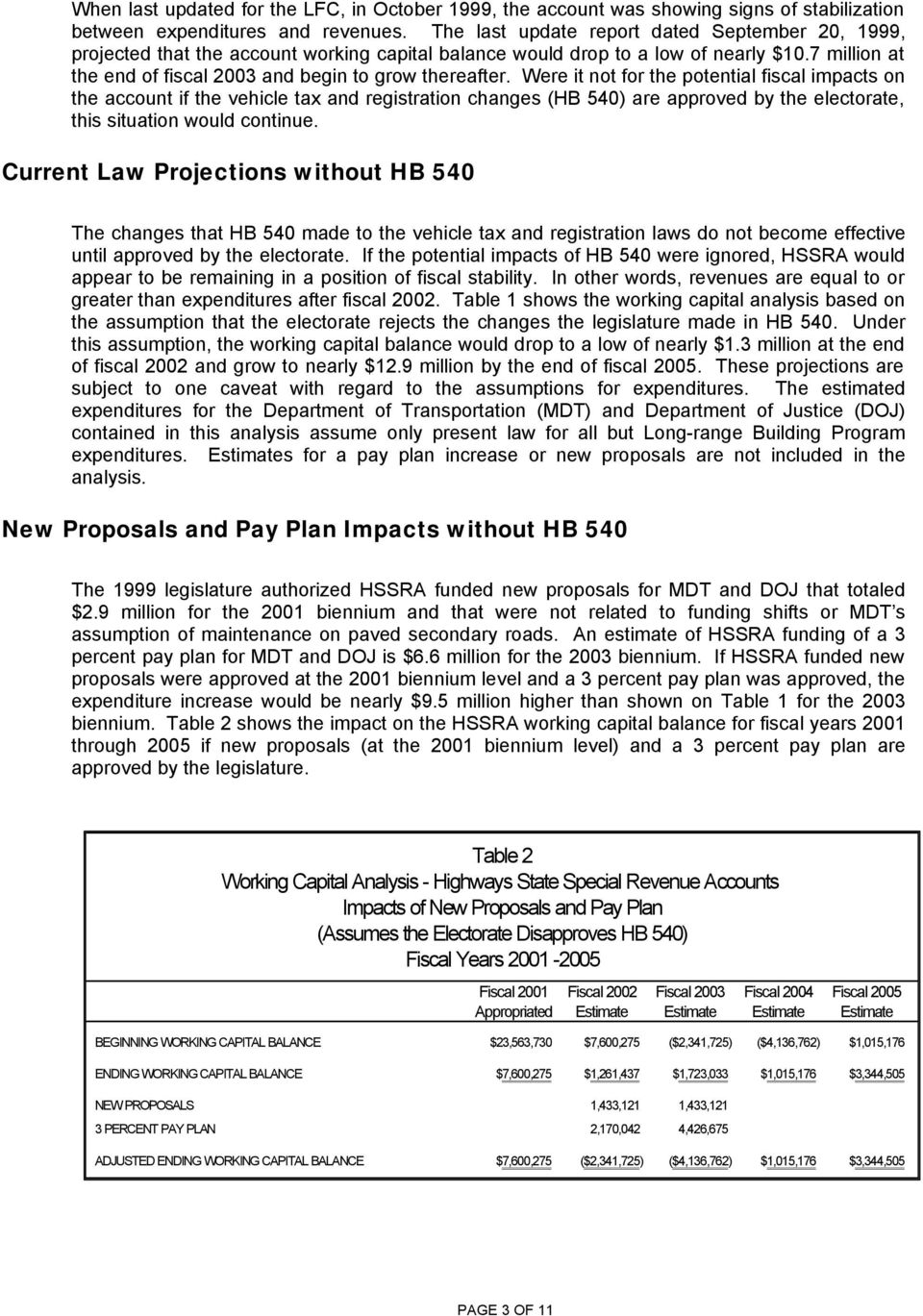
6 If the new proposals and the pay plan are considered in the analysis, the working capital balance would go negative in fiscal 2002, but become positive again in fiscal The primary factor for the projected return to a positive balance is the fiscal 2003 retirement of the debt the MDT accumulated in fiscal 1987 to fund federal-aid and state funded construction projects. Expenditure Assumptions and Basis Fiscal 2001 Expenditure estimates for fiscal 2001 are total non-reverted appropriations, with one exception. The fiscal 2001 estimate for the MDT Construction Program assumes the program will be short of HSSRA authority and will need to augment the HSSRA authority via a funding transfer from federal special revenue authority. This assumption will be discussed in more detail separately in this report Biennium Estimated 2003 biennium program expenditures of HSSRA in MDT and DOJ were taken from the budget requests submitted by the departments to the budget office. For the purpose of the analysis, as shown on Table 1, program expenditures only include base and present law requests. The Long-range Building Program expenditures by MDT and the Department of Fish, Wildlife and Parks (FWP) are assumed to support present law operations and include estimates based on capital project requests included on the state budgeting system for the 2003 biennium. The 2003 biennium capital project requests were divided evenly between each fiscal year of the biennium Biennium The 2005 biennium HSSRA expenditure estimates for MDT and DOJ are the fiscal 2003 estimates inflated by 3 percent per year. Estimates for 2005 biennium Long-range Building Program expenditures assume the 2003 biennium annual expenditure estimates will be repeated in the 2005 biennium at the 2003 biennium level. Legislation Impacting Expenditures Potential expenditure impacts of legislation are included as follows: For SB 333, maintenance of paved secondary roads, the impacts are factored into the MDT Maintenance Program estimates, except for contributed capital to the Equipment Program for SB 333 startup costs. In fiscal 2001, SB 333 would account for roughly $9.6 million Maintenance Program expenditures. SB 333 accounts for nearly $22.3 million of the expenditures in the 2003 biennium estimates. For HB 135, DOJ protective service professionals pay increase, the impacts are factored into the DOJ estimates. In fiscal 2001, HB 135 would account for nearly $865,000 of the DOJ expenditures. For SB 164, noxious weed management and appropriation, the $1.125 million annual transfer out of the non-restricted highways account only occurs in the 2001 biennium. State Funded Construction Program Also included in the expenditure estimates for the 2003 and 2005 biennia is a reduction of the state funded construction program. The preliminary budget for MDT reduces the state funded construction program to the minimum level (roughly $10.0 million) that would maintain a federal participation of 87 percent with a state match of 13 percent for federal-aid construction projects. A more detailed discussion of the state funded construction program as it relates to the federalaid construction program is provided later in this report. PAGE 4 OF 11
7 Revenue Assumptions and Basis Revenue Categories The HSSRA revenues are being presented in different categories than appeared in the September 1999 projection report. Here the revenues are separated between those that are restricted from diversion by Article VIII, Section 6, Montana Constitution, and those that are not restricted. As before, gas and diesel taxes and GVW fees are presented separately from other miscellaneous revenues. Restricted revenues include revenues from gross vehicle weight fees and excise and license taxes on gasoline, fuel, and other energy sources used to propel vehicles on public highways. Other restricted revenues are revenues that are being coded by agencies to the restricted fund but are not directly related to GVW fees or gas or diesel taxes. Other restricted revenues are revenues from activities such as outdoor sign permits, rentals and leases, administrative charges, and workers compensation dividends. Non-restricted revenues include revenues from activities such as new car sales tax, motor fuel penalties, and special use or special route permits. Fiscal 2001 Revenue estimates for fiscal 2001 are HJR 2 estimates for gas taxes and gross vehicle weight (GVW) fees, with one exception. The HJR 2 estimate for gas tax assumed that $1.5 million would be paid for alcohol production incentives under , MCA. Since the estimates of HJR 2 were developed, the only alcohol production facility in the pipeline for certification has failed to meet the certification requirements, and will not likely be eligible for the incentive. Consequently, $1.5 million has been added to the gas tax revenue estimate of HJR 2 for fiscal The actual diesel tax revenues in fiscal 2000 were significantly higher than the HJR 2 estimates. Because this trend is expected to continue, the fiscal 2001 estimate for diesel tax is fiscal 2000 actual revenues inflated by 3 percent. The HJR 2 revenue estimate for GVW is split between the G.V.W. (HJ 2) restricted and Other non-restricted revenue categories based on the relative percentage of fiscal 2000 actual revenues. The Other restricted revenues category assumes the actual fiscal 2000 revenues will continue without growth. Potential revenue impacts of legislation assume the fiscal impact contained on the most recent fiscal notes for SB 401 and HB 138. SB 401 revised the definition of agricultural use for gasoline and special fuel tax refunds. HB 138 eliminated the annual license renewal fee for wholesale gasoline and special fuel distributors. It also eliminated the licensing requirement that applies to a person who sells gasoline or special fuel for which a refund may be claimed Biennium Estimated 2003 biennium gas tax revenues are fiscal 2000 actual revenues inflated by 1.0 percent per year, including compounding for fiscal Diesel tax revenues are fiscal 2001 estimated revenues inflated by 3.0 percent. GVW revenues in the G.V.W. (HJ 2) restricted and Other non-restricted revenue categories are inflated by 0.5 percent per year. The analysis assumes the Other restricted revenues category will continue without growth. Potential revenue impacts of legislation assume the fiscal impact contained on the most recent fiscal note for HB Biennium The estimates for the 2005 biennium are the prior year estimates with the following annual inflation assumptions: gas tax, 1.0 percent; PAGE 5 OF 11
8 diesel tax, 3.0 percent; G.V.W. (HJ 2) restricted, 0.5 percent; other non-restricted revenue, 0.5 percent; and other restricted revenues, no inflation. Potential revenue impacts of legislation assume the fiscal impact contained on the most recent fiscal note for HB 138. Table 3 Working Capital Analysis - Highways State Special Revenue Accounts 1 Projected Revenues and Expenditures (Assumes the Electorate Approves HB 540) Fiscal Years Fiscal 1999 Fiscal 2000 Fiscal 2001 Fiscal 2002 Fiscal 2003 Fiscal 2004 Fiscal 2005 Actual Actual Appropriated Estimate Estimate Estimate Estimate BEGINNING WORKING CAPITAL BALANCE $48,466,448 $48,974,472 $23,563,730 $5,400,275 ($6,891,305) ($9,782,546) ($12,508,963) REVENUE Gas Tax (HJ 2) - restricted $120,093,956 $124,679,120 $127,141, ,185,170 $128,457,022 $129,741,592 $131,039,008 Diesel Tax (HJ 2) - restricted 51,171,425 54,259,213 55,886,990 57,563,599 59,290,507 61,069,222 62,901,299 G.V.W. (HJ 2) - restricted 17,204,020 18,170,861 18,065,250 18,155,576 18,246,354 18,337,586 18,429,274 Other restricted revenue 4,971,734 5,100,972 5,100,972 5,100,972 5,100,972 5,100,972 5,100,972 Other non-restricted revenue 13,997,692 15,837,269 15,234,750 15,310,924 15,387,478 15,464,416 15,541,738 Potential impacts on revenue of legislation in 1999 legislature (2,852,328) (5,961,542) (6,964,800) (7,887,155) (8,880,606) TOTAL REVENUE $207,438,827 $218,047,435 $218,576,634 $217,354,699 $219,517,533 $221,826,633 $224,131,684 Available Working Capital $255,905,275 $267,021,907 $242,140,364 $222,754,974 $212,626,228 $212,044,087 $211,622,721 EXPENDITURES MDT Expenditures General Operations $12,352,448 $14,010,603 $14,530,794 $16,914,622 $16,587,063 $17,084,675 $17,597,215 Tribal Refunds - SA 22,820 24,435 28,036 28,877 29,743 30,636 31,555 Construction potential funding switch (federal to state special 73,665,908 90,891,133 46,593,998 70,879,274 73,624,731 $75,833,473 $78,108,477 revenue) 27,393,102 Maintenance 3 68,576,673 69,930,872 79,608,356 81,708,236 82,107,318 84,570,538 87,107,654 Motor Carrier Services (G.V.W.) 4,601,324 4,823,500 5,002,278 5,019,923 5,043,982 5,195,301 5,351,161 Transportation Planning 769,088 1,560,620 1,576,013 1,945,433 1,740,083 1,792,285 1,846,054 Debt Service/Bond Principal & Interest 13,690,865 13,536,080 13,935,352 13,936,852 3,798, Total MDT Expenditures $173,679,126 $194,777,243 $188,667,929 $190,433,217 $182,931,471 $184,506,908 $190,042,115 Local Distributions County Distribution - SA 10,389,000 10,389,000 10,389,000 10,389,000 10,389,000 10,389,000 10,389,000 City Distribution - SA 6,323,000 6,323,000 6,323,000 6,323,000 6,323,000 6,323,000 6,323,000 Local Technical Assistance Program - SA 54,000 54,000 54,000 54,000 54,000 54,000 54,000 Total Local Distributions $16,766,000 $16,766,000 $16,766,000 $16,766,000 $16,766,000 $16,766,000 $16,766,000 Other Agency Expenditures Department of Justice 4 15,850,092 16,494,329 17,252,851 $18,697,062 $18,961,303 $19,530,142 $20,116,046 HB 5 Long-Range Building Program (Dept. of Fish, Wildlife & Parks) 845, ,091 1,656, , , , ,000 HB 5 Long-Range Building Program (MDT Facilities) 1,810,937 1,897,948 2,509,907 3,000,000 3,000,000 3,000,000 3,000,000 Total Other Agency Expenditures $18,506,388 $18,894,368 $21,419,262 $22,447,062 $22,711,303 $23,280,142 $23,866,046 Potential impacts of other legislation (expenditure impacts) 2 1,125,000 Equipment program contributed capital (SB 333 Startup) 4,342,201 8,761,898 Actual transfer to Noxious Weed Management Trust Fund (SB 164) 1,125,000 Other transfers 15,000 TOTAL EXPENDITURES $208,951,514 $235,919,812 $236,740,089 $229,646,279 $222,408,774 $224,553,050 $230,674,162 REVENUE & EXPENDITURE VARIANCE ($1,512,687) ($17,872,377) ($18,163,455) ($12,291,580) ($2,891,241) ($2,726,417) ($6,542,477) NET ADJUSTMENTS (Prior year and other) 2,020,711 $ (7,538,365) ENDING WORKING CAPITAL BALANCE $48,974,472 $23,563,730 $5,400,275 ($6,891,305) ($9,782,546) ($12,508,963) ($19,051,441) 1 Includes both the highway restricted and nonrestricted accounts 2 Other legislation included in analysis: Revenue impacts (SB 401, HB 138, HB 540, and HB 4 of the 2000 special legislative session) Expenditure impacts (SB 164) 3 The impacts of SB 333 have been included in the Maintenance Program figures PAGE 6 OF 11

9 Current Law Projections with HB 540 The changes that HB 540 made to the vehicle tax and registration laws do not become effective until approved by the electorate. Table 1 shows the working capital analysis that results if the potential impacts of HB 540 were ignored. Table 3 shows the same analysis as shown on Table 1, using the same assumptions for revenues and expenditures, only factoring in the impacts if HB 540 is approved by the electorate. The HSSRA is projected to move into an unstable fiscal condition if HB 540 is approved. Given the assumptions described above, HSSRA would go negative by the end of fiscal The analysis projects a balance of nearly -$6.9 million at the end of fiscal 2002 with the balance going more negative thereafter to a balance of nearly -$19.1 million at the end of fiscal Table 4 Working Capital Analysis - Highways State Special Revenue Accounts Impacts of New Proposals and Pay Plan (Assumes the Electorate Approves HB 540) Fiscal Years Fiscal 2001 Fiscal 2002 Fiscal 2003 Fiscal 2004 Fiscal 2005 Appropriated Estimate Estimate Estimate Estimate BEGINNING WORKING CAPITAL BALANCE $23,563,730 $5,400,275 ($10,494,467) ($19,245,504) ($21,971,921) ENDING WORKING CAPITAL BALANCE FROM TABLE 3 $5,400,275 ($6,891,305) ($13,385,708) ($21,971,921) ($28,514,399) NEW PROPOSALS 1,433,121 1,433,121 3 PERCENT PAY PLAN 2,170,042 4,426,675 ADJUSTED ENDING WORKING CAPITAL BALANCE $5,400,275 ($10,494,467) ($19,245,504) ($21,971,921) ($28,514,399) New Proposals and Pay Plan Impacts with HB 540 As stated above, Table 3 excludes impacts of potential legislative approval of new proposals and a pay plan. Table 4 shows the impact on the HSSRA working capital balance for fiscal years 2001 through 2005 if new proposals (at the 2001 biennium level) and a 3 percent pay plan are approved by the legislature. If the new proposals and the pay plan are considered in the analysis, the working capital balance would go negative in fiscal 2002 and continue to increase in the negative direction from nearly -$10.5 million at the end of fiscal 2002 to -$28.5 million at the end of fiscal Impacts of Vehicle Tax and Registration Law Changes HB 540 (1999 Legislature) The 1999 legislature passed HB 540, which changed the taxation and registration laws for certain vehicles. The changes made by HB 540 are subject to approval by the electorate and if approved will not take effect until January 1, The potential impacts of HB 540 were factored in to the analysis of the account that was presented to the LFC in October PAGE 7 OF 11

10 HB 4 (May 2000 Special Session) Since the October 1999 report to the LFC, HB 4 was passed by the May 2000 special session of the legislature. HB 4 struck language contained in HB 540 that distributed revenue to the HSSRA from fees from vehicles for which an original application for title or the original Montana registration is sought. The language in HB 540 would have distributed registration fees for all newly titled vehicles to the HSSRA. This would have included used vehicles brought into the state that were registered for the first time in the state. HB 4 replaced this language with language that restricted the distribution of revenue to HSSRA only from vehicles that are newly manufactured. HB 4 also abolished the distribution of local option tax revenue from newly titled light vehicles to HSSRA. Impacts on HSSRA if the Electorate Approves HB 540 In November 2000, the electorate will vote on vehicle tax and registration law changes contained in HB 540. HB 4 is current law and is not subject to approval by the electorate. If HB 540 is approved, the HSSRA would see revenue reductions that are estimated to be $2.2 million in fiscal 2001 and $6.1 million starting in fiscal For each year after fiscal 2002, the adverse revenue impact would continue to grow relative to how the vehicle tax and registration laws impact the account under current law. The major factor of HB 540 that causes the adverse impacts on HSSRA to grow each year (relative to current law) is that the value of vehicles currently subject to the new car sales tax is assumed to continue to grow nearly 7.0 percent per year, while under HB 540 the only growth would be a 1.5 percent annual growth of the number of vehicles. HB 540 attempted to offset a portion of this effect by allowing the account to retain the interest on its balance instead of transferring it to the general fund. This offset is negated when the account no longer maintains a positive cash balance. Furthermore, the adverse impacts of HB 540 would grow at a higher rate than shown on Tables 3 and 4 if the ongoing operations of MDT were funded with debt. The only debt financing of the department shown in the analysis is the 1987 bonds issued to fund state funded construction and the state match for federal-aid construction. This debt will be retired in fiscal The analysis does not consider any debt service to fund the projected shortfall. Potential Funding Transfer The appropriations for the MDT Construction Program are biennial. Additionally, HB 2 contains language that authorizes the department to adjust appropriations between state special and federal special revenue fund types if the total state special revenue authority for the program is not increased by more that 10 percent of the total appropriations established by the legislature for the program. During fiscal 2000, the department took advantage of the biennial appropriation designation for the Construction Program when they moved $40 million state special revenue authority from fiscal 2001 to fiscal This movement is permitted by section, , MCA, which states that an agency may make expenditures during the first fiscal year of the biennium from appropriations for the second fiscal year of the biennium if authorized by the general appropriations act. HB 2 provides this authorization with the biennial designation for the Construction Program appropriation. The effects of moving the authority from fiscal 2001 to fiscal 2000 (and then expending the authority in fiscal 2000) is that fiscal 2001 will be short state special revenue to deliver the PAGE 8 OF 11
11 planned program. As Tables 1 and 3 show, the Construction Program will have nearly $47 million HSSRA authority to deliver a program that would take nearly $74 million HSSRA authority to maintain the current construction plan. As such, roughly $27 million would be needed to deliver the planned federal-aid and state funded construction programs. Excess federal special revenue authority is projected to be available to accomplish an appropriations adjustment from federal special revenue to state special revenue funding. Language in HB 2 allows a fund transfer that could be used to overcome the projected shortfall. However, expending $27 million more state special revenue in the current biennium greatly accelerates the depletion of the available working capital balance. State Funded Construction Program Sliding Scale Match MDT provides highway construction activities with two broadly categorized programs the federal-aid construction program and the state funded construction program. In order for Montana to receive federal reimbursement under the federal-aid construction program, Montana must maintain a level of effort in the way of providing a certain level of 100 percent state funded construction. The percentage of federal reimbursement of federal-aid construction activities is determined based on a sliding scale match formula. One factor in the formula is the amount of financial contribution the state makes to maintaining the federal-aid highway system with state dollars. The department has estimated that roughly $10 million is the level of 100 percent state funded construction needed to maintain a match ratio of 87 percent federal to 13 percent state for reimbursement of federal-aid projects. If the state does not provide the minimum level of effort identified above, the federal participation percentage would drop to 80 percent. Based on an average annual federal participation of $260 million the state match is roughly $38.9 million, at 87 percent federal participation. In order to continue receiving $260 million in federalaid for construction at a Table 5 Highway Construction Program Different Federal Participation Percentages ($millions) Federal Praticipation 87 Percent 80 Percent 1 Federal reimbursement $260 $156 State match Total federal-aid program $299 $195 Available federal reimbursement State match for available federal reimbursement 26 Total state match required for available federal reimbursement Total federal-aid program with available federal reimbursement $299 $325 State funded construction program 10 0 Total highway construction program $309 $325 Total state match and state construction program funding $49 $65 Net increase in state funding for highway construction $16 1 This table assumes elimination of the state funded construction program at 80 percent federal participation. match rate of 80 percent, the state would have to provide matching funds of $65 million, or an increase of roughly $16 million per year, if the state funded construction program was eliminated and the $10 million in the state funded construction program was used to provide matching funds for the federal-aid construction program. To fund the additional increased match, the state gas tax would need to be raised by 3.6 cents per gallon or the gas and diesel taxes would each have to be increased by 2.5 cents per gallon. Table 5 compares the highway construction program for different federal matching percentages. PAGE 9 OF 11

12 State Funded Construction Expenditures As stated earlier, the department funds highway construction in a federal-aid construction program and a 100 percent state funded construction program. In fiscal 2000, MDT expended $13.5 million in the state funded construction program. Just over $14 million is planned for fiscal The amount currently planned for fiscal 2001 reflects a reduction of nearly $4.5 million because of projects being redirected from the state funded construction program to the federalaid construction program. The estimates for the 2003 and 2005 biennium assume that $10 million will be expended each year in the state funded construction program. The effect of funding a reduced amount of projects out of the state funded program and funding the projects with federal-aid funds is that HSSRA funds are leveraged at a higher level by federal funds. In other words, a dollar of HSSRA buys over six times the construction activity if federal funds are used. The previous statement assumes equal design standards between the two funding programs. According to previous statements by MDT, the main tradeoff is that if federal funds are used, the projects must be designed to all applicable federal standards. Some highway construction projects don t justify the additional expense required to meet the federal standards, such as road width, side slope, etc. and are therefore more appropriate for 100 percent state funding. The department says that projects that were moved from the state funded program to the federal-aid program had already been designed to meet the federal standards. Therefore, no incremental costs or project impacts are expected. Conclusion Projections for the HSSRA An analysis of the HSSRA projects significantly different outcomes depending upon the results of the November 7, 2000, general election. If the electorate approves the referendum to change motor vehicle tax and registration laws that were passed by the 1999 legislature in HB 540, the HSSRA working capital balance is projected to go negative as early as fiscal The account would continue to remain in a condition in which expenditures would exceed revenues and the balance would continue to degrade. On the other hand, if the electorate rejects the HB 540 referendum, the account is projected to experience a short-term period, through fiscal 2002, in which present law expenditures exceed revenues but the working capital balance remains positive. Beginning in fiscal 2003, the account is then projected to move into a more stable fiscal condition through fiscal 2005, with projected revenues higher than projected expenditures. The imbalance between present law expenditures and revenues reverses to one of revenue dominance in fiscal 2003 when the department debt is retired. Recommendations The LFC may wish to wait until after the November 7 general election to formulate any recommendations regarding the HSSRA. Since time available to introduce legislation for the 2001 legislature is limited after the general election, the LFC may, at its October meeting, wish to provide direction to staff to propose recommendations at the November LFC meeting for PAGE 10 OF 11

13 offsetting the impacts of HB 540 on the HSSRA. The direction could be contingent upon the electorate approving the HB 540 resolution. Other options that would be needed to restore stability to the HSSRA are included below for consideration: increase HSSRA revenues: increase gas and/or diesel taxes; increase GVW fees; modify revenue distribution; authorize bonding for MDT; and new revenue source. reduce HSSRA expenditures: funding switch; program reductions; and reduce statutory appropriations to local government. The LFC may wish to recommend a study of the department funding sources to develop alternatives for providing funding sources that are more closely linked to expenditure factors and that would provide long-term stability of HSSRA. Finally, the LFC may wish to direct MDT and DOJ to provide that recommendations for program reductions, with the list ordered by impact on the capabilities of the associated program. H:\DATA\5401\cashflow\Oct 2000 LFC\oct2000rpt.doc PAGE 11 OF 11
14 Appendix A Transportation Funding Study Recommendations
15 Transportation Funding Study Recommendations A study of Montana transportation funding was conducted during the interim. The study was done because of the persistent structural imbalance of the HSSRA. The study committee provided the following recommendations to the 1999 legislature: shift funding of DOJ activities that are not directly related to enforcement of highway safety from the HSSRA to the general fund or another alternative source of funding; allow interest earned on the HSSRA fund balance to be credited to the HSSRA rather than the general fund; reduce the tax collection allowance for fuel distributors to 0.5 percent; exempt MDT from the requirement to use the Department of Administration for disposing of excess property; and attempt to proportionally reduce annual operating budgets by $3.0 million for agencies funded from fuel tax revenues, with a reduction in the state funded construction program necessary to maintain an annual cash balance in the HSSRA of at least $15.0 million. The 1999 legislature changed statute to allow the HSSRA to keep the interest generated by the account balance. This legislative change was made by HB 540, which is contingent upon approval by the electorate. For the 2001 biennium, the legislature shifted $2.1 million HSSRA funded Highway Patrol Operations Program functions, not directly related to enforcement of highway safety, to the general fund. However, the legislature approved 2001 biennium increases of HSSRA funding for DOJ by $4.2 million. The DOJ increases funded by HSSRA were $2.6 million in present law adjustments and $1.6 million for protective service professional pay increases authorized by HB 135. The other recommendations of the transportation funding study committee were not approved by the legislature. Although not included in HB 2 or any law, MDT has been working toward the last recommendation of the study. MDT has been reducing state funded construction program expenditures by shifting projects to the federal-aid program. As mentioned earlier, the budget proposed by the department further reduces the state funded construction program to the minimum level that would provide the highest percentage of federal-aid participation and provide the highest level of leverage of HSSRA dollars.

A JOINT RESOLUTION OF THE SENATE AND THE HOUSE OF REPRESENTATIVES OF THE STATE OF MONTANA REVISING THE OFFICIAL
 SJ00.0 SENATE JOINT RESOLUTION NO. INTRODUCED BY B. TUTVEDT A JOINT RESOLUTION OF THE SENATE AND THE HOUSE OF REPRESENTATIVES OF THE STATE OF MONTANA REVISING THE OFFICIAL ESTIMATE OF THE STATE'S GENERAL
Transportation Funds Forecast
 Transportation Funds Forecast February 2015 Released March 2, 2015 February 2015 Forecast Executive Summary Revenues up 14 million in Highway User Tax Distribution (HUTD) Fund in FY 2014-15 The February
A JOINT RESOLUTION BE IT RESOLVED BY THE LEGISLATURE OF THE STATE OF TEXAS. Section 5, Article VII, Texas Constitution, is amended to read as follows:
 By: H.J.R. No. A JOINT RESOLUTION proposing a constitutional amendment relating to establishing the Texas Great Classroom Fund as a sequestered fund, funded by an Education Flat Tax, a Reformed Franchise
Transportation Funds Forecast. February 2013. Transportation Funds Forecast. Released March 1, 2013. February 2013 Forecast Executive Summary
 Transportation Funds Forecast The purpose of this document is to serve as the official guide to the Minnesota Department of Transportation (MnDOT) forecast for the six transportation funds: Highway User
2005 SCHOOL FINANCE LEGISLATION Funding and Distribution
 2005 SCHOOL FINANCE LEGISLATION Funding and Distribution RESEARCH REPORT # 3-05 Legislative Revenue Office State Capitol Building 900 Court Street NE, H-197 Salem, Oregon 97301 (503) 986-1266 http://www.leg.state.or.us/comm/lro/home.htm
CHAPTER 20 COUNTY PERMISSIVE MOTOR VEHICLE LICENSE TAX
 CHAPTER 20 COUNTY PERMISSIVE MOTOR VEHICLE LICENSE TAX Latest Revision March, 2013 20.01 INTRODUCTION In 1967 the General Assembly granted counties the authority to enact a permissive motor vehicle license
General fund revenues expected to show moderate growth over the forecast horizon
 A-13 REVENUE FORECAST The Commonwealth's total revenue consists of two types of resources: the general fund and nongeneral funds. About half of state revenues are "nongeneral funds," or funds earmarked
Energy Supplier Assessment Budget Note Report
 Energy Supplier Assessment Budget Note Report December 2010 Contact: Lisa Pinheiro Phone: 503-373-2293 Email: [email protected] Executive Summary The 75 th Oregon Legislative Assembly directed
The primary focus of state and local government is to provide basic services,
 Tax Relief and Local Government The primary focus of state and local government is to provide basic services, such as public safety, education, a safety net of health care and human services, transportation,
Preprinted Logo will go here
 June 15, 2015 Hon. Kamala D. Harris Attorney General 1300 I Street, 17 th Floor Sacramento, California 95814 Attention: Ms. Ashley Johansson Initiative Coordinator Dear Attorney General Harris: Pursuant
The NEVADA PLAN For School Finance An Overview
 The NEVADA PLAN For School Finance An Overview Fiscal Analysis Division Legislative Counsel Bureau 2013 Legislative Session Nevada Plan for School Finance I. Overview of Public K-12 Education Finance
SCHOOL LOCAL PROPERTY TAX OPTION 1999 Legislation
 STATE OF OREGON LEGISLATIVE REVENUE OFFICE H-197 State Capitol Building Salem, Oregon 97310-1347 Research Report (503) 986-1266 Research Report # 5-99 SCHOOL LOCAL PROPERTY TAX OPTION 1999 Legislation
150-303-405 (Rev. 6-09)
 A Brief History of Oregon Property Taxation 150-303-405-1 (Rev. 6-09) 150-303-405 (Rev. 6-09) To understand the current structure of Oregon s property tax system, it is helpful to view the system in a
Primer Highway Trust Fund. Federal Highway Administration Office of Policy Development
 Primer Highway Trust Fund Federal Highway Administration Office of Policy Development November 1998 Highway Trust Fund Primer Summary This Highway Trust Fund Primer is designed to provide basic information
F L O R I D A H O U S E O F R E P R E S E N T A T I V E S HBXX 2016
 1 2 3 4 5 6 7 8 9 10 11 12 13 14 15 16 17 18 19 20 21 22 23 24 25 26 A bill to be entitled An act relating to aviation fuel taxes; amending s. 206.9825, F.S.; revising eligibility criteria for wholesalers
Course Objectives. What are Property Taxes? 2/14/2012. Tax Settlements
 2/14/2012 Tax Settlements Presented by: Local Government Services 1 Course Objectives To enhance your understanding of how to read and record the information contained on your tax settlement sheets To
Understanding Mississippi Property Taxes
 Understanding Mississippi Property Taxes The Mississippi Association of Supervisors with the Center for Governmental Training and Technology Mississippi Property Tax Primer Property tax revenues are a
*HB0380S03* H.B. 380 3rd Sub. (Cherry) LEGISLATIVE GENERAL COUNSEL Approved for Filing: C.J. Dupont 03-09-16 7:25 PM
 LEGISLATIVE GENERAL COUNSEL Approved for Filing: C.J. Dupont 03-09-16 7:25 PM H.B. 380 3rd Sub. (Cherry) Senator Kevin T. Van Tassell proposes the following substitute bill: 1 UTAH COMMUNICATIONS AUTHORITY
Understanding School Choice in Alachua County: Funding School Choice in Florida
 Understanding School Choice in Alachua County: Funding School Choice in Florida Florida has been a leader in developing both public and private school alternative programs to address the challenges of
Legislative Fiscal Bureau
 Legislative Fiscal Bureau One East Main, Suite 301 Madison, WI 53703 (608) 266-3847 Fax: (608) 267-6873 Email: [email protected] Website: http://legis.wisconsin.gov/lfb February 27, 2014
CITY ATTORNEYS OFFICE CITY HALL, 435 RYMAN MISSOULA, MT 59802 Phone: (406) 523-4614 Fax: (406) 327-2105 LEGAL OPINION 2002-014
 CITY ATTORNEYS OFFICE CITY HALL, 435 RYMAN MISSOULA, MT 59802 Phone: (406) 523-4614 Fax: (406) 327-2105 LEGAL OPINION 2002-014 TO: FROM: Mike Kadas, Mayor City Council Janet Stevens, Chief Administrative
The TxDMV s Role in Transportation Funding
 The TxDMV s Role in Transportation Funding Testimony before the House Select Committee on Transportation Funding, Expenditures & Finance Jeremiah Kuntz Director, Government & Strategic Communications Texas
BULLETIN 1992-01 MAY 1992 NEW FUNDING OPTIONS FOR 911 PHONE SYSTEMS
 BULLETIN 1992-01 MAY 1992 INTRODUCTION NEW FUNDING OPTIONS FOR 911 PHONE SYSTEMS In 1985 the General Assembly enacted H.B. 491 which established a process and procedure for the establishment of 911 phone
Budget Introduction Proposed Budget
 Budget Introduction Proposed Budget INTRO - 1 INTRO - 2 Summary of the Budget and Accounting Structure The City of Beverly Hills uses the same basis for budgeting as for accounting. Governmental fund financial
State and Local Taxation of the Electric Industry in Texas
 State and Local Taxation of the Electric Industry in Texas December 2014 The Association of Electric Companies of Texas, Inc. (AECT) is a trade organization of electric companies in Texas. Organized in
2014 LEGISLATION INCOME TAX
 HOUSE BILLS 2 HB 74 ENERGY EFFICIENT VEHICLE TAX CREDITS 2 HB 140 TAX CREDIT AMENDMENTS 2 HB 356 NEW CONVENTION FACILITY DEVELOPMENT INITIATIVE 3 SENATE BILLS 4 SB 47 EMERGENCY MANAGEMENT ACT AMENDMENTS
74th OREGON LEGISLATIVE ASSEMBLY--2007 Regular Session. Enrolled. House Bill 3201
 74th OREGON LEGISLATIVE ASSEMBLY--2007 Regular Session Enrolled House Bill 3201 Sponsored by Representative NELSON; Representatives BERGER, BRUUN, FLORES, GARRARD, Senator FERRIOLI (at the request of Oregon
6602 - DEPARTMENT OF LABOR & INDUSTRY SUMMARY
 Agency Budget Comparison The following table summarizes the total executive budget for the agency by year, type of expenditure, and source of funding. Agency Budget Comparison Budget Item Base Fiscal 2012
LEGISLATIVE REVENUE OFFICE H-197 State Capitol Building Salem, Oregon 97310-1347 http://www.leg.state.or.us/comm/lrohome.htm
 STATE OF OREGON LEGISLATIVE REVENUE OFFICE H-197 State Capitol Building Salem, Oregon 97310-1347 http://www.leg.state.or.us/comm/lrohome.htm Research Report (503) 986-1266 Research Report #6-99 The New
State Property Tax Credits (School Levy, First Dollar, and Lottery and Gaming Credits)
 State Property Tax Credits (School Levy, First Dollar, and Lottery and Gaming Credits) Informational Paper 21 Wisconsin Legislative Fiscal Bureau January, 2013 Wisconsin Legislative Fiscal Bureau January,
Executive Summary. Model Structure. General Economic Environment and Assumptions
 Executive Summary The (LTFP) report is an update from the preliminary report presented in January 2009 and reflects the Mayor s Proposed Budget for Fiscal Year 2010 and Fiscal Year 2011. Details of the
FINANCIAL PLAN. Any future earmarks are assumed to carry their own limitation and not reduce the regular limitation identified in these calculations.
 VII. FINANCIAL PLAN FHWA Funds The Federal Highway Administration (FHWA) funds are appropriated by Congress. FHWA funding levels are identified in the six-year Transportation Act. Each year, a federal
Five Year Financial Plan
 The Five Year Financial Plan is a forecast of revenues and expenditures that begins with the adopted annual budget for the upcoming fiscal year (FY16) and continues for four additional years (through FY20).
Analysis of PERS Cost Allocation, Benefit Modification, and System Financing Concepts February 14, 2013
 Analysis of Cost Allocation, Benefit Modification, and System Financing Concepts February 14, 2013 Version 1.2 Important Notes Regarding This Report This report is produced to support the Board in its
FISCAL IMPACT STATEMENT. LS 6779 NOTE PREPARED: Dec 29, 2011 BILL NUMBER: HB 1073
 LEGISLATIVE SERVICES AGENCY OFFICE OF FISCAL AND MANAGEMENT ANALYSIS 200 W. Washington, Suite 301 Indianapolis, IN 46204 (317) 233-0696 http://www.in.gov/legislative FISCAL IMPACT STATEMENT LS 6779 NOTE
Informational Paper 21. State Property Tax Credits (School Levy and Lottery and Gaming Credits)
 Informational Paper 21 State Property Tax Credits (School Levy and Lottery and Gaming Credits) Wisconsin Legislative Fiscal Bureau January, 2007 State Property Tax Credits (School Levy and Lottery and
How To Compare N.Dakota To North Dakota
 Oil and Gas Production Tax Comparison: and North Dakota Executive Summary November 8, 2012 (updated) This paper provides a brief description and comparison of North Dakota s and s taxes on oil production.
TASA Summary of Education Related Senate Interim Charges. 80 th Legislature
 TASA Summary of Education Related Senate Interim Charges 80 th Legislature Education Study the effectiveness of public school programs serving special education students, including autistic students. Specifically,
HOUSE BILL 2587 AN ACT
 Senate Engrossed House Bill State of Arizona House of Representatives Fifty-second Legislature First Regular Session 2015 HOUSE BILL 2587 AN ACT AMENDING SECTIONS 35-142 AND 35-315, ARIZONA REVISED STATUTES;
State Cashflow Management
 Informational Paper 77 State Cashflow Management Wisconsin Legislative Fiscal Bureau January, 2009 State Cashflow Management Prepared by Dave Loppnow Wisconsin Legislative Fiscal Bureau One East Main,
DEFINITIONS OF IOWA SCHOOL FINANCE TERMS
 DEFINITIONS OF IOWA SCHOOL FINANCE TERMS Accounting Accrual year-end reporting required by the Department of Education on the certified annual financial report. A district may be operating on a cash accounting
SCHOOL FINANCE 101. Presented by Brenda Burkett, CPA, SFO Chief Financial Officer Norman Public Schools. February 2015
 SCHOOL FINANCE 101 Presented by Brenda Burkett, CPA, SFO Chief Financial Officer Norman Public Schools February 2015 Budget and Funding Timeline JUN JUL AUG SEP OCT NOV Final State Aid Allocation from
BASICS ON --- WEIGHT-MILE TAXES IN OREGON
 ISSUE BRIEF Legislative Committee Services 453 State Capitol Salem, OR 97310-4002 503-986-1813 Janet Adkins, Committee Administrator Updated December 2000 BASICS ON --- WEIGHT-MILE TAXES IN OREGON Weight-mile
The 2016-17 Budget: The Governor s Proposition 2 Debt Proposal
 The 2016-17 Budget: The Governor s Proposition 2 Debt Proposal MAC TAYLOR LEGISLATIVE ANALYST FEBRUARY 2016 Summary Proposition 2 requires the state to pay down a minimum annual amount of state debts.
Treasurer of State OVERVIEW
 Treasurer of State OVERVIEW The Treasurer of State collects, invests, and protects state funds. The Treasurer s Office functions as a custodian of the public s money, manager of the state s investment
TAX RELIEF AMENDMENT IMPLEMENTATION LIMIT ON GROWTH OF CERTAIN STATE APPROPRIATIONS
 TAX RELIEF AMENDMENT IMPLEMENTATION LIMIT ON GROWTH OF CERTAIN STATE APPROPRIATIONS Legal References Article VIII, Sec. 22(a), Texas Constitution, approved by the voters in November 1978, states that:
Department of Finance Policies and Procedures Reserve Funds Policy # Authorized by: City Council Date of issue: September 30, 2004
 Department of Finance Policies and Procedures Reserve Funds Policy # Authorized by: City Council Date of issue: September 30, 2004 Revised: April 2011 Purpose The purpose of the Reserve Fund Policy is
As state employees, we must balance safety, cost effectiveness, and efficiency with the fiscal and environmental health of our state.
 To: DAS Fleet Customers RE: Fleet Customer Survey Results and Action Plan Thank you for participating in the DAS Customer Service Survey. The results of the DAS survey are available at http://www.oregon.gov/das/directors_survey.shtml.
SHARED REVENUE AND TAX RELIEF
 455 SHARED REVENUE AND TAX RELIEF GOVERNOR S BUDGET RECOMMENDATIONS Source FY01 FY02 % Change FY03 % Change of Funds Adjusted Base Recommended Over FY01 Recommended Over FY02 GPR 1,717,508,900 1,715,169,400-0.1
State of North Dakota Office Of State Tax Commissioner
 State of North Dakota Office Of State Tax Commissioner RYAN RAUSCHENBERGER, COMMISSIONER Bismarck, North Dakota July 2015 Schedule of Levy Limitations Applicable To The Authority Of The Political Subdivisions
KOEGEN EDWARDS LLP Attorneys at Law
 KOEGEN EDWARDS LLP Attorneys at Law 1001 Fourth Avenue, Suite 2580 120 North Stevens, Suite 300 Seattle, Washington 98154 Spokane, Washington 99201 Telephone (206) 381-1818 Facsimile (206) 381-1919 Telephone
ADMINISTRATIVE REGULATION AR: 6.03 DATE APPROVED September 10, 2002 ORIGINATING DEPARTMENT:
 ADMINISTRATIVE REGULATION AR: 6.03 DATE APPROVED September 10, 2002 SUBJECT: ORIGINATING DEPARTMENT: Debt Management Policy Office of Management & Budget Page 1 of 8 I. PURPOSE: The County recognizes the
Ohio Department of. To All Ohio Vendors: March 2006
 Ohio Department of Sales & Use Tax Division P.O. Box 530 Columbus, Ohio 43216-0530 tax.ohio.gov To All Ohio Vendors: March 2006 The Ohio 124th General Assembly passed Amended Substitute House Bill 405,
NEW PHILADELPHIA CITY SCHOOLS FIVE-YEAR FORECAST 2013-2017
 Real Estate Tax Assumptions NEW PHILADELPHIA CITY SCHOOLS FIVE-YEAR FORECAST 2013-2017 REVENUE ASSUMPTIONS Real estate taxes had increased at approximately 1.1% to 2.0% through 2012 and a 1.5% increase
NORTH CAROLINA DEPARTMENT OF REVENUE 2012 TAX LAW CHANGES. OFFICE OF THE ASSISTANT SECRETARY FOR TAX ADMINISTRATION PO Box 871 Raleigh, NC 27602-0871
 NORTH CAROLINA DEPARTMENT OF REVENUE 2012 TAX LAW CHANGES OFFICE OF THE ASSISTANT SECRETARY FOR TAX ADMINISTRATION PO Box 871 Raleigh, NC 27602-0871 PREFACE This document is designed for use by personnel
NORTH CAROLINA GENERAL ASSEMBLY LEGISLATIVE FISCAL NOTE
 NORTH CAROLINA GENERAL ASSEMBLY LEGISLATIVE FISCAL NOTE BILL NUMBER: SHORT TITLE: SPONSOR(S): House Bill 1429 (House Finance Committee Substitute, as amended) Financial Responsibility Act Representatives
Lynn M. Suter and Associates
 3 Lynn M. Suter and Associates Government Relations GM Memo No. 05-181 August 5, 2005 TO: Joe Wallace, President, and Members of the AC Transit Board of Directors Jim Gleich, DGM FR: RE: Lynn M. Suter
Moss Adams Introduction to ESOPs
 Moss Adams Introduction to ESOPs Looking for an exit strategy Have you considered an ESOP? Since 1984, we have performed over 2,000 Employee Stock Ownership Plan (ESOP) valuations for companies with as
Proposition 172 Facts A Primer on the Public Safety Augmentation Fund
 Coleman Advisory Services www.californiacityfinance.com Proposition 172 Facts A Primer on the Public Safety Augmentation Fund Background: A Sales Tax for Public Safety Born Out of ERAF In 1992, facing
STATE OF OKLAHOMA. 2nd Session of the 49th Legislature (2004) AS INTRODUCED
 STATE OF OKLAHOMA 2nd Session of the 49th Legislature (2004) HOUSE BILL HB2698: Ferguson AS INTRODUCED An Act relating to schools; amending 70 O.S. 2001, Section 14-108, as last amended by Section 1, Chapter
Cost and Financial Analysis
 Chapter 19: Cost and Financial Analysis A. INTRODUCTION The purpose of this chapter is to present examples of financial resources available to the Metropolitan Transportation Authority (MTA), which may
State of North Carolina Department of State Treasurer
 RICHARD H. MOORE TREASURER State of North Carolina Department of State Treasurer State and Local Government Finance Division and the Local Government Commission T. VANCE HOLLOMAN DEPUTY TREASURER Memorandum
New Jersey Transportation Trust Fund Authority Fiscal Year 2016 Financial Plan
 New Jersey Transportation Trust Fund Authority Fiscal Year 2016 Financial Plan Plan for Financing Anticipated NJDOT/NJT Capital Program Outlays for Fiscal Year 2016 NEW JERSEY TRANSPORTATION TRUST FUND
GEORGIA LEMON LAW SUMMARY
 EXECUTIVE SUMMARY TIME PERIOD FOR FILING CLAIMS Although the lemon law does not provide a statute of limitations, a claim must allege at least one of the following: 1. A serious safety defect in the braking
THE STATE EDUCATION DEPARTMENT Room 475 EBA Office of Educational Management Services Albany, NY 12234 (518) 474-6541
 THE STATE EDUCATION DEPARTMENT Room 475 EBA Office of Educational Management Services Albany, NY 12234 (518) 474-6541 Fund Balance - Reservations and Designations The following Reserve Funds are available