
GRADUATE STUDENT HANDBOOK GRADUATE DEGREE PROGRAMS IN APPLIED PSYCHOLOGY. Policies and Procedures 1
|
|
|
- Aleesha Barton
- 10 years ago
- Views:
Transcription
1 GRADUATE STUDENT HANDBOOK GRADUATE DEGREE PROGRAMS IN APPLIED PSYCHOLOGY Policies and Procedures 1 MASTER'S DEGREE IN PSYCHOLOGY DOCTORAL DEGREE IN APPLIED PSYCHOLOGY DEPARTMENT OF PSYCHOLOGY PORTLAND STATE UNIVERSITY February, The policies and procedures in this handbook apply to all graduate students in Applied Psychology regardless of admissions date and are effective beginning Fall 2012 (unless otherwise noted).
2 PSU Department of Psychology [INSERTION FROM PAGE 2 HERE] 2

3 GRADUATE DEGREE PROGRAMS IN APPLIED PSYCHOLOGY TABLE OF CONTENTS INTRODUCTION.5 Departmental Mission 5 Departmental Code. 5 Advisors. 5 Department of Psychology Student Photocopying Policy 6 MASTER S DEGREE PROGRAM OF STUDY.6 Required Coursework 6 The Master s Thesis. 7 Graduation. 11 DOCTORAL DEGREE PROGRAM OF STUDY..11 Required Coursework 13 Timely Progress Norms. 16 Comprehensive Exam 19 Internships. 21 The Dissertation 22 Advancement to Candidacy. 2 STUDENTS ENTERING WITH GRADUATE COURSEWORK FROM OTHER INSTITUTIONS 26 Transfer Credit.. 26 Waiver of Required Graduate Work. 26 Reservation of Graduate Credit. 26 Waiver of Master s Thesis. 26 Comprehensives 27 GRADUATE STUDENT EVALUATION.. 27 Graduate Student Performance Policy and Procedures 27 Grading.. 27 Incompletes 28 Repeat of Graduate Courses. 28 Audit. 28 Academic Probation (University Guidelines).. 28 Disqualification Re-Admission after Disqualification. 29 Input from Graduate Students 29 Feedback to Graduate Students. 29 Post-Master s Review 30 GRADUATE ASSISTANTSHIPS AND FUNDING. 30 Responsibilities 31 Eligibility. 31 Graduate-Level Courses 32 STUDENT PARTICIPATION IN DEPARTMENTAL DECISION-MAKING.. 32 Graduate Committee 33 Orientation of New Graduate Students 33 Search Committees.. 33 Faculty Meetings. 33 Promotion and Tenure Decisions. 33 3

4 PSU Department of Psychology GENERAL INFORMATION 3 Student Offices and Labs.. 3 Library Privileges. 3 Participation in Graduate Program. 3 Human Subjects Research.. 36 Plagiarism.. 36 By-Arrangement Requests. 36 GRADUATE FORMS AND PROCEDURES 37 APPENDIX A: GRADUATE STUDENT PERFORMANCE POLICY AND 38 PROCEDURES

5 GRADUATE DEGREE PROGRAMS IN APPLIED PSYCHOLOGY INTRODUCTION The graduate program, which aims to train research professionals for work in applied settings, is a critical part of the department s mission in applied psychology. This Handbook contains the policies and procedures of the Psychology Department that govern student participation in graduate degree programs in Psychology. It is designed as a guide for students and their advisors to assist students in their progress through the program, and to provide relevant policies. The Handbook integrates departmental policies with the policies of the university, Office of Graduate Studies. However, if any differences exist, the Portland State University Bulletin and Office of Graduate Studies rules take priority over this handbook. Students are responsible for knowing all policies and procedures required by the department and the University. This Handbook includes information about requirements for the Master s and Doctoral degrees, including the steps for completing thesis and dissertation research, practicum and internship, and comprehensive examinations. In addition, it describes departmental policies on graduate student evaluation, graduate assistantships and funding, and student participation in departmental decision-making. The Graduate Committee Chair updates the Graduate Student handbook every summer as needed to include new or revised policies, and to improve clarity and communication of existing policies. Any feedback or suggestions for revisions from Graduate students would be greatly appreciated and can be given to the Chair (or any member) of the Graduate Committee at any time. Note that students must comply with all requirements of PSU s Office of Graduate Studies. These requirements are available on the OGS web site, and in the PSU Bulletin. Department Mission Applied psychology retains the goal of advancing knowledge through a scientific approach to human behavior and experience and addresses significant issues facing society. The settings of applied psychology are varied; in our program, we emphasize the institutions and contexts of daily life, but we also recognize the unique contributions of laboratory research. We encourage faculty to focus on diverse and under-served populations. We recognize the need for an interplay between experimental and naturalistic methods in analyzing problems and testing solutions to real world problems. Rigorous methods of inquiry are those which yield rich information through intensive study, especially in multiple sites over time. Work which has a clear impact on the external community is valued, especially work which is useful for guiding direct action and policy. Collaboration is encouraged among colleagues and disciplines, and cooperation is encouraged across institutions and national boundaries. Work in applied psychology is expected to be demanding and time-consuming, but also to be immediately useful to the university and community as a whole. Departmental Code This department is committed to supporting graduate students' rights in their dealings with faculty, other students, and the university. We will not tolerate discrimination based on race, sex, religion, sexual orientation, national origin, disability, or age. We are responsible for maintaining an environment that is free of sexual harassment. We will not allow graduate students to be exploited by faculty in terms of ideas (e.g., publication credit), workload (e.g., commensurate with credits or payment), or appropriate assignment of duties (e.g., professional activities). If you feel that your rights are being (or have been) infringed upon, we urge you to speak with your advisor, the department chair, the Chair of the Graduate Committee, other faculty, or others referenced in the University policies, available at In keeping with university policy, we will promptly notify The Office of Equity and Compliance of the complaint. Advisors The Department Chair assigns each incoming student to a general faculty advisor. Typically, a student s general faculty advisor becomes their thesis chair, although a student may under special circumstances request another faculty member to serve as thesis chair. Moreover, a faculty member must consent to work with a particular student. Once the thesis supervisor is determined, that faculty member automatically becomes the student's general advisor. See the Doctoral Degree Program section for more information on advising during the student s comprehensive exams and dissertation research. 5
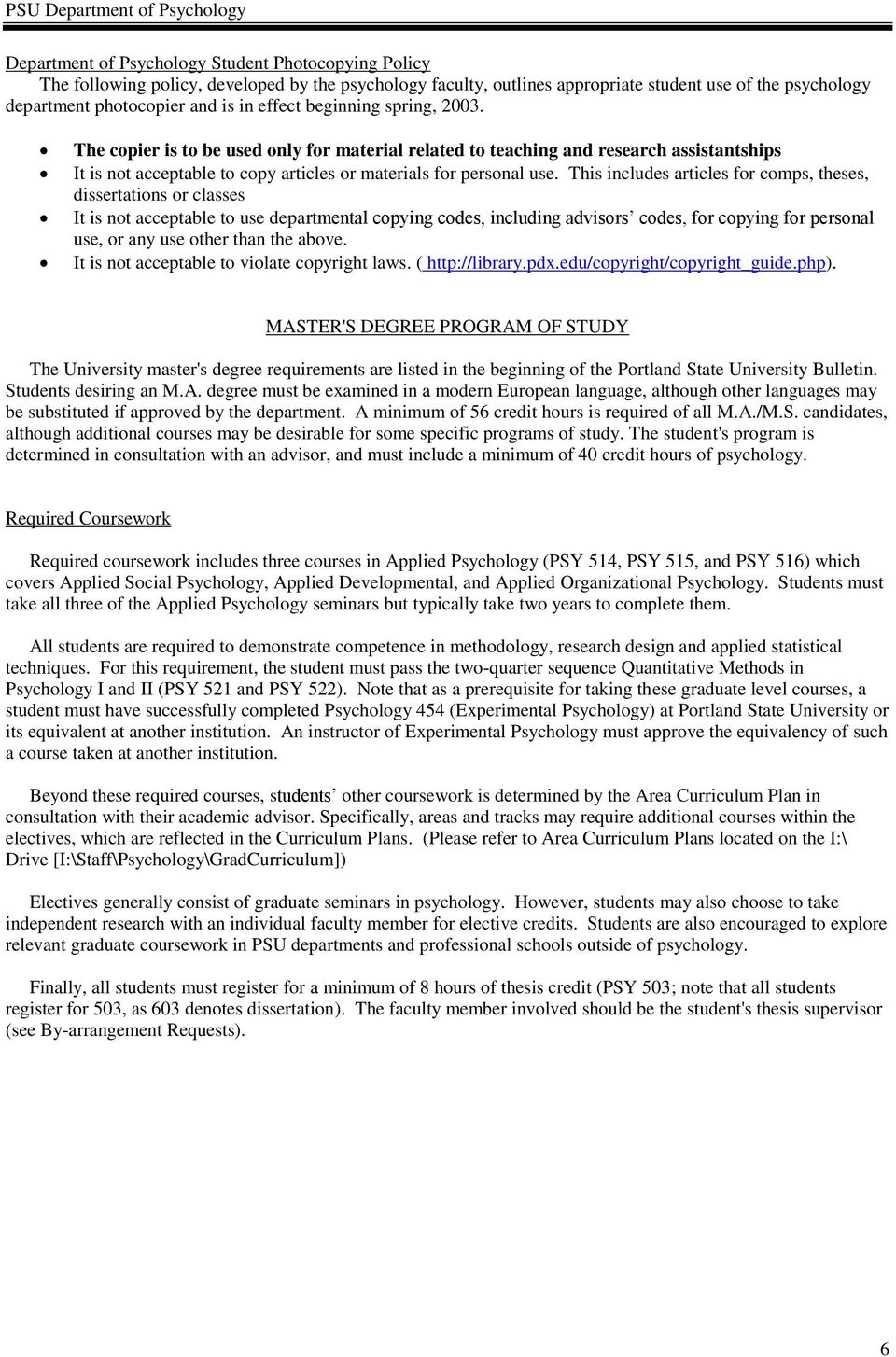
6 PSU Department of Psychology Department of Psychology Student Photocopying Policy The following policy, developed by the psychology faculty, outlines appropriate student use of the psychology department photocopier and is in effect beginning spring, The copier is to be used only for material related to teaching and research assistantships It is not acceptable to copy articles or materials for personal use. This includes articles for comps, theses, dissertations or classes It is not acceptable to use departmental copying codes, including advisors codes, for copying for personal use, or any use other than the above. It is not acceptable to violate copyright laws. ( MASTER'S DEGREE PROGRAM OF STUDY The University master's degree requirements are listed in the beginning of the Portland State University Bulletin. Students desiring an M.A. degree must be examined in a modern European language, although other languages may be substituted if approved by the department. A minimum of 56 credit hours is required of all M.A./M.S. candidates, although additional courses may be desirable for some specific programs of study. The student's program is determined in consultation with an advisor, and must include a minimum of 0 credit hours of psychology. Required Coursework Required coursework includes three courses in Applied Psychology (PSY 51, PSY 515, and PSY 516) which covers Applied Social Psychology, Applied Developmental, and Applied Organizational Psychology. Students must take all three of the Applied Psychology seminars but typically take two years to complete them. All students are required to demonstrate competence in methodology, research design and applied statistical techniques. For this requirement, the student must pass the two-quarter sequence Quantitative Methods in Psychology I and II (PSY 521 and PSY 522). Note that as a prerequisite for taking these graduate level courses, a student must have successfully completed Psychology 5 (Experimental Psychology) at Portland State University or its equivalent at another institution. An instructor of Experimental Psychology must approve the equivalency of such a course taken at another institution. Beyond these required courses, students other coursework is determined by the Area Curriculum Plan in consultation with their academic advisor. Specifically, areas and tracks may require additional courses within the electives, which are reflected in the Curriculum Plans. (Please refer to Area Curriculum Plans located on the I:\ Drive [I:\Staff\Psychology\GradCurriculum]) Electives generally consist of graduate seminars in psychology. However, students may also choose to take independent research with an individual faculty member for elective credits. Students are also encouraged to explore relevant graduate coursework in PSU departments and professional schools outside of psychology. Finally, all students must register for a minimum of 8 hours of thesis credit (PSY 503; note that all students register for 503, as 603 denotes dissertation). The faculty member involved should be the student's thesis supervisor (see By-arrangement Requests). 6
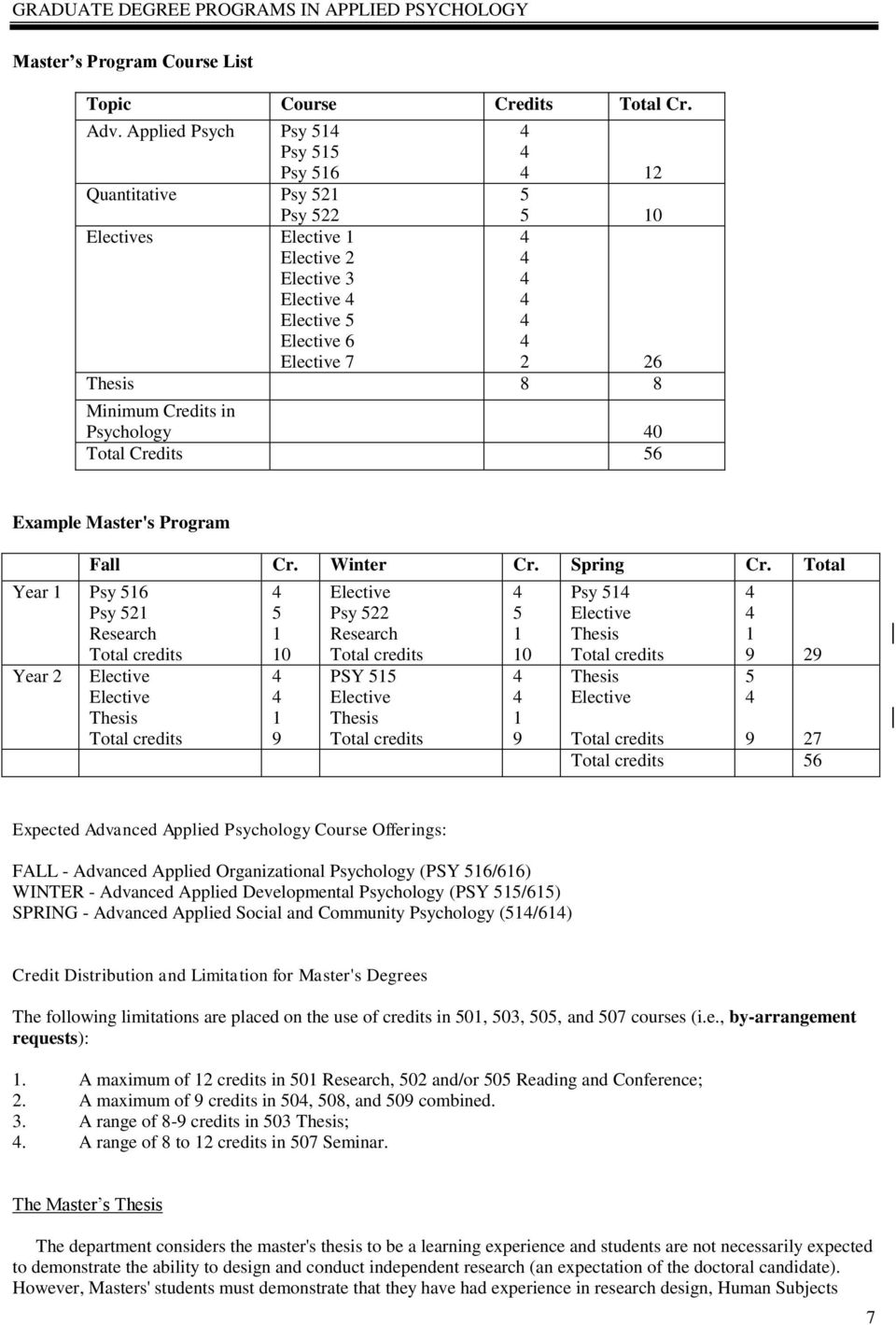
7 GRADUATE DEGREE PROGRAMS IN APPLIED PSYCHOLOGY Master s Program Course List Topic Course Credits Total Cr. Adv. Applied Psych Psy 51 Psy 515 Psy Quantitative Psy Psy Electives Elective 1 Elective 2 Elective 3 Elective Elective 5 Elective 6 Elective Thesis 8 8 Minimum Credits in Psychology 0 Total Credits 56 Example Master's Program Fall Cr. Winter Cr. Spring Cr. Total Year 1 Psy 516 Psy 521 Research Total credits Year 2 Elective Elective Thesis Total credits Elective Psy 522 Research Total credits PSY 515 Elective Thesis Total credits Psy 51 Elective Thesis Total credits Thesis Elective Total credits 9 27 Total credits 56 Expected Advanced Applied Psychology Course Offerings: FALL - Advanced Applied Organizational Psychology (PSY 516/616) WINTER - Advanced Applied Developmental Psychology (PSY 515/615) SPRING - Advanced Applied Social and Community Psychology (51/61) Credit Distribution and Limitation for Master's Degrees The following limitations are placed on the use of credits in 501, 503, 505, and 507 courses (i.e., by-arrangement requests): 1. A maximum of 12 credits in 501 Research, 502 and/or 505 Reading and Conference; 2. A maximum of 9 credits in 50, 508, and 509 combined. 3. A range of 8-9 credits in 503 Thesis;. A range of 8 to 12 credits in 507 Seminar. The Master s Thesis The department considers the master's thesis to be a learning experience and students are not necessarily expected to demonstrate the ability to design and conduct independent research (an expectation of the doctoral candidate). However, Masters' students must demonstrate that they have had experience in research design, Human Subjects 7
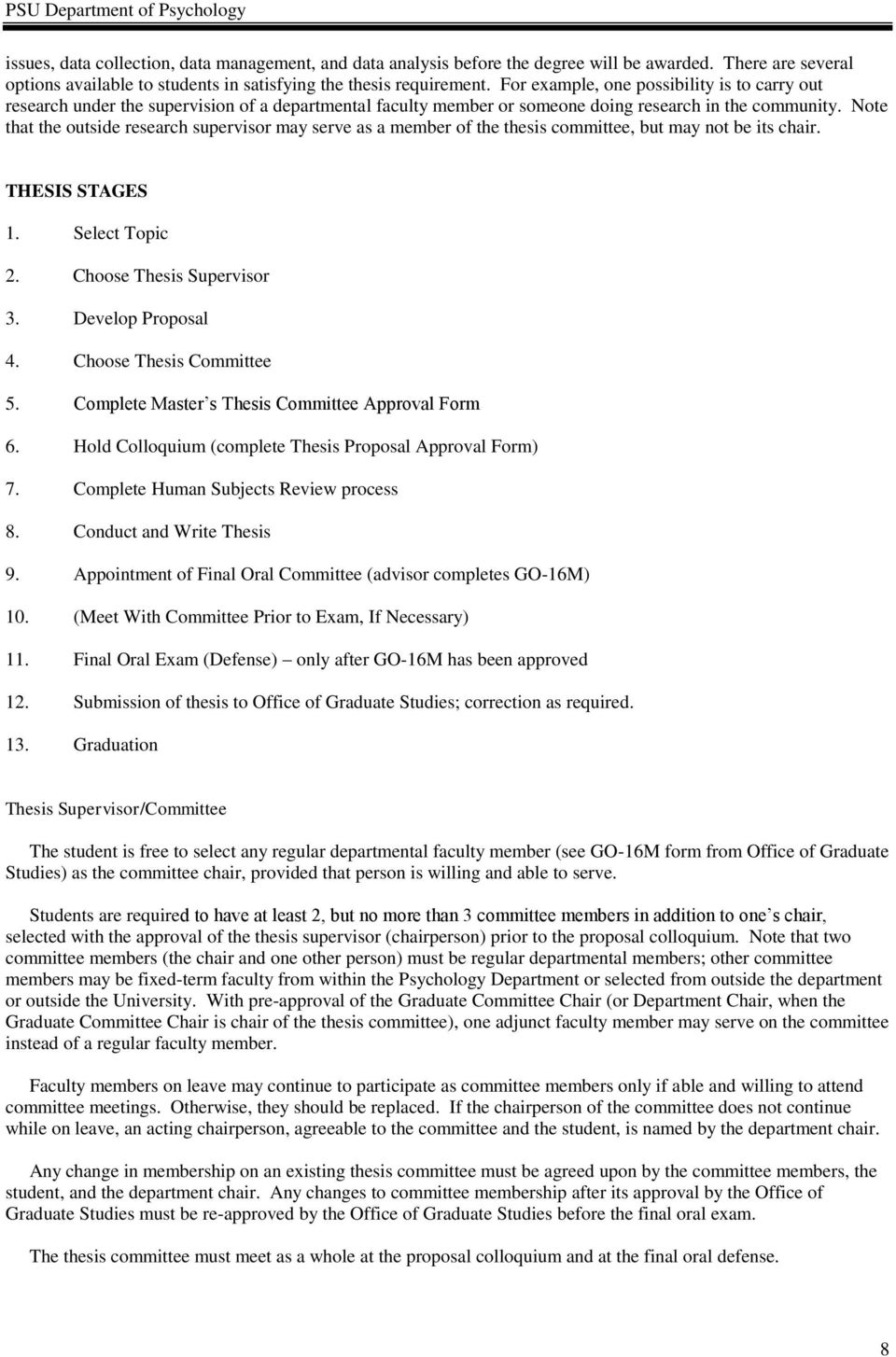
8 PSU Department of Psychology issues, data collection, data management, and data analysis before the degree will be awarded. There are several options available to students in satisfying the thesis requirement. For example, one possibility is to carry out research under the supervision of a departmental faculty member or someone doing research in the community. Note that the outside research supervisor may serve as a member of the thesis committee, but may not be its chair. THESIS STAGES 1. Select Topic 2. Choose Thesis Supervisor 3. Develop Proposal. Choose Thesis Committee 5. Complete Master s Thesis Committee Approval Form 6. Hold Colloquium (complete Thesis Proposal Approval Form) 7. Complete Human Subjects Review process 8. Conduct and Write Thesis 9. Appointment of Final Oral Committee (advisor completes GO-16M) 10. (Meet With Committee Prior to Exam, If Necessary) 11. Final Oral Exam (Defense) only after GO-16M has been approved 12. Submission of thesis to Office of Graduate Studies; correction as required. 13. Graduation Thesis Supervisor/Committee The student is free to select any regular departmental faculty member (see GO-16M form from Office of Graduate Studies) as the committee chair, provided that person is willing and able to serve. Students are required to have at least 2, but no more than 3 committee members in addition to one s chair, selected with the approval of the thesis supervisor (chairperson) prior to the proposal colloquium. Note that two committee members (the chair and one other person) must be regular departmental members; other committee members may be fixed-term faculty from within the Psychology Department or selected from outside the department or outside the University. With pre-approval of the Graduate Committee Chair (or Department Chair, when the Graduate Committee Chair is chair of the thesis committee), one adjunct faculty member may serve on the committee instead of a regular faculty member. Faculty members on leave may continue to participate as committee members only if able and willing to attend committee meetings. Otherwise, they should be replaced. If the chairperson of the committee does not continue while on leave, an acting chairperson, agreeable to the committee and the student, is named by the department chair. Any change in membership on an existing thesis committee must be agreed upon by the committee members, the student, and the department chair. Any changes to committee membership after its approval by the Office of Graduate Studies must be re-approved by the Office of Graduate Studies before the final oral exam. The thesis committee must meet as a whole at the proposal colloquium and at the final oral defense. 8
9 GRADUATE DEGREE PROGRAMS IN APPLIED PSYCHOLOGY Preparation of Thesis The instructions for the thesis format, Information Regarding Thesis Approval, is available at the Office of Graduate Studies web page: Several books, which offer advice to graduate students on the development and writing of theses, are available at the PSU Library. Proposal After the student and the thesis committee have agreed upon the thesis topic, the student prepares a formal written thesis proposal. Once the committee is formed (but no later than 1 month prior to the proposal colloquium), the student should also complete the committee approval form and submit to the front office. At any time during the proposal development process, members of the committee may meet informally (at the request of the student or any committee member) to discuss, come to consensus on, or solve any problems related to the proposal. When the committee chair deems the proposal ready, it is distributed to committee members, who are given at least two weeks to read the proposal. The personal need of a student to finish by a certain date is not a consideration in this decision. Colloquium When the thesis proposal has been distributed to the committee, the student arranges a date and time for the colloquium. Two hours are scheduled for the colloquium. The student and the thesis committee must agree on the date and time. In order to secure a room for the colloquium, the student confers with the Psychology office staff. One week prior to the colloquium, the student sends via an announcement to all Psychology faculty and graduate students, announcing the date, time, room number, title of the thesis, name of the chair, and names of the thesis committee members, including the institutional affiliation of any committee members who are not regular Psychology faculty. At this time, the student places one copy in room 317L for interested faculty and students. Faculty or other students may also request copies of the document from the student. In order to be considered an official colloquium, all committee members must be present. (See for guidelines about electronic presence.) The colloquium begins with the chair calling the meeting to order and then requesting that everyone except the committee leave the room, so that the committee can briefly discuss their initial evaluations of the proposal and make a plan about how the meeting should proceed. The student and any audience members are called back into the room, whereupon the student presents the proposal to the committee, using approximately one half an hour. The next hour or so is used for questions, discussion, and problem-solving. When approximately 20 minutes are left, the student and any audience members are again asked to leave the room. The committee then decides what kinds of revisions are required and whether another meeting is needed. The student is called back in and informed of the decisions. At this point, the details about the revisions are worked out (including any meetings with individual committee members). Committee members agreed to the process for checking to see that revisions have been completed (whether this will be carried out by committee members or the chair). Committee members determine whether another meeting is necessary and if so, schedule it. If another meeting is not needed, then decisions are made about who will sign the Thesis Proposal Approval Form at this time and who will sign later. Usually the thesis chair does not sign the form until all revisions have been made. Some committee members may choose not to sign until certain revisions have been made. Upon completion of the colloquium, the student should remind his/her supervisor to update the Thesis Proposal Approval Form in the student's file. After the colloquium, the revised proposal should be placed in the student's file. Advancement to Candidacy Based on discussions during the colloquium, the student revises the proposal. After the colloquium and after the thesis committee have all signed the Thesis Proposal Approval Form form, demonstrating that they have officially approved the proposal, the student's thesis committee chair recommends to the Graduate Committee Chair that the student be advanced to candidacy. The signed thesis proposal approval form is then submitted to the Graduate Chair for final approval. Note that students must be enrolled for at least 1 credit of thesis while they are working on their thesis and in the quarter they have a colloquium or defense. Since 8 credits of thesis are required, it will usually be the case that 9

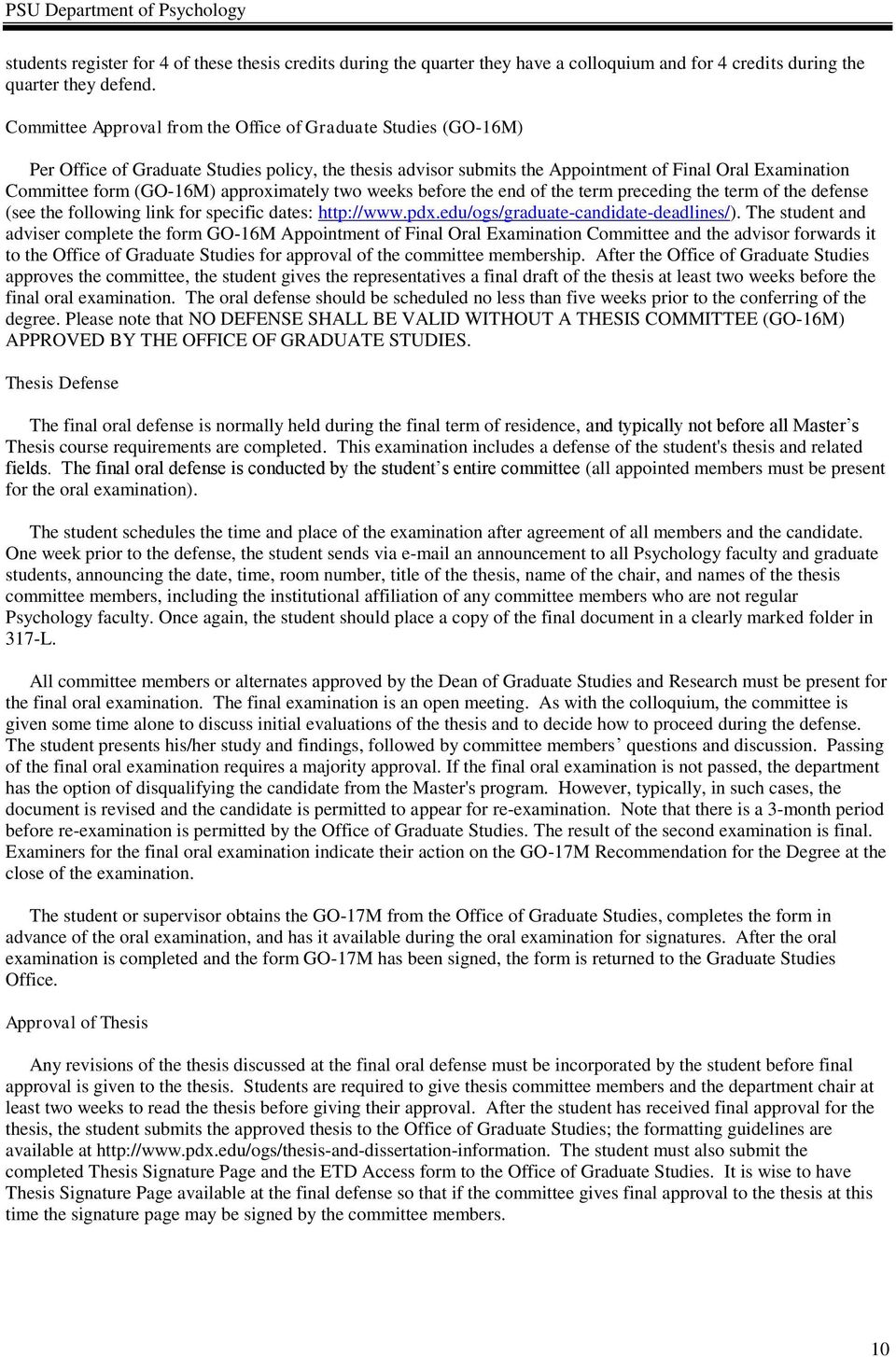
10 PSU Department of Psychology students register for of these thesis credits during the quarter they have a colloquium and for credits during the quarter they defend. Committee Approval from the Office of Graduate Studies (GO-16M) Per Office of Graduate Studies policy, the thesis advisor submits the Appointment of Final Oral Examination Committee form (GO-16M) approximately two weeks before the end of the term preceding the term of the defense (see the following link for specific dates: The student and adviser complete the form GO-16M Appointment of Final Oral Examination Committee and the advisor forwards it to the Office of Graduate Studies for approval of the committee membership. After the Office of Graduate Studies approves the committee, the student gives the representatives a final draft of the thesis at least two weeks before the final oral examination. The oral defense should be scheduled no less than five weeks prior to the conferring of the degree. Please note that NO DEFENSE SHALL BE VALID WITHOUT A THESIS COMMITTEE (GO-16M) APPROVED BY THE OFFICE OF GRADUATE STUDIES. Thesis Defense The final oral defense is normally held during the final term of residence, and typically not before all Master s Thesis course requirements are completed. This examination includes a defense of the student's thesis and related fields. The final oral defense is conducted by the student s entire committee (all appointed members must be present for the oral examination). The student schedules the time and place of the examination after agreement of all members and the candidate. One week prior to the defense, the student sends via an announcement to all Psychology faculty and graduate students, announcing the date, time, room number, title of the thesis, name of the chair, and names of the thesis committee members, including the institutional affiliation of any committee members who are not regular Psychology faculty. Once again, the student should place a copy of the final document in a clearly marked folder in 317-L. All committee members or alternates approved by the Dean of Graduate Studies and Research must be present for the final oral examination. The final examination is an open meeting. As with the colloquium, the committee is given some time alone to discuss initial evaluations of the thesis and to decide how to proceed during the defense. The student presents his/her study and findings, followed by committee members questions and discussion. Passing of the final oral examination requires a majority approval. If the final oral examination is not passed, the department has the option of disqualifying the candidate from the Master's program. However, typically, in such cases, the document is revised and the candidate is permitted to appear for re-examination. Note that there is a 3-month period before re-examination is permitted by the Office of Graduate Studies. The result of the second examination is final. Examiners for the final oral examination indicate their action on the GO-17M Recommendation for the Degree at the close of the examination. The student or supervisor obtains the GO-17M from the Office of Graduate Studies, completes the form in advance of the oral examination, and has it available during the oral examination for signatures. After the oral examination is completed and the form GO-17M has been signed, the form is returned to the Graduate Studies Office. Approval of Thesis Any revisions of the thesis discussed at the final oral defense must be incorporated by the student before final approval is given to the thesis. Students are required to give thesis committee members and the department chair at least two weeks to read the thesis before giving their approval. After the student has received final approval for the thesis, the student submits the approved thesis to the Office of Graduate Studies; the formatting guidelines are available at The student must also submit the completed Thesis Signature Page and the ETD Access form to the Office of Graduate Studies. It is wise to have Thesis Signature Page available at the final defense so that if the committee gives final approval to the thesis at this time the signature page may be signed by the committee members. 10
11 GRADUATE DEGREE PROGRAMS IN APPLIED PSYCHOLOGY Graduation After signatures have been obtained on the signature page, the form is submitted by the student to the Office of Graduate Studies before the appropriate deadline. In addition, the student should give one copy of the final thesis to the advisor and any committee members who request it. Application for Graduation Students must file an application for graduation with Degree Requirements by the stated deadline. Please note that this application is only valid for two terms prior to the term in which graduation is expected. (Check time schedule for deadlines.) Application to the Ph.D. Program Successful completion of the Master s Degree Program does not guarantee admission into the Doctoral Program. As described in greater detail in the section on Graduate Student Evaluation, graduate students who have been admitted into the doctoral program must complete a post-master s review. This evaluation determines whether Ph.D. students will be invited to continue on in the program or dismissed from the program. Students who have successfully completed the requirements of the Master s Degree, and who have shown the capacity for excellence in carrying out community-based research, will be permitted to continue on in the program as doctoral students. Students who were admitted to the program as a terminal Master s student may apply to the doctoral program only after they have successfully defended their Master s thesis. Students must request a formal post-master s review to accompany or closely follow the thesis defense. If the student does not request a formal post-master s review when they complete their Master s thesis defense, and subsequently decides to apply to the doctoral program, they must do so by submitting a full application at the normal yearly admission cycle. The post-master s review is described in greater detail in the section on Graduate Student Evaluation. This evaluation determines whether the Master s student will be permitted to apply to the doctoral program. Students who achieve a favorable post-master s review can apply to the doctoral program at any time during the academic year. However, for students originally admitted to the Master s degree program only, admission to the doctoral program does not automatically guarantee funding. To apply, they update their current file by submitting to the Chair of the Graduate Committee a packet containing: (1) a new statement of research interests, (2) their grades in the Master s program, and (3) two letters of reference, at least one of which must be from a regular faculty member in the Psychology Department. After their updated application has been received, the student s request for application to the doctoral program is considered by the full faculty. Note: If you are trying to make a deadline for any reason, please be sure to schedule your defense meeting early so that you can accommodate the need for revisions and avoid disappointments. Also be aware that faculty members are only available for thesis and dissertation meetings between Sept. 16 and June 15, during regular term periods (i.e., not during Winter or Spring breaks). APPLIED PSYCHOLOGY DOCTORAL DEGREE PROGRAM Program Overview Since 1987, the Department s graduate program has focused on research in Applied Psychology. As described in our mission statement, Applied psychology retains the goal of advancing knowledge through a scientific approach to human behavior and experience while addressing significant issues facing society. The doctoral program in Applied Psychology has been designed explicitly to train research professionals who will have the tools and expertise to contribute to the definition and solution of significant social problems facing society. The Psychology Department offers the Ph.D. in Applied Psychology with concentrations in Industrial/Organizational (I/O), Applied Social and Community, and Applied Developmental Psychology. 11

12 PSU Department of Psychology Advising The Department Chair assigns each incoming student to a general faculty advisor. Students may request that their general faculty advisor become their thesis/dissertation chair or may request another faculty member to serve as thesis/dissertation chair, although this must be also agreed to by both the faculty members. Once the thesis/dissertation chair is determined, that faculty member automatically becomes the student's general advisor. Detailed List of Doctoral Degree Stages NOTE: See also Summary of Procedures for Doctoral Degree in the PSU Bulletin and Office of Graduate Studies website. 1. Complete coursework 2. Identify Comprehensive Examination Areas 3. Select Comprehensive Examination Committee. Develop Comprehensive Exam Proposal 5. Committee Approval of Comprehensive Exam Proposal 6. Comprehensive Exams 7. Passing of Comprehensive Exams 8. Committee Chair Submits Comprehensive Exam Grade Form to Office of Graduate Studies 9. Internship and Internship Report (see Graduate Forms and Procedures Section) 10. Define Dissertation topic 11. Form Dissertation Committee 12. Develop Dissertation Topic and Research Plan 13. Submit GO-16D to Office of Graduate Studies 1. Official Appointment of Dissertation Committee 15. Dissertation Research Proposal Colloquium (see Graduate Forms) 16. Submit formal Human Subjects Research Application; faculty advisor completes Advancement to Candidacy Form and Program of Study Form upon approval (see Graduate Forms for both). 17. Conduct and Write Dissertation 18. File an "Application for the Degree" form (see Distribute Dissertation to Committee 20. Pre-Defense Meeting 21. Schedule Oral Examination Dissertation Defense 22. Dissertation Abstract Approval 23. Distribute Final Draft of Dissertation to Committee 12

13 GRADUATE DEGREE PROGRAMS IN APPLIED PSYCHOLOGY 2. Dissertation Defense (Oral Examination) 25. Final Dissertation Approval 26. Dissertation Formatting Approval (see Submit Electronic Copy of Dissertation and Abstract to Office of Graduate Studies 28. Microfilming Agreement Form and Dissertation Abstract Submission to Office of Graduate Studies 29. Complete the National Research Council Survey of Earned Doctorates 30. The Psychology Department (not the student) submits the GO-17D form for Graduation 31. Graduation Required Coursework Procedures for Doctoral Degree Candidates for the Doctor of Philosophy must satisfy all the requirements for the Master's degree plus additional achievements and work. A program of study for the student will be determined in consultation with his/her advisor. Including the Master's program, students must earn a minimum of 108 quarter graduate credits in approved courses. A minimum of 52 additional degree credits (over and above the 56 credits required to the Master s Degree) are required of doctoral students. Forty-five of these credits must be completed at PSU. Although only 52 additional credits are required, students must meet the credit requirement for the comprehensive examination, and additional coursework may be needed to fulfill this requirement (see section entitled Comprehensive Examination). In order to receive tuition remission and a stipend, doctoral students must enroll in a minimum of 9 hours of graduate credit per quarter, Fall to Spring. Beyond the required courses specified previously and below, students other coursework is determined by the Area Curriculum Plan in consultation with their academic advisor. Specifically, areas and tracks may require additional courses within the electives, which are reflected in the Curriculum Plans. (Please refer to Area Curriculum Plans located on the I:\ Drive [I:\Staff\Psychology\GradCurriculum]) The program is structured around four major stages of core training experiences. The list below illustrates the timing of these required stages. 1. Coursework: Required Courses that include both Advanced Applied Psychology Courses and the Research Methods sequence; and Elective Courses which allow students to tailor their skills in specific Major and Minor areas. Coursework must be completed before taking comprehensive exams. 2. Comprehensive Exams designed to assess the breadth of student knowledge in key programmatic areas. Major and minor exams will be offered twice a year, in the Fall and Spring terms. The comprehensive examinations should be taken in the third year after admission to the program but no later than five years after admission to the program. 3. Process-Oriented Applied Training (i.e., internships) in the form of collaborative work with private and public organizations to provide specialized training in a student s Major and Minor areas. Students must have successfully completed the Master's Thesis oral defense and obtained the approval of their advisor before beginning their internship.. Empirical Research conducted under the supervision of a faculty member to complete dissertation requirements. All doctoral students are required to complete an empirical Master s thesis to demonstrate proficiency with the following skills: conceptualization of applied problems, formulation of empirical questions, research design, Human Subjects compliance, data collection, data management, and data analysis and interpretation. Students also complete an empirical doctoral dissertation to demonstrate their proficiency in conducting independent research in an applied setting. This research represents the culmination of the student s graduate training. 13

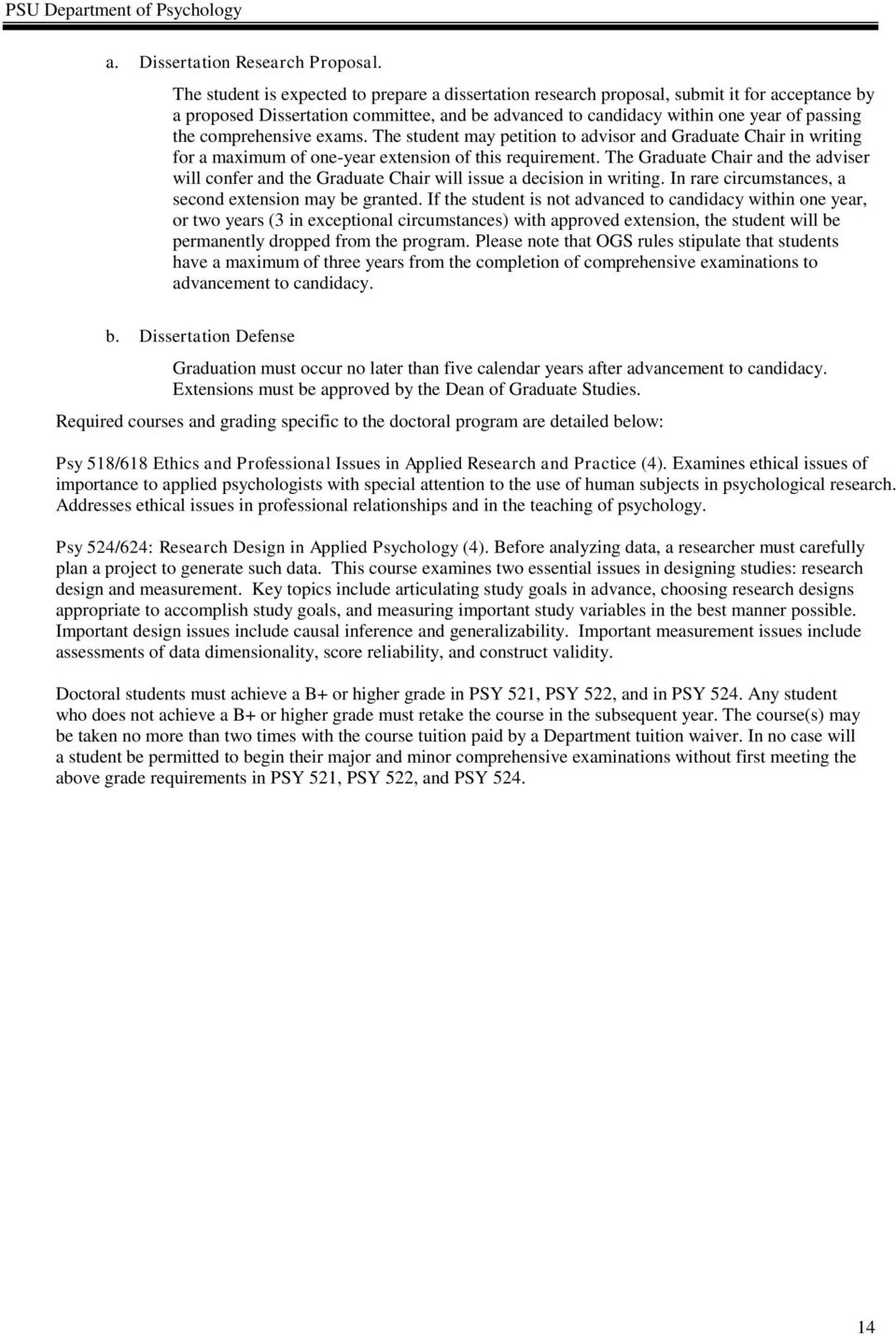
14 PSU Department of Psychology a. Dissertation Research Proposal. The student is expected to prepare a dissertation research proposal, submit it for acceptance by a proposed Dissertation committee, and be advanced to candidacy within one year of passing the comprehensive exams. The student may petition to advisor and Graduate Chair in writing for a maximum of one-year extension of this requirement. The Graduate Chair and the adviser will confer and the Graduate Chair will issue a decision in writing. In rare circumstances, a second extension may be granted. If the student is not advanced to candidacy within one year, or two years (3 in exceptional circumstances) with approved extension, the student will be permanently dropped from the program. Please note that OGS rules stipulate that students have a maximum of three years from the completion of comprehensive examinations to advancement to candidacy. b. Dissertation Defense Graduation must occur no later than five calendar years after advancement to candidacy. Extensions must be approved by the Dean of Graduate Studies. Required courses and grading specific to the doctoral program are detailed below: Psy 518/618 Ethics and Professional Issues in Applied Research and Practice (). Examines ethical issues of importance to applied psychologists with special attention to the use of human subjects in psychological research. Addresses ethical issues in professional relationships and in the teaching of psychology. Psy 52/62: Research Design in Applied Psychology (). Before analyzing data, a researcher must carefully plan a project to generate such data. This course examines two essential issues in designing studies: research design and measurement. Key topics include articulating study goals in advance, choosing research designs appropriate to accomplish study goals, and measuring important study variables in the best manner possible. Important design issues include causal inference and generalizability. Important measurement issues include assessments of data dimensionality, score reliability, and construct validity. Doctoral students must achieve a B+ or higher grade in PSY 521, PSY 522, and in PSY 52. Any student who does not achieve a B+ or higher grade must retake the course in the subsequent year. The course(s) may be taken no more than two times with the course tuition paid by a Department tuition waiver. In no case will a student be permitted to begin their major and minor comprehensive examinations without first meeting the above grade requirements in PSY 521, PSY 522, and PSY 52. 1
15 GRADUATE DEGREE PROGRAMS IN APPLIED PSYCHOLOGY Curriculum for Ph.D. in Applied Psychology Focus of Training Course Number and Title Cr. Applied Psychology Core PSY 61. Advanced Applied Social Psychology PSY 615. Advanced Applied Developmental Psychology PSY 616. Advanced Applied Organizational Psychology PSY 618. Ethics and Professional Issues in Applied Research and Practice Methodology Core (Required of all students) PSY 621. Univariate Quantitative Methods* PSY 622. Multiple Regression and Multivariate Quantitative Methods* PSY 62. Research Design in Applied Psychology* PSY 5xx/6xx. Required Methodology Elective Electives (includes courses in Major, Minor, and additional coursework) Community-based Experience 18 5xx/6xx. Electives 31 PSY 60. Internship 8 8 Independent Research PSY 503. Thesis PSY 603. Dissertation 8 27 Note: Areas or tracks may require specific electives. * Must be passed with a B+ or higher grade (see above policy) 35 Total: 108 Applied Psychology Doctoral Program - Required Curriculum Year 1 Psy 621 (5) Psy 616 () Fall Quarter Winter Quarter Spring Quarter Psy 622 (5) Major Elective () Total = 9 CH Year 2 Minor Elective () Major Elective () Psy 503 (1) Total = 9 CH Year 3 Minor Elective () Minor Elective () PSY 605 (1) Total = 9 CH Year Psy 603 (9) Total = 9 CH Total = 9 CH Methods Elective () PSY 615 () Psy 503 (1) Total = 9 CH Major Elective () Psy 60 () PSY 605 (1) Total = 9 CH Psy 603 (9) Total = 9 CH Psy 62 () Psy 61 () PSY 503 (1) Total = 9 CH Major Elective () Psy 503 (5) Total = 9 CH Comp Exam Psy 618 () Psy 60 () PSY 605 (1) Total = 9 CH Total 603 (9) Total = 9 CH 15

16 PSU Department of Psychology Timely Progress Norms Below are the normative expectations for students timely progress through the program curriculum requirements. Please note that student funding is contingent on availability of funds as well as timely progress. Requirement Range Early On Time End of On Time Propose Master's thesis 1.5 to 2.5 years Winter of Year 2 Winter of year 3 Finish Master's thesis 2 to 3 years Spring of Year 2 Spring of Year 3 Comps 2.5 to 3.5 years Fall of year 3 Spring of Year Internship 2.5 to 3.5 years Winter of year 3 Spring of year Propose Dissertation 3 to years Fall of Year Fall of Year 5 Defend Dissertation to 5 years Spring of Year Spring of Year 5 Year 1 Fall Winter Spring Year 2 EARLY ON TIME Propose Master's thesis EARLY ON TIME Finish Master's thesis Year 3 Year Year 5 EARLY ON TIME Comps (following master s thesis completion) EARLY ON TIME Propose Dissertation END OF ON TIME Comps If Internship not done EARLY ON TIME Internship END OF ON TIME Propose Master's thesis END OF ON TIME Internship END OF ON TIME Finish Master's thesis EARLY ON TIME Defend Dissertation END OF ON TIME Comps, If Internship done Rule: Must comp by end of year END OF ON TIME Propose Dissertation Rule: Must propose within 1 year of passing comps. END OF ON TIME Defend Dissertation Rule: Failure to comp by end of year 5 results in dismissal. Elective Coursework Elective courses offer opportunities for students to tailor their skills in a particular major area of concentration (i.e., I/O, Applied Developmental, or Applied Social/Community Psychology), and to develop a specialization in a particular Minor area of concentration (e.g., Business, Education, Systems Science, or an area of Applied Psychology within our department such as Occupational Health Psychology). Students are strongly encouraged to declare a minor with a cohesive plan of study relatively early in the program in consultation with their advisor, for example at the beginning of their second year in the program as part of their yearly plan (see under Annual Reviews). See the tables below for a non-comprehensive list of graduate courses that can be used by students to obtain in-depth training in their major, minor, and methods areas. The list of courses is organized by area. As described previously, coursework should be determined by the Area Curriculum Plan. Students are encouraged to take courses from a variety of other departments within the University as well as from related disciplines. 16

17 GRADUATE DEGREE PROGRAMS IN APPLIED PSYCHOLOGY List of Graduate Electives Applied Research Methodology Electives PSY 510/610 Research in Quantitative & Psychometric Methods () SySc 610 Systems Approaches to Research in Applied Psychology () PSY 537/637 Qualitative Research Methods in Psychology () PSY 510/610 Advanced Psychological Measurement () PSY 510/610 Item Response Theory () PSY 510/610 Program Evaluation PSY 519 Field Experimental Methods () PSY 523/623 Factor Analysis & Covariance Structure Modeling (5) PSY 532/632 Clinical Interviewing () PSY 95/595 Psychological Test Construction () PSY 97/597 Applied Survey Research Methods () PSY 98/598 Field Observation Methods () Applied Social/Community Psychology Electives PSY 80/580-81/581-82/582 Community Psychology (12) PSY 589/689 Adult Socialization () PSY 71/571 Health Psychology () PSY 533/633 Contemporary Social Psychology () PSY 55/66 Social Psychology of Mental Health () PSY 510 Psychology of Women () PSY 31U/510 Psychology of Men and Masculinity () PSY 0/50 Group Process () 17

18 PSU Department of Psychology Applied Developmental Psychology Electives PSY 59/559 Infant Development () PSY 60/560 Child Psychology () PSY 61/561 Adolescent Development () PSY 562 Adult Development and Aging () PSY 510 Psychological Development of African American Children () PSY 510 Biological Bases of Development () PSY 510 Cognitive Development () PSY 6/56 Developmental Psychopathology () PSY 87/587 Lifespan Development () PSY 68/568 Social Development () PSY 510 Developmental Processes in Beginning Reading () Industrial/Organizational Psychology Electives PSY 510/610 Industrial Psychology (; required for all I/O students) PSY 510/610 Occupational Safety and Health (; required for all I/O students) PSY 36/536 Performance Appraisal and Feedback () PSY /5 Job Analysis () PSY 5/55 Employee Development (Training) () PSY 858 Psychology of Work Motivation () PSY 67/567 Work and Family () PSY 78/578 Leadership and Group Effectiveness () PSY 79/579 Women and Organizational Psychology () PSY 550/650 Occupational Health Psychology () PSY 610 Organizational Theory and Systems Dynamics () PSY 535/635 Psychological Consulting in Organizations () PSY 536/66 Personnel Selection () Applied Psychology Electives PSY 510 Evolutionary Psychology () PSY 510/610 Cross-Cultural Psychology () PSY 510/610 Stress and Coping () Electives outside Psychology Students are encouraged to take relevant courses in: Administration of Justice Business Administration Community Health Child and Family Studies Education Mathematics Political Science Social Work Sociology Statistics Systems Science Urban Studies 18

19 Comprehensive Examination The primary purpose of the comprehensive exams is for students to demonstrate breadth of training in their major and minor. In addition, the exams allow students to demonstrate integration of perspectives, knowledge, and research gained from course work and research activities. We also encourage students to use the exams as an opportunity to explore potential dissertation topics. Doctoral students may take the major and minor comprehensive exams after they have completed at least (a) the required number of hours of coursework, (b) the Master's thesis, and (c) the credit hours required to support each exam area. Students are required to pass comprehensive exams before beginning dissertation proposals, and preferably before completing an internship. Timely progress norms specify that students complete comprehensive exams by the end of their th year (see table in previous section). Comprehensive Exams must however be completed no later than by the end of a student s 5 th year in the program. Students not taking comprehensive exams by this point will be dismissed from the Ph.D. program. Major and Minor comprehensive exams are normally given twice per year, during the 5 th week of the Fall and Spring quarters. Note that it is the student s responsibility to check any additional University guidelines regarding the comprehensive exams. Description Comprehensive exams will consist of two written exams, each of which will be supported by credit hours of course work with a minimum total of 32 credit hours, and an oral exam. Students will identify specific exam topics relevant to their studies within the required areas. The two required written examination areas include: 1. Departmental major area (Applied Developmental, Applied Social and Community, Industrial and Organizational Psychology) 2. Minor area: a specialized area of concentration tailored to the interests of the student (e.g. Business, Occupational Health Psychology, Developmental Science and Education, Methods, Systems Science, or an area of Applied Psychology within our department). No course can count toward more than one area of the exam. No more than 8credit hours of by-arrangement courses (503, 505, 507, 605, 607) can be used as part of the 32 credit hours. By-arrangement courses numbered 501, 50, 601, and 60 cannot be used towards the 32 credit hours. However, 507/607 classes taught in Psychology are acceptable. Note: Students wishing to pursue a minor in applied research methods must take coursework beyond PSY 621, 622, and 62. Procedures for the Major and Minor Exams There will be three comprehensive exam committee members: The chair (from the major area), a second member from the major area, and a minor area examiner. The committee must always comprise 3 examiners, even in cases where a faculty member could serve major and minor examiner roles. The two major area examiners and the exam committee chair will be determined by the faculty in the major. The role of the chair is to coordinate feedback of results from the examiners to the student after the written exam and prior to the oral. The comprehensive exam proposal document will be composed of a proposal cover sheet with approval signatures from all Committee members and the Graduate Program Chair, a list of coursework related to the proposal exam areas, a reading list, and a 1-2 page description of a possible dissertation topic. The core reading list is determined in advance by the area or track, but exam committee members may tailor it to provide more emphasis in a particular area pertinent to the student s area of expertise. For those planning to take the exam in the Fall, the proposal must be approved by the end of Spring term. For those planning to take the exam in the Spring, the proposal must be approved by the end of the Fall term. The student should
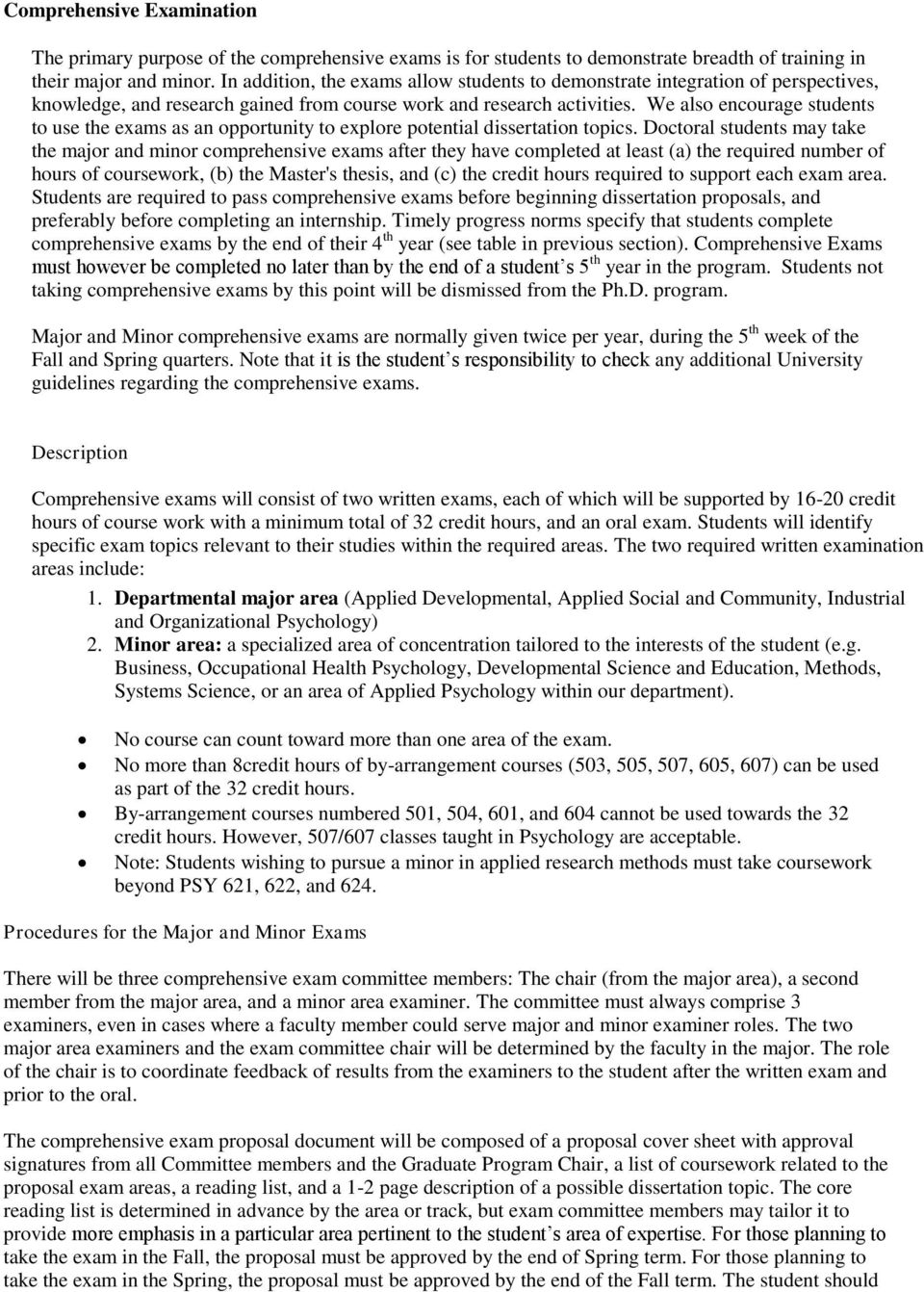
20 PSU Department of Psychology meet with individual examiners prior to the comprehensive exam proposal meeting to obtain informal approval for their proposal. The proposal meeting will be informal and involve a discussion among the student and the examiners to fine-tune the reading list, determine the examination procedure for the minor, and set the date for the oral exam (usually within 2 weeks of the written test). Students will take the exams on personal computers, in the Psychology Department offices (spaces to be designated by department manager). Reading List The reading list for major exams will be determined by faculty in the area or track. Although the Department strives for comparability of the reading lists across areas in terms of length, the reading list is ultimately up to the faculty in the major area or track. Exam Administration Major and minor written exams will be given semi-annually on the 5 th week of the Fall and Spring terms. An individual faculty member from each area will be responsible, on a rotating basis, for administration of the exams and for making and distributing copies of the answers to readers within 8 hours of receiving the exam. Note that comprehensive exams are administered under an honor system such that faculty are not required to monitor student examinees while they are taking their exams. Scoring of the Major exam. Each major written exam will be read by at least 2 faculty from the area or track. Faculty reading the major exam will give students a score of check-plus (5 points), check ( points; passing), check-minus (3 points; marginal), or X (1 point; fail). Students must be given an average score of 3.5 or higher in the Major area in order to pass the Major area exam. The two faculty members average their individual grades to arrive at the single overall grade. Students who do not pass the Major exam will be given one additional chance to pass the exam the next time the exams are offered. In cases in which the student has received a "fail" from a single examiner, either the student or the examiner may request an additional reader. Scoring of the Minor exam. Faculty reading the Minor written exam will give students a score of check-plus (5 points), check ( points; passing), check-minus (3 points; marginal), or X (1 point; fail). Students must be given a passing score in the Minor area in order to pass the Minor area exam (see table below). If two or more faculty members are grading the minor exam, they average their individual grades to arrive at the single overall grade. Students must be given an average score of 3.5 or higher in the Minor area in order to pass the Minor area exam. Students who do not pass the Minor exam will be given one additional chance to pass the exam the next time the exams are offered. In cases in which the student has received a "fail" from a single examiner, either the student or the examiner may request an additional reader. The chair combines the scores on the major and minor exams. If the average is 3.5 or higher, the student proceeds to the Oral Exam (see table, below). Check plus Check PASS Check minus X FAIL MARGINAL Check plus 5 Pass (5) Pass (.5) Pass () (3) P + M Check PASS Pass (.5) Pass () Pass (3.5) (2.5) P + M Check minus MARGINAL 3 Pass () P + M Pass (3.5) P + M Fail (3) M + M Fail (2) M + F X FAIL 1 (3) (2.5) Fail (2) M + F Fail (1) F + F 20

21 21 Oral Exams The purpose of the oral exams is to assess students knowledge and ability in their Major and Minor areas of expertise. In addition, the oral exam may be used to address any deficiencies in the Major or Minor exams. The oral exams are typically scheduled within 1-2 weeks following the written exams. At least 2 hours before the scheduled time of the oral exam, the Chair of the committee will give grades from all examiners (de-identified) for either (1) each exam day or exam area, or (2) each exam question, depending on the practices of the Major or Minor area. No other feedback can be given prior to the oral exam. At the beginning of the exam, students are asked by the Chair to step outside while the committee reviews the student's performance on the written portion of the exam, and decides how the oral exam is to proceed. It is difficult to specify the nature of the oral exam, but in general, the examiners focus on those areas of the written exam in which the student needs to demonstrate proficiency. Each examiner spends some time having students clarify responses given in the written portion of the exam and/or may raise new issues/questions. Once the committee members have finished questioning the student, the student leaves while the examiners discuss and assign a numerical grade to the student's performance. Even when the oral is successfully completed, students will not have access to their written exams. They may meet with their examiners to discuss their performance, but cannot see their actual exam. Following the completion of the oral exam, each committee member will vote by secret ballot on the status of the student in their exam area according to the following: 5= exceptional, = satisfies norm of solid Ph.D., 3= marginal, 2= too weak for marginal, but not a clear failure, and 1= fail and should not be in program. Performance on both the written and oral portions of the exam is evaluated together so that a student is assigned one numerical score for each exam area. That is, each examiner assigns a grade based on the student s performance on both the written and oral exams in a particular area. The faculty are not restricted to integers when voting. To pass, the student must have an average score across the Major and Minor exam of at least 3.8. The university policy states: If the student fails the entire comprehensive exam or any section thereof, the doctoral program may dismiss the student from the degree program or permit the student to repeat the entire examination, or the section that was failed, after a minimum of three months. The results of the second examinations are final. If the department allows a student to retake the entire exam or a portion thereof, the student must be given a time line for retaking the exam as well as feedback on the first exam. Specifically, in the case that a student will be retaking some or all parts of the comprehensive exam, formative feedback needs to be provided, such that the student is apprised of the deficiencies in the first exam administration and has a clear understanding of how to prepare for the reexamination. The exam committee completes a Comprehensive Exam Scoring Report following each comprehensive exam administration (which is internal to the department). Once the final outcome of comprehensive exams is determined (either the student has passed or the student failed the retake examination), the committee chair should complete the Comprehensive Examination Report, which is then signed by the Graduate Committee Chair and sent to the Office of Graduate Studies. Internship Students are required to complete an internship (8 credits) as part of their applied training. Students must have successfully completed the Master's Thesis oral defense and obtained the approval of their advisor before beginning their internship. The internship generally is taken after completion of formal coursework. The internship involves a field placement or off-campus research experience and must be directly relevant to a student's program of study. A job or setting with which a student is currently affiliated may be appropriate if the experience involves new or different tasks. In general, university or college teaching does not satisfy this requirement. A minimum of eight internship credits are required, and a student is expected to work three hours per week per credit hour. (Students should be aware that in order to receive tuition remission and a stipend during the internship, they must be performing TA duties for the university.) Before beginning the internship, the student and faculty member complete the internship proposal form (which can be obtained from the Department Office), detailing the goals of the internship as understood by the student and his/her advisor. Upon completion of the internship, the student writes a 2-3 page double spaced report using the internship template in the Graduate forms section of this Handbook. The report 21
22 PSU Department of Psychology includes a description of the location of the internship, the dates it was completed, who supervised the internship on site, the responsibilities and activities of the intern, and what the student learned in the internship. This report is to be reviewed and approved by the faculty adviser and Graduate Committee Chair and then placed in the student s file. Students should enroll in PSY 60 making sure the word internship is in the course title. Arrangements for the internship are made by the student in conjunction with his/her advisor. Internships are designed to provide in-depth training, hands-on opportunities and experiences in a particular area. These experiences typically take the form of placement with an outside agency, business, or organization and efforts center on program conceptualization and development, research planning and implementation, and program evaluation skills. Dissertation Overview The dissertation must be original research designed and carried out by the student. It is the culminating empirical project of the student s doctoral program. Students must complete a total of 27 credits of dissertation (PSY 603). Office of Graduate Studies requires that at least one credit be taken during the term of the dissertation defense. Note that tuition remissions can only be given during terms when the student is registered for full-time (9 hours) credit. It is the student s responsibility to schedule the dissertation proposal and defense meetings early in the quarter since follow-up meetings may be needed before the proposal or dissertation is approved. It is also the student s responsibility to schedule follow-up meetings in a timely fashion during the quarter and to give committee members, including the chair, sufficient time (at least two weeks) to review drafts of the dissertation. The dissertation process is very similar to the Master s Thesis process (see the Master s Thesis section), with the additional requirement of a pre-defense meeting, along with an optional pre-proposal meeting. These are designed to be problem-solving sessions that provide learning opportunities for the student. During these meetings, the committee agrees upon the revisions that are needed for the student to proceed to the next step. Students may find it useful to have additional meetings, for example, after the data have been analyzed and to present major findings and interpretations. Note that students are required to complete the GO-16-D to appoint the committee, approval of which must be received prior to the formal proposal colloquium. The GO-17D must be submitted and approved by the Office of Graduate Studies in conjunction with the final oral examination. A GO- 17D form must be submitted to the Office of Graduate Studies by the deadline published by the Office of Graduate Studies. Note that doctoral students must be graduated to walk in commencement. Dissertation Committee Committee Membership The dissertation committee consists of four people: three members recruited by the student with the guidance of the adviser (at least 2 regular Psychology faculty, 1 additional member of the Psychology faculty or another department), and a Graduate Studies representative, selected by the Office of Graduate Studies. One of the full-time Psychology faculty members should be identified as the principal dissertation advisor (Chair). The Chair and Graduate Office Representative must be regular, full time tenured or tenuretrack faculty, assistant professor or higher in rank. Emeritus faculty members are acceptable as committee members. Each member of the committee must hold a doctorate and be a recognized researcher in a field appropriate to support the student's research. In addition, the student must include a th member who serves 22
23 23 as the Graduate Office Representative throughout the whole process, from the proposal stage through the final oral defense. Two choices are suggested to the Office of Graduate Studies. OGS permits students to go off-campus for one committee member with specific expertise not available among PSU faculty, in which case a CV for the proposed member must be submitted with the GO-16D form. In consultation with dissertation committee members (including the Graduate Studies representative), the student should develop a brief problem statement and research plan. For the complete guideline for Committee Membership, refer to the Office of Graduate Studies website. Official Appointment of Dissertation Committee The student reminds the faculty adviser to submit a GO-16D form to the Office of Graduate Studies to officially appoint the dissertation committee. The GO-16D form requires the following information: 1) dissertation topic; 2) will human subjects be used, yes or no; 3) names of the three regular committee members; ) two suggested names for the graduate studies representative, in priority order; and 5) estimated date of proposal defense. Students should allow 1 to 2 months for Committee Appointment from Graduate Studies. Dissertation Proposal Preparation of the Dissertation Proposal The proposed research problem must be appropriate for a Ph.D. in Applied Psychology and meet University requirements. Students should obtain a copy of the Office of Graduate Studies' requirements for a dissertation, available from the Graduate Studies Office and on its web site. The proposal is expected to include the following: 1. Background and general status of knowledge in the problem area. 2. Theoretical and empirical framework within which the proposed problem exists, beginning with a concise statement of the problem. 3. Significance of the proposed research and its likely contributions.. Research methodology, including participants and their recruitment, design, and measures to be used. 5. Analysis plan. 6. Discussion section, containing the limitations of the research and future studies. The Pre-Proposal Meeting (optional) The decision to hold a dissertation pre-proposal meeting is at the discretion of a student s dissertation committee chair. Our department affirms that pre-proposals may be deemed useful in preparing a student for the dissertation research proposal colloquium. When the Chair deems the pre-proposal draft is ready, the student schedules the pre-proposal meeting, to which all committee members are invited (including the GO representative). The meeting is scheduled so that all of the members who wish to attend are included. It is recommended that at least three of the five committee members be present. The student distributes copies of the proposal to committee members at least two weeks prior to the meeting. The pre-proposal meeting, which is somewhat informal, does not include a presentation by the student. The meeting is used for problem-solving and discussion, including reaching consensus on the revisions that are needed for the student to hold his or her colloquium. If the revisions are minor, the committee may decide to schedule the colloquium at that time. The colloquium should be scheduled to allow the student time to complete the revisions and have the revised proposal to faculty at least two weeks before the colloquium date. In the absence of a pre-proposal meeting, students are urged to meet individually with or otherwise solicit feedback from committee members prior to scheduling the dissertation colloquium. 23
24 PSU Department of Psychology Dissertation Research Proposal Colloquium When the Chair deems that the dissertation proposal draft is ready, the student schedules the colloquium. The student must be registered for dissertation credit during the term they propose. Two hours are needed for the colloquium. The student and the dissertation committee must agree on the date and time. In order to secure a room for the colloquium, the student confers with the Psychology staff. One week prior to the colloquium, the student sends via an announcement to all Psychology faculty and graduate students, announcing the date, time, room number, title of the dissertation, name of the chair, and names of the dissertation committee members, including the institutional affiliation of any committee members who are not regular Psychology faculty, and attaches an electronic copy of the dissertation proposal abstract. At this time, the student places one copy of the proposal in room 317L for interested faculty and students. Faculty or other students may also request electronic copies of the document from the student. The colloquium is open to other Psychology Department faculty and graduate students. To be official, all committee members must be present, including the GO representative. The purpose of the colloquium is for the student to present and defend the proposal and for the committee members to approve the proposal. At this meeting, the student makes a formal presentation and answers questions from the committee regarding the proposed research. It is possible that the student will be required to make additional changes in the proposal, as per recommendations by the committee members. When committee members are satisfied that the student's proposal merits approval, they complete and sign the Advancement to Candidacy Form (GO-23). Advancement to Candidacy To be advanced to candidacy, students must complete all required courses, a total of 72 credits (8 credits in addition to the 6 credits taken for comprehensive exams), hold a dissertation proposal meeting, have official approval of the proposal by the Human Subjects Committee, meet the requirements for advancement to candidacy established by the Office of Graduate Studies (see Office of Graduate Studies web site), and have a dissertation proposal that is approved by their committee. The dissertation can be defended in a minimum of four months and a maximum of five years following advancement to candidacy. Following the student s dissertation proposal, each committee member signs the GO-23, signifying their approval of the dissertation proposal. The Graduate Chair signs the form and forwards it to the Dean of Graduate Studies. The Dean of Graduate Studies then advances the student to candidacy for the degree. Human Subjects Research Application An application for review of the research by the Human Subjects Research Review Committee must be submitted to the Research and Sponsored Projects prior to conducting the study or analyzing data that have already been collected. The application for review is available on the ORSP website: Once it is completed and signed by the advisor, it should be submitted to HSRRC through the Office of Research and Sponsored Projects after approval of the proposal. Students should allow from to 6 weeks for approval from HSRRC. Once approval is given by the HSRRC, HSRRC submits a copy of the approval form to the Office of Graduate Studies. Proceeding with the Dissertation Research Advanced students must be registered for at least one graduate credit each term that they are working on their dissertation. Dissertation Defense Pre-Defense Meeting The department requires a pre-defense meeting. When the Chair deems the dissertation to be ready, the student schedules the pre-defense meeting, to which all committee members are invited (including the GO representative). The meeting is scheduled so that all of the members who wish to attend are included. At least three of the five committee members must be present. 2
25 25 The student distributes copies of the dissertation to committee members at least two weeks prior to the meeting. The pre- defense meeting, which is somewhat informal, does not include a presentation by the student. The meeting is used for problem-solving and discussion, including reaching consensus on the revisions that are needed for the student to hold their final defense. If the revisions are minor, the committee may decide to schedule the defense at that time. The defense should be scheduled to allow the student time to complete the revisions and have the revised proposal to faculty at least two weeks before the defense date. The committee also approves the abstract. The dissertation abstract may be approved at the student s pre-defense meeting. If not, the student should obtain approval by the dissertation committee at least 2 weeks before the date of the Oral Examination. Final Oral Exam: Dissertation Defense Note: If you are trying to make a deadline for any reason, please be sure to schedule your defense meeting early so that you can accommodate the need for revisions and avoid disappointments. Also be aware that faculty members are available for thesis and dissertation meetings Sept. 16 June 15, during the regular academic term (i.e., not during Winter or Spring Breaks). The student files the Application for the Degree form with the Office of Graduate Studies before the first week of the anticipated term of graduation. After the student makes the revisions to their dissertation required by their committee at the pre-defense, the student should distribute the final draft of the dissertation a minimum of two weeks prior to Oral Examination. All committee members, or alternates approved in advance by the Dean of Graduate Studies, must be present for the final oral examination. (See for guidelines about electronic presence.) The defense is open to the public. The candidate is expected to prepare and present orally a formal statement on the research methodology and results. The oral presentation should not exceed 30 minutes. Following this presentation, the candidate must defend the dissertation as a worthy contribution to knowledge in its field and must demonstrate mastery of the field of specialization as it is related to the dissertation. The purpose of the questioning and discussion is to: (1) further illuminate, for the candidate and the committee, the significance and limitations of the research, and (2) demonstrate that the candidate has met the high standards of the University for the award of the doctoral degree. Following questions and discussion, the student and all audience members leave the room while the committee confers and votes. Each appointed member has a vote. For dissertation approval, there can be no more than one dissenting vote on the final examination. The Graduate Studies representative participates in conducting the final oral exam and in the vote for pass or no-pass. The role of the Graduate Studies representative is defined by documents given to the representative by the Graduate Studies Office. The representative can write a memorandum to the Office of Graduate Studies if they have any concerns about the dissertation. The Committee may pass the student subject to the completion of specified minor modifications to the dissertation. If the candidate fails the final oral examination, the advisory committee may recommend that the Dean of Graduate Studies permit the candidate to take another oral examination after a minimum of three months; results of the second oral examination are final. Note: During the term in which the Dissertation defense occurs, the student must be enrolled for a minimum of one graduate credit hour. The final defense of the dissertation may be held no later than five weeks prior to the conferring of the degree. 25
26 PSU Department of Psychology Transfer Credit STUDENTS ENTERING WITH GRADUATE COURSEWORK FROM OTHER INSTITUTIONS If transfer credit is to be presented in partial fulfillment of the requirements for a master s degree at PSU, the GO-21 form (Proposed Pre-Admission and Transfer Credit; available from the Office of Graduate Studies or their web site) must be filed in the Office of Graduate Studies for approval as soon as possible after admission but no later than the term the student submits the Graduate Degree Program form. (The GO- 21 needs to be approved by the student's advisor and Graduate Committee Chair before being sent to the Office of Graduate Studies). Transfer credits are graduate credits graded A or B only (no P/NP), which meet the conditions described on the GO-21 form. According to university guidelines, the maximum transfer credit accepted toward a graduate degree is one-third of the number of quarter hours required for the degree. Psychology graduate students are allowed to transfer up to 18 credits. Waiver of Required Graduate Work Students who have completed previous graduate work, whether or not they received a degree, and who wish to have this work meet program requirements may submit a course waiver petition. All master s or Ph.D. program requirements must be completed, substituted, or waived. This is accomplished on a courseby-course basis. The course waiver petition form is in the appendices. This form must be completed by the faculty member who is responsible for the course being waived. Approval of the petition constitutes a waiver of a required course, not a waiver of required credits. Reservation of Work for Graduate Credit Only credits earned at PSU can be reserved for graduate credit. A Reservation of Graduate Credit form must be filed in the Office of Graduate Studies and Research (GO-10) after admission to a graduate program, preferably the term following admission. Reserved graduate credit is limited to 12 completed and graded graduate credits of A or B earned within the last 5 credits prior to the award of the baccalaureate degree and not used to fulfill the requirements for the baccalaureate degree. See the OGS website for explanation. Waiver of Master s Thesis (Ph.D. Students Only) Students who have completed a thesis or empirical project and who wish to have the thesis requirement waived must submit their thesis or project to the student s advisor, and submit a course waiver petition. The petition must be submitted to the Graduate Committee Chair who will make final decisions regarding waivers after receiving input from relevant faculty. While approval waives the thesis requirement, students are still required to earn 108 total credits. Students who already have a Master s degree in Psychology or a related field (such as Counseling or Educational Psychology) from an accredited institution, but who 1) have not completed an empirical thesis, or 2) have completed an empirical thesis that does not meet the Department s threshold of quality (as determined by 2 faculty in the student s major area) must complete a Master s thesis. Students can also choose to pursue the requirements for the Master s degree, or not; if not, they need to complete all of the required steps for the Master s thesis and degree, but do not need approval of the usually required forms by the Office of Graduate Studies. Instead, they should complete all of the normally required forms from the Office of Graduate Studies, but submit them directly to the Psychology Department for placement in the student s file. Students who have a Master s degree from another field are required to complete all Master s requirements, including a Master s thesis in psychology, whether or not they have completed an empirical thesis in another field. 26
27 27 Comprehensives Courses completed at other universities (whether or not they are used for transfer credit or to waive regular courses) can be used for comprehensive exam coursework, provided they are less than seven years old. However, students need to have completed at PSU at least two courses in their major area and at least one course in each other area of the comprehensive exams. Note that students must complete the Master s thesis before they can take comprehensive exams. GRADUATE STUDENT EVALUATION Graduate Student Performance Policy and Procedures Introduction The graduate program of the Department of Psychology at Portland State University includes components such as research apprenticeship, coursework, colloquia, internships and service activities that provide students with opportunities to begin assuming the professional role of psychologist. These professional roles entail the integration of previous training and further development of the scientific, professional, and ethical bases involved in professional functioning. The accretion of professional competencies begins from the time of a student s entry into the graduate program and develops over the entire course of graduate training. The Department faculty has a professional and ethical obligation to evaluate the professional competence of graduate students and train students to manage future relationships (such as teaching, collegial, professional, or scholarly relationships) in effective and appropriate ways. Department faculty acknowledge their responsibility to support the development of professional competence in all of graduate students professional activities, including work with research partners, employers, and the public at large, and to take such action as may be necessary when a student fails to demonstrate these professional and ethical competencies. Faculty evaluate graduate students professional and ethical competence in coursework, seminars, scholarship, comprehensive examinations, related program requirements, and in additional areas beyond the formal program requirements (e.g., community-based activities and relationships; classroom behavior; teaching). This document [in Appendix A of this Graduate Student Handbook] provides policy and procedures for addressing problems of professional competence of graduate students in the Department of Psychology at Portland State University. The policy is consistent with ethical standards of the American Psychological Association and has been approved by the Department of Psychology faculty. In addition, the Psychology Department has set the following specific policies for grading in the graduate program: Grading 1. A graduate student receiving two or more grades of C+ or below in any one year or in the entire core program will be considered by the faculty for possible dismissal. Requirements for Graduate Assistantships are separate. 2. A Graduate student who does not maintain at least a B average in required courses will not be advanced to candidacy. 3. No graduate courses may be taken P/NP, except independent research, Professional Development (Brown bag) seminar, and internship credits. 3. Doctoral students must achieve a B+ or higher grade in PSY 5/621, PSY 5/622, and in PSY 5/62. Any student who does not achieve a B+ or higher grade must retake the course in the subsequent year. The course(s) may be taken no more than two times with the course tuition paid by a Department tuition waiver, if the student is still eligible for funding. 27
28 PSU Department of Psychology Incompletes (University Guidelines) A student may be assigned an incomplete by an instructor when all of the following four criteria apply: 1) the quality of work in the course up to that point is B level or above; 2) essential work remains to be done; 3) reasons for assigning an 'I' must be acceptable to the instructor; and ) a formal agreement must be reached between the instructor and student as to the nature of the work to be done and a reasonable time frame for completing it. A written record of the remaining work and its completion date should be kept by both instructor and student. The instructor may specify the highest grade that may be earned, which should not exceed the level of achievement displayed during the normal course period. The student s advisor should also be notified regarding the incomplete grade. The deadline for completion of an incomplete can be no longer than one year. The instructor may set a shorter deadline which shall be binding. In order to obtain a longer period of time to complete the work, the student must petition the Graduate Council. A graduate level petition also requires approval of the Dean of Graduate Studies. In the case of IP grades (In Progress) in 503 Thesis, the incompletes are removed only at the conclusion of the research or thesis, and no time limitation applies except that the student must complete all work in the required 7 years. Repeat of Graduate Courses (University Guidelines) Students will not be given credit toward an advanced degree for the repeat of a course in their program. If a required course must be repeated, the credits from the repeated course will not be used to fulfill the credit hour requirement for the degree. Both grades appear on the student s record and are included in calculating the GPA. Audit Graduate students may take any course on an audit basis for which they have the prerequisites and which is open to them on the basis of space available and approval of the instructor. A student's total credit hours do not include audit enrollments. Courses taken more than once on an audit basis cannot be repeated for graduate credit. Use of the audit basis for a course must be declared at the time of enrollment and cannot be changed to a graded credit basis after the add-drop period. Audits must be paid for in order to count as audit, and are not covered by tuition remission (nor do audits count towards the minimum of 9 for Graduate Assistantship eligibility). Academic Probation (University Guidelines) A graduate student with regular or conditional degree status will be placed on probation if the student's cumulative graduate GPA at PSU, based on a minimum of 9 or more letter-graded graduate credits after admission to the graduate level at PSU, falls below While on academic probation the student will not be permitted to graduate, to be advanced to doctoral candidacy, to receive approval of the master's degree program (GO-12), or to receive or continue to hold a graduate assistantship. Students on probation are not permitted to register for more than a total of 9 graduate credits in any term. Removal of academic probation occurs if the cumulative graduate GPA is brought to 3.00 within the next 9 graduate credits in graded courses after beginning probation. Disqualification (University Guidelines) A student who is disqualified may not register for any graduate courses at PSU for at least one calendar year. Disqualification occurs if: 28
29 29 1. A student on academic probation fails to achieve a cumulative graduate GPA of 3.00 or higher within the next 9 letter-graded graduate credits after beginning probation status; or 3. The student becomes subject to academic probation for a second time. Re-Admission after Disqualification (University Guidelines) A disqualified student may petition for re-admission as a degree-seeking student to a graduate program after one calendar year. Re-admission after the mandatory one-year period is initiated by the student filing a petition for re-admission to the Graduate Council through the Office of Graduate Studies. Re-admission is not automatic. To be readmitted the student must meet all the current admission requirements, with the exception of the graduate GPA. If the student's graduate program has recommended re-admission, the Graduate Council may grant readmission, with or without additional academic requirements, or may recommend continued disqualification. If the Graduate Council approves re-admission, the student must submit a re-enrollment request to the Office of Admissions. The readmitted graduate student is subject to all University and program requirements in effect at the time of re-admission. The student must raise the PSU graduate GPA to 3.00 or better with 12 credits of graded graduate coursework after re-admission, or be disqualified. Graduate courses completed at any institutions while a student is under disqualification at PSU will not be applied toward a graduate program at PSU. Annual Reviews: Input from Graduate Students In the spring quarter, students receive a memo from the Graduate Committee Chair requesting information about students scholarly activities and accomplishments from the past year. This information is used for communicating individual accomplishments and tracking the program as a whole. Completion and submission of this information is mandatory by the stipulated deadline. Yearly Plan: In addition, each graduate student drafts a statement outlining her or his plans for the coming academic year. This plan includes courses the student intends to take, a time-line for major goals (e.g. thesis, comprehensive exams or dissertation), and research interests. The goal of this plan is not to hold the student to every detail, but rather, to provide a basis of effective communication to facilitate the student s progress. The student submits two copies of this plan to his or her advisor, who forwards one copy to the student s file. Annual Reviews: Feedback to Graduate Students In the Spring term, the Psychology Department Faculty as a whole evaluates each student's academic performance to date. The student will then be provided with written feedback regarding the faculty evaluation. In order to provide graduate students with ongoing feedback about their participation in the graduate program, each graduate student will meet with faculty adviser during Spring term. The students advisor or faculty members from an area will meet with each graduate student from that area for approximately one half hour. The goal is to discuss with students their progress, strengths, and areas for development, as well as to deal with any issues raised by the student. Faculty who are supervising (or have close contact with) a student outside of their area are requested to provide relevant information to the student s advisor prior to their meeting with the student. At a minimum, students must meet the degree requirements established in this Handbook and by the University. These requirements must be met on a timely basis and in a way that demonstrates outstanding effort and outcomes of high quality. Beyond these minima, students are evaluated against a standard of excellence. We expect each student to be immersed in the department and in the broader field of Applied 29
30 PSU Department of Psychology Psychology, and to be actively engaged in community-based research with their faculty mentors and in collaborative work with community partners. We expect students to make a full-time commitment to graduate school. Post-Master s Review In addition to the annual review of graduate students, regular Psychology faculty on the thesis committee will evaluate students upon the completion of their Master s Degree. This evaluation determines whether Ph.D. students will be asked to continue on in the program or dismissed from the program. It also determines whether students who have been admitted into the Master s program are permitted to apply to the doctoral program. Students who have successfully completed the requirements of the Master s Degree, and who have shown the capacity to carry out excellence in community-based research, will be invited to continue on in the program as doctoral students. Of course, all students are expected to have made timely progress and performed well. (See timely progress guidelines elsewhere in this Handbook.) Nevertheless, beyond these minimal requirements, the faculty considers the fit between the student and the program and whether the student meets the criteria of a highly engaged student and excellent community-based researcher. This post-master s review is the time to assess that fit. During the post-master s review, members of the student s Master s thesis committee who are full-time Psychology faculty make an evaluation about whether the student has the potential to complete the remaining requirements of the doctoral program, including the independent research and writing required for a dissertation. The evaluation is based on the entire body of the student s work: research, papers, publications, courses and grades, research assistantship performance, teaching assistantship performance, participation in departmental activities and colloquia, community-based work and any other scholarly activities in which the student has been involved. Taking into consideration the student s entire history of performance as a Master s student, including the process of completing the Master s thesis, the full-time faculty on the committee meet (without the student and the graduate office representative) to discuss and vote on whether the student should continue in the program or be dismissed. Students are notified regarding the results of this vote within 30 days of the thesis defense. If students do not agree with the conclusion of the committee, they can request reconsideration by the entire faculty within two weeks. The vote also goes to the entire faculty if the vote of the full-time faculty on the student s thesis committee results in a tie. The student may submit in writing any materials that they would like to have considered. During the first available regularly scheduled faculty meeting, the chair of the Graduate Committee facilitates a discussion about the student s performance and evaluation. Faculty vote on the case and the decision is final. GRADUATE ASSISTANTSHIPS AND FUNDING Efforts will be made to provide continuous funding throughout a student's graduate program providing that the student remains in good standing and makes timely progress toward the degree. Two-years of support will be attempted for Master's students, four-years for Doctoral students. These may be graduate teaching assistantships, part-time instructorships (extra wage sections), or research assistantships, and often will include a combination of research and teaching responsibilities. In general, as a first priority, assistantship money may be made available to provide support to continuing students in good standing and making timely progress. Next, incoming students will be considered for funding. Students can request or be assigned an instructional teaching position only after they ve attained a master s degree in Psychology and generally, after the student has completed comprehensive exams. A graduate assistant must register for and satisfactorily complete a minimum of 9 graduate credit hours each term the assistantship is in effect, except summer term, and show satisfactory academic progress in fulfilling the requirements of the degree program. Exceptions to these maximum credit hours must have the approval of the Dean of Graduate Studies, and students must pay the overload rate in the current schedule of 30
31 31 classes. A graduate assistant receives tuition remission in addition to the stipend earned. The tuition remission amount is variable depending upon the tuition rate in the current schedule of classes. Responsibilities As indicated on the web page for the Office of Graduate Studies ( A GA is provided a salary on a monthly basis as compensation for the service that has been provided. The salary is not directly dependent on the actual number of hours worked each month, but rather is paid for satisfactory performance of professional responsibilities as required by the Department Chair or program Director." The website also provides guidelines for hours worked relative to your FTE. The guidelines are meant to give you an approximation for what you can expect. For example, each term you are paid over 13 weeks, and over 13 weeks,.9 FTE equals 25 hours. In Psychology, graduate students supported through the department spend a portion of their time as a teaching assistant (TA) working with an instructor, and a portion of their time as a research assistant (RA) working with their primary advisor. The portion of time spent on TA responsibilities is about 156 hours over the term for both first year and continuing students. For first year students, a guideline for time to be spent on RA responsibilities is around 78 hours for the term. For continuing students, RA time is around 98 hours. Generally, your TA responsibilities run for 11 weeks, although some instructors may request your assistance just before the term begins. Each graduate assistant's time may vary each week based on such things as the nature of the projects, and the number of weeks the instructor and your advisor engage your time. As the OGS web page also says, "In all cases the assistantship is regarded as a contribution to the graduate student's learning experience as well as a service to the university." In general, departmental RA s will only be requested to participate in activities related to research. TA s can also be requested to participate in activities related to research and other professional activities. Graduate assistants will not be requested or permitted to perform personal tasks for faculty. When the number of hours required per week will not be equally distributed over the term, advance information regarding the time requirements of the assistantship should be provided. In general, graduate students are expected to work during the week of final examinations, and may also be asked to assist in completing final grades generally due two working days after the end of finals week. A TA s responsibilities for a particular class and to particular professor are terminated at the end of the quarter during which the TA was performed (i.e., at 5 p.m. on the day grades are due). Any time not used during the quarter cannot be used later. Faculty and graduate assistants are encouraged to remain flexible and to consider the student's workload. If a Teaching Assistant is working with more than one faculty member, the faculty members should make efforts to coordinate the total workload. Any student problems or concerns related to graduate assistantships should be communicated to the Chair of the Graduate Committee, Department Chair, or the student's advisor. Eligibility In general, Master's students will be supported for no more than two years. Doctoral students will be supported for no more than four years. Students who are not making timely progress toward a degree will not be funded. Ineligibility for funding due to academic standing (See OGS website for complete information and note the following excerpts in particular) A GA who did not satisfactorily complete 9 graduate credits in a term, but who 1) has a term GPA below 3.0 and has no grade below a B- and is not on academic probation, 2) has credits or fewer of grades in the C range (C+, C, C-) and has a term GPA of 3.0 or above, or 3) has credits or fewer of Incomplete and has a term GPA of 3.0 or above, qualifies for Warning Status. The GA s employing unit must request Warning Status. If Warning Status is granted, the student may continue as a GA despite not satisfactorily completing 9 graduate credits in a term. However, if the student fails to meet the requirement of satisfactorily completing 9 graduate credits in a term for a second 31
32 PSU Department of Psychology time, the assistantship will be terminated and the student will not be allowed to serve as a GA in the future. A GA who had been terminated for failure to satisfactorily complete 9 graduate credits in a term, without first going on Warning Status, may potentially hold a graduate assistantship again. A minimum of one term after termination of the assistantship, the employing unit can request reinstatement. The decision whether to continue the termination or allow reinstatement will be determined after reviewing the student s academic history, including after the assistantship was terminated. If reinstatement is granted, and the student fails to satisfactorily complete 9 graduate credits in a term for a second time, the assistantship will be terminated again and the student will not be allowed to serve as a GA in the future. Note that under no circumstances will the Office of Graduate Studies allow students to have an assistantship if a) their cumulative grade point average falls below 3.0 AND b) they have an outstanding grade of I (incomplete) in more than one course excluding thesis credits. Ineligibility for funding due to substandard performance When a faculty member supervising a graduate RA or TA notes that the graduate student is not performing the duties of the position at an acceptable level, the faculty member will take three steps: 1. The faculty member will complete a Performance Evaluation of the student s work in the position. 2. The faculty member will meet with the student and discuss the basis for the evaluation and make suggestions about how to improve subsequent performance. These first two steps must be completed by the sixth week of the quarter. 3. If the performance does not improve by the end of the quarter, the faculty member will submit an updated Performance Evaluation to the Chair. The Chair will discuss the report with the student. Action One unsatisfactory report: Goes into student s file. For any future assignment, student is assigned to a different faculty member. Two unsatisfactory reports: The student is not eligible for funding from the department. Graduate-Level Courses TAs must have previously taken any graduate course in which they are appointed an assistantship. TAs cannot concurrently or subsequently enroll in a graduate course in which they have or have had an assistantship. When TAs grade the work of other graduate students, the material to be graded should be as objective as possible. Efforts should be made to limit grading to homework assignments. If grading of tests is included among the TAs duties, the TAs access to other students' grades should be limited and should not include final grades. It is a given that students grades are to be kept confidential. STUDENT PARTICIPATION IN DEPARTMENTAL DECISION-MAKING In general, the department has the policy and practice of supporting graduate student engagement and participation in the activities of the department. Graduate students are encouraged to attend departmental activities and functions, and to suggest and organize departmental activities and functions themselves. There are several special instances in which graduate student representation is required or allowed. These include: 32
33 33 Graduate Committee A graduate student representative is expected to attend and participate in meetings of the Graduate Committee. If specific graduate students are discussed, then representatives will not be present. Any graduate students (or student groups) who have an issue they would like the Graduate Committee to consider can submit the issue to any member of the Committee. Alternatively, students may arrange to attend a meeting of the Graduate Committee to discuss the issue or invite a member of the Graduate Committee to attend a student meeting on the topic. Orientations of New Graduate Students Graduate students are responsible for a portion of the new student orientation, which takes place the week before classes start in the Fall. Search Committees Graduate representatives will be appointed to faculty search committees. Students will be expected to read files on candidates and to participate in discussion and selection of candidates to interview. Letters of recommendation and discussion of candidates is confidential. All graduate students are urged to attend sessions with faculty candidates and candidates colloquia. Graduate student input will be solicited prior to deliberations on new hires. Graduate students will not be present during deliberations and voting on new hires. Faculty Meetings Graduate student representative(s) may attend faculty meetings. If sensitive personnel matters or specific graduate students are discussed, then representatives will not be present. The Graduate Committee Chair will meet with the Psychology Graduate Student Association (PGSA) to facilitate communication between faculty and graduate students. Promotion and Tenure Decisions According to university regulations, input from students is mandatory in consideration of faculty for promotion and tenure. Within the department, input from graduate students is solicited by the chair of the PRT Committee. 33
34 PSU Department of Psychology GENERAL INFORMATION Student Offices and Labs As graduate students in the Psychology Department, you have a few perquisites available. Graduate students have access to a lounge and desk space on the third or fifth floors of Cramer Hall. Please see the department staff to be issued a key. The department has limited student offices available and these offices are generally assigned by the Department Manager on a priority basis. First priority is given to graduate teaching assistants who need a private place to conduct office hours. Second priority is given to advanced students working on research or theses, with the remaining offices assigned on a need basis. Students who need office space should see the Department Manager. Some graduate students may have offices in the research space of their research supervisors. This is at the discretion of the respective faculty and depends on how particular research space is structured and used. We strongly encourage graduate students to make use of this space since interaction among students is an important part of the graduate school experience. All graduate students have mailboxes located below and next to the faculty mailboxes in the Psychology Department. Graduate students are encouraged to check these boxes frequently, as they are the official information link between faculty and students. Notices of events of interest as well as departmental notices and committee meeting times will be placed in these mailboxes. Listserv Every graduate student should join the PGSA (Psychology Graduate Student Association) listserv. This listserv is an important resource for valuable information related to the department and TA responsibilities and opportunities. Generally, students will be added to the listserv as part of their orientation to the graduate program. If that does not happen or a student has problem with the listserv, the student should contact PGSA leadership. Library Privileges In addition to the regular usage undergraduate students have, graduate students are granted special library privileges. Graduate students may be allowed to check out some journals marked "for library use only" for a period of one to two days. Graduate students and faculty are allowed to borrow material from the following libraries: Oregon Health Sciences University, Oregon Graduate Institute, and Reed College. Special conference rooms and study areas are set-aside in the library for graduate student use. Graduate students may use the interlibrary loan service, including out-of-state requests, without faculty authorization. Graduate students may also renew books for two weeks, provided a hold has not been placed on the books. Further information may be obtained from the library. Participation in Graduate Program Leave of Absence A student admitted to the graduate program may petition for a leave of absence for one calendar year. A leave of absence insures that students are in good standing in the program while away, and allows them to continue in the program when the leave of absence expires. To apply for a leave of absence, the student writes a letter to the Graduate Committee Chair explaining why and for how long the leave is requested. Once the request has been endorsed by the Graduate Committee Chair, he or she informs the Department Chair of the leave details. The Graduate Chair also forwards the leave approval to the Office of Graduate Studies no later than the last day to register for classes in the term in which the application is made. A copy is placed in the student s file by the Graduate Chair. A leave of absence is granted only to graduate students 3
35 35 in good standing and does not constitute a waiver of the time limit for completion of the graduate degree at PSU. The one-year deadline for fulfilling the requirements for an incomplete grade is not suspended. A student may petition for a second leave of absence from a graduate program, but additional approval is required from the Office of Graduate Studies. Graduate students accepted into the program who have not yet matriculated submit their requests for a deferred admission to the Graduate Admissions Committee. Any quarter of the regular academic year (Fall, Winter or Spring) during which a student is not enrolled for at least one credit hour in psychology at PSU, requires a formal leave of absence from the department. Failure to do so can result in termination from the program. Graduate students should be enrolled for at least 1 credit hour of thesis or dissertation each quarter they are receiving faculty assistance. They also should be enrolled for at least 1 credit hour of thesis or dissertation in the quarter they have a colloquium or final defense. Please note that per University policy regarding residency, students will be assessed out-ofstate tuition rates if they moved to Portland within 1 year of beginning coursework at Portland State (please refer to Cancellation of Admission to Graduate Program. A student admitted to the graduate program who during a one-year period 1) does not have an approved leave of absence and 2) does not complete a graduate course in the approved program of study for the degree, shall have admission to the degree program canceled. Re-Admission of Graduate Students. Graduate students who have dropped out of the program or who have had their admission canceled for extended absence from the program without an approved leave of absence, need to reapply to the Department if they wish to return to the program. To reapply, students must submit a letter of explanation, 2 letters of recommendation from current faculty, and a timeline for completion of the program. Students who have been dropped by the Office of Graduate Studies also must go through the formal procedure including a petition process to be readmitted. Time Limitations By rule of the Office of Graduate Studies, all work submitted for a Masters degree (including transferred credit, thesis, final evaluation, etc.) must be completed within a period of seven calendar years. Note: The Psychology Department has more restrictive expectations for satisfactory progress through the requirements of the program (see section on Timely Progress Norms). The procedure for validation of out-of-date graduate credit is described in the GO-15 form published by the Office of Graduate Studies. This procedure includes satisfactory completion (B- or higher) of the examination for the graduate course(s) in question. A student may petition for credit of out-of-date coursework only once. According to university guidelines, the doctoral dissertation must be completed and successfully defended and the student must be graduated within five years following advancement to candidacy. Failure to complete the dissertation in the allotted time invalidates the comprehensive exams. Students have five years between the time of their admission into the Ph.D. program and their comprehensive exams. However, the availability of financial support is separate from the time allotted. Further, university policy stipulates that a maximum of three years will be allowed from the completion of comprehensive examinations to advancement to candidacy. However, our department policy requires advancement within one year, with a maximum extension of up to two additional years in extraordinary circumstances (see Procedures for Doctoral Degree for additional information). Petitions All petitions for exceptions or waivers of University graduate regulations or graduate degree requirements must be approved by the Graduate Committee Chair and the Department Chair and then submitted to the Office of Graduate Studies for consideration. Action by the Graduate Council is also required. 35
36 PSU Department of Psychology Overload Petitions The Office of Graduate Studies monitors the academic achievements of each matriculated student. Part of the responsibility includes limiting excessive overloads, which may harm the quality of the academic achievements. Graduate students must seek approval of registration in excess of 16 credit hours. A student registering for hours must obtain the approval of the department chair and advisor. A student registering for 16 hours or more must obtain the approval of the department chair and advisor and the Office of Graduate Studies if they have a graduate assistantship. The Overload Petition form is available on the OGS website: Human Subjects Research If the graduate student's thesis or dissertation involves conducting research using human subject participants, including secondary data analysis, an application for review of the research by the Human Subjects Research Review Committee must be submitted to the Office of Research and Strategic Partnerships (ORSP) prior to conducting the study or reanalyzing the data. The review is designed to ascertain that the rights and welfare of human subjects are protected. All information concerning human subjects review is available at their website: Per recently revised HSRRC policy (effective 2/ 2013), students may no longer serve as PIs on applications Faculty advisors or committee members should review and submit the IRB application on behalf of students, and students should complete the bottom section of the Investigator s Assurance form. Once approval is given by the HSRRC, the student should submit a copy of the approval form to the Office of Graduate Studies. The HSRRC application should be filed as soon as the students have completed their colloquia. The application asks for detailed information concerning the study, and graduate students should be prepared to detail explicitly the study they propose and to provide a copy of any Informed Consent form. Additionally, students should allow from to 6 weeks to receive approval from the Human Subjects Research Review Committee. Plagiarism Procedures for the allegations of plagiarism are established in the PSU Student Code of Conduct which is administered by the Dean of Student Life. Details regarding the Code of Conduct and related processes are described in the following link: By-Arrangement Requests By-arrangement forms must be submitted prior to, or early in the quarter in which students wish to enroll in the courses listed below. Students may obtain the By-Arrangement Request form and instructions from the departmental office. 501/601 Research - Research which is not normally part of the thesis. 503/603 Thesis/Dissertation - All aspects of the thesis including thesis research and writing of thesis. 505/605 Reading & Conference - Scholarly examination of literature including discussion between student and teacher. 60 Internship - Fieldwork involving the practice of professional activities or guided research. All by-arrangement requests should include a substantive title and an accurate description of the activities planned. Students should keep copies of all materials pertaining to by-arrangement coursework. These may be needed to document the coursework supporting comprehensive exams. 36
37 37 GRADUATE FORMS AND PROCEDURES All required forms are available either on the department I:/ drive (I:/Staff/Psychology/GRADUATE FORMS) or through the Office of Graduate Studies (OGS) web site A comprehensive list of deadlines for submission of forms is available at the OGS website: Please refer to our graduate student checklist for detailed information about both departmental and OGS forms and the process and order by which they must be completed and submitted. 37
38 PSU Department of Psychology Responsibilities of the Department of Psychology APPENDIX A: Graduate Student Performance Policy and Procedures 1. The Department will provide students with information regarding academic standards as well as information regarding academic policies of the university. 2. The Department will provide at least annual written evaluation of each student s progress in the program. Each student s advisor meets with the student annually to discuss the evaluation and offer recommendations. After the review, the advisor and student sign the letter of assessment and forward it to the student s file. In addition, throughout a student s graduate career the student s performance may be evaluated informally by Department faculty or other personnel (for example by graduate course instructors or teaching assistantship supervisors). 3. The program will provide due process for the review of graduate student performance, including procedures for possible remediation, probation, or termination from the program, as provided in this policy. Feedback from these assessments is intended to facilitate students' professional growth by acknowledging strengths and by identifying performance or conduct areas that need improvement. Such assessments are both episodic and ongoing. Expectations of Graduate Students Regarding professional competence we categorize our expectations of graduate students into three domains: 1. Knowledge of and conformity to relevant professional standards, 2. Acquisition of appropriate professional skills, and 3. Appropriate management of personal concerns and issues as they relate to professional functioning, including performance in academic, research or service arenas and relationships with other students, faculty, staff, research participants or research partners. Department faculty expect graduate students to be cognizant of and abide by the APA Ethical Principles of Psychologists and Code of Conduct, specialty guidelines, and any other relevant, professional documents or standards which address psychologists' ethical, personal and/or legal responsibilities. Department faculty also recognize that mere knowledge of and exposure to the above guidelines and standards, while necessary, are insufficient. Graduate students need to demonstrate professional standards in their behavior. Examples include a demonstrated awareness of ethical issues which arise in work with community research partners; providing research participants with a prompt opportunity to obtain appropriate information about the research findings; and truthfulness in representing one s credentials and training. Problems of professional competence may become evident at any point during a student s graduate career. Examples of problems include: 1. The quality of work delivered by a student in coursework, assistantship, and/or research related contexts is notably below reasonable standards; 2. A student does not acknowledge, understand, seek to understand, or address a problem when it is identified to him or her; 3. A disproportionate amount of attention to the student by faculty or staff is required;. A student's behavior does not change as a function of feedback, remediation efforts, and/or time; 5. Problematic behavior has potential for ethical or legal ramifications if not addressed; 6. Problematic behavior compromises the training of other students. Procedures for Addressing Student Performance not Meeting Expectations For many problems it is expected that the student and faculty member will first attempt to resolve problems informally; indeed, this is the preferred manner of resolution whenever reasonable. Informal resolution may also include consultation by the student with the adviser and/or the Department chair and/or by the initiating faculty member with the adviser and/or the chair. Typically the student then addresses the problems to the satisfaction of the 38
39 39 faculty, and continues successfully in the program. When necessary, however, faculty will communicate more formally with the student. In any case, the Dean of Students may be consulted and become instrumental in the actions taken, including adjudicating the matter at hand. Unsatisfactory performance that has not been resolved informally will be addressed in the following ways: (1) a Remediation Procedure in which selected faculty develop a plan for remediation and later reviews progress; and/or (2) a Retention Review, in which a faculty committee makes a decision regarding retention or dismissal of the student. The decision to invoke either the Remediation Procedure or a Retention Review is based on the nature and seriousness of the concern(s). Criteria and procedures for each response are provided below. If a student commits a violation of the APA ethical code, this situation is subject to automatic initiation of either the Remediation Procedure or Retention Review by the student s advisor. Remediation Procedures. The Chair 1 of the Department will work with the Graduate Program Chair who together oversee all remediation plans and conduct all retention reviews in a given academic year. The faculty serving in this capacity take action based on the following: 1. When a faculty member has not been able to resolve a concern through informal interactions with the student, she or he notifies the student in writing to request a remediation meeting. If the initiating faculty member is not the student s advisor, the initiating faculty member includes the advisor in this request and sends a copy to the student s advisor. The written request should specify in what ways the student needs to meet the Department s expectations and/or address the concerns identified. 2. The initiating faculty member will meet with the student, the designated faculty committee, and the student s advisor to discuss the concerns and develop a plan for remediation. In select circumstances, other parties may need to be consulted. If the advisor and the initiating faculty member decide that the concern is so serious that a plan of remediation is inappropriate, the Retention Review procedure will be invoked. The committee may request that the student provide such information as may be reasonably related to the issue and the student is expected to cooperate with the committee by providing such information. 3. When the initiating faculty member, designated faculty, and advisor decide that a plan for remediation is appropriate, they will develop a written plan. The plan will specify the concerns, actions to be undertaken by the student, and the date by which the student must demonstrate the performance specified. The plan must allow a reasonable period of time for remediation. Whenever possible, completion of the plan should take place within the academic year (September 16 June 15). The last pages of this document provide an outline for remediation plans.. The designated faculty, the student, and the student s advisor will meet with the student to review the outcomes of the plan on or before the completion date. When appropriate this review should also include the faculty member who initiated the process. The committee may also meet to deliberate without the student present. The designated faculty will decide whether or not the student has successfully remediated the concern according to the plan. They will send a written notice of their conclusions to the Chair of the Department. If the concern is judged to be unresolved, a Retention Review will take place. Retention Review Serious concerns about a student s performance or behavior may persist after having been addressed by faculty. Additionally, on very rare occasions, violations of professional expectations may be so egregious as to necessitate immediate consideration for program dismissal without a preliminary remediative step. Dismissal of a student from his or her graduate program in the Department of Psychology is a significant event for 1 The Associate Chair may also act as a representative of the Chair 39
40 PSU Department of Psychology the student and for program faculty. It represents the conclusion of the faculty that the student has not demonstrated an adequate level of competency in academic skills, research skills, or professional conduct. Procedures for such review, distinct from the annual academic reviews and post-master s review that students normally receive are as follows. 1. The faculty member referring the concern for a Retention Review ( the initiating faculty ) will notify the student and the student s advisor in writing that a concern has developed. The initiating faculty member will send a copy of this notice to the Chair of the Department. 2. A Retention Review Committee will be appointed and convened by the Chair of the Department. Membership on the committee should include the Chair of the Graduate Committee (who will serve as chair), and one other tenured Department faculty member. One of these faculty members will be selected from a list submitted by the student of at least two Department faculty members or appointed be the Chair if the student provides no nominee. The student s advisor is ineligible for membership on the Retention Review Committee. If membership presents a conflict of interest for the Chair of the Graduate committee, the Department Chair will appoint another tenured faculty member to assume the responsibilities of committee chair. 3. The student and the student s advisor will attend a meeting of the Retention Review committee. The committee chair may invite other parties relevant to the concern. The student may invite departmental students or faculty members to provide the committee with relevant information. The student will inform the committee chair in writing at least 3 days prior to the meeting who will be attending on the student s behalf. The committee chair reserves the right to limit the providing of redundant or irrelevant information.. The Retention Review Committee will consider the concerns brought before them and the student s response. The committee may also choose to review the student s academic file. 5. The Committee then meets and makes a recommendation that the concerns may be be resolved in one of the following ways: a. Due to behavior on the part of the graduate student, the student is immediately dismissed from the graduate program. b. Dismissal from the graduate program is recommended to take place at the end of the current academic term. c. The committee may recommend that the student remain in the program under conditions of remediation specified by the committee. d. The committee may find there is sufficient evidence that the concern has been remediated, and recommend that no further action is necessary. e. The committee may find that there are neither grounds for remediation or dismissal, and recommend no action. 6. The Chair of the Graduate Committee will send a letter to the student summarizing the decision and its rationale, with copies to the Department Chair, the student s advisor, the student file, and if appropriate, the faculty member who initiated the Retention Review. Appeals. If the student believes that Department of Psychology policy or procedure was not followed, he or she may request in writing a review of the Remediation Procedure and/or Retention Review process and outcomes by the Chair of the Department within two weeks. The Department Chair will notify the student of the outcome of his or her review, in writing, within another two weeks. Any further appeal of these outcomes would need to be submitted to the Office of Graduate Studies under policies outlined in the Portland State University Bulletin. Policy Effective: June, 2011 The Department of Psychology acknowledges the stated policies of the Council of Chairs of Training Councils, affiliated with the Education Directorate of the American Psychological Association; the School of Social Work at Portland State University; and Fielding Graduate University, from all of which the Department faculty drew extensively in creating this policy including direct use of some of these materials. 0
41 1 Remediation Plan Department of Psychology, Portland State University Date of Remediation Plan meeting: Name of graduate student: Primary advisor: Names committee members designated by the Department Chair, present at the meeting: All additional pertinent advisors or other faculty: Provisional date for follow-up meeting(s): Circle all competency domains in which the graduate student s performance still needs to meet expectations: Foundational Competencies: Professionalism, Scientific Knowledge and Methods, Self-Assessment/Self-care, Relationships, Diversity, Ethical Standards Functional Competencies: Teaching, Consultation, Research, Supervision, Service Activities, Administrative Activities Description of the problem(s) in each competency domain circled above: Date(s) the problem(s) was brought to the graduate student s attention and by whom: Steps already taken by the graduate student to rectify the problem(s) that was identified: Steps already taken by the faculty member(s) to address the problem(s): 1
42 PSU Department of Psychology (Make copies of this page as needed.) Competency domain and essential components Problem behaviors Expectations for acceptable performance Actions and/or responsibilities of the graduate student Actions and/or responsibilities of the supervisor or faculty member Timeframe for acceptable performance Assessment methods Date(s) of reevaluation Consequences of unsuccessful remediation Remediation Plan (continued) 2
43 3 I,, have reviewed the above remediation plan with my primary advisor and faculty members of the Remediation Procedure committee. My signature below indicates that I fully understand the above. I agree / disagree with the above decision (please circle one). My comments, if any, are below (PLEASE NOTE: If the graduate student disagrees, comments, including a detailed description of the graduate student s rationale for disagreement, are REQUIRED). Graduate student signature: Date: Graduate student s comments (Feel free to use additional pages): Members of the Remediation Committee, the faculty advisor, and other faculty with responsibilities or actions described in the above remediation plan agree to participate in the plan as outlined above. Please sign and date below to indicate your agreement with the plan. 3
44 PSU Department of Psychology Summative Evaluation of the Remediation Plan (Make copies of this page as needed.) Follow-up meeting Date: In attendance: Competency domain and essential components Expectations for acceptable performance Expected outcomes (Met; Partially met; Not met) Next steps (e.g., remediation is concluded; plan is modified; next step in due process procedure) Next evaluation date (if applicable)
45 5 I,, have reviewed the above summative evaluation of my remediation plan with my primary advisor and with other faculty as needed. My signature below indicates that I fully understand the above. I agree / disagree with the above decision (please circle one). My comments, if any, are below. (PLEASE NOTE: If the graduate student disagrees with the outcomes and next steps, comments, including a detailed description of the graduate student s rationale for disagreement, are REQUIRED). Graduate student signature: Date: Graduate student s comments (Feel free to use additional pages): 5
GRADUATE STUDENT HANDBOOK GRADUATE DEGREE PROGRAMS IN APPLIED PSYCHOLOGY. Policies and Procedures 1
 GRADUATE STUDENT HANDBOOK GRADUATE DEGREE PROGRAMS IN APPLIED PSYCHOLOGY Policies and Procedures 1 MASTER'S DEGREE IN PSYCHOLOGY DOCTORAL DEGREE IN APPLIED PSYCHOLOGY DOCTORAL DEGREE IN SYSTEMS SCIENCE:
Ph.D. PROGRAM GUIDELINES
 Ph.D. PROGRAM GUIDELINES Marketing Department December 8 th, 2014 Kellogg s Marketing Department is regarded as one of the premiere marketing programs in the world and is renowned for its groundbreaking
GRADUATE DEGREE REGULATIONS
 Graduate Regulations-Spring 2014 1 GRADUATE DEGREE REGULATIONS DEPARTMENT OF PSYCHOLOGY UNIVERSITY OF FLORIDA GRADUATE DEGREE REGULATIONS 1 I. GENERAL INFORMATION 2 A. Graduate Advisor/Supervisory Committee.
Graduate Handbook EDUCATIONAL PSYCHOLOGY
 Graduate Handbook EDUCATIONAL PSYCHOLOGY IFCE /Simpson Hall Phone 505-277-4535 MSC05 3040 Fax 505-277-8361 1 University of New Mexico E-Mail [email protected] Albuquerque, NM 87131-1246 Program Website: http://coe.unm.edu/departments/ifce/educational-psychology.html
GRADUATE PROGRAM IN EXPERIMENTAL PSYCHOLOGY GRADUATE HANDBOOK ACADEMIC YEAR 2014-2015. Approved by Experimental Program Committee 04/29/2014
 GRADUATE PROGRAM IN EXPERIMENTAL PSYCHOLOGY GRADUATE HANDBOOK ACADEMIC YEAR 2014-2015 Approved by Experimental Program Committee 04/29/2014 Contents Contents... 1 Introduction... 4 Section 1: PH.D. Degree
2015-2016 BEHAVIORAL SCIENCE MANUAL
 2015-2016 BEHAVIORAL SCIENCE MANUAL BEHAVIORAL SCIENCE DOCTORAL PROGRAM University of North Texas Academic Year 2015-2016 Program Description... 1 Program Faculty... 2 Application and Admission Requirements...
G E N E R A L I N F O R M A T I O N F O R G R A D U A T E S T U D E N T S
 G E N E R A L I N F O R M A T I O N F O R G R A D U A T E S T U D E N T S This supersedes previous announcements by the Department of Philosophy. All regulations are to be interpreted in conformity with
DEPARTMENT OF CHEMISTRY AND BIOCHEMISTRY
 UNIVERSITY OF NOTRE DAME DEPARTMENT OF CHEMISTRY AND BIOCHEMISTRY GUIDE TO GRADUATE STUDIES 2014 2015 CONTENTS Chapter Page 1. INTRODUCTION 3 2. DEGREE REQUIREMENTS FOR THE DOCTOR OF PHILOSOPHY 3 3. ACADEMIC
The current (2015-2016) Marketing Ph.D. Committee consists of Greg M. Allenby (Committee Chair), Xiaoyan Deng, Nino Hardt, and Rebecca Walker Reczek.
 Marketing Ph.D. Program Handbook 1. Marketing Ph.D. Program Structure and Committees Graduate Faculty and the Marketing Ph.D. As a doctoral student, you are enrolled in the Graduate School of the Ohio
THE Ph.D. PROGRAM IN MARKETING. The Smeal College of Business The Pennsylvania State University
 THE Ph.D. PROGRAM IN MARKETING The Smeal College of Business The Pennsylvania State University 2012-2013 TABLE OF CONTENTS Introduction Structure of Ph.D. Program... 3-9 Course Work... 3 Candidacy Exam...
DOCTOR OF PHILOSOPHY (Ph.D.) DEGREE PROGRAMS IN EDUCATIONAL ADMINISTRATION with an emphasis in HIGHER EDUCATION ADMINISTRATION
 DOCTOR OF PHILOSOPHY (Ph.D.) DEGREE PROGRAMS IN EDUCATIONAL ADMINISTRATION with an emphasis in HIGHER EDUCATION ADMINISTRATION Department of Educational Leadership & Policies College of Education University
COLLEGE OF WILLIAM AND MARY ANTHROPOLOGY GRADUATE PROGRAM PROCEDURES
 1 COLLEGE OF WILLIAM AND MARY ANTHROPOLOGY GRADUATE PROGRAM PROCEDURES TABLE OF CONTENTS PROGRAM OVERVIEW 2 ADMINISTRATIVE STRUCTURE. 2 ADMISSION TO THE PROGRAM 3 Page MASTER OF ARTS 1. Introduction. 4
GRADUATE PROGRAM IN BIOTECHNOLOGY
 GRADUATE PROGRAM IN BIOTECHNOLOGY I. Governance 2 II. Admission....... 3 III. Counseling...... 3 IV. Course of Study...... 3 V. Student Seminars... 4 VI. Teaching... 4 VII. Research...... 4 VIII. Qualifying
Academic Program: Doctoral Program in Clinical Psychology. Graduate or Undergraduate: Graduate Date: October 10, 2003
 Academic Program: Doctoral Program in Clinical Psychology Graduate or Undergraduate: Graduate Date: October 10, 2003 Coordinator of the Program: Kenneth W. Sewell Person completing this form: Kenneth W.
DEPARTMENT OF POLITICAL SCIENCE
 DEPARTMENT OF POLITICAL SCIENCE HANDBOOK FOR THE GRADUATE PROGRAM Revised Fall 2013 The Department of Political Science at the University of New Mexico is a department of eighteen full-time faculty members.
Developmental Psychology Program Graduate Degree Requirements: Outline Revised 10/21/14 REQUIRED DEVELOPMENTAL COURSEWORK
 1 Developmental Psychology Program Graduate Degree Requirements: Outline Revised 10/21/14 The doctoral program in developmental psychology is structured so that all requirements for the degree can be completed
Timeline to Degree Molecular Biology Ph.D.
 Timeline to Degree Molecular Biology Ph.D. 1. 1 st Year Completion of BISC 502A and BISC 502B with a grade of a B or higher (Screening Exam). Minimum 3.0 overall GPA. 2. 1 st Year Successful completion
GRADUATE STUDENT INFORMATION MECHANICAL AND INDUSTRIAL ENGINEERING DEPARTMENT
 GRADUATE STUDENT INFORMATION MECHANICAL AND INDUSTRIAL ENGINEERING DEPARTMENT 2013/2014 September 2013 (This edition supersedes all previous editions) Table of Contents I PURPOSE AND SCOPE... 3 II THE
political Science Degree Requirements and Requirements
 UWM Political Science Department Graduate Program Policies A. Political Science at UWM B. M.A. C. Ph.D. D. Transfer of Credits E. Incompletes F. Scheduling Completion of M.A. and Ph.D. Degrees G. Fellowship
Physics Graduate Program Handbook
 Carnegie Mellon University Department of Physics November 14, 2012 Version 1.1 Physics Graduate Program Handbook This document presents the rules and requirements governing the Graduate Program in the
Student Handbook. Georgia State University
 Student Handbook The Doctoral Program in Educational Psychology Georgia State University Department of Educational Psychology and Special Education This document has been prepared as an overview for the
GRADUATE GROUP IN EPIDEMIOLOGY M.S. PLANS I AND II AND Ph.D. PLAN B DEGREE REQUIREMENTS Graduate Council Approval: June 28, 2013
 GRADUATE GROUP IN EPIDEMIOLOGY M.S. PLANS I AND II AND Ph.D. PLAN B DEGREE REQUIREMENTS Graduate Council Approval: June 28, 2013 The Graduate Group in Epidemiology has both M.S. and Ph.D. tracks. Students
STATE UNIVERSITY OF NEW YORK AT ALBANY Department of Economics
 STATE UNIVERSITY OF NEW YORK AT ALBANY Department of Economics Doctor of Philosophy Program Guidelines: May 2013 I. Admission Each application is evaluated on its individual merits by the Economics Department.
CLINICAL PSYCHOLOGY HANDBOOK
 College of Humanities and Social Sciences Department of Psychology CLINICAL PSYCHOLOGY HANDBOOK 1 Table of Contents Introduction... 3 Training Objectives and Evaluation Tools... 3 General Rules and Guidelines...
Psychology. Forensic Psychology Master of Science (M.S.)
 University of North Dakota 1 Psychology http://www.und.edu/dept/psych/ Bradley, Derenne, De Young, Ferraro, Grabe, Holm, Kehn, Kelly, King, Legerski, Looby, McDonald, Miller, Peters, Petros, Plumm, Poltavski,
Masters Program in Political Science:
 Masters Program in Political Science: Frequently Asked Questions Division of Political Science Mark O. Hatfield School of Government www.pdx.edu/hatfieldschool/political- science (Updated, September 2011)
Degree Requirements for the Graduate Program in Chemistry and Biochemistry 2014-15
 Degree Requirements for the Graduate Program in Chemistry and Biochemistry 2014-15 University of Oregon Contents PH.D. DEGREE REQUIREMENTS... 2 Examination Requirements... 2 Cumulative Examinations...
DEPARTMENT OF EDUCATIONAL PSYCHOLOGY GRADUATE STUDENT / ADVISOR HANDBOOK DOCTORAL DEGREE PROGRAM. College of Education. University of Arizona
 1 DEPARTMENT OF EDUCATIONAL PSYCHOLOGY GRADUATE STUDENT / ADVISOR HANDBOOK DOCTORAL DEGREE PROGRAM College of Education University of Arizona Revised March 2014 2 DOCTORAL PLAN OF STUDY AND DEGREE FORMS
RULES, REGULATIONS AND FORMS PERTAINING TO GRADUATE PROGRAMS IN PSYCHOLOGY DEPARTMENT OF PSYCHOLOGY UNIVERSITY OF NEW ORLEANS 2015-2016
 RULES, REGULATIONS AND FORMS PERTAINING TO GRADUATE PROGRAMS IN PSYCHOLOGY DEPARTMENT OF PSYCHOLOGY UNIVERSITY OF NEW ORLEANS 2015-2016 Revised, August 2008 1 TABLE OF CONTENTS I. Admission 4 A. Criteria
Stanford University Department of Communication Degree Requirements & Department Procedures for Ph.D. Students and Ph.D. Advisors (October 10, 2015)
 Stanford University Department of Communication Degree Requirements & Department Procedures for Ph.D. Students and Ph.D. Advisors (October 10, 2015) Table of Contents 1. Introduction 2. Departmental Graduate
DOCTORAL HANDBOOK IN MUSIC EDUCATION
 DOCTORAL HANDBOOK IN MUSIC EDUCATION Admission Standards To be admitted to the doctoral program in music education, an applicant must have a master s degree in music education or a total of 30 credits
Department of Psychology
 The University of Texas at San Antonio 1 Department of Psychology The Department of Psychology offers the Master of Science Degree in Psychology and the Doctor of Philosophy Degree in Psychology. Master
DePaul University EXPERIMENTAL PSYCHOLOGY GRADUATE PROGRAM RULES AND POLICIES AUGUST, 2013. Linda A. Camras Program Director
 1 DePaul University EXPERIMENTAL PSYCHOLOGY GRADUATE PROGRAM RULES AND POLICIES AUGUST, 2013 Linda A. Camras Program Director TABLE OF CONTENTS Overview. 2 Admissions Procedure... 2 Guidelines on Previous
Graduate or Undergraduate: Graduate-PhD Date 12/18/03. Coordinator of the Program: Douglas Johnson Email [email protected]_
 Assessment of Student Learning Outcomes (Fall 2003) Please provide the information below about how your academic unit assesses the extent to which students achieve learning outcomes associated with each
NORTHEASTERN UNIVERSITY College of Social Sciences and Humanities Department of History REGULATIONS GOVERNING GRADUATE STUDY IN HISTORY
 NORTHEASTERN UNIVERSITY College of Social Sciences and Humanities Department of History REGULATIONS GOVERNING GRADUATE STUDY IN HISTORY Applicable to Students Matriculating in September 2014 The Department
UAF-UAA Joint PhD Program in Clinical-Community Psychology with Rural, Indigenous Emphasis Outcomes Assessment Goals, Objectives, and Benchmarks
 Page 1 of 16 UAF-UAA Joint PhD Program in Clinical-Community Psychology with Rural, Indigenous Emphasis Outcomes Assessment Goals,, and Benchmarks Mission The PhD Program in Clinical-Community Psychology
Ph.D. Program FINANCE
 Ph.D. Program In FINANCE DEPARTMENT OF FINANCE POLICIES AND PROCEDURES Ph.D. Program Fisher College of Business The Ohio State University 700 Fisher Hall 2100 Neil Avenue Columbus, OH 43210 (Revised July
DOCTORAL DEGREE PROGRAM GUIDE
 DOCTORAL DEGREE PROGRAM GUIDE Purpose of the Degree The Doctoral degree in Political Science is intended to prepare students for academic careers in research and teaching, and professional careers in public
Master of Arts in Psychology
 Master of Arts in Psychology Introduction This handbook describes the major milestones, program regulations and requirements that students will encounter as they complete the Master s program in Psychology
Materials Science and Engineering
 Materials Science and Engineering Graduate Program Requirements The Department of Materials Science and Engineering at the University of Utah offers three graduate degrees: Master of Science (M.S.) Thesis
DePaul University INDUSTRIAL/ORGANIZATIONAL PSYCHOLOGY PROGRAM RULES AND POLICIES
 DePaul University INDUSTRIAL/ORGANIZATIONAL PSYCHOLOGY PROGRAM RULES AND POLICIES Revised September, 2013 TABLE OF CONTENTS Non-Degree Seeking Students... 2 Admission Procedures... 2 Guidelines on Previous
Texas State University. Sociology Department. Handbook. MA with a Major in Sociology. MS with a Major in Applied Sociology. 7 th Edition (2015)
 Texas State University Sociology Department Handbook MA with a Major in Sociology MS with a Major in Applied Sociology 7 th Edition (2015) Chair: Dr. Susan Day Director of Graduate Programs: Dr. Patti
DOCTORAL PROGRAM DEPARTMENT OF BIOLOGICAL SCIENCES TEXAS TECH UNIVERSITY Revised December 2013
 DOCTORAL PROGRAM DEPARTMENT OF BIOLOGICAL SCIENCES TEXAS TECH UNIVERSITY Revised December 2013 The Department of Biological Sciences offers doctoral degree programs in Biology and Zoology for students
CULTURAL STUDIES GRADUATE GROUP DEGREE REQUIREMENTS Revisions: June 2006, February 2009 Approved by Graduate Council: May 20, 2009
 CULTURAL STUDIES GRADUATE GROUP DEGREE REQUIREMENTS Revisions: June 2006, February 2009 Approved by Graduate Council: May 20, 2009 M.A. PROGRAM 1) Admissions Requirements There are no admissions to the
M.S. DEGREE REQUIREMENTS
 Graduate Group in Biochemistry, Molecular, Cellular & Developmental Biology Ph.D. and M.S. DEGREE REQUIREMENTS Graduate Council Approval: April 15, 2009 MASTER'S PROGRAM 1) Admissions Requirements Applicants
Interdisciplinary Studies Doctorate. Graduate Student Handbook
 Interdisciplinary Studies Doctorate Graduate Student Handbook Graduate College April 2015 Introduction The Interdisciplinary Studies Doctorate at Western Michigan University is a unique degree that offers
PH.D. PROGRAM. 1) Admissions Requirements
 PH.D. PROGRAM 1) Admissions Requirements Admission to graduate standing in the Biomedical Engineering Graduate Group (BMEGG) requires a Bachelor s degree in a discipline relevant to biomedical engineering
Department of Biodiversity, Earth and Environmental Science College of Arts and Sciences Graduate Student Handbook
 Department of Biodiversity, Earth and Environmental Science College of Arts and Sciences Graduate Student Handbook Table of Contents I. Introduction II. Graduate Program and Requirements A. The Doctor
PROGRAM HANDBOOK Doctor of Education Higher Education Community College Administration
 PROGRAM HANDBOOK Doctor of Education Higher Education Community College Administration College of Education Graduate Education and Research Texas Tech University Box 41071 Lubbock, TX 79409-1071 (806)
Graduate Student Handbook Supplement Department of Computer Science Tufts University Fall 2015
 Graduate Student Handbook Supplement Department of Computer Science Tufts University Fall 2015 Details Last Updated: July 13, 2015. If you need any further clarifications please contact the Director of
COLLEGE OF VISUAL ARTS AND DESIGN Department of Art Education and Art History DOCTORAL PROGRAM IN ART EDUCATION PROCEDURES MANUAL
 COLLEGE OF VISUAL ARTS AND DESIGN Department of Art Education and Art History DOCTORAL PROGRAM IN ART EDUCATION PROCEDURES MANUAL Revised 3/2008 HEJC MANUAL FOR DOCTORAL STUDENTS IN ART EDUCATION The information
Graduate Student Handbook
 Texas State University San Marcos, Texas 78666 http://www.txstate.edu/history Department of History Graduate Student Handbook 2014-2015 Rebecca Montgomery Director of Graduate Studies 1 Graduate Student
Department of Electrical and Computer Engineering. The University of Texas. San Antonio DOCTORAL PROGRAM ACADEMIC POLICIES AND PROCEDURES.
 Department of Electrical and Computer Engineering The University of Texas San Antonio DOCTORAL PROGRAM ACADEMIC POLICIES AND PROCEDURES August 2012 (Date of approval: Aug. 24, 2011) 1 I. Ph.D. Program
GRADUATE PROGRAM, DEPARTMENT OF GEOLOGY AND PLANETARY SCIENCE UNIVERSITY OF PITTSBURGH
 DOCTOR OF PHILOSOPHY DEGREE Consult the latest Bulletin of the Graduate Programs of the Faculty of Arts and Sciences (http://www.pitt.edu/~graduate/) for general regulations. The material presented here
Department of Family Studies. Graduate Student Handbook Master s Degree in Family Studies 2006-2007
 Department of Family Studies Graduate Student Handbook Master s Degree in Family Studies 2006-2007 School of Human Environmental Sciences College of Agriculture University of Kentucky MASTER S DEGREE STUDENT
MA/MS in Education: Educational Leadership & Policy PACE. Postsecondary, Adult & Continuing Education
 MA/MS in Education: Educational Leadership & Policy PACE Postsecondary, Adult & Continuing Education A specialty for those interested in the facilitation of adult learning in college and workplace settings.
Student Guide for the Ph.D. Degree Program in Educational Administration and Policy Studies
 Department of Educational Administration and Policy Studies State University of New York at Albany Student Guide for the Ph.D. Degree Program in Educational Administration and Policy Studies April 2001
LLED Doctoral Program Requirements
 LLED Doctoral Program Requirements Students are responsible for information on the Graduate School website. See, especially the Graduate Bulletin and the Graduate School s Academic Regulations & Procedures
Psychology. Forensic Psychology Master of Science (M.S.)
 University of North Dakota 1 Psychology http://www.und.edu/dept/psych/ Bradley, Derenne, De Young, Ferraro, Grabe, Holm, Kehn, Kelly, King, Legerski, Looby, McDonald, Miller, Peters, Petros, Plumm, Poltavski,
DEPARTMENT OF POLITICAL SCIENCE MICHIGAN STATE UNIVERSITY
 DEPARTMENT OF POLITICAL SCIENCE MICHIGAN STATE UNIVERSITY PH.D. HANDBOOK Last Updated, September 2010 1 INTRODUCTION One of the main missions of the Department of Political Science at MSU is the education
UNIVERSITY OF ROCHESTER DEPARTMENT OF BIOLOGY
 UNIVERSITY OF ROCHESTER DEPARTMENT OF BIOLOGY HANDBOOK FOR THE Ph.D. PROGRAM Adopted October 3, 1986 by vote of the Faculty of the Department of Biology University of Rochester DEPARTMENT OF BIOLOGY HANDBOOK
Experimental Psychology Programs Handbook. Cognitive Psychology Program Human Factors Program Social Psychology Program
 Experimental Psychology Programs Handbook Cognitive Psychology Program Human Factors Program Social Psychology Program Edition: 2015-2016 Table of Contents Introduction... 1 Practical Issues... 1-3 Advisors...
Graduate Student HANDBOOK. Rehabilitation Counseling Program
 Graduate Student HANDBOOK Rehabilitation Counseling Program 2014-2015 Dear Rehabilitation Counseling Students, On behalf of the Rehabilitation Counseling faculty, staff, and second year students, I would
Portland State University Graduate Program in Conflict Resolution
 Portland State University Graduate Program in Conflict Resolution MASTER S DEGREE PROGRAM IN CONFLICT RESOLUTION Student Handbook Revised: 2/13/2012 Table of Contents General Information 3 Degree Requirements
PSYCHOLOGY Ph.D. AND M.A. DEGREE REQUIREMENTS Revised: May 5, 2010 Graduate Council Approval: January 7, 2011
 PSYCHOLOGY Ph.D. AND M.A. DEGREE REQUIREMENTS Revised: May 5, 2010 Graduate Council Approval: January 7, 2011 The Graduate Program in Psychology offers a Ph.D. degree. Although students in the program
EARTH & ATMOSPHERIC SCIENCES (EAS) GRADUATE PROGRAM OVERVIEW
 1 Table of Contents EARTH & ATMOSPHERIC SCIENCES (EAS) GRADUATE PROGRAM OVERVIEW 1.0 Application Process 1.1 Admissions Process and Criteria 1.1.1 Masters Degree 1.1.2 Doctoral Degree 1.2 Application Deadlines
Graduate Program Policies and Procedures
 The University of British Columbia Department of Physics & Astronomy Graduate Program Policies and Procedures Sept 2011 Table of Contents 1. Introduction!... 4 2. Programs!... 4 3. Admissions!... 4 3.1.
DEGREE REQUIREMENTS & ACADEMIC GUIDELINES
 Sam Houston State University 1 DEGREE REQUIREMENTS & ACADEMIC GUIDELINES Graduate Degree Requirements (p. 1) Academic Expectations and Guidelines (p. 3) Graduate programs are typically regarded as either
Graduate Handbook of the Mathematics Department. North Dakota State University May 5, 2015
 Graduate Handbook of the Mathematics Department North Dakota State University May 5, 2015 Graduate Program Policies and Handbook 1 Graduate Committee Voting members of the Graduate Committee are the Graduate
Program Planning Guide. Counseling Psychology Program Department of Psychology Southern Illinois University. Revised Spring, 2014.
 1 Program Planning Guide Counseling Psychology Program Department of Psychology Southern Illinois University Revised Spring, 2014 This program planning guide is designed for use by students and their faculty
IV. MASTER OF SCIENCE DEGREE REQUIREMENTS
 IV. MASTER OF SCIENCE DEGREE REQUIREMENTS 1 ADMISSIONS REQUIREMENTS Consideration for program admission requires three letters of recommendation, official transcripts, GRE scores, TOEFL score (if applicable)
www.usc.edu/dept/ise Ph.D. Handbook 2013-2014
 www.usc.edu/dept/ise Ph.D. Handbook 2013-2014 DISCLAIMER This handbook is produced by the Daniel J. Epstein Department of Industrial and Systems Engineering as an unofficial guide to graduate studies in
COMPUTER SCIENCE & COMPUTER ENGINEERING GRADUATE STUDENT HANDBOOK Fall 2015
 COMPUTER SCIENCE & COMPUTER ENGINEERING GRADUATE STUDENT HANDBOOK Fall 2015 University of Arkansas JBHT 504 Fayetteville, Arkansas 72701 www.csce.uark.edu telephone 479-575-6197 fax 479-575-5339 Graduate
Doctoral Program Guidelines (revised 10/14/14)
 FLORIDA STATE UNIVERSITY COLLEGE OF COMMUNICATION AND INFORMATION School of Information Doctoral Program Guidelines (revised 10/14/14) The PhD degree is a research degree designed to produce the critical
Clinical Psychology. Program Manual
 Clinical Psychology Program Manual September, 2013 NOTE: Although it is realistic to consider this manual a "work in progress," it should be considered the basis for defining and clarifying procedures
I. Master s Degree Requirements: A. Completion of appropriate course work as defined by the student s area (Behavioral Neuroscience, Clinical, or
 I. Master s Degree Requirements: A. Completion of appropriate course work as defined by the student s area (Behavioral Neuroscience, Clinical, or Cognitive). Students are to fill out the area course check-list
Program of Study Ph.D. in Community Health Promotion University of Arkansas. Introduction
 DOCTOR OF PHILOSOPHY DEGREE: COMMUNITY HEALTH PROMOTION GRADUATE MANUAL DEPARTMENT OF HEALTH, HUMAN PERFORMANCE, & RECREATION 1 Program of Study Ph.D. in Community Health Promotion University of Arkansas
DEPARTMENT OF BIOLOGY GRADUATE HANDBOOK 2009 1
 DEPARTMENT OF BIOLOGY GRADUATE HANDBOOK 2009 1 I. General Requirements for All Entering Graduate Students A. All graduate students (M.S., M.S.T., Ph.D.) must be admitted by the Graduate Committee. All
PhD Program Details. 1. Residency Requirements. 2. Registration Requirements. For students matriculating after Sept 1, 2004.
 PhD Program Details For students matriculating after Sept 1, 2004. There are three stages of admission to the doctoral program: admission to graduate study when the student first matriculates, admission
GUIDE FOR DOCTORAL STUDENTS Biological Systems Engineering University of California, Davis
 GUIDE FOR DOCTORAL STUDENTS Biological Systems Engineering University of California, Davis GENERAL INFORMATION 1. Departmental The Graduate Program in Biological Systems Engineering is based in the department
CLINICAL PSYCHOLOGY GRADUATE STUDENT HANDBOOK University of Colorado Boulder Boulder, CO 80309-0345
 REVISED: Fall, 2014 CLINICAL PSYCHOLOGY GRADUATE STUDENT HANDBOOK University of Colorado Boulder Boulder, CO 80309-0345 This handbook provides a comprehensive and current orientation to the doctoral program
VANDERBILT UNIVERSITY DEPARTMENT OF POLITICAL SCIENCE GRADUATE PROGRAM REQUIREMENTS Effective January 2014
 VANDERBILT UNIVERSITY DEPARTMENT OF POLITICAL SCIENCE GRADUATE PROGRAM REQUIREMENTS Effective January 2014 This document is designed to provide graduate students in Political Science with a concise list
The Master s Degree in Media Studies and Production: Policies and Procedures
 Temple University School of Media and Communication The Master s Degree in Media Studies and Production: Policies and Procedures 1 Table of Contents Introduction...3 Program Overview...3 Program Administration...3
MISSION STATEMENT CURRICULUM
 DEPARTMENT OF PSYCHOLOGY University of Oregon Undergraduate Handbook 2014-2015 1715 Franklin Boulevard, Eugene, OR 97403-1227 (541) 346-4921 Web Page : psychology.uoregon.edu MISSION STATEMENT The mission
How To Get A Phd In Engineering
 Department of Electrical and Computer Engineering Boise State University DOCTORAL PROGRAM ACADEMIC POLICIES AND PROCEDURES 1 I. Ph.D. Program Areas of Study The Department of Electrical and Computer Engineering
Doctor of Philosophy in Social Work
 GRADUATE FACULTY COUNCIL DOC. NO. 1051 Approved November 20, 2006 RECOMMENDATION OF THE GRADUATE CURRICULUM COMMITTEE AND THE FACULTY OF THE DEPARTMENT OF SOCIAL WORK FOR GRADUATE SCHOOL BULLETIN COPY
Guide to Doctoral Study in Special Education. Department of Disability and Psychoeducational Studies The University of Arizona Tucson, AZ 85721
 Guide to Doctoral Study in Special Education Department of Disability and Psychoeducational Studies The University of Arizona Tucson, AZ 85721 The DPS GRADUATE OFFICE DPS Main Office, Room 412 in the College
Graduate Program Policies and Procedures
 The University of British Columbia Department of Physics & Astronomy Graduate Program Policies and Procedures May 2007 Table of Contents 1 Introduction 4 2 Programs 4 3 Admissions 4 3.1 Eligibility 4 3.2
This program is offered entirely ONLINE throughout the United States and in approved international locations.
 West Virginia University 1 Special Education Degrees Offered Master of Arts in Special Education Doctor of Education with a major in Special Education MASTER OF ARTS IN SPECIAL EDUCATION OVERVIEW The graduate
Requirements for Graduate Students in the Vanderbilt Psychological Sciences Program. April 2015
 Requirements for Graduate Students in the Vanderbilt Psychological Sciences Program April 2015 Table of Contents I. Overview... 3 II. Areas of Specialization... 3 III. Accreditation... 3 IV. Training Objectives
ADMISSION REQUIREMENTS PROGRAM REQUIREMENTS. Of interest to PH.D. IN COMPUTER SCIENCE PROGRAM DEGREE PROGRAMS APPLICATIONS REGISTRATION
 PH.D. IN COMPUTER SCIENCE PROGRAM ADMISSION REQUIREMENTS PROGRAM REQUIREMENTS ADMISSION REQUIREMENTS FOR THE PH.D. IN COMPUTER SCIENCE A student can be admitted into one of the following graduate degree