
Portland State University Graduate Program in Conflict Resolution
|
|
|
- Earl Sparks
- 10 years ago
- Views:
Transcription
1 Portland State University Graduate Program in Conflict Resolution MASTER S DEGREE PROGRAM IN CONFLICT RESOLUTION Student Handbook Revised: 2/13/2012
2 Table of Contents General Information 3 Degree Requirements 3 Required Core Courses 4 Areas of Emphasis 4 Emphasis Area Coursework 4 Practicum 5 Capstone: Professional Project or Thesis 7 Library Resources 8 Transfer Credit 9 Program Advisor 9 Conditional Status 9 Ongoing Satisfactory Progress Evaluations 10 Satisfactory Progress 10 Language Requirement for MA 11 Principles of the Program 11 Removal from the Program 11 General Reminders for Graduate Students 12 2

3 General Information Conflict Resolution is a discipline within the Humanities Division of the College of Liberal Arts and Sciences at Portland State University. Our Masters Degree Program also benefits from its ties with other related disciplines across the University, including philosophy, psychology, political science, anthropology, sociology, communication, criminology, urban studies, and education. The program s current areas of emphasis are: violence prevention, mediation, negotiation, restorative justice, nonviolent social change, policy and organizational facilitation, international and intercultural conflict resolution, dispute systems design and evaluation. For admission to graduate study, the student s background and preparation should reflect an ability to pursue graduate work in conflict resolution. It is not required that the applicant have an undergraduate degree in philosophy or any other specific academic discipline. Because the program is broadly interdisciplinary, students with any undergraduate degree are encouraged to apply for admission. Should the student s preparation be deemed inadequate in certain areas, the student will be required to overcome those deficiencies through formal coursework and/or directed readings. All such work is separate from work toward the master s degree. All students are admitted to the program on conditional status. Regular status and retention in the graduate program requires the satisfactory completion of 12 graduate credits with a minimum grade of 3.00 in each course and evidence of satisfactory progress toward the degree. Degree Requirements: Master of Arts or Master of Science in Conflict Resolution University master's degree requirements are listed in the current Portland State University Bulletin. Specific program requirements are listed below. The distinction between the Master of Arts and the Masters in Science degree lie in the language requirement which is explained further below. Students entering this program are expected to develop an understanding and appreciation of the theoretical, conceptual, and methodological breadth of the field and to develop expertise in the pursuit of their own particular interests in the study of conflict resolution. In conjunction with the student's advisor, each student will design a program based upon particular concerns within the field of conflict resolution, such as 3
4 violence prevention, mediation, negotiation, facilitation, restorative justice, nonviolent social change, international and intercultural conflict resolution, dispute systems design and evaluation. This program will provide the student with the appropriate research and program evaluation competencies--critical, qualitative, or quantitative to complete the capstone tasks of either a professional project or a thesis. The master's degree program consists of a minimum of 63 credits of coursework, including 9 credits of capstone work (either a professional project or a thesis) work and 9 credits of practicum work. Each student's program must be based upon the following courses. 1. Required Core Courses: a. CR 512 Perspectives on Conflict Resolution (4 credits) b. CR 513 Philosophy of Conflict Resolution (4 credits) c. CR 518 Psychology of Conflict Resolution (4 credits) d. CR 515 Negotiation and Mediation (4 credits) e. CR 524 Advanced Mediation (4 credits) f. CR 526 Intercultural Conflict (4 credits) g. CR 522 Thesis Preparation Seminar (1 credit) h. CR 510 CR Methodology (4 credits)* *Several departments offer courses that satisfy the methodology requirement, such as Anth 512, Eng 596, PHE 520, PS 595, Psy 597, Psy 598, Soc 592, Soc 593, Sp 521, Sp 531) 2. Areas of Emphasis: All graduate students are expected to develop a theoretical competency in at least two areas of emphasis. Areas of emphasis will be designed in consultation with the student's program advisor. Areas of emphasis currently supported in this program include: violence prevention, mediation, negotiation, facilitation, restorative justice, nonviolent social change, international conflict resolution, dispute systems design and evaluation; other areas of emphasis may be developed, according to particular student needs, in consultation with the program advisor. 3. Emphasis Area Coursework: Students must take a minimum of four interdisciplinary elective courses. These four courses, combined with the core courses, must support at least two emphasis areas. The program director maintains a current list of recommended interdisciplinary elective courses that support emphasis areas 4
5 4. Elective Coursework In addition to core requirements, all students must take a minimum of 16 credit hours in elective courses. These courses can be either within the Conflict Resolution program or from other departments. Ideally, each student will pursue classes that most meet his or her areas of interests and needs. Students should work with their advisors to make sure that electives outside of the program fulfill the necessary and appropriate conditions of the program. 5. The Conflict Resolution Practicum Each student is required to take 300 hours of practicum during your degree program. This translates to 9 credits. Therefore each credit should be thought of as approximately 34 hours. This is a significant time commitment, so please ensure that the practicum you have planned is commensurate with the time you intend to commit, and fits with other logistical constraints in your schedule. You may take these credits one at a time, or in groups. Some people take them all at once. You can distribute them across multiple sites, or you can take them all in one place. You may decide to accumulate practicum experience in your emphasis areas, or you may decide to explore the breadth of the field of conflict resolution and transformation. However, there are several objectives for the practicum which we hope you will keep in mind. We intend the practicum to: 1) Provide students with an opportunity to see a variety of conflict resolution techniques in practice in a variety of settings. 2) Provide students with an opportunity to practice conflict resolution skills beyond the classroom setting. 3) Create the possibility of a mentorship relationship with a conflict resolution practitioner in the community. 4) Include the community in educating and training new conflict resolution professionals. 5) Provide community partners with skilled and trained assistance in their organizations as a way of our contributing to their work in exchange for training and supervision. 6) Increase the theory/practice dialogue in the classroom and in the community. 7) Continue to build strong relationships with our partners in the community. 8) Enhance career opportunities and facilitate transitions from academic life to the world of work. 5

6 In most cases, students are encouraged to wait until their second year of study to begin practicum work and students should have taken primary core classes such as CR 512, CR 518, CR 515 and CR 524 before beginning their experience. This allows for the grounding in theory and practice in classes before setting off into the community. Decisions about the focus and purpose of your practicum and how you distribute credits during your course should be made in consultation with your program advisor and with your onsite supervisor who will both contribute to the practicum contracts each quarter in which you take practicum credits, and will sign your registration paperwork (obtained from Stephenie). The Practicum Contract This form is available from Stephenie and requires several signatures before it is completed. You will provide a description of the place where you are working complete with contact information and URLs if there are any. Deadlines for submission of assignments are also included. When all the signatures are collected, the original goes in your file. You should make one copy for your own records. The Practicum Log of Hours You are required to keep a log of your hours on the job with brief descriptions of what you have been doing. Please ask your onsite supervisor to initial your log entries. This log should be turned in to your advisor on the last Friday of classes. The Practicum Seminar Concurrently with the practicum is a virtual seminar in which all practicum students are required to participate. The seminar will be facilitated this Fall by Rachel Hardesty. The seminar will take place on Blackboard and the seminar site (The CR Practicum Seminar) will open on Monday September 27 th. All discussions will be asynchronous, but you are expected to participate at least once weekly. Please check into the site early in the first week of the quarter to review the syllabus which will clarify the expectations and topics of discussion. We are very excited to introduce this opportunity to collaborate on the integration of theory and practice, to discuss topics relevant to the learning community, and to facilitate connection for all of you while you are in your practicum placements. 6

7 The Practicum Onsite Supervisor s Report In order for you to have a successful practicum, you will need someone on site who is willing and able to supervise your time. Please be as clear as possible when setting up your practicum what is expected of you and of them. At the end of each term, your supervisor is expected to write a brief report summarizing and evaluating your activities at the site. This can be brief (1-2 pages) and should be sent directly to your advisor within the program. The Practicum Reflection Paper Students who register for 3 or more credits of Practicum are required to submit an additional reflection paper integrating core principles and concepts from the discipline of conflict resolution into their observations and experiences of practice. Your advisor will detail with you the precise expectations of you and will provide a rubric or plan for how your paper will be evaluated. Students who register for less than 3 credits will meet this requirement for integration in the practicum seminar. 6. Capstone: Professional Project or Thesis Each student will complete a professional project or a thesis and pass a final oral examination on this work. Students must complete at least 9 credits of CR 506 Special Project or CR 503 Thesis; 9 credits maximum count toward the degree. The project/thesis advisor and project/thesis committee will be selected, in consultation with the program advisor. Prior to beginning work on the project or thesis, all students will be required to take the Thesis Preparation Seminar (which also prepares students to work on Projects where they demonstrate proficiency in relevant theories and research methodology In our experience, the professional project is a more suitable capstone for those intending to find employment in the field of conflict resolution after graduating from the program. The thesis may be of more interest to those who are interested in an academic career to be furthered through a PhD program. However, there are faculty members in our department who have PhDs who did not do theses and so these are not necessarily a pre-requisite to successful applications to programs. Your advisor is an important resource as you decide which capstone to do and the thesis preparation seminar provides an opportunity for you to fully explore your options, the process and procedures involved with each choice, and the implications for your program plan. 7
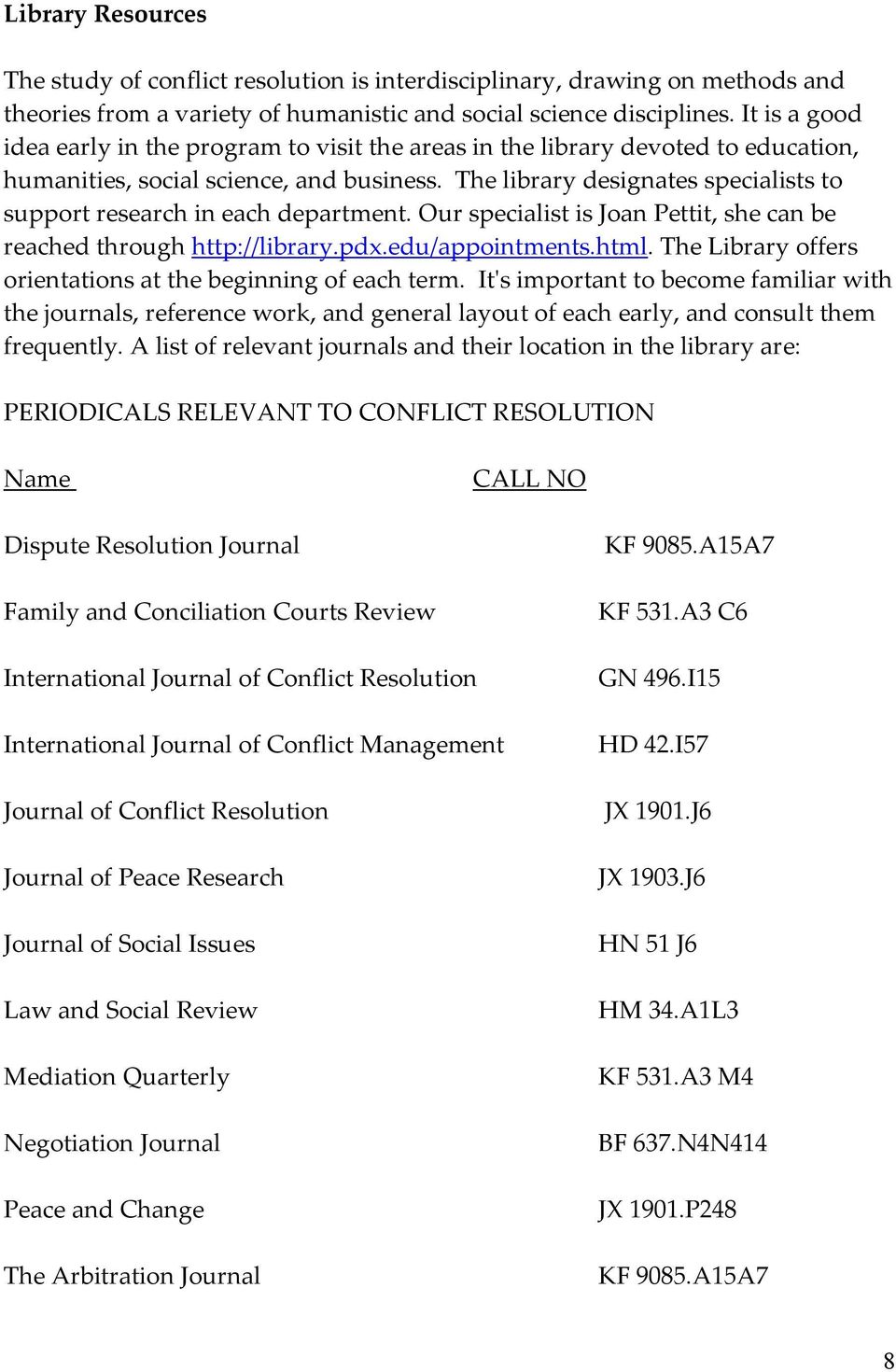
8 Library Resources The study of conflict resolution is interdisciplinary, drawing on methods and theories from a variety of humanistic and social science disciplines. It is a good idea early in the program to visit the areas in the library devoted to education, humanities, social science, and business. The library designates specialists to support research in each department. Our specialist is Joan Pettit, she can be reached through The Library offers orientations at the beginning of each term. It's important to become familiar with the journals, reference work, and general layout of each early, and consult them frequently. A list of relevant journals and their location in the library are: PERIODICALS RELEVANT TO CONFLICT RESOLUTION Name CALL NO Dispute Resolution Journal Family and Conciliation Courts Review KF 9085.A15A7 KF 531.A3 C6 International Journal of Conflict Resolution GN 496.I15 International Journal of Conflict Management HD 42.I57 Journal of Conflict Resolution JX 1901.J6 Journal of Peace Research JX 1903.J6 Journal of Social Issues Law and Social Review Mediation Quarterly Negotiation Journal HN 51 J6 HM 34.A1L3 KF 531.A3 M4 BF 637.N4N414 Peace and Change JX 1901.P248 The Arbitration Journal KF 9085.A15A7 8
9 In addition, the library has electronic subscriptions to a number of journals which can be accessed online. Transfer Credit Students should not assume that courses at the graduate level taken prior to formal admission to our Department's program will be included in their degree program. There is a specific form (GO-21,see that must be completed for the transfer of credit. This form must be filed with the Office of Graduate Studies no later than the end of the term following the term of admission to the program. A maximum of 21 hours of transfer credit may be counted toward the degree, subject to the approval of the student's advisor. Program Advisor Core program faculty serve as program advisors for all candidates admitted to the Conflict Resolution Graduate Program. An advisor is assigned to each student and assists the student in deciding on the appropriate courses to take based on program requirements, area of interest and anticipated capstone work. The Program Advisor also assists the student in completing required forms according to prescribed deadlines. Stephenie Jahnke is the most helpful resource on timelines and required paperwork. You should always start with her. Students may elect to work with a different advisor if there is another faculty member whose interests and abilities are more suited to their own. Program advisors may or may not serve as the capstone chair for their advisees. A capstone chair is someone chosen specifically by the student to work closely with on matters relating to the final capstone work. To simplify things, once this person is chosen, they become the student s program advisor also. Change is common at this stage of the program, so don t worry about hurting feelings by suggesting a shift. Once the capstone advisor has been chosen, students are responsible for ensuring that Stephenie Jahnke is notified of the change.. Conditional Status All students are admitted to the graduate degree program on a "conditional" basis. See the current PSU Bulletin (catalogue) for a complete description of this status. Each spring, the Core faculty will review the progress of each student who is still on "conditional" status and initiate the change of status (Form GO-7, see ) for all students who are deemed to be making satisfactory progress. Students will be informed of the faculty's action 9

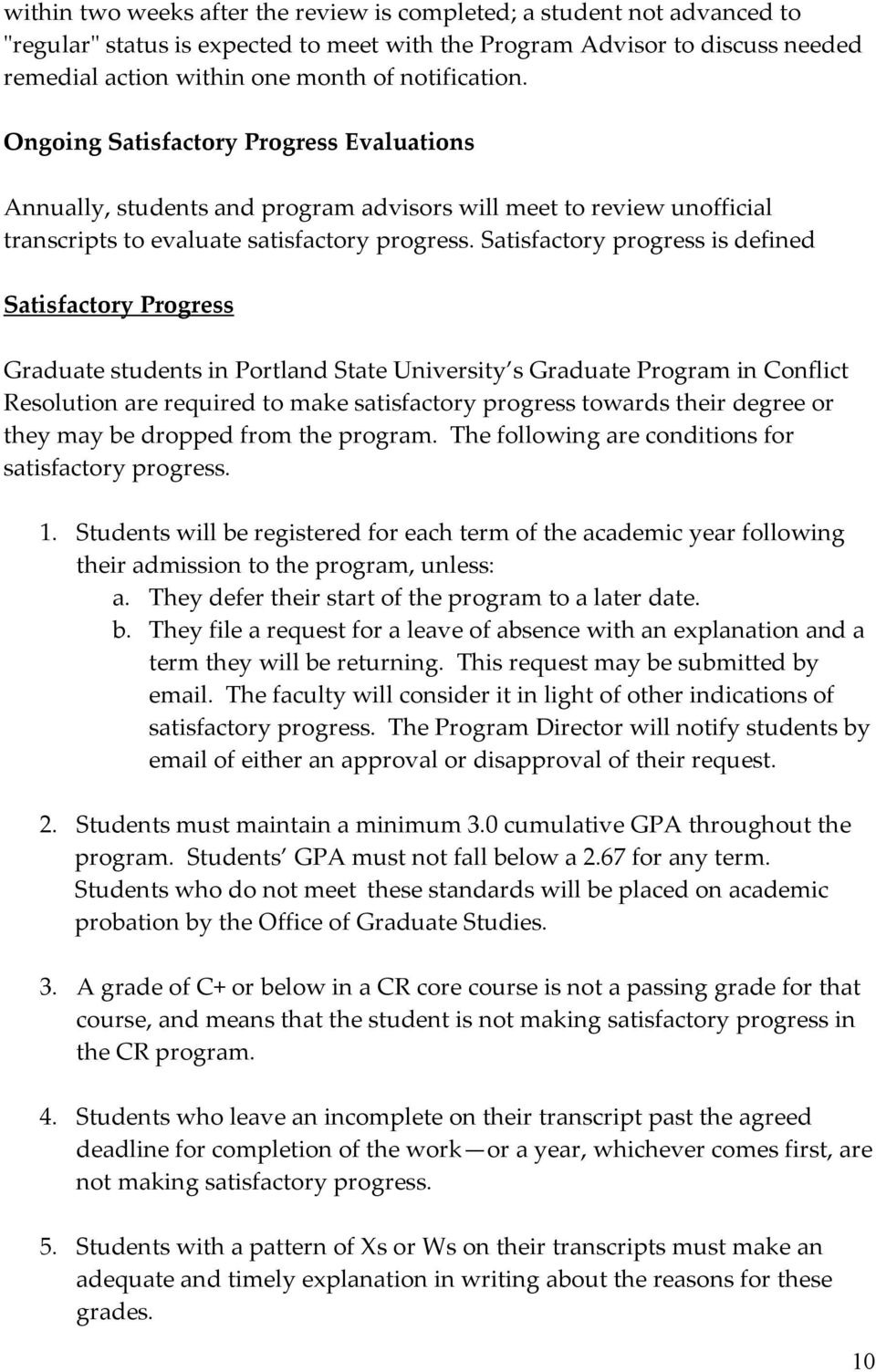
10 within two weeks after the review is completed; a student not advanced to "regular" status is expected to meet with the Program Advisor to discuss needed remedial action within one month of notification. Ongoing Satisfactory Progress Evaluations Annually, students and program advisors will meet to review unofficial transcripts to evaluate satisfactory progress. Satisfactory progress is defined Satisfactory Progress Graduate students in Portland State University s Graduate Program in Conflict Resolution are required to make satisfactory progress towards their degree or they may be dropped from the program. The following are conditions for satisfactory progress. 1. Students will be registered for each term of the academic year following their admission to the program, unless: a. They defer their start of the program to a later date. b. They file a request for a leave of absence with an explanation and a term they will be returning. This request may be submitted by . The faculty will consider it in light of other indications of satisfactory progress. The Program Director will notify students by of either an approval or disapproval of their request. 2. Students must maintain a minimum 3.0 cumulative GPA throughout the program. Students GPA must not fall below a 2.67 for any term. Students who do not meet these standards will be placed on academic probation by the Office of Graduate Studies. 3. A grade of C+ or below in a CR core course is not a passing grade for that course, and means that the student is not making satisfactory progress in the CR program. 4. Students who leave an incomplete on their transcript past the agreed deadline for completion of the work or a year, whichever comes first, are not making satisfactory progress. 5. Students with a pattern of Xs or Ws on their transcripts must make an adequate and timely explanation in writing about the reasons for these grades. 10
11 6. Every professional project or thesis credit must have a student contract that specifies the work to be done during the term. Students must be making appropriate progress on their practicum and professional project or thesis. Registering for practicum, project, or thesis hours and not making progress on these activities is unsatisfactory progress. 7. Admitted CR students, who have taken courses that do not meet any of the CR Master s Degree requirements for two consecutive terms are not making satisfactory progress. Courses offered outside of the CR program to be used as CR electives must be approved by the student s primary advisor. This restriction does not apply to students in a double masters program. 8. Students must abide by all of the requirements of PSU s Office of Graduate Studies and Research, and the Student Conduct Code. Language Requirement (MA Students only) An MA degree requires proficiency in a foreign language. Those students seeking an MA degree will arrange with the Foreign Language Department for the language proficiency examination. The university language requirement must be satisfied prior to the final term of work. See the current PSU bulletin Principles of the Program All students are admitted with the understanding that they will conduct themselves in a manner congruent with the principles of the conflict resolution program. If there are conflicts or difficulties that arise between students or between a student and faculty member, students are expected to handle these situations in an appropriate, ethical, respectful and constructive manner. Students who behave in ways that are contrary to the values of the program could jeopardize their enrollment in our program. Removal from the Program Students may be removed from the program for violations of Portland State s Student Conduct Code. Students may also be removed from the program if they are not actively enrolled or who have not had a petition for a leave of absence approved by the program, or who are in some other way not making satisfactory 11

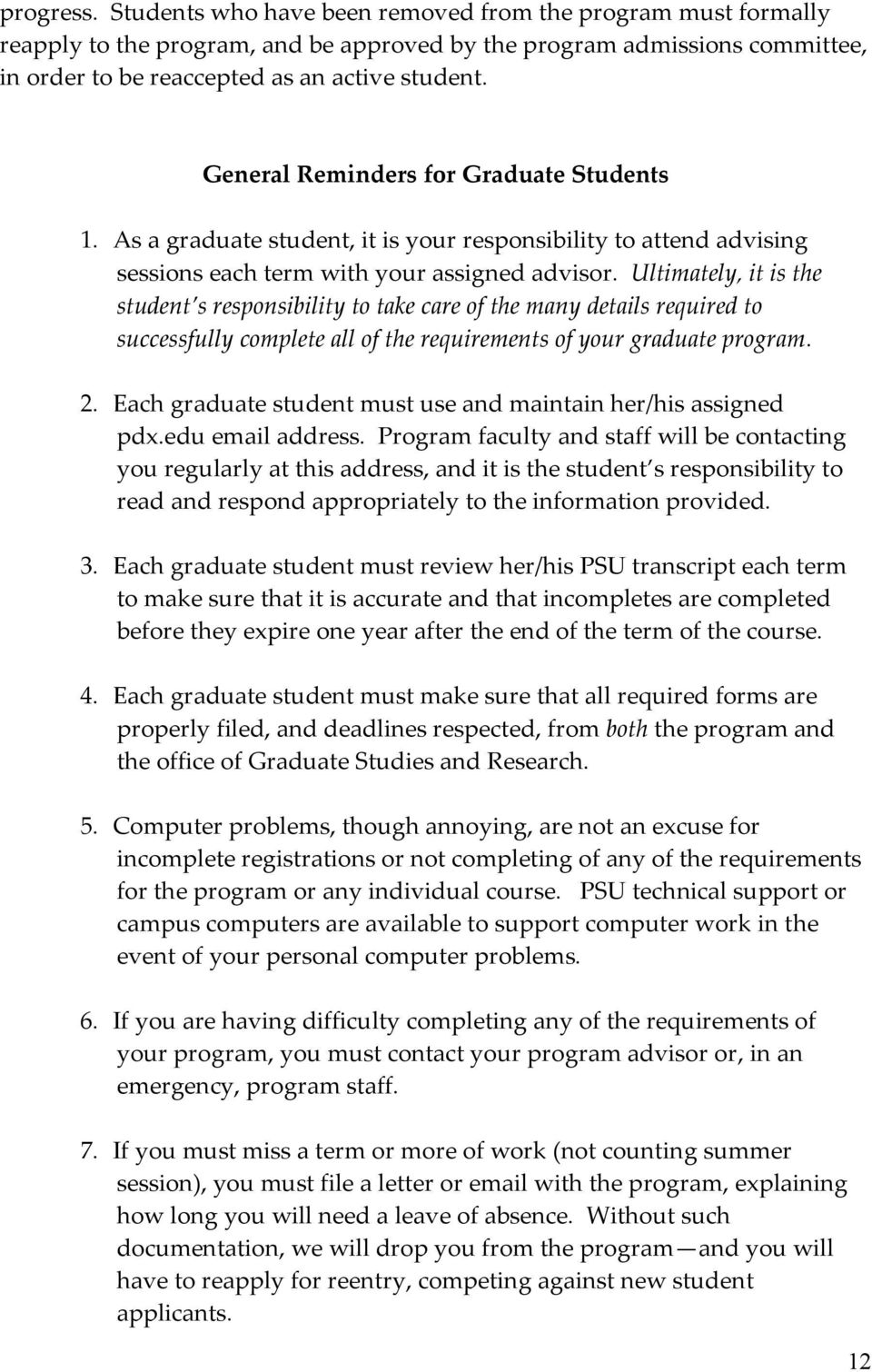
12 progress. Students who have been removed from the program must formally reapply to the program, and be approved by the program admissions committee, in order to be reaccepted as an active student. General Reminders for Graduate Students 1. As a graduate student, it is your responsibility to attend advising sessions each term with your assigned advisor. Ultimately, it is the student s responsibility to take care of the many details required to successfully complete all of the requirements of your graduate program. 2. Each graduate student must use and maintain her/his assigned pdx.edu address. Program faculty and staff will be contacting you regularly at this address, and it is the student s responsibility to read and respond appropriately to the information provided. 3. Each graduate student must review her/his PSU transcript each term to make sure that it is accurate and that incompletes are completed before they expire one year after the end of the term of the course. 4. Each graduate student must make sure that all required forms are properly filed, and deadlines respected, from both the program and the office of Graduate Studies and Research. 5. Computer problems, though annoying, are not an excuse for incomplete registrations or not completing of any of the requirements for the program or any individual course. PSU technical support or campus computers are available to support computer work in the event of your personal computer problems. 6. If you are having difficulty completing any of the requirements of your program, you must contact your program advisor or, in an emergency, program staff. 7. If you must miss a term or more of work (not counting summer session), you must file a letter or with the program, explaining how long you will need a leave of absence. Without such documentation, we will drop you from the program and you will have to reapply for reentry, competing against new student applicants. 12
Graduate Handbook. Master of Science in Criminal Justice Degree Requirements: Policies and Procedures. Department of Criminal Justice
 Department of Criminal Justice Graduate Handbook Master of Science in Criminal Justice Degree Requirements: Policies and Procedures Department of Criminal Justice Wayne State University 3293 Faculty/Administration
Graduate Handbook. Master of Science in Criminal Justice Degree Requirements: Policies and Procedures. Department of Criminal Justice
 Department of Criminal Justice Graduate Handbook Master of Science in Criminal Justice Degree Requirements: Policies and Procedures Department of Criminal Justice Wayne State University 3293 Faculty/Administration
Department of Family Studies. Graduate Student Handbook Master s Degree in Family Studies 2006-2007
 Department of Family Studies Graduate Student Handbook Master s Degree in Family Studies 2006-2007 School of Human Environmental Sciences College of Agriculture University of Kentucky MASTER S DEGREE STUDENT
MA/MS in Education: Educational Leadership & Policy PACE. Postsecondary, Adult & Continuing Education
 MA/MS in Education: Educational Leadership & Policy PACE Postsecondary, Adult & Continuing Education A specialty for those interested in the facilitation of adult learning in college and workplace settings.
Master of Arts in Psychology
 Master of Arts in Psychology Introduction This handbook describes the major milestones, program regulations and requirements that students will encounter as they complete the Master s program in Psychology
Masters Program in Political Science:
 Masters Program in Political Science: Frequently Asked Questions Division of Political Science Mark O. Hatfield School of Government www.pdx.edu/hatfieldschool/political- science (Updated, September 2011)
Proposal for Dual Degree Program Master of Education in Higher Education (M.Ed.) / Master of Public Policy and Administration (MPPA)
 Proposal for Dual Degree Program Master of Education in Higher Education (M.Ed.) / Master of Public (MPPA) The Center for Public and the Higher Education Master s program in the School of Education propose
Texas State University. Sociology Department. Handbook. MA with a Major in Sociology. MS with a Major in Applied Sociology. 7 th Edition (2015)
 Texas State University Sociology Department Handbook MA with a Major in Sociology MS with a Major in Applied Sociology 7 th Edition (2015) Chair: Dr. Susan Day Director of Graduate Programs: Dr. Patti
GUIDE TO GRADUATE STUDIES DEPARTMENT OF SOCIOLOGY. Terminal (one-year) MA Program UNIVERSITY OF CINCINNATI 2014-2015
 GUIDE TO GRADUATE STUDIES DEPARTMENT OF SOCIOLOGY Terminal (one-year) MA Program UNIVERSITY OF CINCINNATI 2014-2015 GRADUATE STUDY IN THE DEPARTMENT OF SOCIOLOGY In addition to the PhD program, the department
COLLEGE OF VISUAL ARTS AND DESIGN Department of Art Education and Art History DOCTORAL PROGRAM IN ART EDUCATION PROCEDURES MANUAL
 COLLEGE OF VISUAL ARTS AND DESIGN Department of Art Education and Art History DOCTORAL PROGRAM IN ART EDUCATION PROCEDURES MANUAL Revised 3/2008 HEJC MANUAL FOR DOCTORAL STUDENTS IN ART EDUCATION The information
The Ph.D. program in Computer and Information Sciences
 The Ph.D. program in Computer and Information Sciences The Ph.D. program in Computer and Information Sciences offers an opportunity for exceptional students to pursue research in the computer and information
Ph.D. in Adult Education Graduate Handbook
 Ph.D. in Adult Education Graduate Handbook Department of Lifelong Education, Administration, and Policy College of Education 1 November 2010 University of Georgia, Athens, Georgia 1 TABLE OF CONTENTS Program
KU School of Education Graduate Student Handbook
 KU School of Education Graduate Student Handbook 2011-2012 Graduate Student Responsibility All graduate students are responsible for informing themselves of requirements of the Graduate School as stated
Applicants new to graduate study at the University of Kansas must submit the following materials to the department s graduate admissions coordinator:
 Doctoral Degrees in Curriculum and Instruction Department of Curriculum and Teaching University of Kansas Joseph R. Pearson Hall, Room 321 Lawrence, KS 66045-3101 (785)864-4435 The Department of Curriculum
GRADUATE DEGREE REGULATIONS
 Graduate Regulations-Spring 2014 1 GRADUATE DEGREE REGULATIONS DEPARTMENT OF PSYCHOLOGY UNIVERSITY OF FLORIDA GRADUATE DEGREE REGULATIONS 1 I. GENERAL INFORMATION 2 A. Graduate Advisor/Supervisory Committee.
LLED Doctoral Program Requirements
 LLED Doctoral Program Requirements Students are responsible for information on the Graduate School website. See, especially the Graduate Bulletin and the Graduate School s Academic Regulations & Procedures
Master of Arts in Higher Education (both concentrations)
 Higher Education Dickinson Hall, Room 419 (501) 569-3267 Master of Arts and Doctor of Education The Master of Arts in Higher Education is designed for those individuals who are interested in entering or
Student Guide for the Ph.D. Degree Program in Educational Administration and Policy Studies
 Department of Educational Administration and Policy Studies State University of New York at Albany Student Guide for the Ph.D. Degree Program in Educational Administration and Policy Studies April 2001
HANDBOOK. Educational Specialist Students. fv{ééä Éy Xwâvtà ÉÇ. for. TÇwÜxãá hç äxüá àç UxÜÜ xç fñü Çzá? ` v{ ztç
 HANDBOOK for Educational Specialist Students fv{ééä Éy Xwâvtà ÉÇ TÇwÜxãá hç äxüá àç UxÜÜ xç fñü Çzá? ` v{ ztç SPECIALIST CANDIDATE HANDBOOK INTRODUCTION This Handbook has been published to help students
LSU SCHOOL OF EDUCATION
 LSU SCHOOL OF EDUCATION GRADUATE PROGRAMS IN GIFTED EDUCATION Thank you for your interest in LSU s graduate programs in Gifted Education. We are proud to offer mentorship and coursework that is based upon
Rationale for changes to the MA in Communication Studies and to the MA in Communication Studies with an option in Community College Pedagogy
 CGS Agenda Item: 11 37 Effective: Fall 2011 Rationale for changes to the MA in Communication Studies and to the MA in Communication Studies with an option in Community College Pedagogy Over the last four
The current (2015-2016) Marketing Ph.D. Committee consists of Greg M. Allenby (Committee Chair), Xiaoyan Deng, Nino Hardt, and Rebecca Walker Reczek.
 Marketing Ph.D. Program Handbook 1. Marketing Ph.D. Program Structure and Committees Graduate Faculty and the Marketing Ph.D. As a doctoral student, you are enrolled in the Graduate School of the Ohio
the polytechnic school
 the polytechnic school graduate student handbook make your ideas happen at the polytechnic school table of contents introduction about the polytechnic school graduate programs purpose of this handbook
School Counseling Program. Practicum Handbook
 University of Massachusetts Boston College of Education and Human Development Department of Counseling and School Psychology School Counseling Program Practicum Handbook PRACTICUM IN SCHOOL COUNSELING
DOCTORAL DEGREE PROGRAM GUIDE
 DOCTORAL DEGREE PROGRAM GUIDE Purpose of the Degree The Doctoral degree in Political Science is intended to prepare students for academic careers in research and teaching, and professional careers in public
GRADUATE HANDBOOK: Online Master s Degree in Family and Human Development
 GRADUATE HANDBOOK: Online Master s Degree in Family and Human Development GUIDE TO GRADUATE PROGRAM PROCEDURES T. DENNY SANFORD SCHOOL OF SOCIAL AND FAMILY DYNAMICS ARIZONA STATE UNIVERSITY PO BOX 873701
CRIMINAL JUSTICE (CJ) Updated June 8, 2016
 CRIMINAL JUSTICE (CJ) Updated June 8, 2016 Chair: Professor S. Kohm; Professor: M. Weinrath: Associate Professor: K. Walby; Assistant Professor: M. Bertrand; Instructors: J. Lothian Murray, K. Gorkoff,
Undergraduate Programs. Graduate Programs 244 ANDREWS UNIVERSITY
 244 ANDREWS UNIVERSITY God calls students to live by principles of good health as stewards of His gift of life. God calls students to develop and maintain supportive personal and professional relationships
DOCTORAL HANDBOOK IN MUSIC EDUCATION
 DOCTORAL HANDBOOK IN MUSIC EDUCATION Admission Standards To be admitted to the doctoral program in music education, an applicant must have a master s degree in music education or a total of 30 credits
PROCEDURES MANUAL FOR DOCTORAL STUDENTS. Ed.D. Human Resource & Workforce Development Education
 PROCEDURES MANUAL FOR DOCTORAL STUDENTS Ed.D. Human Resource & Workforce Development Education Department of Rehabilitation, Human Resources and Communication Disorders Graduate Studies The purpose of
DEPARTMENT OF SOCIOLOGY
 DEPARTMENT OF SOCIOLOGY The Department of Sociology offers courses in Sociology (SOC) and two degrees in Sociology, the undergraduate Bachelor of Arts (B.A.) in Sociology and the graduate degree, the Master
MASTER OF SCIENCE PUBLIC HEALTH SCIENCES HANDBOOK FOR FACULTY AND STUDENTS PENNSYLVANIA STATE UNIVERSITY COLLEGE OF MEDICINE HERSHEY, PENNSYLVANIA
 MASTER OF SCIENCE in PUBLIC HEALTH SCIENCES HANDBOOK FOR FACULTY AND STUDENTS PENNSYLVANIA STATE UNIVERSITY COLLEGE OF MEDICINE HERSHEY, PENNSYLVANIA I. INTRODUCTION HANDBOOK FOR FACULTY AND STUDENTS PENN
Ph.D. Counselor Education and Supervision 2014 2015 Program Guidebook
 Ph.D. Counselor Education and Supervision 2014 2015 Program Guidebook NOTE: 1) This guidebook is subject to change. If it does, students will be notified via email and will be provided with the revised
GRADUATE PROGRAM, DEPARTMENT OF GEOLOGY AND PLANETARY SCIENCE UNIVERSITY OF PITTSBURGH
 DOCTOR OF PHILOSOPHY DEGREE Consult the latest Bulletin of the Graduate Programs of the Faculty of Arts and Sciences (http://www.pitt.edu/~graduate/) for general regulations. The material presented here
DEGREE REQUIREMENTS & ACADEMIC GUIDELINES
 Sam Houston State University 1 DEGREE REQUIREMENTS & ACADEMIC GUIDELINES Graduate Degree Requirements (p. 1) Academic Expectations and Guidelines (p. 3) Graduate programs are typically regarded as either
The Masters of Arts Program in Politics The Wilf Family Department of Politics Graduate School of Arts & Science New York University.
 The Masters of Arts Program in Politics The Wilf Family Department of Politics Graduate School of Arts & Science New York University Student Handbook Last Revised August 2014 Welcome to the Wilf Family
HISTORY DEPARTMENT GRADUATE PROGRAM AND POLICIES
 HISTORY DEPARTMENT GRADUATE PROGRAM AND POLICIES UNIVERSITY AT ALBANY 2014-2015 1 TABLE OF CONTENTS I. Academic Programs and Requirements.. 4 A. The M.A. in History. 4 1. Program Advisement. 4 2. Program
Department of Psychology
 The University of Texas at San Antonio 1 Department of Psychology The Department of Psychology offers the Master of Science Degree in Psychology and the Doctor of Philosophy Degree in Psychology. Master
How To Become An Educational Specialist
 1 COLLEGE OF EDUCATION IDAHO STATE UNIVERSITY Education Specialist in Education Administration Policies & Procedures Handbook Revised & Approved: February 2015 2 Table of Contents PAGE Introduction 3 About
COLLEGE OF WILLIAM AND MARY ANTHROPOLOGY GRADUATE PROGRAM PROCEDURES
 1 COLLEGE OF WILLIAM AND MARY ANTHROPOLOGY GRADUATE PROGRAM PROCEDURES TABLE OF CONTENTS PROGRAM OVERVIEW 2 ADMINISTRATIVE STRUCTURE. 2 ADMISSION TO THE PROGRAM 3 Page MASTER OF ARTS 1. Introduction. 4
www.usc.edu/dept/ise Ph.D. Handbook 2013-2014
 www.usc.edu/dept/ise Ph.D. Handbook 2013-2014 DISCLAIMER This handbook is produced by the Daniel J. Epstein Department of Industrial and Systems Engineering as an unofficial guide to graduate studies in
Doctor of Philosophy Program Handbook
 Higher Education Doctor of Philosophy Program Handbook College of Education Graduate Education and Research Texas Tech University Box 41071 Lubbock, TX 79409-1071 (806) 742-1997 Fax (806) 742-2197 www.educ.ttu.edu
Master of Public Affairs Graduate Policy Manual
 Master of Public Affairs Graduate Policy Manual Established August 27, 2012 Page 1 Mission Statement The mission of the School of Public & Environmental Affairs Program is to sustain a diverse, collaborative
Graduate Student Handbook
 Texas State University San Marcos, Texas 78666 http://www.txstate.edu/history Department of History Graduate Student Handbook 2014-2015 Rebecca Montgomery Director of Graduate Studies 1 Graduate Student
Master of Public Health (MPH) Degree Requirements: 1) Admissions requirements:
 University of California Davis School of Medicine Master of Public Health Degree Requirements Graduate Council Approval: June 16, 201; Revised May 18, 2012 Master of Public Health (MPH) Degree Requirements:
Area of focus: ADMISSIONS INFORMATION PACKET
 Master of Public Health (MPH) PROGRAM Area of focus: Community Health Education ADMISSIONS INFORMATION PACKET Department of Health Science & Human Ecology 5500 University Parkway San Bernardino, CA 92407
Computer Science Graduate Program Rules and Procedures Michigan Technological University. September 17, 2015
 Computer Science Graduate Program Rules and Procedures Michigan Technological University September 17, 2015 Contents 1 Introduction 3 2 PhD Policies and Procedures 3 2.1 Admission Requirements....................................
Interdisciplinary Studies Doctorate. Graduate Student Handbook
 Interdisciplinary Studies Doctorate Graduate Student Handbook Graduate College April 2015 Introduction The Interdisciplinary Studies Doctorate at Western Michigan University is a unique degree that offers
DEPARTMENT OF COMPUTER SCIENCE
 DEPARTMENT OF COMPUTER SCIENCE Faculty of Engineering DEPARTMENT OF COMPUTER SCIENCE MSc REGULATIONS AND PROCEDURES (Revised: September 2013) TABLE OF CONTENTS 1. MSC ADMISSION REQUIREMENTS 1.1 Application
Please review current Graduate College policies and procedures.
 Ph.D. Degree Requirements and Procedures Summary of Procedures for Ph.D. Students Complete every deficiency course with a grade of B or higher within the first two terms File an approved tentative program
Ph.D. PROGRAM IN HIGHER EDUCATION School of Education Indiana University
 Ph.D. PROGRAM IN HIGHER EDUCATION School of Education Indiana University The Ph.D. program prepares students for careers in higher education emphasizing research and related scholarly activities. Toward
VANDERBILT UNIVERSITY DEPARTMENT OF SOCIOLOGY GRADUATE PROGRAM GUIDE
 VANDERBILT UNIVERSITY DEPARTMENT OF SOCIOLOGY 1 GRADUATE PROGRAM GUIDE Last revision, July 2014: These requirements apply to all students entering the graduate program in Fall 2014 and proceeding years.
DOCTORAL DEGREE PROGRAM
 DOCTORAL DEGREE PROGRAM Introduction The Department of Curriculum and Instruction offers the Doctor of Philosophy in Education degree with a Concentration in Curriculum and Instruction. This program is
Doctor of Education Higher Education with Concentration in Community College Administration Program Handbook
 Doctor of Education Higher Education with Concentration in Community College Administration Program Handbook College of Education Graduate Education and Research Texas Tech University Box 41071 Lubbock,
Department of Teaching, Learning, &Teacher Education
 University of Nebraska-Lincoln College of Education & Human Sciences Department of Teaching, Learning, &Teacher Education Masters Degree Programs Master of Education Master of Arts For further information:
The Criminal Justice Department offers two master s degrees in criminal justice, both a Master of Arts and a Master of Science.
 Criminal Justice Admissions Program Requirements Graduate Courses Ross Hall, Room 517, (501) 569-3195, Website Master of Arts and Master of Science The Criminal Justice Department offers two master s degrees
ADMISSION REQUIREMENTS BY PROGRAM
 ADMISSION REQUIREMENTS BY PROGRAM MASTER OF ARTS IN COUNSELING Candidates for admission to the Master of Arts in Counseling program must meet the following criteria: 1. Have earned an undergraduate degree
2014-2015 PETITION/PROGRAM SHEET Degree: Bachelor of Arts Major: Criminal Justice
 14-15 PETITION/PROGRAM SHEET Degree: Bachelor of Arts Major: Criminal Justice About This Major... The Bachelor of Arts in Criminal Justice is designed to provide students interested in careers in the justice
Degree Requirements for the Graduate Program in Chemistry and Biochemistry 2014-15
 Degree Requirements for the Graduate Program in Chemistry and Biochemistry 2014-15 University of Oregon Contents PH.D. DEGREE REQUIREMENTS... 2 Examination Requirements... 2 Cumulative Examinations...
SOCIOLOGY DEPARTMENT Graduate Program Handbook (updated May 2004)
 SOCIOLOGY DEPARTMENT Graduate Program Handbook (updated May 2004) The information provided below is for the convenience of students entering the Master s program. in sociology and the Dual Degree program
DOCTORAL DEGREES ADMISSION REQUIREMENTS
 DOCTORAL DEGREES Ball State University offers programs leading to the doctor of philosophy degree (PhD), the doctor of education degree (EdD), the doctor of arts degree (DA), and the doctor of audiology
Negotiation, Conflict Resolution and Peacebuilding
 Negotiation, Conflict Resolution and Peacebuilding College of Arts and Humanities Master of Arts Program Description The Negotiation, Conflict Resolution and Peacebuilding Program involves a comprehensive
HANDBOOK FOR GRADUATE NURSING STUDENTS Supplement to the Ferris State University Code of Student Community Standards
 FERRIS STATE UNIVERSITY COLLEGE OF HEALTH PROFESSIONS SCHOOL OF NURSING HANDBOOK FOR GRADUATE NURSING STUDENTS Supplement to the Ferris State University Code of Student Community Standards JULY 2012 TABLE
CULTURAL STUDIES GRADUATE GROUP DEGREE REQUIREMENTS Revisions: June 2006, February 2009 Approved by Graduate Council: May 20, 2009
 CULTURAL STUDIES GRADUATE GROUP DEGREE REQUIREMENTS Revisions: June 2006, February 2009 Approved by Graduate Council: May 20, 2009 M.A. PROGRAM 1) Admissions Requirements There are no admissions to the
Masters Program Handbook
 Masters Program Handbook Last Edited: November, 2014 Table of Contents I. Overview and VCU Graduate Bulletin 1 II. Mandatory Orientation 2 III. Registration 2 A. VCU e-services 2 B. Advising Requirements
Student Handbook. Master of Science Program in Educational Psychology. Georgia State University
 Student Handbook Master of Science Program in Educational Psychology Georgia State University Department of Educational Psychology and Special Education This document has been prepared as an overview for
Students select at time of application the option to which they would like to be admitted.
 German Graduate Program Ph.D. and MA Degree Requirements Revised: Sept 2008; Jan 2009; March 2014 Graduate Council Approved: Feb 18, 2009; Aug 14, 2014 Master s Degree Requirements 1) Admissions requirements
GRADUATE STUDENT GUIDE MECHANICAL ENGINEERING (ME) PROGRAM MS
 GRADUATE STUDENT GUIDE MECHANICAL ENGINEERING (ME) PROGRAM MS Degree MECHANICAL ENGINEERING Graduate Studies Committee 598 Rhodes Hall, P.O. Box 210072 COLLEGE OF ENGINEERING UNIVERSITY OF CINCINNATI CINCINNATI,
Master of Arts in Communication: School of Communication, College of Communication, Fine Arts & Media
 www.unomaha.edu/graduate www.facebook.com/unograduatestudies 402-554-2341 [email protected] Master of Arts in Communication: School of Communication, College of Communication, Fine Arts & Media Vision
Ph.D. Program FINANCE
 Ph.D. Program In FINANCE DEPARTMENT OF FINANCE POLICIES AND PROCEDURES Ph.D. Program Fisher College of Business The Ohio State University 700 Fisher Hall 2100 Neil Avenue Columbus, OH 43210 (Revised July
Doctor of Philosophy in Industrial Organizational Psychology
 Doctor of Philosophy in Industrial Organizational Psychology 1 Doctor of Philosophy in Industrial Organizational Psychology Work leading to the degree of Doctor of Philosophy (PhD) is designed to give
HISTORY MASTER OF ARTS HANDBOOK FOR ONLINE STUDENTS
 HISTORY MASTER OF ARTS HANDBOOK FOR ONLINE STUDENTS School of Historical, Philosophical, and Religious Studies Arizona State University PO Box 874302 Tempe, Arizona, 85287-3902 Phone: 480.965.5778 Fax:
Materials Science and Engineering
 Materials Science and Engineering Graduate Program Requirements The Department of Materials Science and Engineering at the University of Utah offers three graduate degrees: Master of Science (M.S.) Thesis
PHD NURSING PROGRAM INFORMATION
 PHD NURSING PROGRAM INFORMATION INTRODUCTION The PhD Program is designed for MSN or BSN graduates who are interested in earning a doctoral degree in nursing. The primary focus of the PhD Program is scientific
Physics Graduate Program Handbook
 Carnegie Mellon University Department of Physics November 14, 2012 Version 1.1 Physics Graduate Program Handbook This document presents the rules and requirements governing the Graduate Program in the
2015-2016 BEHAVIORAL SCIENCE MANUAL
 2015-2016 BEHAVIORAL SCIENCE MANUAL BEHAVIORAL SCIENCE DOCTORAL PROGRAM University of North Texas Academic Year 2015-2016 Program Description... 1 Program Faculty... 2 Application and Admission Requirements...
Higher Education & Student Affairs
 Higher Education & Student Affairs The Ph.D. program prepares students for careers in higher education emphasizing research and related scholarly activities. Toward this end, coursework emphasizes research
Ph.D. Program Handbook
 Ph.D. Program Handbook School of International Service American University Academic Year 2014-15 Edition Updated August 1, 2014 Table of Contents Introduction... iv Courses & Requirements... 2 Core Courses...
This program is offered entirely ONLINE throughout the United States and in approved international locations.
 West Virginia University 1 Special Education Degrees Offered Master of Arts in Special Education Doctor of Education with a major in Special Education MASTER OF ARTS IN SPECIAL EDUCATION OVERVIEW The graduate
California State University Dominguez Hills. College of Business Administration & Public Policy 2014-2015. Program website: http://mpa.csudh.
 California State University Dominguez Hills College of Business Administration & Public Policy 2014-2015 Program website: http://mpa.csudh.edu Master of Public Administration Student Handbook Program policies
Master of Education in Special Education with Elementary Licensure through the Urban Institute for Teacher Education 2015-2016
 University of Utah, College of Education Master of Education in Special Education with Elementary Licensure through the Urban Institute for Teacher Education 2015-2016 Program information is subject to
Graduate Student Handbook
 Graduate Student Handbook Department of Sociology College of Arts and Science American University Latest revision: August 2011 The Graduate Student Handbook was originally created by the Graduate Student
Student Handbook. Georgia State University
 Student Handbook The Doctoral Program in Educational Psychology Georgia State University Department of Educational Psychology and Special Education This document has been prepared as an overview for the
SOCIOLOGY UNIVERSITY OF CALIFORNIA, SANTA CRUZ
 SOCIOLOGY UNIVERSITY OF CALIFORNIA, SANTA CRUZ Undergraduate Handbook 2014-15 TABLE OF CONTENTS WELCOME!... 4 WHAT IS SOCIOLOGY?... 4 GETTING STARTED IN SOCIOLOGY... 4 Proposed Major... 4 Declaring Sociology...
M.A. in Sociology. Student Handbook
 M.A. in Sociology Student Handbook Sociology plays an important role in helping governments, corporations and citizens to cope better in a rapidly changing world. The methods and knowledge developed by
PhD Program Details. 1. Residency Requirements. 2. Registration Requirements. For students matriculating after Sept 1, 2004.
 PhD Program Details For students matriculating after Sept 1, 2004. There are three stages of admission to the doctoral program: admission to graduate study when the student first matriculates, admission
Course registration Students may register for courses of study and drop or add courses only with the approval of the MLS director.
 Master of Liberal Studies (MLS) graduate students must meet the following minimums, deadlines and course or grade requirements to graduate in good standing from the university. These policies are based
REGULATIONS FOR THE DEGREE OF BACHELOR OF HOUSING MANAGEMENT (BHousMan)
 1391 REGULATIONS FOR THE DEGREE OF BACHELOR OF HOUSING MANAGEMENT (BHousMan) (See also General Regulations and Regulations for First Degree Curricula) HM1 In these Regulations, and in the Syllabuses for
political Science Degree Requirements and Requirements
 UWM Political Science Department Graduate Program Policies A. Political Science at UWM B. M.A. C. Ph.D. D. Transfer of Credits E. Incompletes F. Scheduling Completion of M.A. and Ph.D. Degrees G. Fellowship
PSYCHOLOGY 492A FIELDWORK PRACTICUM-HUMAN SERVICES 2015-2016. W022 Lagomarcino Hall 515-294-3646; [email protected]
 PSYCHOLOGY 492A FIELDWORK PRACTICUM-HUMAN SERVICES 2015-2016 COURSE INSTRUCTOR: Dr. Indria M Jenkins W022 Lagomarcino Hall 515-294-3646; [email protected] OBJECTIVES: Psychology 492 is intended to augment
University of South Florida Applied Behavior Analysis Master s Program. Program Description, Policies, and Procedures
 University of South Florida Applied Behavior Analysis Master s Program Program Description, Policies, and Procedures Revised August 2015 ABA Program Policies and Procedures 2 The USF Master s Degree Program
Deficiencies: M.S. Degree, Master s Plan I (Thesis) and Plan II (Project/Examination): Plan I Plan II Course Requirements:
 MASTER S PROGRAM CIVIL AND ENVIRONMENTAL ENGINEERING Ph.D. AND M.S. DEGREE REQUIREMENTS Revised: 5/02/11 Graduate Council Approval: May 4, 2012 1) Admissions Requirements: Applicants for admission to Civil
STUDENT HANDBOOK Master of Arts in Conflict Resolution
 STUDENT HANDBOOK Master of Arts in Conflict Resolution Mission Bethel University s School of Conflict Resolution (*licensed from The Institute for Conflict Resolution, LLC) educates and equips graduates