
date by June Key initiatives included: Paraprofessionals and Academic specialists
|
|
|
- Elfreda Price
- 9 years ago
- Views:
Transcription
1 April 22, 216 Dear Parents and Community Members: We are pleased to present you with the (AER) which provides key information on the educational progress for. The AER addresses the complex reporting information required by federal and state laws. The school s report contains information about student assessment, accountability and teacher quality. If you have any questions about the AER, please contact Kenya Morris for assistance. The AER is available for you to review electronically by visiting the following web site and clicking on the link at the top of the page or you may review a copy from the school s office at your child s school. You may also access the AER by clicking here: Based on a review of assessment data, the following goals were selected: 1. The IEP subgroup will increase 8% in math as measured by state assessment and NWEA MAP data by June 215. Key initiatives in this area included: Paraprofessionals and Academic specialists provided supplementary support, iready was used to differentiate in the regular classroom, and after-school tutoring was provided. 2. The female subgroup will increase 8% in reading as measured by state assessment and NWEA MAP assessment data by September 215. Key initiatives in this area included: Paraprofessionals and Academic specialists provided supplementary support, Accelerated Reader was used, after-school tutoring was provided, and the targeted Summer Success program was used. 3. The subgroup of students who receive reduced lunch will increase 8% in writing as measured by the state assessment data by June 215. Key initiatives included: Paraprofessionals and Academic specialists provided supplementary support, and Wordly Wise was used to increase written vocabulary. 4. The IEP subgroup will increase 8% in social studies as measured by state assessment data by June 215. Key initiatives included: Paraprofessionals and Academic specialists provided supplementary support, and a Social Studies themed family curriculum night was held. 5. The IEP subgroup will increase 5% in science as measured by the state assessment date by June 215. Key initiatives included: Paraprofessionals and Academic specialists provided supplementary support, and a themed family curriculum night was held. State law requires that we also report additional information.

2 1. PROCESS FOR ASSIGNING PUPILS TO THE SCHOOL Detroit Merit is a state-funded, public school academy. Therefore, there is no cost to attend the Academy. The school is open to any child wishing to attend. must be age-appropriate for their respective grade, and they must reside in the state of Michigan. By law, the school cannot restrict enrollment based on selection criteria. The school can, however, limit the total number of students who may attend the school. If the number of applications exceeds the number of offered seats, a random selection process will determine who attends the school. The school s Open Enrollment period begins on the first day of the current school year and ends at 5: p.m. on the last day of business in February of the current school year. During this Open Enrollment period, all applications receive equal consideration regardless of the date submitted. At the close of Open Enrollment, all applications received during the Open Enrollment period will be counted. If applications received are fewer than offered seats in each and every grade level, all applicants will be accepted and will receive a notice of acceptance into their respective grades. If the number of applications received exceeds the number of offered seats in any grade level, a random selection process will take place for all affected grade levels. Names are randomly selected until all offered seats have been filled. Any remaining names are selected to establish waiting list priority. Applications received after the Open Enrollment period will be accepted until the end of the current school year and available seats will be filled. Once students are Enrolled and remain Enrolled, they will remain eligible to be Re-Enrolled at the school for successive years without having to reenter the random selection process. However, they will be requested to complete a re-enrollment form by the end of the Open Enrollment period showing their intent to Re-Enroll for the subsequent school year. All applicants on a waiting list must submit an application for the following school year during the next Open Enrollment period. In an effort to accommodate parents who have more than one child eligible for enrollment, siblings of accepted and currently Enrolled students are given enrollment priority over children who have no such siblings. Siblings of currently Enrolled students at the school will be drawn first in the random selection process for offered seats. In addition, if a child is selected during the random selection process, that child s sibling will be offered an available offered seat or the next spot on the waiting list in his/her respective grade. Though siblings are afforded priority for offered seats, they are not given priority over a previously Enrolled student. In addition to sibling preference, children of staff members employed at the school working a minimum of 2 hours per week (at least.5 FTE) or children of current board members are

3 given enrollment priority. Though these children are afforded priority for offered seats, they are not given priority over a sibling, or a previously Enrolled student. All applications received after the Open Enrollment Period will not be eligible to participate in the random selection process, and will be added to the end of the accepted list if offered seats are still available after the random selection process, or to the resulting waiting list created at the time of the random selection process is a state-funded, public school academy. Therefore, there is no cost to attend the Academy. The school is open to any child wishing to attend. must be age-appropriate for their respective grade, and they must reside in the state of Michigan. By law, the school cannot restrict enrollment based on selection criteria. The school can, however, limit the total number of students who may attend the school. If the number of applications exceeds the number of offered seats, a random selection process will determine who attends the school. The school s Open Enrollment period begins on the first day of the current school year and ends at 5: p.m. on the last day of business in February of the current school year. During this Open Enrollment period, all applications receive equal consideration regardless of the date submitted. At the close of Open Enrollment, all applications received during the Open Enrollment period will be counted. If applications received are fewer than offered seats in each and every grade level, all applicants will be accepted and will receive a notice of acceptance into their respective grades. If the number of applications received exceeds the number of offered seats in any grade level, a random selection process will take place for all affected grade levels. Names are randomly selected until all offered seats have been filled. Any remaining names are selected to establish waiting list priority. Applications received after the Open Enrollment period will be accepted until the end of the current school year and available seats will be filled. Once students are Enrolled and remain Enrolled, they will remain eligible to be Re-Enrolled at the school for successive years without having to reenter the random selection process. However, they will be requested to complete a re-enrollment form by the end of the Open Enrollment period showing their intent to Re-Enroll for the subsequent school year. All applicants on a waiting list must submit an application for the following school year during the next Open Enrollment period. In an effort to accommodate parents who have more than one child eligible for enrollment, siblings of accepted and currently Enrolled students are given enrollment priority over children who have no such siblings. Siblings of currently Enrolled students at the school will be drawn first in the random selection process for offered seats. In addition, if a child is selected during the random selection process, that child s sibling will be offered an available offered seat or the next spot on the waiting list in his/her respective grade. Though siblings are afforded priority for offered seats, they are not given priority over a previously Enrolled student.
4 In addition to sibling preference, children of staff members employed at the school working a minimum of 2 hours per week (at least.5 FTE) or children of current board members are given enrollment priority. Though these children are afforded priority for offered seats, they are not given priority over a sibling, or a previously Enrolled student. Should offered seats remain available after the close of Open Enrollment, students will be accepted on a first-come, first-served basis until offered seats are no longer available. Applications are date and time stamped upon submission, and students are admitted by grade in the order their application is received. Applications will be accepted after offered seats are filled and will be placed on a waiting list in the order received. 2. THE STATUS OF THE 3-5 YEAR SCHOOL IMPROVEMENT PLAN etroit%2merit%2sip.pdf A. Describe how data led your School Improvement Team to select your school s improvement objectives in the core academic curriculum The school s School Improvement Team reviews data formally and informally throughout each school year as part of its continuous school improvement process. In Spring 215, the school reviewed school and student performance data and perceptual data aligned with the Michigan School Improvement Framework. This review included the following data, among others: Student achievement on norm-referenced assessments, including Northwest Evaluation Association s (NWEA) Primary Grades Assessment and Measures of Academic Progress (MAP), criterion-referenced assessments (state assessment), and classroom assessments Student demographics Discipline, tardy, truancy, and attendance rates Parent surveys Staff surveys and teacher quality information Programs and Processes Data As a result of the School Improvement Team s review of data, priority improvement objectives in the core academic curriculum were selected for the upcoming school year.

5 B. Describe your implementation plan for the core academic improvement objectives identified in your school improvement process. You may choose to describe your overall curricular implementation plan or you may choose to describe the plan in each content area The school s School Improvement Team, comprised of various committee chairs, leadership team members, and parents, reviews data formally and informally throughout each school year as part of its continuous school improvement process. In spring 215, the entire staff reviewed school and student performance data and perceptual data aligned with the Michigan School Improvement Framework. This review included the following data, among others: Student achievement on norm-referenced assessments, including Northwest Evaluation Association s (NWEA) Primary Grades Assessment and Measures of Academic Progress, criterionreferenced assessments, and classroom assessments Student demographics Discipline, tardy, truancy, and attendance rates Parent surveys Staff surveys and teacher quality information As a result of the staff, parents and School Improvement Team s review of data, priority improvement objectives in the core academic curriculum were selected for the upcoming school year. C. Did the SIP do what it set out to do? Describe the evaluation process that led you to this conclusion. The school improvement plan supported the academic goals and objectives developed by the team, although adjustments will need to be made along with continued close monitoring of the SIP goals, Our overall RaMP (reading and math proficiency) was 54.4% as measured by the MEAP test. Reading proficiency was 67.9% and math was 41.1%. According to NWEA-MAP results in the spring of 215, students in grades 2-8 were 59.5% proficient in reading, and 47.% proficient in math. in grades K-1 were 74.6% proficient in reading and 76.2% proficient in math. Of the students in grades 2-8, 7.6% in reading, and 66.9% in math made their typical growth targets. Student in grades K-1 had 73.7% in reading and 85.6% in math make their typical growth targets. Detroit Merit continues to strive for growth as a school. The School Improvement Team formally reviewed progress against its SIP goals and objectives in Spring 215, as part of its preparation for the school year. A review of student performance data and other data pertaining to the school s selected focus area was conducted in order to evaluate progress toward meeting its goals. Specific data evaluated includes that collected
6 through MEAP assessments, NWEA assessments, summative assessments, and formative assessments. The evaluation process includes ascertaining the degree to which each goal has been met or what progress has been made toward each goal. D. Describe how the evaluation of data and the current year s school improvement process led your school improvement team to select your school s improvement objectives in the core academic curriculum for the next school year See A and C above. Additionally, the School Improvement Team s evaluation of data, as part of its continuous school improvement process, revealed key focus areas for improvement. Identified through the process were specific student performance targets in English language arts, mathematics, science, and social studies. E. How was this year s school improvement process similar or different from last year s process? On the whole, this year s school improvement process was similar to last year s process. The School Improvement Team met formally in the spring both to evaluate progress against the prior year s identified school improvement goals and to assess data and identify school improvement goals for the next year %2Detroit%2Merit%2SIP.pdf A. Describe how data led your School Improvement Team to select your school s improvement objectives in the core academic curriculum The school s School Improvement Team reviews data formally and informally throughout each school year as part of its continuous school improvement process. In Spring 214, the school reviewed school and student performance data and perceptual data aligned with the Michigan School Improvement Framework. This review included the following data, among others: Student achievement on norm-referenced assessments, including Northwest Evaluation Association s (NWEA) Primary Grades Assessment and Measures of Academic Progress, criterion-referenced assessments, and classroom assessments Student demographics Discipline, tardy, truancy, and attendance rates Parent surveys Staff surveys and teacher quality information Programs and Processes Data As a result of the School Improvement Team s review of data, priority improvement objectives in the core academic curriculum were selected for the upcoming school year.

7 Implementation of our core academics will continue to be driven through the committees that each staff member is assigned to as well as by our SIP s goals that are aligned to our 6 Critical Success Factors (Academic Proficiency, Academic Growth, Build and Develop and Strong Instructional Team, Enrollment, Manage Expenses, and Engage Stakeholders). Our academic committees are responsible for the academic objectives for each goal and report to the school improvement team monthly. They report how we are progressing with respect to our objectives and adjustments within committees are made as needed. Grade level teams have five common planning periods weekly and meet to examine student work, and assess the status of our goals in terms of academic proficiency and growth. NWEA- MAP and MEAP scores are used to review and asses if the established objectives helped us meet the goal of increasing test scores. The school improvement team completed a formal, comprehensive review of the data and goals/objectives in the spring to prepare for the school year. Each area was evaluated in order to determine if progress was being made toward the goals/objectives outlined in the school improvement plan. Specific data sources evaluated were obtained through NWEA-MAP assessments, MEAP assessments, summative and formative assessments. In addition, the staff and SIP team formally reviewed progress against its SIP goals and objectives in spring 214, as part of its preparation for the school year. A review of student performance data and other data pertaining to the school s selected focus area was conducted in order to evaluate progress toward meeting its goals. Specific data evaluated includes that collected through MEAP assessments, NWEA assessments, summative assessments, and formative assessments. The evaluation process includes ascertaining the degree to which each goal has been met or what progress has been made toward each goal. B. Describe your implementation plan for the core academic improvement objectives identified in your school improvement process. You may choose to describe your overall curricular implementation plan or you may choose to describe the plan in each content area The school s School Improvement Team, comprised of various committee chairs, leadership team members, and parents, reviews data formally and informally throughout each school year as part of its continuous school improvement process. In spring 214, the entire staff reviewed school and student performance data and perceptual data aligned with the Michigan School Improvement Framework. This review included the following data, among others: o Student achievement on norm-referenced assessments, including Northwest Evaluation Association s (NWEA) Primary Grades Assessment and Measures of Academic Progress, criterion-referenced assessments, and classroom assessments o Student demographics o Discipline, tardy, truancy, and attendance rates o Parent surveys o Staff surveys and teacher quality information

8 As a result of the staff, parents and School Improvement Team s review of data, priority improvement objectives in the core academic curriculum were selected for the upcoming school year. C. Did the SIP do what it set out to do? Describe the evaluation process that led you to this conclusion. The school improvement plan supported the academic goals and objectives developed by the team, although adjustments will need to be made along with continued close monitoring of the SIP goals, Our overall RaMP (reading and math proficiency) was 57.9% (an increase of 3.5%) as measured by the MEAP test. Reading proficiency was 67.9% and math was 41.1%. MEAP scores in general improved from the school year 2.8% in reading, 13.2% in writing, 6.8% science, and 2.5% in social studies. MEAP scores declined 3.5% in math. According to NWEA-MAP results in the spring of 214, students in grades 2-8 were 55.3% proficient in Reading, 48.% proficient in math, and 62.% proficient in language usage. in grades K-1 were 73.2% proficient in reading and 79.2% proficient in math. Of the students in grades 2-8, 65.7% in reading, 66.7% in math, and 64.4% in language usage made their typical growth targets. Student in grades K-1 had 86.% in reading and 94.1% in math make their typical growth targets. Detroit Merit continues to strive for growth as a school. The School Improvement Team formally reviewed progress against its SIP goals and objectives in Spring 214, as part of its preparation for the school year. A review of student performance data and other data pertaining to the school s selected focus area was conducted in order to evaluate progress toward meeting its goals. Specific data evaluated includes that collected through MEAP assessments, NWEA assessments, summative assessments, and formative assessments. The evaluation process includes ascertaining the degree to which each goal has been met or what progress has been made toward each goal. D. Describe how the evaluation of data and the current year s school improvement process led your school improvement team to select your school s improvement objectives in the core academic curriculum for the next school year See A and C above. Additionally, the School Improvement Team s evaluation of data, as part of its continuous school improvement process, revealed key focus areas for improvement. Identified through the process were specific student performance targets in English language arts, mathematics, science and social studies. E. How was this year s school improvement process similar or different from last year s process? On the whole, this year s school improvement process was similar to last year s process. The School Improvement Team met formally in the spring both to evaluate progress against the prior year s identified school improvement goals and to assess data and identify school improvement goals for the next year.
9 3. A BRIEF DESCRIPTION OF EACH SPECIALIZED SCHOOL At, our staff is committed to educating the students of Detroit based on four key values: Academic Excellence, Student Responsibility, Moral Focus and a Partnership with Parents. It is our mission to challenge each child of to achieve their full potential through our rigorous curriculum, values and individualized attention. We offer an excellent academic curriculum monitored by the leadership within the building, our governing board, our management company (NHA), and our authorizer (GVSU). Our teachers are held accountable to teaching the wellstructured curriculum set forth by the curriculum team at our service center, to ensure our students receive the best education. Our staff is committed to creating the best urban school in the country and believes this can be achieved through the hard work of all of our stakeholders. We strive to achieve academic excellence for each child in our school family, and thus it is important that we treat every child as an individual, who is expected to be his/her very best and nothing short. The school creates individualized instruction to meet all students at their level, giving extra support or challenge as needed. We believe students will be successful if they are held to high expectations. In setting high educational and behavioral expectations, we create an environment where each child will grow and learn. We are excited to offer parents in the Detroit area a tuition free, quality education alternative to Detroit City public schools for their children At, our staff is committed to educating the students of Detroit based on four key values: Academic Excellence, Student Responsibility, Moral Focus and a Partnership with Parents. It is our mission to challenge each child of Detroit Merit Charter Academy to achieve their full potential through our rigorous curriculum, values and individualized attention. We offer an excellent academic curriculum monitored by the leadership within the building, our governing board, our management company (NHA), and our authorizer (GVSU). Our teachers are held accountable to teaching the well-structured curriculum set forth by the curriculum team at our service center, to ensure our students receive the best education. Our staff is committed to creating the best urban school in the country and believes this can be achieved through the hard work of all of our stakeholders. We strive to achieve academic excellence for each child in our school family, and thus it is important that we treat every child as an individual who is expected to be his/her very best and nothing short. The school creates individualized instruction to meet all students at their level, giving extra support or challenge as needed.

10 We believe students will be successful if they are held to high expectations. In setting high educational and behavioral expectations, we create an environment where each child will grow and learn. We are excited to offer parents in the Detroit area a tuition free, quality education alternative to Detroit City public schools for their children. 4. IDENTIFY HOW TO ACCESS A COPY OF THE CORE CURRICULUM, A DESCRIPTION OF ITS IMPLEMENTATION AND AN EXPLANATION OF THE VARIANCES FROM THE STATE S MODEL Our goal of preparing students for college success has required us to take a unique view in terms of our curriculum. Our goal is to graduate students who have not only had the opportunity to experience academic excellence, but have acquired the knowledge and skills necessary to be successful in high school and college. What makes our curriculum particularly unique is that it has been developed to support state standards with a college-bound approach. Our curriculum was developed based on the analysis of standards and assessment experts across the nation, including groups such as National Assessment of Educational Progress (NAEP), ACT, Achieve, Inc., the Thomas B. Fordham Institute, the National Council of Teachers of English, The National Advisory Panel, the Association for the Advancement of, and the National Council for Social Studies. This analysis, conducted by National Heritage Academies, comprehensively researched what students need to know to be successfully prepared for rigorous high school and college educational programming. NHA then worked backward to develop a curriculum that defines the expertise needed by students in kindergarten through eighth grade to enter high school on the path to college readiness. Since college readiness goes beyond academic preparedness, the curriculum not only includes learning goals in core academic and co-curricular areas, but also includes an integrated character development component. The curriculum s objectives are aligned to those identified by the Michigan Academic Standards: both the Common Core State Standards (CCSS) and the Grade Level Expectations (GLCE). Moreover, all students are expected to reach the CCSS and GLCE goals. However, modifications/accommodations are sometimes necessary to ensure learning for all students. This support comes through classroom differentiation, in-class support services, targeted programmatic resources, out of class intervention, and out of school time opportunities all of which are designed to accelerate student growth trajectories. The only variance in our curriculum when compared to the Michigan Academic Standards is the addition of a Moral Focus component. We believe great schools develop both a student s heart and mind, and the Moral Focus program is designed to support parents' efforts to teach

11 character at home by reinforcing and modeling universal human virtues, such as compassion, respect, and integrity. This Moral Focus program is explicit and integrated with the school s core curriculum. A different virtue is featured each month of the school year. Teachers model behavior that exemplifies the virtue and recognize and praise students when they do the same. A copy of the core curriculum can be obtained by parents via written request submitted to the school administration. In , our curriculum is fully aligned and implemented using the Common Core State Standards and the Michigan Grade Level Expectations (GLCE) as the foundation Our goal of preparing students for college success has required us to take a unique view in terms of our curriculum. Our goal is to graduate students who have not only had the opportunity to experience academic excellence, but have acquired the knowledge and skills necessary to be successful in high school and college. What makes our curriculum particularly unique is that it has been developed to support state standards with a college-bound approach. Our curriculum was developed based on the analysis of standards and assessment experts across the nation, including groups such as National Assessment of Educational Progress (NAEP), ACT, Achieve, Inc., the Thomas B. Fordham Institute, the National Council of Teachers of English, The National Advisory Panel, the Association for the Advancement of, and the National Council for Social Studies. This analysis, conducted by National Heritage Academies, comprehensively researched what students need to know to be successfully prepared for rigorous high school and college educational programming. NHA then worked backward to develop a curriculum that defines the expertise needed by students in kindergarten through eighth grade to enter high school on the path to college readiness. Since college readiness goes beyond academic preparedness, the curriculum not only includes learning goals in core academic and co-curricular areas, but also includes an integrated character development component. The curriculum s objectives are aligned to those identified by the Michigan Academic Standards: both the Common Core State Standards (CCSS) and the Grade Level Expectations (GLCE). Moreover, all students are expected to reach the CCSS and GLCE goals. However, modifications/accommodations are sometimes necessary to ensure learning for all students. This support comes through classroom differentiation, in-class support services, targeted programmatic resources, out of class intervention, and out of school time opportunities all of which are designed to accelerate student growth trajectories. The only variance in our curriculum when compared to the Michigan Academic Standards is the addition of a Moral Focus component. We believe great schools develop both a student s heart and mind, and the Moral Focus program is designed to support parents' efforts to teach character at home by reinforcing and modeling universal human virtues, such as compassion, respect, and integrity. This Moral Focus program is explicit and integrated with the school s core
12 curriculum. A different virtue is featured each month of the school year. Teachers model behavior that exemplifies the virtue and recognize and praise students when they do the same. A copy of the core curriculum can be obtained by parents via written request submitted to the school administration. In , our curriculum is fully aligned and implemented using the Common Core State Standards and the Michigan Grade Level Expectations (GLCE) as the foundation.
13 5. THE AGGREGATE STUDENT ACHIEVEMENT RESULTS FOR ANY LOCAL COMPETENCY TESTS OR NATIONALLY NORMED ACHIEVEMENT TESTS Detailed below is a graph depicting the percentage of students in our school meeting growth targets from fall 214 to spring % 9% 8% 7% 6% 5% 4% Math Reading 3% 2% 1% % Grade 2 Grade 3 Grade 4 Grade 5 Grade 6 Grade 7 Grade 8 All Grades Detailed below are the percentages of students performing at or above the 5th percentile on the spring 215 administration of the NWEA MAP assessment. 1% 9% 8% 7% 6% 5% 4% Math Reading 3% 2% 1% % Grade 2 Grade 3 Grade 4 Grade 5 Grade 6 Grade 7 Grade 8 All Grades

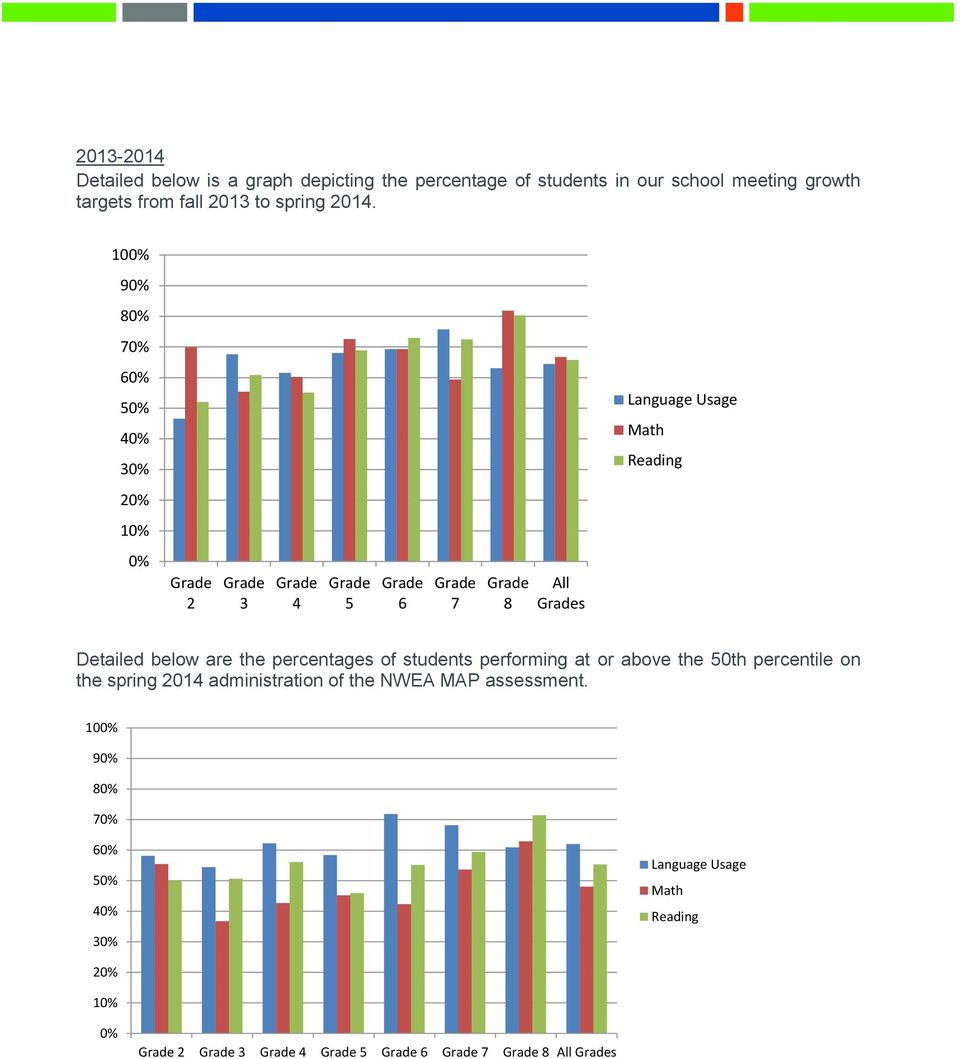
14 Detailed below is a graph depicting the percentage of students in our school meeting growth targets from fall 213 to spring % 9% 8% 7% 6% 5% 4% 3% Language Usage Math Reading 2% 1% % Grade 2 Grade 3 Grade 4 Grade 5 Grade 6 Grade 7 Grade 8 All Grades Detailed below are the percentages of students performing at or above the 5th percentile on the spring 214 administration of the NWEA MAP assessment. 1% 9% 8% 7% 6% 5% 4% 3% Language Usage Math Reading 2% 1% % Grade 2 Grade 3 Grade 4 Grade 5 Grade 6 Grade 7 Grade 8 All Grades
15 6. IDENTIFY THE NUMBER AND PERCENT OF STUDENTS REPRESENTED BY PARENTS AT PARENT-TEACHER CONFERENCES Parent-Teacher Conferences Grades # of Represented % of Represented Fall 214 K % Spring 215 K % Parent-Teacher Conferences Grades # of Represented % of Represented Fall 213 K % Spring 214 K %

16 7. SCHOOL YEAR HIGHLIGHTS 1% of all graduating eighth graders were placed into their high school of choice with 38 academic scholarships given to elite private high schools 75% of parents are highly likely and 18% likely to recommend our school to others according to parent loyalty survey data, with 1% of parents attending fall and spring conferences 34% of staff is highly satisfied and 49% satisfied overall according to employee loyalty survey results Offered a free after school tutoring program and club program for all students, along with athletics for grades four and up Congratulations on a great school year and thank you to everyone for all of their hard work. We look forward to another rewarding and successful school year! Sincerely, Sandra Terry-Martin School Principal 191 Alter Road Detroit, MI BOARD OF DIRECTORS: Robert Farhat President William Beddoes Vice President/Secretary Janis Ramsey Treasurer Paul Schaap Director Bill Triplett Director

17 4/5/216 M-STEP Grades 3-8 Subject Grade Testing Group School Year State School Advanced Partially Not 2nd Grade All % 51.9% 51.9% 5.2% 46.8% 37.7% 1.4% 2nd Grade 2nd Grade 2nd Grade Hispanic of Any Race Two or More Races % 52.1% 52.1% 5.5% 46.6% 38.4% 9.6% % <1 <1 <1 <1 <1 < % <1 <1 <1 <1 <1 <1 2nd Grade 2nd Grade 2nd Grade 2nd Grade White % <1 <1 <1 <1 <1 <1 Female % 52.4% 52.4% 7.1% 45.2% 42.9% 4.8% Male % 51.4% 51.4% 2.9% 48.6% 31.4% 17.1% % 52.1% 52.1% 5.6% 46.5% 36.6% 11.3% 2nd Grade With % <1 <1 <1 <1 <1 <1 A service of the Center for Educational Performance and Information (CEPI) Page 1 of 46

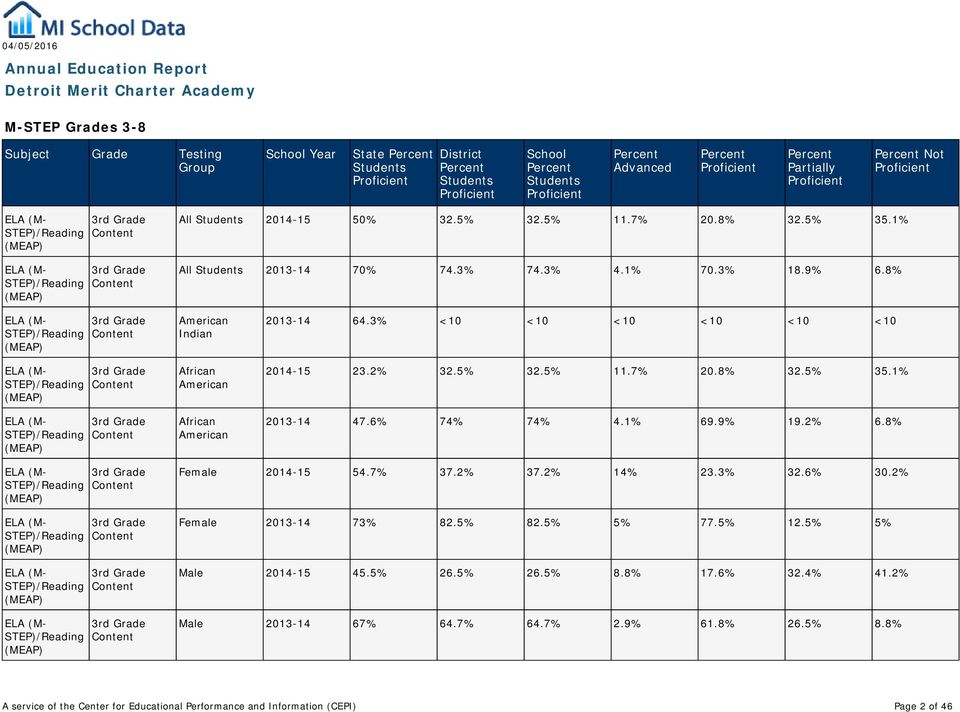
18 4/5/216 M-STEP Grades 3-8 Subject Grade Testing Group School Year State School Advanced Partially Not All % 32.5% 32.5% 11.7% 2.8% 32.5% 35.1% All % 74.3% 74.3% 4.1% 7.3% 18.9% 6.8% Indian % <1 <1 <1 <1 <1 < % 32.5% 32.5% 11.7% 2.8% 32.5% 35.1% % 74% 74% 4.1% 69.9% 19.2% 6.8% Female % 37.2% 37.2% 14% 23.3% 32.6% 3.2% Female % 82.5% 82.5% 5% 77.5% 12.5% 5% Male % 26.5% 26.5% 8.8% 17.6% 32.4% 41.2% Male % 64.7% 64.7% 2.9% 61.8% 26.5% 8.8% A service of the Center for Educational Performance and Information (CEPI) Page 2 of 46
19 4/5/216 M-STEP Grades 3-8 Subject Grade Testing Group School Year State School Advanced Partially Not % 23.8% 23.8% 4.8% 19% 34.9% 41.3% % 71.2% 71.2% 1.5% 69.7% 21.2% 7.6% With With % <1 <1 <1 <1 <1 < % <1 <1 <1 <1 <1 <1 All % 2% 2% 4% 16% 22.7% 57.3% All % 71.1% 71.1% 9.2% 61.8% 22.4% 6.6% Hispanic of Any Race % 19.2% 19.2% 4.1% 15.1% 21.9% 58.9% % 7.7% 7.7% 8% 62.7% 22.7% 6.7% % <1 <1 <1 <1 <1 <1 A service of the Center for Educational Performance and Information (CEPI) Page 3 of 46

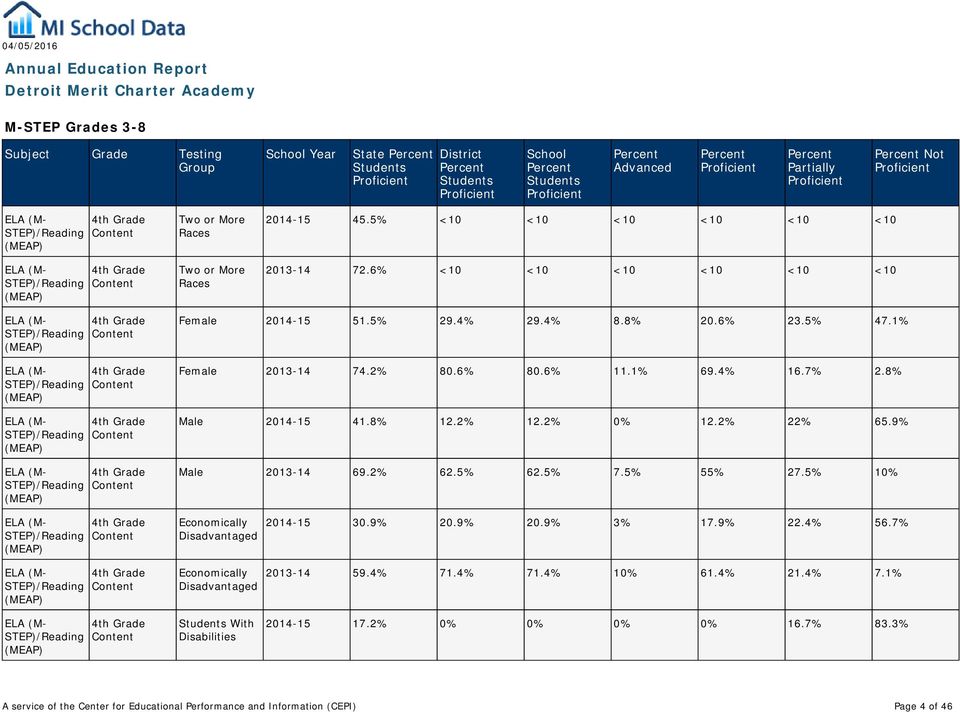
20 4/5/216 M-STEP Grades 3-8 Subject Grade Testing Group School Year State School Advanced Partially Not Two or More Races Two or More Races % <1 <1 <1 <1 <1 < % <1 <1 <1 <1 <1 <1 Female % 29.4% 29.4% 8.8% 2.6% 23.5% 47.1% Female % 8.6% 8.6% 11.1% 69.4% 16.7% 2.8% Male % 12.2% 12.2% % 12.2% 22% 65.9% Male % 62.5% 62.5% 7.5% 55% 27.5% 1% % 2.9% 2.9% 3% 17.9% 22.4% 56.7% % 71.4% 71.4% 1% 61.4% 21.4% 7.1% With % % % % % 16.7% 83.3% A service of the Center for Educational Performance and Information (CEPI) Page 4 of 46
21 4/5/216 M-STEP Grades 3-8 Subject Grade Testing Group School Year State School Advanced Partially Not With % <1 <1 <1 <1 <1 <1 All % 44.3% 44.3% 17.7% 26.6% 25.3% 3.4% All % 79.7% 79.7% 2.3% 59.5% 13.5% 6.8% Indian Two or More Races % <1 <1 <1 <1 <1 < % 44.2% 44.2% 18.2% 26% 26% 29.9% % 8.6% 8.6% 2.8% 59.7% 12.5% 6.9% % <1 <1 <1 <1 <1 <1 White % <1 <1 <1 <1 <1 <1 White % <1 <1 <1 <1 <1 <1 A service of the Center for Educational Performance and Information (CEPI) Page 5 of 46
22 4/5/216 M-STEP Grades 3-8 Subject Grade Testing Group School Year State School Advanced Partially Not Female % 57.1% 57.1% 26.2% 31% 23.8% 19% Female % 72.5% 72.5% 15% 57.5% 2% 7.5% Male % 29.7% 29.7% 8.1% 21.6% 27% 43.2% Male % 88.2% 88.2% 26.5% 61.8% 5.9% 5.9% % 38.6% 38.6% 12.9% 25.7% 27.1% 34.3% % 76.9% 76.9% 2% 56.9% 15.4% 7.7% With With % 8.3% 8.3% 8.3% % 8.3% 83.3% % <1 <1 <1 <1 <1 <1 All % 52% 52% 2% 32% 21.3% 26.7% A service of the Center for Educational Performance and Information (CEPI) Page 6 of 46
23 4/5/216 M-STEP Grades 3-8 Subject Grade Testing Group School Year State School Advanced Partially Not All % 58.1% 58.1% 1.8% 47.3% 32.4% 9.5% Two or More Races % 51.4% 51.4% 18.9% 32.4% 21.6% 27% % 58.1% 58.1% 1.8% 47.3% 32.4% 9.5% % <1 <1 <1 <1 <1 <1 Female % 57.6% 57.6% 3.3% 27.3% 24.2% 18.2% Female % 63.2% 63.2% 1.5% 52.6% 26.3% 1.5% Male % 47.6% 47.6% 11.9% 35.7% 19% 33.3% Male % 52.8% 52.8% 11.1% 41.7% 38.9% 8.3% % 5% 5% 15.7% 34.3% 21.4% 28.6% A service of the Center for Educational Performance and Information (CEPI) Page 7 of 46
24 4/5/216 M-STEP Grades 3-8 Subject Grade Testing Group School Year State School Advanced Partially Not % 58.1% 58.1% 8.1% 5% 32.3% 9.7% With With % <1 <1 <1 <1 <1 < % <1 <1 <1 <1 <1 <1 All % 57.7% 57.7% 9.9% 47.9% 25.4% 16.9% All % 73.8% 73.8% 23% 5.8% 18% 8.2% Two or More Races % 58.6% 58.6% 1% 48.6% 24.3% 17.1% % 73.8% 73.8% 23% 5.8% 18% 8.2% % <1 <1 <1 <1 <1 <1 Female % 51.4% 51.4% 8.1% 43.2% 32.4% 16.2% A service of the Center for Educational Performance and Information (CEPI) Page 8 of 46
25 4/5/216 M-STEP Grades 3-8 Subject Grade Testing Group School Year State School Advanced Partially Not Female % 67.6% 67.6% 29.4% 38.2% 29.4% 2.9% Male % 64.7% 64.7% 11.8% 52.9% 17.6% 17.6% Male % 81.5% 81.5% 14.8% 66.7% 3.7% 14.8% % 54.2% 54.2% 1.2% 44.1% 27.1% 18.6% % 71.7% 71.7% 24.5% 47.2% 18.9% 9.4% With With % <1 <1 <1 <1 <1 < % <1 <1 <1 <1 <1 <1 8th Grade All % 49.2% 49.2% 6.3% 42.9% 34.9% 15.9% 8th Grade % 49.2% 49.2% 6.3% 42.9% 34.9% 15.9% A service of the Center for Educational Performance and Information (CEPI) Page 9 of 46
26 4/5/216 M-STEP Grades 3-8 Subject Grade Testing Group School Year State School Advanced Partially Not 8th Grade 8th Grade 8th Grade Female % 58.3% 58.3% 2.8% 55.6% 3.6% 11.1% Male % 37% 37% 11.1% 25.9% 4.7% 22.2% % 46.2% 46.2% 1.9% 44.2% 38.5% 15.4% 8th Grade With % <1 <1 <1 <1 <1 <1 2nd Grade All % 38.5% 38.5% 6.4% 32.1% 26.9% 34.6% 2nd Grade % 39.2% 39.2% 6.8% 32.4% 27% 33.8% 2nd Grade Hispanic of Any Race % <1 <1 <1 <1 <1 <1 2nd Grade Two or More Races % <1 <1 <1 <1 <1 <1 2nd Grade 2nd Grade 2nd Grade White % <1 <1 <1 <1 <1 <1 Female % 41.9% 41.9% 11.6% 3.2% 32.6% 25.6% Male % 34.3% 34.3% % 34.3% 2% 45.7% A service of the Center for Educational Performance and Information (CEPI) Page 1 of 46
27 4/5/216 M-STEP Grades 3-8 Subject Grade Testing Group School Year State School Advanced Partially Not 2nd Grade % 39.4% 39.4% 5.6% 33.8% 26.8% 33.8% 2nd Grade With % <1 <1 <1 <1 <1 <1 All % 34.2% 34.2% 1.5% 23.7% 35.5% 3.3% All % 48.7% 48.7% 5.3% 43.4% 15.8% 35.5% Indian % <1 <1 <1 <1 <1 < % 34.2% 34.2% 1.5% 23.7% 35.5% 3.3% % 48% 48% 5.3% 42.7% 16% 36% Female % 33.3% 33.3% 9.5% 23.8% 35.7% 31% Female % 43.9% 43.9% % 43.9% 26.8% 29.3% Male % 35.3% 35.3% 11.8% 23.5% 35.3% 29.4% Male % 54.3% 54.3% 11.4% 42.9% 2.9% 42.9% % 22.6% 22.6% 4.8% 17.7% 4.3% 37.1% % 47.1% 47.1% 5.9% 41.2% 13.2% 39.7% A service of the Center for Educational Performance and Information (CEPI) Page 11 of 46
28 4/5/216 M-STEP Grades 3-8 Subject Grade Testing Group School Year State School Advanced Partially Not With % <1 <1 <1 <1 <1 <1 With % 2% 2% % 2% % 8% All % 9.1% 9.1% 3.9% 5.2% 31.2% 59.7% All % 46.1% 46.1% 2.6% 43.4% 21.1% 32.9% % 9.6% 9.6% 4.1% 5.5% 31.5% 58.9% % 45.3% 45.3% 1.3% 44% 21.3% 33.3% Hispanic of Any Race % <1 <1 <1 <1 <1 <1 Two or More Races % <1 <1 <1 <1 <1 <1 Two or More Races % <1 <1 <1 <1 <1 <1 White % <1 <1 <1 <1 <1 <1 Female % 18.9% 18.9% 8.1% 1.8% 27% 54.1% Female % 5% 5% % 5% 13.2% 36.8% Male % % % % % 35% 65% A service of the Center for Educational Performance and Information (CEPI) Page 12 of 46
29 4/5/216 M-STEP Grades 3-8 Subject Grade Testing Group School Year State School Advanced Partially Not Male % 42.1% 42.1% 5.3% 36.8% 28.9% 28.9% % 8.7% 8.7% 2.9% 5.8% 31.9% 59.4% % 45.7% 45.7% 2.9% 42.9% 21.4% 32.9% With % % % % % 16.7% 83.3% With % <1 <1 <1 <1 <1 <1 All % 32.9% 32.9% 12.7% 2.3% 35.4% 31.6% All % 37.8% 37.8% 5.4% 32.4% 25.7% 36.5% Indian % <1 <1 <1 <1 <1 < % 32.5% 32.5% 13% 19.5% 36.4% 31.2% % 38.9% 38.9% 5.6% 33.3% 23.6% 37.5% Two or More Races % <1 <1 <1 <1 <1 <1 White % <1 <1 <1 <1 <1 <1 White % <1 <1 <1 <1 <1 <1 A service of the Center for Educational Performance and Information (CEPI) Page 13 of 46
30 4/5/216 M-STEP Grades 3-8 Subject Grade Testing Group School Year State School Advanced Partially Not Female % 31% 31% 9.5% 21.4% 45.2% 23.8% Female % 33.3% 33.3% 2.6% 3.8% 25.6% 41% Male % 35.1% 35.1% 16.2% 18.9% 24.3% 4.5% Male % 42.9% 42.9% 8.6% 34.3% 25.7% 31.4% % 3% 3% 1% 2% 34.3% 35.7% % 35.4% 35.4% 6.2% 29.2% 26.2% 38.5% With % 8.3% 8.3% % 8.3% 25% 66.7% With % <1 <1 <1 <1 <1 <1 All % 27% 27% 8.1% 18.9% 36.5% 36.5% All % 44.2% 44.2% 5.2% 39% 27.3% 28.6% % 26% 26% 6.8% 19.2% 37% 37% % 43.4% 43.4% 5.3% 38.2% 27.6% 28.9% Two or More Races % <1 <1 <1 <1 <1 <1 A service of the Center for Educational Performance and Information (CEPI) Page 14 of 46
31 4/5/216 M-STEP Grades 3-8 Subject Grade Testing Group School Year State School Advanced Partially Not White % <1 <1 <1 <1 <1 <1 Female % 39.4% 39.4% 6.1% 33.3% 24.2% 36.4% Female % 51.3% 51.3% 5.1% 46.2% 28.2% 2.5% Male % 17.1% 17.1% 9.8% 7.3% 46.3% 36.6% Male % 36.8% 36.8% 5.3% 31.6% 26.3% 36.8% % 23.2% 23.2% 8.7% 14.5% 37.7% 39.1% % 45.3% 45.3% 1.6% 43.8% 28.1% 26.6% With % <1 <1 <1 <1 <1 <1 With % <1 <1 <1 <1 <1 <1 All % 26.8% 26.8% 12.7% 14.1% 47.9% 25.4% All % 29% 29% 3.2% 25.8% 32.3% 38.7% % 27.1% 27.1% 12.9% 14.3% 48.6% 24.3% % 29% 29% 3.2% 25.8% 32.3% 38.7% A service of the Center for Educational Performance and Information (CEPI) Page 15 of 46
32 4/5/216 M-STEP Grades 3-8 Subject Grade Testing Group School Year State School Advanced Partially Not Two or More Races % <1 <1 <1 <1 <1 <1 Female % 18.9% 18.9% 2.7% 16.2% 54.1% 27% Female % 28.6% 28.6% 2.9% 25.7% 31.4% 4% Male % 35.3% 35.3% 23.5% 11.8% 41.2% 23.5% Male % 29.6% 29.6% 3.7% 25.9% 33.3% 37% % 23.7% 23.7% 1.2% 13.6% 47.5% 28.8% % 25.9% 25.9% 1.9% 24.1% 33.3% 4.7% With % <1 <1 <1 <1 <1 <1 With % <1 <1 <1 <1 <1 <1 8th Grade All % 19% 19% 4.8% 14.3% 38.1% 42.9% 8th Grade % 19% 19% 4.8% 14.3% 38.1% 42.9% 8th Grade 8th Grade Female % 22.2% 22.2% 2.8% 19.4% 47.2% 3.6% Male % 14.8% 14.8% 7.4% 7.4% 25.9% 59.3% A service of the Center for Educational Performance and Information (CEPI) Page 16 of 46
33 4/5/216 M-STEP Grades 3-8 Subject Grade Testing Group School Year State School Advanced Partially Not 8th Grade % 17.3% 17.3% 1.9% 15.4% 38.5% 44.2% 8th Grade With % <1 <1 <1 <1 <1 <1 All % 1.3% 1.3% % 1.3% 13% 85.7% All % 1% 1% 5% 5% 31.3% 58.8% % 1.4% 1.4% % 1.4% 11% 87.7% % 8.9% 8.9% 3.8% 5.1% 31.6% 59.5% Hispanic of Any Race % <1 <1 <1 <1 <1 <1 Two or More Races % <1 <1 <1 <1 <1 <1 Two or More Races % <1 <1 <1 <1 <1 <1 White % <1 <1 <1 <1 <1 <1 Female % 2.8% 2.8% % 2.8% 13.9% 83.3% Female % 1.5% 1.5% 5.3% 5.3% 34.2% 55.3% Male % % % % % 12.2% 87.8% A service of the Center for Educational Performance and Information (CEPI) Page 17 of 46
34 4/5/216 M-STEP Grades 3-8 Subject Grade Testing Group School Year State School Advanced Partially Not Male % 9.5% 9.5% 4.8% 4.8% 28.6% 61.9% % 1.4% 1.4% % 1.4% 13% 85.5% % 1.8% 1.8% 5.4% 5.4% 31.1% 58.1% With % % % % % % 1% With % % % % % 2% 8% All % 1% 1% 4.3% 5.7% 21.4% 68.6% All % 6.1% 6.1% % 6.1% 22.7% 71.2% % 1.1% 1.1% 4.3% 5.8% 21.7% 68.1% % 6.1% 6.1% % 6.1% 22.7% 71.2% Two or More Races % <1 <1 <1 <1 <1 <1 Female % 5.6% 5.6% 2.8% 2.8% 11.1% 83.3% Female % 8.3% 8.3% % 8.3% 22.2% 69.4% Male % 14.7% 14.7% 5.9% 8.8% 32.4% 52.9% A service of the Center for Educational Performance and Information (CEPI) Page 18 of 46
35 4/5/216 M-STEP Grades 3-8 Subject Grade Testing Group School Year State School Advanced Partially Not Male % 3.3% 3.3% % 3.3% 23.3% 73.3% % 1.3% 1.3% 5.2% 5.2% 2.7% 69% % 3.4% 3.4% % 3.4% 22.4% 74.1% With % <1 <1 <1 <1 <1 <1 With % <1 <1 <1 <1 <1 <1 Social Studies Social Studies All % 16.5% 16.5% 1.3% 15.2% 63.3% 2.3% All % 19.2% 19.2% % 19.2% 64.1% 16.7% Social Studies Indian % <1 <1 <1 <1 <1 <1 Social Studies % 15.6% 15.6% 1.3% 14.3% 63.6% 2.8% Social Studies % 19.7% 19.7% % 19.7% 63.2% 17.1% Social Studies Two or More Races % <1 <1 <1 <1 <1 <1 Social Studies Social Studies White % <1 <1 <1 <1 <1 <1 White % <1 <1 <1 <1 <1 <1 A service of the Center for Educational Performance and Information (CEPI) Page 19 of 46
36 4/5/216 M-STEP Grades 3-8 Subject Grade Testing Group School Year State School Advanced Partially Not Social Studies Social Studies Social Studies Social Studies Social Studies Social Studies Female % 16.7% 16.7% % 16.7% 69% 14.3% Female % 15% 15% % 15% 7% 15% Male % 16.2% 16.2% 2.7% 13.5% 56.8% 27% Male % 23.7% 23.7% % 23.7% 57.9% 18.4% % 12.9% 12.9% 1.4% 11.4% 64.3% 22.9% % 18.8% 18.8% % 18.8% 62.3% 18.8% Social Studies With % 8.3% 8.3% % 8.3% 58.3% 33.3% Social Studies With % <1 <1 <1 <1 <1 <1 Social Studies 8th Grade All % 19% 19% 1.6% 17.5% 52.4% 28.6% Social Studies 8th Grade % 19% 19% 1.6% 17.5% 52.4% 28.6% Social Studies Social Studies Social Studies 8th Grade 8th Grade 8th Grade Female % 8.3% 8.3% % 8.3% 58.3% 33.3% Male % 33.3% 33.3% 3.7% 29.6% 44.4% 22.2% % 17.3% 17.3% % 17.3% 51.9% 3.8% A service of the Center for Educational Performance and Information (CEPI) Page 2 of 46
37 4/5/216 M-STEP Grades 3-8 Subject Grade Testing Group School Year State School Advanced Partially Not Social Studies 8th Grade With % <1 <1 <1 <1 <1 <1 A service of the Center for Educational Performance and Information (CEPI) Page 21 of 46
38 4/5/216 MME Subject Grade Testing Group School Year State School Advanced Partially Not No Data to Display A service of the Center for Educational Performance and Information (CEPI) Page 22 of 46
39 4/5/216 Michigan Educational Assessment Program Access (MEAP - Access) Subject Grade Testing Group School Year State School Exceeded Met Progressing 3rd All % 33.3% 33.3% % 33.3% 66.7% 3rd % <1 <1 <1 <1 <1 3rd White % <1 <1 <1 <1 <1 3rd Female % <1 <1 <1 <1 <1 3rd Male % <1 <1 <1 <1 <1 3rd % 33.3% 33.3% % 33.3% 66.7% 4th All % <1 <1 <1 <1 <1 4th % <1 <1 <1 <1 <1 4th Female % <1 <1 <1 <1 <1 4th Male % <1 <1 <1 <1 <1 4th % <1 <1 <1 <1 <1 5th All % 75% 75% % 75% 25% 5th % 75% 75% % 75% 25% 5th Male % 75% 75% % 75% 25% 5th % 75% 75% % 75% 25% 6th All % 75% 75% 5% 25% 25% A service of the Center for Educational Performance and Information (CEPI) Page 23 of 46
40 4/5/216 Michigan Educational Assessment Program Access (MEAP - Access) Subject Grade Testing Group School Year State School Exceeded Met Progressing 6th % 75% 75% 5% 25% 25% 6th Female % <1 <1 <1 <1 <1 6th Male % 1% 1% 66.7% 33.3% % 6th % 75% 75% 5% 25% 25% 7th All % <1 <1 <1 <1 <1 7th % <1 <1 <1 <1 <1 7th Female % <1 <1 <1 <1 <1 7th Male % <1 <1 <1 <1 <1 7th % <1 <1 <1 <1 <1 8th All % 5% 5% % 5% 5% 8th % 5% 5% % 5% 5% 8th Female % <1 <1 <1 <1 <1 8th Male % 66.7% 66.7% % 66.7% 33.3% 8th % 5% 5% % 5% 5% Reading 3rd All % 5% 5% 25% 25% 5% Reading 3rd % 33.3% 33.3% 33.3% % 66.7% A service of the Center for Educational Performance and Information (CEPI) Page 24 of 46
41 4/5/216 Michigan Educational Assessment Program Access (MEAP - Access) Subject Grade Testing Group School Year State School Exceeded Met Progressing Reading 3rd White % <1 <1 <1 <1 <1 Reading 3rd Female % 33.3% 33.3% 33.3% % 66.7% Reading 3rd Male % <1 <1 <1 <1 <1 Reading 3rd % 66.7% 66.7% 33.3% 33.3% 33.3% Reading 4th All % % % % % 1% Reading 4th % % % % % 1% Reading 4th Female % <1 <1 <1 <1 <1 Reading 4th Male % <1 <1 <1 <1 <1 Reading 4th % % % % % 1% Reading 5th All % 25% 25% % 25% 75% Reading 5th % 25% 25% % 25% 75% Reading 5th Female % <1 <1 <1 <1 <1 Reading 5th Male % <1 <1 <1 <1 <1 Reading 5th % 25% 25% % 25% 75% Reading 6th All % 75% 75% 5% 25% 25% Reading 6th % 75% 75% 5% 25% 25% A service of the Center for Educational Performance and Information (CEPI) Page 25 of 46
42 4/5/216 Michigan Educational Assessment Program Access (MEAP - Access) Subject Grade Testing Group School Year State School Exceeded Met Progressing Reading 6th Male % 75% 75% 5% 25% 25% Reading 6th % 75% 75% 5% 25% 25% Reading 7th All % 8% 8% 6% 2% 2% Reading 7th % 75% 75% 5% 25% 25% Reading 7th White % <1 <1 <1 <1 <1 Reading 7th Female % <1 <1 <1 <1 <1 Reading 7th Male % 66.7% 66.7% 66.7% % 33.3% Reading 7th % 75% 75% 5% 25% 25% Reading 8th All % 8% 8% 8% % 2% Reading 8th % 8% 8% 8% % 2% Reading 8th Female % <1 <1 <1 <1 <1 Reading 8th Male % 66.7% 66.7% 66.7% % 33.3% Reading 8th % 8% 8% 8% % 2% A service of the Center for Educational Performance and Information (CEPI) Page 26 of 46
43 4/5/216 MI-Access Functional Independence Subject Grade Testing Group School Year State School Surpassed Attained Emerging ELA All % <1 <1 <1 <1 <1 All % <1 <1 <1 <1 < % <1 <1 <1 <1 <1 ELA % <1 <1 <1 <1 <1 ELA Male % <1 <1 <1 <1 <1 Male % <1 <1 <1 <1 < % <1 <1 <1 <1 <1 ELA % <1 <1 <1 <1 <1 Reading All % <1 <1 <1 <1 <1 All % <1 <1 <1 <1 <1 All % <1 <1 <1 <1 < % <1 <1 <1 <1 <1 Reading % <1 <1 <1 <1 <1 A service of the Center for Educational Performance and Information (CEPI) Page 27 of 46
44 4/5/216 MI-Access Functional Independence Subject Grade Testing Group School Year State School Surpassed Attained Emerging % <1 <1 <1 <1 <1 Reading Female % <1 <1 <1 <1 <1 Female % <1 <1 <1 <1 <1 Female % <1 <1 <1 <1 < % <1 <1 <1 <1 <1 Reading % <1 <1 <1 <1 < % <1 <1 <1 <1 <1 Reading All % <1 <1 <1 <1 <1 All % <1 <1 <1 <1 < % <1 <1 <1 <1 <1 Reading % <1 <1 <1 <1 <1 Reading Female % <1 <1 <1 <1 <1 Female % <1 <1 <1 <1 <1 A service of the Center for Educational Performance and Information (CEPI) Page 28 of 46
45 4/5/216 MI-Access Functional Independence Subject Grade Testing Group School Year State School Surpassed Attained Emerging % <1 <1 <1 <1 <1 Reading % <1 <1 <1 <1 <1 ELA All % <1 <1 <1 <1 <1 All % <1 <1 <1 <1 < % <1 <1 <1 <1 <1 ELA % <1 <1 <1 <1 <1 ELA ELA Female % <1 <1 <1 <1 <1 Female % <1 <1 <1 <1 <1 Male % <1 <1 <1 <1 <1 Male % <1 <1 <1 <1 < % <1 <1 <1 <1 <1 ELA % <1 <1 <1 <1 <1 A service of the Center for Educational Performance and Information (CEPI) Page 29 of 46
46 4/5/216 MI-Access Supported Independence Subject Grade Testing Group School Year State School Surpassed Attained Emerging No Data to Display A service of the Center for Educational Performance and Information (CEPI) Page 3 of 46
47 4/5/216 MI-Access Participation Subject Grade Testing Group School Year State School Surpassed Attained Emerging No Data to Display A service of the Center for Educational Performance and Information (CEPI) Page 31 of 46
48 4/5/216 Accountability Details Subject Data Testing Group Subject State Tested Total State Tested Total * School Tested Total School ** All 98.1% 36.5% 99.1% N/A 99.1% N/A All ELA 98.1% 48.5% 99.1% N/A 99.1% N/A All 97.5% 22.2% 98.7% N/A 98.7% N/A All Social Studies 97.4% 31.8% 99.3% N/A 99.3% N/A Indian Indian Indian Indian 98.2% 27.8% <3 N/A <3 N/A ELA 98% 41.5% <3 N/A <3 N/A 97.8% 17.7% N/A N/A N/A N/A Social Studies 97.2% 25.2% <3 N/A <3 N/A 96.5% 13.5% 99.1% N/A 99.1% N/A ELA 96.5% 24.5% 99.5% N/A 99.5% N/A 95.4% 6.1% 98.6% N/A 98.6% N/A Social Studies 95.2% 11% 99.3% N/A 99.3% N/A Asian 99.1% 66.3% N/A N/A N/A N/A Asian ELA 98.7% 7.2% N/A N/A N/A N/A Asian 99% 38% N/A N/A N/A N/A Asian Social Studies 98.8% 49.6% N/A N/A N/A N/A Hispanic of Any Race Hispanic of Any Race Hispanic of Any Race Hispanic of Any Race Native Hawaiian or Other Pacific Islander 98.3% 23.7% <3 N/A <3 N/A ELA 98.3% 36.1% <3 N/A <3 N/A 97.9% 11.7% <3 N/A <3 N/A Social Studies 97.5% 2.2% N/A N/A N/A N/A 99.8% 4.8% N/A N/A N/A N/A A service of the Center for Educational Performance and Information (CEPI) Page 32 of 46
49 4/5/216 Accountability Details Subject Data Testing Group Subject State Tested Total State Tested Total * School Tested Total School ** Native Hawaiian or Other Pacific Islander Native Hawaiian or Other Pacific Islander Native Hawaiian or Other Pacific Islander Two or More Races Two or More Races Two or More Races Two or More Races ELA 99.3% 53.3% N/A N/A N/A N/A 99.6% 21.9% N/A N/A N/A N/A Social Studies 99.3% 33% N/A N/A N/A N/A 98.5% 33.6% <3 N/A <3 N/A ELA 98.5% 46.9% <3 N/A <3 N/A 98.5% 2.1% <3 N/A <3 N/A Social Studies 98.1% 28.3% N/A N/A N/A N/A White 98.5% 42.5% <3 N/A <3 N/A White ELA 98.5% 55% <3 N/A <3 N/A White 98.1% 26.6% <3 N/A <3 N/A White Social Studies 98% 37.3% <3 N/A <3 N/A English Language Learners English Language Learners English Language Learners 97.6% 22.5% 99% N/A 99% N/A ELA 97.6% 33.7% 99% N/A 99% N/A 96.8% 11.7% 98.4% N/A 98.4% N/A Social Studies 96.5% 17.8% 99.2% N/A 99.2% N/A 98.6% 2.3% N/A N/A N/A N/A ELA 98.2% 24% N/A N/A N/A N/A 98.2% 3.9% N/A N/A N/A N/A A service of the Center for Educational Performance and Information (CEPI) Page 33 of 46
50 4/5/216 Accountability Details Subject Data Testing Group Subject State Tested Total State Tested Total * School Tested Total School ** English Language Learners With With With With Social Studies 97.9% 8.1% N/A N/A N/A N/A 97.2% 21.8% 98% N/A 98% N/A ELA 96.6% 24.7% 98% N/A 98% N/A 96.5% 15.4% <3 N/A <3 N/A Social Studies 95% 13.9% <3 N/A <3 N/A A service of the Center for Educational Performance and Information (CEPI) Page 34 of 46
51 4/5/216 Accountability Details Graduation Data Student Group Statewide School All 78.6% N/A N/A Indian 64.8% N/A N/A 64.5% N/A N/A Asian 89.1% N/A N/A Hispanic of Any Race 68.8% N/A N/A Native Hawaiian or Other Pacific Islander 78.9% N/A N/A Two or More Races 74.2% N/A N/A White 82.9% N/A N/A Female 82.9% N/A N/A Male 74.4% N/A N/A 65.6% N/A N/A English Language Learners 68.2% N/A N/A With 55.1% N/A N/A Bottom 3% N/A N/A N/A * All data based on students enrolled for a full academic year. A service of the Center for Educational Performance and Information (CEPI) Page 35 of 46
52 4/5/216 Accountability Details Attendance Data Student Group Statewide School All 94.7% 92.4% 92.4% * All data based on students enrolled for a full academic year. A service of the Center for Educational Performance and Information (CEPI) Page 36 of 46
53 4/5/216 Accountability Status Data Name Reading Status Reading Score Writing Status Writing Score Math Status Math Score Status Score Social Studies Status Social Studies Score Overall Status Overall Score No Data to Display A service of the Center for Educational Performance and Information (CEPI) Page 37 of 46
54 4/5/216 Accountability Status School Data Name School Name Title 1 Status Reading Status Reading Score Writing Status Writing Score Math Status Math Score Status Score Social Studies Status Social Studies Score Overall Status Overall Score No Data to Display A service of the Center for Educational Performance and Information (CEPI) Page 38 of 46
55 4/5/216 Teacher Quality - Qualification Professional Qualifications of All Public Elementary and Secondary School Teachers in the School Other B.A. M.A. P.H.D Professional Qualifications are defined by the State and may include information such as the degrees of public school teachers (e.g., percentage of teachers with Bachelors Degrees or Masters Degrees) or the percentage of fully certified teachers Teacher Quality - Class School Aggregate High-Poverty Schools Low-Poverty Schools age of Core Academic Subject Elementary and Secondary School Classes not Taught by Highly Qualified Teachers.%.%.% Teacher Quality - Provisional Certification age of Public Elementary and Secondary School Teachers in the School with Emergency Certification % A service of the Center for Educational Performance and Information (CEPI) Page 39 of 46
56 4/5/216 NAEP Grade 4 Math of below Basic Basic Advanced All Male Female National Lunch Program Eligibility Eligible Not Eligible Info not available # Race/Ethnicity White Black Hispanic Asian Indian/Alaska Native Native Hawaiian/Pacific Islander Two or More Races # &# ‡ Student classified as having a disability SD Not SD Student is an English Language Learner ELL Not ELL Reporting Standards not met. Note: Observed differences are not necessarily statistically significant. Detail may not sum to total because of rounding. SOURCE: U.S. Department of Education. Institute for Education s. National Center for Education Statistics. National Assessment of Educational Progress (NAEP) 215 Achievement. A service of the Center for Educational Performance and Information (CEPI) Page 4 of 46
57 4/5/216 NAEP Grade 8 Math of below Basic Basic Advanced All Male Female National Lunch Program Eligibility Eligible Not Eligible Info not available # Race/Ethnicity White Black Hispanic Asian Indian/Alaska Native Native Hawaiian/Pacific Islander Two or More Races # # 4 32 Student classified as having a disability SD Not SD # 7 Student is an English Language Learner ELL Not ELL Reporting Standards not met. NOTE: Observed differences are not necessarily statistically significant. Detail may not sum to total because of rounding. SOURCE: U.S. Department of Education. Institute for Education s. National Center for Education Statistics. National Assessment of Educational Progress (NAEP) 215 Achievement. A service of the Center for Educational Performance and Information (CEPI) Page 41 of 46
58 4/5/216 NAEP Grade 12 Math of below Basic Basic Advanced All Male Female National Lunch Program Eligibility Eligible Not Eligible Info not available Race/Ethnicity White Black Hispanic Asian Indian Native Hawaiian/Pacific Islander Two or More Races Student classified as having a disability SD Not SD Student is an English Language Learner ELL Not ELL Reporting Standards not met. NOTE: Observed differences are not necessarily statistically significant. Detail may not sum to total because of rounding. SOURCE: U.S. Department of Education. Institute for Education s. National Center for Education Statistics. National Assessment of Educational Progress (NAEP) 215 Achievement. A service of the Center for Educational Performance and Information (CEPI) Page 42 of 46
59 4/5/216 NAEP Grade 4 Reading of below Basic Basic Advanced All Male Female National Lunch Program Eligibility Eligible Not Eligible Info not available # Race/Ethnicity White Black Hispanic Asian Indian/Alaska Native Native Hawaiian/Pacific Islander Two or More Races # Student classified as having a disability SD Not SD # 6 Student is an English Language Learner ELL Not ELL # Rounds to zero Reporting Standards not met. NOTE: Observed differences are not necessarily statistically significant. Detail may not sum to total because of rounding. SOURCE: U.S. Department of Education, Institute of Education s, National Center for Education Statistics, National Assessment of Educational Progress (NAEP), 215 Reading Assessment. A service of the Center for Educational Performance and Information (CEPI) Page 43 of 46
60 4/5/216 NAEP Grade 8 Reading of below Basic Basic Advanced All Male Female National Lunch Program Eligibility Eligible Not Eligible Info not available # Race/Ethnicity White Black Hispanic Asian/Pacific Islander Indian/Alaska Native Two or More Races &# Student classified as having a disability SD Not SD # 3 Student is an English Language Learner ELL Not ELL # 3 # Rounds to zero Reporting Standards not met. NOTE: Observed differences are not necessarily statistically significant. Detail may not sum to total because of rounding. SOURCE: U.S. Department of Education, Institute of Education s, National Center for Education Statistics, National Assessment of Educational Progress (NAEP), 215 Reading Assessment. A service of the Center for Educational Performance and Information (CEPI) Page 44 of 46
61 4/5/216 NAEP Grade 12 Reading of below Basic Basic Advanced All Male Female National Lunch Program Eligibility Eligible Not Eligible Info not available Race/Ethnicity White Black Hispanic Asian Indian Native Hawaiian/Pacific Islander Two or More Races Student classified as having a disability SD Not SD Student is an English Language Learner ELL Not ELL # Rounds to zero Reporting Standards not met. NOTE: Observed differences are not necessarily statistically significant. Detail may not sum to total because of rounding. SOURCE: U.S. Department of Education, Institute of Education s, National Center for Education Statistics, National Assessment of Educational Progress (NAEP), 215 Reading Assessment. A service of the Center for Educational Performance and Information (CEPI) Page 45 of 46
62 4/5/216 NAEP Participation Data Grade Subject Participation Rate for with Standard Error Participation Rate for Limited English Standard Error 4 Math Reading Math Reading A service of the Center for Educational Performance and Information (CEPI) Page 46 of 46
Allen Elementary School
 Allen Elementary School April 4, 216 Dear Parents and Community Members: We are pleased to present you with the (AER), which provides key information on the 214-15 educational progress for the. The AER
Bangor Central Elementary School 2014-2015 Annual Education Report
 Bangor Central Elementary School 24-25 Melissa Vrable; Principal March 23, 26 Dear Parents and Community Members: We are pleased to present you with the (AER) which provides key information on the 24 5
How To Improve Your School
 DETROIT PUBLIC SCHOOLS August 19, 2013 Carver Elementary-Middle School 18701 Paul Street Detroit, Michigan 48228-3868 Annual Education Report (AER) Cover Letter (2012-2013) Dear Parents and Community Members:
ILLINOIS SCHOOL REPORT CARD
 6-99-6-- Arbury Hills Elem Summit Hill SD 6 Mokena, ILLINOIS GRADES : 3 4 Arbury Hills Elem ILLINOIS SCHOOL REPORT CARD federal laws require public school districts to release report cards to the public
WEST OTTAWA PUBLIC SCHOOLS
 WEST OTTAWA PUBLIC SCHOOLS EAT LAKES ELEMENTARY SCHOOL 3200 N. 152 nd Ave. Holland, MI 49424 (616) 738-6300 Fax (616) 738-6391 Safety Hotline (616) 738-5750 www.westottawa.net August 15, Dear Parents and
STUDENT PERFORMANCE DATA DOCUMENT
 STUDENT PERFORMANCE DATA DOCUMENT Assessment Quality: To measure to progress towards Intended Learning Outcomes, DaVinci Academy has used an array of summative assessments that are aligned with the Utah
ty School District Digita al Classrooms Plan
 Nassau Count ty School District Digita al Classrooms Plan Nassau County School Districtt Digital Classrooms Plan 1 P age The intent of the District Digital Classroom Plan (DCP) is to provide a perspective
STRATEGIC SCHOOL PROFILE 2010-11. Middle and Junior High School Edition. Great Oak School. Oxford School District
 108-51 STRATEGIC SCHOOL PROFILE 2010-11 Middle and Junior High School Edition Great Oak School Oxford School District BRIAN P. MURPHY, Principal Telephone: (203) 888-5418 Website: www.oxfordpublicschools.org/greatoak/index.htm
THE LEONA GROUP, L.L.C.
 We are a THE LEONA GROUP, L.L.C. A new kind of public school Chartered by Ferris State University Northridge Academy 22-3 Annual Education Report 536 North St. Flint, MI 4855 81.785.8811 Year opened 1999
Executive Summary. Monroe County Middle School
 Monroe County Schools Dr. Efrem Yarber, Principal 66 Thornton Road Forsyth, GA 31029 Document Generated On January 3, 2016 TABLE OF CONTENTS Introduction 1 Description of the School 2 School's Purpose
ILLINOIS SCHOOL REPORT CARD
 17-2-15-2-24 Lincoln Elem Clinton CUSD 15 Clinton, ILLINOIS GRADES : 2 3 2 1 3 Lincoln Elem 1 ILLINOIS SCHOOL REPORT CARD and federal laws require public school districts to release report cards to the
Geographic Area - Humboldt Park
 SABIN Geographic Area - Humboldt Park Official School Name Albert R Sabin Elementary Magnet School Address 2216 W Hirsch St Chicago, Illinois 60622 Number Of Students Served Capacity Utilization Adjusted
Executive Summary. Florida Connections Academy. Ms. Marcie Trombino 5401 S. Kirkman Road Suite 550 Orlando, FL 32819
 Ms. Marcie Trombino 5401 S. Kirkman Road Suite 550 Orlando, FL 32819 Document Generated On February 5, 2015 TABLE OF CONTENTS Introduction 1 Description of the School 2 School's Purpose 4 Notable Achievements
Executive Summary. Paragon Academy of Technology Charter Middle School. Dr. Steven Montes, Principal 502 N 28th Ave Hollywood, FL 33020-3811
 Paragon Academy of Technology Charter Middle School Dr. Steven Montes, Principal 502 N 28th Ave Hollywood, FL 33020-3811 Document Generated On March 9, 2015 TABLE OF CONTENTS Introduction 1 Description
San Juan College High School
 San Juan College High School Application for Class of 2020 Thank you for considering San Juan College High School (SJCHS.) Before completing the application, please give careful consideration to the information
REQUEST FOR PERSONAL CURRICULUM
 Page 1 REQUEST FOR PERSONAL CURRICULUM In April 2006, Public Acts 123 & 124 were passed and beginning with the class of 2011, they specified 16 credits which are a minimum required to graduate from a Michigan
WORLD S BEST WORKFORCE PLAN
 WORLD S BEST WORKFORCE PLAN ANNUAL REPORT 2014 2015 School Year South Early Learning Center, North Intermediate, Saint Peter Middle/High School 1 Saint Peter Public Schools World s Best Workforce Report
DRAFT TUITION BASED PRESCHOOL ACTION PLAN
 POUDRE SCHOOL DISTRICT Early Childhood Education DRAFT TUITION BASED PRESCHOOL ACTION PLAN March 6, 2012 DRAFT TUITION BASED PRESCHOOL ACTION PLAN Background Summary The Early Childhood Program began the
Moberly School District. Moberly School District. Annual District Report 2009-2010. Accredited with Distinction. www.moberly.k12.mo.
 Moberly School District Moberly School District Accredited with Distinction Annual District Report 2009-2010 www.moberly.k12.mo.us Moberly School District VISION: Create a safe environment that fosters
Develop and implement a systematic process that assesses, evaluates and supports open-access and equity with measurable outcome improvements
 STRATEGIC GOAL 1: Promote Access and Equity Develop and implement a systematic process that assesses, evaluates and supports open-access and equity with measurable outcome improvements Increase pre-collegiate
Nevis Public School District #308. District Literacy Plan Minnesota Statute 120B.12, 2011 2015-2016. Learning together... Achieving quality together.
 Nevis Public School District #308 District Literacy Plan Minnesota Statute 120B.12, 2011 2015-2016 Learning together... Achieving quality together. SCHOOL BOARD Chairperson: Vice Chairperson: Treasurer:
Mooresville Intermediate School School Improvement Plan 2015 2016
 Mooresville Intermediate School School Improvement Plan 2015 2016 School Improvement Team Dr. Chris Gammon (Principal) Tammy Russ (Assistant Principal) Sarah Dillard (Instructional Technology Facilitator)
Plan for Continuous Improvement
 Plan for Continuous Improvement School Name: BETTIE F WILLIAMS ELEMENTAR Y SCHOOL Date: 9/16/2014 Section II: Action Plan What outcomes do we want for our students? PLAN Student gfedcb Academic proficiency
Colorado Springs School District 11
 Colorado Springs School District 11 Colorado Superintendent: Dr. Sharon A. Thomas Primary contact: Holly Brilliant, Title I facilitator 29,625 students, K-12, urban District Description Colorado Springs
LAKE SILVER ELEMENTARY
 Page 1 of 17 Accountability, Research, and Assessment School Improvement Plan 2010-2011 School Improvement Plan LAKE SILVER ELEMENTARY Approved by: Principal: 9/27/2010 Area Superintendent: 10/19/2010
Hiawatha Academies School District #4170
 Hiawatha Academies School District #4170 World s Best Workforce Plan All Hiawatha Academies scholars will be empowered with the knowledge, character and leadership skills to graduate from college and serve
SMART Goals. Goals should be SMART - specific, measurable, agreed upon, realistic and time-based.
 SMART Goals Goals should be SMART - specific, measurable, agreed upon, realistic and time-based. The acronym SMART has a number of slightly different variations, which can be used to provide a more comprehensive
Getting a Community After School Program Off the Ground Tip Sheet for Iowa State University Extension Staff
 Getting a Community After School Program Off the Ground Tip Sheet for Iowa State University Extension Staff Getting a community after school program off the ground can seem overwhelming and daunting. Like
ANNUAL REPORT ON CURRICULUM, INSTRUCTION AND STUDENT ACHIEVEMENT
 The mission of the Greenbush-Middle River School is to provide a quality education which will prepare all students to meet success by developing self-directed thinkers and communicators who are responsible,
High Schools That Work: How Improving High Schools Can Use Data to Guide Their Progress
 High Schools That Work: How Improving High Schools Can Use Data to Guide Their Progress In our book, The Power of Focus, we encourage all governmental, nonprofit, and for-profit groups that are working
Rhode Island Department of Education Office of Student, Community and Academic Supports School Support System Report and Support Plan
 Rhode Island Department of Education Office of Student, Community and Academic Supports School Support System Report and Support Plan Blackstone Academy Public Charter School February 2016 1 SCHOOL SUPPORT
Executive Summary. South Redford School District. Mr. Brian Galdes, Superintendent 26141 Schoolcraft Redford, MI 48239-2791
 Mr. Brian Galdes, Superintendent 26141 Schoolcraft Redford, MI 48239-2791 Document Generated On June 23, 2015 TABLE OF CONTENTS Introduction 1 Description of the School System 2 System's Purpose 3 Notable
The principal must make effective use of student performance data to identify
 3 Analyzing Data for Schoolwide and Individual Student Improvement What separates the schools that will be successful in their reform efforts from the ones that won t is the use of one, often neglected,
Boulder Valley School District RE-2 OPEN ENROLLMENT PROCEDURES & INFORMATION 2016-2017 School Year
 Please keep for future reference regarding timelines & details. Boulder Valley School District RE-2 OPEN ENROLLMENT PROCEDURES & INFORMATION 2016-2017 School Year The open enrollment period is from November
Michigan Merit Curriculum High School Graduation Requirements
 Michigan Merit Curriculum High School Graduation Requirements 45 Understanding Michigan s graduation requirements will enable you to help your child obtain a high school diploma and ultimately succeed
Louisiana s Schoolwide Reform Guidance
 Overview How educational funds are spent not just how much is spent impacts student achievement. Louisiana Believes is based on the premise that those closest to kids parents and educators know better
APPENDIX A: Examples of Observations and Documentation
 APPENDIX A: and Documentation 1. Centering instruction on high expectations for student achievement. Students communicate goals and objectives. Teacher communicates goals and objectives in lesson opening
Core Goal: Teacher and Leader Effectiveness
 Teacher and Leader Effectiveness Board of Education Update January 2015 1 Assure that Tulsa Public Schools has an effective teacher in every classroom, an effective principal in every building and an effective
To date, more than 45 states and the District of Columbia have adopted the CCSS.
 Parents Guide to New Assessments IN Illinois In 2010, Illinois began implementing the Common Core State Standards (CCSS). The CCSS provide a consistent, clear understanding of what students are expected
English Learner Program Description White Bear Lake Area Schools
 English Learner Program Description White Bear Lake Area Schools March, 2012 Please direct questions to: Kathleen Daniels Director of Special Services [email protected] 1 The purpose of this
ILLINOIS SCHOOL REPORT CARD
 5-8-9-6- MASCOUTAH ELEM SCHOOL MASCOUTAH C U DISTRICT 9 MASCOUTAH, ILLINOIS GRADES : PK K 5 6 MASCOUTAH ELEM SCHOOL ILLINOIS SCHOOL REPORT CARD and federal laws require public school districts to release
SCHOOLWIDE TITLE I PLAN JONESVILLE MIDDLE SCHOOL
 SCHOOLWIDE TITLE I PLAN JONESVILLE MIDDLE SCHOOL 2014-2015 1 Jonesville Middle School SchoolWide Title I Plan 2014-2015 Committee Members Dr. Lynn Metcalfe, Principal Brian Huff, Principal Designee LaVerne
South Carolina. 180 The Proficiency Illusion
 South Carolina Introduction This study linked data from the 02 and 06 administrations of South Carolina s reading and math tests to the Northwest Evaluation Association s Measures of Academic Progress
Executive Summary. Metro Nashville Virtual School
 Metropolitan Nashville-Davidson City Public Schools Dr. James V Witty, Principal 4805 Park Ave Nashville, TN 37209-3436 Document Generated On September 26, 2014 TABLE OF CONTENTS Introduction 1 Description
ESL HANDBOOK. CCISD ESL Handbook/01/11/2011/Curr/TBG
 ESL HANDBOOK State Goals Chapter 89.1201 Adaptations for Special Populations Subchapter BB. Commissioner's Rules Concerning State Plan for Educating Limited English Proficient Students The goal of English
66.1 59.9. District: LITTLESTOWN AREA SD AUN: 112015203 Test Date: PSSA Spring 2015. English Language Arts. Mathematics 46.8 39.7. Science 75.5 67.
 PENNSYLVANIA System of School Assessment (PSSA) Summary Report Dear Leader: This report provides you with information about your district's performance in English Language Arts, Mathematics, and Science
Special Education Audit: Organizational, Program, and Service Delivery Review. Yonkers Public Schools. A Report of the External Core Team July 2008
 Special Education Audit: Organizational, Program, and Service Delivery Review Yonkers Public Schools A Report of the External Core Team July 2008 The Collaborative Founded in 1994 Sponsored by the Education
Higher Performing High Schools
 COLLEGE READINESS A First Look at Higher Performing High Schools School Qualities that Educators Believe Contribute Most to College and Career Readiness 2012 by ACT, Inc. All rights reserved. A First Look
ANNUAL REPORT ON CURRICULUM INSTRUCTION AND STUDENT ACHIEVEMENT. ADA-BORUP PUBLIC SCHOOLS District #2854. School year 2012-13 Report - October 2013
 ANNUAL REPORT ON CURRICULUM INSTRUCTION AND STUDENT ACHIEVEMENT ADA-BORUP PUBLIC SCHOOLS District #2854 School year 2012-13 Report - October 2013 Mike Kolness approved on October 8, 2013 Ada-Borup Schools
ILLINOIS SCHOOL REPORT CARD
 Bottenfield Elem Champaign CUSD Champaign, ILLINOIS GRADES : K Bottenfield Elem ILLINOIS SCHOOL REPORT CARD and federal laws require public school districts to release report cards to the public each year.
BCSD EXCEL Program: Experiential Curriculum for the Enrichment of Learning
 Gifted and Talented Education Service Delivery Plan BCSD EXCEL Program: Experiential Curriculum for the Enrichment of Learning BOONE COMMUNITY SCHOOL DISTRICT 2015-16 2 TABLE OF CONTENTS Mission and Vision..
Comprehensive Reading Plan K-12 A Supplement to the North Carolina Literacy Plan. North Carolina Department of Public Instruction 2013-2014
 Comprehensive Reading Plan K-12 A Supplement to the North Carolina Literacy Plan North Carolina Department of Public Instruction 2013-2014 1 TABLE OF CONTENTS INTRODUCTION PAGE 3 NCDPI PAGE 4 STANDARDS-BASED
Batesville Junior High School School Profile 2011-2012
 Batesville Junior High School School Profile 2011-2012 Providing Opportunities for Educational Excellence Making a Difference with Purpose, Passion, and Pride Charles Beene, Principal Carey Allen, Assistant
Executive Summary. LBA Academy Construction & Business Management Charter High School
 LBA Academy Construction & Business Management Charter High School Ms. Chayma Gomez, Principal 13835 NW 97th Ave Hialeah, FL 33018-1213 Document Generated On September 21, 2015 TABLE OF CONTENTS Introduction
Evaluating the School Strategic Plan Components Title I Rubric for Schoolwide Projects
 Evaluating the School Strategic Plan Components Title I Rubric for Schoolwide Projects Category Planning Committee The stakeholders represent various school groups or committees that can assist in aligning
Teaching All Students to Read: With Strong Intervention Outcomes
 Teaching All Students to Read: Practices from Reading First Schools With Strong Intervention Outcomes Summary Document Elizabeth Crawford and Joseph Torgesen Introduction One of the most critical needs
Executive Summary. Colorado Connections Academy. Mr. Tim Carlin, Principal 8 Inverness Drive E, suite 240 Englewood, CO 80112
 Mr. Tim Carlin, Principal 8 Inverness Drive E, suite 240 Englewood, CO 80112 Document Generated On March 18, 2013 TABLE OF CONTENTS Introduction 1 Description of the School 2 School's Purpose 4 Notable
Executive Summary DRAFT. Martin Luther King, Jr. Elementary School
 Executive Summary Martin Luther King, Jr. Elementary School Dougherty County School System Mr. David C Adams, Assistant Principal 3125 Martin Luther King Drive Albany, GA 31707 TABLE OF CONTENTS Introduction
Annual Report on Curriculum, Instruction, and Student Achievement Independent School District 700, Hermantown Community Schools
 Annual Report on Curriculum, Instruction, and Student Achievement Independent School District 700, Hermantown Community Schools Information for the constituents of the Hermantown School District of curriculum,
Middle School Special Education Progress Monitoring and Goal- Setting Procedures. Section 2: Reading {Reading- Curriculum Based Measurement (R- CBM)}
 Middle School Special Education Progress Monitoring and Goal- Setting Procedures Section 1: General Guidelines A. How do I determine the areas in which goals are needed? a) Initial/Re- evaluation IEP s:
ILLINOIS SCHOOL REPORT CARD
 7-6-4--4 Kerkstra Elem Forest Ridge SD 4 Oak Forest, ILLINOIS GRADES : Kerkstra Elem ILLINOIS SCHOOL REPORT CARD and federal laws require public school districts to release report cards to the public each
Implementing RTI Using Title I, Title III, and CEIS Funds
 Implementing RTI Using Title I, Title III, and CEIS Funds Key Issues for Decision-makers U.S. Department of Education 1 As Response to Intervention, or RTI expands across the country, the question we at
Michigan s High School Graduation requirements Guide for Parents
 D i c k i n s o n - I r o n I n t e r m e d i a t e S c h o o l D i s t r i c t Michigan s High School Graduation requirements Guide for Parents Important Notice Information is subject to change. For the
Comprehensive Plan. for. World Class Schools 2013-2018
 Comprehensive Plan for World Class Schools 2013-2018 Approved: 10.22.2013 PURPOSE Educating each student to be a thriving citizen MISSION Bend-La Pine Schools, in partnership with our community, will prepare
70-1210.508C Reading Sufficiency Act - Programs of Reading Instruction
 70-1210.508C Reading Sufficiency Act - Programs of Reading Instruction Kindergarten Screening and Assessments A. 1. Each student enrolled in kindergarten in a public school in this state shall be screened
DEARBORN PUBLIC SCHOOLS. DCMST APPLICATION PACKET 7 th Grade
 DEARBORN PUBLIC SCHOOLS DCMST APPLICATION PACKET 7 th Grade 2016-2017 Dearborn Center for Mathematics, Science & Technology December 10, 2015 Dear Parents of 7th grade students, Your child may be qualified
P-20 in Action Michigan s Focus on Career and College Ready Students: Student Success through Collaborative Efforts Pk-20
 P-20 in Action Michigan s Focus on Career and College Ready Students: Student Success through Collaborative Efforts Pk-20 Michigan Community College Association Student Success Applied Research Symposium
Executive Summary. Truckee Meadows School. Dr. Lynn E. Pikero, Principal 690 Edison Way Reno, NV 89502-4100
 Dr. Lynn E. Pikero, Principal 690 Edison Way Reno, NV 89502-4100 Document Generated On February 15, 2016 TABLE OF CONTENTS Introduction 1 Description of the School 2 School's Purpose 4 Notable Achievements
DRAFT. Denver Plan 2014. Every Child Succeeds
 Denver Plan 2014 Every Child Succeeds 100 80 Introduction Every child takes that first step into their first day of school with butterflies and talent, potential and dreams. It s the day that the door
Executive Summary. College of Southern Nevada HS
 Clark County School District Ms. Barbara Collins, Administrator 6375 W. Charleston Blvd. WMH Las Vegas, NV 89146-1139 Document Generated On January 25, 2016 TABLE OF CONTENTS Introduction 1 Description
IDENTIFICATION AND ASSESSMENT OF ENGLISH LANGUAGE LEARNERS
 IDENTIFICATION AND ASSESSMENT OF ENGLISH LANGUAGE LEARNERS CHAPTER 3 INDEX 3.1 PURPOSE AND SCOPE... 3 1 3.2 IDENTIFICATION AND REFERRAL OF ENGLISH LEARNERS SUSPECTED OF HAING A DISABILITY... 3 1 3.3 SPECIAL
The Effects of Read Naturally on Grade 3 Reading: A Study in the Minneapolis Public Schools
 The Effects of Read Naturally on Grade 3 Reading: A Study in the Minneapolis Public Schools David Heistad, Ph.D. Director of Research, Evaluation, and Assessment Minneapolis Public Schools Introduction
School & Program Guide. A Family Centered Public Cyber Charter School
 School & Program Guide A Family Centered Public Cyber Charter School 1 ccaeducate.me CCA: A Family Service Organization With An Expertise In Education Each and every child can learn, and Commonwealth Charter
Indian Community School of Milwaukee, Inc. Education Annual Summary Report: 2004-2005
 Indian Community School of Milwaukee, Inc. Education Annual Summary Report: 2004-2005 September 7, 2005 Annual Board Meeting With Indian values and cultures at the heart of our mission, the Indian Community
Theory of Action Statements - Examples
 Theory of Action Statements - Examples E. Robin Staudenmeier, Principal Consultant System of Support and District Intervention Division March 24, 2014 1. Establish specific district wide Goals and Objectives
River Islands Technology Academy School Accountability Report Card Reported Using Data from the 2013-14 School Year Published During 2014-15
 River Islands Technology Academy School Accountability Report Card Reported Using Data from the 2013-14 School Year Published During 2014-15 Every school in California is required by state law to publish
Pittsburgh Public Schools. We Dream Big. We Work Hard. We Promise. Promise-Readiness Corps
 Pittsburgh Public Schools We Dream Big. We Work Hard. We Promise. Promise-Readiness Corps 1 Promise-Readiness Corps (PRC) Salary Plan: Additional Compensation: Residency: FLSA Status: Work Day: Work Year:
Florida s Plan to Ensure Equitable Access to Excellent Educators. heralded Florida for being number two in the nation for AP participation, a dramatic
 Florida s Plan to Ensure Equitable Access to Excellent Educators Introduction Florida s record on educational excellence and equity over the last fifteen years speaks for itself. In the 10 th Annual AP
Executive Summary. Golightly Career & Technical Center
 Detroit City School District Mr. Ian Diem, Director 900 Dickerson St Detroit, MI 48215-2900 Document Generated On March 2, 2015 TABLE OF CONTENTS Introduction 1 Description of the School 2 School's Purpose