
Goodheart-Willcox Publisher
|
|
|
- Oliver Doyle
- 9 years ago
- Views:
Transcription
1 Department of Education State Textbook Adoption Correlations Subject Area: Family & Consumer Sciences Course: Parents and Their Children 2010 ISBN

2 Students take a look at the rewards, responsibilities, and challenges involved in the parenting role. The importance of the decision to become a parent is reinforced in each unit. Topics covered include human reproduction, pregnancy, heredity, medical care, childbirth, caring for a newborn, emotional adjustments, nutrition, discipline, guidance, family characteristics, child care, budgeting, meeting the needs of exceptional children, and providing a nurturing environment for toddlers and preschool children. Balancing work and family responsibilities is a major focus of this course. Appropriate work-based learning strategies appropriate for this course are field trips, job shadowing, and school-based enterprises. Simulations, projects, and teamwork provide opportunities for application of instructional competencies. Family, Career, and Community Leaders of America (FCCLA) leadership activities provide the opportunity to apply instructional competencies and workplace readiness skills to authentic experiences. The course is offered only to junior and senior students. Prerequisite Skills: None Table of Contents Family and Consumer Sciences Resources 11 Internet Sites 11 Page 2
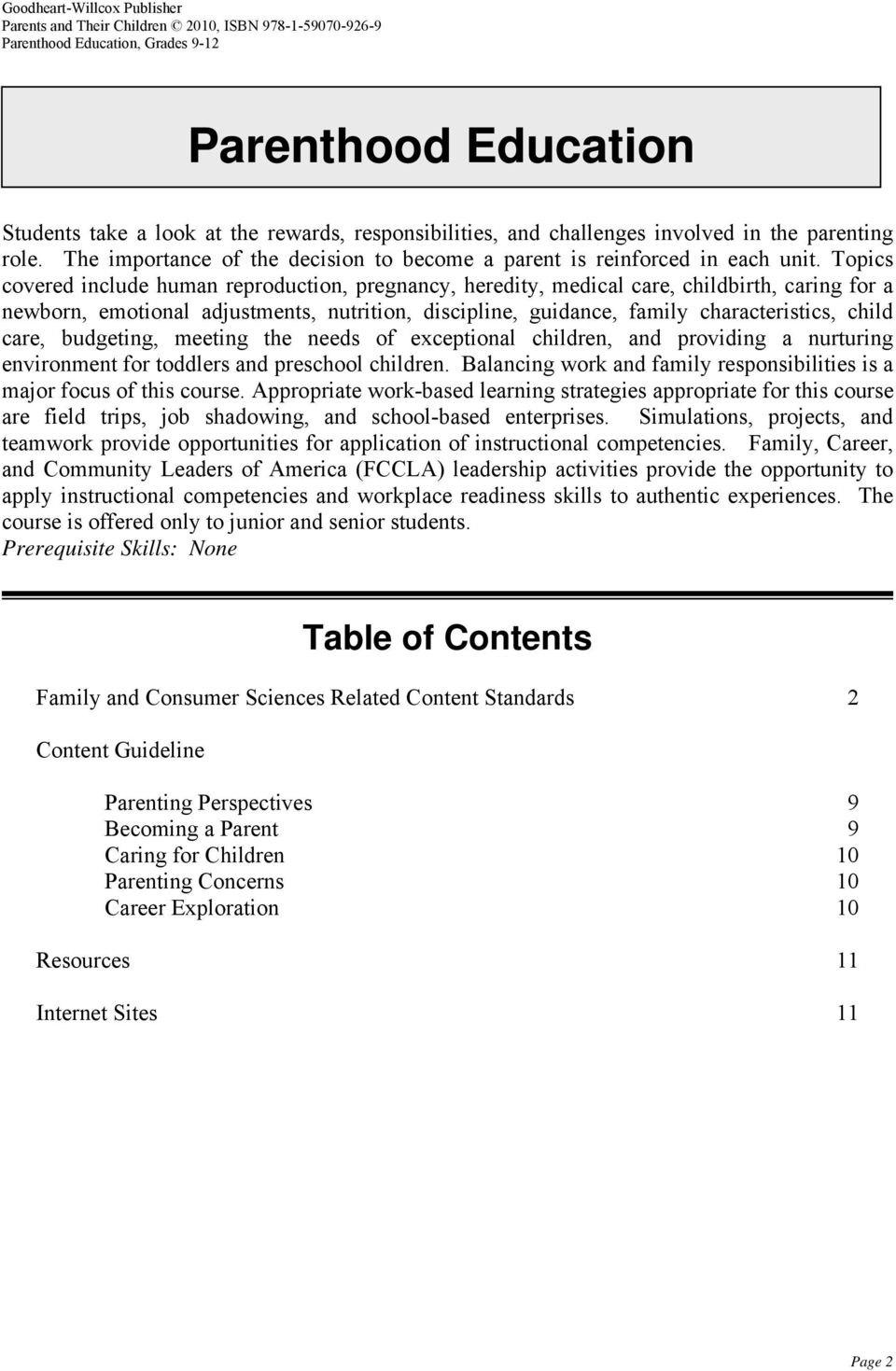
3 Strand: Human Development and Family Relationships Standard 1. Analyze human growth and development across the life span. 1. Explain principles of human growth and development. 2. Examine major historical and current human development theories to interpret human development. 3. Examine the basic human needs and patterns that influence individual development. 4. Explain factors that shape human development from preconception through the life cycle , , , , , , , Consider the influences of personality, temperament, and experience on learning and development. 6. Investigate the interrelationship of physical, emotional, social, and intellectual development across the life span. Standard 2. Analyze personal and social forces that impact human growth and development across the life span. 1. Investigate the impact of heredity and family on human growth and development. 63, 84, 166 Standard 3. Analyze all aspects of a child s growth and development. 1. Analyze principles of human growth and development. 2. Evaluate major historical and current child development theories and their effects on educational practices. 3. Examine and assess all aspects of a child s growth and development in the following areas: physical, cognitive, language acquisition, social, and emotional. Page 3

4 4. Determine strategies that promote a child s growth and development , , , , , , , , , , , , , , , , , , , , , Standard 4. Evaluate the preparation necessary for a healthy emotional and physical beginning for parents and children. 1. Assess biological processes related to prenatal development, birth, and factors that affect the health of the parents and child. 2. Review the emotional factors of prenatal development and birth involving the health of the parents and child , 201, 217, , , , , , , , Standard 5. Evaluate strategies that promote healthy development across the life span. 1. Select nurturing practices that support development across the life span , , 51, 61-68, 72-73, , , Page 4
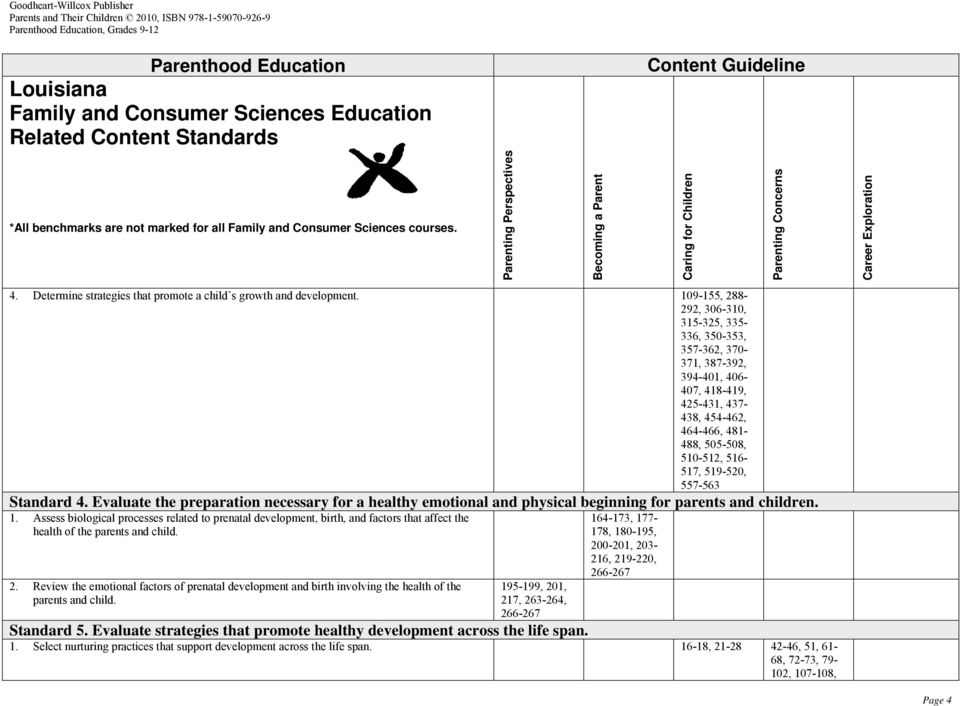
5 , , , , , , , , , , , , , , 413, , , , Assess available support systems that meet human needs. 3. Determine communication principles and patterns that affect human growth and development. Standard 6. Evaluate attributes of respectful and healthy relationships. 1. Determine the processes for building and maintaining respectful and healthy relationships , 39-48, 50-51, , , , , , , , , , , , , , , , , Page 5
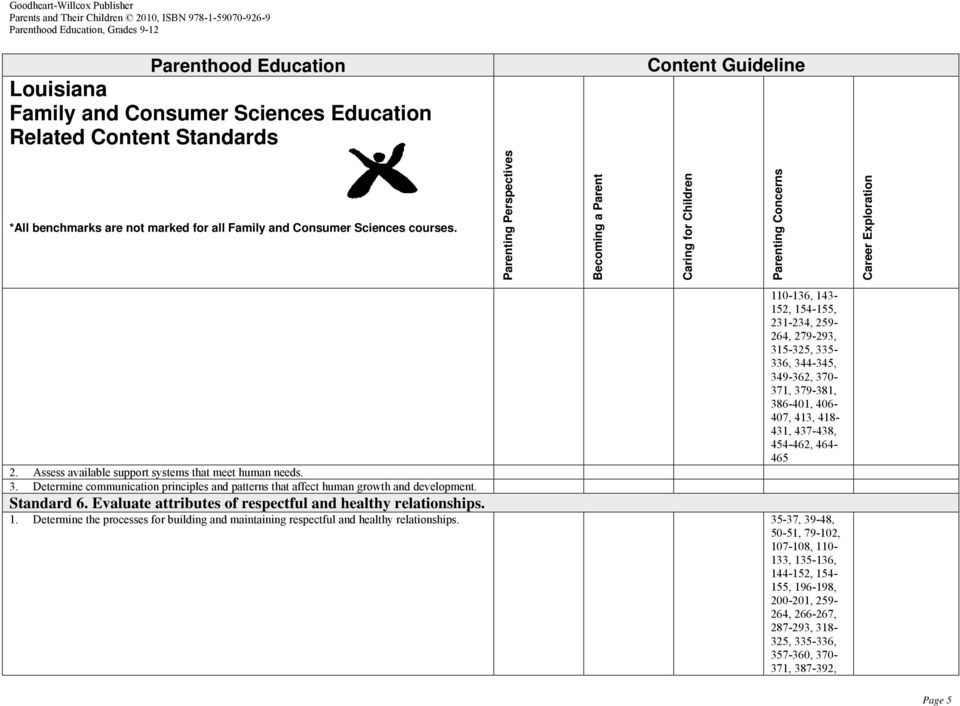
6 , 400, , , , , , Review functions and expectations of various types of relationships. 3. Determine factors contributing to healthy and unhealthy relationships. 4. Assess processes for handling healthy and unhealthy relationships. 5. Appraise the impact of life events and conditions on relationships. 6. Assess the effect that various stages of the life span have on relationships , 44-48, Standard 7. Analyze personal needs and characteristics which influence relationships. 1. Examine personal, physical, social, emotional, cognitive, and creative characteristics which influence relationships , 27-28, 39-48, 50-51, 61-67, 73, 90-95, , Standard 8. Demonstrate the capacity to sympathize with others based on multiple perspectives, needs, and characteristics that may affect personal and family relationships. 1. Demonstrate the impact of empathy on relationships. 140, , Standard 9. Demonstrate communication skills that contribute to positive relationships. 1. Examine communication styles and their effects on relationships. 90, 92-95, , 111, , 124, Page 6
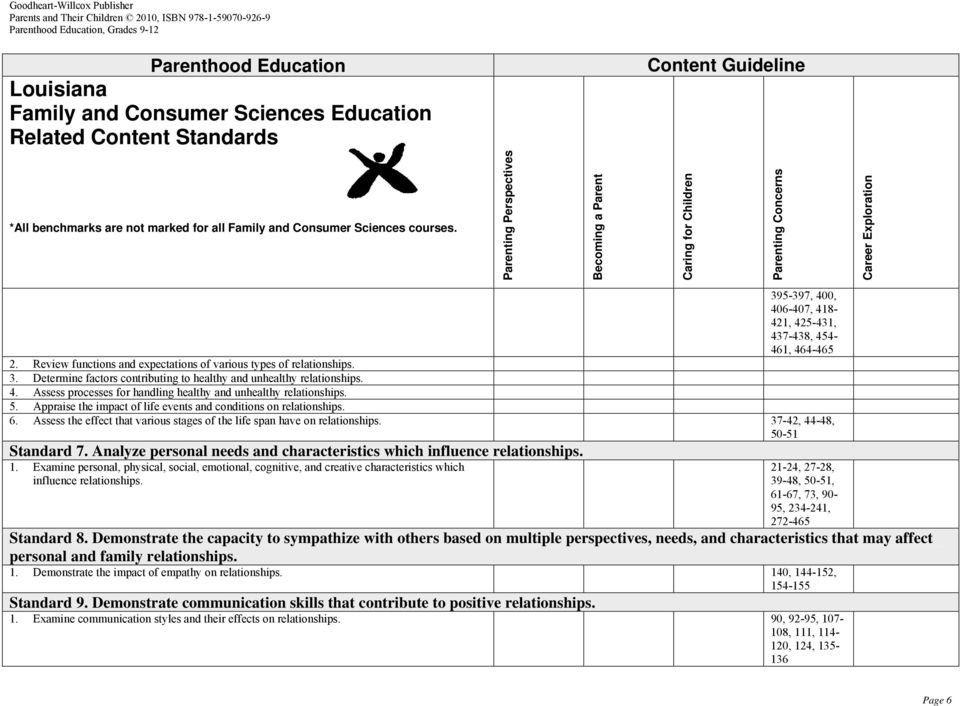
7 Standard 15. Examine the significance of the family. 1. Analyze the development of families in this culture and others. 24, 42-43, 50-51, 112, , Analyze the impacts of social, economic, and technological forces on the family. 3. Describe the roles of family in teaching culture to family members. 4. Describe the roles of family in instilling societal skills of communication, education, and role expectations , 50-51, , 163, , 385, , , 407, , , 438, 443, , Standard 16. Analyze family development and change across time and cultures. 1. Describe family formation , 50-51, , , Describe major family responsibilities including care giving, child rearing, social, legal, education, economic, leisure, security, and spirituality. 3. Compare ways in which family members are dependent, interdependent, and independent. 4. Examine commitment and interdependence among family members. 5. Analyze the family as a system and its effects on individual family members within the family unit. 6. Examine how knowledge of family systems contributes to family well-being. 7. Examine the potential impact of a change in family membership , , Page 7

8 Standard 19. Analyze roles and responsibilities of parenthood. 1. Explain the role of parenting Explain how opinions and attitudes about childhood affect beliefs and actions in parenting , Compare expectations and responsibilities of parenthood , 27-28, 53-61, Examine consequences of parenting practices to the individual, family, and society. 48, , Examine cultural differences in roles and responsibilities of parenthood , 51 Standard 20. Analyze societal conditions that impact parenting. 133, , Analyze the impact of personal, family, and social development on parenthood Examine society s influence on the behaviors and emotional patterns of caregivers and family 48, , 519- members Explore the impact of changing economic conditions on parenting practices , 66-67, Standard 21. Analyze parenting skills and practices needed to support physical, economical, social, intellectual, and emotional well-being throughout the life span 1. Examine the interrelationships of parents and other family members and analyze their effect on 79-81, others. 2. Determine the role of nurturance in supporting the development of family members. 85, 110, , , , , Examine communication strategies which promote positive self-esteem in family members , , 136 Page 8
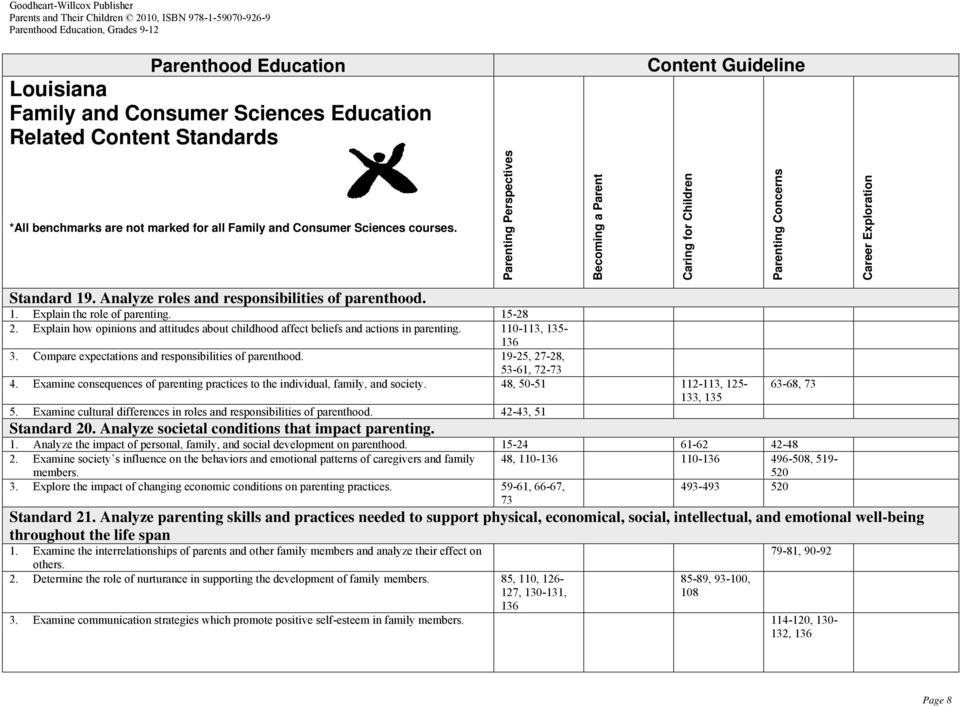
9 Standard 22. Analyze public policies, agencies, and services that impact parenting. 1. Investigate community resources and services available for protection, health, education, and wellness needs of family members. 2. Investigate community agencies and services that provide opportunities to learn parenting skills. Standard 23. Demonstrate a safe and healthy learning environment. 1. Demonstrate security and emergency procedures. 2. Carry out safe and healthy practices that comply with state regulations to include, but not limited to, first aid and CPR, universal precautions, food handling, tuberculosis prevention, sanitation, and child s health status. 3. Implement strategies to teach children healthy habits , 370, , , Prepare nutritious meals and snacks Identify symptoms of child abuse and neglect, and use appropriate procedures to report , 519- suspected abuse or neglect to the designated authorities Implement basic health practices and prevention procedures regarding childhood illnesses and , 562- communicable diseases , , 508, 514, , , , 133 Standard 24. Apply developmentally appropriate practices to the care of children. 1. Identify developmental milestones of a child s growth and development. 2. Apply a variety of assessment methods to observe and interpret children s behavior. 3. Identify the special needs of exceptional children , Page 9
10 Standard 28. Demonstrate the interrelationship of family, community, and career roles and responsibilities for individual. 1. Examine the relationship of social, economic, and technological changes to work and family dynamics. 2. Examine life roles and responsibilities in relation to self, family, and the community. 3. Design strategies to manage time, finances, conflict, opportunity, and stress as they affect the individual and family at home, at work, and in the community. 4. Examine family support systems and community resources , , 133, 136 Standard 32. Synthesize community networking opportunities in family and community services. 1. Identify local, state, and national agencies and informal support resources providing human services to individual and families. Standard 37. Demonstrate effective communication skills that enhance collaborative working relationships. 1. Demonstrate clear and logical written, verbal, and non-verbal communication , Demonstrate positive interpersonal skills to resolve conflict, negotiate, work as a team, and provide leadership. 3. Use accepted career/service terminology and technical information Standard 38. Demonstrate transferable employability skills in relation to individual, family, community, and career roles. 1. Demonstrate job-seeking skills Apply communication skills in family, community, and career settings. 270, Demonstrate work ethics and professionalism Maintain safe and healthy family, community, and workplace environments Demonstrate teams skills needed in the family, community, and workplace , Page 10

11 6. Demonstrate technological literacy, as applied in family, community, and workplace 12, 76, 158, 270, environments. 468, , Apply the economics of work to individual, family, and community needs. 59, 107, , , , Relate essential living skills to employability skills for individuals Practice appropriate personal hygiene and dress requirements needed in various workplaces , 592 Standard 39. Demonstrate professional practices and standards when working with children and families. 1. Participate in continuing training and educational opportunities. 2. Apply professional ethical standards accepted by the recognized professional organizations. 3. Implement federal, state, and local standards, policies, regulations, and laws that impact 4. children, families, and programs. Demonstrate employability skills , Standard 40. Evaluate career paths within early childhood, family, community, and educational services. 1. Assess the importance of early childhood, family, community, and education services in the , 592 United States and the world. 2. Research the roles and functions of individuals engaged in early childhood, family, community, 158, 270, 468, and educational services careers , Assess employment opportunities and preparation requirements Review education and training requirements for different levels of employment Assess the impact of early childhood, family, community, and educational service occupations 6. on the local, state, national, and global economies. Research entrepreneurial opportunities related to these careers. 571, 593 Page 11

12 7. Assess how interests, education, personal priorities, and family responsibilities affect career choices in these areas Page 12
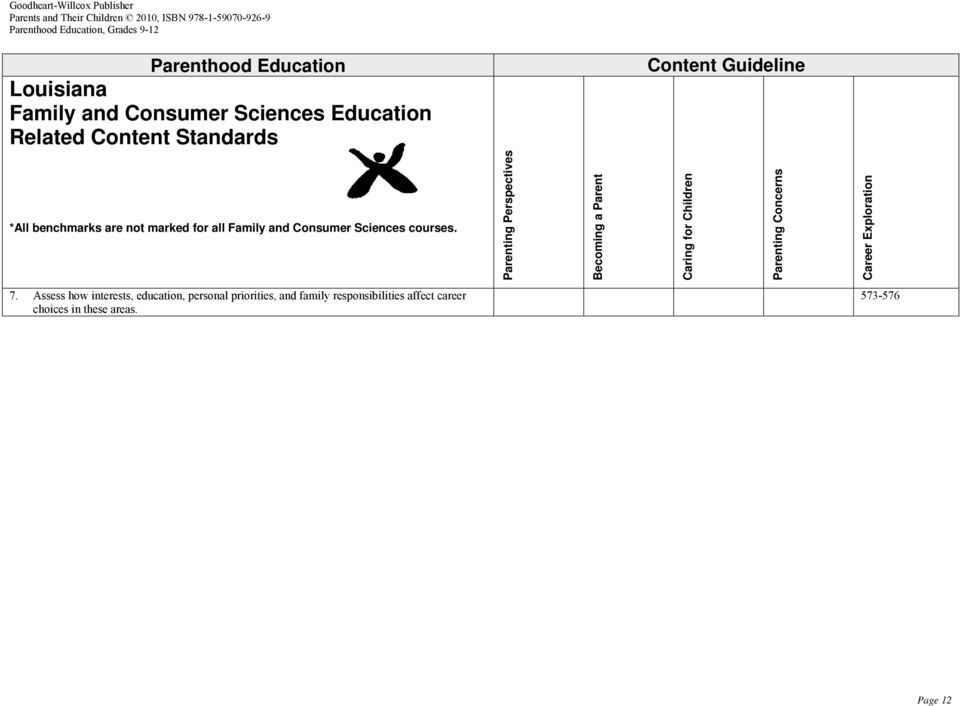
13 Unit One (The student will be able to...) 1. Summarize parenting roles and responsibilities. 2. Interpret the meaning and responsibilities of parenthood across the life span. 3. Recognize the role and responsibilities of parenthood in family functioning. 4. Compare and contrast parenthood roles and responsibilities in various family structures. 5. Discuss various approaches to parenting. 6. Explain how parenting is affected by society and other outside influences. 7. Compare and contrast different parenting styles. 8. Form ideas about your parenting philosophy. 9. Distinguish between myths and realities of parenthood. Unit Two 1. Determine the importance of readiness for parenthood. a. Investigate how finances and budgeting affect readiness. b. Summarize and apply the steps of the decision-making process. 2. Compare family planning methods. 3. Suggest sources of education for parents. 4. Explain the processes of human reproduction. 5. Describe alternate ways to become a parent. 6. Research the costs of having a child. 7. Discuss aspects of a healthy pregnancy. 8. Describe physical changes during pregnancy. a. Recommend activities and care for a healthy pregnancy. b. Plan a nutritionally adequate diet for a healthy mother and fetus. c. Outline the stages of prenatal development. 9. Investigate options for childbirth. 10. Explain the father s role during pregnancy. 11. Prepare for the individual and family adjustments to parenthood or additional children in the family. 12. Examine roles, responsibilities, and concerns of teen parents. 13. Examine roles, responsibilities, and concerns of single parents. Page 13
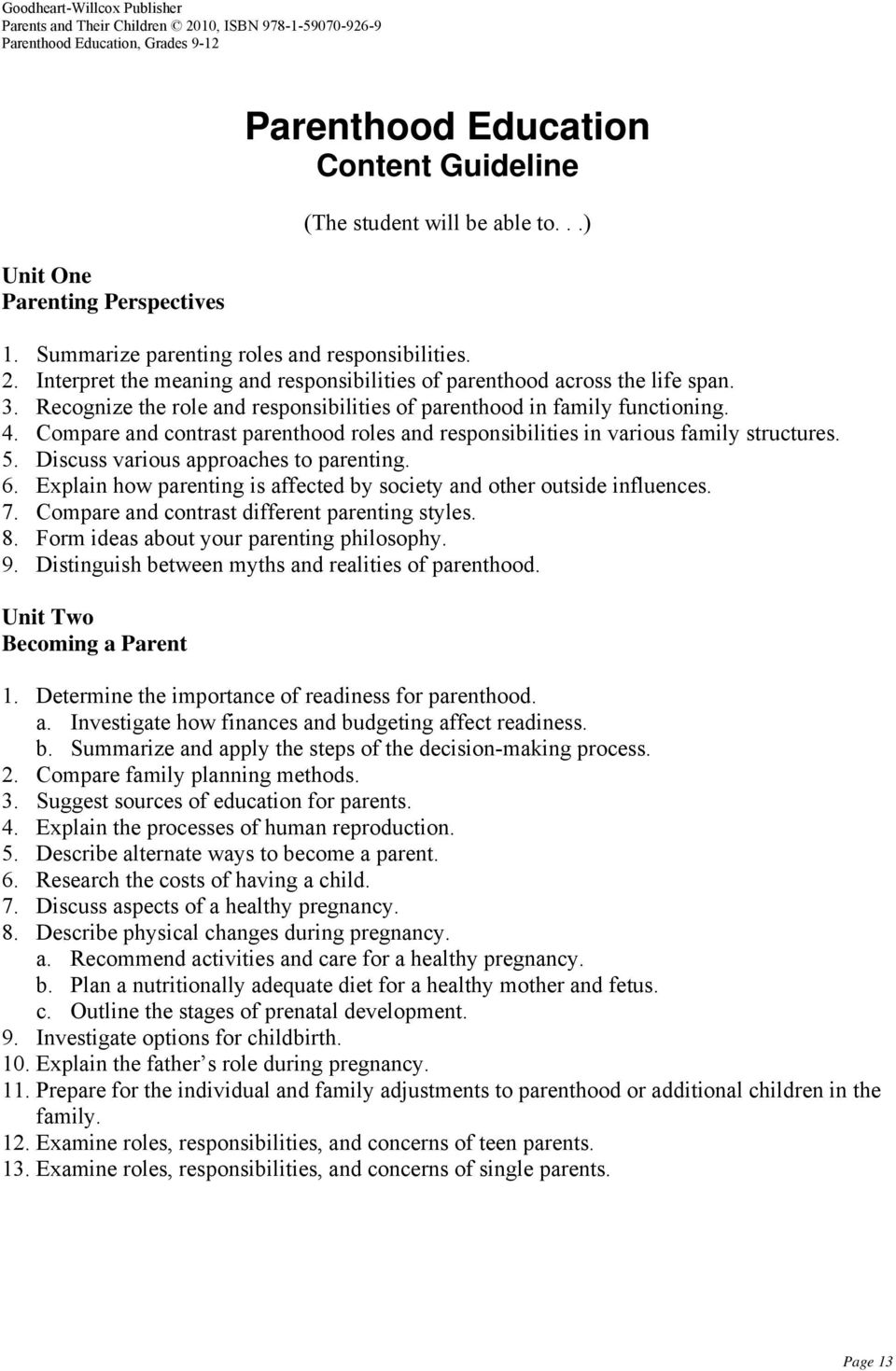
14 Unit Three 1. Explain parenting responsibilities in caring for an infant. a. Select clothing, equipment, and supplies needed for an infant. b. Discuss needs of an infant associated with feeding and medical care. 2. Describe ways parents should meet the physical needs of children. a. Compare different stages of childhood. b. Demonstrate ways to promote good nutrition and developmentally appropriate activities. 3. Discuss ways parents meet health and safety needs of children. 4. Evaluate ways parents meet emotional needs of children. 5. Assess ways parents meet the intellectual needs of children. 6. Promote appropriate methods for nurturing a child s development. 7. Promote appropriate methods of guiding children. Unit Four 1. Analyze strategies for managing parenting concerns. 2. Determine ways parents can assist children in dealing with stress and family crisis. 3. Explain the importance of the parent-child relationship. a. Describe factors that promote a positive parent-child relationship. b. Examine communication techniques for positive parent-child relationships. 4. Discuss the impact of technology on parenting. 5. Utilize technology to enhance parenting skills. 6. Explain ways to meet the needs of exceptional children. 7. Outline the characteristics of a desirable child care provider. 8. Discuss parental involvement in the school experience. 9. Explain parenting leave. 10. Identity and explain factors to consider when selecting medical care. 11. Analyze the forms of child abuse and neglect. 12. Outline steps to combat child abuse and neglect. 13. Compare agencies, services, resources, and support systems available to meet the needs of parents and children. Unit Five 1. Utilize activities of the Family, Career, and Community Leaders of America (FCCLA) student organization as an integral component of course content and leadership development. 2. Analyze career options relating to parents and children. 3. Apply employability skills in career development opportunities. Page 14
15 Resources Brisbane, S. (2000). The Developing Child. New York, NY: Glencoe McGraw-Hill. Family, Career, and Community Leaders of America. (2001). Family, Career and Community Leaders of America Chapter Handbook. Reston, VA: Author. Hildebrand, V. (2000). Parenting Rewards and Responsibilities. New York, NY: Glencoe McGraw-Hill. Department of Education. (1998). Family and Consumer Sciences Content Standards: Curriculum Framework. Baton Rouge, LA: Author. Nurturing Brain Development. (2003). New York, NY: Glencoe McGraw-Hill. Internet Sites American Association for Family and Consumer Sciences. Family, Career, and Community Leaders of America, Inc. Books and Beyond Educational Programs and Services. Child Development Institute. Home and Family Online Resource. Indiana State Department of Education. Parents Magazine. The Parenting Group. Page 15

o Ivy Tech ECED 100 Introduction to Early Childhood Education ECED 101 Health, Safety and Nutrition ECED 103 Curriculum in Early Childhood Classroom
 Indiana Department of Education Academic Course Framework EARLY CHILDHOOD EDUCATION I Early Childhood Education I prepares students for employment in early childhood education and related careers that
ARIZONA CTE CAREER PREPARATION STANDARDS & MEASUREMENT CRITERIA EARLY CHILDHOOD EDUCATION, 13.1210.00
 EARLY CHILDHOOD EDUCATION, 13.1210.00 STANDARD 1.0 ANALYZE THE CONTINUUM OF PHYSICAL AND SENSORY DEVELOPMENT OF YOUNG 1.1 Analyze factors influencing prenatal development 1.2 Explain the general progression
Parenting and Child Development
 Technical Committee Report and Curriculum Guide for Idaho Family and Consumer Sciences Parenting and Child Development IBEDS 22204 This report was prepared by the Idaho Division of Professional-Technical
AA 1 Utilize effective verbal and non-verbal communication skills. AA 2 Participate in conversation, discussion, and group presentations
 Early Childhood Education Alignment Page 1 Old # AA006 Standard Adapt listening strategies to utilize verbal and nonverbal content of communication ACADEMIC AA SPEAKING AND LISTENING AA 1 Utilize effective
Month Content Skills Assessments Objectives and Standards. September. Semester 2: February
 Month Content Skills Assessments Objectives and Standards Semester 1: Family Systems -writing Childhood Understand different types of family September -reflection Project: 20 Explore Nature vs. Nurture
Outline Chapter 1 Child Psychology 211 Dr. Robert Frank. 1 What is child development, and how has its study evolved?
 Outline Chapter 1 Chapter 1: GUIDEPOSTS FOR STUDY 1 What is child development, and how has its study evolved? 2 What are six fundamental points about child development on which consensus has emerged? 3
Field 011: Career and Technical Education Family and Consumer Sciences Assessment Blueprint
 Field 011: Career and Technical Education Family and Consumer Sciences Assessment Blueprint Domain I Family Studies, Human Development, and Education 0001 Career, Community, and Family Connections (Standard
SOUTHEAST MISSOURI STATE UNIVERSITY COURSE SYLLABUS. Title of Course: Child Health, Safety and Nutrition New: Fall 2000
 SOUTHEAST MISSOURI STATE UNIVERSITY COURSE SYLLABUS Department of: Human Environmental Studies Course No.: CF124 Title of Course: Child Health, Safety and Nutrition New: Fall 2000 I. Catalog Description
Early Childhood Education- Distance Prior Learning Assessment Recognition (PLAR) - Comprehensive. Course Descriptions 2012 Program
 School of Academics, Applied Arts and Tourism Early Childhood Education- Distance Prior Learning Assessment Recognition (PLAR) - Comprehensive Course Descriptions 2012 Program EE1290 Positive Behaviour
The Georgia Early Care and Education Professional Development Competencies
 Page 1 The Georgia Early Care and Education Professional Development Competencies Early Care and Education Professional School-Age Care Professional Program Administrator Trainer Technical Assistance Provider
Western Wayne School District Planned Course. Days-Number 180 Grade(s) 11-12 Or Check One ( ) Quarter Semester XXX Full Year
 Western Wayne School District Planned Course Course Name: Early Childhood Education I Days-Number 180 Grade(s) 11-12 Or Check One ( ) Quarter Semester XXX Full Year Course Description: This course provides
DELAWARE COMPETENCIES for EARLY CHILDHOOD PROFESSIONALS
 DELAWARE COMPETENCIES for EARLY CHILDHOOD PROFESSIONALS INTRODUCTION Delaware Department of Education in collaboration with Delaware Higher Education and the Delaware early childhood community have developed
Kentucky Career and Technical Education Curriculum Alignment Resource. Child and Human Development
 Kentucky Career and Technical Education Curriculum Alignment Resource Child and Human Development Project Launched October 2011 KENTUCKY CAREER PATHWAY/PROGRAM OF STUDY TEMPLATE Recommended Course Sequence
Standards for Certification in Early Childhood Education [26.110-26.270]
![Standards for Certification in Early Childhood Education [26.110-26.270]](/thumbs/24/3436110.jpg "Standards for Certification in Early Childhood Education [26.110-26.270]") I.B. SPECIFIC TEACHING FIELDS Standards for Certification in Early Childhood Education [26.110-26.270] STANDARD 1 Curriculum The competent early childhood teacher understands and demonstrates the central
I.B. SPECIFIC TEACHING FIELDS Standards for Certification in Early Childhood Education [26.110-26.270] STANDARD 1 Curriculum The competent early childhood teacher understands and demonstrates the central
Table of Contents. Introduction... 3-7. WV STARS Career Pathway Levels... 6
 Table of Contents Introduction... 3-7 WV STARS Career Pathway Levels... 6 1. 2. Child Growth and Development... 8-10 1.1 Characteristics and Needs of Young Children... 9 1.2 Multiple Influences on Development
Early Childhood Education / Course Outcomes
 Early Childhood Education / Course Outcomes Development in Early Childhood CCED102 1. To understand the stages of development from pre- natal to 7/8 years of age in order to have appropriate and reasonable
Florida Department of Education Curriculum Framework. 25-2011 Preschool Teachers, Except Special Education
 Florida Department of Education Curriculum Framework 2013 2014 Program Title: Career Cluster: Early Childhood Education Associate Degree Education and Training CIP Number 1413121003 Program Type Standard
Independent Living. #09025 Grades 9-12*
 Independent Living #09025 Grades 9-12* To prepare students for responsibilities involved in becoming self-sufficient young adults preparing for life away from the parental home during or immediately following
Human Services Cluster
 Page 1 of 6 Human Services Cluster T57321 Interpersonal Relationships (5364) 1 semesters, 1 credit per semester Approximate cost per semester: $16.21 This course addresses essential knowledge and skills
13. Competency/Outcome: Students will learn to serve as an advocate on behalf of young children and their families. (ESPB Standard 50037.8.
 Recommended Course Title: Introduction to Early Childhood Education Recommended Course Number: 210/310 1. Competency/Outcome: Students will compare and contrast the major existing theories that influence
ASCA National Standards. Developed by: American School Counselor Association
 ASCA National Standards Developed by: American School Counselor Association Guidance and counseling program content standards and student competencies. 7.1. Academic development. The content standards
Education & Training Career Cluster Early Childhood Education I Course Number 20.52810
 Education & Training Career Cluster Early Childhood Education I Course Number 20.52810 Course Description: The Early Childhood Education I course is the foundational course under the Early Childhood Care
COURSE TITLE: CHILD CARE & DEVELOPMENT LENGTH: ONE SEMESTER GRADES 11 12 DEPARTMENT: FINE, PRACTICAL, AND PERFORMING ARTS SCHOOL:
 COURSE TITLE: CHILD CARE & DEVELOPMENT LENGTH: ONE SEMESTER GRADES 11 12 DEPARTMENT: FINE, PRACTICAL, AND PERFORMING ARTS SCHOOL: RUTHERFORD HIGH SCHOOL RUTHERFORD, NEW JERSEY DATE: SPRING 2015 Child Care
CHD 12023T COURSE OUTLINE. Prerequisites: None. Course Description:
 23T Lecture Revised: Fall 2015 CHD 12023T 23TIntroduction to Early Childhood COURSE OUTLINE Prerequisites: None Course Description: This course introduces early childhood development through activities
The Wisconsin Comprehensive School Counseling Model Student Content Standards. Student Content Standards
 The Wisconsin Comprehensive School Counseling Model Student Content Standards The Wisconsin Comprehensive School Counseling Model builds the content of developmental school counseling programs around nine
BIRTH THROUGH AGE EIGHT STATE POLICY FRAMEWORK
 BIRTH THROUGH AGE EIGHT STATE POLICY FRAMEWORK The Birth Through Eight State Policy Framework is a tool, or roadmap, that anyone can use to guide policy in ways that will improve the health, learning,
Smart Horizons/Child Care Aware: alignment of courses with VT Core Knowledge Areas 9-12 www.smarthorizons.org/childcare
 Child/Youth Development Discovery of Math (.1 CEU/1 Early Literacy (.1 CEU/1 Equipment, Activities, and Strategies for Promoting Physical Activity (.1 CEU/1 Learning My A,B,Cs (.3 CEU/3 Learning Through
HEAD START PERFORMANCE STANDARDS W/ MENTAL HEALTH FOCUS
 HEAD START PERFORMANCE STANDARDS W/ MENTAL HEALTH FOCUS This list represents a variety of Head Start Performance Standards that include some aspect of mental health; however, it is not exhaustive of every
Health Education Core ESSENTIAL QUESTIONS. It is health that is real wealth, and not pieces of gold and silver. Gandhi.
 Health Education Core ESSENTIAL QUESTIONS It is health that is real wealth, and not pieces of gold and silver. Gandhi Increased Focus Classroom Real Life Connection Student Reflection Student Assessment
FAMILY AND CONSUMER SCIENCES EDUCATION. Family and Consumer Sciences Foundations. Course Title: Personal and Family Development Grade Placement: 9
 FAMILY AND CONSUMER SCIENCES EDUCATION Family and Consumer Sciences Foundations Course Title: Personal and Family Development Grade Placement: 9 Credit: 1 Unit This comprehensive laboratory course deals
(CIP: 19.0707) θθθθθ A. Demonstrates Professional Work Habits (Vermont Standards: 1.5, 3.10, 3.14, 3.15, 3.16, 6.15)
 Human Services (CIP: 19.0707) Occupational Skills The Student demonstrates the specified level of competency in occupational skills: 0 1 2 3 4 No Exposure Introduced Practiced Entry-level Competency ORIENTATION
Common Core Content Early Childhood Educator. Entry Through Bachelor s Level
 Common Core Content Early Childhood Educator Entry Through Bachelor s Level Prepared by Higher Education Early Childhood Task Force May 2002 Revised April, 2011 COMMON CORE CONTENT and COMPETENCIES for
Self-Assessment for Administrators of Child Care Programs
 Self-Assessment for Administrators of Child Care Programs Child Care Director s and Administrator s Self-assessment North Carolina Institute for Early Childhood Professional Development Self-assessment
Education & Training Career Cluster Early Childhood Education II Course Number: 20.42400
 Education & Training Career Cluster Early Childhood Education II Course Number: 20.42400 Course Description: Early Childhood Education II is the second course in the Early Childhood Care and Education
NEW YORK STATE TEACHER CERTIFICATION EXAMINATIONS
 NEW YORK STATE TEACHER CERTIFICATION EXAMINATIONS TEST DESIGN AND FRAMEWORK September 2014 Authorized for Distribution by the New York State Education Department This test design and framework document
Core Competencies for Early Education and Care and Out-of-School Time Educators. Table of Contents
 Core Competencies for Early Education and Care and Out-of-School Time Educators Table of Contents Introduction Page 3 A Quick Reference to the Core Competency Areas and Subcategories Page 10 Core Competency
Alignment of the Career and Life Role Common Curriculum Goals with Career-Related Learning Standards Oregon Department of Education October 2002
 Alignment of the Career and Life Role with Oregon Department of Education October 2002 (available on the ODE website at www.ode.state.or.us/cimcam) The Oregon Department of Education hereby gives permission
Georgia Performance Standards. Health Education
 HIGH SCHOOL Students in high school demonstrate comprehensive health knowledge and skills. Their behaviors reflect a conceptual understanding of the issues associated with maintaining good personal health.
JEFFERSON TOWNSHIP SCHOOLS COURSE OF STUDY ADVANCED CHILD DEVELOPMENT CP GRADE 12
 JEFFERSON TOWNSHIP SCHOOLS COURSE OF STUDY ADVANCED CHILD DEVELOPMENT CP GRADE 12 SEPTEMBER 2011 TABLE OF CONTENTS JEFFERSON TOWNSHIP HIGH SCHOOLCURRICULUM ADVANCED CHILD DEVELOPMENT CP Topic Page Number(s)
Program Administrator Definition and Competencies
 I. Program Administrator Definition The program administrator is the individual responsible for planning, implementing, and evaluating a child care, preschool or kindergarten program. The role of the administrator
EARLY CHILDHOOD EDUCATION
 Louisville Main Campus Lexington Branch Campus 3101 Bardstown Road Louisville, KY 40205 2355 Harrodsburg Road Lexington, KY 40504 (502)456-6504 (800)844-1354 (859)276-4357 (800)467-6281 fax (502) 456-0031
SAMPLE 2 WORKSHEET - Child Growth and Development
 SAMPLE 2 WORKSHEET - Child Growth and Development CAP Samples and Recommendation Your Campus Course Information Course Title: Course Title: Child Growth and Development Child Development Explanation of
Grade K Health Education, Quarter 1, Unit 1 of 2. Mental and Emotional Health: You Think and Feel. Overview
 Grade K Health Education, Quarter 1, Unit 1 of 2 Mental and Emotional Health: You Think and Feel Overview Overall Days: 4-5 days (1 day = 30 minutes) Content to be learned Choose healthy behaviors. Identify
CCEI Online College Credit Eligible CDA Certificate Family Child Care Program Syllabus
 CCEI Online College Credit Eligible CDA Certificate Family Child Care Program Syllabus Settings: Family Care Program Code: 1103-CDA Program Length: 151 Hours IACET CEU Value: 15.1 CEUs Program Start Date:
CTSO Course Alignments: Early Childhood Education Careers I
 CTSO Course Alignments: Early Childhood Education Careers I Below you will find standards for the Early Childhood Education Careers I course aligned with competitive events from appropriate career and
Consumer and Resource Management #09028 Grades 9-12
 Consumer and Resource Management #09028 Grades 9-12 To help students learn how to make intelligent choices in the use of resources in order to gain maximum personal and family satisfaction. Course content
Learning Outcomes Framework
 Learning Outcomes Framework May 2004 Health/Personal Development and Relationships Grades 7 9 Learning Outcomes Framework Health/Personal Development and Relationships Grades 7 9 Draft DRAFT GRADE 7
WV Birth to Three. Comprehensive System of Personnel Development CORE COMPETENCIES FOR EARLY INTERVENTION AND SERVICE COORDINATION SPECIALISTS
 WV Birth to Three Comprehensive System of Personnel Development CORE COMPETENCIES FOR EARLY INTERVENTION AND SERVICE COORDINATION SPECIALISTS April, 2003 Revised May, 2008 Acknowledgments The WV Birth
EARLY CHILDHOOD GUIDANCE CURRICULUM May 2008. *For EC2 and EC3: Cover competencies that are developmentally appropriate for 2 and 3 year olds.
 EARLY CHILDHOOD GUIDANCE CURRICULUM May 2008 *For EC2 and EC3: Cover competencies that are developmentally appropriate for 2 and 3 year olds. 1. Standard-Academic Self-Management for Lifelong Learning
How To Become A Personal Support Worker
 PROGRAM OBJECTIVES The Personal Support Worker program prepares students to deliver appropriate short or longterm care assistance and support services in either a long-term care facility, acute care facility,
NATIONAL STANDARDS Lesson 1: Healthy Me!
 NATIONAL STANDARDS ers HEALTH EDUCATION STANDARDS (GRADES 3-5) Source: National Health Education Standards, Achieving Excellence, Second Edition (2007), Joint Committee on National Health Education Standards
Florida Department of Education Curriculum Framework
 Florida Department of Education Curriculum Framework 2015 2016 Program Title: Program Type: Career Cluster: Early Childhood Education NEW Career Preparatory Education & Training Note: This program is approved
CCEI Online Self-Study CDA Certificate Program Syllabus
 CCEI Online Self-Study CDA Certificate Program Syllabus Settings: Infant/Toddler or Preschool and Family Care Program Code: 1302-CDA Program Length: 125 Hours IACET CEU Value: 12.5 CEUs Program Start Date:
Test Code: 7933 / Version 1
 Pennsylvania Customized Assessment Blueprint Test Code: 7933 / Version 1 Copyright 2013. All Rights Reserved. General Assessment Information Blueprint Contents General Assessment Information Written Assessment
Standards for the School Social Worker [23.140]
![Standards for the School Social Worker [23.140]](/thumbs/40/21507228.jpg "Standards for the School Social Worker [23.140]") Standards for the School Social Worker [23.140] STANDARD 1 - Content The competent school social worker understands the theories and skills needed to provide individual, group, and family counseling; crisis
Standards for the School Social Worker [23.140] STANDARD 1 - Content The competent school social worker understands the theories and skills needed to provide individual, group, and family counseling; crisis
YOUTH WORK READINESS CURRICULUM
 AKAZI KANOZE, Youth Livelihoods Project PHONE: (+250) (0)252 580 796/805/806, FAX: (+250) (0)252 580 797; P.O. BOX: 2498 Kigali/Rwanda, http://edc.org/ and http://akazikanoze.edc.org/ YOUTH WORK READINESS
Hoover City Schools Secondary Curriculum Social Studies, 2005-06
 Course Information: HCS Curriculum: Social Studies 6 12 Hoover City Schools Secondary Curriculum Social Studies, 2005-06 Course Title: Psychology, IB Grade Level: 11-12 Course Description: This course
Because children ARE our future. [email protected] www.idealearlylearning.com Office: (678) 632-4085 Fax: (678) 228-1912
 Because children ARE our future [email protected] www.idealearlylearning.com Office: (678) 632-4085 Fax: (678) 228-1912 Dr. Bisa Batten Lewis, Founder & CEO Course Information Child Development
School of Social and Behavioral Sciences
 human development School of Social and Behavioral Sciences Acting Dean: Daniel E. Rivas, Ph.D. Academic Chair: Kari Tucker, Ph.D. Faculty: Ingrid Anderson, Julie Bookwalter, Marilee Cosgrove, Donna Gray,
PURPOSE: To inform the Bureau Staff of a new apprenticeable occupation:
 BULLETIN 2002-02 Date: November 28, 2001 U.S. Department of Labor Employment and Training Administration Office of Apprenticeship Training, Employer and Labor Services Washington, D.C. 20210 Symbols: DSNIP/DMc
ILLINOIS PROFESSIONAL TEACHING STANDARDS (2013)
 ILLINOIS PROFESSIONAL TEACHING STANDARDS (2013) Standard 1 - Teaching Diverse Students The competent teacher understands the diverse characteristics and abilities of each student and how individuals develop
Personal Financial Literacy 2010, (Madura, et al)
 Prentice Hall 2010, (Madura, et al) High School C O R R E L A T E D T O Kentucky Occupational Skill Standards - 3008 - Family and Consumer Management Kentucky - Business Education - Programs of Studies
STANDARDS FOR GUIDANCE COUNSELING PROGRAMS
 STANDARDS FOR GUIDANCE COUNSELING PROGRAMS These standards were approved January 2005 by the Kentucky Education Professional Standards Board. The Kentucky Standards for Guidance Counselor Programs are
Please see current textbook prices at www.rcgc.bncollege.com
 PSY213: CHILD PSYCHOLOGY SYLLABUS LECTURE HOURS/CREDITS: 3/3 CATALOG DESCRIPTION Prerequisite: PSY101 General Psychology Development and analysis of prenatal factors and, infant and child behavior are
Professional Requirements & Training for Preschool Teacher. Introduction to Early Childhood Care and Education by Dr.
 Professional Requirements & Training for Preschool Teacher Introduction to Early Childhood Care and Education by Dr. Chiu, Mei-Wen Outline Description of Preschool Teachers How to Become a Preschool Teacher
Putting the Head Start Parent, Family, and Community Engagement Framework to Work in Your Program: Integrating Strategies for Program Progress (ISPP)
 Putting the Head Start Parent, Family, and Community Engagement Framework to Work in Your Program: Integrating Strategies for Program Progress (ISPP) This document was prepared under Grant #90HC0003 for
Florida Core Competencies for Early Care and Education Practitioners. September 2010
 Florida Core Competencies for Early Care and Education Practitioners September 2010 Florida Core Competencies for Early Care and Education Practitioners Table of Contents Core Competencies and Purpose
National Health Education Standards: For Students
 National Health Education Standards: For Students HEALTH EDUCATION STANDARD 1: Students will comprehend concepts related to health promotion and disease prevention. Basic to health education is a foundation
How Parents as Teachers Outcomes Align with Federal Home Visiting Initiative Benchmarks
 How Parents as Teachers Outcomes Align with Federal Home Visiting Initiative Benchmarks The table below highlights how Parents as Teachers outcomes, as outlined in the 2011 Parents as Teachers Logic Model,
THE ANGLO-AMERICAN SCHOOL OF MOSCOW. K-12 Health Education
 THE ANGLO-AMERICAN SCHOOL OF MOSCOW K-12 Health Education The Physical Education curriculum is designed to encourage a commitment to a lifelong healthy lifestyle. Our program promotes personal, social,
OCCUPATIONAL THERAPY ASSISTANT CURRICULUM DESIGN
 OCCUPATIONAL THERAPY ASSISTANT CURRICULUM DESIGN The design of the content, scope, and course sequencing for the Occupational Therapy Assistant ( OTA ) curriculum combines the mission of the OTA program,
Bachelor of Teaching (Early Childhood Education) (Level 7) Course Synopses
 New Zealand Tertiary College T E R T I A R Y C O L L E G E S G R O U P Bachelor of Teaching (Early Childhood Education) (Level 7) Course Synopses Stage One B101 Introduction to Early Childhood Education
Health education as a new compulsory school subject in Finnish schools
 Health education as a new compulsory school subject in Finnish schools Lasse Kannas, Professor of Health Education, Department of Health Sciences, Faculty of Sport and Health Sciences University of Jyväskylä,
CHC50113 Diploma of Early Childhood Education and Care
 CHC50113 Diploma of Early Childhood Education and Care DESCRIPTOR This qualification reflects the role of early childhood educators who are responsible for designing and implementing curriculum in early
PEQUEA VALLEY SCHOOL DISTRICT. Curriculum Guide for
 PEQUEA VALLEY SCHOOL DISTRICT Curriculum Guide for Course Child Care & Development Course Number 730 Grade Level 9-12 Course Length (Days) 90 Number Minutes per day: 87 Clock Hours Per Year 130.5 Number
Early Childhood Education
 260 Early Childhood Education Early Childhood Education The Early Childhood Education Degree Program at Santa Barbara City College centers around the continuing experience of supervised teaching, combined
Lessons by CDA Content
 Lessons by CDA Content The following lessons are a mix of On Demand Lessons and Lessons by Mail you can use to meet the 120 CDA Hours. CDA 1 Competency Goal: To establish and maintain a safe, healthy,
Social and Emotional Wellbeing
 Social and Emotional Wellbeing A Guide for Children s Services Educators Social and emotional wellbeing may also be called mental health, which is different from mental illness. Mental health is our capacity
EARLY CHILDHOOD EDUCATION
 EARLY CHILDHOOD EDUCATION This program focuses on the theory and practice of learning and teaching children from birth to age eight; the basic principles of education and development psychology; the art
Standards for the School Counselor [23.110]
![Standards for the School Counselor [23.110]](/thumbs/25/6617639.jpg "Standards for the School Counselor [23.110]") II. STANDARDS FOR THE SCHOOL SERVICE PERSONNEL CERTIFICATE Standards for the School Counselor [23.110] STANDARD 1 - Academic Development Domain The competent school counselor understands the learning process
II. STANDARDS FOR THE SCHOOL SERVICE PERSONNEL CERTIFICATE Standards for the School Counselor [23.110] STANDARD 1 - Academic Development Domain The competent school counselor understands the learning process
Early Childhood Studies (ECD) Early Childhood Management Specialization
 Regular Meeting Agenda Item 5C February 17, 2015 Action REQUEST TO APPROVE MODIFICATION OF THE FOLLOWING EARLY CHILDHOOD STUDIES DEGREES: EARLY CHILDHOOD MANAGEMENT AAS, CAS FAMILY CARE AAS, CAS, CP INFANT/TODDLER
Child Development. Caseworker Core Training Module VII: Child Development: Implications for Family-Centered Child Protective Services
 Child Development P R E - T R A I N I N G A S S I G N M E N T Caseworker Core Training Module VII: Child Development: Implications for Family-Centered Child Protective Services Developed by the Institute
Early Childhood Education
 ECE Degrees: A.A. Child Development A.A. Administration A.A. Teacher AA-T - for Transfer Division of Behavioral and Social Sciences Dr. Carl-Petter Sjovold, Interim Dean Rodda North 226 916-558-2401 Certificates
High School Family and Consumer Science. Culinary Arts I
 Page 1 of 12 Culinary Arts I Rationale: Students will integrate knowledge, skills and practices required for basic food preparation. Content Standard 1: Comprehend food safety and sanitation procedures.
National Health Care. Foundation Standards and Accountability Criteria NCHSE-2012
 National Health Care Foundation Standards and Accountability Criteria NCHSE-2012 This document describes the correlation between curriculum, supplied by Applied Educational Systems, and the National Health
NUNAVUT. EDUCATION CAREERS Early Childhood Education PROGRAM REPORT. 171 Early Childhood Education DIPLOMA
 NUNAVUT EDUCATION CAREERS Early Childhood Education PROGRAM REPORT 171 Early Childhood Education DIPLOMA Start Term: No Specified Start Date End Term: No Specified End Date Program Status: Approved Action
Career Options. Associate Degree. Associate in Science Degree in. Child Development Emphases: Infant/Toddler
 human development School of Social and Behavioral Sciences Dean: Karima Feldhus, PhD Academic Chair: Kari Tucker, PhD Faculty: Julie Bookwalter, Marilee Cosgrove, Donna Gray, Wenli Gau Lin, Susan McClintic,
Child Development. Child Development. Associate Degrees. Contact Information. Full-Time Faculty. Associate in Arts Degrees
 Child Associate Degrees The Child program explores the social/emotional, cognitive/language, and physical/motor growth and development skills of children from conception through adolescence. Students take