
MUNICIPALITY: EMPLOYEE PERFORMANCE MANAGEMENT FRAMEWORK
|
|
|
- Oscar Warren
- 9 years ago
- Views:
Transcription
1 MUNICIPALITY: EMPLOYEE PERFORMANCE MANAGEMENT FRAMEWORK SECTION 54&56 MUNICIPAL EMPLOYEES AND NON-SECTION 54&56 MUNICIPAL EMPLOYEES PERFORMANCE MANAGEMENT 1
2 ACRONYMS AAP ALM CAR CMC CCR MM SALGA EA HOD HRD HRM KPA KPI SDBIP IDP MEC MTEF PA PAR PDP MFMA PMDS PSA SALGBC IMATU SAMWU MSA LGTAS VAR Assessment Appeal Panel Abaqulusi Local Municipality Confirmed assessment rating Core management criteria Core Competency Requirements Municipal Manager South African Local Government Association Executive Authority Head of Department Human Resource Development Human Resource Management Key performance areas Key performance indicator Service delivery & budget implementation plan Integrated Development Plan Member of the Executive Council Medium Term Expenditure Framework Performance Agreement Provisional Assessment Rating Personal Development Plan Municipal Finance Management Act Performance Management & Development System Public Service Act South African Local Government Bargaining Council Independent Municipal and allied trade union South African Municipal Workers Union Municipal Systems Act Local Government Turn- around strategy Validated assessment rating 2
3 GLOSSARY OF TERMS Annual performance rating: The annual performance rating as part of an employee s assessment that takes place at the end of the performance cycle. The result of this rating is the overall annual performance score for the employee during the entire performance cycle. Assessment instrument: An assessment instrument tool is used to assess the performance of an individual employee in relation to the achievement of key result areas and core management criteria or generic assessment factors as contained in the work plan of the performance agreement. Attribute: An attribute (as part of competency) is generally defined to consist of motives, traits and self concept. Baseline: A baseline is a previous measure of performance achieved in respect of a KPA or KPI that serves as a comparison point for purposes of tracking variations and improvement over time. Competence: Relates to an employee s capacity to meet the job requirement (job competence) Competency: A competency is a particular mix of knowledge, skills and attributes required to effectively perform a job/task/role. Confirmed assessment rating: The assessment score for an employee that has been confirmed by the departmental moderating committee (see also validated and provisional assessment rating) Core Managerial Competecy (CMC): An element of knowledge, skill or attribute in the PMDS that is directly related to effective performance in a job, applicable to members 3
4 Customers: People internal or external to the municipality with whom employees interact to provide a service Development: Training and development activities to enhance the employee s competencies and to improve performance. Evidence: Evidence refers to documents i.e. concrete proof that must be produced at the time of review to indicate the extent to which the employee has achieved the required KPI s. Feedback: Objective and timely information by the Director/Supervisor on the employee s performance against set expectations and standards, understood by the staff member, and aimed at improving performance. Main Collective Agreement: In accordance with the provisions of the Labour Relations Act, 1995 made and entered into by and between SALGA, IMATU & SAMWU. Integrated Development Plan: Integrated development planning is the strategic document of a municipality Service delivery and budget implementation plan: Is a detailed plan for implementing the municipality s delivery of service and the execution of its annual budget? Key Performance Area A key performance area is/are strategies that are adopted to achieve the IDP and business plan of the different departments in the Municipality. Key Performance Indicator Is a measure of performance that allows you to determine progress and achievement? The KPI can be developed at different levels (output, outcome, impact) Moderation: The review of employee assessment scores by a committee to ensure consistency and fairness across the municipality through a common understanding of performance standards required at 4
5 each level of the rating scale and to assist in complying with the requirement that expenditure should not exceed the remuneration budget. Operational plan(s): A one year plan derived from and giving life to strategic plan by translating the strategic objectives identified in the strategic plan into key result areas and activities with measurable standards, for a particular year for the municipality and its departments Outcome: A broad statement about a specific objective, aim or intent, the achievement of which will require one or more specific outputs to be achieved. Output: A concrete result or achievement (i.e. product, action or service) that contributes to the achievement of a key result area. Input: They measure what inputs have been made towards achieving the objective and they are most relevant to the day to day operations of a Municipality. Performance: Human performance involves (1) employee actions, and (2) the outcomes or effects of those actions. Performance is a process in which resources are used in an effective, efficient and productive way to produce results that satisfy requirements of time, quality and quantity and which are the effect or outcome of the actions or behaviour or a performer in the work process. Performance appraisal/assessment: The measurement, assessment, rating or appraisal of employee performance. The formal annual process is usually referred to as performance appraisal or assessment, while more informal processes are referred to as performance review. Performance cycle: A 12 month period, for which performance is planned, managed and assessed. It must be aligned to the same period as the Municipality s IDP s annual business plan i.e. 1 st July to 30 th June of the following year. Performance incentives: A set of (a) financial rewards linked to the results of performance appraisal, including pay progression, performance bonus and (b) a variety of non financial rewards that may be contained in the municipality s performance incentive scheme. 5
6 Performance Incentive Scheme: A performance related incentive scheme aligned with its performance management system Performance Indicator: A measure used to gauge the extent to which an output has been achieved (policy developed, presentation delivered, service rendered) Performance Management: A purposeful, continuous process aimed at managing and developing employee behaviour for the achievement of the organisation s strategic goals, the determination of the correct activities as well as the evaluation and recognition of the execution of tasks/duties with the aim of enhancing their efficiently and effectiveness and a means of improving results from the Municipality, teams and individuals by managing performance within an agreed framework of planned goals, objectives, standards and incentives. Performance Management System: An authoritative framework for managing employee performance, which includes the policy framework as well as the framework relating to all aspects and elements in the performance cycle, including performance planning and agreement, performance monitoring, review and control, performance appraisal and moderating and managing the outcomes of appraisal. Performance Review: A structured, quarterly discussion between supervisor and employee to monitor progress, resolve problems and adjust work plans during the performance cycle, thereby providing an opportunity for improvement before the annual review take place. If the employee s performance is not fully effective or unsatisfactory the quarterly reviews must be in writing. Personal Development Plan (PDP) A requirement of the performance agreement whereby the important competency and other developmental needs of the employee are documented, together with the means by which these needs are to be satisfied and which includes time lines and accountabilities. Process: Describes how municipalities use their resources in producing services. They cover the activities and operations that convert inputs into outputs. Provisional assessment rating (PAR): An employee s total assessment rating score that has been agreed upon between the employee and her/his supervisor. 6
7 Rating: The allocation of a score to a KPA, a KPI and/or to overall performance in accordance with the five-point rating scale of the PMDS. Target: A target refers to the desired level of performance. Strategic Plan: The end product of strategic planning, setting out the mission and vision statements and the medium and long term strategic objectives of the municipality. Strategic Planning: The process by which top management determines the overall strategic direction and priorities, as well as the organisational purpose and objectives and how they are to be achieved. Supervisor: An official responsible for the allocation of work, monitoring of activities, discussing performance and development, and the half-yearly performance review and annual performance rating of an employee. Validated assessment rating (VAR): The performance rating for an employee that has been validated by an assessment higher that the employee s supervisor for submission to the departmental moderating. Weight: Weightings are assigned to KPA s and KPI s. Each KPA and KPI must have an associated weighting. The highest weighting is allocated to the most important KPA. The combined weights must add up to 100%. A Performance Plan: Sets out the performance objectives and targets that must be met by the employee, and the time frames within which those performance objectives and targets must be met. 7
8 1.1 Preamble This document constitutes a framework of the Employee Performance Management and development System. It has been designed to assist with performance management of employees of the Municipality. The Municipal Planning and Performance Management Regulations (2001) stipulate that a municipality's performance management-system entails a framework that describes and represents how the municipality's cycle and processes of performance planning, monitoring, measurement, review, reporting and improvement will be conducted, organized and managed, including determining the roles of the different role-players. This document is in line with this requirement The framework acts as a municipal policy document that defines its performance management system. It constitutes Council policy with regards to: The requirements that a PMS for the Municipality will need to fulfill, The principles that will inform its development and application, A model that describes what areas of performance will be managed, in the Municipality What processes will be followed in managing performance What institutional arrangements are necessary for this Who will take responsibility for parts of the system How this links to S54 and 56 Performance agreements How S54 Managers will have their performance managed In other words the framework is a documented record of the municipality s performance management system as it will be implemented Legal Framework The development and implementation of a performance management policy and system for the Municipality strategically aligns to various prescripts a) The Constitution of the Republic of South Africa No. 108 of 1996 Chapter 10 Section 195(1) Basic values and principles governing public administration. Good human resources management and career development Practices, to maximise human potential, must be cultivated Effective and efficient use of resources must be promoted and Public administration must be accountable 8
9 b) The White Paper on Local Government (1998) The White Paper on Local Government (1998) suggests that local government should introduce the idea of performance management systems. It states that a performance management system would provide early warnings where municipalities are experiencing difficulties, and enable other spheres of government to provide appropriate support before a crisis develops. The white paper acknowledges that, "involving communities in developing some municipal key performance indicators increases the accountability of the municipality. Some communities may prioritize the amount of time it takes a municipality to answer a query others will prioritize the cleanliness of an area or the provision of water to a certain number of households. Whatever the priorities, by involving communities in setting key performance indicators and reporting back to communities on performance, accountability is increased, and public trust in the local government system enhanced" (The White Paper on Local Government, 1998). c) Batho Pele (1998) The White Paper on Transforming Public Service Delivery (Batho Pele) puts forward eight principles for good public service. Our municipality is duty bound to uphold these principles: (1) Consultation: Communities should be consulted about the level and quality of public service they receive, and, where possible, should be given a choice about the services which are provided. (2) Service standards: Communities should know what standard of service to expect. (3) Access: All communities should have equal access to the services to which they are entitled. (4) Courtesy: Communities should be treated with courtesy and consideration. (5) Information Communities should be given full and accurate information about the public services they are entitled to receive. (6) Openness and transparency: Communities should know how directorates are run, how resources are spent, and who is in charge of particular services 9
10 (7) Redress: If the promised standard of service is not delivered, communities should be offered an apology, a full explanation and a speedy and effective remedy; and when complaints are made communities should receive a sympathetic, positive response. (8) Value-for-money: Public services should be provided economically and efficiently in order to give communities the best possible value-for-money. Importantly, the Batho Pele White Paper notes that the development of a serviceoriented culture requires the active participation of the wider community. Municipalities need constant feedback from service-users if they are to improve their operations. Local partners can be mobilized to assist in building a service culture. For example, local businesses or non-governmental organisations may assist with funding a helpline, providing information about specific services, identifying service gaps or conducting a customer survey" - The White Paper on Local Government (1998). d) The Municipal Systems Act (2000) Chapter 6 (38) The Municipal Systems Act (2000) enforces the idea of local government PMS and requires all municipalities to: Promote a culture of performance management system among its political structures, Political office bearers, Councilors and in its administration. Develop a performance management system Set targets, monitor and review performance based on indicators linked to their IDP Publish an annual report on performance for the councilors, staff, the public and other spheres of government Incorporate and report on a set of general indicators prescribed nationally by the minister responsible for local government Conduct an internal audit on performance before tabling the report. Have their annual performance report audited by the Auditor-General Involve the community in setting indicators and targets and reviewing municipal performance The Department of Provincial and Local Government has published national guidelines on performance management systems. e) Municipal Planning and Performance Management Regulations (2001) / The Municipal Planning and Performance Management Regulations set out in detail requires for municipal performance management systems. However the regulations do not sufficiently 10
11 constitute a framework that fully proposes how the system will work. Each component of the proposed framework in this document is strongly informed by the regulations. f) Municipal Finance Management Act No. 32 of 2003, Chapter 6 The Municipal Finance Management Act states requirements for a municipality to include its annual municipal performance report with its financial statements and other requirements in constituting its annual report. This must be dealt with by the municipal Council within 9 months of the end of the municipal financial year. g) Municipal Performance Management Regulations (2006) The Local Government Municipal Performance Regulations for municipal managers and managers directly accountable to municipal managers (Government Gazette No.29089, 1 August 2006), sets out how the performance of Section 56 staff will be uniformly directed, monitored and improved. The regulations address both the employment contract and performance agreement of municipal managers and managers directly accountable to municipal managers. It further provides a methodology for the performance management system as well as criteria for performance bonus payments. The regulations also provide an approach for addressing under-performance, should this occur. The regulations will be discussed in greater detail in a later section of this framework document. 2. The Vision of Performance Management Performance management system creates an enabling environment that will allow staff and the organisation to perform at its highest level. 3. Objectives of Performance Management System Besides the fulfilling of legislative requirements, Municipality requires a performance management system that will be constituted as the primary mechanism to plan for performance management, monitor, review and improve the implementation of the municipality s IDP. This will have to be fulfilled by ensuring that we: i. Facilitate increased accountability The performance management system should provide a mechanism for ensuring increased accountability between The communities of the municipality and the municipal council, The political and administrative components of the municipality, directorates and the Office of the Municipal Manager. 11

12 ii. Facilitate learning and improvement While ensuring that accountability is maximised, the performance management system must also provide a mechanism for learning and improvement. It should allow for the municipality to know which approaches are having the desired impact, and enable the municipality to improve delivery. It should form the basis for monitoring, evaluation and improving IDP implementation. iii. Provide early warning signals The performance management system should provide managers, the Municipal Manager, Portfolio Committees and the Executive Committee with diagnostic signal of the potential risks that are likely to affect the realisation of the full IDP implementation. It is important that the system ensures that decision-makers are timeously informed of risks, so that they can facilitate intervention, where it is necessary and possible to do so. iv. Facilitate decision-making The performance management system should provide appropriate management information that will allow efficient, effective and informed decision-making, particularly in so far as indicating where the allocation of limited resources should be prioritised. The functions listed above are not exhaustive, but summarise the intended benefits of the performance management system to be developed and implemented. These intended functions should be used to evaluate the performance management system, periodically 4. Principles Governing Performance Management The key principles underpinning effective performance management system of Abaqulusi Local Municipality are as follows: i. Simplicity The system must be a simple user-friendly system that enables the municipality to operate it within its existing capacity of its financial, human resources and information management system. ii. Politically driven Legislation clearly tasks the municipal Council; the Executive and Mayor as the drivers of the performance management system. The Executive MUST drive both the implementation and improvement of the system. Legislation allows for the delegation of this responsibility or aspects of it to the Municipal Manager or other appropriate structures as the Executive may deem fit. 12
13 iii. Incremental implementation It is important that while a holistic performance management system is being developed, the municipality should adopt a phased approach to implementation, dependent on the existing capacity and resources within the municipality. It is also important to note that municipal performance management is a new approach to local government functioning and therefore requires adequate time to be given to the organization s process of change. The performance management system will not be perfect from the start it should be constantly improved based on its workability. Based on the above the system must first be perfected at an organizational/strategic level and Senior Management (s54 and 56) before cascading to staff at lower levels. iv. Transparency and accountability Members of the organisation whose performance will be monitored and measured must ensure that the process of managing performance is inclusive open and transparent. This can only be achieved by taking effective participation in the design and implementation of the system within the municipality. Again, the process must involve and empower communities so that they are able to understand how the municipality and its directorates are run, how resources are spent, and who is in charge of particular services. Similarly, all information on the performance of directorates should be available for other managers, employees, the public and specific interest groups. v. Integration The performance management system should be integrated into other management processes in the municipality, such that it becomes a tool for more efficient and effective management rather than an additional reporting burden. It should be seen as a central tool to the ongoing management functions. vi. Objectivity Performance management must be founded on objectivity and credibility. Both the processes of managing performance and the information on which it relies need to be objective and credible. Sources of data for measuring indicators should be scrutinized to enhance credibility of information and therefore objective decision-making. 13
14 5. Basis for Monitoring and Review International experience in both the private and public sectors has shown that traditional approaches to measuring performance, which have been heavily reliant on only financial measures, are severely lacking. It has become well accepted that in order to assess an organisation s performance, a balanced view is required, incorporating a multi-perspective assessment of how the organisation is performing as seen by differing categories of stakeholders. To ensure this balanced multi-perspective examination of the municipality s performance, the following model has to be adopted to guide performance management in the entire municipal organisation. a. What is a model? A model for performance management is a conceptual framework that provides guidance as to what, how and when aspects of the municipality s performance should be measured and managed. b. Why do we need a model? Models have proved useful in performance management for the following reasons. They provide: b.1. Balance A good model will prompt the organisation to take a balanced view in terms of how it measures and manages its performance. It should prevent bias by ensuring that performance measurement does not rely heavily on one facet of performance (i.e. financial viability), but rather encapsulates a multi-perspective holistic assessment of the municipality s performance. b.2. Simplicity A good model should organise simply, what would otherwise be a long list of indicators attempting to comprehensively cover performance, into a set of categories sufficiently covering all key areas of performance. Models differ most significantly in what they assert and are the key aspects of performance. b.3. Mapping of Inter-relationships A good model will map out the inter-relationships between different areas of performance. These inter-relationships relate to the extent to which poor performance in one category would lead to poor performance in other related areas and the converse. These inter-relationships help in both the planning stage and the review stage, particularly in the diagnosis of causes of poor performance. 14
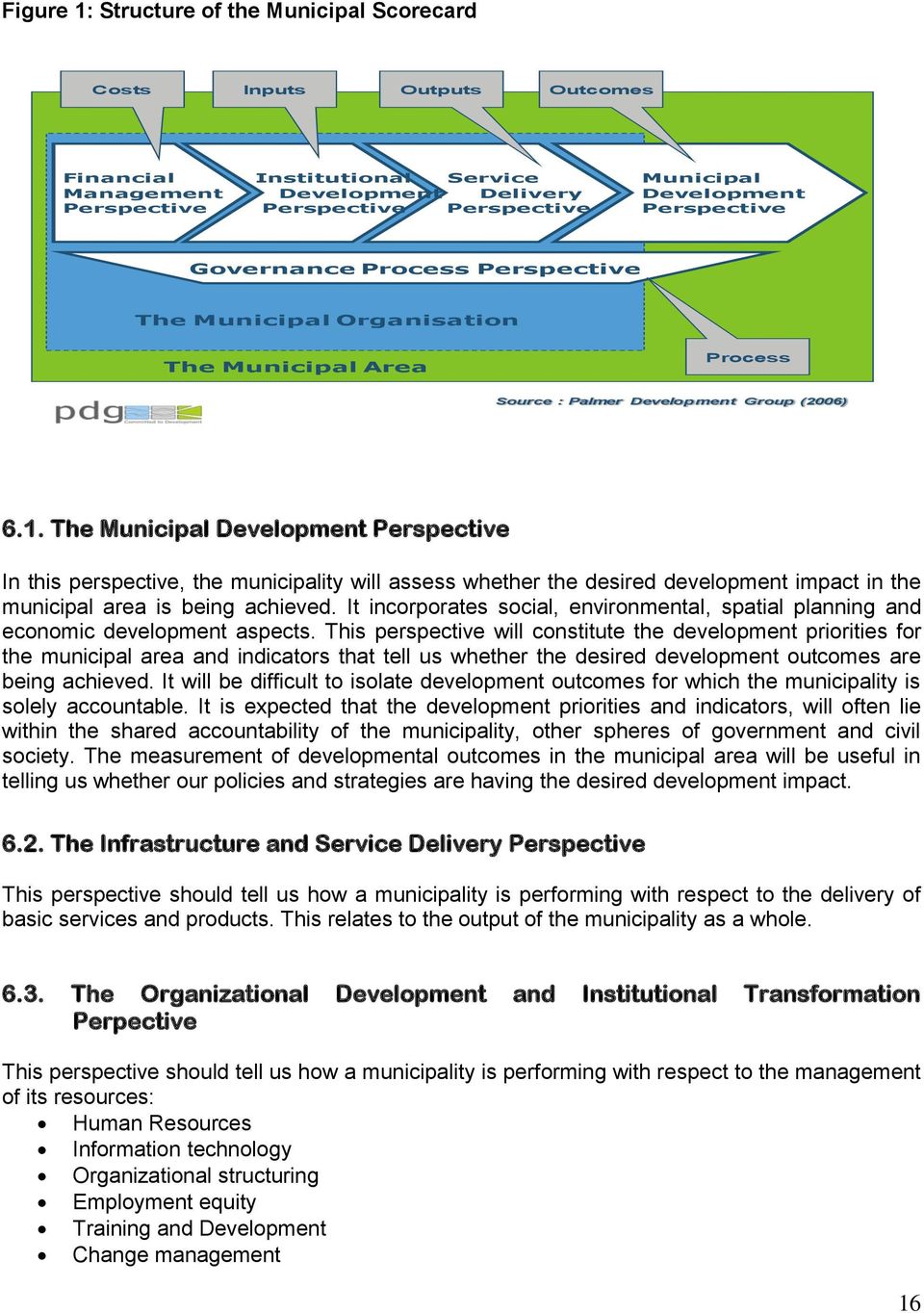
15 b.4. Alignment to the Integrated Development Planning (IDP) methodology A good performance management model for a municipality in South Africa will align the processes of performance management to the IDP processes of the municipality. It will ensure that the IDP is translated into performance plans that will be monitored and reviewed. The categories of key performance areas provided by a model should relate directly to the identified priority areas of the IDP. 6. The Municipal Scorecard Model Abaqulusi Council hereby adopts the Municipal Strategic Scorecard Model as its model for performance management. This model is useful for the following reasons. It is: Tightly aligned to the strategic planning and IDP processes of the municipality Directly relevant to the notion of developmental local government A balanced view of performance based on municipal inputs, outputs, outcomes and process A simple portrayal of municipal performance, where inter-relationships can be mapped (municipal-wide, sectoral/directorate and unit/ programme levels) Compliant with the requirements of the Municipal Systems Act (2002) and its subsequent Regulations (2001,2006) It aligns to 5 Key Performance Areas + 1 (as adopted by KwaZulu Natal Province) for Local Government used in the Regulations Five Year Local Government Strategic Agenda Vuna Awards for Performance Excellence The 5 +1 Key Performance Areas from the Five Year local Government Strategic Agenda are 1. Municipal Transformation, Organisational Development and Financial Viability 2. Infrastructure development and Basic Service Delivery 3. Socio - Economic Development 4. Good Governance & Public Participation 5. Financial Viability 6. Spatial Development Planning N.B. For the purposes of the municipality the 3 rd KPA shall be captured as Environment, socioeconomic development and Spatial Planning The Municipal Scorecard Model is based on five key perspectives, outlined in figure-1 below. 15
16 Figure 1: Structure of the Municipal Scorecard Costs Inputs Outputs Outcomes Financial Management Perspective Institutional Development Perspective Service Delivery Perspective A Municipal Development Perspective Governance Process Perspective The Municipal Organisation The Municipal Area Process Source : Palmer Development Group (2006) 6.1. The Municipal Development Perspective In this perspective, the municipality will assess whether the desired development impact in the municipal area is being achieved. It incorporates social, environmental, spatial planning and economic development aspects. This perspective will constitute the development priorities for the municipal area and indicators that tell us whether the desired development outcomes are being achieved. It will be difficult to isolate development outcomes for which the municipality is solely accountable. It is expected that the development priorities and indicators, will often lie within the shared accountability of the municipality, other spheres of government and civil society. The measurement of developmental outcomes in the municipal area will be useful in telling us whether our policies and strategies are having the desired development impact The Infrastructure and Service Delivery Perspective This perspective should tell us how a municipality is performing with respect to the delivery of basic services and products. This relates to the output of the municipality as a whole The Organizational Development and Institutional Transformation Perpective This perspective should tell us how a municipality is performing with respect to the management of its resources: Human Resources Information technology Organizational structuring Employment equity Training and Development Change management 16
17 Knowledge management Organizational ethics and code of conduct This relates to the inputs of the municipality as a whole Financial viability Perspective Asset management Operating income Operating expenditure Financing infrastructure investment Capital expenditure Budget and treasury 6.5. Good Governance and Public Participation Perspective: This perspective should tell us how a municipality is performing with respect to its engagement and relationship with its stakeholders in the process of governance. This perspective should include, amongst others: Public participation, including the functionality and impact of traditional leaders in Council and ward committees, NGOs, Community Development Workers, Youth Ambassadors, Youth Council, Women groups and disabled people s organizations. Functionality and impact of municipal governance structures (Council structures including the offices of the Speaker, portfolio committees and the Executive) Communication and access to information Intergovernmental relations Sound policy environment Functioning of good governance structures i.e. internal audit, Audit Committee, Performance Audit Committee, Oversight comiittee and Municipal Public Accounts Committee (MPAC) This relates to the governance processes of the municipality as a whole. 17

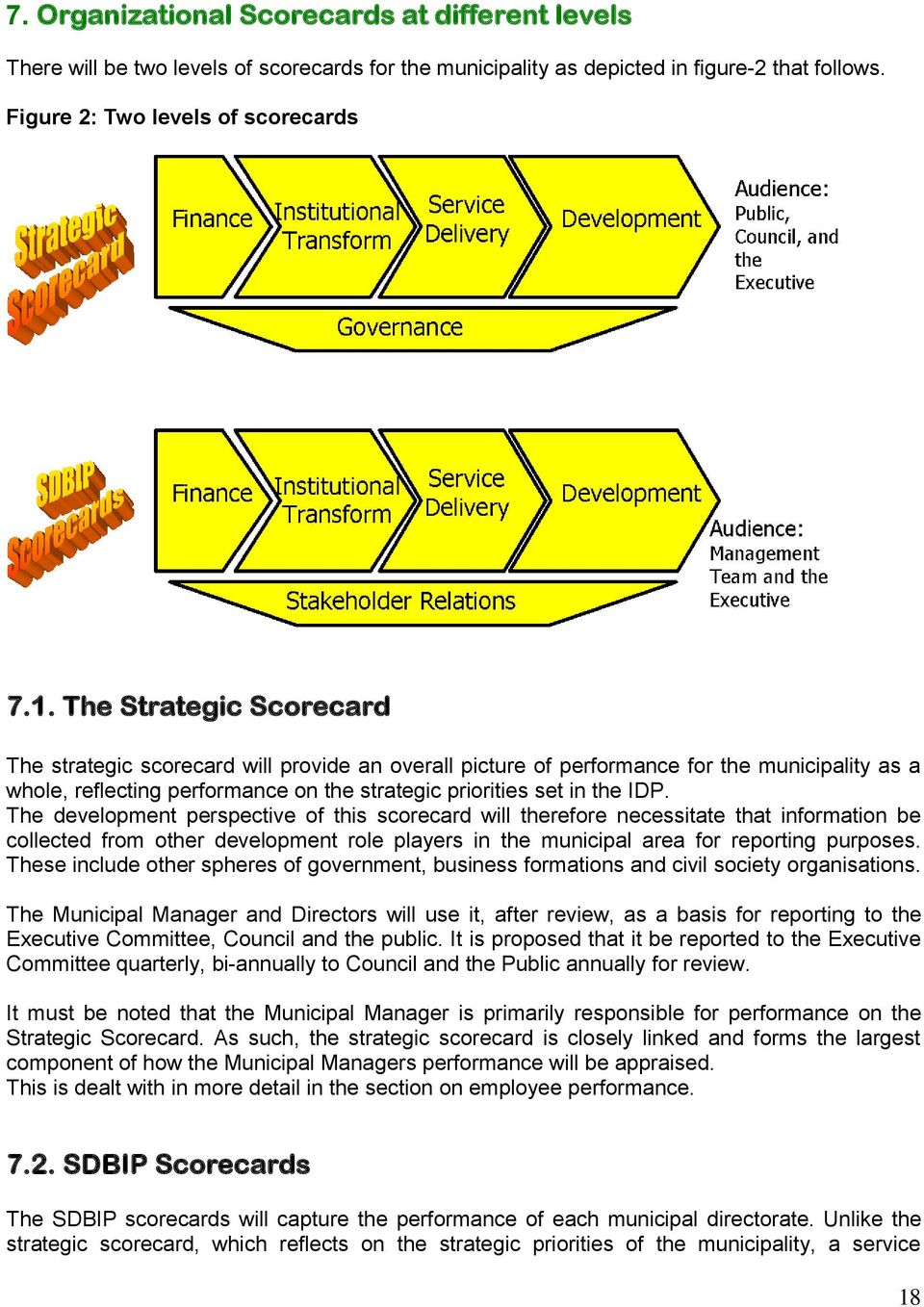
18 7. Organizational Scorecards at different levels There will be two levels of scorecards for the municipality as depicted in figure-2 that follows. Figure 2: Two levels of scorecards 7.1. The Strategic Scorecard The strategic scorecard will provide an overall picture of performance for the municipality as a whole, reflecting performance on the strategic priorities set in the IDP. The development perspective of this scorecard will therefore necessitate that information be collected from other development role players in the municipal area for reporting purposes. These include other spheres of government, business formations and civil society organisations. The Municipal Manager and Directors will use it, after review, as a basis for reporting to the Executive Committee, Council and the public. It is proposed that it be reported to the Executive Committee quarterly, bi-annually to Council and the Public annually for review. It must be noted that the Municipal Manager is primarily responsible for performance on the Strategic Scorecard. As such, the strategic scorecard is closely linked and forms the largest component of how the Municipal Managers performance will be appraised. This is dealt with in more detail in the section on employee performance SDBIP Scorecards The SDBIP scorecards will capture the performance of each municipal directorate. Unlike the strategic scorecard, which reflects on the strategic priorities of the municipality, a service 18
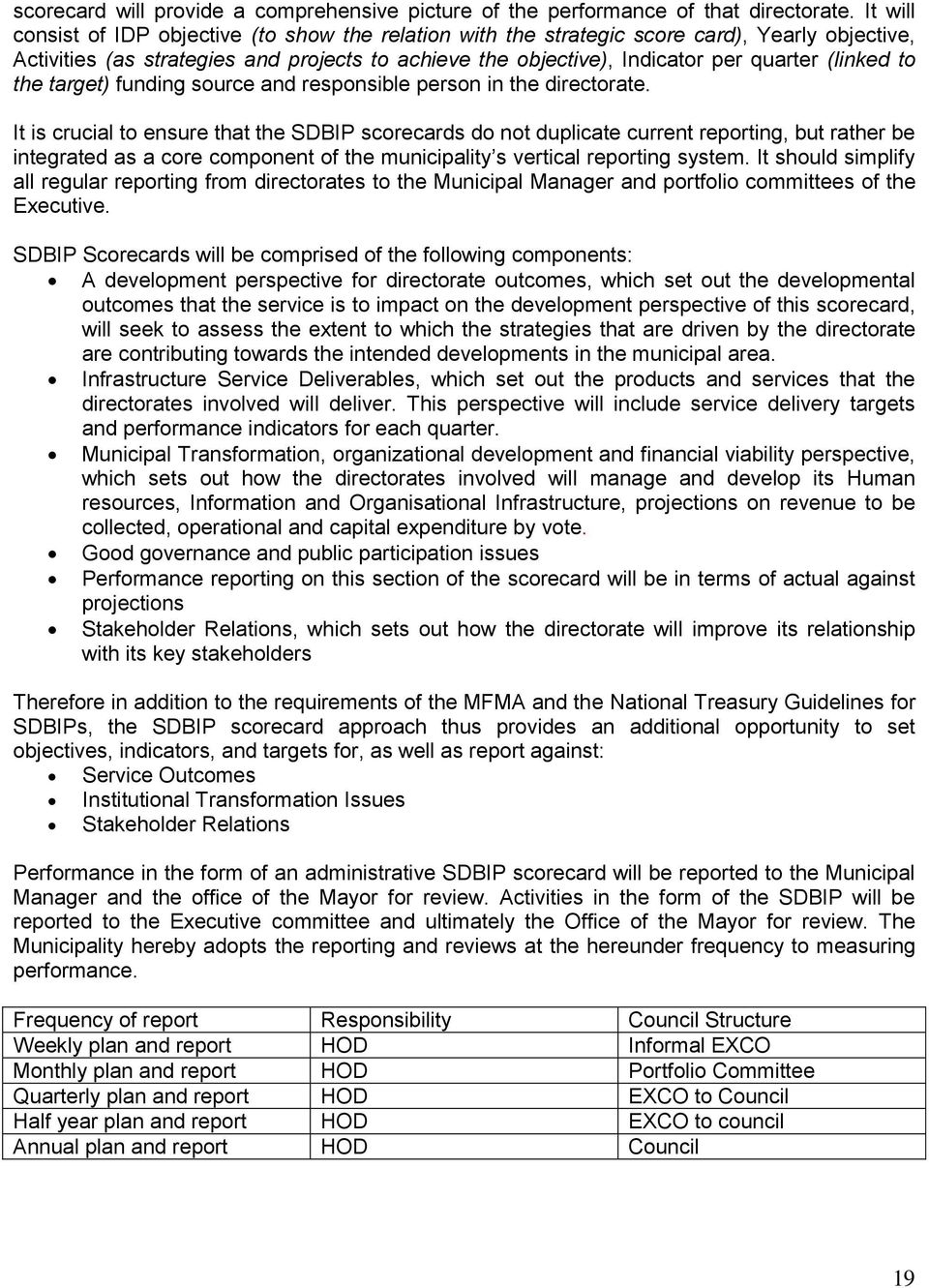
19 scorecard will provide a comprehensive picture of the performance of that directorate. It will consist of IDP objective (to show the relation with the strategic score card), Yearly objective, Activities (as strategies and projects to achieve the objective), Indicator per quarter (linked to the target) funding source and responsible person in the directorate. It is crucial to ensure that the SDBIP scorecards do not duplicate current reporting, but rather be integrated as a core component of the municipality s vertical reporting system. It should simplify all regular reporting from directorates to the Municipal Manager and portfolio committees of the Executive. SDBIP Scorecards will be comprised of the following components: A development perspective for directorate outcomes, which set out the developmental outcomes that the service is to impact on the development perspective of this scorecard, will seek to assess the extent to which the strategies that are driven by the directorate are contributing towards the intended developments in the municipal area. Infrastructure Service Deliverables, which set out the products and services that the directorates involved will deliver. This perspective will include service delivery targets and performance indicators for each quarter. Municipal Transformation, organizational development and financial viability perspective, which sets out how the directorates involved will manage and develop its Human resources, Information and Organisational Infrastructure, projections on revenue to be collected, operational and capital expenditure by vote. Good governance and public participation issues Performance reporting on this section of the scorecard will be in terms of actual against projections Stakeholder Relations, which sets out how the directorate will improve its relationship with its key stakeholders Therefore in addition to the requirements of the MFMA and the National Treasury Guidelines for SDBIPs, the SDBIP scorecard approach thus provides an additional opportunity to set objectives, indicators, and targets for, as well as report against: Service Outcomes Institutional Transformation Issues Stakeholder Relations Performance in the form of an administrative SDBIP scorecard will be reported to the Municipal Manager and the office of the Mayor for review. Activities in the form of the SDBIP will be reported to the Executive committee and ultimately the Office of the Mayor for review. The Municipality hereby adopts the reporting and reviews at the hereunder frequency to measuring performance. Frequency of report Responsibility Council Structure Weekly plan and report HOD Informal EXCO Monthly plan and report HOD Portfolio Committee Quarterly plan and report HOD EXCO to Council Half year plan and report HOD EXCO to council Annual plan and report HOD Council 19
20 It must be noted that each Portfolio Head in the Executive Committee will be primarily responsible for political activities associated with the required performance to pursue implementation of the administrative SDBIP Scorecard and that each S56 Manager will be primarily responsible for performance on the administrative SDBIP Scorecard. As such, the administrative SDBIP scorecard is closely linked and forms the largest component of how the S56 manager s performance will be appraised. This is dealt with in more detail in the section on employee performance Scorecard concepts The strategic and SDBIP scorecards should be presented in a consistent format so that they are easy to use and understand. Proposed formats are attached as appendix I(strategic scorecard) and II(SDBIP). Several concepts that are commonly used in the scorecard concept are defined below: Objectives: are statements (often drawn from the IDP) about what a service wants to achieve. -In developing objectives and or targets the municipality shall ensure that these are appropriate and can demonstrate both the output and outcome variables. Output is a measurable result (quantitatively) in the form of a service or product of the administrative process Outcome is a measurable positive change in the wellbeing of the clients of the administrative process or the prevention of a threat to their well-being - Objectives must be tested against the SMART principle to ensure a quality objective. - Specific Measurable Achievable Realistic Time-bound - In setting objectives the municipality must analyze the environment both externally and internally. The exercise will ensure that objectives are set in environments where they are most likely to be achieved. - For the purposes of the external environment two (2) tests shall be undertaken: Political Economic Social Technological Strengths Weaknesses Opportunities Threats - For the purposes of the internal environment the following test shall be undertaken: Strengths Weaknesses Aspirations INterests Indicators: are variables (qualitative or quantitative) that tell us whether we are making progress towards achieving our objectives. 20

21 A baseline measure: is the value (or status quo) of the indicator before the start of the programme or prior to the period over which performance is to be monitored and reviewed. For the purpose of standardising the setting of baselines and for the Sake of clarity, the following descriptions will be used: - If the indicator is measurable on an annual basis, the baseline will be its measure in the last financial year. - The baseline for annual targets that are incrementally measurable per quarter or per month will be the measure at the end of the last financial year but the targets can be set incrementally - The baseline for quarterly targets that are not incrementally contributing to an annual target will be the indicator s measure in the last quarter it was measured unless by its nature it is Seasonally variable in which case it will be an average of the last four quarterly measures - The baseline for monthly targets, that are not incrementally contributing to a quarterly or annual target, will be its measure in the last month it was measured unless by its nature it varies monthly in which case it will be an average of the last three monthly measurements A target: what is aspired to be achieved in the annual plan. The measurement source and frequency: should indicate where the data for measuring will emanate from, and how frequently the indicator will be measured and reported. This information is crucial for the auditing process. Indicator custodian/responsible person: refers to the person that takes responsibility for the monitoring of change in the indicator and report on it. The performance management plan of the municipality will have various indicators for the goals that are set in the IDP. These indicators including those that will be further developed for SDBIP scorecards should be assessed against the following criteria. a. Criteria for Setting Good Indicators In developing indicators, the municipality will ensure adherence to the following principles: i. Focused and Specific Indicators should be clearly focused and stated unambiguously. ii. Measurable An indicator should by definition contain a unit of measurement. iii. Valid and Relevant Validity is the degree to which an indicator measures what is intended to be measured. This correlates strongly to the relevance of the indicator to the objective being measured. It is also important that the whole set of indicators chosen should be contextually relevant to the municipality in the South African contexts. 21
22 iv. Reliable Reliability is the degree to which repeated measures, under exactly the Same set of conditions will produce the Same result. This is particularly relevant to those indicators that use ratios (formulas) and figures. v. Simple Good indicators will be simple, easy to communicate such that their relevance is apparent. vi Minimise perverse consequences Poorly chosen indicators, while nobly intended can have perverse consequences in the behaviors it incentives. Chosen indicators should ensure that the performance behaviors likely to emerge from its pursuance are those that are intended to contribute to the objectives. vii. Data Availability Good indicators will also rely on data that is, or intended to be, available on a regular basis. b. Core Local Government Indicators i. National Indicators The municipality s performance management indicators will incorporate the following indicators prescribed by the Minister of Provisional and Local Government as per the Municipal Planning and Performance Management Regulations of 2001: 1. The percentage of households with access to basic level of water, Sanitation, electricity and solid waste removal; 2. The percentage of households earning less than R2 200 per month with access to free basic services; 3. The percentage of a municipality's capital budget actually spent on capital projects identified for a particular financial year in terms of the municipality's Integrated Development Plan; 4. The number of jobs created through municipality's local economic development initiatives including capital projects; 5. The number of people from employment equity target groups employed in the three highest levels of management in compliance with a municipality's approved employment equity plan; 6. The percentage of a municipality's budget actually spent on implementing its workplace skills plan; and 7. Financial viability as expressed by the following ratios: (i) B - C A = D Where - "A" represents debt coverage "B" represents total operating revenue received "C" represents operating grants "D" represents debt service payments (i.e. interest + redemption) due within the financial year; 22
23 (ii) (iii) B A = C Where - "A" represents outstanding service debtors to revenue "B" represents total outstanding service debtors "C" represents annual revenue actually received for services; B + C A = D Where - "A" represents cost coverage "B" represents all available cash at a particular time "C" represents investments "D" represents monthly fixed operating expenditure. While there is no legal requirement to incorporate any other local government performance monitoring indicators used by other spheres of government other than those prescribed by the Minister, the Municipality will, in addition to indicators prescribed by the Minister, as practically feasible as possible incorporate a core set of local government indicators used by other spheres of government into its performance management system. Among these will be the indicators for the Vuna Awards for Municipal Performance Excellence for the following reasons: It will ensure that the municipality is tracking its performance in line with national priorities, at least the indicators that are valued nationally It will ensure that the municipality has the performance information on hand to enter the Vuna Awards It will allow benchmarking and comparison with other municipalities who are also using the same set of indicators. 23
24 A core set of Local Government indicators 12 Figure 3: Local Government Indicators The schematic above suggest an approach to incorporating a core set of LG indicators such as those used in the Vuna Awards into a municipal set of indicators. It notes that they need to be complemented for local use with IDP indicators and SDBIP indicators. Other sets of indicators deemed to be important, in each sector, such as the water sector benchmarking indicators can be included. There is also a national initiative aimed at establishing a local government M&E system, which intends to include a core set of local government indicators. If these differ from the Vuna indicators, and are available in time, they may be included as part of the municipality s scorecard. c. District Indicators In order to align with a district PMS system, the municipality will also include a set of indicators required by the district PMS. 8. The Process of Managing Performance The process of performance management is central to modern notions of management i.e. it is inseparable from the things that a manager must do. It is important that performance management is mainstreamed in municipalities as an approach to daily management. 24
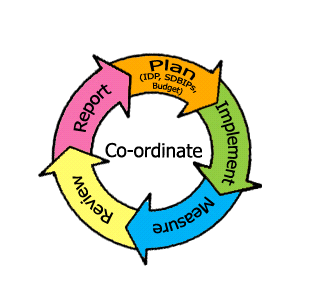
25 Figure 4: Performance Management as an Approach to Management The annual process of managing the performance of the Municipality will involve the following components: Co-ordination Performance Planning Performance Measurement, Analysis Performance Reviews & Reporting Performance Auditing For each of these components, this chapter sets out the role stakeholders in the performance management system will play and how these components are to happen. i.co-ordination Oversight co-ordination of performance planning, implementation and reporting implementation of the planning, measurement, reporting and review process is delegated as follows; 25
26 Purpose Committee/structure Responsible Person To monitor performance on Department/directorate Departmental Director the planned SDBIP as a responsible departmental or directorate level. To monitor and evaluate the Management Committee Municipal Manager performance of all departments/directorates To monitor the performance of Executive committee Mayor the whole administration (MANCOM) conduct collective reviews Receive reviewed reports Council Speaker from the EXCO Receive and review audit Audit committee Audit Committee Chairperson performance report and performance information The municipality hereby establishes Individual performance review committees for the Municipal Manager and Directors accountable to the Municipal Manager. For the purposes of the review of the individual performance of the Municipal Manager the Municipality establishes the committee as follows: 1. The Local Municipality Mayor (Chairs the sitting) 2. The Local Council Speaker 3. Executive committee member responsible for Corporate Services 4. A Mayor of a Municipality either than the incumbent Mayor but within the district. 5. The Head of the Internal Audit 6. The Chairperson of the Audit Committee 7. A nominated member of the community by the Speaker For the purposes of reviewing the individual performance of Directors reporting to the Municipal Manager the Municipality establishes the committee as follows: 1. The Local Municipality Mayor 2. The Local Council Speaker 3. The Executive committee member responsible for Corporate Services 4. The Municipal Manager of the Local Municipality (Chairs the sitting) 5. A Municipal Manager of a Municipality either than the current but situated in the District. 6. The Head of the Internal Audit 7. The Audit Committee Chairperson 26
27 The responsibility for performance management and the IDP are to be located together, in an IDP and PMS Office. Furthermore, these functions are to be located in the Municipal Manager s office as the overall responsibility and parts of the drafting of the IDP may be subdelegated to the Planning Division of the Municipality. Individual Performance Management for employees either than the Municipal Manager and Incumbents reporting directly to the Municipal Manager in terms of section 56 of the Municipal systems act (as amended) ii. Performance Planning The IDP and the Municipal Service Delivery and Budget Implementation Plans constitute the planning components for performance management. Through the IDP review process the priority areas, strategic objectives, strategies and the strategic scorecard will be finalised. The next step is to develop Directorate scorecards that should support the realisation of the objectives and targets set in the strategic scorecard. These Directorate Scorecards are also known as Service Delivery and Budget Implementation Plans. With these in place, the Municipality is now on track to implement and monitor the implementation of the IDP. The following diagram shows the link between the IDP objectives and strategies and the SDBIP scorecard Figure 5: Municipal planning 5 year Municipal scorecard IDP Municipal objectives Strategies Annual SDBIP Cluster objectives Directorate SDBIP s (Projects and on going service delivery/ activities) iii. The performance cycle Activity Purpose Period Conclude Annual Performance Agree with section 54 and 56 directors on the End July agreements expected level of performance in the year under 27
28 Draft annual report for submission to the AG for auditing performance for the year under review Draft and submit a Process plan for the review of the IDP; Budget; SDBIP and PMS Convene an IDP engagement session Quarter 1: SDBIP review session Quarter 2: SDBIP review (Midterm assesment) Annual Report (preceeding year) Table draft IDP; Budget and PMS (Institutional score card) Draft a SDBIP Adopt the Final IDP, Budget; SDBIP and PMS review To prove that the Municipality s performance in the year under review was planned through perdetermined objectives based on the IDP To detail activities and timelines for the review of the IDP; Budget; SDBIP and PMS. To ensure that legislative timelines are met. To assess the level at which line function departments, NGOs, CBOs, Business and LM are achieving the set targets To review the performance of the municipality against set targets. Effect changes to the reviewed plan if necessary. Conduct individual reviews of the Municipal Manager by the Mayor and Directors reporting to the Municipal Manager review portfolios of evidence and sign PIP and PDP as necessary To review the performance of the LM against set targets inculcate in the review the Annual report of the preceeding year and emerge with a turnaround plan. Commence a process of budget adjustment. Conduct individual reviews of the Municipal Manager by the Mayor and Directors reporting to the Municipal Manager review portfolios of evidence and sign PIP and PDP as necessary To table the second draft of the annual report including the audited financial statements and the AG s report. Refer the report to the oversight committee (MPAC) to interrogate the report and table findings and recommendations for the final adoption of the annual report of the preceeding year. To adopt the the IDP; Budget and PMS (Institutional score card) for the coming year. Advertise the above for public comment for 30 days Inculcate public comments in finalising the IDP; Budget; PMS and draw the year plan the SDBIP. Ready the institution for the coming year to ensure the eloquence of implementing predetermined objectives. End August End August End September End September 15 January 25 January End March Mid May End May iv. Measurement and Analysis Measurement is the act of collecting data on identified performance indicators while analysis is the act of interpreting the meaning of such data in terms of performance. For each Municipal Scorecard indicator, a relevant custodian has to be designated. The custodian will not necessarily be accountable for performance he/she will be responsible for 28
29 conducting measurements of the applicable indicators, analysing and reporting these for reviews. Analysis requires that current performance be compared with targets, past performance and possibly the performance of other municipalities, where data is available, to determine whether or not performance is poor. It should provide reasons for performance levels and suggest corrective action where necessary. There may be indicators that would require data gathering on municipal-wide outcome indicators and satisfaction surveys. This may need to be coordinated centrally instead of each directorate doing its own. The Office of the Municipal Manager will be responsible for this. The Office of the Municipal Manager may also undertake the following annual surveys to provide data for indicators organisationally: An annual citizen satisfaction survey conducted for households and business in the Municipal area. An employee satisfaction survey that is conducted internally. Reviews will be undertaken by the Municipal Manager, a committee of Council delegated a responsibility for performance management, and Council. Prior to reviews taking place, performance reporting will need to be tracked and coordinated. The Municipal Manager s Office will be responsible for this process. The Municipal Manager s Office will provide an overall analysis of municipal performance, for quarterly and annual reviews. Such an analysis will aim to pick up trends in performance over time and over all directorates. 9. Performance Reporting & Reviews The figure below aims to provide a picture of the annual process of reporting and reviews. Figure 6: The annual process of reporting and review 29
30 Other Spheres Annual Performance Report Annual Performance Report Executive Committee Strategic Scorecard Executive Management Team Directorate SDBIP s Council Quality Control and Coordination - by PMS Technical Steering Summary of Services Public Citizens Report Audit by Committee twice yearly Portfolio Committees Service Scorecard Twice Twice Annual Annual Reporting Reporting to to Council. Council. Annual Annual Reporting Reporting to to Public Public & Other Other Spheres Spheres Review Review and and Adoption Adoption of of Improvement Improvement Measures Measures by by Executive Executive Committee Committee Quarterly Quarterly Evaluation Evaluation by by Management Management Team Team and and Portfolio Portfolio Committees Committees Quarterly Quarterly Directorate Directorate Directorate Directorate Directorate Evaluation Evaluation (Monthly) (Monthly) 37 Once the system is embedded, a web-based reporting system must be considered in order to enhance the reporting process and simplify it. It must however be noted that a computer based automated system will only enhance the reporting processes within the municipality and potentially improve review processes. Most aspects of performance management still need human beings. i. Directorate Reviews Directorates shall review their performance at least once a month in its monthly meeting, using their directorate SDBIP s. Decision-makers should be immediately warned of any emerging failures to service delivery such that they can intervene if necessary. Directorates should use these reviews as an opportunity for reflection on their goals and programmes and whether these are being achieved. Minutes of these reviews should be forwarded to the performance management manager to forward to the PMS technical Committee. Changes in indicators and targets may be proposed at this meeting but can only be approved at the quarterly review session in consultation with the IDP/PMS manager. Each Director shall then prepare a preamble to the monthly report stating the extent of performance in meeting the agreed targets, the extent of expenditure of the budget and conditional grants and steps to be taken to rectify the situation. The Director has to sign and initial all pages of the report to certify that the report is a true reflection of the performance of the directorate. Monthly reports shall be tabled to relevant portfolios to the Executive and council. 30
31 ii. Executive Management Team Reviews Once a quarter the Mayor in the case of a Municipal Manager or the Municipal Manager in the case of Directors reporting to the Municipal Manager will then need to report on their performance in the service scorecard format to the Municipal Manager/the Mayor. Additional indicators that occur in the strategic scorecard will also be reviewed. The formulation of the strategic scorecard and the process of review will be coordinated by the IDP and PMS Manager. The Mayor or the Municipal Manager will need to reflect on whether targets are being achieved, what the reasons for targets not being achieved are, where applicable and corrective action that may be necessary. Where targets need to be changed. The Executive Committee shall endorse these at the quarterly review session. The Manager in the Municipal Manager s Office responsible for Operations and the IDP and PMS Manager shall jointly develop an analysis of performance prior to Executive committee reviews. These reviews shall at least take place quarterly. iii. Portfolio Committee Reviews Each Portfolio committee shall be required to review the performance of their respective directorates against their service scorecard, in all portfolio sittings. The portfolio committee shall appraise the performance of the service against committed targets. Where targets are not being met, portfolio committees shall ensure that the reasons for poor performance are satisfactory and sufficient, and the corrective strategies proposed are sufficient to address the reasons for poor performance. Changes in indicators and targets that do not appear in the strategic scorecard may be proposed to and can only be approved by the Executive Committee in the quarterly review session. iv. Executive Committee Reviews On a quarterly basis, the Executive Committee should engage in an intensive review of municipal performance against both the SDBIP scorecards and the strategic scorecard, as reported by the Municipal Manager. Many of the indicators in the strategic scorecard will only be measurable on an annual basis. The quarterly reviews should thus culminate in a comprehensive annual review of performance in terms of both scorecards. The review should reflect on the performance of services and the strategic scorecard. The Executive Committee will need to ensure that 31
32 targets committed to in the strategic scorecard are being met, where they are not, that satisfactory and sufficient reasons are provided and that the corrective action being proposed is sufficient to address the reasons for poor performance. The review should also focus on reviewing the systematic compliance to the performance management system, by directorates, portfolio committees and the Municipal Manager. Over and above the quarterly intensive reviews by the executive committee; the executive must bi-weekly (once every two weeks on the first Thursday of the month and the last Thursday of the month) convene informal EXCO briefings where members can interact with directors on issues pertaining to performance, progress and glaring issues requiring urgent attention, audit turnaround, v. Council Reviews At least twice annually, the Council will be required to review municipal performance. The reporting shall take place using both the strategic and the SDBIP scorecard. The review report shall be in the annual report format. The Municipal Systems Act requires that the annual report should at least constitute a performance report (the strategic scorecard), financial statements and an audit report. vi. Public Reviews The Municipal Systems Act requires the public to be given the opportunity to review municipal performance. The Municipality shall in addition to the annual report mentioned above, produce a user-friendly community s report for public consumption. The communities report shall be simple, easily readable and attractive document that translates the strategic scorecard for public consumption. The Mayor shall host imbizos on an annual basis for the purposes of tabling and involving communities in the review of municipal performance. Such imbizos shall involve the following methodologies: Ward committees be reported to and submit their review of the municipality to Council. The IDP &PMS Technical Steering Committee should be used to summarise this input. Various forms of media including radio, newspapers and billboards can be used to convey the communities report. The public should be invited to submit comment via telephone, fax, and public hearings to be held in a variety of locations. The public reviews should be concluded by a review by the IDP, PMS and Budget Representative Forum. 32
33 10. Reporting to other spheres and agencies of government a. Auditor General and MEC The Systems Act requires the Municipal Manager to give written notice of meetings, in which the municipality s annual report, is tabled or discussed by the Council, to the Auditor-General and the MEC for local government. The Municipal Manager must also submit copies of the minutes of these meetings to the Auditor-General and the MEC for local government in the province. Representatives of the Auditor-General and the MEC for local government in the province are entitled to attend and to speak at such meetings. A copy of the report must be submitted to the MEC for local government in the province and the Auditor-General. 11. Auditing and Quality Control All auditing will comply with Section 14 of the Municipal Planning and Performance Management Regulations (2001). Auditing of performance reports will be conducted by the internal audit structure prior to submission to the municipality s external audit committee and auditor-general. 12. Quality Control and Co-ordination The Office of the Municipal Manager, overseen by and reporting regularly to the Executive Committee will be required on an ongoing basis to co-ordinate and ensure good quality of reporting and reviews. It will be its role to ensure conformity to reporting formats and check the reliability of reported information, where possible. 13. Performance Investigations The Executive Committee and or Audit Committee will be able to commission an in-depth performance investigations where there is either continued poor performance, a lack of reliability in the information being provided or on a random ad-hoc basis. Performance investigations should assess: The reliability of reported information The extent of performance gaps from targets The reasons for performance gaps Corrective action and improvement strategies The internal audit function shall be responsible for conducting these investigations. 14. Internal Audit 33
34 The municipality s internal audit function will be continuously involved in auditing the performance reports of SDBIPs and the strategic scorecard. As required by the regulations, they will be required to produce an audit report on a quarterly basis, to be submitted to the Municipal Manager and Audit Committee. The capacity of the internal audit unit will need to be improved beyond the auditing of financial information. Auditing is necessary to prevent: Inconsistencies in performance management definition or methodology of data collection; Incorrect processing and poor documentation of performance management; Biased information collection and reporting by those whose image is at stake in the performance management process. The Regulations specify that any auditing must include assessment of: The functionality of the municipality s performance management system; The compliance of the system with the legislation; and The extent to which performance measurements are reliable in measuring performance of the municipality 15. Audit Committee The operation of the audit committee will be governed by section 14 (2-3) of the regulations. As per the regulations, the performance audit committee will review the quarterly reports submitted to it by the internal audit unit review the municipality's performance management system and make recommendations in this regard to the Council of that municipality assess whether the performance indicators are sufficient at least twice during a financial year submit an audit report to the municipal Council 34
35 16. Role of Stakeholders Stakeholders Performance Planning Community Be consulted on Structures and needs IDP Forum Develop the long term vision for the area Influence the identification of priorities Influence the choice of indicators and setting of targets Council Facilitate the development of a long-term vision. Develop strategies to achieve vision Identify priorities Adopt indicators Portfolio (S79) Committees and set targets Influence the preparation of SDBIP scorecards Adopt SDBIP scorecards Ensure involvement of communities in the setting of municipal targets (IDP) Measurement and Analysis Monitor performance of relevant services Performance Reporting & Reviews Be given the opportunity to review municipal performance and suggest new indicators and targets Review municipal performance bi-annually Receive reports from service managers Review monthly SDBIP scorecards Report to Executive committee Adopt corrective actions where necessary and recommend to Executive committee 35
36 Stakeholders Executive Committee Executive Management Team Performance Planning Play the leading role in giving strategic direction and developing strategies and policies for the organisation Manage the development of an IDP Approve and adopt indicators and set targets Communicate the plan to other stakeholders Assist the Executive Committee in providing strategic direction and developing strategies and policies for the organisation Manage the development of the IDP Ensure that the plan is integrated Identify and propose indicators and targets Communicate the plan to other stakeholders Develop SDBIPs & Budget Measurement and Analysis Regularly monitor the implementation of the IDP, identifying risks early Ensure that regular monitoring (measurement, analysis and reporting) is happening in the organisation Intervene in performance problems on a daily operational basis Performance Reporting & Reviews Conduct the major reviews of municipal performance, determining where goals had or had not been met, what the cause or reasons were and to adopt response strategies Conduct quarterly reviews of performance Ensure that performance reviews at the political level are organised Ensure the availability of information Propose response strategies to the Executive Committee Report to Exco 36
37 Stakeholders Performance Planning Measurement and Analysis Performance Reporting & Reviews PMS Technical Develop service Measure Conduct reviews of Steering plans for integration performance service performance Committee with other sectors according to against plan before other within the strategy of agreed indicators, reviews the organisation analyse and report regularly Manage implementation and intervene where necessary Inform decision-makers of risks to service delivery timeously Internal Audit Produce quarterly audit reports for MM and Audit committee Audit Committee / Review internal audit Performance reports Audit Committee Assess system and indicators Provide audit report twice annually to council 17. Responding to Organizational Performance This outlines how the municipality may reward good organizational performance and address poor organizational performance. a. Good or Exceptional Organizational Performance There will be an Executive Mayoral Award for excellent performance that can take the form of rotating trophies or plaques for the best five directorates / units annually. These can be designated: Platinum Gold Silver Bronze An annual entertainment fund can be used to provide funds for at least the Platinum winners to entertain themselves as determined by the Executive on an annual basis. 37
38 b. Poor Performance Poorly performing directorates will be asked to provide an explanation and analysis of poor performance. If this is insufficient, an investigation will be conducted to deepen the understanding of the underlying problems, whether they be policy-related, systemic, structural or attributed to the poor performance of individuals. This section does not deal with employee performance and rewarding good performance and addressing poor employee performance. These are dealt with at the end of the next section. 18. Employee Performance This section focuses on the performance management arrangements for employees of the municipality. The following framework can be used for all employees. However the legal framework that underpins it requires that it be enforced for all Section 54 and 56 Managers. The municipality will incrementally roll-out this system for all employees. i. Responsibilities for implementing system The Municipal Manager, as head of the administration is responsible and accountable for the formation and development of an accountable administration operating in accordance with the municipality s performance management system. She or he is also responsible for the management of the administration in accordance with legislation. The final responsibility for ensuring that employments contracts for all staff are in place rests with the municipal manager. The final responsibility for ensuring that performance agreements with the relevant managers, including his or her own, are in place, rests with the Municipal Manager. ii. Employment contract The Systems Act (see section 56) provides that there must be a written employment contract between the municipality the municipal manager and managers directly accountable to municipal managers (hence the reference, to managers employed in terms of these contracts, as Section 56 Managers). The regulations (see sub-regulation 4(4)(a)) further provide that employment in terms of an employment contract must be subject to the signing of a separate performance agreement within 90 calendar days after assumption of duty and annually within one month after the commencement of the financial year. The question arises whether the validity of the employment contract will be affected in the absence of a performance agreement as per the dictates of the regulation. It is important to bear in mind that both the employment contract and the 38
39 performance agreement are entered into separately by the parties. In the event that the performance agreement has not been entered into after the expiration of the time limit, it amounts to a breach of the employment conditions and the party responsible for such breach must be put on terms. It is important to emphasise that the failure to enter into a performance agreement does not automatically render the employment contract invalid. The party responsible for this breach must be given an opportunity to remedy the breach. Failure by the party responsible for the breach to remedy the breach may result in the other party initiating a contract termination process if it so feels. iii. Performance agreement The performance agreement (see sub regulation 8(2) read with sub-regulation 23) provides the basis upon which the municipality will reward good performance on the part of the employee. Performance Agreements form the basis upon which the performance of Section 54 and 56 staff are measured and monitored against targets. The performance agreement is put in place to comply with the provisions of Section 57 (1)(b), (4A),(4B0 and (5) of the Municipal Systems Act as well as the employment contract entered into between the parties. This agreement must be entered into for each financial year and be reviewed annually in June. According to the Performance Regulations for Municipal Managers and Managers directly accountable to Municipal Managers (2006), the performance agreements fulfill the following key purposes: o o o o o o specify objectives and targets defined and agreed with the employee and to communicate to the employee the employer s expectations of the employee s performance and accountabilities in alignment with the Integrated Development Plan, Service Delivery and Budget Implementation Plan (SDBIP) and the Budget of the municipality; specify accountabilities as set out in a performance plan, which forms an annexure to the performance agreement; monitor and measure performance against set targeted outputs and outcomes; use the performance agreement as the basis for assessing whether the employee has met the performance expectations applicable to his or her job; and in the event of outstanding performance, to appropriately reward the employee; give effect to the employer s commitment to a performance-orientated relationship with its employee in attaining equitable and improved service delivery. iv. Performance Plan The performance plan establishes: o a detailed set of objectives and targets to be met by the Section 56 employee as well as; o the time frames within which these should be met. 39
40 The specifics of the performance plan will be determined by mutual agreement by both parties to the performance agreement and will be based on the IDP, SDBIP and the Budget. It shall include the following elements: o Key Objectives o Key Performance Indicators o Targets o Weightings In addition, the employee will be measured in terms of their contribution to the goals and strategic planning as set out in the Municipality s IDP. Section 54 and 56 staff will be assessed against two components, weighted as follows: a. Key Performance Area (KPA) which is weighted at 80% The employees assessment will in part be based on his/her performance in terms of outcomes/outputs (performance indicators) identified in the performance plan which are linked to the KPAs. This contributes to 80% of the overall assessment result. The weightings per KPA will be agreed upon between the parties to the agreement. For Incumbents directly responsible to the Municipal Manager, the KPAs are those related to their key functional areas. For the municipal manager this will be the organizational scorecard, not dealing with outcomes, representing the IDP. For managers reporting to the municipal manager, this component will be their SDBIP scorecards, without outcomes. For all other staff that this system will be rolled out to, this component will need to be drawn up for them and align with their job description. b. Core Competency Requirement (CCR) which is weighted at 20% The CCRs which are deemed most critical to the employee s specific function will be selected from a list and agreed upon with the employer, with consideration for proficiency levels as agreed between the two parties. Weights will further be assigned to the CCRs selected. This refers to a separate component dealing with competency and expected behavior. Table 1: Core Competency Requirements from Regulations (2006) CORE COMPETENCY REQUIREMENTS FOR EMPLOYEES (CCR) Core Managerial and Occupational Competencies Core Managerial Competencies Strategic Capability and Leadership Programme and Project Management Financial Management Change Management (Indicate choice) compulsory Weight 40
41 CORE COMPETENCY REQUIREMENTS FOR EMPLOYEES (CCR) Core Managerial and Occupational Competencies Core Managerial Competencies Knowledge Management Service Delivery Innovation Problem Solving and Analysis People Management and Empowerment Client Orientation and Customer Focus Communication Honesty and Integrity 1 Core Occupational Competencies Competence in Self Management Interpretation of and implementation within the legislative and national policy frameworks Knowledge of developmental local government Knowledge of Performance Management and Reporting Knowledge of global and South African specific political, social and economic contexts Competence in policy conceptualization, analysis and implementation Knowledge of more than one functional municipal field discipline Skills in Mediation Skills in Governance Competence as required by other national line sector directorates (Indicate choice) compulsory compulsory Weight Exceptional and dynamic creativity to improve the functioning of the municipality Total percentage - 100% v. Personal Development Plan As part of the performance agreement, a personal development plan will be included. This section should state the activities, including training and development that the employee wishes to undertake to improve themselves or is required to take to better fulfill the needs of the job. 41
42 vi. Evaluating performance The Performance Regulations for Municipal Managers and Managers directly accountable to Municipal Managers (2006), stipulates in detail how the evaluation process should be undertaken. vii. Process & Scoring Performance will be reviewed on a quarterly basis within two weeks after completion of the evaluation of a unit (directorate or section) to which the employee belongs of managing. The employer will keep a record of the mid-year review and annual assessment meetings. The performance plan will include a Personal Development Plan, in order to address any weaknesses or skills gaps which may have been identified. In summary, the annual performance appraisal will involve an assessment of results as outlined in the performance plan, discussed below: a. KPA assessment 1. Each KPA will be assessed according to whether performance indicators have been met 2. An indicative rating on a 5-point scale will be provided for each KPA 3. The applicable assessment rating calculator will be used to add to the scores and calculate the final KPA score based on a weighted average score. b. CCR assessment 1. Each CCR will be assessed according to performance indicators that have been met 2. An indicative rating on a 5-point scale will be provided for each CCR 3. The rating is multiplied by the weighting given to each CCR, to provide a score 4. The applicable assessment rating calculator will be used to add to the scores and calculate the final CCR score, based on a weighted average score. Table 2: Scoring suggested by the Regulations (2006) Level Terminology Description 5 Outstanding performance Performance far exceeds the standard expected of an employee at this level. The appraisal indicates that the Employee has achieved above fully effective results against all performance criteria and indicators as specified in the PA and Performance plan and maintained this in all areas 42
43 Level Terminology Description Performance significantly 4 above expectations 3 Fully effective of responsibility throughout the year. Performance is significantly higher than the standard expected in the job. The appraisal indicates that the Employee has achieved above fully effective results against more than half of the performance criteria and indicators and fully achieved all others throughout the year. Performance fully meets the standards expected in all areas of the job. The appraisal indicates that the Employee has fully achieved effective results against all significant performance criteria and indicators as specified in the PA and Performance Plan. 2 1 Performance not fully effective Unacceptable performance Performance is below the standard required for the job in key areas. Performance meets some of the standards expected for the job. The review/assessment indicates that the employee has achieved below fully effective results against more than half the key performance criteria and indicators as specified in the PA and Performance Plan. Performance does not meet the standard expected for the job. The review/assessment indicates that the employee has achieved below fully effective results against almost all of the performance criteria and indicators as specified in the PA and Performance Plan. The employee has failed to demonstrate the commitment or ability to bring performance up to the level expected in the job despite management efforts to encourage improvement. The combined KPA and CCR assessment scores, weighted 80% and 20% respectively, will make up the overall assessment score. The individual managers scorecards will have three components. The first two components will be scores that are based on performance of the municipality. These will constitute the 80% KPA score. The third component is about the manager competency. The following table shows a weighting that will make up the score of a manager reporting directly to a municipal manager s score. Table 3 HOD s performance measurement Component Weighting Source Collective score for municipal 20% Overall municipal scorecard score performance equally owned by all directors and MM Score for directorate 60% Overall directorate score scorecard performance score 43
44 CCR score of a manager 20% CCR appraisal result Similarly in the case of the municipal manager there will also be three components as shown in the table below. Table 4 Municipal Manager s performance measurement Component Weighting Source Collective score for 60% Overall municipal scorecard score municipal performance Average of directorate 20% Sum of directorate scores divided by scores the no. of Depts. CCR score of a manager 20% CCR appraisal result The following table shows a worked example of how a HOD s performance score will be calculated. In this table it is assumed that the weightings given to municipal performance, directorate performance and individual contribution are 35%, 50% and 15% respectively. If the Municipality and the Directorate headed by the HoD concerned achieved 60% and 70% of their targets respectively and the HOD got a 55% in his/ her 360 degrees assessment (by his/ her immediate supervisor (municipal manager), immediate subordinates and Portfolio Councilor) then the score will be calculated as shown in the right hand column of the table. Table 5 Worked example HOD performance score calculation Component Weighting Performance Score Weighted score Collective score for 20% 60% 20% x 60% = 12% municipal performance Score for directorate 60% 70% 60% x 70% = performance 42.5% CCR score of a 20% 55% 20% x 55% = 11% manager Final score (sum of weighted scores) 65% The regulations do not deal with the detail of how to convert the points from the 5-point scale into percentage of performance even though the bonus calculation, as per regulations, will be based on the percentage level of performance achieved. In the Municipality the scoring will take the score obtained and divide it by 3 to reach a % score. In this way a score of from the scale, which means that performance fully meets the standards expected in all areas of the job, will then result to 3/3which will be 100%; 4/3 will be 133% and 5/3 will be 166%. Dispute resolution Any disputes about the nature of the employee s performance agreement, whether it relates to key responsibilities, priorities, methods of assessment and/ or Salary increment in the agreement, must be mediated by 44
45 (a) In the case of the municipal manager, the MEC for local government in the province within thirty (30) days of receipt of a formal dispute from the employee, or any other person designated by the MEC; and (b) In the case of managers directly accountable to the municipal manager, the Mayor within thirty (30) days of receipt of a formal dispute from the employee; whose decision shall be final and binding on both parties. Any disputes about the outcome of the employee s performance evaluation, must be mediated by (c) In the case of the municipal manager, the MEC for local government in the province within thirty (30) days of receipt of a formal dispute from the employee, or any other person designated by the MEC; and (d) In the case of managers directly accountable to the municipal manager, a member of the municipal council, provided that such member was not part of the evaluation panel provided for in sub-regulation 27(4)(e), within thirty (30) days of receipt of a formal dispute from the employee; whose decision shall be final and binding on both parties. Responding to Good Employee Performance ii) Bonuses A performance bonus, based on affordability may be paid to the employees, after: 1. the annual report for the financial year under review has been tabled and adopted by the municipal council 2. an evaluation of performance in accordance with the provisions of the Regulation 3. approval of such evaluation by the municipal Council as a reward for a level of performance deserving of a performance bonus in terms of the bonus criteria In addition to the annual cost-of-living increase, the employee shall be eligible to be considered for a performance related increase (pay progression) on an annual basis. Performance Bonus criteria The regulations provide that a performance bonus between 5% and 14% of the inclusive annual remuneration package may be paid to the employee after the end of the financial year and only after an evaluation of performance and approval of such evaluation by the Municipal Council, as a reward for a level of performance deserving of a bonus in terms of the bonus criteria. In determining the bonus payment, the regulations specify that the relevant percentage depends on the overall rating, calculated by using the applicable assessment rating calculator: 1. A score of 130% - 149% is awarded a performance bonus ranging between 5%-9%. 2. A score of 150% and above is awarded a performance bonus ranging 10% - 15%. 3. In addition to what is suggested in the regulations a score of 100%-120% should result in a bonus of 0% to 5%. Salary Adjustment The respective employee s Salary can be adjusted if it is understood that the high levels of performance can be sustained and are not once-off. This Salary adjustment is over and above any inflationary adjustment. Mayor s Merit Award A Mayor s merit award will be introduced for all employees who are not on fixed term performance related contrasts that perform excellently based on the following awards: 45
46 Score obtained on Performance Scorecard Platinum (>100%) Gold (90% 100%) Silver (80% %) The Employee may be eligible to choose ONE of the options listed below Medal plus: a) Employee is granted 10 free leave days. or b) The Employee is able to attend a conference/seminar relevant to his/her work that costs a maximum of 10 leave days for that employee or c) The Employee may select a work tool that will enhance his/her ability to perform better in his/her job that costs a maximum of 6 leave days for that employee Medal plus: a) Employee is granted 6 free leave days or b) The Employee is able to attend a conference/seminar relevant to his/her work that costs a maximum of 6 leave days for that employee or c) The Employee may select a work tool that will enhance his/her ability to perform better in his/her job that costs a maximum of 6 leave days for that employee Medal plus: a) Employee is granted 4 leave days or b) The Employee is able to attend a conference/seminar relevant to his/her work that costs a maximum of 4 leave days for that employee or c) The Employee may select a work tool that will enhance his/her ability to perform better in his/her job that costs a maximum of 4 leave days for that employee 60 % % No specific reward < 60 Compulsory performance counseling Should an employee who has received a non financial reward in the form of a work tool, leave the employment of the Municipality and wishes to take the work tool, the employee will be required to pay tax on the value of the tool. Special Opportunities Special opportunities will be created such as special study opportunities and exchange programmes that could benefit high performing employees. Promotion Employees who consistently perform well will be given more responsibility and promoted where opportunities arise. 46
47 Addressing Poor Employee Performance iii) Section 56 managers The municipality will base its actions against a poorly performing Section 56 manager on the midyear and annual performance review processes. Having set performance targets in the form of a performance agreement at the beginning of the year and reviewed progress in September as per the Regulations, during the midyear review if a manager achieves a score of less than 60%, an appropriately designated person within the municipality will, together with the managers concerned, develop a Remedial and Developmental Support plan within 30 days of the midyear performance review to assist the employee to improve his/her performance. The design of the plan will be such that there should be performance improvement within 6 months of its implementation. The plan will clearly specify the responsibilities of the employer as well as the responsibilities of the employee with regard to its implementation. If after 6 months, during the end-year performance review, the manager concerned still achieves a score of less than 60% and the municipality has evidence or proof that it met its responsibilities in terms of implementing the remedial and developmental support plan, the municipality will consider steps to terminate the contract of the employee on the grounds of poor performance or operational incapacity. iv) Non-section 56 employees In the case of unacceptable performance by a non-section 56 employee, the municipality shall, together with the employee concerned, develop a Remedial and Developmental Support plan within 30 days of a review in which the employee achieves a score of less than 60%. The plan will clearly specify the responsibilities of the employer as well as the responsibilities of the employee with regard to its implementation. The timeframes of the plan shall be determined by the support and remedial needs identified in the plan. After the timeframe determined in the plan has lapsed and based on the targets set in the plan, the performance of the employee will be assessed. If the employee concerned still achieves a score of less than 60% and the municipality has evidence or proof that it met its responsibilities in terms of implementing the remedial and developmental support plan, the municipality will consider steps to terminate the contract of the employee on the grounds of poor performance or operational incapacity. Evaluation and Improvement of the Performance Management System The Municipal Systems Act requires the municipality to annually evaluate its performance management system. It is proposed that after the full cycle of the annual review is complete, the performance management team will initiate an evaluation report annually, taking into account the input provided by directorates. This report will then be discussed by the Management Team and finally submitted to the Executive Committee for discussion and approval. The evaluation should assess: The adherence of the performance management system to the Municipal Systems Act. 47
48 The fulfillment of the objectives for a performance management system captured in section 3 of this document. The adherence of the performance management system to the objectives and principles captured in section 4 of this document. Opportunities for improvement and a proposed action plan. It must once again be emphasised that there are no definitive solutions to managing municipal performance. The process of implementing a performance management system must be seen as a learning process, where there is a conscious buy-in to incremental improvement of the way the system works in order to fulfill the objectives of the system and address the emerging challenges from a constantly changing environment. Appendices b) Appendix I: Extracts of relevant policies and legislation i) The White Paper on Local Government (1998) The White Paper on Local Government (1998) i nationally introduced performance management systems to local government, as a tool to ensure Developmental Local Government. It concludes that Integrated Development Planning, budgeting and performance management are powerful tools which can assist municipalities to develop an integrated perspective on development in their area. It will enable them to focus on priorities within an increasingly complex and diverse set of demands. It will enable them to direct resource allocations and institutional systems to a new set of development objectives". The White Paper adds that "Involving communities in developing some municipal key performance indicators increases the accountability of the municipality. Some communities may prioritise the amount of time it takes a municipality to answer a query; others will prioritise the cleanliness of an area or the provision of water to a certain number of households. Whatever the priorities, by involving communities in setting key performance indicators and reporting back to communities on performance, accountability is increased, and public trust in the local government system enhanced". Batho Pele (1998) Similarly, the White Paper on Transforming Public Service Delivery (Batho Pele) puts forward eight principles for good public service: Consultation: Citizens should be consulted about the level and quality of public service they receive, and, where possible, should be given a choice about the services that are provided. Service standards: Citizens should know what standard of service to expect. Access: All citizens should have equal access to the services to which they are entitled. 48
49 Courtesy: Citizens should be treated with courtesy and consideration. Information: Citizens should be given full and accurate information about the public services they are entitled to receive. Openness and transparency: Citizens should know how directorates are run, how resources are spent, and who is in charge of particular services. Redress: If the promised standard of service is not delivered, citizens should be offered an apology, a full explanation and a speedy and effective remedy; and when complaints are made citizens should receive a sympathetic, positive response. Value-for-money: Public services should be provided economically and efficiently in order to give citizens the best possible value-for-money. "Importantly, the Batho Pele White Paper notes that the development of a service-oriented culture requires the active participation of the wider community. Municipalities need constant feedback from service-users if they are to improve their operations. Local partners can be mobilised to assist in building a service culture. For example, local businesses or nongovernmental organisations may assist with funding a help line, providing information about specific services, identifying service gaps or conducting a customer survey" - The White Paper on Local Government (1998). The Municipal Systems Act (2000) The Municipal Systems Act, enacted in November 2000, requires all municipalities to: Develop a performance management system Set targets, monitor and review performance based on indicators linked to their IDP Publish an annual report on performance for the councilors, staff, the public and other spheres of government Incorporate and report on a set of general indicators prescribed nationally by the minister responsible for local government Conduct an internal audit on performance before tabling the report. Have their annual performance report audited by the Auditor-General Involve the community in setting indicators and targets and reviewing municipal performance Municipal Planning and Performance Management Regulations (2001) The Municipal Planning and Performance Management Regulations set out in detail requirements for municipal PM systems. However, the regulations do not sufficiently constitute a framework that fully proposes how the system will work. Each component of the proposed framework in this document is strongly informed by the regulations. 49
50 Municipal Finance Management Act (2003) Chapter 12: Financial Reporting and Auditing Preparation and adoption of annual reports 121. (1) Every municipality and every municipal entity must for each financial year prepare an annual report in accordance with this Chapter. The Council of a municipality must within nine months after the end of a financial year deal with the annual report of the municipality and of any municipal entity under the municipality s sole or shared control in accordance with section The purpose of an annual report is (a) to provide a record of the activities of the municipality or municipal entity during the financial year to which the report relates; (b) to provide a report on performance against the budget of the municipality or municipal entity for that financial year; and (c) to promote accountability to the local community for the decisions made throughout the year by the municipality or municipal entity. 3. the annual report of a municipality must include (a) the annual financial statements of the municipality, and in addition, if section 122(2) applies, consolidated annual financial statements, as submitted to the Auditor-General for audit in terms of section 126(1); (b) the Auditor-General s audit report in terms of section 126(3) on those financial statements; (c) the annual performance report of the municipality prepared by the municipality in terms of section 46 of the Municipal System Act; (d) the Auditor-General s audit report in terms of section 45(b) of the Municipal Systems Act; (e) an assessment by the municipality s accounting officer of any arrears on municipal taxes and service charges; (f) an assessment by the municipality s accounting officer of the municipality s performance against the measurable performance objectives referred to in section 12(3)(b)for revenue collection from each revenue source and for each vote in the municipality s approved budget for the relevant financial year; (g) particulars of any corrective action taken or to be taken in response to issues raised in the audit reports referred to in paragraphs (b) and (d); (h) any explanations that may be necessary to clarify issues in connection with the financial statements; (i) any information as determined by the municipality; (j) any recommendations of the municipality s audit committee; and (k) any other information as may be prescribed. 4. The annual report of a municipal entity must include- (a) the annual financial statements of the entity, as submitted to the Auditor- General for audit in terms of section 126(2); (b) the Auditor-General s audit report in terms of section 126(3) on those financial statements; (c) an assessment by the entity s accounting officer of any arrears on municipal taxes and service charges; (d) an assessment by the entity s accounting officer of the entity s performance against any measurable performance objectives set in terms the service 50
51 delivery agreement or other agreement between the entity and its parent municipality; (e) particulars of any corrective action taken or to be taken in response to issues raised in the audit report referred to in paragraph (b); (f) any information as determined by the entity or its parent municipality; (g) any recommendations of the audit committee of the entity or of its parent municipality; and (h) any other information as may be prescribed. Appendix II: Pro forma documents (as separate documents) ii) iii) iv) Performance Agreement Personal Development Plan (PDP) Personal Improvement Plan c) Appendix III: Scorecard templates: i) institutional score card ii) SDBIP planning and reporting template iii) Individual score card ADOPTED BY COUNCIL: COUNCIL RESOLUTION NO.: MUNICIPAL MANAGER/ ADMINISTRATOR MAYOR 51
SOL PLAATJE MUNICIPALITY
 SOL PLAATJE MUNICIPALITY INTEGRATED PERFORMANCE MANAGEMENT POLICY FRAMEWORK Approved by Council: 7 July 201o In terms of Council resolution: C322 322/10 2 Table of Contents 1. Introduction 3 2. Policy
Amathole District Municipality
 Performance Management Framework Contact Details Contact The Municipal Manager, Chris Magwangqana Postal address P.O. Box 320 Physical address 40 Cambridge Street, East London, Eastern Cape, 5200 Telephone
Saldanha Bay Municipality Performance Management Policy
 Saldanha Bay Municipality Performance Management Policy June 2011 (R23/6-11) Table of Contents 1. Introduction 4 1.1 What constitutes performance management? 4 1.2 Purpose of the policy 4 2. Policy and
Handbook for municipal finance officers Performance management Section J
 1. Introduction The Department of Provincial and Local Government (DPLG) defined performance management as a strategic approach to management, which equips leaders, managers, employees and stakeholders
MODIMOLLE MUNICIPALITY PERFORMANCE MANAGEMENT SYSTEM FRAMEWORK
 MODIMOLLE MUNICIPALITY PERFORMANCE MANAGEMENT SYSTEM FRAMEWORK 1 TABLE OF CONTENTS 1. EXECUTIVE SUMMARY... 3 2. BACKGROUND... 4 3. PURPOSE AND OBJECTIVES OF PERFORMANCE MANAGEMENT SYSTEM... 6 4. LEGISLATIVE
PERFORMANCE MANAGEMENT SYSTEM
 . CAPE WINELANDS DISTRICT MUNICIPALITY. PERFORMANCE MANAGEMENT SYSTEM A POLICY and FRAMEWORK GUIDE Document review and approval Revision history Version Author Date reviewed 1 2 3 4 5 This document has
9.2 POLICIES AND LEGISLATIVE FRAMEWORK FOR PERFORMANCE MANAGEMENT
 9. PERFORMANCE MANAGEMENT SYSTEM 9.1 OVERVIEW A performance Management System refers to the processes and systems for measuring, monitoring, reviewing, assessing performance, and then initiating steps
STEVE TSHWETE LOCAL MUNICIPALITY
 STLM Performance Management System Framework 1 STEVE TSHWETE LOCAL MUNICIPALITY PERFORMANCE MANAGEMENT SYSTEM FRAMEWORK 2015-16 REVIEW STLM Performance Management System Framework 2 Contents CHAPTER 1...
Oudtshoorn Municipality. Performance Management Framework / Policy
 Oudtshoorn Municipality Performance Management Framework / Policy July 2011 2 Table of Contents 1. Introduction 4 2. Objectives and Benefits of a Performance Management System 5 2.1 Objectives 5 2.2 Benefits
LEJWELEPUTSWA DISTRICT MUNICIPALITY
 LEJWELEPUTSWA DISTRICT MUNICIPALITY PERFORMANCE MANAGEMENT POLICY INDEX Introduction 3 Background 4 Definitions 7 Legislative Framework 8 Overview of Performance Management 9 The Performance Management
Greater Tubatse Municipality Performance Management Framework 2010/11
 Greater Tubatse Municipality Performance Management Framework 2010/11 GTM Performance Management Framework Page 1 Table of Contents 1. BACKGROUND OVERVIEW...6 1.1. Purpose...6 1.2. Scope of Application...6
ANNEXURE 1 Policy for Managing the Performance of Section 57 Employees of the City of Johannesburg
 ANNEXURE 1 Policy for Managing the Performance of Section 57 Employees of the City of Johannesburg August Section 57 Performance Management Policy Table of Contents 1 SECTION 1 - Introduction... 1 1.1
Performance Management System Framework. Organisational Performance. June 2008 (adopted by council on the 27 th June 2008)
 1 Performance Management System Framework Organisational Performance June 2008 (adopted by council on the 27 th June 2008) 1 2 Contents No Details Page No. PART 1 1 Executive Summary 3 2 List of Acronyms
MATATIELE MUNICIPALITY FRAMEWORK FOR INSTITUTIONAL PERFORMANCE MANAGEMENT
 MATATIELE MUNICIPALITY FRAMEWORK FOR INSTITUTIONAL PERFORMANCE MANAGEMENT 1 TABLE OF CONTENTS 1. INTRODUCTION... 1 2. DEFINITION OF PERFORMANCE MANAGEMENT... 2 3. PURPOSE OF THE PMS FRAMEWORK... 2 4. POLICY
INDIVIDUAL PERFORMANCE MANAGEMENT POLICY. For. Section 57 and Non-section 57 Senior Management of Ethekwini Municipality
 INDIVIDUAL PERFORMANCE MANAGEMENT POLICY For Section 57 and Non-section 57 Senior Management of Ethekwini Municipality Performance Monitoring and Evaluation (PME) Office of the City Manager TABLE OF CONTENTS
(24 August 2001 to date) LOCAL GOVERNMENT: MUNICIPAL SYSTEMS ACT 32 OF 2000
 (24 August 2001 to date) LOCAL GOVERNMENT: MUNICIPAL SYSTEMS ACT 32 OF 2000 (Gazette No. 21776, Notice No. 1187, dated 20 November 2000. Commencement date: 1 March 2001 unless otherwise indicated) [Proc.
ANNEXURE D: DRAFT INTEGRATED PERFORMANCE MANAGEMENT FRAMEWORK AND POLICY
 Fpae City of Human Origins ANNEXURE D: DRAFT INTEGRATED PERFORMANCE MANAGEMENT FRAMEWORK AND POLICY Table of Contents 1. Introduction... 4 2. Legislative and Policy Framework... 5 2.1 The Constitution
DRAKENSTEIN PERFORMANCE MANAGEMENT SYSTEM. Municipality Munisipaliteit umasipala POLICY FRAMEWORK:
 Of all the decisions an executive makes, none is as important as the decisions about people, because they determine the performance capacity of the organisation. (Peter Drucker as noted by the Business
POLICY AND PROCEDURAL FRAMEWORK FOR THE IMPLEMENTATION OF ORGANIZATIONAL PERFORMANCE MANAGEMENT
 POLICY AND PROCEDURAL FRAMEWORK FOR THE IMPLEMENTATION OF ORGANIZATIONAL PERFORMANCE MANAGEMENT The UGU District Municipality has an adopted OPMS policy and procedural framework which was approved by Council
8. ORGANISATIONAL PERFORMANCE MANAGEMENT SYSTEM
 8. ORGANISATIONAL PERFORMANCE MANAGEMENT SYSTEM The Municipal Systems Act, enacted in November 2000, requires all municipalities to: Develop a performance management system Set s, monitor and review performance
ORGANISATIONAL PERFORMANCE MANAGEMENT SYSTEM
 ORGANISATIONAL PERFORMANCE MANAGEMENT SYSTEM Page 273 of 392 PERFORMANCE MANAGEMENT SYSTEM The Management System draws together the information and analysis required at all levels to monitor and evaluate
FRAMEWORK FOR IMPLEMENTING PERFORMANCE MANAGEMENT
 FRAMEWORK FOR IMPLEMENTING PERFORMANCE MANAGEMENT As amended on 26 May 2014 Framework for implementing performance management Adopted by the Mayoral Committee on 15 May 2013. Amendments adopted by the
BERGRIVIER MUNICIPALITY
 BERGRIVIER MUNICIPALITY PERFORMANCE MANAGEMENT SYSTEM POLICY BK 3885 of 26 June 2012 2 Table of Contents 1. Definitions................ 04 2. Why performance Management............ 08 2.1 Legal Framework................
Performance management
 Performance management CHAPTER The Performance Management System (PMS) is one of the mechanisms through which the City aims to improve organisational and individual performance to enhance service delivery.
CHAPTER SEVEN PERFORMANCE MANAGEMENT
 235 CHAPTER SEVEN PERFORMANCE MANAGEMENT 7.1 INTRODUCTION Integrated development planning enables the achievement of the planning stage of performance management. Performance management then fulfills the
City of Johannesburg. ANNEXURE 2 Group Performance Management Framework
 City of Johannesburg ANNEXURE 2 Group Performance Management Framework August 2009 Table of Contents 1 INTRODUCTION... 4 2 LEGISLATIVE FRAMEWORK... 6 3 GROUP PERFORMANCE MANAGEMENT FRAMEWORK OBJECTIVES...
OKHAHLAMBA LOCAL MUNICIPALITY
 2012 PERFORMANCE MANAGEMENT (PMS) POLICY FRAMEWORK OKHAHLAMBA LOCAL MUNICIPALITY This document outlines the details of the management policy framework for the Okhahlamba/ Okhahlamba. Processes to be followed
LUKHANJI MUNICIPALITY PERFORMANCE MANAGEMENT FRAMEWORK
 LUKHANJI MUNICIPALITY PERFORMANCE MANAGEMENT FRAMEWORK INTRODUCTION The Municipal Systems Act, 2000, which requires a municipality to establish a performance management system that is: Commensurate with
Performance Management System
 Performance Management System A POLICY FRAMEWORK GUIDE Of all the decisions an executive makes, none is as important as the decisions about people, because they determine the performance capacity of the
Policy Performance Management System Sedibeng District Municipality
 Policy Performance Management System Sedibeng District Municipality 1 P a g e TABLE OF CONTENTS 1 ACRONYMS... 3 2. TERMINOLOGY... 4 3. INTRODUCTION & BACKGROUND... 6 3.1 LEGISLATIVE REQUIREMENTS...6 3.2
Performance management system. Chapter
 Performance management system Chapter 6 Introduction The Performance Management System (PMS) is one of the mechanisms through which the City aims to improve organisational and individual performance to
PERFORMANCE MANAGEMENT POLICY FRAMEWORK POLICY
 PERFORMANCE MANAGEMENT POLICY FRAMEWORK POLICY ITEM A-CORP (L11-2013) CM 26/11/2013 CORPORATE SERVICE OVERSIGHT COMMITTEE: REVISED EMM PERFORMANCE MANAGEMENT POLICY FRAMEWORK POLICY RESOLVED 1. That the
CHAPTER 4 PERFORMANCE MANAGEMENT AND DEVELOPMENT
 CHAPTER 4 PERFORMANCE MANAGEMENT AND DEVELOPMENT 1. INTRODUCTION 1.1 This chapter describes the process and requirements of performance management and development for members of the SMS. It is issued as
Framework for Managing Programme Performance Information
 Framework for Managing Programme Performance Information Published by the National Treasury Private Bag X115 Pretoria 0001 South Africa Tel: +27 12 315 5948 Fax: +27 12 315 5126 The Framework for Managing
GUIDE ON DEVELOPING SERVICE STANDARDS
 GUIDE ON DEVELOPING SERVICE STANDARDS Contents 1. Background... 3 2. Why the Guide/ Toolkit?... 4 3. Service Delivery Planning Value Chain Components... 4 4. Definition and types of Service Standards...
EMPLOYEE PERFORMANCE MANAGEMENT AND DEVELOPMENT SYSTEM [EPMDS]
![EMPLOYEE PERFORMANCE MANAGEMENT AND DEVELOPMENT SYSTEM [EPMDS]](/thumbs/26/8007356.jpg "EMPLOYEE PERFORMANCE MANAGEMENT AND DEVELOPMENT SYSTEM [EPMDS]") EMPLOYEE PERFORMANCE MANAGEMENT AND DEVELOPMENT SYSTEM [EPMDS] [Developed by the Department of Public Service and Administration as a framework for voluntary use by departments] April 2007 EMPLOYEE PERFORMANCE
EMPLOYEE PERFORMANCE MANAGEMENT AND DEVELOPMENT SYSTEM [EPMDS] [Developed by the Department of Public Service and Administration as a framework for voluntary use by departments] April 2007 EMPLOYEE PERFORMANCE
THE SOUTH AFRICAN HERITAGE RESOURCES AGENCY MANAGEMENT OF PERFORMANCE INFORMATION POLICY AND PROCEDURES DOCUMENT
 THE SOUTH AFRICAN HERITAGE RESOURCES AGENCY MANAGEMENT OF PERFORMANCE INFORMATION POLICY AND PROCEDURES DOCUMENT ACCOUNTABLE SIGNATURE AUTHORISED for implementation SIGNATURE On behalf of Chief Executive
Saldanha Bay Municipality. Risk Management Strategy. Inclusive of, framework, procedures and methodology
 Inclusive of, framework, procedures and methodology Contents 1 Introduction 1 1.1 Legislative Framework and best practice 1 1.2 Purpose of Enterprise Risk Management 2 1.3 Scope and Applicability 3 1.4
Performance Management Made Simple. Performance Management Made Simple. Achieved Results
 OFFICE OF THE MEC TEL: 033 264 5522 FAX: 033 392 0027 EMAIL: [email protected] PHYSICAL ADDRESS 1 ST FLOOR, FNB HOUSE, REDLANDS ESTATE WEMBLEY, PIETERMARITZBURG, 3201 OFFICE OF THE HEAD OF
Principles for the audit committee s role in performance management
 Principles for the audit committee s role in performance management The information contained in this guidance paper is provided for discussion purposes. As such, it is intended to provide the reader and
Department of Provincial and Local Government. Performance Management Guide for Municipalities
 Department of Provincial and Local Government Performance Management Guide for Municipalities 2001 What gets measured get done If you don t measure results, you can t tell success from failure If you can
CHAPTER 1 GENERAL INTRODUCTION
 CHAPTER 1 GENERAL INTRODUCTION 24 CHAPTER1 GENERAL INTRODUCTION 1.1 INTRODUCTION AND BACKGROUND This report provides a record of the activities undertaken by George Municipality during the 2010/2011 financial
KEY PERFORMANCE INFORMATION CONCEPTS
 Chapter 3 KEY PERFORMANCE INFORMATION CONCEPTS Performance information needs to be structured to demonstrate clearly how government uses available resources to deliver on its mandate. 3.1 Inputs, activities,
Promote a culture of performance management among its political structures, Political office bearers and councilors and is administration: and
 Annexure A Part 1 Local Government Municipal Systems Act, (MSA), 2000 Section 38 Establishment of Performance Management System A municipality must: (a) Establish a performance engagement system that:
Quality Management Systems for ETQAs
 Quality Management Systems for ETQAs P0LICY DOCUMENT Please refer any queries in writing to: The Executive Officer SAQA Director: Quality Assurance and Development RE: Quality Management Systems for ETQAs
CONTRACT MANAGEMENT POLICY POLICY ADOPTED BY COUNCIL ON???? AT ITEM C.????
 CONTRACT MANAGEMENT POLICY POLICY ADOPTED BY COUNCIL ON???? AT ITEM C.???? 1 1. PRE-AMBLE All transactions undertaken by the Cape Winelands District Municipality involves a contract whether explicitly
The Framework for Strategic Plans and Annual Performance Plans is also available on www.treasury.gov.za
 Published by the National Treasury Private Bag X115 Pretoria 0001 South Africa Tel: +27 12 315 5948 Fax: +27 12 315 5126 The Framework for Strategic Plans and Annual Performance Plans is also available
Report on the Implementation of the Performance Management and Development System for Senior Managers in the Free-State Province
 Report on the Implementation of the Performance Management and Development System for Senior Managers in the Free-State Province Public Service Commission June 2012 FOREWORD Section 195 of the Constitution
CAFRAD/ACBF Workshop on Performance Measurement and Enhancement in the Public Sector
 African Training and Research Centre in Administration for Development المرآز الا فريقي للتدريب و البحث الا داري للا نماء Centre Africain de Formation et de Recherche Administratives pour le Développement
Public Service Corporate Governance of Information and Communication Technology Policy Framework
 Public Service Corporate Governance of Information and Communication Technology Policy Framework December 2012 i EXECUTIVE SUMMARY Government transformation is, at a strategic level, informed by government-wide
Framework Programme Performance Information. Dr. Annatjie Moore Provincial Performance Management Directorate 12 June 2008
 Framework Programme Performance Information Dr. Annatjie Moore Provincial Performance Management Directorate 12 June 2008 Overview Budget Reform Process Legislative Framework Performance Management and
Department of Performance Monitoring and Evaluation in the Presidency. Management Performance Assessment Tool (MPAT) User's Guide
 Department of Performance Monitoring and Evaluation in the Presidency Management Performance Assessment Tool (MPAT) User's Guide Contact Details Ismail Akhalwaya DDG:PSOA Branch DPME [email protected] Contents
The Municipal Infrastructure Grant Programme
 The Municipal Infrastructure Grant Programme An Introductory Guide Prepared by Department of Provincial and Local Government March 2004 TABLE OF CONTENTS 1. Introduction... 1 1.2 About this document...
BUDGET MANAGEMENT AND OVERSIGHT POLICY
 ANNEXURE 15 BUDGET MANAGEMENT AND OVERSIGHT POLICY Budgets FINANCE DEPARTMENT City of Cape Town 1 Table of Contents 1. DEFINITIONS AND ABBREVIATIONS 3 2. PROBLEM STATEMENT 4 3. DESIRED OUTCOME 4 4. STRATEGIC
VENDOR PERFORMANCE MANAGEMENT POLICY 2015
 VENDOR PERFORMANCE MANAGEMENT POLICY 2015 1 P a g e Index Preamble Page 2 1.) INTRODUCTION Page 3 2.) DEFINITIONS Page 3 3.) PRELUDE Page 4 4.) MONITORING OF SUPPLIERS Page 4 5.) MONITORING OF SUPPLY CHAIN
Effective objective setting provides structure and direction to the University/Faculties/Schools/Departments and teams as well as people development.
 Effective objective setting provides structure and direction to the University/Faculties/Schools/Departments and teams as well as people development. The main purpose of setting objectives is to reflect
CHAPTER 10 PERFORMANCE MANAGEMENT SYSTEM
 INTRODUCTION One of the hallmarks of a transforming and accountable city that is committed to improving quality of life for its citizens, is the successful application of its performance management system.
Employee Performance Management Policy and Procedure
 Employee Performance Management Policy and Procedure Document Control Document Ref: HREPM001 Date Created: Sept 2007 Version: 1.4 Date Modified: April 2015 Revision due Author: Jane Milone Sign & Date:
Adoption: 06 November 2012
 TASK JOB EVALUATION POLICY FOR BAVIAANS MUNICIPALITY 2012 1 JOB EVALUATION POLICY FOR BAVIAANS MUNICIPALITY CONTENTS CLAUSE PAGE 3 1. PREAMBLE 2. SCOPE OF APPLICATION 3. PURPOSE 4. KEY PRINCIPLES 5. ROLE
Learning Framework for Local Government
 Learning Framework for Local Government Local Government should aspire to building learning municipalities in which employees acquire knowledge, skills and attitudes from their daily experience, educational
ETHEKWINI MUNICIPALITY BUDGET POLICY
 ETHEKWINI MUNICIPALITY BUDGET POLICY TABLE OF CONTENTS Page No Definitions (i) (iii) 1. INTRODUCTION 1 2. OBJECTIVE OF THE POLICY 1 3. BUDGETING PRINCIPLES 1 4. BUDGET PREPARATION PROCESS 1 4.1 Formulation
HARLOW COUNCIL PERFORMANCE MANAGEMENT FRAMEWORK
 HARLOW COUNCIL PERFORMANCE MANAGEMENT FRAMEWORK July 2013 1 P age Contents Page 1.0 Definition 3 2.0 Context 3 3.0 Purpose and aim of the policy 4 4.0 Policy Statement 4 5.0 Framework for Performance Management
ENTERPRISE RISK MANAGEMENT POLICY
 ENTERPRISE RISK MANAGEMENT POLICY TITLE OF POLICY POLICY OWNER POLICY CHAMPION DOCUMENT HISTORY: Policy Title Status Enterprise Risk Management Policy (current, revised, no change, redundant) Approving
OVERSTRAND MUNICIPALITY
 C 3 / 001 OVERSTRAND MUNICIPALITY CONTRACT MANAGEMENT POLICY Approved by Council 28 May 2015 Implementation date: 1 July 2015 TABLE OF CONTENTS C 3 / 002 1. PRE-AMBLE 2 2. DEFINITIONS 3 3. ABBREVIATIONS
IMFO Annual Conference October 2015. Breakaway Session 3: mscoa and the Local Government Accountability Cycle. National Treasury I 6 October 2015
 IMFO Annual Conference October 2015 Breakaway Session 3: mscoa and the Local Government Accountability Cycle National Treasury I 6 October 2015 Objectives of the local government financial management reform
Support Services Evaluation Handbook
 Support Services Evaluation Handbook for members of Paraprofessionals and School-Related Personnel (PRSP), Baltimore Teachers Union, Local 340 City Union of Baltimore (CUB), Local 800 Baltimore City Public
Structure of the Administration (political and administrative system)
 Thailand Performance Management 1. Introduction Structure of the Administration (political and administrative system) Since the declaration of the first constitution in 1932, the politics and government
State of management practices in the Public Service
 THE PRESIDENCY REPUBLIC OF SOUTH AFRICA DEPARTMENT: PERFORMANCE MONITORING AND EVALUATION State of management practices in the Public Service Results of management performance assessments for the 2012/13
Department: Municipal Manager s Office
 Department: Municipal Manager s Office 1. Driver to the Mayor: Permanent R 72,925.44 Matric /Grade 12*Minimum of 2-3 years relevant experience in Driving and Security matters. Sound knowledge of legislations
Performance Management Framework
 Purpose of the framework: To explain how we manage in Poole. It applies to all directly managed services of the Council. Introduction: Effective management at the council will: Ensure our goals are prioritised
Report on the Implementation of the Performance Management and Development System for Senior Managers in the North West Province.
 Report on the Implementation of the Performance Management and Development System for Senior Managers in the North West Province January 2008 Published in the Republic of South Africa by: THE PUBLIC SERVICE
Performance Management. Date: November 2012
 Performance Management Date: November 2012 SSBA Background Document Background 3 4 Governance in Saskatchewan Education System 5 Role of School Boards 6 Performance Management Performance Management Overview
Management. Level 3 Diploma in Management (QCF) 2014 Skills CFA Level 3 Diploma in Management (QCF) Page 1
 Management Level 3 Diploma in Management (QCF) 2014 Skills CFA Level 3 Diploma in Management (QCF) Page 1 Level 3 Diploma in Management (combined qualification) Qualification Title Credit Value 55 Level
$ % &' ( &) * &) $!# *
 ! " # " # $ % &' ( &) * &) $!# * *) +, 2.1 The Purpose of Integrated Development 4 2.2 The Legal Status of the IDP 4 2.3 Timeframe for Completion 4 2.4 The similarity between Integrated Development Planning
Performance Management Development System (PMDS) for all Staff at NUI Galway
 Performance Management Development System (PMDS) for all Staff at NUI Galway PMDS.doc 1 1. Introduction The Performance and Development Review System (PMDS) for NUI Galway has its foundation in Sustaining
National Standards for Disability Services. DSS 1504.02.15 Version 0.1. December 2013
 National Standards for Disability Services DSS 1504.02.15 Version 0.1. December 2013 National Standards for Disability Services Copyright statement All material is provided under a Creative Commons Attribution-NonCommercial-
How To Manage A Province Of Philippines
 Department of Performance Monitoring And Evaluation ANNUAL PERFORMANCE PLAN 2013/2014 1 FOREWORD Minister Collins Chabane Deputy Minister Obed Bapela Guided by the departmental Strategic Plan which was
Revenue Administration: Performance Measurement in Tax Administration
 T e c h n i c a l N o t e s a n d M a n u a l s Revenue Administration: Performance Measurement in Tax Administration William Crandall Fiscal Affairs Department I n t e r n a t i o n a l M o n e t a r
APPRAISAL POLICY 1. BACKGROUND
 APPRAISAL POLICY 1. BACKGROUND 1.1 Appraisals are part of performance management. Within the School appraisal is about motivating and developing employees and supporting them in performing their roles
THE SOUTH AFRICAN HERITAGE RESOURCES AGENCY ENTERPRISE RISK MANAGEMENT FRAMEWORK
 THE SOUTH AFRICAN HERITAGE RESOURCES AGENCY ENTERPRISE RISK MANAGEMENT FRAMEWORK ACCOUNTABLE SIGNATURE AUTHORISED for implementation SIGNATURE On behalf of Chief Executive Officer SAHRA Council Date Date
CONTRACT MANAGEMENT FRAMEWORK
 CONTRACT MANAGEMENT FRAMEWORK August 2010 Page 1 of 20 Table of contents 1 Introduction to the CMF... 3 1.1 Purpose and scope of the CMF... 3 1.2 Importance of contract management... 4 1.3 Managing contracts...
Federal Authority for Government Human Resources
 Federal Authority for Government Human Resources Table of Content Introduction 3 I- General Framework 1- Principles 2- Scope 3- Objectives 4- EPMS Foundation 5- Definitions II- Key roles and responsibilities
STRATEGIC REVIEW OF HUMAN RESOURCE MANAGEMENT IN UNICEF. Terms of Reference July 20 2005
 1. Background STRATEGIC REVIEW OF HUMAN RESOURCE MANAGEMENT IN UNICEF Terms of Reference July 20 2005 UNICEF has decided to undertake a Strategic Review of its approach to and performance in Human Resource
INTERNAL AUDIT FRAMEWORK
 INTERNAL AUDIT FRAMEWORK April 2007 Contents 1. Introduction... 3 2. Internal Audit Definition... 4 3. Structure... 5 3.1. Roles, Responsibilities and Accountabilities... 5 3.2. Authority... 11 3.3. Composition...
Relationship Manager (Banking) Assessment Plan
 1. Introduction and Overview Relationship Manager (Banking) Assessment Plan The Relationship Manager (Banking) is an apprenticeship that takes 3-4 years to complete and is at a Level 6. It forms a key
VPQ Level 6 Business, Management and Enterprise
 VPQ Level 6 Business, Management and Enterprise VPQ Level 6 Certificate in Business, Management and Enterprise The VPQ Level 6 Certificate in Business, Management and Enterprise is a 30 credit qualification.
Review of Self-Insurance Arrangements in Victoria Report of the Self-Insurance Review Team August 2005
 Review of Self-Insurance Arrangements in Victoria Report of the Self-Insurance Review Team August 2005 2005 Victorian Workcover Authority About this Report This report presents the outcomes of the Victorian
PUBLIC FINANCE MANAGEMENT ACT NO. 1 OF 1999
 PUBLIC FINANCE MANAGEMENT ACT NO. 1 OF 1999 as amended by Public Finance Management Amendment Act, No. 29 of 1999 ACT To regulate financial management in the national government and provincial governments;
Information Manual For Employees signing a full Performance Agreement (SMS MEMBERS)
 LIMPOPO PROVINCIAL GOVERNEMNT Performance Management System (PMS) Information Manual For Employees signing a full Performance Agreement (SMS MEMBERS) April 2004 (2 nd Edition) Compiled: by Simeka Management
Corporate Governance in D/S NORDEN
 Corporate Governance in D/S NORDEN Contents: 1. The role of the shareholders and their interaction with the management of the company... 2 2. The role of the stakeholders and their importance to the company...
department of human settlement eastern cape, south africa
 department of human settlement eastern cape, south africa strategic plan evaluation 2010/2011 yeukai mukorombindo Acknowledgements The CSA/PSAM acknowledge with gratitude the financial support of the Swiss
QUALITY ASSURANCE POLICY
 QUALITY ASSURANCE POLICY ACADEMIC DEVELOPMENT & QUALITY ASSURANCE OFFICE ALPHA UNIVERSITY COLLEGE 1. BACKGROUND The Strategic Plan of 2003-2005 E.C of Alpha University s defines the direction Alpha University
FINANCIAL MANAGEMENT MATURITY MODEL
 Definition: Financial management is the system by which the resources of an organisation s business are planned, directed, monitored and controlled to enable the organisation s goals to be achieved. Guidance
Central bank corporate governance, financial management, and transparency
 Central bank corporate governance, financial management, and transparency By Richard Perry, 1 Financial Services Group This article discusses the Reserve Bank of New Zealand s corporate governance, financial
Position Description NDCO Team Leader
 Position Description NDCO Team Leader The Inner Melbourne VET Cluster (IMVC) is a not-for-profit incorporated association established in 1998. Throughout its history, the IMVC has been at the forefront
ANNEXURE 3 THE CITY OF JOHANNESBURG S MONITORING AND EVALUATION FRAMEWORK FINAL
 ANNEXURE 3 THE CITY OF JOHANNESBURG S MONITORING AND EVALUATION FRAMEWORK FINAL May 2012 ii Page CONTENTS 1. WHY: The Monitoring and Evaluation Framework An overview... 1 1.1. Introducing the Monitoring