
Performance Management Development System (PMDS) for all Staff at NUI Galway
|
|
|
- Juliana Goodman
- 9 years ago
- Views:
Transcription
1 Performance Management Development System (PMDS) for all Staff at NUI Galway PMDS.doc 1
2 1. Introduction The Performance and Development Review System (PMDS) for NUI Galway has its foundation in Sustaining Progress, which envisages a modernisation of the public service. In the higher education sector there has been increased pressure reflected in the growing demands on staff. In conjunction with this, there has been an increased need for performance and financial management systems to be operational. A focus on the development of a performance and development review system for NUI Galway also arises from the Programme for Prosperity and Fairness, in which it was agreed that proposals for developmental review would be outlined and determined in consultation with the Partnership Steering Group. This developmental review will be applicable to all NUI Galway staff, irrespective of role, grade or location. It is essential that modern and appropriate performance and accountability systems are in place, at individual and organizational levels to ensure that the full potential contribution of all those who work in the public service can be realized and to ensure that resources are used effectively in line with defined national priorities. Robust performance and financial management systems are essential in this regard. Where these are not already in place, the parties agree that appropriate performance management systems will be introduced so that developed performance management systems will be fully operating in each sector of the public service by 1 st January, Sustaining Progress 20.7 The enhancement of quality, the development of staff and the embracing of responsibility are pivotal to achieving the agenda for modernisation under Sustaining Progress. This in turn requires an organisational as well as an individual response. The development of staff and the deliverance of a quality service at NUI Galway is a joint responsibility shared by individual staff members, managers and supervisors, and the institution as a whole. Therefore, it is a recognised responsibility of all managers and supervisors, the development and review of their staff. Equally, it recognises the role of the individual staff member in their own development in line with the strategic priorities of their department and university. The review process should allow self-assessment and constructive discussion within departments leading to the identification of developmental needs and supports. This will facilitate the progression and maintenance of contribution to a quality service at NUI Galway, through the strategic development of staff in line with departmental and university priorities. PMDS.doc 2
3 For the university to make further advances towards its objective of delivering a quality service, it is necessary to both improve communication with employees and further advance staff development. It is necessary to forge even stronger links between individual contribution and the university s strategic ambitions. A means of achieving this is through a review process of all staff members performance and development. It is acknowledged that each member of staff has a contribution to make in improving the service, enhancing their role and themselves in the process. It is also recognised that impediments to delivering a quality service may exist. By engagement in the process these can be identified along with ways towards overcoming them. It is acknowledged that such a system should complement, not displace, good current practice, e.g. where department heads and supervisors regularly consult their colleagues, but to build on past achievements and support existing excellence through providing a structured review and record of that process. The following paper presents the fundamental principles upon which the system is being developed along with a proposed approach to the operation of the system. Four general principles underpin the development of a review system for NUI Galway namely: 1. Self assessment 2. Development at university, department and individual levels 3. Facilitation of staff in reaching their full potential 4. A means of enhancing quality 1. Self-Assessment By review we mean a planned formal process of self-evaluation and structured discussion aimed at personal, professional and individual career development. It is not meant to be a judgmental process but a developmental process driven by the individual. It is an open, regular and systematic discussion of how the individual might enhance their role. The review process should be seen as providing a means by which individual contributions are recognised, to provide feedback on individual performance, to assist members of staff to develop their potential and overcome problems in agreed ways, which they have helped to PMDS.doc 3
4 define. In doing so, individuals take responsibility for their own learning and development, and for their role in the successful operation of the university. Within such a system not all individual needs can be met, given the limited resources available, priority usually being given to clearly related strategic goals. The reviewer s role is to help the individual staff member to assess their own performance and development regularly and fairly and help set and review objectives, placing a focus on self-review, objective setting and the extent to which objectives were achieved. Where objectives were not met possible reasons can be discussed together in a constructive manner. 2. Development at University, Department and Individual Levels One of the main purposes of the review system is to provide a systematic means not only to review past achievements and responsibilities, but also to consider future developments at all levels within the university. At departmental level the review system can help identify, agree and plan staff development activity, which in turn can lead to improved departmental planning. It also can facilitate a better understanding of how all staff members contribute to the department s activities. By engagement in the process a greater input from all staff can aid improved communication between all staff members. Therefore, allowing development at a departmental level through informed and structured discussion. Reflective of the review process for departmental staff, Heads of Departments will also engage in a review process to enhance their role in the university. Participation of all university staff members in the review process will allow an inclusive framework supporting continuous development by encouraging a culture of ongoing feedback, recognising achievement and promoting development and continuous learning. Staff development at an individual level is an integral part of this process. Fundamentally, it provides a regular opportunity to talk about work, progress, achievements, and future plans. The review discussion can be an opportunity to give praise and recognition for achievements and positive initiatives at an individual level. 3. Facilitating Staff in Reaching their Full Potential PMDS.doc 4
5 Another fundamental principle upon which the performance review system is being developed is the recognition that all staff, regardless of grade or staff category, has the ability to reach their full potential in their area of work. The university is central to enabling staff to find ways in achieving their full potential in line with the university s strategic plan. The review is a forum in which clarification of what is expected in the job can take place. It can also bring about an improved understanding of departmental objectives and priorities and how individual work and responsibilities relate to these. It is acknowledged, particularly in such a dynamic environment that strengths and weaknesses may exist at the individual, department and university level. The review process can allow the identification of these within a supportive framework. In order to achieve ones full potential, a need for help, advice or training may be a way forward identified by engagement in the process. Ways of improving the service the university provides to both its staff and students, identified during the review process, can be shared within departments and across the university. Recognition of abilities and contribution can be imparted through acknowledgement and appreciation at the review. Short-term and long-term career development is crucial to ensuring continued development. The review allows an increased focus on career development and an improved understanding of the context in which the work is undertaken. It is also an opportunity to discuss work-related problems, difficulties that may be in the way of goal achievement. Possible solutions can be identified and implemented together. 4. A means of Enhancing Quality The development of staff and the deliverance of a quality service at NUI Galway is a joint responsibility shared by individual staff members, managers and supervisors, and the institution as a whole. The review mechanism is a joint process that enables supervisors and their staff to agree together relevant objectives, which are clearly linked to the university and their department s goals along with any associated support that is needed. Commitment to good practice and staff development is underpinned in the University s Strategic Plan, its HR strategy and Staff Training & Development Policy. This is seen as an on-going process of continuous improvement. However, it was recognised that all staff need to be given appropriate support and encouragement and allocated reasonable time and PMDS.doc 5
6 resources for this purpose. Following from the benefits of the quality review process the proposed performance and development system will provide an on-going opportunity for each department and their staff members to take time to consider their contribution to the university and how this contribution could be enhanced within a developmental framework. In essence, it will help people identify for themselves how they are contributing and how they can do this better. To ensure the on-going value and quality of the PMDS scheme, its implementation will itself be reviewed on a regular basis to ensure that it remains relevant to the university and individual staff members. A fundamental aspect of a review is objective setting. An objective is a target an individual intends to achieve through a plan. It is an undertaking that supports the department and university s goals. No matter what type of objective that is set, it is important that it is specific, measurable, achievable, realistic, and that a clear time frame for accomplishment is specified. Relation to other Policies and Procedures In the spirit of a developmental approach to review, there is no direct connection between review and separate policies or procedures, namely: disciplinary, pay, promotion and grading procedures. The review discussion could be an appropriate forum for discussing marginal under-performance in a constructive and helpful way, but there are separate policies and procedures more appropriate to dealing with consistent under-performance i.e. the University s Disciplinary Procedure. In some instances the process could focus thoughts on career advancement and could inform preparation of an application for promotion. PMDS.doc 6

7 CODE OF PRACTICE FOR PERFORMANCE MANAGEMENT DEVELOPMENT SYSTEM (PMDS) AT NUI GALWAY PMDS.doc 7
8 1.1 Definition By Performance Management Development System (PMDS) we mean a formal developmental process of self-evaluation and structured discussion aimed at the personal, professional, and career development of an individual member of staff. This should not be confused with Assessment which is a judgemental process aimed at determining the performance of an individual member of staff in order to reach a decision about that individual's future employment or reward Objectives The Performance Management Development System (PMDS) is concerned with identifying and meeting the developmental needs of the individual and thereby enhancing the effectiveness of NUI Galway by improving individual effectiveness. The PMDS discussion is intended to provide a means by which individual contributions are recognised, to provide feedback on individual performance and to assist staff to develop themselves to their full potential, overcoming any problems in agreed ways, which they themselves help to define. 2. Performance Management Development System (PMDS) Process 2.1 Frequency and Coverage The PMDS process should take place at least once every two years. In appropriate cases, by mutual agreement, the PMDS can be carried out more frequently. All staff with a contract for more than two years is subject to the PMDS process. Other members of staff may be included by mutual agreement. Those on shorter-term contracts PMDS.doc 8

9 become subject to the scheme upon receiving an extension that would take the total service beyond two years. 2.2 The Process Each Head of Department/Function/Centre is responsible for ensuring that PMDS takes place for each staff member, that they take place effectively, that any follow-up is actioned promptly and that a record, including names and dates is kept, with an annual return to the Staff Training and Development office with developmental needs. 1. The Head of Department/Function is responsible for ensuring the pairing of Reviewer and Reviewee. 2. In the case of Administrative, Library, Computing, Technician and Building staff, if the proposed pairing is unacceptable to either individual then the dispute will be resolved by reference to a third party nominated for that purpose. 3. In the case of academic staff if the proposed pairing is unacceptable to either individual, an application may be made to the Registrar to nominate an alternative reviewer. On receipt of such an application, the Registrar will consider the application, and if he(she) deems it appropriate will nominate an alternative Reviewer 4. The Registrar will appoint an appropriate Reviewer in respect of each Head of Department. 5. In situations where a Head of Department is the Reviewee, the Reviewer in conducting the review will seek the views of all staff members of the department. 6. Individuals should be reviewed by the person to whom they are immediately responsible to (i.e. their Line Manager). 7. Reviewers should know well in advance the names of those that they are to review and vice versa. 8. Some individuals from 'minority groups' may have equality concerns for example the gender of their Reviewer etc. and due regard should be given to these concerns. PMDS.doc 9
10 The Reviewer must have been trained in the task. The PMDS process will begin at the start of each academic year and Heads of Departments/Functions and Line Managers who have not been trained will then be required to attend a training course. Departments should endeavour to ensure, wherever possible, that panels adequately reflect the diversity of backgrounds of staff, taking account of equal opportunity considerations. Ideally, no individual should be expected to conduct more than six reviews a year. Once the pairing is agreed the Reviewer is responsible for ensuring that the rest of the process takes place promptly and effectively up to the point where the agreed documentation is sent to the Head of Department/Function. The pairs exist for the one occasion only and need not be the same pairing for later reviews The PMDS working group is responsible for monitoring the PMDS process and ensuring that it is conducted according to agreed rules and best practice. It should report to the Human Resources Committee on the status of the PMDS Scheme within all departments. The PMDS Scheme has been agreed with all relevant Trade Unions in the University. Departmental variations from this Code of Practice can be made but should first be agreed by the staff of the department and then submitted to the PMDS Sub-Committee. Minor changes falling within the spirit of the agreement will normally be speedily approved but major departures will require the agreement of the PMDS Sub-Committee. The Sub-Committee will make periodic visits to departments to conduct audits of their PMDS procedures and practices, including follow-up. 2.3 Documentation The key document - referred to as The PMDS Form is one that is produced as a result of the discussion. This document is retained only by the Head of Department/Function. With the agreement of the Reviewee, a copy of all or part of the document (for example, a note of actions to be taken) may also be kept by the Reviewer, (where the Reviewer is the direct Line Manager of the Reviewee). Prior to the PMDS discussion the Reviewee must complete the PMDS Form. The Head of Department/Function or other person in charge of PMDS within the department must notify the Staff Development & Development office of any development needs arising from the PMDS process (see also paragraph 5.2 below). The PMDS record is a confidential document and may not be used in any grievance, discipline, promotion or other procedure. PMDS.doc 10
11 There is no expectation that a historical file will be kept of PMDS records; they will normally be destroyed and only the current record retained by the Head of Department. 3 THE REVIEWER 3.1. The Reviewer should consult the Reviewee, well in advance of the intended event, to arrange a time and location for the review to take place. A period of approximately two hours should be allowed for the discussion, recognising that the time may exceed or be less than this. The location should be conducive to easy and private discussion and may be in the office of the Reviewee or of the Reviewer or, preferably, in some other suitable location. 3.2 The Reviewer is responsible for ensuring that there are no disruptions during the discussion times, when alarm bells are tested should be avoided and telephone calls transferred, for example a "Do Not Disturb" notice needs to be placed on the door of the room whilst the discussion is taking place. In the Review, attention should specifically be given to: matters that are perceived to be done well; matters where it is perceived that some improvement is possible; constructive suggestions for development. The agenda for the discussion should be agreed by both parties at the outset but the responsibility for leading the discussion and adhering to the agenda rests with the Reviewer. 3.3 The Reviewer is responsible for ensuring that the discussion is written up but this may be done by either party. Nothing should be placed in the record that did not form any part of the discussions. The record should seek to summarise the discussions giving fair balance to the time spent on commendations and recommendations and should not PMDS.doc 11

12 seek to record every detail. The PMDS Record should be written within two weeks of the discussion and passed to the other party (if it is prepared by the Reviewer, to the Reviewee) for comment. Every attempt should be made to achieve an agreed document but in the event that this is not possible both parties should record their views of the discussion. 4. THE REVIEWEE 4.1 Each member of staff is to prepare a self-review document using a form prepared for the purpose (see 2.3 above) - at least a week before the review discussion is to take place. 4.2 The Self-Review Form At the beginning of the self-pmds document - Part 1 of the form - an attempt should be made to list the main aspects of the job. For each heading the Reviewee should review - in Part 3 of the form, if used aims, objectives and targets agreed at the last review or self determined performance towards those aims, objectives or targets difficulties or problems faced in meeting those targets The Reviewee should also take the opportunity to comment in Part 4 of the Form on what future training and development activities might be required, what coaching is needed and what advice appreciated; in particular, the opportunity should be taken to review: what has been done well since the last review what aspects of the job have been of most (and least) interest what initiatives, if any, have been taken since the last review the extent to which skills have been developed, refined and consolidated what of significance has been achieved and how this can be sustained working relationships job content PMDS.doc 12
13 the use to which any advice and training, received as a result of the last review, has been put general difficulties and problems that have arisen and how they might be overcome what development has been undertaken for subordinate staff what skills, aptitudes and interests have been under-utilised, in the period since the last review 5. TRAINING AND DEVELOPMENT 5.1 Training for the Review Staff Training and Development will run regular training sessions for Reviewers and Reviewees. 5.2 Development and Training Needs Arising from PMDS Because of the developmental focus of the scheme and the guidance given in paragraph 4 above it will be apparent that one of the outcomes of the PMDS discussion is likely to be the identification of development needs. It should be borne in mind that development need can be met in a variety of ways, including: coaching by a more experienced colleague directed reading shadowing a colleague observing a colleague who is more experienced or proficient in that area changing administrative responsibilities visiting another department or institution joining a working party or task force career, personal or health counselling temporary redeployment to another areas to obtain more experience and in many other ways, as well as by attendance at courses, seminars and workshops, both within and outside NUI Galway. Where developmental needs are identified, care must be taken to ensure that any actions are within the remit of either the Reviewer or the Reviewee. This includes representing the needs or actions to the Head of Department/Function or other appropriate body. The PMDS.doc 13
14 PMDS process cannot itself commit departments to administrative actions or expenditure nor Staff Development to developing or funding courses. Recommendations for training and development that would require the advice and support of staff development must be notified to the Staff Training & Development Officer - a copy of the detachable sheet in the Review form should be used for this purpose. Some recommendations may require action by the Head of Department. Signed on behalf of NUI, Galway Signed on behalf of SIPTU Dated: / / Dated: / / PMDS.doc 14
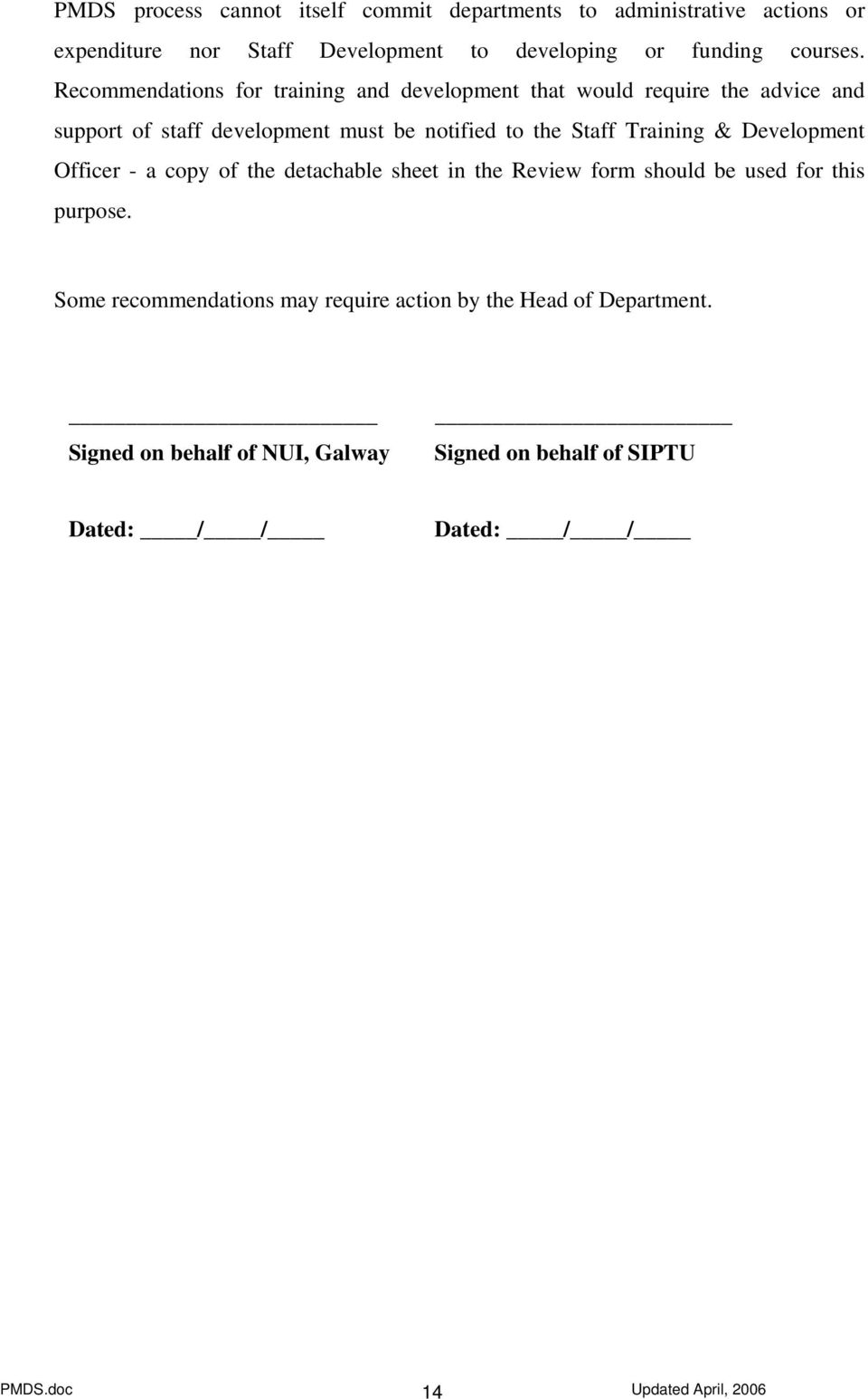
15 Performance Management Development System Form Please refer to the Operational Guide for details of how to complete this form and the PMDS Process. Name of Reviewee: Date of Reviewee s Training in PMDS: Reviewee s Job Title: Department/Office/Centre: Staff ID Number: Date Appointed to this Post: Period Covered by this Document : Date of Last Review if applicable: Date of Reviewer s training in PMDS: Reviewers Job title: Date of Review: PMDS.doc 15
16 SECTION 1 (To be completed by you and passed to your Reviewer not less than 2 days before the Review meeting) 1. Describe briefly the main duties of your present job in terms of its principal components COMPONENT OF WORK TIME (%) 2. On the basis of your performance during the year, of any particular points of enjoyment or frustration, and of your objectives for the coming year, indicate areas where you feel you would welcome additional support or advice. PMDS.doc 16

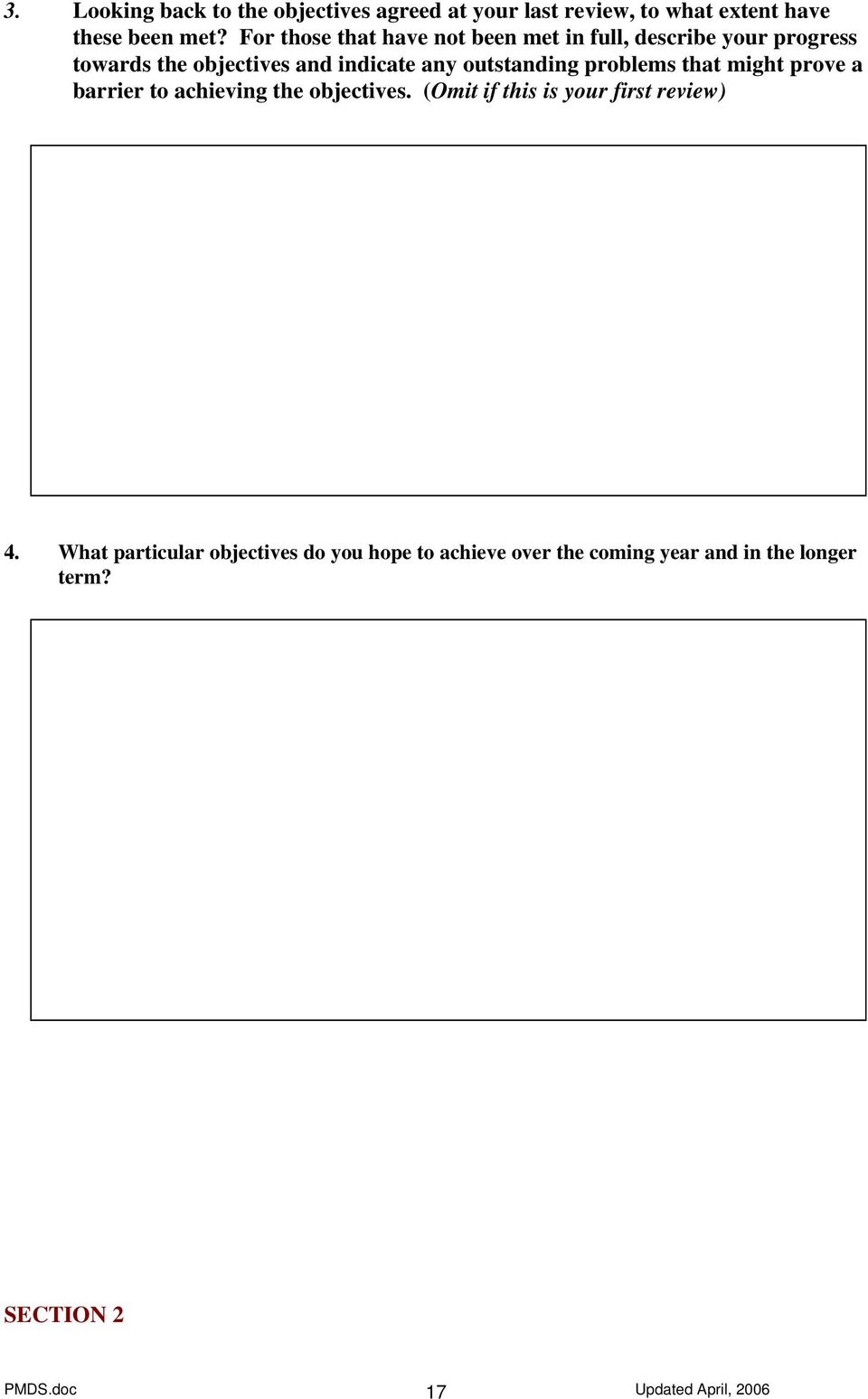
17 3. Looking back to the objectives agreed at your last review, to what extent have these been met? For those that have not been met in full, describe your progress towards the objectives and indicate any outstanding problems that might prove a barrier to achieving the objectives. (Omit if this is your first review) 4. What particular objectives do you hope to achieve over the coming year and in the longer term? SECTION 2 PMDS.doc 17
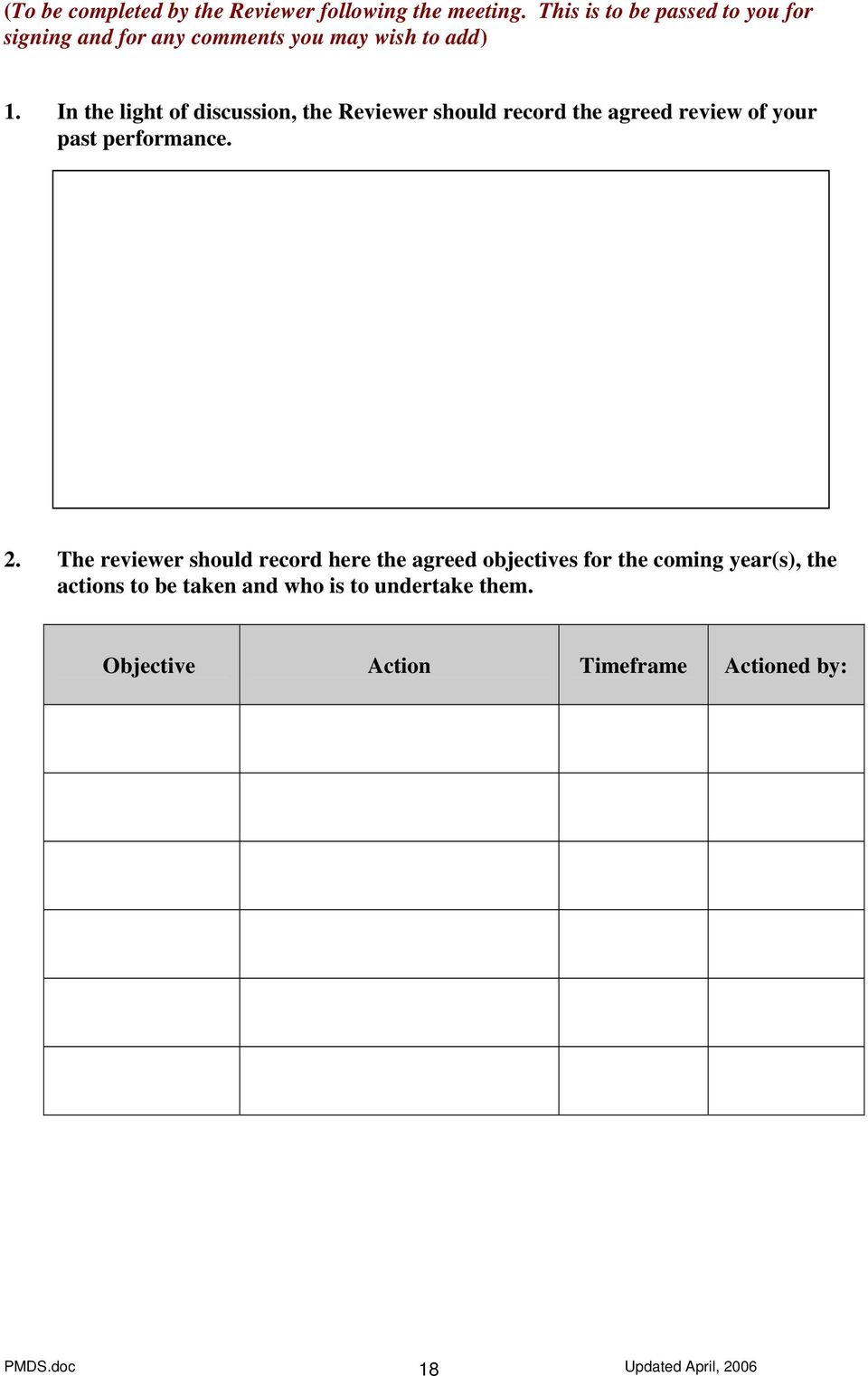
18 (To be completed by the Reviewer following the meeting. This is to be passed to you for signing and for any comments you may wish to add) 1. In the light of discussion, the Reviewer should record the agreed review of your past performance. 2. The reviewer should record here the agreed objectives for the coming year(s), the actions to be taken and who is to undertake them. Objective Action Timeframe Actioned by: PMDS.doc 18
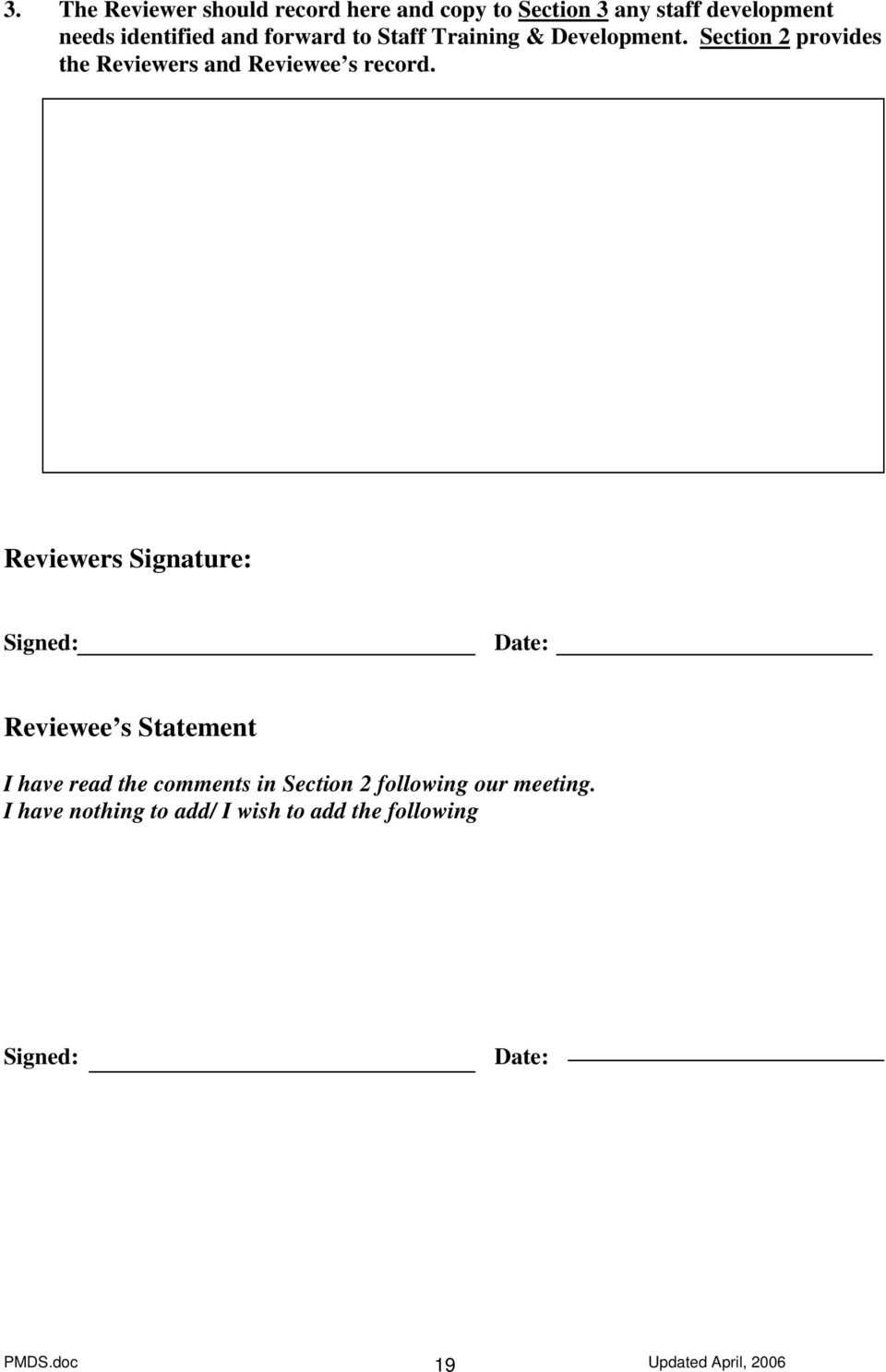
19 3. The Reviewer should record here and copy to Section 3 any staff development needs identified and forward to Staff Training & Development. Section 2 provides the Reviewers and Reviewee s record. Reviewers Signature: Signed: Date: Reviewee s Statement I have read the comments in Section 2 following our meeting. I have nothing to add/ I wish to add the following Signed: Date: PMDS.doc 19
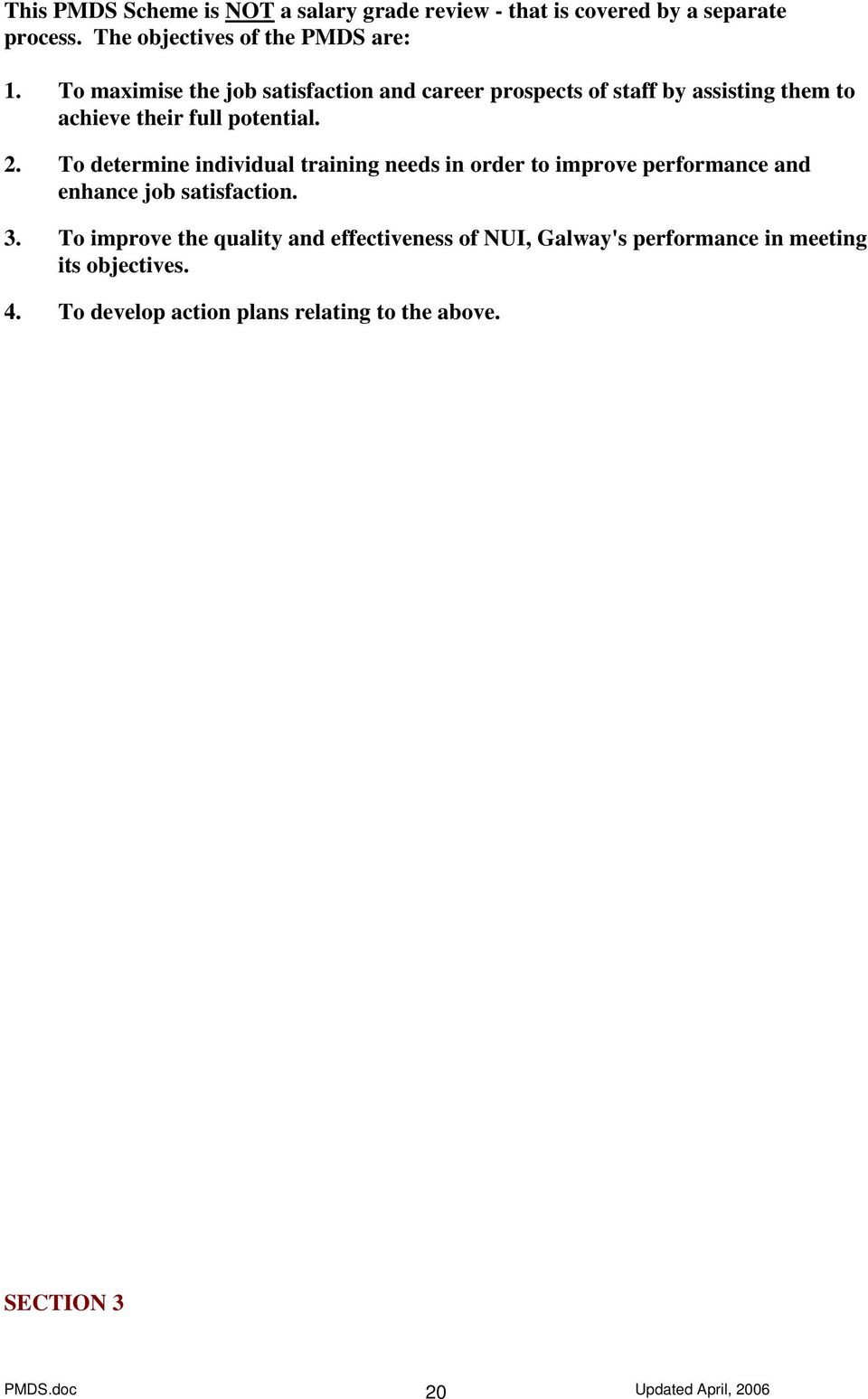
20 This PMDS Scheme is NOT a salary grade review - that is covered by a separate process. The objectives of the PMDS are: 1. To maximise the job satisfaction and career prospects of staff by assisting them to achieve their full potential. 2. To determine individual training needs in order to improve performance and enhance job satisfaction. 3. To improve the quality and effectiveness of NUI, Galway's performance in meeting its objectives. 4. To develop action plans relating to the above. SECTION 3 PMDS.doc 20
21 The information on this sheet should be copied from section 2 of this form and should be sent to Staff Training & Development Office. Reviewee Name: Reviewer Name: Department: Staff ID: Extension No.: Date of Review: Arising from the above named's recent PMDS Review, the following staff development needs have been identified: ALL REPLIES ARE TREATED IN THE STRICTEST CONFIDENCE PMDS Cycle at NUI Galway PMDS.doc 21
22 HR initiates review cycle 1 Senior Managers reviewed Departments develop and disseminate local strategic plans Senior Managers agree and disseminate strategic plan 2 HoDs Reviewed 3 Reviewers briefed by HoD and review relationships agreed 4 HoD informs reviewees of their reviewers Reviewee may appeal 12 Departmental meeting to hear report on review 9 Report on PMDS process and issues emerging sent to Senior Management 8 Departmental Reviewer Meeting to reflect on patterns, issues and training needs emerging 10 Statement of completion of review sent to HR 11 Departmental and /or individual training needs report sent to Training and Development 5 Reviewer contacts reviewee and agress date of discussion If HoD has concerns HoD and Reviewer discuss?? 6 Reviewee obtains form, completes and forwards 1/2 weeks before discussion 7 Discussion takes place (in 1st yr major focus on objectives) If HoD not the reviewer s/he signs of on objectives HoD stores documentation in secure location to which s/he has sole access Where disagreements arise Reviewee may appeal PMDS.doc 22
APPRAISAL POLICY AND PROCEDURE FOR SUPPORT STAFF 1
 APPRAISAL POLICY AND PROCEDURE FOR SUPPORT STAFF 1 1 The appraisal scheme will be rolled out as follows: Phase 1 (2013/2014): Grades 8-11 Phase 2 (2014/2015): Grades 5-7 Phase 3 (2015/2016): Grades 1-5
Performance Management Development System (PMDS)
 Performance Management Development System (PMDS) Helping to chart your development in UCD UCD PMDS Guidelines CONTENTS Page 1. Performance Management Development System in UCD 3 1.1 Introduction 3 1.2
PERFORMANCE & PERSONAL DEVELOPMENT PROGRAMME Launched: April 2010
 PERFORMANCE & PERSONAL DEVELOPMENT PROGRAMME Launched: April 2010 1 PERFORMANCE & PERSONAL DEVELOPMENT PROGRAMME INDEX Page Introduction 3 PPDP Cycle 4 Performance planning meeting 5 Performance planning
Mendip Edge Federation
 Mendip Edge Federation Fairlands Middle School POLICY FOR APPRAISING TEACHER PERFORMANCE Contents PURPOSE... 2 APPLICATION OF THE APPRAISAL POLICY... 2 THE APPRAISAL PERIOD... 2 SETTING OBJECTIVES... 3
Fairness at Work (Grievance Policy & Procedure)
 Fairness at Work (Grievance Policy & Procedure) Publication Scheme Y/N Department of Origin Policy Holder Author Related Documents Can be Published on Force Website HR Operations Head of HR Operations
Code of Conduct, Statement of Corporate Purpose, Managing Unsatisfactory Performance, SES Performance Management
 Policy Name: Status: Staff Performance Management Policy and Framework Current Policy Number: 4 Version Number: 3 File reference: Compliance Level: Applies to: Category: Summary Related Policies: ADM/3132P02
Managing Absence Procedure
 Managing Absence Procedure Human Resources 1 Introduction 1.1 The University is committed to maintaining the health, safety and wellbeing of its most important asset its workforce, and will seek to adopt
Harbour School. Performance Management Policy. Version: 2.01. Learning & Achieving Together
 Harbour School Learning & Achieving Together Performance Management Policy Version: 2.01 Date Released: 28 th November 2012 1 Please note: This is a model policy for the effective appraisal staff in schools
OUTLINE of CONTENTS. Introduction. Professional Development Policy. Part 2 Performance Review and Planning Procedures. Part 3 Salary Increment Policy
 PACIFIC ADVENTIST UNIVERSITY PROFESSIONAL DEVELOPMENT, PERFORMANCE REVIEW AND PLANNING POLICY OUTLINE of CONTENTS Introduction Part I Professional Development Policy Part 2 Performance Review and Planning
HANDBOOK FOR MANAGERS/SUPERVISORS OF PROFESSIONAL/GENERAL STAFF
 HANDBOOK FOR MANAGERS/SUPERVISORS OF PROFESSIONAL/GENERAL STAFF Section 1: Managing and Developing People at CSU... 3 Section 2: People Management, the Broad Structure... 3 Section 3: Principles... 4 Section
Performance Appraisal Policy For Teachers
 Performance Appraisal Policy For Teachers Department: Schools HR Advisory Team Author: Ruth Alinek Original date of Issue: April 2012 Latest Review: May 2013 Version: 3 Hertfordshire County Council 2012.
Performance Review Scheme for the GLA
 Performance Review Scheme for the GLA Section 1 The Policy 1. The Rationale for Performance Review There is a range of sound reasons why organisations should use a system of performance review. It provides
PERFORMANCE MANAGEMENT POLICY
 PERFORMANCE MANAGEMENT POLICY Updated July 2010 2007 1 CONTENTS Page 1 Purpose 3 2 Scope of the policy 3 Policy Framework 4 Roles and Responsibilities 5 Introduction to performance management in HelpAge
Policy for the Appraisal of School Staff
 PRESTON & WINGHAM PRIMARY SCHOOLS FEDERATION Policy for the Appraisal of School Staff APPROVAL & ADOPTION This policy was formally agreed and adopted by the Governing Body on: Chair of Governors Signed:
Managing Change HR Policy and Procedures
 Managing Change HR Policy and Procedures Incorporating changes following the review process in September 2012 Issued October 2012 2 Contents Page 1. Scope 3 2. Managing Organisational Change Key Principles
Northern Ireland Environment Agency Corporate Social Responsibility
 Northern Ireland Environment Agency Corporate Social Responsibility September 2011 Introduction This document has been prepared by the Northern Ireland Environment Agency (NIEA) in line with general NICS
Health and Safety Policy
 Health and Safety Policy October 2014 1 October 2014 Contents: Introduction 1. STATEMENT OF INTENT AND POLICY OBJECTIVES 2. RESPONSIBILITIES AND ACCOUNTABILITIES FOR HEALTH AND SAFETY 2.1 The Director
Wiltshire Council Human Resources. Improving Work Performance Policy and Procedure
 Wiltshire Council Human Resources Improving Work Performance Policy and Procedure This policy can be made available in other languages and formats such as large print and audio on request. What is it?
DRAFT MANAGEMENT OF EMPLOYEE CAPABILITY: ATTENDANCE MANAGEMENT POLICY
 DRAFT MANAGEMENT OF EMPLOYEE CAPABILITY: ATTENDANCE MANAGEMENT POLICY CONTENTS Section Page 1 Introduction 2 2 Scope 2 3 Key Responsibilities 3 4 Definitions used Within the Policy 3 5 Recording & Monitoring
Grievance and Disputes Policy and Procedure. Document Title. Date Issued/Approved: 10 August 2010. Date Valid From: 21 December 2015
 POLICY UNDER REVIEW Please note that this policy is under review. It does, however, remain current Trust policy subject to any recent legislative changes, national policy instruction (NHS or Department
Ratified by: Fully ratified via committee 2008
 Reference: Author & Title: Responsible Director: Performance Review and Development Policy Andy Catterall HR Director HRD Review Date: March 2015 Ratified by: Fully ratified via committee 2008 Date Ratified:
Disciplinary Policy and Procedure
 Disciplinary Policy and Procedure Policy The success of the University is dependent on its most important resource, its staff. It is therefore vital that all employees are encouraged to work to the best
NEWMAN UNIVERSITY DISCIPLINARY POLICY AND PROCEDURE
 1. Scope and Purpose NEWMAN UNIVERSITY DISCIPLINARY POLICY AND PROCEDURE 1.1 Newman University [hereafter referred to as the University] recognises disciplinary rules and procedures are necessary for the
PERFORMANCE APPRAISAL PROCEDURE
 APPENDIX 4 Function: HR Version Number: 1 Introduction: To assist to ensure Council is well placed in its corporate area, to achieve its Objectives and Strategic Goal to provide leadership and ensure community
Compassion Courage Hope Integrity Justice Respect Responsibility - Wisdom. Herne Bay Junior School. Appraisal Policy. Policy Agreed: Sept 2015
 Compassion Courage Hope Integrity Justice Respect Responsibility - Wisdom Herne Bay Junior School Appraisal Policy Policy Agreed: Sept 2015 Review Date: Sept 2016 1 1 Introduction Purpose of the Policy
Sustaining Progress Fourth Progress Report
 Sustaining Progress Fourth Progress Report Name of Institution DUBLIN CITY UNIVERSITY I confirm that I have assessed and verified the extent of progress and co-operation which has been achieved to date
Performance Review and Development Scheme for Support Staff Policy
 Performance Review and Development Scheme for Support Staff Policy Policy Reviewed by Resource committee Autumn 2013 Reviewed policy shared with staff on: Autumn 2013 Policy to be reviewed again on: Autumn
Lifestreams Christian Church (LCC) Child Care Centre. Educator/Staff Performance Management Policy
 Lifestreams Christian Church (LCC) Child Care Centre Educator/Staff Performance Management Policy Policy Number: /2013 Rationale and Policy Considerations The education and care service understands that
Career Development Policy
 1 Career Development Policy POLICY RECORD DETAILS DATE AGREED: 24th September 2010 VERSION No. POLICY OWNER: ORGANISATION DEVELOPMENT MANAGER JOB TITLE Dept / Directorate HUMAN RESOURCES CONTRIBUTORS:
CHANGE MANAGEMENT POLICY AND PROCEDURE
 CHANGE MANAGEMENT POLICY AND PROCEDURE This Change Management Policy and Procedure contains guidance to managers and staff who are involved in the development and implementation of changes in working arrangements
Disciplinary Procedure
 Disciplinary Procedure Human Resources 1 Introduction The University is committed to supporting its staff in carrying out their responsibilities within an environment which encourages productive, safe
Tasmania Prison Service Department of Justice. Performance Management Policy and Framework
 Tasmania Prison Service Department of Justice Performance Management Policy and Framework January 2014 1 Authorised by: Position of authorising person: Brian Edwards Director, Tasmania Prison Service Date
Grievance Policy and Procedure
 Grievance Policy and Procedure Page 1 Grievance Policy and Procedure Policy ref no: HR012-14 Author (inc job Judith Champion, Senior HR Business Partner title) Date Approved May 2014 Approved by Quality
Director of Organisational Development & Workforce DISCIPLINARY POLICY
 Directorate of Organisational Development & Workforce DISCIPLINARY POLICY Reference: OWP017 Version: 3.0 This version issued: 15/05/13 Result of last review: Major changes Date approved by owner (if applicable):
ATTENDANCE MANAGEMENT POLICY
 ATTENDANCE MANAGEMENT POLICY Co-ordinator: Director of HR Reviewer: Grampian Area Partnership Forum Approver: Grampian Area Partnership Forum Signature Signature Signature Identifier: NHSG/POL/39/HR Review
SOUTHERN EDUCATION AND LIBRARY BOARD MANAGING ATTENDANCE AT WORK. Staff in Grant Aided Schools with Fully Delegated Budgets
 SOUTHERN EDUCATION AND LIBRARY BOARD MANAGING ATTENDANCE AT WORK Staff in Grant Aided Schools with Fully Delegated Budgets POLICY STATEMENT The Southern Education and Library Board is committed to promoting
Sickness Management Policy
 Sickness Management Policy Human Resources UpdatedSept 2012 AJR/HR/Sickness Management Policy 1.0 PURPOSE 1.1 The University is committed to promoting the health, safety and welfare of its employees. The
Workforce Performance Management Policy and Procedure
 Workforce Performance Management Policy and Procedure Workforce Performance Management Policy and Procedure Page: Page 1 of 19 Recommended by Approved by Executive Management Team Workforce Committee Approval
Future Research Leaders call 2015/16 Guidance notes for non-academic reviewers
 Future Research Leaders call 2015/16 Guidance notes for non-academic reviewers Introduction... 1 Aims and objectives... 1 Procedure... 3 Peer Review form on Je-S... 3 The decision-making process... 3 Assessment
Health & Wellbeing Framework. Absence Management Policy
 Health & Wellbeing Framework Absence Management Policy 1 Introduction This Policy is part of the Health & Wellbeing Framework which is made up of a number of elements which together encompass all formal
APPRAISAL POLICY. Policy description:
 APPRAISAL POLICY Policy description: Craven College s appraisal scheme aims to enhance the quality of service provided by the College by promoting the individual professional and personal development of
Derbyshire Constabulary REORGANISATION, REDUNDANCY AND REDEPLOYMENT POLICY POLICY REFERENCE 05/001. This policy is suitable for Public Disclosure
 Derbyshire Constabulary REORGANISATION, REDUNDANCY AND REDEPLOYMENT POLICY POLICY REFERENCE 05/001 This policy is suitable for Public Disclosure Owner of Doc: Head of Department, Human Resources Date Approved:
Staff Performance Review Policy and Procedure
 Staff Performance Review Policy and Procedure Policy/Document Approval Body: Governance Board Date Created: 26 October 2012 Policy Custodian: Policy Contact: File Location: Location on EIT website: Review
Procedure for Managing Sickness Absence and Promoting Attendance for Teachers and Associated Professionals
 1 Procedure for Managing Sickness Absence and Promoting Attendance for Teachers and Associated Professionals December 2013 2 Contents Pages Introduction and Dundee City Council Corporate Policy 3-4 Absence
Performance Management and Development System Annual Performance Review Contents
 Page 1 Performance Management and Development System Annual Performance Review Contents Guidelines to Completing the Annual Performance and Development Review Form... 2 Part 1 Assessment... 4 To what extent
Statutory guidance for appropriate bodies, local authorities, head teachers, school staff and governing bodies
 Statutory guidance for appropriate bodies, local authorities, head teachers, school staff and governing bodies Contents GUIDANCE FOR APPROPRIATE BODIES, LOCAL AUTHORITIES, HEAD TEACHERS, SCHOOL STAFF AND
West Dunbartonshire Council s Employee Recognition Framework
 West Dunbartonshire Council s Employee Recognition Framework CONTENTS 1 Introduction page 3 2 Overview of the framework page 3 3 Communicating and promoting success page 4 4 WDC Annual Employee Recognition
MAYFIELD SCHOOL. Author: Torbay Human Resources [April 2011] Renewed 9 th November 2015
![MAYFIELD SCHOOL. Author: Torbay Human Resources [April 2011] Renewed 9 th November 2015](/thumbs/30/14355908.jpg "MAYFIELD SCHOOL. Author: Torbay Human Resources [April 2011] Renewed 9 th November 2015") MAYFIELD SCHOOL Policy: TUPE Guidelines for Managers Author: Torbay Human Resources [April 2011] Governors Committee: Leadership Date adopted: 23 rd May 2011 Renewed 9 th November 2015 Next review: Autumn
MAYFIELD SCHOOL Policy: TUPE Guidelines for Managers Author: Torbay Human Resources [April 2011] Governors Committee: Leadership Date adopted: 23 rd May 2011 Renewed 9 th November 2015 Next review: Autumn
Key Steps to Implementing Performance Management
 Key Steps to Implementing Performance Management Key Steps to Implementing Performance Management COPYRIGHT NOTICE PPA Consulting Pty Ltd (ACN 079 090 547) 2005-2013 You may only use this document for
University of York Coaching Scheme
 University of York Coaching Scheme Guidelines July 2014 Learning and Development Contents Introduction to Coaching... 2 What is the difference between Coaching, Mentoring, Counselling and Mediation?...
Policy for the Appraisal of School Staff
 Policy for the Appraisal of School Staff The Governing Body of Hartlip Endowed Church of England Primary School adopted this performance management policy October 2014. 1. Introduction Purpose of the Policy
APPRAISAL POLICY 1. BACKGROUND
 APPRAISAL POLICY 1. BACKGROUND 1.1 Appraisals are part of performance management. Within the School appraisal is about motivating and developing employees and supporting them in performing their roles
APES 320 Quality Control for Firms
 APES 320 Quality Control for Firms APES 320 Quality Control for Firms is based on International Standard on Quality Control (ISQC 1) (as published in the Handbook of International Auditing, Assurance,
Thurrock Council. Managing Sickness Absence Policy
 Thurrock Council Managing Sickness Absence Policy Contents Page 1. Introduction 5 2 Purpose 5 3. Scope 6 4. Key Responsibilities 6 Employees Managers Human Resources 5. Reporting Sickness Absence 7 Reporting
INDIVIDUAL PERFORMANCE MANAGEMENT POLICY. For. Section 57 and Non-section 57 Senior Management of Ethekwini Municipality
 INDIVIDUAL PERFORMANCE MANAGEMENT POLICY For Section 57 and Non-section 57 Senior Management of Ethekwini Municipality Performance Monitoring and Evaluation (PME) Office of the City Manager TABLE OF CONTENTS
Appendix S ATTENDANCE MANAGEMENT POLICY
 Appendix S ATTENDANCE MANAGEMENT POLICY This Policy sets out the Council's expectations of both managers and employees in the management of attendance at work, particularly with regard to sickness absence.
Review of the Management of Sickness Absence Conwy County Borough Council
 Audit 2004/2005 Date: December 2005 Authors: Ros Adams and George Jones Ref: 1072A2005 Review of the Management of Sickness Absence Conwy County Borough Council Contents Summary Report Introduction 3 Background
University of Detroit Mercy. Performance Communication System (PCS)
 Supervisor Manual 1/5/11 Supervisor Manual Table of Contents The 3 The PCS Process 5 Preparing for the Discussion Meeting 7 Tips for Good Communication 7 Performance Expectations 8 Behavioral Competencies
QAHC Feedback and Conflict Management Policy and Procedures
 QAHC Feedback and Conflict Management Policy and Procedures Prepared By Erica Waters Consulting June 2000 Revised & Endorsed October 2000 Revised by QAHC September 2007 Policy Statement The Queensland
SICKNESS ABSENCE MANAGEMENT PROCEDURE. With effect from xxxxxx
 SICKNESS ABSENCE MANAGEMENT PROCEDURE With effect from xxxxxx Purpose The purpose of this policy is to provide guidelines on how to manage and support staff through absence due to ill health. When is this
Clare College Cambridge
 Clare College Cambridge Staff Training and Development Policy Clare College is committed to the support of staff development for all staff. The key purpose is to facilitate personal and professional development
Redundancy & Redeployment Policy. Transformation & Human Resources
 Redundancy & Redeployment Policy Transformation & Human Resources Issued by HR Policy Team Effective from REDUNDANCY AND REDEPLOYMENT POLICY 1 General Principles Purpose 1.1 The purpose of the policy is
Human Resources CAPABILITY POLICY & PROCEDURE. September 2012 Updated June 2015. 1 of 18
 Human Resources CAPABILITY POLICY & PROCEDURE September 2012 Updated June 2015 1 of 18 1. Purpose and Scope The procedures set out in this document apply to all University staff and aim to: Demonstrate
ST BARTHOLOMEW S SCHOOL. PERFORMANCE MANAGEMENT POLICY (Teachers and the Headteacher)
 ST BARTHOLOMEW S SCHOOL PERFORMANCE MANAGEMENT POLICY (Teachers and the Headteacher) Reviewed by Learning Resources Committee, Spring 2011 Approved by Full Governing Body, Spring 2011 To be reviewed Spring
Managing Unsatisfactory Performance
 Managing Unsatisfactory Performance of employees of the Department of Education, Training and Employment (except for state school teachers and principals) Table of Contents Implementation 3 What is unsatisfactory
VOIP 2000 - HR Direct Fife Council June 2011 Page 1 of 10 MC70
 Managing Workforce Change: Transfer of Undertakings (TUPE) P r o c e d u r e This procedure should be applied where there is a transfer of work from one employer to another. The procedure covers the following
INVESTORS IN PEOPLE REVIEW REPORT
 INVESTORS IN PEOPLE REVIEW REPORT Lower Farm Primary School Page: 1 of 13 CONTENTS Key Information 3 Assessor Decision 3 Milestone Dates 3 Introduction 4 Assessment Objectives 4 Feedback Against the Assessment
HEALTH & SAFETY POLICY
 HEALTH & SAFETY POLICY 1. STATEMENT OF INTENT & POLICY OBJECTIVES The Council, as the governing body of the School, recognises and accepts the responsibilities placed on it as 'Employer' by the Health
D 1. Working with people Develop productive working relationships with colleagues. Unit Summary. effective performance.
 1 Develop productive working relationships with colleagues Unit Summary What is the unit about? This unit is about developing working relationships with colleagues, within your own organisation and within
Staff Development and Performance Management Policy & Procedure
 Staff Development and Performance Management Policy & Procedure Overview The purpose of this document is to outline QAHC s approach to staff development and performance management. The policy and procedure
Personal Development Record. An ICO guide.
 PDR guide September 2014 Personal Development Record. An ICO guide. How am I doing? What can we do to improve? What more can I do to develop? Revised May 2015 Introduction The performance of every member
PERFORMANCE APPRAISAL AND DEVELOPMENT AND KSF ANNUAL REVIEW
 SECTION: HUMAN RESOURCES POLICY AND PROCEDURE No: 10.16 NATURE AND SCOPE: SUBJECT: POLICY AND PROCEDURE TRUST WIDE PERFORMANCE APPRAISAL AND DEVELOPMENT AND KSF ANNUAL REVIEW This policy explains the Performance
University Appraisal Scheme
 University Appraisal Scheme 1. Policy Statement 1.1 Cardiff University recognises the need to develop all staff to allow them to meet their full potential and make a valued contribution to the institution
Grievance Policy. 1. Policy Statement
 Grievance Policy 1. Policy Statement The University is keen to provide a positive and supportive working environment for all of its employees, and as such will take every step to resolve issues in the
1.1 Terms of Reference Y P N Comments/Areas for Improvement
 1 Scope of Internal Audit 1.1 Terms of Reference Y P N Comments/Areas for Improvement 1.1.1 Do Terms of Reference: a) Establish the responsibilities and objectives of IA? b) Establish the organisational
NOTTINGHAM UNIVERSITY HOSPITALS NHS TRUST POLICIES AND PROCEDURES MANAGEMENT OF ATTENDANCE AND SICKNESS ABSENCE POLICY. Documentation Control
 NOTTINGHAM UNIVERSITY HOSPITALS NHS TRUST POLICIES AND PROCEDURES MANAGEMENT OF ATTENDANCE AND SICKNESS ABSENCE POLICY Documentation Control Reference HR/P&C/003 Date approved 4 Approving Body Trust Board
2015 2016 master s courses fashion promotion, communication & media
 2015 2016 master s courses fashion promotion, communication & media postgraduate programmes master s course fashion promotion, communication & media 02 Brief Overview Brief Descriptive Summary These Master
Mentor Portfolio of Evidence for Nurses: Recognition of Mentorship Skills, Guidance and Mapping Framework for Stage 3 mentors/practice Teachers.
 Mentor Portfolio of Evidence for Nurses: Recognition of Mentorship Skills, Guidance and Mapping Framework for Stage 3 mentors/practice Teachers. School of Nursing, Midwifery and Social Work: Working in
PERFORMANCE AND DEVELOPMENT FRAMEWORK FOR PRINCIPALS, EXECUTIVES AND TEACHERS IN NSW PUBLIC SCHOOLS
 PERFORMANCE AND DEVELOPMENT FRAMEWORK FOR PRINCIPALS, EXECUTIVES AND TEACHERS IN NSW PUBLIC SCHOOLS Introduction and Context The NSW Department of Education and Communities is committed to attracting,
Human Resources. Values for Working Together and Professional Behaviours
 Human Resources Values for Working Together and Professional Behaviours A message from the Vice-Chancellor The new Human Resources Strategy, Working Together: A Strategy for Success, in tandem with the
LOCAL DISCIPLINARY PROCEDURE
 LOCAL DISCIPLINARY PROCEDURE 1 2 LOCAL DISCIPLINARY PROCEDURE 1. Introduction... 4 2. Aims and objectives... 4 3. The procedure... 4 4. Officers responsible for taking disciplinary action are as follows...
HUMAN RESOURCES POLICIES AND PROCEDURES DISCIPLINARY. Date of Policy 1993 Date policy to be reviewed 09/2014
 HUMAN RESOURCES POLICIES AND PROCEDURES DISCIPLINARY Date of Policy 1993 Date policy to be reviewed 09/2014 Policy written by SFC/HR Risk Register Ref (s) HR7 Impact Assessed EDG Date Impact assessed 10/2012
The Grampian Valuation Joint Board. Disciplinary Procedure
 The Grampian Valuation Joint Board Disciplinary Procedure 1. STATEMENT OF POLICY 1.1 It is the view of the Grampian Valuation Joint Board that the maintenance of discipline is essential for the effective
City and County of Swansea. Human Resources & Workforce Strategy 2013-2017. Ambition is Critical 1
 City and County of Swansea Human Resources & Workforce Strategy 2013-2017 Ambition is Critical 1 Delivering quality services for a safer, greener, smarter, fairer, healthier, richer Swansea Executive Summary
Rewards and Incentives Group. Teachers and Head teachers Performance Management. Guidance
 Rewards and Incentives Group Teachers and Head teachers Performance Management Guidance This guide is intended for: Governors Head teachers Teachers School Improvement Partners Local authorities Please
NHS North Somerset Clinical Commissioning Group
 NHS North Somerset Clinical Commissioning Group HR Policies Managing Sickness Absence Approved by: Quality and Assurance Group Ratification date: September 2013 Review date: September 2016 Elaine Edwards
People & Organisational Development Strategy
 2013-2018 People & Organisational Development Strategy Delivering excellent research Delivering an excellent student experience Enhancing global reach and reputation 1. Introduction Glasgow 2020: A global
Management of Excess Teaching Service
 Management of Excess Teaching Service Last updated 6 August 2015 MANAGEMENT OF EXCESS TEACHING SERVICE CONTENTS PAGE OVERVIEW... 2 CONSULTATION... 3 IDENTIFICATION... 5 REDEPLOYMENT/CAREER TRANSITION SUPPORT...
Review of Financial Planning and Monitoring. City of York Council Audit 2008/09 Date
 Review of Financial Planning and Monitoring City of York Council Audit 2008/09 Date Contents Introduction and Background 3 Audit approach 4 Main conclusions 5 Financial Planning Findings 6 Financial Monitoring
Administrative Instruction
 Administrative Instruction Date: To: From: 26 July 2011 All UNOPS Personnel Pierre Moreau-Peron, Director, HRPG J 1-r AI Reference: Subject: AUHRPG/2011/04 Performance Management and Appraisal for staff
Capability Procedure: Managing Poor Performance
 Capability Procedure: Managing Poor Performance This policy/apd supersedes: New Policy Name and title of author Christine White Human Resources Advisor Date written/revised September 2007 Approved by (Committee/Group)
CYRIL JACKSON PRIMARY SCHOOL STAFF SICKNESS ABSENCE POLICY
 CYRIL JACKSON PRIMARY SCHOOL STAFF SICKNESS ABSENCE POLICY VISION: Cyril Jackson is a safe and stimulating environment where children encounter challenging and creative learning experiences. Each member
Managerial Competencies (if any) (see attached Annex)
 RECRUITMENT PROFILE Profile: Human Resources Major Duties and Responsibilities 1. Responsible for the interpretation and application of the Staff Rules, regulations and procedures ensuring uniform application
Review Process for University Departments and Academic Partnerships
 Procedure Review Process for University Departments and Academic Partnerships Contents Introduction... 3 Purpose of Review... 4 Stages of the Review Process... 5 Membership of the Review Panel... 5 Areas
Performance Management in the HSE
 Performance Management in the HSE Guidance Document March 2012 Support & Development Patient/ Service User Engagement Responsibility V3 i Contents Chapter 1 Introduction to the Performance Management System
THE IMPLEMENTATION OF PERFORMANCE MANAGEMENT AND CONTRACTING FOR SENIOR MANAGERS IN THE SOUTH AFRICAN PUBLIC SERVICE
 THE IMPLEMENTATION OF PERFORMANCE MANAGEMENT AND CONTRACTING FOR SENIOR MANAGERS IN THE SOUTH AFRICAN PUBLIC SERVICE Presentation to the Association of African Public Services Commissions (AAPSComs) General
DISCIPLINARY POLICY & PROCEDURE FOR SCHOOL BASED STAFF
 DISCIPLINARY POLICY & PROCEDURE FOR SCHOOL BASED STAFF Based on Leeds City Council recommendations January 2012 1 CONTENTS 1. Introduction 2. Scope of the Procedure 3. Core Principles 4. Management of