
Day Treatment Mental Health Adult
|
|
|
- Ashlyn Allen
- 9 years ago
- Views:
Transcription
1 Day Treatment Mental Health Adult Definition Day Treatment provides a community based, coordinated set of individualized treatment services to individuals with psychiatric disorders who are not able to function full-time in a normal school, work, and/or home environment and need the additional structured activities of this level of care. While less intensive than hospital based day treatment, this service includes diagnostic, medical, psychiatric, psychosocial, and adjunctive treatment modalities in a structured setting. Day Treatment programs typically are less medically involved than Hospital Based Day Treatment programs. Day Treatment should not be confused with custodial and social rehabilitation programs. Day Treatment leads to the attainment of specific goals through specific therapeutic interventions and allows for transition of the patient to an outpatient level of care. Policy Day Treatment mental health services are available to Medicaid Managed Care eligible adult members, age 21 and over. Program Requirements Refer to general Facility and Program Standards for additional requirements Licensing/Accreditation Licensed as a Adult Day Service. The agency must have written policies and procedures related to: Refer to Standards Common to all Levels of Care for a potential list of policies generally related to the provision of mental health and substance abuse treatment. Agencies must develop policies to guide the provision of any service in which they engage clients, and to guide their overall administrative function. Features/Hours May be available 7 days/week with a minimum availability of 5 days /week including days, evenings and weekends Service Expectations An initial diagnostic interview by the program psychiatrist within 24 hours of admission Multidisciplinary bio-psychosocial assessment within 24 hours of admission including alcohol and drug screening and assessment as needed A history and physical present in the client s record within 30 days of admission A treatment/recovery plan developed by the multidisciplinary team integrating individual strengths & needs, considering community, family and other supports, stating measurable goals, that includes a documented discharge and relapse prevention plan completed within 72 hours of admission

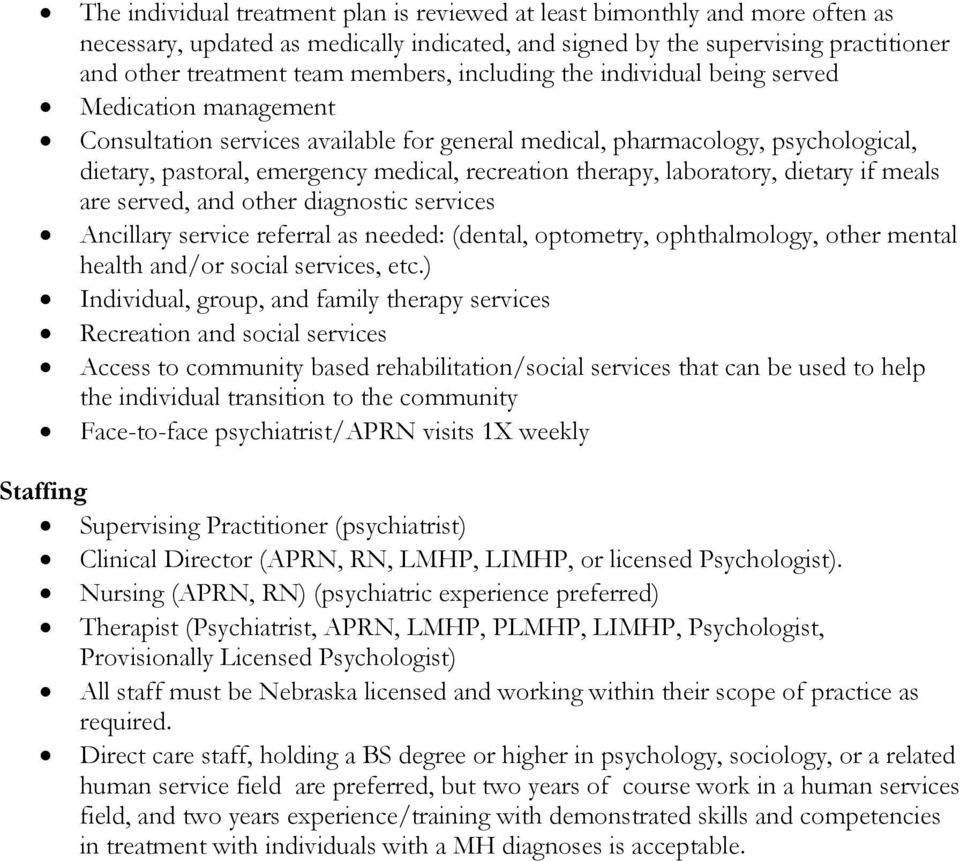
2 The individual treatment plan is reviewed at least bimonthly and more often as necessary, updated as medically indicated, and signed by the supervising practitioner and other treatment team members, including the individual being served Medication management Consultation services available for general medical, pharmacology, psychological, dietary, pastoral, emergency medical, recreation therapy, laboratory, dietary if meals are served, and other diagnostic services Ancillary service referral as needed: (dental, optometry, ophthalmology, other mental health and/or social services, etc.) Individual, group, and family therapy services Recreation and social services Access to community based rehabilitation/social services that can be used to help the individual transition to the community Face-to-face psychiatrist/aprn visits 1X weekly Staffing Supervising Practitioner (psychiatrist) Clinical Director (APRN, RN, LMHP, LIMHP, or licensed Psychologist). Nursing (APRN, RN) (psychiatric experience preferred) Therapist (Psychiatrist, APRN, LMHP, PLMHP, LIMHP, Psychologist, Provisionally Licensed Psychologist) All staff must be Nebraska licensed and working within their scope of practice as required. Direct care staff, holding a BS degree or higher in psychology, sociology, or a related human service field are preferred, but two years of course work in a human services field, and two years experience/training with demonstrated skills and competencies in treatment with individuals with a MH diagnoses is acceptable.
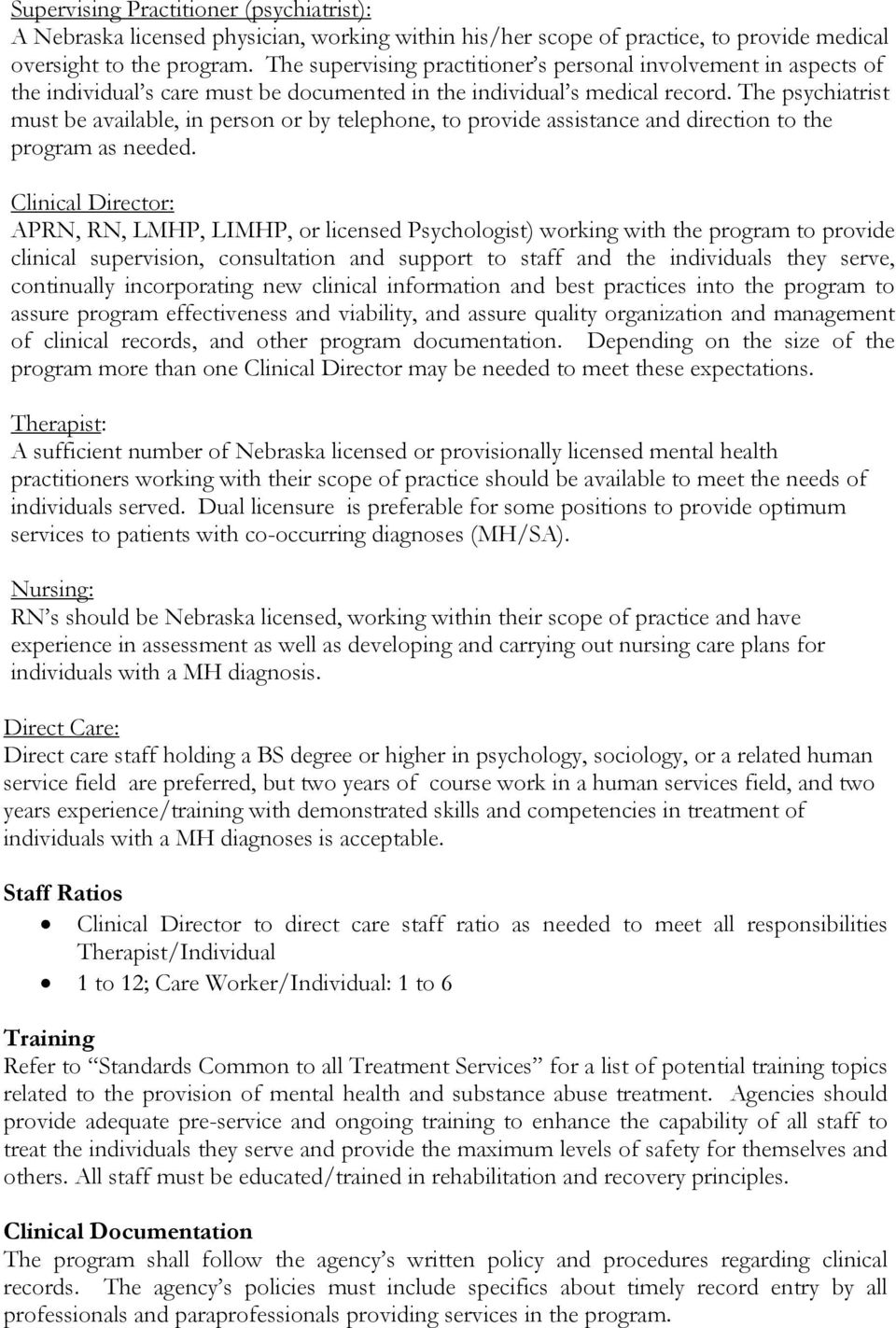
3 Supervising Practitioner (psychiatrist): A Nebraska licensed physician, working within his/her scope of practice, to provide medical oversight to the program. The supervising practitioner s personal involvement in aspects of the individual s care must be documented in the individual s medical record. The psychiatrist must be available, in person or by telephone, to provide assistance and direction to the program as needed. Clinical Director: APRN, RN, LMHP, LIMHP, or licensed Psychologist) working with the program to provide clinical supervision, consultation and support to staff and the individuals they serve, continually incorporating new clinical information and best practices into the program to assure program effectiveness and viability, and assure quality organization and management of clinical records, and other program documentation. Depending on the size of the program more than one Clinical Director may be needed to meet these expectations. Therapist: A sufficient number of Nebraska licensed or provisionally licensed mental health practitioners working with their scope of practice should be available to meet the needs of individuals served. Dual licensure is preferable for some positions to provide optimum services to patients with co-occurring diagnoses (MH/SA). Nursing: RN s should be Nebraska licensed, working within their scope of practice and have experience in assessment as well as developing and carrying out nursing care plans for individuals with a MH diagnosis. Direct Care: Direct care staff holding a BS degree or higher in psychology, sociology, or a related human service field are preferred, but two years of course work in a human services field, and two years experience/training with demonstrated skills and competencies in treatment of individuals with a MH diagnoses is acceptable. Staff Ratios Clinical Director to direct care staff ratio as needed to meet all responsibilities Therapist/Individual 1 to 12; Care Worker/Individual: 1 to 6 Training Refer to Standards Common to all Treatment Services for a list of potential training topics related to the provision of mental health and substance abuse treatment. Agencies should provide adequate pre-service and ongoing training to enhance the capability of all staff to treat the individuals they serve and provide the maximum levels of safety for themselves and others. All staff must be educated/trained in rehabilitation and recovery principles. Clinical Documentation The program shall follow the agency s written policy and procedures regarding clinical records. The agency s policies must include specifics about timely record entry by all professionals and paraprofessionals providing services in the program.
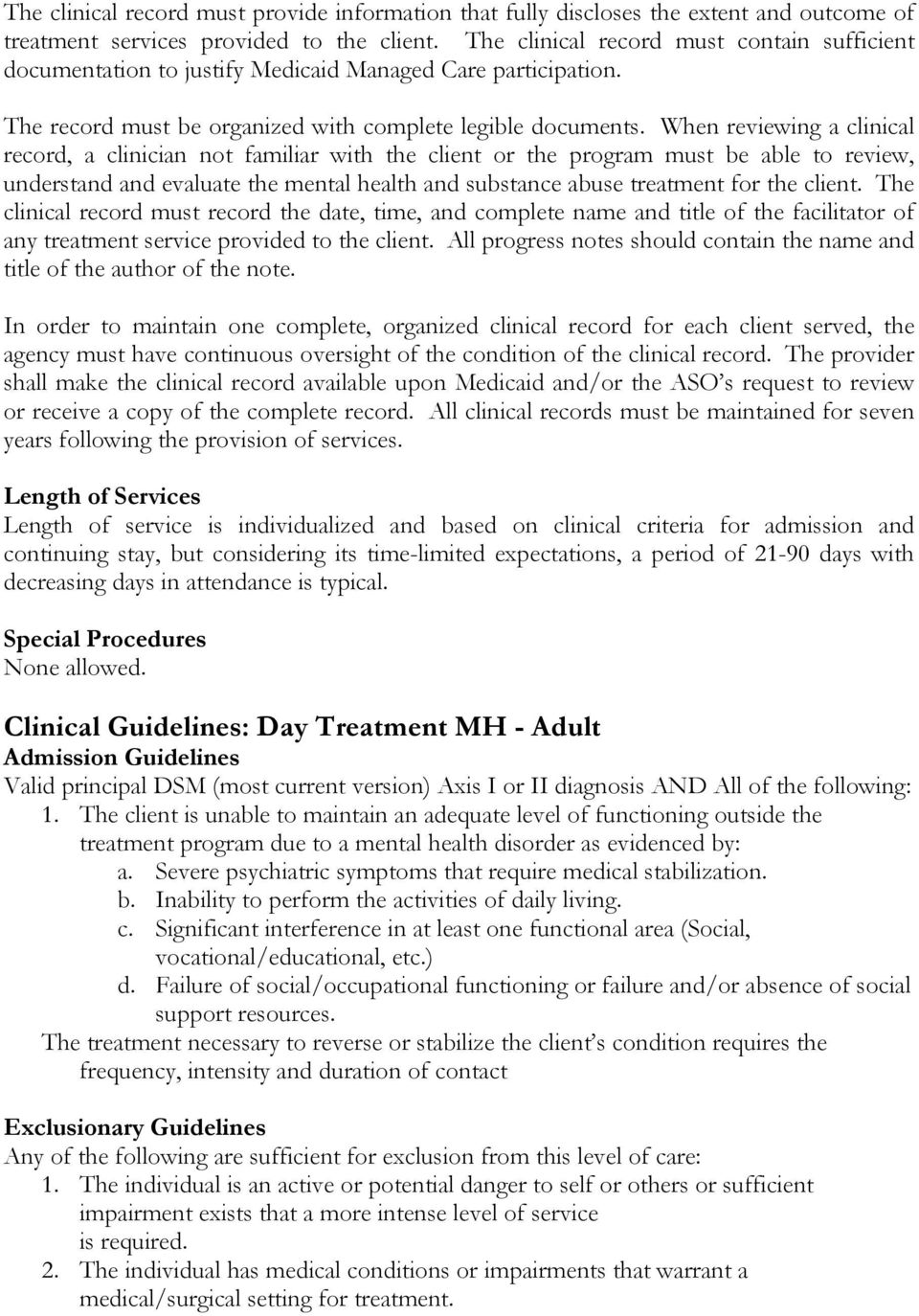
4 The clinical record must provide information that fully discloses the extent and outcome of treatment services provided to the client. The clinical record must contain sufficient documentation to justify Medicaid Managed Care participation. The record must be organized with complete legible documents. When reviewing a clinical record, a clinician not familiar with the client or the program must be able to review, understand and evaluate the mental health and substance abuse treatment for the client. The clinical record must record the date, time, and complete name and title of the facilitator of any treatment service provided to the client. All progress notes should contain the name and title of the author of the note. In order to maintain one complete, organized clinical record for each client served, the agency must have continuous oversight of the condition of the clinical record. The provider shall make the clinical record available upon Medicaid and/or the ASO s request to review or receive a copy of the complete record. All clinical records must be maintained for seven years following the provision of services. Length of Services Length of service is individualized and based on clinical criteria for admission and continuing stay, but considering its time-limited expectations, a period of days with decreasing days in attendance is typical. Special Procedures None allowed. Clinical Guidelines: Day Treatment MH - Adult Admission Guidelines Valid principal DSM (most current version) Axis I or II diagnosis AND All of the following: 1. The client is unable to maintain an adequate level of functioning outside the treatment program due to a mental health disorder as evidenced by: a. Severe psychiatric symptoms that require medical stabilization. b. Inability to perform the activities of daily living. c. Significant interference in at least one functional area (Social, vocational/educational, etc.) d. Failure of social/occupational functioning or failure and/or absence of social support resources. The treatment necessary to reverse or stabilize the client s condition requires the frequency, intensity and duration of contact Exclusionary Guidelines Any of the following are sufficient for exclusion from this level of care: 1. The individual is an active or potential danger to self or others or sufficient impairment exists that a more intense level of service is required. 2. The individual has medical conditions or impairments that warrant a medical/surgical setting for treatment.
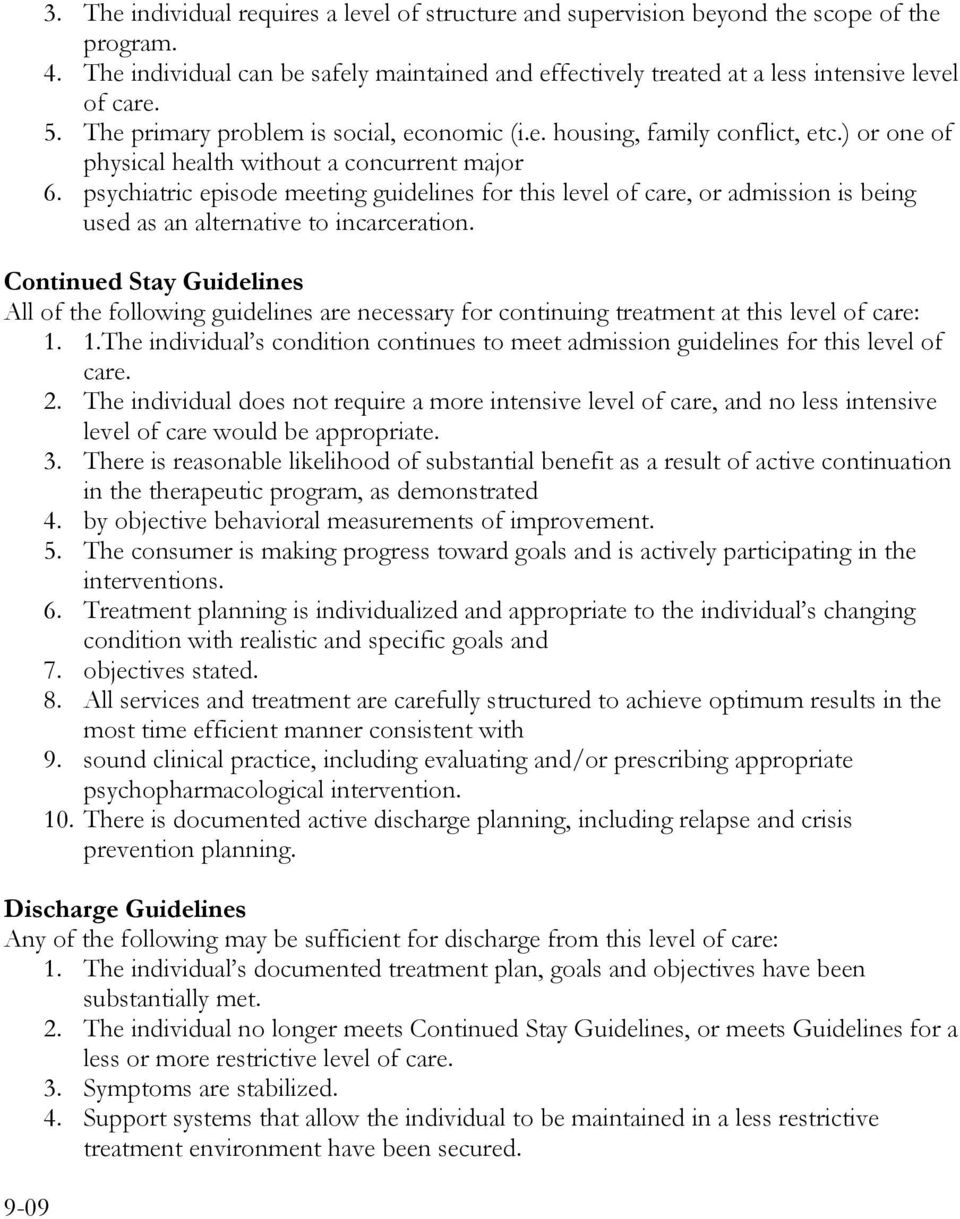
5 3. The individual requires a level of structure and supervision beyond the scope of the program. 4. The individual can be safely maintained and effectively treated at a less intensive level of care. 5. The primary problem is social, economic (i.e. housing, family conflict, etc.) or one of physical health without a concurrent major 6. psychiatric episode meeting guidelines for this level of care, or admission is being used as an alternative to incarceration. Continued Stay Guidelines All of the following guidelines are necessary for continuing treatment at this level of care: 1. 1.The individual s condition continues to meet admission guidelines for this level of care. 2. The individual does not require a more intensive level of care, and no less intensive level of care would be appropriate. 3. There is reasonable likelihood of substantial benefit as a result of active continuation in the therapeutic program, as demonstrated 4. by objective behavioral measurements of improvement. 5. The consumer is making progress toward goals and is actively participating in the interventions. 6. Treatment planning is individualized and appropriate to the individual s changing condition with realistic and specific goals and 7. objectives stated. 8. All services and treatment are carefully structured to achieve optimum results in the most time efficient manner consistent with 9. sound clinical practice, including evaluating and/or prescribing appropriate psychopharmacological intervention. 10. There is documented active discharge planning, including relapse and crisis prevention planning. Discharge Guidelines Any of the following may be sufficient for discharge from this level of care: 1. The individual s documented treatment plan, goals and objectives have been substantially met. 2. The individual no longer meets Continued Stay Guidelines, or meets Guidelines for a less or more restrictive level of care. 3. Symptoms are stabilized. 4. Support systems that allow the individual to be maintained in a less restrictive treatment environment have been secured. 9-09
Partial Hospitalization - MH - Adult (Managed Medicaid only Service)
 Partial Hospitalization - MH - Adult (Managed Medicaid only Service) Definition Partial hospitalization is a nonresidential treatment program that is hospital-based. The program provides diagnostic and
Psychiatric Day Rehabilitation MH - Adult
 Psychiatric Day Rehabilitation MH - Adult Definition Day Rehabilitation services are designed to provide individualized treatment and recovery, inclusive of psychiatric rehabilitation and support for clients
Psychiatric Residential Rehabilitation MH - Adult
 Psychiatric Residential Rehabilitation MH - Adult Definition Psychiatric Residential Rehabilitation is designed to provide individualized treatment and recovery inclusive of psychiatric rehabilitation
Intensive Outpatient Psychotherapy - Adult
 Intensive Outpatient Psychotherapy - Adult Definition Intensive Outpatient Psychotherapy services provide group based, non-residential, intensive, structured interventions consisting primarily of counseling
Subacute Inpatient MH - Adult
 Subacute Inpatient MH - Adult Definition Subacute Inpatient hospital psychiatric services are medically necessary short-term psychiatric services provided to a client with a primary psychiatric diagnosis
Appendix B NMMCP Covered Services and Exceptions
 Acute Inpatient Hospitalization MH - Adult Definition An Acute Inpatient program is designed to provide medically necessary, intensive assessment, psychiatric treatment and support to individuals with
Assertive Community Treatment (ACT)
 Assertive Community Treatment (ACT) Definition The Assertive Community Treatment (ACT) Team provides high intensity services, and is available to provide treatment, rehabilitation, and support activities
LEVEL III.5 SA: SHORT TERM RESIDENTIAL - Adult (DUAL DIAGNOSIS CAPABLE)
 LEVEL III.5 SA: SHT TERM RESIDENTIAL - Adult (DUAL DIAGNOSIS CAPABLE) Definition The following is based on the Adult Criteria of the Patient Placement Criteria for the Treatment of Substance-Related Disorders
NEBRASKA DEPARTMENT OF HEALTH & HUMAN SERVICES DIVISION OF BEHAVIORAL HEALTH. SERVICE DEFINITIONS Attachment to Title 206 NAC
 NEBRASKA DEPARTMENT OF HEALTH & HUMAN SERVICES DIVISION OF BEHAVIORAL HEALTH SERVICE DEFINITIONS Attachment to Title 206 NAC Effective April 11, 2015 Table of Contents MENTAL HEALTH AND SUBSTANCE ABUSE
LEVEL I SA: OUTPATIENT INDIVIDUAL THERAPY - Adult
 LEVEL I SA: OUTPATIENT INDIVIDUAL THERAPY - Adult Definition The following is based on the Adult Criteria of the Patient Placement Criteria for the Treatment of Substance-Related Disorders of the American
LEVEL II.1 SA: INTENSIVE OUTPATIENT - Adult
 LEVEL II.1 SA: INTENSIVE OUTPATIENT - Adult Definition The following is based on the Adult Criteria of the Patient Placement Criteria for the Treatment of Substance- Related Disorders of the American Society
4.401 Substance Use Partial Hospitalization Program (Adults and Adolescents)
 4.40 STRUCTURED DAY TREATMENT SERVICES 4.401 Substance Use Partial Hospitalization Program (Adults and Adolescents) Description of Services: Substance use partial hospitalization is a nonresidential treatment
MEDICAL ASSOCIATES HEALTH PLANS HEALTH CARE SERVICES POLICY AND PROCEDURE MANUAL POLICY NUMBER: PP 27
 POLICY TITLE: RESIDENTIAL TREATMENT CRITERIA POLICY STATEMENT: Provide consistent criteria when determining coverage for Residential Mental Health and Substance Abuse Treatment. NOTE: This policy applies
OUTPATIENT DAY SERVICES
 OUTPATIENT DAY SERVICES Intensive Outpatient Programs (IOP) Intensive Outpatient Programs (IOP) provide time limited, multidisciplinary, multimodal structured treatment in an outpatient setting. Such programs
Clinical Criteria 4.201 Inpatient Medical Withdrawal Management 4.201 Substance Use Inpatient Withdrawal Management (Adults and Adolescents)
 4.201 Inpatient Medical Withdrawal Management 4.201 Substance Use Inpatient Withdrawal Management (Adults and Adolescents) Description of Services: Inpatient withdrawal management is comprised of services
8.401 Eating Disorder Partial Hospitalization Program (Adult and Adolescent)
 8.40 STRUCTURED DAY TREATMENT SERVICES 8.401 Eating Disorder Partial Hospitalization Program (Adult and Adolescent) Description of Services: Eating Disorder partial hospitalization is a nonresidential
other caregivers. A beneficiary may receive one diagnostic assessment per year without any additional authorization.
 4.b.(8) Diagnostic, Screening, Treatment, Preventive and Rehabilitative Services (continued) Attachment 3.1-A.1 Page 7c.2 (a) Psychotherapy Services: For the complete description of the service providers,
B-1 INTRODUCTION. Philosophy and Core Values
 Page1 Table of Contents B-1 INTRODUCTION... 3 Philosophy and Core Values... 3 Active, Effective Treatment and Rehabilitation Plans... 3 Family Centered Practice... 4 Resiliency and Recovery Informed...
TN No: 09-024 Supersedes Approval Date:01-27-10 Effective Date: 10/01/09 TN No: 08-011
 Page 15a.2 (iii) Community Support - (adults) (CS) North Carolina is revising the State Plan to facilitate phase out of the Community Support - Adults service, which will end effective July 1, 2010. Beginning
8.201 Acute Inpatient Eating Disorder (Adult and Adolescent)
 8.20 INPATIENT SERVICES 8.201 Acute Inpatient Eating Disorder (Adult and Adolescent) Description of Services: Acute inpatient eating disorder treatment represents the most intensive level of psychiatric
MEDICAL POLICY No. 91607-R1 MENTAL HEALTH RESIDENTIAL TREATMENT: CHILD AND ADOLESCENT
 Summary of Changes MEDICAL POLICY MENTAL HEALTH RESIDENTIAL TREATMENT: CHILD ADOLESCENT Effective Date: June 4, 2015 Review Dates: 5/14, 5/15 Date Of Origin: May 14, 2014 Status: Current Clarifications:
Department of Mental Health and Addiction Services 17a-453a-1 2
 17a-453a-1 2 DEPARTMENT OF MENTAL HEALTH AND ADDICTION SERVICES General Assistance Behavioral Health Program The Regulations of Connecticut State Agencies are amended by adding sections 17a-453a-1 to 17a-453a-19,
Professional Treatment Services in Facility-Based Crisis Program Children and Adolescents
 Professional Treatment Services in Facility-Based Crisis Program Children and Adolescents Medicaid and North Carolina Health Choice (NCHC) Billable Service WORKING DRAFT Revision Date: September 11, 2014
Medical Necessity Criteria
 Medical Necessity Criteria 2015 Updated 03/04/2015 Appendix B Medical Necessity Criteria Purpose: In order to promote consistent utilization management decisions, all utilization and care management staff
WORKERS COMPENSATION PROTOCOLS WHEN PRIMARY INJURY IS PSYCHIATRIC/PSYCHOLOGICAL
 WORKERS COMPENSATION PROTOCOLS WHEN PRIMARY INJURY IS PSYCHIATRIC/PSYCHOLOGICAL General Guidelines for Treatment of Compensable Injuries Patient must have a diagnosed mental illness as defined by DSM-5
Optum By United Behavioral Health. 2015 Florida Medicaid Managed Medical Assistance (MMA) Level of Care Guidelines
 Optum By United Behavioral Health 2015 Florida Medicaid Managed Medical Assistance (MMA) Level of Care Guidelines Statewide Inpatient Psychiatric Program Services (SIPP) Statewide Inpatient Psychiatric
MEDICAL POLICY No. 91608-R1 MENTAL HEALTH RESIDENTIAL TREATMENT: ADULT
 MENTAL HEALTH RESIDENTIAL TREATMENT: ADULT Effective Date: June 4, 2015 Review Dates: 5/14, 5/15 Date Of Origin: May 12, 2014 Status: Current Summary of Changes Clarifications: Pg 4, Description, updated
How To Know If You Can Get Help For An Addiction
 2014 FLORIDA SUBSTANCE ABUSE LEVEL OF CARE CLINICAL CRITERIA SUBSTANCE ABUSE LEVEL OF CARE CLINICAL CRITERIA Overview Psychcare strives to provide quality care in the least restrictive environment. An
Division of Behavioral Health. Requirements for Program Staff
 Division of Behavioral Health Requirements for Program Staff Integrated BH Regulations Training 1 Program Staff Program Staff are professionals who render behavioral health services directly to a recipient.
DEPARTMENT OF SERVICES FOR CHILDREN, YOUTH AND THEIR FAMILIES DIVISION OF CHILD MENTAL HEALTH SERVICES PROGRAM DESCRIPTIONS
 DEPARTMENT OF SERVICES FOR CHILDREN, YOUTH AND THEIR FAMILIES DIVISION OF CHILD MENTAL HEALTH SERVICES PROGRAM DESCRIPTIONS OVERVIEW The Division of Child Mental Health Services provides both mental health
Program of Assertive Community Services (PACT)
 Program of Assertive Community Services (PACT) Service/Program Definition Program of Assertive Community Services (PACT) entails the provision of an array of services delivered by a community-based, mobile,
ASSERTIVE COMMUNITY TREATMENT TEAMS
 ARTICLE 11. ASSERTIVE COMMUNITY TREATMENT TEAMS Rule 1. Definitions 440 IAC 11-1-1 Applicability Sec. 1. The definitions in this rule apply throughout this article. (Division of Mental Health and Addiction;
ASSERTIVE COMMUNITY TREATMENT: ACT 101. Rebecca K. Sartor, LICSW
 ASSERTIVE COMMUNITY TREATMENT: ACT 101 Rebecca K. Sartor, LICSW A LITTLE BIT ABOUT ME HOW I ENDED UP HERE LEARNING OBJECTIVES To develop an understanding of: How ACT Evolved Practice Principles Services
Behavioral Health Covered Services
 Behavioral Health Covered Services Inpatient Services - 24-hour services, delivered in a licensed hospital setting, that provide clinical intervention for mental health or substance use diagnoses, or both.
Behavioral Health Medical Necessity Criteria
 Behavioral Health Medical Necessity Criteria Revised: 7/14/05 2 nd Revision: 9/14/06 3 rd Revision: 8/23/07 4 th Revision: 8/28/08; 11/20/08 5 th Revision: 8/27/09 Anthem Blue Cross and Blue Shield 2 Gannett
8.301 Residential Treatment Services (RTS) Eating Disorders (Adult and Adolescent)
 8.30 RESIDENTIAL TREATMENT CENTER SERVICES 8.301 Residential Treatment Services (RTS) Eating Disorders (Adult and Adolescent) Description of Services: Residential Treatment Services are provided to individuals
[Provider or Facility Name]
![[Provider or Facility Name]](/thumbs/24/2833314.jpg "[Provider or Facility Name]") [Provider or Facility Name] SECTION: [Facility Name] Residential Treatment Facility (RTF) SUBJECT: Psychiatric Security Review Board (PSRB) In compliance with OAR 309-032-0450 Purpose and Statutory Authority
[Provider or Facility Name] SECTION: [Facility Name] Residential Treatment Facility (RTF) SUBJECT: Psychiatric Security Review Board (PSRB) In compliance with OAR 309-032-0450 Purpose and Statutory Authority
STRUCTURED OUTPATIENT ADDICTION PROGRAM (SOAP)
 STRUCTURED OUTPATIENT ADDICTION PROGRAM (SOAP) Providers contracted for this level of care or service are expected to comply with all requirements of these service-specific performance specifications.
Performance Standards
 Performance Standards Co-Occurring Disorder Competency Performance Standards are intended to provide a foundation and serve as a tool to promote continuous quality improvement and progression toward best
NEW HAMPSHIRE CODE OF ADMINISTRATIVE RULES. PART He-W 513 SUBSTANCE USE DISORDER (SUD) TREATMENT AND RECOVERY SUPPORT SERVICES
 CHAPTER He-W 500 MEDICAL ASSISTANCE PART He-W 513 SUBSTANCE USE DISORDER (SUD) TREATMENT AND RECOVERY SUPPORT SERVICES He-W 513.01 Purpose. The purpose of this part is to establish the procedures and requirements
Optum By United Behavioral Health. 2015 Mississippi Coordinated Access Network (CAN) Medicaid Level of Care Guidelines
 Optum By United Behavioral Health 2015 Mississippi Coordinated Access Network (CAN) Medicaid Level of Care Guidelines Assertive Community Treatment is a multi-disciplinary, selfcontained clinical team
Optum By United Behavioral Health. 2015 Florida Medicaid Managed Medical Assistance (MMA) Level of Care Guidelines
 Optum By United Behavioral Health 2015 Florida Medicaid Managed Medical Assistance (MMA) Level of Care Guidelines Therapeutic group care services are community-based, psychiatric residential treatment
EATING DISORDERS PROGRAM
 EATING DISORDERS PROGRAM Exceptional Care in an Exceptional Setting Silver Hill Hospital is an academic affiliate of Yale University School of Medicine, Department of Psychiatry. SILVER HILL HOSPITAL HIGHLIGHTS
Psychiatric Residential Treatment Facility (PRTF): Aligning Care Efficiencies with Effective Treatment. BHM Healthcare Solutions 2013 1
 Psychiatric Residential Treatment Facility (PRTF): Aligning Care Efficiencies with Effective Treatment 1 Presentation Objectives Attendees will have a thorough understanding of Psychiatric Residential
ACUTE TREATMENT SERVICES (ATS) FOR SUBSTANCE USE DISORDERS LEVEL III.7
 ACUTE TREATMENT SERVICES (ATS) FOR SUBSTANCE USE DISORDERS LEVEL III.7 Providers contracted for this level of care or service are expected to comply with all requirements of these service-specific performance
Performance Standards
 Performance Standards Outpatient Performance Standards are intended to provide a foundation and serve as a tool to promote continuous quality improvement and progression toward best practice performances,
Peer Support Services Code Detail Code Mod Mod
 HIPAA Transaction Code Peer Support Services Peer Support Services Code Detail Code Mod Mod 1 2 Mod 3 Mod 4 Rate Practitioner Level 4, In-Clinic H0038 HQ U4 U6 $4.43 Practitioner Level 5, In-Clinic H0038
Behavioral Health Services 14.0
 Behavioral Health Services 14.0 Kaiser Permanente s Behavioral Health Services operates within the multi-specialty Mid- Atlantic Permanente Medical Group (MAPMG). It is a regional service committed to
Mental Health and Substance Abuse Reporting Requirements Section 425 of P.A. 154 of 2005
 Mental Health and Substance Abuse Reporting Requirements Section 425 of P.A. 154 of 2005 By April 1, 2006, the Department, in conjunction with the Department of Corrections, shall report the following
907 KAR 9:005. Level I and II psychiatric residential treatment facility service and coverage policies.
 907 KAR 9:005. Level I and II psychiatric residential treatment facility service and coverage policies. RELATES TO: KRS 205.520, 216B.450, 216B.455, 216B.459 STATUTORY AUTHORITY: KRS 194A.030(2), 194A.050(1),
ARKANSAS DEPARTMENT OF EDUCATION SCHOOL - BASED DAY TREATMENT PROGRAMS GUIDELINES
 ARKANSAS DEPARTMENT OF EDUCATION SCHOOL - BASED DAY TREATMENT PROGRAMS GUIDELINES I. DESCRIPTION A. Day Treatment is the most intensive non-residential program that can be provided over an extended period
OUTPATIENT SERVICES. Components of Service
 OUTPATIENT SERVICES Providers contracted for this level of care or service are expected to comply with all requirements of these service-specific performance specifications. Additionally, providers contracted
APS UTILIZATION MANAGEMENT GUIDELINES West Virginia OUT OF STATE PROVIDER SERVICES Version 1.0. APS Healthcare, Inc.
 APS UTILIZATION MANAGEMENT GUIDELINES West Virginia OUT OF STATE PROVIDER SERVICES APS Healthcare, Inc.- West Virginia Service Utilization Management Guidelines Out-of-State Provider Services Table of
Appendix D. Behavioral Health Partnership. Adolescent/Adult Substance Abuse Guidelines
 Appendix D Behavioral Health Partnership Adolescent/Adult Substance Abuse Guidelines Handbook for Providers 92 ASAM CRITERIA The CT BHP utilizes the ASAM PPC-2R criteria for rendering decisions regarding
CLINIC, REHABILITATION, TARGETED CASE MANAGEMENT OPTIONS AND BHHF CONTRACT PROVIDERS
 APS UTILIZATION MANAGEMENT GUIDELINES West Virginia MEDICAID, CLINIC, REHABILITATION, TARGETED CASE MANAGEMENT OPTIONS AND BHHF CONTRACT PROVIDERS APS Healthcare, Inc.- West Virginia West Virginia Clinic,
TREATMENT MODALITIES. May, 2013
 TREATMENT MODALITIES May, 2013 Treatment Modalities New York State Office of Alcoholism and Substance Abuse Services (NYS OASAS) regulates the addiction treatment modalities offered in New York State.
American Society of Addiction Medicine
 American Society of Addiction Medicine Public Policy Statement on Treatment for Alcohol and Other Drug Addiction 1 I. General Definitions of Addiction Treatment Addiction Treatment is the use of any planned,
STRUCTURED OUTPATIENT ADDICTION PROGRAM (SOAP)
 STRUCTURED OUTPATIENT ADDICTION PROGRAM (SOAP) Providers contracted for this level of care or service will be expected to comply with all requirements of these service-specific performance specifications.
Outpatient and Intensive Outpatient Narrative
 Los Angeles County Department of Public Health Substance Abuse Prevention and Control (SAPC) will implement an initial benefit package of Substance Use Disorder (SUD) services within the initial twelve
DEPARTMENT OF HEALTH AND HUMAN SERVICES Centers for Medicare & Medicaid Services. Mental Health Services
 DEPARTMENT OF HEALTH AND HUMAN SERVICES Centers for Medicare & Medicaid Services Mental Health Services ICN 903195 September 2013 This booklet was current at the time it was published or uploaded onto
LG/LCADC (Licensed Graduate or Licensed Clinical Alcohol and Drug Counselor) Pre-Application Credentials Evaluation Instructions
 Maryland Board of Professional Counselors and Therapists 4201 Patterson Avenue Baltimore, MD 21215 410-764-4732 or 410-764-4740 www.dhmh.maryland/bopc/ LG/LCADC (Licensed Graduate or Licensed Clinical
THE OFFICE OF SUBSTANCE ABUSE SERVICES REQUIREMENTS FOR THE PROVISION OF RESIDENTIAL DETOXIFICATION SERVICES BY PROVIDERS FUNDED WITH DBHDS RESOURCES
 THE OFFICE OF SUBSTANCE ABUSE SERVICES REQUIREMENTS FOR THE PROVISION OF RESIDENTIAL DETOXIFICATION SERVICES BY PROVIDERS FUNDED WITH DBHDS RESOURCES PURPOSE: The goal of this document is to describe the
As the State Mental Health Authority, the office of Mental Health has two main functions:
 NYSOMH Mission The mission of the New York State Office of Mental Health is to promote the mental health of all New Yorkers, with a particular focus on providing hope and recovery for adults with serious
INPATIENT SERVICES. Inpatient Mental Health Services (Adult/Child/Adolescent)
 INPATIENT SERVICES Inpatient Mental Health Services (Adult/Child/Adolescent) Acute Inpatient Mental Health Services represent the most intensive level of psychiatric care and is delivered in a licensed
How To Care For A Member Of A Psychiatric Rehab Facility
 2015 Level of Care Guidelines SH & ESH Supported Housing and Enhanced Supported Housing Psychiatric Rehabilitation services are defined by the Bureau of TennCare per the Contractor Risk Agreement (CRA).
BH RESIDENTIAL TX OPTIONS Quick Reference Guide 4.9.12 Therapeutic Group RESIDENTIAL REHAB <21
 Psychiatric Residential Treatment Facility (PRTF)
PERFORMANCE STANDARDS DRUG AND ALCOHOL PARTIAL HOSPITALIZATION PROGRAM. Final Updated 04/17/03
 PERFORMANCE STANDARDS DRUG AND ALCOHOL PARTIAL HOSPITALIZATION PROGRAM Final Updated 04/17/03 Community Care is committed to developing performance standards for specific levels of care in an effort to
CHRONIC PAIN AND RECOVERY CENTER
 CHRONIC PAIN AND RECOVERY CENTER Exceptional Care in an Exceptional Setting Silver Hill Hospital is an academic affiliate of Yale University School of Medicine, Department of Psychiatry. SILVER HILL HOSPITAL
Supplemental Manual for Substance Abuse Treatment Services(SATS) RULES OF PRACTICE AND PROCEDURE
 ARKANSAS DEPARTMENT OF HUMAN SERVICES DIVISION OF BEHAVIORAL HEALTH SERVICES OFFICE OF ALCOHOL AND DRUG ABUSE PREVENTION Supplemental Manual for Substance Abuse Treatment Services(SATS) RULES OF PRACTICE
Phoenix House Academy of Los Angeles at Lake View Terrace, CA
 Phoenix House Academy of Los Angeles at Lake View Terrace, CA Operating under the auspices of the Phoenix Houses of Los Angeles, Inc., Phoenix House Academy at Lake View Terrace (LVT) provides a strength-based,
To precertify inpatient admissions or transitional care services, call 1-866-688-3400 and select option #1.
 Security Health Plan provides coverage of various mental health/aoda (alcohol and other drug abuse) benefits to individual and employer group members. These benefits are managed by Security Health Plan.
Intensive Outpatient Program (IOP) Clinical Documentation Training. February 2013
 Intensive Outpatient Program (IOP) Clinical Documentation Training February 2013 Training Objectives APS Healthcare Introduction Utilization Review Process Overview of Medical Necessity Clinical Documentation
Florida Data as of July 2003. Mental Health and Substance Abuse Services in Medicaid and SCHIP in Florida
 Mental Health and Substance Abuse Services in Medicaid and SCHIP in Florida As of July 2003 2,441,266 people were covered under Florida's Medicaid and SCHIP programs. There were 2,113,820 enrolled in the
West Virginia Bureau for Behavioral Health and Health Facilities Covered Services 2012
 Assessment/Diagnostic & Treatment Services CATEGORY A & CATEGORY B Assessment/Diagnostic & Treatment Services are covered by Medicaid/Other third party payor or Charity Care - Medicaid Covered Services:
Treatment Services for Individuals with Co-Occurring Mental Health and Intellectual Disability/Developmental Disabilities
 Two types of individuals 1. People with primary diagnosis of intellectual disability/developmental disability Mental health diagnosis is secondary Primary services through ID/DD system Residential/Housing
Procedure/ Revenue Code. Billing NPI Required. Rendering NPI Required. Service/Revenue Code Description. Yes No No
 Procedure/ Revenue Code Service/Revenue Code Description Billing NPI Rendering NPI Attending/ Admitting NPI 0100 Inpatient Services Yes No Yes 0114 Room & Board - private psychiatric Yes No Yes 0124 Room
ASSERTIVE COMMUNITY TREATMENT TEAMS CERTIFICATION
 ARTICLE 5.2. ASSERTIVE COMMUNITY TREATMENT TEAMS CERTIFICATION Rule 1. Definitions 440 IAC 5.2-1-1 Applicability Sec. 1. The definitions in this rule apply throughout this article. (Division of Mental
Program Plan for the Delivery of Treatment Services
 Standardized Model for Delivery of Substance Use Services Attachment 5: Nebraska Registered Service Provider s Program Plan for the Delivery of Treatment Services Nebraska Registered Service Provider s
Psychiatric Rehabilitation Clinical Coverage Policy No: 8D-1 Treatment Facilities Revised Date: August 1, 2012. Table of Contents
 Table of Contents 1.0 Description of the Procedure, Product, or Service... 1 2.0 Eligible Recipients... 1 2.1 Provisions... 1 2.2 EPSDT Special Provision: Exception to Policy Limitations for Recipients
Policy and Procedure Manual
 Policy and Procedure Manual Resident Assessment (RA) Table of Contents RA-01 RA-02 RA-03 RA-04 RA-05 RA-06 RA-07 RA-08 RA-09 RA-10 RA-11 RA-12 Physical Health Services Dental Services Initial Nursing Summary
I. Introduction. ACT Program Standards
 Montana Standards for Programs of Assertive Community Treatment Adapted in 2011 from National Program Standards for ACT Teams Deborah Allness, M.S.S.W. and William Knoedler, M.D. Revised June 2003 by D.
Minnesota Co-occurring Mental Health & Substance Disorders Competencies:
 Minnesota Co-occurring Mental Health & Substance Disorders Competencies: This document was developed by the Minnesota Department of Human Services over the course of a series of public input meetings held
SUBSTANCE ABUSE OUTPATIENT
 SUBSTANCE ABUSE OUTPATIENT Service Category Description Substance abuse services - outpatient is the provision of medical or other treatment and/or counseling to address substance abuse problems (i.e.,
MAD-MR: 12-01 OTHER LONG TERM CARE SERVICES Eff: 3-1-12 PSYCHOSOCIAL REHABILITATION SERVICES INDEX
 INDEX 8.315.3 8.315.3.1 ISSUING AGENCY...1 8.315.3.2 SCOPE...1 8.315.3.3 STATUTORY AUTHORITY...1 8.315.3.4 DURATION...1 8.315.3.5 EFFECTIVE DATE...1 8.315.3.6 OBJECTIVE...1 8.315.3.7 DEFINITIONS...1 8.315.3.8
DRUG MEDI-CAL TITLE 22 TRAINING
 CALIFORNIA CODE OF REGULATIONS TITLE 22 Drug Medi-Cal Beneficiary Record Requirements 1 PRESENTATION OUTLINE PSPP Review Overview Admission/Physical Exam Treatment Plan Questions and Answers (10 mins)
Optum By United Behavioral Health. 2015 New Jersey Managed Long-Term Services and Support (MLTSS) Medicaid Level of Care Guidelines
 Optum By United Behavioral Health 2015 New Jersey Managed Long-Term Services and Support (MLTSS) Medicaid Level of Care Guidelines (AMHR) AMHR provides services in/by a licensed community residence. Services
# Category Standard Provisional Standard Notes/Comments
 Page1 1 Service Definition/ Required Components Therapeutic Rehabilitation Program is rehabilitative service for adults with SMI and children with SED designed to maximize reduction of mental disability
Children, youth and families with co-occurring mental health and substance abuse issues are welcomed in every contact, and in every setting.
 Practice Guidelines for the Identification and Treatment of Co-occurring Mental Health and Substance Abuse Issues In Children, Youth and Families June, 2008 This document is adapted from The Vermont Practice
Behavioral Health Medical Necessity Criteria
 Behavioral Health Medical Necessity Criteria Effective January 1, 2011 Revised and approved on 8/19/2010 The Office of Medical Policy and Technological Assessment (OMPTA) has developed policies that serve
Location of Service: 707 Broadway NE # 500, Albuquerque NM 87102
 Department: Service Name: Type of Service: Out Patient Services NMS Outpatient Services Mental Health Out Patient Services Location of Service: 707 Broadway NE # 500, Albuquerque NM 87102 Description of
Diagnostic, Screening, Treatment, Preventive and Rehabilitative Services
 Page 7c.1 4.b(8) Diagnostic, Screening, Treatment, Preventive and Rehabilitative Services Services provided under this section are provided by licensed practitioners (within their scope of practice as
ADVANCED BEHAVIORAL HEALTH, INC. Clinical Level of Care Guidelines - 2015
 The Clinical Level of Care Guidelines contained on the following pages have been developed as a guide to assist care managers, physicians and providers in making medical necessity decisions about the least
CABHAs and non-cabha agencies may provide Comprehensive Clinical Assessments, Medication Management, and Outpatient Therapy.
 Page 7c.1b 4.b Early and periodic screening, diagnostic and treatment services for individuals under 21 years of age, and treatment of conditions found. (continued) Critical Access Behavioral Health Agency