
B-1 INTRODUCTION. Philosophy and Core Values
|
|
|
- Collin Lang
- 10 years ago
- Views:
Transcription
1 Page1 Table of Contents B-1 INTRODUCTION... 3 Philosophy and Core Values... 3 Active, Effective Treatment and Rehabilitation Plans... 3 Family Centered Practice... 4 Resiliency and Recovery Informed... 4 Trauma Informed Practices... 5 Culturally Competent Practices... 5 B-2 BENEFIT PLAN DESCRIPTION... 5 Covered Services: Adults (19 years... 5 Non-Covered Services: Adults... 6 Outcome Measures... 8 Therapeutic Leave Day (TLD) Policy and Requirements... 8 Medical Leave Day Policy and Requirements... 9 B-3 STANDARDS COMMON TO ALL LEVELS OF CARE... 9 B-4 COVERED SERVICES Assessment Initial Diagnostic Interview Psychological Testing and Evaluation Medication Management and Injectible Medications Client Assistance Program (CAP) Outpatient Crisis Sessions Outpatient Psychotherapy Psychiatric Nursing (In Home) Electroconvulsive Therapy (ECT) Intensive Outpatient Psychotherapy (IOP) Day Treatment Mental Health Crisis Observation (23:59) Crisis Stabilization Program Partial Hospitalization Subacute Inpatient MH Acute Inpatient Hospitalization MH Medicaid Rehabilitation Option Services Community Support (CS) Psychiatric Day Rehabilitation MH Assertive Community Treatment (ACT) Psychiatric Residential Rehabilitation MH Secure Residential Rehabilitation /15

2 Page2 Adult Substance Abuse (ASAM Levels of Care) Level 1 SA: Outpatient Therapy Level 1 SA: Community Support Level 2.1 Intensive Outpatient (IOP) Level 3.1 Halfway House Level 3.2D Social Detox Level 3.3 Intermediate Residential Treatment Level 3.3 Therapeutic Community Level 3.5 SA: Short Term Residential (Dual Diagnosis Capable) Level 3.5 Dual Disorder Residential (Dual Diagnosis Enhanced)

3 B-1 INTRODUCTION Page3 Philosophy and Core Values Magellan Behavioral Health of Nebraska (hereafter, Magellan) is committed to providing treatment at the least-restrictive level of care necessary to assure safe and effective treatment and meet the mental health and substance use needs of eligible individuals and their families. Magellan believes in providing the right treatment, in the right amount, at the right location, for the right length of time. Individuals may enter treatment at any level and be moved to more or less intensive settings or levels of care as their changing clinical needs dictate. In order to meet Magellan expectations, contracted mental health and substance use disorder providers render care with the following characteristics: Active, Effective Treatment and Rehabilitation Plans Active treatment plans are based on a thorough evaluation of the individual s current symptoms, problems, restorative needs and strengths. The treatment plan addresses the specific event or trigger that caused the individual to present for treatment, has specific measureable goals and is time-limited. The treatment plan provides evidence of active treatment planning. An active psychiatric rehabilitation plan is based on a functional assessment and has measurable goals to restore and rehabilitate skills that promote each individual s recovery. Active treatment reinforces progress that has been attained and works toward improving functioning according to the treatment plan. An individual treatment, rehabilitation and recovery plan contains the following components: 1. Includes and applies the principles of recovery to include meaningful client participation, and a life in the community of the client s choosing; 2. Incorporates and is consistent with best practices; 3. Includes the client s individualized goals and expected outcomes; 4. Contains prioritized objectives that are measurable and time-limited; 5. Describes therapeutic interventions to be used in achieving the goals and objectives that are recovery-oriented, trauma-informed, and strength-based; 6. Identifies staff responsible for implementing the therapeutic interventions; 7. Specifies the planned frequency and duration of each therapeutic method; 8. Delineates the specific behavioral criteria to be met for discharge or transition to a lower level of care; 9. Includes a plan developed with the client that includes strategies to avoid crisis or admission to a higher level of care using principles of recovery and wellness; 10. Includes the signature of the client. 3

4 Page4 Effective treatment and rehabilitation programs utilize clinical outcome measures to inform both the individual treatment plan and the program s system of care. To support treatment effectiveness, Magellan offers secure web-based outcomes measurement programs for our providers and individuals; the Consumer Health Inventory (CHI) is a self-administered assessment that allows consumers to monitor their own progress. It also has items related to consumer satisfaction and gives providers aggregate data to use for program evaluation. Education and instruction on using the CHI is available online to all Magellan providers at: Family Centered Practice Treatment and rehabilitation includes family members in all aspects of treatment planning and service delivery. Family members may be biological relatives or others identified by the individual. The inclusion of the family in assessment, treatment and rehabilitation planning and ongoing intervention is a family centered best practice and plays a key role in the overall success of treatment approaches. Resiliency and Recovery Informed Cultivating a strengths-based, individual and family centered context for treatment that is recovery oriented and allows individuals and families to achieve their goals is one of Magellan s highest priorities. The principles of resiliency and recovery are as follows: 1. Demonstrate appreciation 2. Respect culture and language, and communicate effectively 3. Discover and support the strengths, skills and attributes of others 4. Think holistically about all areas of people s lives 5. Focus on self-determined readiness 6. Offer meaningful choices 7. Optimize peer, family and natural supports 8. Promote self-confidence in others 9. Measure, monitor and improve 10. Celebrate and share success 11. Create opportunities for meaningful consumer and family involvement 12. Model these principles in actions, language and decisions All people have qualities that enable them to rebound from adversity, trauma, tragedy or other stresses and to go on with a sense of mastery, competency and hope. All people living with behavioral health conditions have the capacity to learn, grow and change, and can achieve a life filled with meaning and purpose. Magellan 4

5 Page5 supports a philosophy of wellness that focuses on personal strengths, building hope and offering choices. Our focus on resiliency and recovery means that we help individuals and families achieve: A sense of belonging A safe place to live Days filled with purpose Skills to achieve wellness A strong voice in their own lives Hope and confidence in themselves and their future. Trauma Informed Practices Studies indicate that traumatic life events predispose individuals to increased incidences of both physical and mental health problems. Trauma informed care is based on assessment and treatment of individuals adversely affected by traumatic life events as part of and integrated with the overall treatment approach. In addition, trauma informed care creates mental health treatment environments and practices that reduce incidents that may re-traumatize individuals during the course of mental health treatment. Magellan works closely and consistently with providers to improve their assessment and treatment of traumatized individuals and reduce further trauma through implementation of models that are strength-based. Culturally Competent Practices Magellan supports cultural sensitivity and competency in our provider practice community. This includes awareness, acceptance and respect for differences and continuing self-assessment regarding culture. Treatment services should be delivered in the individual s preferred language. Cultural competence includes careful attention to the dynamics of differences among individuals and how they affect interactions, assumptions and the delivery of services. Providers also demonstrate cultural competence through continuous expansion of cultural knowledge and resources through training, readings, etc., and by providing a variety of adaptations to treatment models in order to meet the needs of different cultural populations. B-2 BENEFIT PLAN DESCRIPTION Covered Services: Adults (19 years When medically necessary, the services, when delivered by a contracted clinician practicing within their scope of practice and performed in accordance with Magellan s authorization requirements, are covered: Assessments Evaluation and Management services 5

6 Page6 Psychiatric Diagnostic Evaluation Substance Use Disorder Assessment Psychological Testing and Evaluation Mental Health and Substance Use Disorder Treatments Medication Management and Injectible Medications Crisis Therapy Client Assistance Program (CAP) Psychotherapy (Individual, Family and Group) ECT Intensive Outpatient Day Treatment Crisis Observation (23:59) Residential Crisis Stabilization Partial Hospitalization Inpatient (Subacute and Acute) Medicaid Rehabilitation Option (MRO) Services: Community Support Day Rehabilitation Assertive Community Treatment (ACT) Psychiatric Residential Rehabilitation Secure Residential Rehabilitation Adult Substance Abuse ASAM Levels of Care: Initial Adult Substance Use Disorder Assessment Level 1: Outpatient (Individual, Family, Group and Community Support) Level 2.1: Intensive Outpatient Level 3.1: Clinically Managed Low Intensity Residential (Halfway House) Level 3.3: Clinically Managed Medium Intensity Residential (Intermediate Residential, Therapeutic Community) Level 3.5: Clinically Managed High Intensity Residential (Short Term Residential, Dual Disorder Residential III.5 Enhanced) Non-Covered Services: Adults Treatment related to the following diagnoses and diagnostic categories are not covered by the Nebraska Medicaid Managed Care Program for Behavioral Health: Medical/Physical Health including brain trauma related issues Autism Spectrum Disorders Mental Retardation Learning Disorders Motor Skills Disorders 6

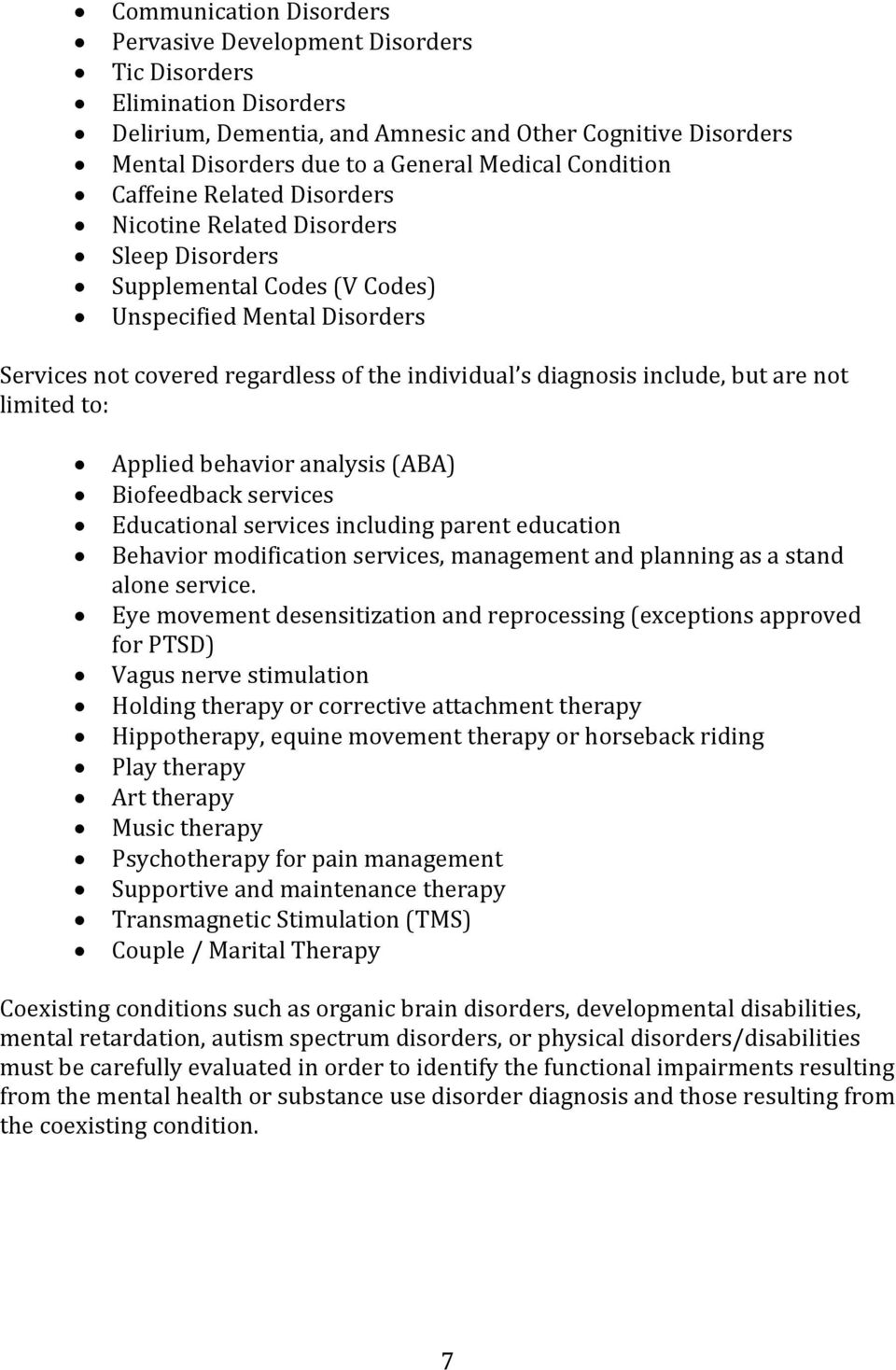
7 Page7 Communication Disorders Pervasive Development Disorders Tic Disorders Elimination Disorders Delirium, Dementia, and Amnesic and Other Cognitive Disorders Mental Disorders due to a General Medical Condition Caffeine Related Disorders Nicotine Related Disorders Sleep Disorders Supplemental Codes (V Codes) Unspecified Mental Disorders Services not covered regardless of the individual s diagnosis include, but are not limited to: Applied behavior analysis (ABA) Biofeedback services Educational services including parent education Behavior modification services, management and planning as a stand alone service. Eye movement desensitization and reprocessing (exceptions approved for PTSD) Vagus nerve stimulation Holding therapy or corrective attachment therapy Hippotherapy, equine movement therapy or horseback riding Play therapy Art therapy Music therapy Psychotherapy for pain management Supportive and maintenance therapy Transmagnetic Stimulation (TMS) Couple / Marital Therapy Coexisting conditions such as organic brain disorders, developmental disabilities, mental retardation, autism spectrum disorders, or physical disorders/disabilities must be carefully evaluated in order to identify the functional impairments resulting from the mental health or substance use disorder diagnosis and those resulting from the coexisting condition. 7
8 Page8 Outcome Measures Effective treatment programs utilize clinical outcome measures to inform both the individual treatment plan and the program s system of care. To support treatment effectiveness, Magellan offers secure web-based outcomes measurement programs for our providers and members. Specifically, the Consumer Health Inventory (CHI) is available. Consumer Health Inventory The Consumer Health Inventory (available in adult and child versions) is available for all Magellan providers by going to our web-based outcomes measurement system known as Outcomes360 at MagellanHealth.com/provider or MagellanofNebraska.com. These tools enable members (consumers) and/or their caretakers to assess and track progress related to their mental and physical health. Magellan worked closely with Quality Metric, Incorporated, the industry leader in health status measurement, to design these brief outcomes measurement tools: Consumer Health Inventory (CHI) -- Tool completed by consumers age 14 and older covered by government (e.g., federal and state) sponsored programs Consumer Health Inventory Child Version (CHI-C) -- Tool completed by caregivers of children less than 18 years of age You can use the assessment process and reports to enhance treatment planning for each member in your care. Note that children s caretakers complete the CHI-C assessment. The Outcomes360 tools are key components of Magellan s behavioral health outpatient programs through which we focus on improving members health and wellness, quality of life, and physical and emotional health. For questions about Outcomes360, call our national Provider Services Line at , or send us a secure message and we will respond to your request promptly. Therapeutic Leave Day (TLD) Policy and Requirements Beds in Psychiatric Residential Rehabilitation, Therapeutic Community, Intermediate Residential, Dual Diagnosis Residential and Secure Residential programs can be held up to 21 days annually (from the date of admission) when a consumer is on therapeutic leave for the purposes of testing ability to function at and transition to a lesser level of care. 8

9 Page9 The therapeutic rationale and leave time period must be indicated in the treatment plan. Documentation of the outcome of the therapeutic leave and the need for continued residential level of care must be indicated in the consumer s record. Magellan will reimburse at the full program rate per day. Magellan must receive prior notification. Leave in excess of the allowable amount noted above must be approved by Magellan. This reimbursement is only available if the treatment bed is not used by another consumer. Medical Leave Day Policy and Requirements Beds in Psychiatric Residential Rehabilitation, Therapeutic Community, Intermediate Residential, Dual Disorder Residential Treatment, Secure Residential programs and Assertive Community Treatment programs can be held up to 10 consecutive days per episode when a consumer is hospitalized for a period of medical / psychiatric stabilization and expected to return to the facility. Documentation of the need for stabilization is reflected in the consumer s treatment plan and file. The program will be reimbursed at the full program rate per day. This reimbursement is only available if the treatment is not used by another member. Magellan must be notified within 24 hours of hospitalization and will reflect this information in the clinical database. More than three episodes in a calendar year will result in a Level of Care review. Leaves in excess of 10 consecutive days must be approved by Magellan. B-3 STANDARDS COMMON TO ALL LEVELS OF CARE Magellan has specific standards and requirements for each level of care and program offered within our network. The information below outlines standards that are applicable to all levels of care. These standards will be reviewed regularly and all modification will be posed on the Magellan website. Services must be family and client centered, culturally competent, trauma informed and developmentally appropriate. The provider must be actively enrolled with Nebraska Medicaid for the specific level of service and be appropriately credentialed and contracted with Magellan. Services must have been determined to be medically necessary (see Appendix C). The member must have an active DSM (current version) diagnosis (except for Client Assistance Program (CAP) or Crisis Therapy Services). For members being referred to Medicaid Rehabilitation Option (MRO) services, there must be evidence that the member qualifies as having a Severe and Persistent Mental Illness. Severe and Persistent Mental Illness criteria are reflected in the MRO Medical Necessity Criteria and are generally defined as follows: 9

10 Page10 1) Member meets diagnostic criteria for a major mental illness 2) The member is at significant risk of continuing in a pattern of either institutionalization or living in a severely dysfunctional way if needed mental health services are not provided, and this pattern has existed for 12months or longer or is likely to endure for 12 months or longer 3) The member s behavioral health condition causes a degree of limitation that seriously interferes with the individuals ability to function independently in an appropriate and effective manner as demonstrated by functional impairments which substantially interferes with or limits at least 2 of 3 areas: a. vocational/educational, b. social skills or c. activities of daily living. Medicaid Rehabilitation Option (MRO) are rehabilitative psychiatric services to rehabilitate clients experiencing severe and persistent mental illnesses in the community and thereby avoid more restrictive levels of care such as inpatient psychiatric hospital or nursing facility. Rehabilitative services focus on improving functioning and building the skills necessary to allow an individual to live as independently as possible in the community. Medicaid providers of substance use disorder treatment services will adhere to all criteria outlined in the American Society of Addiction Medicine, The ASAM Criteria (current version). Services must be prior authorized by Magellan, when required. Clinical oversight of non-independent practitioners and treatment program must be provided by a Supervising Practitioner (for services and professionals who require this supervision) who possesses the appropriate licensure specified for the level of care and Is credentialed as a Magellan network provider, when necessary Is an enrolled Nebraska Medicaid provider Is contracted by Magellan Meets the requirements outlined for each level of care Conducts an Initial Diagnostic Interview and subsequent assessments to confirm the member s diagnosis, develop and update active treatment recommendations for medically necessary services, evaluate member progress and assess member s ongoing treatment needs Meets with the family and the provider or treatment team regularly to review the member s progress and discuss needed modifications to the treatment plan Directly participates in the development and supervises the comprehensive treatment plan in the frequency prescribed by the level of care. (The treatment plan contained in the initial assessment serves until the comprehensive treatment plan is developed.) Directs patient care by reviewing and approving client specific treatment plans and progress notes within the timelines specified for each level of care, 10

11 Page11 Monitors and supervises the treatment services provided, assuring that the treatment provided meets standards of care. Assists in the development of the discharge plan each time the treatment plan is updated Periodically evaluates the therapeutic program and determines if treatment goals are being met and if changes in direction or emphasis are needed. Provides supervision to treating therapist(s) every 30 days or more often as necessary or as identified in the level of care description. Direct face-to-face contact is preferred; however, communication may occur via telephone or Telehealth. Supervisory content shall include: o A review of the treatment recommendations. o An update on the individual s current status, progress achieved, and barriers to progress. This update shall also include critical incidents, especially those involving individual safety or danger to self or others. o A review and signature of approval on the treatment plan and progress notes. o Determination of modifications to the treatment plan to expedite recovery and resiliency, and remove barriers to progress, with a special emphasis on patient or other person s safety. Review of the discharge plan and recommendation for changes. o Documentation of each supervisory session shall be in the individual s treatment record. Some programs also require a Program/Clinical Director. The Program/Clinical Director oversees, implements and coordinates all treatment services and activities provided within the program under the direction of the Supervising Practitioner (when applicable). As such, the Program/Clinical Director: Meets the requirements outlined for each level of care Oversees, implements and coordinates all treatment services and activities provided within the program. Continually incorporates new clinical information and best practices into the program to assure program effectiveness and viability. Oversees the process to identify, respond to and report crises in a timely basis following their occurrence. Is responsible, in conjunction with the supervising practitioner, for the program s clinical management. Assures quality, organization, confidentiality and management of clinical records and other program documentation. Oversees the gathering of outcome data and determine the effectiveness of the program for the individuals served. Supervises all procedures and training regarding behavior management in the program, particularly regarding de-escalation techniques and the use of timeout. Supervises Program Staff, in conjunction with the Supervising 11

12 Practitioner. Page12 All services (with the exception of CAP or Crisis therapy services) are provided under the direction of a comprehensive treatment and/or rehabilitation plan. The treatment plan will: Be developed by the treatment team, including any Supervising Practitioner, the member, and the member s family and/or guardian for minors Is based upon the assessment/evaluation including treatment needs and individual/family strengths. This assessment results in a current and active DSM diagnosis along with treatment/rehabilitation goals Include recommendations to treat the specific event that necessitates treatment Document involvement of the member and his/her family/guardian in its development Describe therapeutic interventions prescribed by the treatment team and establishes specific treatment goals and treatment interventions. Interventions must be outcome-focused based on the comprehensive assessment, treatment/rehabilitation goals, culture, expectations and needs as identified by the client. Include measurable goals and time frames for completion Is updated for changes in the individual s condition, based on ongoing assessment of the individual s progress and outcomes of treatment. If progress is not being made, the treatment plan must be adjusted to promote progress Document ongoing discharge planning. Discharge planning starts at admission and must be included in the treatment plan and all treatment plan reviews. Be completed within the timeframe required by the specific level of care. Documentation Standards: The program shall follow policy and procedures that meet accreditation, Medicaid and Magellan guidelines. Documentation shall be organized and legible, containing the date, time, and complete name and title of the facilitator of any treatment service provided to the individual. All progress notes shall contain the name, title and signature of the author, and when appropriate, the signature of the Supervising Practitioner. Clinical documentation must provide information that fully discloses the interventions and outcome of treatment services. Individual records must be maintained for a minimum of seven years. All individual records of service must be readily available in English. The provider shall make the clinical record available upon Medicaid and/or Magellan s request to review or receive a copy of the complete record. 12

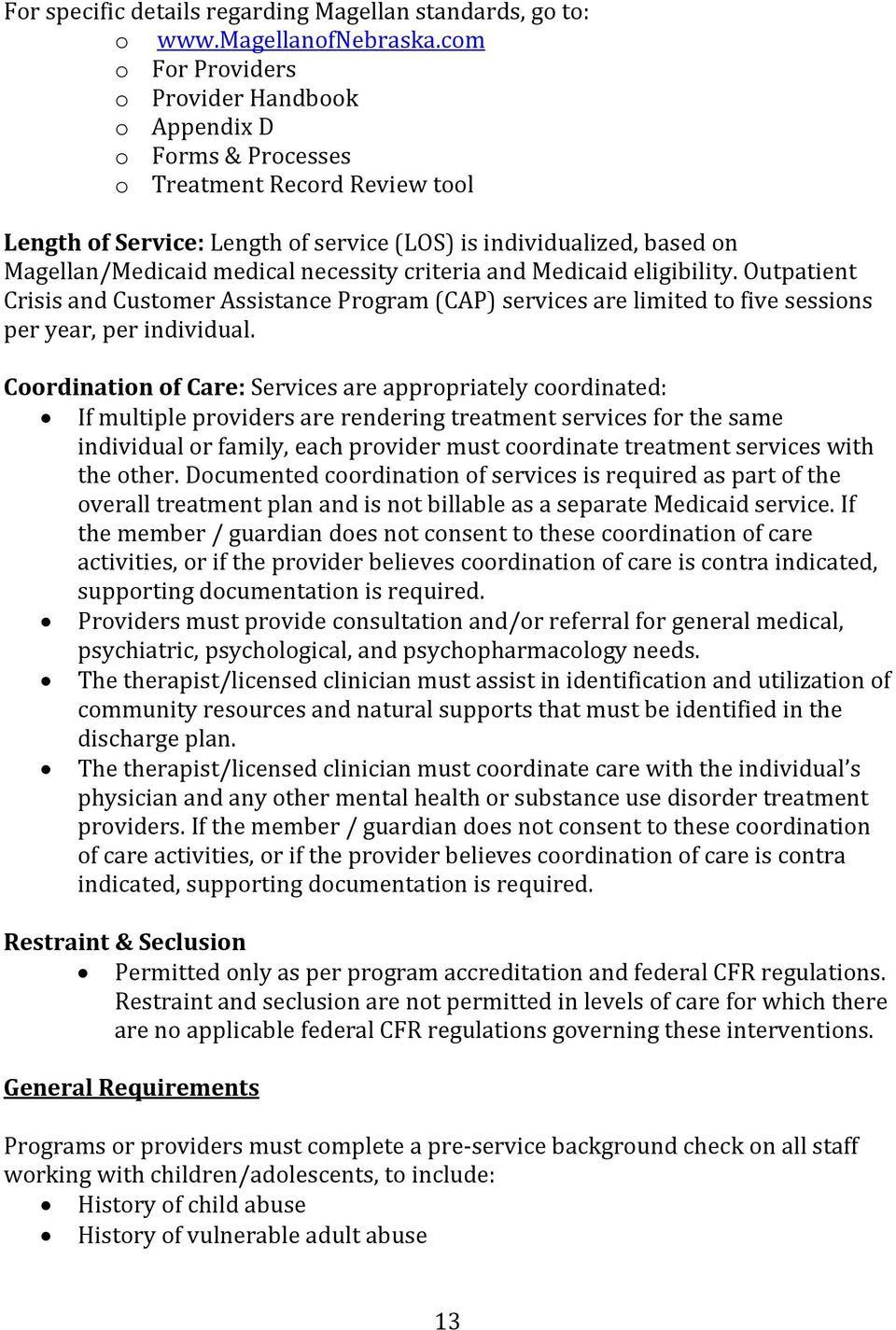
13 Page13 For specific details regarding Magellan standards, go to: o o For Providers o Provider Handbook o Appendix D o Forms & Processes o Treatment Record Review tool Length of Service: Length of service (LOS) is individualized, based on Magellan/Medicaid medical necessity criteria and Medicaid eligibility. Outpatient Crisis and Customer Assistance Program (CAP) services are limited to five sessions per year, per individual. Coordination of Care: Services are appropriately coordinated: If multiple providers are rendering treatment services for the same individual or family, each provider must coordinate treatment services with the other. Documented coordination of services is required as part of the overall treatment plan and is not billable as a separate Medicaid service. If the member / guardian does not consent to these coordination of care activities, or if the provider believes coordination of care is contra indicated, supporting documentation is required. Providers must provide consultation and/or referral for general medical, psychiatric, psychological, and psychopharmacology needs. The therapist/licensed clinician must assist in identification and utilization of community resources and natural supports that must be identified in the discharge plan. The therapist/licensed clinician must coordinate care with the individual s physician and any other mental health or substance use disorder treatment providers. If the member / guardian does not consent to these coordination of care activities, or if the provider believes coordination of care is contra indicated, supporting documentation is required. Restraint & Seclusion Permitted only as per program accreditation and federal CFR regulations. Restraint and seclusion are not permitted in levels of care for which there are no applicable federal CFR regulations governing these interventions. General Requirements Programs or providers must complete a pre-service background check on all staff working with children/adolescents, to include: History of child abuse History of vulnerable adult abuse 13
14 Page14 Motor vehicle record Criminal record Sex offender registry. All background checks must be completed and documented annually in the employee personnel file. The following information must be on file with Magellan: Credentialing application Comprehensive program description (except for outpatient) Required policies and procedures Copy of current state license/certification List of staff by position and credential (updated when changes occur) Proof of Nebraska Medicaid Certification Proof of professional liability Proof of general liability W-9 form. The program/agency must have written policies/procedures as appropriate related to: Agency/program philosophy Individual record storage and clinical documentation Suicide assessment/prevention protocols Abuse and neglect reporting Access to emergency medical care Quality improvement Critical/adverse incident reporting Pre-service staff training Access to higher levels of care Assessment and treatment planning Utilization review Discharge planning Grievance procedures Individual s rights and responsibilities Discovery of contraband including illicit drugs and weapons Seclusion and/or physical restraint Individual elopement (as applicable) Discipline philosophy and methods Infection control and risk management Emergency preparedness Administration and storage of medication (as applicable) Non-discrimination Coverage for Supervising Practitioner 14

15 Page15 Drug Free Workplace Family involvement in treatment efforts Training: All program staff must receive pre-service training that will minimally include: Family and client centered practice and trauma informed care. Recovery and resiliency training. Successful completion of the agency s/program s training and the related competency checks. De-escalation techniques and aggression management. Crisis intervention strategies. Behavior management planning and techniques. The role of medication in psychiatric treatment. Common psychotropic medications. Common child/adolescent psychiatric diagnoses and their treatment. Dealing with psychiatric emergencies. Physical restraint techniques, their indicators and contra-indicators, if used. CPR and first aid. Confidentiality and HIPAA privacy policy B-4 COVERED SERVICES Assessment Initial Diagnostic Interview For services to be covered by Magellan, there must be a DSM (current version) diagnosis which results in functional impairments and interferes with or limits the member s functioning within the family, job, school, or community. This does not include Intellectual Disability, Communication Disorders, Autism Spectrum Disorders, Learning Disorders, Motor Disorders, or Other Neurodevelopment Disorders. This assessment is used to identify the strengths, problems and needs, develop goals and objectives, and determine appropriate strategies and methods of intervention for the client. The assessment must occur prior to the initiation of treatment interventions and must include a baseline of the client's current functioning and treatment needs. The assessment must include but is not limited to the following information: Reason member is seeking services or why now Comprehensive Mental Status Exam that supports the treatment diagnosis, including the Supervising Practitioner recommendations for active treatment interventions. DSM (current version) Diagnosis 15

16 Page16 History & symptomology consistent with DSM (current version) criteria Psychiatric treatment history Co-occurring (co-morbid) substance induced disorder assessed Current and past suicide danger risk assessed Level of familial supports assessed and involved as indicated Consumer Identified areas for improvement Medical history Exploration of allergies and adverse reactions All current medications with dosages Discussion of discharge planning and linkage to next level Assessment of consumer strengths, skills, abilities, motivation etc. An initial diagnostic interview is appropriately completed whenever a new episode of care begins and/or when a new independently licensed practitioner or a new supervising practitioner assumes the member s care. If the member starts a new episode of care or is referred to a new level of care but the independently licensed practitioner or supervising practitioner remains the same, a new Initial Diagnostic Interview is not needed. Psychological Testing and Evaluation Definition Psychological Testing is defined as the use of one or more standardized measurements, instruments or procedures to observe or record human behavior, and requires the application of appropriate normative data for interpretation or classification. Psychological testing may be used to either assist in differential diagnosis of psychiatric disorders or to assist in the assessment of response of those disorders to treatment. Policy Licensing/Accreditation Providers of this service must be appropriately enrolled with Nebraska Medicaid Providers must be credentialed and contracted with Magellan Behavioral Health of Nebraska, Inc. as outlined in the Handbook Supplement Providers must maintain licensure as directed by the Nebraska Department of Health and Human Services. Providers will notify Magellan of all changes to licensure and submit copies of all current/active licenses to Magellan Organizations providing this service must be licensed, certified, or accredited through a national accreditation body such as The Joint Commission (TJC), Commission on Accreditation of Rehabilitation Facilities (CARF) or by the Council on Accreditation (COA). Providers will provide Magellan copies of all current/active accreditation certificates and the most recent accreditation site review report. 16

17 Features/Hours N/A Page17 Service Expectations Psychological testing summaries and evaluations are available when a proper release is secured by the individual or guardian. Before testing is administered, a Request for Psychological Testing Authorization form is completed and submitted or the appropriate Magellan Care Management Center is called for authorization. The testing request form must be completed and submitted to Magellan prior to testing. An administrative non-authorization will occur if preauthorization is not obtained in routine circumstances. Only licensed psychologists may interpret psychological testing results. Staffing Full unrestricted or provisional psychologist license is required. Medication Management and Injectible Medications Definition Medication management is the initial evaluation of the individual s need for psychotropic medications, the provision of a prescription as needed, and ongoing medical monitoring/evaluation related to the individual s use of the psychotropic medication. Licensing/Accreditation Providers of this service must be appropriately enrolled with Nebraska Medicaid Providers must be credentialed and contracted with Magellan Behavioral Health of Nebraska, Inc. as outlined in the Handbook Supplement Providers must maintain licensure as directed by the Nebraska Department of Health and Human Services. Providers will notify Magellan of all changes to licensure and submit copies of all current/active licenses to Magellan Organizations providing this service must be licensed, certified, or accredited through a national accreditation body such as The Joint Commission (TJC), Commission on Accreditation of Rehabilitation Facilities (CARF) or by the Council on Accreditation (COA). Providers will provide Magellan copies of all current/active accreditation certificates and the most recent accreditation site review report. Features/Hours Outpatient medication management services must be provided in a confidential setting such as an office, clinic or other professional service environment. The service provider must assure that members have on-call access to a qualified 17

18 professional whose scope of practice includes prescribing medication 24 hours a day, seven days a week to respond to crises. Page18 Service Expectations Medical evaluation Medication monitoring routinely and as needed Individual education pertaining to the medication so they may make an informed decision for its use Coordinate care with all other medical and behavioral health providers. If the member / guardian does not consent to these coordination of care activities, or if the provider believes coordination of care is contra indicated, supporting documentation is required Conduct an Initial Diagnostic Interview prior to initiating medication management. Staff providing medication management services will encourage the use of medications that do not require prior authorization. This assists members in maintaining ongoing adherence to a prescribed medication regimen. The preferred drug list is available at Staffing A Psychiatrist, or other practitioner qualified to prescribe and manage medication may provide this service. An Advanced Practice Registered Nurse (APRN), Physician Assistant (PA) or Nurse Practitioner (NP) is able to provide this service when practicing within the scope of their license and with appropriate supervision. Client Assistance Program (CAP) Definition Client Assistance Programs are a short-term, solution-focused set of interventions to assist an individual who is eligible for the Medicaid managed care benefit of mental health and/or substance use disorder services. Normally used prior to a diagnosis and assessment, this is a sub-clinical service; therefore it is issue driven and not a diagnostically driven service. Licensing/Accreditation Providers of this service must be appropriately enrolled with Nebraska Medicaid Providers must be credentialed and contracted with Magellan Behavioral Health of Nebraska, Inc. as outlined in the Handbook Supplement Providers must maintain licensure as directed by the Nebraska Department of Health and Human Services. Providers will notify Magellan of all changes to licensure and submit copies of all current/active licenses to Magellan Organizations providing this service must be licensed, certified, or accredited through a national accreditation body such as The Joint Commission (TJC), 18

19 Page19 Commission on Accreditation of Rehabilitation Facilities (CARF) or by the Council on Accreditation (COA). Providers will provide Magellan copies of all current/active accreditation certificates and the most recent accreditation site review report. Features/Hours Outpatient CAP services must be provided in a confidential setting such as an office, clinic, or other professional service environment. The service must be available during times that meet the needs of our members including evenings or weekends or both. The individual is eligible for up to five sessions per year to assist an individual in reducing or eliminating the current stressors that are interfering with the individual s daily living and well-being. Service Expectations Brief counseling or problem solving to resolve client identified issues. Behavioral health screening. Referral as appropriate. Staffing Therapeutic interventions shall be provided by a licensed practitioner whose scope of practice includes mental health and/or substance use disorder treatment services that assist the client by empowering the client and client s family to attain a more manageable level of functioning. Staffing, acting within the scope of practice, will include: Licensed Mental Health Practitioner (LMHP) Provisionally Licensed Mental Health Practitioner (PLMHP) Licensed Independent Mental Health Practitioner (LIMHP) Licensed Psychologist Provisionally Licensed Psychologist Psychiatrist Advanced Practice Registered Nurse (APRN) Licensed Alcohol and Drug Counselor (LADC) Outpatient Crisis Sessions Definition Outpatient Crisis services offer short-term (not to exceed five sessions per individual, per year), intense intervention aimed at assisting the individual and/or family experiencing a life-threatening or traumatic event, with perceived urgent/emergent conditions, or within two weeks of being discharged from a 24- hour treatment setting or partial hospitalization. Outpatient Crisis services are intended to assure that individuals and families receive immediate treatment 19

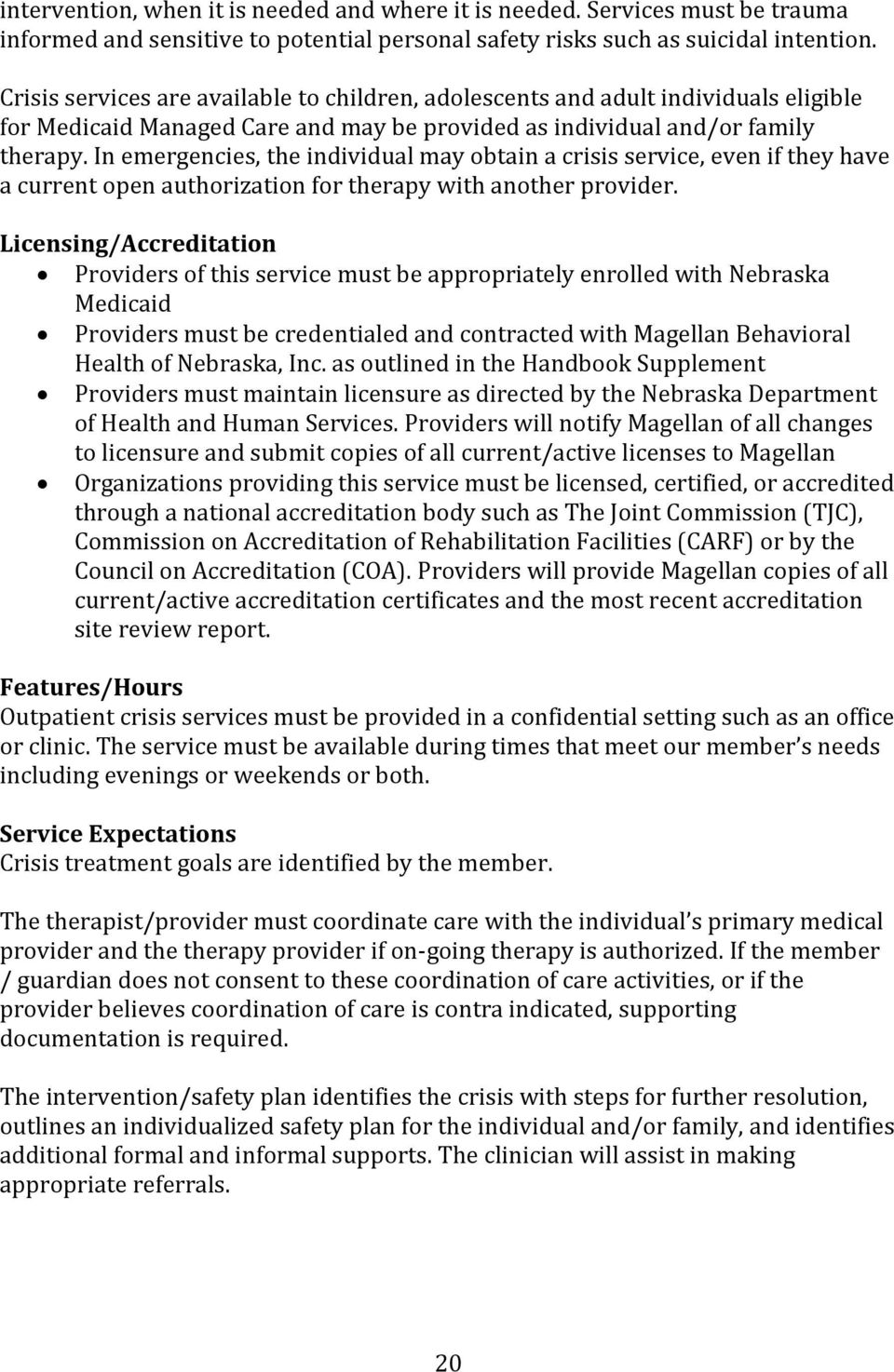
20 intervention, when it is needed and where it is needed. Services must be trauma informed and sensitive to potential personal safety risks such as suicidal intention. Page20 Crisis services are available to children, adolescents and adult individuals eligible for Medicaid Managed Care and may be provided as individual and/or family therapy. In emergencies, the individual may obtain a crisis service, even if they have a current open authorization for therapy with another provider. Licensing/Accreditation Providers of this service must be appropriately enrolled with Nebraska Medicaid Providers must be credentialed and contracted with Magellan Behavioral Health of Nebraska, Inc. as outlined in the Handbook Supplement Providers must maintain licensure as directed by the Nebraska Department of Health and Human Services. Providers will notify Magellan of all changes to licensure and submit copies of all current/active licenses to Magellan Organizations providing this service must be licensed, certified, or accredited through a national accreditation body such as The Joint Commission (TJC), Commission on Accreditation of Rehabilitation Facilities (CARF) or by the Council on Accreditation (COA). Providers will provide Magellan copies of all current/active accreditation certificates and the most recent accreditation site review report. Features/Hours Outpatient crisis services must be provided in a confidential setting such as an office or clinic. The service must be available during times that meet our member s needs including evenings or weekends or both. Service Expectations Crisis treatment goals are identified by the member. The therapist/provider must coordinate care with the individual s primary medical provider and the therapy provider if on-going therapy is authorized. If the member / guardian does not consent to these coordination of care activities, or if the provider believes coordination of care is contra indicated, supporting documentation is required. The intervention/safety plan identifies the crisis with steps for further resolution, outlines an individualized safety plan for the individual and/or family, and identifies additional formal and informal supports. The clinician will assist in making appropriate referrals. 20
21 Page21 Staffing Staff shall be licensed in one of the following disciplines: Licensed Mental Health Practitioner (LMHP) (Also see Supervision requirements in Standards Common to All Levels of Care) Provisionally Licensed Mental Health Practitioner (PLMHP) (Also see Supervision requirements in Standards Common to All Levels of Care) Licensed Independent Mental Health Practitioner (LIMHP) Licensed Psychologist Provisionally Licensed Psychologist (Also see Supervision requirements in Standards Common to All Levels of Care) Psychiatrist Advanced Practice Registered Nurse (APRN) Licensed Alcohol and Drug Counselor (LADC) Outpatient Psychotherapy Definition Outpatient psychotherapy is for the treatment of mental health symptoms related to a DSM (current version) psychiatric diagnosis through scheduled therapeutic visits between the therapist and the member. Outpatient psychotherapy is expected to improve active symptoms of the identified individual that significantly interfere with the member s functioning in at least one life domain (e.g., familial, social, occupational, educational, etc.). The goals, frequency and duration of outpatient treatment will vary according to the individual s needs and response to treatment. Individuals other than the identified individual may participate in the individual session with the identified individual to assist in achieving the individual s treatment goals. Outpatient group psychotherapy is active treatment of a DSM (current version) psychiatric disorder through scheduled treatment interventions with a common goal in the context of a group setting. A group is described as at least three individuals and no more than 12 individuals facilitated by a licensed practitioner. The focus of outpatient group psychotherapy treatment is to improve the member s ability to function as well as alleviate symptoms related to their diagnosis that may significantly interfere with their functioning. The goals, frequency, and duration of outpatient group treatment will vary according to individual needs and response to treatment. Groups that are primarily focused on providing education or prevention or support do not meet the definition of outpatient group psychotherapy for Medicaid and, as such, are not reimbursable. 21
22 Page22 Outpatient family psychotherapy is a therapeutic encounter between the licensed treatment professional, the member and the member s family. The specific objective of active treatment must be to increase the functional level of the family in support of the identified individual s mental health/substance use disorder active diagnostic symptoms. This therapeutic intervention must be provided with the identified individual who has a current DSM diagnosis and family members present. Outpatient family psychotherapy services are based upon the following guidelines: One family psychotherapy session may be utilized on any particular day per family. One family psychotherapy session is available for families even though the family may have multiple Medicaid eligible individuals with a psychiatric and/or substance use disorder diagnosis. Only one Medicaid eligible family session may be utilized for family psychotherapy even though another identified Medicaid eligible individual may be present in the family psychotherapy session. Reimbursement is available for family therapy without the member present (90846). This service type should only be used in the extreme case where it is clinically contraindicated to have the identified member present for the family therapy session and should not be the primary intervention used. Family therapy without the member present should be a purposeful intervention identified in the treatment plan and must have corresponding progress notes in the chart documentation. This service is not meant to provide reimbursement for information sharing between the provider and family members or to provide other non-covered services (parent education, couples counseling) or to provide services to non-covered individuals (individual therapy to a non-medicaid covered parent(s)). Policy: Outpatient mental health services are available to youth age 20 and younger. For clients who present with co-occurring mental health and substance use disorder symptoms and diagnoses, the provider must refer to the ASAM Criteria (current edition). Providers are responsible to refer to the ASAM Criteria (current edition). The provider must also adhere to the service descriptions and clinical guidelines for Outpatient Level 1, as well as the clinical guidelines identified in this service description. Licensing/Accreditation Providers of this service must be appropriately enrolled with Nebraska Medicaid Providers must be credentialed and contracted with Magellan Behavioral Health of Nebraska, Inc. as outlined in the Handbook Supplement 22
23 Page23 Providers must maintain licensure as directed by the Nebraska Department of Health and Human Services. Providers will notify Magellan of all changes to licensure and submit copies of all current/active licenses to Magellan Organizations providing this service must be licensed, certified, or accredited through a national accreditation body such as The Joint Commission (TJC), Commission on Accreditation of Rehabilitation Facilities (CARF) or by the Council on Accreditation (COA). Providers will provide Magellan copies of all current/active accreditation certificates and the most recent accreditation site review report. Features/Hours Outpatient psychotherapy services must be provided in a confidential setting such as an office, clinic, and the member s home or other professional service environment. The service must be available during times that meet the need of the member and their family to include evenings or weekends or both. The service provider must assure that the member has on-call access to a mental health provider on a 24-hour a day, seven-day per week basis to respond to crises. Service Expectations The Initial Diagnostic Interview and subsequent assessment(s) by the Supervising Practitioner must be conducted by a psychiatrist, psychologist, or licensed independent mental health practitioner (LIMHP) prior to the beginning of treatment. Other independently licensed practitioners, such as APRNs, may complete an IDI as the treating provider but cannot serve in the role of Supervising Practitioner. Assessment should be ongoing with treatment and used to inform and establish time-limited and measurable, symptom focused treatment goals and objectives. Ongoing suicide/risk assessment should be conducted each time the member is seen and appropriately documented in the clinical record. Members who become homicidal, suicidal and unable to conduct activities of daily living, are referred to the appropriate level of care. Assessing for other unsafe behaviors that have been a focus of treatment and/or have occurred in the past, such as property destruction, domestic violence and repeat sexual offenses are also part of this ongoing risk assessment each time the member is seen. Asking client if these problems are present may be necessary and appropriate, however the client s statements alone are not sufficient. Coordination of the safety plan with member s natural supports and community resources must be included throughout the clinical record as member makes progress and moves to discharge to the least restrictive level of care. Treatment interventions should be based on the comprehensive assessment, and focused on specific treatment goals inclusive of the culture, expectations and needs as identified by the member and guardian (when applicable). The therapist/licensed clinician should routinely screen for relapse or possible new substance use to rule out barriers to progress related to their DSM (current 23
24 Page24 version) diagnoses, symptoms and document these results in the clinical record. If substance use concerns develop then interventions such as education or, with the member s permission, coordination with the member s natural supports and community resources regarding substance use effects on symptoms and/or progress should be utilized. If these interventions do not bring about a change in the client s condition, a full substance use assessment is referred or completed. The individual treatment/discharge plan is reviewed and updated by the member, guardian (when applicable), treating clinician and the Supervising Practitioner as frequently as medically indicated, but at a minimum of every 90 calendar days, and signed by all participants. Psychotherapy must be developmentally appropriate for the age of the member. Provide consultation and/or referral for general medical, psychiatric, psychological, and psychopharmacology needs. The therapist/licensed clinician must assist the member and guardian (when applicable) in identification and utilization of community resources and natural supports which must be identified in the discharge plan The therapist/provider must coordinate care with the member s primary care physician (PCP) and any other mental health or substance use disorder treatment providers. If the member / guardian does not consent to these coordination of care activities, or if the provider believes coordination of care is contra indicated, supporting documentation is required When other individuals are participating with the member in the individual treatment sessions, the focus and documentation must be based on the member s individual treatment goals outlined in the treatment plan. If group therapy is the primary intervention, individual and/or family therapy must be available as needed to support progress or address issues not amenable to group intervention. Family psychotherapy services must: Address issues related to the functioning of the entire family unit. Be family-focused with goals and objectives that are clearly stated in the treatment plan. Family psychotherapy services are at least 60-minute therapy sessions. Staffing Staff shall be licensed in one of the following disciplines: Licensed Mental Health Practitioner (LMHP) (Also see Supervision requirements in Standards Common to All Levels of Care) Provisionally Licensed Mental Health Practitioner (PLMHP) (Also see Supervision requirements in Standards Common to All Levels of Care) Licensed Independent Mental Health Practitioner (LIMHP) Licensed Psychologist Provisionally Licensed Psychologist (Also see Supervision requirements in Standards Common to All Levels of Care) 24
25 Page25 Psychiatrist Advanced Practice Registered Nurse (APRN) Licensed Alcohol and Drug Counselor (LADC) Supervising Practitioner Involvement: Supervision must be provided within the scope of practice of the individual Supervising Practitioner. Provide face-to-face service to the member at least annually or as often as medically necessary. Complete the Initial Diagnostic Interview prior to beginning therapy. Provide the therapist with recommendations for a course of treatment if medically necessary.. Provide a supervisory contact with the therapist every 30 days or more often as necessary. Direct face-to-face contact is preferred; however, communication may occur by telephone. Supervisory contact will include: a) A review of the treatment recommendations developed in the Initial Diagnostic Interview or subsequent assessments by the therapist and the Supervising Practitioner b) Update on the status of the client, including progress achieved, barriers that impaired progress in treatment, to include and critical incidents which involve patient safety or others such as aggression or self-harm (The incident may have been reported at the time of the incident, depending on severity.) c) Review of the treatment/recovery plan and the progress notes provided by the therapist d) Determination of the plan for ongoing treatment, with any change in focus or direction of treatment e) Review of the discharge plan and the recommendation for changes in discharge as necessary f) Changes in the discharge plan are documented in the client s clinical record. Psychiatric Nursing (In Home) Definition Mental Health Home Health Services are provided to clients in their place of residence. (The place of residence does not include a hospital, skilled nursing facility, day rehabilitation program, residential rehabilitation facility, adult day treatment program, or any facility where 24-hour care is provided.) The home health service is provided by a licensed registered nurse to clients who are unable to access office-based services. This service is only available to homebound. ( Homebound is defined as an individual whose medical or psychiatric condition restricts their ability to leave home safely without the assistance or supervision of another individual or without the assistance of a supportive device and the patient 25
26 Page26 leaves home only to receive medical/psychiatric treatment or leaves home infrequently for non-medical purposes. ) Typically the client has a very poor support system within the community (no family or interested party to act as caretaker, family members or interested parties exist but have poor insight into the client s psychiatric condition and have no positive impact in assisting in the improvement of the client s psychiatric/medical condition). Services may include medication administration, assistance in setting up a medication system, teaching and monitoring of medication, and observation of the physical well-being in relation to medication side effects. The service is intended to support and facilitate increased coordination with rehabilitation services such as community support services. This service is not intended to replace the direct involvement of a physician/psychiatrist in the treatment of the individual. Licensing/Accreditation Providers of this service must be appropriately enrolled with Nebraska Medicaid Providers must be credentialed and contracted with Magellan Behavioral Health of Nebraska, Inc. as outlined in the Handbook Supplement Providers must maintain licensure as directed by the Nebraska Department of Health and Human Services. Providers will notify Magellan of all changes to licensure and submit copies of all current/active licenses to Magellan Organizations providing this service must be licensed, certified, or accredited through a national accreditation body such as The Joint Commission (TJC), Commission on Accreditation of Rehabilitation Facilities (CARF) or by the Council on Accreditation (COA). Providers will provide Magellan copies of all current/active accreditation certificates and the most recent accreditation site review report. Features/Hours The frequency and duration of Mental Health Home Health nursing services may vary based upon the individual needs of the client, but shall not exceed 35 days in the first 60-day authorization for mental health home health services and a maximum of 12 days for each subsequent 60-day authorization period for mental health home health services. The service must provide or otherwise demonstrate that members have on-call access to a mental health provider on a 24-hour, sevenday per week basis. Service Expectations The psychiatric assessment and additional Nursing assessment conducted by appropriate practitioners working within their scope of practice will be completed prior to the initiation of Mental Health Home Health services. A physician s order is required to initiate this service. The treatment plan will: 26
27 Page27 o Be developed following completion of required assessments o Be completed prior to the initiation of Mental Health Home Health services o Be completed using measurable goals and objectives for treatment o Include a reasonable discharge plan to include a plan for transitioning to community based mental health services o Be developed with the inclusion of the client, their family/significant others as appropriate, and the treatment team, including the Supervising Practitioner o Be reviewed at least every 60 days, or more often as necessary, by the client, their family/significant others, other treatment team members, including the Supervising Practitioner. Updates/reviews of the plan must be signed by all of those involved in the review. Staffing Medical Director A physician licensed in Nebraska either employed or contracted who assures the overall medical service integrity of the Mental Health Home Health service. If the medical director is not a psychiatrist, the agency must have an employed or contracted psychiatrist who serves as the supervising practitioner overseeing each individual s treatment. Supervising Practitioner A psychiatrist who is responsible for each individual s treatment plan and Mental Health Home Health services. Clinical Program Director - A registered nurse who has management abilities, experience in the provision of psychiatric services and at least one year experience in home health nursing. The Clinical Program Director is responsible for the management and administration of all Mental Health Home Health services for the agency. Registered Nurses RN s providing Mental Health Home Health services must be licensed and have psychiatric experience. Additional home health experience is preferred. Supervising Practitioner Involvement In addition to the responsibilities outlined in the standards common to all levels of care, the Supervising Practitioner will: Provide an assessment to determine diagnosis and recommendation for services Provide order to the agency for Mental Health Home Health services for the individual Provide a direct service to the client once a month during the first Mental Health Home Health 60-day authorization period and once every subsequent 27
28 60-day authorization of mental health home health services per treatment episode. Page28 Electroconvulsive Therapy (ECT) Definition ECT is a treatment where an electric current, which is medically controlled, is applied to either or both sides of the brain (unilaterally vs. bilaterally) for the purpose of producing a seizure that is modulated by anesthesia and muscle relaxants. The specified requirements for severity of need and intensity and quality of service must be met to satisfy the criteria for outpatient electroconvulsive therapy (ECT). Nothing in the criteria should suggest that electroconvulsive treatment is considered a treatment of last resort. 28
29 Intensive Outpatient Psychotherapy (IOP) Page29 Definition Intensive Outpatient Psychotherapy services provide group-based, non-residential, intensive, structured interventions consisting primarily of counseling and education to improve symptoms that may significantly interfere with functioning in at least one life domain (e.g., familial, social, occupational, educational, etc.). Services are goal oriented interactions with the individual or in group/family settings. This community based service allows the individual to apply skills in real world environments. Such treatment may be offered during the day, before or after work or school, in the evening or on a weekend. The services follow a defined set of policies and procedures or clinical protocols. The service also provides a coordinated set of individualized treatment services to persons who are able to function in a school, work, and home environment but are in need of treatment services beyond traditional outpatient programs. Treatment may appropriately be used to transition persons from higher levels of care or may be provided for persons at risk of being admitted to higher levels of care. The goals, frequency, and duration of outpatient treatment will vary according to individual needs and response to treatment. Features/Hours Intensive Outpatient Programs (IOPs), provide nine or more hours per week of multidisciplinary, multi-modal structured treatment, three to five times per week with groups of no fewer than three and no more than 12 clients. Intensive Outpatient Psychotherapy services may be provided in an office, clinic or other professional service environment. Typical business hours with weekend and evening hours should be available to provide this service by appointment. The service provider must provide or otherwise demonstrate that members have on-call access to a mental health provider on a 24-hour, seven-day per week basis. Service Expectations An initial treatment plan will be developed at admission based upon the Supervising Practitioner s Initial Diagnostic Interview, which is completed within 24 hours of admission to IOP. If the Supervising Practitioner of the IOP program had completed an assessment with the member prior to admission to the IOP program, and that assessment is still clinically relevant to the member s condition, no additional assessment is needed. Assessment should be ongoing with treatment. Individualized treatment/recovery plan, including discharge and relapse prevention, developed with the individual prior to the beginning of treatment (consider community, family and other supports), reviewed on an ongoing basis, adjusted as medically indicated, and signed by all team members including the individual 29
30 Page30 Assessments and treatment should address mental health needs, and potentially, other co-occurring disorders Provided as group, family, and/or individual psychotherapy Includes psycho educational components as appropriate to the individual s needs Consultation and/or referral for general medical, psychiatric, and psychopharmacology needs It is the provider s responsibility to coordinate with other treating professionals Staffing Staff, licensed to practice in the State of Nebraska, enrolled with Nebraska Medicaid, contracted and credentialed with Magellan and acting within their scope may provide this service and include: Licensed Mental Health Practitioner (LMHP) Provisionally Licensed Mental Health Practitioner (PLMHP) Licensed Independent Mental Health Practitioner (LIMHP) Licensed Psychologist Provisionally Licensed Psychologist Advanced Practice Registered Nurse (APRN) Psychiatrist Supervising Practitioner (Psychiatrist, Licensed Clinical Psychologist, Licensed Independent Mental Health Practitioner) Supervising Practitioner Involvement Provide face-to-face service to the member at least monthly or as often as medically necessary. Meet with the client face-to-face to complete the admission and ongoing assessments Provide a supervisory contact with the provisionally licensed therapist every 30 days or more often as necessary, and every 90 days for the fully licensed therapist, or more often as necessary. Direct face-to-face contact is preferred; however, communication may occur by telephone. Supervisory contact will include: Review of the treatment recommendations developed in the assessment Update on the status of the client, including progress achieved, barriers that impaired movement in treatment, to include any critical incidents which involve safety to self or others such as aggression or self-harm. (The incident depending on severity may have been previously reported at the time of the incident.) Review of the treatment/recovery plan and the progress notes provided by the therapist. 30
31 Page31 Determination of the plan for ongoing treatment, with any change in focus or direction of treatment. Review of the discharge plan and the recommendation for changes in discharge as necessary. Changes in the discharge plan are documented in the client's clinical record. Day Treatment Mental Health Definition Day Treatment provides a community based, coordinated set of individualized treatment services to individuals with psychiatric disorders who are not able to function full-time in a normal school, work, and/or home environment and need the additional structured activities of this level of care. While less intensive than partial hospitalization, this service includes diagnostic, medical, psychiatric, psychosocial, and adjunctive treatment modalities in a structured setting. Day Treatment programs typically are less medically involved than partial hospital programs. Licensing/Accreditation Providers of this service must be appropriately enrolled with Nebraska Medicaid Providers must be credentialed and contracted with Magellan Behavioral Health of Nebraska, Inc. as outlined in the Handbook Supplement Providers must maintain licensure as directed by the Nebraska Department of Health and Human Services. Providers will notify Magellan of all changes to licensure and submit copies of all current/active licenses to Magellan Organizations providing this service must be licensed, certified, or accredited through a national accreditation body such as The Joint Commission (TJC), Commission on Accreditation of Rehabilitation Facilities (CARF) or by the Council on Accreditation (COA). Providers will provide Magellan copies of all current/active accreditation certificates and the most recent accreditation site review report. Features/Hours: May be available seven days/week with a minimum availability of five days/week including days, evenings and weekends. Service Expectations An initial treatment plan will be developed at admission based upon the Supervising Practitioner s Initial Diagnostic Interview, which is completed within 24 hours of admission to Day Treatment and prior to the delivery of treatment. If the Supervising Practitioner of the Day Treatment program had completed an assessment with the member prior to admission to the Day Treatment program, and that assessment is still clinically relevant to the member s condition, no additional assessment is needed. Or, if the member is 31
32 Page32 transitioned from Inpatient care to PHP, the inpatient evaluation and discharge summary documenting the rationale of transfer to PHP is sufficient as long as it provides adequate information to formulate an initial treatment plan A treatment/recovery plan developed by the multidisciplinary team integrating individual strengths and needs, considering community, family and other supports, stating measurable goals, that includes a documented discharge and relapse prevention plan completed within 72 hours of admission The individual treatment plan is reviewed at least bimonthly and more often as necessary, updated as medically indicated, and signed by the supervising practitioner and other treatment team members, including the individual being served Medication management Consultation services available for general medical, pharmacology, psychological, dietary, pastoral, emergency medical, recreation therapy, laboratory, dietary if meals are served, and other diagnostic services Ancillary service referral as needed (dental, optometry, ophthalmology, other mental health and/or social services, etc.) Individual, group, and family therapy services Recreation and social services Access to community based rehabilitation/social services that can be used to help the individual transition to the community Face-to-face psychiatrist/aprn visits 1X weekly Staffing Supervising Practitioner (psychiatrist) Clinical Director (APRN, RN, LMHP, LIMHP, or licensed Psychologist) Nursing (APRN, RN) (psychiatric experience preferred) Therapist (Psychiatrist, APRN, LMHP, PLMHP, LIMHP, Psychologist, Provisionally Licensed Psychologist) All staff must be Nebraska licensed and working within their scope of practice as required Direct care staff, holding a BS degree or higher in psychology, sociology, or a related human service field are preferred, but two years of course work in a human services field, and two years experience/training with demonstrated skills and competencies in treatment with individuals with a MH diagnoses is acceptable. Staff Ratios Clinical Director to direct care staff ratio as needed to meet all responsibilities Therapist/Individual: 1 to 12; Care Worker/Individual: 1 to 6 32
33 Page33 Crisis Observation (23:59) Definition This level of care provides up to 23 hours and 59 minutes of care in a secure and protected environment. The program is medically staffed, psychiatrically supervised and includes continuous nursing services. The primary objective of this level of care is for prompt evaluation and/or stabilization of individuals presenting with acute symptoms or distress. Before or at admission, a comprehensive assessment is conducted and a treatment plan developed. The treatment plan should place emphasis on crisis intervention services necessary to stabilize and restore the individual to a level of functioning that does not require hospitalization. This level of care may also be used for a comprehensive assessment and to obtain clarification regarding previously incomplete diagnostic information that may lead to a determination that the individual requires a more intensive level of care. This service is not appropriate for individuals who by history or initial clinical presentation require services of an acute psychiatric inpatient setting exceeding 23 hours and 59 minutes. Duration of services at this level of care may not exceed 23 hours and 59 minutes, by which time stabilization and/or a determination of the appropriate level of care will be made, and facilitation of appropriate treatment and support linkages will be coordinated by the treatment team. Licensing/Accreditation Providers of this service must be appropriately enrolled with Nebraska Medicaid Providers must be credentialed and contracted with Magellan Behavioral Health of Nebraska, Inc. as outlined in the Handbook Supplement Providers must maintain licensure as directed by the Nebraska Department of Health and Human Services. Providers will notify Magellan of all changes to licensure and submit copies of all current/active licenses to Magellan Organizations providing this service must be licensed, certified, or accredited through a national accreditation body such as The Joint Commission (TJC), Commission on Accreditation of Rehabilitation Facilities (CARF) or by the Council on Accreditation (COA). Providers will provide Magellan copies of all current/active accreditation certificates and the most recent accreditation site review report. Features/Hours The program has the ability to accept admissions at any time and operates 24 hours a day, 7 days per week. Service Expectations 33
34 Page34 An initial treatment plan will be developed at admission based upon the Attending Psychiatrist s assessment, which is completed within 24 hours of admission to Crisis Observation. If the Psychiatrist of the Crisis Observation program had completed an assessment with the member prior to admission to the Crisis Observation program, and that assessment is still clinically relevant to the member s condition, no additional assessment is needed. A substance use disorder screening during the individual s 23-Hour Crisis admission Health screening/nursing assessment conducted by an RN Substance use disorder assessment by an LMHP, LMHP/LADC, Psychologist, LADC or other mental health professional working within their scope of practice if screening reveals a need for further assessment Discharge plan with emphasis on crisis intervention and referral for relapse prevention services developed under the direction of a physician (psychiatrist preferred) at admission Medication evaluation and management Individual and family, therapy available and offered as tolerated and/or appropriate using a brief therapy/solution focused approach Intense discharge planning Consultation services available for general medical, dental, pharmacology, psychological, dietary, pastoral, emergency medical, recreation therapy, laboratory and other diagnostic services as needed Staff Requirements for Psychiatric Hospitals Medical Director (Boarded or Board eligible Psychiatrist) Psychiatrist(s) and/or Physician(s) APRN(s) (with psychiatric specialty, in collaboration with a psychiatrist) Director of Psychiatric Nursing (RN, APRN) LMHP, LMHP/ LADC, LIMHP, Psychologist RN(s) and APRN(s) (psychiatric experience preferable) Director of Social Work (MSW preferred) Social Worker(s) (at least one social worker, director or otherwise, holding an MSW degree) Technicians, HS with JCAHO approved training and competency evaluation (two years experience in mental health service preferred) Peer services with approved training and supervision. Staffing Ratio (42 CFR ) Availability of medical personnel must be sufficient to meet psychiatrically/medically necessary treatment needs for individuals served. RN availability must be assured 24 hours each day. 34
35 Page35 The number of qualified therapists, support personnel, and consultants must be adequate to provide comprehensive therapeutic activities consistent with each patient s active treatment program. Crisis Stabilization Program Definition: This level of care provides a facility-based program where patients in urgent/emergency need can receive crisis stabilization services in a safe, structured setting. It provides continuous 24-hour observation and supervision for individuals who do not require intensive clinical treatment in an inpatient psychiatric setting and would benefit from a short-term, structured stabilization setting. Services at this level of care include crisis stabilization, care management, medication management, and mobilization of family support and community resources. This level of care may or may not be provided in a medical setting. Some of the functions such as medication monitoring and physical care will require access to medical services while other services can be provided by mental health professionals who are licensed and credentialed to provide interventions such as individual therapy, family therapy, and crisis counseling. This level of care would provide an initial assessment by a licensed mental health professional prior to admission followed by a comprehensive psychiatric evaluation by a psychiatrist within 24 hours. The primary objective of the crisis stabilization service is to promptly conduct a comprehensive assessment of the patient and to develop a treatment plan with emphasis on crisis intervention services necessary to stabilize and restore the patient to a level of functioning that requires a less restrictive level of care. Duration of services should not exceed 72 hours, by which time a determination of the appropriate level of care will be made and facilitation of appropriate linkages coordinated by the treatment team. Licensing/Accreditation Providers of this service must be appropriately enrolled with Nebraska Medicaid Providers must be credentialed and contracted with Magellan Behavioral Health of Nebraska, Inc. as outlined in the Handbook Supplement Providers must maintain licensure as directed by the Nebraska Department of Health and Human Services. Providers will notify Magellan of all changes to licensure and submit copies of all current/active licenses to Magellan Organizations providing this service must be licensed, certified, or accredited through a national accreditation body such as The Joint Commission (TJC), Commission on Accreditation of Rehabilitation Facilities (CARF) or by the Council on Accreditation (COA). Providers will provide Magellan copies of all current/active accreditation certificates and the most recent accreditation site review report. 35
36 Page36 Features/Hours The program has the ability to accept admissions at any time and operates 24 hours a day, 7 days per week. Service Expectations An initial treatment plan will be developed at admission based upon the Supervising Practitioner s assessment, which is completed within 24 hours of admission to Crisis Residential. If the Supervising Practitioner of the Crisis Residential program had completed an assessment with the member prior to admission to the Crisis Residential program, and that assessment is still clinically relevant to the member s condition, no additional assessment is needed Medication management Consultation services available for general medical, pharmacology, psychological, dietary, pastoral, emergency medical, recreation therapy, laboratory, dietary if meals are served, and other diagnostic services Ancillary service referral as needed (dental, optometry, ophthalmology, other mental health and/or social services, etc.) Individual, group, and family therapy services if medically necessary and available Access to community based rehabilitation/social services that can be used to help the individual transition to the community Face-to-face psychiatrist/aprn visits 1X weekly Staffing Supervising Practitioner (psychiatrist) Clinical Director (APRN, RN, LMHP, LIMHP, or licensed Psychologist) Nursing (APRN, RN) (psychiatric experience preferred) Therapist (Psychiatrist, APRN, LMHP, PLMHP, LIMHP, Psychologist, Provisionally Licensed Psychologist) All staff must be Nebraska licensed and working within their scope of practice as required Direct care staff, holding a BS degree or higher in psychology, sociology, or a related human service field are preferred, but two years of course work in a human services field, and two years experience/training with demonstrated skills and competencies in treatment with individuals with a MH diagnoses is acceptable. Staff Ratios Therapist / Individual: 1 to 12; Care Worker/Individual: 1 to 6 36
37 Partial Hospitalization Page37 Definition Partial hospitalization is a nonresidential treatment program that is hospital-based. The program provides diagnostic and treatment services on a level of intensity similar to an inpatient program, but on less than a 24-hour basis. These services include therapeutic milieu, nursing, psychiatric evaluation, medication management, group, individual and family therapy. The environment at this level of treatment is highly structured, and there should be a staff-to-patient ratio sufficient to ensure necessary therapeutic services. Partial Hospitalization may be appropriate as a time-limited response to stabilize acute symptoms, transition (step-down from inpatient), or as a stand-alone service to stabilize a deteriorating condition and avert hospitalization. Licensing/Accreditation Providers of this service must be appropriately enrolled with Nebraska Medicaid Providers must be credentialed and contracted with Magellan Behavioral Health of Nebraska, Inc. as outlined in the Handbook Supplement Providers must maintain licensure as directed by the Nebraska Department of Health and Human Services. Providers will notify Magellan of all changes to licensure and submit copies of all current/active licenses to Magellan Organizations providing this service must be licensed, certified, or accredited through a national accreditation body such as The Joint Commission (TJC), Commission on Accreditation of Rehabilitation Facilities (CARF) or by the Council on Accreditation (COA). Providers will provide Magellan copies of all current/active accreditation certificates and the most recent accreditation site review report. Features and Hours Partial Hospitalization may be available seven days/week with a minimum availability of five days /week. Staff must be available to schedule meetings and sessions at a variety of times in order to support family/other involvement for the individual. Partial Hospitalization can be provided in full-day increments of six hours or half-day increments of three hours. Service Expectations An initial treatment plan will be developed at admission based upon the Supervising Practitioner s assessment, which is completed within 24 hours of admission to PHP. If the Supervising Practitioner of the PHP program had completed an assessment with the member prior to admission to the PHP program, and that assessment is still clinically relevant to the member s condition, no additional assessment is needed A history and physical within 24 hours of admission 37
38 Page38 An initial treatment/recovery plan developed by the multidisciplinary team (including the individual, their family or other supports as appropriate) integrating individual strengths and needs, stating measurable goals, and including a documented discharge and relapse prevention plan completed within 24 hours of admission The individual treatment/recovery plan is reviewed at least weekly and more often as necessary, updated as medically indicated, and signed by the treatment team members including the individual being served Medication management Consultation for general medical needs, psychological, pharmacy, pastoral, and emergency medical services, laboratory, dietary if meals are served within the program, and other diagnostic services Ancillary service referral as needed (dental, optometry, ophthalmology, dietary, etc.) Psychological, pharmacy, pastoral, emergency medical, laboratory and other diagnostic services Readily available, on-site nursing services Individual, group, and family therapy services Recreation and social services Access to community based rehabilitation/social services that can be used to help the individual transition to the community Face-to-face psychiatrist (APRN under psychiatrist supervision) visits 4 of 5 days Staff Requirements for Psychiatric Hospitals Medical Director (Boarded or Board eligible Psychiatrist) Psychiatrist(s) and/or Physician(s) APRN(s) (with psychiatric specialty, in collaboration with a psychiatrist) Director of Psychiatric Nursing (RN, APRN) LMHP, LMHP/ LADC, LIMHP, Psychologist RN(s) and APRN(s) (psychiatric experience preferable) Director of Social Work (MSW preferred) Social Worker(s) (at least one social worker, director or otherwise, holding an MSW degree) Technicians, HS with JCAHO approved training and competency evaluation (two years experience in mental health service preferred) Peer services with approved training and supervision. Staffing Ratio (42 CFR ) Availability of medical personnel must be sufficient to meet psychiatrically/medically necessary treatment needs for individuals served. RN availability must be assured 24 hours each day. 38
39 Page39 The number of qualified therapists, support personnel, and consultants must be adequate to provide comprehensive therapeutic activities consistent with each patient s active treatment program. Subacute Inpatient MH Definition Subacute Inpatient hospital psychiatric services are medically necessary short-term psychiatric services provided to a client with a primary psychiatric diagnosis or cooccurring disorder experiencing an exacerbation of their condition. The Subacute Inpatient setting is equipped to serve patients at some risk of harm to self or others and in need of a safe, secure, setting that is family centered, recovery oriented, culturally sensitive and developmentally appropriate. The purpose of sub-acute care is to provide further stabilization, engage consumer in comprehensive treatment, rehabilitation and recovery activities, and transitions client to least restrictive setting as rapidly as possible. Licensing Providers of this service must be appropriately enrolled with Nebraska Medicaid Providers must be credentialed and contracted with Magellan Behavioral Health of Nebraska, Inc. as outlined in the Handbook Supplement Providers must maintain licensure as directed by the Nebraska Department of Health and Human Services. Providers will notify Magellan of all changes to licensure and submit copies of all current/active licenses to Magellan Organizations providing this service must be licensed, certified, or accredited through a national accreditation body such as The Joint Commission (TJC), Commission on Accreditation of Rehabilitation Facilities (CARF) or by the Council on Accreditation (COA). Providers will provide Magellan copies of all current/active accreditation certificates and the most recent accreditation site review report. Features/Hours The Subacute Inpatient hospital psychiatric service is designed to meet the psychiatric, social and behavioral needs of its clients. The program is open 24-hours a day, seven days per week. Individuals are supervised at all times with 24-hour awake staff. Staff vacations, holiday, or other leave including weekends, may not preclude the client from receiving the minimum 42 hours of structured clinical treatment interventions per week. Service Expectations Before admission to the subacute inpatient psychiatric facility or prior to authorization for payment, the attending physician or staff physician must 39
40 Page40 make a medical evaluation of each individual s (applicant or recipient) need for care in the hospital; and appropriate professional personnel must make a psychiatric and social evaluation. (42 CFR ) Psychosocial, trauma-informed assessment must be conducted for the individual by licensed clinicians as per (42 CFR ) Before admission to the subacute inpatient psychiatric facility or prior to authorization for payment, the attending physician or staff physician must establish a written plan of care for the individual (42 CFR ) which includes plans for continuing care, including review and modification to the plan of care and discharge plan components Screening for substance use conducted as needed, and addictions treatment initiated and integrated into the treatment/recovery plan for co-occurring disorders identified in initial assessment process Plan of care reviews under the direction of the physician should be conducted at least every three days, or more frequently as medically necessary, by the essential treatment team members, including the physician/aprn, RN, and individual served as appropriate; and complete interdisciplinary team meetings under the direction of the physician during the episode of care and as often as medically necessary, to include the essential treatment team, individual served, family, and other team members and supports as appropriate. Updates to the written plan of care should be made as often as medically indicated. Psychiatric nursing interventions are available to patients 24/7 Multimodal treatments available/provided to each patient daily, seven days per week beginning at admission 35 to 42 hours of active treatment available/provided to each client weekly, seven days per week Educational, pre-vocational, psycho-social skill building, nutrition, daily living skills, relapse prevention skills, medication education Medication management Individual (2X weekly), group (3X weekly), minimally, and family therapy (as appropriate) and face to face services with a psychiatrist or APRN three or more times per week. Psychological services as needed Consultation services for general medical, dental, pharmacology, dietary, pastoral, emergency medical Laboratory and other diagnostic services as needed Social Services to engage in discharge planning and help the individual develop community supports and resources and consult with community agencies on behalf of the individual A written Utilization Review Plan for medical care evaluation studies as outlined in federal regulations. (42 CFR ) 40
41 Page41 Therapeutic passes planned as part of individual s transitioning to less restrictive Staff Requirements for Psychiatric Hospitals Medical Director (Boarded or Board eligible Psychiatrist) Psychiatrist(s) and/or Physician(s) APRN(s) (with psychiatric specialty, in collaboration with a psychiatrist) Director of Psychiatric Nursing (RN, APRN) LMHP, LMHP/ LADC, LIMHP, Psychologist RN(s) and APRN(s) (psychiatric experience preferable) Director of Social Work (MSW preferred) Social Worker(s) (at least one social worker, director or otherwise, holding an MSW degree) Technicians, HS with JCAHO approved training and competency evaluation. (two years experience in mental health service preferred) Staffing Ratio (42 CFR ) Availability of medical personnel must be sufficient to meet psychiatrically/medically necessary treatment needs for individuals served. RN availability must be assured 24 hours each day. The number of qualified therapists, support personnel, and consultants must be adequate to provide comprehensive therapeutic activities consistent with each patient s active treatment program. Acute Inpatient Hospitalization MH Definition An Acute Inpatient program is designed to provide medically necessary, intensive assessment, psychiatric treatment and support to individuals with a DSM (current version) diagnosis and/or co-occurring disorder experiencing an acute exacerbation of a psychiatric condition. The Acute Inpatient setting is equipped to serve patients at high risk of harm to self or others and in need of a safe, secure, lockable setting. The purpose of the services provided within an Acute Inpatient setting is to stabilize the individual s acute psychiatric conditions. Licensing Providers of this service must be appropriately enrolled with Nebraska Medicaid Providers must be credentialed and contracted with Magellan Behavioral Health of Nebraska, Inc. as outlined in the Handbook Supplement 41
42 Page42 Providers must maintain licensure as directed by the Nebraska Department of Health and Human Services. Providers will notify Magellan of all changes to licensure and submit copies of all current/active licenses to Magellan Organizations providing this service must be licensed, certified, or accredited through a national accreditation body such as The Joint Commission (TJC), Commission on Accreditation of Rehabilitation Facilities (CARF) or by the Council on Accreditation (COA). Providers will provide Magellan copies of all current/active accreditation certificates and the most recent accreditation site review report. Features/Hours The program has the ability to accept admissions at any time and operates 24 hours a day, seven days per week. Staff must be available to schedule meetings and sessions at a variety of times including weekends and evenings in order to support family involvement for the individual. Service Expectations Before admission to the inpatient psychiatric facility or prior to authorization for payment, the attending physician or staff physician must make a medical evaluation of each individual s (applicant or recipient) need for care in the hospital; and appropriate professional personnel must make a psychiatric and social evaluation. (42 CFR ) Screening for substance use conducted as needed Before admission to the inpatient psychiatric facility or prior to authorization for payment, the attending physician or staff physician must establish a written plan of care for the individual (42 CFR ) which includes plans for continuing care, including review and modification to the plan of care and discharge plan components Plan of care reviews under the direction of the physician should be conducted at least daily, or more frequently as medically necessary, by the essential treatment team members, including the physician/aprn, RN, and individual served as appropriate; and complete interdisciplinary team meetings under the direction of the physician during the episode of care and as often as medically necessary, to include the essential treatment team, individual served, family, and other team members and supports as appropriate. Updates to the written plan of care should be made as often as medically indicated Multimodal treatments available/provided to each patient daily, seven days per week beginning at admission Medication management Individual, group, and family therapy available and offered as tolerated and/or appropriate Face-to-face service with the physician (psychiatrist preferred), or APRN, six of seven days 42
43 Page43 Psychological services as needed Consultation services for general medical, dental, pharmacology, dietary, pastoral, emergency medical, therapeutic activities Laboratory and other diagnostic services as needed Social Services to engage in discharge planning and help the individual develop community supports and resources and consult with community agencies on behalf of the individual A written Utilization Review Plan for medical care evaluation studies as outlined in 42 CFR Staff Requirements for Psychiatric Hospitals Medical Director (Boarded or Board eligible Psychiatrist) Psychiatrist(s) and/or Physician(s) APRN(s) (with psychiatric specialty, in collaboration with a psychiatrist) Director of Psychiatric Nursing (RN. APRN) LMHP, LMHP/ LADC, LIMHP, Psychologist RN(s) and APRN(s) (psychiatric experience preferable) Director of Social Work (MSW preferred) Social Worker(s) (at least one social worker, director or otherwise, holding an MSW degree) Technicians, HS with JCAHO approved training and competency evaluation. (2 years experience in mental health service preferred) Staffing Ratio (42 CFR ) Availability of medical personnel must be sufficient to meet psychiatrically/medically necessary treatment needs for individuals served. RN availability must be assured 24 hours each day. The number of qualified therapists, support personnel, and consultants must be adequate to provide comprehensive therapeutic activities consistent with each patient s active treatment program. Medicaid Rehabilitation Option Services Community Support (CS) Definition Community Support is a rehabilitative and support service for individuals with primary DSM (current version) diagnosis consistent with a serious and persistent mental illness. Community Support Workers provide direct rehabilitation and support services to the individual in the community with the intention of supporting the individual to maintain stable community living, and prevent exacerbation of 43
44 mental illness and admission to higher levels of care. Service is not provided during the same service delivery hour of other rehabilitation services. Page44 Licensing/Accreditation Providers of this service must be appropriately enrolled with Nebraska Medicaid Providers must be credentialed and contracted with Magellan Behavioral Health of Nebraska, Inc. as outlined in the Handbook Supplement Providers must maintain licensure as directed by the Nebraska Department of Health and Human Services. Providers will notify Magellan of all changes to licensure and submit copies of all current/active licenses to Magellan Organizations providing this service must be licensed, certified, or accredited through a national accreditation body such as The Joint Commission (TJC), Commission on Accreditation of Rehabilitation Facilities (CARF) or by the Council on Accreditation (COA). Providers will provide Magellan copies of all current/active accreditation certificates and the most recent accreditation site review report. Features/Hours Access to service during weekend/evening hours, or in time of crisis with the support of a mental health professional is required. Services are available to the person served 24 hours a day, seven days per week. Service Expectations An Initial Diagnostic Interview, completed by a practitioner operating within their scope of practice, must be completed within the 12 months prior to admission into the program and available in the Community Support member chart. The Initial Diagnostic Interview must evidence that the member has a Severe and Persistent Mental Illness and will inform the treatment/rehabilitation and recovery plan and, therefore, must accurately and thoroughly reflect the needs of the member at the time of admission to the program. A treatment/rehabilitation/recovery plan developed with the individual, integrating individual strengths and needs, considering community, family and other supports, stating measurable goals and specific interventions, that include a documented discharge and relapse prevention plan, completed within 30 days of admission, reviewed, approved and signed by the treatment team, the consumer and the Clinical Supervisor, or other licensed person. Review the treatment/rehabilitation/recovery and discharge plan with treatment team, including the individual, every 90 days, making necessary changes then, or as medically indicated. Each review should be signed by members of the treatment team, the consumer and the Clinical Supervisor, or other licensed person, care staff and client/family. 44
45 Page45 Provision of active rehabilitation and support interventions with focus on activities of daily living, education, budgeting, medication compliance and self-administration (as appropriate and part of the overall treatment/recovery plan), relapse prevention, social skills, and other independent living skills that enable the individual to reside in their community Provide service coordination and case management activities, including coordination or assistance in accessing medical, psychiatric, psychopharmacological, psychological, social, education, housing, transportation or other appropriate treatment/support services as well as linkage to other community services identified in the treatment/rehabilitation/recovery plan Develop and implement strategies to encourage the individual to become engaged and remain engaged in necessary mental health treatment services as recommended and included in the treatment/rehabilitation/recovery plan Participate with and report to treatment/rehabilitation team on the individual s progress and response to community support intervention in the areas of relapse prevention, substance use, application of education and skills, and the recovery environment (areas identified in the plan). Provide therapeutic support and intervention to the individual in time of crisis and work with the individual to develop a crisis relapse prevention plan If hospitalization or residential care is necessary, facilitate, in cooperation with the treatment provider, the individual s transition back into the community upon discharge. Staffing Clinical Supervision by a licensed person (APRN, RN, LMHP, PLMHP, LIMHP, Licensed, Psychologist, Provisionally Licensed Psychologist); working with the program to provide clinical supervision, consultation and support to community support staff and the individuals they serve. For Community Support workers a BS degree or higher in psychology, sociology, or a related human service field is preferred, but two years of course work in a human services field, and two years experience/training with demonstrated skills and competencies in treatment with individuals with a mental health diagnoses is acceptable. All Community Support workers should be educated/trained in rehabilitation and recovery principles. Staff Ratios Clinical Supervisor to Community Support Worker ratio as needed to meet all responsibilities. 45
46 Page46 Maximum of 1:25 Community Support worker to individuals served; or fewer as needed to meet all responsibilities and appropriately meet the needs of members served. Psychiatric Day Rehabilitation MH Definition Day Rehabilitation services are designed to provide individualized treatment and recovery, inclusive of psychiatric rehabilitation and support for clients with a severe and persistent mental illness and/or co-occurring disorders who are in need of a program operating variable hours. Services must be community-based, familycentered, culturally competent, recovery oriented, trauma informed, and developmentally appropriate. The psychiatric day rehabilitation program provides on-site psychosocial rehabilitation and skill acquisition activities. The intent of the service is to support the individual in the recovery process so that he/she can be successful in a community living setting of his/her choice. Licensing/Accreditation Providers of this service must be appropriately enrolled with Nebraska Medicaid Providers must be credentialed and contracted with Magellan Behavioral Health of Nebraska, Inc. as outlined in the Handbook Supplement Providers must maintain licensure as directed by the Nebraska Department of Health and Human Services. Providers will notify Magellan of all changes to licensure and submit copies of all current/active licenses to Magellan Organizations providing this service must be licensed, certified, or accredited through a national accreditation body such as The Joint Commission (TJC), Commission on Accreditation of Rehabilitation Facilities (CARF) or by the Council on Accreditation (COA). Providers will provide Magellan copies of all current/active accreditation certificates and the most recent accreditation site review report. Features/Hours Regularly scheduled day, evening, or weekend hours. Service Expectations An Initial Diagnostic Interview, completed by a practitioner operating within their scope of practice, must be completed within the 12 months prior to admission into the program and available in the Day Rehabilitation member chart. The Initial Diagnostic Interview must evidence that the member has a Severe and Persistent Mental Illness and will inform the treatment/rehabilitation and recovery plan and, therefore, must accurately and thoroughly reflect the needs of the member at the time of admission to the program. 46
47 Page47 An initial treatment/rehabilitation/recovery plan (orientation, assessment schedule, etc.) to guide the first 30 days of treatment developed within 72 hours Alcohol and drug screening and assessment as needed A treatment/rehabilitation/recovery plan developed with the individual, integrating individual strengths and needs, considering community, family and other supports, stating measurable goals, that includes a documented discharge and relapse prevention plan completed within 30 days of admission Review the treatment/rehabilitation/recovery and discharge plan with treatment team, including the individual, every 90 days, making necessary changes then or as medically indicated. Each review should be signed by members of the treatment team, at a minimum the Clinical Supervisor, care staff and client/family The ability to arrange for general medical, pharmacology, psychological, dietary, pastoral, emergency medical, recreation therapy, laboratory and other diagnostic services Ancillary service referral as needed (dental, optometry, ophthalmology, other mental health and/or social services including substance use disorder treatment, etc.) Therapeutic milieu providing active treatment/recovery/rehabilitation activities led by individuals trained in the provision of recovery principles. The on-site capacity to provide medication administration and/or selfadministration, symptom management, nutritional support, social, vocational, and life-skills building activities, self-advocacy, peer support services, recreational activities, and other independent living skills that enable the individual to reside in their community Services available a minimum of five hours/day, five days/week which may include weekend and evening hours Ability to coordinate other services the individual may be receiving and refer to other necessary services Referral for services and supports to enhance independence in the community Staffing Clinical Supervision by a licensed person (APRN, RN, LMHP, PLMHP, LIMHP, Licensed, Psychologist, Provisionally Licensed Psychologist); working with the program to provide clinical supervision, consultation and support to direct care staff and the individuals they serve. The Clinical Supervisor will continually incorporate new rehabilitation information and best practices into the program to assure program effectiveness and viability, and assure quality of rehabilitation clinical records. 47
48 Page48 Direct care staff, holding a BS degree or higher in psychology, sociology, or a related human service field are preferred, but two years of course work in a human services field, and two years experience/training or two years of lived recovery experience with demonstrated skills and competencies in treatment with individuals with mental health diagnoses is acceptable. Staff Ratios Clinical Supervisor to direct care staff ratio as needed to meet all responsibilities outlined above One staff to six clients during day and evening hours; access to licensed mental health professionals 24/7 Care staff to provide a variety of recovery/rehabilitative, therapeutic activities and groups for clients throughout scheduled program times is expected Assertive Community Treatment (ACT) Definition The Assertive Community Treatment (ACT) Team provides high intensity services, and is available to provide treatment, rehabilitation, and support activities seven days per week, 24 hours per day, 365 days per year. The team has the capacity to provide multiple contacts each day as dictated by client need. The team provides ongoing continuous care for an extended period of time, and clients admitted to the service and demonstrating any continued need for treatment, rehabilitation, or support will not be discharged except by mutual agreement between the client and the team. The primary goal of the Assertive Community Treatment (ACT) is to assist clients disabled by severe and persistent mental illness to have an improved quality of life and increased success in stable community living. This model of integrated treatment, rehabilitation and support services by multidisciplinary team staff is intended to help clients stabilize symptoms, improve level of functioning, and enhance their sense of well-being and empowerment. While the majority of services provided will focus on treatment and rehabilitation of the affects of serious mental illness, support and assistance in meeting such basic human needs as housing, transportation, education, and employment is necessary for client satisfaction with services and increased quality of life. The philosophy of the program is to provide assistance to clients to maximize their recovery, to ensure client directed goal setting, to assist clients in gaining hope and sense of empowerment, and provide assistance in helping clients become respected and valuable members of the community. 48
49 Page49 Licensing/Accreditation Providers of this service must be appropriately enrolled with Nebraska Medicaid Providers must be credentialed and contracted with Magellan Behavioral Health of Nebraska, Inc. as outlined in the Handbook Supplement Providers must maintain licensure as directed by the Nebraska Department of Health and Human Services. Providers will notify Magellan of all changes to licensure and submit copies of all current/active licenses to Magellan Organizations providing this service must be licensed, certified, or accredited through a national accreditation body such as The Joint Commission (TJC), Commission on Accreditation of Rehabilitation Facilities (CARF) or by the Council on Accreditation (COA). Providers will provide Magellan copies of all current/active accreditation certificates and the most recent accreditation site review report. Features/Hours A minimum of 12 hours per day, 8 hours per day on weekends/holidays. Staff oncall 24/7, 365 days per year and able to provide needed services and response to psychiatric crises. Service Expectations Complete an Initial Diagnostic Interview at admission or within 24 hours of admission and prior to service delivery. If the Supervising Practitioner of the ACT program completed an assessment prior to admission, and that assessment is still clinically relevant to the member s condition, it shall serve as the admission assessment Comprehensive Assessment: The Comprehensive Assessment is unique to the ACT Program in its scope and completeness. A Comprehensive Assessment is the process used to evaluate a client s past history and current condition in order to identify strengths and problems, outline goals, and create a comprehensive, individual treatment/rehabilitation/recovery/service plan. The Comprehensive Assessment reviews information from all available resources including past medical records, client self-report, interviews with family or significant others if approved by the client, and other appropriate resources, as well as current assessment by team clinicians from all disciplines. This assessment must include thorough medical and psychiatric evaluations. A Comprehensive Assessment must be initiated and completed within 30 days after the client s admission to the ACT program. A treatment/rehabilitation/recovery/service plan developed under clinical guidance with the individual, integrating individual strengths and needs, considering community, family and other supports, stating measurable goals 49
50 Page50 and specific interventions that include a crisis/relapse prevention plan, completed within 21 days of the completion of the Comprehensive Assessment. The treatment/rehabilitation/recovery/service plan is reviewed and revised at least every six months or more often as medically indicated. The team leader, psychiatrist, appropriate team members, the client, and appropriate, approved family members or others must participate. Medical assessment, management and intervention as needed. Individual/family/group psychotherapy and substance use disorder counseling as needed. Referrals to appropriate support group services may be appropriate. Medication prescribing, delivery, administration and monitoring. Crisis intervention as required. Rehabilitation services, including symptom management skill development, vocational skill development, and psycho-educational services focused on activities of daily living, social functioning, and community living skills. Supportive interventions which include direct assistance and coordination in obtaining basic necessities such as medical appointments, housing, transportation, and maintaining family/other involvement with the individual, etc. National accreditation by an approved accreditation body. Staffing A licensed Psychiatrist who serves as the Team Psychiatrist of the program and meets the FTE standards for evidence-based ACT programs. For ACT Alternative Programs: A Psychiatrist/Advanced Practice Registered Nurse (APRN) Team provides the Team Psychiatrist functions, and the psychiatrist at a minimum provides an in-depth psychiatric assessment and initial determination for medical and psychopharmacological treatment, individual treatment rehabilitation and recovery plan reviews, weekly clinical supervision, and participation in at least two daily meetings per week. APRNs may provide coverage for psychiatric time as a part of the Psychiatrist/APRN Team when the APRN is practicing within his/her scope of practice, has an integrated practice agreement with the team psychiatrist, and defines the relationship with the psychiatrist. All other program staffing standards apply. Team Leader with master s degree in nursing, social work, psychiatric rehabilitation or other human service needs, psychiatrist, psychologist. The team leader must have demonstrated clinical and administrative experience. Licensed mental health practitioners, LMHP, PLMHP, Psychologist, Provisional Psychologist, LADC, PLADC (dual licensure is preferable.) Registered nurses with psychiatric experience to provide nursing interventions as appropriate and needed. 50
51 Page51 Mental Health Worker (BS degree or higher in psychology, sociology, or a related field is preferred, but two years of course work in a human services field, or high school diploma and two years experience/training or two years of lived recovery experience with demonstrated skills and competencies in treatment with individuals with a MH diagnoses is acceptable. All staff should be trained in rehabilitation and recovery principles, and personal recovery experience is a positive. Substance Use Disorder Specialists with at least one year training/experience in substance use disorder treatment, or a LADC, or LMHP with specialized substance use disorder training Vocational Specialists with at least one year training/experience in vocational rehabilitation and support Peer support worker with training, experience, and ability to work with the team in carrying out appropriate aspects of the treatment and service plan. Must have a minimum of a high school diploma with experience working with adults with severe and persistent mental illness, or be able to demonstrate the motivation, learning potential and interpersonal characteristics necessary to benefit from on-the-job training. Staff to Client Ratio Assertive Community Treatment: Team member to client ratio is one to no more than 10. A full-time psychiatrist is required for programs of 100 persons served. Increases in the size of the program should reflect a proportional increase in psychiatrist hours and availability. Alternative Community Treatment: The Psychiatrist/APRN Team must provide a full-time equivalent for programs of 100 persons served. Increases in the size of the program should reflect a proportional increase in the number of hours supplied by this team. At least 16 hours of this team s psychiatrist time is required weekly for programs of up to 100 individuals served, and 20 hours weekly for programs of up to 120 individuals served, or increased proportionally to reflect the numbers of individuals served. The team APRNs hours should be increased proportionally to assure the overall team hours reflect one FTE for each 100 individuals served or a proportional increase for programs over 100 individuals served. Each program serving 100 persons must provide two full-time RNs, two Substance Use Disorder Specialists, and two Vocational Specialists. For ACT teams over 100 individuals, there should be a proportional increase in staff hours for the RN, Vocational Rehabilitation Specialist, and Substance Use Disorder Treatment Specialist to address needs of the additional individuals. 51
52 Psychiatric Residential Rehabilitation MH Page52 Definition Psychiatric Residential Rehabilitation is designed to provide individualized treatment and recovery inclusive of psychiatric rehabilitation and support for individuals with a severe and persistent mental illness and/or co-occurring disorder who are in need of recovery and rehabilitation activities within a residential setting. Services must be community-based, family-centered, culturally competent, recovery oriented, trauma informed, and developmentally appropriate. The psychiatric residential rehabilitation program provides on-site psychosocial rehabilitation and skill acquisition activities. The program will facilitate client-driven activities as appropriate. Psychiatric Residential Rehabilitation is provided by a treatment/recovery team in a 24-hour staffed residential facility. The intent of the service is to support the individual in the recovery process so that he/she can be successful in a community living setting of his/her choice. Licensing Providers of this service must be appropriately enrolled with Nebraska Medicaid Providers must be credentialed and contracted with Magellan Behavioral Health of Nebraska, Inc. as outlined in the Handbook Supplement Providers must maintain licensure as directed by the Nebraska Department of Health and Human Services. Providers will notify Magellan of all changes to licensure and submit copies of all current/active licenses to Magellan Organizations providing this service must be licensed, certified, or accredited through a national accreditation body such as The Joint Commission (TJC), Commission on Accreditation of Rehabilitation Facilities (CARF) or by the Council on Accreditation (COA). Providers will provide Magellan copies of all current/active accreditation certificates and the most recent accreditation site review report. Service Expectations An Initial Diagnostic Interview, completed by a practitioner operating within their scope of practice, must be completed within the 12 months prior to admission into the program and available in the Community Support member chart. The Initial Diagnostic Interview must evidence that the member has a Severe and Persistent Mental Illness and will inform the treatment/rehabilitation and recovery plan and, therefore, must accurately and thoroughly reflect the needs of the member at the time of admission to the program An initial treatment/rehabilitation/recovery plan (orientation, assessment schedule, etc.) to guide the first 30 days of treatment developed within 72 hours Arrange for psychiatric services as needed 52
53 Page53 Alcohol and drug screening and assessment as needed A treatment/rehabilitation/recovery plan developed with the individual, integrating individual strengths and needs, considering community, family and other supports, stating measurable goals, that includes a documented discharge and relapse prevention plan completed within 30 days of admission Review of the treatment/recovery and discharge plan with the individual, other approved family/supports, and the Clinical Supervisor every 90 days or more often as needed; updated as medically indicated; approved and signed by the Clinical Supervisor, other team members, and the individual being served The ability to arrange for general medical, pharmacology, psychological, dietary, pastoral, emergency medical, recreation therapy, laboratory and other diagnostic services Ancillary service referral as needed (dental, optometry, ophthalmology, other mental health and/or social services including substance use disorder treatment, etc.) Therapeutic milieu providing 25 hours of staff led active treatment/rehabilitation/recovery activities per client served, seven days/week The on-site capacity to provide medication administration and/or selfadministration, symptom management, nutritional support, social, vocational, and life-skills building activities, self-advocacy, peer support services, recreational activities, and other independent living skills that enable the individual to reside in their community Ability to coordinate a minimum of 20 hours/week of additional off-site rehabilitation, vocational, and educational activities Ability to coordinate other services the individual may be receiving and refer to other necessary services Referral for services and supports to enhance independence in the community Features/Hours The service provides 24-hour, awake supervision with a minimum of 25 hours per week of on-site rehabilitation activities and skill acquisition. A minimum of 20 hours per week of additional off-site rehabilitation and educational activities is required. 53
54 Page54 Staffing Clinical Supervision by a licensed person (APRN, RN, LMHP, PLMHP, LIMHP, Licensed Psychologist, Provisionally Licensed Psychologist); working with the program to provide clinical supervision, consultation and support to direct care staff and the individuals they serve. The Clinical Supervisor will continually incorporate new rehabilitation information and best practices into the program to assure program effectiveness and viability, and assure quality of rehabilitation clinical records. Direct Care Staff, holding a bachelor s degree or higher in psychology, sociology or a related human service field are preferred but two years of coursework in a human services field and/or two years of experience/training or two years of lived recovery experience with demonstrated skills and competencies in treatment with individuals with a behavioral health diagnoses is acceptable. Staffing Ratio Clinical Supervisor to direct care staff ratio as needed to meet all responsibilities as outlined above One staff to four clients during client awake hours (day and evening shifts); one awake staff for each 10 individuals during client sleep hours (overnight) with on-call availability for emergencies; two awake staff overnight for 11 or more individuals served; access to on-call, licensed mental health clinicians as described for Clinical Supervision 24/7 Care staff to provide a variety of recovery/rehabilitative, therapeutic activities and groups for clients throughout scheduled program times is expected Secure Residential Rehabilitation Definition Secure Psychiatric Residential Rehabilitation is a secure facility-based, non-hospital or non-nursing facility program for individuals disabled by severe and persistent mental illness, who are unable to reside in a less restrictive setting. These facilities are integrated into the community and provide programming in an organized, structured setting, including treatment and rehabilitation services and offer support to clients with a severe and persistent mental illness and/or co-occurring substance use disorders. These individuals demonstrate a moderate to high risk for harm to self/others and are in need of recovery, treatment, and rehabilitation services. The clients who are in need of this level of care have long standing limitations with limited ability to live independently over an extended period of time. These individuals have needed a high level of psychiatric intervention and have limitations in all three functional areas, vocational/educational, social skills and activities of daily living. See definitions in 471 NAC The Secure Psychiatric 54
55 Page55 Residential Rehabilitation program provides skill building and other related recovery oriented psychiatric rehabilitation services as needed to meet individual client needs. The Secure Psychiatric Residential Rehabilitation Program is designed to: 1. Increase the client s functioning while improving psychiatric stability so that he/she can eventually live successfully and safely in a less restrictive residential setting of his/her choice and capabilities; 2. Decrease the frequency and duration of hospitalization; 3. Decrease and/or eliminate all high risk, unsafe behavior to self or others; and 4. Improve the ability to function independently by improving ability to function. Licensing Providers of this service must be appropriately enrolled with Nebraska Medicaid Providers must be credentialed and contracted with Magellan Behavioral Health of Nebraska, Inc. as outlined in the Handbook Supplement Providers must maintain licensure as directed by the Nebraska Department of Health and Human Services. Providers will notify Magellan of all changes to licensure and submit copies of all current/active licenses to Magellan Organizations providing this service must be licensed, certified, or accredited through a national accreditation body such as The Joint Commission (TJC), Commission on Accreditation of Rehabilitation Facilities (CARF) or by the Council on Accreditation (COA). Providers will provide Magellan copies of all current/active accreditation certificates and the most recent accreditation site review report. Service Expectations Complete an Initial Diagnostic Interview at admission or within 24 hours of admission and prior to service delivery. If the Supervising Practitioner of the Secure Residential program completed an assessment prior to admission and that assessment is still clinically relevant to the member s condition, it shall serve as the admission assessment Arrangement for general medical care including laboratory services, psychopharmacological services, psychological services, as necessary Each member must be engaged in a minimum of 42 documented hours per week (7 days) of active therapeutic and rehabilitative treatment. Provision of a minimum of 42 hours per week of on-site staff led psychosocial rehabilitation activities and skill acquisition Programming focused on relapse prevention, recovery, nutrition, daily living skills, social skill building, community living, substance use disorders, education, medication education and self-administration, symptom 55
56 Page56 management, and focus on improving the level of functioning to get to a less restrictive level of care Educational and vocational focus as appropriate Access to community-based rehabilitation/social services to assist in transition to community as symptoms are managed and behaviors are stabilized A comprehensive mental health and substance use disorder assessment by a licensed mental health practitioner must occur prior to admission A history and physical must be completed by a physician or Advanced Practice Registered Nurse (APRN) within 24 hours of admission A nursing assessment must be completed by a Registered Nurse within 24 hours of admission A functional assessment must be completed initially upon admission and annually with continued stay at this level of service. Features/Hours The service provides 24-hour, awake supervision with a minimum of 42 hours per week of active treatment and on-site rehabilitation activities and skill acquisition. Staffing Supervising Practitioner (psychiatrist) Clinical Director (APRN, RN, LMHP, LIMHP, or licensed Psychologist). Nursing (APRN, RN) (psychiatric experience preferred) Therapists (Psychiatrist, APRN, LMHP, PLMHP, LIMHP, LMHP/LADC, Psychologist, Provisionally Licensed Psychologist) All staff must be Nebraska licensed and working within their scope of practice as required Direct Care Staff, holding a bachelor s degree or higher in psychology, sociology or a related human service field are preferred but two years of coursework in a human services field and/or two years of experience/training or two years of lived recovery experience with demonstrated skills and competencies in treatment with individuals with a behavioral health diagnoses is acceptable. Supervising Practitioner (psychiatrist): A Nebraska licensed physician, working within his/her scope of practice, to provide medical oversight to the program. The supervising practitioner s personal involvement in aspects of the individual s care must be documented in the individual s medical record. The psychiatrist must be available, in person or by telephone, to provide assistance and direction to the program as needed. Clinical Director: (APRN, RN, LMHP, LIMHP, or licensed Psychologist) working with the program to provide clinical supervision, consultation and support to staff and the individuals they serve, continually incorporating new clinical information and best practices 56
57 Page57 into the program to assure program effectiveness and viability, and assure quality organization and management of clinical records, and other program documentation. Depending on the size of the program more than one Clinical Director may be needed to meet these expectations. Therapist: A sufficient number of Nebraska licensed or provisionally licensed mental health practitioners working with their scope of practice should be available to meet the needs of individuals served. Dual licensure is preferable for some positions to provide optimum services to patients with co-occurring diagnoses (mental health/substance use disorders). Nursing: RNs should be Nebraska licensed, working within their scope of practice and have experience in assessment as well as developing and carrying out nursing care plans for individuals with a MH diagnosis. Direct Care: Direct Care Staff, holding a bachelor s degree or higher in psychology, sociology or a related human service field are preferred but two years of coursework in a human services field and/or two years of experience/training or two years of lived recovery experience with demonstrated skills and competencies in treatment with individuals with a behavioral health diagnoses is acceptable. Staffing Ratio Clinical Supervisor to direct care staff ratio as needed to meet all responsibilities as outlined above One staff to four clients during client awake hours (day and evening shifts); one awake staff for each six individuals during client sleep hours (overnight) with on-call availability for emergencies; two awake staff overnight for seven or more individuals served; access to on-call, licensed mental health clinicians as described for Clinical Supervision 24/7 Therapist to client ratio 1:8 Adult Substance Abuse (ASAM Levels of Care) Level 1 SA: Outpatient Therapy Definition Outpatient Substance Use Disorder Therapy describes the professionally directed evaluation, treatment and recovery services for individuals experiencing a substance related disorder that causes moderate and/or acute disruptions in the 57
58 Page58 individual s life. While the services follow a defined set of policies and procedures or clinical protocols, they must be tailored to each patient s individual level of clinical severity and must be designed to help the patient achieve changes in his or her alcohol or other drug using behaviors. Treatment must address major lifestyle, attitudinal and behavior issues that may undermine treatment goals or impair the individual s ability to function in at least one life area. Level I services are appropriate in the following situations: As an initial level of care when the severity of the illness warrants this intensity of intervention. Treatment should be able to be completed at this level, thus using only one level of care unless an unanticipated event warrants a reassessment of the appropriateness of this level of care. As a step down from a more intensive level of care As an alternative approach to engage the resistant individual in treatment, who is in the early stages of change and who is not yet ready to commit to full recovery. This often proves more effective than intensive levels of care that lead to increased conflict, passive compliance, or leaving treatment. If this approach proves successful, the patient may no longer require a higher intensity of service, or may be able to better use such service. Dual Diagnosis Capable Programs At level 1, the patient may have a co-occurring mental disorder that meets the stability criteria for a Dual Diagnosis Capable program. Other patients may have difficulties in mood, behavior or cognition as a result of other psychiatric or substance-induced disorders, or the patient s emotional, behavioral or cognitive symptoms are troublesome but not sufficient to meet the criteria for a diagnosed mental disorder. Patients in these programs may require the kinds of assessment and treatment plan review offered by Dual Diagnosis Enhanced programs, but at a reduced level of frequency and comprehensiveness, because their mental health problems are more stable. Dual Diagnosis Enhanced Programs The patient who is identified as in need of Level 1 Dual Diagnosis Enhanced program services is assessed as meeting the diagnostic criteria for a Mental Disorder as well as a Substance Disorder as defined in the DSM (current version). Level 1 Dual Diagnosis enhanced programs offer ongoing intensive case management for highly crisis-prone dually diagnosed individuals. Such services are delivered by cross-trained interdisciplinary staff through mobile outreach and engagement-oriented psychiatric and substance disorders programming. Staff of Level 1 Dual Diagnosis enhanced programs include credentialed mental health trained staff who are able to assess, monitor and manage severe and persistent mental disorders seen in a Level 1 setting, as 58
59 Page59 well as other psychiatric disorders that are mildly unstable. Such staffs are knowledgeable about the management of co-occurring mental and substance-related disorders, including assessment of the patient s stage of readiness to change and engagement of patients who have co-occurring mental disorders. Level 1 Dual Diagnosis Enhanced programs must also provide a review of the patient s recent psychiatric history and a mental status examination, reviewed by a psychiatrist, if necessary. A comprehensive psychiatric history and examination are performed within a reasonable time, as determined by the patient s psychiatric condition. Active reassessment of the patient s mental status and follow-through with mental health treatment and psychotropic medication must be provided and documented at each visit. Licensing/Accreditation Providers of this service must be appropriately enrolled with Nebraska Medicaid Providers must be credentialed and contracted with Magellan Behavioral Health of Nebraska, Inc. as outlined in the Handbook Supplement Providers must maintain licensure as directed by the Nebraska Department of Health and Human Services. Providers will notify Magellan of all changes to licensure and submit copies of all current/active licenses to Magellan Organizations providing this service must be licensed, certified, or accredited through a national accreditation body such as The Joint Commission (TJC), Commission on Accreditation of Rehabilitation Facilities (CARF) or by the Council on Accreditation (COA). Providers will provide Magellan copies of all current/active accreditation certificates and the most recent accreditation site review report. 59
60 Page60 Features/Hours Services are provided in regularly scheduled sessions of fewer than nine contact hours per week. Outpatient treatment programs must have emergency services available by telephone 24 hours a day, seven days a week; medical, psychiatric, psychological, laboratory and toxicology services, which are available on-site or through consultation or referral; medical and psychiatric consultation that are available within 24 hours by telephone or, if in person, within a timeframe appropriate to the severity and urgency of the consultation requested. Outpatient treatment programs must also have direct affiliation with, or close coordination through referral to, more intensive levels of care and medication management. Evening and weekend hours should be available by appointment. Service Expectations A Substance Use Disorder Assessment by a fully licensed clinician prior to the beginning of treatment Individualized treatment/recovery plan, including discharge and relapse prevention, developed with the individual prior to the beginning of treatment (consider community, family and other supports), reviewed on an ongoing basis, adjusted as medically indicated, and signed by the treatment team including the individual. Assessments, treatment, and referral should address co-occurring needs Monitoring stabilized co-occurring mental health diagnoses Consultation and/or referral for general medical, psychiatric, and psychopharmacology needs Motivational interviewing If the client has a co-occurring diagnosis it is the provider s responsibility to coordinate with other treating professionals. Staffing Staff, licensed to practice in the State of Nebraska, enrolled with Nebraska Medicaid, contracted and credentialed with Magellan and acting within their scope may provide this service and include: o Appropriately licensed and credentialed professionals (Psychiatrist, APRN, Psychologist, Provisionally Licensed Psychologist, LMHP/LADC, PLMHP/LADC, LMHP, PLMHP, LADC, PLADC) working within their scope of practice to provide substance use disorder and/or co-occurring (mental health/substance use disorder) outpatient treatment o A dually licensed clinician is preferred for clients with a co-occurring disorder 60
61 Level 1 SA: Community Support Page61 Definition Level 1: Community Support is rehabilitation and support service for individuals with primary Axis I substance use disorders. Community Support Workers provide direct rehabilitation and support services to the individual in the community with the intention of supporting the individual to maintain abstinence, stable community living, and prevent exacerbation of illness and admission to higher levels of care. Community Support describes the professionally directed evaluation, and recovery services for individuals experiencing a substance related disorder that causes moderate and/or acute disruptions in the individual s life. While the services follow a defined set of policies and procedures or clinical protocols, they must be tailored to each patient s individual level of clinical severity and must be designed to help the patient achieve changes in his or her alcohol or other drug using behaviors. The service must address major lifestyle, attitudinal and behavior issues that may undermine treatment goals or impair the individual s ability to function in at least one life area. Level 1 services are appropriate in the following situations and when meeting Medical Necessity Criteria: As an initial level of care when the severity of the illness warrants this intensity of intervention. Treatment should be able to be completed at this level, thus using only one level of care unless an unanticipated event warrants a reassessment of the appropriateness of this level of care. As a step down from a more intensive level of care As an alternative approach to engage the resistant individual in treatment, who is in the early stages of change and who is not yet ready to commit to full recovery. This often proves more effective than intensive levels of care that lead to increased conflict, passive compliance, or leaving treatment. If this approach proves successful, the patient may no longer require a higher intensity of service, or may be able to better use such service. Dual Diagnosis Capable Programs At Level 1, the patient may have a co-occurring mental disorder that meets the stability criteria for a Dual Diagnosis Capable program. Other patients may have difficulties in mood, behavior or cognition as a result of other psychiatric or substance-induced disorders, or the patient s emotional, behavioral or cognitive symptoms are troublesome but not sufficient to meet the criteria for a diagnosed mental disorder. Patients in these programs may require the kinds of assessment and treatment plan review offered by Dual Diagnosis Enhanced programs, but at a reduced level of frequency and comprehensiveness, because their mental health problems are more stable. 61
62 Page62 Dual Diagnosis Enhanced Programs The patient who is identified as in need of Level 1 Dual Diagnosis Enhanced program services is assessed as meeting the diagnostic criteria for a Mental Disorder as well as a Substance Disorder as defined in the DSM (current version). Level 1 Dual Diagnosis enhanced programs offer ongoing intensive case management for highly crisis-prone dually diagnosed individuals. Such services are delivered by cross-trained interdisciplinary staff through mobile outreach and engagement-oriented psychiatric and substance disorders programming. Staff of Level 1 Dual Diagnosis enhanced programs include credentialed mental health trained staff who are able to assess, monitor and manage severe and persistent mental disorders seen in a Level 1 setting, as well as other psychiatric disorders that are mildly unstable. Such staffs are knowledgeable about the management of cooccurring mental and substance-related disorders, including assessment of the patient s stage of readiness to change and engagement of patients who have cooccurring mental disorders. Level 1 Dual Diagnosis Enhanced programs must also provide a review of the patient s recent psychiatric history and a mental status examination, reviewed by a psychiatrist, if necessary. A comprehensive psychiatric history and examination and a psycho diagnostic assessment are performed within a reasonable time, as determined by the patient s psychiatric condition. Active reassessment of the patient s mental status and follow-through with mental health treatment and psychotropic medication must be provided and documented at each visit. Licensing/Accreditation Providers of this service must be appropriately enrolled with Nebraska Medicaid Providers must be credentialed and contracted with Magellan Behavioral Health of Nebraska, Inc. as outlined in the Handbook Supplement Providers must maintain licensure as directed by the Nebraska Department of Health and Human Services. Providers will notify Magellan of all changes to licensure and submit copies of all current/active licenses to Magellan Organizations providing this service must be licensed, certified, or accredited through a national accreditation body such as The Joint Commission (TJC), Commission on Accreditation of Rehabilitation Facilities (CARF) or by the Council on Accreditation (COA). Providers will provide Magellan copies of all current/active accreditation certificates and the most recent accreditation site review report. Features/Hours Community Support services are provided in regularly scheduled sessions, or in times of crisis. Community Support programs must have emergency services available by telephone 24 hours a day, seven days a week. 62
63 Page63 Service Expectations A Substance Use Disorder Assessment by a fully licensed clinician prior to the beginning of treatment. If another provider has completed a full SUD assessment, and it included a current diagnosis and level of care recommendation and all information is still clinically relevant to the members condition, it can serve as the admission assessment; otherwise a SUD addendum would be warranted to update the previous assessment as necessary. A treatment/recovery plan developed with the individual, integrating individual strengths and needs, considering community, family and other supports, stating measurable goals and specific interventions, that includes a documented discharge and relapse prevention plan, completed within 30 days of admission, reviewed, approved and signed by the Clinical Supervisor, or other licensed person Review and update of the treatment/recovery and discharge plan with the individual and other approved family/supports every 90 days or as often as medically indicated; approved and signed by the Clinical Supervisor, or other licensed person. Provision of active rehabilitation and support interventions with focus on activities of daily living, education, budgeting, medication compliance and self-administration (as appropriate and part of the overall treatment/recovery plan), relapse prevention, social skills, and other independent living skills that enable the individual to reside in their community Provide service coordination and case management activities, including coordination or assistance in accessing medical, psychopharmacological, psychological, psychiatric, social, education, transportation or other appropriate treatment/support services as well as linkage to other community services identified in the treatment/recovery plan Develop and implement strategies to encourage the individual to become engaged and remain engaged in other necessary substance use disorder and mental health treatment services as recommended and included in the treatment/recovery plan Participate with and report to treatment/rehabilitation team on the individual s progress and response to community support intervention in the areas of relapse prevention, substance use/, application of education and skills, and the recovery environment (areas identified in the plan) Provide therapeutic support and intervention to the individual in time of crisis If hospitalization or residential care is necessary, facilitate, in cooperation with the treatment provider, the individual s transition back into the community upon discharge 63
64 Page64 All members should be screened for co-occurring conditions and referrals to appropriate / alternative treatment provider made. If the client has a cooccurring diagnosis (mental health/substance use disorder) it is the provider s responsibility to coordinate with other treating professionals. If the member / guardian does not consent to these coordination of care activities, or if the provider believes coordination of care is contra indicated, supporting documentation is required. Staffing Clinical Supervision (APRN, RN, LMHP, LIMHP, PLMHP, LADC, PLADC, Licensed Psychologist, Provisionally Licensed Psychologist); co-occurring mental health/substance use disorder licensing preferred) working with the program and responsible for all clinical decisions (i.e. admissions, assessment, treatment/discharge planning and review) and to provide clinical consultation and support to community support workers and the individuals they serve. This individual will review each case plan monthly at a minimum (face-to-face preferable but phone review will be accepted) with the Community Support worker. The Clinical Supervisor will also continually incorporate new clinical information and best practices into the program to assure program effectiveness and viability, and assure quality of rehabilitation clinical records. For Community Support workers a BS degree or higher in psychology, sociology, or a related human service field is preferred, but two years course work in a human services field, and two years experience/training with demonstrated skills and competencies in treatment of individuals with substance use disorder is acceptable. Staffing Ratio Maximum of 1:25 Community Support worker to individuals served; or fewer as needed to meet all responsibilities and appropriately meet the needs of members served.. Level 2.1 Intensive Outpatient (IOP) Definition Intensive Outpatient Services provide group based, non-residential, intensive, structured interventions consisting primarily of counseling and education about substance related and co-occurring mental health problems. Services are goal oriented interactions with the individual or in group/family settings. This community based service allows the individual to apply skills in real world environments. Such treatment may be offered during the day, before or after work or school, in the evening or on a weekend. The services follow a defined set of policies and procedures or clinical protocols. The service also provides a 64
65 Page65 coordinated set of individualized treatment services to persons who are able to function in a school, work, and home environment but are in need of treatment services beyond traditional outpatient programs. Treatment may appropriately be used to transition persons from higher levels of care or may be provided for persons at risk of being admitted to higher levels of care. Dual Diagnosis Capable Programs The above identified therapies and supports are typically offered by Dual Diagnosis Capable programs to patients with co-occurring addictive and mental disorders who are able to tolerate and benefit from a planned program of therapies. In addition to the standards previously listed, Dual Diagnosis Capable programs document the patient s mental health problems, the relationship between the mental and substance-related disorders, and the patient s current level of mental functioning. Dual Diagnosis Enhanced Programs 2.1 Intensive Outpatient Program in addition to those specific to meet the needs of the patient with mental illness. In addition to the above mentioned support systems, which encompass Dual Diagnosis Capable programs, Level 2.1 Dual Diagnosis Enhanced programs offer psychiatric services appropriate to the patient s mental health condition. Such services are available by telephone and on site, or closely coordinated off site, within a shorter time than in a Dual Diagnosis Capable program. Dual Diagnosis Enhanced programs are staffed by appropriately credentialed mental health professionals, who assess and treat co-occurring mental disorders, in addition to the interdisciplinary team of addiction treatment professionals. Some patients, especially those who are diagnosed as severely and persistently mentally ill, may not be able to benefit from a full program of therapies consistent with Intensive Outpatient Level 2.1, and thus may require Dual Diagnosis enhanced program services that constitute the intensity of hours in Level 2.1, but involve intensive case management, assertive community treatment, medication management, and psychotherapy, as well as substance use disorder treatment services. Dual Diagnosis Enhanced programs provide a review of the patient s recent psychiatric history and a mental status examination (which are reviewed by a psychiatrist, if necessary). A comprehensive psychiatric history and examination and a psycho diagnostic assessment are performed within a reasonable time frame, as determined by the patient s psychiatric condition. Required documentation includes the patient s mental health problems, the relationship between the mental and substance-related disorders, and the patient s current level of mental functioning. Licensing/Accreditation 65
66 Page66 Providers of this service must be appropriately enrolled with Nebraska Medicaid Providers must be credentialed and contracted with Magellan Behavioral Health of Nebraska, Inc. as outlined in the Handbook Supplement Providers must maintain licensure as directed by the Nebraska Department of Health and Human Services. Providers will notify Magellan of all changes to licensure and submit copies of all current/active licenses to Magellan Organizations providing this service must be licensed, certified, or accredited through a national accreditation body such as The Joint Commission (TJC), Commission on Accreditation of Rehabilitation Facilities (CARF) or by the Council on Accreditation (COA). Providers will provide Magellan copies of all current/active accreditation certificates and the most recent accreditation site review report. Features/Hours Intensive outpatient programs (IOPs) provide nine or more hours per week of skilled treatment, three to five times per week in groups of no fewer than three and no more than 12 clients. Service Expectations A Substance Use Disorder Assessment by a fully licensed clinician prior to the beginning of treatment. If another provider has completed a full SUD assessment, and it includes a current diagnosis and level of care recommendation and all information is still clinically relevant to the member s condition, it can serve as the admission assessment; otherwise, a SUD addendum would be warranted to update the previous assessment as necessary. Individualized treatment/recovery plan, including discharge and relapse prevention, developed with the individual prior to the beginning of treatment (consider community, family and other supports) Review and update of the treatment/recovery plan under clinical guidance with the individual and other approved family/supports every two weeks or more often as medically indicated, and ensure signatures by the treatment team including the individual Therapies/interventions should include individual, family, and group psychotherapy, educational groups, motivational enhancement and engagement strategies Other services could include 24 hours crisis management, family education, self-help group and support group orientation Monitoring stabilized co-occurring mental health problems Consultation and/or referral for general medical, psychiatric, and psychopharmacology needs Access to a licensed mental health/substance use disorder professional on a 24/7 basis 66
67 Page67 All members should be screened for co-occurring conditions and referrals to appropriate / alternative treatment providers made. If the client has a cooccurring diagnosis (mental health/substance use disorder) it is the provider s responsibility to coordinate with other treating professionals. If the member / guardian does not consent to these coordination of care activities, or if the provider believes coordination of care is contra indicated, supporting documentation is required Staffing Staff, licensed to practice in the State of Nebraska, enrolled with Nebraska Medicaid, contracted and credentialed with Magellan, and acting within their scope may provide this service and include: Appropriately licensed and credentialed professionals (Psychiatrist, APRN, Psychologist, Provisionally Licensed Psychologist, LMHP/LADC, PLMHP/LADC, LMHP, PLMHP, LADC, PLADC) working within their scope of practice to provide substance use disorder and/or dual (mental health/substance use disorder) outpatient treatment For dually diagnosed clients, a licensed mental health clinician must serve as the primary mental health/substance use disorder treatment provider A dually licensed clinician is preferred for any dually diagnosed client 67
68 Page68 Staffing Ratios 1:1 Individual 1:1 Family 1:3 minimum and no more than 1:12 maximum for group treatment Level 3.1 Halfway House Definition Halfway House is a transitional, 24-hour structured supportive living/treatment/recovery facility located in the community for adults seeking reintegration into the community generally after primary treatment at a more intense level. This service provides safe housing, structure and support, affording individuals an opportunity to develop and practice their interpersonal and group living skills, strengthen recovery skills and reintegrate into their community, find/return to employment or enroll in school. The services provided usually include individual, group and family therapy; medication management and medication education. Mutual/self-help meetings usually are available on site. Some persons require the structure of a Level 3.1 program to achieve engagement in treatment. Those who are in the early stages of readiness to change may need to be removed from an unsupportive living environment in order to minimize their continued alcohol or other drug use. Level 3.1 programs can also meet the needs of individuals who may not yet acknowledge that they have an alcohol or other drug problem. Such individuals may be living in a recovery environment that is too toxic to permit treatment on an outpatient basis. Because these individuals are at an early stage of readiness to change, they may need monitoring and motivating strategies to prevent deterioration, engage them in treatment and facilitate their progress through the stages of change to recovery. They are appropriately placed in a Level 3.1 supportive environment while receiving discovery services as opposed to recovery services. In every case, the individual should be involved in planning continuing care to support recovery and improve his or her functioning. Dual Diagnosis Capable Programs Certain residents may need the kinds of assessment and treatment services described here for Dual Diagnosis Enhanced, but at a reduced level of frequency and comprehensiveness to match the greater stability of the resident s mental health problems. For such residents, placement in a Dual Diagnosis capable program may be appropriate. Dual Diagnosis Enhanced Programs In addition to the above support systems, Level 3.1 Dual Diagnosis Enhanced programs offer psychiatric services, medication evaluation and laboratory services. Such services are provided on-site or closely coordinated off-site, as appropriate to the severity and urgency of the resident s mental condition. 68
69 Page69 In addition to the staff listed above, Dual Diagnosis Enhanced programs are staffed by appropriately credentialed mental health professionals who are able to assess and treat co-occurring mental disorders and who have specialized training in behavior management techniques. Some (if not all) of the addiction treatment professionals have had sufficient cross-training to understand the signs and symptoms of mental disorders and to understand and explain to the resident the purposes of psychotropic medications and their interactions with substance use. The intensity of nursing care and observation is sufficient to meet the resident s needs. The therapies in the Level 3.1 Dual Diagnosis Enhanced programs offer planned clinical activities (either directly or through affiliated providers) that are designed to stabilize the resident s mental health problems and psychiatric symptoms and to maintain such stabilization. The goals of therapy apply to both the substance dependence disorder and any cooccurring mental disorder. Specific attention is given to medication education and management and to motivational and engagement strategies which are used in preference to confrontational approaches. Dual Diagnosis Enhanced programs (either directly or through affiliation with another program) also provide active reassessments of the patient s mental status, at a frequency determined by the urgency of the resident s psychiatric problems, and follow-through with mental health treatment and psychotropic medications. In addition to the assessment and treatment plan review activities described above, Level 3.1 Dual Diagnosis Enhanced programs provide a review of the resident s recent psychiatric history and mental status examination, completed by a psychiatrist. A comprehensive psychiatric history and examination are performed within a reasonable time, as determined by the resident s needs. In addition to the documentation requirements of Level 3.1, Dual Diagnosis Enhanced Programs regularly document the resident s mental health problems, the relationship between the mental and substance dependence disorders, and the resident s current level of mental functioning. Licensing/Accreditation Providers of this service must be appropriately enrolled with Nebraska Medicaid Providers must be credentialed and contracted with Magellan Behavioral Health of Nebraska, Inc. as outlined in the Handbook Supplement Providers must maintain licensure as directed by the Nebraska Department of Health and Human Services. Providers will notify Magellan of all changes to licensure and submit copies of all current/active licenses to Magellan 69
70 Page70 Organizations providing this service must be licensed, certified, or accredited through a national accreditation body such as The Joint Commission (TJC), Commission on Accreditation of Rehabilitation Facilities (CARF) or by the Council on Accreditation (COA). Providers will provide Magellan copies of all current/active accreditation certificates and the most recent accreditation site review report. Features/Hours Hours of operation are 24 hours per day, seven days per week. Service Expectations A Substance Use Disorder Assessment by a fully licensed clinician prior to the beginning of treatment. If another provider has completed a full SUD assessment, and it includes a current diagnosis and level of care recommendation and all information is still clinically relevant to the member s condition, it can serve as the admission assessment; otherwise, a SUD addendum would be warranted to update the previous assessment as necessary. Individualized treatment/recovery plan, including discharge and relapse prevention, developed under clinical supervision with the individual (consider community, family and other supports) within 14 days of admission Review and update of the treatment/recovery plan with the individual and other approved family/supports every 30 days or more often as medically indicated Monitoring to promote successful reintegration into regular, productive daily activity such as work, school or family living Other services could include 24 hours crisis management, family education, self-help group and support group orientation All members should be screened for co-occurring conditions and referrals to appropriate / alternative treatment providers made. If the client has a cooccurring diagnosis (mental health/substance use disorder) it is the provider s responsibility to coordinate with other treating professionals. If the member / guardian does not consent to these coordination of care activities, or if the provider believes coordination of care is contra indicated, supporting documentation is required Consultation and/or referral for general medical, psychiatric, and psychopharmacology needs Provides a minimum of eight hours of skilled treatment and recovery focused services per week including therapies/interventions such as individual, family, and group psychotherapy, educational groups, motivational enhancement and engagement strategies 70
71 Page71 Staffing Clinical Director (APRN, RN, LMHP, LIMHP, LADC or Licensed Psychologist) working with the program and responsible for all clinical decisions (admissions, assessment, treatment/discharge planning and review) and to provide consultation and support to care staff and the individuals they serve. Appropriately licensed and credentialed professionals working within their scope of practice, and who have specific expertise in providing substance use disorder and/or co-occurring (mental health/substance use disorder) treatment, and are knowledgeable about the biological and psychosocial dimensions of substance use. Direct Care Staff, holding a bachelor s degree or higher in psychology, sociology or a related human service field are preferred but two years of coursework in a human services field and/or two years of experience/training or two years of lived recovery experience with demonstrated skills and competencies in treatment with individuals with a behavioral health diagnoses is acceptable. Staffing Ratios Clinical Director to direct care staff ratio as needed to meet all responsibilities 1:12 Counselors to individual served One awake staff for each 10 individuals during client sleep hours (overnight) with on-call availability for emergencies; two awake, overnight staff for 11 or more individuals served On-call availability of direct care staff and licensed clinicians 24/7 Level 3.2D Social Detox CLINICALLY MANAGED RESIDENTIAL DETOXIFICATION Definition Provides intervention in substance use disorder emergencies on a 24-hour/day basis for acutely intoxicated individuals to restore from intoxicated state. Provides residential setting with staff present for observation, monitoring of vital signs, administration of fluids, provision for rest and substance use disorder education, counseling and referral. Length of service varies depending on individual needs but is usually not longer than two to five days. CPC is a 24-hour legal hold that law enforcement can use to provide safety for the intoxicated person presented a danger to him/herself and/or others. The Social Detox facility may have one to four locked rooms available for a CPC involuntary hold to provide protection and detoxification services. Licensing/Accreditation Providers of this service must be appropriately enrolled with Nebraska Medicaid 71
72 Page72 Providers must be credentialed and contracted with Magellan Behavioral Health of Nebraska, Inc. as outlined in the Handbook Supplement Providers must maintain licensure as directed by the Nebraska Department of Health and Human Services. Providers will notify Magellan of all changes to licensure and submit copies of all current/active licenses to Magellan Organizations providing this service must be licensed, certified, or accredited through a national accreditation body such as The Joint Commission (TJC), Commission on Accreditation of Rehabilitation Facilities (CARF) or by the Council on Accreditation (COA). Providers will provide Magellan copies of all current/active accreditation certificates and the most recent accreditation site review report. Hours Hours of operation are 24 hours per day, seven days per week. Service Expectations A biophysical screening (i.e., includes at a minimum, vital signs, detoxification rating scale, and other fluid intake) conducted by appropriately trained staff at admission with ongoing monitoring as needed, with licensed medical consultation available Implementation of physician approved protocols An addiction focused history is obtained and reviewed with the physician if protocols indicate concern Physical exam to be completed prior to admission if the client will be selfadministering detoxification medication. This is not necessary if the program has 24-hour nursing and nursing administers client medications according to the program s physician protocols Monitor self-administered medications Sufficient screening to determine the level of care in which the patient should be placed and for the individualized care plan to address treatment priorities identified in Dimensions 2 through 6 Detoxification staff will initiate a plan of care for the individual at the time of intake. Prior to discharge, the staff in concert with the individual will develop a discharge plan which will include specific referral and relapse strategy Daily assessment of individual progress through detoxification and any treatment changes Medical evaluation and consultation is available 24 hours per day Consultation and/or referral for general medical, psychiatric, psychopharmacology, and other needs Interventions will include a variety of educational sessions for individuals and their families, and motivational and enhancement strategies Individual participation is based on the biophysical condition and ability of the individual 72
73 Assist individual to establish social supports to enhance recovery. Page73 Staffing Clinical Director (APRN, RN, LMHP, LIMHP, or licensed psychologist or LADC) providing consultation and support to care staff and the individuals they work with. This individual will also continually incorporate new clinical information and best practices into the program to assure program effectiveness and viability, and assure quality organization and management of clinical records, and other program documentation. Appropriately licensed and credentialed professionals working within their scope of practice, and who have specific expertise in providing substance use disorder and/or co-occurring (mental health/substance use disorder) treatment, and are knowledgeable about the biological and psychosocial dimensions of substance use.. For direct care employees a BS degree or higher in psychology, sociology, or a related human service field is preferred, but two years of course work in a human services field, and two years experience/training with demonstrated skills and competencies in the treatment of individuals with a substance use diagnoses is acceptable. Special training and competency evaluation required in carrying out physician developed protocols. Staffing Ratio Clinical Director to direct care staff ratio as needed to meet all responsibilities Two awake Direct Care staff overnight Level 3.3 Intermediate Residential Treatment Definition Intermediate Residential Treatment is intended for adults with a primary diagnosis of substance use disorder for whom shorter term treatment is inappropriate, either because of the pervasiveness of the impact of dependence on the individual s life or because of a history of repeated short-term or less restrictive treatment failures. Typically this service is more supportive than therapeutic communities and relies less on peer dynamics in its treatment approach. Individuals are housed in, or affiliated with, permanent facilities where they can reside safely. Level 3.3 programs provide structured recovery environment in combination with medium intensity clinical services to support recovery from substance-related disorders. These programs are frequently referred to as extended or long-term care. For the typical resident in a Level 3.3 program, the effects of the substance-related disorder on the individual s life are so significant, and the resulting level of impairment so great, that outpatient motivational and/or relapse prevention strategies are not feasible or effective. The functional deficits seen in individuals who are appropriately placed at 73
74 Page74 Level 3.3 are primarily cognitive and can be either temporary or permanent. They may result in problems in interpersonal relationships or emotional coping skills. Some individuals have such severe deficits in interpersonal and coping skills that the treatment process is one of habilitation rather than rehabilitation. Treatment of such individuals is directed toward overcoming their lack of awareness of the effects of substance-related problems on their lives, as well as enhancing their readiness to change. Treatment also is focused on preventing relapse, continued problems and/or continued use, and promoting the eventual reintegration of the individual into the community. In every case, the individual should be involved in planning continuing care to support recovery and improve his or her functioning. Biomedical Enhanced Services Are available to assess and treat co-occurring biomedical disorders and to monitor the resident s administration of medications in accordance with a physician s prescription. The intensity of nursing care and observation is sufficient to meet the patient s needs. Dual Diagnosis Capable Programs The therapies described above encompass Level 3.3 dual diagnosis capable program services for residents who are able to tolerate and benefit from a planned program of therapies. Dual Diagnosis Enhanced Programs In addition to the above support systems, Level 3.3 Dual Diagnosis Enhanced programs offer psychiatric services, medication evaluation and laboratory services. Such services are available by telephone within eight hours and onsite or closely coordinated off-site within 24 hours, as appropriate to the severity and urgency of the resident s mental condition. Dual Diagnosis Enhanced programs are staffed by appropriately credentialed mental health professionals who are able to assess and treat co-occurring mental disorders and who have specialized training in behavior management techniques. Some (if not all) of the addiction treatment professionals have had sufficient cross-training to understand the signs and symptoms of mental disorders and to understand and explain to the resident the purposes of psychotropic medications and their interactions with substance use. The intensity of nursing care and observation is sufficient to meet the resident s needs. The therapies in the Level 3.3 Dual Diagnosis Enhanced programs offer planned clinical activities designed to stabilize the resident s mental health problem and psychiatric symptoms and to maintain such stabilization. The goals of therapy apply to both the substance dependence disorder and any co-occurring mental disorder. Specific attention is given to medication education and management and to 74
75 motivational and engagement strategies which are use in preference to confrontational approaches. Page75 Licensing/Accreditation Providers of this service must be appropriately enrolled with Nebraska Medicaid Providers must be credentialed and contracted with Magellan Behavioral Health of Nebraska, Inc. as outlined in the Handbook Supplement Providers must maintain licensure as directed by the Nebraska Department of Health and Human Services. Providers will notify Magellan of all changes to licensure and submit copies of all current/active licenses to Magellan Organizations providing this service must be licensed, certified, or accredited through a national accreditation body such as The Joint Commission (TJC), Commission on Accreditation of Rehabilitation Facilities (CARF) or by the Council on Accreditation (COA). Providers will provide Magellan copies of all current/active accreditation certificates and the most recent accreditation site review report. Features/Hours Hours of operation are 24 hours per day, seven days per week. Service Expectations A Substance Use Disorder Assessment by a fully licensed clinician prior to the beginning of treatment. If another provider has completed a full SUD assessment, and it includes a current diagnosis and level of care recommendation and all information is still clinically relevant to the member s condition, it can serve as the admission assessment; otherwise, a SUD addendum would be warranted to update the previous assessment as necessary. Individualized treatment/recovery plan, including discharge and relapse prevention, developed under clinical supervision with the individual (consider community, family and other supports) within seven days of admission Review and update of the treatment/recovery plan under clinical supervision with the individual and other approved family/supports every 30 days or more often as medically indicated Therapies/interventions should include individual, family, and group substance use disorder counseling, educational groups, motivational enhancement and engagement strategies provided a minimum of 30 hours per week Monitoring to promote successful reintegration into regular, productive daily activity such as work, school or family living 75
76 Page76 Other services could include 24 hours crisis management, family education, self-help group and support group orientation All members should be screened for co-occurring conditions and referrals to appropriate / alternative treatment providers made. If the client has a cooccurring diagnosis (mental health/substance use disorder) it is the provider s responsibility to coordinate with other treating professionals. If the member / guardian does not consent to these coordination of care activities, or if the provider believes coordination of care is contra indicated, supporting documentation is required Consultation and/or referral for general medical, psychiatric, and psychopharmacology needs Staffing Clinical Director (APRN, RN, LMHP, LIMHP, LADC, or licensed, psychologist to provide clinical supervision, consultation and support to all program staff and the clients they serve. This individual will also continually incorporate new clinical information and best practices into the program to assure program effectiveness and viability, and assure quality organization and management of clinical records, and other program documentation. Appropriately licensed and credentialed professionals working within their scope of practice, and who have specific expertise in providing substance use disorder and/or co-occurring (mental health/substance use disorder) treatment, and are knowledgeable about the biological and psychosocial dimensions of substance use. Direct Care Staff, holding a bachelor s degree or higher in psychology, sociology or a related human service field are preferred but two years of coursework in a human services field and/or two years of experience/training or two years of lived recovery experience with demonstrated skills and competencies in treatment with individuals with a behavioral health diagnoses is acceptable. Staffing Ratio Clinical Director to direct care staff ratio as needed to meet all responsibilities 1:10 Direct Care staff to individual served during awake hours One awake staff for each 10 individuals during client sleep hours (overnight) with on-call availability for emergencies; two awake staff overnight for 11 or more individuals served On-call availability of medical and direct care staff and licensed clinicians to meet the needs of individuals served 24/7 76
77 Page77 Level 3.3 Therapeutic Community Definition Therapeutic Community is intended for adults with a primary DSM (current version) diagnosis of substance use disorder for whom shorter term treatment is inappropriate, either because of the pervasiveness of the impact of dependence on the individual s life or because of a history of repeated short-term or less restrictive treatment failures. This service provides psychosocial skill building through a set of longer term, highly structured peer oriented treatment activities which define progress toward individual change and rehabilitation and which incorporate a series of defined phases. The individual s progress must be marked by advancement through these phases to less restrictiveness and more personal responsibility. Individuals are housed in, or affiliated with, permanent facilities where they can reside safely. Level 3.3 programs provide a structured recovery environment in combination with medium intensity clinical services to support recovery from substance-related disorders. These programs are frequently referred to as extended or long-term care. For the typical resident in a Level 3.3 program, the effects of the substance-related disorder on the individual s life are so significant, and the resulting level of impairment so great, that outpatient motivational and/or relapse prevention strategies are not feasible or effective. The functional deficits seen in individuals who are appropriately placed at Level 3.3 are primarily cognitive and can be either temporary or permanent. They may result in problems in interpersonal relationships or emotional coping skills. Some individuals have such severe deficits in interpersonal and coping skills that the treatment process is one of habilitation rather than rehabilitation. Treatment of such individuals is directed toward overcoming their lack of awareness of the effects of substance-related problems on their lives, as well as enhancing their readiness to change. Treatment also is focused on preventing relapse, continued problems and/or continued use, and promoting the eventual reintegration of the individual into the community. In every case, the individual should be involved in planning continuing care to support recovery and improve his or her functioning. Biomedical Enhanced Services Biomedical Enhanced services are delivered by appropriately credentialed medical staffs, which are available to assess and treat co-occurring biomedical disorders and to monitor the resident s administration of medications in accordance with a physician s prescription. The intensity of nursing care and observation is sufficient to meet the patient s needs. 77
78 Page78 Dual Diagnosis Capable Programs The therapies described above encompass Level 3.3 dual diagnosis capable program services for residents who are able to tolerate and benefit from a planned program of therapies. Dual Diagnosis Enhanced Programs In addition to the above support systems, Level 3.3 Dual Diagnosis Enhanced programs offer psychiatric services, medication evaluation and laboratory services. Such services are available by telephone within eight hours and onsite or closely coordinated off-site within 24 hours, as appropriate to the severity and urgency of the resident s mental condition. Dual Diagnosis Enhanced programs are staffed by appropriately credentialed mental health professionals who are able to assess and treat co-occurring mental disorders and who have specialized training in behavior management techniques. Some (if not all) of the addiction treatment professionals have had sufficient cross-training to understand the signs and symptoms of mental disorders and to understand and explain to the resident the purposes of psychotropic medications and their interactions with substance use. The intensity of nursing care and observation is sufficient to meet the resident s needs. The therapies in the Level 3.3 Dual Diagnosis Enhanced programs offer planned clinical activities designed to stabilize the resident s mental health problem and psychiatric symptoms and to maintain such stabilization. The goals of therapy apply to both the substance dependence disorder and any co-occurring mental disorder. Specific attention is given to medication education and management and to motivational and engagement strategies which are used in preference to confrontational approaches. Residents who are diagnosed as severely and persistently mentally ill may not be able to benefit from the therapies described under the Level 3.3 program. However, once stabilized, such residents will require planning for and integration into intensive case management, medication management and/or psychotherapy. In addition to the documentation requirements of Level 3.3, Dual Diagnosis Enhanced Programs document the resident s mental health problems, the relationship between the mental and substance dependence disorders, and the resident s current level of mental functioning. Licensing/Accreditation Providers of this service must be appropriately enrolled with Nebraska Medicaid Providers must be credentialed and contracted with Magellan Behavioral Health of Nebraska, Inc. as outlined in the Handbook Supplement 78
79 Page79 Providers must maintain licensure as directed by the Nebraska Department of Health and Human Services. Providers will notify Magellan of all changes to licensure and submit copies of all current/active licenses to Magellan Organizations providing this service must be licensed, certified, or accredited through a national accreditation body such as The Joint Commission (TJC), Commission on Accreditation of Rehabilitation Facilities (CARF) or by the Council on Accreditation (COA). Providers will provide Magellan copies of all current/active accreditation certificates and the most recent accreditation site review report. Features/Hours Hours of operation are 24 hours per day, seven days per week. Service Expectations A Substance Use Disorder Assessment by a fully licensed clinician prior to the beginning of treatment. If another provider has completed a full SUD assessment, and it includes a current diagnosis and level of care recommendation and all information is still clinically relevant to the member s condition, it can serve as the admission assessment; otherwise, a SUD addendum would be warranted to update the previous assessment as necessary. Individualized treatment/recovery plan, including discharge and relapse prevention, developed under clinical supervision with the individual (consider community, family and other supports) within seven days of admission Review and update of the treatment/recovery plan under clinical supervision with the individual and other approved family/supports every 30 days or more often as medically indicated Therapies/interventions will include individual, family, and group psychotherapy, educational groups, motivational enhancement and engagement strategies Program is characterized by peer oriented activities and defined progress through defined phases Monitoring to promote successful reintegration into regular, productive daily activity such as work, school or family living Other services will include 24 hours crisis management, family education, self-help group and support group orientation All members should be screened for co-occurring conditions and referrals to appropriate / alternative treatment providers made. If the client has a cooccurring diagnosis (mental health/substance use disorder) it is the provider s responsibility to coordinate with other treating professionals. If the member / guardian does not consent to these coordination of care activities, or if the provider believes coordination of care is contra indicated, supporting documentation is required 79
80 Page80 Consultation and/or referral for general medical, psychiatric, and psychopharmacology needs Provides a minimum of 30 hours of treatment and recovery focused services per week Staffing Clinical Director (APRN, RN, LMHP, LIMHP, LADC or licensed psychologist) to provide clinical supervision, consultation and support to all program staff and the clients they serve. This individual will also continually incorporate new clinical information and best practices into the program to assure program effectiveness and viability, and assure quality organization and management of clinical records, and other program documentation. Appropriately licensed and credentialed professionals working within their scope of practice, and who have specific expertise in providing substance use disorder and/or co-occurring (mental health/substance use disorder) treatment, and are knowledgeable about the biological and psychosocial dimensions of substance use. Direct Care Staff, holding a bachelor s degree or higher in psychology, sociology or a related human service field are preferred but two years of coursework in a human services field and/or two years of experience/training or two years of lived recovery experience with demonstrated skills and competencies in treatment with individuals with a behavioral health diagnoses is acceptable. Staffing Ratio Clinical Director to direct care staff ratio as needed to meet all responsibilities One awake staff for each 10 individuals during client sleep hours (overnight) with on-call availability for emergencies; two awake staff overnight for 11 or more individuals served On-call availability of medical and direct care staff and licensed clinicians 24/7 Level 3.5 SA: Short Term Residential (Dual Diagnosis Capable) Definition Short Term Residential Treatment is intended for adults with a primary diagnosis of substance use disorder requiring a more restrictive treatment environment to prevent the use of abused substances. This service is highly structured and provides primary, comprehensive substance use disorder treatment. This service may be located in a community setting or a specialty unit within a licensed health care facility. Level 3.5 programs are designed to treat persons who have significant social and psychological problems. Such programs are characterized by their reliance on 80
81 Page81 the treatment community as a therapeutic agent. The goals of treatment are to promote abstinence from substance use and antisocial behavior and to effect a global change in participant s lifestyle, attitudes and values. This philosophy views substance-related problem as disorders of the whole person that are reflected in problems with conduct, attitudes, moods, values, and emotional management. The defined characteristics of these residents are found in their emotional, behavioral and cognitive conditions and their living environments. Individuals who are appropriately placed in a Level 3.5 program typically have multiple deficits, which may include substance-related disorders, criminal activity, psychological problems, impaired functioning and disaffiliation from mainstream values. Their mental disorders may involve serious and persistent mental health issues. Other functional deficits in residents appropriately placed at this level of care include a constellation of criminal history or antisocial behaviors, with a risk of continued criminal behavior, and extensive history of treatment and/or criminal justice involvement, limited education, little or no work history and limited vocational skills. Poor social skills, inadequate anger management skills, extreme impulsivity, emotional immaturity and/or an antisocial value system. Biomedical Enhanced Services Biomedical Enhanced services are delivered by appropriately credentialed medical staffs, who are available to assess and treat co-occurring biomedical disorders and to monitor the resident s administration of medications in accordance with a physician s prescription. The intensity of nursing care and observation is sufficient to meet the patient s needs. Dual Diagnosis Capable Programs The therapies described above encompass Level 3.5 dual diagnosis capable program services for residents who are able to tolerate and benefit from a planned program of therapies. Certain residents may require the kinds of assessment and treatment services described for Dual Diagnosis Enhanced Services, but at a reduced level of frequency and comprehensiveness to match the greater stability of the resident s mental health problems. For such residents, placement in a Dual Diagnosis Capable program may be appropriate. Other residents, especially those who are severely and persistently mentally ill, may not be able to benefit from such a program. Once stabilized, such residents will require planning for and integration into intensive case management, medication management and/or psychotherapy. Dual Diagnosis Enhanced Programs In addition to the above support systems, Level 3.5 Dual Diagnosis Enhanced programs offer psychiatric services, medication evaluation and laboratory services. Such services are available by telephone within eight hours and onsite or closely coordinated off-site within 24 hours, as appropriate to the severity and urgency of the resident s mental condition. 81
82 Page82 Dual Diagnosis Enhanced programs are staffed by appropriately credentialed mental health professionals who are able to assess and treat co-occurring mental disorders and who have specialized training in behavior management techniques. Some (if not all) of the addiction treatment professionals have had sufficient cross-training to understand the signs and symptoms of mental disorders and to understand and explain to the resident the purposes of psychotropic medications and their interactions with substance use. The intensity of nursing care and observation is sufficient to meet the resident s needs. The therapies in the Level 3.5 Dual Diagnosis Enhanced programs offer planned clinical activities designed to stabilize the resident s mental health problem and psychiatric symptoms and to maintain such stabilization. The goals of therapy apply to both the substance dependence disorder and any co-occurring mental disorder. Specific attention is given to medication education and management and to motivational and engagement strategies which are use in preference to confrontational approaches. Licensing/Accreditation Providers of this service must be appropriately enrolled with Nebraska Medicaid Providers must be credentialed and contracted with Magellan Behavioral Health of Nebraska, Inc. as outlined in the Handbook Supplement Providers must maintain licensure as directed by the Nebraska Department of Health and Human Services. Providers will notify Magellan of all changes to licensure and submit copies of all current/active licenses to Magellan Organizations providing this service must be licensed, certified, or accredited through a national accreditation body such as The Joint Commission (TJC), Commission on Accreditation of Rehabilitation Facilities (CARF) or by the Council on Accreditation (COA). Providers will provide Magellan copies of all current/active accreditation certificates and the most recent accreditation site review report. Features/Hours Hours of operation are 24 hours per day, seven days per week. Service Expectations A Substance Use Disorder Assessment by a fully licensed clinician prior to the beginning of treatment. If another provider has completed a full SUD assessment, and it includes a current diagnosis and level of care recommendation and all information is still clinically relevant to the member s condition, it can serve as the admission assessment; otherwise, a 82
83 Page83 SUD addendum would be warranted to update the previous assessment as necessary. An initial treatment/recovery plan (orientation, assessment schedule, etc.) to guide the first seven (7) days of treatment developed within 24 hours and the comprehensive individualized treatment/recovery plan, including discharge and relapse prevention, developed under clinical supervision with the individual (consider community, family and other supports) within seven days of admission. A nursing assessment by a licensed (in NE or reciprocal) RN or LPN under RN supervision should be completed within 24 hours of admission with recommendations for further in-depth physical examination if necessary as indicated. Review and update of the treatment/recovery plan under a licensed clinician with the individual and other approved family/supports every seven days or more often as medically indicated. Drug screenings as clinically indicated. Counseling and clinical monitoring to promote successful reintegration into regular, productive daily activity such as work, school or family living, including the establishment of each individual s social supports to enhance recovery, 24 hour crisis management, family education, self-help group and support group orientation a minimum of 42 hours per week. Other services could include 24 hour crisis management, family education, self-help group and support group orientation. All members should be screened for co-occurring conditions and referrals to appropriate / alternative treatment providers made. If the client has a cooccurring diagnosis (mental health/substance use disorder) it is the provider s responsibility to coordinate with other treating professionals. If the member / guardian does not consent to these coordination of care activities, or if the provider believes coordination of care is contra indicated, supporting documentation is required. Monitoring the individual s compliance in taking prescribed medications Consultation and/or referral for general medical, psychiatric, and psychopharmacology needs. Staffing Clinical Director (APRN, RN, LMHP, LIMHP, or licensed psychologist or LADC) working with the program and responsible for all clinical decisions (i.e. admissions, assessment, treatment/discharge planning and review) and to provide consultation and support to care staff and the individuals they serve. This individual will also continually incorporate new clinical information and best practices into the program to assure program effectiveness and viability, and assure quality organization and management of clinical records, and other program documentation. 83
84 Page84 RNs and/or LPNs under the supervision of an RN with substance use disorder treatment experience preferred. Other program staff may include RNs, LPNs, recreation therapists or social workers. Appropriately licensed and credentialed professionals working within their scope of practice, and who have specific expertise in providing substance use disorder and/or co-occurring (mental health/substance use disorder) treatment, and are knowledgeable about the biological and psychosocial dimensions of substance use.. Direct Care Staff, holding a bachelor s degree or higher in psychology, sociology or a related human service field are preferred but two years of coursework in a human services field and/or two years of experience/training or two years of lived recovery experience with demonstrated skills and competencies in treatment with individuals with a behavioral health diagnoses is acceptable. Staffing Ratios Clinical Director to direct care staff ratio as needed to meet all responsibilities 1:6 Direct Care Staff during waking hours One awake staff for each 10 individuals during client sleep hours (overnight) with on-call availability for emergencies; two awake staff overnight for 11 or more individuals served 1:8 Therapist/ licensed clinician to individuals served On-call availability of medical and direct care staff and licensed clinicians to meet the needs of individuals served 24/7 Level 3.5 Dual Disorder Residential (Dual Diagnosis Enhanced) Definition Dual Disorder Residential Treatment is intended for adults with a primary substance use disorder and a co-occurring severe and persistent mental illness requiring a more restrictive treatment environment to prevent substance use. This service is highly structured, based on acuity, and provides primary, integrated treatment to further stabilize acute symptoms and engage the individual in a program of maintenance, treatment, rehabilitation and recovery. This service may be located in a community setting or a specialty unit within a licensed health care facility. Level 3.5 programs are designed to treat persons who have significant social and psychological problems. Such programs are characterized by their reliance on the treatment community as a therapeutic agent. The goals of treatment are to promote abstinence from substance use and antisocial behavior and to effect a global change in a participant s lifestyle, attitudes and values. This philosophy views substance-related problem as disorders of the whole person that are reflected in 84
85 Page85 problems with conduct, attitudes, moods, values, and emotional management. The defined characteristics of these residents are found in their emotional, behavioral and cognitive conditions and their living environments. Individuals who are appropriately placed in a Level 3.5 program typically have multiple deficits, which may include substance-related disorders, criminal activity, psychological problems, impaired functioning and disaffiliation from mainstream values. Their mental disorders may involve serious and persistent mental health issues. Other functional deficits in residents appropriately placed at this level of care include a constellation of criminal history or antisocial behaviors, with a risk of continued criminal behavior, and extensive history of treatment and/or criminal justice involvement, limited education, little or no work history and limited vocational skills. Poor social skills, inadequate anger management skills, extreme impulsivity, emotional immaturity and /or an antisocial value system. Biomedical Enhanced Services Biomedical Enhanced services are delivered by appropriately credentialed medical staffs, who are available to assess and treat co-occurring biomedical disorders and to monitor the resident s administration of medications in accordance with a physician s prescription. The intensity of nursing care and observation is sufficient to meet the patient s needs. Dual Diagnosis Capable Programs The therapies described above encompass Level 3.5 dual diagnosis capable program services for residents who are able to tolerate and benefit from a planned program of therapies. Certain residents may require the kinds of assessment and treatment services described for Dual Diagnosis Enhanced Services, but at a reduced level of frequency and comprehensiveness to match the greater stability of the resident s mental health problems. For such residents, placement in a Dual Diagnosis Capable program may be appropriate. Other residents, especially those who are severely and persistently mentally ill, may not be able to benefit from such a program. Once stabilized, such residents will require planning for and integration into intensive case management, medication management and/or psychotherapy. Dual Diagnosis Enhanced Programs In addition to the above support systems, Level 3.5 Dual Diagnosis Enhanced programs offer psychiatric services, medication evaluation and laboratory services. Such services are available by telephone within eight hours and onsite or closely coordinated off-site within 24 hours, as appropriate to the severity and urgency of the resident s mental condition. Dual Diagnosis Enhanced programs are staffed by appropriately credentialed mental health professionals who are able to assess and treat co-occurring mental disorders and who have specialized training in behavior management techniques. Some (if not all) of the addiction treatment professionals have 85
86 Page86 had sufficient cross-training to understand the signs and symptoms of mental disorders and to understand and explain to the resident the purposes of psychotropic medications and their interactions with substance use. The intensity of nursing care and observation is sufficient to meet the resident s needs. The therapies in the Level 3.5 Dual Diagnosis Enhanced programs offer planned clinical activities designed to stabilize the resident s mental health problem and psychiatric symptoms and to maintain such stabilization. The goals of therapy apply to both the substance dependence disorder and any co-occurring mental disorder. Specific attention is given to medication education and management and to motivational and engagement strategies which are use in preference to confrontational approaches. Licensing/Accreditation Providers of this service must be appropriately enrolled with Nebraska Medicaid Providers must be credentialed and contracted with Magellan Behavioral Health of Nebraska, Inc. as outlined in the Handbook Supplement Providers must maintain licensure as directed by the Nebraska Department of Health and Human Services. Providers will notify Magellan of all changes to licensure and submit copies of all current/active licenses to Magellan Organizations providing this service must be licensed, certified, or accredited through a national accreditation body such as The Joint Commission (TJC), Commission on Accreditation of Rehabilitation Facilities (CARF) or by the Council on Accreditation (COA). Providers will provide Magellan copies of all current/active accreditation certificates and the most recent accreditation site review report. Features/Hours Hours of operation are 24 hours per day, seven days per week. Service Expectations An Initial Diagnostic Interview, completed by a practitioner operating within their scope of practice, must be completed prior to or within 24 hours of admission into the program and available in the member chart. The Initial Diagnostic Interview must evidence that the member has a Severe and Persistent Mental Illness and will inform the treatment/rehabilitation and recovery plan and, therefore, must accurately and thoroughly reflect the needs of the member at the time of admission to the program. A Substance Use Disorder Assessment by a fully licensed clinician prior to the beginning of treatment. If another provider has completed a full SUD assessment, and it includes a current diagnosis and level of care recommendation and all information is still clinically relevant to the member s condition, it can serve as the admission assessment; otherwise, a 86
87 Page87 SUD addendum would be warranted to update the previous assessment as necessary. A nursing assessment by a licensed (in NE or reciprocal) RN or LPN under RN supervision should be completed within 24 hours of admission with recommendations for further in-depth physical examination if necessary as indicated. Individualized psychiatric services. An initial treatment/recovery plan (orientation, assessment schedule, etc.) to guide the first 30 days of treatment developed within 24 hours. Individualized treatment/recovery plan, including discharge and relapse prevention, developed under clinical supervision with the individual (consider community, family and other supports) within seven days of admission. Review and update of the treatment/recovery plan under clinical supervision with the individual and other approved family/supports every 30 days or more often as clinically indicated. Therapies/interventions should include individual, family, and group psychotherapy, educational groups, motivational enhancement and engagement strategies, recreational activities and daily clinical services provided at a minimum of 42 hours weekly. Drug screenings as clinically indicated. Medication management and education. Consultation and/or referral for general medical, and psychopharmacology needs. Discharge planning to promote successful reintegration into regular, productive daily activity such as work, school or family living, including the establishment of each individual s social supports to enhance recovery. Other services will include 24 hour crisis management, family education, selfhelp group and support group orientation. Staffing Clinical Director who is a dually trained/capable or certified, licensed, registered addiction clinician (Psychiatrist, APRN, RN, LMHP, LIMHP, or licensed psychologist) working with the program and responsible for all clinical decisions (i.e., admissions, assessment, treatment/discharge planning and review) and to provide consultation and support to care staff and the individuals they serve. The Clinical Director also continually works to incorporate new clinical information and best practices into the program to assure program effectiveness and viability, and assure quality organization and management of clinical records, and other program documentation Consulting psychiatrist RNs and/or LPNs under the supervision of an RN with substance use disorder/psychiatric treatment experience preferred 87
88 Page88 Other program staff may include recreation therapists or social workers Appropriately licensed and credentialed professionals working within their scope of practice, and who have specific expertise in providing substance use disorder and/or co-occurring (mental health/substance use disorder) treatment, and are knowledgeable about the biological and psychosocial dimensions of substance use. Direct Care Staff, holding a bachelor s degree or higher in psychology, sociology or a related human service field are preferred but two years of coursework in a human services field and/or two years of experience/training or two years of lived recovery experience with demonstrated skills and competencies in treatment with individuals with a behavioral health diagnoses is acceptable. Staffing Ratios Clinical Director to direct care staff ratio as needed to meet all responsibilities 1:6 Direct Care staff during waking hours 1:8 Therapist/ licensed clinician to individuals served One awake staff for each 10 individuals during client sleep hours (overnight) with on-call availability for emergencies; two awake staff overnight for 11 or more individuals served On-call availability of medical and direct care staff and licensed clinicians 24/7. 88
Intensive Outpatient Psychotherapy - Adult
 Intensive Outpatient Psychotherapy - Adult Definition Intensive Outpatient Psychotherapy services provide group based, non-residential, intensive, structured interventions consisting primarily of counseling
Subacute Inpatient MH - Adult
 Subacute Inpatient MH - Adult Definition Subacute Inpatient hospital psychiatric services are medically necessary short-term psychiatric services provided to a client with a primary psychiatric diagnosis
Day Treatment Mental Health Adult
 Day Treatment Mental Health Adult Definition Day Treatment provides a community based, coordinated set of individualized treatment services to individuals with psychiatric disorders who are not able to
Assertive Community Treatment (ACT)
 Assertive Community Treatment (ACT) Definition The Assertive Community Treatment (ACT) Team provides high intensity services, and is available to provide treatment, rehabilitation, and support activities
LEVEL II.1 SA: INTENSIVE OUTPATIENT - Adult
 LEVEL II.1 SA: INTENSIVE OUTPATIENT - Adult Definition The following is based on the Adult Criteria of the Patient Placement Criteria for the Treatment of Substance- Related Disorders of the American Society
Partial Hospitalization - MH - Adult (Managed Medicaid only Service)
 Partial Hospitalization - MH - Adult (Managed Medicaid only Service) Definition Partial hospitalization is a nonresidential treatment program that is hospital-based. The program provides diagnostic and
LEVEL III.5 SA: SHORT TERM RESIDENTIAL - Adult (DUAL DIAGNOSIS CAPABLE)
 LEVEL III.5 SA: SHT TERM RESIDENTIAL - Adult (DUAL DIAGNOSIS CAPABLE) Definition The following is based on the Adult Criteria of the Patient Placement Criteria for the Treatment of Substance-Related Disorders
Psychiatric Day Rehabilitation MH - Adult
 Psychiatric Day Rehabilitation MH - Adult Definition Day Rehabilitation services are designed to provide individualized treatment and recovery, inclusive of psychiatric rehabilitation and support for clients
Appendix B NMMCP Covered Services and Exceptions
 Acute Inpatient Hospitalization MH - Adult Definition An Acute Inpatient program is designed to provide medically necessary, intensive assessment, psychiatric treatment and support to individuals with
Psychiatric Residential Rehabilitation MH - Adult
 Psychiatric Residential Rehabilitation MH - Adult Definition Psychiatric Residential Rehabilitation is designed to provide individualized treatment and recovery inclusive of psychiatric rehabilitation
LEVEL I SA: OUTPATIENT INDIVIDUAL THERAPY - Adult
 LEVEL I SA: OUTPATIENT INDIVIDUAL THERAPY - Adult Definition The following is based on the Adult Criteria of the Patient Placement Criteria for the Treatment of Substance-Related Disorders of the American
Procedure/ Revenue Code. Billing NPI Required. Rendering NPI Required. Service/Revenue Code Description. Yes No No
 Procedure/ Revenue Code Service/Revenue Code Description Billing NPI Rendering NPI Attending/ Admitting NPI 0100 Inpatient Services Yes No Yes 0114 Room & Board - private psychiatric Yes No Yes 0124 Room
OUTPATIENT SERVICES. Components of Service
 OUTPATIENT SERVICES Providers contracted for this level of care or service are expected to comply with all requirements of these service-specific performance specifications. Additionally, providers contracted
Optum By United Behavioral Health. 2015 Florida Medicaid Managed Medical Assistance (MMA) Level of Care Guidelines
 Optum By United Behavioral Health 2015 Florida Medicaid Managed Medical Assistance (MMA) Level of Care Guidelines Statewide Inpatient Psychiatric Program Services (SIPP) Statewide Inpatient Psychiatric
Professional Treatment Services in Facility-Based Crisis Program Children and Adolescents
 Professional Treatment Services in Facility-Based Crisis Program Children and Adolescents Medicaid and North Carolina Health Choice (NCHC) Billable Service WORKING DRAFT Revision Date: September 11, 2014
NEW HAMPSHIRE CODE OF ADMINISTRATIVE RULES. PART He-W 513 SUBSTANCE USE DISORDER (SUD) TREATMENT AND RECOVERY SUPPORT SERVICES
 CHAPTER He-W 500 MEDICAL ASSISTANCE PART He-W 513 SUBSTANCE USE DISORDER (SUD) TREATMENT AND RECOVERY SUPPORT SERVICES He-W 513.01 Purpose. The purpose of this part is to establish the procedures and requirements
NEBRASKA DEPARTMENT OF HEALTH & HUMAN SERVICES DIVISION OF BEHAVIORAL HEALTH. SERVICE DEFINITIONS Attachment to Title 206 NAC
 NEBRASKA DEPARTMENT OF HEALTH & HUMAN SERVICES DIVISION OF BEHAVIORAL HEALTH SERVICE DEFINITIONS Attachment to Title 206 NAC Effective April 11, 2015 Table of Contents MENTAL HEALTH AND SUBSTANCE ABUSE
Supplemental Manual for Substance Abuse Treatment Services(SATS) RULES OF PRACTICE AND PROCEDURE
 ARKANSAS DEPARTMENT OF HUMAN SERVICES DIVISION OF BEHAVIORAL HEALTH SERVICES OFFICE OF ALCOHOL AND DRUG ABUSE PREVENTION Supplemental Manual for Substance Abuse Treatment Services(SATS) RULES OF PRACTICE
Performance Standards
 Performance Standards Co-Occurring Disorder Competency Performance Standards are intended to provide a foundation and serve as a tool to promote continuous quality improvement and progression toward best
WORKERS COMPENSATION PROTOCOLS WHEN PRIMARY INJURY IS PSYCHIATRIC/PSYCHOLOGICAL
 WORKERS COMPENSATION PROTOCOLS WHEN PRIMARY INJURY IS PSYCHIATRIC/PSYCHOLOGICAL General Guidelines for Treatment of Compensable Injuries Patient must have a diagnosed mental illness as defined by DSM-5
TN No: 09-024 Supersedes Approval Date:01-27-10 Effective Date: 10/01/09 TN No: 08-011
 Page 15a.2 (iii) Community Support - (adults) (CS) North Carolina is revising the State Plan to facilitate phase out of the Community Support - Adults service, which will end effective July 1, 2010. Beginning
How To Know If You Can Get Help For An Addiction
 2014 FLORIDA SUBSTANCE ABUSE LEVEL OF CARE CLINICAL CRITERIA SUBSTANCE ABUSE LEVEL OF CARE CLINICAL CRITERIA Overview Psychcare strives to provide quality care in the least restrictive environment. An
Department of Mental Health and Addiction Services 17a-453a-1 2
 17a-453a-1 2 DEPARTMENT OF MENTAL HEALTH AND ADDICTION SERVICES General Assistance Behavioral Health Program The Regulations of Connecticut State Agencies are amended by adding sections 17a-453a-1 to 17a-453a-19,
BH RESIDENTIAL TX OPTIONS Quick Reference Guide 4.9.12 Therapeutic Group RESIDENTIAL REHAB <21
 Psychiatric Residential Treatment Facility (PRTF)
other caregivers. A beneficiary may receive one diagnostic assessment per year without any additional authorization.
 4.b.(8) Diagnostic, Screening, Treatment, Preventive and Rehabilitative Services (continued) Attachment 3.1-A.1 Page 7c.2 (a) Psychotherapy Services: For the complete description of the service providers,
4.401 Substance Use Partial Hospitalization Program (Adults and Adolescents)
 4.40 STRUCTURED DAY TREATMENT SERVICES 4.401 Substance Use Partial Hospitalization Program (Adults and Adolescents) Description of Services: Substance use partial hospitalization is a nonresidential treatment
Performance Standards
 Performance Standards Outpatient Performance Standards are intended to provide a foundation and serve as a tool to promote continuous quality improvement and progression toward best practice performances,
Magellan Behavioral Care of Iowa, Inc. Provider Handbook Supplement for Iowa Autism Support Program (ASP)
 Magellan Behavioral Care of Iowa, Inc. Provider Handbook Supplement for Iowa Autism Support Program (ASP) 2014 Magellan Health Services Table of Contents SECTION 1: INTRODUCTION... 3 Welcome... 3 Covered
OUTPATIENT DAY SERVICES
 OUTPATIENT DAY SERVICES Intensive Outpatient Programs (IOP) Intensive Outpatient Programs (IOP) provide time limited, multidisciplinary, multimodal structured treatment in an outpatient setting. Such programs
PERFORMANCE STANDARDS DRUG AND ALCOHOL PARTIAL HOSPITALIZATION PROGRAM. Final Updated 04/17/03
 PERFORMANCE STANDARDS DRUG AND ALCOHOL PARTIAL HOSPITALIZATION PROGRAM Final Updated 04/17/03 Community Care is committed to developing performance standards for specific levels of care in an effort to
DEPARTMENT OF SERVICES FOR CHILDREN, YOUTH AND THEIR FAMILIES DIVISION OF CHILD MENTAL HEALTH SERVICES PROGRAM DESCRIPTIONS
 DEPARTMENT OF SERVICES FOR CHILDREN, YOUTH AND THEIR FAMILIES DIVISION OF CHILD MENTAL HEALTH SERVICES PROGRAM DESCRIPTIONS OVERVIEW The Division of Child Mental Health Services provides both mental health
Psychiatric Residential Treatment Facility (PRTF): Aligning Care Efficiencies with Effective Treatment. BHM Healthcare Solutions 2013 1
 Psychiatric Residential Treatment Facility (PRTF): Aligning Care Efficiencies with Effective Treatment 1 Presentation Objectives Attendees will have a thorough understanding of Psychiatric Residential
Medical Necessity Criteria
 Medical Necessity Criteria 2015 Updated 03/04/2015 Appendix B Medical Necessity Criteria Purpose: In order to promote consistent utilization management decisions, all utilization and care management staff
Minnesota Co-occurring Mental Health & Substance Disorders Competencies:
 Minnesota Co-occurring Mental Health & Substance Disorders Competencies: This document was developed by the Minnesota Department of Human Services over the course of a series of public input meetings held
Medical Necessity Criteria Guidelines. Adapted for. Magellan Behavioral Health of Nebraska, Inc.
 MAGELLAN HEALTHCARE, INC. Medical Necessity Criteria Guidelines Adapted for Magellan Behavioral Health of Nebraska, Inc. 2015 V1 Effective Date: February 1, 2015 2015 Magellan Health, Inc. TOC Table of
Title 10 DEPARTMENT OF HEALTH AND MENTAL HYGIENE
 Title 10 DEPARTMENT OF HEALTH AND MENTAL HYGIENE Subtitle 21 MENTAL HYGIENE REGULATIONS Chapter 26 Community Mental Health Programs Residential Crisis Services Authority: Health-General Article, 10-901
Psychiatric Rehabilitation Services
 DEFINITION Psychiatric or Psychosocial Rehabilitation Services provide skill building, peer support, and other supports and services to help adults with serious and persistent mental illness reduce symptoms,
ACUTE TREATMENT SERVICES (ATS) FOR SUBSTANCE USE DISORDERS LEVEL III.7
 ACUTE TREATMENT SERVICES (ATS) FOR SUBSTANCE USE DISORDERS LEVEL III.7 Providers contracted for this level of care or service are expected to comply with all requirements of these service-specific performance
Appendix D. Behavioral Health Partnership. Adolescent/Adult Substance Abuse Guidelines
 Appendix D Behavioral Health Partnership Adolescent/Adult Substance Abuse Guidelines Handbook for Providers 92 ASAM CRITERIA The CT BHP utilizes the ASAM PPC-2R criteria for rendering decisions regarding
Targeted Case Management Services
 Targeted Case Management Services 2013 Acronyms and Abbreviations AHCA Agency for Health Care Administration MMA Magellan Medicaid Administration CBC Community Based Care CBH Community Behavioral Health
Policy and Procedure Manual
 Policy and Procedure Manual Resident Assessment (RA) Table of Contents RA-01 RA-02 RA-03 RA-04 RA-05 RA-06 RA-07 RA-08 RA-09 RA-10 RA-11 RA-12 Physical Health Services Dental Services Initial Nursing Summary
Psychiatric Residential Treatment Facility (PRTF) Prior Authorization Request
 Psychiatric Residential Treatment Facility (PRTF) Prior Authorization Request Please submit this application and all supporting documentation to: Magellan Behavioral Health ATTN: Residential Psychiatric
Frequently Asked Questions (FAQs) from December 2013 Behavioral Health Utilization Management Webinars
 Frequently Asked Questions (FAQs) from December 2013 Behavioral Health Utilization Management Webinars 1. In the past we did precertifications for Residential Treatment Centers (RTC). Will this change
STRUCTURED OUTPATIENT ADDICTION PROGRAM (SOAP)
 STRUCTURED OUTPATIENT ADDICTION PROGRAM (SOAP) Providers contracted for this level of care or service are expected to comply with all requirements of these service-specific performance specifications.
Program Plan for the Delivery of Treatment Services
 Standardized Model for Delivery of Substance Use Services Attachment 5: Nebraska Registered Service Provider s Program Plan for the Delivery of Treatment Services Nebraska Registered Service Provider s
Discharge Planning and Community Based Services. Vicki Beth Blattert, QI Reviewer Dr. Becky Braymen, Clinical Director
 Discharge Planning and Community Based Services Vicki Beth Blattert, QI Reviewer Dr. Becky Braymen, Clinical Director Objectives Communicate required Magellan and Medicaid standards and discharge planning
STATE OF NEVADA Department of Administration Division of Human Resource Management CLASS SPECIFICATION
 STATE OF NEVADA Department of Administration Division of Human Resource Management CLASS SPECIFICATION TITLE GRADE EEO-4 CODE MENTAL HEALTH COUNSELOR V 43* B 10.135 MENTAL HEALTH COUNSELOR IV 41* B 10.137
RULES OF THE TENNESSEE DEPARTMENT OF MENTAL HEALTH AND DEVELOPMENTAL DISABILITIES
 RULES OF THE TENNESSEE DEPARTMENT OF MENTAL HEALTH AND DEVELOPMENTAL DISABILITIES CHAPTER 0940-05-47 MINIMUM PROGRAM REQUIREMENTS FOR ALCOHOL AND DRUG OUTPATIENT DETOXIFICATION TREATMENT FACILITIES TABLE
Policy and Procedure Manual
 Policy and Procedure Manual Resident Assessment (RA) Table of Contents RA-01 RA-02 RA-03 RA-04 RA-05 RA-06 RA-07 RA-08 RA-09 RA-10 RA-11 RA-12 RA-13 Admission. History, Physicals and Routine Health Care
BEACON HEALTH STRATEGIES, LLC TELEHEALTH PROGRAM SPECIFICATION
 BEACON HEALTH STRATEGIES, LLC TELEHEALTH PROGRAM SPECIFICATION Providers contracted for the telehealth service will be expected to comply with all requirements of the performance specifications. Additionally,
Florida Data as of July 2003. Mental Health and Substance Abuse Services in Medicaid and SCHIP in Florida
 Mental Health and Substance Abuse Services in Medicaid and SCHIP in Florida As of July 2003 2,441,266 people were covered under Florida's Medicaid and SCHIP programs. There were 2,113,820 enrolled in the
MEDICAL ASSOCIATES HEALTH PLANS HEALTH CARE SERVICES POLICY AND PROCEDURE MANUAL POLICY NUMBER: PP 27
 POLICY TITLE: RESIDENTIAL TREATMENT CRITERIA POLICY STATEMENT: Provide consistent criteria when determining coverage for Residential Mental Health and Substance Abuse Treatment. NOTE: This policy applies
Value Behavioral Health Summer Therapeutic Activities Program Performance Standards
 Value Behavioral Health Summer Therapeutic Activities Program Performance Standards Definition: Summer Therapeutic Activities Program (STAP) is a site based program for children under the age of 21, with
Clinical Criteria 4.201 Inpatient Medical Withdrawal Management 4.201 Substance Use Inpatient Withdrawal Management (Adults and Adolescents)
 4.201 Inpatient Medical Withdrawal Management 4.201 Substance Use Inpatient Withdrawal Management (Adults and Adolescents) Description of Services: Inpatient withdrawal management is comprised of services
Medicaid Application for Intensive Outpatient Programs Application Checklist for Providers
 Provider information Agency Name: Physical Address: If applying for multiple sites or applying to serve adolescents and/or adults please note and list specific physical locations: Mailing Address (if different
Other diagnostic, screening, preventive, and rehabilitative services, i.e., other. than those provided elsewhere in the plan.
 State Ut Ohio Attachment 3.1 -A Item 13 -d 1- Page 1 of 28 13. Other diagnostic, screening, preventive, and rehabilitative services, i.e., other 1. Rehabilitative services provided by community mental
CIGNA MEDICAL NECESSITY CRITERIA
 CIGNA MEDICAL NECESSITY CRITERIA for Treatment of Behavioral Health and Substance Use Disorders 839233 a 11/12 Offered by: Connecticut General Life Insurance Company or Cigna Health and Life Insurance
NJ Department of Human Services Dual Diagnosis Task Force Clinical Workgroup Service Design Recommendations
 NJ Department of Human Services Dual Diagnosis Task Force Clinical Workgroup Service Design Recommendations For Discussion Only 4/23/10 Purpose The purpose of this document is to present the service design
CONTRACT BILLING MANUAL
 ALABAMA DEPARTMENT OF MENTAL HEALTH MENTAL HEALTH AND SUBSTANCE ABUSE SERVICES DIVISION CONTRACT BILLING MANUAL EFFECTIVE JULY 1, 2013 (Revised September 9, 2013) SERVICES TABLE OF CONTENT BEHAVIORAL HEALTH
INTENSIVE IN HOME SERVICES FOR THE INTELLECTUALLY AND/OR DEVELOPMENTALLY DISABLED (I/DD) YOUTH
 CSOC Service Guidelines Clinical Criteria INTENSIVE IN HOME SERVICES FOR THE INTELLECTUALLY AND/OR DEVELOPMENTALLY DISABLED (I/DD) YOUTH Definition Intensive In-Home Services means an array of rehabilitation
Professional Criteria and Medicaid Reimbursable Outpatient Services by Professionals
 IOWA PLAN F BEHAVIAL HEALTH RE: Professional Criteria and Medicaid Reimbursable Outpatient Services by Professionals The purpose of this document is to clarify who can provide which outpatient services
Quality Management. Substance Abuse Outpatient Care Services Service Delivery Model. Broward County/Fort Lauderdale Eligible Metropolitan Area (EMA)
 Quality Management Substance Abuse Outpatient Care Services Broward County/Fort Lauderdale Eligible Metropolitan Area (EMA) The creation of this public document is fully funded by a federal Ryan White
Provider Evaluation of Performance. Plan. Tennessee
 Provider Evaluation of Performance Plan Tennessee 2015 Executive Summary UnitedHealthcare Community Plan is committed to ensuring the services members receive from network providers meet the requirements
Behavioral Health Medical Necessity Criteria
 Behavioral Health Medical Necessity Criteria Revised: 7/14/05 2 nd Revision: 9/14/06 3 rd Revision: 8/23/07 4 th Revision: 8/28/08; 11/20/08 5 th Revision: 8/27/09 Anthem Blue Cross and Blue Shield 2 Gannett
AUTISM SPECTRUM DISORDER RELATED SERVICES FOR EPSDT ELIGIBLE INDIVIDUALS
 AUTISM SPECTRUM DISORDER RELATED SERVICES FOR EPSDT ELIGIBLE INDIVIDUALS I. GENERAL POLICY Autism Spectrum Disorder (ASD) Related Services are not covered benefits for Traditional Medicaid beneficiaries.
Section 8 Behavioral Health Services
 Section 8 Behavioral Health Services Superior subcontracts with Cenpatico Behavioral Health Services, Inc. to manage behavioral health services (mental health and substance abuse) for Superior Members.
Med-QUEST Division Behavioral Health Protocol
 Attachment F Med-QUEST Division Behavioral Health Protocol I. OVERVIEW The Med-QUEST Division (MQD) is responsible for providing behavioral health to all its beneficiaries. MQD provides standard behavioral
Optum By United Behavioral Health. 2015 Florida Medicaid Managed Medical Assistance (MMA) Level of Care Guidelines
 Optum By United Behavioral Health 2015 Florida Medicaid Managed Medical Assistance (MMA) Level of Care Guidelines Therapeutic group care services are community-based, psychiatric residential treatment
Psychiatric Rehabilitation Clinical Coverage Policy No: 8D-1 Treatment Facilities Revised Date: August 1, 2012. Table of Contents
 Table of Contents 1.0 Description of the Procedure, Product, or Service... 1 2.0 Eligible Recipients... 1 2.1 Provisions... 1 2.2 EPSDT Special Provision: Exception to Policy Limitations for Recipients
MEDICAID SERVICES MANUAL TRANSMITTAL LETTER CUSTODIANS OF MEDICAID SERVICES MANUAL TAMMY MOFFITT, CHIEF OF PROGRAM INTEGRITY
 MEDICAID SERVICES MANUAL TRANSMITTAL LETTER October 19, 2015 TO: FROM: SUBJECT: CUSTODIANS OF MEDICAID SERVICES MANUAL TAMMY MOFFITT, CHIEF OF PROGRAM INTEGRITY MEDICAID SERVICES MANUAL CHANGES CHAPTER
MEDICAL POLICY No. 91607-R1 MENTAL HEALTH RESIDENTIAL TREATMENT: CHILD AND ADOLESCENT
 Summary of Changes MEDICAL POLICY MENTAL HEALTH RESIDENTIAL TREATMENT: CHILD ADOLESCENT Effective Date: June 4, 2015 Review Dates: 5/14, 5/15 Date Of Origin: May 14, 2014 Status: Current Clarifications:
ATTACHMENT D BLENDED CASE MANAGEMENT GUIDELINES
 ATTACHMENT D BLENDED CASE MANAGEMENT GUIDELINES These guidelines establish the standards for the provision of mental health Blended Case Management (BCM) under provisions of the approved Medicaid State
The Collaborative Models of Mental Health Care for Older Iowans. Model Administration. Collaborative Models of Mental Health Care for Older Iowans 97
 6 The Collaborative Models of Mental Health Care for Older Iowans Model Administration Collaborative Models of Mental Health Care for Older Iowans 97 Collaborative Models of Mental Health Care for Older
Alcohol and Drug Rehabilitation Providers
 June 2009 Provider Bulletin Number 942 Alcohol and Drug Rehabilitation Providers New Modifier and s for Substance Abuse Services Effective with dates of service on and after July 1, 2009, eligible substance
907 KAR 9:005. Level I and II psychiatric residential treatment facility service and coverage policies.
 907 KAR 9:005. Level I and II psychiatric residential treatment facility service and coverage policies. RELATES TO: KRS 205.520, 216B.450, 216B.455, 216B.459 STATUTORY AUTHORITY: KRS 194A.030(2), 194A.050(1),
Outpatient and Intensive Outpatient Narrative
 Los Angeles County Department of Public Health Substance Abuse Prevention and Control (SAPC) will implement an initial benefit package of Substance Use Disorder (SUD) services within the initial twelve
State of Illinois. Department of Human Services/Division of Mental Health. Medical Necessity Criteria and Guidance Manual
 Introduction Consistent with Rule 132, DHS/DMH is providing enhanced Medical Necessity Guidance for the following Rule 132 services: Assertive Community Treatment (ACT) adult only Community Support Team
AMOUNT, DURATION, AND SCOPE OF MEDICAL AND REMEDIAL CARE AND SERVICES PROVIDED TO THE CATEGORlCALL Y NEEDY
 Transmittal# 13-02 Page 6-d.l 0 CARE AND SERVICES PROVIDED TO THE CATEGORlCALL Y NEEDY Rehabilitative: Substance Use Disorder Services: Substance Use Disorder (SUD)treatment services include; screening,
MEDICAL ASSISTANCE BULLETIN COMMONWEALTH OF PENNSYLVANIA * DEPARTMENT OF PUBLIC WELFARE
 MEDICAL ASSISTANCE BULLETIN COMMONWEALTH OF PENNSYLVANIA * DEPARTMENT OF PUBLIC WELFARE SUBJECT BY Outpatient Psychiatric s for Children Under 21 Years of Age Sherry Knowlton Deputy Secretary for Medical
Location of Service: 707 Broadway NE # 500, Albuquerque NM 87102
 Department: Service Name: Type of Service: Out Patient Services NMS Outpatient Services Mental Health Out Patient Services Location of Service: 707 Broadway NE # 500, Albuquerque NM 87102 Description of
RULES OF THE DEPARTMENT OF MENTAL HEALTH AND DEVELOPMENTAL DISABILITIES OFFICE OF LICENSURE
 RULES OF THE DEPARTMENT OF MENTAL HEALTH AND DEVELOPMENTAL DISABILITIES OFFICE OF LICENSURE CHAPTER 0940-5-46 MINIMUM PROGRAM REQUIREMENTS FOR ALCOHOL AND DRUG RESIDENTIAL TREATMENT FACILITIES FOR CHILDREN
STRUCTURED OUTPATIENT ADDICTION PROGRAM (SOAP)
 STRUCTURED OUTPATIENT ADDICTION PROGRAM (SOAP) Providers contracted for this level of care or service will be expected to comply with all requirements of these service-specific performance specifications.
Florida Medicaid COMMUNITY BEHAVIORAL HEALTH SERVICES COVERAGE AND LIMITATIONS HANDBOOK
 Florida Medicaid COMMUNITY BEHAVIORAL HEALTH SERVICES COVERAGE AND LIMITATIONS HANDBOOK Agency for Health Care Administration March 2014 How to Use the Update Log COMMUNITY BEHAVIORAL HEALTH SERVICES COVERAGE
West Virginia Bureau for Behavioral Health and Health Facilities Covered Services 2012
 Assessment/Diagnostic & Treatment Services CATEGORY A & CATEGORY B Assessment/Diagnostic & Treatment Services are covered by Medicaid/Other third party payor or Charity Care - Medicaid Covered Services:
Florida Medicaid. Mental Health Targeted Case Management Handbook. Agency for Health Care Administration
 Florida Medicaid Mental Health Targeted Case Management Handbook Agency for Health Care Administration JEB BUSH, GOVERNOR ALAN LEVINE, SECRETARY June 7, 2006 Dear Medicaid Provider: Enclosed please find
ASSERTIVE COMMUNITY TREATMENT TEAMS
 ARTICLE 11. ASSERTIVE COMMUNITY TREATMENT TEAMS Rule 1. Definitions 440 IAC 11-1-1 Applicability Sec. 1. The definitions in this rule apply throughout this article. (Division of Mental Health and Addiction;
Magellan Health Services Request for Proposal Psychiatric Residential Treatment Facility
 Magellan Health Services Request for Proposal Psychiatric Residential Treatment Facility Magellan Health Services is seeking a provider interested in developing and operating a Psychiatric Residential
CACREP STANDARDS: CLINICAL MENTAL HEALTH COUNSELING Students who are preparing to work as clinical mental health counselors will demonstrate the
 CACREP STANDARDS: CLINICAL MENTAL HEALTH COUNSELING Students who are preparing to work as clinical mental health counselors will demonstrate the professional knowledge, skills, and practices necessary
TREATMENT MODALITIES. May, 2013
 TREATMENT MODALITIES May, 2013 Treatment Modalities New York State Office of Alcoholism and Substance Abuse Services (NYS OASAS) regulates the addiction treatment modalities offered in New York State.
Kansas Data as of July 2003. Mental Health and Substance Abuse Services in Medicaid and SCHIP in Kansas
 Mental Health and Substance Abuse Services in Medicaid and SCHIP in Kansas As of July 2003, 262,791 people were covered under Kansas's Medicaid and SCHIP programs. There were 233,481 enrolled in the Medicaid
Mental Health and Substance Abuse Reporting Requirements Section 425 of P.A. 154 of 2005
 Mental Health and Substance Abuse Reporting Requirements Section 425 of P.A. 154 of 2005 By April 1, 2006, the Department, in conjunction with the Department of Corrections, shall report the following
IAC 9/30/15 Human Services[441] Ch 24, p.1
![IAC 9/30/15 Human Services[441] Ch 24, p.1](/thumbs/27/9939915.jpg "IAC 9/30/15 Human Services[441] Ch 24, p.1") IAC 9/30/15 Human Services[441] Ch 24, p.1 CHAPTER 24 ACCREDITATION OF PROVIDERS OF SERVICES TO PERSONS WITH MENTAL ILLNESS, INTELLECTUAL DISABILITIES, OR DEVELOPMENTAL DISABILITIES PREAMBLE The mental
IAC 9/30/15 Human Services[441] Ch 24, p.1 CHAPTER 24 ACCREDITATION OF PROVIDERS OF SERVICES TO PERSONS WITH MENTAL ILLNESS, INTELLECTUAL DISABILITIES, OR DEVELOPMENTAL DISABILITIES PREAMBLE The mental