
Community Colleges: Targeted Investments Could Improve Student Completion Rates
|
|
|
- Marlene Henderson
- 10 years ago
- Views:
Transcription
1 Secretary of State Audit Report Jeanne P. Atkins, Secretary of State Gary Blackmer, Director, Audits Division Community Colleges: Targeted Investments Could Improve Student Completion Rates Only 24% of the Oregon community college students we analyzed completed an associate s degree or certificate, putting Oregon s education and workforce goals in jeopardy. Community colleges have introduced sound practices to improve student success, but they can reach less than one-quarter of the students in need. Coordination, support, and analytic capacity are needed to improve student success and to assess proposed changes, such as outcome-based funding. Executive Summary Low community college completion rates jeopardize state goals Goal: Oregon is farthest from the middle 40 goal (Associate s/certificate) 40% 40% 31% 17% 42% Bachelor's + Associate's/ Certificate High School To improve the economy and quality of life of Oregonians, the state set an ambitious education goal that by 2025: 40% of adult Oregonians will have at least a bachelor s degree. 40% will have at least an associate s degree or certificate (middle 40). The remaining 20% or less will have a high school diploma or equivalent. In 2013 only 17% of adults had an associate's degree or certificate. To meet the middle 40 goal, community college completion rates must improve. We tracked degree-seeking students who started college in , and found that only 24% completed a degree or certificate at an Oregon community college within seven years. In a national study, Oregon ranked 32nd out of 36 states studied for community college completion rates. 20% Goal (2025) 10% Oregon working-age adults (2013) < High School Oregon completion rates were even lower for black (15%), Hispanic (21%), American Indian (22%), Pacific Islander (16%), and multi-racial (19%) students. CCWD Page 1
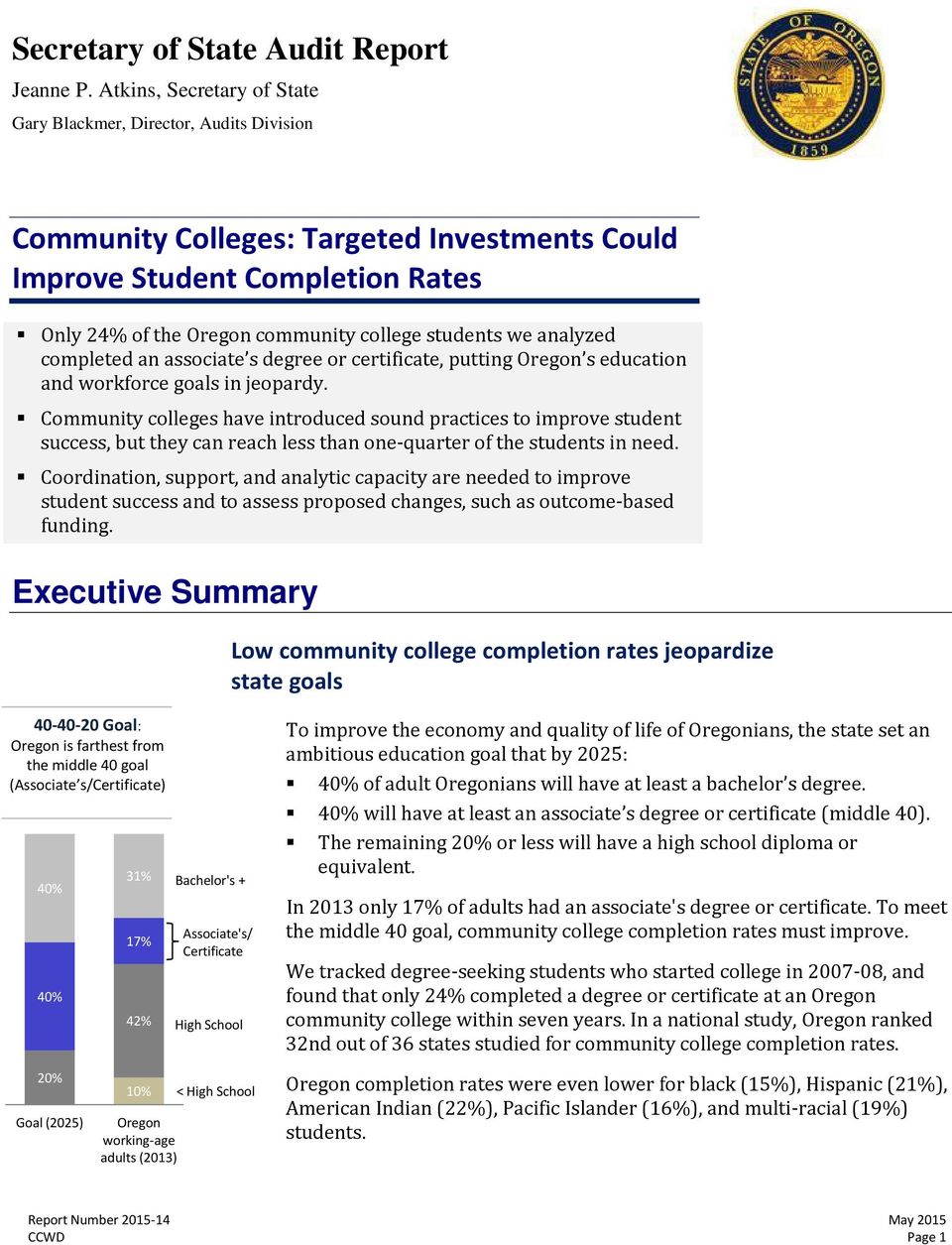
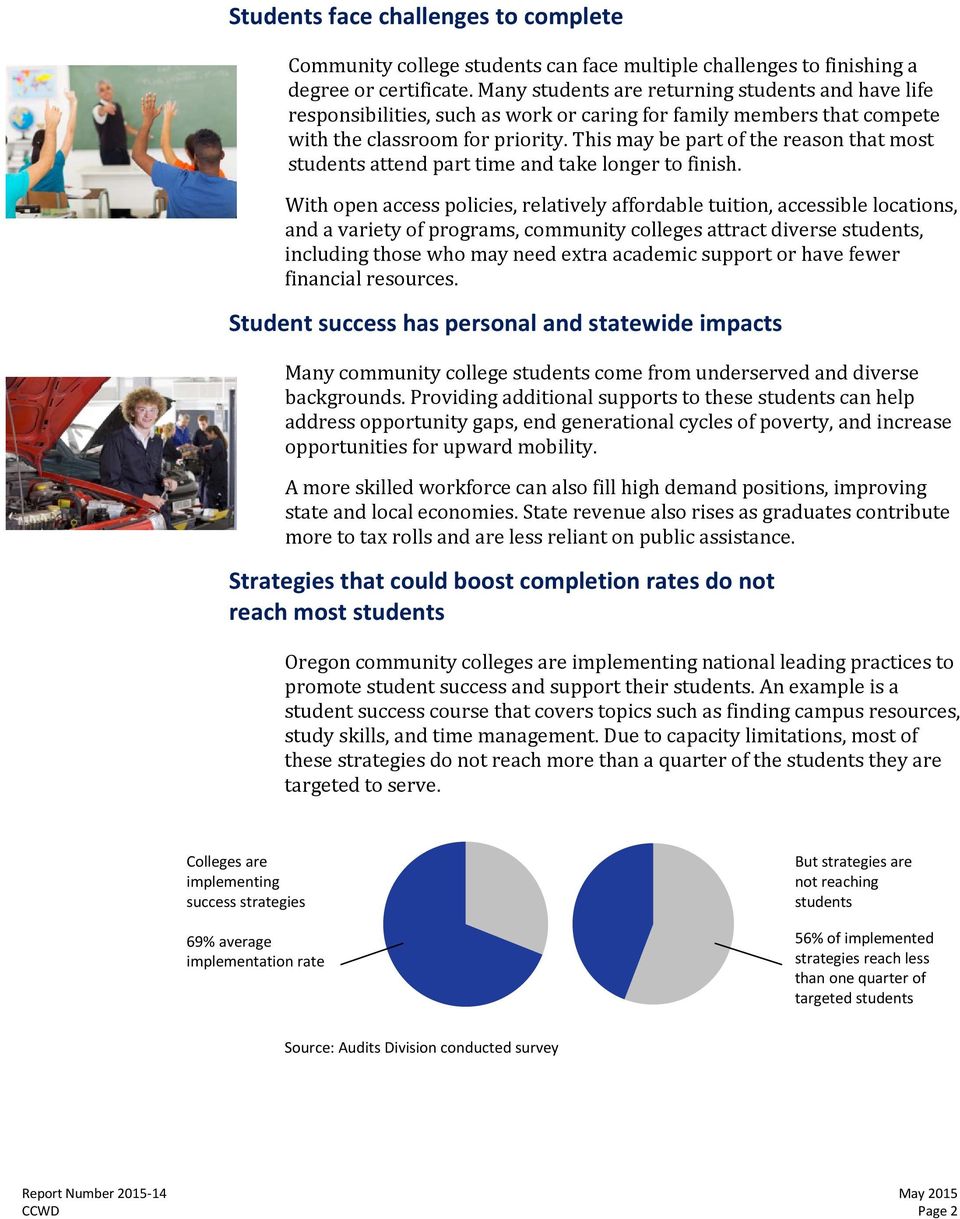
2 Students face challenges to complete Community college students can face multiple challenges to finishing a degree or certificate. Many students are returning students and have life responsibilities, such as work or caring for family members that compete with the classroom for priority. This may be part of the reason that most students attend part time and take longer to finish. With open access policies, relatively affordable tuition, accessible locations, and a variety of programs, community colleges attract diverse students, including those who may need extra academic support or have fewer financial resources. Student success has personal and statewide impacts Many community college students come from underserved and diverse backgrounds. Providing additional supports to these students can help address opportunity gaps, end generational cycles of poverty, and increase opportunities for upward mobility. A more skilled workforce can also fill high demand positions, improving state and local economies. State revenue also rises as graduates contribute more to tax rolls and are less reliant on public assistance. Strategies that could boost completion rates do not reach most students Oregon community colleges are implementing national leading practices to promote student success and support their students. An example is a student success course that covers topics such as finding campus resources, study skills, and time management. Due to capacity limitations, most of these strategies do not reach more than a quarter of the students they are targeted to serve. Colleges are implementing success strategies 69% average implementation rate But strategies are not reaching students 56% of implemented strategies reach less than one quarter of targeted students Source: Audits Division conducted survey CCWD Page 2
3 State outcomes-based funding would require continued assessment and monitoring The Higher Education Coordinating Commission (HECC) is considering a proposal to change the funding distribution model from one based solely on enrollment to one based partially on enrollment and partially on the number of completions and progression milestones reached. This change is aimed at improving student success. Some colleges have concerns about unintended consequences. If the proposal is adopted, ongoing analysis and attention will be needed to assess the effectiveness of the model and monitor impacts on student education and colleges. Capacity constraints hinder student success strategies Community colleges report that the biggest challenges to expanding student success strategies are capacity constraints. These constraints, summarized below, exist both at the colleges and at the Department of Community Colleges and Workforce Development (CCWD). Limited and Competing Resources: Community colleges have few resources to devote to student success initiatives. State Coordination and Strategic Support: CCWD has less capacity than it once did to help community colleges coordinate and implement student success and completion initiatives. Data Informed Decision-Making and Analysis: Most colleges have limited capacity and expertise to analyze data for decision-making and continuous improvement. CCWD has limited capacity to analyze data for state initiatives, to support small colleges, or to assess the implementation of outcomes-based funding. Community colleges lack information about their students before and after they leave college. Recommendations: Targeted investments to support student success To better support strategies that promote community college student success and completion, we recommend that the Oregon Education Investment Board, the Higher Education Coordinating Commission, and/or the Department of Community Colleges and Workforce Development coordinate to: CCWD Page 3
4 Clarify roles and responsibilities and increase capacity for coordination and support of student success and completion initiatives. Continue to invest in developing the statewide longitudinal data system to track student progress and outcomes, and ensure that investment continues for ongoing administration. Increase capacity to analyze data to inform state strategic initiatives and support small colleges. If the state moves forward with outcomes-based funding, ensure capacity to assess the effectiveness of the model and monitor impacts on student education and colleges. Continue to use at least 1% of the Community College Support Fund-Strategic Fund to invest in community college student success initiatives. To improve student outcomes and expand initiatives, we recommend the community colleges consider: Agency Response Aligning budget allocation to strategic goals that forward student success initiatives. Prioritizing investment in increased analysis capacity for decisionmaking and continuous improvement. Coordinating and combining resources to fund statewide projects, materials and training to support student success initiatives. The agency response is attached at the end of the report. CCWD Page 4

5 Background Community colleges play a vital role in Oregon s education system Community colleges serve diverse students with a variety of programs Community colleges provide many different education opportunities to the areas they serve. Colleges offer a variety of education courses that serve degree-seeking students with diverse goals. In general, these students fall into one of two categories: Lower Division Collegiate: Courses and programs that parallel the first two years of four-year institutions, including transfer degrees that focus on 100 and 200 level general courses in math, writing, science, and/or business. These programs prepare students to transfer to a university but could also stand alone. Transfer students have the option of earning an associate s degree or certificate before transferring. Career and Technical Education: Courses that generally lead to an associate s degree or certificate in a professional program, such as medical assisting or welding. Though these programs are intended to lead directly to employment, some students continue on at universities to earn a bachelor s degree. For example, students can earn a Bachelor of Science in Nursing after earning an associate s. Community colleges also provide education opportunities for high school students and adult learners through: Dual-credit or fifth year programs, where students earn college credit while still in high school. Developmental Education, which includes Adult Basic Education, English as a Second Language, General Educational Development (GED), and post-secondary remedial courses. Adult Continuing Education that does not lead to a degree. Continuing education is required for many professions and to maintain professional licenses. Also, many people attend community college to take one or more enrichment courses to build skills or for recreation, such as learning a foreign language or participating in fitness activities. CCWD Page 5
6 Community colleges are a primary point of access for students who may face challenges in higher education Community colleges generally have open access policies, relatively low costs compared to universities, accessible locations, and a variety of programs. These characteristics attract diverse students, including those who may require additional academic support or have fewer financial resources. Community colleges can provide a point of access for students who may not have otherwise gone to college, lack support, have commitments that prevent full-time enrollment or relocation, or face additional challenges. Challenges community college students face can include: Limited financial resources Needing additional academic support or developmental courses Lack of affordable child care Lack of reliable transportation Many students identify financial concerns as their primary obstacle, including the cost of tuition, books, and navigating financial aid. Community college students can also have life commitments, such as family obligations, caring for children, and balancing a job. For students who face these challenges, community colleges provide an affordable option and access point to higher education. The mission of community colleges is shifting from access to access and completion Traditionally, community colleges focused on providing access to higher education. They worked to reduce barriers to enrollment, such as keeping tuition low and reducing administrative hurdles. Community colleges throughout the country have become more focused on helping students succeed in their programs and complete degrees and certificates, while still preserving open access. Oregon s community colleges have collaborated to address student success and completion Oregon community colleges have worked with each other and with state partners to share information and coordinate efforts for increasing student success. For example, the Student Success Oversight Committee (SSOC), established in 2007, identifies strategies that address student success and encourages colleges to focus on those strategies. Oregon community colleges have also secured grants and worked with national organizations to address student success. This has enabled them to work on initiatives such as: CCWD Page 6

7 Creating reverse transfer programs, which automatically award an associate s degree to community college students who transferred to a university prior to completing their degree. This ensures that even if students do not finish a bachelor s program they will have an associate s degree. Increasing the use of data to inform decision-making and ensure investments are directed toward strategies that improve student success. Oregon s education policy goals emphasize student completion Oregon s education policy goals are also focused on completion of degrees and certificates. In 2011, the Legislature established the education goal that by 2025: At least 40% of adult Oregonians will have earned a bachelor s degree or higher. At least 40% of adult Oregonians will have earned an associate s degree or post-secondary credential as their highest level of educational attainment. The remaining 20% or less of all adult Oregonians will have earned a high school diploma or equivalent. Figure 1: goal vs. current education distribution 40% 31% Bachelor's or Higher Goal: Oregon is farthest from the middle 40 goal (Associate s/certificate) 40% 17% 42% Associate's/ Certificate (Estimate) High School 20% 10% Less Than High School Goal (2025) Oregon working-age adults (2013) Source: HECC analysis of the American Community Survey By establishing the goal, Oregon set education as a strategic priority. Community college associate s degrees and certificates fall under the middle 40 category. Community colleges also contribute to the other two categories through transfers to universities and Adult High School Diploma and GED programs. As Figure 1 shows, Oregon is farthest away CCWD Page 7

8 from achieving the middle 40 goal, with only 17% of Oregonians currently holding an associate s degree or professional certificate. The state reduced support during the recession and has undergone structural changes State support for community colleges dropped during the recession and colleges now rely more on higher tuition rates Community colleges are funded through a combination of state support, local property tax revenue, and tuition. The proportion of these three funding sources has changed significantly in the last 20 years. State support peaked in at 55% and fell to 35% in Tuition and fees have become more important, accounting for 44% of college revenue in During the recession, this trend was pronounced. State support dropped at the same time that enrollment rose and colleges raised tuition. When accounting for funding per full-time equivalent (FTE) student, the state s method of calculating funding distribution, and for inflation, the funding drop during the recession is more visible, as shown below in Figure 2. The state General Fund support for community colleges of approximately $465 million in was an increase from previous years, but did not reach the level of approximately $495 million ($550 million in 2014 dollars). With enrollment decreasing after the recession and state support increasing, state support per student will likely increase. CCWD Page 8
9 Figure 2: Amount of state General Fund allocated to the Community College Support Fund by biennium (adjusted for inflation) State Support Millions ,000 2,500 2,000 1,500 1, Support per FTE (Adopted) (Governor's Recommended) - State Support (General Fund) - Rounded figures Per FTE Sources: Legislative Fiscal Office Analysis; CCWD audited enrollment; Bureau of Labor Statistics Staffing reductions at the Department of Community Colleges and Workforce Development have lowered capacity to support colleges Staffing reductions at the Department of Community Colleges and Workforce Development (CCWD), particularly among general funded staff, have resulted in less flexibility for staff roles and less capacity to support community colleges. The full-time equivalent (FTE) of general funded staff has been reduced each biennium since , with one exception. In two additional general funded FTE were added. However, these positions were dedicated to new workforce development activities. Overall, around 10 FTE out of just under 60 overall staff are funded through the General Fund. The remaining FTE have specific requirements related to funding sources, primarily federally funded workforce activities. This limits the agency s flexibility to take on new student success initiatives or move staff to different projects. Staffing reductions coupled with additional work demands led to a nearly $885,000 operating budget shortfall in the biennium. This shortfall was filled by leaving three positions vacant, transferring $121,000 from the Strategic Fund, allocating an additional $250,000 from the General Fund, and identifying others savings and revenue. The Strategic Fund is intended to be used for statewide strategic initiatives and activities. CCWD Page 9

10 Structural changes to Oregon s higher education system were implemented to improve key education transitions The state has undergone significant structural changes in higher education in recent years, with the goal of improving alignment of the entire education system. However, these changes resulted in a lack of clarity about the role of the various state education agencies and other stakeholders. This includes lack of clarity about what roles fall to the Higher Education Coordination Commission (HECC) and the Oregon Community College Association, a council of governments of the 17 community colleges. In 2011, the Oregon Legislature established the Oregon Education Investment Board (OEIB) to ensure that all public school students achieve the state s education outcome goals, help focus state investment on achieving student outcomes, and to build a statewide data system to measure student outcomes. OEIB is charged with unifying public education from preschool through graduate school (P-20). Beginning July 2014, the HECC, established 2011, took over policymaking authority for community colleges from the State Board of Education. In July 2015, CCWD will officially move under the authority of the HECC. As CCWD moves under the authority of the HECC, it is intended that the HECC will provide some consolidated functions for both community colleges and universities. For instance, the HECC has started to integrate executive functions, legislative affairs, internal operations (such as accounting, procurement, and human resources), and communications work. The HECC further plans to integrate information technology systems, data and research, and certain policy efforts that span community colleges and universities. This has the potential to partially address some of CCWD s staffing constraints discussed above. Changes are still underway and results of changes are not yet seen. Colleges and state agencies make efforts to coordinate In Oregon, there is a decentralized system of 17 independent community colleges. The HECC distributes state and federal funds to each of the community colleges, sets broad policies, and approves new courses and programs. CCWD provides assistance and information to the colleges. Locally elected education boards are responsible for setting policy for their individual colleges. The colleges collaborate on student success efforts and to leverage resources. CCWD has helped support and staff those efforts. The colleges also utilize statewide professional groups to share information. For instance, the college presidents, institutional researchers, and student service administrators each have their own councils that meet regularly. CCWD Page 10

11 Proposed changes to the community college funding model aim to improve outcomes, other proposals focus on affordability and access Oregon s current funding model is based on enrollment Oregon s distribution of state funding is primarily based on the full-time equivalent of students enrolled. This funding model does not account for student outcomes, including completion of degrees or certificates. The state distributes a set amount of funding each biennium based on each college s enrollment numbers. The only way for a college to get a larger proportion of funding is to have faster enrollment growth than other colleges. Oregon is considering implementing partial outcomes-based funding Many states are moving away from funding based on enrollment to funding based partially or entirely on outcomes or performance, such as counting the number of degrees awarded or students earning 30 credits. Tennessee has moved to 100% outcomes-based funding. Other states, including Washington and Ohio, allocate part of their funding based on outcomes. The intent of this change is to align funding with student success strategies and incentivize college budget decisions to prioritize completion. Oregon is discussing incorporating outcomes into the community college funding distribution model. The HECC recently approved a change to incorporate a partial outcomes-based funding model for universities. A similar proposal for community colleges is being examined. Other proposed changes focus on improving affordability and access Other recently proposed changes address affordability and access to community colleges. These proposals do not directly focus on student success and completion, though improved affordability could help reduce financial barriers to completion. They include: Establishing a statewide endowment for scholarships. This Oregon ballot measure was voted down in the November 2014 general election. Making community college tuition free for recent high school graduates. There have been proposals for this at both the national and state levels. Pay It Forward, a proposed Oregon pilot program that would allow students to pay a percent of their future earnings instead of taking out loans or paying tuition. Increasing funding for the Oregon Opportunity Grant, the state s need-based aid program, and focusing that program s limited CCWD Page 11
12 resources on the highest-need students, many of whom attend community colleges. CCWD Page 12

13 Audit Results Community colleges play a vital role in serving a diverse population of students. The colleges help create the highly skilled workforce required for Oregon businesses to be successful and competitive. However, with an overall community college completion rate of only 24%, the colleges must address the barriers that their students encounter when trying to earn a degree or certificate. These challenges could include anything from navigating financial aid to balancing life responsibilities. Oregon colleges are aware of strategies that are effective in helping students succeed. However, their ability to expand these initiatives and serve more students is limited by lack of funding, capacity for analysis, and state support. Changes being initiated at the state level, including outcomes-based funding and the longitudinal data system, could help colleges direct funding toward student success initiatives and track outcomes. These state initiatives will require ongoing attention and capacity for analysis. Oregon s community college state level completion rate is low Oregon s community college completion rate is low when compared to the national average and to other states. Only 24% of the students who entered college in went on to complete a degree or certificate at a community college within seven years. The completion rates are even lower for non-asian students of color. Traditional measures of community college completion rates do not capture students who took longer than three years to complete a two-year degree. Our analysis allowed more than twice as much time for a student to complete (seven years as opposed to three), and still found that less than a quarter of the cohort students completed a degree or certificate. Completion rate is based on a student cohort Completion (or graduation) rates are based on a student cohort calculation. For example, a university s graduation rate compares a freshmen class who all started in the same term to the same group of students four to six years later. In order to calculate a completion rate, we defined a cohort using an established methodology. We included full and part-time degree-seeking students who started in the academic year and did not include completion rates for noncredit, skill-building, adult-education, or GED students. It is important to note that the cohort comprised only a small fraction of the total enrolled students. See Appendix for more details on our methodology and reporting limits. CCWD Page 13

14 Figure 3: Community college completion rates by state North Dakota Florida Minnesota Maine Wisconsin Montana Iowa Mississippi Kentucky Hawaii Washington New York Arkansas Illinois Nebraska Massachusetts Kansas North Carolina Tennessee Missouri Virginia U.S. Overall New Jersey Colorado Wyoming Pennsylvania Maryland Michigan Georgia Ohio Connecticut South Carolina Oregon Nevada California Utah Indiana 13% 30% 24% 52% Note: Based on a cohort. Source: National Student Clearinghouse Oregon has low completion rates compared to other states The overall completion rate for students first enrolled in an Oregon community college in was 24% (all rates in this section are rounded to the nearest percent) after seven years and only 14% after three years. This completion rate is low when compared to other states, as shown in Figure 3. In a nationwide comparison of a cohort, Oregon ranked 32 nd out of the 36 states studied for community college completion rates. Oregon was six percentage points lower than the national average and 28 points lower than the top-ranked state (North Dakota). The numbers are no better when looking at comparisons based on other methods of reporting that focus on full-time students. A comparison done by the Chronicle of Higher Education looking at 2010 graduation rates ranked Oregon 41 st out of 50 states for two-year degree completion. Some of the students who did not complete a degree or certificate at a community college transferred to a four-year university. A third of the cohort students who did not complete at a community college went on to enroll and take at least one class at a four-year university. Students who transfer do not necessarily continue to complete a bachelor s degree. A national study found an overall completion rate of 30% for Oregon students that start at community college. That means less than a third of community college students completed a degree or certificate within six years anywhere, including at a four-year institution. This is 10 percentage points lower than the national rate. Completion rates are lower for non-asian students of color, particularly male non-asian students of color Non-Asian students of color had lower completion rates than white (25%) and Asian (25%) students. Oregon completion rates were lower for black (15%), Hispanic (21%), American Indian (22%), Pacific Islander (16%), and multi-racial (19%) students. Male students also had lower completion rates than female students. Combining these factors, the disparity is even larger. As Figure 4 shows, black male students had the lowest seven year completion rate at 11%, compared to white female students rate of 27%. As discussed later in the report, targeted programs may help address these gaps and provide supports that students need to be successful. CCWD Page 14

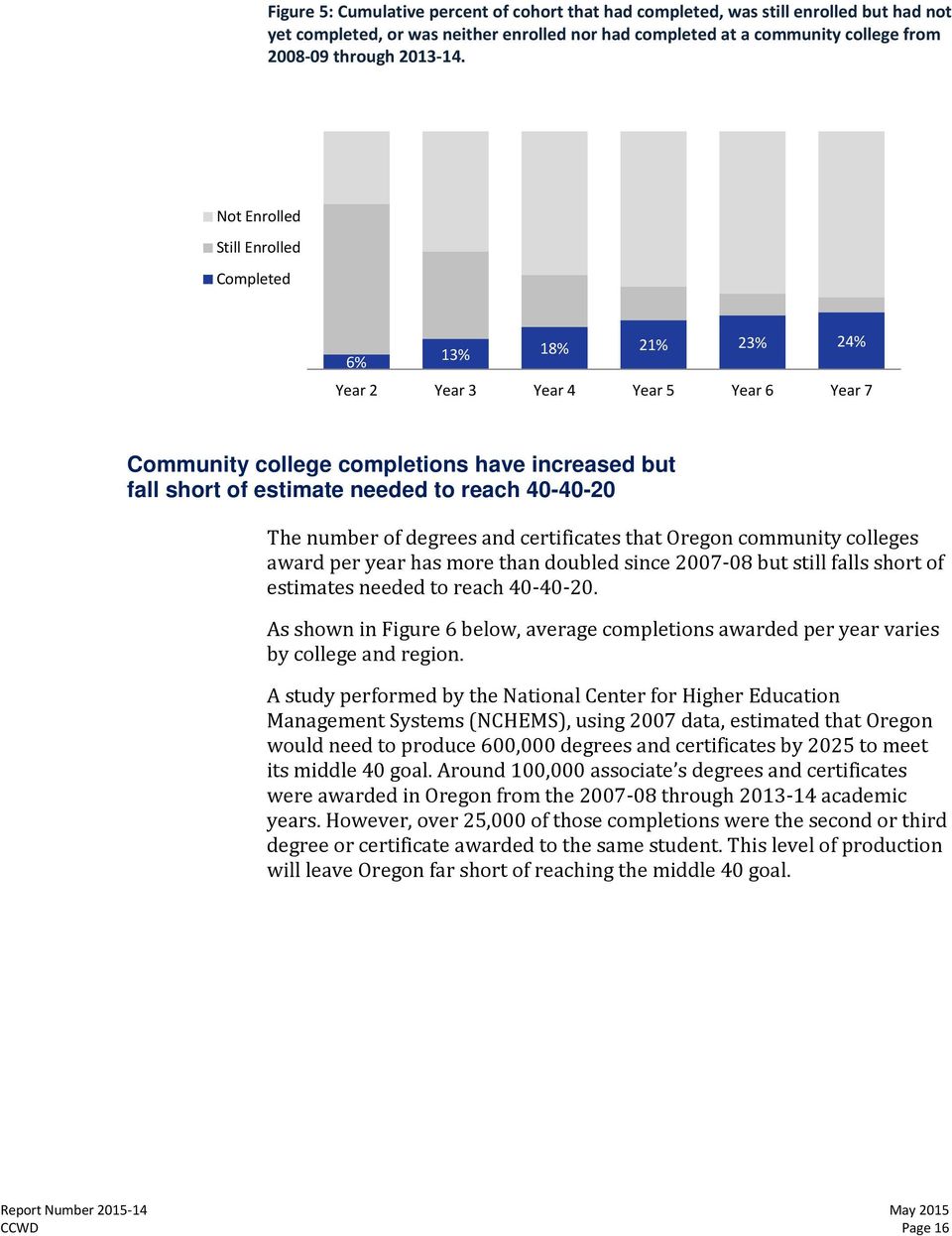
15 Figure 4: Cohort completion rates by race/ethnicity and gender. White Asian American Indian Hispanic Multi-Racial Black 11% 18% 18% 18% 20% 20% 22% 25% 25% 24% 23% 27% Female Male Note: 14% of cohort students did not report their race/ethnicity. Pacific Islander data were omitted due to small numbers. Community college students take longer than two years to complete Community college students can take up to seven years, or possibly longer, to complete a degree or certificate. Of the cohort we analyzed, most students took longer than two years to complete. Three quarters of those who completed did not receive their first degree or certificate until their third year or later. Nearly half did not receive their first award until their fourth year or later. This longer timeline makes sense as only a quarter of cohort students were enrolled full time. After three years, half of the cohort students were no longer enrolled at community college and had not completed a degree or certificate. As mentioned above, some students transfer to four-year universities before completing an associate s degree or certificate. Of the students that were still enrolled after three years, nearly a third continued to complete a community college credential within seven years. As shown in Figure 5 below, the completion rate continues to rise after the four year mark, though not as rapidly. CCWD Page 15

16 Figure 5: Cumulative percent of cohort that had completed, was still enrolled but had not yet completed, or was neither enrolled nor had completed at a community college from through Not Enrolled Still Enrolled Completed 6% 13% 18% 21% 23% 24% Year 2 Year 3 Year 4 Year 5 Year 6 Year 7 Community college completions have increased but fall short of estimate needed to reach The number of degrees and certificates that Oregon community colleges award per year has more than doubled since but still falls short of estimates needed to reach As shown in Figure 6 below, average completions awarded per year varies by college and region. A study performed by the National Center for Higher Education Management Systems (NCHEMS), using 2007 data, estimated that Oregon would need to produce 600,000 degrees and certificates by 2025 to meet its middle 40 goal. Around 100,000 associate s degrees and certificates were awarded in Oregon from the through academic years. However, over 25,000 of those completions were the second or third degree or certificate awarded to the same student. This level of production will leave Oregon far short of reaching the middle 40 goal. CCWD Page 16
17 Figure 6: Oregon s 17 community colleges average annual degree and certificate production from the through the academic years. Note: The number of degrees and certificates awarded is related to the size of the college s enrollment. The completion totals include multiple degrees and certificates awarded to a single student. Source: Audits Division created map, data obtained from CCWD Low community college completions have personal and statewide impacts The purpose of the goal is not simply about reaching numbers. It is about realizing the economic and social gains that come from a welleducated population. When students earn an associate s degree or a certificate they are more likely to have higher earnings and better job prospects. A well-educated population is also expected to bring statewide benefits. A more educated workforce can fill high skilled jobs, improving state and CCWD Page 17

18 local economies. State revenue also rises as graduates contribute more to tax rolls and rely less on public assistance. On the other hand, when students take courses toward a degree or certificate but do not complete, they may end up with student debt but no credential. This could leave them financially worse off than when they started college. If the completion rate at Oregon community colleges does not improve well beyond 24%, the state will not reach its education goals or realize the benefits associated with those goals. Students who complete a degree have better employment opportunities and higher wages Evidence clearly shows that students who complete an associate s degree have greater employment opportunities and earn higher wages than their peers with only a high school diploma or equivalent. As Figure 7 shows, national average earnings go up and unemployment rates decrease with each level of education attained. Figure 7: Average earnings and unemployment by education level $35.00 $30.00 $ % 30% $25.00 $20.00 $15.00 $10.00 $5.00 $ % $16.70 $ % 6.0% $ % 3.2% 25% 20% 15% 10% 5% $- Less Than High School High School Some College Associate's Bachelor's or Higher Average Hourly Earnings Percent Unemployed 0% Source: Oregon Employment Department, based on 2014 national averages from the Current Population Survey The potential for increased earnings is particularly important within the context of social equity and economic mobility. Community colleges are a primary access point to higher education for low income, diverse, and first generation students, some who may not otherwise have gone to college. For these students, earning a degree or certificate can help end generational cycles of poverty and provide opportunities for upward mobility. Increasing completion rates would boost local and state economies Oregon leaders recognize the need to boost residents skill levels in order to improve the economy and economic competitiveness. Oregon is not only CCWD Page 18

19 competing against other states but also globally. Other nations are producing more college degrees than the United States and other states are outpacing Oregon. Many Oregon businesses require higher skilled employees to meet workforce needs. Having higher skilled employees can make businesses more competitive. Employers report a lack of skilled applicants for some high skilled positions. Some businesses have to find qualified employees from other states. This skill shortage could increase in the future as the economy becomes more complex. A study from Georgetown University projects that by 2020, 65% of American jobs will require post-secondary education and training. Oregon would also boost its revenues with a more educated workforce. States that have the highest levels of education also have the highest per capita incomes. Increasing income is important in Oregon since the state relies more heavily on income tax than other states. Additionally, as people become more educated, they are also less likely to rely on public assistance, such as food stamps and Temporary Assistance to Needy Families (TANF). A higher educated population could therefore reduce government costs while increasing tax revenue. Students who do not complete a degree or certificate may leave with high student debt and no credential Students who do not to complete their intended degree or certificate may end up financially worse off than when they started. Many community colleges students take out student loans while in school. Some students reduce their working hours and lose wages while enrolled. Students typically understand that this investment will pay off in the future with better job opportunities and higher wages. However, students who fail to complete a program will not have a credential to help them secure higher earnings in the workforce but may still be responsible for paying back student debt. Low completion rates may impact Oregon s education goals It will be hard for Oregon to realize its middle 40 education goal by 2025 without increasing community college completion rates. This is particularly true since most community colleges have seen a drop in enrollment since the end of the recession. Using broad estimates, if Oregon community colleges had the same completion rate as the national average, the cohort could have added roughly 1,500 additional completers to the middle 40 category. Holding all factors constant, that rate would have added around 10,000 additional completers over the past seven years and 15,000 completers over the next 10 years. This is closer but still far short of estimates needed to reach the middle 40 goal. CCWD Page 19
20 Oregon community colleges are addressing student success by implementing leading practices Community college students can face significant challenges that may make it difficult for them to succeed in school. These include family obligations, lack of financial resources, inadequate college readiness, and lack of access to services like housing and health care. Community colleges have been proactive in supporting students, but they currently lack the resources and capacity to scale student success initiatives to meet the needs of all students. Community college students can face multiple challenges in earning a degree or certificate Most community college students have at least one recognized challenge to succeeding in higher education. These include being the first in the family to go to college, being low income, or having a need for developmental (remedial) education. With supports, students that face challenges are more likely to complete a degree or certificate. Community colleges are making efforts to improve student success Some of the challenges community college students face can be academic. For instance 65% of Oregon community college students require developmental (or remedial) education, typically in math, reading, and writing. Students may also struggle with navigating college, including how to register for classes, identify which credits are needed for their degree, and how to access resources, such as tutoring services. Oregon community colleges are implementing national leading practices to help students succeed and improve completion. Examples of strategies that some colleges are implementing include: Mandatory orientation for new students Mandatory student advising Student success courses Fast track developmental education Colleges also offer targeted programs with individualized support In addition to academic challenges, colleges are also implementing targeted programs that help students who may face challenges not related to academics. We interviewed current students and asked them what challenges they face toward completing their degree. They identified financial and life challenges as barriers. CCWD Page 20

21 PCC s Future Connect program provides success coaches and financial assistance to low income, first generation students. 70% of participants continue on to their second year of college. Students reported that financial challenges go beyond the high cost of tuition and books. One frequently reported challenge was finding access to affordable child care. In addition, some students may not have access to basic health care or have enough income to buy food, pay their rent, or obtain adequate transportation. Balancing life challenges with the stress of college can be overwhelming. Some students face mental health issues, such as depression, personal relationship issues, or a lack of family support while in college. Many of Oregon s community colleges provide counselors or coaches who are there to support students dealing with these life challenges. Some also have programs that target particular groups that may have unique challenges, such as veterans. Lishao Chen is a Future Connect participant. Chen moved from a small village in China to Portland where she entered the fifth grade. She said that it wasn t until Future Connect and the PCC Transitions program helped her gain confidence speaking English that Portland really felt like home. Before that, she was shy and afraid to speak, worried that people would laugh at her. These programs helped her learn to ask for help and access campus resources, such as volunteer conversation partners. She appreciates the support. I know they [coaches] are always there for me, she said. Targeted supports may be one solution for addressing opportunity gaps. For example, the Future Connect program at Portland Community College serves first generation, low income, and predominantly students of color who may not otherwise attend college. It provides students with financial aid and a college success coach. The coaches in Future Connect provide comprehensive support that helps students with everything from in-depth advising to bus tickets to providing encouragement through personal issues. They also help students find other resources that are available in the college or in the community. Chen said Future Connect helps her to live with purpose. In her second year at PCC, she joined student leadership as the Sustainability Coordinator for the Associated Students of PCC (ASPCC). In her third year, she became ASPCC s Director of Legislation for the Southeast Campus. Chen plans to transfer to Pacific University this fall. The guidance she received from Future Connect, she said, inspired her to pursue a career as a college advisor. [Future Connect] made me feel like I can do better. I will be successful in life. CCWD Page 21
22 Student success strategies are not reaching most students Most strategies do not reach more than ¼ of targeted students. Strategies to improve student success reach less than 25% of students While the services community colleges are focusing on are in line with national leading practices, the strategies are limited in the number of students they reach. A survey we conducted of all 17 colleges found that most of the strategies implemented do not reach more than a quarter of the students they target. Depending on the strategy, examples of targeted student groups may include: all students, all first time students, or those placed into developmental education. Other programs, such as Future Connect, that target students with the greatest need, succeed at improving completion rates for the students they serve. However, these require significant investment, and colleges are not currently in a position to scale up these services. Many strategies are not mandatory, limiting reach The strategies reach even fewer students outside their target populations, given that the majority of practices are not mandatory. Some national groups advise that, to be effective, strategies should reach many students, in part by requiring students to participate. Examples include mandatory advising and mandatory orientation. One reason some colleges may not make programs mandatory is that they do not have enough staff or instructors to provide the service to all students. Some colleges may also be reluctant to make programs mandatory out of concern that it will affect their enrollment and therefore their funding. For example, a student may be discouraged by a mandatory orientation that conflicts with their work schedule and not enroll in classes. Some colleges that have made changes such as mandating strategies or prohibited late registration stated that their enrollment did go down. Colleges may also be concerned that mandatory practices will interfere with students ability to access higher education. Upcoming state initiatives are aimed at improving student success A statewide longitudinal data system could improve tracking and assessing student success Efforts are underway in Oregon to develop a statewide longitudinal data system to link data from preschool through graduate school (P-20) to employment. The responsibility for this new data system falls to OEIB, but CCWD Page 22
23 other agencies are preparing their data to be compatible with it. CCWD is currently working on ensuring data integrity and rolling out a new community college database with the functionality of a longitudinal data system. Having a longitudinal data system in Oregon would allow the community colleges to have access to information about students before and after they leave community college. One college expressed that having access to high school records would help them better target programs and placement. Colleges also want to know if their students were successful in graduating from a four-year university, obtaining employment in their field of study, or if they experienced wage increases. Having this information would help colleges assess the long-term success of their programs. A longitudinal data system could also improve decision-making at the state level. State agencies, decision-makers, and stakeholders could ask research questions and conduct analyses that look at students progress and success over time. Overall and long-term effectiveness of state initiatives could be evaluated. Increasing the state level Strategic Fund is also proposed The college presidents have supported increasing the percentage of state support allocated to the Strategic Fund. Currently, up to 1% of the total available state support is set aside to fund statewide strategic initiatives and activities. For example, this fund could be used for enhanced research and data support or implementing best practices. Increasing the fund could increase coordinated strategic efforts between colleges, but would do so by reducing the funding colleges receive from the state for operations. Any amount not used for statewide initiatives is distributed back to the colleges. Proposed changes to the funding model aim to align with student success The current state funding model is based on student enrollment. This model may limit investments in practices that promote student success and completion because they are not reimbursed through enrollment. The HECC is exploring the possibility of a partial outcomes-based funding model for community colleges. The model would formally fund colleges partially based on completion of certificates and degrees and progress toward degrees. Outcomes-based funding is intended to align resources with activities that are best for students and improving completion rates. Outcomes-based funding proposal addresses some risks but continued attention will be needed Any funding model will create incentives, and some incentives may produce unintended results. When implementing outcomes-based funding, CCWD Page 23
24 safeguards should be put in place and quality can be monitored to reduce the risk of unintended results. The current proposal includes mechanisms to address some of these risks. There are risks of unintended consequences in outcomes-based funding One study suggests outcomes-based funding could unintentionally result in lowering academic standards, narrowing the community college mission, favoring those students most likely to complete, or requiring a higher than expected cost of compliance. Many at the colleges we visited expressed similar concerns. Some were also concerned that it would disproportionately affect funding at small, rural colleges. While some had concerns, some also expressed that funding that incorporates outcomes could be an improvement over funding based solely on enrollment. Measurement challenges can complicate outcomes-based funding There are also challenges to measuring success and completion that complicate outcomes-based funding. Some measurement considerations include: Student success initiatives take time to affect completions. Small colleges have more volatility in year to year completions. Transfer and swirling students can be difficult to measure or track. Many colleges have implemented student success initiatives in the past few years. Resulting effects could take time to appear in completion outputs. Our analysis found some students taking as long as seven years to complete a degree or certificate. Small colleges that have a small numbers of completers each year will experience more volatility than larger colleges. Deciding which college receives funding for transfer student completions or students who take courses at multiple colleges, known as swirlers, may be another challenge. This could be especially problematic if there are uneven transfer or swirling patterns. Outcomes-based funding proposal includes mechanisms to address risks The partial outcomes-based funding proposal being considered includes mechanisms to address some of the risks and challenges outlined above. These mechanisms also reflect national recommendations for outcomesbased funding. Mechanisms include: Measuring progress as well as completion. Using three year rolling averages to smooth volatility. CCWD Page 24
25 Including incentives for the success of traditionally underserved groups. Allowing flexibility for colleges to adjust measures to local needs and broader missions. Using a phased-in approach, with a stop loss provision to prevent any drastic drops in funding. Building these mechanisms in up front may help alleviate concerns and prevent potential unintended consequences of outcomes-based funding. Assessing the ongoing effectiveness of the funding model and ensuring that unintended consequences are not realized over time will require continued assessment. Community colleges face limits to expanding student success strategies Community colleges have few resources to devote to student success initiatives Total state and local funding for community colleges decreased during the and biennia at the same time that enrollment increased. Colleges increased tuition and made cuts to faculty and administrative positions, especially in student support services. Some colleges reported that small, rural colleges were especially affected by state funding cuts. State funding went up slightly during the biennium allowing colleges to reinvest somewhat in support services and completion initiatives. Colleges we visited say more funding is needed. For example, one college has initiated an early alert system to identify students who may be at risk of failing a course. The college can now identify at risk students but is limited in staff capacity to reach out directly to those students and refer them to services that can help. Many of the colleges we visited said even just a little bit of additional funding targeted to student success and completion initiatives would go a long way toward providing those services. Some colleges said the biggest barrier is obtaining resources for initial planning and setup of new services. One college said once a new service or program has been implemented, the college could allocate budget resources to sustain the program. All of the colleges we visited reported recent investments in new student success and completion initiatives. A notable example is the unique budgeting approach used by Klamath Community College. Though the college is small with significant resource constraints, Klamath has taken steps to prioritize and align budget allocation to strategic planning goals focused on student success. To do this, the college initiated a new collaborative budgeting process, flattened the organization and eliminated some administrative positions, and built in capacity for evaluation and continuous improvement. CCWD Page 25
26 Some colleges lack the capacity to assess whether implementing student success initiatives has improved student completion Colleges are well aware of the national literature and best practice research that has identified effective student success strategies. But they also lack the financial resources and staff to monitor the strategies they have implemented to ensure they are successful. Education experts encourage colleges to use data to inform decisionmaking when implementing strategies to improve student success. Colleges are encouraged to tailor implementation to the unique needs of their students. They should also use data to learn and continuously refine the design of implementation as needed. Some colleges we visited reported having little or no capacity to conduct analysis to support continuous improvement efforts. For example, a small, rural community college we visited has one-fifth of an FTE assigned to institutional research. Another college reported that their institutional researcher only works on mandatory reporting, not analysis. Outcomesbased funding could also place additional burdens on college institutional research staff. Some colleges have made employing staff with expertise in analysis a priority. For example, Linn-Benton Community College has two employees assigned to analyzing and disseminating data to inform decision-making around student success initiatives. However, some colleges, particularly in rural areas, have difficulty recruiting employees with the necessary data skills. In addition to limited staff capacity for institutional research, many colleges we visited said their information technology systems present barriers to addressing student success. For example, one college could not make their orientation mandatory because they could not program the information technology system to stop the registration of students who did not attend. CCWD has less capacity to assist community colleges in increasing completions CCWD has less capacity to help community colleges implement student success and completion initiatives Prior to recent staffing reductions, CCWD played a greater role helping community colleges implement student success efforts aimed at improving completion rates. Currently, CCWD provides limited support and technical assistance to community colleges due to staffing cuts, turnover, and uncertainty about the future of the agency. With shifting state governance, there is less clarity around who will or should perform all of these roles and responsibilities. CCWD Page 26
27 Areas where CCWD previously provided support included: Obtaining and managing student success grants. Convening and supporting statewide initiatives that were designed in partnership with the colleges to increase student preparation, persistence, and completion. This included being the convener of the Student Success Oversight Committee. Providing assistance, research, and best practice information to colleges. Creating collaborative partnerships with other educational sectors, the workforce system, and employers at the state level. CCWD requested three positions in part to reinstate capacity for providing the colleges with support for student success initiatives. However, this request was not included in the Governor s recommended budget. As CCWD s capacity lessened, either other groups have taken on providing the colleges with these supports or the work is not being done. For example, CCWD recently stepped down as the lead convener of the Student Success Oversight Committee and that role has shifted to the Oregon Community College Association. In preparation for CCWD s integration into the Higher Education Coordinating Commission agency structure, HECC staff has assumed responsibility for some communications and policy work that was previously the responsibility of CCWD alone. The state lacks capacity to assess community college student success and completion initiatives Increasing analytic capacity at the state level to support colleges in improving student success and completion may provide significant benefits. The continual analysis of student data would allow the state to better target statewide initiatives and planning, monitor efforts for improvement, and also support smaller colleges with less capacity. Community colleges said they desired more data support from the state, especially for small colleges. Colleges would like access to more data sooner, especially P-12, university, and employment data. This data could help colleges better serve students and evaluate the long-term effectiveness of programs. Some colleges also suggested the state could produce more of the federally mandated reports. This would allow the colleges to focus research on their student success and completion initiatives. The OEIB formed a unit in 2014 to conduct research that supports alignment of education policy. The research this unit has performed thus far has been focused on K-12. There is an opportunity for OEIB to perform analysis focused on community colleges or partner with CCWD s research staff. CCWD Page 27
28 The state will need capacity to assess the impacts of outcomes-based funding on an ongoing basis National experts recommend that states with outcomes-based funding provide colleges with resources to hire additional researchers to conduct the types of analyses necessary to drive institutional improvement. The current proposal being considered by the HECC also recommends continued research, including identifying research questions early in the process. In order to assess the impacts of outcomes-based funding on student success and stay alert to potential unintended consequences, the HECC and CCWD will need to ensure capacity for ongoing assessment and monitoring. Colleges, especially small colleges, will also require additional research support. CCWD Page 28
29 Recommendations To better support strategies that promote community college student success and completion, we recommend that the Oregon Education Investment Board, the Higher Education Coordinating Commission, and/or the Department of Community Colleges and Workforce Development coordinate to: Clarify roles and responsibilities and increase capacity for coordination and support of student success and completion initiatives. Continue to invest in developing the statewide longitudinal data system to track student progress and outcomes, and ensure that investment continues for ongoing administration. Increase capacity to analyze data to inform state strategic initiatives and support small colleges. If the state moves forward with outcomes-based funding, ensure capacity to assess the effectiveness of the model and monitor impacts on student education and colleges. Continue to use at least 1% of the Community College Support Fund-Strategic Fund to invest in community college student success initiatives. To improve student outcomes and expand initiatives, we recommend the community colleges consider: Aligning budget allocation to strategic goals that forward student success initiatives. Prioritizing investment in increased analysis capacity for decisionmaking and continuous improvement. Coordinating and combining resources to fund statewide projects, materials and training to support student success initiatives. CCWD Page 29
30 Objectives, Scope and Methodology Our audit objective was to determine how OEIB, HECC, CCWD, and Oregon s community colleges can increase the number of students who complete degree and certificate programs in line with the state s education goals. We reviewed applicable state laws and rules, policies, and management best practices related to our audit objective. We reviewed CCWD policies and procedures, performance measures, and strategic planning documents. To understand historical context and budgets, we analyzed documents prepared by the Oregon Legislative Fiscal Office. We reviewed reports prepared by national foundations, universities, the American Association of Community Colleges, and more. We also reviewed academic literature regarding the link between associate s degrees and certificates and earnings. We reviewed other higher education audits completed at states and local governments to identify risks associated with community college completion. We interviewed CCWD and HECC managers and employees to identify common challenges across community colleges and the state s capacity to assist colleges in addressing those issues. In addition, we interviewed members of the Oregon Community Colleges Association, OEIB, Oregon Business Council, and community college representatives at all levels. We conducted six site visits to identify common challenges across community colleges and areas the state might assist colleges. The colleges we visited are: Blue Mountain, Clackamas, Clatsop, Klamath, Linn-Benton, and Portland. Colleges were selected to ensure variation in location, size, and student population. We conducted an online survey of all 17 community colleges to gauge the current level of implementation of leading practices to promote student success and completion. Leading practices were selected based on practices identified by the University of Texas that were also cited in other sources. We received 100% response rate. We analyzed data provided by CCWD to ascertain a completion rate for a cohort of students. We conducted data reliability tests and concluded that the data were sufficiently reliable. We conducted this performance audit in accordance with generally accepted government auditing standards. Those standards require that we plan and perform the audit to obtain sufficient, appropriate evidence to provide a reasonable basis for our findings and conclusions based on our audit objectives. We believe that the evidence obtained provides a reasonable basis for our findings and conclusions based on our audit objectives. CCWD Page 30
31 Appendix: Cohort Methodology and Limitations Completion rates in this report are based on a student cohort methodology Community college student enrollment and goals are varied, which makes defining a cohort challenging. Many community college students attend part time, may take courses to build skills, and may not have any intention of earning a degree. Statewide community college data do not provide a reliable way to identify a student s intent. In order to understand which students intended to complete a degree or certificate we identified degree-seeking students based on enrollment intensity. To be defined as degree-seeking, students had to be enrolled full time (12 credits) at least once between fall 2007 through summer 2008 or half time (6 credits) at least twice between fall 2007 through fall We also looked only at students who were new for the academic year, based on their enrollment in the previous academic year. This methodology was modeled closely after the National Student Clearinghouse s signature report series. We went back seven years in order to give part-time students adequate time to complete a degree or certificate. Traditional measures of completion only give students three years to complete an associate s degree, which does not account for the large percentage of part-time students. We wanted to ensure that those students would be counted as completers to get the most accurate picture. Limitations to methodology Our strategy for identifying a cohort has several limitations. Due to data limitations it is difficult to narrow our cohort down to truly first time students. Additionally, our definition of a degree-seeking student is based on course-taking behavior and not a self-reported intent. Since we went back seven years, our data cannot be linked to more recent efforts to address student completion. Student success strategies take time to affect completion rates and this cohort started before many strategies were in place. Due to various concerns and data challenges, we also did not report completion rates by college. We faced challenges in determining how to address students who had transferred between community colleges. Comparing one time college cohort completions rates can also be misleading. This is especially true considering potential volatility in completion rates at colleges with small numbers and the different student populations served by different colleges. Program level completion rates could not be reported due to inadequate data about what programs students are in. We did not include other CCWD Page 31
32 groupings based on concerns about unreliable, unavailable or potentially misleading data. While we were able to obtain data on whether students transferred, we were unable to obtain data regarding the success of these students at universities. Photos obtained from the following sources: Honggi Zhang (aka Michael Zhang) Dreamstime.com, Juice Images Dreamstime.com, Monkey Business Images Dreamstime.com, Monkey Business Images Dreamstime.com, Portland Community College CCWD Page 32
33
34
35
36 About the Secretary of State Audits Division The Oregon Constitution provides that the Secretary of State shall be, by virtue of her office, Auditor of Public Accounts. The Audits Division exists to carry out this duty. The division reports to the elected Secretary of State and is independent of other agencies within the Executive, Legislative, and Judicial branches of Oregon government. The division audits all state officers, agencies, boards, and commissions and oversees audits and financial reporting for local governments. Audit Team Will Garber, CGFM, MPA, Deputy Director Sheronne Blasi, MPA, Audit Manager Shanda Miller, CIA, MPA, Principal Auditor Amanda Lamb, MPA, Staff Auditor Caroline Zavitkovski, MPA, Staff Auditor This report, a public record, is intended to promote the best possible management of public resources. Copies may be obtained from: website: sos.oregon.gov/audits phone: mail: Oregon Audits Division 255 Capitol Street NE, Suite 500 Salem, Oregon The courtesies and cooperation extended by officials and employees of the Department of Community Colleges and Workforce Development, the Higher Education Coordinating Commission, and the 17 community colleges during the course of this audit were commendable and sincerely appreciated.
How To Calculate College Enrollment In The United States
 EDUCATION POLICY BRIEF May 2008 The Nelson A. Rockefeller Institute of Government The public policy research arm of the State University of New York The States and Their Community Colleges Every state
College Completion in Connecticut: The Impact on the Workforce and the Economy
 College Completion in : The Impact on the Workforce and the Economy February 2012 Investing in Individuals and Society through College Completion 30 25 20 15 10 5 0 Higher Levels of Education and Skills
Bob Craves, Chairman, Higher Education Coordinating Board. 2004 Interim Strategic Master Plan for Higher Education
 December 15, 2003 To: From: Subject: Governor Gary Locke Members of the Washington Legislature Bob Craves, Chairman, Higher Education Coordinating Board 2004 Interim Strategic Master Plan for Higher Education
Workforce Development Programs
 Nurses provide extraordinary care. They re the front lines of the healthcare system. ~ President Barack Obama White House Health Care Summit March 5, 2009 Nursing Workforce Development Programs Title VIII
The High Cost of Low Graduation Rates: How Much Does Dropping Out of College Really Cost? Mark Schneider Vice President AIR
 The High Cost of Low Graduation Rates: How Much Does Dropping Out of College Really Cost? Mark Schneider Vice President AIR Lu (Michelle) Yin Researcher AIR August 2011 www.air.org Contents Executive Summary...........................................................
BUSINESS DEVELOPMENT OUTCOMES
 BUSINESS DEVELOPMENT OUTCOMES Small Business Ownership Description Total number of employer firms and self-employment in the state per 100 people in the labor force, 2003. Explanation Business ownership
Georgia s Ranking Among the States: Budget, Taxes, and Other Indicators
 THE CENTER FOR STATE AND LOCAL FINANCE JUNE 2015 Georgia s Ranking Among the States: Budget, Taxes, and Other Indicators IN COLLABORATION WITH ABOUT THE CENTER FOR STATE AND LOCAL FINANCE The (CSLF) mission
Suggested Citation: Institute for Research on Higher Education. (2016). College Affordability Diagnosis: Florida. Philadelphia, PA: Institute for
 FLORIDA Suggested Citation: Institute for Research on Higher Education. (2016). College Affordability Diagnosis: Florida. Philadelphia, PA: Institute for Research on Higher Education, Graduate School of
Higher Education in Florida: Trends and Key Issues. 1990-2014 The LeRoy Collins Institute Dr. Carol Weissert, Director
 Higher Education in Florida: Trends and Key Issues 1990-2014 The LeRoy Collins Institute Dr. Carol Weissert, Director Key Observations Florida universities are more accessible than those in many other
The Performance and State Policies Of Higher Education in Illinois: Insights from a Five- State Policy Review Project
 The Performance and State Policies Of Higher Education in Illinois: Insights from a Five- State Policy Review Project Laura W. Perna Joni Finney Patrick Callan With Assistance from: Michael Armijo, Jamey
Presentation for the Leading the Way Compact Forum West Virginia Higher Education Commission Laura W. Perna [email protected].
 Promoting College Access For All Students Presentation for the Leading the Way Compact Forum West Virginia Higher Education Commission Laura W. Perna [email protected] @lauraperna1 March 31, 2014 Improving
Data show key role for community colleges in 4-year
 Page 1 of 7 (https://www.insidehighered.com) Data show key role for community colleges in 4-year degree production Submitted by Doug Lederman on September 10, 2012-3:00am The notion that community colleges
University System of Georgia Enrollment Trends and Projections to 2018
 University System of Georgia Enrollment Trends and Projections to 2018 Introduction: Projections of USG Headcount Enrollment Enrollment projections use past trends and information on other variables to
State Tax Information
 State Tax Information The information contained in this document is not intended or written as specific legal or tax advice and may not be relied on for purposes of avoiding any state tax penalties. Neither
Licensure Resources by State
 Licensure Resources by State Alabama Alabama State Board of Social Work Examiners http://socialwork.alabama.gov/ Alaska Alaska Board of Social Work Examiners http://commerce.state.ak.us/dnn/cbpl/professionallicensing/socialworkexaminers.as
Issue Brief. State Strategies for Awarding Credit to Support Student Learning
 Issue Brief State Strategies for Awarding Credit to Support Student Learning Executive Summary Research has called into question the ability of America s education system to produce the highly skilled
Enhancing Educational Attainment in Arizona
 Enhancing Educational Attainment in Arizona Status Report on the 2002 Changing Directions Policy of the Arizona Board of Regents at Arizona State University February 2006 Chance for College in the U.S.
How To Become A Registered Nurse
 T I T L E V I I I O F T H E P U B L I C H E A L T H S E R V I C E A C T Nursing Workforce Development Programs We cannot get significant improvements in the quality of health care or coverage unless nurses
Special Education Reform: Basics for SLTs
 Special Education Reform: Basics for SLTs Introduction This overview is designed to explain the New York City Department of Education s special education reform and how it relates to your school. We will
Financing Public Higher Education
 E D U C A T I O N A N D T R A I N I NG RE S E A RCH RE P O R T Financing Public Higher Education Variation across States Sandy Baum November 2015 Martha Johnson AB O U T T H E U R BA N I N S T I T U TE
Many students attend more than one institution of higher education before they earn a
 Hot Topics in Higher Education State Policies to Improve Student Transfer By Brenda Bautsch January 2013 Many students attend more than one institution of higher education before they earn a degree. According
Public School Teacher Experience Distribution. Public School Teacher Experience Distribution
 Public School Teacher Experience Distribution Lower Quartile Median Upper Quartile Mode Alabama Percent of Teachers FY Public School Teacher Experience Distribution Lower Quartile Median Upper Quartile
Changes in Self-Employment: 2010 to 2011
 Changes in Self-Employment: 2010 to 2011 American Community Survey Briefs By China Layne Issued January 2013 ACSBR/11-21 INTRODUCTION From December 2007 to June 2009, the United States experienced an economic
Impacts of Sequestration on the States
 Impacts of Sequestration on the States Alabama Alabama will lose about $230,000 in Justice Assistance Grants that support law STOP Violence Against Women Program: Alabama could lose up to $102,000 in funds
WHITE PAPER. Top Nurse Salaries by State
 WHITE PAPER Top Nurse Salaries by State Top Nurse Salaries by State Registered nurses (RNs) experience fast-paced, challenging work and some have the opportunity to earn very attractive salaries. The strong
california Health Care Almanac Health Care Costs 101: California Addendum
 california Health Care Almanac : California Addendum May 2012 Introduction Health spending represents a significant share of California s economy, but the amounts spent on health care rank among the lowest
State Tax Information
 State Tax Information The information contained in this document is not intended or written as specific legal or tax advice and may not be relied on for purposes of avoiding any state tax penalties. Neither
Overview of School Choice Policies
 Overview of School Choice Policies Tonette Salazar, Director of State Relations Micah Wixom, Policy Analyst CSG West Education Committee July 29, 2015 Who we are The essential, indispensable member of
STATE DATA CENTER. District of Columbia MONTHLY BRIEF
 District of Columbia STATE DATA CENTER MONTHLY BRIEF N o v e m b e r 2 0 1 2 District Residents Health Insurance Coverage 2000-2010 By Minwuyelet Azimeraw Joy Phillips, Ph.D. This report is based on data
Community College Systems Across the 50 States
 Community College Systems Across the 50 States Background Information for the Nevada Legislative Committee to Conduct an Interim Study Concerning Community Colleges January 28, 2014 National Center for
Three-Year Moving Averages by States % Home Internet Access
 Three-Year Moving Averages by States % Home Internet Access Alabama Alaska Arizona Arkansas California Colorado Connecticut Delaware Florida Georgia Hawaii Idaho Illinois Indiana Iowa Kansas Kentucky Louisiana
What Is College and Career Readiness? A Summary of State Definitions
 What Is College and Career Readiness? A Summary of State Definitions Peter A. Conforti On March 13, 2010, President Barack Obama issued a blueprint for reauthorizing the Elementary and Secondary Education
Part II: Special Education Revenues and Expenditures
 State Special Education Finance Systems, 1999-2000 Part II: Special Education Revenues and Expenditures Thomas Parrish, Jenifer Harr, Jean Wolman, Jennifer Anthony, Amy Merickel, and Phil Esra March 2004
THE FUTURE OF HIGHER EDUCATION IN TEXAS
 THE FUTURE OF HIGHER EDUCATION IN TEXAS WOODY L. HUNT, CHAIRMAN HIGHER EDUCATION STRATEGIC PLANNING COMMITTEE September 17, 2015 1 Let s talk about higher education in Texas and the educational competitiveness
NON-RESIDENT INDEPENDENT, PUBLIC, AND COMPANY ADJUSTER LICENSING CHECKLIST
 NON-RESIDENT INDEPENDENT, PUBLIC, AND COMPANY ADJUSTER LICENSING CHECKLIST ** Utilize this list to determine whether or not a non-resident applicant may waive the Oklahoma examination or become licensed
MAINE (Augusta) Maryland (Annapolis) MICHIGAN (Lansing) MINNESOTA (St. Paul) MISSISSIPPI (Jackson) MISSOURI (Jefferson City) MONTANA (Helena)
 HAWAII () IDAHO () Illinois () MAINE () Maryland () MASSACHUSETTS () NEBRASKA () NEVADA (Carson ) NEW HAMPSHIRE () OHIO () OKLAHOMA ( ) OREGON () TEXAS () UTAH ( ) VERMONT () ALABAMA () COLORADO () INDIANA
APPENDIX A. Tables. Appendix A Tables 119
 118 The Condition of Education 2012 APPENDIX A Tables Appendix A Tables 119 Indicator 1 Enrollment Trends by Age Table A-1-1. Percentage of the population ages 3 34 enrolled in school, by age group: October
About Child Care Aware of America. Acknowledgements
 About Child Care Aware of America Child Care Aware of America (formerly NACCRRA) is our nation s leading voice for child care. We work with more than 600 state and local Child Care Resource and Referral
Paying Double: Inadequate High Schools and Community College Remediation
 August 2006 This issue brief was made possible with the generous support of MetLife Foundation. Paying Double: Inadequate High Schools and Community College Remediation Americans are beginning to recognize
THE CHARACTERISTICS OF PERSONS REPORTING STATE CHILDREN S HEALTH INSURANCE PROGRAM COVERAGE IN THE MARCH 2001 CURRENT POPULATION SURVEY 1
 THE CHARACTERISTICS OF PERSONS REPORTING STATE CHILDREN S HEALTH INSURANCE PROGRAM COVERAGE IN THE MARCH 2001 CURRENT POPULATION SURVEY 1 Charles Nelson and Robert Mills HHES Division, U.S. Bureau of the
Englishinusa.com Positions in MSN under different search terms.
 Englishinusa.com Positions in MSN under different search terms. Search Term Position 1 Accent Reduction Programs in USA 1 2 American English for Business Students 1 3 American English for Graduate Students
Recruitment and Retention Resources By State List
 Recruitment and Retention Resources By State List Alabama $5,000 rural physician tax credit o http://codes.lp.findlaw.com/alcode/40/18/4a/40-18-132 o http://adph.org/ruralhealth/index.asp?id=882 Area Health
Workforce Development Programs
 Nurses provide extraordinary care. They re the front lines of the healthcare system. ~ President Barack Obama White House Health Care Summit March 5, 2009 Nursing Workforce Development Programs Title VIII
THE BURDEN OF HEALTH INSURANCE PREMIUM INCREASES ON AMERICAN FAMILIES AN UPDATE ON THE REPORT BY THE EXECUTIVE OFFICE OF THE PRESIDENT
 THE BURDEN OF HEALTH INSURANCE PREMIUM INCREASES ON AMERICAN FAMILIES AN UPDATE ON THE REPORT BY THE EXECUTIVE OFFICE OF THE PRESIDENT INTRODUCTION In September 2009, the Executive Office of the President
Georgia College & State University Department of Chemistry, Physics and Astronomy Example of a thriving Physics Program Ken McGill
 Georgia College & State University Department of Chemistry, Physics and Astronomy Example of a thriving Physics Program Ken McGill Georgia College & State University is Georgia's designated public liberal
Attachment A. Program approval is aligned to NCATE and is outcomes/performance based
 Attachment A The following table provides information on student teaching requirements across several states. There are several models for these requirements; minimum number of weeks, number of required
The Case for Change The Case for Whopping Big Change
 TESTIMONY The California Assembly Higher Education Committee October 7, 2013 Presentation by: David Longanecker President, Western Interstate Commission for Higher Education (WICHE) FINANCING CALIFORNIA
Q1 2009 Homeowner Confidence Survey. May 14, 2009
 Q1 2009 Homeowner Confidence Survey Results May 14, 2009 The Zillow Homeowner Confidence Survey is fielded quarterly to determine the confidence level of American homeowners when it comes to the value
When the workers compensation system in New York was reformed in 2007, the system worked poorly for both employers and employees.
 New York's workers' comp: High benefits, higher costs New York s workers' comp benefits have risen to enter the mainstream but they cannot explain why employers costs remain so high By Paul Jahn Executive
FOREIGN LANGUAGE ENROLLMENTS IN K-12 PUBLIC SCHOOLS: Are Students Prepared for a Global Society?
 FOREIGN LANGUAGE ENROLLMENTS IN K-12 PUBLIC SCHOOLS: Are Students Prepared for a Global Society? Executive Summary Since 1968, the American Council on the Teaching of Foreign Languages (ACTFL) has conducted
Highlights and Trends: ASHA Counts for Year End 2009
 Highlights and Trends: ASHA Counts for Year End 2009 Constituents -- How many are there? How have the numbers changed? v ASHA currently represents 140,039 speech-language pathologists, audiologists, and
High School Graduation Rate Approaching Milestone, Reaches Highest Point in 40 Years
 ` EMBARGOED UNTIL: JUNE 6, 2013, 12:01 a.m. EDT CONTACT: Tim Ebner, (301) 280-3100, [email protected] High School Graduation Rate Approaching Milestone, Reaches Highest Point in 40 Years Report Examines
By Chuck Marr, Bryann DaSilva, and Arloc Sherman
 820 First Street NE, Suite 510 Washington, DC 20002 Tel: 202-408-1080 Fax: 202-408-1056 [email protected] www.cbpp.org Updated September 11, 2015 16 Million People Will Fall Into or Deeper Into Poverty if
$7.5 appropriation $6.5 2011 2012 2013 2014 2015 2016. Preschool Development Grants
 School Readiness: High-Quality Early Learning Head Start $10.5 $9.5 $10.1 +$1.5 +17.7% $8.5 $7.5 +$2.1 +27.0% $6.5 for fiscal year 2010 Included in the budget is $1.078 billion to ensure that every Head
2009-10 STATE AND LOCAL GOVERNMENT TAX AND REVENUE RANKINGS. By Jacek Cianciara
 2009-10 STATE AND LOCAL GOVERNMENT TAX AND REVENUE RANKINGS By Jacek Cianciara Wisconsin Department of Revenue Division of Research and Policy December 12, 2012 TABLE OF CONTENTS Key Findings 3 Introduction
Workers Compensation State Guidelines & Availability
 ALABAMA Alabama State Specific Release Form Control\Release Forms_pdf\Alabama 1-2 Weeks ALASKA ARIZONA Arizona State Specific Release Form Control\Release Forms_pdf\Arizona 7-8 Weeks by mail By Mail ARKANSAS
States Can Adopt or Expand Earned Income Tax Credits to Build a Stronger Future Economy By Erica Williams
 Updated January 19, 2016 States Can Adopt or Expand Earned Income Tax Credits to Build a Stronger Future Economy By Erica Williams Twenty-six states plus the District of Columbia have enacted their own
Exploring the Impact of the RAC Program on Hospitals Nationwide
 Exploring the Impact of the RAC Program on Hospitals Nationwide Overview of AHA RACTrac Survey Results, 4 th Quarter 2010 For complete report go to: http://www.aha.org/aha/issues/rac/ractrac.html Agenda
2015 National Utilization and Compensation Survey Report. Section 3 Billing Rates. Based on Data Collected: 4 th Quarter 2014
 2015 National Utilization and Compensation Survey Report Section 3 Billing s Based on Data Collected: 4 th Quarter Copyright 2015 Reproduction of this report or portions thereof without express written
New York State Trends in Student Financial Aid and Cost of Attendance
 New York State Trends in Student Financial Aid and Cost of Attendance Presented to the Higher Education Committee of the New York State Board of Regents January 10, 2011 Joseph Frey Glenwood Rowse Office
Census Data on Uninsured Women and Children September 2009
 March of Dimes Foundation Office of Government Affairs 1146 19 th Street, NW, 6 th Floor Washington, DC 20036 Telephone (202) 659-1800 Fax (202) 296-2964 marchofdimes.com nacersano.org Census Data on Uninsured
FEDERAL GRANTS TO STATES AND LOCALITIES CUT DEEPLY IN FISCAL YEAR 2009 FEDERAL BUDGET By Iris J. Lav and Phillip Oliff
 820 First Street NE, Suite 510 Washington, DC 20002 Tel: 202-408-1080 Fax: 202-408-1056 [email protected] www.cbpp.org February 4, 2008 FEDERAL GRANTS TO STATES AND LOCALITIES CUT DEEPLY IN FISCAL YEAR 2009
Chex Systems, Inc. does not currently charge a fee to place, lift or remove a freeze; however, we reserve the right to apply the following fees:
 Chex Systems, Inc. does not currently charge a fee to place, lift or remove a freeze; however, we reserve the right to apply the following fees: Security Freeze Table AA, AP and AE Military addresses*
The Obama Administration and Community Health Centers
 The Obama Administration and Community Health Centers Community health centers are a critical source of health care for millions of Americans particularly those in underserved communities. Thanks primarily
CFPB Student Loan (TO13) Focus Group and Interview Screener
 CFPB Student Loan (TO13) Focus Group and Interview Screener Quota: Focus Groups: o 54 to 72 adults (20 years of age and older) for participation in focus groups to be held in Arlington, VA, Chicago, IL
REPORT OF FINDINGS NURSING FACILITY STAFFING SURVEY 2010
 REPORT OF FINDINGS NURSING FACILITY STAFFING SURVEY 2010 October, 2011 ABSTRACT Approximately 2 million workers were employed at nursing facilities across the United States in 2010. 1.3 million nursing
Net-Temps Job Distribution Network
 Net-Temps Job Distribution Network The Net-Temps Job Distribution Network is a group of 25,000 employment-related websites with a local, regional, national, industry and niche focus. Net-Temps customers'
Changes in the Cost of Medicare Prescription Drug Plans, 2007-2008
 Issue Brief November 2007 Changes in the Cost of Medicare Prescription Drug Plans, 2007-2008 BY JOSHUA LANIER AND DEAN BAKER* The average premium for Medicare Part D prescription drug plans rose by 24.5
2015 Manufacturing & Logistics Report Card PROFILE FOR ALL 50 STATES. About Conexus Indiana. About the Grades. About Ball State CBER
 PROFILE FOR ALL 50 STATES 2015 Manufacturing & Logistics Report Card About Conexus Indiana Conexus Indiana is a private sector-led initiative focused on the advanced manufacturing and logistics sectors
National and State-Level Projections of Dentists and Dental Hygienists in the U.S., 2012-2025 February 2015
 National and State-Level Projections of Dentists and Dental Hygienists in the U.S., 2012-2025 February 2015 U.S. Department of Health and Human Services Health Resources and Services Administration Bureau
The Work Opportunity Tax Credit (WOTC): An Employer-Friendly Benefit for Hiring Job Seekers Most in Need of Employment. In This Fact Sheet:
 EMPLOYERS: 12 Ways to Earn Income Tax Credits for Your Company The Work Opportunity Tax Credit (WOTC): An Employer-Friendly Benefit for Hiring Job Seekers Most in Need of Employment Background and Updates:
REPORT SPECIAL. States Act to Help People Laid Off from Small Firms: More Needs to Be Done. Highlights as of April 14, 2009
 REPORT April 2009 States Act to Help People Laid Off from Small Firms: More Needs to Be Done In the past two months, several states have taken action to make sure state residents who lose their jobs in
WAGE REPORTS FOR WORKERS COVERED BY FEDERAL OLD-AGE INSURANCE IN 1937
 WAGE REPORTS FOR WORKERS COVERED BY FEDERAL OLD-AGE INSURANCE IN 937 JOHN J. CORSON* 3 DURING 937 approximately 3 million men and women worked in employment covered by Federal old-age insurance. They received
Executive Summary: The Comprehensive Impact of Offshore IT Software and Services Outsourcing on the U.S. Economy and the IT Industry
 Executive Summary: The Comprehensive Impact of Offshore IT Software and Services Outsourcing on the U.S. Economy and the IT Industry SPONSORED BY: Information Technology Association of America 1401 Wilson
High Risk Health Pools and Plans by State
 High Risk Health Pools and Plans by State State Program Contact Alabama Alabama Health 1-866-833-3375 Insurance Plan 1-334-263-8311 http://www.alseib.org/healthinsurance/ahip/ Alaska Alaska Comprehensive
Healthcare. State Report. Anthony P. Carnevale Nicole Smith Artem Gulish Bennett H. Beach. June 2012
 Healthcare State Report June 2012 Anthony P. Carnevale Nicole Smith Artem Gulish Bennett H. Beach B Table of Contents Healthcare: State Level Analysis... 3 Alabama... 12 Alaska... 14 Arizona... 16 Arkansas...
SECTION 109 HOST STATE LOAN-TO-DEPOSIT RATIOS. The Board of Governors of the Federal Reserve System (Board), the Federal Deposit
 SECTION 109 HOST STATE LOAN-TO-DEPOSIT RATIOS The Board of Governors of the Federal Reserve System (Board), the Federal Deposit Insurance Corporation (FDIC), and the Office of the Comptroller of the Currency
Economic Impact and Variation in Costs to Provide Community Pharmacy Services
 Economic Impact and Variation in Costs to Provide Community Pharmacy Services Todd Brown MHP, R.Ph. Associate Clinical Specialist and Vice Chair Department of Pharmacy Practice School of Pharmacy Northeastern