
Assessment, Recording and Reporting Policy
|
|
|
- Abner Williamson
- 9 years ago
- Views:
Transcription
1 Assessment, Recording and Reporting Policy Assessment Assessment enables teachers and pupils to monitor and evaluate learning and to set new targets. Its purpose is to articulate progress and shape the learning process, motivate the pupil and provide appropriate information for parents and pupils. Clear and specific sets of criteria which cover the requirements of Hollygirt School may be found in the school's Whole School Policies and subject specific documentation. Regular assessment forms an integral part of the curriculum. Pupils in the Nursery and Reception Class are assessed at entry. The PIPS Baseline Assessment criteria are used together with the Foundation Stage Profile for Reception pupils. PIPS Aspects Assessment is used for Nursery pupils. In Year 7 pupils take part in MIDYIS testing and in Year 10 in YELLIS testing. These tests are used to predict grades at GCSE and to calculate value added. Verbal and Non-Verbal Reasoning tests are carried out on entry. Formative Assessment All pupils from Year 1 to 7 undergo annual diagnostic tests in reading and spelling. Pupils in Years 1 to 6 undertake an INCAS assessment to monitor and track their progress. Years 3 and 5 take Verbal Reasoning and Non-Verbal Reasoning tests to assess underlying ability and to inform planning. The learning which takes place throughout the school is assessed frequently to ascertain progress and to inform planning. Summative Assessment Summative Assessment is carried out in all academic subjects in Years 3 to 10 by means of examinations in the Summer Term. Mock GCSE examinations take place early in the Spring Term of Year 11. GCSE examinations take place in the Summer Term of Year 11. GCSE controlled assessments where appropriate are planned throughout the course and timings are communicated to parents at the start of the academic year by the Deputy Head. Assessment and Marking Policy Rationale Marking should be a powerful, manageable and useful on-going diagnostic record of pupils achievement that informs future planning. It is also a very effective medium for providing feedback to pupils about their progress. This policy sets

2 out the parameters to ensure that all pupils have their work marked in such a way that will help and improve their learning and develop their self-confidence as learners. This Senior School policy guides those of each department. Each department should establish an assessment and marking policy which reflects the needs of the individual subject, but which does not conflict with the school s overall policy. Assessment at Hollygirt School is both formative (on-going) and summative (end of unit/term/year). The core aims of marking pupils work are to: provide opportunities to give praise and encouragement and to show that we value pupils work motivate pupils to want to produce high quality work and make progress reinforce the standards being aimed for show pupils the standard attained teach pupils to recognise what they do well help pupils to improve their work through the setting of challenging, but achievable targets allow pupils and their parents to build up a realistic picture of their strengths and weaknesses see if teaching has been effective and inform the next steps of planning provide a record of past interactions for outside audiences With these aims in mind, assessment and marking at Hollygirt School: is an integral part of teaching and learning maximises pupils progress gives helpful feedback for pupils and their parents helps to identify clear targets for improvement reflects a wide range of pupils learning recognises achievement and effort and does not confuse the two impacts on the planning and development of lessons Broad Guidelines Good marking occurs when it is: clearly related to the aims of the lesson or section of work meaningful for the individual pupil positive with appropriate praise given constructive with future targets identified used to inform future planning encourages a dialogue between pupil and teacher Feedback may take the following forms: written feedback which is learner specific, related to learning objectives and focused on what the pupil has done well and what he/she needs to do to progress oral feedback for individual pupils or for the whole class which stimulates thinking in a particular and enabling direction, summarises pupils progress and indicates ways forward having gauged where pupils are whole class feedback which provides for collective opportunities to interpret and apply assessment criteria self-assessment where each pupil is familiar with the appropriate criteria and is able to assess his/her own work peer assessment which involves pupils playing an active part in the assessment process using familiar and understood criteria; in both self and peer assessment the accuracy of marking should be checked and a written acknowledgement made by the teacher afterwards. Where see me is written, teachers should tick and initial when this has taken place.

3 Approaches to Marking Marking should be undertaken as quickly as possible. Marking may sometimes be done in the classroom with the child or a group so that dialogue can take place and areas of difficulty be promptly dealt with. It is not necessary to mark every piece of work in detail. Often, a check is all that is required. Checking of work simply indicates that work has been seen. It can be done as you move around the room through a simple tick. Its principle purpose is: to show you are aware of the quality of work to challenge incomplete or untidy work to record an occasional comment to recognise outstanding effort to identify pupils who may need more help or challenge Pupils and parents both need to see evidence of this. Principles for Marking Marks awarded at the end of a piece of work have their place, but should not dominate. Pupils should be taught to reflect on and respond effectively to teacher comments. Time should be allowed for pupils to reflect on teachers comments. Correcting every mistake can be demoralising (see section on Quality of Written Communication). Teachers should write legibly and model good practice. When marking, staff should note where pupils are missing important work and instruction to obtain this should be given. The Marking Process Before a piece of work is undertaken pupils should be clear what is going to be assessed. When assessing work, comments together with an attainment grade should be given according to departmental mark schemes. Comments should include clear indications of what has been done well (so that pupils can recognise this) and specific targets for improvement/further progress. It can be useful for pupils to keep a record of these targets so trends can be recognised and focused upon. Marks should be recorded in the teacher s mark book/planner. Before the next piece of work is undertaken, it is sometimes appropriate to revisit the targets from the previous piece of work. Frequency This will be laid down in each department s marking policy, but would usually involve the marking of a pupil s work in each subject according to the above principles at least once every month. Quality of Written Communication (QWC) Marking should always be for a specific purpose and this purpose, at times, will need to indicate the Quality of Written Communication of a pupil s work. When appropriate, teachers will mark for: legibility; spelling, punctuation and grammar (SPaG) and clarity of communication. Structure and use of specific terms will also be credited in some subjects (according to departmental policy). Updated in July Departments may like to use the following common symbols: sp spelling error gr grammar error // error in paragraphing /\ an omission P punctuation error T target What you have done well

4 Reporting to Parents Junior School Each year group has two Parents Evenings, one in the Autumn Term and one in the Spring Term. The only Parents Evening attended by Senior School teaching staff is the Years 5 and 6 Parents Evening in the Spring Term. Each year group has one full end of year report sent home on the last Friday of the Summer Term. In Years 1 to 6 a report will be written for each subject and a report written by the Class Teacher. Additionally a report card will be sent home on the last Friday of the Autumn Term. In Nursery and Reception reports should be written for: The Prime Areas Communications and Language Physical Development Personal, Social and Emotional Development The Specific Areas Literacy Mathematics Understanding the World Expressive Arts and Design At the end of the Summer Term, Reception pupils will have completed their EYFS profiles. Parents are invited to discuss these at an additional Parents Evening. Senior School Each year group has one Parents Evening. In addition there is a Meet the Staff event for parents of Year 7 pupils early in the Autumn Term and an Options Afternoon for parents of Year 9 pupils early in the Spring Term. Years 7 to 10 have one full end of year report sent home at the end of the Summer Term. Year 11 have one full report sent home at February half term. In Years 7 to 11 a report is written for each subject studied by a pupil and by the Form Tutor. In Years 7 to 10 reports, each report will also include the end of year examination result (expressed as a percentage), a year group end of year examination mean, an effort letter grade and a measure of Summer Term attainment. In Year 11, each subject will also include the mock GCSE examination result (expressed as a grade) and an effort letter. In addition to one full report per year, pupils in Years 7 to 10 have report cards sent home using the following schedule: Years 7 to 11 have a report card sent home on the last day of the first half of the Autumn Term, i.e. at October half term. Years 7 to 11 have a report card sent home on the last day of the Autumn Term, i.e. at Christmas. Years 7 to 10 have a report card sent home on the last day of the Spring Term, i.e. at Easter. The following is the format of report cards: Year 7: Effort data and Form Tutor comment October Half Term Years 8 and 9: Attainment and effort data only Year 10: Effort data only Year 11: Attainment and effort data only End of Autumn Term (Christmas) Years 7 to 10: Attainment and effort data, Form Tutor comment Year 11: Attainment and effort data only
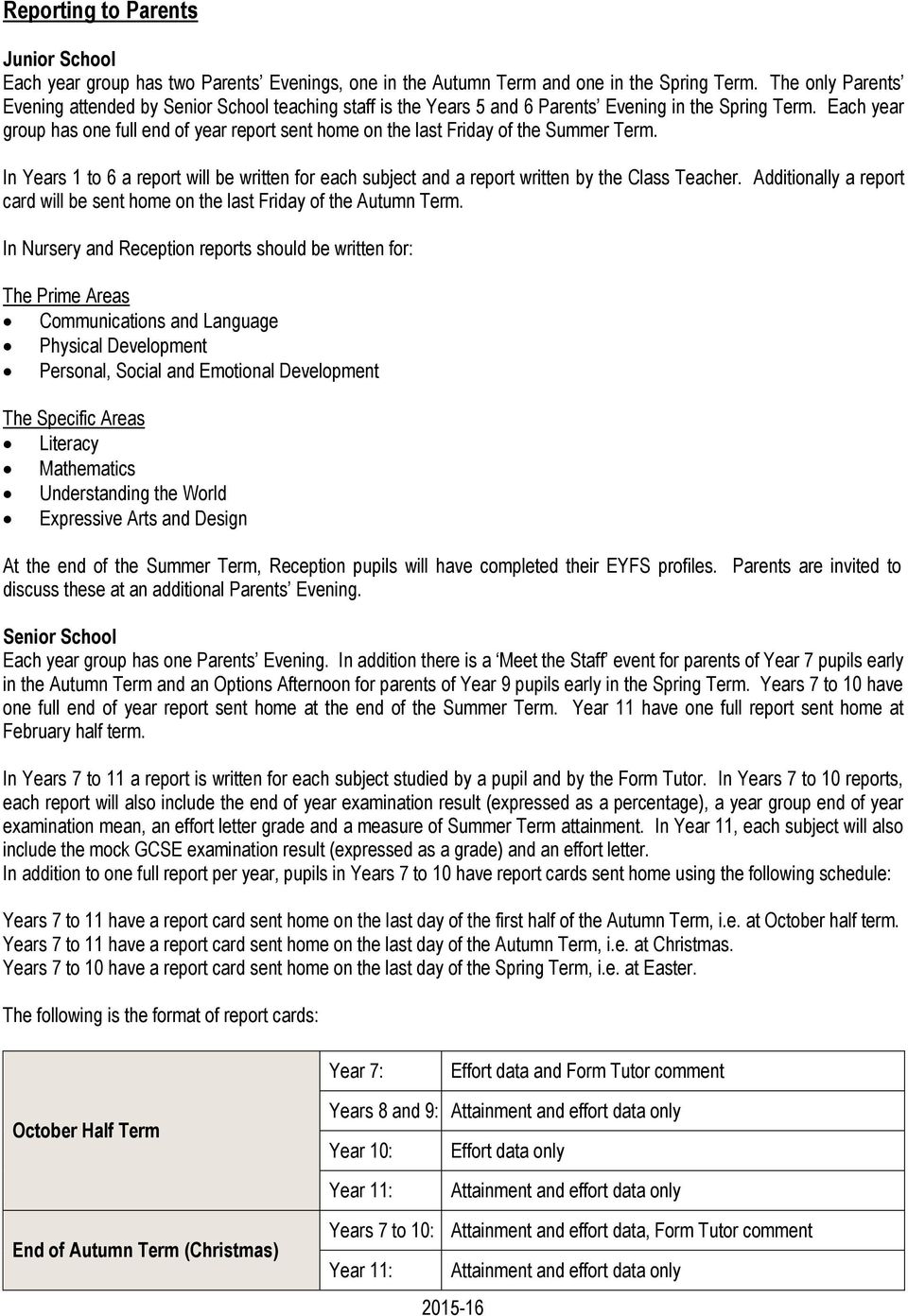
5 End of Spring Term (Easter) Years 7 to 10: Attainment and effort data only On Years 7 to 9 report cards, an attainment (Well Above (1), Above (2), At (3) or Towards (4)) is reported which is the level expected for the year group. Subject teacher s opinion of the work a pupil has done over the assessment period and based on marks and assessment done in class and for homework. The level of attainment is standardised across a particular year group, i.e. if a particular pupil s work is good, it is good compared to the standard within the year group, not just his/her teaching group. On Years 10 and 11 report cards, an attainment (Excellent (++), Good (+), Satisfactory (=) or Poor (-)) is reported which is the teacher s opinion of how a pupil has performed in relation to their baseline GCSE grade (obtained from Yellis testing taken in the first half of the Autumn Term of Year 10). On Years 7 to 11 report cards, we will report an effort (Excellent E, Good G, Satisfactory S or Causing Concern CC) which is the subject teacher s opinion of the effort a pupil has put into their work and compared to the statements of effort on the bottom of the report card. GCSE Results Pupils are issued with their results in August. The Examinations Officer prepares a statistical breakdown for each subject and calculates the overall percentage of A*-C grades. The results are discussed at a meeting of the Trustees in September and are made available to Independent Schools Council (ISC), The Department of Education (DfE) and The Independent Schools Association (ISA). Records of Achievement Records of Achievement are presented with GCSE certificates at Prize Giving to pupils who left Year 11 in the preceding summer. Updated July 2015
Ryburn Valley High School
 Ryburn Valley High School Assessment, Recording & Reporting Policy Date of Issue: February 2015 Strive to Excel Page 1 Contents Page Introduction Rationale 3 Aims and Objectives 3 Definitions 4 Development
Assessment, Recording and Reporting
 Assessment, Recording and Reporting Rationale: Daiglen School Persevere and Excel Assessment, recording and reporting are central to the development of learning and are part of good primary school practice.
The John Fisher School. Assessment, Recording and Reporting Policy
 The John Fisher School Assessment, Recording and Reporting Policy Responsible: Governors Curriculum Committee Date Revised: 2012 Review: Annual Rationale The Assessment Policy at John Fisher is designed
Rygaards International Secondary School Assessment, Recording and Reporting Policy
 Rygaards International Secondary School Assessment, Recording and Reporting Policy ASSESSMENT The purpose of assessment The purpose of assessment is to enhance the quality of teaching and learning. Assessment
Assessment, Recording and Reporting Policy
 St Peter s CE (VA) Infants School Assessment, Recording and Reporting Policy Philosophy Assessment is essential for the promotion of effective learning and teaching. It enables the teacher to deliver an
Assessment Policy. Date of next review: September 2016
 Assessment Policy 2015 Policy Review Details This policy will be reviewed by the governing body on an annual basis Date of Issue: September 2015 Governor Signature Date of next review: September 2016 Headteacher
ASSESSMENT, RECORDING AND REPORTING(ARR) POLICY.
 ASSESSMENT, RECORDING AND REPORTING(ARR) POLICY. Introduction The ARR Policy is closely linked to other key school policies (in particular: Teaching and Learning and Gifted and Talented) to ensure whole
ASSESSMENT, RECORDING AND REPORTING (ARR) GUIDELINES
 Assessment, Recording and Reporting Guideline Dated May 2015 Review Period 3 Years Curriculum Author DS CHRISTLETON HIGH SCHOOL ASSESSMENT, RECORDING AND REPORTING (ARR) GUIDELINES 1 Introduction 1.1 Every
Ss John Fisher, Thomas More High School Assessment, Reporting and Recording Policy
 Ss John Fisher, Thomas More High School Assessment, Reporting and Recording Policy Compiled by: CHA (members of SLT) Approved by: Curriculum Committee Date: May 2015 Revision Date: May 2016 Introduction
PEDMORE TECHNOLOGY COLLEGE & COMMUNITY SCHOOL
 PEDMORE TECHNOLOGY COLLEGE & COMMUNITY SCHOOL ASSESSMENT, RECORDING, REPORTING, MARKING & TARGET SETTING POLICY July 2006 Updated October 2008 Reviewed January 2009 Updated May 2010 Updated September 2010
Assessment, Recording and Reporting Policy. Committee Responsible: Curriculum & Standards
 The process of assessing, recording and reporting is required to: Inform students, parents and teachers of attainment and progress being made by students in all areas of the curriculum. Allow realistic
Keir Hardie Primary School. Assessment and Marking Policy
 Keir Hardie Primary School Assessment and Marking Policy Assessment and Marking Policy Rationale At Keir Hardie Primary School we believe that assessment and marking form the basis of effective teaching
Policy Document Planning, Assessment, Recording and Reporting September 2010
 Policy Document Planning, Assessment, Recording and Reporting September 2010 PLANNING, ASSESSMENT, RECORDING AND REPORTING POLICY 1 INTRODUCTION Planning, assessment, recording and reporting are an integral
Hillocks Primary and Nursery School
 Hillocks Primary and Nursery School Policy for Assessment, recording and reporting. 1 POLICY FOR ASSESSMENT, RECORDING AND REPORTING Introduction At Hillocks, the key purpose for assessment is to move
BEAUFORT and LANGLEY SCHOOL ASSESSMENT RECORDING AND REPORTING
 BEAUFORT and LANGLEY SCHOOL ASSESSMENT RECORDING AND REPORTING Policy date: January 2013 Review date: November 2016 ASSESSMENT RECORDING AND REPORTING Assessment is about measuring achievement and attainment,
Assessment, Recording and Reporting Policy. Introduction
 Assessment, Recording and Reporting Policy Introduction Assessment is essential for the promotion of effective learning and teaching. It enables the teacher to deliver an appropriate curriculum and provides
Bridgewater Primary School
 Understanding Assessment in Bridgewater Primary School Thursday 5 th November 2015 Reason for Assessment Update The changes to assessments in line with the new curriculum. Purpose of Assessment 1. Help
Mark Rutherford School Assessment Policy (Reviewed by Governors Curriculum sub committee January 2014)
 Mark Rutherford School Assessment Policy (Reviewed by Governors Curriculum sub committee January 2014) The quality of assessment has a significant impact on attitudes to learning and on attainment in schools
HAYDON BRIDGE HIGH SCHOOL ASSESSMENT, RECORDING & REPORTING POLICY
 HAYDON BRIDGE HIGH SCHOOL ASSESSMENT, RECORDING & REPORTING POLICY Haydon Bridge High School is committed to being a fully accessible and inclusive organisation, welcoming and respecting the diversity
Policy statement: Assessment, recording and reporting achievement.
 Policy statement: Assessment, recording and reporting achievement. In partnership with the home and the local community, the school has a responsibility to fulfil the demands of the national curriculum
Prettygate Junior School. Assessment, Recording and Reporting Policy. Date: Summer 2015 Review: Summer 2018
 Prettygate Junior School Assessment, Recording and Reporting Policy Date: Summer 2015 Review: Summer 2018 Vision Ensuring a safe, welcoming environment where everyone is valued Providing experiences to
THE QUEEN S SCHOOL Assessment Policy
 The Queen s Church of England Primary School Encouraging every child to reach their full potential, nurtured and supported in a Christian community which lives by the values of Love, Compassion and Respect.
Secondary School Assessment, Recording and Reporting Policy
 Secondary School Assessment, Recording and Reporting Policy Introduction The aims of this document are to establish clear guidelines on the use of assessment in the International School of Toulouse (IST)
Mathematics. Introduction
 Mathematics Introduction Numeracy is a core subject within the National Curriculum. This policy outlines the purpose, nature and management of the mathematics taught and learned in our school. Mathematics
King Charles C of E Primary School. Homework
 King Charles C of E Primary School Homework Agreed at Summer Term Meeting 2012 To be reviewed Summer Term 2014 Signed.. Chair of Governors Page 1 of 5 1 Introduction 1.1 Homework is anything children do
Primrose Hill Primary School Literacy Policy: A baseline for outstanding practice
 .. Primrose Hill Primary School Literacy Policy: A baseline for outstanding practice January 2012 Review date: January 2013 KEY PRINCIPLES Teaching at Primrose Hill is Learning Centred, meaning that each
Assessment in the New National Curriculum
 Assessment in the New National Curriculum Introduction We believe that effective assessment provides information to improve teaching and learning. We give learners regular feedback on their learning so
English Syllabus for Grades 1-4. Desktop/ Files Returned by Experts August 2008 / English cover, content & introduction Grades 1-4 cv2
 Desktop/ Files Returned by Experts August 2008 / English cover, content & introduction Grades 1-4 cv2 Table of Contents Rationale... Topic flow charts for Grades 1-4... Minimum Learning Competencies for
THE REDWAY SCHOOL. This policy was written in line with the whole school Learning and Teaching Policy and Target Setting Policy.
 THE REDWAY SCHOOL Policy: Assessment, Recording and Reporting Date of Policy: September 2009 Reviewed each September Date of Current Policy: September 2015 Member of staff responsible: Ruth Sylvester Introduction
KINETON GREEN PRIMARY SCHOOL MATHEMATICS POLICY FEBRUARY 2015
 KINETON GREEN PRIMARY SCHOOL MATHEMATICS POLICY FEBRUARY 2015 Review Date: February 2018 Contents 1 Introduction... 2 2 The Aims of Mathematics... 2 3 Entitlement... 3 4 Implementation... 3 5 Organisation
Hurworth School Assessment, Recording and Reporting Policy
 Hurworth School Assessment, Recording and Reporting Policy Accepted by: Board of Directors May 2010 Leadership Team Lead Reviewer: Assistant Head Teacher (Raising Achievement) Review Cycle: 2 Years Last
ST. PETER S CHURCH OF ENGLAND (VOLUNTARY AIDED) PRIMARY SCHOOL SOUTH WEALD. Modern Foreign Language Policy
 ST. PETER S CHURCH OF ENGLAND (VOLUNTARY AIDED) PRIMARY SCHOOL SOUTH WEALD Modern Foreign Language Policy January 2013 ST PETER S MODERN FOREIGN LANGUAGE (MFL) POLICY RATIONALE In the knowledge society
ROLES AND RESPONSIBILITIES The roles and responsibilities expected of teachers at each classification level are specified in the Victorian Government
 ROLES AND RESPONSIBILITIES The roles and responsibilities expected of teachers at each classification level are specified in the Victorian Government Schools Agreement 2004: Leading teacher Leading teachers
Our Lady of Lourdes Catholic Nursery & Primary School. Modern Foreign Language Policy
 Our Lady of Lourdes Catholic Nursery & Primary School Modern Foreign Language Policy September 2014 Review Date: September 2016 INTRODUCTION This subject policy is one in a series that makes up the Whole
Stanbridge Primary School ASSESSMENT POLICY
 Stanbridge Primary School ASSESSMENT POLICY Signed (Chair): Name: Date: Signed (Head): Name: Date: Ratified: by Governing Body on Next Review: Every two years Sept 2017 Equality Impact Assessment (EIA)
Policy for Assessment Recording & Reporting
 Lead Andrew Payne Date of completion January 2014 Date of adoption by Governors March 2014 Date to be reviewed January 2018 Grove Park School Policy for Assessment Recording & Reporting 1 ASSESSMENT, RECORDING
JOB PROFILE For a Special Education Needs Coordinator (SENCO)
 SAINT CECILIA S, WANDSWORTH JOB PROFILE For a Special Education Needs Coordinator (SENCO) DATE September 2013 JOB CONTEXT Saint Cecilia's, Wandsworth is a co-educational voluntary aided Church of England
Reforming assessment and accountability for primary schools. Government response to consultation on primary school assessment and accountability
 Reforming assessment and accountability for primary schools Government response to consultation on primary school assessment and accountability March 2014 Contents Introduction 3 The case for change 4
qwertyuiopasdfghjklzxcvbnmqwerty uiopasdfghjklzxcvbnmqwertyuiopas dfghjklzxcvbnmqwertyuiopasdfghjkl zxcvbnmqwertyuiopasdfghjklzxcvbn
 qwertyuiopasdfghjklzxcvbnmqwerty uiopasdfghjklzxcvbnmqwertyuiopas dfghjklzxcvbnmqwertyuiopasdfghjkl Reading by Six How the best schools do it St Stephen and All Martyrs CE Primary zxcvbnmqwertyuiopasdfghjklzxcvbn
X The teacher named below has performed satisfactorily against the Teachers Standards for the completion of induction
 This form should be sent to: Resources Directorate HR & OD Schools Operational Team Resources Directorate Wigan Council PO Box 100 WN1 3DS NQT Induction: final assessment and recommendation Instructions
Principal Job Description
 Anfield School Anfield International Kindergarten Anfield International Kindergarten & Nursery Principal Job Description RESPONSIBLE TO: The School Board INTRODUCTION: This job description is based on
High Halden Church of England Primary School. Early Years Policy
 Early Years Policy As a Church of England School, we nurture the Christian faith in our pupils as well as teaching them knowledge and understanding of other religions. All stakeholders of Value: Equality
Brooklands Primary School School Development Plan
 Brooklands Primary School School Development Plan April 2015 July 2016 (Summer Term 2015 completed, 2015-16 actions to be completed after completion of new headteacher s first term) 1 Contents School Mission
JOB DESCRIPTION FOR EARLY YEARS FOUNDATION STAGE CO-ORDINATOR Postholder: Post Title: PRIMARY TEACHER + TLR 2.1 Grade: MPS + TLR 2.
 JOB DESCRIPTION FOR EARLY YEARS FOUNDATION STAGE CO-ORDINATOR Postholder: Post Title: PRIMARY TEACHER + TLR 2.1 Grade: MPS + TLR 2.1 School: HUGH MYDDELTON PRIMARY Department: EDUCATION This job description
Sample Completed Summative Report Form for a Secondary Teacher 1*
 Sample Completed Summative Report Form for a Secondary Teacher 1* This form must be used for each performance appraisal. The duties of the principal may be delegated to a vice-principal in the same school,
Include Oxfordshire. Summary of key findings. P r o t e c t I n s p e c t i o n School report. Inspection dates 20 21 February 2013
 P r o t e c t I n s p e c t i o n School report Include Oxfordshire East Oxford Community Centre, Princess Road, Oxford, OX4 1DD Inspection dates 20 21 February 2013 Overall effectiveness 2 Pupils achievement
How To Teach Maths At Maple Primary School
 1 MAPLE SCHOOL MATHS POLICY Updated June 2015 by Rachel de la Croix (Maths Co-ordinator) School Vision A high-quality mathematics education provides a foundation for understanding the world, the ability
Mathematics Policy. Michael Sobell Sinai School
 Mathematics Policy 2014 Mathematics Policy Section 1: Introduction Mathematics is a creative and highly inter-connected discipline that has been developed over centuries, providing the solution to some
HISTORY KEY STAGE THREE
 HISTORY KEY STAGE THREE SCHEME OF WORK HISTORY KS3 ASSESSMENT AND HOMEWORK POLICY INTRODUCTION It is the aim of the History Department to develop increasingly independent learners who take responsibility
TUNBRIDGE WELLS GIRLS GRAMMAR SCHOOL Adopted: March 2015 Review: March 2016
 TUNBRIDGE WELLS GIRLS GRAMMAR SCHOOL Adopted: March 2015 Review: March 2016 SPECIAL EDUCATIONAL NEEDS AND DISABILITY (SEND) POLICY RATIONALE This policy document is a statement of the aims, principles
Target Setting: Technical Guide. The Axholme Academy
 Target Setting: Technical Guide The Axholme Academy Target Setting and Progress Tracking How are targets set for my child? At The Axholme Academy, all students are given aspirational targets to aim for
School Inspection Update
 December 2015 Issue: 5 Message to inspectors from the National Director, Education Welcome to the fifth edition of School inspection update. This will be the last issue for this calendar year and, as Christmas
Somerset Progressive School Planning, Assessment, Recording & Celebration Policy
 Number: ED/CU/35SPS Originator: Jason Goddard Issue Number: 4 Authoriser: Amanda Morgan-Taylor Issue Date: 1/07/2014 Service Type: Somerset Progressive School Next Review Due: 1/07/2015 Location: Educational
Roseberry Primary and Nursery School. Maths Policy
 Roseberry Primary and Nursery School Maths Policy October 2015 Purpose The purpose of this policy is to ensure that all staff are able to implement the teaching of maths to a high standard in order for
Much Birch Primary School
 Much Birch Primary School Co-ordinator : Linda Willimont Updated November 2013 Next review date September 2015 1 2 Mathematics Policy Person Responsible:- Mrs Willimont Date Policy discussed and agreed
Regina Coeli Catholic Primary School. Mathematics Action Plan 2013-14
 Regina Coeli Catholic Primary School Mathematics Action Plan 2013-14 MATHEMATICS ACTION PLAN Ensure improved and consistent progress for all pupils of all ages and abilities across the school with particular
Modern Foreign Languages (MFL) Policy 2013
 Modern Foreign Languages (MFL) Policy 2013 Revised by: Head, staff & governors: Date: Dec 2013 Next Review: December 2016 or sooner if regulations / circumstances change 1 Rationale for Teaching Languages
St.Dennis CP School. Modern Foreign Languages (MFL) Policy February 2013
 St.Dennis CP School Modern Foreign Languages (MFL) Policy February 2013 Policy confirmed by the Governing Body of St Dennis CP School on: Date: Signature: To be reviewed on: 1 Rationale for Teaching Languages
Ireland Wood Primary School
 School report Ireland Wood Primary School Raynel Gardens, Leeds, West Yorkshire, LS16 6BW Inspection dates 4 5 July 2013 Overall effectiveness Previous inspection: Good 2 This inspection: Good 2 Achievement
SPECIAL EDUCATIONAL NEEDS and DISABILITY POLICY
 SPECIAL EDUCATIONAL NEEDS and DISABILITY POLICY September 2015 Person responsible: SENCO Date approved: Review date: July 2016 Approved by: Buile Hill Visual Arts College Special Educational Needs and
Job Description. 1. The postholder is responsible to their line manager for his/her duties, responsibilities and teaching tasks.
 Job Description Post Title: Grade: Class Teacher MPS Responsible to: Executive Head and SLT Main Activities and Responsibilities The post holder will take responsibility for a class of children determined
Inspectorate Guidelines for Schools P R O M O T I N G T H E Q U A L I T Y O F L E A R N I N G
 School Self-Evaluation Guidelines for Primary Schools Inspectorate Guidelines for Schools I N S P E C TO R AT E P R O M O T I N G T H E Q U A L I T Y O F L E A R N I N G 2 School Self-Evaluation Guidelines
JOB DESCRIPTION/ CANDIDATE SPECIFICATION
 JOB DESCRPTON/ CANDDATE SPECFCATON POST DEPARTMENT SALARY HOURS RESPONSBLE TO Lecturer Electrical and Electronic Engineering Maths, Computing, Engineering & Technology 20,271-36,072 per annum inclusive
Modern Foreign Languages (MFL)
 Modern Foreign Languages (MFL) Fordcombe C.E. Primary School Reviewed & Approved by the Full Governing Body: Jan 2013 Next Review due Jan 2016 Signed:. Name (print) Mrs Sarah Finch Position: Chair of Governors
Mathematics Policy. National Curriculum Statement on Maths:
 Mathematics Policy National Curriculum Statement on Maths: Mathematics is a creative and highly inter-connected discipline that has been developed over centuries, providing the solution to some of history
Japanese International School. Assessment Recording and Reporting Policy
 Japanese International School Assessment Recording and Reporting Policy 1.0 Philosophy and beliefs Through a positive learning environment, the Japanese International School respects the diversity of its
2. To support the Management Team through the assessment of learners work and assist in moderation where required.
 Job Description Job Title: Lecturer Location: Sutton College Group: People s Directorate / Sutton College Post Number: S314655 Grade: Lect Mgt Spine 7 15 Department: Curriculum Responsible To: Assistant
Art, Design Policy. Michael Sobell Sinai School
 Art, Design Policy 2014 Art, Design & displays Policy Rationale At Sinai School, we are concerned with the education of the whole child and the development of Art and Craft skills will enable the achievement
Possible examples of how the Framework For Teaching could apply to Instructional Coaches
 Possible examples of how the Framework For Teaching could apply to 1b. Specific Examples 1b. Demonstrating Knowledge of Students 1a. Specific Examples 1a. Demonstrating knowledge of Content and Pedagogy
Completed Formal Classroom Observation Form
 Completed Formal Classroom Observation Form (Once participants have filled in and discussed the blank Formal Classroom Observation Form, facilitators should hand out copies of this completed form) August
Key skills for developing employability
 Key skills for developing employability First published 2001 6.00 Qualifications and Curriculum Authority 2001 ISBN 1 85838 481 8 Reproduction, storage, adaption or translation, in any form or by any means,
Radyr Comprehensive School
 Radyr Comprehensive School YsgolGyfunRadur Respect Commitment Success Assessment, Recording and Reporting Parent/Guardian Guide 2015-16 RadyrComprehensiveSchool YsgolGyfunRadur HeolIsaf, Radyr, Cardiff
Description of Services
 Description of Services ARSD24:05:28:01. Least restrictive program to be provided. Children in need of special education or special education and related services, to the maximum extent appropriate, shall
This has been adapted from 'Bilingual pupils and special educational needs: A teacher's guide to appropriate support and referral', by Susan Shaw.
 SEN or EAL? Filter questions This has been adapted from 'Bilingual pupils and special educational needs: A teacher's guide to appropriate support and referral', by Susan Shaw. Use these questions to decide
Assessment Policy. 1 Introduction. 2 Background
 Assessment Policy 1 Introduction This document has been written by the National Foundation for Educational Research (NFER) to provide policy makers, researchers, teacher educators and practitioners with
Rubrics for Assessing Student Writing, Listening, and Speaking High School
 Rubrics for Assessing Student Writing, Listening, and Speaking High School Copyright by the McGraw-Hill Companies, Inc. All rights reserved. Permission is granted to reproduce the material contained herein
Inspection judgements Key to judgements: Grade 1 is outstanding; grade 2 is good; grade 3 is requires improvement; grade 4 is inadequate
 Teesside University Initial Teacher Education (ITE) inspection report 28-31 January 2013 This inspection was carried out by three of Her Majesty s Inspectors and one additional inspector in accordance
SUPPORTING ASSESSMENT IN SCHOOLS - 1
 C: 14:04:05(7) NATIONAL COUNCIL FOR CURRICULUM AND ASSESSMENT SUPPORTING ASSESSMENT IN SCHOOLS - 1 ASSESSMENT IN PRIMARY SCHOOLS DRAFT APRIL 2005 EXECUTIVE SUMMARY The Primary School Curriculum (1999)
Salary The postholder will be paid on the appropriate point of the pay scale with the addition of the TLR 2B.
 JOB DESCRIPTION ASSISTANT CURRICULUM LEADER FOR SCIENCE (TLR 2B) Salary The postholder will be paid on the appropriate point of the pay scale with the addition of the TLR 2B. Line of Responsibility The
Mathematics Policy Bordesley Green Primary
 Aims Mathematics Policy Bordesley Green Primary The national curriculum and EYFS for mathematics aims to ensure that all pupils: Become fluent in the fundamentals of mathematics, including the varied and
Ealing, Hammersmith and West London College
 Ealing, Hammersmith and West London College Re-inspection monitoring visit report Unique reference number: 130408 Name of lead inspector: Jo Parkman, HMI Last day of inspection: 14 January 2016 Type of
COGNITIVE ABILITIES TEST: FOURTH EDITION. Sample Reports SECONDARY. www.gl-assessment.co.uk/cat4. www.gl-assessment.co.uk/cat4
 COGNITIVE ABILITIES TEST: FOURTH EDITION Sample Reports SECONDARY Introduction to CAT4 Introduction to the Cognitive Abilities Test: Fourth Edition (CAT4) CAT4 is the fourth edition of GL Assessment s
Da Vinci Community School
 School report Da Vinci Community School St Andrew's View, Breadsall, Derby, DE21 4ET Inspection dates 5 6 November 2014 Overall effectiveness Previous inspection: Requires improvement 3 This inspection:
BA Primary Education (QTS) Professional Training and Development Handbook Years 2 & 3 Teaching Phonics
 The University for World-Class Professionals BA Primary Education (QTS) Professional Training and Development Handbook Years 2 & 3 Teaching Phonics Faculty of Education mmu.ac.uk/education MMU 2015 Faculty
Standards for Leadership and Management Middle Leaders. Guidelines for Self-Evaluation
 GTCS Professional Update Support Pack for South Ayrshire Schools (DRAFT 2 JUNE 2014) P a g e 32 The The Standards for Leadership and Management include both the Standard for Middle Leadership and the Standard
Pre-service Performance Assessment Professional Standards for Teachers: See 603 CMR 7.08
 Please use this assessment in conjunction with the for Teachers guidelines: the rating scale; evaluation questions relating to the standards; and the license-specific questions per standard (b)2c. Candidates
Assessment and Feedback Policy
 NORTON CEVC PRIMARY SCHOOL ASSESSMENT AND FEEDBACK POLICY Introduction We believe that effective assessment provides information to improve learning and teaching. We give our children regular feedback
Scottish Government Consultations
 Scottish Government Consultations Appendix A A Consultation on the Next Generation of National Qualifications in Scotland Shetland Islands Council The document which follows uses the consultation feedback
Assessment without Levels - Age Related Bands
 Assessment without Levels - Age Related Assessment lies at the heart of the process of promoting children s learning. It has a clear purpose at Great Easton Church of England Primary School for everyone
AfL with APP: developing collaborative schoolbased. Guidance for senior leaders
 AfL with APP: developing collaborative schoolbased approaches AfL with APP: developing collaborative school-based approaches First published in 2009 Ref:00824-2009PDF-EN-01 Disclaimer The Department for
School Assessment, Recording and Reporting Process
 Next review: July 2015 RADLETT LODGE SCHOOL ASSESSMENT, RECORDING AND REPORTING PROCEDURES Aim To assess and report on all aspects of our pupils development to facilitate consistency, progress, planning,
Primrose Hill Primary School Teaching and Learning Policy: A baseline for outstanding practice
 Primrose Hill Primary School Teaching and Learning Policy: A baseline for outstanding practice January 2012 Review date: January 2013 KEY PRINCIPLES Teaching at Primrose Hill is Learning Centred, meaning
Shottery CE Primary School. Assessment, Recording and Reporting Policy
 Shottery CE Primary School Assessment, Recording and Reporting Policy At Shottery Primary School At Shottery Primary we aim to follow the principles of assessment for learning, in that we share with the
THE POLICY AND PROVISION FOR PUPILS FOR WHOM ENGLISH IS AN ADDITIONAL LANGUAGE
 ROSSALL SCHOOL THE POLICY AND PROVISION FOR PUPILS FOR WHOM ENGLISH IS AN ADDITIONAL LANGUAGE Statement of Aims The school is committed to making appropriate provision of teaching and resources for pupils
9 The Difficulties Of Secondary Students In Written English
 9 The Difficulties Of Secondary Students In Written English Abdullah Mohammed Al-Abri Senior English Teacher, Dakhiliya Region 1 INTRODUCTION Writing is frequently accepted as being the last language skill
Durand Primary School
 Inspection under Section 10 of the Schools Inspections Act 1996 Durand Primary School Alianore Road, Caldicot, Monmouthshire NP26 4DF School Number: 679/2261 Date of Inspection: 31 January 2 February 2005
Examples of IEP Goals and Objectives
 AUTISM SPECTRUM DISORDER SERIES Examples of IEP Goals and Objectives Introduction Suggestions for Students with Autism When writing goals for children with Autism it is crucial to be as specific as possible.