
Kitsap County Comprehensive Emergency Management Plan
|
|
|
- Lucas Robbins
- 9 years ago
- Views:
Transcription
1 Kitsap County Comprehensive Emergency Management Plan 2015

2 This Page Left Blank Intentionally ii

3 Promulgation Letter KITSAP COUNTY DEPARTMENT OF EMERGENCY MANAGEMENT Michael S. Gordon, Director KITSAP COUNTY EMERGENCY MANAGEMENT COUNCIL 2015 Kitsap County Commissioner Edward E. Wolfe, Dist. 3 Council Vice-Chair City of Bainbridge Island Representative Anne Blair City of Bremerton Mayor Patty Lent City of Poulsbo Mayor Becky Erickson City of Port Orchard Mayor Tim Matthes, Council Chair The Kitsap County Department of Emergency Management sincerely appreciates the cooperation and support from those agencies, departments, and local jurisdictions that have contributed to the revision and publication of the 2015 Kitsap County (CEMP). Coordination of the Plan represents a committed and concerted effort by county/city agencies and local jurisdictions to emergency management. The Plan demonstrates the ability of a large number of agencies to work together to achieve a common goal. The CEMP was revised through the synergistic effort of many agencies in Kitsap County. A major revision to the CEMP is the integration of the 4 Cities and County CEMPs into one document representing a common strategic plan to mitigate, prepare, respond and recover from disasters in Kitsap County. This represents a holistic approach to a multi-agency and common picture response for the protection of the citizens of Kitsap. The Department of Emergency Management coordinated with many groups to provide a forum for those with identified responsibilities in the CEMP. They participated in planning and coordinating emergency management activities in order to identify, develop, maintain, and enhance county emergency management capabilities. The CEMP is one of the many efforts to prepare all people in Kitsap County for emergencies or disasters. The CEMP is formatted to be consistent with the State as well as the National Response Framework, complete with Emergency Support Functions (ESFs), or single function activities. The 2015 CEMP supersedes the Kitsap County and Cities of Bainbridge Island, Bremerton, Poulsbo, and Port Orchard CEMPs. As a multi-government document, the CEMP includes executive head resolutions signing this CEMP into public law. Thank you for your continued support to our community emergency management and disaster planning efforts in Kitsap County. Mike Gordon Director iii

4 This Page Left Blank Intentionally iv

5 KITSAP COUNTY, WASHINGTON COMPREHENSIVE EMERGENCY MANAGEMENT PLAN CEMP 2015 Executive Summary CEMP 2015 is a comprehensive strategy for the management of disasters in Kitsap County. It is designed to provide an overall approach to emergency response and recovery and the collaboration of County and City governments and support agencies to provide essential measures to preserve life and protect citizens from disasters. The plan is based on providing a well-rounded ongoing program for emergency prevention, preparedness, mitigation, response and recovery activities and to encourage citizens, governments, business, and other organizations to prepare for disasters. It is an all-hazards plan for all types of hazards and to cover the geographic area of Kitsap County. CEMP 2015 provides information for County/City Governments to prepare themselves to respond to disasters using a systematic response network and a comprehensive training and exercise program to insure local responders including City/County employees are prepared to respond to emergencies, support ongoing Emergency Operation Center (EOC) activities and provide a safe and secure environment for its citizens. CEMP 2015 is a product of the coordinated planning efforts between the Kitsap County Department of Emergency Management, County Departments, emergency management representatives from selected political jurisdictions, and selected private and volunteer sector interests. It meets the requirements of RCW 38.52, WAC , FEMA s Comprehensive Preparedness Guide CPG-101 and the Washington State Emergency Management Division s Comprehensive Emergency Management Supplemental Planning Guide, and FEMA s guidance on the National Response Framework and the National Incident Management System (NIMS) compliance. The Kitsap County CEMP 2015 is organized in three parts: A. The Basic Plan and Appendices. The Basic Plan outlines the disaster missions and responsibilities of County and City Governments, branches and departments. It also incorporates the Direction and Control appendix from the previous Kitsap County CEMP in an effort to consolidate and streamline the critical information needed for an incident. The Appendices to the Basic Plan include a variety of topics such as terms and definitions, acronyms and abbreviations, legal authorities, and training requirements. B. Emergency Support Functions (ESFs) describe the policies, situation, planning assumptions, concept of operations, and responsibilities for each ESF for Kitsap County/City Governments and agencies. v

6 D. Support Annexes are plans that define strategies for planning and managing emergency management core functions and delineate specific instruction, roles and responsibilities, and concepts of operations for responsible agencies. The annexes are: A. Multi-Hazard Mitigation Plan B. Emergency Operations Plans C. Terrorism Plan D. Disaster Recovery Plan E. Continuity of Operations (COOP) Plan (under development) F. Animal Emergency and Disaster Preparedness Plan G. Local Emergency Planning Committee (LEPC) for Hazardous Materials Events H. Vulnerable Population Plan These plans are revised and promulgated separately from this plan and play an important role in defining specific agencies and procedures for responding successfully to these important functional areas. The CEMP has been significantly revised in 2015 to consolidate the Kitsap County CEMP 2010 with the CEMPs of the cities of Bainbridge Island, Bremerton, Poulsbo, and Port Orchard. Kitsap Department of Emergency Management is governed by an Interlocal Agreement with each of these entities to provide day-to-day emergency management services as well as support mitigation, preparedness, response and recovery activities to the entire County. As such, one consolidated CEMP brought all jurisdictions under one Emergency Management umbrella designed to incorporate them into a collaborative process and streamline consistent approach to emergency management principles and services. To support strategic and tactical support of emergency management, along with this new CEMP, each jurisdiction will have an updated Emergency Operations Plan that will define details such as specific roles and responsibilities or facilities for emergency response based on strategies outlined in CEMP This CEMP includes numerous revisions: Reformatted for consistency, new maps and other exhibits Updated information based on revised Hazard Identification and Assessment 2015 The incorporation of cities authority, roles and responsibilities Revised information on the role and responsibility of Kitsap County Department of Emergency Management Revised organizational charts for Emergency Management day-to day and EOC operations Major revision to Concept of Operations Revised Roles and Responsibilities Revised Training, Exercises and Credentialing New section on Plan Maintenance Overhaul of all Emergency Support Functions (ESFs) vi

7 CEMP 2015 will improve the capability of Kitsap County and its Cities to understand the holistic approach to a county-wide response using the same concepts and principles for successful in disaster response and recovery that will minimize loss of life, stabilize events quickly, and reduce long term recovery efforts. Pursuant to Kitsap County and the Cities of Bainbridge Island, Bremerton, Poulsbo, and Port Orchard Codes and Ordinances for Emergency Management, and RCW 38.52, this CEMP is set forth and each Government and its departments and those agencies with roles outlined in the document, is directed to be knowledgeable of its contents and be prepared to respond and/or support response efforts when called upon. The Kitsap County Department of Emergency Management and at the direction of the Emergency Management Council, will annually test the plan through planned training and exercises, conduct period plan maintenance, and continue to coordinate revisions recommended by stakeholders. vii

8 This Page Left Blank Intentionally viii

9 Kitsap County, Washington (CEMP) July 2015 Table of Contents Promulgation Letter... iii Executive Summary... v Record of Changes... xi Record of Distribution... xiii Basic Plan... 1 Section I: General Information... 1 Section II: Planning Assumptions and Considerations Section III: Concept of Operations Section IV: Roles and Responsibilities Section V: Emergency Response: An Overview Section VI: Emergency Preparedness: Training, Exercises, and Credentialing Section VII: Plan Maintenance Appendix HIVA 2015 Abstract Appendix Codes and Regulations References Kitsap County and City Codes and Ordinances State Laws and Regulations United States Governing Statutes Appendix Plan References Kitsap County State of Washington Federal ix
10 Appendix Direction and Control Appendix ACRONYMNS Appendix GLOSSARY OF KEY TERMS EMERGENCY SUPPORT FUNCTION #1... ESF-1 EMERGENCY SUPPORT FUNCTION #2... ESF-2 EMERGENCY SUPPORT FUNCTION #3... ESF-3 EMERGENCY SUPPORT FUNCTION #4... ESF-4 EMERGENCY SUPPORT FUNCTION #5... ESF-5 EMERGENCY SUPPORT FUNCTION #6... ESF-6 EMERGENCY SUPPORT FUNCTION #7... ESF-7 EMERGENCY SUPPORT FUNCTION #8... ESF-8 EMERGENCY SUPPORT FUNCTION #9... ESF-9 EMERGENCY SUPPORT FUNCTION #10... ESF-10 EMERGENCY SUPPORT FUNCTION #11... ESF-11 EMERGENCY SUPPORT FUNCTION #12... ESF-12 EMERGENCY SUPPORT FUNCTION #13... ESF-13 EMERGENCY SUPPORT FUNCTION #14... ESF-14 EMERGENCY SUPPORT FUNCTION #15... ESF-15 EMERGENCY SUPPORT FUNCTION #20... ESF-20 EMERGENCY SUPPORT FUNCTION #21... ESF-21 EMERGENCY SUPPORT FUNCTION #22... ESF-22 Support Annexes (under separate cover) x

11 Kitsap County CEMP Record of Changes Change # Date Entered Contents of Change Initials Revision July Incorporation of Cities and Counties into 1 CEMP (through the document) Revision July Revised Executive Summary. All sections reformatted Revision July Updated Record of CEMP Distribution Revision July Section I: all sections updated to include addition of cities into CEMP Revision July Section I: Exhibit I-1 Updated Revision July Section I: Updated Organization and new Exhibit I-2. Revision July Section I: Authority updated with city Information and additional discussion on Disaster funding Revision July Section II: Updated information and addition of Appendix (1) HIVA Extract Revision July Section III: Updated information and new Exhibit III-1: Response System Revision July Section III: updated section on Emergency Management Concepts Revision July Section IV: Updated information to include roles of Cities during emergencies Revision July Section V: Updated Information and new Exhibits V-1 and V-2 Revision July Section V: Updated Exhibit V-3 Revision July Section VI: New section on Preparedness Revision July Section VII: New section on Plan Maintenance xi

12 Revision July Updated lists of Codes and Regulations Revision July Updated list of Plan references Revision July Updated section on Direction and Control Revision July Revised Organization and ESF responsibility chart Revision July New section on Kitsap Lines of succession Revision July New Primary and alternate Kitsap and City Emergency Operations Centers and support agencies Revision July Revised Acronyms and Glossary of Key Terms Revision July ESF-1 through 22 revised and formatted xii

13 Kitsap County CEMP Record of Distribution Kitsap County Departments Paper (P) or Disk (D) Other Supporting Agencies Paper (P) or Disk (D) Administrative Services 1D American Red Cross 1D Assessor 1D Bainbridge Island Fire and 1D Rescue Auditor 1D Bainbridge Island School District 1D CenCom 1D Bremerton School District 1D Clerk 1D Central Kitsap School District 1D Commissioners 4P Central Kitsap Fire and Rescue 1D Coroner 1D Clallam County DEM 1D County Administrator 1P 1D Harrison Medical Center 1D Community Development 1P 1D Jefferson County DEM 1D Emergency Management 4P 1D Kitsap Housing Authority 1D Parks & Recreation 1D Kitsap Mental Health 1D Personnel & Human Services 1D Kitsap Transit 1D Prosecuting Attorney 1P 1D Kitsap Public Health District 1D Public Works 1D Mason County DEM 1D Sheriff 1D Navy Region Northwest 1D Superior Court 1D North Kitsap Fire and Rescue 1D Treasurer 1D Harrison Medical Center 1D Cities of Kitsap County Jefferson County DEM 1D City of Bainbridge Island 2P 5D Kitsap Housing Authority 1D City of Bremerton 2P 5D Kitsap Mental Health 1D City of Port Orchard 2P 5D Kitsap Transit 1D City of Poulsbo 2P 5D Kitsap Public Health District 1D Mason County DEM 1D Navy Region Northwest 1D North Kitsap Fire and Rescue 1D North Kitsap School District 1D Pierce County DEM 1D Port of Bremerton 1D Puget Sound Naval Shipyard 1D Port Gamble S Klallam Tribe 1D South Kitsap Fire & Rescue 1D South Kitsap School District 1D State EM 1D Suquamish Tribe 1D Washington State Emergency 1P 1D Management Washington State Patrol 1D The Kitsap County CEMP 2015 is available online at and posted on Kitsap County Intranet xiii

14 Kitsap County 2015 Basic Plan Section I: General Information The 2015 Kitsap County (CEMP) provides a comprehensive strategy for the management of disasters in Kitsap County. It is designed to provide an overall approach to emergency response and recovery and the collaboration of County and City governments and support agencies to provide essential measures to preserve life and protect citizens from disasters. The plan is based on providing a well-rounded ongoing program for emergency prevention, preparedness, mitigation, response and recovery activities and to encourage citizens, governments, business, and other organizations to prepare for disasters. It is an all-hazards plan for all types of hazards and to cover the geographic area of Kitsap County. A. Mission It is the policy of the Kitsap County Department of Emergency Management (DEM) and its four incorporated cities, in order to protect lives, property, environment, and economic base of the community and in cooperation with other public and private organizations of the community, to endeavor to mitigate, prepare for, respond to and recover from all natural, man-made, technological emergencies and disasters. To carry out the mission, the Kitsap County Department of Emergency Management (DEM) goals are to develop citizen awareness and self-sufficiency, develop responder capabilities, have procedures in an emergency or disaster, and create an atmosphere of interagency cooperation in emergency and disaster operations. DEM is responsible for developing and managing a framework for emergency preparedness, response and recovery of the County and incorporated Cities and minimize the effects of disasters. The framework includes the roles and responsibilities of Kitsap County Governments and other agencies to work together in a homogenous response for the good of the citizens of Kitsap. CEMP 2015 is now a document that brings County governments together under one plan with the same focus and strategy to protect the public from harm and provide a system for managing an emergency/disaster in Kitsap County. B. Purpose The purpose of the Kitsap County (CEMP) is to provide a framework for the emergency management principles and the function and responsibilities of DEM and County/City Governments. This plan considers the concept of emergency management functions of preparedness, response, recovery and mitigation strategies for the ongoing maintenance and enhancement of emergency services. It defines primary and secondary roles of Governments during Effective July 1,

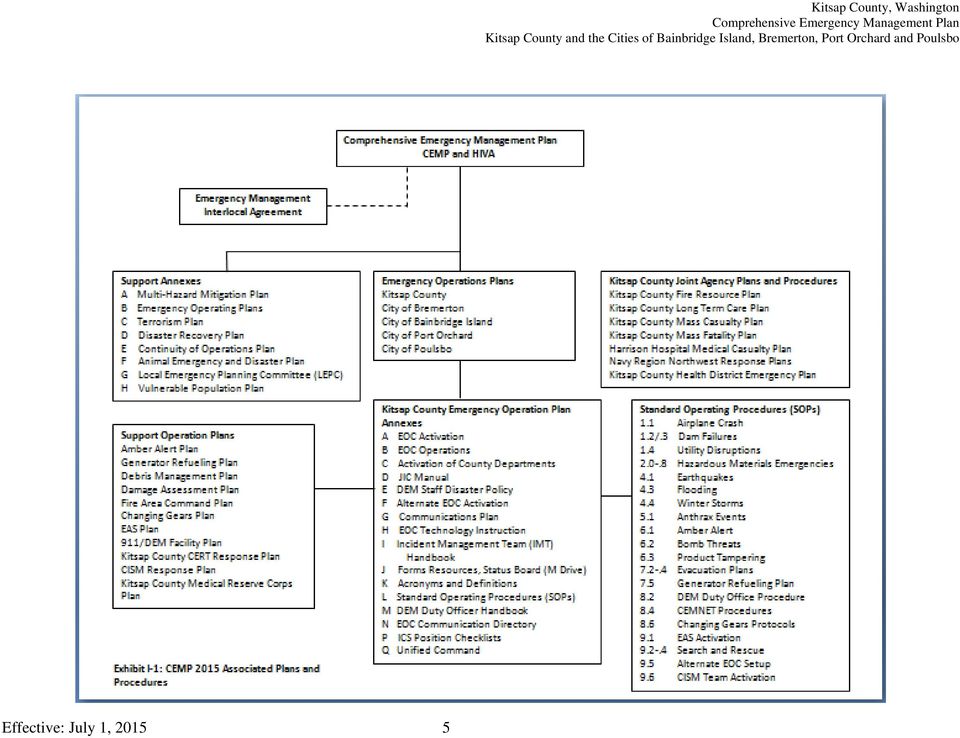
15 and after emergencies and the support roles of a variety of agencies, service groups, volunteers, and faith-based organizations, to provide assistance to the citizens of Kitsap. The CEMP is a strategic plan with many supporting plans, operating procedures and related documents. It is not the intent of this document to encompass all of these additional plans, but will provide reference information in support of emergency management. Throughout this plan, the term City/County refers to the four incorporated cities, Bainbridge Island, Bremerton, Port Orchard, and Poulsbo; and unincorporated Kitsap County. Each of the cities and county retain their own jurisdictional rights imposed by city and county charters and Washington State law, but recognize a common approach to all phases of emergency management. Kitsap County Emergency Management, through an inter-local agreement, has established an Emergency Management Council, to provide direction, control and oversight of the Kitsap County Department of Emergency Management. As noted below, each government will have an Emergency Operating Plan (EOP) specifically defining the role of their government in disaster response and recovery operations. C. Plan Design This plan is designed based on FEMA s Comprehensive Preparedness Guide (CPG) 101 and in accordance with Washington law referenced in this document. As such, an Emergency Support Function Emergency Operating Plan" (EOP) format, with some exceptions, are used to meet the needs of Kitsap County. There are four main sections that compose the plan: the Base Plan and Appendices, the Emergency Support Functions (ESFs), and the Incident Annexes. Section VII provides additional information on plan development and maintenance. The Kitsap County CEMP is the umbrella document for all other plans associated with County Emergency Management. The Plan is broken down as follows: 1. Base Plan and Appendices The base plan delineates the application of emergency operations as it applies to incidents in Kitsap County, including the general role and responsibilities of the County and cities in disasters. It includes a synopsis of the hazards faced by citizens in the County; a discussion of the needs and capabilities in handling those hazards; and an overview of the county s emergency management structure. Appendices are added to expand on information, provide supporting data, or a glossary of definitions and acronyms. 2

16 2. Emergency Support Functions (ESFs) The ESFs provide the structure for coordinating interagency support for local, then later, state and federal response to an incident. They are mechanisms for grouping functions most frequently used to provide support to responders and the citizens of Kitsap. The Incident Command System provides for the flexibility to assign ESFs and other stakeholder resources according to their capabilities, tasking, and requirements to augment and support local response systems. Emergency Support Functions (ESFs) break down fifteen individual functional areas of specific roles and responsibilities during emergencies. They also describe policies, procedures, responsibilities and other planning documents to support actions for functional area response and recovery. Kitsap County ESFs utilize those ESFs outlined in FEMA's National Response Network and others associated with Washington State. 3. Support Annexes Support Annexes are strategic plans that define specific requirements and actions necessary to respond to and manage specific core mitigation, response and recovery functions in Kitsap County. They include such plans for vulnerable populations, recovery, terrorism, and hazardous materials, to name a few. A comprehensive chart Exhibit I-1 is provided that delineates the relationships among plans and operating procedures for Kitsap County that fall under the umbrella of the CEMP and define the emergency management program. Kitsap County operates in accordance with the National Incident Management System (NIMS) and is an all-hazards planner. NIMS provide the structure and mechanism for policy and operational coordination for incident management. Consistent with the model provided in the National Response Framework (NRF) and NIMS, the CEMP can be partially or fully implemented in the context of a threat, or anticipation of a response to a significant incident or event. Selective implementation through the activation of one or more of the Emergency Support Functions (ESFs) or Annexes allows maximum flexibility in responding to and recovering from an incident, meeting the unique operational and information-sharing requirements of the situation at hand, and enabling effective interaction between various county and non-county entities. This plan will facilitate restoration of basic county government operations and services following emergencies or disasters. 3

17 Effective: July 1, Kitsap County, Washington
18 Scope CEMP 2015 considers that emergencies and disasters are likely to occur as described and assessed in the Kitsap County Hazard Identification and Vulnerability Assessment (HIVA) 2015 and describes: Functions and activities necessary to implement the five phases of emergency management prevention, mitigation, preparedness, response and recovery. Responsibilities in relation to Kitsap County Code title 2.104, Chapter RCW 38.52, Public Law , as amended and other applicable laws as appropriate. Appendix (1) of the Basic Plan provides an extract on hazard vulnerability and assessments for Kitsap County. Further information can be found in Kitsap's HIVA Organization Emergency Management in Kitsap County is organized as shown in Exhibit I-2, Emergency Management Organizational Chart, and operates in accordance with RCW and WAC 118 for routine and operational Emergency Operations. Under Kitsap County Code, Chapter 2.104, Emergency Management is responsible for all emergency management functions; to prevent, to mitigate, to prepare, to respond, and to recover from emergencies and disasters resulting from natural and technological hazards and terrorism events. Emergency Management provides services to each of the incorporated cities in Kitsap as well as their citizens to prepare for and response to emergencies. RCW 38.52, the Washington Emergency Management Act and Kitsap County Code, Chapter 2.104, empower local governmental entities to establish a program to deal with emergencies and specifically authorizes two or more entities to join together to establish such a program. In 1989 the Kitsap County Emergency Management Council was formed. All city and county governments are represented on the council as follows: one elected county commissioner, the mayors of Bremerton, Port Orchard and Poulsbo, and 1 City Council member representing the City of Bainbridge Island. The EMC delegate s authority to the Director to make decisions to mobilize resources to save lives, stabilizes the incident, and protects property. DEM is designated a "department" of Kitsap County reporting administratively to the County for personnel, budgeting, and administrative support. DEM is staffed Monday through Friday 8:00 a.m. to 4:30 p.m. After hours incidents are handled by an assigned DEM Duty Officer who is available 24 hours per day, seven days a week. During an emergency or disaster, the office assumes enhanced operations under the Incident Management System. This could include Effective: July 1,

19 opening the Emergency Operations Center (EOC) and to coordinate the activation of City EOCs, each at a level dependent on the severity of the event. CEMP 2015 also employs an Emergency Support Function (ESF) approach. This approach identifies sources for direct assistance and operational support through the Emergency Operations Center (EOC) that the county and its cities may need in order to address response and recovery from an emergency or disaster. The County EOC serves as a coordinating center for all hazard activity in the County. ESF establishment is not expected at the city level and instead, City representatives will be incorporated into the County EOC when ESFs are activated. This is a new policy change associated with the merger of the City and County CEMPs. Exhibit I-2: Kitsap County Emergency Management Organizational Structure Effective: July 1,

20 Authority This Plan is developed, promulgated, and maintained pursuant to the following state and federal statutes and regulations: 1. Authorities (State and Federal) Revised Code of Washington (RCW) Chapters and Chapter RCW, Fire Mobilization. Washington Administrative Codes (WAC) , , and Public Law , The Disaster Relief Act of 1974, as amended by Public Law , the Robert T. Stafford Disaster Relief and Emergency Assistance Act. Public Law , Improved Civil Defense, Public Law , Superfund Amendment and Reauthorization Act (SARA) of 1986, Title III, Emergency Planning and Community Right-to-Know Act (EPCRA). 2. City and County Authority Kitsap County Code, Chapter City of Bainbridge Island Ordinance 86-26, Interlocal Agreement for Emergency Management Services and Ordinance 68-22, Emergency Proclamation City of Bremerton Municipal Code 2.26 Emergency Management Organization City of Port Orchard Interlocal Agreement for Emergency Services and Ordinance 1712, Designation of Hazardous Materials Incident Command Agency and Mutual Aid Agreements City of Poulsbo Municipal Code 2.26 Emergency Management Organization A comprehensive listing of Local, State, and Federal Laws and Authority are provided in Appendix (2) to the Basic Plan. Policy 1. Disaster Funding Kitsap County and its Cities will meet disaster expenditures with currently appropriated funds in accordance with RCW (2), RCW and 190, and County Code. The Emergency Management Council will be responsible for identifying other sources of funds to meet disaster-related expenses if organizational budgets are exceeded. Effective: July 1,

21 Some emergencies like local flooding or winter storms may result in EOC activation and the expenditure of unbudgeted funds. The EMC should either anticipate these events either through annual budgeting or covering these unexpected costs through local compensation efforts. 2. Mutual Aid Should local government resources prove to be inadequate during a disaster; requests will be made for assistance from other local jurisdictions and higher levels of government according to existing or emergency-negotiated mutual aid agreements and compacts. Such assistance may take the form of equipment, supplies, personnel, or other capabilities. All mutual aid agreements and compacts will be entered into by duly authorized officials and will be formalized in writing whenever possible. Kitsap County is currently a signee to the Washington State Intrastate Mutual Aid System. Collaboration through aid agreements is essential in pre-empting a disaster with a holistic response by all responders in Kitsap. Kitsap County also is also a member of the Puget Sound Regional Catastrophic Coalition for planning and responding through a regional collaborative plan during catastrophic events. 3. Consumer Protection Consumer complaints pertaining to alleged unfair or illegal business practices will be referred to the State Attorney General Consumer Protection Division. 4. Limitations It is the policy of Kitsap County and the cities of Bremerton, Bainbridge Island, Poulsbo and Port Orchard that no guarantee is implied by this Plan of a perfect response system. As Kitsap County assets and systems may be overwhelmed, Kitsap County can only endeavor to make every reasonable effort to respond based on the situation, information and resources available at the time. 5. Nondiscrimination It is the policy of Kitsap County and the Cities of Bremerton, Bainbridge Island, Poulsbo and Port Orchard that no services will be denied on the basis of race, color, national origin, religion, sex, age or disability and no special treatment will be extended to any person or group in an emergency or disaster over and above what normally would be expected in the way of county and city services. Local activities pursuant to the Federal/State Agreement for Major Disaster Recovery will be carried out in accordance with Title 44, CFR, and Section Non-discrimination. Federal disaster assistance is conditional on full compliance with this rule. Effective: July 1,
22 Effective: July 1, Kitsap County, Washington
23 A. Disaster Conditions and Hazards Section II: Planning Assumptions and Considerations The Kitsap County Hazard Identification and Vulnerability Assessment (HIVA), updated July 2015, provide information on potential hazards threatening Kitsap County. Disasters have occurred in Kitsap County and will occur again, some with warning and others with no warning at all. The purpose of the HIVA is to provide an evaluation of potential hazards for mitigation and preparedness priorities as well as defining strategic planning for the Department of Emergency Management. The plan rates potential hazards and assigns weights based on a hazard predictability, potential damage and loss of live, and costs to individuals and County Governments. Appendix (1) is an extract from the HIVA 2015 which summarizes hazards in Kitsap County. Using NIMS and a multi-agency response to emergencies, a system is in place to quickly assess emergencies, small and large, and provide an adequate response and recovery plan. B. Planning Assumptions The follow is a list of planning assumptions essential to planning processes and response and recover actions: Some emergencies or disasters will occur with enough warning that appropriate notification will be issued to ensure some level of preparation. Other situations will occur with no advanced warning. Kitsap County may be unable to satisfy all emergency resource requests during a major emergency or disaster. Citizens, businesses, county and city departments, and industries need to provide for their own resources for the first seven days after an emergency or disaster. Kitsap County and its cities will comply with the intent of RCW and WAC 118, and will: o o Establish procedures for continuity of government. Prepare plans and procedures and maintain a comprehensive Emergency Management program. Effective: July 1,
24 o o o Communicate with the State Emergency Management Division (EMD) Emergency Operations Center (EOC) on the status of activities during or following any emergency or disaster. Issue local emergency proclamations and request state assistance when appropriate. Preserve essential records. Comprehensive response and recovery operations are based on an effective training and exercise program and the essential element of communication, coordination and command and control. These elements and the management principle of ICS will help to focus response and guide responders with the same priorities: save live, stabilize the event, and protect the environment and economy. C. Provisions of Government The county will endeavor to maintain essential services as soon as and as long as possible. Conditions may be of such magnitude and severity that some or all county services may be lost. The county will be unable to fulfill all emergency requests under these conditions. Setting of priorities will be necessary. D. Emergency Management Kitsap County Department of Emergency Management (KCDEM) is the organizational structure for emergency response and recovery in Kitsap County. The Director of Emergency Management reports to the Kitsap County Emergency Management Council. The Kitsap County Emergency Operations Center (EOC) is the focal point for emergency management activities. The EMC authorizes the Director of Emergency Management and their successor to take appropriate actions to preserve life and stabilize the emergency to include activation of the EOC, use of County resources, and Emergency Declaration. E. Citizen Preparedness Policy Because of the nature of an emergency or disaster, government may be limited in its response capabilities. Community preparedness is an essential element of preparing for the next disaster. Collaboration among organizations in the County as well as its citizens to prepare for disasters will save lives and provide a network to help those in need of assistance. It is the policy of Kitsap County and its Cities that citizens are encouraged to be self-sufficient for at least seven (7) days should an emergency or disaster occurs. Seven days is based on a worst case disaster Effective: July 1,
25 assumption with limited available resources and competing for resources provided by outside State and Federal response agencies. Section III: Concept of Operations The Kitsap County Department of Emergency Management (DEM) and Emergency Operations Center (EOC) is the focal point of the emergency management organization in Kitsap County governments. Prior to a disaster, mitigation and preparedness activities are the responsibility of each county/city department and supporting agency with DEM providing support in these activities. During emergencies, the Kitsap County Emergency Operations Center (EOC) includes county department representatives as needed and selected representatives of other support agencies within the County. Those support agencies consist of volunteer organizations like the American Red Cross; incorporated cities, fire, police, public works, and special purpose districts and utilities. During significant events, liaison personnel from affected cities, Washington State and Federal agencies may be in the Emergency Operations Center (EOC) to provide expertise, information and authority. Exhibit III-1 provides an overview of Kitsap County's Emergency Response System. Exhibit III-1: Kitsap County Emergency Response System. Effective: July 1,
26 The Kitsap County EOC utilizes the Incident Command System (ICS) to manage emergencies in the County. The County EOC is the coordination hub of a multi-agency coordination system (MACS) made up of city EOCs, CenCom (911), fire district Area Commands, and other agency coordination centers. A. Emergency Management Concepts Protection of human life, public property, the economy and environment are the primary concerns of county/city governments. Local governments are mandated by law, and special purpose jurisdictions are advised, to perform emergency management functions within their jurisdictional boundaries. Local governments may conduct functions outside identified territorial limits as required pursuant to RCW as amended, current resolutions, ordinances, and mutual aid agreements. Normal day-to-day organizational structures and chains-of-command will be maintained insofar as possible in government and supporting organizations. The governments of Kitsap County and its employees, augmented by trained reservist, volunteers and appointed emergency management officials, will take all possible action to respond to the effects of a disaster and expedite response and recovery. This is true for Kitsap Incorporated Cities that have a responsibility for the welfare of its citizens. Top priority is the preservation of human life. The elected and appointed county/city officials, departments and offices of County/city governments, and supporting organizations, agencies, or individuals, will retain their identity and autonomy, but will function under this plan as an emergency organization under the direction of the Kitsap County Commissioners and City Mayors through the Department of Emergency Management. The essential activities of the emergency organization will be coordinated through the Kitsap County Emergency Operations Center (EOC) or City EOCs as appropriate. Emergency operations are conducted on a 24-hour basis, as required. Each Chief office of County/city governments are responsible for providing qualified and trained personnel to their appropriate EOC as outlined in their Emergency Operations Plan to carry out essential assigned activities. Within County/City Governments, supervisors and employees will use department plans and procedures to carry out essential response activities during an emergency. This may include department/facility response activities for life safety and support for County/city response to include EOC operations. Other governmental entities within Kitsap County are responsible for ensuring effective operations and using all available resources including mutual aid to manage the Effective: July 1,
27 emergency within their respective jurisdictions, prior to requesting assistance from county government. Any assistance or exhaustion of resources of Kitsap County Government will be managed through the Kitsap County EOC who will request assistance from State Government. When mutual aid is requested, the responsible requesting organization will be in charge unless the specific mutual aid agreements direct otherwise. When activated, Emergency Support Functions (ESFs) provide a means to bring responsible agencies and governments together to plan and resolve emergency issues in Kitsap as well as provide safety for citizens and recover from disasters. Exhibit III-2 provides a brief discussion of each ESF. Effective: July 1,
28 Effective: July 1, Kitsap County, Washington
29 B. Direction and Control The Director of Emergency Management reports to the Kitsap County Emergency Management Council. The Kitsap County Emergency Operations Center (EOC) is the coordination point for emergency response activities. The EMC authorizes the Director of Emergency Management and their successor to take appropriate actions to preserve life and stabilize the emergency to include activation of the EOC, use of County resources, and Emergency Declaration. Appendix (4) provides "Direction and Control" for Governments in support of response and EOC activities. C. Emergency Operations Facilities The primary County EOC is located at 911 Carver Street, Bremerton, WA. City/County EOCs and alternates are noted in Appendix (4). Alternate EOC locations are utilized when necessary and are determined by the size, severity and damage levels of disaster events. The size and complexity of a disaster will determine the need to move operations to an alternate size large enough to accommodate responding State and Federal support agencies. All County and City EOCs use ICS structure for managing emergencies. The County EOC is designed to transition to ESFs dependent on the magnitude of the event. City EOCs have the option to decide the components of EOC management based on availability of employees to manage EOC operations. In the event a City is unable to activate their EOC, the County EOC will activate to respond and coordinate resources for the affected city. Noted also in Appendix (4), is the agencies that activate emergency operation or coordination centers as part of a multiagency response network. D. Resource Prioritization Strategy and Concept Following a disaster, the County EOC will coordinate resources to support County and City response efforts. The resource prioritization concept is to do the most good for the most people. Each jurisdiction is responsible for their own resource management internally and will coordinate with the County EOC for additional resources. Special purpose districts are responsible for their own emergency response plans and resources. If the disaster is multijurisdictional in nature, the County EOC will assist affected jurisdictions that have legally proclaimed an emergency. Assistance includes resource mobilization, mutual aid agreements and public and private sector resources to include local, state and federal assets (see ESF-7 Resource Management). When the County or City resources are exhausted as well as mutual aid agreements, that jurisdiction may declare an emergency and request resource support from Kitsap County, State or Federal agencies. Effective: July 1,
30 E. Mitigation & Preparedness Activities Mitigation Kitsap County has an active mitigation program working with County, City, and special purpose districts to identify and mitigate hazards in Kitsap. An approved Hazard Mitigation Plan is in place to benchmark mitigation strategies and take advantage of mitigation funding or local resources to improve Kitsap s protection from hazards. Mitigation strategies are a standard in many county and city land use and management plans to make the best use of land vulnerable to hazards. All elements of Kitsap County and City governments will ensure that personnel, property and equipment are protected from the effects of disasters by complying with Paragraph IV.C of this Basic Plan. Preparedness Kitsap County through the Department of Emergency Management has a comprehensive preparedness program for every tier of preparedness from the citizen to County and City Governments. The program core elements are presentation, training and exercises, and programs to enhance emergency response like Community Emergency Response Teams (CERT) or school or neighborhood response team to enhance preparedness through collaboration. The primary goals of preparedness are to connect communities, like organizations, and first responders so they can rely on each others support during disasters. Kitsap also uses social media and other services to elicit preparedness programs and widen our audience. F. Response & Recovery Activities Response This plan as well as many other supporting plans provides comprehensive response processes for a variety of hazards. Coupled with NIMS standards and all-hazards approach, our response network allows Kitsap to maximize communications, coordination, and direction. Additional information on disaster response is provided throughout this document. Effective: July 1,
31 Recovery Short and long term recovery requires an all county approach to solving complex problems to bring the community back to normalcy. This requires the collaboration of governments, agencies, businesses, and non-profit organizations to provide a safe and secure environment in the short term, and long term housing and support systems in the long term recovery process. The Kitsap County Recovery Plan coupled with ESF-14 and 22 provide the basic approach to manage recovery activities. Recovery has numerous goals including: Defining short and long term goals Damage assessments State and Federal Public and private assistance process Short and long term shelters and mass care support Business and Government continuity Identify recovery funding sources Manage the Recovery process G. Public Information and Warning Basic warning systems for eminent danger (Emergency Alert System) or of a lesser priority, news and social media will be used to alert and keep the public informed of an emergency in Kitsap County. The Joint Information Center (JIC) is part of a comprehensive network in the Puget Sound Region to collect and disseminate warning and general information and instruction. All public information disseminated to the news media about Kitsap County government emergency operations and services by county departments, offices, and elected or appointed officials, will be released through the Joint Information Center (JIC) to ensure information is consistent. It is the role of the JIC to support County/City EOCs and provide timely and accurate information to the public. Effective: July 1,
32 Section IV: Roles and Responsibilities It is the role of each jurisdiction to support emergency operations at the extent defined in each of their Emergency Operation Plan (Annex B1-5). This plan will provide an overview of County/City EOCs and their relationship to the County's EOC which, again, serves as the primary EOC for response and recovery coordination. Regardless, each jurisdiction has been trained to manage emergencies in accordance with the National Incident Management System (NIMS) and as required by Homeland Security Presidential Directives 5 and 8. As noted above, the County EOC, acting as the County's Coordination Center for emergencies will employ Emergency Support Functions (ESFs) as appropriate and include those individuals representing the Cities and County of Kitsap. Emergency Support Functions (ESFs) establish prevention, mitigation, preparedness, response, and recovery activities. There is either one agency or joint agencies, with primary responsibility for each ESF. Other agencies and/or organizations may have ESF support roles. ESFs numbered 1-15 correspond to the Washington State and National Response Framework (NRF) numbering system. ESFs are used by Kitsap County. Additionally, during recovery operations, the Kitsap County Recovery Plan is designed to complement the National Recovery Framework. Refer to Exhibit III-2 for a synopsis of ESFs used in Kitsap County. A. Role of the Federal Government The Federal government, through the Federal Emergency Management Agency (FEMA), shall provide assistance in a timely manner to save lives and to protect property, the economy, and the environment. The National Response Framework facilitates the delivery of all types of federal response assistance to states and helps them deal with the consequences of significant emergencies and disasters. Further responsibilities are detailed in ESF-22 State and Federal Support. Additionally, other Federal agencies will provide assistance in response to specific emergencies like terrorism (FBI lead), epidemics (CDC) and/or environmental (EPA) to name a few other possibilities. B. Role of Washington State Government Washington State, through its (CEMP) and Emergency Operations Center (EOC), coordinates all emergency management activities of the State, to protect lives and property, and preserve the environment. In addition, the State takes Effective: July 1,
33 appropriate actions to mitigate the effects of, prepare for, respond to, and recover from the impacts of emergencies or disasters. State government departments are responsible for providing various services such as specialized skills, equipment, and resources in support of state and local government emergency operations. State Government will also work with the Regional FEMA Office and other Federal Agencies for interstate mutual aid, federal resources, and public and private assistance upon Presidential Declaration of a Disaster. There are two Tribal Reservations in Kitsap County that are not under this CEMP. They both have Emergency Management Programs and collaborate with Kitsap County to support response and recovery efforts during emergencies. During a emergency/disaster, at the request of the Tribe, Kitsap County and it Cities will support request for assistance and resources as needed to respond and recover from the event. C. Role of Kitsap County Governments The following are basic responsibilities for emergency management operations provided by and through Kitsap County government. Detailed responsibilities and essential activities are found in the appropriate Emergency Support Functions (ESFs) and Appendices to this document. Department-level operating procedures detail how individual departments shall perform their responsibilities as delineated in this Basic Plan, ESFs and Appendices as well as the operating plan for each of Kitsap's Cities. This section is a broad overview of the responsibility of government during emergencies. Each department in Kitsap County government has basic responsibilities in the four phases of emergency management: mitigation, preparedness, response and recovery. The roles and responsibilities in each of these areas are outlined in CEMP Annex(s) that provide specific strategies in accomplishing these tasks. Through the Kitsap County Emergency Operations Center (EOC), Kitsap County also has a regional (county-wide) responsibility for coordination of response and recovery operations including warning, public information, damage assessment, resource coordination, and recovery guidance for individuals plus political and special purpose jurisdictions. All Kitsap County and City departments (including judicial and legislative organizations) shall: Ensure that employee work areas are safe, clear of equipment and supplies that may compromise access/egress routes, and that no equipment or supplies can injure employees. Effective: July 1,
34 Participate in emergency management training, drills and exercises to test emergency plans and procedures. Plan for ADA, elderly, children, people with English as a second language and all other vulnerabilities citizens may experience in everyday life or encounter as the result of a disaster. Conduct emergency companion animal evacuation and transportation as per the Pets and Evacuation and Sheltering Standards of 2006, PL Train department employees on disaster plans and procedures to ensure operational capabilities and facilitate an effective response. Ensure that equipment and tools are protected from seismic activity (computer and file server tie-downs, secure file cabinets, shelving, and storage areas, etc.). Insure that adequate disaster supplies and equipment are available for department staff and assigned government response teams. Develop mutual support agreements with other like departments or organizations in other jurisdictions, when appropriate. Develop procedures to reestablish department operations, including notification of critical personnel, assessment of damage and resources, relocation of critical department functions, and estimated time to open for business. Provide department resources (supplies, equipment, services, and personnel), as coordinated through the Emergency Operations Center (EOC). Develop procedures to document all costs of disaster response and recovery. Ensure compliance with federal and state requirements to protect the environment as much as deemed possible when responding during an emergency. Before a disaster occurs: it is the policy of Kitsap County and its Cities that the head of each county/city department (including elected officials) is responsible for the following: Establish policies and procedures for departmental chain of command and succession of authority. Effective: July 1,
35 Designate primary and alternate locations from which to establish direction and control of departmental activities during a disaster. Identify and obtaining necessary equipment and supplies, which may be needed to manage departmental activities. Identify the information needed to manage department activities including how it will be gathered, stored and accessed. Decide how departmental management relates to the County or city EOCs, and who should report there when an emergency or disaster occurs. Appoint a liaison and alternates to work with DEM in the development and maintenance of this plan and agency procedures. Encourage the development of employee response teams from within their department. Establish policy for 24-hour contact to activate department responsibilities. Make staff available, when requested by DEM, for appropriate training and emergency assignments, such as EOC activities, damage assessment, and liaisons with other agencies and organizations. All costs for these activities shall be the responsibility of the respective county department. Establish policies and procedures for documentation of disaster costs and developing administrative methods to keep accurate disaster expenditure records. Keep an updated inventory of key departmental personnel, facilities and equipment resources. Train County/City employee s response for emergency/disaster response in the National Incident Management System (NIMS). Plan for ADA, elderly, children, people with English as a second language and all other vulnerabilities citizens may experience in everyday life or encounter as the result of a disaster. Effective: July 1,
36 It is the policy of Kitsap County that, upon the occurrence of an emergency or disaster, each county/city department is responsible for the following: Assess the impact of the event on departmental personnel, clients, facilities, equipment and capabilities. Report assessment information through the respective department s chain of command, to DEM or the County or City EOC on a continuing basis, as appropriate. Keep complete records of costs, expenditures, overtime, repairs and other disaster related expenditures. City/County departmental management shall utilize the following guidelines as a basis for an action checklist to manage disaster response and operations. Report to the pre-designated site to manage department operations. Ascertain what happened, what can be done about it and what is needed. Make contact with DEM upon activation of the Kitsap County Campus Command Post or City EOC. Department Management should report assessments to these locations. Take appropriate actions per department capabilities to save lives and stabilize the emergency at their location (preserve life and injuries). Keep good records, document actions, costs, overtime, etc. County/City departmental designated staff and agency liaisons will report to the County/city EOC, when activated, to coordinate response efforts and support field operations. A significant disaster (most like a catastrophic earthquake), may result in loss of communications throughout the County. Staff members assigned to County/City EOCs should assume their appropriate EOC is activated and should self report to support response activities. Effective: July 1,
37 The Department of Emergency Management (DEM) is the lead agency for evaluating a situation to determine if the extraordinary authority of an Emergency Proclamation by the County Commissioners is necessary. Any jurisdiction or department and/or agency requiring an Emergency Proclamation pursuant to their respective authority, coordinates the process with DEM. If requested, DEM will assist cities in Kitsap County with preparing their own Emergency Proclamations. When a disaster occurs, it is anticipated that Kitsap County/city departments, other jurisdictions, first response agencies and organizations will break down their areas of responsibility into manageable units, assess what has happened, what can be done about it and what is needed. This information is sent by whatever means available to the EOC. When resources cannot meet the needs created by a disaster, additional assistance may be requested through normal mutual aid or through the EOC. Additional resources supporting county operations may be located at staging areas until a specific assignment is made (see ESF-7). If the situation is, or may become, beyond the capabilities of the resources of Kitsap County and those provided by mutual aid, the City Mayors or Board of County Commissioners may request assistance from the Governor, or from the federal government, through the Governor. As the coordinating entity for resources, DEM through the EOC will request assistance from Washington State through State Emergency Management. Depending on the size and complexity of the emergency, the Governor may follow up with a State Proclamation of Emergency and request assistance from the Federal Government. If communication systems break down in a disaster, a remote site may act as a remote command center for its local area until coordination is established from the EOC. Each may serve as a command post, staging area, reception center, triage station, communications center or other functional capacity as appropriate. Additional information about the role of County and City government is provided Appendix (4) to this plan and Annex B1-B5, Kitsap County and City Emergency Operating Plans. Effective: July 1,
38 Section V: Emergency Response: An Overview This section provides an overview of Kitsap County's emergency/disaster response and recovery network and actions. Additional and specific actions are provided in each of the County/City Emergency Operating Plans Annex B1 through B5. Each of the plans and procedures in Exhibit I-1 is a piece of the emergency response and recovery system guiding responders from a variety of organizations to act during an emergency. As part of a comprehensive preparedness program, planning for response to hazards provides an approved structured and defined response to maximize the communication, coordination, and control to save lives and minimize damage as a result of the event. This begins with a structured response network made up of responders from many agencies all trained and exercised within the system defined in Kitsap using the fundamentals of the National Incident Management System (NIMS) and the Incident Command System (ICS). Exhibit V-1: Emergency Response Operational Chart Effective: July 1,
39 When an emergency happens, the DEM Director is responsible for hazard assessment and how it affects the citizens of the Cities/County. Local first responders, generally fire and law, will respond as directed by Central Communications/911 to save lives and stabilize the event. Depending on the size and complexity of the emergency, the DEM Director will activate the EOC to a phase of operation commensurate with the magnitude of the emergency and bring in county employees and agency representatives into the EOC and provide resource coordination. Phases are noted in Exhibit V-1 earlier in this plan. Generally, the DEM Director or his/her successor will act as Disaster Manager and coordinate response and recovery actions. Staffing will be determined by the complexity of the event. The size and complexity of the emergency will also define the extent of response by the County's Multi-Agency Network made up of agencies that have a role in emergency response to include fire agencies, health and medical organizations, and non-profit organizations. Exhibit V-2 is a graphical view of the County multi-agency response network. It shows the numerous EOC/ECCs that represent major organizations in Kitsap during emergency response. Events begin with the DEM Duty Officer as noted in Exhibit III-1 (Section III). The Duty Officer through concurrence of the DEM Director, activate the County EOC. Exhibit V-2: Kitsap County Multi-Agency Coordination System Effective: July 1,
40 Once activated, Kitsap County EOC becomes the coordinating center for coordination with state and federal responding organizations. If needed, City EOCs may also activate to provide safety, security and resources to their citizens. As a coordinating EOC, the County EOC will house representatives from various agencies and work within the ICS system. If the event is large and requires increased span of control, the Disaster Manager may activate Emergency Support Functions (ESFs) to respond to key functional issues essential to life support and/or lifelines. Exhibit V-3 shows the EOC ICS structure and staff assignments. City EOCs, because of limited number of city employees will generally activate an EOC to support response actions. As the event is stabilized, the County EOC would active ESFs and assumes responsibility of short and long term recovery operations. There will be events which require multiple agencies with jurisdictional incident authority to work together to save lives and stabilize an emergency. These incidents may cross or involve separate political boundaries. The ICS concept of Unified Command is essential in defining those agencies or jurisdictions that have authority and essential to successful operations. Some may serve as qualified incident managers or field experts. In the EOC, a Multi-agency group (MAC) may be formed to provide direction and control to the EOC Disaster Manager for large and complex events than span the county. The Board of County Commissioners will take the lead with consultation of the Disaster Manager to determine those individuals/agencies that should make up this group. Large events may require coordination and decision making among key County leaders. As such, the Executive Group would form a Unified Structure to support key decisions that affect the citizens of Kitsap. The group size and members will be determined by the type of event and affected jurisdictions, but will begin with the members of the EMC. Disaster Recovery will consist of actions to provide short term safety and security of citizens to include sheltering, food and water, and coordinating State and Federal assistance. State and Federal agencies, upon State and Presidential Declaration of Disaster, will meld into locally activated ESFs and support response and recovery operations. As such, Kitsap County becomes part of the national response network as depicted in Exhibit V-4. Effective: July 1,
41 Effective: July 1, Kitsap County, Washington
42 Exhibit V-4: National Response Network and Kitsap County Effective: July 1,
43 Section VI: Emergency Preparedness: Training, Exercises, and Credentialing A. Purpose and Scope The purpose of this section is to outline the emergency management training, exercise, and credentialing program to include NIMS training. The training and exercise program serve to increase operational readiness by improving individual skills and increasing the readiness of Kitsap County to respond to emergencies. Annually, Kitsap County Department of Emergency Management (DEM) assesses the capacity of the County and its Cities to respond to a wide range of emergencies as outlined in HIVA Each year, DEM along with representatives from first responding agencies, assess capabilities using the Homeland Security's Threat Hazard Identification and Risk Assessment (THIRA) process to determine gaps in the preparedness program. As gaps are identified, methods are examined to close gaps via planning, operations, equipment, training or exercises (POETE). Exhibit VI-1 shows the process for THIRA threat analysis. Gaps analysis is documented in DEM's goals and objectives which become the basis for annual training and exercise programs. DEM delivers a range of training classes to enhance the emergency planning and response capabilities of Kitsap County elected officials, department directors, managers, and employees, special purpose districts, businesses, schools, emergency workers, and the public. In addition to these local classes, DEM in alliance with Washington State Emergency Management, define statewide training and exercise goals and formal training courses offered by the State and FEMA. Kitsap County DEM is the focal point for exercises that test and evaluate Kitsap County s many emergency response plans. Kitsap County DEM develops and coordinates the exercise program to facilitate training that is necessary to orient Kitsap County agencies to the CEMP and other incident plans. Effective: July 1,
44 Exhibit IV-1: Department of Homeland Security Threat Identification and Risk Assessment (THIRA) Process. Courtesy: Department of Homeland Security B. Roles and Responsibilities The following paragraphs provide the roles and responsibilities of Kitsap County DEM and county governments to ensure employees are trained and ready to response to disasters. 1. Kitsap County Department of Emergency Management shall: a. Provide emergency planning and response training to public and private organizations and individuals commensurate with the resources available. b. Coordinate the acquisition and distribution of emergency training course materials. c. Assist the training officers and emergency planners of county government departments in preparing and conducting training and exercise programs. Effective: July 1,
45 d. Coordinate and facilitate an exercise program that involves at least one functional or full-scale exercise per year, unless impacted by a natural or technological disaster requiring EOC activation of level 2 or above. This program will comply with required Federal and State Grant requirements. e. Manage National Incident Management System (NIMS) training requirements. f. Manage the County's credentialing program as required in Homeland Security directives. This includes establishing qualification standards and the issuance of credentialing cards. g. Provide an after action report with recommendations for plan or procedure improvements. 2. Each Kitsap County/City Department shall: a. Ensure County/City personnel are trained in personal preparedness and in support of established department/facility emergency response programs. b. Ensure that their EOC representatives have the appropriate training as proscribed by the Kitsap County DEM to function effectively in the EOC and function as first responders. c. Ensure County/City department personnel are trained in accordance with NIMS standards. d. Ensure that all relevant staff is trained as needed. Designate qualified employees to coordinate emergency management training programs with the Department of Emergency Management. e. Determine department exercise requirements in coordination with the DEM staff. f. Participate in county/city exercises utilizing selected staff for policy issues and EOC representatives for operational response and recovery. g. Evaluate all exercises and revise department plans and procedures based on the shortcomings discovered through the exercise. C. Concept of Operations The key elements of disaster readiness are comprehensive training for all responders, periodic and consistent exercising of those response skills and standards for personnel qualifications and credentialing. Effective: July 1,
46 1. Training As noted earlier, annually DEM will develop a comprehensive training and exercise program based on preparedness needs, THIRA gaps, and training needs of EOC personnel and the various volunteer organization sponsored by DEM. Training may come from a variety of resources. The DEM staff, working with collaborative agencies will provide local training; DEM, working with Washington State Emergency Management Division, will provide State sponsored training; and finally, formal education sponsored by FEMA's Emergency Management Institute will be utilized to close THIRA gaps and increase skills and expertise of those responsible for emergency response and recovery. Training is made up of a variety of methods including formal and informal classroom training, online training, seminars, workshops, and qualification cards. DEM Community Preparedness program is designed for a variety of preparedness activities for numerous tiers of response including personal, business, government, and responders. Comprehensive community preparedness includes training, but also planning, exercises, and operational readiness. 2. Exercises The exercise program incorporates the results of gap analysis, but also to accommodate the many agency exercise needs in Kitsap. This includes individualized city exercises, exercises with military partners, and full scales exercises to evaluate collaboration with other Counties in the Puget Sound Region. Exercise programs will be developed and managed using the Homeland Security's Exercise and Evaluation Program (HSEEP). HSEEP provides a systematic approach to exercise development, evaluation, execution, and post-improvement planning. Every opportunity will be given to as many County agencies/organizations to participate in exercises and gain valuable lessons from the experience. Exercises can come in several forms, but mostly follow those defined by FEMA as a workshop, seminar, drill, and functional or full scale exercises. Each activity provides the opportunity to gain knowledge, exercise a skill or exercise teamwork to coordinate and resolve complex emergency situations. 3. Credentialing KCDEM is responsible for maintaining the County's credentialing program. As required under Homeland Security Directives, personnel as well as equipment will be "typed" to support a comprehensive inventory of resources in the County. The credentialing of personnel is designed to validate and document training and qualifications of personnel who serve to Effective: July 1,
47 respond in any number of capacities based on their skills and expertise. This includes NIMS training requirements for responders and those who work in EOCs. Training and exercises at all levels in the County to include citizen preparedness is the foundation of successful emergency response to minimize loss of life and damages during a disaster. Effective: July 1,
48 Section VII: Plan Maintenance Once Approved, CEMP 2015 will be part of a typical plan maintenance cycle to ensure the plan remains current and up-to-date. Maintenance consists of: Reviewing the Plan each year as it moves toward the next required Revision (4 year Cycle). Train on the plan to insure Governments and response agencies are familiar with its content. Exercise the plan as much as possible, but specifically each functional and full scale exercise. Evaluate the plan after each functional and full scale exercise or actual emergency. Improved the plan based on lessons learned during real or exercised events. Generally, revisions to this plan will be submitted to the Emergency Management for review and approval. If required for significant changes, the revised plan will be submitted before the Board of County Commissioners and each City Council for resolution. Minor changes that revise clarification of existing portion of the plan reflect changes in state or federal requirements, or other changes that do no change the integrity or responsibilities of Kitsap Government or establish or change City or County policy will be approved by the EMC only. Emergency support function annexes (ESFs) delineate the specific responsibilities of the CEMP. ESFs can be subject to frequent and significant change in response to new procedures, policies or technologies, to lessons learned, and to accommodate new organizations or organizational structures. Accordingly, they may be revised by the functional lead agency or agencies, with the concurrence of applicable support agencies, if they are consistent with the basic plan and neither change nor establish policy. Effective: July 1,
49 Appendix 1 HIVA 2015 Abstract "Executive Summary" Every four years, communities in Washington State must update their Comprehensive Emergency Management Plans (CEMP). To support this update, The Hazard Identification and Vulnerability Assessment (HIVA) are reviewed concurrently with the CEMP to validate hazards in the community to include natural, manmade and technological. The HIVA has been reviewed and updated by the Kitsap County Emergency Management Staff and any changes will be incorporated into the CEMP. Revisions to the HIVA are noted below. Since the last update in 2008 there has not been a major emergency in Kitsap County and its incorporated Cities. There have been a number of winter-storm events that have triggered the activation of the Emergency Operations Center to support power outages, minor flooding, and minimal damage. These types of winter storms are the most common and through the years, Kitsap County and its Cities have made significant effort to mitigate these events through successful storm water systems, tree-trimming along roads, and community preparedness programs. Enhancement in GIS technologies has provided valuable information in accessing natural hazards in Kitsap. These enhancements provide mapping of USGS and Washington State hazard data for ongoing assessments at all levels of government. For example, since 2010, FEMA has been conducting mapping and analysis to provide better information on the affects of tides and tsunamis on Kitsap's shorelines. Installation of rain gages throughout Kitsap provides improved information on water tables, droughts, and rainfall data. Although severe winter storms continue to be our bread and butter events, our greatest risk continues to be earthquakes. As such, the Department of Emergency Management continues to prepare our staff, first responders, and the public for the next significant earthquake. Any earthquake of a Nisqually or greater event will have a significant impact on people, economy and the environment. Within reason, preparing for the greatest all-hazard event, will prepare us for events of lesser magnitude. The table below is a summary of the risk ratings applied to the hazards and threats assessed in this document. Information on how the assessment was determined can be found in Section I to this document. Effective: July 1, Appendix 1 HIVA Executive Summary
50 HIVA 2015 was revised to include: For each hazard, a color-coded icon provided as a quick reference to hazard vulnerability and an assessed rating. Section II as well as many of the natural hazards discussions contains extracts from the new revised Kitsap County Hazard Mitigation Plan HIVA 2015 contains a new section on the Homeland Security Threat Hazard Identification and Risk Assessment or THIRA. THIRA allows Kitsap County to evaluate its capabilities to mitigation, prepare, respond and recover from disasters. Through annual assessments, THIRA will identify gaps in these areas to be used as future goals and objectives. HIVA 2015 includes a discussion on climate change. The argument over whether global warming or evidence of climate change exists is not the purpose of this discussion, but rather a discussion on the potential affects and vulnerably associated the climatic change. HIVA Risk Ratings 2015 Hazard/Threat Overall Life Damages Economy Environment Risk Droughts Low Low Low Low Medium Earthquake High High High High High Forest Fires Medium Low Low Low Medium Flooding Medium Low Medium Low Low Land Shifts Medium Low Medium Low Low Severe Storms Medium Low Medium Low Low Tsunamis Medium Low High Medium High Volcano Ash Medium Low Low Low Medium fall Dam Failures Low Low Low Low Medium Energy Medium Low Low Low Low Emergencies Epidemics Medium Low Low Low High Hazardous High Medium Low Low Low Materials Radiological Low Low Medium High High Terrorism Medium Medium Medium Medium Low Transportation- MCI Medium High Low Low Low Consider the following as you review HIVA 2015: Except for isolated incidents (fire, hazardous material incident) there is no hazard identified that would require an entire evacuation of Kitsap County and its four cities including terrorist events. Effective: July 1, Appendix 1 HIVA Executive Summary
51 Kitsap County plans for all-hazards response utilizing the National Incident Management Systems (NIMS) and by training all response personnel utilizing the Incident Command System. The HIVA helps to assign weight and focus on vulnerabilities and insure the county and four cities prepare themselves for the likelihood of an event. The Department of Homeland Security's THIRA provides a means to evaluate Kitsap's state of readiness for disasters and to identify shortfalls or gaps in meeting HLS's readiness standards. Reference: Kitsap County Hazard Identification and Vulnerability Assessment 2015 The HIVA is reviewed and revised every 5 years along with the Comprehensive Emergency Management Plan. It is also reviewed to support changes to Kitsap County and City Mitigation Plans. HIVA is a comprehensive overview of hazards and vulnerability and based on data provided from numerous local, state and federal assessments. Effective: July 1, Appendix 1 HIVA Executive Summary
52 THIS PAGE LEFT BLANK INTENTIONALLY Effective: July 1, Appendix 1 HIVA Executive Summary
53 Appendix 2 Codes and Regulations References This is a compilation of references used in the completion of this version of the Kitsap County. References include: Federal, State, and local codes and regulations as well as texts, plans and widely used standards. Kitsap County and City Codes and Ordinances Bainbridge Island Ordinance Bainbridge Island Ordinance Bremerton Municipal Code 2.26 Kitsap County Code Chapter 2.04 Emergency Powers Kitsap County Code, Chapter Emergency Management Port Orchard Ordinance 1712 Poulsbo Ordinance 2.62 State Laws and Regulations RCW, Chapter , Person causing Hazardous Material Incident Responsibility for incident clean-up - Liability RCW, Chapter 36.22, County Auditor RCW, Chapter , Vacancies on Board RCW, Chapter 36.40, Budget RCW, Chapter 38.08, Powers and Duties of Governor RCW, Chapter 38.52, Emergency Management RCW, Chapter 39.34, Interlocal Cooperation Act RCW, Chapter 40.10, Microfilming of Records to Provide Continuity of Civil Government RCW, Chapter 43.21G, Energy Supply Emergencies, Alerts RCW, Chapter , State Fire Services Mobilization RCW, Chapter 43.63A, Department of Community, Trade, & Economic Development RCW, Chapter 47.68, Aeronautics RCW, Chapter 52.12, Powers Burning Permit RCW, Chapter 68.50, Human Remains RCW, Chapter 68.52, Public Cemeteries, and Morgues RCW, Chapter , Hazardous Substance Information RCW, Chapter , Hazardous Waste Management RCW, Chapter A, Hazardous Waste Fees RCW, Chapter D, Hazardous Waste Cleanup-Model Toxics Control Act RCW, Chapter , Hazardous Materials Incidents RCW, Chapter 76.04, Forest Protection WAC , Emergency Worker Program WAC , Local Emergency Management/Services Organizations, Plans, and Programs WAC , Hazardous Chemical Emergency Response Planning and Community Right-To- Know Reporting Effective: July 1, Appendix 2 Codes and Regulations
54 WAC , General Occupational Health Standards Washington State Constitution, Article II, Section 15 Washington State Constitution, Article VIII, Section 7 United States Governing Statutes 5 USC, Section 552 (b) (7) (E), Freedom of Information Act Disclosure Exemption 49 USC, Section , Hazardous Materials Transportation Act of USC, Sections q, Clean Air Act of 1970, as amended in 1977 and USC, Section 1251 et seq., Clean Water Act of 1948, as amended in 1972, 1977, and USC, Sections 300f-300j-26, Federal Safe Drinking Water Act of 1974, as amended in 1996 Code of Federal Regulations, Title 11, Part 11; FCC Rules and Regulations, Emergency Alert System Code of Federal Regulations, Title 29, Occupational Safety and Health Standards Code of Federal Regulations, Title 44, Emergency Management and Assistance Code of Federal Regulations, Title 49, Transportation Presidential Decision Directive -39, United States Policy on Counterterrorism (June 21, 1995) Presidential Decision Directive -62, Protection Against Unconventional Threats to Homeland and Americans Overseas (May 22, 1998) Presidential Decision Directive -63, Protecting America s Critical Infrastructure (May 22, 1998) Public Law , The Disaster Relief Act of 1974, as amended by Public Law , The Robert T. Stafford Disaster Relief and Emergency Assistance Act Public Law , Improved Civil Defense Act of 1980, as amended Public Law , Superfund Amendments and Reauthorization Act (SARA) of 1986, Title III, Emergency Planning and Community Right to Know Public Law , Disaster Relief and Emergency Assistance Amendments Public Law , Defense Against Weapons of Mass Destruction Act of 1996 Public Law , Volunteer Protection Act of 1997 Public Law , Pacific Northwest Emergency Management Arrangement Public Law , Disaster Mitigation Act of 2000 Effective: July 1, Appendix 2 Codes and Regulations
55 Appendix 3 Plan References Kitsap County Kitsap County Alternative Communications System Plan Kitsap County Amber Alert Plan Kitsap County Animal Emergency and Disaster Preparedness Plan Kitsap County Changing Gears and Fire Area Command Plan Kitsap County Coroner Mass Fatality Plan Kitsap County Mass Casualty Incident Plan Kitsap County Debris Management Plan Kitsap County Emergency Alert System Plan Kitsap County Emergency Operations Plan Kitsap County Fire Resource Plan Kitsap County Hazard Identification Vulnerability Assessment 2015 Kitsap County Joint Information Center Operations Plan Kitsap County Long Term Care Plan Kitsap County Medical Reserve Corps Plan Kitsap County Mitigation Plan Kitsap County Recovery Plan Kitsap County Refueling Plan Kitsap Cities City of Bainbridge Island Emergency Operations Plan City of Bremerton Emergency Operations Plan City of Port Orchard Emergency Operations Plan City of Poulsbo Emergency Operations Plan State of Washington The Mutual Aid Act (Washington Laws of 1985, Chapter 89, Section 7(1) Washington State Washington State Department of Transportation Disaster Plan Washington State Emergency Communication Plan Washington State Disaster Assistance Guide for Local Governments Washington State Fire Services Mobilization Plan Washington State Hazard Identification Vulnerability Analysis (HIVA), Washington State Department of Ecology, Northwest Area Contingency Plan Puget Sound Regional Catastrophic Plan 2014 Washington State Department of Ecology Geographic Response Plan Washington State Marine Terrorism Response Plan Effective: July 1, Appendix 3 Plan References
56 Federal National Response Framework National Recovery Framework Naval Hospital Disaster Preparedness Plan National Search and Rescue Plan Military Support to Civil Authorities Plan, Northern Command Federal National Contingency Plan Federal Radiological Monitoring & Assessment Plan Navy Region Northwest Response Plans Other Applied Technology Council Procedures for Post Earthquake Safety Evaluation of Buildings Interstate Mutual Aid Contract King/Kitsap American Red Cross Disaster Services Regulations and Procedures: Survey/Damage Assessment American Red Cross Olympic Chapter - Shelters Disaster Plan Kitsap County Health District Emergency Response Plan Kitsap Transit Emergency Operations Plan South Puget Sound Region Fire Defense Mobilization Plan Kitsap County Long Term Agency Coordination Plan Community Emergency Response Team (CERT) Operating Plan Critical Incident Stress Management (CISM) Response Plan Harrison Medical Center Medical Casualty Plan Kitsap County Sheriff s Office Policy Manual Kitsap County Search and Rescue Operating Plan Effective: July 1, Appendix 3 Plan References
57 Appendix 4 Direction and Control Kitsap County Governments A. Introduction The purpose of the Direction and Control Appendix is to define the direction, control and coordination among Government employees and their relationship to emergency response and operational center activities to provide: For the effective direction, control, and coordination of emergency management activities undertaken in accordance with the Kitsap County Comprehensive Emergency Management Plan (CEMP). For continued operation and continuity of Kitsap County and City governments and its functions during and after emergencies or disasters. For the assurance of preservation of public and private records essential to the continued operations of government and the private sector. This appendix will concentrate on County response and support of the County EOC. City Emergency Operation Plans (EOP) will include comprehensive direction and control for their employees in response to an emergency. B. Concept of Operations 1. General Direction, control, and coordination are conducted along the general guidelines shown in Exhibit V-3: Emergency Management Organizational Exhibit V-1: Emergency Management Operational Chart and the Organization and Responsibilities Matrix in this appendix. Continuity of government is ensured through leadership succession, backup communications systems, alternate operational locations, and preservation of essential records. 2. Direction and Control Emergency Management in Kitsap County is established by state law, RCW Other state and county laws and ordinances provide guidance for how emergency management conducts business during emergencies and disasters (see Appendix 1, Authorizations and References). When the Board of County Commissioners or a City Mayor proclaims an emergency, direction and control is usually delegated to the Director of the Kitsap County Department of Effective: July 1, Appendix 4 - Direction and Control
58 Emergency Management in cooperation with local jurisdictions, volunteer organizations, and the private sector. Kitsap County or city services and facilities may be used during the time of an emergency or disaster. The Commissioner(s), City Mayors or their designee, directors of selected county departments and agencies or their designees, and other key individuals may operate during emergencies and disasters from the primary County/City Emergency Operations Center (EOC), or a designated alternate County/city EOC respectfully. Direction and control can be conducted using the existing communications systems that are part of emergency management or communications that have been specifically established for emergency management operations. See Emergency Support Function (ESF) 2, Telecommunications/ Information Systems and Warning. C. Coordination Emergency Management provides the means for coordinating resources and assets necessary to alleviate emergency or disaster impacts on residents and public entities. Coordination occurs with federal, state, and local jurisdictions, as well as other special purpose districts, volunteer agencies and private businesses. D. Continuity of Government 1. Unincorporated Kitsap County In the event that an emergency/disaster reduces the number of County Commissioners, the following applies: If there is one vacancy, the two remaining Commissioners fill it; if there are two vacancies, the Governor appoints one Commissioner and the two Commissioners appoint the third; if the two Commissioners are unable to agree on the third, the Governor makes the appointment, per RCW The statute is based on Article II, Section 15 of the Washington State Constitution. (a) Commissioners Absence Emergencies/Disaster In the event the Kitsap County Commissioners are all injured, isolated or deceased the following succession of command has been established: In order of succession: 1. Sheriff 2. Auditor 3. Assessor 4. Clerk 5. Treasurer Effective: July 1, Appendix 4 - Direction and Control
59 (b) Elected and/or Appointed Department Head absence Emergencies/Disaster Other executive heads of departments and agencies will appoint and identify temporary interim successors or designees in the event they are unable or unavailable to fulfill their duties and responsibilities due to an emergency/disaster. The temporary interim successor, in the order identified by the department head, will have the authority to act in the place of the department head until the department head resumes control or a new executive may be appointed. In the event the elected and/or appointed department head is injured, isolated or deceased the following succession of command has been established in order of succession for each department. See Figure 4 Kitsap County Departments Line of Succession on page 17. (c) Essential Records Preservation Emergencies/Disaster All departments and agencies of Kitsap County shall identify records essential for continuity and preservation of government and provide for their protection according to the guidelines set by the State Archivist (Secretary of State s Office, RCW ). 2. Cities of Bainbridge Island, Bremerton, Port Orchard and Poulsbo According to the Continuity of Government section of the State of Washington Comprehensive Emergency Management Plan, cities are charged with the responsibility for ensuring provisions are made for continuity of government during emergencies within their respective jurisdictions. The cities have independently determined their own orders of succession as noted below. a. Bainbridge Island Under the council - manager form of government, the members of the City Council choose a chair from among their number on a biennial basis. The chair has the title of mayor. He or she also continues to have all the rights, privileges, and immunities of a member of the Council. He or she has no regular administrative duties, but in time of public danger or emergency, if so authorized by ordinance, shall take command of the police, maintain law, and enforce order. The City Council also selects a mayor pro tem, to serve in the absence or temporary disability of the mayor. According to the Bainbridge Island Manual of City Governance Policies, Procedures and Guidelines, Adopted March 10, 2010, In the event that the executive head of any city or town is unavailable by reason of enemy attack to exercise the powers and discharge the duties of the office, the provisions of RCW shall apply. The same policy shall be applied in the case of a natural or man-made disaster. Effective: July 1, Appendix 4 - Direction and Control
60 RCW states, In the event that the executive head of any city or town is unavailable by reason of enemy attack to exercise the powers and discharge the duties of the office, then those members of the city or town council or commission available for duty shall by majority vote select one of their number to act as the executive head of such city or town. In the event enemy attack reduces the number of city or town councilmembers or commission members, then those members available for duty shall have full power to act by majority vote of those present. b. Bremerton Pursuant to Article IV Section 19 of the City of Bremerton Charter, the Mayor, Shall be the official and ceremonial head of the City and shall represent the City, except that when illness or other duties prevent the Mayor's attendance at an official function and the Mayor Pro Tempore is unavailable, a member of Council or some other suitable person may be designated by the Mayor to represent the City on such occasion. Based on Article II Section 11 of the City of Bremerton Charter, the Mayor Pro Tempore will assume the Mayor s duties if the Mayor is incapacitated. The Mayor Pro Tempore being a position filled by majority vote of the city council, it is assumed that following the Mayor Pro Tempore in the line of succession will be the members of the City Council as voted on to assume the position of Mayor Pro Tempore. c. Port Orchard The Port Orchard Municipal Code provides for a Mayor Pro Tem in the case of the mayor being incapacitated. Beyond the Mayor Pro Tem, leadership would fall to the City Council members as appointed by majority vote of the council. d. Poulsbo According to the Poulsbo Municipal Code A, The mayor has the power to impose, by written proclamation of emergency, any or all of the regulations listed in Sections through whenever any of the following conditions exist in the city of Poulsbo to such an extent as to require, in his or her judgment, extraordinary measures to protect the public peace, safety and welfare, which includes natural and man-made disasters. In the event that the mayor is incapacitated, Poulsbo City Code B states, In the absence of the mayor, the deputy mayor shall have and be authorized to execute the powers provided in this section. Beyond the mayor and deputy mayor, there is also the position of alternate deputy mayor as established according to Poulsbo City Code Other executive heads of departments and agencies will appoint and identify temporary interim successors or designees in the event they are unable or unavailable to fulfill their Effective: July 1, Appendix 4 - Direction and Control
61 duties and responsibilities due to an emergency/disaster. The temporary interim successor, in the order identified by the department head, will have the authority to act in the place of the department head until the department head resumes control or a new executive may be appointed. All departments and agencies of a City shall identify records essential for continuity and preservation of government and provide for their protection according to the guidelines set by the State Archivist (Secretary of State s Office, RCW ). E. Emergency Operations Centers County/City governments will coordinate disaster activities from a central location, referred to as the Kitsap County Emergency Operations Center (EOC) for the County and designed EOCs for Cities. The County EOC has the capability to support effective communications response activities. The County EOC is located at the CenCom/Emergency Management Bldg. 911 Carver Street, Bremerton. Appendix (4) to the Basic Plan provides a list of primary and alternate EOCs for Kitsap County and its Cities. Emergency Operating and Support Procedures are maintained to ensure the facility is adequately staffed and equipped to be immediately available when needed. The County/City alternate EOC may be used if the primary facility is unable to accommodate the county s needs during a disaster or it is necessary to transition to a larger facility to accommodate a large and/or complex disaster in the County. The alternate Kitsap County facility is located at the Kitsap County Fairgrounds, but may be located at other facilities in the event the Pavilion is incapacitated. Cities and special purpose districts will coordinate activities impacting county resources with the County EOC. F. Roles and Responsibilities 1. General General responsibilities for county/city departments are identified in the Basic Plan under Section V, Responsibilities. Exhibit 3-1 Organization and Responsibilities Matrix, identifies primary and support responsibilities for county/city departments and agencies as they relate to Emergency Support Functions identified by this plan. Policy decisions affecting county government are made by the Board of County Commissioners or the respective Mayor of the affected city. The Commissioners/Mayors may choose to convene a group of advisors or may make decisions based on information gathered by others. The EOC will be informed of all policy decisions. Regardless, final policy decisions of citizen s rest with the elected official of a Jurisdiction. Effective: July 1, Appendix 4 - Direction and Control
62 Personnel in the County EOC handle coordination issues or operational decisions that significantly impact more than one department. The EOC Incident Manager informs the Commissioners of major events and decisions in regards to the emergency or disaster. In return, the Commissioners/Mayor or their designee informs the EOC of all policy decisions concerning the emergency. Major decisions made at the department level will be transmitted to the EOC. Other agencies or departments may be impacted or have similar issues to address. Because of the complexity of emergencies and disasters, county departments may be responsible for functions or operations that do not normally fall within their scope of responsibility, and will find that they must work closely with other public, volunteer and private agencies to ensure success. 2. Emergency Management The director of the Kitsap County Department of Emergency Management subject to the direction and control of the Kitsap County Emergency Management Council shall be responsible to the Council for coordinating the emergency management program for the county. The director shall coordinate the activities of organizations for emergency management within the county, and shall maintain liaison with and cooperate with emergency management organizations of cities, the state and the federal government, and shall have such additional authority, duties, and responsibilities as prescribed by the Council. Direction and control is usually delegated to the director of DEM, in cooperation with county departments, agencies, local jurisdictions, volunteer organizations, and the private sector. 3. Emergency Support Function Roles and Responsibilities during Emergencies The following summaries the primary and secondary roles of Government, Agencies, and other support organizations during disasters when Emergency Support Functions are activated in response to an emergency. The roles noted below are essential to emergency response and recovery operations. American Red Cross a. Coordinate shelter operations including the provision of first aid and the feeding of shelter residents. b. Coordinate the feeding of emergency workers in the field. c. Coordinate residential damage assessment. d. Provide representation to the EOC. e. Support for ESF-6, Mass Care/Shelter; ESF-11, Agriculture & Natural Resources (food & water). f. Support agency for ESF-7, Resource Management; ESF-21 Damage Assessment Effective: July 1, Appendix 4 - Direction and Control
63 County Assessor a. Provide for re-evaluation of property damaged or destroyed by a disaster. b. Provide information regarding ownership and values. c. Provide manpower support to the EOC as requested. d. Support agency for ESF-14, Long Term Community Recovery & Mitigation; ESF-21 Damage Assessment. County Auditor a. Coordinate the compilation of disaster response and recovery related labor, equipment, material and service costs for post disaster reporting purposes. b. Coordinate post-disaster activity with the County Treasurer and Assessor. c. Provide for internal cash and system financial auditing of county departments and offices, as required to maintain the continuous provision of emergency management functions. d. Provide representation to the EOC as needed. e. Provide manpower support to the EOC as requested. f. Support agency for ESF-14, Long-term Community Recovery & Mitigation; and ESF-21, Damage Assessment. Board of County Commissioners a. Provide overall direction and control. b. Proclaim a state of emergency when necessary and request state and federal assistance. c. Liaison with local, state, and federal elected officials. d. Communicate with the press and citizens of Kitsap County. e. Be available to constituents to address non-routine problems during disaster response and recovery operations. f. Support agency for ESF-2, Communications; ESF-14, Long-term Community Recovery & Mitigation; ESF-21, Damage Assessment; and ESF 15 External Affairs. CENCOM/911 a. Dispatch resources as requested. b. Forward emergency information and requests to the EOC. c. Provide representation to the EOC as required. d. Co-lead agency for ESF-2, Communications Support agency for ESF-14 Longterm Community Recovery & Mitigation; and ESF-21-Damage Assessment. City Representatives a. Provide direction and control for the City EOC Effective: July 1, Appendix 4 - Direction and Control
64 b. Represent the City/Cities on any of the 15 ESFs. c. Co-lead agency for ESFs when a City is primarily affected. d. Provide representation in the County EOC if the City EOC is not activated or unable to activate. e. Liaison with the County EOC on matter affecting emergency response and recovery. f. Proclaim a City State of Emergency when necessary and request Count, State or Federal Assistance. County Clerk a. Provide support personnel to the EOC as needed. b. Support agency for ESF-14, Long-term Community Recovery & Mitigation; and ESF-21-Damage Assessment. County Community Development a. Coordinate damage assessment and post disaster safety inspections of county buildings and facilities. b. Coordinate damage assessment and post disaster safety inspections of private businesses deemed to be critical functions in the County. c. Coordinate private assessment and inspection resources. d. Provide permit assistance and waivers. e. Provide DCD representation to the EOC. f. Provide manpower support to the EOC as requested. g. Co-lead agency for ESF-3, Public Works and Engineering h. ESF-14- Long-term Community Recovery & Mitigation and ESF-21-Damage Assessment. Conservation District a. Provide information and outreach to the agriculture community. b. Coordinate with government and the private sector to reduce or alleviate affects of emergencies or disasters on renewable natural resources. Cooperative Extension Coroner Provide information on food safety. a. Collect and identify deceased victims. b. Provide coordination with other services, including funeral homes, state and federal authorities. c. Provide representation to the EOC. d. Co-lead agency for ESF-8, Public Health & Medical Services. Effective: July 1, Appendix 4 - Direction and Control
65 e. Support agency for ESF-14-Long-term Community Recovery & Mitigation; and ESF-21-Damage Assessment. Correctional Center a. Provide for the emergency shelter and/or congregate care of persons institutionalized in Kitsap County Adult and Juvenile Detention facilities. b. Provide emergency jail operations as required. c. Provide assistance such as food service to the EOC when the needs of the Detainees have been met. d. Assist in collecting information and compiling data for operational reports necessary for emergency operations. e. Support response and recovery activities as required. f. Support agency for ESF-7, Resource Support and ESF-21, Damage Assessment. County Administrator (On behalf of the Board of Commissioners) a. Oversee courthouse and campus evacuation and personnel accountability. b. Provide courthouse damage assessment information to the EOC. c. Provide personnel, equipment, and resources to adequately support DEM, and ensure the efficient support of the County EOC. d. Provide assistance in emergency budgetary and financial management. e. Provide assistance in analyzing emergency planning on issues affecting county emergency management. f. Administer the county s economic stabilization program and recovery plan. g. Provide public information officers or support personnel to the Joint Information Center (JIC) as required. h. Assist in collecting information and compiling data for operational reports necessary to emergency operations. i. Perform major administrative decisions necessary for the continuity of county government. j. Assume lead role in the recovery process. k. Keep the Board of Commissioners informed. l. Coordinates volunteer support to EOC as requested. County District Court and Superior Court a. Provide for continuity of court operations. b. Continue to operate the county courts as efficiently as possible in order to maintain due process of law in civil and criminal justice matters. c. Perform coordination with other divisions: Probation Division, Community and Human Services, Prosecuting Attorney, and Adult and Juvenile Detention to insure efficient trial operations. d. Report to the EOC any damage of department occupied facilities, equipment, or resources. e. Assist in collecting information and compiling data for operational reports Effective: July 1, Appendix 4 - Direction and Control
66 necessary to emergency operations. f. Support response and recovery activities as required. g. Provide manpower support to the EOC as requested. h. ESF-14 Long-term Community Recovery & Mitigation; and ESF-21, Damage Assessment. Emergency Management a. Coordinate all phases of the emergency/disaster. b. Provide comprehensive disaster management planning. c. Coordinate with local, state, federal, private and volunteer organizations. d. Prepare emergency proclamations for the Board of County Commissioners. e. Provide staff and public training. f. Register emergency workers. g. Provide resource management. h. Provide EOC volunteer management. i. Maintain primary and alternate County EOC. j. Maintain communications with Emergency Management Council and Elected Officials. Fire Service a. Provide fire suppression and control. b. Provide fire prevention inspections and activities. c. Provide emergency response such as pumping, evacuation, and limited property protection, resources permitting. d. Provide suburban search and rescue operations. e. Coordination with appropriate outside agencies. f. Provide damage assessment. g. Provide hazardous material operations. h. Provide warning support. i. Provide communications support. j. Provide representation to the EOC. k. Lead agency for ESF-4, Firefighting; ESF-10, Oil & Hazardous Material Response l. Support agency for ESF-1, Transportation; ESF-2, Communications and Warning; ESF-7, Resource Management; ESF-8, Health, Medical and Mortuary Services; ESF-9, Search and Rescue; ESF-13- Public Safety & Security; ESF-14, Long-term Community Recovery and Mitigation, ESF-21, Damage Assessment Public Health District a. Coordinate and provide emergency health services, including communicable disease control, immunizations, and quarantine procedures. Effective: July 1, Appendix 4 - Direction and Control
67 b. Coordinate and provide triage and limited first aid care and treatment of minor injuries at Public Health facilities. c. Provide staff and resources as the lead agency in Kitsap County for bio-terrorism planning. d. Coordinate and provide environmental health services, including inspections for water and food contamination; vector control; inspections of temporary emergency housing and schools for proper sanitation; and disposal of disaster related solid waste. e. Provide representatives to the EOC as required. f. Provide public information officers or support personnel to the Joint Information Center (JIC) as required. g. Co-lead agency for ESF-8, Public Health & Medical Services h. Support agency for ESF-3, Public Works and Engineering; ESF-6, Mass Care/Shelter; ESF-11, Agriculture & Natural Resources ESF-14- Long Term Community Recovery and Mitigation; and ESF-21, Damage Assessment. Housing Authority (Kitsap Housing Authority) a. Coordinate provision of long-term shelter to disaster victims. b. Provide moving/relocation assistance. c. Support agency for ESF-6, Mass Care/Shelter; ESF-14 Long-term Community Recovery and Mitigation County Information Services a. Restore and maintain telephone, computer and mail services. b. Provide for the emergency repair or relocation of the County EOC phones, computers and equipment. c. Coordinate the emergency repair or relocation of other county departments phones and computers. d. Coordinate private telephonic resources. e. Provide GIS support to the EOC for mapping and charting services f. If necessary, assist in opening Alternate EOC. (Facilities) County Budget Department a. Provide Purchasing staff to EOC as requested. b. Provides assistance with financial management (budget) as needed. Personnel and Human Services/Senior Programs a. Coordinate with other organizations for the provision of Emergency Management staff and field support throughout the response and recovery phases. b. Coordinates the hiring of emergency personnel. Effective: July 1, Appendix 4 - Direction and Control
68 c. Provide representation to the EOC. d Provide mental health crisis response and involuntary detention services and outpatient mental health services for persons who suffer from reactions to the disaster. e. Coordinate with Risk Management, State Retirement, and the family in the case of a County employee fatality. f. Assist in collecting information and compiling data for operational reports necessary to emergency operations. g. Support response and recovery activities as required. h. Senior Programs provides technical expertise to the EOC for social concerns for the at-risk population. i. Support agency for; ESF-14, Long-term Community Recovery & Mitigation; and ESF-21, Damage Assessment. Port of Bremerton a. Provide representation to the County EOC as necessary. b. Advise the Transportation Supervisor on marine and air transport matters. c. Coordinate the provision of marine and air transportation. d. Support agency for ESF-1, Transportation; ESF-7, Resource Support. County Prosecutor a. Advise county government officials on legal matters relating to emergency management authority and responsibility. b. Review emergency agreements, contracts, and disaster-related documents. c. Represent county government in all criminal and civil proceedings in which it may be a party, as a result of emergency planning and operations. d. Report to the EOC any damage of department occupied facilities, equipment or resources. e. Provide a representative to the EOC when required. f. Assist in collecting information and compiling data for operational reports necessary to emergency operations. g. Support response and recovery activities as required. h. Support agency for ESF-14, Long-term Community Recovery & Mitigation; and ESF-21, Damage Assessment. Puget Sound Energy and Cascade Natural Gas a. Provide gas shortage and distribution advice. b. Provide gas shortage impact predictions. c. Provide power outage and distribution advice. d. Provide power outage impact predictions. Effective: July 1, Appendix 4 - Direction and Control
69 e. Provide representation to the County EOC as necessary. f. Support agency for ESF-12, Energy, ESF-21, Damage Assessment. County Public Works a. Provide inspections of county roads and bridges to determine damage and safety. b. Provide a liaison to the County EOC and maintain communications with field personnel. c. Remove debris and wreckage from roads and bridges. d. Provide for waste disposal. e. Designate usable roads and bridges. f. Provide temporary repair of damaged county roads and bridges, if possible. g. Provide surface and stormwater management. h. Assess the wastewater system to determine damage. i. Provide roadblocks, barricades, signs, or flaggers as requested. j. Coordinate expeditious removal of debris and other non-hazardous materials. k. Provide fuel storage. l. Provide sand and gravel. m. Provide flood control support. n. Coordinate drainage activities. o. Coordinate with private contractors and suppliers. p. Lead agency for ESF-1, Transportation; ESF-3, Public Works and Engineering; ESF-12 Energy; Support agency for ESF-10, Oil & Hazardous Materials Response; ESF, Long-term Community Recovery & Mitigation ; and ESF-21, Damage Assessment. School Districts a. Develop district building hazard mitigation and emergency response plans in accordance with state and district policy. b. Provide public shelters through agreements with the Red Cross. c. Provide buses for transportation. d. Provide school situation reports to the County EOC. e. Provide damage assessment reports to the County EOC from field observations of bus drivers and other personnel. f. Provide a representative to the County EOC as needed. g. Support agency for ESF-1, Transportation. Sheriff a. Coordinate crime prevention and detection programs and the apprehension of criminals. b. Provide efficient service to the public through crowd and traffic control, emergency aid and safety programs. Effective: July 1, Appendix 4 - Direction and Control
70 c. Prevent and control civil disorder. d. Provide security to the County EOC, shelters, food and water distribution staging areas, and transportation, as needed. e. Provide personnel and equipment to assist in the rapid dissemination of warnings and emergency information. f. Provide Search and Rescue as needed. g. Provide damage assessment support. h. Provide liaison and coordination with other law enforcement agencies. i. Provide representation to the County EOC. j. Lead agency for ESF-1, Transportation; ESF-2 Communications; ESF-9, Search and Rescue; ESF-13, Public Safety & Security; k. Support agency for ESF-10, Oil &Hazardous Materials Response; and ESF-14 Long-term Community Recovery & Mitigation; and ESF-21, Damage Assessment. Kitsap Transit a. Coordinate public transportation resources. b. Advise on public transportation issues. c. Provide representation to the County EOC. d. Co-lead agency for ESF-1 Transportation County Treasurer a. Arrange for emergency funding. b. Provide representation to the EOC as necessary. c. Provide support personnel to the EOC as needed. d. Support agency for ESF-14, Long-term Community Recovery & Mitigation; and ESF-21, Damage Assessment. Water Purveyors a. Provide representation to the County EOC as necessary to address water issues in the county. b. Develop plans and procedures for providing a safe and continuous water supply. c. Establish adequate emergency water supply procedures for effective fire protection operations. d. Provide damage assessment reports to the County EOC. Support agency for ESF-12, Energy; and ESF 11, Agriculture & Natural Resources Effective: July 1, Appendix 4 - Direction and Control
71 Organizations and ESF Responsibilities Emergency Support Function Commissioners County Administrator American Red Cross Assessor Auditor CENCOM/911 Direction & Control Appendix 4 P P City Representative Clerk Courts Community Development Conservation Dist. Cooperative Extension Coroner Correctional Center Emergency Management Transportation ESF 1 S S Communication ESF 2 P S S Public ESF 3 S P S Works/Engineering Firefighting ESF-4 S S Emergency Mgt. ESF-5 S P Mass ESF-6 S S Care/Housing/Human P Services Resources Mgt. ESF-7 S S Public Health & ESF-8 S S Medical Services P Search & Rescue ESF-9 S S Oil & Hazmat ESF-10 S S Response Agriculture & ESF-11 S S S Natural Resources Energy ESF-12 S Public Safety & ESF-13 S S S Security Long-Term Recovery ESF-14 S & Mitigation P S S S S S S S S P External Affairs ESF-15 S S S State and Federal ESF-20 P Support Damage Assessment ESF-21 S S S S S S S S S S S S Military Support ESF-22 P= Primary S=Support Effective: July 1, Appendix 4 - Direction and Control
72 Exhibit A3-1 (continued) Emergency Support Function Fire Service Health District Housing Authority Information Services Personnel & Human Services/Senior Programs Port of Bremerton Prosecutor Puget Sound Energy & Cascade Natural Gas Direction & Control Appendix 4 S S S Transportation ESF 1 S S S P P Communication ESF 2 S Public Works ESF 3 /Engineering P S S P Firefighting ESF-4 Emergency Mgt. ESF-5 Mass Care Housing ESF-6 /Human Services S S S Resources Mgt. ESF-7 S S S Public Health & Medical Services ESF-8 P Search & Rescue ESF-9 P Oil & Hazmat Response ESF-10 P S Agriculture & Natural ESF-11 Resources S Energy ESF-12 P P S Public Safety & ESF-13 P Security Long-Term Recovery & Mitigation ESF-14 S S S S S S S S S S S S S External Affairs ESF-15 S State and Federal ESF-20 Support Damage Assessment ESF-21 S S S S S S S S S S S S S Military Support ESF-22 Public Works Sheriff Transit Treasurer Watery Purveyors Effective: July 1, Appendix 4 - Direction and Control
73 P = Primary S = Support Effective: July 1, Appendix 4 - Direction and Control
74 Kitsap County Departments: Lines of Successions Department Line of Succession (in succession order) Administrator s Office 1. Community Development Dir. 2. Parks/Recreation Dir. 3. Public Works Dir. 4. Personnel/HS Dir. Assessor 1. Deputy Assessor 2. Commercial Appraisal 3. Assessment Adm. Supervisor Auditor 1. Chief Deputy 2. Financial Service Mg. 3. Administrative Services Mg. 4. Elections Mgr. CENCOM 1. Deputy Director 2. Training/Operations Mgr. 3. Professional Standards Super. 4. On-Shift Supervisors Clerk 1. Chief Deputy 2. Court Services Supervisor 3. Courtroom Operations Supervisor Community Development 1. DCD Assistant Director (Chief Building Official) 2. Fire Marshal 3. Development Engineering Mgr. 4. Permit Center Mgr. Coroner 1. Chief Deputy District Court Presiding Judge, Director 1. Office Supervisor 1/ Criminal 2. Office Supervisor /Accounting 3. Court Scheduler District Court - Probation 1. Probation Supervisor 2. Clerical Supervisor 3. Probation Officer Emergency Management 1. Operations Program Coord., 2. Public Info/Public Education Program Mgr. 3. Administrative Asst. Health District 1. Deputy Director 2. Community Health Director or Environmental Health Dir. Information Services 1. Application Services Mgr. 2. Computer & Network Services Mgr. 3. GIS Division Mgr. Juvenile 1. Detention Mgr. 2. Administration Mgr. 3. Court Services Mgr. Office of Strategic Financial Planning 1. Budget Manager 2. Senior Purchasing Agent Parks and Recreation 1 Park Superintendent 2. Fair & Special Events Mgr. 3. Administrative Services Supervisor. 4. Parks Planning Mgr. Personnel & Human Services 1. Senior Program Mgr. Human Services 2. Personnel Mgr. Personnel Services Prosecuting Attorney Division Chiefs Public Works 1. Asst. Director Roads 2. Asst. Director Utilities Sheriff 1. Undersheriff 2. Patrol Chief 3. Detectives Chief 4. Corrections Chief (Lieutenant) Superior Court Presiding Judge, 1. Admin Services Supervisor Director of Administration Treasurer 1. Chief Deputy 2. Investment Officer 3. Financial Analyst Effective: July 1, Appendix 4 - Direction and Control
75 Primary and Alternate Kitsap County and City Emergency Operation Centers (EOCs) and Support Agencies Locations Government Primary Alternate Kitsap County Kitsap County Emergency Management 911 Carver St Bremerton, WA City of Bainbridge Island City of Bremerton City of Poulsbo City of Port Orchard Bainbridge Island Fire and Rescue Station Madison Ave NE, Bainbridge Island, WA Bremerton Public Works 100 Oyster Bay Ave North Bremerton, WA Poulsbo City Hall 200 NE Moe St Poulsbo, WA Port Orchard City Hall 216 Prospect St Port Orchard, WA Kitsap County Fairgrounds 1195 NW Fairgrounds Road Bremerton, WA. Bainbridge Island Fire and Rescue Station Phelps Road, Bainbridge Island, WA Bremerton City Hall th Street Bremerton, WA Poulsbo Fire and Rescue 911 Liberty St. Poulsbo, WA Support Agency Primary Alternate Suquamish Tribe Suquamish Tribe None Suquamish Way Suquamish, WA Port Gamble S Klallam Tribe Port Gamble S Klallam Tribe Little Boston Road Northeast, None North Kitsap Fire and Rescue Area Command Poulsbo Fire and Rescue Area Command Bainbridge Island Fire and Rescue Area Command Central Kitsap Fire and Rescue Area Command Kingston, WA North Kitsap Fire and Rescue Miller Bay Road Northeast Kingston, WA Poulsbo Fire and Rescue 911 Liberty St. Poulsbo, WA Bainbridge Island Fire and Rescue Station Madison Ave NE, Bainbridge Island, WA Central Kitsap Fire and Rescue 5300 NW Newberry Hill Road, Suite 101 Silverdale, WA South Kitsap Fire and Rescue 1974 Fircrest Drive SE Port Orchard, WA North Kitsap fire and Rescue South Kingston Road Kingston, WA Poulsbo Fire and Rescue 1305 NW Pioneer Hill Road Poulsbo, Washington Bainbridge Island Fire and Rescue Station Phelps Road, Bainbridge Island, WA Central Kitsap Fire and Rescue Station Silverdale Way NW, Silverdale, WA Effective: July 1, Appendix 4 - Direction and Control
76 Support Agency Primary Alternate Bremerton Fire Department Area Command Bremerton Public Works 100 Oyster Bay Ave North Bremerton, WA South Kitsap Fire and Rescue Area Command Harrison Medical Center Kitsap Public Health District Navy Region NW Regional Operations Center Navy Base Kitsap EOC Puget Sound Naval Shipyard EOC South Kitsap Fire and Rescue 1974 Fircrest Drive SE Port Orchard, WA Cherry Avenue, Bremerton, WA th Street #300, Bremerton, WA Navy Region Northwest Naval Base Kitsap, Bangor Silverdale, WA Navy Base Kitsap EOC Naval Base Kitsap, Bangor Silverdale, WA Puget Sound Naval Shipyard Bremerton, WA. Bremerton Fire Department 911 Park Ave Bremerton, WA South Kitsap Fire and Rescue 200 Tremont St Port Orchard, WA Northwest Myhre Road, Silverdale, WA Carver Street Bremerton, WA Navy Base Kitsap EOC Naval Base Kitsap, Bangor Silverdale, WA Navy Region Northwest Naval Base Kitsap, Bangor Silverdale, WA None Effective: July 1, Appendix 4 - Direction and Control
77 Appendix 5 ACRONYMNS AAR ACCESS ACS ADA ALS ARC ARES ARFF BLS CENCOM CFR CISD COMVAN CPOD DCD DCTED DEM DFO DHS DNR DOD DOE DOH DOL DOT DRAC DRC DSCA DSHS DSR EIDL EAS EBS EMAC EMD EMS EOC After Action Report A Central Computerized Enforcement Service System Amateur Communication System Americans with Disabilities Act Advanced Life Support American Red Cross Alternate Radio Emergency System Aircraft Rescue and Fire Fighting Basic Life Support Kitsap County Central Communications Center Code of Federal Regulation Critical Incident Stress Debriefing Communications Van Community Points of Distribution Department of Community Development Washington State Department of Community Trade & Economic Development Kitsap County Department of Emergency Management Disaster Field Office Department of Homeland Security Washington State Department of Natural Resources United States Department of Defense Department of Energy Department of Health Department of Labor Department of Transportation Disaster Resource Assistance Center Disaster Recovery Center Defense Support to Civilian Authority Department of Social and Health Services Disaster Survey Report Economic Injury Disaster Loans Emergency Alert System Emergency Broadcasting System Emergency Management Advisory Committee Washington State Emergency Management Division Emergency Medical Services Emergency Operations Center Effective: July 1, Appendix 5 - Acronyms
78 EOP EPA EPCRA ESF FAA FAST FBI FEMA FHA FRMAP HIVA IAP IC ICS ICP IFGP IMT JIC JIS KCACS KCSO LEPC MRC MSCA NAWAS NCP NIMS NMFS NOAA NRC NRC NRF NRT NWACP PDA PIO PL Emergency Operating Procedures Environmental Protection Agency Emergency Planning Community Right-to-Know Act Emergency Support Function Federal Aviation Administration Federal Agency Support Team Federal Bureau of Investigation Federal Emergency Management Agency Farmers Home Administration Federal Radiological Monitoring and Assessment Plan Hazard Identification and Vulnerability Assessment Incident Action Plan Incident Commander Incident Command System Incident Command Post Individual & Family Grant Program Incident Management Team Joint Information Center Joint Information System Kitsap County Alternative Communications System Kitsap County Sheriff s Office Local Emergency Planning Committee Medical Reserve Corp Military Support to Civil Authorities National Warning System National Contingency Plan National Interagency Incident Management System National Marine & Fisheries Services National Oceanographic and Aeronautic Administration Nuclear Regulatory Commission National Response Center National Response Framework National Response Team Northwest Area Contingency Plan Preliminary Damage Assessment Public Information Officer Public Law Effective: July 1, Appendix 5 - Acronyms
79 PSAP RACES RCW RRT RRT SAR SARA SBA SOP SSA THIRA TTY UC UHF USCG USDA USFS USFWS USAR VA VHF WAC WMD WSDOT WSP WUTC Public Safety Answering Point Radio Amateur Civil Emergency Services Revised Code of Washington Radiological Response Team Regional Response Team Search and Rescue Superfund Amendment and Reauthorization Act Small Business Association Standard Operating Procedures Social Security Administration Threat and Hazard Identification and Risk Assessment Text Telephone Unified Command Ultra High Frequency United States Coast Guard United States Department of Agriculture United States Forrest Service United States Fish and Wildlife Service Urban Search and Rescue Veteran s Administration Very High Frequency Washington Administrative Code Weapons of Mass Destruction Washington State Department of Transportation Washington State Patrol Washington Utilities and Transportation Commission Effective: July 1, Appendix 5 - Acronyms
80 Appendix 6 GLOSSARY OF KEY TERMS For the purposes of the Kitsap County, the following terms and definitions apply. A CENTRAL COMPUTERIZED ENFORCEMENT SERVICE SYSTEM (ACCESS) - Statewide law enforcement data network controlled and administered by the Washington State Patrol. Provides capability to send warning and notification of emergencies from state to local jurisdictions. ACTIVATED/ACTIVATION The status of a system resource mobilized in response, or in anticipation of a response, to an incident requiring direction and control at a capacity larger than field incident command. ADVANCED LIFE SUPPORT (ALS) the use of more advanced techniques than covered by Basic Life Support and limited drugs as covered by County protocols in the field treatment and transport of cardiac arrest and other life threatening injuries. AGENCY A division of government with a specific function, that offers a particular kind of assistance. In the incident command system (ICS), agencies are defined as jurisdictional (having statutory responsibility for incident mitigation) or assisting and/or cooperating (providing resources and/or assistance). AGENCY REPRESENTATIVE A person assigned by a primary, assisting, or cooperating federal, state, local or tribal government agency or private entity that has been delegated authority to make decisions affecting that agency s or organization s participation in incident management activities following appropriate consultation with the leadership of that agency. AIR FORCE RESCUE COORDINATION CENTER (AFRCC) - The Rescue Coordination Center (RCC) operated by the U.S. Air Force at Langley Air Force Base, Virginia, which coordinates the federal response in search and rescue (SAR) operations within the Inland Search and Rescue Region. This Region is defined as the 48 contiguous states (see RCC definition). AIR SEARCH AND RESCUE - Search and rescue operations for aircraft in distress, missing, or presumed down are conducted by the Washington State Department of Transportation, Aviation Division, under authority of Revised Code of Washington (RCW) and Washington Administrative Code (WAC) Related land SAR operations, including the rescue and/or recovery of victims of a downed aircraft incident, are the responsibility of the chief law enforcement officer in whose jurisdiction the incident site is located. Air search and rescue does not include air support of land search and rescue operations conducted under authority of Chapter RCW. See also SEARCH AND RESCUE. Effective: July 1, Appendix 6 Glossary of Key Terms
81 ALL-HAZARDS Describing an incident, natural or manmade, that warrants action to protect life, property, environment, and public health or safety, and to minimize disruptions of government, social or economic activities. ALTERNATE RADIO EMERGENCY SYSTEM (ARES) A group of citizens with interests in amateur radio and its application to community response to emergency situations. AMATEUR COMMUNICATION SYSTEM (ACS) - A volunteer radio communications service available to federal, state, and local governments as well as non-profit organizations. AREA COMMAND (UNIFIED AREA COMMAND) - An organization established (1) to oversee the management of multiple incidents that are each being handled by an ICS organization or (2) to oversee the management of large or multiple incidents to which several Incident Management Teams have been assigned. Area Command has the responsibility to set overall strategy and priorities, allocate critical resources according to priorities, ensure that incidents are properly managed, and ensure that objectives are met and strategies followed. Area Command becomes Unified Area Command when incidents are multi-jurisdictional. Area Command may be established at an Emergency Operations Center facility or at some location other than the Incident Command Post. BASIC LIFE SUPPORT (BLS) Emergency cardiopulmonary resuscitation, control of bleeding, treatment of shock, acidosis, and poisoning, stabilization of injuries and wounds, basic first aid, and the use of an automatic external defibrillator (AED). CASUALTY Any person who is declared dead or is missing, ill or injured. CATASTROPHIC INCIDENT Any natural or manmade incident, including terrorism, which leaves extraordinary levels of mass casualties, damage or disruption severely affecting the population, infrastructure, environment, economy, and government functions. A catastrophic event results in sustained national impacts over a prolonged period of time; exceeds resources normally available to federal, state, local, tribal and private sector entities and significantly interrupts governmental operations and emergency services to such an extent that national security could be threatened. CHAIN OF COMMAND A series of command, control, executive, or management positions in hierarchical order of authority. CHANGING GEARS - Guidelines and procedures to properly allocate resources during periods of high demand or low resource availability such as those following major events or communications emergencies. The Changing Gears Matrix will be used to determine the appropriate level of priority response by 911, Fire Districts and DEM to include the activation of the County EOC and other agencies within the Kitsap County Multi-Agency Response Network. Effective: July 1, Appendix 6 Glossary of Key Terms
82 CITIZEN CORPS A component of the USA Freedom Corps that focuses on opportunities for people across the country to participate in a range of measures to make their families, homes, and communities safer from the threats of terrorism, crime, and disasters of all kinds. COMMAND STAFF In an incident management organization, the Command Staff consists of the Incident Commander and the special staff positions of Public Information Officer, Safety Officer, Liaison Officer, and other positions as required, who report directly to the Incident Commander. They may have an assistant or assistants, as needed. COMMUNITY RECOVERY In the context of the National Response Framework (NRF) and its annexes, the process of assessing the effects of an Incident of National Significance, defining resources, and developing and implementing a course of action to restore and revitalize the socioeconomic and physical structure of a community. COMPREHENSIVE EMERGENCY MANAGEMENT NETWORK (CEMNET) - Dedicated 2-way Very High Frequency (VHF) low-band radio system. Provides direction and control capability for state and local jurisdictions for administrative use, and during an emergency or disaster. This is an emergency management net belonging to and managed by the Washington State Military Department, Emergency Management Division. CONSEQUENCE MANAGEMENT Predominantly an emergency management function and included measures to protect public health and safety, restore essential government services, and provide emergency relief to governments, businesses, and individuals affected by the consequences of natural and manmade disasters and terrorism. The requirements of consequence management and crisis management are combined in the NRF. CRISIS MANAGEMENT Predominantly a law enforcement function and includes measures to identify, acquire, and plan the use of resources needed to anticipate, prevent and/or resolve a threat or act of terrorism. The requirements of consequence management and crisis management are combined in the NRFP. See also Consequence Management. CRITICAL INFRASTRUCTURE Assets, systems, and networks, whether physical or virtual, so vital to Pierce County that the incapacitation or destruction of such assets, systems, or networks would have a debilitating impact on security, economic security, public health or safety, or any combination of those matters. CYBER Pertaining to computers and their support systems, such as servers, routers and switches that support critical infrastructure. DECONTAMINATION Relevant to hazardous materials operations, decontamination denotes the actions required to physically remove or chemically change the contaminants found on persons or equipment. DEFENSE SUPPORT TO CIVILIAN AUTHORITY (DSCA) - is the process by which United States Military assets and personnel can be used to assist in missions normally carried out by civil authorities. Effective: July 1, Appendix 6 Glossary of Key Terms
83 DEMOBILIZATION The orderly, safe, and efficient return of an incident resource to its original location and status. DIRECTION AND CONTROL EXERCISE - An activity in which emergency management officials respond to a simulated incident from their command and control centers. It mobilizes emergency management and communications organizations and officials. Field response organizations are not normally involved. DISASTER - An event expected or unexpected, in which a community s available, pertinent resources are expended, or the need for resources exceeds availability, and in which a community undergoes severe danger, incurring losses so that the social or economic structure of the community is disrupted and the fulfillment of some or all of the community s essential functions are prevented. DISASTER ANALYSIS The collection, reporting and analysis of disaster related damages to determine the impact of the damage and to facilitate emergency management of resources and services to the impacted area. DISASTER ASSESSMENT Estimation of damages made after a disaster has occurred which serves as the basis of the Board of Commissioners proclamation of emergency. DISASTER FIELD OFFICE (DFO) - The office established in or near the designated area to support federal and state response and recovery operations. The Disaster Field Office houses the Federal Coordinating Officer (FCO) and the Emergency Response Team (ERT) and where possible, the State Coordinating Officer (SCO) and support staff. DISASTER MEDICAL CONTROL CENTER A trauma-rated hospital with radio communications and appropriately trained staff designated as a patient care and distribution center for the transport and distribution of EMS patients. DISASTER RECOVERY CENTER (DRC) - A temporary facility where, under one roof, representatives of federal agencies, local and state governments, and voluntary relief organizations can explain the disaster recovery programs and process applications from businesses. DISASTER RECOVERY MANAGER (DRM) - This is a function, rather than position, to which the Federal Emergency Management Agency Regional Director delegates the authority to administer the Federal Emergency Management Agency response and recovery programs. The function oversees the physical obligation from the President s Disaster Relief Fund. DISASTER SEARCH AND RESCUE - Large scale search and rescue operations conducted as a result of a natural or technological (human-caused) emergency, disaster, or catastrophe. Effective: July 1, Appendix 6 Glossary of Key Terms
84 EMERGENCY - Any hurricane, tornado, storm, flood, high water, wind-driven water, tidal wave, tsunami, earthquake, volcanic eruption, landslide, mudslide, snowstorm, drought, fire, explosion, or other catastrophe which requires emergency assistance to save lives and protect public health and safety or to avert or lessen the threat of a major disaster. (Public Law ) EMERGENCY ALERT SYSTEM (EAS) - Established to enable the President, federal, state, and local jurisdiction authorities to disseminate emergency information to the public via the Commercial Broadcast System. Composed of amplitude modulation (AM), frequency modulation (FM), television broadcasters, and the cable industry. Formerly known as the Emergency Broadcast System (EBS). EMERGENCY MANAGEMENT or COMPREHENSIVE EMERGENCY MANAGEMENT - The preparation for and the carrying out of all emergency functions other than functions for which the military forces are primarily responsible, to mitigate, prepare for, respond to, and recover from emergencies and disasters, to aid victims suffering from injury or damage resulting from disasters caused by all hazards, whether natural or technological, and to provide support for search and rescue operations for persons and property in distress. EMERGENCY MEDICAL SERVICES (EMS) A national network of services coordinated to provide aid and medical assistance from primary response to definitive care; involves personnel trained in rescue, stabilization, transportation, and advanced treatment of traumatic or medical emergencies. EMERGENCY OPERATIONS CENTER (EOC) - A designated site from which government officials can coordinate emergency operations in support of on-scene responders. EMERGENCY OPERATIONS PLAN (EOP) Those Plans prepared by county and municipal government in advance and in anticipation of disasters for the purpose of assuring effective management and delivery of aid to disaster victims, and providing for disaster prevention, warning, emergency response, and recovery. EMERGENCY PUBLIC INFORMATION Information that is disseminated primarily in anticipation of an emergency or during an emergency. In addition to providing situational information to the public, it also frequently provides directive actions required to be taken by the general public. EMERGENCY RESPONSE PROVIDER Includes Federal, State, local, and tribal emergency public safety, law enforcement, emergency response, emergency medical (including hospital emergency facilities), and related personnel, agencies, and authorities. (See section 2 (6), Homeland Security Act of 2002, Public Law EMERGENCY SUPPORT FUNCTION (ESF) The functional approach that groups the types of assistance that a state is most likely to need, (e.g. mass care, health and medical services) as well as the kinds of federal operations support necessary to sustain state response actions (e.g., transportation, communications). ESFs are expected to support one another in carrying out their respective missions. Effective: July 1, Appendix 6 Glossary of Key Terms
85 EMERGENCY PROTECTIVE MEASURES Those efforts to protect life and property against anticipated and occurring effects of a disaster. These activities generally take place after disaster warning, if any, and throughout the incident period. EMERGENCY WORKER - Emergency worker means any person including but not limited to an architect registered under Chapter RCW or a professional engineer registered under Chapter RCW, who is registered with a local emergency management organization or the department and holds an identification card issued by the local emergency management director or the department for the purpose of engaging in authorized emergency management activities or is an employee of the state of Washington or any political subdivision thereof who is called upon to perform emergency management activities. ENGINEER - Any person registered under Chapter RCW as an emergency worker who is an architect or professional engineer as registered under Chapters and RCW respectively. ENVIRONMENT Natural and cultural resources and historic properties as those terms are defined in this glossary and in relevant laws. EVACUATION Organized, phased, and supervised withdrawal, dispersal, or removal of civilians from dangerous or potentially dangerous areas, and their reception and care in safe areas. EVENT A significant event or designated special event requiring security, such as inaugurals, State of the Union addresses, the Olympics, and international summit conferences. FEDERAL COORDINATING OFFICER (FC0) - The Federal officer who is appointed to manage Federal resource support activities related to Stafford Act disasters and emergencies. The FCO is responsible for directing and coordinating the timely delivery of Federal disaster assistance resources and programs to the affected State and local governments, individual victims, and private sector. FEDERAL EMERGENCY MANAGEMENT AGENCY (FEMA) - Agency created in 1979 to provide a single point of accountability for all federal activities related to disaster mitigation and emergency preparedness, response, and recovery. Federal Emergency Management Agency manages the President s Disaster Relief Fund and coordinates the disaster assistance activities of all federal agencies in the event of a Presidential Disaster Declaration. FEDERAL RADIOLOGICAL MONITORING AND ASSESSMENT PLAN (FRMAP) - (formerly known as the Interagency Radiological Assistance Plan) - A plan developed, coordinated and maintained by the U.S. Department of Energy for provision of federal radiological monitoring and assessment support during a response to a nuclear emergency. FEDERAL RADIOLOGICAL EMERGENCY RESPONSE PLAN - The plan that describes the Federal response to the radiological and on-site technical aspects of an emergency in the United States and identifies the lead federal agency for an event. The events include one Effective: July 1, Appendix 6 Glossary of Key Terms
86 involving the Nuclear Regulatory Commission or state licensee, the U.S. Department of Energy or the U.S. Department of Defense property, a space launch, occurrence outside the United States but affecting the United States, and one involving radium or accelerator-produced material. Transportation events are included in those involving the U.S. Nuclear Regulatory Commission, state licensee, U.S. Department of Energy, or U.S. Department of Defense. FIELD ASSESSMENT TEAM (FAST) - A designated team of technical experts from federal, state, and local emergency management organizations that are alerted and deployed to a disaster to augment or supplement state and local jurisdiction assessment capabilities. FINANCE/ADMINISTRATION SECTION The Incident Command System section responsible for all administrative and financial considerations surrounding an incident. FIRST RESPONDER Local police, fire, and emergency medical personnel who first arrive on the scene of an incident and take action to save lives, protect property, and meet basic human needs. First responders may include Federal, State, local, or tribal responders. FOREST FIRE - The uncontrolled destruction of forested lands by wildfires caused by natural or human-made events. Wildfires occur primarily in undeveloped areas characterized by forestlands. GENERAL STAFF A group of incident management personnel organized according to function and reporting to the Incident Commander. The General Staff normally consists of the Operations Section Chief, Planning Section Chief, Logistics Section Chief, and Finance/Administration Section Chief. An Intelligence/Investigations Chief may be established, if required, to meet incident management needs. HAZARD Something that is potentially dangerous or harmful, often the root cause of an unwanted outcome. HAZARD IDENTIFICATION AND VULNERABILITY ANALYSIS (HIVA) The required foundation for the (CEMP), catalogues the threats to the community, their frequency and historic impacts to the community. HAZARD MITIGATION Any action taken to reduce exposure to, probability of, or potential loss from hazards. Measures may include zoning and building codes, floodplain buyouts, and analysis of hazard-related data to determine where it is safe to build or locate temporary facilities. HAZARDOUS MATERIAL A substance or material, including a hazardous substance, pollutants, and contaminants which has been determined by the Secretary of Transportation to be capable of posing an unreasonable risk to health, safety, and property when transported in commerce, and which has been so designated. Effective: July 1, Appendix 6 Glossary of Key Terms
87 INCIDENT - An occurrence or event, either human-caused or natural phenomena, that requires action by emergency services personnel to prevent or minimize loss of life or damage to property and/or the environment. INCIDENT ACTION PLAN (IAP) An oral or written plan containing general objectives reflecting the overall strategy for managing an incident. It may include the identification of operational resources and assignments. It may also include attachments that provide direction and important information for management of the incident during one or more operational periods. INCIDENT COMMAND POST (ICP) The field location at which the primary tactical-level, on-scene incident command functions are performed. The ICP may be co-located with the incident base or other incident facilities and is normally identified by a green rotating or flashing light. INCIDENT COMMAND SYSTEM (ICS) - An all-hazards, on-scene functional management system that establishes common standards in organization, terminology, and procedures, provides a means (unified command) for the establishment of a common set of incident objectives and strategies during multi-agency/multi-jurisdiction operations while maintaining individual agency/jurisdiction authority, responsibility, and accountability, and which is a component of the National Interagency Incident Management Systems (NIMS). INCIDENT COMMANDER (IC) The individual responsible for all incident activities, including the development of strategies and tactics and the ordering and release of resources. The IC has overall authority and responsibility for conducting incident operations and is responsible for the management of all incident operations at the incident site. INCIDENT MANAGEMENT TEAM (IMT) - An Incident Management Team is a comprehensive resource (a team) to either augment ongoing operations through provision of infrastructure support, or when requested, transition to an incident management function to include all components/functions of a Command and General Staff. INCIDENT OF NATIONAL SIGNIFICANCE An incident with high impact that requires a coordinated and effective response by Federal, State, local, tribal, and nongovernmental entities in order to save lives and minimize damage. INCIDENT STRESS MANAGEMENT A process for allowing public safety responders to air their feelings and defuse emotions related to stressful or traumatic disaster-related incidents. INDIVIDUAL ASSISTANCE (IA) - Supplementary federal assistance available under the Stafford Act to individuals, families, and businesses which includes disaster housing assistance, unemployment assistance, grants, loans, legal services, crisis counseling, tax relief, and other services or relief programs (see Individual and Family Grant Program below). Effective: July 1, Appendix 6 Glossary of Key Terms
88 INDIVIDUAL AND FAMILY GRANT (IFG) PROGRAM - The program authorized under Section 411 of the Robert T. Stafford Disaster Relief and Emergency Assistance Act for the purpose of making grants to individuals and families whose disaster-related serious needs or necessary expenses cannot be satisfied by any other federal, state, or volunteer program. The grant program is normally seventy five percent federally funded and twenty five percent state funded. The state administers the program. INITIAL RESPONSE Resources initially committed to an incident. IONIZING RADIATION Radiation of sufficient energy to ionize atoms, usually by stripping off electrons from individual atoms or molecules. It can be composed of either particles like alpha particles, beta particles or high energy neurons, or waves like x-rays or gamma waves. JOINT FIELD OFFICE (JFO) A temporary Federal facility established to provide a central point for Federal, State, local, and Tribal executives with responsibility for incident oversight, direction, and/or assistance to effectively coordinate protection, prevention, preparedness, response, and recovery actions. The JFO will combine the traditional functions of the FBI Joint Operations Center (JOC), the FEMA Disaster Field Office (DFO), and the Joint Information Center (JIC) within a single federal facility. JOINT INFORMATION CENTER (JIC) - A facility that may be used by affected utilities, state agencies, counties, local jurisdictions, and/or federal agencies to jointly coordinate the public information function during all hazards incidents. JOINT INFORMATION SYSTEM (JIS) - The process by which public information officers collect, verify, package and deliver information to the public. JURISDICTION The range or sphere of authority. Public agencies have jurisdiction at an incident related to their legal responsibilities and authority for incident mitigation. Jurisdictional authority at an incident can be political or geographical (e.g., city, county, State, or Federal boundary lines) or functional (e.g., law enforcement, public health). LIAISON OFFICER An agency official sent to another agency to facilitate interagency communications and coordination. LOCAL EMERGENCY PLANNING COMMITTEE (LEPC) - The planning body designated by the Superfund Amendments and Reauthorization Act, Title III legislation as the planning body for preparing local hazardous materials plans. LOCAL GOVERNMENT A county, municipality, city, town, township, local public authority, school district, special district, intrastate district, council of governments (regardless of whether the council of governments is incorporated as a nonprofit corporation under State law), regional or interstate government entity, or agency or instrumentality of a local government; an Indian tribe or authorized tribal organization or, in Alaska, a Native Village or Alaska Regional Native Corporation; or a rural community, unincorporated town or village, or other public entity. Effective: July 1, Appendix 6 Glossary of Key Terms
89 (As defined in section 2 (10) of the Homeland Security Act of 2002, Public Law , 116 Stat et seq. (202).) LOGISTICS SECTION The incident Command System Section responsible for providing facilities, services, and material support for the incident. MAJOR DISASTER - As defined in federal law, is any hurricane, tornado, storm, flood, high water, wind-driven water, tidal wave, tsunami, earthquake, volcanic eruption, landslide, mudslide, snowstorm, drought, fire, explosion, or other technological or human caused catastrophe in any part of the United States which, in the determination of the President, causes damage of sufficient severity and magnitude to warrant major disaster assistance in alleviating the damage, loss, hardship, or suffering caused thereby. MASS CASUALTY INCIDENTS A number of medically ill or injured from an identifiable incident that produces numbers of patients beyond the capacity of EMS and local hospitals. MILITARY DEPARTMENT - Refers to the Emergency Management Division, the Army and Air National Guard, and Support Services. MILITARY SUPPORT TO CIVIL AUTHORITIES (MSCA) Refers to Department of Defense (DOD) support, including federal military forces, DOD civilians and DOD contractor personnel, and DOD agencies and components, for domestic emergencies and for designated law enforcement and other activities. MITIGATION - Actions taken to eliminate or reduce the degree of long-term risk to human life, property, and the environment from natural and technological hazards. Mitigation assumes our communities are exposed to risks whether or not an emergency occurs. Mitigation measures include but are not limited to: building codes, disaster insurance, hazard information systems, land use management, hazard analysis, land acquisition, monitoring and inspection, public education, research, relocation, risk mapping, safety codes, statues and ordinances, tax incentives and disincentives, equipment or computer tie downs, and stockpiling emergency supplies. MOBILIZATION The process and procedures used by all organizations Federal, State, local, and tribal for activating, assembling, and transporting all resources that have been requested to respond to or support an incident. MORBIDITY - State of being diseased. The number of sick persons or cases of disease in relationship to a specific population. MULTI-JURISDICTIONAL INCIDENT An incident requiring action from multiple agencies that each have jurisdiction to manage certain aspects of an incident. In ICS these incidents will be managed under Unified Command. Effective: July 1, Appendix 6 Glossary of Key Terms
90 MUTUAL AID AGREEMENT Written agreement between agencies and/or jurisdictions that they will assist one another on request, by furnishing personnel, equipment, and/or expertise in a specified manner. NATIONAL CONTINGENCY PLAN (NCP) - The National Oil and Hazardous Substances Pollution Contingency Plan (40 CFR Part 300) prepared by the Environmental Protection Agency to put into effect the response powers and responsibilities created by the Comprehensive Environmental Response, Compensation and Liability Act, and the authorities established by Section 311 of the Clean Water Act. NATIONAL INCIDENT MANAGEMENT SYSTEM (NIMS) is a system used in the United States to coordinate emergency preparedness and incident management among various federal, state, and local agencies. NATIONAL INTERAGENCY COORDINATION CENTER (NICC) - The organization responsible for coordination of the national emergency response to a wild land fire. The NICC is headquartered in Boise, Idaho. NATIONAL RESPONSE CENTER - A communications center for activities related to hazardous materials response actions at Coast Guard headquarters in Washington D.C. The center receives and relays notices of discharges or releases to the appropriate on-scene coordinator, disseminates on-scene coordinator and Regional Response Team reports to the National Response Team when appropriate, and provides facilities for the National Response Team to use in coordinating national response action when required. NATIONAL RESPONSE FRAMEWORK (NRF) is a guide to how the Nation conducts allhazard response. It is built upon scalable, flexible, and adaptable coordinating structures to align key roles and responsibilities across the Nation. NATIONAL SEARCH AND RESCUE PLAN (NSP) - A U.S. interagency agreement providing a national plan for the coordination of Search and Rescue services to meet domestic needs and international commitments. NATIONAL WARNING SYSTEM (NAWAS) - The federal portion of the Civil Defense Warning System, used for the dissemination of warnings and other emergency information from the Federal Emergency Management Agency National or Regional Warning Centers to Warning Points in each state. Also used by the State Warning Points to disseminate information to local Primary Warning Points. Provides warning information to state and local jurisdictions concerning severe weather, earthquake, flooding, and other activities affecting public safety. NON-GOVERNMENTAL ORGANIZATION (NGO) An entity with an association that is based on interests of its members, individuals, or institutions and that is not created by a government, but may work cooperatively with government. Such organizations serve a public purpose, not a private benefit. Examples of NGOs include faith based charity organizations and the American Red Cross (ARC). Effective: July 1, Appendix 6 Glossary of Key Terms
91 OPERATIONS SECTION The Incident Command System Section responsible for all tactical incident operations and implementation of the Incident Action Plan. In ICS, the Operations Section normally includes subordinate Branches, Divisions, and/or Groups. PLANNING SECTION The Incident Command System Section responsible for the collection, evaluation, and dissemination of operational information related to the incident, and for the preparation and documentation of the Incident Action Plan (IAP). This section also maintains information on the current and forecasted situation and on the status of resources assigned to the incident. POLLUTANT OR CONTAMINANT As defined in the NCP, includes, but is not limited to, any element, substance, compound, or mixture, including disease causing agents, which after release into the environment and upon exposure, ingestion, inhalation, or assimilation into any organism, either directly from the environment or indirectly by ingestion through food chains, will or may reasonably be anticipated to cause death, disease, behavioral abnormalities, cancer, genetic mutation, physiological malfunctions or physical deformations, in such organisms or their offspring. PRELIMINARY DAMAGE ASSESSMENT (PDA) - The joint local, state, and federal analysis of damage that has occurred during a disaster and which may result in a Presidential declaration of disaster. The PDA is documented through surveys, photographs, and other written information. PRELIMINARY DAMAGE ASSESSMENT TEAM - An ad hoc group that comes together after a disaster whose main purpose is to determine the level of disaster declaration that is warranted. The team usually consists of federal, state, and local representatives to do an initial damage evaluation to sites damaged. PREPAREDNESS - Actions taken in advance of an emergency to develop operational capabilities and facilitate an effective response in the event an emergency occurs. Preparedness measures include but are not limited to: continuity of government, emergency alert systems, emergency communications, emergency operations centers, emergency operations plans, emergency public information materials, exercise of plans, mutual aid agreements, resource management, training response personnel, and warning systems. PRESIDENTIAL DECLARATION - Formal declaration by the President that an Emergency or Major Disaster exists based upon the request for such a declaration by the Governor and with the verification of Federal Emergency Management Agency preliminary damage assessments. PREVENTION Actions to avoid an incident or to intervene to stop an incident from occurring. This involves actions to protect lives and property. It includes applying intelligence and other information to a range of activities that may include such countermeasures as deterrence operations; security operations; investigations to determine the full nature and source of the threat; public health and agricultural surveillance and testing; and law enforcement operations aimed at deterring, preempting, interdicting, or disrupting illegal activity and apprehending potential perpetrators. Effective: July 1, Appendix 6 Glossary of Key Terms
92 PRIMARY/LEAD AGENCY - A state agency or agency assigned primary responsibility to manage and coordinate a specific ESF. Primary agencies are designated on the basis of who has the most authorities, resources, capabilities, or expertise relative to accomplishment of the specific Emergency Support Function (ESF) with assistance, if requested, from the state EOC. An example of a primary agency is the Department of Transportation for ESF 1, Transportation. PRINCIPAL FEDERAL OFFICIAL (PFO) The Federal official designated by the Secretary of Homeland Security to act as his/her representative locally to oversee, coordinate, and execute the Secretary s incident management responsibilities under HSPD-5 for Incidents of National Significance. While this position is not being currently filled (October 2010) it still resides in the National Response Framework and could be reactivated at any time. PRIVATE SECTOR Organizations and entities that are not part of any governmental structure. It includes for-profit and not-for-profit organizations, formal and informal structures, commerce and industry, and private voluntary organizations (PVOs). PROJECT WORKSHEET Detailed record of an on-site inspection of disaster damage caused to property of the state and local jurisdictions. PUBLIC ASSISTANCE (PA) - Supplementary federal assistance provided under the Stafford Act to state and local jurisdictions, special purpose districts, Native Americans, or eligible private, nonprofit organizations. PUBLIC ASSISTANCE OFFICER (PAO) - A member of the Federal Emergency Management Agency Regional Director s staff who is responsible for management of the Public Assistance Program. PUBLIC SAFETY ANSWERING POINTS (PSAP) dispatch centers. RADIO AMATEUR CIVIL EMERGENCY SERVICES (RACES) - Licensed amateur radio operators who support state and local jurisdictions during emergencies or disasters, and are the only Amateur Radio operators authorized to transmit during declared emergencies when the President of the United States specifically invokes the War Powers Act. RADIOLOGICAL EMERGENCY RESPONSE TEAMS (RERTs) - Teams provided by Environmental Protection Agency (EPA) Office of Indoor Air and Radiation to support and respond to incidents or sites containing radiological hazards. These teams provide expertise in radiation monitoring, radionuclide analyses, radiation health physics, and risk assessment. RERTs can provide both mobile and fixed laboratory support during a response. RADIOLOGICAL RESPONSE TEAM (RRT) - A community-based radiological defense cadre consisting of members from the community emergency services, vital facilities, and essential services. This cadre, trained and exercised on an on-going basis, forms a baseline radiological defense capability which can be used for surge training and to assist in the rapid build up of community radiological defense capability during an increased readiness period. Effective: July 1, Appendix 6 Glossary of Key Terms
93 The Radiological Response Team may be used to respond to peacetime radiological accidents such as transportation and nuclear power plant accidents. RECOVERY a. Activity to return vital life support systems to minimum operating standards and long-term activity designed to return life to normal or improved levels, including some form of economic viability. Recovery measures include, but are not limited to, crisis counseling, damage assessment, debris clearance, decontamination, disaster application centers, disaster insurance payments, disaster loans and grants, disaster unemployment assistance, public information, reassessment of emergency plans, reconstruction, temporary housing, and full-scale business resumption. b. The extrication, packaging, and transport of the body of a person killed in a search and rescue incident. RESOURCES Personnel and major items of equipment, supplies, and facilities available or potentially available for assignment to incident operations and for which status is maintained. Resources are described by kind and type and may be used in operational support or supervisory capacities at an incident or at an EOC. RESPONSE - Actions taken immediately before, during, or directly after an emergency occurs, to save lives, minimize damage to property and the environment, and enhance the effectiveness of recovery. Response measures include, but are not limited to, emergency plan activation, emergency alert system activation, emergency instructions to the public, emergency medical assistance, staffing the emergency operations center, public official alerting, reception and care, shelter and evacuation, search and rescue, resource mobilization, and warning systems activation. ROBERT T. STAFFORD DISASTER RELIEF AND EMERGENCY ASSISTANCE ACT (Public Law , as amended) - The act that authorizes the greatest single source of federal disaster assistance. It authorizes coordination of the activities of federal, state, and volunteer agencies operating under their own authorities in providing disaster assistance, provision of direct federal assistance as necessary, and provision of financial grants to state and local jurisdictions as well as a separate program of financial grants to individuals and families. This act is commonly referred to as the Stafford Act. SEARCH AND RESCUE (SAR) - The act of searching for, rescuing, or recovering by means of ground, marine, or air activity any person who becomes lost, injured, or is killed while outdoors or as a result of a natural or human-caused event, including instances of searching for downed aircraft when ground personnel are used. Includes DISASTER, URBAN, and WILDLAND SEARCH AND RESCUE. Also referred to as LAND SEARCH AND RESCUE to differentiate from AIR SEARCH AND RESCUE. SHELTER IN PLACE To seek immediate shelter and remain there during a chemical emergency, terrorist attack, or natural disaster rather than evacuate the area. The shelter in place Effective: July 1, Appendix 6 Glossary of Key Terms
94 location is a pre-determined location in your home or place of work to seek refuge until there is no longer danger. SPILL RESPONSE - All actions taken in carrying out the Washington State Department of Ecology s responsibilities to spills of hazardous materials, e.g. receiving and making notifications, information gathering and technical advisory phone calls, preparation for and travel to and from spill sites, direction of clean-up activities, damage assessment, report writing, enforcement investigations and actions, cost recovery, and program development. SPORE - A reproductive form some microorganisms can take to become resistant to environmental conditions, such as extreme heat or cold, while in a resting stage. STATE AND REGIONAL DISASTER AIRLIFT PLAN (SARDA) - A plan prepared by Washington State Department of Transportation, Aviation Division, which provides overall policy and guidance for aviation support in time of emergency. SUPPORT AGENCY - An agency designated to assist a specific primary or joint primary agency with available resources, capabilities, or expertise in support of Emergency Support Function (ESF) activities under the coordination of the primary or joint primary, agency. An example of a support agency is the Department of Agriculture for ESF 8 - Health and Medical Services. TABLETOP EXERCISE - An activity in which officials and key staff or others with emergency responsibilities are gathered together informally to discuss simulated emergency situations. It is designed to elicit constructive discussion by the participants without time constraints. Participants evaluate plans and procedures and resolve questions of coordination and assignment of responsibilities in a non-threatening format under minimum stress. TERRORISM - The unlawful use of force or violence committed by an individual or group against persons or property in order to intimidate or coerce a government, the civilian population, or any segment thereof in furtherance of political or social objectives. THREAT An indication of possible violence, harm, or danger. THREAT AND HAZARD IDENTIFICATION AND RISK ASSESSMENT - THIRA is a compilation of the risks, threats, and regional capability to respond to those threats in Kitsap County. THIRA may be used as a basis on which to plan for response to and recovery from the impacts of disasters. TITLE III - Public Law , Superfund Amendment and Reauthorization Act (SARA) of 1986, Title III, Emergency Planning Community Right-to-Know Act (EPCRA), requires the establishment of state and local planning organizations, State Emergency Response Commission (SERC) - a subcommittee of the Emergency Management Council -, and Local Emergency Planning Committees (LEPCs) to conduct emergency planning for hazardous materials incidents. Effective: July 1, Appendix 6 Glossary of Key Terms
95 It requires (1) site-specific planning for extremely hazardous substances, (2) participation in the planning process by facilities storing or using hazardous substances, and (3) notifications to the commission or committee of releases of specified hazardous substances. It also provides for mechanisms to provide information on hazardous chemicals and emergency plans for hazardous chemical events to the public. TRANSPORTATION MANAGEMENT Transportation prioritizing, ordering, sourcing, and acquisition; time-phasing plans; fleet management; and movement coordination and tracking. TRIBE Any Indian Tribe, band, nation, or other organized group or community, including any Alaskan Native Village as defined in or established pursuant to the Alaskan Native Claims Settlement Act (85 Stat. 688) [43 U.S.C.A. and 1601 et seq.], that is recognized as eligible for the special programs and services provided by the United States to Indians because of their status as Indians. ULTRA HIGH FREQUENCY (UHF) - UHF designates the ITU radio frequency range between 300 Mhz and 3 GHz. VHF frequencies are below that of UHF. They are often used for television signal broadcasting, cordless phones and walkie talkies. UNIFIED COMMAND An application of Incident Command System (ICS) used when there is more than one agency with incident jurisdiction. Agencies work together through the designated members of the Unified Command to establish their designated Incident Commanders at a single ICP and to establish a common set of objectives and strategies and a single Incident Action Plan. URBAN FIRE - Fire that is primarily found within the boundaries or limits of a city. URBAN SEARCH AND RESCUE (USAR) - Locating, extricating, and providing for the immediate medical treatment of victims trapped in collapsed or damaged structures. URBAN SEARCH AND RESCUE TASK FORCE (USARTF) - A 62 member organization sponsored by the Federal Emergency Management Agency in support of Emergency Support Function 9. The task force is trained and equipped to conduct heavy urban search and rescue and is capable of being deployed to any disaster site nationwide. VERY HIGH FREQUENCY (VHF) - The radio frequencies below UHF (300 MHz) usually used for police, fire, and EMS response but sometimes used for transit and utility communications, especially during emergencies. VOLUNTEER Any individual accepted to perform services by the lead agency, which has authority to accept volunteer services when the individual performs services without promise, expectation, or receipt of compensation for services performed. Effective: July 1, Appendix 6 Glossary of Key Terms
96 WASHINGTON ADMINISTRATIVE CODE (WAC) - The executive branch regulations that implement the Revised Code of Washington laws. There are 516 WACs, each with a specific area covering a topic or agency within Washington State government. WEAPON OF MASS DESTRCUTION (WMD) (TITLE 18 USC, SECTION 2332a) - Any weapon or device that is intended or has the capability to cause death or serious bodily injury to a significant number of people through the release, dissemination, or impact of toxic or poisonous chemicals or their precursors; a disease organism; or radiation or radioactivity. Any explosive, incendiary, or poison gas, bomb, grenade, rocket having a propellant charge of more than four ounces, missile having an explosive or incendiary charge of more than one-quarter ounce, min or device similar to the above; poison gas; any weapon that is designed to release radiation or radioactivity at a level dangerous to life. WILDLAND - An area in which development is essentially non-existent except for roads, railroads, power lines, and similar transportation facilities. Used in place of WILDERNESS, which frequently refers to specifically designated federal lands intended to remain in their natural state to the greatest extent possible. WILDLAND FIRE - Fire that occurs in wildland areas made up of sagebrush, grasses, or other similar flammable vegetation. WILDLAND SEARCH AND RESCUE - Search and rescue conducted in Wildland areas. Due to the increasing wildland urban interface, wildland search and rescue strategy and tactics may also be employed for subjects lost or missing in urban or suburban areas. See SEARCH AND RESCUE, DISASTER SEARCH AND RESCUE, and URBAN SEARCH AND RESCUE. Effective: July 1, Appendix 6 Glossary of Key Terms
97 EMERGENCY SUPPORT FUNCTION #1 ESF-1: TRANSPORTATION ESF COORDINATOR Kitsap County Department of Emergency Management (KCDEM) JOINT PRIMARY AGENCIES Washington State Patrol (WSP) Washington State Department of Transportation (WSDOT) Kitsap County Sheriff s Office (KCSO) Kitsap County Department of Public Works (KCDPW) Local Law Enforcement Agencies (4) Local Public Works Agencies (4) Kitsap Transit Kitsap County Department of Emergency Management SUPPORT AGENCIES United States Coast Guard (USCG) United States Navy (USN) Local Port Districts (12) Puget Sound & Pacific Railroad Public Airports (2) Private Airports (4) Public School Districts (5) Private Transportation Services I. INTRODUCTION A. Purpose 1. ESF-1 assists local governmental agencies, voluntary organizations, nongovernmental organizations and the private sector in the effective coordination and utilization of transportation systems and infrastructure during emergencies and disasters. 2. ESF-1 provides guidance and direction for the coordinated evacuation of threatened populations away from high-risk area(s). Effective: July 1, 2015 ESF 1-1 ESF 1 - Transportation
98 3. ESF-1 participates in prevention, preparedness, and response, recovery and mitigation activities. B. Scope Transportation systems and infrastructure include roadways, bridges, public and private transit, motor transport, rail lines, waterways, car and passenger ferries, airports and pipelines. ESF-1 provides transportation assistance during emergencies and disasters, including the following activities: 1. Monitor and report status of and damage to the transportation system and infrastructure as a result of an emergency or disaster. 2. Coordinating transportation activities and processing requests for transportation resources particularly during the response phase of the emergency or disaster. 3. Identify temporary alternative transportation solutions to be implemented by others locally when transportation systems or infrastructure are damaged, unavailable or overwhelmed. 4. Coordinate the restoration and recovery of critical transportation systems and infrastructure. 5. Coordinate and support prevention, preparedness, and response, recovery and mitigation activities among public and private transportation stakeholders within the authority and resource limitations of ESF-1 agencies. II. RELATED POLICIES A. To the greatest extent possible, primary and secondary agencies will utilize dayto-day policies to support transportation systems and infrastructure operation during emergencies and disasters, except when the situation requires exceptional policy changes or modifications. B. Primary and secondary agencies will perform transportation-related tasks under their own authority, as applicable, in addition to tasks received under the authority of The Kitsap County. C. Rapid damage assessment of impacted areas will be made to determine response priorities and transportation demands. Effective: July 1, 2015 ESF 1-2 ESF 1 - Transportation
99 D. Primary and secondary agencies will support the coordinated collection of damage assessment reports affecting transportation systems and infrastructure. To the greatest extent possible, each primary and secondary agency is responsible for the inspection, repair and operation of its own resources and infrastructure. E. Primary and secondary agencies will ensure that an Emergency Operations Plan (EOP) and a Continuity of Operations Plan (COOP) is in place to maintain essential transportation services. F. The successful activation and on-going operation of ESF-1 will rely heavily on the partnerships and collaborative efforts of each primary and secondary agency. All ESF-1 activities will follow National Incident Management System (NIMS) principles. III. PLANNING ASSUMPTIONS A. Emergency and disaster conditions and hazards are identified in the Kitsap County HIVA. B. Initial response may be difficult to coordinate during the response phase immediately post emergency or disaster, but will gradually improve with the gradual restoration of transportation routes. C. The severity and scale of an emergency or disaster may damage transportation systems and infrastructure and limit the delivery of essential transportation services affecting people, equipment and supplies. D. The special needs population may be especially impacted due to their reliance upon transportation support on a day-to-day basis. E. The type and degree of damage to transportation systems and infrastructure may limit the effectiveness and efficiency of both the response to the emergency or disaster and the recovery from it. F. Within the Puget Sound Region, the restoration of transportation systems and infrastructure may be accomplished on a priority basis meaning a transportation restoration project in Kitsap County may not have as high of a priority as one in an adjacent county. Effective: July 1, 2015 ESF 1-3 ESF 1 - Transportation
100 G. Repair of transportation systems and infrastructure may be delayed due to insufficient availability of engineering and construction services. H. The fact is understood that transportation systems do not end at a jurisdictional boundary and, thus, the integrity of transportation systems and infrastructure in adjacent counties impact resource acquisition and distribution in Kitsap County. I. The fact is understood that the existence of only one true land transportation route into Kitsap County from adjacent counties impacts the movement of people, equipment and supplies to and from Kitsap County, as well as response and recovery resources. J. An evacuation process may involve one or more jurisdictions and agencies; thus, no one official or agency may have the statutory authority and responsibility for carrying out an evacuation order. K. Some population may not follow official instructions to evacuate an area of risk. L. Some population may evacuate an area of risk prior to the issuance of official evacuation instructions. IV. CONCEPT OF OPERATIONS A. Initial Actions 1. Monitor and report the status of and damage to the transportation systems and infrastructure. 2. Project traffic flow patterns. 3. Identify appropriate evacuation routes away from the incident. 4. Determine effective/efficient emergency responder routes into the incident. 5. Receive, prioritize and coordinate transportation assistance requests based upon available transportation resources. 6. Obtain additional transportation resources. Some of these resources may have a fee associated with its use. Effective: July 1, 2015 ESF 1-4 ESF 1 - Transportation
101 7. Identify temporary alternative transportation solutions to be implemented locally by others when primary systems or routes are unavailable or overwhelmed. 8. Coordinate the delivery of adopted alternative transportation solution(s). 9. Implement appropriate airspace management measures. B. Continuing/On-Going Actions 1. Inspect damage to roadways, rail lines, bridges, marine terminals, waterways and related transportation system infrastructure. 2. Coordinate the restoration and recovery of the transportation systems and infrastructure. 3. Coordinate and support prevention, preparedness, and mitigation activities among transportation stakeholders. 4. Gather and analyze vital information such as status of evacuation routes, traffic patterns, problem areas, shelter and fuel availability and applicable emergency messages and instructions. 5. Advise on appropriate commodity staging locations. 6. Return transit services to normal levels as soon as possible following the emergency or disaster. 7. Provide alternative routing information to private-sector companies transporting vital commodities. C. Incident Scope/Complexity Change Actions 1. Activation of ESF-1 may be for small, localized events or a widespread regional or catastrophic event. Because a wide range of emergencies or disasters may require ESF-1 activation, the lead agency or jurisdiction may shift depending on the particular emergency or disaster. 2. A change in the incident s scope and complexity may result in the need for assistance from State agencies. If so, any State resource response will be initiated and coordinated by the Kitsap County Department of Emergency Management in accordance with applicable laws, regulations and plans 3. If the incident s scope and complexity have exceeded local and State capabilities, tribal and Federal response resources may be utilized. If so, Effective: July 1, 2015 ESF 1-5 ESF 1 - Transportation
102 any tribal or State resource response will be initiated and coordinated by the Kitsap County Department of Emergency Management in accordance with applicable laws, regulations and plans. V. DIRECTION AND CONTROL The Kitsap County Disaster Manager is responsible for direction and control of ESFs in the Kitsap County Emergency Operations Center. ESF #1 can selectively be activated based upon the emergency or disaster. Activation, assignment and responsibility of ESF #1 will be at the direction of the Kitsap County Disaster Manager with lines of authority through the Operations Section Chief. An ESF Coordinator will be assigned to manage the activities of ESF-1. During emergencies or disasters involving one of Kitsap County s four incorporated cities, ESF-1 may be activated at the affected city s Emergency Operations Center for better coordination and control of the function. Such action, when taken, will be accomplished with the knowledge of and cooperation from the Kitsap County Emergency Operations Center. VI. RESPONSIBILITIES A. General Responsibilities The Kitsap County Department of Emergency Management (KCDEM) will serve as the ESF-1 Coordinator. KCDEM is responsible for planning and coordinating activities affecting transportation systems and infrastructure throughout prevention, preparedness, response, recovery and mitigation. These activities include planning and coordination, maintaining ongoing contact with ESF-1 primary and support agencies, conducting periodic ESF-1 meetings and conference calls, coordinating efforts with local agencies and private-sector organizations and coordinating ESF #1 activities relating to catastrophic incident and mass evacuation planning and critical infrastructure preparedness, as appropriate. 1. Mitigation Activities It is the responsibility of each transportation and utilities to mitigate, when possible to reduce disruption to their systems caused by hazards in the Puget Sound Region. Collaborating with Kitsap County Emergency Management on matters affecting transportation is essential to improved response measures. Other efforts to improve technology or remove barriers to restoration can help to mitigate losses and reduce restoration times which help the community to return to normalcy. Active participation in Kitsap County Mitigation Program and FEMA's Mitigation Grant Program can be beneficial in mitigating transportation hazards as a result of a catastrophic event. Effective: July 1, 2015 ESF 1-6 ESF 1 - Transportation
103 2. Preparedness Activities Preparedness measures should include personal, family and facility preparedness to ensure employees can respond to emergencies. This includes: Having a plan in place for response to emergencies Participation in training and exercises Understanding and participating in the National Incident Management System Working with local emergency management prior to winter storm systems to improve response efforts. Maintain notification rosters for CenCom 911, Kitsap DEM and other agencies to support response efforts. Developing public awareness programs for transportation safety for hazard identification, safety, and emergency notification to minimize life safety measures. Additional preparedness activities for transportation agencies, Public Works, and utility districts are per local, state and federal laws for disaster planning and regulations regarding the proper installation and maintenance of roads and infrastructure. 3. Response Activities Primary response activities include those to minimize the loss of lives and property damage. Restoration of infrastructure or road systems is paramount to the safety of security and citizens in Kitsap County. They include: Respond during emergencies as requested by 911 and local responders Work within a task force with local responders to eliminate unsafe infrastructure Provide emergency transportation lifelines to minimize loss of life in Kitsap County Provide a liaison in the County or City Emergency Operations Center Provide situational reports to local agencies regarding restoration activities Conduct damage assessments Develop and implement evacuation procedures in cooperation with other agencies and active ESFs in the EOC Effective: July 1, 2015 ESF 1-7 ESF 1 - Transportation
104 4. Recovery Activities Kitsap County, Washington Recovery activities are important to the restoration of services and the welfare of Kitsap. It helps to return the County to normalcy by getting businesses open, schools open, and folks back to work. Recovery will involve the collaboration with state and federal agencies and working to potentially restore the entire Puget Sound Region, and specifically essential facilities, like hospitals. Recovery activities include: Document Damage assessment and restoration profiles Coordinate with local agencies to identify critical transportation needs Manage any road equipment allocations Collaborate with State and Federal transportation agencies to develop alternate routes and emergency debris removal. Coordinate with local, state, and federal agencies during the implementation of catastrophic response and recovery plans Coordinate with other ESFs in support of mass care, health and medical and long term community recovery. B. Functional Responsibilities Joint Primary Agencies The Washington State Patrol (WSP), the Washington State Department of Transportation (WSDOT), the Kitsap County Sheriff s Office (KCSO), the Kitsap County Department of Public Works (KCDPW), the four (4) local law enforcement agencies operating within Kitsap County (e.g. City of Bainbridge Island PD, the City of Bremerton PD, the City of Port Orchard PD and the City of Poulsbo PD), the four (4) local public works agencies operating within Kitsap County (e.g. the City of Bainbridge DPW, the City of Bremerton DPW, City of Port Orchard DPW and the City of Poulsbo DPW) and Kitsap Transit will serve as the ESF #1 Joint Primary Agencies. 1. General Functions Their general functions and responsibilities include: a. Provide trained personnel to Staff ESF #1 positions at the Kitsap County Emergency Operations Center including an Agency Representative. b. Provide information about transportation system and infrastructure status to the Kitsap County Emergency Operations Center Public Information Officer. Effective: July 1, 2015 ESF 1-8 ESF 1 - Transportation
105 c. Dispatch trained personnel for the provision of essential field services such as traffic control, debris removal, temporary (emergency) roadway or ferry terminal repairs, evacuation, and passenger and commodity transportation. d. Implement internal emergency operations plans. e. Make temporary (emergency) repairs, bypasses or alternations to provisionally restore transportation lifelines, equipment and facilities. f. While working with primary and support agencies, assessing and reporting the damage to transportation systems and infrastructure and analyzing the impact of the emergency or disaster on transportation operations locally and regionally. g. Coordinate and implement incident-related response and recovery functions. h. Provide technical assistance to local entities in determining the most viable transportation networks to, from and within the incident area and on availability of accessible transportation. i. Maintain transportation system operations, including specialized modes for the special needs population. j. While working directly with ESF #3 Public Works and Engineering and the Stafford Act Program, assisting in restoring transportation systems and infrastructure. k. While working directly with other primary and support agencies, KCDEM and the Kitsap County Emergency Operations Center, developing a Disaster Recovery Plan that addresses the long-term restoration of transportation services and infrastructure. l. Return activities to normal levels as soon as possible following the emergency or disaster, unless involved with recovery tasking. 2. Specific Roles Washington State Patrol (WSP) a. Provide emergency traffic control Effective: July 1, 2015 ESF 1-9 ESF 1 - Transportation
106 b. Assist in maintaining traffic flow and enforcing transportation usage priorities. c. Provide air assets to support response and recovery efforts following an emergency or disaster. d. Provide law enforcement resources to assist with evacuation route identification and evacuation. Washington State Department of Transportation (WSDOT) a. Remove or reduce hazards on the highways that tend to endanger the traveling public b. Close or restrict any portion of a state highway whenever the condition of any state highway is such that for any reason its unrestricted use or continued use will greatly damage that state highway. c. Reconstruct, repair and maintain state highways, bridges and alternate routes. WSDOT is authorized to perform maintenance and construction work off the state highway right-of-way in close proximity to the highway to protect the facility and the traveling public (RCW ). d. Mobilize personnel and equipment required for emergency engineering services on state highways. e. Assist the Washington State Patrol (WSP) by providing vehicle traffic control; providing assistance in rerouting vehicle traffic around or away from the affected area; providing equipment and materials; and investigating injury reports and equipment loss. f. Provide assistance for hazardous materials incidents. g. Perform damage assessment, determine the usable portions of the state highway network and provide cost estimates for state highway facilities. h. Provide communication to local jurisdiction Emergency Operations Center through all available means. Effective: July 1, 2015 ESF 1-10 ESF 1 - Transportation
107 i. Provide information on emergency response activities to the media and public, as well as participating with the PC JIC. j. Provide reader board and signage resources when requested as available on state highways. k. Provide liaison to the Kitsap EOC to coordinate emergency response and early recovery if available. l. Report ferry damage and operational status to Kitsap EOC. Kitsap County Sheriff s Office (KCSO) and City Law Enforcement a. Assist in emergency traffic control. b. Assist with maintaining traffic flow and enforcing transportation usage priorities. c. Provide air and marine assets to support response and recovery efforts following an emergency or disaster. d. Identify transportation routes. e. Provide law enforcement resources to assist with special emergency or disaster requirements, such as evacuation and evacuation route identification. f. Provide damage assessment/windshield survey information to the Kitsap EOC g. Provide liaison to the EOC to support ESF 1. Kitsap County and City Department of Public Works (KCDPW) a. Provide liaison to the Kitsap EOC or your local City EOC to coordinate emergency response and early recovery. b. Coordinate with neighboring jurisdictions in support of this ESF (i.e., reroutes, lifelines, restoration, etc.). c. Determine usable portions of the county s road system and coordinate and control emergency traffic regulations in conjunction with appropriate law enforcement agencies. Effective: July 1, 2015 ESF 1-11 ESF 1 - Transportation
108 d. Report operational status and resource requirements to your County or City EOC. e. Provide vehicles, equipment, materials, supplies and on-site vehicle repair necessary for the function of Kitsap County and city governments and, as resources allow, for other affected jurisdictions during an emergency or disaster. f. Coordinate public information and provide public information officer(s) and support personnel to the Kitsap JIC, as indicated. g. Assist in emergency traffic control. h. Assist with maintaining traffic flow and enforcing transportation usage priorities. i. Provide law enforcement resources to assist with special emergency or disaster requirements, such as evacuation and evacuation route identification. j. Provide damage assessment/windshield survey information to the Kitsap EOC Kitsap Transit a. Coordinate and provide emergency transit support and services for the movement of people, equipment and supplies in Pierce County. b. Coordinate service delivery as requested and as resources allow in the affected jurisdictions and zones. c. Provide damage assessment and operational status of buses, transit facilities, and equipment to the Kitsap[ EOC and/or respective jurisdictional EOCs. Make temporary repairs to provisionally restore service and operations. d. Provide personnel, communication assistance, buses, non-revenue vehicles and equipment to assist Kitsap County with emergency operations, in the response and recovery phases of a disaster. e. Coordinate public information and provide public information officer(s) and support personnel to the Kitsap JIC as needed. Effective: July 1, 2015 ESF 1-12 ESF 1 - Transportation
109 . f. Provide windshield survey information to the Kitsap EOC. g. Provide a Liaison to the Kitsap EOC to support this ESF h. Return transit services to normal levels as soon as possible following the emergency or disaster Kitsap County Department of Emergency Management a. Activate the Kitsap EOC and JIC in support of field emergency operations in accordance with local procedures b. Identify and prioritize transportation needs. Coordinate the mobilization of emergency transportation vehicles. c. Coordinate the assessment of damages to the transportation infrastructure. Collect, analyze, evaluate and compile assessment information. d. Coordinate emergency transportation assignments of county owned vehicles when indicated and as resources allow. e. Develop agreements or contracts with transportation resources. Support Agencies The United States Coast Guard (USCG), the United States Navy (USN) The twelve (12) local port districts operating within Kitsap County (e.g. the Port of Bremerton, the Port of Brownsville, the Port of Eglon, the Port of Indianola, the Port of Keyport, the Port of Kingston, the Port of Manchester, the Port of Poulsbo, the Port of Silverdale, the Port of Tracyton and the Port of Waterman) The Puget Sound and Pacific Railroad Two (2) public airports (e.g. the Bremerton National Airport (PWT ) and the Port of Poulsbo Seaplane Base (83Q) The four (4) private airports operating with Kitsap County (e.g. Apex Airpark (8W5), Leisureland Airpark Airport (WA96), Port Orchard Airport Effective: July 1, 2015 ESF 1-13 ESF 1 - Transportation
110 (4WA9) and Vaughn s Ranch Airport (WN13) The five (5) public school districts operating within Kitsap County (e.g. Bainbridge Island School District, Bremerton School District, Central Kitsap School District, North Kitsap School District and South Kitsap School District) Private transportation services will serve as the ESF#1 support agencies 1. General Functions Their functions and responsibilities include: a. Provide an assessment of damages and operational status of transportation systems and facilities to the Kitsap County Emergency Operations Center Public Information Officer. b. Provide an Agency Representative, as applicable, to the Kitsap County Emergency Operations Center. c. Make temporary (emergency) repairs, bypasses or alterations to provisionally restore transportation lifelines, equipment and facilities. d. As applicable, dispatch trained personnel and equipment to provide essential field services. e. Implement internal emergency operations plans. f. Return activities to normal levels as soon as possible following the emergency or disaster, unless involved with recovery tasking. g. Coordinate or implement incident-related response and recovery functions. h. As appropriate, supporting Disaster Recovery Plan development. 2. Specific Functions United States Coast Guard (USCG) a. Respond to distress calls on the waterways b. Provide assistance in managing emergent use of Ferries during an emergency Effective: July 1, 2015 ESF 1-14 ESF 1 - Transportation
111 c. Respond to Kitsap waterfront for emergent assistance d. Respond to and manage hazardous materials spills on the water United States Navy (USN) a. Provide assistance to Kitsap County if available to support lifesafety and citizen needs. b. Provide a representative to the County EOC if requested and capable of doing so. c. Keep military members and their families aware of the emergency situation. d. DEM in managing information to those residing on base on transportation issues. f. Manage base personnel during emergencies in response to congestion or highway issues. Local Port Districts (12) a. Open airfield and docks for the transport of needed resources to support regional response and recovery operations. b. Support local city government in the movement of first responders or injured citizens if requested. c. Assess the status of local airfields and docks and hazardous material events. Puget Sound & Pacific Railroad a. Provide support through available resources for transportation related missions in Kitsap County b. Assess damage to rails and operational status to Kitsap EOC Public Airports (2) Refer to local Port Districts Effective: July 1, 2015 ESF 1-15 ESF 1 - Transportation
112 Private Airports (4) Kitsap County, Washington Open airfield and docks for the transport of needed resources to support regional response and recovery operations. Public School Districts (5) a. Coordinate and provide emergency transit support and services for the movement of students in your school district. b. Provide other assistance to School Districts as directed. Report status of bus services and availability to Kitsap EOC c. Provide personnel, communication assistance, buses, non-revenue vehicles and equipment to assist Kitsap County with emergency operations, in the response and recovery phases of a disaster. Private Transportation Services a. Provide emergency bus services when possible. b. Coordinate the use of available equipment and personnel resources to assist with emergency or disaster operations as requested and as resources allow VII. CATASTROPHIC DISASTERS In the event of a catastrophic emergency or disaster beyond the capabilities of local, regional and State resources, ESF-1 resources may be subject to the prioritization and response outlined in the Puget Sound Regional Catastrophic Plan, when activated. This action may hinder external ESF-1 resource response into Kitsap County due to higher-priority incidents elsewhere within the Puget Sound Region. Nonetheless, the Kitsap County Department of Emergency Management will actively work with the State to support incident prioritization tasking and the restoration of transportation systems and infrastructure. VIII. SUPPORT PLANS AND PROCEDURES National Incident Management System (NIMS). National Response Framework (NSF). National Response Framework; Emergency Support Function (ESF) #1 Transportation. National Response Framework; Emergency Support Function (ESF) #3 Effective: July 1, 2015 ESF 1-16 ESF 1 - Transportation
113 Public Works and Engineering. National Response Framework; Emergency Support Function (ESF) #7 Resources. National Response Framework; Emergency Support Function (ESF) #8 Public Health & Medical Services. State of Washington. Washington State Department of Transportation/Washington State Ferries Emergency Preparedness Plan. Puget Sound Regional Catastrophic Plan. Kitsap County Damage Assessment Plan. Kitsap Transit Emergency Preparedness Plan. IX. TERMS AND DEFINITIONS Please refer to the basic plan document for emergency management terms and their definitions. X. ATTACHMNENTS Attachment 1A: Evacuation of Citizens Attachment 1B: Human Resource Initial Staging Areas Effective: July 1, 2015 ESF 1-17 ESF 1 - Transportation
114 Attachment 1A Evacuation of Citizens 1. General Information Kitsap County Emergency Management maintains a number of procedures involved with the local evacuation of citizens. These procedures are designed for a specific type of emergency, mostly hazardous materials events like a radiological event. There is no specific emergency that would warrant the entire evacuation of Kitsap County and because of limited major road structures, such an evacuation would result in chaos and beyond the capacity of Governments to manage such an event. In response to an emergency, local first responders will take action to evacuate areas to save lives and respond to the event. Local Public Health would work with local responders and ESF-1 to coordinate a plan to evacuate an area affected by hazardous materials or health event, like Ebola contamination and set up support systems to support the emergency. Upon activation, ESF-1 would be the primary unit that would support a planned evacuation of a specified area. The assessment of roads and coordination of traffic would be essential to managing a coordinated evacuation of a community and to keep citizens away from danger. 2. Concept of Operations a. Numerous agencies will work together to develop a plan for evacuation of citizens. This will include the use of law enforcement for traffic control and security, public works for road barriers and assessment of available roads, and Kitsap Transit for the movement of citizens from stricken areas. Specific operational concepts include: b. The Executive Director of Kitsap Transit and the Director of Public Works, or their designee shall serve as transportation supervisor in disasters. c. The recommendation for evacuation will be issued by the Board of County Commissioners for the County or City Mayor for their respective cities, the County Sheriff, Local Law Chiefs, Kitsap County Emergency Operations Center (EOC) Director, or local Fire Chiefs. The local incident commander will direct and control the evacuation in coordination with the City/County Emergency Operation Center (EOC). d. The relocation of people from their homes, schools and places of business is interand intra-jurisdictional, with no one person or agency having the authority and Effective: July 1, 2015 ESF 1-18 ESF 1 - Transportation
115 responsibility for carrying out an evacuation. However, emergency relocation of the population in Kitsap County from a risk area will be coordinated through DEM and the EOC or when activated, a City EOC. e. When transportation sources (e.g., buses or vans) are obtained, drivers will be assigned to drive those vehicles that they are familiar with, e.g., owner or assigned driver. f. Kitsap County will provide emergency transportation, within its capability, in an emergency/disaster. If transportation requirements exceed the capabilities of the county, private sources shall be utilized as a secondary transportation means. If local capabilities are exceeded in meeting transportation needs, Emergency Management may request assistance from Washington State. g. County and City governments, through its departments will direct, control, and coordinate the movement of people on the county road system and will support state and city government with crowd and traffic control on city streets, federal highways, and state roads as resource availability permits. h. Evacuation warning and instructions may be given by Local Law Enforcement and/or fire agencies with door-to-door contacts, mobile sirens, public address systems and the Emergency Alert System (EAS). i. Evacuation instructions and information for the public through the media will be coordinated through the DEM Public Information Coordinator. j. Some of the population may not follow instructions to evacuate a risk area, but choose to remain in homes or places of business. k. Some people can be expected to evacuate a risk area to places of their choice prior to receiving official evacuation instructions. l. Plan for ADA, elderly, children, people with English as a second language and all other vulnerabilities citizens may experience in everyday life or encounter as the result of a disaster by referring to the Vulnerable Population Annex H. 3. Responsibilities Kitsap County Emergency Operations Center (EOC) a. Collect evacuation and people movement intelligence and advise the Board of County Commissioners and City Mayor, if applicable on the situation. b. Activate the Emergency Operations Center and appropriate ESFs to support mass care, transportation and evacuation processes Effective: July 1, 2015 ESF 1-19 ESF 1 - Transportation
116 c. Coordinate resources and information for shelter, evacuation routes, and transportation of people who lack private means. d. Coordinate with the Public Information Coordinator to keep the population advised of evacuation routes, conditions, changes, and plans through the use of radio, the newspapers, and TV. Sheriff s Office Unincorporated Kitsap County a. Direct and coordinate crowd and traffic control operations. b. Identify and establish evacuation routes and advise the population. c. Assist in the removal of stalled vehicles and equipment from evacuation routes. d. Direct and coordinate the movement and evacuation of institutionalized prisoners from the Kitsap County Corrections Facility, as necessary. City Law Enforcement Agencies within their jurisdiction a. Direct and coordinate crowd and traffic control operations. b. Identify and establish evacuation routes and advise the population. c. Assist in the removal of stalled vehicles and equipment from evacuation routes. Kitsap County and City Public Works Roads Department a. Assist in traffic control operations by providing signs and barricades in assigned jurisdictions b. Provide labor and equipment to keep evacuation routes clear of stalled vehicles and equipment. c. Provide for the maintenance or repair of evacuation routes. Through mutual aid and as resources are available, assist the state and cities in crowd and traffic control by providing and placing signs and barricades. Fire Agencies a. Assist with broadcasting the warning message and evacuation routes. b. Assist with evacuation of ambulatory citizens and support long term facilities Kitsap Transit Coordinate the use of public and private mass transportation resources for the movement Effective: July 1, 2015 ESF 1-20 ESF 1 - Transportation
117 of people who lack transportation or have special needs; i.e. the handicapped, elderly, and institutionalized persons. Kitsap School Districts a. Assist with the safe movement of students our of affected area or apply shelter in place orders if applicable b. If available make buses available for citizen transportation if requested through ESF-1. American Red Cross Open shelters for evacuees as needed. City Mayor and Commissioners/Administrators a. Provide overall direction and control as needed. b. Proclaim a state of emergency when necessary and request state and federal assistance. c. Liaison with local, state, and federal elected officials. d. Communicate with the press and citizens of Kitsap County. e. Be available to constituents to address non-routine problems during disaster response and recovery operations. f. Support agency for ESF-2, Communications and Warning; ESF-14, Recovery, Restoration and Damage Assessment; and ESF-15, Public Information. Support Documents and Procedures Kitsap County Emergency Routes for Ice/Snow Removal (City, County and Kitsap Transit) Local Emergency Planning Committee (LEPC) Plan for Hazardous Materials Response Addendum 1 to LEPC for Radiological Response Kitsap County Operations Plans and SOPs for hazardous materials Kitsap Transit Emergency Response Plan Fire District Area Command Plan Cencom 911 and Fire "Changing Gears" Plan Effective: July 1, 2015 ESF 1-21 ESF 1 - Transportation
118 Attachment 1B Human Resource Staging Areas In the event that transportation routes are damaged and/or communications are down, emergency workers may report to one of Kitsap Transit s designated locations for information or a Fire District Area Command when activated. Radio communications should be available from these locations. A DEM volunteer will be sent to the site to coordinate information and transportation of workers. Emergency Worker Staging Areas: Area 1: North Base (23000 Bond Rd., Poulsbo) Area 2: Kitsap Transit Main Base (200 Charleston Blvd., Bremerton) Area 3: South Base (1430 Retsil Rd., Port Orchard) Area 4: Bainbridge Island School Transportation Department (9451 N.E. New Brooklyn Rd., Bainbridge Island) Fire District Area Command Centers: North Kitsap Fire and Rescue Station 81: Miller Bay Rd NE, Kingston, WA Poulsbo Fire and Rescue Station 71: 911 Liberty St, Poulsbo, WA Center Kitsap Fire and Rescue Station 51: Silverdale Way NW, Silverdale, WA Bainbridge Island Fire and Rescue Station 21: 8895 Madison Ave NE, Bainbridge Island, WA Bremerton Fire Department Station 1: 911 Park Ave. Bremerton, WA South Kitsap Fire and Rescue Station 8: 1974 Fircrest Dr SE, Port Orchard, WA Effective: July 1, 2015 ESF 1-22 ESF 1 - Transportation
119 EMERGENCY SUPPORT FUNCTION #2 ESF-2: COMMUNICATIONS ESF COORDINATOR Kitsap County Department of Emergency Management JOINT PRIMARY AGENCIES Kitsap County Department of Emergency Management Kitsap County Central Communications (CENCOM) SUPPORT AGENCIES Kitsap County, Washington Kitsap County Fire Agencies Kitsap County Sheriff's Office and City Police Departments Jurisdiction/Agency Public Information Office Kitsap County Alternate Communications System (Amateur Radio) Kitsap County and City Information Services Departments City Representatives Private Telecommunication Providers I. INTRODUCTION A. Purpose B. Scope 1. Communications To provide guidance and identify an interoperable communications system capable of providing communications as a result of an emergency or disaster. 2. Alert and Warning To provide guidance for the rapid alerting and warning to key officials, and dissemination of warning information to the public of an impending or occurring emergency or disaster. This Emergency Support Function (ESF) applies to all communication and warning assets of Kitsap County organizations to include radio, E9-1-1, voice and data links, telephone and cellular systems, NAWAS, Emergency Alert System (EAS), NOAA Weather Alert Radio and amateur radio. Additionally, there are other supplemental systems such as social media, websites and rapid notification Effective: July 1, 2015 ESF 5-1 ESF 2 Communications
120 through the County s PIER Program that also provide emergency information to key officials, responders, and the citizens of Kitsap County. II. RELATED POLICIES A. The county relies on the hazard warning capabilities of federal and state government, industry, and the media. Citizens are expected to be aware of a hazardous situation for which there is significant media attention, such as severe weather or flooding. When there is a demonstrated need, particularly if timeliness is crucial to protect life and property, the county may supplement existing warning systems. Supplemental measures will depend on the nature of the hazard, the quality and quantity of information available, resources available, media attention, and other situational factors. Supplemental measures will focus on enhancing or amplifying the information being provided through existing sources and, to the extent practicable, upon participatory systems activated at the neighborhood or community level. B. In accordance with RCW (1), in responding to a disaster, or the threat of a disaster, the Board of County Commissioners is directed to utilize the services, equipment, supplies, and facilities of existing departments, offices, and agencies of the state, political subdivisions, and all other municipal corporations thereof including but not limited to districts and quasi municipal corporations organized under the laws of the state of Washington to the maximum extent practicable, and the officers and personnel of all such departments, offices, and agencies are directed to cooperate with and extend such services and facilities upon request notwithstanding any other provision of law. C. No guarantee of a perfect system is implied by this plan. As assets and personnel may be overwhelmed, Kitsap County can only endeavor to make every reasonable effort to respond to a hazardous event based on the situation and on information and resources available at the time. III. PLANNING ASSUMPTIONS A. Reliable communication capabilities are necessary at all levels of government for day-to-day communication, warning of impending disasters, disaster response and recovery operations, search and rescue operations, and coordination between the state, local governments and response agencies. Routine day-to-day modes of communication will continue to be utilized to the degree that they survive the disaster. B. Disruption and damage to the telecommunications infrastructure will likely occur in the event of a natural disaster. The type and degree of damage will determine the effectiveness and availability of communications during the event. C. Local government may request state assistance when necessary by going through emergency management channels. Catastrophic disasters may require the County Effective: July 1, 2015 ESF 2-2 ESF 2: Communications
121 to work with local, state and federal entities as telecommunications system restoration is done based on regional priorities. D. Kitsap County is subject to a variety of emergency or disastrous events requiring rapid dissemination of warning and/or other emergency information to local officials and/or the public. Emergency or disaster warning may originate from any level of government; however, most disaster forecasting resources are located within the Federal government. E. Notification of a threatening situation may also come from the National Weather Service, via NOAA Weather Radio or the media, the amateur communications community, or the public. F. Initially, Kitsap County will focus on coordinating lifesaving activities and reestablishing communications and control in the disaster area. G. Initial reports of damage will be fragmented and provide an incomplete picture of the extent of damage to telecommunication facilities. H. Weather, damage to roads and bridges, and other factors may restrict entry of emergency communications nodes into the area. I. Tests of local warning systems will be conducted periodically to familiarize government and the public with their use. J. In the event that public instructions need to be translated, the provision of interpreters will be coordinated through the EOC. Additionally, high risk populations may require a variety of warning systems using alternate communications methods for such items as auditory impairment, visual impairment, and limited English proficiency. IV. CONCEPT OF OPERATIONS A. General Information 1. The Kitsap County Central Communications Center (CENCOM) is located in Bremerton. CENCOM functions as the countywide E9-1-1 Public Safety Answering Point (PSAP), and provides dispatch services for various law enforcement, fire and emergency medical agencies. CENCOM also serves as the initial communications, alert, and warning point for Emergency Management. See Attachment 2, Kitsap County Communications Center for a description of the CENCOM organization and services. CENCOM coordinates with other PSAP points in Kitsap (Navy s Regional Dispatch Center and WSP Dispatch) during significant emergencies and disasters. Effective: July 1, 2015 ESF 2-3 ESF 2: Communications
122 2. Once activated, emergency communication is also provided through the Kitsap County Emergency Operations Center. 3. The Emergency Alert System (EAS) operates through local radio stations and is intended to provide local officials with the means to disseminate prompt, reliable emergency information, instructions, and warning in the event of an emergency/disaster. 4. The communication capabilities presently available are: a. E9-1-1 Public Safety Answering Point (PSAP) b. Commercial Telephone (regular, cellular, and wireless telephone) c. Two-way radio (see Attachment 1) d. National Warning System (NAWAS): land line-voice; intrastate land line voice; located in CENCOM. e. EAS relay network public safety radio and the broadcast industry. f. CEMNET: Washington State Emergency Communications Network g. NOAA Weather Alert Radio h. Kitsap County Alternate Communications System (KCACS) includes Amateur Radio Emergency Services (ARES) and Radio Amateur Civil Emergency Services (RACES), 2-way radio and/or teletype/packet system via ham frequency bands i. Social Media: provides supplemental communications that enhance two way communications with the public 5. Communications is based on two important concepts of operations: a. Interoperable Communications Interoperability is essential to insure that first responders and EOCs can communicate across various jurisdictions and other responding agencies. Homeland Security Directive requires interoperability and over the years, Kitsap County responders have closed the gap on this concept. b. Redundancy Multiple means of communications ensures that as systems fail during a disaster, backup systems, although may be limited, can Effective: July 1, 2015 ESF 2-4 ESF 2: Communications
123 B. Public Warning Kitsap County, Washington continue to operate and provide essential life safety communications. 1. Whenever Kitsap County Emergency Management officials are alerted to the threat or occurrence of a hazardous event that could lead to or has resulted in a disaster, the Emergency Operations Center will be activated at the appropriate level and the situation monitored. Depending on the circumstances, monitoring could be a prolonged activity or result in the immediate activation of the local information and warning system. 2. Monitoring will consist of the accumulation, display, and evaluation of relevant information, release of appropriate public information advisories, and alerting response agencies and organizations of the situation. 3. As soon as it is apparent that the public must take some action to prepare or protect itself, the local warning system will be activated, as appropriate and as time and resources allow. Warning could take the form of one or more of the following: Activation of the NOAA Weather Alert Radio to alert citizens to turn on their radio or television and listen to instructions, Activation of the Emergency Alert System to disseminate urgent information; Activation of a telephone or web-based alerting system; Fire District and Law Enforcement apparatus providing warnings along specific routes using public address systems and sirens; Activation of volunteer resources; posting of signs; Activating a call response center in the EOC; Providing local warning information to regional television and radio stations; or other mechanisms, as appropriate. 4. The Emergency Alert System is the primary means for life-saving instruction to the public. The system should only be used for "eminent life-saving means" as instructed in the Kitsap County EAS Plan. "Amber Alerts" are also used within the EAS System as well as eminent weather threats, although the can only be accessed for use by Washington State Patrol and the National Weather Service respectively. 5. Public information, advisories and warnings will be updated as necessary until the hazard has subsided. Information will be posted to several webbased accounts as well as social media outlets to maximize to the greatest extent, information to the public. Effective: July 1, 2015 ESF 2-5 ESF 2: Communications
124 C. Public Information Public information will be managed through the County's Joint Information System with the central coordinating station at the County's Joint Information Center. The assigned Public Information Officer will coordinate the message to the public and monitor information and instruction provided to the public. D. Communication Systems during EOC Operations During EOC operations, there are several communication systems in place. Every effort should be made to maximize communications, essential to response and coordination. Each individual in the EOC has a responsibility to know what communications are available to them and use them effectively. The EOC Manager will keep the EOC up-to-date on the availability of systems. The systems include: The Incident Commands system designed to manage information through sections and leadership, forms and processing and briefings. Web-based systems designed to manage communication networks like WebEOC, inter/intranet communications, and visual information systems Communication networks to include radio, amateur radio, phone systems, and VTC. It is the role to work with local on-scene Incident Commanders to ensure that have the necessary communication systems to accomplish their mission. In the County EOC, A Communications Leader, under the Logistics Section, will be assigned to monitor and maintain EOC communications and to work with ICs to maintain communications at the scene. The Kitsap County EOC will establish communications with City EOCs, Fire Area Commands, and other coordination agencies to provide essential services to the public. The Alternate Communications System (ACS, Amateur Radio) will provide supplemental communications for multi-agency networking during emergencies. They will also monitor and communicate with other Counties and State agencies. Information on these systems is provided in Kitsap County Emergency Operations Plan and the EOC Technology Manual. V. RESPONSIBILITIES A. Mitigation Activities It is the responsibility of communication providers to mitigate, when possible to reduce disruption to their systems caused by hazards in the Puget Sound Region. Effective: July 1, 2015 ESF 2-6 ESF 2: Communications
125 Collaborating with Kitsap County Emergency Management on matters affecting interoperable communications is essential to improved response measures. Other efforts to improve technology or remove barriers to restoration can help to mitigate losses and reduce a restoration time which helps the community to return to normalcy. Examples of mitigation activities include improvements to telecommunication towers hardened to withstand earthquakes; hardening of critical servers that provide web-based services in the County; and battery and generator backups for communications equipment in critical facilities and the field. B. Preparedness Activities Preparedness measures should include personal, family and facility preparedness to ensure employees can respond to emergencies. This includes: Having a plan in place for response to emergencies Participation in training and exercises Understanding and participating in the National Incident Management System Periodically testing emergency systems not routinely used on a daily basis. Practice emergency communications to maintain proficiency Maintain notification rosters for CenCom 911, Kitsap DEM and other agencies to support response efforts. Include communication discussions during preparedness training or public outreach programs. C. Response Activities Primary response activities include those to minimize the loss of lives and property damage. Restoration of communication systems is paramount to the safety and security of citizens in Kitsap County. They include Respond during emergencies and manage system capabilities and repairs if needed. Work within task forces to support on-scene communication needs Keep the EOC informed of system availability Provide situational reports to local agencies regarding restoration activities Activate a Joint Information System (JIS) to support public information and instruction. D. Recovery Activities Recovery activities are important to the restoration of services and the welfare of Kitsap. It helps to return the County to normalcy by getting businesses open, schools open, and folks back to work. Recovery of emergency and public communication systems is essential to providing accurate and timely information Effective: July 1, 2015 ESF 2-7 ESF 2: Communications
126 and instructions to the public. Recovery will involve the collaboration with state and federal agencies and working to potentially restore the entire Puget Sound Region, and specifically essential facilities, like hospitals. Recovery activities include: Document Damage assessment and restoration profiles Coordinate with local agencies to identify critical communication needs Manage any communication allocation and distribution programs Coordinate with local, state, and federal agencies during the implementation of catastrophic response and recovery plans Coordinate with other ESFs to support their communication needs during an emergency. VI. RESPONSE ACTIONS Joint Primary Agencies A. Kitsap County Department of Emergency Management 1. Develop and maintain appropriate plans and procedures to ensure, to the extent practicable, the integrity of emergency communications systems. 2. Conduct tests and exercises of the communication and warning systems. 3. Develop EOC procedures for gathering, displaying and evaluating relevant information. 4. Develop appropriate notification lists and procedures for activating the information and warning system. Include consideration of special populations such as the handicapped, the elderly and infirm, schools, daycare centers, and nursing homes. 5. Coordinate public information and warnings with local jurisdictions and surrounding counties, as appropriate. 6. Maintain the EOC in a configuration to support the warning systems and efficient and effective communications. 7. Include communications and warning as part of the county-wide emergency management training program. 8. Act as lead agency for the restoration of EOC communication services. 9. Distribute situation reports and other modes of disaster status to essential agencies and leadership in Kitsap County; maintain communications with State and other adjourning Counties. Effective: July 1, 2015 ESF 2-8 ESF 2: Communications
127 B. Kitsap Central Communications 911 Kitsap County, Washington 1. Develop plans for the management of communications priorities during time of higher usage or per the activation of the County's Changing Gears Plan (See Glossary of Key Terms, Basic Plan Appendix 6). 2. Maintain primary frequency communications to receive and relay emergency calls. 3. Use alternate means of communications to relay emergency information when services are disruptive. 4. Have a procedure for system restoration after disasters. 5. Disseminate warning information and disaster status information to other PSAPs as appropriate. 6. Maintain day-to-day operations Support Agencies A. Kitsap County Fire Agencies 1 In coordination with Emergency Management, develop and maintain procedures to provide communications and warning support and services when requested by the EOC. 2. In coordination with Emergency Management, train personnel in proper warning methods. B. Kitsap County Sheriff s Office and City Police Departments 1. In coordination with Emergency Management, develop and maintain procedures to provide communications and warning support and services when requested from the EOC. 2. In coordination with Emergency Management, train personnel in proper warning methods. 3. When requested, as feasible and without jeopardizing their primary mission, make Search and Rescue units and volunteers available to the EOC to assist in the warning effort. C. City and County Information Services Departments 1. Develop and maintain appropriate plans and procedures to ensure, to the Effective: July 1, 2015 ESF 2-9 ESF 2: Communications
128 extent practicable, the integrity of the county telephone system. 2. Develop and maintain means to expeditiously post warning information on the County s internet site. D. Jurisdiction/Agency Public Information Office 1. Coordinate public information, instructions and media relations as defined in Kitsap County Joint Information System and JIC Manual. 2. Monitor and respond to social media outlets 3. Manage media inquiries E. Kitsap County Alternate Communications System (Amateur Radio) 1. Coordinate alternate communications systems as needed and directed by the Incident Manager at the EOC, Fire Area Command Centers, City EOCs and other vital positions identified during the assessment of the situation. 2. At the EOC, manage information flow and priorities by acting as Net Control for amateur radio operations. 3. As directed, dispatch the ACS Communication Vehicle. 4. As directed, dispatch mobile ACS personnel to on-scene Incident Command Posts. 5. Troubleshoot and repair amateur radio communication failures or system damage. 6. Maintain communications with other nets in the Puget Sound Region. F. Kitsap County and City Information Services Departments 1. Provide services to maintain CenCom and City/County EOC Operations 2. Provide telecommunication and software support to Incident Command Post when directed. 3. Provide protection and repairs to county and others systems 4. Provide liaison with telephone and telecommunication service providers for the re-establishment of capabilities to City/County Governments. 5. Support EOC software maintenance in the County/City EOCs. Effective: July 1, 2015 ESF 2-10 ESF 2: Communications
129 G. City Representatives 1. Provide a representative to this ESF to support essential communication objectives of a City if appropriate 2. Keep Kitsap County EOC informed of City system failures and restoration efforts H. Private Telecommunication Providers 1. Work with EOC officials to prioritize telecommunication services to essential agencies. 2. Liaison with EOC officials on providing temporary services to stricken areas in Kitsap or essential to on-scene and response capabilities. VII. CATASTROPHIC DISASTERS In the event of a catastrophic disaster beyond the capabilities of local and state resources, energy providers may be subject to the prioritization and response outlined in the Puget Sound Catastrophic plan when activated. This may hinder response in Kitsap County for other life saving priorities in the Puget Sound Region. In any event, Kitsap County will work with the State to support life safety prioritization and restoration efforts. VIII. REFERENCES National Response and Recovery Frameworks Kitsap County and City Emergency Operation Plans CENCOM 911 Communications and Changing Gears Plan Kitsap County EAS Plan Kitsap County Joint Information Center Manual Kitsap County Amber Alert Plan Alternate Communications System Amateur Radio Communications Plan Puget Sound Regional Catastrophic Plan Homeland Security Region 2 Interoperability Communications Plans During the response phase of a disaster, when activated, this ESF will coordinate its activities with other ESFs activated for the event, specifically those associated with life safety and support measures. IX. TERMS AND DEFINITIONS Refer to the basic plan for terms and definitions defined in emergency management concepts. Terms and definitions are also provided in other plans referenced in this ESF. X. ATTACHMENTS Effective: July 1, 2015 ESF 2-11 ESF 2: Communications
130 1. Homeland Security Region 2 Interoperability Plan 2. Kitsap County Central Communications (CENCOM) Overview and Frequency Plan Effective: July 1, 2015 ESF 2-12 ESF 2: Communications
131 HOMELAND SECURITY REGION 2 INTEROPERABILITY COMMUNICATIONS PLAN Phase 1: Basic Plan August 2006 Effective: July 1, 2015 ESF 2-13 ESF 2: Communications
132 WASHINGTON STATE HOMELAND SECURITY REGION 2 (Kitsap County, Clallam County, Jefferson County) INTEROPERABLE COMMUNICATIONS PLAN PHASE 1: BASIC PLAN Adopted by the Region 2 Coordinating Council August 21, 2006 BACKGROUND Coordination among the emergency response functions of Homeland Security is essential for the protection of life and property. Mutual aid is enhanced by planned communications methods that allow emergency response resources to utilize common frequencies. This phase of the plan is intended to make best use of currently accessible communications resources while looking ahead to changing conditions. New technologies and opportunities must be sought or by developing hybrid systems that further support our primary mission of coordination and collaboration among the Region 2 jurisdictions in the years ahead. PURPOSE The purpose of this interoperability design is to provide for two-way on-scene tactical operations and strategic support during a multi-discipline response to an emergency or disaster in Homeland Security Region 2, and to maximize existing communications resources, the national Interoperability Channels, and other common channels, for this purpose. This frequency use plan is intended to support an emergency involving two or more local response functions, and where communication is needed for the purpose of unified command and/or coordination. Interoperability is defined as the ability to talk across disciplines and jurisdictions via radio communications systems (voice or data) in real time. This plan envisions the maximum use of conventional two-way radio systems currently available. The plan will be modified as interoperable communications resources are developed over time. An implementation plan and resource inventory will be developed to define how each of the participants should configure their communications equipment and protocols to assure compatibility. AUTHORITY AND REFERENCE A. Homeland Security Presidential Directive 8, National Preparedness. B. National Response Framework (NRF). Effective: July 1, 2015 ESF 2-14 ESF 2: Communications
133 C. Washington State Homeland Security Strategic Plan. D. Washington State Homeland Security Region 2 Strategic Plan. E. Washington State Homeland Security Region 2 Interoperable Communications Memorandum of Agreement for Shared Frequency Use. POLICIES A. The provisions of the Federal Communications Commission with regard to the use of licensed frequencies under this plan will be adhered to without exception. This includes the use of certain frequencies within the Canadian restriction zone. B. This plan recognizes the additional rules established by the Washington State Military Department, Emergency Management, or other license holders where appropriate, with regard to the proper use of these frequencies. C. Region-wide interoperability means that all responders can communicate with each other using their own radios no matter where in the region they respond. D. Standardization of frequency lists in each county in Region 2 is essential to implementation of this interoperability plan. Frequency arrangements will be identified in such a way as to simplify assignments on the fly. Standard terminology and common names crossreferenced to numeric designations will be used where possible. E. The assignment of common tactical frequencies will be determined on a non-interference basis to reduce conflicts with simultaneous use by adjacent communities. The State Emergency Management Division, licensee of the VTAC and UTAC channels, will make the final determination as to their use on a case-by-case basis. F. Participation in the Region 2 Interoperability Plan is voluntary. However, there are two factors to consider in making that decision: 1. Interoperability (including communications connectivity) is the highest priority of this region. Lack of participation will reduce the effectiveness of interoperability, which is inconsistent with the strategy. 2. Further Homeland Security funding for those agencies/jurisdictions that decline participation may be denied by the Region 2 Homeland Security Council. G. This plan is intended to be concurred with, coordinated, and executed by the public safety communications service providers of the Washington State Homeland Security Region 2 jurisdictions on behalf of their constituent response agencies. Effective: July 1, 2015 ESF 2-15 ESF 2: Communications
134 ORGANIZATION A. This plan covers the interoperable communications needs of Washington State Homeland Security Region 2 (the counties of Kitsap, Clallam, and Jefferson, their constituent incorporated cities and emergency response agencies). B. For the purpose of clarity, communications types in Region 2 have been identified in four tiers each with a distinct purpose within the interoperability scheme: (See Attachment A) 1. TIER 1-A: EOC to EOC strategic communications systems (including telephony). 2. TIER 1-B: PSAP to PSAP initial coordination communications between Region 2 dispatch centers. 3. TIER 2: First responder notification and deployment (PSAP dispatching and resource tracking services and facilities). 4. TIER 3: Interoperability among first response agencies on scene (tactical operations). 5. TIER 4: Alternative communications resources (other communications resources). CONCEPT OF OPERATIONS A. Tier 1-A interoperability will be carried out by conventional telephony, augmented by satellite phones, videoconferencing, and other alternative communications resources, including Tier 4 (alternative) methods. B. Tier 1-B coordination will be carried out by the conventional means. C. Daily operational frequencies will be programmed according to a standardized list for each county. Dispatch centers will assign resources to an incident as requested by the incident command agency, and advise them of a reporting/staging or on-scene tactical frequency. A Region 2 list of common frequencies available for assignment should be numbered separately to facilitate identification. D. Tier 3 tactical interoperability will be accomplished by the incident command agency assigning working frequencies to requested resources chosen from a master list. These frequencies will be pre-programmed into responder radio equipment, and identified using common use names or other regionally identifiable nomenclature. The implementation plan will identify pre-established banks or identify communications resources by use of common names. Effective: July 1, 2015 ESF 2-16 ESF 2: Communications
135 E. Tier 4 support communications resources will be employed as needed as determined by the incident command agency. Tier 4 methods may also be employed to augment Tier 1-A and 1-B as needed. F. Additional Tier 4 (support and ancillary) communications resources such as Amateur Radio, Marine Radio, MEDNET, HEAR, FRS, GMRS, etc., are not listed separately in the attached inventory, but may be considered for interoperable communications purposes on an expedient basis case-by-case. G. Where agencies other than the licensee will be occasionally and temporarily using a frequency for interoperability purposes, a letter of consent should be issued by the licensee according to FCC Regulations Part Operation of mobile station units not under the control of the licensee. WASHINGTON STATE HOMELAND SECURITY REGION 2 INTEROPERABLE COMMUNICATIONS PLAN TIER IDENTIFICATION Effective: July 1, 2015 ESF 2-17 ESF 2: Communications
136 ATTACHMENT 2 KITSAP COUNTY CENTRAL COMMUNICATIONS (CENCOM) OVERVIEW Kitsap County Central Communications (CENCOM) was established by intergovernmental agreement to provide a consolidated communications system for Kitsap County, cities and fire/law agencies in the county. The department is staffed by a director and over 60 employees operating under a policy board made up of elected officials from the county and the four cities, three fire representatives and the sheriff. Funds for the services provided are derived from each political subdivision, from nonmember agencies and departments that receive services, from sales tax, and from E9-1-1 tax collections. The primary responsibilities of CENCOM are as follows: 1. The planning, organizing, installation, maintenance, and administration of a central dispatch facility to provide efficient communications and dispatch services to law enforcement, fire, EMS, and other agencies. Provide citizen access and 24- hour answering of emergencies through the E9-1-1 reporting system for the safety of life and protection of property. 2. CENCOM also provides support dispatch and paging service to some county and city road districts, street and sewer departments, the Coroner, Emergency Management, and several others. Tapes and expert witness services are provided for user departments. 3. Coordination assistance is provided to the various governmental agencies for the purchase, maintenance, and operation of their systems. 4. The department serves four cities, six fire districts and two tribes. All of the phone lines going in to CENCOM are enhanced E9-1-1 lines, serving approximately 240,000 persons residing in or passing through Kitsap County. All calls going in to CENCOM are tape recorded for use by the responding and investigating departments. 5. All Central Communications Department personnel are trained in law enforcement and fire dispatch procedures, as well as emergency medical dispatching. They provide emergency medical pre-arrival instruction by telephone prior to the arrival of the EMT or paramedic units. There is direct access via the E9-1-1 emergency number for the speech and hearing-impaired using the teletype (TTY) for the deaf and hard of hearing. Effective: July 1, 2015 ESF 2-18 ESF 2: Communications
137 6. The E9-1-1 Central Dispatch facility is co-located with the Kitsap County Emergency Operations Center (EOC) where county and city administrative officials may meet during an extended emergency to receive briefings and plan courses of action for the community. The EOC also provides emergency communications, including amateur and citizen band radio, and direct local government communications between county and city administrators and State Emergency Management. 7. A diesel auxiliary generator provides backup emergency power. CENCOM is supported additionally by an uninterruptible power supply. Effective: July 1, 2015 ESF 2-19 ESF 2: Communications
138 Effective: July 1, 2015 ESF 2-20 ESF 2: Communications
139 EMERGENCY SUPPORT FUNCTION #3 ESF-3: PUBLIC WORKS AND ENGINEERING ESF COORDINATOR Kitsap County Department of Emergency Management JOINT PRIMARY AGENCIES Kitsap County, Washington Kitsap County and City Public Works Departments Kitsap County Department of Community Development (DCD) SUPPORT AGENCIES Kitsap County Department of Emergency Management (DEM) Kitsap County Public Health - Environmental Health Water and Waste Management Kitsap County Water Purveyors I. INTRODUCTION A. Purpose B. Scope The purpose of Emergency Support Function (ESF-3) is twofold: 1. To provide public works and engineering support to assist the county in meeting needs related to response and recovery, and; 2. To provide for the demolition of unsafe structures, debris and wreckage clearance, temporary repair of essential facilities and the inspection of facilities and private residences/businesses for structural condition and safety. Support includes technical advice and evaluations, engineering services, construction management and inspection, emergency contracting, emergency repair of water and wastewater facilities and transportation infrastructure, provision of potable water, provision of emergency power. Activities within the scope include: 1. Participation in mitigation and preparedness activities. 2. Participation in needs and damage assessment immediately following the event. Effective: July 1, 2015 ESF 4-1 ESF 4: Firefighting
140 3. Emergency clearance of debris to allow for reconnaissance of the damaged areas and passage of emergency personnel and equipment for lifesaving, life protecting, and health and safety purposes during response activities. 4. Removal of debris from public streets and roads. 5. Temporary repair or replacement of emergency access routes. Routes include damaged streets, roads, bridges, ports, waterways, airfields, and any other facilities necessary for passage of rescue personnel. 6. Emergency restoration of critical public facilities including temporary restoration of water supply and wastewater treatment systems. 7. Emergency demolition or stabilization of damaged structures and facilities. These damaged structures are designated by state and local jurisdictions as immediate hazards to the public health and safety, or as necessary to facilitate the accomplishment of life saving operations. 8. Emergency contracting to support public health and safety. 9. Technical assistance including structural inspection of private residences, commercial buildings, and structures, as resources permit. 10. Assist in the preparation of Preliminary Damage Assessments (PDAs) as required. 11. Supporting other ESFs as outlined in the Kitsap County Comprehensive Emergency Management Plan (CEMP). II. RELATED POLICIES A. Kitsap County has the right to collect for any costs incurred by its authorized representatives, contractors, and sub-contractors in carrying out any necessary work on private property, including debris removal, demolition of unsafe or abandoned structures, removal of debris and wreckage, and administrative costs. B. Permitting fees and normal inspection procedures will stay in effect following a disaster unless otherwise directed by the Board of County Commissioners or City Mayors. C. It is the policy of Kitsap County to provide public works services to lands and facilities under county jurisdiction. Other services to private property, such as debris collection or fee adjustments, may be determined by the Board of County Commissioners. Effective: July 1, 2015 ESF 4-2 ESF 4: Firefighting
141 III. PLANNING ASSUMPTIONS A. A major emergency or disaster may cause extensive damage to property and the infrastructure. Structures may be destroyed or severely weakened. Homes, public buildings, bridges, and other facilities may have to be reinforced or demolished to ensure safety. Debris may make streets and highways impassable. Public utilities may be damaged or be partially or fully inoperable. B. Access to the disaster areas may be dependent upon the re-establishment of ground routes. In many locations debris clearance and emergency road repairs will be given top priority to support immediate lifesaving emergency response activities. C. Rapid damage assessment of the disaster area will be required to determine potential workload. D. Assistance from the federal government may be needed to clear debris, perform damage assessments and/or structural evaluations, make emergency repairs to essential public facilities, reduce hazards by stabilizing or demolishing structures, and provide emergency water for human health needs and firefighting. E. Emergency environmental waivers and legal clearances may be needed for disposal of materials from debris clearance and demolition activities for the protection of threatened public and private improvements. F. Significant numbers of personnel with engineering and construction skills along with construction equipment and materials may be required from outside the disaster area. G. Aftershocks require re-evaluation of previously assessed structures and damages. IV. CONCEPT OF OPERATIONS A. Local 1. Kitsap County Public Works and Department of Community Development (DCD) Directors or their designees will serve as the primary coordinators of the public works and engineering function for Kitsap County. When the EOC is activated, they will send assigned staff to coordinate activities. Other County departments may be contacted to provide manpower, equipment, or technical advice. 2. Communications to Public Works and DCD in the field will be accomplished by the most efficient means. 3. Supplemental public works assistance may be requested through normal mutual aid channels or through the EOC. County PW and DCD will Effective: July 1, 2015 ESF 4-3 ESF 4: Firefighting
142 coordinate efforts with City PWs and City Planners. 4. Kitsap County Public Works is the lead agency for coordinating emergency inspection and repair of roads, bridges, storm water and wastewater facilities in unincorporated Kitsap County. 5. DCD is the lead agency for coordinating the inspection of building structures in unincorporated Kitsap County after a disaster to determine building safety and health issues. This will be a cooperative effort with other departments and jurisdictions, and with engineering experts from the private sector. 6. DCD is the lead agency for the Kitsap County permitting system in coordination with Public Health - Environmental Services. DCD responds to disasters in the following phases: Phase 1. Initial Damage Assessment Provide teams of inspectors to sweep affected areas and report to the EOC Phase 2. Emergency Permitting and Inspections Expedite Permitting Center and field operations for emergency operations to: a. Review damages and assist application process b. Issue permits c. Permit construction d. Provide inspections Phase 3. Abandoned Buildings a. Identification b. Inspection c. Coordinate demolition d. Legal process B. State 1. Washington State Emergency Management alerts appropriate state agencies of the possible requirement for emergency engineering services, coordinates state assets and requests federal assistance to support local emergency engineering efforts. State departments/agencies that support the emergency engineering effort are identified in ESF 3, Public Works Effective: July 1, 2015 ESF 4-4 ESF 4: Firefighting
143 and Engineering Services of the Washington State Comprehensive Emergency Management Plan.. 2. State government will provide engineering services primarily to lands and facilities under its jurisdiction and will lend support to local government as requested and as circumstances allow. Supplemental assistance shall be requested through local and state emergency management channels. C. Federal 1. The National Response Framework, ESF #3 - Public Works and Engineering provides for the federal response and support to assist state and local government. The primary federal agencies are the Department of Defense (DOD) and the U.S. Army Corps of Engineers for planning, preparedness, and response with assistance to be provided by other branches as needed. In the event of federal activation, Kitsap County will coordinate with other local, state, and federal agencies. 2. If direct federal assistance has been authorized by the President under an Emergency or Major Disaster Declaration, FEMA may issue a mission assignment to those federal agencies possessing the needed expertise or assets, only when it is verified to be beyond the capability of the affected state and local governments. D. Private Contract with engineers and contractors as needed. V. RESPONSIBILITIES A. Mitigation Activities It is the responsibility of County/City Governments to mitigate, when possible to reduce disruption to their systems caused by hazards in the Puget Sound Region. Collaborating with Kitsap County Emergency Management on matters affecting buildings and hazard vulnerabilities is essential to improved response measures. Other efforts to improve technology or remove barriers to restoration can help to mitigate losses and reduce restoration times which help the community to return to normalcy. B. Preparedness Activities Preparedness measures should include personal, family and facility preparedness to ensure employees can respond to emergencies. This includes: Having a plan in place for response to emergencies Participation in training and exercises Effective: July 1, 2015 ESF 4-5 ESF 4: Firefighting
144 Train engineers in ATC 20/10 Pre and Post Evaluation of Structures Affected by Seismic Events Understanding and participating in the National Incident Management System Working with local emergency management prior to winter storm systems to improve response efforts. Maintain notification rosters for CenCom 911, Kitsap DEM and other agencies to support response efforts. Developing public awareness programs for pipeline safety for hazard identification, safety, and emergency notification to minimize life safety measures. C. Response Activities Primary response activities include those to minimize the loss of lives and property damage. Restoration of infrastructure and systems is paramount to the safety of security and citizens in Kitsap County. They include Respond during emergencies as requested by 911 and local responders Work within a task force with local responders to eliminate unsafe environments Provide a liaison in the County or City Emergency Operations Center Provide situational reports to local agencies regarding restoration activities D. Recovery Activities Recovery activities are important to the restoration of services and the welfare of Kitsap. It helps to return the County to normalcy by getting businesses open, schools open, and folks back to work. Recovery will involve the collaboration with state and federal agencies and working to potentially restore the entire Puget Sound Region, and specifically essential facilities, like hospitals. Recovery activities include: Document Damage assessment and restoration profiles Coordinate with local agencies to identify critical lifeline needs Coordinate with local, state, and federal agencies during the implementation of catastrophic response and recovery plans Coordinate with other ESFs in support of mass care, health and medical and long term community recovery. VI. ACTIONS A. Joint Primary Agencies 1. Public Works Effective: July 1, 2015 ESF 4-6 ESF 4: Firefighting
145 a. Provide inspections of county roads and bridges to determine damage and safety. b. Remove debris and wreckage from roads and bridges. c. Designate usable roads and bridges. d. Provide temporary repair of damaged county roads and bridges, if possible. e. Establish and/or maintain evacuation routes as directed by the EOC or the Sheriff s office. f. Maintain surface and storm water systems. g. Assess the wastewater system to determine damage. h. Provide temporary repair of damaged wastewater infrastructure. i. Provide flood control support. j. Coordinate drainage activities. k. Provide road blocks, barricades, signs, or flaggers as requested. l. Coordinate expeditious removal of debris and other non-hazardous materials. m. Coordinate with the Public Information Coordinator on public information releases. n. Provide fuel storage. o. Repair equipment. p. Provide sand and gravel. q. Provide trucks and drivers to transport debris and wreckage. r. Coordinate county-wide disaster transportation needs. s. Coordinate with other political jurisdictions. t. Coordinate with private contractors and suppliers. u. Relocate public works operations facilities if conditions warrant. Effective: July 1, 2015 ESF 4-7 ESF 4: Firefighting
146 v. Document damages and costs. 2. Community Development B. Support Agencies a. Coordinate damage assessment and post disaster safety inspections of county buildings and facilities. Coordinate post-event ATC-20 inspections. b. Coordinate damage assessment and post disaster safety inspections of public assembly buildings (i.e. schools, major food stores) c. Coordinate damage assessment and post disaster safety inspections of private businesses in the county. d. Coordinate private assessment and inspection resources. e. Expedite permitting and required inspections as appropriate and feasible. f. Provide for the demolition of damaged and/or abandoned structures posing a threat to human safety. g. Coordinate expeditious removal of debris and other non-hazardous materials. h. Assess environmental damage to streams, bluffs, shorelines, and riverbanks, and make recommendations for repair and/or mitigation. i. Review repair, reconstruction, and replacement of structures for compliance with building, land use, and environmental regulations. j. Coordinate with the EOC and Public Information Coordinator on public information. k. Inspectors may distribute public repair and recovery information. l. Document damages and costs. m. Coordinate with other political jurisdictions. 1. Department of Emergency Management a. Coordinate EOC activation and call-out of essential Effective: July 1, 2015 ESF 4-8 ESF 4: Firefighting
147 representatives. b. Coordinate roads, facility, and infrastructure recovery efforts. c. Coordinate requests for outside labor, equipment, and technical experts. d. Issue warnings to the public. e. Coordinate public information; activate the Emergency Alert System (EAS) as necessary. f. Identify and recommend training opportunities for DCD and Public Works personnel (such as ATC-20/21 Post Earthquake Damage Assessment Training). 2. Kitsap County Public Health - Environmental Services a. Coordinate inspections of septic systems. b. Coordinate inspections of food supplies. c. Coordinate sampling of wells and water supplies. d. Oversee inspections of pools and schools e. Coordinate all public information releases through the Kitsap County Public Information Coordinator. 3. Water and Waste Management a. Coordinate with lead agencies to support communities with water and waste management issues as needed. b. Coordinate with Emergency Management for resource management issues as needed. 4. Kitsap County Water Purveyors a. Coordinate with lead agencies to support communities with fresh water system or determined alternate sources as needed. b. Coordinate with Emergency Management for resource management and logistical support as needed. Effective: July 1, 2015 ESF 4-9 ESF 4: Firefighting
148 VII. CATASTROPHIC DISASTERS In the event of a catastrophic disaster beyond the capabilities of local and state resources, Public Works and Community Development may be subject to the prioritization and response outlined in the Puget Sound Catastrophic plan when activated. This may hinder response in Kitsap County for other life saving priorities in the Puget Sound Region. In any event, Kitsap County will work with the State to support life safety prioritization and restoration efforts. VIII. REFERENCES The National Response Framework, ESF #3 Washington State, ESF #3 Kitsap County Debris Management Plan Kitsap County Damage Assessment Plan IX. TERMS AND DEFINITIONS Refer to the basic plan for terms and definitions defined in emergency management concepts. X. ATTACHMENTS None Effective: July 1, 2015 ESF 4-10 ESF 4: Firefighting
149 EMERGENCY SUPPORT FUNCTION #4 ESF-4 FIREFIGHTING ESF COORDINATOR Kitsap County Department of Emergency Management JOINT PRIMARY AGENCIES North Kitsap Fire and Rescue Poulsbo Fire and Rescue Bainbridge Island Fire and Rescue Naval Base Kitsap Federal Fire Bremerton Fire Department Central Kitsap Fire and Rescue South Kitsap Fire and Rescue South Puget Sound Regional Fire Coordinator Kitsap County Fire Mobilization Coordinator SUPPORT AGENCIES Kitsap County Department of Emergency Management CenCom/911 American Red Cross, Kitsap and Olympic Peninsula Chapter Washington State Emergency Management Division Washington State Patrol Washington State Department of Natural Resources, Fish and Wildlife and Ecology INTRODUCTION A. Purpose B. Scope To provide an organizational framework that will effectively utilize all available fire fighting apparatus and personnel within Kitsap County, control the dispatching of such equipment and manpower to localities where needed, and provide for effective operations at the scene during an emergency/disaster. This Emergency Support Function (ESF) addresses all firefighting activities including the detection and suppression of wildland, rural, and urban fires occurring separately or coincidentally with a significant natural or technological disaster. The scope of this section will not attempt to address details regarding Effective: July 1, 2015 ESF 4-11 ESF 4: Firefighting
150 mutual aid and regional fire mobilization responsibilities and procedures that are contained in other documents. II. RELATED POLICIES A. During emergency situations, local fire agencies mobilize all available apparatus and personnel required to mitigate the incident. Mutual Aid Agreements, as outlined in RCW , are activated when an agency s initial resources are inadequate to mitigate the incident. When mutual aid and organic resources are exhausted, then the provisions for regional/state fire mobilization apply. B. Each local, state or federal agency will assume the full cost of protection of the lands within its respective boundaries unless other arrangements are made. Fire protection agencies should not incur costs in jurisdictions outside their area without reimbursement unless there is a local mutual aid agreement between those jurisdictions. It is essential that the issue of financial limitation be clarified through proper official channels for efficient execution of fire support. C. Priority shall be given to saving lives, stabilizing the incident, and protecting property, in that order. III. PLANNING ASSUMPTIONS A. Urban, rural, and wildland fires will occur within Kitsap County. In the event of an earthquake or other significant event, large, damaging fires could be common. B. In a disaster, some firefighting resources will become scarce or damaged. C. Wheeled-vehicle access may be hampered by bridge failures, landslides, etc., making conventional travel to the fire locations extremely difficult or impossible. Aerial attack by air tankers, helicopters, and smoke jumpers may be essential in these situations. Helicopters will be scarce resources and usable airports congested. D. Regional, State and other outside resources may be called upon to mitigate the incident. E. Efficient and effective mutual aid among the various local, county, state, and federal fire agencies requires the use of the Incident Command System (ICS) together with compatible firefighting equipment and communications. F. Many first responders in Kitsap County are volunteers and may not be available to assist during major disasters. Volunteers are not obligated to leave a family crisis or their workplace to assist with emergency efforts. IV. CONCEPT OF OPERATIONS Effective: July 1, 2015 ESF 4-12 ESF 4: Firefighting
151 A. Fire suppression is divided into two distinct response categories: 1. Urban/Rural Fires a. Local fire protection districts and municipal fire departments have the primary responsibility for the suppression and control of fires within their respective fire protection jurisdictions. For those incidents requiring additional support, mutual aid agreements may be executed. b. In 1992 the State Legislature created of a State Fire Services Mobilization Plan (RCW ) to deal with the growing problem of wild land/urban (WUI) interface fires. This action also called for the establishment of the State Fire Defense Board, made up of representatives from nine fire defense regions throughout the state. As part of the South Puget Sound Region, Kitsap County has developed a companion plan to the regional and state documents that address situations exceeding mutual aid agreements. c. Fire suppression and control assistance may, in some instances, be provided on a limited basis by federal agencies and the military by pre-established mutual aid agreements. (Reference Washington State.) d. If an urban fire threatens or is likely to become a fire of major magnitude, assistance may be available from the Federal Government under an emergency declaration by the President. Requests for such assistance are handled through normal Emergency Management channels. 2. Forest Fires a. The State Department of Natural Resources and all supporting agencies, per the Washington State Fire Plan, take action on all wildfires, regardless of land ownership, which jeopardize DNR protected lands outside incorporated cities and towns and on adjacent U.S. Forest Service and Department of the Interior protected areas. b. A fire protection district may take immediate action on DNR (State) protected lands outside of its jurisdictional boundaries per established agreements and/or contracts. C. Fire agencies, in addition to having 24-hour operational capability, have two-way radio communication links between their respective mobile units and the county Emergency Operations Center (EOC). Effective: July 1, 2015 ESF 4-13 ESF 4: Firefighting
152 D. Fire units, with the use of their sirens and public address systems, are a valuable resource for disseminating warning and emergency information, and will do so when requested by the county EOC, unless otherwise involved. E. All fire agencies within Kitsap County operate response vehicles which have the capability of Advanced Life Support (ALS) and/or Basic Life Support (BLS). In addition, all areas are supplemented by private ambulance service which provides Basic Life Support transport. F. The Incident Command System (ICS) is used by many first responders and local jurisdictions in the State of Washington to manage an emergency incident. ICS is required by SARA Title III and Washington State Law to manage any hazardous material incident. The purpose of ICS is to establish a command and control with a system, which is recognized by all responders, using the same organization, and the same nomenclature. The ranking member of the first arriving response unit assumes command until relieved. An Incident Command Post (ICP) is established as the focal point for all emergency operations. The ICS system will be used in Kitsap County by first responders. In a disaster, several ICS units may be established to manage the significant areas of need. When dictated by incident needs, Unified Command will be established between agencies with joint jurisdictional responsibilities. G. The Kitsap County Fire Chief's Association will provide a fire representative to fulfill fire coordination responsibilities within the county EOC during an emergency/ disaster. H. Fire agencies may request activation of the DEM Communications Van (Com Van) through the EOC. The Com Van will be available providing it is not committed in an alternate or forward emergency operations center role. I. Fire agencies may request activation of other local agency resources, such as Alternate Communication System (amateur radio), Search and Rescue units or Critical Incident Stress Management teams. These resources will be made available if not otherwise available. All non-traditional resource requests should be made to the County EOC. J. The Kitsap County Changing Gears Plan was designed to manage 911 priority requests during high volume events. As such, during emergencies, a request to change gears may be done through the 911 Center, Fire agency, or KCDEM. Once ordered, changing gears would realign 911 request and response to maximize priority 1 and 2 responses. Additionally, changing gears will also activate Fire District Area Command Centers to manage fire assets during emergencies. Fire agencies responsible for unincorporated cities may provide a fire representative to the city EOC if activated, or a city representative to the Fire ACC to maximize coordination among responding agencies. Effective: July 1, 2015 ESF 4-14 ESF 4: Firefighting
153 V. RESPONSIBILITIES A. Mitigation Activities It is the responsibility of all agencies to mitigate, when possible to improve their disaster resiliency and subsequently provide optimal response capabilities during an emergency/disaster in Kitsap County. Collaborating with Kitsap County Emergency Management on matters affecting fire mitigation opportunities is essential to improved response measures. Fire and other agencies mentioned in this ESF have been active members of the Kitsap County Mitigation program designed to identify opportunities to mitigate facilities, reduce the effects of hazards and increase restoration efforts. Finally, all fire agencies can mitigate fire hazards through ongoing fire prevention programs and outreach to the community. B. Preparedness Activities Preparedness measures should include personal, family and facility preparedness to ensure employees can respond to emergencies. This includes: Having a facility plan in place for response to emergencies Participation in training and exercises and collaborate with other agencies in Kitsap County on disaster response. Plan and respond in accordance with the principals of the National Incident Management System Insure firefighters are trained in Incident Command and credentialed per County programs Insure rosters and notification processes are kept current with supporting agencies Developing public awareness programs for fire safety and other public concerns to improve community safety and quality of life. Assess equipment and training needs. Type and credential firefighters and equipment in accordance with Homeland Security Region 2 and NIMS requirements. Make provisions for relocating fire operations in the event a station become inhabitable. C. Response Activities Primary response activities include those to minimize the loss of lives and property damage. Other typical response activities Respond during emergencies as requested by 911 and local responders Activate appropriate procedures for Changing Gears and Area Command Activation Conduct notification of career and volunteer firefighters when appropriate. Effective: July 1, 2015 ESF 4-15 ESF 4: Firefighting
154 Provide a representative in the County or City EOC Work within a task force with local responders to eliminate unsafe environments Manage staging areas for on-scene incidents Activate Mass casualty plans when directed by the on-scene command. Provide situational reports to the County EOC on fire activities Manage Urban wildland fire mobilization when directed Respond to and support hazardous materials response D. Recovery Activities Recovery activities are important to the restoration of services and the welfare of Kitsap. It helps to return the County to normalcy by getting businesses open, schools open, and folks back to work. Recovery will involve the collaboration with state and federal agencies and working to potentially restore the entire Puget Sound Region, and specifically essential facilities, like hospitals. Recovery activities include: Document Damage assessment and restoration profiles Coordinate with local agencies to identify critical energy and utility needs Coordinate with local, state, and federal agencies during the implementation of catastrophic response and recovery plans Coordinate with other ESFs in support of mass care, health and medical and long term community recovery. E. Actions Joint Primary Agencies 1. Local Fire Agencies Kitsap County has six Fire Districts as follows: North Kitsap Fire and Rescue Poulsbo Fire and Rescue Bainbridge Island Fire and Rescue Bremerton Fire Department Central Kitsap Fire and Rescue South Kitsap Fire and Rescue Additionally, Naval Base Kitsap Federal Fire responds to events on the military bases in Kitsap and has a mutual aid agreement to provide services to the local agreement, as does Local Fire agencies on the military bases. Homeland Security Region 2 Technical Rescue Team is headquartered at the Bainbridge Island Fire Department. This Type 2 technical rescue team is Effective: July 1, 2015 ESF 4-16 ESF 4: Firefighting
155 available internally to HLS Region 2 as well as externally if requested through Washington State Emergency Management. If an emergency occurs within the county limits, the Fire Agency in which the emergency occurs will exercise overall authority for fire services activities and responsibilities. Regional Fire Resources Coordinator coordinates mobilized resource assistance to regional jurisdictions in accordance with the Regional Fire Defense Plan and the State Mobilization Plan. 2. Fire Agency Duties a. Provide suppression and control of fires within their respective fire protection jurisdictions (including those DNR or government lands that are contracted with the local district), support other fire protection agencies if signatories to a mutual aid agreement, and support the provisions of the Kitsap County Fire Resource Plan. b. Provide Incident Command for rescue operations. c. Support warning and evacuation efforts. d. Provide medical response which includes Advanced and Basic Life Support. e. Provide limited mobile radiological monitoring, as appropriate. (Limitation: Not all fire agencies have this capability. This service is dependent upon individual agency capabilities.) f. Provide hazardous materials response, as appropriate, contingent upon acceptance of, and within the boundaries of, the incident command structure and agency training and capability. Washington State Patrol acts as Incident Commander in nondesignated fire agency areas. g. Make provisions for relocating fire operations in the event a station become inhabitable. h. Activate Fire District Area Command as requested by CenCom 911, KCDEM, or as needed to support significant emergency response. i. Conduct Fire District rapid damage assessment of facilities and equipment to support priority response after a significant earthquake. Effective: July 1, 2015 ESF 4-17 ESF 4: Firefighting
156 j. Provide a qualified Fire Coordinator to the County EOC and/or to a City EOC to support coordination of Fire assets. 3. South Puget Sound Regional Fire Coordinator The Regional Fire Coordinator will be notified of all activations of the South Puget Sound Region Plan, and will request resources through the Washington State Fire Services Resource Mobilization Plan. The Regional Fire Coordinator will coordinate with County Fire Coordinators when a request for South Puget Sound Region resources is made through the State Mobilization Plan or the DNR/USFS. When an incident in the South Puget Sound Region involves the commitment of fire service resources in addition to assigned mutual aid or fire resources from more than one county, or specialized resources not available within a county a request for activation of the Regional Plan is initiated. a. Activate the South Puget Sound Regional Fire Defense Plan. The commitment of regional resources should not exceed 12 hours for a regional incident; however, the initial resources may be at the scene longer than 12 hours until replacements arrive. b. Utilize the Regional Fire Defense Plan and Regional Fire Resource List(s) to meet resource requests. c. Confirm to the WSP, Fire Protection Bureau within 1 hour that resources ordered can or cannot be filled. d. Provide responding resources with the assigned resource request numbers. e. Ensure resources assemble and depart from home jurisdiction for regional assembly or incident within two hours of the request. 4. Kitsap County Fire Mobilization Coordinator The primary purpose of the Kitsap County Fire Resource Plan is to provide rapid access and deployment of pre-arranged quantities of fire service resources for response to disasters, and significant or multiple incidents. The scope of the Kitsap County Fire Resource Plan is all hazards; natural, technological, and human caused. As a result of this broader scope, the South Puget Sound Fire Defense Board has partnered with Homeland Security Regions 2, 3, 5 and 6 to ensure a comprehensive approach to fire resource planning, activation and deployment. Effective: July 1, 2015 ESF 4-18 ESF 4: Firefighting
157 In accordance with the Kitsap County Fire Mobilization Plan, CenCom 911 will notify the Fire Mobilization Coordinator of an incident requiring mobilization of fire resources in Kitsap County or as a request of the South Puget Sound Fire Defense Coordinator. In either case, the Kitsap Fire Mobilization Coordinator with activate the County Plan to support response efforts. The plan outlines the roles and responsibilities of the Coordinator, fire chiefs, and 911. During the response phase, the Fire Mobilization Coordinator will: a. Monitor the incident from CenCom for possible request of regional resources. The Fire Coordinator b. Shall advise the South Puget Sound Regional Coordinator and the Kitsap County DEM Duty Officer of the incident and possible activation of the Regional Plan if deemed necessary. c. The County Fire Coordinator shall provide on scene support to the Incident Commander and or command staff if requested. Support Agencies 1. Kitsap County Department of Emergency Management (KCDEM) a. Provide for alert and warning to persons located in affected areas. b. Serve as liaison between local jurisdictions, response agencies and the State for requesting resources when the capabilities of local response agencies are exceeded. c. Provide training to fire response personnel, as appropriate. d. Provide capabilities for coordinating response, resources, and assets. e. Activate Critical Incident Stress teams as requested by local fire. f. Assist in warning the public of evacuations, traffic routing, and/or traffic control, when possible. Coordinate all public information, instructions and media relations as defined in Appendix 2, Public Information. Activate the Joint Information Center if warranted 2. CenCom 911 a. Provide communications and dispatch services per approved Kitsap County Communications Plan. Effective: July 1, 2015 ESF 4-19 ESF 4: Firefighting
158 b. Coordinate resource response with WSP s and Navy s dispatch centers. c. Per the Kitsap County Changing Gears Plan, activate to higher phases of operations as necessary to manage call volume. If appropriate request Fire Department ACC activation. d. Coordinate emergency response with the County EOC. 3. American Red Cross, Kitsap and Olympic Peninsula Chapter Coordinate the provision of basic human needs and shelter for persons displaced due to residential fires or damages and rendering them uninhabitable. 4. Washington State Emergency Management Division a. Coordinates assistance to local government for fire activities and mobilization resources in accordance with the provisions of the Washington State Fire Services Resource Mobilization Procedures. b. Coordinate activation of the State s fire mobilization plan for wildland or other major emergencies as requested by local fire mobilization representatives or the County EOC. 5. Washington State Patrol a. Respond to hazardous materials events per the State Hazard Materials Response Plan. b. Provide support for fires that affect state highways in Kitsap County 6. Washington State Department of Natural Resources, Fish and Wildlife and Ecology Coordinates all fire suppression efforts and provides resources to control wildland fires in the state on Washington protected lands. May provide resources for non-dnr protected lands, if available. VI. CATASTROPHIC DISASTERS In the event of a catastrophic disaster beyond the capabilities of local and state resources, Emergency response by local fire may be subject to the prioritization and response outlined in the Puget Sound Catastrophic plan when activated. This may hinder response in Kitsap County for other life saving priorities in the Puget Sound Region. In any event, Effective: July 1, 2015 ESF 4-20 ESF 4: Firefighting
159 Kitsap County will work with the State to support life safety prioritization and restoration efforts. VII. SUPPORT PLANS AND PROCEDURES The National Response Framework Washington State Revised Code of Washington, , 38.54, 76.04, 43.63A, 38.52; and Title 52 and 35 RCW "Interstate Mutual Aid Compact" Washington State Fire Services Resource Mobilization Procedures South Puget Sound Region Fire Defense Plan Kitsap County Regional Fire Resources Mobilization Plan Kitsap County Fire Resource Plan Kitsap County Changing Gears Plan Kitsap County Area Command Plan Kitsap County Emergency Medical Services Mass Casualty Incident Plan VIII. TERMS AND DEFINITIONS Refer to the basic plan for terms and definitions defined in emergency management concepts. IX. ATTACHMENTS None Effective: July 1, 2015 ESF 4-21 ESF 4: Firefighting
160 THIS PAGE LEFT BLANK INTENTIONALLY Effective: July 1, 2015 ESF 4-22 ESF 4: Firefighting
161 Effective: July 1, 2015 ESF 4-23 ESF 4: Firefighting
162 EMERGENCY SUPPORT FUNCTION #5 ESF-5 EMERGENCY MANAGEMENT ESF COORDINATOR Kitsap County Department of Emergency Management JOINT PRIMARY AGENCIES Kitsap County Department of Emergency Management SUPPORT AGENCIES Kitsap County, Washington Kitsap County Government Agencies Kitsap County City Agencies South, Central, North, Bremerton, Bainbridge Island and Poulsbo Fire Departments Kitsap County Sheriff s Office Bremerton, Port Orchard, Poulsbo and Bainbridge Island Police Departments Kitsap County Public Works Bremerton, Port Orchard, Poulsbo and Bainbridge Island Public Works Departments Harrison Medical Center Kitsap Public Health District Kitsap Mental Health Kitsap Community Resources Salvation Army I. INTRODUCTION A. Purpose B. Scope To define the emergency management roles and responsibilities of the Kitsap County Department of Emergency Management (KCDEM) during emergencies and disasters and to detail the facility, technology, personnel, communication and coordination systems critical to the response and recovery from events. This Emergency Support Function (ESF-5) applies to the systematic approach of the Kitsap County Emergency Operations Center (EOC) for assessing a disastrous or potentially disastrous situation and activating related response and planning efforts. ESF-5 is generally active upon any activation of the County EOC for emergency operations. This ESF-5 will be implemented in concert with other ESFs applicable to the emergency and particularly ESF-2, Communications, and ESF-14, Long-Term Community Recovery. The Emergency Management ESF-5 is responsible for supporting the overall activities of the incident, and maintains Effective: July 1, 2015 ESF 5-1 ESF 5: Emergency Management
163 the core management, coordination and administrative functions to resolve and recover from the event. II. RELATED POLICIES The basic plan outlines the related policies associated with the establishment and functions of emergency management in accordance with RCW Some essential points include: A. County Commissioners and City Mayors entrust the Director of Kitsap County Department of Emergency Management or in their absence, The Operations Coordinator to manage response operations and cooperate with local jurisdictions, volunteer s organizations and the private sector to responds and recover from an emergency. B. When a disaster occurs, the County/Cities shall have the power to enter into contracts and incur obligations necessary to combat such disaster, protecting the health and safety of persons and property, and providing emergency assistance to the victims of such disaster. C. The political subdivision is authorized to exercise the powers vested under this section in the light of the existence of an extreme emergency situation without regard to time-consuming procedures and formalities prescribed by law (excepting mandatory constitutional requirements), including, but not limited to, budget law limitations, requirements of competitive bidding and publication of notices, provisions pertaining to the performance of public work, entering into contracts, the incurring of obligations, the employment of temporary workers, the rental of equipment, the purchase of supplies and materials, the levying of taxes, and the appropriation and expenditures of public funds. D. The Board of County Commissioners and City Mayors are directed to utilize the services, equipment, supplies, and facilities of existing departments, offices, and agencies of the state, political subdivisions, and all other municipal corporations thereof, including, but not limited to, districts and quasi municipal corporations organized under the laws of the state of Washington to the maximum extent practicable, and the officers and personnel of all such departments, offices, and agencies are directed to cooperate with and extend such services and facilities upon request notwithstanding any other provision of law. E. The Board of County Commissioners and City Mayors, in the event of a disaster, after proclamation by the governor of the existence of such disaster, shall have the power to command the service and equipment of as many citizens as considered necessary in the light of the disaster proclaimed, provided that citizens so commandeered shall be entitled during the period of such service to all privileges, benefits and immunities as are provided by RCW and federal and state emergency management regulations for registered emergency workers. Effective: July 1, 2015 ESF 5-2 ESF 5: Emergency Management
164 III. PLANNING ASSUMPTIONS A. To identify urgent response requirements during a disaster, or the threat of one, and to plan for continuing response, recovery and mitigation activities, there will be an immediate and continuing need to train and exercise personnel who can work effectively under adverse conditions in the EOC and collect, process and disseminate situational information and provide a coordinated effort to resolve or stabilize the emergency. B. The Kitsap County Department of Emergency Management will maintain an Emergency Operations Center as the central coordination center for all emergency activities in the County. It will communicate and coordinate with other support agencies to provide information and resources until the situation is resolved. Kitsap County EOC works within a Multi-Agency Coordination System (MACS) in support of disasters in the county and coordinates with other county emergency coordination centers and state and federal support organizations. C. The Kitsap County EOC is an all-hazards response organization. It utilizes the Incident Command Systems (ICS) to manage an event in the County. Although the 4 cities of Kitsap County have their own EOCs, Kitsap County supports their efforts through training, planning and supporting events localized in their jurisdictions. During EOC operations, when ESFs are activated, Cities may provide representatives to support ESF operations. D. All Kitsap County Government agencies, Cities, and supporting agencies have responsibility for ensuring that adequate disaster supplies and equipment are available for department staff (preparedness). E. Kitsap County residents, businesses, industry, tribes, and public sector may need to pursue their own resources and be self-sufficient following a disaster for a minimum of three days, possibly longer. F. The use of Memorandum of Understanding/Agreements will be utilized at the lowest level of response whenever possible. G. Lack of good information, communication outages, and damaged infrastructure could severely hamper response and coordination during serious disasters. H. Catastrophic events, either localized or regional, may require significant resource support and the activation of national inter-state response systems or the Puget Sound Regional Catastrophic Plan. Effective: July 1, 2015 ESF 5-3 ESF 5: Emergency Management
165 IV. CONCEPT OF OPERATIONS A. General Operations 1. Whenever any part of Kitsap County is threatened by a hazard that could lead to disaster, or when a disaster situation exists, the County EOC will be activated at the appropriate level to assess the situation. The activities and procedures to activate and operate the County EOC are provided in Annex B to CEMP Cities, based on the circumstances of the event, may activate their EOC per their Emergency Operations Plan. Attachment A provides a brief on Kitsap County response processes, roles and responsibilities and related references. 2. Under most circumstances, activation of the EOC will be at the discretion of the DEM Director or Operations Coordinator and based on the circumstances of the event. Should a City EOC activate, the County EOC will activate to support the City s response to the event. Circumstances of the event will also dictate the size of the activation. The Kitsap County Emergency Operating Plan (Annex B) outlines phases of activation, personnel assignments and the management of the EOC. 3. During normal day to day operations, the DEM Staff provides a 24/7 Duty Officer to support the initial actions necessary for coordination of single events like a hazardous materials spill, or the activation of the EOC for an earthquake. Those procedures are provided in Annex B to the Basic Plan. 4. Kitsap County Department of Emergency Management works closely with CenCom 911 and local fire. This relationship is important to the initial emergency response and continued effective communications and coordination of an event. As such, The County implements a Changing Gears Plan which under extraordinary events activates the County s Area Command Plan to decentralize communications and coordination to the 6 local fire districts. These districts help to support resource management of numerous incidents, damage assessments, and priority planning and work directly with the county EOC. 5. Once the EOC is activated, it will remain so and managed by the Incident Command Team (IMT) through recovery operations. Generally, as the event escalates, the Disaster Manager will determine the number of personnel required for the event and the phase response. The EOC may begin using ICS basic principles of management, but may transition to ESFs to accommodate significant functional response capabilities. Effective: July 1, 2015 ESF 5-4 ESF 5 Emergency Management
166 B. General EOC Response and Recovery Operations Response 1. The Incident Command System has been implemented throughout the County for all agencies and organizations responsible for emergency response and recovery. This insures consistency among all responding agencies and the ability to meld into an existing incident command team. Those assigned to incident command teams or organizations must be trained and credentialed as required by the Homeland Security Presidential Directive 5 and 8 and Kitsap County DEM training and credentialing directives. 2. The incident command team will be made up of DEM staff, County Employees and trained volunteers who are authorized to manage county resources as necessary to stabilize and resolve the event. 3. The EOC will be operated in accordance with the Kitsap County EOP and related standard operating procedures. These procedures include those for communications and warning, response to a variety of emergencies, use of EOC technology, and EOC staffing. 4. City EOCs will operate in the same fashion and in accordance with their City Emergency Operations Plan (EOP). Cites may combine with their local fire agency to support better communications and coordination within the City. Cities may not have the personnel resources to manage all EOC operations and as such are not expected to activate ESFs. As such, the City may provide a liaison to the County EOC or to an active ESFs and support cities policies, decisions and resources support during an event. 5. The EOC will be staffed with DEM staff and IMT teams, county government employees, local agencies and jurisdictions, and liaisons from local, state, and federal agencies as necessary for the hazard. Attachment B provides typical positions for those who have a role or responsibility in the County EOC. Similar staffing guides are provided in each of the City EOPs. 6. The Kitsap County EOP is the governing document for all tactical operations for response to disasters in Kitsap County. It includes numerous annexes that delineate the responsibilities of DEM Duty Officers, EOC operations, communications; ICS position checklists, unified command, and transitioning to the Alternate EOC. 7. In the event that the disaster is so complex or large and the current EOC is unable to manage the event effectively, the alternate EOC may be activated to support a much larger venue. The Alternate EOC is the Effective: July 1, 2015 ESF 5-5 ESF 5 Emergency Management
167 Kitsap County Fairgrounds Pavilion located on Fairgrounds Rd, Bremerton, WA. The Kitsap County EOP provides procedures and responsibilities for all personnel responsible for the setup and transition to the alternate EOC. Cities will have similar plans for alternate an EOC in the event, the primary EOC is unavailable. 8. The EOC will plan for ADA, elderly, children, people with English as a second language and all other vulnerabilities citizens may experience in everyday life or encounter as the result of a disaster by referring to the Vulnerable Population Annex H. 9. The EOC will conduct emergency companion animal evacuation and transportation as per the Pets and Evacuation and Sheltering Standards of 2006, PL Recovery 1. The Disaster Manager will determine when the recovery phase has begun and will transition the EOC accordingly. This may entail the activation of damage assessment centers for public and private damage, the continuation of mass care response, and the recovery of county infrastructure. 2. Recovery operations begin with the incident command system transitioning to recovery and the incorporation of any federal and state teams. When ready, the Incident Manager will activate the County s Recovery Plan (Annex D) and manage the plan from the EOC. 3. Recovery Operations will continue until such time it can be transitioned to the DEM staff and the EOC is deactivated. V. GENERAL RESPONSIBILITIES A. Mitigation Activities Kitsap County mitigation activities are provided in Annex A of the CEMP, Kitsap County/City Multi-Hazard Mitigation Plan. It is the responsibility of the County and Cities, when possible to reduce disruption to their systems caused by hazards in their jurisdictions. Mitigation principles are part of many County and City plans that manage lands, properties and processes to comply with local, state and federal regulations and provide a safe environment for its citizens. Efforts to remove barriers to restoration can help to mitigate losses and reduce restoration times which helps the community return to normalcy. B. Preparedness Activities Preparedness measures should include personal, family and facility preparedness to ensure employees can respond to emergencies. Homeland security initiatives Effective: July 1, 2015 ESF 5-6 ESF 5: Emergency Management
168 and RCW requirements outline the preparedness activities of Emergency Management. They include: Essential planning efforts; strategic, tactical, community and personal plans. Operating under the principles of the Incident Command System, Multi- Agency Coordination systems, and effective public information system. Maintaining notification systems for quick activation and response to emergencies. Assessing hazard vulnerabilities (HIVA 2015) and Homeland Security's Threat Hazard Identification and Risk Assessment (THIRA). Having an effective public communication network to include emergency notification and various means including social media to keep the public informed. Providing e a program of citizen and community preparedness programs to include personal, business, schools, and non-government programs Maintaining active volunteers who provide services during emergencies Ongoing evaluation and improvement plan to assess preparedness efforts. C. Response Activities Primary response activities are outlined in Attachment A and Kitsap County and City EOPs designed to provide strategic and tactical response to emergencies. Regardless of the emergency, each entity will have the same initial priorities of 1) life safety, 2) stabilize the event, and 3) protect the economy and environment. Essentially, County/City response includes basic processes: Notification of EOC personnel and County Leadership Activating EOCs and if necessary the Multi-Agency Coordination Network depending on the size and complexity of the emergency. Communicate and coordinate among agencies Provide public information and instruction to the citizens of Kitsap Integrate with responding local, state and federal personnel. D. Recovery Activities Recovery activities are important to the restoration of services and the welfare of Kitsap. It helps to return the County to normalcy by getting businesses open, schools open, and folks back to work. Recovery will involve collaboration with state and federal agencies and working to potentially restore the entire Puget Sound Region, and specifically, essential facilities, like hospitals. Recovery activities include: Document Damage assessment and restoration profiles Coordinate with local agencies to identify critical resource needs Restore critical lifelines Effective: July 1, 2015 ESF 5-7 ESF 5 Emergency Management
169 Coordinate with local, state, and federal agencies during the implementation of catastrophic response and recovery plans Coordinate with other ESFs in support of mass care, health and medical and long term community recovery. A presidential Declaration of Disaster will transition County/City EOCs to support long term recovery needs, public and provide assistance, and managing human services. Kitsap County will transition to the Kitsap County Recovery Plan to support infrastructure, economy and government restoration. VI. GENERAL RESPONSIBILITIES FOR PRIMARY AND SUPPORT AGENCIES A. All County/City Organizations 1. Provide damage assessment information to the county EOC in accordance withesf-23, Damage Assessment. 2. Activate EOCs and ECCs as directed in your jurisdiction/agency emergency operations plan. Provide disaster related information to the County EOC as it becomes known. 3. Provide information and support as appropriate. 4. Conduct annual training and exercises for EOC/ECC team members. B. Emergency Management 1. Develop EOC procedures for coordinating information management, including flow, recording, dissemination, display, analysis, use and reporting. 2. Maintain the EOC in a configuration to support the unexpected activation for any hazardous event in Kitsap County. 3. Provide ongoing training and exercises for EOC personnel and emergency management related training for those who response to disasters in Kitsap County. C. Kitsap County and City Governments 1. Provide expertise to support functions in the EOC. During complex and large disasters, be prepared to provide additional support personnel to the EOC or support organizations. 2. Assign personnel as requested to the EOC for training and exercises. Refer to Attachment B to this ESF. 3. Develop and maintain Continuity of Operations Plans (COOP) for restoring County and City Governments. 4. County and City Departments will provide staff for County and City EOCs respectively for training and operations when requested by the Director KCDEM. Effective: July 1, 2015 ESF 5-8 ESF 5 Emergency Management
170 5. County and City Departments are responsible for the accountability of employees, level of response and operations, assessment of damages and identification of resources needed as a result of an emergency. D. Specific Kitsap County Department Responsibilities 1. Kitsap County Sheriff s Department/Department of Corrections a. Participate in the Kitsap County EOC staffing to coordinate law enforcement operations when requested. b. Provide security for the County EOC, when requested. 2. Kitsap County Department of Public Works and Utilities a. Participate in the County's EOC staffing to coordinate public works and engineering operations when requested. b. Provide engineering and planning support to county residents and public safety agencies during emergencies or disasters. c. Conduct Preliminary Damage Assessments (PDAs) and other support activities. 3. Kitsap County Community Development a. Lead department for the damage assessments of buildings in unincorporated areas. b. Conduct building inspections and provide information to the County EOC. c. Secondary support to the Facilities Department for the damage assessments of buildings owned by Kitsap County. If building is in a city, that city would have primary responsibility unless there is an agreement otherwise. d. Provide technical expertise and planning to the County EOC. 4. Kitsap County Information Services Department a. Provide information to the County EOC on the damages to the county s telecommunications infrastructure. b. Provide technical support and troubleshooting of EOC systems 5. Kitsap County Risk Management Department Provide information to the County EOC on building evacuations and personnel safety. Effective: July 1, 2015 ESF 5-9 ESF 5 Emergency Management
171 6. Kitsap County Commissioners Kitsap County, Washington a. Provide legislative/policy advice to the County EOC related to response and recovery to an emergency or disaster. b. Serve as a member of the Executive Group during emergencies. c. Keep the public informed of the emergency d. Lead the County Government in restoring County operations 7. Kitsap County Prosecuting Attorney Provide legal counsel when needed by the County EOC during an emergency or disaster. 8. Kitsap County Fire Districts and Municipal Fire Departments a. Provide a fire coordinator to the County EOC when requested. b. Activate Fire Area Commands when requested by KCDEM or CenCom Kitsap County Cities a. Activate City EOCs at the request of the County Disaster Manager b. Coordinate activities with the County EOC c. Provide a City Representative to the County EOC for operations and or support of activated ESFs. d. Collect, analyze, evaluate and compile damage assessment information and provide to the County EOC. As noted in the CEMP Basic Plan, there are numerous plans and procedures that provide detailed instruction and guides for the emergency management program as required by law or Homeland Security Compliance, or to facilitate a need in Kitsap County. Additionally, various agencies have plans to support agency response, citizen safety measures, or collaboration with other agencies. VII. CATASTROPHIC DISASTERS In the event of a catastrophic disaster beyond the capabilities of local and state resources, Emergency response by local fire may be subject to the prioritization and response outlined in the Puget Sound Catastrophic plan when activated. This may hinder response in Kitsap County for other life saving priorities in the Puget Sound Region. In any event, Kitsap County will work with the State to support life safety prioritization and restoration efforts. Effective: July 1, 2015 ESF 5-10 ESF 5 Emergency Management
172 VIII. REFERENCES Kitsap County Emergency Operating Plan and Annexes Kitsap County Changing Gears and Area Command Plan Kitsap County Damage Assessment Plan Kitsap County EOC Technology Instruction Other Support Plans identified in Attachment 3 All ESFs identified in the CEMP Puget Sound Regional Catastrophic Plan IX. TERMS AND DEFINITIONS Refer to the basic plan for terms and definitions defined in emergency management concepts. X. ATTACHMENTS A. Kitsap County Response to Disasters: An Overview B. Kitsap County EOC Organization and Staffing C. Kitsap County Plans Associated with EOC operations and Tactical Response Effective: July 1, 2015 ESF 5-11 ESF 5 Emergency Management
173 ESF-5 EMERGENCY MANAGEMENT Attachment A: EOC Operations Kitsap County, Washington This attachment is designed to provide information on emergency response capabilities and processes. Annex B to the CEMP, Kitsap County Emergency Operations Plan provides specific details on EOC operations from general policy to individualized checklists. General Information Each of the numerous plans and procedures in Attachment C is a piece of the emergency response and recovery system guiding responders from a variety of organizations to act during an emergency. As part of a comprehensive preparedness program, planning for response to hazards requires an approved structured and defined response to maximize the communication, coordination, and control to save lives and minimize damage as a result of the event. This begins with a structured response network made up of responders from many agencies all trained and exercised within the system defined in Kitsap County using the fundamentals of the National Incident Management System (NIMS) and the Incident Command System (ICS). When a disaster occurs, it is anticipated that Kitsap County/City departments, other jurisdictions, first response agencies and organizations will break down their areas of responsibility into manageable units, assess what has happened, what can be done about it and what is needed. This information is sent by whatever means available to the EOC. When resources cannot meet the needs created by a disaster, additional assistance may be requested through normal mutual aid or through the EOC. Additional resources supporting county operations may be located at staging areas until a specific assignment is made (see ESF-7). If the situation is, or may become, beyond the capabilities of the resources of Kitsap County and those provided through mutual aid, the City Mayors or Board of County Commissioners may request assistance from the Governor, or from the federal government, through the Governor. As the coordinating entity for resources, DEM through the EOC will request assistance from Washington State through State Emergency Management Division. Depending on the size and complexity of the emergency, the Governor may follow up with a State Proclamation of Emergency and request assistance from the Federal Government. The DEM Director is responsible for hazard assessment and how it affects the citizens of the Cities/County. Local first responders, generally fire and law, will respond as directed by Central Communications/911 to save lives and stabilize the event. Depending on the size and complexity of the emergency, the DEM Director will activate the EOC to a phase of operation commensurate with the magnitude of the emergency and bring in county employees and agency representatives into the EOC and provide resource coordination. Phases are noted in Exhibit A-1 summarizing increasing resource needs and advanced response based on increasing emergency complexity and size. Effective: July 1, 2015 ESF 5-12 ESF 5: Emergency Management
174 Activation of the EOC Exhibit A-1: Emergency Management Phase Response Activation of the EOC begins with the DEM Staff. The DEM Director of his/her successor will determine the need to activate the EOC and what "phase" is appropriate to meet the needs of the County. EOC activation is generally done if: There is a emergency that warrants activation of the EOC A City activates their EOC CenCom 911 Fire Area Commands activate Phase II of the Changing Gears Plan An adjourning County has an emergency and may need assistance from Kitsap County Any other event that may warrant a need to provide assistance to another agency in Kitsap County Once the decision is made to activate, DEM staff will take the following actions using the EOC Startup Kit located in the EOC. This kit provides a series of actions necessary to prioritize activation of the EOC as follows: Notifying EOC personnel--conduct notification of EOC staff including updating the EOC hotline Effective: July 1, 2 ESF 5-13 ESF 5 Emergency Management
175 Setting up the EOC--set up the EOC for incoming personnel. Capturing Event Information--Work with affected jurisdictions and 911 to capture information regarding the event. Check-in, assignment and briefings--check in arriving personnel, assign to EOC positions, and brief on the emergency. Generally, the DEM Director or his/her successor will act as Disaster Manager and coordinate response and recovery actions. Under these circumstances the DEM staff/imt will provide initial staffing until it has been determined that additional personnel with unique expertise or representatives of affected agencies are requested to support the EOC. Staffing will be determined by the complexity of the event based on the concept of "scaling" to allow EOC resources to increase or decrease based on the needs of the event. Exhibit A-2 is an organizational chart for the County EOC. Similar charts are structured for each city EOC based on their capabilities and designed EOC format. Additional information is provided in Attachment 3 to this ESF. Exhibit A-3 shows the organizational relationship among entities that support activation of the County EOC. The organizational chart depicts the relationship of primary ICS functions in the EOC and organizations that support EOC operations in Kitsap. Exhibit A-3: EOC Operations Organizational Relationships Effective: July 1, 2015 ESF 5-14 ESF 5: Emergency Management
176 Multi-Agency Coordination Network Kitsap County, Washington The size and complexity of the emergency will also define the extent of response by the County's Multi-Agency Coordination Network made up of agencies that have a role in emergency response to include fire agencies, health and medical organizations, and non-profit organizations. Exhibit A-4 is a graphical view of the County multi-agency response network. It shows the numerous EOC/ECCs that represent major organizations in Kitsap during emergency response. Designing the network before an emergency is critical to effective communication, coordination and command and control. In the preparedness phase of emergency management principles, training, exercising, and collaborating among network entities establishes relationships early on and before the disaster. Under no circumstances does the Kitsap County EOC or any component within the EOC have over-riding authority of the on-scene incident or area commander. Once activated, Kitsap County EOC becomes the coordinating center for support from state and federal responding organizations. As a coordinating EOC, the County EOC will house representatives from various agencies who provide expertise, decision making, and improved communications with support agencies and organizations. If the event is large and requires increased span of control, the Disaster Manager may activate Emergency Support Functions (ESFs) to respond to key functional issues essential to life support and/or lifelines. City EOCs, because of limited number of city employees will generally activate an EOC to support response actions. As the event stabilizes, the County EOC may activate certain ESFs and assumes responsibility of short and long term recovery operations. Effective: July 1, 2 ESF 5-15 ESF 5 Emergency Management
177 Major Disasters Exhibit A-4: Kitsap County Multi-Agency Coordination Network Major disasters including those categorized as "catastrophic" require significant coordination among many jurisdictions and agencies. Catastrophic events will require intense resource needs and subsequently resource management will be critical to providing basic needs to citizens affected by the event. As such, ongoing catastrophic planning like the Puget Sound Regional Catastrophic Plan will help coordinate critical resources to minimize competition and conflicts between affected jurisdictions. As noted in the basic ESF-5, a series of proclamations of emergency beginning at the local level, allows for greater capabilities to respond to emergencies. Once the President declares a disaster, The Stafford Act of 1986 will provide for public and private assistance for disaster affected communities. A Presidential declaration of Disaster and activation of the Federal National Response and Recovery Network, will establish an expansion of the existing response and recovery system as noted in Exhibit A-5. State and Federal responders will integrate into Kitsap's activated ESFs including ESF-15 Recovery, to support ongoing short and long term recovery services. Effective: July 1, 2015 ESF 5-16 ESF 5 Emergency Management
178 Exhibit A-5: National Response Network Recovery As the event winds down, the Disaster Manager will determine the need to maintain EOC operations, or in the event of a major emergency with long term recovery (Presidential disaster implications), the EOC will transition to recovery operations based on the needs of the public. Essential services like shelter, food and water will require ESF-6 and 8 to continue operations, the need for search and rescue ESF-9, or security and protection ESF-13 may define the ongoing operations in the EOC. The EOC manager will demobilize assets not required and plan for long term operations beginning with damage assessments of infrastructure, private homes and businesses. As other State and Federal agencies arrive in Kitsap, it may be necessary to move operations to the County Fairgrounds and establish operation in the Kitsap Pavilion. ESF-5 will continue to operate out of the primary EOC. Recovery operations will continue to such a time that operations can be demobilized and continued by the DEM staff. Summary Response to disasters is the responsibility of all government entities. It requires all agencies to focus on life saving priorities until such a time the citizens are safe and have essential resources to maintain life and feel secure in their environment. Only through ongoing planning efforts, training and exercising together can we achieve adequate standards of response to achieve these goals. Working within National Incident Management standards and understanding the capabilities of Kitsap County, can we successfully respond and recover from hazardous events. Effective: July 1, 2015 ESF 5-17 ESF 5 Emergency Management
179 ESF-5 EMERGENCY MANAGEMENT Attachment B: EOC Organization and Staffing Organizational Structure The Kitsap County EOC is designed to support the Incident Command Structure. It is co-located with the County 911 Center complementing the coordination to emergency response activities. As noted in Attachment A, the DEM Director will determine, based on the size and complexity of the disaster, the need for activation and bring in appropriate personnel to support EOC operations. The Incident Command System provides the necessary structure to define resource requirements in the EOC. Personnel who are assigned to EOC operations are trained and credentialed by KCDEM to work in the EOC. Standard ICS practice begins with the DEM Staff notified through the 911 Center of an ongoing event or the need to pre-empt an event by preparing for it. Regardless, the DEM Director or on-call duty officer would receive notification and enough information to make a decision on EOC activation. Exhibit B-1 and B-2 are layouts of the EOC and JIC noting its ICS components. There is some room for expansion for the activation of ESFs. In addition to the EOC, the 911/DEM facility provides space for the Joint Information Center. This center will be managed by the Public Information Officer (PIO) and members of the County's PIO Taskforce, again based on the seriousness of the event. EOC Staffing Exhibit B-2 shows a relationship of staffing based on Phase activation of the EOC. EOC operations will transition from basic ICS principles to the activation of ESFs followed by large and complex operations with numerous stakeholders at various governmental levels. Exhibit B-3 is the EOC Organizational Chart. The Chart, is based on ICS with exceptions to accommodate special circumstances in EOC operations. For example, an EOC Manager is assigned to manage EOC processes, including incident action plans, briefings, and technology. Exhibit B-3 also shows the expected assignment of County employees. County employees have essential roles bringing their expertise from their day-to-day job into the EOC. Some play roles based on the emergency and response like Law enforcement or Public Works. Others have responsibilities as part of an ESF or recovery operations. Summary EOC staffing can be complex and overwhelming and in large event, quickly exhausted. A major event will require a minimum of 1 week of 24 hour EOC operations. Identification and assignment of personnel to the EOC is an important aspect of disaster preparedness. Every effort should be made to have a continuing program of training and exercising of EOC personnel. Effective: July 1, 2015 ESF 5-18 ESF 5 Emergency Management
180 Exhibit B-1 Kitsap County Emergency Operations Center Exhibit B-2: Kitsap County Joint Information Center Effective: July 1, 2015 ESF 5-19 ESF 5: Emergency Management
181 Exhibit B-1 EOC Positions and Staffing Requirements Phase Staffing ICS Positions I Routine Operations DEM Staff/DEM Duty Officer None II Partial EOC Activation III Full EOC Activation IV Catastrophic EOC Activation DEM Staff IMT Selected Support Agencies Phase I Personnel Health and Human Services ARC Transit WSP GIS Energy Representatives Harrison Medical City Representatives Navy Representatives Unmet Needs and vulnerable Population Representatives Phase II Personnel Activation of ESFs Disaster Manager PIO Operation Chief Fire Law Public Works Plans Chief Executive Group Disaster Manager All Command Positions PIO and JIC All Section Chiefs Unit Leaders All positions and leadership to support ESFs Effective: July 1, 2015 ESF 5-20 ESF 5: Emergency Management
182 Exhibit B-2: EOC Organizational Chart Effective: July 1, 2015 ESF 5-21 ESF 5: Emergency Management
183 ESF-5 EMERGENCY MANAGEMENT Attachment C: Kitsap County Plans Associated with EOC Operations In order to effectively operate an Emergency Operation Center and respond to emergencies, plans in various forms with specific intent are written to support operations. Each County and City EOC begins with the Emergency Operation Plan. It provides specific information on operational systems, staffing, protocols and other essential functions like communications to respond to events. It is generally broken down by functional areas to support a myriad of procedures and checklists for each individual who has a function in the EOC. Exhibit I-1 of the Basic Plan provides a menu of many plans that fall under the. Most of the plans listed in the exhibit are associated with emergency operations before, during, and after an event. The plans include: Response Plans County/City EOP and Annexes Standard Operating Procedures for specific hazards response Special plans for Emergency Alerting Systems and Amber Alerts Technology Instructions: operating the EOC Joint Information Center Manual ICS Position Checklists Elected and Senior Official Operating Guide Recovery Plans Kitsap County Recovery Plan Debris Management Plan Damage Assessment Plan Continuity of Operations Plan Many other plans all have a place in disaster response and each written to provide guidance or procedures in response to specific hazards in Kitsap. As these plans are written or revised, they are designed to mirror or complement other local agency, State or Federal response plans and the National Response and Recovery Network. Effective: July 1, 2015 ESF 5-22 ESF 5 Emergency Management
184 EMERGENCY SUPPORT FUNCTION #6 ESF-6: MASS CARE, EMERGENCY ASSISTANCE, HOUSING AND HUMAN SERVICES ESF COORDINATOR Kitsap County Department of Emergency Management JOINT PRIMARY AGENCIES Kitsap County Department of Emergency Management American Red Cross Kitsap & Olympic Peninsula Chapter SUPPORT AGENCIES Kitsap County Public Health Kitsap Mental Health Kitsap County Parks Long Term Care Facilities Kitsap County Human Services Division Unmet Needs Committee (local non-profit and faith based organizations) I. INTRODUCTION A. Purpose B. Scope To coordinate efforts to provide mass care services of sheltering, feeding, the distribution of emergency supplies and the assistance in family reunification following a major emergency or disaster to persons unable to provide for themselves. This Emergency Support Function (ESF) addresses basic sheltering and feeding needs in Kitsap County and city jurisdictions during a major emergency or disaster and the coordination of opening of shelters and the provision of other mass care services through the county Emergency Operations Center (EOC). II. POLICIES A. It is the policy of the government of Kitsap County to provide emergency management functions and resources to minimize the loss of life, protect property and the environment with the assistance of the four cities as designated by RCW Effective: July 1, 2015 ESF 6-1 ESF 6: Mass Care, Emergency Assistance, Temp Housing and Human Services
185 B. The American Red Cross will provide staff, shelters, and supplies as resources allow in accordance with the Disaster Relief Act of 1974 (P.L , as amended by the Stafford Act). C. Family Reunification is provided by the American Red Cross through the Safe and Well website. D. All mass care shelters and services will attempt (without guarantee) to meet current requirements of the Americans with Disabilities Act (ADA) of 1990 and revised ADA regulation Implementing Title II and Title III. E. The Kitsap County Animal Emergency and Disaster Preparedness Plan describes those actions that will provide services for pets and series animal (to the best of its ability) to accommodate the sheltering of people with pets after a disaster as per the National Pets Evacuation and Transportations Standards Act of F. Functional Assessment Support Team (FAST) Notification/Mobilization Procedures will activate the team as requested by the lead or support agency to provide assistance at the shelters. III. SITUATION A. Emergency/Disaster Conditions and Hazards 1. Although severe winter storms continue to be our major events, our greatest risk continues to be earthquakes. As such, the Department of Emergency Management continues to prepare our staff and public for the next significant earthquake. 2. Except for isolated incidents (fire, hazardous material incident) there is no hazard identified that would require an entire evacuation of Kitsap County and its four cities including terrorist events. 3. Kitsap County plans for all-hazards response utilizing the National Incident Management Systems (NIMS) and by training all response personnel utilizing the Incident Command System. 4. There are some events that may require temporary shelter and citizen support for stranded citizens. KCDEM along with the ARC and other partners have established a system of temporary shelters and services for winter storms or hazardous materials events to provide temporary warming or severe winter sheltering. B. Planning Assumptions Effective: July 1, 2015 ESF 6-2 ESF 6: Mass Care, Emergency Assistance, Temp Housing and Human Services
186 1. Mass care requirements during an emergency or disaster may overwhelm and impact local social service and support agencies. 2. Depending on the hazard and the severity of its effects, Kitsap County may have limited numbers of shelters or resources to manage shelters. The Americans with Disabilities Act Accessibility guidelines will be adhered to as the disaster situation allows. Accommodations may have to be altered temporarily until the situation can be rectified. 3. The American Red Cross will coordinate mass care sheltering during an emergency or disaster. If the Red Cross cannot provide all of the services needed, victims will be referred to community, church, or other social service shelters that may be opened. State and federal resource assistance will be requested. 4. Available shelter locations will be identified through local media and social media resources. 5. The opening of American Red Cross shelters for all jurisdictions will be coordinated through the Kitsap County Emergency Operations Center. IV. CONCEPT OF OPERATIONS A. General Identify and describe the action that will be taken to identify, open, and staff shelters to support the dislocated citizens. B. Organization 1. During small disasters the Red Cross in partnership with the affected jurisdiction or the Kitsap County Department of Emergency Management (KCDEM) will provide shelter and mass care service coordination through the chapter headquarters, in accordance with their Chapter Disaster Response Plan, as appropriate to their operational capacity. 2. During emergencies or disasters involving one of Kitsap County s four incorporated cities, ESF-6 may be activated at the affected city s Emergency Operations Center for better coordination and control of the function. Such action, when taken, will be accomplished with the knowledge of and cooperation from the Kitsap County Emergency Operations Center. 3. When larger-scale disasters impact and overwhelm the community, the local jurisdictions will open their EOC s in coordination with the activation of KCDEM s EOC. Effective: July 1, 2015 ESF 6-3 ESF 6: Mass Care, Emergency Assistance, Temp Housing and Human Services
187 4. Mass care includes such basic human needs as emergency shelter; emergency provisions of food, water, first aid supplies, and other essential needs and will be provided to all citizens without regard to race, color, national origin, religion, sex, age, or disability. 5. The ESF-6 Coordinator at the EOC has primary responsibility for maintaining situational awareness of mass care services needed during an incident and activating the Functional Assessment Service Team (FAST) if the need arise. This will include tracking the status of mass care activities, filling mission assignments and resource requests as needed. 6. KCDEM and the American Red Cross (ARC) will share information and coordinate identifying those impacted by the disaster, and disaster assistance inquiries, and act together as one voice for public releases. 7. With the cooperation of the Kitsap County Humane Society, a jurisdictional pet plan found in Annex H of the CEMP will define pet sheltering and the handling of pets without owners. 8. In cooperation with the American Red Cross, Kitsap County government will coordinate with local cities, agencies, churches, institutions, commercial facilities, and volunteer organizations for mass care resources and facility support and mutual aid. 9. Post disaster interim housing will be determined in coordination with ESF- 14, Long-Term Community Recovery and Mitigation 10. Community Points of Distribution will be established, if needed, in the EOC coordinating with the following ESF s (1, 5, 7, 13, and 15) C. Procedures Checklists, position descriptions, and standard operating procedures can be found on the EOC server or as hard copy in the EOC. D. Prevention and Mitigation Activities The American Red Cross maintains a list of assessed facilities that could serve the community in times of need. The Kitsap Peninsula and Bainbridge Island is host to warming stations that can be used after a major disaster during daylight hours only before dormitory shelters are established. Caches of cots, food, utensils, etc. are maintained in strategic locations throughout the county. Emergency Management has two trailers equipped to provide power, lighting and heat in ad hoc shelters as needed. See the Hazard Mitigation Plan for more information. Effective: July 1, 2015 ESF 6-4 ESF 6: Mass Care, Emergency Assistance, Temp Housing and Human Services
188 E. Preparedness Activities 1. Support Strategies for High-Risk Populations are outlined in the Vulnerable Population Annex J of the CEMP. 2. Regular shelter training and shelter list maintenance are in the Chapter Disaster Sheltering Plan. 3. KCDEM will provide EOC training for all 4 cities and the county on an annual basis. 4. KCDEM will facilitate collaboration and MOU s with non-profit agencies to provide a variety of services such as housing, job hunting assistance or disaster assistance. F. Response Activities After a rapid assessment of the county is performed under the direction of the EOC, strategic priorities will be established and shelters will be established according to the areas of greatest concern. The use of the Puget Sound Regional Catastrophic Disaster Coordination Plan will identify means and methods for the most robust and efficient response. G. Recovery Activities Recovery begins before response is completed. The Kitsap County Recovery Plan identifies the steps taken to begin the process of short term improvement to life, property and the environment. Long-term recovery will involve investigation, documentation, and a coordinated and concerted effort between state/local/and federal agencies. V. RESPONSIBILITIES A. Joint Primary Agencies 1. Kitsap County Department of Emergency Management a. Responsible for coordinating the activities of local agencies charged in local plans for the provision of emergency mass shelter that includes shelters, feeding and emergency first aid in Kitsap County b. Support training events and exercises on the above responsibilities. c. Identify the need and initiate the request for Mass Care services after a disaster. Effective: July 1, 2015 ESF 6-5 ESF 6: Mass Care, Emergency Assistance, Temp Housing and Human Services
189 d. Mobilize the FAST upon request by the American Red Cross or as needed in shelters not run by the Red Cross. e. Coordinate and maintain liaison with private providers of mass care resources and services as applicable. f. Maintain this plan and coordinate with local partners, the state of Washington and non-governmental partner organizations. 2. American Red Cross (ARC) B. Support Agencies a. Provide mass care for small emergencies or localized incident not requiring the activation of the EOC. The opening of shelters is a function of the American Red Cross. Upon request for, or in coordination with Emergency Management, the ARC will open and staff its shelters. The location of the shelters and/or feeding stations to be opened will depend on the affected area, accessibility, security, and staff and supply considerations. b. Provide representatives in the EOC for ESF-6 coordination and maintain updated shelter agreements. c. Provide those impacted by the disaster with food, clothing, shelter, first aid, and meet other urgent immediate needs. d. Coordinate with ESF-14 for assistance when voluntary contributions do not meet the level of needed resources. e. Coordinate the initial recovery of those impacted by the disaster through Client Casework and Recovery Planning and Assistance. f. Activate the Safe and Well Website as per Chapter plan. g. Mobilize Disaster Health Services and Disaster Mental Health professionals to provide services. 1. Public Health a. Provide for the coordination of health and sanitation services at mass care facilities, if needed. b. Coordinate the establishment of Alternate Care Facilities as needed. Effective: July 1, 2015 ESF 6-6 ESF 6: Mass Care, Emergency Assistance, Temp Housing and Human Services
190 c. Works as the liaison between the pharmacies and the EOC in providing medicines and medical supplies as requested. 2. Kitsap Mental Health 3. Parks a. Mobilizes a shelter on their campus to support KMH clients. b. Assists by referring those impacted by the disaster with personal mental health needs to appropriate agencies, organizations or individuals, when possible. a. Identify county properties than can serve as temporary mass care sites to the EOC. b. Coordinate with city parks programs for locating temporary mass care sites. 4. Kitsap County Human Service Division Supporting the EOC in identifying and addressing those high risk clients that the division serves are safe and ensure that their needs are attended to. 5. Unmet Needs Committee The committee is made up of local social service and faith based organizations volunteers. Depending on resources and personnel available, this group helps meet the unmet needs of the community during a disaster. VII. CATASTROPHIC DISASTERS In the event of a catastrophic disaster beyond the capabilities of local and state resources, energy providers may be subject to the prioritization and response outlined in the Puget Sound Catastrophic plan when activated. This may hinder response in Kitsap County for other life saving priorities in the Puget Sound Region. In any event, Kitsap County will work with the State to support life safety prioritization and restoration efforts VIII. SUPPORT PLANS AND PROCEDURES Washington State Comprehensive Emergency Management Regional American Red Cross Disaster Plan. Vulnerable Population Annex Animal Emergency & Disaster Preparedness Plan Puget Sound Regional Catastrophic Disaster Coordination Plan Kitsap County Emergency Operating Plan Various Severe Winter Shelter, Warming Shelter and American Red Cross Effective: July 1, 2015 ESF 6-7 ESF 6: Mass Care, Emergency Assistance, Temp Housing and Human Services
191 Memorandums of Understanding Kitsap County, Washington IX. TERMS AND DEFINITIONS CPOD Community Point of Distribution FAST Functional Assessment and Support Team X. ATTACHMENTS None Effective: July 1, 2015 ESF 6-8 ESF 6: Mass Care, Emergency Assistance, Temp Housing and Human Services
192 EMERGENCY SUPPORT FUNCTION #7 ESF-7: LOGISTICS MANAGEMENT & RESOURCE SUPPORT ESF COORDINATOR Kitsap County Department of Emergency Management SUPPORT AGENCIES Kitsap County Purchasing Kitsap County Administrative Services Kitsap County Facilities Department Kitsap County Public Works Department City Public Works Departments County Fire Agencies City Fire Agencies Kitsap County Sheriff s Office City Police Departments Kitsap County Parks and Recreation Department City Parks and Recreation Departments Kitsap Public Health District American Red Cross Olympic Peninsula Chapter Salvation Army I. INTRODUCTION A. Purpose B. Scope The purpose of this Emergency Support Function (ESF) is to provide logistical management and resource support functions following an emergency, disaster event, or the threat of an emergency or disaster event. 1. This Emergency Support Function (ESF) primarily applies to operations during major events that would have a widespread and complex impact on the county and its citizens. However, any incident has the potential to require specific resource management activities with the operation. 2. Resource support includes providing services, personnel, commodities, and facilities to the county and cities within the county during the response and recovery phases of an emergency or disaster. This includes emergency relief supplies, office space, office equipment and supplies, contracting Effective: July 1, 2015 ESF 7 - ESF 7: Logistics 1
193 services, transportation services, and personnel as needed to support emergency activities. 3. The Kitsap County Emergency Operations Center (EOC) coordinates resources and support agencies and organizations including the county and cities resources, volunteer groups, businesses, and community service organizations. II. RELATED POLICIES The priorities for providing resources shall be for the protection of life, property, and the environment as well as for providing continuity of government services. A. In accordance with Section 7 of Article VIII of the Washington State Constitution, no county, city, town or other municipal corporation shall give any money, or property, or loan its money, or credit to or in aid of any individual, association, company or corporation. B. In accordance with RCW (2), a political subdivision in which a disaster occurs shall have the power to enter into contracts and incur obligations necessary to combat such disaster, protecting the health and safety of persons and property, and providing emergency assistance to the victims of such disaster. The political subdivision is authorized to exercise the powers vested under this section in the light of the exigencies of an extreme emergency situation without regard to timeconsuming procedures and formalities prescribed by law (excepting mandatory constitutional requirements), including, but not limited to, budget law limitations, requirements of competitive bidding and publication of notices, provisions pertaining to the performance of public work, entering into contracts, the incurring of obligations, the employment of temporary workers, the rental of equipment, the purchase of supplies and materials, the levying of taxes, and the appropriation and expenditures of public funds. C. In accordance with RCW (1), in responding to a disaster, the Board of County Commissioners is directed to utilize the services, equipment, supplies, and facilities of existing departments, offices, and agencies of the state, political subdivisions, and all other municipal corporations thereof, including, but not limited to, districts and quasi municipal corporations organized under the laws of the state of Washington to the maximum extent practicable, and the officers and personnel of all such departments, offices, and agencies are directed to cooperate with and extend such services and facilities upon request notwithstanding any other provision of law. D. In accordance with RCW (2), the Board of County Commissioners, in the event of a disaster, after proclamation by the governor of the existence of such disaster, shall have the power to command the service and equipment of as many citizens as considered necessary in the light of the disaster proclaimed, provided Effective: July 1, 2015 ESF 7 - ESF 7: Logistics 2
194 that citizens so commandeered shall be entitled during the period of such service to all privileges, benefits and immunities as are provided by RCW and federal and state emergency management regulations for registered emergency workers. III. SITUATION A. Emergency/Disaster Conditions and Hazards 1. A significant emergency or disaster will severely damage, or limit access to the local resource infrastructure. 2. Several emergency and disaster scenarios, such as earthquakes, floods or wildfires could require extensive resource management and coordination. Potential situations could occur during a disaster situation that would isolate the county or specific areas of the county and restrict available resource support. 3. Any situation that causes a lack of specific resources necessary for emergency response activities. B. Planning Assumptions 1. Kitsap County will not have all of the resources, either in type or quantity that may be required to combat the effects of all potential hazards. 2. Support agencies will perform tasks and expend resources under their own authorities, including implementation of mutual aid agreements, as applicable, in addition to tasking received under the authority of the Kitsap County. 3. Resource requirements beyond the capacity of support agencies will be coordinated from the county Emergency Operations Center (EOC). Requests will be handled on a case-by-case basis and allocation will depend on availability of both the resource and a means of delivery. 4. Weather conditions, damage to transportation routes, or other factors may restrict access to a disaster site or to a storage area and hence affect the availability and distribution of resources. 5. The initial response to a hazardous event will focus on lifesaving and injury reduction activities followed by protection of public property. The protection of private property will be the responsibility of the landowner or tenant unless directed otherwise by the Board of County Commissioners. Effective: July 1, 2015 ESF 7 - ESF 7: Logistics 3
195 6. The EOC will have available or immediate access to, resource and vendor lists for the most commonly used or anticipated resources to combat a given hazard. IV. CONCEPT OF OPERATIONS A. General 1. This ESF will be implemented upon notification of a potential or actual major emergency or disaster. Implementing this ESF will be the mechanism for providing support activity to other ESFs. Actions undertaken by this ESF will be coordinated by personnel in the EOC. 2. During emergencies or disasters involving one of Kitsap County s four incorporated cities, ESF-7 may be activated at the affected city s Emergency Operations Center for better coordination and control of the function. Such action, when taken, will be accomplished with the knowledge of and cooperation from the Kitsap County Emergency Operations Center. 3. During initial emergency operations, each entity will be responsible for managing its own resources. Local resources will be utilized before requesting assistance from the state. 4. Multi-agency response will use the ICS. 5. DEM/EOC will manage resource coordination activities. 6. The elected officials of the political subdivisions are empowered to establish controls on resources and resource allocation priorities during a state of emergency, once it has been declared. 7. Voluntary controls are the preferred method of resource management, although mandatory controls may be required, when feasible, as a temporary measure. The public will be encouraged to voluntarily cooperate with emergency measures through the public information program. 8. The Kitsap County Board of Commissioners and the respective Mayors/City Councils has the responsibility and authority to manage resources and invoke economic and other controls, if the situation warrants. Effective: July 1, 2015 ESF 7 - ESF 7: Logistics 4
196 9. When appropriate, private agricultural, industrial, commercial, financial, or other services may assist local government in an advisory capacity with emergency resource distribution and mobilization policies or control programs. 10. Local community service organizations, with the Salvation Army being the lead agency, will manage donated goods and services. The Salvation Army Lead will work with ESF 7 Coordinator to determine receiving and distribution points for donated goods. B. Organization 1. The County EOC, in coordination with the Commissioners and Mayors, will establish overall resource management priorities and strategies as appropriate and necessary. 2. If the size of the incident warrants it, the group of individuals within the EOC designated as the Support Group will coordinate resource support and management. 3. Authorization for expenditures, entering into contracts, and other administrative issues will come from the Emergency Management Director or Disaster Manager. C. Procedures 1. The management of initial emergency response will be the responsibility of the Incident Commander(s). 2. Resource requests will be received, coordinated and processed through the EOC. Requests will be evaluated by the EOC, and assigned to the appropriate section or branch for completion of the task. EOC may request additional outside resources; these requests will be coordinated through the state EMD/EOC. 3. If the EOC is activated and the need for resource management activities requires additional assistance, the EOC Manager will designate a participating member as the Resource Coordinator. 4. Incoming resources will usually be processed through a staging area operation which will be determined by the situation. Effective: July 1, 2015 ESF 7 - ESF 7: Logistics 5
197 5. Procedures for purchasing resources during an emergency or disaster are described in RCW If the magnitude and complexity of the situation warrants, the EOC in coordination with the IC may establish priorities and allocations of essential resources. 7. Demobilize outside resources as soon as practical. C. Mitigation Activities 1. Kitsap County DEM/EOC a. Works with local agencies and organizations to establish and review department and agency roles and responsibilities for preparedness; and providing resource support during the response and recovery phases of an emergency or disaster. b. Participates in emergency management training at the county and state level. 2. Support Agencies and Organizations Develop plans and conduct a needs assessment analysis to identify their resource needs; and identify resources that can be provided to them during response and recovery phases of an emergency or disaster. Necessary resources may include, but are not limited to the following: a. Identify essential personnel and staffing for internal and external support requirements. b. Identify emergency supplies needed for personnel. c. Identify essential records, equipment, office supplies, and office space requirements. d. Identify additional transportation requirements and resources in support of emergency or disaster. e. Identify and prioritize internal activities that may require assistance from DEM/EOC in an emergency or disaster. f. Type resources in accordance with NIMS typing regulations and guidelines. D. Preparedness Activities 1. DEM/EOC Effective: July 1, 2015 ESF 7 - ESF 7: Logistics 6
198 a. Conducts and participates in emergency and disaster exercises. b. Coordinates a backup plan for staffing the EOC in case the designated staff are unavailable or are unable to respond. c. Assists with and coordinates the development of lists of essential resource requirements and resources. d. Obtain support of private resource organizations to participate in emergency resource management activities. 2. Support Agencies and Organizations E. Response Activities a. Identify, develop and prioritize an inventory list for essential response and support agency resource requirements in an emergency or disaster. b. Develop suggested operating procedures for resource management. c. Ensure that all personnel are familiar with their roles during an incident. d. Identify and inventory essential lacking resources that may be needed during a major emergency. e. Type resources and maintain a current inventory. f. Participate in local emergency management meetings, training, exercises and drills. 1. DEM/EOC a. Activate EOC or other location for resource management activities. b. Prioritizes requirements in support of ESF 7 and other ESFs as necessary, when activated for an emergency or disaster. c. Establish resource needs and identify available resources. d. Activate/request and coordinate with registered volunteer organizations and individuals as needed based on the type of emergency or disaster. e. Coordinate the establishment and operation of staging areas to process incoming resources. f. Provide support and coordination for managing spontaneous donations of goods, services, and volunteers that are received by the county or EOC in coordination with ARC and other social service providers. g. Coordinate with the PIO regarding public announcements and press releases to clearly specify what the resource needs are and how to support them. h. Enter into contracts for critical goods or services if not available through local government or volunteer agencies. Effective: July 1, 2015 ESF 7 - ESF 7: Logistics 7
199 i. Request other resources and support through the Washington State EOC, as necessary. Many state resources will require authorization from the Governor before they can be deployed to the county. 2. Kitsap County Board of Commissioners and City Mayors a. Keep in contact with DEM/EOC or other coordinating location for duration of incident. b. Establish overall incident resource management strategies. c. Prioritize resource necessity and allocation, in cooperation with DEM/EOC and operational agencies. d. Provide necessary funding for required resources, as appropriate, for the incident and available within county/city fiscal capabilities. 3. Support Agencies and Organizations F. Recovery Activities a. Keep DEM/EOC advised on resource status and needs. b. Prioritize their resource needs; identify and prioritize their assets. c. Provide their standard and supplemental support and resources to Kitsap County. d. Provide support and coordination of spontaneous donated goods, services and volunteers received by their agencies/organizations. e. Maintain communication with the EOC regarding needs and assets, and coordinate information and resources with them. f. Coordinate with the PIO regarding public announcements and press releases concerning donations of goods, services, and volunteers g. Document all activities and costs incurred. 1. Kitsap County DEM/EOC a. Continue to support and coordinate response and recovery activities as needed. b. Follow appropriate policies and procedures in completing required documentation to justify emergency services, purchases, or expenditures. c. Assure continuation of accurate and complete documentation of the event, and actions taken. Continue to submit situation reports and afteraction reports to the Washington State EOC as needed. d. Document and report on resource status and activity. Effective: July 1, 2015 ESF 7 - ESF 7: Logistics 8
200 e. Revise procedures or plans, as necessary, based on information learned from the event or disaster. Some of this information may continue to be learned long after the event or disaster is over. 2. Kitsap County Board of Commissioners and City Mayors a. As necessary, establish priorities in the allocation and utilization of essential services needed to provide effective recovery and restoration activity. b. Coordinate recovery activities through DEM/EOC and direct all county and city departments to cooperate with DEM/EOC. 3. Support Agencies or Organizations V. RESPONSIBILITIES a. Keep DEM/EOC informed on resource status and needs. b. Continue to support by providing available resources and coordinate response and recovery activities as needed. c. Continue to document the event and actions take; and document identified or potential problems. d. Contribute to after-action reports, and revise plans and/or procedures as necessary, based on information learned from the event or disaster. A. Kitsap County Emergency Management 1. Maintain the primary Emergency Operations Center with appropriate equipment, consumables, resource lists, and staff availability. 2. Maintain liaison with support agencies, the business community, volunteer organizations and the Emergency Management Division of the Washington State Military Department. 3. Train and exercise applicable county EOC staff in resource management activities including WebEOC as a primary source for resource ordering with State EMD when available. 4. Develop and maintain a communications process for rapid contact of key EOC staff and support agency personnel. 5. Produce and maintain, with functional staff, EOC resource management standard operating procedures. Effective: July 1, 2015 ESF 7 - ESF 7: Logistics 9
201 6. Develop a procedure for field personnel to register emergency workers at a disaster site. 7. Ensure that field personnel know how to request resources during an emergency or disaster. B. Support Agencies 1. Maintain appropriate resources to meet routine operational requirements. 2. Take actions necessary to ensure staff is prepared to accomplish response and recovery activities. 3. As applicable, ensure local resources are exhausted, or about to be, prior to requesting resources from the EOC. Resources held in reserve to meet constituent needs are to be considered utilized. 4. As applicable, provide resources, transportation, facilities and services in response to requests from the EOC. 5. Assist lead agency personnel in developing resource lists and operating procedures, as appropriate. 6. Provide for the registration of emergency workers in the field, as appropriate. VII. SUPPORT PLANS AND PROCEDURES Washington State Comprehensive Emergency Management Vulnerable Population Annex Pet Evacuation and Sheltering Annex Puget Sound Regional Catastrophic Disaster Coordination Plan Kitsap County Emergency Operating Plan WebEOC Resource Management Tools Kitsap Typing (Inventory)and Credentialing Program VIII. TERMS AND DEFINITIONS Refer to the basic plan for terms and definitions defined in emergency management concepts. IX. ATTACHMENTS None Effective: July 1, 2015 ESF 7 - ESF 7: Logistics 10
202 EMERGENCY SUPPORT FUNCTION #8 ESF-8: PUBLIC HEALTH & MEDICAL SERVICES ESF COORDINATOR Kitsap Public Health District JOINT PRIMARY AGENCIES Kitsap Public Health District Kitsap County Coroner s Office Kitsap County Fire/Emergency Medical Services Agencies Hospitals (Civilian/Military) Washington Veterans Home Kitsap Mental Health Services (KMHS) SUPPORT AGENCIES American Red Cross Kitsap/Olympic Peninsula Chapter Kitsap County Department of Emergency Management (KCDEM) Kitsap EMS and Trauma Care Council Private Health Care Facilities Olympic/Bremerton Ambulance (BLS) Medical Reserve Corps (MRC) Critical Incident Stress Management (CISM) I. INTRODUCTION A. Purpose B. Scope To coordinate the mobilization and management of medical, public health, mental health, ministerial, and mortuary resources within Kitsap County during an emergency/disaster using the Incident Command System/National Incident Management System (ICS/NIMS). Emergency Support Function ESF- 8 involves identifying and meeting the health, medical, mental health and mortuary response needs that will arise when a major emergency or disaster strikes Kitsap County. The response may require any of the following: Assessment of medical/health needs Health surveillance/communicable disease response Health care personnel acquisition Effective: July 1, 2015 ESF 8-1 ESF 8: Public Health and Medical
203 Kitsap County, Washington Medical/health equipment and supplies acquisition, deployment, and competency assurance Patient evacuation Patient care Mental health services and/or interventions Public health information Vector control (rats, pests, etc.) Potable water provision Food safety inspections Wastewater and sanitation interventions Solid waste disposal Mortuary services and victim identification Hazardous substances, spills/releases response II. RELATED POLICIES A. Kitsap County and Navy Region NW Fire Agencies will provide Basic Life Support (BLS) and Advanced Life Support (ALS) under the Northwest Region EMS Protocols and will operate within the guidelines established in the Kitsap County Mass Casualty Incident (MCI) Plan. B. During a MCI, patient transport is directed through the Disaster Medical Control Center (DMCC) and area hospitals will receive MCI patients, unless incapacitated. Harrison Medical Center is the DMCC for Kitsap County. The Naval Hospital Bremerton is the backup. All Kitsap County mutual-aid emergency medical responders who provide emergency medical assistance in Kitsap County should operate under Kitsap County procedures and protocols. C. The Kitsap Public Health District provides guidance to the county, agencies, and individuals on basic public health principles involving safe drinking water, food, sanitation, personal hygiene, and proper disposal of human waste, garbage, infectious or hazardous waste, communicable disease and biological agents. D. The Kitsap County Health Officer is authorized to implement measures as necessary to control communicable disease exposure or contamination of food, water and environmental resources (RCW 70.05). E. Kitsap Mental Health Services, after meeting its responsibilities to patients, will, to the extent of its ability and upon request, work with the EOC to provide mental health support (i.e. crisis outpatient, inpatient, 211) as needed including those identified to be experiencing mental health needs. F. The Kitsap County Coroner has the responsibility for determining the Cause and Manner of Death of all persons who pass within the jurisdictional boundaries of Kitsap County. The Coroner or his/her Deputies are required to adhere to the Revised Code of Washington (RCW Titles & 68.50) for determining if a Effective: July 1, 2015 ESF 8-2 ESF 8: Public Health and Medical
204 case is a jurisdictional death that would require a more thorough and in-depth investigation. G. Washington Veterans Home Retsil MOU will provide temporary shelter to individuals with medical special needs and others in danger of life threatening emergencies during time of extreme emergencies/disasters as established by County declaration. III. SITUATION A. Emergency/Disaster Conditions and Hazards 1. Although severe winter storms continue to be our major events, our greatest risk continues to be earthquakes. As such, the Department of Emergency Management continues to prepare responders and the public for the next significant earthquake. 2. Earthquakes can substantially increase mortality and morbidity. Secondary events resulting from earthquakes, such as aftershocks, fires, and hazardous material spills/releases, all also have health effects. Deaths and injuries (especially lacerations and contusions) are largely the result of being crushed by falling building materials. Major medical complications resulting from earthquakes include hypothermia, wound infections, gangrene, sepsis, adult respiratory distress syndrome, and crush syndrome. The potential also exists for an increase in waterborne, food borne, or vector borne illnesses and impeded access to life-saving and other medical services as well as clean food and water due to impacts to critical infrastructure. 3. Severe weather storms and flooding events in general, can lead to increased mortality and morbidity due to the potential for: drowning, transmission of water-borne disease and vector-borne illness, exposure to hazardous chemical and biological agents, and impeded access to healthcare facilities for treatment or for life-saving procedures or to food or clean water supplies. 4. There can also be significant short-term and long-term mental health effects that result from any emergency or natural disaster. 5. Kitsap County plans for an all-hazards response using the National Incident Management Systems (NIMS) and training all response personnel to use the Incident Command System. B. Planning Assumptions Effective: July 1, 2015 ESF 8-3 ESF 8: Public Health and Medical
205 1. A significant natural, pandemic or technological disaster or terrorism event could overwhelm Kitsap County medical facilities and services requiring emergency coordination of casualties. 2. Kitsap County hospitals, clinics, nursing homes, pharmacies, and other medical and health care facilities may be severely structurally damaged, destroyed, or rendered unusable. 3. A disaster could also pose public health threats to food, water, and personal health. 4. Damaged manufacturing facilities, waste processing and disposal facilities, sewer lines, and water distribution systems and secondary hazards such as fires could result in toxic environmental and public health hazards to the surviving population and response personnel. 5. The damage and destruction of a catastrophic disaster will produce urgent needs for mental health crisis counseling for disaster victims and response personnel. 6. Disruption of sanitation services and facilities, loss of power, and surge of people may significantly impact the public s health. 7. Representative form Kitsap Public Health District, EMS, hospitals and /or Coroner s Office will jointly perform the county EOC function of coordinating medical, health, and mortuary resources which will be beyond the scope of their agencies. 8. If the threat to public health is of such magnitude that supplemental assistance is necessary, the State and Federal Governments may provide assistance. Requests may be made through normal Emergency Management channels with the activation of the Puget Sound- Regional Catastrophic Coordination Plan. IV. CONCEPT OF OPERATIONS A. General 1. ESF-8 primary and support agencies are accessible 24/7 through their afterhours programs (pagers, answering service, etc.). During an emergency with significant health and medical impacts, the agencies would activate their own emergency response plans (which may include activating their own command or coordination centers) and, as staffing allows, send representatives to the County EOC to assist with ESF-8 coordination. The command and coordination centers of the ESF 8 lead and support agencies would coordinate their activities with the EOC. Agencies with command centers are listed in the Basic Plan as part of Kitsap Multi-Agency Effective: July 1, 2015 ESF 8-4 ESF 8: Public Health and Medical
206 Coordination Network. Agencies will coordinate per their response plans with available communication networks including WebEOC. 2. When ESF-8 agencies are activated; they will coordinate public information through the Joint Information Center (JIC) or through the Joint Information System (JIS). 3. Each primary and support agency will be notified using the County Alert and Warning program. Some will activate their agency operations center but most will report to the EOC for coordination purposes. B. Organization 1. Kitsap Public Health District is the ESF-8 Coordinator. It maintains a database containing contact information for various healthcare agencies and facilities, including hospitals, clinics, pharmacies, labs, long-term care agencies, and veterinarians. When the EOC is activated, the ESF 8 primary agencies will send personnel, as resources allow, assisting with (1) public health operations or coordination and (2) ESF-8 coordination. Both the public health liaison and the ESF-8 coordinator will report to the EOC Planning Section Chief unless assigned elsewhere. If an emergency is confined to one of the Cities in Kitsap, at the direction of the County EOC, ESF-8 may be activated at a City EOC for more direct support during an emergency. 2. If Kitsap Public Health District is unable to send a staff person to the EOC to assist with ESF-8 coordination, a healthcare facility or ESF-8 support agency representative or someone with healthcare expertise at the EOC will act as the ESF-8 coordinator. The role of the ESF-8 coordinator will be to: Collect and compile data on the impacts of the emergency to Kitsap s healthcare system to inform the EOC s situational awareness Assess the health and medical needs during an emergency and track the status of ESF-8 activities Advise the EOC Planning and Operations Sections on existing healthcare and public health plans Advise the EOC Logistics Section, if needed, on available healthcare resources inside or outside Kitsap County 3. A representative of the Kitsap Coroner s Office will report to the EOC, as resources allow, assisting with the coordination of mass fatality response as described in the Kitsap County Mass Fatality Plan. 4. Healthcare facilities will strive to remain operational during an emergency to assist with patient care. Most have emergency plans and continuity of operations plan. Harrison Medical Center has MOUs with other hospitals Effective: July 1, 2015 ESF 8-5 ESF 8: Public Health and Medical
207 to assist with emergency resources. Long-term care facilities also have an MOU to assist each other during an emergency. Several local healthcare facilities have been trained as triage and treatment centers so they can medically address a surge of patients who may show up at their sites during an emergency. 5. The Kitsap Medical Surge Plan, which is appended to this Annex, describes how the County would address a surge in patients that requires activating alternate care facilities. DEM also has a medically fragile needs shelter agreement with the Washington Veterans Home to assist with specific surge issues. 6. The first fire agency responding to a scene that involves multiple injuries will evaluate the situation and make the decision whether to request additional assistance. When the decision is made to activate the Kitsap County Mass Casualty Incident (MCI) Plan, the first agency on the scene will serve as the on-scene commander until another fire department arrives and the commander transfers command. Other agencies responding to the incident will report to the designated staging area. 7. Kitsap Public Health District s Emergency Response Plan addresses the activation of mass vaccination or medical distribution sites to respond to a bioterrorism incident or communicable disease outbreak. 8. Kitsap County maintains its own Chapter of the Medical Reserve Corps, a group of volunteers dedicated to assist during medical or health emergencies. DEM maintains the volunteer database and works with Kitsap Public Health District on the training of these volunteers. The MRC will work under the direction of the Kitsap Public Health District and/or the Kitsap County Department of Emergency Management using the NIMS/ICS structure. The county EOC will activate the Medical Reserve Corps as necessary in times of disaster. 9. During emergencies or disasters involving one of Kitsap County s four incorporated cities, ESF-8 may be activated at the affected city s Emergency Operations Center for better coordination and control of the function. Such action, when taken, will be accomplished with the knowledge of and cooperation from the Kitsap County Emergency Operations Center. C. Procedures ESF-8 Checklists, position descriptions, and standard operating procedures can be found on the EOC server or as hard copy in the EOC. Kitsap Public Health District will compile these documents with the assistance of the other ESF-8 lead and Effective: July 1, 2015 ESF 8-6 ESF 8: Public Health and Medical
208 support agencies. Electronic and hard copies of these documents will also be housed with all of the ESF 8 lead agencies. D. Prevention and Mitigation Activities A primary goal of the Kitsap Public Health District (KPHD) is to prevent the occurrence of injuries and to prevent the occurrence and spread of disease. KPHD achieves these goals through its everyday work, which includes providing public information, services, and technical assistance to healthcare, sanitation, and other facilities. Healthcare facilities also contribute to the prevention of injuries and limiting the spread of disease through the direct services they provide to their clients. Refer to the Kitsap County and City Hazard Mitigation Plan for more information. E. Preparedness Activities Healthcare facilities and other health and medical agencies in Kitsap County conduct their own preparedness activities such as response training, plan development, MOU development, and emergency exercises. They also participate in joint planning in venues such as the Kitsap Healthcare Coalition, which is chaired by the Kitsap Public Health District. EMS agencies work with local hospitals and other agencies on the county mass casualty plan and on mass casualty exercises. The Kitsap County Coroner s Office works with funeral homes and other partners on a regular basis and maintains the Kitsap County Mass Fatality Plan. F. Response Activities After a rapid assessment of the county is performed by the EOC, strategic priorities will be established. The Plans Section would activate ESF-8 coordination along with other ESFs as the situation requires. Specific responder/agency response plans would be activated depending on the strategic priorities. The EOC will coordinate response activities with the City EOCs, other agency command or coordination centers, tribal coordination centers, and the State EOC. G. Recovery Activities Recovery begins before response is completed. The Kitsap County Recovery Plan identifies the steps taken to begin the process of short-term improvement to life, property and the environment. Long-term recovery will involve investigation, documentation, and a coordinated and concerted effort among state/local/and federal agencies. V. RESPONSIBILITIES Effective: July 1, 2015 ESF 8-7 ESF 8: Public Health and Medical
209 A. JOINT PRIMARY AGENCIES Kitsap County, Washington 1. Kitsap Public Health District (KPHD) ESF-8 Coordinator a. KPHD is responsible for coordinating the activities of local agencies charged in local plans for the provision of public health and medical services in Kitsap County. KPHD maintains the ESF 8- Coordination binder with input from the other ESF 8 agencies. b. KPHD provides or coordinates human and environmental health services within the community, including: Identification of health hazards. Surveillance, identification and control/prevention of communicable disease within the community. Initiation of vector control services using established local vendors to eliminate or minimize the spread of disease (rats, mosquitoes, etc.) Investigation of food and waterborne illness reports to limit spread and discover source. Ensure compliance of emergency sanitation standards for disposal of garbage, sewage, and debris to reduce human exposure. Assessment of environmental contamination and public health risk from hazardous materials release incidents. Keep the Kitsap Public Health Board, Kitsap County Emergency Management, healthcare providers and the public informed regarding health conditions, warnings, and public information. Medical support and mechanism for inoculating or prophylaxing the public and emergency personnel if warranted by threat of disease. Oversight of potable water supplies. (Kitsap County residents obtain their drinking water from either individual water sources or public water supplies. Registration of deaths in Kitsap County in coordination with the Coroner s Office, Coordination with agencies within the EOC on the provision of animal, livestock, and pet services where there may be a shelter, fatality, or displacement concern that may become a public health issue. c. In coordinating public health services and establishing priorities, administrative details will be accomplished by the KPHD Effective: July 1, 2015 ESF 8-8 ESF 8: Public Health and Medical
210 directors. Decisions involving medical expertise will be the responsibility of the Health Officer. d. Determination of critical priorities in the public health effort will be made in consultation with the Kitsap Public Health Board, local elected officials, and state and federal service agencies. e. The county health officer is authorized to implement measures as necessary to control communicable disease exposure or contamination of food, water and environmental resources (RCW 70.05). 2. Coroner s Office The Coroner s Office ESF-8 primary duties include: a. Assume overall responsibility for the care, identification, and disposition of the dead and notification of next-of-kin during and after disasters. b. Determine the manner and cause of death. c. Maintain a current list of mortuaries, morgues, and other facilities for the care of the dead and coordinating with these services. d. Select suitable facilities for emergency morgues and ensuring that qualified personnel are assigned to operate them. e. In coordination with the Kitsap Public Health District, register deaths in Kitsap County f. Keep all necessary records and providing the local Public Information Officer and EOC Manager with a periodically updated casualty list. g. Provide a representative from the Coroner s Office to the Emergency Operations Center upon request, if available. h. Maintain the Kitsap County Mass Fatality Plan. i. Obtain additional supplies, as needed including: body bags, tags, special manpower, etc. (Additional requests should be made through normal emergency management channels.) j. Originate requests for state and federal assistance via the Kitsap County EOC. Effective: July 1, 2015 ESF 8-9 ESF 8: Public Health and Medical
211 3. Kitsap County Fire/Emergency Medical Services (EMS) Agencies Kitsap County Fire/EMS agencies ESF-8 primary duties include: a. Establish field communications between appropriate agencies. b. Provide Basic Life Support (BLS) and Advanced Life Support (ALS). c. Assist in coordinating private ambulance and EMS resources. d. Coordinate an MCI scene. e. Provide a representative to the county EOC to represent the EMS response. f. Assist in providing casualty and damage assessment information to the EOC. g. Submit appropriate forms to recover disaster funds and damages. 4. Hospitals a. Upon receiving notification of a disaster situation initiating the appropriate disaster plan. b. Receive incoming patients. c. Provide medical care. d. Resupply field units with consumable medical supplies, as able. e. Assess hospital and other affiliated facilities capabilities and damages. f. Coordinate with the Blood Bank and assisting in blood procurement for community needs. g. Serve as the Disaster Medical Coordination Center (DMCC), the responsible agency which directs and coordinates hospital patient distribution. (Harrison Medical Center is Kitsap s DMCC and Naval Hospital Bremerton is the back-up.) h. Report suspect or confirmed communicable disease cases to Kitsap Public Health District. Effective: July 1, 2015 ESF 8-10 ESF 8: Public Health and Medical
212 5. Kitsap Mental Health Services (KMHS) a. Provide continuity of behavioral health care to its vulnerable population of individuals with chronic and persistent mental illness. b. As KMHS staffing permits, providing or coordinating crisis and support mental health services to the public, including the services of the KMHS Crisis Response Team and Crisis Clinic. c. Acting as and staffing a Mass Care Shelter for its vulnerable patients and other special needs victims of a major disaster upon request by the Red Cross. d. As staffing allows, coordinating with other behavioral health service providers and local volunteer agencies and services to provide mental health services as needed to its patients and the public. B. SUPPORT AGENCIES 1. American Red Cross (ARC) Under its charter, the ARC in conjunction with ESF-8 and 6, will provide sheltering, supplementary medical and emergency aid, and other health services upon request and within capabilities. 2. Kitsap Department of Emergency Management (KCDEM) KCDEM ESF-8 support duties include: a. Activate and manage EOC operations and coordinate medical and health services. When appropriate, activate ESF-8 and other organizations and services in support of medical and health needs. b. Serve as an liaison between local agencies and State Emergency Management Division c. Manage the Joint Information Center 3. Kitsap EMS and Trauma Care Council a. The Kitsap EMS and Trauma Care Council ESF-8 support duties include: Effective: July 1, 2015 ESF 8-11 ESF 8: Public Health and Medical
213 b. Providing input into plans, tests, and exercises to assure that the EMS system is able to provide emergency medical services in the system s service area during mass casualties and disasters/ emergencies. 4. Private Healthcare Facilities (Clinics, Skilled Nursing Facilities, Longterm Care Facilities) a. Provide medical care to patients and, per their response procedures, to other community members during an emergency b. Maintain procedures and protocols for moving patients if events require evacuation and maintaining procedures for ensuring medical care for those that cannot be evacuated. c. Assess facilities capabilities and damages. d. Report suspect or confirmed communicable disease cases to Kitsap Public Health District. 5. Olympic/Bremerton Ambulance (BLS) Providing the same services as Kitsap County Fire/Emergency Medical Services Agencies if requested 6. Medical Reserve Corps (MRC) MRC ESF-8 support duties include: a. Assist with mass vaccination or medication distribution centers under the direction of Kitsap Public Health District b. Working in treatment areas and hospitals as needed. c. Supporting clinics and/or care facilities within their neighborhood. 7. Critical Incident Stress Management (CISM) Team The primary mission of CISM Team ESF-8 is to provide critical incident stress debriefing and behavioral support services to first responders as directed by the EOC VII. CATASTROPHIC DISASTERS In the event of a catastrophic disaster beyond the capabilities of local and state resources, medical facilities will face a harsh reality of caring for many citizens and may be unable to provide the appropriate care. And also subject to the prioritization and response outlined Effective: July 1, 2015 ESF 8-12 ESF 8: Public Health and Medical
214 in the Puget Sound Catastrophic plan when activated. This may hinder response in Kitsap County for other life saving priorities in the Puget Sound Region. In any event, Kitsap County will work with the State to support life safety prioritization and restoration efforts. VIII. SUPPORT PLANS AND PROCEDURES The National Response Framework, ESF #8 Health and Medical Washington State Kitsap County Mass Casualty Incident Plan Kitsap County Terrorism Response Coordination Plan County Mass Pharmaceutical Distribution Plan Kitsap County Mass Fatality Plan Kitsap County Health District Emergency Response Plan Harrison Medical Center Code External Triage-Mass Casualty Incident plan Naval Hospital Disaster Preparedness Plan Kitsap County Medical Surge Plan Kitsap County Critical Incident Stress Mangagment Operating Procedures Federal Fire MCI Plan Washington Department of Veterans Affairs Retsil MOU as an Emergency Medical Special Needs Shelter Long Term Care Mutual Aid Evacuation - MOU IX. TERMS AND DEFINITIONS Refer to the basic plan for terms and definitions defined in emergency management concepts. X. ATTACHMENTS None Effective: July 1, 2015 ESF 8-13 ESF 8: Public Health and Medical
215 This Page Left Blank Intentionally Effective: July 1, 2015 ESF 8-14 ESF 8: Public Health and Medical
216 EMERGENCY SUPPORT FUNCTION #9 ESF-9: SEARCH AND RESCUE ESF COORDINATOR Kitsap County Department of Emergency Management JOINT PRIMARY AGENCIES Kitsap County Department of Emergency Management Kitsap County Sheriff s Office SUPPORT AGENCIES Local Law Enforcement Agencies Search and Rescue Organizations Washington State (DOT), Division of Aeronautics US Coast Guard Kitsap County Fire Agencies Homeland Security Region 2 Technical Rescue Team I. INTRODUCTION A. Purpose B. Scope To provide for the effective utilization of search and rescue resources and for the control and coordination of various types of search and rescue operations involving persons in distress resulting from an emergency/disaster. This Emergency Support Function addresses wilderness search and rescue operations, suburban and structural search and rescue, and includes search and rescue on the ground, in the air, or in the water. This ESF will discuss day-to-day SAR operations as well as during major emergencies in Kitsap County. II. RELATED POLICIES A. Search and Rescue (SAR) means the act of searching for, rescuing or recovering by means of ground, marine, or air activity any person who becomes lost, injured, or is killed while outdoors or as a result of a natural, human caused or technological disaster, including instances involving searches for downed aircraft when ground personnel are used. Nothing in this section shall affect appropriate activity by the department of transportation under Chapter RCW". (RCW [7]) Effective: July 1, 2015 ESF 9-1 ESF 9: Search and Rescue
217 B. The chief law enforcement officer of each political subdivision shall be responsible for local SAR activities. (RCW [1]) The Kitsap County Sheriff s office is responsible for SAR operations in unincorporated Kitsap County. The Sheriff will appoint one or more deputies within the agency as SAR Coordinator(s) to work with the Department of Emergency Management and the Kitsap County SAR volunteer organizations. The Chiefs of Police in the incorporated cities are responsible for SAR within their jurisdictions. However, the Sheriff s Office may coordinate search operations within these jurisdictions at the request of a police department supervisor. C. Operations of SAR activities shall be per state and local operation plans adopted by the elected governing body of each local political subdivision. (RCW ) D. The Kitsap County DEM coordinates direct support to all SAR activities and registers emergency (SAR) workers. (RCW ) E. Kitsap County DEM has the responsibility to establish criteria and standards for emergency workers whom they register. This may include the demonstrated proficiency of the worker to perform emergency activities as indicated by assignment and personnel class. (WAC ) F. SAR personnel will be trained and qualified in accordance with WA. State SAR standards and credentialed by KC DEM. III. PLANNING ASSUMPTIONS A. People will become lost, injured, or killed while outdoors, requiring search and rescue activities in Kitsap County. B. An emergency or disaster may cause building collapse, leaving persons in lifethreatening situations requiring prompt urban search and rescue (USAR) and medical care. Homeland Security Region 2 Technical Rescue Team may also be dispatched to provide immediate response to a collapsed structure. This may be referred to as structural search and rescue. C. Large numbers of local residents and emergent volunteers may initiate activities to help in the rescue effort and will require coordination and direction. D. Catastrophic events may have several incident scenes requesting SAR response. Kitsap County EOC and if activated, ESF-9 coordinator will prioritize SAR resources where there skilled is needed for priority life saving. IV. CONCEPT OF OPERATIONS A. The Kitsap County Emergency Operations Center (EOC) may be activated to provide coordination, technical and administrative support to SAR operations. Similar Effective: July 1, 2015 ESF 9-2 ESF 9: Search and Rescue
218 provisions may be made from the State Emergency Operations Center (EOC) to support local efforts. B. Coordination from the incident scene or from the county EOC to the state EOC will be through the normal radio and telephone capabilities, augmented by back-up direction and control systems. Local SAR field operations will utilize whatever communications means necessary to carry out effective SAR operations. C. The Kitsap County Sheriff's Office (SAR Coordinator) or Department of Emergency Management, upon request from the SAR Coordinator, will obtain a mission number from State Emergency Management for SAR missions. D. An adequate number of volunteers can be recruited for general SAR purposes from within the SAR volunteer organizations. However, neither the County nor the volunteers can provide all necessary equipment or manpower to cope with all types of SAR missions. Mobile support units must be available upon request from adjoining political subdivisions, or from the State Division of Emergency Management, to ensure and support maximum SAR efforts. All requests for outside resources will be made through normal emergency management channels. E. SAR operations will be managed per the National Incident Management System. SAR Emergency Workers will be trained in a level of ICS to meet their role and responsibility in the Incident Command structure. F. Ground Search and Rescue 1. State Emergency Management, upon receiving requests for assistance from appropriate local authorities, will coordinate the resources of other political subdivisions and/or state and federal agencies in support of the requesting agency. Activation, call-out and other processes will be per DEM s standard operating procedures for SAR events. 2. Air support or reconnaissance may be requested through State Emergency Management to assist the ground teams, as needed. 3. SAR operations may require the use of canine to support missions for lost or trapped personnel, alive or deceased. 4. State Emergency Management will issue mission numbers to local authorities in response to downed or missing aircraft for ground search only, and will coordinate these missions with the Department of Transportation, Division of Aeronautics. G. Marine Search and Rescue Effective: July 1, 2015 ESF 9-3 ESF 9: Search and Rescue
219 1. The United States Coast Guard directs all SAR operations on or above navigable waters (waters where the Coast Guard maintains navigational aids and/or where there is commercial shipping and navigation). 2. Upon notification of a possible boating accident or possible drowning, CENCOM will notify: a. Appropriate Law Enforcement Agency b. Local Fire Agency c. Coast Guard - if in salt water. 3. Underwater evidence searches will be coordinated by the SAR Coordinator who will obtain an evidence mission number using the proper procedures. H. Air Search and Rescue 1. The United States Air Force directs search operations for downed scheduled aircraft, downed or missing military aircraft, aircraft carrying people or things of national significance, or aircraft of international origin. 2. Air SAR for missing or downed civil aircraft is the responsibility of the Washington State Department of Transportation (WSDOT) Division of Aeronautics. 3. Local law enforcement may participate in a search for downed or missing aircraft when there is a reasonable likelihood that craft is located within their jurisdiction. These activities will be coordinated with the Washington State D.O.T. Division of Aeronautics. Upon location of the downed aircraft, the incident becomes a ground SAR operation under the direction and control of the chief local law enforcement officer. 4. Upon notification of the possibility of a downed aircraft in Kitsap County, CENCOM will notify the SAR Coordinator and DEM Duty Officer who will: a. Request a SAR mission number from State Emergency Management using proper procedures. b. Activate other SAR units, as appropriate. V. RESPONSIBILITIES The following responsibility assignments per jurisdiction are noted above in Concept of Operations section of this ESF. Effective: July 1, 2015 ESF 9-4 ESF 9: Search and Rescue
220 A. Mitigation Activities Mitigation activities may include any program that provides outreach to those who enjoy parks and recreation in the Pacific Northwest outdoors. These programs may include improved signage, special technology, or presentations to make citizens aware of techniques to minimize getting lost in wooded areas. Structural collapses can not be avoided during an earthquake unless the structure is old and not properly retrofitted to improve it ability to withstand an earthquake or high winds. Evaluation of structures and retrofits may provide a better chance of survival for occupants. B. Preparedness Activities Preparedness measures should include personal, family and facility preparedness to ensure employees can respond to emergencies and survive a collapsed structure. This includes: Having a plan in place for response to emergencies to include standard procedures for earthquake and evacuations Participation in training and exercises Understanding and participating in the National Incident Management System SAR organizations should have effective training and qualification programs to keep members sharp and physically ready for SAR call-outs. Maintain notification rosters for CenCom 911, Kitsap DEM and other agencies to support response efforts. C. Response Activities Primary response activities include those to minimize the loss of lives and property damage. SAR team will mobilize without notification after an earthquake. Otherwise, missions will be assigned either in County or another jurisdiction via DEM and SAR Standard Operating Procedures Respond during emergencies as requested by 911 and local responders Work within a task force with local responders to eliminate unsafe environments. Monitor SAR members and volunteers for fatigue. Provide a liaison in the County or City Emergency Operations Center Provide situational reports to the County EOC about SAR Operations Work within an assigned scene Incident Command structure. D. Recovery Activities Effective: July 1, 2015 ESF 9-5 ESF 9: Search and Rescue
221 Recovery activities are important to the restoration of services and the welfare of Kitsap. It helps to return the County to normalcy by getting businesses open, schools open, and folks back to work. Recovery will involve the collaboration with state and federal agencies and working to potentially restore the entire Puget Sound Region, and specifically essential facilities, like hospitals. Recovery activities include: Document Damage assessment, injuries and equipment status Coordinate with local agencies to identify addition SAR needs. SAR leaders manage SAR assets (local or inter agency assets) for recovery operations As directed by KCDEM coordinate with local and or State during the implementation of catastrophic response and recovery plans Coordinate with other ESFs in support of mass care, health and medical and long term community recovery. VI. AGENCY RESPONSIBILITIES A. Local 1. Kitsap County Sheriff s Office a. Provide direction to SAR operations in cooperation with the Kitsap County DEM and is responsible for search and rescue operations within unincorporated areas of Kitsap County. b. Identify the emergency needs for equipment and supplies and ensures that it is available in convenient locations. c. Inform Emergency Management of needed resources to be requested from State Emergency Management. d. Coordinate search and rescue activities and training with SAR volunteer organizations. e. May provide direction for search operations in other jurisdictions at the request of local law enforcement. 2. SAR Organizations a. Provide manpower for search and rescue activities under the direction and control of the Sheriff s Office. b. Develop and implement local SAR programs in coordination with the Sheriff s office. c. Provide other assistance as requested. d. Train and prepare for SAR activities within the scope of the assignment. Train and qualify in accordance with State SAR standards. Be trained in the Incident Command System. 3. Emergency Management Effective: July 1, 2015 ESF 9-6 ESF 9: Search and Rescue
222 a. Obtain SAR mission numbers from State Emergency Management upon request from the SAR Coordinator. b. DEM is the administrative arm of Search and Rescue. It oversees quality assurance in partnership with the Sheriff s office and conducts audits. c. Register volunteers involved in Search and Rescue. Maintain the Emergency Worker program in accordance with RCW 118. d. Keep and maintain SAR mission records, and forward appropriate records and reimbursement requests to State Emergency Management. e. Request state and federal assistance when required. 4. Fire Agencies The fire agencies conduct rescue operations, commensurate with the availability of equipment and the degree of specialized training to include: a. Extricating trapped person(s). b. Rendering essential medical aid at time of release and/or prior to removal. c. Accomplishing other tasks commensurate with the situation and their capabilities. d. Incident Command for structural rescue. 5. Homeland Security Region 2 Technical Rescue Team HLS2 Technical Rescue team is a regionally comprised team with assets from Kitsap, Clallam and Jefferson County. The team is split to provide response on each side of the Hood Canal Bridge and is capable of Type 2 response to collapsed structure and other rescue operations. The Team shall: a. Extricate trapped person(s). b. Render essential medical aid at time of release and/or prior to removal. c. Accomplish other tasks commensurate with the situation and their capabilities. Effective: July 1, 2015 ESF 9-7 ESF 9: Search and Rescue
223 d. Training in accordance with ICS standards for Type 2 technical rescue team and the incident command system. B. State 6. Local Law Enforcement Agencies C. Federal Maintain policies and procedures for response to SAR incidents. Ensure that department personnel are informed of the department policy and methods for requesting assistance from DEM and the Sheriff s Office SAR Coordinators. State Emergency Management a. Provide for the coordination of state and local SAR resources. b. Request federal urban SAR assistance when requested by the county. 1. Federal Emergency Management Agency (FEMA) Task federal agencies to perform SAR activities under a Declaration of Emergency or Major Disaster Declaration by the President. 2. Military Services Coordinate federal resources providing SAR assistance to states during non-disaster times (reference National Search and Rescue Plan). VI. OPERATIONS BY TIME PHASE A. Before the Emergency/Disaster 1. Sheriff s Office a. Assist in recruiting and training volunteers in SAR skills. b. Appoint a SAR Coordinator who will control SAR field operations and serve as advisor to local SAR units. c. Assess equipment and training needs. d. Maintain and distribute call-out list. Effective: July 1, 2015 ESF 9-8 ESF 9: Search and Rescue
224 2. Emergency Management Kitsap County, Washington a. Control SAR administrative functions and serve as administrative advisor to local SAR units. b. Maintain an operational EOC and EOC Emergency Operating Procedures. c. Maintain a SAR personnel list. d. Promote survival and emergency preparedness education programs in consultation with local officials, volunteer, and civic service organizations, to help minimize SAR incidents. 3. SAR Organizations a. Maintain emergency operating procedures. b. Maintain personnel and equipment resource lists. c. Maintain an updated call-out list with procedures for implementation. d. Assist with the recruiting and training of SAR volunteers. e. Assess equipment and training needs. Ensure that equipment is in proper working order and response personnel retain proper certification to meet state and local requirements. B. During the Emergency/Disaster 1. SAR Coordinator a. Report to an incident site and take control of field operations or set up an Incident Command Post, as appropriate. b. Obtain a mission number from State Emergency Management or request that the Sheriff s Office or Department of Emergency Management obtain a mission number. c. Notify appropriate SAR units of activation. May request DEM to assist with this function. d. Request additional resources, as needed. Resource requests should be made through the normal emergency management channels, either local or state. Effective: July 1, 2015 ESF 9-9 ESF 9: Search and Rescue
225 e. Keep a log of SAR activities during the mission. 2. Local Law Enforcement Agencies The local law enforcement agency will respond in the same manner as the Sheriff s office in their political subdivisions. The Police Chief may request the Sheriff s office take over Incident Command of the SAR operations and local law enforcement will provide investigative and security personnel. 3. Emergency Management a. Obtains SAR Mission Number from State Emergency Management upon request of the SAR Coordinator. b. Activates the County EOC, if appropriate, and/or establishes necessary communications support. c. Coordinates local SAR resources, as necessary. d. Submits requests to State Emergency Management for additional resources when local capabilities are exceeded. e. Supports SAR operations as requested by the Sheriff s office and/or SAR Coordinator. 4. SAR Organizations Respond, as requested by the SAR Coordinator, Emergency Management or CENCOM. 5. Fire Agencies Provide for rescue operations commensurate with the availability of equipment and the degree of specialized training to include extrication of trapped persons or essential medical aid, if appropriate. C. After the Emergency/Disaster 1. Sheriff s Office/SAR Coordinator a. When receiving notification from the SAR Coordinator that the mission is terminated, notify State Emergency Management to terminate the mission number, allowing adequate time for volunteers to return home. Effective: July 1, 2015 ESF 9-10 ESF 9: Search and Rescue
226 b. Submit appropriate forms and reports to the local Department of Emergency Management within 10 working days after operation/mission is terminated. c. Arrange for a critique of the mission, as appropriate, for the purpose of determining strengths and weaknesses in mission response and ways of improving future effectiveness for all responders. 2. SAR Organizations a. Continue SAR mission until subject(s) has been located or the SAR Coordinator terminates the search. b. Submit appropriate forms and reports to the SAR Coordinator within 5 working days of operation/mission termination. b. Restore equipment, vehicles, forms, etc., to a state of operational readiness. c. Attend critique of SAR mission, as requested by the SAR Coordinator. 3. Emergency Management a. Files SAR Reports (Forms: DEM-77 and DEM-78) with State Emergency Management within 15 days of operation/mission termination. b. Processes compensation claims for Emergency Workers (volunteers) resulting from SAR missions, as necessary, per RCW Local Law Enforcement Agencies Respond in the same manner as the Sheriff s Office in their own political subdivisions unless they have relinquished command of the SAR Mission to the Sheriff s Office. VII. CATASTROPHIC DISASTERS In the event of a catastrophic disaster beyond the capabilities of local and state resources, SAR may be subject to the prioritization and response outlined in the Puget Sound Catastrophic plan when activated. This may hinder response in Kitsap County for other life saving priorities in the Puget Sound Region. In any event, Kitsap County will work with the State to support life safety prioritization and restoration efforts. VIII. TERMS AND DEFINITIONS Effective: July 1, 2015 ESF 9-11 ESF 9: Search and Rescue
227 Refer to the basic plan for terms and definitions defined in emergency management concepts. IX. SUPPORT PLANS, REFERENCES AND PROCEDURES RCW and WAC RCW Washington State National Response Framework Homeland Security Technical Rescue Operating Plan Kitsap County and City Emergency Operating Plans X. ATTACHMENTS None Effective: July 1, 2015 ESF 9-12 ESF 9: Search and Rescue
228 EMERGENCY SUPPORT FUNCTION #10 ESF-10 OIL & HAZARDOUS MATERIALS RESPONSE ESF COORDINATOR Kitsap County Department of Emergency Management JOINT PRIMARY AGENCIES Kitsap County Fire Agencies Washington State Patrol (WSP) SUPPORT AGENCIES Local Emergency Planning Committee (LEPC) Washington State Patrol Washington State Emergency Management Washington State Department of Ecology Washington State Department of Fish and Wildlife Washington State Department of Transportation Washington State Department of Natural Resources U.S. Coast Guard U.S. Navy and DOD Installation in Kitsap County Private Companies (Responsible Party) City Representative I. INTRODUCTION A. Purpose B. Scope To provide for the effective utilization of hazardous material incident response and mitigation resources, as required, to meet essential needs in Kitsap County during incidents involving hazardous substances or materials, which, when uncontrolled, can be harmful to persons or the environment of Kitsap County? The scope of this Emergency Support Function (ESF) includes: 1. Assess the risk for potential discharges and/or releases of hazardous material within unincorporated Kitsap County. 2. Facilitate the coordination of Kitsap County departments and other agencies responding to the actual release of hazardous material within unincorporated Kitsap County. Effective: July 1, 2015 ESF 10-1 ESF 10: Oil and Hazardous Materials
229 3. Support Kitsap County departments and other agencies in acquiring the technical assistance, specialized equipment, and resource support needed to prevent, minimize, or mitigate a threat to public health and welfare, property, or the environment. This plan is strictly in support of conditions and/or events within Kitsap County. It is understandable that agencies and resources providing service within Kitsap may also be called upon to provide service in other affected communities within the Puget Sound region. As such, the distribution of response and mitigation resources will require prioritization of critical infrastructure. II. RELATED POLICIES A. Kitsap County s priority will be to protect lives and property and the environment. B. The party suspected of generating the hazardous waste incident will be responsible for restoring their own facilities. C. Emergency service providers and City/County governments will be prepared to respond to hazardous materials related emergencies within Kitsap County. III. PLANNING ASSUMPTIONS Emergency/disaster conditions and hazards are outlined in the HIVA A. A natural or technological disaster could result in a single or numerous situations in which hazardous materials are released into the environment. In this case, life safety priorities may have depleted the availability of resources and therefore, may preclude the ability to support an immediate response. B. Fixed facilities (e.g., chemical plants, tank farms, laboratories, operating hazardous waste sites which produce, generate, use, store, or dispose of hazardous materials) could be damaged so that existing spill control apparatus and containment measures are not effective. C. Hazardous materials that are transported may be involved in railroad accidents, highway collisions, water way, or airline mishaps. D. Damage to, or rupture of, pipelines transporting materials that are hazardous if improperly released will present serious problems. E. Emergency exemptions may be needed for disposal of contaminated material. Effective: July 1, 2015 ESF 10-2 ESF 10: Oil and Hazardous Materials
230 F. Kitsap County departments, under Emergency Proclamation, may need the authority to access private property to evaluate and/or mitigate hazards that threaten to jeopardize public health and welfare, property, or the environment. G. No Kitsap County Fire Agency either individually or collectively maintain a Type 1 or Type II hazardous materials emergency response Team (HMERT) capable of operating within hazardous environments. Only U.S. Navy (Navy Region Northwest) Fire and Emergency Services maintain such a capability. Kitsap County maintains local MOUs for hazardous materials support from the Navy in the event of a hazardous materials event. IV. CONCEPT OF OPERATIONS A. General Concepts 1. In accordance with RCW , unless otherwise assumed by another local agency, incident command responsibility for managing hazardous materials incidents, defaults to the Washington State Patrol (WSP). See Attachment 2 for Incident Command designations. Local fire agencies are typically the initial responding agency and are responsible for maintaining their own response plans and procedures. 2. Local emergency responders provide services such as, but not limited to, rescue and medical treatment of the injured, evacuation of persons at risk, initial isolation of an area, and identification of involved materials. The Incident Commander will ensure that the Kitsap DEM is notified. The Kitsap DEM will facilitate assuring the State Emergency Management Division and other local, state and federal agencies are notified as per local, state and federal laws, regulations and plans. 3. Wherever possible, mutual aid agreements among local emergency agencies and the private sector should be developed to promote and facilitate the sharing of resources and expertise. 4. Each agency that has assumed IC responsibilities will ensure that there is trained staff, notification and activation capability, and appropriate resources to carry out respective hazardous materials responsibilities. 5. Routine vs. Emergency: The nature and urgency for response will vary based on the degree of threat the incident poses. Many incidents can be effectively managed within the scope of local agency capabilities and DEM s standard operating procedures. When the incident s scope and complexity exceed what can be reasonably managed under routine procedures, DEM staff or the Duty Officer will initiate activating the EOC along with the applicable ESF guidelines. Reference: SOP 2.0, Hazardous Materials: General Instructions and Reporting Procedures. Effective: July 1, 2015 ESF 10-3 ESF 10: Oil and Hazardous Materials
231 6. LEPC: A Local Emergency Planning Committee (LEPC) shall be established to facilitate the process of developing and maintaining coordinated response plans. These plans shall address risk assessment, Right-to-Know obligations, and response coordination. B. Local Agencies Reference: Superfund Amendments and Reauthorization Act (SARA) was signed into federal law in Title III of SARA 1. Notifications a. Kitsap County s 911 dispatch center (CENCOM) shall serve as the local public-safety answering point for reporting hazardous materials incidents; dispatching local first responders; and initiating local agency notifications. b. The on-scene Incident Commander shall determine if: WSP needs to be notified if they are to assume incident command responsibility or if they are to be requested to provide assistance. The Kitsap DEM Duty Officer needs to be notified for consultation or to initiate their coordination assistance. d. As necessary, the Kitsap County EOC shall be activated to the extent its services are needed to support the on-scene Incident Commander. 2. On-Scene Incident Management a. The on-scene Incident Commander will be the sole individual responsible for coordinating and managing all the on-scene incident activities. In the case where multiple agencies share response jurisdiction and duties, they shall all operate in collaboration under the coordination of a Unified Command structure. b. A lead person from each assisting and/or supporting agency shall liaison with the Incident Commander to ensure their agency s activities fall within the incident objectives and are appropriately coordinated within the incident action plan. c. The Incident Commander will also coordinate with the appropriate federal and state agencies, and the private sector, as appropriate. C. State Agencies As the incident s scope and complexity dictates, the assistance of State agencies may be required. If so, their response will be initiated and coordinated by Kitsap DEM in accordance with the appropriate state laws, regulations, and agency plans. Effective: July 1, 2015 ESF 10-4 ESF 10: Oil and Hazardous Materials
232 D. Federal Agencies If local and state capabilities have been exceeded, Federal agencies and resources may be utilized. If federal response is required, their response will be initiated and coordinated by Kitsap DEM in accordance with the appropriate federal laws, regulations, and plans. V. DIRECTION AND CONTROL Routine incidents may only require consultation with the DEM Duty Officer for assistance in obtaining technical assistance and/or for coordination with securing specialized resources. The DEM Duty Officer shall determine when EOC activation is warranted and to what degree. DEM staff is responsible for local reporting and ensuring the incident has been reported to the National Response Center (NRC). When the EOC is activated, the Kitsap County Disaster Manager assumes responsibility for providing direction and control of ESFs in the County Emergency Operations Center. Activation, assignment and responsibility of ESF-10 will be at the direction of the Disaster Manager with lines of authority through the Operations Section Chief. An ESF Coordinator will be assigned to manage the activities of ESF-10. In cases of minor emergencies, for example a minor hazardous materials release, the function of supporting response and mitigation efforts will be under the Operations Section Chief. During incidents involving one of Kitsap s Cities, ESF-10 may be activated at the City EOC for better coordination and control of the event. This will be accomplished with the cooperation of the County EOC. VI. RESPONSIBILITIES A. Mitigation Activities It is the obligation of the party suspected of being responsible for generating a hazardous materials incident to mitigate the threats caused by the incident. The suspected party (the generator) must collaborate with Kitsap DEM on matters affecting mitigation and recovery. Other efforts to improve technology or remove barriers to restoration can help to mitigate losses and reduce restoration times which help the community to return to normalcy. B. Preparedness Activities Preparedness measures should include personal, family and facility preparedness to ensure employees can respond to emergencies. Additionally, agency preparedness includes: Having a LEPC in place responsible for developing and maintaining plans for coordinating response to emergencies Maintaining a Tier II reporting system and supporting procedures Effective: July 1, 2015 ESF 10-5 ESF 10: Oil and Hazardous Materials
233 Participation in training and exercises Understanding and participating in the National Incident Management System Working with local emergency management prior to winter storm systems to improve response efforts. Maintain notification rosters for CenCom 911, Kitsap DEM and other agencies to support response efforts. Developing public awareness programs for pipeline safety for hazard identification, safety, and emergency notification to minimize life safety measures. Maintaining data on hazardous materials event occurrences. C. Response Activities Primary response activities include those to minimize the loss of lives and property damage. Effective response to incidents involving hazardous materials is paramount to the safety and security of citizens within Kitsap County. They include Respond during emergencies as requested by 911 and local responders Work within a task force with local responders to eliminate unsafe environments Provide a liaison in the County or City Emergency Operations Center Provide situational reports to local agencies regarding mitigation and recovery activities Other response activities as may be stipulated in the LEPC response plans D. Recovery Activities Recovery activities are important to the restoration of services and the welfare of Kitsap. It helps to return the County to normalcy by getting businesses open, schools open, and folks back to work. Recovery will involve the collaboration with state and federal agencies and working to potentially restore the entire Puget Sound Region, and specifically essential facilities, like hospitals. Recovery activities include: Document Damage assessment and restoration profiles Coordinate with local agencies to identify critical mitigation and recovery needs Manage any resource allocation and distribution programs Coordinating the management of debris removal efforts including hazardous waste Coordinate with local, state, and federal agencies during the implementation of catastrophic response and recovery plans Coordinate with other ESFs in support of mass care, health and medical and long term community recovery. Effective: July 1, 2015 ESF 10-6 ESF 10: Oil and Hazardous Materials
234 Kitsap County, Washington Other recovery activities as may be stipulated in the LEPC response plans Conduct long-term clean-up efforts and restore the environment to its natural habitat. VII. ACTION Routine incidents will be managed in accordance with local agency guidelines and DEM s standard operating procedures. When DEM staff or the Duty Officer determine the incident s scope and complexity warrant activating the EOC, it shall serve as the central coordination center for managing ESF actions. In this case, County officials, using ICS principles and situational assessment, will determine the extent of response to an emergency in Kitsap County. Upon Activation of the County EOC, the Disaster Manager will coordinate response efforts with local, state, and federal agencies based on the size and complexity of the incident. Should the need arise; ESF-10 along with any other applicable ESFs will be activated. In accordance with the CEMP basic plan, the County and City EOCs, are NIMS compliant and will activate their EOCs in accordance with those principles. The ESF-10 Coordinator will identify critical personnel, responsibilities, and other resources to carry out the provisions of this document, as well as other supporting plans for operation of this ESF. A. Joint Primary Agencies 1. Incident Command Agency (appropriate fire response agency or WSP) a. Act as on-scene Incident Command agency responsible for the management coordination of initial response and mitigation efforts. b. Activate as needed, mutual-aid agreements with other public and private entities needed to support hazardous materials response, mitigation, and recovery efforts. c. At some point, once initial response efforts have stabilized the incident, continued responsibility for incident command may be transferred to the property owner. 2. Emergency Management a. Develop and maintain a working relationship with the on-scene Incident Commander, acting as the coordinator for the various local emergency organizations and as the local liaison to State Emergency Management. Effective: July 1, 2015 ESF 10-7 ESF 10: Oil and Hazardous Materials
235 b. In accordance with Washington Department of Ecology requirements, managing the County s Tier II reporting system, facilitating the LEPC s planning, supporting training efforts, and reporting incidents to the NRC. c. Coordinate assistance to support the on-scene Incident Commander, as requested. d. Upon the declaration of a local disaster, coordinate resources to support emergency response, mitigation, and recovery efforts. e. Maintain close liaison with assisting and supporting agencies and identify 24-hour emergency numbers and contact personnel. f. Coordinate all public information and instructions and media relations as instructed by the Disaster Manager. g. Activate Kitsap Transit s Refueling Plan if warranted. 3. Other Response Departments/Agencies B. Support Agencies a. Respond according to the applicable interlocal agreements, mutualaid agreements, or organizational emergency operating procedures. 1. City and County Governments a. Develop and maintain a working relationship with support agencies. b. Providing representation in support of the LEPC and its associated planning processes. c. Continue to operate via EOCs in providing support to response agencies during emergencies. Prioritize restoration activities paramount to the health and safety of their respective citizens. d. Provide a liaison for this ESF for ongoing collaboration and support with agencies activated during the recovery phase. e. During emergencies or disasters involving one of Kitsap County s four incorporated cities, ESF-10 may be activated at the affected city s Emergency Operations Center for better coordination and control of the function. Such action, when taken, will be accomplished with the knowledge of and cooperation from the Kitsap County Emergency Operations Center. Effective: July 1, 2015 ESF 10-8 ESF 10: Oil and Hazardous Materials
236 C. State and Federal Support 1. Washington State Patrol a. Serve as the incident commander unless otherwise assumed by a local agency. Reference: RCW b. Supports incident operations when response efforts impact state highways. 2. State Emergency Management a. Alert appropriate state agencies of the possible requirements to supplement local energy and utility needs. b. Coordinate the procurement of state resources for use by the onscene Incident Commander as requested by Kitsap DEM. c. As need, institute measures under the Puget Sound Regional Catastrophic Plan. 4. State Department of Ecology a. May be called upon to serve as the lead agency for spill response cleanup, responsible for providing on-scene coordination, technical information on containment, cleanup, disposal, and recovery; environmental damage assessment; laboratory analysis and evidence collection for enforcement action for non-radioactive environment threatening hazardous materials incidents. b. Serve as the state on-scene coordinator under the Federal National Contingency Plan. c. Other responsibilities as identified in the Washington State 5. State Department of Fish and Wildlife a. May be called upon to provide coordination and resource information on potential or actual fish or fish habitat damage and cleanup. b. Provide coordination and resource information on potential or actual wildlife or wildlife habitat damage and cleanup. Effective: July 1, 2015 ESF 10-9 ESF 10: Oil and Hazardous Materials
237 9. State Department of Transportation a. May be called upon to coordinate the activation of WSDOT personnel and equipment needed to establish traffic control and cleanup activities on state roads and interstate highways. Activation may be initiated by WSP. b. WSDOT personnel will initially establish traffic control and notify WSP when a hazardous materials spill is discovered, by them, on state roads and interstate highways. 10. State Department of Natural Resources DNR may be called upon to coordinate activities related to incidents occurring on DNR protected lands. 11. U.S. Coast Guard Respond and manage hazardous material spills on Puget Sound waters. Serve as Incident Command for large scale waterborne spills and manage response in accordance with the Northwest Contingency Plan. 12. U.S. Navy and DOD Installations (Kitsap County) Respond and manage hazardous material spills on Puget Sound waters for naval assets. Serve as Incident Command for large scale DOD related spills and manage response in accordance with the Navy Region Northwest Contingency Plan. 13. Private Company (Responsible Party) Provide expertise and information about the hazard, system, and resources available to support response and recovery actions. 14. City Representative Provide a liaison from the affected city to represent the interest of the city, information on the affected area, and city resources. VIII. CATASTROPHIC DISASTERS In the event of a catastrophic disaster beyond the capabilities of local and state resources, hazardous materials responds resources may be subject to the prioritization and response Effective: July 1, 2015 ESF ESF 10: Oil and Hazardous Materials
238 outlined in the Puget Sound Catastrophic plan when activated. This may hinder response in Kitsap County for other life saving priorities in the Puget Sound Region. In any event, Kitsap County will work with the State to support life safety prioritization and restoration efforts. IX. SUPPORT PLANS AND PROCEDURES National Response Framework, ESF #10 Oil and Hazardous Materials Kitsap County Refueling Plan Puget Sound Regional Catastrophic Plan Kitsap County Damage Assessment Plan Revised Code of Washington, , 38.54, 76.04, 43.63A, 38.52; and Title 52 and 35 RCW Kitsap County Local Emergency Response Committee Plan Kitsap County Emergency Operations Plan and SOP 2.0 Series Superfund Amendments and Reauthorization Act (SARA) was signed into federal law in Title III of SARA Northwest Area Contingency Plan and Navy Region Northwest Contingency Plan During the response phase of a disaster, when activated, this ESF will coordinate its activities with other ESFs activated for the event, specifically those associated with life safety and support measures. X. TERMS AND DEFINITIONS Refer to the basic plan for terms and definitions defined in emergency management concepts. Terms and definitions associated with hazardous materials response can be found on the web or available through the local response provider. It is not the intent of this document to provide a fundamental understanding of hazardous materials response procedures. XI. ATTACHMENTS 1. Oil Spill Response Resource Websites. Courtesy: SEA Consulting Group 2. Volunteer Organizations for Hazardous Material Spills and Cleanup Effective: July 1, 2015 ESF ESF 10: Oil and Hazardous Materials
239 Washington Region 10/Northwest Area Committee Washington Department of Ecology Oil Spill Program Washington Department of Fish and Wildlife s Oil Spill Team and Volunteer sites Pacific States British Columbia Oil Spill Task Force Marine Spill Response Corporation (MSRC) h NRC, Global Diving & Salvage MSRC, National Response Corporation (NRC) Global Diving & Salvage Island Oil Spill Association Olympic Coast National Marine Sanctuary Northwest Straits Commission Coastal County Marine Resources Committees o North Pacific Coast MRC o Grays Harbor MRC o Pacific County MRC o Wahkiakum County o Clallam o Island o San Juan o Skagit C&c=General&p=smrcmain.htm o Whatcom o North Pacific County MRC Northwest Indian Fisheries commission website Wildlife Rescue and Rehabilitation Links o Focus Wildlife o International Bird Rescue o Oiled Wildlife Care Network Effective: July 1, 2015 ESF ESF 10: Oil and Hazardous Materials
240 Kitsap County, Washington Puget Sound Partnership Earth Corps Regional Volunteer Organizations (see spreadsheet at end of this document) National and International National Response Center US National Response Team (NRT): US Interagency Coordinating Committee on Oil Pollution Research (ICCOPR): University of New Hampshire Coastal Response Research Center (CRRC): US Coast Guard: sectors, publications, incident management US Coast Guard R&D Center US EPA: NOAA Office of Response and Restoration: US DOI, Bureau of Ocean Energy Management, Regulation, and Enforcement (BOEMRE, formerly MMS): US DOI, Fish and Wildlife Service: US DOI, National Park Service: Centers for Disease Control Food and Drug Administration (FDA): htm National Marine Fisheries Service: and Oil Spill Claims and Exxon Valdez Oil Spill Trustee Council US government website for the Deepwater Horizon oil spill: American Petroleum Institute: International Tanker Owners Pollution Federation (ITOPF): Effective: July 1, 2015 ESF ESF 10: Oil and Hazardous Materials
241 Kitsap County, Washington IPIECA (The global oil and gas industry association for environmental and social issues.): /library; Effective: July 1, 2015 ESF ESF 10: Oil and Hazardous Materials
242 Models and Tools Kitsap County, Washington ADIOS (Automated Data Inquiry for Oil Spills - oil weathering model) GNOME (General NOAA Operational Modeling Environment) Environmental Sensitivity Index Maps CAMEO (Computer-Aided Management of Emergency Operations primarily hazmat) Selection Guide for Oil Spill Response Countermeasures Shoreline Cleanup References NOAA Shoreline Assessment Manual (download from ) Shoreline Countermeasures Manual (download from Shoreline_Counter_tropical.pdf API/NOAA/USCG Options for Minimizing Environmental Impacts of Freshwater Spill Response Freshwater Manual (download from NOAA Shoreline Assessment Job Aid NOAA Open-water Oil Identification Job Aid for Aerial Observation Shoreline Assessment Forms (in NOAA Shoreline Assessment Manual or download Canadian version - from Polaris Applied Sciences website Selection Guide for Oil Spill Applied Technologies Effective: July 1, 2015 ESF ESF 10: Oil and Hazardous Materials
243 Effective: July 1, ESF 10: Oil and Hazardous Materials
244 EMERGENCY SUPPORT FUNCTION #11 ESF-11: AGRICULTURE AND NATURAL RESOURCES ESF COORDINATOR Kitsap County Department of Emergency Management JOINT PRIMARY AGENCIES Bremerton Foodline (Food) Kitsap County Department of Emergency Management (DEM) SUPPORT AGENCIES American Red Cross Olympic Peninsula Chapter Kitsap County Parks and Recreation Kitsap County Cooperative Extension Agent Salvation Army Kitsap Transit Kitsap County Department of Human Services Kitsap County Public Works--Surface Water and Waste Management Kitsap County Humane Society Kitsap County Public Health District City Representatives OTHER SUPPORTING STATE AND FEDERAL AGENCIES (NRF) U.S. Department of Agriculture (USDA), Forest Service U.S. Environmental Protection Agency U.S. Department of Interior (Bureau of Indian Affairs/National Park Service/U.S. Fish and Wildlife Service/U.S. Geological Survey) Washington State Animal Response Team - Large Animal Rescue & Support Washington State Department of Agriculture (Food and Nutrition Service/Animal and Plant Health Inspection/Food Safety and Inspection Service) Washington State Department of Ecology Washington Department of Fish and Wildlife Washington State Department of Health Washington State Department of Labor and Industries Washington State Military Department (Emergency Management Division/National Guard) Washington State Department of Natural Resources Washington State Department of Social and Health Services Washington State Department of Transportation Washington State Patrol Effective: July 1, 2015 ESF 11-1 ESF 11: Agriculture and Natural Resources
245 I. INTRODUCTION A. Purpose B. Scope This ESF supports county, local and tribal authorities to address: 1. Emergency provision of food assistance 2. Coordinate to control and eradicate an outbreak of a highly contagious or economically devastating animal/zoonotic disease, highly infective exotic plant disease, or economically devastating plant pest infestation 3. Assurance of food safety and food security 4. Protection of natural and cultural resources 5. Providing for Safety and Well-Being of Household Pets 1. This ESF provides for the management, safe handling and distribution of food stocks, water and donated goods for the needs in Kitsap County and its cities during a major emergency or disaster. 2. This ESF is in the context of emergency or disaster situations. Although there are numerous support State and Federal agencies that would integrate into Kitsap's ESF-11, the scope of this ESF is the activation of County resources necessary for the coordination of food, water and donated goods following a disaster. 3. ESF-11 mentions numerous support agencies. Some of these agencies may not be specifically called out in this ESF because they maybe providing similar roles as other ESFs particularly ESF-6 and ESF-8 and ESF-15 are active. As such, their assignment to this ESF will be dependent on other priorities in Kitsap County. II. RELATED POLICIES A. General 1. Actions in ESF-11 are coordinated and conducted cooperatively with Federal, State, tribal, and local incident management officials and with private entities, in coordination within the Kitsap County Emergency Operations Center. The County EOC will coordinate efforts in Kitsap's incorporated Cities through representatives from City agencies. 2. Each supporting agency is responsible for managing their assets and resources after receiving direction from the primary agency for the incident. Agency assets on-scene will be coordinated and employed by the Incident Commander for the incident or event. Effective: July 1, 2015 ESF 11-2 ESF 11: Agriculture and Natural Resources
246 3. The primary agency for each incident coordinates with other ESFs and annexes to ensure appropriate use of volunteers and their health and safety and to ensure appropriate measures are in place to protect the health and safety of all worker. 4. It is anticipated that numerous non-profit and commercial agencies will come to the aid to support local response as well as providing for Kitsap's vulnerable population. B. Emergency Provisions Food Assistance. 1. Food supplies secured and delivered under ESF 11 are suitable either for household distribution or for mass meal service as appropriate. 2. Transportation and distribution of food supplies within the affected area are arranged by Federal, State, County, local and voluntary organizations. 3. ESF 11 agencies coordinate with, and support as appropriate, agencies responsible for ESF 6, involved in mass feeding. 4. ESF 11 agencies encourage the use of mass feeding arrangements as the primary outlet for disaster food supplies. Community Points of Distribution (CPODs) may be used to distribute disaster food and water to critical areas. 5. ESF 11 agencies, upon notification that commercial channels of trade have been restored, may authorize the use of disaster food stamp program procedures. C. Animal and Plant Disease and Pest Response Polices 1. Animal and plant disease and pest responses are conducted in collaboration and cooperation with State, County, city and tribal authorities and private industries to ensure continued human and animal nutrition and environmental security, and to support the economy and trade. 2. When addressing animal diseases, all animal depopulation and disposal activities are conducted in accordance with Washington State Department of Agriculture policy based on the type of incident and reason for depopulations. 3. In connection with an emergency in which a pest or disease of livestock threatens any segment of agricultural production in the County. The Was Department of Health Department with the support of Kitsap County Public Health will work with the State to aid the transfer from other appropriations or funds available to the agencies or corporations of USDA. The Secretary then determines which are necessary for the arrest, control, Effective: July 1, 2015 ESF 11-3 ESF 11: Agriculture and Natural Resources
247 eradication, or prevention of the spread of the pest or disease of livestock and for related expenses including indemnity for producers. 4. Under a declaration of extraordinary emergency, the Secretary of Agriculture may use Federal authorities to take action within a State if the affected State is unable to take appropriate action to control and eradicate the disease or pest. 5. Actions taken during an animal or plant emergency are guided by and coordinated with State, local, and tribal emergency preparedness and response officials, homeland security officials, and existing USDA internal policies and procedures. In responding to an emergency that requires a coordinated response through the National Response Framework, Animal and Plant Health Inspection coordinates with agencies affiliated with appropriate ESFs and other annexes, including the coordinating agency for the Worker Safety and Health Support Annex, to ensure appropriate measures are in place to protect the health and safety of all workers, including volunteers. C. Assurance of Food Safety and Security 1. Actions are guided by and coordinated with State, County, local, and tribal emergency preparedness and response officials, homeland security officials, and existing USDA internal policies and procedures. 2. Chapter (2) (d) WAC, requires public water systems in Washington to have an emergency response plan. This WAC also requires that systems employ reasonable security measures to protect the raw water intake facilities, water treatment processes, storage facilities, pump-houses and distribution systems from possible damage or intruders. A cooperative effort among water purveyors in Kitsap and Health departments is paramount to providing this essential service to the public. D. Protection of Natural and Cultural Resources 1. Kitsap County Parks & Recreation working with City Parks and Recreation agencies and Kitsap's Tribal partners are the primary agencies for protection and restoration of natural and cultural resources. 2. Actions taken under ESF 11 to protect, conserve, rehabilitate, recover, and restore natural and cultural sources are guided by the existing internal policies and procedures of the primary agency for each incident. 3. The primary agency for each incident coordinates with appropriate ESFs and other annexes, including the coordinating agency for the Worker Safety and Health Support Annex, to ensure appropriate use of volunteers and Effective: July 1, 2015 ESF 11-4 ESF 11: Agriculture and Natural Resources
248 their health and safety and to ensure appropriate measures are in place to protect the health and safety of all workers. 4. Each support agency is responsible for managing its respective assets and resources after receiving direction from the primary agency. E. Providing for Safety and Well-Being of Household Pets 1. Animal evacuation and sheltering should be conducted in conjunction with human evacuation and sheltering efforts. Animals should be sheltered near their owners to the extent possible. Owners should be expected to provide food, water, husbandry, and exercise for their pets during the time they are in emergency shelters. ESF-11 partners should work closely with ESF-6 to coordinate shelters locations and supporting household pets. Other livestock will be coordinated through ESF-11 along with support from nonprofit and other businesses that can the resources to accommodate large animal services. 2. Businesses where animals are integral to operations (e.g., pet shops and veterinary hospitals) should be encouraged to have contingency plans in place for those animals in the event of an emergency. During emergencies, these businesses may also be asked to support emergency response efforts for preserving animal life and other critical services. III. PLANNING ASSUMPTIONS A. Under emergency/disaster conditions the American Red Cross and the Salvation Army are the agencies that have the ability to coordinate mass care. B. K CDEM will work with all community, humanitarian, and social service organizations to assist in the coordination of this activity. C. Kitsap County Health District will provide guidance to the County, agencies and individuals to ensure the safety of food, water, and donated goods to the public. D. The distribution of food, water and donated goods needs to be a community-wide effort to include Kitsap County and City governments. E. Distribution of food, water and donated goods will tax government, humanitarian and social service agencies. CPODs may be established for area distribution. F. If not handled properly, food, water and other goods can become vehicles for illness and disease transmission, which must be avoided. Safety is paramount in food handling and distribution. Effective: July 1, 2015 ESF 11-5 ESF 11: Agriculture and Natural Resources
249 IV. CONCEPT OF OPERATIONS A. General 1. DEM will coordinate with local agencies, churches, institutions, commercial facilities, volunteer organizations and water purveyors for the management of food, water and donated goods. 2. Kitsap County Health Department and the County Extension Agent (agricultural agent) will provide information on preventative measures to be taken to reduce contamination of foodstuffs, water, crops, and livestock, as well as information/recommendations for the safe storage and distribution of emergency foodstuffs. Information will be disseminated as described in Appendix 2, Public Information. 3. During emergencies or disasters involving one of Kitsap County s four incorporated cities, ESF-11 may be activated at the affected city s Emergency Operations Center for better coordination and control of the function. Such action, when taken, will be accomplished with the knowledge of and cooperation from the Kitsap County Emergency Operations Center. 3. In the event of a localized response, ESF-11 may be located at one of the City EOCs affected by the event. For example, loss of Agate Pass Bridge may warrant a City ESF-11 to mobilize on Bainbridge Island to support specialized support and logistics to provide commodities to Islanders. B. Food Assistance C. Water 1. In the event of a countywide disaster, the cooperation of the food sector is essential to execute emergency plans for allocation of food resources to meet emergency demands. 2. The Logistics Group Food Unit in the Emergency Operations Center (EOC) will coordinate county food resources. 3. Emergency food stocks will be purchased or procured under the provisions of RCW Kitsap County residents obtain their drinking water from either individual water sources or public water supplies. 2. The Logistic Group in the EOC will coordinate county water resources. Effective: July 1, 2015 ESF 11-6 ESF 11: Agriculture and Natural Resources
250 D. Pets Kitsap County, Washington 3. Water supplies may be severely impacted during flooding, severe winter storms (frozen and ruptured pipes) and earthquakes (total disruption, cracks, pipeline failures, etc.). 4. Most water purveyors are not prepared to deal with severely impacted water systems after a major emergency/disaster. 5. Following an earthquake, water must be considered contaminated because of pipeline breaks. 1. Pet care will be provided under the provision of ESF 6 and under the governance of the Kitsap Animal Emergency and Disaster Preparedness Plan 2. Local Veterinarians will provide monitoring of pet centers associated with open mass care shelters and provide support to pet owners when available. The Kitsap Animal Emergency and Disaster Preparedness Plan list disaster volunteer Veterinarians. V. RESPONSIBILITIES A. Mitigation Activities It is the responsibility of all Kitsap agencies to mitigate, when possible to reduce disruption to their systems caused by hazards in the Puget Sound Region. Collaborating with Kitsap County Emergency Management on matters affecting food and water is essential to providing critical and sustaining resources to the citizens of Kitsap. Other efforts to improve technology or remove barriers to restoration can help to mitigate losses and reduce restoration times which help the community to return to normalcy. B. Preparedness Activities Preparedness measures should include personal, family and facility preparedness to ensure employees can respond to emergencies. This includes: Having a plan in place for response to emergencies Participation in training and exercises Understanding and participating in the National Incident Management System Maintain notification rosters for CenCom 911, Kitsap DEM and other agencies to support response efforts. Developing public awareness programs for support vulnerable population preparedness efforts. Effective: July 1, 2015 ESF 11-7 ESF 11: Agriculture and Natural Resources
251 Kitsap County, Washington Developing lifelines for commercial distribution of products essential to short term recovery efforts. C. Response Activities Primary response activities include those to minimize the loss of lives and property damage. Providing and maintaining an avenue for essential resources is important to keeping people in their homes and supporting community restoration. The activities will activate agencies necessary to support response and recovery. In a catastrophic event, Kitsap EOC will have a limited source of agencies capable of carrying out roles and will need state and federal guidance and support. Emergency provisions food assistance including delivery of supplies. Animal and Plan Disease and Pest Response Assurance of Food Safety and Security Protection of natural and cultural resources Providing for safety and well-being of household pets D. Recovery Activities Recovery activities are important to the restoration of services and the welfare of Kitsap. It helps to return the County to normalcy by getting businesses open, schools open, and folks back to work. Recovery will involve the collaboration with state and federal agencies and working to potentially restore the entire Puget Sound Region, and specifically essential facilities, like hospitals. Recovery activities include: Document Damage assessment and restoration profiles Coordinate with local agencies to identify priority needs Manage any food, water, or services allocation and distribution programs Coordinate with local, state, and federal agencies during the implementation of catastrophic response and recovery plans Coordinate with other ESFs in support of mass care, health and medical and long term community recovery. VI. ACTIONS A. Joint Primary Agencies 1. Emergency Management a. Coordinate the activities of those local agencies charged in local plans for the provision and management of food, water, and donated goods. Effective: July 1, 2015 ESF 11-8 ESF 11: Agriculture and Natural Resources
252 b. Inform assigned agencies of the need to coordinate food, water, and donated goods. c. Coordinate and maintains liaison with private providers of mass care resources and services. d. Coordinate with all appropriate departments/agencies to ensure operational readiness. e. Maintain an operational EOC and its emergency operating procedures. f. Coordinate emergency public information regarding food resources with the State Emergency Public Information Officer. g. Notify the local food bank of the possible need to activate and coordinate food distribution. h. Coordinate with State Emergency Management in the development of local programs that will manage the logistics of food, water and donated goods. 2. American Red Cross a. Provide disaster victims with food, clothing, shelter, first aid, and supplementary medical/nursing care and meets other urgent immediate needs. b. Assess equipment and training needs. c. Provide liaison to the County EOC. 3. Bremerton Foodline a. Coordinates all food donations for the Kitsap County Food bank Coalition. b. The Foodline will coordinate and distributed donated foods as needed. 4. Kitsap County Public Health District a. Analyze water samples from sources suspected of contamination and makes appropriate recommendations. b. Develop procedures to notify the residents of Kitsap County how to treat contaminated food and water. Effective: July 1, 2015 ESF 11-9 ESF 11: Agriculture and Natural Resources
253 c. Inspect (if available) donated goods with the Department of Agriculture. Oversees the safe distribution of food, water and donated goods. 5. Kitsap County Parks and Recreation a. Coordinate with the EOC potential sites for holding donated goods, food and water supplies. Provide logistical support in distribution of food, water and donated goods. b. Act as liaison with cities for potential holding areas. 6. Cooperative Extension Provide information on food safety. 7. Public Information, ESF-15 Coordinate all public information, instructions, and media relations as defined in Appendix 1, Public Information. 8. Kitsap Transit a. Support transportation needs for personnel providing food assistance. b. Collaborate with ESF-1 on transportation support to local organizations. 9. City Representatives a. When active, provide a representative as a liaison to a city affected by the emergency or disaster. Act as the Mayor s representative on issues affecting food assistance, safety and distribution. b. Collaborate with city resources and private organizations on providing assistance to the citizens of the City. 10. Kitsap County Humane Society a. Collaborate with ESF-6 to develop a household pet plan for sheltering pets and managing lost or deceased animals. b. Provide assistance to pet owners in the form of food, shelter, and veterinary services as needed. Effective: July 1, 2015 ESF ESF 11: Agriculture and Natural Resources
254 c. Collaborate with local veterinarians and other pet services in Kitsap to services to pet owners during disasters. B. Support Agencies d. Work with Kitsap County Parks and Recreation for establishing pet shelters in Kitsap. 1. State Emergency Management a. Request the assistance of state agencies and private organizations having emergency mass care capabilities when requested by local governments. b. Provide overall logistical support of nationally donated goods by managing the State Logistics Center for 72 hours after activation. c. Alert those state and local agencies that have the expertise needed for managing food (Dept. of Agriculture), water (Dept. of Health) and donated goods. 2. Washington Department of Health a. Supplement local health agencies in the regulation and inspection of consumable foods at the point of preparation. b. If available, coordinate and inspect appropriate response with all Group A water purveyors (15 or more homes or serves 25 people per day for more than 60 days). 3. Other State Agencies Responsibilities as identified in the Washington State Comprehensive Emergency Management Plan. 4. Federal The Department of Agriculture assists in the inspection of donated foods and other goods. VII. CATASTROPHIC DISASTERS In the event of a catastrophic disaster beyond the capabilities of local and state resources, ESF-11 may be subject to the prioritization and response outlined in the Puget Sound Effective: July 1, 2015 ESF ESF 11: Agriculture and Natural Resources
255 Catastrophic plan when activated. This may hinder response in Kitsap County for other life saving priorities in the Puget Sound Region. In any event, Kitsap County will work with the State to support life safety prioritization and restoration efforts. VIII. SUPPORT PLANS AND PROCEDURES The National Response and Recovery Framework Washington State Kitsap County Animal Emergency and Disaster Preparedness Plan Kitsap County Community Points of Distribution Plan Kitsap County Public Health Plans Kitsap County Special Needs Plan Kitsap County Alternate Care Plan Kitsap County Multi-Agency Feeding Plan During the response phase of a disaster, when activated, this ESF will coordinate its activities with other ESFs activated for the event, specifically those associated with life safety and support measures. IX. TERMS AND DEFINITIONS Refer to the basic plan for terms and definitions defined in emergency management concepts. X. ATTACHMENTS None Effective: July 1, 2015 ESF ESF 11: Agriculture and Natural Resources
256 EMERGENCY SUPPORT FUNCTION #12 ESF-12 ENERGY ESF COORDINATOR Kitsap County Department of Emergency Management JOINT PRIMARY AGENCIES Kitsap County and City Public Works and Utilities Kitsap County Water Purveyors Puget Sound Energy Cascade Natural Gas City Representatives SUPPORT AGENCIES County Fire Districts and Municipal Fire Departments Kitsap County Department of Emergency Management I. INTRODUCTION A. Purpose B. Scope To provide for the effective utilization of available electric power, water resources, natural gas, and petroleum products, as required, to meet essential needs in Kitsap County during emergency/disaster situations, and to provide for the restoration of utilities affected by an emergency/disaster. The scope of this Emergency Support Function (ESF) includes: 1. Assessing energy systems and utilities damage, supply, demand, and requirements to restore such systems. 2. Helping Kitsap County departments and agencies obtain fuel for transportation, communications, emergency operations, and other critical facilities. 3. Helping Kitsap County energy suppliers and utilities obtain equipment, specialized labor, and transportation to repair or restore service to predisaster levels. Effective July 1, 2015 ESF 12-1 ESF #12 Energy
257 This plan is strictly in support of restoration in Kitsap County. It is understandable that utility companies providing service in Kitsap, also provides service in other Puget Sound communities affected by the disaster. As such, restoration of services will require prioritization of critical infrastructure. II. RELATED POLICIES A. Kitsap County s priority will be to protect lives and property including critical energy, utility lifelines and the environment. B. Energy providers will be responsible for restoring their own facilities. C. Energy providers and City/County utility districts will be prepared to respond to energy related emergencies in Kitsap County. III. PLANNING ASSUMPTIONS Emergency/disaster conditions and hazards are outlined in the HIVA A. A severe natural disaster or other significant event can sever key energy and utility lifelines, constraining supply in impacted areas, or in areas with supply links to impacted areas, and also affect fire fighting, transportation, communication, and other lifelines needed for public health and safety. B. There may be widespread and/or prolonged electric power failure. With no electric power, communications, water, wastewater, and solid waste disposal systems will be affected. C. There may be extensive pipeline failure in water, wastewater, and gas utilities. These may take hours, days, or even weeks to repair. D. There may be panic hoarding of fuel in some areas served by severed pipelines or by individuals from neighboring jurisdictions where shortages have occurred. E. Natural gas lines may fracture, creating a hazardous, volatile environment. F. Water pressure may be low, hampering firefighting and impairing sewer system function. G. Kitsap County departments, under Emergency Proclamation, may need the authority to go on private property to evaluate and repair utilities that jeopardize public and private property or threaten public health or the environment. Effective July 1, 2015 ESF 12-2 ESF #12 Energy
258 IV. CONCEPT OF OPERATIONS A. The occurrence of a major disaster could destroy or disrupt all or a portion of the county's energy and utility systems. 1. The electrical power industry within Washington is organized into a network of public and private generation and distribution facilities which form the Northwest Power Pool. Through such networks, the electrical power industry has developed a capability to provide power under even the most extreme circumstances. 2. Water supply systems within the county are either publicly or privately owned and are organized at municipal or local private levels. Since these systems are not normally interconnected, emergency planning for water and utilities is concerned with restoration efforts. 3. Within Kitsap County, natural gas is supplied by major energy corporations through common pipelines originating from the Western United States and Canada. 4. The Department of Transportation (WSDOT) can access local petroleum suppliers and major oil companies to facilitate the delivery of adequate amounts of emergency petroleum fuel supplies and may be requested through local emergency management channels. B. To the maximum extent possible during a disaster, utility and energy systems will continue to provide services through their normal means. C. Energy and utility resources will be used to meet immediate local needs. If shortages exist, requests to meet needs will be submitted through normal emergency management channels. Actions may be taken to curtail use of energy, water or other utilities until normal levels of service can be restored or supplemented. These resources, when curtailed, will be used to meet immediate and essential emergency needs (e.g. hospitals, etc.). D. Energy and utility information will be furnished to emergency government officials at all levels to inform the public on proper use of services. E. As needed or requested, energy and utility representatives will compile postemergency damage assessment reports and transmit them to DEM. F. The Governor may direct any state or local governmental agency to implement programs relating to the consumption of energy, as deemed necessary to preserve and protect public health, safety, and general welfare, and to minimize to the fullest extent possible the injurious economic, social and environmental consequences of such energy supply alert. (RCW 43.21G.040) Effective July 1, 2015 ESF 12-3 ESF #12 Energy
259 "To protect the public welfare during a condition of energy supply alert or energy emergency, the executive authority of each state or local agency is authorized and directed to take action to carry out the orders issued by the Governor...a local governmental agency shall not be held liable for any lawful actions consistent with RCW 43.21G in accordance with such orders issued by the Governor." (RCW 43.21G.050). G. During emergencies or disasters involving one of Kitsap County s four incorporated cities, ESF-12 may be activated at the affected city s Emergency Operations Center for better coordination and control of the function. Such action, when taken, will be accomplished with the knowledge of and cooperation from the Kitsap County Emergency Operations Center. V. DIRECTION AND CONTROL The Kitsap County Disaster Manager is responsible for direction and control of ESFs in the County Emergency Operations Center. Activation, assignment and responsibility of ESF-12 will be at the direction of the Disaster Manager with lines of authority through the Plans Section Chief. An ESF Coordinator will be assigned to manage the activities of ESF-12. In cases of minor emergencies, for example a winter storm, the function of energy and utility restoration will be under the Operations Section Chief. During emergencies that may involve one of Kitsap s Cities, ESF-12 may be activated at the City EOC for better coordination and control of the event. This will be accomplished with the cooperation of the County EOC. VI. RESPONSIBILITIES The following responsibility assignments per jurisdiction are noted on page 6 of this ESF. A. Mitigation Activities It is the responsibility of the energy providers or utilities to mitigate, when possible to reduce disruption to their systems caused by hazards in the Puget Sound Region. Collaborating with Kitsap County Emergency Management on matters affecting energy is essential to improved response measures. Other efforts to improve technology or remove barriers to restoration can help to mitigate losses and reduce restoration times which help the community to return to normalcy. B. Preparedness Activities Preparedness measures should include personal, family and facility preparedness to ensure employees can respond to emergencies. This includes: Effective July 1, 2015 ESF 12-4 ESF #12 Energy
260 Kitsap County, Washington Having a plan in place for response to emergencies Participation in training and exercises Understanding and participating in the National Incident Management System Working with local emergency management prior to winter storm systems to improve response efforts. Maintain notification rosters for CenCom 911, Kitsap DEM and other agencies to support response efforts. Developing public awareness programs for pipeline safety for hazard identification, safety, and emergency notification to minimize life safety measures. Additional preparedness activities for energy companies, Public Works, and utility districts are per local, state and federal laws for disaster planning and regulations regarding the proper installation and maintenance of energy systems. C. Response Activities Primary response activities include those to minimize the loss of lives and property damage. Restoration of energy systems is paramount to the safety of security and citizens in Kitsap County. They include Respond during emergencies as requested by 911 and local responders Work within a task force with local responders to eliminate unsafe environments Provide a liaison in the County or City Emergency Operations Center Provide situational reports to local agencies regarding restoration activities D. Recovery Activities Recovery activities are important to the restoration of services and the welfare of Kitsap. It helps to return the County to normalcy by getting businesses open, schools open, and folks back to work. Recovery will involve the collaboration with state and federal agencies and working to potentially restore the entire Puget Sound Region, and specifically essential facilities, like hospitals. Recovery activities include: Document Damage assessment and restoration profiles Coordinate with local agencies to identify critical energy and utility needs Manage any energy allocation and distribution programs Coordinate with local, state, and federal agencies during the implementation of catastrophic response and recovery plans Coordinate with other ESFs in support of mass care, health and medical and long term community recovery. Effective July 1, 2015 ESF 12-5 ESF #12 Energy
261 VII. AGENCY RESPONSIBILITIES Kitsap County, Washington The County EOC is the central coordination center for ESF actions. During an emergency, County officials, using ICS principles and situational assessment, will determine the extent of response to an emergency in Kitsap County. Upon Activation of the County EOC, the Disaster Manager will coordinate response efforts with energy and utility providers based on the size and complexity of the emergency. Should the need arise; ESF-12 will be activated. In accordance with the CEMP basic plan, the County and City EOCs, are NIMS compliant and will activate their EOCs in accordance with those principles. The ESF-12 Coordinator will identify critical personnel, responsibilities, and other resources to carry out the provisions of this document, as well as other supporting plans for operation of this ESF. A. Joint Primary Agencies 1. Kitsap County and City Public Works and Utilities a. Coordinate fuel needs for transportation, communications, emergency operations, and other critical facilities. b. Coordinate response and recovery efforts with energy companies when roads and right-a-ways are blocked or damaged. c. Continue to operate in the tradition of self-help and inter-service mutual aid before calling for area, regional, or state assistance. d. Determine, in conjunction with the EOC, priorities among users if adequate utility supply is not available to meet all essential needs. e. Provide information necessary for compiling damage and operational capability reports. 2. Kitsap County Water Purveyors a. Maintain and control water, sewer, and solid waste (there is one purveyor who manages solid waste) systems within their jurisdictions. b. Perform damage assessment on systems and identify problems or shortfalls in service capacities. Report findings to the EOC. Effective July 1, 2015 ESF 12-6 ESF #12 Energy
262 c. Regulate water and utility usage in times of shortages, as appropriate, assuring priority use set to meet immediate and essential emergency needs. d. Within available means, protect existing water sources and systems and restore damaged systems. e. Identify potential areas for mitigation strategy. f. Prepare appropriate disaster assistance forms for submittal to appropriate state and federal agencies. 3. Puget Sound Energy and Cascade Natural Gas Companies B. Support Agencies a. Identify and coordinate restoration activities. b. Activate company EOCs and provide liaisons to the County EOC or Incident Command Post when requested. c. Provide a Public Information Officer or coordinate through the d. Joint Information System for public information and instruction. d. Provide timely and accurate information to the County EOC and the end-user. e. Perform life safety and property preservation operations at the request of an on-scene Incident Commander or 911 center. f. Assess infrastructure damage, supply adequacy, and shortages. g. Determine extent and restoration of power supplies and outages or disruptions. h. Work with local EOCs to identify and prioritize critical infrastructure and restoration plans g. Coordinate out-of-area private assistance. 1. Emergency Management a. Develop and maintain a working relationship with energy and utility providers. b. Maintain close liaison with local utilities and identify 24-hour emergency numbers and contact personnel. Effective July 1, 2015 ESF 12-7 ESF #12 Energy
263 c. Coordinate assistance to support local utility and energy providers, as requested. d. Coordinate all public information and instructions and media relations as instructed by the Disaster Manager. e. Activate Kitsap Transit s Refueling Plan if warranted. 2. County Fire Districts and Municipal Fire Departments a. Conduct initial scene control and life safety measures. b. Establish incident/unified command. c. If needed, evaluate hazardous materials threats and coordinate response efforts. 3. Other Utility Providers a. Continue to operate in the tradition of self-help and inter-service mutual aid before calling for area, regional, or state assistance. b. Comply with the prevailing priority systems relating to curtailment of customer demands or loads, restoration of services, and provision of emergency services for other utilities and systems. c. Determine, in conjunction with the EOC, priorities among users if adequate utility supply is not available to meet all essential needs. d. Provide information necessary for compiling damage and operational capability reports. 4. City and County Governments a. Develop and maintain a working relationship with energy and utility providers. b. Maintain close liaison with local utilities and identify 24-hour emergency numbers and contact personnel. c. Continue to operate via EOCs in providing mutual aid to energy or utility districts during emergencies. Prioritize restoration activities paramount to the health and safety of City citizens. d. Provide a liaison to this ESF for ongoing collaboration and support with energy and utility districts during the recovery phase. Effective July 1, 2015 ESF 12-8 ESF #12 Energy
264 C. State and Federal Support 1. State Emergency Management a. Alert appropriate state agencies of the possible requirements to supplement local energy and utility needs. b. Coordinate with the Utilities and Transportation Commissions to provide supplemental assistance to local government. c. As need, institute measures under the Puget Sound Regional Catastrophic Plan. 2. Federal Emergency Management Agency VIII. CATASTROPHIC DISASTERS Coordinate the activities of federal agencies having supplemental energy and utility resources capabilities during a presidential declared emergency or disaster. In the event of a catastrophic disaster beyond the capabilities of local and state resources, energy providers may be subject to the prioritization and response outlined in the Puget Sound Catastrophic plan when activated. This may hinder response in Kitsap County for other life saving priorities in the Puget Sound Region. In any event, Kitsap County will work with the State to support life safety prioritization and restoration efforts. IX. SUPPORT PLANS AND PROCEDURES National Response Framework, ESF #12 - Energy Kitsap County Refueling Plan Puget Sound Regional Catastrophic Plan Kitsap County Damage Assessment Plan During the response phase of a disaster, when activated, this ESF will coordinate its activities with other ESFs activated for the event, specifically those associated with life safety and support measures. X. TERMS AND DEFINITIONS Refer to the basic plan for terms and definitions defined in emergency management concepts. Effective July 1, 2015 ESF 12-9 ESF #12 Energy
265 Energy includes those that provide essential power to critical facilities and a source of heat or other critical services to homes in Kitsap County during emergencies. The primary source of power in Kitsap is electrical and natural gas, although, many in Kitsap also use propane as a heating source. Terms and definitions associated with power sources, for example, a unit of measure, can be found on the web or available through the local energy provider. It is not the intent of this document to provide a fundamental understanding of energy science. XI. ATTACHMENTS None Effective July 1, 2015 ESF ESF #12 Energy
266 EMERGENCY SUPPORT FUNCTION #13 ESF-13 PUBLIC SAFETY AND SECURITY ESF COORDINATOR Kitsap County Sheriff s Office JOINT PRIMARY AGENCIES Kitsap County Sheriff s Office Kitsap County Department of Emergency Management SUPPORT AGENCIES Bainbridge Island Police Department Bremerton Police Department Port Orchard Police Department Poulsbo Police Department Port Gamble S Klallam Tribal Police Suquamish Tribal Police Washington State Patrol I. INTRODUCTION A. Purpose B. Scope The purpose of the ESF-13, Public Safety and Security is to identify law enforcement roles and responsibilities within Kitsap County during a disaster. It integrates County support to tribal and local law authorities and/or support of other ESFs during emergencies. ESF-13 discusses preventing and investigating crimes against people and property, maintaining law and order through traffic and crowd control, providing security for vital facilities and supplies, controlling access to operating scenes and vacated areas as resources are available. The ESF provides a coordinating mechanism for county to county support for public safety and security in the prevention of, response to, or recover from emergencies or disaster in Kitsap County and its incorporated cities. In general, ESF-13 would be activated in times of significant public safety and security threats when federal, tribal, or local law enforcement resources are overwhelmed or exhausted. Effective July 1, 2105 ESF 13-1 ESF #13 - Public Safety and Security
267 II. RELATED POLICIES A. Kitsap County Sheriff s Office will coordinate with other federal, tribal, state and local law enforcement agencies to support essential law enforcement operations during a disaster. B. Kitsap County Sheriff s Office will maintain normal policies and procedures whenever possible, but may make adjustments when necessary to protect life, property and the environment. C. In most situations, local jurisdictions have primary authority and responsibility for law enforcement activities. Additionally, federal military police have jurisdiction on the numerous military facilities located in Kitsap County. These organizations through public law and local memorandums of understanding or agreements, coordinate law enforcement activities. In large scale incidents requiring additional resources, in some cases, specific functions not available in the County, mutual aid with other law agencies will provide those skills if needed. Regardless, All local, tribal, and federal law enforcement agencies will utilize NIMS/ICS as their core structure for emergency response and recovery activities. D. Coordination and communications are particularly important during large scale emergencies in Kitsap County. Law agencies in Kitsap County participate in integration of communication systems and improved interoperability for optimal coordination of resources during response. E. ESF-13 does not supersede plans, procedures, and protocols implemented by public safety agencies or law that address scene management and emergency operations. For large scale events and County/city activation of EOCs, law representatives will be in the EOC to support priorities, objectives and law resources. III. SITUATION A. Emergency / Disaster Conditions and Hazards: Kitsap County will periodically experience emergency situations that may overwhelm current law enforcement capabilities. Equipment and personnel may be damaged or unavailable at times when they are most needed. The Kitsap County Hazard Identification and Vulnerability Assessment (HIVA), and the (CEMP) Basic Plan describe situations and planning assumptions that affect our area that may impact resource availability. Effective July 1, 2105 ESF 13-2 ESF #13 - Public Safety and Security
268 B. Planning Assumptions 1. The Kitsap County Sheriff s Office maintains a 24 hour operational capability. 2. The Department of Adult and Juvenile Detention maintains a 24 hour operational capability to provide jail services for police agencies and courts. 3. Municipal law enforcement agencies will exhaust local resources before requesting help from county resources. 4. Assistance between law enforcement agencies is facilitated by mutual aid agreements in effect for all law enforcement agencies, which operate in Kitsap County and neighboring jurisdictions. 5. There may be little or no warning before the onset of an event or incident. 6. The Chief Executive of the affected jurisdiction has sufficient legislative authority to act during public emergencies to preserve public peace, health and safety of citizens. In the event that the jurisdiction cannot effectively control the situation, he/she can request county assistance. 7. County agency personnel and resources will provide assistance as available during an emergency. 8. In a public emergency, law enforcement and security resources may be directly impacted and potentially degraded. Regional and local relationships among emergency responder partners positively impact interagency cooperation and operational capability. IV. CONCEPT OF OPERATIONS A. General 1. In times of an emergency or disaster, law enforcement agencies are called upon to perform a wide variety of functions. These include, but are not limited to, rapid damage assessment, warning and evacuation, search and rescue, access control, enforcement of traffic regulations, investigation crime and criminal activity, and responding with other types of services to unusual events. 2. Distribution of personnel and equipment will be determined by the event. Mobilization of county resources will occur by landline, pager, cellular phone or radio communications provided by Kitsap County Sheriff s Office, the Central Communication Center or Effective July 1, 2105 ESF 13-3 ESF #13 - Public Safety and Security
269 other available means. Mutual aid agreements will be activated once Kitsap County Sheriff s Office resources are exhausted. 3. During a county wide event, coordination of law enforcement resources will be managed by the Kitsap County Sheriff s Office with assistance from other agencies as needed. Law enforcement agencies requested via mutual aid will remain under the control of their parent agency. 4. During emergencies or disasters involving one of Kitsap County s four incorporated cities, ESF-13 may be activated at the affected city s Emergency Operations Center for better coordination and control of the function. Such action, when taken, will be accomplished with the knowledge of and cooperation from the Kitsap County Emergency Operations Center.. B. Organization The operational structure of the Kitsap County Sheriff s Office may be modified during emergency operations by using the Incident Command System (ICS). When necessary, a field command post may be activated and staffed as outlined in the department manual and standard operating procedures. It may be necessary for the command structure to incorporate into an Incident Management System with other response agencies such as fire, medical, transportation, public works and emergency management. Any established field command posts will relay information, either by phone, radio or liaison, to the Kitsap County Sheriff s Office Coordination Center or the Kitsap County Emergency Operations Center when it is activated. C. Procedures 1. When circumstances dictate emergency or disaster operations, law enforcement agencies will follow guidelines identified in procedure manuals for their organizations. 2. When the Kitsap County Emergency Operations Center is activated, a representative of the Kitsap County Sheriff s Office may respond, when requested, to coordinate and exchange information with field units and other county departments as needed. 3. Upon receipt of mobilization authorization, law enforcement supervisors will alert the appropriate personnel assigned to them on mobilization rosters. Effective July 1, 2105 ESF 13-4 ESF #13 - Public Safety and Security
270 4. Field command posts may be established whenever the emergency requires the response of multiple public units and coordination of law enforcement activities in the field. 5. Staffing of support functions, including the Central Communications Center, Emergency Operations Center and other offices will be maintained at a level adequate to support the event. 6. Additional resources beyond local capabilities and mutual aid agreements may be requested and coordinated through Kitsap County Emergency Operations Center. D. Mitigation Activities Kitsap County Sheriff s Office will comply with facility, property, and personal protection mitigation plans in accordance with standard operating procedures. E. Preparedness Activities Kitsap County Sheriff s Office will develop and maintain emergency management plans, procedures and supplies as they relate to emergencies and disasters. Preparedness measures should include personal, family and facility preparedness to ensure employees can respond to emergencies. This includes: Having a plan in place for response to emergencies Participation in training and exercises Understanding and participating in the National Incident Management System Working with local emergency management prior to winter storm systems to improve response efforts. F. Response Activities Kitsap County Sheriff s Office will operate in accordance with plans and procedures during times of emergencies and disasters. It will attempt to coordinate activities with other departments and agencies to meet the general mission of Kitsap County during the disaster or emergency event. Other response activities include: Respond during emergencies as requested by 911 and local responders Work with local responders to eliminate unsafe environments Provide a liaison in the County or City Emergency Operations Center Effective July 1, 2105 ESF 13-5 ESF #13 - Public Safety and Security
271 Kitsap County, Washington Provide situational reports to local agencies regarding restoration activities G. Recovery Activities Kitsap County Sheriff s Office will participate in recovery efforts as they relate to law enforcement and overall Kitsap County Government recovery efforts. Recovery activities are important to the restoration of services and the welfare of Kitsap. It helps to return the County to normalcy by getting businesses open, schools open, and folks back to work. Recovery will involve the collaboration with state and federal agencies and working to potentially restore the entire Puget Sound Region, and specifically essential facilities, like hospitals. Recovery activities include: Document Damage assessment and restoration profiles Coordinate with local agencies to identify critical energy and utility needs Manage any energy allocation and distribution programs Coordinate with local, state, and federal agencies during the implementation of catastrophic response and recovery plans V. RESPONSIBILITIES A. Joint Primary Agencies 1. Kitsap County Sheriff s Office a. The Kitsap County Sheriff s Office is responsible for keeping public peace and safety, including the discharge of all duties of the office of sheriff under state law, except those duties relating to jails and inmates, which are performed by other departments of county government. The functions of the department include a plan to coordinate resources for the public safety and welfare in the event of a major emergency or disaster. b. The Kitsap County Sheriff s Office will lead coordination with other law enforcement agencies within Kitsap County during regional events. They will also participate in command structures to support other agencies that may have the lead for a major emergency. c. The Kitsap County Sheriff s Office will communicate with the Kitsap County Department of Emergency Management in providing department and regional coordination of law enforcement services during times of emergencies and disasters. Effective July 1, 2105 ESF 13-6 ESF #13 - Public Safety and Security
272 2. Kitsap County Department of Emergency Management B. Support Agencies a. Serve as the primary coordinating agency for resources in support of county-wide public safety and security during emergencies or disasters. b. Serve as the primary link between tribal/local organizations and state and federal governments for additional resources when requested or required to support public safety and security. c. Assist local jurisdictions with public information and warning as needed. d. Activate the Emergency Operations Center or Joint Information Center to manage large and complex emergencies involving public safety. 1. Bainbridge Island Police Department, Bremerton Police Department, Port Orchard Police Department, Poulsbo Police Department, Port Gamble S Klallam Tribal Police, Suquamish Tribal Police and Washington State Patrol a. The support agencies are responsible for keeping public peace and safety, including the discharge of all duties of their parent enforcement agency under state law. Each support agency will coordinate with the lead agency, Kitsap County Sheriff s Office; participate in command structure as needed and continue to adhere to their parent enforcement agency s policies and procedures. b. Support agencies will meet the requirements of NIMS/ICS and any CBRNE standards established under the Department of Homeland Security Standards. c. Institute incident plans associated with incident perimeters and zone; safety standards and equipment requirements; public safety and security response measures; traffic control standards; and public warning measures. VI. RESOURCE REQUIREMENTS Sufficient commissioned law enforcement officers, support staff and equipment to provide 24 hour day coverage until the demands of the emergency situation or disaster are over. Effective July 1, 2105 ESF 13-7 ESF #13 - Public Safety and Security
273 Additional resource will be requested through mutual aid systems or via the County and State Emergency Management organizations. VII. CATASTROPHIC DISASTERS In the event of a catastrophic disaster beyond the capabilities of local and state resources, energy providers may be subject to the prioritization and response outlined in the Puget Sound Catastrophic plan when activated. This may hinder response in Kitsap County for other life saving priorities in the Puget Sound Region. In any event, Kitsap County will work with the State to support life safety prioritization and restoration efforts. VIII. SUPPORT PLANS AND PROCEDURES Washington State Revised Code of Washington Kitsap County Code Kitsap County Sheriff s Office General Orders Kitsap County Hazard Identification and Vulnerability Assessment Kitsap County Terrorist Response and Coordination Plan Homeland Security Region 2 Interoperability Plan IX. TERMS AND DEFINITIONS Refer to the basic plan for terms and definitions defined in emergency management concepts. XI. ATTACHMENTS None Effective July 1, 2105 ESF 13-8 ESF #13 - Public Safety and Security
274 EMERGENCY SUPPORT FUNCTION #14 ESF-14: LONG TERM COMMUNITY RECOVERY ESF COORDINATOR Kitsap County Department of Emergency Management JOINT PRIMARY AGENCIES Kitsap County Department of Emergency Management All City/County Governments SUPPORT AGENCIES Kitsap County/City Public Works and Utilities Kitsap County/City Community Development Kitsap Public Health District Washington State Emergency Management Division (EMD) Federal Emergency Management Agency (FEMA) I. INTRODUCTION A. Purpose B. Scope This ESF is intended to provide an overview of the short- and long-term disaster recovery process. The ESF provides guidance for county agencies in concert with other jurisdictions, citizens, non-governmental organizations and businesses to expedite recovery of the greater community to a nominal pre-disaster condition. ESF-15 is a transitional document to gather primary and support agencies to being activation of Kitsap County Recovery Plan. This ESF forms the foundation for the county and its external partners in overcoming the difficulties inherent in post-disaster recovery. This ESF covers both short-term and long-term recovery issues. The plan is intended to form a foundation that can be used to guide the county s recovery from any of the myriad disasters that may begin with the restoration of critical functions, services, vital resources, facilities, programs and infrastructure and continuing through long-term recovery. For catastrophic disasters, it would work along with the Puget Sound Catastrophic Plan to reduce competing conflicts for resources and allow jurisdictions to work together and do the best good for citizens affected by the event. Revised: April 6, 2015 ESF 14-1 ESF #14 Long Term Recovery
275 II. POLICIES A. Coordination Kitsap County, Washington Kitsap County (EOC) will act as the coordinator for county-wide recovery operations in the aftermath of emergencies or disasters that impact the county. Based on the size and complexity of the event, Kitsap County (EOC) will: 1. Form joint partnerships with other jurisdictions, governmental agencies, and private-sector organizations to form a cohesive response to the community s needs. 2. Coordinate with other entities that housing, feeding, and support needs for individuals and families affected by the incident. 3. Collect preliminary damage assessment (PDA) information from all jurisdictions to assist with a Stafford Act disaster declaration. 4. Set up the applicant agent meeting for all jurisdictions in the County. 5. Set up disaster recovery centers (DRCs) in conjunction with the Washington State Emergency Management Division (WA EMD) and the Federal Emergency Management Agency (FEMA). 6. Support mitigation measures to ensure that future emergencies will not have the same ill effects as the immediate one. B. Planning Assumptions 1. Recovery will not recreate the same community that was in existence prior to the disaster. 2. Substantial federal assistance will be made available to Kitsap County in the event of a Presidential Disaster Declaration. 3. Many organizations and businesses, such as utility companies, have their own recovery plans that will assist them in their recovery and that of the community. County Government will also activate Continuity of Government plans to restore vital services. 4. Normal operations by law enforcement, fire departments, medical providers, and other emergency personnel may be delayed or hindered for a period of time. 5. With just-in-time inventories, many businesses will not be able to supply basic necessities for a period of time after some disasters and many of them could go out of business due to lost revenue. Revised: April 6, 2015 ESF 14-2 ESF #14 Long Term Recovery
276 6. Catastrophic disasters with require coordination through the Puget Sound Region and effective prioritization of lifelines. III. CONCEPT OF OPERATIONS A. Overview This ESF defines the roles of government, private sector and non-governmental organizations in promoting recovery. Its intent is to reinforce the principle that short- and long-term recovery activities quickly emerge from initial response operations. It assumes emergent recovery will take place during the response phase to open lifelines. Decisions and considerations during the response phase that support recovery operations include: Status of critical functions and service Status of citizen safety and security Influences on economic recovery Factors affecting a return to normalcy: open schools, businesses and return to work options Damage assessment and execution of disaster assistance funds B. Short Term Recovery Short-term recovery begins early in the response phase and is focused on restoring critical services and infrastructure such as utilities, government operations, medical services, transportation routes, cleanup, debris removal, abatement of dangerous buildings and providing support to residents and businesses. In most minor events, like a wind storm and no emergency declaration by the County, recovery is accomplished during the response phase and generally is a matter of energy restoration and minor debris removal. 1. As Kitsap County and Cities activate and assess damages to critical facilities, they will work quickly to restore critical functions, programs and services as well as critical infrastructure. 2. If necessary, ESF-21, Damage Assessment will be activated to capture information on public and private damages to determine criteria for requests for federal assistance and assess areas mostly affected by the event. Information is sent to GIS for analysis and evaluates critically affected areas in the County and affected citizens. 3. Preliminary damage assessment teams from City and County Community Development will assess the hardest hit areas (homes and businesses) for safe occupancy. Later, these teams will coordinate with incoming state and local teams for more accurate evaluation of facilities and infrastructure. Revised: April 6, 2015 ESF 14-3 ESF #14 Long Term Recovery
277 4. County and City Public Works and Utilities Departments are lead agency for public works emergencies involving sewers, solid waste, water, roads, dikes and levees, and ferries and traffic operations. They will work with numerous special purpose districts to evaluate systems and map availability of resources and necessary emergency repairs. 5. Kitsap DEM and the EOC will assist all county departments, contracted cities and towns, public safety stakeholders, outside agencies, and relevant non-profit organizations in the initial requirements to assist the state in obtaining a Presidential Disaster Declaration and subsequently receive the aid that comes with it. 6. Kitsap Joint Information Center will work with the PIO Taskforce and other agencies and organizations to provide the best means possible to continue information and instruction to the public on disaster recovery operations. 7. ESF-7 will support short term recovery will critical resources like commodities, shelter, and safety and security measures. 8. Kitsap County DEM with the FEMA and the Washington State Emergency Management Division, the opening of Disaster Centers in Kitsap County and its cities. C. Long Term Recovery Long-Term Recovery is focused in a larger sense on establishing a new normal for an economically sustainable Kitsap County. Components include rebuilding public infrastructure, ensuring adequate housing stock, coordinating delivery of social and health care including mental health services, refined land-use planning to include mitigation goals and lessons learned from the disaster, support for business to help the economy rebound and maximal utilization of federal and state aid to recover disaster costs. Because long-term recovery is a partnership among all segments of the community, ESF-14 Coordinator and primary agencies will work through this ESF and commence a transition to the County Recovery Plan. Based on the disaster, this will include the appropriate partnerships with cities, major businesses, and non-governmental organizations to defining the recovery priorities. A catastrophic disaster will require vision to incorporate possibly a change of life and system and incorporate mitigation projects that will reduce the same vulnerabilities in the future. 1. Many of the processes included in Short-Term Recovery continue under Long-Term Recovery, albeit with different priorities and emphasis. For example, emergency road repairs made during or immediately after the Revised: April 6, 2015 ESF 14-4 ESF #14 Long Term Recovery
278 response phase might suffice for a time, but will ultimately need to be brought up to normal road standards during the Long-Term Recovery phase. 2. Leaders will have to weigh in on economic as well as environmental priorities and work closely with Department of Defense leaders to support mission critical services and get bases running again and citizens back to work. 3. Other processes include: Analyze post-disaster conditions and opportunities for restoring the community to pre-disaster conditions or better Initiate hazard abatement and mitigation Initiate housing recovery Identify methodology for local business recovery and temporary business resumption Provide support for essential economic facility recovery (military bases, transit, highways) Maximize available state and federal assistance. 4. The process of recovery will include community groups and governments defining recovery processes to include: Strategies to plan for recovery of hardest high areas while allowing normal functions to continue in unaffected areas. Strategies for community participation and investment of stakeholders. How to reorganize and reduce red tape and policy-adoption process for recovery. 5. The Kitsap Hazard Mitigation Committee will meet to discuss strategies and recommend projects for available mitigation funds. IV. RESPONSIBILITIES A. Mitigation Activities It is the responsibility of the Cities, County, and other agencies to mitigate, when possible to reduce disruption to their systems caused by hazards in the Puget Sound Region. Collaborating with Kitsap County Emergency Management on matters affecting hazard vulnerabilities is essential to improved response measures. Other efforts to remove barriers to restoration can help to mitigate losses and reduce restoration times which help the community to return to normalcy. An ongoing Mitigation Program can reduce the effects of catastrophic events and strengthen recovery activities. Revised: April 6, 2015 ESF 14-5 ESF #14 Long Term Recovery
279 B. Preparedness Activities Preparedness measures should include personal, family and facility preparedness to ensure employees can respond to emergencies. This includes: Having a plan in place for response to emergencies Participation in training and exercises Understanding and participating in the National Incident Management System Collaborating with local emergency management on recovery principles to insure processes are in place for the recovery phase of a disaster. Maintain notification rosters for CenCom 911, Kitsap DEM and other agencies to support response efforts. Developing public awareness programs for organizations to identify potential hazards, safety issues, and emergency processes to minimize life safety measures and improve recovery efforts. C. Response Activities Primary response activities include those to minimize the loss of lives and property damage. Restoration of systems is paramount to the safety of security and citizens in Kitsap County. They will begin as noted earlier with emergent temporary restoration for life safety. Other actions are noted in this ESF and include: Respond during emergencies as requested by the County and City EOCs for recovery operations. Work within a task force with local responders to eliminate unsafe environments, provide temporary relief, and open lifelines. Provide a liaison in the County or City Emergency Operations Center Provide situational reports to local agencies regarding restoration activities D. Recovery Activities Recovery activities are important to the restoration of services and the welfare of Kitsap. It helps to return the County to normalcy by getting businesses open, schools open, and folks back to work. Recovery will involve the collaboration with state and federal agencies and working to potentially restore the entire Puget Sound Region, and specifically essential facilities, like hospitals. Recovery activities include: Document Damage assessment and restoration profiles Coordinate with local agencies to identify critical energy and utility needs Manage any energy or service allocation and distribution programs Coordinate with local, state, and federal agencies during the implementation of catastrophic response and recovery plans Revised: April 6, 2015 ESF 14-6 ESF #14 Long Term Recovery
280 Kitsap County, Washington Coordinate with other ESFs in support of mass care, health and medical and long term community recovery. Coordinate with other jurisdictions for support and resources VII. ACTION The County EOC is the central coordination center for ESF actions. During an emergency, County officials, using ICS principles and situational assessment, will determine the extent of response to an emergency in Kitsap County. Upon Activation of the County EOC, the Disaster Manager will coordinate response efforts based on the size and complexity of the emergency as well as coordinate and order resources to conduct emergency restoration. Should the need arise; ESF-14 will be activated to support short and long term recovery and County/City Restoration. A. Joint Primary Agencies 1. Kitsap County Department of Emergency Management (EOC) There are numerous agencies, beginning with Kitsap DEM (EOC) that will begin the process of recovery. For Kitsap DEM, this begins with a situational assessment and estimation of life, buildings, economic and environmental losses associated with the event and exhaustion of County/City Resources. This will results in requests to the Governor for help and eventually an need for a national response. DEM will begin with: Activation of ESFs to respond and recovery from the event. This includes ESF-21 Damage Assessment. Coordination of emergency repairs to support critical response efforts Provision of shelter and other essentials for displaced citizens Transition of activities to the Kitsap County Recovery Plan Ongoing coordination of short and long term recovery operations. Coordinate meetings among local public jurisdictions, Washington EMD, and FEMA to fulfill the documentation requirements for obtaining federal recovery program assistance. The EOC is the focal point for triage and prioritization decisions regarding the restoration of critical services and infrastructure such as utilities, government operations, medical services, transportation routes, cleanup, debris removal, abatement of dangerous buildings and providing emergent support to residents and businesses. 2. All City/County Governments Protect life and property Revised: April 6, 2015 ESF 14-7 ESF #14 Long Term Recovery
281 Kitsap County, Washington Coordinate within the appropriate government body (city or county) and with DEM recovery efforts through the collection and dissemination of information, coordination of resource logistics and the facilitation of inter-governmental/departmental communication. Collect, compile and coordinate damage assessment information from departments. This information will be used to support the state s effort to obtain a Presidential Disaster Declaration, which makes available a wide range of federal funding. Provide representatives to support the activation of Kitsap County s Recovery Plan and actively participate in restoration discussions, decisions and activities. Provide employees to support ongoing long term recovery. Activate County/City Continuity of Government Plans and restore essential services to the public. B. Support Agencies 1. Kitsap County and City Public Works and Utilities Public Works and utilities have short and long-term recovery activities and lead or are represented in numerous ESFs. They have numerous responsibilities and must works to prioritize there activities with EOC leadership. Actions include but not limited to: Inspect transportation infrastructure, flood control and sewer utilities, county facilities and other appropriate structures for structural integrity and safety and returning them to functionality. Clearing debris from roadways and activate the Debris Management Plan if appropriate. Provide damage assessment information to the County/City EOC and/or ESF-21. Make temporary repairs to essential facilities. Assist in traffic control by providing barricades and signage as necessary. Serve as lead agency for debris assessment, removal, and disposal/recycling efforts. Coordinate the Solid Waste Division activities with the Kitsap County EOC and ESF-8 Provide event specific disposal assistance to the public when applicable and when the need is identified. Demolish unsafe buildings. 2. Kitsap County/City Community Development Function as liaison and problem solver for local business in its relations with local, state and federal government entities. A Revised: April 6, 2015 ESF 14-8 ESF #14 Long Term Recovery
282 Kitsap County, Washington division representative will sit at the Kitsap County EOC when activated to serve as business liaison, as necessary. Provide a representative to the Kitsap County Disaster Recovery Task Force. Participate and advise in the obtaining, distributing and administering capital dedicated to long-term economic recovery. The funds could be in numerous forms such as venture capital, community development financial institution funds or community development block grants. Assist firms in the wake of a disaster with relocation/reconstruction from the site-selection and planning stage, through financing, permitting, and development. Advise Kitsap County government on the impact permitting has on economic recovery. Coordinate hazard mitigation activities Inspect private and public buildings in the wake of incidents that could damage structures and placard them to indicate habitability status. Conduct geo-technical inspections as necessary to ensure soil and slope stability. Make recommendations to County/city Leaders on deferring permit fee and fast-tracking permits; enforce building codes for safety of newly constructed or rebuilt facilities. Abate hazards in existing buildings. Coordinate through the Kitsap County Recovery Plan and Committees to support building inspections, issuing permits, code enforcement and working to get citizens back into their homes. 3. Kitsap Public Health District Kitsap Public Health is the lead agency for the coordination of public health services and during emergencies, coordinates ESF-8 activities. During recovery, Public Health through ESF-8 and then the Kitsap County Recovery Plan will during short and long term recovery: Oversee and coordinate the care of the sick, injured and deceased resulting from an emergency or disaster. Promulgate and enforce emergency sanitation standards for proper disposal of garbage, sewage, and debris. Respond to and mitigates public health risks from infectious disease or hazardous material spills. Oversee the safety of drinking water and food. Coordinate and mobilize medical resources in an emergency or disaster to include the Strategic National Stockpile (SNS) Coordinate pre-hospital, hospital and medical facilities. Revised: April 6, 2015 ESF 14-9 ESF #14 Long Term Recovery
283 Kitsap County, Washington Coordinate efforts to provide resources to special needs and vulnerable populations including medical and pharmaceutical aid. Provide public health messaging and subject matter expertise to the JIC. Work with Kitsap Mental Health Services to address mental health issues Ensure emergency shelters meet sanitation codes. Coordinate public immunization and prophylaxis. Coordinate distribution of Strategic National Stockpile medications and equipment. Coordinate alternate care facilities for triaging and treating people during a public health emergency. 4. Non-Profit and Non-Government Organizations There are various organizations during the Recovery phase of a disaster that will provide program assistance to meet the needs of the public. They include the American Red Cross, the Salvation Army and other non-profit or non-government organizations that will stand up and provide assistance to the citizens of Kitsap. Kitsap County has various Memorandum of Understandings with local agencies to support collaboration among groups that provide assistance during disasters. The MOUs would be activated during the response and recovery phase to activate resources and come to the aid of citizens to include vulnerable populations. Representative of these groups should become part of ESF-6, Mass Care and Housing in order to assign responsibilities and coordinate efforts. Representative may be called upon during long term recovery phase to provide ongoing support to the public. For example, donations management, defining affordable housing, provides meals and clothing, home care providers, to name a few. 4. Washington State Emergency Management Division and FEMA Washington State and FEMA are responsible for activating State and Federal Resources to support short and long term recovery efforts. Washington State and FEMA will work together to conduct preliminary assessments of damage from the event and coordinate recovery efforts with affected communities. Washington State administers federally funded recovery programs. Some programs may be available without a presidential declaration of a disaster. Following a presidentially declared disaster, the state and federal government will jointly establish a Joint Field Office (JFO) from which they will temporarily operate to finish the response to a disaster and direct recovery efforts. Revised: April 6, 2015 ESF ESF #14 Long Term Recovery
284 VIII. CATASTROPHIC DISASTERS Recovery is a long-term process that may take years to fully accomplish. There are numerous federal programs that are available during emergencies or disasters. Some programs require a Presidential Disaster Declaration, other programs, such as the Small Business Administration and the Department of Agriculture, may make declarations under certain conditions. In the event of a catastrophic disaster beyond the capabilities of local and state resources, the County may be subject to the prioritization and response outlined in the Puget Sound Catastrophic plan when activated. This may hinder response in Kitsap County for other life saving priorities in the Puget Sound Region. In any event, Kitsap County will work with the State to support life safety prioritization and restoration efforts. IX. SUPPORT PLANS AND PROCEDURES National Response and Recovery Frameworks Kitsap County Recovery Plan Various local agencies response and recovery plans including Public Work, Kitsap Transit, Water Purveyors, and Energy Providers Puget Sound Regional Catastrophic Plan Kitsap County Damage Assessment Plan During the response phase of a disaster, when activated, this ESF will coordinate its activities with other ESFs activated for the event, specifically those associated with life safety and support measures. X. TERMS AND DEFINITIONS Refer to the basic plan for terms and definitions defined in emergency management concepts. XI. ATTACHMENTS None Revised: April 6, 2015 ESF ESF #14 Long Term Recovery
285 This Page Left Blank Intentionally Revised: April 6, 2015 ESF ESF #14 Long Term Recovery
286 EMERGENCY SUPPORT FUNCTION #15 ESF-15: EXTERNAL AFFAIRS ESF COORDINATOR Kitsap County Department of Emergency Management JOINT PRIMARY AGENCIES Kitsap County Commissioners and City Mayors Kitsap County Department of Emergency Management SUPPORT AGENCIES Kitsap County PIO Task Force Kitsap County Government Agencies Kitsap County City Agencies South, Central, North, Bremerton, Bainbridge Island and Poulsbo Fire Departments Kitsap County Sheriff s Office Bremerton, Port Orchard, Poulsbo and Bainbridge Island Police Departments Kitsap County Public Works Bremerton, Port Orchard, Poulsbo and Bainbridge Island Public Works Departments Harrison Medical Center Kitsap Public Health District Kitsap Mental Health Kitsap Community Resources Salvation American Red Cross Olympic Peninsula WA Department of Transportation WA State Patrol Puget Sound Naval Shipyard Naval Base Kitsap I. INTRODUCTION A. Purpose To establish consistent policies and procedures within Kitsap County to ensure the effective dissemination of emergency information and instructions to the public before, during, and after a natural, technological or human-caused emergency or disaster. The overall goal is to protect lives and property in this jurisdiction Revised: April 6, 2015 ESF 15-1 ESF #15 External Affairs
287 B. Scope Kitsap County, Washington Emergency Support Function 15 (ESF-15) External Affairs details the responsibilities for, and relationships that, enhance the processing, coordinating, and disseminating of emergency public information. The level of public information activity will be prioritized by the Kitsap County Emergency Operations Center (EOC) according to the severity of an emergency or disaster and the response will involve multiple county departments; county and city officials; state, tribal, and federal agencies; local businesses and non-profits; and the media, other regional partners, as well as the public. Processes described here are complimentary to state emergency plans and the Puget Sound Regional Catastrophic Disaster Coordination Plan. II. POLICIES A. When the Kitsap County EOC is activated for an emergency or disasters, it is essential information will be generated rapidly from multiple operational sources and must then be consolidated. To ensure its effectiveness, the gathering, coordination and dissemination of information will be consolidated in the Kitsap County Joint Information Center (JIC). B. The Kitsap County Department of Emergency Management (KCDEM) Public Information Officer (PIO) Task Force is made up of professional PIOs and other trained personnel. All public and private organizations from Kitsap County are welcome to participate. C. During normal operations and emergencies, Task Force PIOs coordinate information from their respective locations in a process known as a Joint Information System (JIS). Depending on the severity of an emergency or disaster, members of the Task Force may be requested to support the Kitsap County JIC by working in the JIC or by coordinating through the JIS. D. In addition, the JIC will be responsible for sharing information regarding Kitsap County Government s continuity of operations and general activities to all employees during the disaster and recovery periods. E. The Emergency Alert System (EAS) has the broadest means to give an initial warning to the public. It will be used where time-sensitive, life-threatening situations may impact the public, and immediate action is needed for their safety. F. The Joint Information Center will usually be located at the County EOC but may operate virtually or remotely dependent upon circumstances. Revised: April 6, 2015 ESF 15-2 ESF #15 External Affairs
288 G. The Vulnerable Population Plan Annex H will address ADA, elderly, children, people with English as a second language and all other vulnerabilities citizens may experience in everyday life or encounter as the result of a disaster for the JIC to abide by. III. SITUATION A. Emergency/Disaster Conditions and Hazards 1. Kitsap County is subject to many hazards that may disrupt normal everyday operations by impacting schools, transportation, utilities, naval base activities etc. which may have widespread affect. 2. The hazards addressed in the basic plan and in the Hazard Identification and Vulnerability Analysis includes: Severe Weather, Urban Flooding, Pandemic, Drought, Tsunami and Seiche, Earthquake, Dam Failure, Wildland Fire, Landslide, Hazardous Materials Release, Terrorism, Cyber Terrorism, Civil Disorder, and Transportation Incident. 3. Except for isolated, low-probability incidents, no hazard has been identified that would require the entire population of the county and its four cities to evacuate. Due to the nature, transportation corridors and layout of the county, a full scale evacuation would be highly improbable. B. Planning Assumptions 1. In an emergency or disaster, the Emergency Alert System (EAS) will be available for use. 2. Normal methods of communication in areas affected by an emergency may be damaged or destroyed resulting in limited and incomplete information from that area until communications are restored. The most appropriate tools will be used such as billboards, flyers, social media, website, door to door, broadcast (TV and radio), cable, GovDelivery, and newsprint. 3. In most emergencies and disasters, sufficient support from the KCDEM PIO Task Force will be available to coordinate public information between agencies and respond to media inquiries. 4. Demands for information from media outside the county will increase significantly. 5. In a major disaster, Kitsap County, the state s Emergency Management Division (EMD) of the Washington Military Department, the Federal Emergency Management Agency (FEMA), and other response agencies Revised: April 6, 2015 ESF 15-3 ESF #15 External Affairs
289 will coordinate their information with the Kitsap County JIC, either at the JIC or by working in JIS. 6. If a major disaster imposes demands that may exceed the public information efforts of the KCDEM PIO Task Force and Kitsap County JIC, the Kitsap County PIO may seek outside support. Such requests will be coordinated through the Logistics Units of the Kitsap County EOC and State EOC. Potential sources of support include the Washington Emergency Public Information Network (WEPIN), EMD, FEMA, and other agencies and organizations. This effort will follow the guidance in the Puget Sound Regional Catastrophic Disaster Coordination Plan. 7. KCDEM uses the National Incident Management Systems (NIMS) in planning for an all-hazards response to an emergency or disaster; and trains all emergency personnel to follow the Incident Command System in a response. Regardless of the nature of the emergency or disaster, the dissemination of accurate, timely, and coordinated information will be critical to ensure public safety and health. 8. Rumors and misinformation may cause unnecessary distress. IV. CONCEPT OF OPERATIONS A. General 1. The severity of an emergency or disaster, and the accompanying activation level of the Kitsap County EOC, will define the trigger point for activating the Kitsap County JIC to rapidly gather, coordinate and disseminate essential information. 2. Public Information includes rumor control, informing vulnerable populations, public instructions to avoid hazards, shelter advisories, and coordination with local media outlets and regional partners. 3. The Joint Information System and the Joint Information Center may both include the efforts of cities; special purpose districts; nonprofit organizations (e.g. American Red Cross, Salvation Army); other counties; state, federal, and international representatives; tribal representatives; and businesses. 4. During emergencies or disasters involving one of Kitsap County s four incorporated cities, ESF-15 may be activated at the affected city s Emergency Operations Center for better coordination and control of the function. Such action, when taken, will be accomplished with the knowledge of and cooperation from the Kitsap County Emergency Operations Center. Revised: April 6, 2015 ESF 15-4 ESF #15 External Affairs
290 5. The PIO Task Force is made up of the Kitsap support agencies that reside in the county and are willing to support a Joint Information Center. A list of member agencies is kept by the DEM PIO. Activation is determined by the DEM Public Information Officer through the KCDEM Alert and Warning Program. Response will depend on availability and nature of the emergency. B. Organization 1. During Phase 1 and Phase 2 EOC activations, the Kitsap County PIO will manage public information needs in consultation with the Kitsap County EOC Incident Manager. The Kitsap County PIO will coordinate information with PIOs from city and county agencies if that support is required. The Kitsap County PIO may activate the Joint Information System and request additional support from the KCDEM PIO Task Force, as appropriate. 2. During Phase 3 and Phase 4, the Kitsap County PIO in consultation with the Kitsap County EOC Disaster Manager will activate the Kitsap County JIC. 3. The JIC Manager will be in charge of JIC operations as outlined in the Kitsap County Department of Emergency Management Joint Information Center Operations Manual. The Kitsap County PIO will assume the position of JIC Manager until additional staff from the KCDEM PIO Task Force and other sources arrive to assist. The JIC Manager will report to the Lead PIO or Unified Lead PIOs for the response. 4. When the response to an emergency or disaster involves multiple jurisdictions, a JIC may be established remote from the Kitsap County EOC at a location determined by Incident Commander/Unified Command. This JIC will maintain direct contact with the EOC and Incident Command Post, and may be staffed by PIOs from responding jurisdictions. Whether or not it is co-located with state/federal information efforts, this JIC will coordinate the release of information with those agencies. C. Procedures 1. Checklists, position descriptions, and standard operating procedures can be found in the Kitsap County Department of Emergency Management Joint Information Center Operations Manual on the EOC server or as hard copy in the EOC. 2. All messaging developed by the JIC will be reviewed by the Lead PIO/Unified PIOs and approved by the Incident Commander/Unified Commanders. Public warnings, notification messages and other information products will be produced Revised: April 6, 2015 ESF 15-5 ESF #15 External Affairs
291 by the JIC from operational information it gathers about response activities, protective actions and recovery services. 3. Depending on the emergency situation and available technology, the methods for disseminating emergency public information and instructions will be determined by the JIC Manager in consultation with the Lead PIO/Unified PIOs. 4. The JIC may use multiple outlets for dissemination, including traditional media (radio, television, and newspapers); KCDEM s PIER website system; social media (Twitter, Facebook, and other applications); a telephone hot line or citizen call center; door-to-door alerting and mobile public address systems; and community meetings. 5. The JIC will manage rumor control during the response and recovery. 6. The JIC may produce special instructions and provisions for hospitals, nursing homes, schools, and other vulnerable groups, as needed. If the JIC needs to communicate with non-english speaking communities, translation services will be coordinated through the Kitsap County EOC. D. Prevention and Mitigation Activities Public education is the primary prevention and mitigation activity of the public information system. Maintaining the JIC equipment is done during yearly inventory. E. Preparedness Activities 1. The Kitsap County PIO and KCDEM PIO Task Force will provide PIO and JIC training for all four cities and the county on an annual basis. Preparedness activities involving the PIOs from multiple agencies in planning, training, and exercises. Undertakings include, key messaging, drafting releases, tabletop exercises, PIER trainings and reviewing procedures annually. 2. After major exercises the Kitsap County PIO will review the AAR Improvement plans and integrate changes as needed. Evaluations by participants are also used to update and refine procedures and plans. F. Response Activities 1. Response activities are based on the needs of the stakeholders and priorities within the EOC. 2. Activities could include media briefings, phone banks, more EAS notifications social media and website posts, updating the dashboard, Revised: April 6, 2015 ESF 15-6 ESF #15 External Affairs
292 maintaining an adequate staffing levels, video posting, TV/radio interviews, press releases and community meetings. 3. All these efforts are coordinated with the logistics, planning and operations sections within the EOC and the ESFs that are actively engaged in response activities. 4. Once response actions are in place recovery activities will need to be addressed. These actions could include damage assessment, unmet needs of the community and any type of temporary housing requests such as shelters. Citizens need to be informed of these events sooner than later. Many of these functions, because they are of a regional nature, are identified in the Puget Sound Regional Catastrophic Disaster Plan. G. Recovery Activities 1. The Kitsap County Recovery Plan identifies steps to begin making shortterm improvements as part of returning the public lives back to normal. Communication processes are an important part in the recovery efforts as well as the response and warning. 2. Within 72 hours Preliminary Damage Assessment documentation is being collected. Public Assistance and Individual Assistance from the federal government is also beginning and is a vital step towards a quick recovery. Public information has to make sure the population knows and understands what is expected from these activities. 3. After a few days a Disaster Recovery Center will be established to assist the public in assessing their needs. 4. Debris disposal along with Points of Distribution Center information will come from the JIC. Unmet needs are addressed at this time and will include future housing prospects, if needed. 5. Public information will keep the public, media and stakeholders up to date with the short- and long-term recovery process. Achieving full recovery may take months, even years, as it will involve the investigation and documentation of damages to, and destruction of, lives, property and the environment, and require coordinated and concerted efforts by multiple local, state, and federal agencies. 6. Community meetings may need to be held as a means of sharing and gathering information. V. RESPONSIBILITIES A. Joint Primary Agencies Revised: April 6, 2015 ESF 15-7 ESF #15 External Affairs
293 1. Kitsap County Commissioners and City Leaders a. Establish policy pertaining to the release of emergency public information and instructions. b. Represent the county at news conferences, public hearings, and other public events as required by the emergency situation. 2. Department of Emergency Management (Lead PIO) a. Prepares and disseminates emergency information and official news releases regarding disaster preparedness, response, recovery, and mitigation. b. Responds to local media inquiries to ensure that the publication and broadcast of public information and instructions is accurate and effective. c. Attends regular operational planning cycle briefings during an emergency response as part of the Incident Command Staff. d. Activates and operates the Kitsap County JIC and requests additional PIO support, as necessary. e. Coordinates with local, state, tribal, and federal agencies on the release of emergency information and instructions. f. Provides facilities for briefing the media and, when possible, telecommunications capabilities for the media. g. Prepares and maintains the JIC operations Manual, ESF-15 and all position books and checklists. B. Support Agencies h. Monitors media coverage of emergency responses. i. Exercises rumor control. j. Obtains approval for all releases of information from the EOC Incident Manager or Incident Commander unless other arrangements have been made. 1. All Kitsap County PIOs and KCDEM PIO Task Force members Revised: April 6, 2015 ESF 15-8 ESF #15 External Affairs
294 a. Provide the Kitsap County EOC or JIC with essential information about road closures, emergency instructions, available assistance, how to contact missing relatives, restricted areas, and other subjects that the Kitsap County JIC will disseminate to the public. b. Provide public information support as requested by the Kitsap County PIO. 2. State Agency PIOs a. Coordinate with local and federal agencies on the release of emergency information and instructions. b. Disseminate information about an emergency response and their agency s response efforts in coordination with public information staff at the State EOC. c. In coordination with the State EOC s public information staff, will be available to assist in disseminating emergency instructions from local officials to affected communities. 3. Federal Agency PIOs a. Following a Presidential Disaster Declaration, coordinate their public information efforts through the Joint State/Federal Field Office (JFO) that will be established by the Federal Emergency Management Agency (FEMA). b. The JFO s Joint Information Center will coordinate all emergency public information with the state PIO and local PIOs. VI. RESOURCE REQUIREMENTS JIC GO BOX for relocation Communication devices Back up battery sources Plans, procedures, checklists, PIO task force notification spreadsheets and media points of contacts VII. CATASTROPHIC PLANNING In the event of a catastrophic disaster beyond the capabilities of local and state resources, Public Information may be subject to the prioritization and response outlined in the Puget Sound Catastrophic Plan when activated. This may hinder response in Kitsap County for other life saving priorities in the Puget Sound Region. In any event, Kitsap County will work with the State to support life safety prioritization and restoration efforts. Revised: April 6, 2015 ESF 15-9 ESF #15 External Affairs
295 VIII. SUPPORT PLANS AND PROCEDURES National Response Framework, ESF #15 Kitsap County Joint Information Manual Puget Sound Regional Catastrophic Plan Kitsap County Emergency Operating Plan Kitsap County EAS Plan During the response phase of a disaster, when activated, this ESF will coordinate its activities with other ESFs activated for the event, specifically those associated with life safety and support measures. IX. TERMS AND DEFINITIONS Refer to the basic plan for terms and definitions defined in emergency management concepts. Basic Acronyms EAS Emergency Alert System EMD Emergency Management Division (state) EOC Emergency Operations Center ESF Emergency Support Function FEMA Federal Emergency Management Agency JFO Joint Field Office JIC Joint Information Center JIS Joint Information System KCDEM Kitsap County Department of Emergency Management PIER Public Information Emergency Response (website platform) PIO Public Information Officer X. ATTACHMENTS None Revised: April 6, 2015 ESF ESF #15 External Affairs
296 EMERGENCY SUPPORT FUNCTION #20 ESF-20: DEFENSE SUPPORT TO CIVIL AUTHORITIES ESF COORDINATOR Washington State Military Department JOINT PRIMARY AGENCIES United States Navy United States Marine Corps United States Air Force United States Army United States Coast Guard Washington National Guard SUPPORT AGENCIES Federal Emergency Management Agency Kitsap County Department of Emergency Management I. INTRODUCTION A. General During complex or catastrophic emergencies, it may be necessary to call upon local Department of Defense organizations and the Washington State National Guard to save human life, prevent human suffering or minimize property damage. In Kitsap County, has 5 military bases all of which may experience the same issues imposed on the County. Only cooperation among all installations and County/City agencies is paramount to preserving human life and recovery efforts. Ongoing collaborative training, planning and exercising is paramount to a successful response. When a Presidential declaration is signed, regional Military installations will provide support to all affected through the Nation's Defense Support for Civilian Authorities doctrine. B. Purpose 1. To describe the circumstances and conditions under which units of the Washington State National Guard (WSNG)and the Department of Defense (DOD) can provide Defense Support to Civilian Authorities (DSCA). Revised: Draft April 6, 2015 ESF 20-1 ESF #20 Defense Support
297 2. To describe the procedures used to obtain military support. 3. To provide for the effective coordination and use of Department of Defense assets during an emergency or disaster. C. Scope This Emergency Support Function (ESF) addresses all requests for military support originated by Kitsap County Department of Emergency Management (DEM) following a Proclamation of a Local Emergency. Specific actions under this ESF to be taken following an emergency will be determined by the level of resources needed to support response to the incident. II. POLICIES A. State and federal military forces remain under the direct control of their respective military chains of command. WSNG personnel and equipment will remain under the operational control of the designated military task force commander or the state emergency operations center (SEOC). B. In the event of a Presidential Declaration, The Adjutant General (TAG) will deploy resources of the WSNG in a federally-funded status in response to an emergency involving imminent loss of life, to prevent great suffering and/or to mitigate great destruction of property, in accordance with federal regulations and statutes. As soon as the emergency situation is stabilized, the WSNG will begin to withdraw support unless the Governor directs the TAG to order the WSNG into state active duty. C. Without a Presidential Declaration of Emergency, WSNG deployment comes with an expense with the requester being responsible for payment. III. PLANNING ASSUMPTIONS A. A serious incident will require the activation of the WNG and/or Department of Defense military branches to support emergency operations in Kitsap County or one of its Cities. B. Kitsap County and its Cities have exhausted all resources or required specialized forces or equipment and have requested assistance through the State Emergency Management Division. Military assistance is considered supplemental to local efforts and will not be requested unless and until applicable local responses have been, or will imminently be, exhausted. C. Depending on the scope of the event, Kitsap County officials are empowered to directly request assistance or active appropriate agreements with local military agencies. Revised: Draft April 6, 2015 ESF 20-2 ESF #20 Defense Support
298 D. The military is capable of providing a wide range of support to local governments during an emergency or disaster. E. All requests for military assistance, except requests during imminently serious situations as described herein, will be submitted to the Washington State Emergency Management Division (EMD) through Kitsap County DEM. F. Military support may be delayed until a state of emergency is proclaimed by the Governor or a Presidential Disaster Declaration has been issued. G. When deployed to provide DSCA, military forces will work under the direction of local authority, but will retain their unit integrity and military chain of command. IV. CONCEPT OF OPERATIONS A. General 1. State and Federal Military branches are well represented in Kitsap County. The Navy has five military bases including the Puget Sound Naval Shipyard, and the WNG, several units stationed in the County. The U.S. Coast Guard also has a presence in the County providing immediate support to incidents on the water when they occur. Kitsap County DEM has always maintained a excellent relationship with these organizations acknowledging that any emergency will require all of us to protect the citizens in Kitsap. 2. It will be up to the State to determine the appropriate means of meeting the County's request, including the use of military assets. 3. Defense support to civil authorities is normally executed as a military operation where federal military forces remain under Department of Defense command and control. Although, like all response agencies, Federal military installations and personnel have be trained in NIMS/ICS. State resources will be managed in accordance with NIMS/ICS requirements until officially declared as a federal force. 4. Kitsap County will request military support through the Governor via the Director of State Emergency Management. Under RCW , Kitsap County DEM will request WNG support through the Washington State Emergency Operations Center or Duty Officer. The request may be as simple as a WNG liaison officer to support a coordination effort between the County and State. 5. During emergencies or disasters involving one of Kitsap County s four incorporated cities, ESF-20 may be activated at the affected city s Emergency Operations Center for better coordination and control of the function. Such action, when taken, will be accomplished with the Revised: Draft April 6, 2015 ESF 20-3 ESF #20 Defense Support
299 knowledge of and cooperation from the Kitsap County Emergency Operations Center. B. Activation 1. If DEM is aware of a specific resource owned by the military and needed, the specific resource may be identified in the request sent to the State EOC. 2. In an imminently serious situation, DEM may request assistance from the local military Commander. An imminently serious situation is one in which there is an imminent threat to life and/or to property which will cause human suffering. 3. The base commander of a military installation has the authority to respond to immediate life-threatening emergencies. Requests made under these circumstances may be made directly to the local installation. Assistance from the U.S. Coast Guard may be requested through EMD. All other requests for military assistance must be submitted to EMD through DEM. 4. The National Guard may be available following activation by the Governor. Requesting National Guard assistance must be submitted to EMD through DEM. 5. To obtain National Guard assistance, the City must demonstrate that the need is beyond its capability or that a special capability provided only by the military is immediately required. 6. Under the Posse Comitatus Act, Federal military forces with the exception of the U.S. Coast Guard, cannot engage in direct law enforcement activities, such as arresting individuals or conducting surveillance. However, they are allowed to provide indirect support, such as loaning equipment or providing technical assistance to civilian law enforcement agencies. V. RESPONSIBILITIES This section identifies local responsibilities only. Local agencies can refer to Washington State Emergency Management ESF-20 Defense Support to Civil Authorities for roles, responsibilities and action expected at the State and Federal Level. A. Joint Primary Agencies 1. Washington National Guard Revised: Draft April 6, 2015 ESF 20-4 ESF #20 Defense Support
300 a. Provide temporary military support to civil authorities on order of the governor or during state emergencies. b. When emergency response and recovery demands exceed the local and state capacities, Department of Defense and other federal resources are requested by the Governor to the President, through FEMA Region X. c. As the need requires, dispatch a WNG Liaison to the County Emergency Operations Center 2. Department of Defense a. The United States Army Corps of Engineers (USACE) provides direct assistance to civil authorities in flood fighting, flood rescue, and the repair or restoration of flood control works. b. Local units may support emergency response operations in accordance with established MOUs, federal law and local military policies. c. As the need arises, dispatch a Department of Defense Liaison to the County Emergency Operations Center. d. If a military Joint Information Center (JIC) is activated, coordinate public information and instruction with the County's JIC. B. Support Agencies 1. FEMA a. Receive requests for federal military assistance from the state EOC, following a presidential disaster declaration. b. Coordinates requests for federal military assistance through the defense coordinating officer, who provides liaison between FEMA Region X, US NORTHCOM and the Department of Defense. 2. Kitsap County Department of Emergency Management In most cases, except for those involving terrorism, Kitsap DEM will initiate the request for military support and the coordination between arriving forces and local responders. Revised: Draft April 6, 2015 ESF 20-5 ESF #20 Defense Support
301 a. Receive requests for military support from law enforcement or other agencies and determine whether to request military assistance. b. If not already accomplished, issue a local Declaration of Emergency for the County and/or City. c. Prepare requests for military assistance for routine requests or for imminently serious situation requests. For imminent life safety, contact local military emergency managers or the Base Commander describing the situation and need for immediate support. Examples of imminent life safety are: Sinking pleasure boat Hazardous materials event Terrorism and activation of the Law Enforcement Response Plan d. Transmit all requests to EMD. e. Coordinate activities to ensure efficient use of requested assets. f. During emergencies, the County or City EOCs will anticipate the need for Defense support and plan accordingly. Such missions may include: 3. Washington National Guard The following represent a list of services or resources provided by the National Guard: Limited air and land transportation of personnel and/or equipment. Armories, tents and available land. Limited power generation capabilities. Limited air traffic control functions. Light urban search and rescue forces. Limited water purification Supplementary security forces to patrol damaged areas, establish roadblocks and direct traffic for the preservation of law and order Supplementary communications capabilities within organic unit resources Aerial reconnaissance, photographic missions and chemical, biological and radiological monitoring as required. Coordinates with WSDOT in accordance to ESF-7, Resource Support to provide aforementioned assistance Limited emergency medical assistance Revised: Draft April 6, 2015 ESF 20-6 ESF #20 Defense Support
302 Kitsap County, Washington Limited mass feeding Inspections of WMD facilities damaged by an emergency or disaster Assistance for emergency traffic regulation and movement control Rapid response teams in support of flood operations Mass decontamination support of a CBRN event Wild land firefighting assistance after proper training Response Task Force trained to assist local law enforcement crowd control to include personnel trained with non-lethal capabilities. Provide local law enforcement with the ability to rapidly identify unknown substances Department of Defense The following represent a list of services or resources provided by the Department of Defense: Command and control of employed military forces and assets Water purification Urban search and rescue Military Working Dog support for explosive detection Interim housing sites Debris removal Field sanitation Life support (e.g. shelter, food, medical) Transportation Wild land fire fighting Manual labor Air support Hazardous Materials Response Terrorism Response Radiological assessment and decontamination VI. CATASTROPHIC DISASTERS In the event of a catastrophic disaster beyond the capabilities of local and state resources, State and Federal military support may be subject to the prioritization and response outlined in the Puget Sound Catastrophic plan when activated. This may hinder response in Kitsap County for other life saving priorities in the Puget Sound Region. In any event, Kitsap County will work with the State to support life safety prioritization and restoration efforts. VII. SUPPORT PLANS AND PROCEDURES Revised: Draft April 6, 2015 ESF 20-7 ESF #20 Defense Support
303 Washington Emergency Management Division, Comprehensive Emergency Management Plan (CEMP) and ESF-20 Department of Defense Directive Series Defense Support to Civil Authorities Joint Publication 3-28 Various MOUs, MOAs for sheltering, fire support, hazardous materials support, and other local fire and law enforcement response procedures. Kitsap County and Emergency Operations Plan National Response and Recovery Framework During the response phase of a disaster, when activated, this ESF will coordinate its activities through other ESFs activated for the event, specifically those associated with life safety and support measures. VIII. TERMS AND DEFINITIONS Refer to the Basic Plan IX. ATTACHMENTS None Revised: Draft April 6, 2015 ESF 20-8 ESF #20 Defense Support
304 EMERGENCY SUPPORT FUNCTION #21 ESF-21: DAMAGE ASSESSMENT ESF COORDINATOR Kitsap County Department of Emergency Management JOINT PRIMARY AGENCIES Kitsap County Department of Emergency Management (DEM) SUPPORT AGENCIES American Red Cross (ARC) County and Local Law Enforcement Agencies All County Fire Agencies County and Local Public Works Agencies County and Local Parks and Recreation Agencies County and Local Building Departments City Representatives I. INTRODUCTION A. Purpose B. Scope The Damage Assessment ESF is designed to encompass all activities associated with Rapid Assessment or windshield tours, Damage Assessment, Building Inspections and related automated processes to capture data and generate reports to local, state and federal agencies which may benefit by or require damage assessment reports and information. This ESF applies to all damage assessment activities in Kitsap County related to damage resulting from natural, technological, and humancaused disasters. The damage methodologies have changed over the years, but now incorporate GIS and software programs to capture and develop Public and Private Assistance data as well as analysis information necessary for defining areas with the greatest need. The primary document for conducting assessment is Annex F the CEMP entitled Kitsap County Damage Assessment Plan. Effective July 1, 2105 ESF 21-1 ESF 21: Damage Assessment
305 II. RELATED POLICIES Kitsap County, Washington Kitsap County Department of Emergency Management has established the protocols for Damage Assessment including, but not limited to, Rapid Assessment ( windshield tour ), Damage Assessment, Damage Assessment Data Collection Program, and Building Inspection as an annex to the. Law enforcement agencies are the primary organizations with public works and other county and city government agencies assisting as available and needed. It also provides assessment processes for critical facilities for submission to EOC during disasters. Annex F to the Kitsap County Comprehensive Emergency Management Plan (CEMP) is the Damage Assessment Plan. This plan is the foundation document for all phases of Damage Assessment to include, Rapid Assessment, Damage Assessment and Building Inspection Damage Assessment throughout the duration of a disaster event and the following recovery period. It is designed to build on information validation from initial windshield tour assessments through recovery as State and Federal assistance arrive to assess the damages caused by the event. III. PLANNING ASSUMPTIONS A. There are three phases of damage assessment: 1. Rapid Assessment - Urgent, for rapid assessment of what has happened county-wide for locations know to be critical infrastructure or high risk population locations to prioritize initial response activities and determine the immediate need for outside assistance (often referred to as a windshield tour ); and 2. Damage Assessment - Detailed, to document the magnitude of private and public damage for planning recovery activities and to justify requests for state and federal assistance. During the Damage Assessment phase Kitsap County Department of Emergency Management s Damage Assessment Data Management Program which can be used to further identify areas of greatest damage and displacement as well as generate reports needed by Washington s Emergency Management Division and the Federal Emergency Management Agency. 3. Building Inspection This third phase is when all structures are inspected in great detail for insurance and federal claims for loss and damage. This phase may take days, weeks or even Effective July 1, 2105 ESF 21-2 ESF 21: Damage Assessment
306 months after significant events involving widespread damage (such as a significant seismic event). B. Initial reports may be fragmented and provide an incomplete picture of the extent and magnitude of damage to the community. A. There may be a shortage of individuals qualified to assess the damage. D. Cities, special purpose districts, and public utilities will make detailed damage assessment reports to the county. IV. CONCEPT OF OPERATIONS After any hazardous event, which impacts Kitsap County, a damage assessment of the affected area will be conducted. During emergencies or disasters involving one of Kitsap County s four incorporated cities, ESF-21 may be activated at the affected city s Emergency Operations Center for better coordination and control of the function. Such action, when taken, will be accomplished with the knowledge of and cooperation from the Kitsap County Emergency Operations Center. A. Rapid Assessment A rapid assessment is needed to provide the County Emergency Operations Center (EOC) and first responders with an immediate sense of the types and magnitude of damage and of the condition of the transportation and communications infrastructure. This type of assessment is sometimes referred to as a windshield assessment. The primary purpose of a windshield is a quick assessment to establish life safety priorities for responders. Rapid damage assessment will generally begin during the hazardous event, such as a flood or windstorm, or immediately following, such as after an earthquake, and continue until the EOC has developed a picture of the types and magnitude of damage throughout the county Initial, urgent reports may be provided by county organizations, county employees, the media or the public. Damage reports from county organizations or employees should be as concise yet informative as possible and without delay. Reports of damage should not be delayed to gather detailed information. As a minimum, urgent reports should contain a location, type of damage, magnitude of damage, whether personal injury or death is involved, and whether immediate assistance is needed to save lives. Effective July 1, 2105 ESF 21-3 ESF 21: Damage Assessment
307 Rapid assessment reports will be made to the EOC by the most expeditious means under the circumstances. When life is in danger, information should be immediately provided to 911 and not the EOC. Rapid assessments are designed to determine the extent of response and availability of responders. Although difficult to contemplate, it may be prudent to bypass an apparently urgent situation to continue damage assessment activities. There may be an even more urgent need down the road. Following urgent damage assessment, and as necessary, responders will establish response priorities, attending to the needs of the public in a way that provides maximum life-saving potential. If local resources are insufficient to respond to all urgent needs in a timely manner, additional resources will be requested through mutual aid agreements or through the EOC. EOC staff will analyze the information received, develop countywide response priorities and coordinate resources accordingly. EOC staff will also disseminate damage information to appropriate government officials, the media, and the public. B. Damage Assessment A detailed damage assessment is needed to document the magnitude of private and public damage for planning recovery activities, to justify requests for state and federal assistance, and to meet the information needs of the public. Detailed damage assessment will generally begin during the response activities by resources not needed for life safety measures. Depending on the nature and magnitude, damage assessment could last for several days. In general, Each jurisdiction will continue public and infrastructure damage assessment and support private assessments in their communities. Initial detailed damage assessment of residential and business structures will be conducted by law enforcement and government agencies personnel in the field as well as by the American Red Cross. The ARC data will be provided to the EOC, which will add value and insurance information through the Damage Assessment Data Management Program. When requested, EOC or DEM staff will forward private damage assessment information to the state for determination of whether Kitsap County qualifies for state and federal assistance for individuals, families and businesses. Effective July 1, 2105 ESF 21-4 ESF 21: Damage Assessment
308 Completed preliminary damage assessment forms will be returned to the EOC or DEM staff. Staff will compile the information and, when requested, forward it to State Emergency Management for a determination of whether Kitsap County qualifies for state and federal public assistance. Generally, preliminary damage assessment forms must be provided to the state before any determination is made as to the availability of public assistance. Any county organization or public agency suffering damage from a hazardous event will document the damage on preliminary damage assessment forms available from the Emergency Operations Center or Department of Emergency management staff. Forms can be found in Annex F. County EOC staff will disseminate damage information to appropriate government officials, the media, and the public. Depending on the nature of the hazard, such as an earthquake or flood, the Kitsap County and City Department of Community Development will conduct structural inspections of privately owned structures and businesses to determine whether they are safe to enter or to occupy. Subsequent engineering evaluations to determine corrective action or to appeal the county's action, will be the responsibility of the property owner or occupant. They will work with ESF-6 to insure citizens are safe and have a place to go should be need to evacuate their home. Additional county organizations may be involved with private damage assessment depending on the nature of the hazard, information received by the EOC, information discovered by the building inspectors, or decisions made by the Disaster Recovery Team. C. Building Inspection Damage Assessment Detailed damage assessment of public property and facilities will be conducted by the owner or organization. Specialized assistance will be requested from appropriate county organizations or private sources, as appropriate. Detailed building inspection damage assessment after a significant event can be expected to take weeks to months to complete in areas where all or most structures have sustained some potential damage. Information received can continue to be added to the County s damage assessment software for analysis and management. Effective July 1, 2105 ESF 21-5 ESF 21: Damage Assessment
309 V. RESPONSIBILITIES Kitsap County, Washington A. Mitigation Activities It is the responsibility of all Kitsap agencies to mitigate, when possible to reduce disruption to their systems caused by hazards in the Puget Sound Region. Collaborating with Kitsap County Emergency Management on matters affecting damage assessment is essential to providing critical and sustaining resources to the citizens of Kitsap. Obviously, the best effort in mitigation is working with other partners to identify future mitigation projects to minimize the impact from disasters. Removing barriers to restoration can help to mitigate losses and reduce restoration times which help the community to return to normalcy. B. Preparedness Activities Preparedness measures should include personal, family and facility preparedness to ensure employees can respond to emergencies. This includes: Having a plan in place for response to emergencies Participation in training and exercises Understanding and participating in the National Incident Management System Working with local emergency management prior to winter storm systems to improve response efforts. Maintain notification rosters for CenCom 911, Kitsap DEM and other agencies to support response efforts. Developing public awareness programs for support vulnerable population preparedness efforts. Train on damage assessment programs to improve the capacity to conduct disasters during arduous events C. Response Activities Primary response activities include those to minimize the loss of lives and property damage. Providing and maintaining an avenue for essential resources is important to keeping people in their homes and supporting community restoration. It is essential that rapid assessment concentrate on lifelines and critical facilities to insure first responders can support life safety measures in Kitsap. Once an event is stabilized, more thorough damage assessment can be conducted to ascertain information for priority response and recovery activities. In a catastrophic event, Kitsap EOC will have a limited source of agencies Effective July 1, 2105 ESF 21-6 ESF 21: Damage Assessment
310 capable of carrying out roles and will need state and federal guidance and support. These activities include: Rapid Damage Assessment: concentrating on lifelines and emergency response priorities Damage Assessment: identifying damaged facilities in accordance with Annex F Critical facility Priorities. Building Inspections: thorough building inspections to determine extent of damages, restoration costs and occupancy. D. Recovery Activities Recovery activities are important to the restoration of services and the welfare of Kitsap. It helps to return the County to normalcy by getting businesses open, schools open, and folks back to work. Recovery will involve the collaboration with state and federal agencies and working to potentially restore the entire Puget Sound Region, and specifically essential facilities, like hospitals. Recovery activities include: Document Damage assessment and restoration profiles Coordinate with local agencies to identify priority needs Manage any food, water, or services allocation and distribution programs Coordinate with local, state, and federal agencies during the implementation of catastrophic response and recovery plans Work with the Joint Field Officer and other federal and state agencies to define damage assessment tools and coordination to benefit stricken citizens and provide necessities for a safe and secure environment. Work with ESF-14 for long term community recovery and mitigation efforts. Coordinate with other ESFs in support of mass care, health and medical and long term community recovery. E. Jurisdiction/Agency Responsibilities 1. County Governments Effective July 1, 2105 ESF 21-7 ESF 21: Damage Assessment
311 a. Include damage assessment activities in organizational training programs and participate in countywide drills and exercises to evaluate procedures and to maintain or refine damage assessment skills. b. Implement damage assessment procedures following a hazardous event, as appropriate. c. Make damage assessment information available to the County EOC or DEM staff. d. Assist those organizations with specific damage assessment responsibilities as requested. 2. American Red Cross (ARC) a. Conduct preliminary and detailed damage assessments of residential and business structures in accordance with existing ARC regulations and procedures. b. Make preliminary and detailed damage assessment information available to the County EOC or emergency management staff. 3. Emergency Management a. Develop and maintain the Damage Assessment Plan. b. Assist other organizations in identifying damage assessment resources, including training opportunities. c. Evaluate and update as necessary the list of critical facilities per the Damage Assessment Plan. Critical facilities are those needed for continuity of government and public safety such as disaster management direction and control facilities, shelters, fire houses, correctional facilities, and hospitals. d. Train EOC personnel on Damage Assessment Plan software and processes. Maintain software proficiency and work with GIS to update software and mapping services. e. When the EOC is activated, evaluate the need to use the damage assessment program during the response and recovery phase. Initiate process to set up a damage assessment unit under the Plans Section to take in incoming damage assessment information per the plan. Effective July 1, 2105 ESF 21-8 ESF 21: Damage Assessment
312 f. Develop and distribute damage assessment aids, such as windshield and damage assessment maps and forms. 4. County and Local Building Departments a. Follow departmental procedures for providing life safety response to those occupying or using public facilities b. Conduct rapid assessment to determine the capabilities of facilities for potential shelters c. Conduct damage assessments as directed by the EOC for public assistance support d. Conduct residential inspections for safe occupancy of private citizens. Work with The County or City EOC, ESF- 6, for shelter and other services. 5. County and Local Parks and Recreations a. Follow departmental procedures for providing life safety response to those occupying or using parks and recreation facilities b. Conduct rapid assessment to determine the capabilities of facilities for potential shelters c. Conduct damage assessments as directed by the EOC for public assistance support. 6. City EOCs a. If activated, mobilize city personnel for conducting damage assessment in accordance with the plan. b. Conduct thorough damage assessment of city owned facilities for submission during disaster recovery operations. c. Support residential assessment for safe occupancy and private assistance evaluations. d. Represent the City for Federal/state assessments and submission of damage assessment forms and projects. Effective July 1, 2105 ESF 21-9 ESF 21: Damage Assessment
313 7. Fire Agencies Kitsap County, Washington Develop and maintain procedures to support damage assessment by surveying the fire district immediately following a hazardous event and reporting the situation to the 911. This allows 911 to evaluate the availability of assets immediately following a disaster. Critical facilities within the Fire District should receive highest priority for assessment. 8. Sheriff's Office and Local Law Enforcement a. Maintain and train on field rapid assessment procedures as outline in Annex F. b. Conduct rapid assessments concentrating on assigned patrol zones and Priority 1 critical facilities outlined in Annex F. c. Using forms and maps provided, notify the County/City EOC on area or facility assessments and/or 911 for immediate life safety issues. Continue assessment until all assigned critical facilities have been surveyed. 9. Public Works - Roads a. Maintain and train on field rapid assessment procedures as outline in Annex F. b. Conduct rapid assessments concentrating on assigned patrol zones and Priority 1 critical facilities outlined in Annex F. c. Using forms and maps provided, notify the County/City EOC on area or facility assessments and/or 911 for immediate life safety issues. Continue assessment until all assigned critical facilities have been surveyed. d. Develop and maintain procedures for both rapid assessment and damage assessment including detailed inspections of bridges, roads and transportation rights-of-way. e. Ensure adequate resources and trained personnel are identified to conduct inspections. Develop plans and procedures to register and use resources of other county jurisdictions and government agencies, professional and educational organizations, and volunteers. f. Develop and maintain procedures for work crews and personnel to support urgent damage assessment by Effective July 1, 2105 ESF ESF 21: Damage Assessment
314 surveying their work areas immediately following a hazardous event and reporting the situation to the EOC. Critical facilities within the work area should receive highest priority for assessment. VI. CATASTROPHIC DISASTERS In the event of a catastrophic disaster beyond the capabilities of local and state resources, ESF-21 may be subject to the prioritization and response outlined in the Puget Sound Catastrophic plan when activated. This may hinder response in Kitsap County for other life saving priorities in the Puget Sound Region. In any event, Kitsap County will work with the State to support life safety prioritization and restoration efforts. Rapid Assessment will be paramount in identifying significant life safety priorities in Kitsap County and providing that information to State Planners as catastrophic planning is mobilized in the region. VII. SUPPORT PLANS AND PROCEDURES Washington State Emergency Management Disaster Assistance Guide for Local Governments American Red Cross Disaster Services Regulations and Procedures Washington State Applied Technical Council Procedures and training for Post Evaluation of Structures effected by seismic events, flooding or wind Kitsap County Emergency Operations Plan and Damage Assessment Plan National Response and Recovery Framework During the response phase of a disaster, when activated, this ESF will coordinate its activities through other ESFs activated for the event, specifically those associated with life safety and support measures. VII. TERMS AND DEFINITIONS Refer to the basic plan for terms and definitions defined in emergency management concepts. VII. ATTACHMENTS The Kitsap County Damage Assessment Plan, Annex F to the CEMP, provides all necessary procedures, documentation, and critical facility data for a County/city wide assessment after a disaster. Effective July 1, 2105 ESF ESF 21: Damage Assessment
315 THIS PAGE LEFT INTENTIONALLY Effective July 1, 2105 ESF ESF 21: Damage Assessment
316 EMERGENCY SUPPORT FUNCTION #22 ESF-22: STATE AND FEDERAL SUPPORT PRIMARY AGENCY: Kitsap County Department of Emergency Management (KCDEM) SUPPORT AGENCIES: Washington State Military Department Washington State Emergency Management Division (EMD) Washington National Guard Washington State Department of Transportation (WSDOT) Washington State Department of Health (WADOH) Washington State Department of Ecology (WADOE) Federal Emergency Management Agency (FEMA) Department of Homeland Security (DHS) US Bureau of Alcohol, Tobacco and Firearms (ATF) US Small Business Administration (SBA) US Department of Agriculture US Environmental Protection Agency (EPA) US Social Security Administration US Department of Veterans Affairs US General Services Administration US Department of Commerce, Economic Development Administration US Department of Defense / US Army Corps of Engineers US Department of Transportation, Federal Highway Administration US Department of Health and Human Services US Department of Interior US Internal Revenue Service US Department of Housing and Urban Development (HUD) US Department of the Treasury US Department of Labor Effective July 1, 2105 ESF 22-1 ESF #22 State and Federal Support
317 I. INTRODUCTION A. Purpose B. Scope The purpose of this Emergency Support Function (ESF) is to identify roles and responsibilities involved with how Washington State and the Federal Government will provide support to Kitsap County during all phases of emergency management. This ESF provides a general overview of select state and federal agencies that could provide support to Kitsap County during disasters. For specific information on how support will be provided by state and federal agencies, refer to the respective plans and procedures of those agencies. II. POLICIES It is the policy of Kitsap County and city governments that locally elected government officials will remain in control during all emergencies and disasters. There are provisions under state and federal law where the state or federal government could assume the direction and control of county level functions should there be a total breakdown of county and/or city government. III. SITUATION A. Emergency/Disaster Conditions and Hazards See the Kitsap County (CEMP)-Basic Plan and the Kitsap County s Hazard Identification and Vulnerability Assessment (HIVA) B. Planning Assumptions State and federal governments will support Kitsap County disaster response efforts when requested. When there is a wide spread disaster that impacts a significant portion of the state or country, it could take three days (or possibly longer) before significant state or federal resources arrive to assist Kitsap County. In a catastrophic event, resources would be limited and priorities established throughout the region to respond to life safety and critical resource restoration. Kitsap County and City governments and Kitsap County jurisdictions are encouraged to plan for continuity of operations and continuity of government services. If adequate continuity of government planning is accomplished and procedures are followed, it is assumed that there will be less need for state or Effective July 1, 2105 ESF 22-2 ESF #22 State and Federal Support
318 federal officials to assume county government roles and responsibilities. See the Kitsap County CEMP-Basic Plan, Planning Assumptions. IV. CONCEPT OF OPERATIONS A. General Each county, city or town is required by state law (RCW 38.52) to have or contract for an active and ongoing emergency management program. It is the responsibility of Kitsap County government and individual municipalities Kitsap County Emergency Management Plan ESF 22, State and Federal Support is to provide for the safety and welfare of their citizens and their collective economic well-being. During all phases of emergency management, governments will work in partnership with one another, and members of the private and nonprofit sectors to prepare constituencies for emergencies and disasters. During emergencies or disasters involving one of Kitsap County s four incorporated cities, ESF-22 may be activated at the affected city s Emergency Operations Center for better coordination and control of the function. Such action, when taken, will be accomplished with the knowledge of and cooperation from the Kitsap County Emergency Operations Center. B. Organization Kitsap County is responsible for providing emergency management services to unincorporated areas of the county, and for coordinating the support of Kitsap County cities on a regional basis. There are two federally recognized tribes in Kitsap County (Port Gamble S Klallam and Suquamish) that, as sovereign tribal nations, have authority to request assistance directly from Kitsap County government, Washington State or the Federal government. C. Procedures During response and recovery operations, cities are expected to exhaust all their locally available governmental and private resources within their jurisdiction and their fire/emergency zone before requesting assistance from Kitsap County government and the Kitsap County Emergency Operation Center (EOC). Kitsap County government will exhaust known governmental and private resources before requesting support from the state. When a disaster or emergency happens, the Kitsap County EOC will request a mission number from the Washington EMD. Effective July 1, 2105 ESF 22-3 ESF #22 State and Federal Support
319 Any resource requests will be requested through the WA EMD, or the Washington Emergency Operations Center (EOC) if activated, as detailed in the Kitsap County CEMP, ESF 7-Resource Support. Depending on the severity of the disaster and if the Governor has forwarded a request for a presidential declaration, a mission assignment for state or federal aid and assistance may be requested. Liaison positions will be established in the Kitsap County EOC for state and federal liaisons. D. Mitigation Activities The state administers a federally funded mitigation program following each disaster. Funds are allocated to individual local jurisdictions on a competitive basis. Following a disaster, FEMA administers a mitigation program that funds projects that will mitigate disasters of a similar nature in the future. This program is administered by the State of Washington following federal criteria. Kitsap County Hazard Mitigation Plan was approved in 2014 and includes both the County and its incorporated cities. E. Preparedness Activities Washington State Emergency Management Division (EMD) provides planning, training, public education and exercise assistance to local jurisdictions at the local jurisdictional and county level. EMD works in cooperation with the Federal Emergency Management Agency (FEMA) to provide training classes throughout the state. EMD also administers state and local grants, and federal funding for the County s and local emergency management programs (EMPG, SHSP, UASI, and others). FEMA provides funding to support planning, training and exercising at the county level. These funds are provided to and administered by the state. FEMA also operates a national training facility, the Emergency Management Institute (EMI). This institute provides a variety of training to governmental personnel at the state and local level. Technical assistance is also available from FEMA for assistance with specific hazards or communications equipment. Kitsap County prepares for emergencies through a series of assessment programs to determine the sustainment level of County/City capabilities. This includes Homeland Security THIRA program and gap analysis. Because of the numerous military installations in Kitsap, Kitsap County DEM and other agencies responsible for responding to emergencies, collaborates with local Department of Defense partners and conduct annual training and exercises to maintain a minimum stand of response and recovery standards. Effective July 1, 2105 ESF 22-4 ESF #22 State and Federal Support
320 F. Response Activities The Washington State EMD operates the Washington State Emergency Operations Center (EOC). This includes the operation of a 24-hour Duty Officer position that provides for early warning and information dissemination to local jurisdictions and state agencies. When activated for disasters, the State EOC provides information, situational reports and updates, and support to local jurisdictions and tribes, and accumulates damage assessment data from counties and state agencies. After collecting and analyzing the data, the WA EOC makes recommendations to the Governor regarding response and recovery assistance needs. The Governor may proclaim a disaster to suspend normal contracting and budgetary procedures. If the assistance required exceeds the state s resources, the Governor may request help from the federal government. The federal government will initially begin operations to respond to a disaster from their FEMA Region X Regional Operations Center (ROC) located in Bothell, Washington. National level disaster teams may be dispatched from other areas of the country to assist with the regional damage assessment and response. A Joint Field Office (JFO) will be established jointly with the state at a location near the disaster area. The JFO will remain activated through the response effort and during the initial recovery period. Kitsap County, at the discretion of senior leadership, will request assistance from State and Federal agencies for emergent response activities and long term recovery efforts. There are numerous local memorandums of agreement to provide emergency services in Kitsap between local responders and DOD assets. G. Recovery Activities Washington State administers federally funded recovery programs. Some programs may be available without a presidential declaration of a disaster. Following a presidentially declared disaster, the state and federal government will jointly establish a Joint Field Office (JFO) from which they will temporarily operate to finish the response to a disaster and direct recovery efforts. Recovery is a long-term process that may take years to fully accomplish. There are numerous federal programs that are available during emergencies or disasters. Some programs require a Presidential Disaster Declaration, other programs, such as the Small Business Administration and the Department of Agriculture, may make declarations under certain conditions. V. RESPONSIBILITIES The listing below is not comprehensive in nature. Additional information can be found by contacting the federal department listed or referring to their specific publications. A. Primary Agency Effective July 1, 2105 ESF 22-5 ESF #22 State and Federal Support
321 Kitsap County Department of Emergency Management (DEM) 1. Exhaust known governmental and private resources before requesting support from the state. 2. When a disaster or emergency happens, request a mission number from the Washington EMD. 3. Any resource requests will be requested through the WA EMD, or the Washington Emergency Operations Center (EOC) if activated, as detailed in the Kitsap County CEMP, ESF 7-Resource Support. 4. Depending on the severity of the disaster and if the governor has forwarded a request for a presidential declaration, a mission assignment for state or federal aid and assistance may be requested. 5. Establish Liaison positions in the Kitsap County EOC for state and federal liaisons. 6. Collect Individual and Public Damage Assessment information for reporting to the WA EMD. 7. Serve as the Kitsap County Applicant Agent for public assistance if thresholds are met (see ESF 14-Long-Term Recovery and Mitigation). B. Support Agencies 1. Washington State Emergency management in Washington State is assigned to the Washington State Military Department, Emergency Management Division. This is a separate and distinct civilian division that is not under the Washington State National Guard. 2. Washington National Guard a. National Guard Resources are available after local resources have been committed. Prior to making National Guard resources available, the state will explore use of other available resources at its disposal. b. Resources available through the National Guard include: limited mass feeding, mobile/fixed communications, and delivery of supplies, security and quarantine of shelter sites, emergency shelter, limited electrical power, limited medical supplies, aerial reconnaissance, and limited potable water. Effective July 1, 2105 ESF 22-6 ESF #22 State and Federal Support
322 c. The National Guard is called to active duty by the Governor acting as Commander in Chief. The state pays for non-appropriated costs. National Guard resources are coordinated through the Washington State EOC. 3. Washington State Department of Transportation Supports repair of state and interstate roads, and the ferry system in Washington State. 4. Washington State Department of Ecology Washington State Department of Ecology may provide cleanup funds for hazardous materials spills where the responsible party cannot be identified or is fiscally unable to effect cleanup of a release (see ESF 10-Oil and Hazardous Materials). 5. Washington State Department of Health a. Washington State Department of Health provides coordinates state and federal resources to support local or regional public health issues like a pandemic or radiological event. DOH is also the lead agency for acquiring an SNS package when public health and medical resources are exhausted in Kitsap County. b. Can acquire federal resources without a state proclamation. 6. Federal Government The Federal Emergency Management Agency (FEMA) is the federal agency charged with coordinating the emergency management function in the federal government. The Department of Homeland Security is also involved in preparedness and prevention activities and grant allocation. Additional services in recovery may be provided by the agencies listed below. FEMA manages the Stafford Act activities and functions to coordinate federal response under the National Response or Recovery Framework. 7. Federal Recovery Assistance a. See FEMA 229(4), Disaster Assistance b. Federal agencies are prohibited by law from rendering assistance in duplication of assistance provided under insurance or by another federal agency. Effective July 1, 2105 ESF 22-7 ESF #22 State and Federal Support
323 c. Assistance is available through toll-free or web base registration or at a local Disaster Recovery Centers (DRC) when activated. The location of a DRC is coordinated with the Kitsap County EOC and/or ESF-22 (if activated) and the US Small Business Administration (SBA). d. Economic Injury Loans for working capital to small businesses and agricultural cooperatives. e. Physical Disaster Loans for business losses of machinery, equipment or real estate. Physical Disaster Loans for individuals are available for real estate replacement or repair and for personal property. 8. US Department of Agriculture a. Loans and technical assistance for family farmers and ranchers losses. b. Water Assistance Grants are available for obtaining potable water that meets the Safe Drinking Water Act standards. c. Emergency Watershed Protection funds and assistance is available to individuals to install or repair soil conservation structures. d. Animals: Emergency Hay and Grazing and Livestock Feed Program assist farmers. e. Business and Industrial Loans are also guaranteed under USDA provisions. f. Farm Operating Loans are available for well drilling, farm supplies and livestock and needed improvements. g. Food Distribution donates USDA purchased foodstuffs for school children, certain charitable agencies, and the elderly and elderly tribal nutrition programs on tribal reservations. h. Food Stamps are provided to low-income households on a temporary or extended term based on income level. i. Catastrophic Risk Protection for crop damages. j. Water and Waste Water Disposal Loans and Grants are available for communities of 10,000 or less. Effective July 1, 2105 ESF 22-8 ESF #22 State and Federal Support
324 9. US Environmental Protection Agency (EPA) a. Water Pollution Control grants is available for prevention and control of surface water and ground water pollution. b. CERCLA funds are available for cleanup of hazardous materials sites. c. LGR (local Government Response) funds are available to local governments for recovery of hazardous materials response expenses. d. The US EPA is also the lead agency for contaminated debris management 10. US Social Security Administration Provides survivor benefits and assists with lost checks and pending claims. 11. US Department of Veteran Affairs Provides direct loans to veterans for housing of disabled vets with disaster needs. 12. US General Services Administration Sale, exchange or donation of property and goods benefiting state and local governments, public health organizations and services for the homeless. 13. Public Sector Recovery Programs a. Community Disaster Loan Program for local governments with severe losses in tax base and other revenue from disasters. b. Hazard Mitigation Grants and Public Assistance Program for local governments and certain private non-profit organizations to repair or replace damaged structures, utilities, roads and bridges, water control facilities and recreational facilities. Funds are often available for debris clearance from public areas and for emergency measures. 14. FEMA Individual Assistance a. Disaster Housing Program provides transient accommodation reimbursement for short-term housing, home repairs, and mortgage and rental assistance. Effective July 1, 2105 ESF 22-9 ESF #22 State and Federal Support
325 b. Individual and Family Grants where other sources of assistance are exhausted. c. Legal Services for disaster victims including referrals and insurance claims assistance. 15. US Department of Commerce, Economic Development Administration a. Several programs are available for technical assistance and grants to help communities recover economically from the impact of natural disasters. b. The Fisheries Act of 1986 provides formula grants through NOAA for restoration of resources damaged by a natural disaster. 16. US Department of Defense / US Army Corps of Engineers a. Beach Erosion Control includes 50/50 grants to control beach and shore Erosion b. Flood Control Works rehabilitation from wind, flood, wave or water action. c. Watercourse Navigation: Protection and Clearing grants are available to remove obstructions from waterways for navigation or flood control. d. When requested by the governor, the Chief of Engineers is authorized to provide emergency potable water. e. Following major disasters, USACE may perform emergency work on public and private land, clear debris and provide temporary housing for disaster victims. 17. US Department of Transportation, Federal Highway Administration a. Emergency Relief Program: Federal-aid road damages are 100% covered if repairs are done within 180 days of the disaster. b. Airport Improvement Program for runways, aprons and taxiways. US Department of Health and Human Services c. Community Services Block Grants: Provides meal services, legal assistance for seniors, formula grants to assist low income persons find employment make living arrangement, and provide nutritious foods. Effective July 1, 2105 ESF ESF #22 State and Federal Support
326 18. US Department of Interior Conservation Grants are available for habitat restoration and enhancement, purchase of and development of recreation areas and to assist farmers to perform control of wind erosion, floods and other natural disasters. 19. US Internal Revenue Service a. The federal tax code provides for the limited deductibility of losses from current income. b. Qualifying expenses and losses in excess of 10% of the AGI (adjusted gross income) may be applied. Losses in excess of $3000 may be carried over to following years until exhausted. c. Taxpayers may prepare an amended return for the prior year and receive a refund rather than wait to claim the disaster loss on the current year s tax return. d. Information is usually provided via number (phone) or representative in the local DAC. e. Taxpayers may receive copies of previous returns and documentation. 20. US Department of Housing and Urban Development (HUD) a. Community Development Block Grants provides long-term reconstruction, rehabilitation or acquisition of damaged properties including debris clearance and demolition. May be used along with FEMA and SBA assistance. b. The Home Investment Partnerships Program provides permanent housing for low-income homeowners or renters in large cities and urban counties. c. HUD may provide temporary, rental housing from listed sales inventory. 21. US Department of the Treasury Savings Bond Replacement is available for documents lost due to major disasters or emergencies under the Stafford Act. Effective July 1, 2105 ESF ESF #22 State and Federal Support
327 VI. CATASTROPHIC DISASTERS In the event of a catastrophic disaster beyond the capabilities of local and state resources, energy providers may be subject to the prioritization and response outlined in the Puget Sound Catastrophic plan when activated. This may hinder response in Kitsap County for other life saving priorities in the Puget Sound Region. In any event, Kitsap County will work with the State to support life safety prioritization and restoration efforts. The activation of the catastrophic plan may begin with State Emergency Management when such a need is critical to the distribution of available resources and a maximum effort to utilize resources efficiency. Various Annexes of the plan would be coordinated through various ESFs and coordinated with associated ESFs at the local level. VII. SUPPORT PLANS AND PROCEDURES National Response Framework National Recovery Framework Washington State Kitsap County Damage Assessment Plan Kitsap County Recovery Plan Puget Sound Regional Catastrophic Plan Various Local, State, and Federal Emergency Response and Recovery Plans During the response phase of a disaster, when activated, this ESF will coordinate its activities with other ESFs activated for the event, specifically those associated with life safety and support measures. VIII. ATTACHMENTS None Effective July 1, 2105 ESF ESF #22 State and Federal Support
328
CITY OF KENT, WASHINGTON COMPREHENSIVE EMERGENCY MANAGEMENT PLAN APPENDIX 3 REFERENCES
 CITY OF KENT, WASHINGTON COMPREHENSIVE EMERGENCY MANAGEMENT PLAN APPENDIX 3 REFERENCES The City of Kent Comprehensive Emergency Management Plan was developed and is maintained pursuant to, but not limited
South Puget Sound Community College Emergency Operations Plan Annex H RECOVERY
 I. PURPOSE South Puget Sound Community College Emergency Operations Plan Annex H RECOVERY The purpose of this annex is to provide a process to facilitate the College s transition from a disaster situation
Table of Contents ESF-3-1 034-00-13
 Table of Contents Primary Coordinating Agency... 2 Local Supporting Agencies... 2 State, Regional, and Federal Agencies and Organizations... 3 Purpose... 3 Situations and Assumptions... 4 Direction and
ESF 14. Long-Term Community Recovery
 1. Purpose This annex provides an overview of the general process to be followed in recovering from the economic results of a natural disaster or other major emergency that may impact Coos County. It outlines
MASON COUNTY COMPREHENSIVE EMERGENCY MANAGEMENT PLAN (CEMP)
 MASON COUNTY 2012 COMPREHENSIVE EMERGENCY MANAGEMENT PLAN (CEMP) Division of Emergency Management Mason County Public Works Department Updated: February 17, 2015 Adopted: November 13, 2012 TABLE OF CONTENTS
The Role of Elected Officials During Disasters. The Florida Division of Emergency Management
 The Role of Elected Officials During Disasters The Florida Division of Emergency Management Bryan W. Koon Director Florida Division of Emergency Management Introduction Florida s elected officials play
PART 2 LOCAL, STATE, AND FEDERAL EMERGENCY RESPONSE SYSTEMS, LAWS, AND AUTHORITIES. Table of Contents
 PART 2 LOCAL, STATE, AND FEDERAL EMERGENCY RESPONSE SYSTEMS, LAWS, AND AUTHORITIES (Updates in Yellow Highlight) Table of Contents Authorities: Federal, State, Local... 2-1 UCSF s Emergency ManagemenT
Texas Department of Public Safety Texas Division of Emergency Management. Local Emergency Management Planning Guide. TDEM-10 Revision 4
 Texas Department of Public Safety Texas Division of Emergency Management Local Emergency Management Planning Guide TDEM-10 Revision 4 January 2008 FOR ADDITIONAL INFORMATION Requests for additional copies
MONTGOMERY COUNTY, KANSAS EMERGENCY OPERATIONS PLAN. ESF14-Long Term Community Recovery
 MONTGOMERY COUNTY, KANSAS EMERGENCY OPERATIONS PLAN ESF14-Long Term Community Recovery Planning Team Support Agency Coffeyville Public Works Independence Public Works Montgomery County Public Works 1/15/2009
Walla Walla County CEMP BASIC PLAN
 BASIC PLAN I. INTRODUCTION A. Mission Coordinate and facilitate resources to minimize the impacts of disasters and emergencies on people, property, the environment and the economy of Walla Walla County.
Emergency Operations Plan Executive Summary
 The City of Palmdale Emergency Operations Plan (EOP) was written in compliance with California s Standardized Emergency Management System (SEMS) and the National Incident Management System (NIMS) guidelines,
Emergency Support Function 14 Long-Term Community Recovery and Mitigation
 ESF Coordinator: Grant County Emergency Management Primary Agencies: Grant County Emergency Management Grant County Assessor s Office Grant County Public Works Grant County Building Department Support
Table of Contents ESF-12-1 034-00-13
 Table of Contents Primary Coordinating Agency... 2 Local Supporting Agencies... 2 State, Regional, and Federal Agencies and Organizations... 2 Purpose... 3 Situations and Assumptions... 4 Direction and
ESF-9 LAW ENFORCEMENT
 ESF-9 LAW ENFORCEMENT CONTENTS PAGE I. PURPOSE ESF 9.1 II. SITUATIONS AND ASSUMPTIONS ESF 9.1 A. Situations ESF 9.1 B. Assumptions ESF 9.1 III. CONCEPT OF OPERATIONS ESF 9.2 A. General ESF 9.2 B. Operational
ANNEX P HAZARD MITIGATION
 ANNEX P HAZARD MITIGATION CITY OF HOUSTON TABLE OF CONTENTS ANNEX P MITIGATION COVER... i AUTHORITY & IMPLEMENTATION... ii TABLE OF CONTENTS... iii 1. AUTHORITY...1 2 PURPOSE...1 3. EXPLANATION OF TERMS...1
Western Washington University Basic Plan 2013. A part of Western s Comprehensive Emergency Management Plan
 2013 A part of Western s Record of Changes Change # Date Entered Description and Location of Change(s) Person making changes 2 1. PURPOSE, SCOPE, SITUATION OVERVIEW, ASSUMPTIONS AND LIMITATIONS A. PURPOSE
LAWRENCE COUNTY, KENTUCKY EMERGENCY OPERATIONS PLAN ESF-13
 LAWRENCE COUNTY, KENTUCKY EMERGENCY OPERATIONS PLAN LAW ENFORCEMENT AND SECURITY ESF-13 Coordinates and organizes law enforcement and security resources in preparing for, responding to and recovering from
Local Emergency Operations Plan
 Local Emergency Operations Plan April 2014 1 City of Shawnee LOCAL EMERGENCY MANAGEMENT PLAN RECORD OF CHANGES Change # Date Page # Paragraph # Change Summary 2 3 City of Shawnee COMPREHENSIVE EMERGENCY
Comprehensive Emergency Management Plan
 Washington State Comprehensive Emergency Management Plan - Basic Plan - June 2011 Washington State Military Department Emergency Management Division INTENTIONALLY LEFT BLANK Page ii Basic Plan June 2011
Texas Department of Public Safety Texas Division of Emergency Management. Preparedness Standards for Emergency Management in Texas TDEM-100
 Texas Department of Public Safety Texas Division of Emergency Management Preparedness Standards for Emergency Management in Texas June 2000 FOR ADDITIONAL INFORMATION Requests for additional copies of
State of Utah Emergency Operations Plan. APPENDIX #1 TO ESF #11 Cultural Property
 State of Utah Emergency Operations Plan APPENDIX #1 TO ESF #11 Cultural Property Lead Agencies: Department of Agriculture and Food/ESF #11 Support Agencies: Lead Support Agency The Cultural Property Team
Emergency Operations Plan ANNEX K - UTILITIES RESTORATION ESF #3, #12 I. MNWALK REQUIREMENTS. Item #: 1, 4, 46, 53, 54
 ANNEX K - UTILITIES RESTORATION ESF #3, #12 I. MNWALK REQUIREMENTS Item #: 1, 4, 46, 53, 54 II. PURPOSE The purpose of this annex is to describe the organization, operational concepts and responsibilities
This page intentionally left blank.
 This page intentionally left blank. This page intentionally left blank. CONTENTS List of Tables...vii List of Figures...vii What Is the National Incident Management System?...1 PREFACE... 3 INTRODUCTION
BASIC EMERGENCY MANAGEMENT FOR ELECTED OFFICIALS. M a r y l a n d M a y o r s A s s o c i a t i o n. W i n t e r C o n f e r e n c e A n n a p o l i s
 BASIC EMERGENCY MANAGEMENT FOR ELECTED OFFICIALS M a r y l a n d M a y o r s A s s o c i a t i o n W i n t e r C o n f e r e n c e A n n a p o l i s SPEAKERS Mayor Michael E. Bennett City of Aberdeen Mayor
Cornell University EMERGENCY MANAGEMENT PROGRAM
 Cornell University EMERGENCY MANAGEMENT PROGRAM Table of Contents Table of Contents Section 1 INTRODUCTION... 2 Section 2 EMERGENCY MANAGEMENT COMPONENTS... 3 Prevention-Mitigation Plan... 3 Preparedness
University of California Santa Cruz EMERGENCY RESPONSE PLAN
 University of California Santa Cruz EMERGENCY RESPONSE PLAN September 2007 University of California, Santa Cruz Page 2 of 11 I. INTRODUCTION... 3 A. Purpose... 3 B. Scope... 3 C. Authority... 3 D. Mission...
Houston County Emergency Management Agency Emergency Operations Plan
 County Emergency Management Agency Emergency Operations Plan Plan Approved: 30-OCT-09 Revised: 06-NOV-09 Please insert your local resolution here. RECORD OF REVISIONS Date Author Section Detail 10-30-2009
Emergency Support Function 6 Mass Care and Human Services
 ESF Coordinator: Grant County Emergency Management Primary Agencies for: American Red Cross Apple Valley Chapter Grant County Emergency Management Support Agencies: Emergency Support Function 6 Mass Care
Niagara Region Emergency Management Plan
 Niagara Region Emergency Management Plan Page i PAGE LEFT BLANK FOR DOUBLE SIDED PRINTING Niagara Region Emergency Management Plan Page ii Niagara Region Emergency Management Plan TABLE OF CONTENTS PAGE
BUREAU OF HOMELAND SECURITY IDAHO EMERGENCY OPERATIONS PLAN
 BUREAU OF HOMELAND SECURITY IDAHO EMERGENCY OPERATIONS PLAN July 2015 THIS PAGE INTENTIONALLY LEFT BLANK July 2015 ii EMERGENCY CONTACT NUMBERS If immediate state assistance is required, contact the Idaho
ANNEX W OVERARCHING ACADEMIC/BUSINESS CONTINUITY PLAN (OA/BCP)
 ANNEX W OVERARCHING ACADEMIC/BUSINESS CONTINUITY PLAN (OA/BCP) Ver. 3.0 APPROVAL & IMPLEMENTATION Annex W Overarching Academic/Business Continuity Plan This overarching Academic/Business Continuity Plan
ESF 12: Energy & Utilities
 Table of Contents 1.0 Introduction... 1 1.1 Purpose... 1 1.2 Scope... 1 1.3 ESF Activation & Plan Maintenance... 2 1.4 Policies... 2 2.0 Situation & Assumptions... 2 2.1 Situation... 2 2.2 Assumptions...
December 18, 2008. Dear NIMS Stakeholders:
 December 18, 2008 Dear NIMS Stakeholders: Homeland Security Presidential Directive (HSPD)-5, Management of Domestic Incidents, directed the development and administration of the National Incident Management
ST. JOHNS COUNTY COMPREHENSIVE EMERGENCY MANAGEMENT PLAN APRIL 2012. Appendix E. Training Program
 ST. JOHNS COUNTY COMPREHENSIVE EMERGENCY MANAGEMENT PLAN APRIL 2012 Appendix E Training Program Appendix E Training - 1 I. PURPOSE St. Johns County Training Appendix To outline a training program that
B E F O R E T H E E M E R G E N C Y
 B E F O R E T H E E M E R G E N C Y RESPONSIBILITY / LIABILITY for Homeland Security / Emergency Management Duty of Care - Counties and Cities ARE responsible for the safety of their citizens. Following
Georgia Emergency Operations Plan. Emergency Support Function # 5 Annex Emergency Management
 Emergency Support Function # 5 Annex Emergency Management 2015 Emergency Support Function #5 E S F C o o r d i nator and Support Ag e n c i e s ESF C oordi na t or Georgia Emergency Management Agency/Homeland
Plan Development and Review Guidance for local Emergency Operations Plans
 Nancy J. Dragani, Executive Director Ohio Emergency Management Agency 2855 West Dublin-Granville Road Columbus, Ohio 43235-2206 www.ema.ohio.gov Plan Development and Review Guidance for local Emergency
SEMS/NIMS MANAGEMENT SYSTEM REVISED SEPTEMBER 2007
 SEMS/NIMS MANAGEMENT SYSTEM REVISED SEPTEMBER 2007 SEMS/NIMS - SYSTEM (ICS) is the model tool for command, control, and coordination of a response and provides a means to coordinate the efforts of individual
CITY OF CENTRALIA, WASHINGTON COMPREHENSIVE EMERGENCY MANAGEMENT PLAN
 CITY OF CENTRALIA, WASHINGTON COMPREHENSIVE EMERGENCY MANAGEMENT PLAN 1 This page intentionally left blank. 2 STABLE OF CONTENTS EMERGENCY CONTACT NUMBERS... 6 FOREWORD... 7 LETTER OF PROMULGATION... Error!
UCF Office of Emergency Management. 2013-2018 Strategic Plan
 UCF Office of Emergency Management 2013-2018 Strategic Plan Table of Contents I. Introduction... 2 Purpose... 2 Overview... 3 Mission... 5 Vision... 5 II. Mandates... 6 III. Accomplishments and Challenges...
DRF 1 COMMUNITY ORGANIZATIONS ACTIVE IN DISASTER (COAD)
 DRF 1 COMMUNITY ORGANIZATIONS ACTIVE IN DISASTER (COAD) CONTENTS PAGE I. PURPOSE 1 II. SCOPE 1 III. SITUATION AND ASSUMPTIONS 1 A. Situation 1 B. Assumptions 2 IV. CONCEPT OF OPERATIONS 2 A. General 2
The Pennsylvania State University
 2012 The Pennsylvania State University Comprehensive Emergency Management Plan (CEMP) 2 Record of Changes Change Number Date of Change Date Entered Change Made By (Signature) 1 (example) 5/15/2012 (example)
BUREAU OF HOMELAND SECURITY IDAHO EMERGENCY OPERATIONS PLAN
 BUREAU OF HOMELAND SECURITY IDAHO EMERGENCY OPERATIONS PLAN November 2012 THIS PAGE INTENTIONALLY LEFT BLANK November 2012 ii EMERGENCY CONTACT NUMBERS If immediate state assistance is required, contact
ANNEXS TRANSPORTATION
 ANNEXS TRANSPORTATION Brazos County Interjurisdictional Emergency Management January 2013 Ver 2.0 APPROVAL & IMPLEMENTATION Annex S Transportation This annex is hereby approved for implementation and supersedes
University of California San Francisco Emergency Response Management Plan PART 1 PART 1 OVERVIEW OF EMERGENCY MANAGEMENT.
 PART 1 OVERVIEW OF EMERGENCY MANAGEMENT Table of Contents Introduction... 1-1 UCSF Description... 1-1 Relationship to local, state & federal emergency Mgt Agencies... 1-2 Emergency Management Model...
University of San Francisco EMERGENCY OPERATIONS PLAN
 University of San Francisco EMERGENCY OPERATIONS PLAN University of San Francisco Emergency Operations Plan Plan Contact Eric Giardini Director of Campus Resilience 415-422-4222 This plan complies with
Massachusetts Department of Fire Services Implementation Plan for State and Local Level National Incident Management Systems (NIMS)
 Massachusetts Department of Fire Services Implementation Plan for State and Local Level National Incident Management Systems (NIMS) June 2005 Incident Commander Public Information Officer Safety Officer
Emergency Support Function 14. Recovery
 Emergency Support Function 14 Recovery ESF COORDINATOR: PRIMARY AGENCY: SUPPORT AGENCIES: Iowa County Emergency Management Agency Iowa County Emergency Management Agency Chief Elected Officials County
EMERGENCY MANAGEMENT PROGRAM GUIDE FOR COLORADO
 EMERGENCY MANAGEMENT PROGRAM GUIDE FOR COLORADO January 2013 Colorado Office of Emergency Management Department of Public Safety Division of Homeland Security and Emergency Management Office of Emergency
Commonwealth of Virginia EMERGENCY OPERATIONS PLAN
 EMERGENCY OPERATIONS PLAN 2012 Updated: 2015 March Terence McAuliffe Governor Jeffrey D. Stern, PH.D. State Coordinator of Emergency Management Emergency Operations Plan FOREWORD The Virginia Department
Emergency Management Certification and Training (EMC & T) Refresher Terry Hastings, DHSES Senior Policy Advisor
 Emergency Management Certification and Training (EMC & T) Refresher Terry Hastings, DHSES Senior Policy Advisor 2015 NYSEMA Conference 2 Please sign in to ensure that you receive credit for the refresher
ANNEX C - EMERGENCY PUBLIC INFORMATION ESF #15
 I. MNWALK REQUIREMENTS Item #: 1, 3, 16, 17, 18, 19, 20 ANNEX C - EMERGENCY PUBLIC INFORMATION ESF #15 II. PURPOSE Provide for the development, coordination and dissemination of emergency public information.
Long-Term Community Recovery & Mitigation
 Emergency Support Function 14 Long-Term Community Recovery & Mitigation ESF Coordinator Grays Harbor County Division of Emergency Management Primary Agencies Grays Harbor County Division of Emergency Management
CHAPTER 33 EMERGENCY MANAGEMENT
 CHAPTER 33 EMERGENCY MANAGEMENT Section 33.01 Policy and Purpose 33.02 Definitions 33.03 Establishment of an Emergency Management Organization 33.04 Power and Duties of the Director 33.05 Local Emergencies
STATE UNIVERSITY OF NEW YORK COLLEGE OF TECHNOLOGY CANTON, NEW YORK COURSE OUTLINE EADM 220 DISASTER MANAGEMENT AND PREPAREDNESS
 STATE UNIVERSITY OF NEW YORK COLLEGE OF TECHNOLOGY CANTON, NEW YORK COURSE OUTLINE EADM 220 DISASTER MANAGEMENT AND PREPAREDNESS Prepared By: Dr. Michael J. O Connor Jr. SCHOOL OF BUSINSS AND LIBERAL ARTS
National Response Framework
 National Response Framework Second Edition May 2013 Executive Summary The National Response Framework is a guide to how the Nation responds to all types of disasters and emergencies. It is built on scalable,
United States Department of the Interior
 United States Department of the Interior NATIONAL PARK SERVICE 1849 C Street, N.W. Washington D.C. 20240 IN REPLY REFER TO: DIRECTOR'S ORDER #55: INCIDENT MANAGEMENT PROGRAM Effective Date: Sunset Date:
ICS for LAUSD EOC and DOC Operation
 ICS for LAUSD EOC and DOC Operation Below is some background information on the Incident Command System (used at our schools and in other field operations) and how it applies in an EOC environment. From
EMERGENCY MANAGEMENT ORGANIZATION
 VI. EMERGENCY MANAGEMENT ORGANIZATION General 1. The overall responsibility for emergency preparedness rests with government on all levels, including all agencies of state, county and city in coordination
Emergency Support Function (ESF) #5. Emergency Management
 Emergency Support Function (ESF) #5 Emergency Management Lead Agency: Support Agencies: Cleburne County Emergency Management Agency Cleburne County Commission I. Introduction A. Purpose B. Scope ESF #5
Type 3 All-Hazard Incident Management System Credentialing Guide
 Florida Division of Emergency Management Type 3 All-Hazard Incident Management System Credentialing Guide DSOC Approved March 7, 2013 Florida Division of Emergency Management Type 3 All-Hazard Incident
Georgia Emergency Operations Plan. Emergency Support Function # 12 Annex Energy
 Emergency Support Function # 12 Annex Energy 2015 E S F C o o r d i nator and Support Ag e n c i e s ESF C oordi na t or Georgia Environmental Finance Authority P rima ry Agenc y Georgia Department of
Broward County Emergency Management BROWARD COUNTYWIDE RECOVERY PROCESS (CRP)
 Broward County Emergency Management BROWARD COUNTYWIDE RECOVERY PROCESS (CRP) August 5, 2011 Table of Contents Chapter 1 Introduction... 5 Overview... 5 Broward Countywide Recovery Process Phases... 6
Emergency Support Function (ESF) #14 Long-Term Community Recovery
 Emergency Support Function (ESF) #14 Long-Term Community Recovery Primary Department(s): St. Louis County Police Department, Office of Emergency Management Support Department(s): St. Louis County Housing
MASSACHUSETTS EMERGENCY MANAGEMENT AGENCY
 MASSACHUSETTS EMERGENCY MANAGEMENT AGENCY COMPREHENSIVE EMERGENCY MANAGEMENT PLAN REVISION #6 SEPTEMBER 2007 Commonwealth of Massachusetts Comprehensive Emergency Management Plan Reviewed by: Approved
EMERGENCY MANAGEMENT PLANNING CRITERIA FOR HOSPITALS
 EMERGENCY MANAGEMENT PLANNING CRITERIA FOR HOSPITALS The following minimum criteria are to be used when developing Comprehensive Emergency Management Plans (CEMP) for all hospitals. These criteria will
MESA COUNTY EMERGENCY OPERATIONS PLAN
 MESA COUNTY EMERGENCY OPERATIONS PLAN 09/01/2013 Mesa County Emergency Operations Plan The Mesa County Emergency Operations Plan is an all-discipline, all-hazards plan that establishes a single, comprehensive
Lesson 1: What Is the National Incident Management System (NIMS)? Summary of Lesson Content
 Lesson 1: What Is the National Incident Management System (NIMS)? Lesson Overview On February 28, 2003, President Bush issued Homeland Security Presidential Directive 5. HSPD 5 directed the Secretary of
WALLA WALLA COUNTY Comprehensive Emergency Management Plan
 WALLA WALLA COUNTY Comprehensive Emergency Management Plan Walla Walla County CEMP EMERGENCY SUPPORT FUNCTION 12 ENERGY PRIMARY AGENCIES: Public and Private Energy and Utility Providers Walla Walla County
EMERGENCY MANAGEMENT PLAN FOR
 EMERGENCY MANAGEMENT PLAN FOR APPROVAL & IMPLEMENTATION Midwestern State University Emergency Management Plan Midwestern State University is committed to the safety and security of students, faculty, staff,
The following NIMS FAQ was prepared by NIMS on-line, which has additional information at www.nimsonline.com.
 The National Incident Management System is a structure for management large-scale or multi-jurisdictional incidents. It is being phased in at the federal, state and local levels. Eventually, any jurisdiction
Emergency Support Function #14 Long Term Community Recovery and Mitigation
 Emergency Support Function #14 Long Term Community Recovery and Mitigation Primary Agency FEMA Board of Visitors Radford University Cabinet Secondary/Support Agencies Radford University Office of Emergency
ANNEX 3 ESF-3 - PUBLIC WORKS AND ENGINEERING. SC Budget and Control Board, Division of Procurement Services, Materials Management Office
 ANNEX 3 ESF-3 - PUBLIC WORKS AND ENGINEERING PRIMARY: SUPPORT: SC Budget and Control Board, Division of Procurement Services, Materials Management Office Clemson University Regulatory and Public Service
Final Exam for: IS-700.a: National Incident Management System (NIMS) An Introduction
 Final Exam for: IS-700.a: National Incident Management System (NIMS) An Introduction Each time that this test is taken online, questions and answers are scrambled to protect the integrity of the exam Completion
UNIVERSITY OF INDIANAPOLIS COMPREHENSIVE EMERGENCY MANAGEMENT PLAN. Emergency Planning Guidelines for the University of Indianapolis
 UNIVERSITY OF INDIANAPOLIS COMPREHENSIVE EMERGENCY MANAGEMENT PLAN Emergency Planning Guidelines for the University of Indianapolis February 2016 THIS PAGE INTENTIONALLY BLANK Letter of Promulgation University
14 ESF 14 Long-Term Community. Recovery
 14 ESF 14 Long-Term Community Recovery THIS PAGE LEFT BLANK INTENTIONALLY Table of Contents 1 Purpose and Scope...ESF 14-1 2 Policies and Authorities...ESF 14-1 3 Situation and Assumptions...ESF 14-1 3.1
Fire Marshal Bulletin 9. Fire Department Hazardous Material Emergency Planning Responsibilities
 Department of Energy, Labor and Economic Growth Bureau of Fire Services Fire Marshal Bulletin 9 Fire Department Hazardous Material Emergency Planning Responsibilities This document replaces, expands, and
CITY OF MYRTLE BEACH BASIC DISASTER PLAN
 CITY OF MYRTLE BEACH BASIC DISASTER PLAN I. BASIC PLAN A. PURPOSE This document establishes a framework through which the City of Myrtle Beach may prevent or mitigate the impacts of, prepare for, respond
CASE STUDY. Jefferson County EMA Alabama Recovery Plan
 Jefferson County EMA Alabama Recovery Plan NOTE: Jefferson County EMA contracted with ERI International / All Hands Consulting to fully develop the county's recovery plan and program. The original concept
EMERGENCY OPERATIONS PLAN
 SALINE COUNTY EMERGENCY OPERATIONS PLAN Developed by: Saline County Emergency Management In conjunction with: Kansas Division of Emergency Management And Saline County Officials 2010 PROMULGATION It is
FEDERAL EMERGENCY MANAGEMENT AGENCY (FEMA) INDEPENDENT STUDY COURSE INTRO TO INCIDENT COMMAND SYSTEM FOR FEDERAL WORKERS (IS-100.
 This Study Guide has been created to provide an overview of the course content presented in the Federal Emergency Management Agency (FEMA) Independent Study Course titled IS-100.FWA Intro to Incident Command
SEMS/NIMS Emergency Operations Plan CITY OF BEVERLY HILLS SEMS/NIMS EMERGENCY OPERATIONS PLAN
 CITY OF BEVERLY HILLS SEMS/NIMS EMERGENCY OPERATIONS PLAN Completed By: Office of Emergency Management 2013 Page intended to be blank. TABLE OF CONTENTS INTRODUCTION PAGE NO. Foreword... Intro - 1 Assumptions...
FEMA National Incident. Support Manual
 FEMA National Incident Support Manual February 2011 National Manual (Working Draft)ITAU December 1, 2010 U.S. Department of Homeland Security Federal Emergency Management Agency i Contents Chapter 1: Introduction...
Emergency Operations Plan
 Emergency Operations Plan Final Contents FORWARD... III LETTER OF PROMULGATION... V LETTER OF AGREEMENT... VI SIGNATORIES... VII EXECUTIVE SUMMARY... IX PLAN MAINTENANCE... XI NOTICES OF CHANGE... XII
LARIMER COUNTY COMPREHENSIVE EMERGENCY MANAGEMENT PLAN. Larimer County Emergency Management 200 W. Oak Street Fort Collins, CO 80526. www.larimer.
 LARIMER COUNTY COMPREHENSIVE EMERGENCY MANAGEMENT PLAN 2015 Larimer County Emergency Management 200 W. Oak Street Fort Collins, CO 80526 www.larimer.org 0 P a g e REVIEW AND CONCURRENCE The following
Office of Emergency Management
 Emergency Management Mission In cooperation with internal and external partners, enhance public protective actions and promote domestic preparedness through a comprehensive and effective emergency management
All. Presidential Directive (HSPD) 7, Critical Infrastructure Identification, Prioritization, and Protection, and as they relate to the NRF.
 Coordinating Agency: Department of Homeland Security Cooperating Agencies: All INTRODUCTION Purpose Scope This annex describes the policies, responsibilities, and concept of operations for Federal incident
EMERGENCY MANAGEMENT PLANNING CRITERIA FOR AMBULATORY SURGICAL CENTERS
 EMERGENCY MANAGEMENT PLANNING CRITERIA FOR AMBULATORY SURGICAL CENTERS The following criteria are to be used when developing Comprehensive Emergency Management Plans (CEMP) for all ambulatory surgical
Continuity of Operations Plan Template
 Continuity of Operations Plan Template Office of Water (4608-T) EPA 817-B-14-007 November 2014 Please note: The golden key sticky notes located throughout the template provide additional information and
DISASTER COUNTERMEASURES BASIC ACT
 (Provisional Translation) DISASTER COUNTERMEASURES BASIC ACT June 1997 National Land Agency, Japan DISASTER COUNTERMEASURES BASIC ACT (Act No. 223, November 15, 1961) Table of Contents Chapter I. General
NIMS Study Guide. Lesson One: What Is the National Incident Management System (NIMS)? What is NIMS?
 NIMS Study Guide Lesson One: What Is the National Incident Management System (NIMS)? What is NIMS? NIMS is a comprehensive, national approach to incident management that is applicable at all jurisdictional
TOWN OF MINETTO COMPREHENSIVE EMERGENCY MANAGEMENT PLAN
 TOWN OF MINETTO COMPREHENSIVE EMERGENCY MANAGEMENT PLAN Advisory: This plan represents general guidelines that can be modified by the Incident Commander in the field as appropriate. This plan does not
Chester County Emergency Operations Plan
 Section I Basic Plan February 2014 Chester County Department of Emergency Services 601 Westtown Road, Suite 012 West Chester, PA 19380-0990 Section I Basic Plan THIS PAGE INTENTIONALLY LEFT BLANK February