
TOWN OF MINETTO COMPREHENSIVE EMERGENCY MANAGEMENT PLAN
|
|
|
- Luke Thomas
- 10 years ago
- Views:
Transcription
1 TOWN OF MINETTO COMPREHENSIVE EMERGENCY MANAGEMENT PLAN Advisory: This plan represents general guidelines that can be modified by the Incident Commander in the field as appropriate. This plan does not create any right or duty that is not enforceable in a court of law.

2 TOWN OF MINETTO COMPREHENSIVE EMERGENCY MANAGEMENT PLAN EXECUTIVE SUMMARY 1 Introduction This plan results from the recognition on the part of the Town of Minetto government officials that a comprehensive plan is needed to enhance the Town's ability to manage emergency and disaster situations. It was prepared by Town officials and residents working cooperatively in a planning effort coordinated by the Oswego County Emergency Management Office. Authority to undertake this effort is provided by Article 2-B of the New York State Executive Law. The development of this plan included a systematic investigation and analysis of potential hazards which could affect the Town of Minetto and an assessment of the capabilities existing in the Town to deal with potential problems. 2 Comprehensive Approach Dealing with disasters is an ongoing and multi-faceted undertaking. Lives can be saved and property damage minimized through the implementation of prevention and riskreduction measures and timely and adequate response during an emergency or a disaster. This total ongoing operation is called Comprehensive Emergency Management to emphasize the interrelationship of activities, functions, and expertise necessary to deal with disasters. 3 Management Responsibilities This plan outlines executive assignment of responsibility for emergency management to existing Town departments and agencies. The assignments are made within the framework of present Town capability and existing organizational responsibilities. Each department and agency has determined the management organization and procedures needed to fulfill the responsibilities assigned to it. Accordingly, the Town departments' management responsibilities are outlined in separate plans and operating procedures, which form part of the overall plan. If a disaster involves the entire Town, the Town's Supervisor/Designee is designated to provide the centralized direction of requests for assistance. The County of Oswego's responsibilities are closely related to the responsibility of the 1 Rev. 05/2013
3 local levels of governments within the County to manage all phases of disasters. The County has the responsibility to assist the local levels of government in the event that they have reasonably committed their resources and are still unable to cope with any disaster. Similarly, New York State is obligated to provide assistance to the County after resources have been exhausted and the County is unable to cope with the disaster. The plan describes in detail the centralized direction of requests for assistance and the understanding that the governmental jurisdiction most affected by an emergency is required to involve itself prior to requesting assistance. Specific emergency management guidance for situations requiring special knowledge, technical expertise, and resources may be addressed in separate annexes attached to the plan. 4 Conclusion This plan is intended to provide a general all-hazards management guidance, using existing organizations and lines of authority to allow the Town to meet its responsibilities before, during and after an emergency occurs. 2 Rev. 05/2013
4 TOWN OF MINETTO COMPREHENSIVE EMERGENCY MANAGEMENT PLAN SECTION I GENERAL CONSIDERATIONS AND PLANNING GUIDELINES 1 Policy Regarding Comprehensive Emergency Management 1.1 A wide variety of emergencies, natural, technological or man-made, result in loss of life, property and income; disrupt the normal functions of government, communities and families; and cause great human suffering. 1.2 The Town of Minetto must provide the leadership and direction to prevent, mitigate, respond to and recover from the dangers and problems arising from such emergencies. 1.3 Under the Authority of Section 23 of Article 2-B of the New York State Executive Law, the Town of Minetto may develop a Comprehensive Emergency Management Plan to prevent, mitigate, respond to and recover from emergencies and disasters. 1.4 This plan considers each management function (i.e. coordination, direction, and control) from an all-hazards perspective. 1.5 The concept of Comprehensive Emergency Management includes three interrelated critical phases, which interact in an ongoing cycle, one leading naturally into another: prevention and mitigation; response; and recovery Risk Reduction (Prevention and Mitigation) Prevention refers to those short or long term activities which eliminate or reduce the number of occurrences of disasters Mitigation refers to all activities which reduce the effects of disasters when they do occur Section II of this plan describes specific prevention and mitigation (risk reduction) activities Response Upon receipt of advisories of potential disasters or emergencies, response operations may start. This increased readiness response 1 Rev. 05/2013
5 may include such pre-impact operations as: - assessment and monitoring of the hazard - alerting endangered populations - alerting response forces to stand by - evacuation of population - dispensing and/or relocating critical equipment and resources Most response activities follow the immediate impact of an emergency or disaster. Generally, they are designed to minimize casualties and protect property to the extent possible through emergency assistance. They also seek to reduce the probability of secondary damage and to speed recovery operation. Response operations in the affected area are controlled by the local jurisdictions, supported by the County of Oswego emergency operations Section III of this plan describes specific response activities Recovery Recovery activities are those activities following a disaster or emergency implemented to correct adverse conditions and to protect and improve the quality of life in the Town Recovery activities will include measures to: - prevent or mitigate a recurrence of the disaster or emergency - reinstate public services - restore public property Section IV of this plan describes specific recovery activities. 2 Comprehensive Emergency Management Planning 2.1 The purpose of the plan is to set forth the basic information required by persons managing an emergency in the Town of Minetto. 2.2 The objectives of the plan are to: identify, assess, and prioritize local and regional vulnerabilities to emergencies or disasters and the resources available to prevent or mitigate, respond to, and recover from them 2 Rev. 05/2013

6 2.2.2 outline short, medium, and long-range measures for improving the Town's all-hazards management capability provide that the Town will take the necessary actions to prevent or mitigate the effects of disasters and be prepared to respond to and recover from them provide for the utilization of private and all public emergency resources to protect against and deal with an emergency or threatening situation provide for the coordination with the County of Oswego to assist victims of disasters, with particular attention to the needs of the elderly, disabled, poor and other groups which may be especially affected provide for the coordination with the County of Oswego for programs dealing with recovery from an emergency or disaster with particular attention to the development of mitigative action programs 3 Authorities/References 3.1 New York State Executive Law, Article 2-B, as amended 3.2 New York State Defense Emergency Act of 1951, as amended (addresses the responsibilities, powers, immunities as they pertain to the Town's response during nuclear attack and peacetime disasters) 3.3 Federal Disaster Relief Act of 1974 (Robert T. Stafford Disaster Relief and Emergency Assistance Act) 3.4 New York State Municipal Law 3.5 New York State Town Law 3.6 Resolution 9-2 adopted Sept. 11, 2006 designating the NIMS as the basis for all incident management in the Town of Minetto 3.7 Homeland Security Presidential Directive Homeland Security Presidential Directive Concept of Operations 4.1 The primary responsibility for responding to emergencies rests with the Town Supervisor. 3 Rev. 05/2013
7 4.2 The Town of Minetto and its emergency service organizations play an essential role as the first line of defense. 4.3 The Town Supervisor has the authority to direct and coordinate disaster operations and may delegate this authority to an emergency coordinator. 4.4 In responding to a disaster, the Town of Minetto is required to make reasonably full use of their own facilities, equipment, supplies and personnel. 4.5 When an emergency or disaster is beyond the Town of Minetto s resources capacity and capability, the Town Supervisor may request assistance from the County government The Chairman of the County Legislature has the authority to direct and coordinate disaster operations and may delegate this authority to the County Director of Emergency Management When an emergency or disaster is beyond the management capability of the County and/or emergency resources are inadequate to respond to the situation, the Chairman of the County Legislature may obtain assistance from the State of New York A request for assistance to the State will be submitted by the County to the NYS Office of Emergency Management (NYS-OEM) and presupposes the utilization and expenditure of personnel and resources at the local level. State assistance is supplemental to all local emergency efforts The direction and control of all State mitigation, response, and recovery actions will be exercised by the New York State Disaster Preparedness Commission and coordinated by NYS-OEM When all other Town, County and State resources have been exhausted, State military assistance may be provided only at the direction of the Governor Upon the occurrence of an emergency or disaster clearly beyond the management capability and emergency resources of Town, County, and State governments, the Governor may find that Federal assistance is required and may request the President to declare a major disaster or an emergency under the provisions of the Federal Disaster Relief Act of 1974, as amended. 4 Rev. 05/2013
8 Upon a Federal declaration, a wide variety of Federal assistance may be available from Federal agencies, including assistance under the Disaster Relief Act of 1974, programs of the Corps of Engineers, Small Business Administration and the Department of Agriculture, among others. 5 Roles of the Supervisor of the Town of Minetto 5.1 Be responsible for the development and maintenance of this Comprehensive Emergency Management Plan. 5.2 In preparing this plan, seek cooperation, advice and assistance from: the County of Oswego; the New York State Disaster Preparedness Commission; management of major private commercial and industrial enterprises; and the general public. 5.3 Upon the completion or revision of this plan, submit the plan to the Oswego County Emergency Management Office for the purpose of incorporation into the Oswego County Comprehensive Emergency Management Plan. 5.4 Maintain the plan by reviewing and updating the plan biannually to reflect changes in local government structure, technological changes, and eliminating plan deficiencies identified by drills, exercises and plan implementation during disasters. 5.5 Keep a current inventory of programs relevant to the prevention and mitigation of, response to and recovery from disasters. 5.6 Ensure that Town department personnel and equipment inventories included in this plan be kept current. 6 Advisory 6.1 This plan represents general guidelines which can be modified by the Incident Commander in the field as appropriate. This plan does not create any right or duty that is enforceable in a court of law. 5 Rev. 05/2013
9 TOWN OF MINETTO COMPREHENSIVE EMERGENCY MANAGEMENT PLAN SECTION II RISK REDUCTION 1 Designation of County Hazard Mitigation Coordinator 1.1 Oswego County has designated a County Hazard Mitigation Coordinator. 1.2 The County Hazard Mitigation Coordinator is responsible for coordinating County efforts in reducing hazards in Oswego County, including the Town of Minetto. 1.3 All County agencies will participate in risk reduction activities with the County Hazard Mitigation Coordinator. 1.4 The County Hazard Mitigation Coordinator will coordinate with the Town s Emergency Planning Committee as required. 2 Identification and Analysis of Potential Hazards 2.1 The Town s Emergency Planning Committee will: identify potential hazards in the Town determine the probable impact each of those hazards could have on people and property delineate the geographic areas affected by potential hazards, plot them on maps, and designate them as hazard areas 2.2 Significant potential hazards to be identified and analyzed include natural, technological, and human-caused hazards. 2.3 To comply with above, hazards that pose a potential threat have been identified and analyzed by the Town s Emergency Planning Committee using the program HIRA-NY, provided by the New York State Office of Emergency Management. 2.4 The hazard analysis: provides a basic method for analyzing and ranking the identified hazards, including identification of geographic areas and populations at risk to specific hazards 1 Rev. 05/2013

10 2.4.2 establishes priorities for planning for those hazards receiving a high ranking of significance was conducted in accordance with guidance from the New York State Office of Emergency Management is to be reviewed and updated as part of the biannual review process 2.5 The rating and ranking results of the hazard analysis are found in Attachment 1. 3 Risk Reduction Policies, Programs and Reports 3.1 County and Town agencies are authorized to: promote policies, programs and activities to reduce hazard risks in their area of responsibility Examples of the above are: - encourage the adoption of zoning ordinances, subdivision regulations, and building codes that are cognizant of and take into account significant hazards in the Town - promote compliance with and enforcement of existing laws, regulations, and codes that are related to risk reduction 3.2 The Town Planning Board provides input in specific land use and coordination for land use management of Town-owned land. This activity includes: - developing zoning ordinances, subdivision regulations and building codes and recommending their adoption to the Town Board - consideration of zoning ordinances and subdivision actions 3.3 In all of the above activities, the Town Planning Board will take into account the significant hazards in the Town of Minetto. 4 Emergency Response Capability Assessment 4.1 Periodic assessment of the Town's capability to manage the emergencies that could be caused by the hazards identified in the Town is a critical part of Risk Reduction. 4.2 The Emergency Planning Committee will: 2 Rev. 05/2013

11 4.2.1 assess the Town's current capability for dealing with those significant hazards that have been identified and analyzed, including but not limited to: - the likely time of onset of the hazard (detection,alert and notification equipment and/or procedures - the Town's preparedness levels - the Town's means to respond to anticipated casualties and damage 4.3 The Town s Emergency Planning Committee will conduct a series of table-top exercises based upon specific hazards and hazard areas identified by the Committee. 4.4 The Town s Emergency Planning Committee will identify emergency response shortfalls and make recommendations for implementing corrective actions to the Town Supervisor. 5 Training of Emergency Personnel 5.1 The Town Supervisor has the responsibility to: arrange and provide, with the assistance of the Oswego County Emergency Management Office, the conduct of training programs for emergency response personnel Such training programs will: - include information on the characteristics of hazards and their consequences and the implementation of emergency response actions including protective measures, notification procedures, and available resources - include Incident Command System (ICS) training focusing on individual roles - provide emergency personnel with the variety of skills necessary to help reduce or eliminate hazards and increase their effectiveness to respond to and recover from emergencies of all types 3 Rev. 05/2013
12 - be provided in crisis situations that require additional specialized training and refresher training encourage and support training for emergency response personnel including volunteers. On a local level, the Fire Chief, County Sheriff and other administrators will implement appropriate training and support this coordinate periodic exercises and drills to evaluate local capabilities and preparedness, working toward a full scale operational exercise that tests a major portion of the elements and responsibilities in this Plan, and periodic drills to test readiness of warning and communication equipment consult with the Town departments and agencies, in developing training courses and exercises receive technical guidance on latest techniques from State and Federal sources as appropriate and request assistance as needed. 5.2 All departments and agencies assigned emergency functions are responsible to develop an in-house training capability in order that departments and agencies further train their employees in their duties and procedures. 5.3 Volunteers participating in emergency services such as Red Cross and RACES will be trained in accordance with established procedures and standards. 6 Public Education and Awareness 6.1 The Town s Emergency Planning Committee, in partnership with the Oswego County Emergency Management Office, is responsible for: Providing education on hazards to the young adult and adult public in the Town (Attachment 2) Making the public aware of existing and potential hazards in their communities Familiarizing the public with the kind of protective measures that the Town has developed to respond to any emergency arising from the hazard. 6.2 Federal Emergency Management Agency (FEMA) pamphlets, books and kits dealing with all aspects of emergency management and materials developed by New York State Office of Emergency Management and other State departments, as appropriate, will be made available for use in the program. 4 Rev. 05/2013

13 7 Monitoring of Identified Hazard Areas 7.1 The Town Supervisor will develop, with the necessary assistance of Town Departments and/or other agencies, the capability to monitor identified areas of hazards in order to detect hazardous situations in their earliest stages. 7.2 As a hazard's emergency is detected and is beyond the capabilities of the Town, the Oswego County Emergency Management Office is to be contacted. 7.3 When deemed appropriate by the Town Supervisor, monitoring stations may be established regarding specific hazard areas where individuals responsible to perform the monitoring tasks can be stationed. 5 Rev. 05/2013
14 TOWN OF MINETTO COMPREHENSIVE EMERGENCY MANAGEMENT PLAN SECTION II, ATTACHMENT 1 HAZARD ANALYSIS 1 Rev. 05/2013

15 TOWN OF MINETTO COMPREHENSIVE EMERGENCY MANAGEMENT PLAN SECTION II ATTACHMENT 1 HAZARD ANALYSIS Background As part of its development of a Comprehensive Emergency Management Plan, the Town of Minetto conducted a hazard analysis using the automated program, HIRA-NY (Hazard Identification and Risk Assessment New York) developed by the American Red Cross and the then-new York State Emergency Management Office (NYSEMO). This Hazard Analysis document is a key component in the process of creating a multi-hazard plan and will constitute a major section of your Multi-Hazard Mitigation Plan document; it forms the basis for our risk and vulnerability assessment. The results of this hazard analysis are presented in this report. HIRA-NY evaluates five factors that are the cornerstones in the hazard analysis process. In considering these factors, it is also expected that the risk assessment components of the all-hazard mitigation planning process as outlined in 44 CFR Part 201, under which the hazard mitigation plan is being developed, will also be developed. The risk assessment process is required to identify all hazards that can impact a community and the profiling of the most prevalent hazards. Profiling hazard involves consideration of a) location, or geographic areas affected; b) extent or magnitude/severity; c) previous occurrences; and, d) probability of future occurrences. These five factors are: 1. Scope - This factor looks at two aspects: (1) What area or areas in your jurisdiction could be impacted by the hazard location and (2) What are the chances of the hazard triggering another hazard causing a cascade effect? 2. Onset - How much time is there between the initial recognition of an approaching hazard and when the hazard begins to impact the community? This is a very important factor because for some hazards (e.g., drought) ample warning time is available so that if plans and procedures have not been developed, there is still time to accomplish such. On the other hand, an earthquake could occur at any time without a warning and cause severe damage. 3. Impact - This factor involves the analysis of a hazard's impact extent to the community's infrastructure, private property, and people. 4. Duration (also an indicator of extent) - This factor is concerned with three durations: (1) How long does the hazard remain active? (2) How long do emergency operations continue after the hazard event? (3) How long does the recovery process take? 5. Frequency (past occurrences) - This factor indicates how often a hazard has resulted in an emergency or disaster; historical frequency can also be a prediction of how often a hazard will occur in the future (probability of future occurrences). Frequency is established by recording historical events and determining time intervals between each occurrence. HIRA-NY and the Town of Minetto 2 Rev. 12/12

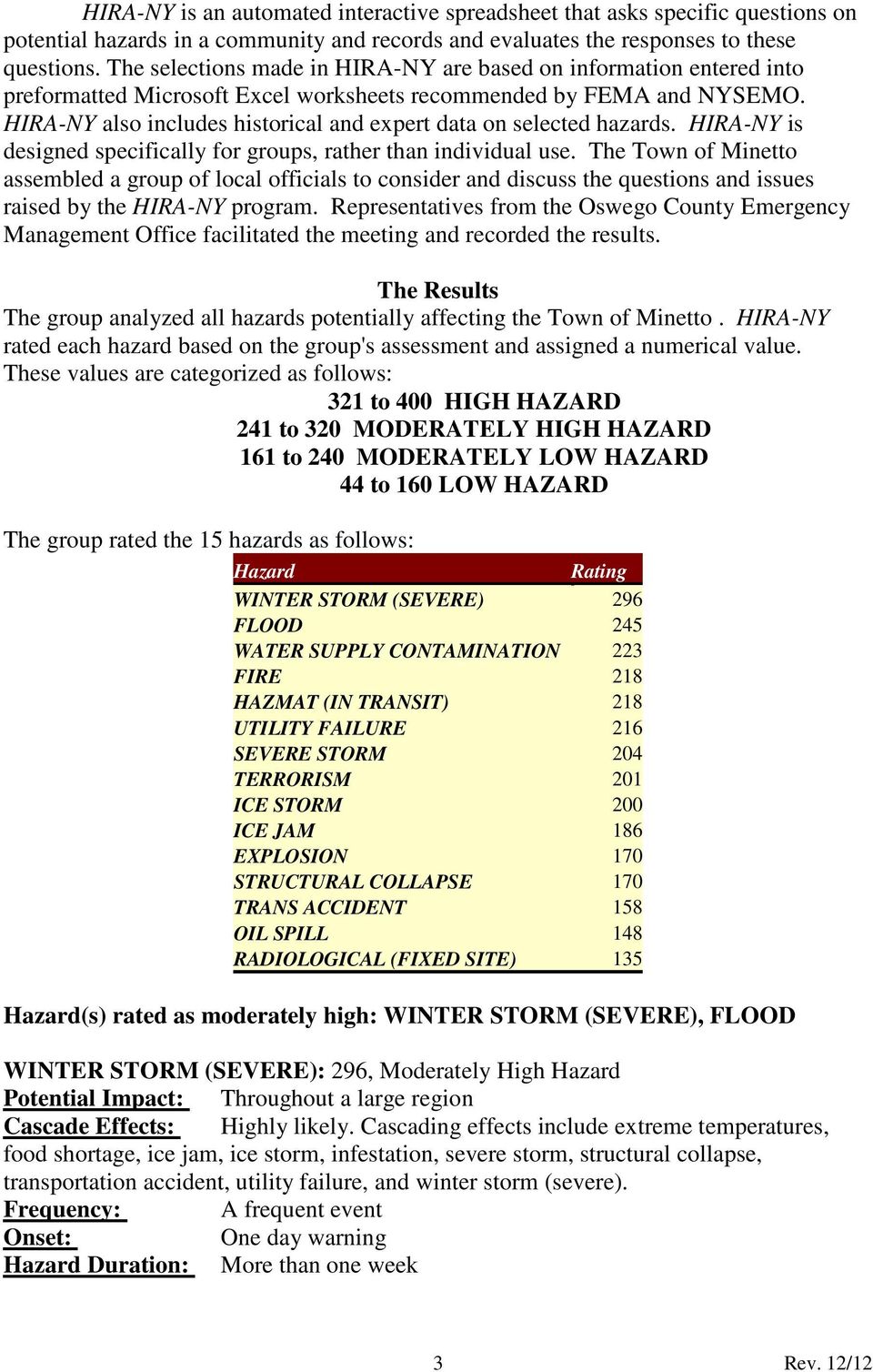
16 HIRA-NY is an automated interactive spreadsheet that asks specific questions on potential hazards in a community and records and evaluates the responses to these questions. The selections made in HIRA-NY are based on information entered into preformatted Microsoft Excel worksheets recommended by FEMA and NYSEMO. HIRA-NY also includes historical and expert data on selected hazards. HIRA-NY is designed specifically for groups, rather than individual use. The Town of Minetto assembled a group of local officials to consider and discuss the questions and issues raised by the HIRA-NY program. Representatives from the Oswego County Emergency Management Office facilitated the meeting and recorded the results. The Results The group analyzed all hazards potentially affecting the Town of Minetto. HIRA-NY rated each hazard based on the group's assessment and assigned a numerical value. These values are categorized as follows: 321 to 400 HIGH HAZARD 241 to 320 MODERATELY HIGH HAZARD 161 to 240 MODERATELY LOW HAZARD 44 to 160 LOW HAZARD The group rated the 15 hazards as follows: Hazard Rating WINTER STORM (SEVERE) 296 FLOOD 245 WATER SUPPLY CONTAMINATION 223 FIRE 218 HAZMAT (IN TRANSIT) 218 UTILITY FAILURE 216 SEVERE STORM 204 TERRORISM 201 ICE STORM 200 ICE JAM 186 EXPLOSION 170 STRUCTURAL COLLAPSE 170 TRANS ACCIDENT 158 OIL SPILL 148 RADIOLOGICAL (FIXED SITE) 135 Hazard(s) rated as moderately high: WINTER STORM (SEVERE), FLOOD WINTER STORM (SEVERE): 296, Moderately High Hazard Potential Impact: Throughout a large region Cascade Effects: Highly likely. Cascading effects include extreme temperatures, food shortage, ice jam, ice storm, infestation, severe storm, structural collapse, transportation accident, utility failure, and winter storm (severe). Frequency: A frequent event Onset: One day warning Hazard Duration: More than one week 3 Rev. 12/12
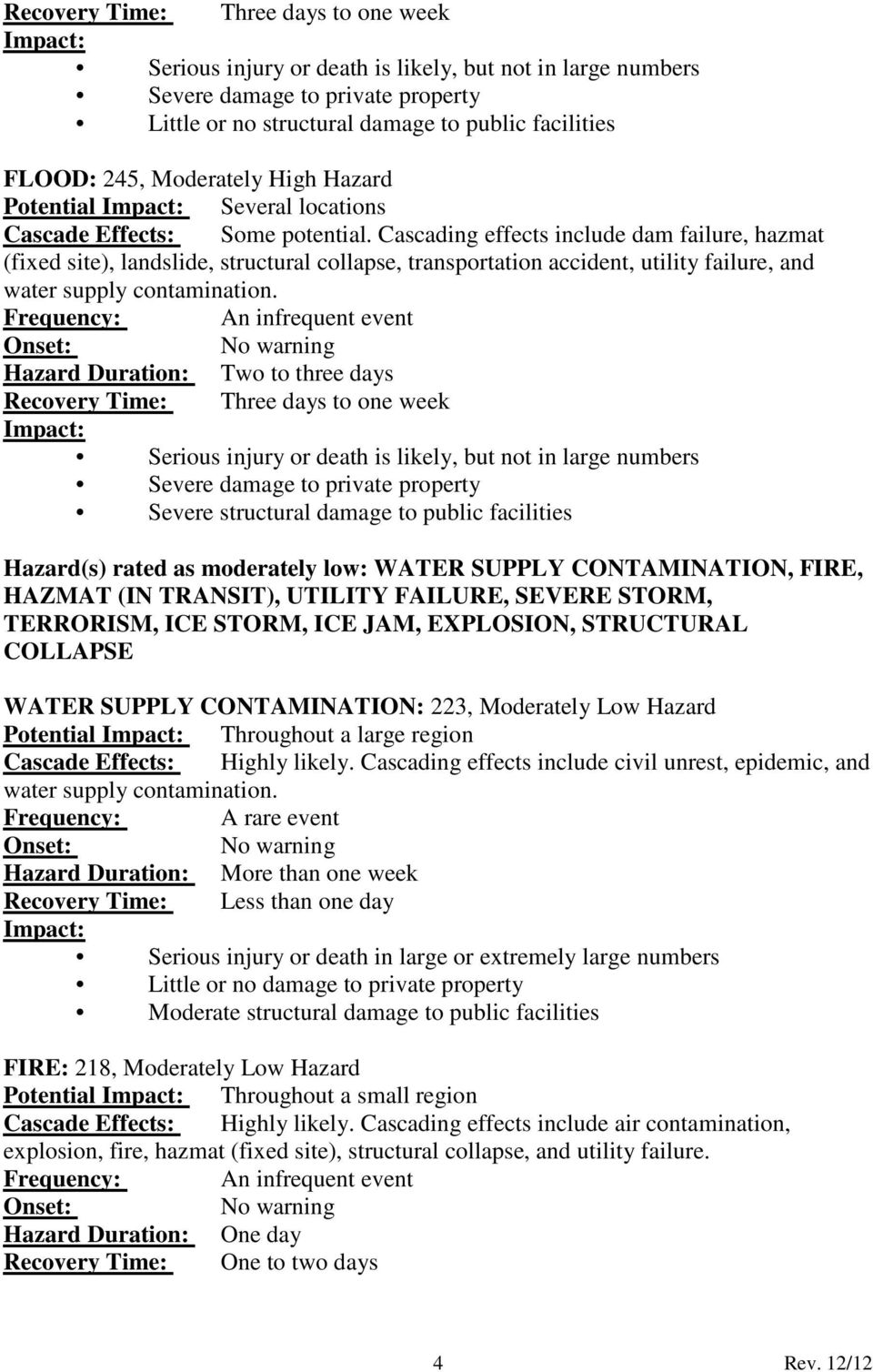
17 Recovery Time: Three days to one week Impact: Serious injury or death is likely, but not in large numbers Severe damage to private property Little or no structural damage to public facilities FLOOD: 245, Moderately High Hazard Potential Impact: Several locations Cascade Effects: Some potential. Cascading effects include dam failure, hazmat (fixed site), landslide, structural collapse, transportation accident, utility failure, and water supply contamination. Frequency: An infrequent event Onset: No warning Hazard Duration: Two to three days Recovery Time: Three days to one week Impact: Serious injury or death is likely, but not in large numbers Severe damage to private property Severe structural damage to public facilities Hazard(s) rated as moderately low: WATER SUPPLY CONTAMINATION, FIRE, HAZMAT (IN TRANSIT), UTILITY FAILURE, SEVERE STORM, TERRORISM, ICE STORM, ICE JAM, EXPLOSION, STRUCTURAL COLLAPSE WATER SUPPLY CONTAMINATION: 223, Moderately Low Hazard Potential Impact: Throughout a large region Cascade Effects: Highly likely. Cascading effects include civil unrest, epidemic, and water supply contamination. Frequency: A rare event Onset: No warning Hazard Duration: More than one week Recovery Time: Less than one day Impact: Serious injury or death in large or extremely large numbers Little or no damage to private property Moderate structural damage to public facilities FIRE: 218, Moderately Low Hazard Potential Impact: Throughout a small region Cascade Effects: Highly likely. Cascading effects include air contamination, explosion, fire, hazmat (fixed site), structural collapse, and utility failure. Frequency: An infrequent event Onset: No warning Hazard Duration: One day Recovery Time: One to two days 4 Rev. 12/12
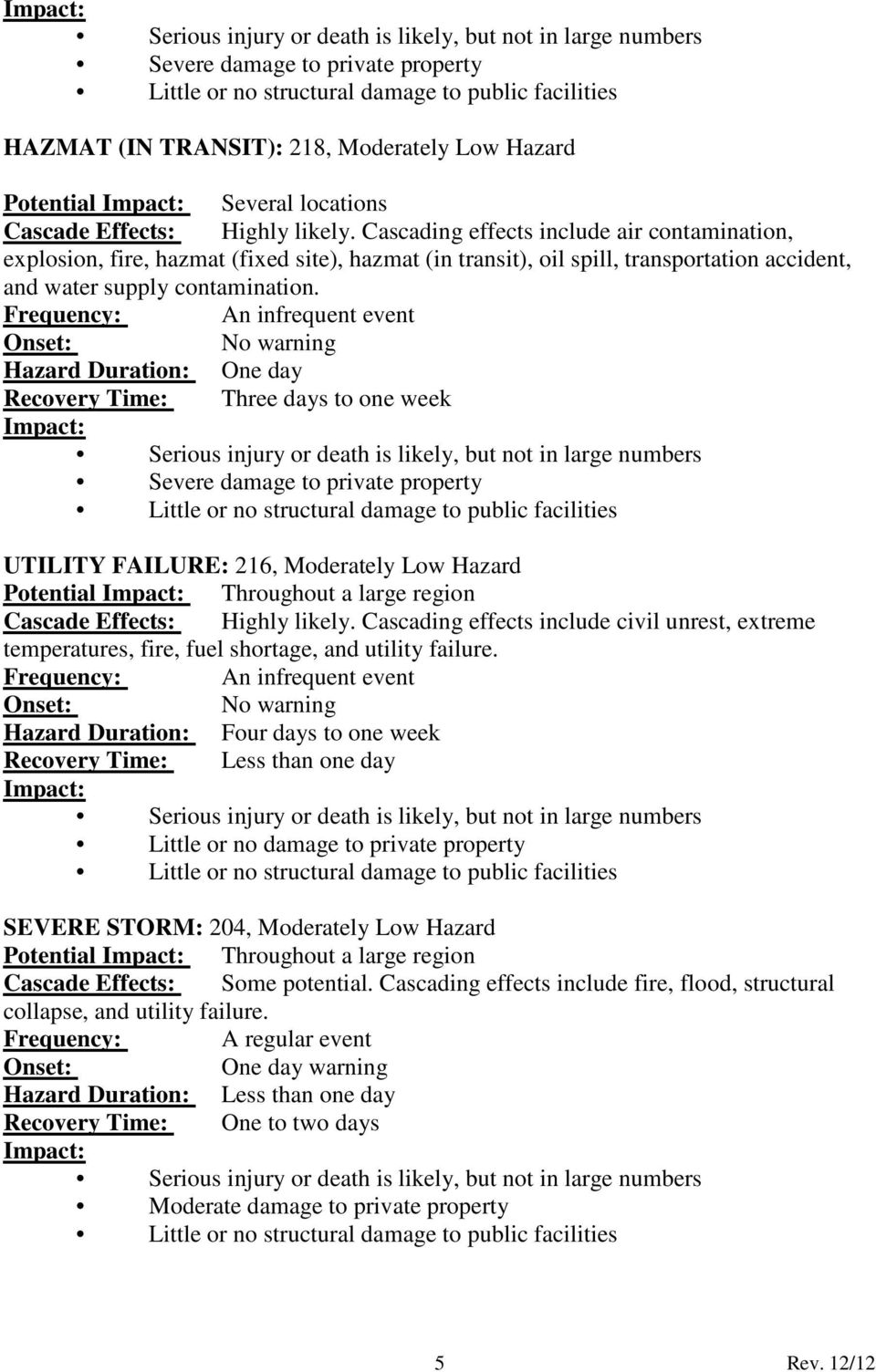
18 Impact: Serious injury or death is likely, but not in large numbers Severe damage to private property Little or no structural damage to public facilities HAZMAT (IN TRANSIT): 218, Moderately Low Hazard Potential Impact: Several locations Cascade Effects: Highly likely. Cascading effects include air contamination, explosion, fire, hazmat (fixed site), hazmat (in transit), oil spill, transportation accident, and water supply contamination. Frequency: An infrequent event Onset: No warning Hazard Duration: One day Recovery Time: Three days to one week Impact: Serious injury or death is likely, but not in large numbers Severe damage to private property Little or no structural damage to public facilities UTILITY FAILURE: 216, Moderately Low Hazard Potential Impact: Throughout a large region Cascade Effects: Highly likely. Cascading effects include civil unrest, extreme temperatures, fire, fuel shortage, and utility failure. Frequency: An infrequent event Onset: No warning Hazard Duration: Four days to one week Recovery Time: Less than one day Impact: Serious injury or death is likely, but not in large numbers Little or no damage to private property Little or no structural damage to public facilities SEVERE STORM: 204, Moderately Low Hazard Potential Impact: Throughout a large region Cascade Effects: Some potential. Cascading effects include fire, flood, structural collapse, and utility failure. Frequency: A regular event Onset: One day warning Hazard Duration: Less than one day Recovery Time: One to two days Impact: Serious injury or death is likely, but not in large numbers Moderate damage to private property Little or no structural damage to public facilities 5 Rev. 12/12
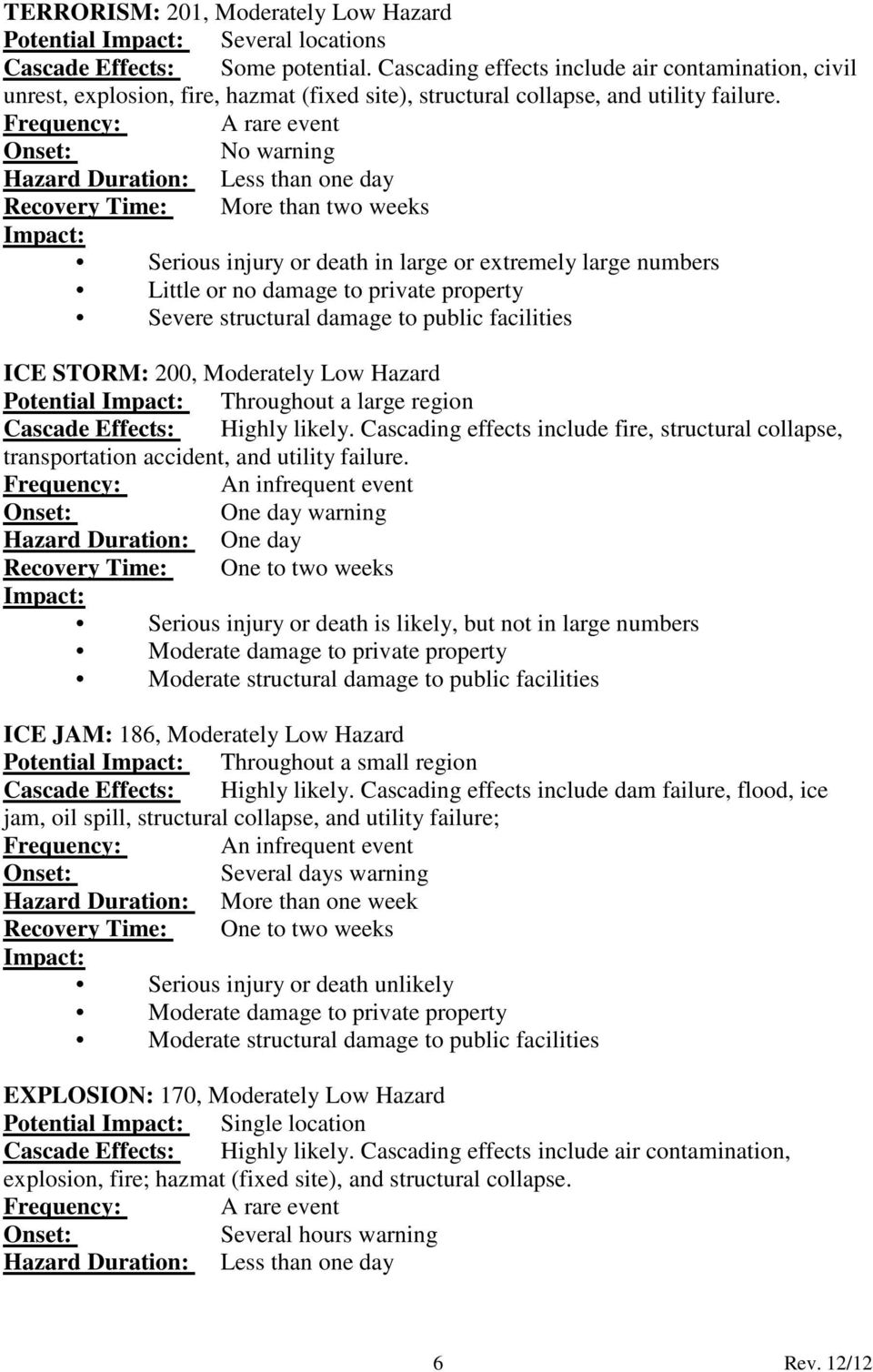
19 TERRORISM: 201, Moderately Low Hazard Potential Impact: Several locations Cascade Effects: Some potential. Cascading effects include air contamination, civil unrest, explosion, fire, hazmat (fixed site), structural collapse, and utility failure. Frequency: A rare event Onset: No warning Hazard Duration: Less than one day Recovery Time: More than two weeks Impact: Serious injury or death in large or extremely large numbers Little or no damage to private property Severe structural damage to public facilities ICE STORM: 200, Moderately Low Hazard Potential Impact: Throughout a large region Cascade Effects: Highly likely. Cascading effects include fire, structural collapse, transportation accident, and utility failure. Frequency: An infrequent event Onset: One day warning Hazard Duration: One day Recovery Time: One to two weeks Impact: Serious injury or death is likely, but not in large numbers Moderate damage to private property Moderate structural damage to public facilities ICE JAM: 186, Moderately Low Hazard Potential Impact: Throughout a small region Cascade Effects: Highly likely. Cascading effects include dam failure, flood, ice jam, oil spill, structural collapse, and utility failure; Frequency: An infrequent event Onset: Several days warning Hazard Duration: More than one week Recovery Time: One to two weeks Impact: Serious injury or death unlikely Moderate damage to private property Moderate structural damage to public facilities EXPLOSION: 170, Moderately Low Hazard Potential Impact: Single location Cascade Effects: Highly likely. Cascading effects include air contamination, explosion, fire; hazmat (fixed site), and structural collapse. Frequency: A rare event Onset: Several hours warning Hazard Duration: Less than one day 6 Rev. 12/12
20 Recovery Time: Three days to one week Impact: Serious injury or death is likely, but not in large numbers Severe damage to private property Severe structural damage to public facilities STRUCTURAL COLLAPSE: 170, Moderately Low Hazard Potential Impact: Several locations Cascade Effects: Highly likely. Cascading effects include dam failure, fire, transportation accident, and utility failure. Frequency: A rare event Onset: No warning Hazard Duration: Less than one day Recovery Time: One to two days Impact: Serious injury or death is likely, but not in large numbers Severe damage to private property Little or no structural damage to public facilities Hazard(s) rated as low: TRANSPORTATION ACCIDENT, OIL SPILL, RADIOLOGICAL (FIXED SITE) TRANSPORTATION ACCIDENT: 158, Low Hazard Potential Impact: Single location Cascade Effects: Some potential. Cascading effects include explosion, fire, hazmat (in transit), oil spill, transportation accident, and utility failure. Frequency: An infrequent event Onset: No warning Hazard Duration: Less than one day Recovery Time: Less than one day Impact: Serious injury or death is likely, but not in large numbers Little or no damage to private property Little or no structural damage to public facilities OIL SPILL: 148, Low Hazard Potential Impact: Several locations Cascade Effects: Highly likely. Cascading effects include air contamination, fire, hazmat (fixed site), hazmat (in transit), oil spill, transportation accident, and water supply contamination. Frequency: A rare event Onset: No warning Hazard Duration: One day Recovery Time: Three days to one week Impact: Serious injury or death iulikely 7 Rev. 12/12
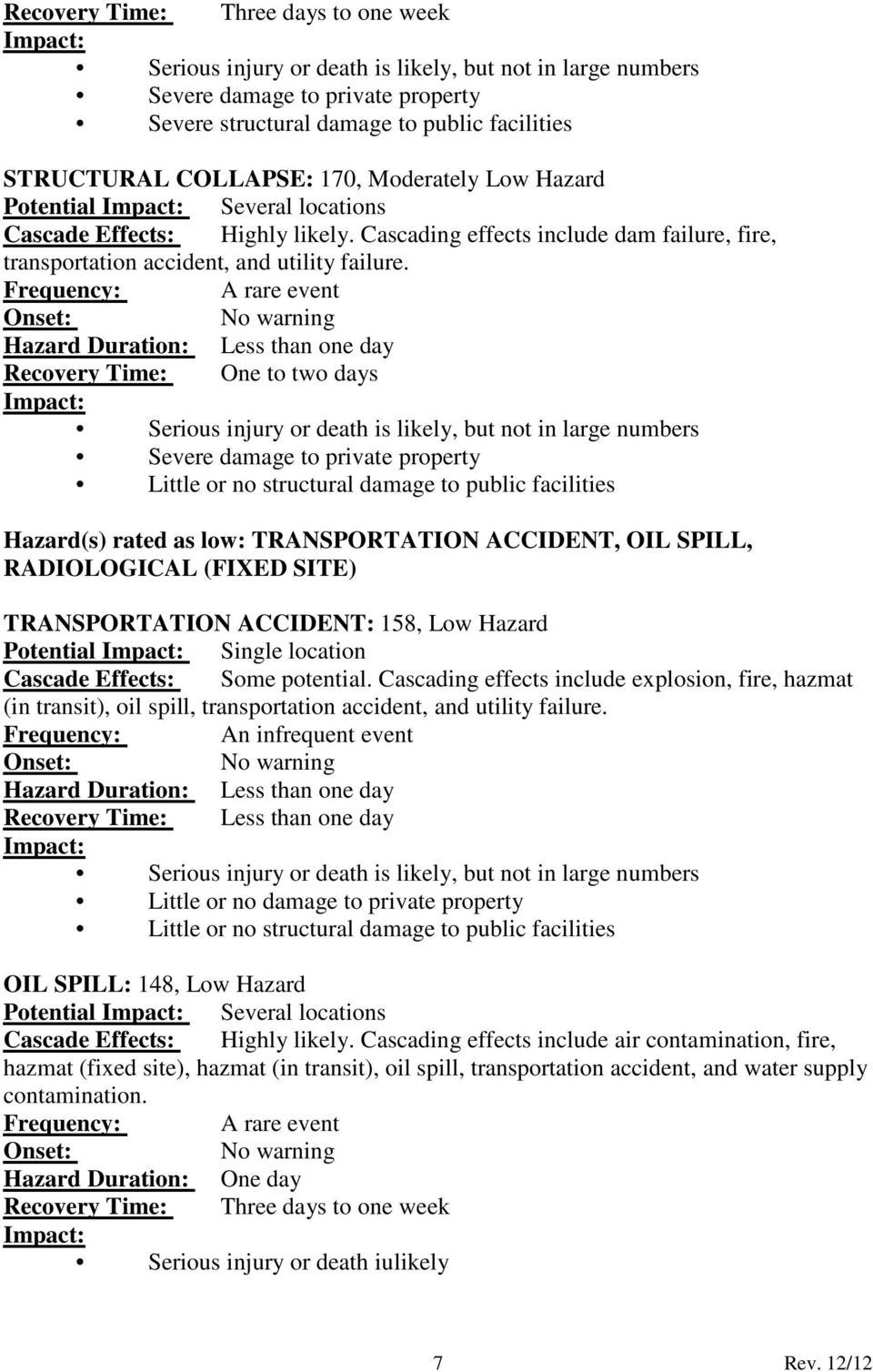
21 Little or no damage to private property Little or no structural damage to public facilities RADIOLOGICAL (FIXED SITE): 135, Low Hazard Potential Impact: Single location Cascade Effects: Some potential. Cascading effects include air contamination and water supply contamination. Frequency: A rare event Onset: Several hours warning Hazard Duration: Two to three days Recovery Time: More than two weeks Impact: Serious injury or death unlikely Little or no damage to private property Little or no structural damage to public facilities HAZARDS THAT OCCUR WITH NO WARNING* FLOOD WATER SUPPLY CONTAMINATION FIRE HAZMAT (IN TRANSIT) UTILITY FAILURE TERRORISM STRUCTURAL COLLAPSE TRANS ACCIDENT OIL SPILL These hazards determined to occur with no warning. HAZARDS THAT OCCUR MOST OFTEN* WINTER STORM (SEVERE) *This hazard was listed as a frequent event. HAZARDS THAT PRESENT THE GREATEST THREAT TO LIFE* WATER SUPPLY CONTAMINATION TERRORISM *These hazards were determined to result in serious injury and death in large or extremely large numbers 8 Rev. 12/12
22 TOWN OF MINETTO COMPREHENSIVE EMERGENCY MANAGEMENT PLAN SECTION II ATTACHMENT 2 RISK REDUCTION REPORT
23 TOWN OF MINETTO RISK REDUCTION REPORT AGENCY/DEPARTMENT SUBMITTING REPORT PERSON/TITLE OF PREPARER DATE OF SUBMISSION PROPOSED HAZARD REDUCTION PLAN DESCRIPTION OF ACTIONS NECESSARY FOR IMPLEMENTATION OF PLAN EXPECTED BENEFITS OF THE ACTION (INCLUDE MONETARY VALUE OF EACH BENEFIT, AS APPROPRIATE) ESTIMATED TIME LINE NEEDED FROM RISK IDENTIFICATION TO RISK REDUCTION PLAN IMPLEMENTATION AGENCIES RESPONSIBLE FOR IMPLEMENTATION AND MAINTENANCE OF RISK REDUCTION PLAN ESTIMATED COST OF THE ACTION (ITEMIZE COSTS SUCH AS EQUIPMENT AND LABOR) Equipment/Labor Cost TOTAL COST
24 DESCRIPTION OF GRANT AVAILABILITY (INCLUDE SOURCE OF GRANT, TITLE OF GRANT, PERSON/AGENCY WRITING GRANT, ETC.) MAINTENANCE SCHEDULE FOR RISK REDUCTION ACTION (IF APPLICABLE) TOWN SUPERVISOR REVIEW DATE SIGNATURE TOWN COUNCIL APPROVAL DATE
25 TOWN OF MINETTO COMPREHENSIVE EMERGENCY MANAGEMENT PLAN ATTACHMENT 3 PUBLIC EDUCATION AND AWARENESS PROGRAMS 1 Minetto Fire Department Programs 1.1 Programs for elementary school children grades 1, 2, and 3 conducted annually include: - Stop, Drop and Roll - Fire Alarms - Exit Drills in the Home - Emergency planning routes from home for evacuation - Smoke detectors - Familiarity with firefighters and apparatus 2 Oswego County Emergency Management Programs 2.1 Disaster education programs for local school children and community groups focusing on family disaster planning, weather emergencies and hazardous chemical awareness 2.2 Disaster planning assistance for community organizations and businesses, including how to develop a comprehensive emergency management plan 3 Oswego County Sheriff s Department Emergency Planning Training 3.1 Boater Safety Courses: This training provides interested persons with skills and information to safely operate watercraft in accordance with New York State and Federal laws. Provides for a group of professionally trained personnel who may be called upon to assist in situations that would require additional watercraft resources. 3.2 Snowmobile Safety Courses: This training provides interested persons with skills and information to safely operate snowmobiles in accordance with New York State laws. Provides for a group of professionally trained personnel who may assist in situations that would require additional snowmobile resources. 3.3 Suspicious Package Recognition Training: This training provides school personnel and others with information and skills to safely respond to threats of suspicious packages. Provides for a group of professionally trained personnel who may be called upon to assist in situations that would require additional resources in threat situations. 1 Rev. 05/2013
26 3.4 Public Finger Printing: This service provides an opportunity to have fingerprints taken and identification information gathered on themselves and family members. Provides for readily available, accurate information to be used for the identification of persons in emergency situations. 2 Rev. 05/2013
27 TOWN OF MINETTO COMPREHENSIVE EMERGENCY MANAGEMENT PLAN SECTION III RESPONSE 1 Response Organization and Assignment of Responsibilities 1.1 Chief Elected Officials - Responsibilities, Powers, and Succession The Town Supervisor of the affected municipality is ultimately responsible for emergency response activities and: may take personal command of the Town emergency response organization if the scope and magnitude of the emergency indicates the necessity of personal management and direction of the response and recovery operations, controls the use of all Town-owned resources and facilities for disaster response, may declare a local state of emergency and may promulgate emergency orders and waive local laws, ordinances, and regulations, may request assistance from other municipalities, Oswego County and the State when the situation escalates beyond the capability of Town resources, may provide assistance at the request of other local governments both within and outside Oswego County If the Town Supervisor is unable, due to absence or incapacitation, to perform the functions described in the preceding section 1.1, the following line of command and succession has been established to ensure continuity of government and the direction of emergency operations: The Deputy Supervisor will be in command if the Town Supervisor is unavailable The first available board member will be in command if the Deputy Supervisor is unavailable. 1 Rev. 05/2013
28 1.1.3 The Town Supervisor or his or her designee coordinates the following emergency response activities: activates the response organization and initiates response activities maintains and manages an Emergency Operations Center notifies and briefs Town departments, agencies and other organizations involved in an emergency response coordinates communications with: - the Incident Commander - Oswego County Emergency Management Office - other towns, cities, and villages in the County - local governments outside the County - private emergency support organizations - Sheriff's Department/State Police - State Department of Transportation 1.2 The Emergency Response Organization The Incident Command System (ICS) The Town of Minetto endorses the use of the Incident Command System (ICS) as formally adopted by the State of New York for emergencies requiring multi-agency response. ICS allows flexibility in its implementation so that its structure can be tailored to the specific situation at hand. ICS should be initiated by the emergency forces first responding to an incident ICS is organized by the following: -Command -Operations -Planning -Logistics -Finance (Administration) Under ICS, an Incident Commander (IC) has the overall responsibility for the effective on-scene management of the incident, and must ensure that an adequate organization is in place to carry out all emergency functions. The IC directs emergency operations from an Incident Command Post Initially in minor incidents, the five ICS functions may all be managed directly by the IC. Larger incidents usually require that 2 Rev. 05/2013
29 one or more of the functions be set up as separate sections under the IC Within the command function, the IC has additional responsibilities for safety, public information, and liaison. These activities can be assigned to staff under the IC An ICS with all five functions organized as sections is depicted as follows: Incident Commander Public Information Safety Liaison Operations Planning Logistics Finance/ Admin During an emergency, response personnel must be cognizant of the Incident Command System in place and their role in it. Some personnel may be responders the scene and part of the on-scene ICS structure in a functional or staff role. Other personnel may be assigned to the Emergency Operations Center (EOC) or other locations where they will provide support to the responders at the scene. All response personnel not assigned to the on-scene ICS will be coordinated by or through the EOC Response personnel operating at the EOC will be organized by ICS function and interface with their on-scene counterparts as appropriate The Incident Commander is usually selected due to his or her position as the highest ranking responding officer at the scene. The IC must be fully qualified to manage the incident. As an incident grows in size or becomes more complex, a more highly qualified Incident Commander may be assigned A major emergency encompassing a large geographic area may have more than one emergency scene. In this situation, separate Operations Section Chiefs may set up command at multiple locations. In this case, an Area Command may be established. The Area Command is structured similar to a 3 Rev. 05/2013
30 normal ICS. The Incident Commander is called the Incident Manager to whom all Incident Commanders report Whenever the ICS is established, emergency response forces should be assigned to specific ICS functions wherever they are needed including at the scene, at the EOC in a support role, or at an Area Command if established. 2 Management of Emergency Response 2.1 Incident Command Post and Emergency Operations Center On-scene emergency response operations will be directed and controlled by the Incident Commander from an Incident Command Post located at or near the emergency site. This will be the only command post at the emergency scene. All other facilities at the scene used by agencies for decision-making should not be identified as a command post A Command Post will be selected by the Incident Commander based upon the logistical needs of the situation and located near but at a safe distance from the emergency site The Primary Town Minetto EOC is located at the Town Hall. If an alternate EOC is necessary, it will be located at the Highway Garage The EOC will be used to support Incident Command Post activities and to coordinate resources and assistance. The EOC can also be used as an Area Command Post when Area Command is instituted The EOC can provide for the centralized coordination of Town and private agencies activities from a secure and functional location Agencies and other organizations represented at the EOC will be organized according to ICS function under the direction of the Chief Elected Official or his or her designee(s) Though organized by ICS function, each agency's senior representative at the EOC will be responsible for directing or coordinating his or her agency's personnel and resources. Where the agency is also represented at the scene in an ICS structure, the EOC representative will coordinate the application of resources with the agency's representative at the scene The Chief Elected Official or designee is responsible for managing the EOC during emergencies. 4 Rev. 05/2013
31 2.1.9 If required, the EOC will be staffed to operate continuously on a twentyfour hour a day basis. In the event of a 24-hour operation, two 12 ½ hour shifts will be utilized. Designation of shifts will be established as conditions warrant by the Chief Elected Official or designee Each agency will identify its personnel assigned to the EOC. This identification is to be provided to the Chief Elected Official or designee and updated as changes occur, at least annually Work areas will be assigned to each agency represented at the EOC Internal security at the EOC during an emergency will be provided by the the Minetto Town Constable. - all persons entering the EOC will be required to check in at the security desk located at the main entrance - all emergency personnel may be issued a pass (permanent or temporary) to be worn at all times while in the EOC - temporary passes will be returned to the security desk when departing from the premises EOC space should be maintained in an emergency operating mode by the Chief Elected Official or designee at all times. During non-emergency periods, the EOC will be used for normal functions The ICS Planning function is responsible for emergency situation reporting at the EOC and has established procedures and forms (Attachment l) to be used The Chief Elected Official or designee maintains Standard Operating Guidelines for activating, staffing and managing the EOC. These SOGs can be found as Attachment 2 to this section of the plan. 2.2 Notification and Activation Upon initial notification of an emergency by the County E-911 Emergency Communication Center, the Center will immediately alert the appropriate emergency response operations. This initial notification sets into motion the activation of emergency response personnel Each emergency is to be classified into one of three Response Levels according to the scope and magnitude of the incident. 5 Rev. 05/2013
32 - Response Level I: Full emergency situation with major threat to life, health, or property, involving large population or area. - Response Level II: Limited emergency situation with some threat to life, health, or property, but confined to a limited area or involving a small population. - Response Level III: Controlled emergency situation without serious threat to life, health, or property, which requires no assistance beyond essential first responders Emergency response personnel will be activated according to the Response Level classification as follows: - For Response Level I, full EOC staffing is achieved as soon as possible. Except for first responders to the scene, assignment of response personnel to other locations including the emergency scene will be made through the EOC. - For Response Level II, essential first responders are activated and, if deemed necessary, the office of the Town Supervisor is notified, and if activated, augmented by select members of the Town response organization as determined by the Town Supervisor. - For Response Level III, essential first responders are activated and if deemed necessary, the office of the Town Supervisor is notified. 2.3 Assessment and Evaluation As a result of information provided by the Operations and Planning sections, the Command Section will, as appropriate, in coordination with the Incident Commander: l develop policies by evaluating the safety, health, economic, environmental, social, humanitarian, legal and political implications of a disaster or threat analyze the best available data and information on the emergency explore alternative actions and consequences select and direct specific response actions 6 Rev. 05/2013
33 2.4 Declaration of State of Emergency and Promulgation of Emergency Orders In response to an emergency, or its likelihood, upon a finding that public safety is imperiled, the Town Supervisor may proclaim a state of emergency pursuant to Section 24 of the New York State Executive Law Such a proclamation authorizes the Chief Elected Officials to deal with the emergency situation with the full executive and legislative powers of Town government This power is realized only through the promulgation of emergency orders. For example, emergency orders can be issued for actions such as: - establishing curfews - restrictions on travel - evacuation of facilities and areas - closing of places of amusement of assembly Appendix A, Town of Minetto Article 2-B Kit, describes the requirements for proclaiming a State of Emergency and promulgating Emergency Orders. 2.5 Public Warning and Emergency Information In order to implement public protective actions there should be a timely, reliable and effective method to warn and inform the public Activation and implementation of public warning is an Operations section responsibility Information and warnings to the public that a threatening condition is imminent or exists can be accomplished by the following resources. Though public warning may, in many cases, be implemented solely by onscene personnel, the use of the systems in ( ), ( ) and ( ) below require strict coordination with the Town of Minetto or Oswego County EOC: Emergency Alert System (EAS) - involves the use of the broadcast media, including television and radio, to issue emergency warnings. Request for activation can be made only by the Oswego County Chairman of the Legislature or Oswego County Emergency Management Office. (Attachment 3) Hyper-Reach reverse telephone system - involves the use of telephone calls originating from the Oswego County E Rev. 05/2013
34 Communications Center using reverse 911 technology to inform or warn people of an incident or emergency in their neighborhood. Requires coordination with the E-911 Supervisor Emergency service with siren and/or public address capabilities - Many law enforcement and fire vehicles in the Town are equipped with siren and public address capabilities. These vehicles may be available, in part, during an emergency for "route alerting" of the public Door-to-door public warning can be accomplished in some situations by the individual alerting of each residence/business in a particular area. This can be undertaken by any designated group such as police and fire, visiting each dwelling in the affected area and relating the emergency information to the building occupants. To achieve maximum effectiveness, the individual delivering the warning message should be in official uniform Special institutions such as places of public assembly are encouraged to obtain and use tone-activated receivers/monitors with the capability to receive NOAA Weather Radio (NWR) Special arrangements may be made for providing warning information to the hearing impaired, and mobility impaired population groups The Public Information Officer, if established, or its function, a part of the Command section, may, in coordination with on-scene Incident Command: establish and manage a Joint Information Center (JIC) from where to respond to inquiries from the news media and coordinate all official announcements and media briefings authenticate all sources of information being received and verify accuracy provide essential information and instructions, including the appropriate protective actions to be taken by the public, to the broadcast media and press coordinate the release of all information with the key departments and agencies involved both at the EOC and on-scene check and control the spreading of rumors 8 Rev. 05/2013
35 arrange and approve interviews with the news media and press by emergency personnel involved in the response operation arrange any media tours of emergency sites The JIC may be established near the EOC or at any location where information flow can be maintained, without interfering with emergency operations. 2.6 Restoring Public Services The Operations section is responsible for ascertaining the emergency' s effect on the infrastructure and the resultant impact on public services including transportation, electric power, and telephone and ensuring that restoration of services is accomplished without undue delay. 2.7 Resource Management The Planning function is responsible for the identification and allocation of additional resources needed to respond to the emergency situation Resources owned by the Town should be used first in responding to the emergency All Town-owned resources are under the control of the Town Supervisor during an emergency and can be utilized as necessary Resources owned by other municipalities in and outside of the Town of Minetto can be utilized upon agreement between the requesting and offering government Resources owned privately cannot be commandeered or confiscated by government during an emergency. However, purchases and leases of privately owned resources can be expedited during an emergency. In addition, it is not uncommon for the private sector to donate certain resources in an emergency Resource identification and inventory are listed in Appendix B Standard Operating Guidelines Each agency assigned responsibility under this Response portion of the plan is required to have its own Standard Operating Guidelines (SOGs). 9 Rev. 05/2013
36 2.8.2 Each agency SOG is to be updated at least annually Copies of each SOG are retained within each agency Standard Operating Guidelines for the Town of Minetto Emergency Operations Center are located in Attachment Rev. 05/2013
37 Figure 1 EOC Organizational Chart EOC Manager Town Supervisor Liaison Officer Public Information Officer Safety Officer Finance Section Chief Planning Section Chief Operations Section Chief Logistics Section Chief Law Enforcement Fire Medical/ EMS Public Works School Communications Human Services RACES 11 Rev. 05/2013
38 TOWN OF MINETTO COMPREHENSIVE EMERGENCY MANAGEMENT PLAN SECTION III ATTACHMENT 1 EMERGENCY OPERATIONS CENTER PLANNING FORMS FORM A FORM B FORM C FORM D FORM E FORM F REGISTRATION LOG EOC STAFFING FORM EVENT/MESSAGE LOG TELEPHONE NUMBER RADIO ASSIGNMENT FORM SHELTER STATUS EVACUATION STATUS Rev. 05/2013
39 TOWN OF MINETTO EMERGENCY OPERATIONS CENTER FORM A - REGISTRATION LOG EMERGENCY/DISASTER: DATE: NAME AGENCY/AFFILIATION ASSIGNED DUTY TIME IN TIME OUT
40 TOWN OF MINETTO EMERGENCY OPERATIONS CENTER FORM B - EOC STAFFING FORM EMERGENCY/DISASTER: DATE: AGENCY/POSITION SHIFT TO NAME(S) SHIFT TO NAME(S) SHIFT TO NAME(S) SHIFT TO NAME(S)
41 TOWN OF MINETTO COMPREHENSIVE EMERGENCY MANAGEMENT PLAN INSTRUCTIONS FOR USING FORM C The purpose of Form C (Event/Message Log) is to provide agencies/departments who are carrying out their emergency functions within the EOC, a record of their messages, telephone calls, and activities impacting their emergency response. Participating agencies/departments should use this form to provide shift personnel an update of the agencies' activities during an on-going emergency. Completed forms should be kept in a three ring binder provided at each EOC work station. Upon EOC deactivation, each agency/department may make a copy of completed forms for return to respective offices. All original logs should be submitted to the Town Supervisor.
42 TOWN OF MINETTO EMERGENCY OPERATIONS CENTER FORM C - EVENT/MESSAGE LOG EVENT/MESSAGE LOG CLOSEOUT: EMERGENCY /DISASTER: DATE: LOCATION: TIME: RECEIVED BY: CALLER: CALLBACK NUMBER: REFERRED TO: AGENCY: MESSAGE: RESULT: SIGNATURE UPON COMPLETION:
43 TOWN OF MINETTO EMERGENCY OPERATIONS CENTER FORM D - TELEPHONE NUMBER/RADIO ASSIGNMENT FORM
44 TOWN OF MINETTO EMERGENCY OPERATIONS CENTER FORM E -- SHELTER STATUS DATE: TIME: PREPARED BY: SHELTER FACILITY NAME CAPACITY # OF VACANCIES OPEN/CLOSED
45 TOWN OF MINETTO EMERGENCY OPERATIONS CENTER FORM F -- EVACUATION STATUS DATE: TIME: PREPARED BY: EVACUATED AREA/ ESTIMATED POPULATION EVACUATION STATUS TRANSPORTATION MODE CAPACITY SHELTER DESTINATION TIME EVACUATED
46 TOWN OF MINETTO COMPREHENSIVE EMERGENCY MANAGEMENT PLAN SECTION III ATTACHMENT 2 EMERGENCY OPERATIONS CENTER - STANDARD OPERATING GUIDELINE 1 Purpose To provide an overview of the Town of Minetto Emergency Operations Center (EOC) activation procedures, roles, and responsibilities 2 Introduction The Town of Minetto EOC serves as an area for multiple agencies and departments to coordinate emergency response and recovery activities. The Town Supervisor's Office is responsible for maintaining the EOC in a state of readiness and for directing and supervising its use during activation. If activation of the EOC is determined necessary, the EOC Manager activates the EOC under the authority of the Town Supervisor. The appropriate policy makers, operational agencies and departments, and support staff are notified. Their representation in the EOC is required to ensure efficient and effective emergency operations. 3 Activation Procedures (include but are not limited to): 3.1 Alert and notify appropriate policymakers, operational agencies and departments, and support staff as circumstances warrant 3.2 Establish security at all entrances to the EOC as warranted 3.3 Activate necessary communications 3.4 Continue to monitor the emergency situation 3.5 Notify the Public Information Officer and establish and designate a briefing area for the media 3.6 Determine the need for a Declaration of Emergency 3.7 Determine the need for and establish a phone bank 3.8 Identify and activate computer capabilities and use 1 Rev. 05/2013
47 4 Roles and Responsibilities of EOC Personnel 4.1 EOC Manager's duties include but are not limited to: Upon direction of the Town Supervisor, activate the EOC Alert and assemble essential departments and agencies Provide necessary status reports to the Town Supervisor and arrange briefing sessions to keep EOC staff informed of administrative decisions Ensure that roles, responsibilities, standard operating guidelines and emergency plans are implemented Coordinate with the Town Supervisor for a Declaration of a State of Emergency, if needed Activate the damage assessment team for timely determinations Establish an EOC staffing pattern schedule for two 122 hour shifts if necessary Provide direction to the Operations Section Chief as needed Provide Public Information Officer with current status reports 4.2 Operations Section Chief (some or all of the following responsibilities may be assigned to EOC Manager) Assist the EOC Manager as needed Provide the Town Supervisor with briefing and updates of emergency operations Maintain control of overall operations within the EOC Ensure that accurate records and statistics are maintained during activation Assist the Town Supervisor in providing briefing sessions for the operational and support staff Provide clearance of personnel for access to the EOC and the Incident Command Post at the scene (if established) 2 Rev. 05/2013
48 4.2.7 Provide EOC support staff with assistance and direction Direct the organization and arrangement of equipment in the EOC to ensure efficient operations Establish a phone bank if deemed necessary by the EOC Manager Assign EOC phone numbers (Form D) and track personnel shift assignments (Form B) 4.3 Public Information Officer (as appointed by the Town Supervisor) Maintain a briefing room and work space that are separate from the EOC Act as liaison between media and the EOC Attend situation briefings in the EOC Keep in close contact with the Town Supervisor and/or EOC Manager If appropriate, conduct media briefings and arrange for appropriate interviews 4.4 Logistics Section Chief Coordinate requests for resources with appropriate agencies and support staff Review and screen volunteer applications as necessary Provide operations and support staff with sufficient supplies and equipment Arrange for the use of audio and visual aids Coordinate the operation of the EOC kitchen activities, food deliveries and distribution 3 Rev. 05/2013
49 4.5 Finance/Admin Section Chief Keep track of incident related costs including: - personnel costs - equipment records (type and use of equipment) - administration of contracts 4.6 Planning Section Chief Maintain resources status Maintain and display situation status Prepare the incident action plan Prepare the demobilization plan Anticipate potential problems and events 4.7 Communications Coordinator Calculate the number of staff needed to carry out adequate radio communications Assist in the notification of emergency personnel Assist communications staff with proper use of message keeping Maintain portable radio equipment use inventory Assist radio operators with mechanical and technical problems Coordinate use and maintenance of equipment in the EOC Coordinate with Director of Emergency Management Office for the dispatch of RACES 4.8 Operational Agencies/Departments Implement their specific agency response activities at the EOC Coordinate agency activities and information with other agency representatives, EOC Manager and the Operations Section Chief 4 Rev. 05/2013
50 4.8.3 Ensure agency personnel are informed of EOC procedures Provide agency personnel for relief/shift duty. Shift and personnel changes are coordinated through the Operations Section Chief Maintain a message/activity log for their agency or department while carrying out their functions in the EOC (Form C) 4.9 Security (only if necessary) Control access to the EOC Ensure proper identification is displayed for access Report security problems to the Operations Section Chief Maintain EOC registration records 4.10 Support Staff Computer Coordinator Coordinate appropriate equipment from current inventory or outside locations Advise the EOC Manager of the EOC computer use and capabilities Help develop a system to track/group accumulated data and record information concerning the emergency situation Maintain and control access to computer equipment Clerical Personnel Provide general clerical support in the EOC 5 Rev. 05/2013
51 TOWN OF MINETTO COMPREHENSIVE EMERGENCY MANAGEMENT PLAN SECTION III ATTACHMENT 3 ACTIVATION OF EMERGENCY ALERT SYSTEM The Oswego County Emergency Alert System broadcasts a 2-minute warning message to the public on participating Oswego County and Syracuse area radio and television stations and cable systems. It may be activated to alert the public of wide-scale emergencies such as floods, tornadoes, power outages, civil disorders, nuclear power plant accidents, toxic leaks, or other events that pose a danger to life or property. Oswego County government has established procedures through the Emergency Management Office for activation of EAS. Participation in the local system is completely voluntary on the part of the broadcast media. The responsibility for activation of the Oswego County EAS rests on the Chairman of the Oswego County Legislature. Requests to broadcast an emergency message may be made to the Director of the Oswego County Emergency Management Office by calling 911 and requesting the director to be contacted. The director will confer with the Chairman of the Legislature to determine appropriateness of the request. If deemed appropriate, activation of EAS will be made by an EAS activator designated by the Emergency Management Office. In the event activation of EAS is not warranted, individual requests can be made to the stations participating in the program to broadcast important emergency information. A media list is included in Appendix E. Rev. 05/2013
52 TOWN OF MINETTO COMPREHENSIVE EMERGENCY MANAGEMENT PLAN SECTION III ATTACHMENT 4 After Action Report Emergency Action Plan Evaluation Form Facility/Agency: Date: / / Time: Emergency Type Fire: Radiological: Public Health/Medical Emergency: Haz-Mat: Power Failure: Terrorism: Other: Duration of emergency: List any problems encountered during the emergency: List any recommendations for improvement to the Plan: Signature: Date: / /
53 TOWN OF MINETTO COMPREHENSIVE EMERGENCY MANAGEMENT PLAN SECTION IV RECOVERY 1 Damage Assessment 1.1 After a disaster/emergency, the Town of Minetto will participate in damage assessment activities. If appropriate, the Town will coordinate its activities with Oswego County's assessment activities. 1.2 Pre-emergency assessment activities may include: identifying Town agencies, personnel, and resources to assist and support damage assessment activities identifying non-governmental groups such as non-profit organizations, trade organizations and professional people that could provide damage assessment assistance fostering agreements between Town government and the private sector for technical support 1.3 Emergency assessment activities will include: obtaining and maintaining documents, maps, photos and video tapes of damage reviewing procedures and forms for reporting damage to higher levels of government 1.4 Post-emergency assessment may include (any or all of the following activities may be implemented by Oswego County in coordination with New York State): selecting personnel to participate in damage assessment teams arranging for training of selected personnel in damage assessment techniques identifying and prioritizing areas to survey damage 1 Rev. 05/2013
54 1.4.4 assigning survey teams to selected areas completing damage assessment reports and maintaining records of the reports submitting damage reports to the New York State Office of Emergency Management for further review and processing 1.5 Town, County and State Assessment Teams will consist primarily of local government employees, such as public works staff, building inspectors, assessors, and members of non-profit organizations such as the American Red Cross and the Salvation Army. When necessary, non-governmental personnel from the fields of engineering, construction, insurance, and related fields may supplement the teams. 1.6 Types of Damage Assessment Teams include: infrastructure teams assess damage to public property and the infrastructure individual assistance teams assess impact on individuals and families 1.7 Personnel from Town and County departments and agencies who are assigned damage assessment responsibilities will remain under the control of their own departments, but will function under the supervision of a Damage Assessment Officer assigned during emergency conditions and resident in the Emergency Operations Center. 1.8 The Damage Assessment Officer (assigned, as appropriate, at the time of the specific emergency/disaster) will maintain information on: destroyed property property sustaining minor damage for the following categories: damage to private property in dollar loss to the extent not covered by insurance: - homes - businesses - industries - utilities - hospitals, institutions - private schools damage to public property in dollar loss to the extent not covered 2 Rev. 05/2013
55 by insurance: - road systems - bridges - water control facilities - public buildings, equipment, vehicles - publicly-owned utilities - parks and recreation facilities Cost in dollar value will be calculated for individual assistance in the areas of mass care, housing, and individual family grants Debris clearance and protective measures, such as pumping, sandbagging, construction of warning signs and barricades, etc Financing overtime and labor required for emergency operations. 1.9 NYS Office of Emergency Management "Damage Assessment Guidance", with appropriate forms, is available from the Oswego County Emergency Management Office Whenever a State or Federal disaster is declared, the Oswego County Chairman of the Legislature, through the Director of Emergency Management, will submit appropriate damage assessment reports to the NYS Office of Emergency Management. This is required for establishing the eligibility for any State and/or Federal assistance It is essential that, from the outset of emergency response actions, Town response personnel keep detailed records of expenditures for: - labor used - use of own equipment - use of borrowed or rented equipment - use of materials from existing inventory - contracted services for emergency response Forms for collecting this information are contained in NYS-OEM s "Public Assistance Handbook of Policies and Guidelines for Applicants", obtainable from the Emergency Management Office The Director of Emergency Management will advise the CEO to maintain detailed records of emergency expenditures, and supply them with standard documentation forms. 3 Rev. 05/2013
56 1.12 During a State or Federally declared emergency the County's Director of Emergency Management will: attend public assistance applicant briefings conducted by Federal and State emergency officials review NYS-OEM's disaster assessment guidance obtain, if possible, maps showing disaster locations documented with photos and video tapes facilitate the preparation and submission of Notice of Interest in applying for Federal disaster assistance assign local representative(s) who will accompany the Federal survey team(s) maintain summary of damage suffered and recovery actions taken 2 Planning for Recovery 2.1 Recovery includes community development and redevelopment. 2.2 Comprehensive community development plans are officially adopted by local government as the official policy for development of the community. 2.3 The Town has public and political support for land use planning with the corresponding plan implementing tools such as local laws, building codes, etc. Therefore, the Town has disaster prevention and mitigation capability by applying these methods successfully. 2.4 The Town decides whether the recovery will be managed through existing organizations with planning and coordinating skills or by a recovery task force created exclusively for this purpose. 2.5 If deemed necessary, a recovery task force will direct the recovery with the assistance of County departments and agencies coordinated by the Director of Emergency Management. 2.6 If necessary, a local recovery and redevelopment plan will be prepared. This plan may include: - replacement, reconstruction, removal, relocation of damaged/destroyed infrastructures, buildings 4 Rev. 05/2013
57 - establishments of priorities of repairs to facilities, buildings and infrastructures - economic recovery and community development - new or amended building and sanitary codes 2.7 Recovery and redevelopment plan will account for and incorporate to the extent appropriate, relevant existing plans and policies. 2.8 Prevention and mitigation measures should be included into all recovery planning when possible. 2.9 If the Governor declares a State of Emergency Disaster, the Town has the following responsibilities: The Town will prepare a local recovery and redevelopment plan, unless the legislative body of the Town determines such a plan be unnecessary or impractical Within 15 days after Declaration of State of Disaster, the Town shall report to the State Disaster Preparedness Commission through NYS-OEM, whether the preparation of recovery and redevelopment plan has been started, and, if not, the reasons for not preparing the plan The proposed plan shall be presented at a public hearing upon five days notice, published in the newspaper of general circulation in the area affected and transmitted to the radio and television media for publication and broadcast. The local recovery and redevelopment plan shall be prepared within 45 days after the Declaration of the State Disaster and shall be transmitted to the DPC. The DPC shall provide its comments on the plan within 10 days after receiving the plan A plan shall be adopted by the Town within 10 days after receiving the comments for the DPC The adopted plan may be amended at any time in the same manner as originally prepared, revised and adopted. The plan will be the official policy of recovery and redevelopment within the Town. 3 Reconstruction 3.1 Reconstruction consists of two phases: Phase One - short term reconstruction to return vital life support systems 5 Rev. 05/2013
58 to minimum operating standards Phase Two - long term reconstruction and development which may continue for years after the disaster and will implement the officially adopted plans, policies and programs for redevelopment 3.2 Long term reconstruction and recovery includes activities such as: - scheduling planning for redevelopment - analyzing existing State and Federal programs to determine how they may be modified or applied to reconstruction - conducting of public meetings and hearings - providing temporary housing and facilities - public assistance - coordinating State/Federal recovery assistance - monitoring of reconstruction process - preparation of periodic progress reports to be submitted to NYS- OEM through the County's Emergency Management Office 3.3 Reconstruction operations must conform to existing State/Federal laws and regulations concerning environmental impact. 3.4 Reconstruction operations in and around designated historical sites must conform to existing State and FEMA guidelines. 4 Public Information on Recovery Assistance 4.1 The Oswego County Public Information Officer is responsible for making arrangements within the broadcast media and press to obtain their cooperation and adequately report to the public on: - what kind of emergency assistance is available to the public - who provides the assistance - who is eligible for assistance - what kinds of records are needed to document items which are damaged or destroyed by the disaster - what actions are required to apply for assistance - where to apply for assistance 4.2 The following types of assistance may be available: - foods stamps (regular and/or emergency) - temporary housing (rental, mobile home, motel) - unemployment and job placement 6 Rev. 05/2013
59 - Veterans' benefits - Social Security benefits - disaster and emergency loans (Small Business Administration) - individual grants - legal assistance 4.3 As appropriate, all of the above information should be prepared jointly by the Federal, State, County and Town public information officers and furnished to the media for reporting to the public. 7 Rev. 05/2013
60 TOWN OF MINETTO COMPREHENSIVE EMERGENCY MANAGEMENT PLAN APPENDIX A TOWN OF MINETTO ARTICLE 2-B KITS The Town of Minetto Article 2-B Kits are located In the Town Supervisor s Office and The Town Clerk s Office Rev. 05/2013
61 TOWN OF MINETTO COMPREHENSIVE EMERGENCY MANAGEMENT PLAN APPENDIX B COUNTY/TOWN RESOURCES Resources for: County Highway Department Fire Coordinator s Office Oswego County Sheriff s Department Oswego County Emergency Management are on file with the respective County Departments 1 Rev. 05/2013
62 TOWN OF MINETTO - Town Hall with capacity for 50 people - Kitchen facilities equipped with refrigerator, sink and stove - Telephones, 3 computers, printers, copy machine, fax machine - TOWN OF MINETTO HIGHWAY DEPARTMENT - Grasshopper Lawn Mower - Work Trailer - Motorola Base Station/11 hand-held radios - Hammer knife mower - 3 Oshkosh plows/sander/dump - 2 John Deere loaders - 2 Kabota tractor w/ snowblower & sweeper(sewer and highway depts.) - Bandit chipper - Gradeall - Misc. tools & equipment - Ford dump - Chevy dump - Kioti tractor w/snowblower/mower/backhoe/loader & attachments - Lincoln Ranger 8 welder generator - Oshkosh dump w/plow/sander - Pelican street sweeper - Mower - Utility trailer MINETTO FIRE DEPARTMENT - 1 Seagrave rescue pumper - 1 E-One 78 ladder truck - 1 F-450 rescue truck - 1 F-350 utility truck special operations trailer 2 w/diving equipment Ribcraft rescue boat kw standby generator 2 Rev. 05/2013
63 TOWN OF MINETTO COMPREHENSIVE EMERGENCY MANAGEMENT PLAN APPENDIX C EVACUATION ROUTE MAPS Rev. 05/2013
64 TOWN OF MINETTO Rev. 05/2013
65 TOWN OF MINETTO COMPREHENSIVE EMERGENCY MANAGEMENT PLAN APPENDIX D EMERGENCY TELEPHONE LIST 1 Rev. 05/2013
66 TOWN OF MINETTO EMERGENCY CONTACTS TOWN OFFICIALS Minetto Town Hall 6 Community Drive, Minetto fax William C. Dodds III Supervisor Michelle Smith Deputy Supervisor/Board member Andrew (Joe) Wallace Board member David Domicolo Board member Dominick Yacco Board member Jennifer Allen Town Clerk Donna Keating Bookkeper/Office Manager James Sharky Highway Superintendent Jim Basile Code Enforcement Martin Webster Assessor Kenneth Auyer Justice Office Richard Ferguson Justice Office Donna Auyer Court Clerk Carl Sanders Town Constable David Dunn Animal Control Officer Dennis Lewis Water Pollution Control James Sharkey WPC Assistant FIRE DEPARTMENT Minetto Fire Department Station: Through 911 Dispatch: Joe Smegelsky Chief Al Heath Assistant Chief Tim Smegelsky Deputy Chief AMBULANCE Oswego County Ambulance Service (Menter s) Ontario St., Fulton NY LAW ENFORCEMENT Oswego County Sheriff s Department Desk Reuel Todd Sheriff Eugene Sullivan Undersheriff New York State Police Fulton Substation Hastings Substation Rev. 05/2013
67 US Border Patrol Oswego Station Fax US Coast Guard New York National Guard OSWEGO COUNTY Emergency Management Dale A. Currier,Director Fax Emergency Operation Center (EOC) Center Michael Allen, Director Fire Coordinator s Office/ERTC Don Forbes, Fire Coordinator Health Department Jiancheng Huang, Director Social Services Department Greg Heffner, Commissioner Highway Department Kurt Ospelt, Superintendent Legislator, 19 th District Daniel Chalifoux NEW YORK STATE Governor s Office 518/ Andrew Cuomo, Governor Department of Homeland Security & Emergency Services 518/ Department of Environmental Conservation 24-hour dispatch center 877/ Zone 1 Lt. James Retmeir 877/ DEC ECO Zone 1 Mark Harger Department of Transportation Region 3 Director Carl F. Ford Oswego Residency Thomas Cory NYS Thruway Syracuse Headquarters Canal Corporation Syracuse Canal Lock 5, Minetto EMERGENCY AGENCIES Central New York Chapter American Red Cross Oswego Bureau Rev. 05/2013
68 UTILITIES National Grid Power Outage: Gas Emergency: Time Warner 866/ Verizon Residential Business SCHOOL DISTRICTS/BUSES Oswego City School District Superintendent William Crist Fax Transportation Supervisor Minetto Elementary School Fax A&E Transport Centro Bus, Oswego OCO, Inc. Transportation HOSPITALS Oswego Hospital, 110 W. Sixth St., Oswego, Switchboard Emergency Department Urgent Care, Fulton GAS STATIONS Stewart s, Route Kim May, Manager GAS PROPANE Amerigas, Minetto Glider Oil Company, Oswego ANIMAL SHELTERS Oswego County Humane Society 265 W. 1 st St., Oswego Oswego Animal Shelter 621 E. Seneca St., Oswego SPCA 5878 E. Molloy Rd., Mattydale Rev. 05/2013
69 TOWN OF MINETTO COMPREHENSIVE EMERGENCY MANAGEMENT PLAN APPENDIX E NEWS MEDIA DIRECTORY
70 TOWN OF MINETTO News Media Directory Oswego County Emergency Management Office Area Code: 315 unless otherwise noted Media Outlet - RADIO Contact numbers Contact Info WSYR 570 AM WYYY 94.5 FM WBBS FM WHEN 620 AM WWHT FM 24 hours manned newsroom EAS Local Primary WRVO FM hours (partially automated) if no answer: Fax: [email protected] Business: Fax: Business: [email protected] Clear Channel Communications 500 Plum Street Suite 100 Syracuse, NY Joel Delmonico: General Manager Lanigan Hall SUNY Oswego Oswego, NY Jeff Windsor: Chief Engineer Catherine Loper, News Director WTKV TK /105.5 FM mmunications.com/ Business Studio line Fax: Galaxy Communications 235 Walton St. Syracuse, NY Program Director: Ted Bradford [email protected] Media Outlet - OTHER Contact numbers Contact Info Oswego County Today Cayuga Street FAX: Fulton, NY online media outlet [email protected] Steve Yablonski: Oswego Bureau Associated Press Syracuse Region wire service rolls to Albany if Syr. closed FAX: Washington, DC for radio interviews 1 Clinton Square PO Box 4915 Syracuse, NY Albany Shaker Road Colonie, NY Rev. 05/2013
71 Media Outlet TV NEWS Contact Numbers Contact Info YNN Time Warner Cable Channel Erie Blvd. East Syracuse, NY press 2 toll free: Fax: Fax toll-free: [email protected] Ron Lombard, General Manager Steve Osterhaus, Assistant News Director (anchor desk is in Albany) 24 hour cable news station WSYR NewsChannel 9 WSTM Channel 3 WTVH Channel 5 WSTQ Channel news tips line Fax: Business: [email protected] News Assignment: Fax: Business: [email protected] 5904 Bridge Street East Syracuse, NY James Street Syracuse, NY Media Outlet - PRINT Contact Numbers Contact Info Syracuse Newspapers Oswego County Bureau Fax: PO Box 4915 Syracuse, NY daily regional [email protected] [email protected] City Desk: fax: Bureau Chief: Dan Padovano The Palladium Times daily Oswego City The Valley News twice-weekly Fulton, southern Oswego County Fax: [email protected] Fax: [email protected] 140 W. First Street Oswego, NY Jon Spaulding, Publisher Sara McCrobie: Managing Editor Fulton Newspapers 67 S. Second St. Fulton, NY Loren Colburn: Publisher Tom Cuskey, Associate Publisher Andy Henderson: Managing Editor 3 Rev. 05/2013
72 TOWN OF MINETTO COMPREHENSIVE EMERGENCY MANAGEMENT PLAN APPENDIX F Glossary 1 Rev. 05/2013
73 Agency Agency Representative Area Command (Unified Area Command) Assessment Assignments Assistant Assisting Agency Available Resources Branch Comprehensive Emergency Management Plan (CEMP) A division of government with a specific function offering a particular kind of assistance. In ICS, agencies are defined either as jurisdictional (having statutory responsibility for incident management) or as assisting or cooperating (providing resources or other assistance). A person assigned by a primary, assisting, or cooperating state, local, or tribal government agency or private entity that has been delegated authority to make decisions affecting that agency s or organization s participation in incident management activities following appropriate consultation with the leadership of that agency. An organization established (1) to oversee the management of multiple incidents that are each being handled by an ICS organization or (2) to oversee the management of large or multiple incidents to which several Incident Management Teams have been assigned. Area Command has the responsibility to set overall strategy and priorities, allocate critical resources according to priorities, ensure that incidents are properly managed, and ensure that objectives are met and strategies followed. Area Command becomes Unified Area Command when incidents are multi-jurisdictional. Area Command may be established at an emergency operations center facility or at some location other than an incident command post. The evaluation and interpretation of measurements and other information to provide a basis for decision-making. Tasks given to resources to perform within a given operational period that are based on operation objectives defined in the IAP. Title for subordinates of principal Command Staff positions. The title indicates a level of technical capability, qualifications, and responsibility subordinate to the primary positions. Assistants may also be assigned to unit leaders. An agency or organization providing personnel, services, or other resources to the agency with direct responsibility for incident management. See also Supporting Agency. Resources assigned to an incident, checked in, and available for a mission assignment, normally located in a Staging Area. The organizational level having functional or geographical responsibility for major aspects of incident operations. A branch is organizationally situated between the section and the division or group in the Operations Section, and between the section and units in the Logistics Section. Branches are identified by the use of Roman numerals or by functional area. The CEMP establishes uniform policy and procedures for the effective coordination of response, recovery, and mitigation to natural, technological, and man-made disasters. County Warning Point Is the location that the State will contact in the case of an emergency. The 24-hour County Warning Point is operated 2 Rev. 05/2013
74 through the Oswego County Emergency Communications Center (ECC) in Oswego, NY. Check-In Chief Command Command Staff Common Operating Picture Communications Unit Cooperating Agency Coordinate Deputy Disaster Recovery Center (DRC) Disaster Field Office (DOF) Dispatch The process through which resources first report to an incident. Check-in locations include the incident command post, Resources Unit, incident base, camps, staging areas, or directly on the site. The ICS title for individuals responsible for management of functional sections: Operations, Planning, Logistics, Finance/Administration, and Intelligence (if established as a separate section). The act of directing, ordering, or controlling by virtue of explicit statutory, regulatory, or delegated authority. In an incident management organization, the Command Staff consists of the Incident Command and the special staff positions of Public Information Office, Safety Officer, Liaison Officer, and other positions as required, who report directly to the Incident Commander. They may have an assistant or assistants, as needed. A broad view of the overall situation as reflected by situation reports, aerial photography, and other information or intelligence. An organizational unit in the Logistics Section responsible for providing communication services at an incident or an EOC. A Communications Unit may also be a facility (e.g., a trailer or mobile van) used to support an Incident Communications Center. An agency supplying assistance other than direct operational or support functions or resources to the incident management effort. To advance systematically an analysis and exchange of information among principals who have or may have a need to know certain information to carry out specific incident management responsibilities. A fully qualified individual who, in the absence of a superior, can be delegated the authority to manage a functional operation or perform a specific task. In some cases, a deputy can act as relief for a superior and, therefore, must be fully qualified in the position. Deputies can be assigned to the Incident Commander, General Staff, and Branch Directors. Locations set-up for victims to apply for State and Federal assistance programs for which they may be eligible. Is established in or near the designated area to support State and Federal response and recovery operations. The DFO houses the Federal Coordinating Officer (FCO) and the Emergency Response Team (ERT), and where possible, the State Coordinating Officer (SCO) and support staff. The ordered movement of a resource or resources to an assigned operational mission or an administrative move from one location to another. 3 Rev. 05/2013
75 Distribution Centers Division Emergency Emergency Operations Centers (EOCs) Emergency Operations Plan (EOP) Emergency Public Information Emergency Response Provider Evacuation Event Federal General Staff Locations where in-kind donations of food, water, and other supplies received from the Resource Staging Centers will be distributed to residents. Distribution Centers may be located in parking lots or open fields in the disaster area, as close to victims as possible. The partition of an incident into geographical areas of operation. Divisions are established when the number of resources exceeds the manageable span of control of the Operations Chief. A division is located within the ICS organization between the branch and resources in the Operations Section. Absent a Presidentially declared emergency, any incident(s), human-caused or natural, that requires responsive action to protect life or property. Under the Robert T. Stafford Disaster Relief and Emergency Assistance Act, an emergency means any occasion or instance for which, in the determination of the President, Federal assistance is needed to supplement State and local efforts and capabilities to save lives and to protect property and public health and safety, or to lessen or avert the threat of a catastrophe in any part of the United States. The physical location at which the coordination of information and resources to support domestic incident management activities normally takes place. An EOC may be a temporary facility or may be located in a more central or permanently established facility, perhaps at a high level of organization within a jurisdiction. EOCs may be organized by major functional disciplines (e.g., fire, law enforcement, and medical services), by jurisdiction (e.g., Federal, State, regional, county, city, tribal), or some combination thereof. The steady-state plan maintained by various jurisdictional levels for responding to a wide variety of potential hazards. Information that is disseminated primarily in anticipation of an emergency or during an emergency. In addition to providing situational information to the public, it also frequently provides directive actions required to be taken by the general public. Includes state, local, and tribal emergency public safety, law enforcement, emergency response, emergency medical (including hospital emergency facilities), and related personnel, agencies and authorities. See Section 2 (6), Homeland Security Act of 2002, Pub. L , 116 Stat (2002). Also know as Emergency Responder. Organized, phased, and supervised withdrawal, dispersal, or removal of civilians from dangerous or potentially dangerous areas, and their reception and care in safe areas. A planned, non-emergency activity. ICS can be used as the management system for a wide range of events, e.g., parades, concerts, or sporting events. Of or pertaining to the Federal Government of the United States of America. A group of incident management personnel organized according to function and reporting to the Incident Commander. The General Staff normally consists of the Operations Section Chief, Planning Section Chief, Logistics 4 Rev. 05/2013
76 Section Chief, and Finance/Administration Section Chief. Group Incident Incident Action Plan (IAP) Incident Command Post (ICP) Incident Command System (ICS) Incident Commander (IC) Incident Management Team Incident Objectives Initial Action Initial Response Intelligence Officer Established to divide the incident management structure into functional areas of operation. Groups are composed of resources assembled to perform a special function not necessarily within a single geographic division. Groups, when activated, are located between branches and resources in the Operations Section. (see Division.) An occurrence or event, natural or human-caused, that requires an emergency response to protect life or property. Incidents can, for example, include major disasters, emergencies, terrorist attacks, terrorist threats, wild-land and urban fires, floods, hazardous materials spills, nuclear accidents, aircraft accidents, earthquakes, hurricanes, tornadoes, tropical storms, war-related disasters, public health and medical emergencies, and other occurrences requiring an emergency response. An oral or written plan containing general objectives reflecting the overall strategy for managing an incident. It may include the identification of operation resources and assignments. It may also include attachments that provide direction and important information for management of the incident during one or more operational periods. The field location at which the primary tactical-level, on-scene incident command functions are performed. The ICP may be collocated with the incident base or other incident facilities and is normally identified by a green rotating or flashing light. A standardized on-scene emergency management construct specifically designed to provide for the adoption of an integrated organizational structure that reflects the complexity and demands of single or multiple incidents, without being hindered by jurisdictional boundaries. ICS is the combination of facilities, equipment, personnel, procedures, and communications operating within a common organizational structure, designed to aid in the management of resources during incidents. It is used for all kinds of emergencies and is applicable to small as well as large and complex incidents. ICS is used by various jurisdictions and functional agencies, both public and private, to organize field-level incident management operations. The individual responsible for all incident activities, including the development of strategies and tactics, the ordering and the release of resource. The IC has overall authority and responsibility for conducting incident operations and is responsible for the management of all incident operations at the incident site. The IC and appropriate Command General Staff personnel assigned to an (IMT) incident. Statements of guidance and direction necessary for selecting appropriate strategy(s) and the tactical direction of resources. Incident objectives are based on realistic expectations of what can be accomplished when all allocated resources have been effectively deployed. Incident objectives must be achievable and measurable, yet flexible enough to allow strategic and tactical alternatives. The actions taken by those responders first to arrive at an incident site. Resources initially committed to an incident. The intelligence officer is responsible for managing internal information, 5 Rev. 05/2013
77 intelligence, and operational security requirements supporting incident management activities. These may include information security and operational security activities, as well as the complex task of ensuring that sensitive information of all types (e.g., classified information, law enforcement sensitive information, proprietary information, or exportcontrolled information) is handled in a way that not only safeguards the information, but also ensures that it gets to those who need access to it to perform their missions effectively and safely. Joint Information Center (JIC) Joint Information System (JIS) Liaison Liaison Officer (LNO) Local Government Local State of Emergency Logistics Logistics Section A facility established to coordinate all incident-related public information activities. It is the central point of contact for all news media at the scene of the incident. Public information officials from all participating agencies should collocate at the JIC. Integrates incident information and public affairs into a cohesive organization designed to provide consistent, coordinated, timely information during crisis or incident operations. The mission of the JIS is to provide a structure and system for developing and delivering coordinated interagency messages; developing, recommending, and executing public information plans and strategies on behalf of the IC; advising the IC concerning public affairs issues that could affect a response effort; and controlling rumors and inaccurate information that could undermine public confidence in the emergency response effort. A form of communication for establishing and maintaining mutual understanding and cooperation. A member of the command Staff responsible for coordinating with representatives from cooperating and assisting agencies. A county, municipality, city, town, township, local public authority, school district, special district, intrastate district, council of governments (regardless of whether the council of governments is incorporated as a nonprofit corporation under State law), regional or interstate government entity, or agency or instrumentality of a local government; an Indian tribe or authorized tribal organization, or in Alaska a Native village or Alaska Regional Native Corporation; a rural community, unincorporated town or village, or other public entity. See Section 2 (10), Homeland Security Act of 2002, Pub. L , 116 Stat (2002) May be declared by the County Chairman or the County Administrator (when authorized), when normal community functions are, or may be severely disrupted, Oswego County requires outside assistance, or as deemed necessary. Providing resources and other service to support incident management. The section responsible for providing facilities, services, and material support for the incident. Major Disaster As defined under the Robert T. Stafford Disaster Relief and Emergency Assistance Act (42 U.S.C. 5122), a major disaster is any natural catastrophe (including any hurricane, tornado, storm, high water, wind-driven water, tidal wave, tsunami, earthquake,volcanic eruption, landslide, mudslide, snowstorm, or which in the determination of the President causes damage of sufficient severity and magnitude to warrant major disaster assistance under the Act to supplement the efforts and available resources of States, tribes, local governments, and 6 Rev. 05/2013
78 disaster relief organizations in alleviating the damage, loss, hardship, or suffering caused thereby. Management by Objective Mitigation Mobilization Multi-agency Coordination Multi-agency Coordination Systems Multi-jurisdictional Incident Mutual-Aid Agreement A management approach that involves a four-step process for achieving the incident goal. The Management by Objectives approach includes the following: establishing overarching objectives; developing and issuing assignments, plans, procedures, and protocols; establishing specific, measurable objectives for various incident management functional activities and directing efforts to fulfill them, in support of defined strategic objectives; and documenting results to measure performance and facilitate corrective action. The activities designed to reduce or eliminate risks to persons or property or to lessen the actual or potential effects or consequences of an incident. Mitigation measures may be implemented prior to, during, or after an incident. Mitigation measures are often informed by lessons learned from prior incidents. Mitigation involves ongoing actions to reduce exposure to, probability of, or potential loss from hazards. Measures may include zoning and building codes, floodplain buyouts, and analysis of hazard-related data to determine where it is safe to build or locate temporary facilities. Mitigation can include efforts to educated governments, businesses, and the public on measures they can take to reduce loss and injury. The process and procedures used by all organizations-state, local, and tribal-for activating, assembling, and transporting all resources that have been requested to respond to or support an incident. A multi-agency coordination entity functions within a broader multi-agency coordination system. It may establish the priorities among incidents and associated resource allocations, deconflict agency policies, and provide strategic guidance and direction to support incident management activities. Multi-agency coordination systems provide the architecture to support coordination for incident prioritization, critical resource allocation, communications systems integration, and information coordination. The components of multi-agency coordination systems include facilities, equipment, emergency operation centers (EOCs), specific multi-agency coordination entities, personnel, procedures, and communications. These systems assist agencies and organizations to fully integrate the subsystems of the NIMS. An incident requiring action from multiple agencies that each have jurisdiction to manage certain aspects of an incident. In ICS, these incidents will be managed under Unified Command. Written agreement between agencies and/or jurisdictions that they will assist one another on request, by furnishing personnel, equipment, and/or expertise in a specified manner. National National Disaster Medical System (NDMS) Of a nationwide character, including the state, local, and tribal aspects of governance and policy. A cooperative, asset-sharing partnership between the Department of Health and Human Services, the Department of Veterans Affairs, the Department of Homeland Security, and the Department of Defense. NDMS provides resources for meeting the continuity of care and mental health services 7 Rev. 05/2013
79 requirements of the Emergency Support Function 8 in the Federal Response Plan. National Incident Management Systems (NIMS) National Response Plan (NRP) Nongovernmental Organization (NGO) Operational Period Operations Section Personnel Accountability Planning Meeting Planning Section A system mandated by HSPD-5 that provides a consistent nationwide approach for state, local, and tribal governments; the private-sector, and nongovernmental organizations to work effectively and efficiently together to prepare for, respond to, and recover from domestic incidents, regardless of cause, size, or complexity. To provide for interoperability and compatibility among state, local, and tribal capabilities, the NIMS includes a core set of concepts, principles, and terminology. HPD-5 identifies these as the ICS; multi-agency coordination systems; training; identification and management of resources (including systems for classifying types of resources); qualification and certification; and the collection, tracking, and reporting of incident information and incident resources. A plan mandated by HSPD-5 that integrates Federal domestic prevention, preparedness, response, and recovery plans into one all-discipline, allhazards plan. An entity with an association that is based on interests of its members, individuals, or institutions and that is not created by a government, but may work cooperatively with government. Such organizations serve a public purpose, not a private benefit. Examples of NGOs include faith-based charity organizations and the American Red Cross. The time scheduled for executing a given set of operation actions, as specified in the Incident Action Plan. Operational periods can be of various lengths, although usually not over 24 hours. The section responsible for all tactical incident operations. In ICS, it normally includes subordinate branches, divisions, and/or groups. The ability to account for the location and welfare of incident personnel. It is accomplished when supervisors ensure that ICS principles and processes are functional and that personnel are working within established incident management guidelines. A meeting held as needed prior to and throughout the duration of an incident to select specific strategies and tactics for incident control operations and for service and support planning. For larger incidents, the planning meeting is a major element in the development of the Incident Action Plan (IAP). Responsible for the collection, evaluation, and dissemination of operational information related to the incident, and for the preparation and documentation of the IAP. This section also maintains information on the current and forecasted situation and on the status of resources assigned to the incident. Preparedness The range of deliberate, critical tasks and activities necessary to build, sustain, and improve the operational capability to prevent, protect against, respond to, and recover from domestic incidents. Preparedness is a continuous process. Preparedness involves efforts at all levels of government and between government and private-sector and nongovernmental organizations to identify threats, determine vulnerabilities, and identify required resources. Within the NIMS, preparedness is operationally focused on establishing guidelines, protocols, 8 Rev. 05/2013
80 and standards for planning, training and exercises, personnel qualification and certification, equipment certification, and publication management. Preparedness Organizations Prevention Private Sector Processes Public Information Officer (PIO) Public Assistance Publications Management The groups and fora that provide interagency coordination for domestic incident management activities in a non-emergency context. Preparedness organizations can include all agencies with a role in incident management, for prevention, preparedness, response, or recovery activities. They represent a wide variety of committees, planning groups, and other organizations that meet and coordinate to ensure the proper level of planning, training, equipping, and other preparedness requirements within a jurisdiction or area. Actions to avoid an incident or to intervene to stop an incident from occurring. Prevention involves actions to protect lives and property. It involves applying intelligence and other information to a range of activities that may include such countermeasures as deterrence operations; heightened inspections; improved surveillance and security operations; investigations to determine the full nature and source of the threat; public health and agricultural surveillance and testing processes; immunizations, isolation, or quarantine; and, as appropriate, specific law enforcement operations aimed at deterring, preempting, interdicting, or disrupting illegal activity and apprehending potential perpetrators and bringing them to justice. Organizations and entities that are not part of any governmental structure. It includes for-profit and not-for-profit organizations, formal and informal structures, commerce and industry, and private voluntary organizations (PVO). Systems of operations that incorporate standardized procedures, methodologies, and functions necessary to provide resources effectively and efficiently. These include resource typing, resource ordering and tracking, and coordination. A member of the Command staff responsible for interfacing with the public and media or with other agencies with incident-related information requirements. Is the reimbursement and emergency assistance provided to State and local governments and private non-profit entities from the Federal government. The publications management subsystem includes materials development, publication control, publication supply, and distribution. The development and distribution of NIMS materials is managed through this subsystem. Consistent documentation is critical to success, because it ensures that all responders are familiar with the documentation used in a particular incident regardless of the location or the responding agencies involved. Qualification and Certification Radio Amateur Civil Emergency Services (RACES) This subsystem provides recommended qualification and certification standards for emergency responder and incident management personnel. It also allows the development of minimum standards for resources expected to have an interstate application. Standards typically include training, currency, experience, and physical and medical fitness. A volunteer group of amateur radio operators, who may be activated by the Oswego County Office of Emergency Management, to provide communications support in times of emergency. 9 Rev. 05/2013
81 Reception Area Recovery Resources Resource Management Resources Unit Response Safety Officer (SO) Section This refers to a location separate from staging areas, where resources report in for processing and out-processing. Reception Areas provide accountability, security, situational awareness briefings, safety awareness, distribution of IAPs, supplies and equipment, feeding, and bed down. The development, coordination, and execution of service-and siterestoration plans; the reconstitution of government operations and services; individual, private-sector, nongovernmental, and public-assistance programs to provide housing and to promote restoration; long-term care and treatment of affected persons; additional measures for social, political, environmental, and economic restoration; evaluation of the incident to identify lessons learned; post incident reporting; and development of initiatives to mitigate the effects of future incidents. Personnel and major items of equipment, supplies, and facilities available or potentially available for assignment to incident operations and for which status is maintained. Resources are described by kind and type and may be used in operational support or supervisory capacities at an incident or at an EOC. Efficient incident management requires a system for identifying available resources at all jurisdictional levels to enable timely and unimpeded access to resources needed to prepare for, respond to, or recover from an incident. Resource management under the NIMS includes mutual-aid agreements; the use of special state, local, and tribal teams; and resource mobilization protocols. Functional unit within the Planning Section responsible for recording the status of resources committed to the incident. This unit also evaluates resources currently committed to the incident, the effects additional responding resources will have on the incident, and anticipated resource needs. Activities that address the short-term, direct effects of an incident. Response includes immediate actions to save lives, protect property, and meet basic human needs. Response also includes the execution of emergency operations plans and of mitigation activities designed to limit the loss of life, personal injury, property, and meet basic human needs. Response also includes the execution of emergency operations plans and of mitigation activities designed to limit the loss of life, personal injury, property damage, and other unfavorable outcomes. As indicated by the situation, response activities include applying intelligence and other information to lessen the effects or consequences of an incident; increased security operation; continuing investigations into nature and source of the threat; ongoing public health and agricultural surveillance and testing processes; immunizations, isolation, or quarantine; and specific law enforcement operations aimed at preempting, interdicting, or disrupting illegal activity, and apprehending actual perpetrators and bringing them to justice. A member of the Command Staff responsible for monitoring and assessing safety hazards or unsafe situations and for developing measures for ensuring personnel safety. The organizational level having responsibility for a major functional area of incident management, e.g., Operations, Planning, Logistics, 10 Rev. 05/2013
82 Finance/Administration, and Intelligence (if established). The section is organizationally situated between the branch and the Incident Command. Span of Control Staging Area The number of individuals a supervisor is responsible for, usually expressed as the ratio of supervisors to individuals. (Under the NIMS, an appropriate span of control is between 1:3 and 1:7) Location established where resources can be placed while awaiting a tactical assignment. The Operations Section manages Staging Areas. State Statewide State of Emergency Strategic Strike Team Strategy Supporting Technologies Task Force Technical Assistance Terrorism Threat When capitalized, refers to any State of the United States, the District of Columbia, Commonwealth of Puerto Rico, the Virgin Islands, Guam, American Samoa, the Commonwealth of the Northern Mariana Islands, and any possession of the United States. See Section 2 (14), Homeland Security Act of 2002, Pub. L , 116 Stat (2002). Is issued by the Governor when an emergency/disaster is eminent or has occurred. States of emergencies normally encompass specific geographic or threatened areas. Strategic elements of incident management are characterized by continuous long-term, high-level planning by organizations headed by elected or other senior officials. These elements involve the adoption of long-range goals and objectives, the setting of priorities; the establishment of budgets and other fiscal decisions, policy development, and the application of measures of performance or effectiveness. Set number of resources of the same kind and type that have an established minimum number of personnel. The general direction selected to accomplish incident objectives set by the IC. Any technology that may be used to support the NIMS is included in this subsystem. These technologies include orthophoto mapping, remote automatic weather stations, infrared technology, and communications, among various others. Any combination of resources assembled to support a specific mission or operational need. All resource elements within a task force must have common communications and a designated leader. Support provided to State, local, tribal jurisdictions when they have the resources but lack the complete knowledge and skills needed to perform a required activity (such as mobile-home park design and hazardous material assessments). Under the Homeland Security Act of 2002, terrorism is defined as activity that involves an act dangerous to human life or potentially destructive of critical infrastructure or key resources and is a violation of the criminal laws of the United States or of a State or other subdivision of the United States in which it occurs and is intended to intimidate or coerce the civilian population or influence a government or affect the conduct of a government by mass destruction, assassination, or kidnapping. See Section 2 (15), Homeland Security Act of 2002, Pub. L , 116 Stat (2002). An indication of possible violence, harm, or danger. 11 Rev. 05/2013
83 Tools Tribal Those instruments and capabilities that allow for the professional performance of tasks, such as information systems, agreements, doctrine, capabilities, and legislative authorities. Any Indian tribe, band, nation, or other organized group or community, including any Alaskan Native Village as defined in or established pursuant to the Alaskan Native Claims Settlement Act (85 stat. 688) [43 U.S.C.A. and 1601 et seq.], that is recognized as eligible for the special programs and services provided by the United States to Indians because of their status as Indians. Type Unified Area Command Unified Command (UC) Unit Unity of Command Volunteer A classification of resources in the ICS that refers to capability. Type 1 is generally considered to be more capable than Types 2, 3, or 4, respectively, because of size; power; capacity; or, in the case of incident management teams, experience and qualifications. A Unified Area Command is established when incidents under an Area Command are multi-jurisdictional. (See Area Command.) An application of ICS used when there is more than one agency with incident jurisdiction or when incidents cross political jurisdictions. Agencies work together through the designated members of the UC, often the senior person from agencies and/or disciplines participating in the UC, to establish a common set of objectives and strategies and a single IAP. The organizational element having functional responsibility for a specific incident planning, logistics, or finance/administration activity. The concept by which each person within an organization reports to one and only one designated person. The purpose of unity of command is to ensure unity of effort under one responsible commander for every objective. For purposes of the NIMS, a volunteer is any individual accepted to perform services by the lead agency, which has authority to accept volunteer services, when the individual performs services without promise, expectation, or receipt of compensation for services performed. See, e.g., 16 U.S.C. 742f(c) and 29 CFR Rev. 05/2013
MONTGOMERY COUNTY, KANSAS EMERGENCY OPERATIONS PLAN. ESF14-Long Term Community Recovery
 MONTGOMERY COUNTY, KANSAS EMERGENCY OPERATIONS PLAN ESF14-Long Term Community Recovery Planning Team Support Agency Coffeyville Public Works Independence Public Works Montgomery County Public Works 1/15/2009
ESF 14. Long-Term Community Recovery
 1. Purpose This annex provides an overview of the general process to be followed in recovering from the economic results of a natural disaster or other major emergency that may impact Coos County. It outlines
PART 2 LOCAL, STATE, AND FEDERAL EMERGENCY RESPONSE SYSTEMS, LAWS, AND AUTHORITIES. Table of Contents
 PART 2 LOCAL, STATE, AND FEDERAL EMERGENCY RESPONSE SYSTEMS, LAWS, AND AUTHORITIES (Updates in Yellow Highlight) Table of Contents Authorities: Federal, State, Local... 2-1 UCSF s Emergency ManagemenT
Draft 8/1/05 SYSTEM First Rev. 8/9/05 2 nd Rev. 8/30/05 EMERGENCY OPERATIONS PLAN
 Draft 8/1/05 SYSTEM First Rev. 8/9/05 2 nd Rev. 8/30/05 EMERGENCY OPERATIONS PLAN I. INTRODUCTION A. PURPOSE - The University of Hawaii System Emergency Operations Plan (EOP) provides procedures for managing
Table of Contents ESF-3-1 034-00-13
 Table of Contents Primary Coordinating Agency... 2 Local Supporting Agencies... 2 State, Regional, and Federal Agencies and Organizations... 3 Purpose... 3 Situations and Assumptions... 4 Direction and
Emergency Response & Recovery Basic Plan
 The University of Vermont Emergency Response & Recovery Basic Plan Introduction and Overview One measure of an organization's strength is its ability to respond well in an emergency. Since every scenario
The Role of Elected Officials During Disasters. The Florida Division of Emergency Management
 The Role of Elected Officials During Disasters The Florida Division of Emergency Management Bryan W. Koon Director Florida Division of Emergency Management Introduction Florida s elected officials play
Emergency Preparedness Guidelines
 DM-PH&SD-P7-TG6 رقم النموذج : I. Introduction This Guideline on supports the national platform for disaster risk reduction. It specifies requirements to enable both the public and private sector to develop
ANNEX C - EMERGENCY PUBLIC INFORMATION ESF #15
 I. MNWALK REQUIREMENTS Item #: 1, 3, 16, 17, 18, 19, 20 ANNEX C - EMERGENCY PUBLIC INFORMATION ESF #15 II. PURPOSE Provide for the development, coordination and dissemination of emergency public information.
Emergency Management Certification and Training (EMC & T) Refresher Terry Hastings, DHSES Senior Policy Advisor
 Emergency Management Certification and Training (EMC & T) Refresher Terry Hastings, DHSES Senior Policy Advisor 2015 NYSEMA Conference 2 Please sign in to ensure that you receive credit for the refresher
Table of Contents ESF-12-1 034-00-13
 Table of Contents Primary Coordinating Agency... 2 Local Supporting Agencies... 2 State, Regional, and Federal Agencies and Organizations... 2 Purpose... 3 Situations and Assumptions... 4 Direction and
LAWRENCE COUNTY, KENTUCKY EMERGENCY OPERATIONS PLAN ESF-13
 LAWRENCE COUNTY, KENTUCKY EMERGENCY OPERATIONS PLAN LAW ENFORCEMENT AND SECURITY ESF-13 Coordinates and organizes law enforcement and security resources in preparing for, responding to and recovering from
ESF-9 LAW ENFORCEMENT
 ESF-9 LAW ENFORCEMENT CONTENTS PAGE I. PURPOSE ESF 9.1 II. SITUATIONS AND ASSUMPTIONS ESF 9.1 A. Situations ESF 9.1 B. Assumptions ESF 9.1 III. CONCEPT OF OPERATIONS ESF 9.2 A. General ESF 9.2 B. Operational
Ordinances Governing EMERGENCY MANAGEMENT. in the CITY OF ARLINGTON TEXAS. Amended by Ordinance No. 87-149. (August 25, 1987)
 Chapter Ordinances Governing EMERGENCY MANAGEMENT in the CITY OF ARLINGTON TEXAS Amended by Ordinance No. 87-149 (August 25, 1987) (Chapter Designator: EMERGENCY MANAGEMENT) History ORDINANCE HISTORY Date
All-Hazard Continuity of Operations Plan. [Department/College Name] [Date]
![All-Hazard Continuity of Operations Plan. [Department/College Name] [Date]](/thumbs/39/18175711.jpg "All-Hazard Continuity of Operations Plan. [Department/College Name] [Date]") d All-Hazard Continuity of Operations Plan [Department/College Name] [Date] TABLE OF CONTENTS SECTION I: INTRODUCTION... 3 Executive Summary... 3 Introduction... 3 Goal... 4 Purpose... 4 Objectives...
d All-Hazard Continuity of Operations Plan [Department/College Name] [Date] TABLE OF CONTENTS SECTION I: INTRODUCTION... 3 Executive Summary... 3 Introduction... 3 Goal... 4 Purpose... 4 Objectives...
Green Mountain College EMERGENCY RESPONSE AND RECOVERY PLAN
 Green Mountain College EMERGENCY RESPONSE AND RECOVERY PLAN INTRODUCTION Green Mountain College recognizes that one measure of an organization's strength is its ability to respond well in an emergency.
AMBULATORY SURGICAL CENTERS
 AMBULATORY SURGICAL CENTERS STATUTE RULE CRITERIA Current until changed by State Legislature or AHCA Hospitals and Ambulatory Surgical Centers Statutory Reference 3 395.1055 (1)(c), Florida Statutes Rules
ANNEX 9. PUBLIC INFORMATION AND WARNING
 ANNEX 9. PUBLIC INFORMATION AND WARNING Rapid dissemination of warning and emergency information about an imminent or occurring emergency is critical to protecting life, safety, and health during an emergency.
Page Administrative Summary...3 Introduction Comprehensive Approach Conclusion
 TABLE OF CONTENTS Page Administrative Summary...3 Introduction Comprehensive Approach Conclusion PART 1: PLANNING General Considerations and Planning Guidelines... 4 Policy Group Oversight Committee Extended
NIMS ICS 100.HCb. Instructions
 NIMS ICS 100.HCb Instructions This packet contains the NIMS 100 Study Guide and the Test Questions for the NIMS 100 final exam. Please review the Study Guide. Next, take the paper test - record your answers
B E F O R E T H E E M E R G E N C Y
 B E F O R E T H E E M E R G E N C Y RESPONSIBILITY / LIABILITY for Homeland Security / Emergency Management Duty of Care - Counties and Cities ARE responsible for the safety of their citizens. Following
Western Washington University Basic Plan 2013. A part of Western s Comprehensive Emergency Management Plan
 2013 A part of Western s Record of Changes Change # Date Entered Description and Location of Change(s) Person making changes 2 1. PURPOSE, SCOPE, SITUATION OVERVIEW, ASSUMPTIONS AND LIMITATIONS A. PURPOSE
BRYN MAWR COLLEGE EMERGENCY RESPONSE PLAN Revised 3/17/08 (abridged)
 BRYN MAWR COLLEGE EMERGENCY RESPONSE PLAN Revised 3/17/08 (abridged) This document is a synopsis of the planning and preparation the College has undertaken to handle emergencies in a professional, efficient,
Emergency Support Function 14 Long-Term Community Recovery and Mitigation
 ESF Coordinator: Grant County Emergency Management Primary Agencies: Grant County Emergency Management Grant County Assessor s Office Grant County Public Works Grant County Building Department Support
FEDERAL EMERGENCY MANAGEMENT AGENCY (FEMA) INDEPENDENT STUDY COURSE INTRO TO INCIDENT COMMAND SYSTEM FOR FEDERAL WORKERS (IS-100.
 This Study Guide has been created to provide an overview of the course content presented in the Federal Emergency Management Agency (FEMA) Independent Study Course titled IS-100.FWA Intro to Incident Command
HOSPITALS STATUTE RULE CRITERIA. Current until changed by State Legislature or AHCA
 HOSPITALS STATUTE RULE CRITERIA Current until changed by State Legislature or AHCA Hospitals and Ambulatory Surgical Centers Statutory Reference' 395.1055 (1)(c), Florida Statutes Rules and Enforcement.
CITY OF KENT, WASHINGTON COMPREHENSIVE EMERGENCY MANAGEMENT PLAN APPENDIX 3 REFERENCES
 CITY OF KENT, WASHINGTON COMPREHENSIVE EMERGENCY MANAGEMENT PLAN APPENDIX 3 REFERENCES The City of Kent Comprehensive Emergency Management Plan was developed and is maintained pursuant to, but not limited
EMERGENCY MANAGEMENT PLANNING CRITERIA FOR AMBULATORY SURGICAL CENTERS
 EMERGENCY MANAGEMENT PLANNING CRITERIA FOR AMBULATORY SURGICAL CENTERS The following criteria are to be used when developing Comprehensive Emergency Management Plans (CEMP) for all ambulatory surgical
PUBLIC SAFETY FIRE. Functional Coordinator: Fire Chiefs
 Option for Public Safety or Tasks can be combined with Law Enforcement depending on jurisdiction PUBLIC SAFETY FIRE Functional Coordinator: Fire Chiefs Purpose This function provides procedures for preparedness,
EMERGENCY MANAGEMENT PLAN (revised June 2012)
 EMERGENCY MANAGEMENT PLAN (revised June 2012) TABLE OF CONTENTS Introduction... 2 1. Objectives and Priorities 2. Review and Assessment Authority... 3 Supporting Documentation... 4 Key Terms and Roles...
MAJOR PLANNING CONSIDERATIONS CHECKLIST
 MAJOR PLANNING CONSIDERATIONS CHECKLIST The following checklist is provided as a guide to assure that relevant considerations are identified in the emergency management planning process. Use the blank
ESF 02 - Communications Annex, 2015
 ESF 02 - Communications Annex, 2015 Table of contents I. Introduction... 3 A. Purpose... 3 B. Scope of Operations... 3 C. Specific Authorities and References... 4 II. Situation and Assumptions... 4 A.
Emergency Management Planning Criteria for Ambulatory Surgical Centers (State Criteria Form)
 Emergency Management Planning Criteria for Ambulatory Surgical Centers (State Criteria Form) FACILITY INFORMATION: FACILITY NAME: FIELD (Company) FAC. TYPE: ASC STATE RULE: 59A-5, F.A.C CONTACT PERSON:
HAZARD VULNERABILITY & RISK ASSESSMENT
 Hazard Vulnerability Analysis Purpose and Scope A Hazard Vulnerability Analysis (HVA) evaluates risk associated with a specific hazard. During this analysis, the hazard is evaluated for its probability
It also provides guidance for rapid alerting and warning to key officials and the general public of a potential or occurring emergency or disaster.
 Emergency Support Function #2 Communications ESF Coordinator: Information Technology Department Support Agencies: Tucson Fire Department Parks and Recreation Department Tucson Police Department Tucson
CHAPTER 33 EMERGENCY MANAGEMENT
 CHAPTER 33 EMERGENCY MANAGEMENT Section 33.01 Policy and Purpose 33.02 Definitions 33.03 Establishment of an Emergency Management Organization 33.04 Power and Duties of the Director 33.05 Local Emergencies
APPENDIX XII: EMERGENCY SUPPORT FUNCTION 12 - ENERGY
 APPENDIX XII: EMERGENCY SUPPORT FUNCTION 12 - ENERGY PRIMARY AGENCIES: Public Service Commission and the Florida Energy and Climate Commission SUPPORT AGENCIES: Nuclear Regulatory Commission, Florida Rural
All Oil and Gas Companies under the Jurisdiction of the National Energy Board (the Board or NEB) and All Interested Parties
 File 172-A000-73 24 April 2002 To: All Oil and Gas Companies under the Jurisdiction of the National Energy Board (the Board or NEB) and All Interested Parties SECURITY AND EMERGENCY PREPAREDNESS AND RESPONSE
TITLE 39 HEALTH AND SAFETY CHAPTER 71
 TITLE 39 HEALTH AND SAFETY CHAPTER 71 39-7101 SHORT TITLE. 39-7102 LEGISLATIVE FINDINGS AND PURPOSES. 39-7103 DEFINITIONS. 39-7104 MILITARY DIVISION --POWERS AND DUTIES. 39-7105 LOCAL EMERGENCY RESPONSE
EMERGENCY MANAGEMENT PLANNING CRITERIA FOR HOSPITALS
 EMERGENCY MANAGEMENT PLANNING CRITERIA FOR HOSPITALS The following minimum criteria are to be used when developing Comprehensive Emergency Management Plans (CEMP) for all hospitals. These criteria will
ANNEX P HAZARD MITIGATION
 ANNEX P HAZARD MITIGATION CITY OF HOUSTON TABLE OF CONTENTS ANNEX P MITIGATION COVER... i AUTHORITY & IMPLEMENTATION... ii TABLE OF CONTENTS... iii 1. AUTHORITY...1 2 PURPOSE...1 3. EXPLANATION OF TERMS...1
Hospital Emergency Operations Plan
 Hospital Emergency Operations Plan I-1 Emergency Management Plan I PURPOSE The mission of University Hospital of Brooklyn (UHB) is to improve the health of the people of Kings County by providing cost-effective,
UNION COLLEGE INCIDENT RESPONSE PLAN
 UNION COLLEGE INCIDENT RESPONSE PLAN The college is committed to supporting the safety and welfare of all its students, faculty, staff and visitors. It also consists of academic, research and other facilities,
ESF-3 COMMUNICATIONS AND WARNING
 ESF-3 COMMUNICATIONS AND WARNING CONTENTS PAGE I. PURPOSE ESF 3.1 II. SITUATIONS AND ASSUMPTIONS ESF 3.1 A. Situations ESF 3.1 B. Assumptions ESF 3.3 III. CONCEPT OF OPERATIONS ESF 3.3 A. General ESF 3.3
The Commonwealth of Massachusetts. 1 Ferncroft Road, P.O. Box 3340, Danvers, MA 01923-0840
 The Commonwealth of Massachusetts 1 Ferncroft Road, P.O. Box 3340, Danvers, MA 01923-0840 Emergency Response Plan 2013 Executive Approved February 18, 2014 I. Mission Statement An emergency can arise at
BRYN MAWR COLLEGE EMERGENCY RESPONSE PLAN Revised 1/2016 (abridged)
 BRYN MAWR COLLEGE EMERGENCY RESPONSE PLAN Revised 1/2016 (abridged) This document is a synopsis of the planning and preparation the College has undertaken to handle emergencies in a professional, efficient,
Preparedness in the Southwest
 Preparedness in the Southwest Risk Assessment and Hazard Vulnerability Developed by The Arizona Center for Public Health Preparedness Cover Art www.azcphp.publichealth.arizona.edu Chapter 1 Importance
CHAPTER 37 DISASTER RECOVERY AND RECONSTRUCTION
 CHAPTER 37 DISASTER RECOVERY AND RECONSTRUCTION 37.01 Authority 37.07 Temporary Regulations 37.02 Purposes 37.08 Demolition of Damaged Buildings 37.03 Definitions 37.09 Temporary and Permanent Housing
Emergency Response Plan
 Emergency Response Plan Public Version Contents INTRODUCTION... 4 SCOPE... 5 DEFINITION OF AN EMERGENCY... 5 AUTHORITY... 6 ACTION PRIOR TO DECLARATION... 6 FREEDOM OF INFORMATION & PRIVACY PROTECTION...
Submitted By Dutchess County Emergency Response Coordinator John Murphy Date:
 THE DUTCHESS COUNTY OFFICE OF EMERGENCY RESPONSE FIRE ~ RESCUE ~ EMS MUTUAL AID PLAN FOR THE COUNTY OF DUTCHESS RECOMMENDED FOR ADOPTION BY: DUTCHESS COUNTY FIRE AND SAFETY ADVISORY BOARD ORIGINAL DATED
Emergency Management 101 The Questions You Should Be Asking In Your Community
 Emergency Management 101 The Questions You Should Be Asking In Your Community Question: What s emergency management and why is it so important? The value that an emergency management program adds to a
Emergency Operations Plan ANNEX K - UTILITIES RESTORATION ESF #3, #12 I. MNWALK REQUIREMENTS. Item #: 1, 4, 46, 53, 54
 ANNEX K - UTILITIES RESTORATION ESF #3, #12 I. MNWALK REQUIREMENTS Item #: 1, 4, 46, 53, 54 II. PURPOSE The purpose of this annex is to describe the organization, operational concepts and responsibilities
LAW ENFORCEMENT ESF 16
 ESF 16 ESF 16: Law Enforcement Page 1 of 13 ESF 16 Primary Agency: Baca County Sheriffs Office Support Agencies: Springfield Police Department Walsh Police Department Campo Police Department Colorado State
City of Sault Ste. Marie Emergency Response Plan
 Schedule A to By-law 2008-40 REVISION CONTROL Date Version Comments iii Table of Contents 1.0 Introduction... 1 2.0 Purpose... 1 3.0 Scope... 1 4.0 Legal Authority... 2 5.0 Community Background... 2 6.0
Pike County General Health District. Emergency Response Plan
 Pike County General Health District Emergency Response Plan Updated October 2014 Basic Plan Primary Agency Support Agencies Introduction Purpose Scope Phases of Emergency Management Situations Assumptions
University of California San Francisco Emergency Response Management Plan PART 1 PART 1 OVERVIEW OF EMERGENCY MANAGEMENT.
 PART 1 OVERVIEW OF EMERGENCY MANAGEMENT Table of Contents Introduction... 1-1 UCSF Description... 1-1 Relationship to local, state & federal emergency Mgt Agencies... 1-2 Emergency Management Model...
Mt. San Antonio College Campus Emergency Response and Evacuation Plan
 Mt. San Antonio College Campus Emergency Response and Evacuation Plan The Mt. SAC Board of Trustees is committed to providing a safe and secure campus work and learning environment for students, employees,
BASIC EMERGENCY MANAGEMENT FOR ELECTED OFFICIALS. M a r y l a n d M a y o r s A s s o c i a t i o n. W i n t e r C o n f e r e n c e A n n a p o l i s
 BASIC EMERGENCY MANAGEMENT FOR ELECTED OFFICIALS M a r y l a n d M a y o r s A s s o c i a t i o n W i n t e r C o n f e r e n c e A n n a p o l i s SPEAKERS Mayor Michael E. Bennett City of Aberdeen Mayor
Emergency Response Network in Your Community. Paul Haley Emergency Management Coordinator City of Trenton
 Emergency Response Network in Your Community Paul Haley Emergency Management Coordinator City of Trenton Your Local Emergency Management Support What we are going to cover Objectives Questions anytime
Emergency Operations Plan ANNEX R - DONATIONS MANAGEMENT ESF #14 I. MNWALK REQUIREMENTS. Item #: 1, 4, 83, 93, 94, 95, 97
 ANNEX R - DONATIONS MANAGEMENT ESF #14 I. MNWALK REQUIREMENTS Item #: 1, 4, 83, 93, 94, 95, 97 II. PURPOSE The purpose of this annex is to explain the responsibilities for coordinating volunteers, donated
Georgia Emergency Operations Plan. Emergency Support Function # 5 Annex Emergency Management
 Emergency Support Function # 5 Annex Emergency Management 2015 Emergency Support Function #5 E S F C o o r d i nator and Support Ag e n c i e s ESF C oordi na t or Georgia Emergency Management Agency/Homeland
University of California Santa Cruz EMERGENCY RESPONSE PLAN
 University of California Santa Cruz EMERGENCY RESPONSE PLAN September 2007 University of California, Santa Cruz Page 2 of 11 I. INTRODUCTION... 3 A. Purpose... 3 B. Scope... 3 C. Authority... 3 D. Mission...
CITY OF MYRTLE BEACH BASIC DISASTER PLAN
 CITY OF MYRTLE BEACH BASIC DISASTER PLAN I. BASIC PLAN A. PURPOSE This document establishes a framework through which the City of Myrtle Beach may prevent or mitigate the impacts of, prepare for, respond
Alabama Radiological Emergency Preparedness Plan
 Alabama Radiological Emergency Preparedness Plan Emergency Support Function (ESF) #1 - Transportation Primary Support Agency: Support Agencies: Secondary Agencies: Transportation Public Safety Military
Comprehensive Emergency Management Plan
 Washington State Comprehensive Emergency Management Plan - Basic Plan - June 2011 Washington State Military Department Emergency Management Division INTENTIONALLY LEFT BLANK Page ii Basic Plan June 2011
Emergency Management Planning Criteria for Hospital Facilities (State Criteria Form)
 Emergency Management Planning Criteria for Hospital Facilities (State Criteria Form) FACILITY INFORMATION: FACILITY NAME: FIELD (Company) ST. LIC. NO.: FIELD (Lic. #) FAC. TYPE: Hospital STATE RULE: 59A-3.078
GREENWOOD INTERNATIONAL SCHOOL
 GREENWOOD INTERNATIONAL SCHOOL EMERGENCY CRISIS MANAGEMENT PLAN REVISED ON DECEMBER 2011 Website: www.greenwood.sch.ae E-mail: [email protected] Promulgation Statement Greenwood International School
CHAPTER 24 EMERGENCY GOVERNMENT. 24.01 Hazardous Discharge Response and Reimbursement
 CHAPTER 24 EMERGENCY GOVERNMENT 24.0 Policy and Purpose 24.01 Hazardous Discharge Response and Reimbursement 24.02 Declaration of Emergency EMERGENCY GOVERNMENT 24.0 24.0 POLICY AND PURPOSE. (Rep. & Rec.
University of Victoria EMERGENCY RESPONSE PLAN
 University of Victoria EMERGENCY RESPONSE PLAN 2013 Table of Contents PLAN FUNDAMENTALS... 2 PURPOSE... 2 PRIORITIES... 2 PLAN SCOPE... 2 AUTHORITY... 2 RESPONSE LEVELS... 2 BEFORE AN EMERGENCY... 3 DURING
Emergency Support Function 14. Recovery
 Emergency Support Function 14 Recovery ESF COORDINATOR: PRIMARY AGENCY: SUPPORT AGENCIES: Iowa County Emergency Management Agency Iowa County Emergency Management Agency Chief Elected Officials County
STANDARD OPERATING GUIDELINES & CONCEPT OF OPERATIONS PLAN
 ORANGE COUNTY TEXAS STANDARD OPERATING GUIDELINES & CONCEPT OF OPERATIONS PLAN ORANGE COUNTY, TEXAS - OFFICE OF EMERGENCY MANAGEMENT 123 South 6 th Street Orange, Texas 77630 Phone: (409) 882-7895 Fax:
NURSING HOME STATUE RULE CRITERIA
 NURSING HOME STATUE RULE CRITERIA Page 1 of 11 Nursing Homes Statutory Reference 8 400.23 (2)(g), Florida Statutes Rules; criteria; Nursing Home Advisory Committee; evaluation and rating system; fee for
Maryland Emergency Operations Plan
 Maryland Emergency Operations Plan Purpose The purpose of the Maryland Emergency Operations Plan (EOP) is to outline an approach and designate responsibilities intended to minimize the consequences of
POINT UNIVERSITY CAMPUS SECURITY Emergency Response Plan
 POINT UNIVERSITY CAMPUS SECURITY Emergency Response Plan Introduction The Point University Emergency Response Plan establishes guidelines for campus-wide communication, service coordination and safety
CHAPTER 5 EMERGENCY SERVICES DEPARTMENT
 5.01 POLICY AND PURPOSE CHAPTER 5 EMERGENCY SERVICES DEPARTMENT a. Emergency Services include Civil Defense and means all measures undertaken by or on behalf of Door County and its political sub-divisions
EMERGENCY MANAGEMENT ORGANIZATION
 VI. EMERGENCY MANAGEMENT ORGANIZATION General 1. The overall responsibility for emergency preparedness rests with government on all levels, including all agencies of state, county and city in coordination
Texas Department of Public Safety Texas Division of Emergency Management. Preparedness Standards for Emergency Management in Texas TDEM-100
 Texas Department of Public Safety Texas Division of Emergency Management Preparedness Standards for Emergency Management in Texas June 2000 FOR ADDITIONAL INFORMATION Requests for additional copies of
Emergency Management Program
 Emergency Management Program The Emergency Management and Civil Protection Act, R.S.O. 1990,c.E.9 and its associated regulations and standards, requires all Ontario Municipalities to implement a mandatory
ICS for LAUSD EOC and DOC Operation
 ICS for LAUSD EOC and DOC Operation Below is some background information on the Incident Command System (used at our schools and in other field operations) and how it applies in an EOC environment. From
Introduction. Catastrophic Incident Annex. Cooperating Agencies: Coordinating Agency: Department of Homeland Security
 Catastrophic Incident Annex Coordinating Agency: Department of Homeland Security Cooperating Agencies: All Federal departments and agencies (and other organizations) with assigned primary or supporting
OREGON STATE UNIVERSITY MASTER EMERGENCY MANAGEMENT PLAN
 OREGON STATE UNIVERSITY MASTER EMERGENCY MANAGEMENT PLAN Last Edit 2/8/2011 OVERVIEW This document provides a management framework for responding to incidents that may threaten the health and safety of
Emergency Support Function 15 External Affairs. Warning
 Emergency Support Function 15 External Affairs Warning Primary Agency Illinois Emergency Management Agency (IEMA) Support Agencies Illinois State Police (ISP) Illinois Department of Natural Resources (IDNR)
ON-SITE INCIDENT MANAGEMENT
 ON-SITE INCIDENT MANAGEMENT Capability Definition Onsite Incident is the capability to effectively direct and control incident activities by using the Incident Command System (ICS) consistent with the
Long-Term Community Recovery & Mitigation
 Emergency Support Function 14 Long-Term Community Recovery & Mitigation ESF Coordinator Grays Harbor County Division of Emergency Management Primary Agencies Grays Harbor County Division of Emergency Management
Animals in Disasters
 MODULE B UNIT 6 Animals in Disasters Recovering from a Disaster Overview Federal, State, and local governments work together in any major emergency. Emergency assistance funding is based on the concept
Performs the Federal coordination role for supporting the energy requirements associated with National Special Security Events.
 ESF Coordinator: Energy Primary Agency: Energy Support Agencies: Agriculture Commerce Defense Homeland Security the Interior Labor State Transportation Environmental Protection Agency Nuclear Regulatory
Assisted Living Facilities & Adult Care Comprehensive Emergency Management Plans
 Assisted Living Facilities & Adult Care Comprehensive Emergency Management Plans STATUTORY REFERENCE GUIDANCE CRITERIA The Henrico County Division of Fire s Office of Emergency Management provides this
Emergency Management Planning Criteria for Nursing Home Facilities (Criteria)
 Emergency Management Planning Criteria for Nursing Home Facilities (Criteria) The following minimum criteria are to be used when developing Comprehensive Emergency Management Plans (CEMP) for all Nursing
Office of Homeland Security
 Office of Homeland Security City Council City Manager OFFICE OF HOMELAND SECURITY Mitigation Program Preparedness Program Recovery Program Response Program Mission Statement To establish and maintain a
Lesson 1: What Is the National Incident Management System (NIMS)? Summary of Lesson Content
 Lesson 1: What Is the National Incident Management System (NIMS)? Lesson Overview On February 28, 2003, President Bush issued Homeland Security Presidential Directive 5. HSPD 5 directed the Secretary of
Walla Walla County CEMP BASIC PLAN
 BASIC PLAN I. INTRODUCTION A. Mission Coordinate and facilitate resources to minimize the impacts of disasters and emergencies on people, property, the environment and the economy of Walla Walla County.
BROOME COUNTY EMERGENCY MEDICAL SERVICES SYSTEM HAZARDOUS MATERIALS INCIDENT RESPONSE PLAN
 BROOME COUNTY EMERGENCY MEDICAL SERVICES SYSTEM HAZARDOUS MATERIALS INCIDENT RESPONSE PLAN Revised: December 2008 I. Introduction Hazardous materials in Broome County are found both at fixed facilities,
EMERGENCY MANAGEMENT AGENCY ORDINANCE. The County of McDowell ordains; Article 1 McDowell County Emergency Management Agency.
 EMERGENCY MANAGEMENT AGENCY ORDINANCE The County of McDowell ordains; Article 1 McDowell County Emergency Management Agency. Section 1. Short Title This Ordinance shall be known and may be cited and referred
Mississippi Emergency Support Function #1 Transportation Response Annex
 Mississippi Emergency Support Function #1 Transportation Response Annex ESF #1 Coordinator of Transportation Primary Agencies of Transportation Support Agencies Federal ESF Coordinator Department of Transportation