
The Right to Special Education in New Jersey
|
|
|
- Elisabeth Eaton
- 9 years ago
- Views:
Transcription
1 NJ The Right to Special Education in New Jersey A G U I D E F O R A D V O C A T E S Education Law Center Sponsored by New Jersey State Bar Foundation

2 Acknowledgments This manual was written by Ellen Boylan, senior attorney at Education Law Center, with contributions by her colleague, Elizabeth Athos, and the attorneys at Education Law Center Pennsylvania. Additional assistance in the preparation of this manual was provided by Education Law Center attorneys, Ruth Lowenkron and Elisabeth Yap. About the Education Law Center Education Law Center (ELC) was established in 1973 to advocate on behalf of New Jersey s public school children for access to an equal and adequate education under state and federal laws. ELC works to improve educational opportunities for low-income students and students with disabilities, through public education, policy initiatives, research, communications, and when necessary, legal action. ELC currently operates two projects to improve education for New Jersey s children: the Student Rights Project (SRP) and the Abbott Schools Initiative (ASI). SRP provides free legal representation to school children who are denied access to an adequate or appropriate public education. The types of cases accepted by SRP include: special education for children with disabilities, school discipline, school district admissions, and other violations of individual student rights. SRP is the only legal services program in New Jersey, and one of very few across the country, that specializes in education law. The Abbott Schools Initiative (ASI) works to assure the full, effective, and timely implementation of the programs and reforms ordered by the New Jersey Supreme Court in the landmark Abbott v. Burke rulings. ELC represents the plaintiffs in the Abbott case more than 340,000 preschool and school-age children in 30 urban school districts across the state. Abbott has been called the most significant education case since the Supreme Court s desegregation ruling nearly 50 years ago (NY Times, 2002) and, along with Brown v. Board of Education, the most important court ruling in New Jersey in the 20th century (NJ Lawyer, 2000). For more information, contact: Education Law Center 60 Park Place, Suite 300 Newark, NJ Fax: TTY: Web site: Education Law Center
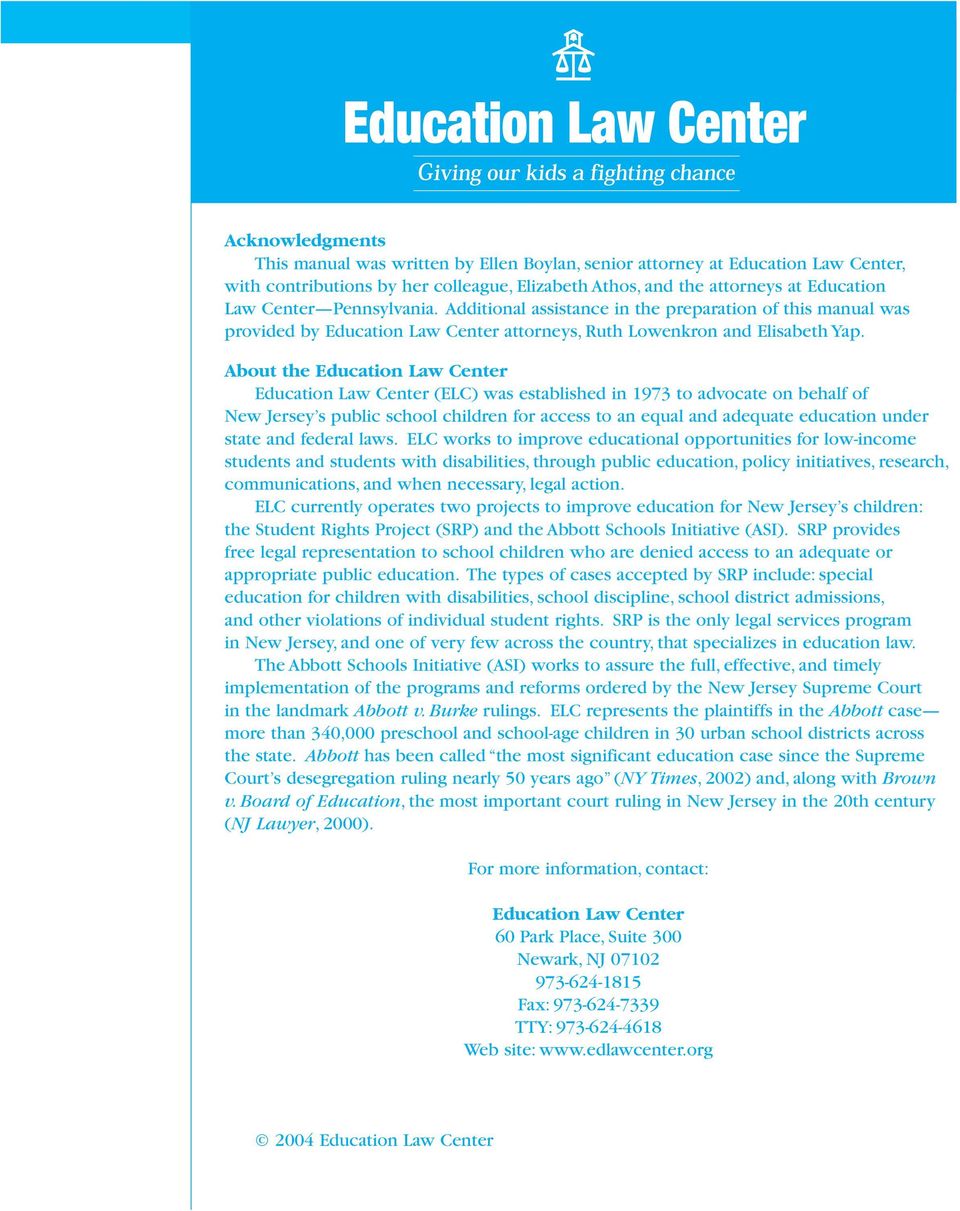
3 TABLE OF CONTENTS 1 Introduction Children Covered by the Law The Right to a Free Appropriate Public Education (FAPE) The Right to Special Education The Right to Related Services The Right to the Least Restrictive Environment (LRE) and Inclusion The Right to Equal Treatment With Children Without Disabilities The Right to Participate in School Activities and Non-academic Classes The Right to Education in the State s Core Curriculum and Participation in Statewide Assessments The Right to a High School Diploma Responsibility for Providing a Free Appropriate Public Education The Child Study Team and Case Manager Identification and Referral of Children With Disabilities Parental Request for Evaluation Referral by School District Personnel Initial Referral Meeting and Decision to Evaluate Written Notice of Decision to Evaluate and Scope of Evaluation Parental Consent to Evaluate Evaluation and Re-Evaluation Initial Evaluations Written Evaluation Reports Consideration of Outside Reports and Evaluations Additional Requirements for a Child Suspected of Having a Specific Learning Disability Separate Requirements for a Child Suspected of Having a Speech-Language Disability Re-Evaluation Independent Evaluation Determining Eligibility for Special Education and Related Services The Right to an Individualized Education Program (IEP) The IEP Team The IEP Conference The Contents of an IEP Tips for Developing an IEP Approval of the IEP Implementation of an IEP The IEP of a Child Moving into a District
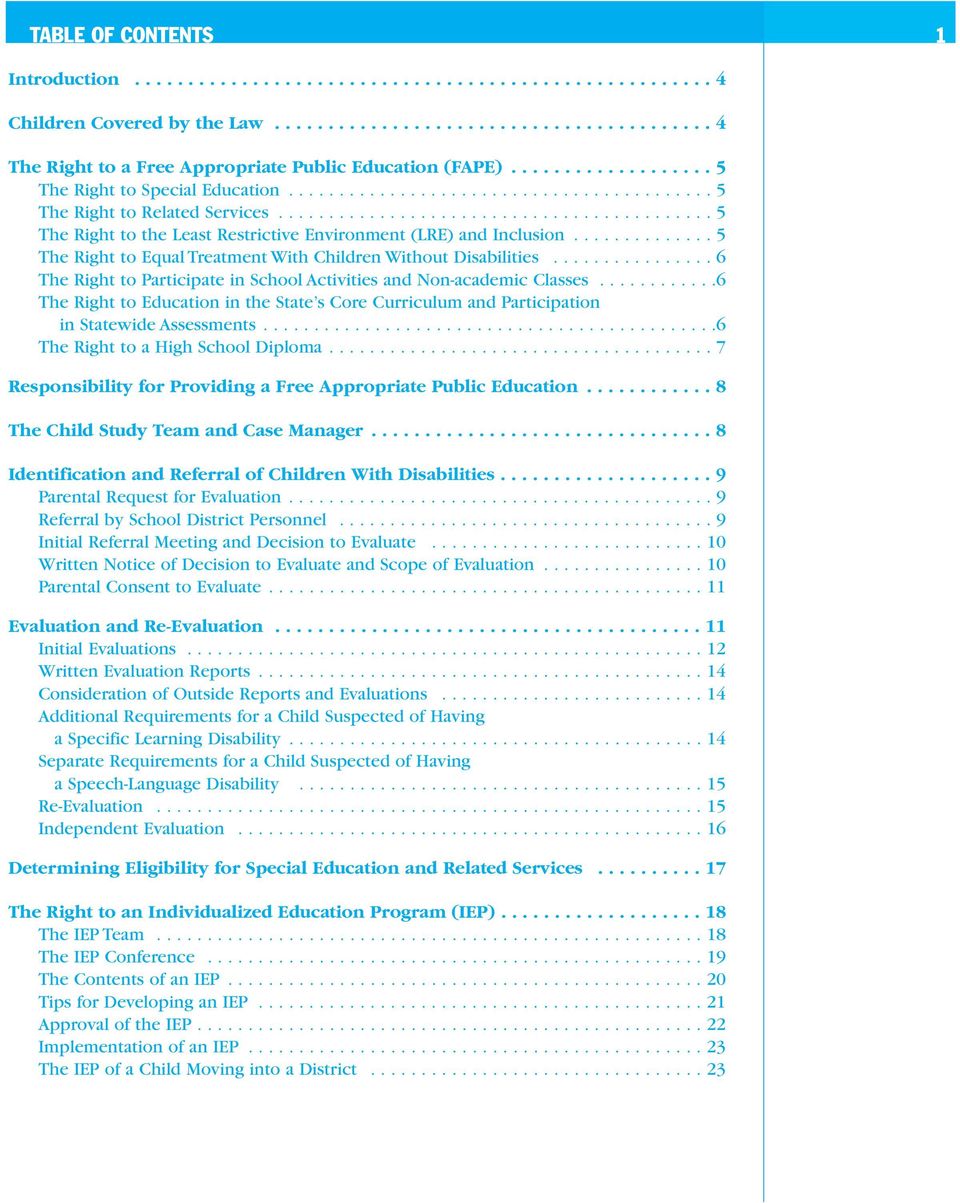
4 2 The Right to an Appropriate Placement in the Least Restrictive Environment.. 23 Determination of Location of Placement at the IEP Conference Notice of Placement and the Right to Disagree The Right to Placement in the Least Restrictive Environment Continuum of Placements Grouping Children by Learning Needs and Age Placement by Parent in a Private School The Right to Challenge School District Action The Right to Notice The Right to Bring a Complaint The Right to Stay Put During Complaint Resolution Administrative Due Process Hearing Requesting a Hearing Transmittal of Case to the Office of Administrative Law (OAL) Expedited Hearings in Discipline Cases The Right to Discover Evidence Prior to the Hearing Burden of Proof Specific Hearing Rights Emergency Relief Due Process Hearing Relief Mediation Requesting Mediation Conduct of Mediation Complaint Investigation Taking a Case to Court Hiring an Attorney and Experts for Mediation, Due Process, or Court The Right to Preschool Services Early Intervention Children From Birth to Three Years Old The Right to an Extended School Year Program The Right to Assistive Technology The Right to Transition Planning and Services The Rights of Adult Students The Right to See and Copy School Records The Rights of Children Whose Parents Are Unknown or Are Unavailable
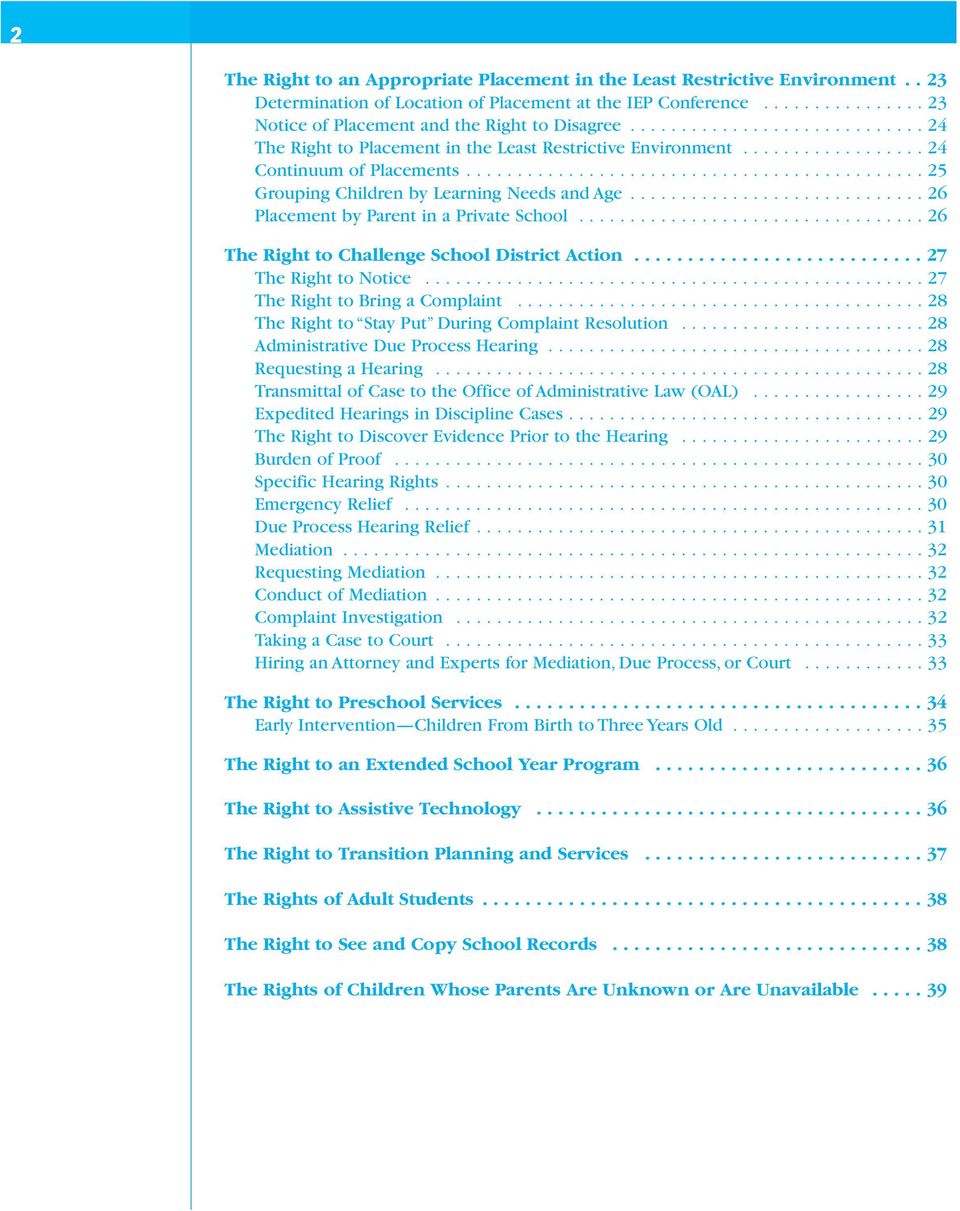
5 3 The Right to Special Protections in Discipline and Behavior Programs School District s Affirmative Obligation to Address Behavioral Problems Functional Behavioral Assessment and Behavioral Intervention Plan The Right to Stay Put During Discipline Proceedings Important Distinction Between Short-Term Suspension and Suspension as a Change in Placement Procedures and Services for Short-Term Suspensions Procedures and Services for a Change-in-Placement Suspension (Long-Term Removal or Expulsion) Parent Appeal of a Change-in-Placement Removal Students Not Yet Eligible for Special Education The Rights of Children in Out-of-District Placements Services for Parentally Placed Private School Students The Rights of Children in Charter Schools The Right to Educational Services and Accommodations Under Section Eligibility Under Section Discrimination Under Section Services Required Under Section Procedural Protections Reminder for Parents Glossary Appendix Appendix A: Legal Background Appendix B: State Regulations Defining Disability Categories Appendix C: Eligibility for Speech-Language Services in New Jersey Appendix D: Sample Parent Letter Requesting an Evaluation Appendix E: Sample Parent Letter Requesting a Re-Evaluation Appendix F: Sample Parent Letter Requesting an Independent Evaluation Appendix G: Sample Parent Letter Requesting IEP Services Appendix H:Advocacy and Information Resources Appendix I: List of New Jersey Department of Education County Supervisors of Child Study New Jersey Department of Education Request for Mediation/Due Process Hearing/Expedited Due Process Hearing New Jersey Department of Education Request for an Emergency Relief Hearing New Jersey Department of Education Request for Complaint Investigation End Notes
6 4 INTRODUCTION This manual is designed to help advocates, including parents, obtain special education for children with disabilities residing in New Jersey. The manual explains the requirements of the federal law governing special education, the Individuals with Disabilities Education Act (IDEA), and the New Jersey regulations implementing IDEA. In addition, the manual gives practical information about the special education system and advocacy within the system. The intent of this manual is to provide information and guidance to advocates so that all children with disabilities in the state learn at high standards and receive a meaningful education that prepares them for full participation in society. NOTE: As of January 2004, Congress is in the process of revising and reauthorizing IDEA. A new law that significantly changes a number of the rights discussed in this booklet is likely to be adopted and take effect sometime in CHILDREN COVERED BY THE LAW In order to be eligible for special education and related services under IDEA, and the rights and protections discussed in this manual, a child must be between the ages of three and 21 1 and meet the definition of a child with a disability. 2 The definition includes children with physical, emotional, learning and cognitive disabilities who, because of their condition, need special education and related services. The specific categories for a child with a disability in New Jersey are listed in this manual in Appendix B on p. 53. It is important to realize that a child who does not meet the definition of a child with a disability may still be entitled to assistance if he or she is having difficulty in school. Unless the nature of the child s educational problems indicate that he or she may have a disability, or the parent makes a written request for a special education evaluation, the school is required to first provide interventions in the general education program to students experiencing educational problems. 3 Each school must have a coordinated system for the planning and delivery of intervention and referral services designed to assist students who are experiencing learning, behavior or health difficulties and to assist staff who have difficulties in addressing the needs of those students. 4 Additionally, under Section 504 of the Rehabilitation Act 5 (Section 504), a child may be eligible for regular or special education and related aids and services that are designed to meet individual need if the child has an impairment which substantially limits a major life function. 6 Section 504 is discussed in more detail in this manual on p. 49. Further, a child whose native language is not English and who has trouble learning in English may be eligible for bilingual education or English language instruction. 7 Of course, a child who needs a bilingual program may also meet the definition of a child with a disability, and may be entitled to both types of programs.
7 THE RIGHT TO A FREE APPROPRIATE PUBLIC EDUCATION (FAPE) 5 Under IDEA, every child who meets the law s definition of a child with a disability is entitled to a free appropriate public education, 8 or FAPE, in the least restrictive environment. 9 The term FAPE is defined as special education and related services that: are provided at public expense, without charge to the parent, under public supervision and direction; meet the state s educational standards (as contained in state regulations and statutes for special education as well as general education, when applicable); comply with the child s individualized education program (IEP). 10 The Right to Special Education A FAPE includes an educational program that is individually designed to meet the child s unique educational needs, and that prepares the child for employment and independent living. 11 Such a program is called special education. Special education encompasses a wide range of program settings, instructional strategies, and educational interventions. While IDEA does not entitle a child to the best educational program available, it does require a school district to provide a child with a planned educational program that accounts for his or her disability, offers the opportunity for significant learning, and allows the child to make meaningful educational progress. 12 No child may be excluded from public school on the grounds that his or her disability is too severe to benefit from education. 13 The law recognizes that every child is able to learn, and requires educational opportunities to be provided for all. 14 The Right to Related Services In addition to a special education program, a FAPE includes related services. 15 Related services are developmental, corrective and other supportive services needed to help a child benefit from the education program. These can include transportation to and from school, or around the school building; physical therapy (PT), occupational therapy (OT), or speech/language therapy; counseling or psychological services; parent counseling and training; and school health services. 16 These items are examples of some related services; there may be other types of related services which a child needs in order to benefit from or have access to an education program. For example, the United States Supreme Court has deemed continuous, one-to-one nursing service to be a related service. 17 The services of a medical doctor, on the other hand, are not included except when necessary to determine the type of special education and related services the child needs. 18 Families may not be charged for related services, whether the school district provides them directly or through a private source. 19 IDEA requires a school district to provide a child with a planned educational program that accounts for his or her disability, offers the opportunity for significant learning, and allows the child to make meaningful educational progress. The Right to the Least Restrictive Environment (LRE) and Inclusion IDEA requires that children be educated in the least restrictive environment (LRE) possible, given their individual needs. 20 This means that they must have the opportunity to interact with, and be educated with, students who do not have disabilities, to the maximum extent appropriate. There is a strong preference in the law for educating children with disabilities in the general education classroom, with appropriate aids and services. A school district must have a full continuum or wide range of alternative placements available for children with disabilities, 21 starting with the general education classroom with supplementary aids and services. More restrictive placements include pull-out or resource programs for some academic subjects; special classes within the public school; special schools for children with disabilities; and, in some very limited situations where students

8 6 are too ill or impaired to attend school, home or bedside instruction. In all situations, placement must be provided in an appropriate educational setting as close to home as possible. 22 The right to an education in the least restrictive environment is discussed in more detail in this manual on p. 23. The Right to Equal Treatment With Children Without Disabilities Children with disabilities have a right to as long a school day and school year as children without disabilities. Classrooms and other facilities for children with disabilities must be in as good a condition generally as those that serve the rest of the students in a district. The school district must make sure that children with disabilities are not kept out of certain school programs because of physical barriers in the school building, such as stairs or narrow doorways. 23 To the maximum extent appropriate, children with disabilities must be educated in the general curriculum. The Right to Participate in School Activities and Non-academic Classes Children with disabilities are entitled to an equal opportunity to participate in nonacademic school courses or special programs, such as gym, art, music, home economics, vocational education, athletics, social and recreational programs, and extracurricular activities, available within the district to children without disabilities. 24 If necessary, the course or program must be adapted to meet the particular needs of students with disabilities. 25 The Right to Education in the State s Core Curriculum and Participation in Statewide Assessments To the maximum extent appropriate, children with disabilities must be educated in the general curriculum. 26 This means that, as appropriate, special education students must be provided with the same knowledge and learning as their non-disabled peers. All children in New Jersey are supposed to be taught to master the Core Curriculum Content Standards (CCCS). The CCCS are the state s educational standards for what public school children must learn in the various subject areas. 27 Children with disabilities must be taught the CCCS, unless the nature of their disability is so severe that such an education would not be appropriate. 28 For students with significant cognitive deficiencies, the New Jersey Department of Education has developed the Core Curriculum Content Standards for Students with Severe Disabilities (CCCSSSD). The CCCSSSD are based on the CCCS, with modified cumulative progress indicators for students who are learning functional living skills. The CCCS and the CCCSSSD are available from the New Jersey Department of Education and every school district, and are posted on the department s Web site under Standards and Assessments. Additionally, children with disabilities must participate in district and statewide assessments, or tests, based on the CCCS, with appropriate accommodations and modifications, unless the nature of the child s disability is so severe that the child is not receiving instruction in any of the areas and skills measured by the assessment. 29 Standard assessments can be very important tools for measuring whether a child with a disability is learning and progressing in his or her educational program, and in determining whether the educational program is appropriate. The IEP team, discussed in this manual on p.18, is responsible for determining the student s need for accommodations and modifications during the administration of standard assessments and for determining whether a particular student requires an alternate assessment. The New Jersey Department of Education has developed a list of accommodations and modifications for consideration by IEP teams, which is available on the department s Web site under Standards and Assessments, and has instructed that its Office of Assessment be contacted when a student requires an accommodation or modification that is not on the list.

9 7 Generally, a high school student with a disability who participates in the general curriculum must pass the High School Proficiency Assessment (HSPA) in order to receive a diploma, unless his or her IEP specifies exceptions to graduation requirements. If a student with a disability fails one or more sections of the HSPA and requires an alternate format to demonstrate the skills and knowledge measured by the assessment, the school district must allow the student to participate in a more individualized alternate assessment known as the the Special Review Assessment (SRA) for the HSPA. 30 Other alternate assessments are required to be provided to any child whose disability is so severe that he or she is not receiving instruction in the knowledge and skills measured by the HSPA, SRA, or other general district and statewide assessments. 31 The New Jersey Department of Education has developed the Alternate Proficiency Assessment, an alternate assessment based on the CCCSSSD which will measure the achievement of students with severe disabilities whose instruction is based on the CCCSSSD. However, there are currently many students with disabilities in the state whose instruction is not based on the CCCSSSD, but who are working significantly below grade level, and who have not received instruction in the knowledge and skills measured by statewide assessments based on the CCCS. In the short term, alternate assessments must be developed to measure the progress of those students, while over the long term, the quality of education to those students must be improved so that they are instructed in the knowledge and skills of the CCCS at an age appropriate grade level. The Right to a High School Diploma All children with disabilities in New Jersey have the right to earn a high school diploma. 32 They can earn a diploma by completing the same kind of courses and earning the same number of credits as non-special education students, and by passing the High School Proficiency Assessment. Alternatively, when their IEP specifies exceptions to certain graduation requirements, children with disabilities who are unable to participate in the general education curriculum may earn a high school diploma by completing the special education program set forth in their IEP. 33 Children with disabilities have the right to stay in school through the school year in which they turn 21, or until they graduate. 34 If a child accepts a high school diploma prior to age 21, the student is no longer entitled to a free public education. 35 However, if it can be shown that the school district failed to provide an appropriate educational program prior to issuing the diploma, the student may be entitled to additional compensatory education. See discussion of compensatory education on p. 31 of this manual. If a child is 18 or older and the school district believes that the child has completed his or her IEP and is eligible to graduate, the district must give the parent and the adult student written notice. 36 If the parent and student do not agree with this decision, they may begin mediation or due process procedures, 37 discussed in this manual on p. 28. The child must be allowed to continue in school until the procedures are completed, or the child is beyond the age of

10 8 RESPONSIBILITY FOR PROVIDING A FREE APPROPRIATE PUBLIC EDUCATION The school district where the child lives is responsible for making sure the child receives a free appropriate public education. 39 This includes children who have been placed by the Division of Youth and Family Services (DYFS) in foster and group homes within a school district. 40 If a child is in a residential state facility, or has been placed by a state agency (other than DYFS) in a group home, private school, or out-of-state facility, the present school district of the parent or legal guardian with whom the child lived immediately prior to the placement is responsible for the cost of the student s education. 41 The student, however, must be permitted to attend school in the district where he or she resides. 42 If it cannot be determined which school district has financial responsibility, or if the child s parent or guardian lives outside New Jersey, the state must assume responsibility for the child s education. 43 Under IDEA, the New Jersey Department of Education is ultimately responsible for assuring an appropriate education for all children with disabilities residing within the state. 44 This means that the state must have regulations and standards requiring local school districts to identify, evaluate, and provide appropriate education programs to children with disabilities. 45 The state must also monitor and enforce district compliance with its standards, and, if necessary, provide direct services to children with disabilities. 46 THE CHILD STUDY TEAM AND CASE MANAGER The child study team is the school district s professional staff responsible for providing services to children with disabilities. The child study team consists of a school psychologist, social worker, and learning disabilities teacher/consultant. 47 For children with a speech-language disability, the district s speech-language specialist acts as a member of the child study team. 48 All child study team members must be employees of a local board of education, and must have an established time during school hours when they are available. 49 The child study team is responsible together with the parent, the child s teachers, and other specialist(s) in the area(s) of disability for identification, evaluation, determination of eligibility of the child, development and review of the individualized education program (IEP), and placement of the child. 50 Child study team members may also deliver related services to children with disabilities and provide services, support and training to the general education staff who work with children with disabilities. 51 Not all members of the child study team are required to participate in each phase of service, although for some duties, such as deciding whether to conduct an initial evaluation of a child, all three members must participate. 52 A case manager must be assigned for each child with a disability. The case manager is designated when a decision is made to conduct an initial evaluation of a child suspected of having a disability. 53 A child study team member or, in the case of a child suspected or known to have a speech-language disability, a speech-language specialist, must serve as the case manager. 54 The case manager must be knowledgeable about the child s educational needs and program and about special education procedures and procedural protections. 55 The case manager is responsible for coordinating the development, monitoring, and evaluation of the effectiveness of the child s IEP; facilitating communication between the home and school; coordinating the annual review and reevaluation processes; and transition planning. 56
11 IDENTIFICATION AND REFERRAL OF CHILDREN WITH DISABILITIES 9 The law requires that all children (age three through 21) with disabilities, including those attending private schools, who are in need of special education and related services, be identified, located, and referred for evaluation. 57 This is known as the school district s child find obligation. 58 Each school district must have policies and procedures for locating, identifying, and evaluating children with disabilities, including those who are considered highly mobile, such as children whose parents are homeless or migrant farm workers. 59 The district s policies and procedures must provide for the referral of students who are having difficulty in school, including emotional and social difficulties. 60 The procedures must allow for referral by any member of the staff of the school district, including teachers, parents and outside agencies involved with the child. 61 The referral may be for a child study team evaluation to determine eligibility for special education and related services, or for some type of intervention in the general education program, such as remedial education services, counseling, or tutoring. 62 Parental Request for Evaluation The school district must refer the child for a special education evaluation when the parent or adult student makes a written request for a special education evaluation. A written parental request for evaluation is considered a formal referral for evaluation. 63 Once a request has been made, the district is required to make the referral, and may not attempt to make interventions in the general school program first. 64 The district s full child study team, that is, all three members, must handle a referral, with a speech-language specialist participating as a fourth member of the team for the initial referral of all preschoolers. 65 The parent should address the written request for evaluation to the school s child study team, with a copy to the district s director of special education or special services. The letter should be dated, and it should explain the nature of the child s difficulties and why the parent thinks the evaluation is needed. In addition, the parent should consider providing his or her written consent to the evaluation in this letter, since the granting of consent starts the clock for the implementation of services to an eligible child. See discussion of Parental Consent to Evaluate on p.11 of this manual. The parent should keep a copy of this letter for his or her records. A sample letter requesting an evaluation can be found in this manual on p. 57. Referral by School District Personnel When it is apparent from the nature of the child s educational problems that the student may have a disability, the child s teacher or other school district staff member must refer the child directly to the child study team for a special education evaluation. They may not try other interventions first. 66 On the other hand, if it is not clear that the student may have a disability, and the parent of the child has not requested a special education evaluation, the school district must try interventions in the general school program (e.g. instruction in basic math or reading skills, counseling with school psychologist or social worker) before referring the child for an evaluation. 67 School districts are required to adopt a multidisciplinary team approach for the planning and delivery of intervention and referral services in the general school program. Many school districts use a Pupil Assistance Committee (PAC) or Student Resource Committee (SRC), generally comprised of a teacher, guidance counselor, principal or vice principal and a child study team member, for this purpose. 68 It is important to remember that if a parent believes his or her child has a disability which requires an evaluation for special education, referral to the PAC or SRC is not an appropriate substitute for such an evaluation. The school district must refer the child for a special education evaluation when the parent or adult student makes a written request for a special education evaluation.

12 10 If the interventions in the general school program do not remedy the child s school problems, then the district must refer the child for a special education evaluation. 69 Also, once a written parental request for evaluation is submitted, the school district cannot refer the child to the PAC or SRC, and must make the referral directly to the child study team. 70 It is important that a teacher familiar with the child s classroom performance participate in the meeting, and a parent has the right to insist that the child s general education teacher be present. Initial Referral Meeting and Decision to Evaluate Within 20 calendar days (excluding school holidays but not summer vacation) of the school district receiving a written parental request for an initial evaluation or a referral for an initial evaluation by school district staff, the full child study team must hold a meeting with the parent and the general education teacher who is knowledgeable about the student s educational performance to determine whether an evaluation is warranted. 71 It is important that a teacher familiar with the child s classroom performance participate in the meeting, and a parent has the right to insist that the child s general education teacher be present. Additionally, if the referral identifies a suspected language disability, or the referral is for a preschool age child (three to five years), the district s speech-language specialist must attend the initial referral meeting as well. 72 If this group the parent, child study team members, regular education teacher and, depending on the age of the child and the suspected disability, the speech-language specialist decides that an evaluation is needed, it must then decide the nature and the scope of the evaluation. 73 The types of evaluations which are required, and those which may be conducted at the parent or child study team s request, are discussed in this manual on p. 12. Note that if the referral involves evaluation for a suspected speech disability involving disorder of voice, articulation and/or fluency only, as compared to a suspected languagebased disability, the full child study team is not required to participate in the referral meeting. Rather, the decisions about the evaluation are to be made at a meeting with the district s speech-language specialist, a general education teacher who has knowledge of the child s educational performance, and the parent. 74 If, in the course of the meeting or in the process of evaluating the child, the speech-language specialist suspects or finds that the child has a more significant language-based disorder which impacts on his or her ability to learn, the child must be referred for a child study team evaluation. 75 Written Notice of Decision to Evaluate and Scope of Evaluation Within 15 calendar days of the referral meeting, and at least 15 calendar days before conducting the evaluation, the child study team, or the speech-language specialist, must provide the parent with written notice specifying whether an evaluation will be done and the types of evaluations to be performed. 76 The time period specified in the notice for commencing the evaluation may be shortened to fewer than 15 days, provided the parent consents in writing to the evaluation starting sooner. 77 An evaluation notice must be provided even if the parent was the one who requested the evaluation and participated in the referral meeting discussed above. The notice must conform to the notice requirements discussed in this manual on p. 27. If a parent does not agree with the school district s decisions about the evaluation whether or not to evaluate or the types of evaluations to be performed he or she can request a mediation conference or due process hearing to contest the action and attempt to change the district s decisions. 78 Mediation and due process are discussed in this manual on p. 28. A parent who disagrees with a district s decision to conduct an initial evaluation of his or her child can refuse consent, 79 as discussed below.
13 11 Parental Consent to Evaluate Within the same time period for written notice regarding the evaluation within 15 calendar days of the referral meeting and at least 15 calendar days before conducting the evaluation the child study team or speech-language specialist must obtain the parent s written consent to the evaluation. 80 A parent can agree that the evaluation can begin sooner than within 15 days of the written consent, but, again, this agreement must be in writing. 81 The date of the written consent is very important because the school district is required to implement the child s special education program within 90 days of this date. This means that within 90 days of the written consent, the child study team and any other professionals involved with the child must complete the evaluations; the parent, child s teacher, child study team, and other involved professionals must develop an Individualized Education Program (IEP) and determine an appropriate placement; and the child must be attending the program and receiving the services called for in his or her IEP. 82 If the parent refuses to provide written consent for an evaluation of the child, the school board may request a due process hearing before an administrative law judge seeking an administrative order allowing it to proceed with the evaluation. 83 The school board must prove at the hearing that an initial evaluation is warranted due to the child s academic or behavioral difficulties. Due process hearings are discussed in this manual on p. 28. A school board is prohibited from conducting an initial evaluation of a child unless it obtains either parental consent or an administrative order allowing the evaluation. 84 EVALUATION AND RE-EVALUATION Before a child is placed in a special education program or provided with related services, he or she must be tested and observed by the school district s child study team and, depending on the nature of the suspected disability, other outside professionals at no cost to the parent. 85 In the case of a child with a suspected language disorder, a speechlanguage specialist must also evaluate the child. 86 The process of testing and observation is known as evaluation. Its purpose is to gather information about the child from many different points of view. This information will then be used to decide whether the child has a disability and needs special education and related services. 87 The evaluation results will also be part of the basis for designing the child s educational program, including the extent to which the child will participate in the general education curriculum. 88 The evaluation must also decide what additions or modifications to the special or general education program are needed to help the child meet his or her annual goals, and to take part in and progress in the general curriculum. 89 It is important, then, that an evaluation determine the child s strengths as well as areas of difficulty, his or her learning style, the types of instruction that would be successful with the child and the styles that have been tried and have not worked. Evaluations must take account of the child s English language skills and ethnic background, so that the testing and evaluation are not racially or culturally biased. 90 For example, a child who does not speak English must be evaluated by someone who speaks the child s language. 91 Testing must also take account of a child s disability to assure that the testing is fair. 92 For example, a child who has a severe visual problem should not be given a written intelligence test.
14 12 Before a child is placed in a special education program or provided with related services, he or she must be tested and observed by the school district s child study team and, depending on the nature of the suspected disability, other outside professionals at no cost to the parent. Initial Evaluations All children referred for an evaluation must receive hearing and vision screening conducted by the school nurse. 93 Additionally, upon receipt of a written referral for evaluation, the school nurse must review and summarize the available health and medical information for the child, including information provided by the parent, and send the summary to the child study team to determine whether the child needs a health appraisal or specialized medical evaluation. 94 As discussed in this manual on p. 10, upon receipt of a referral by a school staff member or a request for an evaluation by the child s parent, the child study team must convene a meeting with the parent and the child s regular education teacher to decide whether the child should be evaluated for special education and the nature and scope of the evaluations to be performed. 95 If this group decides that a special education evaluation is warranted, they then must decide what type of evaluations will be conducted. 96 In determining the nature and scope of the evaluation, the child study team, parent, and general education teacher must review all existing evaluation data, including evaluations and information provided by the parent, current classroom-based assessments, and observations of teachers and related service providers. 97 The initial evaluation must be comprehensive and individual. 98 The child must be assessed in all areas related to the suspected disability, including, if appropriate, health, social and emotional status, general intelligence, academic performance, communicative status, and motor abilities. 99 The child study team, parent, and general education teacher must consider the health summary provided by the school nurse, as discussed above, and determine the child s need for a general health appraisal (physical exam) or specialized medical evaluation, such as neurological or psychiatric assessment. 100 The initial evaluation must include assessment by at least two members of the child study team, and other specialists as deemed necessary. 101 The parent, general education teacher and child study team members decide together which members of the child study team the school psychologist, school social worker, and learning disabilities teacher/consultant will conduct the evaluation and what, if any, additional evaluations are needed depending on the nature of the child s suspected disability. 102 In addition, the state special education code mandates a specialized assessment for some categories of disability. For example, an evaluation by a physician trained in neurodevelopmental assessment is required for a child suspected of having autism, 103 and an evaluation by a specialist qualified to determine a visual disability is required for a student suspected of having a visual impairment. 104 The different categories of eligibility for special education and the requirements for each category are listed in this manual in Appendix B on p. 53. If a child has not had regular and thorough pediatric examinations, the parent should insist that the district arrange and pay for a comprehensive medical assessment. The purpose of this assessment is to detect any medical cause for the child s learning or behavioral difficulty in school. Further, it is important that a parent insist that his or her child be evaluated and examined by experts in all suspected areas of disability. For example, if a parent suspects that his or her child may have attention deficit hyperactivity disorder (ADHD), the parent should insist that the child be evaluated by a neurologist or a neuropsychiatrist/psychologist experienced in assessing neurologically-based disorders. An assessment by an expert in the field of the suspected disability will confirm or rule out the suspected disability. If the disability is confirmed, the assessment should also include a plan and specific strategies for an appropriate educational program, which targets the educational and behavioral needs of the child.

15 13 The initial evaluation must identify all of the child s special education and related services needs, not just the needs related to the child s suspected disability category. 105 For example, school staff may suspect that a child has a specific learning disability such as dyslexia, and plan to evaluate the nature and extent of the reading disorder through a variety of standardized tests, clinical and classroom observations, and parent and teacher interviews. However, due to frustration related to the reading disorder, the student has developed behavioral problems in school which must be addressed through an educational program in order for the child to learn. The initial evaluation must then also identify and assess the child s need for behavioral interventions. The child study team cannot use a single test or procedure as the only basis for determining whether the child has a disability, or for determining an appropriate educational program for the child. 106 A variety of assessment tools and strategies must be used to gather information about the child s development and level of functioning, including information about how the child can be involved in and progress in the general school curriculum. 107 Information provided by the parent regarding development and functioning is an important assessment tool, and must be considered by the child study team. 108 Standardized tests given to a child as part of an evaluation must be individually administered, validated for the specific purpose for which they are used, and administered by trained and knowledgeable school staff. 109 The evaluators must select tests which assess specific areas of educational need, such as reading comprehension and auditory processing skills, rather than merely provide a single general intelligence quotient (IQ). 110 An initial evaluation must also include a functional assessment of academic performance. 111 If behavior is a problem for a student, then a functional behavioral assessment must also take place. 112 A functional assessment is a study of how the student is actually doing in school, and includes the following parts: a structured observation by at least one evaluator in a setting outside the testing environment; an interview with the child s parents; an interview with the teacher who referred the child for evaluation; a review of the child s developmental and educational history, including records; a review of classroom interventions tried and documented by the classroom teacher and others who work with the child; and one or more informal measures, such as an analysis of the student s work, trial teaching methods, a self report (the child s own report of how he or she is doing), and curriculum-based assessments. 113 In addition to being technically sound, the assessment tools and strategies chosen by the child study team must take into account the influence of cognitive and behavioral factors as well as physical and developmental factors. 114 The assessment tools and strategies must provide relevant information that directly assists the child study team and parent in determining the educational needs of the child. 115 It is important to remember that an initial evaluation must include information related to the involvement and progression of the child in the general curriculum. 116 The evaluation must address additions and modifications to both the general education and special education programs which would allow the child to be educated in the least restrictive environment. 117 Finally, beginning at age 14, or younger if appropriate, the evaluation of a student with a disability must include assessment(s) to determine appropriate post-secondary outcomes, that is, an assessment of what the student is capable of doing, and wants to do, after high school. See discussion of Transition Planning and Services on p.37 of this manual. The initial evaluation must identify all of the child s special education and related services needs, not just the needs related to the child s suspected disability category.
16 14 EVALUATION AND RE-EVALUATION Written Evaluation Reports All child study team members and other specialists conducting an assessment of the child must prepare a written report of the results of the evaluation. 118 The report may be done either collaboratively by the evaluators, or each individual evaluator may prepare his or her own report. 119 The reports must be dated and signed by the evaluator, and must contain, at a minimum, the following information: (1) an appraisal of the child s current level of functioning and an analysis of how that functioning impacts on instruction; and (2) a statement of relevant behavior of the child, either reported or observed, and the relationship of the behavior to the student s academic performance. 120 Additionally, each member of the team determining eligibility of the child must certify in writing whether the evaluation report(s) reflect his or her own conclusions; any team member who disagrees with a report must submit a separate statement presenting his or her conclusions. 121 A parent must be provided with a copy of the evaluation report(s) and documentation and information that will be used for a determination of a child s eligibility for special education and related services, at least 10 calendar days before the eligibility determination meeting is held. 122 It is very important that the parent read all evaluation reports before the meetings to determine the child s eligibility and to develop the child s IEP. These meetings are discussed in this manual on pp In addition to evaluation reports, a parent has the right to copies of all school records, discussed in this manual on p. 38. Consideration of Outside Reports and Evaluations As part of the evaluation process, the child study team, parent, and other professionals involved in determining the child s eligibility for services and designing his or her IEP, must consider any independent evaluations and reports obtained by the parent or the school district. 123 If the child study team accepts an outside report, it must note the acceptance in writing, and the outside report will become part of the school district s records for the child. 124 If the child study team rejects a report or part of a report, the team must give the parent a written statement explaining the reasons for rejection. 125 Additional Requirements for a Child Suspected of Having a Specific Learning Disability The definition of the eligibility category specific learning disability can be found in this manual in Appendix B on p. 55. When a parent, teacher and child study team members suspect a child has a specific learning disability, there are requirements in addition to those discussed above for an initial evaluation. First, at least one person qualified to conduct individual diagnostic examinations of children, such as a school psychologist, speech-language pathologist, or remedial reading teacher, must evaluate the child. 126 Second, the structured observation required as a part of the functional assessment must be of the child s academic performance in the general classroom. 127 In other words, at least one member of the child study team must observe the child in the classroom setting and assess how he or she is doing academically. Third, if the child does not have a general education teacher who is familiar with his or her work, a general classroom education teacher qualified to teach a child of his or her age must participate on the team determining the student s eligibility. 128 See discussion of Determining Eligibility for Special Education and Related Services on p. 17 of this manual. Finally, whenever a student is suspected of having a specific learning disability, the report documenting the determination of eligibility for the student must include

17 15 a statement of whether the child has a specific learning disability, the basis for the determination, observation of the child s behavior, the relationship of the behavior to the child s academic functioning, educationally relevant medical findings, whether there is a severe discrepancy between achievement and ability that is not correctable without special education and related services, and the determination concerning the effects of environmental, cultural, or economic disadvantage. 129 Each member of the team determining the student s eligibility, which includes the student s parent and teacher, 130 must certify in writing whether the report reflects his or her conclusion and, if it does not, must submit a separate statement presenting his or her conclusion. 131 Separate Requirements for a Child Suspected of Having a Speech-Language Disability A child suspected of having a speech disorder related to articulation, voice or fluency is evaluated by the school district s speech-language specialist, rather than members of the child study team. 132 Similar to the process described above, the speech-language specialist must convene a meeting with the parent and the child s classroom teacher to review existing information and evaluations, current classroom-based assessments, and observations of the parent and teacher. 133 The speech-language specialist must obtain parental consent to evaluate and conduct an assessment of the child, in accordance with the requirements for a special education evaluation discussed above. 134 The evaluation must also include information from the classroom teacher regarding the educational impact created by the speech problem. 135 The specialist must prepare a written report of the results of the assessment. 136 If, in the course of evaluating the child, the speechlanguage specialist determines that the student has a more significant language-based disorder, which impacts on his or her ability to learn, the child must be referred for a child study team evaluation. 137 Re-Evaluation Every student receiving special education services must be re-evaluated within three years of the previous classification as eligible for special education. 138 In other words, once a child is deemed eligible for special education, the CST must conduct a reevaluation every three years to determine whether the student continues to have a disability that renders him or her eligible for special education and related services. A re-evaluation must be conducted sooner than three years if: a) the district is considering declassifying the child as eligible for special education or changing the disability category that serves as the basis of eligibility; 139 b) a teacher or parent requests it; 140 or c) when conditions warrant, such as when a significant change in placement is proposed. 141 A district does not have to re-evaluate a child who is no longer eligible for special education because he or she has graduated with a diploma or exceeds the age of If a parent believes that a special education program is not working for his or her child, it may be useful to obtain a re-evaluation before the three-year period has lapsed to help determine what program changes should be made. The IEP team, discussed in this manual on p. 18, must meet to review existing evaluation data. 143 The re-evaluation does not have to include testing to determine if the student continues to fall under the category of a child with a disability. 144 If no such testing is proposed by the child study team, the team must inform the parent in writing, and indicate that the parent has the right to request additional testing and assessments to determine if the child remains eligible for special education. 145 The child study team must conduct the additional assessment if requested by the child s parent. 146
18 16...once a child is deemed eligible for special education, the CST must conduct a re-evaluation every three years to determine whether the student continues to have a disability that renders him or her eligible for special education and related services. Like the initial evaluation, a re-evaluation must be thorough enough to determine if the child should continue in special education and what changes, if any, should be made to the child s program or related services. Similarly, the re-evaluation must include a review of all testing and assessments, information from the parent, classroom observations, and the observations of teachers and related service personnel. 147 The re-evaluation must also decide what additions or modifications are needed to help the child meet his or her goals and take part in and progress in the general curriculum. 148 A parent who wants a re-evaluation should send his or her request in writing to the child s case manager, with a copy to the district s director of special education or special services. The child study team must complete the re-evaluation without delay. 149 A parent who wants additional testing or assessments should submit his or her request in writing to the case manager. A parent has the right to request mediation or a due process hearing to resolve any dispute regarding the scope of the re-evaluation and additional testing and assessment. 150 Independent Evaluation A parent has the right to obtain evaluations from professionals outside the school system and submit them to the child study team. 151 These reports are called independent evaluations, and are sometimes referred to as expert reports. The child study team must consider the results of any independent evaluations or expert reports the parent submits. 152 See the discussion on p. 14 of this manual. A parent also has the right to request that the school system pay for an independent evaluation of his or her child if he or she disagrees with the district s evaluation. 153 A request for an independent evaluation at the school district s expense should be made in writing 154 and should be submitted to the case manager, with a copy to the director of special education or special services. A parent is not required to provide a reason for requesting an independent evaluation. 155 A sample letter requesting an independent evaluation is on p. 59 of this manual. Upon receipt of the parent s request for an independent evaluation at school district expense, school officials must provide the parent with information about where an independent evaluation may be obtained and the criteria applicable to all independent evaluators. 156 Within 20 calendar days of receipt of the parent s request, the district must let the parent know whether it agrees to pay for an independent evaluation. 157 A school district cannot deny the parent s request unless it files for a due process hearing and proves to an administrative law judge that its evaluation is appropriate. 158 While a school district must provide a parent with information about where an independent evaluation may be obtained, it cannot dictate where the evaluation must be performed. It is wrong for a district to send the parent a list of only a few independent evaluators and limit the parent s choice. The district should provide the parent with information regarding all qualified evaluators within the geographic area. An independent educational evaluation may be obtained from a clinic or agency approved by the New Jersey Department of Education, a private practitioner who is certified and licensed (where a license is required), another public school district, or an

19 17 educational service commission or jointure commission. 159 An independent medical evaluation may be obtained from a licensed physician, clinic or hospital. 160 The independent evaluator cannot be employed by the district. 161 It is improper for a district to refer the parent to an agency or evaluator with which it has a contractual relationship. Whether an independent evaluation is paid for by the school district or is obtained at the parent s own expense without asking the school district, the independent evaluator selected should understand the eligibility rules for special education and related services. It is important that the independent evaluation comply with the evaluation requirements which child study teams must follow, 162 as discussed in this manual at p. 13. For example, the independent evaluator must perform a functional assessment, 163 interview the child s classroom teacher and parent, 164 and observe the child in a non-testing setting. 165 The parent should specifically request that the independent evaluator visit the child s current classroom and observe any program being recommended by the school district. Additionally, the parent should make clear to the independent evaluator that he or she expects the evaluation to contain specific program recommendations, not only as to class type and program setting, but also regarding particular services, program modifications and accommodations needed by the child. Regarding related services, the independent evaluator should address the following in the report: the types of services needed by the student; where the services should be provided; how often the child should receive the services; how long each service session should be; the group size in which the services should be provided; and why the services are needed to help the child benefit from the proposed educational program. A parent also has the right to request that the school system pay for an independent evaluation of his or her child if he or she disagrees with the district s evaluation. DETERMINING ELIGIBILITY FOR SPECIAL EDUCATION AND RELATED SERVICES Eligibility for special education and related services must be determined collaboratively by the participants at the eligibility meeting. 166 The following individuals are required to attend the initial eligibility meeting: The parent. The student, where appropriate. At least one of the child s regular education teachers. At least one member of the child study team who participated in the evaluation. The case manager. Other individuals who the parent or school district want to attend. Certified school personnel (classroom teacher, special education teacher) who referred the child as potentially disabled or the school principal or designee if they choose to participate. When eligibility for speech-language services only is being considered, the speechlanguage specialist who conducted the evaluation shall be considered a child study team member at the eligibility meeting. 167
20 18 A child is eligible for special education and related services if he or she has one or more of the disabilities defined in the state code, (see Appendix B on p. 53 of this manual); the disability adversely affects the child s educational performance; and the child is in need of special education and related services. 168 Classification as eligible for special education and related services must be based on all evaluations of the child, including child study team and independent assessments. 169 A child cannot be determined eligible for special education if his or her school difficulties are based primarily on lack of instruction in reading or math, or limited English proficiency. 170 The school district must send the parent written notice of the eligibility team s determination, which explains the parent s right to disagree and request mediation or a special education due process hearing. 171 The notice requirements are described in this manual on p. 27. A district cannot provide a child with special education and related services unless the parent consents to the initial implementation of those services. 172 See the discussion on p. 19 of this manual. THE RIGHT TO AN INDIVIDUALIZED EDUCATION PROGRAM (IEP) The IEP is developed at a conference by a team that includes the child s parent as an equal partner with the child study team and other professionals. Before a student can receive special education and related services, he or she must have an IEP in place. 173 The IEP is a written plan that sets forth the special education programs and services the child will receive. 174 The IEP is developed at a conference by a team that includes the child s parent as an equal partner with the child study team and other professionals. 175 The educational plan should be based on observations and recommendations by people who know the child well, such as a parent and teacher, and objective information from the various tests and assessments conducted as part of the evaluation process. 176 The IEP includes information about the child s present levels of performance on various tests and measures. 177 It also includes information about the child s educational goals and objectives. 178 Additionally, the IEP must include ways for parents and educators to measure the child s progress toward these goals and objectives. 179 An IEP must include all the programs and services necessary to meet the child s individual needs as identified during the evaluation and re-evaluation process. 180 Once the IEP is developed, school officials must make sure the child receives all the programs and services listed in the IEP. 181 The IEP Team The child s IEP is developed and reviewed collaboratively at a meeting of the IEP team, which includes the child s parents as equal partners. 182 Each IEP team must include: The child s parents. At least one of the child s general education teachers, if the child is or may be participating in the general education classroom.while not all of the child s general education teachers must attend the meeting, their input into the child s educational program should be sought and documented, whether they are physically present or not. At least one of the child s special education teachers or, where appropriate, at least one special education provider who is familiar with the child s educational performance.
21 19 At least one child study team member who can interpret the instructional implications of the evaluation results. The case manager. A representative of the district board of education, who may be a child study team member, special education administrator or principal, and who (1) is qualified to provide or supervise special education; (2) is knowledgeable about the general education curriculum; and (3) is knowledgeable about the availability of the resources of the district board of education. The student, if over 18 or where appropriate, depending upon age and ability to participate. If the purpose of the meeting is to consider transition services, which are discussed in this manual on p. 37, the student and a representative of any other agency that is likely to be responsible for providing or paying for transition services must be invited to attend the IEP meeting. Any other person, who either the parent or school district wants to attend, who has knowledge or special expertise regarding the student. This may include related service personnel, or an attorney or advocate for the parent, although the presence of attorneys at IEP meetings is strongly discouraged by school districts. 183 The IEP Conference The law requires that the IEP be developed at a conference with the child s parents, and prohibits the child study team from deciding what the IEP will say before then. 184 The IEP conference must be scheduled within 30 calendar days of a determination that a child is eligible for special education and related services or speechlanguage services. 185 The conference must be scheduled at a time and place convenient to the parent and school officials. 186 The case manager must make every effort to ensure that the child s parent attends the IEP conference. 187 The parent must be notified in writing of the purpose, time and location of the conference and of the other people who will be invited to attend. 188 The parent must also be notified of all of his or her procedural rights. 189 The notice must be sent in the language used by the parent, 190 and must be sent early enough for the parent to make arrangements to attend the conference. 191 If the parent cannot attend the meeting, the case manager should arrange for parental participation by other means, such as by telephone conference. 192 Parents, as well as school officials, may tape record an IEP meeting. 193 If a parent anticipates disagreement with the school district, it may be a good idea to bring a friend or family member to take notes, offer support, and provide a different perspective. The conference must be conducted in the language used for communication by the parent, unless it is clearly not feasible to do so. 194 Foreign language interpreters or translators and sign language interpreters for people who are deaf must be provided by the school district at no cost to the parent. 195 At the end of the IEP conference, the parent will either be handed or mailed a copy of the IEP, 196 together with a notice which comports with the notice requirements discussed in this manual on p The parent must also be given written notice of the child s proposed placement. 198 A parent does not have to decide whether to approve or disapprove the IEP at the conference, and has 15 calendar days from the date of the district s written notice to make a decision. 199 If the IEP is the first one for the child, the parent must approve it in writing before it can be implemented. 200 The school district cannot implement an initial IEP without parental consent. 201 If the parent disagrees with the program or placement in future IEPs, he or she must request mediation or due A parent does not have to decide whether to approve or disapprove the IEP at the conference, and has 15 calendar days from the date of the district s written notice to make a decision.
22 20 process within 15 calendar days of the district s notice; if he or she fails to do so, the district may implement the IEP and placement, even without parental consent or a due process order. 202 The Contents of an IEP Each IEP must contain information from the following areas: The child s current levels of education performance, including how the student s disability affects his or her involvement in the general curriculum (if a preschool child, how the disability affects his or her participation in appropriate activities). The child s strengths as well as needs. The parent s concerns for improving the education of the child. The results of the initial or most recent evaluation of the child. The results of the child s performance on any general state or district-wide assessments. Measurable annual goals and short-term learning benchmarks that respond to the individual needs of the child, including those related to the child s participation and progression in the general curriculum and the state s Core Curriculum Content Standards, and goals to maintain and meet district standards with the child s peers. The specific special education services and programs to be provided to the child, including the anticipated frequency, location, and duration of services. The type, amount, frequency and group size of the related services needed by the child. The date services and programs will begin and how long they will continue. The tests and other procedures that will be used to tell if the child is achieving the annual goals and learning benchmarks. The amount of time the child will spend in programs and activities with students who do not have disabilities. An explanation of the extent, if any, to which the student will not participate with non-disabled students in the general education class and in extracurricular and non-academic activities. The supports, services, accommodations, and adjustments that will be provided to enable the child to progress in the general curriculum and participate in non-academic and extracurricular activities with non-disabled peers. Program modifications and support services provided to teachers and other school personnel to enable the child to reach goals and outcomes. Individual modifications in the administration of standardized assessments. If the child will not participate in standardized assessments, the reasons and an explanation of how the child will be assessed. The child s transition from an elementary program to a secondary program, including such factors as the child s age, the number of years in school, and social, academic, and vocational development. Beginning at age 14, or younger if appropriate, transition service needs, discussed on p. 37 of this manual. Beginning at age 16, or younger if appropriate, the needed transition services, discussed on p. 37 of this manual, including any inter-agency responsibilities. Beginning at age 15 or younger, how the child will be prepared to make his or her own IEP decisions at age 18. The state and local graduation requirements that the child will be expected to meet. If the child is provided an exemption from or modification to any graduation requirements, the basis of the exemption or modification and a description of alternate proficiencies to be achieved by the child in order to receive a state diploma.
23 21 A statement of how the student s progress toward annual goals will be measured. A statement of how the parent will be regularly informed of his or her child s progress toward annual goals. The person(s) responsible for ensuring that the child s services will be provided as required in the IEP. Other special factors, depending on the child s unique needs, including: Functional behavioral assessment and positive behavioral intervention, discussed on p. 40 of this manual, in the case of a child whose behavior impedes learning. Language needs in the case of a child with limited English proficiency. Communication needs in the case of a child who is deaf or hard of hearing. Instruction in the use of Braille in the case of a child who is blind or visually impaired. Assistive technology devices and services, discussed on p. 36 of this manual. Extended school year services, discussed on p. 36 of this manual. 203 Tips for Developing an IEP The following guidelines are designed to assist parents in working with the IEP team to develop a program that meets the needs of his or her child: Before the conference: 1. Read all evaluation reports and the child s school records before attending the IEP conference. Determine whether the reports contain sufficient objective test results to chart the child s progress or lack of progress since prior testing or, in the case of initial testing, to establish a baseline upon which to measure the child s future performance. 2. Note the areas of difficulty found in the evaluation reports and other problems seen in the home and outside of school. In other words, think of all of the educational issues that need to be addressed in the educational program. 3. Note the child s strengths and interests, and think about how these positive qualities can help him or her achieve certain educational goals. 4. Contact advocacy and information organizations to obtain and read information on developing effective IEPs, and on educational programs, teaching methods and strategies for children with the child s particular disability. A list of such organizations appears in this manual in Appendix H on p Think about what the child needs to learn and the kind of help the child needs in order to learn. In particular, think about what teaching methods work best, and what activities interest and motivate the child. 6. Review previous IEPs to determine the areas in which the child has met prior goals and objectives; consider new goals and objectives; for those goals and objectives that have not been met, consider different strategies, interventions and programs. 7. Consider consulting with outside experts about the child s educational needs and/or, if necessary, requesting an independent evaluation at public expense. See the discussion on p. 16 of this manual. 8. Review the school district s notice listing the participants invited to the meeting and make sure that everyone required to attend the meeting (see the discussion p.18 of this manual), or who has relevant knowledge or special expertise regarding the student has been included on the list of participants. If the child has had an independent evaluation at public expense, have the district make arrangements for a member of the independent evaluation team to be present at the conference.
24 22 At the conference: 1. Bring to the conference copies of the child s records, any notes and lists made and any other relevant information about the child. The law allows a parent to tape record an IEP conference, so a parent may wish to bring a tape recorder. 2. Make sure that each required element of the IEP, discussed in this manual on p. 20, is discussed, a specific decision is reached, and the element is written in detail in the IEP. 3. Make sure goals, objectives and benchmarks are specific and measurable. For example, an objective such as learn to read is too vague, because there will be no way to tell at the end of the year whether the objective has been achieved. If instead, the objective is stated as increase sight vocabulary from 46 words to 250 words, the reading teacher will be able to measure the child s improvement during the year. Insist that the child s progress toward IEP goals and objectives be measured by objective means, such as by testing, and not simply by subjective teacher observations. 4. Make sure development of the child s IEP starts with a clear understanding of the general curriculum that is required to be mastered by typical children of the same age. Remember that any deviations from the general curriculum must be justified. 5. Make sure the conference is conducted and the IEP is written in plain, understandable language. 6. Participate in the discussion by contributing what is known about the child s skills, interests, needs, strengths and weaknesses, and learning style. Speak your mind. 7. Question the school staff, such as classroom and special education teachers, about what teaching methods work best for the child. Insist that these teaching methods be included in the IEP. 8. If the team agrees on anything related to the child s program and services, insist that it be written into the IEP. For example, if one of the team participants suggests oneon-one speech services, three times a week for 30 minutes per session, and everyone on the IEP team agrees this is what is needed, the IEP must state precisely that this is what the child will receive. If a program and service is not specified in the IEP, the child has no right to that program and service, even if it was verbally agreed upon at the IEP conference. 9. Concentrate on the child s future education, and not past problems and mistakes made by the school and teachers. 10. Insist that the IEP be based on the child s unique learning needs. Do not accept an IEP that is a form checklist, or one that includes only a watered down version of general education goals and does not focus on the child s particular learning difficulties. 11. If school officials will not agree to what the parent wants, the parent should suggest moving on to the next issue so that the IEP is as complete and as close to what the parent wants as possible. 12. Be aware that the parent may bring to the conference, at his or her discretion, any individuals who have knowledge or special expertise regarding the student. Approval of the IEP Before the initial IEP can go into effect, the parent must approve it. 204 A parent will be asked to certify in writing that he or she participated in the IEP conference, and that he or she approves of the program. 205 In general, a parent should not grant approval at the IEP conference. A parent should insist that he or she receive a hand-written copy of the draft IEP agreed to at the conference. The parent has the right to receive a copy of the IEP and
25 23 take it home to read over and think about. A parent should sign and return the IEP to the case manager only if he or she thinks the IEP is satisfactory. If a parent is doubtful about some aspect of the IEP, he or she should ask to meet with the IEP team again, and try to work out the differences. If the problems cannot be resolved, a parent has the right to refuse to approve the IEP. A school district cannot implement an initial IEP without the parent s signed approval. 206 A school district may implement any IEP after the first one, even without written parental consent, unless the parent requests mediation or due process within 15 calendar days of the date of written notice of the IEP. 207 If the parent requests mediation or due process within 15 calendar days, the student remains in his or her current educational placement during the pendency of the proceedings. 208 See the discussion of stay-put on p. 41 of this manual. Implementation of an IEP The IEP must be implemented as soon as possible after the IEP meeting, 209 and no later than 90 calendar days from the parent s written consent to evaluation. 210 Each of the child s teachers, including all general education teachers, must be informed of his or her responsibilities related to implementing the child s IEP and specific accommodations, modifications and supports that are necessary for the child to participate in the general education curriculum. 211 IEP conferences must be held for each classified child at least once a year. 212 Additional conferences must be held if a member of the IEP team such as the parent requests an IEP conference. 213 The IEP must be revised as needed. 214 The IEP of a Child Moving into a District When the child moves from one New Jersey school district to another, or from an out-of-state school district to a New Jersey school district, the IEP moves with the child and generally must be followed by the new school district, unless the parent and the district agree to a change. 215 If the new district disagrees with the existing IEP, and the parent does not agree to the changes proposed by the new district, the child must be educated with an interim IEP that is consistent with the existing IEP, until all disputes are resolved or a change is ordered by an administrative law judge. The IEP must be implemented as soon as possible after the IEP meeting, and within 90 calendar days of the parent s written consent to evaluation. THE RIGHT TO AN APPROPRIATE PLACEMENT IN THE LEAST RESTRICTIVE ENVIRONMENT The law requires that an IEP be developed for a child before it is decided where the program should be provided. 217 This is because, to be appropriate, the school placement must be able to implement the program and services described in the IEP. Often, school officials try to decide placement first, based on what is available, and want to discuss program issues later. A parent must insist on discussing placement issues only after all program issues in the IEP have been decided. The law requires that the education program and placement be tailored to the child, not the child to a prepackaged program and placement. 218 Determination of Location of Placement at IEP Conference The law requires that the IEP provide a statement of the location of special education and related services to be provided to the child. 219 The law also requires that a decision about the child s placement be made annually, be based on the child s IEP and be as close as possible to the child s home. 220 In New Jersey, the placement decision is made by the
26 24 IEP team. 221 The required members of the IEP team are discussed on p. 18 of this manual. The law requires that persons knowledgeable about the child, about the meaning of the evaluation data, and about the placement options be part of the IEP team that makes the placement decision. 222 Special classes, separate schooling or other removal from the general education classroom is allowed only when the nature or severity of the child s disability makes it impossible to satisfactorily educate the child in the regular classroom... Notice of Placement and the Right to Disagree The school district must provide the parent with written notice of the child s school and class placement 15 calendar days before implementation of the placement. 223 The district must also give the parent the opportunity to visit and observe the school placement prior to implementation. 224 If a parent does not agree to the placement, he or she can request mediation or due process within the 15 days, and the child then has the right to stay-put in the current educational program until the disagreement is resolved through the proceedings discussed in this manual on p If the parent does not request mediation or due process, the district can go ahead and implement the placement. 226 However, as discussed in this manual on p. 19, the district cannot implement a child s first special education placement without written parental consent. Even if a parent approved the program set out in the IEP, including the description of the type of class and school (for example, self-contained cognitively impaired class in an in-district public school ), the final placement still may not be appropriate for several reasons. For example, the placement may be at a school far from the child s home; the other children in the proposed class may not be within the child s age range; or the placement may be in a separate special education school and the parent believes his or her child should attend school in the same building with non-disabled students. To decide if a placement is appropriate, a parent should consider whether the classroom is appropriate; whether the school is appropriate; and whether the grouping of students is appropriate in view of the child s age and learning needs. If a parent believes the placement is inappropriate, he or she may request mediation or due process, as discussed in this manual on p. 28. The Right to Placement in the Least Restrictive Environment On the basis of the evaluations and the IEP, the IEP team must determine the type of school and program the child will attend. Every child is entitled to an appropriate program to be implemented in the least restrictive environment (LRE). 227 LRE means: To the maximum extent appropriate, a child with a disability is educated with children who are not disabled; this includes children placed in public or private out-of-district schools and public and private institutions. Special classes, separate schooling or other removal from the general education classroom is allowed only when the nature or severity of the child s disability makes it impossible to satisfactorily educate the child in the regular classroom, even with the use of supplementary aids and services. A full continuum of alternative placements is available to meet the needs of children with disabilities. Placement is determined at least annually, and on the basis of the child s IEP. Placement is provided as close to home as possible. The child must be educated in the school the student would attend if he or she did not have a disability, unless the IEP requires some other arrangement. To the maximum extent appropriate, a child with a disability participates with children without disabilities in non-academic and extracurricular services and programs, such as athletics, recreation, special interest groups and clubs, and lunch and recess periods. 228
27 25 When deciding LRE for a child, the IEP team must consider the following factors: What reasonable efforts the school district can make to accommodate the child in the general classroom with supplementary aids and services. A comparison of the benefits provided in a general classroom and the benefits provided in a special education class. The potentially beneficial and harmful effects which a placement may have on the child or other students in the class. 229 Continuum of Placements School districts must have available a full continuum of alternative placements to meet the needs of all children with disabilities. 230 In order of preference, the class possibilities are: General education classes with support services provided by a special or general education teacher within the class. General education classes with an in-class resource program and other related services. Pull-out resource programs and other related services. Self-contained special education program in the child s local school district, or, if applicable, in vocational or technical school; to the extent appropriate, must include the opportunity to participate with the general school population in specials, such as art, music and physical education. Self-contained special education program in another public school district; to the extent appropriate, must include the opportunity to participate with the general school population in specials, such as art, music, and physical education. A special education program in a county special services school district, educational service commission, or a jointure commission. A New Jersey-approved private school for children with disabilities, including residential schools, or an out-of-state school for children with disabilities approved by the department of education in the state in which the school is located. A school operated by a department of the New Jersey state government, such as the Department of Human Services day training programs for children with severe mental retardation. Community rehabilitation programs. Programs in hospitals or other medical institutions. Individual instruction in the child s home or other appropriate facility, with the approval of the state Department of Education. An accredited nonpublic school which is not specifically approved by the Department of Education for the education of children with disabilities. 231 The most preferred choice on the continuum of placements is a general education program, with supplementary aids and services. 232 Supplementary aids and services include, but are not limited to, modifying the curriculum and teaching strategies; team teaching (a general and special education teacher in one class for all or part of the day); specialized instructional strategies; assistive technology devices and services; teacher aides; and integrated and consultative related services. 233 Supports will vary from child to child, depending on individual need. Inclusive education requires creative thinking, as well as technical and other support for teachers. The most restrictive choice of placement is home instruction. 234 Under this arrangement, a certified teacher must see the student for a minimum of 10 hours per week, three times per week, usually at the child s home. 235 This type of placement is appropriate only on a temporary basis, and only to children whose needs cannot be met in any kind of The most preferred choice on the continuum of placements is a general education program, with supplementary aids and services.
28 26 school setting, such as a child with a serious medical condition who cannot leave home. Because it is a disfavored placement, the school district is required to obtain prior written approval from the Department of Education before placing a child on home instruction, and the department must review the placement every 60 days. 236 A school district may recommend placing a child in a private school, but only if no public program exists or can be developed. 237 Ordinarily, the child is placed in a day program at a state-approved special education school. Occasionally, a child is placed in an accredited private school which is not an approved special education school because it offers a program the child needs in order to make meaningful progress. Sometimes, a child is placed in a residential school, but only when he or she will otherwise be unable to make meaningful educational progress, or the only appropriate program is at a school so far away that daily transportation is not practical. Regardless of whether the child is placed in a day or residential program, or a non-special education school, once the school district agrees to the placement (or an administrative law judge in a due process hearing orders the placement), the program and all related services must be provided without charge to the parent. 238 Grouping Children by Learning Needs and Age Special class programs serve students who have similar educational needs in accordance with their IEPs. 239 New Jersey law establishes the following types of special education programs: Resource Programs: offer individual or small group instruction either in the general education classroom or in a pull-out resource room. A resource program may provide support instruction where the student is taught the general education curriculum for the grade and subject, with modifications to teaching strategies or testing procedures or replacement instruction where the general education curriculum is modified to meet the student s needs. 240 Auditory Impairment Programs Autism Programs Behavior Disabilities Programs Cognitive Impairment Programs (three levels: mild, moderate and severe) Learning and Language Disabilities Programs (two levels: mild to moderate and severe) Multiple Disabilities Programs Preschool Disabilities Programs Visual Impairment The maximum group sizes for special class and resource programs are set by state regulations. 242 For most, but not all programs, there are two maximum group sizes, with more children allowed in the group if the school district adds a paraprofessional or aide to the class. The age span in resource and special class programs cannot be greater than four years. 243 However, a school district may apply to the Department of Education s appropriate county office for an exception, on a case-by-case basis, allowing an increase in group size or age range for a period of up to one year. 244 All parents affected by a request for an exception are entitled to notice of the request, and may voice concerns or opposition to the county superintendent of education. 245 Placement by Parent in a Private School In a due process hearing, discussed in this manual on p. 28, an administrative law judge may order a school district to reimburse a parent for the cost of a private school placement if he or she finds that the school district did not offer FAPE in a timely manner, and that the child received an appropriate program at the private school. 246 A judge may determine a
29 27 parental placement is appropriate even if the school does not meet the state education standards that apply to local school districts. 247 In order to be awarded reimbursement at a due process hearing, a parent must generally prove that he or she gave her school district advance notice that he or she would be enrolling the child in private school and would be seeking reimbursement from the school district. 248 This notice can be given at the last IEP meeting, or in writing 10 business days before the parent removes the child from public school. 249 If a parent does not give this notice, if he or she refuses to let the school district evaluate the child, or if he or she otherwise acts unreasonably, an administrative law judge or court may deny or reduce a reimbursement request. 250 THE RIGHT TO CHALLENGE SCHOOL DISTRICT ACTION Even when a parent and school officials work hard and cooperatively to arrive at an appropriate IEP and placement for a child, there may be disagreements. Disagreements can occur at any stage in the special education process: whether the child should be evaluated, the types of evaluations to be performed, and what tests should be used; whether the child has a disability, and if so, which disability; what program and related services are needed and in what amounts; what placement is needed in order for the child to learn; and whether a child is making sufficient progress in a program and placement. Under federal and state laws, a parent not only has the right to disagree with school officials, he or she has the right to do something about it. These rights are called due process or procedural rights. 251 The Right to Notice The law requires that a parent be told about any actions or plans that school officials are considering for his or her child so that he or she can decide whether to agree or disagree. School officials must give written notice within 15 calendar days of making a decision about a child and at least 15 calendar days before implementing a proposed action whenever they want to initiate or change the identification, classification, evaluation, educational placement, or the provision of FAPE. 252 They must also give written notice within 20 calendar days of a written parental request for action, to let the parent know whether or not they are refusing to do something a parent has asked them to do; when an IEP team meeting is required to make a decision on a parent s request for action, the meeting must be held and a determination made within 20 calendar days of the parent s request, with written notice of the determination provided within 15 calendar days of the meeting. 253 All notices must be written in the language the parent uses, or be in the form of communication used by the parent (such as Braille). 254 The contents of the notice must be easily understood and not overly technical. 255 If a parent has trouble reading, school officials must help the parent understand the notice. Each notice must tell the parent what school officials want to do, or what they refuse to do; the reasons why; a description of the options that were considered and the reasons why those options were rejected; and any tests, records, or evaluations that were used by school officials to make their decisions. 256 The notice must tell the parent that he or she has procedural protections and how to obtain a copy of the Department of Education s pamphlet on procedural safeguards, Parental Rights in Special Education (PRISE). The notice must also provide the names of organizations from which a parent may receive assistance in understanding his or her rights and procedures under the special education laws.
30 28 Under IDEA and state laws, the parent of a child with a disability has the right to resolve a dispute with a school district through an impartial third person. Additionally, a school district must give a parent a copy of PRISE when his or her child is referred for initial evaluation or a re-evaluation is scheduled, whenever notice of an IEP meeting is given, and whenever a request for due process is submitted to the Department of Education. 257 Finally, a school district must provide a parent with a copy of the New Jersey administrative regulations pertaining to special education, N.J.A.C. 6A:14 and N.J.A.C. 1:6A, when a determination is made to conduct or not conduct an initial evaluation. 258 The Right to Bring a Complaint Under IDEA and state law, the parent of a child with a disability has the right to resolve a dispute with a school district through an impartial third person. A parent can bring a complaint over any issue relating to identification, evaluation, classification, educational placement, or the provision of FAPE. 259 IDEA and state law provide for three types of complaint resolution, all of which are discussed below: mediation; an administrative due process hearing, which can include a request for emergency relief; and complaint investigation. The New Jersey Department of Education has developed a form for requesting each type of complaint. These forms are located in the back of this manual. The Right to Stay Put During Complaint Resolution There can be no change in the classification, evaluation, IEP, or placement of a child once the parent has requested mediation or due process, provided the request was made in writing within 15 calendar days of the school district s written notice of a proposed action. 260 This is referred to as the child s right to stay put during the pendency of a dispute. The child s placement may change during the pendency of mediation or due process only if the parent and school district agree to a change, or an administrative law judge (ALJ) orders a change following an emergency relief hearing, discussed in this manual on p. 30. Otherwise, the child must remain in his or her current placement during the pendency of mediation and due process. Under certain limited situations involving discipline, discussed in this manual on p. 41, school officials may change the placement of the child without the protection of the stay put rule. Administrative Due Process Hearing A due process hearing is a formal, trial-like hearing before an ALJ at the New Jersey Office of Administrative Law (OAL). The ALJ in a due process hearing listens to and accepts evidence and legal arguments from both the parent and the school district. Within 45 days of the request for due process, the ALJ writes a formal written decision which must summarize the evidence in the case and explain the reasons for the decision. 261 The ALJ s decision is final and binding on both parties. 262 The decision must be implemented without delay, even if one of the parties files an appeal of the decision. 263 The New Jersey Department of Education has the authority to enforce a due process hearing decision. The parent and the school district each have the right to appeal an adverse decision to either the New Jersey Superior Court or federal district court. 264 Requesting a Hearing A parent may request a due process hearing to contest any school board action or inaction relating to the identification, evaluation, classification, educational placement, or the provision of FAPE to a child with a disability. 265 A school board may request a due process hearing when it is unable to obtain parental consent to conduct an initial evaluation or re-evaluation or to release student records. 266 The board of education must request a due process hearing when it denies a written parental request for an independent evaluation, 267 or seeks to remove a child from school on the grounds that the child is dangerous. 268 See the discussion in the discipline section of this manual on p. 46.
31 29 A due process hearing is requested by writing to the Director, Office of Special Education Programs, New Jersey Department of Education, PO Box 500,Trenton, New Jersey The request must include the student s name and address; the school the student attends; a description of the problem at issue, including relevant facts; a proposed resolution of the problem and the relief sought (see discussion of due process hearing relief on p. 31 of this manual). 270 The due process request must note that a copy of the request has been sent to the other party (the school board). 271 The New Jersey Department of Education s forms for requesting due process, mediation and an expedited hearing in a discipline case, discussed below, are in this manual on p There is no explicit time limit for seeking relief through due process, but it must be done within a reasonable time period. 273 A parent may request a due process hearing to contest any school board action or inaction. Transmittal of Case to the Office of Administrative Law (OAL) Upon receipt of a request for a due process hearing, the Department of Education s Office of Special Education Programs (OSEP) must, without delay, send written acknowledgment of the request, provide the parent with information regarding free and low-cost legal services and contact the parties to offer mediation. 274 If the parties agree to mediate the dispute, a mediation conference must be held within 10 calendar days. 275 See the discussion of mediation on p. 32 of this manual. If the mediation results in an agreement between the parent and school district, the agreement must be incorporated into a written agreement and signed by the parties, and the matter will be considered settled. 276 If the mediation does not result in an agreement, or if the parties do not consent to mediation, the OSEP representative must transmit the case to the OAL, and a hearing must be scheduled. 277 In all cases, the ALJ must render a final decision within 45 calendar days of the receipt of request for the due process hearing by OSEP, unless a specific adjournment is granted by the ALJ in response to a request by either party. 278 Expedited Hearings in Discipline Cases Due process hearings in student discipline disputes, discussed on p of this manual, are expedited.this means that the Department of Education must schedule the hearing within 10 days of the filing of the due process request, and no extension beyond the 45 days for final decision is allowed. 279 The expedited hearing procedures are not designed to provide a quick remedy to a student suffering immediate harm, such as a student improperly expelled from school, or inappropriately placed in an interim alternative educational setting. In order to receive immediate relief, a student suffering irreparable harm must also request an emergency relief hearing, as discussed on p. 30. The Right to Discover Evidence Prior to the Hearing While a party to a due process hearing does not have the right to the type of formal discovery normally allowed in court cases, such as formal interrogatories, formal admissions and depositions of witnesses, the parent and school officials may request information and records from each other prior to the hearing. 280 All responses to these requests must be completed no later than five business days before the hearing, and no later than two business days before an expedited hearing. 281 Each party to the hearing must disclose to the other party any documentary evidence and summaries of testimony intended to be introduced at the hearing. 282 This requirement includes the obligation to disclose all evaluations and expert recommendations that the party intends to use at the hearing. At the request of a party, the ALJ must exclude any evidence at a hearing which was not disclosed at least five business days before the hearing or at least two business days before an expedited hearing unless the ALJ decides that the evidence could not have been disclosed within that time. 283
32 30 The school board in a due process hearing bears the burden of proving the appropriateness of its actions, including the appropriateness of the child s IEP and compliance with IDEA s requirement of least restrictive environment. Burden of Proof The school board in a due process hearing bears the burden of proving the appropriateness of its actions, including the appropriateness of the child s IEP and compliance with IDEA s requirement of least restrictive environment. 284 There is no presumption of correctness for the school board s action. 285 However, in many cases, a parent will need expert testimony in order to rebut the school board s showing of appropriateness. Specific Hearing Rights In order to make sure that the due process hearing allows the parent to present his or her side of the disagreement effectively and fairly, IDEA and state law guarantee the following rights: The right to an impartial ALJ to conduct the hearing and make the decision. 286 The right to have the hearing scheduled at a time and place which is reasonably convenient to the parent. 287 The right to have a verbatim record of the hearing. 288 The right to see and make copies of all records the school district will present at the hearing at least five days before the hearing itself. 289 The right to be accompanied and advised by a lawyer and by individuals with special knowledge or training about children with disabilities. 290 The right to present documents, to call witnesses, and to cross-examine witnesses presented by the school board. 291 The right to prevent the school board from presenting evidence it did not provide at least five days before the hearing unless the ALJ finds that it could not have been disclosed. 292 The right to require any school official or employee with knowledge of the case to attend the hearing. 293 The right to receive the ALJ s decision and the reasons supporting it within 45 days of the request for due process. 294 The right to have the ALJ s decision carried out immediately, even if the school board loses and plans to appeal the decision, unless the school board can persuade a state or federal court judge that implementing the decision may be harmful to the child or other children. 295 Emergency Relief Emergency relief is available when a child needs a speedy resolution of a dispute in order to avoid some serious harm. 296 Emergency relief may be requested as part of a due process (or expedited due process) hearing request by completing the New Jersey Department of Education s Request for Emergency Relief form, located in the back of this manual. If the parent has already requested due process and the case has been transmitted to the OAL, a parent may request emergency relief through a written application to the ALJ. 297 A parent s request for emergency relief must be supported by an affidavit or notarized statement setting forth the basis for the request. 298 The parent must provide a copy of the request to the other party (the school board), and the request for emergency relief must note that a copy was sent. 299 To prevail in an application for emergency relief, a parent must prove: (1) the child will suffer irreparable harm if the relief is not granted; (2) the legal right underlying the child s claim is settled; (3) the child has a likelihood of prevailing on the merits of the underlying claim; and (4) when the equities and interests of the parties are balanced, the
33 31 child will suffer greater harm than the school board will suffer if the requested relief is not granted. 300 The most common way for a parent to demonstrate irreparable harm to the child is by showing that there has been an interruption or termination of educational services to a school-aged child. Although school districts also have the right to apply for emergency relief, they cannot obtain an emergent order to change a child s placement without satisfying IDEA s requirements for the removal of a dangerous child, discussed in this manual on p. 46. Due Process Hearing Relief A due process hearing provides a parent an opportunity to not only complain about what the school district has done wrong, but also to correct the district s action and remedy the harm caused to his or her child. It is important, therefore, that a parent entering into due process carefully consider the range of available remedies and specifically request the remedies he or she wants in the application for due process. IDEA provides that a court may grant such relief as [it] determines is appropriate, 301 but also requires that, in most cases, the parties first seek relief through an administrative due process hearing. 302 Some relief under IDEA namely monetary damages and attorney s fees is only available through court, but most relief is available in the first instance through a due process hearing. (Taking a Case to Court is discussed in this manual on p. 33.) For denials of FAPE,ALJs in New Jersey have awarded a broad scope of relief, appropriate under the particular circumstances. This relief includes: 1) prospective relief, such as orders identifying a child as one with a disability, amending an IEP to provide particular services to a child, or changing an educational placement; 2) compensatory education to make up for education lost when FAPE has been denied; and 3) reimbursement of costs incurred by parents (see, for example, Placement by Parent in a Private School, discussed in this manual on p. 26). The standard for when a child is entitled to compensatory education has been established for this part of the country by the Third Circuit Court of Appeals. According to the Third Circuit, a school district that knows or should know that a child has an inappropriate IEP or is not receiving more than a de minimus educational benefit must correct the situation. If it fails to do so, a disabled child is entitled to compensatory education for a period equal to the period of deprivation, but excluding the time reasonably required for the school district to rectify the problem. 303 Compensatory education can be provided during times when a child would otherwise not be receiving services under his or her IEP (such as during the summer or after school for a student who is not eligible for an extended school year, discussed on p. 36 of this manual) or by extending a child s eligibility for special education beyond the age of 21. Arguably, compensatory education can also be provided by increasing the intensity of services to a child under an IEP so that the child receives the best possible program now to compensate for an inappropriate program in the past. It has generally been recognized that ALJs do not have the authority to award monetary damages and attorney s fees in due process hearings. However, the Third Circuit has ruled that monetary damages in egregious IDEA cases may be sought through court. 304 See Taking a Case to Court, discussed on p. 33 of this manual. Parents may also file for reimbursement of attorney s and expert s fees in court if a school district refuses to pay those fees once a parent has prevailed at a due process hearing. See Hiring an Attorney and Experts for Mediation, Due Process or Court, discussed on p. 33 of this manual.
34 32 Mediation A parent has the option of first trying to resolve disputes through less formal mediation procedures before requesting due process. 305 Additionally, OSEP must offer mediation whenever a parent requests a due process hearing. 306 Mediation must be voluntary on the part of the parent and school board, although a school board may require a parent who chooses not to use the mediation process to meet with a state mediator, by telephone or electronic conference equipment, to discuss the benefits of mediation. 307 The state must bear the full cost of mediation, and a qualified and impartial mediator who is trained in effective mediation techniques must conduct the mediation. 308 Requesting Mediation A request for mediation is made in the same manner, and on the same form, as a request for due process. See the form located at the back of this manual. 309 In a complaint investigation, anyone, not just a parent or school board, may file a complaint with OSEP requesting an investigation and corrective action plan to remedy violations of federal or state laws and rules... Conduct of Mediation A mediation conference must be scheduled by OSEP within 10 days of receipt of the written request, and it must be held at a time and place convenient to all parties. 310 The mediator, who is an OSEP representative, does not reach a decision in the dispute, but rather assists the parties, in an impartial manner, in identifying issues and reaching an agreement. 311 If the mediation results in an agreement between the parties, the mediator will produce a written agreement to be signed by the parent and school officials. 312 If the mediation does not result in an agreement, the mediator will simply document the date and the participants in the meeting. No other record of the mediation will be made, and any discussion that occurred during the mediation must be confidential and not used as evidence in any subsequent due process or court proceeding. 313 Complaint Investigation IDEA also provides a complaint resolution procedure known as complaint investigation. In a complaint investigation, anyone not just a parent or school board may file a complaint with OSEP requesting an investigation and corrective action plan to remedy violations of federal or state laws and rules relating to special education and related services by a local school district or a private educational agency. 314 The complaint must set forth the complete factual basis for the alleged violation of federal or state laws and rules. 315 The complaint must also set forth the time period when the alleged violation occurred, which must be not more than one year prior to the date that the complaint is filed, unless a longer period is reasonable because the violation is continuing, or the complainant is requesting compensatory services for a violation that occurred not more than three years prior. 316 A signed complaint must be filed with the Director, Office of Special Education Programs, New Jersey Department of Education, PO Box 500,Trenton, New Jersey The New Jersey Department of Education s form for requesting a complaint investigation is located at the back of this manual. If the written complaint contains issues that are also the subject of a due process hearing, OSEP must set aside those issues until the conclusion of the due process hearing. 317 Further, if an issue raised in a complaint was previously decided in a due process hearing involving the same parties, OSEP must inform the complainant that the hearing decision is binding. 318 In all other cases, OSEP must conduct an independent investigation of the complaint. 319 Investigations are usually performed in conjunction with the Department of Education s county office. 320 The investigation must be conducted on-site, if necessary, and include the review of all relevant information, such as the school board s policies and procedures, student records, observation of programs, and interview of parents, teachers,
35 33 and other school staff. 321 OSEP must grant the complaining party the opportunity to submit additional information. 322 OSEP must complete its investigation within 60 days of receipt of the signed complaint, although it may grant itself an extension if exceptional circumstances exist. 323 A report of OSEP s findings, conclusions and, in the event the school district is found to be in noncompliance with the law, the corrective actions required, must be sent to the complaining party and the school district. 324 OSEP s written investigation report must address each allegation in the complaint. Additionally, OSEP s report must address how the school district can compensate any child denied services by the district, and how the district can provide appropriate services in the future for all children with disabilities. 325 A corrective action plan must be developed by a local school district or private educational agency found to be in noncompliance with the law. 326 The plan, which is submitted to OSEP through the county office of education, must include, at a minimum, objectives and strategies for correcting the noncompliance, including resources needed to obtain the objectives, and the dates by which the noncompliance will be corrected. OSEP must offer the school district technical assistance in correcting problems. 327 Taking a Case to Court A parent who is unhappy with the result of a due process hearing or complaint investigation, or who is seeking relief not available through administrative proceedings, such as monetary damages or attorney s fees, has the right to file a case in state or federal court. 328 A parent is not allowed to act on behalf of his or her child in court, and must hire an attorney to represent the interests of the child in the case. 329 The time period within which a court case must be filed, known as the statute of limitations, has been determined for IDEA cases in New Jersey to be two years from the date of the act complained of. 330 In most IDEA cases, where the parties are required to first seek relief through due process, the statute of limitations begins running when the administrative process has run its course. 331 This means that the limitations period for filing in court begins to run upon issuance of a final decision by an administrative law judge. Hiring an Attorney and Experts for Mediation, Due Process or Court While most parents are capable of presenting their concerns about their child at a mediation conference, in many if not most cases, a parent who can, should hire an attorney experienced in special education law for representation in a due process hearing. An attorney will represent the school board, and an unrepresented parent may have difficulty meeting the legal and procedural requirements of the special education laws. A parent has the right to be reimbursed by the school district for at least some of his or her attorney s fees and costs if he or she obtains relief on a significant issue through a hearing. 332 As important, if not more important, than representation by a knowledgeable attorney, can be the presence of expert testimony supporting the parent s position at a due process hearing. Judges often rely heavily on expert testimony in deciding the appropriateness of a student s educational program so, if at all possible, the parent should arrange to present the testimony of relevant expert(s) at the hearing. If successful in obtaining relief on a significant issue, a parent can also seek reimbursement for the costs of any independent evaluations used and the cost of having any necessary independent evaluator or expert testify at the hearing.
36 34 If good cause exists, a parent can ask an administrative law judge to order an independent evaluation as part of a due process hearing. 333 If the judge agrees that an independent evaluation is warranted, it will be ordered at no cost to the parent. 334 Upon the request of a party, the judge may adjourn the hearing until the independent evaluation is completed. 335 Preschool children with disabilities may receive services at home, in a communitybased preschool, or in a public preschool program. THE RIGHT TO PRESCHOOL SERVICES Federal and state law require that free and appropriate preschool programs be provided to all children between the ages of three and five with disabilities or developmental delays. 336 Most of the rules that apply to school-age children apply to preschoolers. For example, preschool children have the right to an education in the least restrictive environment with students without disabilities. 337 Parents of preschoolers who need or are thought to need special education services have the same rights to receive written notices and to use the mediation and due process procedures available to parents of school-age children. Aside from the requirement that a speech-language specialist participate as a fourth member of the child study team to determine the nature and scope of the initial evaluation warranted for all preschoolers, (see the discussion of evaluation procedures on p. 11 of this manual) the evaluation, eligibility, and IEP processes for preschoolers are the same as those for school-age children. 338 For example, a parent has the right to participate as a member of the eligibility and IEP teams, and development and implementation of the IEP must occur within 90 days of parental consent to evaluate. In order to ensure that a program is in place by the age of three, the referral and evaluation process should begin at least 120 days before the child s third birthday. 339 The biggest difference between special education services to children of school age and special education services to preschool children is the types of services that can be provided and where those services can be provided. Preschool children with disabilities may receive services at home, in a community-based preschool, or in a public preschool program. For example, a young child may not be ready to attend a school program, and it may be appropriate to provide special services to the family and child in the home. Most children by age three, however, are ready for a full or half-day preschool program which incorporates special education and related services. Because the law requires that preschoolers receive their education together with children without disabilities to the maximum extent appropriate, the vast majority of preschool children with disabilities should be placed in inclusive preschool programs. Segregation in programs solely for preschoolers with disabilities conflicts with the requirement of least restrictive environment. A school district may meet its obligation to provide inclusive preschool by placing a child in either a district-run or private, community-based preschool program. Some districts choose to create a preschool program that is open to the general public on a lottery basis, and available to children with disabilities on an as-needed basis. New Jersey urban school districts that have been designated as Abbott districts are required to provide high-quality preschool education to all three and four-year-old children residing in the district. 340 The school district can meet its Abbott preschool obligation through either school-based or community-based providers, including Head Start programs. Children with disabilities must be included in these Abbott preschool programs.
37 35 A school district cannot meet its obligation to provide inclusive preschool education by reserving a few spaces for non-disabled students in a program primarily for preschool children with disabilities a process known as reverse mainstreaming. To meet the legal requirement of inclusive education, the percentage of children in the program with and without disabilities must be in natural proportion to the general school-age population. If a school district does not create a public preschool program, or if the percentage of children with disabilities in the district s program exceeds natural proportions, a school district may meet its obligation to provide inclusive education by placing a child in a private preschool program. 341 The private program must be a non-sectarian, licensed and approved early childhood program, capable of implementing the child s IEP with appropriately certified and/or licensed personnel, or approved paraprofessionals. An additional option for a child participating in an early intervention program, (see discussion below) is for the child to remain in that program for the balance of the school year in which he or she turns three. As with school-age children, the type, amount and location of special education services for preschool children must be based on the child s individual needs. Early Intervention Children from Birth to Three Years Old Children below age three are eligible for early intervention services at no cost to their families if they have a developmental delay or a physical or mental disability (such as Down Syndrome) that is likely to result in a developmental delay. 342 The term developmental delay includes delays in physical development, language and speech, cognitive, emotional or social development, or in self-help skills. Services to children with these delays who are below age three are provided through the New Jersey Department of Health and numerous local contracting agencies, not through the school system. 343 Early intervention services are services needed to meet the child s developmental needs. 344 These can include but are not limited to occupational, physical and speech/ language therapies, psychological services and specialized learning instruction. 345 Services can be provided in the child s home, at the child s day care center, or in a separate, specialized facility, depending on the child s needs. 346 Early intervention services also include family training and counseling and other assistance needed by the family to support the child s development. 347 A parent who thinks his or her child is eligible for early intervention services should call PROJECT CHILD FIND, at , for information and referral to an early intervention program or other local agency for evaluation. At press time, the Department of Health has not issued state regulations governing early intervention programs. However, under federal law, children from birth to age three have the right to multidisciplinary evaluations and individualized programs and services. 348 Parents also have the right to receive written notices of any proposed action concerning their child, and the right to disagree with the proposal and to request a hearing to resolve their concerns. 349
38 36 THE RIGHT TO AN EXTENDED SCHOOL YEAR PROGRAM Extended School Year (ESY) programs are special education programs provided to children during the summer vacation months, during other school vacations, on weekends, or after the regular school day. 350 The IEP team is responsible for determining whether a child needs an ESY in order to receive FAPE and must consider all relevant factors, such as: the degree of the child s impairment; the degree of regression suffered by the child during interruptions in educational programming and the recovery time from this regression; the ability of the child s parents to provide the educational structure at home during school vacation or on weekends; the child s rate of progress; the child s behavioral and physical problems; the availability of alternative resources; the ability of the child to interact with non-disabled children; the areas of the child s curriculum which require continuous attention; the child s vocational needs; and whether the requested service is extraordinary to the child s condition, as opposed to a necessary part of a program for those with the child s condition. 351 Assistive technology devices and services must be provided by the school district whenever the technology is necessary for the student to make meaningful educational progress, or to ensure a student s placement in the least restrictive environment. THE RIGHT TO ASSISTIVE TECHNOLOGY IDEA requires that assistive technology devices and assistive technology services be considered by the IEP team as part of each child s special education program, related services, or as part of supplementary aids and services. 352 Assistive technology devices and services must be provided by the school district whenever the technology is necessary for the student to make meaningful educational progress, or to ensure a student s placement in the least restrictive environment. An assistive technology device is any item used to maintain, increase or improve the functional capabilities (what the student is capable of doing) of a student with a disability. 353 An assistive technology service is any service that assists in the selection, acquisition or use of an assistive technology device, including evaluations, modifications, maintenance, and repair of assistive technology devices, as well as training for the student, family, and school personnel to use such devices. 354 Assistive technology devices frequently used in schools include computer assistive technology devices, augmentative communication devices, wheelchairs, and adapted buses. When assistive technology is considered by the IEP team but further documentation is needed to determine whether the device would provide educational benefit to the student, the CST must arrange for an evaluation by a qualified person. 355 If the parent disagrees with the results of the evaluation arranged by the school district, he or she may request an independent evaluation, discussed in this manual on p. 16. Once the IEP team decides that assistive technology is required for the student to obtain FAPE or to be placed in the least restrictive environment, the devices and services must be listed in the student s IEP, and the student s use of assistive technology devices should be reflected in the IEP goals and objectives. 356 A school district may request that a parent use Medicaid or private insurance coverage to pay for assistive technology devices and assistive technology services. However, a parent s decision to use these resources is voluntary, and if a parent declines to use Medicaid or private insurance, the school district remains responsible for payment. Assistive technology devices purchased by the school district are owned by the school, but may be used by the student outside of school if necessary to accomplish the goals and objectives of the IEP. 357 New Jersey TARP (Technology Assistive Resource Program) is a program that assists individuals with disabilities in getting assistive technology devices and services. TARP offers information, referral and advocacy services. The phone number for TARP is (800)
39 THE RIGHT TO TRANSITION PLANNING AND SERVICES The IEP of every older student must include a plan for a coordinated set of services designed to move special education students successfully from high school to post-school settings, such as college, vocational training, continuing and adult education, adult services, independent living, community participation, and employment, including supported employment. 358 The IEP team of an older student has the duty to carefully consider where the student is heading after school and to determine what services are needed to help the student reach his or her goals. These services are known as transition services. The child study team case manager is responsible for transition planning. 359 Beginning at age 14, or younger if appropriate, the evaluations of a student with a disability must include assessment(s) to determine appropriate post-secondary outcomes for that student. 360 In other words, the evaluations must assess what the child wants to do, and what the child is capable of doing, after high school. In addition, beginning at age 14, all students must be invited to their IEP meeting. 361 The school district s notice to the parent advising him or her of the IEP meeting must state that transition service needs will be discussed. Also beginning at age 14, and updated annually, every student s IEP must contain a statement of transition service needs of the student, with a focus on the student s courses of study. 362 The statement of transition service needs is a long-range educational plan. All prospective courses, based on what the student wants to accomplish after graduation from high school, should be included. The Division of Vocational Rehabilitation Services (DVRS) within the New Jersey Department of Labor, as well as other agencies providing transition services, must be called upon for technical consultation, if necessary. 363 DVRS will determine eligibility for its services up to two years before the student s graduation. Beginning at age 16, and younger if appropriate, the IEP of every student must include a statement of needed transition services for the student. 364 These are a coordinated set of activities designed to achieve the student s movement from school to accomplishment of his or her long-range plan for life. The transition services must be based on the student s interests and preferences and include a plan for instruction (already in place at age 14), related services, community experiences, the development of employment and other post-school objectives, and, if appropriate, the acquisition of daily living skills and a functional vocational evaluation. 365 Such activities can involve a broad range of services including vocational training, individualized curriculum beyond the standard offered in public high schools, and community-based instruction. As with all special education, the statement of needed transition services must be individualized and appropriate. If the student does not attend the IEP meeting where transition services are discussed, the IEP team must take steps to ensure that the student s preferences and interests are considered in development of the transition plan. 366 An important component of transition planning and services is the interagency connections necessary to prepare a student to leave school. The school district must invite to the IEP meeting a representative of any public agency likely to be responsible for transition, such as DVRS. 367 A child is eligible for DVRS services if he or she: (1) has a physical or mental impairment; (2) such impairment constitutes a substantial impediment to employment; and (3) DVRS services can benefit the student with respect to employment outcome, which is defined as including part-time employment and supported employment. A student does not have to be 18 years of age or older to qualify for DVRS services, and DVRS may not deny services because its case load is full, or because a child is, in its opinion, too severe. Children who are eligible for the services of the Division of Developmental Disabilities (DDD) can link with DDD for adult living support services, and DDD should be invited to the IEP meeting. If a representative from DVRS, DDD or other appropriate public agency 37 An important component of transition planning and services is the interagency connections necessary to prepare a student to leave school.
40 38 does not come to the IEP meeting, the district must take other steps to obtain the participation of the agency in the planning of any transition services. 368 If DVRS, DDD or other participating agency fails to provide agreed upon services contained in the student s IEP, the school district must convene a meeting to identify other strategies to meet the transition goals. 369 THE RIGHTS OF ADULT STUDENTS An adult student is an emancipated minor or a student age 18 or older who is not under legal guardianship. 370 At least one year before the student s 18th birthday, the IEP team must meet with the student and provide information to him or her about the rights under the special education laws that will transfer to the student from his or her parents upon reaching the age of majority. 371 Upon turning 18, an adult student must receive a copy of the state regulations and the procedural safeguards statement (PRISE). 372 Thereafter, the school district must send all notices regarding any action or meeting to the adult student, and must invite the student to participate as a member of the IEP team. 373 The adult student has the right to invoke all of the procedural protections previously granted to parents, such as the right to request mediation or due process. 374 THE RIGHT TO SEE AND COPY SCHOOL RECORDS A parent has the right to see all records kept by the school district concerning his or her child, except notes made by a teacher or another school district employee for his or her use only. 375 A parent may read the records, take notes on what they contain and have copies made. The school district must let a parent see the records within 10 days from the date of the parent s request to see them. 376 If the parent has an IEP conference scheduled, or if he or she has requested a hearing because of a disagreement with the district concerning his or her child, the district must let the parent review and copy the records before the conference or hearing. 377 The district may ask a parent to pay for the cost of copying the records, but if a parent is unable to pay, the district must give the parent the records without charge. 378 (As discussed in this manual on p. 14, the school district is obligated to provide a parent with a copy of special education evaluation reports; this obligation is independent of whether or not the parent requests those records.) Someone from the school district must be present when the parent looks at the records to help interpret them for the parent and to prevent any damage to the records. 379 If the parent is deaf or does not speak English, a school district employee must translate the documents or help find an interpreter. 380 The only kind of information that a school district may keep on a child is that which is related to a child s education. 381 If a teacher or another school employee enters comments about a child in the file, those comments must be based on the person s own knowledge or observation, rather than on hearsay or suspicion, and must be signed and dated by the person who made them. 382 If a parent finds that there is information in a child s records which does not meet these requirements or is not accurate or complete, he or she may ask the school principal to correct or expunge those records. 383 If the principal refuses, a parent may appeal further by writing a letter to the district superintendent explaining the details of the disagreement. 384 The superintendent must then meet with the parent within 10 days and
41 39 make a decision in writing about whether the records will be changed. If the parent is not satisfied with the superintendent s decision, he or she may appeal through the mediation and due process procedures. 385 In any case, a parent has the right to have placed in the child s file a written statement explaining why he or she feels the record is inaccurate or misleading. 386 With a few exceptions, only those providing educational services may see a child s records without the parent s written permission. The only exceptions are for staff members of accrediting organizations, the New Jersey Department of Education, state protective services agencies, researchers who will keep the records anonymous and confidential, or persons with a court order if the parent is given three days advance notice. In any of these cases, a record must be kept in the child s file containing the name and title of the person who was shown the records, the time and place, the reason, and the purpose for which the information will be used. 387 Once a child graduates, the district is required by law to keep certain basic information as a permanent record; other information in a child s records, including all child study team evaluations and IEPs, may be destroyed, but only after written notice has been given to, and written permission has been given by, the adult student or parent, or after reasonable attempts to provide such notification and to secure such permission have been unsuccessful. 388 If a child has been placed in a private school by the district, all rights concerning the child s records are the same as if the child attended public school. All requests to see, change, or destroy records must be made to the superintendent of the child s local school district. 389 THE RIGHTS OF CHILDREN WHOSE PARENTS ARE UNKNOWN OR ARE UNAVAILABLE The special education system depends to a large extent on active parental participation. Recognizing that many children reside in non-traditional families, the federal law defines the term parent broadly. A parent for special education purposes includes: (1) a natural or adoptive parent of a child; (2) a guardian, but not the state if the child is a ward of the state; (3) a person acting in the place of a parent, such as a grandparent or stepparent with whom the child lives; (4) a person who is legally responsible for the child s welfare; (5) a foster parent, if the rights of the child s natural parents have been terminated by a court, or the parents are deceased or cannot be identified, and the foster parent has an on-going, long-term relationship with the child, is willing to make the educational decisions required in the special education system, and has no conflict of interests with the child; or (6) a surrogate parent as defined below. 390 If the parents of a child who has (or is thought to have) a disability are no longer living, or the parents rights have been legally terminated by a court, or the parents cannot be located, the law requires school officials to appoint and train an adult to serve as the child s parent throughout the special education process. 391 This adult, called the surrogate parent under special education laws, has the same rights as the child s actual parents to request evaluations, to approve or not approve programs, or to use the mediation and hearing processes. 392 A person appointed a surrogate parent may not work for the school district and must not have any conflicts of interest that would prevent him or her from being a strong advocate for the child. 393
42 40 IDEA aims to keep children with disabilities in school to the maximum extent possible, and offers great protections in the area of discipline. THE RIGHT TO SPECIAL PROTECTIONS IN DISCIPLINE AND BEHAVIOR PROGRAMS Children who are eligible for special education are entitled to special procedures and services in the areas of discipline and behavioral programs. The law recognizes that the behavior of these children is sometimes the result of their disabilities, and that schools often exclude children simply because they have a behavior disorder. IDEA aims to keep children with disabilities in school to the maximum extent possible, and offers great protections in the area of discipline. The law also recognizes that it is in the interest of society to continue to educate children with disabilities even after expulsion or long-term suspension. For this reason, IDEA grants a child with a disability the right to FAPE and educational services, even after expulsion and suspension. 394 The rules on special education discipline are very complex. Unfortunately, this complexity often leads school districts to discipline students without following the rules. It is, therefore, very important that parents and advocates learn and understand these rules, and demand their school district s full compliance. These rules apply to all situations in which a school district bars a child from attending school or his or her current education program due to violation of school rules or behavioral problems, even if the school does not call the action a suspension or expulsion. It is also very important to keep in mind that children with disabilities are entitled to all of the procedural due process protections every child must receive when facing a shortor long-term removal from school. Examples of these due process protections include the opportunity for the student to meet with a school administrator to explain his or her side of the story before a suspension is imposed, and a hearing before the district board of education within 21 days of a long-term suspension, where the student can cross-examine the district s witnesses and put on his or her own witnesses. These procedural protections are discussed in detail in the Education Law Center s manual Student Discipline Rights and Procedures:A Guide for Advocates. School District s Affirmative Obligation to Address Behavioral Problems Under IDEA, school districts must address a student s challenging behavior before disciplining the child. School districts are required to have qualified teachers, social workers, counselors, psychologists and other professionals who are trained to develop and implement positive behavior strategies and plans for children with disabilities. 395 Additionally, every student s Individualized Education Program (IEP) - the yearly plan for the student s educational program and services - must address his or her behavioral issues.the IEP team - consisting of the student s parents, at least one member of the school s child study team (school psychologist, school social worker and learning disabilities specialist), the student s case manager, the student s teacher (both special education and general education teacher, assuming the student has both) and other specialists, depending on the nature of the student s disability - is required to explore the need for strategies and support systems, including positive behavioral interventions, to address any behavior that may impede the education of the child or the education of his or her peers. 396 A failure to consider and address behavioral problems in developing and implementing a child s IEP violates IDEA s requirement for FAPE. In addition to positive strategies and interventions, the behavioral section of the IEP should address whether and under what circumstances the child may be subject to loss of privileges or short-term suspensions for violation of school rules.
43 41 Functional Behavioral Assessment and Behavioral Intervention Plan School districts are required to conduct a functional behavioral assessment (FBA) and implement a behavioral intervention plan for children with behavioral problems in school. 397 An FBA is a study of the relationship between a student s challenging behavior, his or her disability and the school environment.the purpose of an FBA is to determine: 1. in what environment and under what circumstances the behavior occurs; 2. why the behavior occurs, or the behavior s function for the student (what the student gets out of the behavior); and 3. when the behavior is most likely and least likely to occur. The general idea of an FBA is to respond to things going on in the classroom or other school environments (i.e., lunch room, hallway, cafeteria), including the teacher s response to the behavior, and whether controlling or changing the environment will lead to changes in the challenging behavior.a psychologist or other professional trained in behavior assessment and behavioral plans should conduct the FBA.The IEP team, working with the behavioral expert, uses the information gathered through the FBA to develop an appropriate behavioral intervention plan. Examples of behavioral interventions include providing social skills instruction, helping a student gain self-awareness of problem behavior, teaching the student strategies to change or redirect the behavior and creating environmental modifications. The Right to Stay Put During Discipline Proceedings If school officials believe that a child s discipline problems may be caused in part by an inappropriate placement, their first response should be to work with the parents and teacher through the IEP process to develop a more appropriate program that meets the needs of the child and improves the learning environment for other students.the law requires that a parent be told about any actions or plans school officials are considering for his or her child s placement so he or she can participate as an equal partner. In general, unless the school board s action falls within one of the discipline exceptions discussed in the following pages, school officials must give written notice within 15 calendar days of an IEP team decision about a student s placement or the provision of FAPE, and at least 15 calendar days before implementing a proposed change. 398 If the child s parent does not agree to the program or placement changes proposed by the school district, he or she may contest the changes through mediation or due process, discussed in this manual at pp As in all other situations when there is a dispute between the school district and parent, there can be no change in the classification, IEP, or placement of the child during the pendency of mediation or due process, provided the parental request for mediation or due process is made in writing within 15 calendar days of the school district s written notice of proposed action. 399 This is referred to as the child s right to stay-put during the pendency of a dispute. The child s placement may change during the pendency of mediation or due process only if the parent and school district agree to a change, or an ALJ orders a change.the right to stay-put applies for the vast majority of students facing discipline. 400 The following discipline procedures under IDEA, which allow school districts to impose, in very limited circumstances, longterm suspension and expulsion without agreement from the parents, are basically exceptions to the stay-put rule. Important Distinction Between Short-Term Suspension and Suspension as a Change in Placement The nature of the procedures and the educational services a school district must If school officials believe that a child s discipline problems may be caused in part by an inappropriate placement, their first response should be to work with the parents and teacher through the IEP process to develop a more appropriate program...
44 42 provide to a student with a disability depends on whether the suspension is a short-term removal or a change in placement.a change in placement removal is essentially a long-term suspension, a series of short-term suspensions that constitute a pattern of removal, or an expulsion.a student is entitled to greater procedural protections and services if the removal is a change in placement rather than a short-term removal. A short-term removal is a suspension of 10 or fewer consecutive school days (school days in a row), and additional removals of 10 or fewer days in the same school year for separate incidents of misconduct, as long as the removals beyond the first 10 days do not form a pattern of exclusion, as described below. 401 A change in placement suspension is any removal of more than 10 consecutive school days or a series of removals that amount to more than 10 school days in a school year if they form a pattern of exclusion from school. 402 A determination of whether a suspension is part of a pattern of exclusion must be made on a case-by-case basis, in consideration of such factors as the length of each removal, the total amount of time of removal, and the proximity of the removals to one another. If multiple removals of 10 or fewer days is not found to be a pattern of exclusion, they are considered short-term suspensions. New Jersey s special education regulations exclude parents from the decision of whether a series of removals constitutes a pattern of exclusion, and instead leave the determination to school administrators acting in consultation with the student s case manager. 403 While federal law does not specify the parties responsible for making this decision, the procedural rights granted under IDEA indicate that the decision should be made at a meeting of the IEP team, which includes the child s parent. 404 A parent faced with what appears to be a pattern of exclusion should request an immediate IEP meeting with the child study team, so a joint determination about whether a series of suspensions constitutes a pattern of exclusion may be made.a parent also has the option to request mediation, due process or emergency relief, discussed on pp of this manual, to challenge a school district s determination of whether a series of removals constitutes a pattern of exclusion. EXAMPLES: Short-Term Suspension:A child with a disability violates school rules by fighting with another student. In accordance with district policy, the child may be suspended for up to 10 consecutive school days. Short-Term Suspension:The same child who has already been suspended for 10 school days faces another five-day suspension for violation of school rules three months after the initial suspension.a school administrator, in consultation with the student s case manager, reviews the facts of the suspensions and decides that the second removal does not constitute a change in placement. Change In Placement:The same child who already had a 10-day suspension and a fiveday suspension in the school year is faced with another 10-day suspension two weeks after the last suspension.the school principal, in consultation with the student s case manager, decides that the third removal, which results in a total of 25 days out of school in a three and a half month period, is a change in placement, thereby entitling the child to the greater procedural protections granted for long-term suspensions. Change In Placement:A child is suspended for 15 days for fighting.the suspension of more than 10 consecutive school days constitutes a change in placement.
45 43 Procedures and Services for Short-Term Suspensions For all suspensions, including those of 10 days or less, the school principal is required to provide the child s special education case manager with a written description of the incident and the reasons for the suspension. 405 School officials may suspend a child with a disability for 10 consecutive school days or less without offering any educational services, (if services are not provided to a child without a disability in similar circumstances), 406 and without following the detailed discipline procedures that apply to change in placement removals. 407 Additionally, school officials may suspend a child for more than 10 nonconsecutive days in a school year without following the procedures for long-term discipline, as long as the suspension beyond 10 days in the school year is not part of a pattern of exclusion from school and does not amount to a change in placement. However, for any suspension that amounts to more than 10 days in a school year, regardless of whether it is considered a change of placement, the school district must provide educational services. 408 Thus, in the previous short-term suspension examples, no educational services are required in the first example, and educational services are required in the second example during the second suspension of five days.as long as the suspension is not part of a pattern of exclusion from school, a school administrator, such as the principal, acting in consultation with the child s special education teacher and case manager, decides the level of educational services necessary to enable the child to appropriately progress in the general curriculum and advance toward achieving the goals set out in the IEP. 409 While state and federal regulations allow school officials to make this decision without input from the student s parents, parents should insist on an IEP team meeting to discuss educational services during periods of suspension, and may request mediation and due process to challenge the level or appropriateness of the services to be provided during the period. Whenever a school district imposes a series of short-term suspensions that add up to more than 10 days in the school year, the IEP team must meet to develop a behavioral assessment plan, if the district has not already conducted a functional behavioral assessment and implemented a behavioral intervention plan for the child, even though the team does not have to meet to determine educational services.a behavioral assessment plan is a plan for how the FBA will be conducted.this meeting must take place within 10 business days of the 11 th day of suspension in the school year.again, in the previous shortterm suspension examples, the IEP team does not have to meet after the 10-day suspension given in the first example, but is required to meet in the second example because the second suspension of five days culminates to more than 10 days out of the school year.the meeting must take place within 10 business days of the first day of the second suspension. Then, as soon as practicable after developing the plan and conducting the assessment, the IEP team must meet to develop appropriate behavioral interventions necessary to address the child s behavior. 410 If the same child being removed for the 11 th cumulative day in a school year already has a behavioral intervention plan, the IEP team must meet within 10 business days of the removal to review the plan and its implementation, and to modify the plan as necessary to address the child s behavior. 411 If there are additional suspensions in the school year, the IEP team does not have to meet again to review and revise the behavioral plan, unless the additional suspension amounts to a change in placement, or any team member, including the parent, requests a meeting. 412 The IEP team does not have to meet to conduct a manifestation determination, discussed below, for a removal of less than 10 days, or a removal that amounts to more than 10 non- Whenever a school district imposes a series of short-term suspensions that add up to more than 10 days in the school year, the IEP team must meet...
46 44 consecutive days in a school year, as long as the suspension beyond 10 days is not part of a pattern of exclusion from school and does not amount to a change in placement. Of course, a parent may request an IEP meeting at any time to ask for services to address behavior issues, and the school district must honor any reasonable request for such a meeting.... if a child s disability is the cause of his or her inappropriate conduct, the child should not be punished with longterm removal or expulsion from school. Procedures and Services for a Change-in-Placement Suspension (Long-Term Removal or Expulsion) School districts are allowed to impose a change in placement (suspension for more than 10 consecutive school days, or suspension for more than 10 non-consecutive days in a school year which is part of a pattern of exclusion) for discipline reasons, without a parent s consent, in three narrow circumstances, and only if they comply with very specific procedural requirements.a district may impose a change in placement if: The IEP team conducts a manifestation determination and finds that the student s inappropriate behavior was not caused by or related to his or her disability; The student brings a weapon to school or a school function (a weapon is defined as a dangerous object that is used for, or readily capable of, causing death or serious bodily injury), or knowingly uses, possesses, sells, or solicits illegal drugs while at school or a school function; The district requests an expedited due process hearing and proves by substantial evidence that the student is substantially likely to cause injury to him or herself or others in the current educational placement. In every case in which a school district imposes a change in placement, the IEP team must meet within 10 business days of the removal, or the decision to impose removal, and perform two separate functions: (1) develop a behavioral assessment plan and behavioral intervention plan, or, in the case of a child who already has a behavioral intervention plan, review and modify the plan as necessary to address the child s behavior; 413 and (2) conduct a manifestation determination, 414 discussed below.the IEP team can perform these two functions at one or more meetings, as necessary Change in Placement Following Manifestation Determination Essentially, a school district is allowed to impose a long-term expulsion or suspension for a child with a disability only if the child s breach of school rules is not caused by or related to his or her disability. IDEA and case law 416 under Section 504 of the Rehabilitation Act 417 recognize that if a child s disability is the cause of his or her inappropriate conduct, the child should not be punished with long-term removal or expulsion from school.the process of assessing the relationship between a child s disability and the behavior that is the subject of the discipline is called a manifestation determination. 418 If a school district is considering long-term removal of a child, and that removal amounts to a change in placement, it must, on the day it makes a decision to take such action, send the parent a written notice of its decision with a copy of the procedural safeguards notice (PRISE). 419 The district must schedule a meeting of the IEP team to determine whether the child s behavior was a manifestation of his or her disability no later than10 school days from its decision to pursue long-term removal. 420 The manifestation determination must be conducted by the IEP team and other qualified personnel, and must take place at a meeting. 421 In making a manifestation determination, the IEP team must consider all relevant information, including evaluations, diagnostic results, information supplied by the parent, observations of the child, the child s IEP and the child s placement. 422 The team may find
47 45 that the behavior that is the subject of the discipline is not a manifestation of the child s disability, only if it finds: In relationship to the behavior, the child s IEP and placement were appropriate, and that special education services, supplementary aids and services, and behavior intervention strategies were provided consistent with the IEP and placement; The child s disability did not impair his or her ability to understand the impact and consequences of his or her behavior; and The child s disability did not impair his or her ability to control the behavior. 423 If the IEP team finds that any of these standards were not met, the behavior must be considered a manifestation of the child s disability, and the school district may not impose an expulsion, long-term suspension, or any removal that amounts to a change in placement. 424 However, for a student involved with weapons or illegal drugs, the school district may impose a 45-day removal to an appropriate interim alternative educational setting, as discussed below, even if the behavior was related to the student s disability. Similarly, where there is substantial evidence that the student is likely to cause injury to him or herself or others, as discussed below, an ALJ may impose a 45-day removal to an appropriate interim alternative educational setting, regardless of whether the behavior was a manifestation of the child s disability.the school district must take immediate steps to remedy any problems with the child s IEP or placement, or in their implementation, which are discovered in the course of the manifestation determination. 425 If the IEP team determines that the child s behavior was not a manifestation of his or her disability, it may take steps to discipline the child in the same manner in which children without disabilities are disciplined; that is, the child may be suspended or expelled in accordance with the policies and procedures of the district board of education. 426 The IEP team must transmit the child s special education records to the board of education for its consideration during the discipline proceedings. 427 The school district must continue to provide FAPE to children with disabilities who are expelled or suspended long-term. 428 The IEP team, which includes the child s parent, is responsible for determining the services necessary to enable the child to appropriately progress in the general curriculum and advance toward achieving the goals of the IEP.The IEP team also determines where those services will be provided Change in Placement for Illegal Drugs or Weapons A school district may impose a removal, without agreement from the parent, to an appropriate interim alternative educational setting for not more than 45 days if a child brings a weapon to school or a school function, or knowingly uses, possesses, sells or solicits illegal drugs while in school or at a school function. 430 For purposes of a 45-day removal under IDEA, an illegal drug is defined as a controlled substance, 431 and does not include cigarettes or alcohol, and a weapon is defined as a dangerous object that is used for, or readily capable of, causing death or serious bodily injury. 432 The definition of weapon specifically excludes a pocketknife with a blade of less than two inches. The IEP team, which includes the child s parent, determines the appropriate interim alternative educational setting. 433 The educational setting must enable the child to continue to progress in the regular school curriculum, although in another setting, and to continue to receive the services and modifications, including those described in the child s current IEP, that will allow him or her to meet the goals established in the IEP. 434 Additionally, the interim setting must include services and modifications to address the behavior that led to the removal, and to prevent the behavior from recurring. 435
48 46 If a district believes a child does not belong in school because he or she may cause harm, it must obtain an order from an ALJ allowing the removal. Remember: For any change in placement removal, including a 45-day removal to an interim educational setting for illegal drugs or weapons, the IEP team must meet within 10 days of the removal to develop or review and modify a behavioral intervention plan and to conduct a manifestation determination. If the IEP team determines that the student s involvement with weapons or illegal drugs was not a manifestation of his or her disability, he or she may be expelled or suspended long-term, as any other child would be under school district policy (although the district must continue to provide FAPE). On the other hand, the IEP team may determine that the student s involvement with illegal drugs or weapons was a manifestation of his or her disability, in which case the student cannot be expelled or suspended long-term.the IEP team should, of course, address the student s behavior through changes in his or her IEP or placement. As with any suspension or removal for more than 10 consecutive days, when a child is removed to a 45-day interim educational setting due to weapons or drugs, the due process clause of the U.S. Constitution requires that the student be granted a full hearing before the board of education, at which time he or she can contest the facts that led to the removal. For further discussion of a student s due process protections, see Education Law Center s manual Student Discipline Rights and Procedures:A Guide for Advocates. 3. Change in Placement Ordered by a Hearing Officer The third and final basis on which a district may impose a change in placement removal, without agreement from the parent, is when the placement is ordered by an ALJ in a due process hearing.an ALJ has the authority to order a child s placement in an appropriate interim alternative educational setting for not more than 45 days if a school district requests an expedited due process hearing and proves by substantial evidence that the child is likely to cause injury to him or herself or others in the current educational setting. 436 It is impermissible for a school district to act on its own to bar a child from school on the ground that he or she poses a threat of harm to him or herself or others. If a district believes a child does not belong in school because he or she may cause harm, it must obtain an order from an ALJ allowing the removal.an ALJ may order such a removal only if he or she: determines that the school district has met its burden of proving that the student s presence in school is substantially likely to result in injury to the child or to others; considers the appropriateness of the student s current placement; considers whether the school district has made reasonable efforts to minimize the risk of harm in the student s current placement, including the use of supplementary aids and services; determines that the interim alternative educational setting being proposed by school personnel, in consultation with the student s special education teacher, will enable the student to continue to progress in the curriculum, although in another setting, and to continue to receive those services and modifications, including those described in the student s current IEP, that will allow the student to meet the goals set out in the IEP. Additionally, the interim setting must include services and modifications to address the behavior that led to the removal, and to prevent the behavior from recurring. 437 If the school district has not done everything reasonably possible to change the student s behavior, or to protect the student and others from possible injury, the ALJ should not order removal to the interim educational setting, and should instead order the district to implement appropriate interventions and strategies for addressing the student s behavior. For example, the ALJ may order the district to assign an aide to accompany the student throughout the day, or to allow the student a supervised time out from the classroom
49 47 when his or her behavior escalates. Similarly, the ALJ should not order placement in the interim educational setting if the setting does not offer the student the services and modifications required under the child s current IEP, will not allow the student to progress and meet the goals of the IEP, or does not offer a program or services that address the student s challenging behavior. There has been a great deal of litigation on student removal from school on the ground that the student is substantially likely to cause injury to him or herself or others. A summary of some of the relevant case law is contained in the endnotes of this manual. 438 Parent Appeal of a Change in Placement Removal A parent may request an expedited due process hearing and emergency relief to challenge an interim educational setting, a manifestation determination, a decision by the school district that a removal is not part of a pattern of exclusion, a unilateral long-term removal for which the district did not obtain an ALJ order, or any noncompliance with the discipline procedures of IDEA. Due process and emergency relief are discussed in this manual on pp A student s placement during a due process proceeding depends on the nature of the school board action being contested. If the parent is challenging a manifestation determination, the student remains in his or her current educational placement (the placement prior to suspension or removal) while the due process case is pending, 439 unless an ALJ orders placement in a 45-day interim educational setting on the ground that the student is substantially likely to cause injury to him or herself or others, or the student was placed by the district in a 45-day interim educational setting due to illegal drugs or weapons. If a parent is challenging the interim educational setting or the manifestation determination of a student placed by the district in a 45-day interim educational setting due to illegal drugs or weapons, or placed by a hearing officer in such a setting after a determination that the student is substantially likely to cause injury to him or herself or others, the student remains in the interim educational setting until the expiration of the 45 days, or a decision by the ALJ on the parent s appeal, whichever occurs first, unless the parent and the district agree to another placement. 440 If, at the end of a 45-day interim educational setting, the school district proposes a new educational placement to which the parent does not agree, the parent may request a due process hearing to contest the change in placement. In this case, while the due process case is pending, the child must be returned to his or her educational program prior to the 45-day removal, 441 unless the school district requests emergency relief and the ALJ finds, under the standards discussed in this manual at p. 46, that the child is likely to cause substantial injury and that placement in an interim educational setting is appropriate for an additional 45 days. 442 Students Not Yet Eligible for Special Education A student is entitled to all of the discipline procedural protections discussed in Part II of this manual, even if he or she is not classified as eligible for special education, if the school district knew or should have known that the student has a disability before the time of the violation of school rules. 443 A school district is considered to have knowledge that a student has a disability if: (1) the parent expressed concern to school personnel, in writing, that the student has a disability and needs special education (unless that parent does not know how to write or has a disability that prevents him or her from writing, in which case verbal notice is sufficient); (2) the behavior or performance of the student demonstrates that he or she has a disability and needs special education; (3) the parent submitted a written request for an evaluation; or (4) a teacher of the student or other district personnel expressed concern
50 48 A student with a disability placed by a school district in an out-ofdistrict placement is entitled to all of the discipline procedural protections granted to students in public schools in the district. about the student s performance or behavior to the director of special education for the school district, student study team members, or school administrators responsible for referring students for evaluation. 444 A school district is not considered to have knowledge that a student has a disability if it conducted an evaluation, determined that the student did not have a disability, and provided the parent with written notice of this determination. 445 If a parent requests a special education evaluation for a non-classified student after the student has been suspended or expelled, the school district must conduct the evaluation on an expedited basis. 446 If the student is determined not to have a disability, he or she is not entitled to any educational services during the time of removal, unless the school district normally provides services to students who have been suspended or expelled. 447 If the student is found to have a disability, the school district must provide FAPE to the student to the extent required under IDEA s discipline rules. The Rights of Children in Out-of-District Placements A student with a disability placed by a school district in an out-of-district placement is entitled to all of the discipline procedural protections granted to students in public schools in the district. 448 Whenever a student is subject to a short-term removal, the principal of the out-of-district school must send written notice, including the reasons for the removal, to the student s case manager. In the case of a change of placement or long-term removal, the outof-district school may take disciplinary action only in conjunction with the student s school district, and all of the procedural requirements of IDEA, as discussed in the preceding pages of this manual (e.g., meeting of the IEP team within 10 days, manifestation determination, etc.), must be met. 449 An out-of-district school may not unilaterally terminate a student s placement. 450 SERVICES FOR PARENTALLY PLACED PRIVATE SCHOOL STUDENTS IDEA requires local school districts to provide some special education services to children with disabilities who are placed by their parents in private schools. 451 School districts are required to locate, identify and evaluate private school children with disabilities to the same extent as children in public schools. 452 However, children in private schools do not have an individual right to receive some or all of the special education services that the child would receive if in the public school system. Rather, the local school district is obligated to provide services to some children in private schools based on a mathematical formula related to the federal funding the district receives for all children with disabilities within the district and the proportion of these children who attend private schools. 453 While IDEA requires that some children in private school receive services, the extent and degree of services is unclear. Courts interpreting IDEA have ruled that services to private school children may be limited at the discretion of the local board of education. A local board may choose to provide private school children with one-to-one services such as speech/language specialists and instructional assistants and aides, but these services are not mandatory. 454 Services may be provided on-site to children in a private school, even in religiously affiliated schools. 455 Transportation must be provided to private school students when they receive services at a site other than their private school if the transportation is necessary to benefit from or participate in the offered services. 456 Under no circumstance is the school district required to provide transportation from the child s home to the private school. 457 A school district must prepare a service plan when serving a private school student. 458 The plan must describe the special education and related services to be provided to the student. Service plans must be prepared in consultation with a private school representative, and must be reviewed and revised annually, or as needed.
51 49 A parent of a private school student who disagrees with a local school district over the provision of services for his or her child is not entitled to use the mediation and due process procedures available to public school students for complaint resolution. Such a parent may, however, seek redress of a problem by filing a complaint investigation with the Department of Education. 459 The procedures for a complaint investigation are discussed in this manual on p. 32. Additionally, a parent of a private school student may use the special education mediation and due process procedures for resolution of a complaint related to location, identification, evaluation, re-evaluation, and determination of eligibility for special education and related services. 460 THE RIGHTS OF CHILDREN IN CHARTER SCHOOLS Children in charter schools are entitled to all the same rights and services under IDEA as children in other public schools. 461 The board of trustees of a charter school is defined as a district board of education under New Jersey s special education regulations and is responsible for the location, identification, evaluation, determination of eligibility, development of an IEP and provision of FAPE to students with disabilities in the school. 462 THE RIGHT TO EDUCATIONAL SERVICES AND ACCOMMODATIONS UNDER SECTION 504 In addition to the rights and protections already discussed in this manual, a child may be entitled to educational programs, services and accommodations under Section 504 of the Rehabilitation Act of Section 504 applies to a broader range of students than IDEA, and may, therefore, require programs and services to children who are not eligible for special education. See the discussion on p. 4 of this manual regarding the definition of child with a disability under the special education laws. Section 504 requires that any group or program receiving federal money, either directly or indirectly, include people with disabilities in its activities and services. Federal money may be taken away if the program discriminates against people with disabilities. All public schools in New Jersey receive federal money, as do private special education schools and programs that accept tuition payments from public school districts. Eligibility Under Section 504 Under Section 504, a person with a disability is one who either has a physical or mental impairment which substantially limits one or more major life activities; has a record of such impairment; or is regarded as having such an impairment. 464 Examples of a disability under Section 504 are cerebral palsy, epilepsy, muscular dystrophy, diabetes, dyslexia, attention deficit disorder/attention deficit hyperactivity disorder, severe allergies, and asthma. Major life activities include seeing, hearing, walking, breathing, speaking, using one s hands, learning, socializing, and caring for oneself. All children who are eligible for special education are considered disabled and, therefore, protected under Section 504. However, all children who are considered to have a disability under Section 504 may not be eligible under the special education laws. Section 504 accommodations include physical barrier removal, seating placement, modification of the curriculum, extended time for testing, testing modifications, adjusted class schedules, and use of aids. Discrimination Under Section 504 Under Section 504, a school district or private school receiving federal funds is discriminating against a child with a disability if it denies physical or other access to a program or service; fails to make changes so that access is possible; offers a program that
52 50 is not as good or effective as that offered to children without disabilities; or provides a separate program or service for children with disabilities instead of making a good faith effort to make changes that will allow access. 465 Services Required Under Section 504 Similar to IDEA, Section 504 requires school districts to provide a free appropriate public education (FAPE) in the least restrictive environment (LRE) to all eligible students with disabilities. 466 The child must be evaluated, at district expense, by a team knowledgeable about the child and the suspected disability. 467 The evaluation must be sufficient to accurately and completely assess the nature and extent of the disability, and the needed services. 468 If the team determines that the child has a disability under Section 504, it must develop and implement a Section 504 plan for the delivery of needed services. The special education IEP format will satisfy Section 504 s requirement for a written plan, although the school district may use another format. 469 Again, the determination of what services are needed must be made by a group of persons knowledgeable about the student. The decisions about Section 504 eligibility and services must be documented in the student s file and reviewed periodically. 470 Examples of Section 504 accommodations include physical barrier removal, seating placement, modification of the curriculum, extended time for testing, testing modifications, adjusted class schedules, and use of aids (for example, tape recorder, calculator, computer, modified texts). Examples of Section 504 services include administration of medication, monitoring of physical status, tutors, counseling, a behavioral plan, occupational and physical therapy, and monitoring of blood levels. Procedural Protections Procedural safeguards under Section 504 are not nearly as extensive as those provided under the special education laws. A school district must give a parent written notice of actions affecting the identification, evaluation, or placement of the student. 471 A child must be re-evaluated prior to a significant change in placement. 472 A child eligible for Section 504 is not entitled to the discipline procedures and protections available to children in special education, except that a school district must make a manifestation determination, discussed in this manual on p. 44, and may not suspend or expel a child if the inappropriate behavior was related to his or her disability. 473 Similar to special education disputes, a parent is entitled to an impartial hearing if he or she disagrees with a district decision. 474 In New Jersey, a request for a Section 504 administrative hearing is handled in the same manner as a request for a special education hearing.
53 REMINDER FOR PARENTS 51 Always keep a copy of any letters, reports, evaluations, or other material given to or received from school officials. Get a notebook and make notes of any conversations with school officials, including the date the conversation took place, the person s name and position, and what was said. If a school official promises to do something for a parent or a child, make a note of the person s name, the date, what is to be done, and the date by which it is supposed to be done. Consider taking a friend, family member or advocate to meetings at the child s school. When attending school meetings, ask each person at the meeting to give their name and position, and keep a record of the information or tape record the meeting. If told by school officials we don t do that or we can t do that, ask the school official for a copy of the written policy, law, or regulation on which they are relying. Learn as much as possible about the child s disability and the rights of parents and children under the special education laws. GLOSSARY ADHD - Attention Deficit Hyperactivity Disorder ALJ Administrative Law Judge ASI Abbott Schools Initiative of the Education Law Center CCCS Core Curriculum Content Standards CCCSSSD Core Curriculum Content Standards for Students with Severe Disabilities COSAC Center for Outreach Services for the Autism Community CST Child Study Team DDD New Jersey Division of Developmental Disabilities DVRS New Jersey Division of Vocational Rehabilitation Services DYFS New Jersey Division of Youth and Family Services ELC Education Law Center ESY Extended School Year FAPE Free Appropriate Public Education FBA Functional Behavioral Assessment HSPA High School Proficiency Assessment IDEA Individuals with Disabilities Education Act IQ intelligence quotient LRE Least Restrictive Environment OAL New Jersey Office of Administrative Law OSEP New Jersey Department of Education Office of Special Education Programs OT Occupational Therapy PAC - Pupil Assistance Committee PRISE Parental Rights in Special Education PT Physical Therapy SPAN Statewide Parent Advocacy Network SRA Special Review Assessment SRC Student Resource Committee SRP Student Rights Project of the Education Law Center TARP Technology Assistive Resource Program
54 52 APPENDIX A LEGAL BACKGROUND Federal Laws and Regulations The main federal law involving the educational rights for children with disabilities, and the source of most of the rights and procedures discussed in this manual, is the Individuals with Disabilities Education Act (IDEA). This law, previously known as the Education For All Handicapped Children Act, requires states receiving federal funds under the act (of which New Jersey is one) to provide a free appropriate public education for all children with disabilities between the ages of three and 21. The law specifies what states must do to meet this requirement, and guarantees the right of parents to participate fully in planning and monitoring the educational program and services to be provided to their child. IDEA is published in the United States Code at 20 U.S.C. 1400, et seq., and the United States Department of Education regulations implementing the act are published at 34 C.F.R. Part 300. NOTE: As of January 2004, Congress is in the process of revising and reauthorizing IDEA. A new law that significantly changes a number of the rights discussed in this booklet is likely to be adopted and take effect sometime in Another federal law which affects children with disabilities is Section 504 of the Rehabilitation Act, discussed in this manual on p. 49. Section 504 is a civil rights law that prohibits discrimination against people with disabilities in programs receiving federal funds. Section 504 also requires public schools to provide children with disabilities a free appropriate public education. Section 504 is published at 29 U.S.C. 794.The United States Department of Education s implementing regulations are published at 34 C.F.R. Part 104. State Laws and Regulations Even before the enactment of federal laws relating to special education, New Jersey had statutes requiring local school districts to provide special education to children with disabilities. The New Jersey statutes are published in the New Jersey Statutes Annoted at N.J.S.A. 18A:46-1, et seq. New Jersey has special education regulations which implement IDEA and the federal regulations.these regulations are published at N.J.A.C. 6A:14-1, et seq. and, for the due process hearing procedures, N.J.A.C. 1:6A-1, et seq. New Jersey s special education regulations are available from local school districts, the New Jersey Department of Education, and on the department s Web site under Administrative Code. In any case where New Jersey law and practice does not meet the minimum requirements of the federal laws, it is the federal laws which govern.
55 APPENDIX B STATE REGULATIONS DEFINING DISABILITY CATEGORIES 53 A child is eligible for special education and related services under the New Jersey special education regulations, N.J.A.C. 6A:14-3.5(c), if he or she has one or more of the disabilities defined below; the disability adversely affects the student s educational performance; and the student is in need of special education and related services: 1. Auditorily impaired means an inability to hear within normal limits due to physical impairment or dysfunction of auditory mechanisms characterized by (c)1i or ii below. An audiological evaluation by a specialist qualified in the field of audiology and a speech and language evaluation by a certified speech-language specialist are required. i. Deafness The auditory impairment is so severe that the student is impaired in processing linguistic information through hearing, with or without amplification, and the student s educational performance is adversely affected. ii. Hearing impairment An impairment in hearing, whether permanent or fluctuating which adversely affects the student s educational performance. 2. Autistic means a pervasive developmental disability which significantly impacts verbal and nonverbal communication and social interaction that adversely affects a student s educational performance. Onset is generally evident before age three. Other characteristics often associated with autism are engagement in repetitive activities and stereotyped movements, resistance to environmental change or change in daily routine, unusual responses to sensory experiences and lack of responsiveness to others. The term does not apply if the student s adverse educational performance is due to emotional disturbance as defined in (c)5 below. A child who manifests the characteristics of autism after age three may be classified as autistic if the criteria in this paragraph are met. An assessment by a certified speech-language specialist and an assessment by a physician trained in neurodevelopmental assessment are required. 3. Cognitively impaired means a disability that is characterized by significantly below average general cognitive functioning existing concurrently with deficits in adaptive behavior; manifested during the developmental period that adversely affects a student s educational performance and is characterized by one of the following: i. Mild cognitive impairment corresponds to educable and means a level of cognitive development and adaptive behavior in home, school and community settings that are mildly below age expectations with respect to all of the following: (1) The quality and rate of learning; (2) The use of symbols for the interpretation of information and the solution of problems; and (3) Performance on an individually administered test of intelligence that falls within a range of two to three standard deviations below the mean. ii. Moderate cognitive impairment corresponds to trainable and means a level of cognitive development and adaptive behavior that is moderately below age expectations with respect to the following: (1) The ability to use symbols in the solution of problems of low complexity; (2) The ability to function socially without direct and close supervision in home, school and community settings; and (3) Performance on an individually administered test of intelligence that falls three standard deviations or more below the mean. iii. Severe cognitive impairment corresponds to eligible for day training and means a level of functioning severely below age expectations whereby in a consistent basis the student is incapable of giving evidence of understanding and responding in a positive manner to simple directions expressed in the child s primary mode of communication and cannot in some manner express basic wants and needs.
56 54 4. Communication impaired means a language disorder in the areas of morphology, syntax, semantics and/or pragmatics/discourse which adversely affects a student s educational performance and is not due primarily to an auditory impairment. The problem shall be demonstrated through functional assessment of language in other than a testing situation and performance below 1.5 standard deviations, or the 10th percentile on at least two standardized oral language tests, where such tests are appropriate. When the area of suspected disability is language, assessment by a certified speech-language specialist and assessment to establish the educational impact are required. The speech-language specialist shall be considered a child study team member. i.when it is determined that the student meets the eligibility criteria according to the definition in (c)4 above, but requires instruction by a speech-language specialist only, the student shall be classified eligible for speech-language services. ii.when the area of suspected disability is a disorder of articulation, voice, or fluency, the student shall be evaluated according to N.J.A.C. 6A:14-4 4(e) and if eligible, classified as eligible for speech-language services according to N.J.A.C. 6A:14-3 6(a). 5. Emotionally disturbed means a condition exhibiting one or more of the following characteristics over a long period of time and to a marked degree that adversely affects a student s educational performance due to: i.an inability to learn that cannot be explained by intellectual, sensory or health factors; ii.an inability to build or maintain satisfactory interpersonal relationships with peers and teachers; iii. Inappropriate types of behaviors or feelings under normal circumstances; iv.a general pervasive mood of unhappiness or depression; or v.a tendency to develop physical symptoms or fears associated with personal or school problems. 6. Multiply disabled means the presence of two or more disabling conditions. Eligibility for speech-language services as defined in this section shall not be one of the disabling conditions for classification based on the definition of multiply disabled. Multiply disabled is characterized as follows: i. Multiple disabilities means concomitant impairments, the combination of which causes such severe educational problems that programs designed for the separate disabling conditions will not meet the student s educational needs. ii. Deaf/blindness means concomitant hearing and visual impairments, the combination of which causes such severe communication and other developmental and educational problems that they cannot be accommodated in special education programs solely for students with deafness or students with blindness. 7. Orthopedically impaired means a disability characterized by a severe orthopedic impairment that adversely affects a student s educational performance. The term includes malformation, malfunction or loss of bones, muscle or tissue. A medical assessment documenting the orthopedic condition is required. 8. Other health impaired means a disability characterized by having limited strength, vitality or alertness, including a heightened alertness with respect to the educational environment, due to chronic or acute health problems, such as attention deficit disorder or attention deficit hyperactivity disorder, a heart condition, tuberculosis, rheumatic fever, nephritis, asthma, sickle cell anemia, hemophilia, epilepsy, lead poisoning, leukemia, diabetes or any other medical condition, such as Tourette
57 syndrome, that adversely affects a student s educational performance. A medical assessment documenting the health problem is required. 9. Preschool disabled means an identified disabling condition and/or a measurable developmental impairment which occurs in children between the ages of three and five years and requires special education and related services. 10. Social maladjustment means a consistent inability to conform to the standards for behavior established by the school. Such behavior is seriously disruptive to the education of the student or other students and is not due to emotional disturbance as defined in (c)5 above. 11. Specific learning disability means a disorder in one or more of the basic psychological processes involved in understanding or using language, spoken or written, that may manifest itself in an imperfect ability to listen, think, speak, read, write, spell, or do mathematical calculations, including conditions such as perceptual disabilities, brain injury, minimal brain dysfunction, dyslexia, and developmental aphasia. i. It is characterized by a severe discrepancy between the student s current achievement and intellectual ability in one or more of the following areas: (1) Basic reading skills; (2) Reading comprehension; (3) Oral expression; (4) Listening comprehension; (5) Mathematical computation; (6) Mathematical reasoning; and (7) Written expression. ii.the term does not apply to students who have learning problems that are primarily the result of visual, hearing, or motor disabilities, general cognitive deficits, emotional disturbance or environmental, cultural or economic disadvantage. iii.the district shall adopt procedures that utilize a statistical formula and criteria for determining severe discrepancy. Evaluation shall include assessment of current academic achievement and intellectual ability. 12. Traumatic brain injury means an acquired injury to the brain caused by an external physical force or insult to the brain, resulting in total or partial functional disability or psychosocial impairment, or both. The term applies to open or closed head injuries resulting in impairments in one or more areas, such as cognition; language; memory; attention; reasoning; abstract thinking; judgment; problem-solving; sensory, perceptual and motor abilities; psychosocial behavior; physical functions; information processing; and speech. 13. Visually impaired means an impairment in vision that, even with correction, adversely affects a student s educational performance. The term includes both partial sight and blindness. An assessment by a specialist qualified to determine visual disability is required. Students with visual impairments shall be reported to the Commission for the Blind and Visually Impaired. N.J.A.C. 6A:14-3.5(c). 55
58 56 APPENDIX C ELIGIBILITY FOR SPEECH-LANGUAGE SERVICES IN NEW JERSEY A child is eligible for speech-language services under the New Jersey special education code, N.J.A.C. 6A:14-3.6, if he or she meets the following criteria: (a) Eligible for speech-language services means a speech and/or language disorder as follows: 1.A speech disorder in articulation, phonology, fluency, voice, or any combination, unrelated to dialect, cultural differences or the influence of a foreign language, which adversely affects a student s educational performance; and/or 2.A language disorder which meets the criteria of N.J.A.C. 6A:14-3.5(c) 4 and the student requires speech-language services only. (b) The evaluation for a speech disorder shall be conducted according to N.J.A.C. 6A:14-3.4(e). Documentation of the educational impact of the speech problem shall be provided by the student s teacher. The speech disorder must meet the criteria in (b)1, 2, and/or 3 below and require instruction by a speech-language specialist: 1.Articulation/phonology: On a standardized articulation or phonology assessment, the student exhibits one or more sound production error patterns beyond the age at which 90 percent of the population has achieved mastery according to current developmental norms and misarticulates sounds consistently in a speech sample. 2. Fluency:The student demonstrates at least a mild rating, or its equivalent, on a formal fluency rating scale and in a speech sample, the student exhibits disfluency in five percent or more of the words spoken. 3.Voice: On a formal rating scale, the student performs below the normed level for voice quality, pitch, resonance, loudness or duration and the condition is evident on two separate occasions, three to four weeks apart, at different times. N.J.A.C. 6A:
59 APPENDIX D SAMPLE PARENT LETTER REQUESTING AN EVALUATION 57 PARENT ADDRESS PARENT PHONE NUMBER DATE CHILD STUDY TEAM MEMBERS CHILD S SCHOOL ADDRESS Dear : I am the parent of, whose date of birth is and who is a student in the grade. My child has not been doing well in school and I believe may need special education services. I am therefore requesting a complete child study team evaluation to determine if is eligible for special education, and if so, what programs and services are needed. I understand that under state regulation, I am a member of the evaluation team and that you must schedule a meeting with me to discuss the nature and scope of the evaluation within 20 calendar days of this letter. Please contact me to let me know the time and date of the meeting. I hereby give my consent for the evaluation to be done. I understand that under state regulation, the evaluation must be completed and s program must be implemented within 90 calendar days from the date of my consent. Should you have any questions about this request, please contact me. Thank you. cc: DIRECTOR OF SPECIAL SERVICES FOR THE SCHOOL DISTRICT Sincerely, PARENT NAME
60 58 APPENDIX E SAMPLE PARENT LETTER REQUESTING A RE -EVALUATION PARENT ADDRESS PARENT PHONE NUMBER DATE CHILD STUDY TEAM CASE MANAGER CHILD S SCHOOL ADDRESS Dear : I am the parent of, whose date of birth is and who is a student in the grade/program. My child has not been doing well in school. In order to understand what changes may be needed in my child s special education program or services, I am requesting that receive a complete re-evaluation. I understand that under state regulation, I am a member of the evaluation team and that you must schedule a meeting with me to discuss the nature and scope of the evaluation within 20 calendar days of this letter. Please contact me to let me know the time and date of the meeting. Should you have any questions about this request, please contact me. Thank you. Sincerely, PARENT NAME cc: DIRECTOR OF SPECIAL SERVICES FOR THE SCHOOL DISTRICT
61 APPENDIX F SAMPLE PARENT LETTER REQUESTING AN INDEPENDENT EVALUATION 59 PARENT ADDRESS PARENT PHONE NUMBER DATE CHILD STUDY TEAM MEMBERS CHILD S SCHOOL ADDRESS Dear : I am the parent of, whose date of birth is and who is a student in the grade/program. I am requesting that the school district agree to pay for an independent evaluation of my child. I believe needs to be independently evaluated by the following specialists: (for example, School Psychologist, School Social Worker, Learning Disabilities Teacher-Consultant, Psychiatrist, Neurologist, Speech/Language Specialist, Physical Therapist.) I understand that if the school district turns down my request for an independent evaluation, it must arrange for a due process hearing and prove to an administrative law judge that its evaluation was appropriate. I also understand that under state regulation you must respond to this request within 20 calendar days. I would appreciate it if you would contact me at your earliest convenience to let me know whether the independent evaluation will be provided or when a hearing will be scheduled. Thank you. Sincerely, PARENT NAME cc: DIRECTOR OF SPECIAL SERVICES FOR THE SCHOOL DISTRICT
62 60 APPENDIX G SAMPLE PARENT LETTER REQUESTING IEP SERVICES PARENT ADDRESS PARENT PHONE NUMBER DATE CHILD STUDY TEAM CASE MANAGER CHILD S SCHOOL ADDRESS Dear : I am the parent of, whose date of birth is and who is a student in the grade. I am writing because my child s IEP is not being implemented appropriately.the following services, supports, and accommodations, which are contained in my child s IEP, are not being provided: or I am writing because my child is having difficulty in school and is not making adequate progress under his or her current IEP. I am particularly concerned about the following: Therefore, I request the following: I understand that under state regulation, I am a member of the IEP team and that you must respond to my request within 20 calendar days of this letter. I further understand that when a meeting is required to make a determination and respond to my request, that the meeting must be conducted and a determination made within 20 calendar days. Please contact me to let me know the time and date of the meeting. Should you have any questions about this request, please contact me. Thank you. Sincerely, YOUR NAME cc: DIRECTOR OF SPECIAL SERVICES FOR THE SCHOOL DISTRICT
63 APPENDIX H ADVOCACY AND INFORMATION RESOURCES 61 INFORMATION AND SUPPORT Autism New Jersey Center for Outreach Services for the Autism Community, Inc. (COSAC) 1450 Parkside Avenue, Suite 22 Ewing, NJ (609) ; (800) 4-AUTISM Cerebral Palsy Cerebral Palsy of New Jersey 354 South Broad Street Trenton, NJ (609) Cognitive Disability ARC of New Jersey 985 Livingston Avenue North Brunswick, NJ (732) Deaf and Hearing Impairments Department of Human Services Division of Deaf and Hard of Hearing P.O. Box 074 Trenton, NJ (800) V/TTY; (609) V/TTY Deaf/Blindness New Jersey Technical Assistance Project New Jersey Department of Education Office of Special Education Programs P.O. Box 500 Trenton, NJ (609) ; or New Jersey Department of Human Services/Office of Education (609) ; Dyslexia NJ Branch International Dyslexia Association (908) Epilepsy Epilepsy Foundation of New Jersey 429 River View Plaza Trenton, NJ (800) ; (609) Head Injury/Traumatic Brain Injury Brain Injury Association of New Jersey 1090 King George Post Road, Suite 708 Edison, NJ (800) Learning Disabilities Learning Disabilities Association of New Jersey Northern New Jersey (973) Central New Jersey (732) Southern New Jersey (609) Mental Health Mental Health Association of New Jersey 60 South Fullerton Avenue Montclair, NJ (973) Muscular Dystrophy Muscular Dystrophy Association 1030 St. Georges Avenue, Suite 303A Avenel, NJ (732) Multiple Sclerosis National Multiple Sclerosis Society Greater North Jersey Chapter One Calisa Way, Suite 205 Paramus, NJ (800) ; (201) National Multiple Sclerosis Society Mid-Jersey Chapter 246 Monmouth Road Oakhurst, NJ (732)
64 62 Speech, Language and Hearing New Jersey Speech, Language and Hearing Association 170 Township Line Road Belle Mead, NJ (908) Spina Bifida Spina Bifida Association of the Tri-State Region 84 Park Avenue Flemington, NJ (908) SPECIAL EDUCATION ADVOCACY Education Law Center 60 Park Place, Suite 300 Newark, NJ (973) New Jersey Protection & Advocacy, Inc. 210 South Broad Street, 3rd Fl. Trenton, NJ (800) Association for Children of New Jersey 35 Halsey Street Newark, NJ (973) Alliance for the Betterment of Citizens with Disabilities 127 Route 206, Suite 18 Hamilton, NJ (609) Parent Information Center 104-A Fort Lee Road Teaneck, NJ (201) Statewide Parent Advocacy Network (SPAN) 35 Halsey Street, 4th Fl. Newark, NJ (800) WEB SITES Rutgers School of Law Camden For all New Jersey due process decisions and general school law decisions in the Office of Administrative Law New Jersey Department of Education For New Jersey education regulations, including special education regulations, proposed changes to regulations, departmental policy and position papers, and commissioner decisions in general education cases. Wrights Law Information for parents about the law and special education advocacy IDEA legal advice on the web ERIC Clearinghouse on education Council of Parent Attorneys and Advocates Statewide Parent Advocacy Network U.S. Supreme Court decisions Federal Circuit Court decisions United States Department of Education IDEA Home Page (US Dept. of Education) Office for Civil Rights, US Department of Education
65 APPENDIX I NEW JERSEY DEPARTMENT OF EDUCATION COUNTY SUPERVISORS OF CHILD STUDY 63 (Oversee special education at the county level and provide technical assistance to school districts.) Office of Special Education Programs County Supervisors of Child Study Atlantic Mrs. Barbara Groff Atlantic Co. Office of Ed Old Harding Highway Mays Landing, NJ (609) , ext. 44 FAX: (609) Bergen VACANT Bergen Co. Office of Ed. 1 Bergen Court Plaza, Room 350 Hackensack, NJ (201) FAX: (201) Burlington Ms. Deborah Magee Burlington Co. Office of Ed. 3 Union Street P.O. Box 6000 Mt. Holly, NJ (609) FAX: (609) Camden Dr. Cathy Thomas Camden Co. Office of Ed. Forest Hall 509 Lakeland Road Blackwood, NJ (856) FAX: (856) Cape May Mrs. Barbara Groff Cape May Co. Office of Ed. 4 Moore Road, DN 701 Cape May Courthouse, NJ (609) FAX: (609) Cumberland Ms. Barbara Ciancaglini Cumberland Co. Office of Ed. 19 Landis Avenue Bridgeton, NJ (856) FAX: (856) Essex Ms. Susan Smahl Essex Co. Office of Ed. 7 Glenwood Avenue, Suite 404 East Orange, NJ (973) FAX: (973) Gloucester VACANT Gloucester Co. Office of Ed Tanyard Road Sewell, NJ (856) ext FAX: (856) Hudson VACANT Hudson Co. Office of Ed. 595 Newark Avenue Jersey City, NJ (201) FAX: (201) Hunterdon Mr. Paul Bilik Hunterdon Co. Office of Ed. P.O. Box 2900 Flemington, NJ (908) FAX: (908) Mercer Ms. Carmen Fanucci Mercer Co. Office of Ed Old Trenton Road Trenton, NJ (609) FAX: (609) Middlesex Ms. Denise Wilkens Middlesex Co. Office of Ed Livingston Avenue North Brunswick, NJ (732) FAX: (732) Monmouth VACANT Monmouth Co. Office of Ed Highway #9, P.O. Box 1264 Freehold, NJ (732) FAX: (732)
66 64 Morris Ms. Janet C.Wright Morris Co. Office of Ed. Court House, P.O. Box 900 Morristown, NJ (973) FAX: (973) Ocean Ms. Carmen Fanucci Ocean Co. Office of Ed. 212 Washington Street Toms River, NJ (732) FAX: (732) Passaic VACANT Passaic Co. Office of Ed. 501 River Street Paterson, NJ (973) FAX: (973) Salem Ms. Barbara Ciancaglini Salem Co. Office of Ed. 94 Market Street, 3rd Floor Salem, NJ (856) FAX: (856) Sussex Ms. Jennifer De Saye Sussex Co. Office of Ed. 262 White Lake Road Sparta, NJ (973) FAX: (973) Union Mrs. Sandra A. Gogerty Union Co. Office of Ed. 300 North Avenue East Westfield, NJ (908) FAX: (908) Warren Ms. Jennifer De Saye Warren Co. Office of Ed. 537 Oxford Street Belvidere, NJ (908) FAX: (908) NJDOE, August 15, 2003 These are the mailing addresses. Location may be different. Somerset Mr. Paul Bilik Somerset County Office of Education Admin. Building, P.O. Box 3000 Somerville, NJ (908) FAX: (908)
67 NEW JERSEY DEPARTMENT OF EDUCATION REQUEST FOR MEDIATION/DUE PROCESS HEARING/EXPEDITED DUE PROCESS HEARING Date: To: Barbara Gantwerk, Director Office of Special Education Programs NJ Department of Education P.O. Box 500 Trenton, NJ From: (Name of parent or school district submitting the request) Address: Phone:( ) Fax:( ) Please check whether you will be represented by an attorney or assisted by an advocate. Name of attorney or advocate: Address: Phone:( ) - Fax:( ) - I am/we are requesting (check one): Mediation only Mediation and a due process hearing Mediation and an expedited due process hearing Due process hearing only Expedited due process hearing only On behalf of: (Child s name) (Date of birth) Child s Address (If different from parent s address): District of Residence: School the student attends:
68 You may request an emergency relief hearing as part of your request for either a due process hearing or an expedited hearing, if you believe an immediate decision is required and you will suffer irreparable harm if the relief is not granted. Complete the additional emergency relief request form and attach to this form. Please describe the nature of the problem and any facts relating to the problem. (Attach additional pages if necessary.): Please describe how this problem could be resolved.(attach additional pages if necessary.): Signature of party submitting request: Please check to verify that a copy of this request was sent to other party: Name of other party: Address: Phone:( ) - Note to parent(s) requesting a due process hearing: The IDEA Amendments of 1997 require parent(s) or their attorneys to provide the information contained within this form to the NJ Department of Education and the district of residence. Failure to provide this information may result in a reduction in the award of attorneys fees. (20 U.S.C.1415 (b)(7),(i)(3)(f) (Revised 7/00.)
69 NEW JERSEY DEPARTMENT OF EDUCATION REQUEST FOR AN EMERGENCY RELIEF HEARING Emergency relief may be requested when an immediate decision is required and the petitioner would suffer irreparable harm if the relief is not granted.these circumstances include, but are not limited to, disputes where the student s program will be terminated, the student will be denied participation in a school function or disciplinary action is being proposed. Please note:to meet the requirements for requesting emergency relief, complete each page of this three-page form and have the form notarized. Facsimile transmissions (faxes) will not be accepted. To: Barbara Gantwerk, Director Office of Special Education Programs NJ Department of Education P.O. Box 500 Trenton, NJ From: (Name of parent or school district submitting the request) Address: Phone:( ) Fax:( ) Please check whether you will be represented by an attorney or assisted by an advocate. Name of attorney or advocate: Address: Phone:( ) Fax:( ) On behalf of: (Child s name) (Date of birth) Child s address (If different from parent s address): District of Residence: School the student attends:
70 Request for emergency relief Part 2 Please describe the nature of the problem and any facts relating to the problem. (Attach additional pages if necessary.): Please describe how this problem could be resolved. (Attach additional pages if necessary.): Please check to verify that a copy of this request was sent to other party: Name of other party: Address: Phone:( ) Request for emergency relief Part 3 Date: Name of petitioner:, of full age, being duly sworn upon his or her oath according to law deposes and says: 1. I am the petitioner in the foregoing matter. 2. I have read the petition, certify that the foregoing statements made by me are true. I am aware that if any of the foregoing statements made by me are willfully false, I am subject to punishment. Signature of Petitioner: Sworn and subscribed to before me this day of,. Signature of notary public or other person authorized to administer an oath or affirmation
71 NEW JERSEY DEPARTMENT OF EDUCATION REQUEST FOR COMPLAINT INVESTIGATION Date: To: Barbara Gantwerk, Director Office of Special Education Programs NJ Department of Education P.O. Box 500 Trenton, NJ From: (Name of person submitting the request) Address: Phone: ( ) Name the student or specify the group of students affected by the alleged violation: School where alleged violation(s) occurred: District of Residence: Briefly state the specific violations(s) of special education that you believe occurred. Include the relevant facts. (Attach additional pages if necessary.):
72 Specify the period of time or date(s) when the alleged violation(s) occurred: Is the alleged violation(s)continuing at present? Yes No Are compensatory services being requested? Yes No If you have written documentation from the school (letters, IEP, notices, etc.) that you believe will assist in clarifying or verifying the violation, please submit it with this request. Signature:
73 ENDNOTES 71 U.S.C. refers to the United States Code, and is the cite for all federal legislation, including IDEA, Section 504 and the ADA. C.F.R. refers to the Code of Federal Regulations, and is the cite for all federal regulations implementing federal statutes, including IDEA and Section 504. N.J.A.C. refers to the New Jersey Administrative Code, and is the cite for all state regulations U.S.C. 1412(a)(1)(A); 34 C.F.R U.S.C. 1401(3); 34 C.F.R N.J.A.C. 6A:14-3.3(c),-(d). 4. N.J.A.C. 6A:16-7.1(a) U.S.C C.F.R , 104.3(j). 7. N.J.A.C. 6A: U.S.C. 1412(a)(1); 34 C.F.R U.S.C. 1412(a)(5); 34 C.F.R U.S.C. 1401(8); 34 C.F.R U.S.C. 1400(d)(1)(A); 34 C.F.R (a). 12. Ridgewood Bd. of Educ. v. N.E., 172 F.3d 238 (3d Cir. 1999) U.S.C. 1412(a)(3); 34 C.F.R U.S.C. 1400(d) U.S.C. 1401(8); 34 C.F.R U.S.C. 1401(22); 34 C.F.R Irving Independent School District v. Tatro, 468 U.S. 883 (1984); Cedar Rapids Community School District v. Garret F., 526 U.S. 66 (1999) C.F.R (b)(4) U.S.C. 1401(8); 34 C.F.R U.S.C. 1412(a)(5) C.F.R , C.F.R (b)(3) U.S.C. 794; 20 U.S.C , et seq., 12181, et seq C.F.R , C.F.R (c); 34 C.F.R. Part 300,Appendix A, I U.S.C. 1400(c)(5)(A), 1414(b)(2)(A), 1414(c)(1)(B)(iv), 1414(d)(1)(A)(i)(I), 1414(d)(1)(A)(ii)(I), 1414(d)(1)(A)(iii)(II), 1415(k)(3)(B)(i), 34 C.F.R (b)(3)(ii), (d)(2)(i), (d)(3)(i), (d)(3)(ii), (a)(1)(i), (a)(2)(i), (a)(3)(ii), (b)(1), (b), (a)(2)(iv). 27. N.J.A.C. 6:19-1.1, et seq. 28. N.J.A.C. 6A:14-3.7(d)(2), -4.7(a) U.S.C. 1412(a)(17); 34 C.F.R N.J.A.C. 6A: (a)(4) U.S.C. 1412(a)(17); 34 C.F.R ; N.J.A.C. 6A: U.S.C (a)(1)(a),(b); 20 U.S.C. 1401(8), (23)(defining FAPE and secondary school); 34 C.F.R (c); 34 C.F.R ; 34 C.F.R ; 34 C.F.R ; N.J.A.C. 6A: (a); N.J.A.C. 6A:8-5.1 (listing graduation requirements). 33. N.J.A.C. 6A: (a); N.J.A.C. 6A: U.S.C. 1421(a)(1)(B); 34 C.F.R (a)(3)(i); N.J.A.C. 6A:14-1.1(c)(1), U.S.C. 1412(a)(2); 34 C.F.R (a)(3)(i); N.J.A.C. 6A:14-2.1(a) U.S.C. 1415(b)(3); 34 C.F.R (a)(3)(iii) N.J.A.C. 6A: (b).
74 U.S.C. 1415(e),(f); 34 C.F.R ; N.J.A.C. 6A: (b)(2) U.S.C. 1415(j); 34 C.F.R ; N.J.A.C. 6A:14-2.7(o); 20 U.S.C. 1412(a)(1)(A); 34. C.F.R (a); N.J.A.C. 6A:14-1.2(b)(1) U.S.C. 1412;34 C.F.R ; 20 U.S.C. 1401(15); 34 C.F.R ; 20 U.S.C. 1412(a)(1); 34 C.F.R (a); N.J.A.C. 6A:14-1.1(d) U.S.C. 1412(a)(1)(A),(10); 34 C.F.R ; N.J.S.A. 18A:38-1(e). 41. N.J.S.A. 18A:7B-12(b). 42. See N.J.S.A. 18A:7B-12(b). 43. N.J.S.A. 18A:7B-12(d) U.S.C. 1412(a)(11); 34 C.F.R U.S.C. 1412(a)(11)(A) U.S.C. 1413(h). 47. N.J.S.A. 18A:46-5.1; N.J.A.C. 6A: N.J.A.C. 6A:14-3.5(c)(4), -3.6(c), (d). 49. N.J.A.C. 6A:14-3.1(b) U.S.C. 1414(d)(1)(B); 34 C.F.R ; N.J.A.C. 6A:14-3.1(a). 51. N.J.A.C. 6A:14-3.1(d). 52. N.J.A.C. 6A:14-3.3(e). 53. N.J.A.C. 6A:14-3.2(a). 54. N.J.A.C. 6A:14-3.2(a). 55. N.J.A.C. 6A:14-3.2(c) U.S.C. 1412(a)(3); N.J.A.C. 6A:14-3.2(b) C.F.R (a)(2); N.J.A.C. 6A:14-1.2(b)(3) U.S.C. 1412(a)(3)(A); See also W.B. v. Matula, 67 F.3d 484, 492 (3rd Cir. 1995) U.S.C. 1412(a)(3); 34 C.F.R (a); 20 U.S.C. 1402(22); 34 C.F.R (a)(1)(i), (2)(i); N.J.A.C. 6A:14-3.3(a)(1). 60. N.J.A.C. 6A:14-3.3(a). 61. N.J.A.C. 6A:14-3.3(b). 62. N.J.A.C. 6A:14-3.3(a)(3) U.S.C. 1412(a)(6)(B),(a)(7); 34 C.F.R ; N.J.A.C. 6A:14-3.3(d)(2). 64. N.J.A.C. 6A:14-3.3(d)(2). 65. N.J.A.C. 6A:14-3.3(e) U.S.C. 1415(j); 34 C.F.R ; 20 U.S.C. 1414(6)(1); 20 U.S.C. 1415(b)(3), (4),(c); 34 C.F.R ; 34 C.F.R ; N.J.A.C. 6A:14-3.3(d)(1). 67. N.J.A.C. 6A:14-3.3(c). 68. N.J.A.C. 6A:16-7.1(a); see also former N.J.A.C. 6:26 (expired February 1, 2001) C.F.R ; N.J.A.C. 6A:14-3.3(c)(2). 70. N.J.A.C. 6A:14-3.3(d)(2). 71. N.J.A.C. 6A:14-2.3(f)(5), -3.3(e). 72. N.J.A.C. 6A:14-3.3(e)(3), (4). 73. N.J.A.C. 6A:14-3.3(e), -3.4(a). 74. N.J.A.C. 6A:14-3.3(e)(5). 75. N.J.A.C. 6A:14-3.6(e) U.S.C. 1415(b)(3), (b)(4), (c); 34 C.F.R ; N.J.A.C. 6A:14-2.3(e), (f). 77. N.J.A.C. 6A:14-2.3(f)(2) U.S.C. 1415(e); 20 U.S.C. 1415(b)(5); 34 C.F.R ; 20 U.S.C. 1415(f)(1) 34 C.F.R (a); N.J.A.C. 6A:14-2.3(f)(3) U.S.C. 1414(a)(1)(c); 34 C.F.R (b), (a); N.J.A.C. 6A: N.J.A.C. 6A:14-2.3,-3.3(e).
75 81. N.J.A.C. 6A:14-2.3(f)(2). 82. N.J.A.C. 6A:14-3.4(c) U.S.C. 1414(a)(1)(c)(ii); 34 C.F.R (b); N.J.A.C. 6A:14-2.7(b). 84. N.J.A.C. 6A:14-2.3(a)(1), -2.3(b), -2.6(d)(9) U.S.C. 1414(a)(1)(A); 34 C.F.R ; N.J.A.C. 6A:14-3.4(a). 86. N.J.A.C. 6A:14-3.5(c)(4) U.S.C. 1414(c)(1)(B); 34 C.F.R (a); N.J.A.C. 6A:14-3.4(a)(2) U.S.C. 1414(b)(2)(A); 34 C.F.R (b); N.J.A.C. 6A:14-3.4(a)(2), -3.7(c)(2) U.S.C. 1414(b)(2)(A), (c)(1)(b)(iv); 34 C.F.R (b), (a)(2)(iv); N.J.A.C. 6A:14-2.5(a)(1)(ii), -3.4(a)(2)(iv) U.S.C. 1414(b)(3)(A); 34 C.F.R (a); N.J.A.C. 6A:14-2.5(b)(1) U.S.C. 1414(b)(3)(A)(ii); 34 C.F.R (a)(1)(ii); N.J.A.C. 6A:14-2.5(b)(1)(ii) C.F.R (e); N.J.A.C. 6A:14-2.5(b)(5). 93. N.J.A.C. 6A:14-3.3(g), (h). 94. N.J.A.C. 6A:14-3.4(h). 95. N.J.A.C. 6A:14-3.3(e). 96. N.J.A.C. 6A:14-3.4(a) U.S.C. 1414(c)(1)(A); 34 C.F.R (a)(1); N.J.A.C. 6A:14-3.4(a) U.S.C. 1414(a)(1)(A); 34 C.F.R U.S.C. 1414(b)(3)(C); 34 C.F.R (g); N.J.A.C. 6A:14-2.5(b)(3) N.J.A.C. 6A:14-3.4(a)(1)(i), -3.4(h) N.J.A.C. 6A:2.5(b)(6), -3.4(d) N.J.A.C. 6A:14-3.4(a) N.J.A.C. 6A:14-3.5(c)(2) N.J.A.C. 6A:14-3.5(c)(13) C.F.R (h); N.J.A.C. 2.5(b)(7) U.S.C. 1414(b)(2)(B); 34 C.F.R (f); N.J.A.C. 6A:14-2.5(a)(2) U.S.C. 1414(b)(2)(A); 34 C.F.R (b); N.J.A.C. 6A:14-2.5(a)(1) U.S.C. 1414(b)(2)(A); 34 C.F.R (b); N.J.A.C. 6A:14-2.5(a)(1)(i) U.S.C. 1414(b)(3)(B); 34 C.F.R (c)(1); N.J.A.C. 6A:14-2.5(b)(2), - 3.4(d)(1) C.F.R (d) N.J.A.C. 6A:14-3.4(d)(2) N.J.A.C. 6A:14-3.4(d)(2) N.J.A.C. 6A:14-3.4(d)(2) U.S.C. 1414(b)(2)(C); 34 C.F.R (i); N.J.A.C. 6A:14-2.5(a)(3) U.S.C. 1414(b)(3)(D); 34 C.F.R (j); N.J.A.C. 6A:14-2.5(b)(4) U.S.C. 1414(b)(2)(A); 34 C.F.R (b); N.J.A.C. 6A:14-2.5(a)(1)(ii) U.S.C (c)(1)(b)(iv); 34 C.F.R (a)(2)(iv); N.J.A.C. 6A:14-3.4(a)(2)(iv) N.J.A.C. 6A:14-3.4(f) N.J.A.C. 6A:14-3.4(f) N.J.A.C. 6A:14-3.4(f) N.J.A.C. 6A:14-3.4(f)(5) N.J.A.C. 6A:14-3.5(a) U.S.C. 1414(b)(2)(a), (c); 34 C.F.R (a); 124. N.J.A.C. 6A:14-3.4(a).124 N.J.A.C. 6A:14-3.4(g) N.J.A.C. 6A:14-3.4(g) C.F.R C.F.R (a); N.J.A.C. 6A:14-3.4(d)(2)(i)(1). 73
76 C.F.R (a)(2) C.F.R (a); N.J.A.C. 6A:14-3.4(f)(4) N.J.A.C. 6A:14-2.3(i)(1) C.F.R (b) N.J.A.C. 6A:14-3.6(b), -3.4(e) N.J.A.C. 6A:14-3.4(e)(1) N.J.A.C. 6A:14-3.4(e)(2), -(e)(3) N.J.A.C. 6A:14-3.4(e)(3) N.J.A.C. 6A:14-3.4(e)(4) N.J.A.C. 6A:14-3.6(e) U.S.C. 1414(a)(2); 34 C.F.R (b); N.J.A.C. 6A:14-3.8(a) N.J.A.C. 6A:14-3.8(e) N.J.A.C. 6A:14-3.8(a) N.J.A.C. 6A:14-3.8(a) N.J.A.C. 6A:14-3.8(a) U.S.C. 1414(c)(1)(A); 34 C.F.R (a)(1); N.J.A.C. 6A:14-3.8(b) U.S.C. 1414(c)(4); 34 C.F.R (a)(2), (d); N.J.A.C. 6A:14-3.8(b)(2), (3) U.S.C. 1414(c)(4)(A); 34 C.F.R (d)(1); N.J.A.C. 6A:14-3.8(b)(3)(i) U.S.C. 1414(c)(4)(B); 34 C.F.R (d)(2); N.J.A.C. 6A:14-3.8(b)(3)(ii) U.S.C. 1414(c)(1)(A); 34 C.F.R (a)(1); N.J.A.C. 6A:14-3.8(b) U.S.C. 1414(c)(1)(B)(iv); 34 C.F.R (a)(2)(iv); N.J.A.C. 6A:14-3.8(b)(2)(iv) N.J.A.C. 6A:14-3.8(a) U.S.C. 1415(b)(6); 34 C.F.R (a)(1); N.J.A.C. 6A:14-2.7(a) U.S.C. 1415(b); 34 C.F.R (a); N.J.A.C. 6A:14-2.5(c) U.S.C. 1414(c)(1)(A); 34 C.F.R (a)(1); N.J.A.C. 6A:14-2.5(c)(4) C.F.R (b)(1); N.J.A.C. 6A:14-2.5(c)(1) N.J.A.C. 6A:14-2.3(f)(5) C.F.R (b)(4); N.J.A.C. 6A:14-2.5(c)(5) N.J.A.C. 6A:14-2.5(c)(1)(i) N.J.A.C. 6A:14-2.5(c)(1); See also N.J.A.C. 6A:14-2.3(f)(5) C.F.R (b)(2); N.J.A.C. 6A:14-2.5(c)(1) N.J.A.C. 6A:14-2.5(c)(2)(ii) N.J.A.C. 6A:14-2.5(c)(3), -5.1(e) C.F.R (a)(3)(i); N.J.A.C. 6A:14-2.5(c)(2)(ii) C.F.R (e)(1); N.J.A.C. 6A:14-2.5(c)(2)(i) C.F.R (b); N.J.A.C. 6A:14-3.4(d)(2) N.J.A.C. 6A:14-3.4(a)(1) N.J.A.C. 6A:14-3.4(d)(2)(i) U.S.C. 1414(b)(4); 34 C.F.R ; N.J.A.C. 6A:14-3.5(a) N.J.A.C. 6A:14-3.5(a), -2.3(i)(1), -3.6(c) U.S.C. 1414(b)(4), 1401(3); 34 C.F.R , 300.7; N.J.A.C. 6A:14-3.5(c) U.S.C. 1414; 34 C.F.R (c)(1), (a); N.J.A.C. 6A: U.S.C. 1414(b)(5); 34 C.F.R (b); N.J.A.C. 6A:14-3.5(b) U.S.C. 1415(b)(3); 34 C.F.R ; N.J.A.C. 6A: C.F.R (a); N.J.A.C. 6A:14-2.3(a) U.S.C. 1414(d)(2); 34 C.F.R (a); N.J.A.C. 6A:14-3.7(a)(1) U.S.C. 1414(d)(1)(A); N.J.A.C. 6A: U.S.C. 1414(d)(1)(B); 34 C.F.R , U.S.C. 1414(d)(3); 34 C.F.R ; N.J.A.C. 6A:14-3.7(c) U.S.C. 1414(d)(1)(A); 34 C.F.R (a)(1); N.J.A.C. 6A:14-3.7(d)(1).
77 U.S.C. 1414(d)(1)(A)(ii); 34 C.F.R (a)(2); N.J.A.C. 6A:14-3.7(d)(2) U.S.C. 1414(d)(1)(A)(ii); 34 C.F.R (a)(2); N.J.A.C. 6A:14-3.7(d)(2) U.S.C. 1414(d); 34 C.F.R ; N.J.A.C. 6A: U.S.C. 1414(d)(2); 34 C.F.R U.S.C. 1414(d)(1)(B); 34 C.F.R , ; N.J.A.C. 6A:14-3.7(a), (b) U.S.C. 1414(d)(1)(B); 34 C.F.R ; N.J.A.C. 6A:14-3.7(b), -2.3(i)(2) U.S.C. 1414(d)(1)(B); 34 C.F.R , ; N.J.A.C. 6A:14-3.7(a), (b) C.F.R (b)(2); N.J.A.C. 6A:14-3.7(a) U.S.C. 1415(b); 34 C.F.R (b); N.J.A.C. 6A:14-2.3(i)(3), (4) C.F.R (c); N.J.A.C. 6A:14-2.3(i)(6) N.J.A.C. 6A:14-2.3(d), (i)(5) U.S.C. 1415(d); 34 C.F.R ; N.J.A.C. 6A:14-2.3(e)(7) U.S.C. 1415(b)(4); 34 C.F.R (c); N.J.A.C. 6A:14-2.3(e), U.S.C. 1415(b); 34 C.F.R (b); N.J.A.C. 6A:14-2.3(i)(3) C.F.R (c)(3); N.J.A.C. 6A:14-2.3(i)(6) N.J.A.C. 6A:14-2.3(i)(8) C.F.R (c)(5); N.J.A.C. 6A:14-2.4(a) C.F.R (c)(5); N.J.A.C. 6A:14-2.4(a)(1) C.F.R (f); N.J.A.C. 6A:14-3.7(j) U.S.C. 1415(b)(3); 34 C.F.R ; N.J.A.C. 6A:14-2.3(d), -3.7(k) U.S.C. 1415(b)(3); 34 C.F.R ; N.J.A.C. 6A:14-2.3(d), -3.7(k) N.J.A.C. 6A:14-2.3(f)(2) C.F.R (a)(1), (b)(1); N.J.A.C. 6A:14-3.7(k), -2.3(a), U.S.C (a)(1)(ii); N.J.A.C. 6A:14-2.3(a)(2) N.J.A.C. 6A:14-3.7(k), -2.3(f)(3) U.S.C. 1414(d); 34 C.F.R ; N.J.A.C. 6A: C.F.R (a)(1), (b)(1); N.J.A.C. 6A:14-3.7(k), -2.3(a), C.F.R (a)(1), (b)(1); N.J.A.C. 6A:14-3.7(k), -2.3(a), C.F.R (a)(1), (b)(1); N.J.A.C. 6A:14-3.7(k), -2.3(a), N.J.A.C. 6A:14-3.7(k), -2.3(f)(3) N.J.A.C. 6A:14-2.3(f)(3), -2.7(j) C.F.R (b)(1)(ii), (c); N.J.A.C. 6A:14-3.7(a) C.F.R (c); N.J.A.C. 6A:14-3.4(c) C.F.R (b)(3); N.J.A.C. 6A:14-3.7(a)(3) N.J.A.C. 6A:14-3.7(h) N.J.A.C. 6A:14-3.7(h) C.F.R (c)(2) N.J.A.C. 6A:14-4.1(g)(1) C.F.R. Part 300,App.A, Sec. IV, Question 18; N.J.A.C. 6A:14-4.1(g)(2) C.F.R. Part 300,Appendix A, Q.& A. 14; See also 34 C.F.R (b)(1); N.J.A.C. 6A:14-3.7(b) U.S.C. 1401(25), 1414(d)(1)(A)(ii)(I), (II); 34 C.F.R (a)(1), (b)(3), (a)(2)(i), (ii); 34 C.F.R. Part 300,Appendix A, Q.& A. 14.; N.J.A.C. 6A: (definitions of individualized education program and special education), - 3.7(d)(2)(i)&(ii) U.S.C. 1414(d)(1)(A)(iii), (vi); 34 C.F.R (a)(3), (6); N.J.A.C. 6A:14-3.7(d)(3), (6) C.F.R (b) N.J.A.C. 6A:14-3.7(h) C.F.R (a)(1). 75
78 N.J.A.C. 6A:14-2.3(f)(2) N.J.A.C. 6A:14-4.1(k) N.J.A.C. 6A:14-2.3(f)(3)(ii) N.J.A.C. 6A:14-2.3(f)(3) U.S.C. 1412(a)(5)(A); 34 C.F.R ; N.J.A.C. 6A: U.S.C. 1412(a)(5)(A); 34 C.F.R ; N.J.A.C. 6A: N.J.A.C. 6A:14-4.2(a)(8); Oberti v. Board of Educ. of Borough of Clementon School District, 995 F.2d 1204 (3d Cir 1993) C.F.R (a); N.J.A.C. 6A:14-4.2(a)(3) N.J.A.C. 6A:14-4.3(a) U.S.C. 1412(a)(5)(A); 34 C.F.R ; N.J.A.C. 6A: N.J.A.C. 6A:14-4.3(a)(1); See also 20 U.S.C. 1401(29); 34 C.F.R N.J.A.C. 6A:14-4.8(a) N.J.A.C. 6A:14-4.8(a)(4) N.J.A.C. 6A:14-4.8(a)(1), (2) U.S.C. 1412(a)(5)(A); 34 C.F.R ; N.J.A.C. 6A:14-4.2(a) U.S.C. 1401(8)(A), (25); 34 C.F.R , (a)(1), , (a)(2); N.J.A.C. 6A:14-1.1(b), -1.3 (definition of special education) N.J.A.C. 6A: N.J.A.C. 6A: N.J.A.C. 6A:14-4.7(b) N.J.A.C. 6A:14-4.6(h), -4.7(b)(3) N.J.A.C. 6A:14-4.6(h), -4.7(a)(2) N.J.A.C. 6A: N.J.A.C. 6A: (d) U.S.C. 1412(a)(10)(C)(ii); 34 C.F.R ; N.J.A.C. 6A: (b) C.F.R (c); N.J.A.C. 6A: (b) U.S.C. 1412(a)(10)(C)(iii); 34 C.F.R (d); N.J.A.C. 6A: (c). See also 20 U.S.C. 1412(a)(10)(C)(iv); 34 C.F.R (e); N.J.A.C. 6A: (d) for exceptions to the general notice rule U.S.C. 1412(a)(10)(C)(iii)(I)(aa), (bb); 34 C.F.R (d)(1)(i), (ii); N.J.A.C. 6A: (c)(1), (2) U.S.C. 1412(a)(10)(C)(iii); 34 C.F.R (d); N.J.A.C. 6A: (c) U.S.C. 1415; 34 C.F.R ; N.J.A.C. 6A:14-2.6, U.S.C. 1415(b)(3); 34 C.F.R (a)(1); N.J.A.C. 6A:14-2.3(d), (f)(1), (2) N.J.A.C. 6A:14-2.3(f)(5) U.S.C. 1415(b)(4); 34 C.F.R (c); N.J.A.C. 6A:14-2.3(e), U.S.C. 1415(d)(2); 34 C.F.R (c); N.J.A.C. 6A:14-2.3(e) U.S.C. 1415(c); 34 C.F.R ; N.J.A.C. 6A:14-2.3(e) U.S.C. 1415(d)(1); 34 C.F.R (a); N.J.A.C. 6A:14-2.3(e)(7) N.J.A.C. 6A:14-2.3(g) U.S.C. 1415(b)(6); 34 C.F.R (a)(1), (a)(1); N.J.A.C. 6A:14-2.6(a), -2.7(a) U.S.C. 1415(j); 34 C.F.R ; N.J.A.C. 6A:14-2.7(o) U.S.C. 1415(f); 34 C.F.R , ; N.J.A.C. 6A:14-2.7(e) C.F.R (i)(1); N.J.A.C. 6A:14-2.7(f) N.J.A.C. 6A:14-2.7(f) U.S.C. 1415(i)(2); 34 C.F.R (b); N.J.A.C. 6A:14-2.7(p) U.S.C. 1415(f)(1); 34 C.F.R ; N.J.A.C. 6A:14-2.7(a) N.J.A.C. 6A:14-2.7(b).
79 C.F.R (b)(2)(i); N.J.A.C. 6A:14-2.5(c)(1) U.S.C. 1415(k)(2); 34 C.F.R N.J.A.C. 6A:14-2.7(c) U.S.C. 1415(b)(7); 34 C.F.R ; N.J.A.C. 6A:14-2.7(c) N.J.A.C. 6A:14.2.7(c) See 34 C.F.R (c)(3) Bernardsville Board of Education v. J.H., 42 F.3d 149, 158 (1994) (holding that waiting for more than two years, or even more than one year, without mitigating excuse, is unreasonable delay in initiating due process to seek reimbursement for unilateral placement) C.F.R (a); N.J.A.C. 6A:14-2.7(d)(1) N.J.A.C. 6A:14-2.6(3), -2.7(d)(1) U.S.C. 1415(e)(2)(F); 34 C.F.R (b)(5); N.J.A.C. 6A:14-2.7(d)(1)(i) N.J.A.C. 6A:14-2.7(d)(1)(ii), (3) C.F.R (a); N.J.A.C. 6A:14-2.7(e) N.J.A.C. 6A:14-2.7(g), (h) U.S.C. 1415(h)(2); 34 C.F.R (a), (b); N.J.A.C. 1:6A-10.1(d) U.S.C. 1415(f)(2); 34 C.F.R (a); N.J.A.C. 1:6A-10.1(a), -14.2(d)(1) U.S.C. 1415(f)(2)(A); 34 C.F.R (b)(1); N.J.A.C. 1:6A-10.1(b) U.S.C. 1415(f)(2)(B); 34 C.F.R (b)(2); N.J.A.C. 1:6A:10-1(c), -14.2(d)(1) Lascari v. Board of Educ., 116 N.J. 30 (1989); Oberti v. Board of Educ. of Borough of Clementon School District, 995 F.2d 1204 (3d Cir 1993) N.J.A.C. 1:6A-14.1(d) U.S.C. 1415(f)(3); 34 C.F.R ; N.J.A.C. 6A:14-2.7(a) C.F.R (d) U.S.C. 1415(h)(3); 34 C.F.R (a)(4) U.S.C. 1415(f)(2)(A); 34 C.F.R (b)(1) U.S.C. 1415(h)(1); 34 C.F.R (a)(1) U.S.C. 1415(h)(2); 34 C.F.R (a)(2) U.S.C. 1415(f)(2)(B); 34 C.F.R (b)(2) U.S.C. 1415(h)(2); 34 C.F.R (a)(2) U.S.C. 1415(h)(4); 34 C.F.R (a); N.J.A.C. 6A:14-2.7(e) N.J.A.C. 6A:14-2.7(f) N.J.A.C. 6A:14-2.7(h), (l) N.J.A.C. 6A:14-2.7(m) N.J.A.C. 6A:14-2.7(l) N.J.A.C. 6A:14-2.7(l) N.J.A.C. 6A:14-2.7(m), (1) U.S.C. 1415(i)(2)(B)(iii) U.S.C. 1415(f), -(i)(2)(a) M.C. on behalf of J.C. v. Central Regional School District, 81 F. 3d 389, 397 (3d Cir. 1996) W.B. v. Matula, 67 F. 3d 484 (3d Cir. 1995) U.S.C. 1415(e); 34 C.F.R ; N.J.A.C. 6A:14-2.6(a) U.S.C. 1415(e)(1); 34 C.F.R (a); N.J.A.C. 6A:14-2.7(d)(1) U.S.C. 1415(e)(2)(A), (B); 34 C.F.R (b)(1), (d); N.J.A.C. 6A:14-2.6(a), (b)(1) U.S.C. 1415(e)(2)(A)(3), (D); 34 C.F.R (b)(1)(iii), (3) N.J.A.C. 6A:14-2.6(d)(1) N.J.A.C. 6A:14-2.6(d)(1) N.J.A.C. 6A:14-2.6(d)(4), (5). 77
80 U.S.C. 1415(e)(2)(F); 34 C.F.R (b)(5); N.J.A.C. 6A:14-2.6(d)(6) U.S.C. 1415(e)(2)(G); 34 C.F.R (b)(6); N.J.A.C. 6A:14-2.6(d)(6), (7) U.S.C. 1415(b)(6); 34 C.F.R ; N.J.A.C. 6A:14-9.2(b) C.F.R (b)(2); N.J.A.C. 6A:14-9.2(b)(2) N.J.A.C. 6A:14-9.2(b)(3) N.J.A.C. 6A:14-9.2(d) N.J.A.C. 6A:14-9.2(d)(1) C.F.R (a)(1) N.J.A.C. 6A:14-9.2(c) C.F.R (a)(1), (3); N.J.A.C. 6A:14-9.2(c)(1) C.F.R (a)(2); N.J.A.C. 6A:14-9.2(c)(2) C.F.R (a), (b)(1); N.J.A.C. 6A:14-9.2(c) C.F.R (a)(4); N.J.A.C. 6A:14-9.2(e) C.F.R (b) C.F.R (b)(3); N.J.A.C. 6A:14-9.2(f) C.F.R (b)(2) U.S.C. 1415(i)(2)(A) Collingsgru v. Palmyra Board of Educ., 161 F.3d 225 (3d Cir. 1998) Ridgewood Board of Educ. v. N.E., 172 F.3d 238, 251 (3d Cir. 1999) Jeremy H. v. Mount Lebanon School District, 95 F.3d 272 (3d Cir. 1996) U.S.C. 1415(i)(3)(B); 34 C.F.R (a), (c) N.J.A.C. 1:6A-14.4(a) N.J.A.C. 1:6A-14.4(a) N.J.A.C. 1:6A-14.4(b) U.S.C. 1412(a)(1)(A), 1401(3)(B) (definition of child with disability includes children aged three to five); 34 C.F.R (b) U.S.C. 1401(8) (definition of free appropriate public education applies to preschool children) N.J.A.C. 6A:14-3.3(e), -3.3(e)(3), -3.4(c), 3.5(a) N.J.A.C. 6A:14-3.3(e)(2) Abbott v. Burke, 153 N.J. 480 (1998)( Abbott V ); Abbott v. Burke, 63 N.J. 95 (2000)( Abbott VI ) N.J.A.C. 6A:14-4.3(c) U.S.C. 1432(1), (4), (5) N.J.A.C. 6A: U.S.C. 1432(4) U.S.C. 1432(4)(E) U.S.C. 1432(4)(G) U.S.C. 1432(4)(H) U.S.C. 1435(a)(3), (4) U.S.C. 1439(a)(3), (6) C.F.R (b); N.J.A.C. 6A: (definition of extended school year ) C.F.R (a)(2), (3); N.J.A.C. 6A:14-4.3(b); See also Johnson v. Indep. School District, 921 F.2d 1022, 1031 (10th Cir. 1990) U.S.C (v); 34 C.F.R (a); N.J.A.C. 6A:14-3.7(c)(8) U.S.C. 1401(1); N.J.A.C. 6A: U.S.C. 1401(1); N.J.A.C. 6A: U.S.C (b)(3)(b)(ii); N.J.A.C. 6A:14-3.4(a)(1)(i) N.J.A.C. 6A:14-3.7(c)(8), (d) C.F.R (b); N.J.A.C. 6A:3.7(c)(8)(ii).
81 U.S.C. 1401(30), 34 C.F.R ; N.J.A.C. 6A:14-1.3, -3.7(d)(9), (12) N.J.A.C. 6A:14-3.2(c)(4) N.J.A.C. 6A:14-3.4(d)(3) N.J.A.C. 6A:14-2.3(i)(4)(ii)(2) U.S.C. 1414(d)(1)(A)(vii)(1); 34 C.F.R (b)(1); N.J.A.C. 6A:14-3.7(d)(9) N.J.A.C. 6A:14-3.7(d)(9) U.S.C. 1414(d)(1)(A)(vii)(II); 34 C.F.R (b)(2); N.J.A.C. 6A:14-1.3, 3.7(d)(10) C.F.R ; N.J.A.C. 6A:14-3.7(d)(10)(i) N.J.A.C. 6A:14-3.7(d)(11) N.J.A.C. 6A:14-2.3(i)(2)(ix); See also N.J.A.C. 3.7(d)(f), (g) N.J.A.C. 6A:14-3.7(g) U.S.C. 1414(d)(5); 34 C.F.R (a); N.J.A.C. 6A:14-3.7(f) N.J.A.C. 6A:14-1.3, -2.3(k) U.S.C. 1414(d)(1)(A)(vii)(III); 34 C.F.R (c), ; N.J.A.C. 6A:14-3.7(d)(9) N.J.A.C. 6A:14-1.3, -2.3(k) C.F.R (a)(1); N.J.A.C. 6A:14-2.3(k)(1), (3) C.F.R (a)(1); N.J.A.C. 6A:14-2.3(k)(4) N.J.A.C. 6:3-6.1, -6.5(c)(1) N.J.A.C. 6:3-6.2(g) N.J.A.C. 6A:14-2.9(b) N.J.A.C. 6:3-6.5(b) N.J.A.C. 6:3-6.6(a)(3) N.J.A.C. 6A:14-2.4(a) N.J.A.C. 6:3-6.2(c) N.J.A.C. 6:3-6.2(g) N.J.A.C. 6:3-6.7(a); See also 34 C.F.R N.J.A.C. 6:3-6.7(b) N.J.A.C. 6:3-6.7(c) N.J.A.C. 6:3-6.7(d) N.J.A.C. 6: N.J.A.C. 6: N.J.A.C. 6A: U.S.C. 1401(19); 34 C.F.R ; N.J.A.C. 6A: C.F.R , (b)(2) U.S.C. 1415(b)(2), 1439(a)(5); 34 C.F.R. 515(e) C.F.R (c); N.J.A.C. 2.2(c)(1), (d) U.S.C (a)(1)(a) U.S.C (A)(14), 1453(c)(3)(D)(v) U.S.C. 1414(d)(3)(B)(i); 34 C.F.R (a)(2)(i); N.J.A.C. 6A:14-3.7(c)(3) U.S.C. 1415(k)(1)(B)(i); 34 C.F.R (b)(1)(i), (ii) U.S.C. 1415(b)(3); 34 C.F.R (a)(1); N.J.A.C. 6A:14-2.3(d), (f)(1), (2) U.S.C. 1415(j); N.J.A.C. 6A:14:14-2.3(f)(2) U.S.C. 1415(j) U.S.C. 1415(k)(1)(A)(i); 34 C.F.R (a)(1)(i) C.F.R ; N.J.A.C. 6A:14-2.8(b) N.J.A.C. 6A: (b)(2)(i) See 34 C.F.R (a)(2)(granting parents the right to participate in a meeting with the school district with respect to the educational placement of the child and the provision of 79
82 80 FAPE to the child) N.J.A.C. 6A:14-2.8(a) C.F.R (d)(1); N.J.A.C. 6A:14-2.8(a)(1) C.F.R (a)(1) C.F.R (d)(2); N.J.A.C. 6A:14-2.8(d) C.F.R (d)(3)(l); N.J.A.C. 6A:14-2.8(d)(1) C.F.R (b)(2) C.F.R (b)(1)(ii) C.F.R (b)(1)(ii) U.S.C. 1415(k)(1)(B)(i),(ii); 34 C.F.R (b)(1),(2) U.S.C. 1415(k)(4)(A); 34 C.F.R (a)(2) C.F.R (e) S-1 v.turlington, 635 F.2d 342 (4th Cir. 1981) U.S.C U.S.C. 1415(k)(4) C.F.R (a)(1) C.F.R (a)(2) C.F.R (b) C.F.R (c)(1) C.F.R (c)(2)(I)(iii) C.F.R (d) C.F.R (f) C.F.R (a) C.F.R (b) U.S.C. 1412(a)(1)(A); N.J.A.C. 6A:14-1.1(b)(1) C.F.R (d)(3)(ii); N.J.A.C. 6A:14-1.1(d)(2) U.S.C. 1415(k)(1)(A)(ii)(I)-(II); 34 C.F.R (a)(2)(I)(ii) U.S.C. 1415(k)(10)(A), incorporating 21 U.S.C. 812(c) U.S.C. 1415(k)(10)(D), incorporating 18 U.S.C. 930(g)(2) C.F.R (a) C.F.R (b)(1) C.F.R (b)(2) U.S.C. 1415(k)(2)(A) U.S.C. 1415(k)(2)(A)-(D); 34 C.F.R (a)-(d) Proving Substantially Likely to Cause Injury a. Light v. Parkway C-2 School District, 41 F.3d 1223 (8th Cir. 1994) (test of whether there is a substantial risk of injury is an objective one; school district met test by documenting 11 to 19 aggressive acts per week over a two-year period, including biting, hitting, kicking, throwing objects). b. Texas Independent School District v. Jorstad, 752 F. Supp. 231, 238 (S.D.Tex. 1990) (court granted injunctive relief finding that student posed a severe and on-going threat of imminent danger to himself and to others and that the student behaved in a virtually constant manner that was dangerous to himself and others). c. Horry County School District v. P.F., 29 IDELR 354 (D.S.C. 1998) (student with long history of self-injurious behavior and harm to others, including head-banging, rectal digging, biting, hurling of objects, hitting, kicking, clawing, spitting, overturning furniture, destroying property and making threatening statements, including threatening to kill staff and other students was presently, and... at all times relevant to this proceeding, substantially likely to injure herself and others in a local school setting ). d. School District of Philadelphia v. Stephan M. and Theresa M., 25 IDELR 506, 508 (E.D. Pa. 1997) (school district failed to meet burden of proving substantially likely to
83 81 cause injury where student had only one incident of misconduct using a razor blade to cut the hand of another student who had provoked her and no other record of disciplinary infractions). e. Phoenixville Area School District v. Marquis B., 25 IDELR 452 (E.D. Pa. 1997) (hitting three other students and shoving principal against the wall in a three month period, while clearly not appropriate did not rise to the level of demonstrating a substantial likelihood of causing injury in the immediate future ). f. Clinton County R-III School District v. C.J.K., 896 F. Supp. 948, 950 (W.D. Mo. 1995) (injunctive relief removing student denied where student made repeated threats of violence to school officials and other students, but never acted on threats). g. M.P., by D.P. v. Governing Board of the Grossmont Union High School District, 858 F. Supp. 1044, 1050 (S.D. Cal. 1994) (knocking down bookshelf, fighting with another student, throwing modeling clay, insubordination and bringing a gun to school [prior to 1997 IDEA Amendments] were insufficient to demonstrate substantial likelihood of injury to self or others). h. Cabot School District, 27 IDELR 304 (SEA Ark. 12/9/97) (a verbal threat to kill assistant principal did not meet standard of substantially likely to cause injury). i. Scranton School District, 29 IDELR 133 (SEA Pa. 6/22/98) (aggressive acts, including threatening and foul language, throwing furniture, punching at teacher and throwing a box of Jell-O at teacher, never resulted in injury to anyone; therefore, district did not meet burden of proving substantially likely to cause injury). j. East Orange Board of Education v.a.m.j. and A.N.J.,OAL Dkt No. EDS (May 11, 1999) (shouting obscenities, leaving class without permission, and kicking chairs, while clearly not appropriate, do not constitute physical threats or dangerousness). Proving Reasonable Efforts to Minimize Risk of Harm a. Light v. Parkway C-2 Sch. District, 41 F.3d 1223 (8th Cir. 1994) (school district met burden of proving that it had done all it reasonably could do to reduce risk of injury where student was accompanied throughout the school day by one full-time teacher and a full-time teacher s assistant, and extensive training and support had been provided to the teacher and aide, including assistance of inclusion facilitators, behavior management specialists, special education consultants, and crisis prevention trainers). Appropriateness of Interim Alternative Educational Setting a. Oregon City School District, 28 IDELR 96 (SEA Or. 4/23/98) (although district met burden of proving student substantially likely to cause injury, school district ordered to return student to his placement prior to removal because proposed interim placement, one-on-one instruction with virtually no contact with peers and other educators, did not meet IDEA requirements for an interim placement. b. Hempfield School District, 27 IDELR 406 (SEA Pa. 10/20/97) (hearing officer rejected interim setting because school district failed to prove that setting included services and modifications designed to address the target behaviors ). c. Palisade Park Board of Education v. J.M.,OAL Dkt. No. EDS (September 17, 1999) (home instruction not an appropriate interim placement as it is not designed as a dumping ground for children who are too disruptive to remain in mainstream classes ) C.F.R (c) U.S.C. 1415(k)(7)(A); 34 C.F.R (a) U.S.C. 1415(k)(7)(B); 34 C.F.R (b)..
84 C.F.R (c)(1)-(3) U.S.C. 1415(k)(8)(A); N.J.A.C. 6A:14-3.3(f); Doe by Doe v. Board of Education of Elyria City Schools, 28 IDELR 286 (6th Cir. 1998) U.S.C. 1415(k)(8)(B)(i)-(iv); 34 C.F.R (b)(1)-(4) C.F.R (c) U.S.C. 1415(k)(8)(C)(ii); 34 C.F.R (d)(2)(ii) C.F.R (d)(2)(ii) U.S.C. 1412(a)(10)(B)(ii); 34 C.F.R (c); B.H. v. Paterson School District and Windsor Academy,OAL Dkt. No. EDS (February 4, 2000) (holding that OAL had jurisdiction over private school for children with disabilities, and private school was bound by procedural requirements of IDEA). 449 N.J.A.C. 6A:14-7.6(d). 450 B.H. v. Paterson School District and Windsor Academy,OAL Dkt. No. EDS (February 4, 2000) U.S.C. 1412(a)(10)(A); 34 C.F.R , et seq C.F.R ; N.J.A.C. 6A:14-6.1(c)(1) U.S.C. 1412(a)(10)(A)(i)(I); 34 C.F.R N.J.A.C. 6A:14-6.1(a)(1); Russman by Russman v. Mills, 150 F.3d 219 (2nd Cir. 1998) C.F.R (a) C.F.R (b); N.J.A.C. 6A:14-6.2(k) C.F.R (b) C.F.R (b); N.J.A.C. 6A:14-6.1(d)(1)(i) C.F.R (a); N.J.A.C. 6A:14-6.1(c)(2) C.F.R (b); N.J.A.C. 6A:14-6.1(c)(1) C.F.R N.J.A.C. 6A: U.S.C. 705, 794, 794b U.S.C. 705(20)(B); 34 C.F.R (j) C.F.R C.F.R (b), (a) C.F.R (c) C.F.R (b) C.F.R (b)(2) C.F.R , (d) C.F.R C.F.R (a) S-1 v. Turlington, 635 F.2d 342 (4th Cir. 1981) C.F.R
85 ABOUT THE NEW JERSEY STATE BAR FOUNDATION 83 The New Jersey State Bar Foundation, founded in 1958 as the charitable and educational arm of the New Jersey State Bar Association, is an organization dedicated to promoting free law-related education and giving all New Jersey residents a basic understanding of the legal system. Programs sponsored by the Foundation include seminars on such topics as wills, landlord-tenant matters, divorce, special education, real estate, disability law and health issues. Dedicated to providing programs for children and teachers, the Foundation sponsors mock trial competitions for elementary, middle and high school students, training sessions for teachers on conflict resolution and peer mediation, as well as teasing and bullying. For students, the Foundation publishes a legal newspaper for kids titled, The Legal Eagle and a newsletter promoting tolerance called, Respect. Both publications are produced three times a year. Other publications published by the Foundation include Law Points for Senior Citizens; Residential Construction & Renovation: A Legal Guide for New Jersey Homeowners; AIDS and the Law in New Jersey; Disability Law: A Legal Primer (fourth edition), cosponsored with the Essex County Bar Association; Students Rights Handbook, cosponsored with the American Civil Liberties Union of New Jersey; and You Have the Right! Your Rights as a Young Person in New Jersey, cosponsored with Association for Children of New Jersey. Some of these publications are available in Spanish and all are available in alternative formats for individuals with disabilities. For more information or copies of program materials, visit the Foundation online at or call FREE LAW. This publication is provided as a public education service to help explain laws in New Jersey. It does not constitute legal advice, which can only be given by an attorney. This booklet is made possible with funding from the IOLTA Fund of the Bar of New Jersey.
86
87
88 Created and Written by the Education Law Center 60 Park Place, Suite 300 Newark, New Jersey (973) TTY: (973) Fax: (973) E mail: [email protected] Web site: Sponsored by the New Jersey State Bar Foundation One Constitution Square New Brunswick, New Jersey FREE LAW (732) Web site:
The Right to Special Education in New Jersey
 NJ The Right to Special Education in New Jersey A G U I D E F O R A D V O C A T E S SECOND EDITION Education Law Center Sponsored by New Jersey State Bar Foundation Acknowledgments The original version
The Right to Special Education in New Jersey
 NJ The Right to Special Education in New Jersey A G U I D E F O R A D V O C A T E S SECOND EDITION Education Law Center Sponsored by New Jersey State Bar Foundation Acknowledgments The original version
SPECIAL EDUCATION IN MASSACHUSETTS
 SPECIAL EDUCATION IN MASSACHUSETTS Children's Law Center of Massachusetts 298 Union Street Lynn, MA 01901 (781) 581-1977 *updated February 2013 Introduction.1 When is a student eligible for special education
THE RIGHT TO SPECIAL EDUCATION IN PENNSYLVANIA: A GUIDE FOR PARENTS
 THE RIGHT TO SPECIAL EDUCATION IN PENNSYLVANIA: A GUIDE FOR PARENTS EDUCATION LAW CENTER 1315 Walnut Street, 4th Floor, Philadelphia, PA 19107 Phone: 215-238-6970 Fax: 215-772-3125 TTY: 215-789-2498 1901
Special Education Process: From Child-Find, Referral, Evaluation, and Eligibility To IEP Development, Annual Review and Reevaluation
 Special Education Process: From Child-Find, Referral, Evaluation, and Eligibility To IEP Development, Annual Review and Reevaluation Companion Document to NJOSEP Code Trainings October/November 2006 Updated
How To Plan For Transition In New Jersey
 TRANSITION PLANNING Acknowledgments This manual was written by Jenna L. Statfeld of the Education Law Center, with assistance from Elizabeth Athos and Ruth Deale Lowenkron, senior attorneys at the Education
CHILD FIND POLICY and ANNUAL PUBLIC NOTICE OF SPECIAL EDUCATION STUDENTS AND PROGRAMS FOR STUDENTS WITH DISABILITIES
 CHILD FIND POLICY and ANNUAL PUBLIC NOTICE OF SPECIAL EDUCATION STUDENTS AND PROGRAMS FOR STUDENTS WITH DISABILITIES It is the policy of YouthBuild Philadelphia Charter School that all students with disabilities,
FAIRFAX COUNTY PUBLIC SCHOOLS PROCEDURES REQUIRED FOR IMPLEMENTATION OF SPECIAL EDUCATION REGULATIONS IN VIRGINIA S PUBLIC SCHOOLS
 FAIRFAX COUNTY PUBLIC SCHOOLS PROCEDURES REQUIRED FOR IMPLEMENTATION OF SPECIAL EDUCATION REGULATIONS IN VIRGINIA S PUBLIC SCHOOLS Table of Contents Child Find... 2 Screening... 3 General Screening Procedures...
Parent s Guide to SPECIAL EDUCATION
 Parent s Guide to SPECIAL EDUCATION in MISSOURI Missouri Department of Elementary and Secondary Education Division of Special Education D. Kent King, Commissioner of Education Revised September 2008 This
Annual Public Notice of Special Education Services and Programs for Students with Disabilities
 1 Annual Public Notice of Special Education Services and Programs for Students with Disabilities Mastery Charter School publishes the following Annual Notice in the school s Parent-Student Handbook and
Q&A: Related Services
 Q&A: Related Services The (MDE), Division of Compliance and Assistance, has developed this document to assist school districts and parents who have raised questions about related services. The intention
Advocating for Services: How a Parent Can Access a Special Education Program, Special Education Teacher Support Services and/or Related Services
 Advocating for Services: How a Parent Can Access a Special Education Program, Special Education Teacher Support Services and/or Related Services Applied Behavioral Counseling Applied ABC Presented by Joan
Lock in Your Team: The Role of the School Nurse in Special Education
 Lock in Your Team: The Role of the School Nurse in Special Education 2009 National Alliance for Medicaid in Education Thursday, October 15, 10:45 AM 12:15 PM Derby Janet Lowe, LSN, CPN, MA Lock In : To
WHAT HAPPENS IF MY CHILD IS HAVING TROUBLE LEARNING IN SCHOOL?
 TABLE OF CONTENTS INTRODUCTION... 1 WHAT HAPPENS IF MY CHILD IS HAVING TROUBLE LEARNING IN SCHOOL?... 2 STEPS TO GETTING SERVICES... 3 ANSWERS TO FREQUENTLY ASKED QUESTIONS... 9 REQUEST FOR ASSISTANCE...
Special Education Services. Serving Children Supporting Families Encouraging Success
 Special Education Services Serving Children Supporting Families Encouraging Success 1 If you have this brochure in your hand, then you are most likely asking: 1. Does PA Distance Learning Charter School
Catholic Conference of Ohio
 Catholic Conference of Ohio Q&A DOCUMENT TO ASSIST PARENTS OF SPECIAL NEEDS CHILDREN AND SERVE AS A RESOURCE FOR CATHOLIC SCHOOLS ENROLLING CHILDREN WITH DISABILITIES 1. What is the Individual Disability
SPECIAL EDUCATION RIGHTS AND RESPONSIBILITIES
 SPECIAL EDUCATION RIGHTS AND RESPONSIBILITIES Chapter 2 Information on Evaluations/Assessments TABLE OF CONTENTS Question Page 1. How can I get the school district to evaluate or assess my child?... 1
Parent s Guide to SPECIAL EDUCATION
 Parent s Guide to SPECIAL EDUCATION in MISSOURI Missouri Department of Elementary and Secondary Education Division of Special Education D. Kent King, Commissioner of Education Revised September 2008 ADDENDUM
Service Delivery Models
 Service Delivery Models Anne Arundel County Public Schools (AACPS) is committed to educational excellence by "Elevating all Students, Eliminating all Gaps." To that end, AACPS offers a full continuum of
This definition of special education comes from the Individuals with Disabilities Education Act (IDEA), Public Law 105-17.
 Questions Often Asked About Special Education Services By the National Dissemination Center for Children with Disabilities (NICHCY), 1999. Public Domain. I think my child may need special help in school.
DEVELOPING THE SPECIAL EDUCATION PROGRAM
 Making sure that all of Pennsylvania s children have access to quality public schools DEVELOPING THE SPECIAL EDUCATION PROGRAM IMPORTANT: ELC's publications are intended to give you a general idea of the
What is special education?
 P arents play an important role in their children s education. When a child has a disability and needs special education, parents are their most important advocates. If you believe that your child has
Navigating the Course:
 Navigating the Course: Finding Your Way Through Indiana s Special Education Rules A companion guide to: ARTICLE 7 September 2009 TABLE OF CONTENTS Table of Contents... 1 Section I: INTRODUCTION... 7 PURPOSE...
Related Services: How Do Special Needs Education Relate to Your Child?
 Related Services: How Do Special Needs Education Relate to Your Child? Family Driven Non-Profit 501(c)3 What makes FND unique is that the majority of our Board of Directors, all of our Management Staff
Special Education For Preschoolers
 C A L I F O R N I A E A R L Y S T A R T Special Education For Preschoolers A G U I D E F O R P A R E N T S Early Intervention services system encouraging partnerships between families and professionals,
A Basic Guide to Special Education
 A Basic Guide to Special Education 2011 EDITION Kidlaw Resource Center Advocates for Children of New Jersey 35 Halsey Street Newark, NJ 07102 973-643-3876 973-643-9153 fax for ADVOCATES CHILDREN OF NEW
1. Each LEA shall ensure that evaluation procedures are established and implemented that meet the requirements of this Rule.
 Code: IDDF (4) 160-4-7-.04 EVALUATIONS AND REEVALUATIONS. (1) INITIAL EVALUATIONS. (a) Each LEA must conduct a full and individual initial evaluation before the initial provision of special education and
Regulation Special Education and Related Services for Eligible Students
 Regulation Special Education and Related Services for Eligible Students The purpose of the district s special education program regulations is to address program areas where state and federal regulations
Special Education Rights. A Handbook for Maryland Families and Professionals
 Special Education Rights A Handbook for Maryland Families and Professionals i MARYLAND DISABILITY LAW CENTER The Maryland Disability Law Center (MDLC) is a private, non-profit law firm. MDLC is designated
Traveling the Special Education Highway. A Parent s Guide to a Successful Journey. Arizona Department of Education Exceptional Student Services
 Traveling the Special Education Highway A Parent s Guide to a Successful Journey Arizona Department of Education Exceptional Student Services Revised 2015 TRAVELING THE SPECIAL EDUCATION HIGHWAY The Individuals
Sp e c i a l. Ed u c a t i o n. National disability
 Sp e c i a l Ed u c a t i o n & Th e La w M e m b e r o f t h e National disability R i g h t s N e t w o r k This publication was prepared by the Disability Law Center of Alaska, The Protection and Advocacy
Glossary of Special Education Terminology
 Glossary of Special Education Terminology 1. "A Child with a Disability": A student who has been properly evaluated in accordance with regulations who is found to have a disability which results in the
SUBCHAPTER 3. SPECIAL EDUCATION NEW JERSEY ADMINISTRATIVE CODE TITLE 6A EDUCATION
 CHAPTER 14 SPECIAL EDUCATION NEW JERSEY ADMINISTRATIVE CODE TITLE 6A EDUCATION CHAPTER 14. AUTHORITY: SPECIAL EDUCATION N.J.S.A. 18A:4-15, 18A:7A-1 et seq., 18A:7B-1 et seq., 18A:7C-1 et seq., 18A:40-4,
Parent s Guide to Special Education
 Revised 2010 Parent s Guide to Special Education Virginia Department of Education Division of Special Education and Student Services Table of Contents Introduction....3 Understanding Special Education
Eligibility, and Individualized Education Program (IEP) Process in Maryland
 A Guide For Parents of Students With Disabilities Understanding the Evaluation, Eligibility, and Individualized Education Program (IEP) Process in Maryland Maryland State Department of Education Division
ARKANSAS DEPARTMENT OF EDUCATION SPECIAL EDUCATION AND RELATED SERVICES 5.00 FREE APPROPRIATE PUBLIC EDUCATION (FAPE) July 2008
 ARKANSAS DEPARTMENT OF EDUCATION SPECIAL EDUCATION AND RELATED SERVICES July 2008 5.01 PROVISION OF FAPE 5.01.1 Subject to 34 CFR 300.101 and this part, the State of Arkansas must ensure that all children
SPECIAL EDUCATION RIGHTS OF PARENTS AND CHILDREN UNDER FEDERAL AND STATE REQUIREMENTS
 SPECIAL EDUCATION RIGHTS OF PARENTS AND CHILDREN UNDER FEDERAL AND STATE REQUIREMENTS The Individuals with Disabilities Education Act Amendments of 1997 (IDEA 97) is a federal special education law that
ARLINGTON PUBLIC SCHOOLS SPECIAL EDUCATION PROGRAMS AND SERVICES
 ARLINGTON PUBLIC SCHOOLS SPECIAL EDUCATION PROGRAMS AND SERVICES Introduction The Arlington Public Schools provides a comprehensive array of programs and services from pre-school through grades 12 designed
School-based Support Personnel
 L. SUPPORT SERVICES School-based Support Personnel Yukon Education provides both professional and paraprofessional support to schools to address the diverse learning of students. Learning Assistance Program
Role and Special Education in. A Principal s
 1 Role and Special Massachusetts Education in A Principal s Goal of This Presentation To provide information regarding general and special education laws and regulations to assist you in integrating the
EAST QUOGUE UNION FREE SCHOOL DISTRICT PROGRAMS FOR STUDENTS WITH DISABILITIES UNDER THE IDEA AND NEW YORK EDUCATION LAW ARTICLE 89 Policy 4321
 I. General The Board of Education shall make available a free appropriate public education to all students with disabilities who reside within the School District and are eligible for special education
Section 504 and IDEA Comparison Chart
 Page 1 of 6 Section 504 and IDEA Comparison Chart By NCLD Editorial Team 51 Comments School can be a stressful environment for the child and a time of vulnerability. Appropriate accommodations and modifications
Belmont Public Schools Special Education Programs
 Belmont Public Schools Special Education Programs Preschool Program School: Belmont system wide Population Served: Special Education Students Aged 3 5 Grade: Pre K Program Description: This program is
PART 226 SPECIAL EDUCATION SUBPART A: GENERAL
 ISBE 23 ILLINOIS ADMINISTRATIVE CODE 226 TITLE 23: EDUCATION AND CULTURAL RESOURCES : EDUCATION CHAPTER I: STATE BOARD OF EDUCATION : INSTRUCTION FOR SPECIFIC STUDENT POPULATIONS PART 226 SPECIAL EDUCATION
18 Tips for Getting Quality Special Education Services for Your Child
 California s Protection & Advocacy System Toll-Free (800) 776-5746 18 Tips for Getting Quality Special Education Services for Your Child Before the IEP 1 Meeting July 2007, Pub #5130.01 1. Request Needed
SWGUVKQPU"("CPUYGTU"
 SWGUVKQPU(CPUYGTU (Generated after the Allan Blume Video, August 2005) CEEQOOQFCVKQPU(OQFKHKECVKQPU S3
How to Request an Initial Evaluation for Special Education Eligibility
 2222 West Braker Lane Austin, Texas 78758 MAIN OFFICE 512.454.4816 TOLL-FREE 800.315.3876 FAX 512.323.0902 How to Request an Initial Evaluation for Special Education Eligibility If you or someone you know
Special Education and Delinquency Cases Wendell Hutchinson Education Team Managing Attorney Disability Rights Mississippi
 Special Education and Delinquency Cases Wendell Hutchinson Education Team Managing Attorney Disability Rights Mississippi Disability Rights Mississippi (DRMS) is a private, non-profit corporation. The
N.J.A.C. 6A:14, SPECIAL EDUCATION TABLE OF CONTENTS
 N.J.A.C. 6A:14, SPECIAL EDUCATION TABLE OF CONTENTS SUBCHAPTER 1. GENERAL PROVISIONS 6A:14-1.1 General requirements 6A:14-1.2 District eligibility for assistance under IDEA Part B 6A:14-1.3 Definitions
SPECIAL EDUCATION RIGHTS AND RESPONSIBILITIES
 SPECIAL EDUCATION RIGHTS AND RESPONSIBILITIES Chapter 13 Information on Preschool Education Services TABLE OF CONTENTS Question Page 1. What is the federal law that requires preschool education services?...
The Parent Guide to Special Education Services In South Carolina
 The Parent Guide to Special Education Services In South Carolina For further information on special education services in South Carolina, you may contact the Office of Exceptional Children at the South
EDUCATIONAL RIGHTS FOR STUDENTS WITH DISABILITIES
 GENERAL LEGAL RIGHTS EDUCATION CHAPTER 3 Education is seen by most people as the key to opening the doors of opportunity. For people with disabilities, these doors were often closed before the enactment
Developing IEPs in Minnesota
 702 August 2008 Developing IEPs in Minnesota A Fact Sheet from the Minnesota Disability Law Center Notice: Minnesota Disability Law Center Fact Sheets, including this one, are intended as brief informational
INDIVIDUALIZED EDUCATION PROGRAM & SPECIAL EDUCATION PROGRAMS & RELATED SERVICES
 INDEX INDIVIDUALIZED EDUCATION PROGRAM & SPECIAL EDUCATION PROGRAMS & RELATED SERVICES 7.1 PURPOSE AND SCOPE..7 1 7.2 INDIVIDUALIZED EDUCATION PROGRAM REQUIREMENTS..7 1 7.2. A. DEVELOPMENT OF IEP......7
CHAPTER 4 THE INDIVIDUALIZED EDUCATION PROGRAM (IEP) INTRODUCTION A. IEP TEAM
 C H A P T E R 4 : T H E I N D I V I D U A L I Z E D E D U C A T I O N P R O G R A M ( I E P ) INTRODUCTION The Individualized Education Program is defined as a written statement for each student with an
MCD OUTCOME COMPONENT SCHOOL PLAN
 Federal Requirement, District publications and forms are available Search and Serve Response to Intervention (RtI) approach shall be one of several components of the process of determining a Specific Learning
PROGRAMS FOR STUDENTS WITH DISABILITIES UNDER IDEA AND NEW YORK S EDUCATION LAW ARTICLE 89
 PROGRAMS FOR STUDENTS WITH DISABILITIES UNDER IDEA AND NEW YORK S EDUCATION LAW ARTICLE 89 The Board of Education shall make available a free appropriate public education to all students with disabilities
CAPE MAY COUNTY TECHNICAL SCHOOL DISTRICT FILE CODE: 5111 Cape May Court House, New Jersey ADMISSIONS
 CAPE MAY COUNTY TECHNICAL SCHOOL DISTRICT FILE CODE: 5111 Cape May Court House, New Jersey Regulation How to Apply ADMISSIONS A. Students interested in attending Cape May County Technical High School (
Supporting Families in Transition between Early Intervention and School Age Programs
 Supporting Families in Transition between Early Intervention and School Age Programs by Cheryl Johnson, Special Education Unit, Colorado Department of Education The transitions between early intervention
ATTLEBORO PUBLIC SCHOOLS. Office of Special Education 2015-2016
 ATTLEBORO PUBLIC SCHOOLS Office of Special Education 2015-2016 PROGRAM DESCRIPTIONS Page 1 Attleboro Public Schools Preschool Special Education Programs Special education regulations 603 C.M.R 28.04 govern
Chapter 6: Individualized Education Programs (IEPs)
 33 Chapter 6: Individualized Education Programs (IEPs) In this chapter you will: learn the parts of an IEP learn who is on an IEP team discover tips and things to remember when working on the IEP understand
To help improve the educational experience and general wellbeing of those students who are unable to profit from the existing school program.
 LOCATOR: 3.01 TITLE: School Psychologist QUALIFICATIONS: 1. Valid Connecticut certification with endorsement as psychologist. 2. Such alternatives to the above qualifications as the Board may find appropriate
PART 226 SPECIAL EDUCATION SUBPART A: GENERAL
 ISBE 23 ILLINOIS ADMINISTRATIVE CODE 226 TITLE 23: EDUCATION AND CULTURAL RESOURCES : EDUCATION CHAPTER I: STATE BOARD OF EDUCATION : INSTRUCTION FOR SPECIFIC STUDENT POPULATIONS PART 226 SPECIAL EDUCATION
Special Education Operating Guidelines
 Special Education Operating Guidelines Special Education Cooperative Cotulla ISD, Dilley ISD, Pearsall ISD Revised as of June 2011 Special Education Operating Guidelines The Special Education Cooperative
Development of Special Education Programs. Elizabeth Compton Special Education Section [email protected] 332-6869
 Development of Special Education Programs Elizabeth Compton Special Education Section [email protected] 332-6869 1 Agenda Welcome & Introductions Objectives Special Education Compliance & Funding
III. FREE APPROPRIATE PUBLIC EDUCATION (FAPE)
 III. FREE APPROPRIATE PUBLIC EDUCATION (FAPE) Understanding what the law requires in terms of providing a free appropriate public education to students with disabilities is central to understanding the
Students. With. for. Public. Free. Appropriate. Requirements Under Section 504 of The Rehabilitation Act of 1973
 for Students With Disabilities: Free Appropriate Public Education Requirements Under Section 504 of The Rehabilitation Act of 1973 Free Appropriate Public Education for Students With Disabilities: Requirements
Understanding Compliance Issues Manual RELATED SERVICES (February 2014)
 Understanding Compliance Issues Manual RELATED SERVICES (February 2014) What the law says: Related services means transportation and such developmental, corrective, and other supportive services as are
Continuum of Special Education Services for School-Age Students with Disabilities. April 2008 (Updated November 2013)
 Continuum of Special Education Services for School-Age Students with Disabilities April 2008 (Updated November 2013) The University of the State of New York The State Education Department Office of P-12
A Parent s Guide: How to Avoid IEP Traps 2005 Adams & Associates
 A Parent s Guide: How to Avoid IEP Traps 2005 Adams & Associates Skit Written by Timothy A. Adams, Esq. & Lynne Arnold The law firm of Adams & Associates presents the information as a service to parents
Henrico County Public Schools Department of Exceptional Education
 Henrico County Public Schools Department of Exceptional Education EDUCATIONAL EVALUATION CRITERIA FOR CONSIDERATION OF PRIVATE EVALUATIONS Revised 06/12/2013 Professionals utilize educational evaluations
SPECIAL EDUCATION STANDARD OPERATING PROCEDURES MANUAL BRIDGEPORT PUBLIC SCHOOLS
 SPECIAL EDUCATION STANDARD OPERATING PROCEDURES MANUAL BRIDGEPORT PUBLIC SCHOOLS 2014 The District understands and acknowledges that the laws and interpretations of the laws may change over time. Readers
HOPKINTON PUBLIC SCHOOLS CONTINUUM OF ALTERNATIVE SERVICES AND PLACEMENTS
 HOPKINTON PUBLIC SCHOOLS CONTINUUM OF ALTERNATIVE SERVICES AND PLACEMENTS Hopkinton Public Schools provides programs for students in need of special education from the ages of three through twenty-one,
CHILDREN AND YOUTH CASEWORKERS EDUCATION SCREEN
 CHILDREN AND YOUTH CASEWORKERS EDUCATION SCREEN When a child enters the child welfare system, and at each of his/her six month reviews, a caseworker shall use this Education Screen to assess a child s
Baden Academy Charter School Special Education Policy. with disabilities appropriate to their needs, abilities and interests and that complies with
 Baden Academy Charter School Special Education Policy Baden Academy Charter School is committed to providing a quality education to children with disabilities appropriate to their needs, abilities and
Compliance Standards for Special Education
 s for Special Education Michigan Department of Education Office of Special Education October 2013 State Board of Education John C. Austin, President Casandra E. Ulbrich, Vice President Daniel Varner, Secretary
Parent Guide to Special Education
 Pennsylvania Parent Guide to Special Education for School-Age Children INTRODUCTION Parents are very important participants in the special education process. Parents know their child better than anyone
TITLE DISTRIBUTION A B APPROVING AUTHORITY
 TITLE Special Education Services NO. 4805 DATE 10/21/2015 DIRECTIVE SUPERSEDES DIR #4805 Dtd. 10/20/2014 DISTRIBUTION A B PAGES PAGE 1 OF 7 DATE LAST REVISED REFERENCES (Include but are not limited to)
504 or IEP: Which is Right for my Child?
 504 or IEP: Which is Right for my Child? Students with disabilities can receive educational plans under one of two federal laws. One is Section 504 of the Rehabilitation Act of 1973, whose plan is commonly
Rhode Island Department of Education Office of Student, Community and Academic Supports School Support System Report and Support Plan
 Rhode Island Department of Education Office of Student, Community and Academic Supports School Support System Report and Support Plan Blackstone Academy Public Charter School February 2016 1 SCHOOL SUPPORT
HINGHAM PUBLIC SCHOOLS GUIDE TO STUDENT SERVICES. Special Education and English Learner Education
 HINGHAM PUBLIC SCHOOLS GUIDE TO STUDENT SERVICES Special Education and English Learner Education Hingham Public Schools Commitment to Learning Fulfillment of Potential Service to Others Hingham Public
AUSTIN INDEPENDENT SCHOOL DISTRICT INTERNAL AUDIT DEPARTMENT SPECIAL EDUCATION AUDIT PROGRAM
 SPECIAL EDUCATION GENERAL: Texas Administrative Code 89.1001 Special Education Services shall be provided to eligible students in accordance with all applicable federal law and regulations, state statutes,
SALT LAKE CITY SCHOOL DISTRICT SPECIAL EDUCATION PROCEDURES
 SALT LAKE CITY SCHOOL DISTRICT SPECIAL EDUCATION PROCEDURES This Procedures Manual ensures the implementation of special education services in Salt Lake City School District. It is to be used in coordination
Legal Issues in Special Education relating to San Bernardino City USD January 8, 2015
 Legal Issues in Special Education relating to San Bernardino City USD January 8, 2015 Michael Dominguez Director Special Education/SELPA Laws that Protect Students with Disabilities IDEA Core Principals
IEP PR-07 Form. Revised Annotations for the. Contents. Using the IEP Form document
 Revised Annotations for the IEP PR-07 Form The Ohio Department of Education, Office for Exceptional Children (ODE/ OEC) revised the individualized education program (IEP) form to align the elements of
SPECIAL EDUCATION POLICIES AND PROCEDURES MANUAL
 SPECIAL EDUCATION POLICIES AND PROCEDURES MANUAL Los Angeles Unified School District July 2007 COMMODITY CODE 966 121 8565 Page 1 of 358 PUBLISHED BY LOS ANGELES UNIFIED SCHOOL DISTRICT DIVISION OF SPECIAL
GETTING YOUR CHILD AN INDEPENDENT EDUCATIONAL EVALUATION
 GETTING YOUR CHILD AN INDEPENDENT EDUCATIONAL EVALUATION IMPORTANT: ELC's publications are intended to give you a general idea of the law. However, each situation is different. If, after reading our publications,
FAQ #1 NEWARK PUBLIC SCHOOLS SPECIAL EDUCATION CLASS ACTION LAWSUIT SETTLEMENT. General Questions
 FAQ #1 NEWARK PUBLIC SCHOOLS SPECIAL EDUCATION CLASS ACTION LAWSUIT SETTLEMENT General Questions What is a class action? A class action is a lawsuit in which a large group of people who have been harmed
Education 290-8-9 STATE BOARD OF EDUCATION STATE DEPARTMENT OF EDUCATION DIVISION OF SPECIAL EDUCATION SERVICES ADMINISTRATIVE CODE
 STATE BOARD OF EDUCATION STATE DEPARTMENT OF EDUCATION DIVISION OF SPECIAL EDUCATION SERVICES ADMINISTRATIVE CODE CHAPTER 290-8-9 SPECIAL EDUCATION SERVICES TABLE OF CONTENTS 290-8-9-.00 Definitions 290-8-9-.01
LYNBROOK UNION FREE SCHOOL DISTRICT LYNBROOK, NEW YORK
 LYNBROOK UNION FREE SCHOOL DISTRICT LYNBROOK, NEW YORK TWO YEAR PLAN DISTRICT POLICIES, PRACTICES AND PROCEDURES FOR ASSURING APPROPRIATE EDUCATIONAL SERVICES AND DUE PROCESS IN EVALUATION AND PLACEMENT
Special Education Advocacy for Children in Oregon. Brian V. Baker, Juvenile Rights Project, Inc. & Joel Greenberg, Oregon Advocacy Center, Inc.
 Special Education Advocacy for Children in Oregon Brian V. Baker, Juvenile Rights Project, Inc. & Joel Greenberg, Oregon Advocacy Center, Inc. Goals Understand eligibility for special education and Section
CHAPTER 16. SPECIAL EDUCATION FOR GIFTED STUDENTS
 CHAPTER 16. SPECIAL EDUCATION FOR GIFTED STUDENTS Sec. GENERAL PROVISIONS 16.1. Definitions. 16.2. Purpose. 16.3. Experimental programs. 16.4. Strategic plans. 16.5. Personnel. 16.6. General supervision.
SPECIAL EDUCATION RIGHTS AND RESPONSIBILITIES
 5051.01 English SPECIAL EDUCATION RIGHTS AND RESPONSIBILITIES Chapter 11 Information on Preschool Education Services From a 13-Chapter Manual Available by Chapter and in Manual Form Written by: Community
Side-by-side Comparison of Early Intervention and Preschool Special Education
 NM Part C Early Intervention Procedures - Appendix A. Side-by-side Comparison of Early Intervention and Preschool Special Education The following is a side-by-side comparison of: Early intervention services