
NAVAL POSTGRADUATE SCHOOL MONTEREY, CALIFORNIA THESIS MOBILE TRAINING TEAMS: A COST ANALYSIS. Jerome F. Hamel
|
|
|
- Mervin Shepherd
- 9 years ago
- Views:
Transcription
1 NAVAL POSTGRADUATE SCHOOL MONTEREY, CALIFORNIA w ^ vf «y V*.** " " p H; v 1 t» ^j "fe\ JUN I 1 THESIS MOBILE TRAINING TEAMS: A COST ANALYSIS by Jerome F. Hamel December, 1994 Principal Advisor: William R. Gates Approved for public release; distribution is unlimited o*h*ats' 'y \Sioz?-
2 REPORT DOCXnVDENTATION PAGE Form Approved OMB No Public reporting burden for this collection of information is estimated to average 1 hour per response, including the time for reviewing instruction, searching existing data sources, gathering and maintaining the data needed, and completing and reviewing the collection of information. Send comments regarding this burden estimate or any other aspect of this collection of information, including suggestions for reducing this burden, to Washington Headquarters Services, Directorate for Information Operations and Reports, 1215 Jefferson Davis Highway, Suite 1204, Arlington, VA , and to the Office of Management and Budget, Paperwork Reduction Project ( ) WashingtonDC AGENCY USE ONLY (Leave blank) 2. REPORT DATE December TITLE AND SUBTITLE MOBILE TRAINING TEAMS: A COST ANALYSIS 6. AUTHOR Hamel, Jerome F. 7. PERFORMING ORGANIZATION NAME(S) AND ADDRESS(ES) Naval Postgraduate School Monterey CA REPORT TYPE AND DATES COVERED Master's Thesis 5. FUNDING NUMBERS 8. PERFORMING ORGANIZATION REPORT NUMBER 9. SPONSORING/MONITORING AGENCY NAME(S) AND ADDRESS(ES) 10. SPONSORING/MONITORING AGENCY REPORT NUMBER 11. SUPPLEMENTARY NOTES The views expressed in this thesis are those of the author and do not reflect the official policy or position of the Department of Defense or the U.S. Government. 12a. DISTRIBUTION/AVAILABILITY STATEMENT Approved for public release; distribution is unlimited. 12b. DISTRIBUTION CODE 13. ABSTRACT (maximum 200 words) In November 1990, the Navy instituted a personal financial management program to reduce lost manhours due to financial hardships. Financial hardships can be attributed in part to inadequate training in personal financial management. At inception, 18 sites were established to train personal financial management counselors and the Bureau of Naval Personnel (PERS-66) was tasked with carrying out the program objectives. In four years, program demands increased the number of training sites to 29, incurring additional costs at the program level. As an alternative to establishing additional training sites, this thesis examines the concept of Mobile Training Teams to train Command Financial Specialists at overseas Family Service Centers that require such training. It compares the cost of decentralized training at nine OUTCONUS training sites to the cost of conducting the training by a single centralized Mobile Training Team. Individual models of Command Financial Specialist instruction by Mobile Training Team are provided to act as an established baseline. 14.SUBJECT TERMS Overseas Mobile Training Teams, Command Financial Specialist, Consolidated Survey Results, Cost Analysis, Decentralized Training Model, Proposed Centralized Training Model, Staffing Mobile Training Teams. 17. SECURITY CLASSIFICA- TION OF REPORT Unclassified 18. SECURITY CLASSinCATION OF THIS PAGE Unclassified 19. SECURITY CLASSIFICA- TION OF ABSTRACT Unclassified 15. NUMBER OF PAGES PRICE CODE 20. UMTTATTON OF ABSTRACT UL NSN Standard Form 298 (Rev. 2-89) Prescribed by ANSI Std

3 11

4 Approved for public release; distribution is unlimited. MOBILE TRAINING TEAMS: A COST ANALYSIS by Jerome F. Hamel Lieutenant, United States Naval Reserve B.S., Massachusetts Maritime Academy, 1985 Accesion For NTIS CRA&I DTIC TAB Unannounced Justification By Distribution/ D D Submitted in partial fulfillment of the requirements for the degree of MASTER OF SCIENCE IN MANAGEMENT Dist D- Availability Codes Avail and/or Special from the Author: Approved by: NAVAL POSTGRADUATE SCHOOL December 1994 ^-> JL -fr^^^l Jerome F. Hamel liml ft^ ft. 2-jg^T^ William R. Gates-Pjigcipal Advisor, Kenneth L^Euske, Associate Advisor David R. Whipple, Chairman Department of Systems Management in
5 ABSTRACT In November 1990, the Navy instituted a personal financial management program to reduce lost manhours due to financial hardships. Financial hardships can be attributed in part to inadequate training in personal financial management. At inception, 18 sites were established to train personal financial management counselors and the Bureau of Naval Personnel (PERS-66) was tasked with carrying out the program objectives. In four years, program demands increased the number of training sites to 29, incurring additional costs at the program level. As an alternative to establishing additional training sites, this thesis examines the concept of Mobile Training Teams to train Command Financial Specialists at overseas Family Service Centers that require such training. It compares the cost of decentralized training at nine OUTCONUS training sites to the cost of conducting the training by a single centralized Mobile Training Team. Individual models of Command Financial Specialist instruction by Mobile Training Team are provided to act as an established baseline. IV

6 TABLE OF CONTENTS I. INTRODUCTION 1 A. BACKGROUND 1 B. THE PERSONAL FINANCIAL MANAGEMENT PROGRAM.. 2 C. THE TRAINING 3 D. EARLY MOBILE TRAINING TEAMS 4 1. Western Pacific 4 2. Keflavik, Iceland 4 3. Adak, Alaska 4 II. DETERMINING THE NEED FOR MTT VISITS 7 A. RESULTS OF THE APRIL 1993 SURVEY 8 1. Chief of Naval Operations Field Support Activities 8 2. Commander in Chief U.S. Pacific Fleet Commander in Chief U.S. Atlantic Fleet Chief of Naval Education and Training Commander in Chief U.S. Naval Forces Europe Commander Naval Facilities Engineering Command Commander Naval Reserve Force Commander Naval Sea Systems Command Commander Naval Air Systems Command Commander Naval Computer and Telecommunications Command Commander Naval Security Group Command. 14 B. CONSOLIDATED SURVEY RESULTS 14 C. THE PERCEIVED NEED FOR MOBILE TRAINING III. DATA PRESENTATION 21 A. OVERSEAS TRAINING AT A DESIGNATED TRAINING SITE 21

7 1. Proposed Model for Decentralized Training 21 a. Start Up Cost Benefits Associated with On Site Instructors Case Example: NAS Keflavik, Iceland.. 25 a. Direct Costs 27 b. Indirect Costs 27 B. OVERSEAS TRAINING BY MOBILE TRAINING TEAM Start-up Cost 28 a. Model 1: Norfolk Model 29 b. Model 2: COMNAVSURFPAC Model c. Model 3: Bangor Model Proposed Model for a Centralized MTT.. 31 a. Proposed Location for Centralized MTT 32 b. Example: MTT Training Route Atlantic and Pacific Benefits Associated with MTT Instructors Summary of Cost Information 35 IV. DATA ANALYSIS 37 A. THE ISSUE OF CENTRALIZED VERSUS DECENTRALIZED TRAINING Transportation Cost MTT Preparation Time: The Learning Curve The Burden of Cost 41 B. STAFFING THE MTT Senior Enlisted or Full Time Equivalent Personnel Professional Qualifications 44 vx
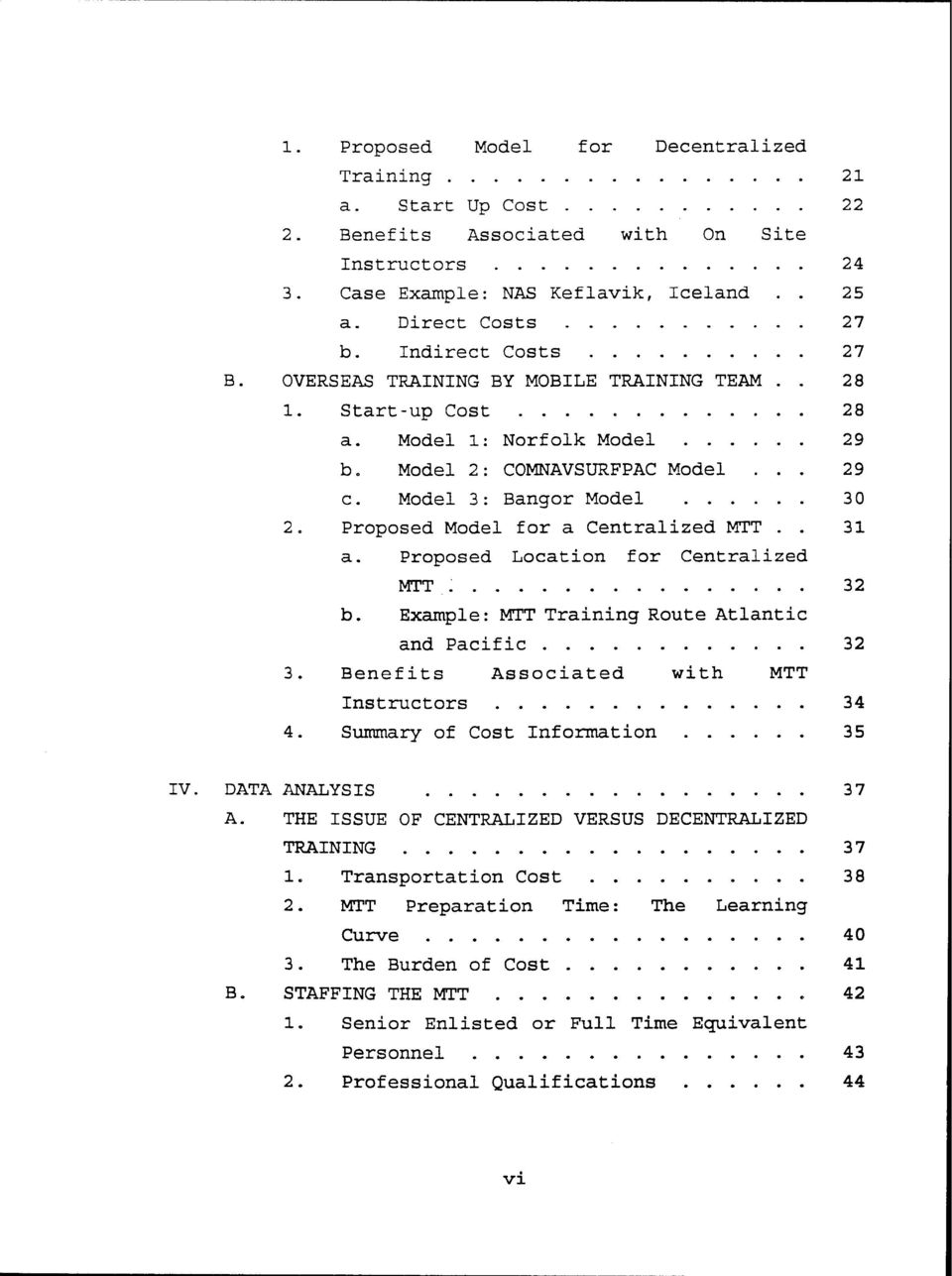
8 V. CONCLUSIONS 47 A. SUMMARY 47 B. AREAS FOR CONTINUED RESEARCH 49 C. FINDINGS 51 APPENDIX A. DESIGNATED CFS TRAINING SITES 53 APPENDIX B. EVALUATION OF MTT POLICY SURVEY 55 LIST OF REFERENCES 57 INITIAL DISTRIBUTION LIST 59 VI1

9 Vlll

10 LIST OF TABLES 1. Consolidated Survey Results Proposed CFS Training Sites With Travel Cost Data Government Rates for Select Military Personnel Instructor Training Cost from Keflavik Iceland Proposed MTT Travel Route with Cost Data Personnel and Travel Cost Comparison PFM Program Cost at FSC Bangor 42 IX

11

12 LIST OF FIGURES 1. PFM Training Flow Diagram 2. Two Year Projected CFS Need By Major Claimant 3. Major Claimants Response to MTT Organization, 4. Staff Time for MTT from Norfolk to Keflavik 5. Staff Time for MTT from Bangor to Adak XI

13 I. INTRODUCTION During 1989, 1,000 man-years were lost on the job while Navy and Marine Corps members sought financial assistance from ehe Navy and Marine Corps Relief Society. In July 1991, one out of every ten bankruptcies filed in San Diego County were from active duty Navy/Marine Corps personnel [Ref. 1]. In 1992, the Navy spent over $7.4 billion to train over one million students who attended approximately 10,000 different courses taught at more than 3 00 Navy activities [Ref. 2]. Financial management training was a component of this training. A. BACKGROUND Many Navy personnel experience significant debt or other financial crisis including bankruptcy, due in part to the availability of easy credit, inability to budget income, and a lack of fundamental money management skills. Debt is a double edged sword in the Navy. It hinders job performance due to time lost for required counseling sessions and responding to letters of indebtedness. It can also influence individuals to sell secrets for money. Bankruptcy can be grounds for removing a military member's security clearance. Hence it is strongly to the Navy's advantage to provide baseline financial management education beyond the minimal accession level training provided. Accession level training provided at Naval Training Center, Great Lakes reviews basic concepts of pay and allowances on recruit Leave and Earning Statements, and explains credit and the importance of maintaining a clean credit record. However, Navy personnel require further training to avoid the pitfalls associated with a lack of education in managing their personal finances. The Personal
![4 billion to train over one million students who attended approximately 10,000 different courses taught at more than 3 00 Navy activities [Ref. 2].](/docs-images/48/19214809/images/page_13.jpg "Financial management training was a component of this training. A.")
14 Financial Management program was developed to enable the Navy to use Navy personnel as counselors for individuals requiring such assistance. B. THE PERSONAL FINANCIAL MANAGEMENT PROGRAM In November 1990, the Deputy Chief of Naval Operations for Manpower, Personnel and Training, Admiral Michael J. Boorda, established a comprehensive three tier program of Personal Financial Management (PFM) for all Department of the Navy personnel [Ref. 3]. Its purpose was to educate all Navy personnel in basic consumer skills and provide them with fundamental knowledge of household finances. The program was built around three major cornerstones: 1. financial education 2. training and information 3. counseling Responsibility for implementing the program was assigned to the Bureau of Naval Personnel, BUPERS Code 6. BUPERS has cognizance over all quality of life initiatives [Ref. 4]. The PFM program was designed as a long term, pro-active, comprehensive means of providing baseline financial education to members of the fleet. It is considered a "train the trainer" program or rather "train the counselor program." It built upon existing counseling experience in each individual command, namely the enlisted advisors. The directive requires a designated Command Financial Specialist (CFS), Petty Officer E-6 or above, for every command with over 25 members. Once trained, the CFS coordinates the command's efforts in providing financial information, education on common consumer rip-offs and counseling services for personnel already in financial difficulty.
![Boorda, established a comprehensive three tier program of Personal Financial Management (PFM) for all Department of the Navy personnel [Ref. 3].](/docs-images/48/19214809/images/page_14.jpg "Its purpose was to educate all Navy personnel in basic consumer skills and provide them with fundamental knowledge of household finances. The program was built around three major cornerstones: 1.")
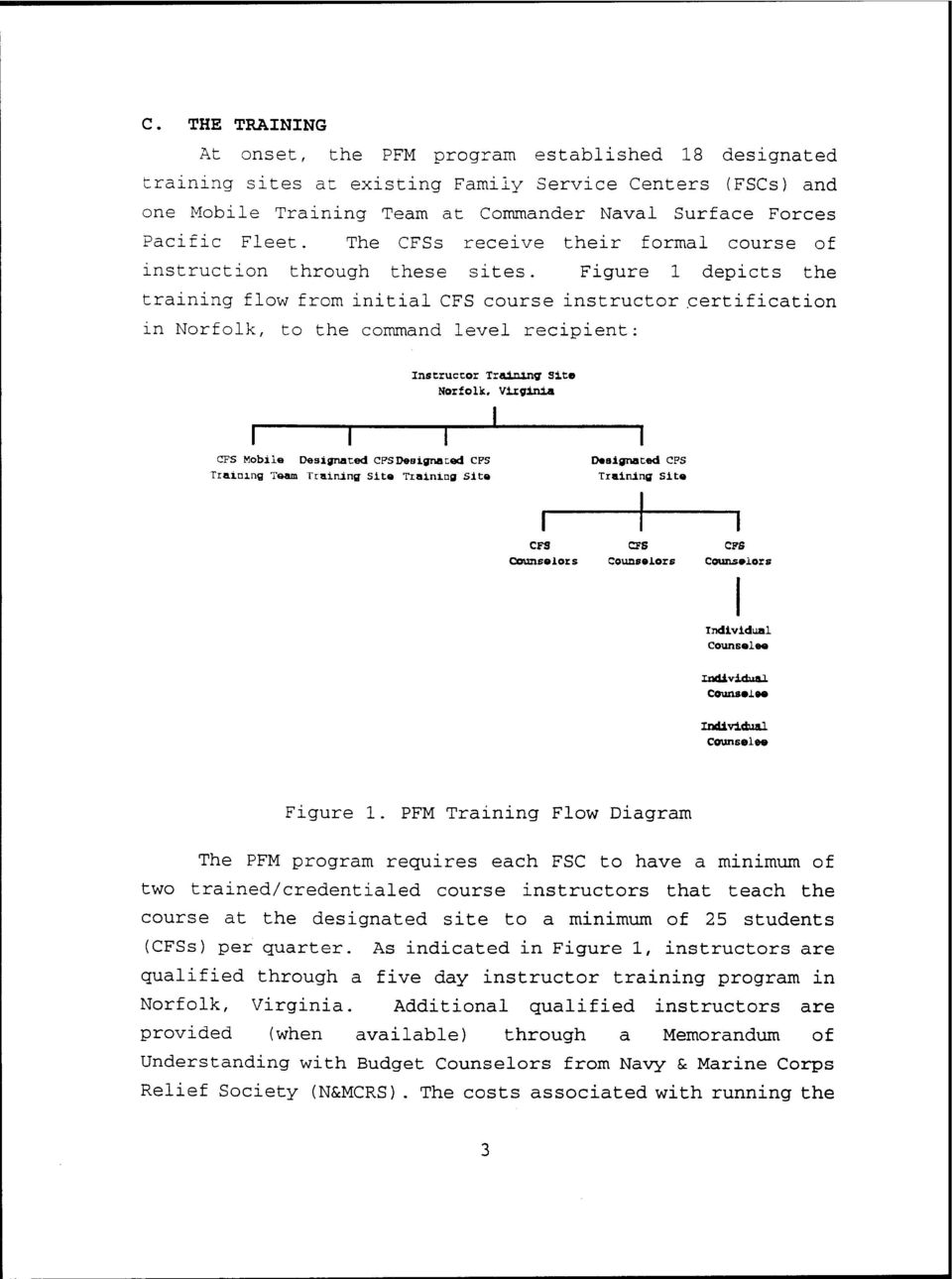
15 C. THE TRAINING At onset, the PFM program established 18 designated training sites at existing Family Service Centers (FSCs) and one Mobile Training Team at Commander Naval Surface Forces Pacific Fleet. The CFSs receive their formal course of instruction through these sites. Figure 1 depicts the training flow from initial CFS course instructor.certification in Norfolk, to the command level recipient: Instructor Training site Norfolk. Virginia CFS Mobile Designated CPSDesignated CFS Designated CFS Training Team Training site Training Site Training Site CFS CFS CFS Counselors Counselors Counselors Individual Counselee individual Counselee Individual counselee Figure 1. PFM Training Flow Diagram The PFM program requires each FSC to have a minimum of two trained/credentialed course instructors that teach the course at the designated site to a minimum of 25 students (CFSs) per quarter. As indicated in Figure 1, instructors are qualified through a five day instructor training program in Norfolk, Virginia. Additional qualified instructors are provided (when available) through a Memorandum of Understanding with Budget Counselors from Navy & Marine Corps Relief Society (N&MCRS). The costs associated with running the
16 PFM program at an individual training site include instructor certification costs, direct support program costs and the annual salary and benefits of the individual instructor assigned to the FSC. Presently, of the 77 major Naval activities located worldwide, 29 designated FSCs train nearly 4,000 CFSs annually. The FSCs with designated training sites are located where demographics indicate a high concentration of Navy personnel (see Appendix A). This method reduces training costs for a maximum number of personnel, but forces the remaining activities to incur travel costs to the nearest designated training site (FSC). These travel costs for command financial specialists have become burdensome for the individual command. Alternatives include staffing additional FSCs to meet the increasing need or pay travel and per diem costs for a Mobile Training Team to visit bases as needed. The Mobile Training Team would substitute for sending three or four command personnel to the nearest training site. D. EARLY MOBILE TRAINING TEAMS 1. Western Pacific In the summer of 1991, four instructors (two teams) provided the CFS course to Naval commands at Yokosuka, Japan, Subic Bay, Philippines, and Guam. Two CFS classes were conducted simultaneously at each activity [Ref. 5]. 2. Keflavik, Iceland In August of 1992, Naval Air Station Keflavik hosted two CFS instructors from FSC Norfolk and Oceana, and conducted a one week training course for area commands [Ref. 6]. 3. Adak, Alaska In November of 1993, the CFS instructor at Naval Air Station Bangor, Washington, was hosted by Naval Activity Adak, Alaska, where 3 8 CFSs from area commands were trained during a one week course [Ref. 7].
17 Training was successful in each individual case. This thesis will examine the concept of mobile training teams. Mobile training, teams (MTTs) may provide a cost effective alternative to administering Command Financial Specialist training to more distantly located activities, reducing the strain on already restricted funding at both the BUPERS and command level.

18

19 II. DETERMINING THE NEED FOR MTT VISITS In April 1993, the Director of Family and Community Support Division, Pers-66, surveyed echelon Two and echelon Three commanders (Major Claimants) to both determine the need for MTTs and identify the claimants' ability to support MTTs from their designated training sites [Ref. 8]. MTT's were previously used as a band-aid measure to help commands comply with OPNAV INSTRUCTION , which established the Personal Financial Management program in Because the MTT concept had proven a cost effective method of delivering the training, a concerted effort would be put forward to identify permanent teams to provide the CFS course instruction to areas without local designated training sites [Ref. 9]. The survey explained how the MTT concept was used to instruct the CFS course in Keflavik, Iceland. It stated the costs incurred by the commands receiving the training (travel and per diem costs of two course instructors), were proportionately borne by the commands. This offered a substantial savings over each command sending their own personnel to a CONUS or European training site. Instructors were picked from the Norfolk and Oceana FSCs. They delivered the one week course as the guest of the host, Commanding Officer Naval Air Station Keflavik, Iceland [Ref. 10]. Feedback on the training was all positive, but the time required to conduct the out of area training was substantial. This precluded using this method again in exactly this manner. Three models of the preparation time required to instruct the course in this fashion, and the resulting costs, will be examined in Chapter III.

20 A. RESULTS OF THE APRIL 1993 SURVEY In the nine question survey, provided in Appendix B, the commanders were asked to candidly indicate whether they had a defined need for MTTs in their claimancy; and if so, how well the designated training sites within their claimancy respond by sending MTTs to provide the training. Results varied, but some generalizations about the responses can be made. Each claimant's response to the 1993 survey is summarized below. Updates are provided as indicated. Where no response to the survey was received by PERS-6 6, a response was obtained by phone. 1. Chief of Naval Operations Field Support Activities No direct response to the survey was received. Successive phone contact with LT Arend of Field Support Activities during the research process determined that the claimant has approximately 320 units within its claimancy, both in CONUS and out, including three major activities such as USNA Annapolis, Naval Postgraduate School Monterey, and Administrative Support Unit Southwest Asia (ASUSWA). Only one FSC instructs the CFS program within the claimancy, the Naval District in Anacostia, D.C. In general, CONUS activities did not perceive a need for MTT visits. However, out CONUS activities, such as ASUSWA, greatly needed CFS MTT visits. This activity was assigned large numbers of junior personnel and has high costs of living. Over 7,000 personnel [Ref. 11] both afloat and ashore are assigned to the Navy Central Command in Southwest Asia. Due to the limited staffing at Anacostia, an MTT could not be provided to ASUSWA. 2. Commander in Chief U.S. Pacific Fleet Commander in Chief, U.S. Pacific Fleet is the manpower claimant for Commander Naval Air, Surface and Submarine Forces Pacific, and Commander Naval Activity Marianas. Eight of the 29 existing CFS training sites are located within this
21 claimancy. A consolidated response was received from both surface and submarine forces Pacific as well as Naval Base Guam in the Marianas. Follow-up during the research process was conducted with representatives from the Naval Surface Forces and Naval Air Forces Pacific commands. Provided in the survey results, the surface forces response alone projected a need for over 225 trained CFSs within the next two years. This indicates MTTs would be particularly beneficial to afloat units and out CONUS activities. Okinawa and Sasebo Japan, with a combined Navy active duty population of over 5,000, [Ref. 12] are highlighted as two areas in need of PFM instruction. FSC San Diego alone instructs the CFS course monthly to 3 5 personnel. Approximately five of the 3 5 are from out of area commands. A single CFS instructor could be provided to act as a course coordinator on an as needed basis, depending upon the course location and the amount of advance planning required for course augmentation within the local area. Naval Base Pearl Harbor conducts the CFS course five times per year and projects no need for a MTT visit to the area. Additionally, they reported that commands from both Japan and Guam have been able to obtain quotas at their location at the expense of the command. The FSC Director at Naval Base Guam, servicing 40 afloat and ashore commands, expressed a need for three MTT visits over the following two years. Total Navy active duty population exceeds 7,000 personnel [Ref. 13]. Guams' last training was conducted in the summer of Because personnel serve a two year tour, turnover of CFS's is greater than normal. Representatives of the Submarine Forces Pacific indicated that commands are in compliance with the current directives and that a MTT visit to the western Pacific submarine commands would satisfy training needs of CFS relief personnel.
22 Phone conversations with the Naval Air Forces Pacific indicate a perceived need at out CONUS activities only. CFS personnel at Naval Air Station Adak, Alaska currently receive annual training from FSC Bangor, Washington by MTT [Ref. 14]. The Commanding Officer Naval Air Station Adak acts as the MTT host. A cost breakdown will address this further in Chapter III. 3. Commander in Chief U.S. Atlantic Fleet The Commander in Chief U.S. Atlantic Fleet is the manpower claimant for Commander Naval Air, Surface and Submarine Forces Atlantic, two Naval Facilities Commands and three Naval Bases. A consolidated response was received for all of the Atlantic fleet commands. Using the Navy FSC Master Directory [Ref. 15], a total of 11 CFS training sites are located within this claimancy, including the CFS instructor training site in Norfolk, Virginia. The consolidated response indicated adequate facilities in CONUS but recommended MTT visits at remote activities and out CONUS sites. Although Norfolk, VA, Charleston, SC, New London, CN and Kings Bay, GA have all offered or conducted some form of MTTs in the past, the response to the survey stated that requirements exceeded resources in these areas. Thus a recommendation was made to establish a consolidated team (or teams) of instructors to provide CFS training to the remote/out CONUS sites. From April 1993 through October 1993, the CFS instructor from FSC New London in Groton, Connecticut conducted four MTTs both in CONUS and out [Ref. 16]. With the assistance of a Navy and Marine Corps Relief Society budget counselor, the two person team travelled to Naval Air Station Bermuda, Naval Weapon Station Earle, New Jersey, Naval Facility Newfoundland, and Naval Air Station Brunswick, Maine. All travel costs were distributed proportionally to the commands receiving the CFS training or paid for by the FSC hosting the 10
23 training. Host activities established quota control and provided the necessary liaison for local representatives to assist in the course instruction. In May 1994, this team was disbanded because the budget counselor for the Navy and Marine Corps Relief Society was unable to conduct further travel. 4. Chief of Naval Education and Training The Chief of Naval Education and Training is the manpower claimant for in CONUS training activities. Three designated training sites are located within the claimancy. There is currently a need for an annual MTT visit to both the south Texas, and Meridian, Mississippi areas. Phone contact with the claimant representative, Ms. Janet Raines, during the research process, confirmed the continuing need for MTT visits in the areas designated. However, there is a limited ability to staff and send an MTT from organic assets within this claimancy. Both FSCs in Pensacola, FL and Great Lakes, IL would consider staffing and sending an MTT on a case by case basis. In the survey, the claimant recommended forming a consolidated MTT staffed by senior personnel to deliver the training on a scheduled basis. FSC Pensacola recommended that the Navy assign a Navy Enlisted Classification code (NEC) to personnel having received the training so that qualified CFSs could be identified more readily. 5. Commander in Chief U.S. Naval Forces Europe Commander In Chief U.S. Naval forces Europe is the manpower claimant for three Naval Support Activities, a Naval Air Station, a Naval Station, and a Navy Supply Depot. A consolidated response was provided to the survey. Three CFS training sites are located within this claimancy. MTT need was, according to the survey, two visits per year. A total of 16 classes are taught within this claimancy annually, 60 percent of which are taught by FSC Rota, Spain. Both Rota, Spain and Naples, Italy FSCs indicated they could support MTTs on an as needed basis. 11
24 Some inconsistencies exist between the survey results and information received by phone contact during the research process. Apparently, the PFM coordinator billet at Naval Forces Europe was vacant when the survey results were compiled in June 93. The survey implies that the overall need for MTT visits to the Mediterranean is minimal. However, this does not appear to be the case. In fact, the incumbent PFM coordinator, Ms. Cathy Stokoe, reports a strong need [Ref. 17]. Rapid personnel turnover rates overseas, relatively remote duty assignments, and a high cost of living all increase the need for CFS training. Highlighted areas include London, England; Gaeta and Sigonella, Italy; and Suda Bay, Crete. Ms. Stokoe reports that the rapid turnover at Suda Bay, one year tours unaccompanied by family members, causes financial hardships not seen in other activities. Active duty population in these areas total in excess of 4,400 [Ref. 18]. The need for training has been so great that the claimant has requested that PERS-66 fund an additional CFS training site at Naval Air Station Sigonella, Italy. This information implies that there may be a tremendous need for additional CFS training at U.S. Naval Force locations in Europe. 6. Commander Naval Facilities Engineering Command Commander Naval Facilities Engineering Command is the manpower claimant for two Naval Construction Battalions. Two CFS designated training sites are located in this claimancy. No projected need for MTT visits was indicated. Limited support for MTT staffing exists at the two Facilities commands. The claimant stressed that the command requesting the training should bear all of the costs of the MTT visit. Similarly, the requesting activity should conduct all forward liaison for scheduling local speakers to help instruct the class. 12
25 7. Commander Naval Reserve Force Commander Naval Reserve Force is the manpower claimant for five Naval Air Stations and one Naval Support Activity. Naval Support Activity New Orleans provided a consolidated survey response and is the only designated CFS training site in the claimancy. Six courses are taught per year at this location. There is no reported need for MTTs. During the research process, discussion with the Naval Support Activity representative (PNC Royer) revealed that due to limited staffing at the Support Activity in New Orleans, it would be difficult to fill an MTT from within the claimancy. 8. Commander Naval Sea Systems Command Commander Naval Air Systems Command is the manpower claimant for three shipyards, two weapons stations and the Surface Warfare Development Center. No response to the survey was received. Phone contact with Naval Sea Systems field representative (Ms. Annie Fowler) indicated the claimancy needed one MTT visit per site per year [Ref. 19]. A recommendation was made for a centrally located MTT to deliver the CFS training. 9. Commander Naval Air Systems Command Commander Naval Air Systems Command includes four naval air warfare centers. No response to the survey was received. 10. Commander Naval Computer and Telecommunications Command Commander Naval Computer and Telecommunications Command is the manpower claimant for a telecommunications station in Wahiawa, HI. No response to the survey was received. The research process revealed that due to the overall availability of CFS resources on the island of Oahu, HI, MTTs are not required in this area. The FSC at Naval Station Pearl Harbor, HI instructs the CFS course five times per year and fulfills the needs of all activities within this geographic region. 13
26 11. Commander Naval Security Group Command Commander Naval Security Group Command is the Manpower claimant for three Naval Security Group Activities. No response to the survey was received. No designated CFS training sites are located within this claimancy. Phone contact with the claimant representative (Mr. Scott Purser) indicated no need for MTT visits to security group activities. The claimant emphasizes financial training and individual member responsibility for all security group personnel. B. CONSOLIDATED SURVEY RESULTS The survey results are provided in abbreviated form in Table 1: 14
27 Claimant CFS Training MTTS MTTS Sites Required Staffed CNG FSA Naval District ASUSWA, None Washington Bahrain CINCPACFLT NAS Atsugi, Guam, SUBASE Bangor NAS Alameda, Okinawa, NAS Lemoore, Adak NAS Miramar, FLTACT Yokosuka, NAVSTA Pearl Harbor, NAVSTA San Diego, SUBASE Banqor CIKCLANTFLT NAS Cecil Field, Need exists Temporary NAS Jacksonville, mainly in MTTs NAS Keflavik, OUTCONUS sites NAS Oceana, NAVBASE Little Creek, NAVSTA Guantanamo NAVSTA Mayport, SUBASE Kings Bay, SUBASE New London, NAVBASE Charleston, NAVBASE Norfolk CNET NAS Pensacola, Corpus None NTC Great Lakes, Cristie, NAS Memphis Meridian CINCUSNAVEUR NAVSTA Rota, London, None NAVSUPPO La Gaeta, Maddelena, Italy Sigonella, NAVSUPPACT Naples Suda Bay COMNAVFACENG CNRF COMBATTCEN Gulfport, COMBATTCEN Port Hueneme NAVSUPPACT New Orleans None None COMNAVSEASYS None NAVSURFWARCEN Dahlgren, NAVSHIPYD Mare Island, NAVSHIPYD Puget Sound, WPNSTA Earle, WPNSTA Ptsmth None None None COMNAVAIRSYS None No Response None COMNAVTELCOM None None None COMNAVSECGRU None None None Table 1. Consolidated Survey Results 15
28 Consolidating the results of the survey, provides some generalizations about the claimants' inputs. For instance, all claimants believed MTTs are an adequate delivery vehicle to conduct CFS training, but few could staff a permanent team and provide the training on a regular basis. All agreed that MTTs should be provided to commands both in CONUS and out, but the defined need for MTTs in CONUS was limited because of the many designated CFS training sites in CONUS. The SURFPAC representative, Ms. Marilyn Schaefer, identified a need for additional trained CFSs during the next two years. Emphasis was placed on afloat units and OUTCONUS activities. Adak, Alaska receives one MTT per year, staffed by trainers from Submarine Base Bangor, Washington. The most conclusive results indicate that a more defined need for training exists overseas, in high cost areas, where personnel are stationed with their families. Needs identified in CINCLANTFLT have been handled by PERS-66 and the claimant staffing temporary MTTs from New London, CT and Norfolk, VA for remote CONUS and overseas locations. Figure 2 displays the major claimants response to the survey question of how many trained CFS personnel within their claimancy are projected in the next two years: Overseas 86.5% conus 13.5% Figure 2. Two Year Projected CFS Need By Major Claimant 16
29 Figure 3 illustrates the major claimants response to how the MTT should be organized (centralized or decentralized): Centrally Located 66.7% Multiple sites 33.3% Figure 3. Major Claimants Response to MTT Organization In the survey, major claimants identified the need for 965 (85.6%) trained CFS overseas and 150 (13.5%) in CONUS. Five claimants recommended a centralized MTT, staffed in one designated location, to conduct CFS training in accordance with a pre-established schedule. However, no recommendation was made for funding a team to conduct the training in either a centralized or a decentralized manner. Due to the overwhelming response for CFS training needs overseas, this thesis research will determine costs for an established schedule in the Pacific, the Mediterranean and the Persian Gulf. CFS training would be conducted in FSCs where designated PFM program personnel exist, but no designated training is provided. This will allow MTT personnel to have an established point of contact for advance liaison at each training activity on the scheduled route. Training at sites in CONUS would be accomplished by the team while not traveling to overseas locations. The only two CONUS areas identified by name in the survey as needing the training were the South Texas and Mississippi locations. An example route for the team to teach the CFS course in the Atlantic/Mediterranean locations, as determined from the survey results, might include London, England; Gaeta, Italy; 17
30 Sigonella, Italy; and Suda Bay, Crete. Further training would include Bahrain as a part of this sequence. Training to the Pacific rim would include Guam; Okinawa and Sasebo, Japan; and Adak, Alaska, if the ongoing training to that area determined further assistance was required. The travel cost associated with this route is discussed in Chapter III. C. THE PERCEIVED NEED FOR MOBILE TRAINING In the research process, certain claimants indicated that there was no apparent need for mobile training within their claimancy and that adequate instruction was provided to personnel on a regular basis. For example, Commander Naval Reserve Force at Naval Support Activity instructs the CFS course on a regular basis to personnel within their claimancy. Individual commands send CFS personnel for this instruction from as far away as South Weymouth Massachusetts and Marietta Georgia. While it is understood that the command will choose the closest designated CFS instruction site, there is an opportunity cost associated with several people traveling to a given location for course instruction. Hypothetically, suppose a site such as NSA New Orleans instructs as many as five personnel per year from either Dallas, Texas or Marietta, Georgia, two of its claimancies. Given a travel time of two days per member, ten man-days are lost on travel for this course of instruction. Cost in mandays is in addition to travel cost incurred by the command for their members to reach the training site. This case would be amplified to an even higher magnitude when overseas activities become involved. Additional travel days would be lost and higher travel and per diem costs may render the instruction too costly, leaving commands without CFS personnel. For this reason, Mobile Training Teams are discussed and offered as a more cost effective solution to optimizing the limited 18
31 resources available for CFS course instruction. In researching the training needs required by the major claimants, the phenomena of a "bow wave" effect is apparent. Specifically, there appears to be an immediate urgency for trained CFS instructors that may dissipate over the course of the next few years. As more personnel are instructed and gain experience in PFM, the overall program needs should decrease over time. Given the economic factors that influence financial decision making today, exactly how much time it will take is undefinable. Factors that will help to improve personal financial management in the Navy will be discussed in Chapter IV. 19
32 20
33 III. DATA PRESENTATION In comparing the costs and benefits of instructing CFS by MTT with establishing additional training sites, tradeoffs must be discussed. This chapter will compare individual costs and benefits of CFS training by designated training sites and by mobile training team. As background, it will present and describe previous models that have been used to track time and expenditures for CFS mobile training. For reasons of comparison, a supposition is made that establishes CFS training sites at eight overseas locations, thus decentralizing the training. The cost of establishing these new FSCs is compared with that of a single MTT following a proposed training route. This centralized method forms a new model to demonstrate how CFS training can be provided to military personnel overseas by a centralized MTT. An analysis of the cost for the two different methods of delivering the training is presented in Chapter IV. A. OVERSEAS TRAINING AT A DESIGNATED TRAINING SITE 1. Proposed Model for Decentralized Training Since the PFM programs inception in 1990, 11 additional CFS training sites have been added to the 18 original sites. The most recent addition was NAS Keflavik, Iceland in July, Despite the continued Navy end-strength reductions, this new total of 29 CFS training sites continues to grow. Given past trends of establishing new CFS training sites as needs increased, this section will present the comparative travel and related costs between designating new training sites, (decentralized training), and attempts at satisfying the increasing demand by conducting the CFS training using a single (centralized) MTT. 21
34 a. Start Up Cost The newly proposed training sites will be selected from those OUTCONUS activities found to be in highest demand in Chapter II. A comparative cost analysis will be conducted between the cost to fund decentralized CFS training at multiple proposed FSCs, and the cost to establish a single centralized MTT, visiting FSCs along a predetermined route. Table 2 below, summarizes potential training sites, listing travel, rental car, and perdiem cost for the one week instructor training course in Norfolk: Proposed CFS Training Site Travel and Per Diem Cost 1 London, England $3, Gaeta, Italy $4, Sigonella, Italy $4, Suda Bay, Crete $5, Manama, Bahrain $5, Guam $5, Okinawa, Japan $4, Sasebo, Japan $5, Adak, Alaska $4, Total: $42, Table 2. Proposed CFS Training Sites With Travel Cost Data The costs to establish an overseas training site are limited to identifying dedicated course instructors, transportation costs to and from the instructor training command in Norfolk, Virginia, per diem and rental car cost for the week long training course, and support costs required to : The method used in Table 2 assumes a two person team would travel from the overseas location to Norfolk, receive the instructor training and return. 22
35 conduct the training. Support costs such as books, paper and other consumables are assumed to be non-differential costs because these costs will be incurred regardless of the method chosen to conduct the training. Indirect cost or opportunity cost must also be added to the overall program cost. The opportunity cost to the FSC is the cost of lost time while the team travels. It is computed below by taking the team's salary and benefits for the one week period. Summing them for all teams yields a total opportunity cost to the program. Discussions with overseas claimants have revealed that only active duty personnel have been designated course instructors overseas. Therefore, no contracted or Full Time Equivalent (FTE) civil service employees are included in the comparison. When computing the cost for active duty personnel assigned to the program, a combination of their individual salaries and the dollar value of their fringe benefits is added together for a total cost. Generally, the cost of these personnel is measured in billet numbers. As with the civil service system, each billet is defined by both rank and the skills the billet demands. Government established rates in costing military service members will be used to determine start-up cost. These rates capture both pay and benefits. They are provided by the Department of the Navy from a Comptroller of the Navy Notice [Ref. 20]. An excerpt is provided in Table 3, listing composite standard rates for personnel that may likely be assigned as CFS course instructors. This thesis assumes that commands use E-8 personnel as instructors. According to Table 3, the total opportunity cost for the nine, two member teams is $27, This represents seven days salary and benefits for each member of nine, two person teams. The total direct and indirect program cost for this decentralized training is $69,
36 Pay Grade Rank or Title Hourly Rate 0-2 Lieutenant Junior Grade Officers Daily Rate Monthly Rate Annual Rate $26.77 $ $4,641 $55, Ensign ,562 42,743 E-9 Master Chief Petty Officer E-8 Senior Chief Petty Officer E-7 Chief Petty Officer E-6 Petty Officer First Class Enlisted Personnel $31.76 $ $5,506 $66, ,669 56, ,020 48, ,426 41,114 Table 3. Government rates for Select Military Personnel After completing the instructor training course, the overseas FSC can conduct CFS courses on a regularly scheduled basis until they are rotated to a new command. For the purpose of this model, an assignment length of 3 0 months is used as a typical overseas assignment tour. At this point, the cycle repeats itself and additional personnel from the FSC will have to be trained to instruct the course. 2. Benefits Associated with On Site Instructors Benefits of a permanently assigned instructor are both tangible and intangible. As a primary role, the instructor is designated as the command PFM representative and instructs the course on a quarterly basis to a class of at least 25 CFS students. The instructor establishes relationships with community representatives who help lecture during the course. These representatives include, among others, Credit Union representatives, overseas auto buying service personnel and Navy Exchange Credit Card purchasing representatives. 24
37 Additionally, the dedicated instructor's role requires daily counseling sessions with members referred by the individual base activities' CFS representatives or Navy and Marine Corps Relief Society budget counselors located on the base. The latter is the case when individual command personnel prefer to be counseled by a member outside the immediate chain of command. In addition to the primary functions of the CFS course instructor, the FSC assigns additional administrative or collateral responsibilities. In some instances overseas members are assigned primary responsibilities within the FSC and PFM is only a collateral responsibility [Ref. 21]. Examples of such assignments include command sponsor coordinator, relocation assistance coordinator and pre-separation/pre-retirement counselor. This enables the FSC director to obtain a more evenly distributed workload from all personnel assigned. It must be noted that all Navy Family Service Centers have a PFM coordinator who performs budget counseling and financial assistance to referred personnel; but not all PFM coordinators are qualified to instruct the CFS training course. Only FSCs that request and receive designation as a CFS training site from PERS-66 are identified as such. This is the point at which the cost of CFS training is incurred. The next section discusses establishing a CFS training site at a particular OUTCONUS activity. 3. Case Example: NAS Keflavik, Iceland In July 1994, the Director of Personal, Family and Community Support (PERS-66) designated NAS Keflavik, Iceland as a CFS training site, due to the inordinate demand for qualified CFS counselors [Ref. 22]. As a direct result of this designation, two personnel will attend the instructor training course in Norfolk, VA in November
38 The central problem identified by the PFM counselor at ehe FSC was that junior enlisted personnel were experiencing financial difficulty with the new Navy Exchange Credit Card program. This contractual agreement, signed by the member, allows a deduction (up to the maximum) to be taken directly from the members pay to cover a delinquent balance remaining in their credit card account. 2 At NAS Keflavik, both the delay in receiving mail and lack of fundamental financial education contributed to a high credit card default rate. For many, the Navy Exchange Credit Card system provides a valuable service, but it has been identified as a concern with which counselors must deal. The program's growth has caused the need for additional CFS trained personnel. In addition to the Navy Exchange Credit Card problem, and particular to NAS Keflavik itself, the activity receives a deployed P-3 squadron, Patrol Squadron 24, (ten aircraft with aircrews and maintenance personnel) on a regular basis. This introduces all of the financial difficulties associated with a deployment. For example, allotments not established in advance for family members at home; loss of coordination in the family between savings and expenses; and insufficient contingency planning for household emergencies, are typical financial difficulties experienced by deployed personnel. After successfully completing the MTT from the Norfolk area in August 1992, the director of the Family Service Center, LCDR King requested NAS Keflavik be designated as a CFS training site; she stated that additional personnel would have to be trained to reduce the number of Navy personnel 2 Under the Hatch Act Reform Amendments of 1994, the Department of defense is promulgating regulations with regard to members of the Armed Forces which include provisions for the involuntary allotment of pay not exceeding the lesser of 25 percent of a members disposable pay, or the maximum amount authorized under the garnishment law of the state where judgement is entered. 26
39 requiring financial counseling. Designation as a CFS training site came in the form of a letter addressed to the Commanding Officer, Naval Air Station Keflavik on 18 July a. Direct Costs Table 4 lists the costs for NAS Keflavik counselors to attend the instructor training course in November 1994: Instructor Travel Per Diem Total Two E-8 Personnel $2, $1, $3, Table 4. Instructor training Cost from Keflavik Iceland Travel costs are from Navy Personnel Transportation Office at government travel rates of $1050 per person. This rate assumes the members travel by the weekly "rotator" aircraft provided by Air Mobility Command, from Norfolk to Keflavik. Per diem is calculated based on a $114 per person rate for a total of 12 days. For reasons of comparison, it must be noted as a part of the analysis that the FSC at NAS Keflavik serves an active duty Navy component of approximately 1,548 personnel [Ref. 23]. The burden of the travel cost incurred by the course instructors will be assumed by the NAS Keflavik travel budget unless reimbursement is obtained from PERS-66. This data will be compared with the number of active duty personnel a CFS Mobile Training Team would serve while conducting the training along a designated training route for the same 3 0 month period of time. b. Indirect Costs While direct costs are the immediate costs associated with the travel and per diem for the course instructors, indirect cost is the opportunity of the lost man-days when the FSC members travel, to Norfolk for course instruction. For a two member team, this cost will exceed 12 27
40 man-days for one course of instruction. Using Table 3 to convert time lost at the FSC to dollars, the indirect cost totals $5, in the Keflavik example. B. OVERSEAS TRAINING BY MOBILE TRAINING TEAM 1. Start-up Cost The costs associated with starting a MTT in order to fill the gaps where designated training sites are not established are somewhat similar to that of bringing an existing FSC on line. The same composite government pay rates from Table 3 are used to calculate the personnel cost. Differences reflect that there is more than one way to conduct mobile training. Two methods are presented here. They are based on either previous or ongoing MTTs. The first method utilizes CFS course instructors that are already trained in their respective FSCs (demonstrated later in Model 1 and 3). These instructors provide CFS training based upon need within the claimancy. The Major Claimant tasks the geographically closest FSC to provide instructors to the site that requested the CFS training. Cost for travel would be distributed proportionately by the commands receiving the training, or be absorbed by the FSC activity hosting the training. The alternative method demonstrates how the training could be conducted by staffing an independent team and sending it to areas needing the training (demonstrated in Model 2). This particular method could also apply to a Master Instructor trainer course, where master trainers visit specific sites (namely large in CONUS sites) that could teach the CFS course to instructors rather than CFS personnel themselves. This would allow more accessibility to the CFS course rather than just at its current location in Norfolk, Virginia. 28
41 a. Model 1: Norfolk Model The Norfolk Model is based on the preparation and training time for one team of two instructors conducting a one week CFS course in Keflavik, Iceland in August In this model, over 156 hours of staff time were directly attributable to conducting the out of area training. This cost was shared by the two FSCs that provided instructors, NAS Oceana and Norfolk. Instructor classroom time totaled 80 hours; course preparation time was 41 hours, involving phone calls, faxing materials and preparing agenda; travel time totaled 28 hours; an additional seven hours of management and administration was spent by the Norfolk FSC staff to oversee the training [Ref. 24]. The training was received by 26 CFS personnel from Keflavik commands. A 1992 study of this method revealed that it would be a viable alternative, if the FSC could absorb the indirect cost of the instructor for the time it took to prepare and conduct the course. Presently, this is the only documented east coast model that demonstrates the costs involved with teaching the CFS curriculum by sending trained instructors to FSCs. The study concluded that using an exportable MTT in this fashion requires taking the manpower loss "out of hide." At the time of the report, the office was not staffed to provide this training even on an intermittent basis [Ref. 25]. b. Model 2: COMNAVSURFPAC Model COMNAVSURFPAC used a designated Mobile Training Team in the summer of Commander Naval Surface Forces Pacific, Admiral Kihune, staffed two, two person teams and sent them together to Yokosuka, Japan, Subic Bay, Phillipines and Guam. Team members included a GM-13 and two Master Chief Petty Officers from FSC San Diego, and a Lieutenant Commander from the Middle Pacific staff [Ref. 26]. Transportation and per diem costs for three of the instructors were funded by SURFPAC. Specific costs were unobtainable because 29
42 travel records have been destroyed. The remaining team member was funded by Commander Naval Surface Group Middle Pacific, in Pearl Harbor. Two CFS courses were taught simultaneously by the two teams and over 2 00 active duty personnel attended during this three week period. In each case, the director of the FSC was the primary point of contact at the host activity. Advance course preparation included assembling course materials and identifying classroom location and individual course schedules. This was conducted by the PFM personnel at the host activity. Quota control for the CFS course was maintained by PFM personnel as well. The MTTs arrived in time to prepare for course instruction, and then taught the five day course. This particular team cycle through the Pacific was completed only once and the teams disbanded when team members reached their planned rotation. No attempt was made to continue the training in this fashion. c. Model 3: Bangor Model An ongoing MTT provides CFS course instruction to both NAS Whidbey Island, Washington, and NAS Adak, Alaska. In August 1993, the CFS instructor at FSC Bangor, a civilian General Schedule government employee, taught the course to 35 personnel from Whidbey Island commands. In November that year, the same instructor provided the CFS training to a class of 3 8 personnel from NAS Adak commands. In both cases, the instructor was the guest of the base activity. In this particular model, the instructor assumed responsibility for training CFS personnel in the five state region, including Washington, Alaska, Montana, Wyoming and Oregon. When instructing the CFS course as an MTT, only four hours of preparation time were required; and 49 hours of course instruction were provided. The remainder of the preparations were conducted by the FSC receiving the training. 30
43 Travel time varied due to location. CFS instruction was provided to more than 3 0 personnel at the receiving activities by a team of one. Travel expenses were provided by the FSC that hosted the training. As a General Schedule employee of the government, grade 11, step 2, the instructor's labor cost can be computed by dividing her total annual salary and benefits package by 2087 annual hours, to arrive at an hourly cost. Annual salary is taken from the DOD Wage Fixing Authority Salary Table [Ref. 27], with 21 percent acceleration to include member benefits. Thus, annual salary and benefits combined, totals $43,340. Dividing this total by 2087 hours gives a $20.75 per hour. Given the 53 hours of course preparation and instruction, the opportunity cost to the FSC to conduct this travel totals $1, Proposed Model for a Centralized MTT As a recommendation to conducting the mobile training, five of the major claimants indicated, in either the survey response or by phone contact, that a centrally located and independently staffed MTT would be more effective than having each major claimant staff a MTT within its claimancy. This Model proposes such a method. Results from the survey reveal that an overwhelming number of FSCs are over-tasked and unable to forfeit course instructors to present the course in a MTT fashion. This alternative method forms the MTT from two new billets. These billets would be advertised by PERS-66 as being available for assignment. Personnel assigned would have a primary responsibility of conducting CFS training along a designated training route, primarily overseas, while maintaining a permanent office in a geographically central and cost effective location. Rather than forming the team, or teams, from collateral duty CFS personnel currently in billets that are reportedly over-tasked, these two billets would allow 31
44 the instructors to focus on CFS training alone. The advantages of a centralized training team are discussed in Chapter IV. a. Proposed Location for Centralized MTT In determining the best location for a permanent MTT office, a location must be designated from which travel to and from training sites will originate. Two billets would be advertised by PERS-66 for location in the Norfolk, VA area, co-located with the instructor training site in Norfolk. This allows the MTT to receive the most current information on course changes while allowing them to stay up to date with any PFM program changes. Once assigned, these personnel would undergo the same instructor qualification requirements as that of designated FSC personnel. Due to their location, travel cost for their training would not be incurred. Tour lengths should be from 3 0 to 3 6 months to provide continuity and consistency in the training. Initially, each training site would be visited once per year. Cost would be limited to salaries and benefits of the instructors, as they would augment the existing instructors already assigned at Norfolk. b. Example: MTT Training- Route Atlantic and Pacific As a means of demonstrating the cost of conducting travel to and from sites in need of training, and demonstrating the versatility of the MTT concept, Table 5 lists the areas identified as needing CFS personnel as summarized in Chapter II. It also suggests a potential travel route with area population and travel cost: 32
45 Departure Norfolk, VA Training Site /Population 3 Flight Cost 4 Per Diem North Atlantic / Mediterranean / Persian Gulf London, England / 746 London, Eng Gaeta, Italy / 631 Gaeta, Italy Sigonella, Italy Suda Bay, Crete Sigonella, Italy / 2,679 Suda Bay, Crete / 359 Manama, Bahrain / 343 Manama, Bah Norfolk, VA $904 Rental Car $574 $1,631 $149 $240 $903 $198 $52 $735 $198 $1,074 $441 $187 $1,148 $1,309 $166 Total: 4,758 $3,992 $5,019 $898 Pacific Rim Norfolk, VA Guam / 7,83 6 $956 $1,610 $238 Guam Okinawa, Japan / 2,917 Okinawa, JP Sasebo, Japan / 2,250 Sasebo, JP Adak, Alaska / 1,706 Adak, AK Norfolk, VA $787 $218 $1,239 $616 $225 $1,253 $620 $838 $616 Total: 14,709 $3,024 $4,718 $1,474 Table 5. Proposed MTT Travel Route with Cost Data Population statistics taken from DOD Worldwide Manpower Distribution by Geographical Area and Navy Fact Sheets from CINCLANTFLT and CINCPACFLT Public Affairs Offices. 4 Temporary Duty travel costs provided by Navy Personnel Transportation Office Monterey, CA. effective through 30 September
46 Table 5 represents per person travel information; the costs for travel, per diem and rental car total $18, in the Atlantic, and $16, in the Pacific for the two person team assuming a one week stay and one rental car at each site. Upon instructor qualification, the MTT could carry the training to any areas in need and not be restricted to any one particular route. Indirect costs are not a factor because the same course of CFS instruction is provided in either case; this is not a differential cost. Cost to train the MTT is factored as an opportunity cost to the instructors as they are trained in Norfolk. This total cost of $2, represents five days time spent away from the command, for two E-8 instructor personnel. 3. Benefits Associated with MTT Instructors As with on site instructors, benefits associated with MTT instructors are both tangible and intangible. The primary responsibility of the MTT instructors would be to conduct CFS training along the designated training route. Instructors would provide additional assistance to PFM personnel at overseas FSCs. One intangible benefit would be providing assistance in program oversight. Another would be the experience gained by the individual instructors as they brought the training to the overseas areas. Such benefits can not be quantified and go beyond the scope of this research. Further, the MTT could up-date PFM personnel on current Personal Financial Management issues affecting the fleet at overseas locations and assist in sorting out individual PFM difficulties experienced at the FSC. Additionally, MTT instructors could coordinate and confer with local authorities that assist in course presentation and help identify financial difficulties particular to the training site. the MTT. The most important benefit is the population reached by The example route through the Atlantic, 34
47 Mediterranean, Persian Gulf, and Pacific demonstrates how the MTT could reach a population of over 19,124 active duty personnel in commands without designated CFS training sites and without staffing permanent teams in each location. 4. Summary of Cost Information Table 6 below summarizes decentralized training cost for establishing nine new CFS training sites and costs for a centralized MTT of two E-8 personnel to deliver CFS training to commands in both the Atlantic, Pacific and Persian Gulf for a one year period. Costs are taken from Tables 2 and 5: Decentralized Centralized Airfare $27,042 $14,032 Perdiem $14,742 $19,474 Rental Car $1,044 $2,372 Time $27,153 $2,155 Total $69,981 $38,033 Table 6. Personnel and Travel Cost Comparison In the decentralized Model, travel assumes a two person team would receive training in Norfolk, and return to their respective FSCs. Perdiem and rental car cost is the standard Norfolk, VA rate calculated during the summer months. Time represents the opportunity cost to the overseas FSC for the loss of 18 personnel, nine teams of two, during the one week training. In the centralized Model, airfare, perdiem and rental car cost represents travel to each of the nine activities with a one week stay. Only minimal opportunity cost is seen because time lost is for only two members that receive the instructor training. 35
48 36
49 IV. DATA ANALYSIS A variety of issues envelop starting an MTT for CFS craining. It is clear from the survey results that the major claimants support MTTs. They emphasized needs in specific locations, some in CONUS, but a majority of them are overseas. What remains to be identified is how the CFS training will be conducted in those locations. Two alternative methods were presented. The first method used personnel in FSCs that traveled to Norfolk to receive instructor training; as instructors, they then travel as directed by the major claimant and/or PERS-66 (decentralized training). The alternative method uses an independent team of qualified personnel to travel to the training sites as directed by PERS-66, based upon the claimants input (centralized training). This chapter will analyze the benefits of each method, weighing the costs associated with conducting the training in each fashion. Expectations will be drawn using model information provided in Chapter III. Additionally, this chapter will address professional methods instructor personnel can use to gain PFM knowledge. A. THE ISSUE OF CENTRALIZED VERSUS DECENTRALIZED TRAINING Models 1 and 3 discussed the FSCs ability to staff an MTT and deliver the training. The proposed decentralized model presented a way for the overseas FSC to staff a team and qualify as CFS instructors, then return to conduct training in at their activity. However, this training is delivered at a cost. Two types of costs were identified: First, the direct transportation cost for personnel from the FSC to the instructor training site if the members are not qualified; and second, the opportunity cost of the course instructor's time lost due to the out of area training. Both types of cost will be analyzed. 37
50 Costs associated with MTT preparation time can be explained in part by Learning Curve theory and its impact on how quickly the team prepares for the out of area training. An analysis is provided based on Models 1 and 3. Lastly, the burden of cost and how funding is allocated to the PFM program is presented. To demonstrate this, an example of how an FSC supports the PFM program is analyzed. 1. Transportation Cost In the absence of qualified course instructors at the requesting activity, the direct cost of instructor travel is offset by the number of CFSs that received the training. Without the MTT, transporting CFS personnel to Norfolk, Virginia, as in Model 1; to Bangor, Washington as in Model 3 or to the nearest CFS training site makes it cost prohibitive. However, as collateral duty CFS course instructors, time spent training personnel by MTT means that the member is unavailable to perform his/her primary job on the FSC staff. Figure 4 illustrates the distribution of time the Norfolk MTT devoted to training in Keflavik, Iceland, while Figure 5 illustrates the distribution of time the Bangor MTT devoted to training in Adak: CFS Instruction 51.3% Oversight 4.5% Preparation 26.3% Travel 17.9% Figure 4. Staff Time for MTT from Norfolk to Keflavik 38
51 CFS Instruction 59.1% Oversight 2.4% Piepaiation 4.8% Travel 3 3.7% Figure 5. Staff Time for MTT from Bangor to Adak Similarities exist between the two models in that the largest portion of the time during the MTT is used for instruction. Comparing the two models indicates that the next largest time blocks are consumed by preparation in the Norfolk Model and travel to and from the training site in the Bangor Model. An advantage of a decentralized MTT system is that it will require less preparation time and less time spent traveling to and from the requesting activity. The instructors will have more familiarity with the area in which they are training and will be closer to the sites requesting the training. As a result of the survey, four major claimants responded that they could staff an MTT on an "as needed" basis. Representatives from Atlantic Fleet, Pacific Fleet, Chief of Naval Education and Training Command, and Naval Facilities Engineering Command indicated that such a team could be staffed if tasked to do so [Ref. 28]. However, if each FSC provided an MTT as needed, costs would include the travel both to and from the designated site. Travel cost and the opportunity cost of mandays allocated to travel to and from training sites by multiple CFS MTTs will increase overall program cost. 39
52 An independent and centralized MTT, headquartered in one location, could economize on travel related costs by adopting a predetermined route and schedule as indicated by both Model 2 (COMNAVSURFPAC Model) and the proposed Model. Travel costs, are only incurred in a single direction for travel from one training site to the next. A larger population of CFS students could be reached by the centralized team, optimizing efficiencies in one way travel, and saving scarce budgetary dollars. Program savings over a decentralized MTT depicted in Table 6, show a dramatic savings during a one year training period. 2. MTT Preparation Time: The Learning Curve A difference exists between the two models in preparation time that can be of use to future MTTs. As illustrated in Figure 3, the Norfolk model, 41 hours or a full 26 percent of the staff time was used to prepare to teach the course overseas. In the Bangor model, illustrated in Figure 4, only four hours or five percent of the staff time was used to prepare the course. A key difference lies in the fact that the Norfolk to Keflavik MTT took place as an independent event and was performed on a one time basis. Bangor to Adak, on the other hand, is an ongoing MTT. Learning curve theory indicates that workers learn as they work; the more often they repeat an operation, the more efficient they become [Ref. 29]. This reduces the time spent on the process. An advantage of a decentralized MTT would be that it would spend less time on preparation, given some familiarity with the training location. This would be the case with multiple training teams each training within their claimancy. On the other hand, a centralized MTT would initially spend a majority of time planning and preparing for the training, given the unfamiliarity with the destinations and the continuous travel to the training sites. The initial learning curve is likely to be steep during the first training 40
53 route, but would taper off as the MTT becomes familiar with the training sites. This could represent considerable savings over a longer period of time. 3. The Burden of Cost Unlike many programs that are fully funded from their inception, PFM was brought on line in 1990 with no additional funding appropriated to support travel and training cost for CFS personnel. The original 18 FSCs were designated as training sites due to the demographics supporting their locations. Program growth to 29 designated training sites indicates a strong need for additional CFS instructors. It is the responsibility of the individual FSCs to bear the cost of running the program, along with the assistance of counselors from the Navy and Marine Corps Relief Society. This is echoed in a quote from the Commanding Officer, Naval Submarine Base Bangor responding to the April 1993 survey on conducting MTTs: The Family Service Center (FSC) has been tasked with multitudes of programs without consideration to the cost of administrative support. This has caused the FSC severe budget strains due to their limited resources. The Transition Assistance Management Program (TAMP) thus far is the only program that has come with the necessary administrative support and has been extremely successful. Although all major claimants fully endorsed CFS MTTs in the survey, only four indicated they could staff one. No money is earmarked for PFM at the BUPERS level [Ref. 30]. Each major claimant controls the Operation and Maintenance and Military Pay funding for its claimancy. Money from these two accounts is then passed to the FSC through the base commander. The FSC then allocates its budget across the various programs it supports. Discussion with CINCLANTFLT representative, LCDR D. Bishop [Ref. 31], revealed that PFM is in fact a 41
54 small part of a much larger program, Family Support, and it does not receive adequate emphasis. In the Pacific Fleet Chain of Command, using Submarine Base Bangor as an example, Table 7 illustrates the direct support and labor funding for the PFM program at FSC Bangor: Direct Support Budget 5 Total FSC Labor Cost PFM Labor PFM Direct Support $653,000 $533,000 $4,515 $500 Table 7. PFM Program Cost at FSC Bangor The data indicates that the program runs primarily on its labor cost and very little direct support funding is necessary to sustain the training. This remains true regardless of the decision between centralized or decentralized training. The budget director at the FSC provides the CFS course to area commands as one of a number of services budgeted under Family Support Programs. The program cost is minimal when compared with the annual direct support budget for the FSC. Less than one percent of total direct support funding is applied to PFM in the FSC Bangor example. Out of area CFS training is conducted at the receiving activity expense, enabling FSC Bangor to keep program cost down. Indirect costs from the out of area time are not factored into the FSCs budget. B. STAFFING THE MTT Prior to staffing a centralized team to provide PFM counselor training, the qualifications of the members assigned to conduct the training must be discussed. The proposed model uses two senior enlisted personnel because of their field experience and overall counseling knowledge. An equally 5 Direct Support Budget represents annual monetary allowance for FSC manpower, supplies and equipment. 42
55 acceptable alternative would be using Full Time Equivalent (FTE) civilian personnel to conduct the training. Their salary and benefits could be paid by PERS-66, and their travel cost could be distributed to the commands receiving the training. Civilians could bring continuity to the training program because of longer staff rotations. This section will discuss the tradeoffs between the two different methods of staffing the team. It will also discuss the credentials that would be helpful to CFS course instructors. During the research process, it became evident that senior enlisted course instructors did not have the same professional certifications as their civilian training counterparts. 1. Senior Enlisted or Full Time Equivalent Personnel If decentralized CFS course instruction is chosen, the staff at the existing FSCs would provide the instruction with no additional training. This method works for either Senior Enlisted or FTE personnel. However, if a centralized MTT were to be formed, instructor qualifications should be considered. Tradeoffs between selecting Senior Enlisted or FTE personnel are numerous. Senior Enlisted personnel bring with them a variety of on-the-job training and counseling techniques not often found in civilian personnel. Their years of experience with junior enlisted personnel in both shore and sea billets enables them to understand more fully the circumstances facing junior enlisted personnel. However, no system exists whereby the financial specialist credentials of an enlisted member can be tracked. No Naval Enlisted Classification code is associated with the CFS instructor. Therefore, service records of enlisted members eligible to instruct, the course would have to be checked closely to document the members experience in financial counseling and training. This could become 43
56 burdensome due to the short rotation period of training team personnel. Establishing a classification code would provide a more systematic method for tracking qualified individuals. FTE personnel, on the other hand, could be selected based on field level experience in financial training. The job description could be as specific as required to incorporate the travel requirements and instructional expertise. In either case, Senior Enlisted or FTE personnel, continuity would stem from the members' team assignment length and overall professional qualifications. In the case of a single centralized MTT, salary and benefits could be funded from an account established by PERS-66, while travel cost would be distributed to commands receiving the training. A disadvantage associated with FTE personnel is the inability to hire new civilians with the required expertise in a Navy that continues to pare down personnel end strength. Staffing the two billets from existing resources might prove to be difficult. Barring the ability to hire new personnel in this particular training circumstance, FTE personnel provide an alternative selection to staffing the MTT. 2. Professional Qualifications Currently, screening for course instructors begins at the FSC. Personnel qualifications and availability combine to match the course instructor with the assignment. CFS course instructor requirements mirror that of the CFSs themselves. The course instructor attends the same one week course in Norfolk, VA taught to the local CFS personnel, but in addition meets with the course organizer on a daily basis to discuss the class events and provide feedback to the Master Course of instruction. Instructors then return to their respective FSCs and convene CFS classes on a regular basis. Although not a requirement, participation in a professionally sanctioned financial planning organization such 44
57 as the Association for Financial Counselors and Planning Education (A.F.C.P.E.), or even working toward accreditation as a Certified Financial Planner (CFP), would help the instructor keep abreast of changes in financial management. The Navy's PFM program does not intend to qualify instructor personnel as financial planners, but rather to instruct basic financial management skills through training, information, counseling and referral services. Requirements for course instruction are clearly outlined in governing instructions [Ref. 32]. However, participation in professional organizations would help to broaden the instructors' professional financial management knowledge. 45
58 46
59 V. CONCLUSIONS A. SUMMARY This thesis has attempted to assess the effectiveness of conducting CFS training by MTT. Primary research focused on comparing the costs of the two alternative methods of conducting the training. The first method, decentralized training, added multiple training sites to the existing 29 designated FSCs. The second method, centralized training, proposed staffing a single two person MTT to deliver training along a scheduled route to overseas commands. Support for a MTT and the proposed training routes is based on the consolidated results of the survey provided to PERS-66 by the Major Claimants in April The survey results showed training needs existed primarily at overseas locations and that these locations are not budgeting to send their personnel to Norfolk to receive the training. Although some needs were identified in CONUS, PERS-66 and Major Claimants were addressing them by staffing temporary MTTs to conduct the training. Examples were cited in the Norfolk Model (Model 1). By using historical information from successful past MTTs, this thesis conducted a comparative cost benefit analysis between the two alternative methods of training, centralized and decentralized. Costs were broken into two primary areas: start up cost for training new instructors and direct support program cost. The direct support program cost was determined to be non-differential because this cost would be incurred regardless of the method chosen to deliver the training. Such costs include books and other consumables required to teach the course. Each method had its particular advantages and disadvantages with overall cost being a driving factor in the decision to chose between the two. Advantages of 47
60 decentralized training include the FSC's ability to conduct training whenever classroom quotas are met without waiting for a scheduled MTT visit. Decentralized training also gives the FSC on-site personnel on a permanent basis to both instruct the course and allow for follow-up counseling when required by command personnel. A discussion of preparation time was presented that revealed fewer hours necessary for a team to conduct training, given the familiarity with the place of instruction. This is offset in the decentralized Model by the amount of additional oversight required on the part of both PERS-66 and the major claimants to monitor the performance of the nine new CFS instructor teams. Disadvantages of decentralized training stem from the start-up cost to train instructor personnel in Norfolk, from overseas and the additional oversight previously mentioned. Travel costs have to be funded from existing FSC budgets and can become burdensome based on the distance traveled. Opportunity cost to the FSC became a cost driver in the decentralized model. This represented the staff time spent away from the FSC to receive the instructor training. Centralized training demonstrated that a single MTT staffed out of a central location could provide instruction to a number of FSCs, while conducting one way travel along a specified route to each destination. MTT members could provide oversight in PFM at the FSC and assist in particular counseling cases as required by the PFM coordinator. The cost driver in this case was travel and per diem, and was distributed to the individual commands receiving the training. This method only requires two service members, dedicated to training CFS personnel, and releases the personnel and strict oversight requirements in the decentralized model. The centralized MTT method reduces the overall program cost to PERS-66 and the Major Claimant while training a given number of CFS personnel. Table 5 proposed an MTT route to 48
61 meet the needs of CFS course instruction overseas. A cost comparison in Table 6 revealed the travel and opportunity cost savings when employing method of centralized training. Population statistics provided the number of personnel that could be reached while training by the centralized method. Disadvantages of the centralized MTT included the limited assistance to the PFM personnel at the training activity because of the continuous travel by the MTT and the brief stop at each activity. In some instances, alternative methods of delivering the training may be employed. These methods could include video classroom instruction, or video teleconferencing at different activities. A proper cost effectiveness model would have to be developed to determine the desirability of this training method. The thesis also revealed the funds flow structure for money in the CFS program. It discussed a typical annual expenditure for CFS from the FSC perspective and highlighted the importance of labor cost in relation to overall program cost. It stated that no money was earmarked for PFM at the PERS-66 level and that CFS training funds come from the FSC budget or in the case of travel for mobile training, are provided by a Naval Station travel account to which the FSC is attached. B. AREAS FOR CONTINUED RESEARCH Given the attention paid to PFM in the four years since its inception, the program's effectiveness should be measured. Further research could compare how much time the Navy spends on PFM and CFS training with the lost time due to counseling sessions for inadequate personal financial management. This research could draw a relationship between the two to determine the programs effectiveness. In order to fully discuss the need for financial training in the fleet, some consideration in further research must be 49
62 given to two areas: one, the training given to recruits as they enter the service; two encouraging individuals to take responsibility for their actions and exercise self discipline when purchasing on credit. Navy policy determines the first issue. Such training could contribute to reducing the time spent on correcting deficiencies in the future. Unfortunately, the Navy can only indirectly influence the latter issue. It is beyond the Navy's direct control. A total of two formal hours of financial training is provided to recruits during their military accession at the Great Lakes Training Center. 6 The primary focus is on pay and allowances and member financial responsibility. A review of both credit and budget topics is provided to the recruits with added emphasis placed on adverse impact to the command from letters of indebtedness resulting from members' unpaid debts. Research in this area could lead to developing more specific accession level training, in both the recruit training program and follow-on training while at the Service School Command. Additional instruction provided during this critical phase of the recruit's training could pay dividends to future commands. It could reduce time lost because of absenteeism for required off ship financial counseling. Without the ability to easily identify which individuals are CFS qualified, an inefficiency exists in the system. The Navy Enlisted Classification system has the capability to identify individuals with particular qualifications. With over 4,000 CFS personnel being trained annually, and no consolidated tracking method available to identify these individuals, tracking this qualification would possibly alleviate a burden 5 Taken from Great Lakes Training Center Lesson Plan for Basic Military Training. Recruit training is for a period of eight and one third weeks. Personal financial management training represents one half of one percent of total recruit training. 50
63 on the system. Commands would be identified as having a need for a particular number of CFS qualified personnel, based on their size, and CFS requirements could be filled in advance of a member's arrival at the command. Research to determine the applicability of such a system to the PFM program would assist in these efforts. A major concern cited by the field CFS personnel was the adverse impact the Navy Exchange Credit Card was having on some junior enlisted personnel. An analysis of cost recovery under this new system, backed by recent legislation to collect credit debts by garnishing military wages, would assist the CFS in counseling efforts aimed at the personnel most frequently experiencing financial difficulty with this method of credit. C. FINDINGS In the age of right-sizing and shrinking military budgets, the most effective means of training Navy personnel must be employed. This thesis demonstrated that MTT CFS training would effectively educate Navy personnel counseling junior personnel in personal financial management. It cited specific examples of how the MTT system could be effectively employed to assist in training CFS personnel overseas. The MTT concept could also extend to CONUS commands needing training, or it could be modified to conduct master training at specific CFS sites. These sites would then qualify to teach CFS course instructors. The addition of a master training site on the west coast would save additional travel dollars for west coast commands CFS instructors. With the proven ability of the MTT to reduce CFS training costs, the Navy has the capability to improve on time lost due to hardships caused by inadequate personal financial management skills. 51
64 52
65 APPENDIX A. DESIGNATED CFS TRAINING SITES The following 2 9 FSCs are designated CFS training sites as of 30 July Each activity maintains quota control for their scheduled courses: CONUS EAST NAVSTA Norfolk, VA NAVPHIBASE Little Creek, VA NAS Oceana, VA SUBASE New London, CN NTC Great Lakes, IL NAVDIST Washington, DC SUBASE Kings Bay, GA NAVBASE Charleston, SC NAS Pensacola, FL NAS Cecil Field, FL NAS Jacksonville, FL NAVSTA Mayport, FL CBC Gulfport, MS NAS Memphis, TN NAVSUPPACT New Orleans, LA WEST NAS Alameda, CA NAS Lemoore, CA NAS Miramar, CA CBC Port Hueneme, CA NAVSTA San Diego, CA SUBASE Bangor, WA OVERSEAS NAVSTA Guantanamo Bay, Cuba NAVSUPPACT Naples, Italy NAVSTA Rota, Spain NAS Keflavik, Iceland NAVSUPPACT La Maddalena, Italy NAVSTA Pearl Harbor NAF Atsugi, Japan FLEACT Yokosuka, Japan 53
66 54
67 APPENDIX B. EVALUATION OF MTT POLICY SURVEY ^The following survey was sent t o Major Claimants by the in e 0rmtl0n from claimants regarding the nt P ri fnr,.,, the Training Teams (MTTs) for ^ r ^lity to support Mobil (CFS) tlnijf.t1v. f r the Cc nd Financial Special!«1. Given the demand for trained CF^,,v, al - projected need fnv h>, 0 ; ea <-* >s, what is the claimancy for MTTs to '? X W YearS Within ^our compliance with OPNAVINST 1740^5p 00^^ ^ achievi^ supprttour^vneeds ^ "^ ^ cl y reguestf eits^ on^a'^u?" & ^^ ^ date MTT (These request msv bp f r. cas e-by-case basis? training sites ) claimanci es without CFS deliver^gthe^cf 6! trlinina^ MTTS " effecti - means of authorize! delive^ vehtoti? "? Sh Uld MTTS be an should MTTs" bf e n Sn aut^ized delivery vehicle, how ScSeduled7 or 9am 2 ed (composition)? Advertized? locfuöns o M nty S? ^ rest "«ed to use by remote/ouoxonus d^ r^i^^tys?^^" bs Rifled *» aiternawves^ds^v? 50 the Use of " MTTs < wh " other requirement!? Y P ro P ose to meet CFS training HTTs^or^FftrSingf 3 "" 63 " 0113 re^ding the nse of 55
68 56
69 LIST OF REFERENCES 1. All Hands Maaazine, Personal Financial Manaaement, bv JOl Melissa Wood Lefler, July Zero Based Training and Education Review, Final Report, page i, November OPNAV INSTRUCTION , Department of the Navy, Office of the Chief of Naval Operations, 06 November Ibid. 5. Phone contact between the author and LCDR Webb Freeman, CFS MTT course instructor, 04 August Phone contact between the author and LCDR Nancy King, Director FSC Keflavik, Iceland, 15 June Phone contact between the author and Ms. Marie Capogna, Programs Director, FSC Bangor, Washington, 18 July Letter from the Director, Personal, Family and Community Support Division (Pers-66) Serial 661C/283, to 11 Major claimants, dated 9 April Ibid., page Ibid., page Phone contact between the author and LTCOL Martens, staff PAO, Central Command Headquarters in Florida, 03 October Phone contact between the author and Public Affairs Petty Officer Kraemer of CINCPACFLT staff, 03 October Ibid. 14. Phone contact between the author and Ms. Marie Capogna, FSC Programs Director, Bangor, Washington, 18 July Bureau of Naval Personnel Memorandum from the Head of Service Member and Family Support Programs dated 30 June Phone contact between the author and QMC(SS) Edward Corrao of FSC New London, Connecticut, 14 June Phone contact between the author and Ms. Cathy Stokoe, CINCUSNAVEUR London staff, 7 September
70 18. Phone contact between the author and J01 Mavica, CINCUSNAVEUR London staff, 03 October Phone contact between the author and Ms. Annie Fowler, FSC Programs Director, Naval Sea Systems Command, 7 September Navy Comptroller Note 7041, dated 8 December Phone contact between the author and Ms. Cathy Stokoe, CINCUSNAVEUR London, UK, 7 September Director of Personnel, Family and Community Support Division letter, serial 662D/148 dated 18 July Phone call between the author and NCCS Jones of NAS Keflavik FSC, 14 September Population statistic taken from Transition/Relocation Site Population Report dated 30 September Memorandum prepared by Mr. Dean Brassington documenting staff hours required to conduct out of area training, dated 04 September Ibid., page Phone contact between the author and LCDR Webb Freeman, CFS MTT course instructor, 4 August Department of Defense Wage Fixing Authority, Salary Table 94-RUS, effective January Pers-661C survey results, completed in June The Learning Curve As a Production Tool, Frank C. Andress; excerpts published in Harvard Business Review, Phone contact between the author and LCDR Anne Hemingway, 14 June Phone conversation between the author and LCDR Deb Bishop, CINCLANTFLT Family Support Programs Officer, 13 October OPNAVINST , Personal Financial Management Education, Training and Counselling Program, 6 November
71 INITIAL DISTRIBUTION LIST No. Copies Defense Technical Information Center 2 Cameron Station Alexandria, Virginia Library, Code 52 2 Naval Postgraduate School Monterey, California Professor Bill Gates SM/Gt : Naval Postgraduate School Monterey, California Professor Kenneth Euske SM/Ee : Naval Postgraduate School Monterey, California Bureau of Naval Personnel : PERS-662 Washington, D.C ATTN: PFM Program Manager Officer in Charge ] Personnel Support Activity Detachment Building 1405 Recruit Training Command Great Lakes, IL Mr. Dean Brassington ] FSC Norfolk, VA Building FPP-24 Norfolk, VA LT Jerome F. Hamel ] 5537 Charlestown Drive Dallas, TX
Role of the Judge Advocate General s Corps. Uniformed Legal Advisor to Naval Leaders Title 10 Responsibilities
 The Navy JAG Corps Role of the Judge Advocate General s Corps Uniformed Legal Advisor to Naval Leaders Title 10 Responsibilities Role of The Judge Advocate General Our nation is at war Credibility is everything
MILPERSMAN 1910-812. Place of Separation. 1910-812 CH-30, 12 Jan 2010 Page 1 of 9. Responsible Office NAVPERSCOM (PERS-832)
 Page 1 of 9 Place of Separation MILPERSMAN 1910-812 Responsible Office NAVPERSCOM (PERS-832) Phone: DSN COM FAX 882-4433 (901) 874-4433 882-2624 NAVPERSCOM CUSTOMER SERVICE CENTER 1. Policy Phone: Toll
Subj: APPLICATION PROCEDURES FOR FISCAL YEAR 2016 NAVY MEDICINE ACTIVE COMPONENT CAREER MILESTONE POSITIONS
 DEPARTMENT OF THE NAVY BUREAU OF MEDICINE AND SURGERY 7700 ARLINGTON BOULEVARD FALLS CHURCH, VA 22042 Canc: Jun 2016 IN REPLY REFER TO BUMEDNOTE 1410 BUMED-M09 BUMED NOTICE 1410 From: Chief, Bureau of
FEDERAL PERSONNEL Observations on the Navy s Managing To Payroll Program
 United States General Accounting Office GAO Report to the Chairman, Subcommittee * on Federal Services, Post Office and Civil Services, Committee on Governmental Affairs, U.S. Senate March 1990 FEDERAL
NAVSUP FLC NORFOLK PHILADELPHIA OFFICE
 NAVSUP FLC NORFOLK PHILADELPHIA OFFICE Gerald Furey Deputy for Small Business Ready. Resourceful. Responsive! 1 Report Documentation Page Form Approved OMB No. 0704-0188 Public reporting burden for the
How To Learn The Command Financial Specialist Program
 CHAPTER 25: Introduction to the Command Financial Specialist Program INTRODUCTION The Marine Corps emphasizes the importance of readiness for Marines and family members in many areas of life. One of them
DEPARTMENT OF THE NAVY OFFICE OF THE CHIEF OF NAVAL OPERATIONS 2000 NAVY PENTAGON WASHINGTON, DC 20350-2000
 DEPARTMENT OF THE NAVY OFFICE OF THE CHIEF OF NAVAL OPERATIONS 2000 NAVY PENTAGON WASHINGTON, DC 20350-2000 OPNAVINST 1700.10M N00D OPNAV INSTRUCTION 1700.10M From: Chief of Naval Operations Subj: SAILOR
EAD Expected Annual Flood Damage Computation
 US Army Corps of Engineers Hydrologic Engineering Center Generalized Computer Program EAD Expected Annual Flood Damage Computation User's Manual March 1989 Original: June 1977 Revised: August 1979, February
Asset Management- Acquisitions
 Indefinite Delivery, Indefinite Quantity (IDIQ) contracts used for these services: al, Activity & Master Plans; Land Use Analysis; Anti- Terrorism, Circulation & Space Management Studies; Encroachment
MILPERSMAN 1300-1000 MILITARY COUPLE AND SINGLE PARENT ASSIGNMENT POLICY
 Page 1 of 6 MILPERSMAN 1300-1000 MILITARY COUPLE AND SINGLE PARENT ASSIGNMENT POLICY Responsible Office NAVPERSCOM (PERS-451) Phone: DSN COM 882-4185 (901) 874-4185 NAVPERSCOM CUSTOMER SERVICE CENTER Phone:
Ernest H. Joy II. Educational Background. 1997 VPI AND STATE UNIVERSITY Blacksburg, VA. Ph.D. Education: Curriculum and Instruction
 138 Ernest H. Joy II Educational Background 1997 VPI AND STATE UNIVERSITY Blacksburg, VA. Ph.D. Education: Curriculum and Instruction 1990 US NAVAL WAR COLLEGE Newport, RI. M. A., National Security And
Pima Community College Planning Grant For Autonomous Intelligent Network of Systems (AINS) Science, Mathematics & Engineering Education Center
 Pima Community College Planning Grant For Autonomous Intelligent Network of Systems (AINS) Science, Mathematics & Engineering Education Center Technical Report - Final Award Number N00014-03-1-0844 Mod.
DEPARTMENT OF THE NAVY OFFICE OF THE SECRETARY 1000 NAVY PENTAGON WASHINGTON, DC 20350-1000
 DEPARTMENT OF THE NAVY OFFICE OF THE SECRETARY 1000 NAVY PENTAGON WASHINGTON, DC 20350-1000 SECNAV INSTRUCTION 1754.5B SECNAVINST 1754.5B PERS-67 From: Secretary of the Navy Subj: EXCEPTIONAL FAMILY MEMBER
Acquisition. Controls for the DoD Aviation Into-Plane Reimbursement Card (D-2003-003) October 3, 2002
 October 3, 2002 Acquisition Controls for the DoD Aviation Into-Plane Reimbursement Card (D-2003-003) Department of Defense Office of the Inspector General Quality Integrity Accountability Report Documentation
Strategic Design. To learn more about the Naval Facilities Engineering Command, please visit us at www.navfac.navy.mil and www.facebook.
 To learn more about the Naval Facilities Engineering Command, please visit us at www.navfac.navy.mil and www.facebook.com/navfac Strategic Design Naval Facilities Engineering Command 1322 Patterson Avenue,
Subj: NAVAL SPECIAL WARFARE OFFICER CONTINUATION PAY PROGRAM
 DEPARTMENT OF THE NAVY OFFICE OF THE CHIEF OF NAVAL OPERATIONS 2000 NAVY PENTAGON WASHINGTON, DC 20350-2000 OPNAVINST 7220.16A N131 OPNAV INSTRUCTION 7220.16A From: Chief of Naval Operations Subj: NAVAL
UNITED STATES POSTAL SERVICE. postal agreement with the department of defense
 UNITED STATES POSTAL SERVICE postal agreement with the department of defense PUBLICATION 38 February 1980 FOREWORD Postal service for all branches of the Armed Forces is provided jointly by the U.S. Postal
IISUP-. NAVAL SUPPLY SVSTE:MS COMMAND. Ready. Resourceful. Responsive!
 ~ IISUP-. NAVAL SUPPLY SVSTE:MS COMMAND Ready. Resourceful. Responsive! Report Documentation Page Form Approved OMB No. 0704-0188 Public reporting burden for the collection of information is estimated
GAO GOVERNMENTWIDE TRAVEL MANAGEMENT. Views on the Proposed Travel Reform and Savings Act
 GAO For Release on Delivery Expected at 9:30 a.m. Tuesday July 9, 1996 United States General Accounting Office Testimony Before the Subcommittee on Government Management, Information and Technology Committee
1050-120 22 Aug 2002 Page 1 of 7 MILPERSMAN 1050-120. CNO (N13) Phone: DSN COM FAX. DFAS-DJMS, Procedures Training Guide (DFAS-PTG)
 Page 1 of 7 SEPARATION LEAVE MILPERSMAN 1050-120 Responsible Office CNO (N13) Phone: DSN COM FAX 225-3304 (703) 695-3304 (703) 695-3311 Governing Directive DFAS-DJMS, Procedures Training Guide (DFAS-PTG)
 Class Photos Food Safety Symposiums In cooperation with: Pearson Learning Solutions Global Food Service Institute Research and Development Associates (R&DA) Prometric Margo King, MCFE, CHM, CPFM Class
In June 1998 the Joint Military Intelligence. Intelligence Education for Joint Warfighting A. DENIS CLIFT
 Defense Intelligence Analysis Center, home of JMIC. Intelligence Education for Joint Warfighting Courtesy Joint Military Intelligence College By A. DENIS CLIFT In June 1998 the Joint Military Intelligence
Department of Defense
 Department of Defense INSTRUCTION NUMBER 1205.13 February 6, 2006 USD(P&R) SUBJECT: Junior Reserve Officers Training Corps (JROTC) Program References: (a) DoD Instruction 1205.13, Junior Reserve Officers
Eric J. Getka, Ph.D. CAPT(ret), MSC, USN National Training Director, Navy Psychology
 NAVY PSYCHOLOGY WORLD CLASS CARE ANYTIME, ANYWHERE Eric J. Getka, Ph.D. CAPT(ret), MSC, USN National Training Director, Navy Psychology JOINING THE NAVY PSYCHOLOGY TEAM Uniformed Services University of
REPORT DOCUMENTATION PAGE *
 REPORT DOCUMENTATION PAGE * Form Approved OMBNo. 07040188 Public reporting burden for this collection of information is estimated to average 1 hour per response, including the time for reviewing instructions,
DEPARTMENT OF THE NAVY OFFICE OF THE CHIEF OF NAVAL OPERATIONS 2000 NAVY PENTAGON WASHINGTON, D.C. 20350-2000
 OPNAV INSTRUCTION 1301.10B DEPARTMENT OF THE NAVY OFFICE OF THE CHIEF OF NAVAL OPERATIONS 2000 NAVY PENTAGON WASHINGTON, D.C. 20350-2000 IN REPLY REFER TO OPNAVINST 1301.10B N3/N5 From: Subj: Chief of
Outline. Intro Navy at Large NUPOC Program. NUPOC Eligibility How to Apply. Job Options and Descriptions
 Outline Intro Navy at Large NUPOC Program Job Options and Descriptions NUPOC Eligibility How to Apply The Nuclear Navy Today 82 Nuclear Powered Ships: A total of 92 naval reactors 28% of Navy s Total Deployable
2014 Demographics PROFILE OF THE MILITARY COMMUNITY
 Demographics PROFILE OF THE MILITARY COMMUNITY ACKNOWLEDGEMENTS This report is published by the Office of the Deputy Assistant Secretary of Defense (Military Community and Family Policy), under contract
The U.S. Coast Guard Travel to Obtain Health Care Program Needs Improved Policies and Better Oversight
 The U.S. Coast Guard Travel to Obtain Health Care Program Needs Improved Policies and Better Oversight February 9, 2015 OIG-15-31 HIGHLIGHTS The U.S. Coast Guard Travel to Obtain Health Care Program Needs
Overview Presented by: Boyd L. Summers
 Overview Presented by: Boyd L. Summers Systems & Software Technology Conference SSTC May 19 th, 2011 1 Report Documentation Page Form Approved OMB No. 0704-0188 Public reporting burden for the collection
Subj: STANDARDS PROGRAM FOR MARINE SAFETY, SECURITY AND ENVIRONMENTAL PROTECTION PROGRAMS
 Commandant United States Coast Guard 2100 SECOND STREET SW WASHINGTON DC 20593-0001 Staff Symbol: G-MTH (202) 267-2960 COMMANDANT INSTRUCTION 5420.32 Subj: STANDARDS PROGRAM FOR MARINE SAFETY, SECURITY
MISSION, FUNCTIONS AND TASKS OF NAVAL LEGAL SERVICE COMMAND OFFICES
 DEPARTMENT OF THE NAVY NAVAL LEGAL SERVICE COMMAND 1322 PATTERSON AVENUE SE SUITE 3000 WASHINGTON NAVY YARD DC 20374-5066 CNLSCINST 5450.1G Code 63 JUL 3 2012 COMNAVLEGSVCCOM INSTRUCTION 5450.1G From:
OPNAVINST 3541.1F N96 8 FEB 2013. Subj: SURFACE SHIP SURVIVABILITY TRAINING REQUIREMENTS
 DEPARTMENT OF THE NAVY OFFICE OF THE CHIEF OF NAVAL OPERATIONS 2000 NAVY PENTAGON WASHINGTON, DC 20350-2000 OPNAVINST 3541.1F N96 OPNAV INSTRUCTION 3541.1F From: Chief of Naval Operations Subj: SURFACE
DCAA and the Small Business Innovative Research (SBIR) Program
 Defense Contract Audit Agency (DCAA) DCAA and the Small Business Innovative Research (SBIR) Program Judice Smith and Chang Ford DCAA/Financial Liaison Advisors NAVAIR 2010 Small Business Aviation Technology
ARMY COURSE CATALOG INTRODUCTION (SI)
 ARMY COURSE CATALOG INTRODUCTION (SI) DA PAM 351-4 INTRODUCTION 1-1. Purpose: The Army Formal Schools Catalog is the official source of information on formal courses of instruction offered at active U.S.
D E P A R T M E N T O F THE NAVY
 D E P A R T M E N T O F THE NAVY OF FICE OF THE SECRETARY 1000 N AVY PENTAG ON WASHINGTON D C 20350-1000 SECNAVINST 1420.2A ASN (M&RA) SECNAV INSTRUCTION 1420.2A From: Secretary of the Navy Subj: FROCKING
DEFENSE CONTRACT AUDIT AGENCY
 DEFENSE CONTRACT AUDIT AGENCY Fundamental Building Blocks for an Acceptable Accounting System Presented by Sue Reynaga DCAA Branch Manager San Diego Branch Office August 24, 2011 Report Documentation Page
Department of Defense DIRECTIVE
 Department of Defense DIRECTIVE NUMBER 5105.64 January 10, 2013 DA&M SUBJECT: Defense Contract Management Agency (DCMA) References: See Enclosure 1 1. PURPOSE. Pursuant to the authority vested in the Secretary
FACT SHEET. General Information about the Defense Contract Management Agency
 FACT SHEET General Information about the Defense Contract Management Agency Mission: We are the independent eyes and ears of DoD and its partners, delivering actionable acquisition insight from the factory
An Application of an Iterative Approach to DoD Software Migration Planning
 An Application of an Iterative Approach to DoD Software Migration Planning John Bergey Liam O Brien Dennis Smith September 2002 Product Line Practice Initiative Unlimited distribution subject to the copyright.
DoD Financial Management Regulation Volume 10, Chapter 11 February 1996 CHAPTER 11 PAYMENT AS REIMBURSEMENT FOR PERSONAL EXPENDITURES
 CHAPTER 11 PAYMENT AS REIMBURSEMENT FOR PERSONAL EXPENDITURES 1101 PERSONAL EXPENSES 110101. General A. Military and civilian personnel should avoid using their own funds to pay for the government's obligations.
Subj: GRADUATE EDUCATION PLUS TEACHING (GET) PROGRAM
 DEPARTMENT OF THE NAVY OFFICE OF THE CHIEF OF NAVAL OPERATIONS 2000 NAVY PENTAGON WASHINGTON. D.C. 20350-2000 IN REPLY REFER TO OPNAVINST 1524.2 N131 OPNAV INSTRUCTION 1524.2 From: Chief of Naval Operations
1. Situation. To provide instructions for the award and administration of SDAP, per references (a) and (b).
 MPO MARINE CORPS ORDER 7220.12P W/CH 1 From: Commandant of the Marine Corps (CMC) To: Distribution List Subj: SPECIAL DUTY ASSIGNMENT PAY (SDAP) PROGRAM Ref: (a) DOD Instruction 1304.27, Award and Administration
UTILIZATION OF NAVAL FLIGHT SURGEONS, AEROS PACE MEDIC I NE TECHNICIANS, AND NAVAL AVIATION MEDICAL EXAM I NERS
 SECNAV I NSTRUCTION 6410. 1 DEPARTMENT OF THE NAVY OFFICE OF THE SECRETARY 1000 NAVY PENTAGON SECNAVINST 6410. 1 WASHINGTON DC 20350-1000 ASN (M&RA) 19 JUN 2014 From : Subj : Ref : Encl : Secretary of
DEPARTMENT OF THE NAVY OFFICE OF THE CHIEF OF NAVAL OPERATIONS 2000 NAVY PENTAGON WASHINGTON, DC 20350-2000
 DEPARTMENT OF THE NAVY OFFICE OF THE CHIEF OF NAVAL OPERATIONS 2000 NAVY PENTAGON WASHINGTON, DC 20350-2000 OPNAVINST 5351.2A N15 OPNAV INSTRUCTION 5351.2A From: Chief of Naval Operations Subj: NAVY ENLISTED
DEPARTMENT OF DEFENSE DEPENDENTS SCHOOLS TRANSFER PROGRAM - SCHOOL YEAR 2015/16 OPENING DATE FOR APPLICATION SUBMISSION - JANUARY 14, 2015
 DEPARTMENT OF DEFENSE DEPENDENTS SCHOOLS TRANSFER PROGRAM - SCHOOL YEAR 2015/16 OPENING DATE FOR APPLICATION SUBMISSION - JANUARY 14, 2015 DEADLINES: Submission of Applications: February 6, 2015, 5 p.m.
FACT SHEET. General Information About the Defense Contract Management Agency
 FACT SHEET General Information About the Defense Contract Management Agency Mission: We provide Contract Administration Services to the Department of Defense Acquisition Enterprise and its partners to
Department of Defense INSTRUCTION. SUBJECT: Defense Resources Management Institute (DRMI)
 Department of Defense INSTRUCTION NUMBER 5010.35 September 28, 2007 USD(C)/CFO SUBJECT: Defense Resources Management Institute (DRMI) References: (a) DoD Directive 5010.35, subject as above, February 7,
DEPARTMENT OF MILITARY AND VETERANS AFFAIRS
 DEPARTMENT OF MILITARY AND VETERANS AFFAIRS Guidelines for Military Family Relief Assistance Program (MFRAP) 1. Authority. These guidelines are promulgated under the authority of 51 Pa.C.S. 7319(c) to
GAO. MILITARY RECRUITING DOD Could Improve Its Recruiter Selection and Incentive Systems
 GAO United States General Accounting Office Report to the Subcommittee on Personnel, Committee on Armed Services, U.S. Senate January 1998 MILITARY RECRUITING DOD Could Improve Its Recruiter Selection
Defense Logistics Agency Effectively Managed Continental U.S. Mission-Critical Batteries
 Report No. DoDIG-2014-032 I nspec tor Ge ne ral U.S. Department of Defense JA N UA RY 2 7, 2 0 1 4 Defense Logistics Agency Effectively Managed Continental U.S. Mission-Critical Batteries I N T E G R I
ELECTRONIC HEALTH RECORDS. Fiscal Year 2013 Expenditure Plan Lacks Key Information Needed to Inform Future Funding Decisions
 United States Government Accountability Office Report to Congressional July 2014 ELECTRONIC HEALTH RECORDS Fiscal Year 2013 Expenditure Plan Lacks Key Information Needed to Inform Future Funding Decisions
NAVY FLEET MANAGEMENT PLAN
 NAVY FLEET MANAGEMENT PLAN INTRODUCTION On May 24, 2011, the President issued Presidential Memorandum-Federal Fleet Performance. It requires that all federal agencies conducting an annual Vehicle Allocation
Military Transactions
 8 Military Transactions In this section: Coverage and definitions Estimation methods overview U.S. receipts Transfers under U.S. military agency sales contracts U.S. payments Direct defense expenditures
Integrated Force Method Solution to Indeterminate Structural Mechanics Problems
 NASA/TP 2004-207430 Integrated Force Method Solution to Indeterminate Structural Mechanics Problems Surya N. Patnaik Ohio Aerospace Institute, Brook Park, Ohio Dale A. Hopkins and Gary R. Halford Glenn
GAO. DEFENSE INFRASTRUCTURE Funding Risks in Services 1999 Central Training Programs
 GAO United States General Accounting Office Report to the Chairman, Committee on the Budget, House of Representatives February 1999 DEFENSE INFRASTRUCTURE Funding Risks in Services 1999 Central Training
PROBLEM STATEMENT: Will reducing the ASD for Kadena AB F-15 C/Ds increase the CPFH for this Mission Design Series (MDS)?
 CONSULTING REPORT Kadena F-15 C/D Cost per Flying Hour Analysis PROJECT MANAGERS: Capt Jeremy Howe and Capt Kevin Dawson AFLMA PROJECT NUMBER: LM200520700 16 August 2005 BACKGROUND: Kadena AB is currently
CAPTURE-THE-FLAG: LEARNING COMPUTER SECURITY UNDER FIRE
 CAPTURE-THE-FLAG: LEARNING COMPUTER SECURITY UNDER FIRE LCDR Chris Eagle, and John L. Clark Naval Postgraduate School Abstract: Key words: In this paper, we describe the Capture-the-Flag (CTF) activity
Issue Paper. Wargaming Homeland Security and Army Reserve Component Issues. By Professor Michael Pasquarett
 Issue Paper Center for Strategic Leadership, U.S. Army War College May 2003 Volume 04-03 Wargaming Homeland Security and Army Reserve Component Issues By Professor Michael Pasquarett Background The President
Department of Defense
 Department of Defense DIRECTIVE SUBJECT: Federal Voting Assistance Program (FVAP) NUMBER 1000.04 April 14, 2004 Certified Current as of April 23, 2007 USD(P&R) References: (a) DoD Directive 1000.4, "Federal
Guide to Using DoD PKI Certificates in Outlook 2000
 Report Number: C4-017R-01 Guide to Using DoD PKI Certificates in Outlook 2000 Security Evaluation Group Author: Margaret Salter Updated: April 6, 2001 Version 1.0 National Security Agency 9800 Savage Rd.
OPNAVINST 1412.14 N00 4 Jun 2012
 DEPARTMENT OF THE NAVY OFFICE OF THE CHIEF OF NAVAL OPERATIONS 2000 NAVY PENTAGON WASHINGTON, DC 20350-2000 OPNAVINST 1412.14 N00 OPNAV INSTRUCTION 1412.14 From: Chief of Naval Operations Subj: COMMAND
2012 Demographics PROFILE OF THE MILITARY COMMUNITY
 2012 Demographics PROFILE OF THE MILITARY COMMUNITY Acknowledgements ACKNOWLEDGEMENTS This report is published by the Office of the Deputy Assistant Secretary of Defense (Military Community and Family
2013 Demographics PROFILE OF THE MILITARY COMMUNITY
 2013 Demographics PROFILE OF THE MILITARY COMMUNITY Acknowledgements ACKNOWLEDGEMENTS This report is published by the Office of the Deputy Assistant Secretary of Defense (Military Community and Family
EDWARD G. LEWIS 556 East Gill Way, Superior, Colorado 80027-8002 Tel: 303-494-6537; Fax: 303-494-0645; E-Mail: [email protected]
 556 East Gill Way, Superior, Colorado 80027-8002 Tel: 303-494-6537; Fax: 303-494-0645; E-Mail: [email protected] PROFESSIONAL EXPERIENCE 2001 - Present Member, Board of Directors, National Veterans Business
STATEMENT OF REAR ADMIRAL ANNIE B. ANDREWS, U.S. NAVY COMMANDER, NAVY RECRUITING COMMAND BEFORE THE SUBCOMMITTEE ON MILITARY PERSONNEL OF THE
 NOT FOR PUBLICATION UNTIL RELEASED BY THE HOUSE ARMED SERVICES COMMITTEE STATEMENT OF REAR ADMIRAL ANNIE B. ANDREWS, U.S. NAVY COMMANDER, NAVY RECRUITING COMMAND BEFORE THE SUBCOMMITTEE ON MILITARY PERSONNEL
Aircraft Cleanability and Corrosion Issues 26 February 2008. Craig Matzdorf NAVAIR
 Aircraft Cleanability and Corrosion Issues 26 February 2008 Craig Matzdorf NAVAIR Report Documentation Page Form Approved OMB No. 0704-0188 Public reporting burden for the collection of information is
90-Day Referendum Ballot. Members who do not currently pay the $100-a-quarter dues rate received a two-question ballot, without the dues question.
 90-Day Referendum Ballot Referendum ballots mailed out to each member on Friday, January 15, 2016, at his or her address of record on file with Headquarters. A dues increase proposal is part of the secret
Chapter 3. Methodology
 22 Chapter 3 Methodology The purpose of this study is to examine the perceptions of selected school board members regarding the quality and condition, maintenance, and improvement and renovation of existing
CHAPTER 169. MILITARY CONSTRUCTION AND MILITARY FAMILY HOUSING
 CURRENT THROUGH P.L. 110-190, APPROVED 2/28/2008 TITLE 10. ARMED FORCES SUBTITLE A. GENERAL MILITARY LAW PART IV. SERVICE, SUPPLY, AND PROCUREMENT CHAPTER 169. MILITARY CONSTRUCTION AND MILITARY FAMILY
OPNAVINST 3000.15A USFF/CNO N3/N5 10 Nov 2014
 DEPARTMENT OF THE NAVY OFFICE OF THE CHIEF OF NAVAL OPERATIONS 2000 NAVY PENTAGON WASHINGTON, DC 20350-2000 OPNAVINST 3000.15A USFF/CNO N3/N5 OPNAV INSTRUCTION 3000.15A From: Chief of Naval Operations
DEPARTMENT OF THE NAVY HEADQUARTERS UNITED STATES MARINE CORPS 3000 MARINE CORPS PENTAGON WASHINGTON, DC 20350-3000
 DEPARTMENT OF THE NAVY HEADQUARTERS UNITED STATES MARINE CORPS 3000 MARINE CORPS PENTAGON WASHINGTON, DC 20350-3000 MCO 1560.21E MMEA-85 MARINE CORPS ORDER 1560.21E From: To: Subj: Commandant of the Marine
SUMMARY: This document contains final regulations relating to qualified
 [4830-01-u] DEPARTMENT OF THE TREASURY Internal Revenue Service (IRS) 26 CFR Parts 1 and 602 [TD 8933] RIN 1545-AX33 Qualified Transportation Fringe Benefits AGENCY: Internal Revenue Service (IRS), Treasury.
4. Objective. To provide guidelines for IS requirements and LCM support under NMCI.
 d. To apply basic policy and principles of computer hardware and software management as they relate to Information Management and Information Technology (IMIT) and Information Systems (IS) associated with
Interagency National Security Knowledge and Skills in the Department of Defense
 INSTITUTE FOR DEFENSE ANALYSES Interagency National Security Knowledge and Skills in the Department of Defense June 2014 Approved for public release; distribution is unlimited. IDA Document D-5204 Log:
MILPERSMAN 1301-906 NAVY OFFICER LEADERSHIP CONTINUUM TRAINING
 MILPERSMAN 1301-906 NAVY OFFICER LEADERSHIP CONTINUUM TRAINING 1301-906 Page 1 of 8 Responsible Office NAVPERSCOM (PERS-452) Phone: DSN COM 882-4058 (901) 874-4058 Naval Leadership and Ethics Center Phone:
The Environmental Careers Organization Reported Outlays for Five EPA Cooperative Agreements
 OFFICE OF INSPECTOR GENERAL Attestation Report Catalyst for Improving the Environment The Environmental Careers Organization Reported Outlays for Five EPA Cooperative Agreements Report No. 2007-4-00065
Designation, Classification, and Change in Status of Units
 Army Regulation 220 5 Field Organizations Designation, Classification, and Change in Status of Units Headquarters Department of the Army Washington, DC 15 April 2003 UNCLASSIFIED SUMMARY of CHANGE AR 220
MEASURING A NATION S INCOME
 10 MEASURING A NATION S INCOME WHAT S NEW IN THE FIFTH EDITION: There is more clarification on the GDP deflator. The Case Study on Who Wins at the Olympics? is now an FYI box. LEARNING OBJECTIVES: By the
Department of Defense INSTRUCTION
 Department of Defense INSTRUCTION NUMBER 1322.19 March 14, 2013 USD(P&R) SUBJECT: Voluntary Education Programs in Overseas Areas References: See Enclosure 1. 1. PURPOSE. This instruction: a. Reissues DoD
Commonwealth of Virginia Job Vacancy Survey 2011-2012
 a Commonwealth of Virginia Job Vacancy Survey 2011-2012 Prepared for: Virginia Employment Commission Richmond, Virginia Prepared by: Virginia Center for Urban Development and the Survey and Evaluation
Implementation of the DoD Management Control Program for Navy Acquisition Category II and III Programs (D-2004-109)
 August 17, 2004 Acquisition Implementation of the DoD Management Control Program for Navy Acquisition Category II and III Programs (D-2004-109) Department of Defense Office of the Inspector General Quality
GAO DEFENSE WORKING CAPITAL FUNDS. DOD Faces Continued Challenges in Eliminating Advance Billing
 GAO United States General Accounting Office Testimony Before the Subcommittee on Military Readiness, Committee on National Security, House of Representatives For Release on Delivery Expected at 2 p.m.
PROMOTION OF OFFICERS TO THE GRADE OF LIEUTENANT (JUNIOR GRADE) IN THE NAVY AND TO THE GRADE OF FIRST LIEUTENANT IN THE MARINE CORPS
 DEPARTMENT OF THE NAVY OFFICE OF THE SECRETARY 1000 NAVY PENTAGON WASHINGTON, D.C. 20350-1000 SECNAVINST 1412.6L N132F/PERS-49 SECNAV INSTRUCTION 1412.6L From: Subj: Ref: Secretary of the Navy PROMOTION
DODIG-2013-105 July 18, 2013. Navy Did Not Develop Processes in the Navy Enterprise Resource Planning System to Account for Military Equipment Assets
 DODIG-2013-105 July 18, 2013 Navy Did Not Develop Processes in the Navy Enterprise Resource Planning System to Account for Military Equipment Assets Additional Copies To obtain additional copies of this
United States-Japan Security Consultative Committee Document. United States-Japan Roadmap for Realignment Implementation.
 United States-Japan Security Consultative Committee Document United States-Japan Roadmap for Realignment Implementation May 1, 2006 by Secretary of State Rice Secretary of Defense Rumsfeld Minister of
Radiologic Sciences Staffing and Workplace Survey 2015
 Radiologic Sciences Staffing and Workplace Survey 2015 Reproduction in any form is forbidden without written permission from publisher. 1 Table of Contents Executive Summary... 3 Staffing Levels... 3 Longitudinal
DETAIL OF APPROPRIATED FUND CIVILIAN EMPLOYEES
 Commandant United States Coast Guard 2100 Second Street SW Washington, DC 20593-0001 Staff Symbol: G-WPC-1 Phone: (202) 267-0921 COMDTINST 12300.7A COMMANDANT INSTRUCTION 12300.7A Subj: DETAIL OF APPROPRIATED
Hail-related claims under comprehensive coverage
 Bulletin Vol. 29, No. 3 : April 2012 Hail-related claims under comprehensive coverage Claims for hail damage more than doubled in 2011 compared with the previous three years. Hail claims are primarily
ORTHODONTIC CARE IN NAVAL MILITARY TREATMENT FACILITIES
 DEPARTMENT OF THE NAVY BUREAU OF MEDICINE AND SURGERY 2300 E STR EET NW WASHINGTON DC 20372-5300 IN REPL Y REFER TO BUMEDINST 6670.2A BUMED-M3B6 BUMED INSTRUCTION 6670.2A From: Chief, Bureau of Medicine
CHAPTER 4 CAREER INFORMATION
 CHAPTER 4 CAREER INFORMATION The U.S. Navy is a highly complex organization. It is complex not only because of its ships and sophisticated equipment but also because of its Sailors and their many occupational
CURRICULUM VITAE MICHAEL A. NORTON
 CURRICULUM VITAE MICHAEL A. NORTON CONTACT INFORMATION Mailing Address Telephone/Email Voice (808)754-7689 E-mail [email protected] EDUCATION M.A. 2006 National Security and Strategic Studies, Naval War
PERMANENT CHANGE OF STATION (PCS) TRAVEL FOR CIVILIAN EMPLOYEES
 Commandant United States Coast Guard 2100 Second Street, S.W. Washington, DC 20593-0001 Staff Symbol: CG-121 Phone: (202) 475-5351 DEC 7, 2006 COMDTINST 12570.5A COMMANDANT INSTRUCTION 12570.5A Subj: PERMANENT
GAO TAX ADMINISTRATION. Millions of Dollars Could Be Collected If IRS Levied More Federal Payments. Report to Congressional Requesters
 GAO United States General Accounting Office Report to Congressional Requesters July 2001 TAX ADMINISTRATION Millions of Dollars Could Be Collected If IRS Levied More Federal Payments GAO-01-711 Contents
QUALITY CONTROL REVIEW REPORT
 IG-02-007 QUALITY CONTROL REVIEW REPORT ERNST & YOUNG LLP AND DEFENSE CONTRACT AUDIT AGENCY AUDIT OF SOUTHWEST RESEARCH INSTITUTE, FISCAL YEAR ENDED SEPTEMBER 24, 1999 January 23, 2002 OFFICE OF INSPECTOR