
INFORMATION SHEET NURSING PROGRAM EXPANSION PLAN
|
|
|
- Lee Oswald Cox
- 10 years ago
- Views:
Transcription
1 Janice K. Brewer Governor Arizona State Board of Nursing 4747 North 7 th Street, Suite 200 Phoenix, AZ Phone (602) Fax (602) [email protected] Joey Ridenour Executive Director INFORMATION SHEET NURSING PROGRAM EXPANSION PLAN BACKGROUND The Education Advisory Committee, a non-binding advisory body to the Arizona State Board of Nursing, has expressed concern that the rapid expansion and proliferation of nursing programs in Arizona may not result in high quality and adequate numbers of registered nurses in the future. Some observations that prompted the committee s concern are: The continued low ratio of BSN to AD grads in AZ The low completion rates for RN to BSN programs Continued shortages of qualified, competent faculty Shortages of available clinical placements for students in medical-surgical acute care, psych-mental health, pediatrics and maternity. The Committee believes that the nursing shortage will become more evident and critical as the economy recovers. Nurses will be required to care for patients from increasingly diverse cultural backgrounds presenting with multiple co-morbidities and a growing elderly population with unique health care demands. With the immediate RN shortage dampened due to the economy, now may be an ideal time to convene education, service, policy makers and nursing organizations to craft guidelines and principles that emphasize the needs of the AZ population in planning a nursing workforce for the future. Evidence to Support the Need for Planning Nursing Education The National Advisory Council on Nurse Education and Practice (NACNEP), policy advisors to Congress and the US Secretary for Health and Human Services on nursing issues, has urged that at least two-thirds of the nursing workforce hold baccalaureate or higher degrees in nursing by 2010 (AACN, 2007). Taking into account attrition, Arizona will need to produce or attract 75,000 new RN licensees (9,375 per year) to reach the goal of 825 nurses per 100,000 population between 2009 and Achieving an 825 ratio does not ensure that that appropriate nursing services will be available to patients because approximately one-fourth to one-third of RNs employed in AZ do not provide patient care. (CHIR, 2009)

2 In fiscal year 2009 there were a total of 5,447 new applicants for RN licenses in AZ down from 6,068 in FY 2008 and 6,990 in FY (AZBN Compliance Reports 2007, 2008, 2009) Arizona has a much higher proportion of Hispanic or Latino citizens and lower proportion of Black or African Americans than other states. Arizona has the largest American Indian population among the United States. Approximately one-sixth of the population of Arizona qualifies for Medicaid. Approximately 84% of nurses in Arizona are Caucasian with the next highest ethnic category being Hispanic at approximately 5-6%.(CHIR, 2009). The estimated percentage of the Arizona population that is of Hispanic origin is 29.6% as compared to the national percentage of 15.1%. Approximately 26% of Arizonans speak a language other than English in the home as compared to 18% nationally. (U.S Census Bureau, 2009) Over the next decade, the average age of Arizona s population will rise. By 2020, onefourth of all Arizonans will be over the age of 60. (Napolitano, 2005) Predicted severe nursing shortages are based on the assumption of growing demand for nursing. If very little new growth or demand is expected, there is little reason for the supply side to increase production of new nurses. In normal economic times demand grows about 3% per year. (Buerhaus, 2009) The current recession has weakened demand for nurses with reported scarcity of positions, particularly in acute care, for new graduate nurses. According to Buerhaus (2007), when a nurse s spouse has a negative job event (lay-off, reduction in pay/hours) an RN will be more likely to return to the workforce, or if already in the workforce, increase hours. There is more demand for pre-licensure RN nursing education than available placements in AZ nursing programs. In 2008 there were 2780 nursing program applications that met program qualifications but were not accepted or deferred due to insufficient openings in the program. Of applications to RN programs, 98.5% of the deferred/denied placements of qualified students were for public programs. (Randolph, 2009a) In Arizona graduates of RN to BSN programs increased from 126 in 2004 to 456 in 2008, a 262% increase in 4 years. However attrition is high in RN to BSN programs and there are approximately twice as many RN to BSN students are admitted to a program one year than graduate the next year. (Randolph, 2009a) Nearly 20% (N=391) of Arizona pre-licensure clinical groups were not placed according to plan in 2008, representing approximately 3900 displaced students. 38% of clinical group placements were reported to be less than optimal to meet objectives. (Randolph, 2009b) 12/2009 2

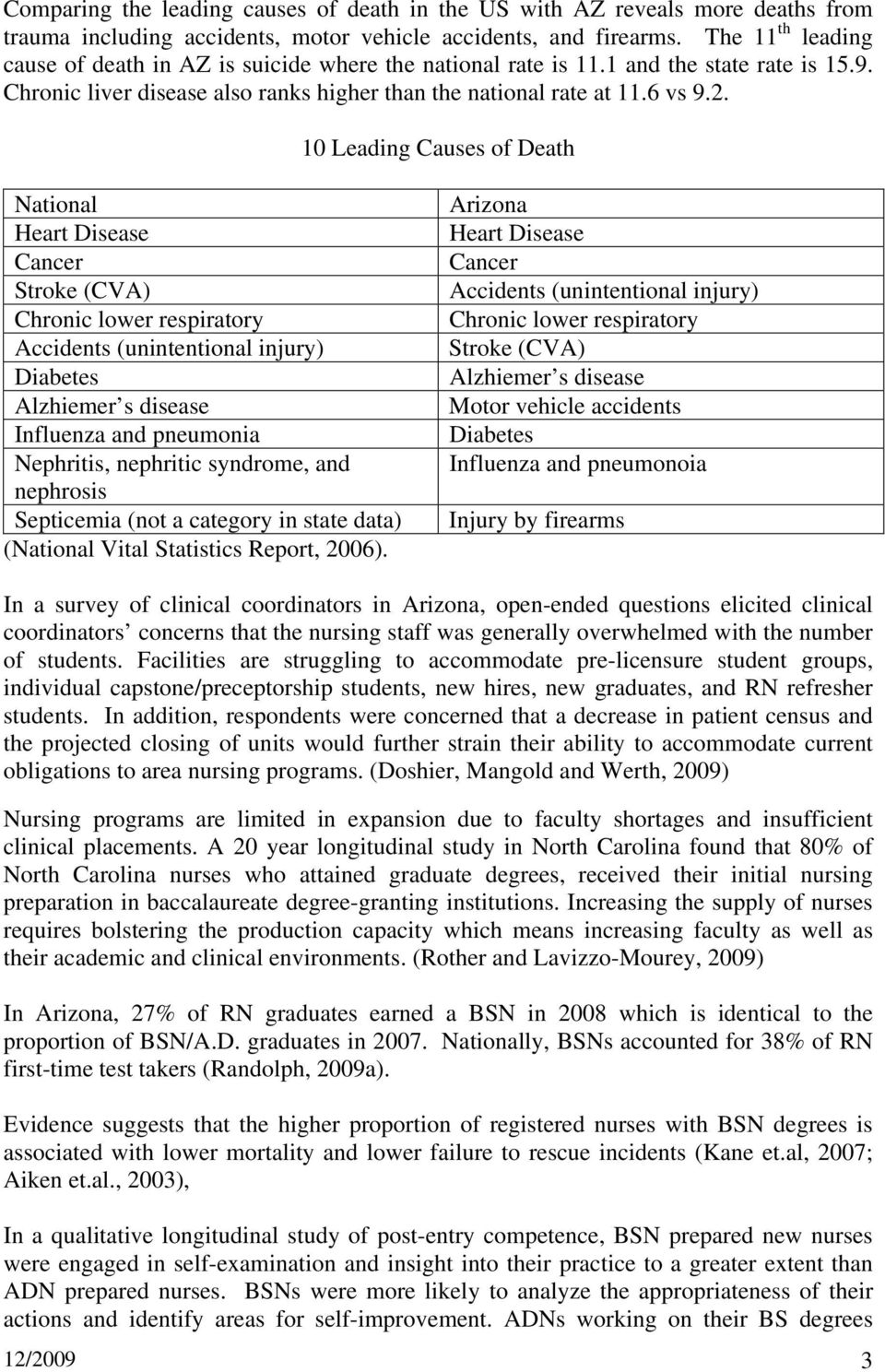
3 Comparing the leading causes of death in the US with AZ reveals more deaths from trauma including accidents, motor vehicle accidents, and firearms. The 11 th leading cause of death in AZ is suicide where the national rate is 11.1 and the state rate is Chronic liver disease also ranks higher than the national rate at 11.6 vs Leading Causes of Death National Heart Disease Cancer Stroke (CVA) Chronic lower respiratory Accidents (unintentional injury) Diabetes Alzhiemer s disease Influenza and pneumonia Nephritis, nephritic syndrome, and nephrosis Septicemia (not a category in state data) (National Vital Statistics Report, 2006). Arizona Heart Disease Cancer Accidents (unintentional injury) Chronic lower respiratory Stroke (CVA) Alzhiemer s disease Motor vehicle accidents Diabetes Influenza and pneumonoia Injury by firearms In a survey of clinical coordinators in Arizona, open-ended questions elicited clinical coordinators concerns that the nursing staff was generally overwhelmed with the number of students. Facilities are struggling to accommodate pre-licensure student groups, individual capstone/preceptorship students, new hires, new graduates, and RN refresher students. In addition, respondents were concerned that a decrease in patient census and the projected closing of units would further strain their ability to accommodate current obligations to area nursing programs. (Doshier, Mangold and Werth, 2009) Nursing programs are limited in expansion due to faculty shortages and insufficient clinical placements. A 20 year longitudinal study in North Carolina found that 80% of North Carolina nurses who attained graduate degrees, received their initial nursing preparation in baccalaureate degree-granting institutions. Increasing the supply of nurses requires bolstering the production capacity which means increasing faculty as well as their academic and clinical environments. (Rother and Lavizzo-Mourey, 2009) In Arizona, 27% of RN graduates earned a BSN in 2008 which is identical to the proportion of BSN/A.D. graduates in Nationally, BSNs accounted for 38% of RN first-time test takers (Randolph, 2009a). Evidence suggests that the higher proportion of registered nurses with BSN degrees is associated with lower mortality and lower failure to rescue incidents (Kane et.al, 2007; Aiken et.al., 2003), In a qualitative longitudinal study of post-entry competence, BSN prepared new nurses were engaged in self-examination and insight into their practice to a greater extent than ADN prepared nurses. BSNs were more likely to analyze the appropriateness of their actions and identify areas for self-improvement. ADNs working on their BS degrees 12/2009 3
4 showed more insight and commitment than ADNs who were not engaged in further education. RNs from second degree programs were especially insightful and motivated to improve care. BSN nurses were also more likely, in the early years of practice, to solve complex psychosocial patient problems. Additionally, ADNs who quickly pursued BS degrees were more alert to psychosocial interventions. (Kearney, 2009). Graduates of nursing programs were more likely to feel adequately prepared when the nursing program had the following characteristics: a higher percentage of faculty members teaching both didactic and clinical; information technology and evidence-based practice incorporated into the curriculum; pathophysiology integrated throughout the curriculum; and independent nursing courses based in traditional specialties (women s health, mental health, medical-surgical etc.). (Li & Kenward, 2006) The ratio of nurse practitioners to population in AZ is higher than the national average while nurse midwives and certified registered nurse anesthetists are near the national average. Clinical nurse specialists, are far below the national average. (CHIR, 2009) The National Student Nurses Association conducted a survey of employment among new graduates in 2009 and found that 44% did not have jobs within a month of graduation. 50% of those who did not have a job had associates degrees, 38% had baccalaureate degrees. The most common reason for not having a job was that there were no jobs for new graduates in the area. Arizona new grads were among the highest in the nation who cited no jobs for new graduates in the area as the reason for non-employment (Mancino, 2009) Washington adopted a master plan for nursing education. Below are some features of their plan. Goals include new licensees having a baccalaureate within 10 years starting 2010; all LPN and ADN programs having at least one articulation pathway to a higher degree. Expanded access to education by all citizens including minorities Strategies include shared resources and multiple pathways Evaluate appropriate number of clinical hours at each level of prelicensure education Improve quality of teaching and learning in schools Expectations of teaching as part of professional practice (Washington Center for Nursing, 2008). Malloch, Davenport and Hatler (2003) conducted workforce management benchmarking for the state of Kentucky and concluded that Kentucky needed to take the following measures in regards to educating the workforce: recruit and retain younger, ethnically diverse RNs, increase BSN graduates, increase master s graduates, standardize and formalize continuing education content related to specialty areas and increase continuing education offerings for RNs on the 10 leading causes of death. 12/2009 4
5 Conclusions Based on the evidence examined, Arizona could revise educational efforts to better meet the health care needs of its citizens by promoting public policy to: Increase the proportion nurses prepared at the baccalaureate level for initial licensure this not only will promote better outcomes but provide a future pipeline for faculty for all programs Reduce barriers and increase early access to BSN completion programs; developing strategies to decrease attrition in BSN completion programs Increase capacity in public pre-licensure RN programs Encourage nursing program curriculum reforms including: care of vulnerable populations; cultural competence; care of aging clients; integration of EBP, pathophysiology and technology into nursing courses; and nursing courses based on traditional populations of care Increase nurses prepared at the graduate level in programs focusing on teaching and advanced practice, particularly CNS. Increase the proportion of Hispanic/Latino and male nurses to better reflect the population demographics of the state Increase the number of nurses serving rural and other underserved areas REFERENCES Aiken, L.H., Clarke, S.P., Cheung, R.B., Sloane, D.M., and Silber, J.H. (2003). Educational level of hospital nurses and surgical patient mortality. Journal of the American Medical Association, 290(12): American Association of Colleges of Nursing (2007). Fact sheet: the impact of education on nursing practice. Available at: aacn.nchc.edu/edimpact/index.htm. AZBN (2009). Clinical Group Placements in Accessed at azbn.gov/educaton on August 13, Buerahus, P., Aurebach, D., & Staiger, D. (2007). Recent trends in the nurse labor market in the US: short-run swings on top of long-term trends. Nursing Economics, 25 (2), Buerhaus, P., Staiger, D., and Auerbach, D. (2009). The Future of the nursing workforce in the United States: data, trends, and implications. Boston: Jones and Bartlett. Center for Health Information and Research (CHIR). The Arizona Health Care Workforce: Nurses, Pharmacists, & Physician Assistants. Draft Report. April Doshier, S., Mangold, C. & Werth, J. (2009). Clinical coordinator survey: an assessment of clinical placement issues for pre-license nursing students in Arizona. Arizona State Board of Nursing Regulatory Journal, 4(2), /2009 5

6 Heron, M. Hoyert, D., Murphy, S., Xu, J., Kochanek, K. & Tejeda-Vera, B. (2009). Deaths: Final data for National Vital Statistics Report, Vol. 57, No. 14, April 17, Available atcdc.gov/nchs/data/nvsr/nvsr57/nvsr57_14.pdf. Accessed on September 9, HRSA (2004). The registered nurse population: Findings from the March 2004 national sample survey of registered nurses. US Department of Health and Human Services Health Resources and Services Administration Bureau of Health Professions. Available at hrsa.gov/healthworkforce/rnsurvey04/. Accessed on September 9, Kane R.L., Shamliyan T., Mueller, C., et al. Nurse Staffing and Quality of Patient Care. Minneapolis: Prepared by Minnesota Evidence-based Practice Center for the Agency for Healthcare Research and Quality under Contract No ; Evidence Report/Technology Assessment No. 151, AHRQ Publication No. 07 E005. March Kearney, M., (2009). Report of findings from the post-entry competence study. National Council of State Boards of Nursing Research Brief. Accessed August 6, 2009 at ncsbn.org. Li, S. and Kenward, K. (2006/July). A national survey on elements of nursing education. National Council of State Boards of Nursing Research Brief. Volume 24. Malloch, K., Davenport, S. & Hatler, C. (2009). Nursing workforce management: Using benchmarking for planning and outcomes monitoring. JONA: The Journal of Nursing Administration, 33(10), Mancino, D. (2009). Entry level positions for new graduates: Real-time dilemma requires real-time solutions. Dean s Notes, 31(1), 1-3. NLN (2008). NLN think tank on transforming nursing clinical education. NLN available at nln.org. Accessed on August 13, Napolitano, J. (2005). Aging 2020 Arizona s plan for an aging population. Available at azgovernor.gov on August 13, Randolph, P., (2009a). Annual Reports from Nursing Programs Available at azbn.gov/education. Accessed on August 12, Randolph, P., (2009b). Clinical program survey: group placement in Arizona State Board of Nursing Regulatory Journal. 4 (2) Rother, J. and Lavizzo-Mourey, R., (2009). Addressing the nursing workforce: A critical element for health reform. Health Affairs-web exclusive. 12 June U.S. Census Bureau (2009). Arizona Quick Facts from the U.S. Census Bureau. Available at quickfacts.census.gov/qfd/states/04000.html. Accessed on August 12, /2009 6

7 Washington Center for Nursing (March 31, 2008). A master plan for nursing education in Washington state. Available at: wacenterfornuring.org. Accessed on August 12, /2009 7
Nursing Education Programs 2013-2014 Annual School Report
 STATE OF WASHINGTON DEPARTMENT OF HEALTH Nursing Education Programs 2013-2014 Annual School Report Statistical Summary and Trends Analysis Nursing Care Quality Assurance Commission DOH 669-269 (Revised
Subcommittee on Labor, Health and Human Services, Education and Related Agencies Committee on Appropriations United States House of Representatives
 ANSR AMERICANS FOR NURSING SHORTAGE RELIEF Testimony of the Americans for Nursing Shortage Relief (ANSR) Alliance Regarding Fiscal Year 2011 Appropriations for Title VIII Nursing Workforce Development
POSITION STATEMENT ON EDUCATIONAL ADVANCEMENT FOR REGISTERED NURSES
 POSITION STATEMENT ON EDUCATIONAL ADVANCEMENT FOR REGISTERED NURSES EXECUTIVE SUMMARY INA supports the action report adopted at the House of Delegates. ANA (O Brien & Gural, 2008) recommends: Increasing
Arizona State Board of Nursing 4747 North 7 th Street, Suite 200 Phoenix. AZ 85014-3653 Phone (602)771-7800 Fax - (602)771-7888
 Janice K. Brewer Governor Arizona State Board of Nursing 4747 North 7 th Street, Suite 200 Phoenix. AZ 85014-3653 Phone (602)771-7800 Fax - (602)771-7888 Joey Ridenour Executive Director Credits/Length
Fact Sheet: Creating a More Highly Qualified Nursing Workforce
 CONTACT: Robert J. Rosseter, 202-463-6930, x231 [email protected] Fact Sheet: Creating a More Highly Qualified Nursing Workforce Quality patient care hinges on having a well educated nursing workforce.
BUILD UPON YOUR NLCP EXPERIENCE THROUGH ACADEMIC PROGRESSION
 BUILD UPON YOUR NLCP EXPERIENCE THROUGH ACADEMIC PROGRESSION Dr. Colleen Manzetti, CNE, CNLCP Assistant Professor & Graduate Faculty Monmouth University 1 LEARNING OBJECTIVES: 1. The participants will
White Paper: Community Colleges Awarding Baccalaureate Degrees in Nursing
 White Paper: Community Colleges Awarding Baccalaureate Degrees in Nursing Introduction The community s response to the proposal for a six-year pilot program allowing community colleges in Arizona to offer
How To Fund The Nursing Community
 Testimony of the Nursing Community Regarding Fiscal Year (FY) 2015 Appropriations for the Title VIII Nursing Workforce Development Programs, the National Institute of Nursing Research, and Nurse-Managed
Topic: Nursing Workforce Snapshot A Regional & Statewide Look
 Topic: Nursing Workforce Snapshot A Regional & Statewide Look Nursing Workforce in Texas 184,467 registered nurses (2011) Median age of RN is 47 (2011) Gender 89% Female and 11% Male (2011) Race/Ethnicity
Arizona Nursing Education at a Glance, Fall 2014
 Education is not a static process. It evolves with newly discovered best-practices, technology, and innovation in the classroom. As our nation s healthcare system transforms and more services are provided
Tri-Council for Nursing
 For Immediate Release Tri-Council for Nursing Issues New Consensus Policy Statement on the Educational Advancement of Registered Nurses WASHINGTON, D.C., May 14, 2010 In light of the recent passage of
Education Advancement for RNs Briefing Paper
 Proposal The 2008 American Nurses Association House of Delegates RESOLVED, that the American Nurses Association support initiatives to require registered nurses (RNs) to obtain a baccalaureate degree in
Community College Presidents National Meeting on Academic Progression in Nursing
 Community College Presidents National Meeting on Academic Progression in Nursing Convened by: The Robert Wood Johnson Foundation Hosted at: The American Association of Community Colleges April 9, 2013
Proposal for a Graduate Certificate. Adult Nurse Practitioner. Submitted by the School of Nursing West Lafayette Campus
 Graduate Council Document 06-4b Approved by the Graduate Council 4/27/06 Proposal for a Graduate Certificate Adult Nurse Practitioner Submitted by the School of Nursing West Lafayette Campus Purdue University
Subcommittee on Labor, Health and Human Services, Education and Related Agencies Committee on Appropriations United States House of Representatives
 ANSR AMERICANS FOR NURSING SHORTAGE RELIEF Testimony of the Americans for Nursing Shortage Relief (ANSR) Alliance Regarding Fiscal Year 2013 Appropriations for Nursing Workforce Development Programs and
To help transform our health care system and improve
 INVITED COMMENTARY The RIBN Initiative: A New Effort to Increase the Number of Baccalaureate Nurses in North Carolina Polly Johnson To meet the increasing demand for a more educated nursing workforce,
Massachusetts Nursing Education at a Glance, Fall 2014
 Education is not a static process. It evolves with newly discovered best-practices, technology, and innovation in the classroom. As our nation s healthcare system transforms and more services are provided
Survey of Nursing Education Programs: 2005 2006 School Year
 Survey of Nursing Education Programs: EXECUTIVE SUMMARY In the fall of 2006, the Michigan Center for Nursing conducted a survey of nursing education programs in Michigan to collect information on the types
Nursing Supply and Demand Study 2008
 Nursing Supply and Demand Study 2008 2100 Sherman Avenue, Suite 100 Cincinnati, OH 45212-2775 Phone: (513) 531-0200 2 Table of Contents I. Introduction... 3 II. Hospital Survey (Demand)... 4 A. Registered
Survey of Nursing Education Programs: 2005 2006 School Year
 Survey of Nursing Education Programs: 2005 2006 School Year EXECUTIVE SUMMARY In the fall of 2006, the Michigan Center for Nursing conducted a survey of nursing education programs in Michigan to collect
2010 NLN NURSE EDUCATOR SHORTAGE FACT SHEET
 2010 NLN NURSE EDUCATOR SHORTAGE FACT SHEET The National League for Nursing and the Carnegie Foundation Preparation for the Professions Program conducted a study of the nation's estimated 32,000 nurse
Selected Health Status Indicators DALLAS COUNTY. Jointly produced to assist those seeking to improve health care in rural Alabama
 Selected Health Status Indicators DALLAS COUNTY Jointly produced to assist those seeking to improve health care in rural Alabama By The Office of Primary Care and Rural Health, Alabama Department of Public
DECEMBER 9, 2015. On behalf of the 55 undersigned national professional nursing organizations representing the
 WRITTEN TESTIMONY FOR THE RECORD HOUSE ENERGY AND COMMERCE, SUBCOMMITTEE ON HEALTH HEARING EXAMINING LEGISLATION TO IMPROVE HEALTH CARE AND TREATMENT SUBMITTED BY: SUZANNE MIYAMOTO, PHD, RN, FAAN ON BEHALF
Nursing Education Expansion Plan
 University System of Georgia s Nursing Education Expansion Plan Approved by: USG Health Professions Advisory Committee November 18, 2009 Submitted by: USG Nursing Education Task Force September 22, 2009
Survey of Nursing Education Programs: 2009 2010 School Year
 Survey of Nursing Education Programs: 2009 2010 School Year Prepared for Michigan Center for Nursing Okemos, Michigan Prepared by Public Sector Consultants Lansing, Michigan www.pscinc.com Survey of Nursing
Nursing Supply and Demand Study Acute Care
 2014 Nursing Supply and Demand Study Acute Care Greater Cincinnati Health Council 2100 Sherman Avenue, Suite 100 Cincinnati, OH 45212-2775 Phone: (513) 531-0200 Table of Contents I. Introduction and Executive
PROPOSAL GRADUATE CERTIFICATE ADVANCED PRACTICE ONCOLOGY SCHOOL OF NURSING TO BE OFFERED AT PURDUE UNIVERSITY WEST LAFAYETTE CAMPUS
 Graduate Council Document 08-20b Approved by the Graduate Council November 20, 2008 PROPOSAL GRADUATE CERTIFICATE ADVANCED PRACTICE ONCOLOGY SCHOOL OF NURSING TO BE OFFERED AT PURDUE UNIVERSITY WEST LAFAYETTE
Academic Consulting Group. Get the Grant: Writing a Powerful and Persuasive Grant Proposal EXAMPLES OF GRANT COMPONENTS
 Academic Consulting Group Get the Grant: Writing a Powerful and Persuasive Grant Proposal Objectives of Presentation: Susan Sportsman, RN, PhD, ANEF, FAAN 1. Evaluate the effectiveness of a basic logic
How To Understand And Understand The National Health Care System
 A Data-Driven Examination of the Impact of Associate and Bachelor s Degree Programs on the Nation s Nursing Workforce Roxanne Fulcher and Christopher M. Mullin AACC Policy Brief 2011-02PBL March 2011 HEALTH
How To Become A Registered Nurse
 T I T L E V I I I O F T H E P U B L I C H E A L T H S E R V I C E A C T Nursing Workforce Development Programs We cannot get significant improvements in the quality of health care or coverage unless nurses
Workforce Development Programs
 Nurses provide extraordinary care. They re the front lines of the healthcare system. ~ President Barack Obama White House Health Care Summit March 5, 2009 Nursing Workforce Development Programs Title VIII
CGEAN Position Statement on the Educational Preparation of Nurse Executives and Nurse Managers*
 CGEAN Position Statement on the Educational Preparation of Nurse Executives and Nurse Managers* Background The Council on Graduate Education for Administration in Nursing (CGEAN) is focused on advancing
State of the South Dakota Nursing Workforce: Data, Trends & Opportunities
 State of the South Dakota Nursing Workforce: Data, Trends & Opportunities Linda Young, RN, MS, FRE Nursing Practice Specialist SD Board of Nursing SD Center for Nursing Workforce 2012-2022 National Employment
Florida s Advanced Registered Nurse Practitioner Supply: 2014-2015 Workforce Characteristics and Trends
 Florida s Advanced Registered Nurse Practitioner Supply: 2014-2015 Workforce Characteristics and Trends Visit our site at: www.flcenterfornursing.org TABLE OF CONTENTS Key Findings...3 Introduction.4 Results
Nursing Education. d Supply & Demand Analysis Curriculum Redesign & System-wide Offerings
 Nursing Education d Supply & Demand Analysis Curriculum Redesign & System-wide Offerings Office of the Commissioner of Higher Education May 19, 2016 Topics MUS Nursing Graduate Production State-level Analysis
Iowa Legislative Fiscal Bureau. Iowa's Nursing Shortage. This Issue Review provides a comprehensive overview of the current nursing shortage in Iowa.
 Iowa Legislative Fiscal Bureau I S S U E R E V I E W Dennis Prouty State Capitol (515) 281-5279 Des Moines, IA 50319 FAX 281-8451 September 20, 2001 ISSUE Iowa's Nursing Shortage This Issue Review provides
NEW YORK S GROWING DEMAND
 Nurses and Allied Health Professionals NEW YORK S GROWING DEMAND Results from the 2011 Health Care Professionals Workforce Survey JUNE 2011 Published by The 2011 Health Care Professionals Workforce Survey
Florida Pre-Licensure Registered Nurse Education: Academic Year 2012-2013
 The information below represents the key findings regarding the pre-licensure RN (Associate Degree in Nursing, ADN, and Bachelor of Science Degree in Nursing, BSN) education system in Florida. This report
State Health Assessment Health Priority Status Report Update. June 29, 2015 Presented by UIC SPH and IDPH
 State Health Assessment Health Priority Status Report Update June 29, 2015 Presented by UIC SPH and IDPH 1 Health Priority Presentation Objectives 1. Explain context of how this discussion fits into our
2008 Colorado Registered Nurse Workforce Survey
 2008 Colorado Registered Nurse Workforce Survey Survey Findings Colorado Health Institute 1576 Sherman Street, Suite 300 Denver, CO 80203-1728 www.coloradohealthinstitute.org September 2009 Acknowledgments
March 25, 2014. recommending $251 million for the Title VIII Nursing Workforce Development Programs at
 ANSR AMERICANS FOR NURSING SHORTAGE RELIEF Christine Murphy, ANSR Alliance Co-Chair Senior Public Policy Specialist National League for Nursing Wade Delk, ANSR Alliance Co-Chair Government Affairs Director
The Obama Administration s Record on Supporting the Nursing Workforce
 The Obama Administration s Record on Supporting the Nursing Workforce Nurses are at the center of the American health system. There are more nurses in our country than any other type of health care provider.
Nursing Education: The State of the Discipline. Unique contribution of the Florida Atlantic University, Christine E. Lynn College of Nursing
 Nursing Education: The State of the Discipline Unique contribution of the Florida Atlantic University, Christine E. Lynn College of Nursing Access to Nursing Education: Programs Licensed Practical Nurse
Subcommittee on Labor, Health and Human Services, Education and Related Agencies Committee on Appropriations United States House of Representatives
 Testimony of the American Nurses Association Regarding Fiscal Year 2015 Appropriations for the Title VIII Nursing Workforce Development Programs and Nurse-Managed Health Clinics Subcommittee on Labor,
How To Understand And Understand The Health Care Needs In North Dakota
 North Dakota Nursing Needs Study 2011 Licensed Nurse Supply Analysis January, 2012 Patricia L. Moulton, Ph.D. North Dakota Center for Nursing Research Publication #3 Funding for this project was provided
US Department of Health and Human Services Employment/Workforce Priorities. Sharon Lewis Administration for Community Living
 US Department of Health and Human Services Employment/Workforce Priorities Sharon Lewis Administration for Community Living Topics US Department of Health and Human Services (HHS) Administration for Community
Health Professions Data Series Registered Nurses 2010
 Executive Office of Health and Human Services Health Professions Data Series Registered Nurses 2010 Deval L. Patrick, Governor Timothy P. Murray, Lieutenant Governor John W. Polanowicz, Secretary Lauren
E-Learning to Ease the Nursing Shortage: A New Model for Transitioning Licensed Vocational Nurses (LVNs) to Registered Nurses (RNs)
 E-Learning to Ease the Nursing Shortage: A New Model for Transitioning Licensed Vocational Nurses (LVNs) to Registered Nurses (RNs) Dr. Carol Diminnie Professor of Management Sciences Angelo State University,
The Alabama Health Action Coalition (AL-HAC)
 The Alabama Health Action Coalition (AL-HAC) Carol J. Ratcliffe, DNP, RN, FACHE AL-HAC - Nursing Co-Leader Birmingham Black Nurses Association, Inc. Open House UAB Hospital, Birmingham, AL February 3,
complex discipline, one that requires skilled, knowledgeable,
 C EONTINUING DUCATION SERIES CE Objectives and Evaluation Form appear on page 142. Christina M. Graf ADN to BSN: Lessons from Human Capital Theory Executive Summary Despite the recommendation by the National
Nursing Workforce. Primary Care Workforce
 Key Provisions Related to Nursing: The Patient Protection and Affordable Care Act (Public Law 111-148) clearly represents a movement toward much-needed, comprehensive and meaningful reform for our nation