
E-Learning to Ease the Nursing Shortage: A New Model for Transitioning Licensed Vocational Nurses (LVNs) to Registered Nurses (RNs)
|
|
|
- Jody Glenn
- 10 years ago
- Views:
Transcription
1 E-Learning to Ease the Nursing Shortage: A New Model for Transitioning Licensed Vocational Nurses (LVNs) to Registered Nurses (RNs) Dr. Carol Diminnie Professor of Management Sciences Angelo State University, San Angelo, Texas, USA Dr. Linda Ross Regional Director for Laura W. Bush Institute for Women s Health and Assistant Clinical Professor of Nursing Angelo State University, San Angelo, Texas, USA Background The United States is in the midst of a nursing shortage due to a rapidly aging workforce, the aging of current registered nurses (RNs), and a shortage of nursing faculty in the colleges. Despite the current easing of the nursing shortage due to the recession, one source projects the U.S. nursing shortage to grow to 260,000 registered nurses by 2025 (Buerhaus, July/August 2009), while the U. S. Bureau of Labor Statistics published in the November 2007 Monthly Labor Review that more than one million new and replacement nurses will be needed by Between 2011 and 2020, an estimated 55% of the registered nursing workforce is expected to retire (Hadler et al, 2006). Currently 72% of hospitals nationwide report an average vacancy rate of 12% (Siler, DeBasio & Roberts, 2008). Texas is no exception. By 2020, Texas will be short an estimated 52,000 nurses. Nursing programs will have to double their current enrollment to meet the demand by 2020 (Texas Higher Education Coordinating Board, 2006). The projected need for new RN graduates is a real dilemma facing nursing education and the healthcare workforce. Rural Texas hospitals have reported an RN vacancy of 15% in recent years (Texas Center for Nursing Workforce Studies, 2006). 1

2 Many nursing programs are at capacity and unable to admit qualified applicants. In Texas, 200 additional nursing faculty are needed annually to meet the demand for additional nursing students. This shortage of nurses will ultimately impact the quality of patient care. Therefore, innovative, accelerated solutions to provide more RNs to address this potential crisis are needed. The Problem One population that essentially has been overlooked in meeting the nursing shortage is the Licensed Vocational Nurses (LVNs). LVNs care for people who are sick, injured, convalescent, or disabled under the direction of physicians and registered nurses. Their stateapproved training program usually lasts about a year, after which the student must pass a national licensure exam. There are 77,117 LVNs in Texas, with over 18,000 working in hospital settings (Texas Department of State Health Services). The LVN profession is among the few health professions where Texas exceeds the U.S. average for provider-to-population ratios. Why do not more LVNs train to become RNs to help alleviate the registered nurse shortage? The vast majority of LVNs must maintain full-time employment in order to provide for themselves and their families. Traditional LVN-RN programs are campus-based, full-time month programs. Many LVNs cannot continue their education on a full-time basis because they cannot afford to quit their job, losing pay and/or benefits. Hence, the full-time programs are having difficulty attracting and graduating students. The Licensed Vocational Nurses express frustration over not being given credit for their LVN educational experience and education, being required to repeat didactic (knowledge based) nursing experiences in the traditional LVN- RN program. 2

3 Hospitals have expressed dissatisfaction with alternative LVN-RN options because of their cost, lack of clinical experience, and a sense of isolation from the educational process of their employee. What is needed is a reputable, quality LVN-RN program which takes less time than the traditional program, allows the student to remain employed with benefits for the duration of the program, and gives the student credit for demonstrated competence in nursing skills learned in their LVN training. The Solution Angelo State University (ASU), San Angelo, Texas, proposed a new model for the LVN to RN transition which meets all these requirements. Funded by a $1.27 million grant from the Texas Higher Education Coordinating Board, ASU partnered initially with four community hospitals in rural West Texas to develop and implement a new model LVN-RN program in which the working LVNs would be able to go back to school to earn their associate degree in nursing. Initial partnerships were formed with four hospitals in West Texas: San Angelo Community Medical Center (San Angelo, TX), Shannon Medical Center (San Angelo, TX), Scenic Mountain Medical Center (Big Spring, TX) and Brownwood Regional Hospital (Brownwood, TX). The program has expanded to include 14 hospitals at the current time, with five more hospitals to come on board in July The objectives of the new model were to: 1. Allow LVNs to remain employed full-time with full salary and benefits while completing their studies. 2. Decrease the time of completion by 50%. 3. Develop asynchronous, on-line courses to cover the didactic content. 3

4 4. Identify on-line study materials for mental health, obstetrics, and pediatric competency exams, so the LVNs could earn credit for material studied in their LVN educational program. 5. Identify on-line tests for mental health, obstetrics, and pediatric competencies. 6. Develop asynchronous, on-line course tailored to the hospital preceptor who will supervise the specific individualized competency development of the LVN who is transitioning to the RN role. 7. Provide one-on-one supervision (precepting) of the LVN student by a hospital RN preceptor. 8. Develop an LVN-RN Competency Transcript which includes the RN hospital orientation competencies. 9. Increase hospital staff involvement with the LVN to RN transition educational process. The Model In the summer of 2008, Angelo State University formed partnerships with four area hospitals to design and implement an innovative, cost- and time-efficient, competency-based LVN-RN transition program. This program allows working LVNs to go back to school on-line to earn their associate degree in nursing without sacrificing salary and benefits. The ultimate goal of this project is to increase the number of RNs providing nursing care to the citizens of Texas, especially those Texans living in rural areas, by training LVNs employed by the partner hospitals. Unique features of this model include: 1. A decrease in time of completion from the traditional campus-based full-time model by 50% (from 42 to 21 weeks). 2. Students given credit for course work in mental health, obstetrics, and pediatrics after passing competency tests in these areas. 4

5 MyNursingLab TM from Pearson Education selected to help prepare students to pass online testing through the National League of Nursing to show competency in the didactic content of mental health, obstetrics, and pediatrics (material the students had covered in their LVN education). Pre- and post-testing Study plan Interactive video PowerPoint Online Instructor Resource Manual Student E-book National League of Nursing (NLN) on-line tests selected for competency testing. 3. Didactic content delivered and evaluated through online courses. Creation of on-line versions of RNSG 1227 Transition from Vocational to Professional Nursing I and RNSG 2427 Transition from Vocational to Professional Nursing II. Students study didactic course work on their own time. Articulated PowerPoint Discussion board Clinical logs/reflection On-line support for textbook Blackboard 8.0 Course Management system chosen as the platform for the on-line delivery of courses. 5

6 4. Hospitals provide an RN preceptor for each LVN student in the program. The preceptor is generally paid a stipend (which varies by hospital) for this role and is prepared for this responsibility by taking an on-line course (paid for by the hospital). Creation of an on-line course N4343 Role of the Clinical Preceptor for the hospital RN chosen to assist the LVN-RN student during the precepted clinical experiences. 5. Hospitals pay tuition and fees, provide a paid 8-12 hour study day during the didactic portion of the program, and provide paid release time for completion of the clinical components. The grant pays the hospital $3000 per student to partially offset this expense. 6. Development of a project orientation program for hospital staff educators, RN clinical preceptors, and key hospital administrators. Hospitals now have a direct involvement in the educational process. 7. Adoption of an LVN-RN Competency Transcript which allows the hospital to reduce or eliminate the orientation time necessary for a new RN hire. Curriculum Design Phase I 5 weeks in length RNSG 1227 Transition from Vocational to Professional Nursing I Didactic Testing No later than week 4 RNSG 1160 Clinical-Nursing 6 24 Hours of Precepted Clinical Experience No later than Week 5

7 Upon successful completion of Phase 1, the student receives credit for the first year of AASN courses and moves into Phase II. Phase II 16 weeks in length RNSG 2427 Transition from Vocational to Professional Nursing II Student begins MyNursingLab study for Mental Health, Obstetrics, and Pediatrics NLN competency exams Didactic Testing No later than week 12 NLN Exams No later than week 12 RNSG 2527 Capstone Clinical 176 Hours of Precepted Clinical Upon successful completion of Phase II, as long as all graduation requirements are met, the student receives ADN degree and is eligible to sit for the NCLEX-RN Exam. Success of the Model Initially, four Texas hospitals signed on as partners. Two of the hospitals are in San Angelo, Texas (San Angelo Community Medical Center and Shannon Medical Center), one in Big Spring, Texas (Scenic Mountain Medical Center) and one in Brownwood, Texas (Brownwood Regional Hospital). 7

8 Fifteen LVNs made up the first cohort of students, who began classes in July of Over the next two years, five more cohorts (for a total of six cohorts) have been supported by the Texas Higher Education Coordinating Board grant, for a total of 88 students. With each new cohort, additional Texas hospitals came on board until, currently, 14 Texas hospitals have partnered with Angelo State University for this program. Map of Texas, USA with 14 Partner Hospitals As of June 1, 2010, five cohorts have completed the program and one is slated to graduate in August, when the grant funding ends. The average age of the student is 33.3, with a range from 20 to 59. The average length of time the student has worked as an LVN is 5.2 years, with a range from 0 to 30 years. 8

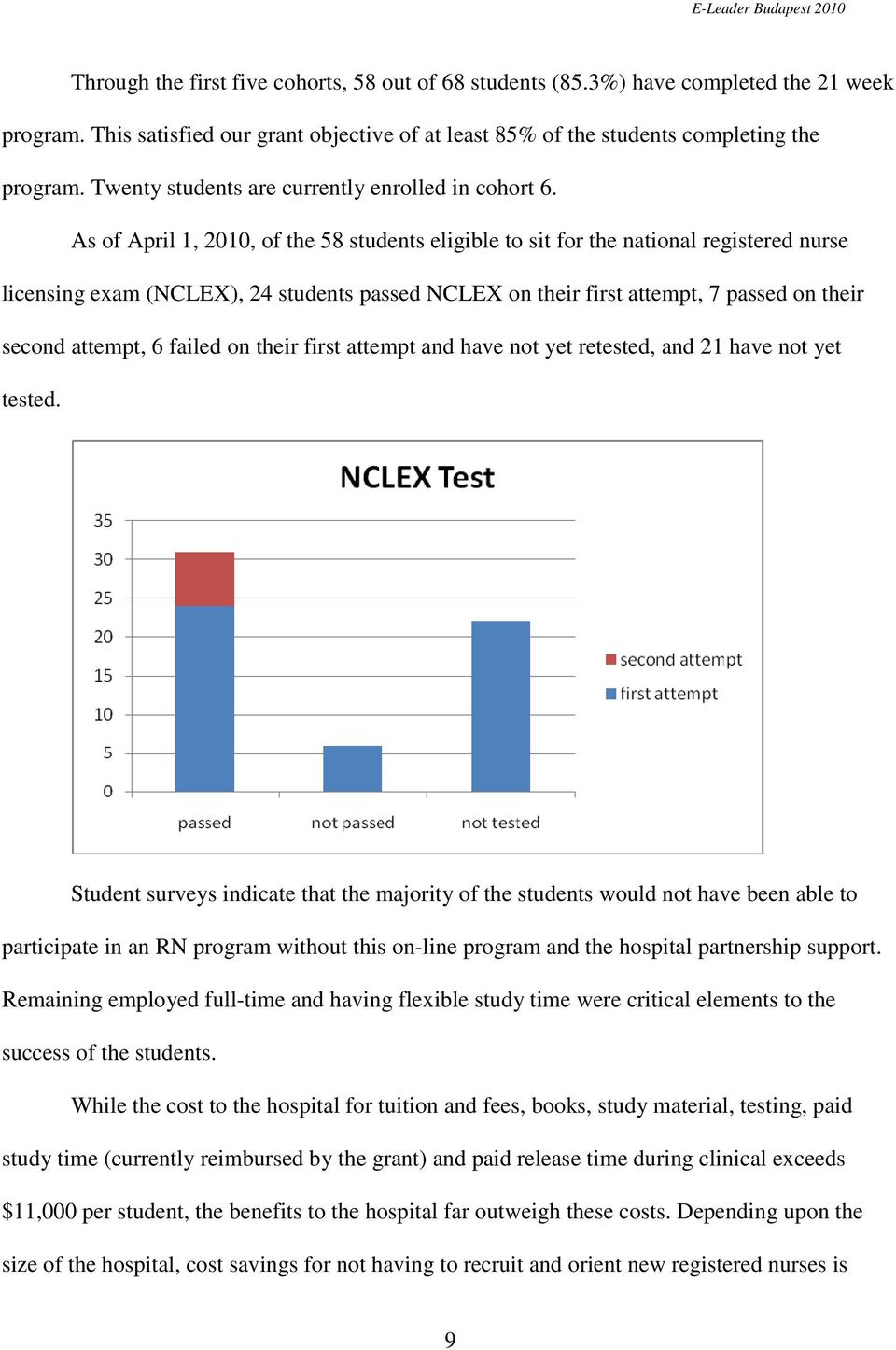
9 Through the first five cohorts, 58 out of 68 students (85.3%) have completed the 21 week program. This satisfied our grant objective of at least 85% of the students completing the program. Twenty students are currently enrolled in cohort 6. As of April 1, 2010, of the 58 students eligible to sit for the national registered nurse licensing exam (NCLEX), 24 students passed NCLEX on their first attempt, 7 passed on their second attempt, 6 failed on their first attempt and have not yet retested, and 21 have not yet tested. Student surveys indicate that the majority of the students would not have been able to participate in an RN program without this on-line program and the hospital partnership support. Remaining employed full-time and having flexible study time were critical elements to the success of the students. While the cost to the hospital for tuition and fees, books, study material, testing, paid study time (currently reimbursed by the grant) and paid release time during clinical exceeds $11,000 per student, the benefits to the hospital far outweigh these costs. Depending upon the size of the hospital, cost savings for not having to recruit and orient new registered nurses is 9
10 estimated to range from $15,000 (for a small hospital) to over $40,000 (for medium to large hospitals). The new RN needs little or no orientation to the hospital (which often takes up to 16 weeks) because the RN satisfied the LVN-RN Competency Transcript while in clinical at the hospital. Hospitals do not need to hire expensive agency nurses to fill the vacant RN position. Further, RN attrition at the hospital decreases because a known, committed employee is now filling the RN position. Hospital administrators, educators, and nurse preceptors appreciate having a major role in the education of their new RN employee. The Future While the grant support for this new model ends with the graduation of cohort 6 in August, all of the existing partner hospitals plan to remain committed to supporting this program, even without the grant support. Further, an additional five Texas hospitals have requested to participate. A new cohort starting in July will have students from as far away as Houston in the program. Since the program is on-line, LVNs from across the state are asking their hospitals to contact us to begin this program. Some of the larger hospitals are phasing out the employment of LVNs and requiring all nurses to be RNs. This increases the demand for an accelerated program such as this. 10
11 References American Association of Colleges of Nursing. (2008, September). Fact sheet: Nursing shortage. Retrieved October 17, 2008, from American Association of Colleges of Nursing Web site: Buerhaus, P., Auerbach, D., & Staiger, D., The recent surge in nurse employment: causes and implications, Health Affairs, 28, no. 4 (2009): w657-w668, published online 12 June 2009). Dohm, A. & Shniper, L., (2007, November). Employment outlook: : Occupational employment projections to Monthly Labor Review, Feldman, H. & Jordet, C. (1989). On the fast track. Nursing and Health Care, 10, Hadler, R., Saver, C., & Steltzer, T. No time to lose, Nursing Management, 37(7):23-29, 48, July Lim, J., Kim, M., Chen, S., & Ryder, C. (2008). An empirical investigation of student achievement and satisfaction in different learning environments. Journal of Instructional Psychology, 35 (2), Robley, L., Farnsworth, B., Flynn, J., & Horne, C. (2004, September/October). This new house: Building knowledge through online learning. Journal of Professional Nursing, 20 (5),

12 Siler, B., DeBasio, N., & Roberts, K. (2008, November). PROFILE of Non-Nurse College Graduates Enrolled in Accelerated Baccalaureate Curricula: Results of a National Study. Nursing Education Perspectives, 29(6), Texas Center for Nursing Workforce Studies. (2006) Texas Hospital Nurse Staffing Survey:2006. Retrieved October 10, 2008, from the Texas Center for Workforce Studies web site: Texas Higher Education Coordinating Board. (2006, November). Strategies for increasing student completion rates in initial RN licensure programs. Retrieved October 10, 2008, from Texas Higher Education Coordinating Board web site: 12

E-Learning to Ease the Nursing Shortage: A New Model for Transitioning Vocational Nurses (LVNs) to Registered Nurses (RNs)
 E-Learning to Ease the Nursing Shortage: A New Model for Transitioning Vocational Nurses (LVNs) to Registered Nurses (RNs) Carol Diminnie, PhD, MS, MBA Linda Ross, DNP, MS, RN Background Information By
Academic Consulting Group. Get the Grant: Writing a Powerful and Persuasive Grant Proposal EXAMPLES OF GRANT COMPONENTS
 Academic Consulting Group Get the Grant: Writing a Powerful and Persuasive Grant Proposal Objectives of Presentation: Susan Sportsman, RN, PhD, ANEF, FAAN 1. Evaluate the effectiveness of a basic logic
Office of the President
 Office of the President Dr. Belle Wheelan, President, Commission on Colleges Southern Association of Colleges and Schools 1866 Southern Lane, Decatur, GA 30033 December 13, 2010 In keeping with the Southern
Topic: Nursing Workforce Snapshot A Regional & Statewide Look
 Topic: Nursing Workforce Snapshot A Regional & Statewide Look Nursing Workforce in Texas 184,467 registered nurses (2011) Median age of RN is 47 (2011) Gender 89% Female and 11% Male (2011) Race/Ethnicity
WASHBURN UNIVERSITY SCHOOL OF NURSING. Program Comparisons: Prelicensure BSN and RN-BSN Undergraduate Degrees
 WASHBURN UNIVERSITY SCHOOL OF NURSING Program Comparisons: Prelicensure BSN and RN-BSN Undergraduate Degrees Introduction The Washburn University School of Nursing offers two tracks for the Bachelor of
Agenda Item: 3.2.5.b. Prepared by: B. Skloss/V. Ayars Board Meeting: July 2014
 Report of a Routine Survey Visit Wharton County Junior College, Wharton, Texas Associate Degree Nursing Education Program Agenda Item: 3.2.5.b. Prepared by: B. Skloss/V. Ayars Board Meeting: July 2014
Nursing Education Programs 2013-2014 Annual School Report
 STATE OF WASHINGTON DEPARTMENT OF HEALTH Nursing Education Programs 2013-2014 Annual School Report Statistical Summary and Trends Analysis Nursing Care Quality Assurance Commission DOH 669-269 (Revised
Baby Boomer Workforce Cliff
 Baby Boomer Workforce Cliff Impact on Your Nursing Workforce and Steps You Can Take Now to Minimize i i the Shortage Baby Boomer Workforce Cliff Impact On Your Nursing Workforce and Steps You Can Take
Nursing Education Programs in Pennsylvania Data from 2012 Nursing Education Program Annual Reports
 Nursing Education Programs in Pennsylvania Data from 2012 Nursing Education Program Annual Reports Bureau of Health Planning Division of Plan Development Volume 11, January 2014 TABLE OF CONTENTS List
New Program Proposal Bachelor of Science Nursing (R.N. to B.S.N. Completion) Coastal Carolina University
 New Program Proposal Bachelor of Science Nursing (R.N. to B.S.N. Completion) Coastal Carolina University Summary Coastal Carolina University requests approval to offer a program leading to the Bachelor
ASSOCIATE DEGREE NURSING PROGRAM
 Revised 11/23 Revised for Fall 2005 ASSOCIATE DEGREE NURSING PROGRAM The Galveston College Associate Degree Nursing program is offered by Galveston College in Galveston, Texas. The first year of the program
Development of Health Career Pathway for California. Psychiatric Mental Health Nurse Practitioner/Clinical Nurse Specialist Career Pathway
 Development of Health Career Pathway for California Psychiatric Mental Health Nurse Practitioner/Clinical Nurse Specialist Career Pathway 1 Current State As of February 2011, there were 9,458 psychiatric
How To Become A Licensed Vocational Nurse
 LVN- RN - Registered Nursing Program for Licensed Vocational Nurses Advanced Standing Status Advanced standing status (LVN-RN and Re-Admission applicant) is granted to students who have previously completed
Leslie M. Mayrand, Ph.D. 2601 W. Ave N /ASU Station #10902 San Angelo, TX 76909 325-942-2630 (voice) or 2631 (FAX) leslie.mayrand@angelo.
 Leslie M. Mayrand, Ph.D. 2601 W. Ave N /ASU Station #10902 San Angelo, TX 76909 325-942-2630 (voice) or 2631 (FAX) [email protected] RANK PROFESSOR/TENURED LICENSURE Registered Nurse, State of
POSITION STATEMENT ON EDUCATIONAL ADVANCEMENT FOR REGISTERED NURSES
 POSITION STATEMENT ON EDUCATIONAL ADVANCEMENT FOR REGISTERED NURSES EXECUTIVE SUMMARY INA supports the action report adopted at the House of Delegates. ANA (O Brien & Gural, 2008) recommends: Increasing
Careers in Nursing. Kris Hart RN-C, FNP MN
 Careers in Nursing Kris Hart RN-C, FNP MN What is a Profession? Profession is a calling that requires special knowledge, skill and preparation. An occupation that requires advanced knowledge and skills
Nursing Shortage Fact Sheet
 CONTACT: Robert J. Rosseter, (202) 463-6930, x231 [email protected] Nursing Shortage Fact Sheet The U.S. is in the midst of a shortage of registered nurses (RNs) that is expected to intensify as
Arizona State University College of Nursing & Health Innovation. Dean Teri Pipe
 Arizona State University College of Nursing & Health Innovation Dean Teri Pipe UNDERGRADUATE RN-BSN Pre-Licensure GRADUATE PHD DNP MS, Nursing Education INNOVATION Master of Healthcare Innovation (MHI)
How To Know The Nursing Workforce
 FAST FACTS The Nursing Workforce 2014: Growth, Salaries, Education, Demographics & Trends RN Job Growth Rate (new and replacement) By State/Region, 2012-2022) 14 states project an annual growth rate of
Cerritos College Associate Degree Nursing Program
 Cerritos College Associate Degree Nursing Program The California Board of Registered Nursing 2010-2011 Annual School Report reflected that 61% of nursing programs in California are Associate Degree programs.
Issues and Scope of the Problem Several major issues confront the nursing profession with respect to academic progression:
 Organization for Associate Degree Nursing and American Nurses Association Joint Position Statement on Academic Progression to Meet the Needs of the Registered Nurse, the Health Care Consumer, and the U.S.
HOWARD COLLEGE ACCELERATED ASSOCIATE DEGREE NURSING PROGRAM (FOR LICENSED VOCATIONAL NURSES) ACCELERATED ADN ADMISSION REQUIREMENTS
 HOWARD COLLEGE ACCELERATED ASSOCIATE DEGREE NURSING PROGRAM (FOR LICENSED VOCATIONAL NURSES) ACCELERATED ADN ADMISSION REQUIREMENTS Prior to actual admission into the Accelerated Associate Degree Nursing
LVN- RN - Registered Nursing Program for Licensed Vocational Nurses Who Seek an Associate Arts Degree in Nursing
 LVN- RN - Registered Nursing Program for Licensed Vocational Nurses Who Seek an Associate Arts Degree in Nursing Chabot College offers a step-up program to assist Licensed Vocational Nurses to achieve
Nursing Supply and Demand Study 2008
 Nursing Supply and Demand Study 2008 2100 Sherman Avenue, Suite 100 Cincinnati, OH 45212-2775 Phone: (513) 531-0200 2 Table of Contents I. Introduction... 3 II. Hospital Survey (Demand)... 4 A. Registered
LEGISLATIVE EDUCATION STUDY COMMITTEE BILL ANALYSIS. Bill Number: HB 204a 51st Legislature, 1st Session, 2013
 LEGISLATIVE EDUCATION STUDY COMMITTEE BILL ANALYSIS Bill Number: HB 204a 51st Legislature, 1st Session, 2013 Tracking Number:.191221.2 Short Title: Nurse Educator Higher Degree Funding Sponsor(s): Representatives
Nursing. Faculty. Programs Offered. Bachelor of Science in Nursing. (707) 664-2465 www.sonoma.edu/nursing
 Nursing (707) 664-2465 www.sonoma.edu/nursing Department Chair Liz Close Administrative Staff Ana Munoz Eileen O Brien Faculty Anita Catlin Liz Close Carole Heath Deborah Kindy Jeanette Koshar Deborah
Intent to Plan for Master of Science in Nursing
 Shepherd University Board of Governors October 12, 2006 Agenda Item No. 6 Intent to Plan for Master of Science in Nursing Board of Governors approval is sought to plan a Master of Science in Nursing (MSN)
Nursing Education Expansion Plan
 University System of Georgia s Nursing Education Expansion Plan Approved by: USG Health Professions Advisory Committee November 18, 2009 Submitted by: USG Nursing Education Task Force September 22, 2009
Summary and interpretation of the data for Enrollment, Achievement, and Staffing as related to the LVN-RN program.
 Program Overview: The primary purpose of the Associate Degree Nursing Program is to educate nurses for entrylevel nursing positions to meet the needs of the local community for registered nurses. Our program
Changes in the Nursing Career Ladder
 Emerging Career Pathways in the New York City Healthcare Workforce: Changes in the Nursing Career Ladder The City University of New York Office of the University Dean for Health and Human Services William
Registered Nurse Survey 2012 Executive Summary
 Wisconsin Registered Nurse Survey 2012 Executive Summary wicenterfornursing.org Wisconsin Center for Nursing Mary Ellen Murray, PhD, RN, School of Nursing University of Wisconsin-Madison Judith Westphal,
Survey of Nursing Education Programs: 2005 2006 School Year
 Survey of Nursing Education Programs: EXECUTIVE SUMMARY In the fall of 2006, the Michigan Center for Nursing conducted a survey of nursing education programs in Michigan to collect information on the types
2014-15 Proposal to Fill a Full-Time Faculty Position
 1. Faculty position being proposed Pediatric Nursing Faculty 2. Proposal Being Made by (List Name(s) and Title(s) Sally Scofield, Director, Registered Nursing Program 2014-15 Proposal to Fill a Full-Time
NURSE RESIDENCY PROGRAM
 HELPING NURSES SUCCESSFULLY TRANSITION FROM SCHOOL TO CAREER Dear New Graduate Nurse, Welcome to the Pediatric Nurse Residency Program at Children s Hospital & Medical Center. The program is designed to
Source: Center for Health Workforce Studies. (2006). New York Registered Nursing Graduations, 1996-2004. Rensselaer, NY: CHWS. http://chws.albany.
 Testimony of Jana Stonestreet, Ph.D., RN Chief Nursing Executive, Baptist Health System, Before the House Subcommittee on Immigration, Citizenship, Refugees, Border Security and International Law June
The State of Nursing in Illinois. Michele Bromberg Nursing Coordinator for State of Illinois Chairperson of the Illinois Center for Nursing
 The State of Nursing in Illinois Michele Bromberg Nursing Coordinator for State of Illinois Chairperson of the Illinois Center for Nursing April 20, 2010 Present Supply and Demand of the RN Workforce Estimated
University System of Georgia Board of Regents Office of Research and Policy Analysis Center for Health Workforce Planning and Analysis
 Research Notes University System of Georgia Board of Regents Office of Research and Policy Analysis Center for Health Workforce Planning and Analysis Capacity for FY2007 Applicants to s in the University
Nursing Programs. Associate Degree Bachelor of Science Accelerated Bachelor of Science Degree and Licensure Completion Programs.
 Nursing Programs Associate Degree Bachelor of Science Accelerated Bachelor of Science Degree and Licensure Completion Programs Empowering You to reach higher Start Your Nursing Career Here Nursing is the
Nursing. Education in Five States. The Importance of State Appropriations to Sustain Nursing School Capacity in States with Acute Nurse Shortages
 Nursing 2005 Education in Five States The Importance of State Appropriations to Sustain Nursing School Capacity in States with Acute Nurse Shortages California I n d i a n a Georgia Texas Utah INTRODUCTION
Survey of Nursing Education Programs: 2005 2006 School Year
 Survey of Nursing Education Programs: 2005 2006 School Year EXECUTIVE SUMMARY In the fall of 2006, the Michigan Center for Nursing conducted a survey of nursing education programs in Michigan to collect
Contributing Factors Impacting the Nursing Shortage
 CONTACT: Robert J. Rosseter, (202) 463-6930, x231 [email protected] Nursing Shortage Fact Sheet The U.S. is projected to experience a shortage of Registered Nurses (RNs) that is expected to intensify
"SONHS Faculty Enrolled in Doctoral Studies in SONHS" 2/26/14 FS agenda 1 of 5 SONHS Faculty Members Enrolled in Doctoral Studies at the SONHS
 1 of 5 SONHS Faculty Members Enrolled in Doctoral Studies at the SONHS On August 29, 2008, the Faculty Senate affirmed a proposal made by the School of Nursing and Health Studies (SONHS) and Department
Growing Tomorrow s Nurses and Clinical Leaders. For Audio Dial: 218-844-0850 Access Code: 1096648#
 Growing Tomorrow s Nurses and Clinical Leaders For Audio Dial: 218-844-0850 Access Code: 1096648# Speakers Lynn Fischer, Founder and CEO, Catalyst Learning Company Melanie Waller, Director of Leadership
NURSES NEEDED SHORT-TERM RELIEF, ONGOING SHORTAGE. Results from the 2010 Nursing Workforce Survey
 NURSES NEEDED SHORT-TERM RELIEF, ONGOING SHORTAGE Results from the 2010 Nursing Workforce Survey JUNE 2010 IN COLLABORATION WITH WNYHA Western New York Healthcare Association Demand for nurses will continue
Assessment of the Associate Degree Nursing Program St. Charles Community College 2010-2011 Academic Year
 Assessment of the Associate Degree Nursing Program St. Charles Community College 2010-2011 Academic Year By Patti Williams MSN, RN Director of Nursing Programs St. Charles Community College March 2012
The Magnificent Journey to Nursing Excellence at Sharp Grossmont
 The Magnificent Journey to Nursing Excellence at Sharp Grossmont Grossmont College Future of Nursing / Strategic Partnership Dale E. Beatty, RN, MSN, NEA-BC CNO Sharp Grossmont Hospital Future of Nursing
Please complete this brief proposal and submit an electronic copy to Claire [email protected]
 OAKLAND UNIVERSITY GRADUATE COUNCIL Graduate Education 520 O Dowd Hall Proposal for a New and Modified Graduate Certificate Program Approved Graduate Certificate programs are planned programs limited to
COUNTY COLLEGE OF MORRIS WEEKEND NURSING PROGRAM. Summary of Need for the Weekend Nursing Program at CCM:
 COUNTY COLLEGE OF MORRIS WEEKEND NURSING PROGRAM Summary of Need for the Weekend Nursing Program at CCM: Severe shortages predicted in nursing and allied health fields are not a local or a shortterm concern.
nursing Associate of Applied Science nursing program AD2 Associate Degree nursing (ADn) program Admission Requirements
 nursing Associate of Applied Science nursing program AD2 The purpose of the Associate Degree Nursing Tech Prep Program is to prepare students with beginning competencies to practice as registered nurses
NURSE RECRUITMENT STRATEGIES
 NURSE RECRUITMENT STRATEGIES With the national shortage of nursing professionals projected to reach one million by 2010, as well as the increasing evidence supporting the impact of nursing ratios on patient
The State of the State s Nursing Education Programs 2012
 The State of the State s Nursing Education Programs 2012 Prepared by Susan B. Sepples PhD Associate Professor of Nursing School of Nursing University of Southern Maine Nursing Programs in Maine Central
ASSOCIATE DEGREE NURSING PROGRAM
 ASSOCIATE DEGREE NURSING PROGRAM Revised Summer 2010 Nursing is a service to individuals, to families and to the community of man. The individual nurse has scientifically based competencies and skills
Minimum Quarter Units
 Nursing Science and Health-Care Leadership Graduate Group (NSHL) Master s Entry Program in Nursing (MEPN) MASTER OF SCIENCE IN NURSING DEGREE REQUIREMENTS Graduate Council Approval: January 9, 05 Master
Nursing: RN Program BSN
 Nursing: RN Program BSN Why Choose Nursing? Nursing is the largest health care profession with workforce shortages anticipated for the next two decades. Earnings are above average, particularly for advanced
Hagerstown Community College Nursing Programs
 Hagerstown Community College Nursing Programs Certified Medicine Aide (CMA)... 2 Certified Nursing Assistant/ Geriatric Nursing Assistant (CNA/GNA)... 4 Nursing....6 Nursing: LPN to RN Transition... 9
Texas Board of Nursing Fiscal Year 2015-2019 Workforce Plan
 Texas Board of Nursing Fiscal Year 2015-2019 Workforce Plan I. AGENCY OVERVIEW The Board of Nursing (BON), has one of the largest licensee database in the State of Texas. We regulate over 360,000 nurses
Yes, campus housing is available for Accelerated Option students. Please contact Molly Cordes at 319-226-2091 or [email protected].
 Allen College Accelerated Option of the BSN Program Frequently Asked Questions The BSN Program and the Accelerated Option 1. How is it possible to complete the Accelerated Option and earn the BSN degree
Subcommittee on Nursing Shortage. Nursing Shortage Statistics. Members of the Nursing Shortage Subcommittee
 Subcommittee on Nursing Shortage Report and Recommendations to the House Health Policy Committee March 12, 2008 Members of the Nursing Shortage Subcommittee Rep. Lisa Wojno Rep. Mary Valentine Rep. Robert
Getting Ahead by Growing Your Own
 ABOUT THE PROJECT The Pioneer Employer Initiative is based on the idea that employers who do good, do well. It is an effort to discover and promote the next generation of best practices in workforce management,
Frequently Asked Questions (FAQ)
 Frequently Asked Questions (FAQ) When does Adventist Midwest Health hire new grad RNs? Adventist hires graduate nurses when "New Grad RN Residency" positions are posted on our career site in early spring
Tri-Council for Nursing
 For Immediate Release Tri-Council for Nursing Issues New Consensus Policy Statement on the Educational Advancement of Registered Nurses WASHINGTON, D.C., May 14, 2010 In light of the recent passage of
Subcommittee on Labor, Health and Human Services, Education and Related Agencies Committee on Appropriations United States House of Representatives
 ANSR AMERICANS FOR NURSING SHORTAGE RELIEF Testimony of the Americans for Nursing Shortage Relief (ANSR) Alliance Regarding Fiscal Year 2011 Appropriations for Title VIII Nursing Workforce Development
University of Wisconsin- Milwaukee College of Nursing On-Line PhD Program: Meeting the Nurse Educator Crisis
 University of Wisconsin- Milwaukee College of Nursing On-Line PhD Program: Meeting the Nurse Educator Crisis presented to the UW System Board of Regents by Sally Peck Lundeen, PhD, RN, FAAN Dean and Professor
Survey of Nursing Education Programs: 2009 2010 School Year
 Survey of Nursing Education Programs: 2009 2010 School Year Prepared for Michigan Center for Nursing Okemos, Michigan Prepared by Public Sector Consultants Lansing, Michigan www.pscinc.com Survey of Nursing
Nursing Information Booklet LPN-RN Online Program
 Nursing Information Booklet LPN-RN Online Program INTRODUCTION The nursing program at Allegany College of Maryland began in 1970 and has become a major component within the college. The program enjoys
Nursing Information Session
 Nursing Information Session The Profession of Nursing 2.6 million RNs in the U.S. Nation s largest health care profession Blend of science & technology Art of caring & compassion Opportunities for Employment
Subcommittee on Labor, Health and Human Services, Education and Related Agencies Committee on Appropriations United States House of Representatives
 Testimony of the American Nurses Association Regarding Fiscal Year 2015 Appropriations for the Title VIII Nursing Workforce Development Programs and Nurse-Managed Health Clinics Subcommittee on Labor,
SUMMARY REPORT ACADEMIC YEAR 2004-2005 STATEWIDE SURVEY OF NURSING PROGRAMS
 2915 High School Road Indianapolis, IN 46224 SUMMARY REPORT ACADEMIC YEAR 2004-2005 STATEWIDE SURVEY OF NURSING PROGRAMS Compiled fall 2005 Introduction The Indiana Nursing Workforce Development Coalition
But Who Will. A report on the faculty shortage in publicly funded nursing education programs in Massachusetts
 But Who Will Teach each Them? A report on the faculty shortage in publicly funded nursing education programs in Massachusetts Prepared for the Nursing Career Ladder Initiative (NUCLI), an industry/labor/education/workforce