
Excellence and Enterprise. Advancing Public Schools of Distinction
|
|
|
- Candace Todd
- 10 years ago
- Views:
Transcription
1 Excellence and Enterprise Advancing Public Schools of Distinction

2 i Excellence and Enterprise Advancing Public Schools of Distinction A framework for improving secondary schooling in the ACT

3 ii Excellence and Enterprise Advancing Public Schools of Distinction Australian Capital Territory, Canberra 2011 Produced by Publishing Services Publication No 11/ Telephone: Canberra Connect
4 1 Table of contents Message from the Minister for Education and Training 2 Advancing public secondary schools of distinction 5 Directions at a glance 8 Our reform history 10 School improvement agenda 10 Recent reform initiatives 11 The consultation processes 14 Developing a framework for improvement 15 Advancing distinctive public secondary schools 17 Flexibility, pathways and partnerships 29 Strengthening the system 39 From directions to action 46 Appendix 1: Contributors to consultation phases 1 and 2 47 Appendix 2: Public schools providing secondary schooling in the ACT 49

5 2 Minister s message In July 2010 I launched a discussion paper, Improving ACT Public High Schools and Colleges, inviting the community to contribute ideas to improve and energise our secondary education system. Students, school staff, parents, community members and stakeholder groups all contributed their ideas and aspirations in over 100 written submissions and in community forums and school meetings. At the same time, I formed the ACT Tertiary Education Taskforce to consult on a vision for tertiary education. The Taskforce brought together stakeholders from institutions, industry, government and the community. Learning Capital, the report of the Taskforce was completed in late 2010 and the ACT Government is responding to its recommendations. There are a number of common areas for improvement identified in both processes. The submissions to the discussion paper indicated strong support for the comprehensive nature of secondary schooling in the ACT. Parents, students and the broader community embrace the local provision, and the range of choices already offered in our schools. Nevertheless it is clear that there is room for improvement. For parents and the community to continue to have confidence in our public school system we need to identify the challenges facing our schools and find new ways to address them. We need to ensure our secondary schools are well positioned to embrace the opportunities that are available through learning technologies, more flexible structures and increased partnerships with business, the community and other service providers. As we begin to implement the Australian Curriculum we want to ensure our schools continue to develop engaging, coherent learning programs that cater for the increasing diversity of interests and needs of our students. Drawing from submissions, this document outlines key directions that will shape the secondary schooling landscape in the ACT over the next decade. It provides a framework for improvement that will result in a more distinctive secondary school system, increasing the

6 3 diversity and choice available to students, both within each school and across schools and other learning providers. It will ensure our schools have rigorous education programs to allow every student to excel. It will enable better connections between our schools and the community sector, more productive partnerships with business and industry and enhanced learning and career pathways for all students. It will also provide better support to students with learning difficulties and a greater range of options to address behavioural and engagement issues. This framework also identifies some areas, such as the suggestion to form a P to 12 curriculum certification body, which will require further discussion and development with the whole education community. I look forward to participating in these discussions and to receiving advice that will further enhance secondary education across the ACT. On behalf of the government I would like to thank all who have contributed their ideas and aspirations to shape the directions for secondary education in the ACT for the next decade. I am confident that this framework provides the directions for a vibrant, energised public education system that will continue to excite and engage our students and provide them with a strong foundation for their future studies, employment and life. Andrew Barr MLA Minister for Education and Training
7 5 Advancing public secondary schools of distinction The ACT public school system has a tradition of excellence and achievement. For over thirty years our public school system has responded in timely and innovative ways to meet the growing expectations of the community. We are preparing our students for a world that is dramatically more complex than it was even a decade ago. Driven largely by advances in information and telecommunication technologies, the world s economies, cultures and people have become inextricably connected. This global interdependence has implications for how we learn, work and solve problems. In this fast-changing and highly connected world our schools need to be open, responsive and proactive. Recognition is growing, in Australia and elsewhere, that the purpose of education is not simply confined to meeting the needs of the economy, be it local or global. Attention is equally focused on the role of education in building the common good, with the latter being measured in terms of developing the capacities for citizenship, community engagement and intellectual understanding. The Melbourne Declaration on Educational Goals for Young Australians 2008 recognises that successful completion of schooling has a profound influence on the economic and non-economic wellbeing of young people. School completion and higher levels of educational attainment are linked to greater employment opportunities, economic and social prosperity, better health, reduced levels of obesity and longer life expectancy. Young people who fail to complete school tend to be significantly more disadvantaged, with increased likelihood of unemployment, greater risk of offending behaviour, greater susceptibility to the influences of drug and alcohol misuse, homelessness, anti-social behaviour and lower life-long income.

8 6 Excellence and Enterprise Advancing Public Schools of Distinction In our high schools and colleges the challenge, and the opportunity, to ensure every young person remains engaged in schooling and has access to productive learning pathways, has never been greater. Our recent reforms and current school improvement agenda have established a strong platform for student success. To prepare every young person for a rapidly changing society we require even more from our secondary schools. In the 2009 Program for International Student Assessment, fifteen year olds from ACT schools outperformed other states and territories in measures of reading literacy, mathematical literacy and scientific literacy 1. The results, however, indicate that compared to other countries we were previously on a par with, Australia is slipping in mathematics and reading, especially those students at the top end of performance. This slippage includes the ACT. Our retention rates to year 12 are strong compared to other Australian jurisdictions. Over 80% of people aged 19 in the ACT have attained year 12 compared to 69% across Australia 2. The ACT Government has committed to raise the level of the ACT s 19 year old year 12 or equivalent attainment rate to 95% by To meet this goal we need to continue to build community confidence in our public schools. We recognise that educational choice is healthy and ACT parents are able to choose schools on the basis of family beliefs, values and circumstances. Quality education in the knowledge society is about high standards and high level outcomes for all students within a framework of challenge and support. It incorporates networks, partnerships and pathways between schools, communities, families and workplaces. Our intention is to deliver quality education through the best education system in the nation, an ambition that sets the ACT apart as the learning capital of Australia and as a global leader in school education. This ambition relates to all phases of education, from our early childhood and primary schools, our high schools, colleges and specialist schools for students with disabilities, through to the ACT tertiary sector. Our vision is for ACT public secondary schools to be the schools of choice for all students, based firmly on the quality of their educational programs and the opportunities for students to excel. In order to achieve this ambition we have developed a framework for improvement that will enable our high schools and colleges to: demonstrate high quality teaching and learning and provide learning programs that challenge, excite and engage all young learners deliver more personalised and diversified learning pathways for students in ways that suit their interests and advance their aspirations enhance young peoples learning and career pathways by more effectively collaborating with other schools 1 Challenges for Australian Education: Results from PISA 2009, ACER, ABS Census of population and housing, ABS, Canberra Social Plan, ACT Chief Minster s Department, 2004
9 innovate in ways that extend and diversify the curriculum and promote improved access to and success in learning establish partnerships and proactively and productively engage with parents, industry and the broader community access an exciting capital works program to provide facilities and infrastructure to support contemporary teaching and learning become more flexible and responsive to local needs through increased autonomy. The framework for improving secondary schooling in the ACT outlined in this document will help to guide our decisions and actions over the next decade. It draws together a number of initiatives that are currently being developed within the Directorate, providing a focus and alignment to new ideas and opportunities. It provides direction for schools, their communities and the system and a clear mandate for increased engagement with our stakeholders. I am confident this framework provides the direction and momentum that will allow our high schools and colleges to continue to meet the challenge of educating our young people to be successful citizens in the third millennium. 7 Jim Watterston Director-General ACT Education and Training Directorate

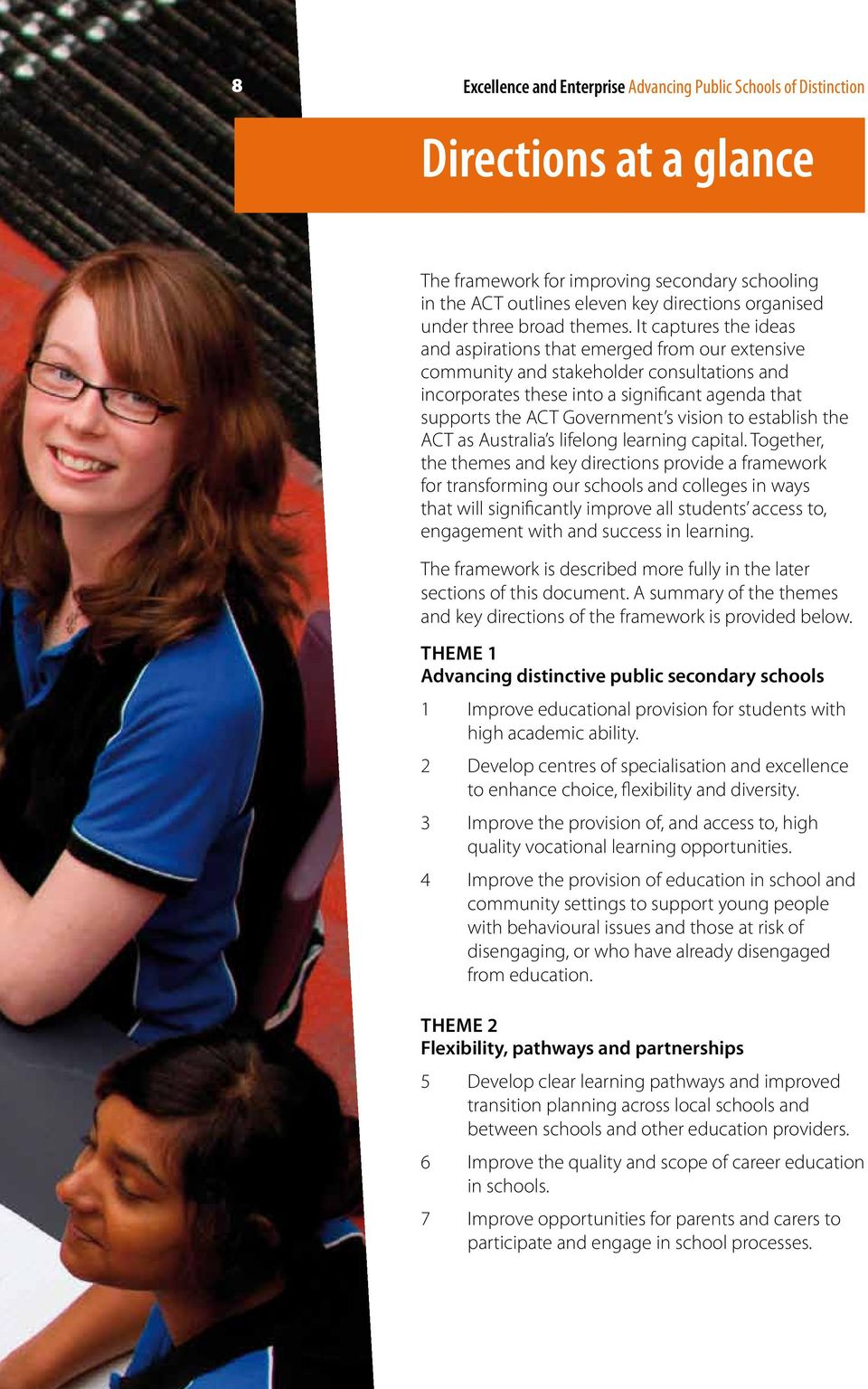
10 8 Excellence and Enterprise Advancing Public Schools of Distinction Directions at a glance The framework for improving secondary schooling in the ACT outlines eleven key directions organised under three broad themes. It captures the ideas and aspirations that emerged from our extensive community and stakeholder consultations and incorporates these into a significant agenda that supports the ACT Government s vision to establish the ACT as Australia s lifelong learning capital. Together, the themes and key directions provide a framework for transforming our schools and colleges in ways that will significantly improve all students access to, engagement with and success in learning. The framework is described more fully in the later sections of this document. A summary of the themes and key directions of the framework is provided below. Theme 1 Advancing distinctive public secondary schools 1 Improve educational provision for students with high academic ability. 2 Develop centres of specialisation and excellence to enhance choice, flexibility and diversity. 3 Improve the provision of, and access to, high quality vocational learning opportunities. 4 Improve the provision of education in school and community settings to support young people with behavioural issues and those at risk of disengaging, or who have already disengaged from education. Theme 2 Flexibility, pathways and partnerships 5 Develop clear learning pathways and improved transition planning across local schools and between schools and other education providers. 6 Improve the quality and scope of career education in schools. 7 Improve opportunities for parents and carers to participate and engage in school processes.
11 9 8 Enable schools to adopt more innovative structures and use technology to support flexible approaches to learning. Theme 3 Strengthening the system 9 Establish a cross-sectoral committee to advise the Minister for Education and Training on the formation of a curriculum certification and regulatory body to monitor standards and ensure curriculum coherence from preschool to year Plan for modern, flexible adaptable learning environments in all secondary schools. 11 Enhance local decision-making through increased school and school board autonomy. This document expands on the key directions above and describes a number of them in more detail; it also highlights some of the work that is currently underway that complements and supports these key directions.

12 10 Excellence and Enterprise Advancing Public Schools of Distinction Our reform history School improvement agenda There are almost students enrolled in ACT public schools. In our early childhood schools, primary schools, high schools, colleges and specialist schools children and young people are developing the skills and understandings needed to succeed in school and beyond. We have 29 public schools providing secondary education in the ACT catering for the full range of students across the Territory. Our secondary schools include nine high schools catering for students from years 7 to 10, one year 6 10 high school, six P 10 schools, one K 10 school, one 7 12 secondary school, eight colleges catering for year 11 and 12 students, two specialist schools for students in years 7 to 12 with moderate to severe disabilities and one school located in the ACT youth justice centre 4. The Canberra Institute of Technology (CIT) also offers a Year 10 equivalent program (the Access 10 program 5 ) and the ACT Year 12 Certificate. Our secondary schools partner with a range of other education and training providers to ensure young people have access to programs and courses that address their interests and aspirations and extend their horizons. We have partnerships with the Australian National University (eg ANU Secondary College 6 ), 4 A list of public schools providing secondary education in the ACT is provided in Appendix 2. 5 Access 10 is a program offered by the CIT that provides a flexible and alternative option for the achievement of the Year 10 Certificate. The program is designed to meet the needs of those students who find it difficult to complete year 10 in a traditional school environment. Further information can be found at the CIT website: 6 The ANU Secondary College Program is a collaboration between the Australian National University (ANU) and the ACT Education and Training Directorate to provide an enhanced learning experience for year 11 and 12 students in the ACT. Further information is available from the ANU website:

13 11 the University of Canberra (eg UC Schools 7 ) and the Canberra Institute of Technology (eg Access 10). In addition a number of Registered Training Organisations may be working with our schools at any one time. At the high school level our schools provide a comprehensive curriculum consistent with the ACT curriculum framework, Every Chance to Learn. In 2011 we are beginning the implementation of the Australian Curriculum in our early childhood, primary and high schools. Our colleges deliver courses and units under the guidance of the ACT Board of Senior Secondary Studies, with students receiving an ACT Year 12 Certificate on completion. The International Baccalaureate is offered in one high school (Telopea Park School) and three colleges (Narrabundah College, Canberra College and Melba Copland Secondary School). The French Baccalauréat is offered at Narrabundah College. In 2010 the Directorate introduced a systemic and targeted approach to school improvement. Key elements of the school improvement strategy include: organising our public schools into four networks, each led by a School Network Leader increasing the availability and use of data to inform school improvement practices and monitor progress supporting principals to ensure they are high quality instructional leaders building the capacity of teachers enhancing the accountability of principals and school network leaders. School networks provide the basis for greater collaboration and sharing between schools, with a focus on improving the performance of all schools within the network. Each network prioritises its areas of improvement based on joint analysis of the performance data across the network. Actions and improvement strategies are identified and implemented collaboratively. School network leaders regularly review the performance of individual schools. Every four years schools undertake an external validation process where independent validators review the school s self assessments to confirm the validity and extent of their improvement. Recent reform initiatives Over the past five years the ACT Government has supported a number of reports and initiatives that have strengthened the public education system. In 2005 the Directorate commissioned an independent review of public colleges in the ACT. Recommendations implemented from the Review of Government Secondary Colleges (the Atelier Report 8 ) included the strengthening 7 The UC Schools initiative has established a formal relationship between the University of Canberra and two ACT public schools (the University of Canberra Senior Secondary College, Lake Ginninderra and the University of Canberra High School, Kaleen). Further information from the University of Canberra website: 8 Report of the Review of Government Secondary Colleges on behalf of the ACT Education and Training Directorate, Atelier Learning Solutions, The report is available from the Directorate website:
14 12 Excellence and Enterprise Advancing Public Schools of Distinction of vocational education opportunities at college level and improved transition processes as students moved from high school to college (the Moving Forward initiative 9 ). In 2006, in Towards 2020: Renewing our Schools report (the 2020 initiative), the ACT Government set out its vision for new school structures across the ACT, providing greater choice, increased diversity and higher quality education into the future. The initiatives included the establishment of early childhood schools, the amalgamation of preschools into primary schools and a range of models to enhance middle schooling (eg a 6-10 high school and P 10 schools). The 2020 initiative involved a review of the location of schools across the Territory and has resulted in significant investment in upgrading school infrastructure and in building new schools where they are needed. In 2007 the ACT curriculum framework, Every Chance to Learn, was launched following a four-year period of development, community consultation, school trial and external validation. Every Chance to Learn provides public and nongovernment schools in the ACT with a consistent framework on which to base their school curriculum plans from preschool to year 10. Also in 2007 the Quality Teaching model was adopted by the ACT public school system. This model assists teachers and school leaders to develop consistent practices to support high quality teaching, resulting in improved engagement and achievement by all students. Both these initiatives provide a strong base for the introduction of the Australian Curriculum from In 2008 community consultation was held to consider a proposal for a school standards authority to overview educational standards P to 12, and to introduce teacher registration. While it was decided not to proceed with a standards authority at that time, there was considerable support for the establishment of teacher registration processes in the ACT. In 2011 the ACT Teacher Quality Institute has been established, and will introduce nationally consistent teacher registration and the accreditation of pre-service teacher education courses. In 2008 the ACT Government published ACT Skills Future, Key Initiatives in a long term strategy to address the skills challenge 10 which included a number of recommendations supporting enhancements to public school provision particularly in the areas of career education, vocational learning and student transitions. In 2009 the Directorate released its Literacy and Numeracy Strategy to strengthen understandings and capacities of teachers and school leaders to improve literacy and numeracy outcomes. This strategy is being complemented with the Australian Government National Partnerships, providing an increased emphasis and support for schools to improve literacy and numeracy learning, teacher quality and leadership capacity. 9 The ACT Budget provided $3.4 million over four years to place one additional full time equivalent teacher into each ACT public college. This targeted staffing is assisting in facilitating the transition of students into and out of the college sector and improving students access to careers programs and vocational learning. 10 A copy of ACT Skills Future is available from the Chief Minister and Cabinet website at
15 In 2009 the Directorate released its School Improvement Framework, introducing a more consistent process of school review and validation. In 2010 these processes were strengthened and the new school network model was introduced as detailed in the document, School Improvement in ACT Public Schools: Directions In 2009 the ACT Government commissioned Professor Tony Shaddock to conduct a review into disability education in ACT schools. The Review of Special Education 2009 provided a framework for improvement in the provision of support for students with disabilities. In 2010 the Directorate released its plan for disability education, drawing upon the extensive work of the Shaddock Review. Excellence in Disability Education in ACT Public Schools: Strategic Plan outlines the priorities and related activities that will further improve the learning outcomes of students with a disability who attend our schools. In 2010 the Directorate released its Reconciliation Action Plan, Reconciliation Matters. This plan is an important partner to the Directorate s Strategic Plan , Everyone matters. The Directorate also released its Aboriginal and Torres Strait Islander Education Matters Strategic Plan This plan outlines the priorities and actions required across our schools and central office teams to close the learning achievement gap between Aboriginal and Torres Strait Islander students and other students in the ACT. On 1 January 2010 the ACT Government amended the Education Act 2004 requiring all young people to continue in education, training or employment until completing year 12 or equivalent, or reaching age 17, whichever occurs first. The ACT Youth Commitment 11 was developed in response to the changes to the Education Act, and has been designed to ensure that the progress of every young person in the ACT is monitored and they are supported to remain in education, training or employment. Late in 2010 the ACT Tertiary Education Taskforce released its report Learning Capital: an integrated tertiary education system for the ACT. The report aims to ensure that our secondary and tertiary education sectors are aligned and are providing relevant and engaging pathways for young people. The ACT Government is considering the recommendations and will provide a response and directions for future action in the near future. The ACT Teacher Quality Institute (TQI) 12 was established by the ACT Government under the ACT Teacher Quality Institute Act 2010 to raise the standing of the teaching profession in the ACT and to strengthen the quality and sustainability of the teaching workforce. Together these initiatives and reforms provide a strong foundation for the directions outlined in this framework for improving secondary schooling in the ACT Further information on the ACT Youth Commitment is available from the Directorate website: 12 Further information on the ACT Teacher Quality Institute is available from the Teacher Quality Institute website at:

16 14 Excellence and Enterprise Advancing Public Schools of Distinction The consultation processes Stakeholder dialogue on high schools and colleges was a two-phased consultation process. The first phase, from July to September 2010, invited community and stakeholder views and ideas, generated by the discussion paper, Improving ACT Public High Schools and Colleges. During this period an interactive website was established, enabling community members to provide their feedback online or through a designated account. Information was also made available through the ACT Government Community Engagement website and print advertisements provided details of three community forums held across the ACT. Numerous meetings were held with public school leaders, community groups and individual stakeholders. This consultation resulted in over one hundred written submissions from parents, students, teachers, community members, peak bodies, educational institutions and other organisations. In the second phase, undertaken in November and December 2010, key stakeholders were invited to provide feedback on significant themes synthesised from the initial consultation. This feedback was used to review and refine the synthesised themes, and contributed to the key directions that form the framework for improvement of secondary education in ACT public schools. A list of contributors to the first phase of the consultation, and stakeholders identified in phase two, is provided in Appendix 1.
17 Developing a framework for improvement 15 We have identified eleven key directions, organised in three themes, which in combination provide a framework for improving secondary schooling in the ACT. They capture the ideas and aspirations that emerged from the consultation processes and draw on current research on school and system improvement. The three themes are: advancing distinctive public secondary schools flexibility, pathways and partnerships strengthening the system. The directions identified in each of the themes will ensure that ACT public secondary schools are schools of choice, based firmly on the quality of educational programs and the opportunities for every student to excel in a safe and supportive environment.

18 16 Excellence and Enterprise Advancing Public Schools of Distinction Student engagement is at the heart of the ACT vision for public schools

19 17 Theme 1: Advancing distinctive public secondary schools A central element of the framework for improving secondary education is the focus on building excellence in every area of the curriculum across all secondary public schools in the ACT. Coupled with this is the opportunity for every school to develop areas of curriculum specialisation or excellence to enhance choice and flexibility for students. The traditional classroom can sometimes not adequately meet the educational needs of some levels of gifted students. We will introduce new approaches to educational delivery that give students the freedom to advance as their skills, knowledge and capabilities require and that promote the principles of fairness, access and equity. For some students, the regular school environment presents challenges at times in their schooling career. Extending the range of alternative learning options to better meet the needs of these students will increase the likelihood that they will be successful in education and training, and decrease the levels of disengagement or disruption in schools. This theme maintains high standards for all students. It is about making our high schools and colleges more engaging and relevant, as well as supporting students so they can achieve high levels of skills and understanding across a broad curriculum that facilitates world-class academic and vocational outcomes. To achieve this we will: improve educational provision for students with high academic ability develop centres of specialisation and excellence to enhance choice, flexibility and diversity improve the provision of, and access to, high quality vocational learning opportunities improve the provision of education in school and community settings to support young people with behavioural issues or those at risk of disengaging, or who have already disengaged from education.
20 18 Excellence and Enterprise Advancing Public Schools of Distinction Key direction 1 Theme 1 Improve educational provision for students with high academic ability. To ensure every high school and college can meet the needs of all students with high academic ability, including our most gifted and talented students: options for the development of a Virtual Learning Academy will be identified accelerated pathways to allow students to commence higher education and training courses as part of their senior secondary courses, or to complete courses more quickly, will be investigated in partnership with our tertiary education partners. All students learn best when they are interested, engaged and challenged by the tasks they are undertaking. There are students in every classroom who can perform at high academic levels, and may well be identified as gifted. All teachers need the skills, understandings and resources to organise and differentiate the curriculum so that every student is challenged and engaged. A Virtual Learning Academy (VLA) will provide an online integrated framework for differentiated educational provision to suit high ability and gifted and talented students. It will use the clc 13 to host resources, collaborative forums and discussion spaces aimed at supporting students to explore and understand curriculum topics and areas of interest in more depth. It will be available in every high school, and will be linked to learning areas and key topics in the Australian Curriculum. Students will be able to interact and collaborate online with other students as well as teachers, academic mentors and experts from across the ACT, Australia and the world. VLA networks will provide the opportunity for high ability and gifted students to investigate and explore topics in greater depth and breadth, developing expert understanding and more creative and innovative thinking. The capacity of every school to cater for high ability students will be enhanced through the provision of professional learning to develop the skills and understandings of teachers and school leaders to develop learning opportunities that further engage and extend gifted students. This initiative builds on the Pursuit of Excellence program to equip teachers and schools to identify gifted students and to differentiate the curriculum to meet their needs. Several schools have been providing local programs for gifted and talented students 14 and teachers have participated in sponsored tertiary studies and workshops in gifted education. 13 The connected Learning community (clc) is the Directorate s virtual learning platform that was introduced in 2010 and is being implemented in schools in For example, the LEAP program at Lyneham High School, the In SPIRE program at Canberra High School, and the Pinnacle Enrichment Program at Belconnen High School.
21 At the college level, the ANU Secondary College provides a highly successful model of extension studies for high achieving students in selected disciplines. The Tertiary Education Taskforce has recommended that more opportunities be created for secondary school students to participate in accelerated pathways that will allow them to commence university and vocational courses as part of their senior secondary courses. We will also investigate opportunities for very able students to progress through their secondary studies more quickly. For example, some students may be able to complete years 9 to 12 in three years rather than four. Our consultation told us... I believe that public schools need to ensure they are committed to excellence and are not afraid of identifying and challenging gifted and intelligent students. Parent... there is a clear need for accelerated and extended learning pathways for gifted students in the ACT. ACT Council of P&C Associations... it is important that our gifted and talented students are provided with appropriate opportunity, stimulation and the experiences to develop their potential and satisfy their learning needs. Community forum participant 19
22 20 Excellence and Enterprise Advancing Public Schools of Distinction Key direction 2 Theme 1 Develop centres of specialisation and excellence to enhance choice, flexibility and diversity. A strategic approach to the development of specialist programs and centres of excellence for students with particular talents or interests in areas such as mathematics, science, the arts, music, literature, humanities, languages, vocational learning and sports will include: mapping existing specialisms in high schools and colleges developing policy and operational guidelines for effective provision, access, selection, governance, resourcing and accountability identifying opportunities for schools to become centres of specialisation and excellence. All ACT high schools and colleges offer a broad comprehensive curriculum and this will continue. There was no support during the consultation to change this by introducing stand-alone select entry schools or single gender schools. There was support, however, for specialist programs within schools that attracted students with high ability or interest in the particular specialism. Some schools currently offer specialist programs although these have emerged in a relatively ad hoc manner. Some specialist programs cater for students with a desire to pursue a particular learning focus in some depth, allowing for more efficient deployment of specialist teachers, resources and partnerships. Examples include schools with specialist programs in languages, the arts, design, sports, vocational learning and music programs. The planning activity currently underway in response to the opportunities presented through the Australian Government s Trade Training Centres in Schools Program is an example of schools working together to consider how to provide enhanced vocational opportunities for students in their local region. Another common form of specialist program arises when a school and a university or local industry enter into a partnership to establish a centre with a particular learning focus, such as engineering, science or mathematics. These programs provide students interested in the specialist area the opportunity to experience learning at an advanced level. ACT secondary schools will be able to develop distinct areas of specialism, while maintaining their capacity to serve their local community as a comprehensive school. Pathways that allow students to pursue their areas of specialism from primary, to high school and college will be identified. Planned well, the provision of specialist programs across the Territory will provide breadth and choice for students with particular talents or interests. Network and system planning will ensure that specialist schools are strategically located to optimise student access. They will be resourced so that over time each specialist location has distinctive state-of-the-art facilities and equipment and establishes a reputation for teaching excellence.
23 21 Our consultation told us there are many examples of specialist programs and schools where learning communities are well defined and operate effectively... Much can be gained by aggregating expertise and resources, and such specialisation provides a competitive edge with non-government schools. University of Canberra The ACT Chamber of Commerce supports the suggestion that public colleges be designated as selective or specialist schools for particular industries. Such initiatives... have been effective in developing strong links between school curriculum and the world of work and developing strong and effective partnerships between school and industry. They also serve to improve the social capital of school communities. ACT & Region Chamber of Commerce and Industry Specialisms should grow organically and not be imposed. The Department should facilitate the process and provide this expertise to other schools in the area. High School P&C President
24 22 Excellence and Enterprise Advancing Public Schools of Distinction Key direction 3 Theme 1 Improve the provision of, and access to, high quality vocational learning opportunities Vocational education and training (VET) for students in high schools and colleges will be improved through: the development of an ACT strategic plan for the provision of VET in schools, which is responsive to the emerging opportunities in the Territory and the nation, and provides clear articulation of pathways to further education and employment increased access for students in years 9-12 to courses, facilities and expertise of other training providers, including CIT and universities enhanced partnerships with a range of providers, industry, business and community bodies in the provision of VET increased pre-vocational opportunities for students in the primary and middle years of schooling (years 5-8). Currently vocational learning in ACT colleges and high schools encompasses Australian School-based Apprenticeships (ASbAs) and vocational education and training (VET) in schools. It also includes structured workplace learning, enterprise education, career education and practice firms. In 2010 more than 590 students in ACT public schools participated in structured workplace learning and 905 students received a total of 957 vocational certificates 16, 17. Most students were from the college sector as each college is a Registered Training Organisation (RTO) and could deliver specified industry endorsed training packages. Certificate 1 courses are available to high school students in Hospitality, Information Technology, Business Administration, Workplace Skills and Horticulture 18. The Canberra Institute of Technology (CIT) offers taster programs in eight vocational courses for high school students. In addition, in 2010, three Certificate programs were offered to year 10 students at CIT. A total of 52 students participated in these programs. A number of other RTOs offer programs to high school students aimed at building employability skills. In the past each school and college developed their own vocational provision. More recently, extensive cross-sectoral and industry consultations which have informed the development of Trade Training Centre proposals have begun to provide a basis for more systemic approaches to VET provision. The 16 ACT Board of Senior Secondary Studies; Vocational Study The figure relating to students receiving a vocational certificate only counts those awarded by an ACT public college operating as the RTO. A range of other programs are available through external RTOs. 17 A number of students received more than one vocational certificate. 18 These Certificate I programs are delivered via a partnership between the high school and a college where the college is the RTO and the high school is auspiced for elements of delivery and assessment.
25 development of an ACT plan for VET in schools will build on the planning and cooperation that is now well established at network level. This work may extend to the examination of current governance arrangements associated with VET delivery, particularly with reference to the national regulatory agenda 19. Vocational learning at the secondary level will continue to grow in status and relevance with the increased range and availability of new and authentic learning opportunities. Schools will continue to build partnerships with their communities, providing broader educational opportunities outside the school. The report of the Tertiary Education Taskforce recommends a more strategic planning process for tertiary education, to be overseen by a high level advisory body. It is anticipated that the advisory body will provide the forum for the identification of emerging skills and training needs for the Territory, and will inform the development of the ACT plan for VET in schools. The development of a more integrated tertiary sector will also enhance the opportunities for strategic partnerships with training and further education providers and industry groups at the high school and college levels. Clear and flexible funding and staffing models, with incentives to develop sustainable partnerships, will be required to ensure greater access for high school and college students to the facilities and expertise of CIT, universities and training providers. Exploring opportunities to share skills and expertise of teachers and trainers across institutions is an important step in improving quality and expanding VET programs, particularly as the levels of certification available to secondary students increase. Opportunities for new training approaches, such as those described in the Australian Government s Trade Cadetships, will require new thinking, new partnerships and new delivery models. A number of respondents throughout the consultation commented on the perceived difference in status of academic and vocational courses. VET should be seen as an integral element of the full secondary program in high schools and colleges, where teachers have the same high expectations of VET that they have for the rest of the curriculum. Assuring the quality of VET delivery in schools and identifying clear pathways to higher education and training will help to position vocational learning firmly within mainstream education programs in our schools. The suggestion to develop a Certificate in Applied Learning as part of the senior secondary certification process has been included under Key direction In 2009 the Council of Australian Governments (COAG) agreed to establish a national regulator for the vocational education and training (VET) sector. With the passage of legislation establishing the national VET regulator through the Commonwealth Parliament, the regulator will commence operations in July Further information is available at the Department s website:
26 24 Excellence and Enterprise Advancing Public Schools of Distinction Our consultation told us there is need for greater diversity in the courses available to students to cater for students who, for example, may want to specialise in an area or combine academic and vocational studies. Community forum participant... the combination of work place involvements, effective connections to a range of other learning communities and vocational training would all be seen as part of the range of options available to students through the high school and college years. Teacher... developing an ACT plan for the provision of VET in schools might best be consolidated into particular sites, avoiding duplication and expenses associated with multiple VET facilities. This would (allow) students... to build learning networks across other schools by attending VET related classes at key education sites across the ACT. University of Canberra
27 Key direction 4 Theme 1 Improve the provision of education in school and community settings to support young people with behavioural issues and those at risk of disengaging, or who have already disengaged from education. A multi-level strategy will be implemented including: the identification and development of a range of flexible learning options in schools and across school networks, to provide intensive, personalised support for disengaged students the exploration of potential models for full service flexible learning centres based in the community, for students who are not engaged in education or training and those with behavioural issues whose attendance at a neighbourhood school is not viable the establishment of school network action plans to build synergy between school, government and community activity associated with supporting the re-engagement of young people in education the investigation of approaches to the development of online learning resources available through the clc to provide flexible learning options in a range of settings. 25 Student engagement is at the heart of the ACT vision for public schools. Disengagement and underachievement exacts an enormous cost on future employment, health, wellbeing and social outcomes of young people. It often leads to disruptive and anti-social behaviours, impacting on the learning of all students and interrupting the safe environment of the school. Work has commenced on the development of a student engagement framework to guide the provision of education for students who are at risk of disengaging, or have already disengaged from school 20. The framework will enhance the connection of schools with the range of non-school support services so as to better meet the needs of students. The framework has four levels of educational provision describing responses along a continuum for all young people ranging from those who are at school, to young people who are beginning to disengage from schooling, to those who are unlikely to re-engage with regular schools. The first level of the student engagement framework has an emphasis on engaging all students. It details the range of curriculum and program options, within and across schools and networks, necessary to respond to different needs and interests of young people. Responses could include, for example, the development of clear behaviour protocols, innovative and creative curriculum programs, whole school pastoral care initiatives, bullying prevention approaches and strategies, and involvement of students in decision-making processes. The second level identifies responses aimed at groups of students within schools with identified engagement issues. Responses associated with this
28 26 Excellence and Enterprise Advancing Public Schools of Distinction level are designed to support students while they remain in their regular classrooms and may include, for example, individualised learning approaches or a differentiated curriculum, counselling and mentoring programs, outreach services, appropriate responses to bullying, tutoring or after hours programs. The third level focuses on flexible learning options in a supported environment within school settings for students with behavioural or engagement issues. The focus for responses at this level is on short-term intensive placements outside the regular classroom, but still within a school. The fourth level identifies flexible learning options within community settings, and is aimed at young people with a long history of school disengagement or exclusion. Programs associated with this level focus on education and training with access to a range of support services, including social and welfare advocacy. In order for these flexible learning options to be successful they will need to consider issues concerning access and location. The student engagement framework will be used to review the breadth of flexible learning options available in the ACT. This will include the realignment of Achievement Centres and Connect10, as well as further strengthening of behaviour management, student support and intervention strategies. The student engagement framework will expand the options and choices available to meet the needs of the Territory s young people. The approach being taken to the development of the framework recognises the value of broad early intervention and prevention strategies. Research has demonstrated that early intervention and prevention strategies are successful and efficient in achieving change within families. The Directorate will continue to work with ACT Government agencies and other service providers to enhance the range of services that are available to meet the needs of Canberra s youth and to engage with and support families. The involvement of partners will be an important contributor to the success of the student engagement framework. The ACT Youth Commitment provides a foundation for the Directorate and schools to build connections with providers, services and agencies that are supporting Canberra s youth. Its goal is to better connect young people with the services that meet their needs and support re-engagement with learning. Through the ACT Youth Commitment, and the range of other forums and advisory structures of the Directorate and other government agencies, opportunities will be explored for engaging relevant support services in the four levels of the engagement framework. The work that is being undertaken in schools to address the ongoing issues associated with bullying and other challenging behaviours will be supported through the engagement framework. The engagement framework will complement the existing range of advice, support and professional learning opportunities provided to schools to facilitate safe and supportive school environments. 20 The student engagement framework for ACT public schools is being adapted, with permission, from similar frameworks developed by the Victorian and Queensland public school systems.
29 27 Our consultation told us... Marginalised and disadvantaged young people need particular supports in order to bridge the gap and achieve the educational outcomes of their peers. The more inclusive and flexible the ACT school system can be in meeting the needs of marginalised and disadvantaged students, the more ACT high schools and colleges will become schools of choice, where every student has a pathway suited to their needs, and wants, that supports their broader social engagement. ACT Council of Social Service... (we suggest) developing differentiated teaching for children with behaviour or additional learning needs. Aboriginal and Torres Strait Islander Education Consultative Group
30 28 Excellence and Enterprise Advancing Public Schools of Distinction ACT public schools have a history of embracing change and supporting innovation
31 29 Theme 2: Flexibility, pathways and partnerships A student entering the ACT public school system in preschool will spend around 14 years in schooling. The pathways through our schools need to be coherent and understood by students, parents and the community. There is a need for better planning into developing and designing these pathways. There is also a need to ensure there is appropriate guidance and support at points of transition. It is recognised that educational attainment is improved through strong and sustainable partnerships. By strengthening our partnerships with parents and the community sector, tertiary education providers, business and industry and by encouraging students to participate in decisions about their schooling, as well as building greater connections and sharing between our schools and colleges, we can ensure a rewarding educational and career pathway for every student. Expanding traditional structures and developing more flexible approaches to learning through the use of technologies has the potential to enhance learning opportunities for students. To achieve this we will: develop clear learning pathways and improved transition planning across local schools and between schools and other education providers improve the quality and scope of career education in schools improve opportunities for parents and carers to participate and engage in school processes enable schools to adopt more innovative structures and use technology to support flexible approaches to learning.
32 30 Excellence and Enterprise Advancing Public Schools of Distinction Key direction 5 Theme 2 Develop clear learning pathways and improved transition planning across local schools and between schools and other education providers. Local area education planning will be developed across each school network to describe typical learning paths for students from preschool to year 12 in their neighbourhood schools. Local area education plans will: ensure continued curriculum access in core curriculum areas, including languages ensure learning paths across schools in a local area are explicit and communicated clearly to parents, students and the community improve transition planning as students progress from one school to another including through the consistent use of pathways planning processes explore options for the development of integrated information management systems to ensure appropriate data transfer as students transition through public schools and on to further education or training. In order to develop coherent pathways that meet each young person s learning needs and future aspirations and to ensure that students are appropriately supported and guided at each point of transition, local area education plans will be developed across each school network. These local area education plans will map out the typical paths from early childhood and primary schools, to high school and college and on to tertiary education. Local area education plans will indicate how the curriculum and culture of schools fit together and will detail learning pathways across schools in a local area. Once developed, local area education plans will be available to students and parents who will be able to consider the options available within and beyond their local area. Defining clear learning pathways was raised particularly in relation to language learning in schools. It equally applies to opportunities to pursue specialist music study, engage in particular arts streams or to VET provision. Local area education planning will encourage collaborations between schools and clusters of schools to support flexible learning opportunities and innovative approaches to curriculum delivery. We will improve procedures for information sharing between schools to facilitate the transition of students as they move between schools at different phases and on to other education providers. A single enrolment process will be explored to facilitate more seamless access to the specialist programs and facilities as well as greater flexibility for students. The Tertiary Education Taskforce recommended that a student information management system, with a unique student identifier, be developed and integrated across ACT schools, CIT and
33 31 universities. The Directorate will work with our tertiary partners to explore possibilities. Information sharing between schools and other education providers, which is being developed under the ACT Youth Commitment, will be instrumental in building stronger transition programs from high school to college and from college to tertiary education. Transition planning will also be strengthened through the explicit priority focusing on student pathways and transitions in the Aboriginal and Torres Strait Islander Education Matters Strategic Plan Our consultation told us that some children could not pursue a learning interest because there was no clear pathway for sequential learning from K-12 in their Priority Enrolment Area. Teacher... that colleges must engage in building stronger relationships with communities and feeder high schools to promote better engagement in the college system. Parent... that closer connections need to be established between primary and high school and between high school and college. Parent... there is a need for explicit transition programs for Aboriginal and Torres Strait Islander students moving from primary to secondary schools. Government School Education Committee... there is support for a clear pathway and support base for diverse needs and equity that is currently the hallmark of ACT Department of Education and Training schools. University of Canberra
34 32 Excellence and Enterprise Advancing Public Schools of Distinction Key direction 6 Theme 2 Improve the quality and scope of career education in schools. Career education in high schools and colleges will be improved by: coordinating and aligning current career education provision in schools and tertiary institutions expanding the roles of industry and employer stakeholders in the provision of career advice and information to secondary students providing targeted professional learning to school staff involved in career education, including continued access to the Certificate IV in Career Development establishing a consistent approach to Pathways Planning across schools and the other sectors of education in the ACT. The ACT Education and Training Directorate is committed to providing career support for young people. The development of a strategy to enhance the quality of career education in high schools and colleges, in partnership with tertiary education institutions and industry and employer stakeholders, will be prioritised. Staff with responsibility for providing career advice in high schools and colleges will be identified, roles clarified and a comprehensive professional learning program put in place. This will include opportunities for staff to access the Certificate IV in Career Development. At the primary level, teachers will be supported to identify opportunities in the curriculum to raise students awareness of career pathways and opportunities, and how to access information about careers. The development of the ACT Career and Transition (CaT) Framework was funded through the ACT Budget. The CaT Framework is anticipated to take the form of an internet resource which will provide a systematic and comprehensive approach to assisting young people from age 11 through to age 25 in the ACT in managing career and transition processes. The internet resource is intended to promote a holistic and consistent approach in navigating the range of options that young people are faced with as they move towards independence by providing a one stop shop and how to guide for all stakeholders/users. The CaT Framework and the universal approach to Pathways Plans, being advanced through the ACT Youth Commitment, will enhance the activity already underway in schools to improve the provision of career education to students. The ACT Youth Commitment Steering Group has established a timeline for the introduction of a consistent approach to pathways planning across schools, the vocational education and youth sectors. From 2011 all students in years 10 and 11 will begin developing and using their Pathways Plans, along with students under the age of 17 at the CIT and young people associated with youth sector agencies.
35 The report of the ACT Tertiary Education taskforce Learning Capital: an integrated tertiary education system for the ACT, emphasised opportunities for greater collaboration between all sectors of education, with industry and employer stakeholders to revise, enhance and expand models of career advice available across the ACT, including in schools. The Directorate will collaborate with industry, universities and CIT to explore ways in which the recommendations of the Tertiary Education Taskforce can be integrated with the work described in this key direction and opportunities to connect with the CaT Framework. Career education is also a focus at the national level. As part of the National Partnership on Youth Attainment and Transitions the Australian Government has established a National Career Development Working Group and the Department of Education, Employment and Workplace Relations (DEEWR) is conducting extensive evaluation of best practice and existing career advice both in Australia and internationally. The DEEWR research project is scheduled for completion in the second half of 2011 and will inform the approach taken in the ACT to enhance career development for students in our public schools. Our consultation told us we need to upskill teachers to develop their expertise, plus greater links with vocational education providers to utilise their resources. High School P&C... there is a strong support for greater pathways planning for students and (better) partnerships between home and work. ACT Principals Association... we need a centralised industry-based Career Advisory Service in addition to current provision in schools. ACT & Region Chamber of Commerce... in schools offering comprehensive career development programs students earn higher grades, schooling is seen as more relevant, and employment preparation is more highly rated. Career Development Association of Australia, ACT Division... there is a need for early introduction to careers and pathways planning, in both primary and high schools. School Network 33
36 34 Excellence and Enterprise Advancing Public Schools of Distinction Key direction 7 Theme 2 Improve opportunities for parents and carers to participate and engage in school processes. Systematic processes to increase parental and student participation in school activities, particularly those involving key decisions about individual student s progress, will be improved through the development of: a parent portal as an element of the clc regular opportunities in all secondary schools for parent engagement with teachers, including participation with their child in pathways planning and 3-way progress interviews more regular parent and student surveys, including exit surveys and instruments that provide focussed feedback to teachers and school leaders. The desire for better communication between schools and parents was a repeated theme in consultation responses. The ACT Parents and Citizens Association (P&C) informed us that communications with parents was the third most recurring response to their question about the changes needed to improve schools. Both teachers and parents commented that better relationships needed to be developed between schools, parents and communities. Students also expressed the desire to provide regular feedback to teachers and be more involved in school-level decisions. Several school respondents described a range of strategies that they have adopted to help engage families in their child s education. These included induction interviews structured so that parents run the session; three way (parent, student and teacher) progress interviews; sessions for parents on parenting young adolescents; parent requested forums; three way (parent, student and teacher) development of individual student learning plans; and parent feedback surveys on various aspects of the school. We commend strategies such as these to schools and will support the introduction of a range of tools to assist schools in communicating with, and responding to, parents and students. We will increase support to schools to gauge their effectiveness in meeting parental expectations. We will also introduce interim and exit surveys so that each school can collect information from parents and students for use in school decision-making. The introduction of the Directorate s online connected Learning community (clc) will provide a platform for regular interaction between parents, students and teachers. The clc is a secure website that will be able to be accessed by teachers, students and parents. It will give parents more detailed, timely access to information to help them monitor and support their child s learning. It is anticipated that this will be available to parents in Many respondents also expressed concerns about the image of public schooling in the broader community and felt that greater attention needed to be given to the views of parents, as parents are the most credible advocates
37 for public schools. Several parents observed that the lack of school uniforms diminished opportunities for building a positive image about and pride in public schools. We support the requests from parents and schools to introduce school uniforms as a positive means for lifting the identity of public schools and building community pride in and ownership of their local school. Our consultation told us parental engagement should not be an afterthought but a planned process designed to cement the shared responsibility between the school and the family for giving the young person every opportunity to be a highly engaged and successful learner. Parent... to consider providing each school with a school feedback web site. Parent... enabling all children and young people to participate in high quality education, irrespective of where they live or their personal circumstances, is a shared responsibility. Parent... the fact that the school system cares about me and my interests makes me feel confident and like I matter. Lyneham High School student 35
38 36 Excellence and Enterprise Advancing Public Schools of Distinction Key direction 8 Theme 2 Enable schools to adopt more innovative structures and use technology to support flexible approaches to learning. Schools and school clusters will be supported to identify, pilot, evaluate and implement innovative structures and processes that will support increased student access and improved student achievement in the secondary years. Opportunities to increase structural flexibility and exploit the potential of technology include, but are not limited to: more flexible timetables and start and finish times to improve access for students offering opportunities to extend students through extracurricula activities accelerated learning for students who have the ability to progress more quickly through secondary school exploring opportunities for moving year 10 to college sites integrating management structures across a cluster of schools new governance for groups of schools to offer greater curriculum access to their students electronic delivery of specialist courses to students located across ACT public schools blending classroom attendance with on-line learning supplementing school timetables beyond the traditional school day (eg online tutorials). ACT public schools have a history of embracing change and supporting innovation. Our schools are already engaging in pilots to evaluate new approaches to teaching, new relationships with business, industry and the community and new organisational structures and processes. Our new schools are demonstrating how more flexible, agile learning spaces can change the teacher-student relationship. Lake Ginninderra College and Kaleen High School are forging new relationships with the University of Canberra. School networks are developing new approaches to the delivery of student support services and are developing network proposals for Trade Training Centres 21. Ten lead schools are developing new processes and resources to support the introduction of the Australian Curriculum in the ACT. Eight schools are piloting new approaches to school autonomy and developing proposals for expansion to all schools. Many other schools and clusters are exploring local projects, all aimed at improving student achievement. 21 The Trade Training Centres in Schools Program is an important element of the Australian Government s Building the Education Revolution. It will provide $2.5 billion over 10 years (nationally) to enable all secondary students to access vocational education through Trade Training Centres. Further information is available from the Department s website:
39 Schools and school networks will be encouraged and supported to identify areas for innovation aimed at improving capacity to provide engaging, relevant learning experiences for students. Schools will be encouraged and supported to share and apply successful new approaches and ways of working. Our consultation told us the education system needs to recognise options outside the normal school environments as suitable alternatives... the school environment and strict hours of attendance do not fit all students, or allow them flexibility to choose alternative pathways to education. Parent... traditional school hours are ancient and unsuitable to today s world, parents, workforce, child care.... Parent... the University of Canberra strongly supports opportunities for a series of pilots to enable more flexible learning opportunities and structures. The University s partnership with ACT DET through the UC Schools strategy is an example of the way to rigorously pursue flexible learning options. University of Canberra... a stronger sense of local community via networked learning opportunities (physical and virtual) and associated pathways would enable greater innovation in teaching and learning. University of Canberra 37
40 38 Excellence and Enterprise Advancing Public Schools of Distinction Increasing the effectiveness of teachers, schools and the system comes from collaboration and shared responsibility
41 39 Theme 3: Strengthening the system This theme recognises that system-wide action can enhance school-level decision making and increase schools capacity to provide high quality teaching and learning. Increasing the effectiveness of teachers, schools and the system comes from collaboration and shared responsibility across our schools and with the broader community and stakeholders. Schools and their communities need to be confident about the quality of the teaching and learning environment, and the capacity of school leaders to make effective decisions to enhance student learning. To achieve this we will: establish a cross-sectoral committee to advise the Minister for Education and Training on the formation of a curriculum certification and regulatory body to ensure rigorous curriculum coherence from preschool to year 12 plan for modern, flexible and adaptable learning environments in all secondary schools enhance local decision-making through increased school and school board autonomy.
42 40 Excellence and Enterprise Advancing Public Schools of Distinction Key direction 9 Theme 3 Establish a cross-sectoral committee to advise the Minister for Education and Training on the formation of a curriculum certification and regulatory body to monitor standards and ensure curriculum coherence from preschool to year 12. The cross-sectoral committee will: develop a paper describing the form and purpose of a P 12 curriculum body with responsibilities for ensuring rigorous and coherent curriculum provision and consistency of achievement standards across all schools provide advice on the implementation costs, timing and risks associated with the establishment of such a body. Concurrently the Directorate, in consultation with the ACT Board of Senior Secondary Studies, will: investigate the potential of a new senior secondary certificate of applied learning review the purpose and relevance of the current year 10 certificate consider participation in community service activities as a key contributor to high school and college graduation. While the implementation of the ACT curriculum framework Every Chance to Learn, and the introduction of the Australian Curriculum, is increasing the consistency of the curriculum across our high schools, there is a need to review the relevance, rigour and coherence of the curriculum in the secondary years. This includes the place and delivery of VET in the curriculum. The implementation of a more seamless curriculum from pre-primary to year 12 will assist in developing more coherent and challenging learning pathways for students as they progress through schooling and transition to further education, training or employment. Currently, the ACT Board of Senior Secondary Studies (BSSS) is responsible for curriculum, standards and certification for students in years 11 and 12 while the Education and Training Directorate is responsible for curriculum for students from pre-primary to year 10. In the P 10 years cross-sectoral cooperation, particularly around the development and introduction of the ACT curriculum framework Every Chance to Learn, has ensured a level of consistency across all schools. However, the introduction of the Australian Curriculum is highlighting the fragmented approach to curriculum regulation and certification in the ACT. The establishment of a curriculum certification and regulatory body, with responsibilities from pre-primary to year 12, will align with the role of the Australian Curriculum, Assessment and Reporting Authority (ACARA). It is anticipated that the establishment of such a body, including legislative change, could take up to five years. An ACT Certificate of Applied Learning would draw on the success of similar approaches already in place in a number of other jurisdictions. An applied
43 learning approach contextualises learning and emphasises the relevance of what is being learned by making connections with the world of work and the world outside of the classroom. A certificate of applied learning could combine compulsory and elective options thus providing all students with essential (generic) knowledge and skills they will need to function in any area of activity, as well as the opportunities to acquire specialised skills and knowledge for success in a specific or chosen industry. Minimum standards in literacy and numeracy would be established and the teaching of literacy and numeracy would be through an applied learning approach. The applied learning approach would establish partnerships with industry and the community to facilitate access to authentic learning opportunities. Investigations into a certificate of applied learning would explore opportunities for such a program to be mapped to the Employability Skills Framework 22 and potential alignment to Training Packages 23. The Directorate, in collaboration with the BSSS will work with stakeholders to address issues regarding certification at year 10 and the recognition of vocational learning within the current certification process. 41 Our consultation told us that in recognising the ambitious notion of a P-12 curriculum and assessment body, there needs to be further emphasis on strengthening years 11 and 12 as a clear pathway in the transition from senior secondary to tertiary education. This would require a strong partnership between the ACT Government, ANU, UC and CIT in the development of the public senior secondary colleges. University of Canberra... the ACT could consider a Certificate in Applied Learning as an alternative year 12 program to replace the current accredited courses. Canberra Institute of Technology... the curriculum at Years 9 and 10 needs to be renovated to make it more relevant and engaging for students and questioned the value of the Year 10 Certificate. Student... of the need for a more seamless curriculum from pre-primary to year 12. Teacher 22 Australia s Employability Skills were developed in 2002 by the Business Council of Australia and the Australian Chamber of Commerce and Industry, in consultation with other peak employer bodies, and outlined in the Employability Skills for the Future report, funded by the Australian Government. Further information is available from the Department s website: 23 A Training Package is a set of nationally endorsed standards and qualifications used to recognise and assess the skills and knowledge people need to perform effectively in the workplace in a specific industry. Training Packages are a key resource in the delivery of structured, accredited training. Further information is available from:
44 42 Excellence and Enterprise Advancing Public Schools of Distinction Key direction 10 Theme 3 Plan for modern, flexible and adaptable learning environments in all secondary schools. To ensure every high school and college has the facilities and infrastructure to support high quality teaching and learning that will meet the needs of every student: a public secondary school redevelopment plan will be prepared, in line with the directions in this framework an analysis of facilities will be undertaken for each school built more than 20 years ago to inform the redevelopment plan. Engaging, adaptable learning environments energise students, teachers and the community. Well designed learning spaces inspire creative, productive and efficient learning. The skills and understandings that students acquire are influenced by the design of learning spaces, the effective use of ICT and the ways in which teachers change the nature and culture of schooling to reflect the needs of learners. Learning is enhanced, deepened and made more relevant when connected learning spaces provide opportunities for learning that is formal and rigorous, collaborative and flexible, personalised and inclusive. With the current ACT Government program of constructing new schools (Gungahlin College, Namadgi School, Kingsford Smith School, Harrison School, Amaroo P-10 School) and refurbishments delivered through the Australian Government Building the Education Revolution initiative, we have evidence of the impact that contemporary design can have on the learning and teaching relationship. Our schools need to be welcoming and attractive places to work and learn. We recognise that new approaches to teaching and learning are more readily adopted in facilities that are technology rich and specifically designed to maximise flexibility in teaching and student grouping arrangements. A number of the directions outlined in this framework for improving secondary education could be supported by more flexible learning spaces, greater access to technologically rich environments and, in some cases, the provision of specialist facilities. We believe it is desirable for our schools to be designed in ways that optimise their benefits to the community. Consequently we strongly endorse the current direction that ensures that school facilities are designed so that they can be used for a breadth of school and community activities. Improving the physical and learning environments of our older secondary schools is a priority for the Directorate. Initially an analysis of facilities will be undertaken in fourteen high schools and eight colleges to identify infrastructure improvements required to support high quality learning programs in those environments.
45 43 The public secondary school redevelopment plan will describe a phased, strategic approach to the redevelopment work identified in the longer term strategic goals of this framework. The implementation of the redevelopment plan will be phased over a number of years and budget cycles. Our consultation told us as most of our secondary schools have infrastructure that is aged there is an urgent need for a significant school rebuilding and refurbishment program. ACT Education and Training Directorate Schools Capital Works... of the need to invest in upgrading and redesigning schools so that new approaches to teaching and learning, more flexible ways of organising for learning, new opportunities for diversifying and extending curriculum and new ways of relating to the community can be explored by schools. Teacher... that schools were being left behind in the technology revolution and that the provision of new infrastructure needs to be accompanied by the provision of state-of-the-art technologies. Community forum participant
46 44 Excellence and Enterprise Advancing Public Schools of Distinction Key direction 11 Theme 3 Enhance local decision-making through increased school and school board autonomy. The Directorate will continue to maximise local decision making through: developing and implementing policies and operational procedures to increase school autonomy in areas such as staffing and the allocation of school resources designing an accountability framework to clarify and support the role of principals and school/college boards developing frameworks and training to support a greater role and responsibility for school boards in the context of increased school autonomy. School based decision-making has been a feature of ACT public schools since the establishment of the ACT Schools Authority in In 1997 with the introduction of school global budgeting, more responsibility for budget management was devolved to schools. Since 1997 the effectiveness of schoolbased management in the ACT has been reviewed a number of times. The latest review was conducted by the Allen Consulting Group in and recommended greater autonomy for schools. Increased school autonomy will contribute to establishing the conditions for school improvement and has the potential to drive the development of more diverse, student focussed secondary schools in the ACT. It will allow public schools more flexibility in financial and human resource management and greater transparency in decision-making and accountability. Devolving resource decisions to school level increases each school s internal accountability for improved student learning. The Directorate has established a phased approach to implementing recommendations from the Allen review. During phase one, eight schools are identifying, trialling and evaluating policy and operational procedures so resources can be distributed at the local level to where they will have the greatest impact on student outcomes. The introduction of greater autonomy for schools requires effective systems and support processes to ensure school leaders and board members are confident and able to make well-founded decisions. Processes and systems developed and tested with the eight phase one schools in 2011 will provide the framework for expansion of school autonomy progressively to all schools from Increased school autonomy presents the opportunity for school boards to have an increased role in strategic leadership and monitoring the effectiveness of school programs. Board members will be given increased access to training and support to develop the skills and understandings to undertake the broadened role. 25 Review of School Based Management in the ACT, The Allen Consulting Group, 2009.
47 45 Our consultation told us principals should be given greater decision making in selecting, developing and managing staff and greater flexibility to optimise the use of the school s finances in order to achieve improved student outcomes. Teacher... that school boards may not have the requisite skills to provide advice about the strategic direction setting, budgeting and financial management needs of schools. Community forum participant
48 Appendix 2: 46 Excellence and Enterprise Advancing Public Schools of Distinction From directions to action This framework outlines the themes and key directions that will shape the secondary education landscape in ACT public schools over the next decade. It provides a framework to guide our planning decisions and actions, both for individual schools, groups of schools and the system. It establishes a framework to support schools and colleges to identify the ways in which they will excel, and to map their paths for improvement. The framework encourages schools to be the focus for learning within their local communities, and to build partnerships with other education providers and with business and industry. As each theme of the framework is progressed, opportunities for creativity and innovation will emerge. We expect our principals, teachers, parents, students and school boards will grasp opportunities to shape their school s identity, ethos and programs to meet the expanding aspirations of their communities. Some elements of the framework invite immediate action, some are already in progress, however most will require a sustained effort over time to come to fruition. Over the next few months we will develop a blueprint for action that will identify key strategies to be progressed over the short, medium and long terms. The framework for improving our public secondary schools will only have impact if we work together to think differently. It will require innovation and an entrepreneurial approach by our school leaders, parents, students, teachers, staff and key stakeholders. This framework will guide the ACT Government s continuing efforts to enhance the Territory s public secondary school system over the next 10 years. It represents an invitation to the ACT community to advance vibrant public secondary schools that will serve our students well into the future.
49 Appendix 1: Contributors to consultation phases 1 and 2 47 Phase 1 Consultation ACT Bilingual Society ACT Council of P&C Associations ACT Council of Social Service ACT Department of Disability, Housing and Community Services ACT Department of Health ACT Principals Association ACT & Region Chamber of Commerce & Industry Australian Education Union ACT Branch Australian National University Association for Learning Mandarin Canberra Institute of Technology Career Development Association of Australia; ACT Division Catholic Education Office Archdiocese of Canberra and Goulburn Children and Young People Commissioner Davidson Trahaire Corpsych Freemasons Foundation Centre for Men s Health Government Schools Education Council Youth Coalition of the ACT SCHOOL AND NETWORK SUBMISSIONS Dickson College staff Gungahlin College staff Harrison School Melrose High School staff Gungahlin Cluster North Gungahlin Network Red Hill, Forrest, Alfred Deakin, Telopea Park school cluster Tuggeranong Schools Network
50 48 Excellence and Enterprise Advancing Public Schools of Distinction STUDENT SUBMISSIONS Caroline Chisholm School - Year 9 students Gold Creek School - Year 10 SOSE students Lanyon High School students Lyneham High School students Melba Copland School Student Representative Council SCHOOL BOARD/P&C SUBMISSIONS Alfred Deakin HS School Board Canberra HS P&C Narrabundah College School Board Red Hill School Board Wanniassa School Board DEPARTMENT OF EDUCATION AND TRAINING Curriculum Support Transitions, Careers and Vocational Learning Schools Capital Works COMMUNITY MEMBERS 45 submissions from parents and community members 17 from individual teachers Phase 2 Stakeholders Consultation ACT Council of P&C Associations ACT Aboriginal and Torres Strait Islander Education Consultative Group Australian Education Union ACT Australian National University ACT Department of Disability, Housing and Community Services ACT Department of Education and Training Branches Aboriginal and Torres Strait Islander Education and Student Support Schools Capital Works Transitions, Careers and Vocational Learning University of Canberra Woden - Weston School Cluster Youth Advisory Council
51 Appendix 2: Public schools providing secondary schooling in the ACT high schools Alfred Deakin High School Belconnen High School Calwell High School Campbell High School Canberra High School University of Canberra High School, Kaleen Lanyon High School Lyneham High School Melrose High School 6 10 high school Stromlo High School P 10 schools K 10 school Amaroo School Caroline Chisholm School Gold Creek School Harrison School* Kingsford Smith School Namadgi School Wanniassa School * currently P year 7 Telopea Park School 7 12 secondary school Melba Copland Secondary School colleges Canberra College Dickson College Erindale College Gungahlin College Hawker College Narrabundah College University of Canberra Senior Secondary College, Lake Ginninderra Lake Tuggeranong College 7 12 specialist schools Black Mountain School Woden School Juvenile justice education centre Murrumbidgee Education and Training Centre Access 10 ACT Year 12 Certificate Canberra Institute of Technology
52 50 Excellence and Enterprise Advancing Public Schools of Distinction
Improving ACT Public High Schools and Colleges
 Improving ACT Public High Schools and Colleges A discussion paper to generate ideas Better schools will only come when those in schools dare to have dreams and work to make them a reality Caldwell and
AUSTRALIAN PROFESSIONAL STANDARDS FOR TEACHERS I L C O U N C
 AUSTRALIAN PROFESSIONAL STANDARDS FOR TEACHERS QUALITY TEACHING I L C O U N C Contents Introduction 2 Organisation of the Australian Professional Standards for Teachers 4 Professional Knowledge 8 Professional
Foreword. Closing the Gap in Indigenous Health Outcomes. Indigenous Early Childhood Development. Indigenous Economic Participation.
 National Aboriginal and Torres Strait Islander Health Workforce Strategic Framework 2011 2015 Prepared for The Australian Health Ministers Advisory Council by the Aboriginal and Torres Strait Islander
CAREER AND TRANSITION SERVICES FRAMEWORK: an effective national approach to youth transitions
 CAREER AND TRANSITION SERVICES FRAMEWORK: an effective national approach to youth transitions PREAMBLE The Career and Transition Services (CTS) Framework will help young people to make successful transitions
NATIONAL FRAMEWORK FOR RURAL AND REMOTE EDUCATION
 NATIONAL FRAMEWORK FOR RURAL AND REMOTE EDUCATION DEVELOPED BY THE MCEETYA TASK FORCE ON RURAL AND REMOTE EDUCATION, TRAINING, EMPLOYMENT AND CHILDREN S SERVICES 1 CONTENTS Introduction... 3 Purpose...
Australian Professional Standard for Principals
 AITSL is funded by the Australian Government Australian Professional Standard for Principals July 2011 Formerly the National Professional Standard for Principals 2011 Education Services Australia as the
Professional Standards for Teachers
 Professional Standards for Teachers Guidelines for Professional Practice July 2005 Queensland the Smart State The State of Queensland (Department of Education) 2005 Copyright protects this publication.
Australian Professional Standards for Teachers
 AITSL is funded by the Australian Government Australian Professional Standards for Teachers February 2011 Formerly the National Professional Standards for Teachers Work on the (the Standards) commenced
National Trade Cadetships
 Schools Vocational Pathways National Trade Cadetships Discussion paper National Trade Cadetships Background Paper National Trade Cadetships Introduction The National Trade Cadetship offers the potential
Vocational Education and Training in Schools Guidelines
 Vocational Education and Training in Schools Guidelines Department of Training and Workforce Development Department of Education 1. Introduction These guidelines support the implementation of the Joint
School Focused Youth Service Supporting the engagement and re-engagement of at risk young people in learning. Guidelines 2013 2015
 School Focused Youth Service Supporting the engagement and re-engagement of at risk young people in learning Guidelines 2013 2015 Published by the Communications Division for Student Inclusion and Engagement
Bachelor of Bachelor of Education (Honours)
 Bachelor of Bachelor of Education (Honours) Detailed Course Requirements The 2016 Monash University Handbook will be available from October 2015. This document contains interim 2016 course requirements
Australian Professional Standards for Teachers
 Australian Professional Standards for Teachers This version of the Australian Professional Standards for Teachers was adopted by the Queensland College of Teachers (QCT) with permission from the Australian
Strategic Plan 2013 17
 Department of Education, Training and Employment Department of Education, Training and Employment Strategic Plan 2013 17 Engaging minds. Empowering futures. 1300046 Department of Education, Training and
An outline of National Standards for Out of home Care
 Department of Families, Housing, Community Services and Indigenous Affairs together with the National Framework Implementation Working Group An outline of National Standards for Out of home Care A Priority
BUILDING A HIGH PERFORMING SYSTEM. A business improvement plan for the Department for Education and Child Development
 BUILDING A HIGH PERFORMING SYSTEM A business improvement plan for the Department for Education and Child Development BUILDING A HIGH PERFORMING SYSTEM 1 Contents Executive summary 3 Increasing local decision-making
Some Text Here. Policy Overview. Regulation Impact Statement for Early Childhood Education and Care Quality Reforms. July 2009
 Some Text Here Early Childhood Development Steering Committee Policy Overview Regulation Impact Statement for Early Childhood Education and Care Quality Reforms July 2009 1 Introduction The early years
Our Young Learners: giving them the best possible start
 NSW DEPARTMENT OF EDUCATION & TRAINING Our Young Learners: giving them the best possible start An Education Strategy for the Early Years from Kindergarten to Year 4, 2006-2009 Introduction We are committed
Early childhood education and care
 Early childhood education and care Introduction This policy brief provides an overview of the national policy and advocacy priorities on early childhood education and care. These include: access to services
TAFE Development Centre response to the Productivity Commission Issues Paper on the VET Workforce
 TAFE Development Centre response to the Productivity Commission Issues Paper on the VET Workforce In this response the TAFE Development Centre (TDC) addresses the specific questions that focus on workforce
Great skills. Real opportunities.
 Department of Education, Training and Employment 130107 Photography: Tony Phillips Great skills. Real opportunities. The Queensland Government reform action plan for further education and training Foreword
Leadership in public education
 Leadership in public education Policy direction overview Discussion paper three Great educational leaders transform the lives of young people and enrich our whole community. They are the exceptional men
Productivity Commission Draft Research Report Vocational Education and Training Workforce
 Productivity Commission Draft Research Report Vocational Education and Training Workforce Submission by the Department of Education, Employment and Workplace Relations March, 2011 1 The Department of Education,
aitsl.edu.au Accreditation of Initial Teacher Education Programs in Australia
 aitsl.edu.au Accreditation of Initial Teacher Education Programs in Australia Standards and Procedures April 2011 2011 Education Services Australia as the legal entity for the Ministerial Council for Education,
Government response to the review of teacher education and school induction
 Government response to the review of teacher education and school induction Government response to the review of teacher education and school induction In February 2010, the Queensland Government released
Aboriginal and Torres Strait Islander Education Action Plan 2010 2014
 Aboriginal and Torres Strait Islander Education Action Plan 2010 2014 Ministerial Council for Education, Early Childhood Development and Youth Affairs ACN 007 342 421 PO Box 202 Carlton South Victoria
Statewide Education and Training Services. Position Paper. Draft for Consultation 1 July 2013
 Statewide Education and Training Services Position Paper Draft for Consultation 1 July 2013 This paper establishes the position for an SA Health Statewide Education and Training Service following the initial
Every chance to learn
 Every chance to learn Curriculum framework for ACT schools Preschool to year 10 Contents Message from the Minister...4 Message from the Chair, Curriculum Renewal Taskforce...5 Introduction...6 Definition
Health and Community Services Industry Workforce Action Plan 2010-2014
 Health and Community Services Industry Workforce Action Plan 2010-2014 Together, supporting South Australians health and wellbeing through a skilled and innovative health and community services workforce.
Education and Early Childhood Development Legislation Reform
 Education and Early Childhood Development Legislation Reform Discussion Paper No 3 General Provisions for Education and Early Childhood Development Discussion Paper No 3 State of South Australia, 2008.
Australia-wide accreditation of programs for the professional preparation of teachers. A consultation paper
 Australia-wide accreditation of programs for the professional preparation of teachers A consultation paper was established as the national body for the teaching profession with funding provided by the
PROFESSIONAL STANDARDS for Queensland Teachers
 PROFESSIONAL STANDARDS for Queensland Teachers December 2006 COLLEGE OF TEACHERS LETTER from the Chair Colleagues On behalf of the Queensland College of Teachers, I would like to introduce the Professional
School Strategic Plan for Highvale Secondary College 7918 2016-2019
 School Strategic Plan for Highvale Secondary College 7918 2016-2019 Endorsement by School Principal Signed Name Ian Watkins Date 15 September 2015 Endorsement by School Council Signed Name Fred Butcher
KidsMatter Early Childhood Connecting with the Early Childhood Education and Care National Quality Framework
 KidsMatter Early Childhood Connecting with the Early Childhood Education and Care National Quality Framework KidsMatter Early Childhood KidsMatter Early Childhood Mental Health Initiative has been developed
AITSL is funded by the Australian Government. Guide to the Certification of Highly Accomplished and Lead Teachers in Australia
 AITSL is funded by the Australian Government Guide to the Certification of Highly Accomplished and Lead Teachers in Australia The Australian Institute for Teaching and School Leadership (AITSL) has been
Measurement Framework for Schooling in Australia. May 2015
 Measurement Framework for Schooling in Australia May 2015 2015 Australian Curriculum, Assessment and Reporting Authority Address enquiries regarding copyright to: [email protected] or ACARA Level 10, 255
The National Health Plan for Young Australians An action plan to protect and promote the health of children and young people
 The National Health Plan for Young Australians An action plan to protect and promote the health of children and young people Copyright 1997 ISBN 0 642 27200 X This work is copyright. It may be reproduced
1. Introduction. 2. National Guidelines
 Australian Education Union Submission to the Parliament of Victoria s Education and Training Committee Inquiry into Pre-Service Teacher Education May 2004 1. Introduction The AEU welcomes the opportunity
From New Directions to Action:
 From New Directions to Action: World class teaching and school leadership October 2013 Department of Education and Early Childhood Development Published by the Department of Education and Early Childhood
Australian Professional Standard for Principals
 AITSL is funded by the Australian Government Australian Professional Standard for Principals and the Leadership Profiles 2014 Education Services Australia as the legal entity for the Standing Council on
NSW GOVERNMENT RESPONSE
 NSW GOVERNMENT RESPONSE to the REPORT OF THE LEGISLATIVE COUNCIL GENERAL PURPOSE STANDING COMMITTEE NO. 2 INQUIRY INTO THE PROVISION OF EDUCATION TO STUDENTS WITH A DISABILITY OR SPECIAL NEEDS January
Every Student, Every School. Learning and Support
 Every Student, Every School Learning and Support PUBLIC SCHOOLS NSW 27/03/2012 www.det.nsw.edu.au Contents Introduction 3 The need for change 5 A framework for learning and support 9 Establishing a framework
Department of Education, Training and Employment. Community Learning. Inclusive learning for Queenslanders. Guidelines for funding 2014 15
 Community Learning Inclusive learning for Queenslanders Guidelines for funding 2014 15 140107 Community Learning Inclusive learning for Queenslanders Guidelines for funding 2014 15 Introduction Community
Wannik. Learning Together - Journey to Our Future. Education Strategy for Koorie Students
 Wannik Learning Together - Journey to Our Future Education Strategy for Koorie Students VICTORIA 2008 Published by the Koorie Education Strategy Branch System Policy and Research Division Office for Policy,
curriculum for excellence
 curriculum for excellence building the curriculum 3 a framework for learning and teaching RESPONSIBLE CITIZENS EFFECTIVE CONTRIBUTIONS SUCCESSFUL LEARNERS CONFIDENT INDIVIDUALS curriculum for excellence
PRESERVICE. PROGRAM APPROVAL GUIDELINES for Preservice Teacher Education QUEENSLAND COLLEGE OF TEACHERS. Revised September 2011
 PRESERVICE PROGRAM APPROVAL GUIDELINES for Preservice Teacher Education Revised September 2011 COLLEGE OF TEACHERS PROGRAM APPROVAL GUIDELINES for Preservice Teacher Education Revised September 2011 COLLEGE
Central Land Council s Submission to the Australian Government Review of Indigenous Training and Employment Programs.
 Central Land Council s Submission to the Australian Government Review of Indigenous Training and Employment Programs 1. Introduction December 2013 The Central Land Council (CLC) is a statutory authority
PRESERVICE. PROFESSIONAL STANDARDS FOR QUEENSLAND TEACHERS (graduate level): A guide for use with preservice teachers QUEENSLAND COLLEGE OF TEACHERS
 PRESERVICE PROFESSIONAL STANDARDS FOR TEACHERS (graduate level): March 2009 INTRODUCTION The Professional Standards for Queensland Teachers underpin all stages of teachers professional learning throughout
How To Improve Training In Australia
 New Arrangements for Training Product Development for Australian Industry ED15-0079 1 Key messages The Government aims to enhance Australia s economic prosperity by ensuring the future and emerging skills
Trade Training Centres in Schools Programme
 Trade Training Centres in Schools Programme Discussion Paper for Stakeholder Consultations February 2007 1 Contents Introduction...3 Overview...3 Programme objectives...4 Priorities...4 A partnership approach...5
Supporting our teachers
 Recognise. Respect. Value. Policy direction overview Discussion paper two Better schools Better future Supporting our teachers We can all recall a teacher who made a difference a teacher who inspired us,
Workforce Management Plan 2013-2017
 Workforce Management Plan 2013-2017 Adopted on Wednesday 19 June 2013 Contents Message from the General Manager 5 city Plan: Cascade of Plans 6 our Vision, Mission and Community Outcomes 7 Introduction
Greenwood College Business Plan 2015-2017
 Greenwood College Business Plan 2015-2017 Greenwood College 2015-2017 Business Plan Our Business Plan 2015 2017 is a reflection of the College s priorities and change initiatives that endeavour to ensure
Success through partnership
 Success through partnership Achieving a national vision for ICT in schools Strategic Plan to guide the implementation of the Digital Education Revolution initiative and related initiatives 5 August 2008
INTEGRATED PLANNING AND REPORTING
 Government of Western Australia Department of Local Government INTEGRATED PLANNING AND REPORTING Framework and Guidelines Integrated Planning and Reporting Framework and Guidelines p1. Contents Foreword
The Shape of the Australian Curriculum
 November 2010 The Shape of the Australian Curriculum Version 2.0 December 2010 www.acara.edu.au Australian Curriculum, Assessment and Reporting Authority 2010 ii This work is copyright. You may download,
NQC RESPONSE TO THE PRODUCTIVITY COMMISSION DRAFT RESEARCH REPORT ON THE VOCATIONAL EDUCATION AND TRAINING WORKFORCE
 INTRODUCTION The National Quality Council (NQC) is pleased to provide feedback to the Productivity Commission on the Draft Research Report Vocational Education and Training Workforce (November 2010). Council
Department of Education, Training and Employment. Great teachers = Great results A direct action plan for Queensland schools
 Department of Education, Training and Employment Great teachers = Great results A direct action plan for Queensland schools June 2013 Premier and Minister s foreword The State Government is committed to
Frequently Asked Questions
 Nurse Practitioner Accreditation Standard 2015 Who is ANMAC? The Australian Nursing and Midwifery Accreditation Council (ANMAC) is the independent accrediting authority for the nursing and midwifery professions
Standards for Registered Training Organisations (RTOs) 2015
 Standards for Registered Training Organisations (RTOs) 2015 I, Ian Elgin Macfarlane, Minister for Industry, make this legislative instrument under subsection 185(1) and subsection 186(1) of the National
School Strategic Plan for Box Hill Senior Secondary College (7050) 2015-2018
 School Strategic Plan for Box Hill Senior Secondary College (7050) 2015-2018 Endorsements Endorsement by School Principal Signed. Name Steve Cook Date March 24, 2015 Endorsement by School Council Signed.
The Standards for Leadership and Management: supporting leadership and management development December 2012
 DRIVING FORWARD PROFESSIONAL STANDARDS FOR TEACHERS The Standards for Leadership and Management: supporting leadership and management development December 2012 Contents Page The Standards for Leadership
Transitional Strategic Plan Youth Work Ireland 2013 & 2014
 Transitional Strategic Plan Youth Work Ireland 2013 & 2014 February 2013 PROLOGUE Welcome to Youth Work Ireland s Transitional Strategic Plan 2013 and 2014. As our Board evaluated the outcomes and impacts
Annual Implementation Plan Low SES National Partnerships Funding
 REECE HIGH SCHOOL 2010-2013 Annual Implementation Plan Low SES National Partnerships Funding Learner at the Centre Improvement Priorities Leading Indicators by 2012 Beginning to Learn Kinder Development
flinders.edu.au Postgraduate Education
 flinders.edu.au 2013 Postgraduate Education A Flinders postgraduate degree can enhance your career Flinders offers a wide range of full-time or part-time postgraduate courses to help you secure a successful
NATIONAL PARTNERSHIP AGREEMENT ON EARLY CHILDHOOD EDUCATION
 NATIONAL PARTNERSHIP AGREEMENT ON EARLY CHILDHOOD EDUCATION Council of Australian Governments An agreement between the Commonwealth of Australia and the States and Territories, being: the State of New
Your child, your schools, our future:
 A commitment from The Children s Plan Your child, your schools, our future: building a 21st century schools system SUMMARY Building a 21st century schools system Summary 1 Summary Chapter 1 Our ambition
NSW Public Service Commissioner NSW Health Good Health Great Jobs Stepping Up Forum 2015
 NSW Public Service Commissioner NSW Health Good Health Great Jobs Stepping Up Forum 2015 Our Aboriginal workforce The Australian Bureau of Statistics figures from 2011 estimate that 2.9% of the NSW population
NATIONAL PARTNERSHIP AGREEMENT ON IMPROVING TEACHER QUALITY
 NATIONAL PARTNERSHIP AGREEMENT ON IMPROVING TEACHER QUALITY Council of Australian Governments An agreement between the Commonwealth of Australia and the States and Territories, being: t t t t t t t t the
Next Steps for the IBSA VET Capability Framework. Options Paper prepared for IBSA
 Next Steps for the IBSA VET Capability Framework Options Paper prepared for IBSA October 2012 Contents Introduction... 1 Mapping the Capability Framework to TAE10 units and qualifications... 3 At Level
Universal access to early childhood education Overview
 Universal access to early childhood education Overview 1. Background The Council of Australian Government s National Partnership Agreement on Early Childhood Education was signed in November 2008, with
Essential Standards for Registration
 Essential Standards for Registration State and Territory Registering Bodies Australian Capital Territory New South Wales Northern Territory Queensland South Australia Tasmania Victoria Western Australia
Certification of Highly Accomplished and Lead Teachers in Australia
 AITSL is funded by the Australian Government Certification of Highly Accomplished and Lead Teachers in Australia April 2012 The Australian Institute for Teaching and School Leadership (AITSL) has been
Preparing Secondary Students for Work. A framework for vocational learning and VET delivered to secondary students
 Preparing Secondary Students for Work A framework for vocational learning and VET delivered to secondary students Copyright and Terms of Use Education Services Australia 2014, as the legal entity for the
STATEMENT OF STRATEGY 2015-2017 AN ROINN OIDEACHAIS AGUS SCILEANNA DEPARTMENT OF EDUCATION AND SKILLS DEPARTMENT OF EDUCATION AND SKILLS 2015-2017
 STATEMENT OF STRATEGY 2015-2017 AN ROINN OIDEACHAIS AGUS SCILEANNA DEPARTMENT OF EDUCATION AND SKILLS Foreword by the Minister I welcome the publication of the Statement of Strategy which sets out the
Accreditation of Initial Teacher Education Programs in Australia
 AITSL is funded by the Australian Government Accreditation of Initial Teacher Education Programs in Australia Standards and Procedures April 2011 2011 Education Services Australia as the legal entity for
Bachelor of Early Childhood Education and Care (Birth-5) More than you imagine
 Bachelor of Early Childhood Education and Care (Birth-5) More than you imagine Study with TAFE NSW Higher Education Shellharbour Campus The TAFE NSW Bachelor of Early Childhood Education and Care (Birth-5)
10 Facts about the Australian Curriculum FACT 1 THE AUSTRALIAN CURRICULUM SETS HIGH STANDARDS
 FACT 1 THE AUSTRALIAN CURRICULUM SETS HIGH STANDARDS The Australian Curriculum sets the expectations for what all young Australians should be taught, regardless of where they live. The Australian Curriculum
Queensland Education Performance Review
 Queensland Education Performance Review Government to the Report of the Queensland Education Performance Review Masters Review A Shared Challenge: Improving Literacy, Numeracy and Science Learning in Queensland
A guide to the evidence-based process for full registration SUPPORTING PROVISIONALLY REGISTERED TEACHERS
 A guide to the evidence-based process for full registration SUPPORTING PROVISIONALLY REGISTERED TEACHERS Updated 0 SUPPORTING PROVISIONALLY REGISTERED TEACHERS ONLINE Teachers with provisional registration
Submission. Results and impact from the policy: July 2009. Removal of TAFE fees for Diploma and Advanced Diploma of Children s Services courses
 Creating Futures Submission Results and impact from the policy: Removal of TAFE fees for Diploma and Advanced Diploma of Children s Services courses July 2009 www.acpet.edu.au 1. Purpose of this submission...
The Shape of the Australian Curriculum
 November 2010 The Shape of the Australian Curriculum Version 4.0 October 2012 www.acara.edu.au Australian Curriculum, Assessment and Reporting Authority 2013 This work is copyright. You may download, display,
Developing Excellence in Leadership, Training and Science
 DELTAS Africa Initiative Outline Developing Excellence in Leadership, Training and Science August 2014 Improving School Governance 1 The Wellcome Trust and its partners have launched an initiative with
Quality teaching in NSW public schools Discussion paper
 Quality teaching in NSW public schools Discussion paper Professional Support and Curriculum Directorate May 2003 Quality teaching in NSW public schools Discussion paper 2003 State of NSW Department of
Response to QCEC Discussion Paper Pre service Teacher Education Entry Requirements December 2012
 Response to QCEC Discussion Paper Pre service Teacher Education Entry Requirements December 2012 Australian Catholic University (ACU) welcomes this opportunity to inform discussion on entry levels into
VICTORIAN IMPLEMENTATION PLAN. Smarter Schools National Partnership Agreements on Literacy and Numeracy Improving Teacher Quality
 VICTORIAN IMPLEMENTATION PLAN Smarter Schools National Partnership Agreements on Literacy and Numeracy Improving Teacher Quality Low Low Socio-Economic Socio-Economic Status Status School School Communities
Organisational and Leadership Development at UWS
 Organisational and Leadership Development at UWS Context The University of Western Sydney s (UWS) leadership development framework is underpinned by the recognition that its managers and leaders have a
Professional Experience Handbook - Appendices Bachelor of Education (Early Childhood) Course Code SL033BEEC 2013
 Professional Experience Handbook - Appendices Bachelor of Education (Early Childhood) Course Code SL033BEEC 2013 Professional Experience Unit SLEE202 Teaching and Learning in Early Childhood Table of
Outputs and performance measures
 Outputs and performance s This section reports on achievement against the outputs and performance s listed in the Budget Papers (Budget Paper no. 3, chapter 3). Outputs and performance s are listed under
Information Technology Curriculum Framework
 Information Technology Curriculum Framework Stage 6 Syllabus Part A for implementation from 2000 Information Technology (120 indicative hours) Information Technology (180 indicative hours) Information