
Universal access to early childhood education Overview
|
|
|
- Hugh Atkins
- 9 years ago
- Views:
Transcription
1 Universal access to early childhood education Overview

2

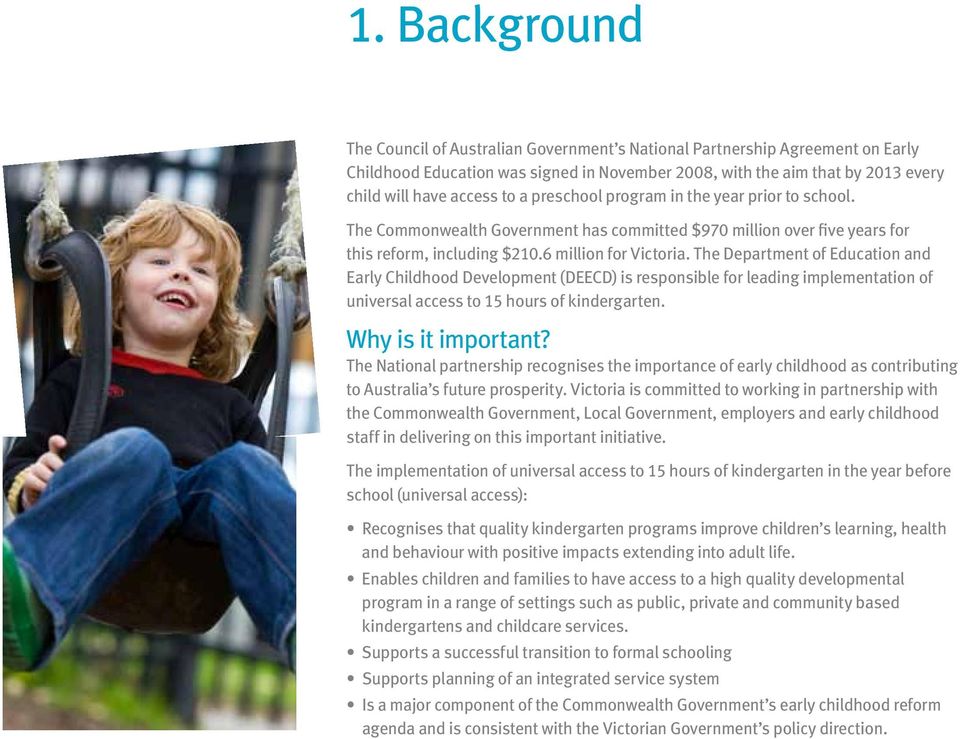
3 1. Background The Council of Australian Government s National Partnership Agreement on Early Childhood Education was signed in November 2008, with the aim that by 2013 every child will have access to a preschool program in the year prior to school. The Commonwealth Government has committed $970 million over five years for this reform, including $210.6 million for Victoria. The Department of Education and Early Childhood Development (DEECD) is responsible for leading implementation of universal access to 15 hours of kindergarten. Why is it important? The National partnership recognises the importance of early childhood as contributing to Australia s future prosperity. Victoria is committed to working in partnership with the Commonwealth Government, Local Government, employers and early childhood staff in delivering on this important initiative. The implementation of universal access to 15 hours of kindergarten in the year before school (universal access): Recognises that quality kindergarten programs improve children s learning, health and behaviour with positive impacts extending into adult life. Enables children and families to have access to a high quality developmental program in a range of settings such as public, private and community based kindergartens and childcare services. Supports a successful transition to formal schooling Supports planning of an integrated service system Is a major component of the Commonwealth Government s early childhood reform agenda and is consistent with the Victorian Government s policy direction.
4 2. Policy context Early childhood has been the focus of considerable policy and legislative attention in Victoria in recent years and the implementation of universal access is one of, and is complemented by, a range of changes, including: the requirement for a degree qualified early childhood teacher in all standard services (i.e. long day care and kindergarten) in Victoria by 2014 implementation of the Victorian Early Years Learning and Development Framework and the Transition: A Positive Start to School initiative to strengthen children s learning and development from birth to eight years, guide the partnership between families and everyone who works with children and support children s transitions, including moving to school the release of an Early Childhood Workforce Strategy later this year. Major priorities for the strategy will be to attract and retain staff in careers in early childhood, particularly in hard-to-staff areas, and to increase qualification levels among the workforce. development of the National Quality Framework for Education and Care to provide parents, communities and operators of early childhood education and care services with a nationally consistent, streamlined and integrated licensing and accreditation system which ensures quality standards are implemented and that services focus on continuous improvement. signing of the Heads of Agreement between the Australian Education Union, the Liquor, Hospitality and Miscellaneous Union, the Municipal Association of Victoria and Kindergarten Parents Victoria. The Heads of Agreement states that in the context of delivery of 15 hours per week of kindergarten education, child contact time for teachers will increase to a maximum of 25.5 hours per week, effective from continued investment in early childhood infrastructure through provision of economic stimulus packages, school regeneration projects, early childhood hubs and early learning centres the release of a revised kindergarten cluster management policy framework later this year that aligns the policy directions for kindergarten cluster management with the broader early childhood policy builds on successful cluster management models and highlights the need for strong local networks, effective local planning and the integration of care and education in early childhood cluster managed services. Universal access to early childhood education
5 3. Victoria s approach The achievement of universal access will require major sector transformation in Victoria and it is dependent upon strong leadership and sustainable working partnerships between the State Government, Commonwealth Government, local government, employers and early childhood staff. The Victorian Government, through the DEECD, consulted with key stakeholders in developing its approach to implementation of universal access. Victoria has identified seven key areas for action, outlined in Diagram 1. Planning Quality Action 1 Municipal planning Access (participation) Action 7 Workforce Action 2 Optimising available places Access Action 6 Infrastructure Universal Access Every child has access to 15 hours per week of quality early childhood education in the year before schooling Action 3 Access to 15 Hours Action 5 Improving access for vulnerable children Inclusion Action 4 Innovation: trialling new approaches Innovation Quantity (Access) Implementation in Victoria
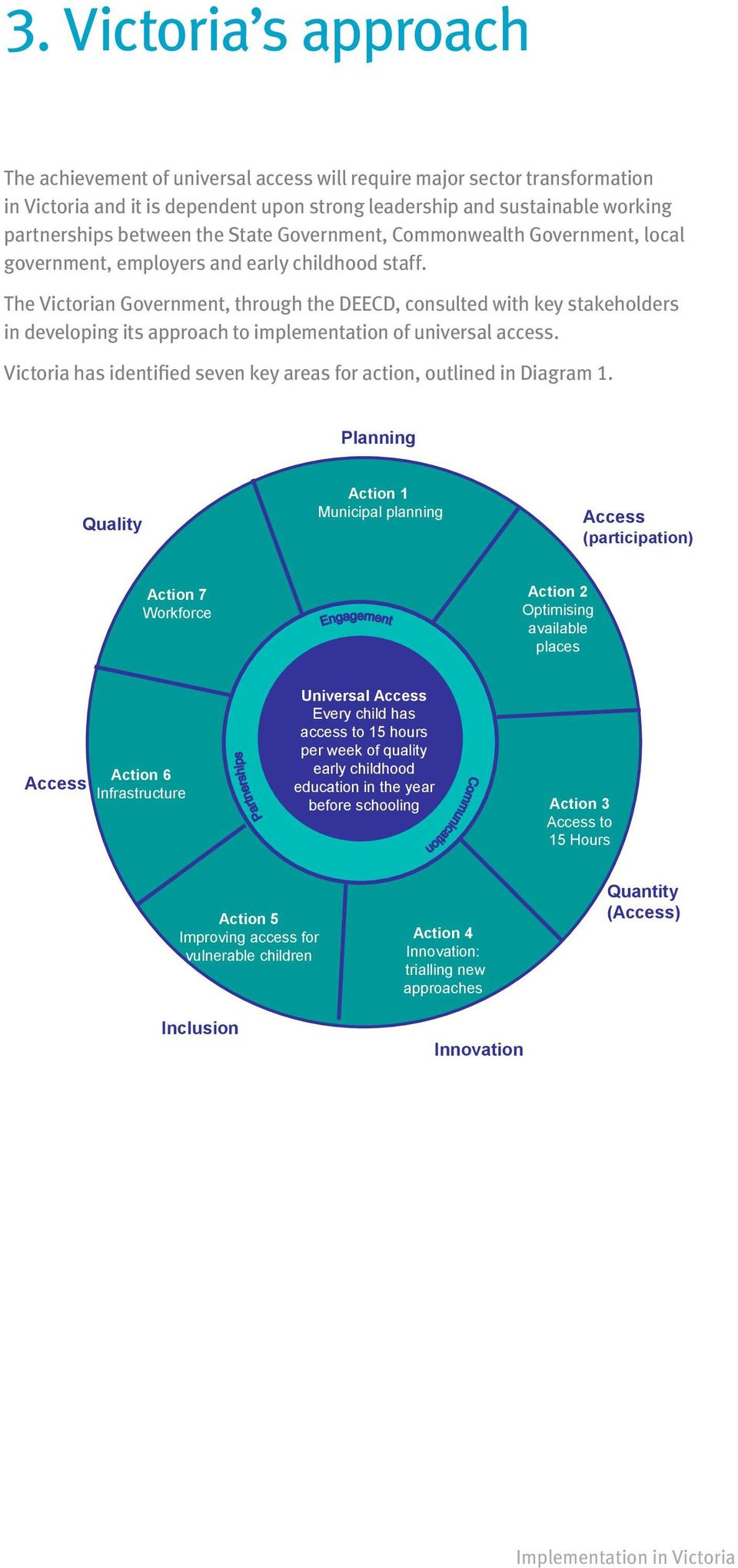
6 This work is just beginning, and there is a significant amount of planning to be done before universal access can be rolled out across the state. Planning will provide better information to understand the impacts of universal access and support the development of new approaches to be piloted and evaluated before moving forward. Action 1. Municipal planning Between August 2009 and June 2010, each local council will work with service providers to develop a plan to implement universal access in their community. The plans will encompass four year old kindergarten delivered in a range of settings including stand alone kindergartens, schools, integrated children s centres and for profit and community based long day care centres. The plans will also identify the impact that universal access may have on other programs such as three year old activity groups and playgroups. Action 2. Optimising available places Starting in 2009/10, and continuing until 2013, work will be undertaken to establish and implement a planned approach to optimise service and infrastructure use for four year old kindergarten, three year old activity groups and playgroups. This approach will ensure that all current available kindergarten space is being fully used. Action 3. Access to 15 Hours At the same time, and to support Councils in their planning, DEECD will work with organisations such as Kindergarten Parents Victoria, the Australian Education Union, the Municipal Association of Victoria, Community Child Care and private child care providers to develop possible models for delivering a 15 hour kindergarten program. Pilots will be undertaken to help develop strategies on how 15 hours of kindergarten can be delivered in a range of settings. This will later inform the state-wide roll-out of universal access. Action 4. Innovation: Trialling new approaches Innovative models of 15 hour kindergarten program delivery will also be trialled over the next 3 years to provide an evidence base to inform the state-wide roll-out. Action 5. Improving Access for vulnerable children Barriers to kindergarten access for vulnerable children will be identified and strategies will be put in place to support inclusion of vulnerable children in 15 hour kindergarten programs. Solutions will be implemented in coordination with home learning and parent support programs. Action 6. Infrastructure New infrastructure or extensions to existing buildings may be required to support universal access to 15 hours of kindergarten. Capital grants will support this element of the reform. Action 7. Workforce The Victorian Early Childhood Workforce Strategy will support universal access to kindergarten. Early childhood education and care workforce reform will be prioritised to improve the overall number of kindergarten teachers and the quality of service delivery in line with the strategy. Universal access to early childhood education
7 4. Engagement, communication and partnership To successfully implement 15 hours of kindergarten by 2013, ongoing consultation, communication and engagement with families, employers, early childhood staff and other key stakeholders is important. Partnerships between the State Government and peak bodies, representing local councils, kindergartens, schools and community and private child care services will be critical in moving forward with this reform agenda over the next few years. For more information about Universal Access to 15 hours of kindergarten, contact:

8
Victoria s Implementation Plan
 Victoria s Implementation Plan SCHEDULE C NATIONAL PARTNERSHIP AGREEMENT ON UNIVERSAL ACCESS TO EARLY CHILDHOOD EDUCATION - 2015 PART 1: PRELIMINARIES 1. This Implementation Plan is a schedule to the National
Kindergarten Cluster Management. Policy Framework
 Kindergarten Cluster Management Policy Framework Contents Executive summary 1 Part 1: Background 3 Introduction of kindergarten cluster management 3 Policy and legislative context 3 Review of kindergarten
Overview. Early Childhood Education and Care Grants Program
 Overview Early Program The Early Program Overview is intended to inform the NSW early childhood education and care sector about the funding assistance that is available from the NSW Department of Education
Early Childhood Education and Care in Australia. OECD Network on Early Childhood Education and Care 30-31 October 2008
 Early Childhood Education and Care in Australia OECD Network on Early Childhood Education and Care 30-31 October 2008 Current thinking Australia s investment in early education is low compared to the OECD
Some Text Here. Policy Overview. Regulation Impact Statement for Early Childhood Education and Care Quality Reforms. July 2009
 Some Text Here Early Childhood Development Steering Committee Policy Overview Regulation Impact Statement for Early Childhood Education and Care Quality Reforms July 2009 1 Introduction The early years
NATIONAL PARTNERSHIP AGREEMENT ON EARLY CHILDHOOD EDUCATION
 NATIONAL PARTNERSHIP AGREEMENT ON EARLY CHILDHOOD EDUCATION Council of Australian Governments An agreement between the Commonwealth of Australia and the States and Territories, being: the State of New
Productivity Commission Education and Training Workforce: Early Childhood Development
 Productivity Commission Education and Training Workforce: Early Childhood Development Victorian Association of Maternal and Child Health Nurses Submission The Victorian Association of Maternal and Child
Blueprint for Education and Early Childhood Development
 Blueprint for Education and Early Childhood Development Every child, every opportunity Every child, every opportunity 02 03 Blueprint for Education and Early Childhood Development Blueprint for Education
THE NATIONAL QUALITY FRAMEWORK FOR EARLY CHILDHOOD EDUCATION AND CARE: INFORMATION FOR FAMILIES
 COUNCIL OF AUSTRALIAN GOVERNMENTS 1 THE NATIONAL QUALITY FRAMEWORK FOR EARLY CHILDHOOD EDUCATION AND CARE: INFORMATION FOR FAMILIES Research shows that a child s experience in their first five years sets
Some Text Here. A national quality framework for early childhood education and care
 Some Text Here Productivity Agenda Working Group Education, Skills, Training and Early Childhood Development August 2008 A national quality framework for early childhood education and care A discussion
Early childhood education and care
 Early childhood education and care Introduction This policy brief provides an overview of the national policy and advocacy priorities on early childhood education and care. These include: access to services
Guide to the National Quality Framework
 1 Guide to the National Quality Framework September 2013 Copyright The details of the relevant licence conditions are available on the Creative Commons website (accessible using the links provided) as
Centre for Community Child Health Submission to Early Childhood Development Workforce Study February 2011
 Centre for Community Child Health Submission to Early Childhood Development Workforce Study February 2011 Background to the Centre for Community Child Health The Royal Children s Hospital Melbourne Centre
BUILDING A HIGH PERFORMING SYSTEM. A business improvement plan for the Department for Education and Child Development
 BUILDING A HIGH PERFORMING SYSTEM A business improvement plan for the Department for Education and Child Development BUILDING A HIGH PERFORMING SYSTEM 1 Contents Executive summary 3 Increasing local decision-making
VICTORIAN IMPLEMENTATION PLAN. Smarter Schools National Partnership Agreements on Literacy and Numeracy Improving Teacher Quality
 VICTORIAN IMPLEMENTATION PLAN Smarter Schools National Partnership Agreements on Literacy and Numeracy Improving Teacher Quality Low Low Socio-Economic Socio-Economic Status Status School School Communities
National Trade Cadetships
 Schools Vocational Pathways National Trade Cadetships Discussion paper National Trade Cadetships Background Paper National Trade Cadetships Introduction The National Trade Cadetship offers the potential
Supporting successful transitions. School decision-making tool
 Supporting successful transitions School decision-making tool 150233 Department of Education and Training Supporting successful transitions: School decision-making tool Starting school is an important
School Focused Youth Service Supporting the engagement and re-engagement of at risk young people in learning. Guidelines 2013 2015
 School Focused Youth Service Supporting the engagement and re-engagement of at risk young people in learning Guidelines 2013 2015 Published by the Communications Division for Student Inclusion and Engagement
Education and Early Childhood Development Legislation Reform
 Education and Early Childhood Development Legislation Reform Discussion Paper No 3 General Provisions for Education and Early Childhood Development Discussion Paper No 3 State of South Australia, 2008.
Victorian kindergarten policy, procedures and funding criteria 2010 12
 Victorian kindergarten policy, procedures and funding criteria 2010 12 Published for Department of Education and Early Childhood Development Melbourne March 2010 State of Victoria (Department of Education
Early Bird Catches the Worm: The Causal Impact of Pre-school Participation and Teacher Qualifications on Year 3 NAPLAN Outcomes
 Early Bird Catches the Worm: The Causal Impact of Pre-school Participation and Teacher Qualifications on Year 3 NAPLAN Outcomes This research looks at the causal impact of attendance at pre-school i in
Every Student, Every School. Learning and Support
 Every Student, Every School Learning and Support PUBLIC SCHOOLS NSW 27/03/2012 www.det.nsw.edu.au Contents Introduction 3 The need for change 5 A framework for learning and support 9 Establishing a framework
Koorie Early Childhood Education Program (KECEP) - Victoria
 Koorie Early Childhood Education Program (KECEP) - Victoria Moira Ross-Rayner Rayner Tracey-Lee Beer Victorian Koorie Early Childhood Education program (KECEP) Sits within the Victorian Department of Education
Early childhood education and care Early childhood education and care
 Early childhood education and care Early childhood education and care Department of Education and Training Annual Report 2014 15 25 Our performance indicators Participation in early childhood education
NATIONAL PARTNERSHIP AGREEMENT ON THE NATIONAL QUALITY AGENDA FOR EARLY CHILDHOOD EDUCATION AND CARE
 NATIONAL PARTNERSHIP AGREEMENT ON THE NATIONAL QUALITY AGENDA FOR EARLY CHILDHOOD EDUCATION AND CARE Council of Australian Governments An agreement between the Commonwealth of Australia and the States
Skilled Occupation List (SOL) 2015-16
 Skilled List (SOL) 2015-16 Tracking Code: 24AKG5 Name Individual * Jocelyne Aldridge Organisation Community Services and Health Industry Skills Council (CS&HISC) What are the industry/industries and ANZSCO
Improving School Sport and Physical Education in your School
 Improving School Sport and Physical Education in your School Published by the Student Learning Division Office of Government School Education Department of Education and Early Childhood Development Melbourne
PROJECT AGREEMENT FOR INDEPENDENT PUBLIC SCHOOLS INITIATIVE
 PROJECT AGREEMENT FOR INDEPENDENT PUBLIC SCHOOLS INITIATIVE An agreement between: - the Commonwealth of Australia; and - the State of South Australia. This project will increase the autonomy of government
6. Supporting diversity
 6. Supporting diversity We acknowledge and pay respect to all the traditional owners of the land we now call Victoria. There were approximately 40 language groups before colonisation that made up the state
Strategic Plan 2013 17
 Department of Education, Training and Employment Department of Education, Training and Employment Strategic Plan 2013 17 Engaging minds. Empowering futures. 1300046 Department of Education, Training and
Maternal and Child Health Service. Program Standards
 Maternal and Child Health Service Maternal and Child Health Service Program Standards Contents Terms and definitions 3 1 Introduction 6 1.1 Maternal and Child Health Service: Vision, mission, goals and
The National Health Plan for Young Australians An action plan to protect and promote the health of children and young people
 The National Health Plan for Young Australians An action plan to protect and promote the health of children and young people Copyright 1997 ISBN 0 642 27200 X This work is copyright. It may be reproduced
Encouraging Quality in Early Childhood Education and Care (ECEC)
 Encouraging Quality in Early Childhood Education and Care (ECEC) STRATEGIES TO TACKLE CHALLENGES IN IMPROVING WORKFORCE DEVELOPMENT AND WORKING CONDITIONS Challenge 1: Improving staff qualifications Qualifications
ATTACHMENT. Response to the International Education Discussion Paper VICTORIA S FUTURE INDUSTRIES
 ATTACHMENT Response to the International Education Discussion Paper VICTORIA S FUTURE INDUSTRIES AUGUST 2015 Introduction There are over 34,000 international students living and/or studying at one of the
NATIONAL PARTNERSHIP AGREEMENT ON UNIVERSAL ACCESS TO EARLY CHILDHOOD EDUCATION
 NATIONAL PARTNERSHIP AGREEMENT ON UNIVERSAL ACCESS TO EARLY CHILDHOOD EDUCATION Council of Australian Governments An agreement between the Commonwealth of Australia and the States and Territories, being:
Professional Standards for Teachers
 Professional Standards for Teachers Guidelines for Professional Practice July 2005 Queensland the Smart State The State of Queensland (Department of Education) 2005 Copyright protects this publication.
Bachelor of Bachelor of Education (Honours)
 Bachelor of Bachelor of Education (Honours) Detailed Course Requirements The 2016 Monash University Handbook will be available from October 2015. This document contains interim 2016 course requirements
Foreword. Closing the Gap in Indigenous Health Outcomes. Indigenous Early Childhood Development. Indigenous Economic Participation.
 National Aboriginal and Torres Strait Islander Health Workforce Strategic Framework 2011 2015 Prepared for The Australian Health Ministers Advisory Council by the Aboriginal and Torres Strait Islander
Australian Nursing Federation (Victorian Branch)
 Australian Nursing Federation (Victorian Branch) 17 th February 2012 Lisa Fitzpatrick State Secretary Box 12600 A Beckett Street PO Melbourne Victoria Telephone: 03 9275 9333 Fax: 03 9275 9344 www.anfvic.asn.au
How To Improve Training In Australia
 New Arrangements for Training Product Development for Australian Industry ED15-0079 1 Key messages The Government aims to enhance Australia s economic prosperity by ensuring the future and emerging skills
Accreditation of initial teacher education programs in Australia
 aitsl.edu.au Accreditation of initial teacher education programs in Australia Frequently Asked Questions Standards and Procedures April 2011 1. What are the Standards and Procedures for the Accreditation
Great skills. Real opportunities.
 Department of Education, Training and Employment 130107 Photography: Tony Phillips Great skills. Real opportunities. The Queensland Government reform action plan for further education and training Foreword
Leadership in public education
 Leadership in public education Policy direction overview Discussion paper three Great educational leaders transform the lives of young people and enrich our whole community. They are the exceptional men
NDIS Early Childhood Early Intervention (ECEI) Approach
 NDIS Early Childhood Early Intervention (ECEI) Approach 26 February 2016 ndis.gov.au 26 February 2016 NDIS ECEI Approach Introduction The National Disability Insurance Scheme (NDIS) was established to
Children First Labor s plan to give our children the best start in life
 Children First Labor s plan to give our children the best start in life Authorised and printed by R Lindell, 360 King St, West Melbourne 3003. PUTTING VICTORIA S CHILDREN FIRST Children are our future.
Submission by SDN Children s Services Early Childhood Development Workforce Productivity Commission Issues Paper
 Submission by SDN Children s Services Early Childhood Development Workforce Productivity Commission Issues Paper SDN was established in 1905 and is one of Australia s most experienced and trusted leaders
Supporting our teachers
 Recognise. Respect. Value. Policy direction overview Discussion paper two Better schools Better future Supporting our teachers We can all recall a teacher who made a difference a teacher who inspired us,
Health and Community Services Industry Workforce Action Plan 2010-2014
 Health and Community Services Industry Workforce Action Plan 2010-2014 Together, supporting South Australians health and wellbeing through a skilled and innovative health and community services workforce.
SUBMISSION TO PRODUCTIVITY COMMISSION REVIEW OF MUTUAL RECOGNITION SCHEMES JANUARY 2015
 QUEENSLAND COLLEGE OF TEACHERS SUBMISSION TO PRODUCTIVITY COMMISSION REVIEW OF MUTUAL RECOGNITION SCHEMES JANUARY 2015 BACKGROUND The Queensland College of Teachers ( the QCT ) was established in January
InSights. Application of the Australian Professional Standards for Teachers to teachers working in early childhood education and care services
 Application of the Australian Professional Standards for Teachers to teachers working in early childhood education and care services The SiMERR National Research Centre The University of New England November
EARLY CHILDHOOD POLICY AND ACTION PLAN (Adopted at AEU Federal Conference 2003 and endorsed by Branch Council June 2003.)
 EARLY CHILDHOOD POLICY AND ACTION PLAN (Adopted at AEU Federal Conference 2003 and endorsed by Branch Council June 2003.) 1. PREAMBLE Education is the key to a more equitable, more democratic society.
Early Childhood Development Workforce
 Early Childhood Development Workforce This submission to the Early Childhood Development Workforce Productivity Commission Issues Paper is made on behalf of GoodStart Childcare and specifically seeks to
Community Services. Family Services. Megan Holbrook
 POSITION TITLE: Early Childhood Educator - Certificate III qualified (Integrated Centres / Services) POSITION NUMBER: 2467 & 0098 CLASSIFICATION/BAND: City of Greater Geelong Enterprise Agreement (as amended
Strategic Plan 2011 2012 to 2014 2015. Working Together for Australian Sport
 Strategic Plan 2011 2012 to 2014 2015 Working Together for Australian Sport Strategic Plan 2011 2012 to 2014 2015 Working Together for Australian Sport Australian Sports Commission 2011 Ownership of intellectual
Education and Care Services Update
 Education and Care Services Update Issue 1 March 2012 Welcome to Issue 1 of the new Education and Care Services Update The introduction of the National Quality Framework on 1 January 2012 resulted in changes
Out-of-Home Care Education Commitment
 Out-of-Home Care Education Commitment A Partnering Agreement between the Department of Human Services Department of Education and Early Childhood Development Catholic Education Commission of Victoria Independent
Aboriginal and Torres Strait Islander Education Action Plan 2010 2014
 Aboriginal and Torres Strait Islander Education Action Plan 2010 2014 Ministerial Council for Education, Early Childhood Development and Youth Affairs ACN 007 342 421 PO Box 202 Carlton South Victoria
Australian Professional Standard for Principals
 AITSL is funded by the Australian Government Australian Professional Standard for Principals and the Leadership Profiles 2014 Education Services Australia as the legal entity for the Standing Council on
T/A Laverton Community Education Centre TOID: 6408. Student Information. CHC50113 Diploma of Early Childhood Education and Care
 Student Information CHC50113 Diploma of Early Childhood Education and Care Course Dates The course runs one day a week for 63 weeks Time: Location: 9.30 am 3.30 pm Laverton Community Hub, 95-105 Railway
Early Childhood Scholarships for Aboriginal People
 Application Form 2014/15 Early Childhood Scholarships for Aboriginal People Personal Information Title: Family Name: Given Name(s): Date of Birth: / / Gender: Male Female Are you an Australian citizen
Submission on the Proposal for a National Energy Consumer Advocacy Body
 Department of Energy and Water Supply Submission on the Proposal for a National Energy Consumer Advocacy Body Key Issues Queensland welcomes the opportunity to make a submission on the development of options
Australia s career and technical education (CTE) system. - key features - challenges - reforms
 Australia s career and technical education (CTE) system - key features - challenges - reforms Key Features of the Australian CTE System Strong industry leadership and engagement Training qualifications
Submission. Results and impact from the policy: July 2009. Removal of TAFE fees for Diploma and Advanced Diploma of Children s Services courses
 Creating Futures Submission Results and impact from the policy: Removal of TAFE fees for Diploma and Advanced Diploma of Children s Services courses July 2009 www.acpet.edu.au 1. Purpose of this submission...
NATIONAL INFORMATION AGREEMENT ON EARLY CHILDHOOD EDUCATION AND CARE
 NATIONAL INFORMATION AGREEMENT ON EARLY CHILDHOOD EDUCATION AND CARE An agreement between the Authorities of the Australian Government and the States and Territories of Australia, being: the State of New
Submission to the Productivity Commission Childcare and Early Childhood Learning February 2014. Background. The Montessori Australia Foundation (MAF)
 Submission to the Productivity Commission Childcare and Early Childhood Learning February 2014 Background The Montessori sector is unique, diverse and significant in Australian education, particularly
1 P a g e. Emma Richards Project Co-ordinator CS&HISC Children's and Youth Services Review Project P.O. Box H61, Australia Square, NSW, 1215
 Emma Richards Project Co-ordinator CS&HISC Children's and Youth Services Review Project P.O. Box H61, Australia Square, NSW, 1215 [email protected] 6/12/2012 Please find below a submission from
3 Early childhood education and care
 3 Early childhood education and care CONTENTS 3.1 Profile of ECEC 3.2 3.2 Framework of performance indicators 3.19 3.3 Key performance indicator results 3.22 3.4 Future directions in performance reporting
District of Columbia Career Guide for Early Childhood and Out of School Time Professionals
 District of Columbia Career Guide for Early Childhood and Out of School Time Professionals Pathways to Professional Growth Division of Early Learning Office of the State Superintendent of Education (OSSE)
Trade Training Centres in Schools Programme
 Trade Training Centres in Schools Programme Discussion Paper for Stakeholder Consultations February 2007 1 Contents Introduction...3 Overview...3 Programme objectives...4 Priorities...4 A partnership approach...5
Community Services Family Services
 GREATER GEELONG: BUILDING OUR COMMUNITY THROUGH ENTERPRISE, OPPORTUNITY AND INNOVATION IN A QUALITY ENVIRONMENT POSITION TITLE: POSITION NUMBER: 0100 DIVISION: DEPARTMENT: CLASSIFICATION: Band 4 REPORTS
Guide to the National Quality Standard
 3 Guide to the National Quality Standard September 2013 Amendments to the Education and Care Services National Regulations affecting the National Quality Framework Resource Kit Amendments to the Education
Encouraging Quality in Early Childhood Education and Care (ECEC)
 Encouraging Quality in Early Childhood Education and Care (ECEC) STRATEGIES TO TACKLE CHALLENGES IN IMPROVING WORKFORCE DEVELOPMENT AND WORKING CONDITIONS Challenge 4: Workforce development Many countries
AUSTSWIM Strategic Plan January 2014 December 2017
 AUSTSWIM Vision Safe enjoyment of aquatic environments Strategic Initiative One: Governance, Leadership & Management Strategic Initiative Two: Product & Service Development & Delivery Strategic Initiative
Guide to the National Quality Standard
 3 Guide to the National Quality Standard October 2011 Copyright The details of the relevant licence conditions are available on the Creative Commons website (accessible using the links provided) as is
E-SECURITY REVIEW 2008 DISCUSSION PAPER FOR PUBLIC CONSULTATION
 1. Introduction E-SECURITY REVIEW 2008 DISCUSSION PAPER FOR PUBLIC CONSULTATION Australia s national security and economic and social well-being rely upon the use and availability of a range of Information
Early Childhood Intervention Postgraduate Scholarship Scheme Guidelines for Applicants
 Early Childhood Intervention Postgraduate Scholarship Scheme Guidelines for Applicants Program Information Who can apply for a scholarship? Scholarships are available to support early childhood intervention
TAFE Development Centre response to the Productivity Commission Issues Paper on the VET Workforce
 TAFE Development Centre response to the Productivity Commission Issues Paper on the VET Workforce In this response the TAFE Development Centre (TDC) addresses the specific questions that focus on workforce
An outline of National Standards for Out of home Care
 Department of Families, Housing, Community Services and Indigenous Affairs together with the National Framework Implementation Working Group An outline of National Standards for Out of home Care A Priority
CHC50113 Diploma of Early Childhood Education and Care
 CHC50113 Diploma of Early Childhood Education and Care Introduction Australian National Training Group is a Registered Training Organisation (RTO number 41311) registered with the Australian Skills Quality
Vocational Education and Training in Schools Guidelines
 Vocational Education and Training in Schools Guidelines Department of Training and Workforce Development Department of Education 1. Introduction These guidelines support the implementation of the Joint
A Flying Start for Queensland Children. Queensland Government Education White Paper
 A Flying Start for Queensland Children Queensland Government Education White Paper 1 Contents Premier and Minister s foreword 3 Introduction 4 The Flying Start Green Paper: three objectives 4 The Flying
National Disability Insurance Scheme
 A Framework for Information, Linkages and Capacity Building Overview This paper sets out policy parameters for Information, Linkages and Capacity Building (ILC), formerly known as Tier 2, in the National
NDIS Mental Health and Housing. May 2014
 NDIS Mental Health and Housing May 2014 Whole of NSW Transition to the NDIS July 2013 June 2016 June 2018 Hunter NDIS launch commences Hunter launch rollout NSW transition planning NSW wide NDIS transition
NSW GOVERNMENT RESPONSE
 NSW GOVERNMENT RESPONSE to the REPORT OF THE LEGISLATIVE COUNCIL GENERAL PURPOSE STANDING COMMITTEE NO. 2 INQUIRY INTO THE PROVISION OF EDUCATION TO STUDENTS WITH A DISABILITY OR SPECIAL NEEDS January
6. Social & Community Facilities
 6.1. Objectives The built environment, with appropriate housing, public spaces and community facilities provides a basic platform to ensure residents have the best opportunity to build their own community.