
ETAG 011 LIGHT COMPOSITE WOOD-BASED BEAMS AND COLUMNS
|
|
|
- Horace Jackson
- 9 years ago
- Views:
Transcription
1 European Organisation for Technical Approvals Europäische Organisation für Technische Zulassungen Organisation Européenne pour l Agrément Technique ETAG 011 Edition January 2002 GUIDELINE FOR EUROPEAN TECHNICAL APPROVAL of LIGHT COMPOSITE WOOD-BASED BEAMS AND COLUMNS EOTA KUNSTLAAN 40 AVENUE DES ARTS BRUSSELS

2 TABLE OF CONTENTS Table of contents 2 Foreword 5 Background 5 - List of reference documents 5 - Updating conditions of reference documents SECTION ONE: INTRODUCTION 1. Preliminaries Legal basis Status of ETAGs 6 2. Scope Scope Use categories, product families, kits and systems Assumptions 8 3. Terminology Common terminology and abbreviations Specific terminology and abbreviations SECTION TWO: GUIDANCE FOR THE ASSESSMENT OF THE FITNESS FOR USE General notes 10 a. Applicability of the ETAG 10 b. General layout of section 2 10 c. Levels or classes or minimum requirements 10 d. Working life (durability) and serviceability 10 e. Fitness for the intended use Requirements General 12 Comprehensive table Mechanical resistance and stability Safety in case of fire Hygiene, health and environment Safety in use Protection against noise Energy economy and heat retention Aspects of durability, serviceability and Identification Methods of verification General 18 Table adding verification methods to table in Mechanical resistance and stability Safety in case of fire Hygiene, health and environment Safety in use Protection against noise Energy economy and heat retention 22 2
3 5.7 Aspects of durability, serviceability and identification Assessing and judging the fitness for use General 25 Table linking the essential requirements to product requirements Assessment of mechanical resistance and stability Safety in case of fire Hygiene, health and environment Safety in use Protection against noise Energy economy and heat retention Aspects of durability and serviceability Identification of the product/kit Assumptions and recommendations under which the fitness for use of the light composite wood-based beams and columns is assessed 7.1. Design and execution of the works Packaging, transport and storage Maintenance 29 SECTION THREE: ATTESTATION & EVALUATION OF CONFORMITY 8. Attestation & Evaluation of conformity EC decision Responsibilities Tasks for the manufacturer Factory Production Control Testing of samples taken at the factory Determination of correlation between test methods Tasks of the Approved Body Initial Type Testing Assessment of the factory production control system initial inspection and continuous surveillance Certification of Conformity Documentation CE marking and information 36 SECTION FOUR: ETA CONTENT 9. The ETA content The ETA content Additional information 37 ANNEXES TO THE ETAG Annex A. Common terminology 39 Annex B. Reference documents 42 Annex C. PU Adhesives 46 3

4 FOREWORD - Background of the subject The EOTA Working Group 03.04/05 Light composite wood-based beams and columns has drawn up this Guideline. The WG consisted of members from eight EU countries [Sweden (Convenor and Secretariat), Austria, Belgium, Finland, France, Germany, Netherlands, and the United Kingdom], one EFTA country (Norway), and one European industrial organisation, CEI-Bois (European Confederation of Woodworking Industries). The scope of the Guideline is a result of a distinction between EOTA and CEN-involvement in the area of wood-based beams and columns. As it appears from the Guideline, existing methods for testing, etc. described in EN-standards and other similar documents are used as far as possible. The Guideline sets out the performance requirements for light composite wood-based beams and columns, the verification methods used to examine the various aspects of performance, the assessment criteria used to judge the performance for the intended use and the presumed conditions for the design and execution. The general assessment approach of the Guideline is based on relevant existing knowledge and testing experience. The advantage of the calculation method is its flexibility to use and the relative low approval costs. The disadvantage of this method is that the design in some cases is too conservative. The design assisted by testing method takes advantages of both the calculation method and the testing method. Since the design is based on a theoretical model, the need for tests is reasonably small compared to the testing method. This approach is also more flexible than the testing method. However, the test results shall not be used for extrapolation. The testing method is suitable when there is a need to directly determine the resistance of the product. The disadvantages of this method are its inflexibility of use and the relative high testing costs. The costs are high because the testing programme is rather extensive as the results cannot directly be used for products not tested. - Reference documents Reference documents are referred to within the body of the ETAG and are subject to the specific conditions mentioned therein. The list of reference documents (mentioning the year of issue) for this ETAG is given in annex B. When additional parts for this ETAG are written afterwards, they may comprise modifications to the list of reference documents applicable to that part. Updating conditions The edition of a reference document given in this list is that which has been adopted by EOTA for its specific use. When a new edition becomes available, this supersedes the edition mentioned in the list only when EOTA has verified or re-established (possibly with appropriate linkage) its compatibility with the guideline. EOTA Technical Reports go into detail in some aspects and as such are not part of the ETAG but express the common understanding of existing knowledge and experience of the EOTA-bodies at that moment. When knowledge and experience is developing, especially through approval work, these reports can be amended and supplemented. EOTA Comprehension Documents permanently take on board all useful information on the general understanding of this ETAG as developed, when delivering ETA's in consensus, by the EOTA members. Readers and users of this ETAG are advised to check the current status of these documents with an EOTA member. EOTA may need to make alterations/corrections to the ETAG during its life. These changes will be incorporated into the official version on the EOTA website and the actions catalogued and dated in the associated History File. Readers and users of this ETAG are advised to check the current status of the content of this document with that on the EOTA website. The front cover will indicate if and when amendment has taken place. 4

5 SECTION ONE : INTRODUCTION 1. PRELIMINARIES 1.1. LEGAL BASIS This ETAG has been established in compliance with the provisions of the Council Directive 89/106/EEC (CPD) and has been established taking into account the following steps: - the final mandate issued by the EC : 30 September the final mandate issued by the EFTA : 30 September adoption of the Guideline by the Executive Commission of EOTA : 12 June opinion of the Standing Committee for Construction : December endorsement by the EC : 16 January 2002 This document is published by the Member States in their official language or languages according to art of the CPD. No existing ETAG is superseded STATUS OF ETAG a. An ETA is one of the two types of technical specifications in the sense of the EC 89/106 Construction Products Directive. This means that Member States shall presume that the approved light composite woodbased beams and columns are fit for their intended use, i.e. they enable works in which they are employed to satisfy the Essential Requirements during an economically reasonable working life, provided that : - the works are properly designed and built; - the conformity of the products with the ETA has been properly attested. b. This ETAG is a basis for ETAs, i.e. a basis for technical assessment of the fitness for use of a light composite wood-based beam and column for an intended use. An ETAG is not itself a technical specification in the sense of the CPD. This ETAG expresses the common understanding of the approval bodies, acting together within EOTA, as to the provisions of the Construction Products Directive 89/106 and of the Interpretative Documents, in relation to the light composite wood-based beams and columns and uses concerned, and is written within the framework of a mandate given by the Commission and the EFTA Secretariat, after consulting the Standing Committee for Construction. c. When accepted by the European Commission after consultation with the Standing Committee for Construction this ETAG is binding for the issuing of ETAs for the light composite wood-based beams and columns for the defined intended uses. The application and satisfaction of the provisions of an ETAG (examinations, tests and evaluation methods) leads to an ETA and a presumption of fitness of a light composite wood-based beam and column for the defined use only through an evaluation and approval process and decision, followed by the corresponding attestation of conformity. This distinguishes an ETAG from a harmonised European standard which is the direct basis for attestation of conformity. Where appropriate, light composite wood-based beams and columns outside of the precise scope of this ETAG may be considered through the approval procedure without guidelines according to art. 9.2 of the CPD. The requirements in this ETAG are set out in terms of objectives and of relevant actions to be taken into account. It specifies values and characteristics, the conformity with which gives the presumption that the requirements set out are satisfied, wherever the state of art permits and after having been confirmed as appropriate for the particular product by the ETA. This guideline indicates alternative possibilities for the demonstration of the satisfaction of the requirements. 5

6 2. SCOPE 2.1. SCOPE This ETAG deals with light composite wood-based beams and columns with at least one of the structural components consisting of a wood-based material. It can include, for example, adhesives, reinforcement, fixing elements. This ETAG only covers products which are not chemically treated. Typical examples are shown in Figure 2.1. Figure 2.1 Figure 2.1. shows examples of light composite wood-based beams and columns used in building construction as structural members. Beams are primarily subjected to bending, shear and concentrated loads at the supports. Columns are primarily subjected to compressive forces in the axial direction, but also to transversal forces. Light composite wood-based beams and columns are defined as slender and with low weight. Flanges and web/web bars are connected with adhesive bonded joints or mechanical joints. 6

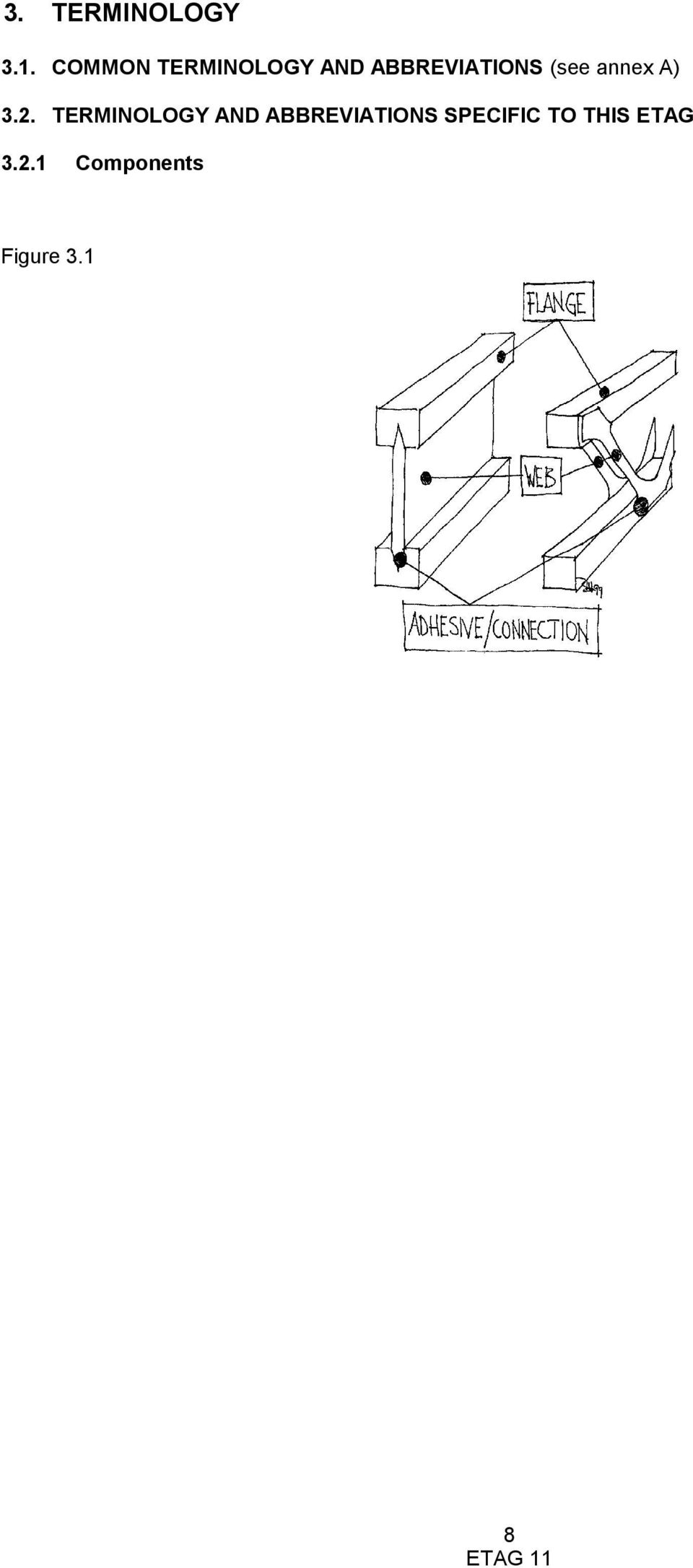
7 Typical examples are shown in Table 2.1. Table 2.1 PRODUCTS FOR CONSIDERATION MATERIALS FORM Light composite wood-based beams and columns e.g.: Timber Laminated timber Laminated veneer lumber (LVL) Fibre board Particle board Oriented strand board Plywood Metals Plastics Organic/inorganic fibres Concrete Adhesives Fixings (e.g. nails, screws,.) Chemicals Large units Sections Bars Sheets Components Formless This ETAG does not include glued laminated timber, glued timber products, timber trusses, LVL beams and columns etc that are already mandated to CEN under the structural timber products and the wood-based panels mandates or wood-based stressed skin elements dealt with by another working group within EOTA. Nor does it include timber formwork beams, which are outside the scope of the CPD. Components Light composite wood-based beams and columns consist of three parts: web, flange and adhesive/connection. See also figure in Relationship with European harmonised standards When writing this ETAG, the aim has been to use as many as possible existing and forthcoming EN standards, and well-established test and assessment methods USE CATEGORIES/PRODUCT FAMILIES/KITS AND SYSTEMS Used as loadbearing components in building structures, for example: construction members or frame elements for walls, roofs, floors and trusses. The properties of light composite wood-based beams and columns are assessed according to characteristics mentioned under the Essential Requirements 1, 2, 3 and 6. ER 6 is optional and may be stated in an ETA as no performance determined since at least one Member State only regulates this property for works. There is an end use category in seismic areas demanding a specific evaluation ASSUMPTIONS The state of the art does not enable the development, within a reasonable time, of full and detailed verification methods and corresponding technical criteria/guidance for acceptance for some particular aspects or products. This ETAG contains assumptions taking account of the state of the art and makes provisions for appropriate, additional case-by-case approaches, e.g. in the case of construction materials not treated in detail in the ETAG, when examining ETA-applications, within the general framework of the ETAG and under the CPD consensus procedure between EOTA members. The guidance remains valid for other cases which do not deviate significantly. The general approach of the ETAG remains valid but the provisions then need to be used case by case in an appropriate way. This use of the ETAG is the responsibility of the ETA body which receives the special application, and subject to consensus within EOTA. Experience in this respect is collected, after endorsement in EOTA-TB, in the ETAG- Comprehension document. 7

8 3. TERMINOLOGY 3.1. COMMON TERMINOLOGY AND ABBREVIATIONS (see annex A) 3.2. TERMINOLOGY AND ABBREVIATIONS SPECIFIC TO THIS ETAG Components Figure 3.1 8
9 SECTION TWO : GUIDANCE FOR THE ASSESSMENT OF THE FITNESS FOR USE GENERAL NOTES (a) Applicability of the ETAG This ETAG provides guidance on the assessment of a family of light composite wood-based beams and columns and their intended uses. It is the manufacturer or producer who defines the light composite wood-based beams and columns for which he is seeking ETA and how it is to be used in the works, and consequently the scale of the assessment. It is therefore possible that for some of light composite wood-based beams and columns, which are fairly conventional, only some of the tests and corresponding criteria are sufficient to establish fitness for use. In other cases, e. g. special or innovative light composite wood-based beams and columns or materials, or where there is a range of uses, the whole package of tests and assessment may be applicable. (b) General layout of this section The assessment of the fitness of light composite wood-based beams and columns with regard to their fitness for intended use in construction works is a process with three main steps: - Chapter 4 clarifies the specific requirements for the works relevant to the light composite wood based beams and columns and uses concerned, beginning with the Essential Requirements for works (CPD art. 11.2) and then listing the corresponding relevant characteristics of light composite wood-based beams and columns - Chapter 5 extends the list in chapter 4 into more precise definitions and the methods available to verify product characteristics and to indicate how the requirements and the relevant product characteristics are described. This is done by test procedures, methods of calculation and of proof, etc. - Chapter 6 provides guidance on the assessing and judging methods to confirm fitness for the intended use of the light composite wood-based beams and columns. - Chapter 7, assumptions and recommendations are only relevant in as far as they concern the basis upon which the assessment of the light composite wood-based beams and columns is made concerning their fitness for the intended use. (c) Levels or classes related to the essential requirements and to the product performance (see ID clause 1.2 and EC Guidance Paper E) According to the CPD, "Classes" in this ETAG refer only to mandatory levels or classes laid down in the ECmandate. This ETAG indicates however the compulsory way of expressing relevant performance characteristics for the light composite wood-based beams and columns. If for some uses at least one Member State has no regulations, a manufacturer always has the right to opt out of one or more of them, in which case the ETA will state "no performance determined" against that aspect, except for those properties for which, when no determination has been made, the product does not any longer fall under the scope of the ETAG; such cases shall be indicated in the ETAG. d) Working life (durability) and serviceability 9

10 The provisions, test and assessment methods in this guideline or referred to, have been written, based upon the assumed intended working life of the light composite wood-based beams and columns for the intended use of 50 years, provided that the light composite wood-based beam or column is subject to appropriate use and maintenance (cfr. ch. 7). These provisions are based upon the current state of the art and the available knowledge and experience. An "assumed intended working life" means that it is expected that, when an assessment following the ETAGprovisions is made, and when this working life has elapsed, the real working life may be, in normal use conditions, considerably longer without major degradation affecting the essential requirements. The indications given as to the working life of light composite wood-based beams and columns cannot be interpreted as a guarantee given by the producer or the approval body. They should only be regarded as a means for the specifiers to choose the appropriate criteria for light composite wood-based beams and columns in relation to the expected, economically reasonable working life of the works (based upon ID. par ). (e) Fitness for the intended use According to the CPD it has to be understood that within the terms of this ETAG, products shall "have such characteristics that the works in which they are to be incorporated, assembled, applied or installed, can, if properly designed and built, satisfy the Essential Requirements" (CPD, art. 2.1). Hence, the light composite wood-based beams and columns must be suitable for use in construction works which (as a whole and in their separate parts) are fit for their intended use, account being taken of economy, and in order to satisfy the essential requirements. Such requirements must, subject to normal maintenance, be satisfied for an economically reasonable working life. The requirements generally concern actions which are foreseeable. "(CPD Annex I, preamble). 10

11 4. REQUIREMENTS for works, and their relationship to the characteristics of light composite woodbased beams and columns This chapter sets out the aspects of performance to be examined in order to satisfy the relevant Essential Requirements, by: - expressing in more detail, within the scope of the ETAG, the relevant Essential Requirements of the CPD in the Interpretative Documents and in the mandate, for works or parts of the works, taking into account the actions to be considered, as well as the expected durability and serviceability of the works. - applying them to the scope of the ETAG for light composite wood-based beams and columns and providing a list of relevant product characteristics and other applicable properties. When a product characteristic or other applicable property is specific to one of the Essential Requirements, it is dealt with in the appropriate place. If, however, the characteristic or property is relevant to more than one Essential Requirement, it is addressed under the most important one with cross reference to the other(s). This is especially important where a manufacturer claims "no performance determined" for a characteristic or property under one Essential Requirement and it is critical for the assessing and judging under another Essential Requirement. Similarly, characteristics or properties which have a bearing on durability assessments may be dealt with under ER 1 to ER 6, with reference under 4.7. Where there is a characteristic which only relates to durability, this is dealt with in 4.7 This chapter also takes into account further requirements, if any (e.g. resulting from other EC Directives) and identifies aspects of serviceability including specifying characteristics needed to identify the light composite wood-based beams and columns. (cfr ETA-format par. II.2). 11

12 Comprehensive table Table 4.0 ER Corresponding ID* paragraph for works Corresponding ID* paragraph for products performance ETAG paragraphs on product performance Product characteristics Provisions concerning works or parts of them Performance of products + Appendix Table 2, Timber products for structural use Loadbearing capacity; Creep Dimensional stability Seismic evaluation Limitation of the generation of fire and smoke within the room Limitations of spread of fire and smoke beyond the room of origin Products subject to reaction to fire requirements Loadbearing elements without separating function (e.g. beams, columns) Reaction to fire Resistance to fire Air quality Annex 1.A. table, Air quality 4.3 Release of formaldehyde, asbestos (content), pentachlorophenol and other dangerous substances 4 Not relevant 5 Not relevant Provisions concerning works or parts of them Fabric components 4.6 Thermal resistance Aspects of durability, serviceability and identification Durability Serviceability Identification *IDs (Interpretative documents). CPD Articles 3 and 12 set out that IDs give concrete form to the Essential Requirements referred to in accordance with the preamble to that Annex. The principle objective of the IDs is to establish the link between the Essential Requirements and the mandates which the Commission gives to CEN and EOTA. 12

13 4.1 MECHANICAL RESISTANCE AND STABILITY (ER 1) The essential requirement laid down in the Council Directive 89/106/EEC is as follows: The construction works must be designed and built in such a way that the loadings that are liable to act on it during its construction and use will not lead to any of the following: a b c d collapse of the whole or part of the work; major deformations to an inadmissible degree; damage to other parts of the works or to fittings or installed equipment as a result of major deformation of the load bearing construction; damage by an event to an extent disproportionate to the original cause. The following aspects of performance are relevant to this Essential Requirement for the light composite wood-based beams and columns. Torsion is a property, which is usually not relevant, since the effects of the loads applied are assessed under other properties Mechanical resistance and stiffness The mechanical resistance and stiffness of the product shall be sufficient to withstand the effects of: Bending Compression Tension Shear Combinations of the above from the actions on the works where relevant Creep and duration of load The mechanical resistance and stiffness of the product exposed to combined effects of loading time and moisture shall be sufficient to withstand the effects of: Bending Compression Tension Shear Combinations of the above from the actions on the works where relevant Dimensional stability Permissible deviations of sizes The manufacturing tolerances on sizes of the product shall be such that the product performance and stability can be maintained. 13

14 Stability of dimensions The dimensional changes due to varying moisture content shall not have inadmissible effects on product performance and stability Seismic evaluation Seismic evaluation shall be carried out in the case of an end use category in seismic areas. 4.2 SAFETY IN CASE OF FIRE (ER 2) The Essential Requirement laid down in the COUNCIL DIRECTIVE 89/106/EEC is as follows: The construction works must be designed and built in such a way that in the event of an outbreak of fire: the loadbearing capacity of the construction can be assumed for a specific period of time. the generation and spread of fire and smoke within the works are limited. the spread of fire to neighbouring construction works is limited. occupants can leave the works or be rescued by other means. the safety of rescue teams is taken into consideration. The following aspects of performance are relevant to this Essential Requirement for light composite wood-based beams and columns Reaction to fire Requirements for the reaction to fire of the light composite wood-based beam and column shall be in accordance with laws, regulations and administrative provisions, applicable to the end use of the light composite wood-based beam and column Resistance to fire Requirements for the resistance to fire of the light composite wood-based beam and column shall be in accordance with laws, regulations and administrative provisions, applicable to the end use of the light composite wood-based beam and column. A classification may be needed for loadbearing capacity (R) for beams and columns (e.g. large LVLbeams). 4.3 HYGIENE, HEALTH AND ENVIRONMENT (ER 3) The Essential Requirement laid down in the COUNCIL DIRECTIVE 89/106/EEC is as follows: The construction work must be designed and built in such a way that it will not be a threat to the hygiene or health of the occupants or neighbours, in particular as a result of any of the following: The giving-off of toxic gas, the presence of dangerous particles or gases in the air, the emission of dangerous radiation, pollution or poisoning of the water or soil, faulty elimination of waste water, smoke, solid or liquid wastes and the presence of damp in parts of the works or on surfaces within the works. Wood preservatives See 2.1. Scope. Concerning wood preservatives, the Directive 98/8/EC - Biocide Directive - of 16 February 1998 applies. 14

15 Chemical treatment of wood is regulated at national level. If a treatment is demanded this should be carried out by companies with capacity and skill in accordance with the regulations valid in the place of use. If a beam or parts of a beam will be subject to chemical treatment, the effect of the chemical treatment on other properties of the beam (e.g. structural, durability of fasteners etc) shall be considered by the regulatory authorities in each Member State. The following aspects of performance are relevant to this Essential Requirement for the product: 15

16 4.3.1 Release of dangerous substances The product/kit must be such that, when installed according to the appropriate provisions of the Member States, it allows for the satisfaction of the ER3 of the CPD as expressed by the national provisions of the Member States and in particular does not cause harmful emission of toxic gases, dangerous particles or radiation to the indoor environment nor contamination of the outdoor environment (air, soil or water). 4.4 SAFETY IN USE (ER 4) Not relevant 4.5 PROTECTION AGAINST NOISE (ER 5) Not relevant 4.6. ENERGY ECONOMY AND HEAT RETENTION (ER 6) The Essential Requirement No. 6 laid down in the COUNCIL DIRECTIVE 89/106/EEC is as follows: The construction works and its heating, cooling and ventilation installations must be designed and built in such a way that the amount of energy required in use shall be low, having regard to the climatic conditions of the location and the occupants The following aspects of performance are relevant to this Essential Requirement for light composite wood-based beams and columns. limiting excessive heat loss by cold bridging limiting risk of surface condensation by cold bridging Thermal bridging The rate at which a beam/column transmits heat depends significantly on the relative position and insulating value of the other materials comprising the works, in particular thermal insulation products. However a beam/column may be designed in such a way as to minimise thermal bridging, for example web beam designs. The extent to which a beam/column allows surface temperatures that may attract surface condensation affecting hygiene, health and the environment is similarly dependent on the rest of the works. See 4.3 Explanatory note - Heat will flow or funnel through the path offering least resistance. For example, a 200 mm beam which bridges an air space is actually a better insulator than the air space and, therefore, is not a cold bridge. However, if the air space were then filled with thermal insulation such as mineral wool, the beam becomes a cold bridge. Note, the rate of heat flow through the beam in each case is different and hence, although the beam can be characterised by a single loss coefficient per unit length, this figure will be different in different constructions. 4.7 ASPECTS OF DURABILITY, SERVICEABILITY AND IDENTIFICATION The intended use of a product shall indicate in which environment the product is suitable Durability The components, the joints and the whole product shall have a verified durability. 16

17 Adhesives/connectors for structural purposes shall produce joints of such strength and durability that the integrity of the bond is maintained in the assigned service class throughout the expected life of the structure Serviceability Serviceability is expressed as deformations of the structure. Allowable limits shall be considered case-by-case. Regard shall be taken as to the possibility of damage of surfacing materials, ceilings, floors, partitions and finishes which may have an effect on the ability of the works to fulfil the Essential Requirements Identification of the product/kit The components and materials used in light composite wood-based beams and columns shall be defined by their properties, which have an influence to the fulfilment of the essential requirements. 17
18 5. METHODS OF VERIFICATION This chapter refers to the verification methods used to determine the various aspects of performance of the products in relation to the requirements for the works (calculations, tests, engineering knowledge, site experience, etc.) as set out in chapter 4. The possibility exists to use existing data in accordance with the EOTA Guidance Document No 004 The provision of data for assessment leading to ETA. The evaluation of a product s different properties shall take account of any alterations to the product that the manufacturer is proposing, either at the time of manufacture or subsequently. Such alterations could be joints in the flanges, holes in the web, reinforcement of the web, special support conditions or any other strength or stiffness related change. A manufacturer shall not have to test a property, which can be verified by calculation. Although tests might be needed in those cases where higher property values are claimed. When EUROCODES are quoted in this ETAG as the methods for the verification of certain product characteristics, their application in this ETAG, as well as in the subsequent ETAs issued according to this ETAG, shall be in accordance with the principles laid down in the EC Guidance Paper on the use of EUROCODES in harmonised European technical specifications Table 5.0 Table adding verification methods to table in 4.0 ER Product characteristics ETAG paragraph on product performance ETAG paragraph on verification methods 1 Loadbearing capacity: Creep Dimensional stability Mechanical resistance Creep and duration of load Dimensional stability Seismic evaluation 2 Ignitability Rate of heat release Rate of spread of flame Rate of smoke production Flaming droplets/particles Reaction to fire. Loadbearing capacity Resistance to fire 3 Content of pollutants Rate of release of pollutants Susceptibility to mould growth Not relevant 5 Not relevant 6 Energy and heat retention 4.6 Thermal resistance Aspects of durability, serviceability and identification Durability 18

19 Serviceability Identification 5.1 MECHANICAL RESISTANCE AND STABILITY Mechanical resistance and stiffness The mechanical resistance and stiffness can be derived using any of the following three methods. Not all properties have to be derived using the same method: Calculation Design assisted by testing Testing Calculation In general the calculation method is suitable when the strength and stiffness properties of the webs, flanges and jointing method are well known and documented. Furthermore, the theoretical model used to estimate the mechanical resistance and stability shall be well established. NOTE: For some products the material for the flanges is graded before it is re-sawn to flange components. In such cases the mechanical properties of the flanges shall be considered separately before using the calculation model. NOTE: For most products the flanges or webs are lengthways jointed (for example finger jointed). In such cases the mechanical properties of the flanges, including finger joints, and webs shall be considered separately before using the calculation model. NOTE: The calculation methods given in Eurocode 5 (ENV ) may be considered Design assisted by testing If a manufacturer can produce a calculation system for the performance of his product, it shall be possible to use his system, if the system has been verified through the methods described in the ETAG. In general the design assisted by testing can be used when: The strength or stiffness properties of the webs or flanges are not well known or documented The theoretical model to estimate the mechanical resistance and stability is not complete. Guidelines for design assisted by testing are given in section 3.2 of Appendix D of Part 1 of Eurocode 1 (ENV ). The extension of the test programme depends on the degree of uncertainty in the used material properties as well as on the degree of uncertainty in the calculation method used. Suitable tests based on the methods given in the section "Test methods" described in the EOTA Technical Report 002 shall be considered separately for each product. The products to be tested shall be a representative sample of the population. From the test results the characteristic value (x k ) for the population shall be given as the 5 % fractile value determined using a confidence level of 75 %. The mean value shall be given using a confidence level of 50 %. For a normal distribution the characteristic value x k is given by: x k = x mean k n x stdev (5.1.1) 19

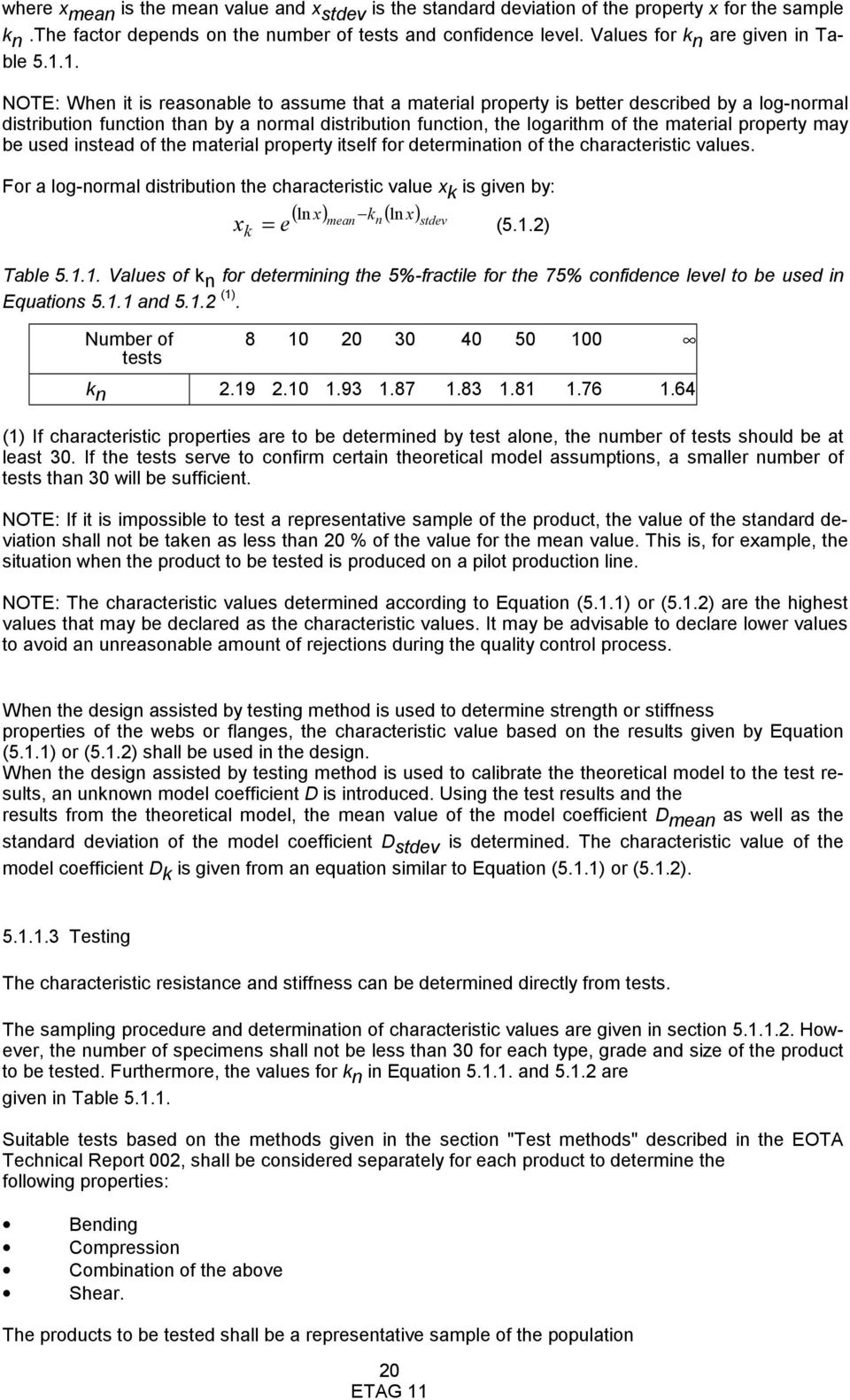
20 where x mean is the mean value and x stdev is the standard deviation of the property x for the sample k n.the factor depends on the number of tests and confidence level. Values for k n are given in Table NOTE: When it is reasonable to assume that a material property is better described by a log-normal distribution function than by a normal distribution function, the logarithm of the material property may be used instead of the material property itself for determination of the characteristic values. For a log-normal distribution the characteristic value x k is given by: ( ln x) mean k n ( ln x) x stdev k = e (5.1.2) Table Values of k n for determining the 5%-fractile for the 75% confidence level to be used in Equations and (1). Number of tests k n (1) If characteristic properties are to be determined by test alone, the number of tests should be at least 30. If the tests serve to confirm certain theoretical model assumptions, a smaller number of tests than 30 will be sufficient. NOTE: If it is impossible to test a representative sample of the product, the value of the standard deviation shall not be taken as less than 20 % of the value for the mean value. This is, for example, the situation when the product to be tested is produced on a pilot production line. NOTE: The characteristic values determined according to Equation (5.1.1) or (5.1.2) are the highest values that may be declared as the characteristic values. It may be advisable to declare lower values to avoid an unreasonable amount of rejections during the quality control process. When the design assisted by testing method is used to determine strength or stiffness properties of the webs or flanges, the characteristic value based on the results given by Equation (5.1.1) or (5.1.2) shall be used in the design. When the design assisted by testing method is used to calibrate the theoretical model to the test results, an unknown model coefficient D is introduced. Using the test results and the results from the theoretical model, the mean value of the model coefficient D mean as well as the standard deviation of the model coefficient D stdev is determined. The characteristic value of the model coefficient D k is given from an equation similar to Equation (5.1.1) or (5.1.2) Testing The characteristic resistance and stiffness can be determined directly from tests. The sampling procedure and determination of characteristic values are given in section However, the number of specimens shall not be less than 30 for each type, grade and size of the product to be tested. Furthermore, the values for k n in Equation and are given in Table Suitable tests based on the methods given in the section "Test methods" described in the EOTA Technical Report 002, shall be considered separately for each product to determine the following properties: Bending Compression Combination of the above Shear. The products to be tested shall be a representative sample of the population 20
21 5.1.2 Creep and duration of load Creep The combined effect of duration time and moisture content on the stiffness properties should be taken into account using the k def factors, given for wood-based materials, in section 4.1 of Part 1-1 of Eurocode 5 (ENV ). For other materials the effect of duration time and moisture content shall be considered separately Duration of load The combined effect of duration time and moisture content on resistance properties should be taken into account using the k mod factors, given for wood-based materials, in section 3.1 of Part 1-1 of Eurocode 5 (ENV ). For other materials the effect of duration time and moisture content shall be considered separately Dimensional stability Tolerances of dimensions To be carried out according to EN Stability of dimensions The same specimens used in shall be conditioned in a climatic room corresponding to the highest moisture conditions where the product is intended to be used. The same measurement as in shall be taken. Alternatively, for well-established products, an assessment can be made Seismic evaluation Bending load tests shall be carried out as indicated in the EOTA Technical Report 002, to obtain load-displacement curves up to the ultimate load. The extension of the test programme depends on the properties of the materials used, the degree of uncertainty and on the scatter of results obtained. 5.2 SAFETY IN CASE OF FIRE Reaction to fire For reaction to fire, the evaluation shall be made as specified in pren Fire classification of construction products and building elements Part 1 Classification using test data from reaction to fire tests. Products which comprise materials included in the COMMISSION DECISION 2000/605/EC can be considered as Euroclass A 1, without testing Fire resistance When assessing resistance to fire, calculation or tests may be used. Calculation of the fire resistance is only possible when the beam or column is made only from woodbased materials with known charring rates as defined in ENV The fire resistance of individual members may be determined by testing according to EN (beams) or EN (columns), or by simplified calculations according to ENV (EC 5). 21
22 The fire resistance of individual members shall be determined so that the assumptions correspond with the intended use. Note: The fire resistance of light composite wood-based beams or columns which are partly or fully integrated in a building structure or element, and where the member is to some extent protected against fire by other materials, shall be determined as a characteristic of the relevant structure and will not be covered by the ETA for the beam or column. 5.3 HYGIENE, HEALTH AND ENVIRONMENT Release of dangerous substances Presence of dangerous substances in the product The applicant shall submit a written declaration stating whether or not the product/kit contains dangerous substances according to European and national regulations, when and where relevant in the Member States of destination, and shall list these substances. Before deciding if the formaldehyde content/release shall be verified or not, the approval body must consider if the intended use of the product is such that the content/release of formaldehyde is relevant. Timber has a natural content of formaldehyde, which should not give reason for a test of formaldehyde content. If the joint between the web and flange contains formaldehyde, tests are not necessary where this will not significantly increase the natural content of formaldehyde. For components containing formaldehyde, the testing of formaldehyde content shall be performed as referred to in pren (Wood-based panels for use in construction, characteristic evaluation of conformity and marking) Compliance with the applicable regulations If the product/kit contains dangerous substances as declared above, the ETA will provide the method(s) which has been used for demonstrating compliance with the applicable regulations in the Member States of destination, according to the dated EU data-base (method(s) of content or release, as appropriate) Application of the precautionary principle An EOTA member has the possibility to provide to the other members, through the Secretary General, warning about substances which, according to Health authorities of its country, are considered to be dangerous under sound scientific evidence, but are not yet regulated. Complete references about this evidence will be provided. This information once agreed upon, will be kept in an EOTA data base, and will be transferred to the Commission services. The information contained in this EOTA data base will also be communicated to any ETA applicant. On the basis of this information, a protocol of assessment of the product, regarding this substance, could be established on request of a manufacturer with the participation of the Approval Body, which raised the issue. 5.4 SAFETY IN USE (ER 4) Not relevant 5.5 PROTECTION AGAINST NOISE (ER 5) Not relevant 22
23 5.6 ENERGY ECONOMY AND HEAT RETENTION For the purpose of heat loss calculations, one or more of the following methods shall determine the thermal properties of the component materials of the beam or column: Design values specified in EN Other values shall be obtained oby measurements according to EN ISO Reference should be made to EN ISO and, if appropriate, the declared value adjusted to take into account expected service temperature and humidity. Explanatory note It should be noted that the extent to which the beam or column bridges the insulation in the works, the overall level of insulation (i.e. how cold the cold parts get) and the permeability of the works to water vapour will all significantly affect the risk of condensation on or within the works. An assessment, therefore, should be carried out for each construction. 5.7 ASPECTS OF DURABILITY, SERVICEABILITY Table A light composite wood-based beam or column consists of a web, joints/connections and flanges. The durability is determined by the weakest of them. The durability of the web is normally dependant on the web material, whose durability can be tested according to the appropriate material standard. The same approach applies to the flanges. The product specifications shall be studied and they should be in accordance with the respective product standard and with consideration taken to the intended use of the product and to the relevant environmental conditions. To ensure an adequately durable structure, the following interrelated factors shall be considered: use of the structure required performance criteria expected environmental conditions composition, properties and performance of the materials shape of members and the structural detailing quality of the workmanship and the level of control particular protective measures likely maintenance during the intended life. The service classes and load duration classes, according to Eurocode 5 and also the hazard classes according EN 335, can generally describe the environmental conditions. The durability of the materials shall be evaluated and specified according to relevant standards. Examples of such standards are listed in Table Standard No. EN 460 Durability of wood and wood-based products Natural durability of solid wood Guide to the durability requirements for wood to be used in hazard classes EN Durability of wood and wood-based products Natural durability of solid wood Part 1: Guide to the principles of testing and classification of natural durability of wood. EN Durability of wood and wood-based products Natural durability of solid wood Part 2: Guide to natural durability and treatability of selected wood species of importance in Europe. EN 599 Durability of wood and wood-based products Performance of preventive wood preservatives as determined by biological tests or national classification and label- 23
24 ling EN 636 EN 312 EN 300 EN 622 EN 301 EN 302 (Parts 1, 2, 3 and 4) EN 385 Plywood Specifications Particleboard Specifications Oriented strand boards (OSB) Definition, classification and specifications Fibreboards Specifications Adhesives, phenolic and aminoplastic for loadbearing timber structures: Classification and performance requirements Adhesives for loadbearing timber structures: Test methods Finger jointed structural timber performance requirements and minimum production requirement Durability of metal fasteners and other structural connectors* and glued joints. *Fasteners/connectors which are a part of the product (e.g. webs). Fasteners to attach products to each other or the works are not included in this ETAG Fasteners, connectors The specification for metal fasteners and other structural connectors shall be examined and an assessment or appropriate test and evaluation shall be carried out, to determine the thickness of corrosion protection or the material specification. Where appropriate, the thickness: 1. of a hot-dip galvanized coating to EN ISO 1461 shall be determined using the methods described in the standard, preferably using the non-destructive magnetic method of EN ISO 2178, or using the gravimetric method of EN ISO 1460 as a reference method in case of dispute. 2. of a coating of a hot-dip zinc coated sheet to EN or EN shall be determined using the methods described in Annex A of the standards. 3. of electroplated zinc coating to ISO 2081 shall be determined using the methods described in the standard, or using ISO 2177 as a reference method in case of dispute. 4. of an electroplated cadmium coating to ISO 2082 is determined using the methods described in the standard. It should be noted that standards for galvanized and electroplated coatings express mass/unit area of coatings with respect to the surface area, and standards for hot-dip coated sheet express mass/unit area with respect to the area of the sheet (i.e. the area of a sheet represents half the area of its surface). The specification for metal fasteners and other structural connectors shall be examined to determine whether any risk of bimetallic corrosion exists and any evidence of monitored atmospheric exposure tests to EN ISO 7441shall be evaluated. An assessment shall be made as to the risks of corrosion arising from any acidic timber species proposed for use in the light composite wood-based beams and columns with the metal fasteners and other structural connectors Adhesives Phenolic and aminoplastic adhesives shall be tested and assessed in accordance with: 24
25 EN 301 Adhesives, phenolic and aminoplastic, for load bearing structures: Classification and performance requirements, and EN 302 (Parts 1, 2, 3 and 4) Adhesives for load bearing timber structures: Test methods. PU adhesives shall be assessed in accordance with Annex Cof this ETAG. Products using other adhesives, e.g. isocyanates (MDI) can be assessed by using the CUAP route. Afterwards the assessment procedure used can be attached to this ETAG as Comprehension Document. Adhesive application. The adhesive application method shall ensure that all surfaces in the assembled joints are covered with adhesive Adhesive application by machine The adhesive should normally be applied to both member ends over at least ¾ of the finger length. However the adhesive may be applied to only one member end if it is documented that the adhesive application fulfils the principle requirement in a reliable way. Fulfilment is achieved if a continuous production control of the adhesive application is in use Serviceability Serviceability is evaluated by calculations or tests as described in clauses and Identification of the product All components of the light composite wood-based beams and columns shall be clearly identified. Where possible, reference to harmonised European specifications shall be made. See Annex B Where components are not covered by harmonised European specifications, they shall be precisely defined. The determination of the product characteristics shall be based on testing in accordance with the appropriate CEN or EOTA test methods as far as they exist. 25
26 6. ASSESSING AND JUDGING THE FITNESS OF PRODUCTS FOR AN INTENDED USE This chapter details the performance requirements to be met (chapter 4) in precise and measurable (as far as possible and proportional to the importance of the risk) or qualitative terms, related to the product and its intended use, using the outcome of the verification methods (chapter 5). 6.0 TABLE LINKING THE ESSENTIAL REQUIREMENTS TO PRODUCT REQUIREMENTS Table 6.0 ER ETAG paragraph on product performance to be assessed Class Use category Numeric values Numeric values for resistance and stiffness as applicable on the intended use Numeric values for k def and k mod Numeric values for nominal sizes and permissible deviations Load-displacement curves Euroclasses A 1 F R No performance determined option Influence on air quality Indication of harmful materials No harmful materials Possible description of resistance to growth of fungi and other microorganisms 4 Not relevant 5 Not relevant Numeric values for thermal resistance No performance determined option Aspects of durability, serviceabili ty and identification 6.7 Service classes and load duration classes (Eurocode 5), Hazard classes (En 335) 26
27 6.1 ASSESSMENT OF MECHANICAL RESISTANCE AND STABILITY Mechanical resistance Independent of the evaluation method used, the following values shall be given in the ETA: Characteristic bending resistance in Nm and mean bending stiffness in Nm 2 Characteristic compression parallel to grain resistance in N and mean compression parallel to grain stiffness in N Characteristic compression perpendicular to grain resistance in N Characteristic tension parallel to grain resistance in N and mean tension parallel to grain stiffness in N Characteristic shear resistance in N and mean shear stiffness in N Characteristic combined bending and compression parallel to grain resistance in Nm and N and mean stiffness in Nm 2 and N The resistance and stiffness values can be directly given in a tabular or graph form or alternatively using a calculation model. If a calculation model is used the relevant input values shall be given. The resistance and stiffness values shall be given for a relative humidity of 65 %, a temperature of 20ºC and a duration of load of 5 minutes Creep and duration of load Creep A numeric value for the factor k def shall be given in the ETA for the relevant service classes and duration of load classes defined in section 3.1 of Eurocode 5 (ENV ) Duration of load A numeric value for the factor k mod shall be given in the ETA for the relevant service classes and duration of load classes defined in section 3.1 of Eurocode 5 (ENV ) Dimensional stability Tolerances of dimensions Numeric values of the nominal dimensions and the permissible deviations, e.g. on length, width and depth, shall be given in the ETA Stability of dimensions Numeric values of the effect of different moisture conditions on the nominal dimensions shall be given. The highest moisture condition for the intended use of the product shall be specified Seismic evaluation Load-displacement curves, resulting of tests under 5.1.4, shall be obtained for use in the ETA to be used by the designer in the evaluation of the seismic behaviour of the work. 6.2 SAFETY IN CASE OF FIRE Reaction to fire Classification of light composite wood-based beams and columns with respect to reaction to fire shall be undertaken in accordance with or EN Fire classification of construction products and building elements Part 1: Classification using data from reaction to fire tests Resistance to fire 27
28 It is optional to declare the property of resistance to fire. To test large products can be a very expensive exercise, therefore it is advisable to calculate the resistance to fire performance. As long as Eurocode 5 has not been issued, the calculation shall be carried out to the rules applicable in the country of use. The corresponding performance would be expressed in terms of "proxy"- characteristics, i.e. charring rates. Classification of light composite wood-based beams and columns with respect to resistance to fire shall be undertaken in accordance with pren Fire classification of construction products and building elements Part 2: Classification using data from fire resistance tests The resistance to fire of individual members may be declared as no performance determined or by a fire resistance R according to EN (beams) or EN (columns), or by simplified calculations according to ENV (EC 5), with a specified time and with a specified maximum loading condition. The loading condition for beams shall be declared as a maximum characteristic bending moment and a maximum characteristic shear resistance at ultimate limit state. The loading condition for columns shall be declared as a maximum characteristic axial load and a maximum characteristic bending stiffness at ultimate limit state. 6.3 HYGIENE, HEALTH AND ENVIRONMENT Release of formaldehyde, and pentachlorophenol Release of formaldehyde Classification of wood-based panels with respect to the release of formaldehyde shall be undertaken in accordance with: EN 300 Oriented Strand Boards (OSB) Definitions, Classification and Specifications EN 312 Particle boards Specifications EN General Requirements for all Board Types EN 622 Fibre boards Specifications EN Requirements for Dry Process Boards (MDF) EN 636 Plywood Specifications EN Requirements for Plywood for Use in Dry Conditions EN Requirements for Plywood for Use in Humid Conditions EN Requirements for Plywood for Use in Exterior Conditions. Release of pentachlorophenol: The content of pentachlorophenol, as stated by the manufacturer, shall be given as a percentage by mass of the component containing the pentachlorophenol Release of dangerous substances The product/kit shall comply with all relevant European and national provisions applicable for the uses for which it is brought to the market. The attention of the applicant should be drawn on the fact that for other uses or other Member States of destination there may be other requirements which would have to be respected. For dangerous substances contained in the product but not covered by the ETA, the NPD option (no performance determined) is applicable. 6.4 SAFETY IN USE (ER 4) Not relevant 28
29 6.5 PROTECTION AGAINST NOISE (ER 5) Not relevant 6.6 ENERGY ECONOMY AND HEAT RETENTION Thermal resistance For the purpose of heat loss calculations, one or more of the following methods shall determine the thermal properties of the component materials of the beam or column: Design values specified in EN Other declared values are determined according to EN ISO and measurements according to pr EN ISO 8990 Where a thermal conductivity or thermal resistance is measured, the mean temperature and moisture content of the sample shall be quoted. 6.7 ASPECTS OF DURABILITY AND SERVICEABILITY The environment for which the product is intended should be determined from the load duration classes and service classes 1, 2 and 3 according to Eurocode 5 and by Hazard classes 1, 2 and 3 according to EN 335. The product and each component should at least be suitable for service class 2, but not for service class 1 only. (e.g. some materials may be used for service class 3) The choice of service class shall be made taking into account the handling of the product during transport, installation, etc Glues shall either meet the requirements of EN 301 or demonstrate to be equivalent by appropriate testing. Finger jointing should comply with the relevant standards Durability The minimum corrosion protection or materials specification for different service classes shall be in accordance with EC5/ENV : 1993, Table Alternative materials shall have equivalent properties/performance. Contact between different materials, used in the manufacture of the metal fasteners and other structural connectors shall not result in corrosion occurring in the service classes being considered. The same rationale shall be applied in relation to the metal fasteners and other structural connectors and the timber species, proposed for use in the manufacture of the light composite wood-based beams and columns. Products with adhesives, which comply with Type I specification, as defined in EN 301, may be used in all service classes. Products with adhesives, which comply with Type II specification, as defined in EN 301, should only be used in service classes 1 or 2 and not subject to prolonged exposure to temperatures in excess of 50ºC. Products with other adhesives shall be assessed individually Serviceability The deformation of a structure, which results from the effects of actions (such as axial and shear forces, bending moments and joint slip) and from moisture, shall remain within appropriate limits. The possibility of damage of surfacing materials, ceilings, floors, partitions and finishes affecting the ER s as per (Eurocode 5, 2.3.4) shall be taken account of. 29
30 Serviceability is addressed by giving the values as described in clauses and IDENTIFICATION OF THE PRODUCT/KIT The description of all components, including materials, of the light composite wood-based beam and column shall be clearly identified. Where possible, reference to harmonised European specifications shall be made. Where components are not covered by relevant harmonised European specifications, they shall be precisely defined by reference to physical characteristics, such as: a) adequate material properties b) geometry, dimensional stability c) the method of assembly. Where applicable, the determination of the component characteristics shall be based on testing in accordance with the appropriate test methods. 30
31 7. ASSUMPTIONS AND RECOMMENDATIONS UNDER WHICH THE FITNESS FOR USE OF THE PRODUCTS IS ASSESSED This chapter sets out the assumptions and recommendations for design, installation and execution, packaging, transport and storage, use, maintenance and repair under which the assessment of the fitness for use according to the ETAG can be made (only when necessary and in so far as they have a bearing on the assessment or on the products) DESIGN AND EXECUTION OF THE WORKS The conditions, for design and execution of the light composite wood-based beams and columns into the works, shall be taken from the manufacturer's installation guide. The quality and sufficiency of the installation guide shall be assessed, e.g. concerning the following aspects: a) the manufacturer claims that his beams and columns can be used with for instance joints in the flanges and/or web, holes/pre-cut knock-outs for installation, reinforcements or other similar equipment, b) definition and verification of the size, spacing and minimum length of support, and demands of serviceability c) fastening of components and eventual restrictions on the application of fixings to the product d) temporary bracing for temporary loads on the construction site during erection. e) In seismic areas, the seismic evaluation of connection between beams and the rest of the works has to be taken care of in the design of the structure. 7.2 PACKAGING, TRANSPORT AND STORAGE The conditions for packaging, transport and storage of the light composite wood-based beams and columns shall be examined from the manufacturer's terms of delivery. The quality and sufficiency of these terms of delivery shall be assessed, e.g. concerning the following aspects: a) protection against unfavourable environmental effects b) protection against external damage, that may affect the proper assembling of the lightcomposite wood-based beams and columns c) intermediate storage at the construction site. 7.3 MAINTENANCE If the light composite wood-based beam or column is possibly to be subject of maintenance, e.g. large beams, the manufacturer's guide for maintenance shall be assessed. 31
32 SECTION THREE : ATTESTATION & EVALUATION OF CONFORMITY (AC) 8. ATTESTATION & EVALUATION OF CONFORMITY 8.1 EC DECISION The system of attestation of conformity, specified by the European Commission Decision 1999/92/EC of 21/1/1999 (published in the EC OJ L 29 of 3/2/1999) and specified in the mandate of the EC of 30/09/98 Annex 3 System 1 for Light composite wood-based beams and columns for which the following is valid: Intended to be used in buildings. For any reaction to fire class. 8.2 RESPONSIBILITIES Tasks for the manufacturer Factory Production Control The manufacturer shall exercise permanent internal control of production. All the elements, requirements and provisions, adopted by the manufacturer, shall be documented in a systematic manner in the form of written policies and procedures. This production control system shall ensure that the product is in conformity with the European Technical Approval (ETA). The manufacturer shall keep a record including any essential information about gluing. Manufacturers having a FPC system that complies with EN ISO 9001 or EN ISO 9002 and which addresses the requirements of an ETA are recognised as satisfying the FPC requirements of the Directive. EC Guidance Paper B provides for a common basis of understanding factory production control, it is however not mandatory. The tables below describe examples of methods to use when performing factory production control. Alternative methods can be accepted. Methods to be examined for each ETA Testing of samples taken at the factory There is a wide variation in the products covered by this ETAG, with different materials, combination of materials and manufacturing processes. For example there will be a fundamental difference in the approach adopted for beams incorporating adhesive joints to those using visible mechanical joints. The performance of an adhesive joint or a non-visible mechanical joint can only be determined by testing, whereas for a mechanically jointed beam, visual examination of the product, process and plant may be sufficient. In relation to factory production control the term testing should be taken to apply to both physical testing and visual examination (including for example dimensional checks). Therefore a precise test plan can only be set up on a case-by-case basis. Normally only properties related to the mechanical resistance and stability of the product have to be tested. Properties to test and the number of tests will depend on the design method for mechanical resistance and stability, i. e. whether calculation, design assisted by testing or testing alone is used as indicated in table
33 Table Testing of samples taken at the factory. Evaluation should be done in accordance with Property Test method Minimum number of specimens Requirement Design by calculation Full size testing of products is not necessary. It is however the producer s responsibility that the material properties are in conformity with the ETA. This may require testing. Adhesive bond shear strength * To be developed for the particular product and shall be described in the test plan which shall be agreed by the manufacturer and the approval body. Both shear strength and wood failure ratio shall be determined. 3 per shift and production line Shall be given in the test plan. Calculation assisted by testing Full size testing of products is necessary. Testing however can be limited to one variation of the product, for instance to one beam depth. It is also the producer s responsibility that the material properties are in conformity with the ETA. This will generally require additional testing in accordance with accepted standards for such product characteristics. Bending resistance / stiffness * Technical Report, clause 6.2. e.g. 1 beam per meters produced beams and production line or at least 1 beam per week. Characteristic / mean value based on results from at least 10 beams > value given in the ETA. Single value > than 0.80 of ETA value is acceptable. Shear resistance / stiffness * Technical Report, clause 6.4. e.g. 1 beam per meters produced beams and production line or at least 1 beam per week. Characteristic / mean value based on results from the latest 10 beams > value given in the ETA. Single value > 0.80 of ETA value is acceptable. 33
34 Property Test method Minimum number of specimens Compressive force resistance * Technical Report, clause 6.5 e.g. 1 column per metres produced columns and production line or at least 1 column per week. Requirement Characteristic / mean value based on results from at least 10 columns > value given in the ETA. Single value > than 0.80 of ETA value is acceptable Adhesive bond shear strength * To be developed for the particular product and shall be described in the test plan which shall be agreed on by the manufacturer and the approval body. Both shear strength and wood failure ratio shall be determined. At least 3 per shift and production line Shall be given in the test plan. Design by testing Full size testing of products is necessary. Testing has to be carried out on all variations of the product, for instance for all beam depths. It is also the producer s responsibility that the material properties are in conformity with the ETA. This will generally require additional testing in accordance with accepted standards for such product characteristics. Bending resistance / stiffness * Shear resistance / stiffness * Compressive resistance * force Technical Report, clause 6.2. Technical Report, clause 6.4 Technical Report, clause beams per week and production line or at least 2 beams per metres produced beams and production line 2 beams per week and production line or at least 2 beams per metres produced beams and production line 2 columns per week and production line or at least 2 columns per metres produced columns and production line Characteristic / mean value based on results from the last 10 beams > value given in the ETA. Single value > than 0.80 of ETA value is acceptable. Characteristic / mean value based on results from the last 10 beams > value given in the ETA. Single value > 0.80 of ETA value is acceptable. Characteristic mean value based on results from at least 10 columns > value given in the ETA. Single value > than 0.80 of ETA value is acceptable Adhesive bond shear strength * To be developed for the particular product and shall be described in the test plan which shall be agreed on by the manufacturer and the approval body. Both shear strength and wood failure ratio shall be determined. 3 per shift and production line Shall be given in the test plan. *) The test procedure in the Technical Report shall be used. Alternative procedures may be used provided that a statistically significant relationship can be established between the specified property and the measured property, see clause
35 Determination of correlation between test methods In some cases, AC procedures may include other test methods than standard methods (according to the Technical Report). The alternative methods may be used if correlation between results from the alternative test procedure and from the standard test procedure is determined Tasks of the approved body Initial Type Testing Approval tests will have been conducted by the approval body or under its responsibility (which may include a proportion conducted by an indicated laboratory or by the manufacturer, witnessed by the approval body) in accordance with section 5 of this ETAG. The approval body will have assessed the results of these tests in accordance with section 6 of this ETAG, as part of the ETA issuing procedure. These tests should be used for the purposes of Initial Type Testing The approved body should validate this work for Certificate of Conformity purposes. Material properties obtained in the initial test programme shall be characterised sufficiently to serve as a basis for subsequent quality assurance evaluations (to ascertain whether a given production lot remains well represented by the initial test material). The approved certification body may in some cases have to conduct initial type testing, e.g. when products, from another production line/unit than the one already assessed for issuing the ETA, shall be included. The purpose is to verify that the production line in question is able to manufacture products in conformity with the ETA. If the calculation only system has been used for the assessment of the product, initial type testing can be limited to testing of the mechanical or adhesive bonded connections between web and flanges. 35
36 Table Initial Type Testing. (Statistical evaluation should be carried out according to ) Product Property Test method Minimum number of specimens Beams Moment resistance Technical Report, clause 6.2. Requirement 10 beams Characteristic value > value given in the ETA. Single value > than 0.80 of ETA value is acceptable. Beams Shear resistance Technical Report, clause beams Characteristic value > value given in the ETA. Single value > than 0.80 of ETA value is acceptable. Beams Bending stiffness Technical Report, clause beams Mean value > value given in the ETA. Single value > than 0.80 of ETA value is acceptable. Beams Shear stiffness Technical Report, clause beams Mean value > value given in the ETA. Single value > than 0.80 of ETA value is acceptable. Columns Compressive force resistance Technical Report, clause columns Characteristic value > value given in the ETA. Single value > than 0.80 of ETA value is acceptable. Beams and columns Adhesive bond shear strength To be developed for the particular product and shall be described in the test plan which shall be agreed by the manufacturer and the approval body. Both shear strength and wood failure ratio shall be determined. 20 specimens form 10 beams or columns Shall be given in the test plan Assessment of the factory production control system initial inspection and continuous surveillance Assessment of the factory production control system is the responsibility of the approved body. An assessment of each production unit shall be carried out to demonstrate that the factory production control is in conformity with the ETA and any subsidiary information. This assessment shall be based on an initial inspection of the factory. Where it has been assumed in the design that the value of the standard deviation shall not be taken as less than 20% of the value for the mean, this assumption shall be re-evaluated when sufficient production has taken place. 36
37 Subsequently continuous surveillance of factory production control is necessary to ensure continuing conformity with the ETA. It is recommended that surveillance inspections be conducted at least twice per year. Initial inspection of the factory, as far as gluing is concerned, shall include the inspection of the premises, technical equipment of the factory and qualification of the personnel Certification of Conformity When all the criteria of the Conformity Attestation are satisfied the approved certification body shall issue a Certificate of Conformity of the product. 8.3 DOCUMENTATION The approval body issuing the ETA shall supply the information detailed below. The information given below together with the requirements given in EC Guidance Paper B will generally form the basis on which the factory production control (FPC) is assessed. This information shall initially be prepared or collected by the approval body and shall be agreed with the manufacturer. The following gives guidance on the type of information required: (1) The ETA See section 9 of this ETAG. The nature of any additional, possibly confidential information shall be declared in the ETA. (2) Basic manufacturing process The basic manufacturing process shall be described in sufficient detail to support the proposed FPC methods. Components for beams and columns are normally manufactured using conventional techniques. Any critical process or treatment of the components affecting performance shall be highlighted. The application properties determined and specified by the approval body for the adhesive used (viscosity, application duration, open drying time, wetting, brushability, ph-value and influence of indoor climate on the setting rate) shall be described in sufficient detail. (3) Product and materials specifications These may include: detailed drawings (including manufacturing tolerances) incoming (raw) materials specifications and declarations references to European and/or international standards or appropriate specifications in manufacturer's data sheets. (4) Test plan (as part of FPC) The manufacturer and the approval body issuing the ETA shall agree on an FPC test plan. An agreed FPC test plan is necessary as current standards relating to quality management systems (EN/ISO 9001 and 9002, etc), do not ensure that the product specification remains unchanged and cannot address the technical validity of the type or frequency of checks/tests. The validity of the type and frequency of checks/tests conducted during production and on the final product shall be considered. This will include the checks conducted during manufacture on properties that cannot be inspected at a later stage and for checks on the final product. These will normally include: material properties dimensions of component parts where materials/components are not manufactured and tested by the supplier in accordance with agreed methods, then, where appropriate, they must be subject to suitable checks/tests by the manufacturer before acceptance. 37
38 In addition to this, tests on the final products may be considered necessary. The parameters to be addressed, as given in the mandate, are related to following mandated performance characteristics: Loadbearing capacity Test methods, sampling, evaluation and requirements should be given. Comment: It may not always be possible or desirable (for reasons of confidentiality) to include the complete product specification and technical justification within the ETA. Therefore it may be necessary to supply subsidiary information to the approved body. The nature of this subsidiary information should be declared in the ETA. 8.4 CE MARKING AND INFORMATION The ETA shall indicate the information to accompany the CE marking and the placement of CE marking and the accompanying information: on the beam/column itself, or on an attached label, or on the packaging, or on the accompanying commercial documents. According to the CE Guidance Paper D on CE marking, the required information to accompany the symbol "CE" is: identification number of the notified certification body (System 1) the name or identifying mark of the producer and the registered address of the producer last two digits of the year in which the marking was affixed the number of the EC certificate of conformity (System 1) number of the ETA, valid as indication to identify the characteristics of the beam/column 38
39 SECTION FOUR : ETA CONTENT 9. THE ETA CONTENT 9.1 THE ETA-CONTENT Model ETA The format of the ETA shall be based on the Commission Decision 97/571/EC of 22 July 1997, Official Journal of the European Communities No L 236 of 27 August Checklist for the approval body The technical part of the ETA shall contain information on the following items, in the order and with reference to the Essential Requirements relevant for the product category declared by the manufacturer. For each of the listed items, the ETA shall either give the mentioned indication/classification/statement/description or state that the verification/assessment of this item has not been carried out. The items are here given with reference to the relevant clause of this ETAG: Indication of the assumed working life (Section Two : Durability) Mechanical resistance including method used (calculation, calculation assisted by test, or test only). (Clause 6.1.1) Creep and duration of load (Clause 6.1.2) Dimensional stability (Clause 6.1.3) Load displacement curves for seismic evaluation (Clause 6.1.4) Classification of beam/column with respect to reaction to fire, including test method used (Clause ) Classification of beam/column with respect to fire resistance, including test method used (Clause 6.2.2) Statement on the presence and concentration/emission rate/etc. of formaldehyde, pentachlorophenol, other dangerous substances, or a statement that dangerous materials are not present (Clause 6.3.1) Indication of calculated or measured thermal resistance, including the calculation or test method and the configuration applied (Clause 6.6.1) Durability (Clause 6.7.1) Serviceability (Clause 6.7.2) Identification of the product (Clause 6.7.3). In section II.2 characteristics of products and methods of verification the ETA shall include the following note: In addition to the specific clauses relating to dangerous substances contained in this European Technical Approval, there may be other requirements applicable to the products falling within its scope (e.g. transposed European legislation and national laws, regulations and administrative provisions). In order to meet the provisions of the EU Construction Products Directive, these requirements need also to be complied with, when and where they apply. 9.2 ADDITIONAL INFORMATION Any alteration to the product that the manufacturer is proposing either at the time of manufacture or subsequently, e.g. holes in webs, web reinforcement, must be assessed. It shall be stated in the ETA that the installation guide forms part of the ETA and thus always shall accompany the delivered beams/columns. 39
40 Similarly, it shall be stated in the ETA whether or not any additional, possibly confidential information shall be supplied to the approved certification body for the evaluation of conformity. See clause 8 of this ETAG. 40
41 Annexes: Annex A. Annex B Annex C Common terminology Reference documents PU Adhesives 41
42 1. WORKS AND PRODUCTS Annex A COMMON TERMINOLOGY (definitions, clarifications, abbreviations) 1.1 Construction works (and parts of works) (often simply referred to as "works") (ID 1.3.1) Everything that is constructed or results from construction operations and is fixed to the ground. (This covers both building and civil engineering works, and both structural and non-structural elements) Construction products (often simply referred to as "products") (ID 1.3.2) Products which are produced for incorporation in a permanent manner in the works and placed as such on the market. (The term includes materials, elements, components of prefabricated systems or installations) 1.3. Incorporation (of products in works) (ID 1.3.2) Incorporation of a product in a permanent manner in the works means that: - its removal reduces the performance capabilities of the works, and - that the dismantling or the replacement of the product are operations which involve construction activities Intended use (ID 1.3.4) Role(s) that the product is intended to play in the fulfilment of the essential requirements. (N.B. This definition covers only the intended use as far as relevant for the CPD) 1.5. Execution (ETAG-format) Used in this document to cover all types of incorporation techniques such as installation, assembling, incorporation, etc System (EOTA/TB guidance) Part of the works realised by - particular combination of a set of defined products, and - particular design methods for the system, and/or - particular execution procedures. 2. PERFORMANCES 2.1. Fitness for intended use (of products) (CPD 2.1) Means that the products have such characteristics that the works in which they are intended to be incorporated, assembled, applied or installed, can, if properly designed and built, satisfy the essential requirements. (N.B. This definition covers only the intended fitness for intended use as far as relevant for the CPD) 2.2. Serviceability (of works) Ability of the works to fulfill their intended use and in particular the essential requirements relevant for this use. The products must be suitable for construction works which (as a whole and in their separate parts) are fit for their intended use, subject to normal maintenance, be satisfied for an economically reasonable working life. The requirements generally concern actions which are foreseeable (CPD Annex I, Preamble) Essential requirements (for works): requirements applicable to works, which may influence the technical characteristics of a product, and are set out in terms of objectives in the CPD, Annex I (CPD, art. 3.1) Performance (of works, parts of works or products) (ID 1.3.7) The quantitative expression (value, grade, class or level) of the behaviour of the works, parts of works or of the products, for an action to which it is subject or which it generates under the intended service conditions (works or parts of works) or intended use conditions (products). 42
43 As far as practicable the characteristics of products, or groups of products, should be described in measurable performance terms in the technical specifications and guidelines for ETA. Methods of calculation, measurement, testing (where possible), evaluation of site experience and verification, together with compliance criteria shall be given either in the relevant technical specifications or in references called up in such specifications Actions (on works or parts of the works) (ID 1.3.6) Service conditions of the works which may affect the compliance of the works with the essential requirements of the Directive and which are brought about by agents (mechanical, chemical, biological, thermal or electromagnetic) acting on the works or parts of the works. Interactions between various products within a work are considered as "actions" Classes or levels (for essential requirements and for related product performances) (ID 1.2.1) A classification of product performance(s) expressed as a range of requirement levels of the works, determined in the IDs or according to the procedure provided for in art. 20.2a of the CPD. 3. ETAG - FORMAT 3.1. Requirements (for works) (ETAG-format 4.) Expression and application, in more detail and in terms applicable to the scope of the guideline, of the relevant requirements of the CPD (given concrete form in the ID's and further specified in the mandate, for works or parts of the works, taking into account the durability and serviceability of the works Methods of verification (for products) (ETAG-format 5.) Verification methods used to determine the performance of the products in relation to the requirements for the works (calculations, tests, engineering knowledge, evaluation of site experience, etc.). This verification methods are related only to the assessment of, and for judging the fitness for use. Verification methods for particular designs of works are called here "project testing", for identification of products are called "identification testing", for surveillance of execution or executed works are called "surveillance testing", and for attestation of conformity are called "AC-testing" Specifications (for products) (ETAG-format 6.) Transposition of the requirements into precise and measurable (as far as possible and proportional to the importance of the risk) or qualitative terms, related to the products and their intended use. The satisfaction of the specifications is deemed to satisfy the fitness for use of the products concerned. Specifications may also be formulated with regard to the verification of particular designs, for identification of products, for surveillance of execution or executed works and for attestation of conformity, when relevant 4. WORKING LIFE 4.1. Working life (of works or parts of the works) (ID 1.3.5(1) The period of time during which the performance will be maintained at a level compatible with the fulfilment of the essential requirements Working life (of products) Period of time during which the performances of the product are maintained - under the corresponding service conditions - at a level compatible with the intended use conditions Economically reasonable working life: (ID 1.3.5(2) Working life which takes into account all relevant aspects, such as costs of design, construction and use, costs arising from hindrance of use, risks and consequences of failure of the works during its working life and cost of insurance covering these risks, planned partial renewal, costs of inspections, maintenance, care and repair, costs of operation and administration, of disposal and environmental aspects Maintenance (of works) (ID 1.3.3(1) A set of preventive and other measures which are applied to the works to enable the works to fulfil all its functions during its working life. These measures include cleaning, servicing, repainting, repairing, replacing parts of the works where needed, etc. 43
44 4.5. Normal maintenance (of works) (ID 1.3.3(2) Maintenance, normally including inspections, which occurs at a time when the cost of the intervention which has to be made is not disproportionate to the value of the part of the work concerned, consequential costs (e.g. exploitation) being taken into account Durability (of products) Ability of the product to contribute to the working life of the work by maintaining its performances, under the corresponding service conditions, at a level compatible with the fulfilment of the essential requirements by the works. 5. CONFORMITY 5.1. Attestation of conformity (of products) Provisions and procedures as laid down in the CPD and fixed according to the directive, aiming to ensure that, with acceptable probability, the specified performance of the product is achieved by the ongoing production Identification (of a product) Product characteristics and methods for their verification, allowing to compare a given product with the one that is described in the technical specification. 6. APPROVAL AND APPROVED BODIES 6.1. Approval Body Body notified in accordance with Article 10 of the CPD, by an EU Member State or by an EFTA State (contracting party to the EEA Agreement), to issue European Technical Approvals in (a) specific construction product area(s). All such bodies are required to be members of the European Organisation for Technical Approvals (EOTA), set up in accordance with Annex II.2 of the CPD Approved Body(*) Body nominated in accordance with Article 18 of the CPD, by an EU Member State or by an EFTA State (contracting party to the EEA Agreement), to perform specific tasks in the framework of the Attestation of Conformity decision for specific construction products (certification, inspection or testing). All such bodies are automatically members of the Group of Notified Bodies. (*) also known as Notified Body Concerning the Construction Products Directive: ABBREVIATIONS AC: Attestation of Conformity CEC: Commission of the European Communities CEN: Comité Européen de Normalisation / European Committee for Standardization CPD: Construction Products Directive EC: European Communities EFTA: European Free Trade Association EN: European Standard FPC: Factory Production Control ID: Interpretative Documents of the CPD ISO: International Standardisation Organisation SCC: Standing Committee for Construction of the EC Concerning approval: EOTA: European Organisation for Technical Approvals ETA: European Technical Approval ETAG: European Technical Approval Guideline TB: EOTA-Technical Board UEAtc: Union Européenne pour l Agrément technique dans la construction/ European union of agrément 44
45 General: TC: Technical Committee WG: Working Group 45
46 Annex B REFERENCE DOCUMENTS The reference documents, such as EC documents, test methods, product standards, EOTA Technical reports etc, are presented under the headings of each chapter of this ETAG where the references appear in this ETAG. Table B.01 ETAG Chapter Document title ENV , Eurocode 5 ENV , Eurocode 1 EOTA Technical Report No ENV , Eurocode EN 336, Structural timber Conferous poplar sizes, p pren , Fire classification of construction products and building elements 2000/605/EC, Commission Decision establishing the list of products belonging to Euroclass A1, without testing ENV , Eurocode 5 EN and 4, Fire resistance for loadbearing elements PrEN 13986, Wood-based panels for use in construction, characteristic evaluation of Conformity and marking 5.6 EN 12524, Building materials and products Hygrothermal properties, tabulated design values. EN ISO 8990 Thermal insulation. Determination of steady-state thermal transmission properties. Calibrated and guarded hot box EN ISO 10456, Building materials and products Procedures to. 5.7 EN 335, Durability of wood and wood-based products EN 460, Durability of wood and wood-based products Natural durability of solid wood Guide to the durability requirements for wood to be used in hazard classes EN Durability of wood and wood-based products Natural durability of solid wood Part 1: Guide to the principles of testing and classification of natural durability of wood. 46
47 ETAG Chapter Document title 5.7 cont. EN Durability of wood and wood-based products Natural durability of solid wood Part 2: Guide to natural durability and treatability of selected wood species of importance in Europe. EN 599, Durability of wood and wood-based products Performance of preventive wood preservatives as determined by biological tests or national classification and labelling EN 636, Plywood - Specifications EN 312, Particleboard Specifications EN 300, Oriented strand Boards (OSB) Definition, classification and specifications EN 622, Fibreboards - Specifications EN 301, Adhesives, phenolic and aminoplastic for load-bearing timber structures: Classification and performance requirements EN 302 (Part 1, 2, 3 and 4)Adhesives for load bearing timber structures: Test methods EN 385, Finger jointed structural timber performance requirements and minimum production requirement EN ISO 1461, Hot dip galvanized coatings on fabricated iron... EN ISO 2178, Non-magnetic coatings on magnetic substrates - EN ISO 1460, Metallic coatings - Hot dip galvanized coatings... EN 10142, Continuously hot-dip zinc coated mild steel str... EN 10147, Continuously hot-dip zinc coated structural ste ISO 2081, Metallic coatings - Electroplated coatings of z... ISO 2177, Metallic coatings - Measurement of coating thic ISO 2082, Metallic coatings - Electroplated coatings of c... EN ISO 7441, Corrosion of metals and alloys - Determination... EN 301 Adhesives, phenolic and aminoplastic, for lad bearing structures: Classification and performance requirements EN 302 (Parts 1 4) Adhesives for lad bearing timber structures: Test methods ENV , Eurocode pren , Fire classification of construction products and building elements EN and 4, Fire resistance for loadbearing elements ENV , Eurocode 5 47
48 ETAG Chapter Document title EN 300, Oriented Strand Boards (OSB) Definitions, Classification and Specifications EN 312, Particle boards Specifications EN 312-1, General Requirements for all board types EN 622, Fibre boards Specifications EN 622 5, Requirements for Dry Process Boards (MDF) EN 636, Plywood Specifications EN 636 1, Requirements for Plywood for Use in Dry Conditions EN 636 2, Requirements for Plywood for Use in Humid Conditions EN 636 3, Requirements for Plywood for Use in Exterior Conditions EN 12524, Building materials and products Hygrothermal properties, tabulated design values. EN ISO 8990 Thermal insulation. Determination of steady-state thermal transmission properties. Calibrated and guarded hot box EN ISO 10456, Building materials and products. Procedures for determining declared and design thermal values ISO 8302, Thermal insulation -- Determination of steady-state thermal resistance and related properties -- Guarded hot plate apparatus 6.7 ENV , Eurocode 5 EN 335, Durability of wood and wood-based products EN 301 Adhesives, phenolic and aminoplastic, for lad bearing structures: Classification and performance requirements ENV , Eurocode 5 EN 301 Adhesives, phenolic and aminoplastic, for lad bearing structures: Classification and performance requirements EN/ISO 9001, Quality systems Model for quality assurance in design, development, production installation and servicing EN/ISO 9002, Quality systems Model for quality assurance in production, installation and servicing 48
49 ETAG Chapter Document title 8.3 EC Guidance Paper B, The definition of factory production control in technical specifications for construction products EN/ISO 9001 EN/ISO EC Guidance paper D, CE-marking 49
50 Annex C PU ADHESIVES The European standards EN 301 and EN 302 exclusively apply to phenolic and aminoplastic adhesives. Since sufficient experience has not been gained with regard to continuous creep behaviour of one-component PU adhesives when being exposed to loads it is necessary to carry out additional tests concerning this behaviour. C1 Tests and test methods The following tests shall at least be performed: a) Testing in compliance with EN 301/302. Testing in compliance with EN is complemented by the orienting testing of specimens having a joint thickness of 0.5 mm. Testing in compliance with EN is complemented by the testing of specimens made of pine, beech and oak. b) Testing of the application properties (see also EN 302-5, EN 302-6, EN 302-7): Adhesives, on principle, shall be tested under the same conditions in which they are used or are to be used in practice. The timber shall be of mean density, knotless, straight-grained and without torch growth. During bonding, its moisture content shall be equal to 12 ± 1 % 1. Determination of important characteristics of the adhesive ready for use For each of the tests foreseen in 1.1 to 1.3, approximately 2 kg of adhesive ready for use is to be used in containers of about 250 cm 2 of cross-section. All tests shall be carried out at a temperature of 20 ± 2 C and relative humidity of 65 ± 5 % RH. The tests according to 1.1 and 1.2 in addition shall be carried out at 15 ± 2 C and 90 ± 5 % RH as well as at 30 ± 2 C and 40 ± 5 % RH. Adhesives and timber specimens shall, at the beginning of testing, be conditioned to the prescribed room temperature. This is not relevant for PU adhesives, since such adhesives create a temperature rise. 1.1 Dynamic viscosity The dynamic viscosity (initial viscosity) shall be determined by use of a rotating viscometer with cylindrical measuring device. 1.2 Open assembly time For determination of open assembly time the adhesive is applied 10 minutes after preparation to planed pine and beech wood of mean width of annular rings with a specific application mass of 250 g/m 2 and 400 g/m 2. The surface of the timber specimens (slabs) is equal to about 10 cm x 30 cm; the angle of the annular rings relative to the surface is from 30 to 90. The open assembly time is the period of time between the beginning of application of adhesive until the end of adhesive power determined by the thumb test. 1.3 Assessment of wetting and brushability Wetting and brushability are assessed in connection with the application of adhesive during the test according to
51 2. Determination of influence of indoor climate on curing time (bond strength) The curing time is determined to specify the minimum pressing times. 80 bonded test specimens, each made of beech wood and having a joint thickness of 0.5 ± 0.1 mm, are prepared in accordance with EN under the following conditions: a) Bonding at 15 ± 2 C and 90 ± 5 % RH b) Bonding at 20 ± 2 C and 65 ± 5 % RH c) Bonding at 30 ± 2 C and 40 ± 5 % RH Adhesive and timber shall be at the prescribed temperature of the test room and shall be conditioned at this temperature for 16 hours before starting the bonding. During conditioning, the wood specimens shall be hermetically sealed to avoid changes of moisture content. For each conditioning period 10 test specimens corresponding to a), b) and c) shall be tested after assembly and storage times,, of: 4 hours 8 hours 16 hours 24 hours 2 days 3 days 7 days 28 days At assembly of the slabs the pressing load shall be equal to 0.8 N/mm 2. After 4 and 8 and 16 and 24 hours, respectively, the first slabs are unloaded and samples taken as test pieces. After 24 hours the assembly pressure is removed from the remaining slabs and the slabs are stored until testing after 2, 3, 7 and 28 days at the climatic conditions prescribed. From these slabs samples are taken 2 days after manufacture. For adhesives with particularly short curing times, additional testing of the test pieces can be carried out at curing times of less than 4 hours. c) Assessment of foaming behaviour after open assembly times of varying length. d) Influence of open and closed assembly times on the tensile shear strength of long-cut beech wood samples complying with EN 302-1, joint thickness 0.1 mm. e) Sliding glueings for triangular brace girders with 0.1 mm, 0.3 mm and 0.5 mm clearance (fit) and hardening without additional pressing load(assembly pressure). f) Influence of low and high temperatures (- 60 C, + 50 C and + 70 C) on the tensile shear strength of long-cut beech wood samples with a joint thickness of 0.1 mm, 0.5 mm and 1.0 mm. g) Influence of storage duration, different climatic conditions and permanent loading on the bond strength of beech samples exposed to transverse tension loads with a joint thickness of 0.1 mm and 0.5 mm for a period of 3 years. h) Dynamic creep tests on loaded small-size girders of glued laminated timber over a period of 3 years. If components glued with the adhesive under test and already loaded for some time can be assessed, the dynamic creep tests can possibly be omitted. Where the tests result in noticeable/ unusual values, it may be necessary to perform further tests. 51
52 C2 Classification and performance requirements Classification: Two types of adhesive, I and II, are classified in accordance with their fitness for the intended use under the climatic conditions complying with EN , Table 1. Performance requirements: The one-component PU adhesives shall satisfy the performance requirements given in EN 301. For the tests carried out on additional test pieces of joint thickness of 0.5 mm according to EN 302-1, the performance requirements given in DIN apply. This is also valid for the testing of additional test pieces made of pine, beech and oak according to EN For sliding glueings, see e) above, a pull-out strength of at least 1.8 N/mm 2 shall be achieved. In the tests of the influence of storage duration, different climatic conditions and permanent loading on the bond strength of beech samples exposed to transverse tension loads, with joint thicknesses of 0.1 mm and 0.5 mm, a shear resistance of at least 5 N/mm 2 shall be achieved. In addition, the decrease of strength shall not exceed the expected value of decrease of strength of the wood. In the dynamic creep tests according to clause C 1 h) the glued laminated timber girders manufactured using the PU adhesive shall not present any larger deformations when exposed to loading than similar girders manufactured using adhesives according to EN 301/
ETAG 016 SELF-SUPPORTING COMPOSITE LIGHTWEIGHT PANELS. (Part one : G E N E R A L)
 European Organisation for Technical Approvals Europäische Organisation für Technische Zulassungen Organisation Européenne pour l Agrément Technique Edition NOVEMBER 2003 GUIDELINE FOR EUROPEAN TECHNICAL
European Technical Assessment ETA-10/0153 of 10/06/2015
 ETA-Danmark A/S Göteborg Plads 1 DK-2150 Nordhavn Tel. +45 72 24 59 00 Fax +45 72 24 59 04 Internet ww.etadanmark.dk Authorised and notified according to Article 29 of the Regulation (EU) No 305/2011 of
European Technical Approval ETA 13/0526
 European Technical Approval ETA 13/0526 Trade Name Holder of the approval Website Generic type and use of construction product DOLCEA i3 PCIM S.A. Rue du Péquet 54 5590 Achene (Ciney) Belgium www.isoproc.eu
European Technical Approval ETA-12/0500
 ETA-Danmark A/S Kollegievej 6 DK-2920 Charlottenlund Tel. +45 72 24 59 00 Fax +45 72 24 59 04 Internet www.etadanmark.dk Authorised and notified according to Article 10 of the Council Directive 89/106/EEC
ETAG 004 EXTERNAL THERMAL INSULATION COMPOSITE SYSTEMS WITH RENDERING
 European Organisation for Technical Approvals Europäische Organisation für Technische Zulassungen Organisation Européenne pour l Agrément Technique Edition March 2000 Amendment June 2008 GUIDELINE FOR
European Technical Approval ETA-10/0153
 ETA-Danmark A/S Kollegievej 6 DK-2920 Charlottenlund Tel. +45 72 24 59 00 Fax +45 72 24 59 04 Internet www.etadanmark.dk Authorised and notified according to Article 10 of the Council Directive 89/106/EEC
European technical approval
 Authorised and notified according to Article 10 of the Council Directive 89/ 106/EEC of 21 December 1988 on the approximation of laws, regulations and administrative provisions of Member States relating
THE CONSTRUCTION PRODUCTS DIRECTIVE (COUNCIL DIRECTIVE 89/106/EEC)
 THE CONSTRUCTION PRODUCTS DIRECTIVE (COUNCIL DIRECTIVE 89/106/EEC) Council Directive 89/106/EEC of 21 December 1988 on the approximation of laws, regulations and administrative provisions of the Member
WORKING DOCUMENT FOR SCC CONSULTATION CONSTRUCT09/874 EUROPEAN COMMISSION ENTERPRISE AND INDUSTRY DIRECTORATE-GENERAL
 WORKING DOCUMENT FOR SCC CONSULTATION CONSTRUCT09/874 EUROPEAN COMMISSION ENTERPRISE AND INDUSTRY DIRECTORATE-GENERAL New Approach Industries, Tourism and CSR Construction, Pressure Equipment, Metrology
Structural fire design Eurocode 5-1.2 Timber structures
 Background and Applications Brussels, 18-20 February 2008 Dissemination of information workshop 1 Structural fire design Eurocode 5-1.2 Timber structures Jochen Fornather Austrian Standards Institute [email protected]
Eurocode 5: Design of timber structures
 Eurocode 5: Design of timber structures Arnold Page, BSc, BD, MIWSc. Structural timber engineering consultant Introduction BS EN 1995 consists of three parts: Part 1-1: General. Common rules and rules
Certification of construction products - Fire dampers. Certification Rules 032
 Certification of construction products - Fire dampers Certification Rules 032 1 Contents Contents 1 0 Preface 1 1 Scope and intended application 2 2 Technical requirements 2 2.1 Properties 2 2.1.1 Protection
CERTIFICATE NAME OF PRODUCT MANUFACTURER PRODUCT DESCRIPTION CERTIFICATION PROCEDURE. No VTT C-6044-10 Date of issue 11.10.2010, Updated July 1, 2011
 CERTIFICATE NAME OF PRODUCT No VTT C-6044-10 Date of issue 11.10.2010, Updated July 1, 2011 H-CONTROL REFLEX+ reflective insulating vapour control layer for roof and wall applications MANUFACTURER ACTIS
Rakennustuotedirektiivin (89/106/EEC) artiklan 10, neuvoston direktiivi 21. joulukuuta 1988, mukaisesti notifioitu tuotehyväksyntälaitos EOTAN JÄSEN
 VTT Expert Services Oy PL 1001 02044 VTT Puh. +358 20 722 4911 Telekopio +358 20 722 7003 Rakennustuotedirektiivin (89/106/EEC) artiklan 10, neuvoston direktiivi 21. joulukuuta 1988, mukaisesti notifioitu
Authorised and notified according to Article 10 of the Council Directive 89/106/EEC of 21 December 1988 on the
 ÖSTERREICHISCHES I N S T I T U T F Ü R B A U T E C H N I K A-1010 Vienna, Schenkenstrasse 4 Tel.: + 4 3 ( 0 ) 1-5 3 3 6 5 5 0 Fax: + 4 3 ( 0 ) 1-5 3 3 6 4 2 3 relating to construction products E - m a
pren 1995-1-2 Eurocode 5 Design of timber structures Part 1-2: General rules Structural fire design Final Draft - October 2001 Stage 34 Clean version
 Document CEN/TC 250/SC 5: N161a 2001-10-16 pren 1995-1-2 Eurocode 5 Design of timber structures Part 1-2: General rules Structural fire design Final Draft - October 2001 Stage 34 Clean version Page 1 Contents
Fire safety in timber buildings
 Fire safety in timber buildings Introduction Fire spread in buildings is a risk to life safety for which the Building Regulations (for England and Wales 1,2, Scotland 3 and Northern Ireland 4 ) aims to
Product Data Sheet ROCKPANEL Rockclad
 Product Data Sheet ROCKPANEL Rockclad Durable - Xtreme - FS-Xtra United Kingdom 1 Product description ROCKPANEL boards are prefabricated compressed mineral wool boards with synthetic binders. The surface
Europeiskt Tekniskt Godkännande European Technical Approval
 SITAC Box 553 SE 371 23 Karlskrona SWEDEN MEMBER OF EOTA Tfn.: +46-(0)10-516 63 00 Fax: +46-(0)455-206 88 E-mail: [email protected] Europeiskt Tekniskt Godkännande European Technical Approval Handelsnamn Trade
Page 1 of European Technical Approval ETA-08/0018
 Page 1 of European Technical Approval ETA-08/0018 VTT Expert Services Oy PL 1001 02044 VTT Puh. +358 20 722 4911 Telekopio +358 20 722 7003 Rakennustuotedirektiivin (89/106/EEC) artiklan 10, neuvoston
European Organisation for Technical Approvals
 Warrington Certification Limited, Holmesfield Road, Warrington, WA1 2DS Tel. +44 (0) 1925-646777 Fax +44 (0) 1925-646667 Member of EOTA Authorised and notified according to Article 10 of the Council Directive
Mandate M/116 MASONRY AND RELATED PRODUCTS
 Mandate M/116 Page 1 sur 19 Mandate M/116 MANDATE TO CEN/CENELEC CONCERNING THE EXECUTION OF STANDARDISATION WORK FOR HARMONIZED STANDARDS ON CReatE MASONR AND RELATED PRODUCTS RELATED TO THE FOLLOWING
Wood flooring and parquet Characteristics, evaluation of conformity and marking
 ÖNORM EN 14342 Edition: 2013-09-15 Wood flooring and parquet Characteristics, evaluation of conformity and marking Holzfußböden und Parkett Eigenschaften, Bewertung der Konformität und Kennzeichnung Planchers
Rakennustuotedirektiivin (89/106/EEC) artiklan 10, neuvoston direktiivi 21. joulukuuta 1988, mukaisesti notifioitu tuotehyväksyntälaitos EOTAN JÄSEN
 Page 1 of European Technical Approval ETA-09/0129 VTT Valtion Teknillinen Tutkimuskeskus PL 1000 02044 VTT Puh. +358 20 722 4911 Telekopio +358 20 722 7003 Rakennustuotedirektiivin (89/106/EEC) artiklan
European Technical Approval ETA-04/0013
 ETA-Danmark A/S Kollegievej 6 DK-2920 Charlottenlund Tel. +45 72 24 59 00 Fax +45 72 24 59 04 Internet www.etadanmark.dk Authorised and notified according to Article 10 of the Council Directive 89/106/EEC
Sealfire W1000 Compound. (2 references for the same product) Fire Stopping and Sealing Product: Penetration Seals
 UL INTERNATIONAL (UK) LTD Wonersh House, Building C, The Guildway, Old Portsmouth Road, Guildford. GU3 1LR. United Kingdom. Phone : +44 1483 302130 Fax : +44 1483 302230 Email : [email protected] Website
European Technical Approval ETA 13/0384
 European Technical Approval ETA 13/0384 Trade Name Holder of the approval Website Generic type and use of construction product Isobriq EU, Isobriq LE, Isobriq PA & Isobriq ZE Isobriq sa 49 Rue Slar 4801
The University of Birmingham (Live System)
 The University of Birmingham (Live System) Behaviour of Structural Insulated Panels (SIPs) under both short-term and long-term loadings Yang, Jian; Rungthonkit, Prathan Document Version Author final version
SmartPly OSB3 SMARTPLY
 SMARTPLY SmartPly OSB3 SmartPly OSB3 is a highly engineered, moisture resistant load-bearing panel designed for use in humid conditions and is therefore ideal for many structural and non-structural applications
Österreichisches Institut für Bautechnik Schenkenstrasse 4 1010 Vienna Austria T +43 1 533 65 50 F +43 1 533 64 23 [email protected] www.oib.or.
 Authorised and notified according to Article 10 of the Council Directive 89/106/EEC of 21 December 1988 on the approximation of laws, regulations and administrative provisions of Member States relating
Page 1 of European Technical Approval ETA-12/0495
 Page 1 of European Technical Approval ETA-12/0495 VTT Expert Services Oy PL 1001 02044 VTT Puh. +358 20 722 4911 Telekopio +358 20 722 7003 Rakennustuotedirektiivin (89/106/EEC) artiklan 10, neuvoston
EUROPEAN TECHNICAL APPROVAL ACCORDING TO ETAG 005 - EXPLANATIONS -
 EUROPEAN TECHNICAL APPROVAL ACCORDING TO ETAG 005 - EXPLANATIONS - 1. Particular Abbreviation ETZ : Europäische Technische Zulassung ETA : European Technical Approval ETAG : European Technical Approval
Composite Panel Firewall Systems
 Composite Panel Firewall Systems part of the Protecting more than your business Insulated mineral fibre panels have excellent thermal and acoustic properties, ideal for factory and office partition walls.
Page 1 of European Technical Approval ETA-09/0129, Issued on September 26, 2011, valid until June 3, 2014
 Page 1 of European Technical Approval ETA-09/0129, Issued on September 26, 2011, valid until June 3, 2014 VTT Expert Services Ltd PL 1001 02044 VTT Puh. +358 20 722 4911 Telekopio +358 20 722 7003 Rakennustuotedirektiivin
European Technical Assessment ETA-15/0028 of 23/02/2015
 ETA-Danmark A/S Göteborg Plads 1 DK-2150 Nordhavn Tel. +45 72 24 59 00 Fax +45 72 24 59 04 Internet ww.etadanmark.dk Authorised and notified according to Article 29 of the Regulation (EU) No 305/2011 of
Mandate M/111 CIRCULATION FIXTURES
 Mandate M/111 Page 1 sur 13 Mandate M/111 MANDATE TO CEN/CENELEC CONCERNING THE EXECUTION OF STANDARDISATION WORK FOR HARMONIZED STANDARDS ON CIRCULATION FIXTURES RELATED TO THE FOLLOWING END USES 30/33:
Eurooppalainen tekninen hyväksyntä ETA - 13/0613 European Technical Approval
 VTT Expert Services Ltd PL 1001 02044 VTT Puh. +358 20 722 4911 Telekopio +358 20 722 7003 Rakennustuotedirektiivin (89/106/EEC) artiklan 10, neuvoston direktiivi 21. joulukuuta 1988, mukaisesti notifioitu
Mandate M/119 FLOORINGS
 Mandate M/119 Page 1 sur 14 Mandate M/119 MANDATE TO CEN/CENELEC CONCERNING THE EXECUTION OF STANDARDISATION WORK FOR HARMONIZED STANDARDS ON CReatE RELATED TO THE FOLLOWING END USES FLOORINGS 01/33 :
Requirements for Fire Protection of Light Weight Floor Systems **Act 1 Revisited**
 PHRC Webinar Series Tuesday, September 9, 2014 1:00 pm Requirements for Fire Protection of Light Weight Floor Systems **Act 1 Revisited** Presented by: Bryan Heitzmann Credit(s) earned on completion of
Dubai Municipality Standard DMS 1: Part 5: 2004
 Specification for precast concrete blocks Part 5: Normal-weight concrete-polystyrene sandwich masonry blocks Issue Date Revision Revision Description Prepared by Approved by Authorized by 19/12/2004 Issue
European Technical Approval ETA-10/0124
 ETA-Danmark A/S Kollegievej 6 DK-2920 Charlottenlund Tel. +45 72 24 59 00 Fax +45 72 24 59 04 Internet www.etadanmark.dk Authorised and notified according to Article 10 of the Council Directive 89/106/EEC
BSF and BCC beam connections
 No. 2512 Norwegian member of European Organisation for Technical Approvals, EOTA, and European Union of Agrément, UEAtc Issued: 11.09.2007 Revised: Valid until: 11.09.2012 Page: 1 of 5 BSF and BCC beam
We care about. Environmentally-Friendly Building Products from Renewable Resources. natural building products. Product range overview
 http://upload.wikimedia.org/wikipedia/commons/a/ae/flag_of_the_united_kingdom.svg.0.0 :8 Seite von Environmentally-Friendly Building Products from Renewable Resources Product range overview We care about
Annex of the certificate (Page 1/6) Accreditation Scope
 As a Testing Laboratory Annex of the certificate (Page 1/6) Accreditation Scope Address: Küçük Çiğli Mh. 8780/1 Sk. No:5 Çiğli 35681 İZMİR / TÜRKİYE Phone : 0 232 376 24 25 Fax : 0 232 386 33 98 E-Mail
How To Make An Oriented Strand Board
 ABOUT COMPANY Mission Provide solutions to enchance customers product value. Vision - To be a leader among wood based panel producers in the region. Values Innovation, integrity and team commitment. BOLDERAJA
Fire safety in buildings and implementation of European fire test standards
 Fire safety in buildings and implementation of European fire test standards Dr Debbie Smith OBE Chair of CEN TC127 Fire Safety BRE Global Ltd, UK 18 th June 2014 Part of the BRE Trust Construction Products
European Technical Approval ETA-06/0259
 European Technical Approval ETA-06/0259 - Original version in German language Handelsbezeichnung Trade name Zulassungsinhaber Holder of approval Zulassungsgegenstand und Verwendungszweck Generic type and
Safety Storage Cabinets
 Safety Storage Cabinets Safe storage of flammables? The workplace without a fire resistant Safety Storage Cabinet Dangers, risks and your disadvantages... STORAGE ROOM Transport/working time - Increased
Schedule of Accreditation issued by United Kingdom Accreditation Service 21-47 High Street, Feltham, Middlesex, TW13 4UN, UK
 21-47 High Street, Feltham, Middlesex, TW13 4UN, UK to provide product conformity Stocking Lane High Wycombe Buckinghamshire HP14 4ND Contact: Mr Alan Gower Tel: +44 (0)1494 569700 Fax: +44 (0)1494 569701
B. Related categories: The following categories contain requirements that relate to this section:
 ORIENTED STRAND BOARD PART I. - GENERAL 1.1 RELATED DOCUMENTS A. Drawings and general provisions of Contract, including General and Supplementary Conditions and Division 1 Specification Sections, apply
A Guide to the European Standard for Safety Storage Cabinets (BS EN 14470-1)
 White Paper A Guide to the European Standard for Safety Storage Cabinets (BS EN 14470-1) Published: May 2012 Author: Greg Smith, Labtex In this Labtex White Paper: Safety Storage Cabinets Overview What
AVERTISSEMENT Vous trouverez ci-dessous la version française de ce Guidance Paper suivie de la version anglaise
 AVERTISSEMENT Vous trouverez ci-dessous la version française de ce Guidance Paper suivie de la version anglaise !!"#$%$ %$ &'# %%%( $ # $ %$ # %%") %$ #% $!* $(%$ ($%% +$ (,& #$- * ($%%* $ $ % + $%%$ %!%%
Composite Design Fundamentals. David Richardson
 Composite Design Fundamentals David Richardson Contents A review of the fundamental characteristics of composites Stiffness and Strength Anisotropic Role of fibre, matrix and interface Composite failure
Discussion on Products under the Scope of EN 1090-1 and proposed CEN/TR to clarify the scope
 CEN/TC 135 N 686 European Committee for Standardization Comité Européen de Normalisation Europäisches Komitee für Normung CEN/TC 135 Execution of steel structures and aluminium structures N 686 Secretariat:
English Version. Fire safety storage cabinets - Part 2: Safety cabinets for pressurised gas cylinders
 EUROPEAN STANDARD NORME EUROPÉENNE EUROPÄISCHE NORM EN 14470-2 August 2006 ICS 13.220.40; 71.040.10 English Version Fire safety storage cabinets - Part 2: Safety cabinets for pressurised gas cylinders
EN 14904. Export Manager Pulastic Sports Surfaces The Netherlands www.descol.nl
 Introduction by : Peter Minnée Export Manager Pulastic Sports Surfaces The Netherlands www.descol.nl Co-operation between European test institutes and standardization institutes formalized in 1961 Construction
Position paper on the CE-marking of sanitary and building valves
 Position paper on the CE-marking of sanitary and building valves Last update: 26/06/2013 Verband Deutscher Maschinenund Anlagenbau e.v. (German Engineering Federation) Professional association Valves Chairman:
NATIONAL ASSESSMENT DIRECTIVE FOR THE PRODUCT CERTIFICATE FOR WOODEN SCAFFOLDING BOARDS
 BRL 9923 dd. 2004-10-01 NATIONAL ASSESSMENT DIRECTIVE FOR THE KOMO PRODUCT CERTIFICATE FOR WOODEN SCAFFOLDING BOARDS Technical area E2 Accepted by the Committee of Experts of SKH dd. 15 th September 2004
Quality Regulations for Profiles
 Quality Regulations for Profiles September 2010 Quality Regulations for Profiles Page 2/42 Contents Preface... 4 1. Terms and Definitions... 5 1.1 Third parties... 5 1.2 Independent laboratories... 5 1.3
ModuSec. Secure and efficient IT room solutions Composite Panel Systems Compared. Panel Systems are not all the same!
 Secure and efficient IT room solutions Composite Panel Systems Compared Panel Systems are not all the same! When it comes to accommodating critical IT systems, the first issue to look at is the environment
PIPES, TANKS and ANCILLARIES not in contact with water intended for human consumption
 Mandate M/131 Page 1 sur 24 MANDATE M/131 MANDATE TO CEN/CENELEC CONCERNING THE EXECUTION OF STANDARDISATION WORK FOR HARMONIZED STANDARDS ON CReatE PIPES, TANKS and ANCILLARIES not in contact with water
EUROPEAN STANDARDS AND MARKINGS FOR HAND AND ARM PROTECTION
 APPENDIX 5 EUROPEAN STANDARDS AND MARKINGS FOR HAND AND ARM PROTECTION ISSUE 8: January 2013 This information is extracted from British Standards with the permission of BSI under licence number PD\1998
European technical approval
 Authorised and notified according to Article 10 of the Council Directive 89/ 106/EEC of 21 December 1988 on the approximation of laws, regulations and administrative provisions of Member States relating
EXPERT OPINION on the applicability of the construction technology "GRÈMOUND non-tectonic system on grounds of the documentation submitted
 ÉMI Építésügyi Minőségellenőrző Innovációs Nonprofit Kft. [ÉMI Non-Profit Limited Liability Company for Quality Control and Innovation in Building; ÉMI Non-Profit Ltd.] Address: 1113 Budapest, Diószegi
Your essential guide to CE Marking
 Your essential guide to CE Marking CE marking A guide for window and door fabricators This guide provides essential information that will help you with your preparations for CE marking. A flowchart is
Scheme rules for thermal insulation products for building equipment and industrial installations - VDI certification scheme
 Scheme rules for thermal insulation products for building equipment and industrial installations - certification scheme April 6, 2011 1. Introduction This document presents the rules of the product certification
CE mark now! Mandatory CE marking of construction products 1 July 2013
 CE mark now! Mandatory CE marking of construction products 1 July 2013 Mandatory CE marking of construction products 1 July 2013 From 1 July 2013, construction products covered by a harmonised standard
Fire 2This Technical Bulletin has been commissioned by the UK SIP Association in
 REV 1-12.12.11/TB002 Technical Bulletin Fire 2This Technical Bulletin has been commissioned by the UK SIP Association in conjunction with TRADA Technology and is intended to provide the reader with introductory
Rakennustuotedirektiivin (89/106/EEC) artiklan 10, neuvoston direktiivi 21. joulukuuta 1988, mukaisesti notifioitu tuotehyväksyntälaitos EOTAN JÄSEN
 Page 1 of European Technical Approval ETA-09/0082 VTT Expert Services Oy PL 1001 02044 VTT Puh. +358 20 722 4911 Telekopio +358 20 722 7003 Rakennustuotedirektiivin (89/106/EEC) artiklan 10, neuvoston
Decree of the Ministry of the Environment on fire safety of ventilation systems
 THE NATIONAL BUILDING CODE OF FINLAND MINISTRY OF THE ENVIRONMENT Housing and Building Department Decree of the Ministry of the Environment on fire safety of ventilation systems Adopted in Helsinki, 18
ETAG 022. GUIDELINE FOR EUROPEAN TECHNICAL APPROVAL of Watertight covering kits for wet room floors and or walls
 European Organisation for Technical Approvals Europäische Organisation für Technische Zulassungen Organisation Européenne pour l Agrément Technique ETAG 022 GUIDELINE FOR EUROPEAN TECHNICAL APPROVAL of
European Technical Approval ETA-10/0200
 Deutsches Institut für Bautechnik Anstalt des öffentlichen Rechts Kolonnenstr. 30 B 10829 Berlin Germany Tel.: +49(0)30 787 30 0 Fax: +49(0)30 787 30 320 E-mail: [email protected] Internet: www.dibt.de Mitglied
Georgios Katsarakis Europäische Kommission
 Georgios Katsarakis Europäische Kommission Implementing the Construction Products Regulation (EU) 305/2011 G. Katsarakis European Commission, DG Enterprise and Industry Unit B-1: Sustainable Industrial
How To Understand And Understand Eurocode
 HANDBOOK 1 BASIS OF STRUCTURAL DESIGN Guide to Interpretative Documents for Essential Requirements, to EN 1990 and to application and use of Eurocodes LEONARDO DA VINCI PILOT PROJECT CZ/02/B/F/PP-134007
ÖNORM EN 1504-8. The European Standard EN 1504-8 has the status of an Austrian Standard. Edition: 2005-02-01. Standards group B
 ÖNORM EN 1504-8 Edition: 2005-02-01 Standards group B Identical (IDT) with EN 1504-8:2004 ICS 91.080.40 Products and systems for the protection and repair of concrete structures Definitions, requirements,
DOW CORNING SENEFFE (Belgium) DOW CORNING GmbH WIESBADEN (Germany) This version replaces ETA 03/0003 valid from 2008-04-10 until 2013-04-09
 European Technical Approval ETA-03/0003 Trade name: Holder of the approval: Website: Generic type and use of construction product(s): DOW CORNING 3362 AND 3362 HD BLACK GREY WHITE DOW CORNING Parc Industriel
European Technical Approval ETA-09/0040
 European Technical Approval ETA-09/0040 - Original version in German language Handelsbezeichnung Trade name Zulassungsinhaber Holder of approval Zulassungsgegenstand und Verwendungszweck Generic type and
Rockwool Cladding Roll
 Rockwool Cladding Roll High performance industrial insulation has been specifically developed for use in lightweight cladding applications to commercial or industrial framed buildings. Cladding Roll U/F
Europeiskt Tekniskt Godkännande European Technical Approval
 SITAC Box 553 SE 371 23 Karlskrona SWEDEN MEMBER OF EOTA Tfn.: +46-(0)10-516 63 00 Fax: +46-(0)455-206 88 E-mail: [email protected] Europeiskt Tekniskt Godkännande European Technical Approval ETA-11/0380 Handelsnamn
This European technical approval
 ÖSTERREICHISCHES I N S T I T U T F Ü R B A U T E C H N I K A-1010 Vienna, Schenkenstrasse 4 Tel.: + 4 3 ( 0 ) 1-5 3 3 6 5 5 0 Fax: + 4 3 ( 0 ) 1-5 3 3 6 4 2 3 relating to construction products E - m a
Scope of EN 1090-1 Clarification Document
 Scope of EN 1090-1 Clarification Document This document has been submitted to the European Commission as the UK view on the scope of EN 1090-1. After discussions, including with the European Technical
European technical approval
 Authorised and notified according to Article 10 of the Council Directive 89/ 106/EEC of 21 December 1988 on the approximation of laws, regulations and administrative provisions of Member States relating
Guidance Note on the Construction Products Regulation
 Guidance Note on the Construction Products Regulation Version 1 - April 2012 APPROVAL INSPECTION TESTING CERTIFICATION TECHNICAL APPROVALS FOR CONSTRUCTION Guidance Note on the Construction Products Regulation
DIRECTIVE 2006/95/EC OF THE EUROPEAN PARLIAMENT AND OF THE COUNCIL. of 12 December 2006
 L 374/10 EN Official Journal of the European Union 27.12.2006 DIRECTIVE 2006/95/EC OF THE EUROPEAN PARLIAMENT AND OF THE COUNCIL of 12 December 2006 on the harmonisation of the laws of Member States relating
The BASA Guide to the ISO 11600 Classification of Sealants for Building Construction
 The BASA Guide to the ISO 11600 Classification of Sealants for Building Construction SEALANTS IN BUILDING AND CONSTRUCTION Glazing Sealants (G) Construction Sealants (F) Class 25 Class 25LM Class 25 Class
FLOORS REINFORCEMENT Shear Stud Connector for steel- concrete composite structures cold applied by pins
 www.tecnaria.com FLOORS REINFORCEMENT Shear Stud Connector for steel concrete composite structures cold applied by pins HIGHPERFORMANCE FLOORS COMPOSITE STEEL AND CONCRETE STRUCTURES: STATIC AND ECONOMIC
Chapter 3 Pre-Installation, Foundations and Piers
 Chapter 3 Pre-Installation, Foundations and Piers 3-1 Pre-Installation Establishes the minimum requirements for the siting, design, materials, access, and installation of manufactured dwellings, accessory
N 1069 CEN-TC250-WG7 N0001 EG EN1990
 CEN/TC 250 CEN/TC 250 - Structural Eurocodes Email of secretary: [email protected] Secretariat: BSI (United Kingdom) N 1069 CEN-TC250-WG7 N0001 EG EN1990 - Recommendations for amendments to EN
Boverket s mandatory provisions on the amendment to the Board's building regulations (2011:6) mandatory provisions and general recommendations;
 Boverket s mandatory provisions on the amendment to the Board's building regulations (2011:6) mandatory provisions and general recommendations; Published on 10 October 2011 Reprinted adopted on 4 October
GigaCrete Specification PlasterMax
 GigaCrete Inc. 6775 Speedway Blvd. Suite M105 Las Vegas, NV 89115 Ph (702) 643-6363 Fax (702) 643 1453 www.gigacrete.com GigaCrete Specification PlasterMax PlasterMax : Fire Rated Plaster for Direct Application
DECLARATION OF PERFORMANCE
 Flooring Declaration of Performance Edition 01.07.2013 Identification no. Version no. 01 EN 1504-2: 2004 08 0921 EN 13813: 2002 DECLARATION OF PERFORMANCE Declaration of performance 1. Product Type Unique
Fire-Retardant-Treated (FRT) Plywood
 T e c h n i c a l n o t e Fire-Retardant-Treated (FRT) Plywood Number K320 January 2009 Introduction Codes assure fire safety by controlling such things as size and design of the structure and flame-spread
TECHNICAL INFORMATION SHEET
 European Panel Federation Europäischer Holzwerkstoffverband Fédération Européenne des Panneaux à Base de Bois TECHNICAL INFORMATION SHEET OSB (oriented strand board) Description OSB (Oriented Strand Board)
INTERNATIONAL ASSOCIATION OF CLASSIFICATION SOCIETIES. Interpretations of the FTP
 INTERNATIONAL ASSOCIATION OF CLASSIFICATION SOCIETIES Interpretations of the FTP CONTENTS FTP1 Adhesives used in A or B class divisions (FTP Code 3.1, Res A.754 para. 3.2.3) June 2000 FTP2 Pipe and duct