
Value for Money Unit Local Government Audit Service
|
|
|
- Alexandrina Daniel
- 9 years ago
- Views:
Transcription
1 Value for Money Unit Local Government Audit Service Report on Spot Checks of Capital Projects funded by the Department of the Environment, Heritage and Local Government and undertaken by Local Authorities either in progress or completed during 2008 October, 2010
2 Table of Contents Page Executive Summary 3 Principal Findings by expenditure range 6 Summary of Findings and Recommendations 11 Housing Capital Projects 15 Water Capital Projects 22 Waste Capital Projects 25 Fire and Emergency Services Capital Projects 29 Local Services Capital Projects 31 Traveller Accommodation Capital Projects 34 Appendices Appendix A Sample Selection 37 2
3 Executive Summary Introduction Under the Department of Finance Guidelines for the Appraisal and Management of Capital Expenditure Proposals in the Public Sector (February 2005), there is an obligation on Departments to implement a series of independent spot-checks and reviews of capital projects to establish that the various appraisal and management requirements of the guidelines are being implemented. The Department of the Environment, Heritage and Local Government (the Department) engaged consultants to carryout a series of spot-checks and post project reviews on capital projects funded by the Department and delivered either by the local authorities or directly by the Department. Their final report Report on Spot Checks of Capital Projects funded by the Department of the Environment, Heritage and Local Government was produced in October 2009 and examined capital projects relating to the years 2006 and The consultants also implemented a training programme for Department staff in spot-check and review procedures to develop inhouse capacity. Spot checks on capital projects funded by the Department and undertaken by the local authorities in 2008, have been performed by the Department s Local Government Audit Service (LGAS). During the period January-April 2010 staff of the LGAS visited 31 local authorities and examined 60 capital projects with a total value of m across 6 programme areas for the year The Internal Audit section within the Department also performed spot checks on capital projects undertaken by the Department. Overview The approach taken for the 2008 report was to build on the previous years report but in addition to have a greater focus on materiality. This means that projects were evaluated based on the value bands within which they fall, in addition to the programme areas they cover, as shown in Table 1. The value bands used are in accordance with the Department of Finance guidelines. The matters which arose from the review of the capital projects, under the various appraisal and management requirements of the guidelines, are reported as exceptions. The most frequent occurring exceptions by programme are set out in Table 2. 3

4 Table 1 : Capital Projects examined by programme and expenditure range No. of projects examined by programme Housing: SHIP 1 CAS 2 CLSS 3 0 to 0.5 million range to 5 million range m to 30 million range 8-2 > 30 million Total Water Waste Fire and Emergency Services Local Services Traveller Accommodation Total Overview of exceptions for all projects Incomplete appraisals in 34 projects No project brief or incomplete brief for 15 projects Project not delivered within budget cost in 19 projects Projects not delivered within budget timeframe in 14 projects Final account not prepared in a timely manner for 15 projects Lack of post project review in 28 projects. 1 SHIP (Social Housing Investment Programme) 2 CAS (Capital Assistance Scheme) 3 CLSS (Capital Loan and Subsidy Scheme) 4

5 Table 2: Most frequent occurring exceptions by programme Summary of completed spot checks Programme Total value of projects reviewed No of projects Most frequently occurring exceptions (No. of projects) Housing capital projects: SHIP 154,343, Incomplete appraisal (7) 2. No project brief (6) 3. Projects not delivered within budget time (6) 4. Final account not prepared in timely manner (6) 5. No post project review (7) 6. Project over budget (7) Housing capital projects: CAS 14,116,249 8 Housing capital projects: CLSS Water capital projects Waste capital projects Fire and emergency capital projects Local services capital projects Traveller Accommodation capital projects 63,572, ,507, ,018, ,131, ,185, ,952, Procurement issues 1. No project brief (6) 2. No consistent application of appraisal procedures 3. Lack of local authority oversight 4. No post project review (6) 1. Lack of available documentation (2) 2. Lack of local authority involvement (2) 3. Lack of post project review (2) 1. Incomplete appraisal (10) 2. Project not delivered within budget time (1) 3. Delays in agreeing final account and/or grant claims (4) 4. Project over budget (5) 5. No post project review (3) 6. Procurement issues 1. Incomplete or no appraisal (4) 2. Incomplete/ no project brief (2) 3. No/late Department approval (2) 4. Delays in agreeing final account and/or grant claims (3) 5. Project over budget (2) 6. No post project review (2) 7. Procurement issues 1. Incomplete appraisal (3) 2. Incomplete project brief (1) 3. No post project reviews (1) 1. Incomplete appraisal (6) 2. Project not delivered within budget time (4) 3. Project over budget (3) 4. No post project review (4) 5. Procurement issues 1. Incomplete appraisal (4) 2. Projects not delivered within budget time (3) 3. Final account not prepared in timely manner (2) 4. Project over budget (2) 5. No post project review (3) 6. Procurement issues 5

6 Principal Findings by expenditure range Projects > 30 million range Number of projects examined 5 Housing Programme One project within the Capital Loan Subsidy Scheme (CLSS) was initiated in 2001 and therefore predated the Department of Finance 2005 guidelines and the Department circulars relating to social and voluntary housing. The project was found to be in general compliance with the guidelines even though it predated them. Water Programme Under the Water programme there were four projects examined, all related to upgrading and augmentation of water supply schemes and work on certain projects was required in order to be compliant with the EU Directive Three of the projects were initiated in the 1990 s and one in 1984, it is unclear why there were such time delays as only one project was completed, the other three were at implementation stage. The completed project consisted of three contracts which were all over budget, final accounts have been received on all contracts but only agreed and paid on two contracts. While all projects had an appraisal they did not conform with the prescribed procedures set down in the guidelines. It appears that no cost benefit analysis was performed on any of these projects. One project is a Public Private Partnership and complied with the requirement of appointing a Process Auditor to ensure regulatory and procurement procedures are followed. Projects within the 5 million to 30 million range Number of projects examined 20 Housing Programme Under the SHIP eight projects were within this expenditure range While all projects had some form of appraisal four project appraisals were incomplete and did not conform to the procedures set down in the guidelines (e.g simple assessment which incorporates justification for the project, an estimation of cost, timeline for delivery or an examination at a high level of the value for money (VFM) of the project). Local authorities are obliged to consult with the National Development Finance Agency (NDFA) for projects over 20m. The NDFA were not consulted in relation to four of the projects with a value over 20m, however in two projects the original budgets at appraisal stage were under 20m. Four projects did not have a complete project brief which should provide detailed description of project options, objectives, programme for completion of works and outline any services to be provided by consultants, engineers etc. Two projects were not delivered within the budget time. Four projects did not have a final account completed in a timely manner. Three projects were over budget. Cost overruns were usually attributable to changes in scope of work or extra costs incurred due to unforeseen circumstances such as poor ground conditions. No post project review had been undertaken for three projects. 6

7 Under the CLSS two projects were undertaken, one by a housing association and the second by Dublin Docklands Development Authority. The projects are completed and operating successfully, however the following exceptions were noted: Lack of available documentation at local authority level. Lack of involvement by local authorities in planning and implementation of projects. Lack of post project review. Water Programme There were three projects within this expenditure band. Incomplete appraisals were found in two projects, which originated in 1993 and In one project the Department approval in principle was given after planning stage and tender report and submission of recommended contractors. One project due for completion in 2010 appears to be running over budget as a proposed river crossing was deemed not achieveable and there was a contractor risk price buyout. One project received sanction in 2003 and had an estimated time scale of 3 years, but is still ongoing and over budget. Procurement guidelines were not correctly followed for the tendering procedures. Waste Programme There were three projects within this expenditure band. One project was at implementation stage. The original grant approval was for 6.5m in 2004, revised costings eventually led to the Department granting approval of 21.8m in Two projects were landfill remediation works required under the terms of EPA licences. Therefore they did not follow the appraisal procedures or prepare preliminary reports or project briefs as required under the capital appraisal guidelines. One project had no formal approval from the Department for the project appraisal, to preceed to planning or obtain tenders. The project was over budget and no final account had yet been agreed. Local Services There were three projects within this expenditure band. One project was under budget by 26%, and the appraisal, planning and implementation stages of the project were well managed. The tender documents were not issued to the Department for prior approval and no post project review has yet been performed. A second project was approximately 30% over budget due mainly to accessibility redesign. The project has won a number of national and international design and accessibility awards. The third project originated in 2002 and was completed in May The project ran over budget and time. The advice of the NDFA was not sought at the appraisal stage despite the fact the project exceeded 20m, where such consultation is required under the guidelines. Traveller Accommodation Programme There was one traveller project within this band of expenditure. Project timescale from inception to final account was nine years, there was no specified timescale for this project. 7

8 There was no formal project appraisal, project brief or project plan, but a number of other documents and reports covered some of the above. The project was marginally over budget (0.3%). A post project review was performed on this project. Projects within the 0.5 million to 5 million range Number of projects examined 26 Housing Programme Under the SHIP nine projects were within this expenditure range While all projects had some form of appraisal three project appraisals were incomplete and did not conform to the procedures set down in the guidelines (e.g simple assessment which incorporates justification for the project, an estimation of cost, timeline for delivery or an examination at a high level of the VFM of the project). Two projects did not have a complete project brief which should provide detailed description of project options, objectives, programme for completion of works and outline any services to be provided by consultants, engineers etc. Four projects were not delivered within the budget time. Two projects did not have a final account completed in a timely manner. Four projects were over budget. Cost overruns were usually attributable to changes in scope of work or extra costs incurred due to unforeseen circumstances such as poor ground conditions. No post project review had been undertaken for four projects. Under the CLSS there was one project within this expenditure range The Department advised the local authority there was no need to perform a pre-tender review as this was a turnkey project and no tender process involved. The local authority oversaw the implementation of the project which was delivered within budget and on time. Under the CAS there were six projects within this expenditure range No project brief was prepared for 3 of the projects reviewed There was no post project review for 3 of the projects which were completed at the time of the review. There was no simple or detailed formal appraisal performed on a number of the projects as required by the regulations There was a lack of involvement by the local authorities in the appraisal, planning and implementation phases of projects. Management structures and information flows were not documented. Formal reporting structures were not in place and documentation was maintained by the voluntary bodies and not by the local authorities. Water Programme There were four water capital projects within this band of expenditure. There were incomplete appraisals for the four projects. The two projects completed were on time, but there was no post project evaluation. The final account is not yet completed and the remaining 20% of approved funding had not yet been claimed from the Department for one project. 8

9 Approval for budget variations and increases were not sought for a completed project. Waste Programme There was one waste project within this band of expenditure. The project consisted of a number of main contracts, two contracts completed and one at implementation stage. Confirmation of budget approval was obtained when project work was substantially completed. Two contracts were completed in time for grant funding deadline of 31 December 2007, but costs were incurred on another contract after the deadline. Additional works on one contract were carried out prior to obtaining approval and amounted to an increase of 46% on the original contract. Final account received for two contracts, but only agreed for one contract. Fire and Emergency Services Programme There were three fire services capital projects within this band of expenditure. Appraisals were incomplete, as some did not include detailed budgeted costs (including ongoing capital, life cycle costs or contingencies). The appraisals did not ensure that an evaluation would take place upon completion of projects. One project is complete and operating effectively. Local Services There was one local service project within this band of expenditure. The appraisal, planning and implementation stages of this project appear to have been broadly well managed. The project was completed within time and budget and met it s objectives. The only exception of note was that some elements of the procurement process were not complied with. Traveller Accommodation Programme There was one traveller project within this band of expenditure. This project had a protracted history from initial application for re-housing in May 1983 and a legal case taken against the local authority in The accommodation was occupied in November There were delays with the project as the two lowest tenderers withdrew and project had to be re-tendered. The local authority also had great difficulty in finding a suitable site for accommodation. A separate architect contract was awarded from a panel without any evidence of first obtaining quotes. The final construction contract awarded in August 2009 exceeded the approved estimate by 42%. Cost increases were mainly due to temporary accommodation arrangements. At the time of spot-check the final account was being prepared. 9

10 Projects within the 0 to 0.5 million range Number of projects examined 9 Housing Programme There were two projects under the Capital Assistance Scheme (CAS) examined within this band of expenditure. The planning and implementation for the first project examined was broadly well managed. A detailed project plan was not documented and there was no post project review. The procurement process used by the voluntary housing association was inadequate. The local authority needs to monitor the procurement process used before paying over monies to voluntary bodies. The second project was for the purchase of an existing unit for a homeless person. There was no project brief or plan or post project review. Tendering or planning requirements were not applicable. An architect and valuer s report were viewed during the spot-check. Waste Programme There was one project examined within this band of expenditure. The appraisal and implementation stages of this project appear well managed. Substantial savings were made post tender design (approx. 43%). Department approval was received after the project was substantially completed. Procurement guidelines were not followed for the appointment of consultants. Delay in agreeing the final account. Local Services Capital Programme There were three projects within this band of expenditure. All of the projects were grant aided with the balance of the project paid by the local authority or fund raising in one case. One project was not completed as the club had not yet raised the funding shortfall. The second project was completed, but it exceeded budget as the original tender was for upgrading existing equipment which was renewed instead. The third project was completed (but without the planned new community centre), the final account was outstanding at time of review. Traveller Accommodation Programme There were three projects within this band of expenditure. One of the projects related to the construction of houses under the terms of a Part V agreement. Better record keeping was required for two projects e.g. no evidence was kept on file of having obtained quotes, some costs were not recorded against the project and certificates of payment to contractors were not in sequence. Appraisals were incomplete. Tendering process was inadequate as contractors were selected from a panel which had been advertised locally. No formal post project reviews were carried out. 10

11 Summary of Findings and Recommendations Insufficient level of compliance with guidelines Table 2 (page 5) shows the most frequently occurring exceptions noted during the spot-checks performed. Although there were exceptions across each project stage from appraisal, planning and implementation it is considered that the following are of the most important. The type of appraisal required varied depending on which band of expenditure the project related, from a simple assessment, preliminary appraisal to a detailed appraisal including a cost benefit analysis and seeking the advice of the NDFA for projects in the upper bands. However, it was found that across all the bands there were projects with incomplete appraisals. Projects with no appraisals were usually found where there was a grant application form instead or work was required under the requirements of an EU Directive (such as provision of WEEE facilities, water treatment etc.) also in the cases where work was required to satisfy licensing arrangements for waste facilities with the EPA. Although many projects did have related documents which incorporated some of the appraisal requirements, nevertheless they did not satisfy all the requirements of the Department of Finance guidelines. Incomplete appraisals mostly lacked the inclusion of ongoing lifecycle costs, risks and contingency costs not quantified, possibility of future price increases or variations on the project and sensitivity analysis evaluating the project over a range of assumptions. Recommendation 1 Local authorities need to be reminded of the importance of following the Department of Finance and Department guidelines for capital projects both in substance and in form. All aspects of the appraisal should be completed, especially where projects may potentially move into the higher expenditure band where a more detailed appraisal is required including preparation of cost benefit analysis and seeking the advice of the NDFA as required under the guidelines. Late Department approval Department approval is given for all capital projects. Each project is examined, assessed and approved at various stages during the lifecycle of the project i.e. from appraisal, planning and implementation. A number of approvals are required, depending on the capital programme and the expenditure proposal of the project. It was found that in a small number of instances there was late Department approval i.e. approval was given after a project was completed or substantially completed, or after additional works had been completed or approval in principle given after the planning and tender report had been prepared. Recommendation 2 It is recommended that the capital appraisal guidelines and Department circulars issued stating the required type and levels of approvals are fully implemented and followed to ensure that timely and correct levels of project approval are met. 11
12 Projects not delivered within budget timescale A considerable number of projects were not completed within the planned timescale. In a number of projects which had their origins from the 1990 s it was unclear what were the planned timescales. At the outset the elements of the appraisal stage which require timescale indicators must be realistically provided. The simple assessment should indicate a timeline for the project. The appraisal should give a detailed time profile, and the project brief requires a programme for completion of works and indicates costs targets and timing and delivery of the project. A number of projects did not include a programme for the completion of works. Recommendation 3 Realistic timescales should be provided for key milestones for the project and these should be monitored during the implementation phase of the project through regular project team meetings, progress reports and explanations where slippage occurs in an effort to ensure that projects are completed within budget timescale. Projects not delivered within agreed budget A significant number of projects were not completed within the agreed budget. Based on the spot-checks performed the cost overruns were usually attributable to changes in the scope of the work or extra costs incurred due to unforeseen circumstances such as poor ground conditions. It is therefore important that the work performed at the appraisal and planning stages is more thorough and robust to identify potential variations which may occur and reduce the amount of post tender contract amendments to the project which incur extra costs. Recommendation 4 Formal regular costing reports (weekly/monthly) should be prepared which analyse the budget versus the actual costs incurred by project cost centre. Detailed explanations should be prepared for budget overruns. Delays in agreeing final accounts and or grant claims It was found that a number of projects had delays in receiving and agreeing final accounts and also in submitting grant claims to the Department. It is also important that project expenditure which qualifies for grant funding is incurred by the required deadline. Recommendation 5 Local Authorities should ensure that final accounts are submitted within six months of the completion of a contract. They should then submit their reports to the Department as soon as possible to claim any retention monies due under the scheme. All claims for grants payable must be made by the specified deadlines for the programme. Lack of post project evaluation It was found that the majority of the completed projects did not have a post project review performed. Some local authorities indicated that they intended to perform the post project review after the first twelve months of operation. 12

13 The purpose of a post project evaluation is to determine whether the basis on which the project was undertaken proved to be correct. It should establish whether the benefits and outcomes materialised, and whether the planned outcomes were appropriate to the actual public need. The project appraisal should review the management procedures adopted to determine if they were satisfactory and if there were any conclusions drawn which may be applicable to other projects. It is therefore essential that a post project review is carried out to ensure that any lessons learnt can be used for future projects. Recommendation 6 The Department should monitor and follow-up on completed projects to ensure that post project evaluations are performed and submitted to it for review. Circular SHIP 2010/12 states that reviews be undertaken within 6 months of substantial completion and submitted to the sanctioning authority within 8 months of substantial completion of the project. Procurement activity matters arising It was found that procurement guidelines were not correctly followed in a number of instances for smaller contracts. Some contracts were awarded without either requesting three written quotes from suppliers, advertising on etenders or advertising in a national newspaper. For contracts between 5k and 50k it is recommended that one of these procedures should be followed. There should be adequate evaluation criteria in place to evaluate all tenders and evidence of this evaluation should be maintained by the local authorities to demonstrate that the most suitable supplier was selected based on the evaluation criteria. In some contracts, consultant architects and quantity surveyors were engaged to run the tender competition and the evaluation process reporting on the recommended tender. Evidence of this tender and evaluation process should be maintained by the local authority to demonstrate that the most suitable supplier was selected. Other tendering exceptions noted were failure to use tender scoring sheets with the selection criteria for MEAT based evaluations. Also unsuccessful bidders were not always notified of their failure in their bid, and failure to maintain evidence of the advertisement of the contract award notice. Recommendation 7 Local authorities should ensure that procurement guidelines are fully complied with for all contracts and that all procedural matters are completed and evidence maintained to demonstrate that value for money has been achieved through the procurement process. 13

14 Lack of involvement by local authorities with voluntary bodies Within the Housing capital programme two schemes are in operation, where assistance is given to voluntary bodies to provide accommodation for the elderly, people with disability and the homeless, also rental accommodation is provided to low-income families. A number of exceptions were noted in relation to some of the projects which included a lack of available documentation at local authority level, a lack of involvement by local authorities in the planning and implementation of the projects and a lack of post project evaluation. Recommendation 8 There should be a significantly greater amount of documentation maintained on files in the local authorities in order to verify that the projects are appraised, planned and implemented in accordance with the capital appraisal guidelines and Department guidelines for these projects. Staff should be fully aware of the procurement requirements. Management structures and information flows should be documented. 14
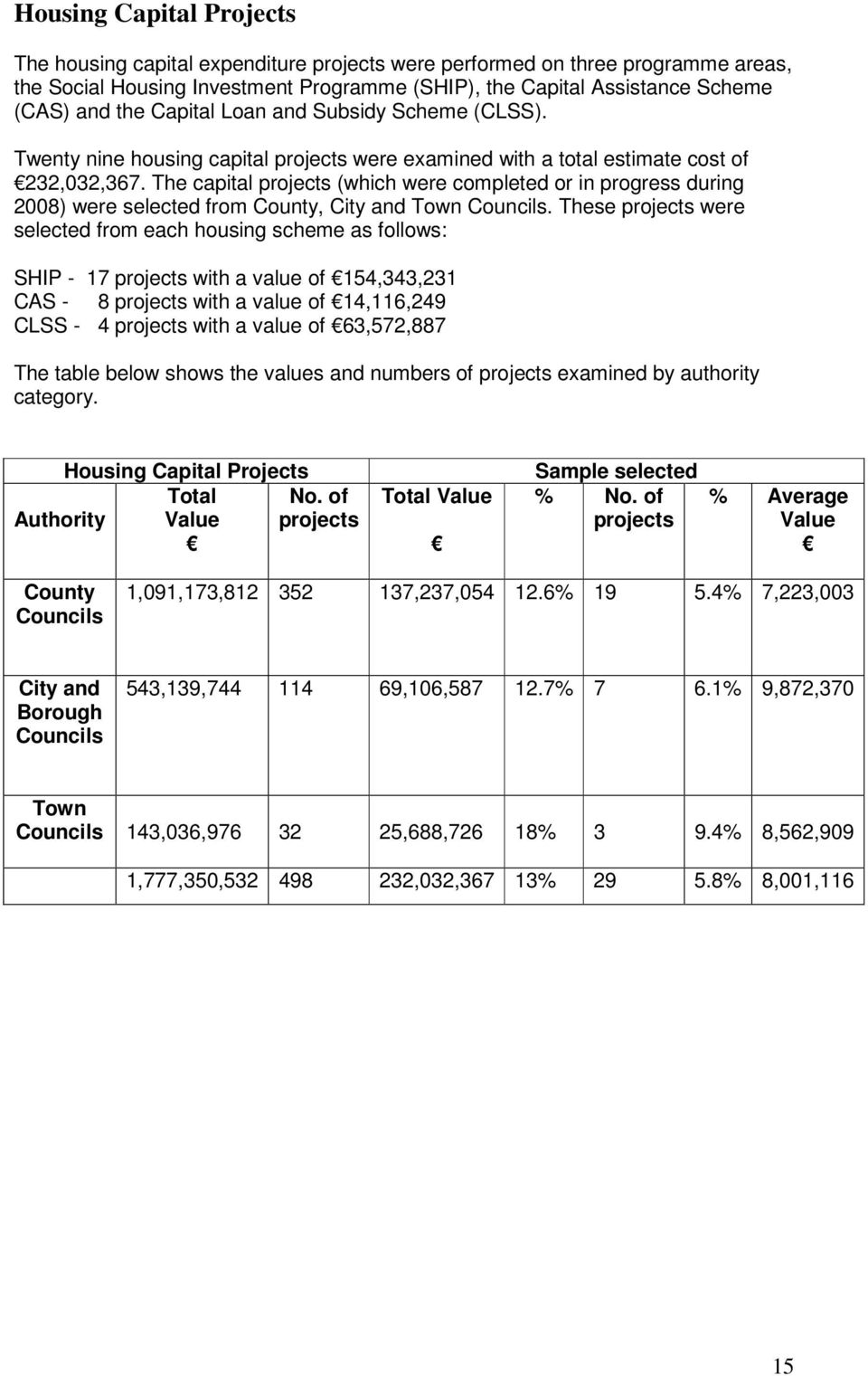
15 Housing Capital Projects The housing capital expenditure projects were performed on three programme areas, the Social Housing Investment Programme (SHIP), the Capital Assistance Scheme (CAS) and the Capital Loan and Subsidy Scheme (CLSS). Twenty nine housing capital projects were examined with a total estimate cost of 232,032,367. The capital projects (which were completed or in progress during 2008) were selected from County, City and Town Councils. These projects were selected from each housing scheme as follows: SHIP - 17 projects with a value of 154,343,231 CAS - 8 projects with a value of 14,116,249 CLSS - 4 projects with a value of 63,572,887 The table below shows the values and numbers of projects examined by authority category. Housing Capital Projects Total No. of Authority Value projects Total Value Sample selected % No. of projects % Average Value County Councils 1,091,173, ,237, % % 7,223,003 City and Borough Councils 543,139, ,106, % 7 6.1% 9,872,370 Town Councils 143,036, ,688,726 18% 3 9.4% 8,562,909 1,777,350, ,032,367 13% % 8,001,116 15
16 Social Housing Investment Programme (SHIP) This scheme provides funding for the development of social housing projects. The objective of the scheme is to provide tailored housing services to those who cannot afford to meet their own housing needs. Substantial investment is devoted to social and affordable housing measures under SHIP. The range of expenditure on SHIP programmes reviewed was; Expenditure Range Number of Projects Reviewed Total Value 0.5million to 5 million 9 21,494,892 5million to 30 million 8 132,848,339 Total ,343,231 The chart below outlines the most frequently occurring exceptions identified during the spot-checks of the SHIP programmes. Total Spot Checks Number of Projects Incomplete appraisal No project brief Projects not delivered within budget time Final Account not prepared in a timely manner Project over budget No Post Project Review Carried Out Exceptions Summary of Findings Incomplete appraisal The examination of the SHIP projects demonstrates that while all projects had some form of an appraisal performed, seven project appraisals were incomplete and did not conform to the prescribed procedures set down in the guidelines e.g. no simple assessment (which incorporates a justification for the project, an estimation of cost, a timeline for delivery or an examination at a high level VFM of the project) was carried out. It should be noted that while some of these projects pre-dated the 2005 guidelines with regard to appraisal and planning stages, the capital appraisal guidelines in place since 1994, are similar to those published in 2005 both in form and content. Therefore many of the procedures which were reinforced through the publication of the 2005 guidelines were in place since
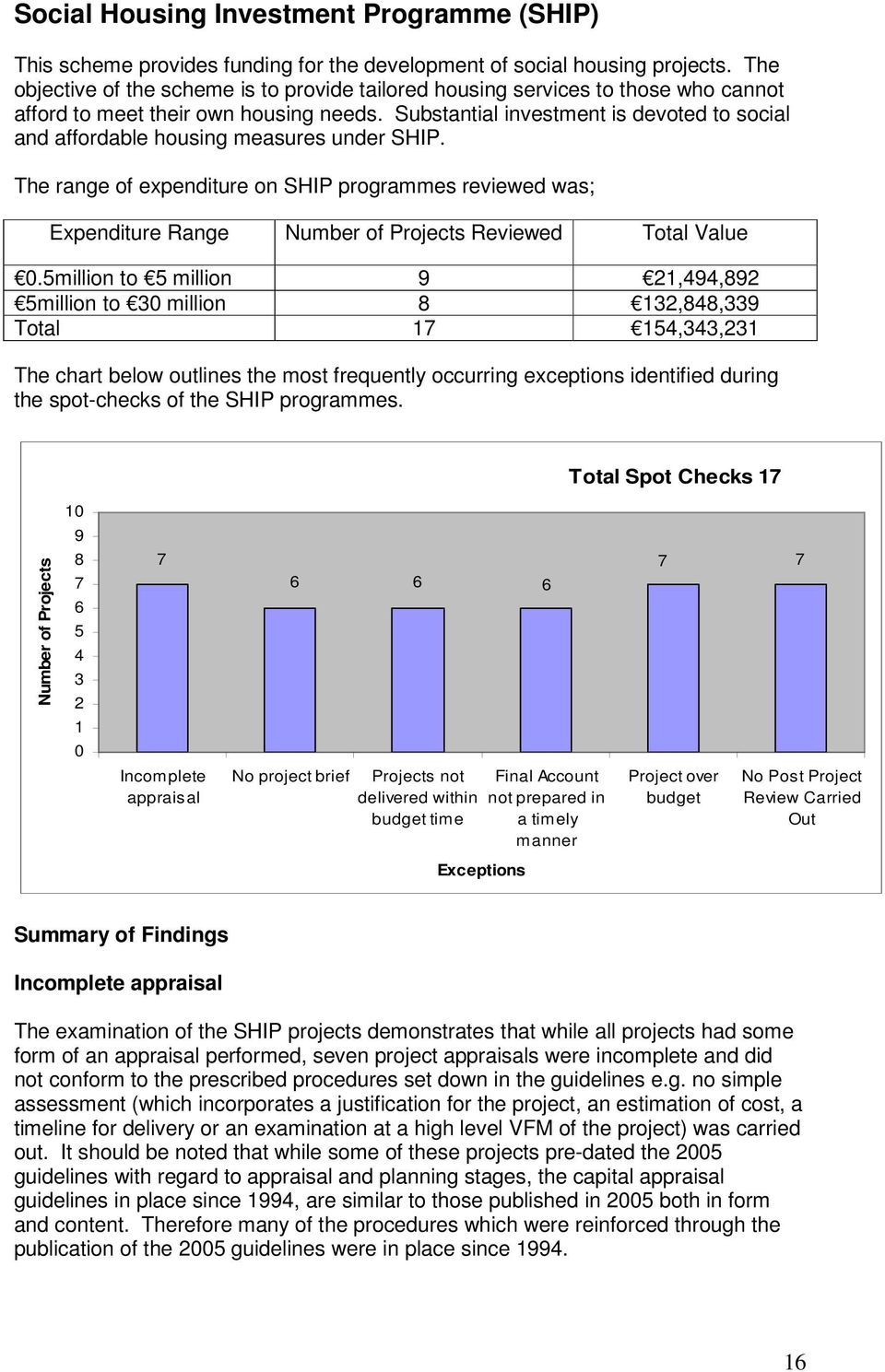
17 While the practice at the time when many of these projects were initiated was probably a more informal one or less structured than perhaps is the case now, it needs to be accepted that this less formal or less structured approach was not considered best practice even pre-2005 and contravened the applicable guidelines in place then. Local authorities are required to seek the advice of the NDFA at appraisal stage for all projects with a capital value of over 20 million. The NDFA were not consulted in relation to four of the projects examined valued at over 20 million under the SHIP. However in two of these instances the original budgets at appraisal stage was under the 20 million threshold and as a result of this the local authorities concerned did not consult the NDFA at the appraisal stage. No project brief Six of the projects reviewed did not have a complete project brief available during the spot-check. A project brief should be developed for all projects which have been approved in principle and should provide a description of the project options and the detailed objectives and parameters to be taken into account by the planning professionals. Any client requirements should also be set out in detail. The programme for the completion of the work as specified in the detailed appraisal should be outlined and any services which are to be provided by consultants, engineers, architects clearly identified. The brief should also include cost limits and targets for the project as included in the detailed appraisal. Projects not delivered within budget time Six of the projects reviewed were delayed and were not delivered within the original timescale. There should be a proper project management system in place to ensure that projects are delivered effectively and efficiently within the required timescale. Issues identified during the SHIP review included; errors made by contractors qualifications placed on the accepted tender by the contractor, thereby rendering the tender invalid and the awarding of contract to next suitable tender unforeseen circumstances e.g. ground conditions adverse weather conditions. Final Account not prepared Six of the twelve projects completed had not received a final account from the contractor at the time of the spot-check. Within two months of issuing the final payment certificate, (i.e. on completion of the usual twelve months defects period which certifies that defects have been satisfactorily addressed), a copy of the contract final account and a final budget application setting out the final all-in cost of the project should be submitted to the Department. The Department will pay up to 97.5% of the final budget once it has been submitted, so it is important that the final account is prepared in a timely manner particularly for large value projects as this can have a significant impact on cash flows for local authorities. No Post Project Review Carried Out Twelve of the projects reviewed were completed at the time of the spot-check but no post project review had been carried out for seven of these. In evaluating the project 17
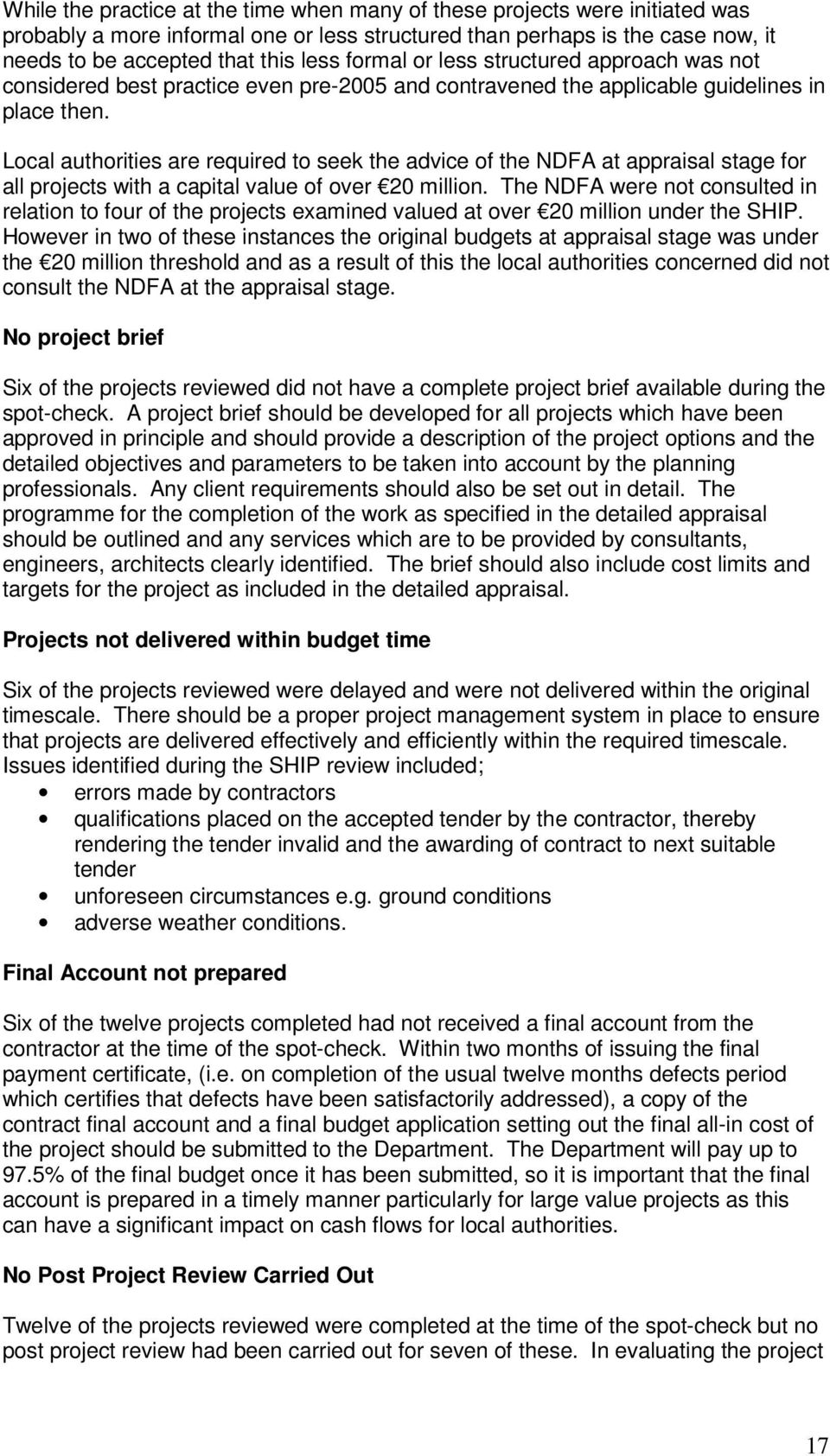
18 post-completion, it should be established whether the basis on which the project was undertaken proved to be correct. It should also establish whether the expected benefits and outcomes materialised, and whether the planned outcomes were appropriate responses to the actual public need. It should review the project appraisal and management procedures adopted to determine if they were satisfactory, and whether or not there were any conclusions drawn that may be applicable to other projects, to the ongoing use of the asset, or to associated policies. The post project review should identify whether any stage of the project could have been done better and whether lessons can be applied elsewhere. It should be noted that in a number of cases where the post project review had not been carried out, the local authorities stated that they would only carry out the review after a sufficient time period (usually 12 months) had elapsed to allow the benefits and drawbacks of the project to be properly evaluated. Circular SHIP 2010/12 issued by the Department in May 2010 recommends that a post project review should commence within six months of substantial completion of a project and should be submitted to the sanctioning authority within eight months of substantial completion. The Department will pay up to 97.5% of the final budget once the final account has been submitted, but the remaining 2.5% shall be withheld pending the submission of the Post Project Review Report so it is also important for cash flow purposes that these reviews are carried out in a timely manner. Project over budget Seven of either the completed or on-going projects reviewed, had exceeded the approved budgeted cost at the date of the spot-check. Based on the checks carried out, the cost overruns were usually attributable to changes in the scope of the work to be performed or extra costs incurred due to unforeseen circumstances e.g. unforeseen ground conditions. Procurement It was found that procurement guidelines were not correctly followed in a number of instances for smaller contracts. Some contracts were awarded without either requesting three written quotes from suppliers, advertising on etenders or advertising in a national newspaper. For contracts between 5k and 50k it is recommended that one of these procedures should be followed. There should be adequate evaluation criteria in place to evaluate all tenders and evidence of this evaluation should be maintained by authorities to demonstrate that the most suitable supplier was selected based on the evaluation criteria. 18

19 Capital Assistance Scheme (CAS) Under the Capital Assistance Scheme voluntary housing bodies provide accommodation to meet social needs such as those of the elderly, people with a disability, homeless, returning emigrants or smaller families. The approved voluntary housing bodies are responsible for tenancy allocations in consultation with the local authorities. Eight housing capital projects with a total spend of 14,116,249 were reviewed. The table below shows the values and numbers of projects examined. The range of expenditure on CAS projects reviewed was: Expenditure Range Number of Projects Total Value 0 to 0.5 million 2 577, to 5 million 6 13,538,718 5 million to 30 million million 0 0 Total 8 14,116,249 Summary of Findings Eight projects were reviewed under the Capital Assistance Scheme. All eight projects achieved their objectives and are operating successfully. There were a number of exceptions as follows: No Project Brief Six of the projects reviewed did not have a complete project brief available at the time of the spot-check. A project brief should be developed for all projects which have been approved in principle and should provide a description of the project options and the detailed objectives and parameters to be taken into account by the planning professionals. Any client requirements should also be set out in detail. The programme for the completion of the work as specified in the detailed appraisal should be outlined and any services which are to be provided by consultants, engineers, architects clearly identified. The brief should also include cost limits and targets for the project as included in the detailed appraisal. 19

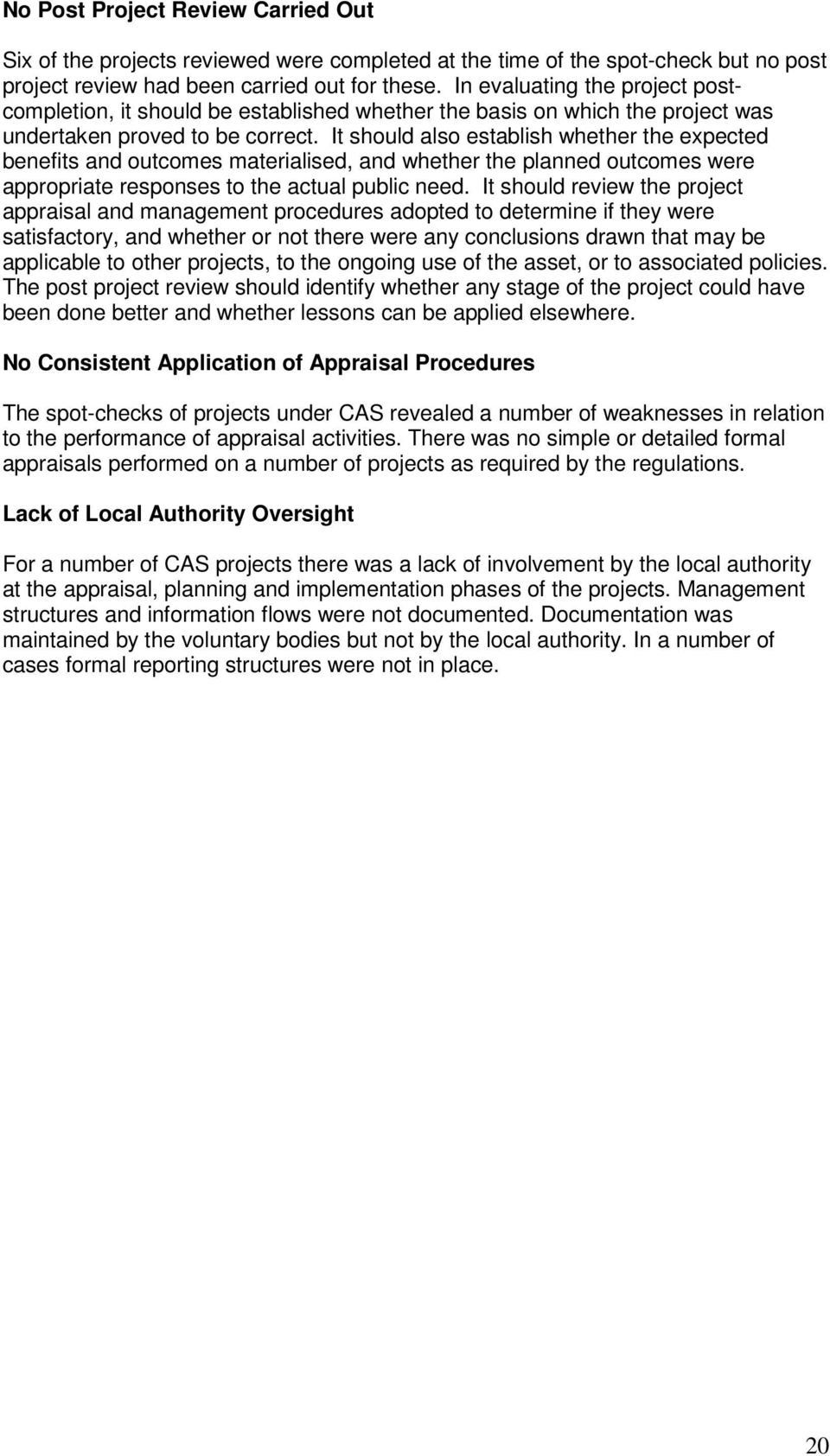
20 No Post Project Review Carried Out Six of the projects reviewed were completed at the time of the spot-check but no post project review had been carried out for these. In evaluating the project postcompletion, it should be established whether the basis on which the project was undertaken proved to be correct. It should also establish whether the expected benefits and outcomes materialised, and whether the planned outcomes were appropriate responses to the actual public need. It should review the project appraisal and management procedures adopted to determine if they were satisfactory, and whether or not there were any conclusions drawn that may be applicable to other projects, to the ongoing use of the asset, or to associated policies. The post project review should identify whether any stage of the project could have been done better and whether lessons can be applied elsewhere. No Consistent Application of Appraisal Procedures The spot-checks of projects under CAS revealed a number of weaknesses in relation to the performance of appraisal activities. There was no simple or detailed formal appraisals performed on a number of projects as required by the regulations. Lack of Local Authority Oversight For a number of CAS projects there was a lack of involvement by the local authority at the appraisal, planning and implementation phases of the projects. Management structures and information flows were not documented. Documentation was maintained by the voluntary bodies but not by the local authority. In a number of cases formal reporting structures were not in place. 20
21 Capital Loan and Subsidy Scheme (CLSS) Under the Capital Loan and Subsidy Scheme, voluntary bodies provide housing for renting, particularly to meet the needs of low-income families. Not less than three quarters of the dwelling units are let to households that have qualified for local authority housing. Rents are determined taking account of household earnings and circumstances. Tenants of the houses are centrally involved in the management of their estates. Four housing capital projects with a total spend of 63,572,887 were reviewed. The table below shows the values and numbers of projects examined. The range of expenditure on CLSS projects reviewed was: Expenditure Range Number of Projects Total Value 0 to 0.5 million to 5 million 1 2,186,101 5 million to 30 million 2 22,097, million 1 39,289,453 Total 4 63,572,887 Summary of Findings Four projects were examined under the Capital Loan and Subsidy Scheme. Two of the projects were found to be in general compliance with the requirements of the guidelines. A number of exceptions were noted in relation to two of the projects which included a lack of available documentation at local authority level, a lack of involvement by local authorities in the planning and implementation of the projects, a lack of post project review but despite these exceptions both projects were completed and were operating successfully. 21
22 Water Capital Projects The Water Services Programme is divided into two main elements: Water Services Investment Programme (WSIP) Rural Water Programme (RWP) The Water Services Investment Programme is the largest component of the Water Services Programme and relates to the provision of major water and sewerage schemes to meet the strategic objectives for investment in water services infrastructure. The Serviced Land Initiative (SLI) is a sub-programme of the WSIP, for new residential developments, projects costing less than 5m are eligible for Exchequer funding of 40%, with the balance being met by the local authorities mainly through development levies. The Rural Water Programme comprises a number of measures to address deficiencies in group water schemes, small public water and sewerage schemes, private supplies where no alternative group or public supply is available. Eleven water capital projects (which were completed or in progress during 2008) were examined with a total estimate cost of 341,507,519. The table below shows the values and numbers of projects examined. Water Capital Projects Sample Selected Total Value No. of projects Total Value % No. of projects % Average Value 1,638,245, ,507, % % 31,046,138 The range of expenditure on WSIP projects reviewed was: Expenditure Range Number of Projects Total Value 0 to 0.5 million to 5 million 4 10,367,529 5 million to 30 million 3 38,759, million 4 292,380,729 Total ,507,519 22
23 The chart below outlines the most frequently occurring exceptions identified during the spot-checks of the water capital projects. Of the eleven projects examined, eight were at the implementation stage and three at the completed stage of the projects. Water Capital Projects Total spot checks Number of Projects Incomplete Appraisal Projects not delivered w ithin time Final Account not agreed in timely manner Project over budget Audit Trail incomplete No scoring sheet for MEAT assessed tenders Types of Exceptions Summary of main findings Most of the projects examined had their origins from the late 1990 s onwards and were included in the WSIP so as to satisfy the requirement of EU regulations and increasing population. All projects were reviewed in the light of the 2005 guidelines which are now accepted as best practice for capital projects undertaken in the public sector, and are broadly in line with previous guidelines which were in place since Incomplete appraisal The Department of Finance guidelines outlines a number of prescribed appraisal activities required in accordance with the value of the capital project. The examination of water capital projects showed that while all projects had an appraisal performed, a large number of project appraisals were incomplete as some of the prescribed procedures as set down in the guidelines were not included. For example some appraisals did not indicate a timeline for the project or a high level VFM assessment. Also detailed appraisals did not always include ongoing lifecycle costs, risk and sensitivity analysis for fluctuations in prices, costs, demand etc. All projects examined included a project brief but four briefs were incomplete as they did not include a programme for completion of works or costs limits or target timescales. No cost benefit analysis (CBA) was performed in the four projects which exceeded 30m. Local authorities are required to undertake a full CBA for projects with a capital value greater than 30m. The CBA should be submitted to the Department as part of the preliminary report in the appraisal process. 23
24 Procurement Based on the spot checks performed project staff demonstrated a reasonable knowledge of compliance with national and EU procurement guidelines. However, a small number of procedural matters arose, e.g. where a tender was advertised as negotiated tender but restricted tender was used, contract award notice was not published, and tender scoring sheets were not used as a basis for evaluating tender documents. Formal Project Management structures and reporting in place Formal project management structures were in place for all the water projects examined. Formal information flows were identified and formal progress reports made in 90% of the projects examined. Project steering committees and frequent reporting to sanctioning authority was also reported for 90% of the projects reviewed. The majority of local authorities reported using the Project Control System (PCS), a small number of projects which did not adopt this management tool were commenced prior to it s introduction. The Audit Trail information needs to be updated for some projects. Projects not delivered within budget For the 11 projects examined only three were completed at the time of the audit spotcheck, and only one of these was within the original approved budget. Overall, five projects (out of the 11 examined) were over the original approved tender budget. However, some ongoing large projects consisted of multiple contracts, some of which were under budget and some appear to be running over budget, the final outcome of which will not be known until the projects are completed. Costs overruns were usually attributable to unavoidable post tender costs increases. All cost overruns incurred required the approval of the Department. Delays in agreeing final accounts and/or grant claims A number of projects showed delays in agreeing final accounts, and/or making grant claims to the Department. Local authorities should ensure that final accounts are submitted within 6 months of the completion of a contract. The authority should then submit their reports to the Department as soon as possible in order to claim any amounts outstanding on the scheme. Post project evaluation No post project evaluation had been performed for the three completed projects. Also a number of other projects consisted of a number of discrete contracts which were at completion at the time of the spot-check, but had no evaluation had been carried out. 24
25 Waste Capital Projects For Waste Capital projects two areas were examined Waste Infrastructure Capital Grants and Landfill Remediation. Five waste capital projects with a total spend of 46,018,250 were examined. The table below shows the values and numbers of projects examined. Waste Capital Projects Sample Selected Total Value No. of projects Total Value % No. of projects % Average Value 154,751, ,018, % 5 6.7% 9,203,650 The range of expenditure on Waste Capital projects reviewed was: Expenditure Range Number of Projects Total Value 0 to 0.5 million 1 234, to 5 million 1 2,568,560 5 million to 30 million 3 43,215, million 0 0 Total 5 46,018,250 The chart below outlines the most frequently occurring exceptions identified during the spot-checks of the waste capital projects. Of the five projects examined, three were completed and two were at the implementation stage of the projects. 25
26 Waste Capital Projects Total spot checks 5 Number of exceptions Incomplete Appraisal 2 2 No No Project Preliminary Brief Report 1 1 No Project Steering Brief Projects not delivered within budget time 2 2 Project over budget 3 No Final evidence of Account formal not agreed Dept. in a timely approval manner Type of exceptions Summary of Findings Three of the five projects had commenced before the 2005 guidelines, however, they were reviewed in the light of the 2005 guidelines which are now accepted as best practice for capital projects undertaken in the public sector, and are broadly in line with previous guidelines which were in place since Incomplete or no appraisal No simple appraisals were performed for three projects, however, the work undertaken for these projects was either in support of the waste licences issued by the Environmental Protection Agency (EPA) and/or grant application forms which were completed in place of a formal appraisal document. In the case of some waste capital projects, the local authorities, under the direction of the Department, were required to provide certain waste facilities in order to be compliant with various EU Directives relating to waste management and therefore there may be a lack of some formal documentation at the appraisal stage. In one case where a simple assessment had been performed it did not include an estimated timeline or examine at a high level the VFM of the project, probably as the project was again required in order to comply with an EU Directive. In another instance one incomplete appraisal did not include any risk analysis or any calculations for fluctuations in prices, costs, market growth rates etc. Incomplete or no project brief document Similarly there was an absence of project brief documents for two projects relating to the EPA licence requirements. For the other projects a brief was prepared with a small number of omissions such as a programme for completion of works. Where the projects were required to be undertaken for compliance with EPA licences a Specified Engineering Works (SEW) document was prepared to indicate how the requirements of the EPA waste licence were to be achieved, this was submitted to the EPA and not the Department for approval. Departmental Approval for projects As referred to above, the two projects (where work was performed in order to comply with EPA licences) were not formally submitted to the Department for project appraisal or sanction to proceed to the planning stage. In one case there was no 26
27 formal approval received from the Department to move to obtain tenders, in the second project the work was performed in-house. In one project the approval letter from the Department was received after the construction phase of the project was completed. This project was under a very tight deadline in order to comply with an EU Directive (see below for another instance of late approval).the local authority must obtain the prior written approval of the Department before proceeding with the capital works. High level of compliance with procurement guidelines with one exception noted In one project examined, the local authority carried out the work in-house and therefore there was no tendering involved. In the other four projects tendering was in compliance with procurement guidelines except for the case of a separate appointment of consultants to the project. In this case the appointment of consultants (costing approx. 35,000) to the project was by invitation. It is a requirement to seek quotations from a number of consultants to ensure compliance with procurement guidelines and clearly show that value for money has been achieved through the appointment process. Projects costs and delays in submitting final accounts and grant claims In a project examined the post-tender design changes resulted in significant cost savings which do not appear to have been signalled to the Department prior to commencement of the construction as the approval was for the original budgeted cost and was given after the construction had been completed. In this project the finalising of all grant claims and payments was not made until almost 3 years after completion of the construction. A second project was originally given grant approval in 2004 for 6.5m, in January 2006 grant approval of 10m and finally in August 2007 the Department grant approval for funding of 21.8m. The most recent invoice paid was June 2008 and subsequent invoices have not been paid for contractual reasons. A third project reviewed showed that the estimated costs submitted to the Department in 2007 had increased 74% on the estimated costs previously submitted in Confirmation of budget approval was received in November 2007 when the project was substantially completed. There were three contracts relating to this project and grant approval was on the basis that all expenditure to be completed by 31 December One contract is still ongoing and as a result no grant is due on expenditure incurred past the deadline. A final account has only been completed for one of the finished contracts. One contract incurred additional works amounting to 46% of the original contract, this expenditure was incurred prior to obtaining Department approval. Final Accounts should be submitted to the Department as soon as possible after the project is completed. Under Department procedures for waste infrastructure, a final payment of 10% is withheld pending receipt of final accounts and an examination of same by the inspectorate, including final physical inspection of the project. Audit Trail and Tax Clearance Requirements There was a high level of compliance with the audit trail and tax clearance requirements. Only one instance was noted where the tax clearance certificate for one contractor for 2006/07 could not be located. 27
28 Post Project Reviews At the time of review three projects were completed and two were substantially complete with one project at implementation stage. A post-project review had been carried out in one project. A post project review is required to confirm that the project objectives have been met, the project delivered to the required standard, on time and within budget and to ensure that the experience gained can be used on other projects. 28
29 Fire Services Capital Projects Under the Fire Services Capital Programme three Fire Services Capital Projects (which were completed or in planning/progress during 2008) were examined with a total estimate cost of 3,131,000. The table below shows the values and numbers of projects examined. Fire Capital Projects Sample Selected Total Value No. of projects Total Value % No. of projects % Average Value 77,124, ,131, % 3 5.3% 1,043,667 The range of expenditure on Fire Services Capital projects reviewed was: Expenditure Range Number of Projects Total Value 0.5 to 5 million 3 3,131,000 The chart below outlines the most frequently occurring exceptions identified during the spot-checks of the fire services capital projects. Of the three projects examined, one was at the planning stage, one at the implementation stage and one at the completed stage of the projects. It is therefore not yet possible to determine if two of the projects were completed within time and budget cost. Fire Services Capital Projects Total spot checks 3 4 Number of projects Incomplete Appraisal Incomplete Project Brief Types of exceptions No Post Project Review 29
30 Summary of findings Incomplete appraisal An appraisal was performed for all the projects reviewed. However, in some instances the appraisal did not meet all the criteria as outlined in the Department of Finance guidelines. Incomplete appraisals did not include detailed information on budgeted costs (such as ongoing capital or life cycle costs, cost risk contingencies with price variations etc.) and timelines to complete the projects. Timescales were not set for projects as it was stated that they were dependent on Department approval and funding. The original appraisal for one project was in February 1995, and is now at implementation stage in The appraisals did not ensure that an evaluation would take place after project completions. Planning Information Flows were not documented for one project, however, the project manager had responsibility to organise and coordinate project details with the various members of the design team. Monthly and fortnightly site meetings were held and minuted during construction stage. Incomplete project brief In one case the project brief did not include the programme for the completion of the work as specified in the detailed appraisal. No post project review No post project review was performed for the one completed project examined, however the fire station is fully operational. Audit Trail No audit trail description was provided for one project although all payments were made through the local authority Agresso system and all documentation maintained by the Administrative Officer in the Environment Section of the local authority. 30
31 Local Services Capital Projects Local Services capital expenditure project spot-checks were performed in relation to the construction and refurbishment of a range of civic infrastructure including libraries, community and sports facilities. Seven Local Services capital projects (which were completed or in progress during 2008) were examined with a total estimate cost of 35,185,553. The table below shows the values and numbers of projects examined. Local Services Capital Projects Sample Selected Total Value No. of projects Total Value % No. of projects % Average Value 108,161, ,185, % 7 4.9% 5,026,508 The range of expenditure on Local Services capital projects reviewed was: Expenditure Range Number of Projects Total Value 0 to 0.5 million 3 240, to 5 million 1 1,026,389 5 million to 30 million 3 33,919,164 Total 7 35,185,553 The chart below outlines the most frequently occurring exceptions identified during the spot-checks of the local services capital projects. Of the seven projects examined, one was at the implementation stage and six at the completed stage of the projects. 31
32 Local Services Total spot checks 7 Number of projects Incomplete Appraisal 4 Projects not delivered within time 3 Project over budget 4 No Post Project Review Types of Exceptions Summary of Findings Incomplete or no appraisal Three of the projects examined related to capital grants given by the Department under the Social and Community Facilities Capital Scheme and Playground Scheme. For these projects the grant application form was completed in place of a formal appraisal document. The application forms included details on budget costs and timelines for completion of projects, but did not include a number of other information requirements as outlined in Department of Finance guidelines such as a high level VFM considerations. One of the grant projects is fully completed. The second project is completed but the planned related community centre is not completed. The third project is not completed, as the club have not yet raised the remaining finance to finish the overall project. Where an appraisal was performed for the other projects reviewed, in a number of cases the appraisal did not meet all the criteria as outlined in the Department of Finance guidelines. Incomplete appraisals did not include detailed information on budgeted costs (such as ongoing capital or life cycle costs, cost risk contingencies with price variations etc.) and timelines to complete the projects. A local authority is required to consult with the NDFA for capital projects which are expected to exceed 20m. In one project, the advice of the NDFA was not sought at the appraisal stage, although this project exceeded the 20m value. Construction began on this project in 2007, however, six revised cost reports were prepared (between 2002 and 2006) for changed specifications which put the project over the 20m threshold. Procurement In a number of cases it was found that the procurement guidelines were not fully complied with. In four projects the tender was evaluated on the most economical advantageous criteria (MEAT). However, in one of these cases the recording and setting of weighted criteria and score sheets was not done, and there was no documentary evidence on file that a contract award notice was published. In a number of cases the unsuccessful bidders were not notified. 32
33 In two projects external quantity surveyors and architects ran the tender competition and evaluation process reporting on the recommended tender. Evidence of this evaluation process should be maintained by the local authority to demonstrate that the most suitable supplier was selected. Non-adherence to budget costs In one case the total expenditure on the project was 8.6m resulting in a cost overrun of 2.2m, which were attributed to revisions made to the original design specification requested by the local authority post agreement of the contract. These revisions were requested to comply with best practice in relation to accessibility standards. The building and library services subsequently won a number of international and national awards for design, practice, management and use of services by library customers and staff. A second library project had a cost variation of 8.7% or 1.8m over the contract sum on the project final account. This was mainly due to scope of work changes and design development. There was also a main contractor extension of time claim of 395,000. In the case of the third project, the original estimate was for upgrading of existing playground equipment, however after awarding the contract it was decided that all of the existing equipment should be replaced and additional safety surfacing provided. Two further library projects were completed within budget and on-time. In fact one of these projects had budget savings of 1.87m approximately. For the final two projects reviewed it is difficult to say if they adhered to the budgeted costs. In one case the final account has not yet been received. In the second case the project is not yet completed as the club are trying to finish the project by fundraising. Lack of Tax Clearance Certificates on file In one project there was no evidence of tax clearance certificate or C2 certificate produced by recipients maintained on the project file. Lack of post project review Although six of the projects were completed, a post project review was only completed in two of the projects. Others stated that they intended to carryout a review in approximately 12 months time. 33
34 Traveller Accommodation Capital Projects The relevant housing authorities in consultation with Travellers and the public must prepare and adopt accommodation programmes to meet the existing and projected accommodation needs of Travellers in their areas. The objectives concerning Travellers accommodation should be included in their county and city development plans. Five Traveller capital projects (which were completed or in progress during 2008) were examined with a total estimate cost of 8,952,910. The table below shows the values and numbers of projects examined. Traveller Capital Projects Sample Selected Total Value No. of projects Total Value % No. of projects % Average Value 76,627, ,952, % 5 7% 1,790,582 The range of expenditure on Traveller projects reviewed was: Expenditure Range Number of Projects Total Value 0 to 0.5 million 3 878, to 5 million 1 1,166,172 5 million to 30 million 1 6,908,272 Total 5 8,952,910 The chart below outlines the most frequently occurring exceptions identified during the spot-checks of the traveller accommodation capital projects. There were five projects selected for examination and all were completed. One of the projects was the provision of two houses for traveller accommodation provided for under a Part V agreement with a developer. Therefore the appraisal, planning, implementation and evaluation requirements are not applicable to this case. 34
35 Traveller accommodation Total spot checks 5 6 Number of projects Incomplete Appraisal Projects not delivered within time Final Account not agreed in timely manner Project over budget No Post Project Review Unsuccessful bidders not notified Types of Exceptions Summary of Findings Incomplete appraisal An incomplete appraisal was performed in the four of the projects examined. However, while the appraisal performed may not have been consistent with the Department of Finance guidelines a type of appraisal was carried out. Incomplete appraisals did not include details of brief estimates of costs and resources for the projects, estimates of high-level value for money for projects, estimates of future price increases, operational costs and variations in project outputs. Two cases had no simple assessment prepared, as required under the guidelines. Projects not delivered within budget and delays in submitting final accounts. Two of the projects examined were over budget by 0.3% and 3%. However, in the latter case this may not be the final figure as the final account was not yet submitted although the properties in question were occupied since November It was impossible to determine if a third project was within budget as the final account had not yet been submitted although this project was substantially completed by September There was no formal budget prepared for the fourth project examined relating to the purchase of a pre-constructed unit for a young traveller with special needs. The projected costs were based on quotes received and submitted to the Department for approval, however there was no evidence of these quotes on file in the local authority at the time of the spot check. Project with protracted time period and cost issues In one case the local authority was obliged to provide traveller accommodation due to a High Court case taken against them in Temporary accommodation was provided in Department approval was granted in 2006 and contracts eventually awarded in 2007 following two tender competitions, as the two previous lowest tenderers had withdrawn. The final awarded contract (in 2007) exceeded the approved estimate by 42% and the project was not re-examined at this stage. Department approval was not sought for this increased tender price until May The excess costs were due mainly to having to develop an alternative temporary 35
36 serviced site. Construction work began in April 2008 and the property was occupied in November At time of review the final account had not yet been prepared. A second project examined took nine years from its first inception to the issue of the final account. No timescale was specified for this project. A third project which appears to have been well managed and monitored and was completed within 32 weeks but contract deadline was 26 weeks. Procurement It was found that procurement guidelines were not always completely followed. As outlined below there were some instances of tenders only advertised locally, which should have been advertised nationally. It was also found that a number of contractors were selected from a panel formed by the local authority (which had previously been advertised) on the basis of their geographical location. For smaller contracts between 5k and 50k evidence of obtaining three quotes should be maintained on file. In all cases reviewed the tenders were awarded on the basis of lowest cost. However, evidence of a detailed review of the tenders received should be maintained to show that the most suitable supplier was selected. Unsuccessful bidders were not always formally notified by the authority. Post project review A post project review only took place in two out of the five projects examined. Under the 2005 capital appraisal guidelines post project review should be carried out to review the project appraisal and management procedures so that lessons and experience gained can be carried forward to future projects. Weakness in financial record keeping Some instances of poor financial record keeping were noted where better control needs to be maintained over the posting of all costs to the capital projects in the local authority financial systems. 36
37 Appendix A Sample Selection As part of the initial stage of the selection process each section within the Department submitted details of all capital projects at planning, design, implementation and completed stages during 2008 to the Value for Money Unit Co- Ordinator. Sample Selection Criteria The key criteria in selection of the sample were: Type of programme Geographical location of County, City and Town Councils Level of approved expenditure Stage of the project Value of the project Projects were selected on a random interval sample basis in order to achieve a minimum coverage of 5% of approved capital expenditure and in addition there was a focus on high value projects. Projects that had previously been selected for capital spot checks were excluded. Basis of selection of Sample Capital Programme Sample selection process Water All projects >70m Plus random interval Waste All projects >8m Plus random interval Traveller Accommodation All projects >6m Plus random interval Fire All projects >6m Plus random interval Local Services All projects >6m Plus random interval Housing (County Councils) All projects >23m Plus random interval Housing (City and Borough) All projects >20m Plus random interval Housing (Town Councils) All projects >14m Plus random interval 37
38 Programme Capital Projects Total No. of Value projects Average Value Total Value Sample Selected % No. of % Average projects Value Water 1,638,245, ,410, ,507, % % 31,046,139 Waste 154,751, ,063,354 46,018, % 5 6.7% 9,203,650 Traveller 76,627, ,079,262 8,952, % 5 7% 1,790,582 Fire 77,124, ,353,063 3,131, % 3 5.3% 1,043,667 Local Services Housing (County Councils) 108,161, ,700 35,185, % 7 4.9% 5,026,508 1,091,173, ,099, ,237, % % 7,223,003 Housing (City and Borough Councils) 543,139, ,764,384 69,106, % 7 6.1% 9,872,370 Housing (Town Councils) 143,036, ,469,906 25,688,726 18% 3 9.4% 8,562,909 3,832,261, ,930, ,827, % % 11,113,793 38
PROJECT MANAGEMENT FRAMEWORK
 PROJECT MANAGEMENT FRAMEWORK DOCUMENT INFORMATION DOCUMENT TYPE: DOCUMENT STATUS: POLICY OWNER POSITION: INTERNAL COMMITTEE ENDORSEMENT: APPROVED BY: Strategic document Approved Executive Assistant to
Hertsmere Borough Council. Data Quality Strategy. December 2009 1
 Hertsmere Borough Council Data Quality Strategy December 2009 1 INTRODUCTION Public services need reliable, accurate and timely information with which to manage services, inform users and account for performance.
APPENDIX C. Internal Audit Report South Holland District Council Project Management
 APPENDIX C Internal Audit Report South Holland District Council Project Management Date: 20th December 2012 Contents Introduction and Scope 1 Executive Summary Assurance Opinion Key Messages 2 3 Management
Data Communications Company (DCC) price control guidance: process and procedures
 Guidance document Contact: Tricia Quinn, Senior Economist Publication date: 27 July 2015 Team: Smarter Metering Email: [email protected] Overview: The Data and Communications Company (DCC) is required
Gravesham Borough Council. Leader of the Executive
 Classification: Key Decision: Part 1 Public Yes Gravesham Borough Council Report to: Leader of the Executive Date: 18 January 2013 Reporting officer: Subject: Kevin Burbidge, Director (Housing and Regeneration)
AGENCY AGREEMENT. Between 3Keys Limited company registration number 06841492 6 of Town End Doncaster DN5 9AG ... ... ... ... ... Postcode..
 AGENCY AGREEMENT Between 3Keys Limited company registration number 06841492 6 of Town End Doncaster DN5 9AG and Landlord s name/s (all joint landlords):... Landlord s address: (current address and new
REPORT 2016/066 INTERNAL AUDIT DIVISION. Audit of management of technical cooperation projects in the Economic Commission for Africa
 INTERNAL AUDIT DIVISION REPORT 2016/066 Audit of management of technical cooperation projects in the Economic Commission for Africa Overall results relating to the effective management of technical cooperation
North American Development Bank. Bid Evaluation Procedures
 North American Development Bank Bid Evaluation Procedures BID EVALUATION PROCEDURES TABLE OF CONTENTS The Bidding Process Introduction Preliminary Actions and General Concerns Contract data sheet Responsible
Leasing scheme information
 Leasing scheme information Introduction Thank you for your interest in Genesis Housing Association leasing scheme. This information booklet sets out the stages, the requirements and the factors you will
Internal Audit Report. Chief Executive s Unit. Review of Contract Management
 Internal Audit Report Chief Executive s Unit Review of Contract Management February 2010 CONTENTS 1. BACKGROUND 1 Page 2. AUDIT SCOPE AND OBJECTIVES 1 3. AUDIT APPROACH 1 4. AMENDED PROCESS 2 5. SUMMARY
INCOME MANAGEMENT POLICY
 INCOME MANAGEMENT POLICY 1. Principles 2. Aims 3. Methods * Arrears Prevention * Debt Recovery * Rent Accounting 4. Statutory and Regulatory Requirements 5. Performance Monitoring 6. Review 7. Date of
Department of the Environment and Local Government. Project Management. Public Private Partnership Guidance Note 7. 14 April 2000
 Project Management Project Management Public Private Partnership Guidance Note 7 14 April 2000 Guidance Note 7 14 April 2000 Project Management Contents Section Page I INTRODUCTION...1 SCOPE AND PURPOSE
Contracts, agreements and tendering
 Contracts, agreements and tendering 1) Introduction This guidance note provides an overview of the types of contracts and other agreements you might need to use in setting up and running a local energy
Project Management Handbook 2014. "To Understand the Causes of Things"
 Management Handbook 2014 "To Understand the Causes of Things" AMENDMENT RECORD This document has been issued and amended as follows: - Isu. Rev. Reason for Issue / revision Date Issued to Team Stakeholders
Page 97. Executive Head of Asset Planning, Management and Capital Delivery
 Page 97 Agenda Item 7 Report to: Strategy and Resources Committee Date: 16 December 2013 Report of: Executive Head of Asset Planning, Management and Capital Delivery Ward Location: Not applicable Author
PROJECT PROCUREMENT PROCEDURES AND GUIDELINES
 CAPITAL ASSET MANAGEMENT PROJECT PROCUREMENT PROCEDURES AND GUIDELINES June 2003 Updated June 20, 2003 Ministry of Education Province of British Columbia TABLE OF CONTENTS EXECUTIVE SUMMARY... iii 1.0
PROJECT MANAGEMENT GUIDELINES NATIONAL TRANSPORT AUTHORITY
 PROJECT MANAGEMENT GUIDELINES FOR PROJECTS FUNDED BY THE NATIONAL TRANSPORT AUTHORITY (UP TO 20 MILLION IN VALUE) december 2011 Table of Contents Section A 1. Introduction 4 1.1 Purpose 4 1.2 Applicability
Principles and Procedures
 DPE 022/05/2013 26 September 2014 Circular: 13/2014 Management of and Accountability for Grants from Exchequer Funds To: Accounting Officers, Finance Officers and Heads of Internal Audit. A Dhuine Uasail,
SECTION 106 CLAWBACK MAJOR 1. means the actual additional pre-tax profit of the Development Proposal to be calculated in accordance with paragraph B10
 SECTION 106 CLAWBACK MAJOR 1 Definitions Additional Profit "Appraisal A" "Appraisal B" "Appraisal C" "Appraisals" "Development Costs" means the actual additional pre-tax profit of the Development Proposal
H 7. Factoring Policy. If you require this policy in a different format please ask a member of staff. Date of Approval Oct 12 Review Due Dec 15
 H 7 Factoring Policy If you require this policy in a different format please ask a member of staff Date of Approval Oct 12 Review Due Dec 15 1.0 The Association s Objective 1.1 Elderpark Housing Association
The Gateway Review Process
 The Gateway Review Process The Gateway Review Process examines programs and projects at key decision points. It aims to provide timely advice to the Senior Responsible Owner (SRO) as the person responsible
To be used in conjunction with the Invitation to Tender for Consultancy template.
 GUIDANCE NOTE Tendering for, choosing and managing a consultant Using this guidance This information is not intended to be prescriptive, but for guidance only. Appointing consultants for relatively small
Information Commissioner's Office
 Information Commissioner's Office IT Procurement Review Ian Falconer Partner T: 0161 953 6480 E: [email protected] Last updated 18 June 2012 Will Simpson Senior Manager T: 0161 953 6486 E: [email protected]
Step by Step Project Planning
 Step by Step Project Planning Contents Introduction The Planning Process 1 Create a Project Plan...1 Create a Resource Plan...1 Create a Financial Plan...1 Create a Quality Plan...2 Create a Risk Plan...2
REPORT BY THE COMPTROLLER AND AUDITOR GENERAL HC 535 SESSION 2013-14 5 JULY 2013. Department for Culture, Media & Sport. The rural broadband programme
 REPORT BY THE COMPTROLLER AND AUDITOR GENERAL HC 535 SESSION 2013-14 5 JULY 2013 Department for Culture, Media & Sport The rural broadband programme 4 Key facts The rural broadband programme Key facts
Code of Practice for Agents Undertaking Renovation Grants
 Code of Practice for Agents Undertaking Renovation Grants July 1998 Contents Introduction Page 1 Approved List of Agents Page 1 Procurement Page 2 Approval Page 5 Works in Progress Page 6 Completion Page
Project Implementation: Procurement & Contract Management. April 2012
 & Contract Management April 2012 & Contract Management We would like to acknowledge the contribution of the Programme Management Department in the preparation of this presentation that will introduce some
SUMMER WORKS SCHEME (SWS) 2014
 Circular 0059/2013 To: The Managerial Authorities of Recognised Primary, Secondary, Community and Comprehensive Schools and The Chief Executive Officers of Education and Training Boards SUMMER WORKS SCHEME
Clearing and Settlement Procedures. New Zealand Clearing Limited. Clearing and Settlement Procedures
 Clearing and Settlement Procedures New Zealand Clearing Limited Clearing and Settlement Procedures 30 November 2011 Contents Section A: Interpretation and Construction 6 Section 1: Introduction and General
EXPRESSION OF INTEREST DESIGN, DOCUMENTATION AND PROJECT MANAGEMENT UNIT COMPLEX - LOT 8955 PALMERSTON
 EXPRESSION OF INTEREST DESIGN, DOCUMENTATION AND PROJECT MANAGEMENT UNIT COMPLEX - LOT 8955 PALMERSTON 1 Context The City of Palmerston (CoP) is the owner of 5 Birripa Court (allotment 8955) Rosebery,
CABINET. 24 March 2015
 CABINET 24 March 2015 Title: Procurement of Electricity and Gas Supplies Report of the Cabinet Member for Finance Open Report with Exempt Appendix 4 Wards Affected: All Report Author: Andrew Sivess Group
Part of the Holyhead 2020 Regeneration Programme Working in Partnership with Welsh Government
 Holyhead Investment Fund Part of the Holyhead 2020 Regeneration Programme Working in Partnership with Welsh Government !!!!!!!!!!!"#$%"&'(!)*+,'-.!'-(!)*'+$&!/$'0&1!,&2&-&,'.*#-!/,#2,'33&! 45-(&(!+%!."&!6&$1"!2#)&,-3&-.7!'(3*-*1.&,&(!+%!*1$&!#4!'-2$&1&%!0#5-.%!
8 Operation of the Emergency Call Answering Service
 8 Operation of the Emergency Call Answering Service 8.1 All emergency calls made in the State are handled by the Emergency Call Answering Service (ECAS). The ECAS is operated from three centres, located
HOUSING ALLOCATIONS SCHEME 2013
 HOUSING ALLOCATIONS SCHEME 2013 Adopted by the City Council on 13 th January 2014 Housing Allocations Scheme 2013 Section 1. Introduction 1.1 Introduction 1.2 Housing Areas 1.3 Transfer Applications from
Office Contact Number 01803 611030. 13, Hyde Road, Paignton, Devon. TQ4 5BW. www.targetpropertyservices.com
 Office Contact Number 01803 611030 13, Hyde Road, Paignton, Devon. TQ4 5BW. www.targetpropertyservices.com TARGET PROPERTY RENTALS RENTALS & MANAGEMENT AGENCY AGREEMENT This agreement is made between the
Procurement Transformation Division. Procurement guidance. Engaging and managing consultants. Includes definitions for consultants and contractors
 Procurement guidance Engaging and managing consultants Includes definitions for consultants and contractors Procurement guidance: Engaging and managing consultants Page 2 of 17 Table of contents Table
UNITED STATES DEPARTMENT OF EDUCATION OFFICE OF INSPECTOR GENERAL
 UNITED STATES DEPARTMENT OF EDUCATION OFFICE OF INSPECTOR GENERAL AUDIT SERVICES August 24, 2015 Control Number ED-OIG/A04N0004 James W. Runcie Chief Operating Officer U.S. Department of Education Federal
How to do Business with the London. Borough of Sutton
 How to do Business with the London Borough of Sutton February 2013 1 About this guide This guide has been developed to assist businesses wishing to sell their goods and services to the Borough. Contents
Care & Residential Services Debt Management & Recovery Policy
 Care & Residential Services Debt Management & Recovery Policy Fair and reasonable Collecting debt quickly Version 1 April 2015 Debt Management & Recovery Policy Page 1 Trafford Council Table of Contents
HUNTINGDONSHIRE DISTRICT COUNCIL. Internal Audit Service: Annual Report. Meeting/Date: Corporate Governance Panel 15 July 2015
 Public Key Decision - No HUNTINGDONSHIRE DISTRICT COUNCIL Title: Internal Audit Service: Annual Report Meeting/Date: Corporate Governance Panel 15 July 2015 Executive Portfolio: Report by: Ward(s) affected:
Code of Practice. for Inspecting and Certifying Buildings and Works. Building Control Regulations 2014
 for Inspecting and Certifying Buildings and Works Building Control Regulations 2014 February, 2014 Table of Contents 1. Introduction 1 1.1 Status and Purpose of Code 1 1.2 Overview of Code 1 1.3 Application
Westminster City Council Tenancy Policy (for the City Council s own housing stock) June 2014
 Westminster City Council Tenancy Policy (for the City Council s own housing stock) June 2014 1 Westminster City Council Tenancy Policy Contents 1. Introduction 3 2. Regulatory requirements 3 3. The types
Department of Finance. Guidelines for the Appraisal and Management of Capital Expenditure Proposals in the Public Sector
 Department of Finance Guidelines for the Appraisal and Management of Capital Expenditure Proposals in the Public Sector January 2005 Table of Contents Page Preface Role of Government and Ministers 4 Introduction
DRAFT V5. PFSC 16/05/2014 Appendix 1. Outline Plan to deliver the County Council s investment property Strategy
 PFSC 16/05/2014 Appendix 1 Outline Plan to deliver the County Council s investment property Strategy 1. Strategic Drivers 1.1 The County Council s property investment strategy sets out how its property
REQUEST FOR PROPOSALS For. Kelowna and Vernon Hospitals Project
 REQUEST FOR PROPOSALS For The Kelowna and Vernon Hospitals Project VOLUME 2 of 4 Instructions to Proponents Closing Time: Delivery Address: 3:00 pm (local time) Thursday, March 6,2008 Kelowna and Vernon
Commissioning Strategy
 Commissioning Strategy This Commissioning Strategy sets out the mechanics of how Orkney Alcohol and Drugs Partnership (ADP) will implement its strategic aims as outlined in the ADP Strategy. Ensuring that
Tendering Policies and Procedures
 Tendering Policies and Procedures Tendering Policies and Procedures Content Pg. Mission Statement..3 Introduction....4 Background to the EPS (formerly Shannon Consortium Procurement Network) 4 The Key
Classification: UNCLASSIFIED. C ity S ervices. Classification: UNCLASSIFIED Delivering the Housing and Neighbourhoods Tenancy Policy
 C ity S ervices H ousing and N eighbourhood Tenancy P olicy Y ear 2012/13 2017/18 Classification: UNCLASSIFIED Delivering the Contents 1 Purpose 1 Page 2 Background 1-3 3 The type and length of tenancy
Oxford City Council Managing Capital Projects
 www.pwc.co.uk Internal Audit Report 2014/2015 August 2015 Oxford City Council Managing Capital Projects Table of Contents 1. Executive Summary... 3 2. Background and scope... 5 3. Detailed findings...
North American Development Bank. Prequalification of Contractors
 North American Development Bank Prequalification of Contractors PREQUALIFICATION NOTE This note is prepared for the exclusive use of the borrower (the purchaser in this document) and should not be included
Cost Management Guidelines for. 1 September 2010
 Cost Management Guidelines for Public Transport Investment Projects 1 September 2010 Table of Contents Foreword iv 1. Introduction 1 1.1 Purpose Of The Guidelines 1 1.2 Applicability 1 1.2.1 Conventionally
GUIDANCE NOTE 1.5.2 Cost Control: Price Variation Clauses
 GUIDANCE NOTE 1.5.2 Cost Control: Price Variation Clauses Office of Government Procurement Cost Control: Price Variation Clauses Document Reference GN 1.5.2 v1.0 22 January 2016 2016 Department of Public
SUPPLEMENTARY GREEN BOOK GUIDANCE
 SUPPLEMENTARY GREEN BOOK GUIDANCE ADJUSTING FOR TAXATION IN PFI vs PSC COMPARISONS 1 INTRODUCTION 1.1 This guidance looks at the differential tax receipts that arise from the use of the Private Finance
Guidance on Framework Agreements
 1. Introduction Guidance on Framework Agreements The purpose of this document is to provide guidance to public purchasers on the operation of framework agreements as provided for under current public procurement
Project Management Procedures
 1201 Main Street, Suite 1600 Columbia, South Carolina 29201 Project Management Procedures Start Up The grant becomes effective upon return of one copy of the grant award executed by the Chief Executive
Appenidx 1a. DIRECTORATE OF AUDIT, RISK AND ASSURANCE Internal Audit Service to the GLA REVIEW OF HOUSING COMPLIANCE AUDIT PROGRAMME
 Appenidx 1a DIRECTORATE OF AUDIT, RISK AND ASSURANCE Internal Audit Service to the GLA REVIEW OF HOUSING COMPLIANCE AUDIT PROGRAMME DISTRIBUTION LIST Audit Team David Esling, Head of Audit and Assurance
SCHEDULES OF CHAPTER 40B MAXIMUM ALLOWABLE PROFIT FROM SALES AND TOTAL CHAPTER 40B COSTS EXAMINATION PROGRAM
 7/30/07 SCHEDULES OF CHAPTER 40B MAXIMUM ALLOWABLE PROFIT FROM SALES AND TOTAL CHAPTER 40B COSTS Instructions: EXAMINATION PROGRAM This Model Program lists the major procedures and steps that should be
Final Report Bid Evaluation and Selection Process For Wind-Generated Electricity Hydro-Quebec Distribution Call For Tenders Process.
 Final Report Bid Evaluation and Selection Process For Wind-Generated Electricity Hydro-Quebec Distribution Call For Tenders Process March, 2005 Prepared by Merrimack Energy Group, Inc. Merrimack M Energy
Annex 2: Rules and Procedures for the Swiss-Polish Cooperation Programme
 Annex 2: Rules and Procedures for the Swiss-Polish Cooperation Programme Annex 2 is an integral part of the Framework Agreement between the Swiss Federal Council and the Government of the Republic of Poland
Local Government in Scotland Act 2003
 Local Government in Scotland Act 2003 (asp 1) i Local Government in Scotland Act 2003 2003 asp 1 CONTENTS Section PART 1 BEST VALUE AND ACCOUNTABILITY Duty to secure best value 1 Local authorities duty
Robertson Property Management Sole Agency Agreement
 Robertson Property Management Sole Agency Agreement You should read this document thoroughly. If you have difficulty in understanding any of the terms or conditions laid out in this document, it is recommended
SCRUTINY COMMITTEE ITEM 04 28 MARCH 2012
 SCRUTINY COMMITTEE ITEM 04 28 MARCH 2012 INTERNAL AUDIT PLAN Report of the: Director of Finance Contact: John Turnbull or Gillian McTaggart Urgent Decision?(yes/no) No If yes, reason urgent decision required:
Project Management. Advice on the provision of Local Decontamination Units (LDUs) Decontamination Services
 Advice on the provision of Local Decontamination Units (LDUs) Decontamination Services January 2010 Contents Project Management Page Local Decontamination Units (LDUs) Construction Project Management...3
Contents. 1. Doing Business with Gwynedd Council. 1. 2. Council Structure and Contacts 2
 Contents Page 1. Doing Business with Gwynedd Council. 1 2. Council Structure and Contacts 2 3. How to find out about the opportunities offered by Gwynedd Council 3 4. Types of Procurement 3 5. Tendering
Badger BC. Investments Ltd. Business Plan 2014 2017. A wholly owned subsidiary of Broxbourne Borough Council
 Badger BC Investments Ltd Business Plan 2014 2017 A wholly owned subsidiary of Broxbourne Borough Council Contents Summary 3 Governance and management structure 4 Rights, obligations and decision making
FINAL NOTICE. (1) imposes on Bank of Beirut (UK) Ltd ( Bank of Beirut ) a financial penalty of 2,100,000; and
 FINAL NOTICE To: Bank of Beirut (UK) Ltd Firm Reference Number: 219523 Address: 17a Curzon Street London UNITED KINGDOM W1J 5HS 4 March 2015 1. ACTION 1.1. For the reasons given in this notice, the Authority
SILVER CREEK ST. AUGUSTINE LLLP FINANCIAL STATEMENTS AND INDEPENDENT AUDITORS' REPORT. December 31, 2015 and 2014
 FINANCIAL STATEMENTS AND INDEPENDENT AUDITORS' REPORT TABLE OF CONTENTS INDEPENDENT AUDITORS' REPORT 1 FINANCIAL STATEMENTS: BALANCE SHEET STATEMENT OF OPERATIONS STATEMENT OF PARTNERS' CAPITAL STATEMENT
Construction Bond Audit Report. Office of Auditor General
 Construction Bond Audit Report (This page was left blank) TABLE OF CONTENTS Executive Summary 5 Background, Scope and Objectives, and Methodology....7 Audit Findings, Recommendations, and Management s
Regulation on the implementation of the European Economic Area (EEA) Financial Mechanism 2009-2014
 the European Economic Area (EEA) Financial Mechanism 2009-2014 adopted by the EEA Financial Mechanism Committee pursuant to Article 8.8 of Protocol 38b to the EEA Agreement on 13 January 2011 and confirmed
LOCAL GOVERNMENT AUDIT SERVICE. Statutory Audit Report. to the. Members of Limerick City Council. for the
 LOCAL GOVERNMENT AUDIT SERVICE Statutory Audit Report to the Members of Limerick City Council for the Year Ended 31 December 2013 CONTENTS Paragraph Introduction 1 Financial Standing 2 Summary of Major
Quality Manual. This manual is proprietary and no part thereof shall be copied without written authorisation from the company. Ref: Quality Manual.
 This manual is proprietary and no part thereof shall be copied without written authorisation from the company Ref: Quality Manual.ind Issue: June 2009 INDEX 1 Amendment Status 2 Controlled Distribution
London Borough of Havering. Draft Planning Guidance Note on Affordable Housing. Commuted Sum Payments
 London Borough of Havering Draft Planning Guidance Note on Affordable Housing Commuted Sum Payments May 2016 Affordable housing circumstances where Havering Council will use commuted sum payments to the
HK Electric Smart Power Fund. Application Guideline
 HK Electric Smart Power Fund Application Guideline Corporate Development Division 4/F Hongkong Electric Centre, 44 Kennedy Road, Hong Kong Hotline : 2887 3455 Fax : 2810 0506 Email : [email protected]
Guideline for Professional Services Contractor Performance Reporting
 ` Guideline for Professional Services Contractor Performance Procedure Applicable to: Transport Projects Quality Management System Status: Approved Division: Transport Projects Version: 10 Date of issue:
Local Government Audit Service
 Local Government Audit Service Overview of the work of the Local Government Auditors 2016 May 2016 Department of the Environment, Community and Local Government 2016 The website of the Department of the
Explaining an architect s services. General information on the usual tasks undertaken by an architect
 Explaining an architect s services General information on the usual tasks undertaken by an architect June 2008 What an architect may do for you Introduction The root cause of disputes and complaints against
Tender Evaluation and Contract Award
 Brief 9 January 2011 Public Procurement Tender Evaluation and Contract Award C O N T E N T S Key principles governing the process of evaluation of tenders How does an evaluation panel operate? How does
Australian National Audit Office. Report on Results of a Performance Audit of Contract Management Arrangements within the ANAO
 Australian National Audit Office Report on Results of a Performance Audit of Contract Management Arrangements within the ANAO Commonwealth of Australia 2002 ISBN 0 642 80678 0 10 December 2002 Dear Mr
STATUTORY AUDIT REPORT. to the LORD MAYOR AND MEMBERS THE ACCOUNTS OF DUBLIN CITY COUNCIL FOR YEAR ENDED 31 DECEMBER 2007
 STATUTORY AUDIT REPORT to the LORD MAYOR AND MEMBERS on THE ACCOUNTS OF DUBLIN CITY COUNCIL FOR YEAR ENDED 31 DECEMBER 2007 1. Introduction DUBLIN CITY COUNCIL Dublin City Council Audit Report 2007 Page
Perth & Kinross Council. Risk Assessment, Annual Audit Plan and Fee Proposal for 2007/08. External Audit Report No: 2008/01
 Perth & Kinross Council Risk Assessment, Annual Audit Plan and Fee Proposal for 2007/08 External Audit Report No: 2008/01 Draft Issued: 11 February 2008 Final Issued: 29 February 2008 Contents Page Page
Heritage Grants - Receiving a grant
 Heritage Grants - Receiving a grant Mentoring and monitoring; Permission to Start; and December 2013 If you require a copy of this guidance in an alternative format (large print, Braille or audio version),
Examiner s report F8 Audit & Assurance December 2014
 Examiner s report F8 Audit & Assurance December 2014 General Comments The examination consisted of twelve objective test questions in Section A, worth 20 marks and six questions in Section B worth 80 marks.
TRANSPORT FOR LONDON (TfL) LOW EMISSIONS CERTIFICATE (LEC) GUIDANCE NOTES FOR THE COMPANY AUDIT PROCESS. LEC (Company Audit) Guidance Notes
 TRANSPORT FOR LONDON (TfL) LOW EMISSIONS CERTIFICATE (LEC) GUIDANCE NOTES FOR THE COMPANY AUDIT PROCESS LEC (Company Audit) Guidance Notes Glossary of Terms Transport for London (TfL) London Low Emission
DIRECTORATE OF ESTATES & FACILITIES
 DIRECTORATE OF ESTATES & FACILITIES PROCEDURE AND INFORMATION MANUAL EPM PM4 Client Representative (University Project Manager) for Capital Projects Scope of Services Document Originated: April 2006 By:
Data Quality Report. February 2008. Data Quality Report. Croydon London Borough Council. Audit 2007/08
 Data Quality Report February 2008 Data Quality Report Audit 2007/08 External audit is an essential element in the process of accountability for public money and makes an important contribution to the stewardship
Preparation of a Rail Safety Management System Guideline
 Preparation of a Rail Safety Management System Guideline Page 1 of 99 Version History Version No. Approved by Date approved Review date 1 By 20 January 2014 Guideline for Preparation of a Safety Management