
Optimal Health Insurance for Multiple Goods and Time Periods
|
|
|
- Barbra Hutchinson
- 10 years ago
- Views:
Transcription
1 Preliminary draft for review only 0R.P. Ellis, S. Jiang, and W.G.Manning MultipleGood_ dox June 30, 0 Optimal Health Insurane for Multiple Goods and Time Periods Randall P. Ellis a,, Shenyi Jiang b, Willard G. Manning a Department of Eonomis, Boston University, <[email protected]> b Hanqing dvaned Institute of Eonomis and Finane, Shool of Finane, Renmin University of China, Beijing, P.R. China, <[email protected]> Harris Shool of Publi Poliy Studies, The University of Chiago, <[email protected]> knowledgements: We have benefited from omments during presentations at Boston University, Harvard and Renmin University, The University of Chiago, the E annual meeting, and the merian Soiety of Health Eonomists onferene (Duke. We also thank David Bradford, Kate Bundorf, lbert Ma, Tom MGuire, David Meltzer, Joe Newhouse, Kosali Simon, and Frank Sloan for their useful omments. The opinions expressed are those of the authors, and not neessarily those of Boston University, Renmin University, or The University of Chiago.
2 bstrat This paper reexamines the effiieny-based arguments for optimal health insurane with multiple treatment goods and multiple time periods. Substitutes and positively orrelated demands shoks aross health are goods have redued optimal patient ost sharing. In a multiperiod model, savings ompliate optimal insurane rules, but positively serially orrelated errors imply lower ost sharing is desirable. Positively orrelated unompensated osts also redue optimal ost sharing on the overed servies. Empirial results using insurane laims data examining inpatient, outpatient, and pharmaeutial spending provide a rationale for overing pharmaeutials and outpatient spending more fully than is implied by stati, one health are good models. - -

3 Introdution One of the major themes in health eonomis sine its ineption has been the behavior of patients and providers in the presene of health insurane or sikness funds that over part or all of the ost of health are. The entral eonomi motivation for suh arrangements is that risk-averse individuals an redue their finanial risk by pooling the risks through insurane that effetively shifts funds from the (ex post well individual paying premiums to the (ex post sik individual reeiving reimbursement for health are servies. theoretial and empirial onern has been the adverse effets of moral hazard that arise from the inentives in suh health plans when the marginal ost of an insured servie to the onsumer/patient at the point of servie is less than the soial osts of produing it. To the extent that patients respond to lower out-of-poket pries of health are, health insurane will inrease the amount and quality of the are purhased, generating an exess burden from the inreased use. Empirial support for the law of demand applying to health are is substantial from the literature on observational studies, natural experiments, and the randomized experiments suh as the RND Health Insurane Experiment (Newhouse, 98; Newhouse et al., 993; Zweifel and Manning, 000. Muh of the eonomi literature on optimal health insurane fouses on the fundamental tradeoff of risk spreading and appropriate inentives (Cutler and Zekhauser, 000, p Speifially, it examines either the dead weight losses from moral hazard, the tradeoff between moral hazard and the gains from insuring against finanial risk, or the differential overage of multiple goods with varying degrees of risk. Muh of this work employs a one-period, one health are good model with unertainty about health states or unertainty about levels of health are expenditure [rrow, 963, 97, 976; Besley, 988; Cutler and Zekhauser, 000; Dardanoni and Wagstaff, 990; Pauly, 968, 974; Spene and Zekhauser, 97; Zekhauser, 970]. Papers thatderive the optimal insurane strutures using this framework have employed variants of the tradeoff between the risk premium (as refleted by the rrow-pratt approximation and the deadweight loss from moral hazard (as refleted in Harberger loss or related measures or the ompensating variation (Manning and Marquis, 996. See Feldstein (973, Feldstein and Freedman (977, Buhanan and Keeler (99, Manning and Marquis (996, Newhouse et al. (993, Feldman and Manning (997 for other theoretial and empirially-based examinations of optimal insurane. Blomqvist (997 extends the theory to nonlinear insurane shedules. lmost all of this literature has been based on either a one-period model or a two-period model where the onsumer selets the oinsurane before knowing his or her realized state of - 3 -

4 health, but health are expenditures are hosen onditional on the state of the world that ours. The ommon result in this literature is that one should selet the optimal overage in a plan with a onstant opayment or oinsurane rate suh that the marginal gains from risk redution from a hange in the oinsurane (opayment rate just equal the marginal osts of inreasing moral hazard. The onsensus of the empirial strain of this literature is that optimal levels of ost sharing usually involve neither full insurane (zero out-of-poket ost, nor being uninsured. Depending on the formal model approah and the data employed, optimal oinsurane rates range from the perent range (Feldstein and Friedman, 977; Manning and Marquis, 996 down to values that are in the mid 0 perent range or lower, possibly with a dedutible and/or stop-loss (Blomqvist, 997; Buhanan et al., 99; Feldman and Dowd, 99; Feldman and Manning, 997; Newhouse et al., 993. Our primary interest in this paper is optimal insuranefor health are in markets where there are two or more health are goods either two or more ontemporaneous health are goods or health are goods in two or more periods.we are aware of only three papers that have onsidered a multigood or multiperiod framework for health are goods.besley (988 provides a multi-good extension to this literature in whih demands for health are goods are stohasti, but does not model either omplementarity or substitutability between goods or onsider orrelated shoks in demand. Goldman and Philipson (007 model two goods in one period to show how omplementarity and substitutability of health are servies affets optimal ost sharing in an expeted utility format. Ellis and Manning (007 model the ase of one treatment good and one prevention good to highlight how optimal insurane rules differ for the two types of goods, but inlude only one health demand shok and do not model multiple treatment goods, or orrelations over time. To keep the model tratible, we take a step bakwards from Ellis and Manning and do not onsider preventive are in this analysis.using the same utility struture as in the earlier paper, weexaminehow optimal ost sharing is affeted by the orrelation struture of random shoks affeting demand for health are both aross goods and over time. We also examine how savings and unompensated health losses affet the optimal insurane alulations. The important insight here is that, all other things being equal, health are goods that are positively orrelated should be more generously insured than those that are negatively orrelated or unorrelated. This holds both for ontemporaneously orrelated health are treatment goods and serially orrelated shoks over time: health are treatment goods that have more positive - 4 -

5 orrelations should have more generous overage. The basi logi is that if the demand for two goods or over two periods are unertain, then their ex ante ombined variane is larger if they are positively orrelated than if there is no orrelation or a negative one. Risk averse individuals will prefer more generous insurane (lower oinsurane rates to redue their finanial risk than if they ignored the orrelation or treated them as independent. One very speifi ase of this is when some aspets of health are are overed whereas others are not; for example onsider time osts of are. In that ase, apositive orrelation between the unompensated and overed loss leads to a redution in the optimal oinsurane rate. Thus, unompensated health losses provide a new rationale for reduing ost sharing for health are treatment goods beause of the positive orrelation in unompensated are and insured are for those health events. nother ase of ontinuing interest is the treatment of aute versus hroni are. Our findings indiate that hroni are servies should have better overage than aute are servies, all other things equal, beause hroni are servies are more highly positively serially orrelated. Following rrow (963, Pauly (968, and Zekhauser (970, we fous on only the demand-side while examiningoptimal ost sharing, a topi that has already reeived enormous attention in the literature. We fous on risk aversion, moral hazard, insurane loading osts and unompensated losses without attempting to model other onerns that influene optimal insurane overage: orreting for externalities, suh as those that an our with ommuniable diseases (Hofmann, 007; altruism or publi good arguments for insurane overage (Coate, 995; Rask and Rask, 000 ; distributional onerns (suh as goals of elimination of poverty, or ahieving soial solidarity (ndrulis, 998;tim, 999; Maarse and Paulus, 003; Sin, et al., 003orretions of informational problems (i.e. uninsured onsumers make the wrong deisions (Doherty and Thistle, 996; or insurane that fosters more omplete oordination among health are providers (Duggan, 005; Lihtenberg, 00; and Newhouse, 006. Without denying the relevane of these other fators affeting optimal insurane, we reexamine the effiieny-based This finding runs ounter to the ommon experiene that inpatient overage is more generous than that for most other health servies. The more generous overage of inpatient are is motivated by the high variane of inpatient are as well as by the fat that inpatient are is less responsive to ost sharing than other servies (Newhouse et al., 993. s we show below, the details are more ompliated beause the optimal oinsurane also depends on the variability in demand, own and ross prie effets, and (in the ases of multiple periods the disount rate

6 arguments for insurane with multiple goods and periods, and derive new results whih refine our understanding of the value of generous insurane overage from the onsumer s point of view. We first study the optimal insurane overage for health are treatment when there are two health are treatment goods. fter developing a general analytial model (with mathematial derivations in the ppendix whih we all our base ase, we examine a series of speial ases and do omparative statis. key attration of our speifiation is that we are able to solve for the optimal ost share as a losed-form solution, and to rereate the results from the basi model that involves one health are treatment good. We also derive new results involving unompensated health are losses, orrelated health are shoks, and ross prie elastiities of demand with multiple goods. Our seond set of analytial results onsiders a two-period model in whih health are shoks in one period persist over time due to hroni onditions. In a multi-period ontext, if a onsumer s savings reat to healthare shoks, then this hanges both the ost of risk as well the optimal ost sharing rates. Positively serially orrelated shoks imply that healthare should be more generously overed (lower ost sharing than when shoks are independent or negatively orrelated aross periods. Our third set of analytial results onsiders the two good, two period model, in whih goods may differ both their ontemporaneous and serial orrelation. This model provides insights into optimal overage for aute versus hroni onditions. The onluding setion of the paper disusses a few empirial results that have a bearing on our analytial findings. We briefly disuss empirial estimates of the variane of three broad sets of servies, and the magnitudes of ontemporaneous and intertemporal orrelations that shed light on the empirial relevane of our findings.. Model assumptions We examine a series of models that involve two health goods within one period and then over two time periods. The individual s utility funtion is defined over health states (or health status and the onsumption of other goods, Y, and a vetor of health servies, i, where the i in P indiates the i th healthare good. In the one-period model, onsumers have inome, I, i and fae pries P and P. In the underlying behavioral model, there is a health prodution i Y funtion that transforms health are into health status. For simpliity, we ignore the possibility of death, and assume that the moments of health are shoks do not depend on the level of ost - 6 -

7 sharing or inome, onsidering only briefly the ase where these variables might also affet the distribution of health shoks, not just onsumer hoies. Following muh of the literature (for example, Cutler and Zekhauser, 000, we examine only health insurane plans with a onstant oinsurane rate 0 for both treatment. We briefly introdue loading osts of insurane, whih are assumed to be a onstant proportion δ of insurane payments. Insurane premiums,, are ompetitively determined and depend on the opayment rates and the demand struture, but do not vary aross individuals. The insurane poliy is thus a pure oinsurane plan with no dedutible, stop-loss, or limit on the maximum expenditure or level(s of overed servies. We use the following sequene of steps in our full model.. The insurer hooses the premium and oinsurane rates i for health are treatment.. Nature deides on the onsumer s state of illness as a vetor of random health shoks i that affet the demand for the vetor of health are goods. 3. The onsumer hooses quantities and Y to maximize utility in Period. 4. If a two-period model, repeat steps and 3 for Period. The demand for medial are servies has been shown by many empirial studies to be very inome inelasti for generously insured onsumers. For simpliity, we assume that is perfetly inome inelasti. Hene, I 0. While this inome elastiity assumption is strong and unrealisti, it buys us a great deal of simpliity that enables many losed form solutions for ases with multiple health treatment goods. We make a strong assumption about inome elastiities, but weaker assumptions about other parameters below. We avoid onern about orner solutions by further assuming that inome is always suffiient to pay for at least some of all other goods Y after paying for. Utility in every period is separable in health status and the utility of onsumption. orollary of this is that health are shoks do not have any effet on the marginal utility of inome, other than through their effet on medial expenditures. Health shoks affet spending on medial are and hene the marginal utility of inome, but do not diretly affet this marginal utility of inome. This is a ommon theoretial assumption and is also assumed in many empirial studies (e.g., rrow, 963; Zekhauser, 970; Manning and Marquis,

8 . One period model In an earlier version of the paper, we examined more general notation that allowed for an arbitrary number of health are goods, but we find that all of the relevant intuition is obtained using only two health are goods. Demand urves for eah good are assumed to be linear. - BP / P G P / P - B P / P G P / P Y Y Y Y (( For simpliity, we normalize the marginal osts of all goods to be one, and express all pries in terms of the share of this marginal ost paid by the onsumer. Hene PY and P i i, and the ost share is the onsumer prie of the i th health are good i.s in Ellis and Manning (007, we also inorporate the idea that illness may involve other uninsured, unompensated losses. These losses an be of two types: unompensated out-of poket osts whih we assume are proportional to overed osts (denoted as i benefit funtion for eah medial servie L and unompensated health shok losses L.The marginal i is assumed to be a linear demand urve with a onstant slope Bi on the prie regardless of the realization of the random health shok i. Stohasti health treatment demand is introdued by letting, where ~ F, with 0 i i E. ssumptions about the variane ovariane vetor of are made below but throughout we assume that the distribution does not depend on the out-of-poket prie or inome. This orresponds to the horizontal interept of the demand urves having a mean of when the full onsumer prie i L i is zero. Using this onvention, a single onsumer s demand urve for eah medial servie an be written as + B L. (3 i i i i i i In order to introdue risk aversion, we apply a monotonially inreasing onave funtion V to the indiret utility funtion onsistent with the demand funtion in Equation(. In an earlier version of the paper we onsidered a more general version of our model allowing n goods, but we find that all of the ritial intuition is seen with two goods. Using this notation, we write the one period indiret utility funtion with two treatment good as - 8 -

9 B( L B ( L J ( L V(, I C, V L ( L ( ( L G ( L ( L where (4 J I, Using the linear demand equation for, the insurer s break-even ondition for the insurane premium is ( B ( L G ( L ( ( B ( L G ( L where is the administrative loading fator suh that insurane osts proportion more than atuarially fair insurane. In a two-period model, we assume that the same premium is harged in both periods. While we have used the somewhat restritive assumptions of linear demand, additive errors, and zero inome effets, this speifiation has two attrative features. The error terms only interat with ost shares in a simple multipliative form. This failitates introduing multiple goods and multiple periods. The linear speifiation also allows us to onsider ross prie elastiities in a natural way. We now turn to the soial planner s problem of hoosing the optimal oinsurane rates when there are two health are treatment goods ( and, and a omposite all-other-goods ommodity, Y.We develop the model using a general speifiation, and then derive various ases of interest as speial ases. The optimal ost sharing rates i (5 for health are treatment will maximize the expetation of Equation(4. Taking its partial derivative with respet to and setting equal to zero yields an i equation that haraterizes the soial optimum. Sine this expression will not in general have a simple losed form solution, we take a Taylor series approximation of the partial derivative V I, evaluated around the nonstohasti arguments of the utility funtion. This solution an be written as - 9 -

10 VI J K VII J K L L E V 0 E B ( L G ( L where J I, K ( L ( L B ( L / B ( L / G ( L ( L ( B ( L G ( L (, ( B ( L G ( L ( B B BL G G GL, (6 Defining the absolute risk aversion parameter R II, E, E E, and using E E 0 V V I, we show in the ppendix that this result an be rearranged to obtain first order onditions haraterizing the optimal insurane rates follows. ( B B BL G G G L B( L G R L L and 0 ( B B BL G G G L B( L G R L L 0 (7 (8(9 as We onsider a variety of ways of interpreting these two equations below. In broad terms the first line of eah equation gives the marginal ost of inreasing the ost share, while the seond line, whih involves R gives the marginal benefit in terms of redued ost of risk. 3. One health are good, base ase L L B G 0 We first examine what we all the Base Case whih is the ase of a single good in a single period with no unompensated osts, and no loading fee. In terms of the notation of our model, this orresponds to L L B G 0. This yields the well-known result - 0 -

11 from the literature haraterizing the seond best optimal insurane for onstant oinsurane rate plans when there is a simple tradeoff between moral hazard and the ost of risk: B R 0 where B 0, and the first term (the marginal osts due to moral hazard are inreasing in the prie response B. The gains from risk pooling are inreasing in the variane in health are demand. Solving for the optimal oinsurane rate yields Equation(0, where the optimal base ase oinsurane rate variane in demand. is inreasing in the prie response B and dereasing in the underlying B BaseCase B R Intuitively, there is a tradeoff in hanging to inrease risk bearing as the patient pays more of the prie, and reduing moral hazard. The optimal oinsurane rate is the ratio of the loss from moral hazard to the net loss from hanging risk bearing plus moral hazard. If the demand is perfetly inelasti ( B 0 (0, then the optimal oinsurane rate is zero if there is any risk( 0 at all. If there is no variane or the onsumer is risk neutral ( R 0, then the optimal oinsurane rate BaseCase should be. The optimal oinsurane rate lies between 0 and, inlusive: One health are good, with insurane loading ( 0 Starting with the base ase, we next relax the assumption of no insurane loading fator. The new expression for the optimal oinsurane rate beomes B B B R B ( s long as the insurane loading fator δ is not prohibitively large, then 0, and 0. Moreover, the mean expeted level of spending (with a marginal out-of-poket prie of zero,, enters in the numerator suh that as osts go up, it is desirable to inrease the ost share to redue the ineffiieny due to the insurane loading fator ( δ> 0. Having a positive loading fee inreases the osts of moral hazard relative to the gains from reduing risk. We leave the loading fee rate at zero for the remainder of our results. - -

12 3.3 dding unompensated health-related losses in the one good ase L 0 Inorporating unompensated health loss so that L 0 also affets optimal ost sharing for overed treatment goods, inreasing the overage (dereasing the ost-sharing desired that we found in our analysis of prevention versus treatment (Ellis and Manning, 007. The expression for the optimal ost share on health good beomes R L BaseCase B R ( Sine all of the terms after the minus sign are positive, it is straightforward to see that the optimal oinsurane rate is dereasing in the size of the unompensated loss L. With unompensated losses, it is also possible for to be negative or to reah a orner solution where 0 for either large L or small B. Equation( provides an effiieny-based rationale for why full insurane an be seond best optimal: the absene of omplete insurane markets to fully transfer inome into high-ost ill health states of the world means that oinsurane rates are set at or loser to zero than they would have been if the alternative insurane markets were omplete and onsumers were able to insure against all health are losses. There are many health servies and onditions whih have substantial unompensated health are related losses. This is partiularly true in developing ountries where disability and unemployment insurane is rare and produtivity losses from ill health are often large. Wagstaff (007 provides doumentation of the large magnitudes of inome losses from illness in Vietnam. Thus, inomplete insurane markets provide a rationale for more generous insurane overage of health are treatment, even when welfare losses due to moral hazard and insurane loading may be important 3.4 Multiple health are treatment goods 0, 0, 0, B 0, L L 0 n important motivation in this paper for modeling two rather than one health are treatment goods is to be able to examine the role of ross prie elastiities and orrelated health demands. For ease of exposition, we now assume there are no unompensated health losses and no insurane loading fator, 0, but explore the general ase for demand parameters with two goods. In ontrast to the situation with two goods in a one period but no unompensated losses, there are now shifts in both the marginal osts from the dead weight loss of, and shifts in the - -

13 risk bearing. If L L 0, then (7 and (9 above an be solved for the optimal ost share for health good and simplified to: G R Base Case BR BR (3 with a similar expression for the seond health are good. Sine all of the terms multiplying and G are non-negative, the negative sign means that the first order effet of inreasing either term is to redue the optimal ost share relative to the base ase. Sine G B R 0, reduing reinfores the effet that G 0. Hene, when two health servies beome stronger gross substitutes in the sense that G is inreased, then both servies should have lower ost shares. This finding repliates the finding of Goldman and Philipson (007 that as goods beome stronger omplements ( G 0 they should have higher ost sharing. The impliations of the ovariane between health goods on optimal insurane are more omplex. Beause of the seond order effet of on we annot unambiguously sign for all possible values of G and. We an evaluate this term for ertain speial ases. One speial ase is that the partial derivative an be signed as negative for the limiting ase where approahes zero. nother set of speial ases orrespond to when G takes on ertain values, whih is easiest to see graphially. Figures a- show the effet of hanges in the optimal oinsurane rate for three ranges of G as the ovariane term inreases from zero to a positive level, where in eah figure the solid line orresponds to the equations (7 and(9 with 0. The figures examine for the three possible ases for G aording to whether goods and are prie neutralg 0, omplementsg 0 or substitutesg 0. In the first two ases, the optimal oinsurane rate for both health are goods will tend to fall as goods ovariane inreases. In eah ase, as the ovariane beomes more positive, then Line (Equation(9 pivots lokwise around the origin, while Line (Equation(7 rotates ounterlokwise, ensuring that both oinsurane rates fall

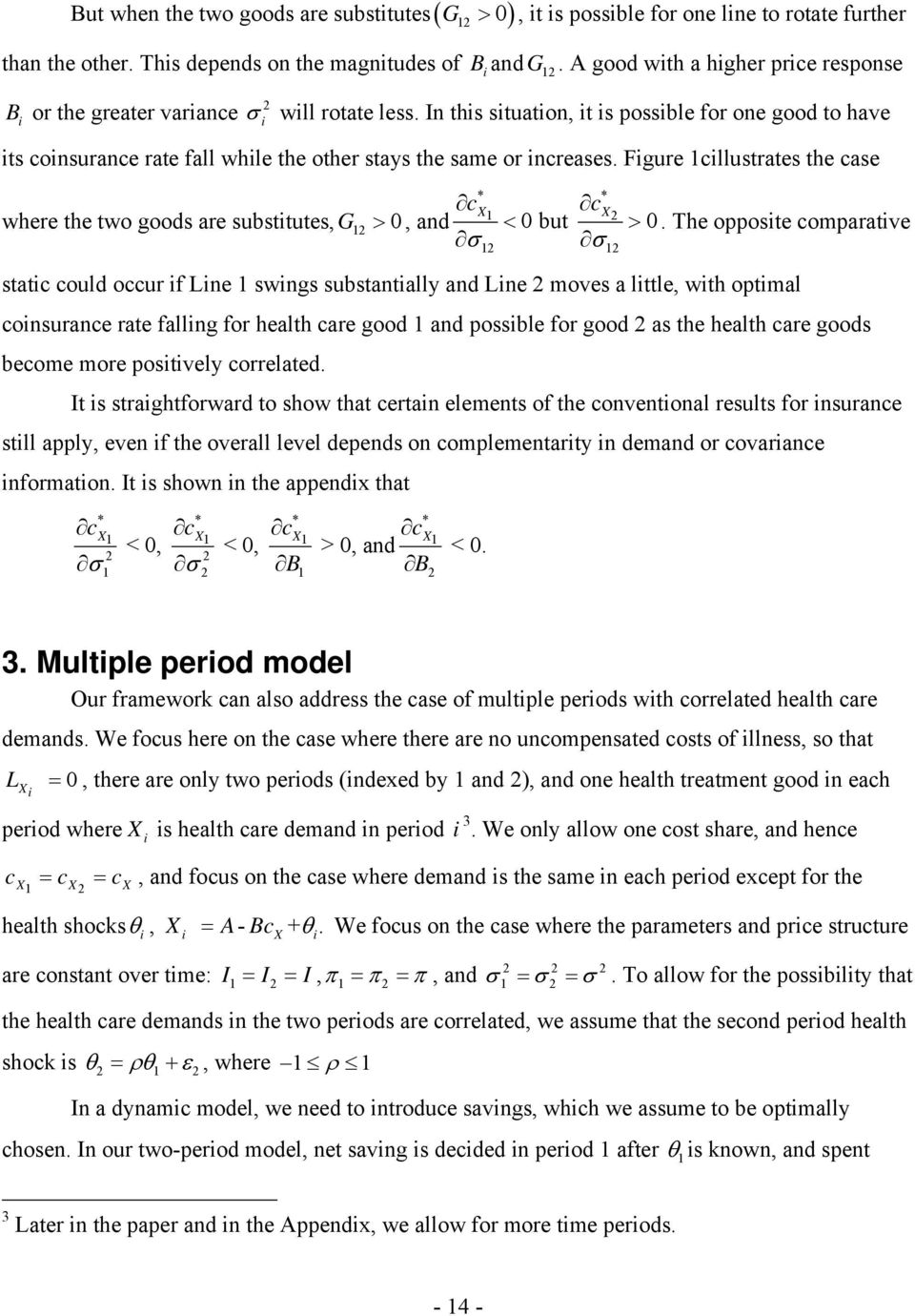
14 But when the two goods are substitutesg 0, it is possible for one line to rotate further than the other. This depends on the magnitudes of Bi andg. good with a higher prie response B i or the greater variane i will rotate less. In this situation, it is possible for one good to have its oinsurane rate fall while the other stays the same or inreases. Figure illustrates the ase where the two goods are substitutes, G 0, and 0 but 0. The opposite omparative stati ould our if Line swings substantially and Line moves a little, with optimal oinsurane rate falling for health are good and possible for good as the health are goods beome more positively orrelated. It is straightforward to show that ertain elements of the onventional results for insurane still apply, even if the overall level depends on omplementarity in demand or ovariane information. It is shown in the appendix that < 0, < 0, > 0, and < 0. B B 3. Multiple period model Our framework an also address the ase of multiple periods with orrelated health are demands. We fous here on the ase where there are no unompensated osts of illness, so that L 0, there are only two periods (indexed by and, and one health treatment good in eah i period where i is health are demand in period i 3. We only allow one ost share, and hene, and fous on the ase where demand is the same in eah period exept for the health shoks i, - B +. i i We fous on the ase where the parameters and prie struture are onstant over time: I I I,, and. To allow for the possibility that the health are demands in the two periods are orrelated, we assume that the seond period health shok is, where In a dynami model, we need to introdue savings, whih we assume to be optimally hosen. In our two-period model, net saving is deided in period after is known, and spent 3 Later in the paper and in the ppendix, we allow for more time periods
15 entirely in period.in general, the optimal level of savings will depend on the all of the parameters of the model. Of speial interest is that savings will depend on the ost share and the first period health shok, S (, with S / 0. In the ppendix, we show that the objetive funtion to be maximized through the hoie of an be written as follows V J K S(, L ( EV E, E V J K ( r S(, ( L where J I B ( K ( L B( (4 Exept for the savings funtion and the introdution of disounting,, this formulation is very similar in struture to what was used above for the ase with one period with multiple states of the world. The solution for the optimal hoie of is derived in the ppendix. We make the following three further assumptions in deriving our solution: Savings is optimal so that for all, V... ( r E V... rate. I I where r is the interest The utility funtion an be approximated using a seond order approximation with onstant relative risk aversion. Consumers an earn a return on savings ( r that is the inverse to their disount rate, so that ( r. In the ase of the quadrati utility funtion that we have used in our analysis, the optimal saving is approximated by S (, S s (shown in ppendix, where the expeted (ex ante savings ( r are S and the optimal savings (ex post are redued by the proportion R ( r ( r s multiplied by the out-of-poket health payments and unompensated osts in time ( r - 5 -

16 period.the term s is the marginal propensity to save. In partiular, if ( r (as assumed, then S(, is redued to a simple funtional form S. 4 Under these assumptions, r when n the optimal ost share is B B. (5 ( BR s BR ( r( This result is very similar to the Base Case equation (0 for the ase of a single period, one health are good without any unompensated lossesl 0. Equation (9 differs from the ( base ase by the addition of a new savings-related term ( r( in the denominator. This term is a funtion of the orrelation oeffiient between period and period health shoks,,the interest rate r and the onsumer disount rate.note that is non-dereasing in, r, and, and that is dereasing in. s before, we interpret the optimal ost sharing result for a variety of speial ases. First, onsider the ase where the marginal propensity to save s 0, so that savings does not respond to health shoks. In this ase,, and the one period model results remain orret even with two periods. The onsumer must absorb all health shoks fully in the first period, so there is no differene between the stati and dynami hoies of. Seond, onsider the ase where the period and period shoks are perfetly orrelated, so that.one again and the one period model results hold. lthough savings is possible, there are none beause the onsumer knows exatly what the shok will be in period. 4 In the more general ase of any n periods, where the autoorrelation terms are allowed to have an arbitrary pattern rather than a first order autoorrelation, we show in the ppendix that the optimal saving funtion still has a losed form S n i ( r ( n i i P n i i ( r

17 There is no diversifiation aross periods in the burden of health shoks. In this limiting ase, insurane should be the same as with no savings. Third, onsider the ase where health shoks are unorrelated over time, so that 0. The disount rate is a number lose to one, and it is onvenient to onsider the ase where and r=0 so that there is no interest or disounting. The plausible result in this two period model is that s will be lose to one half, and half of the burden of a health shok is born in period and half is deferred to period.sine the ost of risk goes up with the square of the deviation from ertainty, the savings redues riskiness in the first period to one-quarter of the one period value and hene the ost of first period risk (proportional to the variane is redued to one quarter of the one period model results. Sine this burden is shared between two periods, the net redution in risk is by one half of the variane. The reason that only delines to 0.75 is that in a two period model there is no opportunity to redue the burden of shoks in the seond period. So while savings an redue the burden of first period shoks to one quarter of their unertainty ost, savings annot redue the burden of seond period shoks. This result with no disounting or interest rates losely approximates the result with disounting, sine the two terms ( r( will be approximately 4 if onsumers use the market interest rate for disounting. 4. Two-periods with two-goods So far, we have addressed the ases of multiple treatment goods and multiple periods separately. It is also important to onsider the ase of multiple treatment goods with more than one period beause this allows us to address issues suh as the differential overage of aute and hroni health are. We fous on the ase where there are two goods and two periods. The onsumption of two goods in two periods is indexed by,,, with subsripts indiating goods, and supersripts time periods. Following the notation in the one-good multiple period ase, we assume, i,, I I I, and. i i i To make this more onrete, we onsider as a medial treatment good for an aute ondition and as a medial treatment good for a hroni ondition. Then, we would expet that the amount of good one in the first period is not orrelated with its own future amount, while the amounts of good two in both periods are positively orrelated, where, 0<.We - 7 -

18 assume loading fees and other unompensated osts are zero: L L 0. We also assume E( E( E( E( 0 and that VR The objetive funtion and first order onditions haraterizing the optimum are shown in the ppendix. The main new result of interest relates to how onsumers optimally hange savings in response to aute rather than hroni onditions. If disounting exatly equals +r, so that ( r. Then, we show in the appendix that the optimal saving funtion is approximated by S (,,,, r r sine s r and s. The expeted (ex ante savings S are the same with the two-period r one-good ase. The marginal propensity to save s is lower than s beause good is hroni are and patients who reeive a large shok for hroni are antiipate a orrelated shok the following period and hene do not adjust their savings as muh as for an aute are shok. Results for the general ase are presented in the appendix. For the speial ase where demand shoks have zero ovariane in the eah period, and good are neither omplements nor substitutes, so that 0, G 0, the two-goods two-periods ases redue to one-good twoperiods ase. nd the optimal ost shares are approximated by B BR r B B R r The optimal ost shares are onsistent to equation (5 with 0 for the aute are. So the orrelation of spending for hroni are in two periods does not affet the optimal ost share of the aute ase. Thus, our findings indiate that hroni are should have better overage than aute, all - 8 -

19 other things equal, beause hroni are is positively serially orrelated, while aute are is unorrelated over time. 5. Theoretial Summary We have extended the theoretial literature on effiieny-based models of optimal insurane to address issues that arise from orrelated soures of unertainty, whether the soure of the orrelation is due to orrelated demands aross different health are goods at a point in time, orrelated demands over time, or the orrelated losses that arise from unompensated losses that aompany the losses overed by the insurane plan. By using a quadrati indiret utility funtion and, hene, a linear demand speifiation with zero inome effets on the demand for health are treatment, we have been able to derive losed form expressions haraterizing optimal ost sharing on health are treatment when there are multiple health are goods or where there are multiple time periods. Table summarizes the omparative statis findings in this paper for the various parameters onsidered for health are treatment goods and multiple time periods. In some of the ases that we have onsidered, we an only sign the effets of a parameter on optimal ost shares for ertain parameter values. These ases have the omparative stati results in parentheses. The parameters in the first four rows of Table reaffirm onventional results found in the previous literature, while the terms at the bottom reflet our new results that extend the previous literature. It is well established that optimal ost sharing on health are treatment should be higher as demand beomes more elasti, onsumers beome less risk averse, or the variane of spending dereases. Our findings are onsistent with the findings from Besley (988 and others. Our theoretial findings also are onsistent with those of Goldman and Philipson (007 on omplements and substitutes that all other things equal, ost sharing should be higher for omplements than substitutes. Our new finding is that positively orrelated losses aross health are goods or over time should lead to more generous overage (lower ost-sharing than unorrelated or negatively orrelated losses

20 6. Empirial Relevane. In this setion, we briefly examine the empirial magnitudes of two innovation of our model: the role of ontemporaneous orrelations aross multiple goods and of autoorrelations over time. We use data from the Thomson-Reuters MarketSan data base from the period on a population of non-elderly (age <65 enrollees in employment-based ommerial plans. We have restrited the sample to FFS, HMO, PPO and POS plans whih overed outpatient pharmay servies, in addition to outpatient physiian and inpatient servies. We inluded only those individuals who were ontinuously enrolled for the full five year period; this yields a sample of,335,448 individuals. Besides it size, these data have two major advantages. The first is that the enrollees are followed for several years, allowing us to study orrelations by type of health are over time. Seond, all of the enrollees had pharmay overage, thus allowing us to ontrast pharmay expenditure patterns with those of both inpatient and outpatient are. Table summarizes key means, standard deviations and orrelations from our five year sample, deomposed into three broad types of servies inpatient (faility, not inpatient physiian payments, all outpatient servies, and pharmay servies. 5 The first two olumns in the top half of Table reaffirms that inpatient spending, while not the largest expeted ost, is by far the most risky in a one year framework. Table also shows the autoorrelation oeffiients for spending for eah of the three servies differ meaningfully, with pharmaeutial spending having the highest autoorrelations and inpatient spending the lowest. The autoorrelations also reveal that spending is muh slower to return to normal levels following a health shok than a simple autoregressive R( pattern would indiate. Chroni onditions obviously explain this pattern. The larger orrelations for pharmay than outpatient are and for outpatient than inpatient suggest a larger orretion for pharmay than outpatient from the usual results for a one period model. The final olumn summarizes the impliations of using multiple years of spending to alulate finanial risk by presenting the standard deviation of five year sums of spending rather than one year spending. 5 Some researhers may expet a higher proportion of spending to be on inpatient are. The MEDSTT ommerial laims do not inlude Mediaid or Mediare enrollees, who have higher hospitalization rates. MEDSTT laims haves 4% of all overed harges for inpatient are in 004. Our sampling frame of using only people with five onseutive years of insurane overage has somewhat lower proportion of perent of spending in inpatient servies
21 Whereas inpatient spending has nearly four times as muh variation as pharmay using a one year horizon, it is less than twie as variable if a five year horizon is used. Our theoretial model shows that ontemporaneous orrelations between multiple health servie goods an also be important, and its ontribution to total risk is partiularly relevant. Table 3 presents two orrelation matries for spending on inpatient, outpatient, pharmay and total spending. The top half is for one year (004 while the bottom half orresponds to orrelations of five year sums of eah of the three omponents and total spending. The top orrelation matrix shows that one-year inpatient spending is the most losely orrelated with total spending, and that orrelations among other servies are relatively modest the onventional view. Taking into aount the autoorrelation effet, we generate the bottom half of the table. It reveals that the pattern for inpatient spending is weaker using a five year total spending. Outpatient spending beomes the most losely orrelated ategory with five year total spending. nd pharmay spending has a signifiant higher orrelation with total spending ompared to one-period ase. Considering the ontemporaneous orrelation and the autoorrelation, we would suggest the better overage for outpatient and pharmay spending than onventional rules for insurane overage would. Needless to say, the MEDSTT data do not have information on the range of unompensated losses other than dedutibles and opayments. Thus we are unable to omment on the magnitude of the orretion for orrelated unompensated losses. Moreover, in the absene of estimates of the underlying demand elastiities for these three servies, or even more hallenging the degree of omplementarity among them, it is diffiult to determine how large the shift in oinsurane rates would be under our rules would be from those based on Besley s formulation or older approahes. But the diretion is lear. By onsidering the orrelated responses over time, pharmay would have a lower oinsurane rate than would our under the traditional rules for one-period models. Spending on inpatient servies, whih is less orrelated than outpatient and pharmay over time would reeive the least adjustment. 7. Disussion The new results that we find most interesting are those that ( fous on the roles of unompensated losses differentially over health are goods and time periods, and ( those that address the role of orrelations aross goods and time. s in our earlier work (Ellis and Manning, - -
22 007, unompensated health losses that are related with insured servies should influene the level of ost sharing for orrelated health are goods. These losses provide a rationale for both reduing out-of-poket osts for those goods whih tend to have larger unompensated losses suh as time lost due to hospitalization and reovery, going for a physiian visit, or opayments. The intuition is lear. If onsumers fae unertain inome losses whih are orrelated with health are spending shoks on ertain treatment goods, then over insuring those treatment goods is a seond best response to redue this ombined risk from the ompensated and unompensated elements. In the tradeoff of moral hazard against the risk premium, the key term in unertainty in the demand for health goods in the single period, two-good model is L L where the θ s are unertain ex ante. The risk premium depends on the variane of this whole expression, whih in turn depends on the size of the unompensated losses (the L s ompared to the out-ofpoket opayments (the s. Unompensated losses inrease both the benefits from risk redution (the variane term from above and the osts of insurane (the demand / moral hazard term. Our finding that optimal treatment ost shares should be lower for positively orrelated treatment goods and goods with positive ross prie effets reaffirm the findings of Besley (988 on multiple goods as well as the intuition that positively orrelated amounts have greater variane whih need to be partially offset by lower ost sharing. 6 The empirial signifiane of these results is diffiult to assess, sine relatively little researh has foused on estimating these parameters. They may nonetheless provide guidane on overage for ertain goods suh as ertain brand name drugs, speialty urative goods, or the overage of serious hroni illnesses, whih may have lose or not lose substitutes and omplements. Our framework also provides a rationale for more generously overing servies provided relatively more to families (e.g., maternity are rather than single ontrats, on the grounds that these servies are positively orrelated. Finally, our multiperiod model shows the key role that savings deisions and orrelated errors play in setting optimal ost sharing. We are not aware of any papers in the health eonomis literature that has emphasized this topi, although there is a sizeable literature on how large unovered health losses an lead to dissaving and bankrupty. While there is a literature on how onsumers respond to health spending shoks, the impliations for optimal health insurane design 6 Besley (988, indiates that ross-elastiities and ovarianes jointly affet whih good is more generously overed. - -
23 deserves reexamination. Expensive, hroni onditions, whih exhibit strong positive serial orrelations over time for ertain health are servies provide an eonomi rationale for more generous insurane overage, beause onsumers annot use intertemporal savings to redue the burdens of suh spending. Thus in a world where hroni and aute are look to be otherwise equivalent in terms of prie responses and variability, the stronger orrelation in health are over spending for the hronially ill would lead to better overage than the standard one period model would suggest. Sine so muh of pharmay use exhibits the same property, this line of argument would also lead to better pharmay overage. It is worth highlighting the limitations of our study. We develop all of our models using a very speifi demand struture, in whih demand is linear in its arguments, have errors that are additive and have onstant variane, and the demand for treatment is perfetly inome inelasti. 7 In doing so, we assume away most inome effets or orner solutions, whih are partiularly relevant in any equity disussions of optimal health insurane. In our model, subsidizing health are does not affet relative inomes, although it does affet those with poor health. We reognize that these are relatively restritive assumptions, although our models remain more general than many others that have used only onsumer surplus or assumed only two health are states or one health are good. We have also repeatedly used a linear approximation of the marginal utility of inome whih is onsistent with approximating the utility funtion with a onstant absolute risk aversion funtion. We are not espeially troubled by this assumption beause our results should hold as an approximation for any arbitrary funtion, as long as the absolute risk aversion parameter is not varying too muh aross states of the world. Our unompensated loss funtion and optimal savings funtion were also approximated using linear funtions, although again, we believe that our results should hold as an approximation for more general nonlinear funtions. The other restritive assumption that we have made for tratability sake is that the variane in health are expenditure is a onstant, onditional on the health state. Speifially we have assumed that the variane and the other higher order moments in healthare treatment do not 7 The empirial literature finds that demand is inome inelasti overall, espeially in the absene of adverse seletion on insurane overage (Manning et al, 987; Newhouse et al, 993. But demand for speifi health treatment servies may be more highly inome elasti and yield different results
24 depend on the level of ost sharing, that is i / 0 or other observable fators in the demand funtion. n extension of the urrent work would allow for the ommon observation that the variability in health are expenditures is an inreasing funtion of the mean or expeted value of expenditures given the ovariates in the model. 8 Our models point to the importane of understanding the empirial signifiane of a number of demand and ost parameters. Of all of our parameters, the demand responsiveness of various health are treatment goods to ost sharing has been perhaps the most arefully studied. The Rand Health Insurane Experiment and others studies have established that spending on inpatient are is less responsive to ost sharing than spending on outpatient are, whih is less responsive than spending on pharmaeutials ( drugs. The evidene on demand responsiveness of preventive are is more ambiguous, but it appears to be at least as responsive to insurane overage as outpatient treatment. Hene the ex ante moral hazard problem that we model seems to be very real, and insurane overage of preventive are is justified due to the peuniary externality of ost savings from redued health premiums. The varianes and means of spending on different types of treatment goods are also well understood. Inpatient spending is muh more variable than outpatient spending and drug spending, justifying greater overage for inpatient are than other health servies. These onlusions follow from the previous literature as well as our framework. Less well studied are ross prie effets, ontemporaneous orrelations, and serial orrelations over time of speifi treatment goods. Drug spending and outpatient spending have higher ontemporaneous ovarianes with other types of spending than inpatient are does, 8 When the variane beomes an inreasing funtion of the mean, we pik up an extra term in the ost-of-risk part of the first order ondition that did not exist if demand for health are treatment ( x had onstant variane, onditional on health status. s we inrease the oinsurane rate, we have the usual inrease in the term related to the variane of out-of-poket expenses. But beause inreasing oinsurane also dereases the mean, it also dereases the variane. Thus, we have a partially offsetting term to inlude in the ost of risk. The magnitude of this redution depends on how prie responsive demand is. s long as the demand for health are treatment is inelasti with respet to ost sharing, the qualitative pattern desribed earlier in this setion prevails. See Feldman and Manning (997 for suh an extension to the basi model that we onsidered in Ellis and Manning (007 and in this paper, exept that it allowed for a onstant oeffiient of variation property for health are expenditures instead of a onstant variane assumption
25 suggesting they may deserve greater insurane overage than would otherwise be the ase. Cross elastiities of demand for drug and outpatient are are likely to be muh higher than for inpatient are, justifying greater overage. Some evidene on this is provided in Meyerhoefer and Zuvekas(006 who demonstrate that ross prie elastiities between non-mental health drugs and spending on treatment for physial health are moderately large and statistially signifiant. Relatively little work has explored the intertemporal orrelations of speifi treatment servies. We do know that spending on drugs and outpatient are is muh more highly orrelated over time than spending on inpatient are. Ellis, Jiang and Kuo (0 provide reent evidene on this issue in examining more than 30 different medial servies defined by type of servie. In our framework, high serial orrelations justify greater insurane overage than is implied using a one period model. The evidene from the Thomson-Reuters MarketSan data suggests that these orrelations are sizeable and important for both outpatient and for pharmay, but stronger for pharmay than outpatient. We suspet that the ause of this differene is that so muh of the use of pharmay is related to the treatment and management of hroni illnesses. Perhaps the area most in need of empirial work is to doument the magnitude of unompensated health losses that are orrelated with health are spending. Signifiant unompensated osts provide a rationale for zero or even negative ost shares on treatment goods and inreased ost shares on prevention in the absene of perfet insurane markets. It would be interesting to know how large are the adjustments needed to the onventional model results
26 REFERENCES tim, Chris, 999. Soial movements and health insurane: a ritial evaluation of voluntary, nonprofit insurane shemes with ase studies from Ghana and Cameroon, Soial Siene & Mediine, Vol. 48, 7, ndrulis, Dennis P., 998. ess to are is the enterpiee in the elimination of soioeonomi disparities in health, annals of internal mediine, Vol. 9, 5, rrow, Kenneth J., 963, Unertainty and the welfare eonomis of medial are, merian Eonomi Review 53, rrow, Kenneth J., 97, Essays in the theory of risk-bearing (Markham Pub. Co., Chiago, IL. rrow, Kenneth J., 976, Welfare analysis of hanges in health oinsurane rates, in R. Rossett(eds., The note of health insurane in the health servies setor (National Bureau of Eonomi Researh, New York. Blomqvist, ke, 997, Optimal non-linear health insurane. Journal of Health Eonomis 6, Besley, Timothy, 988. Optimal reimbursement health insurane and the theory of Ramsey taxation. Journal of Health Eonomis 7, Buhanan, Joan L., Keeler, Emmett B., Rolph, John E. and Holmer, Martin R Simulating health expenditures under alternative insurane plans. Management Siene, 37 (9: Coate, Stephen, 995.ltruism, the Samaritan's dilemma, and government transfer poliy, The merian Eonomi Review, Vol. 85,, Cutler, David M., Zekhauser, Rihard J., 000. The anatomy of health insurane. In: Culyer,., Newhouse, P. (Eds., Handbook of Health Eonomis. North Holland. Dardanoni, Valentino, and Wagstaff, dam Unertainty and the demand for medial are. Journal of Health Eonomis 9, Doherty, Neil. and Thistle, Paul D., 996. dverse seletion with endogenous information in insurane markets, Journal of Publi Eonomis, Vol. 63,, Ellis, Randall P., Jiang, Shenyi, and Kuo, Tzu-hun, 0. Does servie-level spending show evidene of seletion aross health plan types? Boston University working paper. Ellis, Randall P., and Manning, Willard G. 007.Optimal Health Insurane for Prevention and Treatment.Journal of Health Eonomis, 6(6, Feldstein, Martin and Friedman, Bernard, 977. Tax subsidies, the rational demand for health insurane, and the health are risis. Journal of Publi Eonomis 7, Feldman, Roger and Dowd, Bryan, 99. new estimate of the welfare loss of exess health insurane. The merian Eonomi Review, Vol. 8(, pp
27 Feldman, Roger and Manning, Willard M., 997.Une Formule Simple du Taux Optimale pour Une Polie D-ssurane Maladie. In : S. Jaobzone (ed. Eonomie de la Sante: Trajetoires du Futur, Insee Methodes, number 64-65, pp.33-44, Frenh National Ministry of Health, (English Translation: Simple Formula for the Optimal Coinsurane Rate in a Health Insurane Poliy. Goldman, Dana, and Philipson, Tomas J Integrated insurane design in the presene of multiple medial tehnologies. merian Eonomi Review 97(, Hofmann, nnette, 007. Internalizing externalities of loss prevention through insurane monopoly: an analysis of interdependent risks. The Geneva Risk and Insurane Review, Vol. 3(, 9-. Maarse, Hans and Paulus, ggie, 003. Has Solidarity Survived? Comparative nalysis of the Effet of Soial Health Insurane Reform in Four European Countries, Journal of Health Politis, Poliy and Law, Vol. 8, 4, Manning, Willard G., Newhouse, Joseph P.,Duan, Naihua, et al., 987. Health Insurane and the Demand for Medial Care: Evidene from a Randomized Experiment. merian Eonomi Review, 77(3: Manning, Willard G., and Marquis, M. Susan, 996. Health insurane: the trade-off between risk pooling and moral hazard. Journal of Health Eonomis 5(5, Newhouse, Joseph P. and the Health Insurane Group 993. Free-For-ll: Health Insurane, Medial Costs, and Health Outomes: The Results of the Health Insurane Experiment, Cambridge: Harvard University Press. Newhouse, Joseph P Reonsidering the moral hazard-risk avoidane tradeoff. Journal of Health Eonomis 5: Pauly, Mark V., 968 "The Eonomis of Moral Hazard: Comment." merian Eonomi Review 58(: Pauly, Mark V Overinsurane and publi provision of insurane: the roles of moral hazard and adverse seletion. Quarterly Journal of Eonomis 88: Rask, Kevin N. and Rask, Kimberly J., 000.Publi insurane substituting for private insurane: new evidene regarding publi hospitals, unompensated are funds, and Mediaid. Journal of Health Eonomis, Vol. 9,, -3. Spene, Mihael and Zekhauser, Rihard, 97, Insurane, information and individual ation, merian Eonomi Review 6, Sin., Don D., Svenson, Larry W., Cowie, Robert L. and Man, S. F. Paul, 003. Can Universal ess to Health Care Eliminate Health Inequities Between Children of Poor and Nonpoor Families? Case Study of Childhood sthma in lberta, Chest, Vol. 4,, Zekhauser, Rihard, 970. Medial insurane: a ase study of the tradeoff between risk spreading and appropriate inentives. Journal of Eonomi Theory,
28 Zweifel, Peter J. and Manning, Willard G., 000. Consumer Inentives in Health Care, in Newhouse, J.P.,.J. Culyer (eds., Handbook of Health Eonomis Vol., msterdam: Elsevier, Ch
29 Table.Comparative Statis on Optimal Coinsurane Rate i Effet of on i Own demand slope B i + Risk aversion parameter Variane of spending on own i R - i - Insurane loading fator + Unompensated losses affeting inome Unompensated losses affeting utility diretly Variane of spending on other good j Covariane of spending on i and j L i - L 0 j - ij (- Other good demand slope B j - Cross prie term for other good G ij (- Correlation with next period error (- Note: results in parentheses only hold for speifi values of key parameters
30 Table Means, standard deviations, five year autoorrelation rates of inpatient, outpatient and pharmay spending Using unadjusted spending Standard utoorrelation with spending in year Mean deviation Standard deviation of 5 year sum 004 inpatient spending $ 87 $ 8, $ 6, outpatient spending $,50 $ 7, $ 7, pharmay spending $ 977 $, $ 7, total spending $ 3,999 $, $ 3,875 Note: Results are based on healthare servies for MEDSTT Marketsan data for individuals aged< 65, who were ontinuously enrolled during N=,335,
31 Table 3Correlations aross spending on healthare servies 004 unadjusted spending Inpatient Outpatient Pharmay Total Inpatient Outpatient Pharmay Total (symmetri Five year total spending Inpatient Outpatient Pharmay Total Inpatient Outpatient Pharmay Total (symmetri.000 Note: Results are based on healthare servies for MEDSTT Marketsan data for individuals aged< 65 in 004, who were ontinuously enrolled during N=,48,
32 Figure a Optimal Coinsurane Rates for Neutral Goods: G =0 as, Line Line. Figure b Optimal Coinsurane Rates for Complements: G < 0 as and/or Line Line - 3 -
33 Figure Optimal Coinsurane Rates for Substitutes: G > 0 Starting at 0 as and/or Line Line Notes for figures a- B G G R B G G R (Line (Line BR BR B R B R Interepts on axes for and do not shift beause they do not depend on
34 ppendix This appendix derives seleted analytial results in the main paper. For onveniene, Table - presents our notation. Equation numbers shown without an suffix orrespond to numbering in the main text. Table - Notation = { i} = quantity of health are treatment of servie i Y = quantity of all other onsumption goods I = onsumers total inome J = disposable inome after premiums and prevention spending = premium paid by onsumer P, P i Y = demand pries of i and Y i ost share rates on treatment i (share paid by onsumer = { i} = random shoks affeting health and demand for i, i = mean of health are spending on i or when are is free Bi = slope of demand urves when written in the form i = - B i + i i i G ross prie effet of on and also on L i ij j i i j = insurane loading fator = disount rate used by onsumer r = interest rate reeived on savings by onsumer S = savings in period i = variane of i and also variane of health are spending i ij = ovariane of i and i V = the onsumer's utility funtion R = absolute risk aversion onstant= - VII / VI L = per unit unompensated osts of treatment i i ( = unompensated health losses that redue effetive inome from random shok i i -. Optimal ost sharing rates for health are treatment ssume there is no preventive good, and that treatment goods and have linear demand urves of the form
35 - BP / P G P / P Y Y - B P / P G P / P Y Y These demands are onsistent with a risk neutral indiret utility funtion of (.0 B P B P P P P P V (. S I G PY PY PY PY PY PY Using the normalizations PY, P,, L P L i i, letting J I S, applying the onave transformationv an be written as, this yields an indiret utility funtion that i B( L B ( L S ( S J L V V L ( L ( ( L G ( L ( L Taking partial derivatives with respet to yields (. V J K ( L ( L S I S V E B ( L G ( L 0 where J I, K ( L ( L B ( L B ( L G ( L ( L, ( B ( L G ( L (, ( B ( L G ( L ( B B BL G G G L Taking a first order approximation of S VI around J-K, we an write (
36 S V J K V J K L L S I II S V E B ( L G ( L S VI J K B ( L G ( L S E VII J K L L B ( L G ( L (.4 S V, using E ( 0, the first Defining R II,, S E E, E VI S order onditions for the maximum, one divided through by the (nonstohasti V ( J K an be approximated as follows. i I B ( L G ( L 0 E R ( L ( L B ( L G ( L B ( L G ( L R ( L ( L (.4 Finally replaing and rearranging slightly, we get an expression that is linear in and. By symmetry, we get the orresponding expression for, whih is also presented below.. ( B B BL G G G L B ( L G R L L 0 ( B B B L G G G L B ( L G R L L 0 (.4 (
37 In the main text we examine a number of speial ases. -. One good, no unompensated losses, no insurane loading osts B G L L 0 B B B R 0 BB R 0 B B R -. One good, no unompensated losses, positive insurane loading osts (.4 If B G L L 0, and 0, then the FOC (.7 simplifies to ( B B B R 0 B B B BR -.3 One good, no insurane loading fator, unompensated losses (.4 If B G L 0, but L 0, then the FOC (.7 simplifies to B B B R L 0 B R L B R ( Two goods, no insurane loading fator, no unompensated losses, general demand struture If L L 0, then equations (.7 nd (.8 an be solved for as i ( G B ( R G ( G B ( R B ( R B ( R B ( R G (.4 It is straightforward to show from (. that <0, <0, >0, <0, B B (
38 The expressions for and G annot be signed for all possible values of G and, however these derivatives an be unambiguously signed for the limiting ase where G and approah zero. In this limiting ase the two partial derivatives beome 0 ( ( R B R 0, 0 B R B G 0 G ( R B ( R B R 0, 0 G (.4 (.4 Hene in this limiting ase and G are both negative. This means that for suffiiently small G and, as the ovariane of the errors between two servies inreases (beomes more positive, then the optimal oinsurane rate dereases. The expression G an also be signed as negative for an arbitrary value of. To show the sign of / G when σ =0, use: B + R R G R ( G B ( G ( G B ( R B ( R B( R B ( G ( R B( R B ( G Φ(G So =, where Φ and Ψ are as impliitly defined above. Now sine Ψ(G Φ(G > 0. lso, ' 0, '>0. Hene for any G, when σ =0, / 0 G. <then -3.Two period model It is well known that there are lose parallels between models with multiple states of the world and models with multiple periods. One key differene is that there is the possibility of orrelated outomes in different periods, either beause health shoks are serially orrelated or beause the two periods are linked by savings. We examine here a two-period model with one health are treatment good in eah period, allowing both savings and orrelated errors. The demand struture is assumed to be the same in both periods, and hene so are premiums. We use the diret utility funtion whih is the dual to the indiret utility funtion used thus far. We also fous on the ase
39 where δ = 0, I I Iand L L L, hene. We also assume onstant varianes over time and ( r. V, Y, L ( Max EV E, E V, Y, L (, Y, S where S ( V, Y, V ( Y B S ( V, Y, V ( Y B onsumers disount fator B ( L K K ( L B( L (.4 (.4 amount of s long as inome is suffiient to always buy the optimal amount of i will be purhased as in the one period ase. Hene we an use: B ( L B ( L i, then the same (.4 Savings will equilibrate the expeted marginal utility of inome in period with the marginal utility in period. Hene we have I I V ( ( r E V (.4 Let the optimal savings funtion be utility as S(, (derived below and write the problem using indiret
40 V J K S(, ( L L ( EV E, E V J K ( r S(, ( ( L L where J J J I (.4 onsumers disount fator B ( L K ( L B( L Exept for the savings funtion, this formulation is very similar in struture to that used for multiple states of the world. Differentiating with regard to yields VI J K S(, ( L S(, B ( L EV E, (.4 VI J K ( r S(, ( L E S(, ( r B( L S(, By the envelope theorem, the terms involving in the above expression will anel out due to the assumption of optimal savings. Hene we an rewrite this as: VI J K S(, ( L B( L EV E V I J K ( r S(, ( L (.4 E B ( L Exept for the fat that two different piees of the utility funtion are used, and the appearane of the Savings funtion as an argument of the V I this is idential to the earlier speifiation. Taking a first order Taylor series approximation of the V I and V I funtions, we an use the familiar expansions
41 R S(, ( L B( L 0 E E R ( r S(, ( ( L B L VI J K VII J K S(, ( L B( L EV E V I J K VII J K( r S(, ( L E B ( L B ( L R E S(, ( L B( L B ( L R E, ( r S(, ( L B( L ( B BL R E S(, B( L E ( L R E, ( r S (, B( L E, ( L ( B BL R E S(, B( L ( L R E, ( r S (, B( L ( L - 4 -
42 ( B BL R ( L S(, B( L E R ( rs (, B ( L E, S(, ( r (.4 If onsumers use the same disount rate as that is implied by their real interest rate on savings, then ( r and the top expression in brakets will be zero. With this assumption we an further simplify 0 ( B BL R ( L R E, S(, s a reminder, B BL B. B B R L R E S, (.4 0 ( ( (, (.4 This expression annot be simplified further without expliit savings funtion form showed later, optimal savings rule an be approximated by the following linear funtion S (,. s is S (, S s ( L (.4 ( r ( r Where S, s, R ( r ( r This implies that there is an average savings level S but that savings is redued by proportion s for all losses (ompensated or unompensated. Sine S will be unorrelated with, it will drop out one expetations are taken and we an write 0 ( B R L s (.4 Rearranging yields the following ondition for optimal ost sharing with multiple periods, BR L s BR s (.4-4 -
43 If we plug in funtion form of s, then r ( BR L ( r (. ( BR ( r ( Now we turn to deriving optimal saving funtion. s our model set up, saving is determined after health shok is revealed in the st period. ssuming individuals are not budget onstraint, the optimal amount of i will be purhased in both periods and will not be affeted by the optimal saving deision, however saving does affet the amount of Y i. Due to this feature, we solve our optimal saving funtion after taking optimal hoies of i as given. This approah brings us the same solution for the optimal saving funtion as is in the real deision proess involving hoosing, Y and Ssimultaneously in the first period. Max EV ( ( S V J K S L L E ( ( ( V J K r S L L where J I onsumers disount fator B ( L K ( L B( L The optimal saving funtion S satisfies VI J K S ( L ( r E V ( ( 0 I J K r S L Taking a first order Taylor series approximation of V I funtion at J K, VI J K VI J KS ( L VII J K( r E ( rs ( L VII JK VI J K S ( L VII J K ( r VI J K ( r SVII J K ( L( r VII J KE ( s is assumed, E (, we obtain
44 ( ( ( ( r( L V J K V J K S L V J K r V J K r S V J K I II I II II ( S ( ( ( ( L R r r S R L r R Rearranging the above equation, we solve the optimal saving funtion as following ( r ( r S ( L, whih implies that R ( r ( r S ( r ( r, s R ( r ( r Given our assumption ( r, S an be simplified further as S ( L and S 0, s r r -4 Optimal saving for model with multiple periods T Now we allow more general ases. We assume that E ( t i i t, for any t t, without making any restritions on the stohasti proess for t. s is shown in B-(available upon request, if we have three periods, ( r S P. ( r ( r ( r ( r 3 S P 3 for T=4. ( r ( r ( r nd S ( r ( r ( r ( r ( r ( r ( r P 3 4 the number of years of data we have.. when T=5 (same with From the pattern of optimal saving for multiple period models, it is easy to see that the optimal saving result for any T as S T t ( r ( T t t P T t t ( r -5 Optimal saving for model with two periods and two goods
45 The onsumption of two goods in two periods is indexed by subsripts for goods and supersripts for periods,,,. Following the notation for the multiple period ase, we assume, i,, I I I, L L L, L L L and. i i i To make the ase more insightful, we might onsider as an aute medial treatment good and as a hroni medial treatment good. So good one in the first period is not orrelated with its own future while good two in both periods are positively orrelated, where, 0<. We also assume that E( E( E( E( 0 and VR s is assumed that inome is suffiient to support the optimal amounts of medial servie, the demands of two treatment goods in period are B( L G ( L B ( L G ( L Similarly, the demands in period are B( L G ( L B ( L G ( L If we let the optimal savings funtion be S (,,,, then we an write the objetive funtion using the expeted indiret utility as (shown as V J K S ( L ( L L ( L ( EV E, V J K ( r S ( ( L L E,, L ( L (
46 where J J J I onsumers disount fator B( L B( L K ( L ( L G ( L ( L Y B ( L G ( L B ( L G ( L The optimal saving funtion S satisfies V J K S ( L ( L I,, ( re VI JK( rs ( L ( L 0 Taking a first order Taylor series approximation of V I funtion at J K, ( ( L VI J K S L VII J K ( re VI JK ( rs ( L VII JK,, ( L ( ( ( ( L ( L ( r V J KE ( ( L ( r V J KE ( V J K S L V J K r V J K r S V J K I II I II II II,,,, Having assumed, 0<, E (, we obtain,, ( ( ( ( L ( L ( rv J K V J K S L V J K r V J K r S V J K I II I II II ( L ( L S ( L R ( r ( r S R ( r R Rearranging the above equation, we solve the optimal saving funtion as following S (,,, S s ( L s ( L, where the savings and overall savings ( r rates are S R ( r ( r and s. The expeted (ex ante ( r ( r, s savings S are same with the two-period one-good ase. The marginal propensity to save s is lower than s beause good is hroni are and patients redue the unertainty of expeted
47 spending of good by treating it better in period. In partiular, if ( r, S (,,, is redued to a simple funtional form S ( L ( L. r r Differentiating with regard to yields V I S (,,, B ( L B ( L EV E, S (,,, ( r E V I,, B ( L B ( L V I S (,,, B ( L B ( L EV E, S (,,, ( r E V I,, B ( L B ( L S (,,, By the envelope theorem, the terms involving in the above expression will anel out due to the assumption of optimal savings. The optimal ost shares and must satisfy G ( B ( R L s R ( L s 0 G ( ( B ( R L s R ( L s 0 If we simplify the problem by assuming that there are no unompensated ost related to health are (by assuming L L 0, the optimal onditions beome ( ( B G ( ( G R R s ( ( B R R s ( ( B R R s
48 ( ( B G ( ( G R R s ( ( B R R s( ( ( B R R s(
Suggested Answers, Problem Set 5 Health Economics
 Suggested Answers, Problem Set 5 Health Eonomis Bill Evans Spring 2013 1. The graph is at the end of the handout. Fluoridated water strengthens teeth and redues inidene of avities. As a result, at all
Chapter 1 Microeconomics of Consumer Theory
 Chapter 1 Miroeonomis of Consumer Theory The two broad ategories of deision-makers in an eonomy are onsumers and firms. Eah individual in eah of these groups makes its deisions in order to ahieve some
AUDITING COST OVERRUN CLAIMS *
 AUDITING COST OVERRUN CLAIMS * David Pérez-Castrillo # University of Copenhagen & Universitat Autònoma de Barelona Niolas Riedinger ENSAE, Paris Abstrat: We onsider a ost-reimbursement or a ost-sharing
Fixed-income Securities Lecture 2: Basic Terminology and Concepts. Present value (fixed interest rate) Present value (fixed interest rate): the arb
 Fixed-inome Seurities Leture 2: Basi Terminology and Conepts Philip H. Dybvig Washington University in Saint Louis Various interest rates Present value (PV) and arbitrage Forward and spot interest rates
Lemon Signaling in Cross-Listings Michal Barzuza*
 Lemon Signaling in Cross-Listings Mihal Barzuza* This paper analyzes the deision to ross-list by managers and ontrolling shareholders assuming that they have private information with respet to the amount
A Holistic Method for Selecting Web Services in Design of Composite Applications
 A Holisti Method for Seleting Web Servies in Design of Composite Appliations Mārtiņš Bonders, Jānis Grabis Institute of Information Tehnology, Riga Tehnial University, 1 Kalu Street, Riga, LV 1658, Latvia,
From the Invisible Handshake to the Invisible Hand? How Import Competition Changes the Employment Relationship
 From the Invisible Handshake to the Invisible Hand? How Import Competition Changes the Employment Relationship Marianne Bertrand, University of Chiago, Center for Eonomi Poliy Researh, and National Bureau
Optimal Sales Force Compensation
 Optimal Sales Fore Compensation Matthias Kräkel Anja Shöttner Abstrat We analyze a dynami moral-hazard model to derive optimal sales fore ompensation plans without imposing any ad ho restritions on the
Henley Business School at Univ of Reading. Pre-Experience Postgraduate Programmes Chartered Institute of Personnel and Development (CIPD)
 MS in International Human Resoure Management For students entering in 2012/3 Awarding Institution: Teahing Institution: Relevant QAA subjet Benhmarking group(s): Faulty: Programme length: Date of speifiation:
) ( )( ) ( ) ( )( ) ( ) ( ) (1)
 OPEN CHANNEL FLOW Open hannel flow is haraterized by a surfae in ontat with a gas phase, allowing the fluid to take on shapes and undergo behavior that is impossible in a pipe or other filled onduit. Examples
Supply chain coordination; A Game Theory approach
 aepted for publiation in the journal "Engineering Appliations of Artifiial Intelligene" 2008 upply hain oordination; A Game Theory approah Jean-Claude Hennet x and Yasemin Arda xx x LI CNR-UMR 668 Université
In many services, the quality or value provided by the service increases with the time the service provider
 MANAGEMENT SCIENCE Vol. 57, No. 1, January 2011, pp. 40 56 issn 0025-1909 eissn 1526-5501 11 5701 0040 informs doi 10.1287/mns.1100.1250 2011 INFORMS Quality Speed Conundrum: Trade-offs in Customer-Intensive
Learning Curves and Stochastic Models for Pricing and Provisioning Cloud Computing Services
 T Learning Curves and Stohasti Models for Priing and Provisioning Cloud Computing Servies Amit Gera, Cathy H. Xia Dept. of Integrated Systems Engineering Ohio State University, Columbus, OH 4310 {gera.,
Price-based versus quantity-based approaches for stimulating the development of renewable electricity: new insights in an old debate
 Prie-based versus -based approahes for stimulating the development of renewable eletriity: new insights in an old debate uthors: Dominique FINON, Philippe MENNTEU, Marie-Laure LMY, Institut d Eonomie et
Market power and banking failures
 International Journal of Industrial Organization 20 (2002) 1341 1361 www.elsevier.om/ loate/ eonbase a Market power and banking failures Ramon Caminal *, Carmen Matutes a, a,b Institut d Analisi ` Eonomia
A Comparison of Service Quality between Private and Public Hospitals in Thailand
 International Journal of Business and Soial Siene Vol. 4 No. 11; September 2013 A Comparison of Servie Quality between Private and Hospitals in Thailand Khanhitpol Yousapronpaiboon, D.B.A. Assistant Professor
An integrated optimization model of a Closed- Loop Supply Chain under uncertainty
 ISSN 1816-6075 (Print), 1818-0523 (Online) Journal of System and Management Sienes Vol. 2 (2012) No. 3, pp. 9-17 An integrated optimization model of a Closed- Loop Supply Chain under unertainty Xiaoxia
State of Maryland Participation Agreement for Pre-Tax and Roth Retirement Savings Accounts
 State of Maryland Partiipation Agreement for Pre-Tax and Roth Retirement Savings Aounts DC-4531 (08/2015) For help, please all 1-800-966-6355 www.marylandd.om 1 Things to Remember Complete all of the setions
OPTIMAL TAXATION AND SOCIAL INSURANCE IN A LIFETIME PERSPECTIVE
 January 26 OPTIMAL TAXATION AND SOCIAL INSURANCE IN A LIFETIME PERSPECTIVE A. Lans Bovenberg, Tilburg University, CEPR and CESifo ) Peter Birh Sørensen, University of Copenhagen, EPRU and CESifo ) Abstrat
Findings and Recommendations
 Contrating Methods and Administration Findings and Reommendations Finding 9-1 ESD did not utilize a formal written pre-qualifiations proess for seleting experiened design onsultants. ESD hose onsultants
RESEARCH SEMINAR IN INTERNATIONAL ECONOMICS. Discussion Paper No. 475. The Evolution and Utilization of the GATT/WTO Dispute Settlement Mechanism
 RESEARCH SEMINAR IN INTERNATIONAL ECONOMICS Shool of Publi Poliy The University of Mihigan Ann Arbor, Mihigan 48109-1220 Disussion Paper No. 475 The Evolution and Utilization of the GATT/WTO Dispute Settlement
Open and Extensible Business Process Simulator
 UNIVERSITY OF TARTU FACULTY OF MATHEMATICS AND COMPUTER SCIENCE Institute of Computer Siene Karl Blum Open and Extensible Business Proess Simulator Master Thesis (30 EAP) Supervisors: Luiano Garía-Bañuelos,
Tax-loss Selling and the Turn-of-the-Year Effect: New Evidence from Norway 1
 Tax-loss Selling and the Turn-of-the-Year Effet: New Evidene from Norway 1 Qinglei Dai Universidade Nova de Lisboa September 2005 1 Aknowledgement: I would like to thank Kristian Rydqvist at Binghamton
Chapter 5 Single Phase Systems
 Chapter 5 Single Phase Systems Chemial engineering alulations rely heavily on the availability of physial properties of materials. There are three ommon methods used to find these properties. These inlude
Trade Information, Not Spectrum: A Novel TV White Space Information Market Model
 Trade Information, Not Spetrum: A Novel TV White Spae Information Market Model Yuan Luo, Lin Gao, and Jianwei Huang 1 Abstrat In this paper, we propose a novel information market for TV white spae networks,
Capacity at Unsignalized Two-Stage Priority Intersections
 Capaity at Unsignalized Two-Stage Priority Intersetions by Werner Brilon and Ning Wu Abstrat The subjet of this paper is the apaity of minor-street traffi movements aross major divided four-lane roadways
Deadline-based Escalation in Process-Aware Information Systems
 Deadline-based Esalation in Proess-Aware Information Systems Wil M.P. van der Aalst 1,2, Mihael Rosemann 2, Marlon Dumas 2 1 Department of Tehnology Management Eindhoven University of Tehnology, The Netherlands
Weighting Methods in Survey Sampling
 Setion on Survey Researh Methods JSM 01 Weighting Methods in Survey Sampling Chiao-hih Chang Ferry Butar Butar Abstrat It is said that a well-designed survey an best prevent nonresponse. However, no matter
university of illinois library AT URBANA-CHAMPAIGN BOOKSTACKS
 university of illinois library AT URBANA-CHAMPAIGN BOOKSTACKS CENTRAL CIRCULATION BOOKSTACKS The person harging this material is responsible for its renewal or its return to the library from whih it was
The Basics of International Trade: A Classroom Experiment
 The Basis of International Trade: A Classroom Experiment Alberto Isgut, Ganesan Ravishanker, and Tanya Rosenblat * Wesleyan University Abstrat We introdue a simple web-based lassroom experiment in whih
The Advantages of Using Aountable Care Organizations ( ACOs)
 JLEO, V3 S i77 Struturing Inentives within Aountable Care Organizations Brigham Frandsen Brigham Young University James B. Rebitzer* Boston University Shool of Management and ational Bureau of Eonomi Researh
Henley Business School at Univ of Reading. Chartered Institute of Personnel and Development (CIPD)
 MS in International Human Resoure Management (full-time) For students entering in 2015/6 Awarding Institution: Teahing Institution: Relevant QAA subjet Benhmarking group(s): Faulty: Programme length: Date
The D.C. Long Term Disability Insurance Plan Exclusively for NBAC members Issued by The Prudential Insurance Company of America (Prudential)
 Plan Basis The D.C. Long Term Disability Insurane Plan Exlusively for NBAC members Issued by The Prudential Insurane Company of Ameria (Prudential) What does it over? The D.C. Long Term Disability Insurane
Customer Efficiency, Channel Usage and Firm Performance in Retail Banking
 Customer Effiieny, Channel Usage and Firm Performane in Retail Banking Mei Xue Operations and Strategi Management Department The Wallae E. Carroll Shool of Management Boston College 350 Fulton Hall, 140
SupermarketPricingStrategies
 SupermarketPriingStrategies PaulB.Ellikson Duke University SanjogMisra University of Rohester November 13, 2006 Abstrat Most supermarket firms hoose to position themselves by offering either Every Day
Motivations for swap-covered foreign currency borrowing
 Motivations for swap-overed foreign urreny borrowing Anella Munro and Philip Wooldridge 1 1. Introdution Borrowing denominated in foreign urrenies soared during the s. 2 Gross issuane of foreign urreny
Florida Blue has got you covered. Choose your plan. Choose your network.
 overed. Choose your plan. Choose your network. When it omes to your health are overage, you an ount on us. attention and extra support are part of every plan. You hoose features that are most important
In order to be able to design beams, we need both moments and shears. 1. Moment a) From direct design method or equivalent frame method
 BEAM DESIGN In order to be able to design beams, we need both moments and shears. 1. Moment a) From diret design method or equivalent frame method b) From loads applied diretly to beams inluding beam weight
Retirement Option Election Form with Partial Lump Sum Payment
 Offie of the New York State Comptroller New York State and Loal Retirement System Employees Retirement System Polie and Fire Retirement System 110 State Street, Albany, New York 12244-0001 Retirement Option
TRENDS IN EXECUTIVE EDUCATION: TOWARDS A SYSTEMS APPROACH TO EXECUTIVE DEVELOPMENT PLANNING
 INTERMAN 7 TRENDS IN EXECUTIVE EDUCATION: TOWARDS A SYSTEMS APPROACH TO EXECUTIVE DEVELOPMENT PLANNING by Douglas A. Ready, Albert A. Viere and Alan F. White RECEIVED 2 7 MAY 1393 International Labour
Classical Electromagnetic Doppler Effect Redefined. Copyright 2014 Joseph A. Rybczyk
 Classial Eletromagneti Doppler Effet Redefined Copyright 04 Joseph A. Rybzyk Abstrat The lassial Doppler Effet formula for eletromagneti waves is redefined to agree with the fundamental sientifi priniples
VOLUME 13, ARTICLE 5, PAGES 117-142 PUBLISHED 05 OCTOBER 2005 DOI: 10.4054/DemRes.2005.13.
 Demographi Researh a free, expedited, online journal of peer-reviewed researh and ommentary in the population sienes published by the Max Plank Institute for Demographi Researh Konrad-Zuse Str. 1, D-157
arxiv:astro-ph/0304006v2 10 Jun 2003 Theory Group, MS 50A-5101 Lawrence Berkeley National Laboratory One Cyclotron Road Berkeley, CA 94720 USA
 LBNL-52402 Marh 2003 On the Speed of Gravity and the v/ Corretions to the Shapiro Time Delay Stuart Samuel 1 arxiv:astro-ph/0304006v2 10 Jun 2003 Theory Group, MS 50A-5101 Lawrene Berkeley National Laboratory
Dynamic and Competitive Effects of Direct Mailings
 Dynami and Competitive Effets of Diret Mailings Merel van Diepen, Bas Donkers and Philip Hans Franses ERIM REPORT SERIES RESEARCH IN MANAGEMENT ERIM Report Series referene number ERS-2006-050-MKT Publiation
Economic and Antitrust Barriers to Entry
 Eonomi and Antitrust Barriers to Entry R. Preston MAfee, Hugo M. Mialon, and Mihael A. Williams 1 Deember 1, 2003 Abstrat We review the extensive literature on barriers to entry in law and eonomis; we
5.2 The Master Theorem
 170 CHAPTER 5. RECURSION AND RECURRENCES 5.2 The Master Theorem Master Theorem In the last setion, we saw three different kinds of behavior for reurrenes of the form at (n/2) + n These behaviors depended
RATING SCALES FOR NEUROLOGISTS
 RATING SCALES FOR NEUROLOGISTS J Hobart iv22 WHY Correspondene to: Dr Jeremy Hobart, Department of Clinial Neurosienes, Peninsula Medial Shool, Derriford Hospital, Plymouth PL6 8DH, UK; Jeremy.Hobart@
Computer Networks Framing
 Computer Networks Framing Saad Mneimneh Computer Siene Hunter College of CUNY New York Introdution Who framed Roger rabbit? A detetive, a woman, and a rabbit in a network of trouble We will skip the physial
 Chapter 6 A N ovel Solution Of Linear Congruenes Proeedings NCUR IX. (1995), Vol. II, pp. 708{712 Jerey F. Gold Department of Mathematis, Department of Physis University of Utah Salt Lake City, Utah 84112
Board Building Recruiting and Developing Effective Board Members for Not-for-Profit Organizations
 Board Development Board Building Reruiting and Developing Effetive Board Members for Not-for-Profit Organizations Board Development Board Building Reruiting and Developing Effetive Board Members for Not-for-Profit
SCHEME FOR FINANCING SCHOOLS
 SCHEME FOR FINANCING SCHOOLS UNDER SECTION 48 OF THE SCHOOL STANDARDS AND FRAMEWORK ACT 1998 DfE Approved - Marh 1999 With amendments Marh 2001, Marh 2002, April 2003, July 2004, Marh 2005, February 2007,
THE PERFORMANCE OF TRANSIT TIME FLOWMETERS IN HEATED GAS MIXTURES
 Proeedings of FEDSM 98 998 ASME Fluids Engineering Division Summer Meeting June 2-25, 998 Washington DC FEDSM98-529 THE PERFORMANCE OF TRANSIT TIME FLOWMETERS IN HEATED GAS MIXTURES John D. Wright Proess
ru ILllYC UT 3 IMC IrrCRCIYLL3 AND SIMLARITIES BETWEEN CALIFORNIA AND h.tlnols
 ru ILllYC UT 3 IMC IrrCRCIYLL3 AND SIMLARITIES BETWEEN CALIFORNIA AND h.tlnols Foreward This paper outlines some of the signifiant differenes and similarities between the eletri power environments whih
International Journal of Supply and Operations Management. Mathematical modeling for EOQ inventory system with advance payment and fuzzy Parameters
 nternational Journal of Supply and Operations Management JSOM November 0, Volume, ssue 3, pp. 60-78 SSN-Print: 383-359 SSN-Online: 383-55 www.ijsom.om Mathematial modeling for EOQ inventory system with
Effectiveness of a law to reduce alcohol-impaired driving in Japan
 Effetiveness of a law to redue alohol-impaired driving in Japan T Nagata, 1,2 S Setoguhi, 3 D Hemenway, 4 M J Perry 5 Original artile 1 Takemi Program, Department of International Health, Harvard Shool
Sebastián Bravo López
 Transfinite Turing mahines Sebastián Bravo López 1 Introdution With the rise of omputers with high omputational power the idea of developing more powerful models of omputation has appeared. Suppose that
Static Fairness Criteria in Telecommunications
 Teknillinen Korkeakoulu ERIKOISTYÖ Teknillisen fysiikan koulutusohjelma 92002 Mat-208 Sovelletun matematiikan erikoistyöt Stati Fairness Criteria in Teleommuniations Vesa Timonen, e-mail: vesatimonen@hutfi
Disability Discrimination (Services and Premises) Regulations 2016 Index DISABILITY DISCRIMINATION (SERVICES AND PREMISES) REGULATIONS 2016
 Disability Disrimination (Servies and Premises) Regulations 2016 Index DISABILITY DISCRIMINATION (SERVICES AND PREMISES) REGULATIONS 2016 Index Regulation Page 1 Title... 3 2 Commenement... 3 3 Interpretation...
1.3 Complex Numbers; Quadratic Equations in the Complex Number System*
 04 CHAPTER Equations and Inequalities Explaining Conepts: Disussion and Writing 7. Whih of the following pairs of equations are equivalent? Explain. x 2 9; x 3 (b) x 29; x 3 () x - 2x - 22 x - 2 2 ; x
Job Creation and Job Destruction over the Life Cycle: The Older Workers in the Spotlight
 DISCUSSION PAPER SERIES IZA DP No. 2597 Job Creation and Job Destrution over the Life Cyle: The Older Workers in the Spotlight Jean-Olivier Hairault Arnaud Chéron François Langot February 2007 Forshungsinstitut
INCOME TAX WITHHOLDING GUIDE FOR EMPLOYERS
 Virginia Department of Taxation INCOME TAX WITHHOLDING GUIDE FOR EMPLOYERS www.tax.virginia.gov 2614086 Rev. 07/14 * Table of Contents Introdution... 1 Important... 1 Where to Get Assistane... 1 Online
Table of Contents. Appendix II Application Checklist. Export Finance Program Working Capital Financing...7
 Export Finane Program Guidelines Table of Contents Setion I General...........................................................1 A. Introdution............................................................1
From a strategic view to an engineering view in a digital enterprise
 Digital Enterprise Design & Management 2013 February 11-12, 2013 Paris From a strategi view to an engineering view in a digital enterprise The ase of a multi-ountry Telo Hervé Paault Orange Abstrat In
Optimal Health Insurance for Prevention and Treatment
 Optimal Health Insurance for Prevention and Treatment Randall P. Ellis Department of Economics Boston University Willard G. Manning Harris School of Public Policy Studies The University of Chicago We thank
3 Game Theory: Basic Concepts
 3 Game Theory: Basi Conepts Eah disipline of the soial sienes rules omfortably ithin its on hosen domain: : : so long as it stays largely oblivious of the others. Edard O. Wilson (1998):191 3.1 and and
Granular Problem Solving and Software Engineering
 Granular Problem Solving and Software Engineering Haibin Zhu, Senior Member, IEEE Department of Computer Siene and Mathematis, Nipissing University, 100 College Drive, North Bay, Ontario, P1B 8L7, Canada
INCOME TAX WITHHOLDING GUIDE FOR EMPLOYERS
 Virginia Department of Taxation INCOME TAX WITHHOLDING GUIDE FOR EMPLOYERS www.tax.virginia.gov 2614086 Rev. 01/16 Table of Contents Introdution... 1 Important... 1 Where to Get Assistane... 1 Online File
Iatrogenic Specification Error: A Cautionary Tale of Cleaning Data
 DISCUSSION PAPER SERIES IZA DP No. 1093 Iatrogeni Speifiation Error: A Cautionary Tale of Cleaning Data Christopher R. Bollinger Amitabh Chandra Marh 2004 Forshungsinstitut zur Zukunft der Arbeit Institute
Using Live Chat in your Call Centre
 Using Live Chat in your Call Centre Otober Key Highlights Yesterday's all entres have beome today's ontat entres where agents deal with multiple queries from multiple hannels. Live Chat hat is one now
protection p1ann1ng report
 f1re~~ protetion p1ann1ng report BUILDING CONSTRUCTION INFORMATION FROM THE CONCRETE AND MASONRY INDUSTRIES Signifiane of Fire Ratings for Building Constrution NO. 3 OF A SERIES The use of fire-resistive
FOOD FOR THOUGHT Topical Insights from our Subject Matter Experts
 FOOD FOR THOUGHT Topial Insights from our Sujet Matter Experts DEGREE OF DIFFERENCE TESTING: AN ALTERNATIVE TO TRADITIONAL APPROACHES The NFL White Paper Series Volume 14, June 2014 Overview Differene
WORKFLOW CONTROL-FLOW PATTERNS A Revised View
 WORKFLOW CONTROL-FLOW PATTERNS A Revised View Nik Russell 1, Arthur H.M. ter Hofstede 1, 1 BPM Group, Queensland University of Tehnology GPO Box 2434, Brisbane QLD 4001, Australia {n.russell,a.terhofstede}@qut.edu.au
A MESSAGE FROM THE CHAIRMAN...
 insurane brokers A MESSAGE FROM THE CHAIRMAN........... A MESSAGE FROM THE CHAIRMAN.......... Every single member of MKenzie Ross is part of a team, dediated to both our lients profession. Every single
Transfer of Functions (Isle of Man Financial Services Authority) TRANSFER OF FUNCTIONS (ISLE OF MAN FINANCIAL SERVICES AUTHORITY) ORDER 2015
 Transfer of Funtions (Isle of Man Finanial Servies Authority) Order 2015 Index TRANSFER OF FUNCTIONS (ISLE OF MAN FINANCIAL SERVICES AUTHORITY) ORDER 2015 Index Artile Page 1 Title... 3 2 Commenement...
NASDAQ Commodity Index Methodology
 NASDAQ Commodity Index Methodology January 2016 1 P a g e 1. Introdution... 5 1.1 Index Types... 5 1.2 Index History... 5 1.3 Index Curreny... 5 1.4 Index Family... 6 1.5 NQCI Index Setors... 6 2. Definitions...
How can firms profitably give away free products? This paper provides a novel answer and articulates
 MANAGEMENT SCIENCE Vol. 5, No. 0, Otober 005, pp. 494 504 issn 005-909 eissn 56-550 05 50 494 informs doi 0.87/mns.050.0400 005 INFORMS Two-Sided Network Effets: A Theory of Information Produt Design Geoffrey
Electrician'sMathand BasicElectricalFormulas
 Eletriian'sMathand BasiEletrialFormulas MikeHoltEnterprises,In. 1.888.NEC.CODE www.mikeholt.om Introdution Introdution This PDF is a free resoure from Mike Holt Enterprises, In. It s Unit 1 from the Eletrial
Deliverability on the Interstate Natural Gas Pipeline System
 DOE/EIA-0618(98) Distribution Category UC-950 Deliverability on the Interstate Natural Gas Pipeline System May 1998 This report was prepared by the, the independent statistial and analytial ageny within