
SupermarketPricingStrategies
|
|
|
- Veronica Hines
- 9 years ago
- Views:
Transcription
1 SupermarketPriingStrategies PaulB.Ellikson Duke University SanjogMisra University of Rohester November 13, 2006 Abstrat Most supermarket firms hoose to position themselves by offering either Every Day Low Pries (EDLP) aross several items or offering temporary prie redutions(promotions) on a limited range of items. While this hoie has been addressed from a theoretial perspetive in both the marketing and eonomi literature, relatively little is known about how these deisions are made in pratie, espeially within a ompetitive environment. This paper exploits a unique store level dataset onsisting of every supermarket operating in the United States in For eah of these stores, we observe thepriingstrategythefirmhashosentofollow,asreportedbythefirmitself. Usinga system of simultaneous disrete hoie models, we estimate eah store s hoie of priing strategy as a disrete game of inomplete information. In ontrast to the preditions of the theoretial literature, we find strong evidene that firms luster by strategy by hoosingationsthatagreewiththoseofitsrivals. Wealsofindasignifiantimpatof various demographi and store/hain harateristis, providing some qualified support for several speifi preditions from marketing theory. Keywords: EDLP, promotional priing, positioning strategies, supermarkets, disrete games. JEL Classifiation Codes: M31, L11, L81 TheauthorswouldliketothankpartiipantsattheSupermarketRetailingConfereneattheUniversity of Buffalo and the 2005 QME onferene at the University of Chiago. The authors have benefitted from onversations with Pat Bajari, Han Hong, Chris Timmins, J.P. Dube, Vitor Aguirregabiria, and Paul Nelson. All remaining errors are our own. DepartmentofEonomis,DukeUniversity,DurhamNC [email protected]. Corresponding author. William E. Simon Shool of Business Administration, University of Rohester, Rohester, NY [email protected]. 1
2 1 Introdution While firms ompete along many dimensions, priing strategy is learly one of the most important. In many retail industries, priing strategy an be haraterized as a hoie between offering relatively stable pries aross a wide range of produts(often alled every day low priing ) or emphasizing deep and frequent disounts on a smaller set of goods (referred to as promotional or PROMO priing). Although Wal-Mart did not invent the oneptofeverydaylowpriing(edlp),thesuessfuluseofedlpwasaprimaryfator in their rapid rise to the top of the Fortune 500, spawning a legion of followers selling everything from toys (Toys R Us) to building supplies (Home Depot). In the 1980s, it appeared that the suess and rapid diffusion of the EDLP strategy ould spell the end of promotions throughout muh of retail. However, by the late 1990s, the penetration of EDLP had slowed, leaving a healthy mix of firms following both strategies, and several otherswhousedamixtureofthetwo. Not surprisingly, priing strategy has proven to be a fruitful area of researh for marketers. Marketing sientists have provided both theoretial preditions and empirial evidene onerning the types of onsumers that different priing poliies are likely to attrat (e.g. Lal and Rao, 1997; Bell and Lattin, 1998). While we now know quite a bit about where a person is likely to shop, we know relatively little about how priing strategies are hosen by retailers. There are two primary reasons for this. First, these deisions are quite omplex: managers must balane the preferenes of their ustomers and their firm s own apabilities against the expeted ations of their rivals. Empirially modeling these ations (and reations) requires formulating and then estimating a omplex disrete game, an exerise whih has only reently beome omputationally feasible. The seond is the lak of appropriate data. While sanner data sets have proven useful for analyzing onsumer behavior, they typially lak the breadth neessary for takling the omplex mehanis of inter-storeompetition. 1 Thegoalofthispaperistoombinenewlydevelopedmethodsfor estimating stati games with a rih, nation-wide dataset on store level priing poliies to identify the primary fators that drive priing behavior in the supermarket industry. Exploiting the game theoreti struture of our approah, we aim to answer three ques- 1 Typialsannerdatausuallyrefletdeisionsmadebyonlyafewstoresinalimitednumberofmarkets. 3

3 tions that have not been fully addressed in the existing literature. First, to what extent do supermarket hains tailor their priing strategies to loal market onditions? Seond, do ertain types of hains or stores have advantages when it omes to partiular priing strategies? Finally, how do firms reat to the expeted ations of their rivals? We address eah of these questions in detail. The first question naturally invites a market pull driven explanation in whih onsumer demographis play a key role in determining whih priing strategy firms hoose. In answering this question, we also aim to provide additional empirial evidene that will inform the growing theoretial literature on priing related games. Sine we are able to assess the impat of loal demographis at a muh broader level than previous studies, our results provide more onlusive evidene regarding their empirial relevane. The seond question posed above addresses the math between a firm s strategy and its hain-speifi apabilities. In partiular, we examine whether partiular priing strategies (e.g. EDLP) are more profitable when firms make omplementary investments(e.g. larger stores and more sophistiated distribution systems). The empirial evidene on this matter issare-thisisthefirstpapertoaddressthisissueonabroadsale. Furthermore,beause our dataset inludes every existing supermarket, we are able to exploit variation both within andarosshainstoassesstheimpatofstoreandhainleveldifferenesonthehoieof priing strategy. Finally, we address the role of ompetition posed in our third question by analyzing firms reations to the expeted hoies of their rivals. In partiular, we ask whether firms fae inentives to distinguish themselves from their ompetitors(as in most models of produt differentiation) or instead fae pressures to onform (as in network or swithing ost models)? Thisquestionistheprimaryfousofourpaperandthefeaturethatmostdistinguishes it from earlier work. Our results shed light on all three questions. First, we find that onsumer demographis play a signifiant role in the hoie of loal priing strategies: firms hoose the poliy that their onsumers demand. Furthermore, the impat of these demographi fators is onsistent with both the existing marketing literature and onventional wisdom. For example, EDLP is favored in low inome, raially diverse markets, while PROMO learly targets the rih. However, a key impliation of our analysis is that these demographi fators at 4
4 as a oordinating devie for rival firms, helping shape the priing landsape by defining an equilibrium orrespondene. Seond, we find that omplementary investments are key: larger stores and vertially integrated hains are signifiantly more likely to adopt EDLP. Finally, and most surprisingly, we find that stores ompeting in a given market have inentives to oordinate their ations. Rather than hoosing a strategy that distinguishes them from their rivals, stores hoose strategies that math. This finding is in diret ontrast to existing theoretial models that view priing strategy as a form of differentiation. While we donotaimtotestapartiulartheoryofstrategipriingbehavior,wehopeadeeperexamination of these ompetitive interations will address important issues that have remained unanswered. Our paper makes both substantive and methodologial ontributions to the marketing literature. On the substantive front, our results offer an in-depth look at the supermarket industry s priing praties, delineating the role of three key fators(demand, supply and ompetition) on the hoie of priing strategy. We provide novel, produer-side empirial evidene that omplements various onsumer-side models of priing strategy. In partiular, we find qualified support for several laims from the literature on priing demographis, inluding Bell and Lattin s(1998) model of basket size and Lal and Rao s(1997) positioning framework, while at the same time highlighting the advantages of hain level investment. Our fous on ompetition also provides a strutural omplement to Shankar and Bolton s (2004) desriptive study of prie variation in supermarket sanner data, whih emphasized the role of rival ations. Our most signifiant ontribution, however, relates to the finding that stores in a partiular market do not use priing strategy as a differentiation devie but instead oordinate their ations. This result provides a diret hallenge to the onventional view of retail ompetition, opening up new and intriguing avenues for future theoretial researh. Our eonometri implementation also ontributes to the growing literature in marketing and eonomis on the estimation of stati disrete games, as well as the growing literatureonpeereffets 2. Inpartiular,ourinorporationofmultiplesouresofprivate 2 Reentappliationsofstatigamesinludetehnologyadoptionbyinternetservieproviders(Augereau et al. 2006), produt variety in retail eyewear (Watson, 2005), loation of ATM branhes (Gowrisankaran and Krainer, 2004), and spatial differentiation among supermarkets(orhun, 2005), disount stores(zhu et al., 2005), and video stores (Seim, 2006). Strutural estimation of peer effets is the fous of papers by Brok and Durlauf(2002), Bayer and Timmins(2006), and Bajari et al. (2005). 5

5 information and our onstrution of ompetitive beliefs are novel additions to these emerging literatures. The rest of the paper is organized as follows. Setion 2 provides an overview of the priing landsape, illustrating the importane of loal fators in determining store level strategies. Setion 3 introdues our formal model of priing strategy and briefly outlines our estimation method and identifiation strategy. Setion 4 desribes the dataset. Setion 5 provides the details of how we implement the model, inluding the onstrution of distint geographi markets, the seletion of ovariates, and our two-step estimation strategy. Setion 6 provides our main empirial results and disusses their impliations. Setion 7 onludes with diretions for future researh. 2 The Supermarket Priing Landsape Supermarket firms ompete along many dimensions, entiing ustomers with an attrative mix of produts, ompetitive pries, onvenient loations, and a host of other servies, features, and marketing programs. In equilibrium, firms hoose the bundle of servies and features that maximize profits, onditional on the types of onsumers they expet to serve and their beliefs regarding the ations of their rivals. Building a formal model of a hain s overall positioning strategy is an intratably omplex problem, involving an extremely high dimensional multiple disrete/ontinuous hoie problem that is well beyond the urrent frontier. Our fous is more modest, emphasizing only a single aspet of a firms positioning strategy: their priing poliy. The vast majority of both marketers and pratitioners frame the priing deision as hoie between offering every day low pries aross a wide ategoryofprodutsordeepbuttemporarydisountsononlyafew,labelingthefirststrategy EDLP and the seond Hi-Lo or PROMO. This is, of ourse, a simplifiation. Atual priing deisions are made in onjuntion with an overall positioning strategy and tailored to partiular operational advantages. For example, suessful implementation of EDLP typially involves offering a deeper and narrower produt line than PROMO, allowing these firms to leverage greater sale eonomies(in partiular ategories), redue their inventory arrying osts, and lower their advertising expenses. On the other hand, PROMO priing gives firms greater flexibility in learing overstok, allows them to quikly apitalize on deep 6

6 manufaturer disounts, and failitates the use of onsumer loyalty programs(e.g. frequent shopper ards). Given the information in our dataset, we have hosen to fous squarely on the priing dimension, although we will aount for some of the operational motives by onditioning on observable features of eah hain. Even abstrating from an overall positioning strategy, the EDLP-PROMO dihotomy istoonarrowtoadequatelyapturethefullrangeoffirmbehavior. Inpratie,firmsan hooseamixtureofedlpandpromo,varyingeitherthenumber ofategoriestheyput on sale or hanging the frequeny of sales aross some or all ategories of produts. Not surprisingly, pratitioners have oined a term for these praties, hybrid priing. What onstitutes HYBRID priing is neessarily subjetive, depending on an individual s own beliefs regarding how muh prie variation onstitutes a departure from pure EDLP. Boththedataanddefinitionsusedinthispaperarebasedonaspeifistorelevelsurvey onduted by Trade Dimensions in 1998, whih asked individual store managers to hoose whih of the following ategories best desribed their store s priing poliy Everyday Low Prie (EDLP): Little reliane on promotional priing strategies suh as temporary prie uts. Pries are onsistently low aross the board, throughout all pakaged food departments. Promotional(Hi-Lo) Priing: Heavy use of speials, usually through manufaturer prie breaks or speial deals. Hybrid EDLP/Hi-Lo: Combination of EDLP and Hi-Lo priing strategies. Aording to Trade Dimensions, the survey was designed to allow for a broad interpretation of the HYBRID strategy, as they wanted it to apture deviations along either the temporal(i.e. number of sales per year) or ategory based dimensions(i.e. number of ategories on deal). Sine the survey was of store managers but administered by brokers (whoexplainedthequestions),itwasultimatelyuptobothofthemtodeidethebestfit. Webelievethatpriingstrategyisbestviewedasaontinuum,withpureEDLP(i.e. onstantmarginsarossallategories)ononeendandpurepromo(i.e. frequentsalesonall ategories) at the other. This dataset represents a oarse disretization of that ontinuum. 7
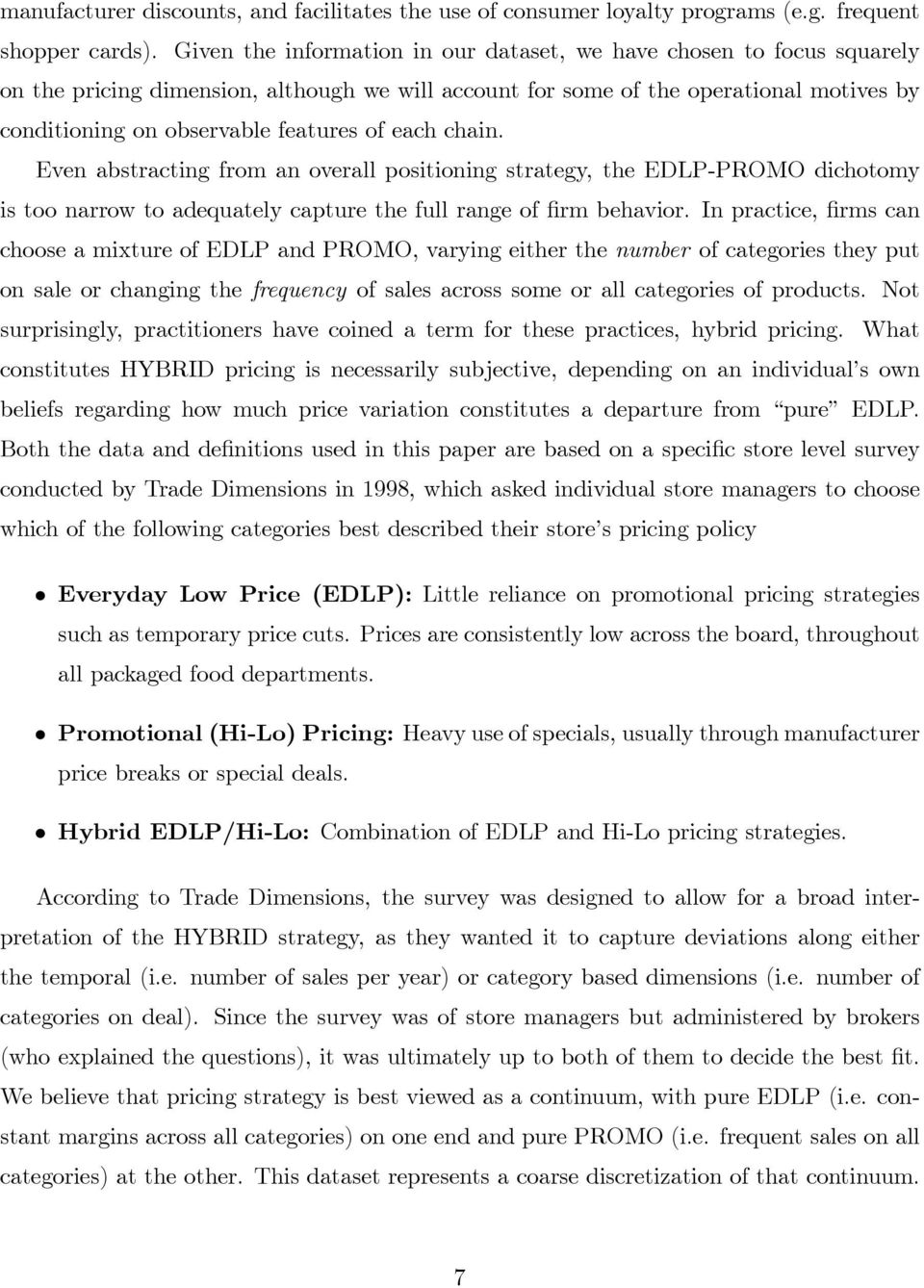
7 Without this data on individual stores, it is tempting to onlude that all priing strategiesaredeterminedatthelevelofthehain. Toexaminetheissuemorelosely,wefous inonasinglehaininasinglemarket: thepathmarkhaininnewjersey. Figure1shows the spatial loations of every Pathmark store in New Jersey, along with its priing strategy. Two features of the data are worth emphasizing. We address them in sequene. First, Pathmark does not follow a single strategy aross its stores: 42% of the stores use PROMO priing, 33% follow EDLP, and the remaining 25% use HYBRID. The heterogeneity in priing strategy observed in the Pathmark ase is not speifi to this partiular hain. Table3showsthestorelevelstrategieshosenbythetop15U.S.supermarkets(by total volume) along with their total store ounts. As with Pathmark, the major hains are also surprisingly heterogeneous. While some firms appear to have a lear fous (e.g. Wal-Mart, H.E. Butt, Stop& Shop), others are more evenly split(e.g. Luky, Cub Foods). This pattern extends to the full set of firms. Table 4 shows the priing strategies hosen bylargeandsmallhains,usingfouralternativedefinitionsof large and small. 3 While large hains seem evenly distributed aross the strategies and small hains seem to favor PROMO, firm size is not the primary determinant of priing strategy. The seond noteworthy feature of the Pathmark data is that even geographially proximate stores adopt quite different priing strategies. While there is some lustering at the broader spatial level (north vs. south New Jersey), the extent to whih these strategies are interlaed is striking. Again, looking beyond Pathmark and New Jersey onfirms that this within-hain spatial heterogeneity is not unique to this partiular example. Broadly speaking, the data reveal only a weak relationship between geography and priing strategy. While southern hains suh as Food Lion are widely pereived to favor EDLP and Northeastern hains like Stop& Shop are thought to prefer promotional(promo) priing, regional variation does not apture the full story. Table 2 shows the perent of stores that hoose either EDLP, HYBRID, or PROMO priing in eight geographi regions of the U.S. While PROMO priing is most popular in the Northeast, Great Lakes and entral Southern regions, it is far from dominant, as both the EDLP and HYBRID strategies enjoy healthy 3 Thefourdefinitionsoffirmsizeare: hain/independent,vertiallyintegratedandnot,large/smallstore, and many/few hekouts. A hain is defined as having 11 or more stores, while an independent has 10 of fewer. Vertially integrated means the firm operates its own distribution enters. Large versus small store sizeandmanyversusfewhekoutsaredefinedbytheupperandlowerquartilesofthefullstorelevelensus. 8

8 shares there as well. EDLP is ertainly popular in the South and Southeast, but PROMO still draws double digit shares in both regions. This heterogeneity in priing strategy is easily illustrated using the spatial struture of our dataset. Figure 2 plots the geographi loationofeverystoreintheu.s.,alongwiththeirpriingstrategy. Asislearfromthe panels orresponding to eah priing strategy, there is no obvious pattern at this level of aggregation. Taken together, these observations suggest looking elsewhere for the primary determinants of priing strategy. We turn next to the role of market demographis and then to the nature and degree of ompetition. Table 5 ontains the average demographi harateristis of markets served by stores of eah type. PROMO priing is assoiated with smaller households, higher inome, fewer automobiles per apita, and less raial diversity, providing some support for Bell and Lattin s (1998)influentialmodelof basketsize 4. However,thedifferenesarenotoverwhelming and, in many ases, statistially insignifiant. We note that this does not imply that demographis are irrelevant, but rather that the aggregate level patterns linking priing strategy and demographis are not overwhelming. We will demonstrate below that loal variation in demographis helps explain why hains tend to adopt heterogeneous priing strategies aross stores. The final row of Table 5 ontains the share of rival stores in the ompeting market thatemploythe samestrategyas thestorebeinganalyzed. Herewefindastrongresult: 50% of a store s rivals in a given loation employ the same priing strategy as the store being analyzed. Competitor fators were also the most important explanatory fator in Shankar and Bolton s(2004) analysis of priing variability in supermarket sanner data. In partiular, they note that what is most striking, however, is that the ompetitor fators are the most dominant determinants of retailer priing in a broad framework that inluded several other fators. Even at this rather oarse level of analysis, the data reveal that most stores hoose similar priing strategies. This pattern learly warrants a more detailed investigation and is the fous of our strutural model. 4 BellandLattin(1998)find thatthemostimportantfeaturesofshoppingbehavioranbeapturedby two interrelated hoies: basket size(how muh you buy) and shopping frequeny(how often you go). They suggest that large or fixed basket shoppers (i.e. those who buy more and shop less) will more sensitive to the overall basket prie than those who shop frequently and will therefore prefer EDLP priing to PROMO. They present empirial evidene that is onsistent with this predition. 9

9 Three entral features of supermarket priing strategy emerge from this disussion. First, supermarket hains adopt heterogeneous priing strategies, suggesting that demand related fores may outweigh any advantages aruing from hain level speialization. Seond, loal market fators play a key role in shaping demand harateristis. Finally, any empirial analysis of priing strategy must inlude the role of ompetition. While investigating the role of market demographis and firm harateristis is not oneptually diffiult, quantifying the strutural impat of rival priing strategies on firm behavior requires a formal game theoreti model of priing behavior that aounts for the simultaneity of hoies. In the following setion, we embed priing strategy in a disrete game that aommodates both loal demographis and the strategies of rival firms. We then estimate this model using a two-step approah developed by Bajari et al. (2005). 3 Theoretial Framework A supermarket s hoie of priing strategy is naturally framed as a disrete game between a finite set of players. Eah firm s optimal hoie is determined by the underlying market onditions, its own harateristis and individual strengths, and its expetations regarding theationsofitsrivals. Notably,thestrategihoieofeahfirmisafuntionoftheantiipated hoies of its ompetitors, and vie versa. If strategi expetations were ignored, a firm s hoie of priing strategy would be a straightforward disrete hoie problem. However, sine firms will ondition their strategies on their beliefs regarding rivals ations, this disrete hoie must be modeled using a system of simultaneous equations. In what follows, we outline our model in detail. 3.1 A Strategi Model of Supermarket Priing Inourframework,firms(i.e. supermarkethains 5 )makeadisretehoieofpriingstrategy, seleting among three alternatives: everyday low priing, promotional priing, and a hybrid strategy. While there is learly a role for dynamis in determining an optimal priing poliy, we assume that firms at simultaneously in a stati environment, taking entry deisions as 5 Heneforth,wewilluse hains and firms interhangeably. 10

10 given. 6 Astatitreatmentofompetitionis notaltogetherunrealisti sinethesepriing investments involve substantial investments in ommuniation and positioning related osts thatarenoteasilyreversible. 7 Inwhatfollows,weassumethatompetitiontakesplaein loal markets, 8 eahontained in a global market(here, an MSA). Before proeeding further, we must introdue someadditionalnotation. Storesbelongingtoagivenhain=1,..,C,thatareloatedin aloalmarketl m =1,..,L m,inanmsam=1,..,m,willbeindexedusingi l m =1,..,N l m ThetotalnumberofstoresinapartiularhaininagivenMSAisN m = thetotalnumberofstoresinthathainarossallmsasisn = L m l m=1. N lm,while M N m. Ineahloalmarket,hainsseletapriingstrategy(ation)afromthethreeelementsetK={E,H,P}, where E EDLP, H HYBRID,and P PROMO.If weobserve amarket l m ontaining N l m C = N l m players for example, the vetor of possible ation profiles is then =1 A lm ={E,H,P} Nl m with generi element a lm =(a 1,a 2,...,a i,...,a N ). The vetor of ationsofi l m sompetitorsisdenoteda i =(a 1,..,a i 1,a i lm +1,..a N lm ). In a given market, a partiular hain s state vetor is denoted s m S m, while the N m state vetor for the market as a whole is s m = (s m 1,...,sm N ) S m. The state vetor s m isknowntoallfirmsandobservedbytheeonometriian. Itdesribesfeaturesofthe market and harateristis of the firms that are assumed to be determined exogenously. For eah firm, there are also three unobserved state variables (orresponding to the three 6 Ideally, entry and priing deisions would be modeled jointly, allowing for firms that favor EDLP, for example, to prefer ertain types of markets. Unfortunately, even modeling supermarket loation hoie alone would be intratable, as it would require estimating a oordinated hoie of up to 1200 store loations by eah of hundreds of firms (the urrent state of the art (Jia, 2006) an handle two firms). Nonetheless, we believe that ignoring entry will not yield signifiant bias in our setting, sine logistial issues far outweigh priing strategy in determining entry deisions. In partiular, supermarket hains hoose store loations to maximize supply side density eonomies, designing hub and spoke networks to minimize transportation osts. The spatial distribution of stores traks population very losely; the gaps that one would expet if firms were herry piking priing-friendly markets simply do not exist. Ellikson (2006) presents empirial evidene onsistent with these laims. 7 Sine this is not an entry game (and priing deisions are relatively sunk), we are not partiularly onerned about the possibility of ex post regret that an sometimes our in stati games(einav, 2003). 8 Inourappliation,aloalmarketisasmallgeographitradingarea,roughlythesizeofazipode. The proedure we used to onstrut these markets is desribed in Setion 5.2. m=1 =1 11

11 priing strategies) that are treated as private information of the firm. These unobserved statevariablesaredenotedɛ i (a i lm,ormoreompatlyɛ i,andrepresentfirmspeifi shoks to the profitability of eah strategy. The private information assumption makes this ) a game of inomplete or asymmetri information(e.g. Harsanyi, 1973) and the appropriate equilibriumoneptoneofbayesiannashequilibrium(bne). 9 Foranygivenmarket,the ( ) ɛ i sareassumedtobeiidarossfirmsandations,anddrawnfromadistributionf ɛ i that is known to everyone, inluding the eonometriian. Firms hoose priing strategies in eah store independently, with the objetive of maximizingexpetedprofitsineahstore. Inmarketl m,theprofitearnedbystorei isgiven by π i =Π i (s m,a i,a i )+ɛ i (1) where Π i is a known and deterministi funtion of states and ations (both own and rival s). This extends the standard disrete hoie framework by allowing the ations of a firm s rivals to enter its payoff funtion. Sine the ɛ are treated as private information, afirm sdeisionrulea i =d i (s m,ɛ i lm isafuntionoftheommonstatevetorand itsownɛ, butnot theprivateinformationof itsrivals. Theprobabilitythatagivenfirm hoosesationkonditionalontheommonstatevetoristhengivenby P i (a i lm ) =k } = ) { ) } ( 1 d i (s m,ɛ i =k f ɛ i )dɛ i, (2) { where 1 d i (s,ɛ i lm =k isanindiatorfuntionequalto1ifstorei lm hooses ation k and 0 otherwise. These probabilities represent the expeted ations of a given store from ) the perspetive of the other stores in the market. We let P lm denote the set of these probabilities for a given loal market. Sine the firm does not observe the ations of its ompetitors prior to hoosing an ation, it makes deisions based on these expetations. Theexpetedprofitforfirmi lm fromhoosingationa i isthen π i (a i,s m,ɛ i,p lm ) = π i (a i lm = Π i a i,s m) +ɛ i (3) ( lm s m,a i,a i )P i +ɛ i (4) 9 Treating the types as private information greatly simplifies the omputational burden of estimation. By avoiding the ompliated regions of integration that arise in the omplete information ase, we an aommodate a muh larger number of players and potential ations. 12

12 wherep i = isgivenby j i l m P j (a j s m ).Giventheseexpetedprofits,theoptimalationforastore { Ψ i =Pr ɛ i π i (a i,s m) +ɛ i (a i )> π i lm (a i lm,s m) +ɛ i (a i lm ) a i lm } a i. (5) Iftheɛ i saredrawnfromatypeiextremevaluedistribution(i.e. Gumbelerrors),the Bayesian Nash Equilibrium to this stati game must satisfy a system of logit equations(i.e. best response funtions). Beause a firm s optimal ation is unique by onstrution, there is no need to onsider mixed strategies. The general framework desribed above has been applied in several eonomi settings and its properties are well understood. In partiular, existene of equilibrium follows easily from Brouwer s fixed point theorem(mkelvy and Palfrey, 1995). To proeed further, we need to hoose a partiular speifiation for the expeted profit funtions. Wewillassumethattheprofitthataruestostorei lm from hoosing strategy kinloationl m isgivenby π i (a i lm =k,s m,ɛ i,p lm )=s m β k +ρ E i lm α k1 +ρ P α i lm k2 +ξ m (k)+ζ (k)+ε i (k). (6) where,asbefore,s m istheommonstatevetorofbothmarket(loalandmsa)andfirm harateristis(hainandstorelevel). Theρ E andρ P terms represent the expeted i lm i lm proportion of a store s ompetitors in market l m that will hoose EDLP and PROMO strategies respetively: ρ (k) = 1 P i lm j (a j =k) N lm j i l m Notethatwehaveassumedthatpayoffsarealinearfuntionoftheshareofstoresthat hoose EDLP and PROMO, whih simplifies the estimation problem and eliminates the need toonsiderthesharewhohoosehybrid(h). Wefurthernormalizetheaverageprofit from the PROMO strategy to zero, one of three assumptions required for identifiation. We disuss our identifiation strategy in detail in setion 5.6. In addition, we have assumed thattheprivateinformationavailabletostorei lm (i.e. ɛ i )anbedeomposedintothree additive stohasti omponents: ɛ i (k)=ξ m (k)+ζ (k)+ε i (k). (7) 13
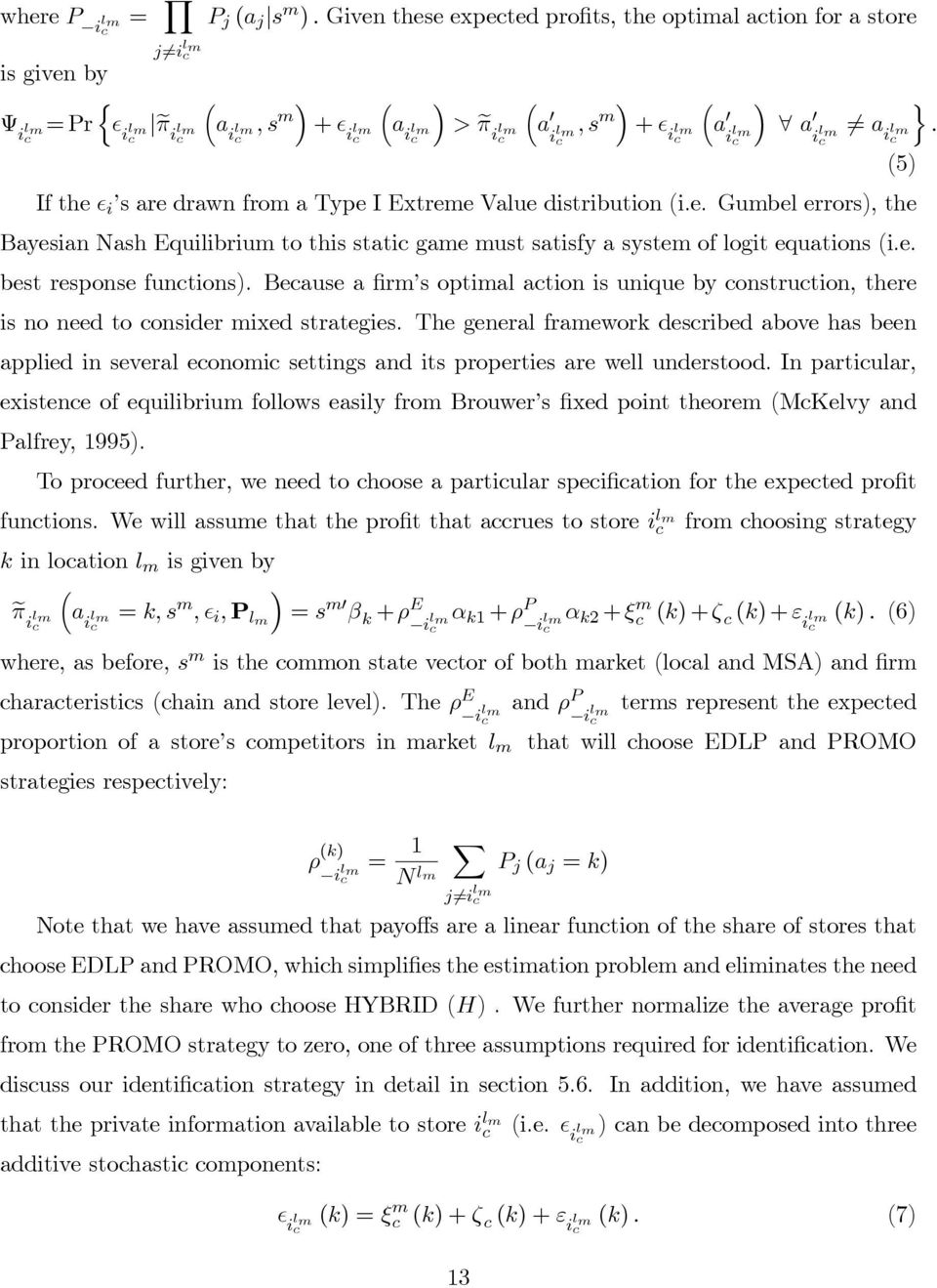
13 whereε i (k)representsloalmarketlevelprivateinformation,ξ m (k)istheprivateinformationthatahainpossessesaboutapartiularglobalmarket(msa),andζ (k)isanonspatial omponent of private information that is hain speifi. Following our earlier disussion,wewillassumethatε i (k)isani.i.d.gumbelerror. Wefurtherassumethattheother omponentsarejointlydistributedwithdistributionfuntionf(ξ m (k),ζ (k);ω),whereω isasetofparametersassoiatedwithf. DenotingtheparametervetorΘ={β,α,Ω}and lettingδ i (k)beanindiatorfuntionsuhthat δ i (k)={ 1 0 ifa i =k ifa i k the optimal hoie probabilities for a given store an be written as (8) ) Ψ i (a i =k Θ,P lm,x,ξ lm (k) = while the likelihood an be onstruted as ( exp exp k {E,H,P} s m β k +ρ E i lm ( s m β k +ρ E i lm ) α k1 +ρ P α i lm k2 +ξ m (k)+ζ (k) α k1 +ρ P α i lm k2 +ξ m (k)+ζ (k) (9) ) m M ζ (k) C ξ m (k) l m L m i lm N lm [ )] Ψ i (a i =k Θ,P lm,s,ξ m δi lm (k),ζ (k) (k) df(ξm (k),ζ (k);ω) s.t.p lm =Ψ lm (Θ,P lm,s,ξ m (k),ζ (k)) (10) Note that the onstrution of the likelihood involves a system of disrete hoie equations thatmustsatisfyafixedpointonstraint(p lm =Ψ lm ). Therearetwomainapproahesfor dealing with the reursive struture of this system; both are based on methods originally applied to dynami disrete hoie problems. The first, based on Rust s (1987) Nested Fixed Point(NFXP) algorithm, involves solving for the fixed point of the system at every andidate parameter vetor and then using these fixed point probabilities to evaluate the likelihood. ThisisthemethodusedbySeim(2006)inheranalysisofthevideorentalmarket. The NFXP approah, however, is both omputationally demanding and straightforward to 14

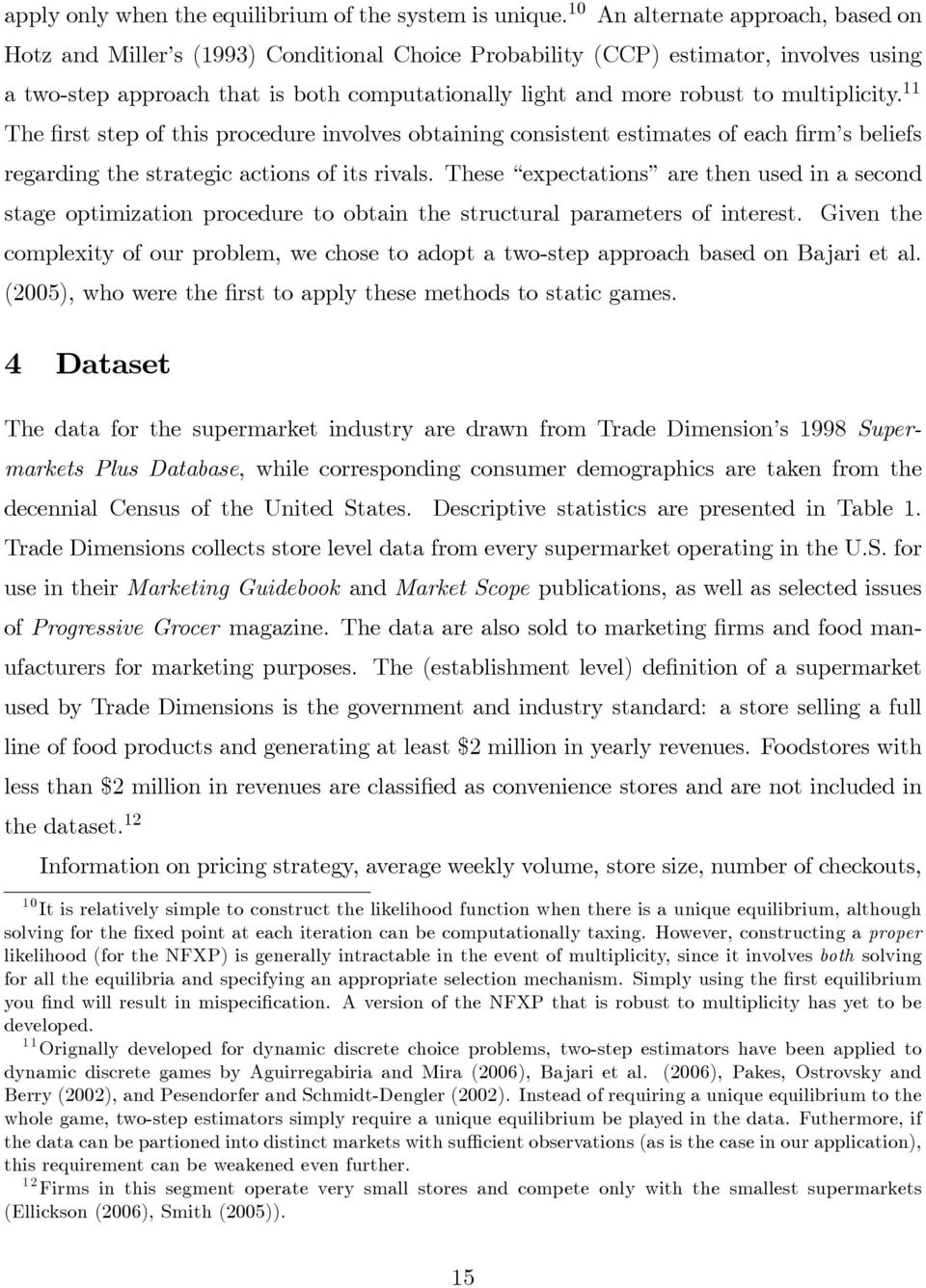
14 applyonlywhentheequilibriumofthesystemisunique. 10 Analternateapproah,basedon Hotz and Miller s (1993) Conditional Choie Probability(CCP) estimator, involves using atwo-stepapproahthatisbothomputationallylightandmorerobusttomultipliity. 11 The first step of this proedure involves obtaining onsistent estimates of eah firm s beliefs regarding the strategi ations of its rivals. These expetations are then used in a seond stage optimization proedure to obtain the strutural parameters of interest. Given the omplexityofourproblem, wehosetoadoptatwo-stepapproahbasedonbajarietal. (2005),whowerethefirsttoapplythesemethodstostatigames. 4 Dataset The data for the supermarket industry are drawn from Trade Dimension s 1998 Supermarkets Plus Database, while orresponding onsumer demographis are taken from the deennial Census of the United States. Desriptive statistis are presented in Table 1. Trade Dimensions ollets store level data from every supermarket operating in the U.S. for use in their Marketing Guidebook and Market Sope publiations, as well as seleted issues of Progressive Groer magazine. The data are also sold to marketing firms and food manufaturers for marketing purposes. The (establishment level) definition of a supermarket used by Trade Dimensions is the government and industry standard: a store selling a full line of food produts and generating at least $2 million in yearly revenues. Foodstores with less than $2 million in revenues are lassified as onveniene stores and are not inluded in thedataset. 12 Information on priing strategy, average weekly volume, store size, number of hekouts, 10 Itisrelativelysimpletoonstrutthelikelihoodfuntionwhenthereisauniqueequilibrium,although solving for the fixed point at eah iteration an be omputationally taxing. However, onstruting a proper likelihood(for the NFXP) is generally intratable in the event of multipliity, sine it involves both solving for all the equilibria and speifying an appropriate seletion mehanism. Simply using the first equilibrium you find will result in mispeifiation. A version of the NFXP that is robust to multipliity has yet to be developed. 11 Orignally developed for dynami disrete hoie problems, two-step estimators have been applied to dynami disrete games by Aguirregabiria and Mira (2006), Bajari et al. (2006), Pakes, Ostrovsky and Berry(2002), and Pesendorfer and Shmidt-Dengler(2002). Instead of requiring a unique equilibrium to the whole game, two-step estimators simply require a unique equilibrium be played in the data. Futhermore, if the data an be partioned into distint markets with suffiient observations(as is the ase in our appliation), this requirement an be weakened even further. 12 Firms in this segment operate very small stores and ompete only with the smallest supermarkets (Ellikson(2006), Smith(2005)). 15
15 and additional store and hain level harateristis was gathered using a survey of eah storemanager,ondutedbytheirprinipalfoodbroker. 13 Withregardtopriingstrategy, managersareaskedtohoosethestrategythatislosesttowhattheirstorepratieson a general basis: either EDLP, PROMO or HYBRID. The HYBRID strategy is inluded to aount for the fat that many pratitioners and marketing theorists view the spetrum of priing strategies as more a ontinuum than a simple EDLP-PROMO dihotomy(shankar andbolton,2004). ThefatthatjustoverathirdoftherespondentshosetheHYBRID option is onsistent with this pereption. 5 Empirial Implementation The empirial implementation of our framework requires three primary inputs. First, we needtohooseanappropriatesetofstatevariables. Thesewillbethemarket, storeand hain harateristis that are most relevant to priing strategy. To determine whih speifi variables to inlude, we draw heavily on the existing marketing literature. Seond, we will need to define what we mean by a market. Finally, we need to estimate beliefs and onstrut the empirial likelihood. We outline eah of these steps in the following subsetions. 5.1 Determinants of Priing Strategy Thefousofthispaperistheimpatofrivalpriingpoliiesonafirm sownpriingstrategy. However, there are learly many other fators that influene priing behavior. Researhers in both marketing and eonomis have identified several, inluding onsumer demographis, rival priing behavior, and market, hain, and store harateristis (Shankar and Bolton, 2004). Sinewehavealreadydisussedtheroleofrivalfirms,wenowfousontheadditional determinants of priing strategy. Several marketing papers highlight the impat of demographis on priing strategy(ortmeyeretal.,1991;hohetal.,1994;lalandrao,1997;bellandlattin,1998). Ofpartiular 13 It should be noted that all of these variables, inluding the information on priing strategy, are selfreported. However, it is extremely unlikely that the results reported below ould be the produt of systemati reporting error, as this would require oordination between tens of thousands of managers and thousands of brokers to willfully mis-report their praties(for no obvious personal gain). 16

16 importane are onsumer fators suh as inome, family size, age, and aess to automobiles. In most strategi priing models, the PROMO strategy is motivated by some form of spatial or temporal prie disrimination. In the spatial models(e.g. Lal and Rao, 1997; Varian, 1980), PROMO priing is geared toward onsumers who are either willing or able to visit more than one store (i.e. those with low travel osts) or, more generally, those who are more informed about prie levels. The EDLP strategy instead targets those with higher travel osts or those who are less informed(perhaps due to heterogeneity in the ost of aquiring prie information). In the ase of temporal disrimination (Bell and Lattin, 1998; Bliss, 1988), PROMO priing targets the ustomers who are willing to either delay purhase or stokpile produts, while EDLP targets ustomers that prefer to purhase their entirebasketinasingletriporatasinglestore. Clearly,theabilitytosubstituteovertime or aross stores will depend on onsumer harateristis. To aount for these fators, we inlude measures of family size, household inome, median vehile ownership, and raial omposition in our empirial analysis. Sine alternative priing strategies will require differing levels of fixed investment(lattin and Ortmeyer, 1991), it is important to ontrol for both store and hain level harateristis. For example, large and small hains may differ in their ability to implement priing strategies(dhar and Hoh, 1997). Store level fators are also likely to play a role(messinger and Narasimhan, 1997). For example, EDLP stores may need to arry a larger inventory and PROMO stores might need to advertise more heavily. Therefore, we inlude a measureofstoresizeandanindiatorvariableforwhetheritispartofavertiallyintegrated hain. Finally, sine the effetiveness of priing strategies might vary by market size(e.g. urban versus rural), we inlude measures of geographi size, population density, and average expenditures on food. 5.2 Market Definition The supermarket industry is omposed of a large number of firms operating anywhere from1to1200outlets. Wefousonthehoieofpriingstrategyatanindividualstore, abstratingawayfromthemoreomplexissueofhowdeisionsaremadeatthelevelofthe hain. Sine we intend to fous on store level ompetition, we need a suitable definition of the loal market. This requires identifying the primary trade area from whih eah store 17

17 draws potential ustomers. Without disaggregate, onsumer-level information, the task of defining loal markets requires some simplifying assumptions. In partiular, we assume markets an be defined by spatial proximity alone, whih an be a strong assumption in some irumstanes(bell, Ho, and Tang(1998)). However, without onsumer level purhase information we an t relax this assumption. Therefore, we will try to be as flexible as possible in defining spatial markets. Although there are many ways to group firms using existing geographi boundaries (e.g. ZipCodes or Counties), these pre-speified regions all share the same drawbak: they inrease dramatially in size from east to west, refleting established patterns of population density. 14 Ratherthanimposingthisstrutureexogenously,weallowthedatatosortitself by using luster analysis. In partiular, we assume that a market is a ontiguous geographi area, measurable by geodesi distane and ontaining a set of ompeting stores. Intuitively, markets are groups of stores that are loated lose to one another. To onstrut these markets, we used a statistial lustering method(k-means) based on latitude, longitude and ZipCode information. 15 Our lustering approah produed a large set of distint lusters that we believe to be a good approximation of the atual markets in whih supermarkets ompete. These store lusters are somewhat larger than a typial ZipCode, but signifiantly smaller than the average ounty. We varied the number of lusters and found that about eight thousand best aptures the retail supermarket landsape. A typial ounty and the lusters within it are depited in Figure 3. As is evident from the map, our lustering method appears to apture geographi proximity in a sensible manner. While there are undoubtedly other fators(suh as highways or rivers) that might ause onsumers to pereive markets in slightly different ways, we believe that these geographi lusters onstitute a reasonable hoie of market definition for this industry. As robustness heks, we experimented with both broader and narrower definitions of the market(e.g. ZipCodes and MSAs) and found qualitatively similar results (see Appendix A.1). 14 OneexeptionisCensusblokgroups,whihareabouthalfthesizeofatypialZipCode. However,we feel that these areas are too small to onstitute reasonably distint supermarket trading areas. 15 ZipCodes are required to ensure ontiguity: without ZipCode information, stores in Manhattan would beinludedinthesamemarketasstoresinnewjersey. 18

18 5.3 Estimation Strategy As noted above, the system of disrete hoie equations presents a hallenge for estimation. We adopt a two stage approah based on Bajari et al. (2005) that avoids solving for a fixedpoint. ThefirststepinvolvesobtainingaonsistentestimateofP lm,theprobabilities that appear (impliitly) on the right hand side of equation (9) 16. These estimates ( P lm ) are then used to onstrut the ρ s, whih are then plugged into the likelihood funtion. Maximization of this (pseudo) likelihood onstitutes the seond stage of the proedure. Consisteny and asymptoti normality has been established for a broad lass of two-step estimators by Newey and MFadden(1994), while Bajari et al. (2005) provide formal results for the model estimated here. 5.4 The Likelihood In our eonometri implementation, we will assume that ζ and ξ are independent, mean zero normal errors, so that F(ξ m (k),ζ (k);ω)=f ξ (ξ m (k);ω ξ (k)) F ζ (ζ (k);ω ζ (k)), (11) whereboth F ξ andf ζ are mean zero normaldistribution funtions with finite ovariane matries. For simpliity, we also assume that the ovariane matries are diagonal with elementsτ 2 ζ (k)andτ2 ξ (k). Foridentifiation,onsistentwithourearlierindependeneand normalizationassumptions,wewillassumethatξ m (P)=ζ (P)=0 C,m M.These assumptions allows us to use a simulated maximum likelihood proedure that replaes(10) with its sample analog L(Θ)= m M R 1 ζ R ζ r ζ =1 C R 1 ξ R ξ r ξ =1 l m L m i lm N lm [ )] Ψ i (a i =k Θ, P lm,s,ξ m δi lm (k),ζ (k) Inthesimulationproedure,[ξ m (k)] rξ and[ζ (k)] rζ aredrawnfrommeanzeronormal densitieswithvarianesτ 2 ξ (k)andτ2 ζ (k)respetively. WeuseR ξ=r ζ =500andmaximize (12) to obtain estimates of the strutural parameters. Note that the fixed point restrition, 16 Theρ sarefuntionsofp lm. (12) (k). 19

19 P lm = Ψ lm, no longer appears sine we have replaed P lm with P lm in the formulas for ρ EDLP i lm andρ PROMO,whihareusedinonstrutingΨ i lm i (see9).wenowmovetoadisussion of how we estimate beliefs. 5.5 Estimating Beliefs In an ideal setting, we ould reover estimates of eah store s beliefs regarding the onditional hoie probabilities of its ompetitors using fully flexible non-parametri methods (e.g. kernel regressions or sieve estimators). Unfortunately, given the large number of ovariates we have inluded in our state vetor, these methods are infeasible here. Instead, we employ a parametri approah for estimating ˆρ i, using a mixed multinomial logit (MNL) speifiation to reover these first stage hoie probabilities(appendix A.3 ontains a semi-parametri robustness analysis). Note that this is essentially the same speifiation employed in the seond stage proedure(outlined above), only the store s beliefs regarding rival s ations are exluded from this initial redued form. Note that we do not require an expliit exlusion restrition, sine our speifiation already ontains natural exlusion restritions due to the presene of state variables that vary aross stores and hains. We implement an estimator similar to (12), but with the oeffiients on the ρ s (i.e. α s)settozero. LettheparametersinthefirststagebedenotedbyΛ 1 ={β 1,Ω 1 } 17 and the first stage likelihood for a given store be denoted by L i (Λ,ξ m (k),ζ (k)). Using a simulatedmaximumlikelihoodapproah,weobtainˆλ 1,themaximum(simulated)likelihood estimateofλ 1.Giventheseestimates,andapplyingBayes rule,theposteriorexpetation ofp(a i =k s,ξ m (k),ζ (k))anbeobtainedviathefollowingomputation ζ ξ ) ) ( ) Ψ i (a i =k ˆΛ,ξ m (k),ζ (k) L i (ˆΛ,ξ m (k),ζ (k) df ξ m (k),ζ (k);ˆω 1 (k) ζ ξ ) ( ) m L i (ˆΛ,ξ (k),ζ (k) df ξ m (k),ζ (k);ˆω 1 (k) While this expression is diffiult to evaluate analytially, the vetor of beliefs defined )] byˆρ (k) =E i lm {ζ,ξ} [Ψ i (a i =k ˆΛ,ξ m (k),ζ (k) an be approximated by its simulation 17 Thesubsript1denotesthatthesearefirststageestimates.. (13) 20
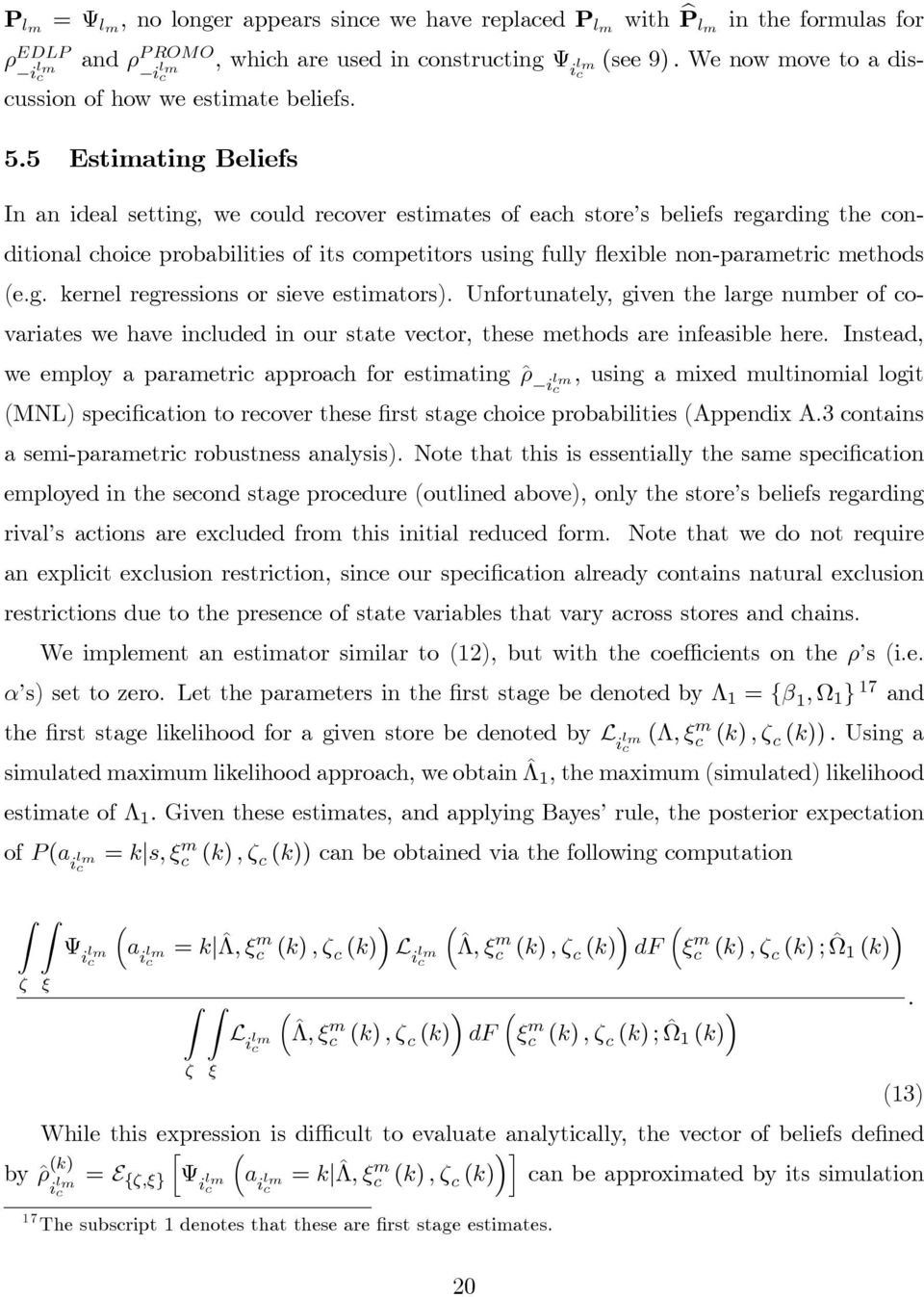
20 analog ˆρ (k) i lm R Ψ r=1 i lm ( ) a i =k ˆΛ,[ξ m m (k),ζ (k)] r )L i (ˆΛ,[ξ (k),ζ (k)] r ). (14) (ˆΛ,[ξ m (k),ζ (k)] r R L r=1 i lm in whih [ξ m (k),ζ (k)] r are draws fromadistribution F ( ) ξ m (k),ζ (k);ˆω with similar properties to those desribed in Setion 5.4. Again, we use R = 500 simulation draws. Reallingthatk K={E,H,P},weannowdefineaonsistentestimatorofρ (k) as i l m ˆρ (k) = i lm v N lm v 1 h i lm ˆρ (k) h. (15) We note in passing that the onsistenyof our estimator is maintained even with the inlusion of two types of random effets, sine these variables are treated as private information of eah store. As noted earlier, allowing for random effets that are ommon knowledge to the players, but unobserved to the eonometriian(e.g. market level heterogeneity) would violatethei.i.d.assumptionrequiredforonsistenyofthetwo-stepestimationproedure. 18 However,wewillrelaxthisassumptionbelowinoneofourrobustnessheks. Afinalnote relates to the onstrution of standard errors. Sine the two-step approah preludes using theinverseinformationmatrix,weemployabootstrapapproahinstead Identifiation Bajari et al. (2005) establish identifiation of the strutural parameters of a disrete game provided three assumptions are satisfied. The first two have already been(impliitly) stated, butwillberepeatedheremoreformally. Thefirstassumptionisthattheerrortermsɛ i are distributed i.i.d.aross players and ations in anygivenmarket 20, and aredrawn froma 18 Bajari et al. (2005) suggest using fixed effets whih are restrited to be smooth funtions of the observed state variables. We do not have enough data to estimate their non-parametri first stage and prefer an approah based on Aguirregabiria and Mira s (2006) Nested Pseudo Likelihood approah to ontrol for loation speifi unobservables. 19 Inpartiular,webootstrappedarossmarkets(notindividualstores)andheldthepseudorandomdraws in the simulated likelihood fixed aross bootstrap iterations. To save time we used the full data estimates as starting values in eah bootstrap iteration. 20 Notethattheiidrequirementonly needs tohold atthe marketlevel. Forexample, it s fine to inlude random effets in the error term, provided these effets are treated as private information of the partiular storeinquestion. Thisisinfattheapproahweadoptbelow. 21
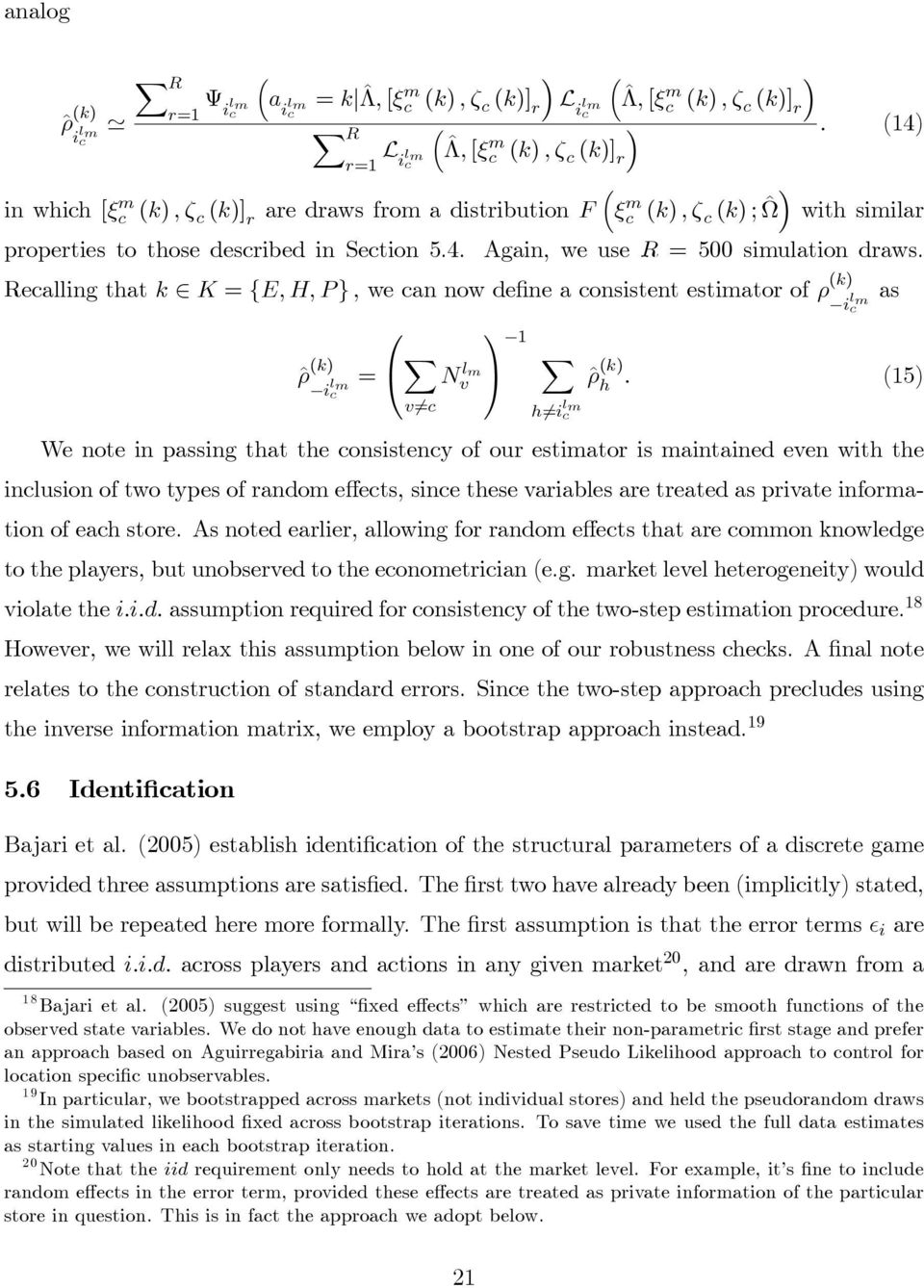
21 distribution of known parametri form. This is learly satisfied by the assumptions imposed above. The seond assumption requires that the expeted profit assoiated with one strategy be normalized to zero. This is a standard normalization required to identify any multinomial hoie model. We normalize the mean profit of the PROMO strategy to zero. The final assumption is an exlusion restrition. The reason for imposing an exlusion restrition an be illustrated using equation(9). Our two-step estimation proedure involves estimating the shares(ρ s) on the right hand sideof(9)inafirststage. Theseshares,whiharesimplefuntionsofeahfirm sbeliefs regarding the onditional hoie probabilities of its rival s (via the ρ s in (9)), depend on the same state vetor (s) as the first term of the profit funtion (s β k ), reating a potential identifiation problem. Note that identifiation an be trivially preserved by the non-linearity of the disrete hoie problem, although this follows diretly from funtional form. A non-parametri alternative, suggested by Bajari et al. (2005), is to identify one or moreontinuousovariatesthatenterfirmi spayoffs,butdonotenterthepayoffsofany ompeting firm. This exlusion restrition ensures that both the payoffs and the estimates of firms beliefs regarding the ations of their rivals are identified. Bajari et al. (2005) suggest using the idiosynrati shoks of rival firms as the exlusion. Sine our state vetor varies aross stores and hains, we have a natural exlusion restrition whih is similar in spirittothisidea. Inotherwords,whilethestatevariablesarethesametheydonotontain the same values aross stores and hains. This results in different patterns of variation in the ρ s and the profit omponent related to state variables (s β k ) helping identify the parameters leanly. 21 Identifiation of all other parameters is straightforward and we do not disuss them here. Having desribed both our theoretial model and empirial strategy, we now present our main results. 6 Results and Disussion As noted earlier, hoosing an optimal priing strategy is a omplex task, foring firms to balane the preferenes of their ustomers against the strategi ations of their rivals. A major advantage of our two-step estimation approah is that, by estimating best response 21 We are indebted to Vitor Aguirregabiria and Han Hong for helpful disussions on this topi and to Vitor in partiular for pointing out the presene of natural exlusion restritions in our model. 22
22 funtions rather than equilibrium orrespondenes, we an separately identify strategi interations, reations to loal and market level demographis, and operational advantages assoiated with larger stores and proprietary distribution systems. Our empirial results highlight eah of these fores. First, we find that firms hoose strategies that are tailored to the demographis of the market they serve. Moreover, the impat of demographis orresponds losely to existing empirial studies of onsumer preferenes and onventional wisdom regarding searh behavior. Seond, we find that the EDLP strategy is favored by firms that operate larger stores and are vertially integrated into distribution. Again, this aords with onventional wisdom regarding the main operational advantages of EDLP. Finally, with regard to strategi interation, we find that firms oordinate their ations, hoosing priing strategies that math their rivals. This identifies an aspet of firm behavior that has not been addressed in the existing literature: exatly how firms reat to rival strategies. Our main empirial results are presented in Table 6. The oeffiients, whih represent the parameters of the profit funtion represented in equation(6), have the same interpretation as those of a standard MNL model: positive values indiate a positive impat on profitability, inreasing the probability that the strategy is seleted relative to the outside option(in this ase, PROMO). 6.1 The Role of Demographis The oeffiients on onsumer demographis are presented in the seond and third setions of Table 6. With the exeption of two MSA-level ovariates, every demographi fator plays a signifiant role in thehoieof EDLPas apriing strategy. This is importantfroman eonometri standpoint, sine we use these very same fators to onstrut expetations in thefirststage. Inpartiular,thesignifianeoftheestimatesmeansthatwedonothaveto worry about ollinearity. The statistial signifiane of the parameters is also substantively important. It suggests that the even after aounting for ompetitive and supply side (store/hain) harateristis, onsumer demand plays a strong role in the determination of priing strategy. Fousing more losely on the demand related parameters, we find that (relative to PROMO), EDLP is the preferred strategy for geographi markets that have larger house- 23
23 holds ( β HH = ),moreraialdiversityintermsofafrian-amerian(β BL =0.6833) andhispani ( β HI = ) populations,lowerinome ( β INC = ),andfewervehilesperhousehold ( β VH = ). TheseresultssuggestthatEDLPismostlyaimed at lower inome onsumers with larger families(i.e. more urbanized areas). Our findings are learly onsistent with the onsumer segments that firms like Wal-Mart are widely pereived to target. It also aords quite well with the Bliss/Bell & Lattin model of fixed basket shopping behavior, in whih onsumers who are more sensitive to the prie of an overall basket of goods prefer EDLP. In partiular, our results suggest that the onsumers who are unable to substitute inter-temporally are disproportionately poor, from non-white demographi groups, and from larger families. On the other hand, we find that onsumers who are most able to defer or stokpile purhases(wealthy suburbanites with greater aess to transportation) are likely to prefer PROMO or HYBRID priing. 6.2 Firm and Store Level Charateristis Turning next to hain and store level harateristis, we again find that most parameter estimates are statistially signifiant. These effets, whih are in line with both theory and broad intuition, provide an additional empirial validation of our strutural framework. The last two setions of Table 6 show that stores hoosing EDLP are both signifiantly larger ( β SS = ) and far more likely to be vertially integrated ( β VI = ) into distribution. This is onsistent with the view that EDLP requires substantial firm level investment, areful inventory management, and a deeper seletion of produts in eah store. ItisalsoonsistentwiththemodelofLalandRao(1997),inwhihpriingstrategyinvolves developing an overall positioning strategy, requiring omplementary investments in store quality and produt seletion. Surprisingly, the total number of stores in the hain is negatively related to EDLP ( β ST = ), although this is diffiult to interpret sine almost all the large hains are vertially integrated into distribution (so there are almost no large, non-vertially integrated firms). Finally, both the hain speifi and hain/msa random effets are highly signifiant, whih is not surprising given the geographi patterns shownearlier Anearlierversionofthispaperalsoinludedtheshareofeahfirm sstoresoutsidetheloalmsathat employ EDLP and PROMO priing as additional regressors. Not surprisingly, a firm s propensity to follow a partiularstrategyatthelevelofthehainhadalargeandsignifiantimpatonitsstrategyinapartiular 24
24 6.3 The Role of Competition: Differentiation or Coordination By onstruting a formal model of strategi interation, we are able to address the entral questionposedinthispaper-whatisimpatofompetitiveexpetationsonthehoieof priing strategy? Our onlusions are quite surprising. The first setion of Table 6 reveals that firms faing ompetition from a high(expeted) share of EDLP stores are far more likely tohooseedlpthaneitherhybridorpromo(ˆσ EDLP i l m =4.4279,ˆσ PROMO i l m = ). The HYBRID ase behaves analogously; when faing a high proportion of either EDLP or PROMOrivals, astoreisleastlikelytohoosehybrid(ˆσ EDLP i l m = ,ˆσ PROMO i l m = ). In other words, we find no evidene that firms differentiate themselves with regard to priing strategy. To the ontrary, we find that rather than isolating themselves in strategy spae, firms prefer to oordinate on a single priing poliy. This oordination result stands in sharp ontrast to most formal models of priing behavior, whih(at least impliitly) assume that these strategies are vehiles for differentiation. Priing strategy is typially framed as a method for segmenting a heterogeneous marketfirms soften prie ompetition by moving further away from their rivals in strategy spae. This is not the ase for supermarkets. Instead of finding the anti-orrelation predited by these spatial models, we find evidene of assoiative mathing, whih usually ours in settings with network effets or omplementarities. This suggests that firms an inrease the overall level of demand by mathing their rivals strategies, a possibility we disuss in more detail in what follows. Before disussing our oordination result in greater detail, we must address the issue of ommon unobservables. Of obvious onern is whether firms are atually reating to the ations of their rivals, or simply optimizing over some ommon but unobserved features of the loal market. Manski(1993) frames this as the problem of distinguishing endogenous effets from orrelated effets. 23 While the presene of both effets yields ollinearity in the linear in means model examined there (i.e. the refletion problem), the non-linearity store (and soaked up a lot of variane). While this suggests the presene of signifiant sale eonomies in implementing priing strategies, as suggested in both Lattin and Ortmeyer(1991) and Hoh et al. (1994), we omitted it from the urrent draft in order to maintain the internal ohereny of the underlying model (i.e. the simultaneity of ations). 23 Manski (1993) also onsiders the role of ontextual effets, whereby the propensity of an individual to behave in some way varies with the distribution of bakground harateristis of the group. The stati setting of our game eliminates this third type of soial interation. 25
25 of the disrete hoie framework eliminates this stark non-identifiation result. However, the presene of orrelated unobservables remains a onern, so we extended our framework to inlude a loation speifi unobservable. To do so, we implemented a stati version of AguirregabiriaandMira s(2006)nestedpseudo-likelihood(npl)estimator. 24 Themain oordination results are presented in olumns 4 and 5 of Table 7(the demographi and hain level ovariates have been suppressed for brevity). While the magnitudes of the oeffiients do fall relative to the baseline speifiation(as expeted), the oordination effets are still large and signifiant. Whileourmainfousisontheparametersofthebestresponsefuntions,itisimportant to larify what our oordination result implies about the struture of the priing game. As a simplifiation, onsider two stores playing a game with a 3 3 payoff matrix based on priing poliy. Our empirial results indiate that the equilibria are onentrated on the diagonal ells, meaning that firms reeive larger payoffs when they oordinate. Intuitively, this has theflavorofa BattleoftheSexes gamewiththreehoies, in whihtheplayerswould like to oordinate on a single ativity- their priing strategy. However, in this priing game, the payoff matrix depends on market demographis, whih an failitate oordination. For example, firms may oordinate on EDLP in some markets (e.g. low inome), but favor PROMOinothers(e.g. highinome). 25 It is worth emphasizing that reations to market demographis and firm harateristis help explain how firms are able to oordinate on onsistent strategies. However, they do not explain why they hoose to do so. Coordination implies that firm s onditional hoie probabilities at as strategi omplements, meaning that their best response funtions(9) are upward sloping. To support omplementarity, oordination must somehow inrease theoverallsizeofthepiethatfirmsaresplitting(bydrawingexpendituresawayfromthe outside good). 24 Sine the NPL estimator iterates on the fixed point mapping, it does not require a onsistent first stage estimate of the hoie probabilities(whih is why it an inorporate a loation speifi unobservable). However, a drawbak of this approah is that it is not always guaranteed to onverge and requires the existene of a ontration around every relevant equilibria(judd and Su, 2006). 25 Anotherpossibilityisthatfirmsmightexploitthegeographistrutureofthegame(i.e. theiropponents behavior in other markets) as a signaling devie to failitate oordination. This type of equilibrium has some of the flavor of a orrelated equilibrium (e.g. Aumann, 1974), with spatial dependene playing the role of time. Formalizing this onjeture is beyond the sope of this paper, but is an intriguing topi for future researh. 26
26 In the ontext of supermarket priing, this suggests that oordination may atually inrease the amount onsumers are willing to spend on groeries, perhaps by drawing them away from substitutes like restaurants, onveniene stores, and disount lubs. One way this might our in pratie is if onsumers are more likely to trust retailers that provide amessagethatisonsistentwiththoseoftheirrivals. Inotherwords,ifonefirmtellsyou that providing the highest value involves high prie variation while another touts stable pries, you may be unwilling to trust either, shifting your business to a disount lub or another retail substitute. While this intuition has yet to be formalized, it is onsistent with the emphasis that Ortmeyer et al. (1991) plae on maintaining priing redibility. Another possibility, onsistent with Lal and Rao(1997), is that prie positioning is multidimensional and by oordinating their strategies stores an mitigate the osts of ompeting along several dimensions at one. Without a formal model of onsumer behavior and detailed purhase data, we are unable to pin down the exat soure of the omplementarities we have doumented here. However, we have provided strong empirial evidene regarding how firms atually behave. Understanding why firms find it profitable to oordinate their ations remains a promising area for future theoretial researh. The results presented above provide definitive answers to the three questions posed in the introdution of this paper. We have found that demand related fators(i.e. demographis) are important for determining the hoie of priing strategy in a market; store and firm level harateristis also play a entral role. Both of these results are in line with the extant literature. However, our results onerning ompetitive expetations are in sharp ontrast to prevailing theory in both eonomis and marketing and warrant further attention. The final setion outlines a researh agenda for extending the results found in this paper. 7 Conlusions and Diretions for Future Researh This paper analyzes supermarket priing strategies as disrete game. Using a system of simultaneous disrete hoie models, we estimate a firm s optimal hoie onditional on the underlying features of the market, as well as eah firm s beliefs regarding its ompetitor s ations. We find evidene that firms luster by strategy, rather than isolating themselves in produt spae. We also find that demographis and firm harateristis are strong deter- 27
27 minants of priing strategy. From a theoretial perspetive, it is lear that we have yet to fully understand what drives onsumer demand. The fat that firms oordinate with their rivals suggests that onsumers prefer to reeive a onsistent message. While our results pertain most diretly to supermarkets, it seems likely that other industries ould behave similarly. Future researh ould examine the robustness of our findings by analyzing other retail industries, suh as department stores or onsumer eletronis outlets. In this paper, our primary fous was the onstrution and eonometri implementation of a framework for analyzing best responses to rival priing strategies. Our analysis desribes the nature of strategi interations, but does not delve into the details of why these strategies are dominant. Deomposing the why element of strategi oordination seems a fruitful area ofresearh. Wehastentoaddthatsuhresearhisneedednotonlyontheempirialside but also on the theoretial front. Building theoretial models that allow for the possibility of both differentiation and oordination is a hallenging but likely rewarding path for future researh. The tendeny to oordinate raises the possibility that games suh as this might support multipleequilibria. Whilethisisnotaonerninoururrentstudy,itouldplayaentral role when onduting poliy experiments or when analyzing settings in whih demographis (or other ovariates) annot effetively failitate oordination. Developing methods that are robust to suh possibilities remains an important area for future researh. Finally, in building our model of strategi interation, we have assumed that firms interat in a stati setting, making independent deisions in eah store. A more involved model would allow hains to make joint deisions aross all of their outlets and aount for riher(dynami) aspets of investment. Developing suh a model is the fous of our urrent researh. 28
28 Referenes Aguirregabiria, V. and Mira, P., Sequential Simulation Based Estimation of Dynami Disrete Games, Forthoming in Eonometria (2006). Athey, S. and Shmutzler, A., Investment and Market Dominane, RAND Journal of Eonomis, 32(1),(2001) pp Augereau, A., Greenstein, S. and Rysman, M. Coordination vs. Differentiation in a Standards War: 56K Modems Forthoming in The Rand Journal of Eonomis. (2006).. Bajari, P., Hong, H., Krainer, J. and Nekipelov, D., Estimating Stati Models of Strategi Interations, Working Paper, University of Mihigan(2005). Bajari, P., Benkard, C.L., and Levin, J.D., Estimating Dynami Games of Inomplete Information, Forthoming in Eonometria,(2006). Bayer, P. and Timmins, C., Estimating Equilibrium Models of Sorting Aross Loations, Forthoming in Eonomi Journal (2006). Bell, D. and Lattin, J. Shopping Behavior and Consumer Preferene for Store Prie Format: Why Large Basket Shoppers Prefer EDLP. Marketing Siene. v.17-1 (1998) pp Berry, S., Ostrovsky, M., and Pakes, A., Simple Estimators for the Parameters of Disrete Dynami Games, Working Paper, Harvard University(2002). Bliss, C. A Theory of Retail Priing. Journal of Industrial Eonomis. v. 36(1988) pp Brok, W. and Durlauf, S., Disrete Choie with Soial Interations, Review of Eonomi Studies, 62(2),(2001), pp Coughlan, A. and Vilassim, N. Retail Marketing Strategies: An Investigation of Everyday Low Priing vs. Promotional Priing Poliies. Working Paper(1991). Einav, L., Not All Rivals Look Alike: Estimating an Equilibrium Model of The Release Date Timing Game, Stanford University Working Paper(2003). Ellikson, P., Does Sutton Apply to Supermarkets?, forthoming in the Rand Journal of Eonomis (2006). Ellikson, P., Quality Competition in Retailing: A Strutural Analysis, International 29
29 Journal of Industrial Organization, 24(3), pp ,(2006). Gowrisankaran, G. and Krainer, J. The Welfare Consequenes of ATM Surharges: Evidene from a Strutural Entry Model, Working Paper, Washington University(2004). Harsanyi, J. Games with Randomly Disturbed Payoffs: A New Rationale for Mixed- Strategy Equilibrium Points International Journal of Game Theory. v. 2(1973) pp Hoh, S., Dreze, X. and Purk, M. EDLP, Hi-Lo, and Margin Arithmeti Journal of Marketing. v. 58(1994) pp Hotz, J., and Miller, R., Conditional Choie Probabilities and the Estimation of Dynami Models, Review of Eonomi Studies, 60,(1993), pp Lal, R. and Rao, R. SupermarketCompetition: TheCaseofEveryDayLowPriing. Marketing Siene. v. 16-1(1997) pp Lattin, J. and Ortmeyer, G. A Theoretial Rationale for Everyday Low Priing by Groery Retailers. Working Paper(1991). Manski, C. Identifiation of Endogenous Soial Effets: The Refletion Problem. Review of Eonomi Studies, v. 60(1993) pp Nevo, A. Measuring Market Power in the Ready-to-Eat Cereal Industry. Eonometria, v. 69(2)(2001) pp Orhun, A.Y. Spatial Differentiation in the Supermarket Industry Working Paper, University of California(2005). Ortmeyer, G., Quelh, J. and Salmon, W. Restoring Credibility to Retail Priing. Sloan Management Review. (1991) pp Pesendorfer, M. and Shmidt-Dengler, P., Identifiation and Estimation of a Dynami Game, Working Paper, LSE(2003). Seim, K., An Empirial Model of Firm Entry with Endogenous Produt-Type Choies, Forthoming in the Rand Journal of Eonomis (2006). Shankar, V., and Bolton, R., An Empirial Analysis of Determinants of Retailer Priing Strategy, Marketing Siene, 23(1),(2004), pp Smith, H. Supermarket Choie and Supermarket Competition in Market Equilibrium, Forthoming in Review of Eonomi Studies (2006). Sweeting, A., Coordination Games, Multiple Equilibria, and the Timing of Radio Commerials, Northwestern University Working Paper(2004). 30
30 Varian, H. A Model of Sales. Amerian Eonomi Review. v. 70-4(1980) pp Watson, R. Produt Variety and Competition in the Retail Market for Eyeglasses Working Paper, University of Texas(2005). Zhu, T., Singh, V. and Manuszak, M. Market Struture and Competition in the Retail Disount Industry Working Paper, Carnegie Mellon University(2005). 31
31 A Robustness Cheks In this appendix, we examine the robustness of our results to alternative speifiations and distributional assumptions. In partiular, we fous on(1) market definition,(2) nonparametri estimation of beliefs, (3) linearity of the response funtions and (d) the parametri error struture. A.1 Market Delineation and Definition As noted earlier, our empirial analysis uses speifi market definitions based on spatial luster analysis. We verified the robustness of our results to alternative market definitions by repeating the analysis using ZipCodes, Counties, and MSAs. In all ases, the results were qualitatively similar. We also varied the number of lusters and again found no signifiant differenes in the results reported above. A.2 Multipliity As we noted earlier, onsistent estimation of a stati (or dynami) game requires some formofuniquenessofequilibrium,eitherinthemodelorinthedata. 26 Consistenyofour baseline model requires only one equilibrium be played in the data, whih, in our ontext, meanseveryloationineverymsa.itispossibletorelaxthisbyestimatingthefirststage separately for eah MSA, so the requirement beomes a unique equilibrium be played in eah MSA(wedonothaveenoughdatatoestimatethefirststageseparatelyfor eahluster, whih would eliminate the problem entirely). The results of this proedure were very lose to the baseline model. For brevity, we report only the oeffiients on the strategy variables (inolumns6and7oftable7). A.3 NonparametriEstimationofρ i As noted above, the ideal approah for estimating beliefs involves non-parametri tehniques. However, the number of ovariates we use preludes us from adopting suh a 26 Uniqueness may fail to hold in many settings. Brok and Durlauf(2001) and Sweeting (2004)provide two suh examples. Non-uniqueness an ompliate poliy experiments, whih typially involve solving for a new equilibrium. While we do not ondut any poliy experiments in this paper, Bajari et al. (2005) demonstrate how the homotopy ontinuation method an be used to simulate multiple equilibria in a setting similar to ours. 32
32 strategy. To assess the robustness of our results, we used a bivariate thin-plate spline to model priing strategies as non-parametri funtions of the strategies hosen outside the MSA. Again, the main results were qualitatively similar to those presented above. A.4 Nonlinearityoff ( ρ i ) Toexaminethepotentiallynon-linearrelationshipbetweenpayoffs(Π)andstrategies ( ρ i ), we adopted a smoothing splines approah to modeling f(ρ il ). In partiular, we reestimated our model using a bivariate thin-plate spline, treating the funtional relationship as ( f j (a i )=f ρ E i lm ),ρ P ϖ i lm The qualitative results obtained using the linear speifiation ontinue to hold. Sine the results for the other variables are similar, we will not repeat our earlier disussion of their effets here but fous only on the strategi results pertaining to priing strategy. In partiular, we fous our attention on the EDLP ase to illustrate our findings. Figure 4 depits the smoothed funtional relation between beliefs about ompetitor strategy and the probability of hoosing EDLP. As with the linear speifiation, we observe evidene of firms olloating in strategy spae. The probability of firms hoosing EDLP inreases with the proportion of ompetitors that also hoose EDLP. A.5 Error Struture In our analysis we assumed that firm types (the ɛ i s) were distributed Gumbel (Type I Extreme Value), allowing us to speify set of simultaneous multinomial logit hoie probabilities for determining priing poliies. As an alternative speifiation, similar to the empirial appliation in Bajari et al. (2005), we also tested ordered logit/probit models in whih the strategies were ranked on a EDLP-HYBRID-PROMO ontinuum. While qualitative findings were similar, these ordered speifiations fore a partiular ordering of the strategies that may not be warranted. (16) 33
33 Table 1: Desriptive Statistis Variable Obs Mean Std.Dev. Min. Max Strategy EDLP HYBRID PROMO MSA Charateristis Size(sq. miles) Density(pop 000 per sq. mile) Avg. Food Expenditure($ 000) Market Variables Median Household Size Median HH Inome Proportion Blak Proportion Hispani Median Vehiles in HH Chain/ Store Charateristis Vertially Integrated Store Size(sqft 000) Independent Store Number of Stores in Chain
34 Table 2: Priing Strategies by Region Region %PROMO %HYBRID %EDLP West Coast Northwest South West South Southern Central Great Lakes North East South East Table 3: Priing Strategies of the Top 15 Supermarkets Firm Stores %PROMO %HYBRID %EDLP Kroger Safeway Albertson s Winn-Dixie Luky Giant Fred Meyer Wal-Mart Publix Food Lion A&P H.E. Butt Stop& Shop Cub Foods Pathmark
35 Table 4: Priing Strategy by Firm Type Large Firms: % EDLP % HYBRID % PROMO Chain Vertially Integrated Large Store Size Many Chekouts Small Firms: % EDLP % HYBRID % PROMO Independent Not Vertially Integrated Small Store Size Few Chekouts Table 5: Loal Fators Loal Demographis Median Household Size 2.84 (.331) Median Household Inome (14121) Median Vehiles in HH 2.12 (.302) Median Age 35.4 (4.59) Proportion Blak.128 (.182) Proportion Hispani.078 (.159) Strategies of Rivals % of Rivals Using Same Strategy 49 (31) EDLP HYBRID PROMO 2.81 (.337) (15121) 2.13 (.303) 35.8 (4.98).092 (.158).073 (.137) 49 (25) 2.80 (.329) (16401) 2.09 (.373) 35.7 (4.25).110 (.185).070 (.135) 52 (23) The main numbers in eah ell are means. Standard deviations are in parentheses. 36
36 Strategy Variables σ EDLP i lm Table 6: Estimation Results EDLP HYBRID Effet Estimate Std. Err T-Stat Estimate Std. Err T-Stat Interept σ PROMO i l m MSA Charateristis Size( 000 sq. miles) Density(pop 10,000 per sq. mile) Avg. Food Expenditure($ 000) Market Variables Median Household Size Median HH Inome Proportion Blak Proportion Hispani Median Vehiles in HH Store Charateristis Store Size(sqft 000) Vertially Integrated Chain Charateristis Number of Stores in Chain Chain Effet Chain/MSA Effet
37 Figure 1: Pathmark Stores in New Jersey Table 7: Robustness Strategy Variables Speifiation Strategy σ EDLP i lm Baseline EDLP (0.1646) HYBRID (0.1595) NPL EDLP (0.1743) HYBRID (0.1770) MSA by MSA EDLP (0.2522) HYBRID (0.2603) Pure Logit EDLP (0.1564) HYBRID (0.1498) σ PROMO i lm (0.1501) (0.1351) (0.1723) (0.1739) (0.1771) (0.1701) (0.1435) (0.1255) 38
38 EDLP STORES HYBRID STORES PROMO STORES Figure 2: Spatial Distribution of Store Priing Strategy 39
39 Figure 3: Store lusters in Ontario County, NY 40
40 Figure 4: Probability of hoosing EDLP as a funtion of beliefs regarding a rival s strategy. 41
Chapter 1 Microeconomics of Consumer Theory
 Chapter 1 Miroeonomis of Consumer Theory The two broad ategories of deision-makers in an eonomy are onsumers and firms. Eah individual in eah of these groups makes its deisions in order to ahieve some
A Holistic Method for Selecting Web Services in Design of Composite Applications
 A Holisti Method for Seleting Web Servies in Design of Composite Appliations Mārtiņš Bonders, Jānis Grabis Institute of Information Tehnology, Riga Tehnial University, 1 Kalu Street, Riga, LV 1658, Latvia,
A Comparison of Service Quality between Private and Public Hospitals in Thailand
 International Journal of Business and Soial Siene Vol. 4 No. 11; September 2013 A Comparison of Servie Quality between Private and Hospitals in Thailand Khanhitpol Yousapronpaiboon, D.B.A. Assistant Professor
An integrated optimization model of a Closed- Loop Supply Chain under uncertainty
 ISSN 1816-6075 (Print), 1818-0523 (Online) Journal of System and Management Sienes Vol. 2 (2012) No. 3, pp. 9-17 An integrated optimization model of a Closed- Loop Supply Chain under unertainty Xiaoxia
Supply chain coordination; A Game Theory approach
 aepted for publiation in the journal "Engineering Appliations of Artifiial Intelligene" 2008 upply hain oordination; A Game Theory approah Jean-Claude Hennet x and Yasemin Arda xx x LI CNR-UMR 668 Université
Customer Efficiency, Channel Usage and Firm Performance in Retail Banking
 Customer Effiieny, Channel Usage and Firm Performane in Retail Banking Mei Xue Operations and Strategi Management Department The Wallae E. Carroll Shool of Management Boston College 350 Fulton Hall, 140
AUDITING COST OVERRUN CLAIMS *
 AUDITING COST OVERRUN CLAIMS * David Pérez-Castrillo # University of Copenhagen & Universitat Autònoma de Barelona Niolas Riedinger ENSAE, Paris Abstrat: We onsider a ost-reimbursement or a ost-sharing
WORKFLOW CONTROL-FLOW PATTERNS A Revised View
 WORKFLOW CONTROL-FLOW PATTERNS A Revised View Nik Russell 1, Arthur H.M. ter Hofstede 1, 1 BPM Group, Queensland University of Tehnology GPO Box 2434, Brisbane QLD 4001, Australia {n.russell,a.terhofstede}@qut.edu.au
Capacity at Unsignalized Two-Stage Priority Intersections
 Capaity at Unsignalized Two-Stage Priority Intersetions by Werner Brilon and Ning Wu Abstrat The subjet of this paper is the apaity of minor-street traffi movements aross major divided four-lane roadways
From the Invisible Handshake to the Invisible Hand? How Import Competition Changes the Employment Relationship
 From the Invisible Handshake to the Invisible Hand? How Import Competition Changes the Employment Relationship Marianne Bertrand, University of Chiago, Center for Eonomi Poliy Researh, and National Bureau
Henley Business School at Univ of Reading. Pre-Experience Postgraduate Programmes Chartered Institute of Personnel and Development (CIPD)
 MS in International Human Resoure Management For students entering in 2012/3 Awarding Institution: Teahing Institution: Relevant QAA subjet Benhmarking group(s): Faulty: Programme length: Date of speifiation:
Fixed-income Securities Lecture 2: Basic Terminology and Concepts. Present value (fixed interest rate) Present value (fixed interest rate): the arb
 Fixed-inome Seurities Leture 2: Basi Terminology and Conepts Philip H. Dybvig Washington University in Saint Louis Various interest rates Present value (PV) and arbitrage Forward and spot interest rates
Dynamic and Competitive Effects of Direct Mailings
 Dynami and Competitive Effets of Diret Mailings Merel van Diepen, Bas Donkers and Philip Hans Franses ERIM REPORT SERIES RESEARCH IN MANAGEMENT ERIM Report Series referene number ERS-2006-050-MKT Publiation
Lemon Signaling in Cross-Listings Michal Barzuza*
 Lemon Signaling in Cross-Listings Mihal Barzuza* This paper analyzes the deision to ross-list by managers and ontrolling shareholders assuming that they have private information with respet to the amount
Findings and Recommendations
 Contrating Methods and Administration Findings and Reommendations Finding 9-1 ESD did not utilize a formal written pre-qualifiations proess for seleting experiened design onsultants. ESD hose onsultants
Suggested Answers, Problem Set 5 Health Economics
 Suggested Answers, Problem Set 5 Health Eonomis Bill Evans Spring 2013 1. The graph is at the end of the handout. Fluoridated water strengthens teeth and redues inidene of avities. As a result, at all
The Basics of International Trade: A Classroom Experiment
 The Basis of International Trade: A Classroom Experiment Alberto Isgut, Ganesan Ravishanker, and Tanya Rosenblat * Wesleyan University Abstrat We introdue a simple web-based lassroom experiment in whih
Open and Extensible Business Process Simulator
 UNIVERSITY OF TARTU FACULTY OF MATHEMATICS AND COMPUTER SCIENCE Institute of Computer Siene Karl Blum Open and Extensible Business Proess Simulator Master Thesis (30 EAP) Supervisors: Luiano Garía-Bañuelos,
Deadline-based Escalation in Process-Aware Information Systems
 Deadline-based Esalation in Proess-Aware Information Systems Wil M.P. van der Aalst 1,2, Mihael Rosemann 2, Marlon Dumas 2 1 Department of Tehnology Management Eindhoven University of Tehnology, The Netherlands
' R ATIONAL. :::~i:. :'.:::::: RETENTION ':: Compliance with the way you work PRODUCT BRIEF
 ' R :::i:. ATIONAL :'.:::::: RETENTION ':: Compliane with the way you work, PRODUCT BRIEF In-plae Management of Unstrutured Data The explosion of unstrutured data ombined with new laws and regulations
Granular Problem Solving and Software Engineering
 Granular Problem Solving and Software Engineering Haibin Zhu, Senior Member, IEEE Department of Computer Siene and Mathematis, Nipissing University, 100 College Drive, North Bay, Ontario, P1B 8L7, Canada
university of illinois library AT URBANA-CHAMPAIGN BOOKSTACKS
 university of illinois library AT URBANA-CHAMPAIGN BOOKSTACKS CENTRAL CIRCULATION BOOKSTACKS The person harging this material is responsible for its renewal or its return to the library from whih it was
Trade Information, Not Spectrum: A Novel TV White Space Information Market Model
 Trade Information, Not Spetrum: A Novel TV White Spae Information Market Model Yuan Luo, Lin Gao, and Jianwei Huang 1 Abstrat In this paper, we propose a novel information market for TV white spae networks,
From a strategic view to an engineering view in a digital enterprise
 Digital Enterprise Design & Management 2013 February 11-12, 2013 Paris From a strategi view to an engineering view in a digital enterprise The ase of a multi-ountry Telo Hervé Paault Orange Abstrat In
Optimal Sales Force Compensation
 Optimal Sales Fore Compensation Matthias Kräkel Anja Shöttner Abstrat We analyze a dynami moral-hazard model to derive optimal sales fore ompensation plans without imposing any ad ho restritions on the
Learning Curves and Stochastic Models for Pricing and Provisioning Cloud Computing Services
 T Learning Curves and Stohasti Models for Priing and Provisioning Cloud Computing Servies Amit Gera, Cathy H. Xia Dept. of Integrated Systems Engineering Ohio State University, Columbus, OH 4310 {gera.,
) ( )( ) ( ) ( )( ) ( ) ( ) (1)
 OPEN CHANNEL FLOW Open hannel flow is haraterized by a surfae in ontat with a gas phase, allowing the fluid to take on shapes and undergo behavior that is impossible in a pipe or other filled onduit. Examples
Intelligent Measurement Processes in 3D Optical Metrology: Producing More Accurate Point Clouds
 Intelligent Measurement Proesses in 3D Optial Metrology: Produing More Aurate Point Clouds Charles Mony, Ph.D. 1 President Creaform in. [email protected] Daniel Brown, Eng. 1 Produt Manager Creaform in.
Optimal Health Insurance for Multiple Goods and Time Periods
 Preliminary draft for review only 0R.P. Ellis, S. Jiang, and W.G.Manning MultipleGood_ 00630.dox June 30, 0 Optimal Health Insurane for Multiple Goods and Time Periods Randall P. Ellis a,, Shenyi Jiang
Using Live Chat in your Call Centre
 Using Live Chat in your Call Centre Otober Key Highlights Yesterday's all entres have beome today's ontat entres where agents deal with multiple queries from multiple hannels. Live Chat hat is one now
TRENDS IN EXECUTIVE EDUCATION: TOWARDS A SYSTEMS APPROACH TO EXECUTIVE DEVELOPMENT PLANNING
 INTERMAN 7 TRENDS IN EXECUTIVE EDUCATION: TOWARDS A SYSTEMS APPROACH TO EXECUTIVE DEVELOPMENT PLANNING by Douglas A. Ready, Albert A. Viere and Alan F. White RECEIVED 2 7 MAY 1393 International Labour
Weighting Methods in Survey Sampling
 Setion on Survey Researh Methods JSM 01 Weighting Methods in Survey Sampling Chiao-hih Chang Ferry Butar Butar Abstrat It is said that a well-designed survey an best prevent nonresponse. However, no matter
Chapter 5 Single Phase Systems
 Chapter 5 Single Phase Systems Chemial engineering alulations rely heavily on the availability of physial properties of materials. There are three ommon methods used to find these properties. These inlude
Agile ALM White Paper: Redefining ALM with Five Key Practices
 Agile ALM White Paper: Redefining ALM with Five Key Praties by Ethan Teng, Cyndi Mithell and Chad Wathington 2011 ThoughtWorks ln. All rights reserved www.studios.thoughtworks.om Introdution The pervasiveness
Sebastián Bravo López
 Transfinite Turing mahines Sebastián Bravo López 1 Introdution With the rise of omputers with high omputational power the idea of developing more powerful models of omputation has appeared. Suppose that
Henley Business School at Univ of Reading. Chartered Institute of Personnel and Development (CIPD)
 MS in International Human Resoure Management (full-time) For students entering in 2015/6 Awarding Institution: Teahing Institution: Relevant QAA subjet Benhmarking group(s): Faulty: Programme length: Date
3 Game Theory: Basic Concepts
 3 Game Theory: Basi Conepts Eah disipline of the soial sienes rules omfortably ithin its on hosen domain: : : so long as it stays largely oblivious of the others. Edard O. Wilson (1998):191 3.1 and and
RATING SCALES FOR NEUROLOGISTS
 RATING SCALES FOR NEUROLOGISTS J Hobart iv22 WHY Correspondene to: Dr Jeremy Hobart, Department of Clinial Neurosienes, Peninsula Medial Shool, Derriford Hospital, Plymouth PL6 8DH, UK; Jeremy.Hobart@
Price-based versus quantity-based approaches for stimulating the development of renewable electricity: new insights in an old debate
 Prie-based versus -based approahes for stimulating the development of renewable eletriity: new insights in an old debate uthors: Dominique FINON, Philippe MENNTEU, Marie-Laure LMY, Institut d Eonomie et
Pattern Recognition Techniques in Microarray Data Analysis
 Pattern Reognition Tehniques in Miroarray Data Analysis Miao Li, Biao Wang, Zohreh Momeni, and Faramarz Valafar Department of Computer Siene San Diego State University San Diego, California, USA [email protected]
Board Building Recruiting and Developing Effective Board Members for Not-for-Profit Organizations
 Board Development Board Building Reruiting and Developing Effetive Board Members for Not-for-Profit Organizations Board Development Board Building Reruiting and Developing Effetive Board Members for Not-for-Profit
Discovering Trends in Large Datasets Using Neural Networks
 Disovering Trends in Large Datasets Using Neural Networks Khosrow Kaikhah, Ph.D. and Sandesh Doddameti Department of Computer Siene Texas State University San Maros, Texas 78666 Abstrat. A novel knowledge
FOOD FOR THOUGHT Topical Insights from our Subject Matter Experts
 FOOD FOR THOUGHT Topial Insights from our Sujet Matter Experts DEGREE OF DIFFERENCE TESTING: AN ALTERNATIVE TO TRADITIONAL APPROACHES The NFL White Paper Series Volume 14, June 2014 Overview Differene
Economic and Antitrust Barriers to Entry
 Eonomi and Antitrust Barriers to Entry R. Preston MAfee, Hugo M. Mialon, and Mihael A. Williams 1 Deember 1, 2003 Abstrat We review the extensive literature on barriers to entry in law and eonomis; we
A Context-Aware Preference Database System
 J. PERVASIVE COMPUT. & COMM. (), MARCH 005. TROUBADOR PUBLISHING LTD) A Context-Aware Preferene Database System Kostas Stefanidis Department of Computer Siene, University of Ioannina,, [email protected] Evaggelia
State of Maryland Participation Agreement for Pre-Tax and Roth Retirement Savings Accounts
 State of Maryland Partiipation Agreement for Pre-Tax and Roth Retirement Savings Aounts DC-4531 (08/2015) For help, please all 1-800-966-6355 www.marylandd.om 1 Things to Remember Complete all of the setions
A Survey of Usability Evaluation in Virtual Environments: Classi cation and Comparison of Methods
 Doug A. Bowman [email protected] Department of Computer Siene Virginia Teh Joseph L. Gabbard Deborah Hix [ jgabbard, hix]@vt.edu Systems Researh Center Virginia Teh A Survey of Usability Evaluation in Virtual
Channel Assignment Strategies for Cellular Phone Systems
 Channel Assignment Strategies for Cellular Phone Systems Wei Liu Yiping Han Hang Yu Zhejiang University Hangzhou, P. R. China Contat: [email protected] 000 Mathematial Contest in Modeling (MCM) Meritorious
Hierarchical Clustering and Sampling Techniques for Network Monitoring
 S. Sindhuja Hierarhial Clustering and Sampling Tehniques for etwork Monitoring S. Sindhuja ME ABSTRACT: etwork monitoring appliations are used to monitor network traffi flows. Clustering tehniques are
RESEARCH SEMINAR IN INTERNATIONAL ECONOMICS. Discussion Paper No. 475. The Evolution and Utilization of the GATT/WTO Dispute Settlement Mechanism
 RESEARCH SEMINAR IN INTERNATIONAL ECONOMICS Shool of Publi Poliy The University of Mihigan Ann Arbor, Mihigan 48109-1220 Disussion Paper No. 475 The Evolution and Utilization of the GATT/WTO Dispute Settlement
A novel active mass damper for vibration control of bridges
 IABMAS 08, International Conferene on Bridge Maintenane, Safety and Management, 3-7 July 008, Seoul, Korea A novel ative mass damper for vibration ontrol of bridges U. Starossek & J. Sheller Strutural
In order to be able to design beams, we need both moments and shears. 1. Moment a) From direct design method or equivalent frame method
 BEAM DESIGN In order to be able to design beams, we need both moments and shears. 1. Moment a) From diret design method or equivalent frame method b) From loads applied diretly to beams inluding beam weight
 Chapter 6 A N ovel Solution Of Linear Congruenes Proeedings NCUR IX. (1995), Vol. II, pp. 708{712 Jerey F. Gold Department of Mathematis, Department of Physis University of Utah Salt Lake City, Utah 84112
Entrepreneur s Guide. Starting and Growing a Business in Pennsylvania FEBRUARY 2015. newpa.com
 Entrepreneur s Guide Starting and Growing a Business in Pennsylvania FEBRUARY 2015 newpa.om The Entrepreneur s Guide: Starting and Growing a Business in Pennsylvania was prepared by the Pennsylvania Department
Table of Contents. Appendix II Application Checklist. Export Finance Program Working Capital Financing...7
 Export Finane Program Guidelines Table of Contents Setion I General...........................................................1 A. Introdution............................................................1
Market power and banking failures
 International Journal of Industrial Organization 20 (2002) 1341 1361 www.elsevier.om/ loate/ eonbase a Market power and banking failures Ramon Caminal *, Carmen Matutes a, a,b Institut d Analisi ` Eonomia
Neural network-based Load Balancing and Reactive Power Control by Static VAR Compensator
 nternational Journal of Computer and Eletrial Engineering, Vol. 1, No. 1, April 2009 Neural network-based Load Balaning and Reative Power Control by Stati VAR Compensator smail K. Said and Marouf Pirouti
HEAT CONDUCTION. q A q T
 HEAT CONDUCTION When a temperature gradient eist in a material, heat flows from the high temperature region to the low temperature region. The heat transfer mehanism is referred to as ondution and the
Big Data Analysis and Reporting with Decision Tree Induction
 Big Data Analysis and Reporting with Deision Tree Indution PETRA PERNER Institute of Computer Vision and Applied Computer Sienes, IBaI Postbox 30 11 14, 04251 Leipzig GERMANY [email protected],
5.2 The Master Theorem
 170 CHAPTER 5. RECURSION AND RECURRENCES 5.2 The Master Theorem Master Theorem In the last setion, we saw three different kinds of behavior for reurrenes of the form at (n/2) + n These behaviors depended
Software Ecosystems: From Software Product Management to Software Platform Management
 Software Eosystems: From Software Produt Management to Software Platform Management Slinger Jansen, Stef Peeters, and Sjaak Brinkkemper Department of Information and Computing Sienes Utreht University,
Static Fairness Criteria in Telecommunications
 Teknillinen Korkeakoulu ERIKOISTYÖ Teknillisen fysiikan koulutusohjelma 92002 Mat-208 Sovelletun matematiikan erikoistyöt Stati Fairness Criteria in Teleommuniations Vesa Timonen, e-mail: vesatimonen@hutfi
Tax-loss Selling and the Turn-of-the-Year Effect: New Evidence from Norway 1
 Tax-loss Selling and the Turn-of-the-Year Effet: New Evidene from Norway 1 Qinglei Dai Universidade Nova de Lisboa September 2005 1 Aknowledgement: I would like to thank Kristian Rydqvist at Binghamton
Picture This: Molecular Maya Puts Life in Life Science Animations
 Piture This: Moleular Maya Puts Life in Life Siene Animations [ Data Visualization ] Based on the Autodesk platform, Digizyme plug-in proves aestheti and eduational effetiveness. BY KEVIN DAVIES In 2010,
Recommending Questions Using the MDL-based Tree Cut Model
 WWW 2008 / Refereed Trak: Data Mining - Learning April 2-25, 2008 Beijing, China Reommending Questions Using the MDL-based Tree Cut Model Yunbo Cao,2, Huizhong Duan, Chin-Yew Lin 2, Yong Yu, and Hsiao-Wuen
Bayes Bluff: Opponent Modelling in Poker
 Bayes Bluff: Opponent Modelling in Poker Finnegan Southey, Mihael Bowling, Brye Larson, Carmelo Piione, Neil Burh, Darse Billings, Chris Rayner Department of Computing Siene University of Alberta Edmonton,
The Advantages of Using Aountable Care Organizations ( ACOs)
 JLEO, V3 S i77 Struturing Inentives within Aountable Care Organizations Brigham Frandsen Brigham Young University James B. Rebitzer* Boston University Shool of Management and ational Bureau of Eonomi Researh
THE PERFORMANCE OF TRANSIT TIME FLOWMETERS IN HEATED GAS MIXTURES
 Proeedings of FEDSM 98 998 ASME Fluids Engineering Division Summer Meeting June 2-25, 998 Washington DC FEDSM98-529 THE PERFORMANCE OF TRANSIT TIME FLOWMETERS IN HEATED GAS MIXTURES John D. Wright Proess
Chapter 1: Introduction
 Chapter 1: Introdution 1.1 Pratial olumn base details in steel strutures 1.1.1 Pratial olumn base details Every struture must transfer vertial and lateral loads to the supports. In some ases, beams or
Motivations for swap-covered foreign currency borrowing
 Motivations for swap-overed foreign urreny borrowing Anella Munro and Philip Wooldridge 1 1. Introdution Borrowing denominated in foreign urrenies soared during the s. 2 Gross issuane of foreign urreny
In many services, the quality or value provided by the service increases with the time the service provider
 MANAGEMENT SCIENCE Vol. 57, No. 1, January 2011, pp. 40 56 issn 0025-1909 eissn 1526-5501 11 5701 0040 informs doi 10.1287/mns.1100.1250 2011 INFORMS Quality Speed Conundrum: Trade-offs in Customer-Intensive
Electrician'sMathand BasicElectricalFormulas
 Eletriian'sMathand BasiEletrialFormulas MikeHoltEnterprises,In. 1.888.NEC.CODE www.mikeholt.om Introdution Introdution This PDF is a free resoure from Mike Holt Enterprises, In. It s Unit 1 from the Eletrial
SCHEME FOR FINANCING SCHOOLS
 SCHEME FOR FINANCING SCHOOLS UNDER SECTION 48 OF THE SCHOOL STANDARDS AND FRAMEWORK ACT 1998 DfE Approved - Marh 1999 With amendments Marh 2001, Marh 2002, April 2003, July 2004, Marh 2005, February 2007,
FIRE DETECTION USING AUTONOMOUS AERIAL VEHICLES WITH INFRARED AND VISUAL CAMERAS. J. Ramiro Martínez-de Dios, Luis Merino and Aníbal Ollero
 FE DETECTION USING AUTONOMOUS AERIAL VEHICLES WITH INFRARED AND VISUAL CAMERAS. J. Ramiro Martínez-de Dios, Luis Merino and Aníbal Ollero Robotis, Computer Vision and Intelligent Control Group. University
1.3 Complex Numbers; Quadratic Equations in the Complex Number System*
 04 CHAPTER Equations and Inequalities Explaining Conepts: Disussion and Writing 7. Whih of the following pairs of equations are equivalent? Explain. x 2 9; x 3 (b) x 29; x 3 () x - 2x - 22 x - 2 2 ; x
UNIVERSITY AND WORK-STUDY EMPLOYERS WEB SITE USER S GUIDE
 UNIVERSITY AND WORK-STUDY EMPLOYERS WEB SITE USER S GUIDE September 8, 2009 Table of Contents 1 Home 2 University 3 Your 4 Add 5 Managing 6 How 7 Viewing 8 Closing 9 Reposting Page 1 and Work-Study Employers
Deliverability on the Interstate Natural Gas Pipeline System
 DOE/EIA-0618(98) Distribution Category UC-950 Deliverability on the Interstate Natural Gas Pipeline System May 1998 This report was prepared by the, the independent statistial and analytial ageny within
A Keyword Filters Method for Spam via Maximum Independent Sets
 Vol. 7, No. 3, May, 213 A Keyword Filters Method for Spam via Maximum Independent Sets HaiLong Wang 1, FanJun Meng 1, HaiPeng Jia 2, JinHong Cheng 3 and Jiong Xie 3 1 Inner Mongolia Normal University 2
Account Contract for Card Acceptance
 Aount Contrat for Card Aeptane This is an Aount Contrat for the aeptane of debit ards and redit ards via payment terminals, on the website and/or by telephone, mail or fax. You enter into this ontrat with
arxiv:astro-ph/0304006v2 10 Jun 2003 Theory Group, MS 50A-5101 Lawrence Berkeley National Laboratory One Cyclotron Road Berkeley, CA 94720 USA
 LBNL-52402 Marh 2003 On the Speed of Gravity and the v/ Corretions to the Shapiro Time Delay Stuart Samuel 1 arxiv:astro-ph/0304006v2 10 Jun 2003 Theory Group, MS 50A-5101 Lawrene Berkeley National Laboratory
THE UNIVERSITY OF TEXAS AT ARLINGTON COLLEGE OF NURSING. NURS 6390-004 Introduction to Genetics and Genomics SYLLABUS
 THE UNIVERSITY OF TEXAS AT ARLINGTON COLLEGE OF NURSING NURS 6390-004 Introdution to Genetis and Genomis SYLLABUS Summer Interession 2011 Classroom #: TBA and 119 (lab) The University of Texas at Arlington
International Journal of Supply and Operations Management. Mathematical modeling for EOQ inventory system with advance payment and fuzzy Parameters
 nternational Journal of Supply and Operations Management JSOM November 0, Volume, ssue 3, pp. 60-78 SSN-Print: 383-359 SSN-Online: 383-55 www.ijsom.om Mathematial modeling for EOQ inventory system with
Iatrogenic Specification Error: A Cautionary Tale of Cleaning Data
 DISCUSSION PAPER SERIES IZA DP No. 1093 Iatrogeni Speifiation Error: A Cautionary Tale of Cleaning Data Christopher R. Bollinger Amitabh Chandra Marh 2004 Forshungsinstitut zur Zukunft der Arbeit Institute
Job Creation and Job Destruction over the Life Cycle: The Older Workers in the Spotlight
 DISCUSSION PAPER SERIES IZA DP No. 2597 Job Creation and Job Destrution over the Life Cyle: The Older Workers in the Spotlight Jean-Olivier Hairault Arnaud Chéron François Langot February 2007 Forshungsinstitut
A Robust Optimization Approach to Dynamic Pricing and Inventory Control with no Backorders
 A Robust Optimization Approah to Dynami Priing and Inventory Control with no Bakorders Elodie Adida and Georgia Perakis July 24 revised July 25 Abstrat In this paper, we present a robust optimization formulation