
M A S S A G E & B O D Y WO R K
|
|
|
- Godwin Newman
- 9 years ago
- Views:
Transcription
1 ESSENTIALSKILLS 108 MASSAGE & BODYWORK FEBRUARY/MARCH 2006

2 The Mystery of Low-Back Pain, Part II Ligament Tears By Ben E. Benjamin In the first article in this series, we examined the anatomy of the low back and various types of injuries that can occur in this area. Here, we ll focus on ligament injuries, taking a closer look at how they occur, what symptoms they cause, and how we can pinpoint exactly which structure has been damaged. What Are They? Ligament injuries are the most frequently ignored and misunderstood factor in low-back pain. More often than not, chronic pain in the low-back area is caused by tears and subsequent adhesive scar tissue formation in the ligaments. Although the majority of low-back pain actually originates in the sacral ligaments, tears to the ligaments at L1 through L5 and the iliolumbar ligament occur frequently and can be very painful. Pain in the low back may be accompanied by referred pain felt in the buttock, groin, genital, thigh, lower leg, foot, or a combination of these areas (Figures 1 and 2). Even when the low back doesn t Figure 2 Low-back injury pain patterns. Pain in any of these areas probably means an injured low-back ligament between the vertebrae indicated if disc indicators are not present. Figure 1 Referred pain pattern for injury to the iliolumbar ligament. hurt, pain in these other locations may be caused by ligament tears in the low-back region. Pain down the leg is often called sciatica or sciatic pain. Sciatica is not a precise diagnostic term, for many things can cause this pattern of pain. The ligaments most frequently sprained include the supraspinous and interspinous ligaments between L4 and L5 and between L5 and S1, as well as the iliolumbar ligament where it attaches the L5 transverse FEBRUARY/MARCH 2006 MASSAGE & BODYWORK 109

3 essential skills B Figure 3 Left, the low back showing the sacrum (A), the ilium (B), and the low-back vertebrae (C). Right, the low-back vertebrae: L1, L2, L3, L4, and L5. Beryl Simon illustrations. C A B C D Figure 4 The sacrum (A), the iliac bone or ilium (B), the sacroiliac ligaments (C), and the iliolumbar ligament (D). process to the ilium (see Figures 3 and 4). Depending on the location of the tears, a client may experience pain on either one or both sides of the low back or directly in the center of the low back. Note that pain does not refer across the midline. If a ligament is injured on just one side of the back, pain will be felt on that side only. For example, an injury to the iliolumbar ligament on the right side will not cause symptoms on the left side of the body; any referred pain will be felt in the right buttock, groin, or thigh. An injury to the right or left edge of a superspinous ligament will cause pain on the right or left side of the back, respectively. An injury directly in the middle of a supraspinous ligament will cause pain felt right on the spine. This is often called central pain. If pain is felt on both the right and left sides of the low back or experienced as a band across the entire low back region, this generally means that ligament segments on both sides of the spine are injured. In addition to indicating which side of the body has been injured, patterns of pain referral can also help us determine how serious the injury is. The distance a pain A is referred from its source is directly proportional to the severity of the injury. If a low-back ligament injury is not too severe, the pain may not refer very far into the buttock and thigh. When an injury is moderately severe, the pain will generally refer into the thigh and lower leg. With very severe injuries, the pain is more likely to be referred all the way to the foot. How and Why Do Tears Occur? Low-back pain may appear suddenly, either as a result of a traumatic event or with no apparent cause. Sudden pain may come on after a fall (even a minor one) or after lifting a heavy object. If someone sprains a ligament in the heat of a sports activity, when that area of the body is warmed up, the person may feel nothing at all until the area cools down many hours later. (This is a phenomenon many athletes can attest to.) Low-back pain often begins after an automobile accident. If the accident is severe, the pain may be felt immediately, but often it does not begin until several weeks later. This is likely due to the time it takes for pain-causing adhesive scar tissue to form. Low-back pain may also come on slowly and imperceptibly, beginning with a slight ache in the low back after tennis or gardening or just sitting for an hour or two. This ache then intensifies gradually over several weeks or months, until the person is incapacitated for increasing periods of time. The pain may persist or come and go with different kinds of activities. Often, prolonged sitting causes the back to ache, and lifting a heavy object will start a new bout of pain. In either of these scenarios (sudden onset or gradual development of back pain), damage to ligaments is a likely culprit. A ligament will tear if it becomes fatigued or if more work is demanded of it than it is capable of performing. A precondition for injury can be created by poor alignment, which puts constant stress on the body; excess muscle tension, which diminishes blood circulation; poor diet, which depletes the body of its resources; poor exercise habits, such as not warming up properly prior to exercise; or inadequate physical activity, which causes muscle weakness. When back pain keeps recurring, this is frequently because the ligaments have healed with weakened, poorly formed adhesive scar tissue, which easily tears again under stress. One Mechanical Theory To get a better understanding of the injury process, let s first review a few anatomical facts and discuss the effects of abnormal compression of the spine. The discs that cushion the spine are normally in their most spongy, flexible state when we arise in the morning. As we stand and move about, the weight of the body exerts a compressing force, transmitted through the vertebrae, on the discs. Due to this compression, small amounts of water diffuse through the disc membranes into the vertebral bodies throughout the day. By the 110 MASSAGE & BODYWORK FEBRUARY/MARCH 2006

4 essential skills Serious Conditions that Cause Back Pain Nerve root compression The term nerve root refers to the first half-inch or so of a nerve as it exits the spine. Each nerve root is covered by a membrane called a dural sleeve, which is an extension of the dural lining of the spinal cord.this sleeve is very sensitive to pain. Nerve root compression is usually caused by a protruding disc exerting a pinching force on this segment of a nerve. Spinal stenosis A narrowing of the spinal canal (the bony passage that houses the spinal cord) or of the openings through which nerves exit the spine. Pressure is exerted on the nerves as they pass through these narrowed spaces. Primarily seen in the elderly, spinal stenosis develops slowly over a long period of time.this condition can cause gradually increasing numbness, weakness, and pain in the low back and legs. Osteophytic root pain A type of nerve root pain caused by the growth of an osteophyte (bone spur). The pain results from the osteophyte compressing the nerve root as it exits the spine. Frequently, there is no pain, just decreasing sensation in the limb or increasing weakness in the leg or foot. Cancer at the spine 1 Cancer from various locations in the body sometimes metastasizes (spreads) to the spine.the most common symptom of a spinal tumor is pain, which may be localized at the spine, generalized, or similar to that caused by nerve root compression (e.g., pain referred into the buttock, thigh, lower leg, and/or foot). Pain caused by cancer tends to be constant, worse at night, and not alleviated by rest. It is made worse by strenuous activity. Spinal fractures due to tumor growth are not uncommon. In addition, nerve compression from cancer often causes weakness in the legs and feet, difficulty walking, and urinary problems leading to incontinence. Spondylolisthesis A congenital abnormality in the alignment of two adjoining vertebrae. Spondy refers to the vertebrae and listhesis means to slip. A vertebra may be one-quarter to one-half inch out of alignment, anteriorly or posteriorly, instead of sitting squarely on the vertebra below. While this distance may sound small, it can create a great deal of difficulty.the extra stress created by the misalignment makes a person more vulnerable to injuries in this area. Spondylolisthesis occurs more frequently in the low back than in other parts of the spine. Reference 1 Ragnarsson, K.T., and Thomas, D.C. Section 21: Cancer Rehabilitation Medicine 71. Principles of Cancer Rehabilitation Medicine. Cancer Medicine, 5th ed. Ontario, Canada: B.C. Decker, end of the day the discs have slightly narrowed, and we are a little bit shorter than we were in the morning. When we go to sleep, the water that was absorbed into the vertebral bodies slowly diffuses back into the discs, and the discs are restored to their original size. In some people, the discs are abnormally compressed due to excessive tension in the muscles that flank the spine. The erector spinae muscle complex comprises hundreds of small muscles between the neck and the sacrum, each spanning one, two, three, or more vertebrae. As a group, they form the most powerful muscles of the spine. If a person is chronically tense, these muscles can exert a compressive force on the vertebrae, and in turn on the discs, that far exceeds the natural forces of gravity. Over time, in a very tense person, an abnormal narrowing of the discs may result. This narrowing has a harmful effect on the spinal ligaments. As discussed in the previous article, spinal ligaments are designed to be held taut by the height of the discs. This keeps the ligaments working, maintaining their structural integrity in the same way that muscles or bones maintain their strength through use. When muscle tension causes discs to narrow, the ligaments slacken and slowly lose their strength because they are not being fully utilized. That makes it more likely that making a sudden quick movement or lifting a moderately heavy object will cause a strain or tear in the ligamentous tissues. This may occur over and over again, causing mini-traumas that weaken the ligaments even further and cause more and more adhesive scar tissue to build up. An Emotional Theory Another theory that some clinicians find plausible points to the emotions as an additional activator of pain in the body. Emotional stress causes an overstimulation of the sympathetic nervous system, which in turn triggers chronic contractions of the musculature. In addition, the endocrine system may play a larger role than previously thought. For example, cortisol, one of the stress hormones, has a powerful impact on our musculoskeletal system. In moderation, it helps our bodies to heal from strains caused by overuse: It works to deinflame tissues such as muscles, tendons, and ligaments when they become even slightly damaged or irritated. However, in excess it can be quite toxic and slow down the healing process. It can also cause osteoporosis and loss of lean tissue (as well as other negative effects such as insulin resistance and memory loss). Medical researchers are just now beginning to understand the role of the psyche and the emotions in pain and disease. Injury Verification Apain in the low back can mean a variety of things, ranging from simple to serious. Some of the more critical conditions that cause low-back pain include nerve root compression, spinal stenosis, osteophytic root pain, cancer of the spine, and spondylolisthesis 112 MASSAGE & BODYWORK FEBRUARY/MARCH 2006

5 (see Serious Conditions that Cause Back Pain, page 112). All practitioners should be aware that the following signs and symptoms may signal a serious medical problem. If any of these are present, the client should consult a physician right away. Numbness or a continuous feeling of pins and needles in the legs or feet. Very severe pain in the low back or leg. Weakness or apparent atrophy of particular leg muscles. Extreme limitation of movement when attempting to do the tests described below. Bladder or bowel incontinence. Paralysis of a limb. Pinpointing the precise cause of a person s back pain can be a complicated process. A full musculoskeletal assessment includes more than three dozen tests. The section that follows presents a streamlined, abbreviated evaluation procedure for a few of the most commonly injured ligaments. These tests and subsequent treatments should be used only after a physician or other qualified practitioner has eliminated all serious causes of back pain. Because we re focusing on ligament injuries, the assessments we ll discuss in detail are passive tests. It s important to understand the distinction between passive and resisted tests. When a muscle is injured, a resisted test will be painful. In this type of test, the client works against resistance; as in an isometric exercise, there is no movement through space. For example, the test for injury to the quadratus lumborum (which goes from the 12th rib to the transverse processes of L1 L4 and the posterior third of the iliac crest) is resisted side flexion of the trunk. With the person side-lying on a treatment table, you place your hands on the shoulder or upper ribs and ask the person to side-flex into your hands. Your job is to apply equal and opposite pressure so no movement occurs. If this test causes pain, the quadratus lumborum is injured. In contrast, one test for ligament injury in this area is passively stretching ask the person to stand and simply allow the body to bend forward. If this causes pain, the likely culprit is a ligament or some other structure that does not initiate movement. The passive tests described below will help you determine whether a ligament has been injured and help direct you to the site of injury. When the supraspinous or interspinous ligaments are injured, the pain is usually felt in the low back or buttock or directly over the spine. Sometimes pain is also referred into the thigh and lower leg. The pain may be felt on one side or on both sides. Ligament strains in the low back do not cause pins and needles or weakness in the legs or feet. Assessment Tests In the following tests, the client should stop each action as soon as any discomfort or pain is felt and point to precisely the area that hurts. Before beginning the assessment, ask whether the client is experiencing any pain just from standing. If the answer is yes, the client should stop each action as soon as there is any increase in pain. Test 1 Passive Flexion With the client standing, feet parallel and about two inches apart, ask her to slowly bend forward with the knees straight, stopping as soon as there is pain or increased discomfort.take note of how far the client was bending forward when the pain occurred or increased. Test 2 Passive Extension Ask the client to slowly bend backward, stopping as soon as any discomfort is felt. If the client looks insecure about bending backward, place your hand very lightly on the midback for support.take note of how far the client bent back before feeling pain (sometimes it s only an inch or two), as well as where the pain was felt (i.e., in the back, buttock, leg, etc.). 114 MASSAGE & BODYWORK FEBRUARY/MARCH 2006

6 essential skills injury is located. Pain from an iliolumbar ligament injury may also radiate to one side of the low back, buttock, groin, inner or outer thigh, labia, or testicle. Tests 3 and 4 Passive Side Flexion Ask the client to bend as far as possible to the right and then to the left, again noting where pain is felt. If the client felt pain on flexion or extension, this probably means that the supraspinous or interspinous ligaments are injured.the pain is generally felt near the spine at the level of L4 or L5, with a referred pain to the buttock and/or thigh. Pain felt during side flexion often means that the iliolumbar ligament is injured. Pain from this injury is usually felt on one side of the lower back at the top of the iliac crest a few inches lateral to the spine or across the entire upper hip bone. It typically covers a fairly broad area of the low back on one side only, unless of course both of these ligaments are injured. Pain is generally felt when bending to the side opposite the area that hurts, because this stretches the ligament (e.g., if the pain is felt on the left, it usually hurts when side-bending to the right). In some cases, it hurts to bend toward the painful side; this indicates that the bending movement is compressing the ligament. When the injury is relatively severe, bending in either direction may cause pain on the side where the Palpation The final step in the assessment process is to palpate the various structures you have been testing, using transverse friction, to pinpoint the precise location of the injury. The first time you palpate each ligament, use very little force; an injured ligament can be exquisitely tender to the touch. If the first touch or gentle transverse movement causes pain, don t do it again you have all the information you need. If there is no discomfort, palpate once or twice more, with increasing pressure. Healthy ligaments are painless on palpation. First, palpate each supraspinous ligament from L1 L2 to L5 S1. If you don t know how to find the L1 L2 ligament, begin at L5, which is easier to find. It lies between the two posterior superior iliac spines (PSIS), the high prominences of bone at the posterior medial edge of the iliac crest. When you find L5, place your index or middle fingertip directly on the spine midway between L5 and S1, and press down (anteriorly). Then move your fingertip from side to side, taking the skin with you. Repeat this same procedure between L5 and L4, then between L4 and L3, and so forth up the spine. Next, palpate the iliolumbar ligament, which is attached to the anterior superior surface of the ilium, approximately one inch lateral and superior to the PSIS. If you stand with your hands on your hips, your thumb will be either right on the ligament attachment or very close to it. The deep portion of the ligament is not accessible to the finger, but the superficial portion is. To palpate this tissue, perform transverse friction along the border of the iliac crest about an inch lateral to the PSIS. Use your thumb, index, or middle finger, whichever is most comfortable for you. Conclusion While ligament injuries are common sources of pain, they are frequently overlooked or misunderstood. With a firm understanding of this type of injury, you are in a much better position to help clients suffering from low-back pain. In this article, we examined lowback ligament injuries in detail and looked at a number of more serious conditions that can cause pain in this area. We also discussed the full assessment process, including orthopedic testing procedures and palpation. In the next and final article in this series, we ll discuss the various treatments available for low-back ligament injuries. M&B Ben E. Benjamin, Ph.D., holds a doctorate in education and sports medicine. He is senior vice president of strategic development for Cortiva Education and founder of the Muscular Therapy Institute in Watertown, Mass. He has been in private practice for more than 40 years and is the author of Listen to Your Pain, Are You Tense? and Exercise Without Injury. He can be contacted at [email protected]. FEBRUARY/MARCH 2006 MASSAGE & BODYWORK 115

THE BENJAMIN INSTITUTE PRESENTS. Excerpt from Listen To Your Pain. Assessment & Treatment of. Low Back Pain. Ben E. Benjamin, Ph.D.
 THE BENJAMIN INSTITUTE PRESENTS Excerpt from Listen To Your Pain Assessment & Treatment of Low Back Pain A B E N J A M I N I N S T I T U T E E B O O K Ben E. Benjamin, Ph.D. 2 THERAPIST/CLIENT MANUAL The
BACK PAIN: WHAT YOU SHOULD KNOW
 BACK PAIN: WHAT YOU SHOULD KNOW Diane Metzer LOWER BACK PAIN Nearly everyone at some point has back pain that interferes with work, recreation and routine daily activities. Four out of five adults experience
Low Back: Sacroiliac Dysfunction. Presented by Dr. Ben Benjamin
 Debilitating Orthopedic Injury Sampler #1 Low Back: Sacroiliac Dysfunction Presented by Dr. Ben Benjamin 1 Instructor: Ben Benjamin, Ph.D. 2 Instructor: Ben Benjamin, Ph.D. [email protected] 3 1 Thank
Introduction: Anatomy of the spine and lower back:
 Castleknock GAA club member and Chartered Physiotherapist, James Sherry MISCP, has prepared an informative article on the common causes of back pain and how best it can be treated. To book a physiotherapy
Sciatica Yuliya Mutsa PTA 236
 Sciatica Yuliya Mutsa PTA 236 Sciatica is a common type of pain affecting the sciatic nerve, which extends from the lower back all the way through the back of the thigh and down through the leg. Depending
Temple Physical Therapy
 Temple Physical Therapy A General Overview of Common Neck Injuries For current information on Temple Physical Therapy related news and for a healthy and safe return to work, sport and recreation Like Us
Neck Pain Overview Causes, Diagnosis and Treatment Options
 Neck Pain Overview Causes, Diagnosis and Treatment Options Neck pain is one of the most common forms of pain for which people seek treatment. Most individuals experience neck pain at some point during
essential skills By Ben Benjamin
 By Ben Benjamin 102 massage & bodywork september/october 2008 The Ligaments of the Sacrum The Primary Cause of Low-Back Pain, Part 1 Different generations have sacrum used different phrases to describe
Lower Back Pain An Educational Guide
 Lower Back Pain An Educational Guide A publication from the Center of Pain Medicine and Physiatric Rehabilitation 2002 Medical Parkway Ste 150 1630 Main St Ste 215 Annapolis, MD 21401 Chester, MD 21619
Information on the Chiropractic Care of Lower Back Pain
 Chiropractic Care of Lower Back Pain Lower back pain is probably the most common condition seen the the Chiropractic office. Each month it is estimated that up to one third of persons experience some type
Avoid The Dreaded Back Injury by Proper Lifting Techniques
 Avoid The Dreaded Back Injury by Proper Lifting Techniques If you ve ever strained your back while lifting something, you ll know the importance of lifting safely. Agenda Introduction About the Back The
What are Core Muscles?... 2. A Healthy Lumbar Spine...3. What is Low Back Pain?...4. Rehabilitation...6. Stages of Rehabilitation...
 Table of Contents What are Core Muscles?... 2 A Healthy Lumbar Spine...3 What is Low Back Pain?...4 Rehabilitation...6 Stages of Rehabilitation...7 Pain Management....................... 8 Heat/Ice What
Neck Injuries and Disorders
 Neck Injuries and Disorders Introduction Any part of your neck can be affected by neck problems. These affect the muscles, bones, joints, tendons, ligaments or nerves in the neck. There are many common
ESSENTIALPRINCIPLES. Wrist Pain. Radial and Ulnar Collateral Ligament Injuries. By Ben Benjamin
 ESSENTIALPRINCIPLES Wrist Pain Radial and Ulnar Collateral Ligament Injuries By Ben Benjamin 92 MASSAGE & BODYWORK FEBRUARY/MARCH 2005 Ulnar Collateral Ligament Radial Collateral Ligament Right wrist,
.org. Herniated Disk in the Lower Back. Anatomy. Description
 Herniated Disk in the Lower Back Page ( 1 ) Sometimes called a slipped or ruptured disk, a herniated disk most often occurs in your lower back. It is one of the most common causes of low back pain, as
Integrated Manual Therapy & Orthopedic Massage For Low Back Pain, Hip Pain, and Sciatica
 Integrated Manual Therapy & Orthopedic Massage For Low Back Pain, Hip Pain, and Sciatica Assessment Protocols Treatment Protocols Treatment Protocols Corrective Exercises By Author & International Lecturer
Shoulder Tendonitis. Brett Sanders, MD Center For Sports Medicine and Orthopaedic 2415 McCallie Ave. Chattanooga, TN (423) 624-2696
 Shoulder Tendonitis Brett Sanders, MD Center For Sports Medicine and Orthopaedic 2415 McCallie Ave. Chattanooga, TN (423) 624-2696 Shoulder tendinitis is a common overuse injury in sports (such as swimming,
THE LUMBAR SPINE (BACK)
 THE LUMBAR SPINE (BACK) At a glance Chronic back pain, especially in the area of the lumbar spine (lower back), is a widespread condition. It can be assumed that 75 % of all people have it sometimes or
How to Get and Keep a Healthy Back. Amy Eisenson, B.S. Exercise Physiologist
 How to Get and Keep a Healthy Back Amy Eisenson, B.S. Exercise Physiologist Lesson Objectives Statistics of Back Pain Anatomy of the Spine Causes of Back Pain Four Work Factors Core Muscles Connection
The Neck: Whiplash & Central Ligament Sprains. Presented by Dr. Ben Benjamin
 Debilitating Orthopedic Injury Sampler #1 The Neck: Whiplash & Central Ligament Sprains Presented by Dr. Ben Benjamin Instructor: Ben Benjamin, Ph.D. 2 1 Instructor: Ben Benjamin, Ph.D. [email protected]
A Patient s Guide to Diffuse Idiopathic Skeletal Hyperostosis (DISH)
 A Patient s Guide to Diffuse Idiopathic Skeletal Hyperostosis (DISH) Introduction Diffuse Idiopathic Skeletal Hyperostosis (DISH) is a phenomenon that more commonly affects older males. It is associated
Sports Injury Treatment
 Sports Injury Treatment Participating in a variety of sports is fun and healthy for children and adults. However, it's critical that before you participate in any sport, you are aware of the precautions
Injury Prevention for the Back and Neck
 Injury Prevention for the Back and Neck www.csmr.org We have created this brochure to provide you with information regarding: Common Causes of Back and Neck Injuries and Pain Tips for Avoiding Neck and
SPINE SURGERY - LUMBAR DECOMPRESSION
 SPINE SURGERY - LUMBAR DECOMPRESSION Information Leaflet Your Health. Our Priority. Page 2 of 7 Introduction This booklet has been compiled by the physiotherapy department to help you understand lumbar
Spine University s Guide to Cauda Equina Syndrome
 Spine University s Guide to Cauda Equina Syndrome 2 Introduction Your spine is a very complicated part of your body. It s made up of the bones (vertebrae) that keep it aligned, nerves that channel down
Spine Anatomy and Spine General The purpose of the spine is to help us stand and sit straight, move, and provide protection to the spinal cord.
 Spine Anatomy and Spine General The purpose of the spine is to help us stand and sit straight, move, and provide protection to the spinal cord. Normal List Kyphosis The human spine has 7 Cervical vertebra
Does the pain radiating down your legs, buttocks or lower back prevent you from walking long distances?
 Does the pain radiating down your legs, buttocks or lower back prevent you from walking long distances? Do you experience weakness, tingling, numbness, stiffness, or cramping in your legs, buttocks or
X-Plain Neck Exercises Reference Summary
 X-Plain Neck Exercises Reference Summary Introduction Exercising your neck can make it stronger, more flexible and reduce neck pain that is caused by stress and fatigue. This reference summary describes
Do you have Back Pain? Associated with:
 Do you have Back Pain? Associated with: Herniated Discs? Protruding Discs? Degenerative Disk Disease? Posterior Facet Syndrome? Sciatica? You may be a candidate for Decompression Therapy The Dynatronics
ILIOTIBIAL BAND SYNDROME
 ILIOTIBIAL BAND SYNDROME Description The iliotibial band is the tendon attachment of hip muscles into the upper leg (tibia) just below the knee to the outer side of the front of the leg. Where the tendon
There are four main regions of the back; the cervical (C), thoracic (T), lumbar (L), and sacral (S) regions
 Low Back Pain Overview Low back pain is one of the most common disorders in the United States. About 80 percent of people have at least one episode of low back pain during their lifetime. Factors that
PERFORMANCE RUNNING. Piriformis Syndrome
 Piriformis Syndrome Have you started to experience pain in your hip or down your leg while beginning or advancing your fitness program? This pain may be stemming from the piriformis muscle in your hip.
Orthopaedic Spine Center. Anterior Cervical Discectomy and Fusion (ACDF) Normal Discs
 Orthopaedic Spine Center Graham Calvert MD James Woodall MD PhD Anterior Cervical Discectomy and Fusion (ACDF) Normal Discs The cervical spine consists of the bony vertebrae, discs, nerves and other structures.
Information for the Patient About Surgical
 Information for the Patient About Surgical Decompression and Stabilization of the Spine Aging and the Spine Daily wear and tear, along with disc degeneration due to aging and injury, are common causes
Herniated Disk. This reference summary explains herniated disks. It discusses symptoms and causes of the condition, as well as treatment options.
 Herniated Disk Introduction Your backbone, or spine, has 24 moveable vertebrae made of bone. Between the bones are soft disks filled with a jelly-like substance. These disks cushion the vertebrae and keep
Lumbar Spondylolisthesis or Anterolisthesis Patient Educational Information
 Lumbar Spondylolisthesis or Anterolisthesis Patient Educational Information What is a Spondylolisthesis or Anterolisthesis? Spondylolisthesis is a condition of the spine when one of the vertebra slips
LOW BACK PAIN EXAMINATION
 LOW BACK PAIN EXAMINATION John Petty, M.D. Medical Director Department of Physical Medicine & Rehabilitation Kettering Medical Center February 8, 2014 PRE-TEST QUESTION What part of the low back physical
STRESS. Health & Wellness The Newsletter About Achieving and Maintaining Optimal Well-being UNDERSTANDING AND YOUR BODY. www.neorthopt.
 Health & Wellness The Newsletter About Achieving and Maintaining Optimal Well-being UNDERSTANDING STRESS AND YOUR BODY Life s demands create stress and although some stress may be good, too much can cause
Patient Guide to Lower Back Surgery
 The following is a sampling of products offered by Zimmer Spine for use in Open Lumbar Fusion procedures. Patient Guide to Lower Back Surgery Open Lumbar Fusion Dynesys The Dynesys Dynamic Stabilization
.org. Cervical Radiculopathy (Pinched Nerve) Anatomy. Cause
 Cervical Radiculopathy (Pinched Nerve) Page ( 1 ) Cervical radiculopathy, commonly called a pinched nerve occurs when a nerve in the neck is compressed or irritated where it branches away from the spinal
Psoas Syndrome. The pain is worse from continued standing and from twisting at the waist without moving the feet.
 Psoas Syndrome The iliopsoas muscle is a major body mover but seldom considered as a source of pain. Chronic lower back pain involving the hips, legs, or thoracic regions can often be traced to an iliopsoas
Preventing & Treating Low Back Pain
 Preventing & Treating Low Back Pain An Introduction to Low Back Pain Low back pain is the number two reason that Americans see a health care practitioner second only to colds and flu. While most people
Trochanteric Bursitis Self Management for Patients
 Trochanteric Bursitis Self Management for Patients Updated May 2010 What is the Trochanteric Bursa? The trochanteric bursa is a fluid-filled sac that functions as a gliding surface to reduce friction between
Cervical Spondylosis. Understanding the neck
 Page 1 of 5 Cervical Spondylosis This leaflet is aimed at people who have been told they have cervical spondylosis as a cause of their neck symptoms. Cervical spondylosis is a 'wear and tear' of the vertebrae
THE RELATIONSHIP BETWEEN POSTURE AND HEALTH
 THE RELATIONSHIP BETWEEN POSTURE AND HEALTH Roger Sperry, Ph.D. (Nobel Prize in Physiology or Medicine 1981) discovered that 90% of the brain's activity is used to balance your body within the gravitational
Lumbar Disc Herniation/Bulge Protocol
 Lumbar Disc Herniation/Bulge Protocol Anatomy and Biomechanics The lumbar spine is made up of 5 load transferring bones called vertebrae. They are stacked in a column with an intervertebral disc sandwiched
Lumbar Spine Anatomy. eorthopod.com 228 West Main St., Suite D Missoula, MT 59802-4345 Phone: 406-721-3072 Fax: 406-721-2619 info@eorthopod.
 A Patient s Guide to Lumbar Spine Anatomy 228 West Main St., Suite D Missoula, MT 59802-4345 Phone: 406-721-3072 Fax: 406-721-2619 [email protected] DISCLAIMER: The information in this booklet is compiled
Low Back Injury in the Industrial Athlete: An Anatomic Approach
 Low Back Injury in the Industrial Athlete: An Anatomic Approach Earl J. Craig, M.D. Assistant Professor Indiana University School of Medicine Department of Physical Medicine and Rehabilitation Epidemiology
Cervical Exercise: How important is it? What can be done? The Backbone of Spine Treatment. North American Spine Society Public Education Series
 Cervical Exercise: The Backbone of Spine Treatment How important is it? What can be done? North American Spine Society Public Education Series Important: If you have had an accident that started your neck
Lumbar Spinal Stenosis
 Copyright 2009 American Academy of Orthopaedic Surgeons Lumbar Spinal Stenosis Almost everyone will experience low back pain at some point in their lives. A common cause of low back pain is lumbar spinal
How To Treat Heel Pain
 Plantar Fasciitis, Heel Spurs, Heel Pain The Plantar Fasciitis Organization is dedicated to the understanding of Plantar Fasciitis, Heel Spurs, and all other forms of Heel Pain. Welcome to the Plantar
Herniated Disk in the Lower Back
 Nader M. Hebela, MD Fellow of the American Academy of Orthopaedic Surgeons http://orthodoc.aaos.org/hebela Cleveland Clinic Abu Dhabi Cleveland Clinic Abu Dhabi Neurological Institute Al Maryah Island
.org. Fractures of the Thoracic and Lumbar Spine. Cause. Description
 Fractures of the Thoracic and Lumbar Spine Page ( 1 ) Spinal fractures can vary widely in severity. While some fractures are very serious injuries that require emergency treatment, other fractures can
Rotator Cuff Pathophysiology. treatment program that will effectively treat it. The tricky part about the shoulder is that it is a ball and
 Rotator Cuff Pathophysiology Shoulder injuries occur to most people at least once in their life. This highly mobile and versatile joint is one of the most common reasons people visit their health care
INSTRUCTIONAL MATERIALS: REFERENCES: a. PAEC School Safety Manual b. Any locally produced Back Injury pamphlet TRAINING AIDS:
 LESSON TOPIC: AVERAGE TIME: BACK INJURY PREVENTION 30 Minutes INSTRUCTIONAL MATERIALS: REFERENCES: a. PAEC School Safety Manual b. Any locally produced Back Injury pamphlet TRAINING AIDS: a. Handout #1
SPINE ANATOMY AND PROCEDURES. Tulsa Spine & Specialty Hospital 6901 S. Olympia Avenue Tulsa, Oklahoma 74132
 SPINE ANATOMY AND PROCEDURES Tulsa Spine & Specialty Hospital 6901 S. Olympia Avenue Tulsa, Oklahoma 74132 SPINE ANATOMY The spine consists of 33 bones called vertebrae. The top 7 are cervical, or neck
Spine Injury and Back Pain in Sports
 Spine Injury and Back Pain in Sports DAVID W. GRAY, MD 1 Back Pain Increases with Age Girls>Boys in Teenage years Anywhere from 15 to 80% of children and adolescents have back pain depending on the studies
Spinal Anatomy. * MedX research contends that the lumbar region really starts at T-11, based upon the attributes of the vertebra.
 Spinal Anatomy Overview Neck and back pain, especially pain in the lower back, is one of the most common health problems in adults. Fortunately, most back and neck pain is temporary, resulting from short-term
Patient Guide to Neck Surgery
 The following is a sampling of products offered by Zimmer Spine for use in Anterior Cervical Fusion procedures. Patient Guide to Neck Surgery Anterior Cervical Fusion Trinica Select With the Trinica and
BALANCED BODYWORKS LA Rejuvenate. Heal. Restore.
 Tools For Myofascial Self Massage and Stretching Foam Roller Lacrosse Ball (Hard) Stretch Strap What is Foam Rolling? Foam Rolling or Self Myofascial Release, is a form of soft tissue massage. Similar
TheraCane. Owner's Manual
 TheraCane Owner's Manual THERA CANE 411 Thera Cane is a therapeutic massager that allows you to apply pressure to treat muscle dysfunction. Benefits of using the Thera Cane Eliminate painful knots in your
Self Management Program. Ankle Sprains. Improving Care. Improving Business.
 Ankle Sprains Improving Care. Improving Business. What is an ankle sprain? Ligaments attach to the ankle bones and allow for normal movement and help prevent too much motion within the joint. Ankle sprains
ACL Reconstruction Rehabilitation
 ACL Reconstruction Rehabilitation The following exercises are commonly used for rehabilitation following ACL reconstruction surgery. However, each knee surgery is unique and each person s condition is
ISOMETRIC EXERCISE HELPS REVERSE JOINT STIFFNESS, BUILDS MUSCLE, AND BOOSTS OVERALL FITNESS.
 ISOMETRIC EXERCISE HELPS REVERSE JOINT STIFFNESS, BUILDS MUSCLE, AND BOOSTS OVERALL FITNESS. By Askari A. Kazmi KazmisBioscienceLabs exercise helps reverse joint stiffness, builds muscle, and boosts overall
Is Your Neck Or Back Pain Caused By A Herniated Disc?
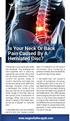 Is Your Neck Or Back Pain Caused By A Herniated Disc? The bones in your spine are called the vertebrae. The vertebrae are held together and in place by ligaments and small discs that act as shock absorbers.
Current Concepts of Low Back Pain. Terry L. Grindstaff, PhD, PT, ATC, SCS, CSCS
 Current Concepts of Low Back Pain Terry L. Grindstaff, PhD, PT, ATC, SCS, CSCS 28% population reports LBP in past 3 months (CDC 2010) 60% recurrence rate (Turner et al, 1992) Low Back Pain Low Back Pain
Patient Guide. Sacroiliac Joint Pain
 Patient Guide Sacroiliac Joint Pain Anatomy Where is the Sacroiliac Joint? The sacroiliac joint (SIJ) is located at the bottom end of your spine, where the "tailbone" (sacrum) joins the pelvis (ilium).
INFORMATION FOR YOU. Lower Back Pain
 INFORMATION FOR YOU Lower Back Pain WHAT IS ACUTE LOWER BACK PAIN? Acute lower back pain is defined as low back pain present for up to six weeks. It may be experienced as aching, burning, stabbing, sharp
 More information >>> HERE
 Mike s Top Ten Tips for Reducing Back Pain
 Mike s Top Ten Tips for Reducing Back Pain The following article explains ways of preventing, reducing or eliminating back pain. I have found them to be very useful to myself, my clients and my patients.
For Deep Pressure Massage
 T H E R A C A N E O W N E R S M A N U A L For Deep Pressure Massage Thera Cane is a self massager used to apply pressure to sore muscles. The unique design of the Thera Cane lets you apply deep pressure
A Patient s Guide to Guyon s Canal Syndrome
 A Patient s Guide to DISCLAIMER: The information in this booklet is compiled from a variety of sources. It may not be complete or timely. It does not cover all diseases, physical conditions, ailments or
Hand Injuries and Disorders
 Hand Injuries and Disorders Introduction Each of your hands has 27 bones, 15 joints and approximately 20 muscles. There are many common problems that can affect your hands. Hand problems can be caused
Nerve Root Pain. Your back pain diagnosis. Contact Details. Spinal Triage Nuffield Orthopaedic Centre Windmill Road Headington Oxford OX3 7LD
 Nerve Root Pain Contact Details Spinal Triage Nuffield Orthopaedic Centre Windmill Road Headington Oxford OX3 7LD Phone: 01865 738051 Fax: 01865 738027 Web Site www.noc.nhs.uk Nerve Pain Patient Information
Stretching for Young Athletes. Shawn P. Anderson, SPT Duke University Doctor of Physical Therapy
 Stretching for Young Athletes Shawn P. Anderson, SPT Duke University Doctor of Physical Therapy Sports and exercise are usually integral parts of many adolescents life. Whether they play at school or in
PLANTAR FASCITIS (Heel Spur Syndrome)
 PLANTAR FASCITIS (Heel Spur Syndrome) R. Amadeus Mason MD Description Plantar fascitis is characterized by stiffness and inflammation of the main fascia (fibrous connective [ligament-like] tissue) on the
LIFTING AND BACK SAFETY TRAINING LESSON PLAN
 LIFTING AND BACK SAFETY TRAINING LESSON PLAN Topic: Back Safety and Proper Lifting Techniques This presentation is designed to assist trainers conducting Lifting and Back Safety training for workers. Back
Plantar Fasciitis Information Leaflet. Maneesh Bhatia. Consultant Orthopaedic Surgeon
 Plantar Fasciitis Information Leaflet Maneesh Bhatia Consultant Orthopaedic Surgeon What is plantar fasciitis? The plantar fascia is a strong band of tissue that stretches from the heel to the toes. It
Common Injuries in Bodybuilding
 Common Injuries in Bodybuilding There is nothing that can slow you down like an injury. Sometimes it seems just when you are starting to make progress in your workouts, you suffer a nagging injury that
Closed Automobile Insurance Third Party Liability Bodily Injury Claim Study in Ontario
 Page 1 Closed Automobile Insurance Third Party Liability Bodily Injury Claim Study in Ontario Injury Descriptions Developed from Newfoundland claim study injury definitions No injury Death Psychological
Thoracic Spine Anatomy
 A Patient s Guide to Thoracic Spine Anatomy 228 West Main, Suite C Missoula, MT 59802 Phone: [email protected] DISCLAIMER: The information in this booklet is compiled from a variety of sources.
Don t. Hamstrings. Calf Muscles. both legs 2-3 times. stretch is felt in the back of the calf. Repeat with both legs 2-3 times.
 Remember to: Warm-up your muscles first before stretching (e.g. stretch after walking). Stretch until you feel mild discomfort, not pain. Never bounce or force a stretch. Hold the stretch for 10-30 seconds
Knee Conditioning Program. Purpose of Program
 Prepared for: Prepared by: OrthoInfo Purpose of Program After an injury or surgery, an exercise conditioning program will help you return to daily activities and enjoy a more active, healthy lifestyle.
MANAGING BACK PAIN GETTING YOU BACK INTO ACTION MANAGING BACK PAIN. www.healthcare-rm.com
 H E A L T H R I S K M A N A G E M E N T MANAGING BACK PAIN MANAGING BACK PAIN GETTING YOU BACK INTO ACTION GETTING YOU BACK INTO ACTION www.healthcare-rm.com Who is this for? CONTENTS Introduction about
Back Safety and Lifting
 Back Safety and Lifting Structure of the Back: Spine The spine is the part of the back that supports the trunk and head. It protects the spinal cord as well as giving flexibility to the body. Vertebrae
Manual Handling- The Whole Story!
 Manual Handling- The Whole Story! For Responsible Managers and Assessors Course Notes Mark Mallen Group Health and Safety Manager July 2005 Course Content 1 What is Manual Handling? 2 What s the Problem?
Knowing about your Low Back Pain
 Knowing about your Low Back Pain Knowing about low back pain Low back pain is very common with around 80-90% of adults having some sort of back pain in their lifetime. detail vertebra disc Although a specific
Sit stand desks and musculo skeletal health. Katharine Metters
 Sit stand desks and musculo skeletal health Katharine Metters Topics Sitting Standing Movement and activity Work and human change Sitting uses less energy Sitting provides support for the body to reduce
LUMBAR. Hips R L B R L B LUMBAR. Hips R L B R L B LUMBAR. Hips R L B R L B
 1 Patient Name In order to properly assess your condition, we must understand how much your BACK/LEG (SCIATIC) PAIN has affected your ability to manage everyday activities. For each item below, please
WEEKLY SAFETY MEETING All Euramax Subsidiaries BACK SAFETY / PROPER LIFTING. Safety Meeting Contents. Meeting Notice. Leaders Guide.
 Safety Meeting Contents Meeting Notice Employee Handout Employee Quiz Meeting Sign-In Sheet Employee Puzzle PRIOR TO THE WEEKLY MEETING: - Post the meeting notice by the timeclock - Read through the and
CHAPTER 3: BACK & ABDOMINAL STRETCHES. Standing Quad Stretch Athletic Edge - www.athleticedge.biz - (650) 815-6552
 CHAPTER : BACK & ABDOMINAL STRETCHES Standing Quad Stretch ) Stand and grasp right ankle with same hand, use a wall or chair to Lower maintain Back balance with left hand. Maintain an upright Stretches
Strength Training HEALTHY BONES, HEALTHY HEART
 Strength Training HEALTHY BONES, HEALTHY HEART No matter what your age, strength training can improve your bone health and your balance. As we age, our bones lose both tissue and strength. This condition
UNDERSTANDING STRESS AND YOUR BODY
 UNDERSTANDING STRESS AND YOUR BODY Life s demands create stress and although some stress may be good, too much can cause health problems. Most people equate stress with high blood pressure, a heart attack
Musculoskeletal System
 CHAPTER 3 Impact of SCI on the Musculoskeletal System Voluntary movement of the body is dependent on a number of systems. These include: The brain initiates the movement and receives feedback to assess
.org. Cervical Spondylosis (Arthritis of the Neck) Anatomy. Cause
 Cervical Spondylosis (Arthritis of the Neck) Page ( 1 ) Neck pain can be caused by many things but is most often related to getting older. Like the rest of the body, the disks and joints in the neck (cervical
Hitting a Nerve: The Triggers of Sciatica. Bruce Tranmer MD FRCS FACS
 Hitting a Nerve: The Triggers of Sciatica Bruce Tranmer MD FRCS FACS Disclosures I have no financial disclosures Objectives - Sciatica Historical Perspective What is Sciatica What can cause Sciatica Clinical
Endoscopic Plantar Fasciotomy
 Endoscopic Plantar Fasciotomy Introduction Plantar fasciitis is a common condition that causes pain centralized around the heel. It may be severe enough to affect regular activities. Health care providers
If you or a loved one have suffered because of a negligent error during spinal surgery, you will be going through a difficult time.
 If you or a loved one have suffered because of a negligent error during spinal surgery, you will be going through a difficult time. You may be worried about your future, both in respect of finances and
Return to same game if sx s resolve within 15 minutes. Return to next game if sx s resolve within one week Return to Competition
 Assessment Skills of the Spine on the Field and in the Clinic Ron Burke, MD Cervical Spine Injuries Sprains and strains Stingers Transient quadriparesis Cervical Spine Injuries Result in critical loss