
T task Distribution and Selection Based Algorithm
|
|
|
- Angelina Fox
- 5 years ago
- Views:
Transcription
1 2009 Fourth IEEE International Conference on Global Software Engineering TAMRI: A Tool for Supporting Task Distribution in Global Software Development Projects Ansgar Lamersdorf University of Kaiserslautern [email protected] Jürgen Münch Fraunhofer IESE Abstract The distribution of tasks to sites is one central activity in global software development project planning. Due to the large number of assignment possibilities, tool support seems to be adequate for supporting the evaluation and selection of task assignments. We present TAMRI, a planning tool for identifying task assignments based on multiple criteria and weighted project goals. Its implementation combines a distributed systems approach with Bayesian networks. The tool can be adapted to specific organizational environments by exchanging the underlying Bayesian network. The article presents an overview of task distribution approaches, gives three application scenarios for the tool, and shows the implementation of the tool as well as its application in the scenarios. 1. Introduction Besides the remarkable success and widespread distribution of Global Software Development (GSD) [3], many problems in GSD still remain unsolved, such as lack of informal communication [8], lack of trust [13], time differences [5], or cultural differences [9]. Accordingly, the failure rate in GSD projects is remarkably high [6]. As the challenges and problems of distributed development cover various different aspects and phases of a development project, they are expected to have a significant impact on the project management level, and project planning should proactively find ways to cope with the inherent specifics of GSD [12]. One central aspect in GSD project planning is the assignment of development tasks to available sites: A software development process consists of different tasks (e.g., design, implementation of different components) requiring different capabilities. In GSD, these tasks usually have to be distributed and allocated to sites. This influences both the benefits and the risks of distributed development. Different strategies can be implemented here, such as nearshoring to reduce problems of cultural and time-zone differences [4] or follow-the-sun to reduce development time [14]. However, many different goals and criteria have to be regarded simultaneously in task allocation, for instance cultural and time-zone differences, capabilities at the sites, and labor cost structures. In addition, there exists a potentially very large number of possible allocations. For example, if a software development project consists of 10 independent development tasks that can be distributed across 3 development sites, theoretically 3 10 = different combinations of allocating tasks to sites exist. Even if just a fraction of these combinations is possible in practice due to organizational or logistic restrictions, overseeing and evaluating all possibilities with respect to multiple criteria can be hard or impossible to do for a human in a real situation. We developed TAMRI (Task Allocation based on Multiple criteria), a tool that can support project managers in identifying suitable task allocations in a GSD project planning process. The tool implements an algorithm that uses (1) a set of weighted goals, (2) characteristics of the project tasks and the available sites, and (3) causal relationships between characteristics and goals for deriving a weighted list of suggestions for task allocations. As distributed software development processes and their characteristics can differ widely between organizations, the tool is generic, making it possible to adapt goals, characteristics, and causal relationships to specific environments. The remainder of this article is structured as follows: First, a brief overview of approaches and algorithms for task distribution will be given in order to motivate the selection of the implemented algorithms. Then, application scenarios for using the tools will be presented, followed by an overview of the tool s implementation. Section five will show the application of the tool in the given scenarios. Limitations and a discussion of the approach will conclude the article /09 $ IEEE DOI /ICGSE
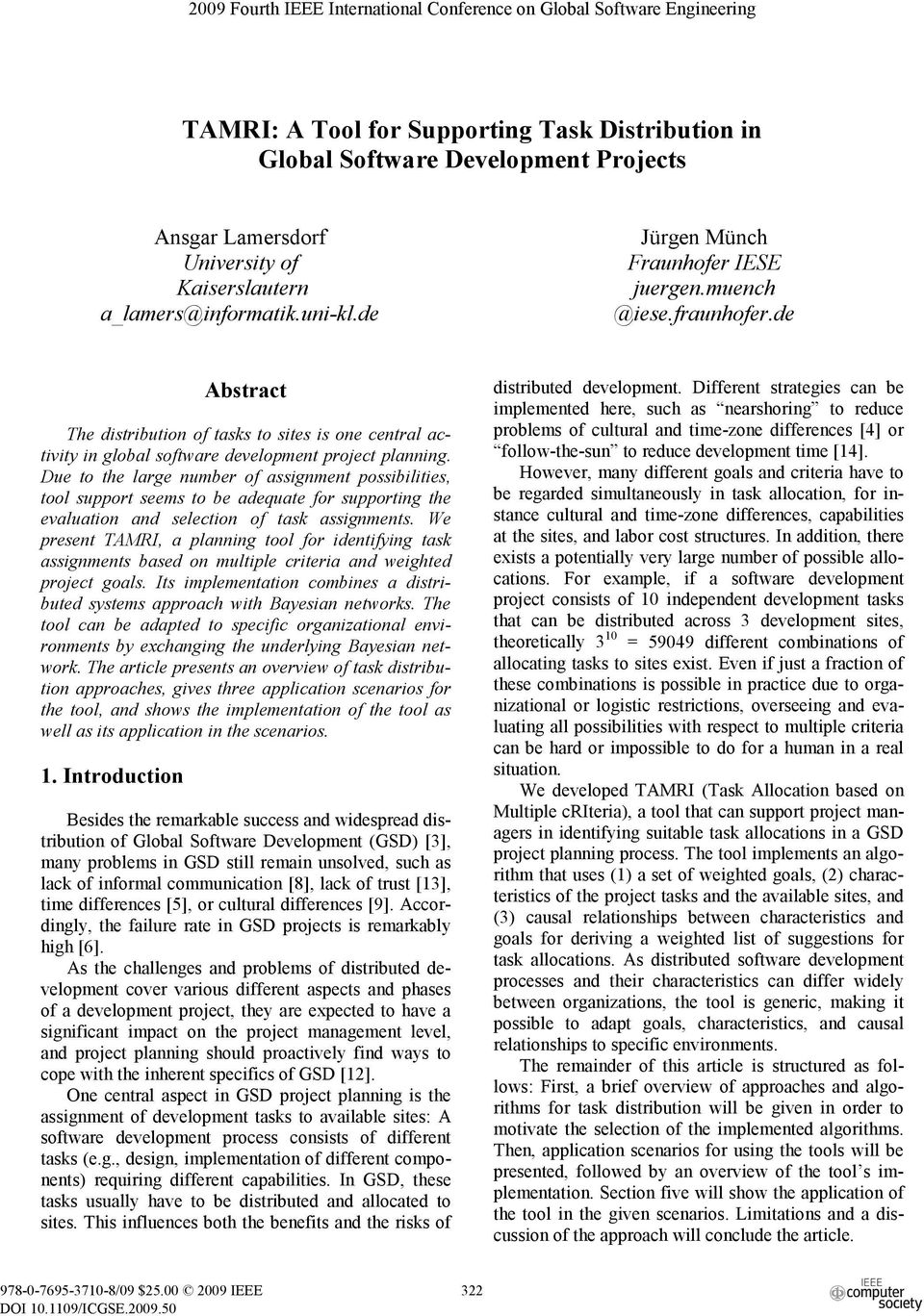
2 2. Task Distribution Approaches In a previous study done by the authors [10], several approaches for distributing tasks over nodes in a network were analyzed in terms of their applicability as a task distribution model. For this purpose, a list of requirements for a distribution model was derived. These included (1) consideration of multiple, perhaps conflicting objectives (e.g., time, costs), (2) the ability to describe both characteristics of and dependencies between tasks and nodes, (3) adaptability (e.g., for including new objectives or characteristics), (4) formality, and (5) an empirical basis for the underlying causal relations. Approaches from three domains were analyzed: global software development, distributed production, and distributed systems. Table 1 gives an overview of the result of the evaluation. The detailed evaluation and the references to the approaches can be found in [10]. Table 1. Comparison of distribution models [10] and requirement fulfilment (not -, partly o, mostly +, total ++), selected approach in bold print Domain Approach Multi-objective goal Tasks Nodes Properties Dependencies Tasks Nodes Adaptability Formality Empirically based The comparison showed that task distribution approaches from GSD often lack formality and consider only single aspects in task distribution. Distributed production approaches usually are very formal but lack multi-objectivity and adaptability. In the end, one approach for processor allocation [2] fulfilled most of the criteria (all except empirical basis were at least partially fulfilled). It can identify the optimal distribution of computing tasks over processors in a network based on quantitative descriptions of execution costs at and communication costs between the processor nodes. As a result of the evaluation, it was decided to use this approach for the model underlying the project planning tool. However, several adaptations had to be made in order to reuse the algorithm for project planning in GSD [11]. For example, the original algorithm worked with quantitative, distinct cost functions (e.g., execution costs of task x at node y) without providing a method for deriving the values. We used Bayesian networks [1] for modeling the costs since this made it possible to a) describe causal relationships (e.g., the impact of time zone differences on development time) and to b) reflect the uncertainties immanent in describing human behavior. requirements input Distributed SW Development Distributed Production Distributed Systems Modificatio n Requests Global Studio Project Distributed CoCoMo Simulation Model Reference Model for GSD Linear Programming Plant Distribution BMW Production Processor Allocation Opportunity Costs File Allocation - o o o o + o o + o + o o - + o - o o - ++ o + + o + o o product process method generate_ test cases test_ cases perform_ tests test_ results white_box_test Figure 1. Test Process [7] 3. Application Scenario consume produce input design input executable_ code output The application scenarios are based on a detailed scenario for planning a distributed project that was defined by Goldmann et al. [7] as part of the MILOS 323
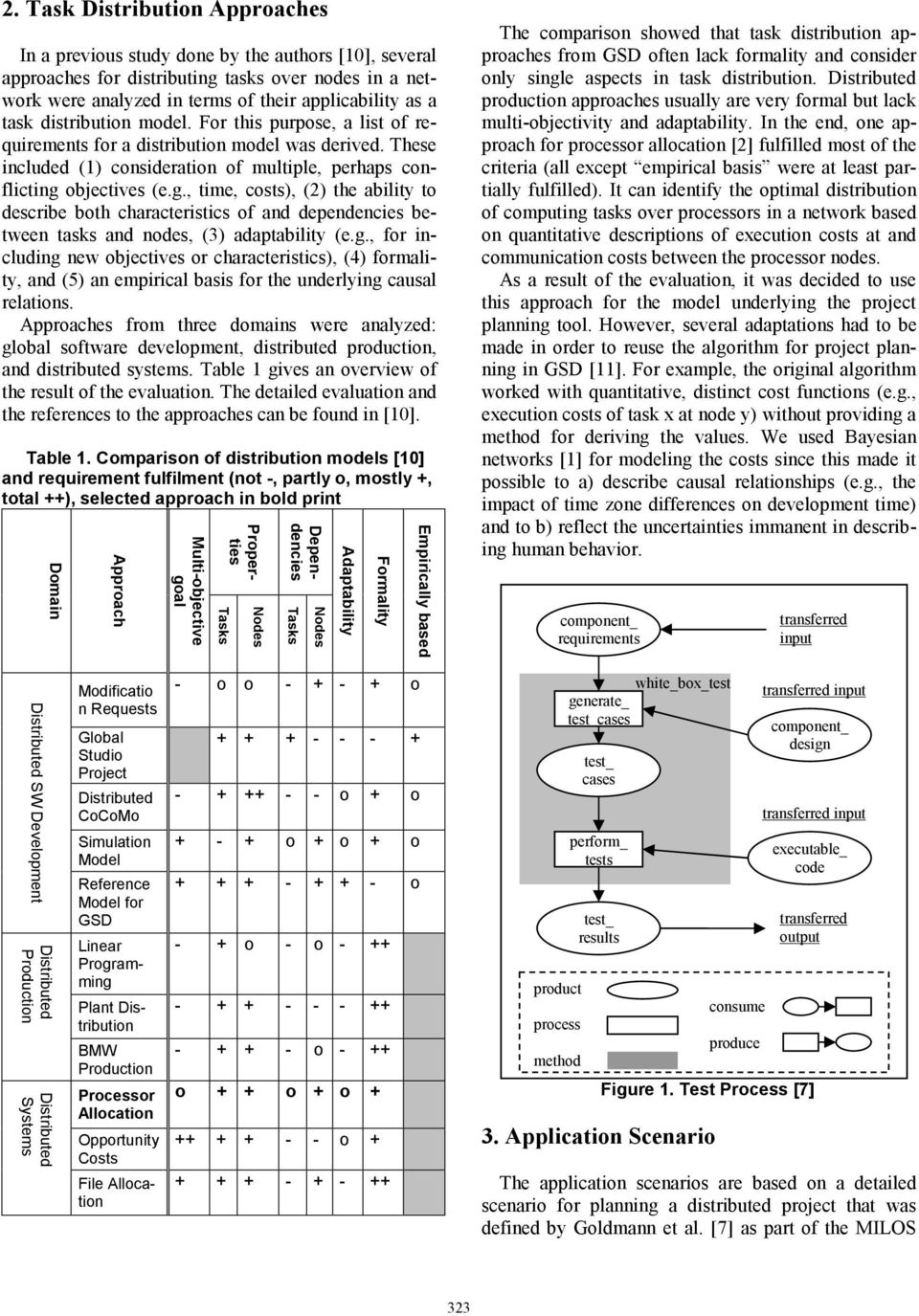
3 project. The MILOS scenario focuses on a distributed planning process for component development and testing. Two types of activities are to be distributed in this scenario. Their specifications are shown in Figures 1 and 2. input requirements output output create_ design design ad_hoc_ design_ inspection create_ code executable_ code development defect_ list Figure 2. Development plan [7] In the MILOS scenario, a development and a test site are already selected and the planning begins with the assignment of individuals to tasks and the selection of concrete techniques for tasks. We extend this scenario by adding the step of choosing a development or testing site and define three new scenarios. In our new scenarios, three sites (A, B, C) are available. Figure 3 shows some characteristics of the sites. - near customer - high labor costs site B or C. As component development and testing are complementary activities, round-the-clock development can be applied in principle. The time shift between A and C would make round-the-clock development possible if testing was assigned to C. However, at B, people are more familiar with the component and thus have higher testing skills. Cost rates are not considered. Scenario 2: Three components are to be developed and tested. The components are coupled differently, thus requiring different amounts of communication between the teams developing them. Figure 4 gives an overview of the tasks. From the viewpoint of expertise and skills, the best abilities are located at A for developing the components and at B for testing them. However, labor costs are much lower at C and the time shift to C would enable round-the-clock development. low coupling high couling Dev 1 Test 2 Test 1 Dev 2 Dev 3 Figure 4. Tasks in scenario 2 Scenario 3: Now, the development step (Figure 2) is split into design and (code) development. Three components are to be designed, developed, and integrated into the final product (see Figure 5). Integration has to be done at the customer site A. Design would also benefit from being at the customer site, but the people at C have the most expertise in design. Due to available staff, development can only be done at B or C. Des 1 Test 3 - small distance - no time shift A - large distance - large time shift Des 2 Des 3 B - large distance - high labor costs - large time shift - low labor costs Figure 3. Available Sites C Test 2 Test 1 Dev 1 Dev 2 Dev 3 Test 3 In the following, the three new scenarios are described in such a way that they can serve as use cases for the TAMRI tool: Scenario 1: One component is to be developed and tested. It was already decided to assign the development to site A. Testing can now be assigned either to Int Figure 5. Tasks in scenario 3 324
![Development plan [7] In the MILOS scenario, a development and a test site are already selected and the planning begins with the assignment of individuals to tasks and the selection of concrete](/docs-images/48/18835421/images/page_3.jpg "techniques for tasks. We extend this scenario by adding the step of choosing a development or testing site and define three new scenarios. In our new scenarios, three sites (A, B, C) are available.")
4 4. Tool Implementation The TAMRI tool was implemented in Java and will be presented in the following Implemented Algorithm The distributed system algorithm selected before was used for identifying distributions of tasks over sites. As input, this algorithm uses numeric values for both the cost of executing a task at a site and the communication costs between tasks located at different sites. Thus, a way had to be developed for modeling these costs. This was done using the Bayesian network (BN) approach [1]. Figure 6 gives an example excerpt of a BN describing the communication costs between two tasks located at different sites. It shows the impact of task and site characteristics on development time. For example, a time shift between sites increases communication problems between sites, which, in turn increases the overhead for two coupled tasks assigned to these sites and increases development time. On the other hand, a time shift can increase the potential benefit of round-theclock development, which may decrease development time. Using BNs, it is possible to describe causal relationships between various variables and project goals. Language Differences Task Coupling Cultural Differences Communication Problems Overhead Round-the-clock Benefit Development Time Time Shift Figure 6. BN excerpt for communication cost As a result, the BNs produce statistical distributions over the possible communication and execution costs (e.g., Task t assigned to site s would result in execution costs x with probability p and y with probability q ). However, the distributed systems algorithm requires numeric values as input (e.g., t assigned to s always results in execution costs x ). This discrepancy was handled by using stochastic simulation: The distributed systems algorithm is executed n times. In every run, the cost values are set randomly according to the distributions produced by the BNs (e.g., the cost for executing t at s is set to x with probability p and to y with probability q). As one optimal distribution is produced for every run, the algorithm is able to return a weighted list of suggestions (e.g., distribution d 1 is optimal with probability p 1 and d 2 is optimal with probability p 2 ). The overall algorithm is summarized in Figure 7. As shown in the overview, the different goals are integrated into one cost value for each BN by normalizing, weighting, and adding them. Thus, it is possible to weight the goals according to project-specifics. For every task and every site: - Instantiate a BN for execution costs based on project and resources characteristics For every combination of two tasks and two sites: - Instantiate a BN for communication costs For n times (n >> 1, e.g., n = 2000): - Select random values for every goal in every BN according to the probability distributions - Integrate the different goal values into one cost value per BN (normalizing, weighting, and adding) - Execute the distributed system algorithm with the execution cost and transmission cost values from the previous step - Add the returned assignment to the list of optimal assignments Return the list of assignments in decreasing order of occurrences 4.2. Adaptability Figure 7. Algorithm overview In this implementation, the goals, influencing variables, and their causal relationships are stored solely in the Bayesian networks. In the prototypical version presented in this article, they stem from a combined literature and interview study [11]. However, in specific organizations, the underlying relationships may be different. For example, other goals and variables might be relevant, or the impact of a certain variable on project goals might be different. This would result in individual BNs covering specific organizational environments We addressed this by making the implementation of the tool adaptable in the following way: The model implementation consists of a generic part, containing the algorithm and a framework for Bayesian networks. An organization-specific part contains the description of a concrete Bayesian network. Accordingly, the user interface consists of a generic part and a specific implementation that describes the masks for setting the individual parameters. With this architecture, it was possible to implement a new organization-specific model (i.e., the Bayesian networks and the user interface) in less than two days. 325


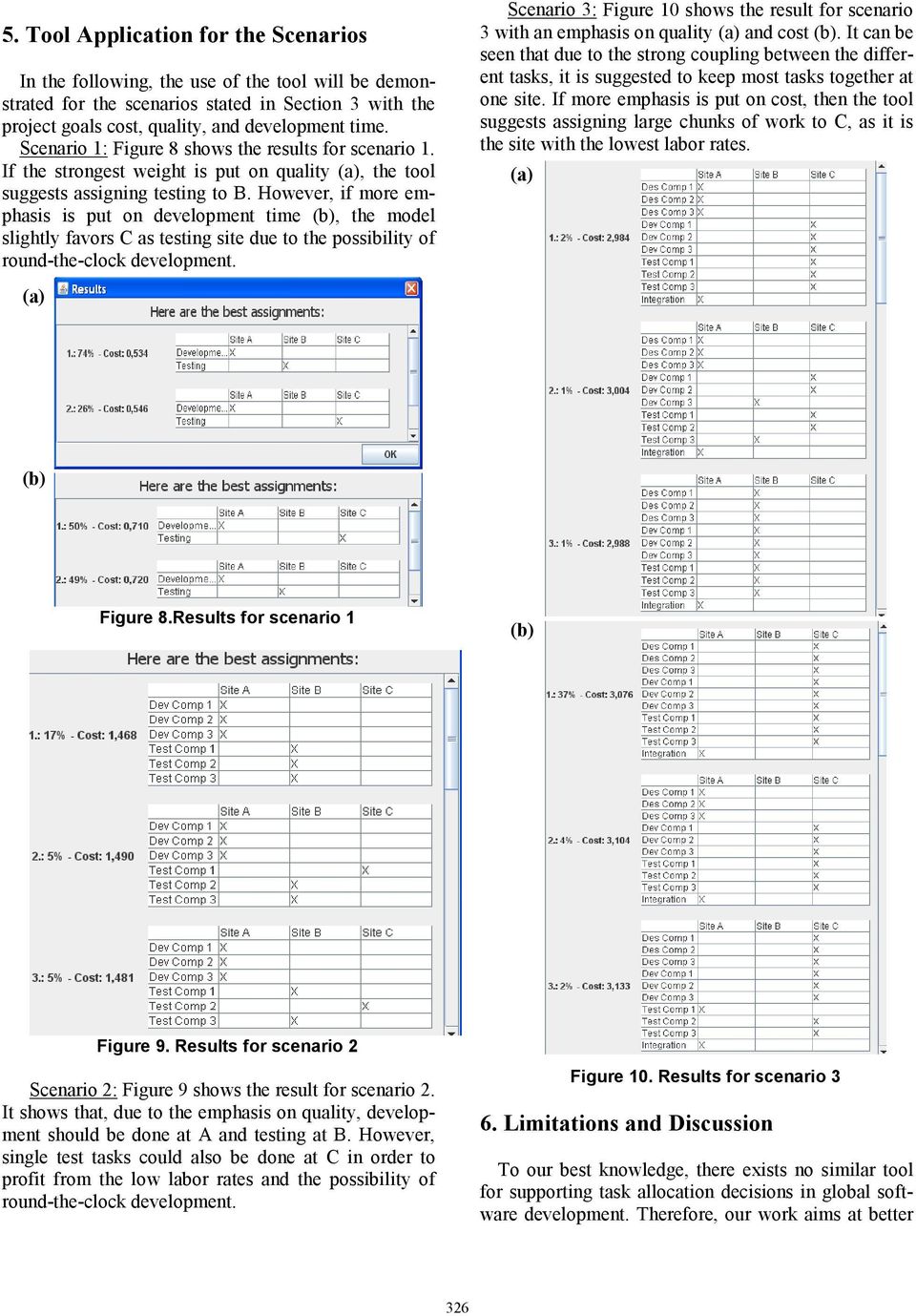
5 5. Tool Application for the Scenarios In the following, the use of the tool will be demonstrated for the scenarios stated in Section 3 with the project goals cost, quality, and development time. Scenario 1: Figure 8 shows the results for scenario 1. If the strongest weight is put on quality (a), the tool suggests assigning testing to B. However, if more emphasis is put on development time (b), the model slightly favors C as testing site due to the possibility of round-the-clock development. (a) Scenario 3: Figure 10 shows the result for scenario 3 with an emphasis on quality (a) and cost (b). It can be seen that due to the strong coupling between the different tasks, it is suggested to keep most tasks together at one site. If more emphasis is put on cost, then the tool suggests assigning large chunks of work to C, as it is the site with the lowest labor rates. (a) (b) Figure 8.Results for scenario 1 (b) Figure 9. Results for scenario 2 Scenario 2: Figure 9 shows the result for scenario 2. It shows that, due to the emphasis on quality, development should be done at A and testing at B. However, single test tasks could also be done at C in order to profit from the low labor rates and the possibility of round-the-clock development. Figure 10. Results for scenario 3 6. Limitations and Discussion To our best knowledge, there exists no similar tool for supporting task allocation decisions in global software development. Therefore, our work aims at better 326
6 understanding and supporting the development of an improved and more systematic process of project planning and task distribution in GSD. However, there are some limitations and open questions that can impede the application of this or similar tools in practice: The application of the tool requires a very large amount of knowledge on causal relationships in distributed development. Few causal relationships can be gathered from results of empirical studies or theoretical analyses; most of the knowledge has to be gathered individually at each organization. It is doubtable that many companies possess the maturity and data basis needed to gather this knowledge. Therefore, the Bayesian networks would probably have to be developed based on expert estimations and not on empirical data, which would increase the uncertainty. The same is expected for determining and quantifying the characteristics of the resources (e.g., cultural differences between two sites) or of the project (e.g., coupling between two tasks). Most factors will be described with a large amount of uncertainty and others might not be known at all. Bayesian networks and the tool allow not setting all parameters to known values, but the less information is known on the project, the more uncertainty will be in the result. Another limitation of the tool is the fact that it uses a black-box algorithm: Due to the large number of calculations executed by the tool, it is not transparent to the user why a certain distribution is suggested by the algorithm. It is left to the user to conclude the rationale for the suggestion. To many managers, it might be unacceptable to follow the suggestions of a tool without being able to reconstruct the underlying reasons in detail. However, despite these limitations that might constitute obstacles to usage in an industrial context, we see the TAMRI tool as a good starting point for exploring the possibilities of tool-supported project planning and task allocation in global software development. In our future work, we aim at overcoming the limitations of the tool. Therefore, we will look at (1) techniques for modeling distributed development without needing access to large amounts of empirical data and (2) algorithms or processes that can support task allocation decisions in a more interactive way. In addition, we will try to build empirically-based models for describing the impact of distributed development on project goals, in order to use them for future decision support tools. References [1] Ben-Gal, I.: Bayesian Networks. In Ruggeri, F., Kenett, R., Faltin, F. (editors): Encyclopedia of Statistics in Quality and Reliability, John Wiley & Sons (2007). [2] Bokhari, S. H.: A Shortest Tree Algorithm for Optimal Assignments across Space and Time in a distributed Processor System. IEEE Transactions on Software Engineering SE- 7:6, pp (1981) [3] Damian, D., Moitra, D.: Global Software Development: How Far Have We Come? IEEE Software, 23(5): pp (2006) [4] Dubie, D.: Outsourcing Moves Closer to Home. CIO Today, December 18, 2007 [5] Espinosa, J. A., Carmel, E.: Modeling Coordination Costs Due to Time Separation in Global Software Teams. International Workshop on Global Software Development, 2003 [6] Fabriek, M., Brand, M. van de, Brinkkemper, S., Harmsen, F., Helms, R.W.,: Reasons for Success and Failure in Offshore Software Development Projects. European Conference on Information Systems, 2008 [7] Goldmann, S., Münch, J., Holz, H.: Distributed Process Planning Support with MILOS. International Journal of Software Engineering and Knowledge Engineering, vol. 10, no. 4, pp , October 2000 [8] Herbsleb, J.D., Mockus, A.: An Empirical Study of Speed and Communication in Globally-Distributed Software Development. IEEE Transactions on Software Engingeering, vol. 29, no. 6, June 2003 [9] Krishna, S., Sahay, S., Walsham, G.: Managing crosscultural issues in Global Software Outsourcing. Communications of the ACM 47, 4 (Apr. 2004), pp [10] Lamersdorf, A., Muench, J., Rombach, D.: Towards a Multi-Criteria Development Distribution Model: An Analysis of Existing Task Distribution Approaches. International Conference on Global Software Development, ICGSE 2008 [11] Lamersdorf, A., Muench, J., Rombach, D.: A Decision Model for Supporting Task Allocation Processes in Global Software Development. International Conference on Product Focused Software Development and Process Improvement PROFES 2009, in press [12] Lee, G., DeLone, W., Espinosa, J. A.: Ambidextrous coping strategies in globally distributed software development projects. Communications of the ACM, Volume 49, Issue 10 (October 2006) [13] Smite, D., Moe, N. B.: Understanding a Lack of Trust in Global Software Teams: A Multiple-Case Study. International Conference on Product Focused Software Development and Process Improvement PROFES 2007: [14] Treinen, J. J., Miller-Frost, S. L.: Following the Sun: Case studies in global software development. IBM Systems Journal; Oct-Dec 2006; 45, 4, p
TAMRI: A Tool for Supporting Task Distribution in Global Software Development Projects
 TAMRI: A Tool for Supporting Task Distribution in Global Software Development Projects REMIDI 2009, Limerick, Ireland Ansgar Lamersdorf [email protected] Jürgen Münch [email protected]
A Multi-Criteria Distribution Model for Global Software Development Projects
 A Multi-Criteria Distribution Model for Global Software Development Projects Ansgar Lamersdorf University of Kaiserslautern Software Engineering Research Group: Processes and Measurement Phone: + 49 631
Reporting Empirical Research in Global Software Engineering: a Classification Scheme
 Reporting Empirical Research in Global Software Engineering: a Classification Scheme Darja Šmite, Claes Wohlin 2, Robert Feldt 2, Tony Gorschek 2 : University of Latvia; 2: Blekinge Institute of Technology
4/9/13. Global So(ware Development. GSD courses @ITU. Roadmap
 Global So(ware Development Rosalba Giuffrida Yvonne Di3rich IT- University in Copenhagen So(ware and System Sec>on GSD courses @ITU http://global-interaction.org/ Distributed Collaboration and Development
Managing Requirement Risks in Global Software Development
 Managing Requirement Risks in Global Software Development Aurangzeb Khan Dr. Farooque Azam Muhammad Shoaib Zafar ABSTRACT Now a day s trend toward software development is changed and Software organizations
C. Wohlin and B. Regnell, "Achieving Industrial Relevance in Software Engineering Education", Proceedings Conference on Software Engineering
 C. Wohlin and B. Regnell, "Achieving Industrial Relevance in Software Engineering Education", Proceedings Conference on Software Engineering Education & Training, pp. 16-25, New Orleans, Lousiana, USA,
A Process View on Architecture-Based Software Development
 A Process View on Architecture-Based Software Development Lothar Baum, Martin Becker, Lars Geyer, Georg Molter System Software Research Group University of Kaiserslautern D-67653 Kaiserslautern, Germany
Risk Knowledge Capture in the Riskit Method
 Risk Knowledge Capture in the Riskit Method Jyrki Kontio and Victor R. Basili [email protected] / [email protected] University of Maryland Department of Computer Science A.V.Williams Building
Usage of SCRUM Practices within a Global Company
 2008 IEEE International Conference on Global Software Engineering Usage of SCRUM Practices within a Global Company Mauricio Cristal [email protected] Daniel Wildt FACENSA, Brazil [email protected]
Requirements Specification in Distributed Software Development A Process Proposal
 Requirements Specification in Distributed Software Development A Process Proposal Leandro Lopes, Rafael Prikladnicki, Jorge Audy School of Computer Science - PUCRS 6681 Ipiranga Av., Porto Alegre, RS,
global software development Distribution Dimensions in Software Development Projects: A Taxonomy
 focus global software development Distribution Dimensions in Software Development Projects: A Taxonomy Dorina C. Gumm, University of Hamburg A literature-based taxonomy identifies four distribution dimensions
Communication in Firm-Internal Global Software Development with China
 Communication in Firm-Internal Global Software Development with China Bilal Zaghloul 1, Dirk Riehle 2, Minghui Zhou 3 1 Friedrich-Alexander University Erlangen-Nürnberg, Information Systems Department,
Quality Assurance Assessment in Global Software Development
 World Applied Sciences Journal 24 (11): 1449-1454, 2013 ISSN 1818-4952 IDOSI Publications, 2013 DOI: 10.5829/idosi.wasj.2013.24.11.13286 Quality Assurance Assessment in Global Software Development Khalid
Analysing, Modelling, and Improving Workflow Application Development Processes
 Analysing, Modelling, and Improving Workflow Application Development Processes Mathias Weske ½, Thomas Goesmann ¾, Roland Holten,Rüdiger Striemer ½ Eindhoven University of Technology, The Netherlands ¾
Software Quality Assurance Software Inspections and Reviews
 Software Quality Assurance Software Inspections and Reviews Contents Definitions Why software inspections? Requirements for inspections Inspection team Inspection phases 2 Definitions Manual quality assurance
Developer Fluency: Achieving True Mastery in Software Projects
 Developer Fluency: Achieving True Mastery in Software Projects Minghui Zhou, [email protected], Peking University, Beijing, China Audris Mockus [email protected] Avaya Research Labs, NJ, USA Agenda History
Full-time MSc in Logistics and Supply Chain Management
 Full-time MSc in Logistics and Supply Chain Management Course structure and content 2015-2016 The course has been developed to produce expert logistics and supply chain professionals who can take the skills
Communication Risks and Best Practices in Global Software Development during Requirements Change Management: A Systematic Literature Review Protocol
 Research Journal of Applied Sciences, Engineering and Technology 6(19): 3514-3519, 2013 ISSN: 2040-7459; e-issn: 2040-7467 Maxwell Scientific Organization, 2013 Submitted: October 17, 2012 Accepted: November
A Variability Viewpoint for Enterprise Software Systems
 2012 Joint Working Conference on Software Architecture & 6th European Conference on Software Architecture A Variability Viewpoint for Enterprise Software Systems Matthias Galster University of Groningen,
Preparation for Distributed Development and Outsourcing
 Preparation for Distributed Development and Outsourcing Peter Kolb Distributed and Outsourced Software Engineering, - 1 - Objectives This module will enable the participant to: Prepare a decision basis
Requirements Management in Global Software Development: Preliminary Findings from a Case Study in a SW-CMM context i
 Requirements Management in Global Software Development: Preliminary Findings from a Case Study in a SW-CMM context i Rafael Prikladnicki, Jorge Audy, Roberto Evaristo School of Computer Science, Pontifical
Mahmoud Khraiwesh Faculty of Science and Information Technology Zarqa University Zarqa - Jordan [email protected]
 World of Computer Science and Information Technology Journal (WCSIT) ISSN: 2221-0741 Vol. 1, No. 2, 26-33, 2011 Validation Measures in CMMI Mahmoud Khraiwesh Faculty of Science and Information Technology
Knowledge Infrastructure for Project Management 1
 Knowledge Infrastructure for Project Management 1 Pankaj Jalote Department of Computer Science and Engineering Indian Institute of Technology Kanpur Kanpur, India 208016 [email protected] Abstract In any
Using Simulation to Evaluate Global Software Development Task Allocation Strategies
 SOFTWARE PROCESS IMPROVEMENT AND PRACTICE Softw. Process Improve. Pract. 2007; 12: 491 503 Published online 23 May 2007 in Wiley InterScience (www.interscience.wiley.com) DOI: 10.1002/spip.335 Using Simulation
Towards Web Design Frameworks (Wdfs)
 14 Towards Web Design Frameworks (Wdfs) Rehema Baguma, Faculty of Computing and IT, Makerere University. [email protected]; Ogao Patrick, Department of Information Systems, Faculty of Computing and
Bachelor's Degree in Business Administration and Master's Degree course description
 Bachelor's Degree in Business Administration and Master's Degree course description Bachelor's Degree in Business Administration Department s Compulsory Requirements Course Description (402102) Principles
International group work in software engineering
 International group work in software engineering Julian M. Bass Robert Gordon University Aberdeen, UK [email protected] J. T. Lalchandani IIIT-B Bangalore, India [email protected] R. McDermott Robert Gordon
Estimating Software Reliability In the Absence of Data
 Estimating Software Reliability In the Absence of Data Joanne Bechta Dugan ([email protected]) Ganesh J. Pai ([email protected]) Department of ECE University of Virginia, Charlottesville, VA NASA OSMA SAS
Load Balancing Routing Algorithm for Data Gathering Sensor Network
 Load Balancing Routing Algorithm for Data Gathering Sensor Network Evgeny Bakin, Grigory Evseev State University of Aerospace Instrumentation Saint-Petersburg, Russia {jenyb, egs}@vu.spb.ru Denis Dorum
Global Software Development: Issues, Solutions, Challenges
 Global Software Development: Issues, Solutions, Challenges Parastoo Mohagheghi Dept. Computer and Information Science (IDI) University of Science and Technology (NTNU) Trondheim, Norway [email protected]
Comparing Artificial Intelligence Systems for Stock Portfolio Selection
 Abstract Comparing Artificial Intelligence Systems for Stock Portfolio Selection Extended Abstract Chiu-Che Tseng Texas A&M University Commerce P.O. BOX 3011 Commerce, Texas 75429 Tel: (903) 886-5497 Email:
A Risk Management System Framework for New Product Development (NPD)
 2011 International Conference on Economics and Finance Research IPEDR vol.4 (2011) (2011) IACSIT Press, Singapore A Risk Management System Framework for New Product Development (NPD) Seonmuk Park, Jongseong
Stephen M. Fiore, Ph.D. University of Central Florida Cognitive Sciences, Department of Philosophy and Institute for Simulation & Training
 Stephen M. Fiore, Ph.D. University of Central Florida Cognitive Sciences, Department of Philosophy and Institute for Simulation & Training Fiore, S. M. (2015). Collaboration Technologies and the Science
An empirical study on Global Software Development: Offshore Insourcing of IT Projects
 An empirical study on Global Software Development: Offshore Insourcing of IT Projects Rafael Prikladnicki, Jorge L. N. Audy, Roberto Evaristo School of Computer Science, PUCRS, Porto Alegre, Brazil; University
Microblogging in Global Software Development
 Microblogging in Global Software Development Lars Klimpke Department of General Management and Information Systems University of Mannheim 68131 Mannheim, Germany [email protected] Abstract. Despite
WORKFLOW ENGINE FOR CLOUDS
 WORKFLOW ENGINE FOR CLOUDS By SURAJ PANDEY, DILEBAN KARUNAMOORTHY, and RAJKUMAR BUYYA Prepared by: Dr. Faramarz Safi Islamic Azad University, Najafabad Branch, Esfahan, Iran. Workflow Engine for clouds
ANALYZING SYSTEM MAINTAINABILITY USING ENTERPRISE ARCHITECTURE MODELS
 ANALYZING SYSTEM MAINTAINABILITY USING ENTERPRISE ARCHITECTURE MODELS Lagerström, Robert, Royal Institute of Technology, Osquldas väg 12, 100 44 Stockholm, Sweden, [email protected] Abstract A fast and
Contribution of Agile Software Development Methods to Business-IT Alignment in Non-profit Organizations
 Contribution of Agile Software Development Methods to Business-IT Alignment in Non-profit Organizations Arjan Aarnink HU University of Applied Sciences Utrecht, The Netherlands [email protected]
Current Research Topic In Software Engineering
 Current Research Topic In Software Engineering A PROJECT REPORT Submitted by MD. Mithun Ahamed Id: 13-96937-2 Under the guidance of DR. Dip Nandi in partial fulfillment for the award of the degre of Master
An Agent-Based Concept for Problem Management Systems to Enhance Reliability
 An Agent-Based Concept for Problem Management Systems to Enhance Reliability H. Wang, N. Jazdi, P. Goehner A defective component in an industrial automation system affects only a limited number of sub
Communication Needs, Practices and Supporting Structures in Global Inter- Organizational Software Development Projects
 Communication Needs, Practices and Supporting Structures in Global Inter- Organizational Software Development Projects Maria Paasivaara Helsinki University of Technology Software Business and Engineering
AN EFFICIENT STRATEGY OF AGGREGATE SECURE DATA TRANSMISSION
 INTERNATIONAL JOURNAL OF REVIEWS ON RECENT ELECTRONICS AND COMPUTER SCIENCE AN EFFICIENT STRATEGY OF AGGREGATE SECURE DATA TRANSMISSION K.Anusha 1, K.Sudha 2 1 M.Tech Student, Dept of CSE, Aurora's Technological
Six Strategies for Building High Performance SOA Applications
 Six Strategies for Building High Performance SOA Applications Uwe Breitenbücher, Oliver Kopp, Frank Leymann, Michael Reiter, Dieter Roller, and Tobias Unger University of Stuttgart, Institute of Architecture
The Bayesian Network Methodology for Industrial Control System with Digital Technology
 , pp.157-161 http://dx.doi.org/10.14257/astl.2013.42.37 The Bayesian Network Methodology for Industrial Control System with Digital Technology Jinsoo Shin 1, Hanseong Son 2, Soongohn Kim 2, and Gyunyoung
FACULTY OF COMPUTER SCIENCE AND INFORMATION TECHNOLOGY AUTUMN 2016 BACHELOR COURSES
 FACULTY OF COMPUTER SCIENCE AND INFORMATION TECHNOLOGY Please note! This is a preliminary list of courses for the study year 2016/2017. Changes may occur! AUTUMN 2016 BACHELOR COURSES DIP217 Applied Software
Software Engineering Practices in Jordan
 Software Engineering Practices in Jordan Nuha El-Khalili Faculty of Information Technology, University of Petra, Amman, Jordan [email protected] Dima Damen Faculty of Information Technology, University
Near Sheltered and Loyal storage Space Navigating in Cloud
 IOSR Journal of Engineering (IOSRJEN) e-issn: 2250-3021, p-issn: 2278-8719 Vol. 3, Issue 8 (August. 2013), V2 PP 01-05 Near Sheltered and Loyal storage Space Navigating in Cloud N.Venkata Krishna, M.Venkata
Guidelines for a risk management methodology for product design
 Guidelines for a risk management methodology for product design Viviane Vasconcellos Ferreira Federal University of Santa Catarina [email protected] André Ogliari Federal University of Santa Catarina
AC 2009-803: ENTERPRISE RESOURCE PLANNING: A STUDY OF USER SATISFACTION WITH REFERENCE TO THE CONSTRUCTION INDUSTRY
 AC 2009-803: ENTERPRISE RESOURCE PLANNING: A STUDY OF USER SATISFACTION WITH REFERENCE TO THE CONSTRUCTION INDUSTRY I. Choudhury, Texas A&M University American Society for Engineering Education, 2009 Page
Adaptive demand planning in a volatile business environment
 2012 International Conference on Economics, Business and Marketing Management IPEDR vol.29 (2012) (2012) IACSIT Press, Singapore Adaptive demand planning in a volatile business environment Romana Traxler
Software Project Models
 INTERNATIONAL JOURNAL OF TECHNOLOGY ENHANCEMENTS AND EMERGING ENGINEERING RESEARCH, VOL 1, ISSUE 4 135 Software Project Models Abhimanyu Chopra, Abhinav Prashar, Chandresh Saini [email protected],
Implementing New Approach for Enhancing Performance and Throughput in a Distributed Database
 290 The International Arab Journal of Information Technology, Vol. 10, No. 3, May 2013 Implementing New Approach for Enhancing Performance and in a Distributed Database Khaled Maabreh 1 and Alaa Al-Hamami
Factors Influencing Software Development Productivity - State of the Art and Industrial Experiences
 Factors Influencing Software Development Productivity - State of the Art and Industrial Experiences Adam Trendowicz, Jürgen Münch Fraunhofer Institute for Experimental Software Engineering Fraunhofer-Platz
Total Cost of Ownership Considerations in Global Sourcing Processes
 Total Cost of Ownership Considerations in Global Sourcing Processes Robert Alard, Philipp Bremen, Josef Oehmen, Christian Schneider ETH Center for Enterprise Sciences (BWI), Department of Management, Technology,
Simulating the Structural Evolution of Software
 Simulating the Structural Evolution of Software Benjamin Stopford 1, Steve Counsell 2 1 School of Computer Science and Information Systems, Birkbeck, University of London 2 School of Information Systems,
SILs and Software. Introduction. The SIL concept. Problems with SIL. Unpicking the SIL concept
 SILs and Software PG Bishop Adelard and Centre for Software Reliability, City University Introduction The SIL (safety integrity level) concept was introduced in the HSE (Health and Safety Executive) PES
Integrating risk indicators into corporate performance management tool
 Integrating risk indicators into corporate performance management tool Jelena Raid Swedbank Estonia Liivalaia 8, Tallinn, Estonia Abstract Tallinn Technical University Raja 15, Tallinn, Estonia In operational