
Risk Knowledge Capture in the Riskit Method
|
|
|
- Jocelyn Harper
- 10 years ago
- Views:
Transcription
1 Risk Knowledge Capture in the Riskit Method Jyrki Kontio and Victor R. Basili / University of Maryland Department of Computer Science A.V.Williams Building College Park, MD 20742, U.S.A. basili}/ Abstract This paper describes how measurement data and experience can be captured for risk management purposes. The approach presented is a synthesis of the Riskit risk management method and the Experience Factory. In this paper we describe the main goals for risk knowledge capture and derive a classification of information based on those goals. We will describe the Riskit method and its integration with the Experience Factory. We will also outline the initial experiences we have gained from applying the proposed approach in practice. 1. Introduction Unanticipated problems frequently cause major problems to projects, such as cost overruns, schedule delays, quality problems, and missing functionality. To some degree these problems can be seen as signs of immaturity of our field and we should expect some improvements in our discipline as our methods and knowledge improve. However, as each software development project involves at least some degree of uniqueness and our technology changes continuously, uncertainty about the end results will always accompany software development. While we cannot remove from software development, we should learn to manage them better. Ability to capture, analyze and package experience is a prerequisite for systematic, planned improvements in software engineering [2], as in any field. The framework proposed in this paper builds upon the Riskit method and the Experience Factory, both developed at the University of Maryland. The proposed risk knowledge capture framework contains templates for capturing data about risk elements, templates for capturing relevant information about the risk management process, definition of where in the risk management process risk management knowledge is captured and utilized, and a proposed model for improvement goals for risk management.
2 2. Background Risks in software development were not addressed in detail until late 1980 s when Boehm [6] proposed and synthesized an approaches for software risk management. His work was complemented by Charette [9], and on these foundations recent advances in software risk management have produced well-documented approaches for risk management [14,18,24,26], several categories of have been identified [6,8,23], quantitative approaches for risk management have been proposed and used [5,7,11], and there are several software tools available for risk management. Furthermore, most commonly used software engineering standards [15,16] or assessment frameworks [17,27] require at least some form of risk management to take place. Despite these efforts and the obvious industry interest in risk management, it seems that few organizations apply specific management methods actively [28]. The limited survey data from a recent workshop by Basili and Koji Tori supports this observation: only 20% of respondents claimed to use risk management techniques extensively while 40% stated that they are not using any risk management techniques or approaches [19]. Clearly, the industrial practice of management methods has not yet reached its full potential. There is little reported work on utilizing data and experience from past project in software engineering risk management literature. Some aspects of Boehm s work implicitly assumed that data from past projects is available if simulation and cost models are used for estimating [6]. He also mentioned factors of cost models as possible risk monitoring metrics. Charette has presented an outline of items that should be defined for a project to initiate risk management [10]. He has also given examples of what should be measured and how this data can be graphed for risk management purposes. However, neither one of these approaches can be considered a systematic way to capture or utilize risk management experience. The Software Engineering Institute (SEI) has collected data from risk assessments they have carried out during the last few years. Their goal seems to be to support analysis and their relationships using lexical analysis on the qualitative descriptions in the database [25]. It also seems that frequencies of in the database have been used to indicate what are the most common. To our knowledge, this database focuses on the results of risk assessments and contains little or no data of what actually happened in projects. Also, it is not clear how much context information is captured about and projects so that information in the database can be utilized more effectively. Hall has defined and implemented a risk database while working at Harris corporation [12]. Risks from three projects were collected [13] and used for analysis in evaluating Hall s risk management maturity model. Hall has also collected survey data on the levels of management practices in various organizations [12]. There have been several other, less formal approaches in documenting information about software. The ACM SIGSOFT Software Engineering Notes has run a long series of reports on computer related problems or disasters. However, such a list is not very useful for analyzing of an individual projects as most of the reported do not contain enough context information and details to be useful.
![categories of have been identified [6,8,23], quantitative approaches for risk management have been proposed and used [5,7,11], and there are several software tools available for risk management.](/docs-images/57/6517432/images/page_2.jpg "Furthermore, most commonly used software engineering standards [15,16] or assessment frameworks [17,27] require at least some form of risk management to take place.")
3 In summary, it seems that while several some advances have been made in the area of software risk knowledge capture, none of the reported approaches provide a comprehensive framework for capturing risk knowledge. Furthermore, software risk management data and knowledge is rarely systematically collected and utilized in the industry. We hope that the framework proposed in this paper can act as a step towards more systematic risk knowledge capture so that our understanding of and risk management methods can improve. 3. Risk Knowledge Capture We have identified three generic types of goals for risk knowledge capture: monitoring, understanding, and risk management process improvement. First, the risk situation in a project needs to be monitored so that appropriate risk controlling action can be taken. Second, we need to collect information about so that frequencies of occurrence and losses of can be estimated better. Finally, information needs to be collected so that the risk management process itself can be improved. Each of the three goals described above focus on different kinds of information and, as always in measurement, the individual metrics and data collection procedures may vary between situations. However, we have identified some generic classes of information based on these three goals. This risk information classification will be introduced in the following paragraphs. Project context information refers to such information that determines the circumstances and setting where the project is carried out. Project context information is relevant for all software engineering measurement data, but it is particularly important for risk management. The probability of a risk event is often influenced by many factors. By capturing as much as possible of the risk management context information we make it easier to interpret risk management data in the future. The risk management infrastructure information defines what risk management methods, techniques, tools, processes and approaches are used for in risk management. The risk management infrastructure can also be extended to include several other organizational issues that marginally influence risk management, as proposed by Hall [12]. In fact Hall s framework can be used as a model to document the state of risk management infrastructure in an organization. The project information defines the project itself and it includes the definition of the goals, customers, schedule, and constraints of the project. It also includes the definition of the risk management mandate for the project: the risk management mandate is a project-specific statement of the scope of risk management in a project. Risk monitoring Understanding Risk management process improvement Project context information X X X Risk management infrastructure X information Project information X X
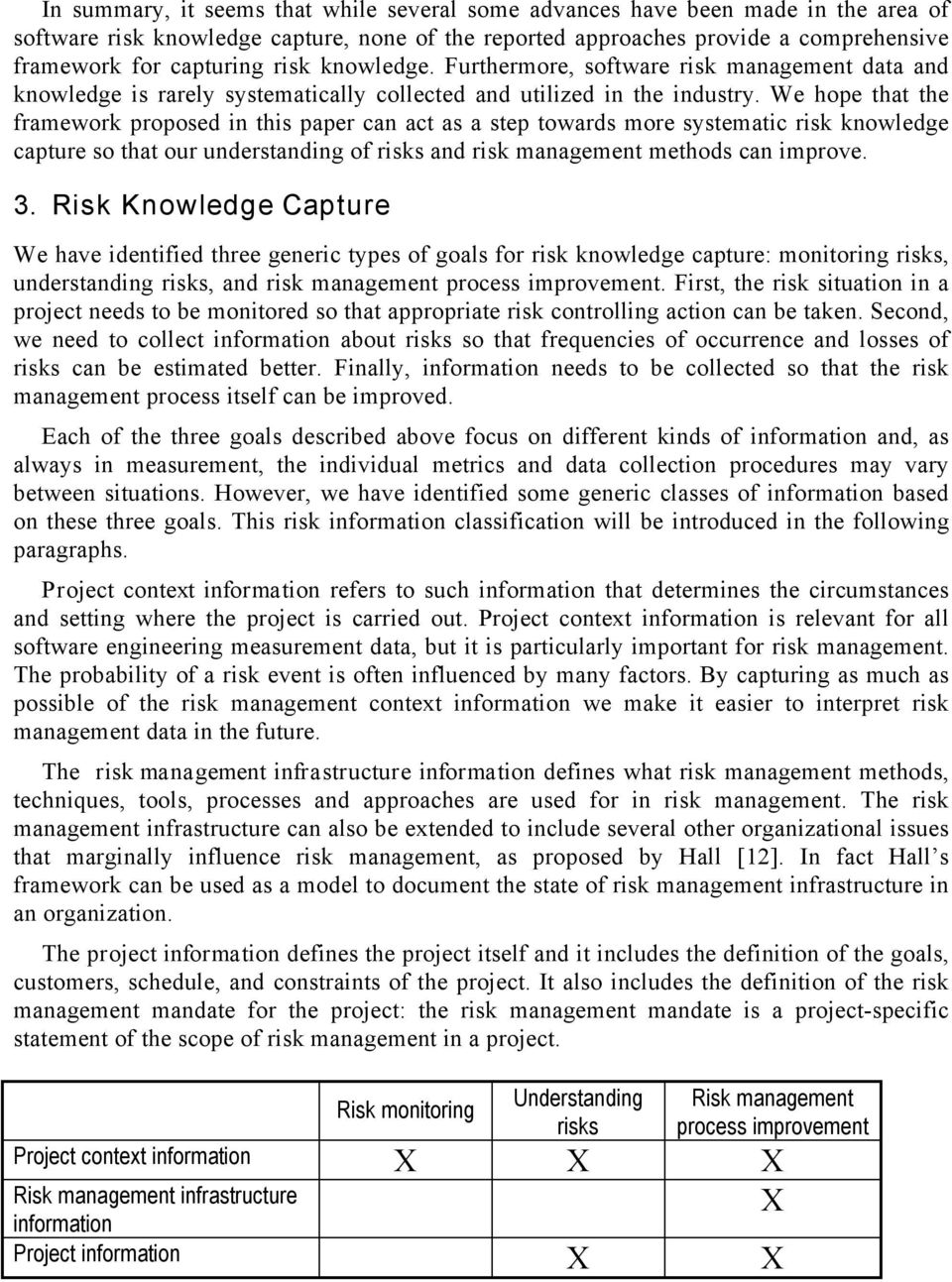
4 Enactment data X X X Risk management process X information Risk element information X X X Table 1: The relationships between risk knowledge capture goals and risk information types While the project information provides a static view to the project, enactment data provides the dynamic perspective to the project: how much effort is spent, what artifacts are produced and when, how much time has passed, and which individuals worked on the project. Enactment data is usually collected for project control and experience capture purposes as a part of software engineering measurement program. The risk management process information describes the activities and events related to risk management in the project. The risk management process information is, in fact, a special case of project information, but as it represents our special focus, it is meaningful to separate it from the general enactment data of the project. Finally, risk element information refers to information about in a project. This type of information can include descriptions of factors that influence, such as methods, tools, resources; events that may influence the project; or impacts that might have. As we will discuss later, the Riskit method contains conceptual tools to structure such information more formally than is usually done. The relationships between risk knowledge capture goals and risk information types is presented in Table 1. Each row in Table 1 represents a risk information type and each column a risk knowledge capture goal. An X in a cell indicates that the goal in that row normally needs to utilize the type of information listed in that row. However, it is important to point out that information from other categories may often be needed as well, Table 1 merely represents what we believe to be typical relationships between goals and information types. 4. Towards a Risk Knowledge Capture Framework 4.1 The Riskit Method The Riskit method has been developed to support systematic risk analysis. The Riskit method uses a graphical formalism to support qualitative analysis of risk scenarios before quantification is attempted, its risk ranking approach can be selected based on the availability of history data or accuracy of estimates, it supports multiple goals and stakeholders, and its risk ranking approach is based on the utility theory [20]. We have presented an overview of the activities in the Riskit process in Figure 1. More information about the method is available in separate reports [20-22]. A central part of the Riskit method is the graphical formalism used to document, the Riskit analysis graph. The Riskit analysis graph is used to define the different aspects of risk explicitly and more formally than is done in casual conversation. The Riskit analysis graph is used during the Riskit process to decompose into clearly defined components, risk
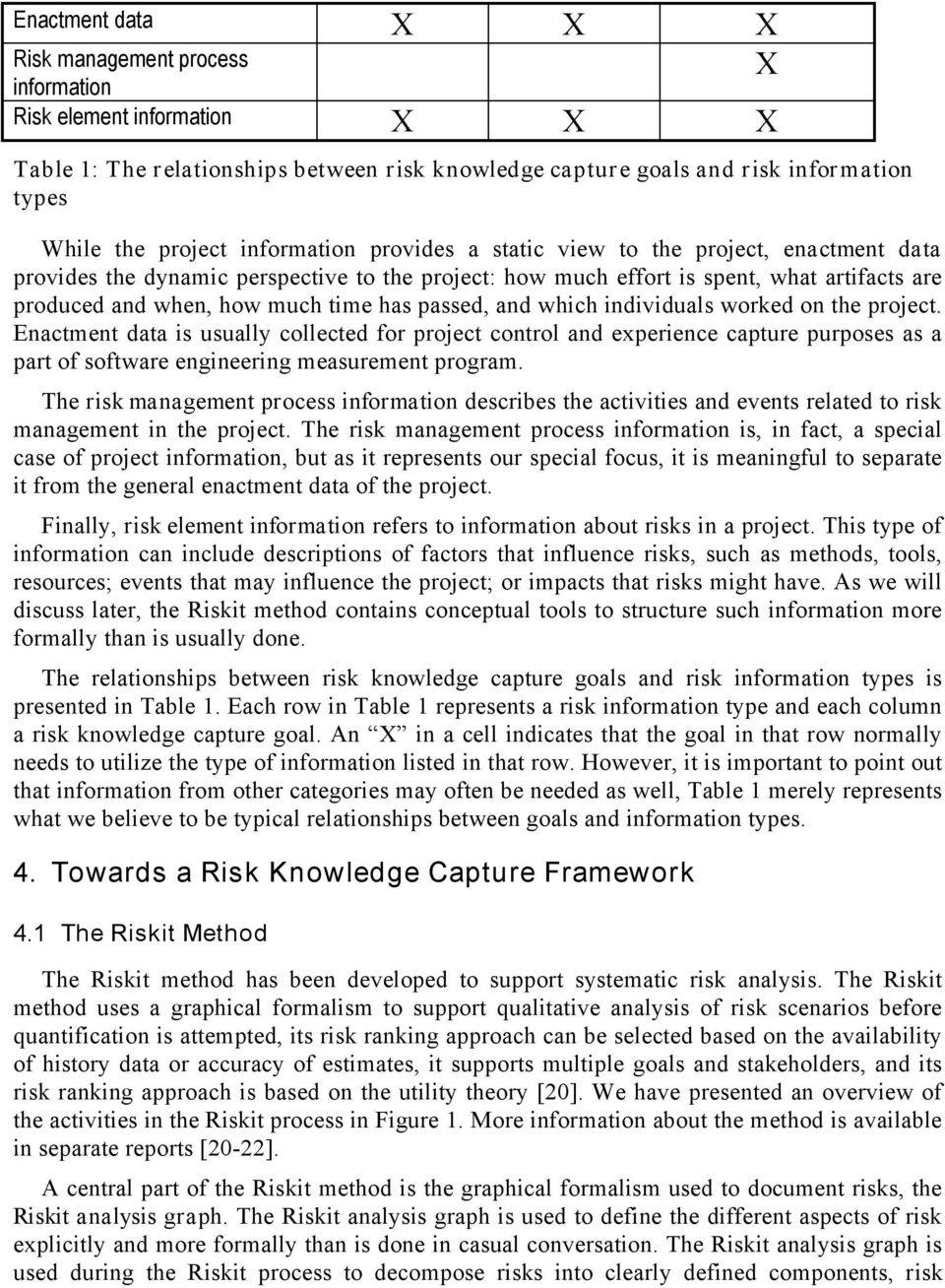
5 elements. Its components are presented in Figure 2. Each rectangle in the graph represents a risk element and each arrow describes the possible relationship between risk elements. We will define the components of the graph in the following paragraphs. Instead of informal, general descriptions of, we can document the different aspects of more precisely, as is shown in Figure 2. The Riskit analysis graph allows explicit and more formal documentation of and risk scenarios. The Riskit method has several potentially useful characteristics that can support risk knowledge capture. First, the Riskit Analysis Graph enforces more formal definition of so that more information is collected about each risk. Second, the graphical formalism used as well as the tool that is used to draw these diagrams lay the foundations for automating some of the risk knowledge capture: information about can be captured as Riskit graphs are drawn. Third, the Riskit process itself is a defined process that increases repeatability of the risk management process and supports the collection of relevant risk management experience through the templates and guidelines included in the method. 4.2 Risk Knowledge Capture in the Experience Factory Framework Control expected results selected actions Review/ define goals objectives, expectations, constraints, Identify and monitor Plan risk control potential Analyze prioritized, quantified Figure 1: The Riskit risk management cycle 1 In this section we present how the Riskit method can be integrated into Basili s Experience Factory (EF) and Quality Improvement Paradigm (QIP) [3,4]. The Quality Improvement Paradigm (QIP) is a systematic process for continuous improvement. It is similar to the scientific principle of learning in its emphasis of learning through empirical experience. The QIP process can be seen as consisting of three main activities that include the six steps may influence probability of may influence probability of (many-to-many) may influence probability of (many-to-many) valued through Risk Risk may prompt Effect on Reaction Utility loss factor event (one-to-many) (one-to-many) goals (one-to-many) 1 (many-to-many) Note that Figure 1 presents a simplified view of the activities in the Riskit process. More comprehensive description of the Riskit process is available through other publications [20]. Risk scenario have impact Figure 2: A conceptual view of the elements in the Riskit analysis graph

6 normally described for QIP: planning, consisting of the steps characterize, set goals, and choose process; execute; and learning, consisting of steps analyze and package [4]. The Experience Factory Organization is an organizational model for implementing the QIP process. The main idea of this approach is the recognition the distinct roles belonging to the project organization and a learning organization, the Experience Factory. The Project Organization focuses on delivering the software product and the Experience Factory focuses on learning from experience and improving software development practice in the organization. A central aspect of the Experience Factory is the Experience Base, a repository of data and knowledge about the software development process and products. The knowledge in the Experience Base can be in various forms, it can include raw and summarized data, mathematical models about the data (e.g., prediction models), experiment reports, and qualitative lessons learned reports [1-4]. From risk management perspective the Experience Factory concept serves to fulfill the following goals: separation of responsibilities between risk management within projects and improving the risk management process itself and improving the understanding of ; systematic capture and accumulation of risk management knowledge into the Experience Base; continuous learning from risk management experience through measurement, data collection, analysis and synthesis; and systematic reuse of accumulated risk management knowledge through packaging and dissemination of this knowledge. When the Riskit process is viewed from the perspective of the Experience Factory and the QIP cycle, it is possible to identify steps where risk management process needs to be initiated to support the QIP process, as shown in Figure 3. The initial planning cycle represents the first cycle of the Riskit process, whereas the risk management cycle supporting the execute step support mainly project monitoring, i.e., risk monitoring and control. The learning step analyzes and packages the risk management experience gained through the process. All of the QIP and Riskit activities represented in Figure 3 produce data about risk management that can be captured and stored in an experience base. We have defined a database definition for such information for the Riskit process. Furthermore, the project planning step in QIP also includes goal definition for risk understanding and risk management process improvement. These goals can introduce new data and experience capture needs that can be implemented as required. The learning step of QIP, and the two risk related activities associated with it, utilize the data and experience collected about and produce packaged, reusable pieces of risk knowledge to be stored in the Experience Base and utilized in future projects.
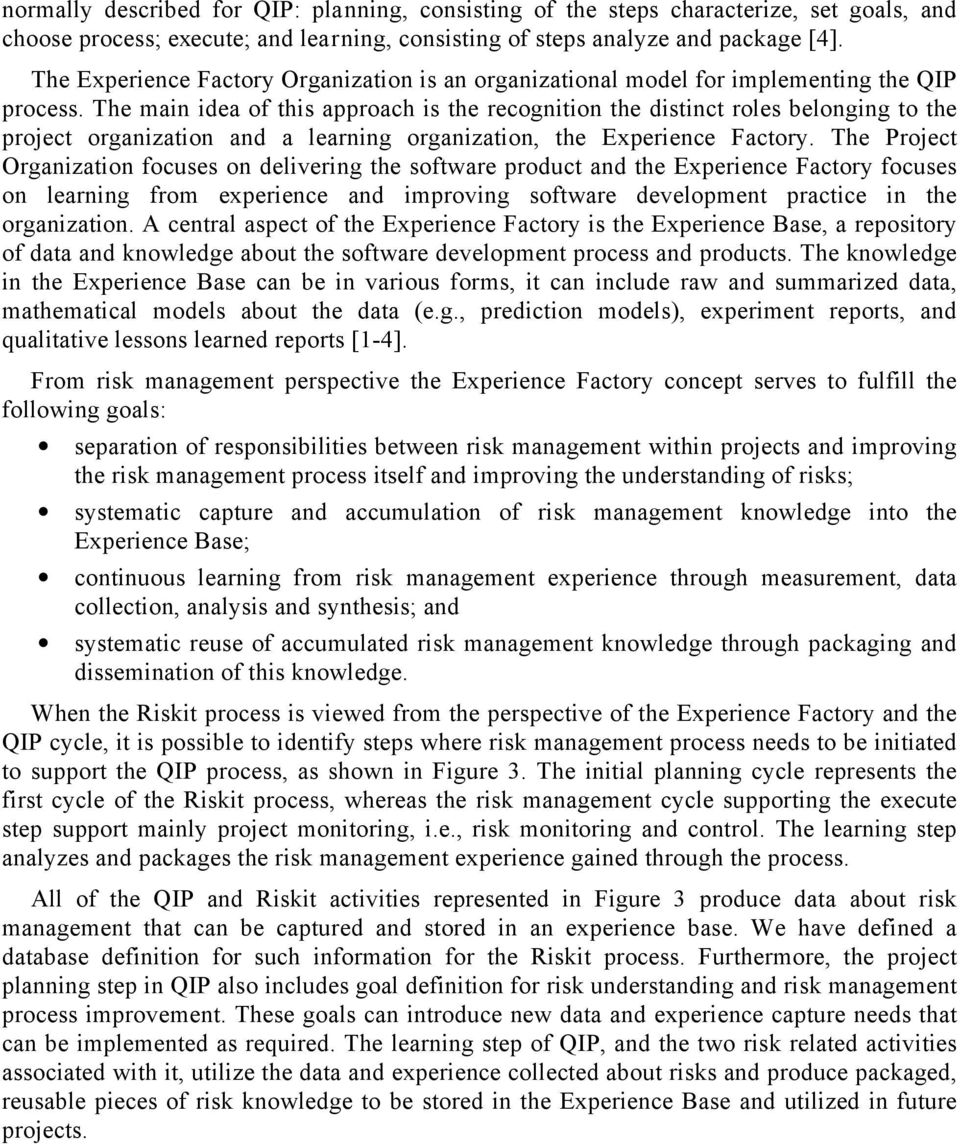
7 Review/ define goals objectives, expectations, constraints, Identify potential Risk understanding risk patterns reusable knowledge, environment information context, goals, process risk management plan Plan (characterize, set goals, choose process) Plan risk control prioritized, quantified Analyze Risk process improvement experience risk policy, risk mgmt process experience Learn performance data QIP Cycle Execute selected actions execution plan data, experience Identify and monitor potential Plan risk control prioritized, quantified Analyze Figure 3: The mapping between QIP cycle and the Riskit process 4.3 Applying the Riskit Knowledge Capture Framework The Riskit method and its knowledge capture framework have been applied in several trial projects. So far the case studies have focused on the last one of the goals we introduced earlier: improving the method itself. The goals of the first case study [22] were to characterize the method, investigate its feasibility, and to collect empirical feedback on its use to be able to improve it. This first case study resulted in several changes in the method itself and it produced approximately 15 risk scenarios (corresponding to about 50 risk elements). Project and context information was documented informally in a separate report [22]. Other, on-going empirical studies with the method focus similarly on obtaining feedback on the methods feasibility and effectiveness. These case studies have produced large amounts of risk management data and experience and we are in the process of formalizing this data into a risk management database, or a risk management experience base. Our goal is to evaluate the feasibility and potential benefits of such a database given the empirical data we have obtained.

8 5. Conclusions This paper presented background and motivation for risk knowledge capture and proposed a classification of goals and information types for such capture. We also outlined how the Riskit method supports this type of experience capture. We reported some initial experiences from the use of the Riskit method and the proposed risk knowledge capture framework. The potential benefits from risk knowledge capture are significant. Frequency and severity of typical can be estimated more accurately, changes in potential observed more concretely, risk management methods and tools can be improved based on empirical feedback, and projects have more up-to-date information about and risk management actions in a project. Furthermore, it may be possible to identify and package some risk management patterns: reusable pieces of risk management knowledge that can be utilized by project managers. Examples of such risk patterns could be lists of that are associated with certain project characteristics and descriptions of risk controlling actions that have been found effective in controlling certain types of. The Riskit method itself, through its more formal definition of risk and its graphical representation formalism, provides a good basis to capture and reuse such knowledge in practice. While it is too early to make any conclusions about the feasibility and benefits of the proposed risk knowledge capture approach, the combination of Riskit and the Experience Factory contain the necessary foundations for more systematic and detailed experience capture. The initial empirical studies indicate that the approach is feasible in industrial context. However, it is yet to be determined whether such experience capture is cost effective. Although the Riskit method may potentially allow automation of some of the experience capture processes, it is currently a manually driven process and therefore potentially too costly in large scale use. Furthermore, given the subjective nature of the definition of risk, one could also question how reliable is experience that, to a large degree, is based on subjective opinions and judgment calls about future events. While there may be some valid concerns about the cost-effectiveness of a risk management database and its utilization, it is nevertheless likely that risk management experience needs to be captured and formulated into knowledge to be reused in future projects. The Riskit method provides a more concrete basis even for qualitative knowledge formulation process, even when the risk management experience and data are not captured into a formal database but stored in less formal parts of the Experience Base. 6. References [1] V. R. Basili, Quantitative Evaluation of Software Engineering Methodology, Proceedings of the First Pan Pacific Computer Conference. Also available as computer science technical report TR-1519, University of Maryland. [2] V. R. Basili, Software Development: A Paradigm for the Future, Proceedings of the 13th Annual Computer Software and Applications Conference (COMPSAC).

9 [3] V. R. Basili, G. Caldiera, F. McGarry, R. Pajerski, G. Page, and S. Waligora, The Software Engineering Laboratory - an Operational Software Experience Factory, pp , Proceedings of the International Conference on Software Engineering, May [4] V. R. Basili, G. Caldiera, and H. D. Rombach. The Experience Factory. In: Encyclopedia of Software Engineering, Anonymous New York: John Wiley & Sons, 1994.pp [5] J. Berny and P. R. F. Townsend, Macrosimulation of project -- a practical way forward, International Journal of Project Management, vol. 11, pp , [6] B. W. Boehm. Tutorial: Software Risk Management, IEEE Computer Society Press, pp [7] J. A. Bowers, Data for project risk analyses, International Journal of Project Management, vol. 12, pp. 9-16, [8] M. J. Carr, S. L. Konda, I. A. Monarch, F. C. Ulrich, and C. F. Walker. Taxonomy-Based Risk Identification, SEI Technical Report SEI-93-TR-006, Pittsburgh, PA: Software Engineering Institute, [9] R. N. Charette. Software Engineering Risk Analysis and Management, New York: McGraw-Hill, [10] R. N. Charette. Applications Strategies for Risk Analysis, New York: McGraw-Hill, [11] R. Fairley, Risk Management for Software Projects, IEEE Software, vol. 11, pp , [12] E. M. Hall, Proactive Risk Management Methods for Software Engineering Excellence Florida Institute of Technology. Also available from UMI Dissertation Services. [13] E. M. Hall, correspondence ed. J. Kontio correspondence. [14] R. Hefner, Experience with Applying SEI's Risk Taxonomy, Proceedings of the Third SEI Conference on Software Risk Management. SEI. Pittsburgh, PA. [15] IEEE. IEEE Standard for Developing Software Life Cycle Processes, New York: IEEE Computer Society, [16] ISO. ISO , Guidelines for the application of ISO 9001 to the development, supply and maintenance of software, ISO :1991(E), International Standards Organization, [17] ISO. SPICE: Baseline Practices Guide, an unfinished draft of a standard being developed for ISO, version 1.00, (UnPub) [18] D. W. Karolak. Software Engineering Risk Management, Washington, DC: IEEE, [19] J. Kontio, IWSED-95 Web pages Anonymous. Anonymous. <None Specified>, vol University of Maryland. World Wide Web. [20] J. Kontio, The Riskit Method for Software Risk Management, version 1.00 Anonymous1996. Computer Science Technical Reports. University of Maryland. College park, MD. [21] J. Kontio and V. R. Basili, Empirical Evaluation of a Risk Management Method, Proceedings of the SEI Conference on Risk Management. Software Engineering Institute. Pittsburgh, PA. [22] J. Kontio, H. Englund, and V. R. Basili, Experiences from an Exploratory Case Study with a Software Risk Management Method Anonymous CS-TR-3705, Computer Science Technical Reports. University of Maryland. College Park, Maryland. [23] L. Laitinen, S. Kalliomäki, and K. Känsälä. Ohjelmistoprojektien Riskitekijät, Tutkimusselostus N:o L-4, Helsinki: VTT, Tietojenkäsittelytekniikan Laboratorio, [24] J. V. Michaels. Technical Risk Management, Upper Saddle River, NJ: Prentice Hall, [25] I. A. Monarch, S. L. Konda, and M. J. Carr, Software Engineering Risk Repository, Proceedings of the 1996 SEPG Conference. Software Engineering Institute. PIttsburgh, PA. [26] G. Pandelios, T. P. Rumsey, and A. J. Dorofee, Using Risk Management for Software Process Improvement, Proceedings of the 1996 SEPG Conference. SEI. Pittsburgh. [27] M. C. Paulk, B. Curtis, M. B. Chrissis, and C. V. Weber. Capability Maturity Model for Software, Version 1.1, Technical Report SEI-93-TR-024, Pittsburgh: Software Engineering Institute, Carnegie Mellon University, 1993.
![In: Encyclopedia of Software Engineering, Anonymous New York: John Wiley & Sons, 1994.pp. 470-476. [5] J. Berny and P. R. F.](/docs-images/57/6517432/images/page_9.jpg "Townsend, Macrosimulation of project -- a practical way forward, International Journal of Project Management, vol. 11, pp. 201-208, 1993. [6] B. W. Boehm.")
10 [28] J. Ropponen, Risk Management in Information System Development Anonymous TR-3, Computer Science Reports. University of Jyväskylä, Department of Computer Science and Information Systems. Jyväskylä.

ISO, CMMI and PMBOK Risk Management: a Comparative Analysis
 ISO, CMMI and PMBOK Risk Management: a Comparative Analysis Cristine Martins Gomes de Gusmão Federal University of Pernambuco / Informatics Center Hermano Perrelli de Moura Federal University of Pernambuco
The Riskit Method for Software Risk Management, version 1.00
 CS-TR-3782 UMIACS-TR-97-38 The Riskit Method for Software Risk Management, version 1.00 Jyrki Kontio Institute for Advanced Computer Studies and Department of Computer Science University of Maryland A.V.
Risk Analysis: a Key Success Factor for Complex System Development
 Risk Analysis: a Key Success Factor for Complex System Development MÁRCIO DE O. BARROS CLÁUDIA M. L. WERNER GUILHERME H. TRAVASSOS COPPE / UFRJ Computer Science Department Caixa Postal: 68511 - CEP 21945-970
Mahmoud Khraiwesh Faculty of Science and Information Technology Zarqa University Zarqa - Jordan [email protected]
 World of Computer Science and Information Technology Journal (WCSIT) ISSN: 2221-0741 Vol. 1, No. 2, 26-33, 2011 Validation Measures in CMMI Mahmoud Khraiwesh Faculty of Science and Information Technology
Knowledge Infrastructure for Project Management 1
 Knowledge Infrastructure for Project Management 1 Pankaj Jalote Department of Computer Science and Engineering Indian Institute of Technology Kanpur Kanpur, India 208016 [email protected] Abstract In any
AN OVERVIEW OF INDUSTRIAL SOFTWARE DOCUMENTATION PRACTICES
 AN OVERVIEW OF INDUSTRIAL SOFTWARE DOCUMENTATION PRACTICES Marcello Visconti 1 Departamento de Informática Universidad Técnica Federico Santa María Valparaíso, CHILE [email protected] Curtis R. Cook
V. Phani Krishna et al, / (IJCSIT) International Journal of Computer Science and Information Technologies, Vol. 2 (6), 2011, 2915-2919
 Software Quality Assurance in CMM and XP- A Comparative Study CH.V. Phani Krishna and Dr. K.Rajasekhara Rao CSE Department, KL University, Guntur dt., India. Abstract Software Quality Assurance is a planned
Domain Analysis for the Reuse of Software Development Experiences 1
 Domain Analysis for the Reuse of Software Development Experiences 1 V. R. Basili*, L. C. Briand**, W. M. Thomas* * Department of Computer Science University of Maryland College Park, MD, 20742 USA ** CRIM
A CASE STUDY ON SOFTWARE PROJECT MANAGEMENT IN INDUSTRY EXPERIENCES AND CONCLUSIONS
 A CASE STUDY ON SOFTWARE PROJECT MANAGEMENT IN INDUSTRY EXPERIENCES AND CONCLUSIONS P. Mandl-Striegnitz 1, H. Lichter 2 1 Software Engineering Group, University of Stuttgart 2 Department of Computer Science,
Quality Management of Software and Systems: Continuous Improvement Approaches
 Quality Management of Software and Systems: Continuous Improvement Approaches Contents Quality Improvement Paradigm (QIP) Experience Factory (EF) Goal Question Metric (GQM) GQM + Strategies TQM Definition
REVIEW OF RISK MANAGEMENT METHODS
 2011 Robert Stern, José Carlos Arias 59 REVIEW OF RISK MANAGEMENT METHODS Robert Stern (MBA), José Carlos Arias (PhD, DBA) Abstract Project development, especially in the software related field, due to
A Capability Maturity Model for Scientific Data Management
 A Capability Maturity Model for Scientific Data Management 1 A Capability Maturity Model for Scientific Data Management Kevin Crowston & Jian Qin School of Information Studies, Syracuse University July
A Variability Viewpoint for Enterprise Software Systems
 2012 Joint Working Conference on Software Architecture & 6th European Conference on Software Architecture A Variability Viewpoint for Enterprise Software Systems Matthias Galster University of Groningen,
GQM + Strategies in a Nutshell
 GQM + trategies in a Nutshell 2 Data is like garbage. You had better know what you are going to do with it before you collect it. Unknown author This chapter introduces the GQM + trategies approach for
Continuous Risk Management Guidebook
 Carnegie Mellon Software Engineering Institute Continuous Guidebook Audrey J. Dorofee Julie A. Walker Christopher J. Alberts Ronald P. Higuera Richard L. Murphy Ray C. Williams The ideas and findings in
Current Research Topic In Software Engineering
 Current Research Topic In Software Engineering A PROJECT REPORT Submitted by MD. Mithun Ahamed Id: 13-96937-2 Under the guidance of DR. Dip Nandi in partial fulfillment for the award of the degre of Master
Project Management. [Student s Name] [Name of Institution]
![Project Management. [Student s Name] [Name of Institution]](/thumbs/30/14331803.jpg "Project Management. [Student s Name] [Name of Institution]") 1 Paper: Assignment Style: Harvard Pages: 10 Sources: 7 Level: Master Project Management [Student s Name] [Name of Institution] 2 Project Management Introduction The project management also known as management
1 Paper: Assignment Style: Harvard Pages: 10 Sources: 7 Level: Master Project Management [Student s Name] [Name of Institution] 2 Project Management Introduction The project management also known as management
Chapter 3 Chapter 3 Service-Oriented Computing and SOA Lecture Note
 Chapter 3 Chapter 3 Service-Oriented Computing and SOA Lecture Note Text book of CPET 545 Service-Oriented Architecture and Enterprise Application: SOA Principles of Service Design, by Thomas Erl, ISBN
A Taxonomy of Operational Risks
 Sponsored by the U.S. Department of Defense 2005 by Carnegie Mellon University A Taxonomy of Operational Risks Brian Gallagher Director, Acquisition Support page 1 Operational Risk By its nature, the uncertainty
707.009 Foundations of Knowledge Management Organizational Knowledge Repositories
 707.009 Foundations of Knowledge Management Organizational Knowledge Repositories Markus Strohmaier Univ. Ass. / Assistant Professor Knowledge Management Institute Graz University of Technology, Austria
Simulating Software Projects An Approach for Teaching Project Management
 Simulating Software Projects An Approach for Teaching Project Management P. Mandl-Striegnitz 1, A. Drappa 1, H. Lichter 2 1 University of Stuttgart, Stuttgart, Germany 2 Aachen University of Technology,
Role of Software Quality Assurance in Capability Maturity Model Integration
 Role of Software Quality Assurance in Capability Maturity Model Integration Rekha Chouhan 1 Dr.Rajeev Mathur 2 1 Research Scholar, Jodhpur National University, JODHPUR 2 Director, CS, Lachoo Memorial College
Teaching Continuous Risk Management Using A Requirements Management Tool
 Teaching Continuous Risk Management Using A Requirements Management Tool James C. Helm, Ph.D., P. E. University of Houston-Clear Lake Delta 123 2700 Bay Area Blvd. Houston, TX 77058 [email protected] Phone
Empirical Software Engineering Introduction & Basic Concepts
 Empirical Software Engineering Introduction & Basic Concepts Dietmar Winkler Vienna University of Technology Institute of Software Technology and Interactive Systems [email protected]
An Overview of Software Engineering Process and Its Improvement
 An Overview of Software Engineering and Its Improvement O Alain April École de Technologie Supérieure, Montréal, Canada Claude Laporte École de Technologie Supérieure, Montréal, Canada Introduction The
Practical Experiences of Agility in the Telecom Industry
 Practical Experiences of Agility in the Telecom Industry Jari Vanhanen 1, Jouni Jartti 2, and Tuomo Kähkönen 2 1 Helsinki University of Technology, Software Business and Engineering Institute, P.O. Box
Fault Slip Through Measurement in Software Development Process
 Fault Slip Through Measurement in Software Development Process Denis Duka, Lovre Hribar Research and Development Center Ericsson Nikola Tesla Split, Croatia [email protected]; [email protected]
Fundamentals of Measurements
 Objective Software Project Measurements Slide 1 Fundamentals of Measurements Educational Objective: To review the fundamentals of software measurement, to illustrate that measurement plays a central role
What Makes Good Research in Software Engineering?
 International Journal of Software Tools for Technology Transfer, 2002, vol. 4, no. 1, pp. 1-7. What Makes Good Research in Software Engineering? Mary Shaw School of Computer Science, Carnegie Mellon University,
JOURNAL OF OBJECT TECHNOLOGY
 JOURNAL OF OBJECT TECHNOLOGY Online at www.jot.fm. Published by ETH Zurich, Chair of Software Engineering JOT, 2006 Vol. 5. No. 8, November-December 2006 Requirements Engineering Tasks Donald Firesmith,
CHAPTER 9 SOFTWARE ENGINEERING PROCESS
 CHAPTER 9 SOFTWARE ENGINEERING PROCESS Khaled El Emam Institute for Information Technology National Research Council Building M-50, Montreal Road Ottawa, Ontario K1A 0R6, Canada +1 (613) 998 4260 [email protected]
Leveraging CMMI framework for Engineering Services
 Leveraging CMMI framework for Engineering Services Regu Ayyaswamy, Mala Murugappan Tata Consultancy Services Ltd. Introduction In response to Global market demand, several OEMs adopt Global Engineering
Utilization of Statistical Process Control in Defined Level Software Companies to Manage Processes Using Control Charts with Three Sigma
 Proceedings of the World Congress on Engineering and Computer Science 00 Vol I WCECS 00, October 0-, 00, San Francisco, USA Utilization of Statistical Process Control in Defined Level Software Companies
Use a Risk Breakdown Structure (RBS) to Understand Your Risks
 Use a Risk Breakdown Structure (RBS) to Understand Your Risks David Hillson, PhD, PMP, FAPM, MIRM, MCMI, Director of Consultancy, Management Professional Solutions Limited Introducing the Risk Breakdown
Software Metrics & Software Metrology. Alain Abran. Chapter 4 Quantification and Measurement are Not the Same!
 Software Metrics & Software Metrology Alain Abran Chapter 4 Quantification and Measurement are Not the Same! 1 Agenda This chapter covers: The difference between a number & an analysis model. The Measurement
Evaluation and Integration of Risk Management in CMMI and ISO/IEC 15504
 Evaluation and Integration of Risk Management in CMMI and ISO/IEC 15504 Dipak Surie, Email : [email protected] Computing Science Department Umea University, Umea, Sweden Abstract. During software development,
The Challenge of Productivity Measurement
 Proceedings: Pacific Northwest Software Quality Conference, 2006 The Challenge of Productivity Measurement David N. Card Q-Labs, Inc [email protected] Biography- David N. Card is a fellow of Q-Labs, a subsidiary
BUSINESS RULES AS PART OF INFORMATION SYSTEMS LIFE CYCLE: POSSIBLE SCENARIOS Kestutis Kapocius 1,2,3, Gintautas Garsva 1,2,4
 International Conference 20th EURO Mini Conference Continuous Optimization and Knowledge-Based Technologies (EurOPT-2008) May 20 23, 2008, Neringa, LITHUANIA ISBN 978-9955-28-283-9 L. Sakalauskas, G.W.
Schedule Risk Analysis Simulator using Beta Distribution
 Schedule Risk Analysis Simulator using Beta Distribution Isha Sharma Department of Computer Science and Applications, Kurukshetra University, Kurukshetra, Haryana (INDIA) [email protected] Dr. P.K.
An Approach for assessing the Quality of Software for small and medium sized firms
 An Approach for assessing the Quality of Software for small and medium sized firms N. Veeranjaneyulu Associate Professor, School of Computing, Vignan University, Vadlamudi, India 1 Abstract: Software quality
International Association of Scientific Innovation and Research (IASIR) (An Association Unifying the Sciences, Engineering, and Applied Research)
 International Association of Scientific Innovation and Research (IASIR) (An Association Unifying the Sciences, Engineering, and Applied Research) International Journal of Engineering, Business and Enterprise
Software Engineering Compiled By: Roshani Ghimire Page 1
 Unit 7: Metric for Process and Product 7.1 Software Measurement Measurement is the process by which numbers or symbols are assigned to the attributes of entities in the real world in such a way as to define
Controlling software acquisition: is supplier s software process capability determination enough?
 Controlling software acquisition: is supplier s software process capability determination enough? Fabrizio Fabbrini, Mario Fusani, Giuseppe Lami Abstract Innovation in automotive is principally due to
Economic Aspects and Needs in IT-Security Risk Management for SMEs
 Markus Klemen Stefan Biffl Institute of Software Technology and Interactive Systems Vienna University of Technology, Karlsplatz 13, A-1040, Austria {klemen, biffl}@ifs.tuwien.ac.at Abstract Business success
Measurement Information Model
 mcgarry02.qxd 9/7/01 1:27 PM Page 13 2 Information Model This chapter describes one of the fundamental measurement concepts of Practical Software, the Information Model. The Information Model provides
Software Engineering/Courses Description Introduction to Software Engineering Credit Hours: 3 Prerequisite: 0306211(Computer Programming 2).
 0305203 0305280 0305301 0305302 Software Engineering/Courses Description Introduction to Software Engineering Prerequisite: 0306211(Computer Programming 2). This course introduces students to the problems
Experience Report: Using Internal CMMI Appraisals to Institutionalize Software Development Performance Improvement
 Experience Report: Using Internal MMI Appraisals to Institutionalize Software Development Performance Improvement Dr. Fredrik Ekdahl A, orporate Research, Västerås, Sweden [email protected] Stig
Distributed and Outsourced Software Engineering. The CMMI Model. Peter Kolb. Software Engineering
 Distributed and Outsourced Software Engineering The CMMI Model Peter Kolb Software Engineering SEI Trademarks and Service Marks SM CMM Integration SCAMPI are service marks of Carnegie Mellon University
C. Wohlin, "Is Prior Knowledge of a Programming Language Important for Software Quality?", Proceedings 1st International Symposium on Empirical
 C. Wohlin, "Is Prior Knowledge of a Programming Language Important for Software Quality?", Proceedings 1st International Symposium on Empirical Software Engineering, pp. 27-36, Nara, Japan, October 2002.
A Study on Software Metrics and Phase based Defect Removal Pattern Technique for Project Management
 International Journal of Soft Computing and Engineering (IJSCE) A Study on Software Metrics and Phase based Defect Removal Pattern Technique for Project Management Jayanthi.R, M Lilly Florence Abstract:
Decision Support System for Software Risk Analysis during Software Development
 Decision Support System for Software Risk Analysis during Software Development Surbhi Anand Assistance Prof CT Institutes, Jalandhar, Punjab,India. Vinay Chopra Assistance Prof Daviet,Jallandhar, Punjab,India.
Applying Integrated Risk Management Scenarios for Improving Enterprise Governance
 Applying Integrated Risk Management Scenarios for Improving Enterprise Governance János Ivanyos Trusted Business Partners Ltd, Budapest, Hungary, [email protected] Abstract: The term of scenario is used
Quantitative Project Management Framework via Integrating
 Quantitative Project Management Framework via Integrating Six Sigma and PSP/TSP Sejun Kim, BISTel Okjoo Choi, Jongmoon Baik, Abstract: Process technologies such as Personal Software Process SM (PSP) and
Requirements engineering
 Learning Unit 2 Requirements engineering Contents Introduction............................................... 21 2.1 Important concepts........................................ 21 2.1.1 Stakeholders and
BMC Software Consulting Services. Fermilab Computing Division Service Catalog & Communications: Process and Procedures
 BMC Software Consulting Services Service Catalog & Communications: Process and Procedures Policies, Client: Date : Version : Fermilab 02/12/2009 1.0 GENERAL Description Purpose This document establishes
Case Study of CMMI implementation at Bank of Montreal (BMO) Financial Group
 Case Study of CMMI implementation at Bank of Montreal (BMO) Financial Group Background Started in 1817, Bank of Montreal - BMO Financial Group (NYSE, TSX: BMO) is a highly diversified financial services
Palisade Risk Conference, 2014
 Advanced Risk Management to Improve Cost and Schedule Performance on EPC Projects Risk-Management Best Practices from Nuclear Experience Palisade Risk Conference, 2014 Sola Talabi PhD MBA MSc BSc RMP Project
Practice Overview. REQUIREMENTS DEFINITION Issue Date: <mm/dd/yyyy> Revision Date: <mm/dd/yyyy>
 DEPARTMENT OF HEALTH AND HUMAN SERVICES ENTERPRISE PERFORMANCE LIFE CYCLE FRAMEWORK PRACTIICES GUIIDE REQUIREMENTS DEFINITION Issue Date: Revision Date: Document
(Refer Slide Time: 01:52)
 Software Engineering Prof. N. L. Sarda Computer Science & Engineering Indian Institute of Technology, Bombay Lecture - 2 Introduction to Software Engineering Challenges, Process Models etc (Part 2) This
Software Engineering from an Engineering Perspective: SWEBOK as a Study Object
 Software Engineering from an Engineering Perspective: SWEBOK as a Study Object Alain Abran a,b, Kenza Meridji b, Javier Dolado a a Universidad del País Vasco/Euskal Herriko Unibertsitatea b Ecole de technologie
A Configuration Management Model for Software Product Line
 A Configuration Management Model for Software Product Line Liguo Yu 1 and Srini Ramaswamy 2 1 Computer Science and Informatics Indiana University South Bend South Bend, IN 46634, USA [email protected] 2 Computer
Audit of the Test of Design of Entity-Level Controls
 Audit of the Test of Design of Entity-Level Controls Canadian Grain Commission Audit & Evaluation Services Final Report March 2012 Canadian Grain Commission 0 Entity Level Controls 2011 Table of Contents
Software Risk Management: a Process Model and a Tool
 Software Risk Management: a Process Model and a Tool Tereza G. Kirner 1, Lourdes E. Gonçalves 1 1 Graduate Program in Computer Science Methodist University of Piracicaba SP, Brasil [email protected];
Reusing Meta-Base to Improve Information Quality
 Reusable Conceptual Models as a Support for the Higher Information Quality 7DWMDQD :HO]HU %UXQR 6WLJOLF,YDQ 5R]PDQ 0DUMDQ 'UXåRYHF University of Maribor Maribor, Slovenia ABSTRACT Today we are faced with
PROCESS AND PRODUCT QUALITY ASSURANCE MEASURES IN CMMI
 PROCESS AND PRODUCT QUALITY ASSURANCE MEASURES IN CMMI Mahmoud Khraiwesh Faculty of Science and Information Technology, Zarqa University, Zarqa Jordan ABSTRACT Process and product quality assurance are
Abstraction in Computer Science & Software Engineering: A Pedagogical Perspective
 Orit Hazzan's Column Abstraction in Computer Science & Software Engineering: A Pedagogical Perspective This column is coauthored with Jeff Kramer, Department of Computing, Imperial College, London ABSTRACT
SOFTWARE QUALITY MANAGEMENT THROUGH IMPLEMENTATION OF SOFTWARE STANDARDS
 4 th Int. Conf. CiiT, Molika, Dec.11-14, 2003 61 SOFTWARE QUALITY MANAGEMENT THROUGH IMPLEMENTATION OF SOFTWARE STANDARDS S. Grceva, Z. Zdravev Faculty for Education Goce Delcev, University of Sts. Cyril
Enhancing RUP for CMMI compliance: A methodological approach
 Page 1 of 15 Copyright IBM Corporation 2004. http://www-106.ibm.com/developerworks/rational/library/5318.html Search for: within All of dw Use + - ( ) " " Search help IBM home Products & services Support
IMPLEMENTATION OF A SOFTWARE PROJECT OFFICE AT HONEYWELL AIR TRANSPORT SYSTEMS. by Michael A. Ross
 IMPLEMENTATION OF A SOFTWARE PROJECT OFFICE AT HONEYWELL AIR TRANSPORT SYSTEMS by Michael A. Ross Abstract. This paper justifies, defines and describes an organization-level software project management
Use of Metrics in High Maturity Organizations
 Use of Metrics in High Maturity Organizations Pankaj Jalote Department of Computer Science and Engineering Indian Institute of Technology Kanpur Kanpur, India 208016 [email protected] Summary A high maturity
INTEGRATED PROJECT MANAGEMENT MEASURES IN CMMI
 INTEGRATED PROJECT MANAGEMENT MEASURES IN CMMI ABSTRACT Mahmoud Khraiwesh Faculty of Information Technology, Zarqa University, Zarqa Jordan Project management is quite important to execute projects effectively
Software Maintenance Capability Maturity Model (SM-CMM): Process Performance Measurement
 Software Maintenance Capability Maturity Model 311 Software Maintenance Capability Maturity Model (SM-CMM): Process Performance Measurement Alain April 1, Alain Abran 2, Reiner R. Dumke 3 1 Bahrain telecommunications
Operational Risk Management - The Next Frontier The Risk Management Association (RMA)
 Operational Risk Management - The Next Frontier The Risk Management Association (RMA) Operational risk is not new. In fact, it is the first risk that banks must manage, even before they make their first
CDC UNIFIED PROCESS PRACTICES GUIDE
 Document Purpose The purpose of this document is to provide guidance on the practice of Quality Management and to describe the practice overview, requirements, best practices, activities, and key terms
SOFTWARE RISK MANAGEMENT
 SOFTWARE RISK MANAGEMENT Linda Westfall The Westfall Team [email protected] PMB 383, 3000 Custer Road, Suite 270 Plano, TX 75075 972-867-1172 (voice) 972-943-1484 (fax) SUMMARY This paper reviews the basic
Steve Masters (SEI) SEPG North America March 2011. 2011 Carnegie Mellon University
 Using Organizational Business Objectives to Guide a Process Improvement Program Software Engineering Institute Carnegie Mellon University Pittsburgh, PA 15213 (SEI) SEPG North America March 2011 Agenda
Quantitative CMMI Assessment for Offshoring Through the Analysis of Project Management Repositories
 Quantitative CMMI Assessment for Offshoring Through the Analysis of Project Management Repositories Thanwadee Sunetnanta 1, Ni-On Nobprapai 1, Olly Gotel 2 1 Mahidol University, Department of Computer
CDC UNIFIED PROCESS PRACTICES GUIDE
 Document Purpose The purpose of this document is to provide guidance on the practice of Requirements Definition and to describe the practice overview, requirements, best practices, activities, and key