
Charles F. Dolan School of Business Graduate Programs
|
|
|
- Michael Webb
- 10 years ago
- Views:
Transcription
1 Charles F. Dolan School of Business Graduate Programs Master of Business Administration Master of Science in Accounting Master of Science in Finance Certificate Programs for Advanced Study in Accounting Accounting Information Systems Entrepreneurship Finance General Management Human Resource Management Information Systems and Operations Management Marketing Taxation

2 i Table of Contents Academic Calendar... 2 Message from the President... 4 Mission... 5 Overview... 6 Diversity Vision Statement Campus Services... 6 Student Handbook... 6 DiMenna-Nyselius Library... 6 Early Learning Center... 7 Aloysius P. Kelley, S.J. Center... 7 Computing Services... 7 Information Technology Services (ITS)... 7 Arts and Minds Programs Other Requirements... 8 Accreditations... 9 Compliance Statements and Notifications Message from the Dean Overview Vision Statement Mission Statement Admission Criteria and Procedures Mandatory Immunization International Students Students with Disabilities Tuition, Fees, and Financial Aid Tuition and Fees Deferred Payment Reimbursement by Employer Refund of Tuition Financial Aid Federal Stafford Loans Tax Deductions Veterans Academic Policies And General Regulations Academic Advising and Curriculum Planning Student Programs of Study Academic Freedom and Responsibility Freedom of Expression Student Rights Student Responsibilities Academic Honesty Honor Code University Course Numbering System... 22

3 ii Option for Graduate Level Courses Normal Academic Progress Academic Load Academic Standards Independent Study Matriculation/Continuation Time to Complete Degree Applications for and Awarding of Degrees Graduation and Commencement Disruption of Academic Progress Academic Probation/Dismissal Course Withdrawal Readmission Grading System Grades; Academic Average Incomplete Transfer of Credit Grade Reports Scholastic Honors Academic Grievance Procedures Purpose Types of Grievances Time Limits Informal Procedure Formal Procedure Structure of Grievance Committee Due Process Procedure Transcripts Student Records Academic Programs The MBA Program The Master of Science in Accounting Program The Master of Science in Finance Program Certificate Programs for Advanced Study Course Descriptions Dolan School of Business Administration Department Chairs Faculty Faculty Emeriti Advisory Council Fairfield University Administration Fairfield University Board of Trustees... 52

4 Academic Calendar - Graduate Programs Classes are offered on weeknights and Saturdays to accommodate those in the program who are employed full time. Refer to the schedules that are distributed each semester for calendar changes. Fall 2013 July 8 Registration begins for all Graduate programs for Fall, 2013 Applications for degree are due for August 30th graduation Aug. 1 Last day for students to sign up for Fall 2013 monthly payment plan Aug. 5 Last day for online registration for Fall 2013 Sept. 2 Labor Day - University holiday Sept. 3 Classes begin for all graduate programs Oct. 11 Deadline for Summer, 2013 and Spring, 2013 make up of Incompletes Oct. 14 Columbus Day - University holiday (School of Engineering has graduate classes) Oct. 18 Last day to withdraw from Fall course Nov Dec. 1 Thanksgiving Recess Dec. 2 Classes resume for all schools Applications for degree are due for January 30th graduation Registration begins for all Graduate Studies Programs for Spring, 2014 Dec. 20 Last day of classes/exams for all graduate programs Last day for students to sign up for Spring 2014 monthly payment plan Winter 2014 Intersession Jan. 2 - Jan. 14 Winter Intersession - Dolan School of Business Spring 2014 Jan. 2 Last day for online registration for Spring 2014 Jan. 16 Jan. 20 Feb. 17 Classes begin for all schools Martin Luther King, Jr. Day - University Holiday President's Day - University holiday (School of Engineering has graduate classes) Last day to withdraw from Spring course Spring Recess Classes resume March 7 March 24 - March 28 March 31 April 1 Registration begins for all Graduate programs for Summer, 2014 Applications for degree are due for May graduation - all schools April 17 - April 20 Easter Recess all Graduate programs April 21 May 9 May 17 May 18 Classes resume Last day of classes/exams for all graduate programs Baccalaureate Mass 64th Commencement Graduate Ceremony - 3 p.m.

5 3 Summer 2014 May 19 - May 30 Graduate Business Summer Session I May 19 - Aug. 8 Engineering Summer Session June 2 - June 27 Graduate Business Summer Session II June 30 - Aug. 1 Graduate Business Summer Session III (July 4 Holiday) July 7 Registration begins for all Graduate Programs for Fall, 2014 Applications for Degree are due for August 30th graduation (all schools) Aug. 4 - Aug. 23 Graduate Business Summer Session IV

6 4 A Message from the President Dear Student, Welcome to Fairfield University, and thank you for your interest in our graduate and professional programs. As a student at Fairfield you will learn from our first-class faculty, who are leaders in their fields, with a strong personal commitment to the education of men and women who share their passion for making a difference in the world. Fairfield is consistently ranked as one of the top master's level universities in the Northeast and provides advantages to our graduate and professional students that lead to success in their future endeavors. The graduates of our professional and master's programs go on to successful and fulfilling careers, as global leaders in business, education, engineering, nursing, and countless other professions where they are sought after for their intellectual acumen, professional skills, and strength of character. What distinguishes Fairfield from many other colleges and universities is that as a Jesuit institution, we are the inheritor of an almost 500-year-old pedagogical tradition that has always stressed that the purpose of an education is to develop students as "whole persons" - in mind, body, and in spirit. These Jesuit values are integral to our graduate and professional programs. It is our mission at Fairfield to form men and women who are prepared to be global citizens, confident in their capacities, trained to excel in any circumstance, and inspired to put their gifts at work to transform the world for the betterment of their fellow men and women. A Fairfield education will shape you in this manner, preparing you to meet future challenges. We invite you to browse through the catalog of courses and take the first step towards your graduate education at Fairfield University. Sincerely, Jeffrey P. von Arx, S.J. President

7 5 Fairfield University Mission Fairfield University, founded by the Society of Jesus, is a coeducational institution of higher learning whose primary objectives are to develop the creative intellectual potential of its students and to foster in them ethical and religious values, and a sense of social responsibility. Jesuit education, which began in 1547, is committed today to the service of faith, of which the promotion of justice is an absolute requirement. Fairfield is Catholic in both tradition and spirit. It celebrates the God-given dignity of every human person. As a Catholic university, it welcomes those of all beliefs and traditions who share its concerns for scholarship, justice, truth, and freedom, and it values the diversity that their membership brings to the University community. Fairfield educates its students through a variety of scholarly and professional disciplines. All of its schools share a liberal and humanistic perspective, and a commitment to excellence. Fairfield encourages a respect for all the disciplines - their similarities, their differences, and their interrelationships. In particular, in its undergraduate schools, it provides all students with a broadly based general education curriculum with a special emphasis on the traditional humanities as a complement to the more specialized preparation in disciplines and professions provided by the major programs. Fairfield is also committed to the needs of society for liberally educated professionals. It meets the needs of its students to assume positions in this society through its undergraduate and graduate professional schools and programs. A Fairfield education is a liberal education, characterized by its breadth and depth. It offers opportunities for individual and common reflection, and it provides training in such essential human skills as analysis, synthesis, and communication. The liberally educated person is able to assimilate and organize facts, to evaluate knowledge, to identify issues, to use appropriate methods of reasoning, and to convey conclusions persuasively in written and spoken word. Equally essential to liberal education is the development of the aesthetic dimension of human nature, the power to imagine, to intuit, to create, and to appreciate. In its fullest sense, liberal education initiates students at a mature level into their culture, its past, its present, and its future. Fairfield recognizes that learning is a lifelong process and sees the education that it provides as a foundation upon which its students may continue to build within their chosen areas of scholarly study or professional development. It also seeks to foster in its students a continuing intellectual curiosity and a desire for self-education that will extend to the broad range of areas to which they have been introduced in their studies. As a community of scholars, Fairfield gladly joins in the broader task of expanding human knowledge and deepening human understanding, and to this end it encourages and supports the scholarly research and artistic production of its faculty and students. Fairfield has a further obligation to the wider community of which it is a part, to share with its neighbors its resources and its special expertise for the betterment of the community as a whole. Faculty and students are encouraged to participate in the larger community through service and academic activities. But most of all, Fairfield serves the wider community by educating its students to be socially aware and morally responsible people. Fairfield University values each of its students as individuals with unique abilities and potentials, and it respects the personal and academic freedom of all its members. At the same time, it seeks to develop a greater sense of community within itself, a sense that all of its members belong to and are involved in the University, sharing common goals and a common commitment to truth and justice, and manifesting in their lives the common concern for others which is the obligation of all educated, mature human beings.

8 6 Fairfield University Overview Fairfield University offers education for an inspired life, preparing students for leadership and service through broad intellectual inquiry, the pursuit of social justice, and cultivation of the whole person: body, mind, and spirit. A comprehensive university built upon the nearly 500-year-old Jesuit traditions of scholarship and service, Fairfield University is distinguished by a rigorous curriculum, close interaction among faculty and students, and a beautiful, 200-acre campus with views of Long Island Sound. Since its founding in 1942 by the Society of Jesus (the Jesuits), the University has grown from an all-male school serving 300 to a competitively ranked coeducational institution serving 3,400 undergraduate students, 1,200 graduate students, and more than 400 students enrolled for degree completion programs, as well as personal and professional enrichment courses and certificates. Fairfield offers over 40 undergraduate majors, 17 interdisciplinary minors, and 41 graduate programs. The University is comprised of five schools: the College of Arts and Sciences, the Charles F. Dolan School of Business, and the schools of Engineering, Nursing, and Graduate School of Education and Allied Professions. Students benefit from small class sizes, an outstanding faculty, a rich array of study abroad, internship, and service opportunities, and the resources and reputation of a school consistently ranked among the top regional universities in the north by the U.S. News & World Report. Since 1993, 63 Fairfield students have been named Fulbright scholars, and the University is among the 12 percent of four-year colleges and universities with membership in Phi Beta Kappa, the nation's oldest and most prestigious academic honor society. Fairfield is located one hour north of New York City at the center of a dynamic corridor of educational, cultural and recreational resources, as well as leading corporate employers. Diversity Vision Statement As a Jesuit and Catholic institution, Fairfield University s commitment to the God given dignity of the human person requires that we create an environment that promotes justice and fosters a deep understanding of human and cultural diversity. Fairfield is committed to encouraging dialogue among those with differing points of view in order to realize an integral understanding of what it means to be human. The University recognizes that transcending the nation s political and social divisions is a matter of valuing diversity and learning respect for individuals, in their similarities and their differences. Fairfield will continue to integrate diversity in all facets of University life academic, administrative, social, and spiritual as together, the community seeks to realize a vision of common good that is rooted in genuine human solidarity. Fairfield University defines diversity in the broadest sense, reflecting its commitment to creating a more inclusive community that is reflective of the richly diverse global community of which we are part. Diversity encompasses not only racial, ethnic, and religious diversity, but also diversity of socioeconomic contexts, cultural perspectives, national origins, sexual orientation, gender identity, age, physical ability, and educational backgrounds. Campus Resources & Services Student Handbook For information about the Office of Graduate Student Life, parking regulations and stickers, the StagCard, Quick RecPlex, and campus resources and student services, please see the Student Handbook at the Graduate Student Reference Guide at DiMenna-Nyselius Library The DiMenna-Nyselius Library is the intellectual heart of Fairfield's campus and its signature academic building, combining the best of the traditional academic library with the latest access to print and electronic resources. Carrels, leisure seating, and research tables provide study space for up to 900 individual students, while groups meet in team rooms, study areas, or convene for conversation in the 24-hour cafe. Other resources include a 24-hour, open-access computer lab with Macintosh and Windows-based computers; a second computer lab featuring Windows-based computers only; two dozen multimedia workstations; an electronic classroom; a 90-seat multimedia auditorium; photocopiers, scanners, microform readers and printers; and audiovisual hardware and software. Workstations for the physically disabled are available throughout the library. The library's collection includes more than 365,000 bound volumes, 376,000 e-books, 515 print journal and newspaper subscriptions, electronic access to 60,000 full-text journal and newspaper titles, and 15,000 audiovisual items. To borrow library materials, students must present a StagCard at the Circulation Desk. Students can search for materials using the research portal, Summon Discovery system. Library resources are accessible from any desktop on or off campus at From this site, students use their NetID and password to access their accounts, read fulltext journal articles from more than 170 databases, submit interlibrary loan forms electronically, or contact a reference librarian around the clock via IM, , Skype or "live" chat.

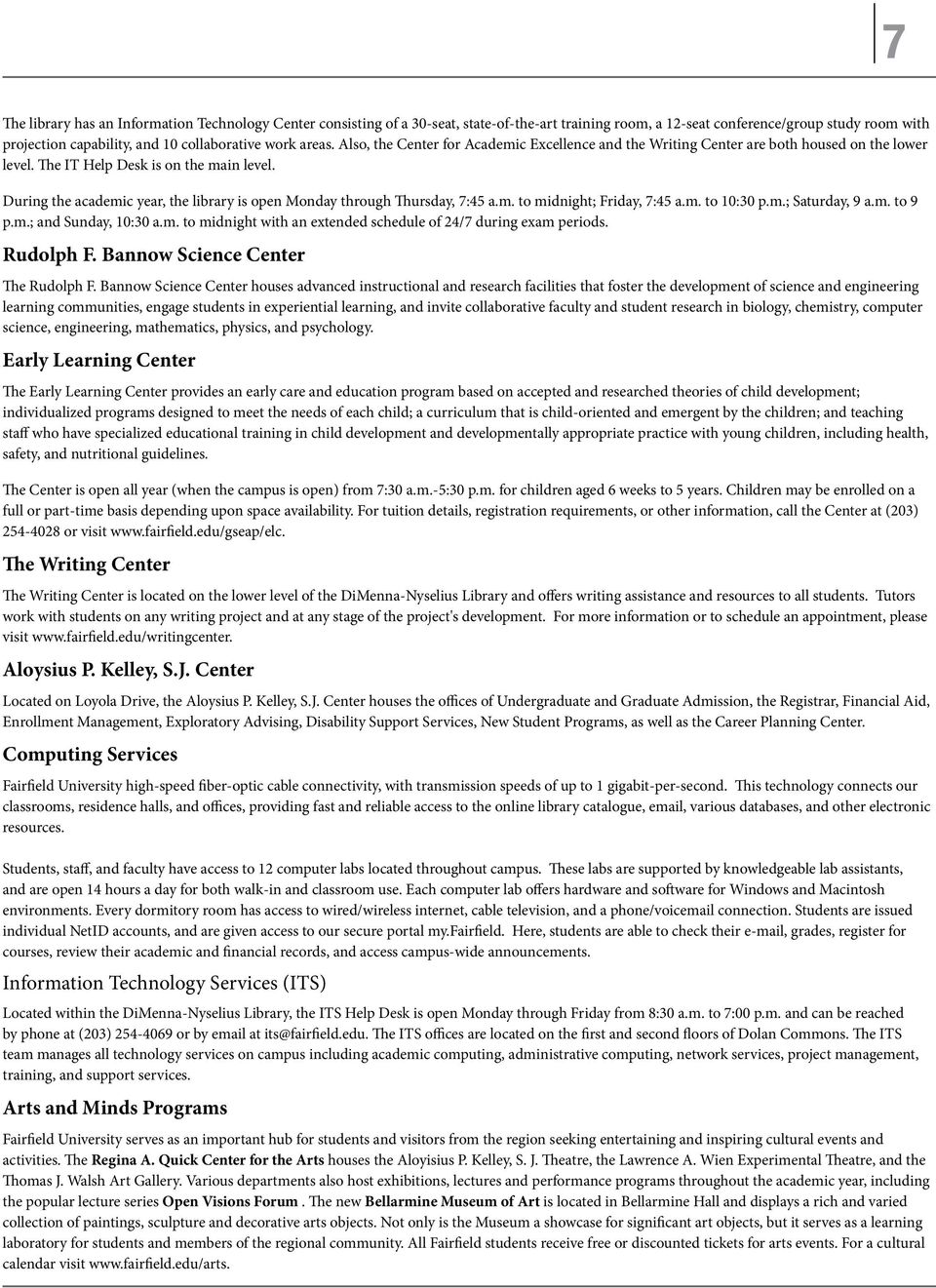
9 7 The library has an Information Technology Center consisting of a 30-seat, state-of-the-art training room, a 12-seat conference/group study room with projection capability, and 10 collaborative work areas. Also, the Center for Academic Excellence and the Writing Center are both housed on the lower level. The IT Help Desk is on the main level. During the academic year, the library is open Monday through Thursday, 7:45 a.m. to midnight; Friday, 7:45 a.m. to 10:30 p.m.; Saturday, 9 a.m. to 9 p.m.; and Sunday, 10:30 a.m. to midnight with an extended schedule of 24/7 during exam periods. Rudolph F. Bannow Science Center The Rudolph F. Bannow Science Center houses advanced instructional and research facilities that foster the development of science and engineering learning communities, engage students in experiential learning, and invite collaborative faculty and student research in biology, chemistry, computer science, engineering, mathematics, physics, and psychology. Early Learning Center The Early Learning Center provides an early care and education program based on accepted and researched theories of child development; individualized programs designed to meet the needs of each child; a curriculum that is child-oriented and emergent by the children; and teaching staff who have specialized educational training in child development and developmentally appropriate practice with young children, including health, safety, and nutritional guidelines. The Center is open all year (when the campus is open) from 7:30 a.m.-5:30 p.m. for children aged 6 weeks to 5 years. Children may be enrolled on a full or part-time basis depending upon space availability. For tuition details, registration requirements, or other information, call the Center at (203) or visit The Writing Center The Writing Center is located on the lower level of the DiMenna-Nyselius Library and offers writing assistance and resources to all students. Tutors work with students on any writing project and at any stage of the project's development. For more information or to schedule an appointment, please visit Aloysius P. Kelley, S.J. Center Located on Loyola Drive, the Aloysius P. Kelley, S.J. Center houses the offices of Undergraduate and Graduate Admission, the Registrar, Financial Aid, Enrollment Management, Exploratory Advising, Disability Support Services, New Student Programs, as well as the Career Planning Center. Computing Services Fairfield University high-speed fiber-optic cable connectivity, with transmission speeds of up to 1 gigabit-per-second. This technology connects our classrooms, residence halls, and offices, providing fast and reliable access to the online library catalogue, , various databases, and other electronic resources. Students, staff, and faculty have access to 12 computer labs located throughout campus. These labs are supported by knowledgeable lab assistants, and are open 14 hours a day for both walk-in and classroom use. Each computer lab offers hardware and software for Windows and Macintosh environments. Every dormitory room has access to wired/wireless internet, cable television, and a phone/voic connection. Students are issued individual NetID accounts, and are given access to our secure portal my.fairfield. Here, students are able to check their , grades, register for courses, review their academic and financial records, and access campus-wide announcements. Information Technology Services (ITS) Located within the DiMenna-Nyselius Library, the ITS Help Desk is open Monday through Friday from 8:30 a.m. to 7:00 p.m. and can be reached by phone at (203) or by at [email protected]. The ITS offices are located on the first and second floors of Dolan Commons. The ITS team manages all technology services on campus including academic computing, administrative computing, network services, project management, training, and support services. Arts and Minds Programs Fairfield University serves as an important hub for students and visitors from the region seeking entertaining and inspiring cultural events and activities. The Regina A. Quick Center for the Arts houses the Aloyisius P. Kelley, S. J. Theatre, the Lawrence A. Wien Experimental Theatre, and the Thomas J. Walsh Art Gallery. Various departments also host exhibitions, lectures and performance programs throughout the academic year, including the popular lecture series Open Visions Forum. The new Bellarmine Museum of Art is located in Bellarmine Hall and displays a rich and varied collection of paintings, sculpture and decorative arts objects. Not only is the Museum a showcase for significant art objects, but it serves as a learning laboratory for students and members of the regional community. All Fairfield students receive free or discounted tickets for arts events. For a cultural calendar visit
10 8 Other Requirements NetID A NetID is your username and password combination that provides you access to a variety of University online services, including Gmail and access to my.fairfield. Your NetID username is not case sensitive It is generated from University records, and it is a combination of your first, middle, and last names or initials Your NetID is not the same as your Fairfield ID number, which is on the front of your StagCard Your NetID will remain active until you graduate. You will need to change your password every 90 days. To activate (or "claim") your NetID account, you will need to log in to the Fairfield University NetID Manager Web site: For more detailed information, including step-by-step instructions, visit You will need your eight-digit Fairfield ID number to activate your NetID, which can be found on the front of your StagCard, or in the upper righthand corner of your student schedule. After claiming your NetID, visit to log in. Please check your Gmail account regularly, and be sure to use it to communicate with all University officials (faculty, staff, etc.). Your address follows this format: [email protected]. If your name is John Smith, and your NetID is john.smith, then your address is [email protected]. my.fairfield ( All graduate students are issued individual accounts for my.fairfield, a secure website used to view course schedules, access library services remotely, register for classes and parking permits, view and pay tuition bills, print unofficial transcripts, and much more. Students may also register their cell phone number for entry into the StagAlert system, Fairfield University's emergency notification system. Click on the "Update Cell Phone Number" link under Student tab, Personal Information link, and follow the prompts. Students can log in to my.fairfield with their Net ID and password, and the account will be available within 24 hours of registering for classes for the first time. For assistance with my.fairfield call the help desk at (203) or [email protected].

11 Accreditations Fairfield University is fully accredited by the New England Association of Schools and Colleges, which accredits schools and colleges in the six New England states. Accreditation by one of the six regional accrediting associations in the United States indicates that the school or college has been carefully evaluated and found to meet standards agreed upon by qualified educators. Additional accreditations include: AACSB International - The Association to Advance Collegiate Schools of Business (Charles F. Dolan School of Business) Accredited by the Engineering Accreditation Commission of ABET, B.S. Computer Engineering Program B.S. Electrical Engineering program B.S. Mechanical Engineering program B.S. Software Engineering Program American Chemical Society (College of Arts and Sciences) B.S. in Chemistry Commission on Accreditation of Marriage and Family Therapy Education (Graduate School of Education and Allied Professions, GSEAP) Marriage and Family Therapy program Connecticut State Office of Higher Education (GSEAP) Council for Accreditation of Counseling and Related Educational Programs (GSEAP) Counselor Education programs Commission on Collegiate Nursing Education (School of Nursing) Undergraduate Nursing programs Master's Nursing programs Doctoral programs National Council for the Accreditation of Teacher Educators (NCATE) Elementary Education Secondary Education School Counseling School Library Media Specialist School Psychology Special Education TESOL/Bilingual Education programs National Association of School Psychologists (NASP) (GSEAP) School Psychology 9

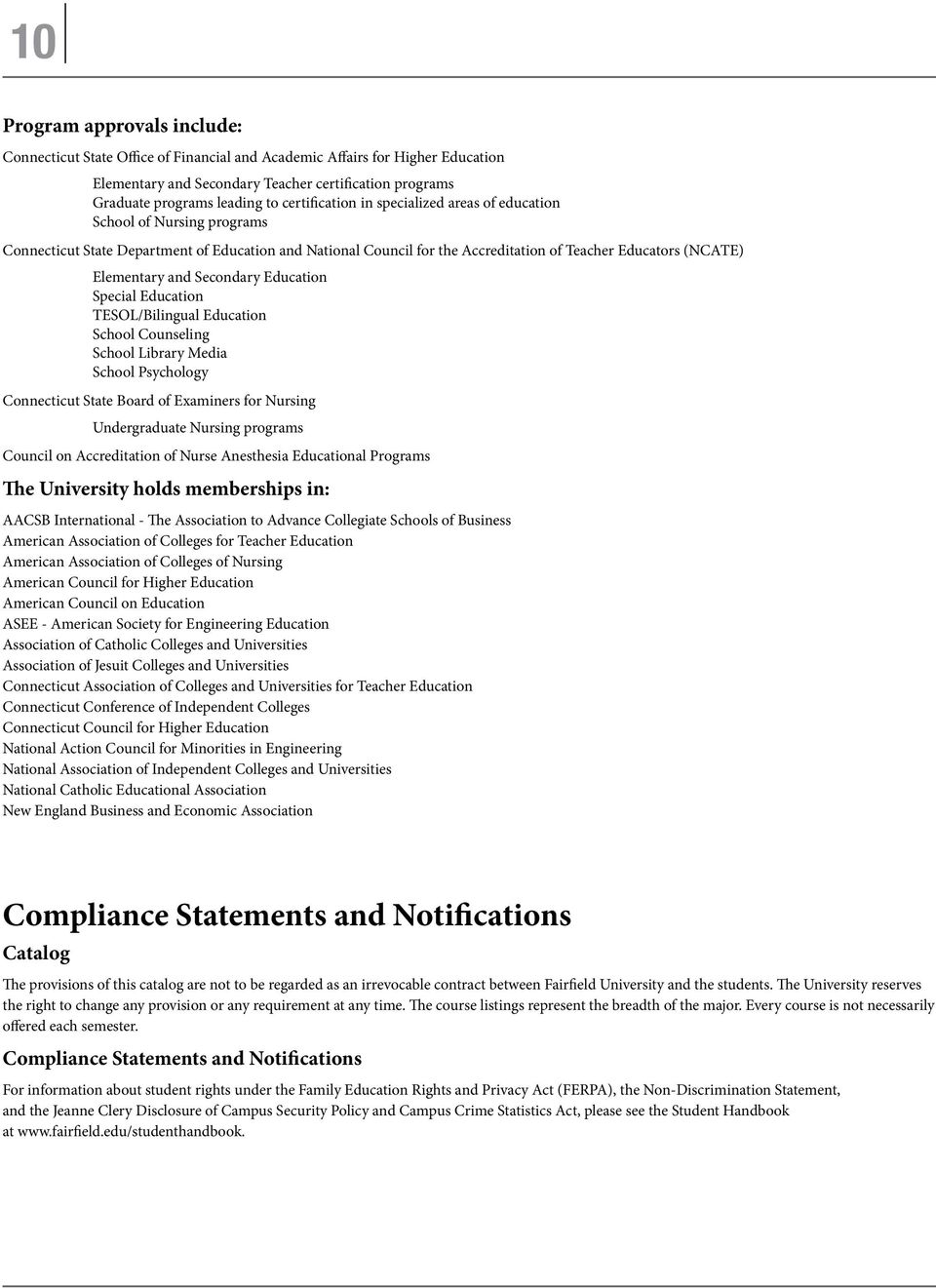
12 10 Program approvals include: Connecticut State Office of Financial and Academic Affairs for Higher Education Elementary and Secondary Teacher certification programs Graduate programs leading to certification in specialized areas of education School of Nursing programs Connecticut State Department of Education and National Council for the Accreditation of Teacher Educators (NCATE) Elementary and Secondary Education Special Education TESOL/Bilingual Education School Counseling School Library Media School Psychology Connecticut State Board of Examiners for Nursing Undergraduate Nursing programs Council on Accreditation of Nurse Anesthesia Educational Programs The University holds memberships in: AACSB International - The Association to Advance Collegiate Schools of Business American Association of Colleges for Teacher Education American Association of Colleges of Nursing American Council for Higher Education American Council on Education ASEE - American Society for Engineering Education Association of Catholic Colleges and Universities Association of Jesuit Colleges and Universities Connecticut Association of Colleges and Universities for Teacher Education Connecticut Conference of Independent Colleges Connecticut Council for Higher Education National Action Council for Minorities in Engineering National Association of Independent Colleges and Universities National Catholic Educational Association New England Business and Economic Association Compliance Statements and Notifications Catalog The provisions of this catalog are not to be regarded as an irrevocable contract between Fairfield University and the students. The University reserves the right to change any provision or any requirement at any time. The course listings represent the breadth of the major. Every course is not necessarily offered each semester. Compliance Statements and Notifications For information about student rights under the Family Education Rights and Privacy Act (FERPA), the Non-Discrimination Statement, and the Jeanne Clery Disclosure of Campus Security Policy and Campus Crime Statistics Act, please see the Student Handbook at
13 The Charles F. Dolan School of Business 11

14 12 A Message from the Dean The highly competitive, globally-oriented, tech-savvy business world seeks energized, knowledgeable, inspired graduates with rock solid ethics to be the business leaders of the future. As a graduate student at the Charles F. Dolan School of Business, we want to enhance your progress in developing that future and meeting your career goals. Whether you see yourself as an accountant, an expert in the world of finance, an international business executive, a marketing professional, an information systems manager, or an entrepreneur, we can help take you there. How do we do this? We do this, first, through our excellent faculty. This is a faculty that does cutting edge research and, through a world-class curriculum, will teach you the business concepts critical to your future career. This is also a faculty with substantial real-world business experience who seek to create an active learning environment. Here, real organizational problems are brought into the classroom to be dissected and debated, often with the actual managers involved. The faculty is also vitally interested in you. In classrooms averaging less than 24 students, and in one-on-one advising sessions, faculty are available to discuss your current concerns, your developing ideas, and future career trajectory. We do this by creating a community of students who have the opportunity to interact closely with faculty, alumni, and staff. You'll have opportunities to join the Graduate Student Assembly and engage with faculty in clubs and service learning opportunities. We do this by partnering with local business leaders and alumni, drawing on Fairfield County's strategic location, home to more than 40 Fortune 500 headquarters located within 50 miles of the University. When you're here, the world of business is literally at your front door. We do this, finally, by stressing excellence in all that we do. We are ranked among the Best 300 Business Schools in the U.S. (according to the Princeton Review), and fully accredited by the AACSB International, The Association to Advance Collegiate Schools of Business. Only five percent of all business schools worldwide are so recognized. As a graduate student, you have already gained experience in the work world. The Dolan School of Business will help leverage that experience by offering breadth courses to enhance your skills, and concentration and elective courses to hone your skills. The result is a set of tools for jumpstarting your career goals. We educate in an environment that takes its Jesuit foundations seriously, emphasizing a rigorous curriculum, caring for our students, a concern for promoting ethics and justice, and an understanding of the power of reflecting on your life. We welcome you. We urge you to take advantage of all that this school offers, and make it your own. Donald E. Gibson, Ph.D Dean, Charles F. Dolan School of Business

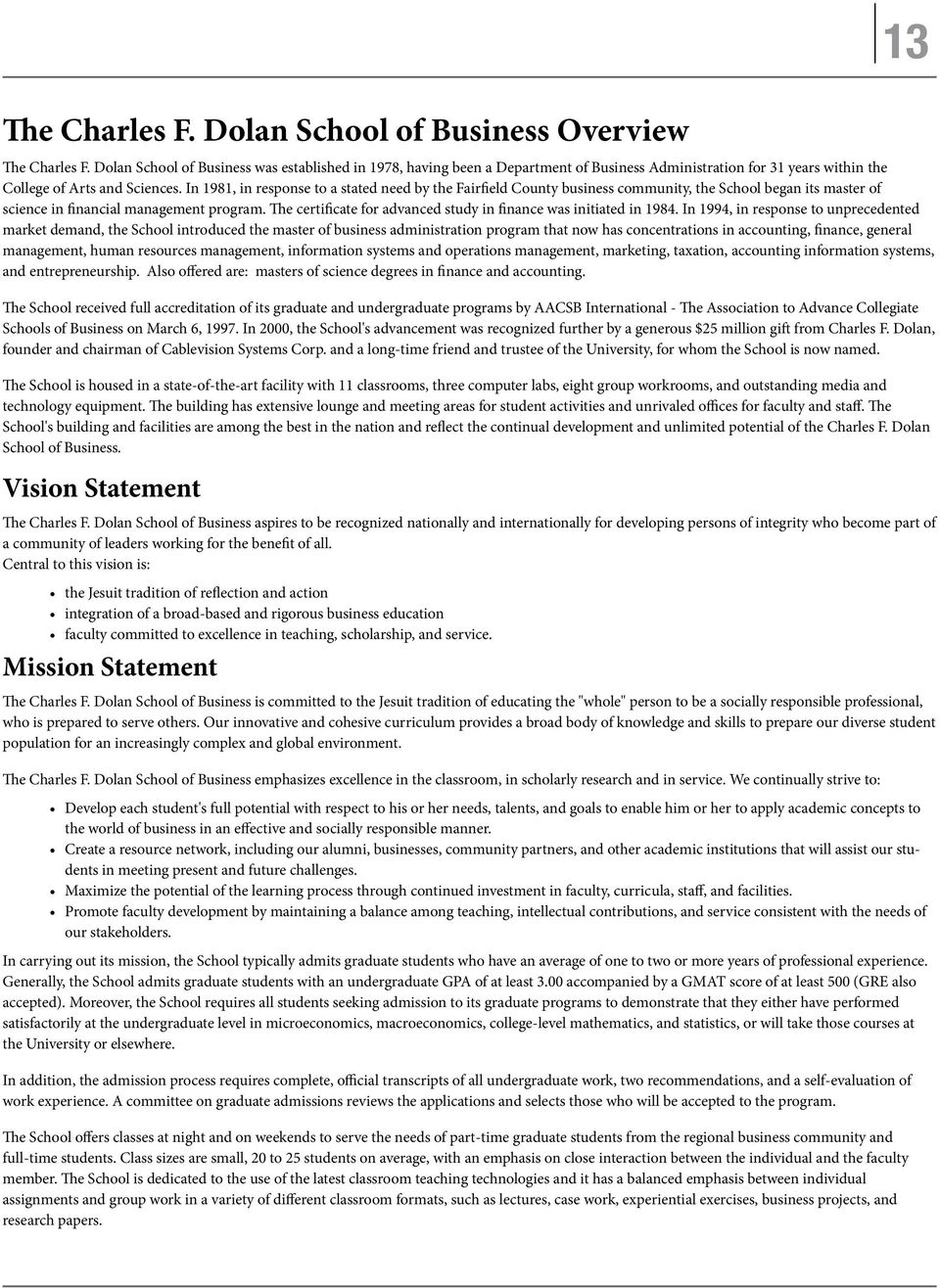
15 The Charles F. Dolan School of Business Overview 13 The Charles F. Dolan School of Business was established in 1978, having been a Department of Business Administration for 31 years within the College of Arts and Sciences. In 1981, in response to a stated need by the Fairfield County business community, the School began its master of science in financial management program. The certificate for advanced study in finance was initiated in In 1994, in response to unprecedented market demand, the School introduced the master of business administration program that now has concentrations in accounting, finance, general management, human resources management, information systems and operations management, marketing, taxation, accounting information systems, and entrepreneurship. Also offered are: masters of science degrees in finance and accounting. The School received full accreditation of its graduate and undergraduate programs by AACSB International - The Association to Advance Collegiate Schools of Business on March 6, In 2000, the School's advancement was recognized further by a generous $25 million gift from Charles F. Dolan, founder and chairman of Cablevision Systems Corp. and a long-time friend and trustee of the University, for whom the School is now named. The School is housed in a state-of-the-art facility with 11 classrooms, three computer labs, eight group workrooms, and outstanding media and technology equipment. The building has extensive lounge and meeting areas for student activities and unrivaled offices for faculty and staff. The School's building and facilities are among the best in the nation and reflect the continual development and unlimited potential of the Charles F. Dolan School of Business. Vision Statement The Charles F. Dolan School of Business aspires to be recognized nationally and internationally for developing persons of integrity who become part of a community of leaders working for the benefit of all. Central to this vision is: the Jesuit tradition of reflection and action integration of a broad-based and rigorous business education faculty committed to excellence in teaching, scholarship, and service. Mission Statement The Charles F. Dolan School of Business is committed to the Jesuit tradition of educating the "whole" person to be a socially responsible professional, who is prepared to serve others. Our innovative and cohesive curriculum provides a broad body of knowledge and skills to prepare our diverse student population for an increasingly complex and global environment. The Charles F. Dolan School of Business emphasizes excellence in the classroom, in scholarly research and in service. We continually strive to: Develop each student's full potential with respect to his or her needs, talents, and goals to enable him or her to apply academic concepts to the world of business in an effective and socially responsible manner. Create a resource network, including our alumni, businesses, community partners, and other academic institutions that will assist our students in meeting present and future challenges. Maximize the potential of the learning process through continued investment in faculty, curricula, staff, and facilities. Promote faculty development by maintaining a balance among teaching, intellectual contributions, and service consistent with the needs of our stakeholders. In carrying out its mission, the School typically admits graduate students who have an average of one to two or more years of professional experience. Generally, the School admits graduate students with an undergraduate GPA of at least 3.00 accompanied by a GMAT score of at least 500 (GRE also accepted). Moreover, the School requires all students seeking admission to its graduate programs to demonstrate that they either have performed satisfactorily at the undergraduate level in microeconomics, macroeconomics, college-level mathematics, and statistics, or will take those courses at the University or elsewhere. In addition, the admission process requires complete, official transcripts of all undergraduate work, two recommendations, and a self-evaluation of work experience. A committee on graduate admissions reviews the applications and selects those who will be accepted to the program. The School offers classes at night and on weekends to serve the needs of part-time graduate students from the regional business community and full-time students. Class sizes are small, 20 to 25 students on average, with an emphasis on close interaction between the individual and the faculty member. The School is dedicated to the use of the latest classroom teaching technologies and it has a balanced emphasis between individual assignments and group work in a variety of different classroom formats, such as lectures, case work, experiential exercises, business projects, and research papers.
16 14 The School designs individual programs of study for students, enabling them to meet their educational goals and professional objectives. These program designs are completed upon matriculation, and each semester students may update or amend their plans in consultation with the Director of Graduate Programs. The School's faculty members have extensive professional business experience to accompany their strong academic preparation, which includes earned doctorates and, in nearly every case, previous academic work in the liberal arts and sciences, scholarly contributions and ongoing research interests, and continuing professional involvement in their chosen areas of expertise. They are dedicated to teaching excellence and their strong business and academic backgrounds give them a unique ability to bridge the gap between theory and practice.

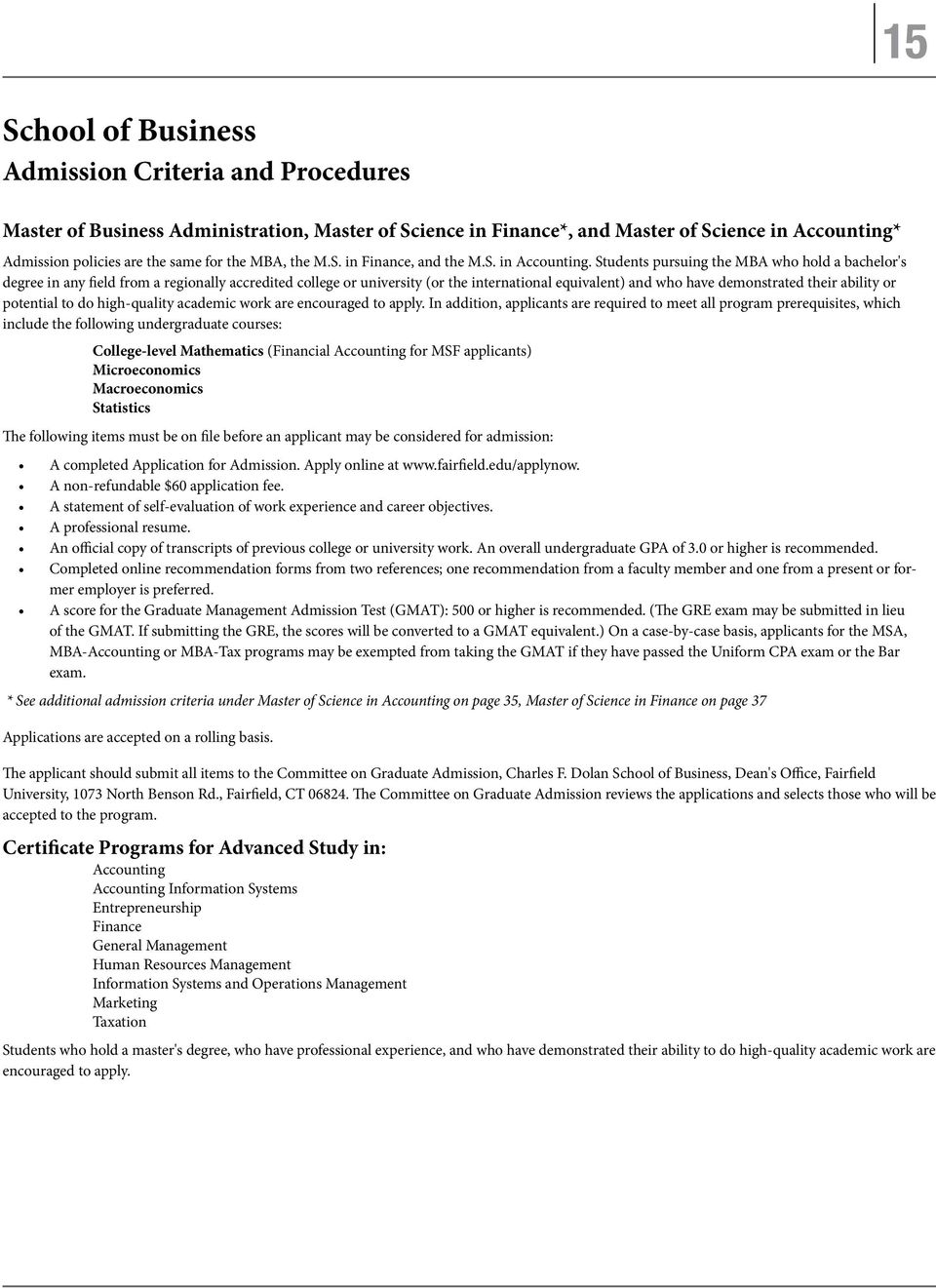
17 15 School of Business Admission Criteria and Procedures Master of Business Administration, Master of Science in Finance*, and Master of Science in Accounting* Admission policies are the same for the MBA, the M.S. in Finance, and the M.S. in Accounting. Students pursuing the MBA who hold a bachelor's degree in any field from a regionally accredited college or university (or the international equivalent) and who have demonstrated their ability or potential to do high-quality academic work are encouraged to apply. In addition, applicants are required to meet all program prerequisites, which include the following undergraduate courses: College-level Mathematics (Financial Accounting for MSF applicants) Microeconomics Macroeconomics Statistics The following items must be on file before an applicant may be considered for admission: A completed Application for Admission. Apply online at A non-refundable $60 application fee. A statement of self-evaluation of work experience and career objectives. A professional resume. An official copy of transcripts of previous college or university work. An overall undergraduate GPA of 3.0 or higher is recommended. Completed online recommendation forms from two references; one recommendation from a faculty member and one from a present or former employer is preferred. A score for the Graduate Management Admission Test (GMAT): 500 or higher is recommended. (The GRE exam may be submitted in lieu of the GMAT. If submitting the GRE, the scores will be converted to a GMAT equivalent.) On a case-by-case basis, applicants for the MSA, MBA-Accounting or MBA-Tax programs may be exempted from taking the GMAT if they have passed the Uniform CPA exam or the Bar exam. * See additional admission criteria under Master of Science in Accounting on page 35, Master of Science in Finance on page 37 Applications are accepted on a rolling basis. The applicant should submit all items to the Committee on Graduate Admission, Charles F. Dolan School of Business, Dean's Office, Fairfield University, 1073 North Benson Rd., Fairfield, CT The Committee on Graduate Admission reviews the applications and selects those who will be accepted to the program. Certificate Programs for Advanced Study in: Accounting Accounting Information Systems Entrepreneurship Finance General Management Human Resources Management Information Systems and Operations Management Marketing Taxation Students who hold a master's degree, who have professional experience, and who have demonstrated their ability to do high-quality academic work are encouraged to apply.
18 16 The following items must be on file with the School's Graduate Admission Committee before an applicant may be considered for admission: A completed Application for Admission. Apply online at A non-refundable $60 application fee A professional resume An official copy of transcripts of previous undergraduate and graduate work Applications are accepted on a rolling basis. Application materials should be sent directly to the Committee on Graduate Admission, Charles F. Dolan School of Business, Fairfield University, 1073 North Benson Road, Fairfield, CT The GMAT Exam The Graduate Management Admission Test is a test of aptitude rather than a test of business knowledge per se. The test, offered throughout the year at local computer labs and administered by Pearson VUE, examines two areas: verbal and quantitative. A score is earned in each area and the scores are added together for a total GMAT score that ranges between 200 and 800. The actual required score for admission of an individual candidate into the program depends upon the cumulative grade point average earned in undergraduate work and an assessment of all parts of the candidate's application dossier. For more information on the GMAT, visit Mandatory Immunizations Connecticut State law requires each full-time or matriculated student to provide proof of immunity or screening against measles, mumps, rubella, varicella (chicken pox), meningitis and tuberculosis. Certain exemptions based on age and housing status apply. Matriculating students are defined as those enrolled in a degree-seeking program. More detailed information and the required downloadable forms are available online at Completed forms should be submitted directly to the Student Health Center. Although this is not required to complete an application, you must provide proof of immunity/screening prior to course registration. Please consult you private health care provider to obtain the necessary immunizations. Questions may be directed to the Student Health Center: (203) ext or [email protected]. International Students International applicants must also provide a certificate of finances (evidence of adequate financial resources in U.S. dollars) and must submit certified English translations and course-by-course evaluations, done by an approved evaluator (found on our website at of all academic records. All international students whose native language is not English must demonstrate proficiency in the English language by taking either TOEFL or IELTS exams. A TOEFL composite score of 550 for the paper test, 213 for the computer-based, or 80 on the internet based test is strongly recommended for admission to the graduate school. Scores must be sent directly from the Educational Testing Service. An IELTS score of 6.5 or higher is strongly recommended for admission to the graduate school. Scores must be sent directly from the IELTS.org (Fairfield's ETS code is 3390). TOEFL and IELTS may be waived for those international students who have earned an undergraduate or graduate degree from a regionally accredited U.S. college or university. International applications and supporting credentials must be submitted at least three months prior to the intended start date. Students with Disabilities Fairfield University is committed to providing qualified students with disabilities an equal opportunity to access the benefits, rights, and privileges of its services, programs, and activities in an accessible setting. Furthermore, in compliance with Section 504 of the Rehabilitation Act, the Americans with Disabilities Act, and Connecticut laws, the University provides reasonable accommodations to qualified students to reduce the impact of disabilities on academic functioning or upon other major life activities. It is important to note that the University will not alter the essential elements of its courses or programs. If a student with a disability would like to be considered for accommodations, he or she must make this request in writing and send the supporting documentation to the director of Disability Support Services. This should be done prior to the start of the academic semester and is strictly voluntary. However, if a student with a disability chooses not to self-identify and provide the necessary documentation, accommodations need not be provided. All information concerning disabilities is confidential and will be shared only with a student's permission. Fairfield University uses the guidelines suggested by CT AHEAD to determine disabilities and reasonable accommodations. Send letters requesting accommodations to: Director of Disability Support Services, Fairfield University, 1073 North Benson Road, Fairfield, CT

19 17 DSB Graduate Tuition, Fees, and Financial Aid Tuition and Fees The schedule of tuition and fees for the academic year: Application for matriculation $60 (not refundable) Registration per semester $30 Graduate Student Activity Fee $35 Tuition per credit $795 Computer Lab Fee $45 Commencement fee $150 (required of all degree recipients) Transcript $4 Promissory note fee $25 Returned check fee $30 The University's Trustees reserve the right to change tuition rates and the fee schedule and to make additional changes whenever they believe it necessary. Full payment of tuition and fees, and authorization for billing a company must accompany registration for the Summer sessions and Intersessions. For the Fall and Spring semesters, it must be received by the initial due date. Payments may be made in the form of cash (in person only), check, money order, credit card (MasterCard, VISA, or American Express), or online payment at All checks are payable to Fairfield University. Degrees will not be conferred and transcripts will not be issued until students have met all financial obligations to the University. Deferred Payment During the fall and spring semesters, eligible students may defer payment on tuition. Initially, the student pays one-third of the total tuition due plus all fees and signs a promissory note to pay the remaining balance in two consecutive monthly installments. Failure to honor the terms of the promissory note will prevent future deferred payments and affect future registrations. Reimbursement by Employer Many corporations pay their employees' tuition. Students should check with their employers. If they are eligible for company reimbursement, students must submit a letter on company letterhead acknowledging approval of the course registration and explaining the terms of payment. The terms of this letter, upon approval of the Bursar, will be accepted as a reason for deferring that portion of tuition covered by the reimbursement. Even if covered by reimbursement, all fees (registration, processing, lab, or material) are payable by the due date. Students will be required to sign a promissory note, which requires a $25 processing fee, acknowledging that any outstanding balance must be paid in full prior to registration for future semesters. If the company offers less than 100-percent unconditional reimbursement, the student must pay the difference by the due date and sign a promissory note for the balance. Letters can only be accepted on a per-semester basis. Failure to pay before the next registration period will prevent future deferred payments and affect future registration. Refund of Tuition All requests for tuition refunds must be submitted to the appropriate dean's office immediately after withdrawal from class. Fees are not refundable. The request must be in writing and all refunds will be made based on the date notice is received or, if mailed, on the postmarked date according to the following schedule. Refunds of tuition charged on a MasterCard, VISA, or American Express must be applied as a credit to your charge card account.

20 18 Official Withdrawal Date Refund % of Charge 7 days before first scheduled class 100 percent 6 days or less before first scheduled class 80 percent Before second scheduled class Before third scheduled class Before fourth scheduled class After fourth scheduled class Refunds take two to three weeks to process. Federal Direct Stafford Loans 60 percent 40 percent 20 percent 0 percent Under this program, graduate students may apply for up to $20,500 per academic year, depending on their educational costs. Beginning July 1, 2012, interest payments are no longer subsidize by the federal government during graduate student enrollment. When a loan is unsubsidized, the student is responsible for the interest and may pay the interest on a monthly basis or opt to have the interest capitalized and added to the principal. There is a six-month grace period following graduate or withdrawal before loan payments begin. How to Apply Step One: Step Two: Step Three: Complete a Free Application for Federal Student Aid (FAFSA) online at indicating your attendance at Fairfield University (Title IV code ). Complete the required Entrance Counseling and Master Promissory Note (MPN) at Financial Aid administrators at Fairfield University will process your loan when your file is finalized, entrance counseling completed, and the MPN is signed. You will be notified of the approval of the loan via the Notice of Loan Guarantee and Disclosure Statement. Loan Disbursement If you are a first time borrower at Fairfield University, your loan will not disburse until you have completed the required entrance loan counseling. Your loan will be disbursed according to a schedule established by Fairfield University and federal guidelines. It will be made in two installments for the year and transferred electronically to your University account. The total amount of the funds (minus any origination fees) will be outlined in the Notice of Loan Guarantee and Disclosure Statement sent to you by the Department of Education. If you have any questions, please contact the Office of Financial Aid at (203) or [email protected]. Alternative Loans These loans help graduate and professional students pay for their education at the University. For further information view online at: Tax Deductions Treasury regulation ( ) permits an income tax deduction for educational expenses (registration fees and the cost of travel, meals, and lodging) undertaken to: maintain or improve skills required in one's employment or other trade or business; or meet express requirements of an employer or a law imposed as a condition to retention of employment job status or rate of compensation. Veterans Veterans may apply VA educational benefits to degree studies pursued at Fairfield University. Veterans should consult with the Office of Financial Aid regarding the process and eligibility for possible matching funds through Fairfield's Veterans Pride Program. Information about the program, including free tuition for some veterans, is available at The University Registrar s office will complete and submit the required certification form for all VA benefits.

21 19 Consumer Information Fairfield now offers Gainful Employment Disclosures for certificate programs as required. This information can be found at about/about_gainful_employ.html.
22 20 DSB Academic Policies and General Regulations Academic Advising and Curriculum Planning Specialty M.S. Directors advise all fully matriculated students in their respective tracks. The Associate Dean advises all MBA students. Students must meet with their advisor during their first semester of enrollment to plan a program of study. The associate dean must be consulted each subsequent semester regarding course selection. Students must register no later than one week prior to the first day of class. Information about state certification requirements may be obtained from the certification officer or graduate faculty advisors. Student Programs of Study All programs of study must be planned with an advisor. In granting approval, the advisor will consider the student's previous academic record and whether the prerequisites set forth for the specific program have been met. Should a student wish to change his or her track or concentration, this request must be made in writing and approved by the advisor and the dean. Academic Freedom and Responsibility The statement on academic freedom, as formulated in the 1940 Statement of Principles endorsed by the AAUP (American Association of University Professors) and incorporating the 1970 interpretive comments, is the policy of Fairfield University. Academic freedom and responsibility are here defined as the liberty and obligation to study, to investigate, to present and interpret, and discuss facts and ideas concerning all branches and fields of learning. Academic freedom is limited only by generally accepted standards of responsible scholarship and by respect for the Catholic commitment of the institution as expressed in its mission statement, which provides that Fairfield University "welcomes those of all beliefs and traditions who share its concerns for scholarship, justice, truth, and freedom, and it values the diversity which their membership brings to the university community." Freedom of Expression As an academic institution, Fairfield University exists for the transmission of knowledge, pursuit of truth, development of students, and the general well-being of society. Free inquiry and free expression are indispensable to the attainment of these goals. Fairfield University recognizes that academic freedom, freedom of expression, and responsibility are required to realize the essential purposes of the University. Academic freedom and responsibility (distinguished from freedom of expression) are herein defined as the liberty and obligation to study, to investigate, to present, interpret, and discuss facts and ideas concerning all branches and fields of inquiry. Student Rights As constituents of the academic community, students should be free, individually and collectively, to express their views on issues of institutional policy and on matters of general interest to the student body. Fairfield University students are both citizens and members of the academic community. As citizens of a private institution, Fairfield's students enjoy the same freedom of speech, peaceful assembly, and right of petition that students at other private institutions enjoy as accorded by law, and as members of the academic community, they are subject to the obligations which accrue to them by virtue of this membership. Faculty members and administration officials should ensure that institutional powers are not employed to deprive students of their rights as accorded to them by law and University policy. At the same time, the institution has an obligation to clarify those standards which it considers essential to its educational mission and its community life. These expectations and regulations should represent a reasonable regulation of student conduct. As members of the academic community, students should be encouraged to develop the capacity for critical judgment and to engage in a sustained and independent search for truth. They do this within the requirements of the curriculum and the courses in which they are enrolled. The professor in the classroom and in conference should encourage free discussion, inquiry, and expression. Student performance should be evaluated solely on an academic basis, not on opinions or conduct in matters unrelated to academic standards. This means that students are free to take reasoned exception to the data or views offered in any course of study and to reserve judgment about matters of opinion, but they are responsible for learning the content of any course of study for which they are enrolled. Students in professional programs are expected to understand and uphold the standards required in their profession. Students bring to the campus a variety of interests previously acquired and develop many new interests as members of the academic community. They should be free to organize and join associations to promote their common interests. Students and student organizations should be free to examine and discuss all questions of interest to them and to express opinions publicly and privately. Students should be allowed to invite and to hear any person of their own choosing. Those procedures required by an institution before a guest speaker is invited to appear on campus should be designed only to ensure that there is orderly scheduling of facilities and adequate preparation for the event, and that the occasion is conducted in a manner appropriate to an academic community. Guest speakers are subject to all applicable laws, and to the University policies on harassment and discrimination.
23 21 Students' freedom of expression extends to their ability to express their opinions in writing or through electronic means, and to distribute and post materials expressing their opinions. Any restrictions should be designed only to ensure the orderly use of space and facilities, to provide reasonable restrictions on commercial messages, to comply with applicable fire, health or safety codes, to comply with the University's Non-Discrimination and Harassment Policy, or to comply with state or federal law. Students should always be free to support causes by orderly means which do not disrupt operations of the institution. At the same time, it should be made clear to the academic and larger community that in their public expressions or demonstrations, students or student organizations speak only for themselves and not the institution. Student Responsibilities Freedom of expression enjoyed by students is not without limitations. The rights set forth herein must be balanced against and considered in the context of the following responsibilities: Students have the obligation to refrain from interfering with the freedom of expression of others. Students have the responsibility to respect the rights and beliefs of others, including the values and traditions of Fairfield University as a Jesuit, Catholic institution. Students have the responsibility to support learning, and when learning, to engage others in a respectful dialogue, to never threaten the safety or security of others, and to comply with all University policies prohibiting harassment, hate crimes, and discrimination. All policies in this Handbook and the actions taken under them must support Fairfield University's Mission Statement and the Statement on Academic Freedom. Academic Honesty All members of the Fairfield University community share responsibility for establishing and maintaining appropriate standards of academic honesty and integrity. As such, faculty members have an obligation to set high standards of honesty and integrity through personal example and the learning communities they create. Such integrity is fundamental to, and an inherent part of, a Jesuit education, in which teaching and learning are based on mutual respect. It is further expected that students will follow these standards and encourage others to do so. Students are sometimes unsure of what constitutes academic dishonesty. In all academic work, students are expected to submit materials that are their own and to include attribution for any ideas or language that is not their own. Examples of dishonest conduct include but are not limited to: Falsification of academic records or grades, including but not limited to any act of falsifying information on an official academic document, grade report, class registration document or transcript. Cheating, such as copying examination answers from materials such as crib notes or another student's paper. Collusion, such as working with another person or persons when independent work is prescribed. Inappropriate use of notes. Falsification or fabrication of an assigned project, data, results, or sources. Giving, receiving, offering, or soliciting information in examinations. Using previously prepared materials in examinations, tests, or quizzes. Destruction or alteration of another student's work. Submitting the same paper or report for assignments in more than one course without the prior written permission of each instructor. Appropriating information, ideas, or the language of other people or writers and submitting it as one's own to satisfy the requirements of a course - commonly known as plagiarism. Plagiarism constitutes theft and deceit. Assignments (compositions, term papers, computer programs, etc.) acquired either in part or in whole from commercial sources, publications, students, or other sources and submitted as one's own original work will be considered plagiarism. Unauthorized recording, sale, or use of lectures and other instructional materials. In the event of such dishonesty, professors are to award a grade of zero for the project, paper, or examination in question, and may record an F for the course itself. When appropriate, expulsion may be recommended. A notation of the event is made in the student's file in the academic dean's office. The student will receive a copy. Honor Code Fairfield University's primary purpose is the pursuit of academic excellence. This is possible only in an atmosphere where discovery and communication of knowledge are marked by scrupulous, unqualified honesty. Therefore, it is expected that all students taking classes at the University adhere to the following Honor Code: "I understand that any violation of academic integrity wounds the entire community and undermines the trust upon which the discovery and communication of knowledge depends. Therefore, as a member of the Fairfield University community, I hereby pledge to uphold and maintain these standards of academic honesty and integrity."
24 22 University Course Numbering System Undergraduate Introductory courses Intermediate courses without prerequisites Intermediate courses with prerequisites Advanced courses, normally limited to juniors and seniors, and open to graduate students with permission Graduate Master's and Certificate of Advanced Study courses, open to undergraduate students with permission Master's and Certificate of Advanced Study courses Doctoral courses, open to qualified Master's students Option for Graduate Level Courses Undergraduates with permission could take a graduate course for undergraduate credit and as part of their undergraduate load. It would appear on their undergraduate transcript. A student could later petition to have those courses provide advanced standing in their graduate program and it would be up to the faculty to determine if the credits should apply to the graduate program at that point. Student might receive credit for these courses as part of a graduate program if the student did not apply the credits to complete the undergraduate degree. An undergraduate student who has advanced beyond degree requirements and also has permission could take a graduate level course for graduate credit as part of their regular undergraduate load. The number of graduate courses a full time undergraduate could take would be limited to two. The five year pre-structured programs would follow their own required sequence. Registration for graduate courses is on a space available basis, with preference given to graduate students. Undergraduates with permission to enroll in a graduate course may petition to register in late August for the fall and early January for the spring. Normal Academic Progress Academic Load A full-time graduate student will normally carry nine credits during the fall or spring semester. Twelve credits is the maximum load permitted. During summer sessions, full-time students are permitted to carry a maximum load of 12 credits. Students who work full time or attend another school may not be full-time students. Such individuals are ordinarily limited to six credits during the fall or spring semesters and nine credits during the summer sessions. Academic Standards Students are required to maintain satisfactory academic standards of scholastic performance. Candidates for a master's degree or certificate must maintain a 3.00 grade point average. Independent Study The purpose of independent study at the graduate level is to broaden student knowledge in a specific area of interest. Students must submit a preliminary proposal using the Independent Study Application form, which is available in the dean's office, to the major advisor. Frequent consultation with the major advisor is required. Students may earn from one to six credits for an independent study course. Matriculation/Continuation To remain in good academic standing, a student must achieve a 3.00 cumulative quality point average upon completion of the first 12 semester hours. A student whose cumulative quality point average falls below 3.00 in any semester is placed on academic probation for the following semester. Students on academic probation must meet with their advisors to program adjustments to their course load. If, at the end of the probationary semester, the student's overall average is again below 3.00, he or she may be dismissed.
25 23 Time to Complete Degree Students are expected to complete all requirements for the M.A. and M.S. programs within five years after beginning their course work. Each student is expected to make some annual progress toward the degree or certificate to remain in good standing. A student who elects to take a leave of absence must submit a request, in writing, to the dean. Applications for and Awarding of Degrees All students must file an application for the master's degree in the dean's office by the published deadline. Graduate students must successfully complete all requirements for the degree in order to participate in commencement exercises. Refer to the calendar for the degree application deadline. Graduation and Commencement Diplomas are awarded in January, May, and August (see calendar for application deadlines). Students who have been awarded diplomas in the previous August and January, and those who have completed all degree requirements for May graduation, are invited to participate in the May commencement ceremony. Graduate students must successfully complete all requirements for the degree in order to participate in commencement. Disruption of Academic Progress Academic Probation/Dismissal A student whose overall grade point average falls below 3.00 in any semester is placed on probation for the following semester. If the overall grade point average is again below 3.00 at the end of that semester, the student may be dismissed. Any student who receives two course grades below 2.67 or B- will be excluded from the program. Course Withdrawal Candidates who wish to withdraw from a course must do so in writing or in person at the Registrar's Office on or before the published last day to withdraw (see academic calendar). Written withdrawals are effective as of the date received or postmarked. In-person withdrawals are made in the Registrar's Office by completing and submitting a Change of Registration form. Those who need to withdraw from a course after the posted last day to withdraw must submit a written statement justifying their need to withdraw to the dean for approval to withdraw without academic penalty. Failure to attend class or merely giving notice to an instructor does not constitute an official withdrawal and may result in a penalty grade being recorded for the course. In general, course withdrawals are not approved after the posted last day to withdraw. When there are extenuating circumstances (e.g., medical condition requiring withdrawal) exceptions may be approved by the dean. Withdrawal after the posted deadline will not be permitted simply to prevent receipt of a grade that might not meet the student s satisfaction. Readmission If a student has been inactive for three terms or longer, students must submit a written update to the dean for reinstatement. Depending on the individual circumstances it may be necessary to complete a full application for admission. A review of past work will determine the terms of readmission. All honorably discharged veterans who have interrupted their Fairfield education to serve in the military will be readmitted and may apply for financial aid. Grades; Academic Average The work of each student is graded on the following basis: A 4.00 A B B 3.00 B C C 2.00 F 0.00 I Incomplete W Withrew without penalty
26 24 No change of grade will be processed after a student has graduated. Any request for the change of an earned letter grade is at the discretion of the original teacher of the course and must be recommended in writing to the dean by the professor of record within one calendar year of the final class of the course or before graduation, whichever comes first. A student may request an extension of the one-year deadline from the dean of their school if he or she can provide documentation that extenuating circumstances warrant an extension of the one-year deadline. Such an extension may be approved only if the professor of record agrees to the extension and an explicit date is stipulated by which the additional work must be submitted. A student who elects to withdraw from a course must obtain written approval from the dean. Refunds will not be granted without written notice. The amount of tuition refund will be based upon the date the notice is received. Fees are not refundable unless a course is canceled. Multiplying a grade's numerical value by the credit value of a course produces the number of quality points earned by a student. The student's grade point average is computed by dividing the number of quality points earned by the total number of credits completed, including failed courses. The average is rounded to the nearest second decimal place. A change of an incomplete grade follows the established policy. Incompletes An Incomplete is issued when, due to an emergency situation such as a documented illness, a student arranges with the course instructor to complete some of the course requirements after the term ends. All course work must be completed within 30 days after the beginning of the next regular semester. Any requests to extend the 30-day time period for completing an Incomplete require approval by the appropriate Dean. Any incomplete grade still outstanding after the 30-day extension will become an F and the candidate may be excluded from the program. Transfer of Credit Transfer of credit from another approved institution of higher learning will be allowed if it is graduate work done after the completion of a bachelor's program and completed prior to entering Fairfield University. No more than six credits may be transferred. Transfer credit will be considered for graduate coursework earned with a grade of B or better. An official transcript of the work done must be received before a decision will be made on approving the transfer. Grade Reports Grade reports for all graduate students are issued electronically by the Registrar via the student's web portal (my.fairfield) at the end of each semester. Scholastic Honors Alpha Sigma Nu Alpha Sigma Nu, the national Jesuit honor society, serves to reward and encourage scholarship, loyalty, and service to the ideals of Jesuit higher education. To be nominated for membership, graduate students must have scholastic rank in the top 15 percent of their class, demonstrate a proven concern for others, and manifest a true concern and commitment to the values and goals of the society. The Fairfield chapter was reactivated in 1981 and includes outstanding undergraduate and graduate students who are encouraged to promote service to the University and provide greater understanding of the Jesuit ideals of education. Beta Gamma Sigma (business honor society) Beta Gamma Sigma is an international honor society recognizing the outstanding academic achievements of students enrolled in collegiate business programs accredited by AACSB International - The Association to Advance Collegiate Schools of Business. With more than 440,000 members worldwide, the Society's membership comprises the brightest and best of the world's business leaders. At Fairfield University, the top 10 percent of juniors, the top 10 percent of seniors, and the top 20 percent of graduate students are eligible for membership in the University's Beta Gamma Sigma chapter, which was established in Each spring, an induction ceremony is held at the Charles F. Dolan School of Business to welcome new members into the Society. Beta Gamma Sigma membership provides recognition for a lifetime. With alumni chapters in major metropolitan areas across the United States and the BetaLink online membership community, those recognized for their academic achievements at Fairfield University can continue an active relationship with Beta Gamma Sigma long after graduation. This lifelong commitment to its members' academic and professional success is defined in the Society's mission: To encourage and honor academic achievement in the study of business and personal and professional excellence in the practice of business.
27 25 Dolan School of Business Honors Graduate (Dean's Office recognition) The Dolan School of Business designates as Honors Graduates those students who attain an overall GPA of 3.85 during their graduate studies. Honors Graduates receive a certificate to acknowledge their achievement and are recognized at the annual Charles F. Dolan School of Business Awards Ceremony each spring semester. Please note, this distinction is not recognized at Commencement or on student transcripts. Academic Grievance Procedures Purpose Procedures for review of academic grievances protect the rights of students, faculty, and the University by providing mechanisms for equitable problem solving. Types of Grievances A grievance is defined as a complaint of unfair treatment for which a specific remedy is sought. This procedure is concerned solely with academic grievances. It excludes circumstances that may give rise to a complaint for which expli cit redress is neither called for nor sought, or for those for which other structures within the university serve as an agency for resolution. Academic grievances relate to procedural appeals, academic dishonesty appeals, or quality of work appeals. Procedural appeals are defined as those seeking a remedy in which no issue of the quality of a student's work is involved. For example, a student might contend that the professor failed to follow previously announced mechanisms of evaluation. Academic dishonesty appeals are defined as those seeking a remedy because of a dispute over whether plagiarism, cheating, or other acts of academic dishonesty occurred. Remedies would include but not be limited to removal of a file letter, change of grade, or submitting new or revised work. Quality of work appeals are defined as those seeking a remedy, following the completion of a course, because the evaluation of the quality of a student's coursework is alleged to be prejudiced or capricious. Time Limits The procedure herein defined must be initiated by the end of the subsequent fall or spring semester after the event that is the subject of the grievance. If the grievance moves forward, all subsequent steps of the informal process must be completed and the formal process must be initiated before the end of the second semester subsequent to the event that is the subject of the grievance. Informal Procedure Step one: The student attempts to resolve any academic grievance with the faculty member. If, following this initial attempt at resolution, the student remains convinced that a grievance exists, she or he advances to step two. Step two: The student consults with the chair or program director, bringing written documentation of the process to this point. If the student continues to assert that a grievance exists after attempted reconciliation, she or he advances to step three. Step three: The student presents the grievance to the dean of the school in which the course was offered, bringing to this meeting documentation of steps one and two. After conversation with the instructor of record and the department chair/program director, the dean will inform the student whether or not the grade shall be changed by the instructor of record. If the student is dissatisfied with the outcome, the dean will inform the student of the right to initiate formal review procedures.
28 26 Formal Procedure Step one: If the student still believes that the grievance remains unresolved following the informal procedures above, she or he initiates the formal review procedure by making a written request for a formal hearing through the dean to the Senior Vice President for Academic Affairs (SVPAA). Such a request should define the grievance and be accompanied by documentation of completion of the informal process. It should also be accompanied by the dean's opinion of the grievance. Step two: The SVPAA determines whether the grievance merits further attention. If not, the student is so informed. If, however, the grievance does merit further attention, the SVPAA determines whether it is a procedural appeal, an academic dishonesty appeal, or a quality of work appeal. For procedural appeals and academic dishonesty appeals, the SVPAA will convene a Grievance Committee according to the process described below, providing the committee with the written documentation resulting from the previous steps in the appeal process. For quality of work appeals, the SVPAA will request that the chair of the department through which the course is taught, or if the chair is the subject of the grievance a senior member of the department, assemble an ad hoc committee of three department/program members to review the appeal, providing the committee with the written documentation resulting from the previous steps in the appeal process. Step three: For procedural appeals and academic dishonesty appeals, the Grievance Committee takes whatever steps are deemed appropriate to render a recom mendation for resolving the grievance. The committee adheres to due process procedures analogous to those in the Faculty Handbook. For quality of work appeals, the department committee shall make itself available to meet and discuss the appeal with the student, and shall discuss the appeal with the instructor of record for the course. If the final consensus of the department committee is that the academic evaluation that led to the course grade was neither prejudiced nor capricious, the appeals process ends here. Step four: For procedural appeals and academic dishonesty appeals, the recommendation from the Grievance Com mittee is forwarded to the SVPAA in written form, accompanied, if necessary, by any sup porting data that formed the basis of the recommendation. Should the Grievance Committee conclude that a change of grade is warranted, the two faculty members on the Grievance Committee will recommend an appropriate grade. In case of disagreement between the two faculty members, the dean chairing the Grievance Committee will decide which of the two recommended grades to accept. The recommended grade change shall be included in the report. For quality of work appeals, if the final consensus of the department committee is that the academic evaluation that led to the course grade was prejudiced or capricious, the department committee will recommend an alternative course grade. If the instructor of record agrees to change the grade to that recommended by the committee, the appeals process ends here. If the instructor of record declines to change the grade, the department committee shall prepare a written report, including the department committee s recommended grade. The report will be forwarded to the SVPAA and the instructor of record, who may send the SVPAA a written response to the report. Step five: For procedural appeals and academic dishonesty appeals, the SVPAA renders a final and binding judgment, notifying all involved parties. If such an appeal involves a dispute over a course grade given by a faculty member, the SVPAA is the only uni versity official empowered to change that grade, and then only to the grade recommended by the Grievance Committee. For quality of work appeals, if the SVPAA agrees with the department committee that the academic evaluation that led to the course grade was prejudiced or capricious, she or he is authorized to change the course grade to the grade recommended in the department committee s report. Structure of the Grievance Committee The structure of the Grievance Committee will be as follows: Two faculty members to be selected from the Student Academic Grievance Board. The faculty member against whom the grievance has been directed will propose four names from that panel, the student will strike two of those names, and the two remaining faculty members will serve. Two students to be selected from a standing pool of eight students elected by the student government. The student filing the grievance will propose four names from that panel, the faculty member will strike two of those names, and the two remaining students will serve. In the event that any faculty member or student selected through the foregoing process is unable to meet, another elected member of the panel will serve as an alternate. The Grievance Committee will be chaired by a dean (other than the dean of the school in which the course was offered) to be selected by the SVPAA. The dean so selected will have no vote except in the event of a tie, and will be responsible for overseeing the selection of the Grievance Committee, convening and con ducting the committee meetings, and preparing the committee's report(s) and other appropriate documentation.
29 27 Due Process Procedure Both the student and the faculty member have the right to be present and to be accompanied by a personal advisor or counsel throughout the hearing. Both the student and the faculty member have the right to present and to examine and cross-examine witnesses. The administration makes available to the student and the faculty member such authority as it may possess to require the presence of witnesses. The grievance committee promptly and forthrightly adjudicates the issues. The full text of the findings and conclusions of the grievance committee are made available in identical form and at the same time to the student and the faculty member. The cost is met by the University. In the absence of a defect in procedure, recommendations shall be made to the Senior Vice President for Academic Affairs by the grievance committee as to possible action in the case. At any time should the basis for an informal hearing appear, the procedure may become informal in nature. Grievance Process Complaints Fairfield University endeavors to resolve all grievances, complaints and disputes in a timely and fair manner. In the event a student believes a complaint remains unresolved after the conclusion of Fairfield University's grievance and/or dispute resolution processes (including all appeals), the student may request that the complaint be reviewed by the State of Connecticut Office of Higher Education. The Office of Higher Education is responsible for quality review of independent colleges and will investigate complaints concerning matters within its statutory authority. For more information or to file a complaint, contact the Office of Higher Education, 61 Woodland Street, Hartford, CT ; (800) ; University is accredited by the New England Association of Schools and Colleges (NEASC). Students may contact NEASC at 3 Burlington Woods Drive, Suite 100 Burlington, MA 01803, Transcripts Graduate transcript requests should be made in writing to the University Registrar's Office in the Kelley Center. There is a $4 fee for each copy (faxed transcripts are $6). Students should include the program and dates that they attended in their requests. In accordance with the general practices of colleges and universities, official transcripts with the University seal are sent directly by the University. Requests should be made one week in advance of the date needed. Requests are not processed during examination and registration periods. Student Records Under the Family Educational Rights and Privacy Act passed by Congress in 1974, legitimate access to student records has been defined. A student at Fairfield University, who has not waived that right, may see any records that directly pertain to the student. Excluded by statute from inspection is the parents' confidential statement given to the financial aid office and medical records supplied by a physician. A listing of records maintained, their location, and the means of reviewing them is available in the dean's office. Information contained in student files is available to others using the guidelines below: Confirmation of directory information is available to recognized organizations and agencies. Such information includes name, date of birth, dates of attendance, address. Copies of transcripts will be provided to anyone upon written request of the student. Cost of providing such information must be assumed by the student. All other information, excluding medical records, is available to staff members of the University on a need-to-know basis; prior to the release of additional information, a staff member must prove his or her need to know information to the office responsible for maintaining the record.
30 28 Dolan School of Business Graduate Programs
31 The Masters of Business Administration Program 29 An MBA is meant to be a generalist degree that covers all the relevant topical areas and gives students the opportunity to specialize, but not major, in a functional area of business. The MBA program includes core courses, breadth courses, specialization or concentration courses, a free elective, and a required capstone course. The core courses are designed to provide fundamental tools and functional area competencies for students who did not major in a business specialty as undergraduates, did not perform well academically as undergraduates, or took only a portion of the functional and tool courses that comprise the MBA core. For example, a student who majored in economics as an undergraduate probably has sufficient background in economics, mathematics, and statistics, but lacks course work in marketing, accounting, finance, organizational behavior, etc. Therefore, the economics major would need to complete the missing core courses in order to have the same set of fundamental competencies as a student who majored in a business discipline. This is called "leveling," where everyone starts at the same level, or nearly so, before they go on to take advanced coursework. Therefore, the core courses are prerequisites to the full MBA program. The full MBA program consists of the breadth and specialization courses. The AACSB International accreditation standards require at least 30 semester hours of study beyond the core. The Dolan School limits the number of options that it offers in the breadth and specialization courses to strengthen the program pedagogically with a strong set of breadth courses that everyone must take, and a limited number of specialization electives to provide a focus for each concentration. The capstone course, taken after the completion of core, breadth, and other concentration courses, is aimed at giving all MBA students a comprehensive overview of global competitive strategy, essential in today's global economy. Course waiver policy: Students admitted to the graduate programs may be able to waive selected courses on the basis of previous course work, typically through a program of undergraduate study completed with a grade of B or better. A maximum of six core courses may be waived in the MBA Core. Generally, the student's undergraduate degree must have been earned within five years from an AACSB accredited Business school from the date of enrollment in the graduate program for those undergraduate courses to be considered for waivers. Computer usage: All students are expected to demonstrate and/or attain proficiency in the use of computers during their program of study. Usage is integrated throughout the curriculum and it is expected in each course. The School provides fully equipped microcomputer labs for student use, and each student should obtain a computer account for access to the University's mainframe systems. The MBA Curriculum All courses are 3 credits unless otherwise noted. Core courses (18 credits) Core courses are required to be taken before breadth and concentration courses. AC 400 Introduction to Accounting FI 400 Principles of Finance MG 400 Organizational Behavior MK 400 Marketing Management OM 400 Integrated Business Processes QA 400 Applied Business Statistics Breadth courses (18 credits) Required of all MBA students, regardless of concentration. AC 500 Accounting Information for Decision-Making FI 500 Shareholder Value IS 500 Information Systems MG 500 Leadership MG 503 Legal and Ethical Environment of Business MK 500 Customer Value
32 30 Concentration/Specialization Areas*** (12 credits) Accounting* Accounting Information Systems** Entrepreneurship Finance General Management Human Resources Management Information Systems and Operations Management Marketing Taxation* * Only students with a bachelor's degree in accounting or the equivalent may pursue these concentrations. ** Students must have completed courses in introductory accounting, intermediate accounting and auditing or equivalent; or must have attained comparable practical experiences to pursue this concentration. *** At least one of a student's concentration courses must be designated as a research course (See the section on MBA concentrations). Free Elective (3 credits) Students select an additional course from any concentration area. Capstone Course (3 credits) MG 584 Global Competitive Strategy Each student takes this course at the end of his or her graduate program. MBA Concentrations Accounting Concentration To be eligible for admission to this area of concentration, students must have an undergraduate degree (B.S. or B.A.) with a major in accounting or the equivalent. The equivalent of an undergraduate degree in accounting includes the successful completion of: intermediate accounting (six credits), advanced accounting (three credits), cost accounting (three credits), auditing (three credits), and taxation (three credits). Deficiencies will be handled on a case-by-case basis. Required concentration course AC 590* Research on Contemporary Issues in Accounting Elective concentration courses Students select three from the following list**: AC 520 International Accounting AC 530 Accounting for Governments, Hospitals, and Universities AC 540 Topics in Managerial Accounting AC 550 Accounting Information Systems and Technology AC 555 Issues in Internal Audit AC 560 Issues in Auditing and Assurance Services AC 570 Issues in Accounting Ethics AC 580 Financial Statement Analysis AC 585 Seminar: Special Topics in Accounting AC 598 Independent Study in Accounting *Designated research course **In consultation with the Coordinator of Graduate Accounting Programs, students pursuing a concentration in accounting may substitute one 500-level taxation course as an elective
33 31 Accounting Information Systems Concentration To be eligible for admission to this area of concentration, students must have completed courses in introductory accounting (six credits), intermediate accounting (six credits) and auditing (three credits), or equivalent; or must have attained comparable practical experiences. Deficiencies will be handled on a case by case basis. Required concentration courses AC 550 Accounting Information Systems and Technology AC 560 Computer Auditing and Contemporary Audit Issues IS 520 Project Management OM 525* Business Process Improvement Elective concentration courses** None *Designated research course ** Given the cross-disciplinary nature of the concentration, there are no elective concentration courses. However, students endeavoring to meet state specific requirements for the CPA certification should select their free elective course in consultation with the Coordinator of Graduate Accounting Programs. Suggested courses include AC 590, CO 528, MG 510, MG 512 and TX 500. Finance Concentration Required concentration courses FI 530 Corporate Finance FI 540* Investment Analysis Elective concentration courses Students select two courses from the following list: FI 545 Portfolio Management FI 555* International Financial Management FI 560 Global Financial Markets and Institutions FI 565* Derivative Securities FI 570 Fixed Income Securities FI 575 Capital Budgeting FI 580 Financial Risk Management FI 585 Seminar: Contemporary Topics in Finance *Designated research course Information Systems and Operations Management Concentration Students in the Information Systems and Operations Management concentration take four courses: three advanced graduate courses in Information Systems (IS) or Operations Management (OM), and one advanced (MBA 500 level) graduate course from any business school department. A student may substitute an IS or OM advanced graduate course with an alternative graduate course, such as one from the School of Engineering's M.S. in Management Technology program, with the approval of the IS&OM department chair. Students select three courses from the following list: IS 501 International Information Systems IS 520 Project Management IS 585* Contemporary Topics in Information Systems and Operations Management IS 598 Independent Study in IS&OM OM 525* Business Process Improvement OM 535 Global Logistics and Supply Chain Management CO 528 Professional Rhetoric and Presentation Students select one course (free elective) from any MBA 500 level course. *Designated research course
34 32 Management Concentrations Entrepreneurship Concentration Required concentration courses MG 508* Strategic Management of Innovation: The Entrepreneurial Firm MG 530 Entrepreneurship MG 531 Social Entrepreneurship Elective concentration courses Students must take one course from the General Management Concentration * Designated research course General Management Concentration Required concentration course MG 504 Managing People for Competitive Advantage Elective concentration courses Students must take three electives: two General Management electives selected from the following list, or one from the following list and one from the list of Human Resources Management electives, and a third elective to be approved by an MBA advisor. MG 505* Human Resources Strategies MG 506 Organizational Culture MG 507 Negotiations and Dispute Resolution MG 508* Strategic Management of Technology and Innovation: The Entrepreneurial Firm MG 510 Management Communication, Influence, and Power MG 520 Diversity in the Workplace MG 530 Entrepreneurship MG 540* Cross-Cultural Management MG 550 International Business Law and Regulation MG 560 Career Planning and Development MG 580 Seminar: Contemporary Topics in Management and Human Resources Human Resources Management Concentration Required concentration course MG 505* Human Resources Strategies Elective concentration courses Students must take three electives: two Human Resources Management electives from the following list, or one from the following list and one from the list of General Management electives, and a third elective to be approved by an MBA advisor. MG 525 Employee Performance, Management, and Reward MG 535* International Human Resources Management MG 545* Law and Human Resources Management MG 555 Labor Relations MG 595 Seminar: Contemporary Topics in Human Resources Management *Designated research course
35 33 Marketing Concentration Required concentration courses MK 510 Customer Behavior MK 520* Marketing Research Elective concentration courses Students select two courses from the following list: MK 535 Building Brand Equity MK 540 Advertising Management MK 550 Global Marketing MK 560 Business-to-Business Marketing in the Internet Economy MK 570 Digital Marketing MK 585 Seminar: Contemporary Topics in Marketing *Designated research course Taxation Concentration To be eligible for admission to this area of concentration, students must have an undergraduate degree (B.S. or B.A.) with a major in accounting or the equivalent. The equivalent of an undergraduate degree in accounting includes the successful completion of intermediate accounting (six credits), advanced accounting (three credits), cost accounting (three credits), auditing (three credits), and taxation (three credits). Deficiencies will be handled on a case by case basis. Required concentration course TX 550* Tax Planning Elective concentration courses Students select three from the following list** : TX 500* Tax Research TX 501 Tax Accounting TX 502 Taxation of Property Transactions TX 510 Corporate Income Taxation I TX 512 Corporate Income Taxation II TX 520 Estate and Gift Taxation TX 530 Partnership Taxation TX 540 State and Local Taxation TX 542 International Taxation TX 548 Tax Practice and Procedure TX 585 Seminar: Contemporary Topics in Taxation TX 598 Independent Study in Taxation *Designated research courses **In consultation with the Coordinator of Graduate Accounting Programs, students pursuing a concentration in taxation may substitute one 500-level accounting course as an elective. Overall Program Requirements Core courses 18 credits Breadth courses 18 credits Concentration courses 12 credits Free Elective 3 credits Capstone course 3 credits Total requirements 54 credits A minimum of 36 graduate credit hours must be completed at Fairfield University for the MBA degree.
36 34 The Master of Science in Accounting Program The M.S. in Accounting is designed to prepare students for careers in the field of accounting. Students learn to analyze complex accounting issues from an ethical perspective and use professional literature (e.g., accounting and auditing standards and interpretations) in resolving them. The degree is offered in a full-time cohort program, which includes 10 three-credit courses (seven required and three electives). It is designed to address the educational requirements for certification in Connecticut and most other states. Prior to beginning the program, applicants must have a baccalaureate degree in accounting or have completed the equivalent coursework. The equivalent of an undergraduate degree in accounting includes the successful completion of: intermediate accounting (six credits), advanced accounting (three credits), auditing (three credits), cost accounting (three credits), and taxation (three credits). Deficiencies will be handled on a case-by-case basis. The M.S. in Accounting Curriculum Required courses (21 credits) Foundation courses (15 credits) AC 530 Accounting for Governments, Hospitals, and Universities AC 570 Issues in Accounting Ethics AC 580 Financial Statement Analysis TX 510 Corporate Income Taxation I Choose one: AC 550 Accounting Information Systems and Technology AC 560 Computer Auditing and Contemporary Audit Issues TX 550* Tax Planning International course (3 credits) Choose one: AC 520 International Accounting TX 542 International Taxation Designated research course (3 credits) Choose one: AC 590* Research on Contemporary Issues in Accounting TX 500* Tax Research
37 35 Elective courses (9 credits) AC 520 International Accounting AC 540 Topics in Managerial Accounting AC 550 Accounting Information Systems and Technology AC 555 Issues in Internal Audit AC 560 Computer Auditing and Contemporary Audit Issues AC 585 Seminar: Special Topics in Accounting AC 590* Research on Contemporary Issues in Accounting TX 500* Tax Research TX 501 Tax Accounting TX 502 Taxation of Property Transactions TX 512 Corporate Income Taxation II TX 520 Estate and Gift Taxation TX 530 Partnership Taxation TX 540 State and Local Taxation TX 542 International Taxation TX 548 Tax Practice and Procedure TX 550 Tax Planning* TX 585 Seminar: Contemporary Topics in Taxation IS 520 Project Management OM 525* Business Process Improvement MG 510 Management Communication, Influence and Power MG 512 The Law of Commercial Transactions: Advanced Studies in the Uniform Commercial Code CO 528 Professional Rhetoric and Presentation Elective Courses may also include any other 500-level business course with permission of the Coordinator of Graduate Accounting Programs. *Designated research course. MBA/M.S. in Accounting Overlap The MBA with a concentration in Accounting (MBA-AC), is a generalist degree that covers all relevant topical areas for a business professional, gives students the opportunity to specialize, but not major, in Accounting. Immediately after completion of the MBA-AC, students sometimes wish to further their graduate study in Accounting. Interested students then may apply for admission to the M.S. in Accounting and, once accepted, can earn the degree by completing an additional 6 courses drawn from the M.S. in Accounting Curriculum. Courses are selected in advisement with the Coordinator of Graduate Accounting Programs. Students are encouraged to seek individualized advisement well before completing the MBA-AC.
38 36 The Master of Science in Finance Program The M.S. in Finance provides unique opportunities for individuals who want to enhance their career opportunities in the areas of investments, corporate finance, or banking. The main program consists of 10 three-credit courses (seven required and three electives) and is especially useful for those who want to pursue advanced certification, such as the CFA, CFM, CFP, etc. Applicants should hold an undergraduate or an MBA degree and have an adequate background in the areas of microeconomics, macroeconomics, financial accounting, and statistics. Applicants lacking proper training in these areas will need to take preparatory courses in addition to the main course work. The M.S. in Finance Curriculum Required courses (21 credits) FI 530 Corporate Finance FI 540 Investment Analysis FI 545 Portfolio Management FI 560 Global Financial Markets and Institutions FI 565 Derivative Securities FI 580 Financial Risk Management FI 595* Research Methods in Finance Elective courses (9 credits) FI 500 Shareholder Value FI 555 International Financial Management FI 570 Fixed Income Securities FI 575 Capital Budgeting FI 585 Seminar: Contemporary Topics in Finance FI 597 Independent Research Seminar in Finance *Designated research course MBA/M.S. in Finance Overlap The MBA with a concentration in Finance (MBA-FI) is a generalist degree that covers all relevant topical areas for a business professional, gives students the opportunity to specialize, but not major, in Finance. Immediately after completion of the MBA-FI, students sometimes wish to further their graduate study in Finance. Interested students then may apply for admission to the M.S. in Finance and, once accepted, can earn the degree by completing an additional 6 courses drawn from the M.S. in Finance Curriculum. Courses are selected in advisement with the Coordinator of Graduate Finance Programs. Students are encouraged to seek individualized advisement well before completing the MBA-FI.
39 The Certificate Programs for Advanced Study The certificate programs for advanced study (C.A.S.) in accounting*, accounting information systems**, entrepreneurship, finance, general management, human resources management, information systems and operations management, marketing, and taxation* provide opportunities for qualified professionals to enhance their competency and update their skills in an area of specialization. 37 The 15-credit program is designed to provide a complete integration between the theory and practice of contemporary business. The C.A.S. programs are suitable for working professionals who have already earned a graduate degree, but whose responsibilities are currently or are expected to be in a particular specialty and desire greater depth of academic preparation in that subject area, or for individuals outside of the area who desire to understand multifunctional thinking in order to compete effectively in the marketplace. The program requires completion of the subject area's required concentration course(s) plus additional elective courses, for a total of 15 credits in the area of specialization. All programs of study are planned with the help of the Director of Graduate Programs and consider the interests and goals of the participant. Candidates for the certificate are to complete all requirements within three years of beginning their course work. They are expected to make some annual progress toward the certificate in order to remain in good standing. A candidate who elects to take a leave of absence must notify the Graduate Office in writing. Grades and academic average computation are identical to those of the MBA and M.S. programs. Certificates are awarded to candidates who complete their programs with at least a 3.00 overall grade point average. * To be eligible to pursue a C.A.S. in this area, students must have successfully completed the following courses at the undergraduate level: intermediate accounting (six credits), advanced accounting (three credits), cost accounting (three credits), auditing (three credits), and taxation (three credits). Deficiencies will be handled on a case-by-case basis. ** To be eligible to pursue a C.A.S. in this area, students must have successfully completed the following courses at the undergraduate level: introductory accounting (six credits), intermediate accounting (six credits), and auditing (three credits). Deficiencies will be handled on a case-by-case basis. Graduate Course Descriptions AC 400 Introduction to Accounting This course examines the basic concepts necessary to understand the information provided by financial and managerial accounting systems. The focus is on interpretation of basic information, as students learn about internal and external financial reporting. Topics include: accrual accounting; revenue and expense recognition; accounting for assets, liabilities, and equities; accumulation and assignment of costs to products and services; and budgeting. AC 500 Accounting Information for Decision-Making This course emphasizes the use of accounting information by managers for decision-making. It is designed to provide managers with the skills necessary to interpret analytical information supplied by the financial and managerial accounting systems. Financial accounting concepts based on profit, liquidity, solvency, and capital structure are used in the process of employing management accounting tools to decisions and evaluate organization performance and changes in cost, profit and investment centers. (Prerequisite: AC 400 or equivalent). AC 520 International Accounting The primary focus of this course is the study of International Financial Reporting Standards (IFRS). Particular emphasis will be placed on developing an understanding of significant differences between the current United States Generally Accepted Accounting Principles (GAAP) and IFRS standards. Students will also learn the pros and cons of U.S. GAAP and IFRS approaches for select technical accounting issues. Some other non-ifrs related topics include International Taxation, International Transfer pricing and the impact of culture on the development of accounting standards and practices throughout the world. (Prerequisite: Enrollment in MS-Accounting, MBA-Accounting, MBA-Accounting Information Systems, CAS-Accounting or by permission from the Department Chair or his or her designee). AC 530 Accounting for Governments, Hospitals, and Universities This course examines the generally accepted accounting principles applicable to governmental entities (as issued by GASB) as well as accounting principles applicable to not-for-profit entities (as issued by FASB). The focus will be on the financial statements and reports prepared by state and local governments and financial reporting for the wide array of not-for-profit entities with an emphasis on the contrast of these entities with for-profit accounting. (Prerequisite: Enrollment in MS-Accounting, MBA-Accounting, MBA-Accounting Information Systems, CAS-Accounting or by permission from the Department Chair or his or her designee).
40 38 AC 540 Topics in Managerial Accounting This course examines contemporary topics in management accounting. Students are expected to become familiar with key articles in the professional literature and discuss their implications in a seminar format. They are expected to compare and contrast contemporary approaches with traditional methods, and evaluate the impact on the process of managerial reporting and decision-making. (Prerequisite: Enrollment in MS-Accounting, MBA-Accounting, MBA-Accounting Information Systems, CAS-Accounting or by permission from the Department Chair or his or her designee). AC 550 Accounting Information Systems and Technology This course analyzes the methods used to capture, process, and communicate accounting information in a modern business enterprise. Students learn to document business transaction cycles, identify weaknesses, and recommend internal control improvements. They may design and build a module of an accounting information system using appropriate database technology. (Prerequisite: Enrollment in MS-Accounting, MBA-Accounting, MBA-Accounting Information Systems, CAS-Accounting or by permission from the Department Chair or his or her designee). AC 555 Issues in Internal Audit This course covers internal audit from a broad perspective. Course topics cover three main areas, internal audit: (1) basics, (2) risks, and (3) metrics. During the course, students will develop critical thinking skills (particularly employing professional skepticism) and learn to effectively communicate their professional opinions. (Prerequisite: Enrollment in MS-Accounting, MBA-Accounting, MBA-Accounting Information Systems, CAS-Accounting or by permission from the Department Chair or his or her designee). AC 560 Computer Auditing and Contemporary Audit Issues This course has an emphasis on computer auditing. In addition, the course examines current issues in auditing. The course is designed with a modular format that facilitates the updating of topics as needed. Thus, topics will vary any given semester, but may include the following: XBRL and its impact on auditing, continuous auditing, computer assisted audit tools and techniques, fraud detection and forensic accounting, computer authentication of confirmation evidence, auditor independence, materiality, internal controls, international auditing rules and the impact of IFRS on auditing, and the evaluation of audit evidence. The course is taught seminar style, with students leading the discussions of cases and current articles. Assignments are designed to develop students written and oral communication skills, analytical skills and critical thinking skills. (Prerequisite: Enrollment in MS-Accounting, MBA-Accounting, MBA-Accounting Information Systems, CAS-Accounting or by permission from the Department Chair or his or her designee). AC 570 Issues in Accounting Ethics This course investigates ethical problems in contemporary accounting practice. The goal is to increase students' ethical perception so they are better able to identify, consider, and ultimately act on the ethical issues they may face in their professional accounting career, regardless of specialty area (e.g., audit, tax, and corporate accounting). The course is taught seminar style, with students leading the discussions of cases and current articles. Assignments are designed to develop students' written and oral communication skills, analytical skills, and critical thinking skills. (Prerequisite: Enrollment in MS-Accounting, MBA-Accounting, MBA-Accounting Information Systems, CAS-Accounting or by permission from the Department Chair or his or her designee). AC 580 Financial Statement Analysis The course is designed to increase and extend the knowledge of the student in financial statement information and topics introduced in undergraduate courses in intermediate and advanced financial accounting through lecture, problem solving and case analysis. A critical examination of both objective and subjective aspects of financial reporting will be undertaken with both quantitative as well as qualitative assessments of financial information emphasized. (Prerequisite: Enrollment in MS-Accounting, MBA-Accounting, MBA-Accounting Information Systems, CAS-Accounting or by permission from the Department Chair or his or her designee). AC 585 Seminar: Special Topics in Accounting This course presents recent practioner and academic literature in various areas of accounting, including guest speakers where appropriate. Topics change semester to semester, depending upon faculty and student interests. (Prerequisite: Enrollment in MS-Accounting, MBA-Accounting, MBA-Accounting Information Systems, CAS-Accounting or by permission from the Department Chair or his or her designee). AC 590* Research on Contemporary Issues in Accounting This course is a designated research course. In it students will investigate, analyze, develop, and present recommendations for emerging issues, recent pronouncements of accounting rule-making bodies and/or unresolved controversies relating to contemporary financial reporting. In doing so, students will consider institutional, historical, and international perspectives. In their research, students are expected to use authoritative resources (e.g., FASB and/or IASB pronouncements). The course is taught seminar style, with students leading the discussions of cases and current articles. Assignments are designed to develop students' written and oral communication skills, analytical skills, and critical thinking skills. (Prerequisite: Enrollment in MS-Accounting, MBA-Accounting, MBA-Accounting Information Systems, CAS-Accounting or by permission from the Department Chair or his or her designee).
41 39 AC 598 Independent Study in Accounting This course provides students with an opportunity to develop research skills while exploring a specific contemporary accounting issue with a full-time faculty member specializing in the area of the discipline. Students are expected to complete a significant research paper as the primary requirement of this course. (Prerequisite: Permission from Department Chair or his or her designee). FI 400 Principles of Finance This course examines the fundamental principles of modern finance that are helpful in understanding corporate finance, investments, and financial markets. More specifically, the course examines the time value of money; the functioning of capital markets; valuation of stocks, bonds, and corporate investments; risk measurement; and risk management. Students learn to use sources of financial data and spreadsheets to solve financial problems. (This course must be taken after AC 400 and QA 400). FI 500 Shareholder Value This course examines business decision-making with the aim of creating and managing value for shareholders. Accordingly, students learn how to lead and manage a business in a competitive environment. This involves the formulation of corporate objectives and strategies, operational planning, and integration of various business functions leading to greater shareholder value. Topics include investment and strategic financial decision-making. A business simulation facilitates the learning process. (Prerequisite: FI 400 or equivalent). FI 530 Corporate Finance This course provides an exploration of theoretical and empirical literature on corporate financial policies and strategies. More specifically, the course deals with corporate investment decisions, capital budgeting under uncertainty, capital structure and the cost of capital, dividends and stock repurchases, mergers and acquisitions, equity carve-outs, spin-offs, and risk management. FI 540* Investment Analysis This course examines the determinants of valuation for bonds, stocks, options, and futures, stressing the function of efficient capital markets in developing the risk-return tradeoffs essential to the valuation process. FI 545 Portfolio Management Students examine how individuals and firms allocate and finance their resources between risky and risk-free assets to maximize utility. Students use an overall model that provides the sense that the portfolio process is dynamic as well as adaptive. Topics include portfolio planning, investment analysis, and portfolio selection, evaluation, and revision. (Prerequisite: FI 540). FI 555* International Financial Management The globalization of international financial markets presents international investors and multinational corporations with new challenges regarding opportunities and risks. This course examines the international financial environment of investments and corporate finance, evaluating the alternatives available to market participants in terms of risk and benefits. Topics include exchange rate determination, exchange rate exposure, basic financial equilibrium relationships, risk management including the use of currency options and futures, international capital budgeting and cost of capital, and short-term and international trade financing. (Prerequisite: FI 530). FI 560 Global Financial Markets and Institutions This course examines financial markets in the context of their function in the economic system. The material deals with the complexity of the financial markets and the variety of financial institutions that have developed, stressing the dynamic nature of the financial world, which is continually evolving. (Prerequisite: FI 540). FI 565* Derivative Securities This course offers in-depth coverage of financial derivative securities, such as options futures and swaps. The course focuses on the principles that govern the pricing of these securities as well as their uses in hedging, speculation, and arbitrage activities. (Prerequisite: FI 540). FI 570 Fixed Income Securities This course deals extensively with the analysis and management of fixed income securities, which constitute almost two-thirds of the market value of all outstanding securities. The course provides an analysis of treasury and agency securities, corporate bonds, international bonds, mortgage-backed securities, and related derivatives. More specifically, this course provides an in-depth analysis of fixed income investment characteristics, modern valuation, and portfolio strategies. (Prerequisite: FI 540). FI 575 Capital Budgeting This course examines the decision methods employed in long-term asset investment and capital budgeting policy. The course includes a study of quantitative methods used in the capital budgeting process: simulation, mixed integer programming, and goal programming. Students use these techniques and supporting computer software to address questions raised in case studies. (Prerequisite: FI 530).
42 40 FI 580 Financial Risk Management This course focuses on the evaluation and management of corporate and portfolio risk. More specifically, this course examines the methods of evaluating and managing risk with the objective of contributing to value maximization. Risk assessment methodologies such as value-at-risk (VaR) and cash-flow-at-risk (Car) are analyzed and used extensively. (Prerequisite: FI 540). FI 585 Seminar: Contemporary Topics in Finance This course presents recent practitioner and academic literature in various areas of finance, including guest speakers where appropriate. Topics vary each semester to fit the interests of the seminar participants. (Prerequisites: FI 530 and FI 540). FI 595* Research Methods in Finance This course, open to M.S. in finance students only, deals extensively with applied research methods in finance, a highly empirical discipline with practical relevance in the models and theories used. The central role of risk distinguishes research methodology in finance from the methodology used in other social sciences, necessitating the creation of new methods of investigation that are adopted by the finance industry at an astonishingly fast rate. For example, methods of assessing stationarity and long-run equilibrium, as well as methods measuring uncertainty, found a home in the finance area. This course covers traditional and new research methods that are directly, and in most instances, solely applicable to finance problems. (Prerequisite: FI 540). FI 597 Independent Research Seminar in Finance This course, which is open to M.S. in finance students only, provides participants with the opportunity to explore a financial topic of interest in depth, immersing students in detailed investigations requiring substantial research and analysis. (Prerequisite: FI 595). IB 580 Study Abroad This program provides students with the opportunity to supplement their class lectures and assignments on a specific topic during a visit to specific world region. This program offers students the invaluable experience of visiting a company and meeting business leaders in another country to learn about their culture and business practices. IS 500 Information Systems This course provides a managerial perspective on information systems and technologies, and their enabling roles in business strategies and operations. The course uses case studies to facilitate discussions of practical application and issues involving strategic alignments of organizations, resource allocation, integration, planning, and analysis of cost, benefit, and performance. At appropriate points in the course, students use information technology software and tools, such as Group Support Systems (GSS), Enterprise Resource Planning (ERP), Customer Relationship Management (CRM), and ecommerce. (Prerequisite: Competency in basic office software, such as Microsoft Office). IS 501 International Information Systems This course examines information technology environments around the world, and attendant challenges to business strategy and information systems design. The course identifies geographic and institutional variables that create borders in the global Internet economy: material infrastructures, socio-economic elements, and political-legal systems. The course emphasizes national and regional strategies, emergent technologies, hybrid systems, and equity issues. (Prerequisite: IS 500 or permission of instructor). IS 520 Project Management This course explores the process and practice of project management. Topics to be covered include project lifecycle and organizations, teambuilding and productivity, task scheduling and resource allocation, and progress tracking and control. Cases will be used to consider the implications for change management, consulting, IT implementation, and other related disciplines. Small team projects and experiential exercises will also be used to provide an active learning environment. This course is designed to count toward professional project management certification. (Prerequisites: IS 500 or OM 400 or permission of the instructor). IS 585* Contemporary Topics in Information Systems and Operations Management This course draws from current literature and practice on information systems and/or operations management. The topics change from semester to semester, depending on student and faculty interest and may include: project management, e-business, management science with spreadsheets, e-procurement, executive information systems, ethics, and other socio-economic factors in the use of information technology. (Prerequisite: IS 500 or permission of instructor). IS 598 Independent Study in Information Systems and Operations Management This course provides an opportunity for students to complete a project or perform research under the direction of an Information Systems and Operations Management (ISOM) faculty member who has expertise in the topic being investigated. Students are expected to complete a significant project or research paper as the primary requirement of this course. (Prerequisite: permission of the ISOM Department Chair).
43 41 MG 400 Organizational Behavior This course examines micro-level organizational behavior theories as applied to organizational settings. Topics include motivation, leadership, job design, interpersonal relations, group dynamics, communication processes, organizational politics, career development, and strategies for change at the individual and group levels. The course uses an experiential format to provide students with a simulated practical understanding of these processes in their respective organizations. MG 500 Leadership This course focuses intensively on the art and science of leadership in organizations by examining the critical links between leader skills, strategy, and organizational change utilizing a human resources approach. The course strives to assist students from every concentration - including finance, marketing, information systems, accounting, and international business - to become leaders who can motivate and mobilize their people to focus on strategic goals. The material covered in this course will include traditional, contemporary, and strategic theories of leadership. Students will assess their leadership skills, and engage in a series of assignments designed to improve and establish confidence in their own abilities to lead. (Prerequisite: MG 400 or equivalent). MG 503 Legal and Ethical Environment of Business This course helps students be more responsible and effective managers of the gray areas of business conduct that call for normative judgment and action. The course is designed to develop skills in logical reasoning, argument, and the incorporation of legal, social, and ethical considerations into decision-making. The course teaches the importance of legal and ethical business issues and enables students to make a difference in their organizations by engaging in reasoned consideration of the normative aspects of the firm. Using the case method, the course provides an overview of current topics, including the legal process, corporate governance, employee rights and responsibilities, intellectual property and technology, and the social responsibility of business to its various stakeholders. MG 504 Managing People for Competitive Advantage This course focuses on effectively managing people in organizations by emphasizing the critical links between strategy, leadership, organizational change, and human resource management. Topics include the strategic importance of people, leading organizational change, corporate social responsibility, implementing successful mergers and acquisitions, and fundamentals of human resource practices. Discussions interweave management theory with real-world practice. Class sessions are a combination of case discussions, experiential excercises, and lectures. (Prerequisite: MG 500). MG 505* Human Resources Strategies In this course students study the linkages among human resource management (HRM), human capital, firm strategy and overall firm performance. The central goal of this course is to assist students to become better managers of people. Human capital is one of the critical assets of the firm and is comprised of the knowledge, skills and abilities (KSA) of its people. HRM deals with workplace practices that organizations use to manage human capital. Some key HRM practices of the firm are recruitment and selection, training, total compensation and benefits management, performance management, employee relations such as diversity management, work life balance, legal and ethical compliance, safety issues, etc. In this course the student will analyze how these practices can be aligned with the strategy of the firm so as to provide the firm with a competitive advantage leading to greater firm performance. (Prerequisite: MG 500). MG 506 Organizational Culture This course starts from the premise that organizations are more than the sum of their parts and best understood as complex, evolving cultures.. Indeed, organizations prosper or stumble on the meanings they produce. An organization s structure, control mechanisms, leadership, and identity are not, therefore, to be treated as brute facts of nature but as accomplishments of culture-bound human imaginations. Predicted on this constructivist perspective, this course employs pressing questions about the efficacy of market-based culture (e.g., resource depletion) to improve students skills in reconsidering corporate business purpose and social and environmental obligation. MG 507 Negotiations and Dispute Resolution This course uses the theories of negotiation and alternative dispute resolution, along with extensive experiential exercises, to build individual negotiation skills and to help students manage disputes from a business perspective. The course emphasizes ways of managing both internal and external disputes. (Prerequisite: MG 500). MG 508* Strategic Management of Technology & Innovation: The Entrepreneurial Firm This course begins by presenting cutting-edge concepts and applications so that students understand the dynamics of innovation, the construction of well-crafted innovation strategy, and the development of well-designed processes for implementing the innovation strategy. It then focuses on the building of an entrepreneurial organization as a critical core competency in the innovation process. Concurrent with this, it also focuses on the development and support of the internal entrepreneur, or intrapreneur, as part of the process of developing organizational core competencies that build competitive comparative advantages, which in turn allow the firm to strategically and tactically compete in the global marketplace. Topics explored, in this regard, include technology brokering, lead users, disruptive technologies and the use of chaos, and complexity theory in the strategic planning process.
44 42 MG 510 Management Communication, Influence, and Power This course examines the critical factors involved in communication, influence, and power in organizations. It emphasizes that a business strategy, decision, or idea is effective only if it is communicated in a way that persuades an audience. The course is intended for managers who seek to become more effective communicators, whether it is with one person, a group, or a large audience. Fundamentals of persuasion and influence tactics provide the context for considering such topics as critical listening skills, assessing one's emotional intelligence, analyzing communication networks, gender differences in communication, and strategies for communicating during conflict. The course addresses how to formulate communication objectives and strategy; assess levels of credibility; power, audience diversity, and corporate culture; analyze message structure; and choose appropriate communication media. This is an involved, hands-on class. In-class exercises, oral and written presentations, and case discussions provide vivid illustrations of the concepts. (Prerequisite: MG 500). MG 512 The Law of Commercial Transactions: Advanced Studies in the Uniform Commercial Code This course offers an in-depth analysis of laws and legal principles relevant to commercial transactions. Several articles of the Uniform Commercial Code will be studied, including: Articles 2 and 2A (Sales, Warranties and Leases of Goods); Articles 3 and 3A (Negotiable Instruments - i.e., checks, drafts, promissory notes); Articles 4 and 4A (Bank Collections and Deposits); Article 5 (Letters of Credit); Article 7 (Warehouse Receipts) and Article 9 (Secured Transactions). Federal bankruptcy law (with particular attention to Chapters 7 and 11) will also be considered. MG 520 Diversity in the Workplace Students explore the value of diversity in organizations. They develop an increased understanding of the ways in which differences in the workplace can enhance both personal development and organizational effectiveness. To accomplish this, students explore why diversity has become a central strategic issue, their own diversity framework, the relationship between diversity and management effectiveness, and strategies for valuing diversity. The class addresses specific dimensions of diversity and the knowledge and skills students must develop to work effectively with people who are different. (Prerequisite: MG 500). MG 525 Employee Performance Management and Rewards This course builds on the foundational evaluations and reward concepts covered in "Managing People for Competitive Advantage." Students explore in some depth the employee performance management, compensation, and reward systems in organizations. Topics may include 360 degree feedback programs, ESOPs, profit sharing, gain sharing, and the strategic use of employee benefits. The course focuses on how employee performance management, compensation, and reward systems can lead to a competitive advantage for firms. (Prerequisite: MG 500). MG 530 Entrepreneurship This course covers entrepreneurship and small business management. The course focuses on the development of entrepreneurial start-up ventures from the point of view of the founding entrepreneur. The course explores characteristics and skills of successful entrepreneurs, the stages of growth of entrepreneurial businesses, the crises in start-up ventures, and issues confronting family and small business management. Students may create their own start-up business plan in conjunction with faculty as the primary course requirement. MG 531 Social Entrepreneurship This course is about understanding how entrepreneurial skills can be used to craft innovative responses to pressing social needs. These skills are opportunity recognition, assembling resources, launching a venture, scaling it and finally ensuring its sustainability. There will be an emphasis, throughout the course, on how exemplar for-profit enterprises have been able to successfully contribute to widespread economic well-being and social development while enjoying significant profitability. Students will appreciate that the pursuit of profit and poverty alleviation need not be mutually exclusive domains and the institutional requirements that are needed to ensure this outcome. MG 535* International Human Resources Management This course delves into the complexities of managing human resources in the global business arena. Business today is characterized by the relentless pace of globalization through the formation of international collaborations, mergers, joint ventures, and the opening of new markets. A major challenge posed by this landscape is the need to understand the similarities and differences in people management practices across cultures and countries. As firms enter global markets, hire foreign employees, or outsource work to foreign countries, human resources management practices such as recruitment, training, compensation, performance management, and employee relations become more complex. Legal and regulatory requirements of foreign countries, cultural differences, expatriate management, and workforce mobility become important considerations for global businesses. This course explores these complexities and analyzes in-depth the people-related issues in different countries. (Prerequisite: MG 500). MG 540* Cross-Cultural Management This course develops a framework for distinguishing the various stages of cooperative relationships across national cultures, which have distinct characteristics and call for different modes of behavior. The stages of this framework include: identifying a cross-cultural win-win strategy; translating the strategy into viable action plans; executing the strategy and making cross-cultural collaboration happen; and assuring that emerging synergistic organizations become self-initiating entities. The course identifies and discusses in detail the necessary managerial skills for the support of each of these stages.
45 43 MG 545* Law and Human Resources Management This course examines law and public policy issues relating to employee rights and obligations, including employment discrimination, OSHA, pension and benefit issues, minimum wage, and workers' compensation. The course provides a basic overview of the law and its relevance to human resource strategy and operations. (Prerequisite: MG 503). MG 550 International Business Law and Regulation This course examines public and private international law and regulation, emphasizing issues relevant to doing business internationally. (Prerequisite: MG 503). MG 555 Labor Relations The dual aim of this course is to acquaint students with the dynamics of the labor-management relationship and to make them better negotiators and managers of workplace conflict. Toward these ends, this course examines the processes of bargaining and dispute resolution, primarily in the context of the unionized environment. Case studies, law cases, and experiential exercises are used to explore issues such as negotiations strategy, mediation, and arbitration. Successful models of cooperative relations between management and labor are also covered. (Prerequisite: MG 505). MG 560 Career Planning and Development This course provides students an opportunity to explore career planning and development issues from two perspectives, as a job-seeking candidate and as an employer engaged in the hiring and development process of employees. The course will provide theoretical background on a number of career development topics, including: career development over the life span, career transitions, work-family balance, and post-retirement issues. Cases on individuals negotiating career issues such as new roles associated with promotion, managing technical or entrepreneurial careers, aspects of derailment and family issues will be presented. The second part of the course will be devoted to experiential activities that are designed to enhance one's career planning skills. Students take a self-assessment survey and participate in workshops on resume creation, mock interviewing, and social media applications associated with the job search. (Prerequisite: MG 500). MG 580 Contemporary Topics in Management and Human Resources This course examines recent practitioner and academic literature in various areas of management. Topics vary each semester. Guest speakers may be invited as appropriate. MG 584 Capstone course: Global Competitive Strategy All MBA students must take this capstone course at the end of their program of study. The course begins by considering the three components of a global strategy: development of the core strategy (building a sustainable competitive advantage), internationalizing the core strategy (international expansion of activities and adaptation of the core strategy), and globalizing the core strategy (integrating the strategy across countries). It then considers the global levers of strategy such as the selection of international markets in which to conduct business, the product/service mix offered in different countries, the location of value-adding activities, international marketing strategies, and competitive moves in individual countries as part of a global competitive strategy. The course explores the benefits of a global strategy by examining cost reductions, improved quality of products and programs, enhanced customer preference, and increased competitive leverage. (Prerequisites: Completion of core, breadth, and other concentration courses). MG 595 Contemporary Topics in Human Resources Management This course examines recent academic literature in various areas of Human Resources Management. Topics vary each semester to fit the interests of the seminar participants. Guest speakers may be invited as appropriate. MK 400 Marketing Management This course examines analytical and managerial techniques applied to the marketing function, with an emphasis on the development of a conceptual framework necessary to plan, organize, direct, and control the product, and strategies for promotion, distribution, and pricing of the firm. The course also considers the relationship of marketing to other units within the firm. MK 500 Customer Value This course examines the concept of customer value with the goal of understanding how it can be used to achieve customer satisfaction, which in turn generates loyalty and, ultimately, a long-term customer-firm relationship. Topics include the nature of the costs and benefits associated with the notion of customer value, measuring and analyzing customer value and satisfaction, and understanding the associated concepts of customer loyalty and customer relationship management. The class consists of a mix of lectures, case analyses, in-depth qualitative research projects, and opportunities for practical applications, such as a marketing simulation. (Prerequisite: MK 400 or equivalent). MK 510 Customer Behavior This course offers an interdisciplinary approach to understanding the behavior of consumers in the marketplace, covering concepts from the fields of economics, psychology, social psychology, sociology, and psychoanalysis. Topics include motivation, perception, attitudes, consumer search, and post-transactional behavior..
46 44 MK 520* Marketing Research This course provides an overview of the risks associated with marketing decisions and emphasizes developing skills for conducting basic market research. Topics include problem formulation, research design, data collection instruments, sampling and field operations, validity, data analysis, and presentation of results. MK 535 Building Brand Equity This course focuses on the theory and conceptual tools used to develop and implement product and service branding strategies, as means for insuring brand awareness, acceptance, and success, or "equity," in the marketplace. The course highlights the importance and impact of the brand in the marketplace; identifies various decisions involved in creating successful brands; provides an overview of different means for measuring brand effectiveness; and explores the existence of customer-brand relationships. The course incorporates three general modules: Module 1 - Identifying/Developing Brand Equity; Module 2 - Measuring Brand Equity; and Module 3 - Managing Brand Equity. MK 540 Advertising Management This course provides a comprehensive overview of advertising and promotional processes, and develops strategies facilitating managerial decisions in the areas of advertising, public relations, sales promotion, and direct marketing. This course analyzes the importance and influence of advertising in the changing marketplace; provides students with an integrated approach for analyzing marketing communication opportunities; develops the capability for designing, implementing, and evaluating advertising campaigns; and promotes an understanding of the different methods of measuring advertising effectiveness. MK 550 Global Marketing This course investigates the role of marketing and marketing management in different environments. It focuses on the distinction between the various marketing activities in a domestic setting versus the impact of the cultural, political, and geographic issues faced in different countries and regions of the world. MK 560 Business-to-Business Marketing in the Internet Economy This course develops an applied understanding of the principles of business-to-business marketing, which focuses on organizational customers who buy for production purposes rather than individuals who buy for personal consumption. The techno-economic purchase motivations of organizational customers require appropriate adaptation of product, promotion, distribution, and pricing strategies. The course examines the strategic and operational implications of organizational buyer behavior and other special characteristics of business-to-business products and services that influence their marketing strategy. The course incorporates the vital and specific role of the Internet as an integral and indispensable instrument of every function and activity in business-to-business marketing operations in all subjects. MK 570 Digital Marketing The move to an Internet-based society is among the changes expected to have a significant impact on the way that business is, and will be, conducted. This course pays particular attention to the impact of Internet technology on marketing strategy and practices, and discusses Internet technology and e-business in the context of established marketing concepts such as promotion, distribution/logistics, pricing, retailing, marketing research, customer behavior, and other product/service decisions from a practical and academic perspective. Students develop an in-depth understanding of the marketing implications of this promising business management development. MK 585 Seminar: Contemporary Topics in Marketing This course examines recent practitioner and academic literature in various areas of marketing, incorporating guest speakers as appropriate. Topics vary each semester to fit the interests of the seminar participants. OM 400 Integrated Business Processes Process management is concerned with the design and control of processes that transform inputs (such as labor and capital) into finished goods and services. Course topics include process mapping, quality management and control, capacity planning, supply chain management, and operations strategy. The course uses case studies to show how concepts and models presented in lectures and readings apply to real-world business situations. OM 525* Business Process Improvement This course addresses topics and methods related to the improvement of business processes along dimensions such as cost, quality, speed, and flexibility. Through the use of case studies, students learn to approach problems using methods that have proven effective for a variety of organizations. Topics include: financial justification of operational improvements; change management; six-sigma process improvement methods and tools; business process reengineering; and lean production concepts applied in both manufacturing and service organizations. This course will also reinforce skills involved in working in teams and communicating recommendations effectively (Prerequisites: OM 400 and QA 400).
47 45 OM 535 Global Logistics and Supply Chain Management This course emphasizes global logistics as the management of time and place. It takes an integrated cross-functional management approach using strategic infrastructure and resource management to efficiently create customer value. Specifically, it examines the time-related global positioning of resources and the strategic management of the total supply-chain. Topics include procurement, manufacturing, distribution, and waste disposal, and discussion of associated transport, storage, and information technologies. QA 400 Applied Business Statistics Using spreadsheet software, this hands-on course teaches a variety of quantitative methods for analyzing data to help make decisions. Topics include: data presentation and communication, probability distributions, sampling, hypothesis testing and regression, and time series analysis. This course uses numerous case studies and examples from finance, marketing, operations, accounting, and other areas of business to illustrate the realistic use of statistical methods. TX 500* Tax Research This course introduces students to tax research source materials and provides students with the opportunity to conduct tax research. After the course, students should be able to identify tax issues inherent in various fact scenarios, locate and evaluate various sources of tax law, and effectively communicate conclusions and recommendations based on their research. (Prerequisite: Enrollment in MS-Accounting, MBA-Taxation, CAS-Taxation or by permission from the Department Chair or his or her designee). TX 501 Tax Accounting This course introduces students to federal tax accounting and contrasts its effects with those of financial accounting. After the course, students should be able to identify accounting transactions and methods that have differing tax and financial statement treatments, and to understand and plan for the consequences of those differences. (Prerequisite: Enrollment in MS-Accounting, MBA-Taxation, CAS-Taxation or by permission from the Department Chair or his or her designee). TX 502 Taxation of Property Transactions This course introduces students to the income tax laws impacting real property transactions. After the course, students should be able to identify tax issues stemming from various types of real property transactions and activities, as well as plan for the consequences of, and make recommendations for alternatives to, contemplated property transactions. (Prerequisite: Enrollment in MS-Accounting, MBA-Taxation, CAS-Taxation or by permission from the Department Chair or his or her designee). TX 510 Corporate Income Taxation I This course introduces students to the fundamental concepts of the federal income taxation of corporations and corporate-shareholder transactions. After the course, students should be able to identify tax issues stemming from various corporate transactions and activities, including those between the corporation and shareholders, as well as plan for the consequences of, and make recommendations for alternative structuring of, intended transactions and activities. (Prerequisite: Enrollment in MS-Accounting, MBA-Taxation, CAS-Taxation or by permission from the Department Chair or his or her designee). TX 512 Corporate Income Taxation II This course introduces students to advanced concepts of the federal income taxation of corporations and corporate-shareholder transactions. After the course, students should be able to identify tax issues stemming from various corporate transactions and activities, particularly those involving corporate divisive and acquisitive restructurings, as well as plan for the consequences of, and make recommendations for alternatives to the contemplated restructurings. (Prerequisite: TX 510 and Enrollment in MS-Accounting, MBA-Taxation, CAS-Taxation or by permission from the Department Chair or his or her designee). TX 520 Estate and Gift Taxation This course introduces students to the concepts of, as well as the statutory rules surrounding, federal estate and gift taxation. After the course, students should be able to identify tax issues stemming from lifetime and at-death transfers of various types of property and property rights to various classes of beneficiaries or donees, as well as to plan for the consequences of, and make recommendations for alternative structuring of intended wealth transfers. (Prerequisite: Enrollment in MS-Accounting, MBA-Taxation, CAS-Taxation or by permission from the Department Chair or his or her designee). TX 522 Income Taxation of Trusts and Estates This course introduces students to the concepts of, as well as the statutory rules surrounding, the federal income taxation of trusts and estates. After the course, students should be able to identify income tax issues arising during administration, which affect the various parties to the estate or trust, as well as to plan for the consequences of, and make recommendations for alternative structuring of intended transactions. (Prerequisite: Enrollment in MS-Accounting, MBA-Taxation, CAS-Taxation or by permission from the Department Chair or his or her designee).
48 46 TX 530 Partnership Taxation This course introduces students to the fundamental concepts of the federal income taxation of partnerships and partner-partnership transactions. After the course, students should be able to identify tax issues stemming from various partnership transactions and activities, including those between the partnership and the partners, as well as plan for the consequences of, and make recommendations for alternative structuring of, intended transactions and activities. (Prerequisite: Enrollment in MS-Accounting, MBA-Taxation, CAS-Taxation or by permission from the Department Chair or his or her designee). TX 532 Taxation of Flow-Through Entities and Closely Held Businesses This course introduces students to the provisions of the Internal Revenue Code that affect closely held corporations. After the course, students should be able to identify tax issues stemming from the transactions and activities of closely held corporations, including those between the corporation and the shareholder, as well as plan for the consequences of, and make recommendations for alternative structuring of intended transactions and activities. (Prerequisite: Enrollment in MS-Accounting, MBA-Taxation, CAS-Taxation or by permission from the Department Chair or his or her designee). TX 540 State and Local Taxation This course helps students develop a conceptual understanding of the constitutional limits on a state s power to impose taxes, the determination of state-specific taxable income, the sales and use tax system, and various other state taxes. After the course, students should be able to identify the tax issues associated with the conduct of business in multiple states, as well as plan for the consequences of, and make recommendations for alternative structuring of, intended multi-state transactions and activities. (Prerequisite: Enrollment in MS-Accounting, MBA-Accouting, MBA-Taxation, CAS-Taxation or by permission from the Department Chair or his or her designee). TX 542 International Taxation This course helps students develop a conceptual understanding of the federal income tax provisions applicable to non-resident aliens and foreign corporations. After the course, students should be able to identify the tax issues associated with the generation of U.S. taxable income by foreign individuals and corporations, as well as plan for the consequences of, and make recommendations for alternative structuring of, intended U.S. transactions and activities by these particular taxpayers. (Prerequisite: Enrollment in MS-Accounting, MBA-Taxation, CAS-Taxation or by permission from the Department Chair or his or her designee). TX 545 Tax Implications of Deferred Compensation This course helps students develop a conceptual understanding of the various forms of deferred compensation available, the purposes and uses of each, and the federal income tax provisions applicable thereto. After the course, students should be able to identify the tax issues associated with the design and adoption of various forms of deferred compensation plans, as well as plan for alternative structuring of compensation. (Prerequisite: Enrollment in MS-Accounting, MBA-Taxation, CAS-Taxation or by permission from the Department Chair or his or her designee). TX 548 Tax Practice and Procedure This course familiarizes students with the rules of practice before the Internal Revenue Service, as well as the procedures available for the resolution of income tax matters of disagreement. After the course, students should be able to identify the appropriate procedures applicable to specific transactions, elections and filings, as well as the appropriate and alternative means by which the resolution of disagreements between taxpayers and the IRS can be achieved. (Prerequisite: Enrollment in MS-Accounting, MBA-Taxation, CAS-Taxation or by permission from the Department Chair or his or her designee). TX 550* Tax Planning This course develops a framework for understanding how taxes affect business decisions, and provides students with the tools to identify, understand, and evaluate tax planning opportunities in various decision contexts, such as investments, compensation, organizational form choice, and multinational endeavors. (Prerequisite: Enrollment in MS-Accounting, MBA-Taxation, CAS-Taxation or by permission from the Department Chair or his or her designee). TX 585 Seminar: Contemporary Topics in Taxation This course presents recent practitioner and academic literature in various areas of taxation, including guest speakers where appropriate. Topics change semester to semester, depending upon faculty and student interests. (Prerequisite: Enrollment on MS-Accounting, MBA-Taxation, CAS-Taxation or by permission from the Department Chair or his or her designee). TX 598* Independent Study in Taxation This course provides students with an opportunity to develop research skills while exploring a specific contemporary taxation issue with a full-time faculty specializing in the area of the discipline. Students are expected to complete a significant research paper as the primary requirement of this course. (Prerequisite: Permission from Department Chair or his or her designee). *Designated as research courses.
49 47 The Charles F. Dolan School of Business Administration Donald E. Gibson, Ph.D. Dean Mark Ligas, Ph.D. Associate Dean, Director of Graduate Programs Heather Petraglia, M.A., LPC Assistant Dean, Director of Undergraduate Programs Department Chairs Joan L. Van Hise, Ph.D., C.P.A. Accounting Walter F. Hlawitschka, Ph.D. Finance Xin (James) He, Ph.D. Information Systems and Operations Management Faculty Katsiaryna Bardos Associate Professor of Finance B.S., The Belarussian State University of Informatics and Radioelectronics, Belarus B.A., Hartwick College Ph.D., University of Connecticut Mousumi Bhattacharya Associate Professor of Management B.A., MBA, Jadavpur University Ph.D., Syracuse University Rebecca Bloch Instructor of Accounting ABD, Rutgers, The State University of New Jersey B.S., Binghamton University (SUNY) C.P.A., New York Bruce Bradford Associate Professor of Accounting B.S., M.S., Ph.D., Virginia Polytechnic Institute and State University MBA, Arkansas State University D.B.A., University of Memphis C.P.A., Arkansas Gerard Campbell Professor of Information Systems and Operations Management B.S., Columbia University MBA, University of Connecticut M.S., Rensselaer Polytechnic Institute Ph.D., Indiana University Paul Caster Professor of Accounting B.S., Lehigh University MBA, University of Chicago Ph.D., University of North Texas C.P.A., New Jersey (Inactive) Tara Rupp Director of Internships Dawn W. Massey, Ph.D., C.P.A. Coordinator, Graduate Accounting Programs Gregory Koutmos, Ph.D. Coordinator, Graduate Finance Programs Carl Scheraga, Ph.D. Management Rajasree K. Rajamma, Ph.D. Marketing Gerald Cavallo Associate Professor of Marketing B.B.A., Pace University MBA, Columbia University MBA, Ph.D., City University of New York J. Cavanaugh Associate Professor of Management B.A., St. Francis College B.S., Baylor College of Medicine M.S., Georgetown University MBA, Rensselaer Polytechnic Institute Ph.D., University of Massachusetts Arjun Chaudhuri Rev. Thomas R. Fitzgerald, S.J., Professor of Marketing B.A., M.A., Calcutta University M.A., Ph.D., University of Connecticut Thomas Conine Jr. Professor of Finance B.S., University of Connecticut MBA, Ph.D., New York University Michael Coyne Associate Professor of Accounting B.S., Fairfield University MBA, New York University Ph.D., University of Connecticut C.P.A., New York JoAnn Drusbosky Assistant Professor of the Practice in Accounting B.S., Villanova M.S., University of New Haven C.P.A., Pennsylvania Ahmed Ebrahim Associate Professor of Accounting B.S., M.S., Mansoura University (Egypt) MBA, Ph.D., Rutgers Business School C.P.A., Florida
50 48 Catherine Connelly Giapponi Associate Professor of Management B.A., Providence College MBA, University of Connecticut Sc.D., University of New Haven Donald Gibson Dean, Charles F. Dolan School of Business Professor of Management B.S., University of California M.A., San Francisco State University MBA, Ph.D., University of California at Los Angeles Mousumi Bose Godbole Assistant Professor of Marketing B.S., University of Calcutta M.S., University of Calcutta MBA, Ecole Nationale des Ponts et Chaussees Ph.D., Louisiana State University Xin (James) He Chair, Information Systems and Operations Management Professor of Information Systems andoperations Management B.S., Zhejiang University MBA, University of Shanghai for Science and Technology Ph.D., Pennsylvania State University Walter Hlawitschka Chair, Finance Associate Professor of Finance B.S., MBA, Cornell University M.A., Ph.D., University of Virginia Christopher Huntley Associate Professor of Information Systems and Operations Management B.S., M.S., Ph.D., University of Virginia Gregory Koutmos Gerald M. Levin Professor of Finance Coordinator, Graduate Finance Programs B.S., Graduate School of Business Studies, Athens, Greece M.A., City College of City University of New York Ph.D., Graduate School and University Center, City University of New York Patrick Lee Associate Professor of Operations Management and Information Technology A.B., Berea College M.S., Ph.D., Carnegie Mellon University Sooyeon (Nikki) Lee-Wingate Assistant Professor of Marketing B.B.A., MBA, Seoul National University M.Phil., Ph.D., New York University Mark Ligas Associate Dean, Director of Graduate Programs Associate Professor of Marketing B.A., University of Pennsylvania M.S., Pennsylvania State University Ph.D., University of Connecticut Lisa Mainiero Professor of Management B.A., Smith College M.A., Ph.D., Yale University Valeria Martinez Assistant Professor of Finance B.S., Instituto Technologico Autonomo de Mexico M.S., University of Warwick, England Ph.D., University of Texas at San Antonio Dawn Massey Professor of Accounting Coordinator, Graduate Accounting Programs B.S., MBA, Fordham University Ph.D., University of Connecticut C.P.A., Connecticut John McDermott Associate Professor of Finance B.S., U.S. Coast Guard Academy MBA, Columbia University Ph.D., University of Connecticut Sharlene McEvoy Professor of Business Law B.A., Albertus Magnus College M.A., Trinity College J.D., University of Connecticut Ph.D., University of California at Los Angeles Kathi Mettler Assistant Professor of the Practice in Accounting B.S., Birmingham-Southern College M.S., University of Alabama C.P.A., Connecticut Camelia Micu Associate Professor of Marketing B.S., M.S., Polytechnic University, Romania Ph.D., University of Connecticut Iman Naderi Assistant Professor of Marketing B.S., Sharif University of Technology, Iran MBA, Sharif University of Technology, Iran Ph.D., University of North Texas Yasin Ozcelik Associate Professor of Information Systems and Operations Management B.S. Bilkent University M.S., Ph.D., Purdue University Milo Peck Jr. Assistant Professor of Accounting A.B., Middlebury College M.S., Northeastern University J.D., Suffolk University LL.M., Boston University C.P.A., Massachusetts
51 49 Patricia Poli Associate Professor of Accounting B.S., University of Connecticut M.Phil., Ph.D., New York University C.P.A., Connecticut Rajasree Rajamma Chair, Marketing Associate Professor of Marketing B.S., Kerala University, India MBA, Cochin University of Science & Technology, India MBA, Indiana University Ph.D., University of North Texas Carl Scheraga Chair, Management Professor of Business Strategy and Technology Management Sc.B., M.A., Brown University Ph.D., University of Connecticut David Schmidt Associate Professor of Ethics B.S., Illinois State University M.A., M.A., Ph.D., University of Chicago Norman Solomon Professor of Management B.S., Cornell University M.A., Ph.D., University of Wisconsin Debra Strauss Associate Professor of Business Law B.A., Cornell University J.D., Yale University Mukesh Sud Associate Professor of Management B.T., Indian Institute of Technology Ph.D., Indian Institute of Management Cheryl Tromley Professor of Management B.A., Michigan State University M.A., Florida Atlantic University Ph.D., Yale University Michael Tucker Professor of Finance B.A., Washington College MBA, D.B.A., Boston University Joan Van Hise Chair, Accounting Professor of Accounting B.S., MBA, Fordham University Ph.D., New York University C.P.A., New York Vishnu Vinekar Associate Professor of Information Systems and Operations Management B.S., Manipal Institute of Technology, India M.S., Texas A&M International University Ph.D., University of Texas at Arlington Ying Zhang Assistant Professor of Finance B.S., JiNan University, Guang Zhou, China M.S., University of Texas at Arlington Ph.D., University of Texas at Arlington Faculty Emeriti Henry E. Allinger Assistant Professor of Accounting, Emeritus Robert L. DeMichiell Professor of Information Systems, Emeritus Robert W. Kravet Assistant Professor of Accounting, Emeritus Suzanne D. Lyngaas Assistant Professor of Accounting, Emerita Roselie McDevitt Assistant Professor of Accounting, Emerita Winston Tellis Professor of Information Systems and Operations Management, Emeritus
52 50 Advisory Board Mary Campbell 72 EDF Ventures Ann Arbor, MI Kevin Cannon 80 CEO Zweig-DiMenna Associates LLC New York, NY Christopher S. Cardell Trumbull, CT Carlos Cardoso 81 Chairman, President & CEO Kennametal Inc. Latrobe, PA Robert Coleman P 13 Six3 Systems McLean, VA Hugh Davis 95 Managing Director Reinvention Capital LLC Westport, CT Christopher Desmarais 93 Managing Director GAMCO Asset Management Rye, NY Thomas J. Fanning 78 P 06 Managing Member Heritage Strategies, LLC Woodbury, NY Michael Ferrante 90 Executive Vice President Chief of Operations MultiPlan Inc. New York, NY William F. Greenwood 81, P 14, 11 Managing Director Meridian Asset Management Stamford, CT Neal D.E. Griffin 91 Senior Managing Director Head of Institutional Equity Trading Institutional Strategy and Investment Group, Inc. New York, NY Douglas Hammond 86 COO/EVP National Financial Partners New York, NY Elaine Hughes President EA Hughes & Co. New York, NY Adrienne A. Johnson 91 Senior Vice President Corporate Strategy and Business Development AXA Equitable Life Insurance Company New York, NY Paul LaViolette 79 Venture Partner SV Life Sciences Boston, MA Joan B. Makara Vice President Global Risk Operations Consumer Finance GE Capital Norwalk, CT Christopher McCormick 77 President & Chief Executive Officer LL Bean Freeport, ME Robert M. McMahon 87 Senior Managing Director GE Capital Americas Norwalk, CT John R. O Neil 71, P 08 Managing Director & Practice Leader Alvarez & Marsal Valuation Services, LLC New York, NY James J. O Shaughnessy 79 Global Chairman, Entertainment and Media Practice PricewaterhouseCoopers LLP Stamford, CT Kevin C. Piccoli 79 Deputy Director CFTC New York, NY Maive Scully 76 Senior Vice President & CFO (Retired) GE Money Fairfield, CT Lisa Cowell Shames 87 Executive Vice President Government Affairs Century City, CA Kevin C. Shea 87 Managing Director Goldman Sachs New York, NY Steven Siwinski 92 Upper Montclair, NJ Christopher J. Stephens, Jr. Senior Vice President Finance and CFO Barnes Group Inc. Bristol, CT Kevin Walsh 82 Managing Director and Group Head Power and Renewable Energy GE Energy Financial Services Stamford, CT
53 51 Fairfield University Administration Jeffrey P. von Arx, S.J., Ph.D. President Charles H. Allen, S.J., M.A. University Chaplain and Special Assistant to the President Lynn Babington, Ph.D. Dean, School of Nursing Bruce W. Berdanier, Ph.D. Dean, School of Engineering Robbin D. Crabtree, Ph.D. Dean, College of Arts and Sciences Faith-Anne Dohm, Ph.D. Dean, Graduate School of Education and Allied Professions Karen Donoghue, M.A. Dean of Students Eugene P. Doris, M.A.T. Director of Athletics Paul J. Fitzgerald, S.J., D. ès L., S.T.D. Senior Vice President for Academic Affairs Paige Francis, M.S. Chief Information Officer David W. Frassinelli, M.S. 92 Associate Vice President of Facilities Management Donald E. Gibson, Ph.D. Dean, Charles F. Dolan School of Business Paul D. Holland, S.J., M.A. Director of Campus Ministry Kevin P. Lawlor 79, MBA, C.P.A. Executive Vice President Interim Vice President for Marketing and Communications Mary Frances A.H. Malone, Ph.D. Associate Vice President for Academic Affairs Karen A. Pellegrino, M.A. Dean of Enrollment Thomas C. Pellegrino 90, Ph.D., J.D. Vice President for Student Affairs Mark C. Reed 96, Ed.D., MBA Senior Vice President for Administration and Chief of Staff Interim Vice President for University Advancement David A. Sapp, Ph.D. Associate Vice President for Academic Affairs Christine Siegel, Ph.D. Associate Vice President for Academic Affairs TBD Vice President for Finance and Treasurer Administrators Emeriti Aloysius P. Kelley, S.J., Ph.D President Emeritus Jeanne M. Novotny, Ph.D Dean, School of Nursing, Emerita Phyllis E. Porter, MSN Associate Professor of Nursing, Emerita Dean, School of Nursing, Emerita António Simões, Ed.D Dean, Graduate School of Education and Allied Professions, Emeritus
54 52 Fairfield University Trustees Nancy A. Altobello 80 William L. Atwell, P 08, Chair John F. Baldovin, S.J. Terrence A. Baum, S.J. Thomas G. Benz, S.J. Joseph R. Bronson 70 Frank J. Carroll III 89, Vice Chair Kevin M. Conlisk 66, P 91 Timothy J. Conway 76 William C. Crager 86 Sheila K. Davidson, 83 William P. Egan 67, P 99 Thomas A. Franko 69 Peter J. Gillen 68 Patricia E. Glassford 85 Brian P. Hull 80, P 13 Paul J. Huston 82 Jack L. Kelly 67, P 96 Susan Robinson King, M.A. 73 Katherine N. Lapp 78 William A. McIntosh, P 92, 86 Andrew J. McMahon 89, P 13 John C. Meditz 70 Elner L. Morrell 81, P 03 Most Reverend George V. Murry, S.J. Gavin G. O Connor 88 Biff J. O Reilly 80, P 11 Stephen A. Privett, S.J. Christopher C. Quick 79 Rosellen W. Schnurr 74 Kelly A. Simon 01 Jeffrey P. von Arx, S.J., President Marianne Dolan Weber, P 16 James D. Wehr 79 Trustees Emeriti Dr. E. Gerald Corrigan 63 Charles F. Dolan, P 86, 85 Aloysius P. Kelley, S.J. Roger M. Lynch 63, P 95 Master of Arts in American Studies Graduate Course Descriptions Master of Arts in American Studies Master of Arts in Communication Master of Arts in Liberal Studies Master of Fine Arts in Creative Writing Master of Science in Mathematics Master of Public Administration
School of Engineering Graduate Programs
 School of Engineering Graduate Programs Master of Science in Management of Technology Master of Science in Mechanical Engineering Master of Science in Software Engineering Master of Science in Electrical
APPLICATION. Admission for School of Nursing Programs. Second Degree Accelerated Program RN to BSN Program. Fairfield, Connecticut
 APPLICATION Admission for School of Nursing Programs Second Degree Accelerated Program RN to BSN Program Fairfield, Connecticut FAIRFIELD UNIVERSITY Application for Undergraduate Admission W e appreciate
School of Nursing - Graduate Programs
 School of Nursing - Graduate Programs Doctor of Nursing Practice (DNP) BSN-DNP Nurse Anesthesia Family Nurse Practitioner Psychiatric Nurse Practitioner MSN-DNP Executive DNP Advanced Practice DNP Master
Fairfield University Undergraduate Catalog 2013-14
 Fairfield University Undergraduate Catalog 2013-14 i Table of Contents 2013-14 Academic Calendar... 2 A Message from the President.... 5 Fairfield University Mission.... 6 Fairfield University Overview...
Instructions for Completing Online Application DOCTOR OF PHYSICAL THERAPY CLASS ENTERING MAY 2015
 1 Instructions for Completing Online Application DOCTOR OF PHYSICAL THERAPY CLASS ENTERING MAY 2015 These instructions are posted on the Physical Therapy website at http://www.umc.edu/shrp/. Click on Physical
ACADEMIC REGULATIONS FOR MASTER'S DEGREE PROGRAMS
 Additional Requirements 1. At least six hours of electives must be completed to present a minimum total of 120 semester hours. 2. A cumulative grade point average of 2.0, including a minimum of 2.0 in
College of Arts and Sciences
 Stetson University College of Arts and Sciences From its founding in 883, the College of Arts and Sciences has offered an energetic and imaginative approach to education in the liberal arts and sciences.
MBA Program. Master of Business Administration
 MBA Program Master of Business Administration Overview The goal of the Montclair State University MBA program is to ensure that our graduates have the skills and knowledge needed to be effective managers
Admission to the College of Graduate Studies
 30 Admission to the College of Graduate Studies Admission to the College of Graduate Studies The University welcomes applications from individuals qualified for graduate study. Admission to graduate studies
Online Master of Business Administration (MBA)
 Online Master of Business Administration (MBA) Dear Prospective Student, Thank you for contacting the University of Maryland s Robert H. Smith School of Business. By requesting this brochure you ve taken
GRADUATE PROGRAM IN THEOLOGY MASTER OF ARTS IN CATHOLIC THEOLOGY
 GRADUATE PROGRAM IN THEOLOGY MASTER OF ARTS IN CATHOLIC THEOLOGY The Theology Program at Our Lady of Holy Cross College offers a Master of Arts in Catholic Theology (MACT). This degree is designed to be
Online Master of Business Administration (MBA)
 Online Master of Business Administration (MBA) Dear Prospective Student, Thank you for contacting the University of Maryland s Robert H. Smith School of Business. By requesting this brochure you ve taken
DOCTORAL DEGREES ADMISSION REQUIREMENTS
 DOCTORAL DEGREES Ball State University offers programs leading to the doctor of philosophy degree (PhD), the doctor of education degree (EdD), the doctor of arts degree (DA), and the doctor of audiology
GRADUATE APPLICATION INSTRUCTIONS
 201/201 GRADUATE APPLICATION INSTRUCTIONS All applicants must submit all of the required materials listed below to complete their applications for review. Do not send materials/credentials to departments.
Graduate School. Admission to Graduate School Doctoral Program. Arriving at the Admission Score. Steps for Admission
 Dr. Angela Spaulding, interim dean Killgore Research Center, Room 102 WTAMU Box 60215 (806)651-2730 Fax (806)651-2733 www.wtamu.edu/graduateschool [email protected] Admission to Graduate School
Graduate Programs Manual Shawnee State University
 Graduate Programs Manual Shawnee State University INTRODUCTION The following is a guide to graduate programs at Shawnee State University (SSU). SSU retains the right to change its course offerings, academic
Online Master of Science in Taxation. Prepare for Tomorrow s Tax Challenges Today
 Online Master of Science in Taxation Prepare for Tomorrow s Tax Challenges Today Welcome Letter It is my honor and pleasure to welcome you to the D Amore-McKim School of Business at Northeastern University.
Master s in Educational Administration K-12 / Tier I Credential Application Checklist
 Master s in Educational Administration K-12 / Tier I Credential Application Checklist Students applying for admission to the dual Master of Arts Degree/Preliminary Administrative Credential Program need
2005-2007. Admission. View from main gate
 Admission View from main gate 23 Wofford College admits, on a competitive basis, men and women of good character who demonstrate the potential for successful academic work at Wofford. The college seeks
P.C. Rossin College of Engineering and Applied Science Graduate Programs
 11-03-2011 P.C. Rossin College of Engineering and Applied Science Graduate Programs Listed below are the degree programs offered through the P.C. Rossin College of Engineering and Applied Science at Lehigh
The. business world. changing. Are you? APPLICATION FOR ADMISSION G R A D U A T E P R O G R A M S C O L L E G E O F B U S I N E S S
 The business world is changing. Are you? APPLICATION FOR ADMISSION G R A D U A T E P R O G R A M S C O L L E G E O F B U S I N E S S WESTERN NEW ENGLAND UNIVERSITY COLLEGE OF BUSINESS Application/Financial
New Student Orientation Master of Arts in Clinical Mental Health Counseling
 Master of Arts in Clinical Mental Health Counseling Page 1 New Student Orientation Master of Arts in Clinical Mental Health Counseling Contents: Welcome Academic Catalog, Courses, Registration Attendance,
ADMISSION REQUIREMENTS AND PROCEDURES
 ADMISSION REQUIREMENTS AND PROCEDURES Changes to some admission requirements have occurred, edits are indicated below in red. Santa Fe University of Art and Design is an academically challenging institution
Regulation of Florida A&M University
 Regulation of Florida A&M University 2.015 Admissions. (1) General Policies. (a) Florida A&M University (FAMU) uses the common application form for undergraduate admission to any one of the state universities.
Graduate Program Application for Admission
 Graduate Program Application for Admission Graduate Program Division of Education, Supervision and Instruction Tougaloo College Tougaloo, MS 39174 601-977-7744 [email protected] SOCIAL SECURITY NUMBER:
Master of Library and Information Science (MLIS)
 St. Catherine University 1 Master of Library and Information Science (MLIS) Mission The Master of Library and Information Science (MLIS) program at St. Catherine educates students in the principles, practices
NON-MATRICULATED STUDENT APPLICATION AND REGISTRATION GUIDE
 COLLEGE OF NURSING Office of Student Affairs and Admissions 726 Broadway, 10 th Floor New York, NY 10003-9502 Telephone: (212) 998-5317 Fax: (212) 995-4302 NON-MATRICULATED STUDENT APPLICATION AND REGISTRATION
MPH Degree Requirements
 MASTER OF PUBLIC HEALTH DEGREE REQUIREMENTS T he Northwest Ohio Consortium for Public Health (NOCPH) MPH students typically designate a major (also known as a concentration or track) prior to or upon matriculation
Dear Parents, We wish your student much success here at Bergen Community College and trust this information is helpful. Sincerely,
 Dear Parents, Making the transition from high school to college may be challenging and sometimes difficult. Students must adjust to new academic standards, make new friends, and make appropriate decisions
Student Manual. Ph.D. in International Business Administration. A. R. Sanchez, Jr. School of Business
 Student Manual Ph.D. in International Business Administration A. R. Sanchez, Jr. School of Business Texas A&M International University February 17, 2004 Table of contents 1. Vision 3 2. Mission.. 3 3.
Admission Information and Requirements
 Admission Information and Requirements Admission Contacting the Office of Admission Office of Admission Butler University 4600 Sunset Ave. Indianapolis, IN 46208-3485 Local: (317) 940-8100 Fax: (317) 940-8150
Department of Computer Science Academic Policies
 Department of Computer Science Academic Policies January 2012 This manual describes the academic policies for the Master of Science Degree in Computer Science, Master of Science Degree in Computer Information
School Psychologist Graduate Program: Frequently Asked Questions by Applicants
 Brooklyn College of the City University of New York Department of School Psychology, Counseling and Leadership School Psychologist Graduate Program Room 1107 James Hall 2900 Bedford Avenue Brooklyn, New
The Owens Community College Honors Program:
 Owens Community College Honors Program Student Handbook 2013-2014 Table of Contents Mission 3 Vision 3 Student Learning Outcomes 3 Honors Scholars FAQs 4 The Honors Program Curriculum 7 Requirements for
Admission to Keystone College
 Admission to Keystone College Keystone College accepts applicants on a rolling admissions basis; however, priority is given to applications received by May 1 for fall semester applications and December
ADMISSION POLICIES ENROLLMENT MANAGEMENT
 ADMISSION POLICIES ENROLLMENT MANAGEMENT The Division of Enrollment Management exists to identify, enroll, and retain motivated and qualified students who are committed to leadership, the liberal arts,
Coastal Carolina University Catalog 2004/2005 ADMISSIONS
 ADMISSIONS 25 ADMISSION INFORMATION The Office of Admissions is committed to marketing the University and attracting students who seek to attend a comprehensive liberal arts institution. As a team, we
III ADMISSION TUITION AND FEES FINANCIAL AID
 III ADMISSION TUITION AND FEES FINANCIAL AID Admission AMHERST COLLEGE looks, above all, for men and women of intellectual promise who have demonstrated qualities of mind and character that will enable
Glossary of College Terms
 Glossary of College Terms Academic Advisor: Member of student services who helps and advises students on what classes to take, what major to pursue, etc. He or she also assists students during the registration
Admissions ADMISSIONS PROCESS FOR FULL-TIME STUDY. International Admissions. Freshman Admissions. Transfer Admissions
 Admissions 2011-2012 Sacred Heart University Undergraduate Catalog Admissions ADMISSIONS PROCESS FOR FULL-TIME STUDY The Office of Undergraduate Admissions coordinates the admission of prospective students
III ADMISSION TUITION AND FEES FINANCIAL AID
 III ADMISSION TUITION AND FEES FINANCIAL AID Admission AMHERST COLLEGE looks, above all, for men and women of intellectual promise who have demonstrated qualities of mind and character that will enable
Graduate Studies in. Civic Leadership. Linda Peek Schacht Executive Director, Nelson and Sue Andrews Institute for Civic Leadership
 Graduate Studies in Civic Leadership Linda Peek Schacht Executive Director, Nelson and Sue Andrews Institute for Civic Leadership Graduate Studies in Civic Leadership Master of Arts Linda Peek Schacht,
P RAI RIE VIEW A&M UNIVERSITY A member of the Texas A&M University System. Bachelor of Business Administration Program
 P RAI RIE VIEW A&M UNIVERSITY A member of the Texas A&M University System Bachelor of Business Administration Program at Lone Star College-CyFair 1 College of Business Undergraduate Programs Bachelor of
Application Deadlines - If students are relying on financial aid, it is best to apply for the Fall semester.
 General Instructions Once you have submitted your application online, all supplemental application materials should be sent to the following address: BOSTON UNIVERSITY COLLEGE OF ENGINEERING GRADUATE PROGRAMS
Graduate Programs In Business Administration
 Graduate Programs In Business Administration Accounting Student Learning Outcomes College of Business Administration M.S. in Accounting 1. Students will receive a high quality accounting education that
Fairfield university. Fairfield, Connecticut
 Fairfield university Fairfield, Connecticut International Undergraduate Student Fact Book Fairfield University The moment you arrive at Fairfield University everything feels different. Our 200-acre idyllic
School of Accounting Florida International University Strategic Plan 2012-2017
 School of Accounting Florida International University Strategic Plan 2012-2017 As Florida International University implements its Worlds Ahead strategic plan, the School of Accounting (SOA) will pursue
UNDERGRADUATE PROGRAM UNDERGRADUATE PROGRAM. Undergraduate Admission Traditional Programs
 UNDERGRADUATE PROGRAM Undergraduate Admission Traditional Programs 800.422.4101 Institutional Codes 574.807.7600 ACT 1178 574.807.7650 (fax) SAT 1079 [email protected] TOEFL 1079 Bethel College
Guidelines for Massachusetts Early Educator Preparation Programs Participating in the Early Childhood Educator Scholarships Program.
 Guidelines for Massachusetts Early Educator Preparation Programs Participating in the Early Childhood Educator Scholarships Program Background The Departments of Higher Education and Early Education and
ONLINE ONLINE. Master of Science in. Bachelor of Science in
 ONLINE Bachelor of Science in INFORMATION SYSTEMS ONLINE Master of Science in Management Information Systems Information Systems Online University of Alabama at Birmingham COLLAT School of Business Dear
Mercy College A to Z
 Mercy College A to Z Academic Integrity: The moral code or ethical policy at an academic institution. This includes values such as avoidance of cheating or plagiarism, the act of using another person s
THE UNIVERSITY HONORS COLLEGE HANDBOOK
 THE UNIVERSITY HONORS COLLEGE HANDBOOK Congratulations on your acceptance into the University Honors College! The Honors experience will provide you with a unique and challenging set of opportunities,
Graduate Program Application
 NEW YORK UNIVERSITY S C H O O L O F CO N T I N U I N G AND PROFESSIONAL STUDIES GRADUATE PROGRAM APPLICATION Graduate Program Application NYU-SCPS APPLICATION FOR ADMISSION TO GRADUATE STUDY Please type
DEPARTMENT OF NURSING C.W.POST CAMPUS LONG ISLAND UNIVERSITY UNDERGRADUATE STUDENT HANDBOOK
 DEPARTMENT OF NURSING C.W.POST CAMPUS LONG ISLAND UNIVERSITY UNDERGRADUATE STUDENT HANDBOOK C.W. POST CAMPUS DEPARTMENT OF NURSING UNDERGRADUATE STUDENT HANDBOOK TABLE OF CONTENTS MISSION STATEMENT FOR
Department of Computer Science Academic Policies
 Department of Computer Science Academic Policies Version 4 August 2008 This manual describes the academic policies for the Master of Science Degree in Computer Science, Master of Science Degree in Computer
GRADUATE APPLICATION. www.indianatech.edu/cps
 GRADUATE APPLICATION www.indianatech.edu/cps The College of Professional Studies Admissions Requirements Graduate programs at the university are designed to serve the working professional adult who seeks
FIND YOUR PLACE IN THE ECONOMIC LANDSCAPE. M.B.A. AND MAcc PROGRAMS
 FIND YOUR PLACE IN THE ECONOMIC LANDSCAPE M.B.A. AND MAcc PROGRAMS WELCOME 1 TABLE OF CONTENTS Program Goals M.B.A. Highlights MAcc Highlights M.B.A. Courses M.B.A. Emphasis MAcc Courses Admissions Process
Admissions. Office of Admissions. Admission. When to Apply. How to Apply. Undergraduate Admission Directly from High School
 Iowa State University 2015-2016 1 Admissions Office of Admissions Director Katharine Johnson Suski Admission When to Apply Applicants for the fall semester are encouraged to apply during the fall of the
COLLEGE OF HEALTH & HUMAN SERVICES
 COLLEGE OF HEALTH AND HUMAN SERVICES 195 COLLEGE OF HEALTH & HUMAN SERVICES The College of Health and Human Services provides quality education for professional practice in a variety of areas associated
SCHOOL OF SOCIAL WORK MISSION SCHOOL OF SOCIAL WORK GOALS: Teaching:
 Southern University at New Orleans School of Social Work Master of Social Work Degree Program 6400 Press Drive, Room 211 New Science Building New Orleans, Louisiana 70126 (504) 286-5376 FAX (504) 286-5387
Admissions. Campus Visits and Admission Application
 Admissions Campus Visits and Admission Application Several opportunities are available for prospective students to gain a personal view of life on the Hannibal-LaGrange University campus. Tours, entertainment,
COLLEGE OF HEALTH & HUMAN SERVICES
 COLLEGE OF HEALTH AND HUMAN SERVICES 159 COLLEGE OF HEALTH & HUMAN SERVICES Degree Program Dothan Campus Montgomery Campus The College of Health and Human Services provides quality education for professional
Online Master of Science in Finance Master the Financial Side of Business
 Online Master of Science in Finance Master the Financial Side of Business Welcome Letter It is my honor and pleasure to welcome you to the D Amore-McKim School of Business at Northeastern University. Since
Table of Contents. Academic Calendar 2015 2016... 2 Index... 11
 Table of Contents Academic Calendar 2015 2016... 2 Index... 11 i ACADEMIC CALENDAR 2015 2016 Fall 2015 NOTE: Classes for FALL LONG SESSION run the full term beginning in the first week and ending in the
Undergraduate Admissions Policy
 Undergraduate Admissions Policy STATEMENT OF POLICY: Winston-Salem State University (WSSU) is committed to equality of educational opportunity. Admission to the university is based on merit and there is
Application for Graduate Admission. Department of Education SCHOOL OF GRADUATE AND PROFESSIONAL STUDIES
 Application for Graduate Admission Department of Education SCHOOL OF GRADUATE AND PROFESSIONAL STUDIES Le Moyne College Instructions for Application Completion A graduate education program candidate may
THE UNIVERSITY OF MARYLAND ROBERT H. SMITH SCHOOL OF BUSINESS. PhD
 PhD Program THE UNIVERSITY OF MARYLAND ROBERT H. SMITH SCHOOL OF BUSINESS PhD Shape the future of business scholarship. Welcome to the PhD program at the Robert H. Smith School of Business. We are a collaborative,
New Student Orientation Master of Science in Management and Leadership
 Master of Science in Management and Leadership Page 1 New Student Orientation Master of Science in Management and Leadership Contents: Welcome Academic Catalog, Courses, Registration Attendance, Admin
2015-2016 Articulation Manual
 2015-2016 Articulation Manual Ringling College of Art and Design For more information please visit: www.ringling.edu Mission Ringling College of Art and Design recognizes that artists and designers play
The Search for a President
 The Search for a President Nassau Community College in Garden City Long Island is extending its search for a president. The Board of Trustees invites inquiries, applications and nominations. The next president
An Invitation to Apply: Quinnipiac University School of Nursing Director, Nurse Anesthesia Program
 An Invitation to Apply: Quinnipiac University School of Nursing Director, Nurse Anesthesia Program THE SEARCH The Quinnipiac University School of Nursing invites applications and nominations/recommendations
Admissions ADMISSION REQUIREMENTS
 Admissions Admission to Northwest University is granted to applicants meeting the University admissions requirements without regard to sex, race, color, age, national or ethnic origin, or physical disability.
BSN Information Session. Traditional Pathway 7/20/15
 BSN Information Session Traditional Pathway 7/20/15 Today s Program Presentation (30 40 minutes) Application process Eligibility guidelines Program information Q&A Meet with an advisor (transcript review)
Part-time. Part-time Undergraduate Studies 175
 Part-time Undergraduate Studies Administrative and Program Information... 176 Part-time Admission Procedures.... 177 Non-Matriculated Students... 177 Changing Status Non-degree to Degree... 177 Financial
Application for Graduate Business Programs
 Application for Graduate Business Programs MADDEN SCHOOL OF BUSINESS Le Moyne College MADDEN SCHOOL OF BUSINESS GRADUATE PROGRAMS Instructions for Application Completion A graduate business program candidate
Scholarships and Grants
 Scholarships and Grants More than 5,000 scholarships and grants are awarded annually to Drake University students. These scholarships include awards based on demonstrated financial need, academic achievement,
Doctor of Architecture and Master of Architecture
 Michael Speaks, Ph.D., is Dean of the. David Biagi, M.Arch., is Director of the School of Architecture. Ann Whiteside-Dickson, M.S., is Director of the. The strives to be a leading force in the world of
Applicants new to graduate study at the University of Kansas must submit the following materials to the department s graduate admissions coordinator:
 Doctoral Degrees in Curriculum and Instruction Department of Curriculum and Teaching University of Kansas Joseph R. Pearson Hall, Room 321 Lawrence, KS 66045-3101 (785)864-4435 The Department of Curriculum
Graduate Studies in. Civic Leadership. Linda Peek Schacht Executive Director, Nelson and Sue Andrews Institute for Civic Leadership
 Graduate Studies in Civic Leadership Linda Peek Schacht Executive Director, Nelson and Sue Andrews Institute for Civic Leadership Graduate Studies in Civic Leadership Master of Arts Linda Peek Schacht,
Office of Graduate Admission 2083 Lawrenceville Road Lawrenceville, NJ 08648-3099 T 609-896-5036 www.rider.edu
 Office of Graduate Admission 2083 Lawrenceville Road Lawrenceville, NJ 08648-3099 T 609-896-5036 www.rider.edu APPLICATION INSTRUCTIONS First-time applicants for graduate study must submit: 3 This application,
Preparing public leaders for positive change.
 Preparing public leaders for positive change. Master of PUBLIC Administration PROGRAM ChangeYourWorld @ CSUDH Shape the future. Starting with your own. You re looking to make a difference in your organization,
Please refer to www.ubalt.edu/gradadmission for the current address to which all application supporting materials should be mailed.
 ADMISSION Office of Graduate Admission Academic Center, Room 117 Tel: 410.837.6565, 1.877.ApplyUB (toll free) Fax: 410.837.4793 Email: [email protected] Web: www.ubalt.edu/gradadmission Office of
Sacramento State College of Business Administration. Master of Business Administration
 Sacramento State College of Business Administration Master of Business Administration M a s t e r o f B u s i n e s s A d m i n i s t r at i o n www.cba.csus.edu/prospectivemba Leadership begins here.
Admission to the College
 Admission to the College OFFICE OF ADMISSIONS Director: Ms. Alba N. Cancetty Assistant Director: Mr. Thomas Bracken Loew Hall, Room 224 Phone: (718) 289-5895 GENERAL ADMISSIONS INFORMATION Bronx Community
INTRODUCTION [email protected]
 INTRODUCTION The nursing program at Allegany College of Maryland began in 1970 and has become a major component within the college. The program enjoys a positive reputation in the community, which has
BALL STATE UNIVERSITY GRADUATE CATALOG
 BALL STATE UNIVERSITY GRADUATE CATALOG 2005 2007 BALL STATE UNIVERSITY BULLETIN (USPS 040-660) Volume LXXX, Number 2 Spring 2005 Ball State University Bulletin published four times a year by Ball State