
REPORTED ROAD CRASHES
|
|
|
- Cleopatra Golden
- 9 years ago
- Views:
Transcription
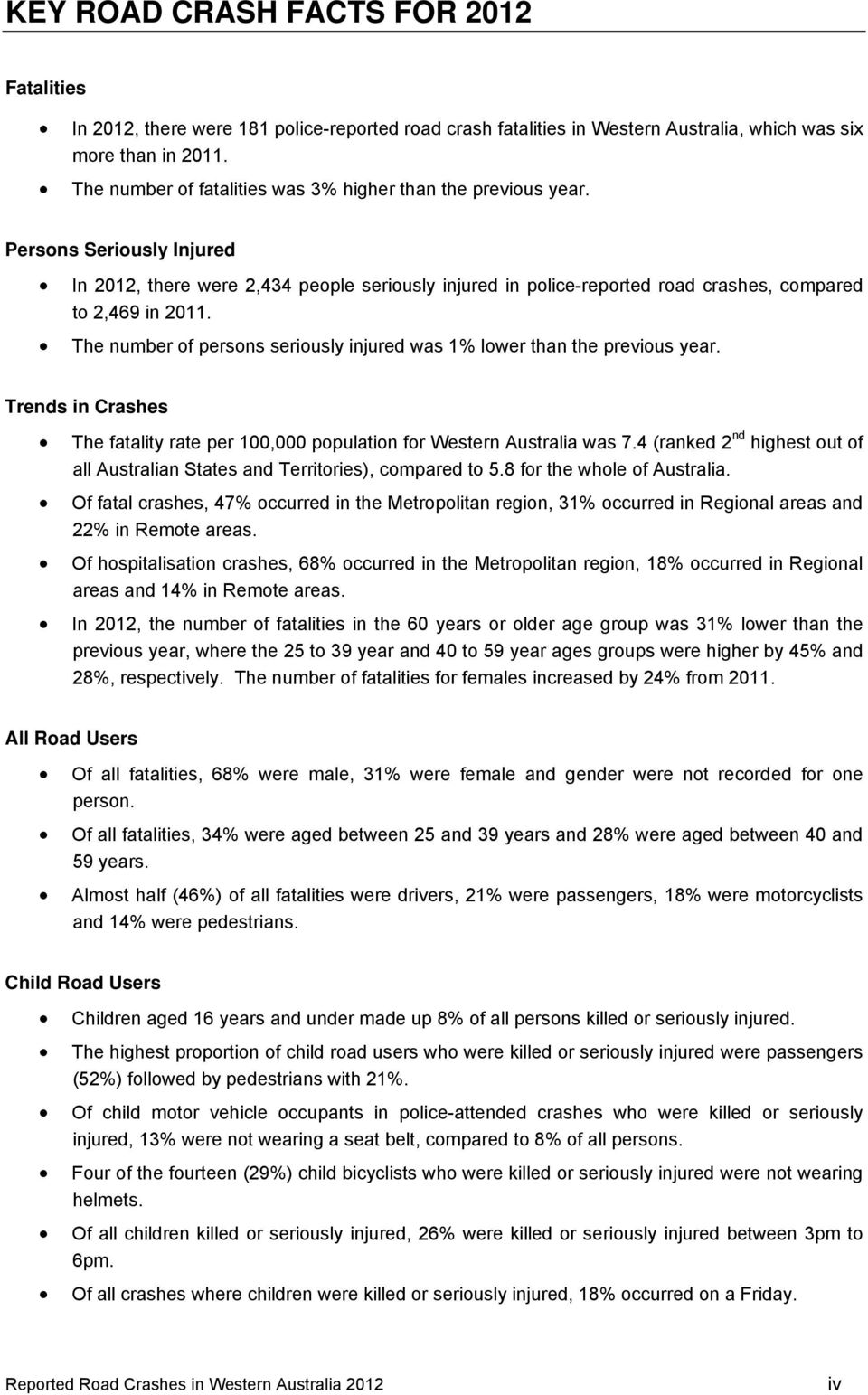
1 REPORTED ROAD CRASHES IN WESTERN AUSTRALIA 2012
2

3 REPORTED ROAD CRASHES IN WESTERN AUSTRALIA 2012

4

5 Road Safety Council of Western Australia Document Retrieval Information Date Pages ISSN April TITLE Reported Road Crashes in Western Australia 2012 AUTHOR(S) Bramwell J, Hill DL, Thompson PE PERFORMING ORGANISATION Data Analysis Australia 97 Broadway NEDLANDS WA 6009 Tel: (08) Fax: (08) SPONSOR Road Safety Council of Western Australia c/- Office of Road Safety Main Roads WA Waterloo Crescent East Perth WA 6004 Tel: (08) Fax: (08) ABSTRACT This report presents information on road crashes that occurred in Western Australia in There were 39,008 police-reported road crashes involving 75,864 vehicles and 2,615 persons killed or seriously injured. KEYWORDS Road crash statistics, Crash severity, Blood alcohol concentration, Drink driving, Drugs, Fatality, Helmet use, Injury, Restraint use, Road environment, Metropolitan area, Regional area, Remote area, Seat belt, Speeding, Urban area, Vehicle type, Western Australia. NOTE This report is distributed in the interests of information exchange and is available on the Internet at the Office of Road Safety web site < >. On the Main Roads Western Australia web site < >, intersection rankings and metropolitan traffic flows can be viewed. This publication is also available in alternative formats (e.g. audio tape, computer disc, large print or Braille) by contacting the Office of Road Safety on Reported Road Crashes in Western Australia 2012 i

6 FOREWORD In 2012, there were 181 police-reported road crash fatalities that occurred on Western Australian roads. This figure was three per cent higher than the 2011 figure. However, the number of people seriously injured in police-reported road crashes was 2,434, which was one per cent lower than the 2,469 figure in Of the fatal crashes in 2012, 47 per cent occurred in the metropolitan region, 31 per cent took place in regional areas and the remaining 22 per cent happened in remote locations. WA s fatality rate of 7.4 per 100,000 population was above the national rate at 5.8, meaning the State is still ranked as the second highest out of all States and Territories in Australia. Over the last five years, the number of people killed on WA roads has been decreasing; the number of people killed in 2012 was nine per cent less than the average of the previous five years. During the same period, the number of people seriously injured in road traffic crashes has also been decreasing, with the number of people admitted to hospital in 2012 being eight per cent less than the average for 2007 to The issue of road safety continues to be addressed in line with the State Government s Towards Zero Road Safety Strategy This strategy is built on the globally-recognised Safe System approach, which views WA s transport system holistically by seeking to manage and improve road safety between the four cornerstones of Safe Road Use, Safe Roads and Roadsides, Safe Speeds and Safe Vehicles. The 2012 crash book highlights a number of behaviours that played a role in WA road crashes, including speed, alcohol, illegal drugs, seat belts and helmets. The community has a responsibility to support each other to act safely within the road rules to help continue to bring WA s road fatality and serious injury rates down. Speed was a factor in 24 per cent of police-attended fatal crashes in 2012 and a quarter of motorcyclist fatalities occurred as a result of speed-related crashes. At least one driver/rider had a BAC of 0.05g/100mL or higher in almost one fifth of police-attended fatal crashes (19 per cent), and the majority of drivers/riders involved in alcohol related crashes were male. Twenty-two per cent of motor vehicle occupant fatalities in police-attended crashes were not wearing a seat belt. Males accounted for 68 per cent of all fatalities in 2012 and overall, the age group with the biggest percentage of fatalities were those aged between 25 and 39 years (at 34 per cent). However, the number of road deaths for females increased by 24 percent from Often referred to as one of the highest risk groups, young adult road users aged 17 to 24 years made up 22 per cent of all persons killed or seriously injured on WA roads, with 52 per cent of this age group injured while behind the wheel. Children aged 16 years and under made up eight per cent of all persons killed or seriously injured, and the highest proportion of child road users who were killed or seriously injured were passengers (52 per cent), followed by pedestrians (21 per cent). The number of senior adult road user fatalities (those aged 60 years and over) in 2012 had also decreased significantly, down by 31 per cent from In terms of the crash nature, single-vehicle crashes constituted 61 per cent of all fatal crashes in 2012, and nearly three quarters of fatal crashes in remote areas of WA involved a single vehicle. More than one third (35 per cent) of fatal road deaths in the metropolitan region occurred at an intersection. Reported Road Crashes in Western Australia 2012 ii

7 WA continues to move forward to achieve the targets of the Towards Zero road safety strategy. Substantial funds have been allocated from the Road Trauma Trust Account towards five major priority safety programs focusing on urban intersections, regional run off road crashes, impaired driving, excess and inappropriate speed-related crashes, and unprotected occupants and users. The State Government will continue to implement Towards Zero and the Safe System approach in a shared responsibility with road users and the community to further reduce the devastating effects of road trauma. Hon Liza Harvey MLA Minister for Police; Tourism; Road Safety; Women s Interests Professor Murray Lampard APM Chair Road Safety Council of WA Reported Road Crashes in Western Australia 2012 iii

8 KEY ROAD CRASH FACTS FOR 2012 Fatalities In 2012, there were 181 police-reported road crash fatalities in Western Australia, which was six more than in The number of fatalities was 3% higher than the previous year. Persons Seriously Injured In 2012, there were 2,434 people seriously injured in police-reported road crashes, compared to 2,469 in The number of persons seriously injured was 1% lower than the previous year. Trends in Crashes The fatality rate per 100,000 population for Western Australia was 7.4 (ranked 2 nd highest out of all Australian States and Territories), compared to 5.8 for the whole of Australia. Of fatal crashes, 47% occurred in the Metropolitan region, 31% occurred in Regional areas and 22% in Remote areas. Of hospitalisation crashes, 68% occurred in the Metropolitan region, 18% occurred in Regional areas and 14% in Remote areas. In 2012, the number of fatalities in the 60 years or older age group was 31% lower than the previous year, where the 25 to 39 year and 40 to 59 year ages groups were higher by 45% and 28%, respectively. The number of fatalities for females increased by 24% from All Road Users Of all fatalities, 68% were male, 31% were female and gender were not recorded for one person. Of all fatalities, 34% were aged between 25 and 39 years and 28% were aged between 40 and 59 years. Almost half (46%) of all fatalities were drivers, 21% were passengers, 18% were motorcyclists and 14% were pedestrians. Child Road Users Children aged 16 years and under made up 8% of all persons killed or seriously injured. The highest proportion of child road users who were killed or seriously injured were passengers (52%) followed by pedestrians with 21%. Of child motor vehicle occupants in police-attended crashes who were killed or seriously injured, 13% were not wearing a seat belt, compared to 8% of all persons. Four of the fourteen (29%) child bicyclists who were killed or seriously injured were not wearing helmets. Of all children killed or seriously injured, 26% were killed or seriously injured between 3pm to 6pm. Of all crashes where children were killed or seriously injured, 18% occurred on a Friday. Reported Road Crashes in Western Australia 2012 iv
9 Young Adult Road Users Persons aged 17 to 24 years made up 22% of all persons killed or seriously injured. Of young adult road users who were killed or seriously injured, 52% were drivers, 23% were passengers and 15% were motorcyclists. Of young adult road users who were killed or seriously injured in police-attended crashes, 19% were in crashes where speed was a factor. In comparison, of all persons killed or seriously injured in police-attended crashes, 13% were in crashes where speed was factor. Of young adult road users who were killed or seriously injured in police-attended crashes, 13% were in alcohol-related crashes (i.e. a crash where at least one driver/rider involved in the crash had a blood alcohol concentration (BAC) of 0.05 g/100ml or higher), compared to 10% for all persons killed or seriously injured in police-attended crashes. Of young adult motor vehicle occupants in police-attended crashes who were killed or seriously injured, 11% were not wearing a seat belt, compared to 8% of all persons. Quarter (25%) of young adult drivers/riders involved in serious crashes were hit object crashes. This compares with 16% of all drivers/riders involved in serious crashes. Of all young adult killed or seriously injured, more than a quarter (27%) were killed or seriously injured between 9pm and 3am. In comparison, of all persons killed or seriously injured, 17% were killed or seriously injured between 9pm and 3am. Of all crashes where young adult were killed or seriously injured, 21% occurred on a Saturday. In comparison, 18% of all persons killed or seriously injured were injured in crashes occurring on a Saturday. Mature Adult Road Users Persons aged 25 to 59 years accounted for 53% of all persons killed or seriously injured. Over half (52%) of mature adult road users who were killed or seriously injured were drivers, 20% were motorcyclists and 16% were motor vehicle passengers. Of mature adult road users who were killed or seriously injured in police-attended crashes, 13% were in crashes where speed was a factor. Of mature adult road users who were killed or seriously injured in police-attended crashes, 12% were in alcohol-related crashes. Of mature adult motor vehicle occupants in police-attended crashes who were killed or seriously injured, 9% were not wearing a seat belt. Senior Adult Road Users Persons aged 60 years and over made up 13% of all persons killed or seriously injured. Of senior adult road users who were killed or seriously injured, 60% were drivers, 21% were passengers, 8% were motorcyclists and 7% were pedestrians. More than half (55%) of senior adult drivers/riders involved in serious crashes were in Intersection crashes. This compares with 49% of all drivers/riders involved in serious crashes. Of all senior adult killed or seriously injured, almost three quarters (73%) were killed or seriously injured between 9am and 6pm, compared to 50% of all persons. Reported Road Crashes in Western Australia 2012 v

10 Speed Speed was a factor in 24% of police-attended fatal crashes. The percentage of police-attended fatal crashes that were speed-related was highest in the Remote region (27%) and lowest in Regional WA (17%). A quarter (25%) of motorcyclist fatalities occurred in speed-related crashes attended by police. More than two thirds (68%) of speed-related fatal crashes attended by police were single-vehicle crashes and 70% of these were Hit Object crashes. Alcohol Almost one fifth (19%) of police-attended fatal crashes involved at least one driver/rider with a BAC of 0.05 g/100ml or above (i.e. were an alcohol related crash). Among road users killed or seriously injured, 10% were involved in alcohol-related crashes attended by police. The majority (84%) of drivers/riders involved in alcohol-related police-attended fatal crashes were male. Eight of the 25 (32%) pedestrian fatalities in police-attended crashes are alcohol-related. Illegal Drugs Almost a quarter (23%) of the 170 fatalities matched to the crash data had illegal drugs detected in their systems. Almost one third (30%) of the 30 fatalities from age group 17 to 24 matched to the crash data had illegal drugs detected in their systems. More than a quarter (26%) of the 31 motorcyclist fatalities matched to the crash data had illegal drugs detected in their systems. Just over one tenth (13%) of the pedestrian fatalities matched to the crash data involved a driver/rider who had illegal drugs detected in their systems. Seat Belts Almost one quarter (22%) of motor vehicle occupant fatalities in police-attended crashes were not wearing a seat belt. Twenty-five per cent of male and 18% of female motor vehicle occupant fatalities in police-attended crashes were not wearing a seat belt. Helmets Four of the 32 motorcyclist fatalities in police-attended crashes were not wearing a helmet. Of the three bicyclist fatalities in police-attended crashes, two were not wearing helmets. More than one quarter (26%) of bicyclists seriously injured in crashes attended by police were not wearing a helmet. Reported Road Crashes in Western Australia 2012 vi

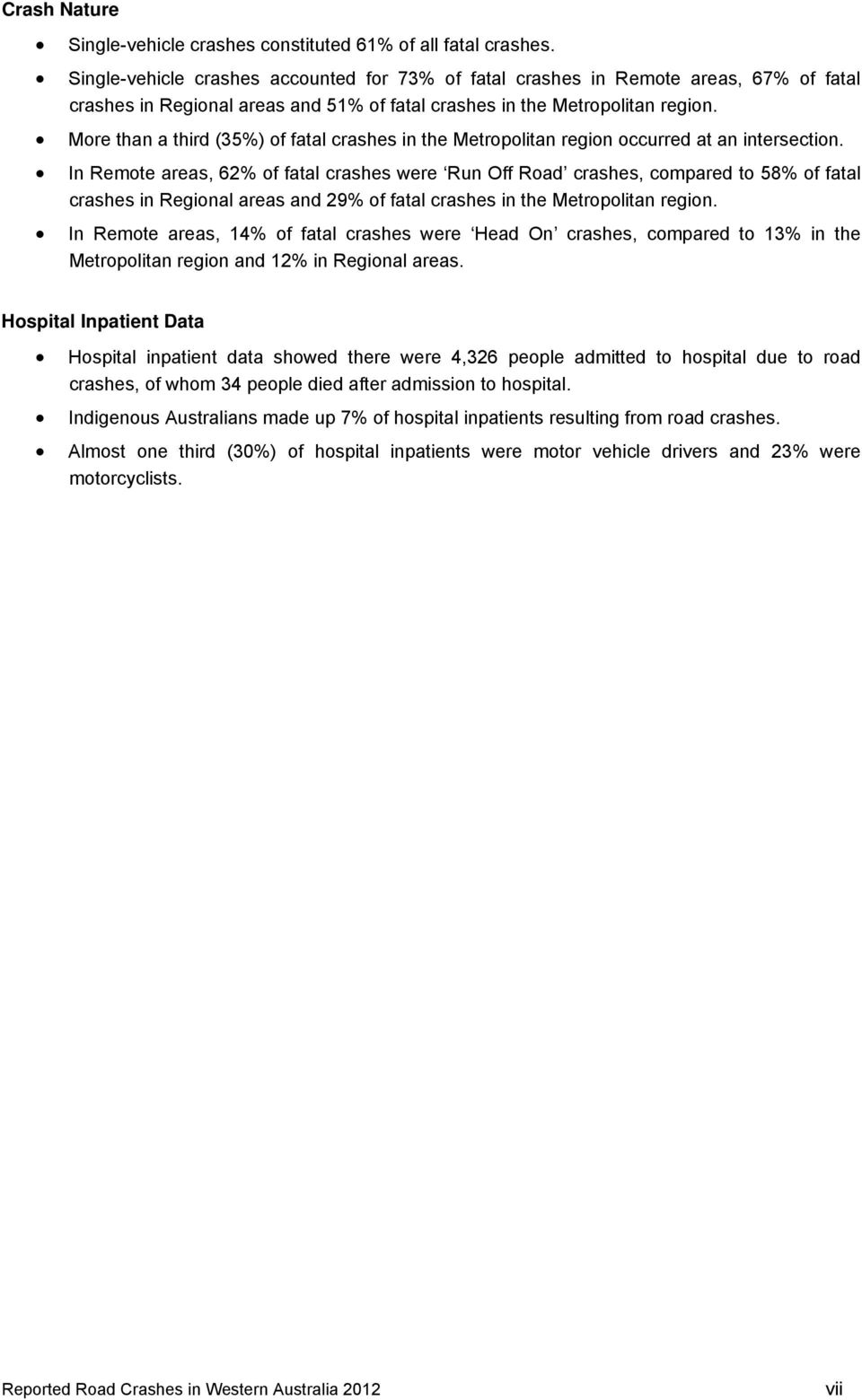
11 Crash Nature Single-vehicle crashes constituted 61% of all fatal crashes. Single-vehicle crashes accounted for 73% of fatal crashes in Remote areas, 67% of fatal crashes in Regional areas and 51% of fatal crashes in the Metropolitan region. More than a third (35%) of fatal crashes in the Metropolitan region occurred at an intersection. In Remote areas, 62% of fatal crashes were Run Off Road crashes, compared to 58% of fatal crashes in Regional areas and 29% of fatal crashes in the Metropolitan region. In Remote areas, 14% of fatal crashes were Head On crashes, compared to 13% in the Metropolitan region and 12% in Regional areas. Hospital Inpatient Data Hospital inpatient data showed there were 4,326 people admitted to hospital due to road crashes, of whom 34 people died after admission to hospital. Indigenous Australians made up 7% of hospital inpatients resulting from road crashes. Almost one third (30%) of hospital inpatients were motor vehicle drivers and 23% were motorcyclists. Reported Road Crashes in Western Australia 2012 vii
12 Key Performance Indicators The key performance indicators (KPI) below provide a more detailed breakdown of the broader performance indicators that are set out in Towards Zero, the State Government s road safety strategy for The indicators have been approved by the Road Safety Council, and will be the means by which the annual progress of the Strategy is monitored. The indicators are subject to regular review, and may change during the life of the Strategy. KPI Number of hospitalised bed days Year 2012 Change from 2011 (%) Cumulative length of stay (days) 28, , , , , , Average length of stay (days) Cost of crashes to the WA community (2012 dollars) 1 Cost ($m) Human Capital 2, , , , , , Cost ($m) Willingness to pay 3, , , , , , Number of serious crashes by Towards Zero regions Metropolitan 1,617 1,685 1,482 1,464 1,467 1, Regional Remote Number of persons killed or seriously injured Persons KSI 3,019 3,095 2,759 2,722 2,644 2, Percentage of vehicles exceeding the speed limit by speed zone 2 60 km/h km/h km/h km/h km/h km/h Injury rates for persons killed or seriously injured 3 Persons KSI per 100,000 population Persons KSI per 10,000 registered vehicles Persons KSI per 100 million km travelled For details on data sources and methodology, refer to Section 2.2 on page For details on data sources and methodology, refer to section 4.3 on page The 2008, 2009 and 2011 KSI rates per 100 million km travelled is based on average kilometres travelled (interpolated between 2007, 2010 and 2012 figures) and number of registered vehicles in each year. Reported Road Crashes in Western Australia 2012 viii

13 Year Change from 2011 KPI n % n % n % n % n % n % % Number and percentage of persons killed or seriously injured in police-attended crashes involving illegal behaviour 4,5,6 Speed a factor Alcohol a factor Seat belt not worn Helmet not worn (motorcyclists) Helmet not worn (bicyclists) Illegal drugs (fatalities) Number and percentage of persons killed or seriously injured by road user type 7 Driver 1, , , , , , Passenger Pedestrian Bicyclist Motorcyclist Scooter/Moped user N/A Heavy vehicle occupant Number and percentage of persons killed or seriously injured in crashes at intersections by Towards Zero areas Metropolitan 1, , , Regional Remote Number and percentage of persons killed or seriously injured in head on crashes by Towards Zero areas Metropolitan Regional Remote Number and percentage of persons killed or seriously injured run off road crashes by Towards Zero areas Metropolitan Regional Remote Speed and alcohol-related crashes refer to police-attended crashes only. 5. Motor vehicle occupants in police-attended crashes only. 6. Illegal drug data obtained from the Forensic Science Laboratory, Chemistry Centre of WA for fatalities only. Percentages of fatalities who were able to be matched between the two datasets. 7. Excludes persons with other/unknown road user type (n=3 for 2012). Reported Road Crashes in Western Australia 2012 ix

14 TABLE OF CONTENTS LIST OF TABLES... xii LIST OF FIGURES... xvii LIST OF MAPS... xix 1. INTRODUCTION DATA SOURCES AND ACKNOWLEDGEMENTS READING AND INTERPRETING THE REPORT TOWARDS ZERO PRIORITY CRASH TYPES REPORTING REGIONS AND ACCESSIBILITY/REMOTENESS INDEX OF AUSTRALIA SELECTED WESTERN AUSTRALIAN STATISTICAL INDICATORS ROAD CRASH AND INJURY SUMMARIES HISTORICAL INFORMATION COST OF CRASHES COMPARISON WITH OTHER STATES AND TERRITORIES GENDER AND AGE ROAD USER TYPES BROAD AGE GROUPS CHILD ROAD USERS 0 TO 16 YEARS YOUNG ADULT ROAD USERS 17 TO 24 YEARS MATURE ADULT ROAD USERS 25 TO 59 YEARS SENIOR ADULT ROAD USERS 60 YEARS OR OLDER SAFE SYSTEM SAFE ROAD USER BEHAVIOURS Speeding Alcohol Illegal Drugs Seat Belts Helmets SAFE ROADS AND ROADSIDES Road Factors Crash Nature SAFE SPEEDS Speed Zones Speed Compliance SAFE VEHICLES ANCAP Safety Ratings Vehicle Type Airbags OTHER FACTORS TEMPORAL FACTORS REGIONAL SUMMARIES REGIONAL COMPARISONS REGIONAL CRASH AND CASUALTY RATES GOLDFIELDS GREAT SOUTHERN KIMBERLEY MID WEST Reported Road Crashes in Western Australia 2012 x

15 6.7 PILBARA-GASCOYNE SOUTH WEST WHEATBELT NORTH WHEATBELT SOUTH HOSPITAL INPATIENT DATA Appendix A Trends Over Time Appendix B Additional Crash and Injury Tables Appendix C P72 Form Appendix D Safe Systems Diagram Appendix E Road Safety-Related Legislation and Other Initiatives GLOSSARY OF TERMS Reported Road Crashes in Western Australia 2012 xi

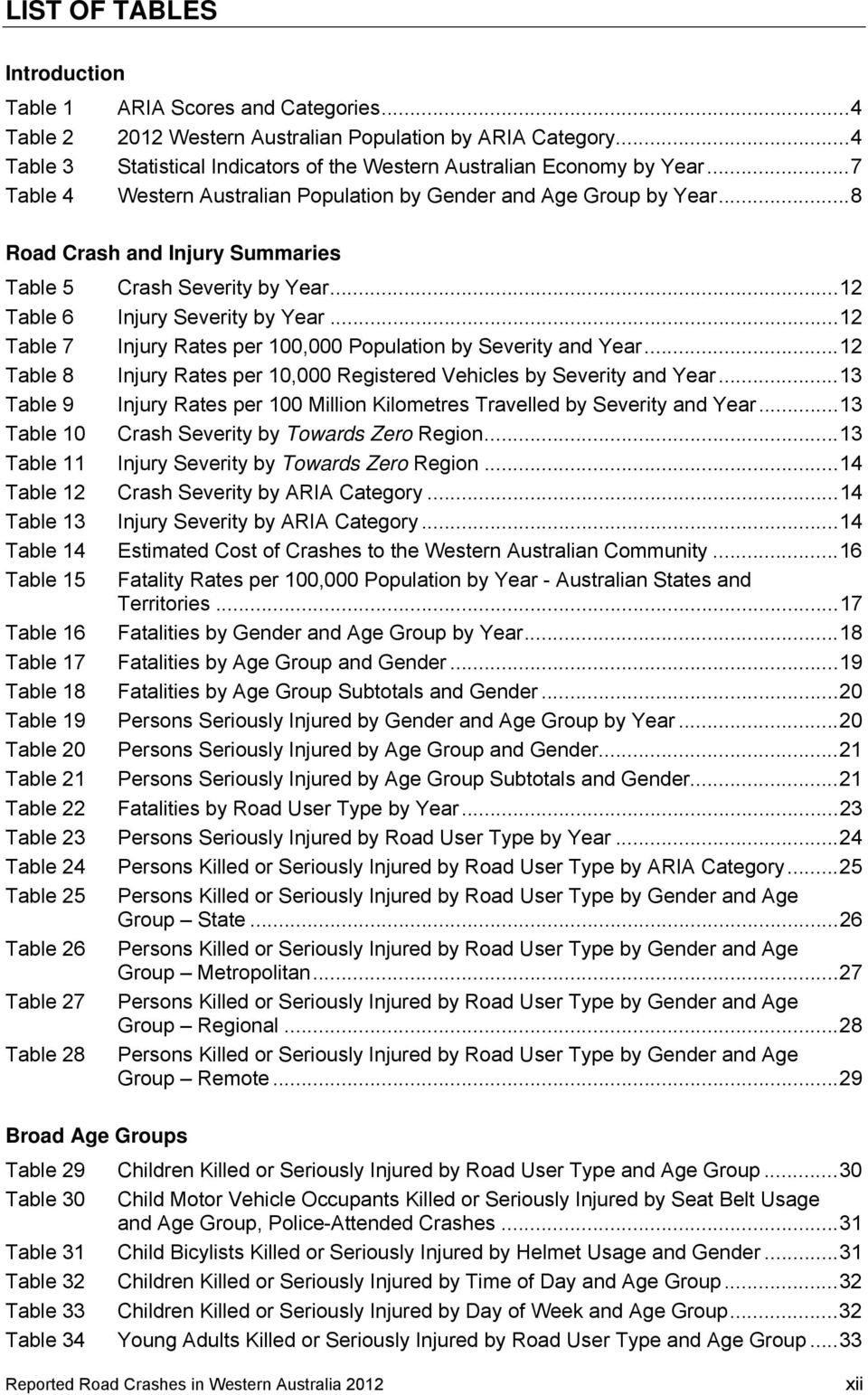
16 LIST OF TABLES Introduction Table 1 ARIA Scores and Categories... 4 Table Western Australian Population by ARIA Category... 4 Table 3 Statistical Indicators of the Western Australian Economy by Year... 7 Table 4 Western Australian Population by Gender and Age Group by Year... 8 Road Crash and Injury Summaries Table 5 Crash Severity by Year Table 6 Injury Severity by Year Table 7 Injury Rates per 100,000 Population by Severity and Year Table 8 Injury Rates per 10,000 Registered Vehicles by Severity and Year Table 9 Injury Rates per 100 Million Kilometres Travelled by Severity and Year Table 10 Crash Severity by Towards Zero Region Table 11 Injury Severity by Towards Zero Region Table 12 Crash Severity by ARIA Category Table 13 Injury Severity by ARIA Category Table 14 Estimated Cost of Crashes to the Western Australian Community Table 15 Fatality Rates per 100,000 Population by Year - Australian States and Territories Table 16 Fatalities by Gender and Age Group by Year Table 17 Fatalities by Age Group and Gender Table 18 Fatalities by Age Group Subtotals and Gender Table 19 Persons Seriously Injured by Gender and Age Group by Year Table 20 Persons Seriously Injured by Age Group and Gender Table 21 Persons Seriously Injured by Age Group Subtotals and Gender Table 22 Fatalities by Road User Type by Year Table 23 Persons Seriously Injured by Road User Type by Year Table 24 Persons Killed or Seriously Injured by Road User Type by ARIA Category Table 25 Persons Killed or Seriously Injured by Road User Type by Gender and Age Group State Table 26 Persons Killed or Seriously Injured by Road User Type by Gender and Age Group Metropolitan Table 27 Persons Killed or Seriously Injured by Road User Type by Gender and Age Group Regional Table 28 Persons Killed or Seriously Injured by Road User Type by Gender and Age Group Remote Broad Age Groups Table 29 Children Killed or Seriously Injured by Road User Type and Age Group Table 30 Child Motor Vehicle Occupants Killed or Seriously Injured by Seat Belt Usage and Age Group, Police-Attended Crashes Table 31 Child Bicylists Killed or Seriously Injured by Helmet Usage and Gender Table 32 Children Killed or Seriously Injured by Time of Day and Age Group Table 33 Children Killed or Seriously Injured by Day of Week and Age Group Table 34 Young Adults Killed or Seriously Injured by Road User Type and Age Group Reported Road Crashes in Western Australia 2012 xii
17 Table 35 Young Adults Killed or Seriously Injured by Speed a Factor and Age Group, Police-Attended Crashes Table 36 Young Adults Killed or Seriously Injured by Highest Driver/Rider BAC in Crash and Age Group, Police-Attended Crashes Table 37 Young Adult Drivers/Riders Involved in Serious Crashes by Driver/Rider BAC and Age Group, Police-Attended Crashes Table 38 Young Adult Motor Vehicle Occupants Killed or Seriously Injured by Seat Belt Usage and Age Group, Police-Attended Crashes Table 39 Young Adult Drivers/Riders Involved in Serious Crashes by Crash Nature and Age Group Table 40 Young Adult Drivers/Riders Involved in Serious Crashes by High Priority Crash Type and Age Group Table 41 Young Adults Killed or Seriously Injured by Time of Day and Age Group Table 42 Young Adults Killed or Seriously Injured by Day of Week and Age Group Table 43 Mature Adults Killed or Seriously Injured by Road User Type and Age Group Table 44 Mature Adults Killed or Seriously Injured by Speed a Factor and Age Group, Police-Attended Crashes Table 45 Mature Adult Motor Vehicle Occupants Killed or Seriously Injured by Seat Belt Usage and Age Group, Police-Attended Crashes Table 46 Mature Adults Killed or Seriously Injured by Highest Driver/Rider BAC in Crash and Age Group, Police-Attended Crashes Table 47 Mature Adults Killed or Seriously Injured by Time of Day and Age Group Table 48 Mature Adult Drivers/Riders Involved in Serious Crashes by Crash Nature Table 49 Mature Adult Drivers/Riders Involved in Serious Crashes by Driver/Rider BAC and Age Group, Police-Attended Crashes Table 50 Senior Adults Killed or Seriously Injured by Road User Type and Age Group Table 51 Senior Adult Drivers/Riders Involved in Serious Crashes by Crash Nature Table 52 Senior Adult Drivers/Riders Involved in Serious Crashes by High Priority Crash Type and Age Group Table 53 Senior Adults Killed or Seriously Injured by Time of Day and Age Group Safe System Table 54 Speed a Factor by Crash Severity, Police-Attended Crashes State Table 55 Speed a Factor by Crash Severity, Police-Attended Crashes - Metropolitan Table 56 Speed a Factor by Crash Severity, Police-Attended Crashes - Regional Table 57 Speed a Factor by Crash Severity, Police-Attended Crashes - Remote Table 58 Fatal Crashes by Speed a Factor by Year, Police-Attended Crashes Table 59 Serious Crashes by Speed a Factor by ARIA Category, Police-Attended Crashes Table 60 Drivers/Riders Involved in Fatal Crashes by Speed a Factor by Gender and Age Group, Police-Attended Crashes Table 61 Drivers/Riders Involved in Hospitalisation Crashes by Speed a Factor by Gender and Age Group, Police-Attended Crashes Table 62 Persons Killed or Seriously Injured by Speed a Factor by Gender and Age Group, Police-Attended Crashes Table 63 Fatalities by Road User Type by Speed a Factor, Police-Attended Crashes Table 64 Fatal Crashes by Speed a Factor by Crash Nature, Police-Attended Crashes - Metropolitan Table 65 Fatal Crashes by Speed a Factor by Crash Nature, Police-Attended Crashes - Regional Reported Road Crashes in Western Australia 2012 xiii

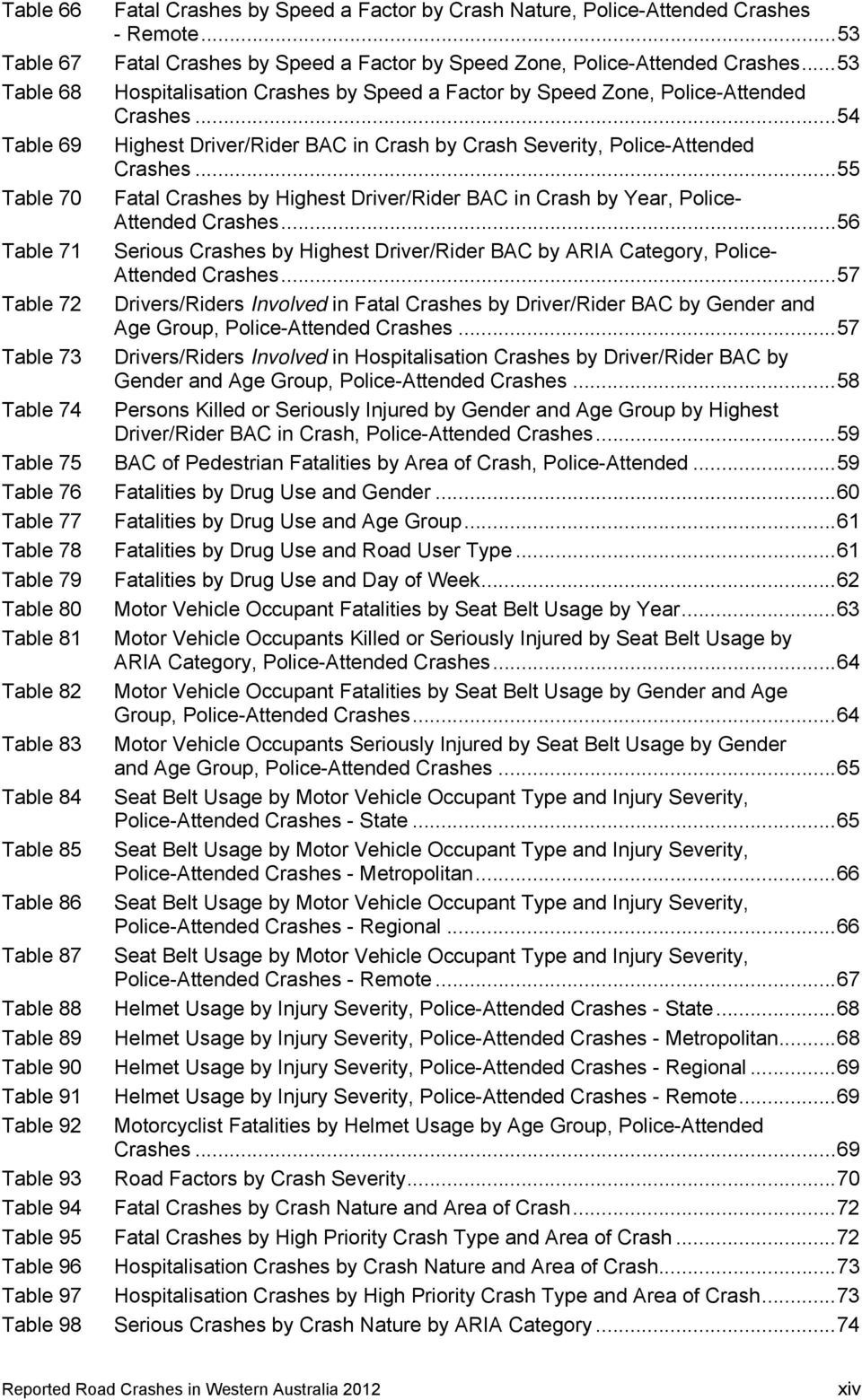
18 Table 66 Fatal Crashes by Speed a Factor by Crash Nature, Police-Attended Crashes - Remote Table 67 Fatal Crashes by Speed a Factor by Speed Zone, Police-Attended Crashes Table 68 Hospitalisation Crashes by Speed a Factor by Speed Zone, Police-Attended Crashes Table 69 Highest Driver/Rider BAC in Crash by Crash Severity, Police-Attended Crashes Table 70 Fatal Crashes by Highest Driver/Rider BAC in Crash by Year, Police- Attended Crashes Table 71 Serious Crashes by Highest Driver/Rider BAC by ARIA Category, Police- Attended Crashes Table 72 Drivers/Riders Involved in Fatal Crashes by Driver/Rider BAC by Gender and Age Group, Police-Attended Crashes Table 73 Drivers/Riders Involved in Hospitalisation Crashes by Driver/Rider BAC by Gender and Age Group, Police-Attended Crashes Table 74 Persons Killed or Seriously Injured by Gender and Age Group by Highest Driver/Rider BAC in Crash, Police-Attended Crashes Table 75 BAC of Pedestrian Fatalities by Area of Crash, Police-Attended Table 76 Fatalities by Drug Use and Gender Table 77 Fatalities by Drug Use and Age Group Table 78 Fatalities by Drug Use and Road User Type Table 79 Fatalities by Drug Use and Day of Week Table 80 Motor Vehicle Occupant Fatalities by Seat Belt Usage by Year Table 81 Motor Vehicle Occupants Killed or Seriously Injured by Seat Belt Usage by ARIA Category, Police-Attended Crashes Table 82 Motor Vehicle Occupant Fatalities by Seat Belt Usage by Gender and Age Group, Police-Attended Crashes Table 83 Motor Vehicle Occupants Seriously Injured by Seat Belt Usage by Gender and Age Group, Police-Attended Crashes Table 84 Seat Belt Usage by Motor Vehicle Occupant Type and Injury Severity, Police-Attended Crashes - State Table 85 Seat Belt Usage by Motor Vehicle Occupant Type and Injury Severity, Police-Attended Crashes - Metropolitan Table 86 Seat Belt Usage by Motor Vehicle Occupant Type and Injury Severity, Police-Attended Crashes - Regional Table 87 Seat Belt Usage by Motor Vehicle Occupant Type and Injury Severity, Police-Attended Crashes - Remote Table 88 Helmet Usage by Injury Severity, Police-Attended Crashes - State Table 89 Helmet Usage by Injury Severity, Police-Attended Crashes - Metropolitan Table 90 Helmet Usage by Injury Severity, Police-Attended Crashes - Regional Table 91 Helmet Usage by Injury Severity, Police-Attended Crashes - Remote Table 92 Motorcyclist Fatalities by Helmet Usage by Age Group, Police-Attended Crashes Table 93 Road Factors by Crash Severity Table 94 Fatal Crashes by Crash Nature and Area of Crash Table 95 Fatal Crashes by High Priority Crash Type and Area of Crash Table 96 Hospitalisation Crashes by Crash Nature and Area of Crash Table 97 Hospitalisation Crashes by High Priority Crash Type and Area of Crash Table 98 Serious Crashes by Crash Nature by ARIA Category Reported Road Crashes in Western Australia 2012 xiv
19 Table 99 Serious Crashes by High Priority Crash Type by ARIA Category Table 100 Speed Zone by Crash Severity Table 101 Percentage of Vehicles Exceeding the Speed Limit by Speed Zone Table 102 New Vehicles Purchased by ANCAP Safety Rating and Vehicle type Table 103 Vehicle Type by Crash Severity Table 104 Airbag Usage by Injury Severity Table 105 Motor Vehicle Occupants Killed or Seriously Injured by Airbag Usage by Area Table 106 Motor Vehicle Occupants Killed or Seriously Injured by Airbag Usage by Occupant Type Other Factors Table 107 Crash Month by Crash Severity Table 108 Crash Month by Injury Severity Table 109 Day of Week by Crash Severity Regional Summaries Table Estimated Resident Population by Region Table 111 Crash Severity by Region Table 112 Injury Severity by Region Table 113 Drivers/Riders Involved in Serious Crashes by Gender by Region Table 114 Drivers/Riders Involved in Serious Crashes by Age Group by Region Table 115 Serious Crashes by Speed a Factor by Region Table 116 Serious Crashes by Highest Driver/Rider BAC in Crash by Region, Police- Attended Crashes Table 117 Motor Vehicle Occupants Killed or Seriously Injured by Seat Belt Usage by Region, Police-Attended Crashes Table 118 Serious Crashes by Crash Type by Region Table 119 Serious Crashes by Other Contributing Factors by Region Table 120 Serious Crashes by Month and Day of Week by Region Table 121 Age and Gender Standarised Rates of those Killed or Seriously Injured by Region Table 122 Persons Killed or Seriously Injured by Age Group and Gender - Goldfields Table 123 Speed a Factor by Crash Severity, Police-Attended Crashes - Goldfields Table 124 Seat Belt Usage by Injury Severity, Police-Attended Crashes - Goldfields Table 125 Crash Nature by Crash Severity - Goldfields Table 126 High Priority Crash Type by Crash Severity - Goldfields Table 127 Persons Killed or Seriously Injured by Age Group and Gender - Great Southern Table 128 Speed a Factor by Crash Severity, Police-Attended Crashes - Great Southern 105 Table 129 Highest Driver/Rider BAC in Crash by Crash Severity, Police-Attended Crashes - Great Southern Table 130 Crash Nature by Crash Severity - Great Southern Table 131 High Priority Crash Type by Crash Severity - Great Southern Table 132 Persons Killed or Seriously Injured By Age Group And Gender - Kimberley Table 133 Seat Belt Usage by Injury Severity, Police-Attended Crashes - Kimberley Table 134 Crash Nature by Crash Severity - Kimberley Table 135 High Priority Crash Type by Crash Severity - Kimberley Reported Road Crashes in Western Australia 2012 xv

20 Table 136 Persons Killed or Seriously Injured by Age Group and Gender - Mid West Table 137 Speed a Factor by Crash Severity, Police-Attended Crashes - Mid West Table 138 Highest Driver/Rider BAC in Crash by Crash Severity, Police-Attended Crashes - Mid West Table 139 Seat Belt Usage by Injury Severity, Police-Attended Crashes - Mid West Table 140 Crash Nature by Crash Severity - Mid West Table 141 High Priority Crash Type by Crash Severity - Mid West Table 142 Persons Killed or Seriously Injured by Age Group and Gender - Pilbara- Gascoyne Table 143 Seat Belt Usage by Injury Severity, Police-Attended Crashes - Pilbara- Gascoyne Table 144 Crash Nature by Crash Severity Pilbara-Gascoyne Table 145 High Priority Crash Type by Crash Severity - Pilbara-Gascoyne Table 146 Persons Killed or Seriously Injured by Age Group by Gender - South West Table 147 Crash Nature by Crash Severity - South West Table 148 High Priority Crash Type by Crash Severity - South West Table 149 Persons Killed or Seriously Injured by Age Group and Gender - Wheatbelt North Table 150 Speed a Factor by Crash Severity, Police-Attended Crashes - Wheatbelt North Table 151 Highest Driver/Rider BAC in Crash by Crash Severity, Police-Attended Crashes - Wheatbelt North Table 152 Crash Nature by Crash Severity - Wheatbelt North Table 153 High Priority Crash Type by Crash Severity - Wheatbelt North Table 154 Persons Killed or Seriously Injured by Age Group and Gender - Wheatbelt South Table 155 Crash Nature by Crash Severity - Wheatbelt South Table 156 High Priority Crash Type by Crash Severity - Wheatbelt South Hospital Inpatient Data Table 157 Hospital Inpatients by Injury Severity by Year Table 158 Hospital Inpatients by Road User by Year Table 159 Hospital Inpatients by Age Group and Gender Table 160 Hospital Inpatients by Road User Group by Gender Table 161 Hospital Inpatients by Road User Group by Age Group Table 162 Hospital Inpatients by Indigenous Status by Year Table 163 Hospital Inpatients by Indigenous Status by Gender Table 164 Hospital Inpatients by Indigenous Status by Age Group Table 165 Hospital Inpatients by Indigenous Status by Road User Group Reported Road Crashes in Western Australia 2012 xvi

21 LIST OF FIGURES Road Crash and Injury Summaries Figure 1 Fatalities by Year, 1961 to Figure 2 Fatality Rates by Year, 1961 to Figure 3 Persons Seriously Injured by Year, 1980 to Figure 4 Serious Injury Rates by Year, 1980 to Figure 5 Reported Crash Rates by Year, 1976 to Figure 6 Fatality Rates per 100,000 Population - Australian States and Territories Figure 7 Fatalities by Gender and Age Group Figure 8 Fatalities by Road User Type Figure 9 Persons Seriously Injured by Road User Type Figure 10 Persons Killed or Seriously Injured by Road User Type by Gender Broad Age Groups Figure 11 Children Killed or Seriously Injured by Road User Type Figure 12 Young Adults Killed or Seriously Injured by Road User Type Figure 13 Mature Adults Killed or Seriously Injured by Road User Type Figure 14 Senior Adults Killed or Seriously Injured by Road User Group Safe System Figure 15 Fatal Crashes With Speed a Factor by Year, Police-Attended Crashes Figure 16 Fatal Crashes by Highest Driver/Rider BAC in Crash by Year, Police- Attended Crashes Figure 17 Motor Vehicle Occupant Fatalities Where Seat Belts Were Not Worn by Year Figure 18 Crash Nature by Crash Severity Figure 19 New Vehicles Purchased by ANCAP Safety Rating and Vehicle Type Regional Summaries Figure 20 Fatal Crashes and Fatalities by Year - Goldfields Figure 21 Persons Killed or Seriously Injured by Road User Type - Goldfields Figure 22 Fatal Crashes and Fatalities by Year - Great Southern Figure 23 Persons Killed or Seriously Injured by Road User Type - Great Southern Figure 24 Fatal Crashes and Fatalities by Year - Kimberley Figure 25 Persons Killed or Seriously Injured by Road User Type Kimberley Figure 26 Fatal Crashes and Fatalities by Year - Mid West Figure 27 Persons Killed or Seriously Injured by Road User Type - Mid West Figure 28 Fatal Crashes and Fatalities by Year - Pilbara-Gascoyne Figure 29 Persons Killed or Seriously Injured by Road User Type - Pilbara-Gascoyne Figure 30 Fatal Crashes and Fatalities by Year - South West Figure 31 Persons Killed or Seriously Injured by Road User Type - South West Figure 32 Fatal Crashes and Fatalities by Year - Wheatbelt North Figure 33 Persons Killed or Seriously Injured by Road User Type - Wheatbelt North Figure 34 Fatal Crashes and Fatalities by Year - Wheatbelt South Figure 35 Persons Killed or Seriously Injured by Road User Type - Wheatbelt South Reported Road Crashes in Western Australia 2012 xvii
22 Hospital Inpatient Data Figure 36 Hospital Inpatients by Indigenous Status by Age Group Figure 37 Hospital Inpatients by Indigenous Status by Road User Group Reported Road Crashes in Western Australia 2012 xviii
23 LIST OF MAPS Map 1 ARIA Categories by Local Government Area... 5 Map 2 Towards Zero Regions by Local Government Area... 6 Map 3 Serious Crash Rate per 100,000 Population by Region Map 4 Multi-vehicle Serious Crash Rate per 100,000 Population by Region Map 5 Single-Vehicle Serious Crash Rate per 100,000 Population by Region Map 6 Speed-Related Serious Crash Rate per 100,000 Population by Region, Police-Attended Crashes Map 7 Alcohol-Related Serious Crash Rate per 100,000 Population by Region, Police-Attended Crashes Map 8 Seat Belt Not Worn KSI Rate per 100,000 Population by Region, Police- Attended Crashes Map 9 Age and Gender Standardised KSI Rate per 100,000 Population by Region Reported Road Crashes in Western Australia 2012 xix
24
25 1. INTRODUCTION This report, published annually, is produced and distributed on behalf of the Road Safety Council of Western Australia. The report provides road crash statistics for 2012 in Western Australia. Some historical data and road crash statistics for the rest of Australia are also included in the report to help readers to interpret the statistics in an appropriate context. A crash is classified as a road crash if the following conditions hold: the crash resulted in bodily injury or property damage, the crash occurred on a road and the road was open to the public at the time of the crash, the crash involved at least one moving vehicle and the crash was not a result of a medical condition or a deliberate act (such as a suicide attempt). Crashes that do not meet these criteria have been excluded from the report. The report focuses mainly on crashes that resulted in road users being killed or seriously injured, where a serious injury is defined as an injury that resulted in the road user being admitted to hospital for treatment. The term serious crash is used in this report to describe any crash resulting in at least one fatality or serious injury. For more detailed definitions of these and other terms, see the Glossary on page Data Sources and Acknowledgements Sections 2 to 6 contain statistics extracted from data on police-reported road crashes. These data were obtained from the Integrated Road Information System (IRIS) maintained by Main Roads Western Australia. The dataset used was extracted from the IRIS on 2 May 2013 by Main Roads and changes made after this date are not reflected in this report. Crash rates were calculated from the police-reported data using estimated resident population, vehicle registrations and estimated kilometres travelled data obtained from the Australian Bureau of Statistics (ABS). The estimated kilometres travelled for 2012 was obtained directly from the ABS publication. The release date of data sourced from Australian Bureau of Statistics publications with multiple releases is provided with each table. Section 7 presents information on road traffic casualties who were admitted to public and private hospitals in Western Australia during Casualties involved in non-traffic crashes were excluded. The data was extracted on 18 April 2013 by the Hospital Morbidity Data Collections, Data Integrity, Performance Activity & Quality Division of the Western Australian Department of Health. Hospital inpatient data is captured using the Hospital Morbidity Data System. These data offer an alternative data source to the police-reported data and provide additional details about the road traffic casualties not usually available in police crash reports (i.e. Indigenous status). However, there are differences in reporting criteria, reporting methods and road user type definitions between the two datasets. Therefore, the hospital inpatient data cannot be directly compared to the police-reported data. The number of Western Australian motor driver licences on record for each year from 1974 onwards is provided in Appendix A on page 137. This information was obtained from the Western Australian Department of Transport. Reported Road Crashes in Western Australia
26 Data Analysis Australia would like to thank the following people and organisations for their assistance in providing data: Main Roads Western Australia Thandar Lim Health Department of Western Australia Paul Stevens Matthew Cooper Ellen Ceklic Department of Transport Karl Shoebridge We would also like to thank Matthew Legge and Kirsty Kirkman from the Office of Road Safety for their contributions and assistance in the preparation of the report. 1.2 Reading and Interpreting the Report The statistics in this report should be read in conjunction with the glossary included on page 159, which provides definitions of terms used in the report. Particular note should be made of changes to some of the terminology used in this report compared to that of earlier reports in the same series. These changes have been made to provide consistency with the terminology used nationally in the area of road crash statistics. All tables and figures in this report refer to road crashes that occurred in Western Australia in 2012, unless otherwise stated. Tables and graphs are provided with varying levels of detail, and care must be taken when interpreting percentage changes where the overall numbers are small. For this reason percentage changes are not reported for counts less than 10 (indicated by N/R in tables). In some cases percentages may not add to exactly 100%, due to rounding. Rates in the tables presented in this report are rounded to one decimal place, although percentage changes are calculated from the original, unrounded data. Therefore, calculating percentage changes using the rounded rates may result in values that differ from those shown in the tables. Many of the tables that provide information by crash or injury severity include a subtotal column or row for total serious crashes or total persons Killed or Seriously Injured (KSI). Therefore, in these tables the overall column or row total cannot be calculated by simply summing all columns or rows. Western Australian legislation requires that traffic crashes are reported to police if: the incident results in bodily harm to any person the total value of property damage exceeds $3,000 the owner or representative of any damaged property is not present Traffic crashes can be reported in person to a police station, using a paper-based form (the P72 form). In addition to this, in November 2009 an online crash report facility (OCRF) was launched Reported Road Crashes in Western Australia
27 by Western Australia Police and the Insurance Commission of Western Australia. The introduction of the OCRF is expected to result in more accurate data, as some validation of the information entered can be conducted automatically at the time the crash is reported (such as make and model of vehicle and currency of driver s licence). It may also result in an apparent increase in the number of crashes involving property damage only, as the ease of reporting may reduce underreporting of such crashes. There are some minor differences in the information collected via the OCRF and the hard copy P72 form, including the addition of passenger gender. The version of the P72 form used in 2012 is provided in Appendix C on page 143. Throughout the report, overall table totals will vary because separate tables are provided for different levels, including the following: number of crashes number of road users number of drivers/riders number of motor vehicle occupants number of vehicles Within these levels, tables and graphs are provided for subsets by crash severity, injury severity, road user group and police attendance. All captions for tables and figures describe the particular subset of data included in that table or figure. 1.3 Towards Zero Priority Crash Types Towards Zero is the State Government s road safety strategy for 2008 to Towards Zero is based on a holistic view of road safety that seeks to manage the interaction between the road user, the road, travel speed and the vehicle. This safe system approach has achieved results not possible using traditional road safety approaches. The measures outlined in Towards Zero use the safe system framework and its four cornerstones Safe Road Use, Safe Roads and Roadsides, Safe Speeds and Safe Vehicles. Copies of the strategy are available from the Office of Road Safety website < As part of the development of Towards Zero, problem areas were identified by the Monash University Accident Research Centre from an analysis of WA s reported crashes between 2005 and Problem areas were prioritised on their estimated contribution to the number of deaths and serious injuries, either because of their frequency or because the associated risks were high. On this basis, three crash types were identified as having the highest priority and are reported on in various sections of this text. Two crash types, intersection and run-off-road crashes 1, were identified as a priority since each resulted in a third of the people killed and seriously injured between 2005 and 2007, and the third crash type, head-on crashes, was chosen because the risk associated with a person being killed or seriously injured is high. These crash types are not mutually exclusive, hence tables presenting Towards Zero High Priority Crash Types may count some crashes more than once, and percentages will not sum to 100%. 1 Run Off Road crashes are defined as crashes in which a vehicle involved exits the carriageway, through a loss of control, swerving to avoid a collision or for other reasons. After the vehicle has left the carriageway it may also collide with a person, object, or vehicle, or it may roll over, and/or a person may fall or be ejected from the vehicle. Reported Road Crashes in Western Australia
28 1.4 Reporting Regions and Accessibility/Remoteness Index of Australia The accessibility/remoteness index of Australia (ARIA) is a geographical measure of remoteness developed by the National Centre for Social Applications of Geographical Information Systems Consultancy Services. Measurements of road distances between populated localities and service centres were used to determine the ARIA score for a given location. ARIA scores were derived for over 12,000 populated localities within Australia. These ARIA scores have then been interpolated to provide an ARIA score for the whole of Australia. Localities that are more remote have less access to service centres; those that are less remote have greater access to service centres. The standard ranges that are used for ARIA scores are provided in Table 1. These ranges have been used in all ARIA tables throughout the report. Table 1 ARIA Scores and Categories ARIA Score ARIA Category 0 to 0.2 Highly Accessible >0.2 to 2.4 Accessible >2.4 to 5.92 Moderately Accessible >5.92 to Remote >10.53 Very Remote Source: National Centre for Social Applications of Geographical Information Systems Consultancy Services. In 2012, 77.5% of Western Australia s population were located in Highly Accessible areas and 8.1% in Accessible areas while only 2.2% were located in Very Remote areas. Table Western Australian Population by ARIA Category 2012 Population ARIA Category n % Highly Accessible 1,885, % Accessible 197, % Moderately Accessible 187, % Remote 108, % Very Remote 53, % Total 2,432, % Source: Australian Bureau of Statistics, Customised report, 2013 for 2012 figures. In line with the focus of the Towards Zero road safety strategy, some results in this report are presented comparing the Metropolitan region with Regional and Remote areas. The Metropolitan area is defined as the Perth Statistical Division and the remainder of the State is then split into Regional and Remote areas based on ARIA categories. Regional areas have ARIA categories of Accessible or Moderately Accessible, and Remote areas have ARIA categories of Remote or Very Remote. Note that the Towards Zero Regions were defined using 2006 ARIA categories whereas elsewhere in the book reports on 2011 ARIA categories. Map 1 shows the ARIA Categories, and Map 2 shows the Towards Zero Regions by Local Government Areas (LGAs) in Western Australia. Reported Road Crashes in Western Australia
29 Map 1 ARIA Categories by Local Government Area Reported Road Crashes in Western Australia
30 Map 2 Towards Zero Regions by Local Government Area Reported Road Crashes in Western Australia
31 1.5 Selected Western Australian Statistical Indicators This section contains key statistics to provide an overview of the Western Australian economy and population for 2007 to This information may provide additional context to the road crash statistics. Table 3 Statistical Indicators of the Western Australian Economy by Year Year Change from 2011 Statistical Indicator n n n n n n % Gross State Product (June) 1 138, , , , , , Consumer Price Index (June) 2 Index Numbers Annual Percentage Change Labour Force (December) 3 Persons Employed 1,124,500 1,173,100 1,185,800 1,223,800 1,260,900 1,313, Persons Unemployed 37,500 39,600 64,200 56,400 54,800 59, Total Labour Force 1,162,000 1,212,700 1,250,000 1,280,200 1,315,700 1,373, Average Weekly Earnings (May) 4 Male $1, $1, $1, $1, $1, $1, Female $ $ $ $ $ $ Persons $ $ $1, $1, $1, $1, New Motor Vehicle Sales 5 Passenger Vehicles 67,771 62,358 52,323 62,303 54,489 60, Sports Utility Vehicle 24,831 24,556 22,494 28,499 28,290 35, Other Vehicles 28,745 29,820 25,513 27,005 27,014 31, Total Vehicle Sales 121, , , , , , Source: Australian Bureau of Statistics, Catalogue No , in $million (2011/2012 release). The estimates of Gross State Product are given in current price and chain volume terms. 2. Source: Australian Bureau of Statistics, Catalogue No (September 2012 release). The Consumer Price Index is for all groups and is for the Perth Metropolitan area. 3. Source: Australian Bureau of Statistics, Catalogue No ( releases). 4. Source: Australian Bureau of Statistics, Catalogue No Seasonally adjusted total earnings (May 2012 release). 5. Source: Australian Bureau of Statistics, Catalogue No (January 2013 release). The New Motor Vehicle Sales figures are seasonally adjusted. Reported Road Crashes in Western Australia
32 Table 4 Western Australian Population by Gender and Age Group by Year Gender/Age Group Male Female Persons Year Change from 2011 n n n n n n % , , , , , , , , , , , , , , , , , , and over 167, , , , , , Total Males 1,061,703 1,094,894 1,129,438 1,154,064 1,185,050 1,228, , , , , , , , , , , , , , , , , , , and over 184, , , , , , Total Females 1,044,436 1,076,806 1,110,812 1,136,781 1,168,359 1,205, , , , , , , , , , , , , ,035,155 1,066,197 1,099,452 1,124,852 1,158,175 1,202, and over 352, , , , , , Total Population 1 2,106,139 2,171,700 2,240,250 2,290,845 2,353,409 2,434, Source: Australian Bureau of Statistics, Catalogue No (September 2013 release). Reported Road Crashes in Western Australia
33 2. ROAD CRASH AND INJURY SUMMARIES 2.1 Historical Information This section presents trends in road traffic crashes, casualties and corresponding rates. It also includes the distribution of road crashes and casualties in 2012 by geographical areas. This document provides information on 181 fatalities from 169 fatal crashes in This is one less fatality and one less fatal crash reported by other sources, as one fatal crash did not meet the inclusion criteria specified in the introduction of this report (page 1). The excluded crash did not meet the definition of involving at least one moving vehicle. The only person recorded as being involved in the crash was using a motorised wheelchair, which was considered to be a pedestrian conveyance rather than a vehicle. The crash was therefore excluded from this report as a pedestrian only crash. Figure 1 Fatalities by Year, 1961 to Number of Fatalities Reported Road Crashes in Western Australia
34 Figure 2 Fatality Rates by Year, 1961 to per 10,000 Vehicles and per 100 million km Travelled per 100,000 Population Year per 10,000 Vehicles per 100 million km Travelled per 100,000 Population 0.0 Figure 3 Persons Seriously Injured by Year, 1980 to ,500 Number of Persons Seriously Injured 3,000 2,500 2,000 1,500 1, Year Reported Road Crashes in Western Australia
35 Figure 4 Serious Injury Rates by Year, 1980 to 2012 Figure 5 Reported Crash Rates by Year, 1976 to , ,000.0 per 10,000 Vehicles and per 100 million km Travelled , , , , per 100,000 Population Year per 10,000 Vehicles per 100 million km Travelled per 100,000 Population 0.0 Reported Road Crashes in Western Australia
36 Table 5 Crash Severity by Year Year Change from 2011 Crash Severity n n n n n n % Fatal Hospitalisation 2,188 2,279 2,007 2,031 2,006 1, Total Serious 2,401 2,464 2,183 2,205 2,169 2, Other 39,229 36,833 35,043 37,410 37,288 36, Total Crashes 41,630 39,297 37,226 39,615 39,457 39, Table 6 Injury Severity by Year Year Change from 2011 Injury Severity n n n n n n % Fatal Serious 2,784 2,890 2,568 2,531 2,469 2, Total Persons KSI 3,019 3,095 2,759 2,722 2,644 2, Minor 13,088 12,485 11,589 10,080 9,841 8, None/unknown 99,804 93,242 87,972 97,491 92,978 93, Total Persons 115, , , , , , Table 7 Injury Rates per 100,000 Population by Severity and Year Year Change from 2011 Injury Severity n n n n n n % Fatal Serious Total Persons KSI Minor None/unknown 4, , , , , , Total 5, , , , , , Estimated Population 1 2,106,139 2,171,700 2,240,250 2,290,845 2,353,409 2,434, Source: Australian Bureau of Statistics, Catalogue No (September 2013 release). Reported Road Crashes in Western Australia
37 Table 8 Injury Rates per 10,000 Registered Vehicles by Severity and Year Year Change from 2011 Injury Severity n n n n n n % Fatal Serious Total Persons KSI Minor None/unknown Total Registered Vehicles 1 1,676,495 1,746,579 1,828,346 1,870,068 1,912,739 1,977, Source: Australian Bureau of Statistics Motor Vehicle Census Catalogue No ( releases). Table 9 Injury Rates per 100 Million Kilometres Travelled by Severity and Year Year Change from 2011 Injury Severity n n n n n n % Fatal Serious Total Persons KSI Minor None/unknown Total Vehicle Kilometres Travelled (millions) 1 24,289 25,325 25,902 26,285 26,740 27, Source: Australian Bureau of Statistics Survey of Motor Vehicle Use, Catalogue No (June 2012 release for 2007, 2010 and 2012 figures). Due to direct estimates being unavailable for 2008, 2009 and 2011, figures for those years were obtained by interpolating between the published average kilometres travelled per vehicle values for 2007, 2010 and 2012 and then multiplying by the number of registered vehicles in the respective years. Table 10 Crash Severity by Towards Zero Region Crash Severity Fatal Hospitalisation Total Serious Other Total Towards Zero Region n Col % n Col % n Col % n Col % n Col % Metropolitan , , , , Regional , , Remote , , Total Crashes , , , , Reported Road Crashes in Western Australia
38 Table 11 Injury Severity by Towards Zero Region Fatal Serious Injury Severity Total Persons KSI Minor None/Unknown Total Towards Zero Region n Col % n Col % n Col % n Col % n Col % n Col % Metropolitan , , , , , Regional , , Remote , , Total Persons , , , , , Table 12 Crash Severity by ARIA Category Crash Severity Fatal Hospitalisation Total Serious Other Total ARIA Category n Col % n Col % n Col % n Col % n Col % Highly Accessible , , , , Accessible , , Moderately Accessible , , Remote Very Remote Total Crashes , , , , Table 13 Injury Severity by ARIA Category Injury Severity Total Persons Fatal Serious KSI Minor None/Unknown Total ARIA Category n Col % n Col % n Col % n Col % n Col % n Col % Highly Accessible , , , , , Accessible , , Moderately Accessible , , Remote , , Very Remote , Total Persons , , , , , Reported Road Crashes in Western Australia
39 2.2 Cost of Crashes Estimates of the financial cost of road traffic injuries and crashes in Western Australia have been calculated using two different methods, and both are shown for comparison in Table 14. The human capital approach evaluates the benefit of avoiding death and injury as the present value of income flow the economy could lose if a crash occurs. It is an after the fact valuation. That is, it focuses on the value lost to the economy after the event has occurred. The cost calculation is based on various identifiable costs associated with the crash and its aftermath. These include, but are not restricted to, the cost of ambulance, hospital inpatient and other medical costs, long term care, funeral costs, loss of income by the casualty and the repair or replacement costs to the vehicles and property involved in the crash. The value of the injury is then measured as the sum of the discounted present value of these component costs. The willingness-to-pay approach is based on subjective preferences and is usually defined as the amount of money that individuals are willing to pay to reduce their risk of premature death or injury, while performing certain risky activities such as using the road network. When people spend extra time or money to avoid potentially fatal risks, or accept money to take such risks, they are making a trade off between their wealth and the probability of death or injury. In this sense, road safety is not valued on the basis of the cost of crashes or the loss of income by crash victims, but it is the value placed on a reduction in risk of death or injury due to a crash. So instead of deriving an after the fact value of the costs associated with a road crash, the willingness-to-pay approach captures the value individuals place on avoiding death and injury. The human capital approach valuations were obtained from the Austroads publication Guide to Project Evaluation Part 4: Project Evaluation Data, which provides estimates of average crash costs ($/crash) as at 30 June These valuations have been adjusted for inflation using Western Australia-specific price indices derived from the consumer price index (CPI) indices for June and seasonally adjusted average weekly earnings for May published by the Australian Bureau of Statistics. The willingness-to-pay valuations were obtained from the New South Wales Road Traffic Authority publication Economic Valuation of Safety Benefits: Serious injuries - Final Report. These are the only Australian willingness-to-pay values currently available. These figures have also been adjusted for inflation using the Perth specific CPI All Groups index for June, published by the Australian Bureau of Statistics. The most striking difference between the two approaches is the much higher value associated with fatal crashes using the willingness-to-pay approach, compared to the human capital valuation. This is an indication of the value that the community places on avoiding road deaths. The other difference is that the willingness-to-pay valuations for hospitalisation crashes are lower than the human capital approach equivalents. For example, using the human capital approach to estimate the total cost of crashes in 2012 yields an estimate of $2.1 billion, 22% of which was due to fatal crashes and 56% from hospitalisation crashes. In contrast, the willingness-to-pay approach gives an estimate of $2.7 billion, of which 46% was due to fatal crashes and 25% from hospitalisation crashes. Reported Road Crashes in Western Australia
40 Table 14 Estimated Cost of Crashes to the Western Australian Community Human Capital Approach Willingness-to-Pay Approach Crashes Cost Per Crash 1 Total Cost Cost Per Crash 2 Total Cost Crash Severity n $ $ $ $ Metropolitan Fatal 80 2,623, M 6,898, M Hospitalisation 1, , M 292, M Medical Attention 4,470 34, M 74, M Other 3 27,074 9, M 11, M Total Metropolitan Crashes 32, M M Non-Metropolitan Fatal 89 2,857, M 7,969, M Hospitalisation , M 467, M Medical Attention , M 103, M Other 3 4,558 9, M 11, M Total Non-Metro Crashes 6, M M Total Western Australian Crashes 39, M M 1. Human capital costs per crash were provided by the Office of Road Safety and are based on: Austroads Guide to Project Evaluation Part 4: Project Evaluation Data (2008). Average weekly earnings for Western Australia for the May quarter Australia Bureau of Statistics Catalogue No (May 2012 release). The Consumer Price Index, Australia Bureau of Statistics Catalogue No (September 2012 release). 2. Willingness-to-pay costs per crash were provided by the Office of Road Safety and are derived using: Costs per injury from NSW RTA Economic Valuation of Safety Benefits: Serious injuries - Final Report. Consumer price index (CPI) categories of CPI - All Groups, CPI - Motor Vehicle Repair and Servicing and CPI Health, for the June quarter, Australia Bureau of Statistics Catalogue No Other refers to crashes that resulted in property damage only. Reported Road Crashes in Western Australia
41 2.3 Comparison with Other States and Territories Figure 6 Fatality Rates per 100,000 Population - Australian States and Territories Note: The National target for 2020 is a rate of 4.0 fatalities per 100,000 population. Table 15 Fatality Rates per 100,000 Population by Year - Australian States and Territories Year State/Territory n Rate n Rate n Rate n Rate n Rate n Rate WA NSW VIC QLD SA TAS NT ACT AUST 1, , , , , , Source: Number of fatalities for Western Australia from IRIS, number of fatalities for all other states and territories extracted (18/06/2013) from the Australian Transport Safety Bureau "Fatal Road Crash Database". Rates calculated using population data from Australian Bureau of Statistics Catalogue No (September 2013 release). Reported Road Crashes in Western Australia
42 2.4 Gender and Age Table 16 Fatalities by Gender and Age Group by Year Year Change from 2011 Gender/Age Group n n n n n n % Male N/R N/R and over Total Male Female N/R N/R N/R N/R 60 and over Total Female Total Unknown Gender N/R All Persons N/R N/R and over Unknown age N/R Total Fatalities change from 2011 not reported for persons with unknown age or gender, or for age groups with fewer than ten fatalities. Reported Road Crashes in Western Australia
43 Figure 7 Fatalities by Gender and Age Group Table 17 Fatalities by Age Group and Gender Gender Male Female Total 1 Percentage of Fatalities Percentage of Population Age-Specific Fatality Rate 2 Age Group n n n % % Rate and over Unknown age N/A N/A Total Fatalities Source: Population data from Australian Bureau of Statistics, Customised report, Includes unknown gender. 2. Age-specific fatality rates per 100,000 population. Reported Road Crashes in Western Australia
44 Table 18 Fatalities by Age Group Subtotals and Gender Gender Male Female Total 1 Percentage of Fatalities Percentage of Population Age-Specific Fatality Rate 2 Age Group n n n % % Rate and over Unknown age N/A N/A Total Fatalities Source: Population data from Australian Bureau of Statistics, Customised report, Includes unknown gender. 2. Age-specific fatality rates per 100,000 population. Table 19 Persons Seriously Injured by Gender and Age Group by Year Year Change from 2011 Gender/Age Group n n n n n n % Male and over Unknown age N/R Total Male 1,395 1,372 1,196 1,237 1,345 1, Female and over Unknown age N/R Total Female Total Unknown Gender N/R All Persons and over Unknown age N/R Total Persons Seriously Injured 2,784 2,890 2,568 2,531 2,469 2, change from 2011 not reported for persons with unknown age or gender, or for age groups with fewer than ten persons seriously injured. Reported Road Crashes in Western Australia
45 Table 20 Persons Seriously Injured by Age Group and Gender Gender Male Female Total 1 Percentage of Seriously Injured Percentage of Population Age-Specific Serious Injury Rate 2 Age Group n n n % % Rate and over Unknown age N/A N/A Total Persons Seriously Injured 1, , Source: Population data from Australian Bureau of Statistics, Customised report, Includes persons of unknown gender. 2. Age-specific serious injury rates per 100,000 population. Table 21 Persons Seriously Injured by Age Group Subtotals and Gender Gender Percentage of Seriously Injured Percentage of Population Age-Specific Serious Injury Rate 2 Male Female Total 1 Age Group n n n % % Rate and over Unknown age N/A N/A Total Persons Seriously Injured 1, , Source: Population data from Australian Bureau of Statistics, Customised report, Includes unknown gender. 2. Age-specific serious injury rates per 100,000 population. Reported Road Crashes in Western Australia
46 2.5 Road User Types Summaries of the number of persons killed or seriously injured are provided by road user type. When interpreting tables showing road user type by gender, it should be noted that gender was not recorded for a large percentage of motor vehicle passengers. Figure 8 Fatalities by Road User Type Reported Road Crashes in Western Australia
47 Figure 9 Persons Seriously Injured by Road User Type Table 22 Fatalities by Road User Type by Year Year Change from 2011 Road User n n n n n n % Driver Passenger Motorcyclist Bicyclist N/R Pedestrian Other/ Unknown N/A Total Fatalities change from 2011 not reported for road user types with fewer than ten fatalities. Reported Road Crashes in Western Australia
48 Table 23 Persons Seriously Injured by Road User Type by Year Year Change from 2011 Road User N n n n n n % Driver 1,498 1,500 1,224 1,273 1,229 1, Passenger Motorcyclist Bicyclist Pedestrian Other/ Unknown N/R Total Persons Seriously Injured 2,784 2,890 2,568 2,531 2,469 2, change from 2011 not reported for road user types with fewer than ten fatalities. Figure 10 Persons Killed or Seriously Injured by Road User Type by Gender Reported Road Crashes in Western Australia
49 Table 24 Persons Killed or Seriously Injured by Road User Type by ARIA Category Road User Highly Accessible Accessible ARIA Category Moderately Accessible Remote Very Remote Total n Col % n Col % n Col % n Col % n Col % n Col % Driver , Passenger Motorcyclist Bicyclist Pedestrian Other/ Unknown Total Persons KSI 1, , Reported Road Crashes in Western Australia
50 Table 25 Persons Killed or Seriously Injured by Road User Type by Gender and Age Group State Road User Type Driver Passenger 1 Motorcyclist Bicycle Rider Pedestrian Total 2 Gender/Age Group n Row % n Row % n n n Row % n Row % n Row % Male and over Unknown age Total Male , Female and over Unknown age Total Female Unknown Gender Total Persons KSI 1, , Note that for a large percentage of passengers the gender was not recorded in the crash database. 2. There were three other road users. Reported Road Crashes in Western Australia
51 Table 26 Persons Killed or Seriously Injured by Road User Type by Gender and Age Group Metropolitan Road User Type Driver Passenger 1 Motorcyclist Bicycle Rider Pedestrian Total 2 Gender/Age Group n Row % n Row % n Row % n Row % n Row % n Row % Male and over Unknown age Total Male Female and over Unknown age Total Female Unknown Gender Total Persons KSI , Note that for a large percentage of passengers the gender was not recorded in the crash database. 2. There were two other road users. Reported Road Crashes in Western Australia
52 Table 27 Persons Killed or Seriously Injured by Road User Type by Gender and Age Group Regional Road User Type Driver Passenger 1 Motorcyclist Bicycle Rider Pedestrian Total 2 Gender/Age Group n Row % n Row % n Row % n Row % n Row % n Row % Male and over Unknown age Total Male Female and over Unknown age Total Female Unknown Gender Total Persons KSI Note that for a large percentage of passengers the gender was not recorded in the crash database. 2. There were one other road users. Reported Road Crashes in Western Australia
53 Table 28 Persons Killed or Seriously Injured by Road User Type by Gender and Age Group Remote Road User Type Driver Passenger 1 Motorcyclist Bicycle Rider Pedestrian Total Gender/Age Group n Row % n Row % n Row % n Row % n Row % n Row % Male and over Unknown age Total Male Female and over Unknown age Total Female Unknown Gender Total Persons KSI Note that for a large percentage of passengers the gender was not recorded in the crash database. Reported Road Crashes in Western Australia
54 3. BROAD AGE GROUPS 3.1 Child Road Users 0 to 16 years Figure 11 Children Killed or Seriously Injured by Road User Type Table 29 Children Killed or Seriously Injured by Road User Type and Age Group Road User Type Driver Passenger Motorcyclist Bicyclist Pedestrian Other/ Unknown Age Group n n n n n n n Total Children KSI Total Reported Road Crashes in Western Australia
55 Table 30 Child Motor Vehicle Occupants Killed or Seriously Injured by Seat Belt Usage and Age Group, Police-Attended Crashes Seat Belt Usage Worn Not Worn Unknown Total Age Group n Row % n Row % n Row % n Row % Total Child Motor Vehicle Occupants KSI All Motor Vehicle Occupants KSI 1 1, , Note: Motor vehicle occupants exclude occupants of tractors and trailer type vehicles. 1. Includes persons with unknown age. Table 31 Child Bicylists Killed or Seriously Injured by Helmet Usage and Gender Helmet Usage Worn Not Worn Unknown Total Gender n n n n Male Female Total Child Bicyclists KSI Reported Road Crashes in Western Australia
56 Table 32 Children Killed or Seriously Injured by Time of Day and Age Group Midnight to < 3am 3am to < 6am 6am to < 9am 9am to < Midday Time of Day Midday to < 3pm 3pm to < 6pm 6pm to < 9pm 9pm to < Midnight Unknown Total Age Group n Row % n Row % n Row % n Row % n Row % n Row % n Row % n Row % n Row % n Row % Total Children KSI All Persons KSI , Includes persons with unknown age. Table 33 Children Killed or Seriously Injured by Day of Week and Age Group Day of Week Monday Tuesday Wednesday Thursday Friday Saturday Sunday Total Age Group n Row % n Row % n Row % n Row % n Row % n Row % n Row % n Row % Total Children KSI All Persons KSI , Includes persons with unknown age. Reported Road Crashes in Western Australia
57 3.2 Young Adult Road Users 17 to 24 years Figure 12 Young Adults Killed or Seriously Injured by Road User Type Table 34 Young Adults Killed or Seriously Injured by Road User Type and Age Group Road User Type Driver Passenger Motorcyclist Bicyclist Pedestrian Other/ Unknown Age Group n n n n n n n Total Young Adults KSI Total Table 35 Young Adults Killed or Seriously Injured by Speed a Factor and Age Group, Police- Attended Crashes Speed a Factor in Crash Yes No Unknown Total Age Group n Row % n Row % n Row % n Row % Total Young Adults KSI All Persons KSI , , Includes persons with unknown age. Reported Road Crashes in Western Australia
58 Table 36 Young Adults Killed or Seriously Injured by Highest Driver/Rider BAC in Crash and Age Group, Police-Attended Crashes Highest Driver/Rider BAC in Crash (g/100ml) Nil >0 to < to < to < Subtotal 0.05 Unknown Total Age Group n Row % n Row % n Row % n Row % n Row % n Row % n Row % n Row % Total Young Adults KSI All Persons KSI 2, 3 1, , Excludes young adults killed or seriously injured in police-attended crashes that did not involve any drivers/riders (n=2). 2. Excludes persons killed or seriously injured in police-attended crashes that did not involve any drivers/riders (n=16). 3. Includes persons with unknown age. Reported Road Crashes in Western Australia
59 Table 37 Young Adult Drivers/Riders Involved in Serious Crashes by Driver/Rider BAC and Age Group, Police-Attended Crashes Driver/Rider BAC (g/100ml) Nil >0 to < to < to < Subtotal 0.05 Unknown Total Age Group n Row % n Row % n Row % n Row % n Row % n Row % n Row % n Row % Young Adult Drivers/Riders KSI Total Drivers/Riders KSI Other Young Adult Drivers/Riders Total Other Drivers/Riders Total Young Adult Drivers/Riders Total Young Adult Drivers/Riders in Serious Crashes Other young adult drivers/riders are young adult drivers/riders in crashes where a road user was killed or seriously injured, but the driver/riders themselves had only minor injuries or no/unknown injuries. Table 38 Young Adult Motor Vehicle Occupants Killed or Seriously Injured by Seat Belt Usage and Age Group, Police-Attended Crashes Seat Belt Usage Worn Not Worn Unknown Total Age Group n Row % n Row % n Row % n Row % Total Young Adult Motor Vehicle Occupants KSI All Motor Vehicle Occupants KSI 1 1, , Note: Motor vehicle occupants exclude occupants of tractors and trailer type vehicles. 1. Includes persons with unknown age. Reported Road Crashes in Western Australia
60 Table 39 Young Adult Drivers/Riders Involved in Serious Crashes by Crash Nature and Age Group Head On Crash Nature Multi-Vehicle Crashes Single-Vehicle Crashes Total Right Angle Other/Unknown Multi Total Multi Hit Pedestrian Hit Animal Hit Object Non Collision Other/Unknown Single Total Single Age Group n Row % n Row % n Row % n Row % n Row % n Row % n Row % n Row % n Row % n Row % n Row % Total Young Adult Drivers/Riders in Serious Crashes All Drivers/Riders in Serious Crashes , , , Includes persons with unknown age. Table 40 Young Adult Drivers/Riders Involved in Serious Crashes by High Priority Crash Type and Age Group High Priority Crash Types Total Intersection Run Off Road Head On Other Age Group n Row % n Row % n Row % n Row % n Row % Total Young Adult Drivers/Riders in Serious Crashes All Drivers/Riders in Serious Crashes 1 1, , Note: High Priority Crash Types are not mutually exclusive and, therefore, some crashes may be counted more than once and percentages will sum to greater than 100%. 1. Includes persons with unknown age. Reported Road Crashes in Western Australia
61 Table 41 Young Adults Killed or Seriously Injured by Time of Day and Age Group Midnight to < 3am 3am to < 6am 6am to < 9am 9am to < Midday Time of Day Midday to < 3pm 3pm to < 6pm 6pm to < 9pm 9pm to < Midnight Unknown Total Age Group n Row % n Row % n Row % n Row % n Row % n Row % n Row % n Row % n Row % n Row % Total Young Adults KSI All Persons KSI , Includes persons with unknown age. Table 42 Young Adults Killed or Seriously Injured by Day of Week and Age Group Day of Week Monday Tuesday Wednesday Thursday Friday Saturday Sunday Total Age Group n Row % n Row % n Row % n Row % n Row % n Row % n Row % n Row % Total Young Adults KSI All Persons KSI , Includes persons with unknown age. Reported Road Crashes in Western Australia
62 3.3 Mature Adult Road Users 25 to 59 years Figure 13 Mature Adults Killed or Seriously Injured by Road User Type Table 43 Mature Adults Killed or Seriously Injured by Road User Type and Age Group Road User Type Driver Passenger Motorcyclist Bicyclist Pedestrian Other/ Unknown Age Group n n n n n n n Total Mature Adults KSI ,392 Total Reported Road Crashes in Western Australia
63 Table 44 Mature Adults Killed or Seriously Injured by Speed a Factor and Age Group, Police-Attended Crashes Speed a Factor in Crash Yes No Unknown Total Age Group n Row % n Row % n Row % n Row % Total Mature Adults KSI , All Persons KSI , , Includes persons with unknown age. Table 45 Mature Adult Motor Vehicle Occupants Killed or Seriously Injured by Seat Belt Usage and Age Group, Police-Attended Crashes Seat Belt Usage Worn Not Worn Unknown Total Age Group n Row % n Row % n Row % n Row % Total Mature Adult Motor Vehicle Occupants KSI All Motor Vehicle Occupants KSI 1 1, , Note: Motor vehicle occupants exclude occupants of tractors and trailer type vehicles. 1. Includes persons with unknown age. Reported Road Crashes in Western Australia
64 Table 46 Mature Adults Killed or Seriously Injured by Highest Driver/Rider BAC in Crash and Age Group, Police-Attended Crashes Highest Driver/Rider BAC in Crash (g/100ml) Nil >0 to < to < to < Subtotal 0.05 Unknown Total Age Group n Row % n Row % n Row % n Row % n Row % n Row % n Row % n Row % Total Mature Adults KSI , All Persons KSI 2,3 1, , Excludes mature adults killed or seriously injured in police-attended crashes that did not involve any drivers/riders (n=10). 2. Excludes persons killed or seriously injured in police-attended crashes that did not involve any drivers/riders (n=16). 3. Includes persons with unknown age. Reported Road Crashes in Western Australia
65 Table 47 Mature Adults Killed or Seriously Injured by Time of Day and Age Group Midnight to < 3am 3am to < 6am 6am to < 9am 9am to < Midday Time of Day Midday to < 3pm 3pm to < 6pm 6pm to < 9pm 9pm to < Midnight Unknown Total Age Group n Row % n Row % n Row % n Row % n Row % n Row % n Row % n Row % n Row % n Row % Total Mature Adults KSI , All Persons KSI , Includes persons with unknown age. Reported Road Crashes in Western Australia
66 Table 48 Mature Adult Drivers/Riders Involved in Serious Crashes by Crash Nature Head On Crash Nature Multi-Vehicle Crashes Single-Vehicle Crashes Total Right Angle Other/Unknown Other/Unknown Multi Total Multi Hit Pedestrian Hit Animal Hit Object Non Collision Single Total Single Age Group n Row % n Row % n Row % n Row % n Row % n Row % n Row % n Row % n Row % n Row % n Row % Total Mature Adult Drivers/Riders in Serious Crashes , , All Drivers/Riders in Serious Crashes , , , Includes persons with unknown age. Reported Road Crashes in Western Australia
67 Table 49 Mature Adult Drivers/Riders Involved in Serious Crashes by Driver/Rider BAC and Age Group, Police-Attended Crashes Driver/Rider BAC (g/100ml) Nil >0 to < to < to < Subtotal 0.05 Unknown Total Age Group n Row % n Row % n Row % n Row % n Row % n Row % n Row % n Row % Mature Adult Drivers/Riders KSI Total Drivers/Riders KSI Other Mature Adult Drivers/Riders Total Other Drivers/Riders Total Mature Adult Drivers/Riders Total Mature Adult Drivers/Riders in Serious Crashes 1, , Other mature adult drivers/riders are mature adult drivers/riders in crashes where a road user was killed or seriously injured, but the driver/riders themselves had only minor injuries or no/unknown injuries. Reported Road Crashes in Western Australia
68 3.4 Senior Adult Road Users 60 years or older Figure 14 Senior Adults Killed or Seriously Injured by Road User Group Table 50 Senior Adults Killed or Seriously Injured by Road User Type and Age Group Road User Type Driver Passenger Motorcyclist Bicyclist Pedestrian Other/ Unknown Age Group n n n n n n n and over Total Senior 0 Adults KSI Total Reported Road Crashes in Western Australia
69 Table 51 Senior Adult Drivers/Riders Involved in Serious Crashes by Crash Nature Head On Crash Nature Multi-Vehicle Crashes Single-Vehicle Crashes Total Right Angle Other/Unknown Multi Total Multi Hit Pedestrian Hit Animal Hit Object Non Collision Other/Unknow n Single Total Single Age Group n Row % n Row % n Row % n Row % n Row % n Row % n Row % n Row % n Row % n Row % n Row % and over Total Senior Adult Drivers/Riders in Serious Crashes All Drivers/Riders in Serious Crashes , , , Includes persons with unknown age. Reported Road Crashes in Western Australia
70 Table 52 Senior Adult Drivers/Riders Involved in Serious Crashes by High Priority Crash Type and Age Group High Priority Crash Types Intersection Run Off Road Head On Other Age Group n Row % n Row % n Row % n Row % n Row % and over Total Senior Adult Drivers/Riders in Serious Crashes All Drivers/Riders in Serious Crashes 1 1, , Note: High Priority Crash Types are not mutually exclusive and, therefore, some crashes may be counted more than once and percentages will sum to greater than 100%. 1. Includes persons with unknown age. Total Table 53 Senior Adults Killed or Seriously Injured by Time of Day and Age Group Midnight to < 3am 3am to < 6am 6am to < 9am 9am to < Midday Time of Day Midday to < 3pm 3pm to < 6pm 6pm to < 9pm 9pm to < Midnight Unknown Total Age Group n Row % n Row % n Row % n Row % n Row % n Row % n Row % n Row % n Row % n Row % and over Total Senior Adults KSI All Persons KSI , Includes persons with unknown age. Reported Road Crashes in Western Australia
71 4. SAFE SYSTEM 4.1 Safe Road User Behaviours Speeding Speed is a contributing factor to the occurrence and severity of crashes by reducing response time and increasing the amount of energy in a crash. It is not just driving faster than the posted speed limit. Speed can be a contributing factor if the vehicle is being driven too fast for the prevailing weather, visibility, traffic and road conditions without full regard for the condition of the vehicle, driver skills and experience. Whether speed was a contributing factor in causing a crash and increasing crash severity is most reliably determined by an attending police officer, hence this section considers police-attended crashes only. This resulted in the exclusion of 270 of the 1,990 hospitalisation crashes that occurred in All fatal crashes in 2012 were attended by Police and are included in this section. Table 54 Speed a Factor by Crash Severity, Police-Attended Crashes State Crash Severity Fatal Hospitalisation Total Serious Other Total Speed a Factor in Crash n Col % n Col % n Col % n Col % n Col % Yes No , , Unknown , , , Total Crashes , , , , Table 55 Speed a Factor by Crash Severity, Police-Attended Crashes - Metropolitan Crash Severity Fatal Hospitalisation Total Serious Other Total Speed a Factor in Crash n Col % n Col % n Col % n Col % n Col % Yes No , , Unknown , , Total Crashes , , , , Table 56 Speed a Factor by Crash Severity, Police-Attended Crashes - Regional Crash Severity Fatal Hospitalisation Total Serious Other Total Speed a Factor in Crash n Col % n Col % n Col % n Col % n Col % Yes No Unknown Total Crashes , , Reported Road Crashes in Western Australia
72 Table 57 Speed a Factor by Crash Severity, Police-Attended Crashes - Remote Crash Severity Fatal Hospitalisation Total Serious Other Total Speed a Factor in Crash n Col % n Col % n Col % n Col % n Col % Yes No Unknown Total Crashes Figure 15 Fatal Crashes With Speed a Factor by Year, Police-Attended Crashes Table 58 Fatal Crashes by Speed a Factor by Year, Police-Attended Crashes Year Change from 2011 Speed a Factor in Crash n n n n n n % Yes No Unknown Total Fatal Crashes Reported Road Crashes in Western Australia
73 Table 59 Serious Crashes by Speed a Factor by ARIA Category, Police-Attended Crashes Speed a Factor Yes No Unknown Total ARIA Category n Row % n Row % n Row % n Row % Highly Accessible , Accessible Moderately Accessible Remote Very Remote Total Serious Crashes , , Table 60 Drivers/Riders Involved in Fatal Crashes by Speed a Factor by Gender and Age Group, Police-Attended Crashes Speed a Factor in Crash Yes No Unknown Total Gender/Age Group n Row % n Row % n Row % n Row % Male N/A 0 N/A 0 N/A 0 N/A and over Unknown age Total Male Female N/A 0 N/A 0 N/A 0 N/A and over Total Female Unknown Gender Total Drivers/Riders in Fatal Crashes Reported Road Crashes in Western Australia
74 Table 61 Drivers/Riders Involved in Hospitalisation Crashes by Speed a Factor by Gender and Age Group, Police-Attended Crashes Speed a Factor in Crash Yes No Unknown Total Gender/Age Group n Row % n Row % n Row % n Row % Male and over Unknown age Total Male , Female N/A 0 N/A 0 N/A 0 N/A and over Unknown age Total Female Unknown Gender Total Drivers/Riders in Hospitalisation Crashes , , Reported Road Crashes in Western Australia
75 Table 62 Persons Killed or Seriously Injured by Speed a Factor by Gender and Age Group, Police-Attended Crashes Speed a Factor in Crash Yes No Unknown Total Gender/Age Group n Row % n Row % n Row % n Row % Male and over Unknown age Total Male , Female and over Unknown age Total Female Unknown Gender Total Persons KSI , , Table 63 Fatalities by Road User Type by Speed a Factor, Police-Attended Crashes Speed a Factor in Crash Yes No Unknown Total Road User Type n Row % n Row % n Row % n Row % Driver Passenger Motorcyclist Bicyclist Pedestrian Total Fatalities Reported Road Crashes in Western Australia
76 Table 64 Fatal Crashes by Speed a Factor by Crash Nature, Police-Attended Crashes - Metropolitan Speed a Factor in Crash Yes No Unknown Total Crash Nature n n n n Multi-Vehicle Crashes Rear End Head On Sideswipe Same Dir Right Angle Right Turn Through Other/ Unknown Total Multi Vehicle Single-Vehicle Crashes Hit Pedestrian Hit Animal Hit Object Non Collision Other/ Unknown Total Single Vehicle Total Fatal Crashes Table 65 Fatal Crashes by Speed a Factor by Crash Nature, Police-Attended Crashes - Regional Speed a Factor in Crash Yes No Unknown Total Crash Nature n n n n Multi-Vehicle Crashes Rear End Head On Sideswipe Same Dir Right Angle Right Turn Through Other/ Unknown Total Multi Vehicle Single-Vehicle Crashes Hit Pedestrian Hit Animal Hit Object Non Collision Other/ Unknown Total Single Vehicle Total Fatal Crashes Reported Road Crashes in Western Australia
77 Table 66 Fatal Crashes by Speed a Factor by Crash Nature, Police-Attended Crashes - Remote Speed a Factor in Crash Yes No Unknown Total Crash Nature n n n n Multi-Vehicle Crashes Rear End Head On Sideswipe Same Dir Right Angle Right Turn Through Other/ Unknown Total Multi Vehicle Single-Vehicle Crashes Hit Pedestrian Hit Animal Hit Object Non Collision Other/ Unknown Total Single Vehicle Total Fatal Crashes Table 67 Fatal Crashes by Speed a Factor by Speed Zone, Police-Attended Crashes Speed a Factor in Crash Yes No Unknown Total Speed Zone n Col % n Col % n Col % n Col % < State Default Unknown Total Fatal Crashes Reported Road Crashes in Western Australia
78 Table 68 Hospitalisation Crashes by Speed a Factor by Speed Zone, Police-Attended Crashes Speed a Factor in Crash Yes No Unknown Total Speed Zone n Col % n Col % n Col % n Col % < State Default Unknown Total Hospitalisation Crashes , Reported Road Crashes in Western Australia
79 4.1.2 Alcohol This section focuses on the involvement of alcohol in road crashes. The legal blood alcohol concentration (BAC) limit for drivers holding an ordinary licence in Western Australia is 0.05 g/100ml. Therefore, in this report crashes that involved a driver/rider with a BAC of 0.05 g/100ml or above are referred to as alcohol-related crashes. As a driver s or rider s BAC is usually determined by a breath or blood test in the presence of a police officer, only police-attended crashes are included in this section. In 2012, there were 270 hospitalisation crashes that were not police attended and are, therefore, not included in this section. All fatal crashes in 2012 were attended by Police and are included in this section. Since alcohol involvement in crashes is based on the BAC of all drivers and motorcycle riders (referred to as drivers/riders) involved in the crash, crashes that did not involve a driver or rider were excluded from the tables and figures presented in this section. Such crashes include collisions between bicycles and pedestrians or where a parked vehicle rolls away and hits another vehicle or road user. With this restriction a further 35 police-attended crashes were excluded from this section, for a total of 9,784 police-attended crashes that involved a driver/rider. Table 69 Highest Driver/Rider BAC in Crash by Crash Severity, Police-Attended Crashes Crash Severity Highest Driver/Rider Fatal Hospitalisation Total Serious Other Total BAC in Crash (g/100ml) n Col % n Col % n Col % n Col % n Col % Nil , , , , > 0 to < to < to < Subtotal Unknown , , Total Crashes , , , , Excludes police-attended crashes that did not involve a driver/rider (n=35). Reported Road Crashes in Western Australia
80 Figure 16 Fatal Crashes by Highest Driver/Rider BAC in Crash by Year, Police-Attended Crashes Table 70 Fatal Crashes by Highest Driver/Rider BAC in Crash by Year, Police-Attended Crashes Year Highest Driver/Rider BAC Change from in Crash (g/100ml) n n n n n n % Nil > 0 to < N/R 0.05 to < N/R 0.08 to < Sub-total Unknown Total Fatal Crashes change from 2011 not reported for crashes with unknown BAC, or for BAC categories with fewer than ten crashes. Reported Road Crashes in Western Australia
81 Table 71 Serious Crashes by Highest Driver/Rider BAC by ARIA Category, Police-Attended Crashes ARIA Category Highly Moderately Highest Accessible Accessible Accessible Driver/Rider BAC Remote Very Remote Total in Crash n Col % n Col % n Col % n Col % n Col % n Col % Nil , > 0 to < to < to < Sub-total Unknown Total Serious Crashes 1 1, , Excludes police-attended crashes that did not involve a driver/rider (n=16). Table 72 Drivers/Riders Involved in Fatal Crashes by Driver/Rider BAC by Gender and Age Group, Police-Attended Crashes Driver/Rider BAC (g/100ml) Nil < to < to < Subtotal 0.05 Unknown Total Gender/Age Group n n n n n n n n Male and over Unknown Age Total Male Female and over Unknown Age Total Female Unknown Gender Total Drivers/Riders in Fatal Crashes Reported Road Crashes in Western Australia
82 Table 73 Drivers/Riders Involved in Hospitalisation Crashes by Driver/Rider BAC by Gender and Age Group, Police-Attended Crashes Nil < to <0.08 Driver/Rider BAC (g/100ml) 0.08 to < Subtotal 0.05 Unknown Total Gender/Age Group n n n n n n n n Male and over Unknown age Total Male 1, ,771 Female and over Unknown age Total Female Unknown Gender Total Drivers/Riders in Hospitalisation Crashes 1, ,666 Reported Road Crashes in Western Australia
83 Table 74 Persons Killed or Seriously Injured by Gender and Age Group by Highest Driver/Rider BAC in Crash, Police-Attended Crashes Nil <0.05 Highest Driver/Rider BAC in Crash (g/100ml) 0.05 to < to < Subtotal 0.05 Unknown Total Gender/Age Group n n n n n n n n Male and over Unknown age Total Male ,325 Female and over Unknown age Total Female Unknown Gender Total Persons KSI 1 1, , Excludes persons killed or seriously injured in crashes that did not involve a driver/rider (n=16). Table 75 BAC of Pedestrian Fatalities by Area of Crash, Police-Attended Pedestrian BAC (g/100ml) Nil < to < to < Subtotal 0.05 Unknown Total Area n n n n n n n n Metropolitan Regional Remote Total Pedestrian Fatalities Reported Road Crashes in Western Australia
84 4.1.3 Illegal Drugs Data regarding the number of road crash fatalities with drugs detected in their system was provided by the Forensic Science Laboratory of the Chemistry Centre of Western Australia. The drugs tested for included prescription drugs, illegal drugs and alcohol. Data was also provided for persons for whom no drugs (prescription or illegal) or alcohol were detected. It should be noted that the testing only detects the presence of a drug, and it cannot be determined from these results whether the person killed was under the influence of the detected drug(s) at the time of the crash. The data supplied by the Chemistry Centre of Western Australia may also include data for fatalities that were out of scope, such as those killed in off-road crashes. Therefore, the data supplied by the Chemistry Centre was matched to the crash data. The matching process was not exact as some of the fields used in the matching process did not record similar data in the same way. For example, the location of the crash site is recorded in the crash data, however, the drug data records the place of death, which in some cases was a specific hospital, potentially hundreds of kilometres and several days after the crash event. This process resulted in 170 of 181 fatalities from the crash data being matched to a record within the drug dataset. There were also 44 records from the drug data that were unable to be matched to records in the crash data. Of these 44 fatalities, four had amphetamines detected in their systems, four had cannabis, two had both alcohol and cannabis in their systems, two had both amphetamines and cannabis and one had alcohol, amphetamines and cannabis detected in their system. The remaining 31 did not have any illegal drugs detected in their systems. It is likely that many of the 11 fatalities who could not be matched to the drug data did not have illegal drugs in their system, but it is likely that some did. All tables in this section include only the 170 crash fatalities who were matched to the drug data. Table 76 Fatalities by Drug Use and Gender Gender Male Female Unknown Total Fatalities Drugs Detected n N n n Amphetamines only Cannabis only Amphetamines and Cannabis only Amphetamines and Alcohol only Cannabis and Alcohol only Amphetamines, Cannabis and Alcohol only Other (other illegal drugs & combinations) Total with Drugs Detected None Total Fatalities Source: Forensic Science Laboratory, Chemistry Centre of Western Australia. 1. Other includes cocaine and heroin only. Reported Road Crashes in Western Australia
85 Table 77 Fatalities by Drug Use and Age Group Age Group and over Total Fatalities Drugs Detected n n n n n Amphetamines only Cannabis only Amphetamines and Cannabis only Amphetamines and Alcohol only Cannabis and Alcohol only Amphetamines, Cannabis and Alcohol only Other (other illegal drugs & combinations) Total with Drugs Detected None Total Fatalities Source: Forensic Science Laboratory, Chemistry Centre of Western Australia. 1. Other includes cocaine and heroin only. Table 78 Fatalities by Drug Use and Road User Type Road User Type Driver Passenger Motorcyclist Bicyclist Pedestrian Other/Unkn own Total Fatalities Drugs Detected n n n n n n n Amphetamines only Cannabis only Amphetamines and Cannabis only Amphetamines and Alcohol only Cannabis and Alcohol only Amphetamines, Cannabis and Alcohol only Other (other illegal drugs & combinations) Total with Drugs Detected None Total Fatalities Source: Forensic Science Laboratory, Chemistry Centre of Western Australia. 1. Other includes cocaine and heroin only. Reported Road Crashes in Western Australia
86 Table 79 Fatalities by Drug Use and Day of Week Monday Tuesday Wednesday Thursday Day Of Week Friday Saturday Sunday Total Fatalities Drugs Detected n n n n n n n n Amphetamines only Cannabis only Amphetamines and Cannabis only Amphetamines and Alcohol only Cannabis and Alcohol only Amphetamines, Cannabis and Alcohol only Other (other illegal drugs & combinations) 1 Total with Drugs Detected None Total Fatalities Source: Forensic Science Laboratory, Chemistry Centre of Western Australia. 1. Other includes cocaine and heroin only Reported Road Crashes in Western Australia
87 4.1.4 Seat Belts The use of seat belts is only reported for occupants of motor vehicles that are likely to have seat belts fitted. Therefore, the term motor vehicle occupants excludes occupants of non-motorised vehicles, motorcyclists, motorcycle passengers, occupants of tractors and occupants of vehicles that are normally towed (trailers, caravans, campers etc.). As seat belt usage is more reliably recorded for police-attended crashes this section will focus on police-attended crashes. However, tables and figures covering multiple years will use data from all fatal crashes, as in some years police were not able to attend all fatal crashes. In 2012, all fatal crashes were attended by police. Figure 17 Motor Vehicle Occupant Fatalities Where Seat Belts Were Not Worn by Year Table 80 Motor Vehicle Occupant Fatalities by Seat Belt Usage by Year Year Change from Seat Belt Usage n n n n n n % Worn Not Worn Unknown N/R Total Motor Vehicle Occupant Fatalities change from 2011 not reported for fatalities whose seat belt usage was unknown. Reported Road Crashes in Western Australia
88 Table 81 Motor Vehicle Occupants Killed or Seriously Injured by Seat Belt Usage by ARIA Category, Police-Attended Crashes Seat Belt Usage Worn Not Worn Unknown Total ARIA Category n Row % n Row % n Row % N Row % Highly Accessible Accessible Moderately Accessible Remote Very Remote Total Motor Vehicle Occupants KSI 1, , Table 82 Motor Vehicle Occupant Fatalities by Seat Belt Usage by Gender and Age Group, Police-Attended Crashes Seat Belt Usage Worn Not Worn Unknown Total Gender/Age Group n Row % n Row % n Row % n Row % Male Unknown age and over Total Male Female and over Total Female Total Unknown Gender Total Motor Vehicle Occupant Fatalities Reported Road Crashes in Western Australia
89 Table 83 Motor Vehicle Occupants Seriously Injured by Seat Belt Usage by Gender and Age Group, Police-Attended Crashes Seat Belt Usage Worn Not Worn Unknown Total Gender/Age Group n Row % n Row % n Row % n Row % Male and over Unknown age Total Male Female and over Unknown age Total Female Unknown Gender Total Motor Vehicle Occupants Seriously Injured 1, , Table 84 Seat Belt Usage by Motor Vehicle Occupant Type and Injury Severity, Police-Attended Crashes - State Injury Severity Fatal Serious Total Persons KSI Seat Belt Usage by Occupant Type n Col % n Col % n Col % Driver Worn Not Worn Unknown Total Drivers , , Passenger Worn Not Worn Unknown Total Passengers Total Motor Vehicle Occupants 121-1,554-1,675 - Reported Road Crashes in Western Australia
90 Table 85 Seat Belt Usage by Motor Vehicle Occupant Type and Injury Severity, Police-Attended Crashes - Metropolitan Injury Severity Fatal Serious Total Persons KSI Seat Belt Usage by Occupant Type n Col % n Col % n Col % Driver Worn Not Worn Unknown Total Drivers Passenger Worn Not Worn Unknown Total Passengers Total Motor Vehicle Occupants Table 86 Seat Belt Usage by Motor Vehicle Occupant Type and Injury Severity, Police-Attended Crashes - Regional Injury Severity Fatal Serious Total Persons KSI Seat Belt Usage by Occupant Type n Col % n Col % n Col % Driver Worn Not Worn Unknown Total Drivers Passenger Worn Not Worn Unknown Total Passengers Total Motor Vehicle Occupants Reported Road Crashes in Western Australia
91 Table 87 Seat Belt Usage by Motor Vehicle Occupant Type and Injury Severity, Police-Attended Crashes - Remote Injury Severity Fatal Serious Total Persons KSI Seat Belt Usage by Occupant Type n Col % n Col % n Col % Driver Worn Not Worn Unknown Total Drivers Passenger Worn Not Worn Unknown Total Passengers Total Motor Vehicle Occupants Reported Road Crashes in Western Australia
92 4.1.5 Helmets This section deals with helmet use of motorcyclists and bicyclists killed and seriously injured in crashes reported to police. All tables in this section are restricted to police-attended crashes only. Table 88 Helmet Usage by Injury Severity, Police-Attended Crashes - State Helmet Usage Worn Not Worn Unknown Total Road User n n n n Motorcyclists Fatal Serious Total Motorcyclists Bicyclists Fatal Serious Total Bicyclists Total Motorcyclists and Bicyclists Table 89 Helmet Usage by Injury Severity, Police-Attended Crashes - Metropolitan Helmet Usage Worn Not Worn Unknown Total Road User n n n n Motorcyclists Fatal Serious Total Motorcyclists Bicyclists Fatal Serious Total Bicyclists Total Motorcyclists and Bicyclists Reported Road Crashes in Western Australia
93 Table 90 Helmet Usage by Injury Severity, Police-Attended Crashes - Regional Helmet Usage Worn Not Worn Unknown Total Road User n n n n Motorcyclists Fatal Serious Total Motorcyclists Bicyclists Fatal Serious Total Bicyclists Total Motorcyclists and Bicyclists Table 91 Helmet Usage by Injury Severity, Police-Attended Crashes - Remote Helmet Usage Worn Not Worn Unknown Total Road User n n n n Motorcyclists Fatal Serious Total Motorcyclists Bicyclists Fatal Serious Total Bicyclists Total Motorcyclists and Bicyclists Table 92 Motorcyclist Fatalities by Helmet Usage by Age Group, Police-Attended Crashes Helmet Usage Worn Not Worn Unknown Total Age n n n n and over Total Motorcyclists Reported Road Crashes in Western Australia
94 4.2 Safe Roads and Roadsides Road Factors Information on various road factors and environmental conditions are provided in this section. Levels of exposure to different road and environmental condition will vary, and this should be considered when interpreting these figures. Table 93 Road Factors by Crash Severity Crash Severity Fatal Hospitalisation Total Serious Other Total Road Factor n Col % n Col % n Col % n Col % n Col % Road Classification Highway , , Main Road Other , , , , Road Surface Sealed , , , , Unsealed Unknown Road Alignment Curve , , Straight , , , , Unknown , , Road Gradient Level , , , , Crest of Hill Slope , , Unknown , , Road Conditions Wet , , Dry , , , , Unknown Light Daylight , , , , Dawn or Dusk , , Night Street Lights On , , Street Lights Off No Street Lights , Subtotal Night , , Unknown , , Total Crashes , , , , Reported Road Crashes in Western Australia
95 4.2.2 Crash Nature The crash nature describes the type of crash in terms of the initial collision, regardless of subsequent collisions with other vehicles and/or road users. For example, if the front of one vehicle squarely strikes the side of another vehicle and pushes it off the road where it hits a pedestrian, the crash nature would be considered a Right Angle crash. Or, if a vehicle hits a pedestrian who is crossing the road and the first vehicle is then hit from behind by a second vehicle, the crash would be classified as a Hit Pedestrian crash. The categories of crash nature included in this report have been aggregated based on the most commonly occurring categories. Figure 18 Crash Nature by Crash Severity Reported Road Crashes in Western Australia
96 Table 94 Fatal Crashes by Crash Nature and Area of Crash Area of Crash Metropolitan Regional Remote Western Australia Crash Nature n Col % n Col % n Col % n Col % Multi-Vehicle Crashes Rear End Head On Sideswipe Same Dir Right Angle Right Turn Through Other/ Unknown Total Multi Vehicle Single-Vehicle Crashes Hit Pedestrian Hit Animal 0 N/A 0 N/A 0 N/A 0 N/A Hit Object Non Collision Other/ Unknown Total Single Vehicle Total Fatal Crashes Table 95 Fatal Crashes by High Priority Crash Type and Area of Crash Area of Crash Metropolitan Regional Remote Western Australia Crash Type n Col % n Col % n Col % n Col % Intersection Run Off Road Head On Other Total Fatal Crashes Note: High Priority Crash Types are not mutually exclusive and therefore some crashes may be counted more than once and percentages will sum to greater than 100%. Reported Road Crashes in Western Australia
97 Table 96 Hospitalisation Crashes by Crash Nature and Area of Crash Area of Crash Metropolitan Regional Remote Western Australia Crash Nature n Col % n Col % n Col % n Col % Multi-Vehicle Crashes Rear End Head On Sideswipe Same Dir Right Angle Right Turn Through Other/ Unknown Total Multi Vehicle , Single-Vehicle Crashes Hit Pedestrian Hit Animal Hit Object Non Collision Other/ Unknown Total Single Vehicle Total Hospitalisation Crashes 1, , Table 97 Hospitalisation Crashes by High Priority Crash Type and Area of Crash Area of Crash Metropolitan Regional Remote Western Australia Crash Type n Col % n Col % n Col % n Col % Intersection Run Off Road Head On Other Total Hospitalisation Crashes 1, , Note: High Priority Crash Types are not mutually exclusive and, therefore, some crashes may be counted more than once and percentages will sum to greater than 100%. Reported Road Crashes in Western Australia
98 Table 98 Serious Crashes by Crash Nature by ARIA Category Crash Nature Multi-Vehicle Crashes Highly Accessible Accessible ARIA Category Moderately Accessible Remote Very Remote Total n Col % n Col % n Col % n Col % n Col % n Col % Rear End Head On Sideswipe Same Dir Right Angle Right Turn Through Other/ Unknown Total Multi Vehicle , Single-Vehicle Crashes Hit Pedestrian Hit Animal Hit Object Non Collisions Other/ Unknown Total Single Vehicle , Total Serious Crashes 1, , Table 99 Serious Crashes by High Priority Crash Type by ARIA Category Crash Type Highly Accessible Accessible ARIA Category Moderately Accessible Remote Very Remote Total n Col % n Col % n Col % n Col % n Col % n Col % Intersection Run Off Road Head On Other Total Serious Crashes 1, , Note: High Priority Crash Types are not mutually exclusive and, therefore, some crashes may be counted more than once and percentages will sum to greater than 100%. Reported Road Crashes in Western Australia
99 4.3 Safe Speeds Speed Zones Table 100 Speed Zone by Crash Severity Crash Severity Fatal Hospitalisation Total Serious Other Total Speed Zone (km/h) n Col % n Col % n Col % n Col % n Col % < , , , , , , , , , , , , State Default Unknown Total Crashes , , , , Speed Compliance General road user compliance with speed limits is shown in this section. Percentages shown below are sourced from Main Roads Western Australia publications based on surveys of driving speeds on sections of the metropolitan and regional road networks. Note that for 2008 and 2009, these percentages are based on observations made in non-metropolitan regions only; for all other years the percentages are based on observations solely in the metropolitan region. The percentages of vehicles exceeding the speed limit are calculated from surveys conducted by collecting two days of speed data from a subset of sites selected for the 2000 survey by a stratified random sample of speed zones. In each subsequent year, the sites selected varied slightly depending on changes to speed limits, road geometry, or road treatments. The findings of the studies were based solely on data obtained on vehicles travelling under free flowing conditions, defined as situations where there is a gap of more than four seconds between vehicles. Reported Road Crashes in Western Australia
100 Table 101 Percentage of Vehicles Exceeding the Speed Limit by Speed Zone Year Change from 2011 Speed Zone % % % % % % % 60 km/h km/h km/h km/h km/h km/h Source: For year 2008 and 2009 the percentage of vehicles exceeding the speed limit is based on observations made in non-metropolitan regions only and is from Main Roads Western Australia Driver Speed Behaviours on Western Australian Rural Road Network 2000, 2003, 2004, 2005, 2007, 2008 and 2009 (2010). For year 2007, 2010, 2011 and 2012, the percentage of vehicles exceeding the speed limit is based on observations made in the metropolitan region only and is from Main Roads Western Australia Trends in Driver Speed Behaviours on Perth Metropolitan Road Network 2000 to 2012 (2013). Reported Road Crashes in Western Australia
101 4.4 Safe Vehicles ANCAP Safety Ratings The Australasian New Car Assessment Program (ANCAP) is an independent crash test program that provides consumers with advice on the level of occupant and pedestrian protection provided by new cars and light commercial vehicles. The ANCAP safety ratings are based on the results of a series of internationally recognised crash tests that replicate the effects of the most common crash types (frontal offset, side impact, pole, pedestrian and whiplash tests) and built in safety assist technologies that help protect occupants and pedestrians, or that assist the driver in avoiding a crash. Crash test dummies are used to measure the forces that would act on occupants and pedestrians involved in the crash. This data is assessed, and the performance of the vehicle in each of the crash types is scored. Vehicles are also scored on the safety assist technologies that are fitted as standard to the vehicle. These scores are combined and converted into an ANCAP safety rating ranging from 1 to 5 stars. Vehicles with better crash results and greater number of safety features are awarded more stars. In order to get the highest rating of 5 stars, the vehicle must achieve a specific score in each of the crash tests, have a mandatory set of safety assist technologies fitted as standard, and also have a minimum number of additional safety assist technologies fitted as standard as specified in the ANCAP Rating Road Map 2. In 2012, the mandatory safety features were electronic stability control (ESC), three-point seat belts for all forward facing seats and head protecting technologies (e.g. side and curtain airbags) for the front seats. A minimum of two additional safety assist technologies specified in Appendix A of the ANCAP Road Map are required for a vehicle to be given a five star rating. The requirements for ANCAP safety ratings are not fixed, and will become more stringent in the future to encourage continual improvements to the safety of vehicle designs. 2 See ANCAP Rating Road Map available from the ANCAP website < Reported Road Crashes in Western Australia
102 Figure 19 New Vehicles Purchased by ANCAP Safety Rating and Vehicle Type Source: R.L. Polk Australia Pty Ltd Table 102 New Vehicles Purchased by ANCAP Safety Rating and Vehicle type ANCAP star rating Passenger vehicles Sports utility vehicles Vehicle type Light commercial vehicles Total n Col % n Col % n Col % n Col % 1 star stars stars , , stars 8, , , , stars 43, , , , Not rated 7, , , , Total 59, , , , Source: R.L. Polk Australia Pty Ltd Reported Road Crashes in Western Australia
103 4.4.2 Vehicle Type Table 103 Vehicle Type by Crash Severity Crash Severity Fatal Hospitalisation Total Serious Other Total Vehicle Type n Col % n Col % n Col % n Col % n Col % Sedan/Hatchback , , , , Station Wagon , , Utility , , Panel Van, 4WD , , Rigid Truck , , Articulated Truck Bus ( 12 seats) Multi Seater Van Motorcycle , , Moped Bicycle Other/ Unknown , , Total Vehicles , , , , Reported Road Crashes in Western Australia
104 4.4.3 Airbags This section presents information on the prevalence of airbags. Due to the way airbags are designed, the more serious the crash, the more likely they are to be deployed. Since the impact speed is not measured, the information in these tables cannot be used to infer the effectiveness of airbags. Multiple airbags can also be fitted in a vehicle (i.e. frontal airbags for drivers and front passengers and side airbags, which can be fitted for all seating positions), and the tables below provide information on whether or not an airbag was fitted for individual seating positions. Motor vehicle occupants who did not have an airbag fitted for their seating position were coded in the IRIS database in the same way as those where it was not known if an airbag was fitted for the seating position. Hence, it is not possible to differentiate between such cases. Table 104 Airbag Usage by Injury Severity Injury Severity Total Persons Fatal Serious KSI Minor None/Unknown Total Airbag Usage n Col % n Col % n Col % n Col % n Col % n Col % Fitted and deployed , , , Fitted and not deployed , , , Total Airbag Fitted , , , , , Not Fitted/Unknown , , , Total Motor Vehicle Occupants , , , , , Table 105 Motor Vehicle Occupants Killed or Seriously Injured by Airbag Usage by Area Area Metropolitan Regional Remote Total Airbag Usage n Col % n Col % n Col % n Col % Fitted and deployed Fitted and not deployed Total Airbag Fitted , Not Fitted/Unknown Total Motor Vehicle Occupants KSI 1, , Table 106 Motor Vehicle Occupants Killed or Seriously Injured by Airbag Usage by Occupant Type Motor Vehicle Occupant Type Driver Passenger Total Airbag Usage n Col % n Col % n Col % Fitted and deployed Fitted and not deployed Total Airbag Fitted , Not Fitted/Unknown Total Motor Vehicle Occupants KSI 1, , Reported Road Crashes in Western Australia
105 5. OTHER FACTORS 5.1 Temporal Factors This section provides crash and injury numbers by crash month and day of week for the whole state. Additional tables for the Metropolitan region and Regional and Remote areas are provided in Appendix B. Table 107 Crash Month by Crash Severity Crash Severity Fatal Hospitalisation Total Serious Other Total Month n Col % n Col % n Col % n Col % n Col % January , , February , , March , , April , , May , , June , , July , , August , , September , , October , , November , , December , , Total Crashes , , , , Table 108 Crash Month by Injury Severity Fatal Serious Injury Severity Total Persons KSI Minor None/Unknown Total Month n Col % n Col % n Col % n Col % n Col % n Col % January , , February , , March , , April , , May , , June , , July , , August , , September , , October , , November , , December , , Total Persons , , , , , Reported Road Crashes in Western Australia
106 Table 109 Day of Week by Crash Severity Crash Severity Fatal Hospitalisation Total Serious Other Total Day of Week n Col % n Col % n Col % n Col % n Col % Monday , , Tuesday , , Wednesday , , Thursday , , Friday , , Saturday , , Sunday , , Total Crashes , , , , Reported Road Crashes in Western Australia
107 6. REGIONAL SUMMARIES This section contains information on road crashes that occurred in individual regions of Western Australia. Comparison tables are provided containing information for each region, and several maps are included that compare crash and casualty rates across the regions. Finally, there is a sub-section for each region, containing a brief summary for that region and providing more detail on particular road user behaviours or crash information pertinent to that region. The individual sections are designed to highlight particular areas of concern for each region. The tables and maps in Sections 6.1 and 6.2 refer to serious crashes, although some refer to all serious crashes and others refer only to police-attended serious crashes. Any tables or maps that refer to police-attended serious crashes are clearly labelled as such. All fatal crashes in 2012 were attended by police, however, there were 270 hospitalisation crashes that were not attended by police. Therefore, percentages calculated from counts reported in different tables may vary, and this is most noticeable for regions with a relatively large proportion of hospitalisation crashes that were not attended by police. 6.1 Regional Comparisons The population of a region should be considered when comparing numbers of crashes across different regions, as a region with a higher population is likely to have a higher number of crashes. The 2012 estimated resident population by Towards Zero and Main Roads regions is provided in Table 110. Table Estimated Resident Population by Region 2012 Population Towards Zero Regions n % Metropolitan 1,808, Regional 407, Remote 216, Main Roads Regions Goldfields 59, Great Southern 60, Kimberley 37, Mid West 55, Pilbara-Gascoyne 73, South West 262, Wheatbelt North 51, Wheatbelt South 22, Total Western Australia 2,432, Source: Australian Bureau of Statistics, Customised report, Reported Road Crashes in Western Australia
108 Table 111 Crash Severity by Region Crash Severity Fatal Hospitalisation Total Serious Other Total Towards Zero Regions n Row % n Row % n Row % n Row % n Row % Metropolitan , , , , Regional , , Remote , , Main Roads Regions Goldfields Great Southern Kimberley Mid West Pilbara-Gascoyne South West , , Wheatbelt North Wheatbelt South Total Crashes , , , , Table 112 Injury Severity by Region Fatal Serious Injury Severity Total Persons KSI Minor None/Unknown Total Towards Zero Regions n Row % n Row % n Row % n Row % n Row % n Row % Metropolitan , , , , , Regional , , Remote , , Main Roads Regions Goldfields , , Great Southern , , Kimberley Mid West , , Pilbara-Gascoyne , , South West , , Wheatbelt North , Wheatbelt South Total Persons , , , , , Reported Road Crashes in Western Australia
109 Table 113 Drivers/Riders Involved in Serious Crashes by Gender by Region Towards Zero Regions Metropolitan Regional Remote Goldfields Great Southern Kimberley Mid West Main Roads Regions Pilbara- Gascoyne South West Wheatbelt North Wheatbelt South Gender of Drivers/Riders n n n n n n n n n n n n Male Female Fatal Hospitalisation 1, ,040 Total Male 1, ,216 Fatal Hospitalisation ,003 Total Female ,059 Unknown gender Fatal Hospitalisation Total Unknown gender Total Drivers/Riders in Serious Crashes 2, ,350 Total Western Australia Table 114 Drivers/Riders Involved in Serious Crashes by Age Group by Region Towards Zero Regions Main Roads Regions Total Age Group of Metropolitan Regional Remote Goldfields Great Southern Kimberley Mid West Pilbara- Gascoyne South West Wheatbelt North Wheatbelt South Western Australia Drivers/Riders n n n n n n n n n n n n , , and over Unknown age Total Drivers/Riders in Serious Crashes 2, ,350 Reported Road Crashes in Western Australia
110 Table 115 Serious Crashes by Speed a Factor by Region Speed a Factor in Crash Police-Attended Serious Crashes Towards Zero Regions Metropolitan Regional Remote Goldfields Great Southern Kimberley Mid West Main Roads Regions Pilbara- Gascoyne South West Wheatbelt North Wheatbelt South n n n n n n n n n n n n Yes No Unknown ,036 Total police Attended Serious Crashes 1, ,889 Serious Crashes Yes No Unknown ,304 Total Serious Crashes 1, ,159 Total Western Australia Table 116 Serious Crashes by Highest Driver/Rider BAC in Crash by Region, Police-Attended Crashes Towards Zero Regions Main Roads Regions Total Highest Great Pilbara- Wheatbelt Wheatbelt Western Driver/Rider BAC Metropolitan Regional Remote Goldfields Southern Kimberley Mid West Gascoyne South West North South Australia in Crash n n n n n n n n n n n n Nil ,162 <0 to < Unknown Total Serious Crashes 1 1, , Excludes crashes that did not involve a driver/rider (n=16). Reported Road Crashes in Western Australia
111 Table 117 Motor Vehicle Occupants Killed or Seriously Injured by Seat Belt Usage by Region, Police-Attended Crashes Towards Zero Regions Main Roads Regions Total Metropolitan Regional Remote Goldfields Great Southern Kimberley Mid West Pilbara- Gascoyne South West Wheatbelt North Wheatbelt South Western Australia Seat Belt Usage n n n n n n n n n n n n Worn ,330 Not Worn Unknown Total Motor Vehicle Occupants KSI ,675 Table 118 Serious Crashes by Crash Type by Region Crash Nature Towards Zero Regions Main Roads Regions Total Metropolitan Regional Remote Goldfields Great Southern Kimberley Mid West Pilbara- Gascoyne South West Wheatbelt North Wheatbelt South Western Australia n n n n n n n n n n n n Head On Right Angle Other/ Unknown Multi- Vehicle Hit Pedestrian Hit Animal Hit Object Non Collision Other/ Unknown Single- Vehicle High Priority Crash Type Intersection Run Off Road Head On Other Total Crashes 1, ,159 Note: High Priority Crash Types are not mutually exclusive and therefore some crashes may be counted more than once and percentages will sum to greater than 100%. 1. Other Multi-Vehicle crashes include: Rear End, Sideswipe Same Direction and Right Turn Through crashes. Reported Road Crashes in Western Australia
112 Table 119 Serious Crashes by Other Contributing Factors by Region Towards Zero Region Main Roads Regions Total Metropolitan Regional Remote Goldfields Great Southern Kimberley Mid West Pilbara- Gascoyne South West Wheatbelt North Wheatbelt South Western Australia Factor n n n n n n n n n n n n Road Classification Highway Main Road Other ,336 Road Surface Sealed 1, ,048 Unsealed Unknown Road Alignment Curve Straight 1, ,624 Unknown Road Conditions Wet Dry 1, ,858 Unknown Total Serious Crashes 1, ,159 Reported Road Crashes in Western Australia
113 Table 120 Serious Crashes by Month and Day of Week by Region Month Towards Zero Region Metropolitan Regional Remote Goldfields Great Southern Kimberley Mid West Main Roads Regions Pilbara- Gascoyne South West Wheatbelt North Wheatbelt South n n n n n n n n n n n n January February March April May June July August September October November December Day of Week Monday Tuesday Wednesday Thursday Friday Saturday Sunday Total Serious Crashes 1, ,159 Total Western Australia Reported Road Crashes in Western Australia
114 6.2 Regional Crash and Casualty Rates This section contains maps showing serious crash and KSI rates across Western Australia. Map 3 shows the overall serious crash rates by region. The Wheatbelt South and Wheatbelt North had the highest serious crash rates of and serious crashes per 100,000 population, respectively, while the Metropolitan and Goldfields regions had the lowest rates of 79.3 and 90.1 per 100,000 population, respectively. Map 4 shows the number of serious multi-vehicle crashes per 100,000 population by region. The Wheatbelt North region had the highest rate of 52.7 per 100,000 population, seeing the Metropolitan region falling to second highest with 50.5 per 100,000 population. The Goldfields, Mid West and Great Southern regions had the lowest rate (28.4, 29.0 and 29.8 per 100,000 population, respectively). Single-vehicle crash rates by region are shown in Map 5, with the highest rates in the Wheatbelt South (209.0 per 100,000 population) and the lowest in the Metropolitan region (28.8 per 100,000 population). Of the non-metropolitan regions, the South West had the lowest serious single-vehicle crash rate (57.5 per 100,000 population). Speed-related serious crash rates (i.e. the number of police-attended serious crashes where speed was a factor per 100,000 population) are shown in Map 6. The Wheatbelt North had the highest rates (33.2 per 100,000 population), while the Metropolitan region had the lowest speed-related serious crash rate (7.0 per 100,000 population), with the Pilbara-Gascoyne region having the second lowest speed-related serious crash rate (8.1 per 100,000 population). Rates for alcohol-related (i.e. involving at least one driver/rider with a BAC of 0.05 g/100ml or higher), police-attended serious crashes are provided in Map 7. The Wheatbelt North and Wheatbelt South regions had the highest rate of alcohol-related serious crashes (23.4 and 21.8 per 100,000 population, respectively). The Metropolitan and South West regions had the lowest alcohol-related serious crash rate (6.6 and 8.0 per 100,000 population, respectively). Map 8 shows the number of persons killed or seriously injured in police-attended crashes who were not wearing a seat belt per 100,000 population. The Kimberley had the highest rate (36.9 per 100,000 population). The Metropolitan, South West and Great Southern regions had the lowest rates, with 3.1, 5.3 and 9.9 per 100,000 population, respectively. Reported Road Crashes in Western Australia
115 Map 3 Serious Crash Rate per 100,000 Population by Region Reported Road Crashes in Western Australia
116 Map 4 Multi-vehicle Serious Crash Rate per 100,000 Population by Region Reported Road Crashes in Western Australia
117 Map 5 Single-Vehicle Serious Crash Rate per 100,000 Population by Region Reported Road Crashes in Western Australia
118 Map 6 Speed-Related Serious Crash Rate per 100,000 Population by Region, Police-Attended Crashes Reported Road Crashes in Western Australia
119 Map 7 Alcohol-Related Serious Crash Rate per 100,000 Population by Region, Police-Attended Crashes Reported Road Crashes in Western Australia
120 Map 8 Seat Belt Not Worn KSI Rate per 100,000 Population by Region, Police-Attended Crashes Reported Road Crashes in Western Australia
121 Map 9 shows age and gender standardised KSI rates, which are provided to allow direct comparisons across the regions. For example, it can be seen from Table 18 and Table 21 in Section 2.4 that 17 to 24 year olds have much higher KSI rates than other age groups. Therefore, to determine whether differences in KSI rates across regions can be attributed to differences in the age and gender profiles of each region, the rates were standardised using the demographic breakdown of each region. The standardised rates show what the rates would be if all regions had the same age and gender breakdown as the State as a whole. The effect of the standardisation is to increase the KSI rate in regions that have low proportions (relative to the whole of WA) of high risk age and gender groups and decrease the KSI rate in regions with high proportions of high risk age and gender groups. One limitation of this approach is that both the age and gender of persons killed or seriously injured are needed to calculate the standardised rates. This means that any person killed or seriously injured whose age and/or gender was not recorded cannot be included in the standardised KSI rates, leading to underestimates for each region. There was a lower variation across the regions in the percentage of persons killed or seriously injured whose age and/or gender were not recorded than in previous years. The minimum percentage was in the Metropolitan (10.3%) while the maximum was in the Goldfields (23.4%). For this reason, Table 121, which shows age and gender standardised KSI rates, also provides the number of people killed or seriously injured in each region for whom both age and gender were recorded and the number for whom age and/or gender was not recorded. The Metropolitan region had the lowest standardised KSI rate (81.2 per 100,000 population), followed by the Goldfields region at 86.1 per 100,000 population. The Wheatbelt South and Wheatbelt North had the highest age and gender standardised KSI rates (328.7 and per 100,000 respectively). Table 121 Age and Gender Standarised Rates of those Killed or Seriously Injured by Region Persons Killed or Seriously Injured (n) Age and Gender Age and Gender Age and/or Gender Standardised KSI Rate 1 Towards Zero Regions Known Unknown Total Persons KSI (per 100,000 population) Metropolitan 1, , Regional Remote Main Roads Regions Goldfields Great Southern Kimberley Mid West Pilbara-Gascoyne South West Wheatbelt North Wheatbelt South Total Western Australia 2, ,615 N/A 1. Excludes persons of unknown age and/or gender (n=322). Reported Road Crashes in Western Australia
122 Map 9 Age and Gender Standardised KSI Rate per 100,000 Population by Region Note: Excludes persons of unknown age and/or gender (n=322). Reported Road Crashes in Western Australia
123 6.3 Goldfields There were nine fatal crashes in the Goldfields region during 2012 in which nine people died. These numbers were higher than the previous two years. Of persons killed or seriously injured where gender was known, 59% were males. The age-specific rate for persons killed or seriously injured was by far the highest for persons aged between 17 and 24 years (Table 122). Forty nine per cent of persons killed or seriously injured in the Goldfields region were drivers, 31% were passengers and 9% were motorcyclists (Figure 21). The Goldfields had the second lowest overall serious crash rate and the second lowest age and gender standardised KSI rate (90.0 and 86.1 per 100,000 population, respectively) (Map 3 and Map 9). The Goldfields had the highest percentage of police-attended serious crashes that were speed related (22%) (Table 115) and the speed related serious crash rate was 20.0 per 100,000 population (Map 6). Four of the nine fatal crashes were speed related (Table 123). In the Goldfields, 11% of serious crashes were alcohol related (Table 116). The alcohol related serious crash rate for the Goldfields region was 10.0 per 100,000 population (Map 7). The Goldfields had the second highest percentage (19%) of motor vehicle occupants killed or seriously injured who were not wearing a seat belt (Table 117). The rate of motor vehicle occupants killed or seriously injured who were not wearing a seat belt was 16.7 per 100,000 population (Map 8). Three of the 6 motor vehicle occupant fatalities, were not wearing a seat belt (Table 124). Over two thirds (69%) of serious crashes in the Goldfields region were single vehicle crashes (Table 125). The Goldfields had the highest percentage of Right Angle crashes of the non Metropolitan regions (17%) (Table 118). Eight of the nine fatal crashes in the Goldfields were single-vehicle crashes (Table 125). Of the serious crashes in the Goldfields, more than half (54%) were Run Off Road (Table 126) and more than a third (39%) were Hit Object (Table 125). Reported Road Crashes in Western Australia
124 Figure 20 Fatal Crashes and Fatalities by Year - Goldfields Table 122 Persons Killed or Seriously Injured by Age Group and Gender - Goldfields Gender Male Female Total 1 Percentage of Persons Killed or Seriously Injured Percentage of Population Age-Specific KSI Rate 2 Age Group n n n % % Rate and over Unknown Age N/A N/A Total Persons KSI Source: Population data from Australian Bureau of Statistics, Customised report, Includes persons of unknown gender. 2. Age-specific KSI rates per 100,000 population. Reported Road Crashes in Western Australia
125 Figure 21 Persons Killed or Seriously Injured by Road User Type - Goldfields Table 123 Speed a Factor by Crash Severity, Police-Attended Crashes - Goldfields Crash Severity Speed a Factor in Police- Attended Crashes Fatal n Hospitalisation n Total Serious n Yes No Unknown Total Police-Attended Crashes Table 124 Seat Belt Usage by Injury Severity, Police-Attended Crashes - Goldfields Injury Severity Fatal Serious Total Persons KSI Seat Belt Usage n n n Worn Not Worn Unknown Total Motor Vehicle Occupants Reported Road Crashes in Western Australia
126 Table 125 Crash Nature by Crash Severity - Goldfields Crash Severity Fatal Hospitalisation Total Serious Crash Nature n n n Multi-Vehicle Crashes Rear End Head On Sideswipe Same Dir Right Angle Right Turn Through Other/Unknown Multi Total Multi Vehicle Single-Vehicle Crashes Hit Pedestrian Hit Animal Hit Object Non Collision Other/Unknown Single Total Single Vehicle Total Crashes Table 126 High Priority Crash Type by Crash Severity - Goldfields Crash Severity Fatal Hospitalisation Total Serious Crash Type n n n Intersection Run Off Road Head On Other Total Crashes Note: High Priority Crash Types are not mutually exclusive and, therefore, some crashes may be counted more than once and may sum to greater than the total number of crashes. Reported Road Crashes in Western Australia
127 6.4 Great Southern There were five fatal crashes in the Great Southern region during 2012, in which six people died. These numbers were lower than the previous three years. Of persons killed or seriously injured where gender was known, 73% were male. Despite persons aged 17 to 24 only making up 9% of the Great Southern population, 27% of persons killed or seriously injured fell in this age bracket, and this age group had the highest age-specific rate for persons killed or seriously injured (Table 127). Drivers constituted 55% of persons killed or seriously injured, followed by passengers (34%) and motorcyclists (7%) (Figure 23). Of police-attended serious crashes in the Great Southern, 17% had speed as a factor (Table 115) and the speed related serious crash rate was 14.9 per 100,000 population (Map 6). One of the five fatal crashes were speed related (Table 128). In the Great Southern, 13% of serious crashes were alcohol related (Table 116) and the alcohol related serious crash rate was 11.6 per 100,000 population (Map 7). Nine per cent of persons killed or seriously injured in the Great Southern region were not wearing a seat belt (Table 117). The Great Southern region had the second lowest KSI rate for not wearing a seat belt (9.9 per 100,000 population) of the non Metropolitan regions (Map 8). Over two thirds (70%) of serious crashes in the Great Southern region were single vehicle crashes (Table 130). The Great Southern had the highest percentage of Head On crashes (10%) and the highest percentage of Hit Animal crashes of all regions (7%) (Table 118). There were no Hit Pedestrian serious crashes in the Great Southern in 2012 (Table 130). Of the serious crashes in the Great Southern, more than half (62%) were Run Off Road (Table 131). More than a third (36%) of the serious crashes were Hit Object and 28% were Non Collision (Table 130). Figure 22 Fatal Crashes and Fatalities by Year - Great Southern Reported Road Crashes in Western Australia
128 Table 127 Persons Killed or Seriously Injured by Age Group and Gender - Great Southern Gender Male Female Total 1 Percentage of Persons Killed or Seriously Injured Percentage of Population Age-Specific Rate 2 Age Group n n n % % Rate and over Unknown Age N/A N/A Total Persons KSI Source: Population data from Australian Bureau of Statistics, Customised report, Includes persons of unknown gender. 2. Age-specific KSI rates per 100,000 population. Figure 23 Persons Killed or Seriously Injured by Road User Type - Great Southern Reported Road Crashes in Western Australia
129 Table 128 Speed a Factor by Crash Severity, Police-Attended Crashes - Great Southern Crash Severity Speed a Factor in Police- Attended Crashes Fatal n Hospitalisation n Total Serious n Yes No Unknown Total Police-Attended Crashes Table 129 Highest Driver/Rider BAC in Crash by Crash Severity, Police-Attended Crashes - Great Southern Crash Severity Highest Driver/Rider BAC in Crash (g/100ml) Fatal n Hospitalisation n Total Serious n Nil < to < to < Subtotal Unknown Total Crashes Table 130 Crash Nature by Crash Severity - Great Southern Crash Severity Fatal Hospitalisation Total Serious Crash Nature n n n Multi-Vehicle Crashes Rear End Head On Sideswipe Same Dir Right Angle Right Turn Through Other/Unknown Multi Total Multi Vehicle Single-Vehicle Crashes Hit Pedestrian Hit Animal Hit Object Non Collision Other Unknown Single Total Single Vehicle Total Crashes Reported Road Crashes in Western Australia
130 Table 131 High Priority Crash Type by Crash Severity - Great Southern Crash Severity Fatal Hospitalisation Total Serious Crash Type n n n Intersection Run Off Road Head On Other Total Crashes Note: High Priority Crash Types are not mutually exclusive and therefore some crashes may be counted more than once and may sum to greater than the total number of crashes. Reported Road Crashes in Western Australia
131 6.5 Kimberley There were five fatal crashes in the Kimberley region during 2012, in which five people died. These numbers were lower than the previous two years. Over half (53%) of the persons killed or seriously injured where gender was known were males. The age-specific rate for persons killed or seriously injured was the highest for persons aged 60 year and over (Table 132). Passengers accounted for 44% of persons killed or seriously injured in the Kimberley region, followed by drivers (31%) and motorcyclists (15%) (Figure 25). There were no bicyclists killed or seriously injured in the Kimberley in Of police attended serious crashes in the Kimberley, 13% had speed as a factor (Table 115). The speed related serious crash rate for the Kimberley region was 15.8 per 100,000 population (Map 6). The Kimberley had the lowest percentage (8%) of serious crashes that were alcohol related (Table 116) and the alcohol related serious crash rate was 10.5 per 100,000 population (Map 7). The Kimberley had the highest percentage (26%) of motor vehicle occupants killed or seriously injured who were not wearing a seat belt (Table 117). The Kimberley region had the highest KSI rate for not wearing a seat belt (36.9 per 100,000 population) (Map 8). Two of the four motor vehicle occupant fatalities were not wearing a seat belt (Table 133). Over two thirds (70%) of serious crashes in the Kimberley region were single vehicle crashes (Table 134). The Kimberley had the highest percentage of Hit Pedestrian crashes (15%) and the highest percentage of Non Collision crashes of all regions (34%) (Table 118). More than half (55%) of the serious crashes were Run Off Road and 21% were Intersection (Table 135). Figure 24 Fatal Crashes and Fatalities by Year - Kimberley Reported Road Crashes in Western Australia
132 Table 132 Persons Killed or Seriously Injured By Age Group And Gender - Kimberley Gender Male Female Total 1 Percentage of Persons Killed or Seriously Injured Percentage of Population Age-Specific Rate 2 Age Group n n n % % Rate and over Unknown Age N/A N/A Total Persons KSI Source: Population data from Australian Bureau of Statistics, Customised report, Includes persons of unknown gender. 2. Age-specific KSI rates per 100,000 population. Figure 25 Persons Killed or Seriously Injured by Road User Type Kimberley Reported Road Crashes in Western Australia
133 Table 133 Seat Belt Usage by Injury Severity, Police-Attended Crashes - Kimberley Fatal Injury Severity Serious Total Persons KSI Seat Belt Usage n n n Worn Not Worn Unknown Total Motor Vehicle Occupants Table 134 Crash Nature by Crash Severity - Kimberley Crash Severity Fatal Hospitalisation Total Serious Crash Nature n n n Multi-Vehicle Crashes Rear End Head On Sideswipe Same Dir Right Angle Right Turn Through Other/Unknown Multi Total Multi Vehicle Single-Vehicle Crashes Hit Pedestrian Hit Animal Hit Object Non Collision Other/Unknown Single Total Single Vehicle Total Crashes Table 135 High Priority Crash Type by Crash Severity - Kimberley Crash Severity Fatal Hospitalisation Total Serious Crash Type n n n Intersection Run Off Road Head On Other Total Crashes Note: High Priority Crash Types are not mutually exclusive and, therefore, some crashes may be counted more than once and may sum to greater than the total number of crashes. Reported Road Crashes in Western Australia
134 6.6 Mid West There were seven fatal crashes in the Mid West region during 2012, in which eight people were killed. The number of fatalities was equal to the previous year. Of persons killed or seriously injured where gender was known, 73% were males. Persons aged 17 to 24 years had the highest age-specific rate for persons killed or seriously injured (Table 136). Drivers accounted for 53% of persons killed or seriously injured, followed by passengers (33%) and motorcyclists (12%) (Figure 27). There were no bicyclists killed or seriously injured in the Mid West in Of police attended serious crashes in the Mid West, 16% had speed as a factor (Table 115) and the speed related serious crash rate was 16.3 per 100,000 population (Map 6). Three of the seven fatal crashes were speed related (Table 137). The Mid West had the highest percentage (14%) of serious crashes that were alcohol related of the non-metropolitan regions (Table 116) and an alcohol related serious crash rate of 14.5 per 100,000 population (Map 7). Two of the seven fatal crashes in the Mid West region were alcohol related (Table 138) and one of them involved driver/riders with very high alcohol readings of greater than 0.15 g/100ml (Table 138). Twelve per cent of persons killed or seriously injured in the Mid West region were not wearing a seat belt (Table 117). The rate of motor vehicle occupants killed or seriously injured who were not wearing a seat belt was 12.7 per 100,000 population (Map 8). Two of the seven motor vehicle occupant fatalities, were not wearing a seat belt (Table 139). Almost three quarters (75%) of serious crashes in the Mid West region were single vehicle crashes (Table 140). The Mid West had the second highest percentage of Head On crashes of all regions (8%) (Table 118). Of the serious crashes in the Mid West, two thirds (67%) were Run Off Road (Table 141), more than a third (35%) were Hit Object and 30% were Non Collision (Table 140). Figure 26 Fatal Crashes and Fatalities by Year - Mid West Reported Road Crashes in Western Australia
135 Table 136 Persons Killed or Seriously Injured by Age Group and Gender - Mid West Gender Male Female Total 1 Percentage of Persons Killed or Seriously Injured Percentage of Population Age-Specific Rate 2 Age Group n n n % % Rate and over Unknown Age N/A N/A Total Persons KSI Source: Population data from Australian Bureau of Statistics, Customised report, Includes persons of unknown gender. 2. Age-specific KSI rates per 100,000 population. Figure 27 Persons Killed or Seriously Injured by Road User Type - Mid West Reported Road Crashes in Western Australia
136 Table 137 Speed a Factor by Crash Severity, Police-Attended Crashes - Mid West Crash Severity Speed a Factor in Police- Attended Crashes Fatal n Hospitalisation n Total Serious n Yes No Unknown Total Police-Attended Crashes Table 138 Highest Driver/Rider BAC in Crash by Crash Severity, Police-Attended Crashes - Mid West Crash Severity Highest Driver/Rider BAC in Crash (g/100ml) Fatal n Hospitalisation n Total Serious n Nil < to < to < Subtotal Unknown Total Crashes Table 139 Seat Belt Usage by Injury Severity, Police-Attended Crashes - Mid West Injury Severity Fatal Serious Total Persons KSI Seat Belt Usage n n n Worn Not Worn Unknown Total Motor Vehicle Occupants Reported Road Crashes in Western Australia
137 Table 140 Crash Nature by Crash Severity - Mid West Crash Severity Fatal Hospitalisation Total Serious Crash Nature n n n Multi-Vehicle Crashes Rear End Head On Sideswipe Same Dir Right Angle Right Turn Through Other/Unknown Multi Total Multi Vehicle Single-Vehicle Crashes Hit Pedestrian Hit Animal Hit Object Non Collision Other/Unknown Single Total Single Vehicle Total Crashes Table 141 High Priority Crash Type by Crash Severity - Mid West Crash Severity Fatal Hospitalisation Total Serious Crash Type n n n Intersection Run Off Road Head On Other Total Crashes Note: High Priority Crash Types are not mutually exclusive and, therefore, some crashes may be counted more than once and may sum to greater than the total number of crashes. Reported Road Crashes in Western Australia
138 6.7 Pilbara-Gascoyne There were 12 fatal crashes in the Pilbara-Gascoyne region during 2012, in which 14 people were killed. Of persons killed or seriously injured with known gender, 64% were males. While 10% of the Pilbara-Gascoyne population were aged 17 to 24 years, this age group made up 19% of persons killed or seriously injured and had the highest age-specific rate for persons killed or seriously injured (Table 142). Drivers accounted for 44% of persons killed or seriously injured, followed by passengers (40%) and motorcyclists (10%) (Figure 29). There were no bicyclists killed or seriously injured in the Pilbara-Gascoyne in The Pilbara-Gascoyne region had the second lowest percentage of police attended serious crashes that were speed related (8%) (Table 115) and the lowest speed related serious crash rate (8.1 per 100,000 population) (Map 6). In the Pilbara-Gascoyne region, 10% of serious crashes were alcohol related (Table 116). The alcohol related serious crash rate for the Pilbara-Gascoyne region was 9.5 per 100,000 population (Map 7). Thirteen per cent of persons killed or seriously injured in the Pilbara-Gascoyne region were not wearing a seat belt (Table 117). The rate of motor vehicle occupants killed or seriously injured who were not wearing a seat belt was 17.6 per 100,000 population (Map 8). Five of the 13 motor vehicle occupant fatalities, were not wearing a seat belt (Table 143). Almost two thirds (65%) of serious crashes in the Pilbara-Gascoyne region were single vehicle crashes (Table 144). Of the serious crashes in the Pilbara-Gascoyne, more than half (58%) were Run Off Road (Table 145) and 29% were Non Collision (Table 144). Figure 28 Fatal Crashes and Fatalities by Year - Pilbara-Gascoyne Reported Road Crashes in Western Australia
139 Table 142 Persons Killed or Seriously Injured by Age Group and Gender - Pilbara-Gascoyne Gender Male Female Total 1 Percentage of Persons Killed or Seriously Injured Percentage of Population Age-Specific Rate 2 Age Group n n n % % Rate and over Unknown Age N/A N/A Total Persons KSI Source: Population data from Australian Bureau of Statistics, Customised report, Includes persons of unknown gender. 2. Age-specific KSI rates per 100,000 population. Figure 29 Persons Killed or Seriously Injured by Road User Type - Pilbara-Gascoyne Reported Road Crashes in Western Australia
140 Table 143 Seat Belt Usage by Injury Severity, Police-Attended Crashes - Pilbara-Gascoyne Injury Severity Fatal Serious Total Persons KSI Seat Belt Usage n n n Worn Not Worn Unknown Total Motor Vehicle Occupants Table 144 Crash Nature by Crash Severity Pilbara-Gascoyne Crash Severity Fatal Hospitalisation Total Serious Crash Nature n n n Multi-Vehicle Crashes Rear End Head On Sideswipe Same Dir Right Angle Right Turn Through Other/Unknown Multi Total Multi Vehicle Single-Vehicle Crashes Hit Pedestrian Hit Animal Hit Object Non Collision Other/Unknown Single Total Single Vehicle Total Crashes Table 145 High Priority Crash Type by Crash Severity - Pilbara-Gascoyne Crash Severity Fatal Hospitalisation Total Serious Crash Type n n n Intersection Run Off Road Head On Other Total Crashes Note: High Priority Crash Types are not mutually exclusive and, therefore, some crashes may be counted more than once and may sum to greater than the total number of crashes. Reported Road Crashes in Western Australia
141 6.8 South West There were 23 fatal crashes in the South West region during 2012, in which 25 people died. Of persons killed or seriously injured where gender was known, 64% were males. While less than 10% of the South West population were aged 17 to 24 years, this group made up 22% of persons killed or seriously injured and had the highest age-specific rate for persons killed or seriously injured (Table 146). Drivers accounted for more than half (52%) of persons killed or seriously injured, while 26% were passengers and 14% were motorcyclists (Figure 31). The South West had the second lowest overall serious crash rate out of all non-metropolitan regions (97.1 per 100,000 population) (Map 3). Of police attended serious crashes in the South West, 12% had speed as a factor (Table 115). And the speed related serious crash rate was 11.0 per 100,000 population (Map 6) The South West had the second lowest percentage (9%) of serious crashes that were alcohol related (Table 116) and the lowest alcohol related serious crash rate (8.0 per 100,000 population) (Map 7) out of all non-metropolitan regions. The South West had the lowest percentage (6%) of motor vehicle occupants killed or seriously injured who were not wearing a seat belt (Table 117) and the lowest KSI rate for not wearing a seat belt (5.3 per 100,000 population) of the non Metropolitan regions (Map 8). Over half (59%) of serious crashes in the South West region were single vehicle crashes (Table 147). The South West had the second highest percentage of Right Angle crashes of the non Metropolitan regions (16%) and the highest percentage of Intersection crashes of non Metropolitan regions (33%) (Table 118). The South West region also has the highest percentage of multi-vehicle serious crashes of the non Metropolitan region (41%) (Table 147). Of the serious crashes in the South West, more than half (51%) were Run Off Road (Table 148) and more than a third (39%) were Hit Object (Table 147). Reported Road Crashes in Western Australia
142 Figure 30 Fatal Crashes and Fatalities by Year - South West Table 146 Persons Killed or Seriously Injured by Age Group by Gender - South West Gender Male Female Total 1 Percentage of Persons Killed or Seriously Injured Percentage of Population Age-Specific Rate 2 Age Group n n n % % Rate and over Unknown Age N/A N/A Total Persons KSI Source: Population data from Australian Bureau of Statistics, Customised report, Includes persons of unknown gender. 2. Age-specific KSI rates per 100,000 population. Reported Road Crashes in Western Australia
143 Figure 31 Persons Killed or Seriously Injured by Road User Type - South West Table 147 Crash Nature by Crash Severity - South West Crash Severity Fatal Hospitalisation Total Serious Crash Nature n n n Multi-Vehicle Crashes Rear End Head On Sideswipe Same Dir Right Angle Right Turn Through Other/Unknown Multi Total Multi Vehicle Single-Vehicle Crashes Hit Pedestrian Hit Animal Hit Object Non Collision Other/Unknown Single Total Single Vehicle Total Crashes Reported Road Crashes in Western Australia
144 Table 148 High Priority Crash Type by Crash Severity - South West Crash Severity Fatal Hospitalisation Total Serious Crash Type n n n Intersection Run Off Road Head On Other Total Crashes Note: High Priority Crash Types are not mutually exclusive and, therefore, some crashes may be counted more than once and may sum to greater than the total number of crashes. Reported Road Crashes in Western Australia
145 6.9 Wheatbelt North There were 23 fatal crashes in the Wheatbelt North region during 2012, in which 25 people were killed. Of persons killed or seriously injured where gender was known, 62% were males. While only 8% of the Wheatbelt North population were aged 17 to 24 years, 23% of persons killed or seriously injured were in this age group, which also had the highest age-specific rate for persons killed or seriously injured (Table 149). Drivers accounted for 60% of persons killed or seriously injured, followed by passengers (32%) and motorcyclists (6%) (Figure 33). There were no bicyclists killed or seriously injured in the Wheatbelt North in The Wheatbelt North had the second highest overall serious crash rate (201.0 per 100,000 population) and the second highest age and gender standardised KSI rate (263.0 per 100,000 population) (Map 3 and Map 9). The Wheatbelt North had the second highest percentage of police attended serious crashes that were speed related (18%) (Table 115) and the highest speed related serious crash rate (33.2 per 100,000 population) (Map 6). Four of the 23 fatal crashes were speed related (Table 150). The Wheatbelt North had the second highest percentage (13%) of serious crashes that were alcohol related (Table 116) and the highest alcohol related serious crash rate (23.4 per 100,000 population) (Map 7). Five of the 22 fatal crashes in the Wheatbelt North region were alcohol related, of which four fatal crashes involved driver/riders with alcohol readings of greater than 0.15 g/100ml (Table 151). The Wheatbelt North had the second lowest percentage (8%) of motor vehicle occupants killed or seriously injured who were not wearing a seat belt (Table 117) out of all non Metropolitan regions. The rate of motor vehicle occupants killed or seriously injured who were not wearing a seat belt was 19.5 per 100,000 population (Map 8). Almost three quarters (74%) of serious crashes in the Wheatbelt North region were single vehicle crashes (Table 152). The Wheatbelt North region had the highest multi-vehicle serious crash rate of all the regions (52.7 per 100,000 population) (Map 4). There were no Hit Animal serious crashes in the Wheatbelt North in 2012 (Table 152). Of the serious crashes in the Wheatbelt North, almost two thirds (66%) were Run Off Road (Table 153), half (50%) were Hit Object and 21% were Non Collision (Table 152). Reported Road Crashes in Western Australia
146 Figure 32 Fatal Crashes and Fatalities by Year - Wheatbelt North Table 149 Persons Killed or Seriously Injured by Age Group and Gender - Wheatbelt North Gender Male Female Total 1 Percentage of Persons Killed or Seriously Injured Percentage of Population Age-Specific Rate 2 Age Group n n n % % Rate and over Unknown Age N/A N/A Total Persons KSI Source: Population data from Australian Bureau of Statistics, Customised report, Includes persons of unknown gender. 2. Age-specific KSI rates per 100,000 population. Reported Road Crashes in Western Australia
147 Figure 33 Persons Killed or Seriously Injured by Road User Type - Wheatbelt North Table 150 Speed a Factor by Crash Severity, Police-Attended Crashes - Wheatbelt North Crash Severity Speed a Factor in Police- Attended Crashes Fatal n Hospitalisation n Total Serious n Yes No Unknown Total Police-Attended Crashes Reported Road Crashes in Western Australia
148 Table 151 Highest Driver/Rider BAC in Crash by Crash Severity, Police-Attended Crashes - Wheatbelt North Crash Severity Highest Driver/Rider BAC in Crash (g/100ml) Fatal n Hospitalisation n Total Serious n Nil < to < to < Subtotal Unknown Total Crashes Excludes persons killed or seriously injured in police-attended crashes that did not involve any drivers/riders (n=2). Table 152 Crash Nature by Crash Severity - Wheatbelt North Crash Severity Fatal Hospitalisation Total Serious Crash Nature n n n Multi-Vehicle Crashes Rear End Head On Sideswipe Same Dir Right Angle Right Turn Through Other/Unknown Multi Total Multi Vehicle Single-Vehicle Crashes Hit Pedestrian Hit Animal Hit Object Non Collision Other/Unknown Single Total Single Vehicle Total Crashes Table 153 High Priority Crash Type by Crash Severity - Wheatbelt North Crash Severity Fatal Hospitalisation Total Serious Crash Type n n n Intersection Run Off Road Head On Other Total Crashes Note: High Priority Crash Types are not mutually exclusive and, therefore, some crashes may be counted more than once and may sum to greater than the total number of crashes. Reported Road Crashes in Western Australia
149 6.10 Wheatbelt South There were 5 fatal crashes in the Wheatbelt South region during 2012, in which 5 people died. These numbers were lower than in 2010 and 2011 (Figure 34). Of persons killed or seriously injured where gender was known, 57% were males. Despite persons aged 17 to 24 only making up 7% of the Wheatbelt South population, 34% of persons killed or seriously injured fell in this age bracket, and this age group had the highest age specific rate for persons killed or seriously injured in all regions (Table 154). Almost two thirds (66%) of persons killed or seriously injured were drivers, 28% were passengers and 4% were motorcyclists (Figure 35). There were no bicyclists killed or seriously injured in the Wheatbelt South in The Wheatbelt South had the highest overall serious crash rate (248.2 per 100,000 population) and the highest age and gender standardised KSI rate (328.7 per 100,000 population) (Map 3 and Map 9). The Wheatbelt South had the lowest percentage of police attended serious crashes that were speed related (6%) (Table 115). The speed related serious crash rate for the Wheatbelt South region was 13.1 per 100,000 population (Map 6) In the Wheatbelt South, 10% of serious crashes were alcohol related (Table 116). The Wheatbelt South had the second highest alcohol related serious crash rate (21.8 per 100,000 population) (Map 7). Ten per cent of persons killed or seriously injured in the Wheatbelt South region were not wearing a seat belt (Table 117). The rate of motor vehicle occupants killed or seriously injured who were not wearing a seat belt was 26.1 per 100,000 population (Map 8). Over four fifths (84%) of serious crashes in the Wheatbelt South region were single vehicle crashes (Table 155), this is the highest percentage of all regions. The Wheatbelt South region had the highest single vehicle serious crash rate (209.0 per 100,000 population) (Map 5). The Wheatbelt South had the highest percentage of Hit Object crashes (63%) and the highest percentage of Run Off Road crashes of all regions (81%) (Table 118). There were no Head On serious crashes in the Wheatbelt South in 2012 (Table 156). All of the five fatal crashes in the Wheatbelt South were single-vehicle crashes (Table 155). Reported Road Crashes in Western Australia
150 Figure 34 Fatal Crashes and Fatalities by Year - Wheatbelt South Table 154 Persons Killed or Seriously Injured by Age Group and Gender - Wheatbelt South Gender Male Female Total 1 Percentage of Persons Killed or Seriously Injured Percentage of Population Age-Specific Rate 2 Age Group n n n % % Rate , and over Unknown Age N/A N/A Total Persons KSI Source: Population data from Australian Bureau of Statistics, Customised report, Includes persons of unknown gender. 2. Age-specific KSI rates per 100,000 population. Reported Road Crashes in Western Australia
151 Figure 35 Persons Killed or Seriously Injured by Road User Type - Wheatbelt South Table 155 Crash Nature by Crash Severity - Wheatbelt South Crash Severity Fatal Hospitalisation Total Serious Crash Nature n n n Multi-Vehicle Crashes Rear End Head On Sideswipe Same Dir Right Angle Right Turn Through Other/Unknown Multi Total Multi Vehicle Single-Vehicle Crashes Hit Pedestrian Hit Animal Hit Object Non Collision Other/Unknown Single Total Single Vehicle Total Crashes Reported Road Crashes in Western Australia
152 Table 156 High Priority Crash Type by Crash Severity - Wheatbelt South Crash Severity Fatal Hospitalisation Total Serious Crash Type n n n Intersection Run Off Road Head On Other Total Crashes Note: High Priority Crash Types are not mutually exclusive and, therefore, some crashes may be counted more than once and may sum to greater than the total number of crashes. Reported Road Crashes in Western Australia
153 7. HOSPITAL INPATIENT DATA This section presents information on road traffic casualties who were admitted to public and private hospitals in Western Australia during The data was extracted on the 18 th of April 2013 by the WA Hospital Morbidity Data Collections, Data Integrity, Performance Activity & Quality Division of the Western Australian Department of Health. Hospital inpatient data is captured using the Hospital Morbidity Data System. This data offers an alternative data source to the police-reported data, and it should be noted that some definitions may vary. The hospital inpatient data presented refers to the number of persons admitted to hospital and not the number of hospital admissions. Multiple admissions by patients often occur for the same injury event, resulting in a need to identify and exclude re-admissions in order to minimise over-counting. Those identified as new injury events are accepted as new admissions and thus, included. If more than 12 months have elapsed since the patient s previous relevant admission, any subsequent hospital admissions are considered to be a new injury event and thus included. The hospital inpatient data includes only those records where the external cause of injury code indicates that the injuries are the result of a traffic crash (i.e. where the ICD-10-AM external cause of injury code is in the range V00.0 to V89.9 and is identified as a traffic crash). A traffic crash is defined by the National Centre for Classification in Health (NCCH) for ICD-10-AM as any vehicle crash occurring on a public highway; where a public highway is specified as a traffic way or street which includes the entire width between property lines of land open to the public as a matter of right or custom for purposes of moving persons or property from one place to another. The road user types referred to in the police-reported section of this report are defined differently to the road user groups identified by ICD-10-AM and, therefore, are not directly comparable. Hospital inpatient data may include the mode of transport but not whether the person injured was the driver or passenger. This is normally due to insufficient information being provided when the patient is admitted to hospital. In particular, the hospital inpatient data did not record for a relatively large number of motor vehicle occupants whether they were drivers or passengers. For police-reported data, nearly all road users who were identified as motor vehicle occupants were also further identified as either the driver or passenger. The hospital inpatient data also differs from police-reported data, in that road users who die at the scene of a crash or en-route to hospital are not admitted to hospital and, therefore, are not included in this section of the report. Hence, the number of fatalities reported by hospitals is lower than the true number of people killed in road crashes each year. Additionally, only those casualties requiring admission to hospital are included in inpatient data. Patients presenting to Accident and Emergency departments, but not admitted to hospital, are not included in hospital inpatient data. For some road user groups (motorcyclists, bicyclists and pedestrians), there are considerably more hospital admissions recorded than the corresponding number of police-reported hospitalisations. One explanation for this may be that these road user groups tend to under-report their crashes to police, but may still require treatment in hospital for their injuries. It is not known why this under-reporting to police exists, but it has been suggested that persons involved in these crashes may not be aware that they are required to report the crash to police, may not be able to report their crash, or may have chosen not to report the crash to police. In addition, some Reported Road Crashes in Western Australia
154 casualties may have occurred off road, but been classified as on road due to incorrect or insufficient information being provided when the patient was admitted. Table 157 Hospital Inpatients by Injury Severity by Year Year Change from 2011 Injury Severity n n n n n n % Fatal Serious 3,580 3,811 3,935 3,995 4,202 4, Total Hospital Inpatients 3,608 3,840 3,965 4,017 4,234 4, The number of fatalities excludes persons killed in road crashes who died before reaching a hospital. Table 158 Hospital Inpatients by Road User by Year Year Change from 2011 Road User Group n n n n n n % Motor Vehicle Driver 1,011 1,069 1,056 1,138 1,337 1, Motor Vehicle Passenger Motor Vehicle Occupant Unknown Motor Cyclist Pedal Cyclist Pedestrian Other/Unknown Total Hospital Inpatients 3,608 3,840 3,965 4,017 4,234 4, Table 159 Hospital Inpatients by Age Group and Gender Gender Male Female Total Age n Col % n Col % n Col % and over Total Hospital Inpatients 1, , , Reported Road Crashes in Western Australia
155 Table 160 Hospital Inpatients by Road User Group by Gender Gender Male Female Total Road User Group n Col % n Col % n Col % Motor Vehicle Driver , Motor Vehicle Passenger Motor Vehicle Occupant Unknown Motorcyclist Bicyclist Pedestrian Other/Unknown Total Hospital Inpatients 1, , , Table 161 Hospital Inpatients by Road User Group by Age Group Motor Vehicle Driver Motor Vehicle Passenger Road User Group Motor Vehicle Occupant Unk Motorcyclist Bicyclist Pedestrian Other/ Unknown Age n Col % n Col % n Col % n Col % n Col % n Col % n Col % n Col % and over Total Hospital Inpatients 1, , The 0 11 and year old age groups have been combined in this table due to confidentially reasons. Total Table 162 Hospital Inpatients by Indigenous Status by Year Change from 2011 Indigenous Status n n n n n n % Non-indigenous 3,311 3,565 3,657 3,745 3,957 4, Indigenous Total Hospital Inpatients 3,608 3,840 3,965 4,017 4,234 4, Year Table 163 Hospital Inpatients by Indigenous Status by Gender Indigenous Status Non-Indigenous Indigenous Total Gender n Col % n Col % n Col % Male 2, , Female 1, , Total Hospital Inpatients 4, , Reported Road Crashes in Western Australia
156 Figure 36 Hospital Inpatients by Indigenous Status by Age Group Table 164 Hospital Inpatients by Indigenous Status by Age Group Indigenous Status Non-Indigenous Indigenous Total Age Group n Col % n Col % n Col % and over Total Hospital Inpatients 4, , Reported Road Crashes in Western Australia
157 Figure 37 Hospital Inpatients by Indigenous Status by Road User Group Table 165 Hospital Inpatients by Indigenous Status by Road User Group Indigenous Status Non-Indigenous Indigenous Total Road User Group n Col % n Col % n Col % Motor Vehicle Driver 1, , Motor Vehicle Passenger Motor Vehicle Occupant Unknown Motorcyclist Bicyclist Pedestrian Other/Unknown Total Hospital Inpatients 4, , Reported Road Crashes in Western Australia
158 Appendix A Trends Over Time Reported Road Crashes in Western Australia
159 Appendix A (i) Western Australia Road Crash Trends 1961 to 2012 Year Deaths Counts and Rates Persons Killed or Seriously Injured Fatal per per Crashes Fatalities per Vehicle 1 Population 2 per Km 3 Persons KSI per Vehicle 1 Population 2 per Km N/A 172 N/A N/A N/A N/A N/A N/A , , , , , , , , , , , , , , , , , , , , , , , , , , , , , , , , , N/A - denotes information not available. 1. Rate is per 10,000 motor vehicles registered (see Appendix A (ii)). 2. Rate is per 100,000 estimated resident population (see Appendix A (ii)). 3. Rate is per 100 million estimated kilometres travelled (see Appendix A (ii)). Reported Road Crashes in Western Australia
160 Appendix A (i) Western Australian Road Crash Trends, 1961 to 2012 continued Casualties Counts and Rates Reported Crashes Year Casualties per Vehicle Population per Km Crashes per Vehicle Population 2 per Km per 3 1 per 1961 N/A N/A N/A N/A N/A N/A N/A N/A , , , , , , , , , , , , , , , , , , , , , , , , , , , , , , , , , , , , , , , , , , , , , , , , , , , , , , , , , , , , , , , , , , , , , , , , , , , , , , , , , , , , , , , , , , , , , , , , , , , , , , , , , , , , , , , N/A - denotes information not available. 1. Rate is per 10,000 motor vehicles registered (see Appendix A (ii)). 2. Rate is per 100,000 estimated resident population (see Appendix A (ii)). 3. Rate is per 100 million estimated kilometres travelled (see Appendix A (ii)). 4. Casualties include persons killed, persons admitted to hospital, persons requiring medical attention only, and exclude persons injured not requiring medical attention. Reported Road Crashes in Western Australia
161 Appendix A (ii) Western Australian Demographics, Demographics Year Vehicles 1 Population 2 Travel 3 MDLs N/A 755,213 N/A N/A , , , , , , , , , , , , , , ,000 1,030, ,900 1,053, ,800 1,068, ,900 1,117, , ,800 1,146, , ,500 1,178,340 9, , ,800 1,197,100 *10, , ,500 1,227,900 *10, , ,700 1,246,600 11, , ,000 1,265,100 *11, , ,200 1,300,056 *12, , ,000 1,338,899 12, , ,300 1,369,050 *12, , ,000 1,391,237 *13, , ,300 1,418,564 14, , ,357 1,459,019 *14, , ,051 1,496,248 *14, , ,761 1,535,167 15, , ,245 1,578,434 *15, , ,037,655 1,613,049 *15, , ,061,643 1,636,067 16,070 1,014, ,081,710 1,658,045 *16,487 1,066, ,111,030 1,677,669 *16,916 1,100, ,142,381 1,703,009 *17,356 1,106, ,186,742 1,733,787 17,735 1,141, ,210,991 1,765,256 *17,531 1,154, ,269,581 1,794,992 *17,328 1,199, ,327,203 1,822,668 17,873 1,260, ,344,809 1,849,733 17,702 1,258, *1,358,075 1,874,459 19,875 1,273, ,371,341 1,901,159 18,610 1,288, ,405,676 1,926,111 19,160 1,270, ,438,441 1,953,070 20,810 1,320, ,480,206 1,982,637 21,324 1,341, ,529,615 2,017,088 21,647 1,360, ,600,566 2,059,381 22,616 1,389, ,676,495 2,106,139 24,289 1,480, ,746,579 2,171,700 25,325 1,716, ,828,346 2,240,250 25,902 1,790, ,870,068 2,290,845 26,285 1,677, ,912,739 2,353,409 26,740 1,739, ,977,756 2,434,738 27,500 1,794,329 N/A - Denotes information not available. * Denotes estimated figure. 1. Motor vehicles registered. From 1997 onwards, data taken from ABS, Motor Vehicle Census, Catalogue No Estimated resident population. From 1983, population data taken from ABS, Catalogue No for June. 3. Estimated kilometres travelled (million). Data taken from ABS, Survey of Motor Vehicle Use, Catalogue No , 2009 and 2011 estimates based on average kilometres travelled per vehicle (interpolated between 2007, 2010 and 2012 figures) and number of registered vehicles. 4. Western Australian Motor Driver Licences on record (Department of Transport). Reported Road Crashes in Western Australia
162 Appendix B Additional Crash and Injury Tables Reported Road Crashes in Western Australia
163 Appendix B (i) Crash Severity by Month - Metropolitan Crash Severity Fatal Hospitalisation Total Serious Other Total Month n Col % n Col % n Col % n Col % n Col % January , , February , , March , , April , , May , , June , , July , , August , , September , , October , , November , , December , , Total Crashes , , , , Appendix B (ii) Crash Severity by Month - Regional Crash Severity Fatal Hospitalisation Total Serious Other Total Month n Col % n Col % n Col % n Col % n Col % January February March April May June July August September October November December Total Crashes , , Reported Road Crashes in Western Australia
164 Appendix B (iii) Crash Severity by Month - Remote Crash Severity Fatal Hospitalisation Total Serious Other Total Month n Col % n Col % n Col % n Col % n Col % January February March April May June July August September October November December Total Crashes , , Appendix B (iv) Injury Severity by Month - Metropolitan Fatal Serious Total Persons KSI Injury Severity Minor None/Unknown Total Month n Col % n Col % n Col % n Col % n Col % n Col % January , , February , , March , , April , , May , , June , , July , , August , , September , , October , , November , , December , , Total Persons , , , , , Reported Road Crashes in Western Australia
165 Appendix B (v) Injury Severity by Month - Regional Fatal Serious Total Persons KSI Injury Severity Minor None/Unknown Total Month n Col % n Col % n Col % n Col % n Col % n Col % January February March , April May June July August September October November December Total Persons , , Appendix B (vi) Injury Severity by Month - Remote Fatal Serious Total Persons KSI Injury Severity Minor None/Unknown Total Month n Col % n Col % n Col % n Col % n Col % n Col % January February March April May June July August September October November December Total Persons , , Reported Road Crashes in Western Australia
166 Appendix B (vii) Crash Severity by Day Of Week - Metropolitan Crash Severity Fatal Hospitalisation Total Serious Other Total Day of Week n Col % n Col % n Col % n Col % n Col % Monday , , Tuesday , , Wednesday , , Thursday , , Friday , , Saturday , , Sunday , , Total Crashes , , , , Appendix B (viii) Crash Severity by Day of Week - Regional Crash Severity Fatal Hospitalisation Total Serious Other Total Day of Week n Col % n Col % n Col % n Col % n Col % Monday Tuesday Wednesday Thursday Friday Saturday Sunday Total Crashes , , Appendix B (ix) Crash Severity by Day of Week - Remote Crash Severity Fatal Hospitalisation Total Serious Other Total Day of Week n Col % n Col % n Col % n Col % n Col % Monday Tuesday Wednesday Thursday Friday Saturday Sunday Total Crashes , , Reported Road Crashes in Western Australia
167 Appendix C P72 Form WA Police Report of Road Traffic Crash Reported Road Crashes in Western Australia
168 WESTERN AUSTRALIA POLICE REPORT OF ROAD TRAFFIC CRASH THERE IS NO COMPULSION TO REPORT A TRAFFIC CRASH IF: Local No. Damage to ALL VEHICLES and/or PROPERTY is LESS than $1000, and There is NO INJURY TO ANY PERSON involved in this crash, and Crash No. The PROPERTY OWNER has been advised of your details, and The crash is NOT a Hit and Run crash Please print clearly. Please enter as many details as possible. Where more than two parties involved - use an additional form. P72 1) POLICE USE ONLY POLICE CRASH OFFICER ON DUTY (Y/N).. Police Officer attending scene: Name...PD No.... Sub District/Unit..... Crash attended at: (time) (date). Police Crash (Y/ N) Photographs (Y/N)... Scene Marked (Y/N).. DRIVER 1 Prelim. POS / NEG BAC 0. CALC TO 0. DRIVER 2 Prelim. POS / NEG BAC 0. CALC TO 0. Blood test taken (Y/N) Driver Number Contributing factors - Excessive Speed (Yes / No) / Fatigue (Yes / No) / Inattention (Yes / No) / Unknown 2) PRECISE NAME OF SUBURB, TOWN OR LOCALITY.. POSTCODE..... LOCATION A) OCCURRED AT THE INTERSECTION OF AND..... OF OR CRASH B) ON Metres N / S / E / W OF.... (street crash occurred on)....kilometres (nearest cross street, landmark etc) AREA SPEED ZONE.KPH 3) DAY OF CRASH TIME OF CRASH 24 hours Sunday Monday Tuesday Wednesday Thursday Friday Saturday DATE OF CRASH. /../... 4) HIT AND RUN (Y/N)... Driver (M/F).. Estimated age. Description of Driver Description of Vehicle (include any accessories fitted to vehicle)... NUMBER OF VEHICLES INVOLVED IN CRASH - 5) INVOLVED VEHICLE 1 YOUR Details SEATBELT WORN (Y/N) PURPOSE OF TRAVEL: PRIVATE / BUSINESS DRIVER S FAMILY NAME GIVEN NAMES. SEX: (M/F). ADDRESS.. SUBURB.... POSTCODE.. OCCUPATION EMPLOYER... PHONE No.: Work....Home. Mobile..... DATE OF BIRTH./ /.. DRIVERS LICENCE: No.... STATE OF ISSUE.. LICENCE CLASS/ES LICENCE TYPE (Ordinary, Probationary, Learner, Expired, Cancelled etc.)..... EXPIRY DATE / /.. VEHICLE MAKE AND MODEL..... COLOUR.. BODY TYPE HEAVY VEHICLES: Configuration No: (see page 4 for ID number ) Was it Loaded (Yes/No) Type of load REGISTRATION No.. STATE OF REGISTRATION.EXPIRY DATE / / No. OF OCCUPANTS OWNERS NAME.. ADDRESS..... OWNERS INSURANCE COMPANY.. DESCRIPTION OF DAMAGE.... VEHICLE TOWED (Y/N) POLICE AUTHORITY (Y/N) TOWING COMPANY.... WHERE TOWED. 6) INVOLVED VEHICLE 2 SEATBELT WORN (Y/N) PURPOSE OF TRAVEL: PRIVATE / BUSINESS DRIVER S FAMILY NAME GIVEN NAMES. SEX: (M/F). ADDRESS.. SUBURB.... POSTCODE.. OCCUPATION EMPLOYER... PHONE No.: Work....Home. Mobile..... DATE OF BIRTH./ /.. DRIVERS LICENCE: No.... STATE OF ISSUE.. LICENCE CLASS/ES. LICENCE TYPE (Ordinary, Probationary, Learner, Expired, Cancelled etc.)..... EXPIRY DATE / /.. VEHICLE MAKE AND MODEL..... COLOUR.. BODY TYPE HEAVY VEHICLES: Configuration No : (see page 4 for ID number) Was it Loaded (Yes/No) Type of load.. REGISTRATION No.. STATE OF REGISTRATION.EXPIRY DATE / / No. OF OCCUPANTS OWNERS NAME.. ADDRESS.... OWNERS INSURANCE COMPANY.. DESCRIPTION OF DAMAGE.... VEHICLE TOWED (Y/N) POLICE AUTHORITY (Y/N) TOWING COMPANY.... WHERE TOWED.
169 7) INJURIES AND ALL PERSONS IN YOUR VEHICLE: refer to KEY below when completing involved persons details: KEY: Include one of the following for Position PERSON INJURY SEATBELT/HELMET AIRBAG Seating position 10. Back of the vehicle/wagon 11. Towed device 1. Driver / Rider 1. Deployed ) 12. Bus seat 13. On tray (utility/truck) 14. Riding externally on vehicle 99. Unknown For M/C or Cyclist use 1 and 4 2. Passenger 3. Pedestrian 1. Killed 4. Admitted to hospital as inpatient 2. Injured, medical treatment only 5. Injured, no medical treatment 6. No injury 1. Worn 2. Not worn 3. Child restraint worn 4. Child restraint not worn 5. Unknown INJURIES AND ALL INVOLVED PERSONS : ( include drivers) Veh Seating Seatbelt / Person Injury Enter full details for each person. (Your vehicle is vehicle No 1) No Position Helmet 1 NAME: ADDRESS Date of Birth / / 2 NAME: ADDRESS Date of Birth / / 3 NAME: ADDRESS Date of Birth / / 4 NAME: ADDRESS Date of Birth / / 5 NAME: ADDRESS Date of Birth / / 6 NAME: ADDRESS Date of Birth / / 7 NAME: ADDRESS Date of Birth / / 8 NAME: ADDRESS Date of Birth / / 2. Fitted not deployed 3. Not fitted AIRBAG CRASH FEATURES (Cross all appropriate boxes) 8) TRAFFIC CONTROL 9) ROAD FEATURE 10) ROAD ALIGNMENT 11) ROAD CONDITION 1. Traffic Lights 1. 4 Way intersection (crossroads) 1. Left Curve 2. Right Curve 1. Wet 2. Stop Sign 2. 3 Way Junction / T Junction 3. Straight 2. Dry 3. Give Way Sign 3. Multiple intersection 12) ROAD GRADE 13) ROAD SURFACE 4. Pedestrian Crossing 4. Roundabout 1. Level 1. Sealed 5. School Crossing 5. Median opening 2. Crest of Hill 2. Unsealed 6. No Sign or Control 6. Slow Point (eg. speed hump) 3. Up Slope 4. Down Slope 3. Off road 7. Other specify: 7. Railway crossing 14) ATMOSPHERIC CONDITIONS 15) LIGHTING Bridge 1. Clear 1. Daylight Rail Level Crossing 9. Subway 2. Fog / mist 2. Dawn or Dusk 8. Boom Gates 10. Driveway 3. Raining Darkness 9. Flashing Lights Only 11. Pedestrian Island 4. Smoke, dust 3. Street lights on 10. Stop Sign 12. No special feature 5. Overcast 4. Street lights off 11. Give Way 13. Other specify: 6. Sun Glare 5. Street lights not provided 12. Unguarded Other ) ESTIMATE of combined damage of ALL vehicles AND property: Less than $1000 Over $ ) Type of Crash (Cross all appropriate boxes) ( 1 ) Vehicle to Vehicle Collisions ( 2 ) Single Vehicle Collision 1. Right turn into oncoming vehicle On Road OR Off Road 2. Right angle collision 1. Struck pedestrian 6. Struck pedestrian 3. Side impact - same direction 2. Struck animal 7. Struck animal 4. Side impact - opposite direction 3. Struck object 8. Struck object 5. Head on collision 4. Overturned 9. Overturned 6. Rear end collision 5. Fall from moving vehicle 10. Fall from moving vehicle 7. Collision with parked vehicle 8. Collision with one vehicle reversing If you hit an object, state each object and distance of each object from the road.metres 3 Vehicle Movement Prior to Crash (Select appropriate vehicle numbers and enter into boxes, e.g. V 1, V 2 or V3 A Direction Veh B Lane Veh Veh C Approach Veh 1 North bound 1 1 st lane ( kerb or left) 5 Left turn lane 1 Approaching intersection 2 South bound 2 2 nd lane 6 Merge lane 2 Within intersection 3 East bound 3 3 rd lane 7 Shoulder 3 Not related with intersection 4 West bound 4 Right turn lane 8 On wrong side of road 4 Into driveway 5 Out of driveway D Action Veh Veh E Other Veh Veh 1 Straight ahead 5 Overtaking right side 1 Proceeding normally 4 Out of control 2 Right turn 6 Overtaking left side 2 Slowing 5 Changing lanes 3 Left turn 7 Backing 3 Stopped 6 Turn - Into parking 4 U-turn 8 Parked 7 Turn - Out of parking
170 18) INDEPENDENT Witnesses (Not Passengers) Telephone Number NAME ADDRESS Work Home Mobile 19) DESCRIPTION and DETAILS of CRASH - Briefly describe how the crash happened, stating clearly speeds of vehicles before and at impact: if vehicle lights on, if vehicle fitted with roo bar/bull bar, and if Ambulance attended What colour were the Traffic Control Lights (Red / Amber / Green) facing: you How far were you from the vehicle / pedestrian when you first sighted them / it 3. Did you sound your horn (Y/N). 20) Sketch of Locality Label all vehicles and objects 1. Show street names 2. Show control signs, road markings 3. Show all objects struck and by which vehicle 4. Select appropriate symbols for diagram 5. Show NORTH point PEDESTRIAN VEHICLE 1 VEHICLE (front) (front) 21) Number of sheets used to report this crash:.... I understand and acknowledge that this form may be adduced in evidence in any court proceedings resulting from the investigation of this crash. Information may be released in accordance with the Western Australia Police Service Privacy Statement. Please retain a copy of this form as it may be required by your Insurance Company and/or Solicitor. Costs apply for additional copies. 22) ONLY SIGN AT TIME FORM IS HANDED TO RECEIVING OFFICER Signature. Time...24 Hours Date./... /.... Police / Staff Signature.. Print Surname PD No... Sub District / Unit.... A/L For self-reported crashes only Copy provided Yes No - Reason if No
171 Heavy vehicle identification chart Select the number of the vehicle configuration which best suits the Heavy Vehicle involved in your crash and place the number on the P72 Crash detail form at the heading of Heavy Vehicle Configuration
172 WESTERN AUSTRALIA POLICE SERVICE P72 ADDITIONAL VEHICLES `6a) INVOLVED VEHICLE 3 SEATBELT WORN (Y/N) PURPOSE OF TRAVEL: PRIVATE / BUSINESS DRIVER S FAMILY NAME GIVEN NAMES. SEX: (M/F). ADDRESS.. SUBURB.... POSTCODE.. OCCUPATION EMPLOYER... PHONE No.: Work....Home. Mobile..... DATE OF BIRTH./ /.. DRIVERS LICENCE: No.... STATE OF ISSUE.. LICENCE CLASS/ES. LICENCE TYPE (Ordinary, Probationary, Learner, Expired, Cancelled etc.)..... EXPIRY DATE / /.. VEHICLE MAKE AND MODEL..... COLOUR.. BODY TYPE. HEAVY VEHICLES: Configuration Was it Loaded (Yes/No) Type of load.. REGISTRATION No.. STATE OF REGISTRATION.EXPIRY DATE / / No. OF OCCUPANTS OWNERS NAME.. ADDRESS..... OWNERS INSURANCE COMPANY.. DESCRIPTION OF DAMAGE..... VEHICLE TOWED (Y/N) POLICE AUTHORITY (Y/N) TOWING COMPANY.... WHERE TOWED. 6b) INVOLVED VEHICLE 4 SEATBELT WORN (Y/N) PURPOSE OF TRAVEL: PRIVATE / BUSINESS DRIVER S FAMILY NAME GIVEN NAMES. SEX: (M/F). ADDRESS.. SUBURB.... POSTCODE.. OCCUPATION EMPLOYER... PHONE No.: Work....Home. Mobile..... DATE OF BIRTH./ /.. DRIVERS LICENCE: No.... STATE OF ISSUE.. LICENCE CLASS/ES. LICENCE TYPE (Ordinary, Probationary, Learner, Expired, Cancelled etc.)..... EXPIRY DATE / /.. VEHICLE MAKE AND MODEL..... COLOUR.. BODY TYPE. HEAVY VEHICLES: Configuration Was it Loaded (Yes/No) Type of load.. REGISTRATION No.. STATE OF REGISTRATION.EXPIRY DATE / / No. OF OCCUPANTS OWNERS NAME.. ADDRESS..... OWNERS INSURANCE COMPANY.. DESCRIPTION OF DAMAGE..... VEHICLE TOWED (Y/N) POLICE AUTHORITY (Y/N) TOWING COMPANY.... WHERE TOWED. 6c) INVOLVED VEHICLE 5 SEATBELT WORN (Y/N) PURPOSE OF TRAVEL: PRIVATE / BUSINESS DRIVER S FAMILY NAME GIVEN NAMES. SEX: (M/F). ADDRESS.. SUBURB.... POSTCODE.. OCCUPATION EMPLOYER... PHONE No.: Work....Home. Mobile..... DATE OF BIRTH./ /.. DRIVERS LICENCE: No.... STATE OF ISSUE.. LICENCE CLASS/ES. LICENCE TYPE (Ordinary, Probationary, Learner, Expired, Cancelled etc.)..... EXPIRY DATE / /.. VEHICLE MAKE AND MODEL..... COLOUR.. BODY TYPE. HEAVY VEHICLES: Configuration Was it Loaded (Yes/No) Type of load.. REGISTRATION No.. STATE OF REGISTRATION.EXPIRY DATE / / No. OF OCCUPANTS OWNERS NAME.. ADDRESS..... OWNERS INSURANCE COMPANY.. DESCRIPTION OF DAMAGE..... VEHICLE TOWED (Y/N) POLICE AUTHORITY (Y/N) TOWING COMPANY.... WHERE TOWED. 6d) INVOLVED VEHICLE 6 SEATBELT WORN (Y/N) PURPOSE OF TRAVEL: PRIVATE / BUSINESS DRIVER S FAMILY NAME GIVEN NAMES. SEX: (M/F). ADDRESS.. SUBURB.... POSTCODE.. OCCUPATION EMPLOYER... PHONE No.: Work....Home. Mobile..... DATE OF BIRTH./ /.. DRIVERS LICENCE: No.... STATE OF ISSUE.. LICENCE CLASS/ES. LICENCE TYPE (Ordinary, Probationary, Learner, Expired, Cancelled etc.)..... EXPIRY DATE / /.. VEHICLE MAKE AND MODEL..... COLOUR.. BODY TYPE. HEAVY VEHICLES: Configuration Was it Loaded (Yes/No) Type of load.. REGISTRATION No.. STATE OF REGISTRATION.EXPIRY DATE / / No. OF OCCUPANTS OWNERS NAME.. ADDRESS..... OWNERS INSURANCE COMPANY.. DESCRIPTION OF DAMAGE..... VEHICLE TOWED (Y/N) POLICE AUTHORITY (Y/N) TOWING COMPANY.... WHERE TOWED.
173 Appendix D Safe Systems Diagram Reported Road Crashes in Western Australia
174 Reported Road Crashes in Western Australia
175 Appendix E Road Safety-Related Legislation and Other Initiatives Reported Road Crashes in Western Australia
176 The following is a brief listing of road safety-related legislation and other initiatives, which could have contributed to reductions in road crashes and injury in WA First Road Traffic Act introduced First Traffic Control signals introduced (West Perth Subway) Stop sign regulation introduced (circa) Amphometer Speed Detection Device introduced (Air pressure tapes) Probationary Licence Scheme introduced First Breath Analysis Apparatus used Preliminary Breath Testing introduced. (Aico Test - a tube with crystals that changed colour) 1968 Blood alcohol concentration (BAC) limits of: 0.08gm%; and 0.15gm% (driving under the influence - DUI) On-the-spot traffic infringement notices (TIN) introduced Seat belts required to be fitted to motor car front seats Legal drinking age changed from 21 years to 18 years Seat belts required to be fitted to motor cars for all seats and wearing of seat belts made compulsory Head Supports required to be fitted for all cars manufactured on or after January Road Traffic Act 1974 and its regulations enacted bringing all traffic enforcement under police control. (Previously most rural and several Metropolitan Local Councils controlled traffic enforcement in their areas) 1974 Compulsory Wearing of Safety Helmets. Motorcycle riders required to wear an approved protective helmet. Pillion passengers of six years of age and older also required to wear an approved helmet Motoring went Metric (Mph to Km/h) 1975 Demerit points introduced an accrual of 12 points results in a three month suspension of licence Child restraints required to be used for children aged 1 to 7 years old (older must wear seat belts). Reported Road Crashes in Western Australia
177 1977 Speed Gun JF 100 Mobile Radar Detection Device introduced (operated from within the patrol vehicle Maximum speed of 60km/h introduced in built-up areas, except where zoned for a different speed limit Maximum speed of 110 km/h introduced in areas other than those zoned otherwise, or in built-up areas Preliminary Breath Testing Apparatus "Liar*' Electronic introduced Drivers responsible for children aged one to seven years wearing seat belt Red light cameras introduced for use at traffic light controlled intersections Road Traffic Board established to administer the Road Traffic Act Infra Red (Digitector) high volume speed detection device introduced BAC limit of 0.02gm% for probationary drivers introduced with a penalty of cancellation of probationary licence and a $100 fine Fairy Slant Radar Speed Detection Devices introduced Breath Analysis Evidentiary Equipment improved - DRAGER introduced Motor Vehicle (Third Party Insurance) Act 1943 amended to limit cover to injury caused through "driving of a motor vehicle", following a High Court decision Random breath testing (RBT) introduced Speed Camera Radars introduced Penalty for failing to wear a seat belt increased from $50 to $ Seat belt exemption for passengers over 70 years of age repealed Prime Minister's 10 point road safety package was devised Penalties for most traffic offences increased Speed limiting device legislation for heavy vehicles introduced Compulsory bicycle helmet wearing legislation came into effect. From July 1, 1992 a rider had the opportunity to buy a helmet or be fined and from January 1, 1993 a rider was fined if found not to be wearing a correctly fastened helmet. Helmet subsidy scheme applied Maximum speed limit for drivers of heavy vehicles increased to 100km/h Penalties increased for speeding offences committed by drivers of heavy vehicles. Reported Road Crashes in Western Australia
178 1993 BAC limit of 0.05gm% introduced. Penalties of $100 and three demerit points were applied Local traffic area 40km/h legislation introduced Threshold on General Damages introduced to eliminate non-pecuniary loss for minor personal injury claims Speed limits (max) increased for: probationary drivers from 80km/h to 90km/h where applicable; and freeways from 90km/h to 100km/h Seat belt regulations repealed and new regulations became effective. From January 1 st all children, regardless of age were to be correctly restrained Revised Towed agricultural implements regulations introduced impacting on the use of agricultural implements being towed on the road Suspension of motor driver's licence for non-payment of fines introduced Young Offenders Act introduced Restricted use of right lane regulation introduced regardless of speed limit - all vehicles to keep left unless overtaking, intending to turn right, or providing good reason for being in the right hand lane. (Note changed to apply to 90km/h roads and higher in 2000) Alcohol Preliminary Testing Units with electrical digital reading capabilities (LION SD 400) introduced Road Safety Council (RSC) formed to replace the Traffic Board of Western Australia Penalties for some traffic offences increased (and penalty units introduced) New Practical driving assessment introduced as first component of the Graduated Driver Training and Licensing System (March) Road Traffic Code 2000 commenced (1 December 2000) with provisions similar to the Australian Road Rules (apart from a few exceptions) Restricted use of right lane regulation applied to roads where speed limit 90km/h or greater (all vehicles are required to keep left unless overtaking, intending to turn right, or providing good reason for being in the right hand lane) Regulation prohibiting passengers riding in the open load space of some vehicles (utilities) introduced on 1 January, Road Traffic Act 1974 amended to give effect to the Graduated Driver Training and Licensing system for novice drivers. Probation period extended from 1 to 2 years or until 19 years of age (whichever is the greater period). Reported Road Crashes in Western Australia
179 2001 Probationary licences no longer cancelled for non-payment of Fines (only suspension of licence) Using a Hand-held Mobile Phone whilst driving banned from July 1, National driver licence classes and minimum standard assessment vehicles for testing of drivers introduced (7 May ) Compulsory Photographs and signatures on licence (7 May) Industry training and assessment for MC licence applications 2001 Default built-up area speed limit reduced from 60km/h to 50km/h. Applied to all roads in a built-up area except within a speed zone in which another speed limit is signed (1 December) Speed limit of 90km/h for Probationary drivers removed (6 February) Hazard perception test introduced for learner drivers A trial of Double Demerit points during holiday periods introduced for offences in relation to speeding, drink driving and failure to use restraints Heavy Vehicle Accreditation Scheme implemented (requiring the introduction of a quality systems approach to the management of heavy vehicle maintenance and driver fatigue) Road Safety Council Act 2002 passed. Under the Act the functions of the Road Safety Council and administration of the Road Trauma Trust Fund were transferred from the Road Traffic Act Road Traffic (Vehicle Standards) Rules and Regulations 2002 introduced Road Traffic Amendment (Impounding and Confiscation of Vehicles) Act This amendment allows police to impound vehicles and suspend driver s licences for reckless and dangerous driving Automatic Number Plate Recognition Devices introduced Double Demerit Points for Nominated Offences (Drink Driving 0.05%<0.08%, Speeding, Not wearing a Seat Belt and Occupying Open Load Spaces) gazetted into legislation for nominated dates Road Traffic Act amended to introduce hoon legislation, including inter alia, 48 hour impounding (December) Redefinition of "driving" by the High Court to exclude claims for personal injury arising from vehicles not in motion. Reported Road Crashes in Western Australia
180 2005 Changes for converting overseas licences commenced 1 January. Testing of licence holders from non-recognised countries for all classes of licence. Licence holders from recognised countries tested for classes other than car and motorcycle Final phase of the Open Load Space regulations came into effect prohibiting the carriage of passengers in the load space of utilities, panel vans and trucks (1 January) Owner-onus regulations came into effect requiring responsible persons (vehicle owners) to identify who was driving their vehicle at a particular time and introducing an offence for failing to take reasonable measures to ensure that if a request for the identity of a driver is made in relation to the vehicle, the responsible person will be able to comply (1 January) New regulations for push-type motorised scooters introduced. Electric motors with 200W or less power permitted and only to be used where wheeled recreational devices permitted (29 December) Penalties increased for speeding, seat belts and penalties for other offences amended (January) based on review by Road Safety Council. Fines for seat belt non-wearing increased further in April Indemnity for persons reporting unsafe or dangerous drivers (6 July) New drug driving laws introduced (12 October) Zero BAC for novice drivers introduced (previously 0.02% BAC) Night time driving restrictions for novices in their first 6 months on a probationary licence (p1) introduced (1 July) Fines increased for some speeding and seat belt offences (1 March) light vehicles: 20km/h to 29km/h increased from 5PU ($250) to 6PU ($300), 30km/h- 39km/h increased from 7PU ($350) to 14 PU ($700). Heavy vehicles 20km/h 29km/h increased from 7PU to 8PU, 30km/h 39km/h increased from 10PU to 17PU. Driver responsibility extended from passengers under 16 to all passengers (irrespective of age) with fines increasing depending on numbers of unrestrained passengers and whether driver restrained or not. If driver restrained but passengers not: 1 passenger=10pu, 2=12PU, 3=14PU, 4 or more 16PU. Penalties greater if driver also not wearing a seat belt Driving in contravention of a driver's licence class condition constitute unlicensed driving (30 June) Licences with photographs and signatures valid for 10 years (30 June) Learners permit validity extended from 1 to 3 years (30 June) Compulsory surrender of all driver's licence documents (i.e. driver's licence cards) at commencement of a licence disqualification or cancellation. (30 June). Reported Road Crashes in Western Australia
181 2008 Disqualification of a WA driver's licence in another Australian jurisdiction recognised in WA (30 June) Overseas visitor licence 12 month recognition replaced by allowance to drive while visitor (30 June) New demerit point disqualification period based on the number of demerit points accrued introduced with good behaviour option and double disqualification if reoffence in probationary period. No extraordinary licences able to be obtained in period (June 2008) Penalties increased for hoon behaviour including roadside impounding for 1 week for first offence (July) Definition of unauthorised driving offences amended. Broaden circumstances where a vehicle could be impounded for unauthorised driving offences. Roadside impoundment unauthorised driving offences increased to 28 days. Hoon impounding offences increased to 3 months roadside impoundment for a second charge (1 July) Enhanced Speed Enforcement Program commenced to upgrade entire traffic camera fleet and processing systems to digital (July) Hoon legislation amended to remove the requirement of circumstances of aggravation. All s.60 Reckless driving offences are now impounding offences. (1 January) Novice Driver Graduated Demerit Point Scheme From 1 December 2010 a novice driver who hold a licence up to 1 year are restricted to 3 demerit points in that year and 7 demerit points over 2 years. Any demerit points accumulated above theserestrictions will result in a 3 month disqualification period Immediate Disqualification for drivers charged with drink driving offences. Drivers who are charged with an offence of drving with a BAC 08 and above are served with a notice disqualifying the person from driving for a period of 2 months Introduction of Redflex Red light/speed cameras and Vitronic PoliScan digital speed cameras into the speed camera fleet (July) Child car restraints regulations amended to ensure that children aged under seven years are restrained in an age-appropriate restraint. Children under four years are also restricted from being seated in the front seat of a vehicle with two or more rows (1 October) Restraints regulations amended to ensure all passengers are restrained in either a seat belt or child restraint. The total number of passengers must, therefore, not be greater than the total number of seat belts (1 October) Hands-free use of mobile phones whilst driving banned for all functions except making and receiving a phone call and use of the satellite navigation function (1 March) Last of the wet film Multanova radar speed cameras retired (April) Penalties increased for certain drink and drug driving offences (1 October). Reported Road Crashes in Western Australia
182 2011 Zero Blood Alcohol Concentration (BAC) applicable to a prescribed class of drivers introduced. (1 October) LTI TruCam hand held speed cameras introduced into the speed camera fleet (August) First fixed site speed camera installed on Mitchell Freeway (December) Mandatory Supervised Learner Driving Hours increased from 25 hours over six months after the Practical Driving Assessment to 50 hours in total, with 25 hours now required before the Practical test (November) Mandatory medical assessments for drivers aged 75 and 78 cease as there is a requirement for all driver s licence holders, regardless of age, to advise they have a medical condition and/or take any medication that may affect their ability to drive a vehicle (April) 2013 Learner Approved Motorcycle Scheme (LAMS) introduced which increased the range, frame size and style of suitable scooters and motorcycles that can be ridden on an R-E class licence (January) Removal of practical driving test requirement for over 85s based upon research into older driver behaviour suggesting older drivers do not pose an unacceptable road safety risk and requiring a mandatory PDA is potentially discriminatory (December) EPTs permitted to be used by tour operators in certain areas (April) 2013 Extension of changes for converting overseas licences to provide for an experienced driver recognition category. This category recognises a person s driving experience and age (minimum 25 years old) as a substitute for novice driver licensing measures (March). Reported Road Crashes in Western Australia
183 GLOSSARY OF TERMS Alcohol-Related Crash: A crash that involved at least one driver/rider with a BAC of 0.05 g/100ml or above. ARIA: (Accessibility/Remoteness Index of Australia). A geographical measure of remoteness. For more information see < >. Articulated Truck: A vehicle consisting of a prime mover having no significant load carrying area, but with a turn-table device that can be linked to a trailer. With or without a trailer the Gross Combination Mass (i.e., the combined prime mover and trailer) must exceed 3.5 tonnes. BAC: Blood alcohol concentration measured as grams of alcohol per 100mL of blood. A BAC of 0.05 g/100ml is equivalent to a BAC of 0.05 gm%. Bicycle: A vehicle with one or more wheels that is designed to be propelled by human power through a belt, chain or gears. It does not include a wheelchair, wheeled recreational device, wheeled toy, or any vehicle with an auxiliary motor capable of generating a power output over 200 watts (whether or not the motor is operating). Bicyclist: A person riding a bicycle, including pillion passengers. Child Restraint: A device used for restraining a young child travelling in a motor vehicle (e.g. baby capsule, baby seat, booster seat, etc.). Child Road User: A road user under 17 years of age. Col %: Column percentage. Crash Severity: Derived from the most serious injury in a crash. The three levels are: 1. Fatal crash involved a fatality; 2. Hospitalisation Crash involved a person who was seriously injured, but no fatalities; 3. Other involved minor or no/unknown injuries only. Driver: Any person that is driving a vehicle (excluding a motorcycle, bicycle, animal or animal drawn vehicle). Driver/Rider: Any person in control of a vehicle (excluding a bicycle, animal or animal drawn vehicle). Includes motor vehicle drivers and motorcycle riders, but excludes motor vehicle passengers and motorcycle pillion and sidecar passengers. Drivers/Riders Involved in Crashes: All persons in control of vehicles (excluding bicycles, animals and animal drawn vehicles) that were in crashes. Includes drivers/riders who were not injured as well as those who were injured or killed. Fatal Crash: A road crash in which at least one person was killed immediately or died within 30 days of the crash, as a result of the crash. Fatality: A person who was killed immediately or died within 30 days of the day of a road crash as a result of the crash. Reported Road Crashes in Western Australia
184 Helmet: A protective device worn on the head to prevent injuries in the event of a crash. Motorcyclists and bicyclists are required by legislation to wear a helmet that meets Australian standards. Hospital Admissions: The total number of times road users were admitted to hospital as a result of road crashes. A single road user can be admitted to hospital more than once for treatment of injuries sustained in a single crash and each admission is counted, hence the number of hospital admissions will be higher than the number of people admitted to hospital as a result of road crashes. Hospitalisation Crash: A road crash that involved at least one serious injury but no fatalities. In Scope Crashes: Crashes that occur on state or local roads, or any roads that are open to public access (e.g. Kings Park, CALM roads and laneways). Does not include crashes that occur off road or in car parks. Does not include collisions that occur due to a medical condition, suicide attempts or police chases. Injury Severity: The level of injury sustained by a person involved in a crash. The four levels used in this report are: 1. Fatal the person died within 30 days of the crash, due to injuries received in the crash; 2. Serious the person was admitted to hospital as an inpatient for treatment of injuries sustained in the crash, but did not die within 30 days of the crash. (In earlier volumes of this series of reports, the term hospitalised was used instead of serious injury); 3. Minor the person was injured and may have received medical attention, but was not admitted to hospital as an inpatient. Includes injuries for which no medical treatment was required; 4. None/Unknown the person was not injured or it was not recorded whether any injuries were sustained. KSI: Killed or seriously injured. KSI Rate: Number of persons killed or seriously injured per specified unit. In this report the following KSI rates are provided: 1. per 10,000 registered vehicles, 2. per 100 million vehicle kilometres travelled and 3. per 100,000 population. Mature Adult Road User: A road user aged 25 to 59 years. Medical Attention Crash: A road crash in which the most serious injury resulted in a person requiring medical treatment, but without being admitted to hospital. Metropolitan: The area equivalent to the Perth Statistical Division as defined by the Australian Bureau of Statistics. Minor Injuries: Injuries from a road crash in which the person was not admitted to hospital. Includes injuries such as sprains and bruises, which may not require medical treatment. Reported Road Crashes in Western Australia
185 Motorcycle: A motor vehicle with two or three wheels. Includes motor vehicles that have a sidecar attached, motor scooters, mopeds, trail bikes and mini-bikes. Motorcycle Pillion: A pillion or sidecar passenger of a motorcycle. Motorcycle Rider: A person riding a motorcycle, motor scooter, moped, trail bike or mini-bike. Excludes pillion and sidecar passengers see Motorcycle Pillion. Motorcyclists: A motorcycle rider or motorcycle pillion. Motor Vehicle Occupant: An occupant of a motorised vehicle, excluding motorcycles, tractors and trailer type vehicles (caravans, campers etc.). Excludes occupants and riders of nonmotorised transport, such as bicycles, animal drawn vehicles and ridden animals. Multi-Vehicle Crash: A crash involving two or more moving vehicles. n: Number. N/R: Not reported. Where a count is less than ten, percentage changes are not reported. Off-Road: Locations that are not classified as roads. Includes car parks, cycle paths, beaches, parking areas, petrol stations, driveways and recreational areas. Other Road User: Persons riding an animal or persons in an animal drawn vehicle. Out of Scope Crashes: Crashes that occur due to a medical condition, deliberate acts (e.g. suicide attempts), police chases or in off-road locations such as beaches, car parks, cycle paths, driveways, petrol stations, recreational areas or ramps at boat harbours. Passenger: Any person other than the driver travelling in a motor vehicle. Excludes persons riding on an animal, bicycle or motorcycle and persons in an animal drawn vehicle. Pedestrian: A person on foot or sitting or lying, a person in or on a wheeled recreational device or wheeled toy, an occupant of a non-motorised wheelchair, an occupant of a motorised wheelchair/gopher, a person pushing a motorised or non-motorised wheelchair. Includes a person on roller skates, in-line skates or a skateboard, but excludes a person riding a bicycle. Also includes a person who has just alighted from a vehicle. Persons Killed or Seriously injured: The number of fatalities and persons seriously injured as the result of a crash. Includes persons who were killed outright or died within 30 days of the day of the road crash as a result of the crash and persons admitted to hospital as a result of a road crash and who did not die from injuries sustained in the crash within 30 days of the crash. Person Seriously Injured: A person admitted to hospital as a result of a road crash and who does not die from injuries sustained in the crash within 30 days of the crash. Region: Subdivisions of Western Australia used by Main Roads Western Australia. Restraint: A device designed to hold a person within the body of a vehicle and limit movement during a crash, thereby reducing severity of injury. Includes inertia reel and fixed lap or sash seat belts, and child restraints such as capsules. (See also Seat belt). Reported Road Crashes in Western Australia
186 Rider: Used as an abbreviation for Motorcycle Rider in some tables and graphs. A person riding a motorcycle, motor scooter, moped, trail bike or mini-bike. Excludes bicycle riders, motorcycle pillion and sidecar passengers. Rigid Truck: A vehicle constructed primarily for load carrying with a gross vehicle mass (GVM) exceeding 3.5 tonnes. Road: Any thoroughfare, highway or road that is open to or used by the public for the purpose of driving or riding of motor vehicles. Road Crash: Any unpremeditated incident where in the course of the use of any vehicle on a road that was not temporarily closed off to the public, a person is injured or property is damaged. The crash must involve vehicle movement. Does not include collisions that occur due to a medical condition, deliberate acts (e.g. suicide attempts) or police chases. Road User: Includes drivers, passengers, motorcycle riders, motorcycle pillion, bicycle riders, persons riding an animal, persons in an animal drawn vehicle and pedestrians. Road User Groups: Categories used to separate different road users. These categories are used for hospital admission data only and are not directly comparable with the Road User Types used for police-reported data. Road User Types: Categories used to separate different road users. These categories are used for police-reported data only and are not directly comparable with the Road User Groups used for hospital admission data. Run-Off-Road Crash: Crashes in which a vehicle involved exits the carriageway, through a loss of control, swerving to avoid a collision or for other reasons. After the vehicle has left the carriageway it may also collide with a person, object, or vehicle, or it may roll over, and/or a person may fall or be ejected from the vehicle. Seat belt: A device designed to hold a person within the body of a vehicle and limit movement during a crash, thereby reducing severity of injury. Includes inertia reel and fixed lap or sash seat belts, and child restraints such as capsules. The device must meet the relevant Australian Vehicle Design Rules and the Australian Standards. Drivers and passengers of motor vehicles must wear seat belts. Senior Adult Road User: A road user aged 60 years or over. Serious Crash: A road crash that resulted in at least one fatality and/or where at least one person was seriously injured. Serious Injury Rate: The number of persons seriously injured per specified unit. In this report the following serious injury rates are provided: 1. per 10,000 registered vehicles; 2. per 100 million vehicle kilometres travelled; and 3. per 100,000 population. Seriously Injured: Admitted to hospital as an inpatient for treatment of injuries sustained in a crash, but did not die within 30 days of the crash. Reported Road Crashes in Western Australia
187 Single-Vehicle Crash: A crash in which only one moving vehicle was involved. Includes collisions with pedestrians, animals and fixed objects such as a tree, pole, bridge, dropped load, or parked vehicle, and includes non-collisions such as a roll-over. Speeding: A vehicle is considered to be speeding if it travels at excessive speed for the prevailing conditions, or above the posted speed limit. Speed-Related Crash: A crash in which speed was found to be a factor in causing the road crash. Vehicle: Includes motor vehicles, trailers, trams, bicycles, animal drawn vehicles or animals that are being ridden and motorised golf buggies. Excludes non-motorised wheelchairs, motorised wheelchairs/gophers, trains, wheeled recreational devices and wheeled toys. Wheelchair: A chair mounted on two or more wheels that is built to transport a person who is unable to walk or has difficulty in walking. Does not include a pram, stroller or trolley. Wheeled Recreational Device: A wheeled device built to transport a person that is propelled by human power or gravity and ordinarily used for recreation or play. Includes in-line skates, roller skates, skateboards and similar wheeled devices. Does not include a golf buggy, pram, stroller, trolley, bicycle, wheelchair or wheeled toy. Wheeled Toy: A child s pedal car, child s scooter, child s tricycle or a similar toy. Does not include a bicycle. Young Adult Road User: A road user aged 17 to 24 years. Reported Road Crashes in Western Australia
188
189 FEEDBACK QUESTIONNAIRE We would appreciate your comments on this report. Please complete this questionnaire and return it to the address below. 1. Which of the following best describes your area of work or study? Planning and Infrastructure Main Roads Police Health Local Government Research University Student High School Student Primary School Student School Librarian Other (please specify) 2. How did you come across this report? It was sent to me I requested it from a government department and was sent the report I found it in the school library I found it in a public library Website Other (please specify) 3. Did you find all of the information you were looking for in this report? Yes No 4. What additional information would you like to have seen in this report?
190 5. Do you have access to the Internet at work or at home? Yes No 6. How would you feel about your future access to this publication being solely through the Internet?... fold here 7. Do you have any other comments or suggestions as to how this publication should be improved? Thank You... fold here Please Affix Stamp Here Attention: Matthew Legge Office of Road Safety Main Roads WA Waterloo Crescent EAST PERTH, Western Australia 6004
ALCOHOL AND DRUGS IN ROAD CRASHES IN SOUTH AUSTRALIA
 Relative Risk FACT SHEET ALCOHOL AND DRUGS IN ROAD CRASHES IN SOUTH AUSTRALIA August 2014 Alcohol remains the most important drug in terms of its contribution to crash involvement. Alcohol impairs skill
the Ministry of Transport is attributed as the source of the material
 Disclaimer All reasonable endeavours are made to ensure the accuracy of the information in this report. However, the information is provided without warranties of any kind including accuracy, completeness,
MISSOURI TRAFFIC SAFETY COMPENDIUM
 2010 MISSOURI TRAFFIC SAFETY COMPENDIUM MISSOURI STATE HIGHWAY PATROL STATISTICAL ANALYSIS CENTER 1510 East Elm Jefferson City, Missouri 65101 (573) 751-9000 CONTENTS PAGE EXECUTIVE SUMMARY INTRODUCTION...1
Measuring road crash injury severity in Western Australia using ICISS methodology
 Measuring road crash injury severity in Western Australia using ICISS methodology A Chapman Data Analyst, Data Linkage Branch, Public Health Intelligence, Public Health Division, Department of Health,
Deaths/injuries in motor vehicle crashes per million hours spent travelling, July 2008 June 2012 (All ages) Mode of travel
 Cyclists CRASH STATISTICS FOR THE YEAR ENDED 31 DECEMBER 212 Prepared by the Ministry of Transport CRASH FACTSHEET November 213 Cyclists have a number of risk factors that do not affect car drivers. The
Traffic Collision Statistics Report
 Traffic Collision Statistics Report 2012 EXECUTIVE SUMMARY Executive Summary 2012 Traffic Collision Statistics Report Executive Summary Motor vehicle collisions resulting in a fatality, injury or property
Car occupants intoxication and non-use of safety belts
 TØI report 499/2000 Authors: Fridulv Sagberg, Terje Assum Oslo 2000, 63 pages Norwegian language Summary: In-depth road accident investigations Aggregated results from 96 fatal accidents in Mälardalen,
Speeding. Probability of death at different impact speeds
 Speeding CRASH FACTSHEET 2012 CRASH STATISTICS FOR THE YEAR ENDED 31 DECEMBER 2011 Prepared by the Ministry of Transport In this fact sheet speeding is defined as driving too fast for the conditions. The
ATSB RESEARCH AND ANALYSIS REPORT ROAD SAFETY. Characteristics of Fatal Road Crashes During National Holiday Periods
 ATSB RESEARCH AND ANALYSIS REPORT ROAD SAFETY Characteristics of Fatal Road Crashes During National Holiday Periods July 2006 ATSB RESEARCH AND ANALYSIS REPORT ROAD SAFETY Characteristics of Fatal Road
How To Know If A Motorcyclist Is Safe
 Motorcyclists CRASH FACTSHEET November 2013 CRASH STATISTICS FOR THE YEAR ENDED 31 DECEMBER 2012 Prepared by the Ministry of Transport In 2012, 50 motorcyclists 1 died and a further 1,138 were injured
How To Understand The Safety Of A Motorcycle
 Disclaimer All reasonable endeavours are made to ensure the accuracy of the information in this report. However, the information is provided without warranties of any kind including accuracy, completeness,
the Ministry of Transport is attributed as the source of the material
 Disclaimer All reasonable endeavours are made to ensure the accuracy of the information in this report. However, the information is provided without warranties of any kind including accuracy, completeness,
Road fatalities in 2012. Road fatality: person killed in a traffic crash or deceased because of an injury within 30 days after the crash.
 Norway Source: IRTAD, Public Roads Administration Inhabitants Vehicles/1 000 inhabitants Road fatalities in 2012 Fatalities /100 000 inhabitants in 2012 5.0 million 703 145 2.9 1. Road safety data collection
How To Know If A Cyclist Is Safe
 ATSB ROAD SAFETY REPORT July 2006 Deaths of cyclists due to road crashes ATSB ROAD SAFETY REPORT July 2006 Deaths of cyclists due to road crashes Published by: Australian Transport Safety Bureau Postal
Fatal motorcycle crashes in north Queensland: characteristics and potential interventions
 Fatal motorcycle crashes in north Queensland: characteristics and potential interventions Ross Blackman¹, Dale Steinhardt¹, Craig Veitch² ¹Centre for Accident Research and Road Safety Queensland, Queensland
Characteristics of High Injury Severity Crashes on 80 110 km/h Rural Roads in South Australia
 Characteristics of High Injury Crashes on 80 110 km/h Rural Roads in South Australia, J. R. R. Centre for Automotive Safety Research, University of Adelaide, SOUTH AUSTRALIA, 5005 email: [email protected]
Motorcycle Related Crash Victims (What the Statistics Say) Mehdi Nassirpour Illinois Department of Transportation Division of Transportation Safety
 Motorcycle Related Crash Victims (What the Statistics Say) Mehdi Nassirpour Illinois Department of Transportation Division of Transportation Safety Illinois Highway Safety Program Areas Occupant Protection
Year Fatalities Injuries
 MOTORCYCLES, 2013 MAY 2014 ISSUE 14-C02 HIGHLIGHTS In 2013, the 113 Indiana fatal collisions involving motorcycles resulted in 118 fatalities. The 118 fatalities involved 81 motorcycle operators, 23 moped
Reported road accidents involving young car drivers: Great Britain 2011
 Reported road accidents involving young car drivers: Great Britain 211 Road Accident Statistics Factsheet No. 1 August 212 Introduction This factsheet presents summary information relating to the casualties
Road Safety Authority Provisional Review of Road Crashes 2013
 A review of 2013 fatal collision statistics December 31 st 2013 The following report summarises the main trends that have emerged in 2013. This has been prepared by the Road Safety Authority following
Traffic Safety Facts. Children. 2003 Data. Motor vehicle crashes are the leading cause of death for children from 2 to 14 years old.
 Traffic Safety Facts 2003 Data DOT HS 809 762 Children Motor vehicle crashes are the leading cause of death for children from 2 to 14 years old. In 2003, there were more than 60 million children under
The Top Ten Most Common Driving Injury Case Studies
 INJURY RESEARCH AND STATISTICS SERIES Number 53 Serious injury due to land transport accidents, Australia 2006 07 Geoff Henley and James E Harrison December 2009 Australian Institute of Health and Welfare
TOTAL NUMBER OF DEATHS DUE TO LEVEL CROSSING ACCIDENTS
 LEVEL CROSSING ACCIDENT FATALITIES The purpose of this publication is to provide an overview of level crossing fatalities in Australia. The information provided is based on unpublished data obtained from
The total number of traffic collisions in Saskatchewan is up 5% from 51,733 in 2008 to 54,229 in 2009.
 2009 Summary The total number of traffic collisions in Saskatchewan is up 5% from 51,733 in 2008 to 54,229 in 2009. The number of fatal collisions decreased 2% over the past year from 132 in 2008 to 129
TABLE OF CONTENTS INTRODUCTION ----------------------------------------------------------------------------------- 1
 TABLE OF CONTENTS INTRODUCTION ----------------------------------------------------------------------------------- 1 FIGURE 1 VEHICLES, DRIVERS AND FATALITY RATE, 1966-2010 ---------------------------------------------------
Iowa CODES Fact Sheet 1. Traumatic Brain Injuries Caused by Motor Vehicle Crash (MVC) - 2007-2009
 Iowa CODES Fact Sheet 1 Traumatic Brain Injuries Caused by Motor Vehicle Crash (MVC) - 2007-2009 Of all types of injury, traumatic brain injuries () are among the most likely to cause death or permanent
Using statistical modelling to predict crash risks, injury outcomes and compensation costs in Victoria.
 Using statistical modelling to predict crash risks, injury outcomes and compensation costs in Victoria. Renee a, Michael Nieuwesteeg a, Amanda Northrop a, Cameron Lucas b, Daniel Smith b a. Transport Accident
Four-wheel drive vehicle crash involvement patterns
 Four-wheel drive vehicle crash involvement patterns August 2006 Report Summary 06/05 Introduction This document is a summary of a larger research report prepared by the Monash University Accident Research
ROAD SAFETY RESEARCH AND ANALYSIS REPORT MONOGRAPH 20. Fatal and serious road crashes involving motorcyclists
 ROAD SAFETY RESEARCH AND ANALYSIS REPORT MONOGRAPH 20 Fatal and serious road crashes involving motorcyclists Road Safety April 2008 MONO_20.indd 1 8/4/08 9:38:49 AM RESEARCH AND ANALYSIS REPORT ROAD SAFETY
New Mexico Traffic Crash Annual Report 2011
 New Mexico Traffic Crash Annual Report 2011 New Mexico Department of Transportation Planning and Traffic Safety Division New Mexico Department of Transportation Planning and Traffic Safety Division P.O.
Inquiry form - Motor Accident Page 1
 Inquiry form - Motor Accident Page 1 1. Personal Details i. Full name Date of Birth i Residential address Documents to bring If relevant in your situation : diagram or photo of accident site, police report
2007 to 2011. Motor Vehicle Fatalities in British Columbia: Statistics
 Motor Vehicle Fatalities in British Columbia: Statistics 27 to 211 October 212 RAD 212-16 Web www.pssg.gov.bc.ca/osmv/ Twitter http://twitter.com/roadsafetybc You Tube www.youtube.com/roadsafetybcgov Contents
Position Paper: Effectiveness of Speed Cameras and Use in Western Australia, Victoria and New South Wales
 Position Paper: Effectiveness of Speed Cameras and Use in Western Australia, Victoria and New South Wales The Government has committed to the implementation of Toward Zero, including the recommended implementation
How valid are Motorcycle Safety Data?
 How valid are Motorcycle Safety Data? Narelle Haworth 1 (Presenter) 1 Monash University Accident Research Centre Biography Dr Narelle Haworth began working at the Monash University Accident Research Centre
For further information contact: Alberta Transportation Office of Traffic Safety Main Floor, Twin Atria Building 4999 98 Avenue Edmonton, Alberta T6B
 Alberta Traffic Collision Statistics 2012 Alberta Traffic Collision Statistics 2012 For further information contact: Alberta Transportation Office of Traffic Safety Main Floor, Twin Atria Building 4999
ROAD SAFETY GUIDELINES FOR TAH ROAD INFRASTRUCTURE SAFETY MANAGEMENT
 I. GENERAL ROAD SAFETY GUIDELINES FOR TAH ROAD INFRASTRUCTURE SAFETY MANAGEMENT ANNEX III B i. The setting up and implementing of appropriate management procedures is an essential tool for improving the
The characteristics of fatal road accidents during the end of year festive period
 The characteristics of fatal road accidents during the end of year festive period 1994-2003 March 2004 Traffic Management and Road Safety Unit Ministry of Public Infrastructure, Land Transport and Shipping
INCREASING MOTORCYCLE HELMET USE
 INCREASING MOTORCYCLE HELMET USE Head injuries among motorcyclists are a growing concern Rapid growth in the use of motorized twowheeled vehicles in many countries has been accompanied by increases in
CYCLISTS INVOLVED IN ROAD CRASHES IN SOUTH AUSTRALIA
 FACT SHEET CYCLISTS INVOLVED IN ROAD CRASHES IN SOUTH AUSTRALIA August 2014 The following data represents police reported incidents of fatal, and minor casualties. Police data does not show the location
For further information contact: Alberta Transportation Office of Traffic Safety Main Floor, Twin Atria Building 4999 98 Avenue Edmonton, Alberta T6B
 Alberta Traffic Collision Statistics 2013 Alberta Traffic Collision Statistics 2013 For further information contact: Alberta Transportation Office of Traffic Safety Main Floor, Twin Atria Building 4999
Suggestions for Using Crash Facts
 Suggestions for Using Crash Facts Crash Facts is designed to meet the needs of different audiences. If you are unfamiliar with this report, here are some suggestions that may make it easier for you to
Per vehicle mile traveled, motorcyclists were more than 26 times more likely than passenger car occupants to die in a traffic crash.
 TRAFFIC SAFETY FACTS 2012 Data DOT HS 812 035 June 2014 Motorcycles In 2012, 4,957 motorcyclists were killed in motor vehicle traffic crashes an increase of 7 percent from the 4,630 motorcyclists killed
Road fatalities in 2012
 Cambodia Source: IRTAD, National Road Safety Committee Inhabitants Vehicles/1 000 inhabitants Road fatalities in 2012 Fatalities /100 000 inhabitants in 2012 14.7 million 148 1 966 13.4 Cambodia joined
ALCOHOL, 2013 HIGHLIGHTS
 ALCOHOL, 2013 JUNE 2014 ISSUE 14-C08 HIGHLIGHTS During 2013, there were 114 fatal alcohol-impaired collisions in the state (16 percent of all fatal collisions). Alcohol-impaired fatal collisions decreased
East Ayrshire Council Road Safety Plan
 East Ayrshire Council Road Safety Plan Foreword Road crashes are not inevitable - the deaths and injuries which occur each year need not happen. However, in order to reduce these incidents a major effort
Alcohol. Alcohol SECTION 10. Contents:
 Contents: Alcohol Alcohol SECTION 1 Figure 1.1 Number of Collisions and Victims Involving Alcohol by Year 69 1.2 Per cent of Collisions and Victims Involving Alcohol by Year 7 1.3 Alcohol-Involved Collisions
NATIONAL ROAD SAFETY ACTION PLAN 2015 2017
 NATIONAL ROAD SAFETY ACTION PLAN 2015 2017 The Action Plan outlined in this document is intended to support the implementation of the National Road Safety Strategy 2011 2020 (NRSS). It addresses key road
Relative risk of fatal crash by blood alcohol level. 0 10 20 30 40 50 60 70 80 90 100 110 120 130 140 150 BAC (mg/100ml)
 Alcohol/drugs CRASH FACTSHEET November 2013 CRASH STATISTICS FOR THE YEAR ENDED 31 DECEMBER 2012 Prepared by the Ministry of Transport In 2012 driver alcohol/drugs were a contributing factor 1 in 82 fatal
Application for Benefits under the Motor Accidents (Compensation) Act
 Application for Benefits under the Motor Accidents (Compensation) Act Application for Benefits The MAC Act provides a wide range of benefits to compensate people injured in a motor vehicle accident for
Killed 2013 upper estimate Killed 2013 lower estimate Killed 2013 central estimate 700
 Statistical Release 12 February 2015 Estimates for reported road traffic accidents involving illegal alcohol levels: 2013 (second provisional) Self-reported drink and drug driving for 2013/14 Main findings
STATISTICS OF FATAL AND INJURY ROAD ACCIDENTS IN LITHUANIA,
 Vilnius 215 STATISTICS OF FATAL AND INJURY ROAD ACCIDENTS IN LITHUANIA, 211 214 TABLE OF CONTENTS INTRODUCTION... 9 GENERAL INFORMATION... 1 1. VEHICLE FLEET... 11 1.1. Number of vehicles, 1995 214...
Young drivers where and when are they unsafe: analysis of road accidents in Great Britain 2000 2006
 Young drivers where and when are they unsafe: analysis of road accidents in Great Britain 2000 2006 Original research by Email: [email protected] August 2008 Copyright the IAM Motoring Trust Extracts
Suggestions for Using Crash Facts
 Suggestions for Using Crash Facts Crash Facts is designed to meet the needs of different audiences. If you are unfamiliar with this report, here are some suggestions that may make it easier for you to
How To Know If You Are Distracted By Cell Phones
 TRAFFIC SAFETY FACTS Research Note DOT HS 811 737 Summary of Statistical Findings April 2013 Distracted Driving 2011 Distracted driving is a behavior dangerous to, passengers, and nonoccupants alike. Distraction
Differences between CTP Insurance Statistics and Crash Statistics
 Differences between CTP Insurance Statistics and Crash Statistics Ross McColl 1 (Presenter) 1 representing the Motor Accident Commission Biography Mr McColl has worked in the road safety field for over
STOP ROAD CARNAGE NOW!
 THE INSTITUTION OF ENGINEERS OF IRELAND STOP ROAD CARNAGE NOW! SUBMISSION TO MR SEAMUS BRENNAN TD MINISTER FOR TRANSPORT December 2002 STOP ROAD CARNAGE NOW IEI SUBMISSION ON ROAD SAFETY PG. 01 1. STOP
How to reduce road injuries through best-practice speed management : Learnings from Australia s experience
 How to reduce road injuries through best-practice speed management : Learnings from Australia s experience Associate Professor Jennie Oxley Monash University Accident Research Centre WRI Sao Paulo, 15
How To Increase Road Traffic Penalties In Western Washington
 CHANGES TO ROAD TRAFFIC PENALTIES 1. Why do the penalties need to change? Penalties for road traffic offences are reviewed every five years to take in to account emerging evidence and offence patterns.
Main figures on Road Safety Data Spain 2013
 Main figures on Road Safety Data Spain 2013 Contents Preface.3 Road Safety Data 2013.4 Injuries related to traffic...10 Evolution of the road safety indicators.....12 Casualties.....14 Drivers...16 Fleet...17
the Ministry of Transport is attributed as the source of the material
 Disclaimer All reasonable endeavours are made to ensure the accuracy of the information in this report. However, the information is provided without warranties of any kind including accuracy, completeness,
Youth and Road Crashes Magnitude, Characteristics and Trends
 Youth and Road Crashes Magnitude, Characteristics and Trends The The mission of the (TIRF) is to reduce traffic related deaths and injuries TIRF is a national, independent, charitable road safety institute.
UPDATE OF ALCOHOL TIMES AS A SURROGATE MEASURE OF ALCOHOL INVOLVEMENT IN ACCIDENTS
 M 0 N ASH UNIVERSITY UPDATE OF ALCOHOL TIMES AS A SURROGATE MEASURE OF ALCOHOL INVOLVEMENT IN ACCIDENTS MONASH UNIVERSITY ACCIDENT RESEARCH CENTRE 1990 ACCIDENT RESEARCH CENTRE UPDATE OF ALCOHOL TIMES
Road fatalities in 2012. Road fatality: any person killed immediately or dying within 30 days as a result of a road crash.
 Korea, KoRoad Inhabitants Vehicles/1 000 inhabitants Road fatalities in 2012 Fatalities /100 000 inhabitants in 2012 48.9 million 438 5 392 10.8 1. Road safety data collection Definitions: Road fatality:
road safety issues 2001 road toll for the WBOP/Tauranga Police area JULY 2002 Regional crash causes 1997 2001 Major road safety issues:
 WESTERN BAY OF PLENTY/TAURANGA POLICE AREA road safety issues JULY 22 The Land Transport Safety Authority (LTSA) has prepared this Road Safety Issues Report. It is based on reported crash data and trends
Montana Traffic Safety Problem Identification FFY 2011
 Montana Traffic Safety Problem Identification FFY 2011 2009 Data State Highway Traffic Safety Office Montana Department of Transportation 2701 Prospect Avenue Helena, Montana 59620-1001 http://www.mdt.mt.gov/safety/safetyprg.shtml
Reported Road Casualties Great Britain: 2012. Annual Report
 Reported Road Casualties Great Britain: 2012 Annual Report DEPARTMENT FOR TRANSPORT SCOTTISH GOVERNMENT WELSH ASSEMBLY GOVERNMENT REPORTED ROAD CASUALTIES GREAT BRITAIN 2012 Published : September 2013
Traffic Accidents Trends and Characteristics in Jordan
 International Journal of Civil & Environmental Engineering IJCEE-IJENS Vol:13 No:5 9 Traffic Accidents Trends and Characteristics in Jordan Bashar AL-Omari 1, Khalid Ghuzlan 2*, Hala Hasan 3 1 Associate
Traffic Safety Facts 2008 Data
 Traffic Safety Facts 2008 Data Bicyclists and Other Cyclists DOT HS 811 156 Bicyclists and other cyclists include riders of two-wheel nonmotorized vehicles, tricycles, and unicycles powered solely by pedals.
SAFETY PROCESS. Martin Small
 SAFETY PROCESS Martin Small With a broad transport policy background including extensive work in the maritime sector, Martin Small has been working in road safety for five years, in a variety of roles
1. The consultation seeks views on the vision, targets and measures for improving road safety in Great Britain for the period beyond 2010.
 Executive Summary 1. The consultation seeks views on the vision, targets and measures for improving road safety in Great Britain for the period beyond 2010. 2. We have made good progress in reducing road
An analysis of collisions & casualties: 18 months pre and post launch Dorset County Council
 An analysis of collisions & casualties: 18 months pre and post launch Dorset County Council Completed by Michael Potter October 2011 [email protected] 1 Figures detailed in this report have been
How To Study The Effects Of Road Traf C On A Person'S Health
 ORIGINAL ARTICLE JUMMEC 2008:11(1) ROAD TRAFFIC INJURIES AMONG PATIENTS WHO ATTENDED THE ACCIDENT AND EMERGENCY UNIT OF THE UNIVERSITY OF MALAYA MEDICAL CENTRE, KUALA LUMPUR Moe H Department of Social
PEDESTRIAN AND BICYCLE ACCIDENT DATA. Irene Isaksson-Hellman If Insurance Company P&C Ltd.
 PEDESTRIAN AND BICYCLE ACCIDENT DATA Irene Isaksson-Hellman If Insurance Company P&C Ltd. Vulnerable road users 2 Number Number Official accident statistics 45 35 4 3 35 25 3 25 2 2 15 15 1 1 5 5 5 4 5
STAFFORDSHIRE COUNTY COUNCIL ROAD CASUALTY REVIEW
 223/9/213 STAFFORDSHIRE COUNTY COUNCIL ROAD CASUALTY REVIEW 212 STAFFORDSHIRE COUNTY COUNCIL ROAD CASUALTY REVIEW 212 Contents 1. Accident and Casualty Statistics 2. Introduction 3. Long Term Progress/Casualty
Child Car Restraints
 Frequently Asked Questions Revised laws for the restraint of children in vehicles were introduced on 1 October 2010. The questions and answers below provide information on the laws and how they impact
How To Know If You Can Ride A Motorcycle
 Motorcycle Safety Program Initiatives: Achievement and Challenges Mehdi Nassirpour Illinois Department of Transportation Division of Transportation Safety Objectives 1. General Statistics on Motorcycles
 June 2006 Dear Traffic Safety Partners: The Wisconsin Department of Transportation, Bureau of Transportation Safety is pleased to provide you with a copy of the 2003 Wisconsin Alcohol Traffic Facts book.
Application for Benefits under the Motor Accidents (Compensation) Act
 Application for Benefits under the Motor Accidents (Compensation) Act Application for Benefits The MAC Act provides a wide range of benefits to compensate people injured in a motor vehicle accident for
Child Road Safety Audit for South Gloucestershire 2009-2011
 Child Road Safety Audit for South Gloucestershire 9 - August 9 Contents Page Foreword Executive Summary. Introduction. Review of the Action Plan. Summary of Casualty Statistics 9. Child Casualty Trends.
Fatality Claim Form. South Australia Compulsory Third Party (CTP)
 South Australia Compulsory Third Party (CTP) Fatality Claim Form This form is to be completed by any person who is claiming compensation as a result of a person s death in a motor vehicle accident (please