
How Large is the 2012 Crop Insurance Underwriting Loss? 1
|
|
|
- Jade Shelton
- 10 years ago
- Views:
Transcription
1 Disclaimer: This web page is designed to aid farmers with their marketing and risk management decisions. The risk of loss in trading futures, options, forward contracts, and hedge-to-arrive can be substantial and no warranty is given or implied by the author or any other party. Each farmer must consider whether such marketing strategies are appropriate for his or her situation. This web page does not represent the views of Kansas State University. How Large is the 2012 Crop Insurance Underwriting Loss? 1 Press reports suggest 2012 crop insurance underwriting losses might reach $40 billion. But how much of these extreme estimates are based in reality versus Washington rhetoric? Many of those large estimated underwriting losses are being used to make arguments for selected changes in the Farm Bill. The underwriting results on the 2012 book will not be nearing completion until this time next year, after the Farm Bill has become law. The people in the best position to know the size of the underwriting loss are the Approved Insurance Providers (AIP), at least on their own book, because in the worst-hit areas, loss adjusting has started. However, they are not talking, so that leaves the field open for lots of speculation. The USDA Chief Economist in a radio interview suggested the underwriting losses might reach $20 billion. This estimate was his upper limit on the loss unless crop conditions become worse than expected. The Chief Economist s office is the group that generates the World Agricultural Supply Demand Estimates (WASDE), so he has the best available data among government, grain trading firms, and academic economists. 1 Prepared by G. A. (Art) Barnaby, Jr., Professor, Department of Agricultural Economics, K-State Research and Extension, Kansas State University, Manhattan, KS 66506, July 25, 2012, Phone , [email protected].
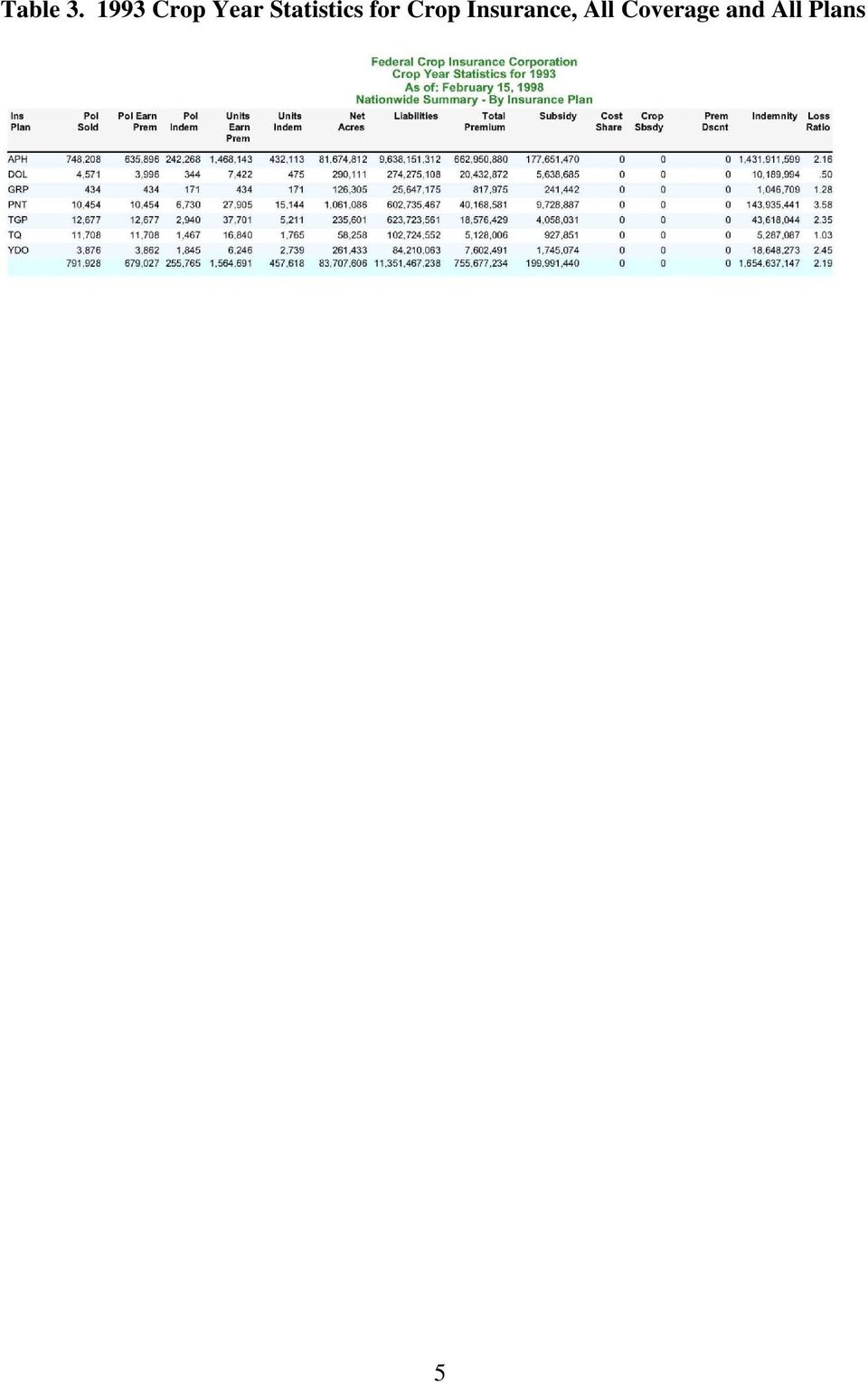
2 The question then becomes, what is the size of loss ratio necessary to generate a $20 billion underwriting loss? Currently about 38-39% of the national book of premium is generated by corn. Assuming that relationship holds for 2012, then the premium for 2012 would be about $10.7 billion with corn generating $4.12 billion in premium based on the author s estimates. If we assume 1988 state corn loss ratios, then the loss ratio for corn would be about 3.51, generating approximately a $10.3 billion underwriting loss. Then the question is, what will be the required loss ratio on the remaining 61% of the book to reach a $20 billion loss? It will require a loss ratio of 2.47 to generate a $9.67 billion underwriting loss on the remaining book to generate a $20 billion underwriting loss. This would result in a national book loss ratio equal to about Has the national crop insurance book ever hit a loss ratio over 2.80? The highest national book loss ratio was in 1993 at The author does not have complete data for 1988 but the corn loss ratio was 3.20, lower than the 3.51 loss ratio used in the corn estimate, and soybeans were Therefore, the combined 1988 corn-soybean loss ratio would be approximately A 2.62 loss ratio, measured on corn and soybeans only, and then applied to the national book would generate an underwriting loss of $17.3 billion. Participation was also low in 1988 and few crops were insured. Because the insurance pool is larger and more diversified, it will require more severe weather than in 1988 to reach the 2.62 loss ratio in Years 1989 through 2011 have complete crop insurance data, unlike Soybeans account for about 20% of the book s premium and when combined with corn s 40%, these two crops represent 60% of the book. The remaining 40% of the book s premium is generated by all other crops. If we assume the corn loss ratio reaches the estimated 1988 level of 3.51 and the remaining 60% of the book that includes soybeans has a loss ratio of 1.95, the same as the 1988 soybean loss ratio, the result is a $16.8 billion underwriting loss. The combined loss ratio for the national book would need to be 2.58 to generate a $16.8 billion underwriting loss. At this point the crop losses are not as large as it was in 1988, but this could easily change. In Table 1 are all of the national historical loss ratios that include all crops, all plans, and all coverages. The largest observed national loss was in 1993 at 2.19, 1989 at 1.49 and 2002 at 1.39 (Tables 2, 3 and 4). The loss ratio necessary to generate a $10 billion underwriting loss would need to be over 1.94 and is the most likely result for 2012 (Table 5). That is a higher loss ratio than in any of the historical years, except The loss ratio necessary to generate a $15 billion underwriting loss would need to be over 2.40 which has never been reached (Table 5). A $20 billion underwriting loss would require a 2.87 loss ratio and one would expect this to be the upper limit on losses. There is some question if the 2012 crop has had enough damage to generate a national loss ratio on corn to equal The most current USDA data suggests the losses are worse in Indiana but better in Iowa and Minnesota. It is rare for the national loss ratio to 2
3 exceed 2.00 and it is also rare for a state loss ratio to exceed 5.00 where the AIP s have a stop loss in the reinsurance agreement. The rare year was 1993 when the national loss ratio was over 2.0 and Minnesota s loss ratio was over 6.0. Therefore, any suggestion the underwriting losses will exceed $20 billion is premature. The 2012 underwriting losses will likely be between $10 and $12 billion. If we assume no rain for the next month then a $15 to $20 billion loss is possible and it would be a record loss ratio. Summary. The fact is that the estimated underwriting losses are just speculation. No one really knows the size of the crop insurance claims because future weather and rain events are unknown. The weather factor effectively is uncertainty rather than a risk that can be quantified. The first real insurance estimates will begin when the National Agricultural Statistical Service (NASS) releases its first estimate of state corn and soybean yields in early August. If those NASS yields are lower than 1988 trend adjusted yields, then likely the 2012 underwriting losses will be over $15 billion and generate a record loss ratio on the national insurance book. Otherwise the losses will likely be under $15 billion. Table 1. National Crop Insurance Loss Ratios, All Crops, All Plans, All Coverages Year Loss Ratio Year Loss Ratio Source: Risk Management Website at: 3

4 Table Crop Year Statistics for Crop Insurance, All Coverage and All Plans 4

5 Table Crop Year Statistics for Crop Insurance, All Coverage and All Plans 5
6 Table Crop Year Statistics for Crop Insurance, All Coverage and All Plans 6

7 Table 5. The Break Even National Loss Ratio for a Given Level of Underwriting Loss Underwriting Loss Required National Loss Ratio $40 billion 4.74 $30 billion 3.80 $20 billion 2.87 $15 billion 2.40 $10 billion

Lower Rates Mean Lower Crop Insurance Cost 1
 Disclaimer: This web page is designed to aid farmers with their marketing and risk management decisions. The risk of loss in trading futures, options, forward contracts, and hedge-to-arrive can be substantial
Understanding the Standard Reinsurance Agreement, Explains Crop Insurance Companies Losses 1,2
 Disclaimer: This web page is designed to aid farmers with their marketing and risk management decisions. The risk of loss in trading futures, options, forward contracts, and hedge-to-arrive can be substantial
Proposed means testing for eligibility to purchase crop insurance 1
 Disclaimer: This web page is designed to aid farmers with their marketing and risk management decisis. The risk of loss in trading futures, optis, forward ctracts, and hedge-to-arrive can be substantial
Yield Protection Crop Insurance will have the same Yield Coverage as Revenue Protection, but RP is Expected to be the Preferred Choice (Updated) 1
 Disclaimer: This web page is designed to aid farmers with their marketing and risk management decisions. The risk of loss in trading futures, options, forward contracts, and hedge-to-arrive can be substantial
Group Risk Income Protection Plan and Group Risk Plans added in New Kansas Counties for 2005 1 Updated 3/12/05
 Disclaimer: This web page is designed to aid farmers with their marketing and risk management decisions. The risk of loss in trading futures, options, forward contracts, and hedge-to-arrive can be substantial
CROP REVENUE COVERAGE INSURANCE PROVIDES ADDITIONAL RISK MANAGEMENT WHEAT ALTERNATIVES 1
 Presented at the 1997 Missouri Commercial Agriculture Crop Institute CROP REVENUE COVERAGE INSURANCE PROVIDES ADDITIONAL RISK MANAGEMENT WHEAT ALTERNATIVES 1 Presented by: Art Barnaby Managing Risk With
Group Risk Income Protection Plan added in Kansas for 2006 Wheat (Updated) 1
 Disclaimer: This web page is designed to aid farmers with their marketing and risk management decisions. The risk of loss in trading futures, options, forward contracts, and hedge-to-arrive can be substantial
Risk Management Agency
 Risk Management Agency Premium Rate Study Update Questions & Answers November 2012 Q1 Why is RMA examining premium rates and the process for determining them? A1 Section 508(i) of the Federal Crop Insurance
Grain Stocks Estimates: Can Anything Explain the Market Surprises of Recent Years? Scott H. Irwin
 Grain Stocks Estimates: Can Anything Explain the Market Surprises of Recent Years? Scott H. Irwin http://nationalhogfarmer.com/weekly-preview/1004-corn-controversies-hog-market http://online.wsj.com/news/articles/sb10001424052970203752604576641561657796544
Impact of Crop Insurance and Indemnity Payments on Cash Rent and Land Values. Michael Langemeier Center for Commercial Agriculture Purdue University
 Impact of Crop Insurance and Indemnity Payments on Cash Rent and Land Values Michael Langemeier Center for Commercial Agriculture Purdue University Background The magnitude of the impact of crop insurance
We have seen in the How
 : Examples Using Hedging, Forward Contracting, Crop Insurance, and Revenue Insurance To what extent can hedging, forward contracting, and crop and revenue insurance reduce uncertainty within the year (intrayear)
Implications of Crop Insurance as Social Policy
 Implications of Crop Insurance as Social Policy Bruce Babcock Iowa State University Presented at the Minnesota Crop Insurance Conference Sept 10, 2014 Mankato, MN Summary of talk 2014 farm bill irrevocably
Crop Insurance Plan Explanations and Review
 Crop Insurance Plan Explanations and Review Table of Contents Page Information/Insurance Plans 1 Crop Revenue Coverage (CRC) 2 Multiple Peril Crop Insurance (MPCI) 2 Income Protection (IP) 3 Group Risk
2010 Risk and Profit Conference Breakout Session Presenters. 9. Marketing Grain Using a Storage Hedge
 Orlen Grunewald 2010 Risk and Profit Conference Breakout Session Presenters 9. Marketing Grain Using a Storage Hedge Orlen Grunewald is a professor in the Department of Agricultural
Title I Programs of the 2014 Farm Bill
 Frequently Asked Questions: Title I Programs of the 2014 Farm Bill November 2014 Robin Reid G.A. Art Barnaby Mykel Taylor Extension Associate Extension Specialist Assistant Professor Kansas State University
2013 World Grain Outlook
 2013 World Grain Outlook Presented by: John Roach February 18, 2013 Disclaimer: Futures/options trading involves substantial risk of loss and trading may not be suitable for all investors. You should fully
Crop Insurance: Background Statistics on Participation and Results
 September 2010 Crop Insurance: Background Statistics on Participation and Results FAPRI MU Report #10 10 Providing objective analysis for more than 25 years www.fapri.missouri.edu This report was prepared
PREMIUM RATE ADJUSTMENT
 PREMIUM RATE ADJUSTMENT Background on Process Section 508(i) of the Federal Crop Insurance Act (Act) requires the Risk Management Agency (RMA) to set premium rates and implement rate changes in a timely
In 2010, many farmers will again choose between farm
 2010 The New ACRE Program: Costs and Effects By Brian C. Briggeman, Economist, Federal Reserve Bank of Kansas City and Jody Campiche, Assistant Professor, Oklahoma State University In 2010, many farmers
Comparing LRP to a Put Option
 Comparing LRP to a Put Option Dr. G. A. Art Barnaby, Jr Kansas State University Phone: (785) 532-1515 Email: [email protected] Check out our WEB at: AgManager.info 1 Livestock Risk Protection (LRP)
(Over)reacting to bad luck: low yields increase crop insurance participation. Howard Chong Jennifer Ifft
 (Over)reacting to bad luck: low yields increase crop insurance participation Howard Chong Jennifer Ifft Motivation Over the last 3 decades, U.S. farms have steadily increased participation in the Federal
CROP INSURANCE. Reducing Subsidies for Highest Income Participants Could Save Federal Dollars with Minimal Effect on the Program
 United States Government Accountability Office Report to Congressional Requesters March 2015 CROP INSURANCE Reducing Subsidies for Highest Income Participants Could Save Federal Dollars with Minimal Effect
Evaluating Taking Prevented Planting Payments for Corn
 May 30, 2013 Evaluating Taking Prevented Planting Payments for Corn Permalink URL http://farmdocdaily.illinois.edu/2013/05/evaluating-prevented-planting-corn.html Due to continuing wet weather, some farmers
MPP Decision Guide 15 01. MPP Dairy Financial Stress test Calculator: A User s Guide
 MPP Decision Guide 15 01 MPP Dairy Financial Stress test Calculator: A User s Guide Christopher Wolf and Marin Bozic Michigan State University and the University of Minnesota A financial stress test calculator
Understanding and Using Basis - Grains
 Understanding and Using Basis - Grains By: E. Dean Baldwin Reviewers: John Ferris and David Holder Edited by Duane Griffith and Stephen Koontz 1 Basis is defined as the amount in cents per bushel a specified
OBTAINING OPERATING CAPITAL FOR 2016 GRAIN OPERATIONS: NEEDS, RISKS, REWARDS & THE BOTTOM LINE
 OBTAINING OPERATING CAPITAL FOR 2016 GRAIN OPERATIONS: NEEDS, RISKS, REWARDS & THE BOTTOM LINE 02.03.16 JEFF RODIBAUGH FIRST FARMERS BANK & TRUST POLL: 2016 CORN BELT SEED CONFERENCE 1. You believe there
Renegotiation of the Standard Reinsurance Agreement (SRA) for Federal Crop Insurance
 Renegotiation of the Standard Reinsurance Agreement (SRA) for Federal Crop Insurance Dennis A. Shields Specialist in Agricultural Policy August 12, 2010 Congressional Research Service CRS Report for Congress
Multiple Peril Crop Insurance
 Multiple Peril Crop Insurance Multiple Peril Crop Insurance (MPCI) is a broadbased crop insurance program regulated by the U.S. Department of Agriculture and subsidized by the Federal Crop Insurance Corporation
Educational Efforts With FAST Tools
 Educational Efforts With FAST Tools By Paul N. Ellinger 1 farmdoc companion project initiated in 1999 FAST Tools Development of spreadsheet-based tools to aid decisions for producers, lenders, consultants
Traditional Products. The two Traditional Crop Insurance Products are: Named Peril Crop Insurance (NPCI) Multi Peril Crop Insurance (MPCI)
 Traditional Products Traditional crop insurance relies on the principle of indemnity, where losses are measured in the field either after the event (named peril crop insurance) or through yield measurement
Post-Freedom to Farm Shifts in Regional Production Patterns
 Post-Freedom to Farm Shifts in Regional Production Patterns AFPC Working Paper 01-6 David P. Anderson James W. Richardson Edward G. Smith Agricultural and Food Policy Center Department of Agricultural
Cost & Efficiency Analysis of U.S. Crop Insurance Program: Implications of Additional FSA Responsibilities
 Cost & Efficiency Analysis of U.S. Crop Insurance Program: Implications of Additional FSA Responsibilities Executive Summary Prepared for: Informa Economics Phone: 901.766.4669 www.informaecon.com September
Grain Futures Markets & National Cash Indices Review & Observations thru July 27, 2012 PHI Market Analysis Manager Virg Robinson
 Grain Futures Markets & National Cash Indices Review & Observations thru July 27, 2012 PHI Market Analysis Manager Virg Robinson S&P 500 FUTURES NEAR BULLISH BREAKOUT The S&P 500 futures monthly continuation
GAO CROP INSURANCE. Savings Would Result from Program Changes and Greater Use of Data Mining
 GAO March 2012 United States Government Accountability Office Report to the Ranking Member, Permanent Subcommittee on Investigations, Committee on Homeland Security and Governmental Affairs, U.S. Senate
LIVESTOCK GROSS MARGIN FOR DAIRY CATTLE INSURANCE POLICY QUESTIONS AND ANSWERS
 LIVESTOCK GROSS MARGIN FOR DAIRY CATTLE INSURANCE POLICY QUESTIONS AND ANSWERS 1. Q: What is the Livestock Gross Margin for Dairy Cattle Insurance Policy? A: The Livestock Gross Margin for Dairy Cattle
FCStone Grain Recap July 9, 2015
 CORN: Values higher throughout the day on heavy volume as traders anticipate USDA s Friday S&D update and speculate on US crop problems. Weekly export sales of 535,000 tons vs 363,000 tons of old crop
The Supplementary Insurance Coverage Option: A New Risk Management Tool for Wyoming Producers
 The Supplementary Insurance Coverage Option: A New Risk Management Tool for Wyoming Producers Agricultural Marketing Policy Center Linfield Hall P.O. Box 172920 Montana State University Bozeman, MT 59717-2920
The AIR Multiple Peril Crop Insurance (MPCI) Model For The U.S.
 The AIR Multiple Peril Crop Insurance (MPCI) Model For The U.S. According to the National Climatic Data Center, crop damage from widespread flooding or extreme drought was the primary driver of loss in
U.S. Farm Policy: Overview and Farm Bill Update. Jason Hafemeister 12 June 2014. Office of the Chief Economist. Trade Bureau
 U.S. Farm Policy: Office of the Chief Economist Trade Bureau Overview and Farm Bill Update Jason Hafemeister 12 June 2014 Agenda Background on U.S. Agriculture area, output, inputs, income Key Elements
Crop Insurance as a Tool
 Crop Insurance as a Tool By: Chris Bastian University of Wyoming There are several approaches to address income variability associated with production risk. One approach is to produce more than one product
SOURCES AND USES OF FUNDS ON KFMA FARMS
 KANSAS FARM MANAGEMENT ASSOCIATION Your Farm - Your Information - Your Decision N E W S L E T T E R Volume 6, Issue 3 March 2012 SOURCES AND USES OF FUNDS ON KFMA FARMS A flow of funds report, often referred
Grain elevators play a crucial role in agricultural commodity markets through the marketing, storage, and
 2008 Can Grain Elevators Survive Record Crop Prices? By Jason Henderson, Assistant Vice President and Omaha Branch Executive and Nancy Fitzgerald, Policy Economist, Banking Studies and Structure R ecord
Chapter Five: Risk Management and Commodity Markets
 Chapter Five: Risk Management and Commodity Markets All business firms face risk; agricultural businesses more than most. Temperature and precipitation are largely beyond anyone s control, yet these factors
Repayment Capacity Sensitivity Analysis Using Purdue Farm Financial Analysis Spreadsheet
 Repayment Capacity Sensitivity Analysis Using Purdue Farm Financial Analysis Spreadsheet ABSTRACT Many agricultural producers purchased capital items the past few years and some used borrowed funds to
WEATHER DERIVATIVES AND SPECIFIC EVENT RISK. Calum G. Turvey
 WEATHER DERIVATIVES AND SPECIFIC EVENT RISK By Calum G. Turvey Associate Professor Department of Agricultural Economics and Business Faculty of Management University of Guelph Guelph Ontario Canada Paper
Managing Risk With Revenue Insurance
 Managing Risk With Revenue Insurance VOLUME 4 ISSUE 5 22 Robert Dismukes, [email protected] Keith H. Coble, [email protected] Comstock 10 Crop revenue insurance offers farmers a way to manage
Details of the Proposed Stacked Income Protection Plan (STAX) Program for Cotton Producers and Potential Strategies for Extension Education
 Journal of Agricultural and Applied Economics, 45,3(August 2013):569 575 Ó 2013 Southern Agricultural Economics Association Details of the Proposed Stacked Income Protection Plan (STAX) Program for Cotton
Missouri Soybean Economic Impact Report
 Missouri Soybean Economic Report State Analysis March 2014 The following soybean economic impact values were estimated by Value Ag, LLC, as part of a Missouri Soybean Merchandising Council funded project.
JAMAICA. Agricultural Insurance: Scope and Limitations for Weather Risk Management. Diego Arias Economist. 18 June 2009
 JAMAICA Agricultural Insurance: Scope and Limitations for Weather Risk Management Diego Arias Economist 18 June 2009 Financed partly by the AAACP EU Support to the Caribbean Agenda The global market Products
Agricultural Reinsurance
 Issues Barry K. Goodwin North Carolina State University October 7, 2013 AAEA Crop Insurance and The Farm Bill Symposium Louisville, Kentucky Introduction Reinsurance is simply insurance taken by insurers
How To Insure A Crop
 Materials Prepared for Federation of Southern Cooperatives Epes, Alabama September 11, 2009 Group Risk Crop Insurance by Karen R. Krub Farmers Legal Action Group, Inc. 360 North Robert Street, Suite 500
Rain on Planting Protection. Help Guide
 Rain on Planting Protection Help Guide overview Rain on Planting Protection allows growers to protect themselves from losses if rain prevents planting from being completed on schedule. Coverage is highly
Federal Crop Insurance: The Basics
 Federal Crop Insurance: The Basics Presented by Shawn Wade Director of Communications Plains Cotton Growers, Inc. 4517 West Loop 289 Lubbock, TX 79414 WWW.PLAINSCOTTON.ORG Why Federal Crop Insurance? Every
FINANCIAL SERVICES BOARD INSURANCE DEPARTMENT
 FINANCIAL SERVICES BOARD INSURANCE DEPARTMENT SPECIAL REPORT ON THE RESULTS OF THE LONG-TERM INSURANCE INDUSTRY FOR THE PERIOD ENDED MARCH 6 June 1 SPECIAL REPORT ON THE RESULTS OF THE LONG-TERM INSURANCE