
Efficient Time Scheduling
|
|
|
- Alexander Johnson
- 9 years ago
- Views:
Transcription
1 Efficient Time Scheduling Being successful at the university level will probably require a more careful and effective utilization of time than you have ever achieved before. Using time efficiently involves setting little goals to achieve your big ones. This handout will give you steps to look at the "big picture" and then narrow down your requirements into smaller and more manageable tasks. Follow these five steps and learn how to really control your life using: 1) Assignment List; 2) Semester Calendar; 3) Master Weekly Schedule; 4) Weekly Schedule; 5) Daily "To Do" List. Step 1. Prepare an Assignment List for all of your courses for the entire semester. 1. List all of your course work for the semester including readings, projects, papers, tests, test preparation time. etc Look at each assignment. You will want to break each one into small units which will fit as closely as possible into a 50 minute block of time by breaking big assignments and long-term assignments, like papers, into sub-parts which are listed separately. (e.g., I) develop topic; 2) library search; 3) outline; 4) first draft; 5) second draft; 6) type). List all readings. 3. Estimate how long you expect each activity to take then double it. As you improve your time management, you will probably improve your estimate of how long tasks will take. 4. List the dates when assignments (or sub-parts of assignments) should be completed. Helpful tip - Consider working backward from the due date to help you estimate how much time you will need for each part. WHY: Completing the Assignment List provides you with the specific things which you need to do during the semester and a timetable for completing them. Step 2. Make a Semester Calendar On a calendar for the entire semester, place all of the items from Step 1 onto the calendar. Add other events you know will be occurring (for your particular situation) - e.g. trips, visits by friends or family, concerts, movies, children's sports events, birthdays, etc. WHY: This is a valuable method of visualizing upcoming events and responsibilities (i.e., exam dates, project dates and meeting dates, etc.). Keep it in a visible place. Don't be tempted to overfill it. Step 3. Create a Master Weekly Schedule that contains all of the fixed or regular activities which you expect to remain the same from week to week for the entire semester. 1. Enter your course schedule. 2. Enter other routine meetings and responsibilities (e.g., work, church, sports practice, etc.) 3. Enter routine mealtime, travel time, sleep, exercise, laundry, shopping, cleaning, etc. 4. Enter regular times for recreation (social hobbies, athletics, private time.) WHY: By programming your time you will gain more time. This can be done in two ways; first, by doing a job in a focused and concentrated way you use less time than in the past, and second, by using leftover

2 blocks of time that are normally wasted. By recording your fixed activities, you can visualize available blocks of time. Step 4. Construct a Weekly Schedule. You are now ready to use your Master Schedule as a base for your weekly schedule. (Be sure you make enough copies for the whole semester.) 1. Plan your activities in time blocks of 50 minutes, followed by a 10 minute break. 2. Plug your study times into your schedule using your most alert times of the day for studying. 3. For a lecture-type class, use study time blocks immediately after the class to keep material fresh in your mind. 4. For a recitation-type class (i.e., a foreign language) use study time blocks immediately before the class to keep material fresh in your mind. 5. Prioritize your most important activities into your schedule first to enable you to get them done on time. Start early. 6. Use your schedule to allow for 8 hours of sleep a night, and adequate time for eating a well-balanced diet. Both are vital for maximum efficiency during the day. 7. Start by allowing at least 2 hours of study for every hour of class time. Then adjust accordingly to master your material, not just cover it. 8. After trying your schedule, make the necessary adjustments to create the best and most workable schedule for you. Some students do best with a detailed weekly schedule, or a more simplified list of things to do, or one in between. Your revision is your key to an effective schedule of living. Fit this idea to your personal style. Step 5. Make a daily "To Do" List This list can be the real secret to your success if you do it every day. Some people end the day by listing tasks to do the next day, while others prefer to make a "to do" list in the morning. A 3 x 5" card that fits into a pocket for easy and frequent reference works very well. Mark the activities that have a high priority today and will require some special attention. Cross each item off as it is completed during the day. Pay more attention to those marked as a higher priority. Don't go for the higher percentage of tasks (that usually require less time) because you may end with a lower effectiveness level by accomplishing only your lower priorities. Remember, completing your list is not as important as making the best use of your time during the day. OTHER SUGGESTIONS THAT STUDENTS HAVE FOUND USEFUL: 1. STUDY AT THE SAME TIME EVERY DAY. In so far as possible, you should schedule certain hours which are used for studying almost every day in a habitual, systematic way. Having regular hours at least five days a week will make it easier to habitually follow the schedule and to maintain an active approach to study.

3 2. MAKE USE OF THE FREE HOURS DURING THE SCHOOL DAY. The hours between classes may be your most valuable study time yet, ironically, the most frequently misused. You can use this time effectively by reviewing the material and editing the notes of the preceding class and/or studying the material to be discussed in the following class. 3. SPACE STUDY PERIODS. Fifty to ninety minutes of study at a time for each course works best. Relaxation periods of ten or fifteen minutes should be scheduled between study periods. It is more efficient to study hard for a definite period of time and then stop for a few minutes, than to attempt to study on indefinitely. 4. PLAN FOR WEEKLY REVIEWS. At least one hour each week for each class (distinct from study time) should be scheduled. The weekend is a good time for review. 5. LEAVE SOME UNSCHEDULED TIME FOR FLEXIBILITY. This is important. Lack of flexibility is the major reason why schedules fail. Students tend to over-schedule themselves. 6. ALLOT TIME FOR RECREATION, CAMPUS AND CHURCH ACTIVITIES, ETC. 7. When forced to deviate from your planned schedule (and that will invariably occur), you should trade time rather than steal it from your schedule. Thus, if you have an unexpected visitor at a time reserved for study, you can substitute an equal amount of study time for the period you set aside for recreation (or use some of the time you left unscheduled).

4 EFFICIENT TIME SCHEDULING Are you wondering if you will have enough time this winter to make a season ski pass worthwhile? Do you want to avoid spending hopeless hours studying the night before an exam? Follow these six steps and learn how to really control your own life using a (1) Course Requirement Worksheet, (2) Assignment List, (3) Master Schedule, (4) Weekly Schedule, (5) Daily "To Do" List (6) Semester Calendar. Step 1. Complete Course Requirement Work Sheets for each of your classes at the beginning of the semester. Make a copy for each course you are taking. Examine your syllabus for each class (if there is one) for any information provided there. Ask instructors for any missing information either in class or after class. The Course Requirement Work Sheet provides a format for collecting the information you need to plan your semester. Step 2. Prepare the Assignment List (see page 6) for all of your courses for the entire semester. Make enough copies of the To Do list all of your course work for the quarter. Save a blank for future copies. Fill in each specific assignment for each course. Try to keep the assignments in small units which will fit as closely as possible in a 50-minute block of time by breaking long-term assignments (like papers) into sub-parts which are listed separately. (For example: 1. develop topic; 2. library search; 3. outline; 4. first draft; 5. second draft; 6. type.) List all readings by number of pages (rather than just by topics or chapters). Develop a time estimate for how long you expect each activity to take. You will probably underestimate, so begin by doubling your first guess. You can revise your estimate as you learn more about how you actually work. Enter the dates when assignments (or sub-parts of assignments) should be completed. STEP 3. Fill out a Master Schedule which contains all of the fixed or regular activities which you expect to remain the same from week to week the entire semester. Enter your course schedule. Enter other routine meetings and responsibilities (e.g., work, church, etc.) Enter routine mealtimes, travel time, sleep, exercise, etc. Enter regular time for recreation (social hobbies, athletics, and private time). By programming your time you will gain more time. This can be done in two ways; first, by doing a job in less time than it usually requires, and second, bu using leftover blocks of time that are normally wasted. By recording your fixed activities, you can visualize available blocks of time. Step 4. Construct a Weekly Schedule. You are now ready to use copies of your Master Schedule as a base for your weekly schedule. (Be sure you make enough copies for the whole semester.) Plan your activities in a time block of 50 minutes, followed by a 10 minute break. Plug your study times into your schedule using your most alert times of the day for studying.
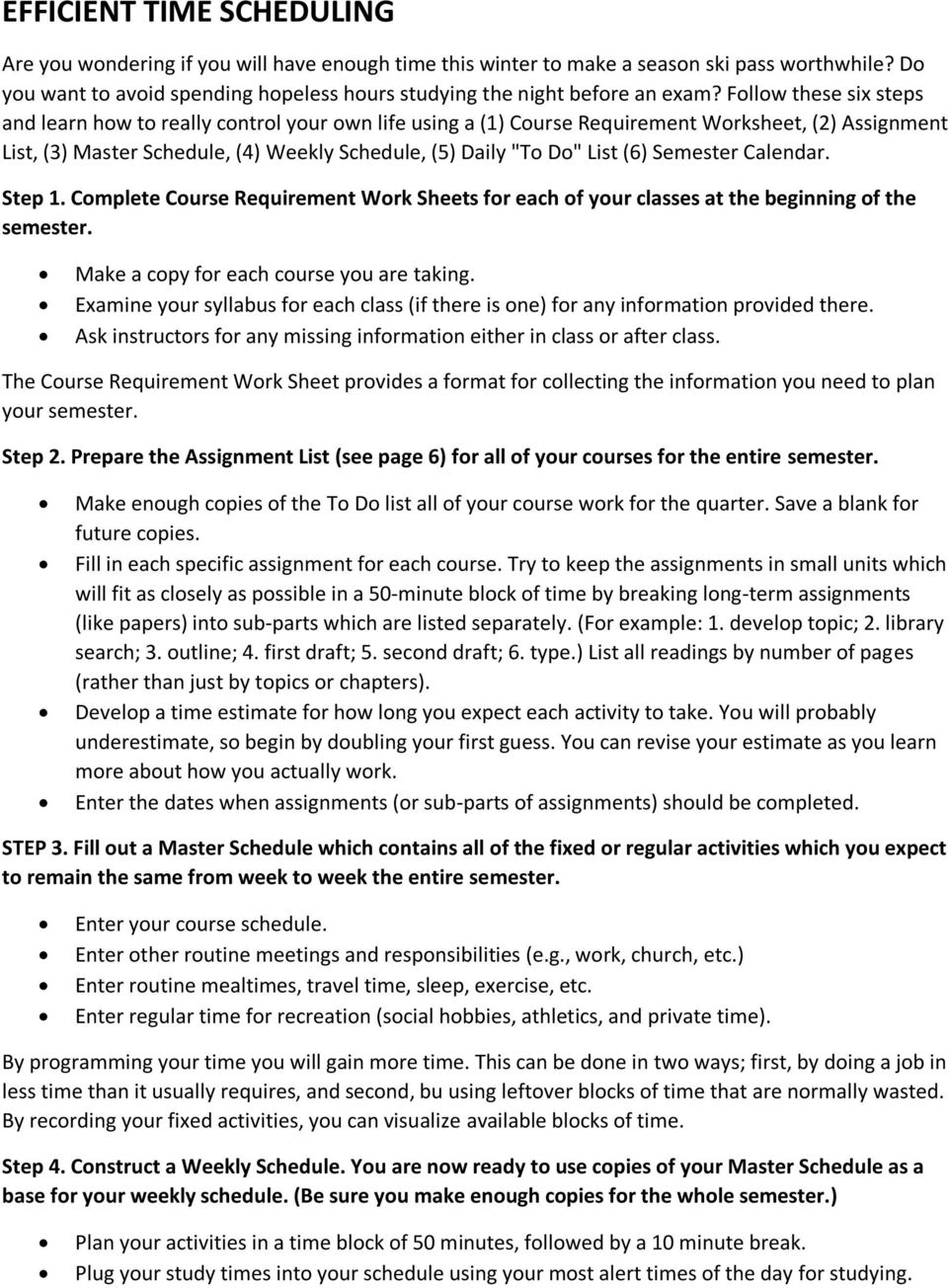
5 For a lecture-type class, use time blocks immediately after class to review notes. For recitation-type class (i.e., a foreign language) use time blocks immediately before the class to keep material fresh in your mind. Prioritize your most important activities into your schedule first to enable you to get them done on time. Start early. Use your schedule to allow 8 hours of sleep a night and adequate time for eating a wellbalanced diet. Both are vital for efficiency during the day. Start by allowing at least 2 hours of study for every hour of class time. Then adjust accordingly to master your material, not just cover it. After trying your schedule, make the necessary adjustments to create the best and most workable schedule for you. Some students do best with a detailed weekly schedule, or a more simplified list of things to do, or one in between. Your revision is your key to an effective schedule of living. Step 5. Make a To Do List (See example below). This list can be the real secret to your success if you do it every day. A 3 x 5 card that fits into your pocket for easy and frequent reference works very well. Mark the activities that have high priority today and will require some special attention. Cross each item off as it is completed during the day. Pay more attention to those marked as a high priority. Don't first go for a high percentage of tasks (that usually require less time) because you may end up with a lower effectiveness level by accomplishing only your lower priorities. Remember, completing your list is not as important as making the best use of your time during the day. "To Do List" Take package to Post Office Pick up suit from the cleaners Start History Project Call bookstore re: special order Get books from library note: Let the phone save unnecessary trips to a store, to be sure they have what you want. Step 6. Make a Semester Calendar. This is a valuable method of visualizing upcoming events and responsibilities (e.g., exam dates, project dates and meeting dates, etc.). Keep it in a visible place. Don't overfill it.

STUDENT SUPPORT SERVICES PRESENTS SCHEDULING TIME FOR STUDY
 STUDENT SUPPORT SERVICES PRESENTS SCHEDULING TIME FOR STUDY 1. PLAN ENOUGH TIME FOR STUDY. A college expects a student to average about two hours in studying (including library work, term papers, themes,
Student Academic Learning Services Page 1 of 8. Time Management & Organization. A Student Academic Learning Services Workshop
 Student Academic Learning Services Page 1 of 8 Time Management & Organization A Student Academic Learning Services Workshop Student Academic Learning Services Page 2 of 8 Time Management What is Time Management?
Time Management Analyzing Commitments Budgeting Time Planning a Schedule
 Time Management Analyzing Commitments Budgeting Time Planning a Schedule Time Management 2 Time Management Analyzing Commitments, Budgeting Time, Planning a Schedule College students have many demands
Time Management An online tutorial for students. CCBC The Community College of Baltimore County
 Time Management An online tutorial for students CCBC The Community College of Baltimore County Where does the time go? Time management is really self-management. We may be trying to push too much into
What is Time Management?
 What is Time Management? Time management is the managing of your time so that time is used to your advantage and it gives you a chance to spend your most valuable resource in the way you choose. Time management
How Do You Manage Your Time?
 How Do You Manage Your Time? Time Management Time management refers to how you regulate your time. In high school, students spend approximately 35 hours per week in class. However, the average college
Adapted from the Managing Your Time Effectively handout by the Learning Assistance Center at Glendale Community College. TIME MANAGEMENT PACKAGE
 Adapted from the Managing Your Time Effectively handout by the Learning Assistance Center at Glendale Community College. TIME MANAGEMENT PACKAGE Time Management Habits: What tasks do I know that I have
Welcome to the Time Management and Study Skills Workshop. Presented by: The Counseling Center of Gulf Coast State College
 Welcome to the Time Management and Study Skills Workshop Presented by: The Counseling Center of Gulf Coast State College What is Time Management? Time management can be defined as a person s ability to
TIME MANAGEMENT WORKSHOP
 TIME MANAGEMENT WORKSHOP Time Management Questionnaire Self Assessment: Answer Yes or No to the following questions: 1. Have you estimated how many hours you need to study this semester? 2. Do you tend
Beyond Social Networking: Using Facebook to Promote Student Engagement, Study Skills, and Critical Thinking Amy J. Marin Phoenix College
 Beyond Social Networking: Using Facebook to Promote Student Engagement, Study Skills, and Critical Thinking Amy J. Marin Phoenix College Cliff Stroop, pictured here relaxing at home. I think ALL classes
Get enough sleep so that you can stay alert during lecture. Falling asleep in the front row wastes your time and might offend your professor.
 SCIENCE STUDY SKILLS CYCLE (S 3 C) DR. JEFF PARADIS (SACSTATE) GENERAL INFORMATION Doing well in college science classes requires a minimum of 2-3 hours work outside of class for each hour you are in lecture.
Time Management Strategies for Busy TAs (Full Article)
 Time Management Strategies for Busy TAs (Full Article) Graduate education provides students with the opportunity to develop and hone a host of essential scholarly skills. However, graduate students receive
STUDENT HANDBOOK AND DAY PLANNER. 2013-2014 Academic Year. GBC Student Government Association www.gbcnv.edu
 STUDENT HANDBOOK AND DAY PLANNER 2013-2014 Academic Year GBC Student Government Association www.gbcnv.edu TIME MANAGEMENT DEFINITION One of the keys to a successful college career is to have good time
Balancing Work and Personal Life
 Handouts Federal Occupational Health EAP Health & Wellness Seminars The attached handouts can be copied and distributed to each participant before the seminar begins as they will be used throughout the
Success Tips for Online Learning
 B.R.E.A.T.H.E. Success Tips for Online Learning Phi Theta Kappa Alpha Omicron Beta Chapter B.R.E.A.T.H.E. Success Tips for Online Learning BE ON TOP OF READINGS REMEMBER DEADLINES EXPECT THE UNEXPECTED
Section 15 Revision Techniques
 Section 15 Revision Techniques Introduction This section in your Study Skills manual will consolidate information relating to revision techniques. This section will consider how to prepare for examinations
JROTCDL.com CADET 105 Time Management 1
 JROTCDL.com CADET 105 Time Management 1 JROTCDL.com CADET 105 Time Management 2 TABLE OF CONTENTS Defining Goals... 5 Types of Goals... 6 Types of Time Management... 7 Problems and Solutions... 8 Stop
Time Management. You see, if you don t supervise your time, you will be serving it rather than making it serve you and your purposes.
 Time Management I once purchased a course on time management but never had time to take it. Actually, more correctly, I never was able to make time for it because I was so unorganized. You see, if you
Study Strategies Used By Successful Students
 Study Strategies Used By Successful Students Test performance not only reflects how much one studied in the hours and days right before the test but also how well the person has been studying throughout
TIME MANAGEMENT By Ann Marie Ross Created for CLASS and ECLP Revised Fall 2005 by Peggy Ozaki
 TIME MANAGEMENT By Ann Marie Ross Created for CLASS and ECLP Revised Fall 2005 by Peggy Ozaki WHAT THIS HANDOUT IS ABOUT This handout will help you understand how to plan and organize your time more effectively
TIME MANAGEMENT AND STUDY SKILLS
 TIME MANAGEMENT AND STUDY SKILLS People aren t born knowing how to be good students. Adopting good study skills takes practice and dedication, but anyone can become a good student. The two most important
PREPARING FOR A CIVIL SERVICE EXAM HOW TO PREPARE FOR A CIVIL SERVICE EXAM (IN GENERAL)... DOING YOUR BEST
 PREPARING FOR A CIVIL SERVICE EXAM HOW TO PREPARE FOR A CIVIL SERVICE EXAM (IN GENERAL)... DOING YOUR BEST BEFORE YOU START TO STUDY: - Read the announcement. Somewhere on it will be the topics or items
Back to School: Working with Teachers and Schools
 Back to School: Working with Teachers and Schools Starting school each fall is a challenge for the student and parents. The following article offers some valuable suggestions as your child starts a new
In university, there is a lot to get done. And only so much time to do it.
 Managing Your Time Kelsey felt as though her life was getting more and more out of control. Starting university was a big transition for Kelsey. On one hand, she loved meeting new people and being on her
Select the ideas that best fit your learning style and lifestyle.
 Lisa Medoff, Ph.D. Stanford School of Medicine Office of Medical School Affairs [email protected] USMLE Step 1 Prep Overview Select the ideas that best fit your learning style and lifestyle. Planning
Practical Study Tips
 Please read and inform student-athletes about this information Practical Study Tips Set Goals Setting goals helps you decide what is important, gives you a plan for success, and keeps you focused. Setting
Time Management. What is Time?
 Time Management What is Time? 1. Time Management What is Time Management? 2. Time Measure of units Equal opportunity everyone gets the same amount each day Unusual commodity Feels like it passes at varying
Pamper yourself. Plan ahead. Remember it s important to eat and sleep well. Don t. Don t revise all the time
 Plan ahead Do Have your own revision timetable start planning well before exams begin. Your teacher should be able to help. Make your books, notes and essays user-friendly. Use headings, highlighting and
Time Management. Northwestern State University Presented by Johnny Manela
 Time Management Northwestern State University Presented by Johnny Manela What Is Time Management? Organizing your life through the best use of your time. Setting your goals and priorities. Everyone has
Your Planning Checklist Grade 9
 Your Planning Checklist Grade 9 Let your teachers know that you plan to go to college. Are your courses considered college prep? If you don t know, ask your guidance counselor to make sure they are. TIP
MEFA s College Admissions Toolkit
 MEFA s College Admissions Toolkit Application Deadline Manager Directions: Use this worksheet to keep track of deadlines and requirements for your college admissions applications. College: College: College:
Grade 9. 1. Create a four- year high school plan. Think about what you d like to accomplish in the next four years.
 Community/Four- Year College/ Trade School Student Timeline There are some steps you can take as a ninth- and 10th- grader to make sure you re on the right track for college. Here s a list to help you
Listening. Test name: L1U8test. Making plans. Listen. Then complete the sentences.
 Test name: L1U8test Listening Making plans Listen. Then complete the sentences. 1. In this phone call,. a. Mike is talking to Gary b. Mike is leaving a message for Gary c. Gary is leaving a message for
How To Use The NxLeveL Micro-Entrepreneur Instructor s Manual
 How To Use The NxLeveL Micro-Entrepreneur Instructor s Manual Purpose of the Instructor s Manual Your NxLeveL Instructor s Manual facilitates the teaching process by providing a comprehensive set of materials
Related KidsHealth Links
 Grades 9 to 12 Health Problems Series KidsHealth.org/classroom Teacher s Guide This guide includes: Standards Related Links Discussion Questions Activities for Students Reproducible Materials Standards
"There are two educations. One should teach us how to make a living and the other how to live." - John Adams
 Expectation Graduation s Graduation Game Plan TM "There are two educations. One should teach us how to make a living and the other how to live." John Adams This Game Plan belongs to: My mentor is: My Game
ORIENTATIONS INVENTORY
 ORIENTATIONS INVENTORY Instructions for questions (1-18 and 20-26): Place a check mark in the blank next to the statement that is more true for you or true most of the time. 1. When planning the activities
Wellesley College Hostess Program: Student Guide 2015
 Wellesley College Hostess Program: Student Guide 2015 Thank you for participating in the Hostess Program. Inside this guide you will find general information about the program, answers to frequently asked
HOW TO SELECT A SCIENCE FAIR TOPIC
 HOW TO SELECT A SCIENCE FAIR TOPIC STEP #1 List five things you are interested in. Examples: Music, Football, Rock-Climbing, Computers, Horses, or Shopping STEP #2 Pick one of the items you listed and
Index. Section 1 - Characteristics of the Successful Online Student... 4. Section 2 Course Navigation... 8. Appendix A Reading Tips...
 Page 1 Index Section 1 - Characteristics of the Successful Online Student... 4 Section 2 Course Navigation... 8 Appendix A Reading Tips... 12 Appendix B Writing Tips... 13 Appendix C Study Tips... 14 Appendix
The Summit Country Day School. College Counseling Freshman Handbook
 The Summit Country Day School College Counseling Freshman Handbook Overview of The Summit Country Day School College Counseling Team STAFF: Maureen Ferrell Director of College Counseling 513 871-4700 x226
Energy Conservation. 5 steps to effective energy management
 Energy Conservation 5 steps to effective energy management Overview If your business is wasting energy it is causing avoidable pollution. Wasting energy also reduces your profitability. For every one pound
M E FA s College Admissions Toolkit
 M E FA s College Admissions Toolkit Application Deadline Manager Directions: Use this worksheet to keep track of deadlines and requirements for your college admissions applications. College: College: College:
PREPARATION GUIDE FOR WRITTEN TESTS
 PREPARATION GUIDE FOR WRITTEN TESTS Prepared by: The Department of Administrative Services Human Resources Management August 2004 GENERAL INFORMATION ON WRITTEN TESTS Two types of questions are often used
9 sets de dúas fichas 1 set de tres fichas
 EXPRESIÓN ORAL 9 sets de dúas fichas 1 set de tres fichas 1 SPEAKING SET 1 CANDIDATE A TASK 1 (MONOLOGUE): FILMS You are a Spanish student living in London and you meet a Polish friend for coffee. You
History 301: Methodologies of History Mondays & Wednesdays, 11-12:15 LA3-205
 History 301: Methodologies of History Mondays & s, 11-12:15 LA3-205 Dr. Emily Berquist Department of History, F02-115 Office hours: Monday, 4-5 &, 9:30-10:30 and by appointment: [email protected] Course
lesson three budgeting your money teacher s guide
 lesson three budgeting your money teacher s guide budgeting your money lesson outline lesson 3 overview I m all out of money, and I won t get paid again until the end of next week! This is a common dilemma
TEST TAKING STRATEGIES - MULTIPLE-CHOICE TESTS
 TEST TAKING STRATEGIES - MULTIPLE-CHOICE TESTS Studying is only one part of getting good results on your exams. Whether you are taking a multiple choice test or essay, you must know some test taking strategies
Diving Into Spending Plans Grade Level 7-9
 2.15.1 Diving Into Spending Plans Grade Level 7-9 Get Ready to Take Charge of Your Finances Time to complete: 60 minutes National Content Standards Family and Consumer Science Standards: 1.1.6, 2.1.1,
Biology 45 ONLINE Introduction to Human Nutrition
 Biology 45 ONLINE Introduction to Human Nutrition Winter 2016 Instructor Anna Miller, MS., RD Phone 408.864.5576 Email [email protected] Write BIO45 Online in the subject Office Hours Mondays and Wednesdays
Effective Study Skills. Dr. Bob Kizlik. How to Study and Make the Most of Your Time
 Effective Study Skills Dr. Bob Kizlik How to Study and Make the Most of Your Time There is little doubt that no two people study the same way, and it is a near certainty that what works for one person
BUDGETING ACTIVITY SHEET Needs Vs. Wants
 BUDGETING ACTIVITY SHEET Needs Vs. Wants You may have many things you want and need. This worksheet should help you think about which is which! I need Least important Most important I want BUDGETING HANDOUT
MONOLOGUE 13 : YOUR FAVOUTE RELATIVE
 SET 7 CANDIDATE A TASK 1 MONOLOGUE Please introduce yourself to the other candidate. You are going to give a short talk on a topic. Choose two or three ideas to talk about. You can add your own ideas.
Goal Setting & Work. Shasta County Health and Human Services Agency Department of Social Services CalWORKs Employment Services Program
 What s in your tool kit? Goal Setting & Work Shasta County Health and Human Services Agency Department of Social Services CalWORKs Employment Services Program Goal Setting & Work 11/08 Goal Setting Action
Weekly Schedule Lesson Plan
 Weekly Schedule Lesson Plan Purpose: Do your students have trouble realizing how much time they need to dedicate to studies? Do your students regularly have excuses as to why they didn't get their work
Time Management. Our costliest expenditure is time - Theophrastus. 3 Steps to effective Time Management:
 Time Management Questions to Ask Yourself about Time Management: How can I balance conflicting priorities? How can I deal with surprises in time scheduling? What level of commitments can I handle? Our
Niles West High School STUDY SKILLS MANUAL
 Niles West High School STUDY SKILLS MANUAL Table of Contents Table of Contents Organizational Skills Study Habits Study Materials Doing Your Best Using the IRC Studying English Studying ESL Studying Foreign
FIREFIGHTER TESTING PROCESS
 FIREFIGHTER TESTING PROCESS VILLAGE OF SCHAUMBURG FIREFIGHTER TESTING PROCESS Notice is hereby given that the Board of Fire and Police Commissioners of the Village of Schaumburg will initiate the testing
Time Management for Life:
 Time Management for Life: How to balance life and academics 1 What will this workshop cover? The purpose of time management Important components of effective time management How to set goals Time management
Strategies for Effective Time Management
 Strategies for Effective Time Management College is a time of increased opportunities, exploration of new things, and many demands on your time. If you are like many college students, you may find that
How much money do you spend every week?
 Learning Objectives 1. Explain the concept of personal financial planning; 2. Understand the importance of personal financial planning in controlling personal finance; 3. Apply the basic principles and
D. Student and Academic. Academic Scheduling and Timetabling
 OLDS COLLEGE POLICY Olds College recognizes the need for Policies and Procedures, and the need for staff and students to be familiar with and follow such policies and procedures. It is the intent of Olds
CLASS PARTICIPATION: MORE THAN JUST RAISING YOUR HAND
 STUDENT LEARNING SUPPORT TUTORIAL PRODUCED BY THE CENTER FOR TEACHING AND FACULTY DEVELOPMENT CLASS PARTICIPATION: MORE THAN JUST RAISING YOUR HAND CHAPTER 1: LEARNING THROUGH CLASS PARTICIPATION CLASS
The Knowledge Resource. First-Time Home Buyers FOR. Your Agent Is the Best Guide Save Time, Money, and Frustration
 K N O W L E D G E I S P O W E R The Knowledge Resource FOR First-Time Home Buyers Your Agent Is the Best Guide Save Time, Money, and Frustration The Keys to Homeownership Unlock the American Dream Is Buying
Financial fitness for the future. Finances out of shape. Learn to manage your money. Managing your money
 Finances out of shape. Learn to manage your money. Financial fitness for the future. Managing your money W E S T E R N U N I O N F O U N D A T I O N You want a better future. A better life. A better education.
GUIDE TO PLANNING AND CONDUCTING A FINANCIAL AID NIGHT
 GUIDE TO PLANNING AND CONDUCTING A FINANCIAL AID NIGHT INTRODUCTION High school and financial aid counselors, as well as counselors employed by community social service agencies, are major sources of information
Mapping Your Future Guide to Life after High School SM : Sophomore Year
 Mapping Your Future Guide to Life after High School SM : Sophomore Year Get prepared for life after high school Some people know from an early age exactly what they want to be when they are adults and
That is where Automating Your Action Plans come in.
 Webinar Summit, Feb 27th, 2014 Automate Your Business for Higher Profits Topic: Automate Your Business for Higher Profits Who is Brad Korn & The Korn Team? #1 in sales for 10 years in a row Keller Williams
It is vital that you understand the rationale behind the correct answer(s) as wel as the incorrect answer options.
 Getting the Most out of ATI www.atitesting.com What is ATI? ATI is an online resource that will be used throughout the nursing program to help you learn about nursing practice as well as help prepare you
Exam Preparation and Planning
 Exam Preparation and Planning 1. 2. 3. 4. 5. Foreword Before your exams During your exams After your exams Further reading 1. Foreword University examinations take place in the first few weeks of the Summer
Life, Accident and Health Insurance 40 Life Insurance only 20 Accident and Health Insurance only 20
 Welcome to the STC School of Insurance, Inc., (Provider #73280) On-Demand Complete Life, Accident and Health Insurance Pre-licensing program for the state of New York. This program has been approved by
TIME MANAGEMENT FOR COLLEGE STUDENTS
 TIME MANAGEMENT FOR COLLEGE STUDENTS Have you ever found yourself bleary-eyed and strung out from too much coffee and too little sleep after pulling an "all nighter" right before the big biology test?
Assessing Blackboard: Improving Online Instructional Delivery
 Assessing Blackboard: Improving Online Instructional Delivery Adnan A. Chawdhry [email protected] California University of PA Karen Paullet [email protected] American Public University System Daniel
Lesson Plan for Note Taking
 Lesson Plan for Note Taking Goals: To prepare students to take pertinent notes form lecture, books and activities. Expose students to different styles of note-taking. Give students an opportunity to practice
Spring 2015 Adjunct Faculty. DATE: January 2015. SUBJECT: Spring Semester 2015
 TO: FROM: Spring 2015 Adjunct Faculty Mime Berman DATE: January 2015 SUBJECT: Spring Semester 2015 ****PeopleSoft Faculty Help Center**** http://www.peoplesofthelp.uconn.edu/faculty_index.html This website
homework and revision
 Create a space for homework Help your child plan their studying Deal with exam stress Helping your child with homework and revision AT A GLANCE Helping your child with homework and exam revision Take an
Time Management Prepared by Dickson College Student Services
 Time Management Prepared by Dickson College Student Services Good time management is essential to success at college. Planning your time allows you to spread your work over a session, avoid a traffic jam
Supplemental Activity
 Materials: Test-Taking Skills Assessment on page 80 in this workbook (page 19 in the student workbook) Test-Taking Tips on page 81 in this workbook (page 20 in the student workbook) Tactics for Studying
What are Your Favorite Lies?
 Life is Hard Sometimes What are Your Favorite Lies? West Chester, PA [email protected] Little lies make life easier at least in the moment. They enable us to avoid pain in the moment and hopefully in
Legal Technology Marketing Trends to Prioritize in 2015
 Legal Technology Marketing Trends to Prioritize in 2015 December 17, 2014 GET AN EDGE OVER YOUR COMPETITION 2015 Legal Tech Marketing Trends Introductions: Amy Juers Cindy Moen Five Hot Marketing Trends
Counselor Education Doctoral Program. Frequently Asked Questions
 Counselor Education Program Counselor Education Doctoral Program Frequently Asked Questions 1. What is SHDOSE? The School of Human Development and Organizational Studies contains 5 programs including,