
Framework for Advanced Nursing, Midwifery and Allied Health Professional Practice in Wales
|
|
|
- Rhoda Cunningham
- 10 years ago
- Views:
Transcription
1 Framework for Advanced Nursing, Midwifery and Allied Health Professional Practice in Wales
2 Advanced Practice Framework Task and Finish Group Membership Stephen Griffiths Director Workforce Development, NLIAH Charlette Middlemiss Associate Director Workforce Development, NLIAH Will Oliver Senior Education and Contracting Manager, NLIAH Clem Price Senior Workforce Modernisation Manger, NLIAH Andrew Jenkins Consultant Paramedic, Welsh Ambulance Service NHS Trust Angela Hillier Therapy Advisor for Wales, Welsh Assembly Government Dave Barton Lecturer and Academic Lead -Nursing, School of Healthcare Sciences, Swansea University Colin Heath Radiology Services Manager, Betsi Cadwaladr University Local Health Board Carys Norgain Head of Physiotherapy, Betsi Cadwaladr University Local Health Board Denise Llewellyn Director of Nursing, Aneurin Bevan Local Health Board Owen Crawley Chief Scientific Adviser (Health), Welsh Assembly Government Pat White Head of Division Integrated Health and Social Care, University of Glamorgan Rosemary Kennedy Chief Nursing Officer, Welsh Assembly Government Donna Mead Dean of Faculty of Health, Sport and Science, University of Glamorgan Gemma Ellis Nurse Consultant Critical Care and Outreach, Cardiff & Vale University Local Health Board Helen Rogers Director for Wales, Royal College of Midwives Jayne Lavin Clinical Manager and Lead for Education, Training & Staff Development, Aneurin Bevan Local Health Board Jean White Nursing Officer, Welsh Assembly Government 2 Framework for Advanced Nursing, Midwifery and Allied Health Professional Practice in Wales

3 Kim Atkinson Clinical Lead Occupational Therapist, Abertawe Bro Morgannwg University Health Board Lesley Bevan Associate Nurse Director Workforce Modernisation, Abertawe Bro Morgannwg University Health Board Linda Donovan Therapy Advisor for Wales, Welsh Assembly Government Martin Semple Associate Director (Professional Practice) Royal College of Nursing Mike Jenkins Clinical Standards Lead, Welsh Ambulance Service NHS Trust Paula Elson Lead Facilitator (Wales) Clinical Leadership Programme, Royal College of Nursing Robert van Deursen Director of Physiotherapy; Director of Research; Director of Research Centre for Clinical Kinaesiology, School of Healthcare Studies, Cardiff University Framework for Advanced Nursing, Midwifery and Allied Health Professional Practice in Wales 3
4 Contents Summary 5 Section 1 - Purpose 7 Section 2 - The Advanced Practice Toolkit 10 Section 3 - Terminology and Definition 12 Section 4 - Role Impact Analysis 22 Section 5 - Education 24 Section 6 - Workforce Planning 29 Section 7 - Regulation and Governance 34 Section 8 - Conclusion 36 Appendix 1 - CQFW Level 7 (Masters) Education 37 Level Descriptors References 40 4 Framework for Advanced Nursing, Midwifery and Allied Health Professional Practice in Wales

5 Summary The development of Advanced Practitioners has presented significant opportunities for role development and service innovation. In recent years however, concern has grown regarding the number of staff working with an advanced practice title in Wales. The evolution of roles in Wales and the lack of clarity regarding what an Advanced Practitioner actually is, needed to be addressed and this provided the rationale for the development of this Framework. The future vision for NHS Wales is set out in the five-year Service, Workforce and Financial Strategic Framework for NHS Wales. One of the core areas of focus for achieving the vision includes empowering front line staff by providing clinical staff with the tools they need to lead change and deliver high quality care. Advanced Practitioners are at the frontline of delivering services and care to patients. This Framework is therefore, an essential enabling tool to support current and future role development. The Framework has been developed by a multidisciplinary professional group and applies to Nurses, Midwives and Allied Health Professionals. A wide range of resources have been used in the development of the Framework. Key messages within the Framework are: Implementation by NHS organisations will ensure a more consistent approach across Wales to the development and management of current and future Advanced Practitioner roles Advanced practice should be viewed as a level of practice rather than a specific role All Advanced Practitioners should have developed their skills and theoretical knowledge to the same standards, and should be empowered to make high level and complex decisions Advanced Practitioner roles are applicable across all areas of practice and include staff working in clinical, education, management and leadership roles Organisations and individual Advanced Practitioners must ensure appropriate evaluation of roles Masters/CQFW level 7 education must underpin all Advanced Practitioner role development The integrated workforce planning process will identify how and where advanced practice roles are required. The approval process within the Framework will help organisations in the decision making process Framework for Advanced Nursing, Midwifery and Allied Health Professional Practice in Wales 5

6 Advanced Practitioners represent a senior resource within the workforce. Robust governance arrangements must therefore be in place to ensure patient safety. It is the workforce, and how responsive the workforce is to service user and community needs, that will determine whether or not the NHS is meeting the needs of the communities it serves. This Framework promotes increased understanding of Advanced Practitioner roles and will support NHS organisations and individual Advanced Practitioners to achieve the workforce and service priorities aimed at improving the quality of care to the population of Wales. 6 Framework for Advanced Nursing, Midwifery and Allied Health Professional Practice in Wales

7 1. Purpose This Framework has been developed to guide the successful development, implementation and evaluation of advanced practice roles within NHS Wales. It will ensure a consistent approach is taken and appropriate governance arrangements are in place to support advanced level practice. Advanced practice roles are increasingly seen as key to the development and delivery of healthcare services. This Framework provides the foundation on which all future advanced practice roles are to be developed and existing roles are to be reviewed and subsequently managed. The Framework is aimed at employers, service leads, education providers and senior or Advanced Practitioners themselves. Introduction The Framework has been developed by a multidisciplinary professional group and applies to Nurses, Midwives and Allied Health Professionals. The role of the Advanced Practitioner is not a new concept. There has been a steady increase in the past two decades in the number of posts in the health sector with the words Advanced or Practitioner or both in the title. Posts have evolved in response to a number of drivers including the European Working Time Directive, the need to address workforce shortages, and improve access to and coordination of services. The growth in Advanced Practitioner roles has been accompanied by confusion and debate about the definition of the role and the features that distinguish it from other healthcare roles in nursing, midwifery and allied health professions. The range of titles and the varied meanings attributed to those titles, has led to a lack of clarity regarding what an Advanced Practitioner actually is. Healthcare provision has changed significantly and will need to continue to do so in order to improve the delivery of healthcare to service users. These changes require a workforce equipped to respond effectively and flexibly to new models of care as they emerge. NHS Wales will continue to rely on committed staff working differently to provide the high quality affordable care that the population of Wales rightly expect. Future workforce demands and the modernisation of practices (and therefore potential career opportunities) rely upon inter-professional working with roles based on recognised levels of capability and competence rather than professional background. This will mean current staff taking on roles and responsibilities previously considered the domain of other staff groups. In the context of advanced practice this will see Nurses, Midwives and Allied Health Professionals undertaking work previously carried out by other professions. Framework for Advanced Nursing, Midwifery and Allied Health Professional Practice in Wales 7
8 While the focus of this Framework is the clinical pillar of practice, in order to enhance the quality of care to service users, it should be noted, that the principles espoused within the Framework will also apply to the other pillars (management, education and research) of Advanced Practice. The lack of guidance for the development of advanced practice roles has resulted in roles being developed in an inconsistent manner, often based in specific contexts, or designed to address particular service gaps. It has previously been suggested that advanced practice acts simply as a broad term that refers to all practice roles at a level above that of initial practice. This lack of consistency in the structure, preparation and expectations of these roles has compromised evaluation and transferability. Whilst this Framework has been developed primarily for the NHS in Wales, it could be used by other sectors. It is a live document and will be updated in the light of emerging UK standards and policy. Background In 2009 NHS Wales accepted the principles contained within the Scottish Government Health Department s Advanced Practice Toolkit (SGHD 2008). The Toolkit provides an overview of the on-going work to support advanced nursing practice in NHS Scotland and was undertaken under the auspices of the UK wide Modernising Nursing Careers (MNC) initiative (DOH 2006). In early 2010, NHS Scotland undertook further work to develop guidance for Scottish health organisations on how to develop and introduce advanced practice roles. For Midwifery and Allied Health Professionals similar modernisation programmes i.e. Midwifery 2020 and Modernising Allied Health Professionals Careers have been undertaken which also support the need for further work on advanced practice. The development of this Framework has drawn on all of these resources to support a more standardised and coherent approach to the development and management of advanced practice roles within Wales. Other policy drivers which are having a significant impact on the demand for the development of advanced practice roles include the following: Delivering a Five Year Strategic Service, Workforce and Financial Framework for NHS Wales Setting the Direction Rural Health Plan Annual Operating Framework Flexible and Sustainable Workforce 1,000 Lives plus Campaign 8 Framework for Advanced Nursing, Midwifery and Allied Health Professional Practice in Wales

9 Healthcare Standards The NHS Career Framework, Service Redesign and Role Development and Pay Modernisation, especially the implementation of Agenda for Change (AfC) and the Knowledge and Skills Framework (KSF). It is recognised that much of the progress in advanced practice roles over recent years has been driven by gap analysis, where shifts in availability of one professional group has led to role change amongst another. Whilst this has generated some professional anxiety, there is no doubt that the emerging models have presented genuine opportunities for role development and service innovation. This Framework has been structured to reflect key issues from the Toolkit developed in Scotland. Section 2 describes the Advanced Practice Toolkit. Terminology and Definitions of advanced practice is presented in Section 3. Section 4 provides the process for evaluating the impact of advanced practice roles. The Education Framework and Development Needs Analysis can be found in Section 5. Section 6 focuses on Workforce Planning and Section 7 on Regulation and Governance. Framework for Advanced Nursing, Midwifery and Allied Health Professional Practice in Wales 9

10 2. The Advanced Practice Toolkit (Nursing) (SGDH 2008) The Advanced Practice Toolkit, developed by Scotland as part of Modernising Nursing Careers, on behalf of the other three home nations, draws together UK and International work on advanced level practice. It states that this level of practice reflects a particular benchmark above Senior level and below Consultant level on the career development ladder. The Toolkit sets out a consensus position on this level of practice and offers tools and resources to support the implementation of these roles The Toolkit which is web-based contains: A nationally agreed definition of Advanced Practice for Nurses Competency Map A national Agenda for Change (AfC) job profile for Advanced Practice, and exemplar/template Knowledge and Skills Framework (KSF) outlines and job descriptions/role profiles Activity Analysis Tools Skills Analysis/Educational Needs Analysis Tools Portfolio Development support Mapping of education programme outcomes to competencies and capabilities Assessment of Competence - theory and practice guidance Links to Qualifications Frameworks Regulatory guidance. The Toolkit identifies that advanced practice roles are applicable across all clinical contexts. Associated competencies apply as much to advanced level practitioners in, for example, mental health as they would to those in paediatrics or the care of older adults in community settings. It is further recognised that there are many practitioners who function at an advanced level but who may not be working in a specifically clinical role. Advanced practice should be viewed as a level of practice rather than a specific role and it is not exclusively characterised by the clinical domain but may also include those working in research, education, management/ leadership roles. 10 Framework for Advanced Nursing, Midwifery and Allied Health Professional Practice in Wales
11 There are multiple national Frameworks which describe from various perspectives the level and range of knowledge and skills needed in the workplace. Examples include the NHS Knowledge and Skills Framework (KSF), the Career Framework for Health, the Credit and Qualifications Framework for Wales (CQFW) and National Occupational Standards. These have been considered in the development of this Framework and are considered complementary and supportive. The development of this Advanced Practice Framework builds upon the principles laid out in the Post Registration Career Framework for Nurses in Wales. The Allied Health Professions in Wales are developing a complimentary Framework which will be completed during Both of these build upon the Modernising Health Careers work undertaken at a UK wide level. The staff groups covered by this Framework include those identified in Modernising Nursing Careers (Nurses) and Modernising AHP Careers (Arts Therapists, Dieticians, Occupational Therapists, Orthoptists, Physiotherapists, Podiatrists and Speech and Language Therapists). In addition, it has been agreed that the Advanced Practice Framework will include Midwives, Radiographers and Paramedics. It is not intended to replicate the Toolkit within this Framework, however, the underpinning principles have been incorporated. This Framework document will be the resource for the development, implementation and evaluation of advanced practice roles in NHS Wales. Framework for Advanced Nursing, Midwifery and Allied Health Professional Practice in Wales 11

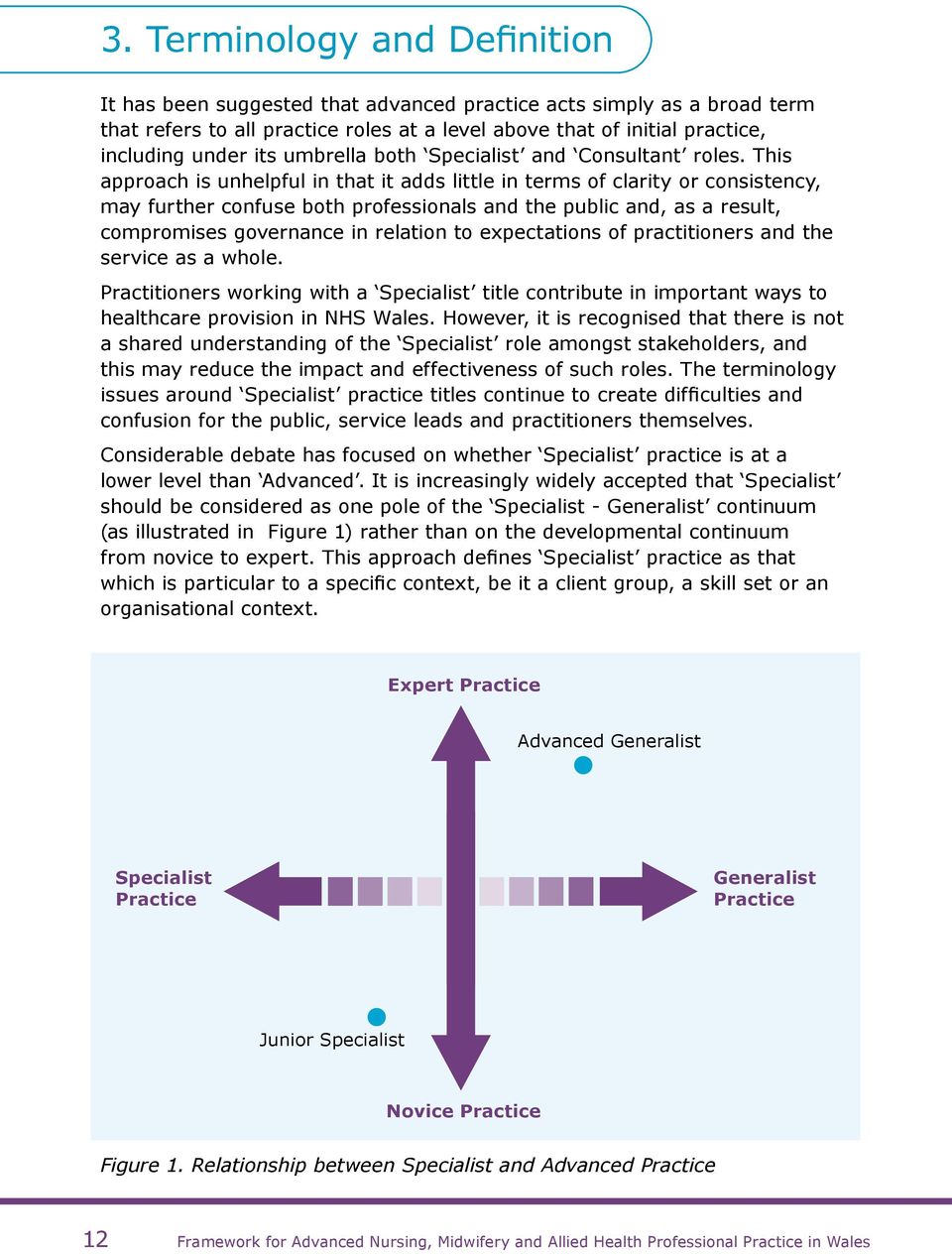
12 3. Terminology and Definition It has been suggested that advanced practice acts simply as a broad term that refers to all practice roles at a level above that of initial practice, including under its umbrella both Specialist and Consultant roles. This approach is unhelpful in that it adds little in terms of clarity or consistency, may further confuse both professionals and the public and, as a result, compromises governance in relation to expectations of practitioners and the service as a whole. Practitioners working with a Specialist title contribute in important ways to healthcare provision in NHS Wales. However, it is recognised that there is not a shared understanding of the Specialist role amongst stakeholders, and this may reduce the impact and effectiveness of such roles. The terminology issues around Specialist practice titles continue to create difficulties and confusion for the public, service leads and practitioners themselves. Considerable debate has focused on whether Specialist practice is at a lower level than Advanced. It is increasingly widely accepted that Specialist should be considered as one pole of the Specialist - Generalist continuum (as illustrated in Figure 1) rather than on the developmental continuum from novice to expert. This approach defines Specialist practice as that which is particular to a specific context, be it a client group, a skill set or an organisational context. Expert Practice Advanced Generalist Specialist Practice Generalist Practice Junior Specialist Novice Practice Figure 1. Relationship between Specialist and Advanced Practice 12 Framework for Advanced Nursing, Midwifery and Allied Health Professional Practice in Wales
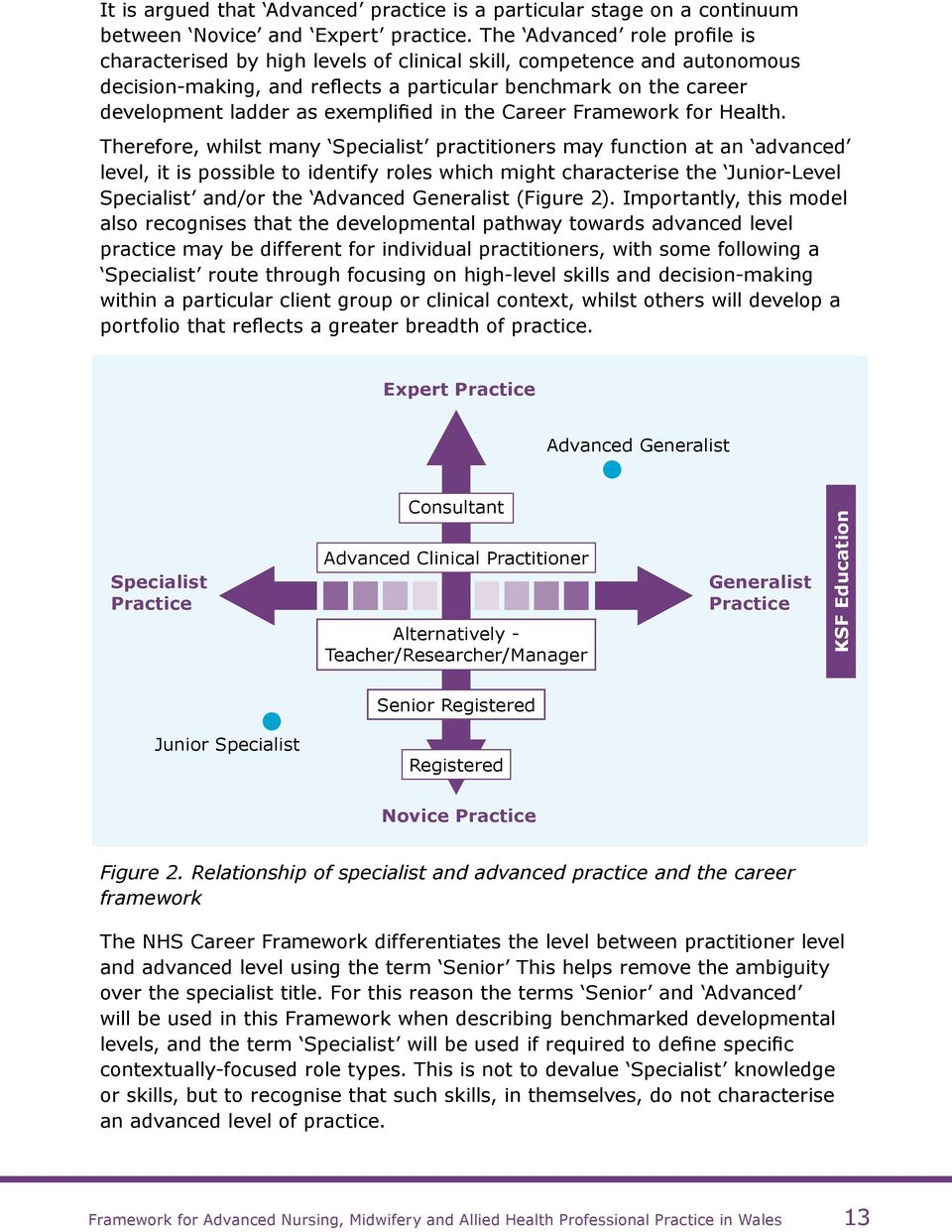
13 It is argued that Advanced practice is a particular stage on a continuum between Novice and Expert practice. The Advanced role profile is characterised by high levels of clinical skill, competence and autonomous decision-making, and reflects a particular benchmark on the career development ladder as exemplified in the Career Framework for Health. Therefore, whilst many Specialist practitioners may function at an advanced level, it is possible to identify roles which might characterise the Junior-Level Specialist and/or the Advanced Generalist (Figure 2). Importantly, this model also recognises that the developmental pathway towards advanced level practice may be different for individual practitioners, with some following a Specialist route through focusing on high-level skills and decision-making within a particular client group or clinical context, whilst others will develop a portfolio that reflects a greater breadth of practice. Expert Practice Advanced Generalist Specialist Practice Consultant Advanced Clinical Practitioner Alternatively - Teacher/Researcher/Manager Generalist Practice KSF Education Senior Registered Junior Specialist Registered Novice Practice Figure 2. Relationship of specialist and advanced practice and the career framework The NHS Career Framework differentiates the level between practitioner level and advanced level using the term Senior This helps remove the ambiguity over the specialist title. For this reason the terms Senior and Advanced will be used in this Framework when describing benchmarked developmental levels, and the term Specialist will be used if required to define specific contextually-focused role types. This is not to devalue Specialist knowledge or skills, but to recognise that such skills, in themselves, do not characterise an advanced level of practice. Framework for Advanced Nursing, Midwifery and Allied Health Professional Practice in Wales 13
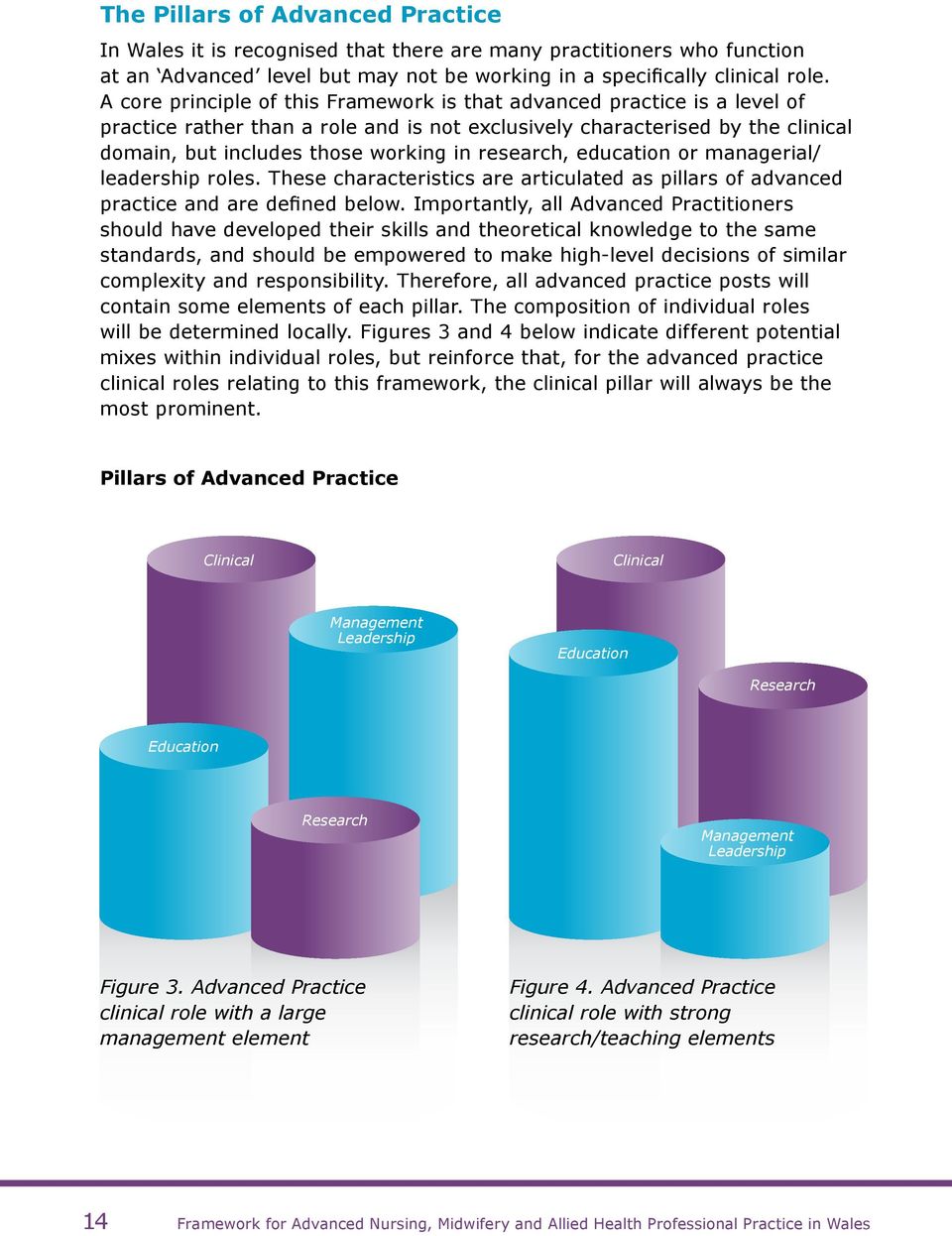
14 The Pillars of Advanced Practice In Wales it is recognised that there are many practitioners who function at an Advanced level but may not be working in a specifically clinical role. A core principle of this Framework is that advanced practice is a level of practice rather than a role and is not exclusively characterised by the clinical domain, but includes those working in research, education or managerial/ leadership roles. These characteristics are articulated as pillars of advanced practice and are defined below. Importantly, all Advanced Practitioners should have developed their skills and theoretical knowledge to the same standards, and should be empowered to make high-level decisions of similar complexity and responsibility. Therefore, all advanced practice posts will contain some elements of each pillar. The composition of individual roles will be determined locally. Figures 3 and 4 below indicate different potential mixes within individual roles, but reinforce that, for the advanced practice clinical roles relating to this framework, the clinical pillar will always be the most prominent. Pillars of Advanced Practice Clinical Clinical Management Leadership Education Research Education Research Management Leadership Figure 3. Advanced Practice clinical role with a large management element Figure 4. Advanced Practice clinical role with strong research/teaching elements 14 Framework for Advanced Nursing, Midwifery and Allied Health Professional Practice in Wales
15 The following are some examples of good practice from across NHS Wales demonstrating the contribution made by Advanced Practitioners. Advanced Practitioner Rehabilitation Medicine - Abertawe Bro Morgannwg University Local Health Board In Abertawe Bro Morgannwg University Local Health Board Advanced Nurse Practitioners on a Rehabilitation Medical ward are working across both general and community hospital settings. They take responsibility for the clinical management of a group of patients by leading the discharge planning process, diagnosing, ordering and interpreting investigations and administering treatment. Within a 12 month period, the Advanced Nurse Practitioners reviewed 408 patients and made direct referrals to rehabilitation beds bypassing a stay on an Acute Medical ward resulting in: acute bed days saved 38% reduction in length of stay for patients. Within the community hospital setting, the Advanced Nurse Practitioners reviewed 76% of acutely unwell patients during a three month study. 60% were able to be managed by the Advanced Nurse Practitioners within the community hospital setting. These patients would have traditionally accessed a call out from the medical team or alternatively would have been transferred back to the hospital. Advanced Nurse Practitioners have also taken over the management of the rehabilitation referral system from consultants. This has resulted in freeing up consultant time of around 20 hours per week whilst at the same time making more appropriate use of hospital services. Advanced Practitioner Role for Carpal Tunnel Syndrome - Powys Local Health Board Patients waiting for assessment and treatment faced long waiting lists of up to 18 months from GP referral to surgery and had to travel out of the area to Abergavenny, Hereford and Cardiff for assessment and treatment, which could include up to five appointments. Redesigning the Service User Pathway, and the development of the Advanced Physiotherapy Practitioner who works with a general practitioner with a specialist interest (GPwSI), means that patients can now be assessed, diagnosed and referred for surgery all in one visit within the Powys Locality. This reduced the number of appointments and DNA rates. The Advanced Practitioner completes the initial assessment and the nerve conduction tests and directly refers to the GPwSi who lists and undertakes surgery. Results since 2007 include:- Framework for Advanced Nursing, Midwifery and Allied Health Professional Practice in Wales 15

16 600 patients seen and reporting high levels of satisfaction Waiting list reduced to 4 weeks from GP referral to diagnosis and a further 4-6 week wait for surgery. This initiative demonstrates how redesign of the patient pathway and role development can contribute to cost savings, efficiency and an improved experience for patients. Advanced Practitioner Occupational Therapist in Plastic Surgery Welsh Centre for Burns and Plastic Surgery The Welsh Centre for Burns and Plastic Surgery is a regional unit providing specialist care to patients from across South and mid Wales. Patients often have complex needs following extensive trauma or elective reconstructive surgery. The Occupational Therapy Service is the only service of its kind in Wales providing highly specialised interventions including static, static progressive and dynamic splinting, functional rehabilitation and scar management techniques including the provision of silicone gels and custom made compression garments. Effective application of these treatment modalities ensures successful outcomes of surgery and reduces the need for further reconstructive procedures. Patients can be discharged to the care of the Advanced Practitioner by the plastic surgeon thus reducing the need for consultant out-patient follow up. Specific standardised assessments and advanced clinical reasoning skills enable the Advanced Practitioner to provide reconstructive plastic surgeons with essential pre-operative information and advice on functional outcomes of proposed surgery thus assisting with surgical decision making. Multidisciplinary education is a key component of the Advanced Practitioner role including induction and specific training sessions for clinical nurse specialists, SHO and SPR medical staff. The Practitioner is also utilised as an educational resource for therapeutic services across Wales to gain specialist advice on the management of patients with complex hand injuries. Improved outcomes of surgery Reduced need for secondary surgery Improved surgical decision making Reduced Consultant out patient follow up appointments. 16 Framework for Advanced Nursing, Midwifery and Allied Health Professional Practice in Wales
17 Advanced Physiotherapist Practitioner for Multiple Sclerosis and Neurology - Cardiff and Vale University Local Health Board In Cardiff and Vale University Health Board, people with Multiple Sclerosis (MS) had limited and inequitable access to expert management of the complex physical problems associated with MS such as seating, positioning and spasticity management. These needs were met in part through the combination of neurological outpatient physiotherapy services and referrals to consultants. The introduction of an Advanced Practitioner for MS and Neurology provided an additional facet to the clinical care of this patient group and led to the transformation of the patient pathway. The Advanced Practitioner triages patients in clinic, leads care where the patients problems are physical and liaises with the consultant as required. The provision of advice, support and direction from the Advanced Practitioner to less specialist colleagues enables patients to be managed effectively in their locality. In addition, the Advanced Practitioner s expertise facilitates patient reviews in their homes, which was not previously possible. A key component of the Advanced Practitioner role is education of other multidisciplinary staff, patients and carers, which means that staff are able to manage patients more effectively within the patient pathway and this ensures that the time of the Advanced Practitioner and consultants can be focused on the management of the more complex cases requiring specific expertise. The development of the Advanced Physiotherapist Practitioner for Multiple Sclerosis and Neurology has led to: The earlier identification and management of complex problems Earlier intervention for the management of spasticity through extending skills in the administration of injection therapy Optimising the functional ability of patients through effective positioning, seating and orthotic provision The release of Consultant time to meet Referral to Treatment targets Reduced referrals to secondary care Improved patient outcomes through the effective management of spasticity Provision of treatment within the patient s home environment Increased collaboration with other colleagues and across clinical specialties further improving the patient experience. Framework for Advanced Nursing, Midwifery and Allied Health Professional Practice in Wales 17

18 Advanced Practice Pillars - Adapted from National Executive Scotland (NES) (2007) In 2007, NES developed the four Advanced Practice pillars and defined the characteristics of each. These have been adapted for NHS Wales in the table below Table 1 - Advanced Practice Pillars - Adapted from NES (2007) 1. Management and Leadership Identifying need for change, leading innovation and managing change, including service development Developing case for change Negotiation and influencing skills Networking Team development 2. Education (either within clinical practice or education sector) Principles of teaching and learning Supporting others to develop knowledge and skills Promotion of learning/creation of learning environment Service user/carer teaching and information giving Developing service user/carer education materials Teaching, mentorship and coaching 3. Research Ability to access research/use information systems Critical appraisal/evaluation skills Involvement in research Involvement in audit and service evaluation Ability to implement research findings into practice - including use of and development of policies/protocols and guidelines. Conference presentations Publications 4. Advanced Clinical Practice Decision making/clinical judgement and problem solving Critical thinking and analytical skills incorporating critical reflection Managing complexity Clinical governance Equality & diversity Ethical decision-making Assessment, diagnosis referral, discharge Developing higher levels of autonomy Assessing and managing risk Non-medical prescribing in line with legislation. Developing confidence Developing therapeutic interventions to improve service user outcomes Higher level communication skills Service user focus/public involvement Promoting and influencing others to incorporate values based care into practice Development of advanced psychomotor skills 18 Framework for Advanced Nursing, Midwifery and Allied Health Professional Practice in Wales

19 These pillars are further supported by the following underpinning principles which demonstrate how the role fulfils the requirements of advanced practice. Table 2 - Underpinning Principles of Advanced Practice - Adapted from NES (2007) Autonomous Practice Advanced Practitioners practice autonomously, have the freedom to exercise judgement about actions, in turn accepting responsibility and being held to account for them. Critical Thinking Practising autonomously requires self-regulatory judgement that results in demonstrating the ability to interpret, analyse, evaluate and infer (Mantzoukas et al, 2007; 33). Critical thinking allows Advanced Practitioners to explore and analyse evidence, cases and situations in clinical practice, enabling a high level of judgement and decision making. High Levels of Decision Making & Problem Solving It would be expected that an Advanced Practitioner can demonstrate expertise in complex decision making in relation to their current role. This includes determining what to include in the decision making process, and making a decision based on judgement and critical thinking/problem solving. This in turn affects the ability to practice autonomously. Values Based Care At this level of practice, individuals are required to have a high level of awareness of their own values and beliefs. Care is negotiated with service user/carers as an equal partner. Working in a positive and constructive way with difference and diversity. Putting the values, views and understanding of individual service users and carers at the centre of everything we do. Improving Practice It is important that Advanced Practitioners deliver advanced practice which is evidence based within service, whilst acting as a positive role model, that enables change regardless of their job title. Framework for Advanced Nursing, Midwifery and Allied Health Professional Practice in Wales 19

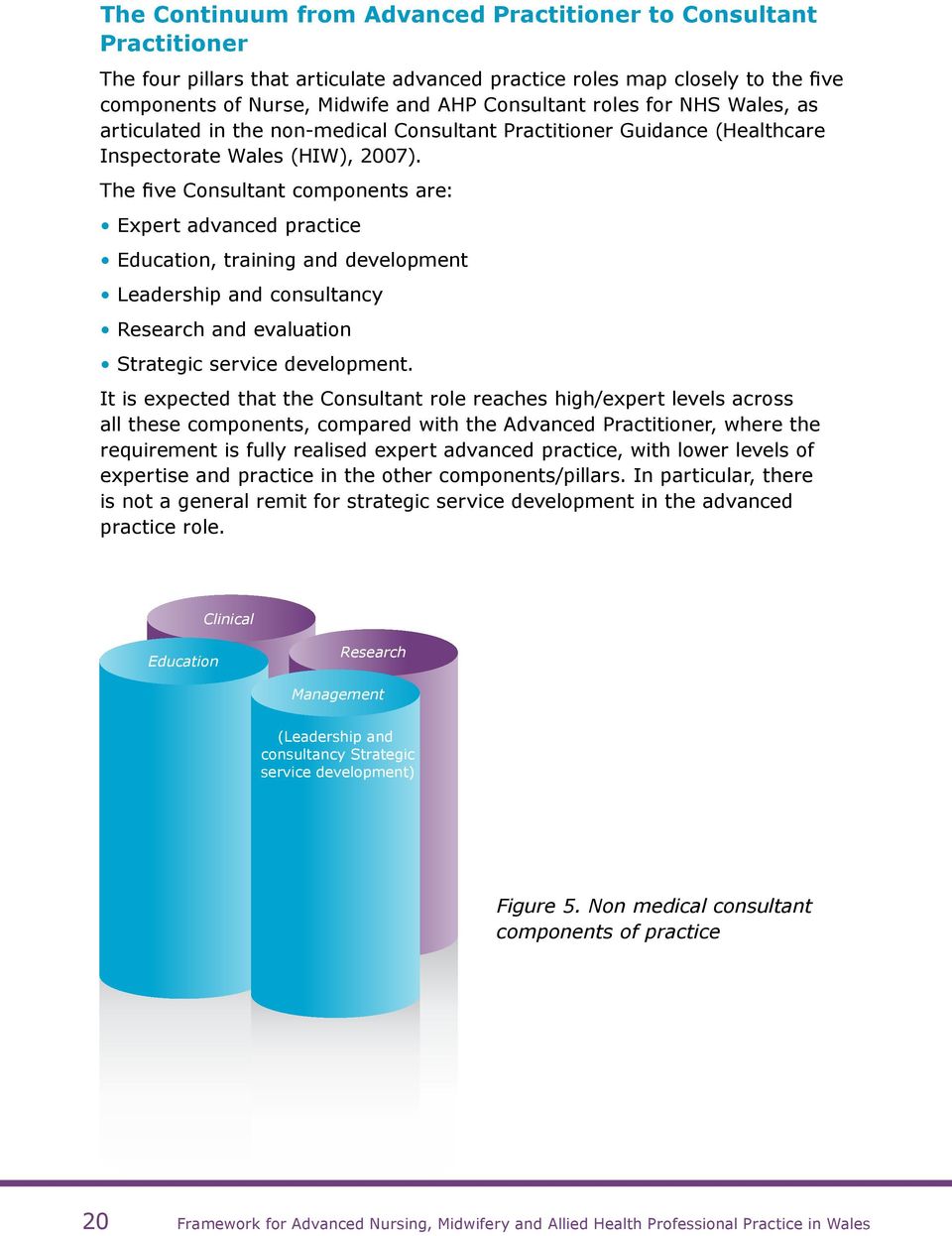
20 The Continuum from Advanced Practitioner to Consultant Practitioner The four pillars that articulate advanced practice roles map closely to the five components of Nurse, Midwife and AHP Consultant roles for NHS Wales, as articulated in the non-medical Consultant Practitioner Guidance (Healthcare Inspectorate Wales (HIW), 2007). The five Consultant components are: Expert advanced practice Education, training and development Leadership and consultancy Research and evaluation Strategic service development. It is expected that the Consultant role reaches high/expert levels across all these components, compared with the Advanced Practitioner, where the requirement is fully realised expert advanced practice, with lower levels of expertise and practice in the other components/pillars. In particular, there is not a general remit for strategic service development in the advanced practice role. Clinical Education Research Management (Leadership and consultancy Strategic service development) Figure 5. Non medical consultant components of practice 20 Framework for Advanced Nursing, Midwifery and Allied Health Professional Practice in Wales
21 Key factors that articulate the different level between Consultant and Advanced Practice levels include: Consultants have high levels of strategic thinking, knowledge and skills, commensurate with expert practice Clear distinctions regarding levels of accountability, with Consultant roles accountable preferably at Board level, and senior management level as a minimum Consultants undertaking and integrating research into clinical practice Consultants working strategically across a range of models of service delivery Consultants influencing policy and decision making. When developing advanced practice roles, it is advisable to benchmark them against the requirements set out in the Health Inspectorate Wales guidance for Consultant roles in order to ensure a clear distinction between the advanced practice and Consultant levels. Definition of Advanced Practice for NHS Wales A considerable amount of work to define advanced practice has been undertaken by a number of different organisations, including the International Council of Nurses (ICN), Skills for Health, the Royal College of Nursing (RCN), the Association of Advanced Nursing Practice Educators (AANPE) and the Nursing and Midwifery Council (NMC). Drawing together the key elements from these definitions, NHS Wales has agreed the following definition for Nursing, Midwifery and Allied Health Professionals Within Wales advanced practice is to be defined as: A role, requiring a registered practitioner to have acquired an expert knowledge base, complex decision-making skills and clinical competencies for expanded scope of practice, the characteristics of which are shaped by the context in which the individual practices. Demonstrable, relevant Masters level education is recommended for entry level. Framework for Advanced Nursing, Midwifery and Allied Health Professional Practice in Wales 21
22 4. Role Impact Analysis This section provides some practical steps for evaluating the impact of Advanced Practitioner roles and provides a methodology for evaluation. The approach provides the basis for prospective evaluation and continued development and improvement of Advanced Practitioners and the delivery of improved quality of healthcare. It is essential that organisations demonstrate achievements in a quantifiable and transparent way. To ensure continuous improvement in the quality of care to service users it is necessary to measure the impact of the activities and interventions made by all staff including Advanced Practitioners. The development and utilisation of robust evaluation methods is therefore essential. Planning for Evaluation Establishing Advanced Practitioner roles is a major commitment for an organisation, both in terms of time and money. It is important therefore that organisations are clear about the purpose of Advanced Practitioner roles and careful planning should be undertaken to determine how the impact of the role will be measured. Organisations must develop a set of robust metrics to capture the impact and benefits of all Advanced Practitioner posts. Failure to measure the impact of advanced practice roles will result in the non recognition of the benefits and improvements attributable to the Advanced Practitioner role Evaluation of roles should focus on outcomes related to safety and efficiency, organisational impact, acceptance and satisfaction, costs and role transfer. Key questions to address are: What objective outcomes are expected from the Advanced Practitioner role? When will these outcomes be achieved? What are the facilitators and barriers to the Advanced Practitioner role? What strategies are required to maximise role facilitators and minimise role barriers? What resources and support are required for role development? What to Measure Once the need for the Advanced Practice role has been established, clearly defined outcomes which reflect organisational objectives need to be agreed by the individual and their line manager. This should be undertaken in a 22 Framework for Advanced Nursing, Midwifery and Allied Health Professional Practice in Wales
23 collaborative, systematic way and utilise a robust evidence base for the specific role. The outcomes for individual roles will vary due to the specific contribution each practitioner makes. Arrangements for Data Collection Advanced Practitioners and managers will need to agree which measures are to be used for evaluation of the role. Organisations need to understand what impact these posts are having and have a responsibility to facilitate monitoring and evaluation of service user care and service delivery. Organisational Arrangements To facilitate higher levels of working, Advanced Practitioners must be allowed to practice. Organisations must ensure clear lines of reporting and accountability and others in the team need to understand and support the role. Organisations have a responsibility to ensure that Advanced Practitioners and managers are collating evidence to demonstrate the benefits and impact of the role and systems to evaluate overall added value in terms of cost, quality and effectiveness. Local impact assessment summaries drawn from clinical specialties or directorates, depending on the organisations structure, should be presented as an annual impact assessment report through the appropriate organisational governance structures. Individual Arrangements Advanced Practitioners, along with other senior members of the healthcare team, are required to document activities relevant to outcomes resulting from the diversity of their work for CPD and KSF purposes. Advanced Practitioners must develop and maintain a portfolio of evidence to demonstrate the impact of the role, complete eksf, and produce a Personal Development Plan. Framework for Advanced Nursing, Midwifery and Allied Health Professional Practice in Wales 23
24 5. Education The development of Advanced Practitioner roles requires significant educational support to enable provision of enhanced service user care. Consistency is the key to confidence in the capability and competence of the resulting practitioners. Enabling practitioners to work collaboratively with their employers, to identify individual educational needs and solutions to support their development, is a crucial step. Educational provision supports the development and recognition of advanced practice capability in a practitioner. This process prepares a practitioner with the ability to fulfil the requirements and expectations of such a level of practice, but does not in itself grant the practitioner an Advanced Practitioner status. The primary driver for the development and maintenance of any advanced practice post/role must be the demonstration of service user needs for such a role. The education developed must underpin and support the clinical nature of the roles developed through this Framework. It is essential that education providers develop education that is relevant to clinical practice and service user needs. Higher Education Institutions will need to respond flexibly to changing requirements and service innovation. This will require high levels of partnership working between NHS organisations and education providers. It will also be necessary to ensure that the development of education to underpin the research elements of advanced practice roles reflects the development of academic clinical roles. The appropriate use of such roles has, thus far, been limited by a failure to benchmark this level of practice and to prepare practitioners appropriately so that organisations are able to consistently recruit to new posts/roles and succession plan. In Wales there are two Frameworks that must be considered in relation to advanced practice role development and education. (i) A Strategy for the Development of a Flexible and Sustainable Workforce (May 2008) This strategy supports the development of clinical and clinical support staff and contains key recommendations that are applicable to the development of advanced practice roles and the education requirements that underpin them. In particular, recommendation eight of this strategy states: The educational level that underpins a role must be appropriate for that role. For Registered Practitioners there is a distinction between advanced level practice and specialist practice as set out in the NHS Career Framework. The level of education for these roles should be higher than the level required for 24 Framework for Advanced Nursing, Midwifery and Allied Health Professional Practice in Wales
25 registration (generally CQFW level 7 or above). This does not preclude staff at this level undertaking programmes of education or training which are at lower educational levels. p ). This is particularly relevant when considering the specialist/generalist nature of advanced practice roles i.e. these roles must be underpinned by Masters level education, but some lower level education may be appropriate. The strategy also contains recommendations on developing sound governance and education arrangements when introducing new or extended roles. The strategy makes it clear that all pillars (Higher Education (HE), Quality Assured Lifelong Learning (QALL) and the Qualifications and Credit Framework (QCF)/Regulated pillar) of the CQFW should be utilised to their full potential. (ii) Post Registration Career Framework for Nurses in Wales (September 2009) This document built on the Flexible and Sustainable Workforce Strategy to articulate how Nurses in Wales should be supported to develop their careers, and underpin the modernisation of the nursing workforce in Wales. It compared the dimensions of nursing practice established in Wales for Consultant nursing posts and the dimensions of professional practice within the Advanced Practice Toolkit, and established that they were highly congruent, with the exception of the consultant dimension of strategic service development. The Post Registration Career Framework establishes: an expectation that all Nurses in advanced practice roles will be graduates and in future will have completed post graduate CPD appropriate for the demands of the post they fill (post graduate certificate, diploma or full Masters award (WAG, 2009, p.23) The requirement for robust systems to Recognise Prior Learning (RPL) will be central to ensuring that the full advantages of flexible learning available via the CQFW are realised. The CQFW allows for Accreditation of Prior Learning (APL) and credit transfer. Mechanisms to establish how experiential learning can be evidenced and valued need to be established. NLIAH and WAG will need to establish consistent standards with education providers. Other Frameworks Other Frameworks that should also be considered include; The NHS Career Framework which defines the level of the post and the competences expected of the post holder. This allows the identification of transferable roles and thereby maximises workforce flexibility and clinical governance. Framework for Advanced Nursing, Midwifery and Allied Health Professional Practice in Wales 25
26 National Occupational Standards (NOS) and National Workforce Competences (NWC) describe what individuals need to know and do to carry out work activities. They provide descriptors of performance criteria to be met and the knowledge and understanding required to work successfully. The CQFW promotes lifelong learning. In essence, it is intended to offer parity in the recognition of achievements for learners of all ages, and for learning in the workplace/ school /college/ university. All learning, wherever and however it is achieved, will carry the potential for the award of credit. Establishing Academic Requirements and Level There is already much educational activity in this area and considerable experience in the Higher Education sector for the delivery and assessment of competence at this level of practice. What has been lacking so far is agreement across the sector regarding the core and context specific requirements for any advanced practice development programme. This document supports individuals and organisations to develop context specific elements to address the skills sets or clinical focus of their particular area, be it Mental Health, Intensive Care, Children, Older People or some combination of the above. Such an approach allows a portfolio approach to career and role development without undermining consensus regarding the benchmarked level. The appropriate academic level of educational programmes to support advanced practice has generated considerable debate. Many practitioners and service leads are wary of grade inflation. Nonetheless, the CQFW level descriptors provide good benchmarks against which advanced practice competencies can be mapped. The CQFW level 7 (Masters) education level descriptors are attached as Appendix 1. From the above, this Framework establishes the principle that Masters/ CQFW level 7 education must underpin all Advanced Practitioner role developments in Wales. Demonstrating Academic Achievement Achievement at this level may be demonstrated either by academic award, credit, or through mapping portfolio outcomes against the level. Clearly, agreement on this level must match any requirements of the Professional Regulators, as regulatory requirements emerge. The aim is to move towards the position where capability at advanced practice level can be demonstrated through a portfolio of learning and competence assessment which addresses the key elements of advanced practice at a consistent level, but which also reflects the breadth of clinical and professional settings within which this can be demonstrated. 26 Framework for Advanced Nursing, Midwifery and Allied Health Professional Practice in Wales
27 Assessment in Practice A key element of the educational preparation of Advanced Practitioners will be a formal assessment of achievement of the advanced-level skills, knowledge, competences and attributes of the Advanced Practitioner, both at a core level and specific to the context in which they practice. This process has, until recently, been taken forward at a local level within the service, but has increasingly been supported by work such as the publication of the Flexible and Sustainable Framework in Wales. The mechanism by which service leads can be assured of the competence of their advanced level staff is crucial to liberating such staff to use their talents to maximum effect. It is also essential in supporting education commissioners and providers in planning, structuring and delivering programmes. The Nursing and Midwifery Council (NMC) and the Health Professions Council (HPC) both give clear guidance in relation to practice assessment at undergraduate level. In addition, the NMC has requirements for sign off mentors and clinical practice teachers in relation to Specialist Practice Qualifications for nurses. The HPC has no post registration requirements for education standards, except those related to annotations on the register for supplementary prescribing. Assessment in practice will be undertaken by academic and clinical staff working in partnership. A guiding principle is that the health professional assessing the practice components of the education must be occupationally competent. They must also be recognised as such by the organisation and the education provider. Because advanced practice roles may cover a variety of activities previously undertaken by a number of different practitioners, this means there may need to be a number of occupationally competent assessors. In this situation, the academic provider will need to determine who the lead assessor is, in order to co-ordinate and quality assure assessment activities. A common framework will be developed for assessing Advanced Practitioners, both in their initial education and in on-going assessments of competence, in order to ensure standardisation across NHS organisations in Wales. This will include common portfolio templates, standardisation of skills assessment and guidance for implementation and benchmarking, and the creation of assessment teams. This will increase the workload for educators and assessors in practice, which will need to be reflected in workforce plans and activity analysis. The role of the assessor will be crucial in supporting good governance by using their own expertise and knowledge to confirm the competence of the Advanced Level Practitioner. The establishment of robust and appropriate practice assessment roles for advanced practice education programmes has often relied upon the ad-hoc recruitment of senior professionals within Framework for Advanced Nursing, Midwifery and Allied Health Professional Practice in Wales 27
28 practice. Whilst there are examples of excellent practice between service and higher education institutions (HEI) in assuring the consistent availability of such assessment roles and the preparation and support of the assessors, there are genuine issues in securing, maintaining and quality assuring this process. In order for organisations to develop Advanced Practitioners, it will be necessary to invest in, and support staff to ensure assessment in practice can take place. Inter-professional Practice and Cross-professional Competence Assessment Inter-professional learning and working will contribute to learning and assessment in practice. Organisations may wish to consider the use of colleagues from other NHS organisations where occupational competence and the ability to assess practice in house is limited. Because there will be a limited number of assessors at advanced practice and Consultant levels, systems of peer review will need to be developed, particularly in relation to on going assessment of competence. Moving Forward and Building Capacity - The Advanced Practice Succession Planning Pathway The Welsh Assembly Government and NHS Directors of Workforce and Organisational Development are currently considering how best to progress talent management and succession planning for the NHS. It is imperative that this Framework is referenced in those developments 28 Framework for Advanced Nursing, Midwifery and Allied Health Professional Practice in Wales
29 6. Workforce Planning for Advanced Practitioners The NHS Wales Integrated Workforce Planning process is the mechanism for organisations to establish their current and model their future workforce requirements at both a local and Health Economy level. The six stage process (Figure 6) supports organisations to make decisions regarding role use and skill mix. The process can be used for workforce planning in a ward, department, team or an entire service and sets out the six key steps in planning and supporting decisions regarding role use and skill mix. Advanced practice roles will not function in isolation and the nature and number of such roles will be influenced by the availability of other support roles and senior/ junior professional roles. How and where advanced practice roles are developed will also depend on the pattern of staffing required. It is important that the integrated workforce planning process is used to identify the types of advanced practice roles that need to be developed. This six stage process has been developed for NHS Wales to assist organisations when they are developing their integrated plans. 6 5 The six stage process Stage 1 Define the Future Service Provision and Plans Stage 2 Analysis of Current Vision, Workforce Configuration Stage 3 Forecast Workforce Requirements & Configuration to meet Service Need including risk assessment Stage 4 Planning for Delivery Stage 5 Proposals for Performance Management & Review (organisation only) Stage 6 Recommendations for Workforce Development Figure 6. Diagram of Workforce Planning six stage process National Leadership and Innovation Agency for Healthcare Innovation House, Bridgend Road, Llanharan CF72 9RP Tel: Workforce Pla developed in N All Wales Curr % FT Curr % Sa Current FTE Consultant Band 9 Band 8D Band 8C Band 8B Band 8A Band 7 Band 6 Band 5 Band 4 Band 3 Band 2 Band 1 Total Total Salarie Mid point on co Consultant Band 9 Band 8D Band 8C Band 8B Band 8A Band 7 Band 6 Band 5 Band 4 Band 3 Band 2 Band 1 Total Framework for Advanced Nursing, Midwifery and Allied Health Professional Practice in Wales 29
30 This national Framework will support NHS organisations to adopt consistent approaches to local governance regarding the use of advanced practice in role titles and support local and national workforce planning. NHS organisations should maintain appropriate records for audit and planning purposes. To support a nationally consistent, but locally governed process of approval for the development of advanced practice posts, it is proposed that the following process is introduced to ensure that the core criteria for an Advanced Practitioner role are consistently applied across NHS Wales. The following section outlines the process for establishing Advanced Practitioner roles. Approval Process for Advanced Practitioners in NHS Wales This Framework seeks not to limit organisations in the development of specific posts, but to provide a benchmark for this important level of practice. However it is important to note that; No posts below Band 7 should be permitted to use advanced practice in their title since the post would not meet the level of knowledge, training and experience to be able to undertake the role. There are examples of educational or management posts, which may be matched to AfC Band 7, but are not focused on advanced clinical practice. There is no requirement for these posts to be titled advanced practice, as they are likely to have quite different elements in the job description, but are still seen to reflect the same level of practice. There may be posts, in specific contexts, where the advanced practice criteria apply but where particular additional responsibilities are also included in the job description and thus the role may be matched to a higher banding. NHS organisations will need to determine whether new posts are required at advanced practice level by considering the requirements of this national Framework and completion of the following: Service needs analysis and the submission of a case for establishment of the new post. Ensuring early engagement with key stakeholders, including clinical teams at the inception of the role. Development of a proposed job description and KSF outline for the post, defining robust governance and accountability arrangements and local evaluation/matching of the role, to include summary report for the post with CAJE number. Nationally agreed job profiles and KSF outlines will be provided as exemplars on the web based resource on the NLIAH website Framework for Advanced Nursing, Midwifery and Allied Health Professional Practice in Wales
31 Identification of the effective contribution of the role to ongoing service delivery/development and of robust evaluation of service impact to be delivered through the role. If the organisation considers that on the basis of this Framework the post should be afforded the title Advanced Practitioner, details of the post should be recorded and maintained within ESR. This information can then be captured on an all Wales basis via the ESR Data Warehouse to allow national benchmarking and review. To support this consistent approval process, organisations must ensure that local governance systems support this framework and the Role Redesign standards (contained within the Standards and Guidance in Role Redesign in the NHS in Wales (2008) via the NLIAH website: have been adhered to when designing these roles. Existing Post Holders The KSF is an integral part of Agenda for Change and defines and describes the application of the knowledge and skills staff need to apply in their role in order to deliver high quality services. As part of the annual PDP/KSF process, all practitioners and line managers should review job descriptions, roles, responsibilities and objectives. Those holding the title of Advanced Practitioner with their line managers, must ensure that their role meets the requirements of this Framework. The following process should be adopted during the PDP/KSF process: If, on review, a post is recognised as matching the advanced practice criteria, then this can be acknowledged through the continued use of the title. If a post does not match the advanced practice criteria, but the practitioner identifies a desire to work towards such a role, then the PDP should reflect this development requirement. Importantly, such individual development will not automatically result in any re-designation of the post or post holder, but it does support succession planning for further advanced practice roles. The title of the post should be changed to reflect it s ongoing position. If the post meets the advanced practice criteria, but the post holder, following appropriate development opportunities, is unable to meet the role requirements, then appropriate local management processes must be followed. Succession Planning The KSF identifies and supports the on-going development of individuals in the post in which they are employed and is also important in making a distinction between the capabilities of the individual (development focus) and the nature of a particular post (demand/service-led need). The KSF in itself does not describe Framework for Advanced Nursing, Midwifery and Allied Health Professional Practice in Wales 31
32 the exact knowledge and skills that people need to develop (more specific standards and competences would help to do this), but draws out the general aspects regarding the range, depth and level, that show how individuals need to apply their knowledge and skills to the role they undertake. The KSF should be used to articulate the make up of the team within which the Advanced Practitioner works, and to provide a benchmark level against which the advanced practice roles can be articulated and against which individuals can be developed to facilitate succession planning. The Career Framework defines the level of the post and the competences expected of the post holder. This allows the identification of transferable roles and thereby maximises workforce flexibility and clinical governance. The Career Framework should not be confused with either Agenda for Change banding or KSF. Decision Making Process and Infrastructure This Framework sets out to support greater governance regarding the implementation of advanced practice roles within Wales, but does not seek to create additional bureaucracy or parallel human resources processes. Whilst it is acknowledged that a commitment to a robust PDP/KSF review for all existing and aspirant Advanced Practitioners will require significant engagement, it is a key element of the national Agenda for Change agreement and is likely to streamline, expedite and ensure consistency across NHS Wales. This is particularly important given the number of posts/job titles which currently either make reference to advanced practice or might be considered to be at that level. Recognising that NHS Wales is in a transitional position with regard to the roll-out and use of these types of posts, it is anticipated that this process can be managed over a staged timescale for existing posts, linked to annual reviews, and that all new posts should be routinely planned in this way, with opportunities for training/development posts to be established to encourage skills/competence acquisition. Such a staged approach, linking the National Framework to appraisal and the annual PDP process, should support both individual practitioners and managers by matching the role development clearly to the job profiles and KSF outlines. 32 Framework for Advanced Nursing, Midwifery and Allied Health Professional Practice in Wales
33 New Advanced Practice post proposal Job description and KSF outline agreed Matched to AfC National Advanced Practice profile for the appropriate profession, in line with agreed local matching procedure Locally evaluated to determine AfC band, in line with agreed local procedure for evaluating posts Comparison of band outcome to the National Advanced Practice profile for the profession Advanced Practice post proposed NHS Organisation Advanced Practice agreement/review process Consideration by NHS Board of proposals for Advanced Practice posts using the national evidence and the following processes: Service need analysis job description Adherence to Advanced Practice framework KSF outline matched job report (CAJE number), or local evaluation report (CAJE number), or Education/Development plan (for training posts) Approval decision through appropriate local governance arrangements Post created Information held by NHS Board performance to be monitored by the Board Framework for Advanced Nursing, Midwifery and Allied Health Professional Practice in Wales 33
34 7. Regulation and Governance Risks to service user safety comes from professionals taking on roles and responsibilities which they lack the competence to carry out safely and effectively or where they practice with inadequate safeguards and thereby put service users at risk of harm. It is inherent in Advanced Practitioner roles that new responsibilities are taken on and therefore there is a need for organisations to ensure that robust governance arrangements, surrounding all types and levels of practice, are in place prior to their establishment. This is necessary in order to allow Advanced Practitioner roles to function fully. New professional support arrangements, which recognise the nature of the role and the responsibilities involved, will be required and existing professional support mechanisms may not be sufficient. This approach provides the most effective means of controlling risks to service user safety from an individual professional s practice and provides a proportionate response. Good governance regarding role development and implementation must, therefore, be based upon consistent expectations of the level of practice required to deliver the service. This is best achieved through the benchmarking of such posts against nationally agreed standards and processes. Concern about new roles is both prudent and understandable and it has been argued that risks to service user safety arise when professionals take on roles and responsibilities for which they lack competence or where they practice without adequate safeguards. However, work by the Commission for Healthcare Regulatory Excellence (CHRE 2009) has emphasised that the activities that professionals undertake at advanced level practice do not lie beyond the scope of existing regulation unless the nature of their practice changes to such a significant extent that their scope of practice is fundamentally different from that at initial registration. It is proposed that advanced level practice reflects a set of responsibilities, competencies and capabilities which act as an indicator of a particular stage on the career development ladder and that such practitioners are always accountable to their regulatory body whatever the level or context of practice. Ensuring Advanced Practitioner Roles have Maximum Impact Advanced Practitioners represent a senior resource within the clinical workforce. Training, education or preparation as an Advanced Practitioner involves a substantial commitment on the part of the individual and the organisation. It is therefore crucial that Advanced Practitioners are able to work effectively and organisations are able to gain maximum impact from these roles. 34 Framework for Advanced Nursing, Midwifery and Allied Health Professional Practice in Wales
35 Advanced practice roles will not function in isolation and the nature and number of such roles will be influenced by the availability of other support roles, and by the availability of other senior/junior professional staff. How and where advanced practice roles are developed will also depend on the pattern of staffing required. Larger teams will allow for more differentiation of roles by clustering activities in terms of level and type of skill required. The relationship between specialist skills (context specific but across levels) and advanced practice (autonomy, decision making, dealing with complexity) is again important in determining the type of role required. It is important to ensure the following: There is clarity about the service they work within Clear objectives to be achieved have been set out The organisation and service managers strongly value the roles The organisation has a well thought out process/structure for finalising the purpose of the roles when the time is right. Promoting Advanced Practice Roles in the Organisation It is important that advanced practice roles are accepted and understood within the organisation and amongst key partners externally, in order to have an impact on service delivery and service user care. Whilst promoting the advanced practice role generally within the organisation is important, it is also essential to secure the support of senior managers and clinicians. They play a vital role in ensuring systems and processes needed are in place and also in ensuring that the roles are accepted and supported. It is essential that organisations make a real commitment to actively promoting appropriate advanced practice posts. Record Keeping In accordance with the management of AfC and as part of established processes, the following documents should be held by NHS organisations to provide an audit trail of local decision-making: Job description and rationale/business case for the post Matching or locally evaluated summary report for the post with CAJE number KSF outline for the post KSF-based personal development plan for the individual in the post Local record of those posts for which the use of the advanced advanced practice or Advanced Practitioner title is approved by the LHB s Board Nature and number of advanced practice posts to be reflected in the LHB s workforce plan. Framework for Advanced Nursing, Midwifery and Allied Health Professional Practice in Wales 35
36 Conclusion Developing higher levels of practice is an enabler for meeting the service and workforce challenges of the future. This Framework provides clarity regarding what an Advanced Practitioner is. Its implementation will ensure a more consistent approach is taken and an appropriate governance framework is in place to support current and future developments of advanced level practice in Nursing, Midwifery and Allied Health Professionals across NHS Wales. Consideration should be given to evaluating this Framework on service delivery and workforce development in the future. 36 Framework for Advanced Nursing, Midwifery and Allied Health Professional Practice in Wales
37 Appendix 1 CQFW Level 7 (Masters) Education Level Descriptors Descriptor for a higher education qualification at level 7: Masters degree The descriptor provided for this level of the framework is for any master s degree which should meet the descriptor in full. This qualification descriptor can also be used as a reference point for other level 7 qualifications, including postgraduate certificates and postgraduate diplomas. Master s degrees are awarded to students who have demonstrated: A systematic understanding of knowledge, and a critical awareness of current problems and/or new insights, much of which is at, or informed by, the forefront of their academic discipline, field of study or area of professional practice A comprehensive understanding of techniques applicable to their own research or advanced scholarship Originality in the application of knowledge, together with a practical understanding of how established techniques of research and enquiry are used to create and interpret knowledge in the discipline Conceptual understanding that enables the student: to evaluate critically current research and advanced scholarship in the discipline to evaluate methodologies and develop critiques of them and, where appropriate, to propose new hypotheses. Typically, holders of the qualification will be able to: Deal with complex issues both systematically and creatively, make sound judgements in the absence of complete data, and communicate their conclusions clearly to specialist and non-specialist audiences Demonstrate self-direction and originality in tackling and solving problems, and act autonomously in planning and implementing tasks at a professional or equivalent level Continue to advance their knowledge and understanding, and to develop new skills to a high level. Framework for Advanced Nursing, Midwifery and Allied Health Professional Practice in Wales 37
38 And holders will have: The qualities and transferable skills necessary for employment requiring: the exercise of initiative and personal responsibility decision-making in complex and unpredictable situations the independent learning ability required for continuing professional development. Found at: 38 Framework for Advanced Nursing, Midwifery and Allied Health Professional Practice in Wales
39 Credit and Qualifications Framework for Wales Learning and Progression Routes Certificate of Higher Education NVQ 3 HNC Intermediate HNC A Level HND MSD Modern Apprenticeship Degree Foundation WBQ Honours to HE NVQ 2 Access Degree WBQ GCSE A*- C Industry/Continuing and ProfessionalDevelopment Education Masters Further - G Higher Education NVQ Work Based Learning Welsh GCSE D (WBQ) Qualification Baccalaureate 2 School Doctoral 7 1 1, 2, and 3 ENTRY 8 Credit and Qualifications Framework for Wales LEVEL FRAMEWORK Entry The Credit and Qualifications Framework for Wales was introduced in 2003 as a fully inclusive learning framework. The Levels capture all learning from the very initial stages (Entry) to the most advanced (Level 8). The Fan diagram illustrates the levels and examples of qualifications and learning provision that are included in it. For further details contact the CQFW Secretariat: Tel: Fax: [email protected] Visit: Framework for Advanced Nursing, Midwifery and Allied Health Professional Practice in Wales 39
40 References 1. Scottish Government Health Departments (2008) Supporting the Development of Advanced Nursing Practice - A Toolkit Approach 051&mid=2508&language=en-US 2. Department of Health (2006) Modernising Nursing Careers: Setting the Direction Welsh Assembly Government (2010) Delivering a Five Year Service, Workforce and Financial Strategic Framework for NHS Wales Department of Health (2004) Modernising nursing careers: Setting the direction. en/documents/digitalasset/dh_ pdf 5. Welsh Assembly Government (2010) NHS Wales Annual Operating Framework; aof201011/?lang=en 6. National Leadership and Innovation Agency (2008) Flexible and Sustainable Workforce Welsh Assembly Government (2005) Healthcare Standards for Wales; for%20wales.pdf 8. Department of Health (2004) NHS Knowledge and Skills Framework (KSF) 9. Credit and Qualifications Framework for Wales (CQFW) Welsh Assembly Government (2009) Post Registration Career Framework for Nurses in Wales. Career%20Framework%20for%20Nurses%20in%20Wales.pdf 11. Mantzoukas S & Watkinson S (2007) Advanced nursing practice Mantzoukas et al, 2007; Framework for Advanced Nursing, Midwifery and Allied Health Professional Practice in Wales
41 12. Healthcare Inspectorate Wales (HIW), (2007) Non-medical Consultant Practitioner guidance National Leadership and Innovation Agency (2008) Design for a New and Integrated Approach in Workforce Planning for NHS Wales 14. National Leadership and Innovation Agency (2008), Standards and Guidance in Role Redesign in the NHS in Wales Guidance%20for%20Role%20Redesign%20in%20the%20NHS%20in%20 Wales%20%28English%29.PDF 15. Council of Healthcare Regulatory Excellence - Website: ,000 Lives plus Campaign - Website: cfm?orgid= Midwifery Website: Skills for Health National Occupational Standards - Website: Skills for Health Career Framework for Health - Website PDF/Career_framework_key_elements.ashx Framework for Advanced Nursing, Midwifery and Allied Health Professional Practice in Wales 41
42 42 Framework for Advanced Nursing, Midwifery and Allied Health Professional Practice in Wales
43
44 National Leadership and Innovation Agency for Healthcare Innovation House Bridgend Road Llanharan CF72 9RP Tel: Fax: Designed at Design Stage
Advanced Nursing Practice Roles Guidance for NHS Boards
 Advanced Nursing Practice Roles Guidance for NHS Boards NB: Whilst the work has been focused upon Nursing, we are keen to ensure that this initiative reflects frameworks and processes that can be applied
Advanced Practice The Portfolio
 Advanced Practice The Portfolio Advanced Practice Framework Task and Finish Group Membership Dave Barton (Chair) Academic Lead for Nursing, Swansea University Sandy Harding Senior Education and Contracting
Career & Development Framework for District Nursing
 & Development for District Nursing & Development for District Nursing Contents Introduction 5 6 7 8 Practitioner Senior Advanced Practitioner Consultant Practitioner Appendices Appendix 1 Appendix 2 Appendix
Nursing and Midwifery Council mentor domains and outcomes and the NHS Knowledge and Skills Framework
 Nursing and Midwifery Council mentor domains and outcomes and the NHS Knowledge and Skills Framework Contents Preface 1 Introduction 2 Partnership Approach 3 Aims 4 The mentor and other practice education
Career & Development Framework for General Practice Nursing
 & Development for General Practice Nursing & Development for General Practice Nursing Contents Introduction 5 6 7 8 Practitioner Senior Advanced Practitioner Consultant Practitioner Appendices Appendix
Rehabilitation Network Strategy 2014 2017. Final Version 30 th June 2014
 Rehabilitation Network Strategy 2014 2017 Final Version 30 th June 2014 Contents Foreword 3 Introduction Our Strategy 4 Overview of the Cheshire and Merseyside Rehabilitation Network 6 Analysis of our
Career & Development Framework for Nursing in Occupational Health
 & Development for Nursing in Occupational Health & Development for Nursing in Occupational Health Contents Introduction 5 6 7 8 9 Practitioner Senior Advanced Practitioner Consultant Practitioner Senior
A strategy to develop the capacity, impact and profile of allied health professionals in public health 2015-2018
 A strategy to develop the capacity, impact and profile of allied health professionals in public health 2015-2018 Strategy from the Allied Health Professionals Federation supported by Public Health England
Career & Development Framework for Health Protection Nursing (Levels 5-9 Career Framework for Health)
 & Development for Health Protection Nursing (s 5-9 for Health) & Development for Health Public Health Protection Nursing Nursing - Health Visiting and School Nursing & Development for Health Protection
ADVANCED NURSE PRACTICE KAREN HERTZ UK
 ADVANCED NURSE PRACTICE KAREN HERTZ UK THE INTERNATIONAL COUNCIL OF NURSES, Definition of a Nurse Practitioner/Advanced Practice Nurse aimed to facilitate a common understanding and guide further development
Registered Nurse professional practice in Queensland
 Nursing and Midwifery Office, Queensland Strengthening health services through optimising nursing Registered Nurse professional practice in Queensland Guidance for practitioners, employers and consumers.
4. Proposed changes to Mental Health Nursing Pre-Registration Nursing
 Developments in nurse education in England Summary BSMHFT employs 1319 registered nurses and 641 health care assistants 53% of the total workforce. BSMHFT works in partnership with Birmingham City University
All-Wales Ward Sister-Charge Nurse Development Programme
 All-Wales Ward Sister-Charge Nurse Development Programme Grymuso Prif Nyrsys Ward Empowering Ward Sisters and Charge Nurses All-Wales Ward Sister-Charge Nurse Development Programme The remit of the education
Position statement on the education and training of health care assistants (HCAs)
 Position statement on the education and training of 1 of health care care assistants (HCAs) Introduction This document provides commissioners, education providers and employers with guidance on best practice
National Approach to Mentor Preparation for Nurses and Midwives
 National Approach to Mentor Preparation for Nurses and Midwives Core Curriculum Framework (Second Edition) Incorporating Guidance for: identification and selection of mentors supervising mentor role continuing
A joint statement on continuing professional development for health and social care practitioners
 A joint statement on continuing professional development for health and social care practitioners A collaborative statement from: A JOINT STATEMENT ON CPD FOR HEALTH AND SOCIAL CARE PRACTITIONERS Overview
Career & Development Framework for Public Health Nursing Health Visiting and School Nursing
 & Development for Public Health Nursing Health Visiting and School Nursing & Development for Public Health Nursing Health Visiting and School Nursing Contents Introduction 5 6 7 8 Practitioner Senior Advanced
Advanced Nurse Practitioner Specialist. Palliative
 JOB DESCRIPTION ellenor Advanced Nurse Practitioner Specialist Palliative Care Responsible to Accountable to: Head of Adult Community Services Director of Patient Care General ellenor is a specialist palliative
Registered nurse professional practice in Queensland. Guidance for practitioners, employers and consumers
 Registered nurse professional practice in Queensland Guidance for practitioners, employers and consumers December 2013 Registered nurse professional practice in Queensland Published by the State of Queensland
TRAINING AND QUALIFICATIONS FOR OCCUPATIONAL HEALTH NURSES
 TRAINING AND QUALIFICATIONS FOR OCCUPATIONAL HEALTH NURSES Summary The Council for Work and Health is concerned that the current system of training and qualifications for occupational health nurses in
Programme name Advanced Practice in Health and Social Care (Advanced Nurse Practitioner- Neonatal/Child/Adult)
 PROGRAMME SPECIFICATION KEY FACTS Programme name Advanced Practice in Health and Social Care (Advanced Nurse Practitioner- Neonatal/Child/Adult) Award MSc School School of Health Sciences Department Division
COLlege of nursing, midwifery and healthcare
 COLlege of nursing, midwifery and healthcare College of Nursing, Midwifery and Healthcare We are a leading institution for professional healthcare education, working in close collaboration with healthcare
Education and Development Framework for Senior Charge Nurses
 Education and Development Framework for Senior Charge Nurses Contents 1. Introduction 1 2. Using this framework 3 3. The Senior Charge Nurse role 7 4. Capabilities, key knowledge and skills 13 5. Planning
Advanced Practice (Public Health)
 Advanced Practice (Public Health) Author: Claire Barley (Head of Professional and Organisational Development) and Kelly McFadyen (Professional and Organisational Development Manager) Date: 2 December 2014
De Montfort University. Course Template
 De Montfort University Course Template 1. Basic information Course Name: PG Cert Practice Education Course Code: PN079T Level (UG, PG): Postgraduate Taught Academic Period: 2015 Faculty: HLS - Faculty
Understanding the role
 Section 1 Understanding the role SECTION 1 Understanding the role 1. Overview To address structural pressures on the health system and to better meet changing health care needs of the population, the National
Learning Disability Nursing
 Career & Development Framework for Learning Disability Nursing in Scotland March 2013 NHS Education for Scotland 2013. You can copy or reproduce the information in this document for use within NHSScotland
Report on District Nurse Education in the United Kingdom 2013-14
 Report on District Nurse Education in the United Kingdom 2013-14 Key Points 351 District Nurses are due to qualify in the summer of 2014 in comparison to 254 in 2013 - an increase of 38% (in England, Wales
Talent Management / Development Framework 2011-2013: Maximising Potential of Organisations Assistant Director of OD
 AGENDA ITEM 4.5 Talent Management / Development Framework 2011-2013: Maximising Potential of Organisations Report of Paper prepared by Purpose of Paper Assistant Director of OD Senior LED Manager Leadership
The importance of nurse leadership in securing quality, safety and patient experience in CCGs
 Briefing note: July 2012 The importance of nurse leadership in securing quality, safety and patient experience in CCGs Introduction For the NHS to meet the challenges ahead, decisions about health services
Policy Paper: Accessible allied health primary care services for all Australians
 Policy Paper: Accessible allied health primary care services for all Australians March 2013 Contents Contents... 2 AHPA s call to action... 3 Position Statement... 4 Background... 6 Healthier Australians
MENTOR PREPARATION FOR NURSING EDUCATION IN NORTHERN IRELAND
 MENTOR PREPARATION FOR NURSING EDUCATION IN NORTHERN IRELAND QUEEN S UNIVERSITY BELFAST UNIVERSITY OF ULSTER OPEN UNIVERSITY and BELFAST HEALTH AND SOCIAL CARE TRUST NORTHERN HEALTH AND SOCIAL CARE TRUST
Skill Levels for Delivering High Quality Asthma and COPD Respiratory Care by Nurses in Primary Care
 Skill Levels for Delivering High Quality Asthma and COPD Respiratory Care by Nurses in Primary Care September 2007 Revised December 2009, April 2014 Author: Ruth McArthur In conjunction with the PCRS-UK
Better Skills Better Jobs Better Health. National occupational standards for the practice of public health guide
 Better Skills Better Jobs Better Health National occupational standards for the practice of public health guide March 2004 Acknowledgements These national occupational standards describe good practice
Healthcare support workers in England:
 Council of Deans of Health Healthcare support workers in England: Five proposals for investing in education and development to deliver high quality, effective and compassionate care Council of Deans of
Supervision and delegation framework for allied health assistants
 Supervision and delegation framework for allied health assistants Supervision and delegation framework for allied health assistants Acknowledgements The department would like to acknowledge the contribution
JOB DESCRIPTION. Community Palliative Care Clinical Nurse Specialist
 JOB DESCRIPTION Post: Band: Responsible to: Accountable to: Community Palliative Care Clinical Nurse Specialist 7 (SAH adapted Agenda for Change) Team Leader Clinical Operational Manager Job Summary Work
POSITION DESCRIPTION. Classification: Job and Person Specification Approval JOB SPECIFICATION
 POSITION DESCRIPTION POSITION DETAILS Position Title: Central Adelaide Director of Psychology Classification: Administrative Unit: Allied Health Term: Type of Appointment: Ongoing Date Created: November
About the Health Informatics Career Framework (HICF) http://www.hicf.org.uk
 About the Health Informatics Career Framework (HICF) http://www.hicf.org.uk Background Health Informatics is about the effective use of data, information, knowledge and technology to support and improve
Summary and introduction
 ROYAL COLLEGE OF NURSING Summary and introduction The work contained in this publication began in June 2000 with the aim of updating the existing Royal College of Nursing (RCN, 1996) position statement
Standards to support learning and assessment in practice
 NURSING & MIDWIFERY COUNCIL Standards to support learning and assessment in practice NMC standards for mentors, practice teachers and teachers Protecting the public through professional standards NURSING
Position Title: Nurse Practitioner Define
 POSITION DESCRIPTION Practitioner Define Date Produced/Reviewed: Position Holder's Name: Position Holder's Signature :... Manager / Supervisor's Name: Manager / Supervisor's Signature :... Date :... Page
Symposium report. The recruitment and retention of nurses in adult social care
 Symposium report The recruitment and retention of nurses in adult social care Overview 1. Social care employers providing nursing care services have been raising concerns about nursing recruitment and
Advanced Level Nursing: A Position Statement
 Advanced Level Nursing: A Position Statement DH INFORMATION READER BOX Policy HR/Workforce Management Planning Clinical Estates Commissioning IM&T Finance Social Care/Partnership Working Document purpose
Progress on the System Sustainability Programme. Submitted to: NHS West Norfolk CCG Governing Body, 31 July 2014
 Agenda Item: 9.1 Subject: Presented by: Progress on the System Sustainability Programme Dr Sue Crossman, Chief Officer Submitted to: NHS West Norfolk CCG Governing Body, 31 July 2014 Purpose of Paper:
Accreditation of Advanced Nurse Practitioners and Advanced Midwife Practitioners
 NATIONAL COUNCIL FOR THE PROFESSIONAL DEVELOPMENT OF NURSING AND MIDWIFERY Accreditation of Advanced Nurse Practitioners and Advanced Midwife Practitioners 2nd Edition NOVEMBER 2008 A Celebration of Life
CONSULTANT OCCUPATIONAL THERAPIST
 21 College of COT/ BAOT Briefings CONSULTANT OCCUPATIONAL THERAPIST Publication Date: August 2007 Lead Group: Professional Practice Review Date: August 2009 Country Relevance: UK Introduction The purpose
WHAT DOES THE PSYCHOLOGICAL THERAPIES HEAT TARGET MEAN TO YOU?
 WHAT DOES THE PSYCHOLOGICAL THERAPIES HEAT TARGET MEAN TO YOU? NHS Boards are now half way through the first year of implementation of the HEAT target Deliver faster access to mental health services by
Standards to support learning and assessment in practice. NMC standards for mentors, practice teachers and teachers
 Standards to support learning and assessment in practice NMC standards for mentors, practice teachers and teachers Front cover, from left to right: Julie Dalphinis, Clinical Learning Environment Lead (West)
Code of Conduct. Property of UKAPA 20/11/2009 1
 Code of Conduct A Physician Assistant (now associate) (PA) is defined as someone who is: a new healthcare professional who, while not a doctor, works to the medical model, with the attitudes, skills and
Registered Nurses and Health Care Support Workers. A summary of RCN policy positions
 Registered Nurses and Health Care Support Workers A summary of RCN policy positions 2 Registered Nurses and Health Care Support Workers - A summary of RCN policy positions Overview Overview This briefing
Practice Educator Professional Standards for Social Work
 Practice Educator Professional Standards for Social Work Revised version May 2012, transition starts from September 2012 These Practice Educator Professional Standards (PEPS) set out requirements at two
Introduction Continuing Competence Framework Components Glossary of Terms. ANMC Continuing Competence Framework
 continuing competence framework february 2009 Introduction Continuing Competence Framework Components Glossary of Terms ANMC Continuing Competence Framework Component Requirement PROFESSIONAL PORTFOLIO
3 LOCATION: JORDANSTOWN/COLERAINE/MAGEE CAMPUS ONE (certain modules) 5 FINAL AWARD: BSc Honours in Specialist Nursing Practice
 COURSE TITLE: BSc Hons IN SPECIALIST NURSING PRACTICE 1 AWARDING INSTITUTION/BODY: UNIVERSITY OF ULSTER 2 TEACHING INSTITUTION: UNIVERSITY OF ULSTER 3 LOCATION: JORDANSTOWN/COLERAINE/MAGEE CAMPUS ONE (certain
Job description: Occupational Therapist
 Job description: Occupational Therapist Organisational Chart Responsible to: Therapeutic Services Manager Salary: PURPOSE OF THE JOB: To ensure that you fulfil your role as an Academy Occupational Therapist,
Top-up degrees and CPD for the multi-professional workforce
 Top-up degrees and CPD for the multi-professional workforce Create your own study plan. We provide the options, you make the choices. 2 Top-up degrees and CPD for the multi-professional workforce Post-qualifying
A developmental framework for pharmacists progressing to advanced levels of practice
 ACLF Advanced to Consultant level Framework A developmental framework for pharmacists progressing to advanced levels of practice Version 2009(a) CoDEG www.codeg.org ADVANCED AND CONSULTANT LEVEL COMPETENCY
BA (Hons) Applied Nursing and Social Work (Learning Disability) GENERIC SOCIAL WORK PLACEMENT
 BA (Hons) Applied Nursing and Social Work (Learning Disability) GENERIC SOCIAL WORK PLACEMENT Additional evidence for achievement of NMC Standards of Proficiency. Student Name: Student Number: Cohort:
community health continuing professional education flexible undergraduate and postgraduate courses
 community health continuing professional education flexible undergraduate and postgraduate courses Continuing Professional Education The continuing professional education (CPE) division of the School of
Customers first Ideas into action Unleash potential Be courageous Empower people
 Role Description Job ad reference: RK6B204896 Hospital and Health Service: Role title: Allied Health Senior (Clinical Intake Officer) Status: Permanent Part Time (38 hrs p.f.) Unit: Child Development Services
About the consultation
 Hearing Aid Council and Health Professions Council consultation on standards of proficiency and the threshold level of qualification for entry to the Hearing Aid Audiologists/Dispensers part of the Register.
Nursing & Midwifery Learning Disability Liaison Nurse Acute Services Band 7 subject to job evaluation. Trustwide
 PLYMOUTH HOSPITALS NHS TRUST JOB DESCRIPTION Job Group: Job Title: Existing Grade: Directorate/Division: Unit: E.g., Department, Area, District Location: Reports to: Accountable to: Job Description last
Position Paper. Allied Health Assistants in Rural and Remote Australia
 Position Paper Allied Health Assistants in Rural and Remote Australia December 2011 Allied Health Assistants in Rural and Remote Australia i Table of Contents DISCLAIMER... II GLOSSARY OF TERMS... III
Reconfiguration of Surgical, Accident and Emergency and Trauma Services in the UK
 Reconfiguration of Surgical, Accident and Emergency and Trauma Services in the UK K Reconfiguration of Surgical, Accident and Emergency and Trauma Services in the UK Summary Our aim is to provide an excellent
An Appraisal Handbook for General Practice Nurses
 An Appraisal Handbook for General Practice Nurses Published May 2009 Contents Introduction Background Consultation and Development Process Purpose of this Document Why do Appraisal? Appraisal Is... Appraisal
JOB DESCRIPTION. The Richmond Community Rehabilitation Service sits at the heart of integrated health and social care in Richmond.
 JOB DESCRIPTION POST: BAND: ACCOUNTABLE TO: Occupational Therapist seconded to HRCH PO2 Assistant Team Manager (HRCH) CONTEXT The Richmond Community Rehabilitation Service sits at the heart of integrated
PERSONNEL SPECIFICATION. POST: Specialist Community Occupational Therapist Band 6 FACTORS ESSENTIAL % DESIRABLE %
 PERSONNEL SPECIFICATION POST: Specialist Community Occupational Therapist Band 6 DEPARTMENT: LOCATION: Community Occupational Therapy Woodview, Gransha DATE: January 2013 FACTORS ESSENTIAL % DESIRABLE
Consultant Occupational Therapists in the United Kingdom
 Consultant Occupational Therapists in the United Kingdom Jamie McDermott Department of Psychology and Allied Health Sciences School of Health and Life Sciences Session aims In this session I hope to: 1.
Nurse Practitioner Frequently Asked Questions
 HEALTH SERVICES Nurse Practitioner Frequently Asked Questions The Frequently Asked Questions (FAQs) have been designed to increase awareness and understanding of the Nurse Practitioner role within the
Advanced Nurse Practitioner Adult Specialist Palliative Care
 JOB DESCRIPTION ellenor Advanced Nurse Practitioner Adult Specialist Palliative Care Responsible to Accountable to: Head of Adult Community Services Director of Patient Care General ellenor is a specialist
The Development of the Clinical Healthcare Support Worker Role: A Review of the Evidence. Executive Summary
 The Development of the Clinical Healthcare Support Worker Role: A Review of the Evidence Executive Summary The Development of the Clinical Healthcare Support Worker Role: A Review of the Evidence Executive
Framework for the Establishment of Advanced Nurse Practitioner and Advanced Midwife Practitioner Posts
 NATIONAL COUNCIL FOR THE PROFESSIONAL DEVELOPMENT OF NURSING AND MIDWIFERY Framework for the Establishment of Advanced Nurse Practitioner and Advanced Midwife Practitioner Posts 4th Edition JANUARY 2008
HUMBER MENTAL HEALTH TEACHING NHS TRUST JOB DESCRIPTION. Manager
 HUMBER MENTAL HEALTH TEACHING NHS TRUST JOB DESCRIPTION JOB TITLE SPECIALIST NURSE BAND 6 REPORTS TO OPERATIONALLY RESPONSIBLE TO PROFESSIONALLY RESPONSIBLE TO Family Support Team Manager Clinical Lead
Nurse Practitioner Mentor Guideline NPAC-NZ
 Nurse Practitioner Mentor Guideline NPAC-NZ Purpose To provide a framework for the mentorship of registered nurses to prepare for Nurse Practitioner (NP) registration from the Nursing Council of New Zealand.
Job Description. Nurse Consultant Cardiac Rhythm Management. Lead Nurse, Division of Cardiothoracic Services. Job purpose
 Job Description Position: Accountable To: Responsible To: Hours of Duty: Location: Nurse Consultant Cardiac Rhythm Management Director of Nursing Lead Nurse, Division of Cardiothoracic Services 37 ½ hours
NSW HEALTH SERVICE HEALTH PROFESSIONALS (STATE) AWARD
 IRC No 427 of 2015 Walton P New Award effective 1 July 2015 NSW HEALTH SERVICE HEALTH PROFESSIONALS (STATE) AWARD AWARD PART A 1. Arrangement Clause No. Subject Matter 1 Arrangement 2 Definitions 3 Classification
Standards of proficiency. Occupational therapists
 Standards of proficiency Occupational therapists Contents Foreword 1 Introduction 3 Standards of proficiency 7 Foreword We are pleased to present the Health and Care Professions Council s standards of
Education programme standards for the registered nurse scope of practice
 Education programme standards for the registered nurse scope of practice July 2010 2 Introduction Under the Health Practitioners Competence Assurance Act 2003 ( the Act ) the Nursing Council of New Zealand
Standards for specialist education and practice
 Standards for specialist education and practice This document is now the UKCC s exclusive reference document specifying standards for specialist practice. Any previous documentation, as detailed below,
Information for registrants. Continuing professional development and your registration
 Information for registrants Continuing professional development and your registration Contents Introduction 2 About this document 2 CPD and HCPC registration: A summary of CPD and the audit process 2 CPD
Information for registrants. Continuing professional development and your registration
 Information for registrants Continuing professional development and your registration Contents Introduction 2 About this document 2 CPD and HCPC registration: A summary of CPD and the audit process 2 CPD
Standards of Proficiency and Practice Placement Criteria
 Social Workers Registration Board Standards of Proficiency and Practice Placement Criteria Bord Clárchúcháin na noibrithe Sóisialta Social Workers Registration Board Issued: January 2014 Contents Page
The practice of medicine comprises prevention, diagnosis and treatment of disease.
 English for Medical Students aktualizované texty o systému zdravotnictví ve Velké Británii MUDr Sylva Dolenská Lesson 16 Hospital Care The practice of medicine comprises prevention, diagnosis and treatment
Message from the Chief Executive of the RCM
 Message from the Chief Executive of the RCM The Midwifery Leadership Competency Framework has been derived from both the NHS Leadership Qualities Framework and the Clinical Leadership Competency Framework.
To date there are 2,069 Clinical Nurse and Midwife Specialist posts in Ireland,
 Submission from the National Council for the Professional Development of Nursing and Midwifery to the European Commission on the Green Paper on Workforce for Health The National Council for the Professional
PUBLIC HEALTH WALES NHS TRUST CHIEF EXECUTIVE JOB DESCRIPTION
 PUBLIC HEALTH WALES NHS TRUST CHIEF EXECUTIVE JOB DESCRIPTION Post Title: Accountable to: Chief Executive and Accountable Officer for Public Health Wales NHS Trust Trust Chairman and Board for the management
APPENDIX 13.1 WORLD FEDERATION OF OCCUPATIONAL THERAPISTS ENTRY LEVEL COMPETENCIES FOR OCCUPATIONAL THERAPISTS
 APPENDIX 13.1 WORLD FEDERATION OF OCCUPATIONAL THERAPISTS ENTRY LEVEL COMPETENCIES FOR OCCUPATIONAL THERAPISTS APPENDIX 13.1 FORMS PART OF THE APPENDICES FOR THE 28 TH COUNCIL MEETING MINUTES CM2008: Appendix
UKCPA - A Review of the Current Pharmaceutical Facility
 Modernising Pharmacy Careers Review of Post-Registration Career Development Discussion Paper PRO FORMA FOR CAPTURING RESPONSES TO STAKEHOLDER QUESTIONS Please complete and return to: [email protected]
ROLE PROFILE. Performance Consultant (Fixed Term) Assistant Director for Human Resources
 ROLE PROFILE Job Title Reports to Service area No. of staff responsible for Budget responsibility ( ) Performance Consultant (Fixed Term) Assistant Director for Human Resources HR 0 None Purpose of Job