
LOCAL ARRANGEMENTS FOR WASTE DISPOSAL (BEGBROKE SITE)
|
|
|
- Rosaline Dawson
- 9 years ago
- Views:
Transcription
1 37 Appendix C LOCAL ARRANGEMENTS FOR WASTE DISPOSAL (BEGBROKE SITE) The Chemicals Technician is your point of contact for enquiries regarding waste disposal at Begbroke. She is not based at Begbroke on a full-time basis (although she does visit the site frequently) and can be contacted by ([email protected]) or by telephone (83337). A summary of disposal routes is to be found at the back of this document (and near to the entrance/exit doors of laboratories). Under NO account leave waste of any type at Stores. WASTE CHEMICALS Some waste chemicals at the Begbroke site may be disposed of via the drains (the Department has a licence to do this) providing they are water-soluble and are not heavy metal salts or organic materials, and are well diluted. All chemicals that cannot be disposed of in this way (and that includes most of the common solvents) have to be dealt with by the University s waste system. To use this service, members of the Department should: 1) Complete the waste disposal form on the Department s web page (link). Please pay attention to the instructions on the form to ensure all required information are provided. Incorrectly completed disposal form will be returned to the sender. 2) Ensure that wastes are packaged safely by: - Using suitable containers that are compatible with the waste that you put in it. Please see guidelines below for selecting suitable containers. - Ensuring the containers are not damaged and not leaking liquids or vapours. - Not overfilling the containers above the maximum line, or ¾ of the container if no maximum line is shown. This allows for expansion. - Ensure the containers exterior are clean and free of chemicals. - The containers must also be fully and correctly labelled (see S5/11). Pre-printed chemical-resistant labels are available (free of charge) from Stores. - No liquid wastes in containers over 10L, no solid wastes in containers over 10Kg Any waste presented at the chemical waste store not conforming to the conditions stated above will be rejected. Guideline for selecting suitable containers for chemical wastes: Chemicals may be sent for disposal in their original containers. UN marked containers may be reused, provided they have been visually checked to ensure that there is no sign of damage, and that their materials are compatible with the chemicals you intend to put in it. Also thoroughly clean and

2 dry the containers to ensure they do not contain residues of incompatible materials). If you need to purchase containers for specific type of waste, or if it is absolutely necessary to collect wastes in containers of 10L or 10Kg capacity, please contact the Chemicals Technician for advice to ensure they comply with UN standards. UN approved containers carry the following mark: - For hydrofluoric acid, use Teflon or high density polyethylene (HDPE). DO NOT use glass, because HF attacks glass. - For perchloric acid, use glass. - For solvents, use HDPE (high density polyethylene). - For aqueous acids and alkalis, HDPE are also suitable. - For solid wastes, use plastic containers designed for hazardous solid wastes. - All containers for liquid wastes must be screw caps. - All containers for solid wastes must have removable lids. 3) Send the completed waste form to the Chemicals Technician by ([email protected]); she will schedule a time for you to the bring the wastes to the chemical building (behind the Hirsch Building) on a Tuesday morning. On NO account leave chemical waste at the stores. WASTE OIL To dispose of waste oil, rags and paper that are heavily contaminated with oil please contact Mr Trevor Knibbs (83711) who will arrange for you to bring your oil to the waste oil store. If there is any swarf in the rags or paper you must tell Mr Trevor Knibbs. Mr Knibbs does not operate a collection service. DISPOSAL OF GLASS WASTE 1) Empty glass chemical bottles (non-pyrex) University regulations governing the disposal of empty, glass chemical bottles are covered by Policy Statement S5/11. The regulations prohibit the disposal of empty glass bottles that have contained chemicals via the domestic waste, i.e. our normal waste bins. To comply with regulations, all bottles must be thoroughly washed out and their tops removed BEFORE disposal (clean bottle tops may be placed in the normal waste bins) and their labels removed/defaced. The clean glass bottles can then be disposed in the recycling wheelie bin to the rear of the Hirsch Building. 2) Clean non-recyclable glass (laboratory glassware made of pyrex/borosilicate) 38

3 Cardboard boxes for the disposal of glass waste, for example laboratory glassware etc are available from Stores. The boxes should be lined with a plastic bag (also available from stores). All glass must be clean or cleaned prior to being placed in the boxes. When the box is ready for disposal, they must be sealed (with gaffer tape) and clearly marked as containing glass. The taped up box can then be disposed in the general waste skip (to the rear of the Hirsch Building). There is no need to use sharps bins for this waste as it is not considered clinical or hazardous wastes. 3) Contaminated glass These should be considered as hazardous waste. There should be very little of it, because end users must clean out all glassware or bottles in the manner described above. In exceptional circumstances where contaminated glassware cannot be cleaned and disposed via the general waste stream, contact the Chemicals Technician ([email protected]) for advice. Please note that if the waste material is broken or otherwise has sharp or jagged edges, it is your responsibility to ensure that it is packaged safely and labelled correctly with full details of what is contained within the packaging and what the contaminant(s) is/are. Inappropriately packaged and/or labelled contaminated glass will not be accepted for disposal. EMPTY PLASTIC CHEMICAL BOTTLES Plastic containers that have open necks, e.g. solvent bottles, may be washed out, remove/deface the labels and disposed of via the non-hazardous waste route (the normal bins/waste skip). Containers that cannot be washed out, e.g. hydrofluoric acid bottles MUST be treated as hazardous waste and disposed of as such via the Chemicals Technician. Containers that remain stubbornly dirty or contaminated must also be disposed of as hazardous waste. SHARPS BINS YELLOW sharps bins are available from Stores and should only be used for: Small contaminated glass shards that cannot be cleaned Syringe needles (as well as the syringe body) Razor blades and scalpel blades No other bins should be used for this type of waste. All (yellow) sharps bins are to be regarded as hazardous waste. As such they must be disposed of via a specialist contractor. Under no circumstances must sharps bins be disposed of with general department waste. Please contact the Chemicals Technician ([email protected]) who will arrange for the disposal of the sharps bins. Obtain a replacement bin from the Materials Stores. AEROSOL CANISTERS Aerosol containers are classified as special waste, regardless of their original contents. All aerosol containers must be disposed of through the University s hazardous waste procedures - please contact Dr Mimi Nguyen. There is no need to complete a waste disposal form for these items. 39

4 BATTERIES All batteries must be disposed of via the hazardous waste system. Contact the Chemicals Technician for the disposal of batteries. ELECTRICAL EQUIPMENT The disposal of waste electrical and electronic equipment (WEEE) now comes under the WEEE regulations 2006 (see Policy Statement S5/11 Appendix 5 for details). It is no longer permissible to put WEEE into domestic waste bins even if it does not contain not contain hazardous materials. Generally WEEE not containing hazardous materials must be returned to the manufacturer or a reputable waste contractor for recycling. Electrical equipment containing hazardous material, for example, rechargeable batteries, will continue to be dealt with by the Safety Office. If you have any piece of electrical/electronic equipment to get rid of, please consult Mr Ashley Brown or Dr Paul Warren for their advice prior to disposal. FLUORESCENT TUBES The only fluorescent light tubes you are likely to dispose of are those from the illuminated magnifying lenses found in some laboratories. Contact Mr Tony Bailey (83701) for disposal of these small circular tubes, he can show you where the box for these items is kept. COMPUTERS AND MONITORS All computers and monitors should be disposed of via the IT section. Contact Dr Paul Warren (73727) for advice. FURTHER INFORMATION AND HELP If you require any help or information, please contact the Chemicals Technician, Dr Mimi Nguyen, who will do her best to help. Mr Shaun Boyce (83724) will be able to help you regarding what is and what is not allowed to be disposed of via the drains at Begbroke. A copy of the following Begbroke Waste Disposal Instructions can be found near to the doors of each laboratory. SUMMARY OF NEW WASTE DISPOSAL INSTRUCTIONS (BEGBROKE) Chemicals Item Aerosols (whether full or empty) Batteries (alkaline and NiCad only) and Disposal route or the 40

5 aerosols Domestic chemical containers with orange hazard sign e.g. bleach, toilet cleaner etc Solvent based paints, varnishes and empty tins Water based paints and empty tins Oily and paint impregnated rags Stores Technician. Wash out container with water (remove/deface labels) and place in non-hazardous waste stream (normal waste bin/general waste skips). If the container cannot be washed out dispose of via the Chemicals Technician Via Dr Mimi Nguyen or 83337) Via non-hazardous waste stream (skips) Contact Mr Trevor Knibbs (83711). Waste oil Contact Mr Trevor Knibbs (83711). Fluorescent tubes Contact Mr Tony Bailey (83701) Empty plastic chemical containers Empty glass reagent bottles (recyclable) Clean non-recyclable laboratory glassware (in cardboard boxes) Contaminated glass waste Sharps bins Fridges & freezers Computers and monitors Electrical equipment MUST BE CLEAN, remove/deface the labels then dispose in non-hazardous waste stream (general waste skip). EXCEPT Hydrofluoric acid. This must be treated as hazardous waste and be disposed of via the Chemicals Technician MUST BE CLEAN., remove/deface the labels, then dispose in recycling wheelie bin behind the Hirsch building. MUST BE CLEAN, and the cardboard box safely packaged, can dispose in the general waste skip Contaminated glass must be treated as chemical waste. Via Dr Mimi Nguyen Via Dr Mimi Nguyen or 83337) See Safety Policy S5/11: Disposal of Refrigerators and Freezers Contact Dr Paul Warren (73727). Via Mr Ashley Brown He will arrange their transfer to town and contact Mr Les Chorley to ensure the equipment is taken off the Portable Appliance Testing and Equipment Register databases. 41

LOCAL ARRANGEMENTS FOR WASTE DISPOSAL (MAIN SITE)
 LOCAL ARRANGEMENTS FOR WASTE DISPOSAL (MAIN SITE) 30 Appendix B The Chemicals Technician, Dr Mimi Nguyen, can be contacted by telephone (83337) or e-mail ([email protected]) for help or advice
Procedure for the Recycling Material and Disposal of Waste from Laboratories
 Procedure for the Recycling Material and Disposal of Waste from Laboratories Document Control Document Created by v1.0 Shane McAteer 26/01/2011 Updates V3.5 Paul Monk 29/10/2013 V4.1 Gary Stratmann 08/01/16
LABORATORY WASTE DISPOSAL GUIDELINES
 WHS Unit LABORATORY WASTE DISPOSAL GUIDELINES Contents 1 Introduction... 2 2 Scope... 2 3 Definitions... 2 4 General Principles... 3 5 Laboratory Procedures... 4 5.1 Summary of Waste Disposal... 9 6 Special
Waste Management Guidance
 Waste Management Guidance 1 Contents Page 1. Introduction 3 2. Legislation 3 3. How to use this guide 4 4. Effective use of resources 4 5. Waste categories 5 6. Waste to be recycled A to Z 5 7. Non hazardous
Laboratory Biosafty In Molecular Biology and its levels
 Laboratory Biosafty In Molecular Biology and its levels Workshop 16-17 Oct..2012 Guidelines Does not mean optional Laboratory Biosafety The Laboratory Biosafety Manual is an important WHO publication
Laboratory Waste Disposal
 Laboratory Waste Disposal 1. Purpose This guideline details the procedures to follow in disposing of hazardous waste that is generated in the laboratory in order to minimise risks associated with the disposal
School of Chemistry and Chemical Biology Hazardous Waste Management Plan
 School of Chemistry and Chemical Biology Hazardous Waste Management Plan SOPs for the disposal of hazardous waste generated in the School of Chemistry and Chemical Biology Updated 29/11/12 Page 1 Contents:
Waste Management Program
 SUNY Cortland Environmental Health and Safety Office Waste Management Program Inception Date: January 30, 2007 Latest Revision/Review Date October 8, 2015 Previous Revision/Review Date: April 30, 2014
Disposal of chemical waste must be regarded as an integral part of all research projects and teaching programs involving chemical use.
 1. Purpose and Objectives This procedure provides information on the generation, collection, storage and disposal of chemical waste to ensure: that the collection, storage and disposal of chemical waste
2.3. The management in each HCF shall be responsible for ensuring good waste management practices in their premises.
 1. PURPOSE Health-care activities lead to production of medical waste that may lead to adverse health effects. Most of this waste is not more dangerous than regular household waste. However, some types
7. Chemical Waste Disposal Procedures
 7. Chemical Waste Disposal Procedures Substances that Can and Cannot be Disposed of via Sink Drains or in Regular Solid Refuse Containers 1. It is prohibited to pour down a sink or floor drain, or place
RADIATION CONTROL TECHNIQUE #2 INSTRUCTIONS FOR PREPARATION OF RADIOACTIVE WASTE FOR DISPOSAL
 RADIATION CONTROL TECHNIQUE #2 INSTRUCTIONS FOR PREPARATION OF RADIOACTIVE WASTE FOR DISPOSAL I. PURPOSE: To establish a standard procedure for preparing Radioactive Waste and Radioactive Mixed Waste (RMW)
Biosafety Level 2 (BSL-2) Safety Guidelines
 BLS-4 Biosafety Level 2 (BSL-2) Safety Guidelines BSL-3 BSL-2 BSL-1 BSL-2 builds upon BSL-1. If you work in a lab that is designated a BSL-2, the microbes used pose moderate hazards to laboratory staff
School Of Medicine & Biomedical Sciences. Waste Management Policy
 School Of Medicine & Biomedical Sciences. Waste Management Policy Introduction The management and disposal of waste has become highly regulated over the past few years. As a result every employee and student
Hazardous Waste Procedures
 Hazardous Waste Procedures Hazardous waste is defined as a waste, or combination of wastes, which because of its quantity, concentration, or physical or chemical characteristics may pose a substantial
OCCUPATIONAL SAFETY AND ENVIRONMENTAL HEALTH GUIDELINE
 OSEH Occupational Safety & Environmental Health OCCUPATIONAL SAFETY AND ENVIRONMENTAL HEALTH GUIDELINE Subject: Biohazardous (Medical) Waste Disposal Date: 08/19/09 Revision: 03 Page: 1 of 7 TABLE OF Section
Do you know how to dispose of hazardous waste?
 Do you know how to dispose of hazardous waste? for Hertfordshire Electrical items Electrical appliances form the fastest growing waste stream in the UK today. These items are becoming increasingly short-lived
School of Chemistry and Chemical Biology Hazardous Waste Management Plan
 School of Chemistry and Chemical Biology Hazardous Waste Management Plan SOPs for the disposal of hazardous waste generated in the School of Chemistry and Chemical Biology Page 1 Contents: Overview...
Each has the following responsibilities under this SOP:
 Page.: 1 1. Purpose The Standard Operating Procedure (SOP) for sharps disposal was developed by the Department of Environmental Health & Safety in accordance with the University s Policy Statement on Health
Examples of Hazardous Wastes produced by the University include:
 Introduction This guidance document outlines how hazardous waste should be managed and disposed of from University of Kent premises at the Canterbury and Medway campuses. Further information about collection
Hazardous Waste Procedures. Faculty of Science University of Ottawa
 Hazardous Waste Procedures University of Ottawa Contents Hazardous Materials Waste Overview:... 3 Regulations:... 3 General requirements related to packaging waste:... 4 Table 1: List of Appropriate Waste
Introduction BIOMEDICAL WASTE
 Page 1 of 4 Title: Chemical Waste Disposal Guidelines-Research Program or Department: Research Document Type: PROCEDURE Effective Date: January 01,2015 Author Steven Hayes Next Review Date: January 01,2016
5: Types of Hazardous Waste
 1. Introduction THE TEXAS A&M UNIVERSITY SYSTEM HEALTH SCIENCE CENTER CHAPTER XI HAZARDOUS WASTE DISPOSAL Hazardous waste disposal is governed by the EPA and the TCEQ through State and Federal regulations.
April 2015. Chemical Waste Guide
 April 2015 Chemical Waste Guide Guides 1. Obtaining Chemical Waste Disposal Tags 2. Chemical Waste Disposal Tags 3. Lab clean Out Operations 4. Waste Containers 5. Contaminated Debris 6. Ethidium Bromide
Policies and Procedures Manual Waste Management Plan Policy No. 06:04:00 Page 1 of 12
 Page 1 of 12 Revision Responsibility: Director of Facility Services and Safety Responsible Executive Officer: Vice President for Financial & Administrative Services Source / Reference: Tennessee Division
SSOUTH TAHOE REFUSE COMPANY, INC. Tips on Safe Disposal of Home-Generated Needles and Other Sharps
 SSOUTH TAHOE REFUSE COMPANY, INC. "sharps" include lancets, needles and syringes. On September 1, 2008, California state law (Section 118286 of the California Health and Safety Code) made it illegal to
Environmental. and. Health Chemical Safety CHEMICAL WASTE DISPOSAL
 U n i v e r s i t y o f C a l i f o r n i a Environmental Health Chemical Safety and Safety Update S a n F r a n c i s c o pub# CSU8 CHEMICAL WASTE DISPOSAL What is chemical waste? A waste is chemical
/ Clinical Waste & Offensive Waste Disposal Procedures
 / Clinical Waste & Offensive Waste Disposal Procedures Document Control Document Created by Last Updated by Shane McAteer 26/01/2011 Paul Monk 29/10/2013 1 Introduction This clinical and offensive waste
Laboratory Hazardous Waste Disposal Guidelines
 Satellite Accumulation Area (SAA) For safety and environmental reasons, hazardous waste must be stored in a designated "Satellite Accumulation Area." These areas must be inspected weekly for container
11. The key for waste management Waste segregation
 11. The key for waste management Waste segregation 11.1 Segregation at the place of origin The background idea Segregation means the separation of the entire waste generated in a hospital in defined, different
Your Recycling and Refuse Service Standards
 Your Recycling and Refuse Service Standards for Lewisham What are Service Standards? Service Standards set out the standards that residents can expect from the Council regarding both recycling and refuse
Queen s University Environmental Health & Safety
 April 2009 1 SOP-CHEM-01 Introduction The Queen's policy statement on Environmental Management outlines the University s commitment to the protection of the environment through the implementation of an
WASTE MANAGEMENT. This document is applicable to all staff and students of the premises of the Department of Medicine.
 WASTE MANAGEMENT INTRODUCTION So as to maintain and promote a safe and healthy workplace, efforts should be made to ensure that staff, students and visitors meet government regulations concerning hazardous
Queen's University Environmental Health and Safety
 April, 2009 1 SOP-Chem-08 1.0 Introduction This document is intended as a guide to the Queen s University requirements for handling and storing flammable and combustible material in non-laboratories areas.
Appendix H Managing Biohazardous Waste SOP
 Biohazardous waste is managed under the State of Rhode Island s Regulated Medical Waste Regulations (Regulation DEM-OWM-MW-1-2009, amended July, 2010). http://www.dem.ri.gov/pubs/regs/regs/waste/medwaste10.pdf
THE SAFE DISPOSAL OF CLINICAL/DOMESTIC WASTE
 Section V THE SAFE DISPOSAL OF CLINICAL/DOMESTIC WASTE The Trust is currently reviewing the requirements of the recent guidelines Health Technical Memorandum Safe Management of Healthcare Waste (HTML 07-01).
ST. CLOUD TECHNICAL AND COMMUNITY COLLEGE HAZARDOUS WASTE PROCEDURE
 APPLICABILITY This procedure is applicable to all St. Cloud Technical & Community College faculty, staff and students. GENERAL Federal, state and local governments impose strict regulations concerning
Waste Management Policy
 University of Sussex Waste Management Policy May 2007 1 University of Sussex Waste Management Policy Contents 1. Introduction 2. Policy Statement 3. Policy Objectives 4. Application 5. Organisation and
PROCEDURES FOR LABORATORY CHEMICAL WASTE DISPOSAL
 PROCEDURES FOR LABORATORY CHEMICAL WASTE DISPOSAL In an effort to create a more effective, cost efficient and environmentally friendly waste management system on campus, we are proposing the following
K-State Entomology Department GOOD LABORATORY SAFETY PRACTICES
 K-State Entomology Department GOOD LABORATORY SAFETY PRACTICES (Approved by the Entomology Faculty on December 13, 2000) The Department of Entomology at Kansas State University (KSU) is committed to providing
When Completed - Fax to (410) 704-2993
 Revised 2/12 Date: / / Hazardous Chemical Waste Disposal Request Page of Requestor: Phone #: Email: Department: Building & Room #: Item # Description of Waste Chemicals Quantity Container Size & Type Comments
TEXAS TECH UNIVERSITY HAZARDOUS WASTE PROGRAM DEPARTMENT OF ENVIRONMENTAL HEALTH AND SAFETY
 TEXAS TECH UNIVERSITY HAZARDOUS WASTE PROGRAM DEPARTMENT OF ENVIRONMENTAL HEALTH AND SAFETY 1 TABLE OF CONTENTS I II III IV V VI VII INTRODUCTION CHEMICAL HAZARDOUS WASTE 1. Definition 2. Characteristics
Appendix H IBC Managing Biohazardous Waste SOP
 Biohazardous waste is managed under the State of Rhode Island s Regulated Medical Waste Regulations (Regulation DEM-OWM-MW-1-2009, amended July, 2010). http://www.dem.ri.gov/pubs/regs/regs/waste/medwaste10.pdf
The University of Texas at San Antonio Office of Environmental Health, Safety and Risk Management. Part A. Biological Waste Management Safety Plan
 The University of Texas at San Antonio Office of Environmental Health, Safety and Risk Management Part A Biological Waste Management Safety Plan i. SIGNATURE PAGE This Biological Waste Management Safety
Biohazardous, Medical & Biological Waste Guidance Chart
 CSULA Environmental Health and Safety Biohazardous, Medical & Biological Waste Guidance Chart The chart below provides information on how to handle most, if not all, of the items that frequently are collectively
THE DISPOSAL OF HEALTHCARE WASTE BY NHS GRAMPIAN FROM ACUTE HOSPITAL WARDS
 THE DISPOSAL OF HEALTHCARE WASTE BY NHS GRAMPIAN FROM ACUTE HOSPITAL WARDS Arrangements for the Collection and Disposal of Healthcare Waste NHS Grampian provides a range of healthcare waste disposal services
The following sections provide hazardous waste safety guidelines and procedures. This section covers the following topics:
 13. The following sections provide hazardous waste safety guidelines and procedures. This section covers the following topics: TOPIC PAGE 13.1 Hazardous Waste and Texas State University... 13-2 13.2 Definitions...
Recycle whatever can be recycled according to the DHMC Recycling Program! See the intranet site or the last page of this document for details.
 Environmental Programs at DHMC are more than just recycling and waste management programs, although these are cornerstones of the Program. Waste and pollution prevention means we re trying to make less
Hazardous Materials Disposal Handbook Biohazardous Waste
 Created by: Stuart Elle Date: September 10, 2009 Revised by: Hazardous Materials Disposal Handbook Biohazardous Waste n/a Date: n/a 1. Introduction... 2 1.1. Purpose... 2 1.2. The Role of Hazardous Materials
What to Recycle with NYC Dept. of Sanitation
 What to Recycle with NYC Dept. of Sanitation http://www.nyc.gov/html/nycwasteless/html/recycling/recycle_what.shtml Recycling is one of the simplest and most effective ways you can reduce your carbon footprint.
Good Housekeeping BMP
 E.1. Good Housekeeping BMP Sweep or vacuum shops floor frequently. Use mopping as an alternative to hosing down work areas. Spot clean any spilled oil or fluids using absorbents or rags. Use dry cleanup
Waste Management Policy
 Waste Management Policy Revised April 2013 1 Contents Page Content Page No. Clinical Waste 3 - The handling and disposal of Clinical and Soiled 3 - Policy 3 - Warning - The collection of Clinical Waste
Hazardous Materials Disposal Manual
 Hazardous Materials Disposal Manual Date Created: 2013-04-08 Revision #: 1 Revision Date: 2014-12-17 Created By: Stuart Elle Revised By: Angel Chung Table of Contents Table of Contents... 1 1. OVERVIEW...
A Guide to the Handling and Disposal of Medical Waste Contents
 A Guide to the Handling and Disposal of Medical Waste Contents Introduction... 2 Definitions... 2 Medical waste... 2 Biological waste... 2 Solid Waste... 2 Types of Medical Waste... 3 Human Blood and Blood
BIOMEDICAL WASTE MANAGEMENT
 BIOMEDICAL WASTE MANAGEMENT Facilitator: Dr. NAVPREET Assistant Professor, Department of Community Medicine Govt. Medical College & Hospital, Chandigarh. Specific Learning Objectives At the end of session,
The Texas A&M University System Environmental, Health & Safety Special Thanks to Koch Industries, Wichita, KS
 Universal Waste Management Training The Texas A&M University System Environmental, Health & Safety Special Thanks to Koch Industries, Wichita, KS Training Objectives In this training, you will learn: What
Green Seal Best Practices Guide for Fleet Vehicle Maintenance Operations
 Green Seal Best Practices Guide for Fleet Vehicle Maintenance Operations June 4, 1996 Green Seal, Inc. 1001 Connecticut Ave. NW, Ste 872 Washington, DC USA 20036-5525 (202) 872-6400 FAX (202) 872-4324
Newport News Shipbuilding Contractor Environmental, Health and Safety Resource Manual Waste Management
 Newport News Shipbuilding Contractor Environmental, Health and Safety Resource Manual Waste Management Newport News Shipbuilding Page 1 WASTE MANAGEMENT 1. Purpose and Scope a. The purpose of this section
Workshop December, 2014
 Workshop December, 2014 Key points Sharps are the most likely health care waste to cause injury and/or exposure. so, at a minimum a waste management program must focus on sharps handling. Proper segregation
Berea College Chemical waste/product Management Guide. October 2014
 Berea College Chemical waste/product Management Guide October 2014 Chemical Waste Chemical waste is generated in many locations across campus. Chemical waste is generated in laboratories, from painting
Campus Services Hints and tips for residents
 Campus Services Hints and tips for residents We have compiled this webpage to help University residents with simple tips and hints about cleaning kitchen areas - which are residents responsibility. We
Dartmouth College. Institutional Biosafety Committee. Biohazardous Waste Disposal Guide IBC Approved: 10/7/15
 Dartmouth College Institutional Biosafety Committee Biohazardous Waste Disposal IBC Approved: 10/7/15 I. DEFINITION OF BIOHAZARDOUS WASTE: Biohazardous waste is any waste generated from working in biological
Chemical Waste Disposal
 Chemical Waste Disposal Summary/Purpose: The Chemical Waste Disposal Policy details the minimum requirements and procedures to dispose of Chemicals and Hazardous Waste. Disposal Information and Procedures
BIO-MEDICAL WASTE MANAGEMENT
 1 BIO-MEDICAL WASTE MANAGEMENT The management of this waste stream requires a number of upgrades as outlined in the Auroville Solid Waste Management Strategy. Appendix A presents an overview of the composition
Waste Management. Course Description
 Waste Management Course Description After completing this training course you will be familiar with the correct handling and disposal of waste materials generated through the provision of PoCT (Point of
Lab Safety and Standard Operating Procedures. Faculty of Dentistry And School of Biomedical Engineering
 Lab Safety and Standard Operating Procedures Faculty of Dentistry And School of Biomedical Engineering Introduction It is the requirement that students working in research laboratories at Dalhousie have
Biosafety Guidelines. 5. Pipetting Mechanical pipetting devices must be available and used. Mouth pipetting is prohibited.
 Biosafety Guidelines Biosafety Level 1 Laboratory Biosafety Level 1 is suitable for work involving well-characterized agents not known to consistently cause disease in immunocompetent adult humans, and
Managing Regulated Medical Waste in New Mexico
 Managing Regulated Medical Waste in New Mexico Prepared by: Dr. Joe King Camino Real Environmental Research Center Sunland Park, New Mexico History of Medical Waste Regulations 1988 Legislation in response
Biohazardous Waste Disposal. Table of Contents
 1 of 6 The purpose of these guidelines is to ensure compliance with legislation related to the disposal of biohazardous waste. Table of Contents 1. Definitions... 1 2. Biohazardous waste assessment...
Instructions for chemical and hazardous waste
 INSTITUTE OF NEUROSCIENCE AND FYSIOLOGY Instructions for chemical and hazardous waste Revised 2014-09-02 Rita Grandér 2 Contents How handle hazardous waste... 3 What is included in chemical waste and Hazardous
SPILLS & SPILL KITS. Spills -General Guidelines:
 Spills -General Guidelines: If handled properly, a spill may be nothing more than a nuisance. If handled improperly, a spill can seriously disrupt your activities and the work of your colleagues. At worst,
Waste Management Program
 EOSMS 210 Date: 04/01/2014 Page 1 of 7 1. Purpose Non-hazardous and hazardous chemical wastes, biohazardous wastes, regulated medical wastes and universal wastes generated by KSU will be handled according
Biomedical Waste Disposal Procedures
 UNIVERSITY OF OTTAWA Subject: Biomedical Waste Disposal Procedures No.: 1 Issued by: Office of Risk Management (ORM) Revised: Sept 2007 Target Group: Faculties and Services Effective: Oct 2004 Biomedical
TITLE: Storage and Management of Hazardous Medications & Chemicals APPLIES TO: Pharmacy Staff
 Administrative Policies and Procedures for MOH hospitals /PHC Centers NO. OF PAGES: ORIGINAL DATE: REVISION DATE : 1.0 PURPOSE 1.1 To develop a set of safety rules and regulations that address the identification,
The Environment Team. A-Z Guide. to Waste & Recycling. www.le.ac.uk/environment
 The Environment Team A-Z Guide to Waste & Recycling www.le.ac.uk/environment 2 UNIVERSITY OF LEICESTER ENVIRONMENT TEAM Welcome...to the University of Leicester s A-Z Guide to Waste and Recycling. Over
UNIVERSITY OF RICHMOND REGULATED MEDICAL WASTE MANAGEMENT GUIDELINES
 UNIVERSITY OF RICHMOND REGULATED MEDICAL WASTE MANAGEMENT GUIDELINES November 2003 Table of Contents Section Page I. Introduction.... 1 II. Characteristics of Regulated Medical Waste 1-2 III. Exclusions...2-3
HAZARDOUS WASTE SATELLITE ACCUMULATION MANAGER RESPONSIBILITIES
 INTRODUCTION This program applies to Eastern Washington University (EWU) personnel who work with chemicals and generate chemical waste in performance of their job duties. Chemicals may pose a threat to
GUIDANCE NOTES FOR WASTE MANAGEMENT
 GUIDANCE NOTES FOR WASTE MANAGEMENT HEALTH & SAFETY UNIT SPRING 2006 CONTENTS 1. INTRODUCTION...2 2 DOES MY WASTE REQUIRE SPECIAL DISPOSAL OR TREATMENT?...2 3 WHAT IS HAZARDOUS WASTE?...3 4 RESPONSIBILITIES...3
Clinical Waste Management & Sharps Injury Prevention. Clinical Skills
 Clinical Skills Clinical Waste Management and Sharps Injury Prevention Clinical Skills and Simulation Team Cardiff and Vale Waste Management Team Aims & Outcomes Aims & Outcomes The aim of this module
Your 2015 / 2016 Recycling Guide. We re recycling are yo? [email protected] [email protected] www.chiltern.gov.uk www.wycombe.gov.
 Your 2015 / 2016 Recycling Guide We re recycling are yo? 01494 586550 [email protected] [email protected] www.chiltern.gov.uk www.wycombe.gov.uk Mixed recycling blue wheeled bin or reusable
Chemical Spill Response Guideline
 ChemicalSpillResponseGuideline Despite the best efforts of researchers to practice safe science in the laboratory, accidents resulting in the release of chemicals will occur. For this reason, it is essential
40 CFR 262.11 Hazardous Waste Determination
 262.11 states, the following: 40 CFR 262.11 Hazardous Waste Determination [which is incorporated into 391 3 11.08(1) of the Georgia Rules for Hazardous Waste Management by reference] A person who generates
Guide on the Segregation, Packaging, Labelling and Storage of Laboratory Chemical Wastes for Schools
 APPENDIX II Guide on the Segregation, Packaging, Labelling and Storage of Laboratory Chemical Wastes for Schools (Prepared by Environmental Protection Department) 1. Introduction The Waste Disposal (Chemical
Reuse The Recycling Zone offers usable household chemicals and paint free for the taking. The Reuse area is open during normal business hours.
 The Recycling Zone display kit The Recycling Zone display kit helps educators explain the importance of proper disposal of household chemicals and products that do not belong in the trash. The display
Level I Inspection Guidance Document 2014
 Level I Inspection Guidance Document 2014 LEVEL I Required Weekly Checklist Note: Items listed in the Level I Required Weekly Checklist are to be inspected weekly. For Satellite Accumulation Areas, it
Revised 4-3-2012 EHS Biosafety. 1 Select appropriate containers/bags for autoclaving.
 Requirements for Decontamination by Autoclaving Summary: Steam sterilization (autoclaving) is one of the most effective methods for decontaminating biohazardous material. Autoclaves use saturated steam
HANDLING OF RADIOACTIVE WASTES
 XIII. HANDLING OF RADIOACTIVE WASTES The disposal of all radioactive waste is regulated by the CNSC, which specifies that a strict accounting be made of all radioactive waste generated. The CNSC has also
WASTE MANAGEMENT POLICY Document Reference
 WASTE MANAGEMENT POLICY Document Reference P052 Version Number 3.00 Author/Lead Job Title Director s Name Anthony J Goforth Environmental Manager Mark Brooks Director s signature Date Date last reviewed,
INSTITUTIONAL POLICY AND PROCEDURE (IPP)
 HOSPITAL NAME INSTITUTIONAL POLICY AND PROCEDURE (IPP) Department: Manual: Section: TITLE/DESCRIPTION POLICY NUMBER HAZARDOUS WASTE: HANDLING AND DISPOSAL EFFECTIVE DATE REVIEW DUE REPLACES NUMBER NO.
Hazardous and Regulated Waste Management Plan Purpose
 Hazardous and Regulated Waste Management Plan Purpose Purpose This Hazardous and Regulated Waste Management Plan describes the chemical and biological waste management practices at Normandale Community
ENVIRONMENTAL HEALTH AND SAFETY HAZARDOUS MATERIALS MANAGEMENT PLAN
 ENVIRONMENTAL HEALTH AND SAFETY HAZARDOUS MATERIALS MANAGEMENT PLAN November 2011 University of Northern Colorado Hazardous Materials Management Plan I. General II. III. IV. Responsibilities Definition
HACH LANGE GmbH Willstätterstraße 11 40549 Düsseldorf
 Supervision Certificate no. 10297 The establishment meets the requirements of 11 para 4 ElektroG (WEEE) as initial treatment plant for of waste electrical and electronic equipment in accordance with Annex
ENVIRONMENTAL HEALTH, SAFETY & RISK MANAGEMENT. Hazardous Materials &Waste Management Plan at
 ا السلامة و معالجة المخاطر لصحة البيي ية ENVIRONMENTAL HEALTH, SAFETY & RISK MANAGEMENT Hazardous Materials &Waste Management Plan at AUB-MC 1 Outline 1. Objectives 2. Definitions of Hazardous Waste 3.
SPECIAL MEDICAL WASTE PROGRAM
 SPECIAL MEDICAL WASTE PROGRAM Department of Environmental Health & Safety Phone: (410) 704-2949 Fax: (410) 704-2993 Emergency: (410) 704-4444 Email: [email protected] Website: www.towson.edu/ehs/index.html
A TO Z RECYCLING GUIDE
 All containers must be empty No need to rinse, just scrape clean No hazardous chemical containers Keep recycling loose - no plastic bags A TO Z RECYCLING GUIDE GLASS Bottles Cosmetic jars Jars Medicine
7 STEPS: GOOD PRACTICE GUIDE FOR EMPTY PESTICIDE CONTAINERS
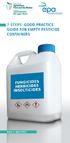 7 STEPS: GOOD PRACTICE GUIDE FOR EMPTY PESTICIDE CONTAINERS Issue 1: April 2012 This Good Practice Guide provides simple guidance for the safe and environmentally friendly recovery of empty plant protection
Tufts Environmental Health and Safety April 2010
 7. HAZARDOUS WASTE 7.1 Hazardous Chemical Waste The Resource Conservation and Recovery Act (RCRA) of 1976 gave the Environmental Protection Agency the authority to regulate the generation, transportation,