
7TH ANNUAL PARENTS, KIDS & MONEY SURVEY: SUPPLEMENTAL DATA
|
|
|
- Anissa Paul
- 9 years ago
- Views:
Transcription

1 Detailed Results 7TH ANNUAL PARENTS, KIDS & MONEY SURVEY: SUPPLEMENTAL DATA T. Rowe Price August 2015

2 Contents Impact of Parent/Kid Discussions on Kids Impact of Parental Discussions on Kids Impact of Parental Arguments on Kids Impact of Parental Discussions on Parents Discussion Frequency Mom vs. Dad Experiential Learning Allowance Letting Kids Make Mistakes Student Loans Credit Cards Discussions Combined with Experiential Learning Money Where Mouth Is Men s Bad Behavior Respondent Profile Objective & Methodology 2
3 IMPACT OF PARENT/KID DISCUSSIONS ON KIDS

4 Impact of Parent/Kid Discussions On Kids HOW KNOWLEDGEABLE ARE YOU ABOUT EACH OF THE FOLLOWING? (KIDS) (Five point scale Displaying very/extremely) Managing personal finances Credit Student loan debt Investing Taxes Social Security Mortgages Inflation 8% 8% 8% 9% 9% 9% 9% 14% 0% 5% 10% 15% 20% 25% 30% 35% 40% 45% 50% 29% 28% 28% 33% 32% 34% 39% 46% Parent & Kid Have Frequent Financial Discussions Yes (N=374) No (N=507) Kids who have financial discussions with their parents are more knowledgeable across all financial topics. N=794 (Married) 4

5 Impact of Parent/Kid Discussions On Kids PERCENT OF KIDS WHO: Say parents set a good financial example Understand the value of a dollar 79% 84% 94% 92% Think they will go to college 76% 84% Say parents do a good job teaching about money 32% 67% Know what type of job they want Think they are smart about money 26% 34% 50% 49% Parent & Kid Have Frequent Financial Discussions Yes (N=374) No (N=507) 0% 10% 20% 30% 40% 50% 60% 70% 80% 90% 100% Discussing finances with kids results in kids who feel smart about money, have direction and feel their parents are doing a good job teaching them about money. N=794 (Married) 5

6 IMPACT OF PARENTAL DISCUSSIONS ON KIDS

7 Impact of Parental Discussions On Kids HOW KNOWLEDGEABLE ARE YOU ABOUT EACH OF THE FOLLOWING? (KIDS) (Five point scale Displaying very/extremely) Managing personal finances Credit 10% 16% 33% 39% Student loan debt Investing Taxes Social Security Mortgages Inflation 7% 7% 8% 6% 6% 6% 27% 26% 28% 28% 30% 32% Parents Have Frequent Financial Discussions With Each Other Yes (N=456) No (N=338) 0% 5% 10% 15% 20% 25% 30% 35% 40% 45% Kids whose parents have financial discussions are more knowledgeable across all financial topics. N=794 (Married) 7

8 Impact of Parental Discussions On Kids PERCENT OF KIDS WHO: Say parents set a good financial example 79% 92% Think they will go to college 72% 86% Say parents do a good job teaching about money Know what type of job they want 32% 33% 49% 58% Parents Have Frequent Financial Discussions With Each Other Yes (N=456) Think they are smart about money 24% 45% No (N=338) 0% 10% 20% 30% 40% 50% 60% 70% 80% 90% 100% Parents who have financial discussions with their spouse have kids who have higher expectations and aptitude. N=794 (Married) 8

9 IMPACT OF PARENTAL ARGUMENTS ON KIDS

10 Impact of Parental Arguments On Kids HOW KNOWLEDGEABLE ARE YOU ABOUT EACH OF THE FOLLOWING? (KIDS) (Five point scale Displaying very/extremely) Managing personal finances Credit Student loan debt Investing Taxes Social Security Mortgages Inflation 9% 9% 8% 8% 9% 9% 8% 14% 0% 10% 20% 30% 40% 50% Kids whose parents have financial arguments are more knowledgeable across all financial topics. 29% 28% 28% 33% 32% 34% 39% 46% Parents Have Frequent Financial Discussions With Each Other Yes (N=99) No (N=507) N=606 (Married and Child Respondent) 10

11 Impact of Parental Arguments On Kids PERCENT OF KIDS WHO: Say parents do a good job teaching about money Think they are smart about money 33% 44% 61% 67% Parents Have Frequent Financial Discussions With Each Other Yes (N=99) No (N=695) 0% 20% 40% 60% 80% Parents who argue frequently about money have kids who are more likely to feel smart about money and think their parents are doing a good job teaching them. N=794 (Married) 11

12 IMPACT OF PARENTAL DISCUSSIONS ON PARENTS

13 Impact of Parental Discussions On Parents HOW KNOWLEDGEABLE ARE YOU ABOUT EACH OF THE FOLLOWING? (PARENTS) (Five point scale Displaying very/extremely) Managing personal finances 54% 75% Credit 51% 74% Taxes 46% 62% Mortgages 45% 62% Inflation Social Security Investing Student loan debt 35% 34% 28% 31% 56% 55% 53% 52% Parents Have Frequent Financial Discussions With Each Other Yes (N=456) No (N=338) 0% 10% 20% 30% 40% 50% 60% 70% 80% Parents who have financial discussions with their spouse are more knowledgeable across all financial topics. N=794 (Married) 13

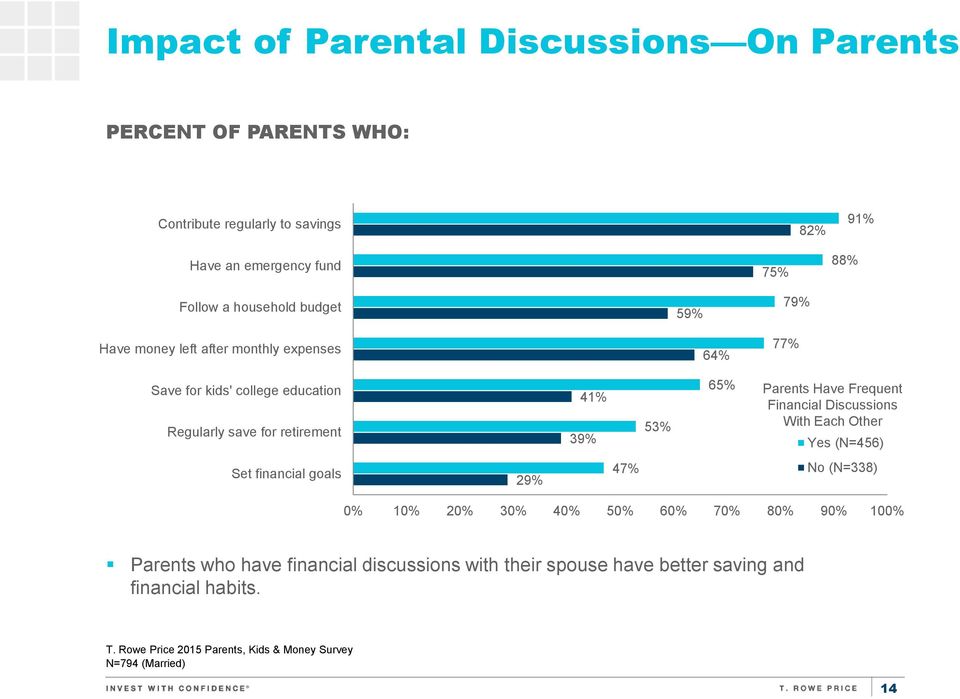
14 Impact of Parental Discussions On Parents PERCENT OF PARENTS WHO: Contribute regularly to savings 82% 91% Have an emergency fund 75% 88% Follow a household budget 59% 79% Have money left after monthly expenses 64% 77% Save for kids' college education Regularly save for retirement 41% 39% 53% 65% Parents Have Frequent Financial Discussions With Each Other Yes (N=456) Set financial goals 29% 47% No (N=338) 0% 10% 20% 30% 40% 50% 60% 70% 80% 90% 100% Parents who have financial discussions with their spouse have better saving and financial habits. N=794 (Married) 14
15 DISCUSSION FREQUENCY: MOM VS. DAD

16 Frequency of Discussions by Parent Gender HOW OFTEN DO YOU DISCUSS EACH OF THE FOLLOWING WITH YOUR KIDS? (Five point scale Displaying very/extremely) Setting financial goals 65% 71% Saving for college 58% 68% Non-traditional post HS education options 47% 58% Investment vehicles 24% 46% Joining the military 21% 34% Men (N=500) Women (N=500) 0% 10% 20% 30% 40% 50% 60% 70% 80% Across all financial topics, dads are more likely than moms to be having discussions with their kids. N=881 (Kid completed survey) 16

17 ALLOWANCE

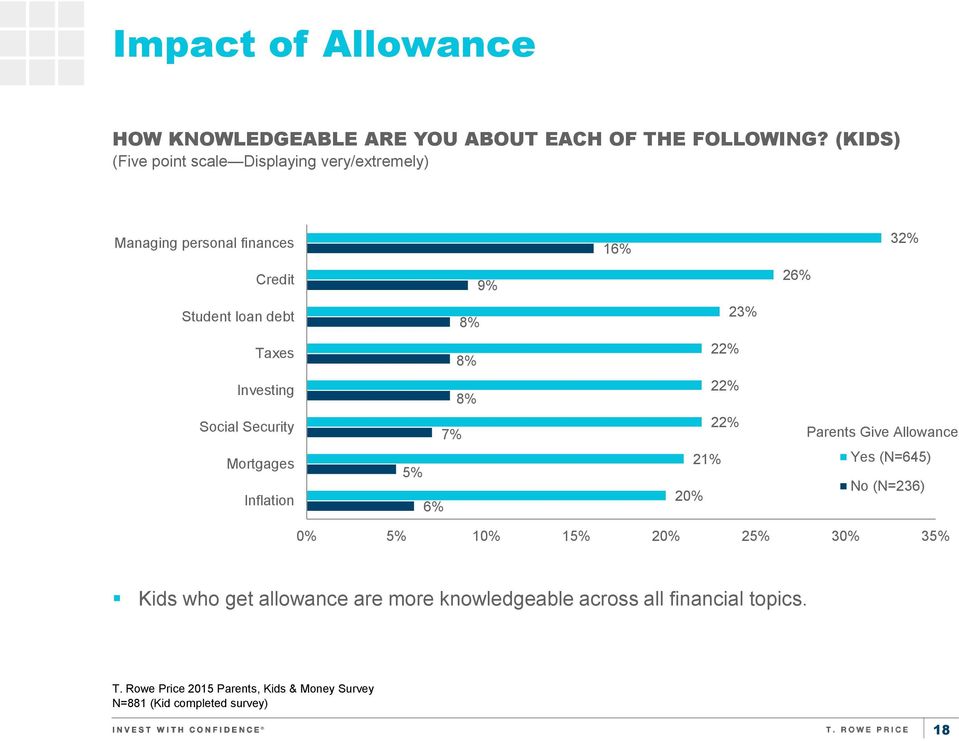
18 Impact of Allowance HOW KNOWLEDGEABLE ARE YOU ABOUT EACH OF THE FOLLOWING? (KIDS) (Five point scale Displaying very/extremely) Managing personal finances 16% 32% Credit 9% 26% Student loan debt 8% 23% Taxes 8% 22% Investing 8% 22% Social Security Mortgages Inflation 7% 5% 6% 22% 21% 20% Parents Give Allowance Yes (N=645) No (N=236) 0% 5% 10% 15% 20% 25% 30% 35% Kids who get allowance are more knowledgeable across all financial topics. N=881 (Kid completed survey) 18
19 Impact of Allowance PERCENT OF KIDS WHO: Understand the value of a dollar 81% 90% Say parents set a good financial example 78% 88% Discuss saving for college 45% 62% Say parents do a good job teaching about money 31% 52% Parents Give Allowance Think they are smart about money 25% 40% Yes (N=645) No (N=236) 0% 10% 20% 30% 40% 50% 60% 70% 80% 90% 100% Kids who receive allowance are more likely to be financially savvy and discuss saving for college with their parents. N=881 (Kid completed survey) 19

20 LETTING KIDS MAKE MISTAKES WITH MONEY

21 Letting Kids Make Financial Mistakes HOW KNOWLEDGEABLE ARE YOU ABOUT EACH OF THE FOLLOWING? (KIDS) (Five point scale Displaying very/extremely) Managing personal finances Credit Student loan debt Investing Social Security Taxes Mortgages Inflation 6% 7% 7% 7% 8% 8% 12% 16% 0% 5% 10% 15% 20% 25% 30% 35% 40% 24% 24% 26% 26% 26% 28% 30% 36% Allow Kids to Make Financial Mistakes Yes (N=506) No (N=375) Kids whose parents allow them to make financial mistakes are more knowledgeable across all financial topics. N=881 (Kid completed survey) 21
22 Letting Kids Make Financial Mistakes PERCENT OF KIDS WHO: Understand the value of a dollar 84% 90% Say parents set a good financial example 82% 87% Say parents do a good job teaching about money 40% 52% Allow Kids to Make Financial Mistakes Think they are smart about money 26% 44% Yes (N=506) No (N=375) 0% 10% 20% 30% 40% 50% 60% 70% 80% 90% 100% Kids whose parents are willing to let them make financial mistakes are more likely to be financially savvy and think their parents set a good example. N=881 (Kid completed survey) 22
23 LETTING KIDS LEARN THROUGH STUDENT LOANS
24 Student Loans to Learn About Debt HOW KNOWLEDGEABLE ARE YOU ABOUT EACH OF THE FOLLOWING? (KIDS) (Five point scale Displaying very/extremely) Managing personal finances 16% 35% Credit 10% 29% Student loan debt 5% 28% Investing 7% 26% Taxes 6% 26% Social Security Mortgages 4% 4% 25% 26% Think Kids Should Take on Student Loans Yes (N=543) Inflation 4% 24% No (N=334) 0% 5% 10% 15% 20% 25% 30% 35% 40% Kids whose parents think that kids should take on student loans to learn about debt are more knowledgeable across all financial topics. N=881 (Kid completed survey) 24
25 Student Loans to Learn About Debt PERCENT OF KIDS WHO: Understand the value of a dollar 84% 90% Say parents set a good financial example 82% 88% Say parents do a good job teaching about money 38% 52% Think Kids Should Take on Student Loans Think they are smart about money 26% 42% Yes (N=543) No (N=334) 0% 10% 20% 30% 40% 50% 60% 70% 80% 90% 100% Kids whose parents think they should experience student loan debt are more likely to be financially savvy and think their parents are doing a good job teaching them. N=881 (Kid completed survey) 25
26 LETTING KIDS LEARN ABOUT MONEY WITH CREDIT CARDS
27 Credit Cards to Learn About Managing Money HOW KNOWLEDGEABLE ARE YOU ABOUT EACH OF THE FOLLOWING? (KIDS) (Five point scale Displaying very/extremely) Managing personal finances 14% 40% Credit 9% 33% Investing 5% 31% Student loan debt 7% 30% Taxes 7% 29% Social Security 5% 29% Think Kids Should Have Credit Cards Mortgages Inflation 6% 5% 27% 27% Yes (N=466) No (N=411) 0% 5% 10% 15% 20% 25% 30% 35% 40% 45% Kids whose parents think that kids should have credit cards to learn about managing money are more knowledgeable across all financial topics. N=881 (Kid completed survey) 27
28 Credit Cards to Learn About Managing Money PERCENT OF KIDS WHO: Understand the value of a dollar 84% 91% Say parents set a good financial example 82% 89% Think they will go to college 76% 83% Say parents do a good job teaching about money Think they are smart about money 27% 37% 44% 55% Think Kids Should Have Credit Cards Yes (N=466) No (N=411) 0% 10% 20% 30% 40% 50% 60% 70% 80% 90% 100% Kids whose parents think they should have credit cards are more likely to be financially savvy and think they will go to college N=881 (Kid completed survey) 28
29 THE COMBINATION OF DISCUSSIONS AND EXPERIENTIAL LEARNING
30 % of kids knowledgeable about Managing Personal Finance Discussions and Experiential Learning Without Allowance 80% Parents & Kids Have Frequent Discussions Yes 70% 60% 50% No 67% 40% 30% 34% 36% 29% 20% 15% 12% 15% 10% 2% 0% Total money experiences parents are willing to allow (Allow mistakes, student loans, credit cards) There is a significant interaction between having discussions and the degree to which parents let kids experience money kids of parents who have frequent discussions and the most experiences with money are significantly more likely to have knowledge of managing personal finance (67% vs. 2%) N=881 (Kid completed survey) 30
31 % of kids knowledgeable about Managing Personal Finance Discussions and Experiential Learning Including Allowance 80% 70% Parents & Kids Have Frequent Discussions Yes No 68% 60% 50% 40% 30% 20% 10% 0% 7% 0% 24% 36% 12% 13% % 19% Total money experiences parents are willing to allow (Give allowance, allow mistakes, student loans, credit cards) 29% Allowance continues to bolster the importance having discussions and the degree to which parents let kids experience money kids of parents who have frequent discussions and the most experiences (allowance, and allowing mistakes, loans and credit cards) with money are even more likely to have knowledge of managing personal finance (68% vs. 0%) N=881 (Kid completed survey) 31
32 % of kids who think they are smart about money Discussions and Experiential Learning Including Allowance Parents & Kids Have Frequent Discussions 80% 70% Yes No 70% 60% 50% 40% 30% 21% 29% 44% 38% 28% 31% 37% 20% 15% 15% 10% 0% Total money experiences parents are willing to allow (Give allowance, allow mistakes, student loans, credit cards) There is a significant interaction between having discussions and the degree to which parents let kids experience money kids of parents who have frequent discussions and the most experiences with money are significantly more likely to think they are smart about money (70% vs. 15%) N=881 (Kid completed survey) 32
33 % of kids who say parents do a good job teaching about money Discussions and Experiential Learning Including Allowance 90% 80% Parents & Kids Have Frequent Discussions Yes No 82% 70% 60% 60% 59% 59% 50% 43% 40% 30% 29% 22% 26% 31% 33% 20% 10% 0% Total money experiences parents are willing to allow (Give allowance, allow mistakes, student loans, credit cards) There is a significant interaction between having discussions and the degree to which parents let kids experience money kids of parents who have frequent discussions and the most experiences with money are significantly more likely to think parents are doing a good job teaching them about money (82% vs. 22%) N=881 (Kid completed survey) 33
34 MONEY WHERE MOUTH IS
35 Saving for Emergencies OF THE 58% OF PARENTS WHO ARE VERY/EXTREMELY CONCERNED ABOUT SAVING FOR EMERGENCIES: 19% rank spending highest for what they are most likely to do with money that is left over after paying monthly bills 22% do not have an emergency fund 32% contribute regularly to an emergency fund N=1,000 (Total respondents) 35
36 Saving for Kids College Education OF THE 58% OF PARENTS WHO ARE VERY/EXTREMELY CONCERNED ABOUT SAVING FOR THEIR KIDS COLLEGE EDUCATION: 18% rank spending highest for what they are most likely to do with money that is left over after paying monthly bills 32% of married respondents have frequent discussions with their spouse about saving for kids college education 40% of those expecting an inheritance will use the money for kids college education 41% don t regularly save for their kids college education 52% would use an unexpected windfall of $1,000 to save for kids college education N=1,000 (Total respondents) 36
37 Paying Bills Month to Month OF THE 52% OF PARENTS WHO ARE VERY/EXTREMELY CONCERNED ABOUT BEING ABLE TO PAY BILLS MONTH TO MONTH: 17% rank spending highest for what they are most likely to do with money that is left over after paying monthly bills 26% don t have a household budget 51% make occasional/frequent impulse purchases 53% of married respondents have frequent discussions with their spouse about monthly spending/budgeting 62% say they spent more than they should have on holiday spending N=1,000 (Total respondents) 37
38 Taking on too Much Debt OF THE 51% OF PARENTS WHO ARE VERY/EXTREMELY CONCERNED ABOUT TAKING ON TOO MUCH DEBT: 28% pay their credit card bills in full each month 36% rank debt repayment highest for what they are most likely to do with money that is left over after paying monthly bills 48% of those expecting an inheritance will use the money to pay off debt 50% use credit cards to pay for holiday spending 53% make occasional/frequent impulse purchases N=1,000 (Total respondents) 38
39 Saving Enough for Retirement OF THE 62% OF PARENTS WHO ARE VERY/EXTREMELY CONCERNED ABOUT SAVING ENOUGH TO BE ABLE TO RETIRE: 24% of married respondents have frequent discussions with their spouse about retirement 31% save less than 5% of their annual income 38% rank saving highest for what they are most likely to do with money that is left over after paying monthly bills 38% of those expecting an inheritance will use the money to pay for retirement 41% regularly set financial goals 42% regularly save for retirement N=1,000 (Total respondents) 39
40 MEN S BAD BEHAVIOR
41 Men s Bad Behavior PERCENT OF PARENTS WHO: Men (N=500) Women (N=500) Tell kids they can't afford things when they really can 39% 54% Discuss family finances with friends 35% 55% Argue with their spouse about money 36% 46% Take money from their kid's piggy bank 24% 32% Lie to their kids about money 26% 38% Have a financial account their spouse is unaware of 25% 42% 0% 10% 20% 30% 40% 50% 60% Men are more likely than women to display various bad behaviors N=881 (Kid completed survey) 41
42 RESPONDENT PROFILE
43 Respondent Profile Q2. REGION Q1. AGE Q3. GENDER < 35 15% South 27% % Northeast West 25% 24% 50% Women Men 50% % Midwest 23% Q4. MARITAL STATUS Q5. HHI Q6. RACE/ETHNICITY Married 77% White/Caucasian 74% Separated/Divorced 11% < $50K 30% Black/African American 13% Single 9% $50K $99,999 44% Hispanic/Latino 13% Married (Same sex) 2% $100K + 26% Asian 5% Widow/Widower 1% Native American 1% T. Rowe Price Parents, Kids & Money Survey N=1,000 (Parents: Total respondents) 43
44 Respondent Profile Q7. EDUCATION LEVEL Q8. EMPLOYMENT STATUS Q9. # KIDS IN HH < HS graduate HS graduate 1% 15% Employed full-time Stay at home parent 16% 59% 1 31% Some college 19% Employed part-time 10% 2 44% Assoc. degree Bachelor's degree Graduate degree 16% 16% 33% Self-employed Unemployed Retired Student 5% 5% 3% 1% % 17% Q11. KID GENDER Q12. KID AGE 8 12% 9 14% 47% Girls Boys 53% % 14% 14% 13 15% 14 15% T. Rowe Price Parents, Kids & Money Survey N=1,000 (Parents: Total respondents); N=881 (Kids: Total respondents) 44

45 OBJECTIVE & METHODOLOGY
46 Objective & Methodology Objective To understand the basic financial knowledge, attitudes and behaviors of both parents of children ages 8-14 and their children ages Methodology T. Rowe Price commissioned an online survey of parents of children ages 8-14 and their children ages The survey was fielded from 1/20/15 to 1/27/15, with parent quotas of at least 50% men and 50% women. A total of 1,000 parents and 881 children ages 8-14 in the U.S. participated; the sampling error for a sample of 1,000 is +/- 3.1% at the 95% confidence interval. The survey was fielded through MarketTools, Inc. T. Rowe Price Parents, Kids & Money Survey 46
47 THANK YOU. CQPDJEJ5E
T. Rowe Price 7TH ANNUAL PARENTS, KIDS & MONEY SURVEY
 T. Rowe Price 7TH ANNUAL PARENTS, KIDS & MONEY SURVEY Detailed Results / March 2015 Contents Family Financial Profile 3 Financial Knowledge 12 Parenting 17 Discussing Financial Matters 30 Habits & Priorities
Online Survey of Employees Without Workplace Retirement Plans
 Online Survey of Employees Without Workplace Retirement Plans Report of Findings Conducted for: State of California October 2015 Prepared by Greenwald & Associates 2015 1 Table of Contents Methodology
A Report from the Girl Scout Research Institute 1
 A Report from the Girl Scout Research Institute 1 Financial literacy is a growing concern given the state of the U.S. economy over the past five years. The recession has led to high unemployment, foreclosures,
A Survey about Financial Literacy Among the U.S. Military
 A Survey about Financial Literacy Among the U.S. Military Prepared For: The National Foundation for Credit Counseling (NFCC) Prepared By: Harris Poll 1 NFCC Financial Literacy among U.S. Military Survey
Americans Attitudes Toward Life Insurance
 Americans Attitudes Toward Life Insurance Survey Findings (General U.S. Adult Population) May, 2008 Products and services offered through the ING family of companies Methodology Methodology Telephone survey
The 2009 Consumer Financial Literacy Survey Final Report. The National Foundation for Credit Counseling
 The 2009 Consumer Financial Literacy Survey Final Report Prepared For: The National Foundation for Credit Counseling Prepared By: Harris Interactive Inc. Public Relations Research Summary At this time
The Ariel Mutual Funds/Charles Schwab & Co., Inc. Black Investor Survey. Saving and Investing Among High Income African-American and White Americans
 The Ariel Mutual Funds/Charles Schwab & Co., Inc. Black Investor Survey: Saving and Investing Among High Income African-American and Americans April, 2000 0 Prepared for Ariel Mutual Funds and Charles
MMI Omnibus Survey. Debt Survey. Top-Line Results and Suggested Story Lines
 MMI Omnibus Survey Debt Survey Top-Line Results and Suggested Story Lines Methodology: Cynapsus and MMI developed seven questions that were included in a nationwide, Web-based omnibus study. The survey
The Ariel/Schwab Black Investor Survey:
 The Ariel/Schwab Black Investor Survey: Saving and Investing Among Higher Income and Americans Ariel Investments, LLC and The Charles Schwab Corporation are non-affiliated entities, but co-sponsor the
Working Beyond Retirement-Age
 Working Beyond Retirement-Age Kelly A. Holder and Sandra L. Clark U.S. Census Bureau Housing and Household Economics Division Labor Force Statistics Branch Presented at the American Sociological Association
Saving and Investing Among Higher Income African-American and White Americans
 The Ariel Investments 2010 Black Investor Survey: Saving and Investing Among Higher Income African-American and Americans July 21, 2010 1 For further information, contact Merrillyn J. Kosier at Ariel Investments
RBS NatWest Clear Rate and Cashback Plus Credit Cards Three Star Fairbanking Mark Research
 RBS NatWest Clear Rate and Cashback Plus Credit Cards Three Star Fairbanking Mark Research The Fairbanking Foundation awards marks to products which can demonstrate that they act in customers best interests,
Name Last First M.I. Marital Status Single Married Divorced Separated. Will your spouse be a student during the 2015-16 academic year?
 INTERNATIONAL STUDENT FINANCIAL AID APPLICATION FILING DEADLINE: MARCH 1, 2015 PLEASE LIST ALL AMOUNTS IN US DOLLARS SECTION 1: STUDENT GENERAL INFORMATION Name Last First M.I. LSAC # Marital Status Single
Your Retirement Lifestyle Workbook
 Your Retirement Lifestyle Workbook Purpose of This Workbook This workbook is designed to help you collect and organize the information needed to develop your Retirement Lifestyle Plan, and will include
2015 U.S. BANK STUDENTS AND PERSONAL FINANCE STUDY
 2015 U.S. BANK STUDENTS AND PERSONAL FINANCE STUDY Student Perspectives on Money and Finances July 7, 2015 2015 U.S. Bancorp. All Rights Reserved. This information is not intended to be a forecast of future
bcu Home Loan Application
 bcu Home Loan Application ELIGIBILITY CRITERIA If you re eligible for a bcu home loan, you ll need to be: 18 years of age or older A permanent Australian resident or citizen You will also have not had
Americans Current Views on Smoking 2013: An AARP Bulletin Survey
 Americans Current Views on Smoking 2013: An AARP Bulletin Survey November 2013 Americans Current Views on Smoking 2013: An AARP Bulletin Survey Report Prepared by Al Hollenbeck, Ph.D. Copyright 2013 AARP
Community Financial Services Association of America (CFSA) Payday Loans and the Borrower Experience: Executive Summary
 Community Financial Services Association of America (CFSA) Payday Loans and the Borrower Experience: Executive Summary Presented by: Harris Interactive Public Relations Research December 4, 2013 Table
Sample Only. Grant & Aid Application For the School Year Beginning Fall 2012. Save Time Apply Online. Information needed to complete your application:
 10000028406 Save Time Apply Online. Apply online at www.factstuitionaid.com - Applying online is the fastest and most direct method of submitting your application. It allows your institution to view your
A Woman s Guide to Life Insurance
 protecting your future A Woman s Guide to Life Insurance CAC.6357 (03.13) TODAY I realized how valuable I am. You are valuable. You insure your house, your car, your jewelry, and your health, right? But
Overview. Our Programs» Strengthening Norfolk s Neighborhoods. One person, one home, one dream at a time.
 Overview HomeNet, a component of the Norfolk Redevelopment and Housing Authority (NRHA) is a full-service homeownership center who partners with local lending institutions, attorneys, housing developers,
NEIGHBORHOOD STABILIZATION PROGRAM (NSP) APPLICATION FOR NSP LOAN. Program Guidelines
 APPLICATION FOR NSP LOAN Income limits per household Program Guidelines Maximum Income 1 48,150 2 55,000 3 61,900 4 68,750 5 74,250 6 79,750 7 85,250 8 90,750 Homebuyer Requirements Home Education Minimum
WHAT IS THE SAVINGS & INVESTMENT MONITOR?
 July 2015 WHAT IS THE SAVINGS & INVESTMENT MONITOR? Annual Survey Metro Working South Africans Saving & Investment Behaviours & Attitudes METHODOLOGY MAIN SURVEY Tracking study to look at trends Weighted
MEDICAL ASSISTANCE (MA)/MCHP APPLICATION FOR FAMILIES, PREGNANT WOMEN, AND CHILDREN
 Si necesita ayuda para llenar el formulario favor de llamar al 1-800-456-8900 Please PRINT in blue or black ink. MEDICAL ASSISTANCE (MA)/MCHP APPLICATION FOR FAMILIES, PREGNANT WOMEN, AND CHILDREN Date
Presentation Slides. Lesson Seven. Credit 04/09
 Presentation Slides $ Lesson Seven Credit 04/09 advantages and disadvantages of using credit advantages: Able to buy needed items now Don t have to carry cash Creates a record of purchases More convenient
Your Retirement Lifestyle Workbook
 Your Retirement Lifestyle Workbook Purpose of This Workbook This workbook is designed to help you collect and organize the information needed to develop your Retirement Lifestyle Plan, and will include
Financial Impact of Premature Death
 Financial Impact of Premature Death The Value of Adequate Life Insurance Coverage When Tragedy Strikes An executive summary of quantitative research conducted by MetLife on the financial impact of death
Using Credit to Your Advantage
 Hands on Banking Using Credit to Your Advantage Credit Reports, Credit Scores and Dealing with Debt The Hands on Banking program is a free public service provided by Wells Fargo. You may also access the
HOMEBASE AFFORDABLE HOMES PROGRAM
 HOMEBASE AFFORDABLE HOMES PROGRAM INCOME ELIGIBILITY APPLICATION Revised April 2013 Please provide ALL applicable information on this form. It will be used to determine your eligibility; HomeBase Income
Medical Assistance Application for the Elderly and Persons with Disabilities
 Medical Assistance Application for the Elderly and Persons with Disabilities Who can use this application? Apply faster online This application is for the elderly and persons with disabilities applying
Application for Free Home Repairs
 Application for Free Home Repairs Name of Homeowner: Date of Birth: Gender Male Female Is this a female headed household? Is this a grandparent headed household? Street Address: City: County: Zip Marital
AGENDA. 9:15-9:45 am Insurance Solutions for Residents Pat Bremer, Insurance Consultant - MD Insurance Agency Limited
 AGENDA 9:00-9:15 am Introduction 9:15-9:45 am Insurance Solutions for Residents Pat Bremer, Insurance Consultant - MD Insurance Agency Limited 9:45-10:15 Buying vs. Renting during Residency Franca Matsos,
Theological Awareness Benchmark Study. Ligonier Ministries
 Theological Awareness Benchmark Study Commissioned by Ligonier Ministries TheStateOfTheology.com 2 Research Objective To quantify among a national sample of Americans indicators of the theological understanding
FREE CARE APPLICATION ATTACHMENT
 FREE CARE APPLICATION ATTACHMENT PLEASE REMEMBER THIS IS NOT AN INSURANCE PLAN IT IS A CHARITABLE CARE PROGRAM AND THERE IS NO ESTABLISHED FUND. THERE IS NO MONEY EXCHANGED FOR SERVICES BY ANY CMC PHYSICIAN/PRACTICE.
SAMPLE ONLY. FACTS Grant & Aid Application For the School Year Beginning Fall 2015. Save Time Apply Online.
 10000028406 Save Time Apply Online. Apply online at online.factsmgt.com/aid w available in Spanish. Applying online allows your institution to view your application electronically within minutes of submission.
Lifestyle Assessment and Financial Overview (Part A)
 Achieving your lifestyle goals Lifestyle Assessment and Financial Overview (Part A) Thank you in advance for taking the time to provide the information requested overleaf. We believe that the creation,
The Decision to Retire and Post-Retirement Financial Strategies: A Report on Eight Focus Groups. Executive Summary
 The Decision to Retire and Post-Retirement Financial Strategies: A Report on Eight Focus Groups Executive Summary This summary was prepared by the Project Oversight Group The report was sponsored by the
The question of whether student debt levels are excessive
 College on Credit: How Borrowers Perceive Their Education Debt By Sandy Baum and Marie O Malley Sandy Baum is professor of economics at Skidmore College in Skidmore, PA. Marie O Malley is vice president
Family protection made easy
 Family protection made easy A guide to life assurance This product is provided by Irish Life Assurance plc. AIB has chosen Irish Life, Ireland s leading life and pensions provider, to provide its customers
payment protection insurance: consumer questionnaire
 our ref: payment protection insurance: consumer questionnaire WHAT IS THIS QUESTIONNAIRE FOR? This questionnaire is for consumers to bring a complaint about the sale of payment protection insurance (PPI).
Tax Preparation by Robin G Wixom, LLC
 Tax Preparation by Robin G Wixom, LLC 2015 TAX ORGANIZER Please fill out the following questionnaire and gather the applicable documents. If you choose to send the documents via e-mail, please encrypt
Workplace Survey American Psychological Association Harris Interactive. March 2012
 Workplace Survey American Psychological Association Harris Interactive March 2012 Methodology The Stress in the Workplace survey was conducted online within the United States by Harris Interactive on behalf
Advantages and Disadvantages of Using Credit
 1 Lesson 7: About Credit Why Get Credit? To establish a credit history. Advantages and Disadvantages of Using Credit 1. Advantages Able to buy needed items now. Don t have to carry cash. Creates a record
2. List at least three (3) of the most important things you learned during your time in the program
 Section 1. NIU s Sport Management MS Student Exit Interview -- Student Questions Please answer the following questions offered below regarding your experiences within the program. 1. General Reflections
ECEC Application Revised 01.5.15
 Salt River Pima-Maricopa Indian Community Early Childhood Education Programs Mailing Address: 10, 005 E. Osborn Road Physical Address: 4815 N. Center Street Scottsdale, AZ 85256 Phone: 480-362-2200 Fax:
Apply faster online at Compass.ga.gov.
 GEORGIA DEPARTMENT OF HUMAN SERVICES Division of Family and Children Services Application for Health Coverage & Help Paying Costs Form Approved OMB No. 0938-1191 Use this application to see what coverage
Household Trends in U.S. Life Insurance Ownership
 Household Trends in U.S. Life Insurance Ownership Full Report Cheryl D. Retzloff, LLIF, ACS Markets Research 860-285-7738 [email protected] Maximize the Value of LIMRA Research The value of LIMRA research
Unit 4: Taxes. Read this unit including websites. You may want to take your own notes.
 Taxes Read Chapter 4 in the text. Read Chapter 7 of The Financial Checkup. Read this unit including websites. You may want to take your own notes. Are taxes your favorite topic? They are not the favorite
The Mortgage Packager Limited. Applicants name: Fact Find Date: 16-20 South Street Hythe Southampton SO45 6EB
 Applicants name: Fact Find Date: The Mortgage Packager Limited 16-20 South Street Hythe Southampton SO45 6EB Telephone: 02380 018109 Fax: 02380 001136 [email protected] Regulated by the Financial
Financial Planning Questionnaire
 Financial Planning Questionnaire To complete this form by hand: Print all pages of this form and bring the completed form to our meeting. To complete this form electronically: Visit www.strategicpoint.com/forms
SAMPLE EVALUATION INSTRUMENTS
 1 SAMPLE EVALUATION INSTRUMENTS This section contains samples of evaluation instruments that can be generated for each evaluation option. Note that the type of the instrument generated depends on the evaluation
Information Age Bills Keep Piling Up What Americans Pay For and How
 Information Age Bills Keep Piling Up What Americans Pay For and How FOR IMMEDIATE RELEASE Paul Taylor, Executive Vice President Cary Funk, Senior Researcher April Clark, Research Associate MEDIA INQUIRIES
Become Debt Free. $1,000 to start an Emergency Fund. Pay off all debt using the Debt Snowball. 3 to 6 months of expenses in savings
 Become Debt Free $1,000 to start an Emergency Fund Pay off all debt using the Debt Snowball 3 to 6 months of expenses in savings Invest 15% of household income into Roth IRAs and pre-tax retirement College
Marketing To Moms Coalition. State of the American Mom. For Questions, Please Contact Amy Colton 847 770 1832
 Marketing To Moms Coalition State of the American Mom For Questions, Please Contact Amy Colton 847 770 1832 TABLE OF CONTENTS I. Introduction & II. Methodology Purpose III. Key Highlights IV. Complete
Key Findings ASIC Report 419. Australian Financial Attitudes and Behaviour Tracker Wave 1: March August 2014
 ASIC Report 419 Wave 1: March August 2014 Australian Securities and Investments Commission December 2014 Contents INTRODUCTION 3 KEY FINDINGS 9 Financial attitudes 10 Keeping track of finances 11 Planning
CLARK UNIVERSITY POLL OF EMERGING ADULTS. Work, Education and Identity
 CLARK UNIVERSITY POLL OF EMERGING ADULTS Work, Education and Identity 1 Research Objectives Reflections on education and its impact on the lives of Emerging Adults and their transition into the workplace
BANKRUPTCY. What is the difference between a Chapter 7 and a Chapter 13 bankruptcy?
 BANKRUPTCY Bankruptcy means you ask the court to excuse you from your duty to repay your creditors. A person or business you owe money to is called a creditor. Bankruptcy allows you to discharge (get rid
Government mortgage rescue scheme What will it mean for me and my family?
 Government mortgage rescue scheme What will it mean for me and my family? What is mortgage rescue? Mortgage rescue is help that the Government is offering if: you are struggling to keep up with your mortgage
Important! How the Affordable Care Program works
 Important! How the Affordable Care Program works What is the Affordable Care Program? The Program allows us to offer patients a sliding fee scale, depending on household income. You share the costs of
Life Cycle of Financial Planning Note-Taking Guide
 Life Cycle of Financial Planning Note-Taking Guide 1.11.2.L1 Note taking guide Total Points Earned 42 Total Points Possible Percentage Name Date Class Many people follow a during their life Financial planning:
WAYS TO WEALTH - IN YOUR 20's TIME TO GET SMART WITH YOUR MONEY
 WAYS TO WEALTH - IN YOUR 20's TIME TO GET SMART WITH YOUR MONEY Whether you're studying, working or travelling, living at home or with friends, saving to buy your own place or you have a mortgage, now
Make a Smart Start Toward Financial Success SUNY ORANGE STUDENTS
 Make a Smart Start Toward Financial Success SUNY ORANGE STUDENTS A College Education is a Smart Investment High School Graduate $25,000 Some College $30,000 Associate s Degree $32,000 Bachelor s Degree
2015 Wells Fargo Retirement Study
 2015 Wells Fargo Retirement Study Table of contents Overview 1 Key findings 2 Background and methodology 8 Harris Poll conducted the survey online of 1,993 affluent investors, ages 30 75 who have $250,000
Making Loans and Gifts to Family Members Last update: January 14, 2015
 Summary Making Loans and Gifts to Family Members Last update: January 14, 2015 Loans to family members can sometimes be of financial benefit to both parties. Gifts also can be a blessing to both giver
Online Shoppers 2011
 Online Shoppers 2011 Dennis Fromholzer, Ph.D. CRM Associates Boulder, CO 80303 303-938-8788 www.crmassoc.com The Internet has emerged as a new marketplace and a primary medium for reaching and influencing
The View from San Francisco Bay Area:
 The View from San Francisco Bay Area: 1,000 residents share their perspectives on managing wealth and the local economy March 2016 Methodology What An online study among a sample of the general public
Standard 1: The student will describe the importance of earning an income and explain how to manage personal income using a budget.
 STUDENT MODULE 1.4 EARNING AN INCOME PAGE 1 Standard 1: The student will describe the importance of earning an income and explain how to manage personal income using a budget. Managing Your Income Mickey