
The Ariel/Schwab Black Investor Survey:
|
|
|
- Stephany Allen
- 10 years ago
- Views:
Transcription
1 The Ariel/Schwab Black Investor Survey: Saving and Investing Among Higher Income and Americans Ariel Investments, LLC and The Charles Schwab Corporation are non-affiliated entities, but co-sponsor the "Black Investor Survey"

2 TABLE OF CONTENTS Background and Objectives 4 Methodology 5 Highlights of Previous and Current Studies 6 Detailed Findings 13 Demographics 31 2

3 BACKGROUND AND OBJECTIVES Ariel Investments, LLC and The Charles Schwab Corporation commissioned Argosy Research to conduct the tenth wave of a primary research study comparing and contrasting higher income ($50,000 or more) and households in terms of their savings and investment attitudes and behaviors. Ariel and Schwab have jointly conducted previous waves of this research every year since The main objectives of this research are the following: Identify similarities and differences between high income s and s with regard to saving and investing. Examine the factors, particularly past influences and underlying beliefs, that may impact how s and s think about financial matters. Determine any shifts in attitudes or behaviors over time. Assess the expectations and issues that s and s face in their financial futures. 3

4 METHODOLOGY 503 s and 506 s were interviewed by phone between June 11 and July 13, All respondents were over the age of 18 and had a household income of at least $50,000. Additionally, all identified themselves as the primary or joint decision-maker in the household in terms of investment decisions. The sample, national in scope, was drawn randomly from census exchanges that have a median income of $40,000 or more. In order to bolster the sample, additional interviews were conducted in census exchanges that have a median income of $40,000 or more and that have a population that is at least 25 or above African- American. The survey ran for an average of 11 minutes. Note: Throughout this report, a bolded number indicates a figure significantly higher from a statistical standpoint than the number to which it is being compared. 4

5 HIGHLIGHTS OF PREVIOUS STUDIES January 1998 The 1998 study revealed a number of interesting differences between the two groups surveyed, such as how, relative to s, s: Are underinvested in the stock market, due to several social and cultural reasons. Prefer more conservative investment vehicles, including life insurance; also regard real estate as the best investment overall. Have less wealth than s with similar incomes. January 1999 The 1999 study helped identify why certain attitudes and behaviors are so divergent. The reasons for the differences were found to include: s were introduced to savings and investing tools later in life. s are motivated to invest in more conservative investment vehicles because of the feeling of security those investments provide. At the same time, this study also uncovered heightened interest in investing among s relative to s. Other areas explored included how women and men behave differently. Women are more likely than men to consider themselves beginner investors, are relatively underinvested, and are more likely to own conservative investments than men. 5

6 HIGHLIGHTS OF PREVIOUS STUDIES (CONTINUED) April 2000 The 2000 study found that family obligations, including children s education, dictate savings. More s than s expect to support adult children; also, more s expect to support aging parents. s are saving as much or even more for education than s. In addition, more s than s cite education as the key to financial success. On the other hand, s have considerably less saved for retirement than s and fewer s cite retirement as their most important reason for saving. June 2001 The 2001 study found that even after controlling for demographic and behavioral variables, s are still 35 less likely to invest than s. In examining the key factors influencing investing patterns among s and s, we found: s become increasingly more likely to invest as they earn more. Income is not a determinant of investing among s. Regardless of their income, s begin investing at fairly young ages, while the likelihood of investing for s does not track with age. 6

7 HIGHLIGHTS OF PREVIOUS STUDIES (CONTINUED) June 2002 The 2002 study explored financial attitudes and behaviors in the wake of the lingering recession, a down market for much of 2001, and the September terrorist attacks: Just a handful of Blacks and s (6 and 7 respectively) liquidated any investments as a result of the recession or acts of terrorism. A sharply rising percentage of all investors agreed that, The recent stock market volatility has shaken [their] long-term confidence in the stock market. Blacks in agreement rose from 32 to 43 since last year; s went from 15 to 25. More Blacks than s (49 vs. 39) felt more anxious about [their] financial situation than [they] were a year ago, and far fewer Blacks than s (46 vs. 68 respectively) thought the economy would improve within the next 12 months. June 2003 The 2003 survey showed that many higher income s were retreating from the stock market. After five straight years of steady increases in the percentages of Blacks who own stocks, only 61 of Blacks in 2003 had money in the market, down from 74 in 2002 and approaching the 1998 level of 57. stock ownership, held steady at 79. Real estate and other investments were increasingly in favor with both groups. With interest rates at 35-year lows, attitudes toward real estate investing approached Black historical preferences for real estate investing. When asked which is the better investment -- home improvements or stocks of Blacks and 61 of s chose home improvements, while only 20 of Blacks and 33 of s chose stocks. 7
![A sharply rising percentage of all investors agreed that, The recent stock market volatility has shaken [their] long-term confidence in the stock market.](/docs-images/50/15445352/images/page_7.jpg "Blacks in agreement rose from 32 to 43 since last year; s went from 15 to 25. More Blacks than s (49 vs.")
8 HIGHLIGHTS OF PREVIOUS STUDIES (CONTINUED) June 2004 The 2004 survey further explained the gap between and investing by uncovering a misperception by Blacks that investors need to be skilled at market timing, or buying and selling stocks at exactly the right time, in order to be successful. Those Blacks citing patience or discipline as an important factor for investing success are two and a half times more likely to be investors than those believing that knowing how to time the market is the most important success factor. The survey included a 10-question investment quiz that a majority of both Black and investors failed, showing that many Americans, both Black and, misunderstand or are unfamiliar with market lingo commonly used by the media and investment companies. Furthermore, many do not know basic facts about investing and the stock market. July 2005 The 2005 study found that for s, employer-sponsored retirement plans have the potential to be an effective entrée into the world of investing. s who are saving primarily for retirement are almost twice as likely to be stock investors as those who are saving for other reasons, such as to pay for education. s are equally likely to be investors regardless of their goals. Fewer Blacks than s overall, however, consider retirement their most important goal. Additionally, those Blacks who are investing regularly in retirement accounts contribute significantly less per month to their accounts, and more Black plan participants than participants have withdrawn money from their accounts prior to retirement (36 vs. 24). Blacks who have help from a financial advisor contribute more money on a monthly basis to their retirement plans than those who do it alone. 8

9 HIGHLIGHTS OF PREVIOUS STUDIES (CONTINUED) June 2006 The 2006 study found that Black and Americans differ in their expectations and strategies about retirement. Notably, s are significantly more reliant on employer pensions than s. Two-thirds of employed Blacks, compared to about half of employed s work for employers with a traditional pension plan; however, large percentages of both Blacks and s (50 and 55) believe that corporate pension funds will no longer exist in a decade. All else being equal, s are twice as likely as s to believe government and corporations bear significant responsibility for ensuring Americans a comfortable retirement. s remain optimistic about retirement: fewer Blacks than s (24 versus 30) say they are worried about their retirement; and more Blacks aim to retire early, with twice as many Blacks as s hoping to retire before the age of 60. However, for many s, retirement is just the beginning of a new phase of work. While both groups have similar aspirations for retirement (maintain standard of living, travel more, etc.), three times the number of s versus s (29 versus 10) say they plan to start a business after they retire. More Blacks than s say they expect real estate investments to help fund retirement. Twice as many Blacks as s (34 versus 16) say they are currently saving to buy real estate, start a business, or both. 9

10 HIGHLIGHTS OF PREVIOUS STUDIES (CONTINUED) October 2007 In 2007, stock market participation was at the same level as it was ten years prior (the first year of the survey): at a low of 57 (compared to a high of 74 in 2002). investing was at 76 last year. Even when all other significant demographic factors are held constant (age, income, gender, education, and so on), s are nearly twice as likely as s to be investors than s. While 56 of s say that retirement is their most important goal for saving and investing, only 40 of s see retirement as their priority. All else being equal (income, age, etc.), Blacks are 50 less likely to say retirement is their primary savings goal. s continue to lag their counterparts in monthly savings, and the average value of overall savings and investments by s is less than half of what it is for s. Of those who invest, more s (55) than s (47) report that they first started investing as a result of having a 401(k) or other employer-sponsored retirement plan. When asked which is a bigger worry: day-to-day expenses, or having enough money to retire, 41 of s cited expenses, and 59 cited retirement. In contrast, only 29 of s cited expenses and 71 cited retirement. 10
11 HIGHLIGHTS OF THIS YEAR S STUDY July 2008 s are on equal footing with s when it comes to accessing and enrolling in employer-sponsored defined contribution plans, but save far less each month and have a considerably smaller nest egg than their counterparts. About nine in ten of both Blacks and s who are working have access to a defined contribution plan such as a 401(k). Of those with such a plan, about 90 of both groups contribute regularly. However, the median monthly amount that Blacks contribute to their 401(k) plan is $169, while s contribute about 50 more, or $249 each month. As a result, the median total household savings for retirement reported by Black respondents is $53,000, in contrast to s at $114,000. For many younger s, saving for retirement is more of a dream than a priority. are half as likely to cite retirement as their most important goal when saving and investing (after controlling for income, education, age and other key demographics). At the same time, 45 of Blacks under the age of 50 (compared to 26 of s) say they want to retire by age 60, Among those older than 50, however, reality has set in: a far smaller 24 of Blacks and 9 of s still plan to retire by age

12 HIGHLIGHTS OF THIS YEAR S STUDY (cont.) With some help from employers, all employees, but particularly s, would be likely to ramp up their monthly 401(k) savings. About two-thirds of s (compared to about a half of s) say they would increase contributions to their retirement plan if employers provided access to financial advisors, seminars about retirement investing, and/or education about the features of the plan. This year s findings show that 62 of higher income Blacks own stocks or mutual funds versus 82 of s. Over the last 11 years, Black stock ownership has fluctuated between last year s low of 57 and a high of 74 in Over the same period, stock ownership has consistently hovered around 80. While overall stock ownership among Blacks is still lagging, the historical preference for real estate among Blacks is at historic lows. This year, just 39 of Blacks said real estate was the best investment overall compared to 37 of Blacks who picked stocks or mutual funds. Among s, just 28 chose real estate compared to 55 who chose stocks and mutual funds. In 2004, at the height of the real estate bubble, 61 of Blacks and 51 of s said it was the best investment overall. 12

13 DETAILED FINDINGS 13
14 TRENDS IN MARKET PARTICIPATION Do you personally, or with a spouse, have any money invested in the stock market right now, either in individual stocks or in a stock mutual fund? ( answering yes)

15 PERCEPTIONS OF BEST INVESTMENTS OVERALL Which of the following do you think is the best investment overall? Don t know Whole life insurance Individual bonds Individual stocks Mutual funds Real estate

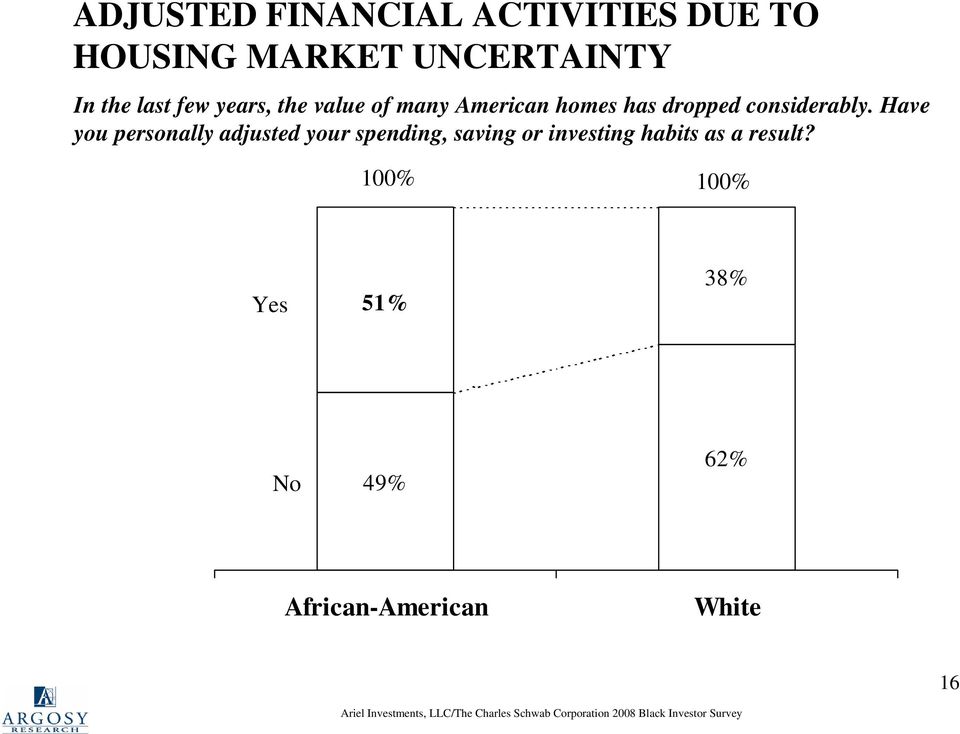
16 ADJUSTED FINANCIAL ACTIVITIES DUE TO HOUSING MARKET UNCERTAINTY In the last few years, the value of many American homes has dropped considerably. Have you personally adjusted your spending, saving or investing habits as a result? Yes No
17 GOAL FOR SAVINGS AND INVESTING Of the following, which would you say is your most important goal in saving or investing money? To leave money to your children or heirs To obtain a better lifestyle To be prepared for an emergency or future need To send children to college For retirement

18 ANTICIPATED AGE OF RETIREMENT At what age are you planning to retire? Base: Not retired 70 or older Before Don t plan to retire Average Retirement Age 60 years old 63 years old 18

19 ANTICIPATED AGE OF RETIREMENT BY CURRENT AGE At what age are you planning to retire? Base: Not retired Under 50 years old Age 50 or older Retire by age Retire by age Retire after age Retire after age

20 PERCEPTIONS OF INCOME NEEDED TO MAINTAIN CURRENT LIFESTYLE When you retire, what percentage of your household income do you think you will need in order to keep your standard of living similar to what it is now? Would you say it would be closest to about? Base: Not retired More than

21 DEFINED BENEFIT/CONTRIBUTION PLAN PARTICIPATION Do you have any defined benefit retirement plans, either with a current or former employer? Does your employer provide you with the option to save some of your earnings in a defined contribution plan? And do you participate in this plan? DB Plan Participation DC Plan Participation Yes Yes No No 9 10 Employer offers DC plan
22 CURRENT DEFINED CONTRIBUTION PLAN HISTORY How many years ago did you first start participating in this plan? About how much money in total have you accumulated so far in this DC plan? Number of Years Participating Assets Accumulated in DC Plan 21+ years years 6-10 years 3-5 years Less than 2 years $100,000+ $50,000- $99,999 $25,000- $49,999 $5,000- $24,999 Less than $5, Average 12 years 11 years Median $32,000 $40,000 22
23 MONTHLY RETIREMENT ACCOUNT CONTRIBUTIONS How much money are you investing per month in any sort of retirement account, including an employer sponsored retirement plan? Base: Employed and have money in a retirement plan >$500 per month $ $ $ $ <$50 10 Nothing at this time Mean monthly amount $262 $331 Median $169 $249 23
24 INCENTIVES TO INVEST ADDITIONAL ASSETS IN EMPLOYER S DC PLAN For each of the following scenarios, please tell me if it would encourage you to invest more money in your employer s defined contribution plan? Base: Not retired African- American Employer offered a better match Employer offered a salary increase and suggested it go to retirement Employer offered free one-on-one consultations with FA Employer offered seminars to learn more about investing for retirement DC plan offered special investing options (e.g., minority-owned funds) Employer allowed for loans when needed Employer provided more education about retirement plan
25 DEFINED CONTRIBUTION PLANS FROM FORMER EMPLOYERS Do have any defined contribution plans from former employers? And about how much money in total do you currently have in these defined contribution retirement plans? DC Plans from Former Employers Assets Held in Former DC Plans Yes No $100,000+ $50,000- $99,999 $25,000- $49,999 $5,000- $24,999 Less than $5, Median $45,000 $89,000 25
26 ACTIONS TAKEN WITH DC PLAN ASSETS Have you ever? Base: Not retired Rolled over money from a DC plan to another retirement account Took out a loan and paid it back Cashed out all or part of assets permanently with a penalty
27 IRA OWNERSHIP Do you have any Individual Retirement Accounts, commonly known as IRAs? About how much money in total do you currently have in IRAs? African- American Have an IRA Total Assets Held in IRA $100, Yes $50,000- $99,999 $25,000- $49, No $5,000- $24,999 Less than $5, Median: $28,000 $44,000 27
28 TOTAL ASSETS HELD IN RETIREMENT PLANS Thinking about all the various retirement plans we have talked about, what would you say is the total amount of money you currently have saved specifically for retirement? African- American $500, $200,000 - $499, $100,000 - $199, Median assets held in retirement plans: $53K $114K $50,000 - $99, Less than $50,
29 RETIREMENT SAVINGS HELD OUTSIDE PLANS Apart from any of the retirement plans we ve already talked about, do you have any other savings earmarked specifically for retirement? And what form do these additional retirement savings take? African- American Hold Retirement Assets Outside Retirement Accounts Additional Retirement Assets Held in Life Insurance Yes Investment Accounts Real Estate No Cash or equivalent Other
30 DEGREE OF INVOLVEMENT MONITORING RETIREMENT PLAN ACCOUNTS When you receive a retirement account statement, do you usually? And about how often do you review the investment in any or all of your retirement accounts? Reviewing Retirement Account Statements How Often Review Retirement Plan Statements Never 3 3 Review it carefully Annually Quarterly Take a quick look Monthly Disregard it 7 5 Weekly
31 DEMOGRAPHICS 31
32 DEMOGRAPHIC/FINANCIAL PROFILE GENDER African- American Male Female AGE African- American Mean Median 47 52_ EDUCATION African- American Some HS or less 5 1 HS graduate Some college College graduate Postgraduate study HOUSEHOLD INCOME African- American $50,000-74, $75,000-99, $100, , $150, , Over $250, Mean $107K $119K Median $82K $94K EMPLOYMENT STATUS African- American TYPE OF EMPLOYER (of those employed) African- American Business Government Not-for-profit Employed full time* Retired Employed part-time* 6 6 Unemployed 4 2 Homemaker 2 8 Full-time student 1 1 *Of these, 21 of s and 27 of s are self-employed. 32
33 DEMOGRAPHIC/FINANCIAL PROFILE (CONTINUED) MARITAL STATUS African- American Single/never married 25 9 Not married/living together 3 3 Married Divorced/separated Widowed African- American 14 4 VALUE OF SAVINGS AND INVESTMENTS (ex. real estate) >$1,000, $500,00-$999, $250,000-$499, $100,000-$249, $50,000-$99,999 $25,000-$49,999 $5,000-$24,999 <$5,000 Mean Median $225K $75K $367K $156K 6 3 NON-SPOUSE ADULTS IN HOME African- American Other adults present No other adults present MONTHLY SAVINGS/INVESTMENTS African- American $2, $1,001-$2, $501-$1, $351-$ $201-$350 $101-$200 $51-$100 <$50 Nothing at this time Mean Median $507 $ $599 $338 33
Saving and Investing Among Higher Income African-American and White Americans
 The Ariel Investments 2010 Black Investor Survey: Saving and Investing Among Higher Income African-American and Americans July 21, 2010 1 For further information, contact Merrillyn J. Kosier at Ariel Investments
The Ariel Mutual Funds/Charles Schwab & Co., Inc. Black Investor Survey. Saving and Investing Among High Income African-American and White Americans
 The Ariel Mutual Funds/Charles Schwab & Co., Inc. Black Investor Survey: Saving and Investing Among High Income African-American and Americans April, 2000 0 Prepared for Ariel Mutual Funds and Charles
2/3 81% 67% Millennials and money. Key insights. Millennials are optimistic despite a challenging start to adulthood
 2/3 Proportion of Millennials who believe they will achieve a greater standard of living than their parents 81% Percentage of Millennials who believe they need to pay off their debts before they can begin
Financial Experience & Behaviors Among Women
 Financial Experience & Behaviors Among Women 2010 2011 Prudential Research Study TENTH ANNIVERSARY E D I T I O N A report prepared by Prudential Research 0182849-00001-00 Acknowledgment A Decade of Progress
MMI Omnibus Survey. Homeownership. Top-Line Results and Suggested Story Lines
 MMI Omnibus Survey Homeownership Top-Line Results and Suggested Story Lines Methodology: Cynapsus and Money Management International (MMI) developed a series of questions on the topic of homeownership,
SOCIETY OF ACTUARIES THE AMERICAN ACADEMY OF ACTUARIES RETIREMENT PLAN PREFERENCES SURVEY REPORT OF FINDINGS. January 2004
 SOCIETY OF ACTUARIES THE AMERICAN ACADEMY OF ACTUARIES RETIREMENT PLAN PREFERENCES SURVEY REPORT OF FINDINGS January 2004 Mathew Greenwald & Associates, Inc. TABLE OF CONTENTS INTRODUCTION... 1 SETTING
2013 Survey of Owners of Individual Annuity Contracts
 2013 Survey of Owners of Individual Annuity Contracts Conducted by The Gallup Organization and Mathew Greenwald & Associates for The Committee of Annuity Insurers 2013 SURVEY OF OWNERS OF INDIVIDUAL ANNUITY
Boomer Expectations for Retirement 2015. Fifth Annual Update on the Retirement Preparedness of the Boomer Generation
 Boomer Expectations for Retirement 2015 Fifth Annual Update on the Retirement Preparedness of the Boomer Generation April 2015 About the Insured Retirement Institute: The Insured Retirement Institute (IRI)
FINANCIAL EXPERIENCE & BEHAVIORS AMONG WOMEN
 FINANCIAL EXPERIENCE & BEHAVIORS AMONG WOMEN 2012-2013 Prudential Research Study FINANCIAL EXPERIENCE & BEHAVIORS AMONG WOMEN 1 FOREWORD Many of the fundamental changes in the lives and experiences of
2015 Wells Fargo Retirement Study
 2015 Wells Fargo Retirement Study Table of contents Overview 1 Key findings 2 Background and methodology 8 Harris Poll conducted the survey online of 1,993 affluent investors, ages 30 75 who have $250,000
2 nd Annual CAP Member Research
 2 nd Annual CAP Member Research Presented by: Tricia Benn Director of Research, Business and Professional Research Group Rogers Publishing October, 2007 Agenda Summary Of Findings Methodology Demographic
2014 Wells Fargo Millennial Study
 2014 Wells Fargo Millennial Study Overview Table of contents Overview 1 Key findings 2 Background and methodology 7 The contents of this report are for information purposes only. They should not be construed
Investment Company Institute and the Securities Industry Association. Equity Ownership
 Investment Company Institute and the Securities Industry Association Equity Ownership in America, 2005 Investment Company Institute and the Securities Industry Association Equity Ownership in America,
INVESTING IN YOURSELF
 Investment Planning INVESTING IN YOURSELF Women are different from men. So are your financial planning needs. 2 INVESTING IN YOURSELF WOMEN & MONEY There are many reasons why you might require a different
2012 HOUSEHOLD FINANCIAL PLANNING SURVEY
 2012 HOUSEHOLD FINANCIAL PLANNING SURVEY A Summary of Key Findings July 23, 2012 Prepared for: Certified Financial Planner Board of Standards, Inc. and the Consumer Federation of America Prepared by: Princeton
401(k) PARTICIPANTS AWARENESS AND UNDERSTANDING OF FEES
 401(k) PARTICIPANTS AWARENESS AND UNDERSTANDING OF FEES February 2011 401(k) PARTICIPANTS AWARENESS AND UNDERSTANDING OF FEES February 2011 Copyright 2011 AARP Research & Strategic Analysis 601 E Street,
Affluent Insights Survey
 Merrill Lynch Global Wealth Management E X A M I N I N I N G T H E V A L U E S, F I N A N C I A L P R I O R I T I E S A N D C O N C E R N S O F A F F L U E N T A M E R I C A N S ABOUT THE AFFLUENT INSIGHTS
AFRICAN AMERICAN FINANCIAL EXPERIENCE
 The AFRICAN AMERICAN FINANCIAL EXPERIENCE 2015-16 Prudential Research Foreword It has been four years since Prudential released the findings of our first African American Financial Experience survey, and
Online Survey of Employees Without Workplace Retirement Plans
 Online Survey of Employees Without Workplace Retirement Plans Report of Findings Conducted for: State of California October 2015 Prepared by Greenwald & Associates 2015 1 Table of Contents Methodology
WOMEN S PERSPECTIVES ON SAVING, INVESTING, AND RETIREMENT PLANNING
 WOMEN S PERSPECTIVES ON SAVING, INVESTING, AND RETIREMENT PLANNING 1 WOMEN S PERSPECTIVES ON SAVING, INVESTING, AND RETIREMENT PLANNING November 2015 Insured Retirement Institute 2 WOMEN S PERSPECTIVES
INVEST IN YOURSELF FINANCIAL PLANNING FOR WOMEN
 INVEST IN YOURSELF FINANCIAL PLANNING FOR WOMEN When They Engage a Financial Advisor, Women Want I To forge relationships based on trust, I To be sure that discussions of their needs and goals will be
Americans Attitudes Toward Life Insurance
 Americans Attitudes Toward Life Insurance Survey Findings (General U.S. Adult Population) May, 2008 Products and services offered through the ING family of companies Methodology Methodology Telephone survey
Boomer Expectations for Retirement 2014: Fourth Annual Report on the Retirement Preparedness of the Boomer Generation
 Boomer Expectations for Retirement 214: Fourth Annual Report on the Retirement Preparedness of the Boomer Generation April 214 About the Insured Retirement Institute: The Insured Retirement Institute (IRI)
THE ASSOCIATED PRESS-CNBC INVESTORS SURVEY CONDUCTED BY KNOWLEDGE NETWORKS
 1350 Willow Rd, Suite 102 Menlo Park, CA 94025 www.knowledgenetworks.com Interview dates: August 26 September 08, 2010 Interviews: 1,035 adults who own stocks, bonds or mutual funds Sampling margin of
U.S. Investors & The Fiduciary Standard. A National Opinion Survey September 15, 2010
 U.S. Investors & The Fiduciary Standard A National Opinion Survey September 15, 2010 Methodology The ORC/Infogroup survey was conducted August 19-23, 2010 among a sample of 2,012 adults comprising 1,007
On average, young retirees are not
 How Financially Secure Are Young Retirees and Older Workers? FIGURE 1 Financial Status of People Age 51 to 59, by Work Status THOUSS OF DOLLARS 14 1 8 6 $82 RETIREES WORKERS $99 4 $41 $24 MEDIAN MEDIAN
The 2014 Retirement Confidence Survey: Confidence Rebounds for Those With Retirement Plans
 March 2014 No. 397 The 2014 Retirement Confidence Survey: Confidence Rebounds for Those With Retirement Plans By Ruth Helman, Greenwald & Associates; and Nevin Adams, J.D., Craig Copeland, Ph.D., and Jack
Advisor Value A Voya Retirement Research Institute Study quantifies the benefits of working with a financial advisor
 Advisor Value A Voya Retirement Research Institute Study quantifies the benefits of working with a financial advisor In the Voya Retirement Revealed1 study of 4,050 working Americans, just 28% of study
16 th Annual Transamerica Retirement Survey Influences of Educational Attainment on Retirement Readiness
 th Annual Transamerica Retirement Survey Influences of Educational Attainment on Retirement Readiness August 0 TCRS 0--0 Transamerica Institute, 0 Welcome to the th Annual Transamerica Retirement Survey
Investment Company Institute Research In Brief
 Fundamentals Investment Company Institute Research In Brief Vol. 9 / No. July 000 0 H Street, NW Suite 00 Washington, DC 0005 0/6-5800 www.ici.org Mutual Fund Shareholders Use of the Internet M utual fund
2015 Wells Fargo Affluent Investor Survey
 2015 Wells Fargo Affluent Investor Survey Table of contents Overview 1 Key findings 2 Background and methodology 8 Harris Poll conducted the survey online of 1,993 affluent investors, ages 30 75 who have
Equity Ownership in America
 Equity Ownership in America Investment Company Institute and the Securities Industry Association Equity Ownership in America Fall 999 Investment Company Institute and the Securities Industry Association
Women, Retirement and Advisors. Concerned About Meeting Retirement Expectations, Female Boomers Seek Expert Advice
 Women, Retirement and Advisors Concerned About Meeting Retirement Expectations, Female Boomers Seek Expert Advice September 2011 About the Insured Retirement Institute: The Insured Retirement Institute
Americans Current Views on Smoking 2013: An AARP Bulletin Survey
 Americans Current Views on Smoking 2013: An AARP Bulletin Survey November 2013 Americans Current Views on Smoking 2013: An AARP Bulletin Survey Report Prepared by Al Hollenbeck, Ph.D. Copyright 2013 AARP
A Guide to Planning for Retirement INVESTMENT BASICS SERIES
 A Guide to Planning for Retirement INVESTMENT BASICS SERIES It s Never Too Early to Start What You Need to Know About Saving for Retirement Most of us don t realize how much time we may spend in retirement.
The LearnVest Personal Finance Review
 The LearnVest Personal Finance Review Financial Goals of 2015 The LearnVest Personal Finance Review examines and explores how people nationwide approach their money. 1 LearnVest is a program for your money.
A Guide to. Planning for Retirement INVESTMENT BASICS SERIES
 A Guide to Planning for Retirement INVESTMENT BASICS SERIES It s Never Too Early to Start What You Need to Know About Saving for Retirement Most of us don t realize how much time we may spend in retirement.
The LGBT FinanciaL experience. 2012-2013 Prudential Research Study
 The LGBT FinanciaL experience 2012-2013 Prudential Research Study FOREWORD The LGBT Financial Experience Over the last decade, many companies have paid increasing attention to the Lesbian, Gay, Bisexual
Participant Preferences in Target Date Funds: Fresh Insights
 Participant Preferences in Target Date Funds: Fresh Insights Findings, Insights and Opportunities White Paper January 216 Research by Voya Investment Management Not FDIC Insured May Lose Value No Bank
HART RESEARCH ASSOCIATES Study #11127--page 1
 HART RESEARCH ASSOCIATES Study #11127--page 1 1724 Connecticut Avenue, NW Interviews: 1,355 adults Washington, DC 20009 Dates: April 8-14, 2014 (202) 234-5570 FINAL Study #11127 48 Male 52 Female [109]
Long-Term Care Insurance:
 The Prudential Insurance Company of America 2011 Long-Term Care Insurance: A Piece of the Retirement & Estate Planning Puzzle IRA Pension 401(k) Annuities Long-Term Care Insurance Life Insurance Social
The Voya Retire Ready Index TM
 The Voya Retire Ready Index TM Measuring the retirement readiness of Americans Table of contents Introduction...2 Methodology and framework... 3 Index factors... 4 Index results...6 Key findings... 7 Role
Home Equity as a Source of Retirement Income February 2013
 Home Equity as a Source of Retirement Income February 2013 Written by Edwin L. Weinstein, PhD The Brondesbury Group, Toronto, ON 2013 The Brondesbury Group Home Equity as a Source of Retirement Income
RETIREMENT ACCOUNTS (c) Gary R. Evans, 2006-2011, September 24, 2011. Alternative Retirement Financial Plans and Their Features
 RETIREMENT ACCOUNTS (c) Gary R. Evans, 2006-2011, September 24, 2011. The various retirement investment accounts discussed in this document all offer the potential for healthy longterm returns with substantial
The FPA and Ameriprise Value of Financial Planning study: Consumer Attitudes and Behaviors in a Changing Economy
 The FPA and Ameriprise Value of Financial Planning study: Consumer Attitudes and Behaviors in a Changing Economy Conducted by Harris Interactive Consumer confidence is near historic lows, yet one group
International Retirement Security Survey
 International Retirement Security Survey July 00 (Copyright 00 by AARP. All rights reserved.) www.harrisinteractive.com [email protected] Table of Contents I. Background and Objectives II. III.
INVESTMENT COMPANY INSTITUTE RESEARCH IN BRIEF
 Fundamentals INVESTMENT COMPANY INSTITUTE RESEARCH IN BRIEF Vol. 9 / No. 6 November 000 40 H Street, NW Suite 00 Washington, DC 0005 0/6-5800 www.ici.org Copyright 000 by the Investment Company Institute
2014 MILLENNIALS RESEARCH STUDY
 2014 MILLENNIALS RESEARCH STUDY In response to interest about the financial needs and challenges of younger employees, Voya Financial conducted an online survey among roughly 2000 young adults aged 20-34
Alternative Retirement Financial Plans and Their Features
 RETIREMENT ACCOUNTS Gary R. Evans, 2006-2013, November 20, 2013. The various retirement investment accounts discussed in this document all offer the potential for healthy longterm returns with substantial
Study into the Sales of Add-on General Insurance Products
 Study into the Sales of Add-on General Insurance Quantitative Consumer Research Report Prepared For: Financial Conduct Authority (FCA) March, 2014 Authorised Contact Persons Frances Green Research Director
Findings. Who Buys Long-Term Care Insurance in 2010 2011?
 Findings Who Buys Long-Term Care Insurance in 2010 2011? America s Health Insurance Plans Who Buys Long-Term Care Insurance in 2010-2011? is a twenty year study of the long-term care insurance marketplace
2015 REPORT ON U.S. PHYSICIANS FINANCIAL PREPAREDNESS:
 2015 REPORT ON U.S. PHYSICIANS FINANCIAL PREPAREDNESS: Women Physicians Segment Start Here 2015 AMA Agency, Inc. a subsidiary of the American Medical Association Introduction Women are playing an increasingly
How To Be Financially Successful
 Employee Financial Wellness Survey 2015 results April 2015 Retirement Employer benefits Financial stress Investing Cash and debt management Risk management About this survey PwC s Employee Financial Wellness
UBS Investor Watch. What is wealthy? Top insights: Analyzing investor sentiment and behavior 3Q 2013
 UBS Investor Watch Analyzing investor sentiment and behavior 3Q 2013 What is wealthy? Top insights: 1. Wealth equals no financial constraints on activities 2. Cash is still king 3. Investors control risk
Study of International Employee Benefits Trends. United Kingdom
 Study of International Employee Benefits Trends United Kingdom From its core to its outer edges a flower s petals transition from tight and unyielding to open and inviting. So goes the current state of
Wealthy Consumers and Real Estate
 Wealthy Consumers and Real Estate Custom Research for Coldwell Banker Previews International Table of Contents Topic Slide # Research Notes and Methodology 3 Key Findings 7 Survey Results Real Estate Profile
Retirement Planning: A Changing Dynamic. Investors Turn to Advisors for Help
 Retirement Planning: A Changing Dynamic Investors Turn to Advisors for Help August 2014 About the Insured Retirement Institute: The Insured Retirement Institute (IRI) is the leading association for the
Individual Retirement Plans Investor guide to traditional and Roth IRAs. Individual Retirement Plans: Investor Guide
 Individual Retirement Plans Investor guide to traditional and Roth IRAs a Individual Retirement Plans: Investor Guide Individual Retirement Plans An individual retirement plan may be a beneficial addition
_ Retirement. Planning for the Stages of. Getting started Your 20s and early 30s
 Planning for the Stages of _ Retirement _ Retirement is being reinvented. It s no longer our parent s retirement. Social Security alone w o n t see us through retirement, especially for higher income earners.
Life Insurance: Myths and Reality
 Life Insurance: Myths and Reality While some misconceptions remain prevalent, consumers are beginning to understand the complete value of life insurance. A report from the 2012 myworth Survey sponsored
RETIREMENT ACCOUNTS. Alternative Retirement Financial Plans and Their Features
 RETIREMENT ACCOUNTS The various retirement investment accounts discussed in this document all offer the potential for healthy longterm returns with substantial tax advantages that will typically have the
Planning for the Stages of Retirement
 Planning for the Stages of Retirement The Financial Planning Association (FPA ) connects those who need, support and deliver financial planning. We believe that everyone is entitled to objective advice
The following questions pertain to consumer views about money and investing.
 Millennial and Baby Boomer Investors Survey: Data Report Securian Financial Group June 2016 The following questions pertain to consumer views about money and investing. 1. Do you have investments outside
Working with an advisor: Improved Retirement Savings, Financial Knowledge and Retirement Confidence! Your future. Made easier.
 I N S I G H T S F R O M Working with an advisor: Improved Retirement Savings, Financial Knowledge and Retirement Confidence! ING research highlights the value of working with a financial advisor > People
LIFE INSURANCE OVERVIEW
 LIFE INSURANCE OVERVIEW Most people think of life insurance in terms of death benefit protection. However, today s policies also provide the vehicles for meeting other goals, such as saving for retirement
Participant Behavior Insight
 T. Rowe Price Participant Behavior Insight How Participants Are Using Target-Date Funds Brought to you by Jodi DiCenzo, CFA, Behavioral Research Associates, LLC. 1 Retirement Research Executive Summary
A FIVE-STEP CHECKLIST FOR RETIREMENT INCOME PLANNING
 77 Access Road, Suite 6, Norwood, MA 02062 Tel (781) 278-9488 Fax (781) 278-9489 www.proficientwealth.com A FIVE-STEP CHECKLIST FOR RETIREMENT INCOME PLANNING STEP 1 Expense Inventory Estimate monthly
JPMorgan INVEST. You work hard for your money. Now keep it working for you with a JPMorgan Invest IRA. IRA Decision Guide
 IRA Decision Guide JPMorgan INVEST You work hard for your money. Now keep it working for you with a JPMorgan Invest IRA. JPMorgan Invest One Beacon Street, Boston, MA 0208 (800) 776-606 jpmorganinvest.com
Society of Actuaries Middle Market Life Insurance Segmentation Program (Phase 1: Young Families)
 Society of Actuaries Middle Market Life Insurance Segmentation Program (Phase 1: Young Families) September 2012 Sponsored By: SOA Marketing and Distribution Section SOA Product Development Section SOA
Things To Do Before Investing
 Basics of Investing Things To Do Before Investing Pay off credit card debt! No investment pays as much as credit card companies charge Build an emergency fund Consider your goals Timeline How soon will
Finding the Links Between Retirement, Stress, and Health
 Finding the Links Between Retirement, Stress, and Health LOCKTON RETIREMENT SERVICES One in five workers reports feeling high levels of stress, and the top two drivers for this are economic: their jobs
EXPLORING YOUR IRA OPTIONS. Whichever you choose traditional or Roth investing in an IRA is a good step toward saving for retirement.
 EXPLORING YOUR IRA OPTIONS Whichever you choose traditional or Roth investing in an IRA is a good step toward saving for retirement. 2 EXPLORING YOUR IRA OPTIONS Planning for retirement can be a challenging
CREATE TAX ADVANTAGED RETIREMENT INCOME YOU CAN T OUTLIVE. create tax advantaged retirement income you can t outlive
 create tax advantaged retirement income you can t outlive 1 Table Of Contents Insurance Companies Don t Just Sell Insurance... 4 Life Insurance Investing... 5 Guarantees... 7 Tax Strategy How to Get Tax-Free
Retirement: Get Ready...1 Why planning makes sense...1 Where are you?...2 Getting Started: 20 s and early 30 s...3
 Retirement: Get Ready...1 Why planning makes sense...1 Where are you?...2 Getting Started: 20 s and early 30 s...3 On Your Way: Mid-30 s to early 40 s...4 Crunch Time: Mid-40 s to early 50 s...5 Just Around
Traditional and Roth IRAs. Invest for retirement with tax-advantaged accounts
 Traditional and Roth IRAs Invest for retirement with tax-advantaged accounts Your Retirement It is your ultimate reward for a lifetime of hard work and dedication. It is a time when you should have the
SalarieS of chemists fall
 ACS news SalarieS of chemists fall Unemployment reaches new heights in 2009 as recession hits profession hard The economic recession has taken its toll on chemists. Despite holding up fairly well in previous