
Towards a Lightweight User-Centered Content Syndication Architecture
|
|
|
- Cameron Sims
- 9 years ago
- Views:
Transcription
1 Towards a Lightweight User-Centered Content Syndication Architecture Vanda Lehel, Florian Matthes, Sheng Wei Technische Universität München Lehrstuhl Software Engineering betrieblicher Informationssysteme Boltzmannstrasse Garching bei München {lehel, matthes, weis}@in.tum.de Abstract: This paper gives a structural overview of social software and its use for content aggregation and publication. We then extend this view to a user-centered perspective. We propose a lightweight XML-based content syndication architecture. It supports bidirectional information flow, as a proper extension and unification mechanism to facilitate the usage of several social software systems at once. Finally, we discuss benefits and limitations of this architecture. 1 Introduction and Motivation Social software is a newly emerging class of community systems that allows individuals to form different communities to connect or to collaborate with each other based on their social context, and it effectively helps to facilitate interaction and collaboration among individuals [Burg05]. XML is widely used in social software due to its strengths, especially for networking, e.g. XML can be the major network payload and XML is the essential part of most related communication protocols [MD04]. In contrast to centralized systems like enterprise portals, the use of social software implies the membership of a user on different community platforms in several social contexts. This results in a distributed architecture of all personally published and available information. For accessing this information, many XML-based protocols and proprietary formats for content syndication and information exchange are used. Unfortunately there is a lack of a unified mechanism to interoperate with different community systems. Therefore it is difficult to achieve a user-centered integrated view on all available information. We address this problem by proposing in this paper an emerging form of information collecting, sharing and publishing that is also referred to as a user-centered social software system with an appropriate content syndication architecture. In chapter 2, we present the fundamental concepts of the relevant kinds of social software systems and the XML-technologies they use. We then introduce the idea of user-centered social software in chapter 3. Chapter 4 explains our approach for an XMLbased lightweight content syndication architecture and discusses it by means of current

2 popular social software-related technologies. The paper concludes with a discussion of the benefits and limitations and an outlook on future research work. 2 Fundamental Concepts and XML-Technologies of Social Software The use of XML-technologies has been established for several purposes in representing and exchanging resources managed by social software. In the succeeding sections, relevant concepts and functions of different kinds of social software, i.e. weblogs, social networking services, and object-centered social software are explained along with their related XML-technologies. Weblogging is a common practice in social software to publish personal knowledge and information on the Web displayed in reverse chronological order as illustrated in [LMS03]. Its popularity results from the quality content and the immediate reflection of ownership to postings and comments in them in spite of the absence of centralized control [Paqu03]. Weblog-related technologies also foster selective syndication of published content and social networking among people. RSS is an XML news syndication format [RSS05] for the exchange of different content, like postings and comments of a weblog. With RSS Enclosure, multimedia content can be embedded in the items as well. By subscribing to RSS feeds, users can remain up-todate about the latest content by notification mechanisms. To link together related content from different systems, pingback [Ping05] and trackback provide mechanisms for the owner of a weblog to be notified about comments to his weblog in external systems. Social networking services provide the opportunity to explicitly build up and manage contact relationships between individuals on a community platform to achieve viewing the path of indirect contacts. Well-established examples of social networking services are Linkedln [Link05] and OpenBC [Open05], both widely used for managing business contacts. However, information exchange and collaboration between different communities are difficult to achieve. An approach to address this problem is the XMLbased FOAF [FOAF05] format to represent relationships between contacts and thereby describe the structure of the social network of an individual. Object-centered social software is another class of online community platforms that focuses on allowing users to store, categorize and share a personal collection of objects. In contrast to taxonomic classification, freely chosen keywords (tags) are used as shared metadata and context information for collaborative categorization [HHLS05]. Widely adopted communities are Del.icio.us [Deli05] for bookmark sharing and CiteULike [Cite05] for bibliographic reference sharing, where people are grouped around shared objects. 3 User-Centered Social Software Based on social software we propose an extension of personal information management (PIM) with an emphasis on social community platforms. Therefore, we define the new class of user-centered social software as a client software for organizing information in

3 a social way, that is in the social context of a user. We call this kind of client software a social organizer. In figure 1, a view on user-centered social software as an extension of PIM is shown. There, we depict a three-faceted view of content, context and contact that are managed using individual desktop tools, like text editing and image editing tools, feed readers or clients. collect give feedback organize learn Desktop Search: Search, Preview share get feedback Text Files RSS Items Address Book Entry Bibliographic References Web History Instant Messages Notes Content Image Files RSS Feedback Calendar Items Favorites & Statistics Audio Files s Video Files Attachments Context Folders & Metadata Tags & Categories Folders & Categories Keywords Links Tags Contact Offline/ Shared Folder Windows Passwords RSS Subscriptions Access Rights Author Names Web Passwords Web Cookies Buddies Contacts Trusted Domains Figure 1: User-Centered Social Software as an Extension of Personal Information Management Content is defined as the collection of different types of personal information objects like text and image files, address book entries and s or instant messages. We distinguish between private content on the user s personal device (e.g. s, personal documents) and content published on social software systems (e.g. postings, citations). By contact, we consider different individuals who are mainly peers in the social context of the user with whom he is sharing his personal information, e.g. RSS subscribers or buddies. The context links together content and contacts and thus defines how these objects are shared, most commonly either by shared folders or by shared categorization. When users publish and share their content, the context travels with the content in the information flow. PIM tools like desktop search engines already support processes like searching or previewing by integrating content objects from different application silos. Building on this successful approach, we propose to support processes for bidirectional information flow as follows (see fig. 1): Collecting content accessible through the social networks of a user. Organizing content based on the social networks and shared contexts of a user. Sharing content and contexts in a controlled way with selected contacts. Learning from received feedback and providing feedback to strengthen personal networks. Further, we propose to consider semi-structured notes as a new kind of content objects, since in social software content is often represented by small fragments of information instead of complete digital documents like postings (see chapter 2) or annotations. The context in social software is built up from shared links and tags.

4 4 An XML-based User-Centered Content Syndication Architecture Syndication represents a publish/subscribe mechanism, where the server (publisher) publishes the syndicated content (or feed) in standard formats for clients (subscribers). This syndicated content can contain both the content itself and related metadata. Syndication generally establishes an asynchronous multicast communication in which servers use push strategy to provide content, whereas RPC is based on synchronous and unicast communication in which clients use pull strategy to retrieve content. Therefore, a syndication architecture is a software architecture that models the information flows of such subscription services. In this chapter, we introduce our approach for a distributed content syndication architecture for user-centered social software. 4.1 Syndication Architecture for User-Centered Social Software User-centered social software integrates available ad-hoc services and technologies to facilitate interaction and collaboration of existing social software systems. Figure 2 clarifies the related distributed content syndication architecture. The social organizer in the middle is designed to let individuals manage all their information on local personal devices and social software systems uniformly. It acts as a universal information client that focuses on collecting personal information, effectively organizing information objects and their relationships, and publishing and sharing information in a controlled way. It can connect to several services at the same time for different purposes (e.g. content publication, information search). Therefore, the diversity of the underlying applications and services is transparent to the user, and barriers preventing individuals from using multiple resource locations are eliminated. <<HTTP>> <<HTTP>> S1 <<Desktop>> Sn+1 Social Organizer S2 Inbox Outbox Sn+2 Content Personal Information Repository Context Contact Sn Sm Figure 2: Distributed Content Syndication Architecture for User-Centered Social Software The social software services on the left represent external content sources of social organizers. By using different XML-based open formats and protocols, they offer different services such as subscription and feedback services. Therefore, users of a social organizer can retrieve the published content and provide feedback to content residing on that server. The social software services on the right act as content sinks of a social organizer which provide services like publication and administration. In this way, users of social organizers can publish and share their information in several communities. Users can create shared context information which is expressed using a shared

5 vocabulary for the available content, e.g. interests, topics, goals. When the user shares and publishes content with his social organizer, the context travels with the content in the information flow to the related social software system. The inbox component of the social organizer (see fig. 2) is responsible for connecting subscription services to pull and filter out content and feedback information from community systems, while the outbox component supports publishing and sharing of information. Finally, HTTP is considered as the de facto communication standard. 4.2 s We have introduced social software and its related technologies in chapter 2. For a better understanding of the information flows between the social organizer and social software systems, we classify all currently available social software services into four categories in figure 3. In this diagram, content producers of social software systems are located on the left, while consumers can be found on the right. Producers and consumers can be either individuals or social organizers as their representatives. Content publishing (Blogger API, Atom API) Link publishing Tag publishing Administration with proprietary API (Flickr API, Atom API) Publication Management Social Software Subscription Feedback Content feed (RSS, Atom, RSS enclosure) Comment feed (RSS, Atom) Tag feed (RSS, Atom) Related content (OPML, FOAF) Content notification (Ping) Local Comments (Comment API) Remote Comments, (Trackback, Pingback) Comment notification, (Trackback, Pingback) Figure 3: Classification of s Publication services: Social software systems act as centralized systems that collect information from individuals. Publication services with related APIs are used to publish content and the related context information, e.g. weblogs, links, tags. Subscription services: Subscription services offer syndicated up-to-date or complete content in different standard feed formats, e.g. RSS or Atom, for clients to subscribe. These feeds represent a filtered view or organization of the content and can be distinguished as content feed, comment feed, tag feed, etc. Beyond that, systems can provide other related content, e.g. list of favorite weblogs of a user. Feedback services: Comments to shared content can be given by visitors using different feedback services. For example, local comment services use comment APIs to attach the complete comment to the target content, while remote comments only provide references. Two kinds of remote comment-related services are available: the remote comment service and the comment notification service. Examples of such services are the weblog trackback and pingback functions. Management services: Beyond the aforementioned services, each social software system provides different proprietary APIs for administration purposes (see fig. 3), since no standard exists.

6 In this section, we introduced a high level classification of the services provided by current social software systems. The challenges are that there is no standard for how to provide services, and there are different options for formats, protocols, communication mechanisms and APIs. These problems result in complexity in service implementation and difficulty in exchanging information between different social software systems. User-centered social software uses the bottom-up approach to support currently available services. The social organizer, as a unified information client, has built-in support for common related technologies, standards and protocols. It intelligently selects different wrapper components to interact with different social software services and it changes the adapters when the related service uses different formats and protocols. One social organizer can interact with many services at the same time, and different users have their own organizer to interact with a number of social software services. Thus a controlled, scalable, decentralized and dynamic network is established in the social context of each user. 5 Conclusion In this paper, we propose user-centered social software as an extension of personal information management along with an appropriate XML-based content syndication architecture. In contrast to other information management solutions, user-centered social software creates immediate value to the individual by unifying the view on locally stored personal information and on content available through social networks with advantages of fast and offline information access, server-side services, ownership of information, and controlled sharing. On the other hand, user-centered social software still has some limitations. Unlike online services, the social organizer requires desktop software distribution and the underlying database systems and available GUI toolkits have to be taken into consideration. To support integration with several social software services, proprietary interfaces to desktop applications need to be added as well. References [Burg05] Burg, T.: Einführung zur Social Software, Access: May [Cite05] CiteULike, Access: May [Deli05] Del.icio.us, Access: May [FOAF05]FOAF Specification, Access: June [HHLS05]Hammond, T.; Hannay, T.; Lund, B.; Scott, J.: Social Bookmarking Tools (I): A General Review, D-Lib Magazine 11(4), April [Link05] Linkedin, Access: May [LMS03] Lehel, V.; Matthes, F.; Steinfatt, K. Weblogs als ein innovatives Instrument des betrieblichen Wissensmanagements. Tagungsband der Konferenz Mensch & Computer 2003, Teubner Verlag, Stuttgart, [MD04] Megginson, D: Imperfect XML, Prentice Hall, [Open05] Open Business Club, Access: May [Ping05] Pingback Spec., Access: May [Paqu03] Paquet, S: Socio-technological approaches to facilitating knowledge sharing across disciplines, PhD Dissertation, Université de Montreal, [RSS05] RSS 2.0 Spec., Access: May 2005.

Towards a Lightweight User-Centered Content Syndication Architecture
 Towards a Lightweight User-Centered Content Syndication Architecture - Beyond Personal Information Management - Beyond Closed Community Platforms Berliner XML Tage 2005 13.09.2005 Vanda Lehel, Florian
Lightweight Data Integration using the WebComposition Data Grid Service
 Lightweight Data Integration using the WebComposition Data Grid Service Ralph Sommermeier 1, Andreas Heil 2, Martin Gaedke 1 1 Chemnitz University of Technology, Faculty of Computer Science, Distributed
aloe-project.de White Paper ALOE White Paper - Martin Memmel
 aloe-project.de White Paper Contact: Dr. Martin Memmel German Research Center for Artificial Intelligence DFKI GmbH Trippstadter Straße 122 67663 Kaiserslautern fon fax mail web +49-631-20575-1210 +49-631-20575-1030
Essential New Media Terms
 Affiliate Marketing: A popular marketing technique that partners merchant with website in which the merchant compensates the website based on performance (e.g. referrals). Aggregator: Also referred to
9. Technology in KM. ETL525 Knowledge Management Tutorial Four. 16 January 2009. K.T. Lam [email protected]
 9. Technology in KM ETL525 Knowledge Management Tutorial Four 16 January 2009 K.T. Lam [email protected] Last updated: 15 January 2009 Technology is KM Enabler Technology is one of the Four Pillars of KM, which
Using Social Networking Sites as a Platform for E-Learning
 Using Social Networking Sites as a Platform for E-Learning Mohammed Al-Zoube and Samir Abou El-Seoud Princess Sumaya University for Technology Key words: Social networks, Web-based learning, OpenSocial,
Keeping Current Using RSS Feeds
 Keeping Current Using RSS Feeds What are Current Awareness Services? Current awareness services are tools that enable you to keep up to date with the professional literature in your field of interest.
Simplifying and Empowering the Implementation of Enterprise Mobile Strategy
 mfrontiers white paper November 2013 Enterprise Mobility Management Platform with Simplifying and Empowering the Implementation of Enterprise Mobile Strategy Page 1 of 9 Simplifying and Empowering the
Office SharePoint Server 2007
 Top 10 Benefits of WSS 3.0 Office SharePoint Server 2007 1. Improve team productivity with easy-to-use collaborative tools Connect people with the information and resources they need. Users can create
Social Media Measurement Meeting Robert Wood Johnson Foundation April 25, 2013 SOCIAL MEDIA MONITORING TOOLS
 Social Media Measurement Meeting Robert Wood Johnson Foundation April 25, 2013 SOCIAL MEDIA MONITORING TOOLS This resource provides a sampling of tools available to produce social media metrics. The list
State Records Guideline No 18. Managing Social Media Records
 State Records Guideline No 18 Managing Social Media Records Table of Contents 1 Introduction... 4 1.1 Purpose... 4 1.2 Authority... 5 2 Social Media records are State records... 5 3 Identifying Risks...
Research on the Model of Enterprise Application Integration with Web Services
 Research on the Model of Enterprise Integration with Web Services XIN JIN School of Information, Central University of Finance& Economics, Beijing, 100081 China Abstract: - In order to improve business
Deciding When to Deploy Microsoft Windows SharePoint Services and Microsoft Office SharePoint Portal Server 2003. White Paper
 Deciding When to Deploy Microsoft Windows SharePoint Services and Microsoft Office SharePoint Portal Server 2003 White Paper Published: October, 2003 Table of Contents Introduction 4 Relationship between
A Survey Study on Monitoring Service for Grid
 A Survey Study on Monitoring Service for Grid Erkang You [email protected] ABSTRACT Grid is a distributed system that integrates heterogeneous systems into a single transparent computer, aiming to provide
Social Media Glossary
 Social Media Glossary API An acronym for Application Programming Interface App App Filename An acronym for Application. See also app filename The filename.app indicates that the file is an application
Web 2.0 Tools 2008 Dr. Pyatt
 1. Browser Set-up Background since the tools we are going to use today will be downloaded from the internet, some of which will be integrated into your web-browser, we will need to have a common browser
Extend the value of Microsoft Dynamics ERP with other technology innovations from Microsoft
 Extend the value of Microsoft Dynamics ERP with other technology innovations from Microsoft Combined with these products and technologies, Microsoft Dynamics ERP solutions can help you gain momentum in
Event-based middleware services
 3 Event-based middleware services The term event service has different definitions. In general, an event service connects producers of information and interested consumers. The service acquires events
Lecture Overview. Web 2.0, Tagging, Multimedia, Folksonomies, Lecture, Important, Must Attend, Web 2.0 Definition. Web 2.
 Lecture Overview Web 2.0, Tagging, Multimedia, Folksonomies, Lecture, Important, Must Attend, Martin Halvey Introduction to Web 2.0 Overview of Tagging Systems Overview of tagging Design and attributes
Flattening Enterprise Knowledge
 Flattening Enterprise Knowledge Do you Control Your Content or Does Your Content Control You? 1 Executive Summary: Enterprise Content Management (ECM) is a common buzz term and every IT manager knows it
2- Electronic Mail (SMTP), File Transfer (FTP), & Remote Logging (TELNET)
 2- Electronic Mail (SMTP), File Transfer (FTP), & Remote Logging (TELNET) There are three popular applications for exchanging information. Electronic mail exchanges information between people and file
Microsoft Office 365 from Vodafone. Administrator s Guide for Midsize Businesses and Enterprises
 Microsoft Office 365 from Vodafone Administrator s Guide for Midsize Businesses and Enterprises Contents Footer bar Return to contents page Go to next of section Return to start of section Previous page
CitationBase: A social tagging management portal for references
 CitationBase: A social tagging management portal for references Martin Hofmann Department of Computer Science, University of Innsbruck, Austria [email protected] Ying Ding School of Library and Information Science,
Oracle Business Intelligence Enterprise Edition Plus and Microsoft Office SharePoint Server. An Oracle White Paper October 2008
 Oracle Business Intelligence Enterprise Edition Plus and Microsoft Office SharePoint Server An Oracle White Paper October 2008 Oracle Business Intelligence Enterprise Edition Plus and Microsoft Office
Web project proposal. European e-skills Association
 Web project proposal European e-skills Association LUCISMEDIA WEB DESIGN PROPOSAL CONTENTS Lucismedia... 3 Building enterprise social communities... 3 project objective... 4 Project scope... 6 Interface
Alfresco Online Collaboration Tool
 Alfresco Online Collaboration Tool USER MANUAL BECOMING FAMILIAR WITH THE USER INTERFACE... 4 MY DASHBOARD... 4 MY PROFILE... 6 VIEWING YOUR FULL PROFILE... 6 EDITING YOUR PROFILE... 7 CHANGING YOUR PASSWORD...
Middleware- Driven Mobile Applications
 Middleware- Driven Mobile Applications A motwin White Paper When Launching New Mobile Services, Middleware Offers the Fastest, Most Flexible Development Path for Sophisticated Apps 1 Executive Summary
Semantically Enhanced Web Personalization Approaches and Techniques
 Semantically Enhanced Web Personalization Approaches and Techniques Dario Vuljani, Lidia Rovan, Mirta Baranovi Faculty of Electrical Engineering and Computing, University of Zagreb Unska 3, HR-10000 Zagreb,
TERMS OF REFERENCE. Revamping of GSS Website. GSS Information Technology Directorate Application and Database Section
 TERMS OF REFERENCE Revamping of GSS Website GSS Information Technology Directorate Application and Database Section Tel: Accra 0302 682656 Cables: GHANASTATS In case of reply the number and date of this
SOA, case Google. Faculty of technology management 07.12.2009 Information Technology Service Oriented Communications CT30A8901.
 Faculty of technology management 07.12.2009 Information Technology Service Oriented Communications CT30A8901 SOA, case Google Written by: Sampo Syrjäläinen, 0337918 Jukka Hilvonen, 0337840 1 Contents 1.
Mobile App Framework For any Website
 Mobile App Framework For any Website Presenting the most advanced and affordable way to create a native mobile app for any website The project of developing a Mobile App is structured and the scope of
Cloud Computing. Chapter 2 Software as a Service (SaaS)
 Cloud Computing Chapter 2 Software as a Service (SaaS) Learning Objectives Define and describe SaaS. List the advantages and disadvantages of SaaS solutions. Define and describe OpenSaaS. Define and describe
Ardenwood Elementary School Website and RSS Feeds
 Ardenwood Elementary School Website and RSS Feeds What are RSS Feeds RSS (most commonly translated as "Really Simple Syndication" but sometimes "Rich Site Summary") is a family of web feed formats used
SENSE/NET 6.0. Open Source ECMS for the.net platform. www.sensenet.com 1
 SENSE/NET 6.0 Open Source ECMS for the.net platform www.sensenet.com 1 ABOUT THE PRODUCT: SENSE/NET 6.0 About the product 2 KEY FEATURES Workspaces-based collaboration Document management Office integration
Mobile App Proposal 0-000-000-000. - Magazine company- [email protected]. January 12, y. Direct Contact. Email
 Mobile App Proposal - Magazine company- January 12, y Direct Contact 0-000-000-000 Email [email protected] TABLE OF CONTENTS 1. Introduction 2. Project Overview & Objectives 3. About Newsboard 4. Analytics
Project management integrated into Outlook
 Project management integrated into Outlook InLoox PM 7.x off-line operation An InLoox Whitepaper Published: October 2011 Copyright: 2011 InLoox GmbH. You can find up-to-date information at http://www.inloox.com
RS MDM. Integration Guide. Riversand
 RS MDM 2009 Integration Guide This document provides the details about RS MDMCenter integration module and provides details about the overall architecture and principles of integration with the system.
SWISSVBS LEARNING CLOUD (SLC)
 SWISSVBS LEARNING CLOUD (SLC) OVERVIEW The LMS for the Mobile-Cloud World The SwissVBS Learning Cloud (SLC) is an enterprise-class learning management and analytics platform. It is designed from the ground
Draft Response for delivering DITA.xml.org DITAweb. Written by Mark Poston, Senior Technical Consultant, Mekon Ltd.
 Draft Response for delivering DITA.xml.org DITAweb Written by Mark Poston, Senior Technical Consultant, Mekon Ltd. Contents Contents... 2 Background... 4 Introduction... 4 Mekon DITAweb... 5 Overview of
Salesforce CRM Content Implementation Guide
 Salesforce CRM Content Implementation Guide Salesforce, Winter 16 @salesforcedocs Last updated: December 8, 2015 Copyright 2000 2015 salesforce.com, inc. All rights reserved. Salesforce is a registered
RSS and Content Syndication in the Social Media Environment
 RSS and Content Syndication in the Social Media Environment 1 Table of Contents RSS what it is and what it does Web 2.0 why syndicating your content is necessary What content should you be syndicating?
Frequently Asked Questions for the USA TODAY e-newspaper
 Frequently Asked Questions for the USA TODAY e-newspaper Navigating the USA TODAY e-newspaper A look at the toolbar Toolbar Functions, Buttons, and Descriptions The tab marked Contents will take the e-reader
USER GUIDE Chapter 20 Using Podcasts. Schoolwires Academic Portal Version 4.1
 USER GUIDE Chapter 20 Schoolwires Academic Portal Version 4.1 TABLE OF CONTENTS Introduction... 1 Adding a New Podcast Page... 3 Adding a New Episode... 5 Supported File Types... 5 What is an MP3 File?...
Source Type Definitions
 Source Type Definitions The Jobs2web Referral Engine sorts all of your visitor traffic into a Source Engine, and then categorizes it into a Source Type. Jobs2web has approximately 2,500 Source Engines
Email Subscription vs. RSS:
 Email Subscription vs. RSS: You Decide Cathy Miller Business Writer/Consultant INTRODUCTION We all have our own preferences in how we do things. That s what makes us unique. When you find a blog that you
About This Document 3. Integration and Automation Capabilities 4. Command-Line Interface (CLI) 8. API RPC Protocol 9.
 Parallels Panel Contents About This Document 3 Integration and Automation Capabilities 4 Command-Line Interface (CLI) 8 API RPC Protocol 9 Event Handlers 11 Panel Notifications 13 APS Packages 14 C H A
Managing explicit knowledge using SharePoint in a collaborative environment: ICIMOD s experience
 Managing explicit knowledge using SharePoint in a collaborative environment: ICIMOD s experience I Abstract Sushil Pandey, Deependra Tandukar, Saisab Pradhan Integrated Knowledge Management, ICIMOD {spandey,dtandukar,spradhan}@icimod.org
EQUELLA. One Central Repository for a Diverse Range of Content. www.equella.com
 EQUELLA One Central Repository for a Diverse Range of Content www.equella.com What is EQUELLA? EQUELLA, our web-based platform, provides one central location for the delivery of a diverse range of content
Marketing tools to support university library s mission
 Qualitative and Quantitative Methods in Libraries (QQML) 2: 205 2012, 2012 Marketing tools to support university library s mission Ilona Trtikova 1, 2 and Lenka Nemeckova 1, 2 1 Czech Technical University
Digital Asset Management. Content Control for Valuable Media Assets
 Digital Asset Management Content Control for Valuable Media Assets Overview Digital asset management is a core infrastructure requirement for media organizations and marketing departments that need to
1 Introduction. Rhys Causey 1,2, Ronald Baecker 1,2, Kelly Rankin 2, and Peter Wolf 2
 epresence Interactive Media: An Open Source elearning Infrastructure and Web Portal for Interactive Webcasting, Videoconferencing, & Rich Media Archiving Rhys Causey 1,2, Ronald Baecker 1,2, Kelly Rankin
Subscribe to RSS in Outlook 2007. Find RSS Feeds. Exchange Outlook 2007 How To s / RSS Feeds 1of 7
 Exchange Outlook 007 How To s / RSS Feeds of 7 RSS (Really Simple Syndication) is a method of publishing and distributing content on the Web. When you subscribe to an RSS feed also known as a news feed
The following multiple-choice post-course assessment will evaluate your knowledge of the skills and concepts taught in Internet Business Associate.
 Course Assessment Answers-1 Course Assessment The following multiple-choice post-course assessment will evaluate your knowledge of the skills and concepts taught in Internet Business Associate. 1. A person
North Dakota Legislative Bill Tracking System. User Manual
 North Dakota Legislative Bill Tracking System User Manual Last Updated: December 30, 2014 Table of Contents Introduction... 3 Login... 4 Internet Users... 4 State Agency Users... 5 Legislative Bill Tracking
Intel Retail Client Manager
 Intel Retail Client Manager Frequently Asked Questions June 2014 INFORMATION IN THIS DOCUMENT IS PROVIDED IN CONNECTION WITH INTEL PRODUCTS. NO LICENSE, EXPRESS OR IMPLIED, BY ESTOPPEL OR OTHERWISE, TO
Edline Manual Parents Guide Version: July, 2013
 Edline Manual Parents Guide Version: July, 2013 Copyright Statements: Edline software is a trademark of Blackboard Engage. Copyright 2013. All other trademarks and copyrights are the property of their
Virtual Team Collaboration Glossary
 Virtual Team Collaboration Glossary Steve Prahst, Rhonda Arterberrie, and Dennis Kay Knowledge Management and Collaborative Technologies Branch NASA Glenn Research Center Introduction Most NASA projects
Classic Grid Architecture
 Peer-to to-peer Grids Classic Grid Architecture Resources Database Database Netsolve Collaboration Composition Content Access Computing Security Middle Tier Brokers Service Providers Middle Tier becomes
Information Technology Web Solution Services
 Information Technology Web Solution Services Icetech 940 West North Avenue Baltimore, Maryland 21217 Tel: 410.225.3117 Fax: 410.225.3120 www. Icetech. net Hubzone Copyright @ 2012 Icetech, Inc. All rights
Solution Showcase Session. Enterprise 2.0 Computing Services
 Solution Showcase Session Enterprise 2.0 Computing Services IDEA Lab Competencies Business Solutions Competency Verification and Validation Competency Business Intelligence Competency Managed Services
Alterian Content Manager 7 Digital Asset Management (DAM) capabilities
 Alterian Content Manager 7 Digital Asset Management (DAM) capabilities Published Oct 2011 Content Manager Enterprise Technology Guide Page 1 of 19 Table of Contents 1. The purpose of this document... 3
IBM Lotus Domino Document Manager 6.5.1
 Collaborative document management for the enterprise IBM 6.5.1 Highlights Provides high-value, low-cost Manages documents for document management for IBM Lotus Notes, Microsoft organization-wide applicability
Extracting and Preparing Metadata to Make Video Files Searchable
 Extracting and Preparing Metadata to Make Video Files Searchable Meeting the Unique File Format and Delivery Requirements of Content Aggregators and Distributors Table of Contents Executive Overview...
WEB 2.0 AND SECURITY
 WEB 2.0 AND SECURITY February 2008 The Government of the Hong Kong Special Administrative Region The contents of this document remain the property of, and may not be reproduced in whole or in part without
Test 1 Review Chapter 1 What is a computer? 1. Definition of computer 2. Data and information. Emphasize that data is processed into information. 3.
 Test 1 Review Chapter 1 What is a computer? 1. Definition of computer 2. Data and information. Emphasize that data is processed into information. 3. Instructions 4. Describe the information processing
CLOUD COMPUTING IN HIGHER EDUCATION
 Mr Dinesh G Umale Saraswati College,Shegaon (Department of MCA) CLOUD COMPUTING IN HIGHER EDUCATION Abstract Technology has grown rapidly with scientific advancement over the world in recent decades. Therefore,
Social Media Glossary of Terms
 Social Media Glossary of Terms A Adsense: Google's pay-per-click, context-relevant program available to blog and web publishers as a way to create revenue. Adwords: advertiser program that populates the
Adobe Digital Publishing Suite, Analytics Service
 Adobe Digital Publishing Suite, Analytics Service Analyze and optimize content for greater business impact Table of contents 1: Business benefits 2: Key features 2: Standard baseline analytics reporting
Standards, Tools and Web 2.0
 Standards, Tools and Web 2.0 Web Programming Uta Priss ZELL, Ostfalia University 2013 Web Programming Standards and Tools Slide 1/31 Outline Guidelines and Tests Logfile analysis W3C Standards Tools Web
WordPress & RSS: What You Need to Know
 Revised June-2011 Cooperative Extension Technology Services : What You Need to Know Many websites, including Coop s WordPress sites, use RSS technology to continuously feed announcements of their latest
FileNet and SharePoint Better Together. Tom Moen Channel Development Manager
 FileNet and SharePoint Better Together Tom Moen Channel Development Manager Agenda Introductions Who is FileNet Why FileNet ECM Content Process Connectivity SharePoint Integration FileNet $500 million
Communications Management within Your Security Platform
 WHITE PAPER Communications Management within Your Security Platform Innovative Solutions Executive Summary In the physical security and public safety industry, communications management systems, such as
T 410 585 9505 E [email protected] W www.ainfosys.com VARONIS DATA GOVERNANCE SUITE
 T 410 585 9505 E [email protected] W www.ainfosys.com VARONIS DATA GOVERNANCE SUITE VARONIS DATA GOVERNANCE SUITE Features and Benefits FULLY INTEGRATED SOLUTIONS Varonis DatAdvantage for Windows
Indian Journal of Science International Weekly Journal for Science ISSN 2319 7730 EISSN 2319 7749 2015 Discovery Publication. All Rights Reserved
 Indian Journal of Science International Weekly Journal for Science ISSN 2319 7730 EISSN 2319 7749 2015 Discovery Publication. All Rights Reserved Analysis Open source software as tools for building up
Integration for Microsoft Outlook 2010
 PRODUCT OVERVIEW Integration for Microsoft Outlook 2010 SUMMARY Integration for Microsoft Outlook 2010 (12) allows an Outlook user to interact with OnBase content and Workflow processes through their familiar
Microsoft Office System Tip Sheet
 The 2007 Microsoft Office System The 2007 Microsoft Office system is a complete set of desktop and server software that can help streamline the way you and your people do business. This latest release
A Standards-based Mobile Application IdM Architecture
 A Standards-based Mobile Application IdM Architecture Abstract Mobile clients are an increasingly important channel for consumers accessing Web 2.0 and enterprise employees accessing on-premise and cloud-hosted
Military Community and Family Policy Social Media. Guide. Staying Connected
 Military Community and Family Policy Social Media Guide Staying Connected Introduction...3 Table of Contents Social Media Tools and Platforms...3 Social Networks...3 Blogs and Microblogs...7 Podcasts...8
Content Delivery Service (CDS)
 Content Delivery Service (CDS) Xyleme delivers content management for learning and development. We transform the way you author, publish, deliver, and analyze learning content to drive business performance.
PLATFORM. Web Content Management and Digital Marketing for Higher Education. Everything You Need from a Great Enterprise CMS CONTENT MANAGEMENT
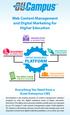 Web Content Management and Digital Marketing for Higher Education COMMUNICATION & MARKETING MEASUREMENT & ANALYSIS CONTENT MANAGEMENT PLATFORM INTEGRATION & DEVELOPMENT WEB, MOBILE, & SOCIAL UNIFICATION
CatDV Pro Workgroup Serve r
 Architectural Overview CatDV Pro Workgroup Server Square Box Systems Ltd May 2003 The CatDV Pro client application is a standalone desktop application, providing video logging and media cataloging capability
Analyzing the Benefits of Blog for Enhancing Knowledge Management among Bloggers
 www.ijcsi.org 1 Analyzing the Benefits of Blog for Enhancing Knowledge Management among Bloggers Pinkie Anggia and Dana Indra Sensuse 1 Faculty of Computer Science, University of Indonesia Depok, 16424,
Integration of Learning Management Systems with Social Networking Platforms
 Integration of Learning Management Systems with Social Networking Platforms E-learning in a Facebook supported environment Jernej Rožac 1, Matevž Pogačnik 2, Andrej Kos 3 Faculty of Electrical engineering
WEB CONTENT MANAGEMENT PATTERNS
 WEB CONTENT MANAGEMENT PATTERNS By YOAB GORFU RENEL SMITH ABE GUERRA KAY ODEYEMI May 2006 Version Date: 23-Apr-06-06:04 PM - 1 - Story TABLE OF CONTENTS Pattern: Separate it. How do you ensure the site