
JP1/Base Function Reference
|
|
|
- Coral O’Neal’
- 9 years ago
- Views:
Transcription
1 JP1 Version 11 JP1/Base Function Reference A03(E)

2 Notices Relevant program products For details about the supported operating systems and the service packs or patches that are required by JP1/Base, see the Release Notes. For Windows: P-2A2C-6LBL JP1/Base (for Windows Server 2008 R2, Windows 7, Windows Server 2012, Windows 8, Windows 8.1, Windows 10) For UNIX: P-1J2C-6LBL JP1/Base (for HP-UX (IPF)) P-9D2C-6LBL JP1/Base (for Solaris (SPARC)) P-1M2C-6LBL JP1/Base (for AIX) P-812C-6LBL JP1/Base (for Linux 6 (x64), Linux 7, Oracle Linux 6 (x64), Oracle Linux 7, CentOS 6 (x64), CentOS 7, SUSE Linux 12) Trademarks HITACHI, JP1 are either trademarks or registered trademarks of Hitachi, Ltd. in Japan and other countries. Active Directory is either a registered trademark or a trademark of Microsoft Corporation in the United States and/or other countries. IBM, AIX are trademarks of International Business Machines Corporation, registered in many jurisdictions worldwide. Linux (R) is the registered trademark of Linus Torvalds in the U.S. and other countries. Microsoft is either a registered trademark or a trademark of Microsoft Corporation in the United States and/or other countries. Oracle and Java are registered trademarks of Oracle and/or its affiliates. Red Hat is a trademark or a registered trademark of Red Hat Inc. in the United States and other countries. All SPARC trademarks are used under license and are trademarks or registered trademarks of SPARC International, Inc., in the United States and other countries. Products bearing SPARC trademarks are based upon an architecture developed by Sun Microsystems, Inc. SUSE is a registered trademark or a trademark of SUSE LLC in the United States and other countries. UNIX is a registered trademark of The Open Group in the United States and other countries. Visual C++ is either a registered trademark or a trademark of Microsoft Corporation in the United States and/or other countries. Windows is either a registered trademark or a trademark of Microsoft Corporation in the United States and/or other countries. Windows Server is either a registered trademark or a trademark of Microsoft Corporation in the United States and/or other countries. The following program product contains some parts whose copyrights are reserved by Oracle Corporation and its affiliates: P-9D2C-6LBL. The following program product contains some parts whose copyrights are reserved by UNIX System Laboratories, Inc.: P-9D2C-6LBL. Other company and product names mentioned in this document may be the trademarks of their respective owners. JP1/Base Function Reference 2

3 1. This product includes software developed by the OpenSSL Project for use in the OpenSSL Toolkit. ( 2. This product includes cryptographic software written by Eric Young 3. This product includes software written by Tim Hudson 4. This product includes the OpenSSL Toolkit software used under OpenSSL License and Original SSLeay License. OpenSSL License and Original SSLeay License are as follow: LICENSE ISSUES ============== The OpenSSL toolkit stays under a dual license, i.e. both the conditions of the OpenSSL License and the original SSLeay license apply to the toolkit. See below for the actual license texts. Actually both licenses are BSD-style Open Source licenses. In case of any license issues related to OpenSSL please contact [email protected]. OpenSSL License /* ==================================================================== * Copyright (c) The OpenSSL Project. All rights reserved. * * Redistribution and use in source and binary forms, with or without * modification, are permitted provided that the following conditions * are met: * * 1. Redistributions of source code must retain the above copyright * notice, this list of conditions and the following disclaimer. * * 2. Redistributions in binary form must reproduce the above copyright * notice, this list of conditions and the following disclaimer in * the documentation and/or other materials provided with the * distribution. * * 3. All advertising materials mentioning features or use of this * software must display the following acknowledgment: * "This product includes software developed by the OpenSSL Project * for use in the OpenSSL Toolkit. ( * * 4. The names "OpenSSL Toolkit" and "OpenSSL Project" must not be used to * endorse or promote products derived from this software without * prior written permission. For written permission, please contact * [email protected]. JP1/Base Function Reference 3

4 * * 5. Products derived from this software may not be called "OpenSSL" * nor may "OpenSSL" appear in their names without prior written * permission of the OpenSSL Project. * * 6. Redistributions of any form whatsoever must retain the following * acknowledgment: * "This product includes software developed by the OpenSSL Project * for use in the OpenSSL Toolkit ( * * THIS SOFTWARE IS PROVIDED BY THE OpenSSL PROJECT ``AS IS'' AND ANY * EXPRESSED OR IMPLIED WARRANTIES, INCLUDING, BUT NOT LIMITED TO, THE * IMPLIED WARRANTIES OF MERCHANTABILITY AND FITNESS FOR A PARTICULAR * PURPOSE ARE DISCLAIMED. IN NO EVENT SHALL THE OpenSSL PROJECT OR * ITS CONTRIBUTORS BE LIABLE FOR ANY DIRECT, INDIRECT, INCIDENTAL, * SPECIAL, EXEMPLARY, OR CONSEQUENTIAL DAMAGES (INCLUDING, BUT * NOT LIMITED TO, PROCUREMENT OF SUBSTITUTE GOODS OR SERVICES; * LOSS OF USE, DATA, OR PROFITS; OR BUSINESS INTERRUPTION) * HOWEVER CAUSED AND ON ANY THEORY OF LIABILITY, WHETHER IN CONTRACT, * STRICT LIABILITY, OR TORT (INCLUDING NEGLIGENCE OR OTHERWISE) * ARISING IN ANY WAY OUT OF THE USE OF THIS SOFTWARE, EVEN IF ADVISED * OF THE POSSIBILITY OF SUCH DAMAGE. * ==================================================================== * * This product includes cryptographic software written by Eric Young * ([email protected]). This product includes software written by Tim * Hudson ([email protected]). * */ Original SSLeay License /* Copyright (C) Eric Young ([email protected]) * All rights reserved. * * This package is an SSL implementation written * by Eric Young ([email protected]). * The implementation was written so as to conform with Netscapes SSL. * * This library is free for commercial and non-commercial use as long as * the following conditions are aheared to. The following conditions * apply to all code found in this distribution, be it the RC4, RSA, * lhash, DES, etc., code; not just the SSL code. The SSL documentation JP1/Base Function Reference 4

5 * included with this distribution is covered by the same copyright terms * except that the holder is Tim Hudson ([email protected]). * * Copyright remains Eric Young's, and as such any Copyright notices in * the code are not to be removed. * If this package is used in a product, Eric Young should be given attribution * as the author of the parts of the library used. * This can be in the form of a textual message at program startup or * in documentation (online or textual) provided with the package. * * Redistribution and use in source and binary forms, with or without * modification, are permitted provided that the following conditions * are met: * 1. Redistributions of source code must retain the copyright * notice, this list of conditions and the following disclaimer. * 2. Redistributions in binary form must reproduce the above copyright * notice, this list of conditions and the following disclaimer in the * documentation and/or other materials provided with the distribution. * 3. All advertising materials mentioning features or use of this software * must display the following acknowledgement: * "This product includes cryptographic software written by * Eric Young ([email protected])" * The word 'cryptographic' can be left out if the rouines from the library * being used are not cryptographic related :-). * 4. If you include any Windows specific code (or a derivative thereof) from * the apps directory (application code) you must include an acknowledgement: * "This product includes software written by Tim Hudson ([email protected])" * * THIS SOFTWARE IS PROVIDED BY ERIC YOUNG ``AS IS'' AND * ANY EXPRESS OR IMPLIED WARRANTIES, INCLUDING, BUT NOT LIMITED TO, THE * IMPLIED WARRANTIES OF MERCHANTABILITY AND FITNESS FOR A PARTICULAR PURPOSE * ARE DISCLAIMED. IN NO EVENT SHALL THE AUTHOR OR CONTRIBUTORS BE LIABLE * FOR ANY DIRECT, INDIRECT, INCIDENTAL, SPECIAL, EXEMPLARY, OR CONSEQUENTIAL * DAMAGES (INCLUDING, BUT NOT LIMITED TO, PROCUREMENT OF SUBSTITUTE GOODS * OR SERVICES; LOSS OF USE, DATA, OR PROFITS; OR BUSINESS INTERRUPTION) * HOWEVER CAUSED AND ON ANY THEORY OF LIABILITY, WHETHER IN CONTRACT, STRICT * LIABILITY, OR TORT (INCLUDING NEGLIGENCE OR OTHERWISE) ARISING IN ANY WAY * OUT OF THE USE OF THIS SOFTWARE, EVEN IF ADVISED OF THE POSSIBILITY OF * SUCH DAMAGE. * * The licence and distribution terms for any publically available version or JP1/Base Function Reference 5

6 * derivative of this code cannot be changed. i.e. this code cannot simply be * copied and put under another distribution licence * [including the GNU Public Licence.] */ Microsoft product name abbreviations This manual uses the following abbreviations for Microsoft product names. Abbreviation Visual C++ Windows 7 Full name or meaning Microsoft (R) Visual C++ (R) Microsoft (R) Windows (R) 7 Enterprise Microsoft (R) Windows (R) 7 Professional Microsoft (R) Windows (R) 7 Ultimate Windows 8 Windows (R) 8 Windows (R) 8 Enterprise Windows (R) 8 Pro Windows 8.1 Windows (R) 8.1 Windows (R) 8.1 Enterprise Windows (R) 8.1 Pro Windows 10 Windows (R) 10 Enterprise Windows (R) 10 Home Windows (R) 10 Pro Windows Server 2008 R2 Microsoft (R) Windows Server (R) 2008 R2 Datacenter Microsoft (R) Windows Server (R) 2008 R2 Enterprise Microsoft (R) Windows Server (R) 2008 R2 Standard Windows Server 2012 Windows Server 2012 Microsoft (R) Windows Server (R) 2012 Datacenter Microsoft (R) Windows Server (R) 2012 Standard Windows Server 2012 R2 Microsoft (R) Windows Server (R) 2012 R2 Datacenter Microsoft (R) Windows Server (R) 2012 R2 Standard Windows is sometimes used generically, referring to Windows Server 2008 R2, Windows 7, Windows Server 2012, Windows 8, Windows 8.1 and Windows 10. Restrictions Information in this document is subject to change without notice and does not represent a commitment on the part of Hitachi. The software described in this manual is furnished according to a license agreement with Hitachi. The license agreement contains all of the terms and conditions governing your use of the software and documentation, including all warranty rights, limitations of liability, and disclaimers of warranty. JP1/Base Function Reference 6

7 Material contained in this document may describe Hitachi products not available or features not available in your country. No part of this material may be reproduced in any form or by any means without permission in writing from the publisher. Edition history Jan. 2016: A03(E) Copyright All Rights Reserved. Copyright (C) 2016, Hitachi, Ltd. JP1/Base Function Reference 7

8 Preface This manual explains in detail the functions provided by JP1/Base and the procedures used to extend the functions of JP1/Base during development of systems linked to JP1/Integrated Management. This manual is intended for all operating systems. When there is a difference in the functions available for the supported operating systems, a distinction to that effect is made in the manual. Intended readers This manual is intended for users who use JP1/IM and JP1/Base to develop systems that work with JP1/IM. This manual assumes that the readers understand the functionality of JP1/IM and JP1/Base. Organization of this manual This manual consists of the following parts: PART 1: Overview PART 2: Operation PART 3: Reference Part 1 provides a brief overview of customizing and extending the JP1/Base functions. Part 2 explains how to customize the JP1/Base functions. Part 3 describes the JP1/Base functions in reference format. JP1/Base manual organization The JP1/Base documentation is divided into three manuals. Read the manual appropriate to your purpose, referring to the content of each manual shown in the following table. Manual JP1/Base User's Guide JP1/Base Messages JP1/Base Function Reference Content Overview and functionality of JP1/Base Setup of each function Commands, definition files, JP1 events Troubleshooting Processes, port numbers, operation logs Messages Procedures for issuing and acquiring JP1 events with JP1 programs and user applications Functions Conventions: "Administrator permissions" as used in this manual In this manual, Administrator permissions refers to Administrator permissions for the local PC. The local user, domain user, or user of the Active Directory environment can perform tasks requiring Administrator permissions if granted Administrator permissions for the local PC. JP1/Base Function Reference 8
9 Conventions: Fonts and symbols The following table explains the text formatting conventions used in this manual: Text formatting Bold Italic Monospace Convention Bold characters indicate text in a window, other than the window title. Such text includes menus, menu options, buttons, radio box options, or explanatory labels. For example: From the File menu, choose Open. Click the Cancel button. In the Enter name entry box, type your name. Italic characters indicate a placeholder for some actual text to be provided by the user or system. For example: Write the command as follows: copy source-file target-file The following message appears: A file was not found. (file = file-name) Italic characters are also used for emphasis. For example: Do not delete the configuration file. Monospace characters indicate text that the user enters without change, or text (such as messages) output by the system. For example: At the prompt, enter dir. Use the send command to send mail. The following message is displayed: The password is incorrect. The following table explains the symbols used in this manual: Symbol Convention In syntax explanations, a vertical bar separates multiple items, and has the meaning of OR. For example: A B C means A, or B, or C. { } In syntax explanations, curly brackets indicate that only one of the enclosed items is to be selected. For example: {A B C} means only one of A, or B, or C. [ ] In syntax explanations, square brackets indicate that the enclosed item or items are optional. For example: [A] means that you can specify A or nothing. [B C] means that you can specify B, or C, or nothing.... In coding, an ellipsis (...) indicates that one or more lines of coding have been omitted. In syntax explanations, an ellipsis indicates that the immediately preceding item can be repeated as many times as necessary. For example: A, B, B,... means that, after you specify A, B, you can specify B as many times as necessary. () Parentheses indicate the range of items to which the vertical bar ( ) or ellipsis (...) is applicable. This symbol is used to explicitly indicate a space. For example, AAA place a space between AAA and BBB. BBB means that you must \ When a syntax character shown above is used as an ordinary character, a backslash is prefixed to the character. For example, \ means as an ordinary character, not as a syntax character. JP1/Base Function Reference 9

10 Conventions: Version numbers The version numbers of Hitachi program products are usually written as two sets of two digits each, separated by a hyphen. For example: version 1.00 (or version 1.0) is written as version 2.05 is written as version 2.50 (or version 2.5) is written as version is written as The version number might be shown on the spine of a manual as Ver. 2.00, but the same version number would be written in the program as JP1/Base installation folder for Windows This manual refers to the JP1/Base installation folder in Windows as follows: Product name Reference to installation folder Installation folder # JP1/Base installation-folder In an x86 environment: system-drive:\program Files\HITACHI\JP1Base In an x64 environment: system-drive:\program Files (x86)\hitachi\jp1base # Denotes the installation folder used when the product is installed with initial settings. For Windows Vista or later, the manual uses the expression system-drive:\programdata. The actual value is determined by the OS environment variable when the program is installed. The installation destination might differ depending on the environment. Example: This manual uses the following convention to represent the full path of the JevApi.h header file needed to compile a source file: installation-folder\include\jevapi.h For the default installation folder, this path would actually be system-drive:\program Files\HITACHI \JP1Base\include\JevApi.h. Other reference information For other reference information, see Reference Material for this Manual in the JP1/Base User's Guide. JP1/Base Function Reference 10
11 Contents Notices 2 Preface 8 Part 1: Overview 1 Overview of Customizing and Extending the Functionality of JP1/Base Features Sample source files of functions 15 Part 2: Operation 2 Issuing and Acquiring JP1 Events Overview of functions for issuing and acquiring events Prerequisites Procedures for issuing and acquiring JP1 events Procedure for issuing JP1 events Procedure for acquiring JP1 events Compiling the source files Migrating user applications from an earlier version Migrating without recompiling Recompiling before migrating 30 Part 3: Reference 3 Functions 31 Function description format 32 Notes common to all functions 33 List of functions 34 JevFreeEvent 36 JevGetArrivedTime 37 JevGetBaseID 38 JevGetClose 39 JevGetCodeSet 40 JevGetDestinationAddress 41 JevGetDestinationServer 42 JevGetDetailInformation 43 JevGetEvent 44 JevGetExtAttrDirect 46 JevGetExtID 47 JP1/Base Function Reference 11

12 Appendixes 66 JevGetFirstExtAttr 48 JevGetMessage 49 JevGetNextExtAttr 50 JevGetOpen 51 JevGetProcessID 53 JevGetRegistFactor 54 JevGetRegistGroupID 55 JevGetRegistGroupName 56 JevGetRegistTime 57 JevGetRegistUserID 58 JevGetRegistUserName 59 JevGetSequenceNumber 60 JevGetSourceAddress 61 JevGetSourceSequenceNumber 62 JevGetSourceServer 63 JevRegistEvent 64 A Criteria for Setting JP1 Event Attributes 67 A.1 Basic attributes 67 A.2 Extended attributes 68 B Sample Source Files 72 B.1 Details of the sample source files 72 Index 77 JP1/Base Function Reference 12
13 Part 1: Overview 1 Overview of Customizing and Extending the Functionality of JP1/Base This chapter provides an overview of what you can do with JP1/Base by extending its functionality, along with samples of the functions provided by JP1/Base. JP1/Base Function Reference 13
14 1.1 Features By using JP1/Base functions and definition files, you can perform the following operations: Issue user-defined JP1 events You can use JP1/Base to define system-issued events as JP1 events with user-defined event attributes. You can also configure such events so that they can be issued by user applications. JP1 events defined by users are called userdefined events. You can freely define the attributes of user-defined events. You can use the JP1 event issuing function to issue user-defined events. For details about how to use the JP1 event issuing function to issue user-defined events, see Chapter 2. Issuing and Acquiring JP1 Events. You can also display in JP1/IM - View the user-defined event attributes that have been added to a user-defined event. To do this, you must create definition files that contain descriptions of your user-defined event attributes. For details, see the manual JP1/Integrated Management - Manager Command and Definition File Reference. Acquire JP1 events JP1 events that a JP1 program or user application has registered with JP1/Base's event database can be acquired directly by other JP1 programs and user applications. After a user-defined event is issued from a user application to JP1/Base and the event is registered with the event database as a JP1 event, other user applications can use the event. You can use the JP1 event acquisition function to acquire JP1 events. For details about how to use the JP1 event acquisition function to acquire JP1 events, see Chapter 2. Issuing and Acquiring JP1 Events. Add extended attributes and messages to events in JP1/SES format JP1/SES is a JP1 program of Version 5 or earlier. An event that JP1/SES handled is called an event in JP1/SES format. You cannot display events in the JP1/SES format in the JP1/IM Event Console window, because they do not have extended attributes. However, by using JP1/Base to add extended attributes to events in JP1/SES format, you can monitor them in the JP1/IM Event Console window as JP1 events. In addition to adding extended attributes, you can also add a message. For details about how to use a definition file to add extended attributes and messages in JP1/SES format, see the manual JP1/Base User's Guide. 1. Overview of Customizing and Extending the Functionality of JP1/Base JP1/Base Function Reference 14

15 1.2 Sample source files of functions JP1/Base provides you sample source files of functions. Editing and compiling the sample source files enables users to easily create and issue JP1 events based on the user's environment, as well as to obtain JP1 events. For details of the sample source files, see Appendix B. Sample Source Files. 1. Overview of Customizing and Extending the Functionality of JP1/Base JP1/Base Function Reference 15

16 Part 2: Operation 2 Issuing and Acquiring JP1 Events This chapter provides an overview of the function for issuing JP1 events with user-defined event attributes directly from user applications, and the functions for directly acquiring JP1 events in other JP1 programs and user applications. It also explains the prerequisites and procedures for each function. JP1/Base Function Reference 16

17 2.1 Overview of functions for issuing and acquiring events Issuing JP1 events JP1/IM enables you to monitor events by converting application-specific log files, SNMP traps, and the Windows event log to JP1 events. However, you cannot use JP1/IM to define application-specific event attributes and other information in detail. You can use the JP1 event issuing function of JP1/Base to issue user-defined events that include user-defined event attributes directly from user applications. These user-defined events that include user-defined event attributes (specific information in extended attributes) can then be displayed in the Event Details window by using JP1/IM to create definition files. The following figure provides an overview of issuing a JP1 (user-defined) event to display the user-defined event attributes. Figure 2 1: Overview of issuing a JP1 (user-defined) event to display the user-defined event attributes Acquiring JP1 events JP1/Base allows you to register and manage a wide variety of events issued by a system as JP1 events in the event database. However, user applications cannot directly use these JP1 events. By using the JP1 event acquisition functions, user applications are able to acquire and use JP1 events directly from the JP1/Base event database. The following figure shows an overview of JP1 event acquisition. 2. Issuing and Acquiring JP1 Events JP1/Base Function Reference 17

18 Figure 2 2: JP1 event acquisition Prerequisites The following lists the prerequisites required for using functions provided by JP1/Base (JP1 event issuing function and JP1 event acquisition functions). An environment for compiling the source files that use the functions (JP1 event issuing function and JP1 event acquisition functions) JP1/Base for the OS in use A compiler for the OS in use (1) Installation of JP1/Base JP1/Base is required in order to compile and execute the source files that use the functions provided by JP1/Base. This is because the libraries and header files provided by JP1/Base are used during compiling and execution. Therefore, before you do anything else, install JP1/Base on the machine on which you will be performing compiling and execution. (2) Installation of a compiler To compile the source files that use the functions provided by JP1/Base, you need one of the compilers listed in the following table. Before you start operations, install one of these compilers on the machine on which you will compile the source files. Table 2 1: Compilers OS Compiler Windows Visual C++ (R) 2010 Visual C++ (R) 2012 Visual C++ (R) 2012 HP-UX (IPF) HP C/aC++ A or later 2. Issuing and Acquiring JP1 Events JP1/Base Function Reference 18

19 OS Compiler Solaris (SPARC) Sun Studio 12 AIX XL C/C++ Enterprise Edition V9.0 for AIX XL C/C++ Enterprise Edition V10.1 for AIX XL C/C++ Enterprise Edition V11.1 for AIX XL C/C++ Enterprise Edition V12.1 for AIX XL C/C++ Enterprise Edition V13.1 for AIX Linux gcc version gcc version Issuing and Acquiring JP1 Events JP1/Base Function Reference 19
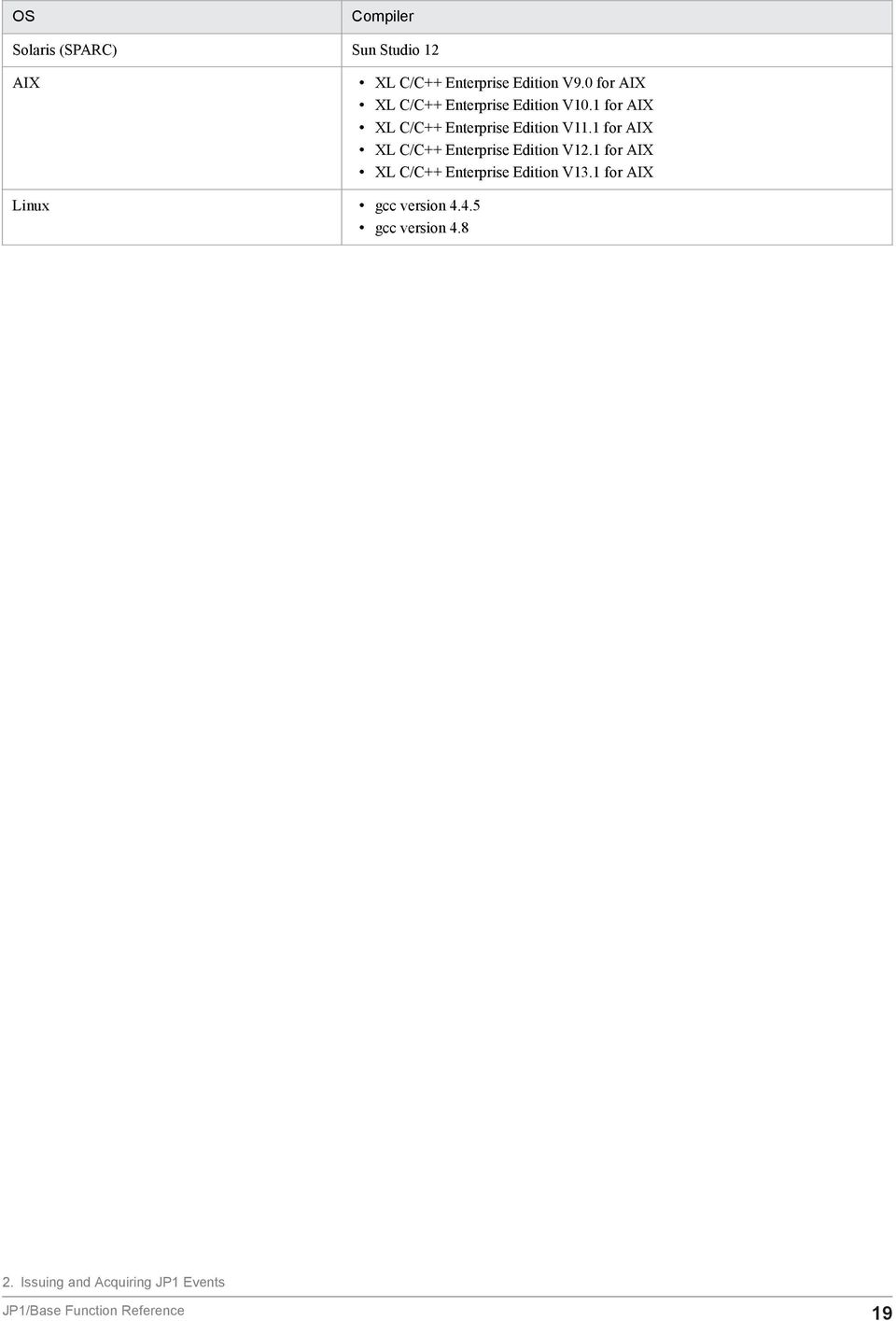
20 2.2 Procedures for issuing and acquiring JP1 events Procedure for issuing JP1 events To issue JP1 events: 1. Decide the types and attributes of the JP1 events you want to issue. 2. Write code that uses the JP1 event issuing function. 3. Compile the source files. To be able to view in JP1/IM - View the user-defined event attributes that are appended to a JP1 event, you must then use JP1/IM to create the following definition files on a machine where JP1/IM - Manager is installed: Definition file for extended event attributes Definition file for object types For details about how to create these definition files using JP1/IM, see the manual JP1/Integrated Management - Manager Command and Definition File Reference. (1) Determining the types and attributes of the JP1 events to be issued To issue JP1 (user-defined) events, you must first decide what kinds of events to issue as JP1 events. The performance of the JP1/Base event service depends on the number of JP1 events that may be issued. Therefore, we recommend that you issue JP1 (user-defined) events only for those JP1 events that are needed by JP1/IM to perform system monitoring. Next, you must determine the types of event attributes you wish to issue. To determine the event attributes, consider the information you need to know about an application when you monitor events with JP1/IM. Determine the event attributes of all JP1 (user-defined) events for each application in advance. You can use the JP1 event attribute values as arguments for initiating automated actions and invoking monitor windows in JP1/IM. For details on the event attributes used in the example described below, see Appendix A. Criteria for Setting JP1 Event Attributes. The example below uses the Windows application SAMPLE to explain issuing the startup event and the abnormal termination event. The character strings enclosed in parentheses are the names of the arguments in the JP1 event issuing function. Types of JP1 events Startup event (JP1 event issued at the startup of the application) Event ID (BaseID): 0x Message (message): Starts the SAMPLE application. Abnormal termination event (JP1 event issued at the abnormal termination of the application) Event ID (BaseID): 0x Message (message): The SAMPLE application terminated abnormally. Event attributes including extended attributes (extattrs): Startup event Assign the following attributes to the startup event of the SAMPLE application. 2. Issuing and Acquiring JP1 Events JP1/Base Function Reference 20

21 Table 2 2: Attributes to be assigned to the startup event Attribute type Item Attribute name Description Basic attribute Event ID -- 0x Message -- Starts the SAMPLE application. Extended attributes (common attributes) Event level SEVERITY Notice User name USER_NAME SAMPLE_USER Product name PRODUCT_NAME /COMPANY/APP1/SAMPLE_PRODUCT (product name) Object type OBJECT_TYPE SAMPLE Object name OBJECT_NAME SAMPLE_NAME Root object type ROOT_OBJECT_TYPE ROOT_SAMPLE Root object name ROOT_OBJECT_NAME ROOT_SAMPLE_NAME Object ID OBJECT_ID SAMPLE_ID Occurrence OCCURRENCE START Start time START_TIME Start time of the SAMPLE application. The number of seconds from 00:00:00 on UTC Platform type PLATFORM NT Version information ACTION_VERSION 0600 Extended attributes (user-specific attributes) SAMPLE common attribute 1 COMMON_ATTR1 NATIVE SAMPLE common attribute 2 COMMON_ATTR2 TRUE SAMPLE start attribute 1 START_ATTR1 SAMPLE1 SAMPLE start attribute 2 START_ATTR2 SAMPLE2 Event attributes including extended attributes (extattrs): Abnormal termination event Assign the following attributes to the abnormal termination event of the SAMPLE application. Table 2 3: Attributes to be assigned to the abnormal termination event Attribute type Item Attribute name Description Basic attribute Event ID -- 0x Message -- The SAMPLE application terminated abnormally. Extended attributes (common attributes) Event level SEVERITY Error User name USER_NAME SAMPLE_USER Product name PRODUCT_NAME /COMPANY/APP1/SAMPLE_PRODUCT (product name) Object type OBJECT_TYPE SAMPLE Object name OBJECT_NAME SAMPLE_NAME Root object type ROOT_OBJECT_TYPE ROOT_SAMPLE 2. Issuing and Acquiring JP1 Events JP1/Base Function Reference 21
22 Attribute type Item Attribute name Description Root object name ROOT_OBJECT_NAME ROOT_SAMPLE_NAME Object ID OBJECT_ID SAMPLE_ID Occurrence OCCURRENCE END End time END_TIME End time of the SAMPLE application. The number of seconds from 00:00:00 on UTC Result code RESULT_CODE Termination code that the SAMPLE application returns when it terminates Platform type PLATFORM NT Version information ACTION_VERSION 0600 Extended attributes(userspecific attributes) SAMPLE common attribute 1 COMMON_ATTR1 NATIVE SAMPLE common attribute 2 COMMON_ATTR2 TRUE SAMPLE end attribute 1 END_ATTR1 SAMPLE1 SAMPLE end attribute 2 END_ATTR2 SAMPLE2 (2) Writing code that uses the JP1 event issuing function The coding example for the SAMPLE application to issue the startup event is as follows: #include <stdio.h> #include <time.h> #include "JevApi.h" int regist_start_event() { int rc; /* Return code */ long status = 0; /* Detailed error code */ const char* server; /* Event server name */ long baseid; /* Event ID */ const char* message; /* Message */ char starttime[32]; const char* extattrs[16]; /* Array for storing extended attributes */ /* Set the destination event server name. */ server = NULL; /* Set the event ID. */ baseid = 0x ; /* Set the message. */ message = "Starts the SAMPLE application."; /* Set the extended attributes. */ extattrs[0] = "SEVERITY=Notice"; extattrs[1] = "USER_NAME=SAMPLE_USER"; extattrs[2] = "PRODUCT_NAME=/COMPANY/APP1/SAMPLE_ 2. Issuing and Acquiring JP1 Events JP1/Base Function Reference 22
23 PRODUCT"; extattrs[3] = "OBJECT_TYPE=SAMPLE"; extattrs[4] = "OBJECT_NAME=SAMPLE_NAME"; extattrs[5] = "OBJECT_ROOT_TYPE=ROOT_SAMPLE"; extattrs[6] = "OBJECT_ROOT_NAME=ROOT_SAMPLE_NAME"; extattrs[7] = "OBJECT_ID=SAMPLE_ID"; extattrs[8] = "OCCURRENCE=START"; sprintf(starttime, "START_TIME=%ld", time(null)); extattrs[9] = starttime; extattrs[10] = "PLATFORM=NT"; extattrs[11] = "VERSION=0600"; extattrs[12] = "COMMON_ATTR1=NATIVE"; extattrs[13] = "COMMON_ATTR2=TRUE"; extattrs[14] = "START_ATTR1=SAMPLE1"; extattrs[15] = "START_ATTR2=SAMPLE2"; /* Register the JP1 event. */ rc = JevRegistEvent(&status, server, baseid, message, extattrs, 16); if(rc < 0) { fprintf(stderr, "JevRegistEvent() failed. status = %ld\n", status); return -1; } } return 0; Procedure for acquiring JP1 events To acquire JP1 events: 1. Determine the types and attributes of the JP1 events you want to acquire. 2. Define an event acquisition filter to specify the JP1 events to acquire. 3. Write code that uses JP1 event acquisition functions. 4. Compile the source files. (1) Determining the types and attributes of the JP1 events to be acquired JP1/Base registers a wide variety of event types to the event database as JP1 events. Therefore, you must first determine the types of events you want to acquire from the event database. Next, determine the event attributes to acquire from these JP1 events. When you are deciding which event attributes to acquire, consider the information you need to know about the application in question. Determine the event attributes of all JP1 events being acquired for each application in advance. 2. Issuing and Acquiring JP1 Events JP1/Base Function Reference 23
24 The following explanations are based on acquiring the startup events listed in 2.2.1(1) Determining the types and attributes of the JP1 events to be issued that are issued as JP1 events in the application SAMPLE. (2) Defining an event acquisition filter to specify the JP1 events to acquire To select only the JP1 events you want to acquire, you must define an event acquisition filter. For details about the syntax of event acquisition filters, see the section on filter syntax in the manual JP1/Base User's Guide. This subsection provides an example of an event acquisition filter for acquiring the startup events listed in 2.2.1(1) Determining the types and attributes of the JP1 events to be issued that are coded in the application SAMPLE. To acquire startup events, you must first consider how to create an event acquisition filter with the following conditions: Event ID: 0x Value of the extended attribute SEVERITY: Notice Value of the extended attribute PRODUCT_NAME: /COMPANY/APP1/SAMPLE_PRODUCT A filter targeting JP1 events that satisfy the above conditions can be used to acquire startup events. The following is an example of such an event acquisition filter: B.ID IN E.SEVERITY IN Notice E.PRODUCT_NAME IN /COMPANY/APP1/ SAMPLE_PRODUCT Note: If you specify a Japanese string for a condition of an event acquisition filter, make sure that the character set matches the locale information (such as the LANG environment variable) used for execution of JP1 event acquisition functions. If the character set for the string specified for a condition of an event acquisition filter differs from the locale information used for execution of JP1 event acquisition functions, JP1 events cannot be acquired. If you define an exclusion condition in an event acquisition filter, connect to an event server of version or later. An error occurs (JEV_S_FILTER_ERROR) if you connect to an event server of version or earlier. (3) Writing code that uses JP1 event acquisition functions JP1 event acquisition functions are used when a JP1 program or user application acquires JP1 events. The following explains how to issue JP1 event acquisition functions to acquire JP1 events from the event database of JP1/Base. To issue JP1 event acquisition functions: 1. Issue a function that requests starting the acquisition of JP1 events. Issue the JevGetOpen function to the event server to request starting the acquisition of JP1 events, and to connect a JP1 program or user application to the event server. Note that the user who requests starting the acquisition of JP1 events must be preconfigured in the users parameter in the event server settings file (conf) for JP1/Base. 2. Issue functions that request acquisition of JP1 events. Use various functions to acquire JP1 events and the attributes set in the JP1 events. 3. Issue a function that reports ending the acquisition of JP1 events. Issue the JevGetClose function to the event server to notify the server of the end of JP1 event acquisition, and to disconnect the JP1 program or user application from the event server. 2. Issuing and Acquiring JP1 Events JP1/Base Function Reference 24
25 For details about JP1 event acquisition functions, see Chapter 3. Functions. For details about what types of event attributes can be acquired, see Appendix A. Criteria for Setting JP1 Event Attributes. The following is a coding example for acquiring the startup events listed in 2.2.1(1) Determining the types and attributes of the JP1 events to be issued that are coded in the application SAMPLE. #include <stdio.h> #include <string.h> #include "JevApi.h" int get_start_event() { int rc; /* Return code */ long position; /* Sequence number within the event database */ long status; /* Status code address */ char filter[256]; /* Filter statement buffer */ const char *server; /* Event server name */ const char *message; /* Pointer to the message */ const char *name; /* Pointer to the extended attribute name */ const char *value; /* Pointer to the extended attribute value */ JEVGETKEY key; /* Handle for acquiring JP1 events */ JP1EVENT event; /* Handle for accessing JP1 events */ JEVACCESSTYPE access; /* Action when no JP1 event exists*/ /* Set the filter statement to acquire JP1 events. */ strcpy(filter, "B.ID IN 0x \n"); strcat(filter, "E.SEVERITY IN Notice\n"); strcat(filter, "E.PRODUCT_NAME IN /COMPANY/APP1/SAMPLE_PRODUCT"); /* Connect to the event server of the physical host. */ status = 0; /* Event server of the physical host to connect to */ server = NULL; /* Acquisition starts with sequence number 0 within the event database. */ position = 0; key = JevGetOpen(&status, server, filter, position); if(key == NULL){ fprintf(stderr, "JevGetOpen() failed. Status = %ld\n", status); return -1; } /* Acquire all the JP1 events which match the filter condition. */ while(1) { status = 0; /* Error return when no JP1 event matches the filter condition */ access = JEVGET_NOWAIT; event = JevGetEvent(&status, key, access); if(event == NULL){ if(status == JEV_S_NO_EVENT) { /* No more JP1 event matches the filter condition. */ break; } else { /* Error occurred while acquiring JP1 events. */ 2. Issuing and Acquiring JP1 Events JP1/Base Function Reference 25
26 } } fprintf(stderr, "JevGetEvent() failed. Status = %ld\n", status); JevGetClose(&status, key); return -1; /* Acquire a message. */ status = 0; rc = JevGetMessage(&status, event, &message); if(rc < 0){ fprintf(stderr, "JevGetMessage() failed. Status = %ld\n", status); JevFreeEvent(&status, event); JevGetClose(&status, key); return -1; } else{ printf("jevgetmessage() message = %s\n", message); } /* Acquire the (first) extended attribute. */ status = 0; rc = JevGetFirstExtAttr(&status, event, &name, &value); if(rc < 0){ fprintf(stderr, "JevGetFirstExtAttr() failed. Status = %ld\n", status); JevFreeEvent(&status, event); JevGetClose(&status, key); return -1; } else{ printf("jevgetfirstextattr() name = %s\n", name); printf("jevgetfirstextattr() value = %s\n", value); } /* Acquire the (subsequent) extended attribute. */ while(1) { status = 0; rc = JevGetNextExtAttr(&status, event, &name, &value); if(rc < 0 ){ if(status == JEV_S_EXTATTR_EOD) { /* No more extended attribute exists. */ break; } else { /* Error occurred while acquiring extended attributes. */ fprintf(stderr, "JevGetNextExtAttr() failed. Status = %ld\n", status); JevFreeEvent(&status, event); JevGetClose(&status, key); return -1; } } 2. Issuing and Acquiring JP1 Events JP1/Base Function Reference 26
27 } else { printf("jevgetnextextattr() name = %s\n", name); printf("jevgetnextextattr() value = %s\n", value); } } /* Release the memory allocated for the acquired JP1 events. */ rc = JevFreeEvent(&status, event); if(rc < 0){ fprintf(stderr, "JevFreeEvent() failed. Status = %ld\n", status); JevGetClose(&status, key); return -1; } /* Disconnect the event server.*/ rc = JevGetClose(&status, key); if(rc < 0){ fprintf(stderr, "JevGetClose() failed. Status = %ld\n", status); return -1; } } return 0; Compiling the source files To issue and acquire JP1 events, you must first compile and link the code source files. Files needed for compiling: JP1/Base header file (installed when JP1/Base is installed) Source files created in C or C++ (user-created files) The location of the header file is as follows: Windows: installation-folder\include\jevapi.h UNIX: /opt/jp1base/include/jevapi.h Files needed for linking: Libraries (installed when JP1/Base is installed) Note that the required libraries vary by OS and by compiler. The following table lists the libraries required for each OS. Table 2 4: Libraries required for each OS OS Threading Required library Windows 32-bit multi-threaded installation-folder\lib\libjevapia.lib 64-bit multi-threaded installation-folder\lib\libjevapiax64.lib HP-UX (IPF) 32-bit single-threaded /opt/jp1base/lib/libjevapiast32.a 2. Issuing and Acquiring JP1 Events JP1/Base Function Reference 27
28 OS Threading Required library 32-bit multi-threaded 64-bit single-threaded 64-bit multi-threaded /opt/jp1base/lib/libjevapiamt32.a /opt/jp1base/lib/libjevapiast64.a /opt/jp1base/lib/libjevapiamt64.a Solaris (SPARC) 32-bit single-threaded /opt/jp1base/lib/libjevapiast.a AIX Linux 32-bit multi-threaded 32-bit single-threaded 32-bit multi-threaded 64-bit single-threaded 64-bit multi-threaded /opt/jp1base/lib/libjevapiamt.a /opt/jp1base/lib/libjevapiast.a /opt/jp1base/lib/libjevapiamt.a /opt/jp1base/lib/libjevapiast64.a /opt/jp1base/lib/libjevapiamt64.a The table below lists for each OS the options to specify when compiling and linking the source files. Note: When you compile and link source files in Visual Studio Integrated Development Environment (GUI) for Windows, use options that are appropriate for configuring the environment, from among the compile and link options listed in the tables below. Table 2 5: Compile options OS Threading Compile option Windows 32-bit multi-threaded /MD /I "installation-folder\include" (Implement in a 32-bit VC++ project configuration) 64-bit multi-threaded /MD /I "installation-folder\include" (Implement in a 64-bit VC++ project configuration) HP-UX (IPF) 32-bit single-threaded -Aa # -I/opt/jp1base/include 32-bit multi-threaded 64-bit single-threaded 64-bit multi-threaded -Aa # -mt -I/opt/jp1base/include +DD64 -Aa # -I/opt/jp1base/include +DD64 -Aa # -mt -I/opt/jp1base/include Solaris (SPARC) 32-bit single-threaded -I/opt/jp1base/include 32-bit multi-threaded -mt -D_THREAD_SAFE -I/opt/jp1base/include AIX 32-bit single-threaded -I/opt/jp1base/include 32-bit multi-threaded 64-bit single-threaded 64-bit multi-threaded -D_REENTRANT -D_THREAD_SAFE -I/opt/jp1base/ include -q64 -I/opt/jp1base/include -q64 -D_REENTRANT -D_THREAD_SAFE -I/opt/jp1base/ include Linux 32-bit single-threaded -I/opt/jp1base/include 32-bit multi-threaded 64-bit single-threaded -D_REENTRANT -D_THREAD_SAFE -I/opt/jp1base/ include -m64 -I/opt/jp1base/include 2. Issuing and Acquiring JP1 Events JP1/Base Function Reference 28
29 OS Threading Compile option 64-bit multi-threaded -m64 -D_REENTRANT -D_THREAD_SAFE -I/opt/jp1base/ include #: The -Aa option for HP-UX (IPF) is needed only when you use the C compiler (cc) to compile. You can replace the -Aa option with the -Ae option, but do not specify the -Ac option. The -Aa option can be omitted if you use the C++ compiler (acc). Table 2 6: Link options OS Threading Link option Windows 32-bit multi-threaded "installation-folder\lib\libjevapia.lib" (Implement in a 32-bit VC++ project configuration) 64-bit multi-threaded "installation-folder\lib\libjevapiax64.lib" (Implement in a 64-bit VC++ project configuration) HP-UX (IPF) 32-bit single-threaded /opt/jp1base/lib/libjevapiast32.a 32-bit multi-threaded 64-bit single-threaded 64-bit multi-threaded -mt /opt/jp1base/lib/libjevapiamt32.a +DD64 /opt/jp1base/lib/libjevapiast64.a +DD64 -mt /opt/jp1base/lib/libjevapiamt64.a Solaris (SPARC) 32-bit single-threaded /opt/jp1base/lib/libjevapiast.a -ldl 32-bit multi-threaded /opt/jp1base/lib/libjevapiamt.a -ldl -lpthread AIX 32-bit single-threaded /opt/jp1base/lib/libjevapiast.a -ldl 32-bit multi-threaded 64-bit single-threaded /opt/jp1base/lib/libjevapiamt.a -ldl -lpthread /opt/jp1base/lib/libjevapiast64.a -q64 -ldl 64-bit multi-threaded /opt/jp1base/lib/libjevapiamt64.a -q64 -ldl - lpthread Linux 32-bit single-threaded /opt/jp1base/lib/libjevapiast.a -ldl 32-bit multi-threaded 64-bit single-threaded /opt/jp1base/lib/libjevapiamt.a -ldl -lpthread /opt/jp1base/lib/libjevapiast64.a -m64 -ldl 64-bit multi-threaded /opt/jp1base/lib/libjevapiamt64.a -m64 -ldl - lpthread Notes: The libraries provided by JP1/Base are static libraries (or an archive for UNIX). They are not DLL import libraries or shared libraries. The libraries provided by JP1/Base are dynamically loaded by means of a DLL (or a shared library for UNIX) bundled with JP1/Base. This means that created programs will run on a machine on which JP1/Base is not installed, but certain functions will fail with a JEV_NO_LIBRARY error. DLLs dynamically loaded from the libraries provided by JP1/Base for Windows are independent of the libraries packaged with side-by-side assembly, so no manifest is provided. Do not use the -l option when linking the libraries provided by JP1/Base on UNIX. When linking on UNIX, we recommend that you use the same linkage editor you used for the compiling (cc, for example), rather than using ld. If you do use ld to link the files, specify the same options in the same order as the compiler when it automatically passes to ld. To compile source files in the Linux x64 environment, add -m32 to the compile options and link options. 2. Issuing and Acquiring JP1 Events JP1/Base Function Reference 29
30 2.3 Migrating user applications from an earlier version This section explains the procedure for migrating user applications created in an earlier version of JP1/Base to the current version Migrating without recompiling JP1/Base assures binary compatibility with user applications created in earlier versions of JP1/Base. Therefore, previously created user applications can run on the most recent version of JP1/Base without having to be recompiled. Binary compatibility of the user applications is assured, provided the JP1/Base execution environment version is the same or later than the JP1/Base development environment version. Therefore, for a user application that is executed by several different versions of JP1/Base, use a JP1/Base development environment version that is no later than the earliest version of the JP1/Base execution environment that is being used. The following table lists examples of the ranges of binary compatibility that are assured between the development environment and the execution environment of JP1/Base. Table 2 7: Examples of the ranges of binary compatibility that are assured Development environment Execution environment Binary compatibility If a user application was created in the following development environment: JP1/Base Compiler User application Legend: Y: Assured. N: Not assured. If JP1/Base is a later version: JP1/Base or later If JP1/Base is the same version: JP1/Base If JP1/Base is an earlier version: JP1/Base or earlier Y Y N Important note The above table does not consider which OS versions are assured for running user applications generated by the compiler that is being used. For example, a user application generated with a compiler supported in JP1/ Base might not be able to run on an OS for which support was added in JP1/Base For details about which OS versions are assured for running user applications generated with a particular compiler, see the compiler documentation Recompiling before migrating JP1/Base assures compatibility of source code created in earlier versions. Therefore, by recompiling the source code of the user application, you can run recompiled user applications on the latest version of JP1/Base without having to modify the source code. 2. Issuing and Acquiring JP1 Events JP1/Base Function Reference 30
31 Part 3: Reference 3 Functions This chapter describes the functions for issuing and acquiring JP1 events. JP1/Base Function Reference 31
32 Function description format This section lists the headings that are used in this chapter for the descriptions of the JP1 event issuing function and the JP1 event acquisition functions. Description Describes the functionality of the function. Definition header Format Indicates the header for defining the function. Shows the format of the function. Argument(s) Describes the arguments and values that can be specified in the function. Return value(s) Note(s) Describes the values that the function may return after its execution. Gives the points you must remember when you use the function. For the notes common to all functions, see the next section Notes common to all functions. 3. Functions JP1/Base Function Reference 32
33 Notes common to all functions The notes common to all functions provided by JP1/Base are as follows. For the Windows and UNIX versions, the operation of a function called from a multi-thread program is assured. For the Windows and UNIX versions, when using the functions in a multi-thread program, you cannot use any of these functions in a thread that was generated before the first function was called. 3. Functions JP1/Base Function Reference 33
34 List of functions JP1/Base provides a JP1 event issuing function and the JP1/event acquisition functions described below. The following two tables list and explain these functions. For details about the event attributes of the JP1 events used by the JP1 event issuing function and the JP1 event acquisition functions, see Appendix A. Criteria for Setting JP1 Event Attributes. Table 3 1: JP1 event issuing function Function name JevRegistEvent Explanation Issues a JP1 event to the event server of JP1/Base. Table 3 2: JP1 event acquisition functions Function name JevGetOpen JevGetEvent JevGetSequenceNumber JevGetBaseID JevGetExtID JevGetRegistFactor JevGetProcessID JevGetRegistTime JevGetArrivedTime JevGetRegistUserID JevGetRegistGroupID JevGetRegistUserName JevGetRegistGroupName JevGetSourceServer JevGetDestinationServer JevGetSourceAddress JevGetDestinationAddress JevGetSourceSequenceNumber JevGetCodeSet JevGetMessage JevGetDetailInformation JevGetExtAttrDirect JevGetFirstExtAttr JevGetNextExtAttr JevFreeEvent Explanation Connects the program to the event server of JP1/Base so that the program can acquire JP1 events. Acquires a JP1 event. Acquires a basic attribute of the JP1 event (the serial number of the JP1 event in the event database). Acquires a basic attribute of the JP1 event (the base part of the event ID). Acquires a basic attribute of the JP1 event (the extended part of the event ID). Acquires a basic attribute of the JP1 event (registered reason). Acquires a basic attribute of the JP1 event (source process ID). Acquires a basic attribute of the JP1 event (registered time). Acquires a basic attribute of the JP1 event (arrived time). Acquires a basic attribute of the JP1 event (source user ID). Acquires a basic attribute of the JP1 event (source group ID). Acquires a basic attribute of the JP1 event (source user name). Acquires a basic attribute of the JP1 event (source group name). Acquires a basic attribute of the JP1 event (source event server name). Acquires a basic attribute of the JP1 event (destination event server name). Acquires a basic attribute of the JP1 event (source IP address). Acquires a basic attribute of the JP1 event (destination IP address). Acquires a basic attribute of the JP1 event (source serial number). Acquires a basic attribute of the JP1 event (code set). Acquires a basic attribute of the JP1 event (message). Acquires a basic attribute of the JP1 event (detailed information). Acquires an extended attribute of the JP1 event. Acquires the first extended attribute of the JP1 event. Acquires the next extended attribute of the JP1 event. Deallocates the memory for an acquired JP1 event. 3. Functions JP1/Base Function Reference 34
35 Function name JevGetClose Explanation Disconnects the program from the event server. The following sections describe the above functions in alphabetical order. 3. Functions JP1/Base Function Reference 35
36 JevFreeEvent Description This function deallocates the area containing a JP1 event that you can access by using the return value of a JevGetEvent() function. Definition header JevApi.h Format int JevFreeEvent(long* lplstatus, JP1EVENT event); Arguments lplstatus In lplstatus, specify the pointer to the area for containing the status code that this function returns if the function abnormally terminates. The following explains the status code. Table 3 3: Status code and meaning (JevFreeEvent) Status code JEV_S_PARAM_ERROR Meaning An invalid parameter is specified. event In event, specify the handle for accessing the target JP1 event (the return value of the JevGetEvent() function). Return values Situation Explanation Normal termination The function returns 0. Abnormal termination The function returns -1. Also, in the area specified in lplstatus, the function stores the detailed error code. 3. Functions JP1/Base Function Reference 36
37 JevGetArrivedTime Description This function acquires the time when the JP1 event arrived, as a basic attribute of the JP1 event. The time is represented by the number of seconds from :00:00 (UTC). Definition header JevApi.h Format long JevGetArrivedTime(long* lplstatus, JP1EVENT event); Arguments lplstatus In lplstatus, specify the pointer to the area for containing the status code that this function returns if the function abnormally terminates. The following explains the status code. Table 3 4: Status code and meaning (JevGetArrivedTime) Status code JEV_S_PARAM_ERROR Meaning An invalid parameter is specified. event In event, specify the handle for accessing the target JP1 event (the return value of the JevGetEvent() function). Return values Situation Normal termination Abnormal termination Explanation The function returns the arrival time of the JP1 event that can be referenced with the specified handle. The function returns -1. Also, in the area specified in lplstatus, the function stores the detailed error code. 3. Functions JP1/Base Function Reference 37
38 JevGetBaseID Description This function acquires the base part of the event ID, as a basic attribute of the JP1 event. The base part of the event ID is the first four bytes of the eight-byte event ID. Definition header JevApi.h Format long JevGetBaseID(long* lplstatus, JP1EVENT event); Arguments lplstatus In lplstatus, specify the pointer to the area for containing the status code that this function returns if the function abnormally terminates. The following explains the status code. Table 3 5: Status code and meaning (JevGetBaseID) Situation JEV_S_PARAM_ERROR Explanation An invalid parameter is specified. event In event, specify the handle for accessing the target JP1 event (the return value of the JevGetEvent() function). Return values Situation Normal termination Abnormal termination Explanation The function returns the base part of the ID of the JP1 event that can be referenced with the specified handle. The function returns -1. Also, in the area specified in lplstatus, the function stores the detailed error code. 3. Functions JP1/Base Function Reference 38
39 JevGetClose Description This function disconnects the program from the event server and closes the JP1-event acquisition handle returned by the JevGetOpen() function. The JP1-event acquisition handle returned by the JevGetOpen() function must be closed by using the JevGetClose() function. In Windows, if the process terminates without calling this function, a system-resource leak error occurs. Definition header JevApi.h Format int JevGetClose(long* lplstatus, JEVGETKEY key); Arguments lplstatus In lplstatus, specify the pointer to the area for containing the status code that this function returns if the function abnormally terminates. The following explains the status codes that may be returned. Table 3 6: Status codes and meanings (JevGetClose) Status code JEV_S_CONNECT_ERROR JEV_S_PARAM_ERROR JEV_S_MAXOPEN JEV_S_NOMEMORY JEV_S_IO_ERR JEV_S_SYSTEM_ERROR Meaning Failed to connect the event server. An invalid parameter is specified. The number of opened files reached the maximum. Memory is insufficient. An I/O error occurred. A system error occurred (the system resource became insufficient). key In key, specify the handle for acquiring the target JP1 event (returned by the JevGetOpen() function). Return values Situation Explanation Normal termination The function returns 0. Abnormal termination The function returns -1. Also, in the area specified in lplstatus, the function stores the detailed error code. 3. Functions JP1/Base Function Reference 39
40 JevGetCodeSet Description This function acquires the code set as a basic attribute of the JP1 event. Definition header JevApi.h Format int JevGetCodeSet(long* lplstatus, JP1EVENT event, const char** const lppszvalue); Arguments lplstatus In lplstatus, specify the pointer to the area for containing the status code that this function returns if the function abnormally terminates. The following explains the status code. Table 3 7: Status code and meaning (JevGetCodeSet) Status code JEV_S_PARAM_ERROR Meaning An invalid parameter is specified. event In event, specify the handle for accessing the target JP1 event (the return value of the JevGetEvent() function). lppszvalue In lppszvalue, specify the pointer to the area for storing the pointer to the acquired code set. When the corresponding data does not exist, a NULL pointer is set. Return values Situation Normal termination Abnormal termination Explanation The function returns 0. Also, in the area specified in lppszvalue, the function stores the pointer to the code set. The function returns -1. Also, in the area specified in lplstatus, the function stores the detailed error code. 3. Functions JP1/Base Function Reference 40
41 JevGetDestinationAddress Description This function acquires the destination IP address as a basic attribute of the JP1 event. Definition header JevApi.h Format int JevGetDestinationAddress(long* lplstatus, JP1EVENT event, int* lpnsize, const char** const lppszvalue); Arguments lplstatus In lplstatus, specify the pointer to the area for containing the status code that this function returns if the function abnormally terminates. The following explains the status code. Table 3 8: Status code and meaning (JevGetDestinationAddress) Status code JEV_S_PARAM_ERROR Meaning An invalid parameter is specified. event In event, specify the handle for accessing the target JP1 event (the return value of the JevGetEvent() function). lpnsize In lpnsize, specify the pointer to the area for storing the length of the destination IP address. For JP1 events acquired in an IPv6 environment, the length of the destination IP address must be 16. lppszvalue In lppszvalue, specify the pointer to the area for storing the pointer to the acquired destination IP address. Return values Situation Normal termination Abnormal termination Explanation The function returns 0 and, in the area specified in lppszvalue, stores the pointer to the destination IP address. Also, in the area specified in lpnsize, the function stores the size of the destination IP address. The function returns -1. Also, in the area specified in lplstatus, the function stores the detailed error code. 3. Functions JP1/Base Function Reference 41
42 JevGetDestinationServer Description This function acquires the destination event server name as a basic attribute of the JP1 event. Definition header JevApi.h Format int JevGetDestinationServer(long* lplstatus, JP1EVENT event, const char** const lppszvalue); Arguments lplstatus In lplstatus, specify the pointer to the area for containing the status code that this function returns if the function abnormally terminates. The following explains the status code. Table 3 9: Status code and meaning (JevGetDestinationServer) Status code JEV_S_PARAM_ERROR Meaning An invalid parameter is specified. event In event, specify the handle for accessing the target JP1 event (the return value of the JevGetEvent() function). lppszvalue In lppszvalue, specify the pointer to the area for storing the pointer to the acquired destination event server name. When the corresponding data does not exist, a NULL pointer is set. Return values Situation Normal termination Abnormal termination Explanation The function returns 0. Also, in the area specified in lppszvalue, the function stores the pointer to the destination event server name. The function returns -1. Also, in the area specified in lplstatus, the function stores the detailed error code. 3. Functions JP1/Base Function Reference 42
43 JevGetDetailInformation Description This function acquires the detailed information of the JP1 event as a basic attribute of the JP1 event. Definition header JevApi.h Format int JevGetDetailInformation(long* lplstatus, JP1EVENT event, long* lplsize, const char** const lppszvalue); Arguments lplstatus In lplstatus, specify the pointer to the area for containing the status code that this function returns if the function abnormally terminates. The following explains the status code. Table 3 10: Status code and meaning (JevGetDetailInformation) Status code JEV_S_PARAM_ERROR Meaning An invalid parameter is specified. event In event, specify the handle for accessing the target JP1 event (the return value of the JevGetEvent() function). lplsize In lplsize, specify the pointer to the area for storing the length of the detailed information. lppszvalue In lppszvalue, specify the pointer to the area for storing the pointer to the acquired detailed information. When the corresponding data does not exist, a NULL pointer is set. Return values Situation Normal termination Abnormal termination Explanation The function returns 0 and, in the area specified in lppszvalue, stores the pointer to the detailed information. Also, in the area specified in lplsize, the function stores the length of the detailed information. The function returns -1. Also, in the area specified in lplstatus, the function stores the detailed error code. 3. Functions JP1/Base Function Reference 43
44 JevGetEvent Description This function acquires a JP1 event that matches the condition specified in the JevGetOpen() function. You can call this function any number of times to acquire the JP1 events that satisfy the filter condition specified in the JevGetOpen() function in the order in which the events were registered with the event database. Definition header JevApi.h Format JP1EVENT JevGetEvent(long* lplstatus, JEVGETKEY key, JEVACCESSTYPE access); Arguments lplstatus In lplstatus, specify the pointer to the area for containing the status code that this function returns if the function abnormally terminates. The following explains the status codes that may be returned. Table 3 11: Status code and meaning (JevGetEvent) Status code JEV_S_CONNECT_ERROR JEV_S_INVALID_SERVER JEV_S_PARAM_ERROR JEV_S_NO_EVENT JEV_S_MAXOPEN JEV_S_NOMEMORY JEV_S_IO_ERR Meaning Failed to connect the event server. The event server name is invalid. An invalid parameter is specified. No JP1 events satisfy the filter condition. The number of opened files reached the maximum. Memory is insufficient. An I/O error occurred. key In key, specify the handle for acquiring the target JP1 event (returned by the JevGetOpen() function). access In access, specify either of the following values for specifying the action to be taken if no JP1 events satisfy the condition specified for acquiring JP1 events. JEVGET_WAIT Does not return the control until the corresponding JP1 event occurs. JEVGET_NOWAIT Returns an error immediately if the corresponding JP1 event is not found. 3. Functions JP1/Base Function Reference 44
45 Return values Situation Normal termination Abnormal termination Explanation The function returns the handle for accessing the JP1 event. The function returns a null pointer. Also, in the area specified in lplstatus, the function stores the detailed error code. 3. Functions JP1/Base Function Reference 45
46 JevGetExtAttrDirect Description This function acquires an extended attribute of the JP1 event. Definition header JevApi.h Format const char*jevgetextattrdirect(long* lplstatus, JP1EVENT event, const char* lpszname); Arguments lplstatus In lplstatus, specify the pointer to the area for containing the status code that this function returns if the function abnormally terminates. The following explains the status codes that may be returned. Table 3 12: Status codes and meanings (JevGetExtAttrDirect) Status code JEV_S_PARAM_ERROR JEV_S_NOT_DEFINED Meaning An invalid parameter is specified. The specified attribute is not defined. event In event, specify the handle for accessing the target JP1 event (the return value of the JevGetEvent() function). lpszname In lpszname, specify the pointer to the character string that specifies the extended attribute name. Return values Situation Normal termination Abnormal termination Explanation The function returns the extended attribute value of the JP1 event that can be referenced with the specified handle. The function returns a null pointer. Also, in the area specified in lplstatus, the function stores the detailed error code. 3. Functions JP1/Base Function Reference 46
47 JevGetExtID Description This function acquires the extended part of the event ID, as a basic attribute of the JP1 event. The extended part of the event ID is the last four bytes of the eight-byte event ID. Definition header JevApi.h Format long JevGetExtID(long* lplstatus, JP1EVENT event); Arguments lplstatus In lplstatus, specify the pointer to the area for containing the status code that this function returns if the function abnormally terminates. The following explains the status code. Table 3 13: Status code and meaning (JevGetExtID) Status code JEV_S_PARAM_ERROR Meaning An invalid parameter is specified. event In event, specify the handle for accessing the target JP1 event (the return value of the JevGetEvent() function). Return values Situation Normal termination Abnormal termination Explanation The function returns the extended part of the ID of the JP1 event that can be referenced with the specified handle. The function returns -1. Also, in the area specified in lplstatus, the function stores the detailed error code. 3. Functions JP1/Base Function Reference 47
48 JevGetFirstExtAttr Description This function acquires the first extended attribute specified in the JP1 event. Definition header JevApi.h Format int JevGetFirstExtAttr(long* lplstatus, JP1EVENT event, const char** const lppszname, const char** const lppszvalue); Arguments lplstatus In lplstatus, specify the pointer to the area for containing the status code that this function returns if the function abnormally terminates. The following explains the status codes that may be returned. Table 3 14: Status codes and meanings (JevGetFirstExtAttr) Status code JEV_S_PARAM_ERROR JEV_S_EXTATTR_EOD Meaning An invalid parameter is specified. This JP1 event includes no more extended attributes. event In event, specify the handle for accessing the target JP1 event (the return value of the JevGetEvent() function). lppszname In lppszname, specify the pointer to the area for storing the pointer to the acquired extended attribute name. lppszvalue In lppszvalue, specify the pointer to the area for storing the pointer to the acquired extended attribute value. When the corresponding data does not exist, a NULL pointer is set. Return values Situation Normal termination Abnormal termination Explanation The function returns 0 and, in the area specified in lppszname, stores the pointer to the extended attribute name. Also, in the area specified in lppszvalue, the function stores the pointer to the extended attribute value. The function returns -1. Also, in the area specified in lplstatus, the function stores the detailed error code. 3. Functions JP1/Base Function Reference 48
49 JevGetMessage Description This function acquires the message in the JP1 event as a basic attribute of the JP1 event. Definition header JevApi.h Format int JevGetMessage(long* lplstatus, JP1EVENT event, const char** const lppszvalue); Arguments lplstatus In lplstatus, specify the pointer to the area for containing the status code that this function returns if the function abnormally terminates. The following explains the status code. Table 3 15: Status code and meaning (JevGetMessage) Status code JEV_S_PARAM_ERROR Meaning An invalid parameter is specified. event In event, specify the handle for accessing the target JP1 event (the return value of the JevGetEvent() function). lppszvalue In lppszvalue, specify the pointer to the area for storing the pointer to the acquired message. When the corresponding data does not exist, a NULL pointer is set. Return values Situation Normal termination Abnormal termination Explanation The function returns 0. Also, in the area specified in lppszvalue, the function stores the pointer to the message. The function returns -1. Also, in the area specified in lplstatus, the function stores the detailed error code. 3. Functions JP1/Base Function Reference 49
50 JevGetNextExtAttr Description This function acquires the next specified extended attribute of a JP1 event after an extended attribute is acquired by a JP1 JevGetFirstAttr() or a JevGetNextAttr() event acquisition function. Definition header JevApi.h Format int JevGetNextExtAttr(long* lplstatus, JP1EVENT event, const char** const lppszname, const char** const lppszvalue); Arguments lplstatus In lplstatus, specify the pointer to the area for containing the status code that this function returns if the function abnormally terminates. The following explains the status codes that may be returned. Table 3 16: Status codes and meanings (JevGetNextExtAttr) Status code JEV_S_PARAM_ERROR JEV_S_EXTATTR_EOD Meaning An invalid parameter is specified. This JP1 event includes no more extended attributes. event In event, specify the handle for accessing the target JP1 event (the return value of the JevGetEvent() function). lppszname In lppszname, specify the pointer to the area for storing the pointer to the acquired extended attribute name. lppszvalue In lppszvalue, specify the pointer to the area for storing the pointer to the acquired extended attribute value. Return values Situation Normal termination Abnormal termination Explanation The function returns 0 and, in the area specified in lppszname, stores the pointer to the next extended attribute name. Also, in the area specified in lppszvalue, the function stores the pointer to the next extended attribute value. The function returns -1. Also, in the area specified in lplstatus, the function stores the detailed error code. 3. Functions JP1/Base Function Reference 50
51 JevGetOpen Description This function connects the program to the event server of JP1/Base so that the program can acquire JP1 events. Definition header JevApi.h Format JEVGETKEY JevGetOpen(long* lplstatus, const char* lpszserver, const char* lpszfilter, long lposition); Arguments lplstatus In lplstatus, specify the pointer to the area for containing the status code that this function returns if the function abnormally terminates. The following explains the status codes that may be returned. Table 3 17: Status codes and meanings (JevGetOpen) Status code JEV_NO_LIBRARY JEV_S_CONNECT_ERROR JEV_S_PARAM_ERROR JEV_S_MAXOPEN JEV_S_NOMEMORY JEV_S_IO_ERR JEV_S_SYSTEM_ERROR JEV_S_NO_AUTHORITY JEV_S_FILTER_ERROR JEV_S_REGEX_ERROR JEV_S_REGEX_CANNOY_USED Meaning No library is found. #1 Alternatively, the shared library cannot be found because too many files are open. Failed to connect the event server. An invalid parameter is specified. The number of open files reached the maximum. Memory is insufficient. An I/O error occurred. A system error occurred (system resources became insufficient). The JP1 program or user application does not have sufficient authority to connect the event server. #2 The filter contains an error (excluding errors in regular expressions). The regular expression specified in the filter contains an error. The regular expression library cannot be used. #1: Check if necessary files have been deleted or if incorrect compile options are specified. If necessary files have been deleted, reinstall JP1/Base. If compile options are incorrect, reconfigure the option settings. #2: The users parameter in the event server settings file (conf) for JP1/Base defines the authority to connect the event server. 3. Functions JP1/Base Function Reference 51
52 lpszserver In lpszserver, specify the pointer to a character string that indicates a destination event server name and ends with \0. If you specify a null pointer, the function connects the program to the event server that has the same name as the local host name. Specify an event server name of 256 bytes or less, including the \0. lpszfilter In lpszfilter, specify the pointer to a character string ending in \0 that indicates a filter, as described by the filter syntax section in the manual JP1/Base User's Guide. If you specify a null pointer, the function targets all the JP1 events. lposition In lposition, specify a serial number in the event database as the position from which to start acquiring JP1 events. If you specify -1, the function can acquire the JP1 events registered after the issuance of this function. Note that events that occur during execution of this function might not be acquired. Therefore, acquisition is guaranteed for JP1 events that are registered after the completion of this function. Return values Situation Normal termination Abnormal termination Explanation This function returns the handle for acquiring the JP1 event. The function returns a null pointer. Also, in the area specified in lplstatus, the function stores the detailed error code. 3. Functions JP1/Base Function Reference 52
53 JevGetProcessID Description This function acquires the source process ID as a basic attribute of the JP1 event. Definition header JevApi.h Format long JevGetProcessID(long* lplstatus, JP1EVENT event); Arguments lplstatus In lplstatus, specify the pointer to the area for containing the status code that this function returns if the function abnormally terminates. The following explains the status code. Table 3 18: Status code and meaning (JevGetProcessID) Status code JEV_S_PARAM_ERROR Meaning An invalid parameter is specified. event In event, specify the handle for accessing the target JP1 event (the return value of the JevGetEvent() function). Return values Situation Normal termination Abnormal termination Explanation The function returns the JP1 event-originating process ID that can be referenced with the specified handle. The function returns -1. Also, in the area specified in lplstatus, the function stores the detailed error code. 3. Functions JP1/Base Function Reference 53
54 JevGetRegistFactor Description This function acquires the registration type of the JP1 event, as a basic attribute of the JP1 event. Definition header JevApi.h Format int JevGetRegistFactor(long* lplstatus, JP1EVENT event); Arguments lplstatus In lplstatus, specify the pointer to the area for containing the status code that this function returns if the function abnormally terminates. The following explains the status code. Table 3 19: Status code and meaning (JevGetRegistFactor) Status code JEV_S_PARAM_ERROR Meaning An invalid parameter is specified. event In event, specify the handle for accessing the target JP1 event (the return value of the JevGetEvent() function). Return values Situation Normal termination Abnormal termination Explanation The function returns the JP1-event registration type that can be referenced with the specified handle. The function returns -1. Also, in the area specified in lplstatus, the function stores the detailed error code. 3. Functions JP1/Base Function Reference 54
55 JevGetRegistGroupID Description This function acquires the source group ID as a basic attribute of the JP1 event. Definition header JevApi.h Format int JevGetRegistGroupID(long* lplstatus, JP1EVENT event, long* lplsize); Arguments lplstatus In lplstatus, specify the pointer to the area for containing the status code that this function returns if the function abnormally terminates. The following explains the status code. Table 3 20: Status code and meaning (JevGetRegistGroupID) Status code JEV_S_PARAM_ERROR Meaning An invalid parameter is specified. event In event, specify the handle for accessing the target JP1 event (the return value of the JevGetEvent() function). lplsize In lplsize, specify the pointer to the area for containing the event-originating group ID. Return values Situation Normal termination Abnormal termination Explanation The function returns 0. Also, in the area specified in lplsize, the function stores the eventoriginating group ID. The function returns -1. Also, in the area specified in lplstatus, the function stores the detailed error code. 3. Functions JP1/Base Function Reference 55
56 JevGetRegistGroupName Description This function acquires the source group name as a basic attribute of the JP1 event. Definition header JevApi.h Format int JevGetRegistGroupName(long* lplstatus, JP1EVENT event, const char** const lppszvalue); Arguments lplstatus In lplstatus, specify the pointer to the area for containing the status code that this function returns if the function abnormally terminates. The following explains the status code. Table 3 21: Status code and meaning (JevGetRegistGroupName) Status code JEV_S_PARAM_ERROR Meaning An invalid parameter is specified. event In event, specify the handle for accessing the target JP1 event (the return value of the JevGetEvent() function). lppszvalue In lppszvalue, specify the pointer to the area for storing the pointer to the acquired event-originating group name. When the corresponding data does not exist, a NULL pointer is set. Return values Situation Normal termination Abnormal termination Explanation The function returns 0. Also, in the area specified in lppszvalue, the function stores the pointer to the event-originating group name. The function returns -1. Also, in the area specified in lplstatus, the function stores the detailed error code. 3. Functions JP1/Base Function Reference 56
57 JevGetRegistTime Description This function acquires the time when the JP1 event was registered, as a basic attribute of the JP1 event. The time is represented by the number of seconds from :00:00 (UTC). Definition header JevApi.h Format long JevGetRegistTime(long* lplstatus, JP1EVENT event); Arguments lplstatus In lplstatus, specify the pointer to the area for containing the status code that this function returns if the function abnormally terminates. The following explains the status code. Table 3 22: Status code and meaning (JevGetRegistTime) Status code JEV_S_PARAM_ERROR Meaning An invalid parameter is specified. event In event, specify the handle for accessing the target JP1 event (the return value of the JevGetEvent() function). Return values Situation Normal termination Abnormal termination Explanation The function returns the registration time of the JP1 event that can be referenced with the specified handle. The function returns -1. Also, in the area specified in lplstatus, the function stores the detailed error code. 3. Functions JP1/Base Function Reference 57
58 JevGetRegistUserID Description This function acquires the source user ID as a basic attribute of the JP1 event. Definition header JevApi.h Format int JevGetRegistUserID(long* lplstatus, JP1EVENT event, long* lplsize); Arguments lplstatus In lplstatus, specify the pointer to the area for containing the status code that this function returns if the function abnormally terminates. The following explains the status code. Table 3 23: Status code and meaning (JevGetRegistUserID) Status code JEV_S_PARAM_ERROR Meaning An invalid parameter is specified. event In event, specify the handle for accessing the target JP1 event (the return value of the JevGetEvent() function). lplsize In lplsize, specify the pointer to the area for storing the event-originating user ID. Return values Situation Normal termination Abnormal termination Explanation The function returns 0. Also, in the area specified in lplsize, the function stores the eventoriginating user ID. The function returns -1. Also, in the area specified in lplstatus, the function stores the detailed error code. 3. Functions JP1/Base Function Reference 58
59 JevGetRegistUserName Description This function acquires the source user name as a basic attribute of the JP1 event. Definition header JevApi.h Format int JevGetRegistUserName(long* lplstatus, JP1EVENT event, const char** const lppszvalue); Arguments lplstatus In lplstatus, specify the pointer to the area for containing the status code that this function returns if the function abnormally terminates. The following explains the status code. Table 3 24: Status code and meaning (JevGetRegistUserName) Status code JEV_S_PARAM_ERROR Meaning An invalid parameter is specified. event In event, specify the handle for accessing the target JP1 event (the return value of the JevGetEvent() function). lppszvalue In lppszvalue, specify the pointer to the area for storing the pointer to the acquired event-originating user name. When the corresponding data does not exist, a NULL pointer is set. Return values Situation Normal termination Abnormal termination Explanation The function returns 0. Also, in the area specified in lppszvalue, the function stores the pointer to the event-originating user name. The function returns -1. Also, in the area specified in lplstatus, the function stores the detailed error code. 3. Functions JP1/Base Function Reference 59
60 JevGetSequenceNumber Description The function acquires the serial number in the event database, as a basic attribute of the JP1 event. Definition header JevApi.h Format long JevGetSequenceNumber(long* lplstatus, JP1EVENT event); Arguments lplstatus In lplstatus, specify the pointer to the area for containing the status code that this function returns if the function abnormally terminates. The following explains the status code. Table 3 25: Status code and meaning (JevGetSequenceNumber) Status code JEV_S_PARAM_ERROR Meaning An invalid parameter is specified. event In event, specify the handle for accessing the target JP1 event (the return value of the JevGetEvent() function). Return values Situation Normal termination Abnormal termination Explanation The function returns the serial number of the JP1 event in the event database that can be referenced with the specified handle. The function returns -1. Also, in the area specified in lplstatus, the function stores the detailed error code. 3. Functions JP1/Base Function Reference 60
61 JevGetSourceAddress Description This function acquires the source IP address as a basic attribute of the JP1 event. Definition header JevApi.h Format int JevGetSourceAddress(long* lplstatus, JP1EVENT event, int* lpnsize, const char** const lppszvalue); Arguments lplstatus In lplstatus, specify the pointer to the area for containing the status code that this function returns if the function abnormally terminates. The following explains the status code. Table 3 26: Status code and meaning (JevGetSourceAddress) Status code JEV_S_PARAM_ERROR Meaning An invalid parameter is specified. event In event, specify the handle for accessing the target JP1 event (the return value of the JevGetEvent() function). lpnsize In lpnsize, specify the pointer to the area for storing the length of the event-originating IP address. For JP1 events acquired in an IPv6 environment, the length of the destination IP address must be 16. lppszvalue In lppszvalue, specify the pointer to the area for storing the pointer to the acquired event-originating IP address. Return values Situation Normal termination Abnormal termination Explanation The function returns 0 and, in the area specified in lppszvalue, stores the pointer to the eventoriginating IP address. Also, in the area specified in lpnsize, the function stores the length of the event-originating IP address. The function returns -1. Also, in the area specified in lplstatus, the function stores the detailed error code. 3. Functions JP1/Base Function Reference 61
62 JevGetSourceSequenceNumber Description This function acquires the serial number for each event-originating program, as a basic attribute of the JP1 event. Definition header JevApi.h Format long JevGetSourceSequenceNumber(long* lplstatus, JP1EVENT event); Arguments lplstatus In lplstatus, specify the pointer to the area for containing the status code that this function returns if the function abnormally terminates. The following explains the status code. Table 3 27: Status code and meaning (JevGetSourceSequenceNumber) Status code JEV_S_PARAM_ERROR Meaning An invalid parameter is specified. event In event, specify the handle for accessing the target JP1 event (the return value of the JevGetEvent() function). Return values Situation Normal termination Abnormal termination Explanation The function returns the JP1-event serial number for each event-originating program that can be referenced with the specified handle. The function returns -1. Also, in the area specified in lplstatus, the function stores the detailed error code. 3. Functions JP1/Base Function Reference 62
63 JevGetSourceServer Description This function acquires the source event server name as a basic attribute of the JP1 event. Definition header JevApi.h Format int JevGetSourceServer(long* lplstatus, JP1EVENT event, const char** const lppszvalue); Arguments lplstatus In lplstatus, specify the pointer to the area for containing the status code that this function returns if the function abnormally terminates. The following explains the status code. Table 3 28: Status code and meaning (JevGetSourceServer) Status code JEV_S_PARAM_ERROR Meaning An invalid parameter is specified. event In event, specify the handle for accessing the target JP1 event (the return value of the JevGetEvent() function). lppszvalue In lppszvalue, specify the pointer to the area for storing the pointer to the acquired event-originating event server name. Return values Situation Normal termination Abnormal termination Explanation The function returns 0. Also, in the area specified in lppszvalue, the function stores the pointer to the event-originating event server name. The function returns -1. Also, in the area specified in lplstatus, the function stores the detailed error code. 3. Functions JP1/Base Function Reference 63
64 JevRegistEvent Description This function issues a JP1 event to the JP1/Base event server. Normal termination of this function assures that the local event server has successfully accepted the JP1 event. Definition header JevApi.h Format int JevRegistEvent(long* status, const char* server, long baseid, const char* message, const char** extattrs, int extcount); Arguments status In status, specify the address of the area for storing the status code returned if this function terminates abnormally. The following explains the status codes that may be returned. Table 3 29: Status codes and meanings (JevRegistEvent) Status code JEV_NO_LIBRARY JEV_S_CONNECT_ERROR JEV_S_INVALID_ID JEV_S_INVALID_SERVER JEV_S_INVALID_EXT_NAME JEV_S_OVER_EXT_COUNT JEV_S_OVER_EXT_SIZE JEV_S_OVER_MESSAGE JEV_S_PARAM_ERROR JEV_S_NOT_SUPPORT JEV_S_MAXOPEN JEV_S_NOMEMORY JEV_S_IO_ERR JEV_S_SYSTEM_ERROR Meaning No library is found. # Alternatively, the shared library cannot be found because too many files are opened. Failed to connect the event service. The event ID is invalid. The event server name is invalid. An extended attribute name is invalid. The number of extended attributes exceeds the maximum. The total size of extended attributes exceeds the maximum. The message length exceeds the maximum. An invalid parameter is specified. The version is not supported. The number of opened files reached the maximum. Memory is insufficient. An I/O error occurred. A system error occurred. #: Check if necessary files have been deleted or if incorrect compile options are specified. If necessary files have been deleted, reinstall JP1/Base. If compile options are incorrect, reconfigure the option settings. 3. Functions JP1/Base Function Reference 64
65 server In server, specify a pointer to a character string that ends with \0 and indicates the name of the destination event server running on the local host. If you specify a NULL pointer, this function attempts to connect the event server that has the same name as the local host. Specify an event server name of 256 bytes or less, including the \0. baseid In baseid, specify a numeric value that indicates the basic part of the event ID you want to register. You can specify one of the following values: 0x x to 0x00001FFF 0x7FFF8000 to 0x7FFFFFFF message In server, specify a pointer to a character string that ends with \0 and indicates the message you want to register. Specify a message of 1,024 bytes or less, including the \0. extattrs In extattrs, specify a string array containing extended-attribute strings. Each extended-attribute string in the array has the extended-attribute-name=extended-attribute-value format and ends with \0. extended-attribute-name is a character string that indicates the meaning of the attribute. You can use up to 32 alphanumeric characters including underscores (_) to specify extended-attribute-name. For alphabetic characters, you can use upper-case characters only. The specified character string must begin with an alphabetic character. extended-attribute-value is a character string containing the value of the attribute. The character string can have 0 to 10,000 bytes. You can specify up to 100 extended attributes. The maximum number of bytes used in all attribute values is 10,000 bytes. If you specify a NULL pointer as an argument, extended attributes are not registered. For details on extended attributes, see Appendix A. Criteria for Setting JP1 Event Attributes. extcount In extcount, specify the number of extended attributes you want to register. This value is ignored if a NULL pointer is specified in extattrs. Return values Situation Explanation Normal termination The function returns 0. Abnormal termination The function returns -1. Note If you specify character strings containing the same extended attribute name, the last character string takes effect. 3. Functions JP1/Base Function Reference 65
66 Appendixes JP1/Base Function Reference 66
67 A. Criteria for Setting JP1 Event Attributes When you issue a user-defined event, you can set event attributes based on the criteria described in the following sections. You can also reference the criteria described in the following sections to determine whether to acquire those attributes when acquiring JP1 events. A.1 Basic attributes Note that the event ID and the message are the basic attributes used when user-defined events are issued. Use the other basic attributes for acquiring JP1 events or other purposes. Table A 1: Basic attributes of JP1 events Attribute Serial number Event ID Registered reason Source process ID Registered time Arrived time Source user ID Source group ID Source user name Source group name Explanation The serial number of the JP1 events that arrived at the event server (including local events). Serial numbers are assigned regardless of the event-originating applications. This attribute is not stored when the JP1 event is transferred between event servers. The major purpose of this attribute is to ensure that the JP1 event will not be lost or duplicated when a user application acquires the event or the event is transferred to another event server. An eight-byte value indicating the event-originating application or the event that occurred in the application. Hitachi programs and user programs are allocated specific ranges of event IDs that they can use. The ranges of values that can be specified for user applications are from 0 to 0x1FFF and from 0x7FFF8000 to 0x7FFFFFFF. Each event ID must be unique within the entire system. The first four bytes of the event ID is the basic part and the last bytes of the event ID is the extended part. The registration type of the JP1 event registered with the event server. This attribute is not stored when the JP1 event is transferred between event servers. There are the following registration types: The event was issued from the local event server to the local event server. The event is issued from the local event server to the remote event server. The event was issued from the remote event server to the local event server. The event was transferred from the remote event server to the local event server on the basis of the configuration settings. The process ID of the event-originating application program. The time when the event was registered at the event-originating event server. The time is based on the clock of the event-originating host and represented with the number of seconds from :00:00 (UTC). The time when the event was registered at the local event server. The time is represented with the number of seconds from :00:00 (UTC). This attribute is not stored when the JP1 event is transferred between event servers. The user ID of the event-originating process. In Windows and Java, this user ID is specified in the environment setting as a fixed value (-1 to 65,535). The group ID of the event-originating process. In Windows and Java, this group ID is specified in the environment setting as a fixed value (-1 to 65,535). The user name of the event-originating process. The group name of the event-originating process. In Windows and Java, this group name is a null string. A. Criteria for Setting JP1 Event Attributes JP1/Base Function Reference 67
68 Attribute Source event server name Destination event server name Source IP address Destination IP address Source serial number Code set Message Detailed information Explanation The event server name of the event-originating application. This attribute indicates the event server name of the host where the JP1 event originated, even when the JP1 event has been transferred. This attributes indicates the name of the event server to which the JP1 event will be transferred when the transfer to the event server is explicitly specified by the event-originating application. The IP address for the event-originating event server. Note that if the JP1 event passes through NAT or a proxy, or if the JP1 event is transferred by the environment setting, this IP address is not always correct. The IP address for the destination event server. Note that if the JP1 event passes through NAT or a proxy, or if the JP1 event is transferred by the environment setting, this IP address is not always correct. The serial number of the JP1 event in the event database at the event-originating host. This serial number does not change when the JP1 event is transferred. The name of the code set with which the messages, detailed information, and extended attributes are written. The message should be: A clear explanation of the event Written in one line without a new line code Any data A.2 Extended attributes Extended attributes of JP1 events are classified into common extended attributes and user-specific extended attributes. (1) Common extended attributes Table A 2: Extended attributes of JP1 events (common information) Attribute name Item Explanation SEVERITY Event level This attribute indicates the severity of the event. The possible event levels are as follows: Emergency, Alert, Critical, Error, Warning, Notice, Information, and Debug. For details about event levels (severity), see Table A-3 Event levels. USER_NAME User name This attribute indicates the name of the user who is executing the job. PRODUCT_NAME Product name This attribute indicates the product name. The value of this attribute consists of alphanumeric strings separated by a slant (/). The value must have either of the following formats and must be unique for each company: /company-name/series-name/product-name /company-name/product-name Note also that you cannot use HITACHI, because as a company name it is a reserved word. OBJECT_TYPE Object type This attribute indicates the object type. As the value of this attribute, specify the type of the event-originating object. In the initial status, the object types listed below are provided. You may want to select or search JP1 events by specifying these object types in event filters, so you should assign the same object type to the JP1 events that have the same meaning. If you want to add new object types, create the definition file for object types and specify unique object types in the file. JOB JOBNET A. Criteria for Setting JP1 Event Attributes JP1/Base Function Reference 68
69 Attribute name Item Explanation ACTION ACTIONFLOW PRINTJOB PRINTQUEUE PRINTER BATCHQUEUE PIPEQUEUE JOBBOX LOGFILE LINK (for reporting events from a lower communication layer) SERVICE (e.g., daemon process) PRODUCT (for reporting other program-specific events) CONFIGRATION SERVER BACKUP RESTORE MEDIA OBJECT_NAME Object name This attribute specifies the object name. As the value of this attribute, specify a name that identifies the type of the object. For example, if the object type is JOB, you may assign the job name. ROOT_OBJECT_TYPE Root object type This attribute specifies the root object type. As the value of this attribute, specify the parent object type. This attribute is effective when objects have a hierarchical structure. For example, if the object type is JOB, the root object type is JOBNET. If the root object type does not exist, specify the same value as the object type. In the initial status, the same value as the object type is defined. ROOT_OBJECT_NAME Root object name This attribute specifies the root object name. Specify a name that identifies the root object type. For example, specify a jobnet name. OBJECT_ID Object ID A combination of this attribute and the PRODUCT_NAME attribute specifies a character string that uniquely identifies the object instance in the integrated system. The format of an object ID depends on the other products. This information is used to open the monitor of a product from the Tool Launcher window of JP1/IM. OCCURRENCE Occurrence This attribute specifies an object-specific occurrence that causes the event to occur. In the initial status, the occurrences listed below are provided. You can specify an occurrence and an object type in a filter to select a specific event for a specific object. ACTIVE The object became active. INACTIVE The object became inactive. START END The object started. The object terminated. NOTSTART The object failed to start. CANCEL The object was canceled. A. Criteria for Setting JP1 Event Attributes JP1/Base Function Reference 69
70 Attribute name Item Explanation LATESTART Exceeded the scheduled start time. LATEEND Exceeded the scheduled end time. SUBMIT The object was submitted. UNSUBMIT Submitting the object was canceled. ENQUEUE The object was added to the queue. DEQUEUE PAUSE The object was removed from the queue. The object paused. RELEASE The object stopped pausing. RESTART The object restarted. CREATE The object was created. DELETE The object was deleted. MODIFY The object was modified. RETRY STOP MOVE COPY The object started a retry. The object stopped. The object was moved. The object was copied. NOTICE REPLY The object notified the operator. The object received a reply. CONNECT The object was connected. DISCONNECT The object was disconnected. EXCEPTION An exception occurred. START_TIME Start time This attribute indicates the execution start or restart time. As the value of this attribute, specify the number of seconds from 00:00:00 UTC on January 1, You can specify this attribute only when the OCCURRENCE attribute is START, RESTART, PAUSE, RELEASE, or END. END_TIME End time This attribute indicates the time to end execution. As the value of this attribute, specify the number of seconds from 00:00:00 UTC on January 1, A. Criteria for Setting JP1 Event Attributes JP1/Base Function Reference 70
71 Attribute name Item Explanation You can specify this attribute only when the OCCURRENCE attribute is END. RESULT_CODE Result code This attribute indicates a termination code consisting of decimal numbers. You can specify this attribute only when the OCCURRENCE attribute is END. PLATFORM # Platform type This attribute indicates the platform type. Specify a character string for this attribute to specify the platform type in the definition file for extended event attributes or in the definition file for opening monitor windows. If you do not specify this attribute, base is used by default. ACTION_VERSION # Version information This attribute indicates the version used for opening the monitor window. This attribute is necessary when the monitor windows to open differ depending on the version. If you do not specify this attribute, do not specify a version in the definition file for opening monitor windows. # The JP1/IM Event Details window displays these attributes only if they have been defined in the definition file for extended event attributes. Event levels The following table explains event levels that may be specified in the SEVERITY common extended attribute. Use the following criteria as a guideline for setting the event level of user-defined events. Note that the JP1/IM Event Console window does not display events that did not have an event level specified when they were issued. Table A 3: Event levels Event level Display name Explanation Emergency Emergency An emergency status. Normally, the events specifying this event level are broadcast to all users. Alert Alert A status requiring an immediate recovery, such as damage to the system or database. Critical Critical A critical status such as a hardware error. Error Error An error. Warning Warning A warning message. Notice Notice A status that does not indicate an error, but indicates a situation that requires careful handling. Information Information Information to users. Debug Debug A message that normally contains information used only for debugging the program. This event level is not used for JP1 events because an excessive volume of messages might occur. (2) User-specific extended attributes In addition to common extended attributes, you can add user-specific extended attributes for the program to JP1 events. To add user-specific extended attributes, you must define them with JP1/IM in the definition file for extended event attributes. The following shows the rules for creating user-specific extended attributes: You can use a symbolic name having no meaning as an attribute name. For programs that have the same value in the PRODUCT_NAME extended attribute, there must be a one-to-one correspondence between attribute names and meanings. A. Criteria for Setting JP1 Event Attributes JP1/Base Function Reference 71
72 B. Sample Source Files JP1/Base provides the following sample source files written in C: sender.c receiver.c The above two sample files are located in the following directory. Use the samples when required. Windows: installation-folder\tools\event\ UNIX: /opt/jp1base/tools/event/ B.1 Details of the sample source files This section gives details of the sample source files. (1) Events handled by the sample source files Table B 1: Events handled by the sample source files Attribute type Item Attribute name Description Basic attribute Event ID -- 0x Message -- Starts the SAMPLE application. Extended attributes (common attributes) Event level SEVERITY Notice User name USER_NAME Name of the user who executes the application. Product name PRODUCT_NAME /COMPANY/APP1/SAMPLE_PRODUCT (product name) Object type OBJECT_TYPE SAMPLE Object name OBJECT_NAME SAMPLE_NAME Root object type ROOT_OBJECT_TYPE ROOT_SAMPLE Root object name ROOT_OBJECT_NAME ROOT_SAMPLE_NAME Object ID OBJECT_ID SAMPLE_ID Occurrence OCCURRENCE START Start time START_TIME Start time of the SAMPLE application. The number of seconds from 00:00:00 UTC on Platform PLATFORM NT Version information ACTION_VERSION 0600 Extended attributes (user-specific attributes) SAMPLE common attribute 1 SAMPLE common attribute 2 COMMON_ATTR1 COMMON_ATTR2 NATIVE TRUE B. Sample Source Files JP1/Base Function Reference 72
73 Attribute type Item Attribute name Description SAMPLE start attributes 1 SAMPLE start attributes 2 START_ATTR1 START_ATTR2 SAMPLE1 SAMPLE2 (2) Coding of sample source files (a) sender.c code #include <stdio.h> #include <time.h> #include "JevApi.h" int regist_start_event() { int rc; /* Return code */ long status = 0; /* Detailed error code */ const char* server; /* Event server name */ long baseid; /* Event ID */ const char* message; /* Message */ char starttime[32]; const char* extattrs[16]; /* Array for storing extended attributes */ /* Set the destination event server name. */ server = NULL; /* Set the event ID. */ baseid = 0x ; /* Set the message. */ message = "Starts the SAMPLE application."; /* Set the extended attributes. */ extattrs[0] = "SEVERITY=Notice"; extattrs[1] = "USER_NAME=SAMPLE_USER"; extattrs[2] = "PRODUCT_NAME=/COMPANY/APP1/SAMPLE_PRODUCT"; extattrs[3] = "OBJECT_TYPE=SAMPLE"; extattrs[4] = "OBJECT_NAME=SAMPLE_NAME"; extattrs[5] = "OBJECT_ROOT_TYPE=ROOT_SAMPLE"; extattrs[6] = "OBJECT_ROOT_NAME=ROOT_SAMPLE_NAME"; extattrs[7] = "OBJECT_ID=SAMPLE_ID"; extattrs[8] = "OCCURRENCE=START"; sprintf(starttime, "START_TIME=%ld", time(null)); extattrs[9] = starttime; extattrs[10] = "PLATFORM=NT"; extattrs[11] = "VERSION=0600"; extattrs[12] = "COMMON_ATTR1=NATIVE"; extattrs[13] = "COMMON_ATTR2=TRUE"; extattrs[14] = "START_ATTR1=SAMPLE1"; extattrs[15] = "START_ATTR2=SAMPLE2"; /* Register the JP1 event. */ rc = JevRegistEvent(&status, server, B. Sample Source Files JP1/Base Function Reference 73
74 baseid, message, extattrs, 16); if(rc < 0) { fprintf(stderr, "JevRegistEvent() failed. status = %ld\n", status); return -1; } } return 0; int main() { return regist_start_event(); } (b) receiver.c code #include <stdio.h> #include <string.h> #include "JevApi.h" int get_start_event() { int rc; /* Return code */ long position; /* Sequence number within the event database */ long status; /* Status code address */ char filter[256]; /* Filter statement buffer */ const char *server; /* Event server name */ const char *message; /* Pointer to the message */ const char *name; /* Pointer to the extended attribute name */ const char *value;/* Pointer to the extended attribute value */ JEVGETKEY key; /* Handle for acquiring JP1 events */ JP1EVENT event; /* Handle for accessing JP1 events */ JEVACCESSTYPE access;/* Action when no JP1 event exists */ /* Set the filter statement to acquire JP1 events. */ strcpy(filter, "B.ID IN \n"); strcat(filter, "E.SEVERITY IN Notice\n"); strcat(filter, "E.PRODUCT_NAME IN /COMPANY/APP1/SAMPLE_PRODUCT"); /* Connect to the event server of the physical host. */ status = 0; /* Event server of the physical host to connect to server = NULL; */ /* Acquisition starts with sequence number 0 within the event database. */ position = 0; key = JevGetOpen(&status, server, filter, position); if(key == NULL){ fprintf(stderr, "JevGetOpen() failed. Status = %ld\n", status); return -1; B. Sample Source Files JP1/Base Function Reference 74
75 } /* Acquire all the JP1 events which match the filter condition. */ while(1) { status = 0; /* Error return when no JP1 event matches the filter condition */ access = JEVGET_NOWAIT; event = JevGetEvent(&status, key, access); if(event == NULL){ if(status == JEV_S_NO_EVENT) { /* No more JP1 event matches the filter condition. */ break; } else { /* Error occurred while acquiring JP1 events. */ fprintf(stderr, "JevGetEvent() failed. Status = %ld\n", status); JevGetClose(&status, key); return -1; } } /* Acquire a message. */ status = 0; rc = JevGetMessage(&status, event, &message); if(rc < 0){ fprintf(stderr, "JevGetMessage() failed. Status = %ld\n", status); JevFreeEvent(&status, event); JevGetClose(&status, key); return -1; } else{ printf("jevgetmessage() message = %s\n", message); } /* Acquire the (first) extended attribute. */ status = 0; rc = JevGetFirstExtAttr(&status, event, &name, &value); if(rc < 0){ fprintf(stderr, "JevGetFirstExtAttr() failed. Status = %ld\n", status); JevFreeEvent(&status, event); JevGetClose(&status, key); return -1; } else{ printf("jevgetfirstextattr() name = %s\n", name); printf("jevgetfirstextattr() value = %s\n", value); } /* Acquire the (subsequent) extended attribute. */ while(1) { status = 0; rc = JevGetNextExtAttr(&status, event, &name, &value); B. Sample Source Files JP1/Base Function Reference 75
76 } if(rc < 0 ){ if(status == JEV_S_EXTATTR_EOD) { /* No more extended attribute exists. */ break; } else { /* Error occurred while acquiring extended attributes. */ fprintf(stderr, "JevGetNextExtAttr() failed. Status = %ld\n", status); JevFreeEvent(&status, event); JevGetClose(&status, key); return -1; } } else { printf("jevgetnextextattr() name = %s\n", name); printf("jevgetnextextattr() value = %s\n", value); } /* Release the memory allocated for the acquired JP1 events. */ rc = JevFreeEvent(&status, event); if(rc < 0){ fprintf(stderr, "JevFreeEvent() failed. Status = %ld\n", status); JevGetClose(&status, key); return -1; } } /* Disconnect the event server. */ rc = JevGetClose(&status, key); if(rc < 0){ fprintf(stderr, "JevGetClose() failed. Status = %ld\n", status); return -1; } } return 0; int main() { return get_start_event(); } B. Sample Source Files JP1/Base Function Reference 76
77 Index A Administrator permissions conventions 8 attributes, basic 67 C coding example for acquiring JP1 events 25, 74 for issuing JP1 events 22, 73 common information 68 compiler, installation of 18 compiling files needed for 27 options 28 conventions Administrator permissions 8 fonts and symbols 9 version numbers 10 E event attributes 20 event levels 71 events in JP1/SES format 14 extended attributes 68 common information 68 specific information 71 F features 14 font conventions 9 function description format of 32 JevFreeEvent 36 JevGetArrivedTime 37 JevGetBaseID 38 JevGetClose 39 JevGetCodeSet 40 JevGetDestinationAddress 41 JevGetDestinationServer 42 JevGetDetailInformation 43 JevGetEvent 44 JevGetExtAttrDirect 46 JevGetExtID 47 JevGetFirstExtAttr 48 JevGetMessage 49 JevGetNextExtAttr 50 JevGetOpen 51 JevGetProcessID 53 JevGetRegistFactor 54 JevGetRegistGroupID 55 JevGetRegistGroupName 56 JevGetRegistTime 57 JevGetRegistUserID 58 JevGetRegistUserName 59 JevGetSequenceNumber 60 JevGetSourceAddress 61 JevGetSourceSequenceNumber 62 JevGetSourceServer 63 JevRegistEvent 64 functions 31 list of 34 notes common to all 33 sample source files of 15 J JevFreeEvent 36 JevGetArrivedTime 37 JevGetBaseID 38 JevGetClose 39 JevGetCodeSet 40 JevGetDestinationAddress 41 JevGetDestinationServer 42 JevGetDetailInformation 43 JevGetEvent 44 JevGetExtAttrDirect 46 JevGetExtID 47 JevGetFirstExtAttr 48 JevGetMessage 49 JevGetNextExtAttr 50 JevGetOpen 51 JevGetProcessID 53 JevGetRegistFactor 54 JevGetRegistGroupID 55 JevGetRegistGroupName 56 JevGetRegistTime 57 JevGetRegistUserID 58 JevGetRegistUserName 59 JevGetSequenceNumber 60 JP1/Base Function Reference 77
78 JevGetSourceAddress 61 JevGetSourceSequenceNumber 62 JevGetSourceServer 63 JevRegistEvent 64 JP1/Base customizing functionality of 13 extending functionality of 13 features of 14 installation 18 JP1/SES event 14 JP1 event acquisition functions JevFreeEvent 36 JevGetArrivedTime 37 JevGetBaseID 38 JevGetClose 39 JevGetCodeSet 40 JevGetDestinationAddress 41 JevGetDestinationServer 42 JevGetDetailInformation 43 JevGetEvent 44 JevGetExtAttrDirect 46 JevGetExtID 47 JevGetFirstExtAttr 48 JevGetMessage 49 JevGetNextExtAttr 50 JevGetOpen 51 JevGetProcessID 53 JevGetRegistFactor 54 JevGetRegistGroupID 55 JevGetRegistGroupName 56 JevGetRegistTime 57 JevGetRegistUserID 58 JevGetRegistUserName 59 JevGetSequenceNumber 60 JevGetSourceAddress 61 JevGetSourceSequenceNumber 62 JevGetSourceServer 63 writing code that uses 24 JP1 event issuing function JevRegistEvent 64 writing code that uses 22 JP1 events acquisition functions (JP1/Base) 34 attributes, criteria for setting 67 basic attributes 67 defining event acquisition filter 24 determining types and attributes of 20, 23 L extended attributes 68 functions for issuing and acquiring 16 issuing function (JP1/Base) 34 overview of function for issuing 17 overview of functions 17 overview of functions for acquiring 17 prerequisites 18 procedure for issuing 20 procedures for acquiring 23 linking M files needed for 27 libraries 27 options 29 migrating O from earlier version 30 without recompiling 30 with recompiling 30 overview 13 R receiver.c (sample source file for acquiring JP1 events) 72, 74 S sample source files 72 coding of 73 details of 72 events handled by 72 sender.c (sample source file for issuing JP1 events) 72, 73 SEVERITY 68 event levels 71 source files, compiling 27 specific information 71 symbol conventions 9 U user-defined events 14 JP1/Base Function Reference 78
79 V version number conventions 10 JP1/Base Function Reference 79
JP1/Automatic Job Management System 3 - Definition Assistant Description, Operator's Guide and Reference
 JP1 Version 11 JP1/Automatic Job Management System 3 - Definition Assistant Description, Operator's Guide and Reference 3021-3-B25(E) Notices Relevant program products For details about the applicable
HIGHSEC eid App Administration User Manual
 HIGHSEC eid App Administration User Manual Contents 1 Introduction... 3 2 Application overview... 3 3 Managing HIGHSEC eid App... 3 3.1 Deleting card pairings... 4 4 Inspecting smart card contents... 5
Job Management Partner 1/Performance Management - Remote Monitor for Virtual Machine Description, User's Guide and Reference
 Job Management Partner 1 Version 10 Job Management Partner 1/Performance Management - Remote Monitor for Virtual Machine Description, User's Guide and Reference 3021-3-353(E) Relevant program products
Enterprise Manager to Enterprise Console upgrade guide. Sophos Enterprise Manager version 4.7 Sophos Enterprise Console version 4.7.
 Enterprise Manager to Enterprise Console upgrade guide Sophos Enterprise Manager version 4.7 Sophos Enterprise Console version 4.7.1 Document date: July 2011 Contents 1 About this guide...3 2 What are
CA DLP. Release Notes for Advanced Encryption. r12.0
 CA DLP Release Notes for Advanced Encryption r12.0 This documentation and any related computer software help programs (hereinafter referred to as the "Documentation") are for your informational purposes
JP1/IT Desktop Management 2 - Agent (For UNIX Systems)
 JP1 Version 11 JP1/IT Desktop Management 2 - Agent (For UNIX Systems) 3021-3-B62(E) Notices Relevant program products JP1/IT Desktop Management 2 - Additional License for Linux P-8142-7GBL JP1/IT Desktop
R&S TSMW Radio Network Analyzer Open Source Acknowledgment
 Radio Network Analyzer Open Source Acknowledgment (;Úà@2) 1176.8216.02 03 Test & Measurement Open Source Acknowledgment Contents Contents 1 Introduction... 3 1.1 Disclaimer... 3 1.2 How to obtain the source
Apache Software Foundation This product includes software developed by the Apache Software Foundation (http://www.apache.org)
 Apache Software Foundation This product includes software developed by the Apache Software Foundation (http://www.apache.org) FutureScale, Inc. PureMVC PureMVC AS3 Utility Startup Manager Copyright (c)
NetVault : SmartDisk v1.0.1 Release Notes Contents
 NetVault : SmartDisk v1.0.1 Release Notes Contents Release Information Documentation for NetVault: SmartDisk New Features Known Issues Faults Fixed Third-Party Licenses Release Information Release Version:
Release Notes for CounterPath X-Lite 4 for Windows Version 4.8
 CounterPath Corporation Suite 300, Bentall One Centre 505 Burrard Street Box 95 Vancouver BC V7X 1M3 Canada Telephone: +1.604.320.3344 www.counterpath.com Release Notes for CounterPath X-Lite 4 for Windows
Job Management Partner 1/File Transmission Server/FTP Description, Reference and Operator's Guide
 For Windows Systems Job Management Partner 1 Version 10 Job Management Partner 1/File Transmission Server/FTP Description, Reference and Operator's Guide 3021-3-334-10(E) Notices Relevant program products
Release Notes for. CounterPath Bria iphone Edition CounterPath Bria ipad Edition Version 3.1.0
 CounterPath Corporation Suite 300, Bentall One Centre 505 Burrard Street Box 95 Vancouver BC V7X 1M3 Canada V6B1R8 Telephone: +1.604.320.3344 www.counterpath.com Release Notes for CounterPath Bria iphone
Installation and Configuration Guide Simba Technologies Inc.
 Simba Microsoft SQL Server ODBC Installation and Configuration Guide Simba Technologies Inc. September 10, 2015 Copyright 2015 Simba Technologies Inc. All Rights Reserved. Information in this document
Novell Nsure Audit 1.0.3. Novell Nsure Audit 1.0.3 Administration Guide. novdocx (ENU) 01 February 2006. www.novell.com ADMINISTRATION GUIDE
 Novell Nsure Audit 1.0.3 Administration Guide Novell Nsure Audit 1.0.3 July 18, 2006 ADMINISTRATION GUIDE www.novell.com Legal Notices Novell, Inc. makes no representations or warranties with respect to
Sophos Enterprise Console quick startup guide. Product version: 5.1 Document date: June 2012
 Sophos Enterprise Console quick startup guide Product version: 5.1 Document date: June 2012 Contents 1 About this guide...3 2 What do I install?...3 3 What are the key steps?...3 4 Check the system requirements...4
SimbaEngine SDK 9.5. OLE DB Implementation Guide. Simba Technologies Inc.
 9.5 Simba Technologies Inc. May 2015 Copyright 2015 Simba Technologies Inc. All Rights Reserved. Information in this document is subject to change without notice. Companies, names and data used in examples
Installing the Shrew Soft VPN Client
 Windows Install Installing the Shrew Soft VPN Client ShrewVPNWindows201003-01 Global Technology Associates 3505 Lake Lynda Drive Suite 109 Orlando, FL 32817 Tel: +1.407.380.0220 Fax. +1.407.380.6080 Email:
Avaya VPN Client Software Release 10.06 (build 022)
 Avaya VPN Client Software Release 10.06 (build 022) 1. Release Summary Release Date: June 22 nd, 2012 Purpose: Software major release to include new features and address customer requests and software
Minor corrective content service pack to address customer and software issues. * This release is no longer available.
 Avaya VPN Client Software Release 10.06_301 1. Release Summary Release Date July 10 th, 2013 Release Version 10.06_301 Prior Release 10.06_300 (Jun 14 th, 2013) Minor corrective content service pack to
List of open source components used by Intel System Management Software
 List of open source components used by Intel System Management Software Sl # Components License Link for additional info 1. AES/HMAC/SHA1 Brian Gladman http://www.gladman.me.uk/ 2. MD2/MD5 Message Digest
Adobe Connect Add-in for Microsoft Outlook Third Party Software Notices and/or Additional Terms and Conditions
 Adobe Connect Add-in for Microsoft Outlook Third Party Software Notices and/or Additional Terms and Conditions Massachusetts Institute of Technology (MIT) Copyright 1991, 1998 by the Massachusetts Institute
Sophos Anti-Virus for Linux startup guide. Product version: 9
 Sophos Anti-Virus for Linux startup guide Product version: 9 Document date: December 2013 Contents 1 About this guide...3 2 System requirements...3 3 About Sophos Anti-Virus for Linux...3 4 Installing
Integrated Citrix Servers
 Installation Guide Supplement for use with Integrated Citrix Servers Websense Web Security Websense Web Filter v7.5 1996-2010, Websense, Inc. 10240 Sorrento Valley Rd., San Diego, CA 92121, USA All rights
Rational Rational ClearQuest
 Rational Rational ClearQuest Version 7.0 Windows Using Project Tracker GI11-6377-00 Rational Rational ClearQuest Version 7.0 Windows Using Project Tracker GI11-6377-00 Before using this information, be
How To Use The Programs Of Ancient.Org
 Oracle s PeopleSoft Enterprise Campus Solutions 9.0 Feature Pack 2: Electronic Payment Integration November 2009 Campus Solutions 9.0 Feature Pack 2: Electronic Payment Integration Copyright 2009, Oracle.
Heroix Longitude Quick Start Guide V7.1
 Heroix Longitude Quick Start Guide V7.1 Copyright 2011 Heroix 165 Bay State Drive Braintree, MA 02184 Tel: 800-229-6500 / 781-848-1701 Fax: 781-843-3472 Email: [email protected] Notice Heroix provides
Oracle s PeopleSoft 9.0 Recruiting and Admissions Changes and Updates for CS Bundle #38
 Oracle s PeopleSoft 9.0 Recruiting and Admissions Changes and Updates for CS Bundle #38 July 2015 Changes and Updates for CS Bundle #38 Copyright 2015, Oracle. All rights reserved. The Programs (which
Installation Guide Supplement
 Installation Guide Supplement for use with Microsoft ISA Server and Forefront TMG Websense Web Security Websense Web Filter v7.5 1996 2010, Websense Inc. All rights reserved. 10240 Sorrento Valley Rd.,
Adobe Connect Collaboration SDK Third Party Notices and/or Additional Terms and Conditions
 Adobe Connect Collaboration SDK Third Party Notices and/or Additional Terms and Conditions The contents of this file are subject to the Netscape Public License Version 1.1 (the "License"); you may not
Plesk 8.0 for Linux/UNIX Backup and Restore Utilities
 SWsoft, Inc. Plesk 8.0 for Linux/UNIX Backup and Restore Utilities Administrator s Guide Revision 1.1 (31 May 2006) (c) 1999-2006 ISBN: N/A SWsoft, Inc. 13755 Sunrise Valley Drive Suite 325 Herndon VA
Quick Connect Express for Active Directory
 Quick Connect Express for Active Directory Version 5.2 Quick Start Guide 2012 Dell Inc. ALL RIGHTS RESERVED. This guide contains proprietary information protected by copyright. The software described in
Oracle s PeopleSoft 9.0 Recruiting and Admissions Changes and Updates for CS Bundle #31
 Oracle s PeopleSoft 9.0 Recruiting and Admissions Changes and Updates for CS Bundle #31 October 2013 Changes and Updates for CS Bundle #31 Copyright 2013, Oracle. All rights reserved. The Programs (which
Release Notes for CounterPath Bria 3 for Windows Version 3.1.2
 CounterPath Corporation Suite 300, Bentall One Centre 505 Burrard Street Box 95 Vancouver BC V7X 1M3 Canada V6B1R8 Telephone: +1.604.320.3344 www.counterpath.com Release Notes for CounterPath Bria 3 for
SWsoft Plesk 8.2 for Linux/Unix Backup and Restore Utilities. Administrator's Guide
 SWsoft Plesk 8.2 for Linux/Unix Backup and Restore Utilities Administrator's Guide 2 Copyright Notice ISBN: N/A SWsoft. 13755 Sunrise Valley Drive Suite 325 Herndon VA 20171 USA Phone: +1 (703) 815 5670
SWsoft Plesk 8.3 for Linux/Unix Backup and Restore Utilities
 SWsoft Plesk 8.3 for Linux/Unix Backup and Restore Utilities Administrator's Guide Revision 1.0 Copyright Notice ISBN: N/A SWsoft. 13755 Sunrise Valley Drive Suite 600 Herndon VA 20171 USA Phone: +1 (703)
Architecting the Future of Big Data
 Hive ODBC Driver User Guide Revised: October 1, 2012 2012 Hortonworks Inc. All Rights Reserved. Parts of this Program and Documentation include proprietary software and content that is copyrighted and
Using SNMP with OnGuard
 Advanced Installation Topics Chapter 8: Using SNMP with OnGuard SNMP (Simple Network Management Protocol) is used primarily for managing and monitoring devices on a network. This is achieved through the
Universal File Mover Status Monitor Installation and Operation Manual
 Universal File Mover Status Monitor Installation and Operation Manual Capitalware Inc. Unit 11, 1673 Richmond Street, PMB524 London, Ontario N6G2N3 Canada [email protected] http://www.capitalware.com
[The BSD License] Copyright (c) 2004-2011 Jaroslaw Kowalski [email protected]
![[The BSD License] Copyright (c) 2004-2011 Jaroslaw Kowalski jaak@jkowalski.net](/thumbs/20/970627.jpg "[The BSD License] Copyright (c) 2004-2011 Jaroslaw Kowalski jaak@jkowalski.net") Software used by portions of this application require the following license statement: [The BSD License] Copyright (c) 2004-2011 Jaroslaw Kowalski [email protected] All rights reserved. Redistribution
Software used by portions of this application require the following license statement: [The BSD License] Copyright (c) 2004-2011 Jaroslaw Kowalski [email protected] All rights reserved. Redistribution
AccuTerm 7 Cloud Edition Connection Designer Help. Copyright 2010-2014 Zumasys, Inc.
 AccuTerm 7 Cloud Edition Connection Designer Help Contents 3 Table of Contents Foreword 0 Part I AccuTerm 7 Cloud Edition 4 1 Description... 4 2 Usage... Guidelines 5 3 Connection... Designer 6 4 Internet...
Cybozu Garoon 3 Server Distributed System Installation Guide Edition 3.1 Cybozu, Inc.
 Cybozu Garoon 3 Server Distributed System Installation Guide Edition 3.1 Cybozu, Inc. Preface Preface This guide describes the features and operations of Cybozu Garoon Version 3.1.0. Who Should Use This
How To Write A Peoplebook
 PeopleSoft Enterprise Human Resources 8.9 PeopleBook: Manage Employee Reviews April 2005 PeopleSoft Enterprise Human Resources 8.9 PeopleBook: Manage Employee Reviews SKU HRCS89MP1ERV-B 0405 Copyright
Hyper V Windows 2012 and 8. Virtual LoadMaster for Microsoft Hyper V on Windows Server 2012, 2012 R2 and Windows 8. Installation Guide
 Virtual LoadMaster for Microsoft Hyper V on Windows Server 2012, 2012 R2 and Windows 8 Installation Guide VERSION: 3.0 UPDATED: SEPTEMBER 2015 Copyright Notices Copyright 2002 2015 KEMP Technologies, Inc..
HP OpenView Patch Manager Using Radia
 HP OpenView Patch Manager Using Radia for the Windows and Linux operating systems Software Version: 2.0 Migration Guide February 2005 Legal Notices Warranty Hewlett-Packard makes no warranty of any kind
PATROL Console Server and RTserver Getting Started
 PATROL Console Server and RTserver Getting Started Supporting PATROL Console Server 7.5.00 RTserver 6.6.00 February 14, 2005 Contacting BMC Software You can access the BMC Software website at http://www.bmc.com.
This guide consists of the following two chapters and an appendix. Chapter 1 Installing ETERNUSmgr This chapter describes how to install ETERNUSmgr.
 Preface This installation guide explains how to install the "ETERNUSmgr for Windows" storage system management software on an ETERNUS DX400 series, ETERNUS DX8000 series, ETERNUS2000, ETERNUS4000, ETERNUS8000,
Installing the IPSecuritas IPSec Client
 Mac Install Installing the IPSecuritas IPSec Client IPSecuritasMac201003-01 Global Technology Associates 3505 Lake Lynda Drive Suite 109 Orlando, FL 32817 Tel: +1.407.380.0220 Fax. +1.407.380.6080 Email:
Backup Exec Third-Party Information. Third-Party License Agreements
 Backup Exec Third-Party Information Third-Party License Agreements Disclaimer The information contained in this publication is subject to change without notice. Symantec Corporation makes no warranty of
24x7 Scheduler Multi-platform Edition 5.2
 24x7 Scheduler Multi-platform Edition 5.2 Installing and Using 24x7 Web-Based Management Console with Apache Tomcat web server Copyright SoftTree Technologies, Inc. 2004-2014 All rights reserved Table
Quest Privilege Manager Console 1.1.1. Installation and Configuration Guide
 Quest Privilege Manager Console 1.1.1 Installation and Configuration Guide 2008 Quest Software, Inc. ALL RIGHTS RESERVED. This guide contains proprietary information protected by copyright. The software
Transaction Vault Credit Card Driver for 3700 POS
 Restaurant Enterprise Series Transaction Vault Credit Card Driver for 3700 POS April 3, 2013 *******************Important******************* When upgrading the Transaction Vault Credit Card Driver from
RSA Two Factor Authentication. Feature Description
 RSA Two Factor Authentication Feature Description VERSION: 3.0 UPDATED: SEPTEMBER 2015 Copyright Notices Copyright 2002 2015 KEMP Technologies, Inc.. All rights reserved.. KEMP Technologies and the KEMP
Reference Guide NPD4211-00 EN
 NPD4211-00 EN Copyright Notice No part of this publication may be reproduced, stored in a retrieval system, or transmitted in any form or by any means, mechanical, photocopying, recording, or otherwise,
Sophos Anti-Virus for VMware vshield upgrade guide. Product version: 1.1
 Sophos Anti-Virus for VMware vshield upgrade guide Product version: 1.1 Document date: February 2014 Contents 1 About this guide...3 2 Key steps in upgrading...3 3 Set up the new update share...3 4 Check
IBM Lotus Protector for Mail Encryption. User's Guide
 IBM Lotus Protector for Mail Encryption User's Guide Version Information Lotus Protector for Mail Encryption User's Guide. Lotus Protector for Mail Encryption Version 2.1.0. Released December 2010. This
User's Guide c-treeace Status Log Analyzer
 User's Guide c-treeace Status Log Analyzer User's Guide c-treeace Status Log Analyzer Contents 1. Introduction... 4 2. Startup... 5 3. Open a File... 6 4. Using Main Window... 9 4.1 Filtered Event View...
RSA Two Factor Authentication
 RSA Two Factor Authentication VERSION: 1.0 UPDATED: MARCH 2014 Copyright 2002-2014 KEMP Technologies, Inc. All Rights Reserved. Page 1 / 16 Copyright Notices Copyright 2002-2014 KEMP Technologies, Inc..
FortiAuthenticator Agent for Microsoft IIS/OWA. Install Guide
 FortiAuthenticator Agent for Microsoft IIS/OWA Install Guide FortiAuthenticator Agent for Microsoft IIS/OWA Install Guide February 5, 2015 Revision 1 Copyright 2015 Fortinet, Inc. All rights reserved.
Sentinel HASP v.5.0 Installation Guide
 Software Rights Management Sentinel HASP v.5.0 Installation Guide www.safenet-inc.com Copyrights and Trademarks Patents Disclaimer The Sentinel HASP system and its accompanying documentation are copyrighted
Simba ODBC Driver with SQL Connector for Apache Cassandra
 Simba ODBC Driver with SQL Connector for Apache Cassandra Installation and Configuration Guide May 7, 2013 Simba Technologies Inc. Copyright 2012-2013 Simba Technologies Inc. All Rights Reserved. Information
Fuse MQ Enterprise Broker Administration Tutorials
 Fuse MQ Enterprise Broker Administration Tutorials Version 7.0 April 2012 Integration Everywhere Broker Administration Tutorials Version 7.0 Updated: 14 Sep 2012 Copyright 2011 FuseSource Corp. All rights
Fundamentals and Implementation
 Fundamentals and Implementation StoneGate Course Handbook StoneGate Version 2.0 Revision: SGCH1-201260902 Copyright 2001 2002 Stonesoft Corp. All rights reserved. No part of this book may be reproduced
CYBEROAM WINDOWS DOMAIN CONTROLLER INTEGRATION GUIDE VERSION:
 7300-1.0-9/20/2005 1 CYBEROAM WINDOWS DOMAIN CONTROLLER INTEGRATION GUIDE VERSION: 7 7300-1.0-9/20/2005 2 IMPORTANT NOTICE Elitecore has supplied this Information believing it to be accurate and reliable
JP1/Data Highway - Server System Administrator Guide
 JP1 Version 11 JP1/Data Highway - Server System Administrator Guide Description, User's Guide, Operator's Guide 3021-3-B43(E) Notices Relevant program products For details about the applicable OS versions,
HP OpenView Adapter for SSL Using Radia
 HP OpenView Adapter for SSL Using Radia Radia SSL Adapter Guide Software Version: 2.0 for the UNIX and Windows operating systems Manufacturing Part Number: T3424-90064 August 2004 Copyright 2004 Hewlett-Packard
Job Management Partner 1/IT Desktop Management 2 - Asset Console Description
 Job Management Partner 1 Version 10 Job Management Partner 1/IT Desktop Management 2 - Asset Console Description 3021-3-375(E) Notices Relevant program products Job Management Partner 1/IT Desktop Management
OPEN SOURCE SOFTWARE NOTICE
 OPEN SOURCE SOFTWARE NOTICE This product incorporates various open source software packages that are distributed under license terms as described further below. 1. Linux Kernel, kmod, Busybox, uboot, libksba
The Tor VM Project. Installing the Build Environment & Building Tor VM. Copyright 2008 - The Tor Project, Inc. Authors: Martin Peck and Kyle Williams
 The Tor VM Project Installing the Build Environment & Building Tor VM Authors: Martin Peck and Kyle Williams Table of Contents 1. Introduction and disclaimer 2. Creating the virtualization build environment
Acronis Backup & Recovery 11.5
 Acronis Backup & Recovery 11.5 Installation Guide Applies to the following editions: Advanced Server Virtual Edition Advanced Server SBS Edition Advanced Workstation Server for Linux Server for Windows
AIMS Installation and Licensing Guide
 AIMS Installation and Licensing Guide Version 9 2603 Camino Ramon Suite 110 San Ramon, CA 94583 Toll Free: 800-609-8610 Direct: 925-217-5170 FAX: 925-217-0853 Email: [email protected] Limited Warranty
GB-OS Version 6.2. Configuring IPv6. Tel: +1.407.380.0220 Fax. +1.407.380.6080 Email: [email protected] Web: www.gta.com
 GB-OS Version 6.2 Configuring IPv6 IPv6201411-01 Global Technology Associates 3505 Lake Lynda Drive Suite 115 Orlando, FL 32817 Tel: +1.407.380.0220 Fax. +1.407.380.6080 Email: [email protected] Web: www.gta.com
RTI Monitor. Release Notes
 RTI Monitor Release Notes Version 5.1.0 2013 Real-Time Innovations, Inc. All rights reserved. Printed in U.S.A. First printing. December 2013. Trademarks Real-Time Innovations, RTI, and Connext are trademarks
Pulse Redundancy. User Guide
 Pulse Redundancy User Guide August 2014 Copyright The information in this document is subject to change without prior notice and does not represent a commitment on the part of AFCON Control and Automation
DOCUMENTATION MICROSOFT SQL BACKUP & RESTORE OPERATIONS
 DOCUMENTATION MICROSOFT SQL BACKUP & RESTORE OPERATIONS Copyright Notice The use and copying of this product is subject to a license agreement. Any other use is prohibited. No part of this publication
Version 6.0 SurfControl E-mail Filter for SMTP
 Version 6.0 SurfControl E-mail Filter for SMTP Administrator's Guide Notices NOTICES Copyright 2007 SurfControl plc. All rights reserved. No part of this publication may be reproduced, stored in a retrieval
8.7. Resource Kit User Guide
 8.7 Resource Kit User Guide 2011 Quest Software, Inc. ALL RIGHTS RESERVED. This document contains proprietary information protected by copyright. The software described in this document is furnished under
Acronis Backup & Recovery 11.5 Quick Start Guide
 Acronis Backup & Recovery 11.5 Quick Start Guide Applies to the following editions: Advanced Server for Windows Virtual Edition Advanced Server SBS Edition Advanced Workstation Server for Linux Server
Sophos Enterprise Console upgrade guide
 Sophos Enterprise Console upgrade guide Product version: 5.2.0 Document date: January 2013 Contents 1 About this guide...3 2 Which versions can I upgrade from?...4 3 How do I add Sophos Disk Encryption?...5
System Requirements and Platform Support Guide
 Foglight 5.6.7 System Requirements and Platform Support Guide 2013 Quest Software, Inc. ALL RIGHTS RESERVED. This guide contains proprietary information protected by copyright. The software described in
Installing the SSL Client for Linux
 Linux Install Installing the SSL Client for Linux SSLLinux201502-01 Global Technology Associates 3361 Rouse Road, Suite 240 Orlando, FL 32817 Tel: +1.407.380.0220 Fax. +1.407.380.6080 Email: [email protected]
Using hp OpenView Omniback II GUI Via Slow Remote Connections
 hp OpenView Omniback II technical whitepaper Using hp OpenView Omniback II GUI Via Slow Remote Connections Using Omniback II GUI via slow remote connections Technical Whitepaper Table of Contents 1. Introduction...
JBoss ESB 4.3 GA. Monitoring Guide JBESB MG 5/20/08 JBESB-TB-5/20/08
 JBoss ESB 4.3 GA Monitoring Guide JBESB MG 5/20/08 Legal Notices The information contained in this documentation is subject to change without notice. JBoss Inc. makes no warranty of any kind with regard
Interworks. Interworks Cloud Platform Installation Guide
 Interworks Interworks Cloud Platform Installation Guide Published: March, 2014 This document contains information proprietary to Interworks and its receipt or possession does not convey any rights to reproduce,
DOCUMENTATION MySQL BACKUP & RESTORE OPERATIONS
 DOCUMENTATION Copyright Notice The use and copying of this product is subject to a license agreement. Any other use is prohibited. No part of this publication may be reproduced, transmitted, transcribed,
Python for Series 60 Platform
 F O R U M N O K I A Getting Started with Python for Series 60 Platform Version 1.2; September 28, 2005 Python for Series 60 Platform Copyright 2005 Nokia Corporation. All rights reserved. Nokia and Nokia
Radius Integration Guide Version 9
 Radius Integration Guide Version 9 Document version 9402-1.0-18/10/2006 2 IMPORTANT NOTICE Elitecore has supplied this Information believing it to be accurate and reliable at the time of printing, but
Microsoft SharePoint
 Microsoft SharePoint VERSION: 1.1 UPDATED: JULY 2014 Copyright 2002-2014 KEMP Technologies, Inc. All Rights Reserved. Page 1 / 13 Copyright Notices Copyright 2002-2014 KEMP Technologies, Inc.. All rights
Configuring GTA Firewalls for Remote Access
 GB-OS Version 5.4 Configuring GTA Firewalls for Remote Access IPSec Mobile Client, PPTP and L2TP RA201010-01 Global Technology Associates 3505 Lake Lynda Drive Suite 109 Orlando, FL 32817 Tel: +1.407.380.0220
Centran Version 4 Getting Started Guide KABA MAS. Table Of Contents
 Page 1 Centran Version 4 Getting Started Guide KABA MAS Kaba Mas Welcome Kaba Mas, part of the world-wide Kaba group, is the world's leading manufacturer and supplier of high security, electronic safe
Patch Management for Red Hat Enterprise Linux. User s Guide
 Patch Management for Red Hat Enterprise Linux User s Guide User s Guide i Note: Before using this information and the product it supports, read the information in Notices. Copyright IBM Corporation 2003,
Interstage Application Server V7.0 Single Sign-on Operator's Guide
 Interstage Application Server V7.0 Single Sign-on Operator's Guide Single Sign-on Operator's Guide - Preface Trademarks Trademarks of other companies are used in this user guide only to identify particular
Azure Multi-Factor Authentication. KEMP LoadMaster and Azure Multi- Factor Authentication. Technical Note
 KEMP LoadMaster and Azure Multi- Factor Authentication Technical Note VERSION: 1.0 UPDATED: APRIL 2016 Copyright Notices Copyright 2002-2016 KEMP Technologies, Inc.. All rights reserved.. KEMP Technologies
Acronis Backup & Recovery 11
 Acronis Backup & Recovery 11 Update 0 Installation Guide Applies to the following editions: Advanced Server Virtual Edition Advanced Server SBS Edition Advanced Workstation Server for Linux Server for
CimTrak Integrity & Compliance Suite 2.0.6.19
 CimTrak Integrity & Compliance Suite 2.0.6.19 Master Repository Management Console App Server File System Agent Network Device Agent Command Line Utility Ping Utility Proxy Utility FTP Repository Interface