
Service Training. The 2.0L 4V TFSI Engine with AVS. Self-Study Program
|
|
|
- Elizabeth Hicks
- 9 years ago
- Views:
Transcription
1 Service Training The 2.0L 4V TFSI Engine with AVS Self-Study Program

2 Audi of America, LLC Service Training Printed in U.S.A. Printed 7/2009 Course Number Audi of America, LLC All rights reserved. Information contained in this manual is based on the latest information available at the time of printing and is subject to the copyright and other intellectual property rights of Audi of America, LLC., its affiliated companies and its licensors. All rights are reserved to make changes at any time without notice. No part of this document may be reproduced, stored in a retrieval system, or transmitted in any form or by any means, electronic, mechanical, photocopying, recording or otherwise, nor may these materials be modified or reposted to other sites without the prior expressed written permission of the publisher. All requests for permission to copy and redistribute information should be referred to Audi of America, LLC. Always check Technical Bulletins and the Audi Worldwide Repair Information System for information that may supersede any information included in this booklet.

3 Table of Contents Introduction... 1 Engine Mechanicals... 4 Oil Circulation System SULEV 2.0L TFSI Engine Service EA 888 Engine Development Knowledge Assessment The Self-Study Program provides introductory information regarding the design and function of new models, automotive components or technologies. The Self-Study Program is not a Repair Manual! All values given are intended as a guideline only and refer to the software version valid at the time of publication of the SSP. For maintenance and repair work, always refer to the current technical literature. Reference Note i

4 ii Notes

5 Introduction The turbocharged 2.0L 4V chain-driven AVS engine (CAEB) described in this Self-Study Program is a development of the 1.8L chain-driven engine (EA 888 family) introduced in Europe in The 1.8L engine, known as the Stage 0 engine, was the basis for the chain-driven 2.0L 4 cylinder engine (CCTA/CBFA) introduced in North America during the 2008 model year. This EA 888 family of engines is replacing the belt-driven camshaft engines within the Volkswagen Group world wide. The 2.0L 4V chain-driven AVS engine is a further development of the earlier CCTA/CBFA engine. The cylinder block, crankshaft assembly and pistons of the CCTA/CFBA engine are similar to those of the CAEB engine. However, major changes to the cylinder head and the addition of the Audi Valve Lift System (AVS) to the exhaust camshaft of the CAEB distinguishes this engine from the CCTA/CBFA engines. Also included in this Self-Study Program is a description of changes needed to make a non-avs 2.0L 4V chaindriven engine compliant with SULEV emission standards. To see a brief description of the development history and a specification comparison of the EA 888 engines, please see the Appendix at the end of this book. 1

6 Introduction Technical Description Four Cylinder, Four Valve, FSI Turbocharged Gasoline Engine Engine Block Cast Iron Crankcase Balancer Shafts in Crankcase Forged Steel Crankshaft Self-Regulating Sump-Mounted Oil Pump Chain-Driven by Crankshaft Timing Gear Chain Front End of Engine Balancer Chain-Driven at Front End of Engine Cylinder Head 4-Valve Cylinder Head 1 INA Intake Camshaft Adjuster Audi Valve Lift System (AVS) on exhaust camshaft only Intake Manifold Tumble Flap Fuel Supply Demand Controlled on Low and High-pressure Ends Multi-Port High-Pressure Injector Engine Management MED 17 Engine Control Hot-Film Air Mass Flow with Integral Temperature Sensor Throttle Valve with Contactless Sensor Map-Controlled Ignition with Cylinder-Selective, Digital Knock Control Single-Spark Ignition Coils Turbocharging Integral Exhaust Turbocharger Charge-Air Cooler Boost Pressure Control with Overpressure Electrical Wastegate Valve Exhaust Single-Chamber Exhaust System with Close-Coupled Pre-Catalyst Combustion Process Fuel Straight Injection 2

7 Introduction Torque/Power Curve Power in hp (kw) Torque in lb ft (Nm) 265 (360) 243 (330) 220 (300) 201 (150) 161 (120) 200 (270) 177 (240) 155 (210) 121 (90) 133 (180) 110 (150) 80 (60) 88 (120) 67 (90) 44 (60) 40 (30) 22 (30) Engine Speed in RPM Specifications Engine Code CAEB Type of Engine Turbocharged Inline 4-Cylinder FSI Engine Displacement 121 cu in (1984 cm3) Maximum Power 200 hp ( rpm Maximum Torque 206 lb ft ( rpm Number of Valves Per Cylinder 4 Bore 3.2 in (82.5 mm) Stroke 3.7 in (92.8 mm) Compression Ratio 9.6 : 1 Firing Order Engine Weight 317 lb (144 kg) Engine Management Bosch MED 17.5 Fuel Grade 95/91 RON Exhaust Emission Standard ULEV II / SULEV for various states 3

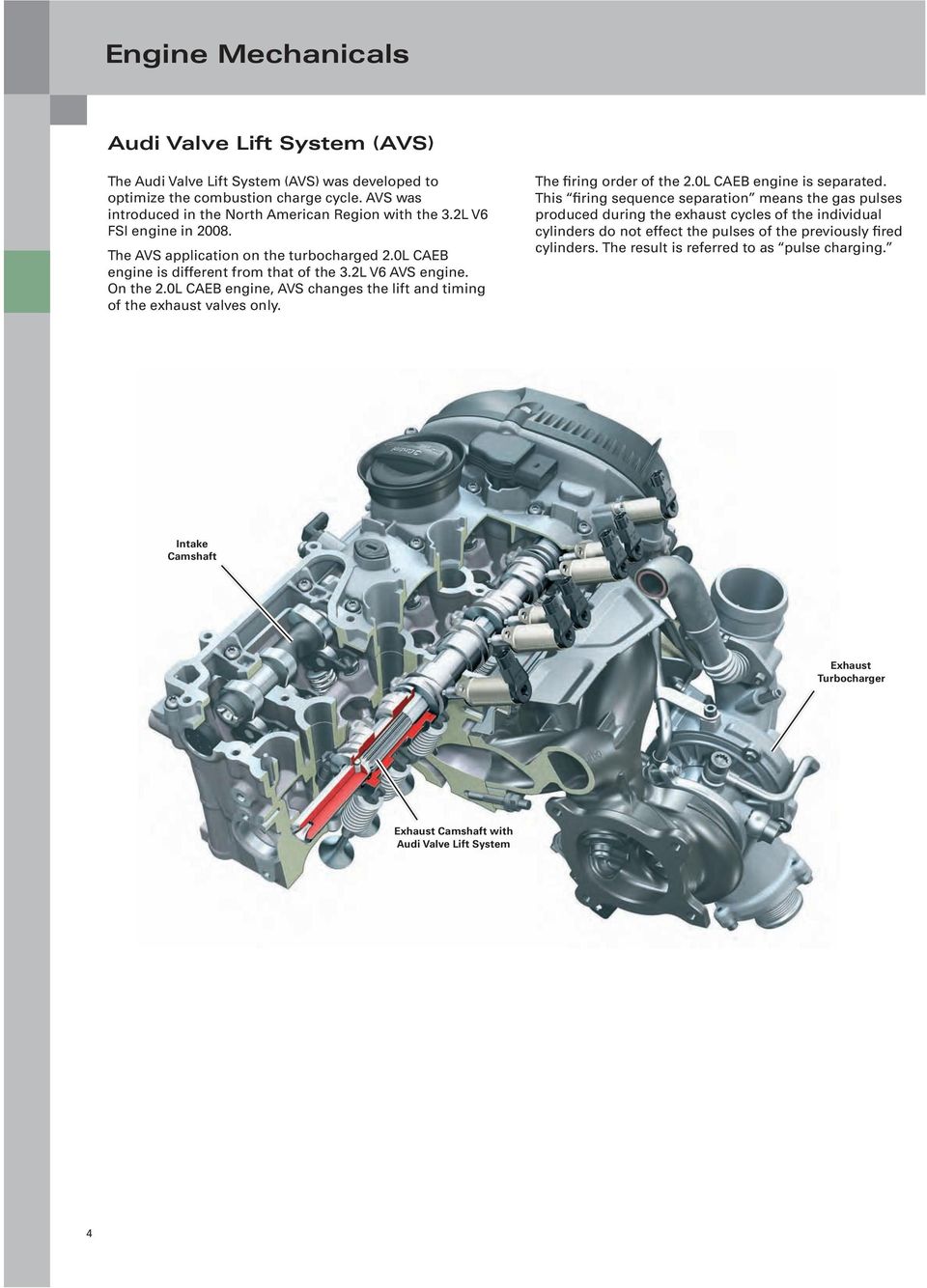
8 Engine Mechanicals Audi Valve Lift System (AVS) The Audi Valve Lift System (AVS) was developed to optimize the combustion charge cycle. AVS was introduced in the North American Region with the 3.2L V6 FSI engine in The AVS application on the turbocharged 2.0L CAEB engine is different from that of the 3.2L V6 AVS engine. On the 2.0L CAEB engine, AVS changes the lift and timing of the exhaust valves only. The firing order of the 2.0L CAEB engine is separated. This firing sequence separation means the gas pulses produced during the exhaust cycles of the individual cylinders do not effect the pulses of the previously fired cylinders. The result is referred to as pulse charging. Intake Camshaft Exhaust Turbocharger Exhaust Camshaft with Audi Valve Lift System 4
9 Engine Mechanicals The mechanical design and function of AVS on the 4-cylinder TFSI engine closely resembles the 6-cylinder naturally aspirated engine. However, different thermodynamic effects are used. At low engine speeds, a narrow profile cam lobe contour is used. At high engine speeds the AVS changes to a wider profile cam lobe contour. The narrow cam lobe contour provides very late exhaust valve opening. This effectively prevents back-flow of exhaust gas during the valve overlap phase due to the pre-exhaust pulse (at the exhaust valve opening point) of the cylinder, which is offset at 180 crankshaft angle. Advanced intake valve timings are therefore possible. The positive cylinder pressure gradient allows the combustion chamber to be effectively purged. This enhances fuel mixture by reducing the residual gas content in the cylinder, and by facilitating advanced intake valve timings (because less intake air is expelled after BDC). These improvements also result in much better response and much higher torque at low rpm. Charge pressure can be built up more quickly, making the torque curve steeper and minimizing turbo lag. Design of the Exhaust Camshaft Cam Elements with Internal Splines Exhaust camshaft with external splines 5

10 Engine Mechanicals Modifications to the Roller Cam Followers The roller cam followers for the exhaust camshaft have been designed to reach both valve lift lobes on the cam elements. To achieve this, the roller is now larger in diameter and narrower in width. At the same time, the roller cam followers have been optimized for low friction by using improved bearings. To prevent the roller cam followers from tilting downward, they are permanently connected to the support element. For this reason, a roller cam follower can only be replaced with a complete, pre-assembled module. Intake Side Exhaust Side with Audi Valve Lift System Roller with Larger Diameter Non-Detachable Connection to Support Element Low Friction Bearing 6

11 Engine Mechanicals Function Each cylinder has its own movable cam element mounted on the exhaust camshaft. Two valve lift contours are possible for each exhaust valve. Changing-over between the large and small cam lobe contours is achieved by the longitudinal displacement of the cam elements. The cam elements are moved on the exhaust camshaft by solenoid actuators. While one actuator switches from small valve lift to large valve lift, the other actuator switches from large valve lift to small valve lift. The second actuator switches back from large valve lift to small valve lift. When an actuator is activated by the Engine Control Module (ECM), a metal pin is extended and engages in the displacement groove of the cam element. Actuators with Metal Pin The cam element is designed to move automatically when the camshaft rotates, thereby changing over both exhaust valves to the other cam lobe contour. However, the displacement groove in the cam elements must be shaped so that the metal actuator pin is pushed back again after the changeover is made. The metal pin cannot be actively changed back by the ECM. Ladder Frame Exhaust Camshaft Axial Bearing Displacement Groove Locking of the Cam Elements Cam Element To ensure that the cam elements are not displaced too far when they are adjusted, adjustment travel is limited by a stop. The stops are camshaft bearings in the cylinder head cover. The cam elements are located and held in place by a detent in the camshaft with spring-loaded balls. Spring-Loaded Ball Cam Element Displacement Groove 7

12 Engine Mechanicals Cam Lobe Contour There are two cam lobe contours per valve on each cam element. The small cam lobes (shown in green) implement a valve opening stroke of 0.25 in (6.35 mm). The length of opening is 180 crankshaft angle. The exhaust valve closes 2 after TDC. The full stroke provided by the large cam lobes (shown in red) is 0.40 in (10 mm) with a length of opening of 215 crankshaft angle. The exhaust valve closes 8 before TDC. Method of Operation Small Cam Lobes (low engine speeds) Large Cam Lobes (high engine speeds) 8

13 Engine Mechanicals Camshaft Adjustment Actuators F366 F373 The camshaft adjustment actuators are electromagnetic solenoid-type actuators. Two actuators are used per cylinder. One actuator moves the cam element on the camshaft for large valve lift. The other actuator resets the cam element for small valve lift. Each actuator is attached externally to the cylinder head cover by a bolt. They are sealed with O rings. When the actuator is activated by the ECM, a metal pin engages the displacement groove in the cam element, thereby moving the other cam lobe into position. Design Electrical Connection Magnetic Coil Mounting Lug Permanent Magnet O-Ring Damper Ring Solenoid Core Metal Pin Pole Plate Guide Tube O-Ring 9

14 Engine Mechanicals Function A solenoid is integrated in the actuator. When the solenoid is activated by the ECM, a metal pin is extended. The solenoid is activated through brief application of battery voltage. When the metal pin is extended, it is held in position by a permanent magnet on the actuator housing. Due to the quick extension time (18 22 ms), the metal pin undergoes very rapid acceleration. A damping ring near the permanent magnet ensures that the pin does not bounce back or become damaged. The metal pin extending into the displacement groove then moves the cam element as the camshaft rotates. The contour of the displacement groove is designed to push the metal pin of the actuator back after just under one revolution of the actuator. The permanent magnet ensures that the metal pin remains in this position. When the permanent magnet pushes the metal pin, voltage is induced in the magnetic coil of the solenoid. This return signal is registered by the ECM. It can only be generated if the metal pin is pushed by back by the displacement groove after the cam element has been moved. The ECM evaluates the signal input as a successful adjustment. Not Activated Electrical Connection Activated Magnetic Coil Solenoid Coil Pole Plate Permanent Magnet Damper Ring Metal Pin 10

15 Engine Mechanicals Activation of the Cam Adjustment Actuators The Camshaft Adjustment Actuators are activated by the ECM, which provides a ground signal. Voltage to the actuators is supplied by Motronic Engine Control Module Power Supply Relay J271. The system is ready for operation above a coolant temperature of 14 F ( 10 C). When the engine is started, the larger contour lobes are in position. Immediately after engine start, the system changes over to the smaller contour lobes. When the engine stops, the AVS switches back to the large contour cam. The maximum power input per actuator is 3 amperes. Legend F366 F373 Cam Adjustment Actuators J271 Motronic Engine Control Module Power Supply Relay J623 Engine Control Module (ECM) Activation of a Cam Adjustment Actuator End of Actuator Activation Battery Voltage [U bat ] Return Signal on Correct Configuration Actuator Activation Adjustment Travel 11

16 Engine Mechanicals Changing Over Between Working Ranges The illustration below shows in schematic form the working range of the AVS when the engine is at operating temperature. It can be seen that the small valve lift is used up to medium engine speeds of approximately 3100 rpm. In the engine speed range required for change-over to large valve lift, the intake manifold flaps are also opened wide. Audi Valve Lift System (AVS) in the Operating Ranges 266 (360) 221 (300) Torque M in lb ft (Nm) 177 (240) 133 (180) 86 (120) 44 (60) Engine Speed in [rpm] 1 Small Valve Lift 3 Large Valve llift 2 Operating Point (at approximately 3100 rpm) Note This illustration shows an example of a torque curve and AVS operating point. Both are dependent on the current ECM software version, and can change in the course of ongoing model development. 12

17 Engine Mechanicals Self-Diagnostics The engine self-diagnostics check the mechanical function of the cam adjustment actuators (changeover to the other cam lobe contour) and the system s electrical connections. A system test is performed after the engine is started. The ECM activates each actuator for this purpose. Both configurations are tested and evaluated. This system test is audible and is performed whenever the engine is started. System failure will result in corresponding DTC entries. Depending on the nature of the fault, the driver may notice a slight variation in engine idling speed or a different engine response under acceleration. How the System Responds to Faults If one or more actuators fails, the ECM will initially attempt (several times) to change over to the other cam. If no adjustment is made, the cam elements that cannot be adjusted remain in position. All other cam elements are changed over to the large cam. They then remain in this position while the engine is running. The next time the engine is started, another attempt is made to adjust all cam elements. Activation of the Warning Lamps Exhaust emissions do not deteriorate due to system failure and because virtually no adverse handling effects may result, neither Electronic Power Control Warning Lamp K132 nor Malfunction Indicator Lamp K83 is activated. However, corresponding DTC entries are generated. Vehicle self-diagnostics Interrogate fault memory 1 Fault detected 01 - Engine electronics EV_ECM20AVS_X1 SAE code P11A100 Text Cam adjuster A, cylinder 1 Electrical fault/open circuit Status active/ static Ambient conditions 13

18 Oil Circulation System Positive Crankcase Ventilation One of the goals in designing this new engine was to provide greater driver, passenger, and pedestrian safety in the event of a collision. For instance, the more compact design of the components above the cylinder head cover provides more clearance between the engine and hood. This translates to a larger crumple zone for the dissipation of energy upon impact. The following components were modified to achieve this goal: Blow-by gas duct integrated in the cylinder crankcase Fine oil separator module with integrated pressure regulating valve, non-return valve and positive crankcase ventilation valve (PCV valve) Valve Unit Blow-By Line to Intake Manifold (naturally aspirated mode) Non-Return Valves Blow-By Line to Exhaust Turbocharger (charging mode) Pressure Regulating Valve PCV Combination Valve Diagnostic Channel Blow-By Duct in Cylinder Head and Cylinder Block Cyclone Oil Return Line 14

19 Oil Circulation System Overview Breather Module Blow-By Inlet into the Intake Manifold (naturally aspirated mode) Blow-By Inlet into the Exhaust Turbocharger (charging mode) Blow-By Duct in Cylinder Head and in Cylinder Block Oil Return Duct in Cylinder Head, Cylinder Block and Oil Pan Oil Return Line Blow-By Gases from the Cylinder Block Non-Return Valve Oil Return Line Below the Dynamic Oil Level Reference The components are positioned differently, but have retained the same functions as on the 1.8L TFSI engine (base engine). For further information, refer to Self-Study Program : Audi 2.0 Liter Chain- Driven TFSI Engine. 15

20 Oil Circulation System Overview The oil circulation system of the 2.0L TFSI CAEB engine is unchanged from the CCTA/CBFA engine. The biggest difference between the two engines is the use of a new self-regulating oil pump on the CAEB engine. Oil Pressure Regulation Valve N428 Self-Regulating Oil Pump 16

21 Oil Circulation System Self-Regulating Oil Pump A newly developed self-regulating engine oil pump is used on the 2.0L TFSI CAEB engine. The main purpose of this development is to increase pump operating efficiency and in turn, reduce fuel consumption. When compared to other self-regulating oil pumps, this design has a more efficient control concept. Oil Pressure Regulation Valve N428 Design Drive Pump Gear Pumped Oil With an external gear pump, the driven pump gear is axially displaceable in relation to the drive gear. This means that the driven gear can move and change the amount the gear lobes mesh with those of the drive gear under certain operating conditions. By displacing the driven pump gear, the delivery rate and pressure in the oil circulation system can be regulated in a controlled manner. Driven Pump Gear (axially displaceable) Intake from the Oil Pan Overview of the Components Pump Housing Input Shaft with Drive Pump Gear Compression Spring of the Cam Lobe Unit Final Drive Sprocket Cam Lobe Unit Regulating Spring Control Piston Driven Pump Gear (axially displaceable) Cold Start Valve Check Valve Cover 17
22 Oil Circulation System Function Conventional Method of Control With a conventional oil pump, the delivery rate increases as the engine RPM increases. The oil consumers in the engine cannot process the excess oil being delivered, so the oil pressure increases. Previously, pressure limiting took place inside the pump. A mechanical valve opened for this purpose. However, since the pump was still operating at its maximum delivery rate, a portion of the input energy was inefficiently converted to heat. The concept of the new control system involves two different pressures. The low pressure setting is approximately 26 psi (1.8 bar). The system changes to the high pressure setting, approximately 48 psi (3.3 bar), at an engine speed of approximately 3500 rpm. The pressure is regulated by controlling the delivery rate of the pump gears. Oil delivery is controlled to produce exactly the required filtered oil pressure downstream of the oil cooler and oil filter. This is achieved by axial displacement of the cam lobe unit or in other words, by displacement of the oil pump gears relative to one another. The delivery rate is highest when both pump gears are aligned exactly opposite each other. The greater the axial displacement of the driven pump gear, the lower its delivery rate will be (only oil displaced between the pump gears is conveyed). The pump gear is displaced by the incoming filtered oil pressure acting on the front piston face of the cam lobe unit. A compression spring also acts upon the front piston face of the cam lobe unit. Filtered oil pressure is permanently applied to the rear piston face of the cam lobe unit. A control piston applies oil pressure through the pressure port on the filtered oil side to the front piston face of the cam lobe unit. The engine oil pressure that has just been developed is used to counteract the force exerted by the regulating spring. The application of oil pressure is a continuous and dynamic process. The control piston moves continuously in alternating linear directions. Overview Compression Spring of the Cam Lobe Unit Oil Passage to Front Piston Face Driven Pump Gear (axially displaceable) Pumped Oil Pressure Port on Filtered Oil Side Oil Pressure Regulation Valve N428 Switchable Pressure Port on Filtered Oil Side Pressure Port on Filtered Oil Side Front Piston Face of Cam Lobe Unit Drive Pump Gear on Input Shaft Cam Lobe Unit Rear Piston Face of the Cam Lobe Unit Oil Passage to Rear Piston Face Control Piston Return to Oil Pan (pressure-less) Oil Passage to Front Piston Face Regulating Spring Oil Passage to Rear Piston Face Low Oil Pressure High Oil Pressure 18
23 Oil Circulation System Positions of the Cam Lobe Unit No axial displacement: maximum oil flow rate Maximum axial displacement: low oil flow rate Engine Start-Up The illustration below shows how the oil pump functions when the engine is started. Engine oil passes through the pressure port on the filtered oil side and impinges on all surfaces of the control piston while flowing to both sides of the cam lobe unit. Oil Pressure Regulation Valve N428 is activated by the ECM and holds the switchable pressure port open so that oil pressure is applied to all surfaces of the control piston. The cam lobe unit remains in this position. The pump operates at maximum output until the low pressure setting is reached (approximately 26 psi [1.8 bar]). A lower value is also possible when the engine is idling. However, an excessively low value would cause irreparable damage to the engine. Therefore, the oil pressure must be monitored, in this case by Reduced Oil Pressure Switch F378. Pumped Oil Pressure Port on Filtered Oil Side Engine Speed [rpm] Relative Oil Pressure [bar] Compression Spring of the Cam Lobe Unit Driven Pump Gear (is displaced axially) Oil Pressure Regulation Valve N428 Oil Passage to Front Piston Face is Closed Rear Piston Face of Cam Lobe Unit Oil Passage to Rear Piston Face Control Piston is Pushed Against the Regulating Spring Regulating Spring Oil Passage to Rear Piston Face 19
24 Oil Circulation System Low Pressure Setting Reached If engine speed increases, the oil pressure increases slightly and displaces the control piston against the force of the regulating spring. The pressure port to the front piston face of the cam lobe unit closes. At the same time, the connection to the pressureless return line leading into the oil pan opens. The hydraulic force exerted by the rear piston face of the cam lobe unit is now greater than the spring force. As a result, the cam lobe unit moves against the force of the compression spring. The driven pump gear is displaced axially relative to the drive pump gear. The volumetric flow rate decreases and adjusts to the engine s oil consumption. By adjusting the volumetric flow rate, the oil pressure is kept at a relatively constant level. Driven Pump Gear (is displaced Compression axially) Spring of the Cam Lobe Unit Pumped Oil Pressure Port on Filtered Oil Side Engine Speed [rpm] Relative Oil Pressure [bar] Oil Passage to Front Piston Face is Closed Cam Lobe Unit is Displaced Rear Piston Face of Cam Lobe Unit Oil Passage to Rear Piston Face Control Piston is Pushed Against the Regulating Spring Regulating Spring Oil Passage to Rear Piston Face Shortly Before Change-Over to the High Pressure Setting The cam lobe unit is fully extended. Engine Speed [rpm] Relative Oil Pressure [bar] Cam Lobe Unit 20
25 Oil Circulation System Change-Over Point to High Pressure Setting The system changes over to the high pressure setting at an engine speed of approximately 3500 rpm. Oil Pressure Regulating Valve N428 is de-energized for this. This simultaneously causes the switchable pressure port and the port to the pressureless chamber in the oil pan to close. Since the surface of the control piston is no longer effective, the force of the regulating spring is now predominant. The control piston moves far enough to open the port to the front piston face of the cam lobe unit. The oil pressure acting upon the front piston face and the compression spring push the cam lobe unit back again, so that both pump gears are again almost in parallel with one another and the pump is operating at its maximum delivery rate. The cam lobe unit remains in this position until an oil pressure of approximately 47 psi (3.3 bar) is reached. Pumped Oil Engine Speed [rpm] Relative Oil Pressure [bar] Oil Pressure Regulation Valve N428 Switchable Pressure Port (now pressureless) Oil Passage to Front Piston Face is Opened Cam Lobe Unit is Displaced Back Control Piston is Displaced Regulating Spring Note The self-regulating oil pump always operates in the high pressure setting during the first 620 mi (1000 km). This allows for the higher thermal load on components during the break-in period. 21
26 Oil Circulation System High Pressure Setting is Reached Oil Pressure Regulation Valve N428 remains de-energized. The force equilibrium between the control piston and regulating spring is maintained by the higher oil pressure (the effective piston surface area is smaller). As engine speed increases, the cam lobe unit again begins to move (as in the low pressure setting). The change-over to the high pressure setting is registered by O.3 Bar Oil Pressure Switch F22 (on the oil filter module). In the high pressure setting, the switchable oil passage is kept closed by Oil Pressure Regulation Valve N428. Pumped Oil Oil Pressure Regulation Valve N428 Engine Speed [rpm] Relative Oil Pressure [bar] Switchable Pressure Port (now pressure-less) Cam Lobe Unit Control Piston Regulating Spring Cam Lobe Unit at Stop Engine Speed [rpm] Relative Oil Pressure [bar] Cam Lobe Unit 22
27 Oil Circulation System Oil Pressure Switch One or two oil pressure switches are used, depending upon whether the engine is equipped with a selfregulating oil pump. Oil pressure switches are generally mounted on the oil filter module. Example: Comparison of Pressure Characteristics 73 (5) Relative Oil Pressure (psi / bar) Oil Temperature at 158 F (70 C) 58 (4) 44 (3) 29 (2) (1) Engine speed [rpm] Oil Pressure of 1.8L MPI Turbocharged Engine (without self-regulating oil pump) Oil Pressure of 1.8L TFSI Engine (transversely mounted, without self-regulating oil pump) Engine Without Self-Regulating Oil Pump Only Oil Pressure Switch F22 is used on engines not equipped with a self-regulating oil pump. However, this switch has a different part number (different oil pressures are measured). Pressure Requirements of 1.8L TFSI Engine Oil Pressure of 1.8L TFSI Engine (self-regulating) 1 Low Pressure Setting 2 High Pressure Setting Engine With Self-Regulating Oil Pump The self-regulating oil pump uses two oil pressure switches F22 and Reduced Oil Pressure Switch F378. F378 is located above Oil Pressure Switch F22. Reduced Oil Pressure Switch F378 (0.7 bar) Oil Pressure Switch F22 (1.4 bar) Oil Pressure Switch F22 (2.55 bar) Reference For information on the design of the oil filter module, please refer to Self-Study Program Audi 2.0 Liter Chain-Driven TFSI Engine. 23
28 Oil Circulation System Oil Pressure Monitoring On engines with a self-regulating oil pump, oil pressure is monitored by two oil pressure switches. This is necessary because two different oil pressures are used. Convenience CAN Instrument Cluster CAN Powertrain CAN Legend 1 Warning bit red oil can 2 2 text bits 3 Change-over bit = 1 4 Switch bit 5 Signal from Oil Pressure Switch F22 6 Signal from Reduced Oil Pressure Switch F378 F22 Oil Pressure Switch F378 Reduced Oil Pressure Switch J285 Instrument Cluster Control Module J519 Vehicle Electrical System Control Module J533 Data Bus On-Board Diagnostic Interface J623 Engine Control Module (ECM) Functions and Signals of the Oil Pressure Switch The two oil pressure switches serve to monitor the oil pressure. Reduced Oil Pressure Switch F378, which is connected directly to the ECM, checks for the presence of oil pressure. Oil Pressure Switch F22 monitors the high-pressure level of the self-regulating oil pump, provided that it is operating in the high pressure setting. Signals Generated by the Oil Pressure Switches Both oil pressure switches are evaluated by the ECM. Earlier versions used a single-stage oil pump and the oil pressure switch was read and evaluated by Instrument Cluster Control Module J285. Oil Pressure Switch F22 of the 2009 Audi A4 is read by Onboard Power Supply Control Module J519 and made available to Engine Control Module J623 via the powertrain CAN data bus. The oil pressure switches are normally-open contacts, connecting to ground as soon as the required oil pressure is developed. 24
29 Oil Circulation System Oil Pressure Monitoring In the ECM, oil pressure switches are monitored at engine ON and validated at engine OFF. Validation at Engine OFF There should NOT be a signal from a closed oil pressure switch when the engine is switched OFF. If there is, an electrical fault has occurred. At terminal 15 ON, a warning is indicated in the Driver Information System display ( red oil can together with the fault text Shut off engine and check oil level ). Warning at Engine ON Oil pressure switches are monitored above a defined engine speed threshold, dependent on oil temperature. The oil pressure switches are generally monitored when the engine is cold (up to 140 F [60 C]) and when the engine is idling. When the engine is at operating temperature, oil pressure switches are only monitored at high engine speeds. If a switch is not closed, the warning red oil can is indicated together with the fault text Shut off engine and check oil level in the Driver Information System display. Oil Pressure Switch F22 is monitored as soon as the selfregulating oil pump is operating in the high pressure setting and engine speed exceeds a value computed from the characteristic map (dependent on oil temperature). If the switch is identified as being not closed, Engine Electronics Indicator Lamp K149 is activated. Engine speed is limited as well. Engine speed is indicated in the instrument cluster as text and a yellow engine speed symbol. Fault Analysis Options A diagnosis is made in the ECM by the oil pressure monitoring function. The status of Oil Pressure Switch F22 can be viewed under Address Word 09, MVB 28 using a VAS Scan Tool. Note Text messages are only displayed for Validation at engine OFF and Warning at engine ON in vehicles with a Highline instrument cluster. 25
30 SULEV 2.0L TFSI Engine Introduction With the introduction of the 2.0L CAEB engine, Audi was able to combine direct fuel injection, AVS, and turbocharging while still meeting the stringent ULEV II exhaust emission limits. However, some states require the even more stringent SULEV exhaust emission standards. The measures undertaken to comply with the SULEV exhaust emission regulations will be explained in detail on the following pages. The technical descriptions refer to the Audi A3. To homologate a vehicle for the North American market, the following conditions must be met: Compliance with statutory exhaust emission limits No hydrocarbon emission from the fuel system All exhaust-related systems and components monitored to OBD II requirements Compliance with SULEV exhaust emission limits ensured over 150,000 miles (240,000 km) and 15 years 26
31 SULEV 2.0L TFSI Engine Secondary Air System To reduce hydrocarbon emissions at the earliest possible stage, fresh air is blown into the cylinder head exhaust ports during the engine start phase. The system is designed to rapidly develop pressure and achieve a high delivery rate on activation. The illustration below shows the components of the secondary air system. The following components are new to the system: Secondary Air Injection Sensor 1 G609 Secondary Air Injection Solenoid Valve N112 The secondary air pump is positioned above the lowest point of the pressure line system to prevent harmful condensation from collecting in the pump. If the system is functional, an excess pressure of approximately 2.3 psi (160 mbar) will be achieved in the pressure line while the engine is idling after a cold start. Pressure acting on the sender increases with rising exhaust gas mass flow, depending on how the car is driven (high engine load). Pressure levels of greater than 2.9 psi (200 mbar) above ambient pressure can be achieved. There is an elongated hole in the cylinder head below the exhaust ports. Secondary air which flows through an elongated hole is drawn directly into the exhaust ports. The proximity of exhaust ports to the exhaust valves is advantageous. A secondary air reaction occurs immediately, generating the thermal energy required to heat the catalytic converter. Overview of the Components Intake Line from Air Filter Pressure Line Secondary Air Bore in the Cylinder Head Secondary Air Injection Pump Motor V101 Secondary Air Injection Sensor 1 G609 Secondary Air Injection Solenoid Valve N112 27
32 SULEV 2.0L TFSI Engine Secondary Air Injection Solenoid Valve N112 Unlike earlier valves, the newly developed Secondary Air Injection Solenoid Valve N112 operates electrically. It is mounted directly to the cylinder head by bolts. When compared to the pneumatic valves used previously, the secondary air intake valve is extremely rugged. The valve also has a non-return function which prevents exhaust gases from flowing back into the secondary air system, even when the valve is open (illustration at right). Electrical Connection Branch Connecting to Cylinder Head From Air Filter Valve Activated When N112 is activated by the ECM, secondary air flows through the valve to the cylinder head. A solenoid lifts the closing element off the valve plate. Secondary air flows through the orifices in the valve plate. Armature Closing Element Coil Valve Plate To Cylinder Head Non-Return Function When secondary air flows through the valve, the nonreturn element is pressed down and against a spring, holding the valve open. If exhaust gases flow back into the secondary air intake valve, secondary air pressure will decrease. As a result, the non-return element lifts off the closing element with spring assistance and seals the orifices in the valve plate. In this way, secondary Air Injection Valve and Secondary Air Injection Pump Motor V101 are protected against possible damage by hot exhaust gases. Non-Return Element Closing Element 28 Valve Plate Spring Exhaust Gas
33 SULEV 2.0L TFSI Engine Secondary Air Injection Sensor 1 G609 Secondary Air Injection Sensor 1 G609 connects to the pressure line coupling upstream of Secondary Air Injection Valve N112. It supplies the ECM with an analog output signal of between 0.5 and 4.5 V. Its measurement window is between 7 and 22 psi (50 kpa 150 kpa). Signal Utilization This signal is used for diagnosing the secondary air system. Because the system is relevant to exhaust emissions, legislation requires that it be monitored. Effects of Signal Failure A diagnosis is made for the sensor and used to monitor voltage (min-max threshold), and to match ambient pressure and the secondary air pressure sensor (phase 0). If a fault occurs in a sensor, the system diagnosis result will not be evaluated because the sensor signal will be implausible. However, a diagnosis will still be made. Diagnostics If Secondary Air Injection Valve N112 remains closed due to a malfunction, the resulting pressure will be too high. Conversely, the pressure will be too low if a leak occurs in the system upstream of the secondary air injection valve. In both cases, the corresponding fault memory entries are saved to the ECM, and Malfunction Indicator Lamp (MIL) K83 is activated. Signal Characteristic of the Secondary Air Pressure Sensor Signal Output Voltage U A [V] (40) 7.2 (50) 8.7 (60) 10.1 (70) 11.6 (80) 13.0 (90) 14.5 (100) 15.9 (110) 17.4 (120) 18.8 (130) 20.3 (140) 21.7 (150) 23.2 (160) 24.6 (170) Absolute Pressure p abs psi (kpa) 29
34 SULEV 2.0L TFSI Engine Testing the System The California Air Resources Board (CARB) requires that the secondary air system be monitored during the heatup phase of the catalytic converter. Previously, the system was monitored using the oxygen sensor. However, this downstream sensor does not become available quickly enough. For this reason, the system is monitored and evaluated for pressure-based secondary air diagnosis by Secondary Air Injection Sensor 1 G609. Reference On the next page you will find a diagram showing the individual phases of the secondary air diagnosis process. Pressure-Based Secondary Air Diagnosis Process Phase 0 The control module initialization process begins at ignition on. The signal from Secondary Air Injection Sensor 1 G609 is stored and compared to the signals received from the ambient pressure sensor and the intake manifold pressure sensor. Phase 1 When the secondary air mass is injected, the pressure within the secondary air system also rises to above atmospheric pressure. This pressure increase is determined by G609. The resulting analog signal is evaluated by the ECM. If the signal exceeds the predefined limit, for example due to a blockage in the system or leakage, a DTC entry will be generated. Engine Electronics Indicator Lamp K149 will also be activated. If the system is still in order, the diagnosis procedure will be continued. Phase 2 During this phase, Secondary Air Injection Valve N112 is closed and checked for leaks. The value determined by Secondary Air Injection Sensor 1 G609 is evaluated for this purpose. Phase 3 The secondary air pump is shut OFF and Secondary Air Injection Valve N112 closed. The difference between the actual measured pressure and the stored value generated in phase 0 is evaluated. A faulty Secondary Air Injection Pump (pump does not shut off) or a faulty Secondary Air Injection Sensor 1 G609 can thus be detected. 30
35 SULEV 2.0L TFSI Engine Phases of the Secondary Air Diagnosis Process Pressure Difference Phase 5 Time Blockage (restricted flow) 4 Faulty Pressure Sensor 2 Reduced Pumping Capacity or a Blockage Upstream of Secondary Air Injection Sensor 1 G609 5 Faulty Pressure Sensor 6 Secondary Air Pump Running 3 Secondary Air Pump Running (does not shut OFF) 7 Combination Valve 1 Open 31
36 SULEV 2.0L TFSI Engine Exhaust Turbocharger The turbocharger used on SULEV emission level engines is made of cast steel, and not cast iron. Cast steel provides excellent long-term stability. In addition, the components heat up more quickly after engine start-up because they have thinner walls. Cast steel also allows the oxygen sensor to be positioned inside the turbine housing. This is necessary to ensure the rapid availability of the sensor. Both air flow and catalytic converter inflow have been greatly improved, reducing the exhaust gas backpressure upstream of the turbine. Reduced back-pressure means less possibility of turbo-lag while also increasing fuel economy. Configuration Cast Steel Integral Module Heated Oxygen Sensor G39 Upstream of Primary Catalytic Converter (broadband oxygen sensor in the integral module) Wastegate 32
37 SULEV 2.0L TFSI Engine Catalytic Converter System The exhaust system was developed with the following goals in mind: Easy compliance with SULEV exhaust emission limits High long-term stability over 150,000 miles (240,000 km) and 15 years Minimized increase in exhaust back-pressure in catalytic converters with a high cell density Reduced light-off time The primary catalytic converter is designed to comply with statutory emission limits. To achieve this, cell density has been increased and wall thickness reduced. To minimize light-off time of the primary catalytic converter, it is close coupled to the exhaust turbocharger turbine (directly in the integral module). Overview of the Components Integral Module Heated Oxygen Sensor G39 Upstream of Primary Catalytic Converter (broadband oxygen sensor in the integral module) Close-Coupled Ceramic Primary Catalytic Converter Oxygen Sensor G130 Upstream of Catalytic Converter (nonlinear lambda sensor upstream of underbody catalytic converter) Exhaust Decoupling Element Oxygen Sensor G287 Downstream of Catalytic Converter (nonlinear lambda sensor downstream of underbody catalytic converter) Ceramic Underbody Catalytic Converter 33
38 SULEV 2.0L TFSI Engine Oxygen Sensors The oxygen sensors were designed to minimize the time-to-readiness for the closed-loop operation engine management system. By installing the broadband oxygen sensor in the turbine housing, closed-loop operation can begin only 19 seconds after starting the engine. Due to the risk of water shock during the broadband oxygen sensor s rapid rate of heating, a special sensor, Oxygen Sensor G39 (LSU4.9), is used here. G39 is located upstream of the primary catalytic converter. This sensor has an additional triple-layer protective tube. Two type LSU4.2 nonlinear oxygen sensors are used upstream and downstream of the underbody catalytic converter. They facilitate natural frequency-based closedloop operation, and allow the primary and underbody catalytic converters to be diagnosed for aging separately. Design of Heated Oxygen Sensor G39 (LSU4.9) Hexagonal Housing Inner Protective Tube Middle Protective Tube Outer Protective Tube 34
39 SULEV 2.0L TFSI Engine Natural Frequency Based Oxygen Sensor Control Task The task of this system is to maximize utilization of the primary catalytic converter during the conversion of pollutant gases. Function Oxygen Sensor G130 LSF4.2 downstream of the primary catalytic converter supplies the ECM with a voltage signal (nonlinear) indicating rich or lean. Heated Oxygen Sensor G39 LSU4.9 determines a frequency from the flow rate and the condition of the catalytic converter. The ECM provides this frequency with an amplitude indicating whether the mixture is to be rich or lean. If the primary catalytic converter is supersaturated with oxygen (lean mixture), Oxygen Sensor G130 will send the ECM a nonlinear signal indicating the lean mixture condition. The mixture is then enriched with fuel until the oxygen has been displaced from the catalytic converter. This condition, in turn, is registered by Oxygen Sensor G130 as a nonlinear signal indicating the rich mixture condition. The mixture is then leaned out by the ECM. If the nonlinear signal is received again, the mixture will again be enriched. The frequency, or period, during which the mixture is enriched or leaned out is variable, being dependent on the gas flow rate (engine load) at that moment. However, aging of the catalytic converter (decrease in conversion rate) also reduces the frequency. A large proportion of the exhaust gases is converted in the primary catalytic converter. The remaining exhaust gas constituents are then converted to non-toxic gases by the underbody catalytic converter. Oxygen Sensor 3 Behind Three Way Catalytic Converter G287 (downstream of underbody catalytic converter) operates in much the same way as a conventional linear oxygen sensor. Its task is to control the fine adjustment of Heated Oxygen Sensor G39. For this purpose, the characteristic curve is corrected by the trimming control in the ECM. It also monitors the conversion process in the catalytic converters. Reference For basic information on exhaust emissions and engine management systems, please refer to Self-Study Programs Motor Vehicle Exhaust Emissions and Engine Management Systems. 35
40 SULEV 2.0L TFSI Engine Signal Characteristics of the Oxygen Sensors Voltage in V Voltage in V Lambda Time t in s Oxygen Sensor 3 Behind Three Way Catalytic Converter G287 Oxygen Sensor Behind Three Way Catalytic Converter G130 Heated Oxygen Sensor G39 (before primary catalytic converter) 36
41 SULEV 2.0L TFSI Engine Automatic Starter Control in the Audi A3 To ensure that the Audi A3 easily achieves SULEV exhaust emission limits, an automatic starter control system is used. The ECM does not allow fuel to be injected into the combustion chamber until a pressure of at least 870 psi (60 bar) is measured in the fuel rail at start-up. This pressure is necessary to keep raw hydrocarbon emissions to an absolute minimum. The complete starting cycle is performed automatically after briefly turning the ignition key to the start position. Requirements for Starting On vehicles with manual transmissions, the starter motor will only engage when the clutch pedal is fully depressed. On vehicles with automatic transmission, the selector lever must be in position P or N, in addition to a short press on the brake pedal. Starting Sequence (refer to diagram on next page) To activate the starter motor, both signal lines (1) and (2) are pulled to ground by the ECM. One of the two lines is pulled to ground for approximately three seconds for diagnostic purposes. The other line is always diagnosed when the engine is started. After completion of the power-off diagnostics, both lines are diagnosed continuously by means of pulses with a short duration of only a few milliseconds. This results in a mean voltage level of approximately 3 to 9 volts. When line (1) is pulled to ground, battery voltage will again be present at the line (3), causing Power Supply Relay Terminal 50, J682 to close. Likewise for diagnostic purposes, the actual circuit status of the J682 load output is fed back across the diagnostic line (4) to the ECM and Vehicle Electrical System Control Module J519. Because the starter motor has high inductance, it takes up to approximately three seconds after the opening of Power Supply Relay J682 until the ground signal is restored on the diagnostic line (4). Effects of Failure If a fault relevant to starting is entered in memory, only one manual start will be performed as a substitute response. The starter will only be activated as long as the ignition key is turned to the start position and held there. 37
42 SULEV 2.0L TFSI Engine Function Diagram Powertrain CAN Convenience CAN Legend A Battery B Starter D Ignition/Starter Switch J519 Vehicle Electrical System Control Module J527 Steering Column Electronic Systems Control Module J533 Data Bus On Board Diagnostic Interface S Fuse 1 Start enable signal: is pulled to ground by the ECM when a start request is received 2 Ground connected signal from ECM 3 Connected terminal 30 4 Diagnostic line 38
43 SULEV 2.0L TFSI Engine Operating Modes After cold-starting the engine, various operating modes and fuel injection strategies are implemented: Stratified start (high-pressure fuel injection) Catalyst heating by homogeneous split dual injection, in conjunction with secondary air injection Dual injection during the engine warm-up phase Stratified Start (high-pressure fuel injection) When the rail pressure exceeds 60 bar (absolute) the injection enable signal is issued by the ECM. This occurs when the full starting fuel charge is injected during the compression phase until 60 crankshaft angle before ignition TDC. At this stage in the process, both cylinder pressure and temperature are already considerably elevated, enabling the injected fuel to evaporate more efficiently. Fuel Quantity [%] Ingress of raw fuel into the combustion chamber is considerably reduced. The resulting, minimal fuel film on the cylinder walls is necessary to ensure extremely low raw hydrocarbon emissions at engine start-up. A richer mixture forms in proximity to the spark plug, thereby creating more stable ignition conditions. 1 Crankshaft Angle [ ] Charge Cycle TDC 3 Ignition TDC 2 BDC 39
44 SULEV 2.0L TFSI Engine Catalyst Heating with Dual Injection and Secondary Air Injection To achieve good idling quality, a special characteristic map has been selected. In this map the following parameters relevant to exhaust emissions have been adapted: Fuel rail pressure Injection timing of first injection during the intake phase Injection timing of second injection during the compression phase Fuel split during first and second injections (approximately 70% during first injection) Intake camshaft adjustment Position of the intake manifold flaps (open/closed) Ignition angle adjustment towards retard (up to 21 after TDC) Combustion chamber air ratio Fuel Quantity [%] 1 Crankshaft Angle [ ] Charge Cycle TDC 3 Ignition TDC By using the secondary air system, exhaust gas temperature has been increased while reducing hydrocarbon emissions. 2 BDC Dual Injection During the Engine Warm-Up Phase The catalytic converter heat-up phase is followed by the engine warm-up phase, where one dual injection is performed per working cycle. The main part of the fuel charge (approximately 80%) is injected synchronous with the intake cycle, and the remainder (approximately 20%) during the compression phase. During the engine warm-up phase, dual injection is performed within the mapped range at engine speeds of less than 3000 rpm. At the same time, the intake manifold flaps are closed to increase flow intensity. The advantage of this operating mode is that considerably less fuel is deposited on the cylinder walls due to the low penetration depth of the fuel during second injection when the engine is still not fully warmed up. Raw hydrocarbon emissions are lower, and entrainment of fuel into the engine oil is kept to a minimum. 40
45 SULEV 2.0L TFSI Engine Compliance with Statutory Limits (PremAir ) When evaluating the environmental compatibility of vehicles, the EPA awards credits for technical measures designed to improve air quality. These credits can be used to offset fleet emissions that are over the limit. For this reason, a radiator with a special catalytic coating is used on the Audi A3. This PremAir technology* contributes to improving air quality. In exchange, the California Air Resources Board allows a higher NMOG* limit. *NMOG This abbreviation stands for Non Methane Organic Gases and encompasses all hydrocarbon emissions except methane. Overview of the Components Catalytically Coated Car Radiator Radiator Identification Sensor G611 (PremAir sensor) 41
46 SULEV 2.0L TFSI Engine Function The entire cooling surface of the car s radiator is coated with catalytic material. When air flows through this specially coated radiator, the ozone in the air is converted to oxygen (chemical symbol O 2 ). Ozone (chemical symbol O 3 ) is a gas which is harmful to health. Given that the air in a car radiator can flow at up to two kilograms per second, a car with a PremAir radiator makes a significant contribution to reducing nearsurface ozone levels. The efficiency of this technology is particularly high in strong sunlight and at high air pollution levels. This ozone catalyst technology is also used on aircraft, where it prevents stratospheric ozone from entering the cabin through the air conditioning system. The same technology is used in printers and copiers. To receive EPA credits however, the Air Resources Board (ARB) requires not only a PremAir radiator installed on the vehicle, but also a monitoring system that ensures its proper function and reliability at all times. Therefore, this special radiator is monitored by Radiator Identification Sensor G611. Treated Air with Reduced Ozone Content Incoming Ambient Air Containing Ozone 42
47 SULEV 2.0L TFSI Engine Radiator Identification Sensor G611 Requirements The purpose of Radiator Identification Sensor G611 is to prevent: PremAir radiator from being removed and replaced with a non-premair radiator G611 from being removed for the purpose of reproducing the electronics or software G611 from being extensively cut out of the radiator and installed elsewhere The requirements relating to Radiator Identification Sensor G611 are met as follows. To check for the presence of the radiator, pre-determined distinguishing features (IDs) are stored in the ECM and in G611, and exchanged electronically. Information is exchanged via LIN bus according to the master-slave principle. This means that Radiator Identification Sensor G611 is interrogated by the ECM. The IDs are transmitted in an encrypted form after the engine is started. If the codes no longer match (for example, due to tampering), a fault will be indicated. Mounting Base for Sensor Spigot in Radiator Radiator Identification Sensor G611 (PremAir sensor) Corrugated Cable Protection Tube Circuit Diagram Integrated Temperature Sensor A temperature sensor (NTC, Negative Temperature Coefficient) measures the temperature at the point of installation. This temperature is compared in the ECM with the temperature from Engine Coolant Temperature Sensor G62. The measured temperatures are transmitted to the ECM via LIN bus. In the ECM, the values are compared with a characteristic map and evaluated. The temperature sensor is located in a specially shaped spigot on the sensor housing. During assembly, the sensor is bonded directly to a mounting base on the radiator. The temperature sensor is made of cast polyurethane resin and is non-removable once attached. If, however, an attempt is made to remove the temperature sensor, the sensor spigot will break away from the housing causing it to become irreparably damaged, both electrically and mechanically. This is a safeguard to ensure that all attempts at tampering will be detected. In the event of misuse, Malfunction Indicator Light K83 will be activated. In this case, both the radiator and Radiator Identification Sensor G611 must be replaced. Legend G611 Radiator Identification Sensor J623 Engine Control Module (ECM) Term 87 Main Relay, 12 Volt Power Supply S Fuse Positive Ground LIN bus 1,2,3 Pins on Control Unit 43
48 SULEV 2.0L TFSI Engine Temperature Sensor Diagnostics The temperature sensor is diagnosed in Engine Control Module J623 only. To prevent tampering, no tests can be performed using the VAS Scan Tool. Furthermore, the temperature signal is not transmitted as a voltage value, but as a LIN message. Before the ECM can diagnose the temperature sensor, several enabling conditions must be met. The values are then checked in multiple measurement windows. Enabling Conditions of the Diagnostics Engine temperature greater than F (97.5 C) (so thermostat is open) There is a 360-second time delay after the engine temperature exceeds F (97.5 C) to ensure maximum flow through the radiator Measurement Window is Active if: Engine has been idling for longer than 25 seconds Engine is then accelerated to part throttle or wideopen throttle within eight seconds intake camshaft adjustment Measurement window is then active for 10 seconds in order to measure the temperature curves (gradients) Three Measurement Windows are Required to Decide Whether the System is Operating Properly Additional conditions for diagnosis: Diagnostics are disabled for 45 seconds at radiator fan ON/OFF or OFF/ON Ambient temperature greater than 48 F (9 C) The temperature sensor cannot be tested by reading out a measured value. If the ECM detects a fault, the following fault memory entries are possible: P2568 implausible signal P2569 short circuit to ground P2570 short circuit to battery/open circuit U102E LIN message incorrect (implausible signal) U102F timeout (no communication) U1030 LIN bus inactive Note The diagnostic strategy described in this SSP will be replaced by a new strategy in the course of ongoing development from model year 2011 onward. 44
49 Service Special Tools Here you can see the special tools for the 4-cylinder TFSI engines. T40191/1 (narrow) and T40191/2 (wide) spacers for locating the AVS spline ends on the camshaft T40196 adaptor for moving the AVS spline ends on the camshaft T10352 assembly tool for removing and installing the inlet camshaft timing adjustment valve. The /1 tool has offset stud bolts. It is used upwards of a defined engine version. T10394 puller for removing the balancer shaft in conjunction with special tool T10133/3 45
50 EA 888 Engine Development Overview of the Development Stages Engine Stage 0 1.8L Longitudinal Engine 1.8L Transverse Engine EC: BYT SOP: 01/2007 EOP: 06/2007 EU IV Initial Rollout of the EA888 Engine Series 2.0L Longitudinal Engine 2.0L Transverse Engine You will find explanatory notes on the abbreviations used in this table on page
51 EA 888 Engine Development Stage 1 Stage 2 EC: CABA SOP: 02/2008 EOP: 09/2008 EU IV EC: CDHA SOP: 09/2008 EOP: / EU V EC: CABB SOP: 07/2007 EOP: 05/2008 EU IV EC: CDHB SOP: 06/2008 EOP: / EU V EC: CABD SOP: 10/2007 EOP: 11/2008 EU IV Modifications to Stage 0 (1.8L Transverse Engine): Positive Crankcase Ventilation Self-Regulating Oil Pump Modifications to Stage 1: Main Bearing Diameter Reduced from 58 to 52 mm Modified Piston Modified Piston Rings Different Honing Process Ixetic Vacuum Pump EC: BZB SOP: 06/2007 EOP: 06/2008 EU IV EC: CDAA SOP: 05/2008 EOP: / EU V Modification to Stage 0: Positive Crankcase Ventilation Modifications to Stage 1: Diameter of Main Bearing Reduced from 58 to 52 mm Modified Piston Modified Piston Rings Different Honing Process Self-Regulating Oil Pump Ixetic Vacuum Pump Fuel Supply Line (routing) Turbocharger Control Rod in Accordance with EA113 EC: CDNA SOP: 22/2009 EOP: / EU II V EC: CDNB SOP: 06/2008 EOP: / EU V EC: CDNC SOP: 06/2008 EOP: / EU V EC: CAEA SOP: 01/2009 EOP: / ULEV II EC: CAEB SOP: 08/2008 EOP: / ULEV II Modifications to Stage 1 (1.8L Longitudinal Engine): Audi Valvelift System (AVS) Modified Piston Modified Piston Rings Different Honing Process Ixetic Vacuum Pump Hitachi Generation III High-Pressure Fuel Pump New Air Mass Meter EC: CAWB SOP: 11/2007 EOP: 05/2008 EU IV EC: CCZA SOP: 05/2008 EOP: / EU V EC: CBFA SOP: 02/2008 EOP: 05/2009 PZEV, SULEV EC: CCXA SOP: 05/2009 EOP: / BIN 5/ULEV II EC: CCTA SOP: 05/2009 EOP: 05/2009 BIN 5, ULEV II Modification to Stage 0 (1.8L Transverse Engine): Positive Crankcase Ventilation Modifications to Stage 1: Modified Piston Modified Piston Rings Different Honing Process Self-Regulating Oil Pump Ixetic Vacuum Pump Hitachi Generation III High-Pressure Fuel Pump Fuel Supply Line (routing) New Air Mass Meter 47
52 EA 888 Engine Development Technical Features Technical Features of the 4-Cylinder TFSI Engines Engine 1.8L TFSI 1.8L TFSI 1.8L TFSI Engine Codes CDHA, CABA BYT, BZB CDAA, CABB, CDHB Displacement in cm Max. Power in rpm at Max. Torque in rpm at Bore in mm Stroke in mm Compression Ratio 9.6 : : : 1 Fuel in RON 95/91* 95/91* 95/91* Injection/Ignition System FSI FSI FSI Firing Order Knock Control Yes Yes Yes Charging Yes Yes Yes Exhaust Gas Recirculation No No No Intake Manifold Change-Over No No No Variable Valve Timing Yes Yes Yes Secondary Air System No No No Audi Valve Lift System (AVS) No No No Self-Regulating Oil Pump Yes No Yes Intake Manifold Flaps Yes Yes Yes *Unleaded RON 91 petrol may also be used with a slight reduction in engine power **The engine develops 130 kw, but all other parameters are identical Abbreviations used in the table: EC Engine Code SOP Start of Production EOP End of Production EA113 Engine series 1.8l MPI Exhaust emission standards: EU IV, EU V, BIN 5, PZEV, SULEV, ULEV II 48
53 EA 888 Engine Development 1.8L TFSI 2.0L TFSI 2.0L TFSI 2.0L TFSI 2.0L TFSI CABD CAEA, CDNB, (CDNA)** CAWB, CBFA CCTA, CCZA CAEB, CDNC : : : : : 1 95/91* minimum 95 95/91* 95/91* minimum 95 FSI FSI FSI FSI FSI Yes Yes Yes Yes Yes Yes Yes Yes Yes Yes No No No No no No No No No no Yes Yes Yes Yes Yes No No Yes (CBFA only) No no No Yes No No Yes Yes Yes No Yes (CCZA only) Yes Yes Yes Yes Yes Yes 49
54 50 Notes
55 Knowledge Assessment An on-line Knowledge Assessment (exam) is available for this Self-Study Program. The Knowledge Assessment may or may not be required for Certification. You can find this Knowledge Assessment at: From the accessaudi.com Homepage: Click on the ACADEMY tab Click on the Academy Site link Click on the CRC/Certification link Click on Course Catalog and select Audi 2.0L 4-Valve TFSI Engine with AVS For assistance please call: Audi Academy Certification Resource Center (CRC) (8:00 a.m. to 8:00 p.m. EST) Or you may send an to: 51
The 2.0l FSI engine with 4-valve technology
 Service Training Self-study programme 322 The 2.0l FSI engine with 4-valve technology Design and function The 2.0l engine is based on the tried and tested 827/113 series. Thanks to FSI technology (Fuel
E - THEORY/OPERATION
 E - THEORY/OPERATION 1995 Volvo 850 1995 ENGINE PERFORMANCE Volvo - Theory & Operation 850 INTRODUCTION This article covers basic description and operation of engine performance-related systems and components.
Tiguan Haldex All-Wheel Drive
 Service Training Self Study Program 861803 Tiguan Haldex All-Wheel Drive Volkswagen of America, Inc. Volkswagen Academy Printed in U.S.A. Printed 3/2008 Course Number 861803 2008 Volkswagen of America,
Electronic Diesel Control EDC 16
 Service. Self-Study Programme 304 Electronic Diesel Control EDC 16 Design and Function The new EDC 16 engine management system from Bosch has its debut in the V10-TDI- and R5-TDI-engines. Increasing demands
Electronic Power Control
 Service. Self-Study Programme 210 Electronic Power Control Design and Function With the Electronic Power Control system, the throttle valve is actuated only by an electric motor. This eliminates the need
ON-Board Diagnostic Trouble Codes
 ON-Board Diagnostic Trouble Codes The list below contains standard diagnostic trouble codes (DTC s) that are used by some manufacturers to identify vehicle problems. The codes provide below are generic
Turbocharger system components, servicing
 21-1 Turbocharger system components, servicing Engine codes: AAZ, 1Z, AHU Observe rules of cleanliness Page 21-10 Turbocharger hoses and lines, connecting Page 21-11 WARNING! Do not re-use any fasteners
DTC Database (OBD-II Trouble Codes)
 Auto Consulting S.a.s di Cofano A. & C. Attrezzature diagnostiche Elaborazioni elettroniche Formazione tecnica DTC Database (OBD-II Trouble Codes) Definitions for generic powertrain diagnostic trouble
Fault codes DM1. Industrial engines DC09, DC13, DC16. Marine engines DI09, DI13, DI16 INSTALLATION MANUAL. 03:10 Issue 5.0 en-gb 1
 Fault codes DM1 Industrial engines DC09, DC13, DC16 Marine engines DI09, DI13, DI16 03:10 Issue 5.0 en-gb 1 DM1...3 Abbreviations...3 Fault type identifier...3...4 03:10 Issue 5.0 en-gb 2 DM1 DM1 Fault
Diagnostic Fault Codes For Cummins Engines
 Section - Diagnostic Fault Codes For Cummins Engines Applies to Engine Models T, T, QSL T, QSM, QS, QSK9, QSK, QST, QSK//8 Note: These fault codes are current at date of publication. Always refer to engine
1.9-Liter TDI Engine with Pump Injection (Pumpe Düse) Design and Function
 1.9-Liter TDI Engine with Pump Injection (Pumpe Düse) Design and Function Self-Study Program Course Number 841303 Volkswagen of America, Inc. Service Training Printed in U.S.A. Printed 10/2003 Course Number
Signature and ISX CM870 Electronics
 Signature and ISX CM870 Electronics Cummins West Training Center System Description General Information The Signature and ISX CM870 engine control system is an electronically operated fuel control system
The 1.2 ltr. 3-cylinder petrol engines
 Service. Self-Study Programme 260 The 1.2 ltr. 3-cylinder petrol engines Design and Function The two 1.2 ltr. engines mark the introduction of 3-cylinder petrol engines at Volkswagen. This pair of entry-level
Typical ECM/PCM Inputs
 Typical ECM/PCM Inputs The computer system components fall into two categories: sensors (inputs) and controlled components (outputs). Each system has sensors. Not every system has all the ones listed,
Technical Service Information
 Technical Service Information COMPLAINT: CAUSE: 1996-20 DEFINITIONS When a VW/Audi vehicle is exhibiting a symptom or is in fail-safe, the technician, in many cases, is unable to communicate with the on-board
LAND ROVER FUEL INJECTION SYSTEMS
 LAND ROVER FUEL INJECTION SYSTEMS INTRODUCTION Land Rover vehicles use one of two types of electronically controlled fuel injection systems: Multiport Fuel Injection (MFI) or Sequential Multiport Fuel
Wynn s Extended Care
 Wynn s Extended Care Every car deserves to receive the very best care... especially yours. How Do You Keep Your Reliable Transportation Reliable? Count on Wynn s Because Wynn s has been caring for cars
Jing Sun Department of Naval Architecture and Marine Engineering University of Michigan Ann Arbor, MI USA
 Automotive Powertrain Controls: Fundamentals and Frontiers Jing Sun Department of Naval Architecture and Marine Engineering University of Michigan Ann Arbor, MI USA Julie Buckland Research & Advanced Engineering
The 2.0L FSI Turbocharged Engine Design and Function
 The 2.0L FSI Turbocharged Engine Design and Function Self-Study Program Course Number 821503 Volkswagen of America, Inc. Volkswagen Academy Printed in U.S.A. Printed 08/2005 Course Number 821503 2005 Volkswagen
SAS light Check Engine Malfunction Indicator Lamp
 SAS light Check Engine Malfunction Indicator Lamp Here's how to do it: In car ECM Diagnostics/ECM Reset procedure: 1) Sit in the driver's seat. 2) Turn the ignition key to the ON position and wait three
The 02E Direct Shift Gearbox Design and Function
 The 02E Direct Shift Gearbox Design and Function Self-Study Program Course Number 851403 Volkswagen of America, Inc. Service Training Printed in U.S.A. Printed 05/2004 Course Number 851403 2004 Volkswagen
P = n M 9550 [kw] Variable Intake Manifold in VR Engines. Self-study programme 212. Principles and Description of Operation. Service.
![P = n M 9550 [kw] Variable Intake Manifold in VR Engines. Self-study programme 212. Principles and Description of Operation. Service.](/thumbs/40/21744251.jpg "P = n M 9550 [kw] Variable Intake Manifold in VR Engines. Self-study programme 212. Principles and Description of Operation. Service.") Service. Self-study programme 212 Variable Intake Manifold in VR Engines Principles and Description of Operation P = n M 9550 [kw] M [Nm] P [kw] n [min -1 ] 212_020 The output and torque of an engine have
Service. Self-study programme 212 Variable Intake Manifold in VR Engines Principles and Description of Operation P = n M 9550 [kw] M [Nm] P [kw] n [min -1 ] 212_020 The output and torque of an engine have
Evaporative emissions system
 just a test. Evaporative emissions system 20-48 Function description of EVAP canister system Depending upon the air pressure and ambient temperature, fuel vapor will form above the level of fuel in the
C18 ACERT Fire Pump Tier 3 448 bkw/600 bhp @ 1750 rpm
 CATERPILLAR ENGINE SPECIFICATIONS I-6, 4-Stroke-Cycle Diesel Bore...145.0 mm (5.71 in) Stroke...183.0 mm (7.2 in) Displacement... 18.1 L (1,104.53 in3) Aspiration...Turbocharged Aftercooled Compression
Emission Control Systems Warranties
 2004 Chevrolet TrailBlazer - 2WD Emission Control Systems Warranties This section outlines the emission warranties that General Motors provides for your vehicle in accordance with the U.S. Federal Clean
M272 Engine 287 HO M272 (FAH) 10/05/04
 M272 Engine 287 HO M272 (FAH) 10/05/04 1 Objectives Students will be able to: identify differences between M112 and M272 explain the camshaft adjusters operation identify major components of the M272 explain
Specifications for Volkswagen Industrial Engine
 Volkswagen 1 industrial engine Specifications for Volkswagen Industrial Engine AFD 1.9 ltr. TDI diesel engine EURO 2 Volkswagen AG, Wolfsburg Volkswagen AG reserves the right to introduce amendments or
Note: This information obtained from internet sources and not verified- use at your own risk!!!!
 Cummins Engine Diagnostic Fault Codes for 2003 and later engines (generally for 2004 and later Alpines; see page 13 for earlier engine diagnostic codes): Note: This information obtained from internet sources
TOYOTA ELECTRONIC CONTROL TRANSMISSION
 Electronic Control Transmission (ECT) The Electronic Control Transmission is an automatic transmission which uses modern electronic control technologies to control the transmission. The transmission itself,
Chapter 19 - Common Rail High Pressure Fuel Injection Systems
 Chapter 19 - Common Rail High Pressure Fuel Injection Systems Diesel Engine Technology For Automotive Technicians Understanding & Servicing Contemporary Clean Diesel Technology What is Common Rail? Common
Engine/Gearbox Combinations
 Engine/Gearbox Combinations Engine code letters ARV/ATY AME ATZ Displacement 1.0 ltr. 1.4 ltr. 1.4 ltr. Power output 37 kw/50 HP 50 kw/68 HP 50 kw/68 HP Engine management system Simos 3PB Simos 3PB Simos
Lotus Service Notes Section EMR
 ENGINE MANAGEMENT SECTION EMR Sub-Section Page Diagnostic Trouble Code List EMR.1 3 Component Function EMR.2 7 Component Location EMR.3 9 Diagnostic Guide EMR.4 11 CAN Bus Diagnostics; Lotus TechCentre
REMOVAL AND INSTALLATION
 303-01C-1 REMOVAL AND INSTALLATION Engine Body On Special Tool(s) Adapter For 303-D043 303-D043-02 or equivalent Special Tool(s) 303-01C-1 Turbocharger Lifting Bracket 303-1266 Wrench, Fan Clutch Nut 303-214
Module 21 Fuel Injectors - Dual Point Injection (DPI)
 Module 21 Fuel Injectors - Dual Point Injection (DPI) Author: Grant Swaim E-mail: [email protected] URL: www.tech2tech.net Phone: (336) 632-9882 Fax: (336) 632-9688 Postal Address: Tech-2-Tech Website
COVERING MILLIONS Preferred Protection Plan, a Service Group Company www.sgifs.com PO Box 26830, Austin, TX 78755-0800.
 COVERING MILLIONS Preferred Protection Plan, a Service Group Company www.sgifs.com PO Box 26830, Austin, TX 78755-0800. 1-877-565-0816 PPP-308 0903 rev 0408 BENEFITS New and Pre-Owned Vehicles Preferred
Signature and ISX CM870 Fuel System
 Signature and ISX CM870 Fuel System Cummins Ontario Training Center HPI-TP Fuel System Heavy Duty High Pressure Injection - Time Pressure Fuel System The fuel system developed for the Signature and ISX
6. VVT-i (Variable Valve Timing-intelligent) System
 38 ENGE 1ZZ-FE ENGE 6. VVT-i (Variable Valve Timing-intelligent) System General This system controls the intake camshaft valve timing so as to obtain balance between the engine output, fuel consumption
SUSPENSION AND STEERING OVERVIEW
 SUSPENSION SUSPENSION AND STEERING OVERVIEW The S40/V50 has a wide track and a long wheelbase for its relative size and weight. This gives the car stable and predictable driving characteristics. It also
Cylinder head, removing and replacing
 15-1 Cylinder head, removing and replacing WARNING! Do not re-use any fasteners that are worn or deformed in normal use. Some fasteners are designed to be used only once, and are unreliable and may fail
REDESIGN OF THE INTAKE CAMS OF A FORMULA STUDENT RACING CAR
 FISITA2010-SC-P-24 REDESIGN OF THE INTAKE CAMS OF A FORMULA STUDENT RACING CAR Sándor, Vass Budapest University of Technology and Economics, Hungary KEYWORDS valvetrain, camshaft, cam, Formula Student,
CONTINUED COVERAGE FOR YOUR NEW, USED, OR CERTIFIED PRE-OWNED BMW.
 BMW EXTENDED SERVICE CONTRACTS FEEL THE RUSH OF ASSURANCE. CONTINUED COVERAGE FOR YOUR NEW, USED, OR CERTIFIED PRE-OWNED BMW. Whether your original 4-year/50,000-mile BMW Warranty is coming to an end,
6-years/75,000 miles Comprehensive coverage Subsequent Owner Warranty $100 Deductible
 LINCOLN PREMIER LIMITED WARRANTY 6-years/75,000 miles Comprehensive coverage Subsequent Owner Warranty $100 Deductible Comprehensive Coverage Because Lincoln has always been a brand you can trust and respect,
The 2.3-ltr. V5 Engine
 The 2.3-ltr. V5 Engine Design and Function Self-Study Programme No. 195 195_118 The new 2.3-ltr. V5 engine is related to the VR6 engine as regards design. For this reason this Self-Study Programme will
The On-Board Refueling Vapor Recovery (ORVR) Evaporative Emission (EVAP) system.
 «1A: Description and Operation» Overview The Evaporative Emission (EVAP) system prevents fuel vapor build-up in the sealed fuel tank. Fuel vapors trapped in the sealed tank are vented through the vapor
STATE UNIVERSITY OF NEW YORK COLLEGE OF TECHNOLOGY CANTON, NEW YORK COURSE OUTLINE AUTO 220 INTERNAL COMBUSTION ENGINES
 STATE UNIVERSITY OF NEW YORK COLLEGE OF TECHNOLOGY CANTON, NEW YORK COURSE OUTLINE AUTO 220 INTERNAL COMBUSTION ENGINES Prepared By: BRANDON BALDWIN CANINO SCHOOL OF ENGINEERING TECHNOLOGY AUTOMOTIVE TECHNOLOGY
M A N U A L 13-10-05
 Documentation The following information sheets illustrate the description below: 12-WW01-4G-E Sectional view of the lance with main dimensions 12-W101-6G-E Sectional view of the head of the lance with
The W Engine Concept. Self-Study Program Course Number 821203
 The W Engine Concept Volkswagen of America, Inc. 3800 Hamlin Road Auburn Hills, MI 48326 Printed in U.S.A. February 2002 Self-Study Program Course Number 821203 Volkswagen of America, Inc. Service Training
Kobelco Extended Warranty Program. www.kobelco-europe.com
 Kobelco Extended Warranty Program www.kobelco-europe.com Kobelco Extended Warranty is a convenient, value added way to give your Kobelco customers added security and peace of mind. Benefits of the Kobelco
CHAPTER 3 EXPERIMENTAL SET UP
 CHAPTER 3 EXPERIMENTAL SET UP 3.1 INTRODUCTION The emission tests were conducted on an Izusu, four stroke, 4 cylinder petrol engine test-rig with hydraulic dynamometer loading system. The specifications
Powertrain DTC (P000-P0999) for EOBD Vehicles (Directive 98/69/EC of the European Parliament)
 Powertrain DTC (P000-P0999) for EOBD Vehicles (Directive 98/69/EC of the European Parliament) 1 Trouble Fault location Probable cause code 1 P0000 No fault found - P0001 Fuel volume regulator control -
COMMON RAIL SYSTEM (CRS) SERVICE MANUAL: Operation
 ISUZU ELF 4HK1/4JJ1 Engine COMMON RAIL SYSTEM (CRS) SERVICE MANUAL: Operation Issued : June 2007 Revised : July 2009 00400601EA 2009 DENSO CORPORATION All rights reserved. This material may not be reproduced
AUTOMATIC TRANSMISSION IN-CAR DIAGNOSTICS
 Learning Guide CHASSIS ELECTRICAL SPECIALIST AUTOMATIC TRANSMISSION IN-CAR DIAGNOSTICS COURSE NUMBER: C050-01 Notice Due to the wide range of vehicles makes and models, the information given during the
1 Air-to-Air AfterCooling. 2 Engine Only. Capacity will vary with radiator size and use. of cab heater.
 Diesel Truck Engine 3126B 175-330 hp 420-860 @ 1440 rpm Peak CATERPILLAR ENGINE SPECIFICATIONS 6-Cylinder, 4-Stroke-Cycle Diesel Bore in (mm)... 4.33 (110) Stroke in (mm)... 5.0 (127) Displacement cu in
ENGINE 1ZZ-FE AND 2ZZ-GE ENGINES
 ENGINE CONTROL SYSTEM 1. General The engine control system for the 1ZZ-FE and 2ZZ-GE engines have following system. System SFI Sequential Multiport Fuel Injection ESA Electronic Spark Advance IAC (Idle
Electronic Manual Gearbox
 Service. Self-Study Programme 221 Electronic Manual Gearbox Design and Function Taking the Lupo as the basis, Volkswagen has developed the world's first 3 L car that will also go into volume production.
A/C-HEATER SYSTEM - AUTOMATIC
 A/C-HEATER SYSTEM - AUTOMATIC 1995 Volvo 850 1995-96 Auto. A/C-Heater Systems Volvo 850 * PLEASE READ THIS FIRST * WARNING: To avoid injury from accidental air bag deployment, read and carefully follow
1/29/2008 DR70. Baja Motorsports Inc. P.O. Box 61150 Phoenix, AZ 85082 Toll Free: 888-863-2252 PART NUMBERS PRICES ARE SUBJECT TO CHANGE 1 of 43
 DR70 Toll Free: 888-863-2252 PART NUMBERS PRICES ARE SUBJECT TO CHANGE 1 of 43 CYLINDER & CYLINDER HEAD 1 DR70-001 883099044472 CYLINDER 1 1 2 DR70-002 883099044489 GASKET, CYLINDER 1 1 3 DR70-003 883099044496
Performance Analysis of a. for a Diesel Engine
 12 th GT-Suite User s Conference Performance Analysis of a Decompression Brake System for a Diesel Engine Ivan Miguel Trindade Vinicius J. M. Peixoto MWM International Motores November, 10th 2008 Presentation
Volkswagen Jetta, Golf, GTI 1999, 2000 Brake System 47 Brakes - Hydraulic Components (Page GR-47)
 47 Brakes - Hydraulic Components (Page GR-47) FS III front brake calipers, servicing Front brake caliper piston, removing and installing FN 3 front brake calipers, servicing Front caliper piston, removing
Diesel Turbo Direct Injection (TDI) system, servicing
 23-1 Diesel Turbo Direct Injection (TDI) system, servicing The Diesel Direct Fuel Injection (DFI) Engine Control Module (ECM) is equipped with Diagnostic Trouble Code (DTC) memory. Before starting repairs,
Introduction to Electronic Signals
 Introduction to Electronic Signals Oscilloscope An oscilloscope displays voltage changes over time. Use an oscilloscope to view analog and digital signals when required during circuit diagnosis. Fig. 6-01
Volvo Vehicle Communications Software Manual
 Volvo Vehicle Communications Software Manual August 2013 EAZ0025B47A Rev. C Trademarks Snap-on is a trademark of Snap-on Incorporated. All other marks are trademarks or registered trademarks of their respective
Fuel Injection Pump, Rotary (005-014)
 Fuel Injection Pump, Rotary View Related Topic Page 1 of 30 Fuel Injection Pump, Rotary (005-014) Table of Contents Summary General Information Preparatory Steps Remove Front Gear Train Rear Gear Train
1013 E. The engine for agricultural equipment.
 1013 E. The engine for agricultural equipment.... -186 kw at 2300 rpm These are the characteristics of the 1013 E: Modern water-cooled 4- and 6-cylinder in-line engine Turbocharging with charge air cooling
Automotive Sensor Simulator. Automotive sensor simulator. Operating manual. AutoSim
 Automotive sensor simulator Operating manual AutoSim Contents Introduction.. page 3 Technical specifications.... page 4 Typical application of AutoSim simulator..... page 4 Device appearance... page 5
PART 2 FORKLIFT HYDRAULIC SYSTEM
 PART 2 FORKLIFT HYDRAULIC SYSTEM Chapter 1 Description and Operation Component Locations & Circuit Layouts 1 Hydraulic Pump 11 Control Valve 14 Valve Section Oil Flows 15 Anti-Cavitation Valve 22 Velocity
Powertrain DTC Summaries EOBD
 Powertrain DTC Summaries Quick Reference Diagnostic Guide Jaguar XJ Range V6, V8 N/A and V8 SC 2003.5 Model Year Refer to pages 2 9 for important information regarding the use of Powertrain DTC Summaries.
Engine Heat Transfer. Engine Heat Transfer
 Engine Heat Transfer 1. Impact of heat transfer on engine operation 2. Heat transfer environment 3. Energy flow in an engine 4. Engine heat transfer Fundamentals Spark-ignition engine heat transfer Diesel
NISSAN FIGARO FAULT CODES AND DIAGNOSTICS
 NISSAN FIGARO FAULT CODES AND DIAGNOSTICS The Nissan Figaro uses an engine management system with the acronym ECCS you ll see it in large letters on the plenum box when you open the bonnet. It stands for
VEHICLE SPEED CONTROL SYSTEM
 PL VEHICLE SPEED CONTROL SYSTEM 8H - 1 VEHICLE SPEED CONTROL SYSTEM TABLE OF CONTENTS page DESCRIPTION AND SPEED CONTROL SYSTEM...1 SPEED CONTROL SERVO-PCM OUTPUT....2 SPEED CONTROL SWITCHES PCM INPUT...2
Automatic Transmission Basics
 Automatic Transmission Basics Lesson Objectives 1. Describe the function of the torque converter. 2. Identify the three major components of the torque converter that contribute to the multiplication of
Fuel System Description. Stromberg 175 CD-2 SE And SU-HS 6 Carburettors
 Fuel System Description Stromberg 175 CD-2 SE And SU-HS 6 Carburettors The B 20 A engine is fitted with a horizontal carburettor of typo Stromberg 175 CD-2 SE, see Fig. 60. The B 20 B engine In the l20
Four-Wheel Drive with Haldex Coupling
 Service. Self-Study Programme 206 Four-Wheel Drive with Haldex Coupling Design and Function Volkswagen and Audi have been building permanent four-wheel drive systems for almost 15 years. In Volkswagen's
Introduction. In this Self-study Programme we will explain to you the design and function of the CAN data bus. SSP 186/01
 Introduction The requirements relating to driving safety, driving comfort, exhaust emissions and fuel economy are are becoming ever more stringent. This entails more intensive information exchange between
UNIT 3 AUTOMOBILE ELECTRICAL SYSTEMS
 UNIT 3 AUTOMOBILE ELECTRICAL SYSTEMS Automobile Electrical Structure 3.1 Introduction Objectives 3.2 Ignition System 3.3 Requirement of an Ignition System 3.4 Types of Ignition 3.4.1 Battery or Coil Ignition
Unit 8. Conversion Systems
 Unit 8. Conversion Systems Objectives: After completing this unit the students should be able to: 1. Describe the Basic conversion systems 2. Describe main conversion kit types. 3. Describe how the CNG
Oregon Fuel Injection
 FORD POWERSTROKE DIAGNOSTICS 1994-2003 This guide is not a substitute for the proper diagnostic manuals and a scan tool. It is intended to be used with the proper tools to help diagnose and solve drivability
Electronically Controlled Clutchless or Variable Drive Compressors
 Electronically Controlled Clutchless or Variable Drive Compressors On many new air conditioning systems, such as Lexus, Cadillac, Chrysler, and others, a new type of compressor has been fitted. There are
1/29/2008 DR50. Baja Motorsports Inc. P.O. Box 61150 Phoenix, AZ 85082 Toll Free: 888-863-2252 PART NUMBERS PRICES ARE SUBJECT TO CHANGE 1 of 45
 DR50 Toll Free: 888-863-2252 PART NUMBERS PRICES ARE SUBJECT TO CHANGE 1 of 45 CYLINDER & CYLINDER HEAD Part UPC Number Description Baja Description 1 DR50-001 842645074424 CYLINDER 1 1 2 DR50-002 842645074431
Touareg Component Locations No. 802 / 1
 Touareg Component Locations No. 802 / 1 1 Fuses 1.1 Fuses 1.1.1 Overview of Fuses 1 - Fuses (SB) on fuse panel B on left instrument panel Location page 3 Fuse Arrangements, from November 2006 page 4 2
Hydrogen as a fuel for internal combustion engines
 Hydrogen as a fuel for internal combustion engines Contents: Introduction External mixture formation for hydrogen operated engines Experimental engine for hydrogen in Stralsund Internal mixture formation
M.S Ramaiah School of Advanced Studies - Bangalore. On completion of this session, the delegate will understand and be able to appriciate:
 Transmission Control Lecture delivered by: Prof. Ashok C.Meti MSRSAS-Bangalore 1 Session Objectives On completion of this session, the delegate will understand and be able to appriciate: Rl Role of electronic
Important: Always perform the Diagnostic System Check - Vehicle prior to using this diagnostic procedure. P0106, P0107 P0107
 Page 1 of 5 DTC P0106 DTC Descriptor 2006 Pontiac GTO GTO (VIN V) Service Manual Document ID: 1417869 DTC P0106: Manifold Absolute Pressure (MAP) Sensor Diagnostic Fault Information Important: Always perform
4000 Series 4008TAG2A Diesel Engine ElectropaK 947 kwm @ 1500 rpm
 The Perkins 4000 Series family of 6, 8, 12 and 16 cylinder diesel engines was designed in advance of today s uncompromising demands within the power generation industry and includes superior performance
Lotus Service Notes Section EMP
 ENGINE MANAGEMENT SECTION EMP Sub-Section Page Diagnostic Trouble Code List EMP.1 3 'Lotus Scan' Diagnostic Tool EMP.2 43 Engine Management Component Location EMP.3 45 Mechanical Throttle Setting Procedure
Perfectly Adapted. ISL Euro 6 Gas Engine 250-320PS
 Perfectly Adapted ISL Euro 6 Gas Engine 250-320PS Cummins ISL-G The ISL G is the natural choice in alternative-fuel engine technology. With industry leading performance, it combines all the advantages
Development of the High Speed 2ZZ-GE Engine
 SAE TECHNICAL PAPER SERIES 2000-01-0671 Development of the High Speed 2ZZ-GE Engine Takasuke Shikida, Yoshikatsu Nakamura, Tamio Nakakubo and Hiroyuki Kawase Toyota Motor Corp. SAE 2000 World Congress
VOLKSWAGEN POWERTRAIN CONTROL SYSTEMS DIAGNOSTICS ONE
 LEARNING GUIDE POWERTRAIN SPECIALIST VOLKSWAGEN POWERTRAIN CONTROL SYSTEMS DIAGNOSTICS ONE COURSE NUMBER: PT310-01 Notice Due to the wide range of vehicles makes and models, the information given during
TOYOTA ELECTRONIC TRANSMISSION CHECKS & DIAGNOSIS
 Checks and Adjustments The transmission requires regular maintenance intervals if it is to continue to operate without failure. As we discussed in previous sections, transmission fluid loses certain properties
Perfectly Adapted. ISB Euro 6 Diesel Engines 150-310PS. Cummins Ltd. Address Line One Address Line Two Address Line Three
 Perfectly Adapted ISB Euro 6 Diesel Engines 150-310PS Cummins Ltd. Address Line One Address Line Two Address Line Three Tel: +00 0000 000000 Fax: +00 0000 000000 Internet: cummins.com Bulletin 0000000
Turbo Tech 101 ( Basic )
 Turbo Tech 101 ( Basic ) How a Turbo System Works Engine power is proportional to the amount of air and fuel that can get into the cylinders. All things being equal, larger engines flow more air and as
Volkswagen B3 Passat Manual Transmission 02A 34 Manual Transmission - Controls, Assembly (Page GR-34) 02A 5-speed. Gearshift cable/lever installing
 34 Manual Transmission - Controls, Assembly (Page GR-34) 02A 5-speed Gearshift cable/lever installing Gearshift housing repairing Gearshift lever repairing lever/relay lever, installing Gearshift mechanism
P7100 PUMP INSTALLATION INSTRUCTIONS Diesel Care & Performance Inc
 P7100 PUMP INSTALLATION INSTRUCTIONS Diesel Care & Performance Inc Installation Timing Pin Location CAUTION: Before installing the injection pump, be sure that number 1 cylinder is at the Top Dead Center
DR90. Baja Motorsports Inc. P.O. Box 61150 Phoenix, AZ 85082 Toll Free: 888-863-2252 PART NUMBERS AND PRICES ARE SUBJECT TO CHANGE 1 of 51
 DR90 Toll Free: 888-863-2252 PART NUMBERS AND PRICES ARE SUBJECT TO CHANGE 1 of 51 CYLINDER & CYLINDER HEAD Part UPC Number Description Baja Description 1 DR90-001 842645048166 CYLINDER 1 1 2 DR90-002
TRAILER MATE SPECIFICATIONS. TM50 2-Wheel Drive 3-Wheel Drive
 TRAILER MATE SPECIFICATIONS TM50 2-Wheel Drive 3-Wheel Drive TABLE OF CONTENTS TM50 2-WD / 3-WD Specifications / Dimensions. 1 General Specifications.... 2 Weights / Travel Speed / Tilt Table Degrees /
Module 6 Engine Control Module (ECM)
 Module 6 Engine Control Module (ECM) Author: Grant Swaim E-mail: [email protected] URL: www.tech2tech.net Phone: (336) 632-9882 Fax: (336) 632-9688 Postal Address: Tech-2-Tech Website PO Box 18443 Greensboro,
SELECTION, APPLICATION AND MAINTENANCE
 DIESEL PROTECTION SYSTEMS Automatic Diesel Engine Shut Down System for Safe Area Applications SELECTION, APPLICATION AND MAINTENANCE Series 300 Series 310 SYSTEM DESCRIPTION Suitable for attended engine
Jeep Renegade Technical specifications
 Jeep Renegade Technical specifications Specifications are based on the latest product information available at the time of publication. All dimensions are in millimeters at curb weight and with standard
DR90. Baja Motorsports Inc. P.O. Box 61150 Phoenix, AZ 85082 Toll Free: 888-863-2252 PART NUMBERS AND PRICES ARE SUBJECT TO CHANGE 1 of 51
 DR90 Toll Free: 888-863-2252 PART NUMBERS AND PRICES ARE SUBJECT TO CHANGE 1 of 51 CYLINDER & CYLINDER HEAD 1 DR90-001 842645048166 CYLINDER 1 1 2 DR90-002 842645048173 GASKET, CYLINDER 1 1 3 DR90-003
Unit 24: Applications of Pneumatics and Hydraulics
 Unit 24: Applications of Pneumatics and Hydraulics Unit code: J/601/1496 QCF level: 4 Credit value: 15 OUTCOME 2 TUTORIAL 3 HYDRAULIC AND PNEUMATIC MOTORS The material needed for outcome 2 is very extensive