
South Dakota Retirement System. Actuarial Valuation As of June 30, 2014
|
|
|
- Junior Stevens
- 9 years ago
- Views:
Transcription
1 South Dakota Retirement System Actuarial Valuation As of June 30, 2014

2 2014 Xerox Corporation and Buck Consultants, LLC. All rights reserved. Xerox and Xerox and Design are trademarks of Xerox Corporation in the United States and/or other countries. Buck Consultants is a registered trademark of Buck Consultants, LLC in the United States and/or other countries. BRXXXX. Other company trademarks are also acknowledged. Document Version: 1.0 (July 2014).
3 Table of Contents Executive Summary... 1 Overview... 1 Purpose... 1 SDRS Benefit Changes... 2 SDRS Actuarial Assumptions... 2 SDRS Actuarial Methods and Funding Objectives... 2 Key SDRS Actuarial Measures... 2 Analysis of Experience for Fiscal Year Ended June 30, Section 1 Actuarial Funding Results Actuarial Funding Results Comparison of Results of Actuarial Valuations for 2013 and SDRS Actuarial Funding Requirements and Funded Status Actuarial Soundness Development of SDRS Present Value of All Benefits as of June 30, Development of Frozen Unfunded Actuarial Accrued Liability as of June 30, Development of Normal Cost Contribution Rate as of June 30, Development of Actuarial Funding Requirements as a Percentage of Member Compensation as of June 30, Gains and Losses for Year Ended June 30, Development of Actuarial Value and Fair Value Funded Ratios as of June 30, History of Funded Ratios... 18

4 Section 2 Plan Assets SDRS Fair Value of Assets Available for Benefits as of June 30, Changes in SDRS Fair Value of Assets for Year Ended June 30, Development of the SDRS Actuarial Value of Assets as of June 30, Development of Reserve for Funding of Long-Term Benefit Goals as of June 30, Fund Gains and Losses for Year Ended June 30, Reconciliation of Cushion as of June 30, Development of the Risk Management Contribution as of June 30, Section 3 Accounting Information Governmental Accounting Standards Board Statement No Governmental Accounting Standards Board Statement No Section 4 Member Data Comparison of Results of Actuarial Valuations for 2013 and Distribution of Number and Average Compensation of Active Members as of June 30, 2014 (1) Distribution of Active Members by Age as of June 30, Distribution of Active Members by Credited Service as of June 30, Distribution of Retirees, Beneficiaries and Disabled Members by Age as of June 30, History of Active Membership History of Member Compensation History of Benefits to Retirees, Beneficiaries, and Disabled Members... 40
5 Section 5 Basis of the Valuation Summary of Principal Benefit Provisions of SDRS as Amended Through the 2014 Legislative Session Summary of Principal Benefit Provisions for Cement Plant Members as Amended Through the 2014 Legislative Session Description of Actuarial Methods and Valuation Procedures Summary of Actuarial Assumptions for Actuarial Valuation as of June 30, Glossary of Actuarial Terms... 63
6 November 5, 2014 Board of Trustees South Dakota Retirement System Post Office Box 1098 Pierre, SD This report summarizes the results of Buck Consultants, LLC s annual Actuarial Valuation of the South Dakota Retirement System (SDRS) as of June 30, Actuarial valuations of SDRS are performed annually. David H. Slishinsky, ASA Principal, Consulting Actuary Retirement Wealth Practice Buck Consultants, LLC th Street Suite 1200 Denver, CO [email protected] tel fax This Actuarial Valuation is based on financial and Member data provided by SDRS and summarized in this report. The actuary did not verify the data submitted, but did perform tests for consistency and reasonableness. All Members of Participating Units of SDRS and all benefits in effect on July 1, 2014 have been considered in this Actuarial Valuation. SDRS benefit provisions considered, Member data, and Trust Fund information are summarized in the Appendices in this report. The assumptions and methods used to determine the Actuarially Determined Contribution of the Employers to SDRS as outlined in this report and all supporting schedules meet the parameters and requirements for disclosure of Governmental Accounting Standards Board (GASB) Statement No. 67, Financial Reporting for Pension Plans. Buck Consultants, LLC is solely responsible for the actuarial data presented in this report. SDRS is funded by Employer and Member Contribution Rates as established by South Dakota law. The funding objective for SDRS is that these statutory rates continue to be sufficient to fund the System benefits as a level percent of Member Compensation. The SDRS Board of Trustees has also established funding policy objectives that the System be fully funded, resulting in no Unfunded Actuarial Accrued Liability and that the statutorily required contributions meet or exceed the amount required to pay the Normal Costs of SDRS, System Expenses, and amortize the Unfunded Actuarial Accrued Liability as a level percent of Member Compensation over a period not to exceed 20 years if the System is not fully funded. As noted below, the fully funded objectives are currently being met and are projected to continue to be met. Our calculations and analysis indicate that the System is meeting its funding objectives and is in actuarial balance. The combined statutory Employer/Member Contributions exceed the amount required to pay the current Normal Costs and Expenses of the System. As of June 30, 2014, the Unfunded Actuarial Accrued Liability is $0. The contractual Employer Contribution Rates to SDRS meet the requirements of the Actuarially Determined Contribution of the Employers of GASB Statement No. 67.

7 The SDRS Board of Trustees measures and compares the funding progress of SDRS on several bases. The Actuarial Value Funded Ratio is 100.0% and the Fair Value Funded Ratio is 107.3%. (In the past, this measure was identified as the Market Value Funded Ratio.) Based on Member data and asset information provided by SDRS, we have prepared the Schedule of changes in the Net Pension Liability and Schedule of Employer Contributions in accordance with GASB No. 67 parameters that are included in the Financial section of the CAFR. The undersigned is an Enrolled Actuary, Associate of the Society of Actuaries and a Member of the American Academy of Actuaries and meets the Qualification Standards of the American Academy of Actuaries to render the actuarial opinions contained in this report. This report has been prepared in accordance with all Applicable Standards of Practice. We are available to answer any questions on the material contained in the report, or to provide explanations or further details as may be appropriate. Future actuarial measurements may differ significantly from current measurements presented in this report due to plan experience differing from that anticipated by the economic and demographic assumptions, increases or decreases expected as part of the natural operation of the methodology used for these measurements, and changes in plan provisions or applicable law. Due to the limited scope of this report, an analysis of the potential range of such future measurements has not been performed. It is our opinion SDRS is meeting its actuarial funding policy. Respectfully submitted, David H. Slishinsky, ASA, EA, MAAA, FCA Principal and Consulting Actuary Disclosure: Use of this report for any other purposes or by anyone other than the Board members and staff of SDRS may not be appropriate and may result in mistaken conclusions because of failure to understand applicable assumptions, methods, or inapplicability of this report for that purpose. No one may make any representations or warranties based on any statements or conclusions contained in this report without Buck Consultants written consent.

8 Executive Summary Overview The South Dakota Retirement System (SDRS) provides pension and ancillary benefit payments to the terminated and retired employees of the participating public employers of the State of South Dakota. A Retirement Board comprised of employer, employee, and appointed representatives is responsible for administering SDRS. The South Dakota Investment Council is responsible for making investment decisions regarding SDRS assets. This report presents the results of the actuarial valuation of SDRS benefits as of the valuation date of June 30, Purpose An actuarial valuation is performed on SDRS annually as of the end of the system s fiscal year. The main purposes of the actuarial valuation detailed in this report are: 1. To determine if the Board s funding policy for SDRS is being met considering current assets and the current statutory employer and member contribution rates; 2. To disclose the funding assets and liability measures as of the valuation date; 3. To disclose the accounting measures for SDRS required by GASB No. 67 as of the end of the fiscal year; 4. To review the current funded status of SDRS; 5. To compare actual and expected experience under SDRS during the last fiscal year; 6. And to report trends in contributions, assets, liabilities, and funded status over the last several years. The actuarial valuation provides a snapshot of the funded position of SDRS based on the statutory plan provisions, membership, assets, and actuarial assumptions as of the valuation date. This Actuarial Valuation is the twenty-ninth Actuarial Valuation of SDRS since consolidation in Effective with the Actuarial Valuation as of June 30, 1997, annual, rather than biennial, Actuarial Valuations of SDRS are completed. 1
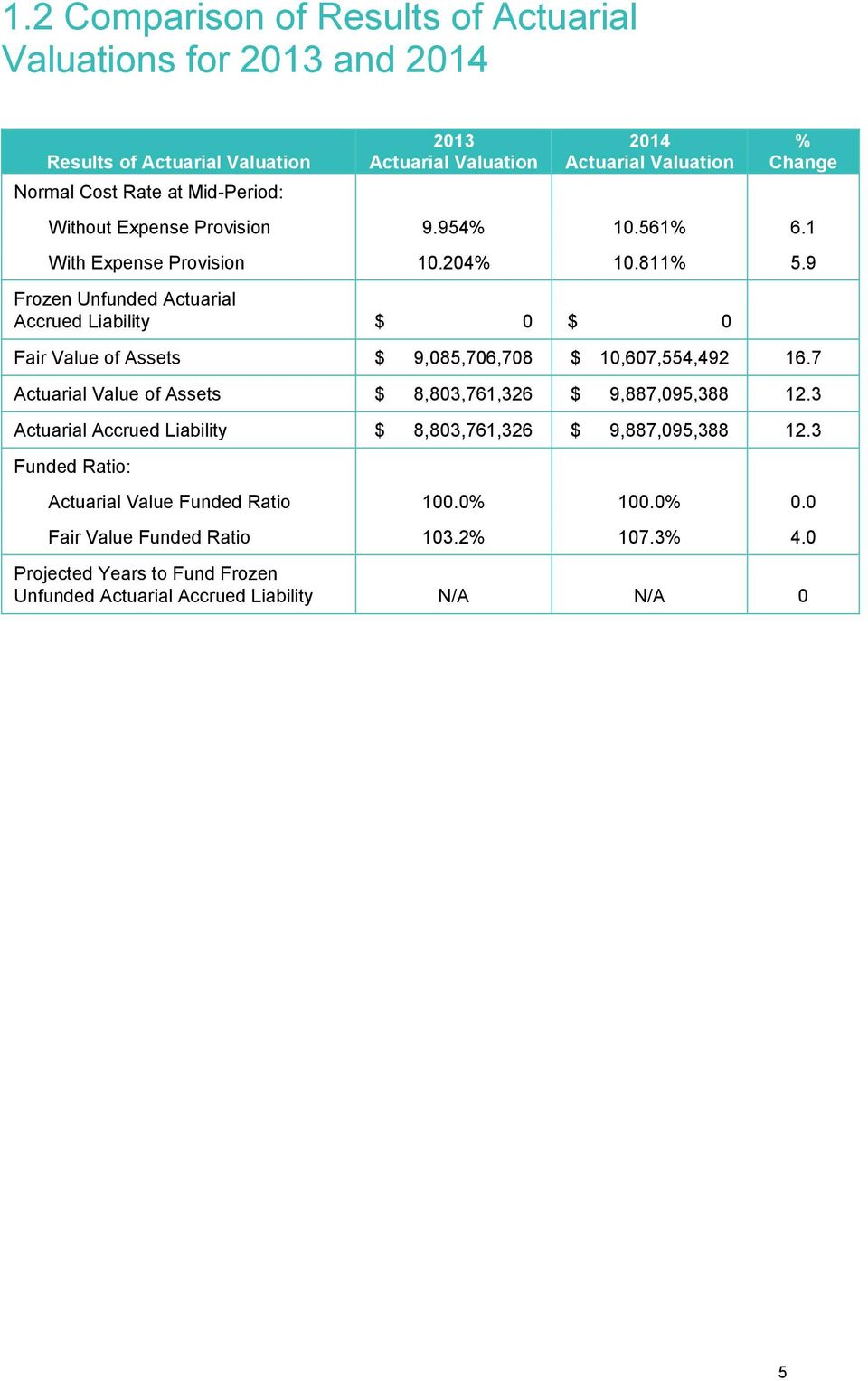
9 SDRS Benefit Changes There were changes to the disability and survivor benefits during the 2014 South Dakota Legislative session. In addition, the South Dakota Cement Plant retirement plan was merged into the South Dakota Retirement System as of April 1, SDRS Actuarial Assumptions The healthy employee, retiree and disabled retiree mortality tables were changed for the 2014 Actuarial Valuation to more accurately reflect expected future mortality improvement. SDRS Actuarial Methods and Funding Objectives The Board of Trustees Funding Policy objectives include an Actuarial Value Funded Ratio of 100% and a Fair (Market) Value Funded Ratio of at least 100%. As of June 30, 2014, a transfer of $599 million was made from the Cushion to the Actuarial Value of Assets to fund the net impact of the change in mortality assumptions and the change to the disability and survivor benefits. With this transfer to the Actuarial Value of Assets from the Cushion (and adjustment to the Reserve), SDRS continues to meet these objectives. As a result, statutorily required Employer and Member Contributions meet all actuarially required contributions and will contribute to the Cushion and Reserve in future years. Key SDRS Actuarial Measures The key actuarial measures determined by the current and prior Actuarial Valuations are as follows: June 30, 2013 Actuarial Valuation June 30, 2014 Actuarial Valuation Funding Period N/A N/A Frozen Unfunded Actuarial Accrued Liability $ 0 $ 0 Fair Value of Assets $ 9,085,706,708 $ 10,607,554,492 Actuarial Value of Assets $ 8,803,761,326 $ 9,887,095,388 Actuarial Accrued Liability $ 8,803,761,326 $ 9,887,095,388 Actuarial Value Funded Ratio 100.0% 100.0% Fair Value Funded Ratio 103.2% 107.3% Reserve for Funding of Long-Term Benefit Goals $ (1,106,063,511) $ (950,717,727) Cumulative Gains to be Allocated to the Reserve in Future Years $ 1,303,115,302 $ 1,586,283,240 2

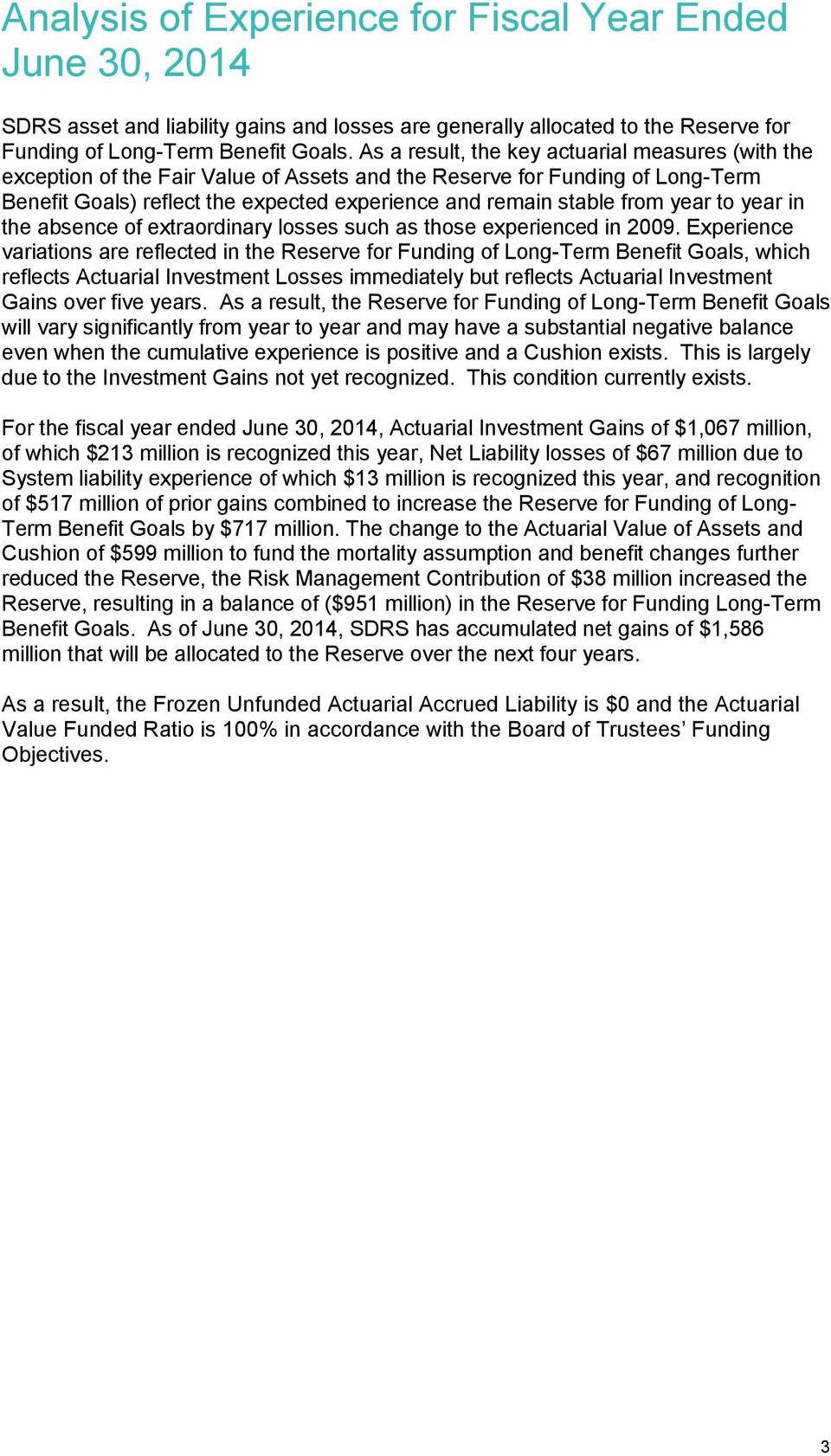
10 Analysis of Experience for Fiscal Year Ended June 30, 2014 SDRS asset and liability gains and losses are generally allocated to the Reserve for Funding of Long-Term Benefit Goals. As a result, the key actuarial measures (with the exception of the Fair Value of Assets and the Reserve for Funding of Long-Term Benefit Goals) reflect the expected experience and remain stable from year to year in the absence of extraordinary losses such as those experienced in Experience variations are reflected in the Reserve for Funding of Long-Term Benefit Goals, which reflects Actuarial Investment Losses immediately but reflects Actuarial Investment Gains over five years. As a result, the Reserve for Funding of Long-Term Benefit Goals will vary significantly from year to year and may have a substantial negative balance even when the cumulative experience is positive and a Cushion exists. This is largely due to the Investment Gains not yet recognized. This condition currently exists. For the fiscal year ended June 30, 2014, Actuarial Investment Gains of $1,067 million, of which $213 million is recognized this year, Net Liability losses of $67 million due to System liability experience of which $13 million is recognized this year, and recognition of $517 million of prior gains combined to increase the Reserve for Funding of Long- Term Benefit Goals by $717 million. The change to the Actuarial Value of Assets and Cushion of $599 million to fund the mortality assumption and benefit changes further reduced the Reserve, the Risk Management Contribution of $38 million increased the Reserve, resulting in a balance of ($951 million) in the Reserve for Funding Long-Term Benefit Goals. As of June 30, 2014, SDRS has accumulated net gains of $1,586 million that will be allocated to the Reserve over the next four years. As a result, the Frozen Unfunded Actuarial Accrued Liability is $0 and the Actuarial Value Funded Ratio is 100% in accordance with the Board of Trustees Funding Objectives. 3
11 Section 1 Actuarial Funding Results Actuarial Funding Results Summary of Key Actuarial Measures Normal Cost Rate with Expense Provision 2013 Actuarial Valuation Results System Investment and Liability Experience for Year 1 Membership Changes and Maturity of System 2 Changes in Benefit Provisions, Actuarial Methods or Actuarial Assumptions Effective July 1, Actuarial Valuation Results % -- (0.108)% 0.715% % Funding Period N/A N/A Frozen Unfunded Actuarial Accrued Liability Actuarial Value Funded Ratio Fair Value Funded Ratio $0 million $0 million 100.0% % 103.2% 11.0% -- (6.9)% 107.3% 1 SDRS Actuarial Investment Gains and Liability Gains and Losses impact the Cushion and the Fair (Market) Value Funded Ratio and are smoothed and allocated directly to the Reserve for Funding of Long-Term Benefit Goals over five years. All SDRS Actuarial Investment Losses are allocated immediately to the Reserve. The Actuarial Value of Assets is increased by the SDRS Liability Loss or decreased by the SDRS Liability Gain each year. 2 Changes to the membership from year to year will cause minor changes in the Normal Cost Rate. 3 Disability and certain survivor benefit provisions were changed by 2014 legislations. In addition, the Board adopted revisions to the mortality assumption effective for the June 30, 2014 valuation. The net increase in the Actuarial Accrued Liability due to the benefit provision and actuarial assumption changes was funded by a $599 million transfer from the Cushion to the Actuarial Value of Assets. 4

12 1.2 Comparison of Results of Actuarial Valuations for 2013 and 2014 Results of Actuarial Valuation Normal Cost Rate at Mid-Period: 2013 Actuarial Valuation 2014 Actuarial Valuation % Change Without Expense Provision 9.954% % 6.1 With Expense Provision % % 5.9 Frozen Unfunded Actuarial Accrued Liability $ 0 $ 0 Fair Value of Assets $ 9,085,706,708 $ 10,607,554, Actuarial Value of Assets $ 8,803,761,326 $ 9,887,095, Actuarial Accrued Liability $ 8,803,761,326 $ 9,887,095, Funded Ratio: Actuarial Value Funded Ratio 100.0% 100.0% 0.0 Fair Value Funded Ratio 103.2% 107.3% 4.0 Projected Years to Fund Frozen Unfunded Actuarial Accrued Liability N/A N/A 0 5
13 1.3 SDRS Actuarial Funding Requirements and Funded Status Funding Requirements Exhibits 1-4 illustrate the funding requirements of SDRS as of June 30, 2014 and the adequacy of the statutorily required combined Employer and Member Contribution Rate to SDRS to fund the past and future obligations of the System. The summary of SDRS Fair Value of Assets, the Development of the Reserve for Funding of Long- Term Benefit Goals, and the Development of the SDRS Actuarial Value of Assets as of June 30, 2014, are illustrated in Section 2 of this report. The results of the 2014 Actuarial Valuation of SDRS indicate that: The System expects to pay future total benefits to all current SDRS active and retired Members with a present value of $ billion (Section 1.5). The Frozen Unfunded Actuarial Accrued Liability equals $0 (Section 1.6). SDRS has accumulated assets to date on an Actuarial Value basis of $9.887 billion (Section 2.3). A portion of future Employer and Member Contributions for current active Members will be required to pay future Normal Costs with a present value of $1.390 billion (Section 1.7). The balance of future Employer and Member Contributions, less System expenses (also known as the Risk Management Contribution), increases the Cushion and Reserve for Funding of Long-Term Benefit Goals. As summarized in Section 1.8, SDRS is funded by statutorily required Employer and Member Contributions that total % of considered compensation. After paying the Normal Costs and Expenses of the System of % of considered compensation, a contribution of 1.671% of considered compensation is available to fund the Frozen Unfunded Actuarial Accrued Liability, or, when the Frozen Unfunded Actuarial Accrued Liability is $0, to increase the Cushion and Reserve for Funding of Long-Term Benefit Goals. The 2014 Actuarial Valuation of SDRS confirms that this rate of contribution will pay the Normal Costs and Expenses of the System and provide 1.671% of considered compensation (also known as the Risk Management Contribution), to increase the Cushion and Reserve for Funding of Long-Term Benefit Goals. SDRS is a well-funded retirement system with no Unfunded Actuarial Accrued Liabilities currently. The volatility resulting from asset and liability gains and losses has been minimized by the methods adopted for development of the Actuarial Value of Assets. 6

14 Actuarial Value Funded Ratio The SDRS Funded Ratio is determined as the ratio of the Actuarial Value of Assets to the Actuarial Accrued Liability of the System. The SDRS Funded Ratio as of June 30, 2014 is equal to 100.0% as determined below. Actuarial Value of Assets (Section 2.3) $ 9,887,095,388 Actuarial Accrued Liability (Actuarial Value of Assets Plus Frozen Unfunded Actuarial Accrued Liability (Section 1.5)) $ 9,887,095,388 Actuarial Value Funded Ratio ($9,887,095,388 $9,887,095,388) 100.0% The Actuarial Value Funded Ratio remained at 100.0% as of the 2014 Actuarial Valuation. A history of the SDRS Funded Ratios is shown in Section

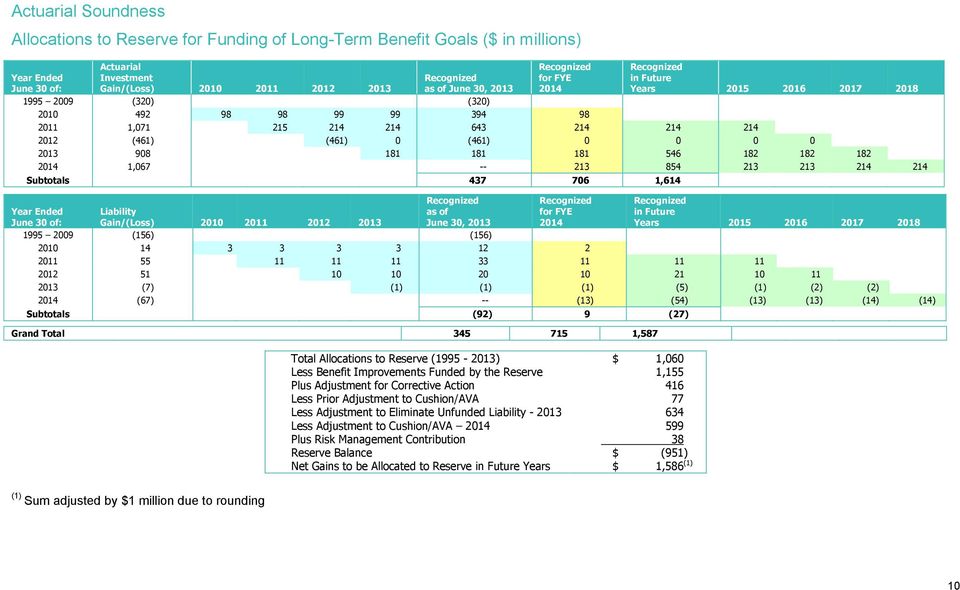
15 1.4 Actuarial Soundness The conclusions reached in the determination of the funding requirements of SDRS based on the Actuarial Valuation of the System are the most important indicators of the long-term actuarial soundness of SDRS. The soundness is measured by the relationship of the Normal Cost to the total contributions available, the length of the Funding Period if an Unfunded Liability exists (a shorter period being more favorable), the excess of the Fair Value of Assets over the Actuarial Value of Assets (the Cushion), the current balance in the Reserve for Funding of Long-Term Benefit Goals and the net amounts remaining to be allocated in the future. SDRS is actuarially sound when the Funding Policy adopted by the SDRS Board designed to meet all future benefit obligations is met and the current and future contributions are made in accordance with the statutory requirements. The management of the current SDRS benefit structure and the present and past financing together with System experience have allowed for the elimination of the Frozen Unfunded Actuarial Accrued Liability. The result is a well-funded System with no Unfunded Actuarial Accrued Liabilities that is funding benefits within the resources available and annually accumulating funds to increase the Cushion and Reserve. Investment performance was favorable for the year ended June 30, 2014 and created a gain, resulting in a Cushion of positive $720 million, and a balance of negative $951 million in the Reserve for Funding of Long-Term Benefit Goals as of June 30, As of June 30, 2014, SDRS has accumulated net gains of $1.586 billion that will be allocated to the Reserve over the next four years. Since 1995, the SDRS cumulative experience has resulted in: Actuarial Investment Gains/(Losses) of $2.757 billion of which $1.143 billion have been allocated to the Reserve and $1.614 billion will be allocated over the next four years. Liability Gains/(Losses), changes in actuarial assumptions, and changes in System provisions that affect anticipated costs of $(110) million of which $(83) million have been allocated to the Reserve and $(27) million will be allocated over the next four years. A total allocation to the Reserve to date of $1,060 million due to gains and losses. $1,155 million of benefit improvements funded from the Reserve in prior years. Corrective Actions of $416 million credited to the Reserve. An adjustment to the Cushion and Actuarial Value of Assets of $77 million to reach 29-year funding as of June 30, An adjustment to the Cushion and Actuarial Value of Assets of $634 million to eliminate the Unfunded Actuarial Accrued Liability as of June 30, An adjustment to the Cushion and Actuarial Value of Assets of $599 million to fund the mortality assumption and benefit changes of June 30,
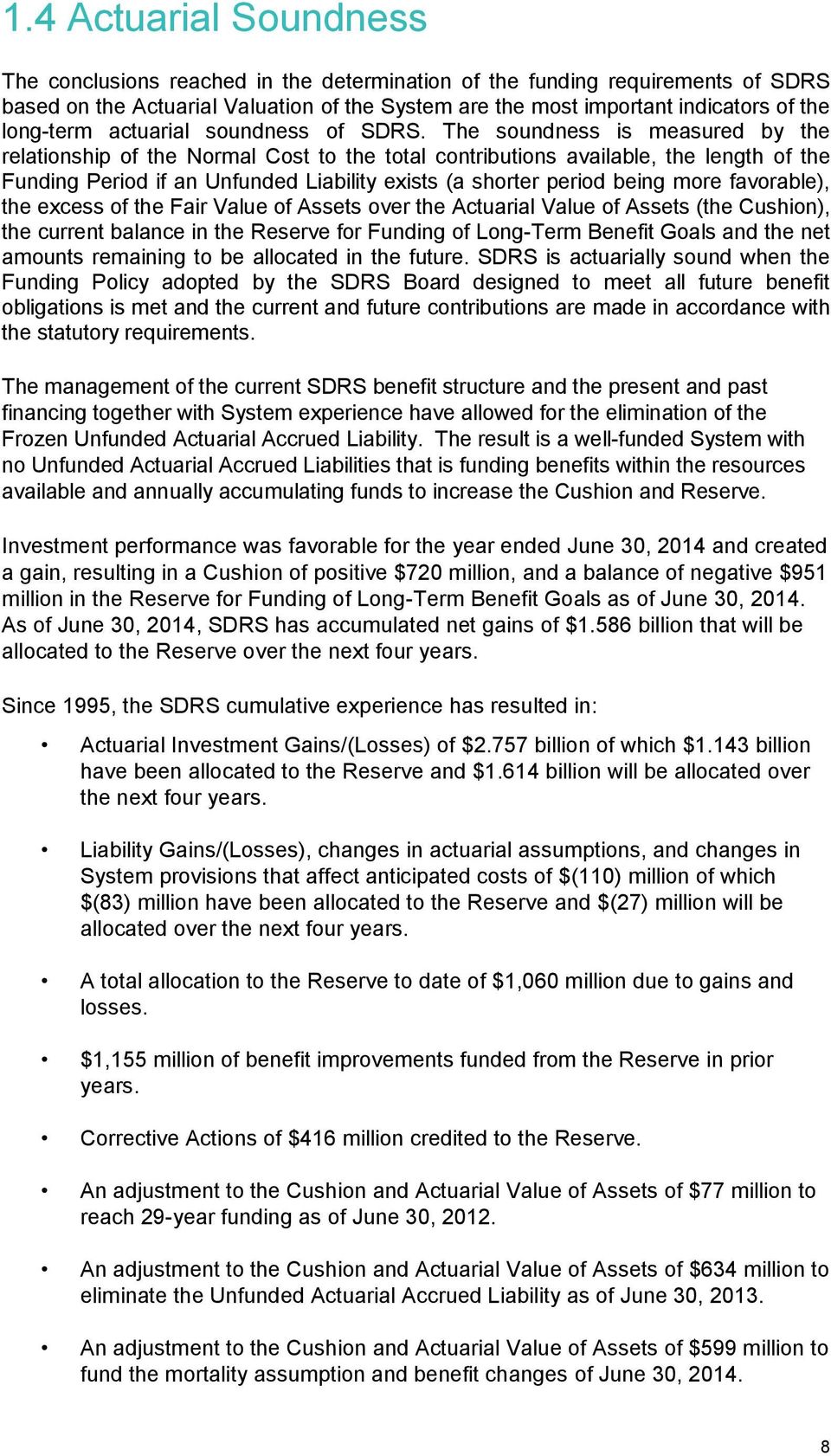
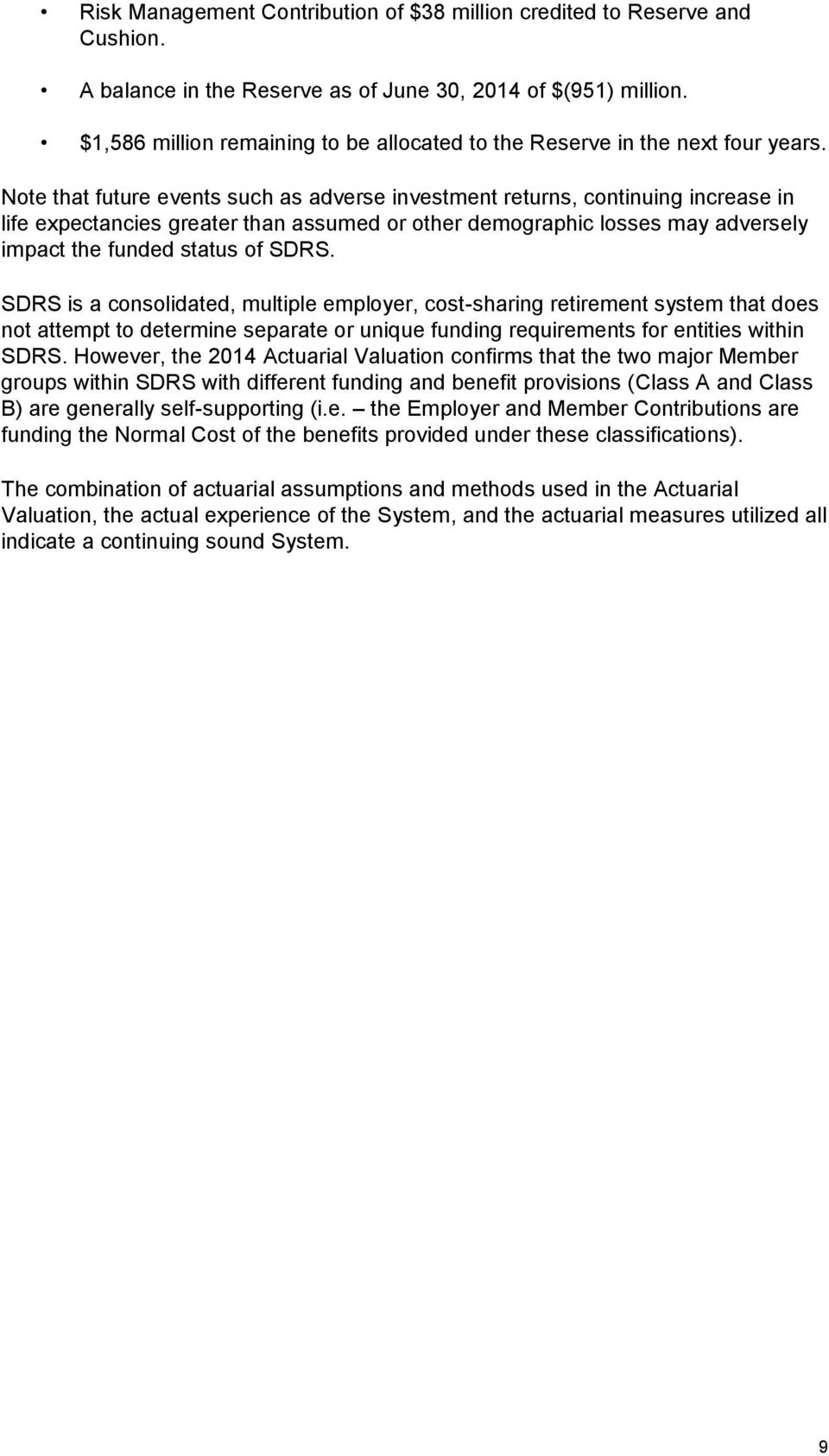
16 Risk Management Contribution of $38 million credited to Reserve and Cushion. A balance in the Reserve as of June 30, 2014 of $(951) million. $1,586 million remaining to be allocated to the Reserve in the next four years. Note that future events such as adverse investment returns, continuing increase in life expectancies greater than assumed or other demographic losses may adversely impact the funded status of SDRS. SDRS is a consolidated, multiple employer, cost-sharing retirement system that does not attempt to determine separate or unique funding requirements for entities within SDRS. However, the 2014 Actuarial Valuation confirms that the two major Member groups within SDRS with different funding and benefit provisions (Class A and Class B) are generally self-supporting (i.e. the Employer and Member Contributions are funding the Normal Cost of the benefits provided under these classifications). The combination of actuarial assumptions and methods used in the Actuarial Valuation, the actual experience of the System, and the actuarial measures utilized all indicate a continuing sound System. 9
17 Actuarial Soundness Allocations to Reserve for Funding of Long-Term Benefit Goals ($ in millions) Year Ended June 30 of: Actuarial Investment Gain/(Loss) Recognized as of June 30, 2013 Recognized for FYE 2014 Recognized in Future Years (320) (320) , (461) (461) 0 (461) , Subtotals ,614 Year Ended June 30 of: Recognized as of June 30, 2013 Recognized for FYE 2014 Recognized in Future Years Liability Gain/(Loss) (156) (156) (7) (1) (1) (1) (5) (1) (2) (2) 2014 (67) -- (13) (54) (13) (13) (14) (14) Subtotals (92) 9 (27) Grand Total ,587 Total Allocations to Reserve ( ) Less Benefit Improvements Funded by the Reserve Plus Adjustment for Corrective Action Less Prior Adjustment to Cushion/AVA Less Adjustment to Eliminate Unfunded Liability Less Adjustment to Cushion/AVA 2014 Plus Risk Management Contribution Reserve Balance Net Gains to be Allocated to Reserve in Future Years $ 1,060 1, $ (951) $ 1,586 (1) (1) Sum adjusted by $1 million due to rounding 10
18 1.5 Development of SDRS Present Value of All Benefits as of June 30, 2014 Present Value of All Benefits Active Members $ 5,374,432,442 Retirees, Beneficiaries and Terminated Members 5,902,266,864 Total $ 11,276,699,306 11

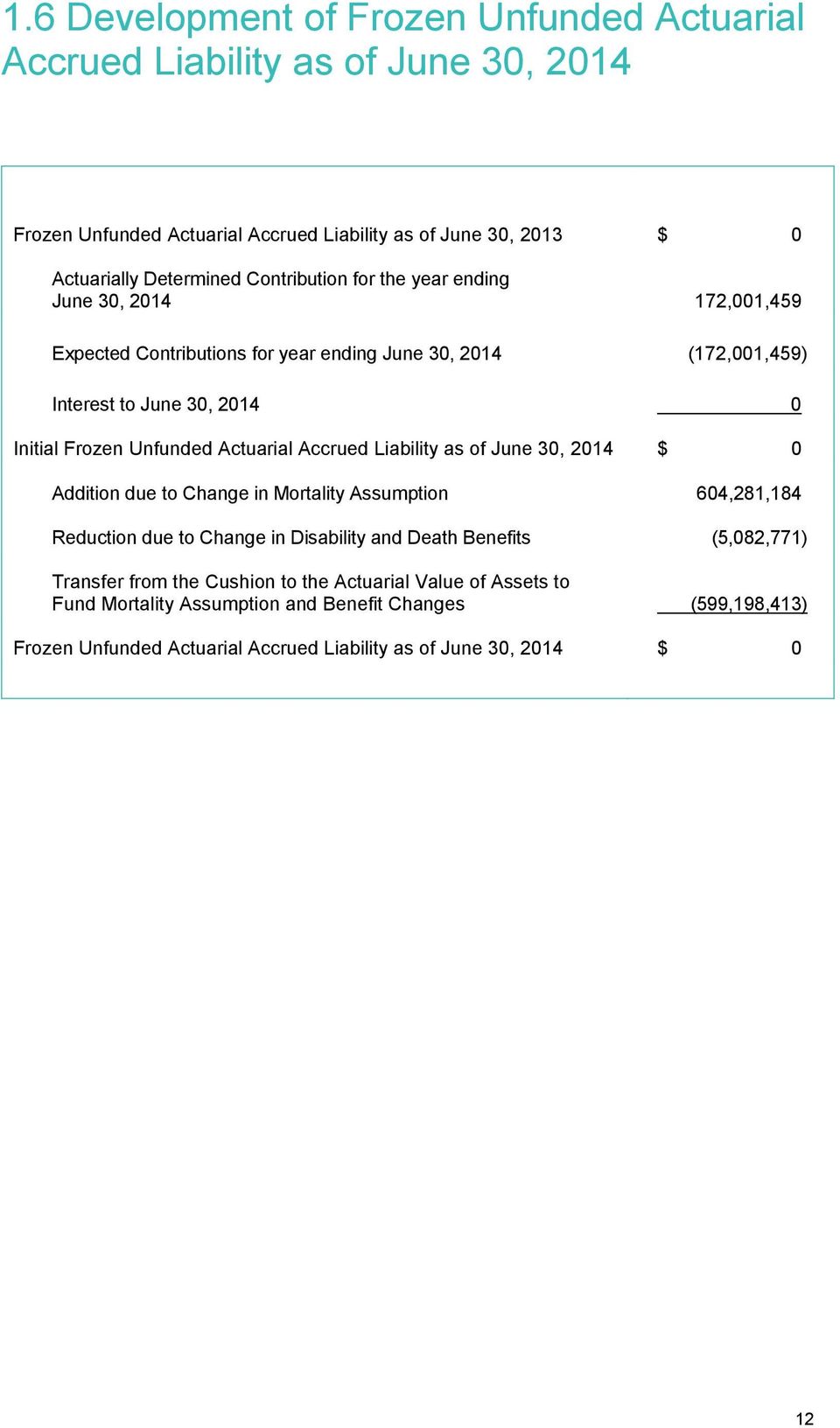
19 1.6 Development of Frozen Unfunded Actuarial Accrued Liability as of June 30, 2014 Frozen Unfunded Actuarial Accrued Liability as of June 30, 2013 $ 0 Actuarially Determined Contribution for the year ending June 30, ,001,459 Expected Contributions for year ending June 30, 2014 (172,001,459) Interest to June 30, Initial Frozen Unfunded Actuarial Accrued Liability as of June 30, 2014 $ 0 Addition due to Change in Mortality Assumption 604,281,184 Reduction due to Change in Disability and Death Benefits (5,082,771) Transfer from the Cushion to the Actuarial Value of Assets to Fund Mortality Assumption and Benefit Changes (599,198,413) Frozen Unfunded Actuarial Accrued Liability as of June 30, 2014 $ 0 12
20 1.7 Development of Normal Cost Contribution Rate as of June 30, 2014 Present Value of All Benefits $ 11,276,699,306 Present Value of Future Normal Cost Contributions $ (1,389,603,918) Actuarial Accrued Liability $ 9,887,095,388 Actuarial Value of Assets (Section 2.3) (9,887,095,388) Frozen Unfunded Actuarial Accrued Liability $ 0 Present Value of 1% of Future Member Compensation $ 136,262,944 Normal Cost Contribution Rate at Start of Period ($1,389,603,918 $136,262,944) % Normal Cost Contribution Rate Adjusted for Mid-Period Payment % 13

21 1.8 Development of Actuarial Funding Requirements as a Percentage of Member Compensation as of June 30, 2014 Matching Statutorily Required Employer/Member Contribution Rate % 1 Normal Contribution Rate at Mid-Period % Expense Allowance 0.250% Actuarially Determined Contribution Rate % Contribution Rate in excess of Normal Cost and Expenses (12.482% %) 1.671% 2 1 Class A Employers and Members each statutorily contribute 6% of Compensation. Class B Employers and Members each statutorily contribute 8% or 9% of Compensation. Participating Members also contribute for the Optional Spouse Coverage and Class A Employers contribute 6.2% of Members Compensation in excess of the Social Security maximum taxable Compensation. The total statutory contributions to SDRS as of July 1, 2014 are % of considered compensation. 2 The Frozen Unfunded Actuarial Accrued Liability is $0 as of July 1,
22 1.9 Gains and Losses for Year Ended June 30, 2014 Liability Experience for Year The SDRS liabilities as of June 30, 2014 were $67 million higher than expected, or (0.60)% of the Present Value of All Benefits. The sources of the $67 million total experience liability loss were as follows: Item Amount of Liability Gain/(Loss) % of Present Value of All Benefits Gain/(Loss) due to Compensation Increases $(8) million (0.07)% Gain/(Loss) due to Decrements (41) million (0.36)% Gain/(Loss) due to Rehired and New Members (13) million (0.12)% Gain/(Loss) due to COLA for Continuing Inactives (20) million (0.18)% Miscellaneous Gain/(Loss) 15 million 0.13% Total Experience Gain/(Loss) $(67) million (0.60)% The remaining SDRS liability experience for the year ended June 30, 2014 included the following: The number of active Members increased by 0.9%, Compensation for all Members increased by 4.4%, and average Compensation increased by 3.5%. The average age of the active Members decreased from 45.6 to 45.3 years and the average Credited Service decreased from 11.4 to 11.3 years. The number of SDRS Members and Beneficiaries receiving benefits increased by 5.3% and the average benefit paid increased by 2.8%. Average Compensation for active Members included in the prior Actuarial Valuation increased by 5.9% compared to an assumed increase of 4.9%. Decremental experience was mixed. The experience included: Losses due to fewer vested members terminating than expected Losses from the COLA being more than the assumed 2.7% Losses from more younger retirements than anticipated Unfavorable mortality for retirees Unfavorable disability experience 15
23 Losses due to new members with prior service Losses due to the service credited to rehired Members who have not previously withdrawn their contributions or who redeposit their contributions or who purchase service. The net liability loss for the year ended June 30, 2014 of $67 million is allocated equally to the Reserve for Funding of Long-Term Benefit Goals for the year ended June 30, 2014 and the next four years. 16
24 1.10 Development of Actuarial Value and Fair Value Funded Ratios as of June 30, 2014 The Actuarial Value Funded Ratio is a comparison of the Actuarial Value of Assets to the Actuarial Accrued Liability of the System and is an indication of how well the System is funded on the valuation date. The Actuarial Accrued Liability is equal to the Present Value of All Benefits for SDRS active and retired Members less the Present Value of Future Normal Cost Contributions required for future benefits for SDRS Members and paid from future Employer and Member Contributions. The Actuarial Accrued Liability is a measure of accrued System liabilities based on the total past and future benefits expected to be paid to all Members that will not be funded by future Normal Cost contributions. Since future Normal Cost contributions are a function of the actuarial cost method used in determining a system s funding requirements, the Actuarial Accrued Liability is a unique calculation for each system. Comparing the SDRS Actuarial Value Funded Ratio on a historical basis illustrates the funding progress of SDRS and the past ability of the fixed, statutorily required Employer and Member Contributions and overall SDRS experience to fund the Normal Costs of the System and to amortize the Frozen Unfunded Actuarial Accrued Liability. Ideally, the Actuarial Value Funded Ratio will increase over time as the Frozen Unfunded Actuarial Accrued Liability decreases or becomes a smaller percentage of the Actuarial Accrued Liability due to growth in the Actuarial Value of Assets and funding of the Actuarial Accrued Liability. A ratio of less than 100% would indicate that the SDRS had not yet accumulated sufficient assets to fully fund the Actuarial Accrued Liability. This exhibit illustrates that the Actuarial Value Funded Ratio as of June 30, 2014 equaled 100.0%. The following exhibit illustrates the history of the Actuarial Value Funded Ratio from 1973 to the present date and shows the improvement from an initial Funded Ratio of 39.8% to the current 100.0% and the Fair Value Funded Ratio of 107.3%. Present Value of All Benefits Present Value of All Benefits for Active Members $ 5,374,432,442 Present Value of Benefits for Retirees, Beneficiaries and Terminated Members 5,902,266,864 Total Present Value of All Benefits $ 11,276,699,306 Present Value of Future Normal Cost Contributions (1,389,603,918) Actuarial Accrued Liability $ 9,887,095,388 Actuarial Value of Assets $ 9,887,095,388 Actuarial Value Funded Ratio ($9,887,095,388 $9,887,095,388) 100.0% Fair Value of Assets $ 10,607,554,492 Fair Value Funded Ratio ($10,607,554,492 $9,887,095,388) 107.3% 17
25 $ Millions 1.11 History of Funded Ratios $11,200 $10,500 $9,800 $9,100 $8,400 $7,700 $7,000 $6,300 $5,600 $4,900 $4,200 $3,500 $2,800 $2,100 $1,400 $700 $0 Actuarial Value of Assets Actuarial Accrued Liabilities Market Value of Assets Fair Value Funded Ratio (%) Actuarial Value Funded Ratio (%) Funding Period (years) % Actuarially Required Contribution Made N/A N/A N/A
26 Section 2 Plan Assets 2.1 SDRS Fair Value of Assets Available for Benefits as of June 30, 2014 Assets Investments at current value $ 10,602,044,751 Cash and temporary investments 2,597,852 Contributions receivable 4,403,616 Benefits receivable 43,000 Accounts receivable (unsettled investment sales) 10,647,176 Investment income receivable 18,851,214 Properties 14,372 Due from Brokers 0 Other assets 339,112 Total Assets $ 10,638,941,093 Liabilities Accounts payable and accrued expenses $ 2,354,618 Accounts payable (unsettled investment purchases) 29,008,600 Securities sold, but not yet purchased 0 Due to Brokers 23,383 Total Liabilities $ 31,386,601 Fair Value of Assets Available for Benefits $ 10,607,554,492 19
27 2.2 Changes in SDRS Fair Value of Assets for Year Ended June 30, 2014 Fair Value of Assets Available for Benefits as of June 30,2013 $ 9,085,706,708 Additions Contributions $ 211,128,366 Cement Plant Consolidation $ 69,519,407 Total Investment Gain Net of Investment Expenses 1,695,543,797 Total Additions $ 1,976,191,570 Deductions Benefit Payments $ (425,823,928) Accumulated Contribution Refunds (24,666,785) Administrative Expenses (3,853,073) Total Deductions $ (454,343,786) Net Increase 1,521,847,784 Fair Value of Assets Available for Benefits as of June 30, 2014 $ 10,607,554,492 20
28 2.3 Development of the SDRS Actuarial Value of Assets as of June 30, Actuarial Value of Assets as of June 30, 2013 $ 8,803,761, Contributions and Disbursements: Actuarially Determined Contribution Purchase of Service Contributions Benefit Payments and Refunds Administrative Expenses Total $ 172,001,459 1,450,284 (450,490,713) (3,853,073) $ (280,892,043) 3. Expected Investment Return $ 628,268, SDRS Liability Gain/(Loss) $ (67,239,772) 5. Cement Plant Consolidation $ 69,519, Preliminary Actuarial Value of Assets as of June 30, 2014 ( ) $ 9,287,896, Adjustment to Actuarial Value of Assets to fund Mortality Assumption and Benefit Changes 599,198, Preliminary Actuarial Value of Assets as of June 30, 2014 with adjustment from Cushion (5 + 6) $ 9,887,095, Fair Value of Assets as of June 30, 2014 $ 10,607,554, Constraining values a. 80% of Fair Value of Assets b. 120% of Fair Value of Assets $ 8,486,043,594 $ 12,729,065, Actuarial Value of Assets as of June 30, 2014 Item 7, but not less than (9a) nor more than (9b) $ 9,887,095,388 21
29 2.4 Development of Reserve for Funding of Long-Term Benefit Goals as of June 30, 2014 For Year Ending June 30, Fair Value of Assets at Beginning of Year $ 9,085,706, Actuarial Value of Assets at Beginning of Year 8,803,761, Non-Investment Cash Flow (excluding Risk Management Contribution) (211,372,636) 1 4. Actual Investment Return Based on Fair Value of Assets $ 1,695,543, Expected Investment Return based on Net Actuarial Value of Assets 628,268, Actuarial Investment Gain (4-5) $ 1,067,275, Allocation of Actuarial Investment Gains Over Five Years and 100% of Actuarial Investment (Losses): 20% of $492,098,094 for year ended June 30, % of $1,071,223,986 for year ended June 30, % of $(460,776,578) for year ended June 30, % of $907,985,113 for year ended June 30, % of $1,067,275,284 for year ended June 30, 2014 $ 98,419, ,244, ,597, ,455,057 Total Allocated for the Current Year $ 707,716, Cumulative Amount of Actuarial Investment Gains Remaining to be Allocated in Future Years $ 1,612,856, SDRS Liability Gain or (Loss) for the Year Ended June 30, 2014 $ (67,239,772) 10. Allocation of SDRS Liability Gain or (Loss) Over Five Years: 20% of $14,415,731 for year ended June 30, % of $54,508,603 for year ended June 30, % of $50,626,270 for year ended June 30, % of $(6,555,438) for year ended June 30, % of $(67,239,772) for year ended June 30, 2014 Total Allocated for the Current Year $ 2,883,147 10,901,720 10,125,254 (1,311,088) (13,447,954) $ 9,151, Cumulative Amount of SDRS Liability Gain or (Loss) to be Allocated in Future Years $ (26,572,852) 12. Reserve for Funding of Long-Term Benefit Goals a. Balance at end of Prior Year $ (1,106,063,511) b. Total Allocated for the Current Year (7 + 10) 716,867,574 c. Adjustment to Cushion and Actuarial Value of Assets to Eliminate Unfunded Actuarial Accrued Liability as of June 30, 2014 (599,198,413) d. Risk Management Contribution 37,676,623 e. Balance at end of Current Year $ (950,717,727) f. Net Gains to be Allocated in Future Years (8 + 11) $ 1,586,283,240 1 Actuarially determined contributions of $172,001,459 plus purchase of service contributions of $1,450,284 less benefit payments, refunds, and administrative expenses of $454,343,786 plus Cement Plant Consolidation of 69,519,
30 2.5 Fund Gains and Losses for Year Ended June 30, 2014 Reserve for Funding of Long-Term Benefit Goals SDRS gains and losses are allocated to the Reserve for Funding of Long-Term Benefit Goals. The amounts currently in the Reserve and remaining to be allocated in the next four years are an important indicator of the System's recent cumulative experience. When available, the Reserve for Funding of Long-Term Benefit Goals is a source of funds to provide future benefit improvements or to protect the System against future unfavorable experience. The current negative balance in the Reserve will shift to a positive balance over the next four years based on recent experience as unrecognized gains and statutory contributions over the System Normal Cost and expenses are allocated, if System experience meets the assumptions. Future unfavorable experience will reduce the Cushion and the Reserve. Future favorable experience will increase the Cushion and the Reserve to provide additional funds for future benefit improvements or protection against unfavorable experience. The Reserve for Funding of Long-Term Benefit Goals as of June 30, 2014 changed as follows: Balance as of June 30, 2013 $ (1,106,063,511) Fiscal Year 2014 Experience 200,007,103 Amortization of Prior Gains and Losses 516,860,471 Less Adjustment to Cushion and Actuarial Value of Assets to fund Mortality Assumption and Benefit Changes (599,198,413) Plus Risk Management Contribution 37,676,623 Balance as of June 30, 2014 $ (950,717,727) Net Gain to be Allocated in Future Years $ 1,586,283,240 Investment Results for Year For the year ended June 30, 2014, the actual investment performance of SDRS was more than the expected 7.25% investment return on the Actuarial Value of Assets by $1,067 million as summarized below. Actual Investment Return for Year Ended June 30, 2014 (Section 2.2) $ 1,695,543,797 Expected Investment Return Based on Actuarial Value of Assets (Section 2.3) 628,268,513 Actuarial Investment Gain (Actual less Expected) $ 1,067,275,284 The dollar-weighted total investment return based on the Fair Value of Assets of the System for the year ended June 30, 2014 was 18.91% after investment expenses (18.90% on a timeweighted basis after investment expenses). The Actuarial Value of Assets was credited with the assumed investment return of 7.25% (or $628 million) for the year and increased by the net liability loss of $67 million for the year. 23
31 2.6 Reconciliation of Cushion as of June 30, 2014 Cushion as of June 30, 2013 $ 281,945,382 Liability Gain/(Loss) (67,239,772) Fair Value Asset Gain/(Loss) 1,067,275,284 Plus Risk Management Contribution 37,676,623 Cushion Transfer for Plan Changes 5,082,771 Cushion Transfer for Mortality Change (604,281,184) Total Changes to the Cushion $ 438,513,722 Cushion as of June 30, 2014 $ 720,459,104 24
32 2.7 Development of the Risk Management Contribution as of June 30, ) Actual contributions for the year ending June 30, 2014 a. Member and Employer Contributions b. Service Purchase/Redeposits/SPB Purchases $ 209,678,082 1,450,284 c. Total Contributions $ 211,128,366 2) Estimated Covered Payroll for year ending June 30, 2014 $ 1,685,627,785 3) Actuarially Determined Contribution Adjusted for Estimated Payroll a. Estimated Covered Payroll b. Required Contribution Rate (Normal Cost + Expenses) $ 1,685,627, % c. Total Actuarially Determined Contribution ( a. x b. ) $ 172,001,459 4) Risk Management Contribution for year ending June 30, 2014 (1a. Less 3c.) $ 37,676,623 25
33 Section 3 Accounting Information 3.1 Governmental Accounting Standards Board Statement No. 25 The Governmental Accounting Standards Board (GASB) has issued Statement No. 25, Financial Reporting for Defined Benefit Pension Plans and Note Disclosures for Defined Contribution Plans. This Statement supersedes GASB Statement No. 5 and has been implemented by SDRS effective with the fiscal year ended June 30, This Statement requires the measurement and disclosure of the Annual Required Contributions of the Employers (ARC) for SDRS and the determination of the Funded Ratio of SDRS considering the Actuarial Value of Assets and the Actuarial Accrued Liability, both in accordance with the parameters of Statement No. 25. The South Dakota Retirement System is a cost sharing multiple-employer defined benefit retirement plan as defined in the GASB statement. As such, the GASB Statement requires that the ARC be computed for the Plan, not individually for each Employer, since the costs and risks of SDRS are shared by all participating Employers and are not attributed individually to the Employers. In addition, SDRS is funded by statutorily required fixed Employer and Member Contributions. The Actuarial Valuation of SDRS includes all Members and considers the contractually required contributions of each Employer based on its employees and the mix of employees participating in Class A or Class B benefits. The actuarial assumptions and methods for the GASB Statement No. 25 calculations are the same as those used for the Actuarial Valuation of SDRS that confirm the funding requirement of the System, and they fully meet the parameters of GASB Statement No. 25. They are summarized in Exhibit 5. The actuarially determined information required in accordance with the GASB statements was determined by the Actuarial Valuation of SDRS as of June 30, 2014 as shown on the following page. GASB Statement No. 25 has been amended by GASB No. 67, effective for the fiscal year beginning after June 15, The effective date for SDRS compliance with GASB No. 67 is June 30, The information shown here for GASB Statement No. 25 is for informational purposes only. 26
34 A. Comparison of contractual employer contribution rate to annual required contributions of the employers as of July 1, 2014 % of Pay 1. Total Contractual Member and Employer Contribution Rates % 1 2. Less Contractual Member Contribution Rate (6.236%) 3. Total Contractual Employer Contribution Rate [(1) - (2)] 6.246% 4. Less Employer Normal Cost Rate (Total Normal Cost Rate of % less Contractual Member Contribution Rate of 6.236%) (4.325%) 5. Less Provision for Expenses (0.250%) 6. Total Contractual Employer Contribution Rate in Excess of Normal Cost and Expenses [(3) - (4) - (5)] 1.671% 2 The contractually required Employer contributions to SDRS equal the requirements for the Annual Required Contributions of the Employers since they are sufficient to pay the Employer Normal Cost, System Expenses, and amortize the Frozen Unfunded Actuarial Accrued Liability over a period of 30 years or less. The ARC for each SDRS participating Employer is equal to the contractually required Employer contributions to SDRS. 1 2 Class A Employers and Members each contractually contribute 6% of pay. Class B Employers and Members each contractually contribute 8% or 9% of pay. Participating Members also contribute for Optional Spouse Coverage and Class A Employers contribute 6.2% of Members pay in excess of the Social Security maximum taxable pay. The total contractual contributions to SDRS as of July 1, 2014 are % of considered compensation. The Frozen Unfunded Actuarial Accrued Liability is $0 as of July 1, B. Actuarial Value Funded Ratio as of June 30, Total Actuarial Accrued Liability 9,887,095, Actuarial Value of Assets $ 9,887,095, Unfunded Actuarial Accrued Liability [(1) - (2)] 0 4. Funded Ratio [(2) / (1)] 100.0% 5. Member Compensation (Prior Year) $ 1,587,075, Unfunded Actuarial Accrued Liability as a Percentage of Member Prior Year Compensation [(3) / (5)] 0.0% 27
35 3.2 Governmental Accounting Standards Board Statement No. 67 GASB has issued Statement No. 67, Financial Reporting for Pension Plans that is effective for fiscal years beginning after June 15, 2013 and Statement No. 68, Accounting and Financial Reporting for Pensions, that is effective for fiscal years beginning after June 15, These statements are amendments to Statements Nos. 25 and 27. Statements Nos. 67 and 68 will require that the Net Pension Liability, similar to an Unfunded Actuarial Accrued Liability, be allocated to individual employers and included on their balance sheets. Furthermore, year to year changes in the Net Pension Liability will be included on the employer s income statements and are expected to vary significantly from one year to the next. Notes to the Financial Statements for the Year Ended June 30, 2014 Summary of Significant Accounting Policies Method used to value investments. Investments are reported at fair value. Plan Description Plan administration. The SDRS Board of Trustees administers the South Dakota Retirement System, a cost-sharing multiple-employer defined benefit pension plan that provides pensions for all full-time employees of participating employers. Management of the System assets is vested in the South Dakota Investment Council. Plan membership. At June 30, 2014, pension plan membership consisted of the following: Inactive plan members or beneficiaries currently receiving 24,562 Inactive plan members entitled to but not yet receiving* 15,992 Active plan members 38,951 Total 79,505 *Includes 179 participant whose benefits have been suspended, but are entitled to future benefits. Benefits provided. Please see Section 5.1 of this report for a summary of plan provisions. 28
36 Net Pension Liability The components of the net pension liability as of June 30, 2014, are as follows: Total pension liability $ 9,887,095,388 Plan fiduciary net position (10,607,554,492) Net pension liability (asset) $ (720,459,104) Plan fiduciary net position as a percentage of the total pension liability % Estimated covered payroll during FY 2014 $ 1,685,627,785 Net pension liability as a percentage of covered payroll (42.74%) Actuarial Cost Method Entry Age Normal Level Percentage of Pay Asset Valuation Method Invested assets are reported at fair value. Actuarial Assumptions The total pension liability was determined by an actuarial valuation as of June 30, 2014, using the following actuarial assumptions, applied to all periods included in the measurement: Inflation 3.25% Graded by years of service, from Salary increases 5.83% at entry to 3.87% after 30 years of service. Discount Rate 7.25% through June 30, 2017 and 7.50% thereafter, net of pension plan investment expenses. This is based on an average inflation rate of 3.25% and a real rate of return of 4.00% through June 30, 2017 and 4.25% thereafter. 29
37 Mortality rates were based on the following: Active members: RP-2000 Employee Mortality Table projected generationally with Scale BB, with males adjusted by 85% and females by 48%. Healthy inactive members, retired members and beneficiaries: RP-2000 Combined Healthy Mortality Table projected generationally with Scale BB, with males adjusted by 91% and females by 90%. Disabled inactive and retired members: RP-2000 Disabled Retiree Mortality Table projected generationally with Scale BB. The actuarial assumptions used in the June 30, 2014 actuarial valuation were based on the results of an actuarial experience study for the period from July 1, 2005 to June 30, 2011, and recent changes to the mortality tables to better reflect expected future mortality improvements. The long-term expected rate of return on Plan investments was determined during the actuarial experience analysis using the General Economy and Market Simulator, an econometric model which forecasts the economic environments of the global economy and stochastically generates expected rates of return of investments held in domestic and foreign markets under expected changes in economic conditions. The 2011 target asset allocation policy for SDRS was used to generate expected rates of return of the SDRS portfolio. The expected long-term rate of investment return for the SDRS benefit duration was determined to be 7.93% per year net of investment expenses. Discount rate: The discount rate used to measure the total pension liability was set based on information presented to the SDRS Board of Trustees by the South Dakota Investment Office and the system s consulting actuary during the actuarial experience analysis. The SDRS Board adopted a discount rate of 7.25% through 2016 and 7.50% thereafter. The difference between the expected long-term rate of investment return and the discount rate represents a margin for adverse deviation as allowed under Actuarial Standards of Practice No. 27. The projection of cash flows used to determine the discount rate assumed that contributions will continue to be made in accordance with the current funding policy. Based on these assumptions, the fiduciary net position was projected to be available to make all projected future benefit payments of current Plan members. The assumed discount rate has been determined in accordance with the method prescribed by GASB 67. We believe this assumption is reasonable for the purposes of the measurements required by GASB
38 Sensitivity of the net pension liability to changes in the discount rate: The following presents the net pension liability, calculated using the discount rate of 7.25% through 2016 and 7.50% thereafter, as well as what the net pension liability would be if it were calculated using a discount rate that is 1-percentage-point lower (6.25%/6.50%) or 1-percentage-point higher (8.25%/8.50%) than the current rate: 1% Decrease (6.25%/6.50%) Current Discount Rate (7.25%/7.50%) 1% Increase (8.25%/8.50%) Net Pension Liability $ 711,949,105 ($ 720,459,104) ($1,888,737,506) Schedules of Required Supplementary Information Schedule of Changes in the Net Pension Liability FYE June 30, 2014 Total pension liability Service cost $ 161,697,696 Interest 633,951,211 Changes of benefit terms (5,082,771) Differences between expected and actual experience 78,328,269 Changes of assumptions 604,281,184 Cement Plan Consolidation 60,649,185 Benefit payments (450,490,712) Net change in total pension liability $ 1,083,334,062 Total pension liability-beginning 8,803,761,326 Total pension liability-ending (a) $ 9,887,095,388 Plan fiduciary net pension Contributions - employers $ 104,952,985 Contributions members 106,175,381 Net investment income 1,695,543,796 Benefit payments, including refunds of member contributions (450,490,712) Administrative expenses (3,853,073) Cement Plan Consolidation 69,519,407 Other 0 Net change in Plan fiduciary net position $ 1,521,847,784 Plan fiduciary net position-beginning $ 9,085,706,708 Plan fiduciary net position-ending (b) 10,607,554,492 Plan s net pension liability-ending (a)-(b) $ (720,459,104) 31
39 Notes to Schedule Benefit changes since June 30, 2013: Death and disability benefits were changed during the 2014 legislative session. Changes of assumptions since June 30, 2013: Morality tables were updated from static mortality tables based on the 1995 Buck Mortality Table to the following: Active members: RP-2000 Employee Mortality Table projected generationally with Scale BB, with males adjusted by 85% and females by 48%. Healthy inactive members, retired members and beneficiaries: RP-2000 Combined Healthy Mortality Table projected generationally with Scale BB, with males adjusted by 91% and females by 90%. Disabled inactive and retired members: RP-2000 Disabled Retiree Mortality Table projected generationally with Scale BB. Schedule of Employer Contributions FYE June 30,2014 Actuarially determined contribution $ 172,001,459 Contributions related to the actuarially determined contribution 209,678,082 Contribution deficiency (excess) $ (37,676,623) Estimated covered payroll during FY 2014 $ 1,685,627,785 Contributions related to actuarially determined contribution as a percentage of covered payroll % Schedule of Investment Returns FYE June 30, 2014 Annual money-weighted rate of return, net of investment expenses 18.91% Annual time-weighted rate of return, net of investment expenses 18.90% 32
40 Section 4 Member Data 4.1 Comparison of Results of Actuarial Valuations for 2013 and 2014 Member Data 2013 Actuarial Valuation 2014 Actuarial Valuation % Change Active Members Number Average Age Average Credited Service Annual Prior Year s Compensation of Members Average Annual Compensation 38, $ 1,519,731,367 $ 39,377 38, $ 1,587,075,036 $ 40, (0.7) (0.9) Benefit Recipients Retired Members Number* Average Age Total Annual Benefits Average Annual Benefits 20, $ 374,412,494 $ 18,717 21, $ 405,641,717 $ 19, Beneficiaries Number* Total Annual Benefits Average Annual Benefits 3,016 $ 32,186,807 $ 10,672 3,116 $ 34,736,072 $ 11, Disabled Members Number Total Annual Benefits Average Annual Benefits 307 $ 4,079,701 $ 13, $ 4,094,866 $ 13, Total Benefit Recipients Number Total Annual Benefits Average Annual Benefits 23,327 $ 410,679,002 $ 17,605 24,562 $ 444,472,655 $ 18, Terminated Members Number Vested Number Non-Vested (Entitled to Accumulated Contributions only) 8,363 6,819 8,702 7, Total Terminated Members 15,182 15, Total System Members 77,103 79, * In addition, there are 168 and 179 Members or Beneficiaries, as of June 30, 2013 and June 30, 2014, respectively, whose benefits are currently suspended, but are entitled to future benefits. 33
41 4.2 Distribution of Number and Average Compensation of Active Members as of June 30, 2014 (1) Age Service 4 and under and over Total 24 and Number 1, ,385 under Avg Compensation $ 29,693 $ 32,534 $ 29, Number 3, ,891 Avg Compensation $ 34,687 $ 38,614 $ 33,416 $ 35, Number 2,059 1, ,505 Avg Compensation $ 36,289 $ 41,158 $ 44,860 $ 37,344 $ 39, Number 1,371 1,148 1, ,227 Avg Compensation $ 36,146 $ 42,298 $ 45,461 $ 48,000 $ 47,975 $ - $ 41, Number 1, , ,565 Avg Compensation $ 35,373 $ 41,010 $ 45,644 $ 49,937 $ 51,335 $ 52,084 $ 43, Number ,723 Avg Compensation $ 35,001 $ 39,664 $ 45,702 $ 50,327 $ 52,502 $ 52,245 $41,315 $ 45, Number 1, ,676 Avg Compensation $ 34,572 $ 37,540 $ 41,402 $ 45,305 $ 51,257 $ 54,521 $ 54,258 $ 46,309 $ 44, Number ,274 Avg Compensation $ 34,863 $ 37,475 $ 38,510 $ 43,688 $ 46,774 $ 54,707 $ 56,154 $ 51,584 $ 50,119 $ 44, Number ,540 Avg Compensation $ 34,304 $ 37,823 $ 40,302 $ 41,186 $ 44,501 $ 50,485 $ 56,551 $ 54,869 $ 52,983 $ 43, and Number ,169 over Avg Compensation $ 30,849 $ 31,292 $ 36,471 $ 38,148 $ 43,438 $ 50,104 $ 51,579 $ 65,177 $ 61,880 $ 38,935 Total Number 12,496 8,506 5,863 4,303 3,430 2,383 1, ,955 Avg Compensation $ 34,591 $ 39,483 $ 43,174 $ 46,700 $ 49,460 $ 53,407 $ 55,321 $ 54,104 $ 55,554 $ 41,783 34
42 Percentage of Total Actives 4.3 Distribution of Active Members by Age as of June 30, % 15% 10% 10% 12% 11% 12% 12% 14% 13% 9% 5% 4% 3% 0% < Age (range mid-points) Average Age is 45.3 years. 35
43 Percentage of Total Actives 4.4 Distribution of Active Members by Credited Service as of June 30, % 35% 32% 30% 25% 22% 20% 15% 10% 5% 0% 15% 11% 9% 6% 3% 1% 0% Years of Service (range mid-points) Average Service is 11.3 years. 36
44 Number 4.5 Distribution of Retirees, Beneficiaries and Disabled Members by Age as of June 30, ,400 1,300 1,200 1,100 1, and under Age 37
45 23,648 25,975 26,152 26,138 26,154 27,369 28,411 29,357 31,717 33,302 32,624 32,397 32,903 33,664 34,180 34,887 35,130 35,114 35,408 35,774 36,074 37,311 37,707 38,596 39,014 38,490 38,207 38,594 38, History of Active Membership 40,000 35,000 30,000 25,000 20,000 15,000 10,000 5, Percentage Increase Over Prior Actuarial Valuation - 10% 1% - - 5% 4% 3% 8% 5% (2%) (1%) 2% 2% 2% 2% 1% 0% 1% 1% 1% 3% 1% 2% 1% (1%) (1%) 1% 1% 38
46 $208 $270 $320 $381 $428 $482 $530 $583 $694 $ Millions $789 $820 $835 $876 $903 $945.0 $1,030 $175.3 $1,117 $1,164 $1,206 $1,230 $1,297 $1,364 $1,451 $1,491 $1,491 $1,503 $1,520 $1, History of Member Compensation $1,600 $1,500 $1,400 $1,300 $1,200 $1,100 $1,000 $900 $800 $700 $600 $500 $400 $300 $200 $100 $0 Percentage Increase Over Prior Actuarial Valuation - 30% 19% 19% 12% 13% 10% 10% 19% 14% 4% 2% 5% 3% 5% 9% 5% 3% 4% 4% 2% 5% 5% 6% 3% 0% 1% 1% 4% 39
47 $4.7 $6.5 $9.8 $13.5 $18.5 $23.4 $32.8 $44.9 $56.8 $69.5 $85.4 $98.5 $111.1 $127.0 $147.9 $161.1 $175.3 $191.7 $ Millions $211.4 $228.5 $245.7 $265.9 $297.7 $318.6 $335.0 $359.4 $386.5 $410.7 $ History of Benefits to Retirees, Beneficiaries, and Disabled Members $500 $450 $400 $350 $300 $250 $200 $150 $100 $50 $0 Percentage Increase Over Prior Actuarial Valuation - 38% 51% 38% 37% 26% 40% 37% 26% 22% 23% 15% 13% 14% 16% 9% 9% 9% 10% 8% 8% 8% 12% 7% 5% 7% 8% 6% 8% 40
48 Section 5 Basis of the Valuation 5.1 Summary of Principal Benefit Provisions of SDRS as Amended Through the 2014 Legislative Session Name of the System South Dakota Retirement System (SDRS). Effective Date SDRS was established effective July 1, The Supreme and Circuit Court Judicial Retirement System, District County Court and Municipal Court Judges Retirement Program, South Dakota Teachers Retirement System, South Dakota Municipal Retirement System, South Dakota Law Enforcement Retirement System, South Dakota Public Employees Retirement System and South Dakota Board of Regents Retirement System (effective July 1, 1975) were consolidated into SDRS. Type of System SDRS is a governmental retirement system created by Act of the State of South Dakota. The Retirement System is administered by the Board of Trustees consisting of two state government Members; two teacher Members; a participating municipality Member; a participating county Member; a currently contributing Class B Member other than a justice, judge or magistrate judge; a justice, judge, or magistrate judge; a participating classified employee Member; one head of a principal department or one head of a bureau under the office of executive management; an individual appointed by the Governor; a county commissioner of a participating county; a school district board member; an elected municipal official of a participating municipality; a faculty or administrative Member employed by the Board of Regents; a retiree; and an investment council representative, ex-officio non-voting. The Board of Trustees appoints an Administrator as the System s chief executive officer. Employers Included Employers include the State of South Dakota and its departments, bureaus, boards, or commissions, and any of its governmental or political subdivisions or any public corporation of the State of South Dakota that elects to become a participating unit. 41
49 Members All of the following permanent full-time employees are included as Members in the System: All state employees; All teachers; All justices, judges, and magistrate judges; All law enforcement employees of counties and municipalities that are participating with their Class B employees; All general employees of counties and municipalities that are participating with their Class A employees; All classified employees of school districts that are participating with their classified employees; All employees of the Board of Regents; All state law enforcement officers. Employees of the Department of Labor hired before July 1, 1980 who elected to remain covered under a former retirement plan, and members of the governing body of any participating county, municipality, or other public subdivision are excluded from SDRS membership. Membership is immediate upon hire and is subdivided into two classes as follow: Class A Member: All Members other than Class B Members. Class B Member: Members who are justices, judges and magistrate judges (Class B Judicial Members) and state law enforcement officers, municipal police, municipal firefighters, penitentiary correctional staff, county sheriffs, deputy county sheriffs, conservation officers, parole agents, air rescue firefighters, campus security officers, court services officers, certain park rangers and certain jailers (Class B Public Safety Members). Class A Members constitute 93% of SDRS active membership. 42
50 Service Considered Credited Service is the period of employment for an SDRS Member which is considered in determining the amount of benefits. It includes the following: Years and fractional years for which Member Contributions were made (Contributory Service). The period of non-contributory service credited prior to July 1, 1974 under the prior retirement systems consolidated under this System. For employees of the Board of Regents, the period of service between April 1, 1964 and June 30, 1975 for which purchase was made to Bankers Life and the period of service prior to April 1, 1964, up to a maximum of 20 years, for which purchase was made. Periods of non-contributory service credited due to specific legislation since Credited Service may be purchased for public employment for which Members are not entitled to retirement benefits, at a cost reflecting an actuarially determined sliding scale based on age, subject to a minimum of 100% of combined Member and Employer Contributions. Credited Service purchased after July 1, 2004, shall not be considered Contributory Service for eligibility purposes. Credited Service is purchased with an after-tax payment unless the Member s Employer elects to permit purchase on a pre-tax basis under Section 414(h) of the Internal Revenue Code. Compensation Compensation is W-2 wages, plus any amount used to purchase a Member s individual retirement plan, plus a Member s contribution to SDRS made on a beforetax basis, plus any amount contributed to a Section 125 cafeteria plan, paid during the period of Credited Service. Compensation does not include lump sum termination pay. Compensation for Members hired after June 30, 1996 is limited as prescribed in Section 401(a)(17) of the Internal Revenue Code. Final Average Compensation Final Average Compensation is the highest average annual Compensation earned by a Member during 12 consecutive calendar quarters of the last 40 such quarters during periods of Credited Service. The Final Average Compensation is limited by statutory provisions that prevent extraordinary increases in Compensation immediately before retirement. Employer Contributions Employer Contributions equal those amounts contributed by Members except for the Additional Contributions noted below. 43
51 Member Contributions Class A Members: 6% of Compensation Class B Public Safety Members: 8% of Compensation Class B Judicial Members: 9% of Compensation Member Contributions are made on a pre-tax basis as permitted under Section 414(h) of the Internal Revenue Code. Accumulated Contributions Accumulated Contributions are equal to Member Contributions and 85% of Employer Contributions for Members with three or more years of Contributory Service or 50% of Employer Contributions for Members with less than three years of Contributory Service credited with interest on a monthly basis at a rate annually established by the Board of Trustees, that is no greater than 90% of the average 91-day U.S. Treasury Bill rate for the immediately preceding calendar year. Such rate shall have no minimum limitation and shall not be greater than the assumed rate of investment return, which is currently 7.25%. For Members who terminated prior to July 1, 2010 the percentage of Employer Contributions is 100% with three or more years of Contribution Service or 75% with less than three years of Contributory Service. Additional Contributions Effective July 1, 2002, employers contribute 6.2% of Class A Member s calendar year Compensation in excess of the maximum taxable amount for Social Security for the calendar year. These additional contributions are not included in Accumulated Contributions. Other Public Benefits Eighty percent of the benefits provided as primary insurance amount or primary Social Security under the Federal Social Security Act. Cost-of-Living Adjustment (COLA) The annual increase in the amount of the SDRS benefits payable on each July 1st is indexed to CPI and based on SDRS funded status: If the SDRS Fair Value Funded ratio is 100% or more 3.1% COLA If the SDRS Fair Value Funded ratio is 80% to 99.9%, index with the CPI 90% to 99.9% funded 2.1% minimum and 2.8% maximum COLA 44
52 80% to 90% funded 2.1% minimum and 2.4% maximum COLA If the SDRS Fair Value Funded ratio is less than 80% - 2.1% COLA All benefits except those depending on the Member s Accumulated Contributions are annually increased by the Cost-of-Living Adjustment. Normal Retirement Date The Normal Retirement Date is age 65 with three years of Contributory Service for Class A and Class B Judicial Members of the System. Normal Retirement Date is age 55 with three years of Contributory Service for Class B Public Safety Members. Normal Retirement Benefit Members are entitled to retire with a benefit commencing the first of the month in which they reach Normal Retirement Date and payable for life, with an automatic 60% surviving spouse s benefit paid for the spouse s lifetime. The Class A benefit is the larger of that provided by the following Standard Formula or Alternate Formula: Standard Formula Enhanced Benefit 1.7% times Final Average Compensation times years of Credited Service as a Class A Member before July 1, 2008, plus Base Benefit 1.55% times Final Average Compensation times years of Credited Service as a Class A Member after July 1, Alternate Formula OR Enhanced Benefit 2.4% times Final Average Compensation times years of Credited Service as a Class A Member before July 1, 2008, plus Base Benefit 2.25% times Final Average Compensation times years of Credited Service as a Class A Member after July 1, 2008 less 80% of Primary Social Security benefit. 45
53 The Class B benefit for Class B Public Safety Members is: Enhanced Benefit 2.4% times Final Average Compensation times years of Credited Service as a Class B Public Safety Member before July 1, 2008, plus Base Benefit 2.0% times Final Average Compensation times years of Credited Service as a Class B Public Safety Member after July 1, The Class B benefit for Class B Judicial Members is determined by adding the Enhanced and Base Benefit for both the first 15 years of Credited Service and years of Credited Service in excess of 15, as follows: First 15 years of Credited Service Enhanced Benefit 3.733% times Final Average Compensation times the first 15 years of Credited Service as a Class B Judicial Member before July 1, 2008, plus Base Benefit 3.333% times Final Average Compensation times all other such years of Credited Service as a Class B Judicial Member after July 1, PLUS Years of Credited Service in Excess of 15 Enhanced Benefit 2.4% times Final Average Compensation times years of Credited Service as a Class B Judicial Member before July 1, 2008, in excess of 15 years, plus Base Benefit 2.0% times Final Average Compensation times all other such years of Credited Service as a Class B Judicial Member after July 1, All of the above benefits are paid monthly. SDRS benefits are limited to the maximum benefit under Section 415 of the Internal Revenue Code, except for the portion of benefits attributable to any after-tax contributions made prior to July 1,
54 Delayed Retirement Benefit The monthly benefit payable upon retirement after Normal Retirement Date is based on Credited Service and Final Average Compensation to date of actual retirement. Special Early Retirement Date (Rule of 85, Rule of 80 and Rule of 75) The Special Early Retirement Date for Class A Members is the date at which a Member s age plus Credited Service total 85, but not less than age 55. The Special Early Retirement Date for Class B Judicial Members is the date at which age plus Credited Service total 80, but not less than age 55. The Special Early Retirement Date for Class B Public Safety Members is the date at which age plus Credited Service total 75, but not less than age 45. Members are entitled to retire at Special Early Retirement Date with a benefit equal to the Normal Retirement Benefit based on Credited Service and Final Average Compensation to date of retirement, with no reduction for early payment. Early Retirement Benefit Any Member with at least three years of Contributory Service can retire in the ten years preceding Normal Retirement Date. The Member will be entitled to receive the Normal Retirement Benefit based on Credited Service and Final Average Compensation to date of retirement, reduced by 1/4 of 1% for each full month by which commencement of payments precedes the earlier of the Normal Retirement Date or the Special Early Retirement Date. Benefits commence on the first of the month following retirement (or the date chosen for payment to commence) and 30 days after the application for retirement benefits has been received by SDRS. Vested Benefit and Portable Retirement Option A terminated Member with at least three years of Contributory Service will be entitled to receive the Normal or Early Retirement Benefit payable at either Normal or Early Retirement based on the Member s Credited Service at the time of termination of employment and increased by the Cost-of-Living Adjustment from the date of termination to the date benefits commence. In lieu of any monthly lifetime retirement benefits under the System, a terminating Member may receive a lump sum of his Accumulated Contributions under the Portable Retirement Option. Members who are rehired may redeposit their Accumulated Contributions plus interest within two years of rehire to reinstate their Credited Service. 47
55 Disability Benefit A contributing Member, who becomes disabled with at least three years of Contributory Service, or was disabled by accidental means while performing the usual duties of his job, is entitled to an immediate monthly Disability Benefit. For Disabilities on or before June 30, 2015 the Disability Benefit is equal to: For the first 36 months, 50% of the Member s Final Average Compensation, increased 10% for each eligible child to a maximum of four children. The maximum benefit payable is 100% of such Compensation (increased by the Costof-Living Adjustment) reduced by earned income. Starting with the 37th month, if the Member is receiving disability benefits from Social Security, the greater of: 50% of the Final Average Compensation plus 10% for each eligible child to a maximum of 90% less the amount of primary Social Security. 20% of Final Average Compensation increased by the COLA The unreduced accrued retirement benefit if the Member is not receiving disability benefits from Social Security, the greater of: 20% of Final Average Compensation increased by the COLA The unreduced accrued retirement benefit The maximum benefit is 100% of Final Average Compensation (increased by the Cost-of-Living Adjustment) reduced by earned income and primary Social Security. The above benefits are payable monthly. At age 65 (or when there are no eligible children, if later), but not before five years of disability, the benefit payable is converted to the Normal Retirement Benefit based on Compensation increased by the Cost-of-Living Adjustment for the period between the date of disability and Normal Retirement Date (Projected Compensation), and Credited Service as if employment had continued uninterrupted to Normal Retirement Date (Projected Credited Service). For Disabilities after June 30, 2015 the Disability Benefits is equal to the greater of: 25% of the Member s Final Average Compensation at the date of disability The unreduced accrued retirement benefit at the date of disability The above benefits are payable monthly. For purposes of determining the eligibility of a surviving spouse, the benefit is considered a retirement benefit when the member attains age sixty-five. 48
56 Survivor Benefits Pre-Normal Retirement Age and Post-Disability Deaths For deaths on or before June 30, 2015: If an active Member with at least one year of Contributory Service, or a Member receiving a disability benefit commencing after July 1, 1974 dies, the surviving spouse having the care of eligible dependent children will receive an immediate benefit equal to 40% of the Member s Final Average Compensation, increased 10% for each child to a maximum of six children. If the surviving eligible dependent children are under the care of a guardian, the benefit payable will be 20% of the Member s Final Average Compensation for each child (to a maximum of five children). The above survivor benefits are all payable monthly and reduced by 75% of primary Social Security Benefit. If no benefit is payable as defined above or payment has ceased, and the Member s Accumulated Contributions have not been withdrawn, the spouse is entitled to receive at the spouse s age 65 a benefit equal to 60% of the Normal Retirement Benefit that would have been payable to the deceased Member at Normal Retirement Date based on Projected Credited Service and Projected Compensation, and further increased by the Cost-of-Living Adjustment for any time between Normal Retirement Date and payment commencement date. For deaths after June 30, 2015: If an active Member with at least three years of Contributory Service, or a Member receiving a disability benefit approved after June 30, 2015 dies, the eligible dependent children will receive an immediate benefit equal to the greater of 25% of the Member s Final Average Compensation at the date of disability The unreduced accrued retirement benefit at the date of disability The benefit will be split equally among any eligible children of the member. The benefit ceases if there are no eligible children. If no benefit is payable as defined above, the spouse is entitled to receive at the spouse s age 65 a benefit equal to 60% of the benefit payable above increased by the Cost-of-Living Adjustment for any time between the date of the member s death and payment commencement date. If the benefit ceases due to no eligible children, the benefit in increased by the Cost-of-Living Adjustment for any time between the date benefit ceased and payment commencement date. As of July 1, 2015, a member s spouse may elect to commence survivor benefits at age 55. The early surviving spouse benefit if reduced by five percent for each year before the spouse s age
57 Post-Normal Retirement Age and Post-Retirement Deaths Upon the death of a retiree or any Member at or beyond Normal Retirement Age, the surviving spouse is entitled to receive 60% of the monthly retirement benefit the Member was receiving or was eligible to receive. Terminated Member If a terminated Member dies prior to benefit commencement, the Accumulated Contributions are refunded to the designated beneficiary, children or estate in a lump sum. Optional Spouse Coverage Prior to June 30, 2010, a Member could have elected to provide an additional benefit payable to the surviving spouse within 365 days after becoming a Member, within 90 days following attainment of age 35, or within 90 days after the first anniversary of marriage. This optional coverage may continue until the Member s spouse attains age 65, the death or disability of the Member, the death of the Member s spouse, termination of the Member s marriage to his spouse, or the Member s termination of employment. The elected additional monthly benefit is equal to 40% of the Member s Final Average Compensation multiplied by the Cost-of-Living Adjustment for each full year between the date of death or disability of the Member to payment commencement. Such benefit is paid upon the Member s death from the time there are no eligible dependent children until the spouse dies or attains age 65. The cost of this protection is paid by the Member through an additional contribution 1.2% of Compensation, which will not be matched by the Employer and is not refundable. Accumulated Contributions as Minimum Benefits If the aggregate benefit payments received by a Member and the Member s beneficiary (excluding benefits received under the Optional Spouse Coverage benefit provisions) do not equal the sum of the Accumulated Contributions then the difference will be paid to the Member s designated beneficiary, children or estate in a lump sum. Optional Forms of Retirement Payments The monthly retirement benefits may be modified to an optional form of payment which is the actuarial equivalent of the benefit due under the System. A Social Security level income payment option is available for Members who retire before age
58 Administrative Expenses Administrative expenses are paid from the System s assets in an amount not to exceed 3% of the annual Member and Employer Contributions received by the System. Retired Members Retired Members and terminated vested Members benefits have been increased to reflect the benefit formula currently in effect for active Members. 51
59 5.2 Summary of Principal Benefit Provisions for Cement Plant Members as Amended Through the 2014 Legislative Session Effective Date and Plan Year Originally effective March 1, 1968, benefits frozen March 16, The Plan Year is July 1 through June 30. Effective April 1, 2014, the Cement Plant members are merged into SDRS as Class C members and the Cement Plant Retirement Fund is transferred into the SDRS Trust Fund. Administration The plan is administered by the South Dakota Retirement System. Type of Plan Defined benefit pension plan. Members Included Any person employed on a permanent, full-time basis, including an officer whose customary employment is for at least 40 hours in a week and 12 months in any calendar year on a continuous basis. Credited Service Last period of continuous employment from employment date to retirement (or termination) date. The participant s Credited Service as of the plan freeze date, March 16, 2001, will be used to determine the frozen Normal Retirement Benefit as of that date. Final Average Earnings Average of the highest 36 consecutive months of earnings (excluding overtime) during the last 72 months of employment. Monthly earnings for hourly-paid employees calculated by multiplying hourly rate by 4-1/3 weeks per month times 40 hours per week. The participant s Final Average Earnings as of the plan freeze date, March 16, 2001, will be used to determine the frozen Normal Retirement Benefit as of that date. 52
60 Normal Retirement Benefit A member is eligible for a Normal Retirement Benefit after attainment of age 65, with 3 years of credited service. Pension amount equals the greater of: 1.625% of Final Average Earnings times Credited Service or 2.325% of Final Average Earnings times Credited Service less 80% times Primary Social Security Benefits. Final Average Earnings, Credited Service, and Primary Social Security Benefits are determined as of the plan freeze date, March 16, Special Early Retirement Benefit A Member who both attained the age of 55 years and the sum of his age and Credited Service at termination equals 85 or more is eligible for a Special Early Retirement Benefit. The monthly benefit is computed as for normal retirement considering compensation and Credited Service at actual retirement date, payable immediately without reduction for early commencement. Members who terminated prior to July 1, 1999 are not eligible for a Special Early Retirement Benefit. Regular Early Retirement Benefit A member who has attained the age of 55 years and completed three years of Credited Service is eligible for a Regular Early Retirement Benefit. Accrued Normal Retirement Benefit reduced by 3% for each year that the employee is younger than the earlier of age 65 or the age at which age plus Credited Service equals 85. Members who terminated prior to July 1, 1999 are eligible for a Regular Early Retirement Benefit after attaining age 62 and completing five years of Credited Service. Vesting Age requirement: None. Credited Service requirement: 3 years. Effects of plan freeze: All participants as of March 16, 2001 are 100% vested as of that date. Pension amount: Accrued Normal Retirement Benefit. Benefit payments begin on employee s Normal or Early Retirement data (with 3% per year reduction). 53
61 Family Death Benefit Age requirement: None. Credited Service requirement: 3 years. Benefit amount: (a) Spouse with care of surviving dependent children: 40% (plus 10% per dependent child up to five) of highest annual earnings in any one of the last three years (as of March 16, 2001), paid in monthly installments. (b) When not eligible under (a), the benefit paid to the spouse at the spouse s age 65 equals 60% of the benefit the employee would have received at Normal Retirement, actuarially reduced to reflect a 60% joint and survivor option. Additional Survivor Protection Age requirement: None. Credited Service requirement: None. Contribution requirement: None. Benefit Amount: When not eligible under Family Death Benefit: 40% of highest annual earnings in last three years (as of March 16, 2001), payable until spouse attains age 65, or death, if earlier. Improvement Factor (a) Retirement prior to October 1, 1978: Benefits to retirees and beneficiaries increased by 2.00% of the initial benefit amount (not compounded) each year. (b) Retirement after September 30, 1978 and before July 1, 1999: Benefits to retirees and beneficiaries increased by 1.43% (compounded) each year. (c) Retirement after July 30, 1999: Benefits to retirees and beneficiaries increased by 3.10% (compounded) each year. 54
62 5.3 Description of Actuarial Methods and Valuation Procedures A. Actuarial Cost Method Liabilities and contributions shown in this report are computed using the Frozen Entry Age Actuarial Cost Method of funding. Sometimes called a funding method, this is a particular technique used by actuaries for establishing the amount and incidence of the annual actuarial cost of pension plan benefits, or normal cost, and the related unfunded actuarial accrued liability. Ordinarily the annual contribution to the plan is comprised of (1) the normal cost and (2) an amortization payment on the unfunded actuarial accrued liability. Under the Frozen Entry Age Actuarial Cost Method, the Normal Cost is computed as the percentage of pay which, if paid from the valuation date to each Member s assumed retirement or termination, that along with the current assets and amortization payments would accumulate with interest at the rate assumed in the valuation to a fund sufficient to pay all benefits under the Plan. The Normal Cost Rate for the Plan is determined by taking the excess of the aggregate Present Value of All Benefits for the membership group over the sum of the Actuarial Value of Assets and the Unfunded Frozen Actuarial Accrued Liability, and dividing this result by the aggregate Present Value of Total Projected Payroll of Members before assumed retirement age. The Normal Cost Rate is then multiplied by the total payroll for active members before assumed retirement to determine the Normal Cost. This procedure is performed for the group as a whole, not as the sum of individual normal cost calculations. The Frozen Unfunded Actuarial Accrued Liability is initially determined using the Entry Age Actuarial Cost Method, and is adjusted annually with interest at a rate assumed in the valuation and amortization payments made during the year. Effective for the June 30, 2013 valuation, the Frozen Unfunded Actuarial Accrued Liability was eliminated through an adjustment to the Actuarial Value of Assets, Cushion and Reserve for Funding of Long-Term Benefit Goals. The Entry Age Actuarial Cost Method will be used in future years to determine the Normal Cost. The Frozen Unfunded Actuarial Accrued Liability will remain at $0 unless and until it is increased to recognize a change in plan provisions or actuarial assumptions or to recognize a decrease in Actuarial Value of Assets required to remain in the 20% corridor around Fair Value of Assets. Under this method experience gains or losses, i.e., decreases or increases in liabilities attributable to deviations in experience from the actuarial assumptions, related to past service adjust the Actuarial Value of Assets and gains and losses related to future service adjust the Normal Cost. 55
63 B. Asset Valuation Method The prior year s Actuarial Value of Assets is credited each year with the assumed rate of investment return plus non-investment cash flow and SDRS liability gains or losses for the year. The resulting Actuarial Value of Assets is constrained to a range of 80% to 120% of the Fair Value of Assets, and if this corridor applies, it will also result in an adjustment to the Reserve for Funding of Long-Term Benefit Goals. Effective June 30, 2014, the Actuarial Value of Assets was increased and the Cushion and Reserve were decreased by $599 million in order to fund the mortality assumption and benefit changes as of June 30, The Reserve for Funding of Long-Term Benefit Goals was included in the Actuarial Value of Assets for the years ended June 30, 1995 through June 30, As of June 30, 2004, the Reserve for Funding of Long-Term Benefit Goals was no longer included in the Actuarial Value of Assets. C. Valuation Procedures No actuarial liability is included for members who terminated non-vested prior to the valuation date, except those due a refund of contributions. The compensation amounts used in the projection of benefits and liabilities were annualized, prior-year compensation amounts projected with assumed salary increases to the valuation year. In computing accrued benefits, average earnings were determined using actual earnings histories supplied by SDRS staff. For beneficiaries missing dates of birth, this information was populated assuming our spouse age difference assumption. The incidence of missing information is small, so the impact of this procedure does not have a material impact on the valuation results. No termination or retirement benefits were projected to be greater than the dollar limitation required by the Internal Revenue Code Section 415 for governmental plans. Annual increases in salary were limited to the dollar amount defined under Internal Revenue Code Section 401(a)(17) for affected members. 56
64 5.3 Summary of Actuarial Assumptions for Actuarial Valuation as of June 30, Investment Return/ Discount Rate 7.25% per annum for 5 years beginning July 1, 2012, increasing to 7.50% after 5 years, compounded annually, net of investment expenses. This nominal rate includes price inflation of 3.25% per annum and a real rate of return of 4.00% annually per annum during the 5 year period beginning July 1, 2012, and 4.25% per annum thereafter. 2.Retirement Age Class A School Members: Age Annual Rate Per 100 Members Eligible to Retire Reduced Unreduced Male Female Male Female
65 All Other Class A Members: Age Annual Rate Per 100 Members Eligible to Retire Reduced Unreduced Male Female Male Female
66 Class B Judges Members: Annual Rate Per 100 Members Eligible to Retire Age Reduced Unreduced Class B Public Safety Members: Annual Rate Per 100 Members Eligible to Retire Age Reduced Unreduced
67 3. Compensation Progression Sample Rates Service Ratio of Compensation at 31 Years of Service to Compensation at Current Year of Service Percentage Increase in Year Following Indicated Year of Service 5.83% Mortality Effective with the June 30, 2014 actuarial valuation, the mortality tables were changed to more accurately reflect future mortality improvement. The new assumption uses a fully-generational application of the RP-2000 Mortality Tables using Scale BB. Active Members Healthy Inactive Members RP-2000 Employee Mortality Table, projected generationally by Scale BB, with males adjusted by 85% and females by 48% RP-2000 Combined Mortality Table, projected generationally by Scale BB, with males adjusted by 91% and females by 90% Disabled Retirees RP-2000 Disabled Mortality Table, projected generationally by Scale BB. See table below for sample values. Annual Rate per 100 Members as of 2014 Active Mortality Inactive Mortality Disabled Mortality Age Male Female Male Female Male Female
68 5. Disability Graduated rates. See table below for sample values Age Annual Rate Per 100 Members Class A School All other Class A Class B Public Safety Members Members Members Male Female Male Female Male Female No disability is assumed for Judicial members 6. Termination Annual Rate Per 100 Members Select Rates of Termination During First 5 Years of Employment Class A School Members All other Class A Members Class B Public Service Male Female Male Female Safety Members Age Annual Rate Per 100 Members After First 5 years of Employment Class A School All other Class Members A Members Male Female Male Female Class B Public Safety Members No termination is assumed for Judicial members 61
69 7. Marital Status a. Percentage Married Active Members: 80% Retired and Terminated Members: 75% b. Age Difference Males are assumed to be three years older than females. 8. Future Social Security Increases a. Cost-of-Living Increases 3.25% per annum. b. Wage Base Increases 3.75% per annum. 9. Interest on Accumulated Contributions 10. Provision for Administrative Expenses 3.5% per annum. A separate expense factor equal to 2.0% of Member and Employer Contributions is included. 11. Election of Portable Retirement Option Benefits 12. Benefit Commencement for Terminated Vested Members Members are assumed to elect to receive the most valuable of the Portable Retirement Option or the Vested Benefit payable at retirement, at termination of employment. Terminated Vested Members are assumed to elect benefit commencement three years prior to Normal Retirement Date. 13. Disabled Members 70% of those receiving Disability Benefits are also receiving Social Security disability awards. 14. Children Death and Disability Benefit Members are assumed to have 2 children between the members ages of 29 and Assumed Cost-of-Living Adjustment (COLA) Monthly benefit payments are assumed to increase annually at the rate of 2.70% per year. 62
70 5.4 Glossary of Actuarial Terms Actuarial Accrued Liability (AAL) Equal to the Present Value of All Benefits less the Present Value of Future Normal Cost Contributions required for future benefits for SDRS Members and paid from future Employer and Member Contributions. It is the portion of the Present Value of All Benefits assigned to prior periods by the Entry Age Normal Cost Method with Frozen Unfunded Actuarial Accrued Liability. It represents the highest measure of the accrued liabilities of the System. Actuarial Value Funded Ratio An actuarial measure of the funding progress and soundness of the System based on the Actuarial Accrued Liability measurement of liabilities and the Actuarial Value of Assets. The ratio is equal to the Actuarial Value of Assets divided by the Actuarial Accrued Liability. A ratio in excess of 100% would indicate that the Actuarial Accrued Liability is fully funded. A ratio of less than 100% would indicate an Unfunded Liability exists. Actuarial Balance Statutory contributions meeting or exceeding the Actuarially Determined Contribution. Actuarially Determined Contribution Under current Board funding policy and GASB Statement No. 67, the contribution required to fund the Normal Cost and System administrative expenses if the System is fully funded in accordance with the Board s funding objectives, and the contribution required to fund the Normal Cost, System administrative expenses, and amortize the Frozen Unfunded Actuarial Accrued Liability over a period not to exceed 20 years if the System is not fully funded. Actuarial Investment Gain(s) The amount the actual investment return on the Fair Value of Assets was greater than the expected investment return (7.25% per annum) on the Actuarial Value of Assets. Actuarial Investment Loss(es) The amount the actual investment return on the Fair Value of Assets was less than the expected investment return (7.25% per annum) on the Actuarial Value of Assets. 63
71 Actuarial Valuation A projection of the Present Value of All Benefits currently earned and expected to be earned in the future by current Members of the System based on actuarial assumptions and actuarial methods as summarized in Section 5. The results of the Actuarial Valuation provide information on the current and future financial soundness of the System. Actuarial Value of Assets (AVA) The value of assets considered in the Actuarial Valuation of the System and in determining the Actuarial Value Funded Ratio, the Actuarially Determined Contribution, and the Funding Period (when applicable). The Actuarial Value of Assets is credited each year with the assumed rate of investment return, debited or credited with the SDRS liability gain or loss for the year and constrained to a range of 80% to 120% of the Fair Value of Assets. If the Actuarial Value of Assets is constrained by the 80%/120% corridor, the Reserve for Funding Long-Term Benefit Goals will also be appropriately adjusted. The AVA may be increased from time-to-time, and the Cushion and Reserve decreased, to fund changes in actuarial assumptions, benefit provisions or other changes as approved by the Board of Trustees. Cushion The excess of Fair Value of Assets (FVA) over Actuarial Value of Assets (AVA); if AVA exceeds FVA, the difference is referred to as a Deficit. Since the Cushion or the Deficit are not taken into account in determining the Actuarial Funding Requirements, a Cushion is available to offset future unfavorable experience and a Deficit will require future favorable experience or ultimately higher Actuarial Funding Requirements. Fair Value of Assets (FVA) The fair value of investments in securities is determined based on last reported prices for those securities traded on national and international stock exchanges. Fixed income securities not traded on a national or international exchange are valued based on comparable securities of issuers with similar yield and risk. The value of foreign securities in foreign currency amounts is expressed in U.S. dollars at the closing daily rate of exchange. For alternative investments, the net asset value reported by the underlying fund is considered the fair value of the investment. The estimated fair value of these investments may differ significantly from values that would have been used had a ready market existed. Fair Value Funded Ratio An actuarial measure of the funding progress and soundness of the System based on the Actuarial Accrued Liability measurement of liabilities and the Fair Value of Assets. The ratio is equal to the Fair Value of Assets divided by the Actuarial Accrued Liability. A ratio in excess of 100% would indicate that the Actuarial Accrued Liability is fully funded. This measure is a factor in determining the annual COLA for retired SDRS members. 64
72 Frozen Entry Age Actuarial Cost Method SDRS s adopted funding method for determining NC and AAL; the NC and UAAL are initially determined using the Entry Age Actuarial Cost Method. In subsequent years, the UAAL is frozen (not adjusted by gains and losses) but only by NC, contributions and interest. The Entry Age Actuarial Cost Method will be used in future years to determine the Normal Cost. The Frozen Unfunded Actuarial Accrued Liability will remain at $0 unless and until it is increased to recognize a change in plan provisions or actuarial assumptions or to recognize a decrease in Actuarial Value of Assets required to remain in the 20% corridor around Fair Value of Assets. Frozen Unfunded Actuarial Accrued Liability (UAAL) In the initial year of the application of the Entry Age Normal Actuarial Cost Method with Frozen Unfunded Actuarial Accrued Liability, the amount in excess of the current Actuarial Value of Assets that would have been accumulated on the valuation date if the Entry Age Normal level funding method had always been used and the Entry Age Normal Cost Contribution Rate for past years had been made. In subsequent years, the Frozen Unfunded Actuarial Accrued Liability is frozen with respect to experience gains and losses. It is reduced by the excess of Employer and Member Contributions over the Interest Charge on the Frozen Unfunded Actuarial Accrued Liability plus the Normal Cost and Expenses of the System. It is increased or decreased by the change in Actuarial Accrued Liability for benefit changes enacted into Law (unless funded from the Reserve for Funding of Long-Term Benefit Goals) and changes in actuarial assumptions. This Frozen Unfunded Actuarial Accrued Liability is also referred to as the Unfunded Actuarial Accrued Liability. Funded Ratio The ratio of System assets to the Actuarial Accrued Liability two measures are considered and disclosed: Actuarial Value Funded Ratio: Actuarial Value of Assets/Actuarial Accrued Liability Fair Value Funded Ratio: Fair Value of Assets/Actuarial Accrued Liability Funding Period An actuarial measure of the soundness of the System which measures the length of time in which the Employer and Member Contributions will amortize the Frozen Unfunded Actuarial Accrued Liability as well as pay the Normal Costs, Interest Charge on the Frozen Unfunded Actuarial Accrued Liability, and expenses of the System. The shorter the Funding Period, the more favorable the actuarial balance of the System. The SDRS Board of Trustees has adopted a funding policy objective maintaining a fully funded system with no Unfunded Actuarial Accrued Liability. However, if unfavorable experience results in not meeting that objective, the Board s funding policy objective is a Funding Period not to exceed 20 years. 65
73 Interest Charge on the Frozen Unfunded Actuarial Accrued Liability The amount of interest that is accrued each year on the Frozen Unfunded Actuarial Accrued Liability. Normal Cost (NC) The cost of benefits earned during the current fiscal year as determined by the funding method. Normal Cost Contribution Rate The level percentage of Member Compensation which, if paid into the System during the future period of time a Member is accruing Credited Service, will, when combined with the Actuarial Value of Assets and the Frozen Unfunded Actuarial Accrued Liability, accumulate with interest at the rate assumed in the Actuarial Valuation to an amount sufficient to pay all benefits under the System. This Normal Cost Contribution Rate is also referred to as the Normal Cost. Present Value of All Benefits (PVB) The single sum amount which, if accumulated in a fund in accordance with the actuarial assumptions, would be sufficient to pay all benefits expected to be paid to Retired Members, Beneficiaries and Terminated Members and all benefits expected to be earned by current active Members for past and future Credited Service, as well as future Compensation, as they fall due. Present Value of Future Normal Cost Contributions (PVFNC) The Present Value of Future Normal Cost Contributions is the Present Value of Future Normal Costs to be paid by Employer and Member Contributions and is also equal to the excess of the Present Value of All Benefits over the sum of the Actuarial Value of Assets and the Frozen Unfunded Actuarial Accrued Liability. Re-initialization Resetting actuarial measurements based on current conditions only; For example, the NC and UAAL can be reset without regard to past experience and the AVA can be reset to the FVA eliminating the current Cushion or Deficit. After re-initialization, the Actuarial Funding Method functions as it did before re-initialization. Reserve for Funding of Long-Term Benefit Goals SDRS investment and liability gains and losses are allocated to the Reserve for Funding of Long-Term Benefit Goals. The Reserve for Funding of Long-Term Benefit Goals is equal to the cumulative amounts credited or debited annually based on the immediate recognition of Actuarial Investment Losses, the five-year recognition of Actuarial Investment Gains and the five-year recognition of SDRS liability gains or losses, less reductions described below. If benefit improvements are enacted into Law and funded from the Reserve for Funding of Long-Term Benefit Goals, the Reserve for Funding of Long-Term Benefit Goals is reduced by the Present Value of 66
74 All Benefits for those improvements. Similarly, benefit reductions will increase the Reserve. The Reserve for Funding of Long-Term Benefit Goals may also be reduced to offset unfavorable experience, if required, to meet the funding objectives of SDRS as established by the Board of Trustees. A positive balance in the Reserve for Funding of Long-Term Benefit Goals indicates that cumulative recognized gains and the net costs of benefit provision changes are greater than cumulative recognized losses to the System. A negative balance in the Reserve for Funding of Long-Term Benefit Goals indicates that cumulative recognized losses are greater than cumulative recognized gains to the System and the net costs of benefit provision changes. The balance of the Reserve and the amounts of deferred gains or losses yet to be allocated provide important information about the past experience of the System. Because of the immediate recognition of Actuarial Investment Losses and the fiveyear recognition of Actuarial Investment Gains, the Reserve may have a significant current negative balance until all deferred gains are recognized even when the overall experience is positive. The Reserve for Funding of Long-Term Benefit Goals was initialized for the year ended June 30, 1995 and the methodology was revised for the years ended June 30, 1998 and June 30, Effective June 30, 2004, the positive balance of this Reserve is no longer included in the Present Value of All Benefits, the Actuarial Accrued Liability, or the Actuarial Value of Assets. Benefit definitions are summarized in Section 5.1 and 5.2, Summary of Principal Benefit Provisions. 67
Report of the Actuary on the Annual Valuation of the Retirement System for Employees of the City of Cincinnati. Pension Report
 Report of the Actuary on the Annual Valuation of the Retirement System for Employees of the City of Cincinnati Pension Report Prepared as of December 31, 2011 and Approved by the Board of Trustees on May
West Virginia Department of Public Safety Death, Disability and Retirement Fund (Plan A)
 West Virginia Department of Public Safety Death, Disability and Retirement Fund (Plan A) Actuarial Valuation As of July 1, 2013 Prepared by: for the West Virginia Consolidated Public Retirement Board January
Report on the Actuarial Valuation of the Health Insurance Credit Program
 Report on the Actuarial Valuation of the Health Insurance Credit Program Prepared as of June 30, 2013 Cavanaugh Macdonald C O N S U L T I N G, L L C The experience and dedication you deserve December 19,
GASB STATEMENT NO. 68 REPORT FOR THE SHERIFFS RETIREMENT FUND OF GEORGIA
 GASB STATEMENT NO. 68 REPORT FOR THE SHERIFFS RETIREMENT FUND OF GEORGIA PREPARED AS OF JUNE 30, 2014 Cavanaugh Macdonald C O N S U L T I N G, L L C The experience and dedication you deserve May 7, 2015
Report on the Actuarial Valuation of the Group Life Insurance Program
 Report on the Actuarial Valuation of the Group Life Insurance Program Prepared as of June 30, 2014 Cavanaugh Macdonald C O N S U L T I N G, L L C The experience and dedication you deserve December 19,
NORTH STAR SCHOOL GASB 68 Notes to the Financial Statements For the Year Ended June 30, 2015. The employer s proportionate share associated with TRS
 NORTH STAR SCHOOL GASB 68 Notes to the Financial Statements For the Year Ended June 30, 2015 Pension Amounts Total for Employer Employer s proportion of TRS and PERS pension amounts combined 74 The employer
Cavanaugh Macdonald. The experience and dedication you deserve
 Cavanaugh Macdonald C O N S U L T I N G, L L C The experience and dedication you deserve December 7, 2015 Mr. Gary L. Harbin Executive Secretary Teachers' Retirement System of the State of Kentucky 479
COUNTY EMPLOYEES' ANNUITY AND BENEFIT FUND OF COOK COUNTY ACTUARIAL VALUATION AS OF DECEMBER 31,2011
 COUNTY EMPLOYEES' ANNUITY AND BENEFIT FUND OF COOK COUNTY ACTUARIAL VALUATION AS OF DECEMBER 31,2011 GOLDSTEIN & ASSOCIATES Actuaries and Consultants 29 SOUTH LaSALLE STREET CHICAGO, ILLINOIS 60603 PHONE
MACOMB COUNTY, MICHIGAN Notes to Basic Financial Statements December 31, 2014
 Notes to Basic Financial Statements Note 8 Employees Retirement System Plan Description and Provision The County sponsors the Macomb County Employees Retirement System (the System ), a single employer
JUNE 30, 2013 POST RETIREMENT BENEFITS ANALYSIS OF THE TOWN OF SMITHFIELD
 JUNE 30, 2013 POST RETIREMENT BENEFITS ANALYSIS OF THE TOWN OF SMITHFIELD September 2013 2013 Smithfield OPEB report - Sept TABLE OF CONTENTS Section Item Page SECTION I OVERVIEW... 1 SECTION II REQUIRED
RHODE ISLAND STATE EMPLOYEES AND ELECTING TEACHERS OPEB
 RHODE ISLAND STATE EMPLOYEES AND ELECTING TEACHERS OPEB ACTUARIAL VALUATION REPORT JUNE 30, 2011 TABLE OF CONTENTS Section Page Number -- Cover Letter A B C D E F G EXECUTIVE SUMMARY 1-5 Executive Summary
Generic Local School District, Ohio Notes to the Basic Financial Statements For the Fiscal Year Ended June 30, 2015
 Note 2 - Summary of Significant Accounting Policies Pensions For purposes of measuring the net pension liability, information about the fiduciary net position of the pension plans and additions to/deductions
Cavanaugh Macdonald. The experience and dedication you deserve
 Cavanaugh Macdonald C O N S U L T I N G, L L C The experience and dedication you deserve April 16, 2015 Mr. James A. Potvin Executive Director Employees Retirement System of Georgia Two Northside 75, Suite
Introduction. Valuation Policy. Employee Contributions. Employer Contributions. Actuarial Cost Method
 95 At LACERA we're committed to customer service. It drives everything we do, from taking members' calls, responding to correspondence, leading workshops, and counseling individuals in one-on-one sessions
CITY OF AVENTURA POLICE OFFICERS RETIREMENT PLAN FINANCIAL STATEMENTS SEPTEMBER 30, 2014, AND 2013
 CITY OF AVENTURA POLICE OFFICERS RETIREMENT PLAN FINANCIAL STATEMENTS SEPTEMBER 30, 2014, AND 2013 CITY OF AVENTURA POLICE OFFICERS RETIREMENT PLAN FINANCIAL STATEMENTS SEPTEMBER 30, 2014, AND 2013 TABLE
Other Postemployment Benefits: A Plain-Language Summary of GASB Statements No. 43 and No. 45
 Governmental Accounting Standards Board Other Postemployment Benefits: A Plain-Language Summary of GASB Statements No. 43 and No. 45 Please note: This document, prepared by the GASB staff, has not been
Regional Transportation Authority Pension Plan (A Pension Trust Fund of the Regional Transportation Authority)
 (A Pension Trust Fund of the Regional Transportation Authority) Financial Report Year Ended December 31, 2014 Table of Contents Page Independent Auditor s Report 1-2 Management s Discussion and Analysis
Attention: Michelle Schulz, Finance Director. The date of the valuation was December 31, 2014. The purpose of the actuarial valuation is to:
 March 2, 2015 The Board of Trustees Retiree Health Care Trust Fund, Michigan 48326-2753 Attention: Michelle Schulz, Finance Director This report contains the results of an actuarial valuation of the liabilities
The Water and Power Employees Retirement Disability and Death Benefit Insurance Plan
 The Water and Power Employees Retirement Disability and Death Benefit Insurance Plan Review of the Death Benefit Fund as of July 1, 2014 Family Death Benefit Allowance Fund Supplemental Family Death Benefit
GASB s New Pension Standards
 Table of Contents BACKGROUND & OVERVIEW... 3 ACCOUNTING OVERVIEW... 3 SCOPE... 4 KEY PROVISIONS... 4 OVERVIEW... 4 TYPES OF BENEFIT PLANS & BENEFIT PLAN ARRANGEMENTS... 5 ACCOUNTING CHANGES... 6 CHANGES
WEST PALM BEACH RESTATED EMPLOYEES' DEFINED BENEFIT RETIREMENT SYSTEM FINANCIAL STATEMENTS SEPTEMBER 30, 2014 AND 2013
 WEST PALM BEACH RESTATED EMPLOYEES' FINANCIAL STATEMENTS SEPTEMBER 30, 2014 AND 2013 WEST PALM BEACH RESTATED EMPLOYEES FINANCIAL STATEMENTS SEPTEMBER 30, 2014 AND 2013 TABLE OF CONTENTS Page No. INDEPENDENT
OAKLAND COUNTY RETIREES HEALTH CARE TRUST S E P T E M B E R 3 0, 2 0 1 3
 OAKLAND COUNTY RETIREES HEALTH CARE TRUST T W E N T Y - N I N T H A N N U A L A C T U A R I A L V A L U A T I O N R E P O R T S E P T E M B E R 3 0, 2 0 1 3 CONTENTS Section Page Introduction A 1-3 Executive
GEORGIA STATE EMPLOYEES POST-EMPLOYMENT HEALTH BENEFIT FUND & GEORGIA SCHOOL PERSONNEL POST-EMPLOYMENT
 GEORGIA STATE EMPLOYEES POST-EMPLOYMENT HEALTH BENEFIT FUND & GEORGIA SCHOOL PERSONNEL POST-EMPLOYMENT HEALTH BENEFIT FUND REPORT OF THE ACTUARY ON THE RETIREE MEDICAL VALUATIONS PREPARED AS OF JUNE 30,
IMPLEMENTING GASB STATEMENT NO. 68 ACCOUNTING AND FINANCIAL REPORTING FOR PENSIONS A CCMA WHITE PAPER FOR CALIFORNIA LOCAL GOVERNMENTS
 IMPLEMENTING GASB STATEMENT NO. 68 ACCOUNTING AND FINANCIAL REPORTING FOR PENSIONS A CCMA WHITE PAPER FOR CALIFORNIA LOCAL GOVERNMENTS Issued April 2015 PUBLISHED BY THE CALIFORNIA COMMITTEE ON MUNICIPAL
Governmental Accounting Standards Series
 NO. 327-B JUNE 2012 Governmental Accounting Standards Series Statement No. 67 of the Governmental Accounting Standards Board Financial Reporting for Pension Plans an amendment of GASB Statement No. 25
Proposed GASB 43/45 Changes Impacting Public Safety Groups STEVE KAPPER, ASA, MAAA OCTOBER 28, 2014
 Proposed GASB 43/45 Changes Impacting Public Safety Groups STEVE KAPPER, ASA, MAAA OCTOBER 28, 2014 Agenda Overview and History of GASB Statements No. 43 and No. 45 Overview of Other Postemployment Benefits
v02979gl.doc PUBLIC EMPLOYEES RETIREMENT SYSTEM OF NEW JERSEY FORTY-EIGHTH ANNUAL REPORT OF THE ACTUARY PREPARED AS OF JULY 1, 2002
 v02979gl.doc PUBLIC EMPLOYEES RETIREMENT SYSTEM OF NEW JERSEY FORTY-EIGHTH ANNUAL REPORT OF THE ACTUARY PREPARED AS OF JULY 1, 2002 March 12, 2003 Board of Trustees Public Employees Retirement System of
Kansas Legislator Briefing Book 2015
 K a n s a s L e g i s l a t i v e R e s e a r c h D e p a r t m e n t Q-1 Kansas Public Employees Retirement System Retirement Plans and History Retirement Kansas Legislator Briefing Book 2015 Q-1 Kansas
Table Of Contents. iii
 GASB Statement 45 Table Of Contents Overview...1 Compliance with GASB 45...2 GASB 45 Compared to Pension Requirements...2 Retiree Health Benefits: Potential Ramifications of GASB 45...3 Addressing Retiree
ILLINOIS GOVERNMENT FINANCE OFFICERS ASSOCIATION RECOMMENDED PRACTICES FOR IMPLEMENTING GASB STATEMENT NOS. 67 AND 68 FEBRUARY 7, 2014
 ILLINOIS GOVERNMENT FINANCE OFFICERS ASSOCIATION RECOMMENDED PRACTICES FOR IMPLEMENTING GASB STATEMENT NOS. 67 AND 68 FEBRUARY 7, 2014 In June 2012, the Governmental Accounting Standards Board (GASB) released
Fundamentals of Current Pension Funding and Accounting For Private Sector Pension Plans
 Fundamentals of Current Pension Funding and Accounting For Private Sector Pension Plans An Analysis by the Pension Committee of the American Academy of Actuaries July 2004 The American Academy of Actuaries
FUNDING NEW JERSEY PUBLIC EMPLOYEE RETIREMENT SYSTEMS
 FUNDING NEW JERSEY PUBLIC EMPLOYEE RETIREMENT SYSTEMS N ew Jersey has six major Stateadministered retirement systems. Along with the required contributions of the public employees, these systems are funded
CITY OF AURORA, ILLINOIS POLICE PENSION FUND ANNUAL FINANCIAL REPORT. For the Year Ended December 31, 2014
 ANNUAL FINANCIAL REPORT For the Year Ended December 31, 2014 TABLE OF CONTENTS Page(s) INDEPENDENT AUDITOR S REPORT... 3-4 MANAGEMENT S DISCUSSION AND ANALYSIS... MD&A 1-5 BASIC FINANCIAL STATEMENTS Statement
MUNICIPAL PENSION PLAN FUNDING POLICY
 MUNICIPAL PENSION PLAN FUNDING POLICY Effective: 2007-03-28 Revision: 2015-09-30 TABLE OF CONTENTS 1.0 PREAMBLE... 4 2.0 AUTHORITIES... 5 3.0 BACKGROUND... 6 4.0 KEY RISKS... 8 5.0 BASIC PENSION BENEFITS
Canadian Association of University Business Officers
 Canadian Association of University Business Officers Financial Reporting Information Note Employee Future Benefits January 2012 Purpose Canadian colleges and universities hereinafter referred to as higher
PENSION PLAN OPTIONS. July 1, 2014 CITY OF MEMPHIS. Copyright 2014 by The Segal Group, Inc. All rights reserved.
 PENSION PLAN OPTIONS CITY OF MEMPHIS July 1, 2014 Copyright 2014 by The Segal Group, Inc. All rights reserved. Table of Contents I. Retirement Plans Overview II. Plan Redesign Approach III. Current Plan
LIABILITIES FOR EMPLOYEE FUTURE BENEFITS
 Resource Management Division LIABILITIES FOR EMPLOYEE FUTURE BENEFITS For British Columbia School Districts April 2015 TABLE OF CONTENTS Section 1 Background and Accounting Policies....... Page 1 Section
Financial Statements EMERGENCY COMMUNICATIONS DISTRICT OF CAMPBELL COUNTY, TENNESSEE. Year Ended June 30, 2015
 Financial Statements EMERGENCY COMMUNICATIONS DISTRICT OF Year Ended June 30, 2015 TABLE OF CONTENTS Page Nos. INDEPENDENT ACCOUNTANTS' AUDIT REPORT 1-3 MANAGEMENT S DISCUSSION AND ANALYSIS 4-6 FINANCIAL
Canadian GAAP IFRS Comparison Series Issue 12 Employee Benefits
 Comparison Series Issue 12 Employee Benefits Both and Canadian GAAP are principle based frameworks, and from a conceptual standpoint many of the general principles are the same. However, the application
Financial Audit Division Office of the Legislative Auditor State of Minnesota
 Public Employees Retirement Association Financial Audit For the Fiscal Year Ended June 30, 1998 January 1999 Financial Audit Division Office of the Legislative Auditor State of Minnesota 99-2 Centennial
RETIREMENT PLAN FOR CHICAGO TRANSIT AUTHORITY EMPLOYEES
 RETIREMENT PLAN FOR CHICAGO TRANSIT Financial Statements and Supplementary Information For the Years Ended With Report of Independent Auditors RETIREMENT PLAN FOR CHICAGO TRANSIT For the Years Ended TABLE
GEORGIA CODE PROVISIONS PUBLIC RETIREMENT SYSTEMS INDEX
 GEORGIA CODE PROVISIONS PUBLIC RETIREMENT SYSTEMS INDEX TITLE 47. RETIREMENT AND PENSIONS TITLE 47 NOTE CHAPTER 1. GENERAL PROVISIONS CHAPTER 2. EMPLOYEES' RETIREMENT SYSTEM OF GEORGIA CHAPTER 3. TEACHERS
EXPOSURE DRAFT CONSOLIDATED STANDARDS OF PRACTICE PRACTICE-SPECIFIC STANDARDS FOR POST-EMPLOYMENT BENEFIT PLANS
 EXPOSURE DRAFT CONSOLIDATED STANDARDS OF PRACTICE PRACTICE-SPECIFIC STANDARDS FOR POST-EMPLOYMENT BENEFIT PLANS COMMITTEE ON CONSOLIDATED STANDARDS OF PRACTICE MARCH 2002 2002 Canadian Institute of Actuaries
ANNUAL REPORT TO THE COMPTROLLER ON ACTUARIAL ASSUMPTIONS
 New York State and Local Employees' Retirement System Police and Fire Retirement System Public Employees Group Life Insurance Plan Thomas P. DiNapoli, Comptroller ANNUAL REPORT TO THE COMPTROLLER ON ACTUARIAL
Accounting for the Implicit Rate Subsidy in OPEB Plans By David Pratt Ward
 Accounting for the Implicit Rate Subsidy in OPEB Plans By David Pratt Ward Implicit rate subsidies in OPEB (Other Postemployment Benefit) plans received significant attention in the Governmental Accounting
Glossary for Use with the Comprehensive Benefit Funding Plan
 Caring For Those Who Serve 1901 Chestnut Avenue Glenview, Illinois 60025-1604 1-800-851-2201 www.gbophb.org Glossary for Use with the Comprehensive Benefit Funding Plan Accumulated Post-Retirement Benefit
PSAB AT A GLANCE Retirement Benefits, Post-employment Benefits, Compensated Absences & Termination Benefits
 PSAB AT A GLANCE Retirement Benefits, Post-employment Benefits, Compensated Absences & Termination Benefits March 2014 Retirement Benefits, Post-employment Benefits, Compensated Absences & Termination
Pensions & Post-Retirement Benefits
 FIN 551: Fundamental Analysis 1 Pensions & Post-Retirement Benefits The Issues Separate set of pension books Defined contribution vs. defined benefit plans» Problem exists with defined benefit plans Annual
PERSONAL RETIREMENT SAVINGS ACCOUNTS PRODUCT INFORMATION
 ACTUARIAL STANDARD OF PRACTICE PRSA-2 PERSONAL RETIREMENT SAVINGS ACCOUNTS PRODUCT INFORMATION Classification Mandatory MEMBERS ARE REMINDED THAT THEY MUST ALWAYS COMPLY WITH THE CODE OF PROFESSIONAL CONDUCT
Life Assurance (Provision of Information) Regulations, 2001
 ACTUARIAL STANDARD OF PRACTICE LA-8 LIFE ASSURANCE PRODUCT INFORMATION Classification Mandatory MEMBERS ARE REMINDED THAT THEY MUST ALWAYS COMPLY WITH THE CODE OF PROFESSIONAL CONDUCT AND THAT ACTUARIAL
ACTUARIAL REPORT on the GOVERNMENT ANNUITIES
 ACTUARIAL REPORT on the GOVERNMENT ANNUITIES as at 31 March 2014 Table of Contents Page I. Executive Summary... 4 II. Introduction... 6 III. Data... 7 IV. Methods and Assumptions... 9 V. Results... 10
Cavanaugh Macdonald. The experience and dedication you deserve
 Cavanaugh Macdonald C O N S U L T I N G, L L C The experience and dedication you deserve Mr. David L. Senn Executive Director Teachers Retirement System State of Montana 1500 Sixth Avenue Helena, MT 59620-0139
EUROPEAN UNION ACCOUNTING RULE 12 EMPLOYEE BENEFITS
 EUROPEAN UNION ACCOUNTING RULE 12 EMPLOYEE BENEFITS Page 2 of 18 I N D E X 1. Introduction... 3 2. Objective... 3 3. Scope... 4 4. Definitions... 5 5. Short-term employee benefits... 7 5.1 Recognition
ACCOUNTING STANDARDS BOARD NOVEMBER 2000 FRS 17 STANDARD FINANCIAL REPORTING ACCOUNTING STANDARDS BOARD
 ACCOUNTING STANDARDS BOARD NOVEMBER 2000 FRS 17 17 RETIREMENT BENEFITS FINANCIAL REPORTING STANDARD ACCOUNTING STANDARDS BOARD Financial Reporting Standard 17 Retirement Benefits is issued by the Accounting
University of Puerto Rico Retirement System Year Ended June 30, 2014 With Report of Independent Auditors
 A UDITED F INANCIAL S TATEMENTS AND R EQUIRED S UPPLEMENTARY I NFORMATION University of Puerto Rico Retirement System Year Ended June 30, 2014 With Report of Independent Auditors Audited Financial Statements
ADMINISTRATION & BENEFITS
 OVERVIEW OF THE KENTUCKY RETIREMENT SYSTEMS ADMINISTRATION & BENEFITS Background Most Kentucky public employees are provided retirement coverage through one of six state administered retirement systems.
What Small Employers (and their Boards) Need to Know About IMRF
 What Small Employers (and their Boards) Need to Know About IMRF August 18, 2015 Louis W. Kosiba, Executive Director Mark Nannini, Chief Financial Officer 1 Background Agenda Benefit Structure Retirement
EXECUTIVE SUMMARY. Section I - Introduction
 EXECUTIVE SUMMARY This information note provides an overview and update on the results of the valuation of WFP employee benefits liabilities at 31 December 2010. Section I - Introduction 1. This section
Actuarial Speak 101 Terms and Definitions
 Actuarial Speak 101 Terms and Definitions Introduction and Caveat: It is intended that all definitions and explanations are accurate. However, for purposes of understanding and clarity of key points, the
INGHAM COUNTY MEDICAL CARE FACILITY Okemos, Michigan
 INGHAM COUNTY MEDICAL CARE FACILITY Okemos, Michigan FINANCIAL STATEMENTS For the Year Ended December 31, 2010 TABLE OF CONTENTS PAGE Independent Auditors Report 1 Financial Statements for the Year Ended
SOUTH CAROLINA RETIREE HEALTH INSURANCE TRUST FUND AUDITED FINANCIAL STATEMENTS YEAR ENDED JUNE 30, 2014 WITH INDEPENDENT AUDITORS REPORT
 SOUTH CAROLINA RETIREE HEALTH INSURANCE TRUST FUND AUDITED FINANCIAL STATEMENTS YEAR ENDED JUNE 30, 2014 WITH INDEPENDENT AUDITORS REPORT State of South Carolina RICHARD H. GILBERT, JR., CPA DEPUTY STATE
July 2011. IAS 19 - Employee Benefits A closer look at the amendments made by IAS 19R
 July 2011 IAS 19 - Employee Benefits A closer look at the amendments made by IAS 19R 2 Contents 1. Introduction 3 2. Executive summary 4 3. General changes made by IAS 19R 6 4. Changes in IAS 19R with
Superannuation Entities
 AASB Standard AASB 1056 June 2014 Superannuation Entities Obtaining a Copy of this Accounting Standard This Standard is available on the AASB website: www.aasb.gov.au. Alternatively, printed copies of
CRITICAL PLAN ELEMENTS. Public Employees Contributory Retirement Systems of Massachusetts. Massachusetts General Laws, Chapter 32
 CRITICAL PLAN ELEMENTS Public Employees Contributory Retirement Systems of Massachusetts Massachusetts General Laws, Chapter 32 INITIAL QUALIFICATION (Item 3a) The Taxpayer's Plan is intended to be a qualified
International Accounting Standard 19 Employee Benefits
 International Accounting Standard 19 Employee Benefits Objective The objective of this Standard is to prescribe the accounting and disclosure for employee benefits. The Standard requires an entity to recognise:
PRESENT LAW AND BACKGROUND RELATING TO EMPLOYER-SPONSORED DEFINED BENEFIT PENSION PLANS AND THE PENSION BENEFIT GUARANTY CORPORATION ( PBGC )
 PRESENT LAW AND BACKGROUND RELATING TO EMPLOYER-SPONSORED DEFINED BENEFIT PENSION PLANS AND THE PENSION BENEFIT GUARANTY CORPORATION ( PBGC ) Scheduled for a Public Hearing Before the SENATE COMMITTEE
Financial Reporting by Superannuation Plans
 Australian Accounting Standard AAS 25 March 1993 Financial Reporting by Superannuation Plans Prepared by the Public Sector Accounting Standards Board of the Australian Accounting Research Foundation and
GAO STATE AND LOCAL GOVERNMENT RETIREE BENEFITS. Current Funded Status of Pension and Health Benefits. Report to the Committee on Finance, U.S.
 GAO United States Government Accountability Office Report to the Committee on Finance, U.S. Senate January 2008 STATE AND LOCAL GOVERNMENT RETIREE BENEFITS Current Funded Status of Pension and Health Benefits
Policy Brief June 2010
 Policy Brief June 2010 Pension Tension: Understanding Arizona s Public Employee Retirement Plans The Arizona Chamber Foundation (501(c)3) is a non-partisan, objective educational and research foundation.
ACTUARIAL REPORT. on the Pension Plan for the
 on the Pension Plan for the PUBLIC SERVICE OF CANADA Office of the Chief Actuary Office of the Superintendent of Financial Institutions Canada 16 th Floor, Kent Square Building 255 Albert Street Ottawa,
What you need to know about Sections 3462 and 3463
 WWW.BDO.CA ASSURANCE AND ACCOUNTING EMPLOYEE FUTURE BENEFITS What you need to know about Sections 3462 and 3463 Accounting for employee future benefits can be complex, but recent changes to the standards
Vested Termination Lump Sum Window Right for your company? September 25, 2014
 Vested Termination Lump Sum Window Right for your company? September 25, 2014 Agenda Background Considerations Administration Communications Wrap Up Q&A 2 Speakers Dean Aloise, ASA, FCA, EA, MAAA Managing
Sri Lanka Accounting Standard-LKAS 26. Accounting and Reporting by Retirement Benefit Plans
 Sri Lanka Accounting Standard-LKAS 26 Accounting and Reporting by Retirement Benefit Plans -661- Sri Lanka Accounting Standard-LKAS 26 Accounting and Reporting by Retirement Benefit Plans Sri Lanka Accounting
Kent County Employees' Retirement Plan. Year Ended December 31, 2012. Financial Statements
 Kent County Employees' Retirement Plan Year Ended December 31, 2012 Financial Statements KENT COUNTY EMPLOYEES' RETIREMENT PLAN Table of Contents Page Independent Auditors Report 1 Management s Discussion
Ingham County Medical Care Facility. For the Year Ended December 31, 2011. Financial Statements
 Ingham County Medical Care Facility For the Year Ended December 31, 2011 Financial Statements INGHAM COUNTY MEDICAL CARE FACILITY Table of Contents FINANCIAL SECTION Page Independent Auditors Report 1
Member s Right to Information: Annual Statements, Termination Statements, Notices. PBA, 1990, s. 25-30, 42, O. Reg. 909 s.
 Financial Services Commission of Ontario Commission des services financiers de l Ontario SECTION: Access to Information INDEX NO.: I150-800 TITLE: Member s Right to Information: Annual Statements, Termination
YORK UNIVERSITY PENSION PLAN
 YORK UNIVERSITY PENSION PLAN (Amended and Restated as at January 1, 1992) Unofficial Consolidation to December 31, 2013 This is an unofficial consolidation of the York University Pension Plan including
COMMUNICATION THE BOARD OF TRUSTEES, FEDERAL OLD-AGE AND SURVIVORS INSURANCE AND FEDERAL DISABILITY INSURANCE TRUST FUNDS
 THE 2016 ANNUAL REPORT OF THE BOARD OF TRUSTEES OF THE FEDERAL OLD-AGE AND SURVIVORS INSURANCE AND FEDERAL DISABILITY INSURANCE TRUST FUNDS COMMUNICATION FROM THE BOARD OF TRUSTEES, FEDERAL OLD-AGE AND