
Livestock Risk Protection
|
|
|
- Deborah Watts
- 9 years ago
- Views:
Transcription
1 E-335 RM Risk Management Livestock Risk Protection Livestock Risk Protection (LRP) insurance is a single-peril insurance program offered by the Risk Management Agency (RMA) of USDA through commercial crop or livestock insurance vendors. An LRP policy protects producers from adverse price changes in the underlying livestock market. The policy does not cover any other peril, such as death or disease. LRP is a pilot program currently available in all counties of 37 states (Fig. 1). How LRP Works A producer must submit an LRP policy application through an authorized crop or livestock insurance vendor. Insurance vendors must have completed an RMA training program to become authorized. The application process establishes a producer s eligibility by documenting his or her substantial beneficial interest in the cattle. A producer with a partial interest in a group or pen of cattle may independently insure his or her portion. After completing the policy application, producers select a coverage price and endorsement length that meets their risk management objectives. This information may change daily and is posted on the RMA Web site. Table 1 lists key RMA Web sites. William Thompson, Blake Bennett and DeDe Jones* Figure 1: Livestock Risk Protection - Fed Cattle and Feeder Cattle. The coverage price is a percentage of the expected ending value. This value and the associated rates are based on the current day s closing futures prices, volume and volatility; they correspond to separate endorsement lengths. The difference between the expected ending value and the coverage price is similar to the deductible on an auto insurance policy. A larger deductible (a lower coverage price relative to the estimated ending value) corresponds to a lower premium. Endorsement lengths are in increments of about 30 days from 13 to 52 weeks. Both feeder cattle and fed cattle producers will want to purchase price risk insurance with an ending date of coverage that meets their risk management objectives. Feeder cattle producers may want the end date of coverage to match the *Assistant Professor and Extension Economist Management, Associate Professor and Extension Economist Management, and Extension Program Specialist Risk Management, The Texas A&M System. 1

2 expected date the cattle will be sold or moved to a feedlot. Fed cattle producers, on the other hand, will want to match the ending date of coverage with the anticipated date the cattle will be ready for slaughter. Both policies, however, can be purchased with shorter endorsement lengths. Table 1. Key LRP Web sites. LRP coverage does not begin until a Specific Endorsement (SCE) is submitted and accepted by RMA. The submission of the SCE to the RMA is done online after the application has been accepted. The SCE specifies the elected coverage price, the specific number of head covered, and the length of coverage. LRP policies require that sales be allowed from the time rates are set and validated (based on the current day s CME prices) to 9:00 a.m. Central time the following day. Once the SCE is accepted, the coverage is in place and a premium is due. If, at the ending date of coverage, the Actual End Value has dropped below the selected coverage price, the producer can claim an indemnity but must file for it within 60 days. The indemnity will be paid whether or not the cattle were sold by the ending date of coverage. However, selling the cattle more than 30 days before the end of coverage will terminate the policy unless the insurance provider has specifically approved the sale. Cattle seized, quarantined, destroyed or not salable because of death or disease will still be covered by the policy if written notice of the circumstances is provided within 72 hours. It is crucial for producers to understand that the ending value of the LRP contract is not the cash price received or a closing futures price as Table 2. Price adjustment factor for LRP-Feeder Cattle contracts. Predominately Weight range Steers Heifers Brahman Dairy <6.0 cwt 110% 100% 100% 100% cwt 100% 90% 90% 80% Table 3. Contract specifics for LRP-Fed Cattle and LRP-Feeder Cattle policies. Insurable cattle End value based on (revised daily) Authorized endorsement length LRP-Fed Cattle Yield grade 1 to 3, 10 to 14 cwt 5-area weekly weighted average for slaughter cattle as reported by AMS LRP-Feeder Cattle Heifers and steers, up to 9 cwt CMW feeder cattle index 13 to 52 weeks 13 to 52 weeks levels 70 to 100% 70 to 100% Premium subsidy 13% 13% Maximum head insured per SCE Maximum insured per crop year LRP agent locator LRP premium calculator Endorsement lengths, coverage prices, rates and end dates CME Feeder Cattle Index AMS five-area, weekly weighted average for direct slaughter cattle reports/main.aspx settled_commodity_prices.html lm_ct150.txt 2,000 1,000 4,000 2,000 of the end date of the policy. The LRP-Feeder Cattle policy uses the Chicago Mercantile Exchange (CME) feeder cattle price index as the actual end value. This cash-settled commodity index is a mathematical calculation that averages the headcounts, weights and prices from numerous livestock sales across the nation to determine its settlement price. The LRP-Fed Cattle policy uses a weekly weighted average of the slaughter cattle prices in five areas as reported by the Agricultural Marketing Service (AMS). 2

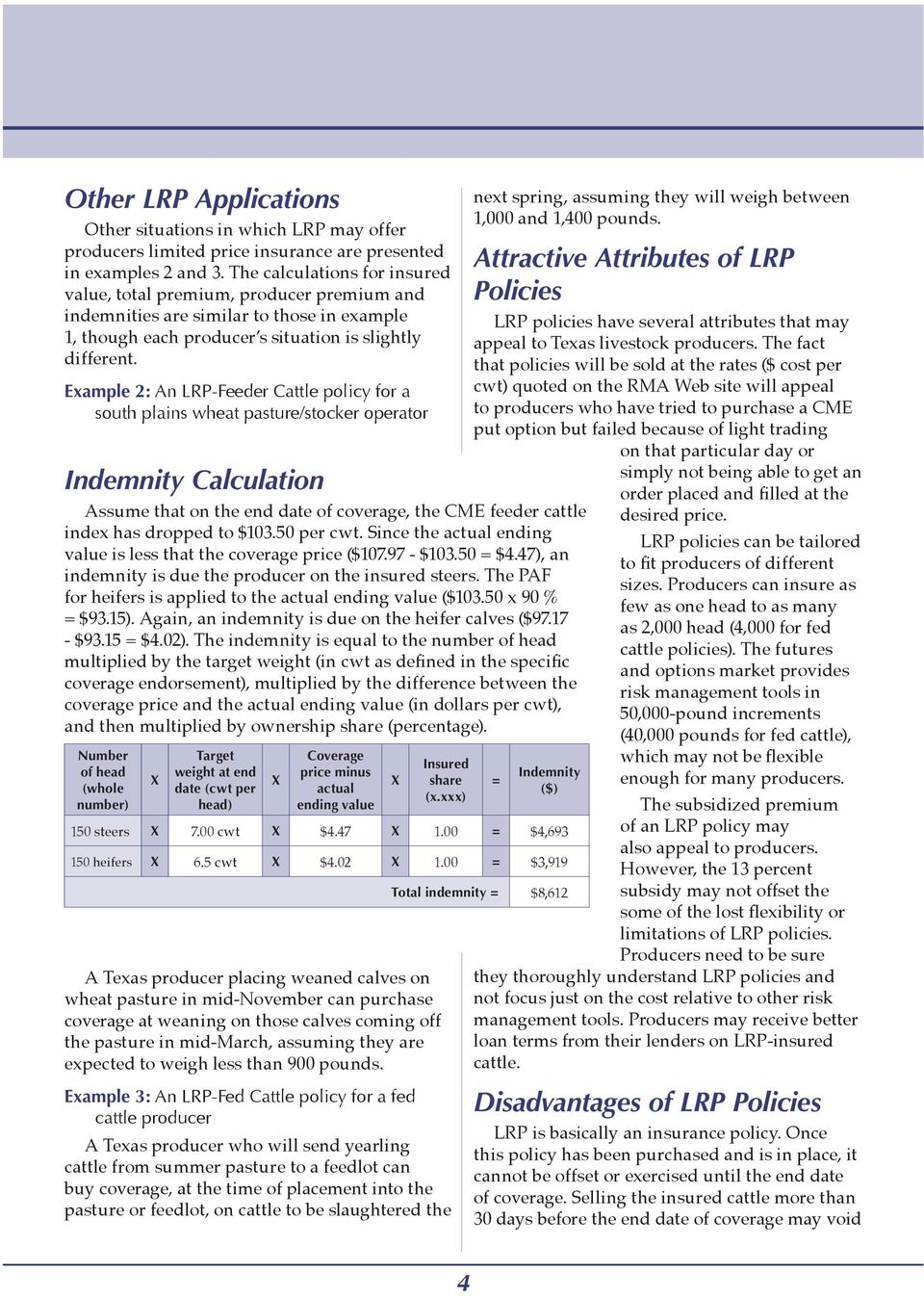
3 Contract Specifics Feeder cattle policies insure all feeder cattle weighing up to 900 pounds. They will cover heifers and Brahma and dairy breeds. A fixed percentage price adjustment factor (PAF) is used to adjust the expected ending values and coverage price from standardweight, beef breed feeder cattle for various combinations of lightweight heifers or non-beef breeds. Table 2 shows the LRP feeder cattle price adjustment factor percentages. The PAF is also applied to actual end values at a contract s end date. LRP-Fed Cattle policies provide coverage for fed cattle that will weigh 1,000 to 1,400 pounds at slaughter. Table 3 lists the contract specifics for both the feeder and fed cattle contracts. Let s work through an example to calculate the insured value, producer s premium and indemnity. Example 1: LRP-Feeder Cattle for a West Texas cow-calf producer In mid-october, the owner of a 340-head cowcalf operation is buying an LRP-Feeder Cattle policy for his current calf crop. The calves are typically weaned (88 percent calf crop) about September 15 each year and carried over to the middle of January before the producer decides whether to market them, retain ownership for additional winter grazing, or move them to a feedlot. It is estimated that by mid-january the steer calves will average 700 pounds and the heifers will average 650 pounds. Table 4. LRP expected end values, coverage prices, levels, rates and contract end dates for October 15, Livestock type Expected end value 3 price level Rate Cost per cwt. End date Steers $ $ $ /14/2008 Heifers $ $ $ /14/2008 Source: value and premium calculations 1. The Value Number of Head multiplied by the Target Weight (live weight, in cwt) multiplied by the Price multiplied by Ownership Share. Number of head (whole number) Target weight at end date (cwt per head) price (as shown on Table 4) share (x.xxx) value 150 steers 7.00 cwt $ $113, heifers 6.5 cwt $ $94,741 Total insured value $208, The Total Premium Value multiplied by the Rate. value will be purchased on all of the heifers, including those that will be retained as replacements. This producer has no partners and owns 100 percent of the calves. This producer will use actuarial data from the RMA on October 15, 2007, which is shown in Table 4. Rate (as shown in Table 4) Total premium Steers $113, $1,634 Heifers $94, $1,365 Total premium $2,999 3 The Subsidy Total Premium multiplied by the Subsidy Rate. The subsidy rate is 13 percent. Total premium Subsidy (percent) Subsidy $2, $390 4 The Producer Premium Total Premium minus the Subsidy. Total premium - Subsidy Producer premium $2,999 - $390 $2,609

4 Other LRP Applications Other situations in which LRP may offer producers limited price insurance are presented in examples 2 and 3. The calculations for insured value, total premium, producer premium and indemnities are similar to those in example 1, though each producer s situation is slightly different. Example 2: An LRP-Feeder Cattle policy for a south plains wheat pasture/stocker operator Indemnity Calculation Assume that on the end date of coverage, the CME feeder cattle index has dropped to $ per cwt. Since the actual ending value is less that the coverage price ($ $ $4.47), an indemnity is due the producer on the insured steers. The PAF for heifers is applied to the actual ending value ($ x 90 % $93.15). Again, an indemnity is due on the heifer calves ($ $93.15 $4.02). The indemnity is equal to the number of head multiplied by the target weight (in cwt as defined in the specific coverage endorsement), multiplied by the difference between the coverage price and the actual ending value (in dollars per cwt), and then multiplied by ownership share (percentage). Number of head (whole number) Target weight at end date (cwt per head) A Texas producer placing weaned calves on wheat pasture in mid-november can purchase coverage at weaning on those calves coming off the pasture in mid-march, assuming they are expected to weigh less than 900 pounds. Example 3: An LRP-Fed Cattle policy for a fed cattle producer A Texas producer who will send yearling cattle from summer pasture to a feedlot can buy coverage, at the time of placement into the pasture or feedlot, on cattle to be slaughtered the price minus actual ending value share (x.xxx) 4 Indemnity 150 steers 7.00 cwt $ $4, heifers 6.5 cwt $ $3,919 next spring, assuming they will weigh between 1,000 and 1,400 pounds. Attractive Attributes of LRP Policies LRP policies have several attributes that may appeal to Texas livestock producers. The fact that policies will be sold at the rates ($ cost per cwt) quoted on the RMA Web site will appeal to producers who have tried to purchase a CME put option but failed because of light trading on that particular day or simply not being able to get an Total indemnity $8,612 order placed and filled at the desired price. LRP policies can be tailored to fit producers of different sizes. Producers can insure as few as one head to as many as 2,000 head (4,000 for fed cattle policies). The futures and options market provides risk management tools in 50,000-pound increments (40,000 pounds for fed cattle), which may not be flexible enough for many producers. The subsidized premium of an LRP policy may also appeal to producers. However, the 13 percent subsidy may not offset the some of the lost flexibility or limitations of LRP policies. Producers need to be sure they thoroughly understand LRP policies and not focus just on the cost relative to other risk management tools. Producers may receive better loan terms from their lenders on LRP-insured cattle. Disadvantages of LRP Policies LRP is basically an insurance policy. Once this policy has been purchased and is in place, it cannot be offset or exercised until the end date of coverage. Selling the insured cattle more than 30 days before the end date of coverage may void
5 the policy. These restrictions place a premium on planning and make it necessary to have a working knowledge of price seasonality and relative price strength. Local basis risk is still an issue facing producers who use LRP policies. Local basis is defined as the difference between local markets and the CME. Increased investor interest in the commodity markets may be widening local basis and making it less predictable. The difference in basis (CME futures vs. cash settled index) is not likely to increase the utility of LRP to Texas producers Feeder cattle producers who want to buy coverage at the same time cattle are purchased and producers who want to buy LRP coverage at the most distant end dates of coverage may find their choices of coverage prices limited. A producer may have to wait several weeks for the right combination of ending date and coverage price to become available. RMA also retains the right to suspend the sale of LRP policies if the market becomes unstable. The criteria for the suspension of sales are the same for LRP-Feeder Cattle and LRP-Fed Cattle policies. If four or more of the respective CME contracts trade the limit up or down for two consecutive days, LRP sales will be suspended. All previously sold policies will remain in effect with no change in the coverage or cost of coverage. LRP sales will resume if and when there have been two consecutive days without there being four or more CME contracts equaling or exceeding the daily price limit. Summary LRP is an insurance tool that may help with risk management role once a producer identifies his risk management objectives (risk tolerance, cost parameters, etc.) and understands the limitations of LRP. Producers will need to learn evaluate LRP in comparison with other risk management strategies that use CME futures and option contracts at different periods in the production cycle. LRP policies are intended to insure against a drop in the underlying livestock market. As an insurance policy, LRP will not increase or enhance gross revenue. LRP policies also do not guarantee a cash price or basis level for the local market. Partial funding support has been provided by the Texas Corn Producers, Texas Farm Bureau, and Cotton Inc. Texas State Support Committee. Produced by AgriLife Communications, The Texas A&M System Extension publications can be found on the Web at: Visit Texas AgriLife Extension Service at Educational programs of the Texas AgriLife Extension Service are open to all people without regard to race, color, sex, disability, religion, age, or national origin. Issued in furtherance of Cooperative Extension Work in Agriculture and Home Economics, Acts of Congress of May 8, 1914, as amended, and June 30, 1914, in cooperation with the United States Department of Agriculture. Edward G. Smith, Director, Texas AgriLife Extension Service, The Texas A&M System.
Livestock Risk Protection Insurance: How Does It Work
 Livestock Risk Protection Insurance: How Does It Work James Mintert, Ph.D. Professor & Extension State Leader Department of Agricultural Economics Kansas State University www.agmanager.info/livestock/marketing
Comparing LRP to a Put Option
 Comparing LRP to a Put Option Dr. G. A. Art Barnaby, Jr Kansas State University Phone: (785) 532-1515 Email: [email protected] Check out our WEB at: AgManager.info 1 Livestock Risk Protection (LRP)
Using the Futures Market to Predict Prices and Calculate Breakevens for Feeder Cattle Kenny Burdine 1 and Greg Halich 2
 Introduction Using the Futures Market to Predict Prices and Calculate Breakevens for Feeder Cattle Kenny Burdine 1 and Greg Halich 2 AEC 2013-09 August 2013 Futures markets are used by cattle producers
Definitions of Marketing Terms
 E-472 RM2-32.0 11-08 Risk Management Definitions of Marketing Terms Dean McCorkle and Kevin Dhuyvetter* Cash Market Cash marketing basis the difference between a cash price and a futures price of a particular
Business Plans for Agricultural Producers
 E-492 RM3-1.0 10-08 Risk Management Business Plans for Agricultural Producers Dean McCorkle and Stan Bevers* A business plan is a road map for a business. It describes the key functions of the business
Income Statement A Financial Management Tool
 E-484 RM5-6.0 09-08 Risk Management Income Statement A Financial Management Tool Danny Klinefelter* An income statement measures the success of a business, in terms of net income or loss, for a period
Cash Flow Projection for Operating Loan Determination
 E-19 RM-7.0 02-09 Risk Management Cash Flow Projection for Operating Loan Determination Danny Klinefelter and Dean McCorkle* A cash flow statement can be simply described as a record of the dollars coming
Using Futures, Options or LRP Insurance to Manage Feeder Cattle Price Risk
 Using Futures, Options or LRP Insurance to Manage Feeder Cattle Price Risk Dillon M. Feuz - Utah State University and John P. Hewlett University of Wyoming Understanding Risk In Agricultural Prices Wyoming
BREAK-EVEN COSTS FOR COW/CALF PRODUCERS
 L-5220 9/98 BREAK-EVEN COSTS FOR COW/CALF PRODUCERS L.R. Sprott* CALCULATING BREAK-EVEN COSTS of production can help cow/calf producers make better management decisions for the current year or for the
CROP REVENUE COVERAGE INSURANCE PROVIDES ADDITIONAL RISK MANAGEMENT WHEAT ALTERNATIVES 1
 Presented at the 1997 Missouri Commercial Agriculture Crop Institute CROP REVENUE COVERAGE INSURANCE PROVIDES ADDITIONAL RISK MANAGEMENT WHEAT ALTERNATIVES 1 Presented by: Art Barnaby Managing Risk With
Using Futures Markets to Manage Price Risk for Feeder Cattle (AEC 2013-01) February 2013
 Using Futures Markets to Manage Price Risk for Feeder Cattle (AEC 2013-01) February 2013 Kenny Burdine 1 Introduction: Price volatility in feeder cattle markets has greatly increased since 2007. While
Understanding and Using Cattle Basis in Managing Price Risk
 Understanding and Using Cattle Basis in Managing Price Risk by R. Curt Lacy 1, Andrew P. Griffith 2 and John C. McKissick 3 Introduction Understanding the concept of basis is a key element in developing
Understanding and Using Basis for Livestock Producer Marketing Management 1
 Understanding and Using Basis for Livestock Producer Marketing Management 1 By: Al Wellman, and Reviewed by Gene Murra Edited by Duane Griffith and Stephen Koontz 2 This Fact Sheet will assist a livestock
FUTURES TRADING OF LIVE BEEF CATTLE (HEDGING) by Clarence C. Bowen
 ESM 481 FUTURES TRADING OF LIVE BEEF CATTLE (HEDGING) by Clarence C. Bowen Cooperative Extension Service Department of Agricultural Economics & Rural Sociology The Ohio State University September, 1972
LIVESTOCK GROSS MARGIN FOR DAIRY CATTLE INSURANCE POLICY QUESTIONS AND ANSWERS
 LIVESTOCK GROSS MARGIN FOR DAIRY CATTLE INSURANCE POLICY QUESTIONS AND ANSWERS 1. Q: What is the Livestock Gross Margin for Dairy Cattle Insurance Policy? A: The Livestock Gross Margin for Dairy Cattle
Multiple Peril Crop Insurance
 Multiple Peril Crop Insurance Multiple Peril Crop Insurance (MPCI) is a broadbased crop insurance program regulated by the U.S. Department of Agriculture and subsidized by the Federal Crop Insurance Corporation
The Costs of Raising Replacement Heifers and the Value of a Purchased Versus Raised Replacement
 Managing for Today s Cattle Market and Beyond March 2002 The Costs of Raising Replacement Heifers and the Value of a Purchased Versus Raised Replacement By Dillon M. Feuz, University of Nebraska Numerous
Using Futures Markets to Manage Price Risk for Feeder Cattle: Advanced Strategies (AEC 2013-03) March 2013
 Using Futures Markets to Manage Price Risk for Feeder Cattle: Advanced Strategies (AEC 2013-03) March 2013 Kenny Burdine 1 Introduction: Price volatility in feeder cattle markets has greatly increased
Financial Management: Cash vs. Accrual Accounting
 E-475 RM5-16.0 10-08 Risk Management Financial Management: Cash vs. Accounting Danny Klinefelter, Dean McCorkle and Steven Klose* Selecting a record-keeping system is an important decision for agricultural
Commodity Futures and Options
 Understanding Commodity Futures and Options for Producers of Livestock and Livestock Products CIS 1100 The Authors Larry D. Makus, C. Wilson Gray and Neil R. Rimbey* Introduction Risk associated with an
U.S. Livestock Insurance
 TODAYcrop insurance The State of U.S. Livestock Insurance By, Dr. Keith Collins, NCIS Editor s Note: Dr. Collins made a presentation on the state of U.S. livestock insurance products at the Congress of
Stocker Grazing or Grow Yard Feeder Cattle Profit Projection Calculator Users Manual and Definitions
 Stocker Grazing or Grow Yard Feeder Cattle Profit Projection Calculator Users Manual and Definitions The purpose of this decision aid is to help facilitate the organization of stocker or feeder cattle
Live, In-the-Beef, or Formula: Is there a Best Method for Selling Fed Cattle?
 Live, In-the-Beef, or Formula: Is there a Best Method for Selling Fed Cattle? Dillon M. Feuz Presented at Western Agricultural Economics Association 1997 Annual Meeting July 13-16, 1997 Reno/Sparks, Nevada
Crop Insurance for Cotton Producers: Key Concepts and Terminology
 Crop Insurance for Cotton Producers: Key Concepts and Terminology With large investments in land, equipment, and technology, cotton producers typically have more capital at risk than producers of other
Group Risk Income Protection
 Group Risk Income Protection James B. Johnson and John Hewlett* Objective Analysis for Informed Agricultural Marketing Policy Paper No. 13 July 2006 Decision Making * University of Wyoming, Extension Educator
The Supplementary Insurance Coverage Option: A New Risk Management Tool for Wyoming Producers
 The Supplementary Insurance Coverage Option: A New Risk Management Tool for Wyoming Producers Agricultural Marketing Policy Center Linfield Hall P.O. Box 172920 Montana State University Bozeman, MT 59717-2920
Pasture, Rangeland, and Forage Insurance: A Risk Management Tool for Hay and Livestock Producers
 October 2012 Pasture, Rangeland, and Forage Insurance: A Risk Management Tool for Hay and Livestock Producers Monte Vandeveer, Otoe County Extension Educator University of Nebraska-Lincoln Institute of
U.S. Farm Policy: Overview and Farm Bill Update. Jason Hafemeister 12 June 2014. Office of the Chief Economist. Trade Bureau
 U.S. Farm Policy: Office of the Chief Economist Trade Bureau Overview and Farm Bill Update Jason Hafemeister 12 June 2014 Agenda Background on U.S. Agriculture area, output, inputs, income Key Elements
Using Enterprise Budgets in Farm Financial Planning
 Oklahoma Cooperative Extension Service AGEC-243 Using Enterprise Budgets in Farm Financial Planning Damona Doye Regents Professor and Extension Economist Roger Sahs Extension Assistant Oklahoma Cooperative
Replacement Heifers Costs and Return on Investment Calculation Decision Aids
 Replacement Heifers Costs and Return on Investment Calculation Decision Aids The purpose of this replacement heifer cost decision aid is to calculate total production costs and return on investment (ROI)
Enterprise Budget: Thomas Foulke BISON. Steven J. Torok. Cow-Calf Short Grass Prairie, Eastern Wyoming. Tex Taylor. Edward Bradley
 Enterprise Budget: BISON Cow-Calf Short Grass Prairie, Eastern Wyoming Thomas Foulke Steven J. Torok Tex Taylor Edward Bradley B-1092 January 2001 Authors: Thomas Foulke, Information Specialist, University
Federal Crop Insurance: The Basics
 Federal Crop Insurance: The Basics Presented by Shawn Wade Director of Communications Plains Cotton Growers, Inc. 4517 West Loop 289 Lubbock, TX 79414 WWW.PLAINSCOTTON.ORG Why Federal Crop Insurance? Every
Financial Management: The Key to Farm-Firm Business Management
 E-491 RM5-10.0 10-08 Risk Management Financial Management: The Key to Farm-Firm Business Management Jose G. Pena and Danny Klinefelter* Most farmers and ranchers still prefer to concentrate on production
Hedging Milk with BFP Futures and Options
 Curriculum Guide I. Goals and Objectives A. Gain an understanding of milk price seasonality. B. earn about basis and how to track it over time. C. earn how to hedge future milk sales with BFP futures and
LGM-Dairy: What is it? New Livestock Gross Margin for Dairy Insurance
 Dairy Price Risk Management Livestock Gross Margin for Dairy (LGM-Dairy) Victor E. Cabrera Assistant Professor Extension Dairy Specialist Dairy Science Department Brian W. Gould Associate Professor Ag
TOC INDEX. Breakeven Analysis for Feeder Cattle. Alberta Agriculture Market Specialists. Introduction. Why Breakevens?
 TOC INDEX Feeder Associations of Alberta Ltd. Breakeven Analysis for Feeder Cattle Alberta Agriculture Market Specialists Introduction Breakevens are specialized partial budgets used to evaluate feeder
CROP INSURANCE FOR NEW YORK VEGETABLE CROPS
 CROP INSURANCE FOR NEW YORK VEGETABLE CROPS Multi-peril crop insurance is a valuable risk management tool that allows growers to insure against losses due to adverse weather conditions, price fluctuations,
Beef Cattle Frame Scores
 Beef Cattle Frame Scores AS-1091, May 1995 John Dhuyvetter, Area Livestock Specialist Frame scores are an objective, numerical description of cattle skeletal size which reflect the growth pattern and potential
By Anne Wasko Gateway Livestock, Market Analyst
 @AnneDunford By Anne Wasko Gateway Livestock, Market Analyst June 2014 J/98 J/99 J/00 J/01 J/02 J/03 J/04 J/05 J/06 J/07 J/08 J/09 J/10 J/11 J/12 J/13 J/14 US $/cwt $160 US Fed Steer Price $140 $120 $100
Lower Rates Mean Lower Crop Insurance Cost 1
 Disclaimer: This web page is designed to aid farmers with their marketing and risk management decisions. The risk of loss in trading futures, options, forward contracts, and hedge-to-arrive can be substantial
Group Risk Income Protection Plan and Group Risk Plans added in New Kansas Counties for 2005 1 Updated 3/12/05
 Disclaimer: This web page is designed to aid farmers with their marketing and risk management decisions. The risk of loss in trading futures, options, forward contracts, and hedge-to-arrive can be substantial
Agricultural Commodity Marketing: Futures, Options, Insurance
 Agricultural Commodity Marketing: Futures, Options, Insurance By: Dillon M. Feuz Utah State University Funding and Support Provided by: On-Line Workshop Outline A series of 12 lectures with slides Accompanying
How To Insure A Crop
 Materials Prepared for Federation of Southern Cooperatives Epes, Alabama September 11, 2009 Group Risk Crop Insurance by Karen R. Krub Farmers Legal Action Group, Inc. 360 North Robert Street, Suite 500
How much financing will your farm business
 Twelve Steps to Ag Decision Maker Cash Flow Budgeting File C3-15 How much financing will your farm business require this year? When will money be needed and from where will it come? A little advance planning
How Crop Insurance Works. The Basics
 How Crop Insurance Works The Basics Behind the Policy Federal Crop Insurance Corporation Board of Directors Approve Policies Policy changes General direction of program Risk Management Agency Administers
Beef Cow Share Lease Agreements
 Institute of Agriculture and Natural Resources EC841 Beef Cow Share Lease Agreements Aaron L. Berger, Extension Educator Introduction Cow-calf enterprises require large investments in capital, labor, and
SOURCES AND USES OF FUNDS ON KFMA FARMS
 KANSAS FARM MANAGEMENT ASSOCIATION Your Farm - Your Information - Your Decision N E W S L E T T E R Volume 6, Issue 3 March 2012 SOURCES AND USES OF FUNDS ON KFMA FARMS A flow of funds report, often referred
Annual Forage (AF) Pilot Program
 Oklahoma Cooperative Extension Service AGEC-626 Annual Forage (AF) Pilot Program Jody Campiche Assistant Professor & Extension Economist JJ Jones Southeast Area Extension Agriculture Economist The Rainfall
Replacement Heifers Costs and Return Calculation Decision Aids
 Replacement Heifers Costs and Return Calculation Decision Aids The purpose of these replacement heifer cost decision aids is to calculate total production costs and return on investment (ROI) to evaluate
Beef Cattle Breeds and Biological Types Scott P. Greiner, Extension Animal Scientist, Virginia Tech
 publication 400-803 Beef Cattle Breeds and Biological Types Scott P. Greiner, Extension Animal Scientist, Virginia Tech Worldwide there are more than 250 breeds of beef cattle. Over 60 of these breeds
Livestock Budget Estimates for Kentucky - 2000
 Livestock Budget Estimates for Kentucky - 2000 Agricultural Economics Extension No. 2000-17 October 2000 By: RICHARD L. TRIMBLE, STEVE ISAACS, LAURA POWERS, AND A. LEE MEYER University of Kentucky Department
Commodity Options as Price Insurance for Cattlemen
 Managing for Today s Cattle Market and Beyond Commodity Options as Price Insurance for Cattlemen By John C. McKissick, The University of Georgia Most cattlemen are familiar with insurance, insuring their
Crop Insurance as a Tool
 Crop Insurance as a Tool By: Chris Bastian University of Wyoming There are several approaches to address income variability associated with production risk. One approach is to produce more than one product
Managing Cattle Price Risk with Futures and Options Contracts
 Managing Cattle Price Risk with Futures and Options Contracts Dr. John Lawrence, Extension Livestock Economist and Professor, Laura A. Bortz, Undergraduate Research Assistant, Iowa State University Department
AFBF Comparison of Senate and House Committee passed Farm Bills May 16, 2013
 CURRENT LAW SENATE AG COMMITTEE (S. 954) HOUSE AG COMMITTEE (HR 1947) Reported out of Committee 15 5 Reported out of Committee 36 10 Cost $979.7 billion over the 10 years before sequester reductions of
How Profitable is Backgrounding Cattle? Dr. John Lawrence and Cody Ostendorf, Iowa State University
 How Profitable is Backgrounding Cattle? Dr. John Lawrence and Cody Ostendorf, Iowa State University Many beef producers question the profitability of backgrounding cattle before selling them. Many variables
Economics of Estrus Synchronization and Artificial Insemination. Dr. Les Anderson and Paul Deaton University of Kentucky
 Economics of Estrus Synchronization and Artificial Insemination Dr. Les Anderson and Paul Deaton University of Kentucky Introduction Few beef producers would disagree that the genetic potential available
Specifications of Futures and Options Contracts
 Specifications of Futures and Options Contracts Overview There have been organized commodity exchanges in the United States since the Chicago Board of Trade (CBOT) was established in 1848. Other agricultural
Crop Insurance For Those Who Choose To Manage Risk
 2008 INSIDE: Crop Insurance For Those Who Choose To Manage Risk n Price And Weather Volatility Increase Risks n It Doesn t Cost To Ask n How To Evaluate Crop-Hail Insurance n Risk Management Checklist
Farm Tax Record Book SAMPLE
 Farm Tax Record Book TABLE OF CONTENTS Farm Receipts... Milk Sales and Deductions Worksheet... Government Payments Worksheet... Commodity Certificates... Sale of Livestock Worksheet... Farm Expenses...0
Section III Advanced Pricing Tools
 Section III Learning objectives The appeal of options Puts vs. calls Understanding premiums Recognizing if an option is in the money, at the money or out of the money Key terms Call option: The right,
Arizona Ranchers Management Guide
 Arizona Ranchers Management Guide Edited by Russell Tronstad Department of Agricultural and Resource Economics Jim Sprinkle Area Extension Agent, Animal Science George Ruyle School of Renewable Natural
Managing Risk With Revenue Insurance
 Managing Risk With Revenue Insurance VOLUME 4 ISSUE 5 22 Robert Dismukes, [email protected] Keith H. Coble, [email protected] Comstock 10 Crop revenue insurance offers farmers a way to manage
The Diverse Structure and Organization of U.S. Beef Cow-Calf Farms
 United States Department of Agriculture Economic Research Service Economic Information Bulletin Number 73 March 2011 The Diverse Structure and Organization of U.S. Beef Cow-Calf Farms William D. McBride
2014 Farm Bill How does it affect you and your operation? Cotton STAX & SCO
 2014 Farm Bill How does it affect you and your operation? Cotton STAX & SCO 1 2014 Farm Bill Cotton Chuck Danehower Extension Area Specialist Farm Management University of Tennessee Extension [email protected]
Managing Feed and Milk Price Risk: Futures Markets and Insurance Alternatives
 Managing Feed and Milk Price Risk: Futures Markets and Insurance Alternatives Dillon M. Feuz Department of Applied Economics Utah State University 3530 Old Main Hill Logan, UT 84322-3530 435-797-2296 [email protected]
Commodity products. Self-Study Guide to Hedging with Livestock Futures and Options
 Commodity products Self-Study Guide to Hedging with Livestock Futures and Options In a world of increasing volatility, CME Group is where the world comes to manage risk across all major asset classes interest
Characterization of the Beef Cow-calf Enterprise of the Northern Great Plains
 Characterization of the Beef Cow-calf Enterprise of the Northern Great Plains Barry Dunn 1, Edward Hamilton 1, and Dick Pruitt 1 Departments of Animal and Range Sciences and Veterinary Science BEEF 2003
Section 6: Cow-Calf Cash Flow Enterprise Budget Analysis 101
 Section 6: Cow-Calf Cash Flow Enterprise Budget Analysis 101 Lets get started with some basics the Cow Calf Profit Equation The Cow Calf Profit Equation There is no single goal that will satisfy every
Commodity Exchange Endorsement for Livestock Gross Margin for Dairy Cattle
 Commodity Exchange Endorsement for Livestock Gross Margin for Dairy Cattle This endorsement contains the exchange prices that are used to set expected and actual prices for LGM for Dairy Cattle. To find
Contents. Acknowledgements... iv. Source of Data...v
 Kentucky Farm Business Management Program Annual Summary Data: Kentucky Grain Farms - 2011 Agricultural Economics Extension No. 2012-17 June 2012 By: Amanda R. Jenkins Michael C. Forsythe University of
Understanding Grid Marketing: How Quality Grades and Grid Conditions Affect Carcass Value. By Pete Anderson Ag Knowledge Services
 Understanding Grid Marketing: How Quality Grades and Grid Conditions Affect Carcass Value By Pete Anderson Ag Knowledge Services Introduction Are cattle a commodity or a branded product? Since sight unseen