
Principles of demand management Airline yield management Determining the booking limits. » A simple problem» Stochastic gradients for general problems
|
|
|
- Edward Palmer
- 9 years ago
- Views:
Transcription
1 Demand Management Principles of demand management Airline yield management Determining the booking limits» A simple problem» Stochastic gradients for general problems

2 Principles of demand management Issues:» Customers are not all the same» The highest paying customers will not fill up available capacity.» The lowest paying customers will not cover the full costs of operations.» Marginal costs may be much lower than average costs.
3 Principles of demand management From microeconomics: Consumers surplus Price A single price leaves a lot of money on the table. The airlines would like to capture some of this. P Revenue Q Quantity

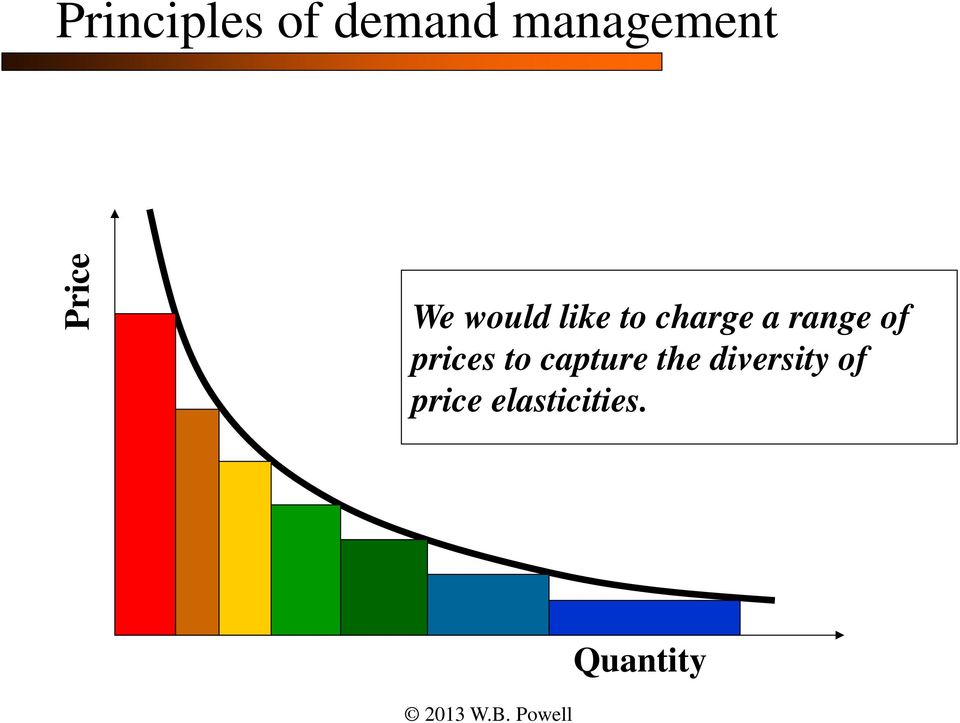
4 Principles of demand management Price We would like to charge a range of prices to capture the diversity of price elasticities. Quantity
5 Principles of demand management Modes of control:» Primal Limit access to the system (now) Reservations (future)» Dual Pricing Service (waiting in line)» Informational Advertising Promotions» Combinations: Coupons - provide discounts (dual) with restricted services (primal) to customers who hold coupons (informational).

6 Principles of demand management Market differentiating characteristics used in practice:» Advance notice (pre-booking, reservations)» Length of stay, stay over Saturday, etc.» Willingness to accept nonrefundable tickets» Service Additional amenities (first class, business class) Pre-board privileges (frequent flier status)

7 Principles of demand management Applications of demand management» Airlines» Hotels» niversities (with rolling admissions)

8 Lecture outline - Demand Management Principles of demand management Airline yield management Determining the booking limits» A simple problem» Stochastic gradients for general problems

9 Airline yield management Overview» Old system: Airlines establish a fare (or two, such as coach and first class) Sell seats at the fare until all seats are sold or the flight departs. Because of no-shows, airlines may sell too many seats to increase load factors.» Issue: Business travelers are willing to pay much more, but want the flexibility of making plans at the last minute. Different customers want different products measured in terms of price and service.» Solution: Offer blocks of seats at increasingly higher prices. The lower demand for higher priced seats has the effect of making seats available for last-minute business travelers.

10 Airline yield management Booking limits» Blocks of seats are offered at different prices: $1700 $1425 $1150 $910 $850 $775 $525

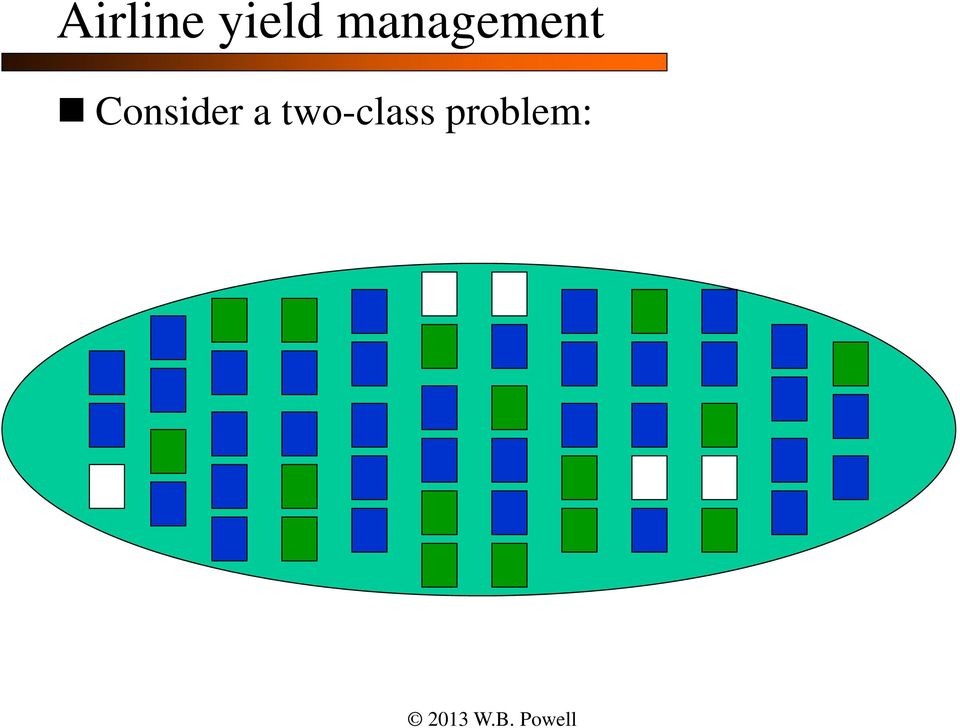
11 Airline yield management Consider a two-class problem:
12 Airline yield management What price to charge? Quantity Aircraft capacity A high price gets the business travelers, but squeezes out the low-priced segment. But there are not enough business people to fill the plane. A lower price attracts the personal travelers, but squeezes out the business people. P Price

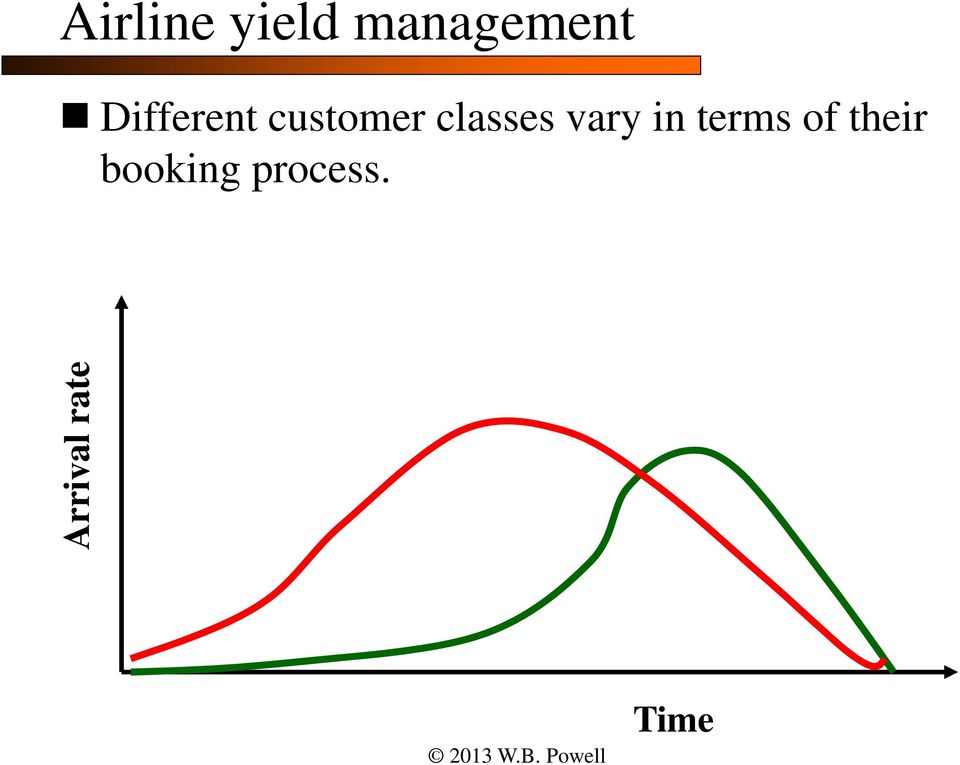
13 Airline yield management Different customer classes vary in terms of their booking process. Arrival rate Time
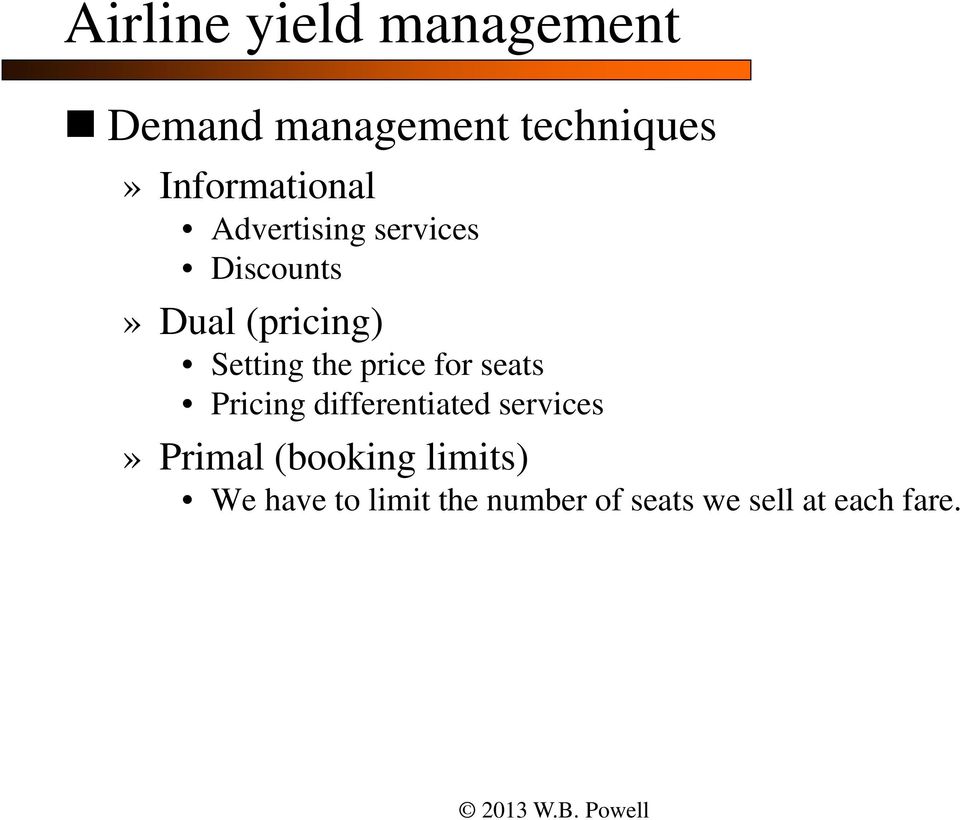
14 Airline yield management Demand management techniques» Informational Advertising services Discounts» Dual (pricing) Setting the price for seats Pricing differentiated services» Primal (booking limits) We have to limit the number of seats we sell at each fare.
15 Airline yield management Consider a two-class problem: Lost customers: Cheap seats Expensive seats How do we decide if we picked the right booking limit?
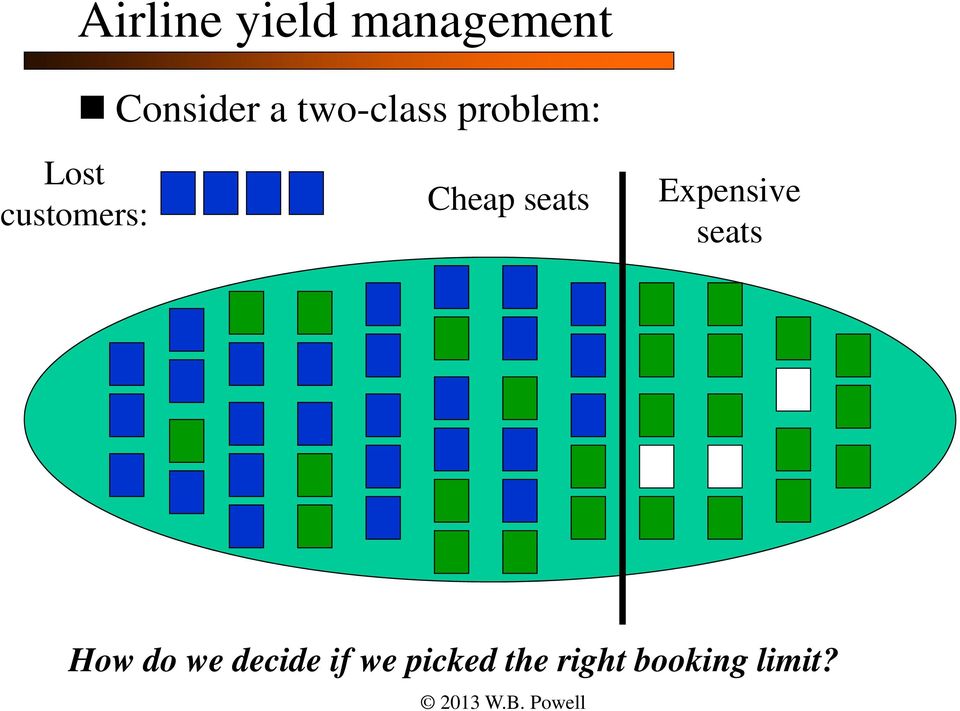
16 Airline yield management Challenge question:» What happens when the allotment of cheap seats is set too high? Too low?

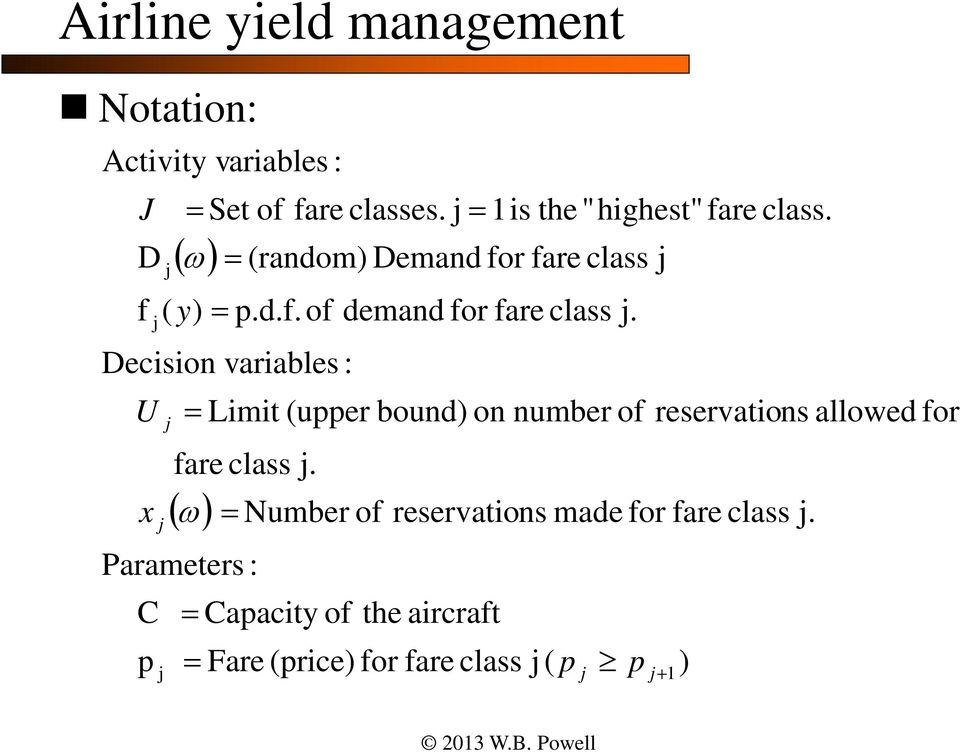
17 Airline yield management Notation: Activity variables : J D f p Set of ( y) p.d.f. of demand for fare class. Decision variables : x Limit (upper bound) on number of reservations allowed for fare class fare classes. 1is the "highest" fare class.. Number of reservations made for fare class. Parameters : C Capacity of the aircraft (random) Demand for fare class Fare (price) for fare class ( p p 1 )
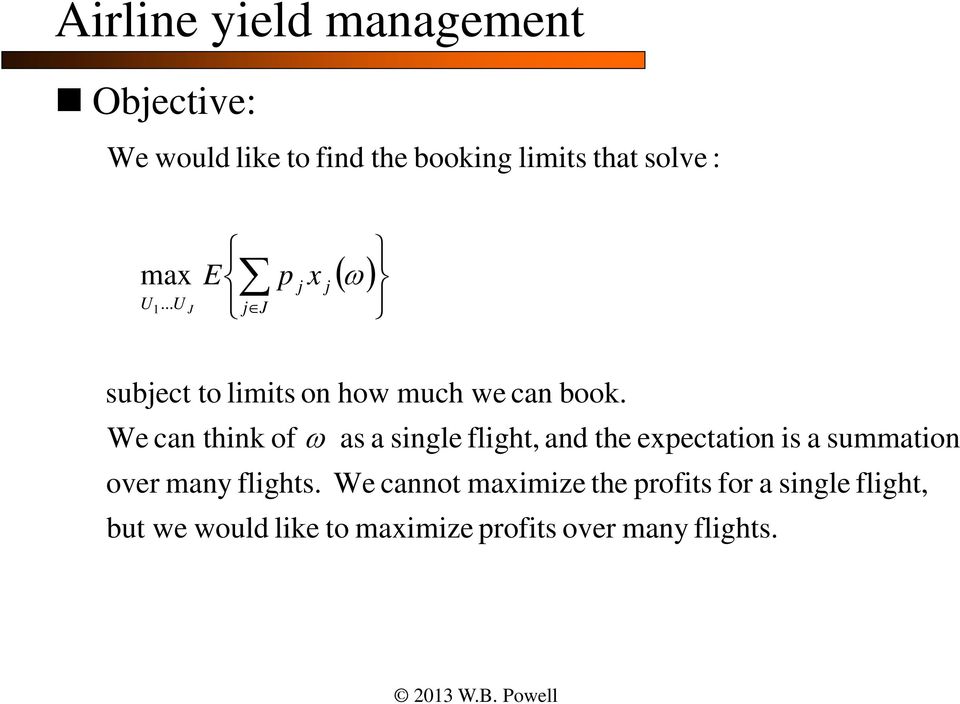
18 Airline yield management Obective: We would like to find the booking limits that solve : max 1... J E J p x subect to limits on how much we can book. We can think of as a single flight, and the expectation is a summation over many flights. We cannot maximize the profits for a single flight, but we would like to maximize profits over many flights.
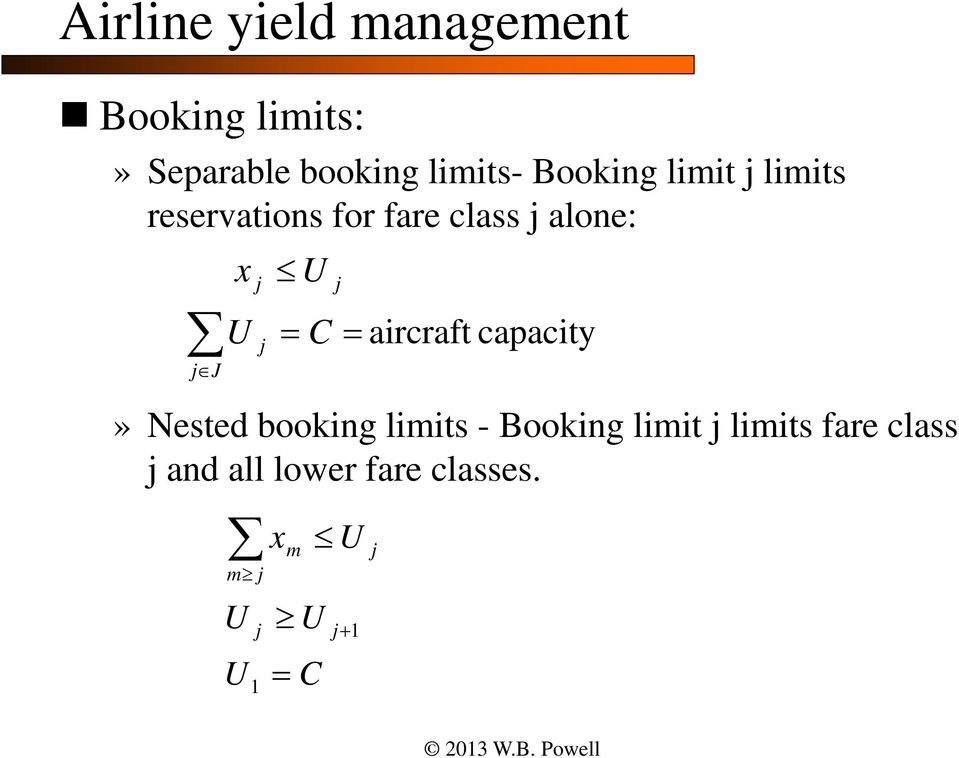
19 Airline yield management Booking limits:» Separable booking limits- Booking limit limits reservations for fare class alone:» Nested booking limits - Booking limit limits fare class and all lower fare classes. aircraft capacity C x J C x m m 1 1
20 Airline yield management A heuristic derivation for booking limits: Start with a separable (non-nested) policy: Let: P ( x) Prob[ D x] y0 ( y) dy This means that if we set a booking limit at we could have x f exceeded it is 1 P ( ). Now let:, the probability that EMSR ( ) The expected marginal seat revenue for fare class The value an additional seat allocated for fare class. p 1 P ( ).

21 Airline yield management ) ( P 1- ) ( Prob ) F(, E : means that This Otherwise 0 ) ( ) F(, Now consider the derivative : } ), ( min{ ), ( where : subect to : ), ( max ) ( We start by expressing the obective function : J p D p D p D p F C F E F
22 Airline yield management We can formulate the problem as an unconstrained problem by relaxing the constraint: L F (, ) max EF(, ) C J L F (, ) At optimality, we expect to find 0. This means that: Or: p 1-P ( ) 0 p 1-P ( ) for each. What is the economic interpretation of this equation?
23 Airline yield management The EMSR algorithm: For a given value of, find the booking limit : P( ) 1- Given, we can find Now we have to pick so that p p p ( ) C ( ) so that this is satisfied. Since is a scalar, ust have to try different values.
24 Lecture outline - Demand Management Principles of demand management Airline yield management Determining the booking limits» A simple problem» Stochastic gradients for general problems
25 Stochastic gradient algorithms Nested booking limits: Fare Class» A sample booking process: Demand D() Booking limit Total reservations Fare class reservations
26 Stochastic gradient algorithms Nested booking limits: Start by defining the cumulative demand: Dˆ, Total reservations made of customer classes and "lower." 1 min D Dˆ, 1 Note: Dˆ (, ) Dˆ (, ) is the number of fare class reservations that have been accepted. What are we implicitly assuming about the callin process? Time
27 Stochastic gradient algorithms J D D p F F E F ), ( ˆ ), ( ˆ ), ( where : ), ( max ) ( to solve : again want we problem, For this 1 But how do we find the gradient?
28 Stochastic gradient algorithms Consider a two class system... We start with C. 1 ˆ ˆ ˆ F (, ) p D(, ) D(, ) p D(, ) p min D Dˆ, Dˆ (, ) p Dˆ (, ) Let's now assume that with our low "vacationers" fare p, D 2 2. In this case, we have: F (, ) p min D, p p min D, p p min D, p
29 Stochastic gradient algorithms Taking the derivative with respect to gives: F (, ) {X} 2 pi 1 D ( ) (Remember: I 1 if event X is true, and 0 otherwise. E I is then the probability that X is true.) Taking expectations gives: F (, ) E p1prob[ D1 1 2] p2 2 Recall that C. Setting the derivative equal to zero, we get: 1 2 pprob[ D C ] p p {X}
30 Stochastic gradient algorithms When the problem gets more complicated, we do not get such neat results. Instead, we can resort to our stochastic gradient algorithms. max E F(, ) max E p D (, ) D (, ) J ˆ ˆ 1 Assume we have an initial vector using the stochastic gradient iteration: k 1 k k k k F(, ) 0. We can find the best value of
31 Stochastic gradient algorithms Consider the change in a booking limit:» Assume we change from 4 =40 to 4 =41. Fare Demand Booking Total Fare class Class D() limit reservations reservations (41) 40(41) 25(26) (80) 80(80) 40(39) Change (120) 120(120) 40(40) (150) 147(147) 27(27) Change in profits is p 4 -p 3. What if 3 was not binding?
32 Stochastic gradient algorithms Consider the change in a booking limit:» What if 3 is not binding, but 2 is? Fare Demand Booking Total Fare class Class D() limit reservations reservations (41) 40(41) 25(26) Change (80) 74(75) 34(34) (120) 120(120) 46(45) (150) 147(147) 27(27) Now the change in profits is p 4 -p 2.
33 Stochastic gradient algorithms Consider the change in a booking limit:» What if nothing else is binding? Fare Demand Booking Total Fare class Class D() limit reservations reservations (41) 40(41) 25(26) Change (80) 74(75) 34(34) (120) 114(115) 40(40) (150) 141(142) 27(27) Now the change in profits is p 4.
34 Stochastic gradient algorithms Consider the change in a booking limit:» What if 4 is not binding, but 2 is? Fare Demand Booking Total Fare class Class D() limit reservations reservations Change (41) 35(35) 20(20) (80) 69(69) 34(34) (120) 120(120) 51(51) (150) 147(147) 27(27) Now there is no change in profits.
35 Stochastic gradient algorithms So we have a formula for the gradient when increasing i: Let: X pi If booking limit i is binding. 0 Otherwise. X If iis binding, and is binding, and i is the first class p whose booking limit is binding. 0 If no other booking limit for a higher fare class is binding. We can now express the gradient using: F (, ) i X X Since X and X depend on the sample realization of demands, they are random variables..
36 Booking limits Seats Booking limit Fare 5 Fare 4 Fare 3 Fare 2 Fare Iteration Iteration
37 Higher demand Booking for limits fare class Iteration Iteration Fare 5 Fare 4 Fare 3 Fare 2 Fare 1 Booking Seats limit
38 Lecture outline - Demand Management Issues in demand management
39 Extensions The no-show problem» How can we manage this? The fairness issue» Paying different amounts for the same seat» In what way are seats different? Managing complexity» 1000 markets» 30,000 fares!
MIT ICAT. Airline Revenue Management: Flight Leg and Network Optimization. 1.201 Transportation Systems Analysis: Demand & Economics
 M I T I n t e r n a t i o n a l C e n t e r f o r A i r T r a n s p o r t a t i o n Airline Revenue Management: Flight Leg and Network Optimization 1.201 Transportation Systems Analysis: Demand & Economics
SIMULATING CANCELLATIONS AND OVERBOOKING IN YIELD MANAGEMENT
 CHAPTER 8 SIMULATING CANCELLATIONS AND OVERBOOKING IN YIELD MANAGEMENT In YM, one of the major problems in maximizing revenue is the number of cancellations. In industries implementing YM this is very
36106 Managerial Decision Modeling Revenue Management
 36106 Managerial Decision Modeling Revenue Management Kipp Martin University of Chicago Booth School of Business October 5, 2015 Reading and Excel Files 2 Reading (Powell and Baker): Section 9.5 Appendix
Ch 6 Revenue Management
 6-1 Ch 6 Revenue Management 6.1 History 6.2 Levels of Revenue Management 6.3 Revenue Management Strategy 6.4 The System Context 6.5 Booking Control 6.6 Tactical Revenue Management 6.7 Net Contribution
LECTURE - 2 YIELD MANAGEMENT
 LECTURE - 2 YIELD MANAGEMENT Learning objective To demonstrate the applicability of yield management in services 8.5 Yield Management or Revenue Management Yield management is applied by service organizations
Chapter 3 Review QOS QOS RPM. Unit Cost ASM. # Flights RPM. Economies Of Scale. Yield RPM. Operating Expense Revenue. Profit.
 Chapter 3 Review RPM RPM QOS Elasticity QOS # Flights QOS ASM Unit Cost Unit Cost Demand RPM Time Elasticity Yield Economies Of Scale Price Elasticity Operating Expense Revenue Profit Spill Fundamentals
AIRLINE REVENUE MANAGEMENT IN A CHANGING BUSINESS ENVIRONMENT
 Proceedings of the 5 th International Conference RelStat 05 Part 1 AIRLINE REVENUE MANAGEMENT IN A CHANGING BUSINESS ENVIRONMENT Richard Klophaus Trier University of Applied Sciences and Centre of Aviation
Airline Revenue Management: An Overview of OR Techniques 1982-2001
 Airline Revenue Management: An Overview of OR Techniques 1982-2001 Kevin Pak * Nanda Piersma January, 2002 Econometric Institute Report EI 2002-03 Abstract With the increasing interest in decision support
A Randomized Linear Programming Method for Network Revenue Management with Product-Specific No-Shows
 A Randomized Linear Programming Method for Network Revenue Management with Product-Specific No-Shows Sumit Kunnumkal Indian School of Business, Gachibowli, Hyderabad, 500032, India sumit [email protected]
 1 Monopoly Why Monopolies Arise? Monopoly is a rm that is the sole seller of a product without close substitutes. The fundamental cause of monopoly is barriers to entry: A monopoly remains the only seller
A central problem in network revenue management
 A Randomized Linear Programming Method for Computing Network Bid Prices KALYAN TALLURI Universitat Pompeu Fabra, Barcelona, Spain GARRETT VAN RYZIN Columbia University, New York, New York We analyze a
Big Data - Lecture 1 Optimization reminders
 Big Data - Lecture 1 Optimization reminders S. Gadat Toulouse, Octobre 2014 Big Data - Lecture 1 Optimization reminders S. Gadat Toulouse, Octobre 2014 Schedule Introduction Major issues Examples Mathematics
INTEGRATING CASE STUDY 9 The Art of Devising Airfares
 INTEGRATING CASE STUDY 9 The Art of Devising Airfares Salvatore s Managerial Economics: Principles and Worldwide Applications, 8th International Edition Chapter 11-2: The Art of Devising Air Fares Introductory
Duality in General Programs. Ryan Tibshirani Convex Optimization 10-725/36-725
 Duality in General Programs Ryan Tibshirani Convex Optimization 10-725/36-725 1 Last time: duality in linear programs Given c R n, A R m n, b R m, G R r n, h R r : min x R n c T x max u R m, v R r b T
Appendix: Simple Methods for Shift Scheduling in Multi-Skill Call Centers
 MSOM.1070.0172 Appendix: Simple Methods for Shift Scheduling in Multi-Skill Call Centers In Bhulai et al. (2006) we presented a method for computing optimal schedules, separately, after the optimal staffing
DEMYSTIFYING PRICE OPTIMIZATION:
 HOSPITALITY Alex Dietz DEMYSTIFYING PRICE OPTIMIZATION: A REVENUE MANAGER S GUIDE TO PRICE OPTIMIZATION As analytic approaches to pricing have evolved over the last decade, one of the most common questions
SECOND-DEGREE PRICE DISCRIMINATION
 SECOND-DEGREE PRICE DISCRIMINATION FIRST Degree: The firm knows that it faces different individuals with different demand functions and furthermore the firm can tell who is who. In this case the firm extracts
Price Discrimination: Part 2. Sotiris Georganas
 Price Discrimination: Part 2 Sotiris Georganas 1 More pricing techniques We will look at some further pricing techniques... 1. Non-linear pricing (2nd degree price discrimination) 2. Bundling 2 Non-linear
REVENUE MANAGEMENT: MODELS AND METHODS
 Proceedings of the 2008 Winter Simulation Conference S. J. Mason, R. R. Hill, L. Mönch, O. Rose, T. Jefferson, J. W. Fowler eds. REVENUE MANAGEMENT: MODELS AND METHODS Kalyan T. Talluri ICREA and Universitat
Lecture 9: Price Discrimination
 Lecture 9: Price Discrimination EC 105. Industrial Organization. Fall 2011 Matt Shum HSS, California Institute of Technology September 9, 2011 September 9, 2011 1 / 23 Outline Outline 1 Perfect price discrimination
Role of Stochastic Optimization in Revenue Management. Huseyin Topaloglu School of Operations Research and Information Engineering Cornell University
 Role of Stochastic Optimization in Revenue Management Huseyin Topaloglu School of Operations Research and Information Engineering Cornell University Revenue Management Revenue management involves making
A Branch and Bound Algorithm for Solving the Binary Bi-level Linear Programming Problem
 A Branch and Bound Algorithm for Solving the Binary Bi-level Linear Programming Problem John Karlof and Peter Hocking Mathematics and Statistics Department University of North Carolina Wilmington Wilmington,
Yield Management. B.S.c. Thesis by. Márta Treszl. Mathematics B.S.c., Mathematical Analyst. Supervisors: Róbert Fullér.
 Yield Management B.S.c. Thesis by Márta Treszl Mathematics B.S.c., Mathematical Analyst Supervisors: Róbert Fullér Professor at Åbo Akademi University Viktória Villányi Assistant Professor at the Department
An Improved Dynamic Programming Decomposition Approach for Network Revenue Management
 An Improved Dynamic Programming Decomposition Approach for Network Revenue Management Dan Zhang Leeds School of Business University of Colorado at Boulder May 21, 2012 Outline Background Network revenue
Branch-and-Price Approach to the Vehicle Routing Problem with Time Windows
 TECHNISCHE UNIVERSITEIT EINDHOVEN Branch-and-Price Approach to the Vehicle Routing Problem with Time Windows Lloyd A. Fasting May 2014 Supervisors: dr. M. Firat dr.ir. M.A.A. Boon J. van Twist MSc. Contents
Improved Forecast Accuracy in Airline Revenue Management by Unconstraining Demand Estimates from Censored Data by Richard H. Zeni
 Improved Forecast Accuracy in Airline Revenue Management by Unconstraining Demand Estimates from Censored Data by Richard H. Zeni ISBN: 1-58112-141-5 DISSERTATION.COM USA 2001 Improved Forecast Accuracy
1.4 Hidden Information and Price Discrimination 1
 1.4 Hidden Information and Price Discrimination 1 To be included in: Elmar Wolfstetter. Topics in Microeconomics: Industrial Organization, Auctions, and Incentives. Cambridge University Press, new edition,
Airlines Industry Yield Management. Ken Homa
 Airlines Industry Yield Management Ken Homa Airlines Industry Challenging Environment Complex, interconnected network Thousands of dynamic prices 90% discount prices 20% pay less than half of average 2/3
Economics 1011a: Intermediate Microeconomics
 Lecture 12: More Uncertainty Economics 1011a: Intermediate Microeconomics Lecture 12: More on Uncertainty Thursday, October 23, 2008 Last class we introduced choice under uncertainty. Today we will explore
Revenue Management and Dynamic Pricing. E. Andrew Boyd Chief Scientist and Senior VP, Science and Research PROS Revenue Management aboyd@prosrm.
 Revenue Management and Dynamic Pricing E. Andrew Boyd Chief Scientist and Senior VP, Science and Research PROS Revenue Management [email protected] 1 Outline Concept Example Components Real-Time Transaction
MATERIALS MANAGEMENT. Module 9 July 22, 2014
 MATERIALS MANAGEMENT Module 9 July 22, 2014 Inventories and their Management Inventories =? New Car Inventory Sitting in Parking Lots Types of Inventory 1. Materials A. Raw material B. WIP C. Finished
Re-Solving Stochastic Programming Models for Airline Revenue Management
 Re-Solving Stochastic Programming Models for Airline Revenue Management Lijian Chen Department of Industrial, Welding and Systems Engineering The Ohio State University Columbus, OH 43210 [email protected]
Common in European countries government runs telephone, water, electric companies.
 Public ownership Common in European countries government runs telephone, water, electric companies. US: Postal service. Because delivery of mail seems to be natural monopoly. Private ownership incentive
Lecture. Simulation and optimization
 Course Simulation Lecture Simulation and optimization 1 4/3/2015 Simulation and optimization Platform busses at Schiphol Optimization: Find a feasible assignment of bus trips to bus shifts (driver and
Lecture 10 Scheduling 1
 Lecture 10 Scheduling 1 Transportation Models -1- large variety of models due to the many modes of transportation roads railroad shipping airlines as a consequence different type of equipment and resources
Jim Lambers MAT 169 Fall Semester 2009-10 Lecture 25 Notes
 Jim Lambers MAT 169 Fall Semester 009-10 Lecture 5 Notes These notes correspond to Section 10.5 in the text. Equations of Lines A line can be viewed, conceptually, as the set of all points in space that
Convex Programming Tools for Disjunctive Programs
 Convex Programming Tools for Disjunctive Programs João Soares, Departamento de Matemática, Universidade de Coimbra, Portugal Abstract A Disjunctive Program (DP) is a mathematical program whose feasible
Efficient and Robust Allocation Algorithms in Clouds under Memory Constraints
 Efficient and Robust Allocation Algorithms in Clouds under Memory Constraints Olivier Beaumont,, Paul Renaud-Goud Inria & University of Bordeaux Bordeaux, France 9th Scheduling for Large Scale Systems
Optimization: Optimal Pricing with Elasticity
 Optimization: Optimal Pricing with Elasticity Short Examples Series using Risk Simulator For more information please visit: www.realoptionsvaluation.com or contact us at: [email protected]
Mathematical finance and linear programming (optimization)
 Mathematical finance and linear programming (optimization) Geir Dahl September 15, 2009 1 Introduction The purpose of this short note is to explain how linear programming (LP) (=linear optimization) may
A Look At Cargo Revenue Management
 White Paper A Look At Cargo Revenue Management A discussion of revenue management for air cargo businesses passenger sales. With the success of In the early 1980s, revenue management disciplines were first
The impact of yield management
 n. 1-2013 Giampaolo Viglia Summary: 1. Introduction 2. The pricing discrimination problem 2.1 Bundling 3. When supply differs from demand 3.1 Yield Management 4. Heuristics to optimize, protecting the
Service Management Managing Capacity
 Service Management Managing Capacity Univ.-Prof. Dr.-Ing. Wolfgang Maass Chair in Economics Information and Service Systems (ISS) Saarland University, Saarbrücken, Germany WS 2011/2012 Thursdays, 8:00
Revenue Management. Who I am...
 (Approximate) Dynamic Programming in Revenue Management Christiane Barz Anderson School of Business Gold Hall B520 February 14th 2012 Who I am... - Diploma and PhD in Industrial Engineering from Universität
Simulating the Multiple Time-Period Arrival in Yield Management
 Simulating the Multiple Time-Period Arrival in Yield Management P.K.Suri #1, Rakesh Kumar #2, Pardeep Kumar Mittal #3 #1 Dean(R&D), Chairman & Professor(CSE/IT/MCA), H.C.T.M., Kaithal(Haryana), India #2
Yield Management: A Tool for Capacity- Constrained Service Firm
 Cornell University School of Hotel Administration The Scholarly Commons Articles and Chapters School of Hotel Administration Collection 10-1989 Yield Management: A Tool for Capacity- Constrained Service
Linear Programming Notes V Problem Transformations
 Linear Programming Notes V Problem Transformations 1 Introduction Any linear programming problem can be rewritten in either of two standard forms. In the first form, the objective is to maximize, the material
A Model for Optimal Pricing and Capacity Allocation for a Firm Facing Market Cannibalization
 Proceedings of the 2011 International Conference on Industrial Engineering and Operations Management Kuala Lumpur, Malaysia, January 22 24, 2011 A Model for Optimal Pricing and Capacity Allocation for
AIRLINE PRICING STRATEGIES IN EUROPEAN AIRLINE MARKET
 AIRLINE PRICING STRATEGIES IN EUROPEAN AIRLINE MARKET Ľubomír Fedorco, Jakub Hospodka 1 Summary: The paper is focused on evaluating pricing strategies based on monitoring of air ticket prices in different
Upgrades, Upsells and Pricing in Revenue Management
 Submitted to Management Science manuscript Upgrades, Upsells and Pricing in Revenue Management Guillermo Gallego IEOR Department, Columbia University, New York, NY 10027, [email protected] Catalina Stefanescu
Chapter 6 Competitive Markets
 Chapter 6 Competitive Markets After reading Chapter 6, COMPETITIVE MARKETS, you should be able to: List and explain the characteristics of Perfect Competition and Monopolistic Competition Explain why a
Models in Transportation. Tim Nieberg
 Models in Transportation Tim Nieberg Transportation Models large variety of models due to the many modes of transportation roads railroad shipping airlines as a consequence different type of equipment
Offline sorting buffers on Line
 Offline sorting buffers on Line Rohit Khandekar 1 and Vinayaka Pandit 2 1 University of Waterloo, ON, Canada. email: [email protected] 2 IBM India Research Lab, New Delhi. email: [email protected]
Statistical Machine Learning
 Statistical Machine Learning UoC Stats 37700, Winter quarter Lecture 4: classical linear and quadratic discriminants. 1 / 25 Linear separation For two classes in R d : simple idea: separate the classes
A Production Planning Problem
 A Production Planning Problem Suppose a production manager is responsible for scheduling the monthly production levels of a certain product for a planning horizon of twelve months. For planning purposes,
A vector is a directed line segment used to represent a vector quantity.
 Chapters and 6 Introduction to Vectors A vector quantity has direction and magnitude. There are many examples of vector quantities in the natural world, such as force, velocity, and acceleration. A vector
Inflation. Chapter 8. 8.1 Money Supply and Demand
 Chapter 8 Inflation This chapter examines the causes and consequences of inflation. Sections 8.1 and 8.2 relate inflation to money supply and demand. Although the presentation differs somewhat from that
Making Hard Decision. ENCE 627 Decision Analysis for Engineering
 CHAPTER Duxbury Thomson Learning Making Hard Decision Third Edition SENSITIVITY ANALYSIS A. J. Clark School of Engineering Department of Civil and Environmental Engineering 5 FALL 2003 By Dr. Ibrahim.
1 Introduction. Linear Programming. Questions. A general optimization problem is of the form: choose x to. max f(x) subject to x S. where.
 Introduction Linear Programming Neil Laws TT 00 A general optimization problem is of the form: choose x to maximise f(x) subject to x S where x = (x,..., x n ) T, f : R n R is the objective function, S
INTEGER PROGRAMMING. Integer Programming. Prototype example. BIP model. BIP models
 Integer Programming INTEGER PROGRAMMING In many problems the decision variables must have integer values. Example: assign people, machines, and vehicles to activities in integer quantities. If this is
Moral Hazard. Itay Goldstein. Wharton School, University of Pennsylvania
 Moral Hazard Itay Goldstein Wharton School, University of Pennsylvania 1 Principal-Agent Problem Basic problem in corporate finance: separation of ownership and control: o The owners of the firm are typically
Lecture 3: Linear methods for classification
 Lecture 3: Linear methods for classification Rafael A. Irizarry and Hector Corrada Bravo February, 2010 Today we describe four specific algorithms useful for classification problems: linear regression,
ECON 459 Game Theory. Lecture Notes Auctions. Luca Anderlini Spring 2015
 ECON 459 Game Theory Lecture Notes Auctions Luca Anderlini Spring 2015 These notes have been used before. If you can still spot any errors or have any suggestions for improvement, please let me know. 1
Teaching Revenue Management in an Engineering Department
 Teaching Revenue Management in an Engineering Department Abstract: Revenue management is one of the newly emerging topics in the area of systems engineering, operations research, industrial engineering,
Increasing for all. Convex for all. ( ) Increasing for all (remember that the log function is only defined for ). ( ) Concave for all.
 1. Differentiation The first derivative of a function measures by how much changes in reaction to an infinitesimal shift in its argument. The largest the derivative (in absolute value), the faster is evolving.
Chapter 15: Monopoly WHY MONOPOLIES ARISE HOW MONOPOLIES MAKE PRODUCTION AND PRICING DECISIONS
 Chapter 15: While a competitive firm is a taker, a monopoly firm is a maker. A firm is considered a monopoly if... it is the sole seller of its product. its product does not have close substitutes. The
Airline Schedule Development
 Airline Schedule Development 16.75J/1.234J Airline Management Dr. Peter Belobaba February 22, 2006 Airline Schedule Development 1. Schedule Development Process Airline supply terminology Sequential approach
Chapter 11 Pricing Strategies for Firms with Market Power
 Managerial Economics & Business Strategy Chapter 11 Pricing Strategies for Firms with Market Power McGraw-Hill/Irwin Copyright 2010 by the McGraw-Hill Companies, Inc. All rights reserved. Overview I. Basic
Stochastic Inventory Control
 Chapter 3 Stochastic Inventory Control 1 In this chapter, we consider in much greater details certain dynamic inventory control problems of the type already encountered in section 1.3. In addition to the
Economics 431 Fall 2003 1st midterm Answer Key
 Economics 431 Fall 003 1st midterm Answer Key 1) (7 points) Consider an industry that consists of a large number of identical firms. In the long run competitive equilibrium, a firm s marginal cost must
Linear Programming for Optimization. Mark A. Schulze, Ph.D. Perceptive Scientific Instruments, Inc.
 1. Introduction Linear Programming for Optimization Mark A. Schulze, Ph.D. Perceptive Scientific Instruments, Inc. 1.1 Definition Linear programming is the name of a branch of applied mathematics that
Focus on minimizing costs EOQ Linear Programming. Two types of inventory costs (IC): Order/Setup Costs (OCs), and Carrying Costs (CCs) IC = OC + CC
 Focus on minimizing costs EOQ Linear Programming Economic Order Quantity (EOQ) model determines: Optimal amount of inventory to produce/purchase at given time Discussion applicable to production runs and
Revenue Management for Transportation Problems
 Revenue Management for Transportation Problems Francesca Guerriero Giovanna Miglionico Filomena Olivito Department of Electronic Informatics and Systems, University of Calabria Via P. Bucci, 87036 Rende
Problem Set 9 Solutions
 Problem Set 9 s 1. A monopoly insurance company provides accident insurance to two types of customers: low risk customers, for whom the probability of an accident is 0.25, and high risk customers, for
Second degree price discrimination
 Bergals School of Economics Fall 1997/8 Tel Aviv University Second degree price discrimination Yossi Spiegel 1. Introduction Second degree price discrimination refers to cases where a firm does not have
BREAK-EVEN ANALYSIS. In your business planning, have you asked questions like these?
 BREAK-EVEN ANALYSIS In your business planning, have you asked questions like these? How much do I have to sell to reach my profit goal? How will a change in my fixed costs affect net income? How much do
Multiple Linear Regression in Data Mining
 Multiple Linear Regression in Data Mining Contents 2.1. A Review of Multiple Linear Regression 2.2. Illustration of the Regression Process 2.3. Subset Selection in Linear Regression 1 2 Chap. 2 Multiple
A Statistical Modeling Approach to Airline Revenue. Management
 A Statistical Modeling Approach to Airline Revenue Management Sheela Siddappa 1, Dirk Günther 2, Jay M. Rosenberger 1, Victoria C. P. Chen 1, 1 Department of Industrial and Manufacturing Systems Engineering
FIN-40008 FINANCIAL INSTRUMENTS SPRING 2008
 FIN-40008 FINANCIAL INSTRUMENTS SPRING 2008 Options These notes consider the way put and call options and the underlying can be combined to create hedges, spreads and combinations. We will consider the
Imperfect information Up to now, consider only firms and consumers who are perfectly informed about market conditions: 1. prices, range of products
 Imperfect information Up to now, consider only firms and consumers who are perfectly informed about market conditions: 1. prices, range of products available 2. characteristics or relative qualities of
Keywords revenue management, yield management, genetic algorithm, airline reservation
 Volume 4, Issue 1, January 2014 ISSN: 2277 128X International Journal of Advanced Research in Computer Science and Software Engineering Research Paper Available online at: www.ijarcsse.com A Revenue Management
Figure 1, A Monopolistically Competitive Firm
 The Digital Economist Lecture 9 Pricing Power and Price Discrimination Many firms have the ability to charge prices for their products consistent with their best interests even thought they may not be
Lecture 6: Price discrimination II (Nonlinear Pricing)
 Lecture 6: Price discrimination II (Nonlinear Pricing) EC 105. Industrial Organization. Fall 2011 Matt Shum HSS, California Institute of Technology November 14, 2012 EC 105. Industrial Organization. Fall
Revenue Management and Capacity Planning
 Revenue Management and Capacity Planning Douglas R. Bish, Ebru K. Bish, Bacel Maddah 3 INTRODUCTION Broadly defined, revenue management (RM) 4 is the process of maximizing revenue from a fixed amount of
Multi-variable Calculus and Optimization
 Multi-variable Calculus and Optimization Dudley Cooke Trinity College Dublin Dudley Cooke (Trinity College Dublin) Multi-variable Calculus and Optimization 1 / 51 EC2040 Topic 3 - Multi-variable Calculus
Price Discrimination and Two Part Tariff
 Sloan School of Management 15.010/15.011 Massachusetts Institute of Technology RECITATION NOTES #6 Price Discrimination and Two Part Tariff Friday - October 29, 2004 OUTLINE OF TODAY S RECITATION 1. Conditions
Two-Stage Stochastic Linear Programs
 Two-Stage Stochastic Linear Programs Operations Research Anthony Papavasiliou 1 / 27 Two-Stage Stochastic Linear Programs 1 Short Reviews Probability Spaces and Random Variables Convex Analysis 2 Deterministic
A PRIMAL-DUAL APPROACH TO NONPARAMETRIC PRODUCTIVITY ANALYSIS: THE CASE OF U.S. AGRICULTURE. Jean-Paul Chavas and Thomas L. Cox *
 Copyright 1994 by Jean-Paul Chavas and homas L. Cox. All rights reserved. Readers may make verbatim copies of this document for noncommercial purposes by any means, provided that this copyright notice
Lecture Notes: Basic Concepts in Option Pricing - The Black and Scholes Model
 Brunel University Msc., EC5504, Financial Engineering Prof Menelaos Karanasos Lecture Notes: Basic Concepts in Option Pricing - The Black and Scholes Model Recall that the price of an option is equal to
Pricing with Perfect Competition. Business Economics Advanced Pricing Strategies. Pricing with Market Power. Markup Pricing
 Business Economics Advanced Pricing Strategies Thomas & Maurice, Chapter 12 Herbert Stocker [email protected] Institute of International Studies University of Ramkhamhaeng & Department of Economics
Multiple Optimization Using the JMP Statistical Software Kodak Research Conference May 9, 2005
 Multiple Optimization Using the JMP Statistical Software Kodak Research Conference May 9, 2005 Philip J. Ramsey, Ph.D., Mia L. Stephens, MS, Marie Gaudard, Ph.D. North Haven Group, http://www.northhavengroup.com/