
deflagration fire marshal pmax wood rubber sugar explosion protection kst
|
|
|
- Alvin Porter
- 9 years ago
- Views:
Transcription
1 dust collectors and combustible dust strategies factory mutual x-vent ducts ahj testing building inspector nfpa68,91,654 csb fire protection factory mutual x-vent ducts ahj testing building inspector nfpa68,91,654 csb fire protection factory mutual x-vent ducts ahj testing building inspector nfpa68,91,654 csb fire protection factory mutual x-vent ducts ahj testing building inspector nfpa68,91,654 csb fire protection

2 Introduction to Combustible Dust The U.S. Occupational Safety and Health Administration (OSHA) has issued a National Emphasis Program and continues to communicate with most industries on the hazards of combustible dust. The agency's focused effort is targeted at reducing combustible dust risks in industrial plant settings. Is your plant effectively managing the risks associated with combustible dust in its processes? For decades Donaldson Torit has been providing quality dust collectors that have become an integral part of many plant s combustible dust compliance strategies. Donaldson remains active in supplying dust collectors to support your combustible dust control strategy by interfacing with you and your experts on fire and explosion protection equipment and strategies. This document is intended to increase your understanding of typical combustible dust management strategies and some of the components involved. Where to Start? A Donaldson Torit representative can review your operational challenges to help you better understand how to integrate dust collection into your combustible dust management strategy. The following considerations are designed to help you decide how you want Donaldson Torit to support your combustible dust management strategy: do you have combustible materials?* are there sparks? Has the process experienced fires? Do you have test results confirming no combustible materials? Obtain test data on combustible properties K st, P max, MIE, MEC. Do test results confirm combustible materials? Materials may not be combustible. Get verification of material properties. Options for combustible materials may not be necessary for your collector. Collector selections could be made without options for combustible material risk management. Do you want Donaldson Torit to Include options to support your combustible materials management strategies? Options for your combustible material risks management strategies are provided by others. Documented Process Hazard Assessment may suggest options to consider during collector selection. Donaldson Torit will include options to support your combustible material risk management strategies. Additional options may be provided by others. * See the partial list from OSHA on page 6 1 Donaldson Torit

3 compliance strategy components * dust control protection Fire Triangle Fire management strategies traditionally focus on the control or elimination of one of the three key elements necessary for a fire often represented by the fire triangle." Managing one or more of the elements in the triangle can decrease the fire risk. prevention ignition control understanding the basics Many manufacturing processes create very small particles of dust which may become airborne, where they settle on surfaces and in crevices throughout the plant. Eventually these particles not only create a housekeeping issue, but if the particles are combustible, they can represent a potentially explosive dust cloud if disturbed. It is essential for plant leaders to understand the risks of combustible dust and ensure they manage combustible dusts in their facilities. Donaldson Torit can supply dust collectors to support your combustible dust control strategy by interfacing with you and your experts on fire and explosion protection equipment and solutions. Combustible dusts generally present both fire and explosion risks so it may help to consider the management of these risks separately (see side bar). WHY DUST COLLECTORS SHOULD BE PART OF YOUR STRATEGY DECISION Many process requirements may make elimination of combustible dust, mist, or fume impractical. However, it may still be very possible to manage the dispersion of dust within your plant by using an appropriate and effective industrial ventilation system including dust collection. A well designed, maintained, and operated industrial ventilation system including good hoods, proper duct sizes, and properly selected collection equipment can provide effective dust control and can therefore help manage the presence of dispersed dust. This not only reduces housekeeping frequency and expense, but could also help you reduce the risk of dust explosions in your facility, particularly the destructive secondary explosions, by helping reduce the presence of dispersed fuel in your facility. * For more information, please see page 6. fire triangle explosion pentagon Explosion risk management strategies consider a slightly expanded set of elements often represented as an explosion pentagon. In addition to the key elements from the fire triangle fuel, heat, and oxygen, the explosion pentagon includes two additional elements necessary for an explosion: Dispersion of Dust and Confinement of Dust. As with fire management strategies, the management or removal of one or more of the elements in the explosion pentagon can reduce the explosion risk. While many explosion management strategies focus on controlling the same elements in the fire triangle, explosion risk management strategies that focus on the dispersion of dust, or the containment of dust alone, may require a separate strategy to address any remaining fire risks. Oxygen/Air Dispersion of Dust Confinement of Dust DUST EXPLOSION Combustible Dust/Fume To be compliant with OSHA regulations, you must meet other requirements and all applicable standards or codes. Visit to find OSHA regulations. Ignition Source donaldsontorit.com

4 guide to explosion/fire protection components for dust collections item # description 1 Explosion Relief Panels 2 Detector / Sensor Chemical or Actuated System Devices 3 Chemical Suppressant Delivery Device 4 Suppression System Control Panel 5 Fire Extinguisher/Fire Suppression/Sprinkler Coupling 6 Overflow Drain 7 Rotary Valve/ Airlock 8 Flow Actuated Isolation Valve - Inlet outlet 9 In-line Spark Abatement 10 Spark Detection & Extinguishing System 11 Actuated Knife Gate - Inlet 12 Chemical Isolation Device - Inlet 13 Automatic Fast Acting Abort Gate 14 Actuated Knife Gate - Outlet 15 Flow Actuated Isolation Valve - Outlet 16 Chemical Isolation Device - Outlet inlet inlet options 3 Donaldson Torit

5 Some Components in Risk Management Strategies for: Item # Explosion Fire Fire Protection Fire Extinguisher/ Fire Suppression / Sprinkler Coupling 5 Overflow Drain 6 Automatic Fast Acting Abort Gate 13 In-line Spark Abatement 9 Spark Detection & Extinguishing System 10 explosion Protection mechanical Explosion Relief Panels 1 chemical Chemical Suppressant Delivery Device 3 Suppression System Control Panel 4 Detector / Sensor Chemical or Actuated System Devices 2 dust collector isolation inlet mechanical Actuated Knife Gate Inlet 11 Flow Actuated Isolation Valve Inlet 8 chemical Chemical Isolation Device Inlet 12 Suppression System Control Panel 4 Detector / Sensor Chemical or Actuated System Devices 2 hopper Rotary Valve/ Airlock 7 outlet (if air is returned to the building) mechanical Actuated Knife Gate Outlet 14 Flow Actuated Isolation Valve Outlet 15 chemical Chemical Isolation Device Outlet 16 Suppression System Control Panel 4 Detector / Sensor Chemical or Actuated System Devices 2 outlet options donaldsontorit.com

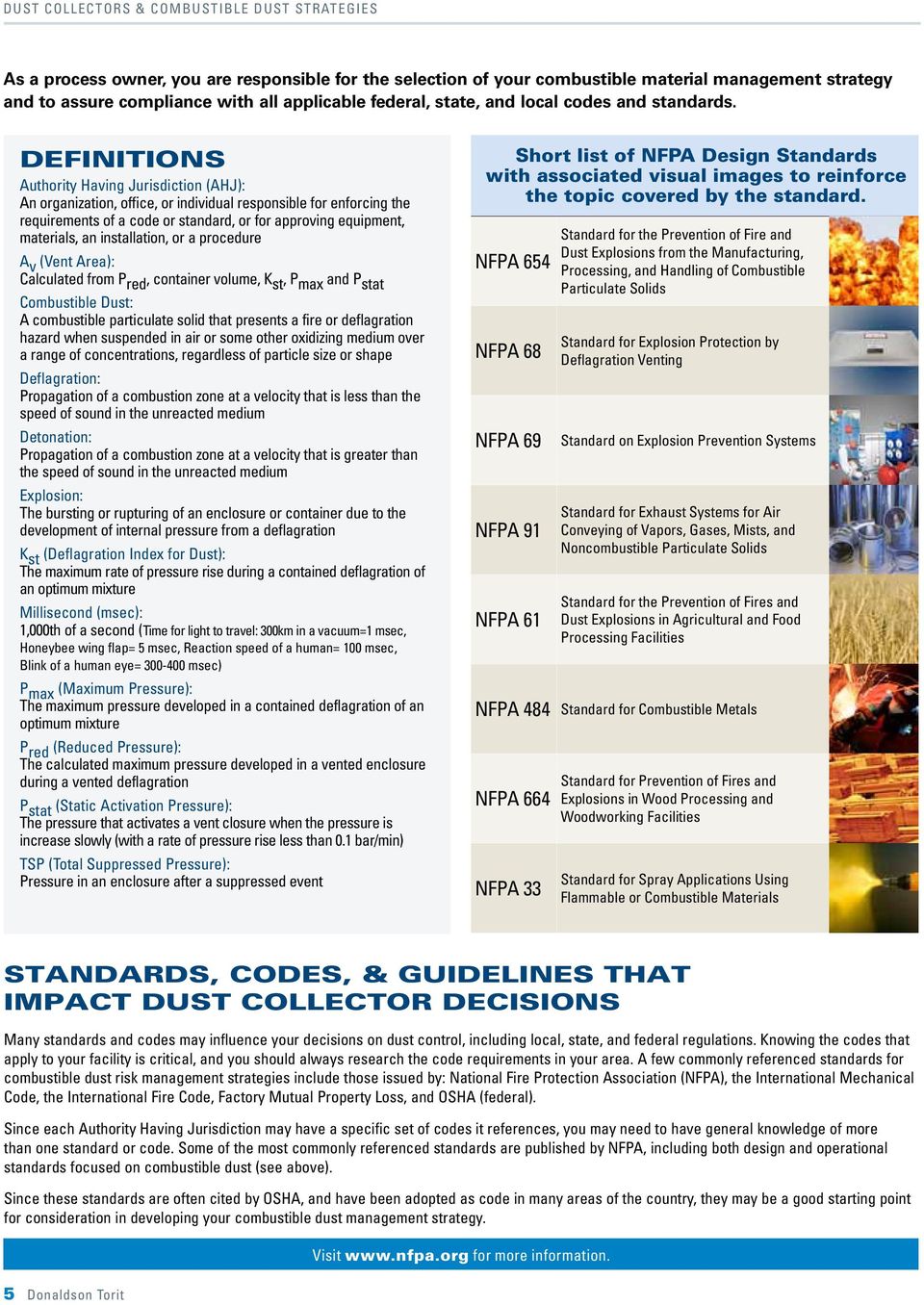
6 As a process owner, you are responsible for the selection of your combustible material management strategy and to assure compliance with all applicable federal, state, and local codes and standards. definitions authority Having Jurisdiction (AHJ): An organization, office, or individual responsible for enforcing the requirements of a code or standard, or for approving equipment, materials, an installation, or a procedure a v (Vent Area): Calculated from P red, container volume, K st, P max and P stat combustible Dust: A combustible particulate solid that presents a fire or deflagration hazard when suspended in air or some other oxidizing medium over a range of concentrations, regardless of particle size or shape Deflagration: Propagation of a combustion zone at a velocity that is less than the speed of sound in the unreacted medium Detonation: Propagation of a combustion zone at a velocity that is greater than the speed of sound in the unreacted medium explosion: The bursting or rupturing of an enclosure or container due to the development of internal pressure from a deflagration K st (Deflagration Index for Dust): The maximum rate of pressure rise during a contained deflagration of an optimum mixture millisecond (msec): 1,000th of a second (Time for light to travel: 300km in a vacuum=1 msec, Honeybee wing flap= 5 msec, Reaction speed of a human= 100 msec, Blink of a human eye= msec) P max (Maximum Pressure): The maximum pressure developed in a contained deflagration of an optimum mixture P red (Reduced Pressure): The calculated maximum pressure developed in a vented enclosure during a vented deflagration P stat (Static Activation Pressure): The pressure that activates a vent closure when the pressure is increase slowly (with a rate of pressure rise less than 0.1 bar/min) TSP (Total Suppressed Pressure): Pressure in an enclosure after a suppressed event Short list of NFPA Design Standards with associated visual images to reinforce the topic covered by the standard. NFPA 654 NFPA 68 NFPA 69 NFPA 91 NFPA 61 Standard for the Prevention of Fire and Dust Explosions from the Manufacturing, Processing, and Handling of Combustible Particulate Solids Standard for Explosion Protection by Deflagration Venting Standard on Explosion Prevention Systems Standard for Exhaust Systems for Air Conveying of Vapors, Gases, Mists, and Noncombustible Particulate Solids Standard for the Prevention of Fires and Dust Explosions in Agricultural and Food Processing Facilities NFPA 484 Standard for Combustible Metals NFPA 664 NFPA 33 Standard for Prevention of Fires and Explosions in Wood Processing and Woodworking Facilities Standard for Spray Applications Using Flammable or Combustible Materials STANDARDS, CODES, & GUIDELINES that IMPACT DUST COLLECTOR DECISIONS Many standards and codes may influence your decisions on dust control, including local, state, and federal regulations. Knowing the codes that apply to your facility is critical, and you should always research the code requirements in your area. A few commonly referenced standards for combustible dust risk management strategies include those issued by: National Fire Protection Association (NFPA), the International Mechanical Code, the International Fire Code, Factory Mutual Property Loss, and OSHA (federal). Since each Authority Having Jurisdiction may have a specific set of codes it references, you may need to have general knowledge of more than one standard or code. Some of the most commonly referenced standards are published by NFPA, including both design and operational standards focused on combustible dust (see above). Since these standards are often cited by OSHA, and have been adopted as code in many areas of the country, they may be a good starting point for consideration in developing your combustible dust management strategy. Visit for more information. 5 Donaldson Torit
7 Does your company or firm process any of these products or materials in powdered form? See side bar. ** If so, there is potential for a Combustible Dust explosion. Dust Control Measures The dust-containing systems (ducts and dust collectors) are designed in a manner (i.e., no leaking) that fugitive dusts are not allowed to accumulate in the work area. The facility has a housekeeping program with regular cleaning frequencies established for floors and horizontal surfaces, such as ducts, pipes, hoods, ledges, and beams, to minimize dust accumulations within operating areas of the facility. The working surfaces are designed in a manner to minimize dust accumulation and facilitate cleaning. Protection Measures The facility has an emergency action plan. Dust collectors are not located inside of buildings. (Some exceptions) rooms, buildings, or other enclosures (dust collectors) have explosion relief venting distributed over the exterior wall of buildings and enclosures. Explosion venting is directed to a safe location away from employees. The facility has isolation devices to prevent deflagration propagation between pieces of equipment connected by ductwork. The dust collector systems have spark detection and explosion/deflagration suppression systems. Emergency exit routes are maintained properly. Ignition Control Measures electrically-powered cleaning devices such as vacuum cleaners, and electrical equipment are approved for the hazard classification for Class II locations. The facility has an ignition control program, such as grounding and bonding and other methods, for dissipating any electrostatic charge that could be generated while transporting the dust through the ductwork. The facility has a HotWork permit program. Areas where smoking is prohibited are posted with No Smoking signs. Duct systems, dust collectors, and dust-producing machinery are bonded and grounded to minimize accumulation of static electrical charge. The facility selects and uses industrial trucks that are approved for the combustible dust locations. Prevention Measures The facility has separator devices to remove foreign materials capable of igniting combustible dusts. msdss for the chemicals which could become combustible dust under normal operations are available to employees. Employees are trained on the explosion hazards of combustible dusts. Combustible Dust Statement As a manufacturer and supplier of Industrial Filtration Products, Donaldson can assist process owners/operators in the selection of filtration technologies. Donaldson cannot, however, select fire and/or explosion mitigation strategies for process owners. Agricultural Products Egg white Milk, powdered Milk, nonfat, dry Soy flour Starch, corn Starch, rice Starch, wheat Sugar Sugar, milk Sugar, beet Tapioca Whey Wood flour Agricultural Dusts Alfalfa Apple Beet root Carrageen Carrot Cocoa bean dust Cocoa powder Coconut shell dust Coffee dust Corn meal Cornstarch Cotton Cottonseed Garlic powder Gluten Grass dust Green coffee Hops (malted) Lemon peel dust Lemon pulp Linseed Locust bean gum Malt Oat flour Oat grain dust Olive pellets Onion powder Parsley (dehydrated) Peach Peanut meal & skins Peat Potato Potato flour Potato starch Raw yucca seed dust Rice dust Rice flour Rice starch Rye flour Semolina Soybean dust Spice dust Spice powder Sugar (10x) Sunflower Sunflower seed dust Tea Tobacco blend Tomato Walnut dust Wheat flour Wheat grain dust Wheat starch Xanthan gum Carbonaceous Dusts Charcoal, activated Charcoal, wood Coal, bituminous Coke, petroleum Lampblack Lignite Peat, 22% H 2 0 Soot, pine Cellulose Cellulose pulp Cork Corn Chemical Dusts Adipic acid Anthraquinone Ascorbic acid Calcium acetate Calcium stearate Carboxy-methylcellulose Dextrin Lactose Lead stearate Methyl-cellulose Paraformaldehyde Sodium ascorbate Sodium stearate Sulfur Metal Dusts Aluminum Bronze Iron carbonyl Magnesium Zinc Plastic Dusts (poly) Acrylamide (poly) Acrylonitrile (poly) Ethylene (low-pressure process) Epoxy resin Melamine resin Melamine, molded (phenol-cellulose) Melamine, molded (wood flour & mineral filled phenolformaldehyde) (poly) Methyl acrylate (poly) Methyl acrylate, emulsion polymer Phenolic resin (poly) Propylene Terpene-phenol resin Urea-formaldehyde cellulose, molded (poly) Vinyl acetate/ ethylene copolymer (poly) Vinyl alcohol (poly) Vinyl butyral (poly) Vinyl chloride ethylene/vinyl acetylene suspension copolymer (poly) Vinyl chloride/ vinyl acetylene/ emulsion/copolymer Compliance with applicable codes and standards remains the responsibility of the process owner/operator. Among other considerations, the current NFPA standards require owners/operators whose processes involve potentially combustible materials to have a current Hazard Analysis, which can serve as the foundation for the process owner/operators hazard mitigation strategies. Upon request, Donaldson can assist owners/operators to incorporate Donaldson Filtration Product into a comprehensive fire and/or explosion mitigation strategy. To provide this support, Donaldson needs complete and accurate information on all potentially combustible contaminants and the fire and/or explosion mitigation strategies that process owner/operator intends to pursue. * Information on this page from "Combustible Dust Does your company or firm process any of these products or materials in powdered form?" OSHA Poster, (2008). ** The above list from OSHA should not be considered complete, nor should it replace the need to obtain validated test data on your dust. donaldsontorit.com

8 Global Support Facilities in 37 countries 40 manufacturing plants and 14 distribution centers Leading Technology Over 1,000 engineers and scientists worldwide Broad range of innovative collectors and filters 100s of filter media formulations Experience and Service Technical expertise and support Ready-to-ship filters and parts within 24 hours 1,000,000+ dust, fume and mist collectors installed Call Donaldson Torit to get cleaner air today: DonaldsonTorit.com Tel (USA) Tel (within Mexico) donaldsontorit.com Donaldson Company, Inc. Torit P.O. Box 1299 Minneapolis, MN U.S.A. Dust Collectors & Combustible Dust Strategies Brochure (06/12) 2011 Donaldson Company, Inc. All Rights Reserved. All products, product specifications, and data (airflow, capacity, dimensions, or availability) are subject to change without notice, and may vary by region or country. Donaldson Torit, Torit PowerCore, Ultra-Web, and the color blue are registered trademarks of Donaldson Company, Inc. Contains Donaldson proprietary technology.

Meeting OSHA Recommendations for Combustible Dust
 1 Meeting OSHA Recommendations for Combustible Dust Table of Contents Introduction: Definition of Combustible Dust 1 Introduction: Hazards of Combustible Dust 2 Organic Dust Fire and Explosion: North Carolina
Combustible Dust Basics
 By Christopher A. Jarc, P.E., PMP, LEED A.P. (with Contributions from The Hixson Baking Industry Team) Abstract From woodworking to metalworking, petrochemicals to fertilizers, any industry that can create
Explosion Prevention
 Explosion Prevention Question: Many food and industrial products produced by member companies are dry powders or crystals. If mishandled, some of these products may form an explosive mixture of air and
Combustible Dust - Things that go Boom. W. Jon Wallace, CSP, MBA Workplace Group, LLC O: 919.933.5548 E: jwallace@workplacegroup.
 Combustible Dust - Things that go Boom W. Jon Wallace, CSP, MBA Workplace Group, LLC O: 919.933.5548 E: [email protected] Presentation Objectives After attending this presentation you will: Learn
9/15/2011. Presented by: Jason Reason, CIH, CSP, CHMM Senior Industrial Hygienist Indiana Occupational Safety and Health Administration
 OSHA Combustible Dust Inspections Presented by: Jason Reason, CIH, CSP, CHMM Senior Industrial Hygienist Indiana Occupational Safety and Health Administration Overview Background Information OSHA Combustible
Combustible dust. How to use this guide. Combustible Dust
 INDUSTRIAL HYGIENE Combustible dust How to use this guide The purpose of this guide is to provide an overview of the dangers of combustible dust explosions along with tools and resources to recognize,
A Guide to Combustible Dusts
 Industry Guide 43 A Guide to Combustible Dusts Occupational Safety and Health Division N.C. Department of Labor 1101 Mail Service Center Raleigh, NC 27699-1101 Cherie Berry Commissioner of Labor N.C. Department
WEEKLY SAFETY MEETING All Euramax Subsidiaries COMBUSTIBLE DUST. Safety Meeting Contents. Meeting Notice. Leaders Guide.
 Safety Meeting Contents Meeting Notice Leaders Guide Employee Handout Employee Quiz Meeting Sign-In Sheet Employee Puzzle PRIOR TO THE WEEKLY MEETING: - Post the meeting notice by the timeclock - Read
Combustible Dust Ensuring Safety and Compliance. Brian Edwards, PE Conversion Technology Inc. ENVIRONMENTAL & SAFETY CONSULTING ENGINEERS
 Combustible Dust Ensuring Safety and Compliance Prepared for: REGION IV VPPPA Presented by: Brian Edwards, PE Conversion Technology Inc. ENVIRONMENTAL & SAFETY CONSULTING ENGINEERS 1 Scope of Discussion
NFPA Combustible Dust Compliance and the Industrial Ventilation System
 NFPA Combustible Dust Compliance and the Industrial Ventilation System Presented By: Tom Kroeger PE [email protected] Kirk & Blum, a CECO Environmental Company Marty Schloss PE [email protected]
Illinois Manufacturers Best Practices January 2016 Webinar
 Illinois Manufacturers Best Practices January 2016 Webinar Combustible Dust Housekeeping: Stay Safe & Compliant January 28, 2016 Combustible Dust Housekeeping: Stay Safe & Compliant Andrew Luessenhop,
COMBUSTIBLE DUST EXPLOSIONS
 COMBUSTIBLE DUST EXPLOSIONS Most people would not think that dust made up of ordinary materials such as food could explode, but under certain circumstances it can. On 7 February 2008, a violent explosion
ARE YOU IN COMPLIANCE WITH THE OSHA COMBUSTIBLE DUST DIRECTIVE? Revised March 18, 2009
 Kidde Fenwal, Inc. Industrial Explosion Protection Group A UTC Fire & Security Company 400 Main Street Ashland, MA 01721 Tel 508-881-2000 Fax 508-485-3115 www.fenwalprotection.com FENWAL Protection Systems
Anew combustible dust standard from the National. Get ready for NFPA 652: The new combustible dust standard
 As appeared in October 2014 PBE www.powderbulk.com Get ready for NFPA 652: The new combustible dust standard Jack Osborn Airdusco Inc. This NFPA committee member and dust collection expert summarizes what
Combustible Dust: - The Basics You Need to Know. Presented by: Mary Ann Heaney, CIH, CSP ohsm, llc.
 Combustible Dust: - The Basics You Need to Know Presented by: Mary Ann Heaney, CIH, CSP ohsm, llc. Why the Current Focus? 2003-3 catastrophic dust explosions January - 7 Fatalities, 38 injured 2006 US
AIHA Professional Development Conference by Daniel Brechko, Managing Consultant
 AIHA Professional Development Conference by Daniel Brechko, Managing Consultant 952-334-9580 [email protected] Basics: Fire vs. Explosion OSHA NEP and NFPA 654 What is a combustible dust? Hazard
Assessing the Potential for a Dust Explosion and Navigating the Current Regulatory Environment
 Assessing the Potential for a Dust Explosion and Navigating the Current Regulatory Environment Ali Reza, P.E., CFI David Clayton, Ph.D., P.E. Exponent, Inc. 5401 McConnell Avenue Los Angeles, CA 90066
Combustible Dust. Overview
 Combustible Dust Michael Wacker Industrial Hygienist Madison, WI Area OSHA Office Overview History of Combustible dust What is combustible dust Some recognized hazards OSHAs Combustible Dust NEP What does
Combustible Dust Hazards
 environmental failure analysis & prevention health technology development 1 Combustible Dust Hazards Scott E. Dillon American Foundry Society 24 th EH&S Conference August 15, 2012 Nashville, TN A leading
Combustible Dust CAN HURT YOU
 Michael A. Serpe CSP SafetyFirstna, Inc. [email protected] 773-447-3982 Joseph P. Howicz CSP, CFPS [email protected] 847 609 9956 Combustible Dust CAN HURT YOU In this presentation we will
12.85 Enforcement and Consultation Guidance for Combustible Dust Hazards December 30, 2008
 DOSH DIIRECTIIVE Deeppaarrt tmeennt t oof f LLaabboorr aanndd Inndduusst I trri ieess Divvi issi ioonn oof f Occccuuppaat tioonnaal l Saaf feet tyy aanndd Heeaal lthh Keeping WA workers safe. 12.85 Enforcement
COMBUSTIBLE DUST in the WOOD PRODUCTS INDUSTRY
 COMBUSTIBLE DUST in the WOOD PRODUCTS INDUSTRY Produced by NWCEP, Inc. This material was produced under grant SH23597SH2 from the Occupational Safety and Health Administration, U.S. Department of Labor.
Electrical Classification
 Electrical Classification Using NFPA 70 and NFPA 499 to Classify Hazardous Locations Electrical classifications are established in accordance with the National Electrical Code, NFPA 70, also referred to
The Status of Combustible Dust Regulation
 The Status of Combustible Dust Regulation Mark Haskins, CSP Practical Safety Solutions, LLC For CBIA Wellness Health and Safety Conference March 31, 2011 Learning Objectives During this presentation you
Combustible Dust Booklet
 Introduction In general, over 70% of organic dusts are explosible if given an adequate ignition source and appropriate dust/air concentration. Unless the material is combustible and finely divided (generally
How to be Sure Your Dust Collector Design and Installation are NFPA Compliant. Presented by: Jeff Kice Kice Industries, Inc.
 How to be Sure Your Dust Collector Design and Installation are NFPA Compliant Presented by: Jeff Kice Kice Industries, Inc. Who is the NFPA? National Fire Protection Association Nonprofit international
During Various Aluminum Fabricating Operations
 Guidelines for Handling Aluminum Fines Generated During Various Aluminum Fabricating Operations F-1 Guidelines for Handling Aluminum Fines Generated During Various Aluminum Fabricating Operations SCOPE
Is This Combustible Dust?
 1 of 5 8/6/2012 1:16 PM Is This Combustible Dust? Thursday, 19 July 2012 Dust explosions and fires are serious hazards in the process industries that have lead to loss of life, injury to plant personnel
To provide guidelines for the safe inspection of potential combustible worksites and for the safe collection and shipment of combustible dust
 SUBJECT: Purpose: Scope: Combustible Dust To provide guidelines for the safe inspection of potential combustible worksites and for the safe collection and shipment of combustible dust This instruction
Key Safety Issues for Combustible Dust Handling. By Molly R. Myers, P.E. Senior Safety and Risk Management Consultant Email: myers.m.nh@iomosaic.
 Key Safety Issues for Combustible Dust Handling By Molly R. Myers, P.E. Senior Safety and Risk Management Consultant Email: [email protected] Summary For the past few years OSHA has been conducting
Hazard Communication Guidance for. Combustible Dusts
 Hazard Communication Guidance for Combustible Dusts OSHA 3371-08 2009 Hazard Communication Guidance for Combustible Dusts U.S. Department of Labor Occupational Safety and Health Act of 1970 To assure safe
5/3/2010. Article 500 address the requirements for hazardous locations: Wiring Equipment
 Two Documents are used for the Classification of Combustible Dusts and Hazardous Locations: NFPA 499-Recommended Practices for the Classification of Combustible Dusts and Hazardous Locations for Electrical
Combustible Dust. The Basics. Presented by: Mary Ann Heaney, CIH, CSP ohsm, llc.
 Combustible Dust The Basics Presented by: Mary Ann Heaney, CIH, CSP ohsm, llc. Why the Recent Focus? 2003-3 catastrophic dust explosions January - 7 FataliGes, 38 injured 2006 US Chemical Safety and Hazard
Static Electricity. A Health and Safety Guideline for Your Workplace. What Are Some Sources of Static Electricity? What is Static Electricity?
 A Health and Safety Guideline for Your Workplace What is static electricity? What causes it? How is it hazardous? And, most importantly, how can it be controlled? All of these questions will be answered
Designing your dust collection system to meet. triangle: fuel (combustible dust), an ignition source, and
 As appeared in PBE December 2008 www.powderbulk.com Designing your dust collection system to meet NFPA standards Part I Gary Q. Johnson Workplace Exposure Solutions About 40 percent of combustible dust
Dust Collector Fire and Explosion Highlights Need for Combustible Dust Considerations In System Designs
 The following article is courtesy of Baghouse.com Dust Collector Fire and Explosion Highlights Need for Combustible Dust Considerations In System Designs Posted on May 18, 2012 in Dust Collection, Dust
Ethanol Vehicle and Infrastructure Codes and Standards Citations
 Ethanol Vehicle and Infrastructure Codes and Standards Citations This document lists codes and standards typically used for U.S. ethanol vehicle and infrastructure projects. To determine which codes and
Use of Combustible Dust Risk Assessments in the Agricultural and Food Processing Industries. by Douglas Moilanen
 1 Use of Combustible Dust Risk Assessments in the Agricultural and Food Processing Industries by Douglas Moilanen A Research Paper Submitted in Partial Fulfillment of the Requirements for the Master of
Fire Alarm System Accessories
 Approved by APPROVED Fire Alarm System Accessories FM Approved* Intrinsically Safe Devices Single and Dual Channel Isolated Barrier Modules Features Single or dual channel intrinsically safe, transformer
Downflo workstation DuSt ColleCtorS
 Downflo WorkStation Dust Collectors Outperforms All Other Collectors Downflo WorkStations (DWS) fit anywhere on the plant floor and apply NO restrictions to worker movements or visibility. The full line
ALBERTA FIRE CODE SAFETY EQUIPMENT MAINTENANCE REQUIREMENTS
 ALBERTA FIRE CODE SAFETY EQUIPMENT MAINTENANCE REQUIREMENTS In this document are the fire safety equipment maintenance requirements that are found in Division B of the Alberta Fire Code (AFC 2006) for
Classification of Hazardous Atmospheres
 Classification of Hazardous s The following pages contain excerpts for your convenience. If more comprehensive information is required, consult with your Western Technology representative. HAZARDOUS LOCATION
Winnipeg Fire Department Fire Prevention Branch
 Winnipeg Fire Department Fire Prevention Branch Manitoba Fire Code Life-Safety Equipment Maintenance Requirements The Fire Prevention Branch of the Winnipeg Fire Department has prepared this document of
Compressed Gas Cylinder Program
 Department of Environmental Health & Safety Procedures Compressed Gas Cylinder Program March 2010 Compressed Gas Cylinder Program Page 1 of 8 Table of Contents I. Introduction II. III. IV. Policy Scope
Safety Data Sheet for Whole Grain
 SECTION 1: IDENTIFICATION Safety Data Sheet for Whole Grain PRODUCT NAME: SDS NUMBER: WHOLE GRAIN GRAIN SYNONYMS/OTHER MEANS OF IDENTIFICATION: INTENDED USE: FOOD MANUFACTURER: (company name) EMERGENCY
Mechanical Systems Competency 1.20
 Competency 1.20 Mechanical systems personnel shall demonstrate a working level knowledge of the safety and health fundamentals of mechanical systems and/or components. 1. Supporting Knowledge and Skills
COOKIES BARS CUPCAKES
 COOKIES Chocolate Chip: DIV Flour Blend (white, brown & sweet rice flours, tapioca flour, cornstarch, potato starch, xanthan gum), brown sugar, vegan margarine [soybean, palm fruit, canola & olive oils,
Flammable Liquids 29 CFR 1910.106
 Flammable Liquids 29 CFR 1910.106 OSHA s Directorate of Training and Education These materials were developed by OSHA s Directorate of Training and Education and are intended to assist employers, workers,
4 servings - Bring 8 cups of water to boil. Slowly whisk in entire package of soup mix. Lower heat simmer 10-15 minutes, stirring occasionally.
 Cheddar Broccoli INGREDIENTS: Non-dairy Creamer (Maltodextrin, Palm Oil, Sodium Caseinate, Di-potassium Phosphate, Mono and Diglycerides, Natural Flavor, Annatto Color), Food Starch-Modified, Sweet Whey,
FLAMMABLE AND COMBUSTIBLE LIQUIDS. n OSHA Changes
 FLAMMABLE AND COMBUSTIBLE LIQUIDS OSHA Changes Introduction This module covers the two primary hazards associated with flammable and combustible liquids: explosion and fire. In order to prevent these hazards,
99/92/EC (ATEX 137) USE
 ATEX DIRECTIVE 99/92/EC (ATEX 137) USE The last few years have seen many changes to the regulations that apply to industry: Directive 94/9/EC (ATEX 95): Products. Directive 98/24/EC: Chemical Agents. Directive
Guardian Fire Safety Solutions FIRE RISK CONTROL IN WELDING FUME EXTRACTION SYSTEMS
 Guardian Fire Safety Solutions FIRE RISK CONTROL IN WELDING FUME EXTRACTION SYSTEMS Guardian Fire Safety Solutions FIRE RISK CONTROL IN WELDING FUME EXTRACTION SYSTEMS DO YOU CONTROL THE RISK OF FIRE AT
Dust Explosion Fundamentals: Ignition Criteria and Pressure Development
 Dust Explosion Fundamentals: Ignition Criteria and Pressure Development Robert Zalosh Firexplo Wellesley, MA 02481 Basic Concepts The five ingredients required for a dust explosion are: Combustible particulates
Notes. Material 1. Appropriate Flammable Liquids
 29 CFR 1910.106 Flammable Materials Flammable Liquids Preparation 1. Read Applicable Background information and related Company Policy Chapter. 2. Make Copies of this Lesson Plan for Personnel 3. Make
TYPICAL FIRE SAFETY INSPECTION VIOLATIONS
 TYPICAL FIRE SAFETY INSPECTION VIOLATIONS The following is a list of typical violations often found by inspectors and a generic solution. You can use this list to improve the safety of your facility, to
Combustible dust is a critical safety
 Feature Report ELECTRONICALLY REPRINTED FROM MARCH 2015 Prevent Combustible Dust Explosions with N 2 Inerting Targeted use of blanketing with inert gas offers an effective strategy for preventing combustible
Sweets nutritional information
 Sweets nutritional information Brownies INGREDIENTS: Chocolate Chips (sugar, chocolate liquor, cocoa butter and soy lecithin), Butter (cream and butter), Brown Sugar, Enriched Unbleached White Flour (Wheat
Static Spark Ignites Flammable Liquid during Portable Tank Filling Operation
 Static Spark Ignites Flammable Liquid during Portable Tank Filling Operation No. 2008-02-I-IA (September 2008) Key Lessons for Safe Handling and Storage of Flammables Ensure that equipment, such as fill
FDNY C14 Certificate of Fitness Quiz
 FDNY C14 Certificate of Fitness Quiz Name: Date: 1. Who issues a New York City laboratory permit? a) Department of Environmental Protection (DEP) b) Department of Environmental Conservation (DEC) c) Occupational
Flammable and Combustible Liquids. Slide 1 (of 23)
 Flammable and Combustible Liquids Slide 1 (of 23) Introduction The two primary hazards associated with flammable and combustible liquids are explosion and fire Safe handling and storage of flammable liquids
Uline NFPA. SECTION 1 : CHEMICAL PRODUCT AND COMPANY IDENTIFICATION MSDS Name: Collapsible Bulk Containers
 Uline NFPA HMIS Collapsible Bulk Containers Manufacturer MSDS Number: 70000000 1 1 0 HEALTH 1 FIRE 1 REACTIVITY 0 PPE SECTION 1 : CHEMICAL PRODUCT AND COMPANY IDENTIFICATION MSDS Name: Collapsible Bulk
Combustible Dust in the Workplace An overview of its recognition, evaluation, and control
 Combustible Dust in the Workplace An overview of its recognition, evaluation, and control Ignition Source Dispersion Deflagration Explosion FIRE Confinement Combustible Dust Oxygen in Air DIOSH Day- Peoria,
FIRE SAFETY SELF-INSPECTION FORM FOR CULTURAL INSTITUTIONS. 1. All Floors (inspect from top floor to basement): Yes No
 General Inspection FIRE SAFETY SELF-INSPECTION FORM FOR CULTURAL INSTITUTIONS 1. All Floors (inspect from top floor to basement): Yes are fire exits and directional signs properly illuminated? is the emergency
Ontario Fire Code SECTION 5.13 DIP TANKS. Illustrated Commentary. Office of the Ontario Fire Marshal
 Ontario Fire Code SECTION 5.13 DIP TANKS Illustrated Commentary Office of the Ontario Fire Marshal Dip Tanks Illustrated Commentary 1 5.13.1. Location 5.13.1.1. Dip tank operations involving flammable
Nutritional Facts & Ingredient Information
 Nutritional Facts & Ingredient Information Banana Toffee Scone Ingredients: Flour, Butter [Sweet Cream (Milk), Natural Flavoring], Bananas, Skor Bits (Sugar, butter, chopped almonds, milk, milk chocolate
Compressed Gas Cylinder Storage and Handling Guide
 Overview Compressed gas cylinders are used in many workplaces to store gases that vary from extremely flammable (acetylene) to extremely inert (helium). Many compressed gas cylinders are stored at extremely
FIRE SAFETY SELF-INSPECTION FORM FOR CULTURAL INSTITUTIONS
 FIRE SAFETY SELF-INSPECTION FORM FOR CULTURAL INSTITUTIONS The attached self-inspection form is intended for staff use at regular, frequent intervals. It should not take the place of two other vital measures
DRYER VENTING SPECIFICATIONS DRYER SAFETY
 DRYER VENTING SPECIFICATIONS Table of Contents DRYER SAFETY...1 INSTALLATION REQUIREMENTS...4 Venting Requirements...5 DRYER INSPECTION AND CLEANING...7 Frequency of Exhaust System Cleaning...7 Inspecting
Spray Booth Guideline
 Department of Development Service 135 North D Street, Perris CA. 92570 Phone: (951) 443-1029 Fax: (951) 943-3293 PURPOSE The intent of this guideline is to provide the information necessary to ensure that
SPECIAL APPLICATIONS
 Page 1 SPECIAL APPLICATIONS The protection of microelectronics clean rooms using aspirating smoke detection systems requires special consideration. The physical configuration of the room(s) and the direction
ALVERNIA UNIVERSITY OSHA REGULATION: 29 CFR 1910.252 WELDING, CUTTING, AND BRAZING ( HOT WORK ) SECTION: 3600
 OSHA REGULATION: 9 CFR 90.5 WELDING, CUTTING, AND BRAZING ( HOT WORK ) A. POLICY. This procedure follows requirements set forth in 9 CFR 90.5.. This policy applies to all Hot Work operations being done
HOT WORK PERMIT PROGRAM TRAINING. John Braun
 HOT WORK PERMIT PROGRAM TRAINING John Braun 1.0 INTRODUCTION 1.2 Purpose The Hot Work Permit Program has been developed for University employees that work on or around hot work activities. This program
⓲ FOOD DETECTIVES. THE WHOLE STORY
 ⓲ FOOD DETECTIVES. THE WHOLE STORY HANDOUT 2 Instructions: Let s compare a snack product s packaging to its nutrition information. Circle the buzzwords product marketers have used to convince shoppers
Combustible Dust... Elements of Dust Hazard Assessment
 Session No. 506 Introduction Combustible Dust... Elements of Dust Hazard Assessment Walter S. Beattie, CSP, CFPS, CSHM Pottstown, PA Presentation: June 25, 2013 On July 29, 2008, Mr. John S. Bresland,
presents Cooking With Fire Fixed Fire Suppression & Exhaust Systems for Cooking Environments Monday, 17 June, 13
 presents Cooking With Fire Fixed Fire Suppression & Exhaust Systems for Cooking Environments Who is the AFSA? Safe and Secure Alberta Fire Safety Association Fire industry members working together to improve
Practical Guidelines for Electrical Area Classification in Combustion Turbine-Generator Power Plants
 Practical Guidelines for Electrical Area Classification in Combustion Turbine-Generator Power Plants Ram K. Saini, P.E. Principal Engineer, Chuck Emma, P.E. Principal Engineer, Burns and Roe Enterprises,
Combustible Dust Fire and Explosion Protection:
 Combustible Dust Fire and Explosion Protection: NFPA 654 Requirements, Explanations and Issues Georgia State Fire Marshal Fire Safety Seminar Robert Zalosh Presentation Thursday, July 16, 2009 [email protected]
Safety Data Sheet (SDS)
 Issue date 06/01/2015 OSHA HazCom OSHA Standard HazCom Standard 29 CFR 29 1910.1200 CFR 1910.1200 (g) and (g) GHS and GHS Rev Rev 03. 03. Page 1/5 Revision 06/01/2015 Page 1/5 1. Identification! Product
Outline. Background. NFPA 820 Applicability to Wastewater Treatment Facilities. Hazardous Area Classifications. Treatment Plant Area Classifications
 Outline Background NFPA 820 Applicability to Wastewater Treatment Facilities Hazardous Area Classifications Treatment Plant Area Classifications Locations of Concern Background NFPA 820 Standard for fire
Nutritional Information: Cookies
 al Information: Cookies Classic Chocolate Chip Total Fat 17g Sat. Fat 8.5g 26% 43% Total Carb. 39g 13% Dietary fiber 1.2g 5% Sugars 28g Cholest. 35mg 12% Protein 3g 7% Calories 283 Fat Calories 127 Sodium
city of edmonds development information
 #B17 city of edmonds development information Commercial Kitchen Hood & Hood Fire Suppression System Permit Submittal Requirements PERMIT REQUIRED: CODES: FEES: A Commercial Kitchen Hood Mechanical Permit
Explosion Protected White Paper Series #1: Imaging Challenges in Explosive Environments
 Video Systems Explosion Protected White Paper Series Imaging Challenges in Explosive Environments Explosion Protected White Paper Series #1: Imaging Challenges in Explosive Environments Introduction Extraordinary
There are several types of air cleaning devices available, each designed to remove certain types of pollutants.
 Please Note: EPA neither certifies nor recommends particular brands of home air cleaning devices. While some home air cleaning devices may be useful in some circumstances, EPA makes no broad endorsement
MATERIAL SAFETY DATA SHEET
 Print date: 14-Apr-2008 MATERIAL SAFETY DATA SHEET Revision Number: 1 1. IDENTIFICATION OF THE SUBSTANCE AND COMPANY Trade Name: LEXAN* Sheet Product ID: 9034-112 Product Description: Poly (bisphenol-a-carbonate)
Cement industry Monitoring loading/unloading from Belt Weighing. Monitoring incoming raw materials. Flow control before and after heating oven
 1 User S-E-G Instrument AB have through the years delivered tens of thousands of weighing equipment for flow measuring and controlling of solid materials, batching and level measuring. Presented below
COMMERCIAL COOKING HOODS, VENTILATION & FIRE SUPPRESSION SYSTEM GUIDELINES AND PROCEDURES
 COMMERCIAL COOKING HOODS, VENTILATION & FIRE SUPPRESSION SYSTEM GUIDELINES AND PROCEDURES These guidelines are to be used for ALL commercial cooking hoods, ventilation systems and related fire suppression
Requirements for Hydrogen Storage and Use
 Requirements for Hydrogen Storage and Use I. INTRODUCTION Fire and Life-Safety Group (FLS) The following is a summary of the fire and building code requirements for the storage and use of hydrogen. These
SAFETY DATA SHEET. Trade name: Master Clear Seal-5 Revised: 5/29/2015
 MMG Mud Masters Group a division of Horizon Mud Company SAFETY DATA SHEET SECTION 1: Identification of the substance/mixture and of the company/undertaking Trade name: Master Clear Seal-5 Supplied by:
MATERIAL SAFETY DATA SHEET
 Page1/6 Revision: April 13,, 2015 Version 1. PRODUCT AND COMPANY IDENTIFICATION Trade Name: Globalene Product Name: Version 2.2 MATERIAL SAFETY DATA SHEET 4035A NT, 4045A NT, 4055A NT, 4065A NT, 4075A
Certified Paleo. 1. Certified Paleo. 1.1 Applicability. 1.2 Guidelines. Program Standards and Specifications
 Certified Paleo Program Standards and Specifications 1. Certified Paleo The Certified Paleo Requirements for Grain-Free, Legume-Free, Dairy-Free, Artificial Coloring, Artificial Preservatives, Artificial