
PBDS Test Study Guide
|
|
|
- Ophelia Elisabeth York
- 9 years ago
- Views:
Transcription
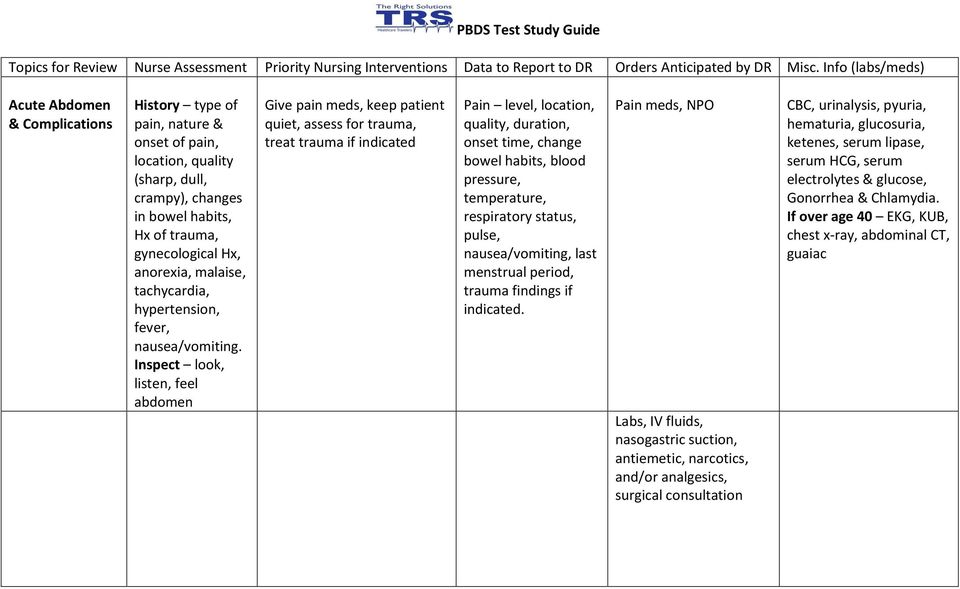
1 Acute Abdomen & Complications History type of pain, nature & onset of pain, location, quality (sharp, dull, crampy), changes in bowel habits, Hx of trauma, gynecological Hx, anorexia, malaise, tachycardia, hypertension, fever, nausea/vomiting. Inspect look, listen, feel abdomen Give pain meds, keep patient quiet, assess for trauma, treat trauma if indicated Pain level, location, quality, duration, onset time, change bowel habits, blood pressure, temperature, pulse, nausea/vomiting, last menstrual period, trauma findings if indicated. Pain meds, NPO Labs, IV fluids, nasogastric suction, antiemetic, narcotics, and/or analgesics, surgical consultation CBC, urinalysis, pyuria, hematuria, glucosuria, ketenes, serum lipase, serum HCG, serum electrolytes & glucose, Gonorrhea & Chlamydia. If over age 40 EKG, KUB, chest x-ray, abdominal CT, guaiac
2 CHF and Complications Auscultate lung fields & heart sounds, blood pressure, temperature, pulse, history, recent weight gain, activity limits, sleep patterns, edema O2, Raise head of bed, IV access, cardiac monitor pulse oximetry, antiembolism stockings. Blood pressure, pulse, recent weight gain, activity limits, sleep pattern, current medications, edema O2, ECG, chest X-ray, ABG s, cardiac monitor, diuretics, potassium, Labs-electrolytes, BUN & creatinine, BNP, cardiac enzymes, echocardiography Labs respiratory alkalosis, increased creatinine if severe, changes in pulmonary artery wedge pressure Meds diuretics, digoxin to improve contractility, ACE inhibitor to decrease after load, Beta-blockers, vasodilators to decrease preload, and systemic resistance.

3 Diabetic Ketoacidosis & Complications Dehydration, hypotension or hypertension, metabolic acidosis, tachypnea, nausea/vomiting, abdominal pain & tenderness, LOC, cardiac changes, history Monitor I & O s, replace fluids as ordered, monitor blood glucoses, cardiac monitor, NPO, provide reassurance, bed rest Blood sugar, LOC, cardiac changes, pain level, location, etc., blood pressure, temperature, pulse, nausea/vomiting Labs serum glucose, electrolytes, BUN, urinalysis, CBC, ketones, serum osmolarity, ABG s obtain CT of the head if mental status altered, intubation if ordered, IV normal saline Labs serum ketosis, urine ketosis, glycosuria, Hyponatremia, increased BUN, metabolic acidosis, increased serum osmolality, report increased anion gap Meds insulin drip, potassium, fluid replacement

4 Acute Myocardial infraction History chest pain, dyspnea, diaphoresis, nausea/vomiting, heart and lung sounds. O2, monitor patient, morphine, nitro, ECG, bed rest Blood pressure, pulse, LOC, chest pain, heart and lung sounds O2, ECG, chest X-ray, ABG s, cardiac monitor, serum troponin, CBC, electrolytes, coagulation studies, cardiac enzymes, cardiac catherization, IV access, morphine, aspirin Labs increase in troponin and creatine, kinase, LDH, ESR, leukocytes levels Meds O2, aspirin, heparin, nitrates, sedatives, morphine, Lopressor, stool softeners, Lidocaine if ventricular arrhythmias

5 Obstructed Airway and it s Complications History COPD, asthma, etc.,cough, sputum production, dyspnea, pedal edema, cyanosis, wheezing, diminished breath sounds, diminished heat sounds Obtain SaO2, elevate head of bed, O2, monitor patient LOC, heart and lung sounds, ability to speak, SaO2, history O2, ABG s, bronchodilators, Steriods, activity as tolerated, chest X - ray Meds Alupent, Albuterol, Atrovent, Prednisone

6 Pneumothorax & Complications History Blood pressure, pulse rate, pleuritic chest pain, cough, dyspnea, cyanosis, respiratory distress, shock, asymmetry of respirations, diminished breath sounds on affected side, referred pain to shoulder, tachycardia, rapid shallow breathing, hyper resonance to percussion; if tension pneumotharax, week rapid pulse, Pallor, neck vein distention, anxiety, tracheal deviation, crepitus O2, monitor blood pressure, pulse rate, respirations, bed rest, SaO2 Blood pressure, pulse, chest mobility, tracheal deviation, crepitus, hypotension, cyanosis, dyspnea, SaO2 O2, ECG, chest X-ray, ABG s, cardiac monitor, pain reliever, IV access Labs- ABG s, respiratory acidosis Meds Intrapleural doxycycline, morphine

7 Pulmonary Emboli & Complications History access legs for swelling & pain, percussion of lungs for flatness, auscultate for friction rub, wheezing, auscultate heart for splitting of 2 nd heart sound, headache, stabbing right side chest pain, tachypnea Monitor respiratory rate, ECG, response to IV fluids, monitor SaO2, bed rest, ambulate per MD order Historypresence of DVT heart and lung sounds, temperature, blood pressure, respiratory status IV access, IV heparin, warfarin, vasopressors if hypotensive, chest X-ray, VQ scan Labs no labs, ABG s Meds heparin, warfarin, morphine

8 Aspiration Pneumonia & Complications History assess for airway obstruction, fever, foul smelling sputum & congestion, tachycardia, dyspnea, cough, cyanosis, swallowing difficulty, blood pressure, respiratory rate, LOC, chest pain, heart & lung sounds SaO2, O2, clear airway if indicated, monitor patient, elevate head of bed Blood pressure, pulse, LOC, chest pain, heart & lung sounds, history, SaO2, smell & color of sputum O2, chest X-ray, ABG s, NG tube, possible G- tube, CBC, swallowing study, possible antibiotics Labs WBC may be normal to elevated

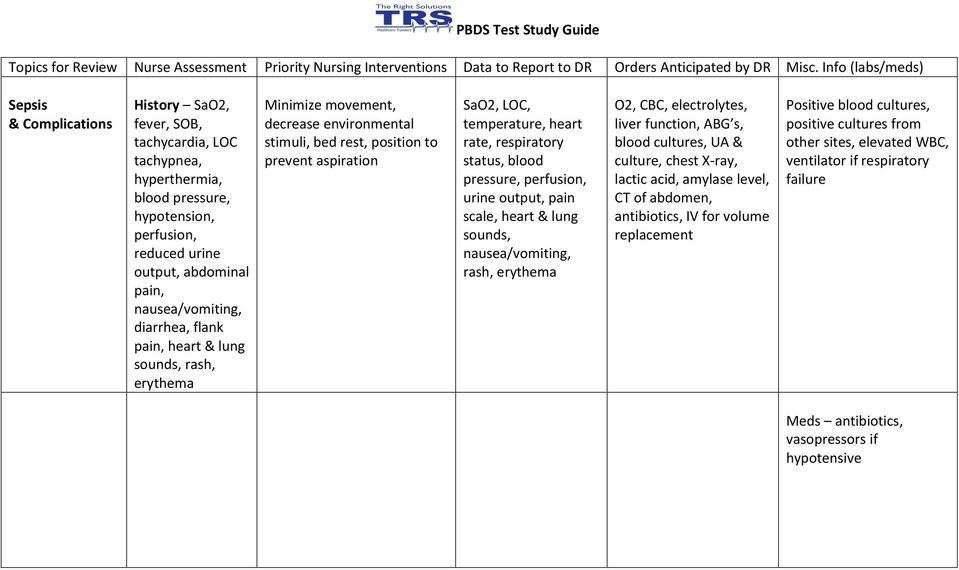
9 Sepsis & Complications History SaO2, fever, SOB, tachycardia, LOC tachypnea, hyperthermia, blood pressure, hypotension, perfusion, reduced urine output, abdominal pain, nausea/vomiting, diarrhea, flank pain, heart & lung sounds, rash, erythema Minimize movement, decrease environmental stimuli, bed rest, position to prevent aspiration SaO2, LOC, temperature, heart rate, respiratory status, blood pressure, perfusion, urine output, pain scale, heart & lung sounds, nausea/vomiting, rash, erythema O2, CBC, electrolytes, liver function, ABG s, blood cultures, UA & culture, chest X-ray, lactic acid, amylase level, CT of abdomen, antibiotics, IV for volume replacement Positive blood cultures, positive cultures from other sites, elevated WBC, ventilator if respiratory failure Meds antibiotics, vasopressors if hypotensive
10 Increased Intracranial Pressure Access for behavior changes - restlessness, irritability, drowsiness, confusion, apathy, change in response to pain, posturing, temperature, rising blood pressure, pulse changes, respiratory irregularities, headache, nausea/vomiting, seizure activity, CPP O2, Raise head of bed, IV access, establish & maintain airway, assist with hyperventilation, avoid positions & activities that might increase ICP, seizure precautions LOC, temperature, blood pressure, pulse, changes in behavior, seizure activity Urinary cauterization, corticosteroids, barbiturates, intraventricular catheter, or subarachnoid screw, epidural pressurerecording device, diuretics, corticosteroids Sedatives, paralytics, anticonvulsants, mannitol

11 Acute Renal Failure Assess for anorexia, back pain, delirium, diarrhea, dyspnea, ecchymosis O2, discontinue any offending medications, maintain aseptic technique, cardiac monitor Change in condition, blood pressure, pulse rate, respiratory status, urine output, edema, ecchymosis O2, cardiac monitor, urinalysis, urine electrolytes/osmolality, creatinine, magnesium, renal profile, angiogram, cystoscopy, bleeding time, renal scan, CT scan, kidney ultrasound, daily weight, IV fluids Labs proteinuria, hematucia, abnormal urine sodium, decreased creatinine clearance, hyperkalemia, decreased serum bicarbonate, increased serum magnesium, increased serum uric acid Meds mannitol, insulin, + glucose if acidosis, Kayexalate if gastrointestinal affected, IV fluids

12 Acute Respiratory Distress Syndrome History of travel to area with known infection, cough, SOB, fever, hypoxia O2, monitor patient, give support History, temperature, respiratory status O2, CBC, chest X-ray, IV fluids if dehydrated, antibiotics X-rays shows pneumonia Anaphylactic Shock History, flushing, tachypnea, throat tightness, hoarseness, perfusion, bradycardia, hypotension, wheezing, nausea/vomiting Maintain airway, obtain SaO2, elevate head of bed, O2, continually monitor respiratory rate, depth, breath sounds & heart rate, comfort patient LOC, heart & lung sounds, ability to speak, SaO2, history, blood pressure, respiratory status O2, ET tube, large bore IV access, IV fluids, bronchodilators Meds Normal saline/lactated ringers, epinephrine, diphenhydramine, prednisone, bronchodilators, aminophylline antihistamines, vasopressors

13 Deep Vein Thrombosis Assess for limb pain, limb swelling, Holman s sign, palpable tender area in limb, warmth & redness of skin over area Monitor blood pressure, pulse rate, respirations, bed rest Blood pressure, pulse, limb pain, swelling, temperature, redness CBC, platelet count, PTT, PT/INR, ultrasound, bed rest, close observation for embolitic events Labs used for baseline Meds IV heparin, warfarin, streptokinase, urokinase

14 Diastolic Heart Failure Auscultate lung fields & heart sounds, blood pressure, temperature, pulse, history, recent weight gain, activity limits, sleep pattern, edema O2, raise head of bed, IV access, cardiac monitor pulse oximetry, antiembolism stockings Blood pressure, pulse, recent weight gain, activity limits, sleep pattern, current medications, edema O2, ECG, chest X-ray, ABG s, two dimensional echocardiography, Doppler echocardiography, cardiac monitor, diuretics, potassium, Labs electrolytes, BUN & creatinine, BNP, cardiac enzymes Intake and output Labs Respiratory alkalosis, increased creatinine if severe, changes in pulmonary artery wedge pressure Meds verapamil, diltiazem, ACE inhibitors, diuretics, calcium channel blockers

15 Digoxin Toxicity Changes in ECG accelerated junctional rhythms, A-flutter, P-R changes, Q-T changes, blurred vision, confusion, halos around lights, headache, diarrhea, nausea/vomiting Maintain airways, O2, cardiac monitoring, discontinue digitalis, frequent apical pulse Changes in ECG, vision disturbances, LOC, headaches, GI functions O2, cardiac monitoring, discontinue digitalis, serum electrolytes, ECG Labs Digoxin level, electrolytes Cardiac enzymes, low salt, low fat diet, bed rest, IV fluid plus electrolyte therapy Meds procainamide, dig bind if severe, lifethreatening arrhythmias, lidocaine for ventricular arrhythmias, magnesium, potassium

16 Hemorrhagic Stroke Impaired LOC, headache, nausea/vomiting, mobility, speech patterns, one sided weakness, blood pressure, pulse rate O2, prevent hyperthermia, cardiac monitor, monitor for nausea to prevent aspiration LOC, headache, nausea/vomiting, mobility, speech patterns, blood pressure, respiratory status, pulse rate O2, Carotid ultrasonography, ECG, transthoracic, echocardiogram, cardiac monitor, EEG, PIT, PT, INR, cardiac enzymes, CT of head, MRI scan of brain Meds ASA, Plavix, Warfarin Medicate for nausea

Interpretation of Laboratory Values
 Interpretation of Laboratory Values Konrad J. Dias PT, DPT, CCS Overview Electrolyte imbalances Renal Function Tests Complete Blood Count Coagulation Profile Fluid imbalance Sodium Electrolyte Imbalances
Nursing Process Focus Patients Receiving Morphine Potential Nursing Diagnoses
 Assessment Prior to administration: Obtain complete medical history including allergies, pulmonary, cardiac, renal, biliary, and mental or sleep disorders, including EKG and laboratory studies: CBC, BUN,
Diabetic Emergencies. David Hill, D.O.
 Diabetic Emergencies David Hill, D.O. Class Outline Diabetic emergency/glucometer training Identify the different signs of insulin shock Diabetic coma, and HHNK Participants will understand the treatment
ACID- BASE and ELECTROLYTE BALANCE. MGHS School of EMT-Paramedic Program 2011
 ACID- BASE and ELECTROLYTE BALANCE MGHS School of EMT-Paramedic Program 2011 ACID- BASE BALANCE Ions balance themselves like a see-saw. Solutions turn into acids when concentration of hydrogen ions rises
Dehydration & Overhydration. Waseem Jerjes
 Dehydration & Overhydration Waseem Jerjes Dehydration 3 Major Types Isotonic - Fluid has the same osmolarity as plasma Hypotonic -Fluid has fewer solutes than plasma Hypertonic-Fluid has more solutes than
Diabetic Ketoacidosis: When Sugar Isn t Sweet!!!
 Diabetic Ketoacidosis: When Sugar Isn t Sweet!!! W Ricks Hanna Jr MD Assistant Professor of Pediatrics University of Tennessee Health Science Center LeBonheur Children s Hospital Introduction Diabetes
What Medical Emergencies Should a Dental Office be Prepared to Handle?
 What Medical Emergencies Should a Dental Office be Prepared to Handle? Gary Cuttrell, DDS, JD, University of NM Division of Dental Services Santiago Macias, MD, First Choice Community Healthcare Dentists
Planning: Patient Goals and Expected Outcomes The patient will: Remain free of unusual bleeding Maintain effective tissue perfusion Implementation
 Obtain complete heath history including allergies, drug history and possible drug Assess baseline coagulation studies and CBC Assess for history of bleeding disorders, GI bleeding, cerebral bleed, recent
PHYSICIAN SIGNATURE DATE TIME DRUG ALLERGIES WT: KG
 MED Hospitalist Stroke-TIA Vital Signs Vital Signs Q4H (DEF)* Q2H Q1H Vital Signs Orthostatic Activity Activity Bedrest, for 12 hours then Up ad lib (DEF)* Bedrest, for 24 hours then Up ad lib Up Ad Lib
Adult CCRN/CCRN E/CCRN K Certification Review Course: Endocrine 12/2015. Endocrine 1. Disclosures. Nothing to disclose
 Adult CCRN/CCRN E/CCRN K Certification Review Course: Carol Rauen RN BC, MS, PCCN, CCRN, CEN Disclosures Nothing to disclose 1 Body Harmony disorders and emergencies Body Harmony (cont) Introduction Disorders
STAGES OF SHOCK. IRREVERSIBLE SHOCK Heart deteriorates until it can no longer pump and death occurs.
 STAGES OF SHOCK SHOCK : A profound disturbance of circulation and metabolism, which leads to inadequate perfusion of all organs which are needed to maintain life. COMPENSATED NONPROGRESSIVE SHOCK 30 sec
Marilyn Borkgren-Okonek, APN, CCNS, RN, MS Suburban Lung Associates, S.C. Elk Grove Village, IL
 Marilyn Borkgren-Okonek, APN, CCNS, RN, MS Suburban Lung Associates, S.C. Elk Grove Village, IL www.goldcopd.com GLOBAL INITIATIVE FOR CHRONIC OBSTRUCTIVE LUNG DISEASE GLOBAL STRATEGY FOR DIAGNOSIS, MANAGEMENT
Lothian Diabetes Handbook MANAGEMENT OF DIABETIC KETOACIDOSIS
 MANAGEMENT OF DIABETIC KETOACIDOSIS 90 MANAGEMENT OF DIABETIC KETOACIDOSIS Diagnosis elevated plasma and/or urinary ketones metabolic acidosis (raised H + /low serum bicarbonate) Remember that hyperglycaemia,
Procedure for Inotrope Administration in the home
 Procedure for Inotrope Administration in the home Purpose This purpose of this procedure is to define the care used when administering inotropic agents intravenously in the home This includes: A. Practice
ACLS PHARMACOLOGY 2011 Guidelines
 ACLS PHARMACOLOGY 2011 Guidelines ADENOSINE Narrow complex tachycardias or wide complex tachycardias that may be supraventricular in nature. It is effective in treating 90% of the reentry arrhythmias.
+Severe Sepsis EMS Spearheads the Attack against a Devastating Syndrome
 + +Severe Sepsis EMS Spearheads the Attack against a Devastating Syndrome By Andrew Garlisi MD MPH MBA VAQSF CASE PRESENTATION You are called to the residence of a 74 year-old female who has experienced
The new Heart Failure pathway
 The new Heart Failure pathway An integrated and seamless Strategy Dr Sunil Balani Definition of Heart Failure The inability of the heart to pump blood at a rate commensurate with the requirements of metabolising
Acute heart failure may be de novo or it may be a decompensation of chronic heart failure.
 Management of Acute Left Ventricular Failure Acute left ventricular failure presents as pulmonary oedema due to increased pressure in the pulmonary capillaries. It is important to realise though that left
Diagnostics: Page 2 of 5
 Proteinuria Proteinuria is a condition in which there are increased amounts of protein in the urine. There are a number of different diseases which can result in proteinuria. In the early stages of the
Diuretics: You may get diuretic medicine to help decrease swelling in your brain. This may help your brain get better blood flow.
 Hemorrhagic Stroke GENERAL INFORMATION: What is a hemorrhagic stroke? A hemorrhagic stroke happens when a blood vessel in the brain bursts. This may happen if the blood vessel wall is weak, or sometimes
Objectives COPD. Chronic Obstructive Pulmonary Disease (COPD) 4/19/2011
 Objectives Discuss assessment findings and treatment for: Chronic Obstructive Pulmonary Disease Bronchitis Emphysema Asthma Anaphylaxis Other respiratory issues Provide some definitions Chronic Obstructive
RGN JOY LAUDE WATFORD GENERAL HOSPITAL, ENGLAND
 RGN JOY LAUDE WATFORD GENERAL HOSPITAL, ENGLAND Monitor patient on the ward to detect trends in vital signs and to manage accordingly To recognise deteriorating trends and request relevant medical/out
PARAMEDIC TRAINING CLINICAL OBJECTIVES
 Page 1 of 21 GENERAL PATIENT UNIT When assigned to the General Patient unit paramedic student should gain knowledge and experience in the following: 1. Appropriate communication with patients and members
STUDY GUIDE 1.1: NURSING DIAGNOSTIC STATEMENTS AND COMPREHENSIVE PLANS OF CARE
 STUDY GUIDE 1.1: NURSING DIAGNOSTIC STATEMENTS AND COMPREHENSIVE PLANS OF CARE WHAT IS A NURSING DIAGNOSIS? A nursing diagnosis is a clinical judgment about individual, family, or community responses to
ACID-BASE DISORDER. Presenter: NURUL ATIQAH AWANG LAH Preceptor: PN. KHAIRUL BARIAH JOHAN
 ACID-BASE DISORDER Presenter: NURUL ATIQAH AWANG LAH Preceptor: PN. KHAIRUL BARIAH JOHAN OBJECTIVES OF PRESENTATION 1. To refresh knowledge of acid-base disorders 2. To evaluate acid-base disorders using
WET, COUGHING AND COLD NEAR RIVER BANK STUNG BY BEE CAUSING ANAPHYLACTIC SHOCK TO WRIST
 GRIT IN EYE BROKEN LEG BONE WET, COUGHING AND COLD NEAR RIVER BANK STUNG BY BEE CAUSING ANAPHYLACTIC SHOCK HEART ATTACK SUFFERING FROM SHOCK CHOKING SEVERE BLEEDING TO WRIST HYPOTHERMIA ANGINA Localised
CORONARY ARTERY BYPASS GRAFT & HEART VALVE SURGERY
 CORONARY ARTERY BYPASS GRAFT & HEART VALVE SURGERY www.cpmc.org/learning i learning about your health What to Expect During Your Hospital Stay 1 Our Team: Our cardiac surgery specialty team includes nurses,
LPN / LVN SKILL CHECKLIST
 LPN / LVN SKILL CHECKLIST Name: When completing this ckecklist, please indicate your level of proficiency in each area according to the scale below. Place a check mark in box which best describes your
Sepsis Reassess patient Monitor and maintain respiratory/ hemodynamic status
 Patient exhibits two or more of the following SIRS criteria: Temperature greater than 38 o C (100.4 o F) or less SIRS than criteria 36 o C (96.8 o F) Heart Rate greater than 90 beats/minute Respiratory
Fainting - Syncope. This reference summary explains fainting. It discusses the causes and treatment options for the condition.
 Fainting - Syncope Introduction Fainting, also known as syncope, is a temporary loss of consciousness. It is caused by a drop in blood flow to the brain. You may feel dizzy, lightheaded or nauseous before
MEDICATION GUIDE KOMBIGLYZE XR (kom-be-glyze X-R) (saxagliptin and metformin HCl extended-release) tablets
 MEDICATION GUIDE KOMBIGLYZE XR (kom-be-glyze X-R) (saxagliptin and metformin HCl extended-release) tablets Read this Medication Guide carefully before you start taking KOMBIGLYZE XR and each time you get
Case Study. Objectives
 Case Study One in a series of case studies developed to stimulate enhancement of problem-solving techniques for physicians and nurses and paramedical personnel when challenged by patients who present with
COALINGA STATE HOSPITAL. Effective Date: August 31, 2006
 COALINGA STATE HOSPITAL NURSING POLICY AND PROCEDURE MANUAL SECTION Emergency Procedures POLICY NUMBER: 715 Effective Date: August 31, 2006 SUBJECT: EMERGENCY CARE OF HEMORRHAGE 1. PURPOSE: The management
ACLS Cardiac Arrest Algorithm Neumar, R. W. et al. Circulation 2010;122:S729-S767
 ACLS Cardiac Arrest Algorithm Neumar, R. W. et al. Circulation 2010;122:S729-S767 Copyright 2010 American Heart Association ACLS Cardiac Arrest Circular Algorithm Neumar, R. W. et al. Circulation 2010;122:S729-S767
Dallas Neurosurgical and Spine Associates, P.A Patient Health History
 Dallas Neurosurgical and Spine Associates, P.A Patient Health History DOB: Date: Reason for your visit (Chief complaint): Past Medical History Please check corresponding box if you have ever had any of
Ischemic Stroke Clinical Pathway
 Ischemic Stroke Clinical Pathway Legal Treatments Advance Directives Refer to the ED Stroke Algorithm Patient exam: review history, Check VS/Neuro every 2 hour or per M.D. order Strict I & O s Cardiac
PATIENT INFORMATION / / OTHER CONTACT NUMERS: (CIRCLE ONE) CELL, HOME OR OTHER. ENTER NUMBER BELOW. ( ) EMPLOYER ( )
 PATIENT INFORMATION PATIENT S LEGAL NAME DATE OF BIRTH AGE DATE / / / / HEIGHT AND WEIGHT SEX REASON FOR VISIT: MARITAL STATUS FT IN LBS MALE FEMALE S M D W ADDRESS CITY STATE ZIP CODE THE BEST NUMBER
APPENDIX B SAMPLE PEDIATRIC CRITICAL CARE NURSE PRACTITIONER GOALS AND OBJECTIVES
 APPENDIX B SAMPLE PEDIATRIC CRITICAL CARE NURSE PRACTITIONER GOALS AND OBJECTIVES The critical care nurse practitioner orientation is an individualized process based on one s previous experiences and should
V: Infusion Therapy. College of Licensed Practical Nurses of Alberta, Competency Profile for LPNs, 3rd Ed. 181
 V: Infusion Therapy College of Licensed Practical Nurses of Alberta, Competency Profile for LPNs, 3rd Ed. 181 Competency: V-1 Principles of V-1-1 V-1-2 V-1-3 V-1-4 V-1-5 Demonstrate knowledge and ability
Universitätsklinik für Kardiologie. Test. Thomas M. Suter Akute Herzinsuffizienz Diagnostik und Therapie [email protected] 1
 Test Thomas M. Suter Akute Herzinsuffizienz Diagnostik und Therapie [email protected] 1 Heart Failure - Definition European Heart Journal (2008) 29, 2388 2442 Akute Herzinsuffizienz Diagnostik und
404 Section 5 Shock and Resuscitation. Scene Size-up. Primary Assessment. History Taking
 404 Section 5 and Resuscitation Scene Size-up Scene Safety Mechanism of Injury (MOI)/ Nature of Illness (NOI) Ensure scene safety and address hazards. Standard precautions should include a minimum of gloves
CorCap Cardiac Support Device Patient Information Booklet
 What is Heart Failure? CorCap Cardiac Support Device Patient Information Booklet Heart failure is a condition in which the heart is unable to pump enough blood to meet the needs of the body. To compensate
Appendix L: HQO Year 1 Implementation Priorities
 Appendix L: HQO Year 1 Implementation Priorities Chronic Obstructive Pulmonary Disease (Source: COPD Chairs) Non-Invasive Positive Pressure Ventilation Early Ambulation If possible, seek patient preferences
Preoperative Laboratory and Diagnostic Studies
 Preoperative Laboratory and Diagnostic Studies Preoperative Labratorey and Diagnostic Studies The concept of standardized testing in all presurgical patients regardless of age or medical condition is no
Diabetic Ketoacidosis
 Princess Margaret Hospital for Children PAEDIATRIC ACUTE CARE GUIDELINE Diabetic Ketoacidosis Scope (Staff): Scope (Area): All Emergency Department Clinicians Emergency Department This document should
Postoperative management in adults
 Scottish Intercollegiate Guidelines Net work 77 Postoperative management in adults A practical guide to postoperative care for clinical staff 1 Introduction 1 2 Clinical assessment and monitoring 3 3 Cardiovascular
Heart Center Packages
 Heart Center Packages For more information and appointments, Please contact The Heart Center of Excellence at the American Hospital Dubai Tel: +971-4-377-6571 Email: [email protected] www.ahdubai.com
NICE Pathways bring together all NICE guidance, quality standards and other NICE information on a specific topic.
 Diabetic ketoacidosis in children and young people bring together all NICE guidance, quality standards and other NICE information on a specific topic. are interactive and designed to be used online. They
Official Online ACLS Exam
 \ Official Online ACLS Exam Please fill out this form before you take the exam. Name : Email : Phone : 1. Hypovolemia initially produces which arrhythmia? A. PEA B. Sinus tachycardia C. Symptomatic bradyarrhythmia
Clinical Reasoning Case Study: I. Data Collection Chief complaint/history of Present Illness:
 Clinical Reasoning Case Study: I. Data Collection Chief complaint/history of Present Illness: What data is relevant that must be recognized as clinically significant to the nurse? Rationale: Personal/Social
table of contents drug reference
 table of contents drug reference ADULT DRUG REFERENCE...155 161 PEDIATRIC DRUG REFERENCE...162 164 PEDIATRIC WEIGHT-BASED DOSING CHARTS...165 180 Adenosine...165 Amiodarone...166 Atropine...167 Defibrillation...168
Chronic Obstructive Pulmonary Disease (COPD) Admission Order Set
 Patient Name: PHN: Page 1/1 Admit to Dr: Notified Consult: Dr: Family Dr: Precautions: Contact Droplet Enhanced Droplet Airborne - Reason: _ Code Status: Full Resuscitation or Consults: Reason: Dietician
Name: Date: The Nurse Agency ER Skills Checklist Please use the following key:
 Name: Date: The Nurse Agency ER Skills Checklist Please use the following key: A=Done Frequently; well skilled C=Rarely done; skill limited B=Occasionally done; moderately skilled D=Observed only; never
The early symptoms of acute salicylism are the triad of gastrointestinal distress, tinnitus or altered hearing, and hyperventilation.
 POISONING SALICYLATES (ASPIRIN) Management Guidelines Emergency Department Princess Margaret Hospital for Children Perth, Western Australia Last reviewed: January 2007 Page 1 of 5 Dr Gary Geelhoed Dr Frank
Acute Pancreatitis. Questionnaire. if yes: amount (cigarettes/day): since when (year): Drug consumption: yes / no if yes: type of drug:. amount:.
 The physical examination has to be done AT ADMISSION! The blood for laboratory parameters has to be drawn AT ADMISSION! This form has to be filled AT ADMISSION! Questionnaire Country: 1. Patient personal
Adult Drug Reference. Dopamine Drip Chart. Pediatric Drug Reference. Pediatric Drug Dosage Charts DRUG REFERENCES
 Adult Drug Reference Dopamine Drip Chart Pediatric Drug Reference Pediatric Drug Dosage Charts DRUG REFERENCES ADULT DRUG REFERENCE Drug Indication Adult Dosage Precautions / Comments ADENOSINE Paroxysmal
DATE / TIME PROVIDER INITIALS PHYSICIAN ORDERS
 If appropriate for this patient, please consider the following order sets: Heart Failure Addendum #609; Acute COPD #789, Glycemic Control - Insulin Infusion #824, Glycemic Control - Subcutaneous Addendum
Alabama Medications. Christopher J. Colvin January 2010
 Alabama Medications Christopher J. Colvin p January 2010 Activated Charcoal Used to absorb toxins ingested before they can be absorbed in the GI system. Contraindicated in AMS patients who cannot control
ANNE ARUNDEL MEDICAL CENTER CRITICAL CARE MEDICATION MANUAL DEPARTMENT OF NURSING AND PHARMACY. Guidelines for Use of Intravenous Isoproterenol
 ANNE ARUNDEL MEDICAL CENTER CRITICAL CARE MEDICATION MANUAL DEPARTMENT OF NURSING AND PHARMACY Guidelines for Use of Intravenous Isoproterenol Major Indications Status Asthmaticus As a last resort for
GU Assessment, Diagnosis and Case Studies. Jami Windhorn, RN BSN SOAR Session #7
 GU Assessment, Diagnosis and Case Studies Jami Windhorn, RN BSN SOAR Session #7 GU System Kidneys: Ultrafiltration of the blood, maintain water and electrolyte homeostasis Pelvicalyceal systems: urine
Nursing Education and Research
 Melissa Meloche Meloche, RN RN, MSN MSN, CCRN Nursing Education and Research Describe the purpose p of common clinical equipment found in the Intensive Care Unit and how this equipment could impact a patient
Therapist Multiple-Choice Examination
 Therapist Multiple-Choice Examination Effective: January 2015 Detailed Content Outline Items are linked to open cells. Each scored form will include 20-item pretests. I. PATIENT DATA EVALUATION AND RECOMMENDATIONS
URN: Family name: Given name(s): Address:
 The State of Queensland (Queensland Health) 2012 Contact [email protected] Facility: Clinical Pathways Never Replace Clinical Judgement Care Outlined In This Pathway Must be Altered If It Is Not Clinically
Acid-Base Balance and the Anion Gap
 Acid-Base Balance and the Anion Gap 1. The body strives for electrical neutrality. a. Cations = Anions b. One of the cations is very special, H +, and its concentration is monitored and regulated very
Intravenous Therapy. Marjorie Wiltshire, RN
 Intravenous Therapy Marjorie Wiltshire, RN :OBJECTIVES Define key terms related to intravenous therapy. Demonstrate the procedure for IV insertion, conversion to a saline lock, administration of IV fluids,
Interventional Spine Pain Consultants, P.A. Initial Consultation Information
 Interventional Spine Pain Consultants, P.A. Initial Consultation Information Date: / / Date of Birth / / Age: Name: Name of the provider that recommended you to our office? Name of your primary care doctor?
Dehydration in Long Term Care: The Nurse s Role in Guiding the Interdisciplinary Team
 Dehydration in Long Term Care: The Nurse s Role in Guiding the Interdisciplinary Team Welcome to the Elizabeth McGown Training Institute Cell Phones and Pagers Please turn your cell phones off or turn
Upstate University Health System Medication Exam - Version A
 Upstate University Health System Medication Exam - Version A Name: ID Number: Date: Unit: Directions: Please read each question below. Choose the best response for each of the Multiple Choice and Medication
ACLS PRE-TEST ANNOTATED ANSWER KEY
 ACLS PRE-TEST ANNOTATED ANSWER KEY June, 2011 Question 1: Question 2: There is no pulse with this rhythm. Question 3: Question 4: Question 5: Question 6: Question 7: Question 8: Question 9: Question 10:
The Acute Abdomen. Dr. Ed Snyder Dr. Melanie Walker Huntington Memorial Hospital
 The Acute Abdomen Dr. Ed Snyder Dr. Melanie Walker Huntington Memorial Hospital Causes of the Acute Abdomen Hemorrhage in the GI tract Blood vessel GU tract Perforation of the GI tract Ulcer Infection
Chapter 16. Learning Objectives. Learning Objectives 9/11/2012. Shock. Explain difference between compensated and uncompensated shock
 Chapter 16 Shock Learning Objectives Explain difference between compensated and uncompensated shock Differentiate among 5 causes and types of shock: Hypovolemic Cardiogenic Neurogenic Septic Anaphylactic
Heart Attack: What You Need to Know
 A WorkLife4You Guide Heart Attack: What You Need to Know What is a Heart Attack? The heart works 24 hours a day, pumping oxygen and nutrient-rich blood to the body. Blood is supplied to the heart through
Overview. Geriatric Overview. Chapter 26. Geriatrics 9/11/2012
 Chapter 26 Geriatrics Slide 1 Overview Trauma Common Medical Emergencies Special Considerations in the Elderly Medication Considerations Abuse and Neglect Expanding the Role of EMS Slide 2 Geriatric Overview
Safety Information Card for Xarelto Patients
 Safety Information Card for Xarelto Patients 15mg Simply Protecting More Patients 20mg Simply Protecting More Patients Keep this card with you at all times Present this card to every physician or dentist
Cervical Spine. New Patient Form
 Cervical Spine New Patient Form Please mark the painful areas on the pictures below Use the following marks: stabbing pain ooo burning pain +++ aching pain pins and needles = = = numbness Right Right Right
PATIENT MEDICATION INFORMATION
 READ THIS FOR SAFE AND EFFECTIVE USE OF YOUR MEDICINE PATIENT MEDICATION INFORMATION Pr CYRAMZA ramucirumab Read this carefully before you receive CYRAMZA (pronounced "si ram - ze"). This leaflet is a
SOUTH TAMPA MULTIPLE SCLEROSIS CENTER
 SOUTH TAMPA MULTIPLE SCLEROSIS CENTER PATIENT/CARE GIVER QUESTIONNAIRE DEMOGRAPHIC INFORMATION Patient's Name: City: State: Zip Code: Phone: Marital Status: Spouse/Care Giver Name: Phone (H) (W) Occupation:
Cardiac Arrest VF/Pulseless VT Learning Station Checklist
 Cardiac Arrest VF/Pulseless VT Learning Station Checklist VF/VT 00 American Heart Association Adult Cardiac Arrest Shout for Help/Activate Emergency Response Epinephrine every - min Amiodarone Start CPR
Oxygenation. Chapter 21. Anatomy and Physiology of Breathing. Anatomy and Physiology of Breathing*
 Oxygenation Chapter 21 Anatomy and Physiology of Breathing Inspiration ~ breathing in Expiration ~ breathing out Ventilation ~ Movement of air in & out of the lungs Respiration ~ exchange of O2 & carbon
Full name DOB Age Address Email Phone numbers (H) (W) (C) Emergency contact Phone
 DEMOGRAPHIC INFORMATION Full name DOB Age Address Email Phone numbers (H) (W) (C) Emergency contact Phone CARE INFORMATION Primary care physician: Address Phone Fax Referring physician: Specialty Address
DAYTON CHILDREN S HOSPITAL CLINICAL PRACTICE GUIDELINES
 One Children s Plaza Dayton, OH 45404-1815 www.childrensdayton.org DAYTON CHILDREN S HOSPITAL CLINICAL PRACTICE GUIDELINES DISCLAIMER: This Clinical Practice Guideline (CPG) generally describes a recommended
Homeostasis. The body must maintain a delicate balance of acids and bases.
 Homeostasis The body must maintain a delicate balance of acids and bases. Metabolic and respiratory processes must work together to keep hydrogen ion (H+) levels normal and stable. ph of Blood The ph of
PULMONARY HYPERTENSION. Charles A. Thompson, M.D., FACC, FSCAI Cardiovascular Institute of the South Zachary, Louisiana
 PULMONARY HYPERTENSION Charles A. Thompson, M.D., FACC, FSCAI Cardiovascular Institute of the South Zachary, Louisiana What is Pulmonary Hypertension? What is normal? Pulmonary artery systolic pressure
Arterial Blood Gas Case Questions and Answers
 Arterial Blood Gas Case Questions and Answers In the space that follows you will find a series of cases that include arterial blood gases. Each case is then followed by an explanation of the acid-base
ECG may be indicated for patients with cardiovascular risk factors
 eappendix A. Summary for Preoperative ECG American College of Cardiology/ American Heart Association, 2007 A1 2002 A2 European Society of Cardiology and European Society of Anaesthesiology, 2009 A3 Improvement,
9/22/2015. About the Exam Itself. Test Taking Skills for Nursing Board Certification Exams. Day of the Exam MOMENT OF TRUTH RIGHT BEFORE THE EXAM
 Test Taking Skills for Nursing Board Certification Exams About the Exam Itself Test questions or items are written by certified nurses in the specialty of medical-surgical nursing Successful or unsuccessful
Objectives. Burn Assessment and Management. Questions Regarding the Case Study. Case Study. Patient Assessment. Patient Assessment
 Objectives Burn Assessment and Management Discuss the mechanisms and complications of a thermal burn, electrical burn and an inhalation burn Explain the factors to consider when determining the severity
RENAL ANGIOMYOLIPOMA EMBOLIZATION
 RENAL ANGIOMYOLIPOMA EMBOLIZATION The information about renal angiomyolipomas on the next several pages includes questions commonly asked about the embolization procedure. Please take a few moments to
MEDICAL HISTORY AND SCREENING FORM
 MEDICAL HISTORY AND SCREENING FORM The purpose of preventive exams is to screen for potential health problems and provide education to promote optimal health. It is best practice for chronic health problems
Disorders of Fluid & Electrolyte Balance. Class 6 Objectives. Starling s Law of the Capillary
 Disorders of Fluid & Electrolyte Balance University of San Francisco Dr. M. Maag 2003 Margaret Maag 1 Class 6 Objectives Upon completion of this lesson, the student will be able to describe the outcomes
Respiratory Complications Respiratory Depression Other Complications Heart Arrhythmias Low HR Medication Management Pain Management
 Documented Saves Table of Contents Table of Contents 3 Respiratory Complications 4 Aspiration at the medical-surgical unit 5 Respiratory Acidosis and Oxygen Desaturation at the medical-surgical unit 6
Jeopardy Topics: THE CLOT STOPS HERE (anticoagulants) SUGAR, SUGAR, HOW D YOU GET SO HIGH (insulins)
 Jeopardy Topics: THE CLOT STOPS HERE (anticoagulants) SUGAR, SUGAR, HOW D YOU GET SO HIGH (insulins) I HEAR YA KNOCKING BUT YOU CAN T COME IN (electrolytes) TAKE MY BREATH AWAY (Opiates-morphine) OUT WITH
Epinephrine & Anaphylaxis To Stick or Not To Stick
 Epinephrine & To Stick or Not To Stick William Hurley, MD FACEP Harborview Medical Center [email protected] Washington Poison Center [email protected] Epinephrine & Describe common initiators of anaphylaxis.
Anaphylaxis: Treatment in the Community
 : Treatment in the Community is likely if a patient who, within minutes of exposure to a trigger (allergen), develops a sudden illness with rapidly progressing skin changes and life-threatening airway
NORTH WALES CRITICAL CARE NETWORK
 NORTH WALES CRITICAL CARE NETWORK LEVELS OF CRITICAL CARE FOR ADULT PATIENTS Throughout the work of the North Wales Critical Care Network reference to Levels of Care for the critically ill are frequently