
An Integrated Simulation and Visualization Framework for Tracking Cyclone Aila
|
|
|
- Beverly Hill
- 9 years ago
- Views:
Transcription
1 An Integrated Simulation and Visualization Framework for Tracking Cyclone Aila Preeti Malakar 1, Vijay Natarajan, Sathish S. Vadhiyar, Ravi S. Nanjundiah Department of Computer Science and Automation Supercomputer Education and Research Centre Centre for Atmospheric & Oceanic Sciences Indian Institute of Science, Bangalore, India Abstract Numerical simulation plays an increasingly important role in many scientific and engineering applications like climate modeling. One of the important problems in climate science is forecasting and tracking cyclones. Large-scale and long-range forecasting of cyclones involves high amount of parallel computations with large data sets, subsequent data analysis and high-resolution visualization for scientific discovery. In this work, we have developed an adaptive framework that performs simultaneous simulations and online visualization for forecasting and tracking cyclones. Our framework contains automatic mechanisms for identifying cyclones, adaptively changing the resolutions of forecasts and visualizations, the resource configurations for executions and the amount of data for visualization based on the cyclone characteristics. We have used our framework for tracking a tropical cyclone, Aila, in the Indian region. I. INTRODUCTION Cyclones, accompanied by torrential rains and powerful winds, cause extensive damage to lives and property. Hence, accurate predictions of cyclone characteristics and movement are imperative. Such accurate weather forecasts require highfidelity simulations [1] with complex numerical models that involve petascale computations generating petabytes of data. Visualization is vital for subsequent data analysis and to help scientists comprehend the huge volume of data output. Visualization can be helpful in identifying important aspects of the modeled region. For example, the development of low pressure or the appearance of high vorticity can be easily detected. 1 Student author Since high-fidelity simulations are computationally intensive and run for long hours, it is necessary to perform in-situ visualization [3]. This is even more important for cyclone simulations because the visualization output can provide advance information with respect to development of the cyclone. This allows adequate time to take preventive measures. Simultaneous execution of simulation and visualization steps not only reduces the turn-around time for visualization but also obviates the need for bulky storage. Hence, a framework that performs simultaneous simulations of cyclones and visualizations of pertinent forecast output is essential for climate scientists. Cyclone simulations also involve various application dynamics. In order to obtain reasonably accurate results, the resolution with which a cyclone is simulated should depend on the intensity of the cyclone and should be varied at different times. Since different resolutions result in different amounts of computations, the number of processors used for parallel simulations will have to be dynamically changed during the simulations. The amount of data transferred from the simulations and visualized by the visualization engine should also be dynamically adjusted to the different intensity levels of the simulations. Thus, the framework should also adequately deal with the dynamics introduced by the cyclone forecasting system. In this work, we have developed an integrated framework for simulation and visualization for tracking cyclones. Our framework automatically transfers data between the simulation and visualization components, invokes the visualization routines, and dynamically changes the resolution of simula-

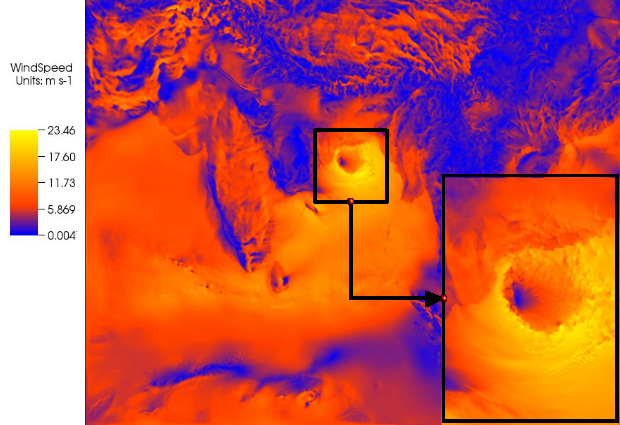
2 tion, the number of processors used for simulations, and the number of time slices visualized. We have used the framework to simulate the cyclone Aila in the Indian region. Aila was the second tropical cyclone to form within the Northern Indian Ocean during 2009 [2]. The cyclone was formed on May 23, 2009 about 400 kms south of Kolkata, India and dissipated on May 26, 2009 in the Darjeeling hills. There were 330 fatalities, 8,208 reported missing and about $40.7 million estimated damage. We simulated Aila at a resolution of upto 3.33 km using a mesoscale numerical weather forecast model WRF [6], using upto 54 AMD Opteron TM processor cores. We discuss the results of the experiments with our framework in this report. II. RELATED WORK The analysis and study of time-varying output data, obtained from numerical simulations, is integral to the scientific process once simulation has completed. Tiankai Tu et al. [4] proposed tightlycoupled execution of the simulation and visualization components in order to share data as shown in Figure 1. Hence the cost of communicating data from simulation component to the visualization component is minimized. The simulation component runs followed by the visualization component in the same set of processors. Thus there is alternation of simulation and visualization cycles using the same shared data. In their approach, the simulation component is stalled while the visualization component runs since both run on the same set of processors. The simulation component is generally more compute-intensive than the visualization component. Hence, stalling simulation while the visualization component runs would cause the subsequent output of simulation to be produced after some delay. of Storms (CAPS) at the University of Oklahoma in this direction [1], [5]. They have conducted a realtime storm-scale ensemble forecasting experiment with the goal of testing multiple runs of a forecast model. III. METHODOLOGY The modeled region of forecast is called a domain in WRF. There is one parent domain which can have child domains, called nests. Regional weather models like WRF model the climate using gridded data where the grid spacing determines the resolution. Decreasing the grid spacing increases resolution which leads to more accurate simulations. The lowest pressure region is called the eye of the cyclone. Hence, to track the eye of Aila, we employ a finer resolution nest on the region of our interest inside the parent domain as shown in Figure 2. Our framework forms the nest dynamically based on the lowest pressure value in the domain and monitors the nest movement in the parent domain along the eye of the cyclone. Fig. 2. Windspeed visualization in finer resolution nest inside parent domain Fig. 1. Tightly-coupled simulation and visualization steps Storm-forecasting is a relatively difficult problem in climate science. Efforts have been made by scientists at the Center for Analysis and Prediction A. Nest refinement Our framework spawns a nest when the pressure decreases to below 995 hpa. The nest is centered at the location of lowest pressure in the parent domain. As and when the cyclone intensifies i.e. the pressure decreases further, our framework changes the resolution of the nest multiple times to get a

3 better simulation result from the model. Finer resolution in turn implies more computation 1. So, our framework reschedules WRF on a higher number of processors when the resolution is refined. B. Amount of Data for Visualization WRF outputs data in the form of NetCDF [7] files. Each NetCDF file contains the output of a number of simulation timesteps. With finer resolution, the output data size per timestep as well as the time to compute each timestep increases. So that the visualization proceeds at the same rate as the simulations, our framework reduces the number of timesteps output per NetCDF file when the resolution is increased. This reduction in number of timesteps per file ensures that the rate of producing each NetCDF file does not increase significantly. C. Online Visualization Whenever an output is produced by the simulation, it is sent to the graphics workstation for visualization, thereby enabling runtime visualization and reducing storage space requirements. Visualization is performed directly on the NetCDF file without any intermediate processing step. We have visualized the output using volume rendering, vector plots employing oriented glyphs, pseudocolor and contour plots of the VisIt [8] visualization tool. IV. INTEGRATION FRAMEWORK The backbone of our integration framework is a co-ordinator process wrf monitor which spawns and refines the nest. The simulation component passes information related to pressure threshold and nest location to wrf monitor through intermediate files. As WRF is a regional model, with each level of refinement, it needs input data at a finer resolution. wrf monitor configures WRF based on the current nest location and invokes the WRF Preprocessing System (WPS) to interpolate the meteorological data onto the changed domain. Based on the current resolution, wrf monitor employs a higher number of processors to run WRF. This is illustrated in Figure 3. 1 For example, 10-km resolution gives better results than 15- km resolution but a 15-km resolution requires a grid whereas a 10-km resolution requires a grid of size for the same area. Fig. 3. wrf monitor co-ordinator process Our framework automatically transfers data between the simulation and visualization components as shown in Figure 4. This is facilitated by the wrf transfer process that runs on the simulation engine host. As and when the simulation component finishes writing to a file, wrf transfer transfers data from the simulation component to the visualization engine. Fig. 4. Integrated Framework for Tracking Cyclones V. EXPERIMENTS AND RESULTS We have performed the simulations for an area of approximately sq. km. from 60 E E and 10 S - 40 N, comprising of the region of formation and dissipation of Aila over a period of 4 days. The nesting ratio i.e. the ratio of the resolution of the nest to that of the parent domain, was set to 1:3. The 6-hourly 1-degree FNL analysis GRIB meteorological input data for our model domain was obtained from CISL Research Data Archive [9]. We used MPICH for running WRF. We utilized upto 54 AMD Opteron TM processor cores operating at 2.6 GHz connected by Gigabit Ethernet. We started the simulations on 20 processors and increased upto 54 processors with each level of refinement of nest as shown in Table I. It can be observed from the table that the number of timesteps/file sent to the visualization engine is decreased with each level of finer resolution in an attempt to maintain constant output file size and

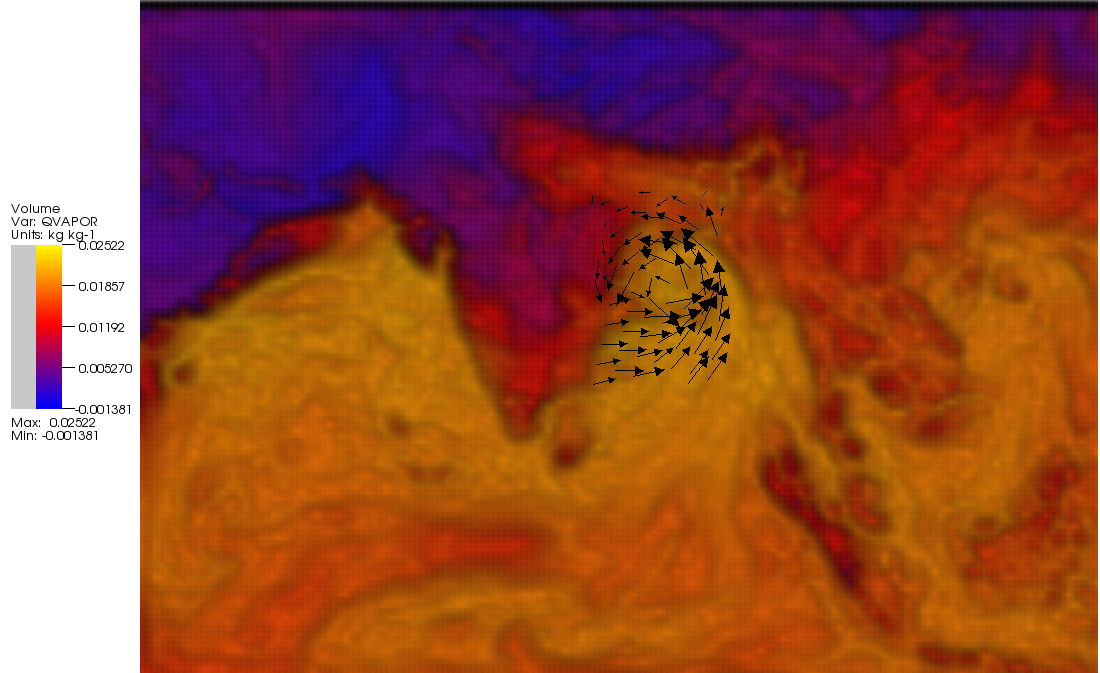
4 constant time for visualizing data from a file. This also keeps the rate at which output is produced constant because the amount of computation increases with finer resolution, thereby increasing the time to produce one timestep data. TABLE I R ESCHEDULING SNAPSHOT DURING THE EXECUTION OF WRF Pressure value (hpa) Resolution (km) No. of Processor cores Number of timesteps/file Output file size (GB) a Intel(R) Pentium(R) 4 CPU 3.40 GHz and an NVIDIA graphics card GeForce 7800 GTX. We used hardware acceleration feature of VisIt. The timings for visualization of different-sized output files is shown in Figure 6. We observed that with hardware acceleration, there is an average decrease of about 72% in the time taken for visualization. The variables visualized were pressure, windspeed, rainfall and water vapor mixing ratio. The track of Aila as produced by simulation can be seen in Figure 7. It can be observed from the figure that the depression was formed in the central Bay of Bengal region (around latitude of 14 N) and traversed north-east upto Darjeeling (27 N). The visualization for water vapor mixing ratio along with wind speed vectors is shown in Figure 8. Figure 9 shows the accumulated total cumulus precipitation on 24th May, 2009 as output by WRF. The complete simulation for the period of 22 May 2009, 12:00 hours to 26 May 2009, 12:00 hours executed for a total of 21.5 hours of wallclock time. The frequency of output of NetCDF files from WRF determined the frequency of visualization. Our framework ensured continuous data transfer from the simulation component to the visualization component and dynamically allocated a required number of processors based on the resolution of the simulation. Change in resolution triggers a reallocation of processors as shown in Figure 5. Fig. 6. Comparison of running time of visualizing differentsized output NetCDF files with and without hardware acceleration Fig. 5. Change in processor configuration with change in resolution over the duration of simulation We have developed a plug-in for VisIt to directly read NetCDF output files, eliminating the cost of post-processing before data analysis. Visualization was performed on a graphics workstation with Fig. 8. Visualization of Water Vapor Mixing Ratio with wind vectors shown by using glyphs on the Aila region at 07:30 hours on 24th May, 2009


5 Fig. 7. Visualization of Perturbation Pressure at 18:00 hours on 23rd, 24th and 25th May, 2009 Fig. 9. Visualization of Accumulated Total Cumulus Precipitation on the Aila region at 07:30 hours on 24th May, 2009 VI. CONCLUSIONS AND FUTURE WORK In this work, we have developed a framework for integrated simulation and visualization of cyclone Aila. In our work, we simultaneously monitored the output without having to wait for the 21.5 hoursimulation to complete. Our framework automatically places a finer resolution nest when the pressure dips beyond a threshold value. We also refined the nest automatically with time as the cyclone intensified, i.e, as the pressure value decreased. In the process, we scheduled WRF on a higher number of processors to cope with the increased computation due to increased resolution. Hence we are able to use multiple processors efficiently depending on computational requirements. In future work we intend to parallelize the visualization process. We plan to investigate algorithms for adaptive resource sharing between the simulation and visualization components. We also intend to investigate interactive simulation/visualization, so that user input based on the visualization can steer the simulation. Hazardous Weather Testbed 2007 Spring Experiment, 22nd Conference on Weather Analysis and Forecasting and 18th Conference on Numerical Weather Prediction, 2007 [2] Aila, Aila [3] Kwan-Liu Ma, Chaoli Wang, Hongfeng Yu, and Anna Tikhonova, In Situ Processing and Visualization for Ultrascale Simulations, Journal of Physics (Proceedings of SciDAC 2007 Conference) Volume 78, 2007 [4] Tiankai Tu, Hongfeng Yu, Leonardo Ramirez-Guzman, Jacobo Bielak, Omar Ghattas, Kwan-Liu Ma, and David R. O Hallaron, From Mesh Generation to Scientific Visualization: An End-to-End Approach to Parallel Supercomputing, Proceedings of the International Conference for High Performance Computing, Networking, Storage and Analysis, 2006 [5] Kong et. al., Real-Time Storm-Scale Ensemble Forecast 2008 Spring Experiment, 24th Conference on Severe Local Storms, 2008 [6] Michalakes, J. et. al., The Weather Reseach and Forecast Model: Software Architecture and Performance, Proceedings of 11th ECMWF Workshop on the Use of High Performance Computing In Meteorology, 2004 [7] Rew, R. K. and G. P. Davis, The Unidata netcdf: Software for Scientific Data Access, 6th International Conference on Interactive Information and Processing Systems for Meteorology, Oceanography, and Hydrology, California, American Meteorology Society, [8] VisIt, [9] UCAR CISL Research Data Archive, REFERENCES [1] M. Xue et. al., CAPS Real Time Storm-Scale Ensemble and High-Resolution Forecasts as Part of the NOAA

The Design and Implement of Ultra-scale Data Parallel. In-situ Visualization System
 The Design and Implement of Ultra-scale Data Parallel In-situ Visualization System Liu Ning [email protected] Gao Guoxian [email protected] Zhang Yingping [email protected] Zhu Dengming [email protected]
The THREDDS Data Repository: for Long Term Data Storage and Access
 8B.7 The THREDDS Data Repository: for Long Term Data Storage and Access Anne Wilson, Thomas Baltzer, John Caron Unidata Program Center, UCAR, Boulder, CO 1 INTRODUCTION In order to better manage ever increasing
THE STRATEGIC PLAN OF THE HYDROMETEOROLOGICAL PREDICTION CENTER
 THE STRATEGIC PLAN OF THE HYDROMETEOROLOGICAL PREDICTION CENTER FISCAL YEARS 2012 2016 INTRODUCTION Over the next ten years, the National Weather Service (NWS) of the National Oceanic and Atmospheric Administration
IMPACT OF SAINT LOUIS UNIVERSITY-AMERENUE QUANTUM WEATHER PROJECT MESONET DATA ON WRF-ARW FORECASTS
 IMPACT OF SAINT LOUIS UNIVERSITY-AMERENUE QUANTUM WEATHER PROJECT MESONET DATA ON WRF-ARW FORECASTS M. J. Mueller, R. W. Pasken, W. Dannevik, T. P. Eichler Saint Louis University Department of Earth and
Schedule WRF model executions in parallel computing environments using Python
 Schedule WRF model executions in parallel computing environments using Python A.M. Guerrero-Higueras, E. García-Ortega and J.L. Sánchez Atmospheric Physics Group, University of León, León, Spain J. Lorenzana
Parameterization of Cumulus Convective Cloud Systems in Mesoscale Forecast Models
 DISTRIBUTION STATEMENT A. Approved for public release; distribution is unlimited. Parameterization of Cumulus Convective Cloud Systems in Mesoscale Forecast Models Yefim L. Kogan Cooperative Institute
Analysis of Climatic and Environmental Changes Using CLEARS Web-GIS Information-Computational System: Siberia Case Study
 Analysis of Climatic and Environmental Changes Using CLEARS Web-GIS Information-Computational System: Siberia Case Study A G Titov 1,2, E P Gordov 1,2, I G Okladnikov 1,2, T M Shulgina 1 1 Institute of
The Ultra-scale Visualization Climate Data Analysis Tools (UV-CDAT): A Vision for Large-Scale Climate Data
 The Ultra-scale Visualization Climate Data Analysis Tools (UV-CDAT): A Vision for Large-Scale Climate Data Lawrence Livermore National Laboratory? Hank Childs (LBNL) and Charles Doutriaux (LLNL) September
13.2 THE INTEGRATED DATA VIEWER A WEB-ENABLED APPLICATION FOR SCIENTIFIC ANALYSIS AND VISUALIZATION
 13.2 THE INTEGRATED DATA VIEWER A WEB-ENABLED APPLICATION FOR SCIENTIFIC ANALYSIS AND VISUALIZATION Don Murray*, Jeff McWhirter, Stuart Wier, Steve Emmerson Unidata Program Center, Boulder, Colorado 1.
Development of an Integrated Data Product for Hawaii Climate
 Development of an Integrated Data Product for Hawaii Climate Jan Hafner, Shang-Ping Xie (PI)(IPRC/SOEST U. of Hawaii) Yi-Leng Chen (Co-I) (Meteorology Dept. Univ. of Hawaii) contribution Georgette Holmes
6.9 A NEW APPROACH TO FIRE WEATHER FORECASTING AT THE TULSA WFO. Sarah J. Taylor* and Eric D. Howieson NOAA/National Weather Service Tulsa, Oklahoma
 6.9 A NEW APPROACH TO FIRE WEATHER FORECASTING AT THE TULSA WFO Sarah J. Taylor* and Eric D. Howieson NOAA/National Weather Service Tulsa, Oklahoma 1. INTRODUCTION The modernization of the National Weather
Comparative Evaluation of High Resolution Numerical Weather Prediction Models COSMO-WRF
 3 Working Group on Verification and Case Studies 56 Comparative Evaluation of High Resolution Numerical Weather Prediction Models COSMO-WRF Bogdan Alexandru MACO, Mihaela BOGDAN, Amalia IRIZA, Cosmin Dănuţ
Project Summary. Project Description
 Project Summary This project will help to bridge the gap between meteorology education and local operational forecasting through collaboration with the National Weather Service (NWS). By leveraging emerging
NOAA Big Data Project. David Michaud Acting Director, Office of Central Processing Office Monday, August 3, 2015
 NOAA Big Data Project David Michaud Acting Director, Office of Central Processing Office Monday, August 3, 2015 Central Processing Portfolio Benefits and Scope Central Processing Portfolio Benefits Ensures
HPC technology and future architecture
 HPC technology and future architecture Visual Analysis for Extremely Large-Scale Scientific Computing KGT2 Internal Meeting INRIA France Benoit Lange [email protected] Toàn Nguyên [email protected]
VisCMD: Visualizing Cloud Modeling Data
 CPSC-533C Information Visualization Project Report VisCMD: Visualizing Cloud Modeling Data Quanzhen Geng (#63546014) and Jing Li (#90814013) Email: [email protected] [email protected] (Master of Software
An Analytical Framework for Particle and Volume Data of Large-Scale Combustion Simulations. Franz Sauer 1, Hongfeng Yu 2, Kwan-Liu Ma 1
 An Analytical Framework for Particle and Volume Data of Large-Scale Combustion Simulations Franz Sauer 1, Hongfeng Yu 2, Kwan-Liu Ma 1 1 University of California, Davis 2 University of Nebraska, Lincoln
CLOUD BASED N-DIMENSIONAL WEATHER FORECAST VISUALIZATION TOOL WITH IMAGE ANALYSIS CAPABILITIES
 CLOUD BASED N-DIMENSIONAL WEATHER FORECAST VISUALIZATION TOOL WITH IMAGE ANALYSIS CAPABILITIES M. Laka-Iñurrategi a, I. Alberdi a, K. Alonso b, M. Quartulli a a Vicomteh-IK4, Mikeletegi pasealekua 57,
Performance Analysis of a Numerical Weather Prediction Application in Microsoft Azure
 Performance Analysis of a Numerical Weather Prediction Application in Microsoft Azure Emmanuell D Carreño, Eduardo Roloff, Jimmy V. Sanchez, and Philippe O. A. Navaux WSPPD 2015 - XIII Workshop de Processamento
Distributed Computing. Mark Govett Global Systems Division
 Distributed Computing Mark Govett Global Systems Division Modeling Activities Prediction & Research Weather forecasts, climate prediction, earth system science Observing Systems Denial experiments Observing
Parallel Large-Scale Visualization
 Parallel Large-Scale Visualization Aaron Birkland Cornell Center for Advanced Computing Data Analysis on Ranger January 2012 Parallel Visualization Why? Performance Processing may be too slow on one CPU
Achieving Nanosecond Latency Between Applications with IPC Shared Memory Messaging
 Achieving Nanosecond Latency Between Applications with IPC Shared Memory Messaging In some markets and scenarios where competitive advantage is all about speed, speed is measured in micro- and even nano-seconds.
A Description of the 2nd Generation NOAA Global Ensemble Reforecast Data Set
 A Description of the 2nd Generation NOAA Global Ensemble Reforecast Data Set Table of contents: produced by the NOAA Earth System Research Lab, Physical Sciences Division Boulder, Colorado USA under a
VisIt: A Tool for Visualizing and Analyzing Very Large Data. Hank Childs, Lawrence Berkeley National Laboratory December 13, 2010
 VisIt: A Tool for Visualizing and Analyzing Very Large Data Hank Childs, Lawrence Berkeley National Laboratory December 13, 2010 VisIt is an open source, richly featured, turn-key application for large
StormSurgeViz: A Visualization and Analysis Application for Distributed ADCIRC-based Coastal Storm Surge, Inundation, and Wave Modeling
 : A Visualization and Analysis Application for Distributed ADCIRC-based Coastal Storm Surge, Inundation, and Wave Modeling Brian Blanton Renaissance Computing Institute University of North Carolina at
Titelmasterformat durch Klicken. bearbeiten
 Evaluation of a Fully Coupled Atmospheric Hydrological Modeling System for the Sissili Watershed in the West African Sudanian Savannah Titelmasterformat durch Klicken June, 11, 2014 1 st European Fully
Accelerating CFD using OpenFOAM with GPUs
 Accelerating CFD using OpenFOAM with GPUs Authors: Saeed Iqbal and Kevin Tubbs The OpenFOAM CFD Toolbox is a free, open source CFD software package produced by OpenCFD Ltd. Its user base represents a wide
Real-time and Archived Antarctic. Interactive Processing Tools
 Real-time and Archived Antarctic Meteorological Data via a Synergy of Interactive Processing Tools Mark W. Seefeldt Department of Atmospheric and Oceanic Sciences University it of Colorado at Boulder,
Application of Numerical Weather Prediction Models for Drought Monitoring. Gregor Gregorič Jožef Roškar Environmental Agency of Slovenia
 Application of Numerical Weather Prediction Models for Drought Monitoring Gregor Gregorič Jožef Roškar Environmental Agency of Slovenia Contents 1. Introduction 2. Numerical Weather Prediction Models -
The Arctic Observing Network and its Data Management Challenges Florence Fetterer (NSIDC/CIRES/CU), James A. Moore (NCAR/EOL), and the CADIS team
 The Arctic Observing Network and its Data Management Challenges Florence Fetterer (NSIDC/CIRES/CU), James A. Moore (NCAR/EOL), and the CADIS team Photo courtesy Andrew Mahoney NSF Vision What is AON? a
Project Title: Quantifying Uncertainties of High-Resolution WRF Modeling on Downslope Wind Forecasts in the Las Vegas Valley
 University: Florida Institute of Technology Name of University Researcher Preparing Report: Sen Chiao NWS Office: Las Vegas Name of NWS Researcher Preparing Report: Stanley Czyzyk Type of Project (Partners
Faculty of Computer Science Computer Graphics Group. Final Diploma Examination
 Faculty of Computer Science Computer Graphics Group Final Diploma Examination Communication Mechanisms for Parallel, Adaptive Level-of-Detail in VR Simulations Author: Tino Schwarze Advisors: Prof. Dr.
IBM Deep Computing Visualization Offering
 P - 271 IBM Deep Computing Visualization Offering Parijat Sharma, Infrastructure Solution Architect, IBM India Pvt Ltd. email: [email protected] Summary Deep Computing Visualization in Oil & Gas
IBM Big Green Innovations Environmental R&D and Services
 IBM Big Green Innovations Environmental R&D and Services Smart Weather Modelling Local Area Precision Forecasting for Weather-Sensitive Business Operations (e.g. Smart Grids) Lloyd A. Treinish Project
Very High Resolution Arctic System Reanalysis for 2000-2011
 Very High Resolution Arctic System Reanalysis for 2000-2011 David H. Bromwich, Lesheng Bai,, Keith Hines, and Sheng-Hung Wang Polar Meteorology Group, Byrd Polar Research Center The Ohio State University
David P. Ruth* Meteorological Development Laboratory Office of Science and Technology National Weather Service, NOAA Silver Spring, Maryland
 9.9 TRANSLATING ADVANCES IN NUMERICAL WEATHER PREDICTION INTO OFFICIAL NWS FORECASTS David P. Ruth* Meteorological Development Laboratory Office of Science and Technology National Weather Service, NOAA
Data Requirements from NERSC Requirements Reviews
 Data Requirements from NERSC Requirements Reviews Richard Gerber and Katherine Yelick Lawrence Berkeley National Laboratory Summary Department of Energy Scientists represented by the NERSC user community
Data-Intensive Science and Scientific Data Infrastructure
 Data-Intensive Science and Scientific Data Infrastructure Russ Rew, UCAR Unidata ICTP Advanced School on High Performance and Grid Computing 13 April 2011 Overview Data-intensive science Publishing scientific
Extra-Tropical Cyclones in a Warming Climate:
 Extra-Tropical Cyclones in a Warming Climate: Observational Evidence of Trends in Frequencies and Intensities in the North Pacific, North Atlantic, & Great Lakes Regions David Levinson Scientific Services
HPC and Big Data. EPCC The University of Edinburgh. Adrian Jackson Technical Architect [email protected]
 HPC and Big Data EPCC The University of Edinburgh Adrian Jackson Technical Architect [email protected] EPCC Facilities Technology Transfer European Projects HPC Research Visitor Programmes Training
Hong Kong Observatory Summer Placement Programme 2015
 Annex I Hong Kong Observatory Summer Placement Programme 2015 Training Programme : An Observatory mentor with relevant expertise will supervise the students. Training Period : 8 weeks, starting from 8
4.3. David E. Rudack*, Meteorological Development Laboratory Office of Science and Technology National Weather Service, NOAA 1.
 43 RESULTS OF SENSITIVITY TESTING OF MOS WIND SPEED AND DIRECTION GUIDANCE USING VARIOUS SAMPLE SIZES FROM THE GLOBAL ENSEMBLE FORECAST SYSTEM (GEFS) RE- FORECASTS David E Rudack*, Meteorological Development
7B.2 MODELING THE EFFECT OF VERTICAL WIND SHEAR ON TROPICAL CYCLONE SIZE AND STRUCTURE
 7B.2 MODELING THE EFFECT OF VERTICAL WIND SHEAR ON TROPICAL CYCLONE SIZE AND STRUCTURE Diana R. Stovern* and Elizabeth A. Ritchie University of Arizona, Tucson, Arizona 1. Introduction An ongoing problem
NASA's Strategy and Activities in Server Side Analytics
 NASA's Strategy and Activities in Server Side Analytics Tsengdar Lee, Ph.D. High-end Computing Program Manager NASA Headquarters Presented at the ESGF/UVCDAT Conference Lawrence Livermore National Laboratory
 Integrated Data Viewer (IDV) a visualization framework Yuan Ho Unidata Program Center Boulder, CO Presentation Outline Integrated Data Viewer (IDV) overview The IDV features IDV examples and customized
Ensuring the Preparedness of Users: NOAA Satellites GOES R, JPSS Laura K. Furgione
 Ensuring the Preparedness of Users: NOAA Satellites GOES R, JPSS Laura K. Furgione U.S. Permanent Representative with the WMO Deputy Director, NOAA s s National Weather Service WMO Executive Council 65
3.5 THREE-DIMENSIONAL HIGH-RESOLUTION NATIONAL RADAR MOSAIC
 3.5 THREE-DIMENSIONAL HIGH-RESOLUTION NATIONAL RADAR MOSAIC Jian Zhang 1, Kenneth Howard 2, Wenwu Xia 1, Carrie Langston 1, Shunxin Wang 1, and Yuxin Qin 1 1 Cooperative Institute for Mesoscale Meteorological
NEXT-GENERATION. EXTREME Scale. Visualization Technologies: Enabling Discoveries at ULTRA-SCALE VISUALIZATION
 ULTRA-SCALE VISUALIZATION NEXT-GENERATION Visualization Technologies: Enabling Discoveries at EXTREME Scale The SciDAC Institute for Ultra-Scale Visualization aims to enable extreme-scale knowledge discovery
Interactive Data Visualization with Focus on Climate Research
 Interactive Data Visualization with Focus on Climate Research Michael Böttinger German Climate Computing Center (DKRZ) 1 Agenda Visualization in HPC Environments Climate System, Climate Models and Climate
PART 1. Representations of atmospheric phenomena
 PART 1 Representations of atmospheric phenomena Atmospheric data meet all of the criteria for big data : they are large (high volume), generated or captured frequently (high velocity), and represent a
Synoptic assessment of AMV errors
 NWP SAF Satellite Application Facility for Numerical Weather Prediction Visiting Scientist mission report Document NWPSAF-MO-VS-038 Version 1.0 4 June 2009 Synoptic assessment of AMV errors Renato Galante
Design and Deployment of Specialized Visualizations for Weather-Sensitive Electric Distribution Operations
 Fourth Symposium on Policy and Socio-Economic Research 4.1 Design and Deployment of Specialized Visualizations for Weather-Sensitive Electric Distribution Operations Lloyd A. Treinish IBM, Yorktown Heights,
BASIC APPROACH TO CLIMATE MONITORING PRODUCTS AND CLIMATE MONITORING PRODUCTS IN WMO RA VI
 BASIC APPROACH TO CLIMATE MONITORING PRODUCTS AND CLIMATE MONITORING PRODUCTS IN WMO RA VI Mesut DEMIRCAN Geodesy and Photogrametry Engineer Turkish State Meteorological Service Agrometeorology and Climatological
Roadmap for Many-core Visualization Software in DOE. Jeremy Meredith Oak Ridge National Laboratory
 Roadmap for Many-core Visualization Software in DOE Jeremy Meredith Oak Ridge National Laboratory Supercomputers! Supercomputer Hardware Advances Everyday More and more parallelism High-Level Parallelism
4.4 GRAPHICAL AND ANALYTICAL SOFTWARE VISUALIZATION TOOLS FOR EVALUATING METEOROLOGICAL AND AIR QUALITY MODEL PERFORMANCE
 4.4 GRAPHICAL AND ANALYTICAL SOFTWARE VISUALIZATION TOOLS FOR EVALUATING METEOROLOGICAL AND AIR QUALITY MODEL PERFORMANCE Irene Lee * Exponent Inc., Natick, Massachusetts 1. INTRODUCTION A critical part
[ Climate Data Collection and Forecasting Element ] An Advanced Monitoring Network In Support of the FloodER Program
![[ Climate Data Collection and Forecasting Element ] An Advanced Monitoring Network In Support of the FloodER Program](/thumbs/33/16326315.jpg "[ Climate Data Collection and Forecasting Element ] An Advanced Monitoring Network In Support of the FloodER Program") [ Climate Data Collection and Forecasting Element ] An Advanced Monitoring Network In Support of the FloodER Program December 2010 1 Introduction Extreme precipitation and the resulting flooding events
[ Climate Data Collection and Forecasting Element ] An Advanced Monitoring Network In Support of the FloodER Program December 2010 1 Introduction Extreme precipitation and the resulting flooding events
MOGREPS status and activities
 MOGREPS status and activities by Warren Tennant with contributions from Rob Neal, Sarah Beare, Neill Bowler & Richard Swinbank Crown copyright Met Office 32 nd EWGLAM and 17 th SRNWP meetings 1 Contents
Climate-Weather Modeling Studies Using a Prototype Global Cloud-System Resolving Model
 ANL/ALCF/ESP-13/1 Climate-Weather Modeling Studies Using a Prototype Global Cloud-System Resolving Model ALCF-2 Early Science Program Technical Report Argonne Leadership Computing Facility About Argonne
THE EXPAND PARALLEL FILE SYSTEM A FILE SYSTEM FOR CLUSTER AND GRID COMPUTING. José Daniel García Sánchez ARCOS Group University Carlos III of Madrid
 THE EXPAND PARALLEL FILE SYSTEM A FILE SYSTEM FOR CLUSTER AND GRID COMPUTING José Daniel García Sánchez ARCOS Group University Carlos III of Madrid Contents 2 The ARCOS Group. Expand motivation. Expand
Hank Childs, University of Oregon
 Exascale Analysis & Visualization: Get Ready For a Whole New World Sept. 16, 2015 Hank Childs, University of Oregon Before I forget VisIt: visualization and analysis for very big data DOE Workshop for
Coupling micro-scale CFD simulations to meso-scale models
 Coupling micro-scale CFD simulations to meso-scale models IB Fischer CFD+engineering GmbH Fabien Farella Michael Ehlen Achim Fischer Vortex Factoria de Càlculs SL Gil Lizcano Outline Introduction O.F.Wind
Fair Scheduling Algorithm with Dynamic Load Balancing Using In Grid Computing
 Research Inventy: International Journal Of Engineering And Science Vol.2, Issue 10 (April 2013), Pp 53-57 Issn(e): 2278-4721, Issn(p):2319-6483, Www.Researchinventy.Com Fair Scheduling Algorithm with Dynamic
Baudouin Raoult, Iryna Rozum, Dick Dee
 ECMWF contribution to the EU funded CHARME Project: A Significant Event Viewer tool Matthew Manoussakis Baudouin Raoult, Iryna Rozum, Dick Dee 5th Workshop on the use of GIS/OGC standards in meteorology
Argonne National Laboratory
 Argonne National Laboratory Using Climate Data to Inform Critical Infrastructure Resilience and Urban Sustainability Decisionmaking National Academy of Sciences Roundtable on Science and Technology for
A Real Case Study of Using Cloud Analysis in Grid-point Statistical Interpolation Analysis and Advanced Research WRF Forecast System
 A Real Case Study of Using Cloud Analysis in Grid-point Statistical Interpolation Analysis and Advanced Research WRF Forecast System Ming Hu 1 and Ming Xue 1, 1 Center for Analysis and Prediction of Storms,
Scholar: Elaina R. Barta. NOAA Mission Goal: Climate Adaptation and Mitigation
 Development of Data Visualization Tools in Support of Quality Control of Temperature Variability in the Equatorial Pacific Observed by the Tropical Atmosphere Ocean Data Buoy Array Abstract Scholar: Elaina
Cluster Scalability of ANSYS FLUENT 12 for a Large Aerodynamics Case on the Darwin Supercomputer
 Cluster Scalability of ANSYS FLUENT 12 for a Large Aerodynamics Case on the Darwin Supercomputer Stan Posey, MSc and Bill Loewe, PhD Panasas Inc., Fremont, CA, USA Paul Calleja, PhD University of Cambridge,
3D Model of the City Using LiDAR and Visualization of Flood in Three-Dimension
 3D Model of the City Using LiDAR and Visualization of Flood in Three-Dimension R.Queen Suraajini, Department of Civil Engineering, College of Engineering Guindy, Anna University, India, [email protected]
HPC Wales Skills Academy Course Catalogue 2015
 HPC Wales Skills Academy Course Catalogue 2015 Overview The HPC Wales Skills Academy provides a variety of courses and workshops aimed at building skills in High Performance Computing (HPC). Our courses
Environmental Data Management:
 Environmental Data Management: Challenges & Opportunities Mohan Ramamurthy, Unidata University Corporation for Atmospheric Research Boulder CO 25 May 2010 Environmental Data Management Workshop Silver
Email: [email protected]
 USE OF VIRTUAL INSTRUMENTS IN RADIO AND ATMOSPHERIC EXPERIMENTS P.N. VIJAYAKUMAR, THOMAS JOHN AND S.C. GARG RADIO AND ATMOSPHERIC SCIENCE DIVISION, NATIONAL PHYSICAL LABORATORY, NEW DELHI 110012, INDIA
Nowcasting: analysis and up to 6 hours forecast
 Nowcasting: analysis and up to 6 hours forecast Very high resoultion in time and space Better than NWP Rapid update Application oriented NWP problems for 0 6 forecast: Incomplete physics Resolution space
How To Share Rendering Load In A Computer Graphics System
 Bottlenecks in Distributed Real-Time Visualization of Huge Data on Heterogeneous Systems Gökçe Yıldırım Kalkan Simsoft Bilg. Tekn. Ltd. Şti. Ankara, Turkey Email: [email protected] Veysi İşler Dept.
Using open source and commercial visualization packages for analysis and visualization of large simulation dataset
 Using open source and commercial visualization packages for analysis and visualization of large simulation dataset Simon Su, Werner Benger, William Sherman, Eliot Feibush, Curtis Hillegas Princeton University,
Monsoon Variability and Extreme Weather Events
 Monsoon Variability and Extreme Weather Events M Rajeevan National Climate Centre India Meteorological Department Pune 411 005 [email protected] Outline of the presentation Monsoon rainfall Variability
COSMO Data Assimilation. Applications for Romanian Territory
 1 Working Group on Data Assimilation 19 COSMO Data Assimilation. Applications for Romanian Territory Amalia IRIZA 1,2, Rodica Claudia DUMITRACHE 1, Cosmin Dănuţ BARBU 1, Aurelia Lupaşcu 1, Bogdan Alexandru
Performance Analysis and Application of Ensemble Air Quality Forecast System in Shanghai
 Performance Analysis and Application of Ensemble Air Quality Forecast System in Shanghai Qian Wang 1, Qingyan Fu 1, Ping Liu 2, Zifa Wang 3, Tijian Wang 4 1.Shanghai environmental monitoring center 2.Shanghai
Overview of Data Visualization Tools. (Submitted by the Secretariat) Summary and Purpose of Document
 WORLD METEOROLOGICAL ORGANIZATION COMMISSION FOR BASIC SYSTEMS OPEN PROGRAMME AREA GROUP ON INTEGRATED OBSERVING SYSTEMS EXPERT TEAM ON SATELLITE UTILIZATION AND PRODUCTS SCOPE-Nowcasting Ad-hoc Steering
NVIDIA IndeX Enabling Interactive and Scalable Visualization for Large Data Marc Nienhaus, NVIDIA IndeX Engineering Manager and Chief Architect
 SIGGRAPH 2013 Shaping the Future of Visual Computing NVIDIA IndeX Enabling Interactive and Scalable Visualization for Large Data Marc Nienhaus, NVIDIA IndeX Engineering Manager and Chief Architect NVIDIA
J9.6 GIS TOOLS FOR VISUALIZATION AND ANALYSIS OF NEXRAD RADAR (WSR-88D) ARCHIVED DATA AT THE NATIONAL CLIMATIC DATA CENTER
 J9.6 GIS TOOLS FOR VISUALIZATION AND ANALYSIS OF RADAR (WSR-88D) ARCHIVED DATA AT THE NATIONAL CLIMATIC DATA CENTER Steve Ansari * STG Incorporated, Asheville, North Carolina Stephen Del Greco NOAA National
NASA s Big Data Challenges in Climate Science
 NASA s Big Data Challenges in Climate Science Tsengdar Lee, Ph.D. High-end Computing Program Manager NASA Headquarters Presented at IEEE Big Data 2014 Workshop October 29, 2014 1 2 7-km GEOS-5 Nature Run
J3.3 AN END-TO-END QUALITY ASSURANCE SYSTEM FOR THE MODERNIZED COOP NETWORK
 J3.3 AN END-TO-END QUALITY ASSURANCE SYSTEM FOR THE MODERNIZED COOP NETWORK Christopher A. Fiebrich*, Renee A. McPherson, Clayton C. Fain, Jenifer R. Henslee, and Phillip D. Hurlbut Oklahoma Climatological
Heavy Rainfall from Hurricane Connie August 1955 By Michael Kozar and Richard Grumm National Weather Service, State College, PA 16803
 Heavy Rainfall from Hurricane Connie August 1955 By Michael Kozar and Richard Grumm National Weather Service, State College, PA 16803 1. Introduction Hurricane Connie became the first hurricane of the