
A Multiplier and Linkage Analysis :
|
|
|
- Imogen Carter
- 9 years ago
- Views:
Transcription
1 A Multiplier and Linkage Analysis : Case of Algeria Dr. MATALLAH Kheir Eddine* Abstract The development strategy for the Algerian economy in the 1980s and 1990s was based on the establishment of small- and mediumscale industrial units. The effectiveness of this policy could be assessed, using multiplier and linkage analysis. 1. Introduction The Algerian economy in the 1970s was in many ways not untypical of many other developing economies. It passed through a period of behaving as a socialist command economy, and has suffered gluts and shortages resultant from the inherent inabilities of any government to regulate the economy efficiently. In the 1980s and 1990s, Algeria looked to be in a transition period towards a more international, capitalist economic system. That is, the aim of the development strategy was a shift from capital intensive industrial units to more labour intensive small- and medium-scale industrial units. The absence of new Algerian input-output table, meant that only economic interpretation of the multipliers and linkages were used in this paper. The subsequent five sections of this paper are structured as follows. Section 2 deals with the theory of input-output multipliers and linkages. In section 3 the limitations of the techniques used are discussed. Section 4 contains an economic interpretation of the multipliers and linkages. In Section 5 some concluding remarks are offered. * Senior Lecturer in Economics, Guelma University, Algeria
2 2. Theory of Multipliers and Linkages 2.1. The Input-Output Multipliers The input-output multipliers, as defined by (Burdekin and Al-Ali, 1978, 13): "...give a detailed picture of the impact of changes in final demand on output, income, and employment throughout the economy. They are now well established as indicators of the importance of particular sectors and the interdependence of the industrial structure". The following notation is used throughout this paper (Miller and Blair, 1985). ( A ) is a square matrix describing the technical relations of production; ( x) is a vector of total output; ( y ) is a vector of final demand; ( I A) 1 is the Leontief inverse matrix. These satisfy the usual basic input-output equation: ( ) 1 x = I A y The Output Multipliers An output multiplier is defined as the change in gross output resulting from a unit change in final demand in a given sector. As we are assuming constant returns to scale, the effect on the economy is seen by multiplying ( I A) 1 by a final demand vector that has unity in the sector we are concerned with and zero elsewhere, i.e. the vector of value multipliers is defined as i ( I A) 1. This is just the column sum of the Leontief inverse. Here () i is the unit vector and a prime indicates the transpose The Income Multiplier The income generated in the economy by a change of 1 Algerian dinar (AD) in final demand is defined as w ( I A) 1. Here each - 288

3 element of ( w ) is the ratio of wages and salaries to gross output for each sector (i.e. the labour income coefficient). However, a more useful measure of the interdependence of the economy is to look at the total direct and indirect income generated for every 1 AD of direct income generated. Thus the income multiplier for industry ( j) has the direct and indirect income effect as numerator and direct income as denominator (Miller and Blair, 1985, 107). We write this as: w ( I A) w 1 1 Here ( w ) is the diagonalised matrix, with the vector ( w ) on the principal diagonal, zeros elsewhere The Labour Multiplier Let us assume that the vector of non-produced inputs, () v, is related to the total output ( x ) by: vi = xi ri Here () r is the vector of non-produced input coefficients. Substituting for ( x ) in the input-output equation gives: = ( ) 1 v r I A y So the effect of a unit change in any element of final demand will simply be the sum of the corresponding column of the matrix 1 r ( I A). Therefore, the vector of all these effects can be found by 1 multiplying this matrix on the left by i, i.e. i r ( I A). So the multiplier is this case is: r ( I A) 1 The effect on total employment of increasing final demand by sufficient to require one extra direct unit of non-produced input - 289
4 would require that final demand in sector i increase by 1 units. So ri we would need to multiply the above matrix by r 1, i.e. the nonproduced input multipliers is: r ( I A) r Linkages In developing planning it is obviously important to know how closely "linked" sectors are with each other. Of course, the direct linkages are shown in the A matrix, and the direct plus the indirect linkages are revealed by the Leontief inverse (Miller and Blair, 1985, 101). However, we need to distinguish between"backward" linkages and "forward" linkages. Backward linkages are the relationship between the activity in a sector and its purchases. Forward linkages are the relationship between the activity in a sector and its sales. The output multipliers, defined as the column sum of the Leontief inverse, obviously indicate backward linkages. Using the row sums of the Leontief inverse, the output multipliers 1 are given by ( I A) i. This shows the effect on the total activity in each sector if every sector increases its final demand by unity. This is sometimes referred to as"sensitivity" of the sector. An alternative approach is to make a completely different set of assumptions about the flows in an economy. Rather than assuming that intermediate inputs are proportional to total output, one might assume that they are proportional to total inputs (Jones, 1976); i.e. rather than using x = a X ij ij j we might use x = b X ij ij i - 290
5 This means that the intermediate flows are supply led rather than demand led. For most economies this is a less acceptable assumption. However, if I define the matrix ( B ) as above, then the 1 row sums of ( I B) are measures of forward linkages. 3. Analytical Limitations There are some analytical limitations to this technique as applied to the Algerian input-output table which should be discussed before the technique is applied to the case of the Algerian economy. 3.1 Internal limits (1). The results obtained are not neutral to the level of aggregation. In fact, a high level of aggregation may have the following results. First, aggregation reduces the technological factor of the intersectoral relationship described by the input-output table, i.e. reducing the impact of a sector on the economy. Second, it reduces the homogeneity of sectors. In an input-output table, classification and division of the economic sectors might affect the sectoral hierarchy. For instance, the creation of a petroleum services and public works sector, Algerian case, would apparently reduce the impact of the hydrocarbon sector on the economy. (2). The inter-sectoral relationship derived from an input-output table should reflect the technological structure of the national economy. In fact, the elements of an input-output table are the result of a complex interaction of several factors, i.e. economic, technical, institutional, etc. Further, the pricing policy adopted by the government in the 1980s and 1990s would tend to decrease the economic significance of the price system, and therefore of the technical coefficient expressed in money terms
6 3.2 External limits (1). The methods used and the results obtained are based mainly on the current interindustry flow matrices. They do not take into account the transaction of fixed capital within the economy. The integration of fixed capital would modify the results already obtained. Their integration would necessitate the construction of the capital matrices and the utilisation of a dynamic Leontief model (Miernyk, 1977). (2). The effects induced by the spending of revenues paid to households are not included. Their integration once more would modify the classification of the economic sectors. Theoretically speaking, their integration is seen as possible by making them endogenous within the economic system (Morrisson and Smith, 1979). 3.3 Objections to the methods used (1). The first objection concerns the hypothesis of stable technical coefficients, which is based on the assumptions of the static Leontief model. The economy is mainly in a continuous dynamic state, which means that the sectoral hierarchy might not be stable (2). The second objection is advanced from the relation between linkages and the efficiency of the economy. The indices calculated do not take into account the differential efficiency of the several branches of the national economy. For instance, backward linkages might favour those sectors with limited efficiency with regard to intermediate consumption. (3). The third objection concerns the problem of employment. The methods used do not take the variable of employment into account, bearing in mind that economic sectors have different potential with regard to this aspect
7 4. The economic interpretation of the multipliers and linkages The absence of new Algerian input-output table, meant that only economic interpretation of the multipliers and linkages is given to serve as a background to the analysis for future studies. It should be mentioned that, the latest Algerian input-output table was for 1989, being published in The economic interpretation of the multipliers The output multipliers The value multipliers for each sector enable the estimation of the total direct and indirect effects of a unit change in activity in each sector. The higher the multiplier the greater the impact on interrelated domestic industries of a sectoral output change. The relatively high value multipliers for these industries are indicative of economic linkage of these industries with other industries. Industries with very low value multipliers will have little or no connection with other industries, i.e. any multiplier effects produced by these sectors, therefore, occur outside the economy. By summing the rows in the Leontief inverse a multiplier is derived which estimates the impact of a dinnar change in gross output in all domestic industrial sectors upon each sector. The higher the value of these row multipliers the greater the change induced by one dinnar change in gross output in all industries. The income multiplier These multipliers can be used to assess the importance of income generated in each industry. For example, the high income multipliers in the hydrocarbon industry, for oil rich-developing economies, is not only because of its low direct coefficients, capital intensive industry, but also because of its significant domestic inter-industry linkages. The labour multiplier - 293
8 It should be mentioned here that, the 1989 Algerian input-output table has been used in the analysis below. By using employment data for each industry, the effective full-time work force of each industry can be calculated. These effective employment figures are then combined with the Leontief inverse matrix to give the labour multipliers for each sector. The labour multipliers in terms of the effect of an extra person employed in each sector on employment in all other sectors using the latest Algerian input-output table, were discussed in a separate paper (Matallah & Proops, 1994), and can be briefly summarized as in Table 1. The labour multiplier for food, drink and tabacco is 6.92 which signifies for every one extra person employed in food, drink and tabacoo it is necessary for 5.92 persons to be employed elsewhere in the Algerian economy. A comparison of the value multipliers and the labour multipliers shows considerable differences in the industrial rankings although the Spearman s rank correlation coefficient of 0.58 is significantly different from zero at the 1% significance level. Analogous to the output multiplier analysis, there are also multipliers which show the sensitivity of each sector to a change in employment by one person in all of the sectors in the economy. These employment sensitivity multipliers are shown in Table 1. The industrial sectors in the top quartile of sensitivity multipliers are agriculture, services, chemicals and iron and steel. The sensitivity of employment in the agriculture sector to changes in the general level of employment in Algeria suggests that employment in agriculture can be used as an economic indicator of cyclical changes in the local economy. Industrial sectors in the bottom quartile indicating sector employment insensitivity to employment changes in the rest of Algerian economy are: mining and quarrying; leather and footwear; cement and building materials; and other industries
9 Table 1. Value and Labour Multipliers, Input-Output Table 1989 Value Multiplier Labour Multiplier SensitivityMultiplier Sectors Value Rank Value Rank Value Rank Agriculture, Forestry and Fishing Energy and Water Hydrocarbon Hydro Services & Public Works Mining and Quarrying Iron and Steel Porcelain and Glass Cement and Building materials Chemicals, Rubber and Plastics Food, Drink and Tabacco Textiles and Clothing Leather and Footwear Timber, Furniture and Paper Other industries Transport and Communicati on Services
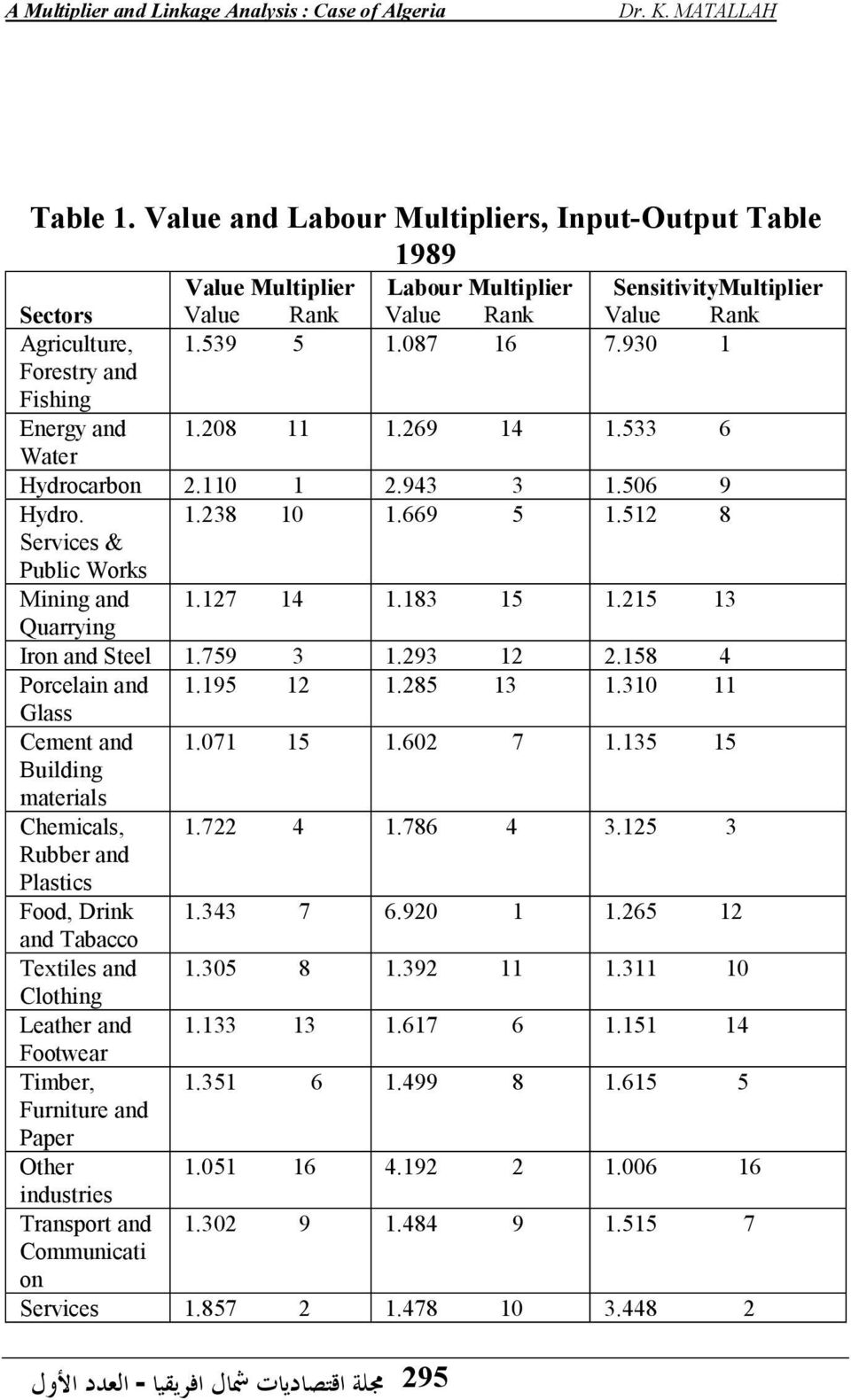
10 Source: Tableau des Entrées-Sorties (1989), O.N.S., By combining the labour multiplier with the total employment, the column headed the total effect of a 1% change in sector employment is derived. Consider, for example, the agriculture sector with a labour multiplier of and total employment of 975,110 (i.e. 54% of total Algerian employment), the effect of a 1% change in agriculture employment would generate a change in employment in Algeria of 10,596 employees. In contrast the food, drink and tabacco sector with a high labour multiplier of 6.92 but relatively small total employment of 71,352 for a 1% change in employment in food, drink and tabacco would change total employment in Algeria by only 4,937 jobs (Table 2). There are obviously significant differences in the ranking of sectors by the size of the labour multiplier and the size of the total employment impact of a 1% change in sector employment. This can be seen by comparing the sectoral rankings in Table 2. Table 2 shows clearly that the sectors with the largest total employment effects are those with the greatest employment and not those with the largest labour multipliers. The spearman rank correlation coefficient between the ranking of the total employment effect and the labour multiplier the coefficient is which is not significantly different from zero
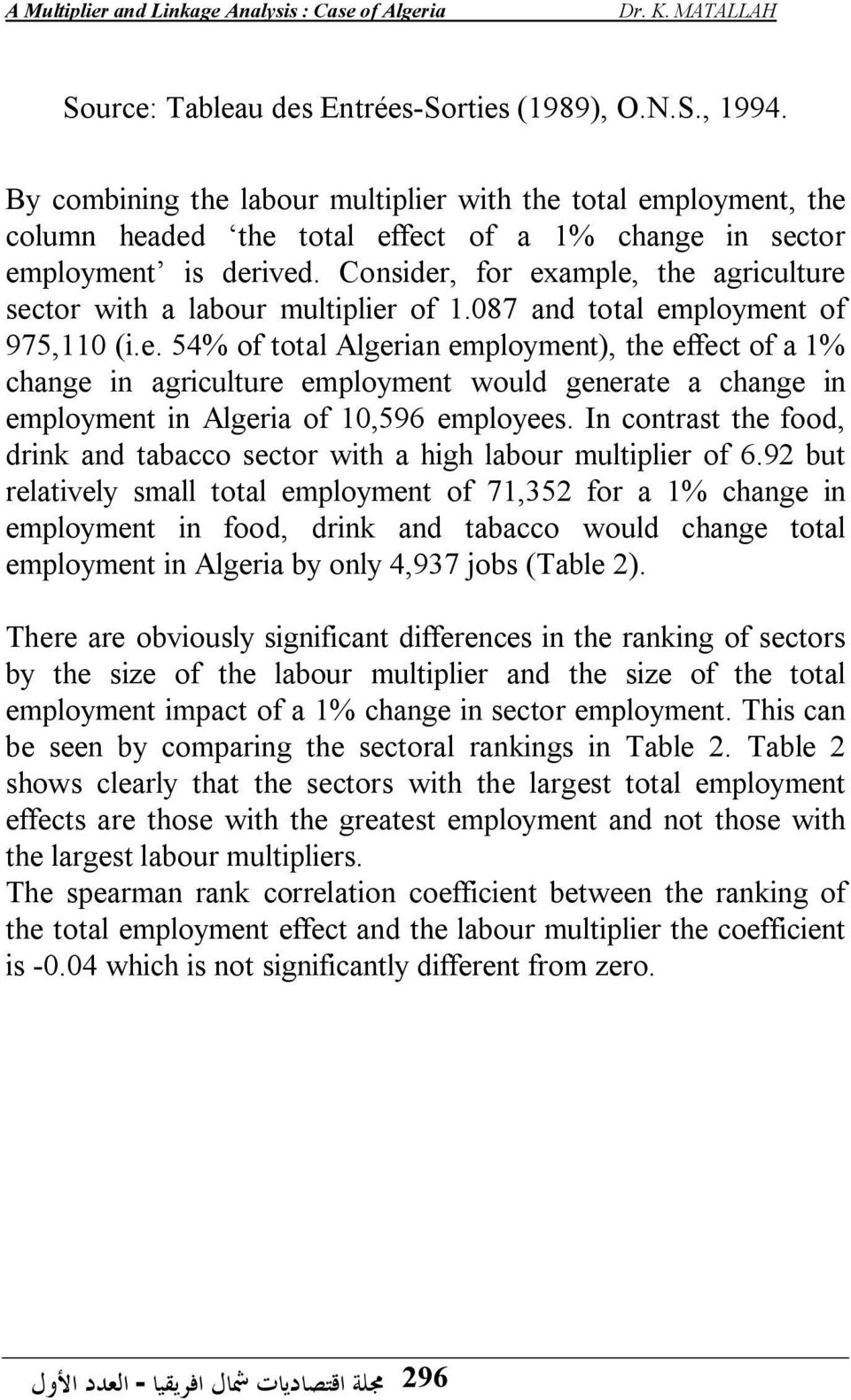
11 Key Table 2. Total Effect of 1% Change in Sector Employment Labour Multiplier (LM) Value Rank Total employment (E) Employment % of thetotal E 100 ( LM ) T. effect Rank % of Total Effects Source: Tableau des Entrées-Sorties (1989), O.N.S., The economic interpretation of the linkages It should be noted that, in theory, the ranking of the sectors is commonly used as a criterion. Further, an index can be constructed to measure the relative strength of the forward and backward linkages by dividing each of the sectors forward and backward linkages by their respective averages for the whole economy. Using 1 z ij as an element of ( I A) 1 and qij as an element of ( I B) we can define:
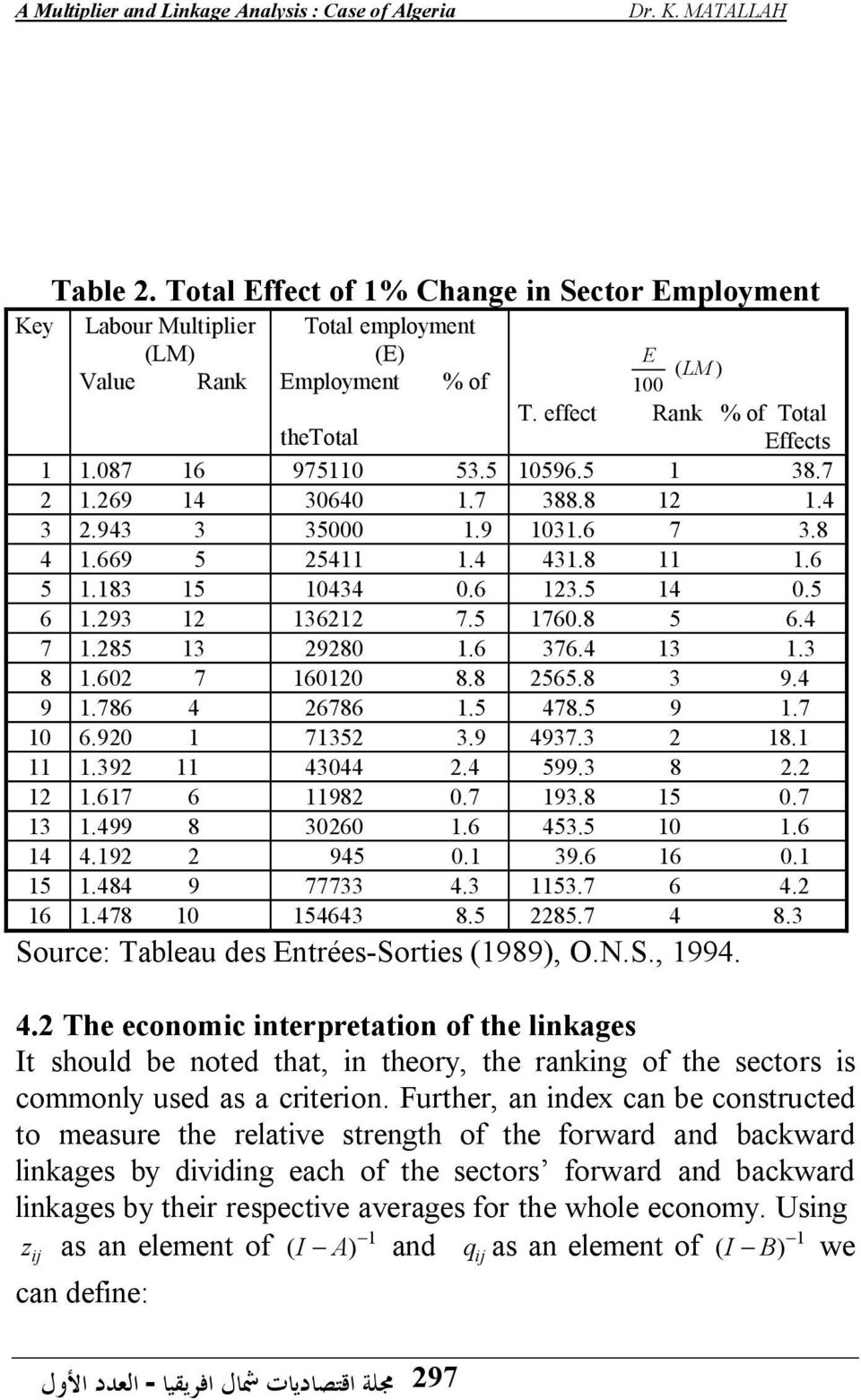
12 backward linkage n z / z ij j j i forward linkage n q / q ij i j i Here n refers to the number of economic sectors. Also, Jones s (1976) measurement of forward linkages can be used, i.e. the "supply led" assumption. Sectors possessing weak forward linkage indices meant that these industries sell their output mostly to final demand and hence do not figure significantly in the measures as they depend on intermediate flows. Sectors possessing weak backward linkage indices meant that their dependence on other sectors for their inputs is comparatively very low, i.e., their principal inputs are provided mainly by imports. Key sectors, according to Hirschman (1958), are those sectors with both backward and forward indices greater than unity. However, the most interesting aspect which might emerge, for developing economies, is the appearance of sectors that nearly qualify as key sectors. This conclusion was first introduced by Matallah and Proops (1990), and further developed by Matallah (1996), and can be summarized by defining "strong", "intermediate", and "weak" linkages. We use Strong linkage index 1 Intermediate 1 > linkage index 0. 9 Weak 0. 9 > linkage index ij ij 5. Conclusions From my analysis I draw two conclusions. First, a summary of the results of the various multiplier analysis will show the importance of those industries in terms of capacity to - 298

13 stimulate output, income and employment in the rest of the economy. The grouping of a large number of industries within a narrow range of values, the output multipliers, means that the ranking of these industries is likely to be sensitive to future changes and also that any policies aimed at increasing demand in all or some of these industries is likely to prove almost equally effective in terms of stimulating the rest of the economy.. Second, the most interesting aspect which might emerge is the appearance of sectors that nearly qualified as key sectors. In particular, if these sectors, compared with other sectors, were relatively underdeveloped, and thus offered considerable potential in any growth strategy. Areas for Future Study The present paper has illuminated some interesting aspects of the limitations of the theory of multipliers and linkages. Still other issues obviously require further study. Further work could examine the following: (1): With a new input-output table the above analyses can be repeated and updated. (2): Test the assumption: strong, intermediate, and weak linkages. References Bulmer-Thomas, V. (1982),"Input-Output Analysis in Developing Countries", John Wiley & Sons Ltd, London. Burdekin, R., & Al-Ali, H. (1978),"An Analysis of Some Aspects of the Scottish Economy Using Input- Output Techniques", Report 96, IBM, UK Scientific Centre. Hirschman, A.O. (1958),"The Strategy of Economic Development", New Haven, CT, Yale University Press. Jones, L. (1976),"The Measurement of Hirschmanian Linkages", Quarterly Journal of Economics, 90, pp

14 Leontief, W (1951), "The Structure of the American Economy, ", Oxford. University Press, Oxford. Matallah, K. & Proops, (1992), "Algerian Economic Development; : A Multiplier and Linkage Analysis", Economic Systems Research, Vol. 4, pp Matallah, K. & Proops, (1994), "An Input-Output Assessment of Algerian development", Working Paper Series, Department of Economics, University of Keele, U.K. Matallah, K. & Proops, (1996),"Measurement of Tachnological Change in the Algerian Economy Via the Iutput Output Tables, ", Working Paper Series, Department of Economics, University of Keele, U.K. Miernyk, H. (1977), "The projection of technical coefficients for medium term forecasting", in W.F. Gosling (ed.),"medium Term Dynamic Forecasting", Prentice Hall, New Jersey. Miller, R., & Blair, (1985), "Input-Output Analysis: Foundations and Extensions", Englewood Cliffs, NJ, A Prentice Hall Company, USA. Office National des Statistiques (ONS), (1993). No. 58, Algiers. Tableau des Entrées-Sorties 1989, "Ministère de la Planification et de l Aménagement du Territoire", (1994), Algiers

11th National Convention on Statistics (NCS) EDSA Shangri-La Hotel October 4-5, 2010
 11th National Convention on Statistics (NCS) EDSA Shangri-La Hotel October 4-5, 2010 INPUT-OUTPUT MULTIPLIER ANALYSIS FOR MAJOR INDUSTRIES IN THE PHILIPPINES by Madeline B. Dumaua For additional information,
Ministry of Economic Development
 Ministry of Economic Development Department of Communications Contribution of ICT to economic growth in Italy: Input Output analysis DEPARTMENT OF COMMUNICATIONS Relatore: n Claudio Di Carlo [email protected]
Explaining the changing input-output multipliers in South African: 1980-2010
 Explaining the changing input-output multipliers in South African: 1980-2010 Le Roux Burrows Anthonie P. Botha # Paper presented at the Biennial Conference of the Economic Society of South Africa 25-27
Alberta Economic Multipliers
 Alberta Economic Multipliers 2011 Representations and Warranties Government of Alberta, 2015 The information contained in this publication is based on the 2011 Input tables produced by Statistics Canada.
ENERGY AND INFRASTRUCTURE NEEDS IN INDIA :AN INPUT-OUTPUT ANALYSIS
 ENERGY AND INFRASTRUCTURE NEEDS IN INDIA :AN INPUT-OUTPUT ANALYSIS Joyashree Roy 1 Faculty at Department of Economics, Jadavpur University, India & Visiting Fellow at Lawrence Berkeley National Laboratory,
Economic impacts of cultural events on local economies: an input output analysis of the Kaustinen Folk Music Festival
 Tourism Economics, 2005, 11 (3), 431 451 Economic impacts of cultural events on local economies: an input output analysis of the Kaustinen Folk Music Festival TIMO TOHMO School of Business and Economics,
THE SOCIOECONOMIC IMPLICATIONS OF RENEWABLE ENERGY AND LOW CARBON TRAJECTORIES IN SOUTH AFRICA
 THE SOCIOECONOMIC IMPLICATIONS OF RENEWABLE ENERGY AND LOW CARBON TRAJECTORIES IN SOUTH AFRICA Tara Caetano and James Thurlow Green and Social Workshop 12-13 March 2014 Bonn, Germany Introduction Literature
Regional Economic Impact Analysis
 Section III: Applying Knowledge Regional Economic Impact Analysis Summary In this activity, teachers present a lecture related to assessing regional economic impacts and students use this knowledge to
The impact on the UK economy of a reduction in fuel duty
 The impact on the UK economy of a reduction in fuel duty Report for Fair Fuel UK March 2012 Centre for Economics and Business Research Ltd. Unit 1, 4 Bath Street, London EC1V 9DX t: 020 7324 2850 f: 020
Abstract: We describe the beautiful LU factorization of a square matrix (or how to write Gaussian elimination in terms of matrix multiplication).
 MAT 2 (Badger, Spring 202) LU Factorization Selected Notes September 2, 202 Abstract: We describe the beautiful LU factorization of a square matrix (or how to write Gaussian elimination in terms of matrix
Cryptography and Network Security. Prof. D. Mukhopadhyay. Department of Computer Science and Engineering. Indian Institute of Technology, Kharagpur
 Cryptography and Network Security Prof. D. Mukhopadhyay Department of Computer Science and Engineering Indian Institute of Technology, Kharagpur Module No. # 01 Lecture No. # 12 Block Cipher Standards
15.062 Data Mining: Algorithms and Applications Matrix Math Review
 .6 Data Mining: Algorithms and Applications Matrix Math Review The purpose of this document is to give a brief review of selected linear algebra concepts that will be useful for the course and to develop
Least Squares Estimation
 Least Squares Estimation SARA A VAN DE GEER Volume 2, pp 1041 1045 in Encyclopedia of Statistics in Behavioral Science ISBN-13: 978-0-470-86080-9 ISBN-10: 0-470-86080-4 Editors Brian S Everitt & David
An Economic Impact Analysis.
 Briefing August 2013 Making Dollars and Sense of Canada s Mutual Fund Industry An Economic Impact Analysis. At a Glance Canada s mutual fund industry directly created $5.8 billion in real GDP in 2012 on
The Evolving External Orientation of Manufacturing: A Profile of Four Countries
 The Evolving External Orientation of Manufacturing: A Profile of Four Countries José Campa and Linda S. Goldberg Changes in exchange rates, shifts in trade policy, and other international developments
Tourism s. 1997 98 to 2011 12. Tourism s. Economy
 Tourism s Contribution to the Australian Economy 1997 98 to 2011 12 Tourism s Contribution to the Australian Economy Authors: Jai Kookana and Tien Duc Pham ISBN 978-1-922106-91-9 (PDF) 978-1-922106-92-6
May 2015. The economic impact of the UK Maritime Services Sector: Business Services
 May 2015 The economic impact of the UK Maritime Services Sector: Business Services Contents 1 Executive summary... 2 2 Introduction... 4 2.1 The channels of economic impact... 4 2.2 Report structure...
Background on the Economic Impact Methodology Used in the Analysis
 Background on the Economic Impact Methodology Used in the Analysis Approach and Models Developed A. Strauss-Wieder, Inc. (ASWinc) constructed a multi-regional input-output model using the IMPLAN version
Impacts of Demand and Technology in Brazilian Economic Growth of 2000-2009
 Impacts of Demand and Technology in Brazilian Economic Growth of 2000-2009 Elcio Cordeiro da Silva 1, Daniel Lelis de Oliveira 2, José Tarocco Filho 3 and Umberto Antonio SessoFilho 4 Abstract: The objective
MATH10212 Linear Algebra. Systems of Linear Equations. Definition. An n-dimensional vector is a row or a column of n numbers (or letters): a 1.
 MATH10212 Linear Algebra Textbook: D. Poole, Linear Algebra: A Modern Introduction. Thompson, 2006. ISBN 0-534-40596-7. Systems of Linear Equations Definition. An n-dimensional vector is a row or a column
Presented by D. R. Khanal Chairman Institute for Policy Research and Development (IPRAD)
 Work in Progress Construction of GTAP Compatible Input Output (I/O) Table and Social Accounting Matrix (SAM) with Limited Data Base : Nepalese Experience Presented by D. R. Khanal Chairman Institute for
MATRIX ALGEBRA AND SYSTEMS OF EQUATIONS. + + x 2. x n. a 11 a 12 a 1n b 1 a 21 a 22 a 2n b 2 a 31 a 32 a 3n b 3. a m1 a m2 a mn b m
 MATRIX ALGEBRA AND SYSTEMS OF EQUATIONS 1. SYSTEMS OF EQUATIONS AND MATRICES 1.1. Representation of a linear system. The general system of m equations in n unknowns can be written a 11 x 1 + a 12 x 2 +
Chapter 3 Quantitative Analysis of the Procurement Structure of Supporting Industries in ASEAN 4, Republic of Korea, and Japan
 Chapter 3 Quantitative Analysis of the Procurement Structure of Supporting Industries in ASEAN 4, Republic of Korea, and Japan Toshiyuki Baba * 1. Introduction The aim of this paper is to describe quantitatively
6. Cholesky factorization
 6. Cholesky factorization EE103 (Fall 2011-12) triangular matrices forward and backward substitution the Cholesky factorization solving Ax = b with A positive definite inverse of a positive definite matrix
CONTRIBUTION OF NUCLEAR POWER TO THE NATIONAL ECONOMIC DEVELOPMENT IN KOREA
 CONTRIBUTION OF NUCLEAR POWER TO THE NATIONAL ECONOMIC DEVELOPMENT IN KOREA MANKI LEE *, KEE-YUNG NAM, KIHO JEONG, BYUNGJOO MIN and YOUNG-EEK JUNG Korea Atomic Energy Research Institute 1045 Daedeokdaero,
Impact of the recession
 Regional Trends 43 21/11 Impact of the recession By Cecilia Campos, Alistair Dent, Robert Fry and Alice Reid, Office for National Statistics Abstract This report looks at the impact that the most recent
Question 2: How do you solve a matrix equation using the matrix inverse?
 Question : How do you solve a matrix equation using the matrix inverse? In the previous question, we wrote systems of equations as a matrix equation AX B. In this format, the matrix A contains the coefficients
Modeling of the impacts of monetary and fiscal policy in the Russian economy with GE-IO model of Russia with aggregated money and currency markets*
 Modeling of the impacts of monetary and fiscal policy in the Russian economy with GE-IO model of Russia with aggregated money and currency markets* Vadim Gilmundinov Novosibirsk National Research State
STRUCTURE OF THE WORLD ECONOMY
 STRUCTURE OF THE WORLD ECONOMY Outline of a Simple Input-Output Formulation* Nobel Memorial Lecture, December 11, 1973 by WA SSILY LE ONTIEF Harvard University, Cambridge, Massachusetts, USA. I The world
A Short review of steel demand forecasting methods
 A Short review of steel demand forecasting methods Fujio John M. Tanaka This paper undertakes the present and past review of steel demand forecasting to study what methods should be used in any future
The Economic Impact of Health Services on the Economy of Sumter County, Alabama
 The Economic Impact of Health Services on the Economy of Sumter County, Alabama Hospitals Nursing Homes Physicians, Dentists, Etc. Pharmacies Other Services Prepared by: National Center for Rural Health
A Method for Estimating Maintenance Cost in a Software Project: A Case Study
 SOFTWARE MAINTENANCE: RESEARCH AND PRACTICE, VOL. 9, 161 175 (1997) Research A Method for Estimating Maintenance Cost in a Software Project: A Case Study JUAN CARLOS GRANJA-ALVAREZ 1 * AND MANUEL JOSÉ
Information Security and Risk Management
 Information Security and Risk Management by Lawrence D. Bodin Professor Emeritus of Decision and Information Technology Robert H. Smith School of Business University of Maryland College Park, MD 20742
Reciprocal Cost Allocations for Many Support Departments Using Spreadsheet Matrix Functions
 Reciprocal Cost Allocations for Many Support Departments Using Spreadsheet Matrix Functions Dennis Togo University of New Mexico The reciprocal method for allocating costs of support departments is the
Asset based finance in Scotland:
 Asset based finance in Scotland: Finding the well in the desert June 2015 Contact: [email protected] Executive Summary Asset based finance can be used to secure funding against a range of
EU sectoral competitiveness indicators
 EU sectoral competitiveness indicators EU sectoral competitiveness indicators A pocketbook prepared by the Enterprise and Industry Directorate-General Unit B2 Competitiveness and economic reforms European
ESTIMATION OF QUARTERLY ACCOUNTS IN INDIA
 ESTIMATION OF QUARTERLY ACCOUNTS IN INDIA Ramesh Kolli 1 Additional Director General Ministry of Statistics and Programme Implementation, India I INTRODUCTION 1. The Central Statistical Organisation (CSO)
a 11 x 1 + a 12 x 2 + + a 1n x n = b 1 a 21 x 1 + a 22 x 2 + + a 2n x n = b 2.
 Chapter 1 LINEAR EQUATIONS 1.1 Introduction to linear equations A linear equation in n unknowns x 1, x,, x n is an equation of the form a 1 x 1 + a x + + a n x n = b, where a 1, a,..., a n, b are given
The Economic Impact of Technical College System of Georgia Institutions on their Service Delivery Areas Economies in FY 2012
 The Economic Impact of Technical College System of Georgia Institutions on their Service Delivery Areas Economies in FY 2012 January 2014 A Study Commissioned by The Technical College System of Georgia
The UK Tourism Satellite Account (UK- TSA) for 2012. Tourism Direct Gross Value Added (GVA) was 57.3 billion in 2012.
 Statistical Bulletin The UK Tourism Satellite Account (UK- TSA) for 2012 Coverage: UK Date: 26 June 2015 Geographical Area: UK Theme: People and Places Theme: Economy Main Figures Tourism Direct Gross
A. Framework and compilation
 Framework for data integration in support of SNA compilation and modeling: Exercise for use of SNA in early estimates and projections in Central America By Jan W. van Tongeren, IVO. April 2006. A. Framework
Solution to Homework 2
 Solution to Homework 2 Olena Bormashenko September 23, 2011 Section 1.4: 1(a)(b)(i)(k), 4, 5, 14; Section 1.5: 1(a)(b)(c)(d)(e)(n), 2(a)(c), 13, 16, 17, 18, 27 Section 1.4 1. Compute the following, if
DATA ANALYSIS II. Matrix Algorithms
 DATA ANALYSIS II Matrix Algorithms Similarity Matrix Given a dataset D = {x i }, i=1,..,n consisting of n points in R d, let A denote the n n symmetric similarity matrix between the points, given as where
Matrices 2. Solving Square Systems of Linear Equations; Inverse Matrices
 Matrices 2. Solving Square Systems of Linear Equations; Inverse Matrices Solving square systems of linear equations; inverse matrices. Linear algebra is essentially about solving systems of linear equations,
The Economic Impacts of Reducing. Natural Gas and Electricity Use in Ontario
 The Economic Impacts of Reducing Natural Gas and Electricity Use in Ontario Prepared for Blue Green Canada July 2013 Table of Contents Executive Summary... i Key Findings... i Introduction...1 Secondary
Projecting the Leontief inverse directly by the RAS method
 Projecting the Leontief inverse directly by the RAS method Mun-Heng TOH National University of Singapore April 1998 ----------------------------------- Paper prepared for presentation at the 12th International
MATRIX ALGEBRA AND SYSTEMS OF EQUATIONS
 MATRIX ALGEBRA AND SYSTEMS OF EQUATIONS Systems of Equations and Matrices Representation of a linear system The general system of m equations in n unknowns can be written a x + a 2 x 2 + + a n x n b a
29.1 COST SHEET : MEANING AND ITS IMPORTANCE
 29 COST SHEET You are running a factory which manufactures electronic toys. You incur expenses on raw material, labour and other expenses which can be directly attibuted to cost and which cannot be directly
Russia. How does Travel & Tourism compare to other sectors? GDP. Size. Share. Russia GDP Impact by Industry. Russia GDP Impact by Industry
 Russia Izmaylovo Kremlin in Moscow Agriculture Automotive Manufacturing Banking Chemicals Manufacturing Communications Education Financial Services Mining Other Service Exports Retail (without wholesale)
Introduction to Matrix Algebra
 Psychology 7291: Multivariate Statistics (Carey) 8/27/98 Matrix Algebra - 1 Introduction to Matrix Algebra Definitions: A matrix is a collection of numbers ordered by rows and columns. It is customary
Global Sector. How does Travel & Tourism compare to other sectors? GDP. Global Direct GDP. Global GDP Impact by Industry
 Global Sector Agriculture Automotive Banking Chemicals Communications Education Financial Mining Other Service Manufacturing Manufacturing Services Exports Retail (without wholesale) Total Economy Travel
Project LINK Meeting New York, 20-22 October 2010. Country Report: Australia
 Project LINK Meeting New York, - October 1 Country Report: Australia Prepared by Peter Brain: National Institute of Economic and Industry Research, and Duncan Ironmonger: Department of Economics, University
Removing the Constraining Assumption of No Joint Products in Breakeven Analysis
 American International Journal of Contemporary Research Vol. 2 No. 5; May 2012 Removing the Constraining Assumption of No Joint Products in Breakeven Analysis Enyi Patrick Enyi Babcock Business School
An Roinn Post, Fiontar agus Nuálaíochta Department of Jobs, Enterprise and Innovation Strategic Policy Division
 Annual Employment Survey 2014 An Roinn Post, Fiontar agus Nuálaíochta Department of Jobs, Enterprise and Innovation Strategic Policy Division Table of Contents Table of Contents 2 Executive Summary 4 Introduction
Notes on Determinant
 ENGG2012B Advanced Engineering Mathematics Notes on Determinant Lecturer: Kenneth Shum Lecture 9-18/02/2013 The determinant of a system of linear equations determines whether the solution is unique, without
GDP and National Accounts: key concepts National Accounts (Part A)
 SUMMER SCHOOL ON MEASUREMENT OF WELL-BEING AND SOCIETAL PROGRESS Pisa 9-13 September 2013 GDP and National Accounts: key concepts National Accounts (Part A) Alessandra Coli, University of Pisa [email protected]
GOVERNMENT OF INDIA MINISTRY OF STATISTICS AND PROGRAMME IMPLEMENTATION
 This Press Release is embargoed against publication, telecast or circulation on internet till 5.30 pm today i.e. 29th January, 2016. GOVERNMENT OF INDIA MINISTRY OF STATISTICS AND PROGRAMME IMPLEMENTATION
By choosing to view this document, you agree to all provisions of the copyright laws protecting it.
 This material is posted here with permission of the IEEE Such permission of the IEEE does not in any way imply IEEE endorsement of any of Helsinki University of Technology's products or services Internal
Macroeconomic. impact of the Wind Energy Sector in Belgium
 Macroeconomic impact of the Wind Energy Sector in Belgium Report December 2012 For further information please visit www.deloitte.es Deloitte provides audit, tax and legal advisory, consulting and corporate
MULTIPLE-OBJECTIVE DECISION MAKING TECHNIQUE Analytical Hierarchy Process
 MULTIPLE-OBJECTIVE DECISION MAKING TECHNIQUE Analytical Hierarchy Process Business Intelligence and Decision Making Professor Jason Chen The analytical hierarchy process (AHP) is a systematic procedure
Do R&D or Capital Expenditures Impact Wage Inequality? Evidence from the IT Industry in Taiwan ROC
 Lai, Journal of International and Global Economic Studies, 6(1), June 2013, 48-53 48 Do R&D or Capital Expenditures Impact Wage Inequality? Evidence from the IT Industry in Taiwan ROC Yu-Cheng Lai * Shih
Sources United States-NAICS based
 Sources United States-NAICS based The basic building blocks for a KLEMS productivity database for the U.S. are the annual industry accounts for the United States provided by the BEA. Beginning with 1998,
The impact of increased efficiency in the use of energy: A computable general equilibrium analysis for Spain
 The impact of increased efficiency in the use of energy: A computable general equilibrium analysis for Spain Pablo Arocena Universidad Pública de Navarra Nafarroako Unibertsitate Publikoa OUTLINE o Motivation:
National Heavy Duty Truck Transportation Efficiency Macroeconomic Impact Analysis
 National Heavy Duty Truck Transportation Efficiency Macroeconomic Impact Analysis Prepared for the: Union of Concerned Scientists 2397 Shattuck Ave., Suite 203 Berkeley, CA 94704 Prepared by: Marshall
SALEM COMMUNITY COLLEGE Carneys Point, New Jersey 08069 COURSE SYLLABUS COVER SHEET. Action Taken (Please Check One) New Course Initiated
 SALEM COMMUNITY COLLEGE Carneys Point, New Jersey 08069 COURSE SYLLABUS COVER SHEET Course Title Course Number Department Linear Algebra Mathematics MAT-240 Action Taken (Please Check One) New Course Initiated
WORLD BANK CHINA RESEARCH PAPER NO. 8
 WORLD BANK CHINA RESEARCH PAPER NO. 8 RAW MATERIAL PRICES, WAGES, AND PROFITABILITY IN CHINA S INDUSTRY HOW WAS PROFITABILITY MAINTAINED WHEN INPUT PRICES AND WAGES INCREASED SO FAST? Song-Yi Kim * / and
The Economic Impact of the New Hospital on the Economy of Drumright, Creek County, Oklahoma
 The Economic Impact of the New Hospital on the Economy of Drumright, Creek County, Oklahoma Drumright Creek County Oklahoma Cooperative Extension Service Oklahoma Office of Rural Health Rural Health Policy
CHAPTER 8 FACTOR EXTRACTION BY MATRIX FACTORING TECHNIQUES. From Exploratory Factor Analysis Ledyard R Tucker and Robert C.
 CHAPTER 8 FACTOR EXTRACTION BY MATRIX FACTORING TECHNIQUES From Exploratory Factor Analysis Ledyard R Tucker and Robert C MacCallum 1997 180 CHAPTER 8 FACTOR EXTRACTION BY MATRIX FACTORING TECHNIQUES In
Continued Fractions and the Euclidean Algorithm
 Continued Fractions and the Euclidean Algorithm Lecture notes prepared for MATH 326, Spring 997 Department of Mathematics and Statistics University at Albany William F Hammond Table of Contents Introduction
1 Introduction to Matrices
 1 Introduction to Matrices In this section, important definitions and results from matrix algebra that are useful in regression analysis are introduced. While all statements below regarding the columns
= C + I + G + NX ECON 302. Lecture 4: Aggregate Expenditures/Keynesian Model: Equilibrium in the Goods Market/Loanable Funds Market
 Intermediate Macroeconomics Lecture 4: Introduction to the Goods Market Review of the Aggregate Expenditures model and the Keynesian Cross ECON 302 Professor Yamin Ahmad Components of Aggregate Demand
VII. DIRECT, INDIRECT, AND INDUCED ECONOMIC IMPACTS OF UC SAN DIEGO
 VII. DIRECT, INDIRECT, AND INDUCED ECONOMIC IMPACTS OF UC SAN DIEGO THE CONCEPT OF INDIRECT AND INDUCED ECONOMIC IMPACTS The impact of UC San Diego on the local, regional, and state economies is greater
CS3220 Lecture Notes: QR factorization and orthogonal transformations
 CS3220 Lecture Notes: QR factorization and orthogonal transformations Steve Marschner Cornell University 11 March 2009 In this lecture I ll talk about orthogonal matrices and their properties, discuss
7 Gaussian Elimination and LU Factorization
 7 Gaussian Elimination and LU Factorization In this final section on matrix factorization methods for solving Ax = b we want to take a closer look at Gaussian elimination (probably the best known method
The Characteristic Polynomial
 Physics 116A Winter 2011 The Characteristic Polynomial 1 Coefficients of the characteristic polynomial Consider the eigenvalue problem for an n n matrix A, A v = λ v, v 0 (1) The solution to this problem
Economic impacts of expanding the National Insurance Contributions holiday scheme Federation of Small Businesses policy paper
 Economic impacts of expanding the National Insurance Contributions holiday scheme Federation of Small Businesses policy paper Overview This research paper sets out estimates for the economic and employment
Al-Jo anee Company: support department cost allocations with matrices to improve decision making
 Al-Jo anee Company: support department cost allocations with matrices to improve decision making ABSTRACT Saad S. Hussein University of Tikrit, Iraq Dennis F. Togo University of New Mexico, USA The direct,
POWER SECTOR ECONOMIC MULTIPLIER TOOL: ESTIMATING THE BROAD IMPACTS OF POWER SECTOR PROJECTS. Methodology
 POWER SECTOR ECONOMIC MULTIPLIER TOOL: ESTIMATING THE BROAD IMPACTS OF POWER SECTOR PROJECTS Methodology June, 2015 This white paper was prepared by IFC CGEDR (Evgenia Shumilkina, Results Measurement Specialist)
2013 Cape Breton Celtic Classic Sydney, Nova Scotia
 2013 Cape Breton Celtic Classic Sydney, Nova Scotia Economic Impact Assessment December 2013 The following analysis details the economic impact of the PGA Tour of Canada 2013 Cape Breton Celtic Classic
The Food Assistance National Input-Output Multiplier (FANIOM) Model and Stimulus Effects of SNAP
 United States Department of Agriculture Economic Research Service Economic Research Report Number 103 October 2010 The Food Assistance National Input-Output Multiplier (FANIOM) Model and Stimulus Effects
THE ANALYTIC HIERARCHY PROCESS (AHP)
 THE ANALYTIC HIERARCHY PROCESS (AHP) INTRODUCTION The Analytic Hierarchy Process (AHP) is due to Saaty (1980) and is often referred to, eponymously, as the Saaty method. It is popular and widely used,
The Energy (including renewables) growth sector is defined by the Standard Industrialisation Classification (SIC) 2007 codes:
 Growth Sector Briefing Energy (including renewables) Office of the Chief Economic Adviser, Scottish Government February 2015 Growth Sector Definition Scotland s Energy (including renewables) sector was
KING COLLEGE SCHOOL OF BUSINESS KING COLLEGE REGIONAL ECONOMIC STUDIES (KCRES) KCRES PAPER NO. 4, May 2012
 KING COLLEGE SCHOOL OF BUSINESS KING COLLEGE REGIONAL ECONOMIC STUDIES (KCRES) KCRES PAPER NO. 4, May 2012 Economic Impact Multipliers for the Coalfield Region of Southwestern Virginia The Coalfield Region
How To Calculate Export Earnings
 Do Jobs In Export Industries Still Pay More? And Why? by David Riker Office of Competition and Economic Analysis July 2010 Manufacturing and Services Economics Briefs are produced by the Office of Competition
Global Sector. How does Travel & Tourism compare to other sectors? GDP. Global Direct GDP. Global GDP Impact by Industry
 Global Sector Agriculture Automotive Banking Chemicals Communications Education Financial Mining Other Service Manufacturing Manufacturing Services Exports Retail (without wholesale) Total Economy Travel