
Catalogue no X. Police Resources in Canada
|
|
|
- Benedict Richard
- 9 years ago
- Views:
Transcription
1 Catalogue no X Resources in Canada 2012
2 How to obtain more information For information about this product or the wide range of services and data available from Statistics Canada, visit our website, You can also contact us by at telephone, from Monday to Friday, 8:30 a.m. to 4:30 p.m., at the following toll-free numbers: Statistical Information Service National telecommunications device for the hearing impaired Fax line Depository Services Program Inquiries line Fax line To access this product This product, Catalogue no X, is available free in electronic format. To obtain a single issue, visit our website, and browse by Key resource > Publications. Standards of service to the public Statistics Canada is committed to serving its clients in a prompt, reliable and courteous manner. To this end, this agency has developed standards of service that its employees observe. To obtain a copy of these service standards, please contact Statistics Canada toll-free at The service standards are also published at under About us > The agency > Providing services to Canadians.
3 Statistics Canada Canadian Centre for Justice Statistics Resources in Canada 2012 Published by authority of the Minister responsible for Statistics Canada Minister of Industry, 2013 All rights reserved. Use of this publication is governed by the Statistics Canada Open License Agreement. March 2013 Catalogue no X ISSN X Frequency: Annual Ottawa Cette publication est également disponible en français. Note of appreciation Canada owes the success of its statistical system to a long-standing partnership between Statistics Canada, the citizens of Canada, its businesses, governments and other institutions. Accurate and timely statistical information could not be produced without their continued cooation and goodwill.

4 User information Symbols The following standard symbols are used in Statistics Canada publications:. not available for any reference iod.. not available for a specific reference iod... not applicable 0 true zero or a value rounded to zero 0 s value rounded to 0 (zero) where there is a meaningful distinction between true zero and the value that was rounded p r x E F preliminary revised suppressed to meet the confidentiality requirements of the Statistics Act usewithcaution too unreliable to be published * significantly different from reference category (p < 0.05) Note This publication was prepared by Marta Burczycka. 2 Statistics Canada Catalogue no X

5 Table of contents Highlights 5 Resources in Canada, Slight decline in police strength 6 Manitoba records largest growth in police strength among provinces 9 strength decreases in New Brunswick census metropolitan areas 10 One in ten eligible for retirement 12 Growth in number of female continues 13 Weighted clearance rate stable in 15 Expenditures by Canadian police services totalled $12.9 billion in 16 Summary 16 References 16 Related products 17 Statistical tables 1 Trends in police sonnel and expenditures, Canada, 1962 to and selected crime statistics by level of policing, by province and territory, Selected crime statistics, by province and territory, 21 3 and crime rates in census metropolitan areas, in the 30 largest municipal police services, Reported hirings and departures of police, Canada, provinces and territories, / Hirings and departures of police by overall years of service, Canada, / Hirings and departures of police at the largest police services, Canada, / by sex, Canada, selected years 27 8 Male and female police by rank, Canada, 1986 to by sex, provinces and territories, Current and constant dollar expenditures on policing, Canada, 1985 to Total expenditures on policing, 30 Statistics Canada Catalogue no X 3

6 Resources in Canada 2012 Table of contents continued 12 sonnel in municipal police services Newfoundland and Labrador, Prince Edward Island, Nova Scotia, New Brunswick, Quebec, Ontario, Manitoba, Saskatchewan, Alberta, British Columbia, Yukon, Northwest Territories, Data quality, concepts and methodology Methodology 49 Appendix I Census metropolitan area (CMA) reference list 51 Charts 1. Crime rate and police strength population, Canada, 1962 to strength, selected countries, 2002 and strength, Canada, provinces and territories, strength, census metropolitan areas, Age distribution of police, Canada, Female as a centage of total police, Canada, 1986 to Statistics Canada Catalogue no X
7 Highlights On May 15, 2012, there were 69,539 police in Canada, 115 more than in. Expressed as a rate, police strength declined slightly (-1.0%) from the previous year, to 199 population. Despite small declines in recent years, police strength in Canada has generally been increasing over the past decade, up 7% since Over the same iod, both the volume and severity of police reported crime have continued to decline. Manitoba replaced Saskatchewan in 2012 as the province with the most population (214 and 213 population, respectively). Prince Edward Island (169) and Alberta (175) reported the fewest population. The highest rates of police strength in 2012 were reported in the census metropolitan areas of Winnipeg, Thunder Bay, Regina and Saint John. The lowest were reported in Moncton and Kelowna. The majority of police (65%) who left their police service in did so to take their retirement. About 1,300 police retired in, accounting for 2% of all. That year, one in ten in Canada were eligible to retire. Of new police hired by police services in, about four in five were new recruits, with the remainder hired from another police service. The trend towards more women in policing continued in For the second year in a row the number of female increased, while the number of male declined. Females now account for 20% of all police, compared to 15% in Expenditures on policing totalled $12.9 billion in. Controlling for inflation, this marks a decrease of 0.7% from the previous year, the first decline in spending since Statistics Canada Catalogue no X 5

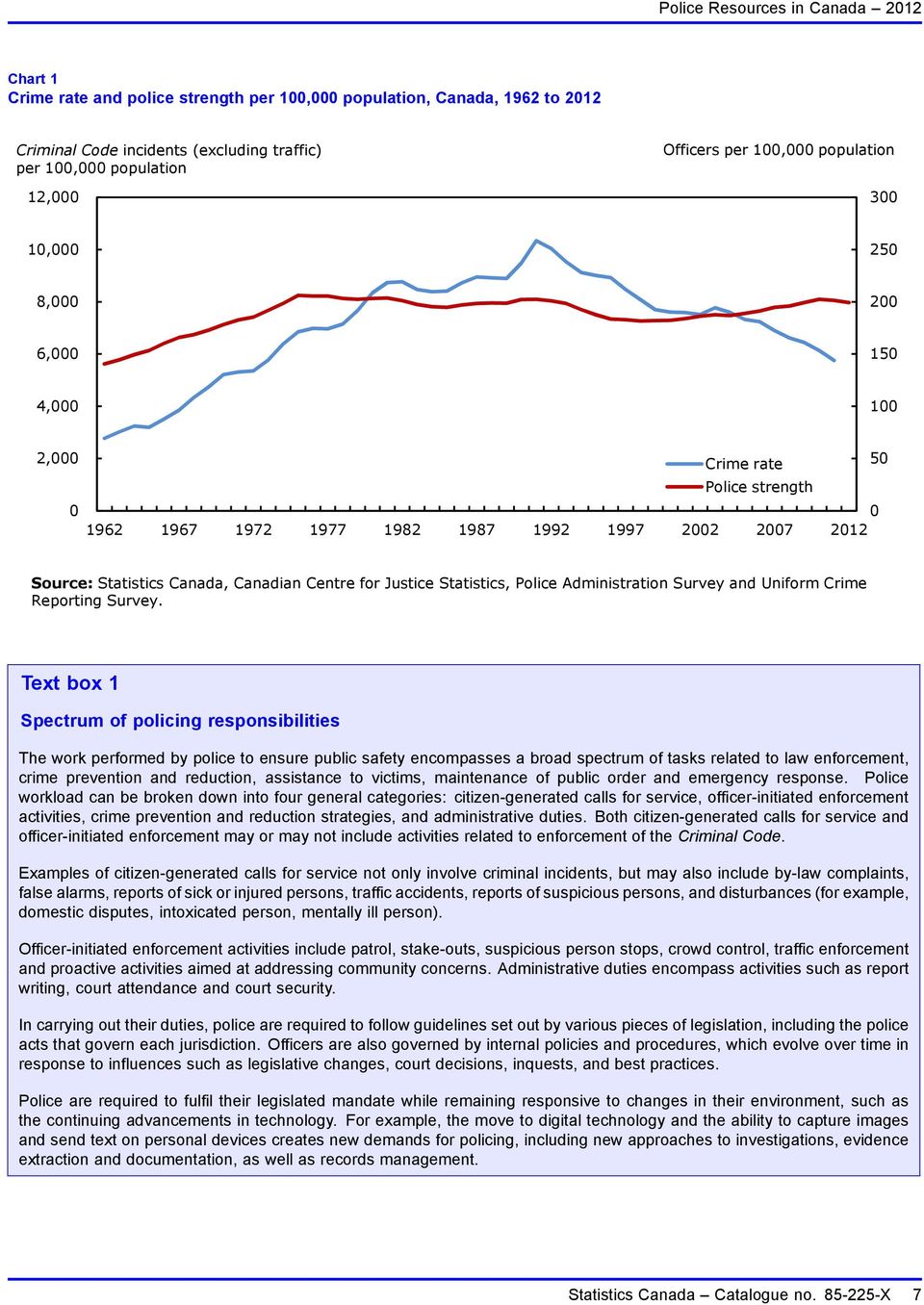
8 Resources in Canada, 2012 In Canada, information on police sonnel and expenditures is collected by Statistics Canada through the annual Administration Survey. Using data reported by each police service in Canada, this report provides details on police sonnel and expenditures at the national, provincial and municipal levels. For the first time, in 2012, a new Supplemental Survey was added to collect detailed information on police hirings, retirements, eligibility to retire and, where available, visible minority status. Data presented in this report represent two distinct time iods. Most of the information on police sonnel is based on a snapshot date of May 15, 2012, while data on hirings, departures and expenditures represent the calendar year ending December 31, (or March 31, 2012 for those police services oating on a fiscal year). The concept police strength is used throughout this report. strength refers to the number of police people in a given area (Canada, a province or territory, a Census Metropolitan Area or a police jurisdiction), and is used to enable comparisons over time and geography. Slight decline in police strength On May 15, 2012, there were 69,539 police in Canada, 115 more than in. Expressed as a rate, police strength declined slightly (-1.0%) from the previous year, to 199 population (Table 1). While police strength has been generally increasing since the late 1990s, the police-reported crime rate has continued to decline (Brennan, 2012) (Chart 1). In, the latest year for which data are available, both the volume and severity of police-reported crime decreased. The crime rate was 24% lower than in 2001 and was at its lowest point since 1972 (Brennan, 2012). Similarly, the Crime Severity Index (CSI) was at 77.6 in, 26% lower than a decade earlier and at the lowest point since data became available in The number of Criminal Code (excluding traffic) incidents police officer declined by 6% in. The ratio of 29 incidents officer was the lowest since Over the past decade, the number of incidents officer has decreased by 31%. 1. The Crime Severity Index (CSI) takes into account both the volume and the seriousness of crime. In the calculation of the CSI, each offence is assigned a weight, derived from average sentences handed down by criminal courts. The more serious the average sentence, the higher the weight for that offence. As a result, more serious offences have a greater impact on changes in the index. All Criminal Code offences, including traffic offences and other federal statute offences, are included in the CSI. 6 Statistics Canada Catalogue no X

9 Resources in Canada 2012 Chart 1 Crime rate and police strength population, Canada, 1962 to 2012 Criminal Code incidents (excluding traffic) population 12,000 Officers population , , , , ,000 Crime rate 50 strength Source: Statistics Canada, Canadian Centre for Justice Statistics, Administration Survey and Uniform Crime Reporting Survey. Text box 1 Spectrum of policing responsibilities The work formed by police to ensure public safety encompasses a broad spectrum of tasks related to law enforcement, crime prevention and reduction, assistance to victims, maintenance of public order and emergency response. workload can be broken down into four general categories: citizen-generated calls for service, officer-initiated enforcement activities, crime prevention and reduction strategies, and administrative duties. Both citizen-generated calls for service and officer-initiated enforcement may or may not include activities related to enforcement of the Criminal Code. Examples of citizen-generated calls for service not only involve criminal incidents, but may also include by-law complaints, false alarms, reports of sick or injured sons, traffic accidents, reports of suspicious sons, and disturbances (for example, domestic disputes, intoxicated son, mentally ill son). Officer-initiated enforcement activities include patrol, stake-outs, suspicious son stops, crowd control, traffic enforcement and proactive activities aimed at addressing community concerns. Administrative duties encompass activities such as report writing, court attendance and court security. In carrying out their duties, police are required to follow guidelines set out by various pieces of legislation, including the police acts that govern each jurisdiction. Officers are also governed by internal policies and procedures, which evolve over time in response to influences such as legislative changes, court decisions, inquests, and best practices. are required to fulfil their legislated mandate while remaining responsive to changes in their environment, such as the continuing advancements in technology. For example, the move to digital technology and the ability to capture images and send text on sonal devices creates new demands for policing, including new approaches to investigations, evidence extraction and documentation, as well as records management. Statistics Canada Catalogue no X 7
10 Resources in Canada 2012 In addition to the actual number of on staff on May 15, 2012, police services reported the number of positions they were authorized to fill during the year. 2 Thetermauthorizedstrengthisusedbypoliceservicestoreferto the number of positions available throughout the year based on their budget, whether or not those positions were actually filled on that day. Examining both the actual and authorized strength together provides a more complete understanding of police staffing throughout the year, as not all available positions are occupied on the May 15 survey snapshot date. Normal changes in staffing occurring throughout the year often result in higher authorized strength numbers as compared to actual police strength point-in-time numbers. In 2012, there were 71,855 authorized police officer positions in Canada, about 2,000 (3%) more than the actual May 15 number of active. Reasons for the difference may include who retired earlier in the year and who had not yet been replaced, or positions held for recruits planning to graduate later in the year. 3 Compared to, the number of authorized positions increased by 1.2%. Text box 2 strength in other countries The United Nations Office on Drugs and Crime (UNODC) compiles a biennial report comparing rates of police strength across a number of countries. While the most recent UNODC report was published in, some countries have released police sonnel data for 2012 via their national statistical offices. Among the eight countries that are included in the scope of the UNODC survey, Canada s police strength was similar to that of Japan and New Zealand, but well below Scotland, Australia, England and Wales and the United States (Text table 1). Since 2002, Canada s police strength has grown by 7%, an increase smaller than those recorded in some comparable countries. Over the same time iod, Finland, Australia, the United States and England and Wales reported decreases in their rates of police strength (Chart 2). Text table 1 population, selected countries Percent change 2002 to 2012 Scotland England and Wales United States Australia New Zealand Japan Canada Finland rate cent 1. Rates for 2012 are calculated using population statistics for. 2. Data shown for 2012 represent population statistics and officer counts. 3. Data shown for 2012 represent 2010 officer counts. 4. Data shown for 2012 represent population statistics and officer counts. Data for 2002 are not available. Source(s): Officer Quarterly Strength Statistics (Scotland); Home Office Statistical Bulletin (England and Wales); Federal Bureau of Investigation Uniform Crime Report (United States); Australian Institute of Criminology (Australia); Annual Report - New Zealand (New Zealand); National Agency (Japan); Statistics Canada, Canadian Centre for Justice Statistics, Administration Survey (Canada); of Finland (Finland). 2. The actual number of police refers to the number of manent, fully-sworn police of all ranks (or their full-time equivalents). This number also includes who are deployed to contract positions and who are not available for general policing duties in their community. on long-term leave who are not being paid by the police service s annual budget are excluded. 3. Positions counted under authorized strength are restricted to positions available to fully-sworn only. Positions occupied by cadets, recruits who have not yet graduated and trainees are counted elsewhere in the Administration Survey. 8 Statistics Canada Catalogue no X

11 Resources in Canada 2012 Chart 2 strength, selected countries, 2002 and 2012 population Canada England and Wales United States¹ Australia² country 1. Data shown for 2012 represent population statistics and officer counts. 2. Data shown for 2012 represent rates for Source: Statistics Canada, Canadian Centre for Justice Statistics, Administration Survey (Canada); Home Office Statistical Bulletin (England and Wales); Federal Bureau of Investigation Uniform Crime Report (United In addition to police, police services across Canada employ civilian sonnel such as dispatchers, clerks and by-law enforcement, as well as police recruits in training. On May 15, 2012, there were 28,220 civilian employees working alongside police, a slight increase of 78 employees from the previous year. The rate of civilian employees population remained virtually unchanged from, at 81 employees capita. In 2012, police services reported employing 2.5 for every one civilian worker, a ratio that has held steady since The ratio of to civilians has decreased substantially since the 1960s, when reported ratios were between 4.6 and 4.1 for every civilian staff member. This change has coincided with increased employment of civilian staff that may be responsible for work such as information technology support or forensic analysis. Manitoba records largest growth in police strength among provinces Most provinces and territories saw their rates of police strength decrease between and The largest declines were reported in Yukon (-4%), Nunavut (-4%), Saskatchewan (-2%) and British Columbia (-2%) (Table 2-1). Among the provinces and territories that recorded increases in police strength in 2012, the largest growth was seen in Manitoba (+3%) and the Northwest Territories (+3%). With this increase, Manitoba replaced Saskatchewan as the province with the highest rate of police strength. These provinces have recorded the highest rates of police strength among the provinces since As in past years, the provinces with the highest rates of police strength also reported the highest crime severity values in. More specifically, in, Manitoba and Saskatchewan reported the highest rates of population among the provinces as well as the highest Crime Severity Index (CSI) values (Table 2-2). However, both Manitoba and Saskatchewan recorded decreases in their CSI values since 2010 (-7% and -3%, respectively). Prince Edward Island and Alberta reported the fewest population. Statistics Canada Catalogue no X 9

12 Resources in Canada 2012 In 2012, Yukon, the Northwest Territories and Nunavut continued to report rates of police strength well above those recorded in the provinces (Chart 3). The CSI values recorded in the territories were also above those in the rest of the country, though each recorded a decrease in. Chart 3 strength, Canada, provinces and territories, 2012 population Canada (199) N.L. P.E.I. N.S. N.B. Que. Ont. Man. Sask. Alta. B.C. Yk. N.W.T. Nvt. Provinces Source: Statistics Canada, Canadian Centre for Justice Statistics, Administration Survey. strength decreases in New Brunswick census metropolitan areas strength decreased in the majority of Canada s census metropolitan areas (CMAs) in 2012 (Table 3-1). 4 The largest decreases in the rate were recorded in the New Brunswick CMAs of Moncton (-8%) and Saint John (-6%). With the recent decrease, Moncton became the CMA with the lowest rate of police strength. Prior to 2012, Kelowna had reported the lowest rate police strength among CMAs for several consecutive years. However, a number of CMAs exienced increases in their rates of police strength in While the largest increase was in Winnipeg (+6%), the increase was partially due to a change in the police service boundaries of one detachment oating within that CMA. Kitchener-Cambridge-Waterloo also recorded a notable increase (+5%). Winnipeg replaced Saint John in 2012 as the CMA with the highest rate of police strength (Chart 4). Saint John had reported the highest rate of police strength among CMAs since Those CMAs with the highest rates of police strength in 2012 were also among those with the highest crime severity values. 5 The three CMAs with the highest rates of police strength in 2012 Winnipeg, Thunder Bay and Regina ranked fourth, third and first, respectively, in terms of crime severity in A census metropolitan area (CMA) consists of one or more neighbouring municipalities situated around a central core. A CMA must have a total population of at least of which 50,000 or more live in the central core. To be included in the CMA, other adjacent municipalities must have a high degree of integration with the central core, as measured by commuting flows derived from census data. A CMA typically comprises more than one police service. For a list of police services included in each CMA, please see Appendix Many factors can influence police-reported crime statistics including: local police service policies, procedures and enforcement practices; changes in various demographic, social and economic factors; neighbourhood characteristics; technological advancements; legislative amendments; and public ception and attitudes. Comparisons across census metropolitan areas should be made with caution. 6. For information on police sonnel, Crime Severity Index values weighted clearance rates in Yellowknife and Whitehorse, please refer to Tables and of this report. 10 Statistics Canada Catalogue no X

13 Resources in Canada 2012 Chart 4 strength, census metropolitan areas, 2012 Census metropolitan area St. John's Halifax Moncton Saint John Saguenay Québec Sherbrooke Trois-Rivières Montréal Gatineau Ottawa Kingston Peterborough Toronto Hamilton St. Catharines-Niagara Kitchener-Cambridge-Waterloo Brantford Guelph London Windsor Barrie Greater Sudbury Thunder Bay Winnipeg Regina Saskatoon Calgary Edmonton Kelowna Abbotsford-Mission Vancouver Victoria population Source: Statistics Canada, Canadian Centre for Justice Statistics, Administration Survey. Statistics Canada Catalogue no X 11

14 Resources in Canada 2012 One in ten eligible for retirement The potential impact of retirements and other types of workforce mobility have become a concern for executives at many Canadian police services (Lewis, ; Royal Canadian Mounted, 2010). For the first time, information on hirings, departures and eligibility to retire among Canada s police was collected through the new Supplemental questionnaire to the Administration Survey. Based on information on workforce mobility during, 7 the survey measured the number of positions left vacant as well as the number of positions filled by incoming police. Across Canada, the majority of police who left their police service in did so to take their retirement, with just under 1,300 or 65% of departing retiring (Table 4). 8 Officers departing for reasons of retirement made up approximately 2% of the police employed by the services reporting this information. Almost half (49%) of all who retired had between 30 and 35 years of service, while over one-quarter (26%) had over 35 years of service. Among the provinces, the proportion of departing police who left for reasons of retirement was highest in Nova Scotia (75%) and Prince Edward Island (73%). Meanwhile, reporting police services in Alberta and Manitoba recorded the highest centages of leaving their services for reasons other than retirement (50% and 49%, respectively). The number of police who took their retirement was considerably smaller than the number of who were eligible to do so. 9 A total of 7,459 were eligible for retirement with full pension in, representing about one in ten (11%) police across Canada. 10 Over half (52%) of who were eligible to retire in had over 30 years of service in policing (Table 5). 11 While little variation was noted among provinces with respect to eligibility to retire, differences exist among police services. For example, the Royal Canadian Mounted reported that 19% of their were eligible to retire in, while the average among non-rcmp municipal police services was 8% (Table 6). In large part, these variations were due to the number of senior on staff, as well as specific characteristics of various collective agreements. Across Canada, police aged 60 years and over accounted for less than 1% of all police, while those between 50 and 60 years of age represented 15% (Chart 5). The largest cohorts were aged 30 to 40 years (35%) and those aged 40 to 50 years (35%). Officers aged between 20 and 30 years represented 14% of all, while less than 1% of were under 20 years of age. 12 Among who were hired by police services during and for whom prior policing exience was known, the majority (80%) were recruit graduates. 13,14 Officers who had exience with another police service made up the remaining 20%. 7. Data on departures represent departures during the calendar year or the /2012 fiscal year, depending on how individual police services chose to report the information. 8. Information on departures due to retirement is based on data collected from police services employing 98% of police across Canada. These police services were able to report their total departures, including departure for reason of retirement, but may not have been able to report details for reasons for departure other than retirement. 9. Information on eligibility to retire is based on data collected from police services employing 97% of police across Canada. 10. This number may or may not include who did retire in (1,310 ). 11. While most police service collective agreements set the minimum years of service required for retirement with full pension at 25 years, other considerations may sometimes apply. For instance, many agreements require a minimum age in addition to minimum years of service, while others use a formula such as the 80 factor, where years of service plus age must equal Information of age of police is based on data collected from police services employing 99% of police across Canada. Information on age was not available for 4% of these. 13. Information on hirings was unavailable for 1% of police In addition, police services employing 36% of were unable to provide the level of exience (exienced police or recruit graduate) of their at time of hire. These police services are excluded from the centage calculations. 14. Recruit graduates include senior, non-commissioned and constables who achieved the status of a fully-sworn officer during the calendar or fiscal year prior to the year for which data are shown. 12 Statistics Canada Catalogue no X

15 Resources in Canada 2012 Chart 5 Age distribution of police, Canada, cent of police Under to to to to to to to to and over Note: Information on age of police is based on data collected from police services employing 99% of police across Canada. Information on age was not available for 4% of these and these are Source: Statistics Canada, Canadian Centre for Justice Statistics, Administration Survey Supplemental. Growth in number of female continues For the second consecutive year, the number of female in police services across Canada increased, while the number of male decreased. There were 234 more female in 2012 than in, and 119 fewer male (Table 7). The increasing numbers of women in policing are part of a longer-term trend evident since the 1960s. Over the past decade alone, the proportion of women has increased from 15% of all in 2002 to 20% in There are also more women among the higher ranks of policing. The proportion of women serving as senior and non-commissioned has increased steadily, reaching 16% by 2012, while the proportion of female constables has remained relatively stable since 2007 at between 21% and 22% of all constables (Table 8) (Chart 6). The provinces with the highest proportions of female continued to be Quebec (24%) and British Columbia (21%). In contrast, Manitoba (15%) and New Brunswick (16%) continued to report the lowest proportions among the provinces. As in past years, the proportion of female was lowest in the territories (Table 9). Statistics Canada Catalogue no X 13

16 Resources in Canada 2012 Chart 6 Female as a centage of total police, Canada, 1986 to 2012 cent Constables Non-commissioned Senior Source: Statistics Canada, Canadian Centre for Justice Statistics, Administration Survey. 14 Statistics Canada Catalogue no X

17 Resources in Canada 2012 Text box 3 self-report as Aboriginal sons or visible minorities Data from the 2006 Census of Population show that Canada s ethnocultural diversity is steadily increasing (Statistics Canada, 2008). In response, some police services are looking to staff their ranks with who are representative of the communities they serve (Royal Canadian Mounted, 2010). The 2012 Supplemental questionnaire to the Administration Survey asked police services to provide information on the visible minority identity of their. 15 While the Canadian Human Rights Commission mits employers, including police services, to collect data on whether their employees are Aboriginal sons or members of visible minority groups, some police services in Canada choose not to collect this information (Canadian Human Rights Commission, 2007). Those that do collect these data do so on a strictly voluntary basis meaning can choose to disclose to their employer that they are Aboriginal or a visible minority, but arenotcompelledtodoso. In 2012, whether an officer was an Aboriginal son, a member of a visible minority group or Caucasian was unknown for 33% of police, as either the police service or the individual officer chose not to report the information. Information was collected for the more than 46,000 police who voluntarily self-identified as an Aboriginal son, a member of a visible minority group or Caucasian. 16 Of these, 87% reported being Caucasian in race or white in colour. A further 9% reported being a member of a non-aboriginal visible minority group and 5% reported being an Aboriginal son. 17 Some variation was seen with respect to self-reported visible minority status for exienced versus recruit graduates. A larger proportion of exienced reported being members of a visible minority than did recruit graduates: among exienced, 11% reported being a visible minority, compared to 4% of recruit graduates. The proportions of exienced and recruit graduates who self-identified as Aboriginal sons showed less variation, with 4% of recruit graduates and 3% of exienced self-identifying as Aboriginal sons. Weighted clearance rate stable in Clearance rates are one measure of police formance. A criminal incident is said to be cleared when a police investigation leads to the identification of an accused son against whom charges can be laid or recommended by police. Incidents can be cleared by the laying of a charge or by other means (e.g., through diversionary programs and other extrajudicial measures). The clearance rate represents the proportion of all crimes that were successfully cleared. Factors unrelated to the effectiveness of police can impact a police service s clearance rate. For instance, minor thefts and mischief are crimes that are more numerous and more difficult to solve than serious, violent crimes; thus, apoliceservice with a higher proportion of these less serious crimes may have a lower clearance rate. For this reason, the weighted clearance rate was developed to provide a more meaningful picture of crime solved by police services. Using concepts similar to the Crime Severity Index, the weighted clearance rate assigns values to crimes according to their seriousness, with more serious crimes being given a higher statistical weight. 18 However, comparisons between police services on the basis of weighted clearance rates should be made with caution, due to factors such as internal policies and procedures, and resources. 15. Definitions related to visible minority status found on the Supplemental to the Administration Survey questionnaire are based on those used by the Census and the Employment Equity Act. Aboriginal peoples refers to whether the police officer is an Aboriginal son of Canada, that is, First Nations (North American Indian), Métis or Inuit. Visible minority refers to sons, other than Aboriginal peoples, who are non-caucasian in race or non-white in colour. Non visible minority populations are sons who are Caucasian in race or white in colour. 16. Though the definitions for Aboriginal son and visible minority specify that Aboriginal people be counted separately from members of visible minority groups, it is possible that some individuals were counted in both categories. The number of individuals counted in both categories is estimated to be less than 1%. 17. Percentages add to more than 100 due to rounding. 18. Applying this concept to clearance rates means that, for example, the clearance of a homicide, robbery or break and enter receives a higher weight than the clearance of less serious offences such as minor theft, mischief and disturbing the peace. For more information on the Crime Severity Index, see footnote 1. Statistics Canada Catalogue no X 15
18 Resources in Canada 2012 Canada recorded a national weighted clearance rate of 39.4% in (the most recent year for which data are available), similar to the previous year. The weighted clearance rate has generally been increasing since 1998 when it stood at 34.1%. Among municipal police services oating in areas with populations of or more, the highest weighted clearance rates in were reported by Durham Regional (49%), Kingston (47%), London (47%) and Trois-Rivières (46%). Expenditures by Canadian police services totalled $12.9 billion in service oating expenditures totalled $12.9 billion in. After adjusting for inflation, constant dollar spending declined slightly (-0.7%) from the previous year. This marked the first time since 1996 that constant dollar spending on policing has decreased (Table 10). The decrease at the Canada level was driven by the conclusion of RCMP expenditures on national special events such as the 2010 Olympic Games and G8/G20 Summits. After controlling for inflation, Yukon (-2.5%) and Nova Scotia (-1.7%) were the only jurisdictions to report a decrease in spending. Spending increased the most in Alberta (+5.3%) and Saskatchewan (+4.9%) (Table 11). Summary Canada s rate of police strength, defined as the number of police population, decreased slightly in Most provinces and territories also reported decreases in police strength. strength in Canada has generally been increasing since the late 1990s, while the volume and severity of crime has continued to decline. Most police who left their police service did so to take their retirement. While 1 in 10 police were eligible to retire in, comparatively few actually did so. The trend towards more women in policing continued in Female grew in number faster than their male counterparts, especially within the higher ranks. Expenditures on policing totalled $12.9 billion in, a decrease of 0.7% from the previous year. This was the first constant-dollar spending decrease recorded since References Brennan, Shannon "-reported crime statistics in Canada,." Juristat. Statistics Canada Catalogue no X. (accessed October 4, 2012). Canadian Human Rights Commission A Guide to Screening and Selection in Employment. Minister of Public Works and Government Services. Catalogue no. HR21-21/2007E-PDF. (accessed October 10, 2012). Lewis, Commissioner Chris D.. "Effective recruitment, crime prevention and leadership development are OPP priorities." Canadian Chief Magazine. Winter. (accessed October 9, 2012). Royal Canadian Mounted National Recruitment Program Audit: Final Report. (accessed October 9, 2012). Statistics Canada Canada s Ethnocultural Mosaic, 2006 Census. Statistics Canada Catalogue no X. (accessed October 10, 2012). 16 Statistics Canada Catalogue no X

19 Related products Selected CANSIM tables from Statistics Canada Trends in police sonnel for Canada, provinces and territories, annual Selected surveys from Statistics Canada 3301 Administration Survey Selected summary tables from Statistics Canada, by province and territory Justice spending Statistics Canada Catalogue no X 17

20 Statistical tables

21 Resources in Canada 2012 Table 1 Trends in police sonnel and expenditures, Canada, 1962 to 2012 Year Total 1 Civilian sonnel 2 Per population Percentage change in rate Total Per population Percentage change in rate Total sonnel to civilians Total expenditures 3 Criminal Code incidents 4 Incidents officer Weighted clearance rate 5 number rate cent number rate cent number ratio dollars (thousands) number rate , , , , , , , , , , , , , , , , , , , , , , , , , , , , , , , , , , , ,110, , , , ,166, , , , ,189, , , , ,298, , , , ,456, , , , ,585, , , , ,637, , , , ,654, , , , ,714, , , , ,855, , , , ,045, , , , ,168, , , , ,203, , , , ,148, , , , ,147, , , , ,174, , , , ,771,205 2,277, , , , ,027,809 2,368, , , , ,389,414 2,390, , , , ,684,760 2,425, , , , ,247,646 2,627, , , , ,426,887 2,898, , , , ,716,833 2,847, , , , ,790,165 2,735, , , , ,783,656 2,646, , , , ,808,607 2,639, , , , ,856,055 2,644, , , , ,989,022 2,534, , , , ,209,756 2,440, , , , ,395,380 2,339, , , , ,798,531 2,334, , , , ,269,977 2,353, , , , ,827,195 2,355, , , , ,324,176 2,458, , , , ,758,213 2,427, , , , ,281,879 2,361, , , , ,877,071 2,359, r 64, , , ,544,771 2,271, r 65, , , ,449,955 2,204, r 67, , , ,314,197 2,172, r 69, , , ,651,596 2,094, r 69, , , ,931,555 1,984, , , , Represents the actual number of manent, fully-sworn police of all ranks (or their full-time equivalents). This number also includes who are deployed to contract positions and who are not available for general policing duties in their community. on long-term leave who are not being paid by the police service s annual budget are excluded. 2. Counts include civilian and other sonnel (e.g., clerical, dispatch, management, cadets, special constables, security, school crossing guards, by-law enforcement ) on the police department s payroll as of May Expenditures amounts are shown in current dollars, which are not adjusted for inflation or deflation. Total oating expenditures include salaries, wages, benefits, and other oating expenses that are paid from the police service budget, as well as benefits paid from other government sources. Revenues, recoveries, and those costs that fall under a police service s capital expenditures are excluded. 4. Data extracted from the Uniform Crime Reporting Survey, Canadian Centre for Justice Statistics. Excludes Criminal Code traffic incidents. 5. Criminal incidents can either be cleared by charge or cleared otherwise (for example, through diversionary programs and other extrajudicial means in instances where a charge could otherwise be laid). The weighted clearance rate is based on the same principle used to create the police-reported Crime Severity Index, whereby more serious offences are assigned a higher weight than less serious offences. Applying this concept to clearance rates means that, for example, the clearance of a homicide, robbery or break and enter receives a higher weight than the clearance of less serious offences such as minor theft, mischief and disturbing the peace. Note(s): A new version of the Administration Survey was implemented in To maintain historical continuity, figures prior to 1986 have been adjusted. Source(s): Statistics Canada, Canadian Centre for Justice Statistics, Administration Survey and Uniform Crime Reporting Survey. Statistics Canada Catalogue no X 19
22 Resources in Canada 2012 Table 2-1 and selected crime statistics by level of policing, by province and territory, 2012 Province or territory services 2 Royal Canadian Mounted Total population 1 Municipal Provincial Municipal Provincial Federal Other 3 police population number rate cent change to 2012 cent change 2002 to 2012 Newfoundland and Labrador 4 512, Prince Edward Island 146, Nova Scotia 948, , New Brunswick 755, , Quebec 8,054,756 9,394 5, , Ontario 5 13,505,900 20,539 4,266 1, , Manitoba 1,267,003 1, , Saskatchewan 6 1,079,958 1, , Alberta 3,873,745 3,977 1,060 1, , British Columbia 4,622,573 2,617 3,472 1, , Yukon 7 36, Northwest Territories 7 43, Nunavut 7 33, Provincial and territorial total 34,880,491 40,636 10,256 5,117 6,830 4, , Royal Canadian Mounted Headquarters and Training Academy 1,681 1,681 Canada 34,880,491 40,636 10,256 5,117 6,830 4,447 2,253 69, Populations are based on preliminary postcensal estimates for 2012, Statistics Canada. 2. Excludes the Royal Canadian Mounted. 3. Includes National Services and Departmental and Divisional Administration. 4. Newfoundland and Labrador does not have any municipal police services. The Royal Newfoundland Constabulary (a provincial police service) provides policing to most of the larger municipalities. 5. Excludes sonnel from Royal Canadian Mounted Headquarters. The Ontario Provincial deploy 1,955 to provide municipal policing services under contract and these are included as municipal, not provincial policing. 6. Excludes sonnel from Royal Canadian Mounted Training Academy. 7. Yukon, Northwest Territories and Nunavut do not have any municipal police forces. The Royal Canadian Mounted is responsible for providing policing to the territories. Note(s): Represents the actual number of manent, fully-sworn police of all ranks (or their full-time equivalents) as of May 15, This number also includes who are deployed to contract positions and who are not available for general policing duties in their community. on long-term leave who are not being paid by the police service s annual budget are excluded. Source(s): Statistics Canada, Canadian Centre for Justice Statistics, Administration Survey. 20 Statistics Canada Catalogue no X
23 Resources in Canada 2012 Table 2-2 and selected crime statistics Selected crime statistics, by province and territory, Province or territory Incidents officer 1,2 Weighted clearance rate 3 Crime Severity Index 4 number cent rate Newfoundland and Labrador Prince Edward Island Nova Scotia New Brunswick Quebec Ontario Manitoba Saskatchewan Alberta British Columbia Yukon Northwest Territories Nunavut Canada Includes police-reported incidents excluding traffic. 2. Represents the actual number of manent, fully-sworn police of all ranks (or their full-time equivalents) as of May 15,. This number also includes who are deployed to contract positions and who are not available for general policing duties in their community. on long-term leave who are not being paid by the police service s annual budget are excluded. 3. Criminal incidents can either be cleared by charge or cleared otherwise (for example, through diversionary programs and other extrajudicial means in instances where a charge could otherwise be laid). The weighted clearance rate is based on the same principle used to create the police-reported Crime Severity Index, whereby more serious offences are assigned a higher weight than less serious offences. Applying this concept to clearance rates means that, for example, the clearance of a homicide, robbery or break and enter receives a higher weight than the clearance of less serious offences such as minor theft, mischief and disturbing the peace. 4. The Crime Severity Index takes into account both the volume and the seriousness of police-reported crime. In the calculation of the Crime Severity Index, each offence is assigned a weight, derived from average sentences handed down by criminal courts. The more serious the average sentence, the higher the weight for that offence. As a result, more serious offences have a greater impact on changes in the index. All police-reported Criminal Code offences, including traffic offences and other federal statute offences, are included in the Crime Severity Index. 5. Includes Royal Canadian Mounted Headquarters and Training Academy. Source(s): Statistics Canada, Canadian Centre for Justice Statistics, Administration Survey and Uniform Crime Reporting Survey. Statistics Canada Catalogue no X 21
24 Resources in Canada 2012 Table 3-1 and crime rates in census metropolitan areas, 2012 Census metropolitan area population number of police police population 3 Percentage change in rate of to Crime Severity Index 4 number rate cent rate Winnipeg 5,6 767,277 1, Thunder Bay 119, Regina 222, Saint John 103, Saskatoon 277, St. John s 188, Montréal 3,924,554 6, Windsor 331, Brantford 140, Toronto 5,783,398 10, Halifax 5 408, St. Catharines-Niagara 445, Calgary 1,270,927 2, Vancouver 5 2,424,544 3, Edmonton 1,198,397 1, Greater Sudbury 162, Barrie 200, London 499, Guelph 126, Peterborough 123, Hamilton 737,330 1, Victoria 362, Kitchener-Cambridge-Waterloo 530, Ottawa 7 946,835 1, Abbotsford-Mission 177, Kingston 161, Gatineau 8 311, Sherbrooke 190, Québec 759, Trois-Rivières 149, Saguenay 145, Kelowna 182, Moncton 138, Populations are based on preliminary postcensal estimates for, Statistics Canada. Populations are adjusted to follow policing boundaries. Census metropolitan area populations for 2012 are not yet available. 2. Represents the actual number of manent, fully-sworn police of all ranks (or their full-time equivalents) as of May 15, This number also includes who are deployed to contract positions and who are not available for general policing duties in their community. on long-term leave who are not being paid by the police service s annual budget are excluded. 3. Based on the number of police in 2012 and census metropolitan area populations for. Census metropolitan area populations for 2012 are not yet available. 4. The Crime Severity Index takes into account both the volume and the seriousness of police-reported crime. In the calculation of the Crime Severity Index, each offence is assigned a weight, derived from average sentences handed down by criminal courts. The more serious the average sentence, the higher the weight for that offence. As a result, more serious offences have a greater impact on changes in the index. All police-reported Criminal Code offences, including traffic offences and other federal statute offences, are included in the Crime Severity Index. 5. officer counts include deployed to contract positions (e.g. airport, port, United Nations Mission). Includes the South Coast British Columbia Transit Authority and the Lower Mainland Integrated Teams. 6. As of 2012, the Royal Canadian Mounted detachment of Selkirk, Manitoba (rural) is no longer included in the Census Metropolitan Area of Winnipeg, resulting in a higher rate of police strength than in previous years. 7. Represents the Ontario portion of the Ottawa-Gatineau census metropolitan area. 8. Represents the Quebec portion of the Ottawa-Gatineau census metropolitan area. Note(s): A census metropolitan area consists of one or more neighbouring municipalities situated around a central core. A census metropolitan area must have a total population of at least of which 50,000 or more live in the central core. To be included in the census metropolitan area, other adjacent municipalities must have a high degree of integration with the central core, as measured by commuting flows derived from census data. A census metropolitan area typically comprises more than one police service. For a list of police services included in each census metropolitan area, please see Appendix 1. The numbers in table 3-1 do not agree with those in table 3-2 (which report data at the level of individual police services) because most census metropolitan areas comprise more than one police service. The census metropolitan area of Oshawa is not included due to incongruities between policing jurisdiction and census metropolitan area boundaries. Crimes investigated by Royal Canadian Mounted federal sonnel within census metropolitan areas are included; however, police officer counts do not include Royal Canadian Mounted federal police. While table 3-1 may be used to compare major metropolitan areas, table 3-2 may be used to compare major police services in Canada. Source(s): Statistics Canada, Canadian Centre for Justice Statistics, Administration Survey and Uniform Crime Reporting Survey. 22 Statistics Canada Catalogue no X
25 Resources in Canada 2012 Table 3-2 and crime rates in the 30 largest municipal police services, 2012 service 2012 population 1 authorized strength 2 Actual strength number of police 2012 police Crime Severity Index 5 Toronto census metropolitan area police services 6 Toronto 2,743,738 5,574 5, Peel Regional 1,298,905 1,937 1, York Regional 1,069,409 1,495 1, Montréal census metropolitanareapoliceservices6 Montréal 1,969,242 4,597 4, Longueuil 405, Laval 404, Vancouver census metropolitan area police services 6 Vancouver 7 669,867 1,327 1, Surrey, Royal Canadian Mounted 8 450, Burnaby, Royal Canadian Mounted 233, Richmond, Royal Canadian Mounted 7 199, Other large police services Halifax Regional 9 228, Winnipeg 7 691,778 1,441 1, Windsor 222, Regina 201, Saskatoon 233, Edmonton 844,474 1,647 1, St. John s, Royal Newfoundland Constabulary 188, Calgary 1,159,446 1,960 1, Greater Sudbury 162, Niagara Regional 445, London 383, Hamilton 540, Gatineau 261, Durham Regional , Waterloo Regional 530, Ottawa 909,862 1,363 1, Québec 553, Sherbrooke Regional 158, Halton Regional , Richelieu-Saint-Laurent 191, number rate 1. Populations are based on preliminary postcensal estimates for, Statistics Canada. Populations are adjusted to follow policing boundaries. Populations for 2012 are not yet available. 2. Represents the number of fully sworn police the police department was allowed to employ during the calendar or fiscal year. 3. Represents the actual number of manent, fully-sworn police of all ranks (or their full-time equivalents) as of May 15, This number also includes who are deployed to contract positions and who are not available for general policing duties in their community. on long-term leave who are not being paid by the police service s annual budget are excluded. 4. Based on the number of police in 2012 and populations for. Populations are adjusted to follow policing boundaries. Populations for 2012 are not yet available. 5. The Crime Severity Index takes into account both the volume and the seriousness of police-reported crime. In the calculation of the Crime Severity Index, each offence is assigned a weight, derived from average sentences handed down by criminal courts. The more serious the average sentence, the higher the weight for that offence. As a result, more serious offences have a greater impact on changes in the index. All police-reported Criminal Code offences, including traffic offences and other federal statute offences, are included in the Crime Severity Index. 6. The police services listed under the Toronto, Montréal and Vancouver census metropolitan areas do not represent all the police services in these census metropolitan areas. 7. officer counts include deployed to contract positions (e.g. airport, port, United Nation mission). 8. Included in this total are the positions that the Surrey detachment of the Royal Canadian Mounted authorizes for the Lower Mainland Integrated Teams. 9. Crime statistics include the Royal Canadian Mounted Halifax District Detachment. 10. Note that 62% of the crime handled by Halton Regional, and 30% of the crime handled by Durham Regional fall within Toronto census metropolitan area boundaries. Note(s): The numbers in table 3-1 do not agree with those in table 3-2 (which report data at the level of individual police services) because most census metropolitan areas comprise more than one police service. The census metropolitan area of Oshawa is not included due to incongruities between policing jurisdiction and census metropolitan area boundaries. Crimes investigated by Royal Canadian Mounted federal sonnel within census metropolitan areas are included; however police officer counts do not include Royal Canadian Mounted federal police. While table 3-1 may be used to compare major metropolitan areas, table 3-2 may be used to compare major police services in Canada. Source(s): Statistics Canada, Canadian Centre for Justice Statistics, Administration Survey and Uniform Crime Reporting Survey. Statistics Canada Catalogue no X 23
26 Resources in Canada 2012 Table 4 Reported hirings and departures of police, Canada, provinces and territories, /2012 Province or territory Total Hirings 1 Departures 2 Exienced police 3 Recruit Total Retirements Other graduates 4 Net gain or loss: hirings and departures eligible to retire 5 number cent number cent number cent Newfoundland and Labrador Prince Edward Island Nova Scotia New Brunswick Quebec Ontario Manitoba Saskatchewan Alberta British Columbia Yukon x x Northwest Territories x x Nunavut Provincial and territorial total 7 2, , Royal Canadian Mounted Headquarters and Training Academy 1 x x Canada 7 2, , Information on hirings was not available for police services employing 1% of across Canada. In addition, police services employing 36% of were unable to provide the level of exience (exienced police or recruit graduate) of their at time of hire. These police services are excluded from the centage calculations. 2. Information on reason for departure was not available for police services employing 2% of across Canada. These police services are excluded from the centage calculations. 3. Includes senior, non-commissioned and constables who achieved the status of a fully-sworn officer prior to the calendar or fiscal year for which data are shown. 4. Includes paid police who achieved the status of fully-sworn police officer during the calendar or fiscal year prior to the year for which data are shown. 5. Information on eligibility to retire was not available for police services employing 3% of police across Canada. These police services are excluded from the centage calculations. 6. In 2012, 43% of in Newfoundland and Labrador were members of the Royal Newfoundland Constabulary. The Royal Newfoundland Constabulary did not report data on hirings, departures and eligibility of to retire for /2012. Therefore, hirings and departures data for Newfoundland and Labrador are not shown. 7. Excludes Newfoundland and Labrador. Note(s): Represents hirings, departures and eligibility to retire during the calendar or /2012 fiscal year. The cent of eligible to retire is calculated using these data, along with the number of fully sworn employed on May 15, Source(s): Statistics Canada, Canadian Centre for Justice Statistics, Administration Survey and Supplemental. 24 Statistics Canada Catalogue no X
27 Resources in Canada 2012 Table 5 Hirings and departures of police by overall years of service, Canada, /2012 Overall years of service Total Hirings 1 Departures 2 Exienced police 3 Recruit Total Retirements Other graduates 4 eligible to retire 5 number cent number cent Less than 5 years 1, to less than 10 years to less than 15 years to less than 20 years to less than 25 years to less than 30 years to less than 35 years years and over Information not available 0 15 Total 6 2, , Information on hirings was not available for police services employing 1% of across Canada. In addition, police services employing 36% of were unable to provide the years of service of their at time of hire. These are excluded from centage calculations. 2. Information on reason for departure was not available for police services employing 2% of across Canada. These police services are excluded from the centage calculations. 3. Includes senior, non-commissioned and constables who achieved the status of a fully-sworn officer prior to the calendar or fiscal year for which data are shown. 4. Includes paid police who achieved the status of fully-sworn police officer during the calendar or fiscal year prior to the year for which data are shown. 5. Information on eligibility to retire was not available for police services employing 3% of police across Canada. These police services are excluded from the centage calculations. 6. Excludes Newfoundland and Labrador. Note(s): Represents hirings, departures and eligibility to retire during the calendar or /2012 fiscal year. The cent of eligible to retire is calculated using these data, along with the number of fully sworn employed on May 15, Totals may not add to 100% due to rounding. Source(s): Statistics Canada, Canadian Centre for Justice Statistics, Administration Survey and Supplemental. Statistics Canada Catalogue no X 25
28 Resources in Canada 2012 Table 6 Hirings and departures of police at the largest police services, Canada, /2012 services Total Hirings 1 Departures 2 Exienced police 3 Recruit Total Retirements Other graduates 4 Net gain or loss: hirings and departures eligible to retire 5 number cent number cent number cent National/provincial police services 6 Ontario Provincial Royal Canadian Mounted Royal Newfoundland Constabulary Sûreté du Québec Municipal police services Toronto census metropolitan area police services Toronto Peel Regional York Regional Montréal census metropolitan area police services Montréal x x Longueuil 1 x x Laval 13 x x Vancouver census metropolitan area police services Vancouver 7 x x Surrey, Royal Canadian Mounted Burnaby, Royal Canadian Mounted Richmond, Royal Canadian Mounted Other large police services Halifax Regional 20 x x Winnipeg Windsor 8 x x Regina 8 x x Saskatoon Edmonton St. John s, Royal Newfoundland Constabulary Calgary Greater Sudbury Niagara Regional 3 x x 16 x x London 26 x x Hamilton Gatineau Durham Regional Waterloo Regional Ottawa Québec Sherbrooke Regional Halton Regional Richelieu-Saint-Laurent Information on hirings was not available for police services employing 1% of across Canada. In addition, police services employing 36% of were unable to provide the level of exience (exienced police or recruit graduate) of their at time of hire. These police services are excluded from the centage calculations. 2. Information on reason for departure was not available for police services employing 2% of across Canada. These police services are excluded from the centage calculations. 3. Includes senior, non-commissioned and constables who achieved the status of a fully-sworn officer prior to the calendar or fiscal year for which data are shown. 4. Includes paid police who achieved the status of fully-sworn police officer during the calendar or fiscal year prior to the year for which data are shown. 5. Information on eligibility to retire was not available for police services employing 3% of police across Canada. These police services are excluded from the centage calculations. 6. Includes municipal contracts. 7. This police service did not report data on hirings, departures and eligibility of to retire for /2012. Note(s): Represents hirings, departures and eligibility to retire during the calendar or /2012 fiscal year. The cent of eligible to retire is calculated using these data, along with the number of fully sworn employed on May 15, Source(s): Statistics Canada, Canadian Centre for Justice Statistics, Administration Survey and Supplemental. 26 Statistics Canada Catalogue no X
29 Resources in Canada 2012 Table 7 by sex, Canada, selected years Year Male Female Total number cent number cent number , , , , , , , , , , , , , , , , , , , , , , , ,461 r 55, , , , , ,539 Source(s): Statistics Canada, Canadian Centre for Justice Statistics, Administration Survey. Table 8 Male and female police by rank, Canada, 1986 to 2012 Year Senior 1 Non-commissioned 2 Constables Male Female Male Female Male Female r cent 1. Includes sonnel who have obtained senior officer status, normally at the rank of lieutenant or higher, such as chiefs, deputy chiefs, staff suintendents, suintendents, staff inspectors, inspectors, lieutenants, and other equivalent ranks. 2. Includes sonnel between the rank of constable and lieutenant, such as staff-sergeants, sergeants, detective-sergeants, corporals and all equivalent ranks. Note(s): Prior to 1986, data on the rank of police was not available. Represents the actual number of manent, fully-sworn police (or their full-time equivalents) as of May 15, This number also includes who are deployed to contract positions and who are not available for general policing duties in their community. on long-term leave who are not being paid by the police service s annual budget are excluded. Source(s): Statistics Canada, Canadian Centre for Justice Statistics, Administration Survey. Statistics Canada Catalogue no X 27
30 Resources in Canada 2012 Table 9 by sex, provinces and territories, 2012 Province or territory Male Female Total number cent number cent number Newfoundland and Labrador Prince Edward Island Nova Scotia 1, ,934 New Brunswick 1, ,364 Quebec 12, , ,992 Ontario 21, , ,274 Manitoba 2, ,706 Saskatchewan 1, ,298 Alberta 5, , ,787 British Columbia 6, , ,887 Yukon Northwest Territories Nunavut Provincial and territorial total 54, , ,858 Royal Canadian Mounted Headquarters and Training Academy 1, ,681 Canada 55, , ,539 Note(s): Represents the actual number of manent, fully-sworn police of all ranks (or their full-time equivalents) as of May 15, This number also includes who are deployed to contract positions and who are not available for general policing duties in their community. on long-term leave who are not being paid by the police service s annual budget are excluded. Source(s): Statistics Canada, Canadian Centre for Justice Statistics, Administration Survey. 28 Statistics Canada Catalogue no X
31 Resources in Canada 2012 Table 10 Current and constant dollar expenditures on policing, Canada, 1985 to Year Total expenditures 3 Current dollars 1 Constant dollars 2 Percentage change from previous year Per capita cost Total expenditures 3 Percentage change from previous year Per capita cost 4 thousands of dollars cent dollars thousands of dollars cent dollars ,542, ,622, ,771, ,748, ,027, ,880, ,389, ,164, ,684, ,263, ,247, ,693, ,426, ,554, ,716, ,805, ,790, ,764, ,783, ,748, ,808, ,630, ,856, ,587, ,989, ,625, ,209, ,801, ,395, ,884, ,798, ,126, ,269, ,433, ,827, ,827, ,324, ,097, ,758, ,365, ,281, ,674, ,877, ,053, r 10,544, ,457, r 11,449, ,035, r 12,314, ,764, r 12,651, ,859, ,931, ,785, Dollars which express the cost of items in terms of the year in which the expenditure occurs. 2. Dollars of a particular base year, which are adjusted (by inflation or deflation) to show changes in the purchasing power of the dollar. The Consumer Price Index was used to calculate constant dollars over a base year of 2002 (2002=100). Note that historical constant dollar data are revised each year as the base year for calculation changes iodically. 3. Total oating expenditures include salaries, wages, benefits, and other oating expenses that are paid from the police force budget, as well as benefits paid from other government sources. Revenues, recoveries, and those costs that fall under a police service s capital expenditures are excluded. 4. Per capita costs are calculated using populations statistics based on preliminary postcensal estimates for, Statistics Canada, Demography Division. Source(s): Statistics Canada, Consumer Price Index and Canadian Centre for Justice Statistics, Administration Survey. Statistics Canada Catalogue no X 29
32 Resources in Canada 2012 Table 11 Total expenditures on policing, Province or territory Municipal 1 Provincial 1 Total 2 Change from previous year 3 Federal 4 Expenditures total 5 Change from previous year 3 thousands of dollars cent thousands of dollars cent Newfoundland and Labrador 6 114, , , , Prince Edward Island 12,013 13,739 25, ,272 32, Nova Scotia 125,274 99, , , , New Brunswick 89,522 69, , , , Quebec 1,466, ,406 2,390, ,390, Ontario 3,577, ,499 4,326, ,326, Manitoba 243, , , , , Saskatchewan 7 159, , , , , Alberta 870, ,396 1,101, ,746 1,224, British Columbia 898, ,812 1,224, ,002 1,434, Yukon 18,362 18, ,869 26, Northwest Territories 35,643 35, ,275 50, Nunavut 29,845 29, ,791 42, Provincial and territorial total 7,444,324 2,842,456 10,286, ,755 10,877, Other Royal Canadian Mounted expenditures 8 2,054,020 2,054, Canada 7,444,324 2,842,456 10,286, ,644,775 12,931, Figures include the amount billed to the province, territory or municipality for Royal Canadian Mounted contract policing. In some provinces, municipal policing is subsidized by the provinces 2. The capita cost field is not included as expenditures are not comparable. Per capita costs should not be calculated. 3. Year to year cent change calcualations are based on constant dollar amounts. Constant dollars are adjusted (by inflation or deflation) to show changes in the purchasing power of the dollar. The Consumer Price Index was used to calculate constant dollars over a base year of 2002 (2002=100). 4. Federal expenditures include all other Royal Canadian Mounted contract expenditures which are not paid for by the municipality or the province and territory for those provinces and territories with contracts with the Royal Canadian Mounted (see footnote 8). 5. Includes municipal, provincial and territorial, federal and other Royal Canadian Mounted expenditures (see footnote 8). 6. Provincial policing figures include both the Royal Newfoundland Constabulary and the Royal Canadian Mounted. 7. Excludes Royal Canadian Mounted Training Academy. 8. Includes headquarters, federal and international oations, and national policing services. Note(s): Totals may not add up due to rounding. Expenditure figures represent gross oating expenditures and include costs that are paid from police department budgets and benefits paid from other sources. Revenues, recoveries and capital expenditures are excluded. Source(s): Statistics Canada, Canadian Centre for Justice Statistics, Administration Survey. 30 Statistics Canada Catalogue no X
33 Resources in Canada 2012 Table 12-1 sonnel in municipal police services Newfoundland and Labrador, 2012 service Population 1 Male Female Total 2012 Actual strength Authorized strength 3 Other sonnel 5 Total police crime Net gain or loss: Crime Weighted hirings Severity clearance Index 6 rate 7 and departures eligible to retire 8 number rate number rate number cent Population and over St. John s, Royal Newfoundland Constabulary 9 188, Population 15,000 to 49,999 Grand Falls-Windsor, Royal Canadian Mounted 10 40, Corner Brook, Royal Newfoundland Constabulary 9 20, Population 5,000 to 14,999 Labrador City, Royal Newfoundland Constabulary 9 9, Populations are based on preliminary postcensal estimates for, Statistics Canada, Demography Division. Populations are adjusted to follow policing boundaries. Populations for 2012 are not yet available. 2. Represents the actual number of manent, fully-sworn police of all ranks (or their full-time equivalents) as of May 15, Represents the number of fully-sworn police officer positions that the police department was allowed to fill during the calendar or fiscal year, whether or not that number of was hired. 4. Based on the number of police in 2012 and populations for. Populations are adjusted to follow policing boundaries. Populations for 2012 are not yet available. 5. Counts include civilian and other sonnel (e.g., clerical, dispatch, management, cadets, special constables, security, school crossing guards, by-law enforcement ) on the police department s payroll as of May The police-reported Crime Severity Index (CSI) takes into account both the volume and the seriousness of crime. In the calculation of the CSI, each offence is assigned a weight, derived from average sentences handed down by criminal courts. The more serious the average sentence, the higher the weight for that offence. As a result, more serious offences have a greater impact on changes in the index. All Criminal Code offences, including traffic offences and other federal statute offences, are included in the CSI. The CSI is not available for police services or detachments with populations less than 1,000. Data for police services or detachments with populations less than 5,000 should be used with caution. 7. Criminal incidents can either be cleared by charge or cleared otherwise (for example, through diversionary programs and other extrajudicial means in instances where a charge could otherwise be laid). The weighted clearance rate is based on the same principle used to create the police-reported Crime Severity Index, whereby more serious offences are assigned a higher weight than less serious offences. Applying this concept to clearance rates means that, for example, the clearance of a homicide, robbery or break and enter receives a higher weight than the clearance of less serious offences such as minor theft, mischief and disturbing the peace. The weighted clearance rate is not available for police services or detachments with populations less than 1,000. Data for police services or detachments with populations less than 5,000 should be used with caution. 8. The cent of eligible to retire is calculated using counts of who were eligible to retire in (or the /2012 fiscal year), along with the number of fully sworn employed on May 15, Information on hirings, departures and eligibility to retire is not available for this police service. 10. Newfoundland and Labrador contracts the Royal Canadian Mounted (RCMP) to police areas of the province not policed by the Royal Newfoundland Constabulary. Though not a municipal detachment, this rural RCMP detachment is included here due to the large population it serves. Municipal employees working within detachments of the Royal Canadian Mounted are not included in the category other sonnel. Note(s): There are no municipal police services in Newfoundland and Labrador. The Royal Newfoundland Constabulary (a provincial police service) is responsible for providing policing to St. John s, Corner Brook, and Labrador City and, for the purposes of this report, they have been included above. Use caution in comparing police services: The number of may not reflect the number available for general community policing because some in certain communities are restricted to specific locations (e.g. ports, airports). Source(s): Statistics Canada, Canadian Centre for Justice Statistics, Uniform Crime Reporting Survey, Administration Survey and Supplemental. Statistics Canada Catalogue no X 31
34 Resources in Canada 2012 Table 12-2 sonnel in municipal police services Prince Edward Island, 2012 service Population 1 Male Female Total 2012 Actual strength Authorized strength 3 Other sonnel 5 Total police crime Net gain or loss: Crime Weighted hirings Severity clearance Index 6 rate 7 and departures eligible to retire 8 number rate number rate number cent Population 15,000 to 49,999 Charlottetown 36, Population 5,000 to 14,999 Stratford, Royal Canadian Mounted 8, Summerside 14, Population less than 5,000 Kensington 1, Montague, Royal Canadian Mounted 1, Populations are based on preliminary postcensal estimates for, Statistics Canada, Demography Division. Populations are adjusted to follow policing boundaries. Populations for 2012 are not yet available. 2. Represents the actual number of manent, fully-sworn police of all ranks (or their full-time equivalents) as of May 15, Represents the number of fully-sworn police officer positions that the police department was allowed to fill during the calendar or fiscal year, whether or not that number of was hired. 4. Based on the number of police in 2012 and populations for. Populations are adjusted to follow policing boundaries. Populations for 2012 are not yet available. 5. Counts include civilian and other sonnel (e.g., clerical, dispatch, management, cadets, special constables, security, school crossing guards, by-law enforcement ) on the police department s payroll as of May The police-reported Crime Severity Index (CSI) takes into account both the volume and the seriousness of crime. In the calculation of the CSI, each offence is assigned a weight, derived from average sentences handed down by criminal courts. The more serious the average sentence, the higher the weight for that offence. As a result, more serious offences have a greater impact on changes in the index. All Criminal Code offences, including traffic offences and other federal statute offences, are included in the CSI. The CSI is not available for police services or detachments with populations less than 1,000. Data for police services or detachments with populations less than 5,000 should be used with caution. 7. Criminal incidents can either be cleared by charge or cleared otherwise (for example, through diversionary programs and other extrajudicial means in instances where a charge could otherwise be laid). The weighted clearance rate is based on the same principle used to create the police-reported Crime Severity Index, whereby more serious offences are assigned a higher weight than less serious offences. Applying this concept to clearance rates means that, for example, the clearance of a homicide, robbery or break and enter receives a higher weight than the clearance of less serious offences such as minor theft, mischief and disturbing the peace. The weighted clearance rate is not available for police services or detachments with populations less than 1,000. Data for police services or detachments with populations less than 5,000 should be used with caution. 8. The cent of eligible to retire is calculated using counts of who were eligible to retire in (or the /2012 fiscal year), along with the number of fully sworn employed on May 15, Note(s): Use caution in comparing forces: The number of may not reflect the number available for general community policing because some in certain communities are restricted to specific locations (e.g. ports, airports). For the Royal Canadian Mounted municipal contracts: Municipal employees working within detachments of the Royal Canadian Mounted are not included in the category other sonnel. Source(s): Statistics Canada, Canadian Centre for Justice Statistics, Uniform Crime Reporting Survey, Administration Survey and Supplemental. 32 Statistics Canada Catalogue no X
35 Resources in Canada 2012 Table 12-3 sonnel in municipal police services Nova Scotia, 2012 service Population 1 Male Female Total 2012 Actual strength Authorized strength 3 Other sonnel 5 Total police crime Crime Severity Index 6 Weighted clearance rate 7 Net gain or loss: hirings and departures eligible to retire 8 number rate number rate number cent Population and over Cape Breton Regional 101, Halifax Regional 9 228, Population 5,000 to 14,999 Amherst 9, Bridgewater 7, Kentville 5, New Glasgow 12, Truro 12, Yarmouth, Royal Canadian Mounted 6, Population less than 5,000 Annapolis Royal Springhill 11 3, Stellarton 4, Westville 3, Royal Canadian Mounted Antigonish 4, Digby 1, Oxford County 1, Parrsboro 1, Pictou 3, Port Hawkesbury 3, Shelburne 1, Windsor 3, Populations are based on preliminary postcensal estimates for, Statistics Canada, Demography Division. Populations are adjusted to follow policing boundaries. Populations for 2012 are not yet available. 2. Represents the actual number of manent, fully-sworn police of all ranks (or their full-time equivalents) as of May 15, Represents the number of fully-sworn police officer positions that the police department was allowed to fill during the calendar or fiscal year, whether or not that number of was hired. 4. Based on the number of police in 2012 and populations for. Populations are adjusted to follow policing boundaries. Populations for 2012 are not yet available. 5. Counts include civilian and other sonnel (e.g., clerical, dispatch, management, cadets, special constables, security, school crossing guards, by-law enforcement ) on the police department s payroll as of May The police-reported Crime Severity Index (CSI) takes into account both the volume and the seriousness of crime. In the calculation of the CSI, each offence is assigned a weight, derived from average sentences handed down by criminal courts. The more serious the average sentence, the higher the weight for that offence. As a result, more serious offences have a greater impact on changes in the index. All Criminal Code offences, including traffic offences and other federal statute offences, are included in the CSI. The CSI is not available for police services or detachments with populations less than 1,000. Data for police services or detachments with populations less than 5,000 should be used with caution. 7. Criminal incidents can either be cleared by charge or cleared otherwise (for example, through diversionary programs and other extrajudicial means in instances where a charge could otherwise be laid). The weighted clearance rate is based on the same principle used to create the police-reported Crime Severity Index, whereby more serious offences are assigned a higher weight than less serious offences. Applying this concept to clearance rates means that, for example, the clearance of a homicide, robbery or break and enter receives a higher weight than the clearance of less serious offences such as minor theft, mischief and disturbing the peace. The weighted clearance rate is not available for police services or detachments with populations less than 1,000. Data for police services or detachments with populations less than 5,000 should be used with caution. 8. The cent of eligible to retire is calculated using counts of who were eligible to retire in (or the /2012 fiscal year), along with the number of fully sworn employed on May 15, Crime statistics include the Royal Canadian Mounted Halifax District Detachment. 10. Crime statistics are not available for this police service. 11. Information on hirings, departures and eligibility to retire is not available for this police service. Note(s): Use caution in comparing forces: The number of may not reflect the number available for general community policing because some in certain communities are restricted to specific locations (e.g. ports, airports). For the Royal Canadian Mounted municipal contracts: Municipal employees working within detachments of the Royal Canadian Mounted are not included in the category other sonnel. Source(s): Statistics Canada, Canadian Centre for Justice Statistics, Uniform Crime Reporting Survey, Administration Survey and Supplemental. Statistics Canada Catalogue no X 33
36 Resources in Canada 2012 Table 12-4 sonnel in municipal police services New Brunswick, 2012 service Population 1 Male Female Total 2012 Actual strength Authorized strength 3 Other sonnel 5 Total police crime Net gain or loss: Crime Weighted hirings Severity clearance Index 6 rate 7 and departures eligible to retire 8 number rate number rate number cent Population and over Codiac Region, Royal Canadian Mounted 110, Population 50,000 to 99,999 Fredericton 56, Saint John 9 70, Population 15,000 to 49,999 Edmundston 16, Miramichi 17, Rothesay Regional 28, Population 5,000 to 14,999 BNPP Regional 8, Bathurst 12, Grand Falls 6, Woodstock 5, Royal Canadian Mounted Campbellton 7, Oromocto 9, Sackville 5, Population less than 5,000 Royal Canadian Mounted Richibucto 1, St. Andrews 1, Bouctouche 2, Saint Quentin 2, Cap-Pelé 2, McAdam 1, Hampton 4, Populations are based on preliminary postcensal estimates for, Statistics Canada, Demography Division. Populations are adjusted to follow policing boundaries. Populations for 2012 are not yet available. 2. Represents the actual number of manent, fully-sworn police of all ranks (or their full-time equivalents) as of May 15, Represents the number of fully-sworn police officer positions that the police department was allowed to fill during the calendar or fiscal year, whether or not that number of was hired. 4. Based on the number of police in 2012 and populations for. Populations are adjusted to follow policing boundaries. Populations for 2012 are not yet available. 5. Counts include civilian and other sonnel (e.g., clerical, dispatch, management, cadets, special constables, security, school crossing guards, by-law enforcement ) on the police department s payroll as of May The police-reported Crime Severity Index (CSI) takes into account both the volume and the seriousness of crime. In the calculation of the CSI, each offence is assigned a weight, derived from average sentences handed down by criminal courts. The more serious the average sentence, the higher the weight for that offence. As a result, more serious offences have a greater impact on changes in the index. All Criminal Code offences, including traffic offences and other federal statute offences, are included in the CSI. The CSI is not available for police services or detachments with populations less than 1,000. Data for police services or detachments with populations less than 5,000 should be used with caution. 7. Criminal incidents can either be cleared by charge or cleared otherwise (for example, through diversionary programs and other extrajudicial means in instances where a charge could otherwise be laid). The weighted clearance rate is based on the same principle used to create the police-reported Crime Severity Index, whereby more serious offences are assigned a higher weight than less serious offences. Applying this concept to clearance rates means that, for example, the clearance of a homicide, robbery or break and enter receives a higher weight than the clearance of less serious offences such as minor theft, mischief and disturbing the peace. The weighted clearance rate is not available for police services or detachments with populations less than 1,000. Data for police services or detachments with populations less than 5,000 should be used with caution. 8. The cent of eligible to retire is calculated using counts of who were eligible to retire in (or the /2012 fiscal year), along with the number of fully sworn employed on May 15, Information on hirings, departures and eligibility to retire is not available for this police service. Note(s): Use caution in comparing forces: The number of may not reflect the number available for general community policing because some in certain communities are restricted to specific locations (e.g. ports, airports). For the Royal Canadian Mounted municipal contracts: Municipal employees working within detachments of the Royal Canadian Mounted are not included in the category other sonnel. Source(s): Statistics Canada, Canadian Centre for Justice Statistics, Uniform Crime Reporting Survey, Administration Survey and Supplemental. 34 Statistics Canada Catalogue no X
37 Resources in Canada 2012 Table 12-5 sonnel in municipal police services Quebec, 2012 service Population 1 Male Female Total 2012 Actual strength Authorized strength 3 Other sonnel 5 Total police crime Net gain or loss: Crime Weighted hirings Severity clearance Index 6 rate 7 and departures eligible to retire 8 number rate number rate number cent Population andover Gatineau 261, Laval 9 404, Lévis 137, Longueuil 405, Montréal 1,969,242 3,105 1,375 4, ,256 4, Québec 553, Richelieu/St. Laurent 191, Roussillon, Régie intermunicipale 100, Saguenay 145, Sherbrooke 158, Terrebonne 131, Trois-Rivières 130, Population 50,000 to 99,999 Châteauguay 76, Granby 64, Mirabel 52, Repentigny 88, Saint-Jean-sur-Richelieu 91, Saint-Jérôme 72, Thérèse-De-Blainville 82, Population 15,000 to 49,999 Blainville 48, Deux-Montagnes, regional police service 43, L Assomption 21, Magog 31, Mascouche 38, MRC des Collines-de-l Outaouais 49, Saint-Eustache 45, Saint-Georges 30, Thetford Mines 25, Population 5,000 to 14,999 Bromont 6, Eeyou Eenou Cree Region 10 14, Kahnawake First Nations 10, Kativik Regional 11, Mont-Tremblant 9, Sainte-Adèle 11, Sainte-Marie 12, See notes at the end of the table. Statistics Canada Catalogue no X 35
38 Resources in Canada 2012 Table 12-5 continued sonnel in municipal police services Quebec, 2012 service Population 1 Male Female Total 2012 Actual strength Authorized strength 3 Other sonnel 5 Total police crime Net gain or loss: Crime Weighted hirings Severity clearance Index 6 rate 7 and departures eligible to retire 8 number rate number rate number cent Population less than 5,000 Amérindienne de Manawan 10 1, Amérindienne de Wemotaci 11 1, Amérindienne d Odanak Essipit , , Eagle Village Gesgapegiac Amerindian , Kitigan Zibi Anishinabeg 1, Lac Simon 13 1, , , Listuguj 1, Mashteuiatsh 1, Montagnais de Pakua Shipi , , Naskapi 10, 12, Obedjiwan 14 1, Pessamit 11 2, Pikogan Timiskaming , , Uashat Mak Mani-Utenam 11 2, Wendake 1, Populations are based on preliminary postcensal estimates for, Statistics Canada, Demography Division. Populations are adjusted to follow policing boundaries. Populations for 2012 are not yet available. 2. Represents the actual number of manent, fully-sworn police of all ranks (or their full-time equivalents) as of May 15, Represents the number of fully-sworn police officer positions that the police department was allowed to fill during the calendar or fiscal year, whether or not that number of was hired. 4. Based on the number of police in 2012 and populations for. Populations are adjusted to follow policing boundaries. Populations for 2012 are not yet available. 5. Counts include civilian and other sonnel (e.g., clerical, dispatch, management, cadets, special constables, security, school crossing guards, by-law enforcement ) on the police department s payroll as of May The police-reported Crime Severity Index (CSI) takes into account both the volume and the seriousness of crime. In the calculation of the CSI, each offence is assigned a weight, derived from average sentences handed down by criminal courts. The more serious the average sentence, the higher the weight for that offence. As a result, more serious offences have a greater impact on changes in the index. All Criminal Code offences, including traffic offences and other federal statute offences, are included in the CSI. The CSI is not available for police services or detachments with populations less than 1,000. Data for police services or detachments with populations less than 5,000 should be used with caution. 7. Criminal incidents can either be cleared by charge or cleared otherwise (for example, through diversionary programs and other extrajudicial means in instances where a charge could otherwise be laid). The weighted clearance rate is based on the same principle used to create the police-reported Crime Severity Index, whereby more serious offences are assigned a higher weight than less serious offences. Applying this concept to clearance rates means that, for example, the clearance of a homicide, robbery or break and enter receives a higher weight than the clearance of less serious offences such as minor theft, mischief and disturbing the peace. The weighted clearance rate is not available for police services or detachments with populations less than 1,000. Data for police services or detachments with populations less than 5,000 should be used with caution. 8. The cent of eligible to retire is calculated using counts of who were eligible to retire in (or the /2012 fiscal year), along with the number of fully sworn employed on May 15, Information on eligibility to retire is not available for this police service. 10. Information on hirings, departures and eligibility to retire is not available for this police service. 11. Non-respondent. 12. Crime statistics are not available for this police service. 13. This police force employs Native Special Constables. Native Special Constables are sonnel with limited law enforcement authority. They provide arestrictive policing role within Aboriginal communities and act as liaison between fully sworn police and Aboriginal members of the community. 14. Personnel data for 2012 are not available; therefore, data were substituted. Note(s): Use caution in comparing forces: The number of may not reflect the number available for general community policing because some in certain communities are restricted to specific locations (e.g. ports, airports). Source(s): Statistics Canada, Canadian Centre for Justice Statistics, Uniform Crime Reporting Survey, Administration Survey and Supplemental. 36 Statistics Canada Catalogue no X
39 Resources in Canada 2012 Table 12-6 sonnel in municipal police services Ontario, 2012 service Population 1 Male Female Total 2012 Actual strength Authorized strength 3 Other sonnel 5 Total police crime Net gain or loss: Crime Weighted hirings Severity Index 6 clearance rate 7 and departures eligible to retire 8 number rate number rate number cent Population and over Barrie 141, Chatham-Kent 108, Durham Regional 631, Greater Sudbury 162, Guelph 126, Halton Regional 518, Hamilton Regional 540, Kingston 126, London 383, Niagara Regional 445, Ottawa 909,862 1, , , Peel Regional 1,298,905 1, , , Thunder Bay 117, Toronto 2,743,738 4,528 1,040 5, ,812 5, Waterloo Regional 530, Windsor 9 222, York Regional 1,069,409 1, , , Population 50,000 to 99,999 Belleville 50, Brantford 96, North Bay 59, Peterborough Lakefield Community 82, Sarnia 74, Sault Ste. Marie 77, South Simcoe 59, Ontario Provincial Caledon 66, Centre Wellington 93, St.Clair 52, Nottawasaga 56, Norfolk 64, Stormont/Dundas/Glengarry 65, Population 15,000 to 49,999 Amherstburg 22, Brockville 23, Cobourg 19, Cornwall Community 47, Kawartha Lakes 24, Lasalle 28, Midland 18, Nishnawbe-Aski 10 17, Orangeville 28, Owen Sound 22, St. Thomas 38, Stratford 31, Strathroy-Caradoc 21, Timmins 42, Woodstock Service 10 37, Ontario Provincial Bracebridge/Gravenhurst 36, Brant County 36, Collingwood 19, Elgin County 45, Essex County 20, Haldimand 46, Hunstville 23, Kenora 18, Kingsville 21, Lakeshore 33, Leamington 29, Loyalist 15, Middlesex Group 35, Napanee 16, Orillia 33, Prince Edward County 27, Quinte West 42, Smith/Ennismore/Lakefield 15, South Frontenac 19, Tecumseh 24, Tillsonburg 15, See notes at the end of the table. Statistics Canada Catalogue no X 37
40 Resources in Canada 2012 Table 12-6 continued sonnel in municipal police services Ontario, 2012 service Population 1 Male Female Total 2012 Actual strength Authorized strength 3 Other sonnel 5 Total police crime Net gain or loss: Crime Weighted hirings Severity Index 6 clearance rate 7 and departures eligible to retire 8 number rate number rate number cent Population 5,000 to 14,999 Anishinabek 11 8, Aylmer 7, Dryden 8, Espanola 5, Gananoque 5, Hanover 7, Pembroke 14, Perth 6, Port Hope 12, Saugeen Shores 12, Shelburne 5, Six Nations 11 6, Smiths Falls 9, Stirling-Rawdon 5, Treaty Three Communities 6, , , West Grey 12, West Nipissing 13, Ontario Provincial Alnwick/Haldimand 7, Augusta 7, Beckwith 6, Blandford-Blenheim 7, Blue Mountains 7, Brighton 10, Brockton 9, Carleton Place 9, Cavan/Millbrook/North Monaghan 9, Central Huron Chatsworth 6, Cramahe 6, Douro-Dummer 7, East-Zorra Tavistock 7, Elliot Lake 11, Fort Frances 8, Georgian Bluffs 10, Peterborough County (Galaway/Cavendish/Harvey) 5, Goderich 7, Grey Highlands 9, Hamilton Township 11, Hawkesbury 12, Hearst 5, Ingersoll Town 12, Kapuskasing 8, Kincardine 11, Kirkland Lake 8, Lanark Highlands 5, Meaford 11, Mississippi Mills 12, Mono 7, North Grenville 14, North Perth 12, Norwich 10, Otonabee/South Monaghan 6, Penetanguishene 10, Petawawa 13, Renfrew 8, Rideau Lakes 10, Russell 14, Russell County/Hawkesbury (The Nation) 11, South Bruce Peninsula 8, South Huron 10, Southgate 7, St. Marys 6, Stone Mills 7, Tay Valley Township 5, Thames Centre 14, Trent Hills 12, West Perth 9, See notes at the end of the table. 38 Statistics Canada Catalogue no X
41 Resources in Canada 2012 Table 12-6 continued sonnel in municipal police services Ontario, 2012 service Population 1 Male Female Total 2012 Actual strength Authorized strength 3 Other sonnel 5 Total police crime Net gain or loss: Crime Weighted hirings Severity Index 6 clearance rate 7 and departures eligible to retire 8 number rate number rate number cent Population less than 5,000 Akwesasne Mohawk 4, Deep River 4, Lac Seul , Rama Service , , U.C.C.M. Anishnaabe 1, Wikwemikong 2, Wingham 2, Ontario Provincial Admaston-Bromley Amaranth 4, Asphodel-Norwood 4, Atikokan 3, Blind River 2, Bonfield 2, Bonnechere Valley Bruce Mines Casselman 3, Cochrane 3, Dymond 1, East Ferris 4, East Garafraxa 2, East Luther-Grand Valley 3, Havelock/Belmont/Methuen 4, Highway Ignace 1, Johnson Laird 1, Laurentian Valley 2, Macdonald/Meredith 1, Machin Marathon 4, Mattawa 3, Melancthon 3, Merrickville 2, Montague 3, Mulmur 3, New Liskeard (Temiskaming Shores) 4, North Kawartha 2, North Shore Point Edward 2, Port Hope 4, Powassan 3, Prescott 4, Red Lake 4, Red Rock 1, See notes at the end of the table. Statistics Canada Catalogue no X 39
42 Resources in Canada 2012 Table 12-6 continued sonnel in municipal police services Ontario, 2012 service Population 1 Male Female Total 2012 Actual strength Authorized strength 3 Other sonnel 5 Total police crime Net gain or loss: Crime Weighted hirings Severity Index 6 clearance rate 7 and departures eligible to retire 8 number rate number rate number cent Shuniah 2, Sioux Narrows/Nestor Falls , , Smooth Rock Falls 1, Spanish Suior East (Wawa) 3, Temagami Terrace Bay 1, Thessalon 1, Populations are based on preliminary postcensal estimates for, Statistics Canada, Demography Division. Populations are adjusted to follow policing boundaries. Populations for 2012 are not yet available. 2. Represents the actual number of manent, fully-sworn police of all ranks (or their full-time equivalents) as of May 15, Represents the number of fully-sworn police officer positions that the police department was allowed to fill during the calendar or fiscal year, whether or not that number of was hired. 4. Based on the number of police in 2012 and populations for. Populations are adjusted to follow policing boundaries. Populations for 2012 are not yet available. 5. Counts include civilian and other sonnel (e.g., clerical, dispatch, management, cadets, special constables, security, school crossing guards, by-law enforcement ) on the police department s payroll as of May The police-reported Crime Severity Index (CSI) takes into account both the volume and the seriousness of crime. In the calculation of the CSI, each offence is assigned a weight, derived from average sentences handed down by criminal courts. The more serious the average sentence, the higher the weight for that offence. As a result, more serious offences have a greater impact on changes in the index. All Criminal Code offences, including traffic offences and other federal statute offences, are included in the CSI. The CSI is not available for police services or detachments with populations less than 1,000. Data for police services or detachments with populations less than 5,000 should be used with caution. 7. Criminal incidents can either be cleared by charge or cleared otherwise (for example, through diversionary programs and other extrajudicial means in instances where a charge could otherwise be laid). The weighted clearance rate is based on the same principle used to create the police-reported Crime Severity Index, whereby more serious offences are assigned a higher weight than less serious offences. Applying this concept to clearance rates means that, for example, the clearance of a homicide, robbery or break and enter receives a higher weight than the clearance of less serious offences such as minor theft, mischief and disturbing the peace. The weighted clearance rate is not available for police services or detachments with populations less than 1,000. Data for police services or detachments with populations less than 5,000 should be used with caution. 8. The cent of eligible to retire is calculated using counts of who were eligible to retire in (or the /2012 fiscal year), along with the number of fully sworn employed on May 15, Information on eligibility to retire is not available for this police service. 10. Information on hirings, departures and eligibility to retire is not available for this police service. 11. Non-respondent. 12. This police service opened in ; therefore information on population, rate of police strength, Crime Severity Index, weighted clearance rate, hirings and departures and eligibility to retire is not available. 13. Crime statistics are not available for this police service. 14. This police service opened in 2012; therefore information on population, rate of police strength, Crime Severity Index, weighted clearance rate, hirings and departures and eligibility to retire is not available. Note(s): Use caution in comparing forces: The number of may not reflect the number available for general community policing because some in certain communities are restricted to specific locations (e.g. ports, airports). Source(s): Statistics Canada, Canadian Centre for Justice Statistics, Uniform Crime Reporting Survey, Administration Survey and Supplemental. 40 Statistics Canada Catalogue no X
43 Resources in Canada 2012 Table 12-7 sonnel in municipal police services Manitoba, 2012 service Population 1 Male Female Total 2012 Actual strength Authorized strength 3 Other sonnel 5 Total police crime Net gain or loss: Crime Weighted hirings Severity clearance Index 6 rate 7 and departures eligible to retire 8 number rate number rate number cent Population and over Winnipeg 691,778 1, , , Population 15,000 to 49,999 Brandon 44, Population 5,000 to 14,999 Altona 5, Dakota Ojibway 5, Morden 7, Winkler 10, Royal Canadian Mounted Dauphin 7, Flin Flon 5, Portage la Prairie 13, Selkirk 10, Steinbach 13, The Pas 5, Thompson 14, Population less than 5,000 Rivers 1, Ste. Anne 1, Royal Canadian Mounted Beausejour 3, Boissevan 1, Carman 3, Gillam 1, Gimli 1, Killarney 2, Minnedosa 2, Neepawa 3, Pinawa 1, Roblin 1, Russell 1, Souris 1, Stonewall 4, Swan River 3, Virden 3, Populations are based on preliminary postcensal estimates for, Statistics Canada, Demography Division. Populations are adjusted to follow policing boundaries. Populations for 2012 are not yet available. 2. Represents the actual number of manent, fully-sworn police of all ranks (or their full-time equivalents) as of May 15, Represents the number of fully-sworn police officer positions that the police department was allowed to fill during the calendar or fiscal year, whether or not that number of was hired. 4. Basedonthe number of police in 2012 and populations for. Populations are adjusted to follow policing boundaries. Populations for 2012 are not yet available. 5. Counts include civilian and other sonnel (e.g., clerical, dispatch, management, cadets, special constables, security, school crossing guards, by-law enforcement ) on the police department s payroll as of May The police-reported Crime Severity Index (CSI) takes into account both the volume and the seriousness of crime. In the calculation of the CSI, each offence is assigned a weight, derived from average sentences handed down by criminal courts. The more serious the average sentence, the higher the weight for that offence. As a result, more serious offences have a greater impact on changes in the index. All Criminal Code offences, including traffic offences and other federal statute offences, are included in the CSI. The CSI is not available for police services or detachments with populations less than 1,000. Data for police services or detachments with populations less than 5,000 should be used with caution. 7. Criminal incidents can either be cleared by charge or cleared otherwise (for example, through diversionary programs and other extrajudicial means in instances where a charge could otherwise be laid). The weighted clearance rate is based on the same principle used to create the police-reported Crime Severity Index, whereby more serious offences are assigned a higher weight than less serious offences. Applying this concept to clearance rates means that, for example, the clearance of a homicide, robbery or break and enter receives a higher weight than the clearance of less serious offences such as minor theft, mischief and disturbing the peace. The weighted clearance rate is not available for police services or detachments with populations less than 1,000. Data for police services or detachments with populations less than 5,000 should be used with caution. 8. The cent of eligible to retire is calculated using counts of who were eligible to retire in (or the /2012 fiscal year), along with the number of fully sworn employed on May 15, Note(s): Use caution in comparing forces: The number of may not reflect the number available for general community policing because some in certain communities are restricted to specific locations (e.g. ports, airports). Note for the Royal Canadian Mounted municipal contracts: Municipal employees working within detachments of the Royal Canadian Mounted are not included in the category other sonnel. Source(s): Statistics Canada, Canadian Centre for Justice Statistics, Uniform Crime Reporting Survey, Administration Survey and Supplemental. Statistics Canada Catalogue no X 41
44 Resources in Canada 2012 Table 12-8 sonnel in municipal police services Saskatchewan, 2012 service Population 1 Male Female Total 2012 Actual strength Authorized strength 3 Other sonnel 5 Total police crime Crime Severity Index 6 Weighted clearance rate 7 Net gain or loss: hirings and departures eligible to retire 8 number rate number rate number cent Population and over Regina 9 201, Saskatoon 233, Population 15,000 to 49,999 Moose Jaw 33, Prince Albert 36, Royal Canadian Mounted Lloydminster 10 Swift Current 15, Yorkton 15, Population 5,000 to 14,999 Estevan 10, Weyburn 9, Royal Canadian Mounted Humboldt 5, Martensville 5, Meadow Lake 5, Melfort 5, North Battleford 14, Warman 6, Population less than 5,000 Caronport Corman Park Dalmeny 1, File Hills First Nations 1, Luseland Royal Canadian Mounted 13 Battleford 3, Populations are based on preliminary postcensal estimates for, Statistics Canada, Demography Division. Populations are adjusted to follow policing boundaries. Populations for 2012 are not yet available. 2. Represents the actual number of manent, fully-sworn police of all ranks (or their full-time equivalents) as of May 15, Represents the number of fully-sworn police officer positions that the police department was allowed to fill during the calendar or fiscal year, whether or not that number of was hired. 4. Based on the number of police in 2012 and populations for. Populations are adjusted to follow policing boundaries. Populations for 2012 are not yet available. 5. Counts include civilian and other sonnel (e.g., clerical, dispatch, management, cadets, special constables, security, school crossing guards, by-law enforcement ) on the police department s payroll as of May The police-reported Crime Severity Index (CSI) takes into account both the volume and the seriousness of crime. In the calculation of the CSI, each offence is assigned a weight, derived from average sentences handed down by criminal courts. The more serious the average sentence, the higher the weight for that offence. As a result, more serious offences have a greater impact on changes in the index. All Criminal Code offences, including traffic offences and other federal statute offences, are included in the CSI. The CSI is not available for police services or detachments with populations less than 1,000. Data for police services or detachments with populations less than 5,000 should be used with caution. 7. Criminal incidents can either be cleared by charge or cleared otherwise (for example, through diversionary programs and other extrajudicial means in instances where a charge could otherwise be laid). The weighted clearance rate is based on the same principle used to create the police-reported Crime Severity Index, whereby more serious offences are assigned a higher weight than less serious offences. Applying this concept to clearance rates means that, for example, the clearance of a homicide, robbery or break and enter receives a higher weight than the clearance of less serious offences such as minor theft, mischief and disturbing the peace. The weighted clearance rate is not available for police services or detachments with populations less than 1,000. Data for police services or detachments with populations less than 5,000 should be used with caution. 8. The cent of eligible to retire is calculated using counts of who were eligible to retire in (or the /2012 fiscal year), along with the number of fully sworn employed on May 15, Number of sonnel includes 62.3 federally or provincially funded and civilian sonnel. 10. The Saskatchewan portion of Lloydminster is policed by the Royal Canadian Mounted in Alberta. 11. Crime statistics are not available for this police service. 12. The Corman Park detachment of the Royal Canadian Mounted (RCMP) oversees municipal by-laws only. Criminal incidents are overseen by neighbouring detachments of the RCMP. 13. As part of the 2012 Service Agreement between the federal government and the province of Saskatchewan, several municipalities policed by the Royal Canadian Mounted replaced their municipal policing contracts with provincial policing contracts. As a result, several municipal detachments of the Royal Canadian Mounted that were listed in this publication in previous years are no longer included, as the detachments are now under provincial policing agreements. However, sonnel counts and expenditures information for provincial policing agreements are included in data shown for the province of Saskatchewan on tables 2-1, 2-2, 9 and 11 of this publication. Note(s): Use caution in comparing forces: The number of may not reflect the number available for general community policing because some in certain communities are restricted to specific locations (e.g. ports, airports). Note for the Royal Canadian Mounted municipal contracts: Municipal employees working within detachments of the Royal Canadian Mounted are not included in the category other sonnel. Source(s): Statistics Canada, Canadian Centre for Justice Statistics, Uniform Crime Reporting Survey, Administration Survey and Supplemental. 42 Statistics Canada Catalogue no X
45 Resources in Canada 2012 Table 12-9 sonnel in municipal police services Alberta, 2012 service Population 1 Male Female Total 2012 Actual strength Authorized strength 3 Other sonnel 5 Total police crime Net gain or loss: Crime Weighted hirings Severity clearance Index 6 rate 7 and departures eligible to retire 8 number rate number rate number cent Population andover Calgary 1,159,446 1, , , Edmonton 844,474 1, , , Population 50,000 to 99,999 Lethbridge 91, Medicine Hat 63, Royal Canadian Mounted Grande Prairie 52, Red Deer 94, Sherwood Park 64, St. Albert 65, Wood Buffalo 66, Population 15,000 to 49,999 Camrose 17, Royal Canadian Mounted Airdrie 33, Blackfalds 21, Cochrane 15, Fort Saskatchewan 17, Leduc 19, Lloydminster 9 26, Okotoks 19, Spruce Grove 22, Population 5,000 to 14,999 Lacombe 12, Taber 8, Royal Canadian Mounted Banff 7, Beaumont 10, Bonnyville 6, Brooks 14, Canmore 14, Chestermere 11, Cold Lake 12, Devon 7, Drayton Valley 7, Drumheller 7, Edson 8, High River 12, Hinton 10, Innisfail 8, Morinville 7, Olds 8, Peace River 7, Ponoka 7, Redcliff 5, Rocky Mountain House 7, Slave Lake 7, St. Paul 5, Stettler 5, Stony Plain 14, Strathmore 11, Sylvan Lake 11, Vegreville 5, Wainwright 5, Wetaskiwin 13, Whitecourt 9, See notes at the end of the table. Statistics Canada Catalogue no X 43
46 Resources in Canada 2012 Table 12-9 continued sonnel in municipal police services Alberta, 2012 service Population 1 Male Female Total 2012 Actual strength Authorized strength 3 Other sonnel 5 Total police crime Net gain or loss: Crime Weighted hirings Severity clearance Index 6 rate 7 and departures eligible to retire 8 number rate number rate number cent Population less than 5,000 Blood Tribe 4, Lakeshore Regional 1, North Peace Tribal 1, Tsuu T ina Nation 3, Populations are based on preliminary postcensal estimates for, Statistics Canada, Demography Division. Populations are adjusted to follow policing boundaries. Populations for 2012 are not yet available. 2. Represents the actual number of manent, fully-sworn police of all ranks (or their full-time equivalents) as of May 15, Represents the number of fully-sworn police officer positions that the police department was allowed to fill during the calendar or fiscal year, whether or not that number of was hired. 4. Based on the number of police in 2012 and populations for. Populations are adjusted to follow policing boundaries. Populations for 2012 are not yet available. 5. Counts include civilian and other sonnel (e.g., clerical, dispatch, management, cadets, special constables, security, school crossing guards, by-law enforcement ) on the police department s payroll as of May The police-reported Crime Severity Index (CSI) takes into account both the volume and the seriousness of crime. In the calculation of the CSI, each offence is assigned a weight, derived from average sentences handed down by criminal courts. The more serious the average sentence, the higher the weight for that offence. As a result, more serious offences have a greater impact on changes in the index. All Criminal Code offences, including traffic offences and other federal statute offences, are included in the CSI. The CSI is not available for police services or detachments with populations less than 1,000. Data for police services or detachments with populations less than 5,000 should be used with caution. 7. Criminal incidents can either be cleared by charge or cleared otherwise (for example, through diversionary programs and other extrajudicial means in instances where a charge could otherwise be laid). The weighted clearance rate is based on the same principle used to create the police-reported Crime Severity Index, whereby more serious offences are assigned a higher weight than less serious offences. Applying this concept to clearance rates means that, for example, the clearance of a homicide, robbery or break and enter receives a higher weight than the clearance of less serious offences such as minor theft, mischief and disturbing the peace. The weighted clearance rate is not available for police services or detachments with populations less than 1,000. Data for police services or detachments with populations less than 5,000 should be used with caution. 8. The cent of eligible to retire is calculated using counts of who were eligible to retire in (or the /2012 fiscal year), along with the number of fully sworn employed on May 15, Includes the portion of Lloydminster that is located in Saskatchewan. Note(s): Use caution in comparing forces: The number of may not reflect the number available for general community policing because some in certain communities are restricted to specific locations (e.g. ports, airports). Note for the Royal Canadian Mounted municipal contracts: Municipal employees working within detachments of the Royal Canadian Mounted are not included in the category other sonnel. Source(s): Statistics Canada, Canadian Centre for Justice Statistics, Uniform Crime Reporting Survey, Administration Survey and Supplemental. 44 Statistics Canada Catalogue no X
47 Resources in Canada 2012 Table sonnel in municipal police services British Columbia, 2012 service Population 1 Male Female Total 2012 Actual strength Authorized strength 3 Other sonnel 5 Total police crime Net gain or loss: Crime Weighted hirings Severity clearance Index 6 rate 7 and departures eligible to retire 8 number rate number rate number cent Population andover Abbotsford 139, Delta 110, Saanich 118, Vancouver 669,867 1, , , Victoria 106, Royal Canadian Mounted Burnaby 233, Coquitlam 130, Kelowna 121, Langley Township 107, Richmond 199, Surrey 450, Population 50,000 to 99,999 New Westminster 67, West Vancouver 51, Royal Canadian Mounted Chilliwack 80, Kamloops 86, Maple Ridge 78, Nanaimo 86, North Vancouver City 51, North Vancouver District 93, Port Coquitlam 59, Prince George 72, Population 15,000 to 49,999 Central Saanich 16, Oak Bay 19, Port Moody 31, Royal Canadian Mounted Campbell River 31, Colwood 15, Courtenay 23, Cranbrook 19, Fort St. John 18, Langford 24, Langley 27, Mission 38, North Cowichan 29, Penticton 32, Pitt Meadows 17, Port Alberni 18, Salmon Arm 17, Squamish 17, Vernon 37, West Kelowna 30, White Rock 21, Population 5,000 to 14,999 Nelson 9, Royal Canadian Mounted Castlegar 7, Coldstream District Municipal 9, Comox 13, Dawson Creek 11, Hope 7, Kent 5, Kimberley 6, Kitimat 9, Ladysmith 8, Lake Country 10, Merritt 7, North Saanich 11, Parksville 12, Powell River 13, Prince Rut 12, Qualicum Beach 9, Quesnel 9, Revelstoke 7, See notes at the end of the table. Statistics Canada Catalogue no X 45
48 Resources in Canada 2012 Table continued sonnel in municipal police services British Columbia, 2012 service Population 1 Male Female Total 2012 Actual strength Authorized strength 3 Other sonnel 5 Total police crime Net gain or loss: Crime Weighted hirings Severity clearance Index 6 rate 7 and departures eligible to retire 8 number rate number rate number cent Sechelt 9, Sidney 12, Smithers 5, Sooke 10, Summerland 11, Terrace 11, Trail 7, View Royal 9, Whistler 10, Williams Lake 10, Population less than 5,0009 Stl atl imx Tribal 3, Other 10 Lower Mainland Integrated Teams, Royal Canadian Mounted South Coast BC Transportation Authority Populations are based on preliminary postcensal estimates for, Statistics Canada, Demography Division. Populations are adjusted to follow policing boundaries. Populations for 2012 are not yet available. 2. Represents the actual number of manent, fully-sworn police of all ranks (or their full-time equivalents) as of May 15, Represents the number of fully-sworn police officer positions that the police department was allowed to fill during the calendar or fiscal year, whether or not that number of was hired. 4. Based on the number of police in 2012 and populations for. Populations are adjusted to follow policing boundaries. Populations for 2012 are not yet available. 5. Counts include civilian and other sonnel (e.g., clerical, dispatch, management, cadets, special constables, security, school crossing guards, by-law enforcement ) on the police department s payroll as of May The police-reported Crime Severity Index (CSI) takes into account both the volume and the seriousness of crime. In the calculation of the CSI, each offence is assigned a weight, derived from average sentences handed down by criminal courts. The more serious the average sentence, the higher the weight for that offence. As a result, more serious offences have a greater impact on changes in the index. All Criminal Code offences, including traffic offences and other federal statute offences, are included in the CSI. The CSI is not available for police services or detachments with populations less than 1,000. Data for police services or detachments with populations less than 5,000 should be used with caution. 7. Criminal incidents can either be cleared by charge or cleared otherwise (for example, through diversionary programs and other extrajudicial means in instances where a charge could otherwise be laid). The weighted clearance rate is based on the same principle used to create the police-reported Crime Severity Index, whereby more serious offences are assigned a higher weight than less serious offences. Applying this concept to clearance rates means that, for example, the clearance of a homicide, robbery or break and enter receives a higher weight than the clearance of less serious offences such as minor theft, mischief and disturbing the peace. The weighted clearance rate is not available for police services or detachments with populations less than 1,000. Data for police services or detachments with populations less than 5,000 should be used with caution. 8. The cent of eligible to retire is calculated using counts of who were eligible to retire in (or the /2012 fiscal year), along with the number of fully sworn employed on May 15, All municipalities under 5,000 and unincorporated areas are policed by the Royal Canadian Mounted provincial force. The police force listed in the publication in this category is a First Nations Administered Service. 10. The police forces listed in the publication in this category provide policing services within Vancouver and surrounding municipalities. Because these forces oate in collaboration with, and within the jurisdictions of, other police forces, neither the police-reported crime statistics nor the populations associated with these areas are included in this table. Note(s): Use caution in comparing forces: The number of may not reflect the number available for general community policing because some in certain communities are restricted to specific locations (e.g. ports, airports). Note for the Royal Canadian Mounted municipal contracts: Municipal employees working within detachments of the Royal Canadian Mounted are not included in the category other sonnel. Source(s): Statistics Canada, Canadian Centre for Justice Statistics, Uniform Crime Reporting Survey, Administration Survey and Supplemental. 46 Statistics Canada Catalogue no X
49 Resources in Canada 2012 Table sonnel in municipal police services Yukon, 2012 service Population 1 Male Female Total 2012 Actual strength Authorized strength 3 Other sonnel 5 Total police crime Crime Severity Index 6 Weighted clearance rate 7 Net gain or loss: hirings and departures eligible to retire 8 number rate number rate number cent Population 15,000 to 49,999 Whitehorse, Royal Canadian Mounted 27, Populations are based on preliminary postcensal estimates for, Statistics Canada, Demography Division. Populations are adjusted to follow policing boundaries. Populations for 2012 are not yet available. 2. Represents the actual number of manent, fully-sworn police of all ranks (or their full-time equivalents) as of May 15, Represents the number of fully-sworn police officer positions that the police department was allowed to fill during the calendar or fiscal year, whether or not that number of was hired. 4. Based on the number of police in 2012 and populations for. Populations are adjusted to follow policing boundaries. Populations for 2012 are not yet available. 5. Counts include civilian and other sonnel (e.g., clerical, dispatch, management, cadets, special constables, security, school crossing guards, by-law enforcement ) on the police department s payroll as of May The police-reported Crime Severity Index (CSI) takes into account both the volume and the seriousness of crime. In the calculation of the CSI, each offence is assigned a weight, derived from average sentences handed down by criminal courts. The more serious the average sentence, the higher the weight for that offence. As a result, more serious offences have a greater impact on changes in the index. All Criminal Code offences, including traffic offences and other federal statute offences, are included in the CSI. The CSI is not available for police services or detachments with populations less than 1,000. Data for police services or detachments with populations less than 5,000 should be used with caution. 7. Criminal incidents can either be cleared by charge or cleared otherwise (for example, through diversionary programs and other extrajudicial means in instances where a charge could otherwise be laid). The weighted clearance rate is based on the same principle used to create the police-reported Crime Severity Index, whereby more serious offences are assigned a higher weight than less serious offences. Applying this concept to clearance rates means that, for example, the clearance of a homicide, robbery or break and enter receives a higher weight than the clearance of less serious offences such as minor theft, mischief and disturbing the peace. The weighted clearance rate is not available for police services or detachments with populations less than 1,000. Data for police services or detachments with populations less than 5,000 should be used with caution. 8. The cent of eligible to retire is calculated using counts of who were eligible to retire in (or the /2012 fiscal year), along with the number of fully sworn employed on May 15, Note(s): There are no municipal police services in Yukon. The Royal Canadian Mounted polices the territory on a rural contract basis and, for the purposes of this report, the largest area for which services are provided is included. Use caution in comparing forces: The number of may not reflect the number available for general community policing because some in certain communities are restricted to specific locations (e.g. ports, airports). Note for the Royal Canadian Mounted municipal contracts: Municipal employees working within detachments of the Royal Canadian Mounted are not included in the category other sonnel. Source(s): Statistics Canada, Canadian Centre for Justice Statistics, Uniform Crime Reporting Survey, Administration Survey and Supplemental. Statistics Canada Catalogue no X 47
50 Resources in Canada 2012 Table sonnel in municipal police services Northwest Territories, 2012 service Population 1 Male Female Total 2012 Actual strength Authorized strength 3 Other sonnel 5 Total police crime Crime Severity Index 6 Weighted clearance rate 7 Net gain or loss: hirings and departures eligible to retire 8 number rate number rate number cent Population 15,000 to 49,999 Yellowknife, Royal Canadian Mounted 20, Populations are based on preliminary postcensal estimates for, Statistics Canada, Demography Division. Populations are adjusted to follow policing boundaries. Populations for 2012 are not yet available. 2. Represents the actual number of manent, fully-sworn police of all ranks (or their full-time equivalents) as of May 15, Represents the number of fully-sworn police officer positions that the police department was allowed to fill during the calendar or fiscal year, whether or not that number of was hired. 4. Based on the number of police in 2012 and populations for. Populations are adjusted to follow policing boundaries. Populations for 2012 are not yet available. 5. Counts include civilian and other sonnel (e.g., clerical, dispatch, management, cadets, special constables, security, school crossing guards, by-law enforcement ) on the police department s payroll as of May The police-reported Crime Severity Index (CSI) takes into account both the volume and the seriousness of crime. In the calculation of the CSI, each offence is assigned a weight, derived from average sentences handed down by criminal courts. The more serious the average sentence, the higher the weight for that offence. As a result, more serious offences have a greater impact on changes in the index. All Criminal Code offences, including traffic offences and other federal statute offences, are included in the CSI. The CSI is not available for police services or detachments with populations less than 1,000. Data for police services or detachments with populations less than 5,000 should be used with caution. 7. Criminal incidents can either be cleared by charge or cleared otherwise (for example, through diversionary programs and other extrajudicial means in instances where a charge could otherwise be laid). The weighted clearance rate is based on the same principle used to create the police-reported Crime Severity Index, whereby more serious offences are assigned a higher weight than less serious offences. Applying this concept to clearance rates means that, for example, the clearance of a homicide, robbery or break and enter receives a higher weight than the clearance of less serious offences such as minor theft, mischief and disturbing the peace. The weighted clearance rate is not available for police services or detachments with populations less than 1,000. Data for police services or detachments with populations less than 5,000 should be used with caution. 8. The cent of eligible to retire is calculated using counts of who were eligible to retire in (or the /2012 fiscal year), along with the number of fully sworn employed on May 15, Note(s): There are no municipal police services in the Northwest Territories. The Royal Canadian Mounted polices the territory on a rural contract basis and, for the purposes of this report, the largest area for which services are provided is included. Use caution in comparing forces: The number of may not reflect the number available for general community policing because some in certain communities are restricted to specific locations (e.g. ports, airports). Note for the Royal Canadian Mounted municipal contracts: Municipal employees working within detachments of the Royal Canadian Mounted are not included in the category other sonnel. Source(s): Statistics Canada, Canadian Centre for Justice Statistics, Uniform Crime Reporting Survey, Administration Survey and Supplemental. 48 Statistics Canada Catalogue no X
51 Methodology Survey definitions and coverage This report is based upon data collected through the Administration Survey conducted by the Canadian Centre for Justice Statistics. This survey collects data on police sonnel and expenditures from each municipal, provincial and federal (RCMP) police service in Canada. First Nations police sonnel and expenditures falling under the jurisdiction of the RCMP are reported under RCMP federal policing. The following federal policing and security agencies are excluded from the survey: the Canadian Security Intelligence Service, railway and military police. Federal and provincial government departments deploying sonnel to enforce specific statutes in the areas of income tax, customs and excise, immigration, fisheries and wildlife are also excluded. As well, private security guards and private investigators are not included in this survey. Data presented in this report represent police sonnel as of May 15, 2012 and final expenditures for the year (or /2012 for those services oating on a fiscal year). Most municipal police services oate on a calendar year while the provincial services and the RCMP oate on a fiscal year. Policing expenditures are referred to as calendar year (i.e., ) throughout this report. Personnel counts are based on manent, full-time equivalents; part-time employees are converted to full-time equivalents (e.g., 4 employees working 10 hours week would equal 1 full-time employee working a 40-hour week). include the actual number of sworn police available for active duty as of May 15, Other employees include all other non-police sonnel (civilians and special constables) (e.g., clerical, dispatch, management, cadets, special constables, security, school crossing guards, by-law enforcement ). Counts for temporary are not included in any of the police officer counts, as only manent, full-time (and full-time equivalents) are included. Temporary police are hired to fill in, as needed, for manent police. The province of Quebec employs more temporary police than any other jurisdiction. Of the 1,004 temporary reported in 2012, 895 or 89% were employed in Quebec. expenditures are actual oating expenditures and include: salaries and wages, benefits, and other oating expenses such as accommodation costs, fuel, maintenance, etc. Capital expenditures, funding from external sources, revenues and recoveries are not included. Data from the Uniform Crime Reporting (UCR) Survey are also included in this report to provide appropriate caseload context for the police in terms of the volume of criminal incidents coming to their attention. The UCR Survey collects police-reported crime and traffic offences reported by all police services in Canada, dating back to 1962, and is the basis for crime rate, Crime Severity Index and clearance rate information. Major survey revisions 1986 revision The Administration Survey was revised in 1986 to collect police department expenditures (beginning in 1985) as well as more detailed information on police sonnel and functions. As both the old and revised surveys were run simultaneously in 1986, it was possible to examine the effects of the revised survey. An analysis of the data revealed that there were some minor differences in the distribution of police sonnel between the two surveys. In order to correct for these methodological differences, the data presented in Table 1 prior to 1986 have been adjusted at the national level. Statistics Canada Catalogue no X 49
52 Resources in Canada revision In 1996, changes were made to the effective date for collecting sonnel strength, moving from September 30 to June 15. School crossing guards were added to the survey in 1996 as their numbers warranted a separate category. Prior to 1996, they were captured under the "other" category. Adjustments were made to civilian sonnel to account for this change, back to Also, expenses associated with the purchasing and leasing of vehicles were now to be included only if they were part of the oational budget of the police service. Prior to 1995, all expenses related to the purchase and lease of vehicles were included, regardless of the type of budget. Benefits were expanded to include those paid by other government sources. The removal of expenses due to the capital purchases of vehicles and the addition of expenses due to the inclusion of benefits paid by other government sources were examined in detail. It was estimated that these revisions accounted for an overall change of less than 1% in reported expenses revision In 2006, changes were made to the effective date for collecting sonnel strength, moving from June 15 to May 15. This date change should not have any impact on the continuity of 2006 data with previous years revision In 2012, the Administration Survey Program included the Supplemental survey for the first time. After consultations with the Canadian policing community, the Supplemental survey questionnaire was designed to capture detailed information on human resources and staffing among police services. Aggregate information on hirings, departures, eligibility to retire, years of service, age, education, visible minority status and language was collected. The majority of the information collected through the Supplemental Administration Survey questionnaire is based on the familiar May 15 survey snapshot day. Other data, such as those on annual hirings, departures and eligibility to retire, is collected based on the previous calendar year or fiscal year. Some police services are unable to provide one or more of the data elements asked for on the Supplemental Administration Survey questionnaire. In these cases, the police services are excluded from related cent calculations and a note explaining coverage for the data element is included in the text or table. Municipal police service data tables Summary information on Canada s municipal police services is presented in this report. Municipal policing includes all police services that are paid for by municipalities including contract policing provided to municipalities by provincial police services and the RCMP. It also includes self-administered First Nations police services. It should be noted that offences investigated by federal RCMP sonnel within a municipal policing jurisdiction are included in the crime statistics for that municipal police service; however, sonnel and expenditures associated with the federal RCMP are not included. Within each province, municipal police services are grouped into population ranges and the municipalities within each group are listed alphabetically. Within these groupings, municipalities that are policed by the RCMP or OPP under municipal contracts are separated from the other municipal police services. Table 12 includes only sonnel from municipal police services that existed on May 15, Municipal police services that ceased to exist and/or were amalgamated by other new police services on or before May 15, 2012 are not included. Crime data for 2012 are not yet available; therefore data presented in Table 12 of the report are for the year. 50 Statistics Canada Catalogue no X
53 Appendix I Census metropolitan area (CMA) reference list services included in CMAs Abbotsford-Mission Abbotsford Mission (RCMP Municipal) 1 Barrie Barrie South Simcoe Brantford Brant County Brantford Six Nations Calgary Airdrie (RCMP Rural) Airdrie (RCMP Municipal) Beiseker (RCMP Rural) Calgary Chestermere (RCMP Municipal) Cochrane (RCMP Rural) Cochrane (RCMP Municipal) Tsuu T ina Nation 1. Royal Canadian Mounted. Statistics Canada Catalogue no X 51
54 Resources in Canada 2012 Edmonton Beaumont (RCMP Municipal) Devon (RCMP Municipal) Edmonton Fort Saskatchewan (RCMP Municipal) Leduc (RCMP Rural) Leduc (RCMP Municipal) Morinville (RCMP Rural) Morinville (RCMP Municipal) Redwater (RCMP Rural) Spruce Grove (RCMP Municipal) St. Albert (RCMP Municipal) Stony Plain (RCMP Rural) Stony Plain (RCMP Municipal) Strathcona (RCMP Municipal) Strathcona County (RCMP Rural) Thorsby (RCMP Rural) Gatineau (Québec portion of Ottawa-Gatineau CMA) Gatineau MRC des Collines de l Outaouais Greater Sudbury Greater Sudbury Guelph Guelph Halifax Halifax County (RCMP Rural) Halifax Regional Hamilton Burlington (OPP District) 2 2. Ontario Provincial. 52 Statistics Canada Catalogue no X
55 Resources in Canada 2012 Halton Regional (38%) 3 Hamilton Kelowna Kelowna (RCMP Municipal) Kelowna (RCMP Rural) Lake Country (RCMP Municipal) West Kelowna (RCMP Municipal) Kingston Frontenac (South Frontenac ) (OPP Municipal) Kingston Loyalist (OPP Municipal) Kitchener-Cambridge-Waterloo Cambridge (OPP Highway Safety) Waterloo Regional London London Middlesex (OPP Municipal) Middlesex (Strathroy) (OPP Rural) St. Thomas Strathroy-Caradoc Thames Centre (OPP Municipal) Moncton Caledonia (RCMP Rural) Codiac (RCMP Municipal) Montréal Blainville Châteauguay Deux-Montagnes MRC (SQ) 4 Deux-Montagnes Regional 3. Includes the City of Burlington. 4. Sûreté du Québec. Statistics Canada Catalogue no X 53
56 Resources in Canada 2012 Kahnawake (Aboriginal Force) L Assomption Laval Longueuil Mascouche Mirabel Montréal Repentigny Richelieu-Saint-Laurent (Régie) Roussillon (Régie) Saint-Eustache Saint-Jérôme Métro Terrebonne Thérèse-De-Blainville Vaudreuil-Soulange MRC (SQ) Ottawa (Ontario portion of Ottawa-Gatineau CMA) Ottawa Ottawa (OPP Highway Safety) Russel (OPP Municipal) Russell County (Rockland) (OPP Rural) Peterborough Cavan/Millbrook/North Monaghan (OPP Municipal) Douro-Dummer (OPP Municipal) Otonabee/South Monaghan (OPP Municipal) Peterborough County (Hiawatha/Curve Lake First Nation) (OPP Rural) Peterborough - Lakefield Village Smith/Ennismore/Lakefield (OPP Municipal) Québec Côte-de-Beaupré MRC (SQ) Jacques Cartier MRC (SQ) 54 Statistics Canada Catalogue no X
57 Resources in Canada 2012 Lévis L Île-d Orléans MRC (SQ) Québec Wendake Regina Lumsden (RCMP Rural) Regina Regina (RCMP Rural) Saguenay Saguenay Saint John Hampton (RCMP Municipal) Rothesay Regional Saint John Saskatoon Dalmeny Martensville (RCMP Municipal) Saskatoon Saskatoon (RCMP Rural) Warman (RCMP Rural) Warman (RCMP Municipal) Sherbrooke Magog Sherbrooke Sherbrooke (SQ) St. Catharines-Niagara Niagara (OPP Highway Safety) Niagara Regional St. John s Royal Newfoundland Constabulary (St. John s) Statistics Canada Catalogue no X 55
58 Resources in Canada 2012 Thunder Bay Shuniah (OPP Municipal) Thunder Bay Toronto Aurora (OPP District) Caledon (OPP Municipal) Durham Regional (30%) 5 Halton Regional (62%) 6 Mono (OPP Municipal) Nottawasaga (OPP Municipal) Orangeville Peel Regional Port Credit (OPP Rural) Toronto Toronto (OPP Rural) Whitby (OPP Rural) York Regional Trois-Rivières Bécancour MRC (SQ) Trois-Rivières Vancouver Bowen Island (RCMP Rural) Burnaby (RCMP Municipal) Coquitlam (RCMP Municipal) Coquitlam (RCMP Rural) Delta Langley City (RCMP Municipal) Langley Township (RCMP Municipal) 5. Includes the towns of Pickering and Ajax and the township of Uxbridge. 6. Includes the towns of Milton, Halton Hills and Oakville. 56 Statistics Canada Catalogue no X
59 Resources in Canada 2012 Maple Ridge (RCMP Municipal) New Westminster North Vancouver (RCMP Rural) North Vancouver City (RCMP Municipal) North Vancouver District (RCMP Municipal) Pitt Meadows (RCMP Municipal) Port Coquitlam (RCMP Municipal) Port Moody Richmond (RCMP Municipal) Squamish (RCMP Rural) Surrey (RCMP Municipal) Surrey (RCMP Rural) University (RCMP Rural) Vancouver West Vancouver White Rock (RCMP Municipal) Victoria Central Saanich Colwood (RCMP Municipal) Langford (RCMP Municipal) North Saanich (RCMP Municipal) Oak Bay Saanich Sidney (RCMP Municipal) Sidney/North Saanich (RCMP Rural) Sooke (RCMP Municipal) Sooke (RCMP Rural) Victoria View Royal (RCMP Municipal) Statistics Canada Catalogue no X 57
60 Resources in Canada 2012 West Shore (RCMP Rural) Windsor Amherstburg Lakeshore (OPP Municipal) LaSalle Tecumseh (OPP Municipal) Windsor Winnipeg East St. Paul (RCMP Rural) Headingley (RCMP Rural) Oakbank (RCMP Rural) St. Pierre-Jolys (RCMP Rural) Winnipeg 58 Statistics Canada Catalogue no X
Police-reported crime statistics, 2014 Released at 8:30 a.m. Eastern time in The Daily, Wednesday, July 22, 2015
 Police-reported crime statistics, 2014 Released at 8:30 a.m. Eastern time in The Daily, Wednesday, July 22, 2015 The Crime Severity Index (CSI) measures the volume and severity of police-reported crime.
Police-reported crime statistics, 2013 Released at 8:30 a.m. Eastern time in The Daily, Wednesday, July 23, 2014
 Police-reported crime statistics, 2013 Released at 8:30 a.m. Eastern time in The Daily, Wednesday, July 23, 2014 The police-reported Crime Severity Index (CSI), which measures the volume and severity of
Juristat Bulletin Article. Criminal harassment in Canada, 2009. By Shelly Milligan
 Component of Statistics Canada catalogue no. 85-005-X Juristat Bulletin Juristat Bulletin Article Criminal harassment in Canada, 2009 By Shelly Milligan Released: March 3, 2011 Juristat Bulletin Component
Operating revenue for the accounting services industry totaled $15.0 billion, up 4.8% from 2011.
 Catalogue no. 63-256-X. Service bulletin Accounting Services 2012. Highlights Operating revenue for the accounting services industry totaled $15.0 billion, up 4.8% from 2011. Accounting, bookkeeping and
Catalogue no. 89-640-X. 2008 General Social Survey: Selected Tables on Social Engagement
 Catalogue no. 89-640-X 2008 General Social Survey: Selected Tables on Social Engagement 2008 How to obtain more information For information about this product or the wide range of services and data available
4.0 Health Expenditure in the Provinces and Territories
 4.0 Health Expenditure in the Provinces and Territories Health expenditure per capita varies among provinces/territories because of different age distributions. xii Population density and geography also
Article. Work absences in 2011. by Maria Dabboussy and Sharanjit Uppal
 Component of Statistics Canada Catalogue no. 75-001-X Perspectives on Labour and Income Article Work absences in 2011 by Maria Dabboussy and Sharanjit Uppal April 20, 2012 Statistics Canada Statistique
Film, Television and Video Production
 Catalogue no. 87-010-X. Service bulletin Film, Television and Video Production 2011. Highlights The Canadian film, television and video production industry generated $3.5 billion in operating revenues
Catalogue no. 85-205-XIE. Canadian Crime. Statistics. Canadian Centre for Justice Statistics. Statistique Canada. Statistics.
 Catalogue no. 85-205-XIE Canadian Crime Statistics 2000 Canadian Centre for Justice Statistics Statistics Canada Statistique Canada How to obtain more information Specific inquiries about this product
Spending on Postsecondary. of Education, Fact Sheet. Education Indicators in Canada. June 2011
 Catalogue no. 81-599-X Issue no. 007 ISSN: 1709-8653 ISBN: 978-1-100-18860-7 Education Indicators in Canada Spending on Postsecondary Education June 2011 Tourism and the Centre for Education Statistics
Culture, Tourism and the Centre for Education Statistics: Research Papers
 Catalogue no. 81-595-M Culture, Tourism and the Centre for Education Statistics: Research Papers Salaries and SalaryScalesof Full-time Staff at Canadian Universities, 2010/2011: Final Report 2011 How to
Crime Statistics in New Brunswick 2010
 Crime Statistics in New Brunswick 21 Department of Public Safety January 212 Crime Statistics in New Brunswick 21 Published by: Department of Public Safety Province of New Brunswick P.O. Box 6 Fredericton,
Consulting Services. Service bulletin. Highlights. Catalogue no. 63-259-X
 Catalogue no. 63-259-X. Service bulletin Consulting Services 2010. Highlights revenues for the consulting services industry in Canada increased by 1.6% in 2010 to $12.8 billion, up from $12.6 billion in
Salaries and Salary Scales of Full-time Teaching Staff at Canadian Universities, 2009/2010: Preliminary Report
 Catalogue no. 81-595-M No. 086 ISSN: 1711-831X ISBN: 978-1-100-16818-0 Research Paper Culture, Tourism and the Centre for Education Statistics Salaries and Salary Scales of Full-time Teaching Staff at
Occupational Therapists in Canada, 2010 National and Jurisdictional Highlights and Profiles
 Occupational Therapists in Canada, 2010 National and Jurisdictional Highlights and Profiles October 2011 Spending and Health Workforce Who We Are Established in 1994, CIHI is an independent, not-for-profit
An Overview of the Lumber Industry in Canada, 2004 to 2010
 Catalogue no. 11-621-M, no. 89 ISSN 1707-0503 ISBN 978-1-100-19666-4..Analytical Paper... Analysis in Brief An Overview of the Lumber Industry in Canada, 2004 to 2010 by Benoit Germain Manufacturing and
Repair and Maintenance Services
 Catalogue no. 63-247-X. Service bulletin Repair and Maintenance Services 2010. Highlights The repair and maintenance services industry earned $22.5 billion in operating revenues in 2010, an increase of
General Social Survey - 2010 Overview of the Time Use of Canadians
 Catalogue no. 89-647-X General Social Survey - 2010 Overview of the Time Use of Canadians July 2011 How to obtain more information For information about this product or the wide range of services and data
Article. Gambling 2011. by Katherine Marshall. Component of Statistics Canada Catalogue no. 75-001-X Perspectives on Labour and Income
 Component of Statistics Canada Catalogue no. 75-001-X Perspectives on Labour and Income Article Gambling 2011 by Katherine Marshall September 23, 2011 Statistics Canada Statistique Canada Standard symbols
Science and Engineering PhDs - A Legitimate Market in Canada
 Catalogue no. 11-621-MIE No. 063 ISSN: 1707-0503 ISBN: 978-0-662-47045-8 Analytical Paper Analysis in Brief Science and Engineering PhDs: A Canadian Portrait by Michael McKenzie Science, Innovation and
Collecting Data on Aboriginal People in the Criminal Justice System: Methods and Challenges
 Catalogue no. 85-564-XIE Collecting Data on Aboriginal People in the Criminal Justice System: Methods and Challenges Canadian Centre for Justice Statistics How to obtain more information Specific inquiries
The Regulation and Supply of Nurse Practitioners in Canada: Health Expenditure Estimates
 The Regulation and Supply of Nurse Practitioners in Canada: Preliminary Technical Provincial Appendix and Territorial Government Health Expenditure Estimates 1974 1975 to 2004 2005 The Regulation and
Catalogue no. 16F0023X. Waste Management Industry Survey: Business and Government Sectors
 Catalogue no. 16F0023X Waste Management Industry Survey: Business and Government Sectors 2010 How to obtain more information For information about this product or the wide range of services and data available
Catalogue no. 16F0023X. Waste Management Industry Survey: Business and Government Sectors
 Catalogue no. 16F0023X Waste Management Industry Survey: Business and Government Sectors 2008 How to obtain more information For information about this product or the wide range of services and data available
Pharmacist Workforce, 2012 Provincial/Territorial Highlights
 pic pic Pharmacist Workforce, 2012 Provincial/Territorial Highlights Spending and Health Workforce Our Vision Better data. Better decisions. Healthier Canadians. Our Mandate To lead the development and
Engineers Canada 2012 Membership Survey
 Engineers Canada 2012 Membership Survey June 3, 2013 Contents List of Tables... i List of Figures... ii Descriptions of Membership Categories... iii 1 Introduction... 1 2 Membership Composition... 1 2.1
Open Government and Information Management. Roy Wiseman Executive Director, MISA/ASIM Canada CIO (Retired), Region of Peel roy.wiseman@outlook.
 Open Government and Information Management Roy Wiseman Executive Director, MISA/ASIM Canada CIO (Retired), Region of Peel [email protected] Open Government Defined Government of Canada defines Open
Control and sale of alcoholic beverages, for the year ending March 31, 2012 Released at 8:30 a.m. Eastern time in The Daily, Thursday, April 11, 2013
 Control and sale of alcoholic beverages, for the year ending March 31, 2012 Released at 8:30 a.m. Eastern time in The Daily, Thursday, April 11, 2013 Beer and liquor stores and agencies sold $20.9 billion
Aboriginal People in Canada s Labour Market: Work and Unemployment, Today and Tomorrow
 Aboriginal People in Canada s Labour Market: Work and Unemployment, Today and Tomorrow by Michael Mendelson March 2004 Aboriginal People in Canada s Labour Market: Work and Unemployment, Today and Tomorrow
Regulated Nurses, 2012 Summary Report
 Spending and Health Workforce Our Vision Better data. Better decisions. Healthier Canadians. Our Mandate To lead the development and maintenance of comprehensive and integrated health information that
Control and sale of alcoholic beverages, for the year ending March 31, 2013 Released at 8:30 a.m. Eastern time in The Daily, Thursday, April 10, 2014
 Control and sale of alcoholic beverages, for the year ending March 31, 2013 Released at 8:30 a.m. Eastern time in The Daily, Thursday, April 10, 2014 Beer and liquor stores and agencies sold $21.4 billion
DIGITAL ECONOMY ANNUAL REVIEW
 DIGITAL ECONOMY ANNUAL REVIEW LABOUR MARKET DIGITAL ECONOMY TALENT ICT 2 0 1 4 THE INFORMATION AND COMMUNICATIONS TECHNOLOGY COUNCIL (ICTC) RESEARCH BY: THE INFORMATION AND COMMUNICATIONS TECHNOLOGY COUNCIL
A Demographic and Socio-Economic Portrait of. AboriginAl PoPulAtions in CAnAdA
 A Demographic and Socio-Economic Portrait of AboriginAl PoPulAtions in CAnAdA table of Contents Aboriginal Population (Total)....1 Registered Indian Population....9 Non-Status Indian Population....17 Métis
Occupational Injuries and Diseases in Canada, 1996 2008
 Fair, Safe and Productive Workplaces Labour Occupational Injuries and Diseases in Canada, 1996 2008 Injury Rates and Cost to the Economy Jaclyn Gilks and Ron Logan Research and Analysis, Occupational Health
University tuition fees, 2014/2015 Released at 8:30 a.m. Eastern time in The Daily, Thursday, September 11, 2014
 University tuition fees, 2014/2015 Released at 8:30 a.m. Eastern time in The Daily, Thursday, September 11, 2014 Canadian full-time students in undergraduate programs paid 3.3% more on average in tuition
Catalogue no. 75F0010XIE. Labour Market and Income Data Guide
 Catalogue no. 75F0010XIE Labour Market and Income Data Guide Choosing the best data source for your needs Data in many forms Statistics Canada disseminates data in a variety of forms. In addition to publications,
Aboriginal People and the Labour Market: Estimates from the Labour Force Survey, 2008-2010
 Catalogue no. 71-588-X, no. 3 ISSN 1919-1200 ISBN 978-1-100-19433-2..Research paper... The Aboriginal Labour Force Analysis Series Aboriginal People and the Labour Market: Estimates from the Labour Force
Catalogue no. 85-224-X. Family Violence in Canada: A Statistical Profile
 Catalogue no. 85-224-X Family Violence in Canada: A Statistical Profile How to obtain more information For information about this product or the wide range of services and data available from Statistics
PUBLIC SAFETY. Industry Solutions Harness the Power of GIS for Public Safety
 PUBLIC SAFETY Industry Solutions Harness the Power of GIS for Public Safety Esri has thousands of customers worldwide who are using the transforming power of GIS technology to respond to disasters and
Aboriginal Peoples in Canada in 2006: Inuit, Métis and First Nations, 2006 Census
 Catalogue no. 97-558-XIE Aboriginal Peoples in Canada in 2006: Inuit, Métis and First Nations, 2006 Census Aboriginal Peoples, 2006 Census Census year 2006 Statistics Canada Statistique Canada How to obtain
Re-Settlers: The Secondary Migration of Immigrants Between Canada s Cities Jack Jedwab Executive Director Association for Canadian Studies
 Re-Settlers: The Secondary Migration of s Between Canada s Cities Jack Jedwab Executive Director Association for Canadian Studies Immigration is an important source of growth for Canada s cities. s tend
Overview How BC teacher salaries rank among the provinces and territories in 2011
 13 BARGAINING PROPOSAL BRITISH COLUMBIA TEACHERS FEDERATION Document Number: U102 Date: Time: Overview How BC teacher salaries rank among the provinces and territories in 2011 Minimum The minimum salary
Saskatchewan Small Business Profile 2015
 Saskatchewan Small Business Profile 2015 October 2015 Ministry of the Economy Performance and Strategic Initiatives Division economy.gov.sk.ca Table of Contents INTRODUCTION... 1 KEY FACTS... 3 1. SMALL
Economic Growth in North America: Is Canada Outperforming the United States?
 Catalogue no. 11 626 X No. 001 ISSN 1927-503X ISBN 978 1 100 19672 5 Analytical Paper Insights Growth in North America: Is Canada Outperforming the United States? by Ryan Macdonald Analysis Division How
Production and Value of Honey and Maple Products
 Catalogue no. 23-221-X. Service bulletin Production and Value of Honey and Maple Products 2009. Highlights Honey Canadian honey production in 2009 was 64.8 million pounds, comparable to the 2008 levels
Labour Market Outcomes of Young Postsecondary Graduates, 2005 to 2012
 Catalogue no. 11-626-X No. 050 ISSN 1927-503X ISBN 978-0-660-03237-5 Economic Insights Labour Market Outcomes of Young Postsecondary Graduates, 2005 to 2012 by Kristyn Frank, Marc Frenette, and René Morissette
Survey of Innovation and Business Strategy, 2012 Released at 8:30 a.m. Eastern time in The Daily, Monday, March 10, 2014
 Survey of Innovation and Business Strategy, 2012 Released at 8:30 a.m. Eastern time in The Daily, Monday, March 10, 2014 Global value chains Business activities performed outside of Canada In 2012, 13.7
Analytical Bulletin Certified and Non-Certified Specialists: Understanding the Numbers
 Analytical Bulletin Certified and Non-Certified Specialists: Understanding the Numbers CIHI Physician Databases 2004:2 Introduction Physician count information is available from a number of Canadian data
Salaries and Salary Scales of Full-time Teaching Staff at Canadian Universities, 2008/2009: Preliminary Report
 Catalogue no. 81-595-M No. 076 ISSN: 1711-831X ISBN: 978-1-100-12662-3 Research Paper Culture, Tourism and the Centre for Education Statistics Salaries and Salary Scales of Full-time Teaching Staff at
PEI Population Demographics and Labour Force Statistics
 PEI Population Demographics and Labour Force Statistics PEI Public Service Commission PEI Population Demographics and Labour Force Statistics Diversity Division PEI Public Service Commission November 2010.
National Retail Report Canada FALL 2015 EDITION. Accelerating success.
 National Retail Report Canada FALL 2015 EDITION Accelerating success. Report prepared by Colliers International Consulting James Smerdon Vice President and Director, Retail Consulting DIRECT +1 604 685
College of Nurses of Ontario. Membership Statistics Highlights 2014
 College of Nurses of Ontario Membership Statistics Highlights 2014 Revised February 25, 2015 VISION Leading in regulatory excellence MISSION Regulating nursing in the public interest Membership Statistics
AP Aboriginal Demographics - The Next Census Day
 Catalogue no. 96F0030XIE2001007 2001 Census: analysis series Aboriginal peoples of Canada: A demographic profile This document provides detailed analysis of the 2001 Census of Population data released
Archived Content. Contenu archivé
 ARCHIVED - Archiving Content ARCHIVÉE - Contenu archivé Archived Content Contenu archivé Information identified as archived is provided for reference, research or recordkeeping purposes. It is not subject
British Columbia, 2013. Crime Statistics in. Crime Statistics in British Columbia, 2013. Table of Contents
 Ministry of Justice Police Services Division Crime Statistics in British Columbia, 2013 Table of Contents Highlights... 1 Table 1: Police-Reported Criminal Code and Drug Offences in BC... 2 Table 2: Crime
THE CANADIAN ISP COUNT, 2003: How many, where they are and what they do
 THE CANADIAN ISP COUNT, 2003: How many, where they are and what they do Sponsored by Industry Framework Telecommunications Policy Branch, Industry Canada BY: The Canadian Association of Internet Providers
Automotive Equipment Rental and Leasing
 Catalogue no. 63-242-X. Service bulletin Automotive Equipment Rental and Leasing 2011. Highlights In 2011, operating revenues of the automotive equipment rental and leasing industry totalled $5.3 billion,
Crime Statistics in. Crime Statistics in British Columbia, 2014. Table of Contents. Ministry of Justice Police Services Division
 Ministry of Justice Police Services Division Crime Statistics in British Columbia, 2014 Table of Contents Highlights... 1 Table 1: Police-Reported Criminal Code and Drug Offences in BC... 2 Table 2: Crime
Article. First Nations, Métis and WInuit Women. by Vivian O'Donnell and Susan Wallace. July 2011
 Component of Statistics Canada Catalogue no. 89-503-X Women in Canada: A Gender-based Statistical Report Article First Nations, Métis and WInuit Women by Vivian O'Donnell and Susan Wallace July 2011 How
Public Accounting Rights for Certified General Accountants in Canada. Issue Brief
 Public Accounting Rights for Certified General Accountants in Canada Issue Brief IMPORTANT NOTE: Some information regarding Ontario is out of date pursuant to the adoption of the Public Accounting Act,
If you have an accident
 LABOUR PROGRAM If you have an accident What to do and how to do it LT-058-03-05 This publication is available in multiple formats (large print, audio cassette, braille and diskette) in English and French.
Street Smart: Demographics and Trends in Motor Vehicle Accident Mortality In British Columbia, 1988 to 2000
 Street Smart: Demographics and Trends in Motor Vehicle Accident Mortality In British Columbia, 1988 to 2000 by David Baxter 3-Year Moving Average Age Specific Motor Vehicle Accident Death Rates British
Table 252-0082 Incident-based crime statistics, by detailed violations and police services, Territories annual (number unless otherwise noted)
 CANSIM - 252-0082 - Incident-based crime statistics, by detailed and police se... Page 1 of 5 Statistics Canada Home > CANSIM 1, 2, 29 Table 252-0082 Incident-based crime statistics, by detailed and police
Canadian Provincial and Territorial Early Hearing Detection and Intervention. (EHDI) Programs: PROGRESS REPORT
 Canadian Provincial and Territorial Early Hearing Detection and Intervention (EHDI) Programs: PROGRESS REPORT www.sac-oac.ca www.canadianaudiology.ca 1 EHDI PROGRESS REPORT This progress report represents
Bill C-27: First Nations Financial Transparency Act
 Bill C-27: First Nations Financial Transparency Act Overview of Act Bill C-27: First Nations Financial Transparency Act was introduced in the House of Commons on November 23, 2011 and is identified as
Dimensions of core housing need in Canada
 C O O P E R A T I V E H O U S I N G F E D E R A T I O N O F C A N A D A Dimensions of core housing need in Canada Completed by Will Dunning Inc. for Co-operative Housing Federation of Canada July 2007
Patterns of Job Growth and Decline
 Patterns of Job Growth and Decline www.brandonu.ca/rdi/ July 2014 Highlights In Manitoba, 34% of employment is in non-metro, higher than the 28% share for Canada. Manitoba s non-metro employment has shown
Organization of the health care system and the recent/evolving human resource agenda in Canada
 Organization of the health care system and the recent/evolving human resource agenda in Canada 1. Organization - the structural provision of health care. Canada has a predominantly publicly financed health
Review of Section 38 (Benefits), Workers Compensation Act
 Legislative Review of Workers Compensation Review of Section 38 (Benefits), Workers Compensation Act Discussion Paper May 2015 Discussion Paper May 2015 Published by: Province of New Brunswick P.O. Box
Our Employees. CIBC s vision, mission and values are at the centre of our commitment to create an environment where all of our employees can excel.
 Our Employees CIBC s vision, mission and values are at the centre of our commitment to create an environment where all of our employees can excel. CIBC focuses on the things that matter to our employees
Statistical Portrait of the Frenchspeaking Immigrant Population Outside Quebec (1991-2011)
 Statistical Portrait of the Frenchspeaking Immigrant Population Outside Quebec (1991-2011) René Houle, Daniel Pereira and Jean-Pierre Corbeil Statistics Canada June 2014 Research and Evaluation This project
Small, Medium-sized, and Large Businesses in the Canadian Economy: Measuring Their Contribution to Gross Domestic Product from 2001 to 2008
 Catalogue no. 11F0027M No. 082 ISSN 1703-0404 ISBN 978-1-100-21432-0 Research Paper Economic Analysis (EA) Research Paper Series Small, Medium-sized, and Large Businesses in the Canadian Economy: Measuring
Doctoral Students and University Teaching Staff
 Catalogue no. 81-599-X Issue no. 006 ISSN: 1709-8653 ISBN: 978-1-100-17800-4 Fact Sheet Education Indicators in Canada Doctoral Students and University Teaching Staff February 11 Tourism and the Centre
Internet Connectivity Among Aboriginal Communities in Canada
 Internet Connectivity Among Aboriginal Communities in Canada Since its inception the Internet has been the fastest growing and most convenient means to access timely information on just about everything.
A Profile of Community and Social Service Workers. National Occupational Classification (NOC 4212)
 A Profile of Community and Social Service Workers National Occupational Classification (NOC 4212) January 2013 The HR Council takes action on nonprofit labour force issues. As a catalyst, the HR Council
Where to Study Criminology/Criminal Justice and related fields of study/work in Canada
 Appendix 1 Where to Study Criminology/Criminal Justice and related fields of study/work in Canada A 1995 Statistics Canada Report revealed that not only are employment prospects bleak and getting bleaker
Prince Edward Island Labour Force Survey 2015 Annual Report. Highlights: Labour Force Characteristics P.E.I. 2005-2015
 Prince Edward Island Labour Force Survey 2015 Annual Report Highlights: Employment declined by 1.1 per cent in 2015, averaging 73,200 PEI s unemployment rate averaged 10.4% in 2015, down 0.2 percentage
Compensation of Full-Time Employees in Small Charities in Canada (2010)
 Compensation of Full-Time Employees in Small Charities in Canada (2010) January 2013 The HR Council takes action on nonprofit labour force issues. As a catalyst, the HR Council sparks awareness and action
taxation Current to June 20, 2013 What s Inside www.bdo.ca
 www.bdo.ca taxation Tax Facts 2013 Current to June 20, 2013 Tax Facts 2013 provides you with a summary of 2013 personal income tax rates and amounts, as well as corporate tax rates (as at July 1, 2013),
Article. Women and the Criminal Justice System. by Tina Hotton Mahony. April 2011
 Component of Statistics Canada Catalogue no. 89-503-X Women in Canada: A Gender-based Statistical Report Article Women and the Criminal Justice System by Tina Hotton Mahony April 2011 How to obtain more
POLICE RECORD CHECKS IN EMPLOYMENT AND VOLUNTEERING
 POLICE RECORD CHECKS IN EMPLOYMENT AND VOLUNTEERING Know your rights A wide range of organizations are requiring employees and volunteers to provide police record checks. Privacy, human rights and employment