
AMERICAN BOARD OF COUNSELING PSYCHOLOGY Candidate Examination Manual for
|
|
|
- Cameron Crawford
- 9 years ago
- Views:
Transcription
1 AMERICAN BOARD OF COUNSELING PSYCHOLOGY Candidate Examination Manual for Board Certification in Counseling Psychology by the American Board of Professional Psychology August American Board of Professional Psychology 600 Market Street Suite 201 Chapel Hill, NC Phone: (919) Website:

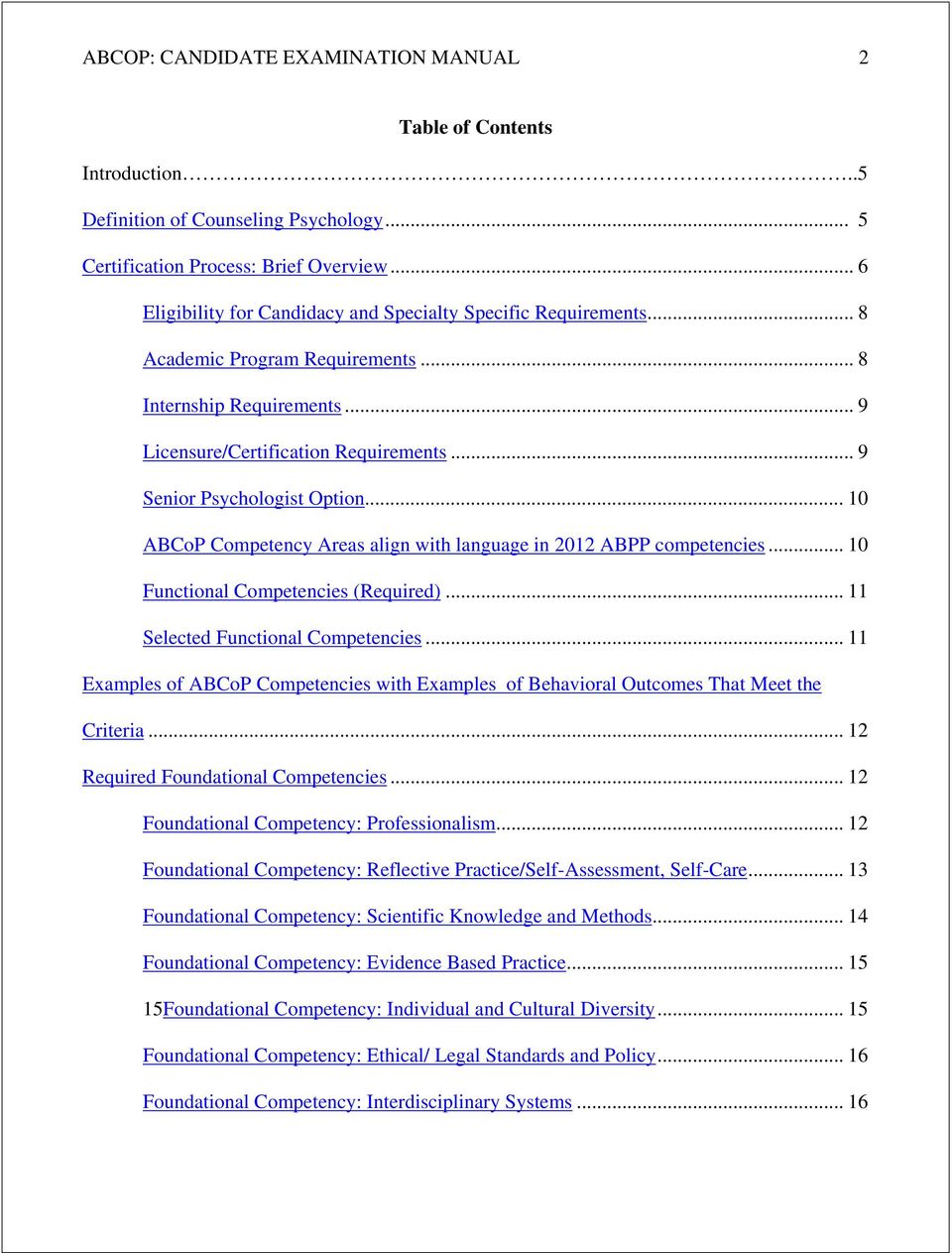
2 ABCOP: CANDIDATE EXAMINATION MANUAL 2 Table of Contents Introduction..5 Definition of Counseling Psychology... 5 Certification Process: Brief Overview... 6 Eligibility for Candidacy and Specialty Specific Requirements... 8 Academic Program Requirements... 8 Internship Requirements... 9 Licensure/Certification Requirements... 9 Senior Psychologist Option ABCoP Competency Areas align with language in 2012 ABPP competencies Functional Competencies (Required) Selected Functional Competencies Examples of ABCoP Competencies with Examples of Behavioral Outcomes That Meet the Criteria Required Foundational Competencies Foundational Competency: Professionalism Foundational Competency: Reflective Practice/Self-Assessment, Self-Care Foundational Competency: Scientific Knowledge and Methods Foundational Competency: Evidence Based Practice Foundational Competency: Individual and Cultural Diversity Foundational Competency: Ethical/ Legal Standards and Policy Foundational Competency: Interdisciplinary Systems... 16
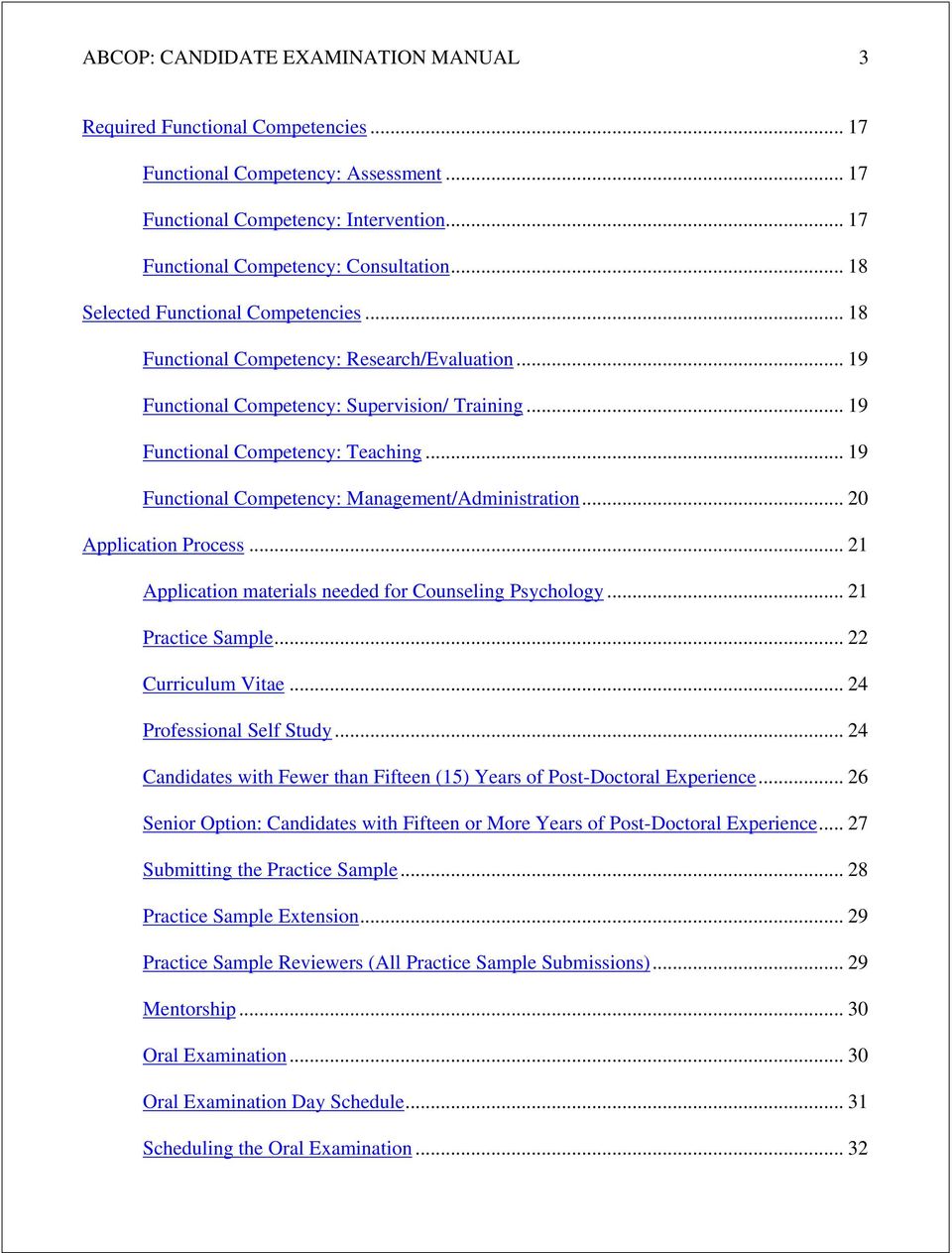
3 ABCOP: CANDIDATE EXAMINATION MANUAL 3 Required Functional Competencies Functional Competency: Assessment Functional Competency: Intervention Functional Competency: Consultation Selected Functional Competencies Functional Competency: Research/Evaluation Functional Competency: Supervision/ Training Functional Competency: Teaching Functional Competency: Management/Administration Application Process Application materials needed for Counseling Psychology Practice Sample Curriculum Vitae Professional Self Study Candidates with Fewer than Fifteen (15) Years of Post-Doctoral Experience Senior Option: Candidates with Fifteen or More Years of Post-Doctoral Experience Submitting the Practice Sample Practice Sample Extension Practice Sample Reviewers (All Practice Sample Submissions) Mentorship Oral Examination Oral Examination Day Schedule Scheduling the Oral Examination... 32
4 ABCOP: CANDIDATE EXAMINATION MANUAL 4 Materials Reviewed During the Oral Examination Video Recording Submissions ABCoP Examination Team Composition Examiners Responsibilities Candidate Notification Public Honoring of New Board Certified Counseling Psychologists Annual Fees American Academy of Counseling Psychology (AACoP) ABCoP Maintenance of Certification (MOC) Standards Section Appeals Appendix A: Summary Table for the Practice Sample and Assessment/Intervention portion of the Oral Examination Appendix B: Voluntary Consent Agreement Appendix C: Appeals Appeals Committee Appealable Decisions Filing an Appeal Composition of the Appeals Committee Scope and Conduct of Appeal Decision and Report of Appeals Committee Time Limitation on Candidate s Response to a Positive Action Appendix D: Application for Counseling Psychology Board Certification... 47

5 ABCOP: CANDIDATE EXAMINATION MANUAL 5 Introduction The American Board of Counseling Psychology (ABCoP) is a Specialty Board of the American Board of Professional Psychology (ABPP). Board Certification in Counseling Psychology attests to Candidates successful completion of the educational, training and experience requirements of the specialty. The protocol for attaining Board Certification includes an oral examination designed to assess the knowledge, skills and competencies required of all Counseling Psychologists who are Board Certified, and who demonstrate identification with the specialty of Counseling Psychology. The primary objective of the ABCoP is to ensure a board certification process that identifies and promotes specialty level standing in the field of Counseling Psychology. Specialty level standing is conceptualized as higher than the basic level of competence certified by jurisdictional licensure, consistent with that of experienced practitioners of professional psychology at the level of two years post-doctoral degree. Psychologists who are licensed and have two or more years of post-doctoral professional experience are able to qualify for board certification in Counseling Psychology. Functioning at the Board Certified level connotes a quality of advanced preparation and professional level focus on the part of psychologists. Definition of Counseling Psychology The definition used to determine whether applicants/candidates have been functioning as Counseling Psychologists is the definition adopted by The Society for Counseling Psychology (Division 17) of APA. Counseling Psychologist facilitates personal and interpersonal functioning across the life span with a focus on individual, group, and community interventions for emotional, behavioral, vocational, and mental health problems using preventative, developmental,

6 ABCOP: CANDIDATE EXAMINATION MANUAL 6 and remedial approaches, and in the assessment, diagnosis, and treatment of psychopathology. Counseling Psychologists participate in a range of activities including psychotherapy, assessment, teaching, research, supervision, career development and consultation. They employ a variety of methods closely tied to theory and research to help individuals, groups and organizations function optimally as well as to remediate dysfunction. The activities of Counseling Psychologists typically include: Conducting clinically relevant research Assessment (evaluation, diagnosis, formal psychological testing) Intervention (treatment, prevention) Consultation with others professionals in diverse settings Supervision, training, and management activities (e.g., program development, administration) Counseling Psychologists are expected to demonstrate sensitivity to and skills in dealing with multicultural/diverse populations. Individual and cultural diversity recognizes the broad scope of such factors as race, ethnicity, language, sexual orientation, gender, age, disability, SES, education, religion/spiritual orientation, and other cultural dimensions 1. Certification Process: Brief Overview Following verification by the ABPP Central Office of the generic requirements for board certification (doctoral degree, licensure, and professional standing[(absence of current 1 American Psychological Association, (2002). Guidelines on multicultural education, training, research, practice, and organizational change for psychologists. American Psychologist, 58 (5), (

7 ABCOP: CANDIDATE EXAMINATION MANUAL 7 disciplinary actions]), the application is forwarded to the ABCoP Credentials Reviewer for specialty review. If applicants graduated from an American Psychological Association (APA) or Canadian Psychological Association (CPA) accredited program, then they are immediately advanced to the Practice Sample level of the examination process. The Board of Trustees of the ABPP sets and verifies minimum generic standards for candidacy. The Board of Directors of ABCoP sets and verifies minimum specialty standards for Counseling Psychology. Once applicants credentials have been approved, a Practice Sample needs to be submitted. We strongly recommend that applicants obtain a knowledgeable mentor. Mentors will guide and consult with applicants throughout the process. Mentors may be requested from the Academy of Counseling Psychology ( All Candidates for board certification must submit a Practice Sample. The Practice Sample typically includes: (a) A Professional Self Study; (b) a Work Sample; and (c) a Curriculum Vitae. The Practice Sample Chair selects two Board Certified Counseling Psychologists who review the Practice Sample and determine completeness and adequacy. The Oral Examination emphasizes Candidates Practice Sample and competencies in the following specific areas: Foundational Competencies (required of all psychologists): Professionalism, Reflective Practice/Self-Assessment, Self-Care; Scientific Knowledge and Methods; Evidence Based Practice; Relationships; Individual and Cultural Diversity; Ethical/Legal Standards and Policy; Interdisciplinary Systems. Functional Competencies (required of all counseling psychologists): Assessment;

8 ABCOP: CANDIDATE EXAMINATION MANUAL 8 Intervention; Consultation. Functional Competencies (selected by some counseling psychologists according to role): Research/Evaluation; Supervision/Training; Teaching; Management/Administration. Board certification is achieved by successful completion of the examination, including both the review of the Practice Sample (Professional Self Study and a Work Sample) and an oral examination conducted by a committee comprised of Board Certified Counseling Psychologists. Twenty Continuing Education credits from the American Psychological Association (APA) are awarded through the American Board of Professional Psychology at no cost to the Applicant after becoming board certified. Eligibility for Candidacy and Specialty Specific Requirements Applicants submit the following education and training activities to the ABPP Central Office in order to establish eligibility. Academic Program Requirements A doctoral degree from a program in professional psychology, which at the time the degree was granted, was accredited by the APA or the Canadian Psychological Association (CPA), OR A doctoral degree, which at the time the degree was granted, was from a program listed in the publication Doctoral Psychology Programs Meeting Designated Criteria OR, The Degree Requirement can be met if: Applicant holds current ABPP Board Certification in another specialty, OR Applicant holds a current Certificate of Professional Qualification in Psychology (CPQ) from the Association of State and Provincial Psychology Boards (ASPPB), OR

9 ABCOP: CANDIDATE EXAMINATION MANUAL 9 Applicant is credentialed as a health service provider in the current Directory of the National Register of Health Service Providers in Psychology (NRHSPP), or the current Canadian Register of Health Service Providers in Psychology (CRHSPP), OR Applicant holds a doctoral degree in psychology and has subsequently been certified as completing the requirements of a formal, doctoral level, professional program that meets the APA accreditation requirements. Individual exception reviews are available for degrees granted outside the U.S. or Canada, doctoral degrees granted prior to 1983, or for applicants claiming equivalent doctoral degree and program requirements. Such exceptions are coordinated through the ABPP Executive Office and the appropriate Specialty Board. Internship Requirements A one-year full-time or two-year half-time internship program is required. The internship requirement can be met in one of four ways. The internship requirement is met if the internship is: Accredited by the APA or CPA, OR Listed in the Association of Psychology Postdoctoral and Internship Centers (APPIC) Directory for the year in which the internship was completed, OR Met APPIC equivalency guidelines, OR Applicants are listed in the NRHSPP or CRHSPP Directories or hold the CPQ. Licensure/Certification Requirements Applicants must be licensed or certified as psychologists at the independent practice level by the State, Province, or Territory of the U.S. or Canada in which

10 ABCOP: CANDIDATE EXAMINATION MANUAL 10 the psychologist practices. Exceptions to the residency requirement are made for active duty federal uniformed service psychologists when practicing in those roles. Senior Psychologist Option Psychologists who meet the above degree, internship, and license requirements, AND have 15 years or more of post-doctoral experience, are eligible for the Senior Psychologist option. The aim of this program is to bring into ABCoP senior colleagues who have made a contribution to our field. (see Senior Option under Practice Sample). ABCoP Competency Areas align with language in 2012 ABPP competencies The ABCoP examination process encompasses the following competencies required by the specialty of Counseling Psychology. Successful Candidates demonstrate knowledge, skills, attitudes/values and experience necessary to provide specialty level services in the practice of Counseling Psychology through discussion of a Professional Self Study and Work Sample. Foundational Competency: Professionalism. Exhibiting professional values and ethics as evidenced in behavior and comportment that reflects the values and ethics of psychology, integrity, and responsibility. Foundational Competency: Reflective Practice/Self-Assessment, Self-Care. Practicing with personal and professional self-awareness and reflection; with awareness of competencies; with appropriate self-care Foundational Competency: Scientific Knowledge and Methods. Demonstrating understanding of research, research methodology, techniques of data collection and analysis, biological bases of behavior, cognitive-affective bases of behavior, and development across the lifespan. Respect for scientifically derived knowledge.

11 ABCOP: CANDIDATE EXAMINATION MANUAL 11 Foundational Competency: Evidence Based Practice. Demonstrating the integration of current research literature into clinical practice, research/evaluation, and other functional competency domains where applicable. Foundational Competency: Relationships. Relating effectively and meaningfully with individuals, groups, and/or communities. Foundational Competency: Individual and Cultural Diversity. Exhibiting awareness of, sensitivity to, and appropriate skills for working professionally with diverse individuals, groups, and communities who represent various cultural and personal backgrounds and characteristics. Foundational Competency: Ethical/ Legal Standards and Policy. Applying ethical concepts and awareness of legal issues regarding professional activities with individuals, groups, and organizations. Foundational Competency: Interdisciplinary Systems. Demonstrating knowledge of key issues and concepts in related disciplines; identifying and interacting with professionals in multiple disciplines Functional Competencies (Required) Functional Competency: Assessment. Applying a strength-based approach to diagnosis of problems, capabilities, and issues associated with individuals, groups, and/ or organizations, case formulation, and selecting appropriate assessment and diagnostic strategies. Functional Competency: Intervention. Intervening with practices and procedures designed to promote health and well-being of individuals, groups, and/or organizations. Functional Competency: Consultation. Applying psychological principles to the change process in response to the needs and/or goals of individuals, families, groups,

12 ABCOP: CANDIDATE EXAMINATION MANUAL 12 organizations, or communities. Selected Functional Competencies Functional Competency: Research/Evaluation. Conducting research/ evaluation of practices (theoretical, experimental, clinical, evaluative) that contribute to psychology s knowledge base. This competency domain will be addressed only for those Candidates with Practice Samples in Research/ Evaluation. Functional Competency: Supervision/ Training. Provides clinical instruction and/ or oversight to trainees or other practicing psychologists. This competency domain will be addressed only for those Candidates with Practice Samples in Supervision. Functional Competency: Teaching. Instructing students, trainees, other professionals or the general public in the science and practice of counseling psychology. This competency domain will be addressed only for those Candidates with Practice Samples in Teaching. Functional Competency: Management/ Administration. Working in an executive or operational capacity for an organization that provides psychological services. This competency domain will be addressed only for those Candidates with Practice Samples in Management/ Administration. Examples of ABCoP Competencies with Examples of Behavioral Outcomes That Meet the Criteria Required Foundational Competencies Foundational Competency: Professionalism Exhibiting professional values and ethics as evidenced in behavior and comportment that reflects the values and ethics of psychology, integrity, and responsibility.

13 ABCOP: CANDIDATE EXAMINATION MANUAL 13 Behavioral outcomes (passing level criteria): Practices within the scope of one s competence, and seeks consultation and supervision as needed Demonstrates respect for and protection of confidentiality in private communications Is aware of potential conflicts and maintains appropriate professional boundaries Articulates professional values Communicates verbally and nonverbally in ways that are appropriate to the professional context, including challenging interactions Acts to benefit the welfare of others, as an advocate for social justice Demonstrates active participation in and contribution to the development and advancement of the profession, the specialty, and colleagues Evidences continuous improvement and enhancement of knowledge, skills, and productivity Takes independent action to correct situations that are in conflict with professional values Recognizes the host of professional issues that may occur when consulting in various settings Foundational Competency: Reflective Practice/Self-Assessment, Self-Care Practicing with personal and professional self-awareness and reflection; with awareness of competencies; with appropriate self-care. Behavioral outcomes (passing level criteria):

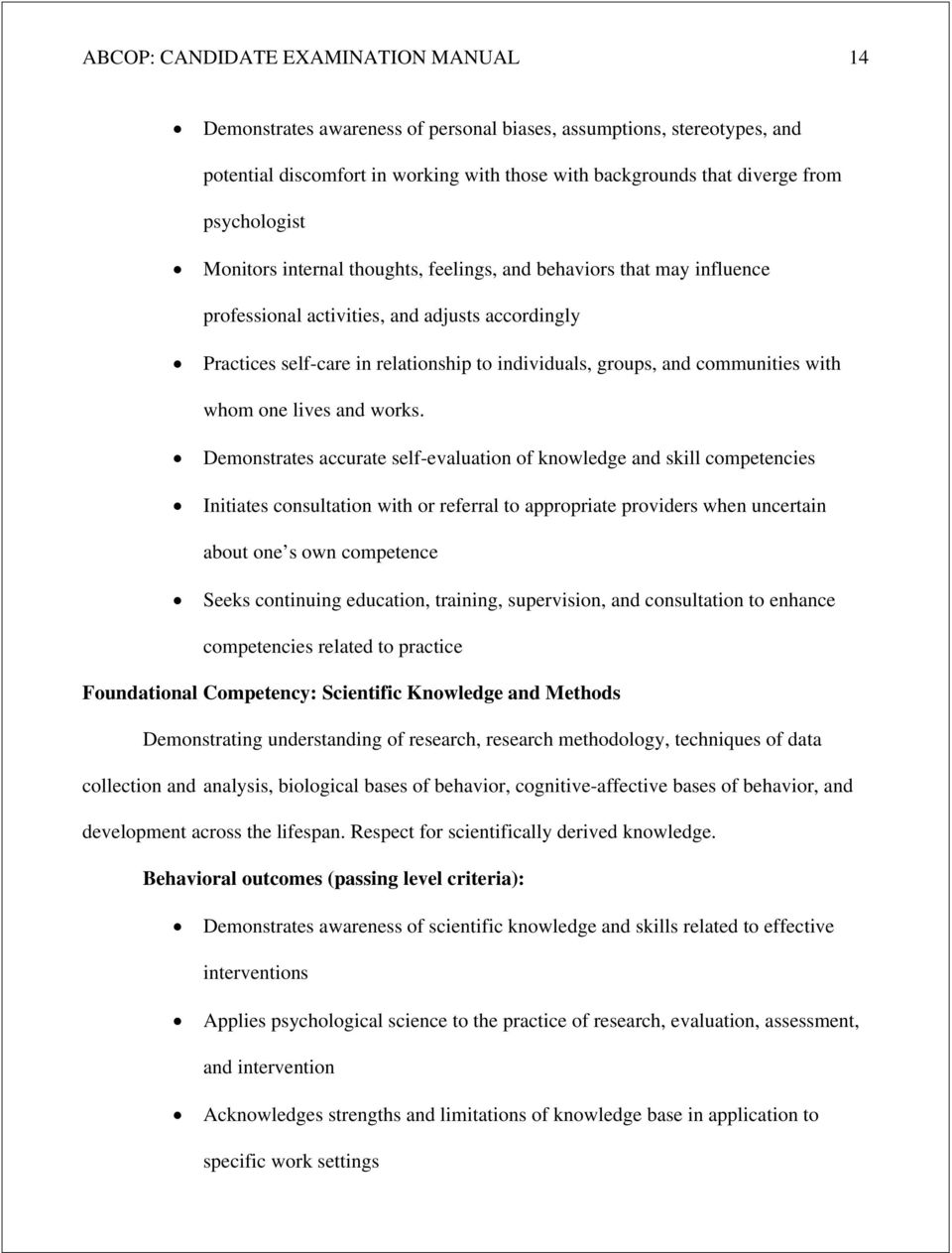
14 ABCOP: CANDIDATE EXAMINATION MANUAL 14 Demonstrates awareness of personal biases, assumptions, stereotypes, and potential discomfort in working with those with backgrounds that diverge from psychologist Monitors internal thoughts, feelings, and behaviors that may influence professional activities, and adjusts accordingly Practices self-care in relationship to individuals, groups, and communities with whom one lives and works. Demonstrates accurate self-evaluation of knowledge and skill competencies Initiates consultation with or referral to appropriate providers when uncertain about one s own competence Seeks continuing education, training, supervision, and consultation to enhance competencies related to practice Foundational Competency: Scientific Knowledge and Methods Demonstrating understanding of research, research methodology, techniques of data collection and analysis, biological bases of behavior, cognitive-affective bases of behavior, and development across the lifespan. Respect for scientifically derived knowledge. Behavioral outcomes (passing level criteria): Demonstrates awareness of scientific knowledge and skills related to effective interventions Applies psychological science to the practice of research, evaluation, assessment, and intervention Acknowledges strengths and limitations of knowledge base in application to specific work settings
15 ABCOP: CANDIDATE EXAMINATION MANUAL 15 Demonstrates ability to cite scientific evidence to support professional activities Foundational Competency: Evidence Based Practice Demonstrating the integration of current research literature into clinical practice, research/evaluation, and other functional competency domains where applicable. Behavioral outcomes (passing level criteria): Maintains knowledge of ongoing developments in the research literature as it relates to clinical practice and the specialty of counseling psychology Integrates empirically based practices into specific roles within counseling psychology Applies evidence in alignment with the values and preferences of those that will be affected Foundational Competency: Relationships Relating effectively and meaningfully with individuals, groups, and/or communities. Behavioral outcomes (passing level criteria): Forms effective working alliances with a wide range of clients, colleagues, and other constituents Uses rapport and empathy in verbal and nonverbal behaviors to facilitate interactions Acknowledges the impact of oneself on others and can evaluate and implement feedback from others Works to resolve conflicts effectively Foundational Competency: Individual and Cultural Diversity Exhibiting awareness of, sensitivity to, and appropriate skills for working professionally

16 ABCOP: CANDIDATE EXAMINATION MANUAL 16 with diverse individuals, groups, and communities who represent various cultural and personal backgrounds and characteristics. Behavioral outcomes (passing level criteria): Articulates integrative conceptualizations of multiple aspects of diversity influencing clients, psychologists, groups, and organizations Adapts behavior in a culturally sensitive manner to the needs of the populations served Demonstrates self-awareness and ability to recognize differences between one s own values, attitudes, and assumptions and those of constituents Initiates consultation with appropriate sources as needed to address specific diversity issues. Foundational Competency: Ethical/ Legal Standards and Policy Applying ethical concepts and awareness of legal issues regarding professional activities with individuals, groups, and organizations. Behavioral outcomes (passing level criteria): Identifies ethical and legal issues that arise in the practice of counseling psychology, analyzes them effectively, and implements appropriate ethical and/or legal interventions. Recognizes and addresses dissonance between sometimes competing goals of promoting autonomy and protecting client safety Practices within federal and state laws, and organizational policies Foundational Competency: Interdisciplinary Systems Demonstrating knowledge of key issues and concepts in related disciplines; identifying

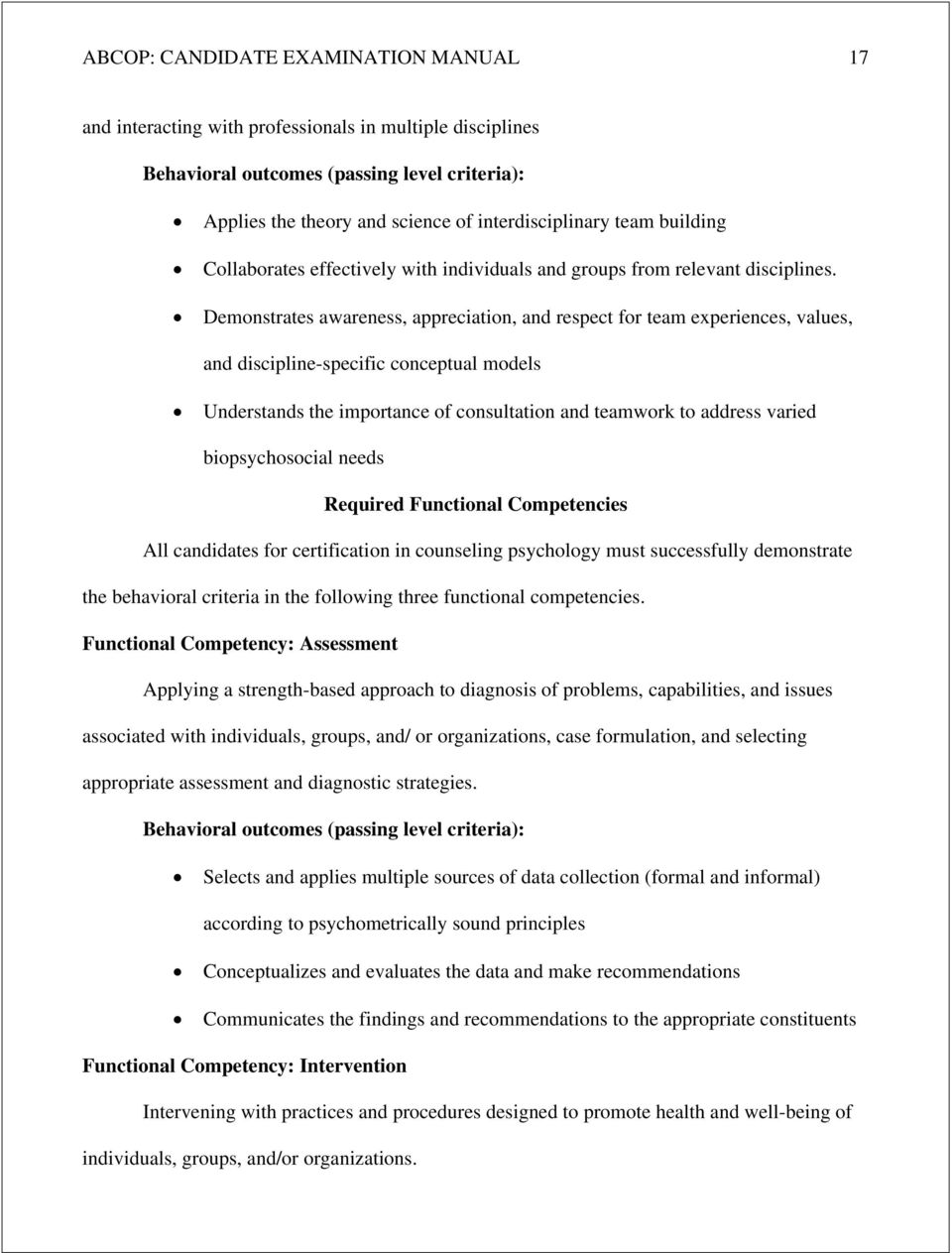
17 ABCOP: CANDIDATE EXAMINATION MANUAL 17 and interacting with professionals in multiple disciplines Behavioral outcomes (passing level criteria): Applies the theory and science of interdisciplinary team building Collaborates effectively with individuals and groups from relevant disciplines. Demonstrates awareness, appreciation, and respect for team experiences, values, and discipline-specific conceptual models Understands the importance of consultation and teamwork to address varied biopsychosocial needs Required Functional Competencies All candidates for certification in counseling psychology must successfully demonstrate the behavioral criteria in the following three functional competencies. Functional Competency: Assessment Applying a strength-based approach to diagnosis of problems, capabilities, and issues associated with individuals, groups, and/ or organizations, case formulation, and selecting appropriate assessment and diagnostic strategies. Behavioral outcomes (passing level criteria): Selects and applies multiple sources of data collection (formal and informal) according to psychometrically sound principles Conceptualizes and evaluates the data and make recommendations Communicates the findings and recommendations to the appropriate constituents Functional Competency: Intervention Intervening with practices and procedures designed to promote health and well-being of individuals, groups, and/or organizations.
18 ABCOP: CANDIDATE EXAMINATION MANUAL 18 Behavioral outcomes (passing level criteria): Plans intervention strategies that include evidence based support, if available Implements intervention skills, covering a wide range of developmental, preventative, and remedial interventions, including psychotherapy, psychoeducational interventions, organizational interventions, and crisis management Evaluates progress at appropriate intervals and at the end of the intervention Functional Competency: Consultation Applying psychological principles to the change process in response to the needs and/or goals of individuals, families, groups, organizations, or communities. Behavioral outcomes (passing level criteria): Evaluates the fit between one s scope of competence and the consultation question Assesses and selects consultation procedures appropriate to the context and consultation question(s) Designs a coherent and organized approach to needs assessment, diagnosis, intervention, and evaluation Communicates the findings and recommendations to the appropriate constituents Selected Functional Competencies Candidates seeking certification in one of the following four selected functional competencies are required to demonstrate the behavioral criteria for the selected functional competency. Functional Competency: Research/Evaluation Conducting research/ evaluation of practices (theoretical, experimental, clinical,

19 ABCOP: CANDIDATE EXAMINATION MANUAL 19 evaluative) that contribute to psychology s knowledge base. This competency domain will be addressed only for those Candidates with Practice Samples in Research/ Evaluation. Behavioral outcomes (passing level criteria): Reviews, evaluates, and implements research related to Counseling Psychology Advocates for social justice in the process of conducting or overseeing research/ evaluation activities Translates research results into practice Publishes in peer-reviewed journals, serves as a reviewer of articles for journal publication, or reviews program proposals for professional organizations Functional Competency: Supervision/ Training Provides clinical instruction and/or oversight to trainees or other practicing psychologists. This competency domain will be addressed only for those Candidates with Practice Samples in Supervision. Behavioral outcomes (passing level criteria): Articulates a philosophy or model of supervision, based on existing theory and research, which integrates contextual, ethical, and legal perspectives Supervises trainees in the provision of psychological services Identifies recommendations regarding knowledge and skill development (e.g., journals, conferences, organizations) Provides feedback that addresses both the strengths and weaknesses of the supervisee Demonstrates a thorough understanding of the reciprocity between supervisor and supervisee, broadly defined, in the process of evaluation of supervision

20 ABCOP: CANDIDATE EXAMINATION MANUAL 20 Demonstrates an awareness of potential conflicts in supervision and seeks consultation when appropriate Functional Competency: Teaching Instructing students, trainees, other professionals or the general public in the science and practice of counseling psychology. This competency domain will be addressed only for those Candidates with Practice Samples in Teaching. Behavioral outcomes (passing level criteria): Articulates a philosophy or model of teaching, based on existing theory and research, which integrates contextual, ethical, and legal perspectives Develops curricula for coursework in life span development and/ or counseling psychology Effectively delivers targeted content Evaluates the effectiveness of teaching Incorporates feedback that informs the continuous modification of teaching strategies and content Functional Competency: Management/Administration Working in an executive or operational leadership capacity for an organization that provides psychological services. This competency domain will be addressed only for those Candidates with Practice Samples in Management/ Administration. Behavioral outcomes (passing level criteria): Articulates a philosophy or model of leadership and management, based on existing theory and research, which integrates contextual, ethical, and legal perspectives
21 ABCOP: CANDIDATE EXAMINATION MANUAL 21 Manages the organization s vision, mission, values, goals, and objectives for effective service delivery Manages the organization s resources and personnel to maximize service delivery Monitors and evaluates service delivery to identify inconsistencies between expected and actual outcomes Demonstrates openness to change by gathering and integrating constituency feedback Provides for the organization s adherence to professional benchmarks, standards, and accrediting bodies Advocates for the organization as well as mental healthcare needs, at the local, state, and national levels Application Process Application materials needed for Counseling Psychology Psychologists whose training and experience meet the basic requirements are encouraged to apply. Applications are accepted throughout the year. A sample of the ABCoP Application is contained in Appendix D. Application is a two step process generic review and a specialty specific review. The link to ABCoP application can be found at Application fees should be included with the application. ABCoP Candidate Examination Manual All applicants shall submit a copy of their vita/resume along with ABPP s basic application form, which is available from Central Office or at the ABPP website (
22 ABCOP: CANDIDATE EXAMINATION MANUAL 22 Graduates of an American Psychological Association approved Counseling Psychology Program shall provide endorsements from two psychologists. Graduates of all other programs shall provide documentation of their current functioning as Counseling Psychologists from two psychologists. Any scholarships awarded by AACoP or ABCoP will be awarded following successful completion of the application step for which the scholarship is being awarded. Upon successful review of the submitted credentials, applicants will receive a letter stating they are Candidates for the examination process. For further information about the scholarship program, contact the Academy president ( Practice Sample Practice Sample. The Practice Sample includes a work sample, a Professional Self Study (PSS), and a Curriculum Vitae (CV)/Resume. The PSS describes the candidate s background, professional orientation, skills, and current personal and professional experience, and lays a framework for the reviewers evaluation of the candidate s overall application. The work sample demonstrates the candidate s experience. Acceptable work sample contents are described below for each option. When candidates submit their Practice Samples under the Standard/ Early Entry Options, they are expected to submit a PSS, a work sample, and a Curriculum Vitae (CV). The work sample is comprised of either a written portion plus a digital video recording, or a work product demonstrating a significant contribution to the field of counseling psychology. The written portion should cover the same material as presented in the video recording. When candidates submit their Practice Samples under the Senior Option, they are
23 ABCOP: CANDIDATE EXAMINATION MANUAL 23 expected to submit a Practice Sample made up of either a Curriculum Vitae (CV), a PSS, and a work sample, which can be either a written portion plus a digital video recording; or sample(s) of publications or innovative programs that demonstrate a significant contribution to the field of counseling psychology. Candidates submitting their materials under the senior option must clearly align those materials with their functioning as a counseling psychologist; the PSS must also correlate with the publications presented. Examples of submissions include, but are not limited to: First authored, or co-authored substantive articles (not brief reports) which are directly relevant to the practice of counseling psychology and which were published in peer-reviewed journals. First authored, or co-authored book chapters covering topics relevant to the practice of counseling psychology. A first authored or co-authored (not edited) book relevant to the practice of counseling psychology. Documentation of the innovative approaches to the training/ supervision/ administration/ consultation of Counseling Psychologists or the delivery of counseling psychology services. Such documentation may be in the form of the candidates creation of training, supervision, service provision, center procedure manuals, and the candidates should include evidence of the successful implementation of the procedures contained therein. The essential components of this category are that the submitted material documents innovative procedures, which were authored/established by the applicant and which produced improved practice.
24 ABCOP: CANDIDATE EXAMINATION MANUAL 24 The ABCoP board implemented electronic submission of candidate materials in All documents for the Practice Sample are submitted through the online system (ShareFile, a HIPAA compliant system) designated by the Practice Sample Chair. The Candidate should contact the Practice Sample Chair prior to the taping of any videos to get current guidelines on file size, format and submission process. If materials cannot be submitted by using ShareFile, four copies or written materials, (e.g. books) and three copies of other materials (e.g. vita and PSS) are to be mailed to the Practice Sample Chair within 12 months of acceptance into candidacy. Curriculum Vitae The Curriculum Vitae must include educational and training background, professional roles and responsibilities, and professional contributions (e.g., service activities, publications, presentations, grants, awards, professional recognitions, etc.) that demonstrate the Candidates professional identification with the specialty of Counseling Psychology. Professional Self Study The Professional Self Study is an 8-10 page, 12 font document (excluding references and written in APA format) that details the candidate s general approaches to psychological assessment and intervention, as well as the training and experience which led to these approaches. The Professional Self Study may reference specific papers, articles, books and courses produced by others or by the Candidate that support the applicant s competence in the required foundational and functional areas, and the selected functional area. The Professional Self Study should demonstrate sensitivity to and skills in dealing with multicultural/diverse populations. The terms multicultural and individual and cultural diversity
25 ABCOP: CANDIDATE EXAMINATION MANUAL 25 are used interchangeably. Individual and cultural diversity recognizes the broad scope of such factors as race, ethnicity, language, sexual orientation, gender, age, disability, SES, education, religion/spiritual orientation, and other cultural dimensions. All Candidates are required to provide a Professional Self Study. The purpose of the Professional Self-Study is to convey a sense of the Candidate --- an image of the Candidate --- that transfers to the written page. Candidates should be able to describe how their professional, personal, and academic roles evolved in the work set forth for the Practice Sample. The person reading the Professional Self Study should have a sense that what is contained in the materials provided is predictable and intelligible given the views expressed in the Professional Self Study. Examiners will consider whether Candidates statements about their professional practice match what Candidates actually do in their professional practices. Information from the candidate s vita can be referred to but should not be duplicated in the Professional Self Study. The Professional Self-Study should include: Description of current professional work (employment and professional activities at the local, state, and national level), general continuing professional education activities, long-term plans in psychology, and reasons for seeking board certification Description of a meaningful and challenging ethical dilemma personally encountered, the aspects of the APA Ethical Principles of Psychologists and Code of Conduct pertinent to the dilemma, and how the dilemma was managed citing specific Ethical Guidelines. Verification that no ethical/legal action has been taken against the Candidate since
26 ABCOP: CANDIDATE EXAMINATION MANUAL 26 having been admitted to candidacy. Candidates are expected to accomplish the task in no fewer than eight (8) and no more than ten (10) double-spaced (typed, font 12pt) pages, excluding references. Please include ALL these in your Professional Self Study to maximize the probability that it will be accepted without revisions. Candidates with Fewer than Fifteen (15) Years of Post-Doctoral Experience Candidates with fewer than fifteen (15) years of post-doctoral experience are required to submit a Work Sample in addition to the Professional Self Study. This Work Sample, which is a video and a case study write-up FOCUSING ON THE TREATMENT REFLECTED IN THE VIDEO, describes how the required foundational and functional competencies, and the selected functional competency are being applied and evaluated. The Work Sample includes a video of your work along with a write-up of the assessment and treatment process for the case. This case write-up should not only detail the specific assessments and interventions associated with the particular case, but also detail how your work exemplifies your approach as elucidated in your Professional Self-Study. Also, Candidates must carefully verify that their video is high quality throughout; poor quality can be the basis for rejection. Candidates should demonstrate their mindfulness of diversity in the Work Sample including, race, ethnicity, gender, age, sexual orientation, socio-economic-status, religion, physical and psychological challenges, geographic regions of birth, rearing and current residence as well as linguistic history and facility. Although the video and case write-up submitted should clearly and specifically detail the course of work presented, it should also specifically state how these activities exemplify
27 ABCOP: CANDIDATE EXAMINATION MANUAL 27 Candidates broader views as a Counseling Psychologist as presented in your Professional Self Study. Candidates are to complete the case write-up in no fewer than ten (10) and no more than twenty (20) double spaced typewritten pages (font 12 pt.) excluding references, copies of tests, profiles, and other supporting documents that you are free to include. Your case write-up may or may not include psychological testing. Formal testing is not required for an Assessment focus of the Practice Sample, but if formal testing is part of the assessment, candidates should demonstrate a thorough knowledge of the construction, administration, validity and reliability and interpretation of such instruments as well as any cultural limitations. The video recording must have been made within six months of the date the Practice Sample was submitted. The video should be an unrehearsed session depicting a typical intervention in one s practice. The video recording that is submitted for review with the Practice Sample will also be reviewed as part of the Oral Examination. Senior Option: Candidates with Fifteen or More Years of Post-Doctoral Experience Candidates with fifteen (15) or more years of post-doctoral experience may choose from two alternatives. When candidates submit their Practice Samples under the Senior Option, they are expected to submit a Practice Sample made up of either a Curriculum Vitae (CV), a PSS, and a work sample, which can be either a written portion plus a digital video recording; or sample(s) of publications or innovative programs that demonstrate a significant contribution to the field of counseling psychology. Candidates submitting their materials under the senior option must clearly align those materials with their functioning as a counseling psychologist; the PSS must also correlate with the publications presented.
28 ABCOP: CANDIDATE EXAMINATION MANUAL 28 Examples of submissions include, but are not limited to: First authored, or co-authored substantive articles (not brief reports) which are directly relevant to the practice of counseling psychology and which were published in peer-reviewed journals. First authored, or co-authored book chapters covering topics relevant to the practice of counseling psychology. A first authored or co-authored (not edited) book relevant to the practice of counseling psychology. Documentation of the innovative approaches to the training/ supervision/ administration/ consultation of Counseling Psychologists or the delivery of counseling psychology services. Such documentation may be in the form of the candidates creation of training, supervision, service provision, center procedure manuals, and the candidates should include evidence of the successful implementation of the procedures contained therein. The essential components of this category are that the submitted material documents innovative procedures, which were authored/established by the applicant and which produced improved practice. Please note that many Senior Option candidates find it preferable to submit a video and case write up if they do not have the type of publications or documentation required, or if their publications no longer line up with their career path as a Counseling Psychologist. Submitting the Practice Sample Candidates will submit their materials through the online system (ShareFile, a HIPAA compliant system) designated by the Practice Sample Chair. The Candidate should contact the
29 ABCOP: CANDIDATE EXAMINATION MANUAL 29 Practice Sample Chair prior to the taping of any videos to get current guidelines on file size, format and submission process. Materials should be submitted online using ShareFile unless impossible. In this case, four copies of written materials (e.g. books) and three copies of other materials (e.g. vita and Professional Self Study) should be mailed to the Practice Sample Chair. The Practice Sample Chair s name, address, and address can be found in the letter admitting applicants to candidacy. Practice Sample Extension Candidates who need an extension to complete their Practice Samples should address the request to the Practice Sample Chair. The request must detail those events that constitute the basis of the need for the extension. The Practice Sample Chair will make the final decision on the six month extension and communicate in writing to the Candidates within two weeks after receiving the request. If the request is granted, the extension period begins on the date of this written communication. Practice Sample Reviewers (All Practice Sample Submissions) The Practice Sample Chair will appoint a team of two board certified Counseling Psychologists to review each Practice Sample. The reviewers collaborate in evaluating the material submitted; reviewers make their decisions by consensus and are requested to do so within thirty days of receiving the Practice Sample materials. Reviewers will have two responses from which to choose: (1) acceptable with revisions and (2) acceptable without further revision. Reviewers communicate their decision to the Practice Sample Chair who, in turn, communicates with the candidate. If the reviewing team asks for revisions of the Practice Sample, the reviewers
30 ABCOP: CANDIDATE EXAMINATION MANUAL 30 communicate, through the Practice Sample Chair, the specific revisions they request. The reviewers will continue to provide feedback to the candidate for up to six months and through a maximum of two revisions until the Practice Sample is found to be acceptable. Using written and/or oral forms of communication, they aim to assist the candidates in producing a Practice Sample that the reviewing team can rate as acceptable without further revision. If candidates are successful, they will be advanced to the Oral Examination. If, by the end of the six-month period, candidates have not produced a Practice Sample evaluated by the team as acceptable without further revision, candidates may request a six-month extension. If candidates do not ask for an extension, they will be advised to develop a new Practice Sample and will be assigned a new set of reviewers when the new Practice Sample is submitted. In this event candidates must pay a second Practice Sample fee when a new Practice Sample is submitted. Mentorship Applicants are strongly encouraged to request a mentor through the AACoP President. Applicants may access the American Academy of Counseling Psychology through the ABPP webpage. The mentorship process can begin before the applicant initiates application to the Early Entry Option, and ends at the successful completion of the Oral Examination. Board certified mentors will answer questions about the certification process and review materials prior to material submission. Oral Examination The Oral Examination consists of a face-to-face examination by two or more examiners in the foundational and functional competencies using an assessment center model. These competencies are infused throughout the five modules of the examination. The modules are: Assessment, Intervention, Professional Identity, Alternative Interventions, and Ethics. The
31 ABCOP: CANDIDATE EXAMINATION MANUAL 31 Practice Sample materials serve as the core for the examination discussion in the Assessment, Intervention, and Professional Identity modules. Vignettes and case examples are used as the basis for discussion of the Alternative Interventions and Ethical Issues modules of the Oral Examination. Oral Examination Day Schedule The examination day schedule is as follows: 8:15 9:00 Examiner Meeting 9:00 9:15 Candidates arrive at examination site 9:15 9:30 Orientation and introduction of candidates and examiners 9:35-10:30 Session One: Assessment, Intervention and Professional Identity modules. Practice Sample materials are basis for examination and discussion 10:30 11:00 Break, (Candidate prepares for Ethics Module; examiners score session one modules.) 11:00 11:30 Ethics Module 11:30 12:00 Break (Candidate prepares for Ethics Module; examiners score session two modules.) 12:00-12:40 Alternative Intervention Module 12:40 1:00 Debriefing and evaluation completion by candidates 12:45 Examiners meet to complete score packets for session three, discuss candidates if needed, to reach consensus, complete evaluations. Scheduling the Oral Examination
32 ABCOP: CANDIDATE EXAMINATION MANUAL 32 Because the assessment center model brings several Candidates and examiners together at the same site, timely coordination is essential. The Board establishes Oral Examination dates several months in advance. Candidates may contact the Oral Examination Chair for current dates. Candidates must pay the Oral Examination fee to the Central Office and inform the Oral Examination Chair of payment no later than sixty (60) days prior to the date on which they wish to take the examination. At the discretion of the Oral Examination Chair and on the basis of available space, Candidates who wish to be examined as soon as possible and who complete their Practice Sample after the deadline can be granted an exception. Except for extreme circumstances, Candidates who do not attend the examination for which they are scheduled, will forfeit their examination fee and must pay a second fee to sit for a later examination. Materials Reviewed During the Oral Examination The oral examination will include discussion of the Practice Sample, previously submitted during the Practice Sample phase of the board certification process. Additionally, when applicable a video will be reviewed. Video Recording Submissions Prior to submitting the video recordings, candidates must obtain the Voluntary Informed Consent Agreement signed by the client, as well as any relevant Health Information Portability and Privacy Act (HIPAA) information. If candidates are using groups or families, they must obtain an individual consent agreement from each participant. The video recording must have been made within six months of the date the Practice Sample was submitted. The video should be an unrehearsed session depicting a typical intervention in one s practice. THE CASE PRESENTED IN THE VIDEO SHOULD THEN BE
33 ABCOP: CANDIDATE EXAMINATION MANUAL 33 EXPLAINED IN THE CASE STUDY WRITE UP. THIS WRITE UP WILL FOCUS ON THE POINT IN INTERVENTION REFLECTED IN THE VIDEO. Candidates are encouraged to submit video samples that reflect their competence and expertise in their day to day practice (as opposed to unusual situations) and that depict their interactive style within their professional context(s). The video shall provide continuous audible interactions between the Candidate and the other participant(s) and depict visible and audible interactions, preferably between the Candidate and other participant(s), but in all cases at least the Candidate. Good audio and video quality is essential. If the audio is not completely clear and distinct, the Candidate must provide a typed transcript of the session. A sample Voluntary Consent Agreement is in Appendix B. This agreement (or any other version employed) should include a full explanation of the nature and purpose of the examination, the fact that those involved in the examination process will review the Practice Sample and that the video will be deleted upon successful completion of the examination. If candidates are using groups or families, they must obtain an individual consent agreement from each participant. Candidates should take great care to remove all identifiers from all materials, including test protocols. ABCoP Examination Team Composition The Examination Committee is a team of Board Certified examiners. No committee member may have had any significant prior or current personal, professional, or administrative relationship with the Candidate or the clients/patients in the Practice Sample. If Candidates anticipate a conflict of interest with one or more of the members of the examination team, they should immediately inform the Oral Examination Chair.
34 ABCOP: CANDIDATE EXAMINATION MANUAL 34 Examiners Responsibilities ABCoP s philosophy regarding the examination process is that the examination be conducted in a courteous, professional, and collegial manner consistent with the policies and procedures stated in this manual. An examiner serves as a representative of ABCoP and accepts responsibility to protect the welfare of the Candidates, the confidentiality of the Practice Samples and the integrity of the examination. The relationship between the Candidates and the examiners should be considered a collegial one in which the Candidates are treated as mature professional psychologists. Candidate Notification Candidates are notified of their examination results through and letter from the ABPP following the oral examination. Notification occurs within three weeks of the oral examination. Public Honoring of New Board Certified Counseling Psychologists ABPP sponsors a Convocation held at APA s annual convention at which newly Board Certified Psychologists are honored. ABCoP strongly encourages attendance at the Convocation to receive this honor. New Board Certified Counseling Psychologists are announced at the annual meeting of the Society for Counseling Psychology Division 17 of APA. The names of these individuals are also published in The Specialist. Annual Fees Individuals who become Board Certified are required to pay an annual attestation fee until they have retired from all practice of psychology. Upon retirement and a request to ABPP the fee will be reduced. American Academy of Counseling Psychology (AACoP)
35 ABCOP: CANDIDATE EXAMINATION MANUAL 35 Each new Board Certified Counseling Psychologist is automatically granted Fellow status as a member of the American Academy of Counseling Psychology. The first year, the AACoP fellow status is dues free. Subsequent years require payment of Academy dues. The Academy is the component of the American Board of Professional Psychology, which is responsible for advocacy, education, and public and legislative action in behalf of Counseling Psychology. ABCoP Maintenance of Certification (MOC) Standards Section Beginning in 2015 following the standard of other health care professionals, the ABPP is implementing a process by which all Specialists will demonstrate their continuing competence in their specialties. Following the lead of the ABPP, the American Board of Counseling Psychology (ABCoP) is also implementing Maintenance of Certification. Maintenance of Certification (MOC) through ABCoP involves a process of selfexamination and documentation of Counseling Psychology Specialists professional development since their last examination or review. In the course of this self-examination, Specialists in Counseling Psychology will examine their professional activities, documenting their professional development using a Specialty Continuing Professional Development Grid combined with a written Narrative. The MOC reviews will be regularly conducted. One year before the Specialists in Counseling Psychology are due for MOC, the ABPP Central Office will notify the Specialists and the ABCoP that the Specialist should begin to address this requirement. ABCoP has designated a member of its board to coordinate the process of MOC and will utilize a team of reviewers (all Board Certified in Counseling Psychology) who have been trained for evaluating their peers through the MOC. Counseling Specialists boarded before January 1, 2015 may waive their participation in
36 ABCOP: CANDIDATE EXAMINATION MANUAL 36 maintenance of certification. Counseling Specialists awarded certificates January 1, 2015, and after, must complete maintenance of their certificates within ten years and every ten years thereafter, unless they seek and obtain a retired status from the ABPP Central Office. When Counseling Psychologists complete the MOC successfully, they will be granted the MOC; no provisional certifications will result from the MOC review. ABCoP will use standard criteria for reviewing candidates by using the Specialists Grid and Narrative, developed by the Specialty Board and approved by the Standards Committee. In some cases, for instance, if Reviewers have been unable to determine whether Counseling Specialists meet the standards for MOC, the Specialists may be asked to engage in a dialogue with the Reviewer about the activities documented in the Grid and Narrative. Specialists completing the MOC process will be provided summary feedback on their MOC effort. The feedback will be brief for pass decisions and more extensive for non-pass decisions; feedback, in this event, will be specific, concise, and relative to Counseling Psychology s MOC criteria. The Executive Officer of ABPP will execute the Pass notification letters and, if the ABCoP desires, it will also initiate a No-Pass notification. The ABCoP will prepare the notifications for Counseling Specialists who do not pass and then send the notifications to the Executive Officer of ABPP, who will review, edit, and, if necessary, seek legal counsel for these notifications. (In no instance will substantive changes be made in the Specialty Board decision by the Executive Officer.) Although the Central Office of ABPP will send notifications to Specialists who do not pass, the ABCoP Reviewer will have provided a balanced summary of the no-pass decision regarding MOC that will be attached to the notification. The ABCoP will conduct MOC procedures with fair and reasonable pass/no pass criteria,
37 ABCOP: CANDIDATE EXAMINATION MANUAL 37 with opportunity for remediation before determining failure, and with a fair appeal process. Specialists will have one year in which to remediate their MOC submission; if Specialists do not comply, they will not be recertified. Specialists are to be treated in a constructive, respectful, and collegial manner. Feedback to the Specialist concerning MOC is part of the MOC process. Accommodations will be made consistent with the Americans with Disabilities Act. ABCoP reviewers having significant personal or professional relationships with Counseling Specialists undergoing MOC review must recuse themselves from serving as reviewers involving these Counseling Specialists. In the event of a Counseling Specialist s appeal of the ABCoP decision regarding MOC, appeal team members having a significant personal or professional relationship with the Specialist must recuse themselves from serving as appeal team members. Appeals ABCoP expects that the conditions for reviewing qualifications, Practice Samples, and Oral Examinations will be consistent with the principles and standards stated in this manual. Recognizing that exceptions may occur, policies and procedures for appeal have been established. Candidates may challenge an appealable decision within 30 days after the receipt of a decision by means of a written appeal, which is addressed to the President of ABCoP. If a Candidate demonstrates by clear and convincing evidence that there was a procedural error that harmed the Candidate in a material way, a remedy shall be provided. Please see Appendix C for a more detailed description.
38 ABCOP: CANDIDATE EXAMINATION MANUAL 38 Appendix A: Summary Table for the Practice Sample and Assessment/Intervention portion of the Oral Examination Fewer Than 15 Years Post-Doctoral Experience Practice Sample 15 Years or more Post-Doctoral Experience Practice Sample Professional Self Study + Work Sample Professional Self Study + either: 1) Work Sample or 2) Two examples from any of the following groups: a) First authored, or co-authored substantive articles (not brief reports) which are directly relevant to the practice of Counseling Psychology and which were published in peer review journals. b) First authored, or co-authored book chapters covering topics relevant to the practice of Counseling Psychology. c) A first authored or co-authored (not edited) book relevant to the practice of Counseling Psychology. d) The documentation of innovative approaches to the training/supervision of Counseling Psychologists or the delivery of Counseling Psychology services.
39 ABCOP: CANDIDATE EXAMINATION MANUAL 39 American Board of Professional Psychology Appendix B: Voluntary Consent Agreement I,, agree to participate in a Name Client psychological service, which includes VIDEO recording of an assessment, intervention, consultation, or supervision/teaching/management activity. Further, I am aware that the assessment, intervention, consultation, supervision, teaching management activity will be video recorded for the purpose of being observed by psychologists who will be evaluating Dr., a licensed psychologist applying for Board Certification by the American Board of Counseling Psychology (ABCoP), a Specialty Board of the American Board of Professional Psychology (ABPP). No one other than those involved in the examination process will be allowed to observe the video recording and related documents. The video recording and related documents will be destroyed or returned to Dr. immediately upon successful completion of the examination. I recognize that my participation in this process is entirely voluntary and not a requirement to receive psychological services. I have been told that I will receive a copy of this consent form. Date: Client: Date: Psychologist: Examination Candidates will keep the original of this consent agreement for her/his records and must submit copies of the consent with the Practice Samples. If this form has not been submitted with the Practice Sample, it must be presented to the Examination Team prior to the exam.
40 ABCOP: CANDIDATE EXAMINATION MANUAL 40 Appendix C: Appeals Protocol for Appeals American Board of Counseling Psychology (ABCoP) April 12, 2013 In the event of an unfavorable decision a candidate s having presented a Practice Sample that is rated by the Review Committee as unacceptable or having failed to meet the standards of the Oral Examination as determined by the Examination Team a Candidate for Board Certification can (and is encouraged to) appeal the unfavorable decision if the Candidate has reason to believe that ABCoP has violated its established procedures. The appeal must result from procedural issues, in which the review or exam committee has not followed the published procedures of the ABCoP. An unfavorable decision based on a candidate s level of performance, that is to say, the candidate s competence in the practice sample or the oral examination, is not appealable. The Candidates Manual of the American Board of Counseling Psychology publishes the following information about the appeals process: Appeals Appeals Committee The Board shall establish an Appeals Committee consisting of three (3) Board Certified Counseling Psychologists, who have not been involved as a reviewer in the review of the appealed Practice Sample or
41 ABCOP: CANDIDATE EXAMINATION MANUAL 41 served as an examiner for the appealed Oral Examination. If one or more members of the Appeals Committee are unable or not eligible to serve, the Board shall appoint the necessary alternates or members of the Appeals Committee. Appealable Decisions The following decisions of the Board may be appealed: 1. Denial of meeting specialty specific qualifications. 2. Non-approval of practice sample. 3. Failure of the oral examination. An appealable decision shall not be final until the appeal process has been completed. Filing an Appeal The Candidate may challenge an appealable decision within thirty (30) days of the receipt of written notice of that decision. The Candidate must specify the grounds on which the appeal is made. The alleged ground(s) must be numbered in the written appeal and must represent a violation of the Board s established procedures. Appeals should be addressed to the President of ABCoP who in turn shall refer it to ABCoP s Appeals Committee. The Appeals Committee must complete its review within sixty (60) days after receipt of the letter of appeal. Appeals related to the denial of meeting general requirements for candidacy shall be forwarded to the ABPP Executive Officer for
42 ABCOP: CANDIDATE EXAMINATION MANUAL 42 resolution by the ABPP Standards Committee whose decision on these requirements is final. Composition of the Appeals Committee The Appeals Committee shall consist of three members of the American Board of Counseling Psychology, with the President serving as the standing Chair. The Chair shall appoint two members of the Appeals Committee to serve for a designated appeal. An Appeals Committee will be formed for each appeal as the need arises. In selecting members of the Appeals Committee, the Chair will ensure that none of the members of the Appeals Committee have conflicting interests or served in a decision making capacity upon which the appeal is based. If it is determined that the standing Chair of the Appeals Committee (ABCoP President) cannot meet the above criteria for chairing the Committee, the standing Chair shall appoint an alternate Chair who meets the criteria, and the alternate Chair shall appoint the members of the Appeals Committee. Scope and Conduct of Appeal The procedural issues addressed by the Appeals Committee shall be limited to those stated in the appeal request letter and that meet the requirement of an appealable procedural issue. If legal issues appear to be involved, the Appeals Committee will consult with the ABPP legal counsel. The Appeals Committee shall implement a process of review primarily based upon information before the Board at the time of the
43 ABCOP: CANDIDATE EXAMINATION MANUAL 43 decision. The Appeals Committee may review information from the Chair and members of the Oral Examination, the Credentials Review Committee, the Practice Sample reviewers, the Candidates, or others as appropriate to the issues raised. The process is not a de novo review, but a review of the challenge to the Board decision. The Appeals Committee shall confer as soon as possible upon the Board s receipt of the Candidate s letter requesting an appeal and shall complete its review and decision, addressing each issue raised by the appellant, within sixty (60) days. Failure to complete the review in the sixty (60) day period shall move the appeal to the ABPP Board of Trustees for resolution. Decision and Report of Appeals Committee The decision of the Board should be affirmed unless there was a failure by the Board to adhere to its procedures. In any case, the procedural error would have to be such that it may have substantially affected the decision. If the Candidate demonstrates by clear and convincing evidence that there was a procedural error that harmed the Candidate in a material way, the Committee shall provide a remedy. The remedy will ordinarily be to void an oral examination (or Practice Sample review) and offer a new examination (or Practice Sample review) with no additional fees assessed to the Candidate, or to refer the matter to the examination committee. In this circumstance, another committee will be provided. The Appeals Committee however, may not pass Candidates or disregard an
44 ABCOP: CANDIDATE EXAMINATION MANUAL 44 examination. The Report of the Appeals Committee shall address each issue raised by the Candidate and its decision related hereto and the basis for that decision. The report shall be forwarded to the Executive Officer through the Board President. The report shall then be forwarded to the Candidate under the Executive Officer's signature. Time Limitation on Candidate s Response to a Positive Action In the event that the Appeals Committee rules that a Candidate s complaint is grounded in a procedural error, the Candidate has one year in which to submit a new practice sample or to sit for another oral examination. With this Candidate s option in mind, the American Board of Counseling Psychology is formalizing its procedures for managing appeals in this document. As stated in the Candidates Manual, the President of ABCoP and recipient of the Appeal will establish an Appeals Committee comprised of board certified Counseling Psychologists who have not reviewed the Candidate s Practice Sample and who have not been involved in the Candidate s Oral Examination. The Appeals Committee shall be made up of at least three board certified Counseling Psychologists, one of whom shall be designated as the chairperson of the committee. The tasks for the chairperson of the Appeals Committee and for the committee itself include: 1. To review the Candidate s complaint to confirm that the appeal is based on
45 ABCOP: CANDIDATE EXAMINATION MANUAL 45 procedural issues. 2. To collect all available data related to the Candidate s complaint. a. If the appeal is related to a Candidate s performance on the Practice Sample, the chair of the Appeals Committee will gather the Candidate s Manual, the Practice Sample, the Practice Sample Coordinator s notes about the Practice Sample, and the comments of the Practice Sample Review Team. b. If the appeal is related to a Candidate s performance on the Oral Examination, the chair of the Appeals Committee will gather the Candidate s Manual, the Practice Sample, the completed forms used to evaluate the Candidate s performance on the Oral Examination, and the vignettes used in the course of the Oral Examination. 3. To disseminate the complaint as well as all of the information related to the complaint (iterated above) to other members of the Appeals Committee. 4. To establish a time frame for the review of the complaint and for a meeting of the members of the Appeals Committee. Each member of the committee is expected to review the documents individually. Each member of the review committee completes the following grid for evaluation of the complaint: Date of Document 1 Issue Raised by Appellant/ Corroborating Data 2 Source 3 ABCoP Response 4
46 ABCOP: CANDIDATE EXAMINATION MANUAL 46 1 The Date of the Document has reference to the date of any entry into columns 2 or 3. 2 The Issue Raised by the Appellant/Corroborating Data includes the specifics of the issues raise in the appeal, the Practice Sample or Oral Examination questions and vignettes, the rating scales for either the Practice Sample or Oral Examination, the correspondence (electronic and paper) related to the complaint, those references specific to the issue from the Candidates Manual, etc. 3 The Source refers to the kind of communication and to the person who sent the communication. 4 The ABCoP Response refers to the action taken by ABCoP with regard to the appeal as well as to actions undertaken by ABCoP to correct its issues that gave rise to the questions in the appeal. 5. To call a meeting of the committee, after each member of the committee reviews the appeal, during which the committee will come to a conclusion about how to resolve the complaint. 6. To compile the conclusions into a document and forward this document and the supportive information (the grid) to the president of ABCoP. The president of ABCoP writes the letter to the Appellant and forwards that letter to the Central Office of ABPP. The Executive Director of ABPP then sends the letter to the Appellant over the signatures of the Executive Director and the president of ABCoP. The resolution of any appeal is that the appeal is either denied or upheld. If the appeal is upheld, the Appellant is invited either to submit another Practice Sample or to sit the Oral Examination at no cost to the Appellant.
47 ABCOP: CANDIDATE EXAMINATION MANUAL 47 Appendix D: Application for Counseling Psychology Board Certification
48 ABCOP: CANDIDATE EXAMINATION MANUAL 48 AMERICAN BOARD OF PROFESSIONAL PSYCHOLOGY, INC. APPLICATION FOR SPECIALTY CERTIFICATION IN COUNSELING PSYCHOLOGY Instructions: **DO NOT PRINT** This document is a fillable word doc. Where applicable the spaces will expand as the text is entered. If a number is requested and a character is entered, the response will revert to 0. If a date field is asked you must enter in m/d/yyyy or you will receive an error message. Please save this doc as you work on it and when completed download to the generic application. Name of Applicant: I wish to qualify for the Senior procedural option (15 years of practice following licensure) Describe your internship program and indicate your primary supervisor. Post-Licensure Experience Please include your title at the time, the program or agency and the nature of your practice REMINDERS: Check list of required items: Official Doctoral Transcripts sent directly from the Institution - Date sent (m/d/yyyy): Two (2) Endorsement Forms sent by: (name) (name) CV Save this form on your computer so that you will be able to upload when completing the application. Complete the Online Application: All application materials should be submitted to: ABPP Central Office 600 Market Street, Ste. 201 Chapel Hill, NC Phone: Fax: [email protected]
American Board of Clinical Health Psychology. Candidate Manual. American Board of Professional Psychology (ABPP)
 American Board of Clinical Health Psychology Candidate Manual American Board of Professional Psychology (ABPP) August, 2014 Table of Contents Introduction... 4 Definition of the Specialty... 4 Core Competency
SPECIALTY CERTIFICATION IN REHABILITATION PSYCHOLOGY AMERICAN BOARD OF REHABILITATION PSYCHOLOGY CERTIFICATION PROCESS MANUAL
 SPECIALTY CERTIFICATION IN REHABILITATION PSYCHOLOGY AMERICAN BOARD OF REHABILITATION PSYCHOLOGY CERTIFICATION PROCESS MANUAL The American Board of Rehabilitation Psychology (ABRP) was incorporated in
American Board of Clinical Psychology
 1 American Board of Clinical Psychology EXAMINATION MANUAL FOR BOARD CERTIFICATION IN CLINICAL PSYCHOLOGY FOR THE AMERICAN BOARD OF PROFESSIONAL PSYCHOLOGY September 2015 ABPP 600 MARKET STREET, SUITE
American Board of Clinical Psychology
 1 American Board of Clinical Psychology EXAMINATION MANUAL FOR BOARD CERTIFICATION IN CLINICAL PSYCHOLOGY FOR THE AMERICAN BOARD OF PROFESSIONAL PSYCHOLOGY APRIL 2009 ABPP 600 MARKET STREET, SUITE 300
How To Pass The American Board Of Cognitive And Behavioral Psychology
 The American Board of Cognitive and Behavioral Psychology Manual for Applicants (Revised January 29, 2015) Page 2 of 20 TABLE OF CONTENTS WELCOME... 3 DEFINITION OF THE SPECIALTY OVERVIEW OF THE APPLICATION
Printer Friendly Version
 Printer Friendly Version EXAMINATION PREPARATION MANUAL FOR BOARD CERTIFICATION IN ORGANIZATION AND BUSINESS CONSULTING PSYCHOLOGY BY The American Board of Organizational and Business Consulting Psychology,
Core Competencies of Clinical Psychology
 Foundational Competencies Core Competencies of Clinical Psychology Graduate Students Must Meet These Competencies at the "Meets Expectations" Level or Better Reflective Practice/Self-Assessment: Practices
ABN Specialty Specific Requirements
 ABN Specialty Specific Requirements Requirements of All Applicants: The following is a brief summary of minimum necessary criteria for a successful application. This summary is intended to answer some
Appendix Health Service Psychology: Preparing Competent Practitioners
 Appendix Health Service Psychology: Preparing Competent Practitioners This document is copyrighted by the American Psychological Association or one of its allied publishers. Advances in psychological science
The Association of State and Provincial Psychology Boards. www.asppb.net
 The Association of State and Provincial Psychology Boards Protects the public Limits license to qualified individuals Sets enforceable standards of professional conduct Serves best interest of the public
National Standards. Council for Standards in Human Service Education. http://www.cshse.org 2013 (2010, 1980, 2005, 2009)
 Council for Standards in Human Service Education National Standards ASSOCIATE DEGREE IN HUMAN SERVICES http://www.cshse.org 2013 (2010, 1980, 2005, 2009) I. GENERAL PROGRAM CHARACTERISTICS A. Institutional
A Position Paper. 2. To put forward a position on the credentials needed to be a school psychologist;
 School Psychology An Essential Public Service in Canada A Position Paper Draft November, 2012 Preface: This paper has been developed by a group of school psychology trainers and practitioners from across
AMERICAN BOARD OF PROFESSIONAL PSYCHOLOGY, INC. APPLICATION FOR SPECIALTY CERTIFICATION IN SCHOOL PSYCHOLOGY
 AMERICAN BOARD OF PROFESSIONAL PSYCHOLOGY, INC. APPLICATION FOR SPECIALTY CERTIFICATION IN SCHOOL PSYCHOLOGY I hereby apply to the ABPP for the purpose of board certification in the specialty of School
School of Social Work
 MSW Core Curriculum for Generalist Practice St. Catherine University/University of St. Thomas Core and Advanced Competencies of the MSW Program The SCU/UST MSW curriculum prepares its graduates for advanced
Evaluation of Practicum Student Competencies SIU Counseling Psychology Program
 Evaluation of Practicum Student Competencies SIU Counseling Psychology Program Student Agency Focus: Career Personal Other: Supervisor Semester (eg, SP-3 rd year) The following evaluation items reflect
McGill School/Applied Child Psychology Program Standards for Non-Accredited (CPA or APA) Pre- Doctoral Internship Sites
 McGill School/Applied Child Psychology Program Standards for Non-Accredited (CPA or APA) Pre- Doctoral Internship Sites Organization of the Internship 1. The selection of candidates for an internship program
Counseling Psychology Core Competencies, Essential Components, Behavioral Anchors, and Examples 1
 Counseling Psychology Core Competencies, Essential Components,, and Examples 1 FOUNDATIONAL COMPETENCIES: 1. Professional Identity; 2. Relationships; 3. Individual and Cultural Diversity; 4. Professional
Counselor Education Program Mission and Objectives
 Counselor Education Program Mission and Objectives Our Mission The LSU Counselor Education program prepares students to function as professional counselors in a variety of human service settings such as
PRACTICUM-INTERNSHIP HANDBOOK Ph.D. in Educational Psychology School Psychology Specialization Strand Fall 2011
 PRACTICUM-INTERNSHIP HANDBOOK Ph.D. in Educational Psychology School Psychology Specialization Strand Fall 2011 This handbook, including materials drawn from the Doctoral Student Handbook, provides information
College of Psychology and Humanistic Studies (PHS) Curriculum Learning Goals and PsyD Program Learning Goals, Objectives and Competencies (GOCs)
 College of Psychology and Humanistic Studies (PHS) Curriculum Learning Goals and PsyD Program Learning Goals, Objectives and Competencies (GOCs) College of PHS Learning Goals PsyD Program Learning Goals
National Standards. Council for Standards in Human Service Education. http://www.cshse.org 2013 (2010, 1980, 2005, 2009)
 Council for Standards in Human Service Education National Standards BACCALAUREATE DEGREE IN HUMAN SERVICES http://www.cshse.org 2013 (2010, 1980, 2005, 2009) I. GENERAL PROGRAM CHARACTERISTICS A. Institutional
Association of State & Provincial Psychology Boards
 An Informative Look at ASPPB for Students, Licensure Applicants and Licensed Psychologists Association of State & Provincial Psychology Boards The foremost authority in regulation and credentialing of
GRADUATE PROFESSIONAL COUNSELOR
 CHAPTER 91 GRADUATE PROFESSIONAL COUNSELOR 9100 GENERAL PROVISIONS 9100.1 This chapter shall apply to applicants for and holders of a license to practice as a graduate professional counselor. 9100.2 Chapters
Appendix A. Educational Policy and Accreditation Standards
 Appendix A Educational Policy and Accreditation Standards A new Educational Policy and Accreditation Standards has been approved by the CSWE Board of Directors in April 2008. Preamble Social work practice
Information for Applicants Handbook
 Effective April 1, 2012 Information for Applicants Handbook For Registration as a Psychologist in the Province of Alberta College of Alberta Psychologists Suite 2100 Sun Life Place 10123 99 Street Edmonton
M.A. Counseling Psychology 2015 2016 Program Guidebook
 M.A. Counseling Psychology 2015 2016 Program Guidebook NOTE: 1) This guidebook is subject to change. If it does, students will be notified via email and will be provided with the revised version. 2) Policies
Counseling Psychology Program Goals, Objectives, and Competencies
 Counseling Psychology Program Goals, Objectives, and Competencies Consistent with our Scientist-Practitioner Training Model and philosophy, below is a summary of our overarching program goals along with
2. Educational Policy and Accreditation Standards
 2. Educational Policy and Accreditation Standards Preamble Social work practice promotes human well-being by strengthening opportunities, resources, and capacities of people in their environments and by
Metropolitan State University of Denver Master of Social Work Program Field Evaluation
 Metropolitan State University of Denver Master of Social Work Program Evaluation Date: Agency/Program Task Supervisor Faculty Liaison Total Hours Completed To Date for this semester: s will not receive
Educational Policy and Accreditation Standards
 Educational Policy and Accreditation Standards Copyright 2001, Council on Social Work Education, Inc. All rights reserved. Sections renumbered December 2001, released April 2002, corrected May 2002, July
Standards for the School Counselor [23.110]
![Standards for the School Counselor [23.110]](/thumbs/25/6617639.jpg "Standards for the School Counselor [23.110]") II. STANDARDS FOR THE SCHOOL SERVICE PERSONNEL CERTIFICATE Standards for the School Counselor [23.110] STANDARD 1 - Academic Development Domain The competent school counselor understands the learning process
II. STANDARDS FOR THE SCHOOL SERVICE PERSONNEL CERTIFICATE Standards for the School Counselor [23.110] STANDARD 1 - Academic Development Domain The competent school counselor understands the learning process
Commission on Teacher Credentialing (CTC) and Council on Social Work Education Educational Policy Standards and Accreditation Standards (CSWE-EPAS)
 (CTC) and Educational Policy Standards and Accreditation Standards (CSWE-) Standards Crosswalk June 2013 An institution that is offering a nationally accredited Pupil Personnel Services: School Social
Council on Social Work Education. Curriculum Policy Statement for Baccalaureate Degree Programs in Social Work Education
 Council on Social Work Education Curriculum Policy Statement for Baccalaureate Degree Programs in Social Work Education B1.0 SCOPE AND INTENT OF THE CURRICULUM POLICY STATEMENT B1.1 This document sets
LICENSURE REQUIREMENTS 2010
 WEST VIRGINIA BOARD OF EXAMINERS OF PSYCHOLOGISTS LICENSURE REQUIREMENTS 2010 MASTER S DEGREE REQUIREMENTS EDUCATION 1. Master s Degree Applicants must possess a MA (Master s of Arts) or MS (Master s of
IAC 1/21/15 Professional Licensure[645] Ch 240, p.1 CHAPTER 240 LICENSURE OF PSYCHOLOGISTS
![IAC 1/21/15 Professional Licensure[645] Ch 240, p.1 CHAPTER 240 LICENSURE OF PSYCHOLOGISTS](/thumbs/27/11317802.jpg "IAC 1/21/15 Professional Licensure[645] Ch 240, p.1 CHAPTER 240 LICENSURE OF PSYCHOLOGISTS") IAC 1/21/15 Professional Licensure[645] Ch 240, p.1 PSYCHOLOGISTS CHAPTER 240 CHAPTER 241 CHAPTER 242 LICENSURE OF PSYCHOLOGISTS CONTINUING EDUCATION FOR PSYCHOLOGISTS DISCIPLINE FOR PSYCHOLOGISTS CHAPTER
IAC 1/21/15 Professional Licensure[645] Ch 240, p.1 PSYCHOLOGISTS CHAPTER 240 CHAPTER 241 CHAPTER 242 LICENSURE OF PSYCHOLOGISTS CONTINUING EDUCATION FOR PSYCHOLOGISTS DISCIPLINE FOR PSYCHOLOGISTS CHAPTER
1. PROFESSIONAL SCHOOL COUNSELOR IDENTITY:
 Utah State University Professional School Counselor Education Program Learning Objectives (Adapted from the Standards for Utah School Counselor Education Programs and the Council for Accreditation of Counseling
Counselor Education CAREER COUNSELING, CLINICAL MENTAL HEALTH COUNSELING, AND SCHOOL COUNSELING
 Counselor Education CAREER COUNSELING, CLINICAL MENTAL HEALTH COUNSELING, AND SCHOOL COUNSELING Dr. Peggy Whiting, Coordinator Counselor Education Program Program Telephone: (919) 530-6182 Fax: (919) 530-5328
UTAH STATE UNIVERSITY. Professional School Guidance Counselor Education Program Mapping
 UTAH STATE UNIVERSITY Professional School Guidance Counselor Education Program Mapping Course Key: PSY 6130 Evidence-Based Practice: School Intervention PSY 6240 Comprehensive School Counseling Programs
Standards for School Psychologists
 Standards for School Psychologists School Psychology in Education Psychology provides an important knowledge and disciplinary base for educational procedures. School psychologists are a primary source
CLINICAL COMPETENCY EXAMINATION GUIDELINES
 CLINICAL COMPETENCY EXAMINATION GUIDELINES 2013-2014 Nova Southeastern University Center for Psychological Studies Revised: April 2011 1 Clinical Competency Examination All Psy.D. candidates are required
DISTRICT OF COLUMBIA MUNICIPAL REGULATIONS for PROFESSIONAL COUNSELING
 ` DISTRICT OF COLUMBIA MUNICIPAL REGULATIONS for PROFESSIONAL COUNSELING 5/30/08 1 CHAPTER 66 Secs. PROFESSIONAL COUNSELING 6600 General Provisions 6601 Term of License 6602 Educational Requirements 6603
American Board of Professional Psychology American Board of Rehabilitation Psychology. Certification Guidelines and Procedures.
 American Board of Professional Psychology American Board of Rehabilitation Psychology Certification Guidelines and Procedures 2012 Revised June 2012 1 TABLE OF CONTENTS 1. INTRODUCTION / DEFINITION OF
Table of Contents. 24.12.01 - Rules of the Idaho State Board of Psychologist Examiners
 Table of Contents 24.12.01 - Rules of the Idaho State Board 000. Legal Authority (Rule 0)....2 001. Title And Scope (Rule 1)....2 002. Written Interpretations (Rule 2)....2 003. Administrative Appeals
Portfolio Guidelines: Practicum Year Northeastern University's CAGS Program in School Psychology* Revised May 2014
 Portfolio Guidelines: Practicum Year Northeastern University's CAGS Program in School Psychology* Revised May 2014 Introduction: Definition and Purposes of the Portfolio All students are required to create
OKLAHOMA STATE UNIVERSITY. School of Applied Health and Educational Psychology
 OKLAHOMA STATE UNIVERSITY School of Applied Health and Educational Psychology Doctorate in Educational Psychology Option: Counseling Psychology Overview The Counseling Psychology Program leading to the
ETHICAL CONDUCT AND PROFESSIONAL PRACTICE: PRINCIPLES AND STANDARDS FOR MEMBERS OF THE BRITISH COLUMBIA ASSOCIATION OF SCHOOL PSYCHOLOGISTS
 ETHICAL CONDUCT AND PROFESSIONAL PRACTICE: PRINCIPLES AND STANDARDS FOR MEMBERS OF THE BRITISH COLUMBIA ASSOCIATION OF SCHOOL PSYCHOLOGISTS March 2010 Preamble Ethical Principles define the ethical responsibility
Program Assessment Summary Table 16: Masters in Social Work (MSW)
 Program Assessment Summary Table 16: Masters in Social Work (MSW) Term 2005-2007 Learning Outcomes Assessment Outcome/Goal Assessed Annual review of all outcomes both foundational year and concentration
Western Carolina University Program Assessment Plan Program: School Psychology College of Education and Allied Professions
 Western Carolina University Program Assessment Plan Program: School Psychology College of Education and Allied Professions Assessment Plan for 2006-2007 Primary Contact: Candace H. Boan, Ph.D. Associate
UAF-UAA Joint PhD Program in Clinical-Community Psychology with Rural, Indigenous Emphasis Outcomes Assessment Goals, Objectives, and Benchmarks
 Page 1 of 16 UAF-UAA Joint PhD Program in Clinical-Community Psychology with Rural, Indigenous Emphasis Outcomes Assessment Goals,, and Benchmarks Mission The PhD Program in Clinical-Community Psychology
CHAPTER 5 LICENSURE REQUIREMENTS
 CHAPTER 5 LICENSURE REQUIREMENTS Section 1. General Requirements. A license as a psychologist shall be issued when the applicant has provided adequate evidence to the Board that the applicant: and: (a)
STANDARDS of ACCREDITATION for HEALTH SERVICE PSYCHOLOGY
 STANDARDS of ACCREDITATION for HEALTH SERVICE PSYCHOLOGY STANDARDS OF ACCREDITATION IN HEALTH SERVICE PSYCHOLOGY 1 INTRODUCTION... 3 I. SCOPE OF ACCREDITATION...3 A. Scope of Accreditation for Doctoral
Model for Comprehensive and Integrated School Psychological Services
 Model for Comprehensive and Integrated School Psychological Services 2010 INTRODUCTION The mission of the National Association of School Psychologists (NASP) is to represent school psychology and support
DEPARTMENT OF EDUCATIONAL LEADERSHIP, COUNSELING, AND POSTSECONDARY EDUCATION STUDENT OUTCOMES, COMPETENCIES, AND METHODS OF ASSESSMENT
 DEPARTMENT OF EDUCATIONAL LEADERSHIP, COUNSELING, AND POSTSECONDARY EDUCATION STUDENT OUTCOMES, COMPETENCIES, AND METHODS OF ASSESSMENT SCHOOL AND MENTAL HEALTH COUNSELING I. Departmental Philosophy The
GUIDELINES AND PRINCIPLES FOR ACCREDITATION OF PROGRAMS IN PROFESSIONAL PSYCHOLOGY 1G&P APA OFFICE OF PROGRAM CONSULTATION & ACCREDITATION
 GUIDELINES AND PRINCIPLES FOR ACCREDITATION OF PROGRAMS IN PROFESSIONAL PSYCHOLOGY 1 APA OFFICE OF PROGRAM CONSULTATION & ACCREDITATION Copyright 2013 by the American Psychological Association All Rights
Social Work Field Education Core Competencies and Practice Behaviors
 Social Work Field Education Core Competencies and Practice Behaviors The School of Social Work Field Education Program addresses each of the Council on Social Work Education (CSWE) Core Competencies and
Education and Counseling (M.A.Ed.)
 III: Influencing Literacy Instruction and Leadership RDG 5320 Diversity and Multicultural Education RDG 5330 Leadership in Reading RDG 5610 Diagnosis, Assessment, Instruction, and Practicum in Reading
AANMC Core Competencies. of the Graduating Naturopathic Student
 Page 1 Introduction AANMC Core Competencies of the Graduating Naturopathic Student Page 2 Table of Contents Introduction... 3 Core Principles... 5 Medical Assessment and Diagnosis... 6 Patient Management...
Standards for the Credentialing of School Psychologists
 Standards for the Credentialing of School Psychologists 2010 INTRODUCTION The mission of the National Association of School Psychologists (NASP) is to represent school psychology and support school psychologists
PSYD CURRICULUM AND COURSE DESCRIPTIONS
 PSYD CURRICULUM AND COURSE DESCRIPTIONS 0999A D The Evolving Professional This sequence begins with practice in the acquisition of the growth oriented counseling skills necessary for working with individuals,
Practicum and Internship Manual
 "One of America s Great Metropolitan Research Universities" DEPARTMENT OF COUNSELING, EDUCATIONAL PSYCHOLOGY AND RESEARCH The College of Education The University of Memphis Memphis, TN 38152 (901) 678-2841
Academic Program: Doctoral Program in Clinical Psychology. Graduate or Undergraduate: Graduate Date: October 10, 2003
 Academic Program: Doctoral Program in Clinical Psychology Graduate or Undergraduate: Graduate Date: October 10, 2003 Coordinator of the Program: Kenneth W. Sewell Person completing this form: Kenneth W.
Mental Health Counselor Practicum Training Brochure
 The Mental Health Center Mental Health Counselor Practicum Training Brochure 1 Updated 02/05/13 Mission Statement The Mental Health Center's (MHC's) mission of service, training, and advocacy focuses on
Syracuse University. Office of Field Instruction. School of Social Work. Program Competencies, Resulting Practice Behaviors & Examples of Field Tasks
 Syracuse University School of Social Work Office of Field Instruction Program Competencies, Resulting Practice Behaviors & Examples of Field Tasks Program Competency Resulting Practice Behavior Example
Standards for School Counseling
 Standards for School Counseling Page 1 Standards for School Counseling WAC Standards... 1 CACREP Standards... 7 Conceptual Framework Standards... 12 WAC Standards The items below indicate the candidate
SCHOOL SOCIAL WORKER EVALUATION SAMPLE EVIDENCES
 As School Social Workers, we often do not fit into typical district forms for employment or evaluation. As a result, teacher evaluation forms are often used to evaluate school social workers. The following
R156. Commerce, Occupational and Professional Licensing. R156-61. Psychologist Licensing Act Rule. R156-61-101. Title. R156-61-102. Definitions.
 R156. Commerce, Occupational and Professional Licensing. R156-61. Psychologist Licensing Act Rule. R156-61-101. Title. This rule is known as the "Psychologist Licensing Act Rule." R156-61-102. Definitions.
Saybrook University. School of Clinical Psychology. LIOS MA Counseling Program in Seattle 2014/2015 - Course Descriptions
 Saybrook University School of Clinical Psychology LIOS MA Counseling Program in Seattle 2014/2015 - Course Descriptions PSYCHOLOGY COUNSELING COURSES RES 1026L Information Competency and Library Use This
The Comprehensive Evaluation of Student-Trainee Competence in Professional Psychology Programs
 The Comprehensive Evaluation of Student-Trainee Competence in Professional Psychology Programs I. Overview and Rationale Professional psychologists are expected to demonstrate competence within and across
DISTRICT OF COLUMBIA MUNICIPAL REGULATIONS for PSYCHOLOGY
 DISTRICT OF COLUMBIA MUNICIPAL REGULATIONS for PSYCHOLOGY Updated May 16, 2014 1 CHAPTER 69 PSYCHOLOGY Secs. 6900 General Provisions 6901 Term of License 6902 Educational and Training Requirements 6903
VISION STATEMENT MISSION STATEMENT PRINCIPLES
 VISION STATEMENT Through research, academic, and clinical activities, the School and Applied Child Psychology Program emphasizes the inherent strengths of all learners and strives to develop optimal outcomes
THE PSYCHOLOGICAL SOCIETY OF IRELAND
 THE PSYCHOLOGICAL SOCIETY OF IRELAND CUMANN SÍCEOLAITHE ÉIREANN GUIDELINES FOR THE ASSESSMENT OF POSTGRADUATE PROFESSIONAL PROGRAMMES IN CLINICAL PSYCHOLOGY DATE: 31 ST OF JANUARY 2009 1 TABLE OF CONTENTS
Checklist for the Professional Service License Application (out-of-state)
 Checklist for the Professional Service License Application (out-of-state) Before you mail this application, be certain that you have completed the following: I have enclosed official transcripts showing
DEPARTMENT OF EDUCATION SCHOOL PSYCHOLOGY PROGRAM
 DEPARTMENT OF EDUCATION SCHOOL PSYCHOLOGY PROGRAM PRACTICUM 2015-2016 The Practicum To the Student: This handbook is intended to address some initial questions you may have regarding field placements.
1. List proposed program changes related to merging, splitting, renaming or modifying a program. Community Counseling and School Counseling.
 Proposal to Modify the MA in School Counseling Department of Counseling Prepared and Submitted by Department of Counseling DATE: November, 2013 SEHS COI Approved: December 3, 2013 1. List proposed program
Department of School Counseling Field Placement Manual I. INTRODUCTION
 I. INTRODUCTION his manual includes pertinent information regarding requirements for practicum/field experience in the School Counseling program. Be sure to read it over carefully as you are responsible
School Based-Registered Play Therapist (SB-RPT)
 Credentialing Guide: School Based-Registered Play Therapist (SB-RPT) Applicants The Association for Play Therapy (APT) is a national professional society formed in 1982 to advance the play therapy modality
Administrative Rules of the Board of Allied Mental Health Practitioners Effective: February 16, 2015. Table of Contents
 Administrative Rules of the Board of Allied Mental Health Practitioners Effective: February 16, 2015 Table of Contents Part 1 General Information 1.1 Introduction 1.2 Definitions 1.3 Laws that Govern the
College of Liberal Arts. Psychology. Clinical Psychology, PhD. 2013-2014 Assessment Report. Expected Outcome 1 -- Assessment and Intervention skills:
 2013-2014 Assessment Report Program: Clinical Psychology, PhD College of Liberal Arts Psychology Clinical Psychology, PhD Expected Outcome 1 -- Assessment and Intervention skills: Commensurate with their
MFT Educational Guidelines
 1. Standard Curriculum MFT Educational Guidelines 1.01 The program will document that all students have completed, or will complete while in the program, all coursework and clinical requirements of the
ASPPB Mobility Program Policies and Procedures
 ASPPB Mobility Program Policies and Procedures Version 10.2015 Table of Contents Section 1: Introduction... 2 Section 2: Definitions and Acronyms... 4 Section 3: Agreement of Reciprocity... 8 Section 4:
Wichita State University School Psychologist, Narrative Describing the Operation of the Program Assessment Plan Approved 11-15-05
 School Psychologist, Narrative Describing the Operation of the Program Assessment Plan Approved 11-15-05 Program evaluation in the Program occurs both (a) to make decisions about individual candidates
Counseling and Psychological Services. Training Program
 Counseling and Psychological Services Training Program Updated 10/2014 Training, Mission & Model The mission of Counseling and Psychological Services (CAPS) at Gallaudet University is to train mental health
INFORMATION FOR APPLICANTS FOR LICENSURE AS A PSYCHOLOGIST
 INFORMATION FOR APPLICANTS FOR LICENSURE AS A PSYCHOLOGIST Enclosed are the application materials to practice as a Licensed Psychologist in Kentucky under the provisions of KRS 319. A copy of the law and
102-1-12. Educational requirements. (a) Definitions. (1) ``Core faculty member'' means an individual who is part of the program's teaching staff and
 102-1-12. Educational requirements. (a) Definitions. (1) ``Core faculty member'' means an individual who is part of the program's teaching staff and who meets the following conditions: (A) Is an individual
Master of Arts, Counseling Psychology Course Descriptions
 Master of Arts, Counseling Psychology Course Descriptions Advanced Theories of Counseling & Intervention (3 credits) This course addresses the theoretical approaches used in counseling, therapy and intervention.
How To Teach School Psychology
 Standards for Graduate Preparation of School Psychologists 2010 INTRODUCTION The mission of the National Association of School Psychologists (NASP) is to represent school psychology and support school
PSYCHOLOGY Program Equivalency Criteria
 Division of Public Health Licensure Unit PO Box 94986 Lincoln, NE 68509 [email protected] PSYCHOLOGY Program Equivalency Criteria Applicant Name: First: Middle/MI: Last: In addition
(From the ABPP website http://www.abpp.org/i4a/pages/index.cfm?pageid=3402) ABPP CN Postdoctoral Fellowship Guidelines
 ABPP CN Postdoctoral Fellowship Guidelines (From the ABPP website http://www.abpp.org/i4a/pages/index.cfm?pageid=3402) B. Specialty Specific Requirements. Once the generic credentials are approved by ABPP,
Department of School Psychology Field Placement Manual
 I. INTRODUCTION his manual includes pertinent information regarding requirements for practicum/field experience/internship in the School Psychology program. Be sure to read it over carefully as you are
ADMINISTRATIVE RULES FOR CLINICAL SOCIAL WORKERS TABLE OF CONTENTS
 ADMINISTRATIVE RULES FOR CLINICAL SOCIAL WORKERS TABLE OF CONTENTS PART 1. GENERAL INFORMATION ON LICENSURE OF CLINICAL SOCIAL WORKERS 1.1 THE PURPOSE OF LICENSURE...1 1.2 BUSINESS LOCATION...1 1.3 ADVISORS
Board of Allied Mental Health Practitioners
 Board of Allied Mental Health Practitioners Administrative Rules Relating to Clinical Mental Health Counselors, Marriage and Family Therapists, and Psychotherapists Effective June 1, 2006 Index Part 1:
262 CMR 2.00: Requirements For Licensure As a Mental Health Counselor
 262 CMR 2.00: Requirements For Licensure As a Mental Health Counselor 2.01: Preface 2.02: Definitions 2.03: Licensure Application Requirements 2.04: Education and Degree Requirements Pre-July 1, 2017 2.05: