
STANDARDS of ACCREDITATION for HEALTH SERVICE PSYCHOLOGY
|
|
|
- Calvin Adams
- 10 years ago
- Views:
Transcription
1 STANDARDS of ACCREDITATION for HEALTH SERVICE PSYCHOLOGY
2 STANDARDS OF ACCREDITATION IN HEALTH SERVICE PSYCHOLOGY 1 INTRODUCTION... 3 I. SCOPE OF ACCREDITATION...3 A. Scope of Accreditation for Doctoral Programs... 3 B. Scope of Accreditation for Internship Programs... 3 C. Scope of Accreditation for Postdoctoral Residency Programs... 3 II. GUIDING PRINCIPLES OF ACCREDITATION...3 A. The Purpose and Practice of Accreditation... 4 B. Professional Values... 4 C. Outcome-Oriented Evaluation Focus... 6 D. Function of the CoA: Professional Judgment... 7 STANDARDS OF ACCREDITATION: DOCTORAL PROGRAMS... 8 I. Institutional and Program Context...8 A. Type of Program...8 B. Institutional and Administrative Structure... 8 C. Program Context and Resources... 9 D. Program Policies and Procedures...10 II. Aims, Competencies, Curriculum, and Outcomes...11 A. Aims of the Program...11 B. Discipline-Specific Knowledge, Profession-Wide Competencies, and Learning/Curriculum Elements Required by the Profession...12 C. Program-Specific Elements Degree Type, Competencies, and Related Curriculum...14 D. Evaluation of Students and Program...14 III. Students...16 A. Student Selection Process and Criteria...16 B. Supportive Learning Environment...17 C. Plans to Maximize Student Success...17 IV. Faculty...18 A. Program Leadership, Administration, and Management...18 B. Faculty Qualifications and Role Modeling...18 V. Communication Practices...20 A. Public Disclosure...20 B. Communication and Relationship With Accrediting Body...21

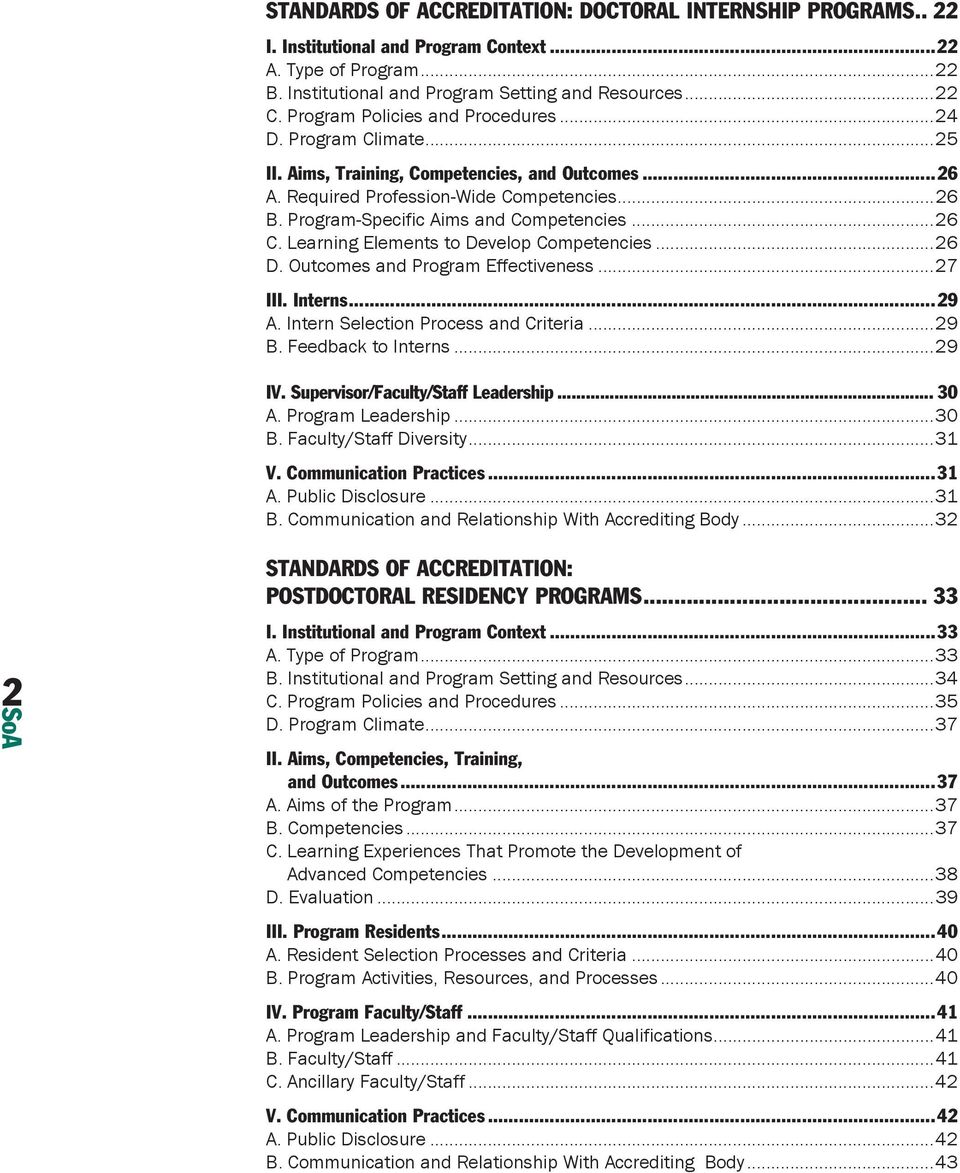
3 STANDARDS OF ACCREDITATION: DOCTORAL INTERNSHIP PROGRAMS.. 22 I. Institutional and Program Context...22 A. Type of Program...22 B. Institutional and Program Setting and Resources...22 C. Program Policies and Procedures...24 D. Program Climate...25 II. Aims, Training, Competencies, and Outcomes...26 A. Required Profession-Wide Competencies...26 B. Program-Specific Aims and Competencies...26 C. Learning Elements to Develop Competencies...26 D. Outcomes and Program Effectiveness...27 III. Interns...29 A. Intern Selection Process and Criteria...29 B. Feedback to Interns...29 IV. Supervisor/Faculty/Staff Leadership A. Program Leadership...30 B. Faculty/Staff Diversity...31 V. Communication Practices...31 A. Public Disclosure...31 B. Communication and Relationship With Accrediting Body STANDARDS OF ACCREDITATION: POSTDOCTORAL RESIDENCY PROGRAMS I. Institutional and Program Context...33 A. Type of Program...33 B. Institutional and Program Setting and Resources...34 C. Program Policies and Procedures...35 D. Program Climate...37 II. Aims, Competencies, Training, and Outcomes...37 A. Aims of the Program...37 B. Competencies...37 C. Learning Experiences That Promote the Development of Advanced Competencies...38 D. Evaluation...39 III. Program Residents...40 A. Resident Selection Processes and Criteria...40 B. Program Activities, Resources, and Processes...40 IV. Program Faculty/Staff...41 A. Program Leadership and Faculty/Staff Qualifications...41 B. Faculty/Staff...41 C. Ancillary Faculty/Staff...42 V. Communication Practices...42 A. Public Disclosure...42 B. Communication and Relationship With Accrediting Body...43
4 INTRODUCTION I. SCOPE OF ACCREDITATION The accreditation process is intended to promote consistent quality and excellence in education and training in health service psychology. Education and training provide tangible benefits for prospective students; the local, national, and international publics that are consumers of psychological services; and the discipline of psychology itself. For the purposes of accreditation by the APA Commission on Accreditation (CoA), health service psychology is defined as the integration of psychological science and practice in order to facilitate human development and functioning. Health service psychology includes the generation and provision of knowledge and practices that encompass a wide range of professional activities relevant to health promotion, prevention, consultation, assessment, and treatment for psychological and other health-related disorders. Programs that are accredited to provide training in health service psychology prepare individuals to work in diverse settings with diverse populations. Individuals who engage in health service psychology have been appropriately trained to be eligible for licensure as doctoral level psychologists. The commission reviews programs for accreditation at doctoral, internship, and postdoctoral levels. A. Scope of Accreditation for Doctoral Programs The CoA reviews doctoral programs in psychology that provide broad and general training in scientific psychology and in the foundations of practice in health service psychology. Practice areas include clinical psychology, counseling psychology, school psychology, and other developed practice areas. The CoA also reviews programs that combine two or three of the above-listed practice areas. B. Scope of Accreditation for Internship Programs 3 The CoA reviews internship training programs in practice areas in health service psychology, which may include clinical psychology, counseling psychology, school psychology, and other developed practice areas. C. Scope of Accreditation for Postdoctoral Residency Programs The CoA reviews postdoctoral residency programs providing education and training in preparation for health service psychology practice at an advanced level of competency in: (a) the developed practice areas that have been defined within the scope of accreditation at the doctoral level, (b) a focus area that promotes attainment of advanced competencies within one or more of the developed practice areas that have been defined within the scope of accreditation at the doctoral level, and/or (c) in a recognized specialty practice area in health service psychology. II. GUIDING PRINCIPLES OF ACCREDITATION The accreditation standards and procedures are greatly influenced by the following principles and practical concerns.

5 A. The Purpose and Practice of Accreditation Accreditation is a voluntary, nongovernmental process of self-study and external review intended to evaluate, enhance, and publicly recognize quality in institutions and in programs of higher education. As such, it serves: 1. General, liberal education; 2. Technical, vocational education and training; and 3. Education and training for the professions. Accreditation is intended to protect the interests of students; benefit the public; and improve the quality of teaching, learning, research, and practice in health service psychology. Through its standards, the accrediting body is expected to encourage dual attainment of a common level of professional competency and ongoing improvement of educational institutions and training programs, sound educational experimentation, and constructive innovation. The accreditation process involves judging the degree to which (a) a program has achieved its educational aims and the standards described in this document and (b) its students/trainees and graduates have demonstrated adequate mastery of the discipline-specific knowledge and profession-wide competencies. The accreditation body should not explicitly prescribe the processes by which competencies should be reached; rather, it should judge the degree to which a program achieves outcomes consistent with the standards in this document and its training aims. 4 Thus, accreditation in psychology is intended to achieve general agreement on the goals of training... encourage experimentation on methods of achieving those goals and... suggest ways of establishing high standards in a setting of flexibility and reasonable freedom. 1 B. Professional Values 1. Certain principles and values are at the core of the profession and impact the way in which the CoA functions and the decisions it makes. The following overarching values govern the policies, standards, and procedures of the CoA. a. Quality The primary goal of the accreditation process is to ensure quality in the education of psychologists and to ensure that students/trainees receive the requisite knowledge, skills, attitudes, and values required for competent and safe practice. The focus on quality ensures that those most vulnerable in the educational process, students/trainees and the public to whom students/trainees and future psychologists will provide services, are adequately protected. b. Transparency As part of its commitment to accountability, the CoA is transparent regarding the policies, standards, and procedures by which it operates. It is open to and values input regarding these from the public, students, faculty, and practitioners. The CoA is also committed to transparency regarding its decisions, within the limits imposed by the confidentiality of the information it receives from programs as part of their application process. 1 The APA Committee on Training in Clinical Psychology. (1947). First report of the new accreditation process in psychology. American Psychologist, 2,

6 c. Peer review Peer review is fundamental to the decision making of the CoA. This process ensures that the education students/trainees receive is assessed by peers nominated for their expertise in health service psychology. Peer review, following carefully developed policies, standards, and procedures, further ensures that the program review process will be fair and objective. A goal of the peer-review process is to promote trust and credibility of the process and outcomes of program review. 2. In addition to the principles and values that regulate the functions of the CoA, the following five principles guide accreditation decisions, such that programs whose policies and procedures violate them would not be accredited. a. Commitment to cultural and individual differences and diversity The Commission on Accreditation is committed to a broad definition of cultural and individual differences and diversity that includes, but is not limited to, age, disability, ethnicity, gender, gender identity, language, national origin, race, religion, culture, sexual orientation, and socioeconomic status. b. Broad and general preparation for practice at the entry level Education in health service psychology resides on a continuum: progressing from broad and general preparation for practice at the entry level at the doctoral and internship levels to advanced preparation at the postdoctoral level in a focus area and/or recognized specialties. Doctoral and internship education and training in preparation for entry-level practice in health service psychology should be broad and professional in its orientation rather than narrow and technical. This preparation should be based on the existing and evolving body of knowledge, skills, and competencies that define the declared substantive practice area(s) and should be well integrated with the broad theoretical and scientific foundations of the discipline and field of psychology in general. 5 c. Advanced preparation for practice at the postdoctoral level in a focus area and/or recognized specialty Postdoctoral residency education and training in health service psychology reflects advanced and focused knowledge of the science and practice of psychology. It builds upon the breadth of knowledge attained in earlier doctoral and internship education so as to ensure competence in health service psychology and is of sufficient depth and focus to ensure advanced competence in the practice area for which the residents are being prepared. This preparation should be based on the existing and evolving body of knowledge, skills, and competencies that define the practice area(s) and should be well integrated with the broad theoretical and scientific foundations of the discipline and field of psychology in general. d. Science and practice The competent practice of psychology requires attention to the empirical basis for all methods involved in psychological practice, including a scientific orientation toward psychological knowledge and methods. Therefore, education and training as

7 a psychologist should be based on the existing and evolving body of general knowledge and methods in the science and practice of psychology, whether in preparation for entry-level practice or in preparation for advanced-level practice in a substantive traditional or specialty practice area. Broad and general knowledge in the discipline of psychology is foundational to and should be well integrated with the specific knowledge, skills, attitudes, and values that define a particular area of interest in health service psychology. The relative emphasis a particular program places on science and practice should be consistent with its training aims and the intended career path of its students/trainees. However, all programs should enable their students to understand the value of science for the practice of psychology and the value of practice for the science of psychology. e. Program aims and student/trainee competencies A program or institution will be evaluated in light of its educational aims and the educational principles described above, the demonstrated competencies of its students/trainees, and the career paths of its graduates. There are certain educational aims that are accepted by the profession as necessary, including adequate mastery by students/trainees of the discipline-specific knowledge in psychology and the profession-wide competencies. 6 The program should be consistent with the stated aims and its policies and with the standards of the CoA described herein. Consistent with these parameters, a program should have a clear, coherent, and well-articulated description of the principles underlying its aims, as well as a clear description of the resources, methods, and processes by which it proposes to attain its desired training outcomes. A program may describe program-specific competencies in addition to profession-wide competencies. Such program-specific competencies should be consistent with the stated aims of the program and with the general requirements of accreditation and should include clear demonstration by students/trainees of attainment of discipline-specific knowledge and profession-wide competencies. The program s aims and desired training outcomes should be consistent with that of its parent or sponsor institution s mission. The program should also address the validity and consistency of its aims and mission in relation to current professional standards and regional and national needs. C. Outcome-Oriented Evaluation Focus The accreditation review process places great emphasis on the outcomes of a program s training efforts. The accreditation process reviews resources and processes to ensure they are adequate to meet the program s aims and the. However these evaluations are not meant to discourage experimentation, innovation, or modernization with regard to the delivery of education. Consistent with this outcomes-oriented approach, the accreditation standards do not contain a checklist of criteria. Rather, they identify and describe the profession-wide competencies and the discipline-specific knowledge that all programs must address as well as general areas that are considered essential to the success of any training program in health service psychology.

8 Programs are expected to document their record of achievements in these areas (in the case of already accredited programs) or their potential for success (in the case of applicant programs). It is assumed that, with reasonable guidance about the kind of information needed by the CoA, programs can decide how best to present their aims, competencies, and outcomes. Similarly, it is assumed that with adequate information from a program, the CoA can reach an informed, fair, and reasonable decision about that program without relying solely on highly restrictive lists of specific criteria. Protection of the interests of the program and the public will be ensured by the creation of procedures that utilize fair and reasonable evaluative methods to assess: 1. The clarity of program aims and outcomes and their consistency with accreditation standards, 2. The sufficiency of resources and adequacy of processes to support the accomplishment of the program s aims, 3. The effectiveness of a program to achieve its aims and outcomes, and 4. The likelihood that such outcomes can be maintained or improved over time. D. Function of the CoA: Professional Judgment This document reflects shared assumptions about the attributes of high-quality education. It is assumed that the CoA will use these shared assumptions, the collective professional judgment of its members, and the accreditation standards to reach an informed, fair, and reasonable decision about a program s readiness for accreditation review and/or its accreditation. The CoA, in representing a broad array of constituencies, has the authority to adopt implementing regulations that elucidate, interpret, and operationally define its standards, principles, and procedures. The implementing regulations are meant to convey to programs and the public the criteria used by the CoA in determining a program s compliance with a standard, while recognizing that application of these criteria and standards requires the exercise of professional judgment. The CoA may in its decision-making processes refer to or adopt definitions, aims, practices, and principles developed by certain health service psychology training communities or reference groups. By creating procedures that utilize fair and reasonable evaluative methods designed to assess program compliance with accreditation standards, principles, and areas, the CoA seeks to ensure protection of the interests of the program and the public. 7

9 STANDARDS OF ACCREDITATION: DOCTORAL PROGRAMS I. INSTITUTIONAL AND PROGRAM CONTEXT A. Type of Program 1. Health service psychology. The program offers broad and general doctoral education and training that includes preparation in health service psychology (HSP). Although HSP encompasses a range of practice areas, degree types, and career paths, certain elements are common to training in the profession. A program that is accredited in health service psychology must demonstrate that it contains the following elements: a. Integration of empirical evidence and practice: Practice is evidence-based, and evidence is practice-informed. b. Training is sequential, cumulative, graded in complexity, and designed to prepare students for practice or further organized training. c. The program engages in actions that indicate respect for and understanding of cultural and individual differences and diversity. 8 DOCTORAL 2. Practice area. Health service psychology includes several practice areas in which an accredited program may focus, including the areas of clinical psychology, counseling psychology, school psychology, combinations of these areas, and other developed practice areas. B. Institutional and Administrative Structure 1. Administrative structure. The program s purpose must be pursued in an institutional setting appropriate for doctoral education and training in health service psychology. The institution must have a clear administrative structure and commitment to the doctoral program. a. The sponsoring institution of higher education must be authorized under applicable law or other acceptable authority to provide a program of postsecondary education and have appropriate graduate degree-granting authority. This includes state authorization and accreditation of the institution by a nationally recognized regional accrediting body in the United States. b. The program is an integral part of the mission of the academic department, college, school, or institution in which it resides. It is represented in the institution s operating budget and plans in a manner that supports the training mission of the program. Funding and resources are stable and enable the program to achieve its aims. 2. Administrative responsibilities related to cultural and individual differences and diversity. The program recognizes the importance of cultural and individual differences and diversity in the training of psychologists. The Commission on Accreditation defines cultural and individual differences and diversity as including, but not limited to, age, disability, ethnicity, gender, gender identity, language, national origin, race, religion, culture, sexual orientation, and socioeconomic status. The program has made systematic, coherent, and long-term efforts to attract and retain students and faculty from diverse back-

10 grounds into the program. Consistent with such efforts, it acts to ensure a supportive and encouraging learning environment appropriate for the training of individuals who are diverse and the provision of training opportunities for a broad spectrum of individuals. Further, the program avoids any actions that would restrict program access on grounds that are irrelevant to success in graduate training, either directly or by imposing significant and disproportionate burdens on the basis of the personal and demographic characteristics set forth in the definition of cultural diversity. Because of the United States rich diverse higher education landscape, training can take place in both secular and faith-based settings. Thus, this requirement does not exclude programs from having a religious affiliation or purpose and adopting and applying admission and employment policies that directly relate to this affiliation or purpose, so long as public notice of these policies has been made to applicants, students, faculty, and staff before their application to or affiliation with the program. These policies may provide a preference for persons adhering to the religious purpose or affiliation of the program, but they shall not be used to preclude the admission, hiring, or retention of individuals because of the personal and demographic characteristics set forth under the definition of cultural diversity. This provision is intended to permit religious policies as to admission, retention, and employment only to the extent that they are protected by the U.S. Constitution. This provision will be administered as if the U.S. Constitution governed its application. Notwithstanding the above, and regardless of a program s setting, the program may not constrain academic freedom or otherwise alter the requirements of these standards. Finally, compelling pedagogical interests require that each program prepare graduates to navigate cultural and individual differences in research and practice, including those that may produce value conflicts or other tensions arising from the intersection of different areas of diversity. C. Program Context and Resources 1. Program administration and structure 9 a. Program leadership. The program has consistent and stable leadership with a designated leader who is a doctoral level psychologist and a member of the core faculty. The program leader s credentials and expertise must be in an area covered by HSP accreditation and must be consistent with the program s aims. This leadership position may be held by more than one individual. b. Program administration. The program has designated procedures and personnel responsible for making decisions about the program, including curriculum, student selection and evaluation, and program maintenance and improvement. The program s decision-making procedures, including who is involved in decision making, must be consistent with the missions of the institution and department, and with the program s aims. The program ensures a stable educational environment through its personnel and faculty leadership. 2. Length of degree and residency. The program has policies regarding program length and residency that permit faculty, training staff, supervisors, and administrators to execute their professional, ethical, and potentially legal obligations to promote student development, socialization, and peer interaction; faculty role modeling; and the development and assessment of student competencies. Residency provides students with mentoring and supervision regarding their development and socialization into the profession, as well as continuous monitoring and assessment of student development through live face-to-face, in-person interaction with faculty and students. DOCTORAL

11 These obligations cannot be met in programs that are substantially or completely online. At a minimum, the program must require that each student successfully complete: a. A minimum of 3 full-time academic years of graduate study (or the equivalent thereof) plus an internship prior to receiving the doctoral degree, b. At least 2 of the 3 academic training years (or the equivalent thereof) within the program from which the doctoral degree is granted, c. At least 1 year of which must be in full-time residence (or the equivalent thereof) at that same program. Programs seeking to satisfy the requirement of 1 year of full-time residency based on the equivalent thereof must demonstrate how the proposed equivalence achieves all the purposes of the residency requirement. 3. Partnerships/consortia. A graduate program may consist of, or be located under, a single administrative entity (e.g., institution, agency, school, or department) or in a partnership or consortium among separate administrative entities. A consortium is composed of multiple independently administered entities that have, in writing, formally agreed to pool resources to conduct a training or education program. 10 DOCTORAL 4. Resources. The program has, and appropriately utilizes, the resources it needs to achieve its training aims, including student acquisition and demonstration of competencies. The program works with its academic unit and/or the administration of the sponsor institution to develop a plan for the acquisition of additional resources that may be necessary for program maintenance and development. The resources should include the following: a. Financial support for training and educational activities; b. Clerical, technical, and electronic support; c. Training materials and equipment; d. Physical facilities; e. Services to support students with academic, financial, health, and personal issues; f. Sufficient and appropriate practicum experiences to allow a program to effectively achieve the program s training aims. D. Program Policies and Procedures 1. Areas of coverage. The program has and adheres to formal written policies and procedures that govern students as they enter, progress through, and matriculate from the program. These must include policies relevant to: a. Academic recruitment and admissions, including general recruitment/admissions and recruitment of students who are diverse; b. Degree requirements; c. Administrative and financial assistance; d. Student performance evaluation, feedback, advisement, retention, and termination decisions;
12 e. Due process and grievance procedures; f. Student rights, responsibilities, and professional development; g. Nondiscrimination policies. The program must document nondiscriminatory policies and operating conditions and avoidance of any actions that would restrict program access or completion on grounds that are irrelevant to success in graduate training or the profession. 2. Implementation. All policies and procedures used by the program must be consistent with the profession s current ethics code and adhere to their sponsor institution s regulations and local, state, and federal statutes regarding due process and fair treatment. If the program utilizes policies developed at another level (e.g., department or institution), it must demonstrate how it implements these policies at the program level. 3. Availability of policies and procedures. The program makes the formal written policies and procedures available to all interested parties. By the time of matriculation, the program provides students with written policies and procedures regarding program and institution requirements and expectations regarding students performance and continuance in the program and procedures for the termination of students. 4. Record keeping. The program is responsible for keeping information and records related to student training and complaints/grievances against the program. Records must be maintained in accordance with federal, state, and institution policies regarding record keeping and privacy. The Commission on Accreditation will examine student records and programs records of student complaints as part of its periodic review of programs. a. Student records. The program must document and maintain accurate records of each student s education and training experiences and evaluations for evidence of the student s progression through the program and for future reference and credentialing purposes. The program should inform students of its records retention policies. 11 b. Complaints/grievances. The program must keep records of all formal complaints and grievances of which it is aware that have been submitted or filed against the program and/or against individuals associated with the program since its last accreditation site visit. The Commission on Accreditation will examine a program s records of student complaints as part of its periodic review of the program. II. AIMS, COMPETENCIES, CURRICULUM, AND OUTCOMES A. Aims of the Program 1. The program must provide information on the aims of its training program that are consistent with health service psychology as defined by these standards, the program s area of psychology, and the degree conferred. DOCTORAL
13 2. These aims should reflect the program s approach to training and the outcomes the program targets for its graduates, including the range of targeted career paths. B. Discipline-Specific Knowledge, Profession-Wide Competencies, and Learning/Curriculum Elements Required by the Profession 1. Discipline-specific knowledge and profession-wide competencies Discipline-specific knowledge serves as a cornerstone for the establishment of identity in and orientation to health service psychology. Thus, all students in accredited programs should acquire a general knowledge base in the field of psychology, broadly construed, to serve as a foundation for further training in the practice of health service psychology. a. Discipline-specific knowledge represents the requisite core knowledge of psychology an individual must have to attain the profession-wide competencies. Programs may elect to demonstrate discipline-specific knowledge of students by: (i) Using student selection criteria that involve standardized assessments of a foundational knowledge base (e.g., GRE subject tests). In this case, the program must describe how the curriculum builds upon this foundational knowledge to enable students to demonstrate graduate- level discipline-specific knowledge. 12 DOCTORAL (ii) Providing students with broad exposure to discipline-specific knowledge. In this case, the program is not required to demonstrate that students have specific foundational knowledge at entry but must describe how the program s curriculum enables students to demonstrate graduate-level discipline-specific knowledge. b. Profession-wide competencies include certain competencies required for all students who graduate from programs accredited in health service psychology. Programs must provide opportunities for all of their students to achieve and demonstrate each required profession-wide competency. Although in general, the competencies appearing at or near the top of the following list serve as foundations upon which later competencies are built, each competency is considered critical for graduates in programs accredited in health service psychology. The specific requirements for each competency are articulated in Implementing Regulations. Because science is at the core of health service psychology, programs must demonstrate that they rely on the current evidence base when training students in the following competency areas. Students must demonstrate competence in: (i) Research (ii) Ethical and legal standards (iii) Individual and cultural diversity (iv) Professional values, attitudes, and behaviors (v) Communication and interpersonal skills (vi) Assessment (vii) Intervention

14 (viii) Supervision (ix) Consultation and interprofessional/interdisciplinary skills 2. Learning/curriculum elements related to the program s aims. The program must describe the process by which students attain discipline-specific knowledge and each profession-wide competency (i.e., the program s curriculum) and provide a description of how the curriculum is consistent with professional standards and the program s aims. 3. Required practicum training elements a. Practicum must include supervised experience working with individuals who are diverse with a variety of presenting problems, diagnoses, and issues. The purpose of practicum is to develop the requisite knowledge and skills for graduates to be able to demonstrate the competencies defined above. The doctoral program needs to demonstrate that it provides a training plan applied and documented at the individual level, appropriate to the student s current skills and ability, that ensures that by the time the student applies for internship, the student has attained the requisite level of competency. b. Programs must place students in settings that are committed to training, provide experiences consistent with health service psychology and the program s aims, and enable students to attain and demonstrate appropriate competencies. c. Supervision must be provided by appropriately trained and credentialed individuals. d. As part of a program s ongoing commitment to ensure the quality of its graduates, each practicum evaluation must be based in part on direct observation of the practicum student and her/his developing skills (either live or electronically) Required internship training elements. The program must demonstrate that all students complete a 1-year full-time or 2-year part-time internship. The program s policies regarding student placement at accredited versus unaccredited internships should be consistent with national standards regarding internship training. a. Accredited internships. Students are expected to apply for and, to the extent possible, complete internship training programs that are either APA- or CPA-accredited. For students who attend accredited internships, the doctoral program is required to provide only the specific name of the internship. b. Unaccredited internships. When a student attends an unaccredited internship, it is the responsibility of the doctoral program to provide evidence demonstrating quality and adequacy of the internship experience. This must include information on the following: (i) The nature and appropriateness of the training activities, (ii) Frequency and quality of supervision, (iii) Credentials of the supervisors, (iv) How the internship evaluates student performance, DOCTORAL

15 (v) How interns demonstrate competency at the appropriate level, and (vi) Documentation of the evaluation of its students in its student files. C. Program-Specific Elements Degree Type, Competencies, and Related Curriculum 1. Degree type. All accredited programs in psychology support the development of disciplinary knowledge and core competencies associated with the profession and support the acquisition and integration of knowledge, skills, and attitudes from two major domains within the discipline: research and evidence-based practice. Programs are accredited either to offer the PhD degree or to offer the PsyD degree. Other doctoral degree designations that meet these general parameters may be eligible for consideration as appropriate. Although all doctoral degrees contain all the required elements common to programs accredited in HSP, they differ in the balance among, and relative emphasis on, program components, based on specific training aims or likely career paths of their graduates. In general, PhD programs place relatively greater emphasis on training related to research, and PsyD programs place relatively greater emphasis on training for engaging in professional practice. Graduates of each type of program or other doctoral degree designations, however, must demonstrate a fundamental understanding of and competency in both research/scholarly activities and evidence-based professional practice. 14 DOCTORAL Programs that confer the PhD must have a substantial proportion of faculty who conduct empirical research in the discipline (or related disciplines and fields) and a substantial proportion of faculty who have been trained for the practice of psychology. Thus, students in PhD programs are trained to both create and disseminate the scholarly research upon which science and practice are built and utilize such research to engage in evidence-based practice. Programs that confer the PsyD must have a substantial proportion of faculty who engage in scholarship and/or empirical research in the discipline (or related disciplines and fields) and a substantial proportion of faculty who have been trained for the practice of psychology. Thus, students in PsyD programs are trained to engage in evidence-based practice and in scientific inquiry and evaluation. 2. Program-specific competencies and related curricula. Doctoral programs accredited in health service psychology may require that students attain additional competencies specific to the program. a. If the program requires additional competencies of its students, it must describe the competencies, how they are consistent with the program s aims, and the process by which students attain each competency (i.e., the curriculum). b. Additional competencies must be consistent with the ethics of the profession. D. Evaluation of Students and Program 1. Evaluation of students competencies a. The program must evaluate students competencies in both profession-defined and program-defined areas. By the time of degree completion, each student must demonstrate achievement of both the profession-wide competencies and those
16 required by the program. Thus, for each competency, the program must: (i) Specify how it evaluates student performance and the minimum level of achievement or performance required of the student to demonstrate competency. Programs must demonstrate how their evaluation methods and minimum levels of achievement are appropriate for the measurement of each competency. The level of achievement expected should reflect the current standards for the profession. (ii) Provide outcome data that clearly demonstrate that by the time of degree completion, all students have reached the appropriate level of achievement in each profession-wide competency and in each program-defined competency. While the program has flexibility in deciding what outcome data to present, the data should reflect assessment that is consistent with best practices in student competency evaluation. (iii) Present formative and summative evaluations linked to exit criteria and data demonstrating achievement of competencies for each student in the program. b. For program graduates, the program must provide distal evidence of students competencies and program effectiveness and must evaluate graduates career paths in health service psychology after they have left the program. (i) Two years after graduation, the program must provide data on how well the program prepared students in each profession-wide and program-specific competency. The program must also provide data on students job placement and licensure rates. (ii) At 5 years postgraduation, the program must provide data on graduates, including data on graduates licensure (as appropriate for their current job duties) and their scholarly/research contributions (as consistent with the program s aims) Evaluation of program effectiveness and quality improvement efforts a. The program must demonstrate a commitment to ensure competence in health service psychology through ongoing self-evaluation to monitor its performance and contribution to the fulfilment of its sponsor institution s mission. b. The program must document mechanisms for performing the regular, ongoing self-assessment, and the self-assessment must: (i) Involve program stakeholders, including faculty, students, graduates, and others involved in the training program; (ii) Evaluate the program s effectiveness in training students who, by the time of graduation, demonstrate the competencies required by the profession and the program, and who, after graduation, are able to engage in professional activities consistent with health service psychology and with the program s aims; DOCTORAL

17 (iii) Evaluate the currency and appropriateness of the program s aims, curriculum, and policies and procedures with respect to the following: its sponsor institution s mission and goals; local, state/provincial, regional, and national needs for psychological services; national standards for health service psychology; and the evolving evidence base of the profession; and (iv) Identify potential areas for improvement. 3. Documenting students achievements and outcomes that demonstrate the program s effectiveness. All accredited doctoral programs are expected to document students achievements while they are in the program and to look at postgraduation outcomes. Accredited programs are also expected to prepare students for entry-level practice, and the program s achievement of this should be reflected in student success in achieving licensure after completion of the program. a. The outcomes of program graduates, including licensure rate and other proximal and distal outcomes of program graduates, shall be evaluated within the context of: the requirement that all accredited doctoral programs prepare students for entry-level practice, program s expressed and implied stated educational aims and competencies, and statements made by the program to the public. 16 DOCTORAL III. STUDENTS b. Doctoral programs specific educational aims and expected competencies may differ from one another; therefore, there is no specified threshold or minimum number for a program s licensure rate. Instead, the Commission on Accreditation shall use its professional judgment to determine if a program s licensure rate, in combination with other factors, such as attrition of students from the program and their time to degree, demonstrates students successful preparation for entry-level practice in health service psychology. A. Student Selection Processes and Criteria 1. The program has an identifiable body of students at different levels of matriculation who: a. Constitute a number that allows opportunities for meaningful peer interaction, support, and socialization. b. Are reflective of a systematic, multiple-year plan, implemented and sustained over time, designed to attract students from a range of diverse backgrounds as outlined in the glossary. (i) The program must implement specific activities, approaches, and initiatives to increase diversity among its students. It may participate in institutional-level initiatives aimed toward achieving diversity, but these alone are not sufficient. (ii) The program should document the concrete actions it is taking to achieve diversity, identifying the areas of diversity recruitment in which it excels and the areas it is working to improve. The program should demonstrate that it examines the effectiveness of its efforts

18 to attract students who are diverse and document any steps needed to revise/enhance its strategies. c. By prior achievement, students have demonstrated appropriate competency for the program s aims and expectations for a doctoral program. (i) If the program has criteria for selection that involve demonstration of prior knowledge (e.g., GRE subject tests), the program must discuss how these criteria influence program requirements, are appropriate for the aims of the program, and maximize student success. (ii) If the program has broad entrance criteria (e.g., undergraduate or graduate GPA), the program must address how students will be prepared for advanced education and training in psychology, how the curriculum is structured in accord with the goal of graduate-level competency, and how the criteria relative to the curriculum maximize student success. d. By interest and aptitude, students are prepared to meet the program s aims. e. The students reflect, through their intellectual and professional development and intended career paths, the program s aims and philosophy. B. Supportive Learning Environment 1. Program faculty are accessible to students and provide them with guidance and supervision. They serve as appropriate professional role models and engage in actions that promote students acquisition of knowledge, skills, and competencies consistent with the program s training aims. 2. The program recognizes the rights of students and faculty to be treated with courtesy and respect. To maximize the quality and effectiveness of students learning experiences, all interactions among students, faculty, and staff should be collegial and conducted in a manner that reflects the highest standards of the scholarly community and of the profession (see the current APA Ethical Principles of Psychologists and Code of Conduct). The program has an obligation to inform students of these principles, put procedures in place to promote productive interactions, and inform students of their avenues of recourse should problems with regard to the principles arise To ensure a supportive and encouraging learning environment for students who are diverse, the program must avoid any actions that would restrict program access on grounds that are irrelevant to success in graduate training. C. Plans to Maximize Student Success 1. Program faculty engage in and document actions and procedures that actively encourage timely completion of the program and maximize student success. The program minimizes preventable causes of attrition (e.g., flawed admission procedures or unsupportive learning environments) and engages in tailored retention/completion efforts as appropriate (e.g., accommodation of student needs and special circumstances). 2. Program engagement. The program engages in specific activities, approaches, and initiatives to implement and maintain diversity and ensure a supportive learning environment for all students. DOCTORAL
19 The program may participate in institutional-level initiatives aimed toward retaining students who are diverse, but these alone are not sufficient. Concrete program-level actions to retain students who are diverse should be integrated across key aspects of the program and documented. The program should also demonstrate that it examines the effectiveness of its efforts to retain students who are diverse and document any steps needed to revise/enhance its strategies. 3. Feedback and remediation. Students receive, at least annually and as the need is observed for it, written feedback on the extent to which they are meeting the program s requirements and performance expectations. Such feedback should include: a. Timely, written notification of any problems that have been noted and the opportunity to discuss them; b. Guidance regarding steps to remediate any problems (if remediable); and c. Substantive, written feedback on the extent to which corrective actions have or have not been successful in addressing the issues of concern. IV. FACULTY A. Program Leadership, Administration, and Management 18 DOCTORAL 1. Leadership of the program is stable. There is a designated leader who is a doctoral level psychologist and a member of the core faculty. The program leader s credentials and expertise are consistent with the program s mission and aims and with the substantive area of health service psychology in which the program provides training. More than one individual can hold this leadership position. 2. The program leader(s) together with program core faculty have primary responsibility for the design, implementation, and evaluation of the program s administrative activities (e.g., policies and procedures for student admissions, student evaluations, and arrangement of practicum experiences) and for its educational offerings (e.g., coursework, practicum experiences, and research training). B. Faculty Qualifications and Role Modeling 1. Core faculty. The program has an identifiable core faculty responsible for the program s activities, educational offerings, and quality, who: a. Function as an integral part of the academic unit of which the program is an element, b. Are sufficient in number for their academic and professional responsibilities, c. Have theoretical perspectives and academic and applied experiences appropriate to the program s aims, d. Demonstrate substantial competence and have recognized credentials in those areas that are at the core of the program s aims, and e. Are available to function as appropriate role models for students in their learning and socialization into the discipline and profession.
20 2. Additional core faculty professional characteristics a. Core faculty must be composed of individuals whose education, training, and/or experience are consistent with their roles in the program in light of the substantive area in which the program seeks accreditation. b. Core faculty must be composed of individuals whose primary professional employment (50% or more) is at the institution in which the program is housed and to whom the institution has demonstrated a multiyear commitment. At least 50% of core faculty professional time must be devoted to program-related activities. c. Core faculty must be identified with the program and centrally involved in program development, decision making, and student training. Identified with the program means that each faculty member is included in public and departmental documents as such, views himself or herself as core faculty, and is seen as core faculty by the students. d. Core faculty activities directly related to the doctoral program include program-related teaching, research, scholarship, and/ or professional activities; supervising students research, students dissertations, and students teaching activities; mentoring students professional development; providing clinical supervision; monitoring student outcomes; teaching in a master s degree program that is an integral part of the doctoral program; and developing, evaluating, and maintaining the program. e. Core faculty activities not directly related to the doctoral program and not seen as aspects of the core faculty role include undergraduate teaching in general and related activities; teaching and related activities in terminal master s or other graduate programs; and clinical work or independent practice not directly associated with training, such as at a counseling center Associated and adjunct faculty. In addition to core faculty, programs may also have associated program faculty, contributing faculty, and adjunct (visiting, auxiliary, or other ) faculty. Associated program faculty do not meet the criteria for core faculty. They are not centrally involved in program development and decision making, but they still make a substantial contribution to the program and take on some of the tasks often associated with core faculty. Adjunct faculty are hired on an ad hoc basis to teach one or two courses, provide supervision, etc. 4. Faculty sufficiency a. Consistent with the program s model, the program faculty, and in particular the core faculty, needs to be large enough to advise and supervise students research and practice, conduct research and/or engage in scholarly activity, attend to administrative duties, serve on institutional or program committees, provide a sense of program continuity, provide appropriate class sizes and sufficient course offerings to meet program aims, and monitor and evaluate practicum facilities, internship settings, and student progress. b. The program faculty, and in particular the core faculty, needs to be large enough to support student engagement and success within the program, from admissions to matriculation to timely completion of program requirements and graduation. DOCTORAL

21 c. At least one member of the core faculty needs to hold professional licensure as a psychologist to practice in the jurisdiction in which the program is located. d. The program faculty must themselves be engaged in activities demonstrating the skills they are endeavoring to teach their students, such as delivering psychological services, conducting psychological research, publishing scholarly work, presenting professional work at conferences/meetings, teaching classes/ workshops, and supervising the professional work of others. 5. Cultural and individual differences and diversity a. Recruitment of faculty who are diverse. Each accredited program is responsible for making systematic, coherent, and long-term efforts to attract (i.e., recruit) and retain faculty from differing backgrounds. The program has developed a systematic, long-term plan to attract faculty from a range of diverse backgrounds and implemented it when possible (i.e., when there have been faculty openings). The program may participate in institutional-level initiatives aimed toward achieving diversity, but these alone are not sufficient. The program should document concrete actions it has taken to achieve diversity, addressing the areas of diversity recruitment in which it excels and the areas in which it is working to improve. It should demonstrate that it examines the effectiveness of its efforts to attract faculty who are diverse and documents any steps needed to revise/enhance its strategies. 20 DOCTORAL V. COMMUNICATION PRACTICES A. Public Disclosure b. Retention of faculty who are diverse. The program implements program-specific activities, approaches, and initiatives to maintain diversity among its faculty. A program may include institutional-level initiatives aimed toward retaining faculty who are diverse, but these alone are not sufficient. The program demonstrates that it examines the effectiveness of its efforts to maintain faculty who are diverse and documents any steps needed to revise/enhance its strategies. 1. General disclosures a. The program demonstrates its commitment to public disclosure by providing clearly presented written materials and other communications that appropriately represent it to all relevant publics. At a minimum, this includes general program information pertaining to its aims, required curriculum sequence, and the expected outcomes in terms of its graduates careers, as well as data on achievement of those expected and actual outcomes. b. The program must disclose its status with regard to accreditation, including the specific academic program covered by that status, and the name, address, and telephone number of the Commission on Accreditation. The program should make available, as appropriate through its sponsor institution, such reports or other materials as pertain to the program s accreditation status.
22 2. Communication with prospective and current students a. All communications with potential students should be informative, accurate, and transparent. b. The program must be described accurately and completely in documents available to current students, prospective students, and other publics. This information should be presented in a manner that allows applicants to make informed decisions about entering the program. Program descriptions should be updated regularly as new cohorts begin and complete the program. c. Descriptions of the program should include information about its requirements for admission and graduation; tuition and other costs; curriculum; time to completion; faculty, students, facilities, and other resources, including distance learning technologies; administrative policies and procedures; the kinds of research, practicum, and internship experiences it provides; and its education and training outcomes. (i) If the program has criteria for selection that involve competence-based assessments (e.g., GRE subject tests), it must describe how those criteria are appropriate for the aims of the program, how the curriculum is structured in terms of students initial assessed competency at entry to the program, and how the criteria maximize student success. (ii) If the program has broad entrance criteria (e.g., undergraduate or graduate GPA), it must address how students will be prepared for advanced education and training in psychology, how the curriculum is structured in accordance with the goal of graduate-level competency, and how the criteria relative to the curriculum maximize student success. 21 d. The program must provide reasonable notice to its current students of changes to its aims, curriculum, program resources, and administrative policies and procedures, as well as any other program transitions that may impact its educational quality. 3. Communication between doctoral and doctoral internship programs a. Throughout the internship year, communication between the doctoral program and the internship should be maintained. This ongoing interaction can remain largely informal, depending on the needs of the program and the trainee. The doctoral program should initiate this contact at the start of the training year. b. Any formal, written internship evaluations must be retained in student files and used to evaluate the student competencies required for degree completion. B. Communication and Relationship With Accrediting Body The program must demonstrate its commitment to the accreditation process through: 1. Adherence. The program must abide by the accrediting body s published policies and procedures as they pertain to its recognition DOCTORAL
23 as an accredited program. The program must respond in a complete and timely manner to all requests for communication from the accrediting body, including completing all required reports and responding to all questions. a. Standard reporting. The program must respond to regular, recurring information requests (e.g., annual reports and narrative reports) as required by the accrediting body s policies and procedures. b. Nonstandard reporting. The program must submit timely responses to any additional information requests from the accrediting body. c. Fees. The program must be in good standing with the accrediting body in terms of payment of fees associated with the maintenance of its accredited status. 2. C ommunication. The program must inform the accrediting body in a timely manner of changes in its environment, plans, resources, or operations that could alter the program s quality. This includes notification of any potential substantive changes in the program, such as changes in practice area or degree conferred or changes in faculty or administration. 22 DOCTORAL INTERNSHIP STANDARDS OF ACCREDITATION: DOCTORAL INTERNSHIP PROGRAMS I. INSTITUTIONAL AND PROGRAM CONTEXT A. Type of Program 1. Sponsoring institution. The program is sponsored by an institution or agency that provides service to a population sufficient in number and variability to give interns adequate experiential exposure to meet training purposes, aims, and competencies. 2. Length of program. Accredited internships may be structured as full time or part time. The program requires interns to have the equivalent of 1 year of full-time training to be completed in no fewer than 12 months (or 10 months for school psychology internships), or the equivalent of half-time training to be completed within 24 months. The sponsoring doctoral program, internship program, and intern must have a clear understanding of the intern s plan if internship time is to be divided among two or more agencies for half-time training. 3. Programs can be single-site or multiple sites. B. Institutional and Program Setting and Resources 1. Internship program setting descriptions must include: a. Description of the sponsoring institution/agency, b. Description of the training setting and how it is appropriate for the aims/purposes of the training program,
24 c. Description of how the setting functions primarily as a service provider, and d. Information on required hours. 2. Administrative structure. The program offers education and training in psychology that prepare interns for the practice of health service psychology. a. The program is an integral part of the mission of the institution in which it resides. b. The administrative structure and processes facilitate systematic coordination, control, direction, and organization of the training activity and resources. 3. Administrative responsibilities related to cultural and individual differences and diversity. The program recognizes the importance of cultural and individual differences and diversity in the training of psychologists. The Commission on Accreditation defines cultural and individual differences and diversity as including, but not limited to, age, disability, ethnicity, gender, gender identity, language, national origin, race, religion, culture, sexual orientation, and socioeconomic status. The program has made systematic, coherent, and long-term efforts to attract interns and faculty/staff from diverse backgrounds into the program and retain them. Consistent with such efforts, it acts to support and encourage an appropriate learning environment, training, and training opportunities for individuals who are diverse. Further, the program avoids any actions that would restrict program access on grounds irrelevant to success in graduate training, either directly or from the imposition of significant and disproportionate burdens on the basis of the personal and demographic characteristics set forth in the definition of cultural diversity. Because of the United States rich diverse higher education landscape, training can take place in both secular and faith-based settings. Thus, this requirement does not exclude programs from having a religious affiliation or purpose and adopting and applying admission and employment policies that directly relate to this affiliation or purpose, so long as public notice of these policies has been given to applicants, interns, faculty, and staff before their application to or affiliation with the program. These policies may provide a preference for persons adhering to the religious purpose or affiliation of the program, but they shall not be used to preclude the admission, hiring, or retention of individuals because of the personal and demographic characteristics set forth under the definition of cultural diversity. This provision is intended to permit religious policies as to admission, retention, and employment only to the extent that they are protected by the U.S. Constitution. This provision will be administered as if the U.S. Constitution governed its application. Notwithstanding the above, and regardless of a program s setting, the program may not constrain academic freedom or otherwise alter the requirements of these standards. Finally, compelling pedagogical interests require that each program prepare interns to navigate cultural and individual differences in research and practice, including those that may produce value conflicts or other tensions arising from the intersection of different areas of diversity. 4. Funding and budget a. Interns are provided financial support. Financial support should be set at a level that is representative and fair in relationship to both the geographic location and clinical setting of the training site. 23 DOCTORAL INTERNSHIP
25 b. The program must have financial support for faculty/staff and sufficient and dependable training activities for the duration of the year or years of the contract with interns. c. Funding for the program should be represented in the institution s operating budget and plans in a manner that enables the program to achieve its training aims. 5. Training resources and support services. The program must demonstrate adequacy of its educational and training resources, including: a. Clerical, technical, and electronic support sufficient to meet the program s needs; b. Training materials, equipment, and access to the current knowledge base in the profession, including access to appropriate technology and resources to stay current with the scholarly literature; c. Physical facilities that are appropriate for confidential interactions, including facilities and resources compliant with the Americans With Disabilities Act. C. Program Policies and Procedures 1. Areas of coverage. The program has, adheres to, and makes available to all interested parties formal written policies and procedures that govern interns as they enter and complete the program. These must include policies relevant to: 24 DOCTORAL INTERNSHIP a. Intern recruitment and selection; b. Any required prior doctoral program preparation and experiences; c. Administrative and financial assistance; d. Requirements for successful internship performance (including expected competencies and minimal levels of achievement for completion); e. Intern performance evaluation, feedback, retention, and termination decisions; f. Identification and remediation of insufficient competence and/ or problematic behavior, which shall include necessary due process steps of notice, hearing, and appeal; g. Grievance procedures for interns including due process; h. Supervision requirements; i. Maintenance of records; and j. Documentation of nondiscrimination policies and operating conditions and avoidance of any actions that would restrict program access or completion on grounds that are irrelevant to success in graduate training or the profession. 2. Implementation. All policies and procedures used by the program must be consistent with the profession s current ethics code and adhere to the sponsor institution s regulations and local, state, and federal statutes regarding due process and fair treatment. The program must demonstrate how it incorporates and implements departmental and institutional policies at the program level, whenever such policies impact the program specifically.
26 3. Availability of policies and procedures. At the start of internship, the program must provide interns with written or electronic policies and procedures regarding program and institution requirements, expectations regarding interns performance and continuance in the program, and procedures for the termination of interns. 4. Record keeping D. Program Climate a. Intern performance. The program must document and permanently maintain accurate records of the interns training experiences, evaluations, and certificates of internship completion for evidence of the interns progress through the program and for future reference and credentialing purposes. The program should inform interns of its records retention policies. b. Complaints and grievances. The program must keep information and records of all formal complaints and grievances of which it is aware that have been submitted or filed against the program and/or against individuals associated with the program since its last accreditation site visit. The Commission on Accreditation will examine a program s records of intern complaints as part of its periodic review of the program. 1. Cultural and individual differences and diversity. The program ensures a welcoming, supportive, and encouraging learning environment for all interns, including interns from diverse and underrepresented communities. a. Program climate is reflected in the recruitment, retention, and development of training supervisors and interns and in didactic and experiential training that fosters an understanding of cultural and individual differences and diversity as it relates to professional psychology. b. The program conducts periodic self-assessment of its training climate in regards to diversity and takes steps to maintain an atmosphere that promotes the success of all interns Supportive learning environment a. The program recognizes the rights of interns and faculty/ staff to be treated with courtesy and respect. To maximize the quality and effectiveness of the interns learning experiences, all interactions among interns, training supervisors, and faculty/staff should be collegial and conducted in a manner that reflects the highest standards of the profession. (See the current APA Ethical Principles of Psychologists and Code of Conduct.) The program has an obligation to inform interns of these principles and of their avenues of recourse should problems arise. b. Program faculty/staff are accessible to interns and provide them with a level of guidance and supervision that encourages successful completion of the internship. Faculty/staff members serve as appropriate professional role models and engage in actions that promote interns acquisition of knowledge, skills, and competencies consistent with the program s training aims. DOCTORAL INTERNSHIP
27 II. AIMS, TRAINING, COMPETENCIES, AND OUTCOMES A. Required Profession-Wide Competencies 1. Certain competencies are required for all interns who graduate from programs accredited in health service psychology. Programs must provide opportunities for all their interns to demonstrate they have met each required profession-wide competency. 2. The role of the internship is to build upon a trainee s competencies in all the competency areas. Because science is at the core of health service psychology, programs must demonstrate they rely on the current evidence base when training and assessing interns in the competency areas. Interns must demonstrate competence in: a. Research b. Ethical and legal standards c. Individual and cultural diversity d. Professional values, attitudes, and behaviors e. Communication and interpersonal skills f. Assessment g. Intervention 26 DOCTORAL INTERNSHIP h. Supervision i. Consultation and interprofessional/interdisciplinary skills B. Program-Specific Aims and Competencies 1. Specific aims of the training program. Consistent with profession-wide competencies required of all programs, the program must provide information on the specific aims of the training program. The program s aims should be aligned with the program s training activities and intended outcomes. 2. Program-specific competencies. While internship programs accredited in health service psychology must encompass profession-wide competencies required of all programs, they may also elect to demonstrate program-specific competencies. a. The program must specify if its intended training outcomes will place special emphasis on the development of any competencies in addition to those expected for all psychology interns or to a greater degree of achievement than might be expected for all psychology interns. b. Additional competencies, if any, must be current and consistent with the definition of health service psychology, ethics of the profession, and aims of the program. C. Learning Elements to Develop Competencies 1. Educational activities. It is the responsibility of the program to have a clear and coherent plan for educational activities that support interns achievement of both profession-wide and any program-specific competencies.
28 2. Learning elements a. The program s primary training method must be experiential (i.e., service delivery in direct contact with service recipients) and include sufficient observation and supervision by psychologists to facilitate interns readiness to enter into the general practice of psychology on training completion. b. The program must follow a logical training sequence that builds on the skills and competencies acquired during doctoral training. c. Training for practice must be sequential, cumulative, and graded in complexity in a manner consistent with the program s training structure. d. The program must demonstrate that intern service delivery tasks and duties are primarily learning oriented, and training considerations take precedence over service delivery and revenue generation. 3. Supervision a. Supervision is regularly scheduled. b. Interns receive at least 4 hours of supervision per week. c. One or more doctoral level psychologists who are appropriately trained and licensed are involved in ongoing supervisory relationships with an intern and have primary professional responsibility for the cases on which supervision is provided. The supervisor(s) must conduct a total of at least 2 hours per week of individual supervision with the intern during the course of the year. d. Supervisory hours beyond the 2 hours of individual supervision must be consistent with the definition of supervision in the glossary and must be supervised by health care professionals who are appropriately credentialed for their role/contribution to the program. These interactive experiences can be in a group or individual format. 27 e. Interns should have access to consultation and supervision during times they are providing clinical services. f. The doctoral level licensed psychologist supervisors maintain overall responsibility for all supervision, including oversight and integration of supervision provided by other professionals. D. Outcomes and Program Effectiveness 1. Evaluation of interns competencies a. Current interns. As part of its ongoing commitment to ensuring the quality of its graduates, the program must evaluate interns in both profession-defined and program-defined competencies. By the end of the internship, each intern must demonstrate achievement of both the profession-wide competencies and any additional competencies required by the program. For each competency, the program must: (i) Specify how it evaluates intern performance; DOCTORAL INTERNSHIP
29 (ii) Identify the minimum level of achievement or performance required of the intern to demonstrate competency; (iii) Provide outcome data that clearly demonstrate all interns successfully completing the program have attained the minimal level of achievement of both the profession-wide and any program-specific competencies; (iv) Base each intern evaluation in part on direct observation (either live or electronic) of the intern; and (v) While the program has flexibility in deciding what outcome data to present, the data should reflect assessment that is consistent with professionally accepted practices in intern competencies evaluation. b. Internship program alumni. The program must evaluate the functioning of alumni in terms of their career paths in health service psychology. Each program must provide data on how well the program prepared interns in each of the profession-wide and any program-specific competencies. The program must also provide data on interns job placement and licensure status. 2. Evaluation of program effectiveness and quality improvement efforts 28 DOCTORAL INTERNSHIP a. The program must demonstrate ongoing self-evaluation to monitor its performance to ensure competence in health service psychology and contribute to fulfilment of its sponsor institution s mission. b. The program must document mechanisms for engaging in regular, ongoing self-assessment that: (i) Involves program stakeholders, including training faculty/staff, interns, program graduates, and others involved in the training program; (ii) Evaluates its effectiveness in training interns who, by the completion of the internship, demonstrate competencies required by the profession and the program and are able to engage in professional activities consistent with health service psychology and with the program s aims; (iii) Has procedures in place to use proximal and distal data to monitor, make changes in, and improve the program; (iv) Provides resources and/or opportunities to enhance the quality of its training and supervision faculty/staff through continual professional development; (v) Evaluates the currency and appropriateness of its aims, educational activities, policies, and procedures with respect to its sponsor institution s mission and goals; local, state/provincial, regional, and national needs for psychological services; national standards for health service psychology; and the evolving evidence base of the profession.
30 III. INTERNS A. Intern Selection Process and Criteria 1. Identifiable body of interns. The program has an identifiable body of interns who are qualified to begin doctoral internship training. a. They are currently enrolled in a doctoral program accredited by an accrediting body recognized by the U.S. Secretary of Education or the Canadian Psychological Association. If the internship accepts an intern from an unaccredited program, the program must discuss how the intern is appropriate for the internship program. b. Interns have interests, aptitudes, and prior academic and practicum experiences appropriate for the internship s training aims and competencies. c. Adequate and appropriate supervised practicum training for the internship program must include face-to-face delivery of health service psychological services. 2. Recruitment of interns who are diverse a. The program has made and continues to make systematic, coherent, and long-term efforts to attract interns from different ethnic, racial, gender, and personal backgrounds into the program. b. Consistent with such efforts, the program acts to ensure the provision of training opportunities appropriate for the training of individuals who are diverse. It reviews its success with these efforts and makes changes as appropriate. 3. Intern sufficiency 29 The program has at least two interns who: a. Are provided with opportunities that ensure appropriate peer interaction, support, and socialization; b. Are provided with opportunities for socialization and interaction with professional colleagues in a manner consistent with the program s training structure; c. Have an understanding of the program s philosophy, aims, and expected competencies; B. Feedback to Interns d. Have a training status at the site that is officially recognized in the form of a title or designation such as psychology intern (consistent with the licensing laws of the jurisdiction in which the internship is located and with the sponsoring institution). 1. Interns receive, at least semiannually and as the need is observed for it, written feedback on the extent to which they are meeting stipulated performance requirements. Feedback is linked to the program s expected minimal levels of achievement for profession-wide competencies and any program-specific competencies. 2. Such feedback should include: DOCTORAL INTERNSHIP
31 a. Timely written notification of all problems that have been noted and the opportunity to discuss them; b. Guidance on steps to remediate all problems (if remediable); c. Substantive written feedback on the extent to which corrective actions are or are not successful in addressing the issues of concern; and d. Documentation that the intern evaluation was reviewed and discussed by the intern and the supervisor. IV. SUPERVISOR/FACULTY/STAFF LEADERSHIP A. Program Leadership 1. Internship program director a. The program director is primarily responsible for directing the training program and has administrative authority commensurate with that responsibility. b. The director should have appropriate administrative skills to ensure the success of the program and serve as a role model for the interns. 30 DOCTORAL INTERNSHIP c. The director must be a psychologist, appropriately trained and credentialed (i.e., licensed, registered, or certified) to practice psychology in the jurisdiction in which the program is located. d. The director s credentials and expertise must be consistent with the program s aims and the expected competencies of its interns. 2. Administrative and program leadership structure. The program s administrative structure and processes facilitate appropriate review and continuous program improvement to ensure the program achieves its aims and provides the training environment needed for interns to attain all competencies. The program must describe how faculty/staff and interns contribute to the planning and implementation of the training program. 3. Intern training supervisors a. Supervisors function as an integral part of the site where the program is housed and have primary responsibility for professional service delivery. b. The program must have a sufficient number of supervisors to accomplish the program s service delivery and to supervise training activities and program aims. An accredited internship program must have a minimum of two doctoral level psychologists on-site. c. Supervisors are doctoral level psychologists who have primary professional responsibility for the cases for which they provide supervision and are appropriately trained and credentialed (i.e., licensed, registered, or certified) to practice psychology in the jurisdiction in which the internship is located. (i) When supervision services are conducted in a context in which a state or territory credential is required for practice, the supervisor holds that required credential.
32 B. Faculty/Staff Diversity (ii) When supervision services are conducted in a federal jurisdiction (e.g., the VA or Bureau of Prisons), the credentialing rules pertaining to practice in a federal setting apply. (iii) Supervision requirements for school settings are governed by federal general education and special education laws. d. Supervisors are responsible for reviewing with the interns the relevant scientific and empirical bases for the professional services delivered by the interns. e. Supervisors participate actively in the program s planning, implementation, and evaluation and serve as professional role models to the interns consistent with the program s training aims and expected competencies. f. Other professionals who are appropriately credentialed can participate in the training program. These individuals may augment and expand interns training experiences, provided the professionals are integrated into the program and are held to standards of competence appropriate to their role/contribution within the program. The program must demonstrate systematic and long-term efforts to recruit and retain faculty/staff of diverse backgrounds. V. COMMUNICATION PRACTICES A. Public Disclosure General Disclosures a. The program demonstrates its commitment to public disclosure by providing clearly presented written materials and other communications that appropriately represent the program to all relevant publics. At a minimum this includes general program information pertaining to its aims, required training sequence, program-specific competencies, and expected outcomes in terms of its interns careers. b. The program also demonstrates commitment to public disclosure by providing current information on its use of distance education technologies for training and supervision. c. The program articulates its commitment to attracting and training diverse interns. d. The program provides its status with regard to accreditation, including the specific training program covered by that status and the name, address, and telephone number of the Commission on Accreditation. The program should make available, as appropriate through its sponsor institution, such reports or other materials that pertain to the program s accreditation status. DOCTORAL INTERNSHIP
33 2. Communication with prospective and current interns a. All communications with potential interns should be informative, accurate, and transparent. b. The program is described accurately and completely in documents available to current interns, prospective interns, and other publics. This information should be presented in a manner that allows applicants to make informed decisions about entering the program. Program descriptions should be updated regularly as new cohorts begin and complete the program. c. The program describes its aims; requirements for admission and completion; curriculum; training supervisors, facilities, and other resources; administrative policies and procedures, including vacation, sick leave, maternity and paternity leave policies; the kinds of experiences it provides; anticipated workload requirements; and training outcomes in documents available to current interns, prospective interns, and other publics. d. The program provides reasonable notice to its current interns of changes to its aims, didactics, program resources, and administrative policies and procedures, as well as any other program transitions that may impact its training quality. e. The program issues a certificate of completion to all interns who have successfully met all program requirements. The certificate of completion must include a statement about the program s scope of accreditation (e.g., Internship in Health Service Psychology) Communication between doctoral and internship programs a. Throughout the internship year, there should be communication between the doctoral program and the internship program. The nature and frequency of this communication will depend on needs. Communication must take place when problems arise with interns. b. The internship should send formal written intern evaluations to the doctoral program at or near the midpoint of the training year and again at internship completion. B. Communication and Relationship With Accrediting Body The program demonstrates its commitment to the accreditation process through: DOCTORAL INTERNSHIP 1. Adherence. The program abides by the accrediting body s published policies and procedures as they pertain to its recognition as an accredited program, and the program responds in a complete and timely manner to all requests for communication from the accrediting body, including completing all required reports and responding to questions from the accrediting body. a. Standard reporting. The program responds to regular recurring information requests (e.g., annual reports and narrative reports) as identified by the accrediting body s policies and procedures. b. Nonstandard reporting. The program submits timely responses to any additional information requests from the accrediting body consistent with its policies and procedures.
34 c. Fees. The program is in good standing with the accrediting body in terms of payment of fees associated with the maintenance of its accredited status. 2. Communication. The program informs the accrediting body in a timely manner of changes in its environment, plans, resources, or operations that could alter the program s quality. This includes notification of any potential substantive changes in the program, such as changes in sequence of experiential training, faculty changes, and changes in administration. STANDARDS OF ACCREDITATION: POSTDOCTORAL RESIDENCY PROGRAMS I. INSTITUTIONAL AND PROGRAM CONTEXT A. Type of Program 1. Areas of postdoctoral accreditation. Programs providing training in health service psychology (HSP) may be accredited in one or more areas: a. Advanced competencies in the major areas of training in health service psychology recognized within the scope of accreditation (i.e., clinical, counseling, school, and other developed practice areas) A focus area that promotes attainment of advanced competencies in a context within one or more of the major areas of training in health service psychology recognized within the scope of accreditation (i.e., clinical, counseling, school, and other developed practice areas) 33 b. Specialty practice areas in health service psychology. If accreditation is sought in a recognized specialty practice area, the specialty practice area must meet at least two of the following requirements: (i) The specialty is recognized by the Commission on the Recognition of Specialties and Proficiencies in Professional Psychology (CRSPPP) of the American Psychological Association or by the American Board of Professional Psychology (ABPP). (ii) The specialty is recognized by and holds membership on the Council of Specialties (CoS). (iii) The specialty has provided the Commission on Accreditation with specialty-specific postdoctoral educational and training guidelines endorsed by the Council of Specialties. 2. Length of program. Each resident must complete a minimum of 1 year of full-time training in no fewer than 12 months (10 months for school psychology postdoctoral training programs) or 2 years of half-time training in no more than 24 months. Specialty practice residencies may require longer training periods, as specified in their respective education and training guidelines. POSTDOCTORAL RESIDENCY
35 3. Direct service delivery. This is an essential element of training that promotes advanced competencies in health service psychology. Programs must allocate sufficient time to various training activities in order to promote the development of advanced competencies (e.g., direct service, didactics, supervision, and research). Programs that require substantial research activities must demonstrate how these research activities are directly related to the program s aims, competencies, and outcomes as described in Section II. 4. Learning. Learning must take precedence over service delivery. The program must demonstrate that residents service delivery activities are primarily learning oriented and that training considerations take precedence over service needs and revenue generation. B. Institutional and Program Setting and Resources 1. Training setting. The setting must be appropriate for the program s aims and the development of residents advanced competencies. Resources to support training must be sufficient to meet the program s aims and various expected learning outcomes. The service population must be appropriate and sufficient to meet the direct service activities that foster development of advanced competencies. 2. Administrative structure a. The program s aims are consistent with the mission of the larger institution in which it resides. The program is represented in the institution s operating budget and plans in a manner that enables it to achieve its aims. 34 POSTDOCTORAL RESIDENCY b. The administrative structure and processes facilitate systematic coordination, control, direction, and organization of the training activity and resources. c. A postdoctoral training program may consist of, or be located under, a single administrative entity (e.g., institution, agency, school, or department) or may take the form of a consortium. 3. Administrative responsibilities related to cultural and individual differences and diversity. The program recognizes the importance of cultural and individual differences and diversity in the training of psychologists. The Commission on Accreditation defines cultural and individual differences and diversity as including, but not limited to, age, disability, ethnicity, gender, gender identity, language, national origin, race, religion, culture, sexual orientation, and socioeconomic status. The program has made systematic, coherent, and long-term efforts to attract and retain residents and faculty/staff from diverse backgrounds into the program. Consistent with such efforts, it acts to ensure a supportive and encouraging learning environment appropriate for training and training opportunities for individuals who are diverse. Further, the program avoids any actions that would restrict program access on grounds that are irrelevant to success in postdoctoral training, either directly or by imposing significant and disproportionate burdens on the basis of the personal and demographic characteristics set forth in the definition of cultural diversity. Because of the United States rich diverse higher education landscape, training can take place in both secular and faith-based settings. Thus, this requirement does not exclude programs from having a religious affiliation or purpose and adopting and applying admission and employment policies that directly relate to this affiliation or purpose, so long as public notice of these policies has been given to applicants, residents, and faculty/staff before their application to or affiliation with the program. These policies may provide a preference for persons adhering to the religious purpose or affiliation of the pro-
36 gram, but they shall not be used to preclude the admission, hiring, or retention of individuals because of the personal and demographic characteristics set forth under the definition of cultural diversity. This provision is intended to permit religious policies as to admission, retention, and employment only to the extent they are protected by the U.S. Constitution. This provision will be administered as if the U.S. Constitution governed its application. Notwithstanding the above, and regardless of a program s setting, the program may not constrain academic freedom or otherwise alter the requirements of these standards. Finally, compelling pedagogical interests require that each program prepare residents to navigate cultural and individual differences in research and practice, including those that may produce value conflicts or other tensions arising from the intersection of different areas of diversity. 4. Funding and budget sources a. A program must have stable and sufficient funding to conduct the training necessary to meet its aims. b. All postdoctoral residents must be financially supported at a level consistent with comparable doctoral level professionals training at the same site or in the region. 5. Training resources and support services a. The program provides sufficient and appropriate resources to fulfill the aims of the program (e.g., office space, supplies, computers, clerical support, library, and test equipment). b. These resources and facilities must be compliant with the Americans With Disabilities Act. C. Program Policies and Procedures 1. Administrative 35 a. Resident recruitment and selection (i) The program has procedures for resident selection that ensure residents are appropriately prepared for the training offered. (ii) At the initiation of training, residents will have completed doctoral and internship training in programs accredited by an accrediting body recognized by the U.S. Secretary of Education or the Canadian Psychological Association. If the program accepts residents who attended unaccredited programs, the residency must describe how the program ensures that selected residents are otherwise qualified and appropriately prepared for advanced training in the residency program. b. Program policies and procedures. The program has, adheres to, and makes available to all interested parties formal written policies and procedures that govern residents as they enter and complete the program. These must include policies relevant to: (i) Resident recruitment and selection; (ii) Any required prior doctoral program and internship preparation and experiences; (iii) Administrative and financial assistance; POSTDOCTORAL RESIDENCY
37 (iv) Requirements for successful resident performance (including expected competencies and minimal levels of achievement for completion); (v) Resident performance evaluation, feedback, retention, and termination decisions; (vi) Identification and remediation of insufficient competence and/or problematic behavior, which shall include necessary due process steps of notice, hearing, and appeal; (vii) Grievance procedures for residents including due process; (viii) Supervision requirements; (ix) Maintenance of records; and (x) Documentation of nondiscrimination policies and operating conditions and avoidance of any actions that would restrict program access or completion on grounds that are irrelevant to success in postdoctoral training or the profession. 2. Resident evaluation. Residents must receive written feedback on the extent to which they are meeting performance requirements at least semiannually (or more often as the need arises). 36 POSTDOCTORAL RESIDENCY 3. Implementation. All policies and procedures used by the program must be consistent with the profession s current ethics code and adhere to the sponsor institution s regulations and local, state, and federal statutes regarding due process and fair treatment. The program must demonstrate how it incorporates and implements departmental and institutional policies at the program level, whenever such policies specifically impact the program. 4. Availability of policies and procedures. At the start of residency, the program must provide residents with written or electronic copies of policies and procedures regarding program and institution requirements, expectations regarding residents performance and continuance in the program, and procedures for the termination of residents. 5. Record keeping a. The program documents and permanently maintains accurate records of the residents supervised training experiences and evaluations for future reference, certification, licensing, and credentialing purposes. b. Each program is responsible for maintaining records of all formal complaints and grievances against the program of which it is aware that have been submitted or filed against the program and/or against individuals associated with the program since its last accreditation site visit. The Commission on Accreditation will examine a program s records of residents complaints as part of its periodic review of the program.
38 D. Program Climate 1. Cultural and individual differences and diversity. The program ensures a welcoming, supportive, and encouraging learning environment for all residents, including residents from diverse and underrepresented communities. a. Program climate is reflected in the recruitment, retention, and development of training supervisors and residents, as well as in didactic and experiential training that fosters an understanding of cultural and individual diversity as it relates to professional psychology. b. The program conducts periodic self-assessment of its training climate in regards to diversity and takes steps to maintain an atmosphere that promotes the success of all residents. 2. Resident/faculty/staff relationship climate a. The program recognizes the rights of residents and training supervisors to be treated with courtesy and respect. To maximize the quality and effectiveness of residents learning experiences, interactions among residents, training supervisors, and program staff should be collegial and conducted in a manner that reflects psychology s ethical principles and professional conduct standards. b. The program provides opportunities for socialization into the profession. c. The program encourages peer interaction, and residents are provided with opportunities for appropriate peer interaction, support, and learning. d. Residents are provided with opportunities for collegial interaction with professionals and/or trainees in other disciplines. 37 II. AIMS, COMPETENCIES, TRAINING, AND OUTCOMES A. Aims of the Program The program must describe its aims in residency training (i.e., the overall, long-term expected outcome of the residency program). B. Competencies Postdoctoral programs ensure that residents attain advanced competencies relevant to the program s specialty or area of focus. Because science is at the core of health service psychology, programs must demonstrate that they rely on the current evidence base when training and assessing residents in the competency areas. All programs provide experiences to promote advanced competencies fundamental to health service psychology (Level 1). Additionally, programs ensure that residents attain advanced competencies relevant to the program s aims or area of focus (Level 2) or that are consistent with the program s designated specialty (Level 3). 1. Level 1 Advanced competency areas required of all programs at the postdoctoral level a. Integration of science and practice. This includes the influence of science on practice and of practice on science. POSTDOCTORAL RESIDENCY
39 b. Individual and cultural diversity. This includes issues of cultural and individual diversity relevant to advanced practice, as appropriate to the setting, the population served, and the focus or specialty area. c. Ethical and legal. This includes professional conduct, ethics and law, and professional standards for providers of psychological services relevant to advanced practice, as appropriate to the setting, the population served, and the focus or specialty area. 2. Level 2 Program-specific or area-of-focus competencies a. The program specifies expected learning outcomes appropriate and relevant for the area of health service psychology emphasized in training (i.e., residents expected competencies upon program completion). b. The program requires all residents to demonstrate competencies at an advanced level in those domains integral to achieving its aims. These may include some or all CoA profession-wide competencies or other competencies identified by the program. 3. Level 3 Specialty competencies. To be accredited in a specialty practice area, the program must fulfill the standards for accreditation and the training and education guidelines endorsed by the recognized specialty. C. Learning Experiences That Promote the Development of Advanced Competencies 38 POSTDOCTORAL RESIDENCY 1. A formal, goal-directed training plan describing planned training experiences must be developed for each resident. To plan for how the resident will successfully attain the program s exit criteria, the individualized training plan should include the resident s competence level at entry. The educational activities listed below may occur in an interprofessional context or may make use of existing didactics occurring in the setting if they are appropriate for an advanced level of training. 2. Educational activities (e.g., didactics, clinical conferences, grand rounds, group supervision). The program must demonstrate how structured educational activities complement experiential training and how they are linked to competencies in Levels 1 3 above. 3. Clinical activities. The program must provide in an appropriate setting supervised service delivery experiences that promote the development of the advanced competencies identified in Levels Individual supervision a. At least 2 hours per week of individual supervision focused on the resident s professional activities must be conducted by an appropriately trained and licensed doctoral level psychologist. b. Supervisors must maintain an ongoing supervisory relationship with the resident and have primary professional clinical responsibility for the cases for which they provide supervision. c. A postdoctoral resident must have an appropriately trained and licensed doctoral level psychologist serving as primary supervisor to ensure continuity of the training plan.
40 d. The primary supervisor must maintain overall responsibility for all supervision, including oversight and integration of supervision provided by other health professionals. D. Evaluation 1. Evaluation of resident competencies a. An evaluation is made of the resident s progress toward satisfactory attainment of the program s expected competencies, as reflected in the completion of the program s stated minimum levels of achievement and other program requirements. b. Data on residents competencies must include competency-based assessments of residents as they progress through, and at completion of, the program (proximal data) and information regarding residents attainment of competencies after they complete the program (distal data). (i) Proximal data will, at the least, include evaluations of residents by knowledgeable others (i.e., supervisors or trainers). The evaluation process and assessment forms must parallel the program s expected competencies. These evaluations include the feedback provided to residents as required in Standard I.C.1d. (ii) At each evaluation interval, the evaluation must be based in part on direct observation of the competencies evaluated. (iii) Distal data reflect the program s effectiveness in achieving its aims, as reflected by resident attainment of program-defined competencies. (iv) Distal data typically include information obtained from alumni surveys assessing former residents perception of the degree to which the program achieved its aims by preparing them in the competencies identified as important by the program. The data may also include graduates professional activities and accomplishments (e.g., licensure, employment, memberships, and affiliations). 2. Quality improvement of the program. The program must demonstrate continuous self-evaluation, ensuring that its aims are met, the quality of its professional education and training are enhanced, and it contributes to the fulfillment of its host institution s mission. a. The program, with appropriate involvement of its training supervisors, residents, and former residents, engages in a selfstudy process that addresses: (i) Its expectations for the quality and quantity of the resident s preparation and performance in the program; (ii) Its effectiveness in achieving program aims for residents in terms of outcome data (while residents are in the program and after completion), taking into account the residents views regarding the quality of the training experiences and the program; (iii) Its procedures to maintain current achievements or to make changes as necessary; and 39 POSTDOCTORAL RESIDENCY
41 (iv) Its aims and expected outcomes as they relate to local, regional, state/provincial, and national needs, as well as advances in the knowledge base of the profession and the practice area in which the program provides its training. b. The program provides resources and/or opportunities to enhance the quality of its training and supervision staff through continued professional development. c. The program and its host institution value and recognize the importance of resident training and of the supervisors training and supervisory efforts and demonstrate this in tangible ways. d. The program demonstrates how it utilizes proximal and distal data to monitor and improve the program. III. PROGRAM RESIDENTS A. Resident Selection Processes and Criteria 1. Resident selection. As evidence that residents meet the program s entry requirements, the program ensures that its residents: a. Have completed appropriate doctoral education and training in health service psychology or appropriate re-specialization, either of which must include the completion of an appropriate internship; and 40 POSTDOCTORAL RESIDENCY b. Have interests and abilities appropriate for the postdoctoral training program s aims and expected competencies. 2. Postdoctoral psychology residents. The program has one or more postdoctoral psychology residents who: a. Have an understanding of the program s aims and expected competencies; b. Have meaningful involvement in those activities and decisions that serve to enhance resident training and education; and c. Have a title commensurate with the title used in that setting by other professionals in training who have comparable responsibility, education, and training, consistent with the laws of the jurisdiction in which the program is located. 3. Resident diversity. The program has made systematic and sustained efforts to attract residents from diverse backgrounds into the program. Consistent with such efforts, the program acts to provide a supportive and encouraging learning environment for all residents, including those with diverse backgrounds, and to provide learning opportunities appropriate for the training of individuals who are diverse. B. Program Activities, Resources, and Processes Activities, resources, and processes are designed to maximize the likelihood of all residents success in completing the program. The program must provide professional mentoring to residents in addition to supervision.
42 IV. PROGRAM FACULTY/STAFF A. Program Leadership and Faculty/Staff Qualifications B. Faculty/Staff 1. Program leadership a. The program has a designated director who is a psychologist appropriately trained and credentialed (i.e., licensed, registered, or certified) to practice psychology in the jurisdiction in which the program is located, who is primarily responsible for directing the training program, and who has administrative authority commensurate with those responsibilities. b. The program director s credentials and expertise are consistent with the program s aims. c. For programs that include a recognized specialty practice area, the individual providing leadership of that area must have appropriate expertise and credentials in that specialty. 2. Program leadership structure. The program must describe how faculty/staff and residents contribute to the planning and implementation of the training program. 1. Sufficiency. The formally designated supervisors include at least two psychologists who: a. Deliver services in the practice area in which postdoctoral training occurs; b. Function as an integral part of the program at the site where the program is housed; c. Have primary professional and clinical responsibility for the cases on which they provide supervision; 41 d. Are appropriately trained and credentialed (i.e. licensed, registered, or certified) to practice psychology in the jurisdiction in which the program is located; e. Are of appropriate quality for the program s aims and have appropriate qualifications for advanced training in the focus area or specialty; f. Participate actively in the program s planning, implementation, and evaluation; and g. Serve as professional role models for the residents. 2. Recruitment and retention of diverse faculty/staff a. The program makes systematic and sustained efforts to attract and retain faculty/staff from diverse backgrounds into the program. b. Consistent with such efforts, the program acts to ensure a supportive and encouraging learning environment and the provision of continuing educational opportunities appropriate for a broad spectrum of professionals. POSTDOCTORAL RESIDENCY
43 C. Ancillary Faculty/Staff c. The program avoids any actions that would restrict program access on grounds that are irrelevant to a career in health service psychology. 1. The program may utilize ancillary faculty/staff to achieve its aims and competencies. 2. An accredited program must demonstrate that the ancillary faculty/ staff are appropriate and sufficient to achieve the program s aims and ensure appropriate competencies for the residents. V. COMMUNICATION PRACTICES A. Public Disclosure 1. General disclosures a. The program demonstrates its commitment to public disclosure by providing accurate and complete written materials and other communications that appropriately represent it to all relevant publics. At a minimum, this includes general program information pertaining to its aims, recruitment, and selection; implementation of strategies to ensure resident cohorts that are diverse; required training experiences; use of distance education technologies for training and supervision; and expected training outcomes. 42 b. The program provides its status with regard to accreditation, including the specific training program covered by that status, and the name, address, and telephone number of the Commission on Accreditation. The program makes available, as appropriate through its sponsor institution, such reports or other materials as pertain to the program s accreditation status. 2. Communication with prospective and current residents a. The program provides current information on training outcomes deemed relevant by the profession. POSTDOCTORAL RESIDENCY b. The program is described accurately and completely in documents available to current residents, prospective residents, and other publics. This information should be presented in a manner that allows applicants to make informed decisions about entering the program. At a minimum, descriptions of the program should include the licensure status, employment status, and advanced certifications residents can expect to obtain. Program descriptions should be updated regularly as new cohorts begin and complete the program. c. The program describes its aims and expected resident competencies; selection procedures and requirements for completion; training supervisors, residents, facilities, service recipient populations, training settings, and other resources; administrative policies and procedures, including the average amount of time per week residents spend in direct service delivery and other educational, training, and program activities; and the total time to completion.
44 d. The program provides reasonable notice to its current residents of changes to its aims, didactics, program resources, and administrative policies and procedures, as well as any program transitions that may impact training quality. e. The program issues a certificate of completion to residents who successfully attain the expected competencies and complete the contracted learning period. B. Communication and Relationship With Accrediting Body The program demonstrates its commitment to the accreditation process through: 1. Adherence. The program abides by the accrediting body s published policies and procedures as they pertain to its recognition as an accredited program. The program responds in a complete and timely manner to all requests for communication from the accrediting body, including completing all required reports and responding to questions from the accrediting body. a. Standard reporting. The program responds to regular recurring information requests (e.g., annual reports and narrative reports) as identified by the accrediting body s effected policies and procedures. b. Nonstandard reporting. The program submits timely responses to information requests from the accrediting body consistent with its affected policies and procedures. c. Fees. The program remains in good standing with the accrediting body in terms of payment of fees associated with the maintenance of its accredited status. 2. Communication. The program informs the accrediting body in a timely manner of changes in its environment, plans, resources, or operations that could alter the program s quality. This includes notification of any potential substantive changes in the program, such as changes in sequence of experiential training, faculty/staff changes, or changes in administration. 43 POSTDOCTORAL RESIDENCY
GUIDELINES AND PRINCIPLES FOR ACCREDITATION OF PROGRAMS IN PROFESSIONAL PSYCHOLOGY 1G&P APA OFFICE OF PROGRAM CONSULTATION & ACCREDITATION
 GUIDELINES AND PRINCIPLES FOR ACCREDITATION OF PROGRAMS IN PROFESSIONAL PSYCHOLOGY 1 APA OFFICE OF PROGRAM CONSULTATION & ACCREDITATION Copyright 2013 by the American Psychological Association All Rights
1G&P GUIDELINES AND PRINCIPLES FOR ACCREDITATION OF PROGRAMS IN PROFESSIONAL PSYCHOLOGY
 GUIDELINES AND PRINCIPLES FOR ACCREDITATION OF PROGRAMS IN PROFESSIONAL PSYCHOLOGY 1 APA OFFICE OF PROGRAM CONSULTATION & ACCREDITATION The Guidelines and Principles for Accreditation in Professional Psychology
Draft Policy on Graduate Education
 Draft Policy on Graduate Education Preface/Introduction Over the past two decades, the number and types of graduate programs have increased dramatically. In particular, the development of clinical master
Commission on Peer Review and Accreditation
 Commission on Peer Review and Accreditation Network of Schools of Public Policy, Affairs, and Administration ACCREDITATION STANDARDS For Master s degree programs Adopted October 16, 2009 at the NASPAA
COMMISSION ON Accreditation IMPLEMENTING REGULATIONS. Section B: CoA Policy Statements: Philosophy, Values, and Responsibilities
 COMMISSION ON Accreditation IMPLEMENTING REGULATIONS Section B: CoA Policy Statements: Philosophy, Values, and Responsibilities The Purpose and Practice of Accreditation...B-1 Scope of Accreditation...B-2
III. Standards for Accreditation of Graduate Education Programs in Audiology and Speech-Language Pathology
 III. Standards for Accreditation of Graduate Education Programs in Audiology and Speech-Language Pathology Effective January 1, 2008 Introduction The Council on Academic Accreditation in Audiology and
PSYCHOLOGY Program Equivalency Criteria
 Division of Public Health Licensure Unit PO Box 94986 Lincoln, NE 68509 [email protected] PSYCHOLOGY Program Equivalency Criteria Applicant Name: First: Middle/MI: Last: In addition
Appendix A. Educational Policy and Accreditation Standards
 Appendix A Educational Policy and Accreditation Standards A new Educational Policy and Accreditation Standards has been approved by the CSWE Board of Directors in April 2008. Preamble Social work practice
2. Educational Policy and Accreditation Standards
 2. Educational Policy and Accreditation Standards Preamble Social work practice promotes human well-being by strengthening opportunities, resources, and capacities of people in their environments and by
Educational Policy and Accreditation Standards
 Educational Policy and Accreditation Standards Copyright 2001, Council on Social Work Education, Inc. All rights reserved. Sections renumbered December 2001, released April 2002, corrected May 2002, July
The National Communication Association s Standards for Undergraduate Communication Programs Updated April, 2011
 The National Communication Association s Standards for Undergraduate Communication Programs Updated April, 2011 A variety of disciplinary organizations have developed specialized accreditation standards
ABHE Commission on Accreditation Manual
 2012 ABHE Commission on Accreditation Manual 2012, Ed.1 EXCERPT All rights reserved, no part of the Manual may be reproduced in any form or by any electronic or mechanical means, including information
Standards for Accreditation of Master s Programs in Library and Information Studies. Introduction
 Standards for Accreditation of Master s Programs in Library and Information Studies Adopted by approval of the Council of the American Library Association, February 2, 2015 Purpose of Accreditation Introduction
How To Teach School Psychology
 Standards for Graduate Preparation of School Psychologists 2010 INTRODUCTION The mission of the National Association of School Psychologists (NASP) is to represent school psychology and support school
RE: Revised Standards for Accreditation of Master s Programs in Library and Information Studies
 EBD #10.9 2013-2014 TO: ALA Executive Board RE: Revised Standards for Accreditation of Master s Programs in Library and Information Studies ACTION REQUESTED/INFORMATION/REPORT: For information purposes.
ABHE Programmatic Accreditation Standards. Conditions of Eligibility
 www.abhe.org ABHE Programmatic Accreditation Standards Adopted by the ABHE Delegate Assembly February 20, 2015 Conditions of Eligibility To be considered for programmatic accreditation, an institution
S TANDARDS R EQUIREMENTS. for Accreditation. of Affiliation. and. Middle States Commission on Higher Education THIRTEENTH EDITION
 S TANDARDS for Accreditation and R EQUIREMENTS of Affiliation THIRTEENTH EDITION Middle States Commission on Higher Education StandardS for accreditation and requirements of affiliation thirteenth edition
The Standards of Good Practice for Education Abroad The Forum on Education Abroad May 2007
 The Standards of Good Practice for Education Abroad The Forum on Education Abroad May 2007 DEFINITION OF TERMS Education Abroad Program (or Program) In-classroom and out-of-classroom related activities
Doctoral Internship Program in Clinical Psychology 2015 2016. Advanced training in behavioral psychology and applied behavior analysis
 Doctoral Internship Program in Clinical Psychology 2015 2016 Advanced training in behavioral psychology and applied behavior analysis c o n t e n t s Program and Clinical Philosophy Training Model 2 Goals
CHAPTER 77 STANDARDS FOR TEACHER INTERN PREPARATION PROGRAMS
 Ch 77, p.1 CHAPTER 77 STANDARDS FOR TEACHER INTERN PREPARATION PROGRAMS 281 77.1(256) General statement. Programs of teacher intern preparation leading to licensure in Iowa are subject to approval by the
Standards and Criteria for Approval of Sponsors of Continuing Education for Psychologists. August 2015
 Standards and Criteria for Approval of Sponsors of Continuing Education for Psychologists August 2015 AMERICAN PSYCHOLOGICAL ASSOCIATION Standards and Criteria PREFACE This document is the most recent
Health Informatics 2010. Master s Degree. Standards and Interpretations for Accreditation of Master s Degree Programs in Health Informatics
 Health Informatics 2010 Master s Degree Standards and Interpretations for Accreditation of Master s Degree Programs in Health Informatics Who We Are The Commission on Accreditation for Health Informatics
STANDARDS AND REQUIRED ELEMENTS FOR ACCREDITATION OF PHYSICAL THERAPIST EDUCATION PROGRAMS (Revised 11/11/15)
 Standard 1 The program meets graduate achievement measures and program outcomes related to its mission and goals. REQUIRED ELEMENTS: 1A The mission 1 of the program is written and compatible with the mission
CPME 120 STANDARDS AND REQUIREMENTS FOR ACCREDITING COLLEGES OF PODIATRIC MEDICINE
 CPME 120 STANDARDS AND REQUIREMENTS FOR ACCREDITING COLLEGES OF PODIATRIC MEDICINE COUNCIL ON PODIATRIC MEDICAL EDUCATION This document is concerned with ensuring the quality and improvement of colleges
Review of the M.A., M.S. in Psychology 42.0101
 Review of the M.A., M.S. in Psychology 42.0101 Overview of the program. The M.A., M.S. in Psychology program is housed in the Department of Psychology within the College of Arts and Sciences. Other programs
APPLIED SOCIOLOGY, CLINICAL SOCIOLOGY, PUBLIC SOCIOLOGY AND SOCIOLOGICAL PRACTICE PROGRAMS AT THE DOCTORAL LEVEL STANDARDS
 APPLIED SOCIOLOGY, CLINICAL SOCIOLOGY, PUBLIC SOCIOLOGY AND SOCIOLOGICAL PRACTICE PROGRAMS AT THE DOCTORAL LEVEL STANDARDS Box Q University of Tampa 401 West Kennedy Boulevard Tampa Florida 33606-1490
Standards for the Credentialing of School Psychologists
 Standards for the Credentialing of School Psychologists 2010 INTRODUCTION The mission of the National Association of School Psychologists (NASP) is to represent school psychology and support school psychologists
Ph.D. Counselor Education and Supervision 2014 2015 Program Guidebook
 Ph.D. Counselor Education and Supervision 2014 2015 Program Guidebook NOTE: 1) This guidebook is subject to change. If it does, students will be notified via email and will be provided with the revised
Guidelines for Massachusetts Early Educator Preparation Programs Participating in the Early Childhood Educator Scholarships Program.
 Guidelines for Massachusetts Early Educator Preparation Programs Participating in the Early Childhood Educator Scholarships Program Background The Departments of Higher Education and Early Education and
Standards for Accreditation of Master's Programs in Library & Information Studies
 Standards for Accreditation of Master's Programs in Library & Information Studies Adopted by the Council of the American Library Association January 15, 2008 Office for Accreditation American Library Association
102-1-12. Educational requirements. (a) Definitions. (1) ``Core faculty member'' means an individual who is part of the program's teaching staff and
 102-1-12. Educational requirements. (a) Definitions. (1) ``Core faculty member'' means an individual who is part of the program's teaching staff and who meets the following conditions: (A) Is an individual
National Standards. Council for Standards in Human Service Education. http://www.cshse.org 2013 (2010, 1980, 2005, 2009)
 Council for Standards in Human Service Education National Standards ASSOCIATE DEGREE IN HUMAN SERVICES http://www.cshse.org 2013 (2010, 1980, 2005, 2009) I. GENERAL PROGRAM CHARACTERISTICS A. Institutional
Chapter 4. Organization and Resources
 Chapter 4. Organization and Resources Introduction This chapter provides information on the infrastructure of a physical therapist education program, necessary both to place the curriculum in context and
National Standards. Council for Standards in Human Service Education. http://www.cshse.org 2013 (2010, 1980, 2005, 2009)
 Council for Standards in Human Service Education National Standards BACCALAUREATE DEGREE IN HUMAN SERVICES http://www.cshse.org 2013 (2010, 1980, 2005, 2009) I. GENERAL PROGRAM CHARACTERISTICS A. Institutional
American Academy of Forensic Sciences
 American Academy of Forensic Sciences Forensic Science Education Programs Accreditation Commission (FEPAC) ACCREDITATION STANDARDS Adopted by FEPAC May 16, 2003 Approved by the AAFS Board of Directors
Standard 2: The program shall have an explicit philosophical statement and clearly defined knowledge base.
 Council for Standards in Human Service Education National Standards MASTER S DEGREE IN HUMAN SERVICES http://www.cshse.org 2013 (2010, 2009) I. GENERALPROGRAM CHARACTERISTICS A. Institutional Requirements
NLNAC STANDARDS AND CRITERIA BACCALAUREATE DEGREE PROGRAMS
 NLNAC STANDARDS AND CRITERIA BACCALAUREATE DEGREE PROGRAMS I. Mission and Governance There are clear and publicly stated mission and/or philosophy and purposes appropriate to postsecondary or higher education
Council on Social Work Education. Curriculum Policy Statement for Baccalaureate Degree Programs in Social Work Education
 Council on Social Work Education Curriculum Policy Statement for Baccalaureate Degree Programs in Social Work Education B1.0 SCOPE AND INTENT OF THE CURRICULUM POLICY STATEMENT B1.1 This document sets
Mississippi Nursing Degree Programs Accreditation Standards Effective June 1, 2015
 Mississippi Nursing Degree Programs Accreditation Standards Effective June 1, 2015 Office of Academic and Student Affairs 3825 Ridgewood Road Jackson, Mississippi 39211 662.432.6501 http://www.mississippi.edu/nursing/
American International College PSYCHOLOGY. Doctor of Education in Educational
 American International College 1 PSYCHOLOGY Doctor of Education in Educational cognition Doctor of Education in Educational Psychology The Doctor of Education in Educational Psychology (EdD) program provides
I. PROGRAM PHILOSOPHY. The mission of the Clinical Psychology Doctoral Program at Jackson State University (JSU) is four-fold:
 NOTIFICATION OF APPLICANT AND INFORMED CONSENT TO PARTICIPATE IN THE ADMISSIONS SCREENING, EVALUATION AND INTERVIEW PROCESS CONDUCTED BY THE ADMISSIONS COMMITTEE I. PROGRAM PHILOSOPHY The mission of the
GRADUATE DEGREE REGULATIONS
 Graduate Regulations-Spring 2014 1 GRADUATE DEGREE REGULATIONS DEPARTMENT OF PSYCHOLOGY UNIVERSITY OF FLORIDA GRADUATE DEGREE REGULATIONS 1 I. GENERAL INFORMATION 2 A. Graduate Advisor/Supervisory Committee.
Evaluation of Undergraduate Academic Programs. Self-Study Guidelines
 Evaluation of Undergraduate Academic Programs Self-Study Guidelines Office of the Provost Fall 2009 Purpose This guide is designed to support academic unit efforts to evaluate undergraduate academic programs
MFT Educational Guidelines
 1. Standard Curriculum MFT Educational Guidelines 1.01 The program will document that all students have completed, or will complete while in the program, all coursework and clinical requirements of the
COURSE APPROVAL GUIDELINES APS COLLEGE OF ORGANISATIONAL PSYCHOLOGISTS
 COURSE APPROVAL GUIDELINES APS COLLEGE OF ORGANISATIONAL PSYCHOLOGISTS Updated January 2007 1. General Introduction and Principles These Guidelines have been developed for use by tertiary institutions
Academic Program: Doctoral Program in Clinical Psychology. Graduate or Undergraduate: Graduate Date: October 10, 2003
 Academic Program: Doctoral Program in Clinical Psychology Graduate or Undergraduate: Graduate Date: October 10, 2003 Coordinator of the Program: Kenneth W. Sewell Person completing this form: Kenneth W.
Eligibility Procedures and Accreditation Standards for Accounting Accreditation. Innovation Impact Engagement
 Exposure Draft Accounting Accreditation Standards (November 15, 2012) FOR AACSB MEMBER REVIEW NOT FOR PUBLIC DISTRIBUTION Eligibility Procedures and Accreditation Standards for Accounting Accreditation
How To Manage Nursing Education
 NLNAC STANDARDS AND CRITERIA ASSOCIATE DEGREE PROGRAMS I. Mission and Governance There are clear and publicly stated mission and/or philosophy and purposes appropriate to postsecondary or higher education
Master of Library and Information Science (MLIS)
 St. Catherine University 1 Master of Library and Information Science (MLIS) Mission The Master of Library and Information Science (MLIS) program at St. Catherine educates students in the principles, practices
SELF-STUDY FORMAT FOR REVIEW OF EXISTING DEGREE PROGRAMS
 SELF-STUDY FORMAT FOR REVIEW OF EXISTING DEGREE PROGRAMS Although programs engage in continual self-assessment and review of their work, periodic program reviews are designed to provide a broader view
American Academy of Forensic Sciences
 American Academy of Forensic Sciences Forensic Science Education Programs Accreditation Commission (FEPAC) ACCREDITATION STANDARDS Adopted by FEPAC May 16, 2003 Approved by the AAFS Board of Directors
Eligibility Procedures and Accreditation Standards for Accounting Accreditation. Engagement Innovation Impact
 Adopted: April 8, 2013 Updated: January 31, 2015 Eligibility Procedures and Accreditation Standards for Accounting Accreditation Engagement Innovation Impact AACSB International The Association to Advance
Ch. 354 PROFESSIONAL EDUCATORS 22 CHAPTER 354. PREPARATION OF PROFESSIONAL EDUCATORS GENERAL PROVISIONS GENERAL CATEGORY PROGRAM DESIGN
 Ch. 354 PROFESSIONAL EDUCATORS 22 CHAPTER 354. PREPARATION OF PROFESSIONAL EDUCATORS Sec. 354.1. Definitions. 354.2. Purpose. GENERAL PROVISIONS GENERAL 354.11. Minimum requirements for approval. 354.12.
Doctoral Study in Applied Developmental Psychology
 Doctoral Study in Applied Developmental Psychology Department of Psychology University of New Orleans College of Sciences New Orleans, LA With a Ph.D. in Applied Developmental Psychology from the University
HIM 2012. Baccalaureate Degree. Standards and Interpretations for Accreditation of Baccalaureate Degree Programs in Health Information Management
 HIM 2012 Baccalaureate Degree Standards and Interpretations for Accreditation of Baccalaureate Degree Programs in Health Information Management Who We Are The Commission on Accreditation for Health Informatics
Connecticut State Colleges and Universities. CCSU Department of Social Work
 Connecticut State Colleges and Universities CCSU Department of Social Work Baccalaureate Social Work Program CSWE Self-Study for Reaffirmation Submitted July 2014 Volume 1: EPAS Narrative & Supporting
AACSB Standards. from the Eligibility Procedures and Accreditation Standards for Business Accreditation Handbook, revised January 31, 2010
 AACSB Standards from the Eligibility Procedures and Accreditation Standards for Business Accreditation Handbook, revised January 31, 2010 Standard 1: The school publishes a mission statement or its equivalent
Counselor Education CAREER COUNSELING, CLINICAL MENTAL HEALTH COUNSELING, AND SCHOOL COUNSELING
 Counselor Education CAREER COUNSELING, CLINICAL MENTAL HEALTH COUNSELING, AND SCHOOL COUNSELING Dr. Peggy Whiting, Coordinator Counselor Education Program Program Telephone: (919) 530-6182 Fax: (919) 530-5328
Information and Informed Consent to Participate in the Admissions Screening, Evaluation, and Interview Process Conducted by the Admissions Committee
 Information and Informed Consent to Participate in the Admissions Screening, Evaluation, and Interview Process Conducted by the Admissions Committee I. PROGRAM PHILOSOPHY We embrace the cognitive-behavioral
American Psychological Association D esignation Criteria for Education and
 American Psychological Association D esignation Criteria for Education and Training Programs in Preparation for Prescriptive Authority Approved by APA Council of Representatives, 2009 Criterion P: Program
GRADUATE PROFESSIONAL COUNSELOR
 CHAPTER 91 GRADUATE PROFESSIONAL COUNSELOR 9100 GENERAL PROVISIONS 9100.1 This chapter shall apply to applicants for and holders of a license to practice as a graduate professional counselor. 9100.2 Chapters
Accreditation Standards Graduate & Post-Graduate Marriage and Family Therapy Training Programs
 American Association for Marriage and Family Therapy Commission on Accreditation for Marriage and Family Therapy Education Accreditation Standards Graduate & Post-Graduate Marriage and Family Therapy Training
GUIDELINES FOR PROFESSIONAL LIBRARY/INFORMATION EDUCATIONAL PROGRAMS - 2000
 GUIDELINES FOR PROFESSIONAL LIBRARY/INFORMATION EDUCATIONAL PROGRAMS - 2000 Approved by IFLA's Section on Education and Training Aug. 27, 2000 Prepared by the Working Group on the Revision of the Standards
Basic Programs Oriented Toward Ministerial Leadership
 Basic Programs Oriented Toward Ministerial Leadership A MASTER OF DIVINITY (MDiv) A.I Purpose of the Degree A.1.0 The Master of Divinity degree is the normative degree to prepare persons for ordained ministry
9. ACADEMIC QUALITY PLANNING PROCESS AND OUTCOME ASSESSMENT
 Page 1 of 32 STANDARDS AND CRITERIA FOR ACCREDITATION OF POSTSECONDARY CONSTRUCTION EDUCATION DEGREE PROGRAMS TABLE OF CONTENTS 1. INTRODUCTION 2. GOVERNANCE AND ADMINISTRATION 3. CURRICULUM 4. FACULTY
ACEN 2013 STANDARDS AND CRITERIA ASSOCIATE
 STANDARD 1 Mission and Administrative Capacity The mission of the nursing education unit reflects the governing organization s core values and is congruent with its mission/goals. The governing organization
Goals & Objectives for Student Learning
 Mission The principal educational purpose of the psychology department is to provide an excellent basic education for undergraduates in the theory, methodology, and core content areas of contemporary psychology.
NATIONAL RECOGNITION REPORT Preparation of School Psychologists
 NATIONAL RECOGNITION REPORT Preparation of School Psychologists Note: NCATE recognition of this program is dependent on the review of the program by representatives of the National Association of School
American Academy of Forensic Sciences
 American Academy of Forensic Sciences Forensic Science Education Programs Accreditation Commission (FEPAC) ACCREDITATION STANDARDS Adopted by FEPAC May 16, 2003 Approved by the AAFS Board of Directors
ACEN 2013 STANDARDS AND CRITERIA MASTER S and POST-MASTER S CERTIFICATE
 STANDARD 1 Mission and Administrative Capacity The mission of the nursing education unit reflects the governing organization s core values and is congruent with its mission/goals. The governing organization
Commission on Accreditation Commission on Educational Policy for Baccalaureate and Master s Social Work Programs
 XX Commission on Accreditation Commission on Educational Policy 2015 Educational Policy and Accreditation Standards for Baccalaureate and Master s Social Work Programs 1 2015 Educational Policy and Accreditation
Counseling Psychology Program Goals, Objectives, and Competencies
 Counseling Psychology Program Goals, Objectives, and Competencies Consistent with our Scientist-Practitioner Training Model and philosophy, below is a summary of our overarching program goals along with
NAAS - inacol Standards for Quality Online Programs
 NAAS - inacol Standards for Quality Online Programs Institutional Standards Institutional standards address the organization's vision, mission, philosophy and beliefs. The institutional standards define
IPP Learning Outcomes Report. Faculty member completing template: Greg Kim Ju, Marya Endriga (Date: 1/17/12)
 Page 1 IPP Learning Outcomes Report Program: Department: Psychology MA (General) Psychology Number of students enrolled in the program in Fall, 2011: 48 (Appendix A) Faculty member completing template:
Graduate Program Goals Statements School of Social Work College of Education and Human Development
 Graduate Program Goals Statements School of Social Work College of Education and Human Development December 12, 2014 Program Youth Development Leadership (MEd) Master of Social Work (MSW) Doctorate in
DEPARTMENT OF PSYCHOLOGY Ph.D. in Clinical Psychology 90 SEMESTER HOURS
 DEPARTMENT OF PSYCHOLOGY Ph.D. in Clinical Psychology 90 SEMESTER HOURS Program Coordinator: Ellen Koch, Ph.D. 301G Science Complex Ypsilanti, MI 48197 Ph: 734-487-0189 [email protected] Objectives The
Master of Arts in Higher Education (both concentrations)
 Higher Education Dickinson Hall, Room 419 (501) 569-3267 Master of Arts and Doctor of Education The Master of Arts in Higher Education is designed for those individuals who are interested in entering or
THE ASSESSMENT OF GRADUATE PROGRAMS IN ART AND DESIGN. National Association of Schools of Art and Design
 THE ASSESSMENT OF GRADUATE PROGRAMS IN ART AND DESIGN National Association of Schools of Art and Design Copyright 2009, 1992, 1990 by the National Association of Schools of Art and Design Reston, Virginia
YALE CLINICAL PSYCHOLOGY: TRAINING MISSION AND PROGRAM STRUCTURE RESEARCH TRAINING
 YALE CLINICAL PSYCHOLOGY: TRAINING MISSION AND PROGRAM STRUCTURE The Clinical Psychology Program at Yale University aspires to educate the next generation of leading academic and research psychologists
BOARD OF REGENTS ACADEMIC AND STUDENT AFFAIRS COMMITTEE 5 STATE OF IOWA MARCH 2, 2016
 STATE OF IOWA MARCH 2, 2016 REHABILITATION AND COUNSELOR EDUCATION PROGRAMS ACCREDITATION REPORT AT THE UNIVERSITY OF IOWA Contact: Diana Gonzalez Action Requested: Receive the accreditation report from
Psy.D. Program in Clinical Psychology. Internship Training Handbook
 Psy.D. Program in Clinical Psychology Internship Training Handbook Accredited by the American Psychological Association For information regarding the accreditation of our program Please consult: American
Policy Changes Adopted on Second Reading
 Assumed Practices Policy Changes Adopted on Second Reading The Board of Trustees adopted these policies on second reading at its meeting on June 26, 2015. Background Adjustments to the Criteria for Accreditation
Printer Friendly Version
 Printer Friendly Version EXAMINATION PREPARATION MANUAL FOR BOARD CERTIFICATION IN ORGANIZATION AND BUSINESS CONSULTING PSYCHOLOGY BY The American Board of Organizational and Business Consulting Psychology,
Standards for Accreditation of Graduate Education Programs in Audiology and Speech-Language Pathology
 Standards for Accreditation of Graduate Education Programs in Audiology and Speech-Language Pathology Effective January 1, 2008 Last Updated January 1, 2014 Introduction The Council on Academic Accreditation
SCHOOL PSYCHOLOGY PROGRAM
 SCHOOL PSYCHOLOGY PROGRAM THE UNIVERSITY OF ALABAMA Handbook of General Program Policies and Procedures ON-CAMPUS PROGRAM ONLY * For new students entering the on-campus program in 2015 School Psychology
Standards for School Psychologists
 Standards for School Psychologists School Psychology in Education Psychology provides an important knowledge and disciplinary base for educational procedures. School psychologists are a primary source
School Psychology Program Department of Educational Psychology 2014-2015. Description of Internship in School Psychology
 EPSY 5491 - School Psychology Internship EPSY 6491 - Doctoral Internship in School Psychology Credit Hours - 3 to 6 Director of Internship - Thomas J. Kehle, Ph.D. School Psychology Program Department
ACEN 2013 STANDARDS AND CRITERIA CLINICAL DOCTORATE
 CLINICAL DOCTORATE STANDARD 1 Mission and Administrative Capacity The mission of the nursing education unit reflects the governing organization s core values and is congruent with its mission/goals. The
AACSB INTERNATIONAL SELF-EVALUATION REPORT GUIDELINES
 AACSB INTERNATIONAL SELF-EVALUATION REPORT GUIDELINES AACSB International accreditation processes are founded on two key principles, self-assessment and peer review. The self-assessment process is documented
American Psychological Association Recommended Postdoctoral Education and Training Program In Psychopharmacology for Prescriptive Authority
 American Psychological Association Recommended Postdoctoral Education and Training Program In Psychopharmacology for Prescriptive Authority Approved by APA Council of Representatives, 2009 INTRODUCTION
I. Introduction and Purpose
 Kentucky Council on Postsecondary Education and Kentucky Department of Education Dual Credit Policy for Kentucky Public and Participating Postsecondary Institutions and Secondary Schools I. Introduction